
A marina reception puts a wedding party on a working piece of waterfront, and that changes three questions most venues never raise: how loud can you be over open water, who keeps strangers off the pier, and which parts of the property you rent are not really yours. This guide answers them with an original pier access and public-boundary map, one worked case and the conditions that should send you to another site.
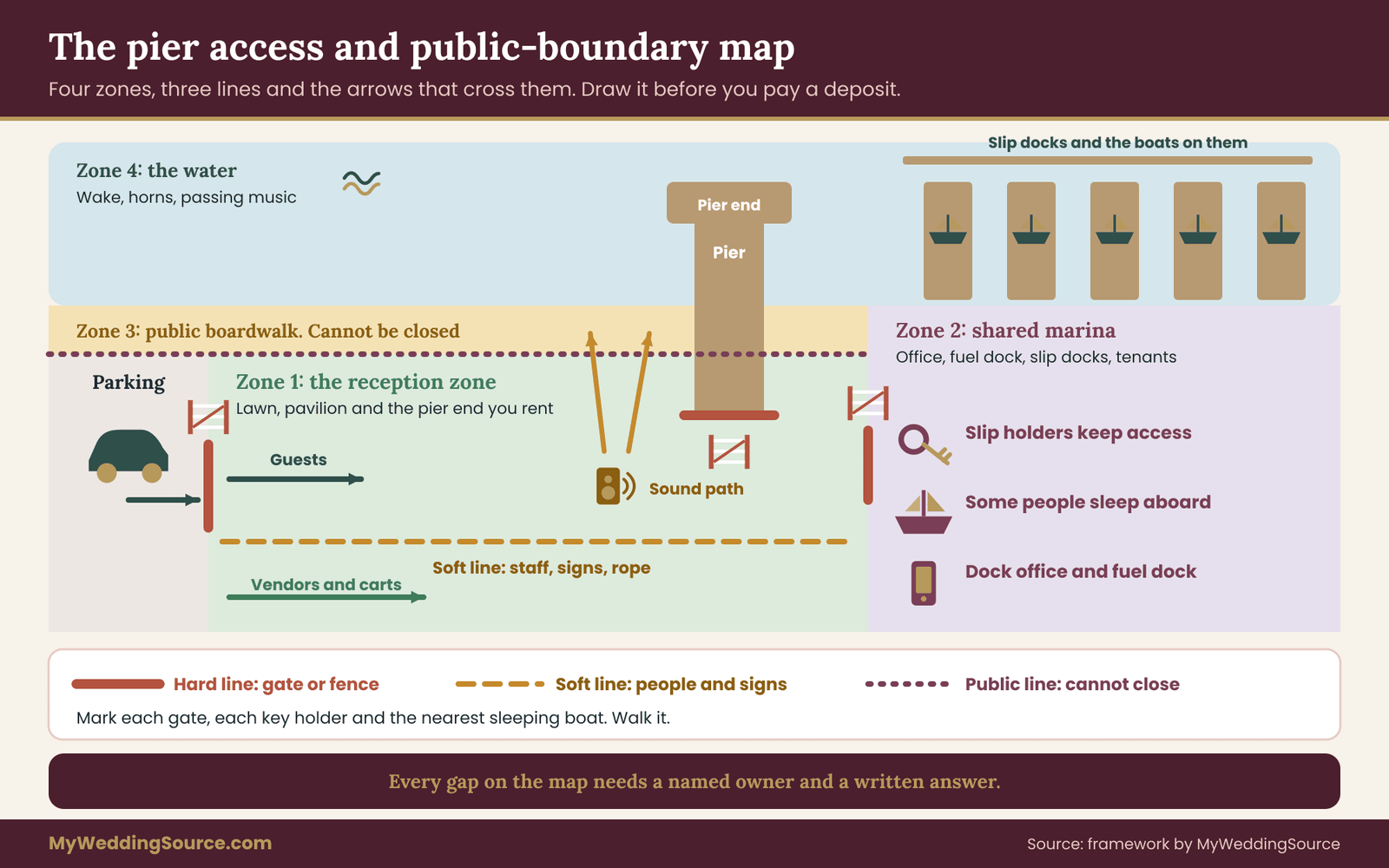
Before you sign for a marina reception, draw the property as four zones (your rental area, shared marina space, public space, and water) and mark three lines on it: a hard line made of gates and fences, a soft line made of staff and signs, and a public line where strangers have a legal right to be. Then write down who controls each line, what the sound will do over the water, and how guests and vendors get in and out. If a gap has no named owner and no written answer, it is still open, and an open gap is a reason to keep asking or to walk away.
Couples tend to picture a marina reception as a dinner and a dance with boats in the background. The marina picture is accurate, but it hides the fact that a marina is a business first. Slip holders pay to keep their boats there. Some of them sleep aboard. A fuel dock, a boat ramp, a harbormaster and a public boardwalk may all sit within fifty yards of your tables. None of them agreed to be part of your wedding, and several of them have rights that are older than your booking.
This guide stays narrow on purpose. It covers the reception itself: the noise it makes, the security it needs, and the access it depends on. It does not compare a boat ceremony with a dock ceremony, review charter contracts or explain what to do in high winds. Those are separate decisions with their own risks. If you are still choosing a venue type for your marina reception, start with the general guide to choosing a wedding venue and come back here once a marina is on your short list.
A note on scope. This is general planning information, not legal, insurance or maritime advice, and noise rules, alcohol laws, public access rights and vessel regulations differ by state, city and waterway. Where a rule matters, the guide names the type of office that issues it so you can confirm the current version yourself.
What makes a marina reception different from other venues
A marina reception shares most of its logistics with any outdoor event: tables, power, catering, restrooms, a timeline. The differences come from the setting, and there are five of them worth understanding before you look at a single contract.
The property is shared by design. A banquet hall controls its walls. A marina controls a rectangle of land and a network of docks, and many people have a claim on that network. Slip holders can usually reach their boats at any hour. Transient boaters may arrive to fuel up on a Saturday night. Staff run the dock office, handle lines and respond to emergencies. A rented lawn or pier end is a slice cut out of this working space, and the edges of the slice are not always marked.
Sound behaves differently over water. Open water has no trees, walls or buildings to absorb or scatter sound, so music from a speaker can carry a long way, sometimes to a shoreline across the harbor. Boats are not soundproof either. People living aboard hear a reception from a few feet away, and they are not guests.
Public access often cuts through the site. Many waterfronts include a boardwalk, a walkway or a public pier that the owner cannot close for a private party. Some marinas are owned by a city, a port authority or a park agency, and the public has a right to be on parts of the property. A wedding can share a boardwalk with joggers, fishermen and families out for ice cream.
Water adds risk that land venues do not have. A guest who has been drinking and walks a few steps in the wrong direction can end up in cold, dark water. Children move fast. Floating docks sway, and some have gaps, cleats and hoses that are easy to trip on in dress shoes. The right controls are not complicated, but they have to exist.
Access is narrow. Most piers and docks were built for foot traffic and boat gear, not for a catering van or a cart carrying a cake. Load limits, gate widths, cart rules and the distance from the parking area decide how fast your vendors can set up, and whether your most mobility-limited guest can reach the party at all.
Dockside, waterfront and marina are not interchangeable
The words overlap in listings, and the difference matters when you read the fine print. A “dockside” reception may happen on a pier, a boardwalk or a lawn beside the water. A “waterfront” venue may be a hotel terrace with a water view and no boats at all.
A marina is a facility with slips, and its rules are written for boat owners first and event hosts second. Ask the venue directly: is this a working marina with active slips and overnight boat owners, or a dock-themed event space? Your noise plan, your security plan and your insurance for a marina reception all change with the answer.
A fully private event pier at a closed yacht club behaves almost like a banquet hall. A busy municipal marina on a summer weekend behaves like a small public market with your party inside it. Most real sites fall somewhere between these two, and the map in the next section is how you find out where.
What this guide will and will not decide for you
The guide gives you a method, not a verdict, and it works for any marina reception. It will not tell you whether a particular marina is a good choice, because that depends on its layout, its tenants and its rules. It will help you walk the site with the right questions, put each answer in writing, and see the unresolved gaps before they become a problem at nine in the evening on the wedding day.
Four deliverables come out of the process of planning a marina reception. The first is a one-page site map with the zones and lines marked. The second is a gap list that names an owner for every open question. The third is a noise and security plan short enough to hand to a coordinator, a bartender and a marina manager. The fourth is a set of stop conditions, written before you fall in love with the sunset, that tell you when the marina is the wrong place.
The pier access and public-boundary map
The map is the heart of this guide. You can draw it on paper in an hour once you have the marina’s site plan, and it will answer more questions than a dozen emails. Start with a printed aerial image or the marina’s own plan, ask the manager for the site plan the marina uses for events if one exists, and mark it up in pencil. Then take it on a measured site walkthrough, using the checklist in the venue technical walkthrough guide as a model, so every line you draw has been walked.
Step one: four zones
Divide the property into four zones and label them clearly.
Zone one is the marina reception zone. This is the area you are paying to use: a lawn, a patio, a pier end, a pavilion. Draw its edges exactly. If the contract says “the event lawn,” find out where the lawn ends, and whether a path, a hedge or a dock ramp cuts through it.
Zone two is the shared marina zone. This covers everything the marina operates for its own business that is still private property: slip docks, the fuel dock, the dock office, the boat ramp, the ship store, boat storage and the parking areas. People who belong here, such as slip holders and staff, will keep moving through it during your event.
Zone three is the public zone. This is any walkway, pier, street, beach or shoreline where the general public has a legal right to be. It includes sidewalks, public boardwalks and any part of the waterfront owned by a city or agency and open to everyone. It also includes the public waterway itself, where boats may pass.
Zone four is the water. The harbor or channel beside the pier. You cannot rent it, and you cannot control who uses it, although a marina may set rules for its own basin. Wake, boat horns, passing music and vessel lights all come from zone four.
Step two: three lines
Once the zones are marked, draw the lines between them. A line is simply the place where one set of rules ends and another begins, and each of the three kinds is controlled differently.
The hard line is physical: a locked gate, a fence, a pier gate with a latch, a door. It is the only line that actually stops someone. Mark every gate on the map and ask who holds the key or the code, and who can change it.
The soft line relies on people and signs. A staff member at the head of the pier, a rope with a sign, a wristband check, a greeter with a guest list, a “private event” sandwich board. It guides people who want to follow the rules. It does not stop someone who does not.
The public line is the edge of what you cannot close. A public boardwalk next to your tent is a public line. So is a street, a public pier or a beach below the high-tide line, depending on local law. You cannot move it. You can only design around it, with seating, screening, signage and staffing placed on your side.
Step three: arrows and sound paths
Add four kinds of arrows. Guest arrows show how people arrive from parking and leave at night. Vendor arrows show where vans stop, where carts roll, and which gate they use. An emergency arrow shows how an ambulance or fire truck reaches the water’s edge. An access arrow shows the step-free route for anyone who cannot use stairs or steep ramps. Then add a fifth set, drawn in a different color: sound paths, from each planned speaker toward the nearest boats, homes and public areas.
Step four: the gap list
Walk every line and arrow and ask the same three questions. Who controls it? What does the contract say about it? What happens if it fails? Each unanswered question is a gap. Write the gap, the person who can close it and the date you need the answer. The rest of the guide goes through the common gaps in the order that tends to matter: control, noise, security, access, alcohol and weather, contracts, then a worked case and the stop conditions.
Who controls each part of a marina reception
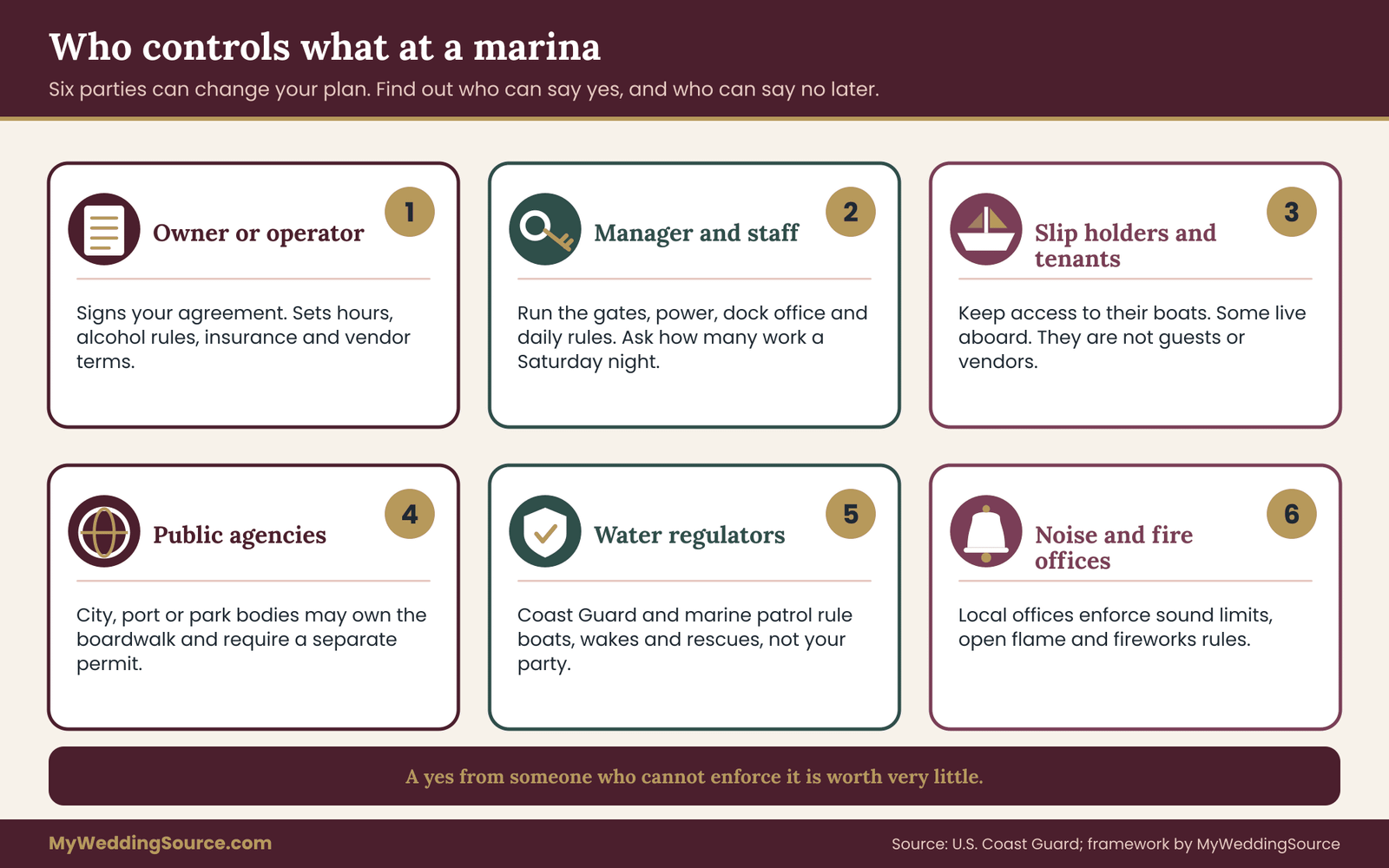
A single phone call to the marina office rarely settles who controls what. Several parties usually have a say in a marina reception, and a gap often hides in the space between two of them.
The owner or operator. This is the entity that signs your rental agreement. It might be a private company, a yacht club, a city, a county or a port authority. The owner sets the hours, the insurance requirements, the alcohol policy and the rules for vendors.
The marina manager and dock staff. The people on site control the gates, the dock office, the water and power hookups and the daily rules of the property. They are also the people who will answer if a guest wanders into a restricted area. Meet them, and ask how many staff members work on a typical Saturday night.
Slip holders and tenants. They rent a place for a boat, usually under a long agreement that includes access rights and sometimes quiet-hours rights. A slip holder is not your guest and is not your vendor. A marina may not be able to ask a tenant to stay away from their own boat, even for one evening.
Public agencies. A city or port authority may own the land or the boardwalk, even if a private company runs the marina. Parks, police and harbor patrol may each hold a piece of the rules. A public body may require a special event permit that is separate from your rental agreement, and the permit may carry conditions on sound, alcohol and crowd size.
Regulators of the water. Rules for boats, wakes and navigation sit with agencies such as the Coast Guard and state or local marine patrol. They matter to a marina reception mostly in an indirect way: a vessel arriving to pick you up, a passing boat or an emergency on the water falls under their authority, not the marina’s.
Ask who can say yes, and who can say no later
The most useful question in the whole process is a simple one: who else could change this? If the manager promises the pier gate will be closed to everyone but your guests, ask whether slip holders have a right to use it. If the marina says amplified music is fine until ten, ask who set that limit and whether a neighbor or an agency can override it. A yes from someone who cannot enforce it is worth very little. You want the party that can enforce the answer to be the one who signs it.
Put the names and numbers of each controlling party in one list. On the day, the person holding the list should be able to reach the right decision-maker within minutes, not hunt through an inbox.
Noise at a marina reception: how sound travels over water
Noise is the first problem most hosts of a marina reception underestimate, because the venue feels open and friendly and the party feels like it belongs. Sound does not know the difference between a party and a complaint. At a marina reception it moves across a flat surface with little to stop it, and it reaches boats, homes and public paths that you cannot see from the dance floor.
What changes over water
Three things make waterfront sound behave differently from sound in a hall or a field.
First, hard flat surfaces reflect sound. Water, docks, fiberglass hulls and nearby buildings bounce it back and forth. Second, there is often little background noise at night to cover it, so a bass line that would vanish in a city street stands out over a quiet harbor. Third, wind and temperature can bend sound so it carries farther in one direction than another.
Evening air over cooler water is a common example. You do not need to understand the physics to plan for it. You only need to accept, when planning a marina reception, that the distance you can hear a speaker is usually much larger than the distance you can see.
The people who hear you are not only distant neighbors. In a working marina, the nearest listener may be a person sleeping on a boat thirty feet from the dance floor. Boats are light, and their hulls and ports let sound through. A person aboard cannot close a door on the music, and may have to be up early for work or a trip.
The rules you are working with
Noise limits come from several places, and a marina reception can be subject to more than one at once.
The marina’s own rules. Many marinas set quiet hours for the whole basin, write them into slip agreements and extend them to events. These rules are usually the strictest practical limit, because the marina answers to its tenants every day of the season.
Local ordinance. Cities and counties write noise rules in different ways: a decibel limit measured at a property line, a cutoff hour for amplified sound, or a general standard about unreasonable disturbance. The wording and the hours vary widely. Ask the marina which rule applies and which office enforces it, then look it up on the local government’s site or ask the office directly.
Event permits. If a public agency owns the land, a permit may name a sound limit, a stop time or both. A permit can be stricter than the ordinance, and the permit usually lands on the host, not the marina.
Your contract. A good agreement states the hours of amplified music, whether the venue may shut off sound, and what happens if there is a complaint. A contract that is silent leaves the decision to whoever is on duty that night.
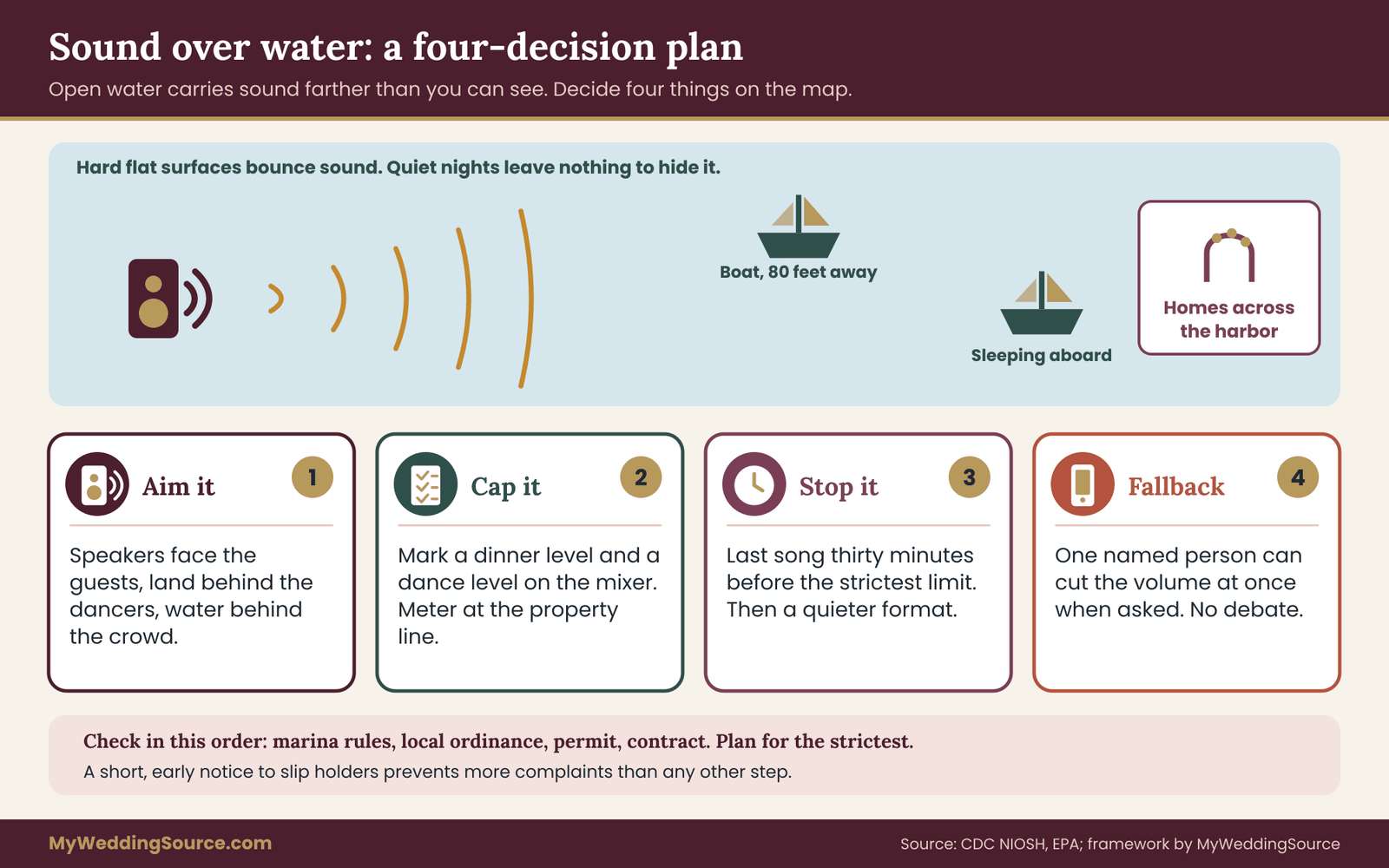
For a marina reception, check the rules in that order: the marina’s rules, then the ordinance, then any permit, then your contract. If the answers disagree, the strictest one is the one you plan for.
Build a sound plan on the map
Take the site map from the previous section and use the sound paths you drew. For each planned speaker position, draw an arrow toward the nearest sleeping boats, the nearest homes and the public boardwalk. Then make four decisions and write them down.
Decide where the sound faces. Place speakers so they point toward the guests and away from the water and homes. A pair of speakers aimed at the dance floor from the landward side, with the water behind the crowd, does less harm than a speaker facing the harbor. If your DJ or band says a position is not possible, ask why, and ask what they can do instead.
Decide the cap. Ask your DJ or band to agree on a maximum level they can keep without a meter, and ask the marina whether it has a way to measure. A simple rule is to set a level for dinner and a level for dancing and mark the setting on the mixer. If the venue has a decibel limit, hire a person with a handheld meter and have them check at the property line, not at the speaker.
Decide the stop time. Pick the hour amplified music must end and work backward. If the marina’s quiet hours begin at ten, a ten o’clock end means the last song plays at nine fifty and the DJ needs to be breaking down at ten, not starting the final dance. Many couples place the last dance a half hour before the limit, and move the party to a quieter format afterward: acoustic music, a playlist at low volume, or guests heading to an after-party.
Decide the fallback. Agree in advance what happens if the marina asks you to turn the sound down. The person who receives the request should be named, and should have the authority to tell the DJ to cut it by a set amount without a debate. Time lost arguing is time the complaint grows.
Ceremony, cocktail hour and dinner sound
Not all sound at a marina reception is the same. Quiet segments cause little trouble: a string trio during cocktail hour, a short toast with a microphone, background music at dinner. The risk comes from the amplified dance set and from anything with a strong low-frequency beat. If your marina reception allows only a limited window of loud music, protect the window. Keep speeches short, run dinner at moderate volume and start the dance set at the time that gives you the longest legal stretch before the cutoff.
Microphone feedback also carries over water and can be annoying to people who did not choose the event. Ask the sound provider to check for feedback before guests arrive, not after. For help matching music style to your crowd and the rules of the venue, the guide to wedding reception music planning covers how to build a set list that works for different generations, and the same logic helps when part of the set has to be quieter.
Fireworks, sparklers and horns
Some couples planning a marina reception ask about a fireworks display, a sparkler exit or a boat horn salute. Each of these brings its own rules and risks, and each can disturb animals, boaters and neighbors. Fireworks on or near the water usually require a licensed operator and a permit from the local fire authority, and the marina may prohibit them entirely.
Open flame on a dock near fuel is a serious hazard, and a marina may ban sparklers and candles for that reason. Treat any request for fire, smoke or explosives as a separate approval process with its own lead time, and do not assume that one yes covers it.
Telling neighbors and tenants ahead of time
A short, early, friendly notice about your marina reception reduces complaints more than any other single step. Ask the marina whether it will post an event notice at the dock office or send one to slip holders, and offer to write it. A good notice has the date, the hours of amplified sound, the stop time, a contact person for concerns and a line of thanks. Do not include guest details, a map to the party or personal information.
For people living aboard, consider a more direct approach. Ask the marina whether you may leave a short note on each boat nearest the reception area, or ask the manager to do it. A note that says “we are hosting a wedding on Saturday, music ends at ten, here is who to call” turns a surprise into a known event.
Some hosts add a small gesture, such as a thank-you card or a gift certificate to a local café, and it is a kindness, not an obligation. What matters is that a person who hears the party knows who to call and gets a fast, respectful answer.
What to say when someone complains
If someone from the marina, a neighbor or an officer asks you to lower the sound, the best response is quick and calm. The designated person says something like: “Thank you for telling us. We will turn it down now, and we will check again in ten minutes.” Then they do it.
Arguing about whether the complaint is fair does not help, and it often escalates a request into a citation or a shutdown. Keep a record of the time, who asked and what you did. If the same request comes twice, move the end time earlier, and tell the guests it is a courtesy to the harbor.
Noise failure conditions for a marina reception
The noise plan has failed, and the marina reception should change, if any of these are true. The marina cannot tell you which noise rule applies. The hours of amplified sound end before the dance you planned could reasonably start. The nearest sleeping boats sit within a few dozen feet of the speakers and the marina will not discuss a notice or a different speaker position.
The marina says the contract will not say anything about sound, and “we will handle it” is the whole answer. When one of these appears, you can still keep the marina. You may need to move to a quiet reception format, shorten the schedule or shift the music to a venue away from the water.
Security at a marina reception: gates, strangers and the water’s edge
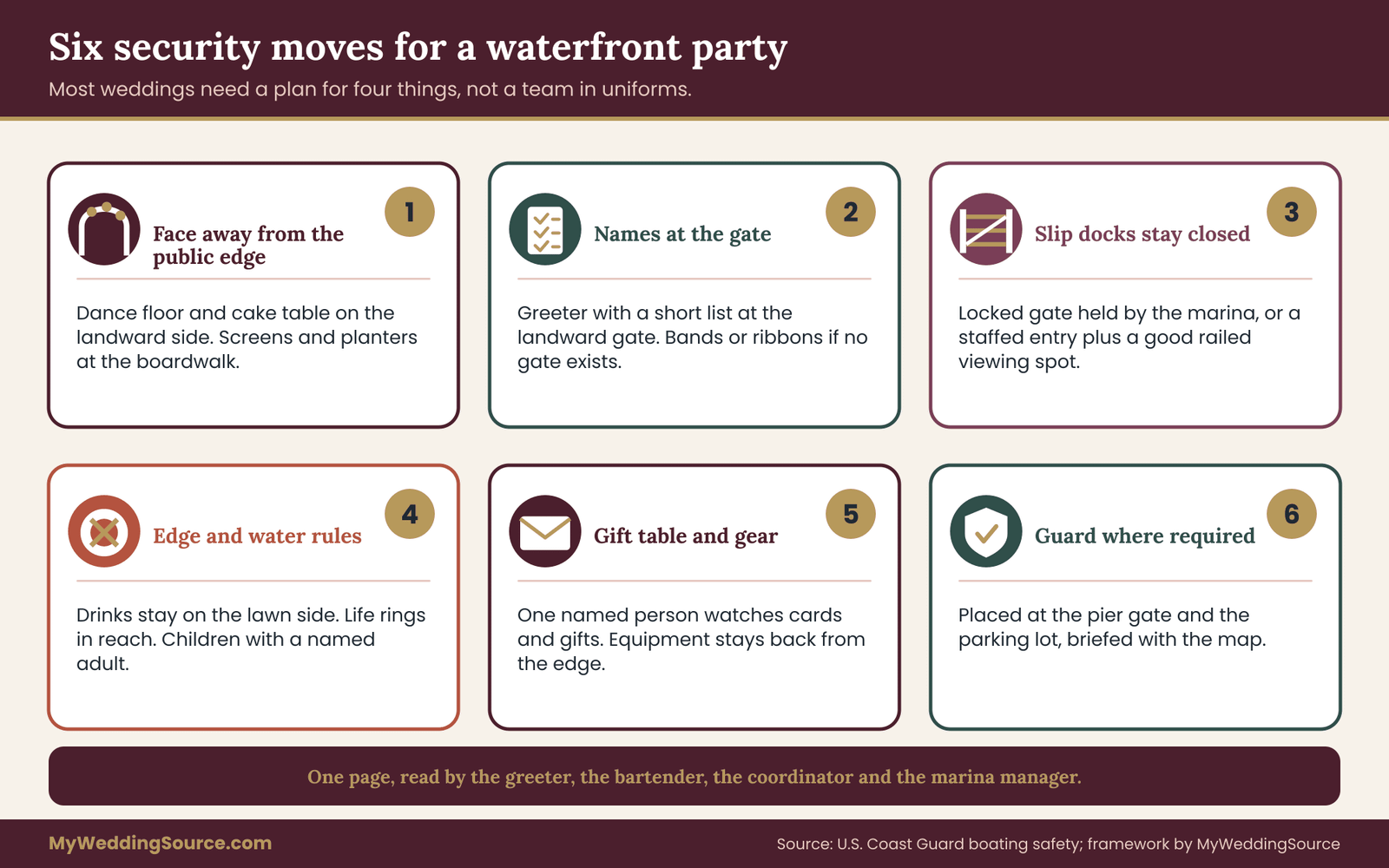
Security at a wedding sounds heavier than it needs to be, and a marina reception is no exception. Most couples do not need a team in uniforms. They need a plan for four ordinary problems: people who are not on the guest list drifting in, guests drifting into places they should not go, property going missing, and someone getting hurt near the water. A marina reception has all four, and the map makes each one visible.
Who can walk onto your reception
Begin with the public line, because every marina reception has one. If a public boardwalk or pier runs along your marina reception zone, strangers can legally stand there, look and listen. You cannot ask them to leave the boardwalk, because it is not yours. What you can do is decide how much of your party they see and how easy it is for them to step from the boardwalk onto your side.
Three design tools help. Orientation: place the dance floor, the cake table and the head table away from the public edge, so the people on the boardwalk see backs and bushes, not the first kiss. Screening: a row of tall plants, a fabric screen or a line of rental fencing between the public edge and your guests reduces both view and casual entry.
Check that the marina allows screens, because wind can turn a fabric screen into a sail. Signage and staffing: a small sign saying “Private event” with the hours, placed at the point where the public path meets your zone, and a greeter nearby, gives passersby a clear signal and gives you a person to speak to anyone who steps over the line.
Do not use a sign to claim rights you do not have. A sign that reads “No public access” on a path that is legally open can create conflict with the marina and the agency that owns the land. Ask the manager what wording the marina uses for events.
The guest list and the gate
If the marina has a gate that can be controlled for your marina reception, such as at the landward entrance or the head of the pier, a guest list at the gate is the single most effective security measure. Use a short printed list, the names the couple supplied, and a greeter who knows the faces of at least some guests.
The greeter does not need to demand identification. A friendly “Welcome, may I have your name?” works, and a name that is not on the list gets a polite “Let me check with the couple” and a call or text to the coordinator.
If the marina cannot control a gate, a wristband or small ribbon for guests can serve the same purpose from a distance. A band does not stop a determined person, but it makes strangers visible and helps staff see who belongs. Keep a spare supply for late additions and for vendors.
Think also about the reverse problem. A gate that is too tight can trap guests who want to leave, or block vendors. Plan a clear exit route, and make sure an emergency vehicle can reach the marina reception zone without waiting for someone to unlock a latch.
Hiring security: when and what kind
A professional security guard is not always necessary at a marina reception, and sometimes the marina requires one. Ask whether the venue has a rule: some marinas require licensed security at events above a certain size, or when alcohol is served, or when the event ends after a set hour. If the rule exists, ask whether you must use the marina’s own provider or may hire your own, and what the cost per hour is.
If there is no rule, think about what a guard would do. A guard stationed at the pier gate checks names and keeps the soft line firm. A guard walking the edge of the marina reception zone watches for guests heading toward restricted docks and for outsiders approaching. A guard at the parking area reduces the risk of theft from cars after dark. One or two people at the right places usually do more than a larger group without a plan.
When you hire security, give them the map. Mark the lines, the gates and the places where you do not want guests to go. Brief them on how to speak to guests: calm, polite and brief. Guests are often a little drunk and entirely friendly, and a guard who is stern with a groomsman can spoil the mood. A good brief includes who to call for any problem, the stop time for music and bar, and what to do if a stranger refuses to leave.
Guests who wander to the docks
The most common safety problem at a marina is not a stranger. It is a guest, usually with a drink in hand, who decides to see the boats. The dock looks inviting at night, the lights are low, and a friend says “come look at this one.” Floating docks move, cleats and hoses lie across walkways, and the edge has no rail.
Close off access to the slip docks with a hard line wherever you can: a gate that stays locked to guests, with the key held by the marina. If that is not possible, use a soft line.
Put a staff member or a volunteer at the dock entrance, place a clear sign, and give guests a place to go instead: a dock-side viewing area, a lit and railed pier end, or a seating zone with a view. People wander when there is nothing to hold them, and a good view where they are allowed to stand lowers the pull of the forbidden one.
Boat owners may invite guests aboard, and some guests may take the invitation as a joke or a challenge. Marinas usually do not allow event guests on private vessels, and an owner who invites a stranger onto a boat can create liability for everyone. Tell your guests that the boats are private property and are off limits, and tell your hosts to repeat it politely.
Children, water and the edge
If children are invited to the marina reception, they need a plan. The plan does not have to be elaborate: one named adult responsible for each small child, a rule that children stay on the lawn side of the fence, and a quiet activity table well back from the water.
Some venues require life jackets for children on docks, which can be a good rule even if it is not required. Ask the marina and bring jackets if needed, sized properly. The guide on wedding guest care covers children and older relatives in more detail, and the same planning helps here.
Place life rings or throwable devices where staff can reach them, and ask the marina where they are kept. Know where the nearest first aid kit and automated external defibrillator are, and who has the key to the cabinet. A quick walk with the marina manager to point these out takes five minutes and might matter on the day.
Lost items, gifts and valuables
A gift table is a target at any wedding, and at a marina reception it sits in the open. At a marina, the table sits in an open space with many people nearby and often a dark parking lot. Assign one person, not a vague “someone,” to watch the table or move the cards and gifts to a secure place at set times. A locked vehicle is better than an unlocked table, and a locked office in the dock building is better than both. Keep envelopes with cash or checks out of sight.
For personal items such as phones and handbags, tell guests where to leave them and that the marina is not responsible. Photographers and DJs carry expensive equipment; ask whether the marina has a locked room or whether vendors should lock gear in their vehicles. Valuable items placed on a pier are also at risk of a different kind: a wave, a gust or a bump can send a camera or a speaker into the water. Keep equipment away from the edge.
Alcohol and the edge: a quick note
Alcohol and water make a poor combination, and a marina reception serves alcohol at most weddings. The best protection is a layered one: food served before and during drinks, a bar that stops serving at a set time, water available at every station, and a ride home arranged for anyone who needs it.
The full discussion of bar service, last call and licensing belongs in the section on alcohol and after-dark planning later in this guide, because the rules differ for each place. Here the point is only that your security plan should include a person who knows when to say “that is enough.”
Writing it down: the security plan on one page
Pull the security decisions for the marina reception into one page and share it with the coordinator, the greeter, the guard if you hire one, the bartender and the marina manager.
The page should list the gates and who holds each key, the guest list method, the places guests must not go, the person responsible for the gift table, the number to call for a medical problem, the location of the life rings and first aid kit, and the end time for the bar and the music. A single sheet that everyone has read beats a long plan that no one has seen.
Marina access: piers, carts, parking and the step-free route
Access decides whether a marina reception runs smoothly or stalls at the gate. Marinas were built for boat owners carrying coolers and rope, not for a caterer with forty trays or a guest using a wheelchair. Every piece of access should appear on the map as an arrow, and every arrow should be tested by someone walking it, not by a phone call.
The walk from parking to the party
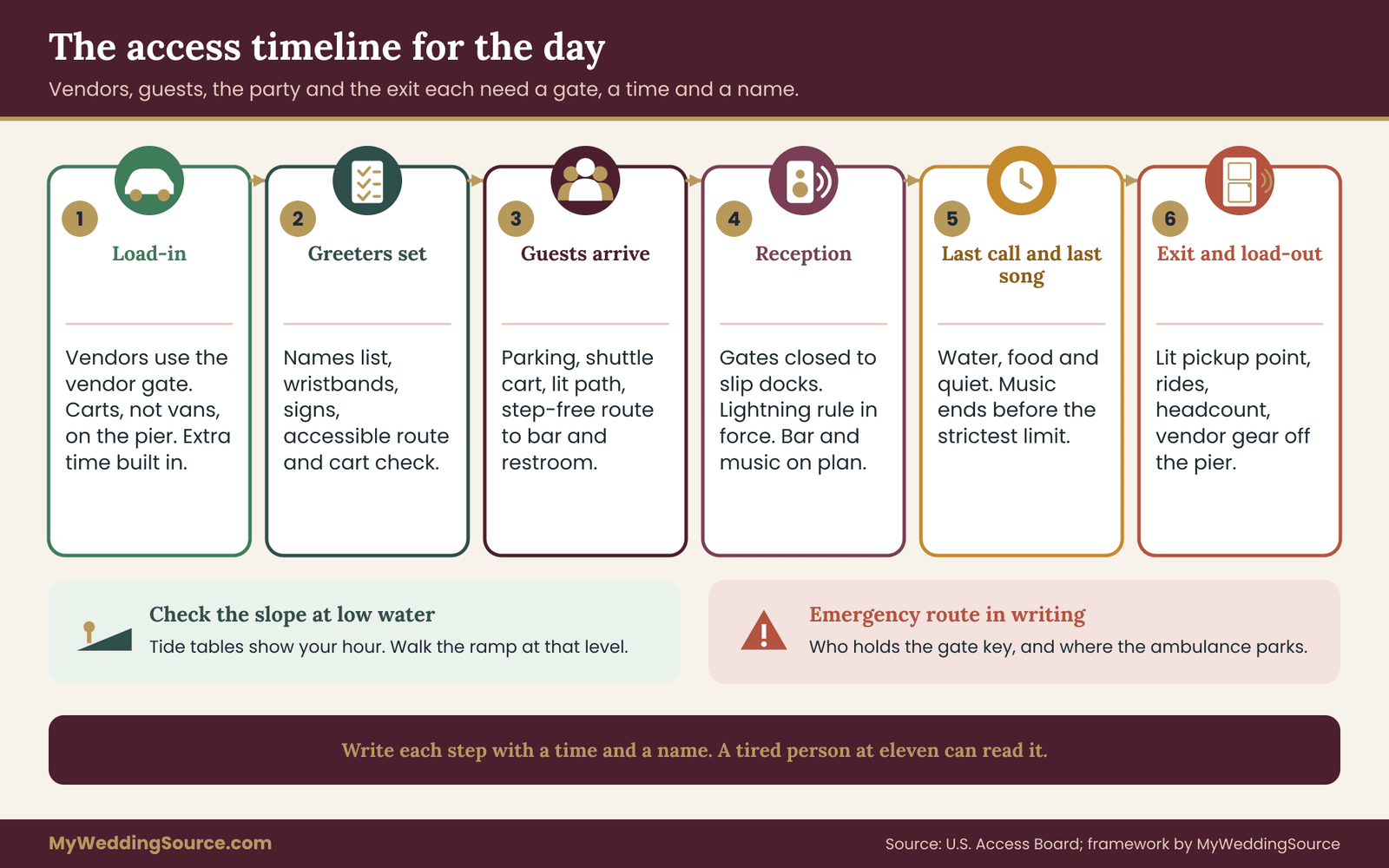
Start where guests start. Where do they park, how far is the walk, and what surface is it? Gravel, boards with gaps, a steep ramp and a long dock can turn a pleasant arrival into an ordeal for older guests, people with mobility limits and anyone in formal shoes. Walk the route yourself and time it. If it takes more than a few minutes, or if there is no shade, plan a shuttle, a golf cart or a drop-off point close to the entrance.
Parking at a marina reception site is often shared with boaters, anglers and restaurant customers. Ask how many spaces are reserved for your event, whether others can use them, and whether guests need a pass. If parking is limited, ask whether there is overflow parking nearby and whether a shuttle is possible. Think about the return trip at night. A dark lot, a long walk and a few drinks do not mix well, so plan lighting and a pickup point for ride shares and taxis, and make the location easy to describe to a driver.
The step-free route
At a marina reception, any guest who cannot manage stairs, steep slopes or uneven surfaces needs a route to the party that is safe and dignified. Ask the marina where its accessible route runs and whether it reaches the marina reception zone, the restrooms and the bar. Piers and floating docks can slope sharply at certain tides, and the angle of a gangway changes through the day as the water rises and falls.
Ask what the slope is at the lowest tide on your date and whether the marina has a ramp that meets accessibility guidelines. The U.S. Access Board publishes guidelines for recreational boating facilities, and the Department of Justice explains the Americans with Disabilities Act. Use them as a starting point for your questions, not as a substitute for a conversation with the marina.
Walk the route with a person who uses a wheelchair or walker if you can, or at least push an empty wheelchair along it. Check the width of gates, the gaps between boards, the lip at the start of a ramp and the surface at the destination. Check that the accessible restroom is truly accessible and not a locked room across the lot. The article on accessible wedding venue red flags lists warning signs to look for at any venue, and most of them apply here.
If the step-free route is long or inconvenient, tell guests in advance and offer a ride from the parking area. Ask guests privately what would make the day easier, and place their seats near the entrance and the restroom. A good arrangement should not require anyone to ask twice.
Load limits, pier width and what a van can do
Piers and docks have load limits, and a marina reception can exceed them quickly. Chairs, tables, a dance floor, a cake, a sound system, a band and two hundred people add weight, and the weight is concentrated on a structure that may be old.
Ask the marina whether the pier has a stated capacity for people and for equipment, and whether a structural review has been done. If the marina gives a number, divide your plan against it. If the marina gives no number, ask who decides, and do not assume the pier can carry what the lawn can.
Width matters just as much. A cart that fits a path may not fit through a gate with a post in the middle. Measure the narrowest point between the parking area and the marina reception zone, and give the measurement to your caterer and rental company.
Ask whether vehicles are allowed on the pier, and if so, which kind and in which hours. Many marinas allow carts and hand trucks only, and some ban rolling a loaded cart over certain boards. A vendor who has not measured and arrives with an oversized dolly will lose twenty minutes on the walk.
Load-in, load-out and the vendor gate
Vendors at a marina reception are guests of the marina as well, and the marina has rules about them. Ask for the vendor policy in writing. A typical policy covers the hours vendors may arrive, where they may park, which gate they use, whether they must show insurance, and whether they must be approved. Some marinas keep a list of approved caterers, florists and rental companies, and require anyone else to pay an extra fee or to provide proof of coverage.
Draw the vendor arrows on the map from the loading point to the kitchen area, the bar, the sound system and the dance floor. Time a trial: how long does it take to carry a case from the parking lot to the bar? A caterer who needs three hours to set up may need four at a marina.
Add the extra time to the contract, because a tight setup window pushes the start of the reception and cuts into everything after it. The site guide on measurements and access routes lists what to measure and who to ask, and it is a good template for a visit before you sign.
Plan load-out as carefully. At the end of the night people are tired, the lights are low, and the pier may be slippery. Many marinas require all rentals to be removed by a certain hour. If vendors cannot reach the pier until morning, ask where the items will be kept overnight and who is responsible for them. A rental chair left at the pier edge is a hazard and a loss.
Utilities: power, water, lights and restrooms
A marina has power at the docks, but a marina reception needs more than a boat does, but power for a boat is not the same as power for a band. Ask what is available, who controls it and what the limit is. A shore power pedestal might support a small speaker and a string of lights, and not a catering kitchen.
Generators work, but they are loud and produce fumes, so ask whether the marina allows them, and place them far from guests and away from the water. A generator that runs through dinner adds its own noise to the soundscape, and the marina reception noise plan should include it.
Lighting is a safety item, not a decoration. A dock at night without enough light is a place for falls. Ask what lighting the marina provides, what it plans to turn off, and whether you can add your own. String lights, lanterns and battery lights can all work if they are secured, away from the edge and not a trip hazard. Check that cords are covered and do not cross walkways.
Restrooms need a count, a location and an accessibility check. A rule of thumb used by many event planners is to provide enough units for the guest count and the length of the party, and to add more if alcohol is served. If the marina’s restrooms are far away, a rental unit may be necessary, but a rental trailer needs a flat, firm spot and a way to reach it. Ask where it can go, and check that the route does not cross a restricted area.
Emergency access
A marina reception should have a route for an ambulance or a fire truck to reach the water’s edge, and the people who work there should know it. Ask the manager how emergency vehicles reach the property, whether the gate can be opened quickly and where a vehicle would park. Draw it on the map, and give the route to the coordinator, the greeter and anyone controlling a gate. A locked gate with no one holding the key is a delay no one wants.
Ask also about the plan for a person in the water. Marinas usually have a procedure, and the staff know it. A short conversation with the dock manager before the event, in which you ask what they would do and what you should do, gives you a plan, and it shows the manager that you take the setting seriously.
Guest and vendor timeline for access
Pull the pieces into a timeline for the day of the marina reception. Vendors arrive first, followed by the coordinator, the greeter and the guards. Guests arrive in a window, ideally with a staff member watching the path and the gate. The reception begins, the bar opens, the music rises and falls, and at a set hour the party ends.
Load-out begins as the last guest leaves, and the marina confirms that the site is clear. Write each step with a time and a name, so that a tired person at eleven at night can read the page and know what to do next.
Alcohol, darkness and the ride home at a marina reception
Alcohol is not unique to a marina reception, but the setting raises the stakes. Water is close, the ground is unfamiliar, the light is low, and the walk to the car can be long. A bar plan that works in a ballroom needs a few adjustments here, and most of them cost very little.
Who can serve, and who decides
At a marina reception, alcohol rules vary by state and sometimes by city, and a marina often adds its own. Some marinas hold a liquor license and require you to use their bar. Some allow outside catering and a licensed bartender with a temporary permit. Some allow beer and wine only. Some prohibit alcohol on docks and permit it only on the lawn or in a building. Ask three questions in writing: who may serve alcohol at this site, what permits or insurance does the server need, and where on the property may guests drink.
The bar is also where responsibility concentrates. A trained bartender who checks guests, refuses service to someone who has had enough and keeps track of timing protects the couple, the marina and the guests. If you hire a bartender or a catering company, ask what training the staff have and what the policy is for refusing service. The guide to wedding bar service planning covers the number of bartenders, drink menus and licensing questions that apply to any venue, and it is a good companion to the marina-specific points here.
Set the edge of the drinking zone
The map you drew can help with alcohol as well. Mark the area where drinks are allowed and the area where they are not. Make the drinking zone one that does not include the dock edge, the fuel dock or the slip docks, and say so on the signage and in the brief to staff.
A line of plants, a rope or a rail at the edge of the marina reception zone reminds people where to stop. Ask guests, kindly and in writing on the program or a sign, to leave glassware at the bar or on a table before walking to the water. Broken glass on a dock is a danger to feet and a mess to remove, and glass in the water is a danger to marine life.
If the marina prohibits glass, plan for plastic or recyclable cups, and look for ones that look decent. Many couples find that good compostable cups and a well-designed bar cut the problem without hurting the look of the party.
Timing: when to stop serving
Decide the last-call time for the marina reception in advance, and place it before the end of the music, not after it. A common pattern is to stop serving thirty to sixty minutes before the party ends, to move to water, coffee and food, and to leave enough time for guests to sober a little before the walk to the car. Work out the time with the bartender and tell the DJ so that the announcement is part of the timeline.
Food is the most useful tool. A late-night snack such as sliders, fries or a dessert table gives people something to do besides drink, and it can slow the pace of the evening. Water stations at several points, not only at the bar, nudge guests to drink water. A person who is told that the bar closes in fifteen minutes will often make a plan to get home.
Rides home
The site of a marina reception is usually at the edge of town, and the road to it may be dark. Arrange transportation before the event, not at its close. Options include a shuttle that runs between the marina and a hotel, a pre-arranged group of ride-share codes, a taxi company with a reserved pickup, or a designated driver list among the wedding party. Pick one or two, tell guests in writing and post the details at the exit.
The pickup point needs light, a clear name and a safe place to stand. If it is hard to describe, put a pin on a map and share it with guests. A guest standing at a dark gate waiting for a car is a safety problem. For the people who will walk, a lit path and a person at the gate to say goodnight help everyone.
Hotels near the marina can simplify the night. A hotel a few minutes from the marina reception means fewer cars on the dark road, so ask the marina which nearby hotels guests use most.
Darkness, lighting and the dock after dusk
Light changes a marina after sunset. A dock that looked friendly at six can be hard to read at nine, with dark water beside the planks and reflections that disguise the edge. Walk the site at dusk with the marina manager. Ask which lights come on automatically, which are controlled by staff and which can be added. Check the pier edge and the steps, and place additional lights where the marina’s lights leave a gap.
Warm, low lights suit the mood and the water, but low light also hides trip hazards. A good compromise is to place steady light along walking routes and at steps and edges, and to use softer, decorative light in seating areas. Avoid blinding light directed at the water or at neighboring boats. Many marinas also have rules about light that could be mistaken for a navigation light, so ask the manager before you hang anything near the water.
Contracts, insurance and written answers for a marina reception
Everything you have learned about your marina reception from the map belongs in a document. A promise from the marina manager is a good start, but a promise that never reaches the contract may not survive a staff change, a complaint or a dispute. The goal is not to write a thick agreement. It is to get the specific points that matter in writing, in plain words, signed by the party that can keep them.
The terms that matter most
For a marina reception, read the rental agreement with the map beside it, and check that each of these appears in writing.
The marina reception zone. The agreement should describe the area you may use, ideally with a map attached. “The event lawn” is not a boundary. A marked plan is.
The hours. The agreement should state when setup may begin, when the reception starts and ends, when amplified sound must stop, when alcohol service ends and when load-out must be complete. Ask what happens if you go over, and what the fee is.
Public and tenant access. The agreement should say what access the public and slip holders keep during your event, which gates will be locked, which will stay open, and who is responsible for each. If the marina cannot close a path, the contract should say so, and you should see it before you pay.
Noise. The agreement should say what noise rules apply, who enforces them and what happens after a complaint. A clause that allows the marina to shut down music at its sole discretion, without notice or refund, deserves a conversation.
Security. The agreement should state whether security is required, who provides it and what it costs. If the marina provides staff, ask what they do and what they do not do.
Vendors. The agreement should state vendor rules, including insurance, approval and arrival times.
Alcohol. The agreement should say who may serve, under which permit and until what hour, and whether the host needs liquor liability coverage.
Damage and cleanup. The agreement should describe what happens if the dock, a boat or a piece of equipment is damaged. A deposit may be held against damage, and cleanup of trash, glass and decorations is usually the host’s job. Ask what condition the site must be left in.
Weather and cancellation. The agreement should describe what happens in high wind, lightning or a storm, whether there is an indoor backup, and how a refund or a date change works. The next section looks at this in more detail.
Insurance and additional insured requests
Most marinas hosting a marina reception ask the host and vendors for proof of liability insurance, and many require the marina or its owner to be named as an additional insured on the policy.
A special event policy for a day is common and can be arranged through an insurance agent, and the agent can tell you what the marina’s request means in practice. Do not accept an answer such as “everyone does this” without seeing the wording. Ask for the exact requirement in writing, including the minimum amount, the name to list and the due date.
Some events also require liquor liability coverage, and some policies exclude water-related incidents, so ask the agent directly. Tell the agent that the event is at a marina, that there will be alcohol and that guests will be near water. The best time to find out that a policy has a gap is before the event. Insurance is a technical area, and an agent or attorney can answer questions about your own situation.
Reading the indemnity clause
Many venue contracts include an indemnity clause, which says the host will protect the venue from claims. It may be broad. A marina that rents space for events can face a large claim if a guest is hurt, and it passes that risk to the host.
You may not be able to remove the clause, but you can ask what it covers, whether it applies to the marina’s own negligence and whether your insurance is expected to cover it. If you do not understand the wording, ask an attorney to read it before you sign. The general guide to wedding vendor contracts lists the terms worth checking in any agreement, and it works as a checklist alongside the marina-specific items above.
How to ask, and what to say
A request to change a contract is easier to make when it is calm and specific. Instead of “we are worried about noise,” say: “We would like the agreement to state the hours of amplified sound and who enforces them.
Can you add a line?” Instead of “will the public be able to walk through,” say: “Can you show us on the plan which paths remain open to the public during our event, and add that plan to the agreement?” If the marina says no, ask why, and ask what it can offer in its place. A refusal tells you something about the site, and you can weigh it with everything else.
Keep every email. When a manager gives a verbal answer on the phone, send a short follow-up: “Thank you for the call today. To confirm, music must end by ten, and the pier gate will be locked to slip holders from six to eleven. Please tell us if anything is wrong.” A written record is simple to make and can save an argument.
Weather, tides and the decision clock at a marina reception
Weather at a marina reception differs from inland weather in two ways. Wind is usually stronger and more variable, and storms can build quickly over open water. Tide, where it applies, changes the height of the water against the pier and the slope of every ramp and gangway. Both matter to a marina reception, and neither needs a forecaster’s skill. They need dates, a source and a decision rule.
Wind and the things it moves
A breeze that feels pleasant at four can become a problem at six. Wind knocks over signs, lifts tablecloths and sends light objects into the water. It also pushes sound. Ask the marina for its experience of the wind at the time of day and season of your event, and look at the marine forecast from the National Weather Service for the few days before.
Tents and canopies need anchors that suit the surface. Weights set on a dock, not stakes driven into the ground, are a common approach, and the marina may require a particular method or ban tents on the pier altogether. Ask early, because a tent order is hard to change late.
Plan the decor for the marina reception with wind in mind. Tall arrangements, paper items, loose napkins and candles with no shield do poorly. Heavy centerpieces, weighted table numbers and enclosed lanterns do better. Put the question to your florist and rental company: what do you use when the wind is strong?
Lightning and storms
Lightning overrides every other plan. When thunder is audible, people should move into a substantial building or a hard-topped vehicle, away from the water and the docks, and wait. The National Weather Service explains lightning safety on its site, and the usual guidance is to wait a set time after the last thunder before returning outside.
A pier and open water are among the worst places to be. Name one person who has authority to stop the event for lightning, tell them in advance and give them a way to reach the DJ, the bartender and the greeter. At a marina reception, an indoor space within a short walk is not a nice extra. It is part of the safety plan.
Ask whether the marina has such a space, how many guests it holds and whether you may use it. If not, ask where guests could shelter and how long it takes to reach it. A tent is not a shelter from lightning. If the marina has no indoor option, consider a backup reception at another site, or a shorter reception that ends earlier in the day.
Tide, water level and the pier
Where a tide applies, the water level can change the slope of a ramp by a wide margin. At low water a floating dock may sit far below the fixed pier, and a ramp that is gentle at high tide may be steep enough to challenge a wheelchair or a person in heels.
NOAA publishes tide predictions for locations along the coast and in some lakes and rivers, and you can look up the time of low and high water at the nearest station for your date. Use that information to decide where to put guests who need an easier route and when to move people on and off the pier.
If you plan to use a floating dock for any part of the event, ask the marina how the ramp looks at the lowest water you will see that evening. A visit at the same tide, if you can arrange it, tells you more than any number.
The decision clock
A weather plan works when decisions are made at set points, by named people, with prepared messages. Write a clock like this and adapt it.
One week out. The couple, the coordinator and the marina manager look at the marine forecast. If the outlook is poor, they check the backup space.
Two days out. The marina manager and the coordinator flag any marginal conditions. The couple decide whether to change the layout, tent or timing.
Morning of. One person checks the forecast and the radar, and makes a first call on the outdoor setup.
Two hours before guests arrive. The final go, switch or cancel call is made, by a named person, and the message goes out.
During the event. The lightning rule applies without further discussion.
Write the guest message in advance, one for a switch to the indoor backup and one for a delay. A simple text that says where to go and when is enough. People respond to clear instructions and to a calm tone.
Fog, cold and the comfort of guests
Waterfront evenings are cooler than inland ones, even in summer, and a guest in a thin dress or a light suit may be uncomfortable at nine. A basket of wraps, a few heaters if the marina allows them, or a note on the invitation that says “bring a layer” helps. Fog can reduce visibility, and a calm night can bring mosquitoes. None of these are serious, but all of them affect how a guest remembers the night. Mention the conditions in your guest communication, and ask your coordinator to plan for them.
A worked case: a marina reception for one hundred and ten guests
The following case is invented. The numbers, the marina and the rules are made up to show how the map and the gap list work. They are not a model for a real site, and your marina will have its own rules.
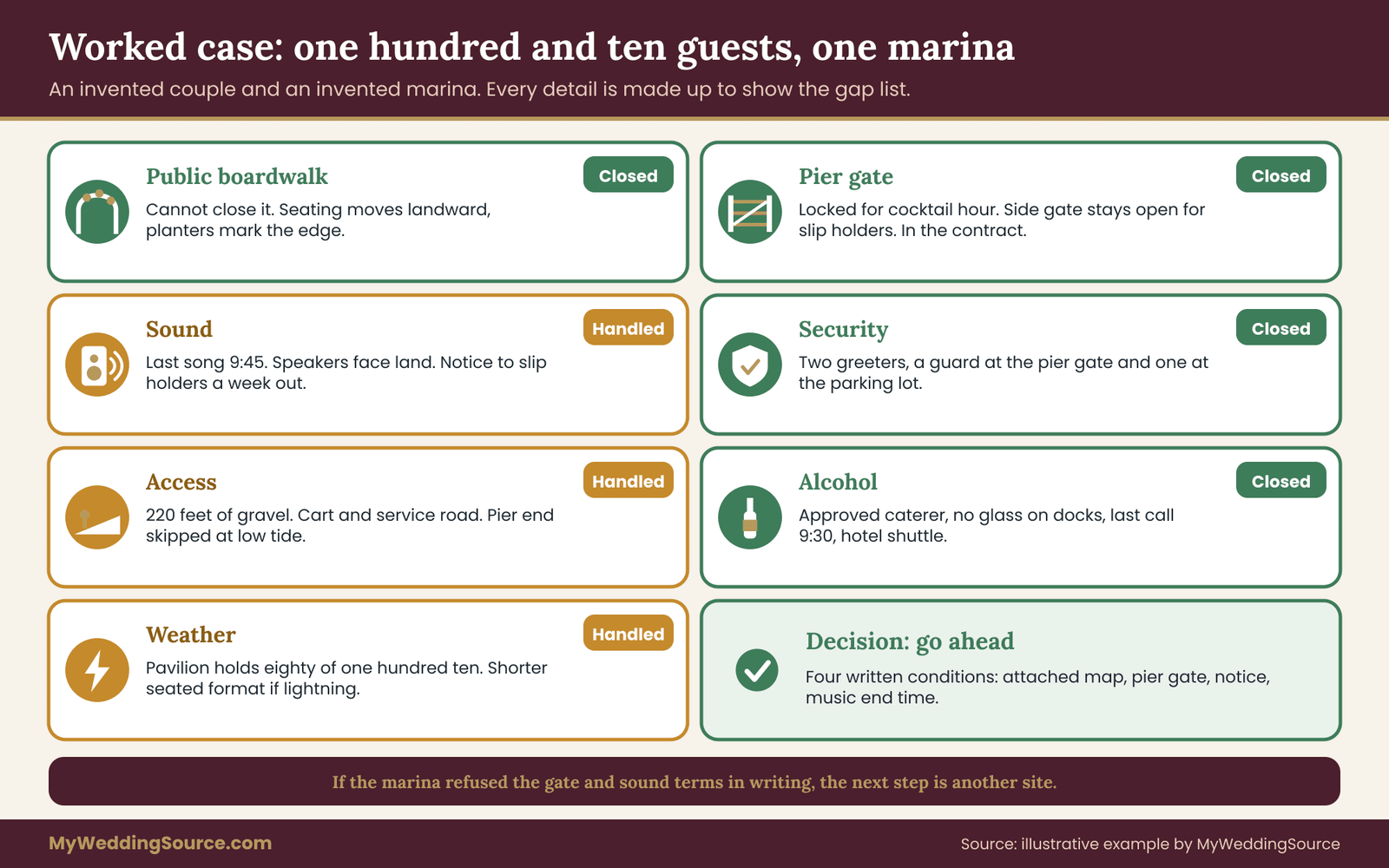
A couple, call them Dana and Luis, wants a marina reception for one hundred and ten guests on a Saturday in late summer. They have found a municipal marina with an event lawn, a fixed pier that extends into the basin, and a public boardwalk running along the water side of the lawn. There are sixty slips, and the marina manager says about a dozen boats have people living aboard through the season.
Step one: the map
Dana and Luis ask for the marina’s site plan and mark it up. The lawn is zone one. The fixed pier is half zone one, because the marina will let them use its end for cocktail hour, and half zone two, because slip holders use the pier’s landward half to reach the floating docks.
The boardwalk is zone three, and the basin is zone four. They mark a hard line at the landward gate and at a gate across the pier, a soft line at the head of the lawn and a public line along the boardwalk.
Step two: the gap list
They walk the lines and write down gaps.
The boardwalk. It cannot be closed. The city says the public may use it at all times. The gap is closed by design: seating and the dance floor move to the landward side of the lawn, and a row of rented planters and a small sign mark the edge of the party.
The pier gate. Slip holders must be able to reach their boats. The marina agrees to lock the gate between the lawn and the pier end for the cocktail hour, while keeping a side gate open to slip holders, and puts it in the contract. The gap is closed.
The sound. The city ordinance sets a stop time for amplified music at ten, and the marina’s quiet hours begin at ten. The nearest liveaboard boat is about eighty feet from the planned dance floor. Dana and Luis decide the last song plays at nine forty-five, the speakers face landward, and the marina will post a notice for slip holders a week before. The DJ agrees to a level mark on the mixer. The gap is handled, and a note records that a complaint will mean an earlier stop.
Security. Two greeters with a guest list at the landward gate, a licensed guard at the pier gate for the cocktail hour and one at the parking lot until the end. The marina requires a guard when alcohol is served after dusk, so the cost is built into the budget.
Access. The walk from the lot to the lawn is about two hundred and twenty feet on gravel. The marina agrees to allow a cart for guests who need it and to open the service road gate for vehicles that carry mobility-limited guests. Tide tables show low water at about the hour of cocktail hour, so the floating ramp will be at its steepest. They decide not to seat anyone who needs a step-free route at the pier end, and to move the cocktail hour toward the lawn for those guests.
Alcohol. The marina permits beer and wine from an approved caterer and prohibits glass on docks. Dana and Luis choose compostable cups for the pier and glass on the lawn, set last call at nine thirty and book a shuttle to a hotel five minutes away.
Weather. A pavilion near the lawn holds eighty guests, not one hundred and ten. They decide that if lightning is forecast, the reception moves to a shorter, seated format inside and the dance floor is skipped. A named person has the authority to call it.
Step three: the written conditions
Dana and Luis put four conditions into the agreement. The map is attached and defines the marina reception zone. The pier gate will be locked to slip holders for the cocktail hour, with a side gate open. The marina’s notice goes to slip holders a week before. Music ends at nine forty-five, and any request to lower the volume goes to a named person. The marina signs the agreement, and the couple send a confirming email with the same points.
Step four: the decision
With six gaps closed and one handled with a condition, they go ahead. If the marina had refused to put the pier gate and the sound hours in writing, or had said the boardwalk would host a public event the same evening, they would have asked again, and then looked at another site. The map did not make the choice for them. It made the unknowns visible while there was still time to ask.
For the movement of guests once they are inside the zone, from entry to seating to dancing and exit, the guide to designing wedding reception guest flow helps you lay out the lawn, and the same principles carry to a pier end.
When to say no to a marina reception
A decision tool is useful only if it can say no, and the marina reception is no exception. These are the conditions that should make you stop, ask for a change or choose another site. Each one is written as a plain test.
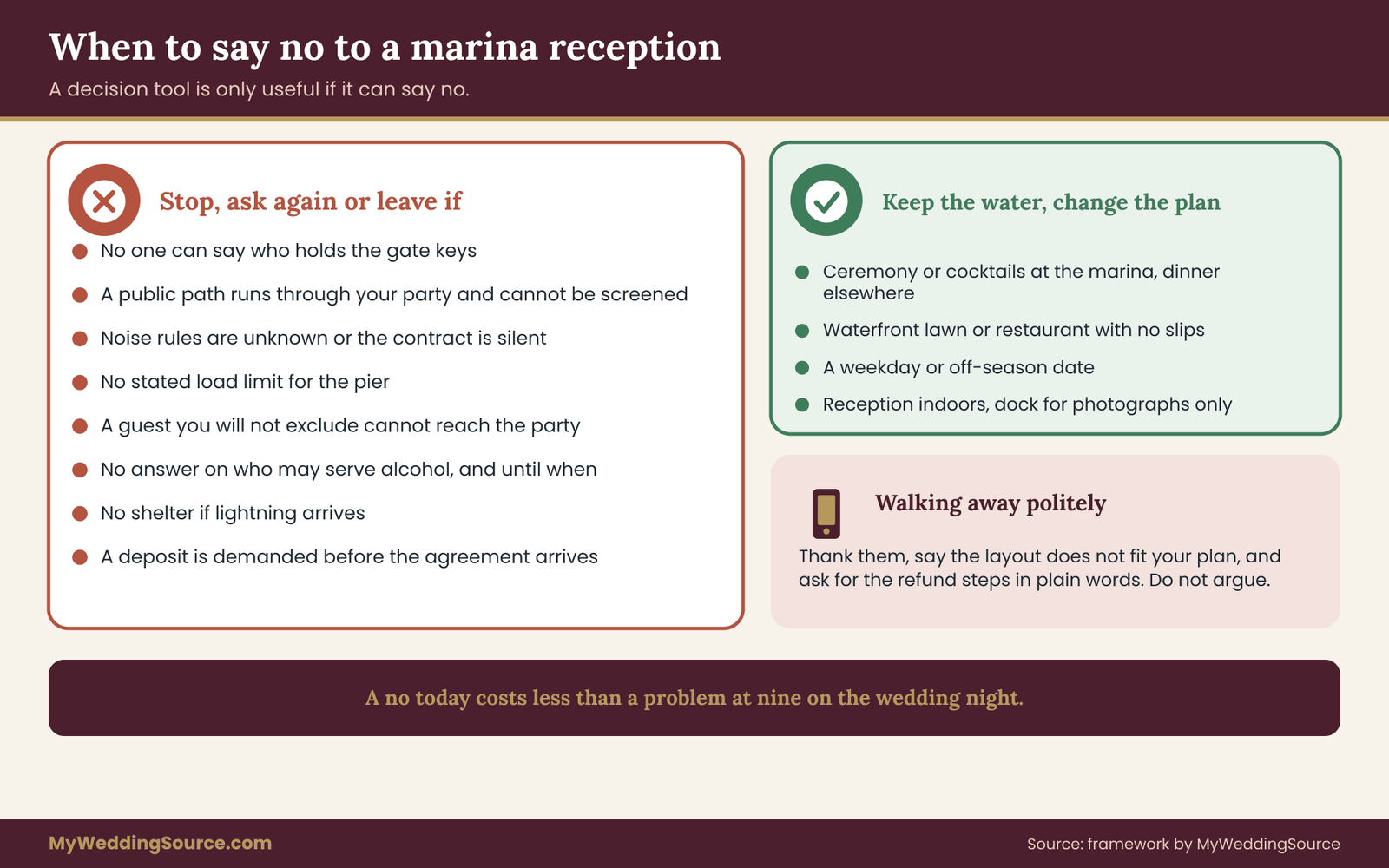
The marina cannot say who controls the gates. If no one can tell you who holds the keys, who can open the pier gate and who answers if it fails, the hard line does not exist.
The public cannot be separated from your party. If a public path runs through the middle of the marina reception zone and the marina cannot propose a layout that keeps your guests away from it, the guests will be sharing their party with strangers.
The noise terms are missing or inconsistent. If the marina cannot say which rules apply, the contract is silent and the nearest sleeping boats are within shouting distance, a complaint is a matter of time.
The pier cannot carry your plan. If there is no stated load limit or the marina will not discuss it, scale back, move the event to the lawn or choose another site.
The step-free route fails. If a guest you will not exclude cannot reach the party, the bar and the restroom with dignity, the site fails the test, even if everything else is good.
Alcohol terms are unclear. If the marina will not say who may serve, under what permit and until what hour, you may find out at the worst moment.
There is no shelter. If lightning arrives and there is nowhere to go, the event has no safety plan.
You are rushed. If the marina asks for a deposit before it provides the agreement or answers your questions, slow down. A marina with a good event program will give you the documents and time to read them.
What to say when you walk away
Stopping can be done politely. A short message works: “Thank you for the time and information. After reviewing the site, we have decided the layout does not fit our plan, and we will not be moving forward. We appreciate your help.” If you have already paid a deposit, read the cancellation terms before you write, and ask for the refund process in plain words.
Do not argue about the reason. If you have a small concern the marina could fix, such as a gate or a clause, say so once and let them respond. A site that wants your business will often offer a change.
Alternatives that keep some of the marina
If the marina fails a test but you still want the water, there are lighter versions. You can hold the ceremony or cocktail hour at the marina and the dinner and dancing elsewhere. You can choose a waterfront restaurant or lawn with no slips. You can book a quieter day, such as a weekday or an off-season date, when fewer boaters and neighbors are present.
You can keep the reception inside a building at the marina and use the dock only for photographs. Each version gives up some of the picture and some of the risk. The venue guide on this site, the wedding venues guide, covers how to compare types of venues once you decide to look elsewhere.
Your next steps
Treat the next two weeks of marina reception planning as a short project with a clear order. The list below follows the order in which gaps usually close, and each step produces something you can hand to someone else.
- Get the plan. Ask the marina for its site plan, its event rules, its vendor policy and a sample agreement. Do not pay a deposit until you have all four.
- Draw the map. Mark zones one to four, the three lines, the arrows for guests, vendors and emergency vehicles, and the sound paths. Do it by hand if you like. A pencil sketch that you have walked beats a polished graphic that you have not.
- Walk the site twice. Once in daylight with the manager, and once at the hour your marina reception would run, so you see the light, the sound and the people who use the marina in the evening.
- Write the gap list. For each open question, name the person who can answer and the date you need the answer. Send the questions by email so the replies exist in writing.
- Draft the three plans. One page for marina reception noise, one page for security and one page for access, each short enough that a coordinator or a bartender will actually read it.
- Match the contract to the map. Attach the map, add the written conditions and ask an insurance agent and, if you are unsure of any clause, an attorney to read the agreement before you sign.
- Set the decision clock. Name the person who calls the weather decision, write the guest messages in advance and confirm the indoor backup.
- Check your stop conditions. Read the list of reasons to say no one more time. If one is true and the marina cannot fix it, you have your answer.
Rules change, and so do marina policies, so any marina reception plan needs a fresh check: confirm each point with the issuing office again close to the date. A rule you checked a year ago may not be the rule on your wedding day.
FAQ
Can a marina reception go past ten at night?
Sometimes, but the limit usually comes from three places at once: the marina’s quiet hours, a local noise ordinance and any event permit. The strictest one controls what you can do. Ask the marina which rules apply, ask the local office that enforces noise rules to confirm, and write the final hour for amplified sound into the agreement. If you want a late party, consider moving it indoors or away from the water after the stop time.
Who is responsible if a guest falls into the water at a marina reception?
Responsibility depends on the facts, the contract and local law, so this is a question for your insurance agent and, if needed, an attorney. In practice, the agreement often places much of the risk on the host through an indemnity clause. That is why the plan matters: lit paths, a locked slip dock, rails or rope at the edge, a trained bartender, life rings in reach and a clear route for emergency vehicles.
Do we need to hire security for a marina reception?
Not always. Some marinas require licensed security when alcohol is served or the guest count passes a set number, and others leave it to you. Ask the marina for its rule in writing. If it has none, think about what one or two people could do: check names at the gate, keep guests off the slip docks and watch the parking area after dark. A greeter and a volunteer sometimes do the job at a smaller event.
Can the public walk through our reception at a marina?
It depends on who owns the land and which paths are public. A boardwalk or pier owned by a city or agency may stay open to everyone, even during your event. Ask the marina to show the public paths on the site plan, and design around them with seating, screening and staff. Do not post signs claiming that a public path is closed unless the owner confirms it is.
How do we keep guests off the boats and docks?
Use the hard line where you can: a gate on the slip docks, locked for the event, with the key held by the marina. If that is not possible, station a staff member or volunteer at the entrance and use clear signs. Give guests a good place to look at the water, such as a railed and well-lit pier end, so they do not go looking for one. Tell guests politely that private boats are off limits.
Does a marina reception need special insurance?
Most marinas ask for proof of liability insurance, and many want the owner named as an additional insured. A one-day event policy is common, and some events also need liquor liability coverage. Tell your insurance agent the event is at a marina, that alcohol will be served and that guests will be near water, then ask whether any exclusions apply. Get the marina’s requirements in writing so the agent can match them.
How do we tell neighbors and boat owners about the party?
Ask the marina to post a notice at the dock office and to send it to slip holders, and offer to write it. Include the date, the hours of amplified sound, the stop time and a contact person. For boats close to the reception, a short note on each one, placed by the marina, goes a long way. Skip guest details and personal information, and answer any call quickly and politely.
What if the weather turns bad during a marina reception?
Lightning means everyone leaves the pier and the water’s edge and goes into a substantial building or a hard-topped vehicle, then waits. Name one person with authority to stop the event, and confirm in advance where guests would shelter and how many people the space holds. A tent does not protect against lightning. Prepare guest messages in advance, and agree on the time when the final call is made.
Sources
- U.S. Coast Guard: passenger vessel, boating safety and waterway information.
- Coast Guard Office of Auxiliary and Boating Safety: recreational boating safety, life jackets and guidance for boaters.
- National Weather Service marine forecasts: marine zone forecasts, advisories and wind and wave information.
- National Weather Service lightning safety: lightning safety guidance for outdoor events.
- NOAA Tides and Currents: tide predictions and water level information for coastal and lake locations.
- ADA.gov: U.S. Department of Justice information on the Americans with Disabilities Act.
- U.S. Access Board: accessibility guidelines, including recreational boating facilities and piers.
- U.S. Environmental Protection Agency: environmental and noise information, and links to state and local programs.
- CDC National Institute for Occupational Safety and Health: information on noise and hearing protection.
- Federal Trade Commission consumer advice: guidance on deposits, refunds and checking businesses before paying.