
A late night food truck at a wedding looks simple on a mood board and turns into a logistics problem the moment you ask where it will actually park. This guide gives you a five-gate feasibility sheet covering the access lane, permits, power, service line throughput and timing, so you can decide before you sign.
A late night food truck works when five things hold at once. A strong, wide lane leads to a spot clear of emergency access. The venue, health department and fire authority approve the truck in writing. Power, fuel and waste stay out of the guests’ space. The windows can serve your late crowd in the time you have, which is arithmetic with two numbers from the vendor. And service ends before curfew, with time left to leave.
Most couples who want a late night food truck are imagining the last hour of the party. Music is still going, the formal dinner is a memory, and someone hands you a hot, messy, perfect snack through a window. That picture is worth wanting. The trouble is that a truck is a commercial kitchen on wheels, and it shows up at a venue that was built to host weddings, not to host a kitchen on wheels.
The questions that decide whether it works are rarely about the menu. They are about a gravel lane that narrows near the barn, a lawn that turns to mud after rain, a fire code that wants a clear distance from the tent, a generator that is louder than the neighbors will tolerate, and a line of sixty people who all got hungry at the same minute. This article treats the truck as a venue access and service problem first and a food choice second.
A note on scope. This is general planning information, not legal, safety or tax advice. Permits, fire rules, noise limits and insurance requirements are set locally and change, so the article tells you whom to ask and what to ask instead of quoting numbers you could not verify. Where it uses numbers in examples, they are illustrations you can replace with your own vendor’s figures.
Why a late night food truck is a venue question first
Think about what else happens at your venue that evening. Caterers and bartenders have loaded in hours ago. The band or DJ has a load-out plan. Rideshares and shuttles need a place to pick up. A fire lane may run along the building. Into that, a late night food truck introduces a large vehicle, a source of open flame or hot oil, a generator or a power cable, a wastewater tank, a trash stream and a crowd that gathers in one spot at an unpredictable moment.
None of these is a reason to give up on the idea. Many venues host trucks regularly and have a standard way to do it. Others have never allowed one and will say no in one sentence. A few will say yes without having thought it through, which is the riskiest answer, because the problems surface on the night when nobody can fix them.
The practical way to avoid that is to turn a vague wish into a sheet with five gates. You do not need to pass every gate perfectly, but you do need to know which ones are open, which are conditional, and which are closed. A closed gate does not always mean no truck. It may mean a different spot, a different hour, or a different kind of late snack.
The five gates in one paragraph
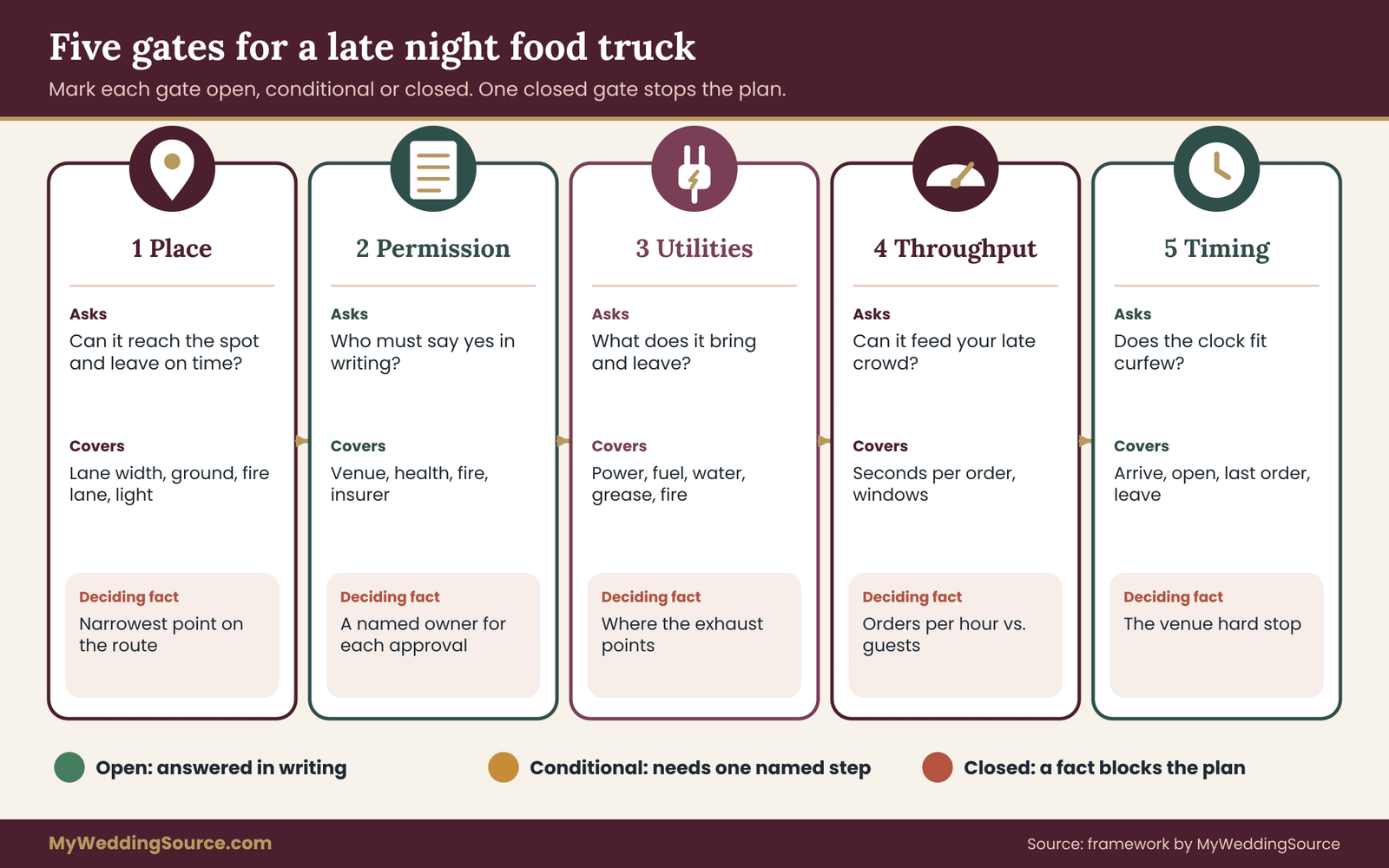
Gate one is place: the lane, the spot, the turnaround and the ground. Gate two is permission: the venue, the health department, the fire authority and the insurer. Gate three is utilities and safety: power, fuel, water, grease and fire. Gate four is throughput: how many orders per hour the truck can really produce, against how many guests will want food. Gate five is timing: when the late night food truck arrives, when it opens, when it closes, and how it leaves without disturbing anyone.
Each gate gets a short entry on a single page. The next sections explain what belongs in each entry. If you only have time to do one thing today, send the venue the five gate headings as questions and ask which are covered by its policies.
Where this fits in the wider plan
A truck is one possible answer to a bigger question: what should the last part of the night feel like, and who has to keep working to make it happen? If you are still choosing the shape of the evening, settle that first. This page covers only the access, permit and service side of one specific idea.
It does not rank food types, and it does not try to tell you whether tacos beat grilled cheese. Menu suitability for a mixed crowd, including allergies and dietary needs, is covered in the wedding menu planning guide, and the same thinking applies to a late night food truck window with a short menu.
Who owns each decision
One reason these plans go wrong is that nobody owns the whole picture. The couple owns the budget and the wish. The venue owns the site rules. The truck owner owns the vehicle, the permits for operating it and the food safety record. The caterer, if there is one, may own an exclusivity clause that quietly forbids outside food. The planner or day-of coordinator, if you have one, owns the timeline and has to fit the truck into it.
Write the five owners down. Next to each, write the one thing they must confirm in writing. For the venue it is the spot, the surface, the hours and the exclusivity position. For the truck it is the vehicle dimensions, the licenses and the insurance certificate. For the caterer it is a written statement that an outside truck does not breach the catering agreement. For the planner it is the timeline slot. For you it is the headcount and the money.
When a question falls between two owners, assign it by name. “Who is bringing a fire extinguisher for the late night food truck?” is a typical orphan. The answer is almost always the truck owner, and it should be in the contract.
The cost of getting it wrong
You do not need dollar figures to see where the risk sits. A truck that cannot reach the spot is a no-show, and a no-show means a deposit dispute and no food. A truck that parks in the wrong place can block a fire lane, which can trigger a stop by the venue or by authorities.
A late night food truck with no permit for your location can be shut down mid-service. A throughput shortfall produces a line of hungry people and a truck that cannot catch up, which is the most common reason a late night food truck disappoints even when everything else goes right.
Each of those has a cheap early check and an expensive late failure. The feasibility sheet is nothing more than the early checks, put in order.
The feasibility sheet, step by step
Here is how to build the sheet. Open a single page and make five blocks, one per gate. In each block write four lines: what we know, what we need to ask, who answers, and the date we need the answer by. Use plain words. The sheet is for you and your vendors, not for guests.
Start with what you know. Your venue name, the date, the time the reception ends, the curfew, the expected headcount at that hour, and any known restrictions. Many couples are surprised by how little they know at this stage. That is normal, and the blank lines are the point.
Then fill what you need to ask. Under gate one, the questions are about measurements and surfaces. Under gate two, they are about who issues which permit. Under gate three, they are about power and fuel. Under gate four, they are about seconds per order and number of windows. Under gate five, they are about clock times. The rest of this guide gives you the wording for each.
Three outcomes for each gate
For each gate, finish with one of three marks. Open means every question is answered in writing and nothing conflicts. Conditional means it works if a named thing happens, such as a dry forecast, an approved permit or a second service window. Closed means a fact makes it impossible as planned.
Do not average these. One closed gate stops the plan until it is resolved, no matter how well the others look. A truck that is perfectly permitted and fast, but that cannot physically reach the lawn, is not a late night food truck for this wedding. It is a lovely idea for a different venue.
If a gate is closed, look at the cheapest repair before dropping the idea. A closed access lane might reopen if the truck parks in the front lot and guests walk. A closed power gate might reopen if the truck brings a quieter generator. A closed timing gate might reopen if service starts earlier and ends earlier. Only when no repair exists should you move to an alternative, which a later section compares.

Why one page works better than a folder
A single page forces trade-offs to be visible. When the lane question sits next to the curfew question, you notice that a late night food truck arriving at nine in the evening in the dark has to back into a spot with a spotter and a light. When the headcount sits next to the service windows, you notice that the numbers do not work. Folders of emails hide those collisions.
It also makes handoffs easier. Your planner, your venue manager and your truck owner can all read one page in a few minutes. If you share a version, share it without payment details or personal contact information, and keep the master copy where only you can edit it.
What a late night food truck is not
A late night food truck is not a replacement for dinner, and it is not usually a cheap fix for a small food budget. The cost of the late night food truck, its minimums and any venue fees often match or exceed what an in-house late snack would cost. Whether the truck is worth it is a values question, and this guide does not tell you how to answer it. It only makes sure the answer is based on what is feasible.
It is also not a way around venue rules. If a venue has an exclusive caterer and your contract says no outside food service, a truck does not become allowed because it is parked outside the property line. Ask first. Many venues grant exceptions in writing for a fee or for a specific vendor type. Some do not. The wedding venues guide explains how to read venue policies before you commit, and the wedding vendor contract guide covers the clauses that make exceptions enforceable.
Finally, a late night food truck is not automatically a guest favorite. Some guests will be full, some will not want fried food, some will have left. Your headcount for the truck is smaller than your headcount for the wedding, and an honest estimate of that smaller number sets the whole throughput calculation in gate four. The next section starts with the gate that most often decides everything else, which is whether the late night food truck can reach its spot at all.
Gate one: the access lane, the spot and the turnaround
Gate one asks a physical question: can a late night food truck get from the public road to a legal, safe spot and back out again, in the dark, with a crowd nearby? Everything else depends on the answer, so it comes first.
Start with the vehicle. Ask the truck owner for four numbers: overall length including any hitch or trailer, overall width including mirrors, overall height including roof vents and exhaust, and loaded weight. Ask also for the open width of the service window awning and how far it projects when raised, because the parked footprint is larger than the vehicle. Write the numbers on the sheet. Do not rely on memory of what a truck “looked like” at another event.
Then ask the venue for the matching numbers. What is the narrowest point on the route from the road to the spot? Are there gates, arches, low branches, power lines or porte-cocheres on the way? Does a bridge, culvert or septic field sit under the path? Many venues know their delivery vehicle limits because box trucks and rental deliveries face the same limits, and the wedding venue technical walkthrough guide shows how to measure a route properly.
Reading the lane like a driver
A driver does not think in feet only. A driver thinks in turns. Ask whether the route includes a tight turn from the road into the property, whether the truck can pull through and leave forward, or whether it must back in. Backing a long vehicle in at night, near guests, is a hazard even for a skilled driver. If backing in is unavoidable, plan a trained spotter, a light and a rule that nobody stands behind the truck.
Ask when the late night food truck will arrive. A late night food truck that arrives in daylight, before guests, can be placed carefully and left in place. A truck that arrives at nine in the evening has to maneuver among parked cars, shuttles and walkers. Many venues limit vehicle movement once guests arrive. If the venue allows only pre-event placement, the truck sits parked for hours, and you need to ask whether it can sit unattended and what it looks like to guests during the ceremony.
The turnaround matters for exit, too. A truck that arrives early and boxes itself in behind a row of guest cars cannot leave on time. Ask where guest parking will be, and whether staff can keep a corridor clear for the truck’s departure.
The ground under the wheels
Surface is the quiet killer of outdoor trucks. Gravel is usually fine. Pavement is fine. Grass is a gamble, and the gamble gets worse with rain, irrigation or heavy use earlier in the day. A loaded truck is heavy, and a heavy truck on wet turf can sink, rut the lawn or need a tow. Venues have strong feelings about ruts, and some charge for repair.
Ask three questions. What is the surface at the spot? What happened to that surface the last time it rained for a day? Is there a hard-surface alternative nearby, even if it is less pretty? If the best-looking spot is a lawn, ask whether the venue uses ground protection such as plywood or track mats for delivery vehicles, who supplies it and who pays.
Also ask what sits under the surface. Irrigation lines, shallow utilities and drain fields do not announce themselves. The venue manager usually knows where trucks have been allowed before and where they have not. That history is worth more than a guess.
Keeping emergency access clear
A fire lane is a lane for emergency vehicles. A hydrant is a hydrant. A late night food truck, a generator or a line of guests that blocks either one creates a safety problem and a rules problem. Ask the venue to mark on a site map where emergency vehicles access the building and where hydrants and fire connections are. Then place the late night food truck clear of those marks, not near them.
Be careful about the line itself. Guests queuing in the dark near a lane, a drive or a parking row can drift into traffic. The queue has a footprint, usually longer than people expect, and it must have a safe place to form. Plan a lined-up path that runs along a walkway, away from vehicle movement, with light.
The United States Fire Administration publishes general fire prevention material for the public, and your local fire authority sets the actual rules for events at your site. Ask the fire authority or the venue’s fire contact, not the truck, what clearances apply, because the answers vary by jurisdiction.

Reach and accessibility for guests
The route from the party to the window should be usable by every guest, including people who use wheelchairs, walkers or canes, and guests who are tired and not entirely steady after a long night. A gravel path can be hard for a wheelchair. A window that sits high above the ground is hard to use for a guest who is seated. The Americans with Disabilities Act sets standards for places of public accommodation, and the ADA site explains the principles, though your venue is the party responsible for its own compliance.
A practical approach is to ask what the venue already does for accessible routes and then check that the truck spot connects to that route. If the late night food truck sits at the far end of a gravel lot, plan a second pickup option: a runner who takes orders from a seated table, or a small accessible counter. Make that a named job, not a hope. For wider venue questions about step-free access, the wedding venues guide can help you frame the questions.
Lighting and wayfinding at night
Late means dark. The spot needs light around the truck, along the route to it, and at the place where the line forms. The truck’s own lights help at the window but do little for the path. If the venue has no lighting there, ask whether it can add portable lighting, and who is responsible for it. A line of tired guests in the dark by a vehicle is a poor place to find out the path has a drop at the edge.
Signs can be small. A single, readable arrow sign from the dance area to the window, plus a sign at the head of the line, prevents a lot of wandering. If you already plan a signage system, add the truck to it, in the same style, and keep the text short.
Distance from the party
Distance has two sides. Too close, and the late night food truck’s noise, exhaust and smell reach the dance floor or the ceremony space, and the line interferes with the party. Too far, and guests will not walk to it, which the truck owner will notice in sales and you will notice in the minimum guarantee. A sensible target is a spot a short walk from the party, clearly visible, and out of the way of the main flow.
If you are mapping the evening’s guest movement anyway, the wedding reception guest flow guide gives a way to think about entries, exits and lines that applies directly. A late night food truck adds one more destination to the flow, and it should not sit in the path between the dance floor and the exit unless you want a queue there.
What goes on the gate one entry
By the end of gate one your sheet should show: the vehicle dimensions, the narrowest point on the route, the proposed spot with a simple sketch, the ground surface and a wet-weather answer, the position of fire lanes and hydrants relative to the spot, the lighting plan, the accessible path, and the arrival and departure windows. If you cannot fill one of those lines, that line is the next question for the venue.
Mark gate one as open when the truck can reach the spot and leave on time, in dry weather, with a clear emergency lane. Mark it conditional when it depends on weather, a ground protection plan or a pre-event arrival. Mark it closed if the truck cannot physically reach or leave the site as it is.
A short example of a conditional gate
Imagine a venue with a gravel drive that narrows at an old stone gate. The venue says delivery vans pass through all the time. The truck owner reports a width that includes mirrors and an awning arm that folds but does not detach. Without the numbers, the answer is “probably.” With the numbers, the answer might be “yes, with the awning folded and mirrors tucked, driven slowly by a person who has done this gate before.” That is a conditional gate with a named condition and a named person.
Write it exactly that way, because the person who drives the late night food truck on the night may not be the person you talked to in March.
Some venues will ask for a pre-event walkthrough with the truck owner. It is worth the hour. A short visit, in daylight, with a tape measure and a phone camera, answers more than a dozen emails. Many couples cannot attend, and they do not need to. The venue manager and the truck owner are the two who have to agree, and a photo of the spot with a measured line is enough to carry the decision.
Gate one tells you whether a late night food truck can physically be there. Gate two tells you whether it may.
Gate two: permits, venue rules and insurance for a late night food truck
Gate two asks who has to say yes before a late night food truck can serve a single guest. The honest answer is several parties, and they do not talk to each other unless you make them. The sheet’s job is to list each approval, who obtains it, and where the written proof is kept.
There are usually four layers. The venue says whether the truck may operate on its property at all. The health authority says whether the truck is licensed to prepare and sell food in that place. The fire authority says whether the cooking equipment, fuel and layout are acceptable at an event. The insurer, usually the venue’s and the late night food truck’s, says whether the coverage matches the risk. A fifth layer, the municipality, may apply if any part of the operation touches a public street or a park.
The venue layer
Begin with the venue contract. Look for language about outside vendors, approved vendor lists, exclusive caterers, food and beverage minimums and rules for outside food. Some venues allow no outside food service. Some allow it with a fee. Some allow only vendors on a list, and a truck that is not on the list may be able to join after submitting documents.
If your caterer is exclusive, ask for a written statement that a late night food truck does not conflict with the catering agreement. Do not assume the caterer is neutral. A caterer may offer its own late snack service, and that offer is a reasonable alternative to compare, which a later section does. The general approach to reading these clauses is in the wedding vendor contract guide.
Ask the venue to state in writing: the allowed spot, the hours the truck may operate, whether a fee applies, whether the venue requires a certificate of insurance naming it as an additional insured, and whether the venue requires its own staff to be present during the truck’s operation. Those five answers cover most venue-side conditions.
The health authority layer
Mobile food businesses are generally licensed by a local or state health authority, and the licensing rules differ by place. A truck licensed in the county where it is based may not be allowed to operate in a neighboring county without an additional permit or notice. Some places require a temporary event permit for each event, even for licensed trucks.
Ask the truck owner for a copy of its current license or permit and the name of the issuing authority. Then ask: is this permit valid in the county where the wedding will take place, and if not, who will obtain the temporary permit and how long does it take? A truck owner who works events regularly will answer in one sentence. One who hesitates may not have thought about it.
The FDA Food Code is a model code that many jurisdictions use as a basis for their own rules on retail food operations, including mobile units. It is not a law that applies by itself, and your local authority’s version is the one that counts, but its structure shows what inspectors look for: hand washing, temperature control, protected water, wastewater disposal and employee health. A reasonable question to a truck owner is, “When was your most recent inspection, and may I see the result?”
The fire authority layer
Cooking vehicles carry hazards that sit in a small space: hot oil, open flame, propane, and a generator. Many fire codes treat mobile and temporary cooking operations specifically, and many adopt NFPA standards in some form. The fire authority may require a permit, an inspection, a fire extinguisher of a certain type, a hood suppression system with a current inspection tag, and a minimum distance from tents, buildings and guests.
You do not need to know the exact distance. You need to know who does. Ask the venue whether the local fire authority has to approve vendors, and ask the truck owner whether it has a record of fire inspections for similar events. If a tent will be near the late night food truck, say so, because tents trigger their own rules. The NFPA site is the primary place to learn how these standards are organized, and the local fire official is the place to learn which version applies.
Put the fire layer on the calendar early. Some inspections need advance booking. A permit that is available in principle but not available in the three days before a wedding is not available.
The municipal and public-space layer
If the truck will park on a public street, in a public park or in a municipal lot, treat the permission as a separate project. Cities regulate where vehicles may park for vending, how long they may stay, and whether any amplified sound or generator noise is allowed. A late night food truck that is legal to vend in one spot is not legal in another. Never assume a “special event” label covers a food truck unless the city says so.
Even on private property, local noise ordinances and hours may apply. Ask the venue whether there is a quiet-hours rule that covers generators or whether the truck must use shore power. Ask also whether neighbors have complained about previous events, because the venue’s history tells you how tight the limit really is.
The insurance layer
A certificate of insurance is a one-page proof that a policy exists. It is not the policy and does not by itself prove it covers your event, but it is the document venues and caterers ask for. Ask the truck owner for a certificate that lists the venue as an additional insured if the venue requires it. The venue will tell you the wording it needs, so ask for the wording before the truck owner requests the certificate.
Ask also whether the late night food truck’s policy covers the vehicle and the operation, and whether it covers the specific kind of event. Do not interpret coverage yourself. Send the venue’s requirements to the truck owner and ask for the certificate that meets them. If the insurer will not issue it, you learn that months before the wedding, which is much better than on the day.
Alcohol and food trucks
A food truck is not a bar. If your wedding serves alcohol, the rules for who may serve it, until what hour, and whether guests may take drinks to the truck line belong to the venue’s alcohol policy and the bar provider. The wedding bar service planning guide covers the bar side. For the truck, the practical point is that a late night food truck line is a place where people who have been drinking stand together in the dark, near a vehicle.
Plan for it with light, space and a staff member nearby, and ask the venue whether drinks may be carried to the line.
Who obtains what
Draw a short list on the sheet with four columns of thought rather than a table: the approval, the party who obtains it, the deadline and the proof. For example, the temporary event permit is obtained by the truck owner, due weeks before the date, proved by a copy of the approved permit. The venue’s written approval is obtained by you, due when you book the late night food truck, proved by an email or signed addendum.
The fire approval is obtained by whoever the venue says, proved by a document or a named official. The certificate of insurance is obtained by the truck owner, due before the venue’s deadline, proved by the certificate itself.
The most common failure in gate two is an assumption that somebody else handled it. The truck owner thinks the venue did the fire notice. The venue thinks the truck did. The couple thinks it is all in the package. By writing the owner next to each approval, you stop that.
Marking gate two
Mark gate two open when every approval has an owner, a date and a document in hand or scheduled. Mark it conditional when a permit is pending with a known decision date. Mark it closed when a party that must approve has said no, and no alternative approval exists. For a closed gate at this stage, check the cheapest repair: sometimes the right answer is a different spot on the property, or a truck from within the county that already has the permit.
Do not treat a verbal yes as an approval. A venue manager who says “should be fine” in a phone call may be correct, may be wrong or may leave the company before your date. Ask for a one-paragraph email that states the spot, the hours and the conditions, and keep it with the contract.
The next gate covers what the truck needs in order to cook safely at your venue, and what it leaves behind.
Gate three: power, fuel, water and fire safety at a late night food truck
Gate three asks what a late night food truck brings with it and what it leaves behind. A truck is mostly self-contained, but only mostly. Power, fuel, fresh water, wastewater, grease, trash and heat all have to go somewhere, and at a wedding that somewhere is next to people in good clothes.
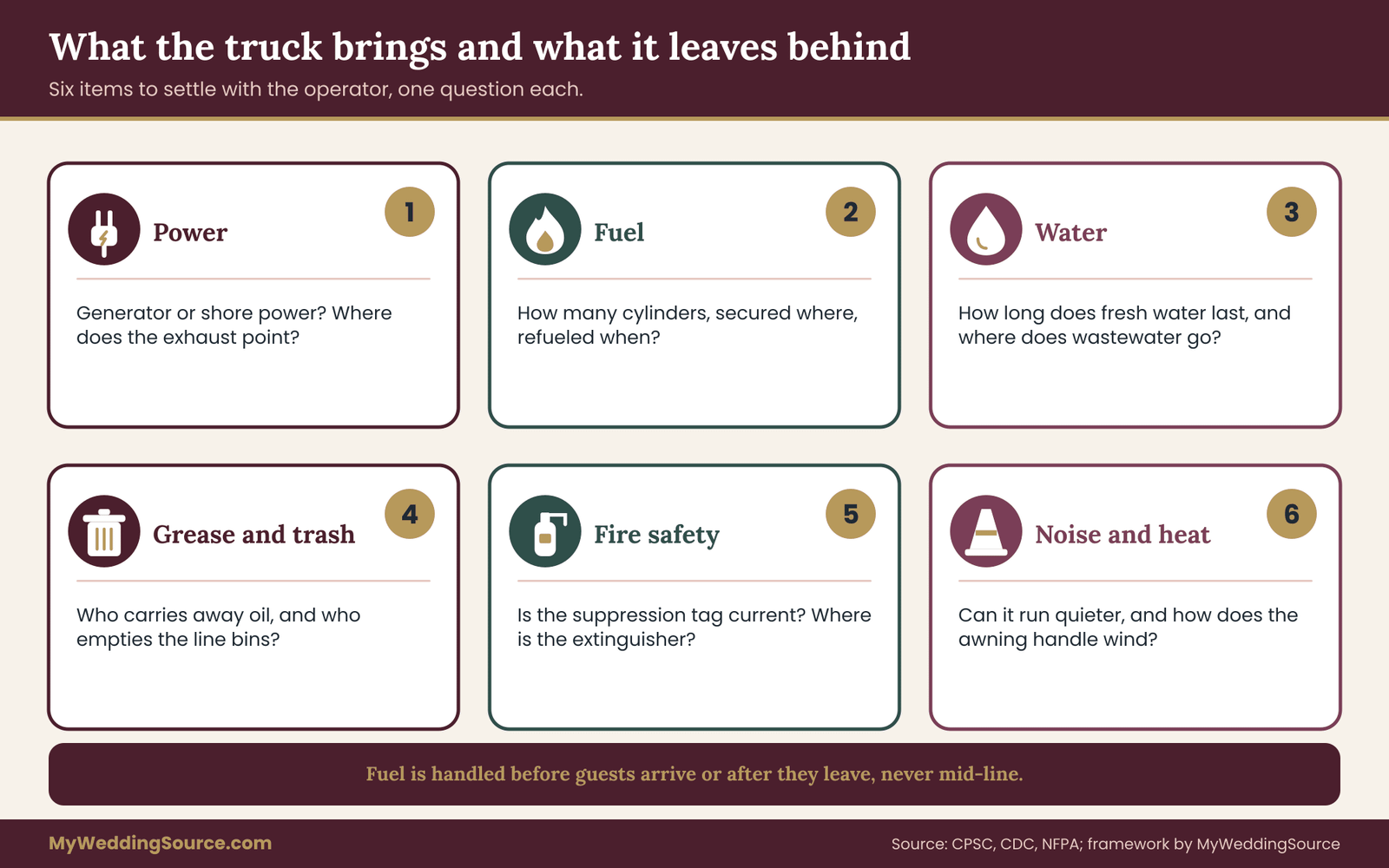
Make a short inventory with the truck owner. For each of the six items, write what the late night food truck uses, what it brings and what it needs from the venue. The inventory is a conversation, not a form. A good truck owner has done it many times and will answer fast. A vague answer is useful information.
Power
Most trucks run on an onboard generator, shore power or both. A generator is simple for the venue, since nothing needs to be installed, but it creates noise and exhaust. Shore power is quieter and cleaner, but it needs a suitable outlet at a reachable distance and a cable run that guests will not trip on.
Ask the truck owner which it will use and what the electrical load is. Ask the venue whether a circuit exists near the spot and who is allowed to connect to it. Never assume a venue outlet can carry a commercial kitchen. A shared circuit that also feeds the band or the lighting may trip under load, and a tripped breaker at the wrong moment ends the music or the food.
If the truck uses a generator, treat carbon monoxide seriously. The Consumer Product Safety Commission warns the public that generators produce carbon monoxide and must be run outdoors, away from windows, doors and vents. For a late night food truck at a wedding, that means placing the generator exhaust away from the tent, away from the building air intakes and away from where guests wait. Ask the truck owner where the exhaust points and how far it sits from the line.
Noise is its own question. Ask for the generator’s rated noise level if the maker publishes one, and ask the venue what level of noise it can tolerate at the property line during late hours. If neither has a number, a practical test is to stand where the neighbors would stand while the truck runs at an earlier event, or ask the truck owner whether a quieter generator or shore power is available.
Fuel
Cooking in trucks commonly uses propane, and some use other fuels. Propane cylinders must be stored upright, secured and protected from heat and impact. Fire codes address how many cylinders, where they sit and how far they must be from ignition sources and public areas. The venue and the fire authority decide what is allowed, and the truck owner should know the rules for its own equipment.
Ask the truck owner how many cylinders it carries, whether any are stored outside the late night food truck, how they are secured and whether the truck has a gas leak procedure. Ask whether refueling happens on site, and if so, that it does not happen while the generator is hot or while guests are near. The simple rule is that fuel is handled before guests arrive or after they leave, never in the middle of the line.
Water and wastewater
A truck carries fresh water for cooking and hand washing and a tank for wastewater. Both have limits. A busy window drains the water supply faster than people expect, and a full gray water tank can stop service as surely as an empty propane cylinder. Ask the truck owner how much water the truck holds, how long that lasts under heavy use and whether a refill or dump is needed during a long service.
Where the wastewater goes after the event matters a great deal. It must go to an approved disposal point, not onto the ground, into a storm drain or into landscaping. Ask the truck owner how it handles disposal and where it goes after your event. A reputable operator has a regular arrangement. If the venue has a rule against dumping, put it in writing and share it with the operator before the day.
Hand washing is a food safety essential, and food safety authorities such as the CDC emphasize it for people who prepare food. You are not inspecting the late night food truck. You are asking whether it has a working hand sink and fresh water, and whether the operator is trained to use them.
Grease, trash and the leave-no-trace rule
Fried food produces used oil and packaging. A truck should carry away its own oil, not pour it down a drain or onto the ground. Ask the operator how it handles used oil after service and whether it carries spill supplies.
Trash from the line, such as paper boats, napkins, cups and foil, is the venue’s problem unless the contract says otherwise. A line of tired guests produces more litter than a seated dinner. Place bins at the window and at the exit of the line, and assign someone to empty them.
If your venue charges for cleanup, ask whether the truck’s trash is included in the venue’s rate or needs its own pickup. Waste planning is a topic of its own, and the wedding waste reduction planning guide covers it in more depth, including packaging choices.
Fire safety
Cooking equipment in a closed vehicle can fail in ways that matter. Ask whether the truck has a hood and a fire suppression system, when it was last inspected and whether the inspection tag is current. Ask for the number and type of portable fire extinguishers on board and whether staff are trained to use them. Ask where the fire extinguisher sits relative to the cooking line, which is not a trick question, because the answer reveals whether the operator thinks about it.
Ask the venue where its nearest extinguisher and shutoffs are and whether any smoke or fire alarm systems might be affected by outdoor cooking near the building. Smoke drifting into an air intake can set off alarms at the worst time. This is the kind of detail a venue manager remembers from a previous event, so ask whether one has happened.
OSHA publishes safety information for workers in many industries, including those who work with cooking equipment and extension cords. You are not responsible for the late night food truck crew’s workplace compliance, but a late night food truck that treats its own safety seriously is a better partner for a crowded night. Ask whether the crew size is enough for the expected service, since a short-staffed truck makes mistakes with hot equipment.
Heat, weather and the awning
Heat from the cooking line can be intense in the truck and still affect the area around the window. Cold nights shape the line too: guests will not stand long in cold wind. Ask about weather protection at the window, and whether the truck uses an awning that can handle wind. Awnings and gusts do not mix, and a good operator lowers or retracts an awning in wind. Put in the contract that the operator makes the call on awning use for safety, and that you will not argue with it.
If a tent will be near the late night food truck, mention it early. A tent near cooking equipment is a fire risk, and the rules for distances are set locally. The solution may be a modest move, but you want to learn that before the tent is staked.
Marking gate three
Gate three is open when the power plan, fuel storage, water and waste disposal, and fire equipment are described in writing, and nothing in the description conflicts with the venue’s rules. It is conditional when one item depends on a decision, such as a power circuit the venue must confirm. It is closed when the truck cannot meet a safety rule that the venue or the fire authority holds, such as an exhaust position or a distance requirement.
A closed gate three at a late night food truck can often be repaired by changing the spot, the generator or the schedule. A different spot a bit farther from the tent might open the gate. A quieter generator might satisfy a neighbor limit. Moving service earlier might beat a quiet-hours rule. Try the repairs in that order of cost, and only then consider a different late snack.
With the physical and safety gates settled, the next gate decides whether the truck can actually feed the people who want to be fed.
Gate four: service line throughput for a late night food truck
Gate four is the one most couples skip, and it is the one that decides whether guests enjoy the late night food truck or stand in a line wondering if it was worth it. Throughput means how many orders the truck can finish per hour, compared with how many orders your guests will place in the time you have. A late night food truck is a small kitchen with a single narrow exit, the service window, and the window sets the pace.
You need four numbers. The first is the number of guests who will realistically want food in the late window. The second is the truck’s seconds per order, from taking the order to handing it over. The third is the number of working service windows. The fourth is the length of the window you can serve in. Everything else follows from arithmetic you can do on a phone.
Counting the hungry
Start with the people. Your wedding headcount is not the late night food truck headcount. Some guests leave before the late window, some are full, some will not want the food on offer, and some do not eat late at all. Count who will still be at the party when the truck opens. If you have a list of guests who plan to stay, such as a later RSVP for an after-party or a ride plan, use that. If not, use your own judgment, and write the estimate on the sheet as an estimate.
Then think about who eats. A common mistake is to assume that everyone present will order. In practice a fraction will. Do not borrow a percentage from a blog post, including this one. Choose a range based on your crowd and the timing: if dinner was early and heavy, a smaller share will order. If dinner was light and the dance floor has been busy for hours, a larger share will. Run the math with the low and the high numbers and see whether both work.
Estimating wrongly in either direction has a cost. An overestimate means you pay a minimum for food nobody orders, and an underestimate means a line. Many truck owners offer a pre-set minimum or a per-person price. Ask the truck owner how it handles the difference, which a later section covers under contract questions.
Seconds per order
Ask the truck owner for seconds per order at the window for the menu you plan to use. Ask for a real answer, based on experience at events, not a menu average. A single-item menu is faster than a menu with customizations. Fried items that cook in batches can come out fast once the fryer is running but can stall if the fryer is full. Made-to-order items depend on the grill and the number of hands.
You can test this without a stopwatch by asking a few questions. How many people work in the truck at an event this size? How many are on the grill or fryer and how many are at the window? What is the busiest hour you have served and how many orders did you complete? A reply that includes numbers is better than a reply that says “we handle big crowds.”
Do not invent the figure. If the truck owner does not know, use a range and plan for the slow end. Alternatively, ask for a tasting at a regular service so you can watch the line move. Many trucks operate publicly and a short visit gives you a feel for the pace without any special arrangement.
The basic math
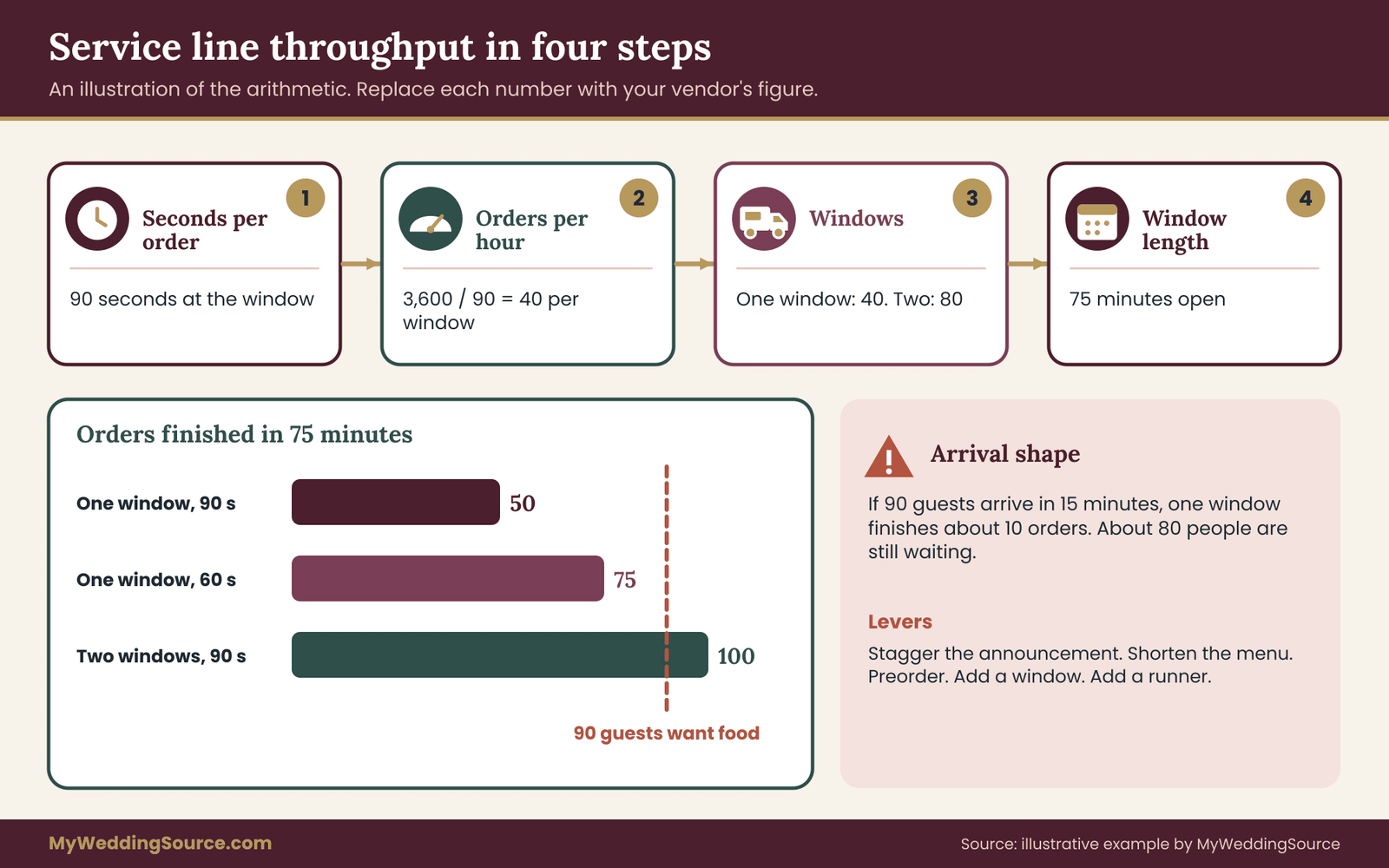
With seconds per order known, the orders per hour per window equal thirty-six hundred divided by seconds per order. As an illustration only, suppose a truck needs ninety seconds per order at one window. That is forty orders per hour. If it works two windows with enough hands, the figure is eighty, though only if the kitchen behind the windows can keep up, which is a separate question to ask.
Now apply the window length. Suppose the late night food truck can serve for seventy-five minutes. At forty orders per hour, one window finishes fifty orders. If ninety guests want food, one window cannot meet it. Two windows finish one hundred, which covers it, but leaves little slack. A shorter menu that takes sixty seconds per order raises the single-window figure to sixty per hour, or seventy-five in the seventy-five minutes.
These numbers are an illustration. They are not a benchmark, and they are not a promise about what any truck can do. The point is the method: the late night food truck can feed the people it can serve in the time it has, and the sheet shows whether the plan fits that.
Why arrival shape matters more than the average
The calculation above assumes guests arrive evenly. They do not. If the DJ announces the truck and ninety people walk over in fifteen minutes, the line forms at once. In that first fifteen minutes the single window finishes ten orders, leaving eighty people waiting. The last person in that line waits about two hours at the same pace, and most of them will give up long before.
The wait for a person in line is roughly the number of people ahead of them multiplied by the seconds per order, divided by the number of windows. That is a rough guide and it is useful. If you would not stand for twenty minutes in a line at midnight, neither will your guests. Set a target wait that you consider acceptable, and use it to design the service.
Several levers change the shape. Staggered opening is the cheapest: announce the truck in waves, or let the first tables to leave dinner go first. A short menu shortens each order. Preordering puts the work before the rush, for example a simple choice card at the table earlier in the evening or a form at the party. A second window, or a second truck, doubles capacity but needs space, power and permits twice. A runner service for seated guests who cannot queue takes pressure off the window, and helps those who find lines difficult.
Preordering without turning it into a chore
Preordering sounds efficient and can be, but it adds work for you and your guests. If you use it, keep it simple. A small card on the table with two or three choices, collected by a staff member, tells the late night food truck what to prepare and when. A sign-up on a page is fine for guests who like it, but do not require it. Some people decide late, and a line that serves only preordered guests will frustrate them.
If you do preorders, agree with the truck owner on how the orders get passed over, how to handle changes, and what happens to uncollected orders. Decide in advance whether unclaimed food is thrown away, offered to anyone, or boxed for the couple. Food safety authorities advise against keeping hot food out for long periods, so do not plan to hold uncollected items for an hour.
The kitchen behind the window
A window can only hand out what the kitchen produces. A truck with a small grill, a small fryer and a crew of two will have a ceiling that does not move when a second window opens. Ask what the limiting step is: the grill space, the fryer capacity, assembly, or payment. If the limit is payment, a pre-paid arrangement removes it. If the limit is the grill, a second window does nothing.
This is the right moment to ask about backup. What happens if the fryer fails? What happens if the generator trips? A late night food truck that runs a short menu with a plan B, such as a simpler item that needs only one appliance, is less likely to leave guests with nothing.
Paying and ticketing
How the truck is paid affects the line. If guests pay at the window, card readers, signal strength and the time to tap or insert all add seconds. If you prepay a flat fee or a per-head fee, guests walk up and order, which is faster. The trade-off is that you pay for orders that may not exist, so you need a cap or a minimum that reflects your estimate. The wedding budget guide helps you decide where a late snack belongs in the overall plan.
Cellular coverage is a practical gap at rural venues. If the truck uses card readers that need a signal, ask what happens when the signal fails. A truck that works only on a good network will stall in a field. Ask for offline payment options or a hotspot.
Marking gate four
Gate four is open when the arithmetic shows that the late night food truck can serve your estimated crowd within your window, with at least some slack, under both the low and high crowd estimates. It is conditional when it works only if you take a specific step, such as staggering the opening or adding a second window. It is closed when no reasonable change makes the numbers fit.
A closed gate four rarely means giving up on a late night food truck entirely. It often means a smaller crowd target, a smaller menu or a longer window. It may mean a different kind of late food, which the comparison section covers. Whatever the result, record the actual numbers on the sheet so that you and the truck owner are working from the same picture.
The last gate ties everything to the clock.
Gate five: timing, noise, neighbors and the exit
Gate five puts the late night food truck on the clock. Even a truck that passes the first four gates fails if it arrives at the wrong time, opens at the wrong moment, or cannot leave before the venue’s curfew. Timing is where the plan meets the venue’s hours, the neighbors’ patience and the guests’ energy.
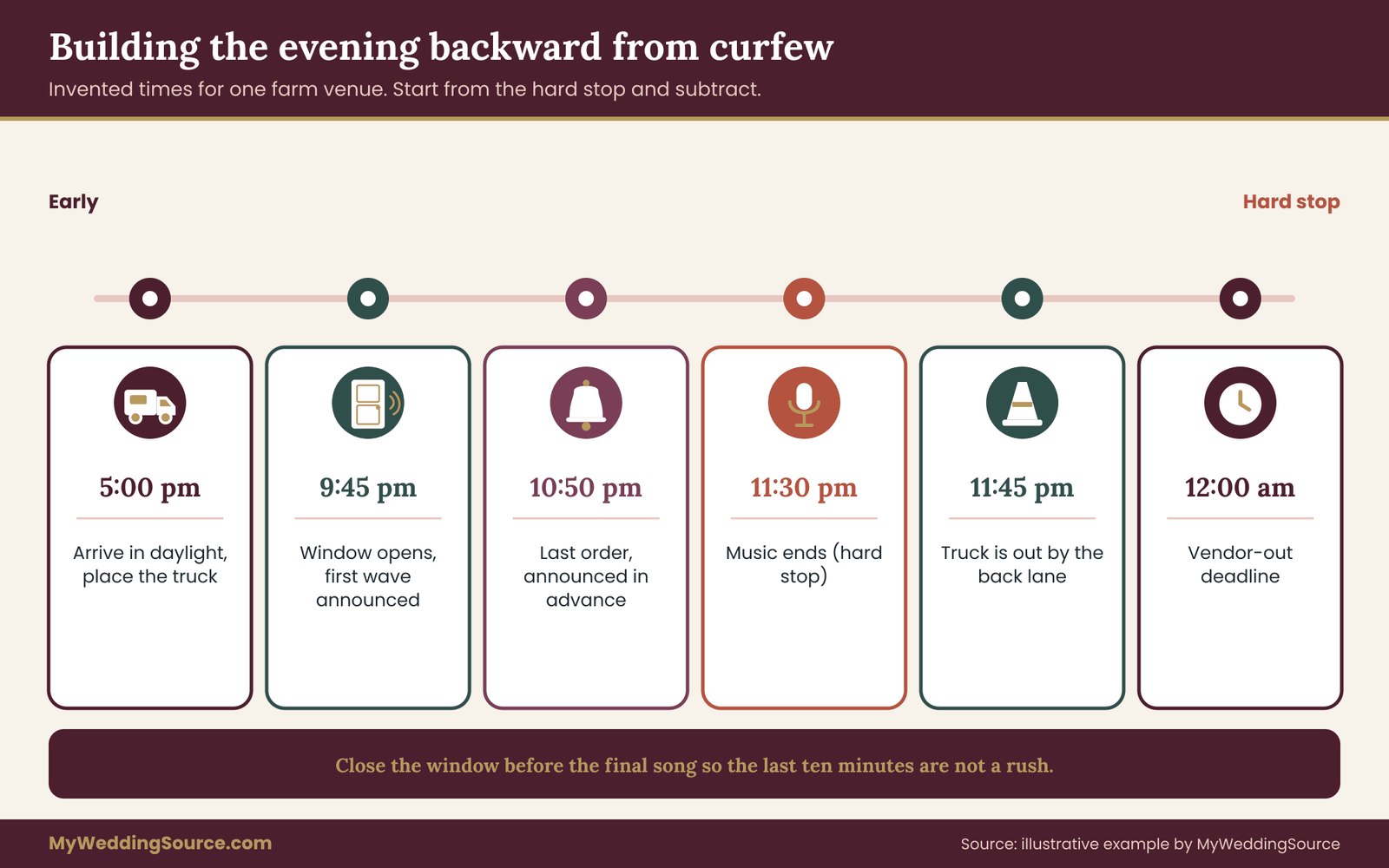
Start from the end and work backward. Write down the venue’s hard stop: the time music must end, the time guests must be off the property and the time vendors must be out. Then write down the truck’s closing tasks: last order, final cleanup, securing propane, draining or capping tanks, packing equipment and driving out. Ask the truck owner how long those take, and add a margin for a line that does not clear exactly on time.
Building the evening backward
Suppose the venue requires music to end at a set hour and everyone off site thirty minutes later. The truck needs to be out of the way before the guest departure rush, because shuttles and rideshares will be queuing. If the truck takes forty-five minutes to close down, last orders must be taken early enough that the final order is handed over, cleanup begins and the late night food truck leaves before the venue’s vendor-out deadline. Subtract that from the hard stop, and you have the last-order time.
Then choose the opening time. Opening earlier spreads the crowd over a longer window, which helps throughput, but it can compete with dancing and dessert. Opening later feels like a late-night treat but compresses the line. A balance many couples find workable is to open when the party is at its busiest and keep the window open long enough that nobody has to queue under pressure, with a clear last call that the DJ or band announces.
Do not set the closing time to the minute when the music ends. A late night food truck that closes at the same moment the party does produces a crowd at the window in the final ten minutes, which is the worst moment for throughput. Close the window before the final song, and tell guests in advance.
Arrival and set-up
Set-up takes time and noise. A late night food truck needs to position, level, connect power or start the generator, heat the equipment, stock and check food safety items. If the venue allows early arrival, ask the truck owner how long set-up takes and when it will be ready, then set the arrival time accordingly. A late night food truck that arrives only a few minutes before service will be slow at its first orders.
Decide whether the truck is visible during the earlier part of the day. A truck parked near the ceremony or the cocktail hour can be a nice surprise or a distraction. Some couples prefer it hidden until the right time. If it is parked early, ask whether a closed window and a sign keep guests from wandering up and finding it unready.
Noise and neighbors
A generator, a crowd and a late hour combine into a noise problem even at a remote venue. Ask the venue about the quiet hours and about any complaints in the past. Ask the truck owner whether it can use shore power or a quieter generator, and whether it can place the generator at the far side from the neighbors.
Think about the line too. A line at midnight is conversation, laughter, car doors and music that carry. If the venue has neighbors close by, ask whether the line can form on the side facing away from them. Keep the queue away from the property edge and away from windows of nearby homes.
You do not need to resolve a neighbor relationship alone. The venue knows the community and may have a standard approach, such as a notice to neighbors. Ask whether it does, and whether it expects you to do anything. The aim is not to avoid being heard, which is impossible at a wedding, but to avoid a complaint that stops service.
Guest departure and the truck lane
The truck’s departure shares space with guest departure. If rideshares, shuttles and the truck all use the same lane, the lane is a bottleneck. Ask the venue where the guest pickup area is and whether the late night food truck can exit without crossing it. If the truck must pass through the pickup area, schedule its exit before the main departure wave or after it, and have a staff member direct traffic.
This is also a safety matter. Guests walking to cars in the dark, a large vehicle backing out and a line of tired people are a poor combination. If the truck must reverse, use a spotter, and keep guests clear. Ask the truck owner about the usual practice and ask the venue about any staff who can help.
A simple fix is to give the late night food truck its own exit path and mark the guest pickup area clearly, so the two flows never meet. If your venue has only one drive, schedule the truck’s departure before the guest rush and tell the driver the time.
Marking gate five
Gate five is open when the sheet shows an arrival time, an opening time, a last-order time, a close and leave time, and a margin before the venue’s hard stop, with the departure route clear. It is conditional when it depends on one step, such as notifying neighbors or an early arrival permit. It is closed when the clock does not fit, for example when the venue’s vendor-out deadline is earlier than the truck’s closing routine can meet.
When gate five is closed, check the easy repairs. Move the opening earlier. Shorten the menu so closing takes less time. Ask the venue whether vendors may leave after guests rather than before. Reduce the window. If none fits, the late night food truck may be better as a different kind of late snack, a topic for the comparison section.
A worked example of a late night food truck decision
The following example is invented, and the numbers are chosen to show the method, not to describe a typical event. Imagine a couple, Dana and Marcus, hosting a hundred and twenty guests at a farm venue with a gravel drive, a lawn and a barn. They want a late night food truck for the last stretch of the evening. The music must end at eleven thirty and vendors must be off site by midnight.
Gate one
The truck owner reports a vehicle roughly the size of a large delivery van, with an awning that projects when open. The drive narrows at a gate between two old posts. The venue manager says delivery trucks use it routinely, and the narrowest measurement matches the late night food truck with room to spare when mirrors are folded. The proposed spot is on the gravel by the barn, not the lawn, which avoids the mud question.
The fire lane runs along the barn’s other side, so the truck stays clear. Lighting is weak, so the venue will add two portable lights. The accessible path is gravel, so the couple assigns a runner for guests who cannot use it. Gate one: open, with the runner and lights noted.
Gate two
The venue allows outside trucks from an approved list, and this truck is not on it. The venue will add it once it receives a license copy and a certificate of insurance naming the venue. The truck operates in the neighboring county, and the owner confirms that a temporary event permit is needed and will be obtained three weeks ahead.
The venue’s fire contact wants to see the suppression system tag. The caterer confirms in writing that the truck does not conflict. Gate two: conditional on the permit and the venue’s documents, with dates on the sheet.
Gate three
The truck runs a generator, and the venue has no suitable outlet near the spot. The owner offers a quieter unit placed on the side away from the neighbors and the barn’s air intake, with exhaust pointed away from the line. Propane cylinders are secured on the vehicle. Wastewater goes to the operator’s base after the event. Gate three: open, with the generator position noted.
Gate four
Dana and Marcus estimate that about eighty guests will still be present when the late night food truck opens, and that between half and three quarters will order. That is forty to sixty orders. The truck takes about ninety seconds per order at one window, so forty per hour.
Open for seventy-five minutes, it serves fifty. The low estimate fits, the high does not. They choose a short menu with a one-minute order time, which raises capacity to seventy-five, and they ask the DJ to announce the truck in two waves. Gate four: open under the shorter menu.
Gate five
The music ends at eleven thirty. The truck needs about forty minutes to close down and leave. They set last order at ten fifty, window open from nine forty-five, arrival at five in daylight, and departure by eleven forty-five, well before the midnight deadline. The pickup area for rideshares is at the front, and the truck leaves by the back lane. Gate five: open.
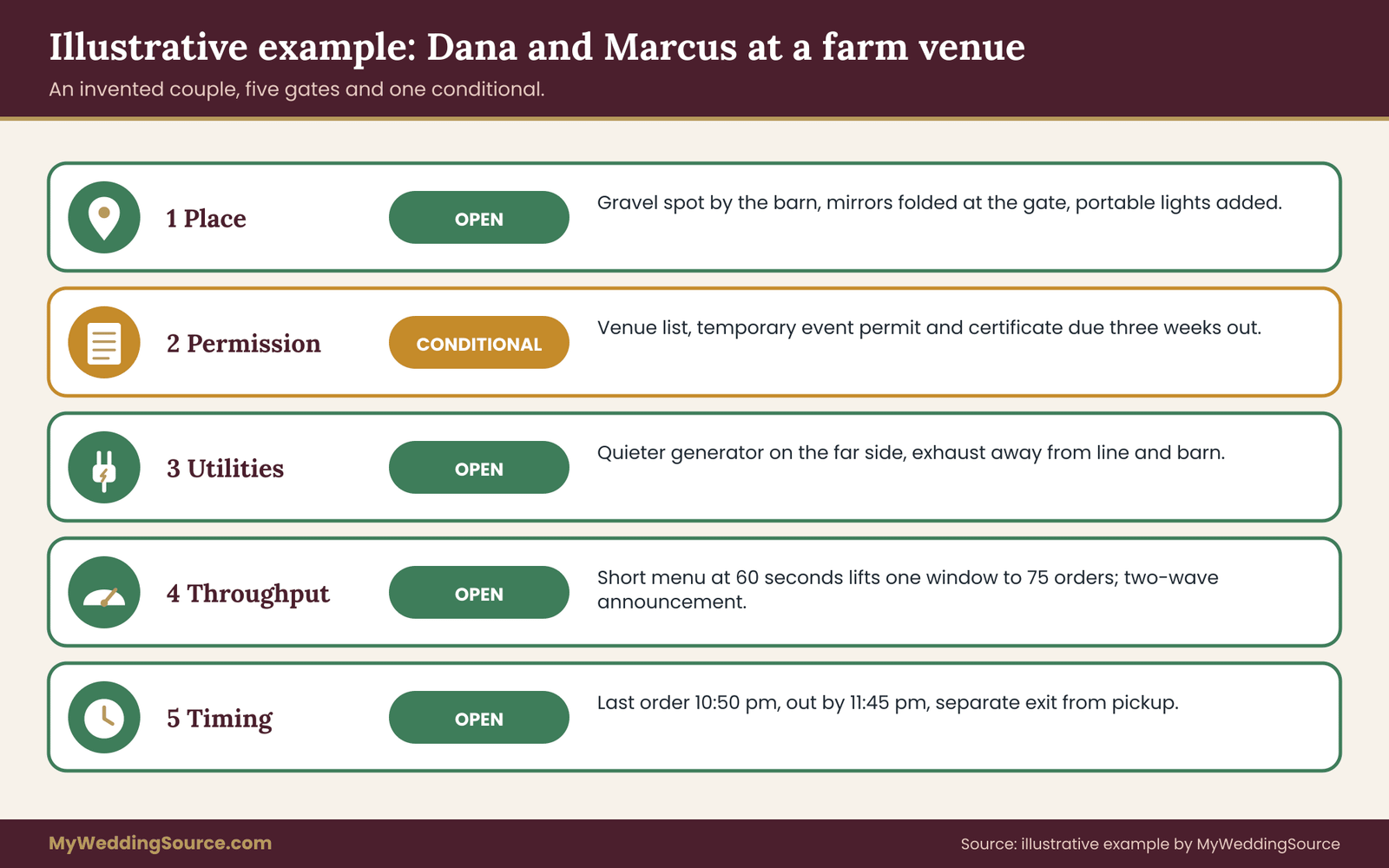
The couple’s sheet ends with four gates open and one conditional, and a list of three documents due. The point of the example is not that this plan is perfect. It is that every decision has a number, a name and a date, and the one conditional is visible, so nothing surprises them at ten o’clock on the night.
Comparing a late night food truck with other late night options
If a gate stays closed, or the numbers look tight, compare the late night food truck with other ways to feed people late. The comparison uses the same five gates, so you are judging like with like. None of these is better in general. Each trades something.
A late night food truck brings variety, a visible moment and a menu from a business that cooks all day. It costs the most gates: access, permits, utilities, throughput and timing all apply. It also adds the most vendors to coordinate.
A caterer’s late snack, served from a station inside or beside the venue, passes most of gate one and gate two automatically, because the venue already knows the caterer and its permits. Gate three is mostly covered by the venue’s kitchen or the caterer’s equipment. Gate four still applies, and so does gate five, but the caterer can also stagger service easily.
The cost is less novelty, and caterers vary in how good their late items are. A station with hot sliders or fries is common, and the venue’s food and beverage rules decide what is allowed. The wedding cocktail hour guide shows how stations feed guests without long lines, and the same logic applies later in the night.
Packaged snacks, such as boxed sandwiches, pastries or bagged items handed out at the exit, pass nearly every gate with almost no equipment. Throughput is simple because guests collect on the way out. The cost is the lack of a hot, fresh moment, but for many couples that is acceptable, especially if guests are traveling.
A delivery order timed to arrive near the end, such as pizza, avoids access and permits on your side, because the delivery business handles its own licensing. The weak point is timing: delivery arrival is not exact, so ask the venue whether outside food may be delivered and where a driver should go.
A dessert or coffee service, such as a late coffee cart or a cookie table, is lighter on the gates, particularly power and fire, and often suits a crowd that has already eaten. It does not solve hunger, but it solves the “something to hold” feeling.
Choose by gates, not by taste. If gates one and two are conditional and gate four needs a second window, a caterer’s station may deliver the same feeling with fewer risks. If the venue is flexible and the numbers work, the truck is a good choice and you now know why.
Questions to ask the truck, and what belongs in the contract
Ask these in writing, and keep the answers with the contract. They are grouped by gate.
For access: the vehicle’s length, width, height and weight; the awning’s open size; whether the truck can pull through or must back in; the arrival time; and whether a spotter is needed. For permits: which licenses it holds, which authority issued them, whether it will obtain the temporary permit, and when you can see a copy.
For power and safety: generator or shore power, noise level, exhaust position, fuel type and storage, fire suppression inspection date, and extinguisher count. For throughput: seconds per order for your menu, crew size, number of windows, the limiting step and the backup plan. For timing: set-up length, service hours, last-order time, close-down length and departure route.
Then the contract. A late night food truck agreement should state the date, the venue, the arrival and service hours, the menu and any substitutions, the price and what the price includes, the minimum or guarantee, the deposit and balance schedule, and the cancellation terms. It should say who obtains each permit, who supplies the certificate of insurance and who is responsible for waste.
It should state what happens if the late night food truck cannot attend, such as a refund or a substitute, and what happens in bad weather, since many operators have weather policies.
Pay attention to the minimum. Some trucks charge a minimum guarantee based on a number of guests or orders. If the throughput math shows you will not reach it, negotiate a smaller one, or a per-order model. Ask also about overtime, gratuity and service charges, and whether they are included. The broader guidance in the vendor agreement clauses in the contract guide explain how to read terms of this kind, and the wedding vendor due diligence checklist helps you verify that the business exists and operates as described before you pay a deposit.
Quote no figures to guests until you have read the final agreement. Truck terms vary, and you should confirm current rates and conditions with the supplier.
Edge cases to settle before the day
Rain is the first. Decide in advance what happens in rain: does the truck move to a hard surface, does service continue under an awning, or does it cancel with a refund? Ask the venue whether it has a rain spot for vehicles. Wind affects awnings and propane flames, and a truck owner may reasonably close the window for safety.
Truck breakdown is the second. Ask for the operator’s backup. Some have a second unit. Some have a partner truck. Some offer a refund and nothing else. Have a plan B ready, such as packaged snacks held at the venue, even if you never use it.
A late truck is the third. If the truck is not on site by the agreed time, who calls whom, and by when does the venue decide to cancel the spot? Put a deadline in the contract.
A shared venue is the fourth. If another event is happening nearby, the late night food truck’s line, noise and exhaust may affect it. Ask the venue whether another event overlaps and whether it has a view on the truck’s position.
Guests with allergies are the fifth. A late night food truck menu often includes common allergens, and cross-contact can occur in a small kitchen. Ask the operator for an allergen list and how it handles requests. Do not promise guests more than the operator promises you. The wedding menu planning guide explains how to communicate dietary information.
Uninvited visitors are the sixth. A visible truck near a road can attract people who are not guests. Ask the venue whether it has a way to keep the line to guests, such as a wristband, a staff member, or a spot out of the road’s view, and tell the truck owner not to serve outsiders if that is your preference.
Finally, a destination or park wedding needs more lead time. If the spot is on public land, treat the permit as the first task. Verify local rules with the city or park authority, and keep a printed copy of the permission on site.
Your next steps
Do these in order, and stop when a gate closes.
- Write the five gates on one page and add what you already know.
- Ask the venue about outside food service, the spot, surface, hours, exclusivity and insurance requirements, and get the answer in writing.
- Ask the truck owner for vehicle dimensions, licenses, insurance, seconds per order and power details.
- Walk or photograph the route and spot, and measure the narrowest point.
- Estimate your late headcount with a low and a high number, and run the throughput arithmetic for each.
- Build the evening backward from the venue’s hard stop, and set arrival, opening, last-order and leave times.
- Mark each gate open, conditional or closed, and fix or drop the closed ones.
- Put the answers into the contract, and file the permits and certificate dates on your calendar.
For the wider picture of how venue rules shape what vendors may do, see the venue selection guide.
FAQ
Do I need a permit for a late night food truck at my wedding?
Usually the truck needs its own mobile food license, and some places also require a temporary event permit or fire approval. Rules differ by city and county, so ask the health authority and the venue who obtains what. Put the answer in the contract, with a due date and a copy of each permit for your records.
How far in advance should I book a late night food truck?
Popular trucks and busy dates fill early, and permits can take weeks, so start as soon as the venue confirms outside vendors are allowed. Ask the venue about vendor approval timelines first, because that deadline often sets the schedule. Book the late night food truck only after the venue has agreed to the spot and hours in writing.
How many guests can one late night food truck serve?
It depends on seconds per order, number of windows, crew size and how long the window is open. Divide thirty-six hundred by seconds per order to get orders per hour per window, then multiply by the hours you serve. Ask the operator for its real figure, and test your low and high guest estimates against it.
What if the venue has an exclusive caterer?
Read the contract. Many exclusive catering clauses forbid outside food service, though some venues grant written exceptions, sometimes for a fee. Ask the venue and the caterer to confirm in writing that a late night food truck is allowed, or ask whether the caterer can offer its own late snack instead, and compare the two options on the five gates.
Can a food truck park on grass?
Sometimes, but a heavy vehicle can sink or rut wet lawn, and venues often restrict it. Ask the venue about the surface, rain plans, ground protection mats and any repair fees. A gravel or paved spot near the party is usually safer, even if it looks less scenic, and it keeps the truck from becoming stuck at departure.
Who is responsible for insurance with a late night food truck?
The truck owner normally carries its own business and vehicle coverage, and the venue may require a certificate naming it as an additional insured. Ask the venue for its exact wording before the truck requests the certificate. Do not interpret the policy yourself; ask the insurer or a licensed adviser about coverage questions.
What time should a late night food truck open and close?
Open when the party is busy, serve long enough to avoid one big rush, and close before the final song so there is no last-minute crowd. Build the schedule backward from the venue’s hard stop, subtracting the late night food truck’s close-down and leave time, and announce last call in advance so guests are not surprised.
What is a good backup if the truck cancels?
Keep a simple plan B that needs no permits, such as boxed snacks, a caterer’s late station or a timed delivery order. Ask the truck owner for its cancellation and substitute policy in writing, and set a deadline by which you decide to switch. Tell the venue the backup involves outside food, if it does.
Sources
- Occupational Safety and Health Administration (OSHA): worker safety information relevant to cooking equipment, electrical safety and heat.
- National Fire Protection Association (NFPA): codes and standards that many local fire rules draw on, including mobile cooking operations.
- U.S. Food and Drug Administration, Food Code: the model code many jurisdictions use for retail and mobile food operations.
- Centers for Disease Control and Prevention, Food Safety: hand washing, temperature control and food safety guidance.
- U.S. Consumer Product Safety Commission: carbon monoxide and portable generator safety information.
- U.S. Fire Administration: public fire prevention and safety resources.
- ADA.gov, U.S. Department of Justice: accessibility principles for places open to the public.
- NIOSH, CDC: occupational noise and workplace safety research.
- U.S. Small Business Administration: general guidance on business licenses and permits for mobile vendors.