

Daylight saving time can quietly move a wedding timeline by an hour, and nobody notices until the DJ, the shuttle driver and the venue each think it is a different time. This guide shows how to plan a wedding around the daylight saving time change: which clocks to check, how contracts count hours, what to ask each vendor, and how to rehearse the day on paper before it happens.
If your wedding weekend falls on or next to a daylight saving time change, run a one-page rehearsal of the day. List every promise tied to a clock time, label each one as wall-clock time or elapsed time, and ask each vendor to confirm in writing which one the contract uses. Check sunset and light for the new schedule, test the devices that run your music and cues, and put one plain sentence about the daylight saving time change on every guest-facing schedule. Weddings that are not near a change need only a short check, but it is worth doing once.
Most couples never think about daylight saving time when they choose a date. They think about the venue, the season, the guest list, the budget. Then, a few weeks before the wedding, someone mentions that the clocks change that weekend, and a small worry appears: does that matter? Usually it matters a little. Occasionally it matters a lot. The difference depends on how late the event runs, how many people are traveling, and how precisely your contracts describe time.
The risk is not dramatic. Nobody is going to miss their own wedding because of a clock change. The real problems are smaller and more irritating. A band that was booked for “six hours” plays for five or seven. A venue curfew that reads “1:00 a.m.” arrives an hour sooner than the couple expected. A bus company runs the last shuttle by the wrong clock. A guest with an old phone shows up an hour late to the ceremony. A photographer bills overtime for an hour that never existed on the clock.
Each of these is easy to prevent if you see it coming. That is the whole purpose of this article. It is a focused guide to daylight saving time for wedding timelines, and it leaves the larger question of choosing your date to the guide on choosing a wedding date. Here the question is narrower: once a daylight saving time change is in play, what do you do about it?
A note on scope. This is general planning information, not legal, tax or financial advice. Time rules, venue policies and vendor contracts vary, and they change, so where a fact matters, the article points to the source that sets it and tells you what to confirm yourself.
What daylight saving time changes about a wedding day
Start with what actually happens. In most of the United States, clocks move forward by one hour in the spring and back by one hour in the fall. The change takes place at two o’clock in the morning, local time, on a Sunday. In the spring, the clock jumps from 1:59 a.m. straight to 3:00 a.m., so the hour from 2:00 to 2:59 does not exist that night. In the fall, the clock runs to 1:59 a.m., then returns to 1:00 a.m., so everything between 1:00 and 1:59 happens twice.
That sounds like a trivia fact until you place it on a Saturday-night wedding. A reception that ends at 1:00 a.m. on the night of a fall change is a very different event from the same reception on any other Saturday. Guests who are still on the dance floor at 1:30 a.m. get a second 1:30 a.m. A venue that says everyone must be out by 2:00 a.m. may have a very different idea of that deadline from the couple who thinks they have an extra hour. A spring change does the opposite and removes an hour from the middle of the night.
Daylight saving time touches a wedding in five separate ways, and it helps to keep them apart.
The clock itself. The overnight jump or repeat affects any event, task or contract that spans two o’clock on the Sunday morning of the change.
Contract language. Many vendor agreements describe time in hours of service, not in clock times. “Eight hours of coverage” and “coverage until 1:00 a.m.” look similar, but across a daylight saving time change they mean different things.
Daylight. The change shifts when the sun appears to rise and set by the clock. A ceremony that was timed for the last warm light of the day looks different after the daylight saving time change, and the photographer’s schedule moves with it.
Devices. Phones, laptops and many scheduling tools update on their own. Some equipment does not: oven clocks, older sound gear, wall clocks, a handheld timer, a cheap bedside alarm, a vintage watch a grandparent wears for the occasion.
People. Guests arriving from a place that does not change its clocks, or from a different time zone, may be an hour off from everyone else, and they may not realize it.

Seen this way, you can check each channel on its own and avoid the vague feeling that “something about the time change might go wrong.” The rest of this guide takes them one at a time and ties them together with a rehearsal sheet you can fill in over an evening.
Does a daylight saving time change affect your wedding at all?
Before building anything, find out whether you need it. Three quick questions settle it.
First, does the wedding weekend contain the change? Check the calendar for the exact date in your state. If the daylight saving time change falls on the Sunday of your wedding weekend, or if the event runs overnight across it, treat the plan as affected. If the change is a week before or a week after, the effect is mostly indirect: the new sunset time, and guests who have not yet adjusted to the new clock.
Second, does the day run late? A wedding that ends at 9:00 p.m. on a Saturday never touches the overnight hour. A wedding with an after-party, a late shuttle schedule, an overnight crew teardown or a Sunday-morning brunch is exposed.
Third, is anything in your plan counted in hours instead of clock times? Hourly coverage, hourly rentals, overtime clauses and per-hour security or transport fees are the places where an extra or missing hour turns into money.
If the answer to all three is no, a fifteen-minute check with your planner or venue contact is enough. If any answer is yes, keep reading, because a short rehearsal now costs far less than an argument about the bill later.
When the clocks change: the dates and the places that skip it
The rule for the United States is set by federal law and administered by the Department of Transportation. In the current rule, daylight saving time begins on the second Sunday in March and ends on the first Sunday in November. The Department of Transportation also oversees time zone boundaries. Because lawmakers have discussed changing the system more than once, confirm the current rule with the Department of Transportation or the National Institute of Standards and Technology before you rely on a specific date for a wedding more than a few months away.
For planning, convert the rule into two dates for your own wedding year. Find the second Sunday in March and the first Sunday in November on a calendar, write them at the top of your timeline, and note whether your wedding weekend is within a few days of either. In a typical year, those Sundays fall between March 8 and March 14, and between November 1 and November 7. Those ranges mean the clock change can land on peak wedding weekends, especially in autumn. Many couples choose early November for the foliage and the cooler weather without realizing that the first Sunday can be a clock-change Sunday.
Not everywhere follows the rule. Hawaii does not observe daylight saving time, and neither does most of Arizona. The Navajo Nation, which covers part of northeastern Arizona, does observe it, while the Hopi Reservation inside it does not. The U.S. territories of Puerto Rico, the U.S. Virgin Islands, Guam, American Samoa and the Northern Mariana Islands also stay on standard time all year.
This matters for weddings in two ways. If your wedding is in one of these places, the daylight saving time change at home does not affect the day, but it can still affect guests and vendors who travel in.
And if your wedding is elsewhere and a large share of your guests live in Arizona or Hawaii, their phones will not change, and the gap between their local time and yours will be different in summer than in winter. A guest in Phoenix keeps the same clock as Colorado in winter and the same clock as California in summer. That is the kind of detail that makes a call-time instruction go wrong.
Time zone lines add a second layer. Some states are split between two zones, including parts of Florida, Texas, Tennessee and Kentucky, and a venue near the line may be in a different zone from the nearest large city. Vendors based in one zone and working in another need to state which clock their quote uses. When you ask a vendor for an arrival time, ask for the time and the zone: “3:00 p.m. Central” removes an hour of doubt.
Which date applies to your wedding
If you are unsure, use this short rule. Find the date of the daylight saving time change in your wedding’s location, not where you live and not where the vendor is based. Then find the date in each guest-heavy location, such as a hometown or an out-of-state family base. Write all of them on the rehearsal sheet described in the next section. The result is usually one date that matters and one or two that are just good to know.
Then check whether your venue, vendors and any transport companies keep the same local rules. A venue in Phoenix and a photographer who lives in Los Angeles are on the same clock in summer and one hour apart in winter. A caterer driving in from a neighboring time zone can arrive an hour early or late if the confirmation email says only “2:00 p.m.” with no zone. When in doubt, ask for the zone in writing.
The clock rehearsal sheet: a daylight saving time method for wedding timelines
The core tool in this guide is a one-page document called the clock rehearsal sheet. It is not a spreadsheet of vendor contacts, and it does not replace your full timeline. Its job is narrow: to find every place where a daylight saving time change could make two people disagree about the time, and to settle each disagreement on paper before the wedding weekend.
Think of it as a dress rehearsal for the clock. You walk through the weekend, hour by hour, and at each step you ask one question: if the daylight saving time change happened exactly as expected, would everyone involved read this time the same way?
The sheet has six steps. Work through them in order, because each one narrows what the next one needs to cover.
Step one: anchor the weekend. Write the date of the clock change at the top, the local time it takes effect, and which direction it moves. Then mark the wedding weekend on a simple timeline running from Friday morning to Sunday night, with the daylight saving time change marked at two o’clock on Sunday morning. This single picture shows how close your events sit to the change.
Step two: list every clock-time promise. Go through the full day and write each commitment that has a time attached. Load-in windows, hair and makeup start times, the first look, the ceremony, the cocktail hour, dinner service, toasts, the cake cutting, the last dance, the shuttle departures, the venue curfew, the vendor load-out, the late-night snack, hotel checkout, the next-morning brunch. Include anything that begins or ends after midnight, because that is where the daylight saving time change bites.
Step three: label each promise. Beside every item, write either W for wall-clock time or E for elapsed time. A wall-clock promise says “at 1:00 a.m.” An elapsed promise says “for four hours.” Many items are both without anyone noticing: a band booked from 8:00 p.m. for four hours has a wall-clock start and an elapsed length, and the end time depends on which one governs.
Step four: flag the exposed items. Circle every item that crosses two o’clock on the Sunday of the change, plus every elapsed promise that starts before the daylight saving time change and ends after it. These are the exposed items. For a wedding that ends at 11:00 p.m., there may be none. For a late reception with an after-party, there may be five.
Step five: get written confirmation. For each exposed item, ask the responsible person which reading applies and have them reply in writing. The next sections explain how to ask and what a good answer looks like.
Step six: set the day-of anchor. Name one person, ideally a planner or day-of coordinator, whose phone is the reference clock for the day. Write a one-sentence instruction that tells everyone to follow that person’s time if anything is unclear. Share it with your vendors and your wedding party.

The sheet is deliberately short. If it grows beyond a page, you are probably restating the whole timeline instead of flagging the exposed items. A complete timeline for the day belongs in your vendor timeline, and the sheet sits beside it as a second layer that only deals with time itself.
A quick example of one line on the sheet
To make the method concrete, here is how a single line might read. The item is “DJ: 8:00 p.m. to 1:00 a.m.”
The label is both W and E, because the contract gives a start time and an end time, but the invoice describes five hours of service. The exposure flag is yes if the party could run past midnight, because overtime would then be counted in the hour next to the change. The confirmation question is: “Your contract lists 8:00 p.m. to 1:00 a.m. and five hours of service. On the night of the daylight saving time change, which one controls if the party runs past midnight?” The answer is pasted into the sheet with the date it was received.
That is the whole process in miniature: one item, one label, one question, one written answer. Repeat it for every exposed item and you have a sheet that actually protects you.
Wall-clock time versus elapsed time: how contracts count hours
The most useful idea in this guide is also the simplest. There are two ways to describe time, and they come apart on the night of a daylight saving time change.
Wall-clock time is what the clock on the wall says. “The reception ends at 1:00 a.m.” is a wall-clock statement. Elapsed time is how long something lasts. “The band plays for five hours” is an elapsed statement. On an ordinary night the two always agree, because five hours after 8:00 p.m. is 1:00 a.m. On the night the clocks change, they can disagree by exactly one hour.
Consider a reception that runs from 7:00 p.m. on Saturday to a wall-clock end of 3:00 a.m. on Sunday. On a normal weekend, that is eight hours. When the clocks move forward in the spring, 3:00 a.m. arrives after only seven real hours, because the 2:00 hour was skipped. When the clocks move back in the fall, the same wall-clock span lasts nine real hours, because the 1:00 hour was repeated.
Which reading is correct depends entirely on how the contract is written, and most contracts do not say. That silence is the actual risk. It is not that the clock change is dangerous. It is that two reasonable people can read the same sentence two different ways, and the person who is owed money tends to read it in the direction that pays.
How common wedding contracts count time
Different vendors write time differently, and it helps to know the usual patterns so you can spot the ones that need a question.
Photographers and videographers often sell coverage by the hour or by a block of hours, and describe it with a start time. An overtime clause usually bills by the hour or half hour after the stated end. If the stated end is a wall-clock time, a fall change can add an extra billable hour, and a spring change can remove one.
DJs and bands often quote a performance block, such as four hours of music, plus setup and breakdown. Some add overtime for each extra half hour. A band that plays for the elapsed time agreed will end an hour later on the wall clock in the spring and an hour earlier in the fall, compared with the schedule the couple pictured.
Venues usually set a hard curfew as a wall-clock time because it is tied to local noise rules, staffing or alcohol service laws. A venue also commonly charges for extra hours. The venue is often the vendor most likely to treat the clock as final: if the building must be empty at midnight by the wall clock, the elapsed time you get that night depends on the date.
Bartenders and caterers may work by the hour with a minimum, and a service that runs past the end time may bill additional hours. Alcohol service often has a legal cutoff set by local rules, which is a wall-clock time. See the guide on wedding bar service planning for how last-call decisions interact with the rest of the evening.
Transportation companies quote by the hour or by the trip. Picture a shuttle block that starts at 11:00 p.m. and runs three hours. By the wall clock it ends at 2:00 a.m., which on a fall-change night is four hours of real time. By elapsed time it ends at the second 1:00 a.m. Either reading can be right, and the last guests waiting at the hotel will not care which one the company chose.
Rental companies and staffing agencies may count time from the first arrival to the last departure, with an hourly rate for hours beyond a base. Across a daylight saving time change, the recorded hours can differ from the hours worked.
The question to ask, in one sentence
You do not need legal language. One sentence usually does it: “On the night of the daylight saving time change, do you count our hours by the wall clock or by the actual time that passes, and can you confirm that in writing?” Then add the specific item, such as the overtime clause, the curfew or the shuttle block.
Most vendors have dealt with this before and will answer in a line. Some will say they bill by the wall clock; some will say by the clock on their time sheet; a few will say they have never been asked. Any of those answers is useful. What you are avoiding is the answer you receive for the first time on the night itself.
If a vendor’s answer differs from your contract, ask for a short written amendment instead of relying on an email thread alone. The guide on reviewing a wedding vendor contract explains how to handle amendments and what a clear scope-of-service clause looks like.
Why you should decide, not just ask
It is tempting to treat the vendor’s answer as the end of it. It is better to also decide what you want. If you would rather the reception end by wall clock at midnight and not worry about elapsed hours, say so and ask them to confirm. If you want a full five hours of music regardless of the clock, say that. Whichever you choose, the point is that both sides wrote down the same thing.
A good habit is to restate the decision in your own words in the confirmation email. “To confirm: our reception runs from 7:00 p.m. to midnight by the wall clock on Saturday. Because the clocks change that night, we are counting the wall clock for the end time and for overtime. Please reply to confirm.” A vendor who replies “confirmed” has given you a record that is far stronger than a verbal reassurance on the phone.
When you are choosing an approach, the cleanest rule is to match the unit to the risk. For anything with a legal or building deadline, use the wall clock, because the building and the law use it. For anything you are paying for by the hour and want to protect, use elapsed time, so you receive every hour you bought. For anything involving people and transport, use the wall clock and add a buffer, because passengers and drivers read clocks, not contracts.
Fall-back weddings: planning around the repeated hour
A wedding on the Saturday before the November change is the case most couples are surprised by, partly because it feels like a gift. The clocks go back, everyone gets an extra hour of sleep, and the night seems longer. In practice an extra hour on the clock is only useful if the people and contracts around you treat it as extra. Often they do not.
On a fall-change night, daylight saving time ends at 2:00 a.m., and the clock returns to 1:00 a.m. Everything between 1:00 and 1:59 happens twice. That creates four planning questions.
Does the venue count the repeated hour? A curfew of 1:00 a.m. is simple, because the first 1:00 arrives before the daylight saving time change and the building closes. A curfew of 2:00 a.m. is not simple, because the clock passes through 1:00 to 1:59 twice and only then reaches 2:00. A venue may mean the moment the clocks change, which is the first arrival at 2:00 daylight time, or it may mean 2:00 on the new clock, an hour later.
That is a real question, and the answer changes the length of your evening by up to an hour. Ask the venue to state the end of the event in a way that cannot be misread, such as “the building must be vacated by 2:00 a.m. standard time” or “by 1:00 a.m. daylight time.” Phrases like those name the clock that governs.
What do hourly vendors bill? If a vendor bills by the hour and your end time is after the change, the invoice depends on the time sheet. A photographer who leaves at 1:30 a.m. wall-clock after arriving at 1:00 p.m. has worked twelve and a half hours by the clock but thirteen and a half real hours if the second 1:00 hour fell inside the shift. Ask whether overtime is counted from the contracted end time by real minutes passed.
Who works the extra hour? Staff and crews do not enjoy the gift either. A venue manager, a bartender or a security guard who is scheduled until 2:00 a.m. may be on duty for an extra hour at a different rate. Some venues pass that cost along as an extra-hour fee, and some quietly end the night sooner. If your reception is likely to run past midnight on a fall-change night, ask what the venue does about its own staffing.
Will guests treat the repeated hour as real? Guests who stay late on a fall night are making a choice with real consequences. They may be driving, or waiting for a ride, or planning to be at a brunch in the morning. A one-line note on the program can help: “Clocks go back tonight. The last shuttle leaves at 12:45 a.m. by the clock before the daylight saving time change.” That removes the guesswork.
A short decision rule for fall weddings
Use this rule when you are deciding how to handle a late reception on a fall-change night. If the party will end well before one o’clock, you can ignore the repeated hour and simply mention the change in a guest note. If the party will end between one and three, assume the repeated hour matters, and ask every hourly vendor and the venue to confirm in writing how they count it. If the party will go past three, the daylight saving time change is only one of several issues, and you should treat the whole late stretch as a separate block with its own staffing and transportation plan.
Many couples find the simplest solution is to end the formal reception before the daylight saving time change, around midnight, and treat anything after as an optional after-party with its own contract or arrangement. That protects the main event from the repeated hour and leaves any ambiguity to the segment that is easiest to adjust.
Sunday morning after a fall-change Saturday
The morning after a fall change brings its own quirk. Guests who woke at their usual time are on the new clock, but their body feels an hour early. A brunch scheduled for 10:00 a.m. is perfectly workable. A hotel checkout at 11:00 a.m. is the same clock for everyone. The one-hour swing is generally kind to the morning after, which is why a Sunday brunch is not exposed in the fall.
What is exposed is any event that depends on the exact hour of sunrise or on a device that did not update. A Sunday-morning outdoor photo session timed to sunrise, for instance, moves an hour earlier on the clock, and sunrise itself arrives about an hour sooner relative to the new clock than it did the day before. We return to light later in this article.
Spring-forward weddings: planning around the missing hour
A wedding near the March change faces the opposite problem. Daylight saving time begins at 2:00 a.m. on the second Sunday in March, and an hour disappears. The night is shorter than any other night of the year, and anything that depends on a full night, an early start the next day or a long drive faces a tighter schedule.
The risks are different from the fall case, and they tend to be easier to underestimate, because the lost hour comes after midnight, when planning has usually stopped.
An early start on Sunday. If you have a brunch, a gift opening or a departure booked for Sunday morning, remember that everyone’s body feels an hour behind. A 9:00 a.m. brunch by the new clock feels like 8:00 a.m. to a guest whose internal clock has not caught up, and it comes after a night that was an hour shorter. Many couples move the brunch later, to 10:30 or 11:00, and avoid the problem.
Transportation and flights. Flights and trains are listed in local time. A guest flying out on Sunday morning will find the schedule printed in the new time, but a guest who set an alarm by hand or relies on an old device might not. Airports and airlines post the change prominently, but the checkout time at a hotel and the pickup time for a shuttle are your responsibility. Confirm both in writing with the new clock in mind.
Elapsed-time contracts. A reception that runs from 7:00 p.m. to 3:00 a.m. lasts seven real hours. If your DJ, band or photographer is paid for eight hours, they may deliver seven, or they may stay for the eighth hour at the end of the night. If you are paying per elapsed hour, you will be billed for the hours that really pass. If you are paying for a wall-clock window, you may receive an hour less than you pictured. The fix is the same as in the fall: decide which reading you want and have the vendor confirm.
Early-morning bridal prep. A morning wedding on the daylight saving time change day itself is the highest-risk case, because everyone loses an hour of sleep before the biggest day of the year. A Sunday ceremony on a spring-change date means that every person involved wakes up an hour behind their usual rhythm. Hair and makeup artists, who often start before dawn, may arrive at a different wall-clock time than their body expects, and some will arrive an hour late if they forgot to update an older watch. Build an extra half hour into the prep schedule, and ask each person to confirm the start time by the wall clock.
The late-night spring problem: a worked comparison
To see the difference, picture two receptions that both run from 6:00 p.m. to 1:00 a.m. on the night before a daylight saving time change. One is in the fall and one is in the spring. In both cases the party ends before 2:00 a.m., so the change never touches the formal event. A guest who leaves at 1:15 a.m. is on the clock before the daylight saving time change either way.
The picture changes if the reception runs until 3:00 a.m. In the spring, 3:00 a.m. arrives after only eight real hours, not nine. Every guest who is still there has lost an hour of sleep without noticing. In the fall, the same wall-clock span lasts ten real hours, not nine. Someone who takes the last shuttle at 2:30 a.m. by the wall clock has actually been awake an hour longer.
This is why the best planning move is to settle the end time by the wall clock for guest-facing events and by elapsed time for vendor hours. Guests do not think in elapsed hours, and vendors, if they are paid by the hour, do.

What to do if the wedding itself is on the change day
A ceremony on the Sunday of the daylight saving time change is rare, but it happens, especially with brunch weddings and elopements. If your wedding falls on the Sunday itself, the clock change has already happened by morning, and nothing in the event spans it. The risk is entirely in the preparation. Phones will usually show the new time; the problem comes from the things that do not update. Walk through the day with a small checklist of everything that runs on its own clock, and set each one by hand.
One practical habit is to treat the Saturday evening before as the real deadline. Confirm every arrival time with a message that says “new clock” and ask for a reply. Do the same for the rehearsal dinner. People who have already adjusted their phones will have no trouble. Those who have not will tell you before it becomes a problem.
Daylight saving time and wedding light: sunset, ceremony time and photographs
The daylight saving time change does not move the sun. It moves the clock relative to the sun, and that shifts how a wedding day looks on the schedule you printed. If your ceremony is outdoors, or your photographer is counting on a particular kind of light, daylight saving time changes the plan even when the date is a week or two away from the daylight saving time change itself.
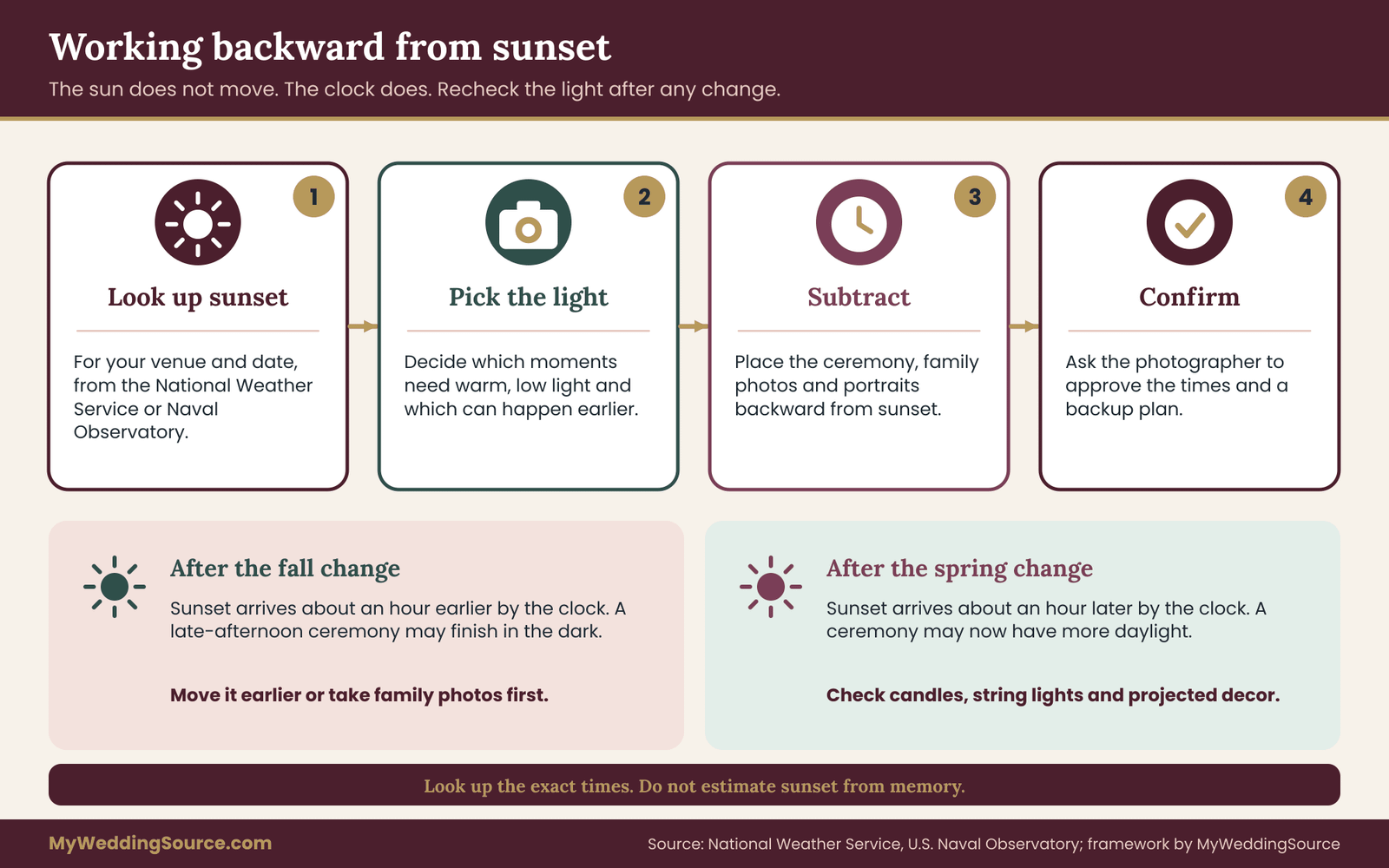
Two facts matter. In the weeks after a spring change, sunset arrives about an hour later by the clock than it did the week before, so evening ceremonies that were once in the dark can now be in soft light. In the weeks after a fall change, sunset arrives about an hour earlier by the clock, and a ceremony that was timed for the last warm light may now happen after dark. The exact times depend on your latitude and the date, so look them up for your venue instead of estimating.
A reliable source is the National Weather Service or the U.S. Naval Observatory, both of which publish sunrise, sunset and twilight times for specific places and dates. The National Institute of Standards and Technology runs the official U.S. time service at time.gov, which is useful for confirming the actual clock time on the day. Use these sources instead of a general weather app, and write down the sunset time for your venue’s location and date on the rehearsal sheet.
Working backward from sunset
A simple method keeps the light on your side. Start with the sunset time at your venue on the wedding date. Then decide what kind of light you want for each moment and subtract from sunset.
For a ceremony in warm, low light, many photographers suggest starting the ceremony somewhere between one and two hours before sunset, so that the portraits that follow still have usable light. For couple portraits in the softest light, aim for the stretch just before sunset. For a first look, earlier in the afternoon works well. These are general guidelines, and your own photographer will have a view based on the venue, so ask them for a specific recommendation instead of guessing.
On a fall-change weekend, this method can produce a surprise. If you planned a 4:30 p.m. ceremony for the week before the change, you might have had more than an hour of daylight left afterward. The week after, sunset may arrive before you have finished the family photos. Many couples respond by moving the ceremony earlier, taking family portraits before the ceremony, or building in a short break between ceremony and cocktail hour for a sunset session while the light is still there.
On a spring-change weekend the opposite adjustment is useful. A ceremony that once finished in daylight and went straight into dusk may now have an hour more of light, which is a gift for photography but may change the look of string lights, candles and projected content. If your decor depends on darkness, a later start may suit it better.
Light and outdoor timing: questions to put to the photographer
Ask your photographer or videographer these questions, preferably during the rehearsal sheet step.
What time is sunset at the venue on the wedding date, and what time is the end of civil twilight? Civil twilight is the period after sunset when there is still enough natural light to see clearly, and photographers often use it for dramatic portraits.
Does your coverage plan depend on a specific time, such as a first look at a set hour or sunset portraits at a set minute? If yes, is that time given as a wall-clock time? If the coverage is tied to sunset, does the contract describe how the time will be decided?
Is there a backup plan if the light is not what we expected, such as moving portraits before the ceremony or using an indoor spot?
Do you adjust your schedule if the daylight saving time change happens in the same week? Experienced photographers will say yes, and will often suggest a revised timeline on their own. If a photographer has no view about it, that is a small sign they may not have planned for it.
Lighting designers, candles and projected content
Daylight saving time can also affect vendors who work with light as a design element. A lighting designer who sets up string lights, uplighting or projected monograms needs to know when it will be dark enough for the effect to read. If your reception starts earlier or later by the clock because of the daylight saving time change, the effect may arrive too soon or too late in the evening.
Candle ceremonies and lantern sendoffs carry both timing and safety questions. Many venues restrict open flames or lanterns, and they may limit them to certain times. Check venue rules for flame and lantern policies directly, and confirm them in writing before you build a plan around them.
Light is not the only thing that moves
Weather and temperature often shift with the season in ways that overlap with the clock change. An outdoor reception in early November may be pleasant at four and cold at six, and the temperature drop may occur earlier by the clock than you expect after the change. If the event is outdoors, plan for the cold hour as carefully as for the dark hour. Shawls, heaters and a warm indoor backup are worth discussing with the venue. The venue and the caterer can tell you how the space behaves in the evening at that time of year, and that advice is worth more than a general forecast.
Guests, travel and time zones around a daylight saving time change
Guests are the people most likely to be caught off guard by a daylight saving time change, because they do not live inside your timeline. They live in theirs. They check a phone, a car dashboard, a hotel clock or a boarding pass, and they trust whatever it says. Your job is to make the information they receive consistent with each of those.
A guest traveling for the weekend can face four kinds of time confusion. Their home may be in a different time zone. Their home may be in a place that does not observe daylight saving time. They may travel across the daylight saving time change during the trip. Or they may set a device manually and forget to update it.
Time zone labels on every guest-facing time
The most helpful single habit is to attach the time zone to every time you publish. Do it on the wedding website, on the invitation insert, on the shuttle schedule, in text messages and on the welcome-bag card. “Ceremony at 4:00 p.m. Eastern” is clearer than “ceremony at 4:00 p.m.,” especially for guests coming from other zones. If your wedding is on a change weekend, add one more word: “Eastern Daylight Time” or “Eastern Standard Time,” whichever applies, so that the label names the clock itself.
The guide to wedding invitation etiquette covers what belongs on the invitation itself and what belongs on the website or an enclosure. A time zone label belongs with the time, wherever it appears, and a short sentence about the clock change belongs on the website and the weekend schedule.
Guests from places that do not change
If a significant share of your guests live in Arizona, Hawaii or a U.S. territory, remember that their phones will not change on their own on the change weekend, because their home clocks do not move. Phones will adjust when they land in a location that follows daylight saving time, but a guest who drives in from a place that does not observe it may see the daylight saving time change halfway through the trip. Add a note on the website that gives the arrival times in plain terms: “Check-in begins at 3:00 p.m. local time at the hotel.”
Guests from other countries are in an even more complicated position, because most other countries change their clocks on different dates from the United States.
In some years the gap between a guest’s home and your wedding location is different in the week of your wedding from the gap the rest of the year. A guest flying in from Europe, for example, can face a one-week period when the usual time difference is one hour shorter or longer, because the two regions change their clocks on different weekends.
For any guest crossing an ocean, give the schedule in the local time of the wedding and encourage them to rely on their phone, which will handle the conversion, over their own arithmetic.
Guests traveling by air, rail or shuttle
Flights and trains print local times, so a guest on a Sunday departure will see the new time on the boarding pass. That is rarely a problem. The weaker link is the ground transport you control. A shuttle that is supposed to pick guests up at 10:00 a.m. and a hotel that expects checkout at 11:00 a.m. need to agree on the clock, so ask both to confirm in writing and to describe the change in their own words. For more on how hotel plans fit around the weekend, the guide to coordinating guest hotels across budgets and mobility needs covers the lodging side.
If you are providing shuttles, give each driver the same single-page schedule with the time zone on top and add the sentence that tells them which clock to follow. Drivers often work several jobs on the same day and may carry a company schedule that was set long before your wedding was booked.
Remote guests and live streams
A live stream for guests who cannot attend adds another set of clocks. The remote guests may be in different zones, and the stream link may be sent in an email that shows the time in the sender’s zone. A calendar invitation usually converts times automatically for each recipient, but a plain-text time in an email does not. Publish the time with a zone label, and, where you can, send a calendar invitation so each guest’s device shows the time on their own clock.
Also decide what the stream does if the ceremony runs a few minutes late. Remote guests who join at the posted time and find a blank screen assume something has gone wrong. A short “starting soon” page and a note on the website avoid unnecessary messages to you on the day.
Vendor confirmations for a daylight saving time wedding: what to ask and how to record it
The rehearsal sheet works only if the answers come from the people who control each item. This section covers how to ask each vendor, what a clear answer looks like, and how to keep the record. A confirmation is not a favor you request. It is a normal part of vendor management, and a good vendor treats it as routine.
Start with timing. Send confirmations early enough that you can still change the plan if the answer is awkward. A reasonable pattern is to send the first request when the final timeline is settled, usually six to eight weeks before the wedding, and to follow up in the final week with a short reminder that restates the agreed reading. The clock confirmation can ride along with the final-details message you already send to each vendor.
The shape of a good confirmation message
A confirmation message does four things in a few lines. It names the date and the daylight saving time change. It lists the exposed items for that vendor. It states how you would like them counted. And it asks for a reply that confirms or corrects.
Here is a template in plain words, which you can adapt. “Hello, our wedding is on Saturday, November 6. The clocks change overnight, at 2:00 a.m. on Sunday. Our contract lists the reception end time as midnight and includes two hours of overtime at your hourly rate. If we run past midnight, please confirm that overtime is counted by the wall clock, and that the daylight saving time change does not add or remove billable time. If you count it differently, please tell us how and we will adjust the plan. Thank you.”
A reply of “yes, confirmed” is enough. If the vendor corrects you, restate their correction in one line and ask for a final yes. Keep the thread in one place, such as a single email chain per vendor, so that you can find it later.
Questions by vendor type
Different vendors face different exposures. The list below is deliberately specific, so you can copy the line that applies and skip the rest.
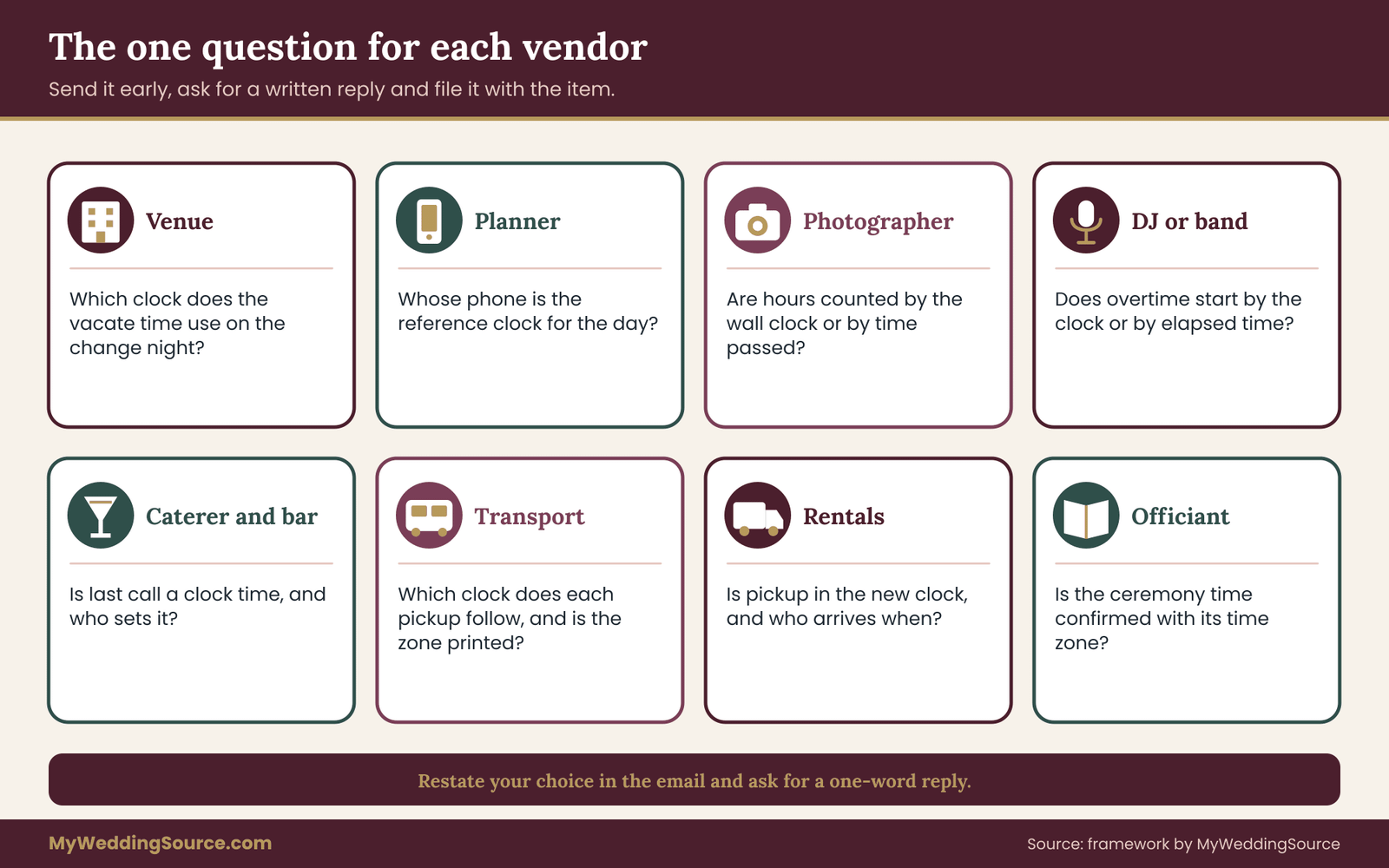
Venue. What time must guests and vendors be out, and which clock does that refer to on the daylight saving time change night? How does the venue count extra time? Are staff scheduled differently on that night? Are there noise or alcohol rules tied to a wall-clock time? Is the building clock automatic or manual?
Planner or day-of coordinator. Which device or clock is the reference for the day? Will the run-of-show state the time zone and the change? Can you add a line about it to the vendor copy of the timeline?
Photographer and videographer. Is coverage counted by the wall clock or by elapsed hours? How is overtime started and rounded? What time is sunset at the venue, and does the timeline account for it? Is there a time-lapse or sunrise shot that depends on the clock?
DJ or band. Is the performance block a clock window or a number of hours? Does overtime start by the wall clock or by elapsed time? Is the sound equipment’s clock or timer set by hand? Who handles the cue for the last dance?
Caterer and bar service. Are hours counted from arrival or from service start? Is there a legal last-call time tied to the clock? How does a service minimum or overtime fee work across the daylight saving time change?
Transportation. Which clock does each pickup use? Are the drivers’ schedules printed with the time zone? Is a block billed by hours or by trips? Will the last shuttle leave before or after the clock change?
Hair, makeup and florists. What is the arrival time by the new clock? Who is the contact if the artist is late? Does the florist’s delivery window shift if the change is that weekend?
Rentals and equipment. Is delivery and pickup scheduled by the wall clock? If pickup is the next morning, is the time given in the new clock? Who is responsible if the crew arrives an hour early or late?
Officiant. Has the officiant confirmed the ceremony time and the zone in writing? Is there a rehearsal time that falls close to the daylight saving time change?
Recording the answers
Add one line to the rehearsal sheet for each confirmed item: the vendor, the item, the reading that applies and the date of the reply. Paste or file the replies in one folder named for the wedding weekend. If a vendor changes their answer later, add the new one beneath it with the date.
This record does two jobs. It tells your planner, your family and your wedding party what to expect. And it gives you a clear trail if there is a disagreement. A message that says “confirmed, wall-clock time” is much stronger than a memory of what someone said on the phone in September.
What if a vendor will not confirm?
Sometimes a vendor answers with something vague, such as “we’ll figure it out on the night.” That is not a refusal, but it is not a confirmation either. Ask a second time with a narrower question: “If the reception runs until 1:30 a.m., would the overtime be one hour or two?” A concrete example is harder to dodge than a general question and usually gets a concrete reply.
If the vendor still declines, consider whether the exposure is small enough to accept or large enough to change. A small extra charge may not be worth a dispute. A venue curfew that could shorten your evening by an hour is worth more attention, and you may decide to end the reception earlier by the wall clock so that the question never arises. You are not obliged to carry a risk that the vendor will not name.
When to ask for an amendment
A confirmation email is usually enough for small items. An amendment, which is a short written change to the contract signed by both sides, makes sense in three situations. When the money involved is more than a few hundred dollars. When the answer changes what the contract said. When the vendor’s answer depends on a policy that might change. In those cases, ask the vendor to add one line to the agreement and sign it.
Devices, calendars and the clocks nobody checks
Most phones and computers update their clocks on their own when the change happens. That is why a daylight saving time wedding mostly runs smoothly: the devices that guests and vendors carry will almost always be right. The risk sits in the few that are not.
A useful way to find them is to walk the venue in your mind and list every clock, timer and scheduled device that will be involved on the wedding weekend. Then ask of each one: does it update by itself, and if not, who sets it?
Devices that usually update on their own
Smartphones set to automatic date and time. Laptops and tablets connected to the internet. Smart watches paired to a phone. Most modern cars with connected navigation. Airline, rail and shuttle booking systems. Most cloud calendars and scheduling tools.
These generally handle the daylight saving time change correctly, but “generally” is not “always.” A phone with the automatic setting turned off, or a device that has not been connected for months, can be an hour wrong. A quick check of a few key devices, such as the planner’s phone, the DJ’s laptop and the venue’s main clock, is worth doing.
Devices that often do not
Wall clocks in a venue, especially in older buildings. Oven and microwave clocks, which the caterer may rely on for timing. Handheld timers and stopwatches. Cheap alarm clocks and travel clocks. Analog watches, including a grandparent’s heirloom watch. Some audio equipment, lighting controllers and projector timers that are set by hand. Programmable thermostats and outdoor lighting timers, which may switch on or off at the wrong hour. A music player or automation system with a scheduled playlist, such as a ceremony prelude set to start at a certain time.
The solution is not complicated. Make a short list of the devices that matter, name the person who is responsible for each, and have them check the time against a reliable reference before the event. The official U.S. time service at time.gov displays the current time for each zone and is a useful reference for setting hand-set devices.
Calendar invitations and scheduled messages
Calendar events can cause quiet problems. An event created with a fixed time zone will show the right time on every device, even across a change. An event created without a zone, sometimes called a floating event, shows the same clock time wherever the device is, which means it can be wrong for a guest in a different zone. When you send a calendar invitation for the ceremony, the rehearsal or the live stream, check that the time zone is attached.
Scheduled messages need the same care. Automatic text updates to guests, scheduled social posts, timed emails from a wedding website and reminders in a planning app all run on a clock. If you scheduled them months ago, review them after the change date is known. The guide on wedding day digital contingency planning covers backup plans for the technology side of the day, including what to do if a scheduled message or app fails.
Cue sheets and music timings
A ceremony cue sheet usually lists the times and the order of each moment. If it is built in a spreadsheet, check whether the times are plain text, which will stay as they are, or formulas that depend on a start time, which will also stay correct across the daylight saving time change because the sheet does not know about the daylight saving time change.
The risk is not the sheet. It is the person reading it. Add the date of the change and the time zone to the header, and note whether the times are wall-clock.
If your DJ or band uses a playlist with timed cues, ask whether the timing is by the clock or by a countdown. A countdown is safer across a change. A clock-based cue should be checked on the day.
A short device check for the morning of the wedding
Choose one trustworthy reference clock, such as a phone set to automatic time. Ask the planner or a reliable friend to compare it with time.gov. Then check the venue’s wall clock, the caterer’s timer, the DJ’s equipment and any watch worn by a key family member. Correct any that are off. The check takes ten minutes and removes a whole category of minor problems.
A daylight saving time worked example: one wedding, one clock change
The example below is invented to show the method at work. The couple, the venue and the vendors are made up, and the details are illustrative, not typical. The point is the reasoning, so adapt the steps to your own contracts.
Priya and Marcus are marrying on the Saturday night before the first Sunday in November, in a city in the Central time zone. They have a ceremony at 4:00 p.m., a reception from 6:00 p.m., an after-party they hope will run late, a Sunday brunch and about ninety guests, some of whom are driving in and some flying. Six weeks out, their planner mentions that the clocks change that weekend. They decide to build a clock rehearsal sheet.
Steps one and two: anchor and list
At the top of the sheet Priya writes the daylight saving time change: clocks go back at 2:00 a.m. on Sunday, and the hour from 1:00 to 1:59 happens twice. She draws a simple strip from Friday to Sunday and marks the change. Then she and Marcus list every clock-time promise: the photographer’s coverage, the ceremony start, the reception schedule, the DJ block, the food truck, the shuttles, the venue curfew, the rental pickup, the brunch and the hotel checkout.
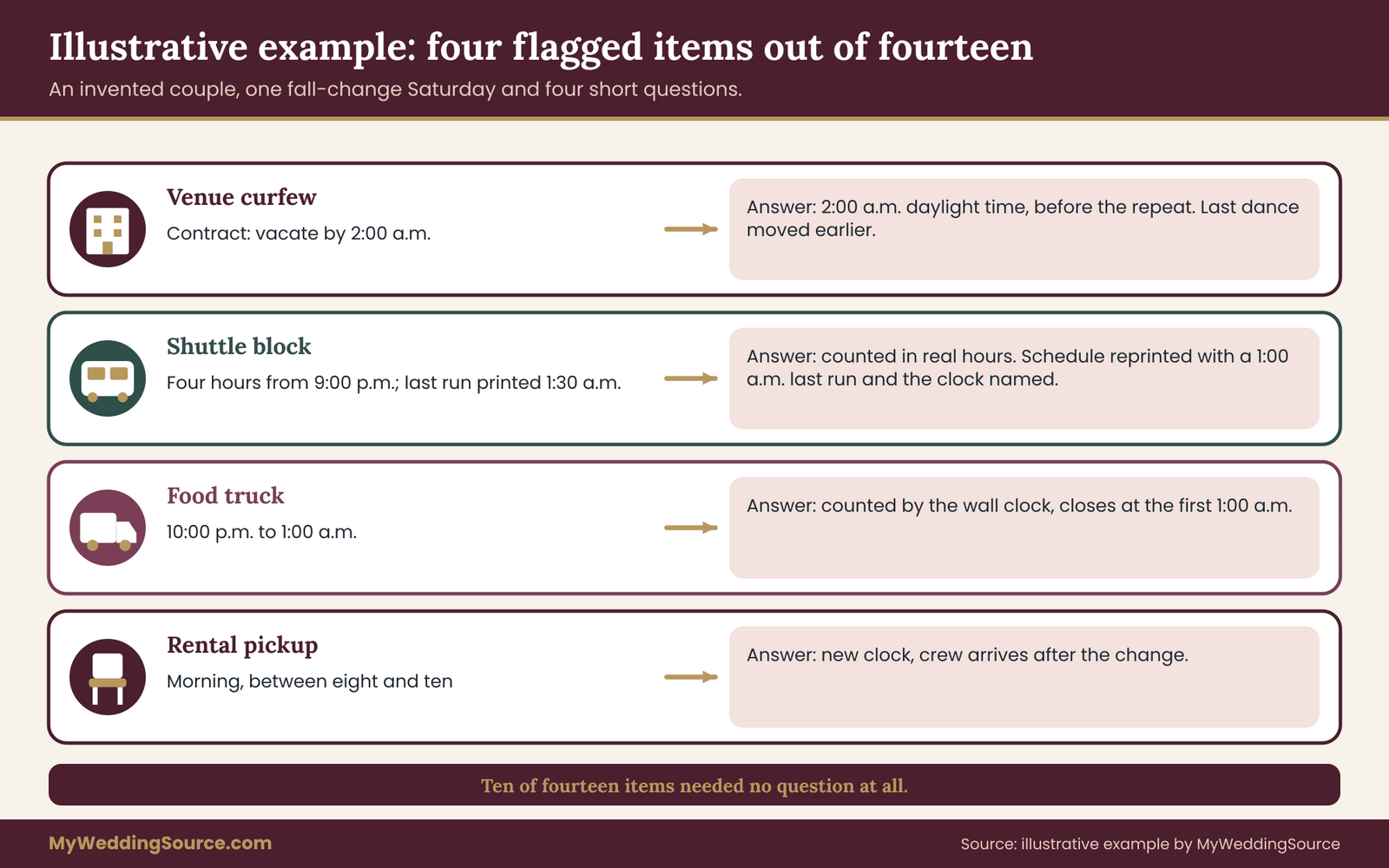
They have fourteen items. Most of them sit well before midnight and are not exposed.
Steps three and four: label and flag
Next they label each item. The photographer is booked for eight hours starting at 1:00 p.m., so coverage ends at 9:00 p.m. by either reading. Not exposed. The ceremony and reception schedule sit before midnight. Not exposed.
The DJ is booked from 6:00 p.m. for six hours, which ends at midnight by either reading, with overtime by the half hour. Marcus wants the option to go to 1:00 a.m. Since 1:00 a.m. arrives before the daylight saving time change, an extra hour counts the same on either reading. Not exposed, but worth noting.
Four items are flagged. The venue contract says the event ends at 1:00 a.m. and everyone must vacate by 2:00 a.m., with a per-hour fee for extra time. The shuttle company’s block runs from 9:00 p.m. for four hours, and the printed schedule shows the last run at 1:30 a.m. The late-night food truck is booked from 10:00 p.m. to 1:00 a.m. And Sunday’s rental pickup is listed as “morning, between eight and ten.”
Step five: written confirmation
They send each flagged vendor a short message in the format described earlier.
The venue replies that “vacate by 2:00 a.m.” means 2:00 a.m. daylight time, which is the moment the clocks change, so the building is empty before the repeated hour begins. The venue’s weekend manager adds that the building’s wall clocks are changed by hand on Sunday morning. That answer disappoints the couple, who had pictured guests lingering through the repeated hour. It also saves them an argument, and they move the last dance to 12:45 a.m.
The shuttle company says its block is counted in actual hours, so the four-hour block runs until 1:00 a.m. on the old clock. Its printed schedule, however, carries no time zone, and the last run was entered as 1:30 a.m., half an hour after the block ends. The dispatcher agrees to reprint the schedule with a last run at “1:00 a.m. daylight time, before the clocks change” and to tell the drivers which clock to follow.
The food truck confirms that it counts by the wall clock and will close by 1:00 a.m. by the first pass.
The rental company confirms that “between eight and ten” means by the new clock, and the crew will arrive after the change.
Step six: the day-of anchor
Priya’s planner becomes the reference clock. The planner checks her phone against time.gov on Saturday morning, then walks the venue and checks the wall clocks, the DJ’s laptop and the caterer’s oven timer. Priya’s grandmother wears a wristwatch that she sets by hand. The planner asks her to set it the night before.
The couple also adds three lines to the guest schedule: “Clocks go back overnight. The last shuttle leaves at 1:00 a.m. by the clock before the daylight saving time change. Sunday brunch is at 10:30 a.m. on the new clock.” A cousin from Phoenix gets a personal note, because her phone will not change on its own.
What the example shows
Notice what the sheet found. None of the problems was dramatic. The venue’s curfew was shorter than the couple pictured, the shuttle schedule lacked a clock label, and the guest schedule lacked a sentence. Each fix took a few minutes and cost nothing. Without the sheet, the couple would have discovered the venue’s meaning of “2:00 a.m.” while the last dance was playing.
The sheet also showed where no action was needed. Of fourteen items, only four needed a question. That is a healthy ratio: the method concentrates attention on the few items that matter and leaves the rest alone.
Edge cases that change the plan
Some situations do not fit the standard picture. Each has a small adjustment.
A destination wedding in a place that does not observe daylight saving time. If the wedding is in Hawaii or Arizona, the clock does not change at the venue, but most of your guests’ home clocks will. Give every time in local wedding time with the zone and a short note about the difference from the main guest cities. The difference in hours will not be the same in summer and winter, and guests may not remember which it is.
A wedding the weekend before or after the change. If the daylight saving time change is a few days away and your event is not exposed, the main effects are indirect. Guests who have not yet adjusted their own watches may be early or late, and sunset moves by an hour on the clock. Add a courtesy line and check the light.
A ceremony tied to sunset or a religious schedule. Some ceremonies are timed to sunset, to the end of a day of rest, or to prayer times, and their clock times move with the season and with the daylight saving time change. Ask your officiant or religious leader for the exact time on your date, and have them confirm it in writing. Do not calculate it yourself.
A multi-day celebration. Welcome dinners, ceremonies and farewell brunches that span a change weekend should each have their own line on the sheet. The risk is highest for events that cross the overnight change and for the first morning after.
An overnight or all-night event. A vigil, a sunrise ceremony or an all-night celebration crosses the daylight saving time change by design. Treat the whole night as exposed, use elapsed time for everything you are paying for, and hold a short briefing with every vendor at the start of the night, so that all of them know which clock to follow.
A rain plan or a venue switch. If you have a backup venue, ask it the same questions. Its curfew, its staff and its clocks may differ from the primary venue’s.
A rule change. Lawmakers have debated ending clock changes. If the rule is different in your wedding year, update the dates on the sheet and ignore this guide’s examples where they no longer apply. The sheet does not depend on a particular rule. It depends only on knowing the date of any change that does happen.
Common daylight saving time mistakes, limits of this guide and what to verify
The same few errors account for most clock-change trouble at weddings. None is hard to avoid once you know it exists, and most are visible on the rehearsal sheet.
Assuming everything updates itself. Phones do. Wall clocks, oven timers, hand-set watches, some audio gear and some scheduled automations do not. Mistaking one for the other is the most common source of an hour’s confusion. The fix is the short device check described earlier, done on the morning of the wedding.
Writing times without a zone. A time that reads clearly to you reads as a question to a guest from another zone. Put the zone, and on a change weekend the word “daylight” or “standard,” beside every guest-facing time.
Mixing clock time and elapsed time in one sentence. “Four hours, ending at 1:00 a.m.” sounds precise and may be impossible on a change night. If you need both, say which one governs.
Treating the repeated hour as free. An extra hour on the clock does not give you an extra hour of venue access, staff time or guest energy unless somebody agreed to it. Ask first.
Ignoring the lost hour in the spring. The missing hour is easy to forget because it occurs after midnight. Plan for the Sunday-morning effects, not the Saturday-night ones: shorter sleep, earlier alarms and a rushed brunch.
Leaving vendors to guess. A vendor who has never been asked will give you their own default, and the default often favors the vendor’s time sheet. A two-line confirmation prevents it.
Relying on a verbal answer. A reassurance on the phone is easy to forget and impossible to show to anyone else. Ask for the reply in writing, even if it is one word.
Changing the plan without telling anyone. If you move the last dance, the shuttle or the brunch because of the daylight saving time change, update every document that mentions it: the website, the vendor timeline, the guest schedule and the day-of binder. The guide to the wedding planning checklist is a good place to see which documents usually carry a time.
Overcorrecting. A daylight saving time change is a small factor in most weddings. A plan that has twelve special rules for a change that touches four items is harder to run than the problem it solves. Keep to the exposed items.
What this guide cannot tell you
Several things sit outside what a general article can settle, and a few honest limits are worth stating.
The rules for time can change. Clock-change law has been debated in Congress and in state legislatures for years, and a state may adopt new rules that take effect only if federal law allows it. The date and direction of the change in your wedding year should come from the Department of Transportation, the National Institute of Standards and Technology or USA.gov, not from this article and not from a printed calendar bought years earlier.
Contract language differs. A sentence in one vendor’s agreement can read differently in another’s, and the right reading depends on the whole document and on local law. This guide describes common patterns. It cannot tell you what your contract means. If a clause is unclear and the amount involved is significant, a short consultation with a local attorney may be worth the cost.
Sunset and twilight times depend on place and date. Use the National Weather Service, the Naval Observatory or the NOAA solar calculator for your venue and date, and ask your photographer what they need.
Venue rules, alcohol service rules and noise ordinances are local. Ask the venue and the vendor who serves alcohol what applies in your location. Do not assume that a rule you read about for another city applies to yours.
Lastly, the examples here are illustrations. The couple in the worked example is invented, and the details are chosen to show reasoning, not to predict what your vendors will say.
What to verify, and with whom
Use this short list to decide whom to ask. The date and rule of the change in your location: the Department of Transportation, NIST or USA.gov. The time zone of your venue and your guest-heavy cities: the Department of Transportation or the vendor’s official address. Sunset, sunrise and twilight on your date: the National Weather Service, the Naval Observatory or the NOAA solar calculator. How each contract counts hours: the vendor, in writing. The venue’s curfew, staffing and clock policy: the venue manager, in writing. Last call and alcohol service rules: your local licensing authority and the licensed vendor. Religious timing: your officiant or religious leader.
The pattern is the same each time. The person who sets the rule gives the answer, and you keep the answer in writing next to the item it affects. For the overall date decision, which this article does not attempt to cover, see the guide on choosing a wedding date around guest availability, vendor capacity and travel disruptions.

A compact timeline for the six weeks before the wedding
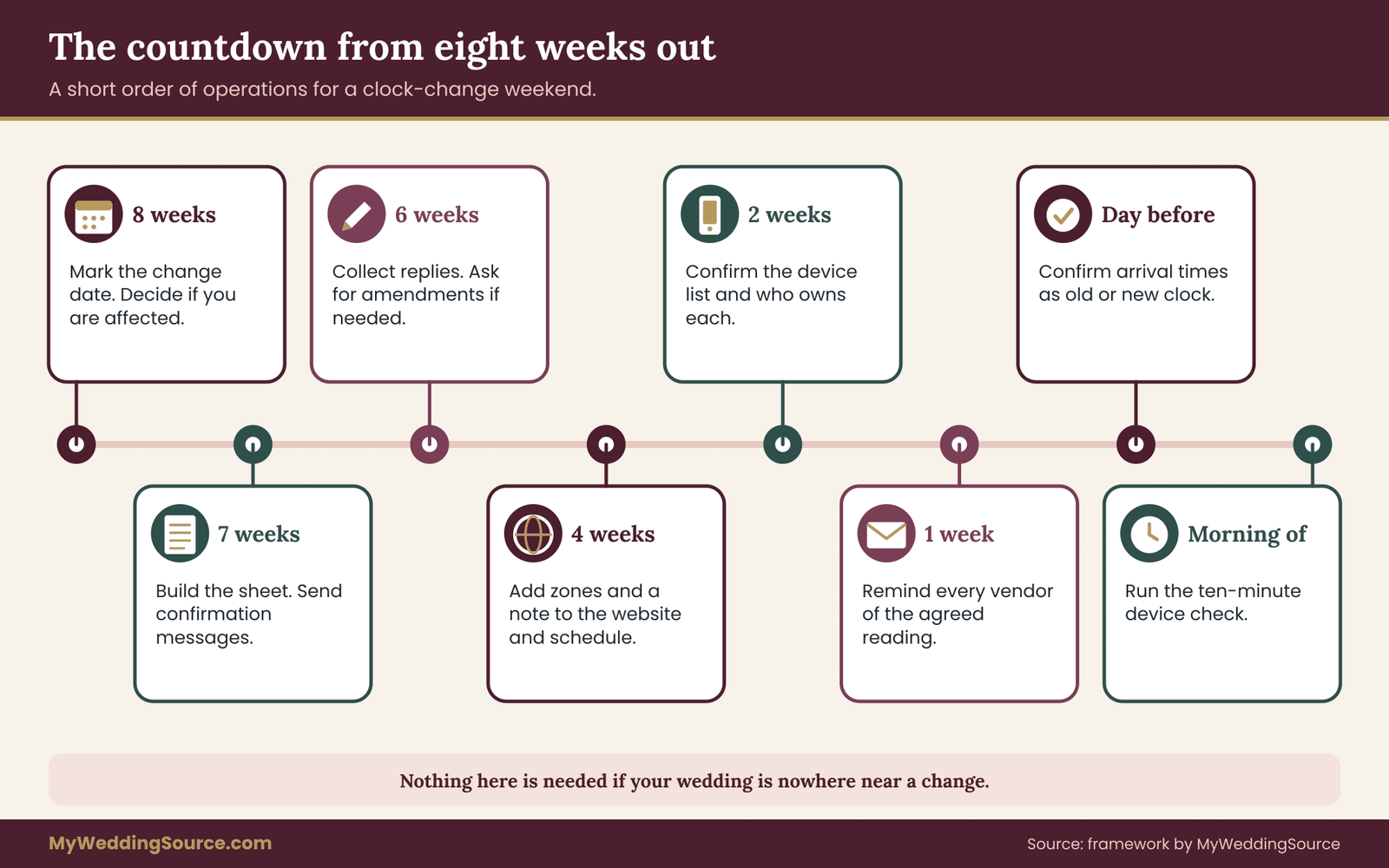
Many couples find it easier to hold the method in a simple order of operations. Eight weeks out, mark the change date and decide whether your wedding is affected. Seven weeks out, build the rehearsal sheet and send confirmation messages to the exposed vendors. Six weeks out, collect replies, ask for amendments where the money or the risk justifies one, and update the website with the time zone and a short note about the change.
Four weeks out, add the note to the invitation follow-up, confirm guest-facing schedules and check sunset for the venue. Two weeks out, confirm the device list and name the person responsible for each device. One week out, send a short reminder to every vendor that restates the agreed reading. The day before, confirm all arrival times with the words “new clock” or “old clock” as needed.
On the morning of the wedding, run the ten-minute device check.
Your next steps
Open a calendar and find the date of the clock change for your wedding year and your location, using the Department of Transportation or NIST for confirmation. If it is not within a week of your wedding, send your planner or venue contact one line asking whether anything in the day is counted in hours across midnight, and stop there.
If the change is on your weekend or next to it, spend one evening building the rehearsal sheet: anchor the weekend, list the clock-time promises, label each as wall-clock or elapsed, flag the exposed items and send each affected vendor the one-sentence question. Add the time zone and a short note about the change to your guest schedule. Then check the devices, and let the rest of your planning carry on as usual.
FAQ
Does daylight saving time really affect a wedding?
Often only a little, and sometimes a lot. A wedding that ends in the evening well before the overnight change is rarely touched. A late reception, an after-party, an overnight crew or hourly contracts that run past midnight can all be affected. The way to find out is the quick check in this guide: does the weekend contain the change, does the day run late, and is anything counted in hours?
When does daylight saving time start and end in the United States?
Under current federal rules, daylight saving time begins on the second Sunday in March and ends on the first Sunday in November, at 2:00 a.m. local time. Most of Arizona, Hawaii and the U.S. territories do not observe it. Because rules can change, confirm the date for your wedding year with the Department of Transportation, NIST or USA.gov before relying on it.
How should a contract describe hours when the clocks change that night?
The clearest wording names both the time and the clock that governs it, and says whether overtime is counted by the wall clock or by actual time passed. For example, a contract can say the reception ends at midnight by the wall clock and that overtime is billed by elapsed minutes. Ask each vendor to confirm the reading in writing, and request a short amendment if significant money is involved.
Do we get an extra hour at the venue when the clocks go back?
Only if the venue agrees. The clock repeats an hour, but a venue’s curfew, staff schedule and fee structure may not treat it as extra time. Some venues end the event by the first pass of the hour, and some count the repeat. Ask the venue to state the end time in a way that names the clock, and get the answer in writing before you plan a late finish.
What should we tell guests about the daylight saving time change?
Keep it short. Put the time zone beside every time, and add one sentence on the website and the weekend schedule, such as which clock the last shuttle follows and what time brunch is on the new clock. Send a personal note to guests who live in places that do not change their clocks, such as Arizona or Hawaii, because their phones will not adjust on their own.
Does daylight saving time change when the sun sets on our wedding day?
The daylight saving time change does not move the sun, but it moves sunset on the clock. After a fall change, sunset arrives about an hour earlier by the clock. After a spring change, it arrives about an hour later. Look up sunset for your venue and date using the National Weather Service or the Naval Observatory, and share it with your photographer when you set the timeline.
Which wedding devices do not update automatically?
Phones, laptops and most connected devices update on their own. Wall clocks, oven timers, handheld timers, hand-set watches, some audio and lighting equipment and old alarm clocks often do not. Make a short list of the devices that matter on the day, name a person for each, and compare them with a reliable reference such as time.gov on the morning of the wedding.
Should we avoid a wedding date on a clock-change weekend?
Not necessarily. Many couples marry on those weekends without trouble, and the date may suit your venue, guests and budget. If the date is otherwise right, handle the change with the rehearsal sheet. If you are still choosing between dates and the other factors are equal, the clock change can be a tiebreaker, because a date without it removes one source of confusion.
Sources
- Daylight saving time, USA.gov
- Daylight saving time, National Institute of Standards and Technology
- Official U.S. time, time.gov, National Institute of Standards and Technology
- U.S. Department of Transportation, which oversees time zone boundaries and daylight saving time
- 15 U.S. Code 260a, Advancement of time, Legal Information Institute, Cornell Law School
- National Weather Service, National Oceanic and Atmospheric Administration
- Astronomical Applications Department, U.S. Naval Observatory
- NOAA Solar Calculator, Global Monitoring Laboratory
- Congress.gov, Library of Congress