
A courthouse wedding outfit has three jobs that a normal wedding outfit never has to do together: get through building security without drama, survive the weather between the car and the courtroom, and still look like you in photographs taken in a hallway. This guide gives you a three-gate check to test any courthouse wedding outfit against those jobs before you buy it, pack it or wear it.
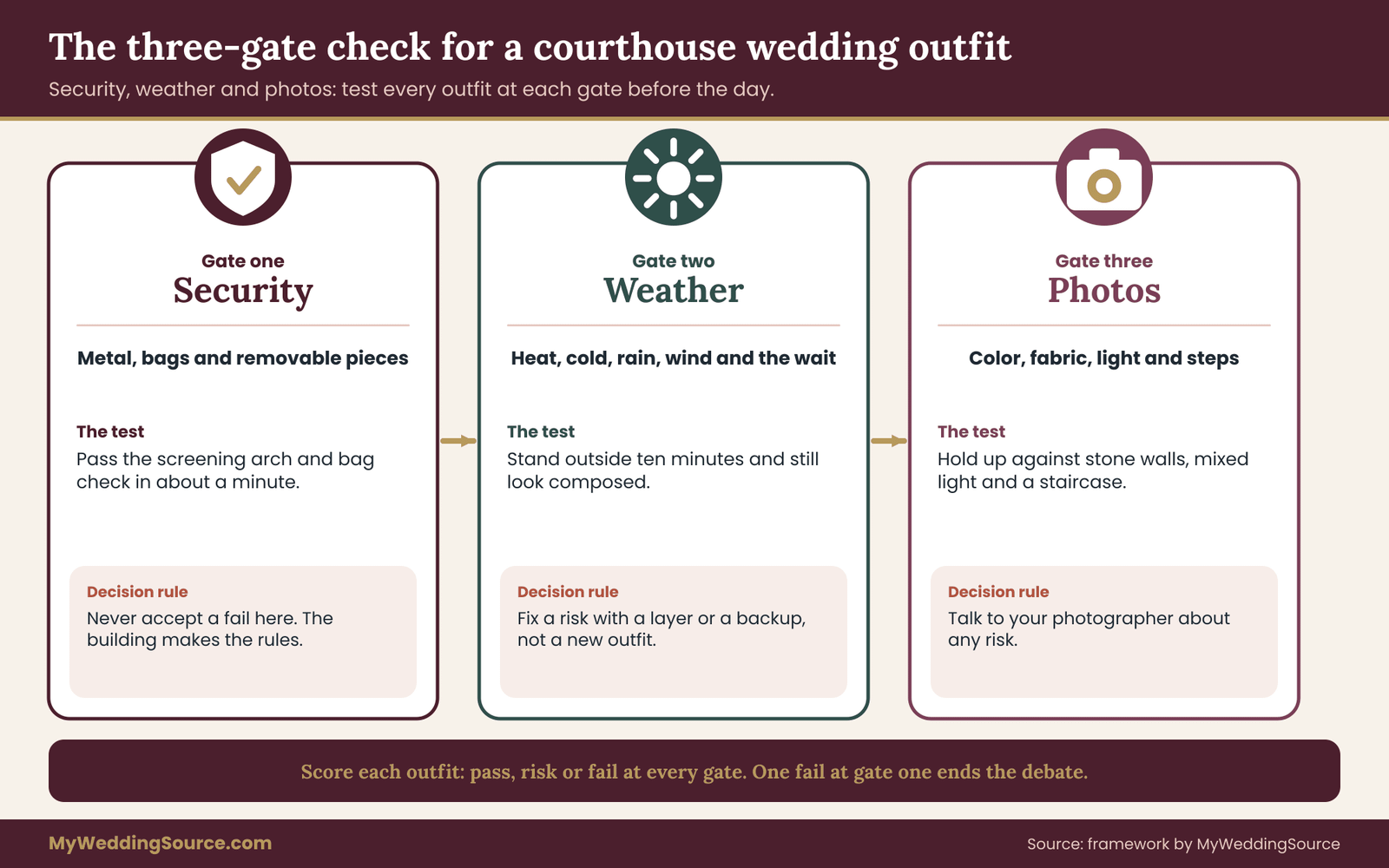
Test every courthouse wedding outfit at three gates. Gate one is security: can you pass a metal detector and a bag check in about a minute, with nothing a deputy would question? Gate two is weather: can you stand outside in the line, the wind or the sun for ten minutes and still look composed? Gate three is photos: does the color, fabric and shape hold up against the building’s walls, lighting and steps? Choose the courthouse wedding outfit that clears all three, carry only what you can hand over at the door, and confirm the court’s own rules by phone before the day.
Most advice about what to wear to a courthouse wedding stops at a color suggestion and a reminder to dress up a little. That advice is fine as far as it goes, but it skips the part that actually causes trouble on the day. A long veil that will not fit through the screening arch, a belt buckle that sets off the detector three times, a white dress that disappears against a white marble wall, a wool suit on a July afternoon with a forty-minute outdoor line.
Each of these is predictable, and each is easy to avoid once you know to look for it.
Courthouses are working government buildings. People arrive there for traffic matters, jury duty, family court and criminal hearings, and the building is set up for all of them at once. Marriage appointments usually share the same front door, the same screening line and the same corridors as everything else. Your courthouse wedding outfit has to work in that setting, not in a ballroom or a garden.
The good news is that the constraints are narrow and knowable. This guide walks through them in order, gives you a simple scoring method, compares outfit styles in plain terms, and ends with a worked example, an edge-case section and a list of questions to ask the clerk and the photographer.
A note on scope. This is general information, not legal advice. Courthouse rules, marriage license requirements and building policies differ by county and court and change over time, so use this guide to prepare good questions and confirm the current rules with the office that issues your license and the court that hosts your ceremony.
The three jobs and the three-gate check for a courthouse wedding outfit
Think of the day as a short journey with three checkpoints. You arrive, you are screened, you wait, you marry, and you take photographs, often in several places. A courthouse wedding outfit that fails at any checkpoint creates a problem exactly when you have the least spare attention to solve it.
Gate one is security. Many courthouses screen visitors at the entrance, much as an airport does on a smaller scale. Depending on the building, that can mean walking through a metal detector, putting bags on a belt, handing over certain items, and sometimes being asked to remove a belt or shoes. Nobody wants to be wanded in a wedding dress, and a calm entrance sets the tone for everything after it.
Gate two is weather. Courthouses often have exterior steps, an outdoor line, a parking structure two blocks away or a plaza where the photographs are taken. Heat, cold, rain, wind and glare all act on fabric, hair and shoes. The courthouse wedding outfit has to cope with the outdoor minutes, not just the indoor ones.
Gate three is photos. Courthouse interiors tend to have mixed lighting, patterned floors, institutional walls and tight corridors. Exteriors have steps, columns and strong shadows. Photographs taken there reward certain colors, cuts and fabrics and punish others.
How to use the three-gate check
For each courthouse wedding outfit under consideration, give it a pass, a risk or a fail at each gate. A pass means you can explain why it works. A risk means it works only if one condition holds, such as dry weather or a friendly guard. A fail means it will probably cause a problem. Then follow three decision rules.
First, never accept a fail at gate one. Security is the one gate where the building makes the rules and you cannot negotiate on the day. If a piece of the courthouse wedding outfit might be refused, replace it or plan a version that can be handed over, such as a pin carried in a pocket and attached after screening where that is permitted.
Second, treat a risk at gate two as a cue to add a layer or a backup, not to abandon the courthouse wedding outfit. Weather problems usually have a cheap fix, such as a wrap, a hair product, a change of shoes for the walk or a ride that drops you at the door.
Third, treat a risk at gate three as a conversation with your photographer. A color that might blend into a wall can often be rescued by choosing a different location for the portraits, and a photographer who has worked at that courthouse will know which corridors flatter and which do not.
What the check does not decide
The check does not tell you what you love about a courthouse wedding outfit. It will not choose between a dress and a suit, and it will not say whether your courthouse wedding outfit should be white, cream, green or navy. Those choices belong to you. What the check does is remove the outfits and the details that will cost you time or comfort on the day, so that your remaining choices are all good ones.
It also does not replace the broader decisions about the day. If you are still working out who can legally perform and sign, the wedding officiant requirements guide covers that, and the broader wedding planning checklist places the appointment inside the rest of your to-do list. This article stays on the courthouse wedding outfit.
Before you choose: find out what the building actually does
The three gates are only as useful as the facts you feed them. A small amount of research, done three or four weeks ahead, turns guesses into answers. Courthouse wedding rules are local. Two buildings in the same state can differ on screening, on how many guests may enter, on whether photographs are allowed inside and on whether the ceremony room is a courtroom, a chamber or a small office.
The five facts to collect
Start with the office that handles marriage licenses or ceremonies at your courthouse. Many county clerks publish a page or a recorded phone message. The federal government’s page on marriage certificates, at usa.gov, explains that marriage records are held at the state and local level, which is a useful reminder that the rules you need are local ones.
Ask or look for these five facts:
- Screening. Is there a metal detector, a bag scanner or both at the entrance used for marriage appointments? Is there a separate entrance for ceremonies?
- Prohibited items. Does the court publish a list? Items such as pocketknives, scissors, certain tools and sometimes even pepper spray or large bags are common entries on court lists, and a few courthouses restrict cameras or tripods.
- Photography rules. Are photographs allowed inside the ceremony room, in the corridors and on the steps? Is a professional photographer allowed, and does that person need advance permission or a fee?
- Waiting arrangements. Do couples wait outside, in a hall or in a waiting room? Is there a second line after screening for the clerk’s window?
- Space. How big is the room where the ceremony takes place, and how many people may enter? A narrow room changes what a long train or wide skirt can do.
Write the answers down, with the date
Keep the answers in a note that includes the date you learned each one and who told you. Policies change, and a front-desk answer from last spring may no longer be correct. Re-check the screening and photography answers within a week of the appointment, because those are the two that most affect your courthouse wedding outfit.
If you cannot reach anyone, assume the stricter version of every rule. Assume you will go through a metal detector, assume bags will be searched, assume interior photographs may be limited to a few minutes and assume that you will wait outside for some portion of the visit. A courthouse wedding outfit built for the strict case works in the relaxed case as well. The reverse is not true.
A short script for the call
Clerks answer many calls and appreciate a clear, narrow question. Something like this works:
“We are getting married at the courthouse on a weekday. Is there a metal detector at the entrance we will use, and is there a list of items we cannot bring in? Also, are photographs allowed in the ceremony room?”
Then listen, repeat the answer back in your own words and ask whether it is written anywhere. If there is a page, ask for its address and save it. A written source is the thing you can point to if a guard at the door has a different understanding.
Why these facts matter more than the weather forecast
Couples often start with the forecast, because it is the easiest fact to find. It is also the one most likely to change between the planning stage and the day. The building’s security and photography rules, by contrast, are stable and they interact with your courthouse wedding outfit in ways a forecast never will. Learn those first, then build for the weather range, not for one predicted number.
Because weather is the most visible variable, the later section on gate two shows how to build a flexible outfit instead of a forecast-dependent one. Think of the forecast as something you check on the final two mornings, not as the basis of the original decision.
Gate one: how security screening shapes the courthouse wedding outfit
Security is a short moment with large consequences. A smooth pass takes about a minute and nobody remembers it. A bad one means a pat-down, a bag set aside, a delay at the clerk’s window and a guest who is already stressed. Most of the problems come from a small list of items, and almost all of them can be removed from the courthouse wedding outfit in advance.
Metal is the main variable
Metal detectors respond to metal in quantity and in certain shapes. Clothing and accessories contain more metal than people expect. The usual suspects are belt buckles, underwire, heavy zippers and snaps, corset boning, jewelry with large metal components, hair accessories with metal clips, shoes with steel shanks or decorative hardware and sewn-in charms. Beading and sequins are usually not a problem on their own, though a heavily metal-threaded fabric can occasionally register.
The practical approach is not to avoid all metal but to count it and reduce it. Before the day, wear the courthouse wedding outfit and walk past a store security gate, a school entrance detector or, if you have an upcoming flight, think of how an airport screening feels.
This is not a precise test, since each machine is calibrated differently, but it is better than nothing. The honest answer is that no test at home predicts the courthouse’s machine exactly, so build in margin: fewer metal pieces, smaller pieces and pieces that can be taken off easily.
Item-by-item decisions
Belts and buckles. If the courthouse wedding outfit needs a belt, choose one with a small or covered buckle, or wear a fabric sash or a belt with a plastic or coated closure. A groom or partner in a suit can choose suspenders with fabric clips or a belt that slides off in seconds.
Jewelry. Rings, simple earrings and a thin necklace are generally fine. A heavy bracelet stack, a metal cuff, large statement earrings and a body chain are likelier to set off a detector. A useful rule is to wear what you would wear through an airport, and carry the rest in a small pouch to put on after screening if rules allow.
Shoes. Heels with metal shanks, ornate buckles or metal toe caps can trigger an alarm. Some screening lines ask for shoes to come off, though many courthouses do not. A shoe that is easy to slip off and on, in a surface you do not mind placing on a gray tray, saves embarrassment. Practice putting them on without sitting down.
Underwire and corsetry. Underwire is a common trigger. Many dresses have built-in support with no wire, or with wire that is coated. If you wear a corset-style bodice with steel boning, consider a version with plastic boning, or accept that you may be asked to step aside for a wand. Know your own tolerance for that conversation.
Hair accessories. Combs, clips and pins with metal can register. Fabric ties, plastic combs and a few well-placed bobby pins are lower risk. If you use many pins for an updo, expect that the wand may find them and be ready for it.
Boutonnieres and corsages. A boutonniere pin is a thin piece of metal with a sharp point. Many courts will allow it, some will ask staff to hold it and a few may object. Carry the pin separately, or choose a magnetic or adhesive attachment, and confirm the rule on the phone. If no answer is available, hand the boutonniere to your witness to attach after the checkpoint.
Bags, bouquets and what you carry
Security also applies to what you bring. The strict-case rule is to carry as little as possible. A small bag that can be opened in ten seconds is better than a large tote with layered compartments.
Consider what you might bring and what it could trigger. A sewing kit contains needles and scissors and is a likely refusal. A steamer is bulky and may be questioned. A garment bag may need to be unzipped and examined. A bouquet is usually fine, but a bouquet wrapped with wire stems or a pin may be inspected. Hairspray in an aerosol can is often accepted in a small size, though some buildings are stricter about aerosols than about other items.
“Is there a size limit on bags, and are aerosol cans or small repair kits allowed past the entrance?”
If the answer is unclear, leave the item in the car or with a friend who is not entering.
The one-minute tray test
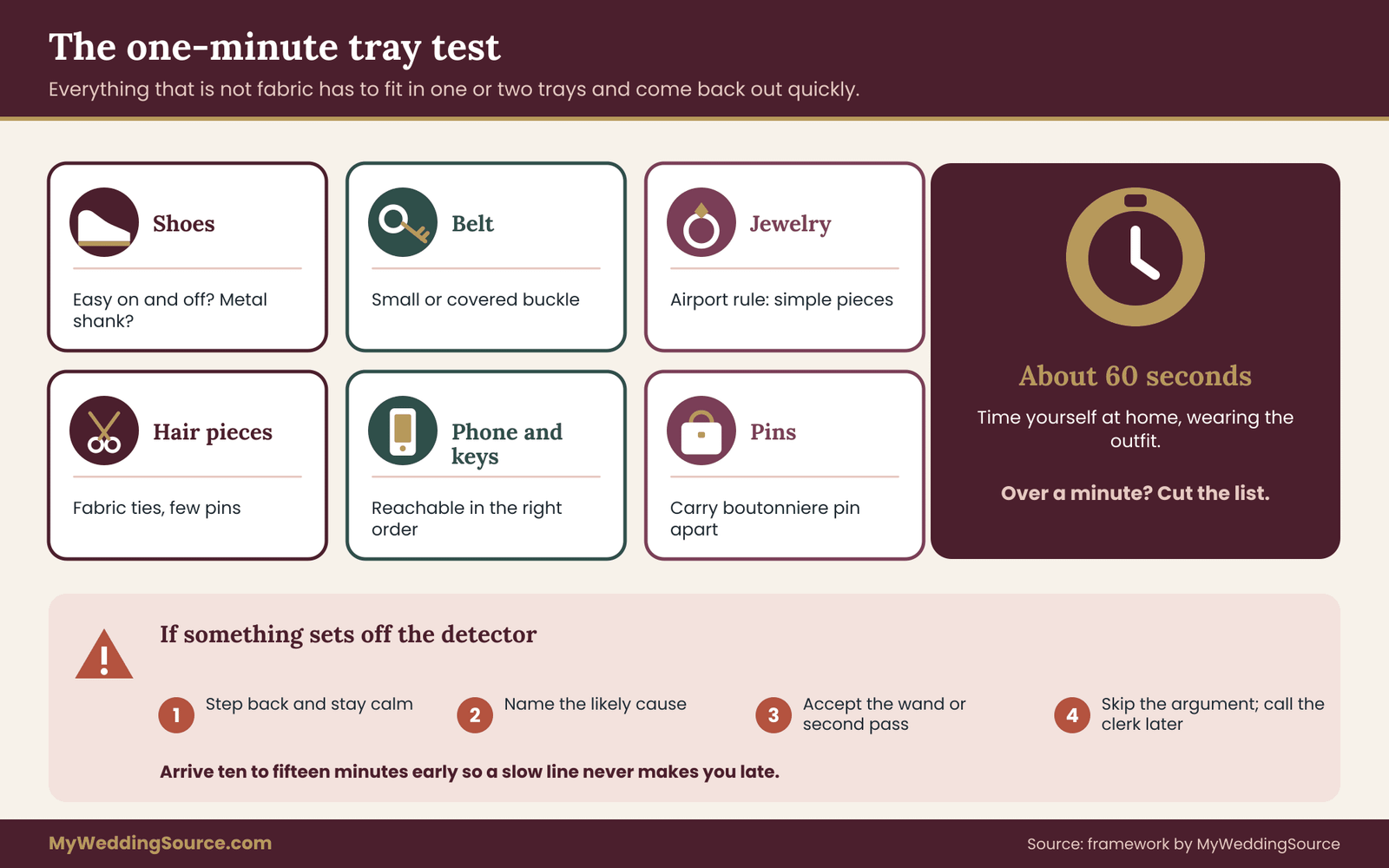
Here is a measurable check that gives the security gate a number. Lay out everything you will carry and wear that is not fabric: shoes, belt, jewelry, hair pieces, phone, wallet, keys, any pins. Now imagine a gray tray at the entrance. Can you place everything in one or two trays and take it back out in about a minute? Time yourself at home, in the clothes you plan to wear.
If the answer is no, the courthouse wedding outfit has too many removable parts or too many that are hard to remove. Cut the list. A pocketless dress with a tiny bag, a ring and a pair of earrings clears this test easily. A three-piece suit with a pocket watch, cufflinks, a tie pin, a belt and a lapel pin does not, and each of those items is a candidate to leave off or carry in a pocket.
The test also reveals ordering problems in a courthouse wedding outfit. If your phone is in a dress pocket that is hard to reach, or your keys are at the bottom of a bag, practice taking them out in the right order. It is a small rehearsal, and it pays off at the door.
What to do if something sets off the detector
Staying calm matters more than the outcome. A second pass or a wand sweep is routine for staff. Step back, let them see what you are wearing, and answer questions plainly. It helps if you can point to the likely cause, for example underwire or a clip. Do not argue with staff about the rules at the door. If you believe an item was wrongly refused, ask for a supervisor politely or call the clerk’s office later, but do not hold up the line on your wedding morning.
Plan a small buffer in your schedule for this. Arriving ten to fifteen minutes before your appointment time, beyond whatever the clerk asks, gives screening room to be uneventful or slow without making you late. That buffer is part of the courthouse wedding outfit plan, because a rushed entrance makes everything else look worse.
Red flags at gate one
A few features deserve a firm second look. A hidden steel structure in a bodice or skirt, such as a hoop or cage, can register and also fill a narrow corridor. A long train that drags through a screening arch may be hard to manage, and a metal-weighted hem, sometimes used to keep a skirt hanging well, can ping.
A cape or long veil can also complicate a bag check if staff want to look under it. Heavy decoration in the form of metal charms, pins or chains can trigger a wand sweep. None of these is a reason to give up the look. Each is a reason to decide beforehand how you will handle it, such as carrying the veil over your arm until after screening.
Gate two: weather, waiting and walking in your courthouse wedding outfit
Weather has a larger effect on a courthouse wedding outfit than on most wedding outfits because so much of the day happens outside the usual protective bubble of a venue. There is a walk from parking, possibly a line on the steps, possibly an outdoor photograph and a walk back. These are not long stretches, but they happen when you are dressed in clothes that are not made for weather.
Map the outdoor minutes
Write down every minute the day might spend outdoors. Start at the car. How far is parking from the entrance? Is there a covered drop-off? Will you wait outside before screening? Do you plan portraits on the steps or in a plaza? How long does the whole outside stretch add up to?
For many couples the total is between ten and thirty minutes, spread across arrival, a possible wait and an outdoor photograph. Use your own number, not a general one. Then ask how the courthouse wedding outfit performs for that length of time in the conditions the season brings.
Heat
Heat is a quiet danger because it affects comfort and appearance before it affects anyone’s health. In hot weather, a heavy fabric such as wool, thick satin or a lined structured garment can leave you flushed and damp in photographs. Pale colors help a little, and breathable fabrics help more.
Linen is cool but wrinkles quickly, which can look relaxed or look careless depending on cut. Cotton blends, lightweight crepe and chiffon layers tend to hold shape with less heat. In a suit, an unlined or half-lined jacket makes a visible difference. For hair and makeup, a heat-resistant style and a setting product help, and a small handheld fan is a legitimate accessory.
The National Weather Service and the Centers for Disease Control and Prevention publish plain guidance on heat safety, including drinking water and recognizing the signs of heat illness. If your day is in hot weather, look at it, and plan water and shade for yourself and for older guests, who are more vulnerable than younger ones.
Cold
Cold creates the opposite problem. The easy mistake is to choose a sleeveless dress or thin suit and plan to rely on the heated interior. But the outdoor stretch is where you take photographs, and shivering shows. A good outer layer is the answer, and it can be part of the look: a tailored coat, a wrap, a cropped jacket, a cape or a wool shawl.
Check whether the outer layer clears the other gates. A coat has to go through the bag screen or be worn through the detector, and a bulky wrap may be unwrapped and searched. Choose one that you can take off at the photograph location without tangling the courthouse wedding outfit underneath, and ask whoever is with you to hold it. Gloves and warm shoes for the walk are sensible, with the formal shoes carried in a bag and swapped at the door if the interior is warm.
Rain and wet ground
Rain is the weather problem with the most predictable damage: wet hems, ruined shoes, flattened hair and a stressful entrance. The solution is mostly logistics. Choose a hem that clears the ground, or accept a short or tea-length skirt. Use a large umbrella, which many couples forget, and have a second for the partner or witnesses. A covered drop-off, if one exists, is worth a short detour.
Plan the shoes for a wet walk too. Smooth leather soles slip on polished courthouse floors, and wet soles slip more. A rubber sole patch, a pair of flat shoes for the walk or a simple towel at the door helps. Courthouses often have marble or terrazzo floors that are slick when wet, so walk slowly and take an arm.
If your courthouse wedding outfit includes a long skirt, the dress fit and alterations guide explains hem length decisions. A hem that sits an inch or two off the floor is the simplest answer to wet ground.
Wind
Wind tests a courthouse wedding outfit more than most people expect. It affects veils, long skirts, capes, hair and boutonnieres. A courthouse’s front steps can act as a wind tunnel, with air funneled between columns or along a wide plaza. A long veil can fly into your face or someone else’s, and a loose skirt can lift at the worst moment.
Options include a shorter veil, a veil attached to a comb that is well anchored, a skirt with enough weight to hold its shape, or a plan to put the veil on only for the photographs. A handful of small clips in the hair, which you reduce for gate one, are a trade-off you will have to weigh. Hair spray and a smooth, secure style do more work against wind than ornament does.
A weather swap list
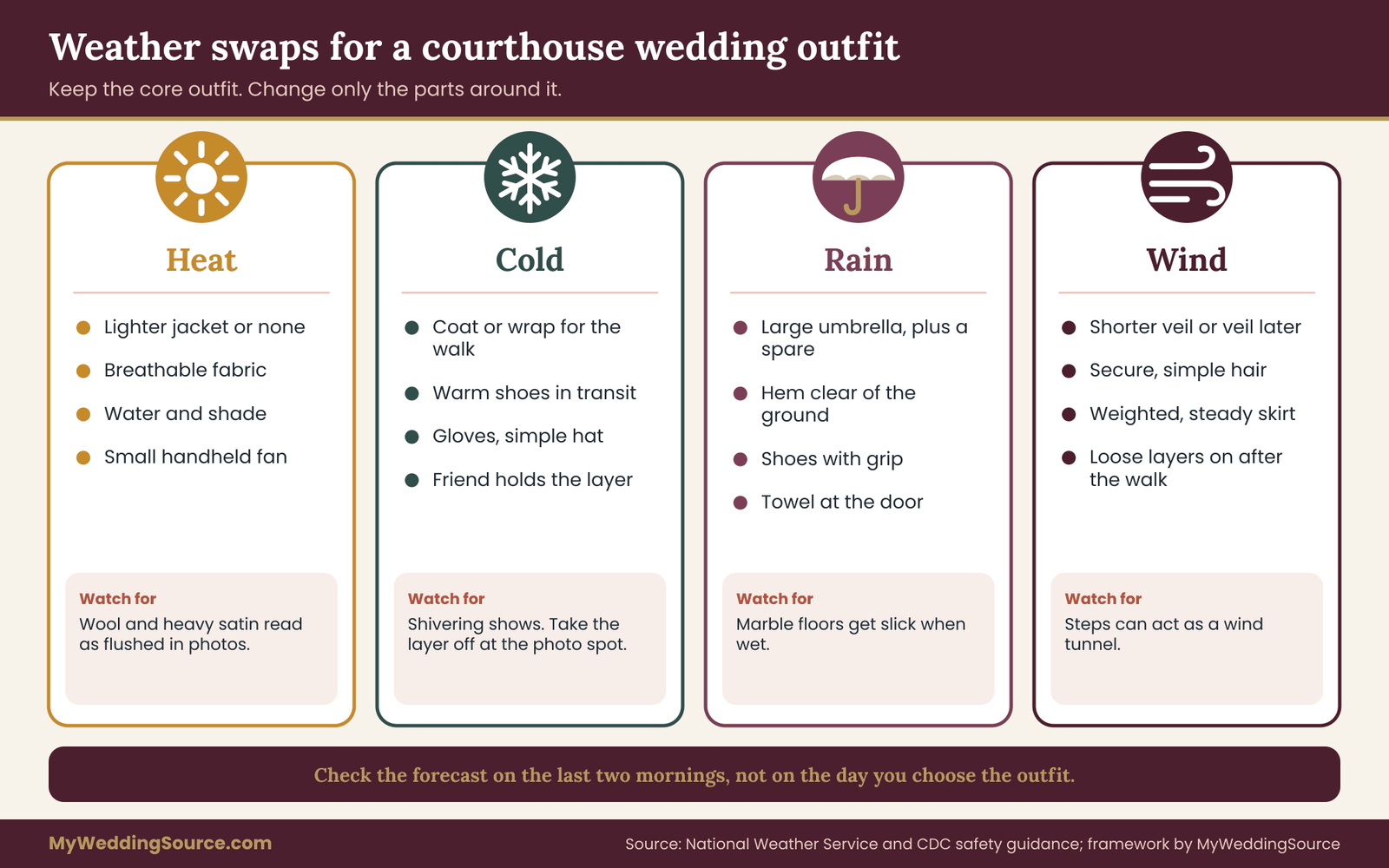
The cleanest way to handle weather is to prepare a short list of swaps instead of a second outfit. The core courthouse wedding outfit stays the same, and weather changes only the parts around it.
For heat: swap the jacket for a lighter layer, carry water, use a fan, and choose lighter shoes. For cold: add a coat or wrap, warm gloves, a hat that does not ruin hair, and a pair of warm shoes for the walk. For rain: add an umbrella, a hem that clears the ground, shoes with grip and a towel. For wind: shorten the veil, secure the hair and put loose layers on after the walk.
The ten-minute standing test
Here is a second measurable check, this time for gate two. Stand outside in the courthouse wedding outfit, in the conditions you expect or the nearest you can get, for ten minutes. Do not sit and do not hold anything unusual. Check afterward how you feel and how the courthouse wedding outfit looks. Are you comfortable? Has the hem moved? Has hair come loose? Is there sweat visible or are you shivering?
If you cannot test in similar weather, test it indoors with a fan blowing for wind, or in a warm room for heat. The test is an approximation, but it catches the worst problems: a waistband that digs, shoes that hurt after ten minutes, a jacket that cannot be taken off without disturbing everything. Fix those before the day.
Be honest about what the test means. It tells you the courthouse wedding outfit survives ten minutes, not that the weather will behave. Treat it as a floor, then add the swap list for the margin.
Gate three: photos and your courthouse wedding outfit
Courthouse photographs are unusual. The setting is institutional, the lighting is often a mix of window light and overhead fixtures, the space is limited and the time may be short. The same courthouse wedding outfit that looks perfect in a studio can look flat or harsh here. Gate three asks whether the courthouse wedding outfit works in the places where the photographs will actually be taken.
Read the building before you choose color
Visit the courthouse if you can, or look at photographs taken there. Pay attention to wall color, floor material, stair railings, columns and doors. Many courthouses use pale stone, beige walls, dark wood and green or tan institutional paint. Against pale stone, pure white and ivory can look washed out, while a warmer cream, soft champagne, blush or a mid-tone color often stands out better.
Against dark wood or deep green walls, light colors pop and very dark outfits can sink into the background. A navy suit on dark paneling needs a lighter shirt, a visible boutonniere or a pocket square to hold its edges.
The lesson is not that one color works. It is that your color has to be chosen against the wall behind it, not in isolation. If you cannot see the building, ask the photographer, who has probably shot there, or choose a color with enough contrast against both light and dark backgrounds.
Fabric under mixed light
Fabric reacts to light in ways you only see on a camera, and a courthouse wedding outfit meets unusual light. Shiny satin catches flash and overhead fluorescents and can show every wrinkle and bump. Matte crepe, heavy cotton sateen and textured fabrics tend to look smooth and expensive in mixed light. Very sheer fabrics can reveal what is underneath when backlit by a window, so check them against a bright window before you commit.
Wrinkles matter more in photographs than they do in person. A fabric that holds a crease from the car ride will show it in every frame. If you are traveling to the courthouse in a vehicle, choose a fabric that recovers, or plan to steam on arrival where permitted, and use a garment bag for transport.
Patterns can also misbehave. Fine stripes and tight checks can produce a shimmering effect in digital images. If you love a pattern, ask the photographer whether it will be a problem, and consider keeping the pattern to a small area such as a tie or a scarf.
Shape, space and steps
Photographs on courthouse steps usually include full-length frames, so hems, shoes and the shape of the courthouse wedding outfit all show. A skirt that spreads well on a flat lawn can bunch on stairs, and a long train that looks graceful in a ballroom can trip you on a wide step. Practice walking up and down stairs in the courthouse wedding outfit, with the shoes, holding a bouquet. If you need two hands for the skirt, you cannot hold a bouquet, and that conflict is better discovered at home.
Narrow corridors reward a streamlined silhouette. A sheath, a straight-leg suit or an A-line skirt moves easily through tight space and looks clean in a hallway frame. A very full skirt or a wide cape can look dramatic on the steps and awkward indoors. Decide which setting matters most to you and choose for that.
Hair and makeup belong here too. Courthouse light is often unflattering and sometimes overhead, creating shadows under the eyes and nose. A slightly more defined eye and a matte base can help, and a hairstyle that frames the face rather than pulling everything back can soften overhead shadows. A short chat with your hair and makeup person about the setting is worth having. For broader planning, the bridal hair and makeup planning guide covers trials and timing.
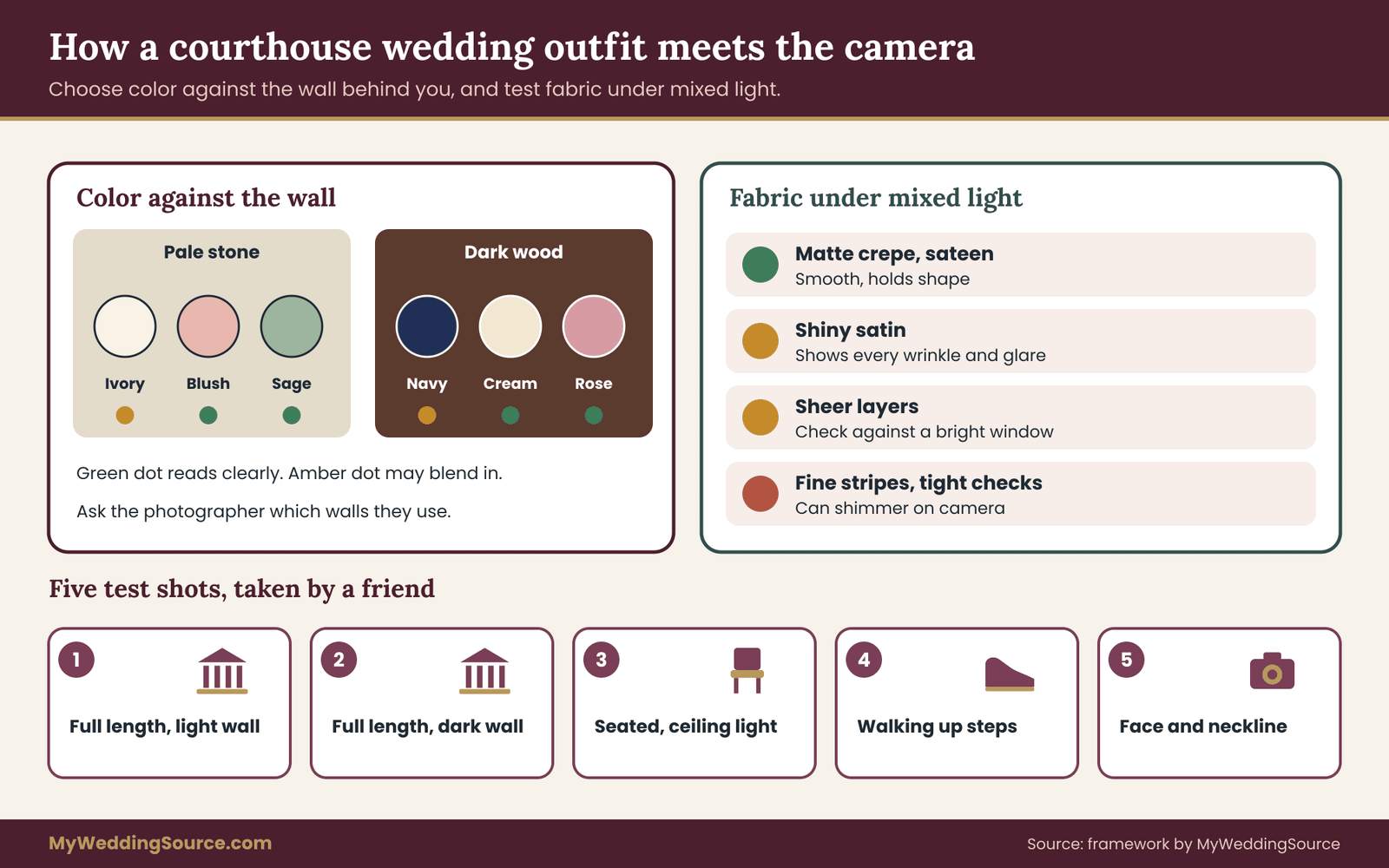
The photo test shots
The third measurable check is a set of test photographs. Ask a friend to take five phone photographs of you in the courthouse wedding outfit: a full-length shot against a light wall, a full-length against a dark wall, a seated or half-length shot indoors under ordinary ceiling light, a shot walking up a few steps and a close-up of the face and neckline.
Look at them on a larger screen than the phone. Is the color separated from the background? Do wrinkles show? Does the hem look tidy? Does the neckline sit flat? Does anything shine or disappear? These are the same questions a camera at the courthouse will answer, and you will see the result before it counts.
If you are working with a professional, send the test shots and ask for an honest reaction. A photographer who has shot weddings in civic buildings can often name the problem in a sentence, such as “that color will blend into the stone, try a deeper one,” and that sentence can save a purchase.
Questions for the photographer about outfits
Photographers are rarely asked about clothing early enough. A short list, sent a few weeks before the appointment, can help:
- Which courthouse spots do you plan to use, and what are the wall and floor colors there?
- Are there colors or fabrics you would avoid in those spots?
- Do you prefer a veil, wrap or jacket on or off for the main portraits?
- How long will we have in the ceremony room, and how many frames will include full-length shots?
- Will the light be mostly window light, overhead light or a mix?
For broader guidance on briefing a photographer, the wedding family photo list guide shows how to turn a loose idea of “some family photos” into a short, ordered list that fits a tight schedule, which is exactly the constraint a courthouse imposes.
How the three gates interact
The gates do not operate in isolation, and the best outfits solve more than one at once. A matte, mid-weight fabric helps gate three by looking smooth, helps gate two by handling wind and moderate heat and helps gate one by usually carrying less hardware. A tea-length skirt helps gate two with wet hems, helps gate three by showing the shoes and helps gate one by fitting through the arch.
Conflicts arise too. A dramatic cape can be perfect for photographs and a problem at security. A heavy structured jacket can be perfect for cold and a problem in heat. A very light dress can be perfect for summer and invisible against pale stone. When two gates pull in opposite directions, apply the first decision rule: gate one wins, because it is the one the building controls.
After that, weigh gates two and three by how likely each problem is. If the forecast is uncertain and your date is in a changeable season, give gate two more weight. If your whole plan depends on a handful of photographs, give gate three more. The point is to make the trade-off consciously, not to discover it at the door.
Comparing every courthouse wedding outfit style for the three gates
No style is right for everyone, and each has a pattern of strengths and risks. The comparison below is in prose because the interactions matter more than any single rating. Treat it as a way to see where to look, not as a ranking.
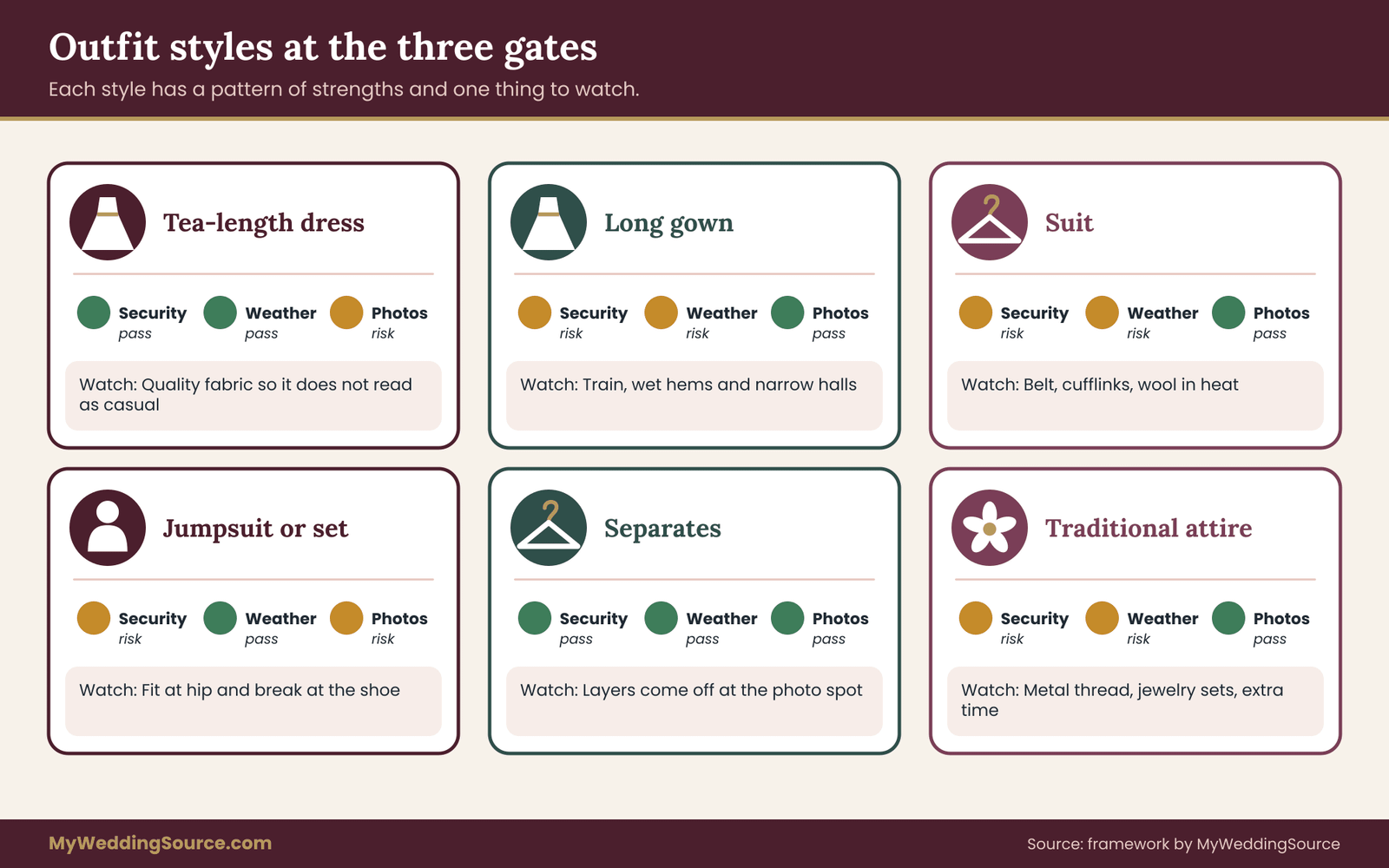
The short or tea-length dress
A dress that ends between the knee and mid-calf is the easiest choice for gates one and two. It has less fabric to manage in a screening arch and on stairs, it avoids wet hems and it shows shoes in photographs, which can be a pleasure or a risk depending on the shoes. Its main gate-three risk is cut: a very casual cut can look like a party dress in formal portraits, so choose structure in the bodice and quality in the fabric.
The long dress or gown
A floor-length dress is the classic choice and the highest-maintenance one. It looks beautiful on steps and in wide frames, and it can be a problem in narrow corridors, on wet ground and in a security line. If you love a long dress, choose a version with no train or a train that detaches or bustles, a fabric that resists wrinkles and a bodice without wire or heavy boning. Plan a helper to manage the skirt at the door and on the stairs, and carry a small cloth to protect the hem.
The suit
A suit is a strong all-round choice, and it has been standard courthouse wear for generations. For gate one, a suit has the belt, the jacket buttons and any cufflinks or pins as the items to manage. For gate two, wool is warm and can be too warm, so look at lighter weights in summer.
For gate three, a suit shows color and shape cleanly, and a considered shirt, tie or pocket square adds a point of interest. Ask a tailor to check the jacket shoulders, the sleeve length and the trouser break while you wear the shirt and shoes you will actually use.
The jumpsuit or a matching set
A tailored jumpsuit or a coordinated top and trousers gives mobility, easy stair climbing and wind resistance. Gate one risks are zippers and belts, and gate two risks are warmth in heavy fabric. Gate three depends on the cut: a clean, high-quality cut looks sharp, and an overly casual fabric looks like loungewear. Fit matters more here than in a dress, because trousers show the break at the shoe, the line at the hip and any pulling at the seat. Allow time for alterations.
Separates and two-piece looks
A skirt with a top, or a dress with a jacket, gives you flexibility. You can remove the jacket at the photograph spot and add it back for the cold walk. You can carry the top layer to security. Separates also allow you to reuse pieces later, which suits couples who want a courthouse wedding outfit that can be worn again at a dinner or a party afterward.
Cultural, religious and family attire
Many couples wear traditional clothing at the courthouse, including saris, lehengas, sherwanis, hanboks, kimonos, barong, kente and other garments. These bring their own gate questions: heavy embroidery with metal thread, long dupattas or trains, jewelry sets with many metal parts, and layered garments that are warm in summer. None of this is a reason to leave them out.
Plan a longer arrival buffer, take the jewelry in a pouch to put on after screening if rules permit, and tell the clerk’s office in advance so the staff are not surprised. For couples planning a larger celebration later, the post-appointment event can carry the full set of garments while the courthouse outfit takes a simplified version.
Matching, coordinating and the partner question
Couples often ask whether to match. A courthouse wedding outfit for one partner does not need to resemble the other’s. What helps is coordination: similar level of formality, colors that do not clash and fabrics that suit the same light. If one partner is in white and the other in black, the photographs can look split. A shared accent color or a similar metal tone in accessories brings them together without matching.
Agree on formality early. Nothing looks more awkward than one person in a gown and the other in a casual shirt, unless that contrast is a deliberate and happy choice. Send each other a photo of the planned look a week before and adjust if needed.
Accessories, hair and the carry bag
Accessories decide more outcomes than the main garment, because they are the parts most likely to set off security, break in wind or look odd in a photograph. A few decisions here save the most trouble.
The accessory audit
Lay out every accessory and give each a one-line verdict at each gate. A veil might be pass, risk, pass. Statement earrings might be risk, pass, pass. A metal belt might be fail, pass, pass, and the fail means it goes. The audit takes ten minutes and forces you to look at each item honestly instead of accepting it because you already bought it. It is the fastest way to tighten a courthouse wedding outfit without buying anything new.
For the longer view on accessories, the guide on wedding day accessories planning covers compatibility, movement and emergency backups, and it pairs well with this audit if you have a lot of pieces to coordinate.
Veils, headpieces and wraps
A veil changes the courthouse wedding outfit more than almost any other piece and is the most common cause of a gate problem. A fingertip-length or shorter veil is easier than a cathedral length in corridors and wind. A veil on a comb is easier to remove for screening than one pinned in a complicated updo. A small headpiece, a fresh flower or a hat can replace a veil while carrying less risk. A simpler headpiece often suits a courthouse wedding outfit better than a long veil.
A wrap, shawl or jacket is the most useful accessory in changeable weather. Choose one that matches the formality of the courthouse wedding outfit and that you can take off without a mirror. Make sure it has no hard hardware, and fold it in a way that makes a bag search quick.
Shoes, in practice
Shoes have a role at all three gates. At gate one, they should come off and go on easily if asked. At gate two, they should hold up on wet or uneven ground and not hurt after ten minutes of standing. At gate three, they should look right in a full-length photograph, which often means they are clean and the heel height suits the dress length.
Shoes are the part of a courthouse wedding outfit that people think about last and regret first.
A common solution is to wear a comfortable pair for the walk and carry a dressier pair, or to choose a single pair that is genuinely comfortable. Break shoes in beforehand, with the same socks or hosiery you will wear. The American Podiatric Medical Association publishes general guidance on choosing footwear, and a fitter can help with comfort for a long day on hard floors. If your shoe decision is still open, do the walk test described in the worked example later in this guide.
Hair and makeup for hard conditions
Hair and makeup meet all three gates, just as the clothes do in a courthouse wedding outfit. For gate one, metal pins and clips can register. For gate two, heat, humidity, rain and wind attack styles. For gate three, courthouse light can be flat or harsh. A plan that suits all three is usually a secure, simple style with a small number of pins, a finish that tolerates humidity and makeup that holds in warm rooms and does not rely on a single flattering light.
A trial run in the same conditions helps. Do the style, then stand outside for ten minutes, then check the mirror. If your hair stylist is part of the day, ask what they would change for the setting. Keep a small touch-up kit in the carry bag, limited to items likely to pass screening: a compact, blotting papers, a lip color and a small comb. Skip aerosols and anything sharp.
The carry bag
One small bag, held by you or a witness, is enough. Its job is to get you through the building and the photographs, not to hold a second wardrobe. A useful set of contents, all subject to the court’s rules, is a phone, a wallet with identification and license paperwork, a lip color, blotting papers, a small pack of tissues, a few safety pins in a sealed pouch, spare ties for hair, a clean cloth for shoes and a bottle of water if the building allows it.
Leave the sewing kit, scissors, large aerosol cans and anything that looks like a tool in the car. If a repair is needed, a clip, a safety pin or tape can usually do the job until you are out of the building. Tell your witness what is in the bag and where, so that if you are rattled, someone else can find the item you need.
Documents belong in the bag too, and the wedding records after the event guide explains why the marriage license and later certified copies deserve their own folder. For the day itself, keep the license paperwork where you can reach it without searching, because the clerk will ask for it before anything else.
A worked example: a three-gate check from start to finish
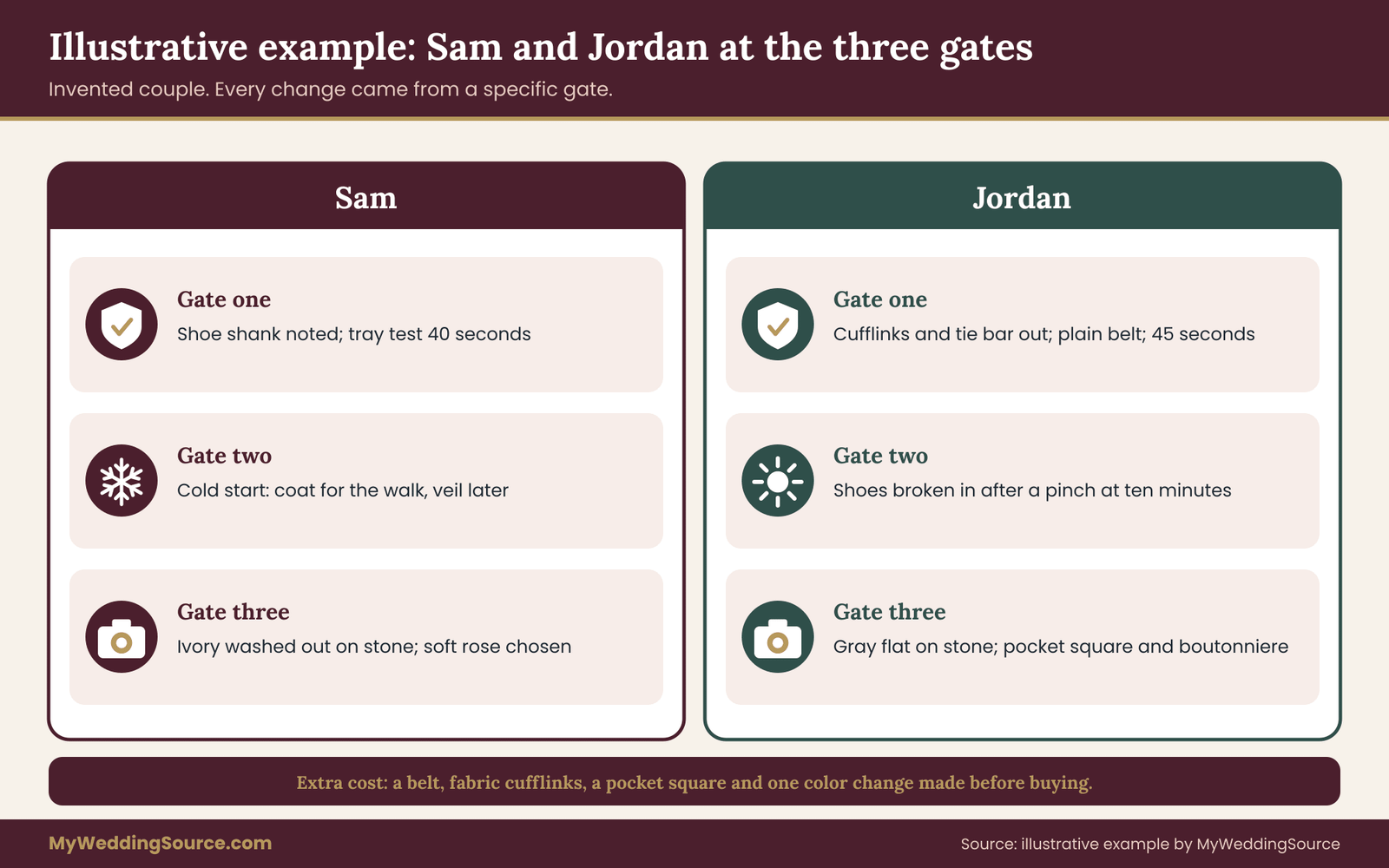
The following example is illustrative. The couple and the numbers are invented to show the method, and your own building, weather and budget will differ.
The situation
Two people, whom we will call Sam and Jordan, are marrying at a county courthouse on a weekday in late October. The appointment is at eleven in the morning. They will bring two witnesses and a photographer for forty-five minutes. A phone call to the clerk’s office tells them that there is a metal detector at the main entrance, that bags are scanned and that photographs are allowed in the ceremony room and the main hall but not in the security area.
The courthouse steps are wide and face south, and the building is pale stone.
Sam is considering a tea-length dress in ivory crepe with a fitted bodice and a short jacket. Jordan is considering a mid-gray suit with a white shirt and a green tie. Both options look good in the store. Neither has been tested against the building.
Gate one for each courthouse wedding outfit
Sam lists the metal items. The dress bodice has a hidden zipper and a small hook. The jacket has covered buttons. The shoes have a thin metal bar in the heel, called a shank, which is common in dress shoes. Earrings are small studs, and the ring is a plain band. A veil is planned, on a comb.
Sam tries the one-minute tray test at home with shoes, earrings, a phone and the keys. It takes about forty seconds, and nothing looks problematic apart from the shoes, which Sam decides to treat as a risk. A call back to the clerk’s office reveals that shoes remain on at the screening arch. Sam rates gate one as a pass, with the shoes noted.
Jordan lists the metal: a belt with a medium buckle, cufflinks, a tie bar and a watch. The tray test with all of it takes closer to ninety seconds because the cufflinks are fiddly. Jordan decides to swap the cufflinks for a French-cuff alternative with fabric knots and to drop the tie bar. The belt buckle is replaced with a plain leather belt with a smaller fitting. Re-test: forty-five seconds. Gate one becomes a pass.
Gate two for each courthouse wedding outfit
The forecast on the final morning shows a start temperature in the mid-forties Fahrenheit and light wind, with no rain. The couple plans about fifteen minutes of outdoor time between parking, the steps and a photograph. Sam has a lightweight dress and plans a wool wrap. Jordan has a wool suit that is likely comfortable.
The ten-minute standing test, done on the previous weekend outdoors, shows that Sam is cold in the dress without the wrap and fine with it. The wrap, however, covers the jacket’s shape in photographs, so Sam decides to wear a longer coat for the walk and remove it on the steps. A friend will hold it. The veil, tested in a light breeze, tangles at the shoulder, and Sam decides to put it on only for the indoor portraits.
Jordan’s test shows no problem with temperature but reveals that the shoes pinch after ten minutes. Jordan switches to a pair already broken in. Gate two is a pass for both, with the coat plan noted.
Gate three for each courthouse wedding outfit
The test shots reveal the main problem. Against the pale stone, Sam’s ivory dress looks washed out, and the face is the only point of contrast. A deeper cream or a muted color would hold better. Sam looks at a soft rose version of the same style and a sage version. In the test shots the rose stands clearly against the stone and still looks bridal in tone. The jacket in a darker shade of the same family finishes the look.
Jordan’s gray suit against the stone also looks flat. The green tie helps, and a white pocket square and a small boutonniere add definition. In the indoor corridor, the gray holds well against dark wood. The photographer, shown the test shots, suggests taking the steps portraits with the couple standing slightly forward of the columns, where the light is better, and says the rose will photograph well.
The result
After the three gates, the choices look different from the store versions. Sam moves from ivory to soft rose, adds a coat for the walk and keeps the veil in the bag until the indoor portraits. Jordan keeps the suit, swaps the cufflinks and belt for lower-risk versions, breaks in the shoes and adds a pocket square.
Total additional cost is modest: a belt, a pair of fabric cufflinks and a pocket square, plus a dress color change that happened before purchase. The point is not the specific choices, but that every change to this courthouse wedding outfit came from a particular gate.
Costs, rentals, alterations and timing
Many people choose a courthouse wedding outfit to save money, and that is a reasonable goal. The risk is spending in the wrong place. A few cost rules keep the budget aimed at the things that matter at the three gates.
Where money helps most
Spend on fit before decoration. A well-fitted, simple garment looks better in photographs than a fancy garment that pulls or gapes. Alterations, even for a basic outfit, are often the best use of a clothing budget, and they take time, so book them early. A tailor can also adjust a hem for wet ground, remove or replace hardware that would set off a detector and adjust a jacket so it works over the dress or shirt you will actually wear.
Spend next on the layers that deal with the weather: a good coat or wrap, comfortable shoes and a decent umbrella. Spend last on small decorative extras, which have the smallest effect on any gate of a courthouse wedding outfit.
Buying, renting or borrowing
Each route has its own timing and risk. Buying new gives the most control over color and fit and needs the longest lead time, including shipping and alterations. Buying off the rack or from a sample sale is faster and may need more alteration. Renting suits formalwear such as suits and tuxedos and some gowns, and a rental company should be asked about its policy on returns, late fees and damage, including wet hems and stains.
Borrowing can be sentimental and free, and the garment may not suit gate three or fit well enough without alteration. Ask the lender for permission to alter, and check the garment against all three gates before you commit. For preowned garments, ask for photographs in daylight, the measurements and the return terms in writing, and keep the confirmation.
A timeline that works backward from the appointment
The days before the appointment are a poor time to discover a problem. A simple timeline helps. Eight to ten weeks ahead, gather the building facts and choose the courthouse wedding outfit direction. Six weeks ahead, order or buy and book any alterations. Four weeks ahead, do the first fitting and the tray, standing and photo tests. Two weeks ahead, do the final fitting, confirm the building rules again and arrange hair and makeup.
One week ahead, pack the bag, check the forecast and confirm transportation. The day before, steam or press, lay out everything and charge your phone. These intervals are guidelines, not rules, so compress them if you have less time and expect fewer options.
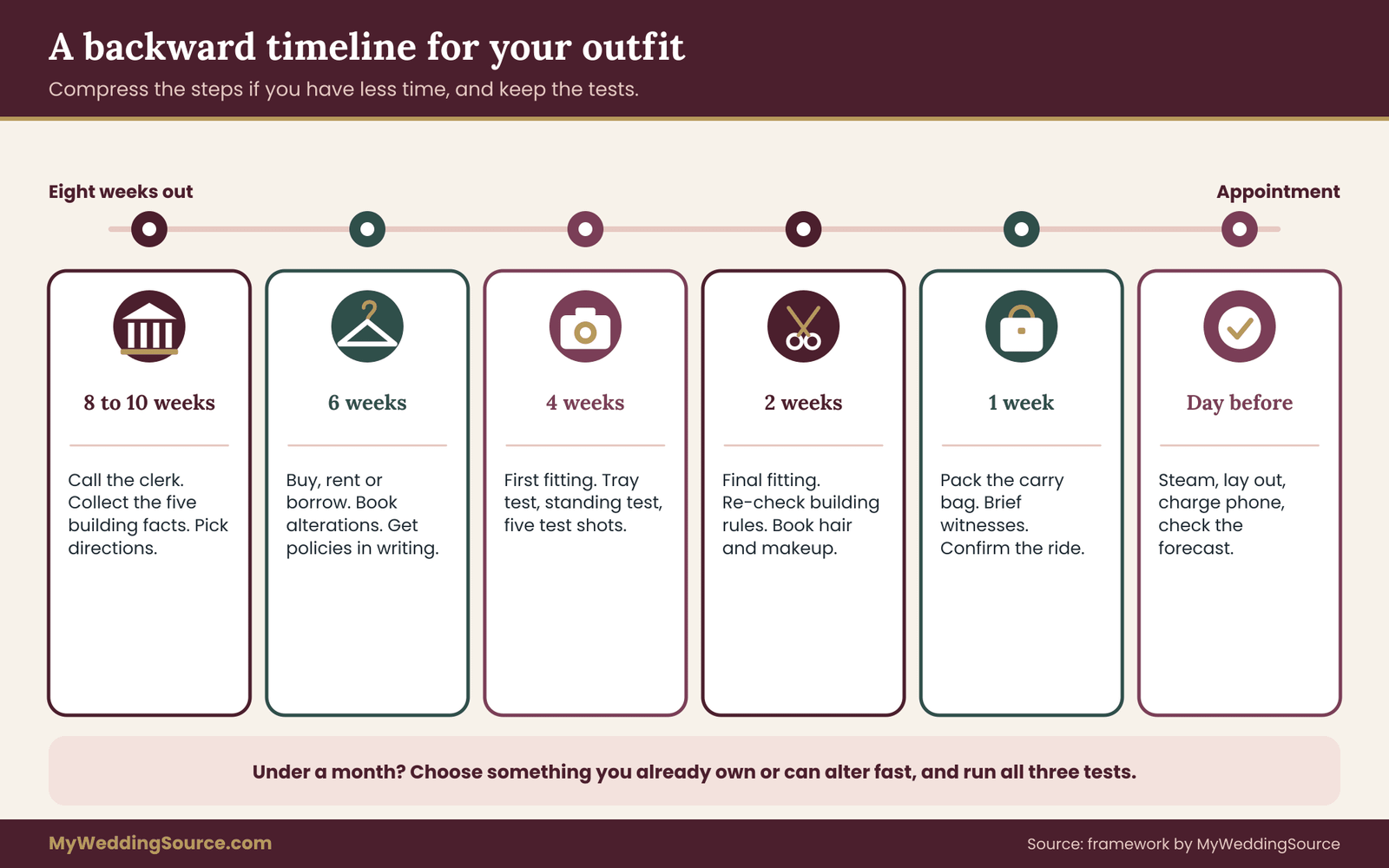
If you have under a month, skip the elaborate options for your courthouse wedding outfit. Choose a courthouse wedding outfit you can buy off the rack and alter quickly, or that you already own, and run the three tests on it. A simple, tested courthouse wedding outfit beats an ambitious outfit that was never checked.
Edge cases and questions that change the courthouse wedding outfit
The standard check handles most appointments. A few situations bend the rules, and it is better to meet them in planning than at the door.
Witnesses and guests
Many courthouses require one or two witnesses, and some allow a small number of guests. Witnesses and guests pass the same security as you, so tell them what to expect. A short message a week before is enough: the building has a metal detector, bags are searched, bring only what you need, wear shoes that are easy to walk in and arrive ten minutes early.
Guest clothing is less of a decision than the couple’s, but a few notes help the photographs. Ask guests to avoid pure white if you are wearing it, to avoid large logos and to choose colors that sit well with yours. A witness who holds your coat, bouquet and bag needs free hands, so a dress with pockets or a small crossbody bag is more useful than a clutch.
The guide on wedding photography consent is worth a glance if guests will take their own photographs, since a courthouse often limits phones and cameras in certain areas and a short, polite request is easier than a correction in the hall.
Accessibility and mobility
If anyone in the party uses a wheelchair, walker, cane or has trouble with stairs, the building’s accessible entrance and route become part of the plan. Courthouses are public buildings that must provide accessible access under federal accessibility rules, and the Americans with Disabilities Act website explains what to expect and how to raise a concern. The accessible entrance may be different from the main steps, which changes where the photographs happen and how long the walk is.
For a person using a mobility device, the courthouse wedding outfit needs a hem that stays clear of wheels and footrests, sleeves and wraps that do not catch, fabric that tolerates sitting and a cut that looks as good seated as standing. Test the test shots in the seated position.
Metal in a mobility device will set off a detector, so ask the court what the standard procedure is, and let the staff know in advance. Do not feel awkward about calling ahead. Court staff handle accessible entry every day, and a short call spares everyone surprise.
Children and family members
Children in the party can bring their own complications: small shoes that come off, sensitive skin, clothes that wrinkle in the car, snacks that cannot cross the threshold. Pick simple outfits that can handle a long wait, have a second pair of comfortable shoes for the walk and carry a quiet activity that passes screening. Keep the child’s clothing in the same general color family as yours without trying to match exactly.
An older relative may need a seat during the wait and extra time in the security line, and may be more affected by heat or cold than anyone else. Plan a seat, a wrap and water, and give them an easy route.
Pregnancy, health and body changes
If one partner is pregnant, healing from an injury, using a medical device or dealing with a body that changes week to week, the fitting schedule needs a margin. Choose a garment with some give, such as a wrap, an empire waist or an adjustable closure, and schedule the final fitting as close to the date as practical.
Comfort is a bigger concern than for most couples, so keep the standing test short and the seating options ready. Medical devices such as insulin pumps and pacemakers have their own screening procedures, and the person who uses one should ask the court how screening works, without assuming anything about how it will be handled.
Religious dress, head coverings and cultural jewelry
Head coverings, religious garments and cultural jewelry are generally allowed, and screening staff may ask to look at them. A headscarf or turban may be subject to a brief check, and some screening procedures have a private option on request. If this matters to you, ask the court about it by phone and give yourself extra time. Jewelry sets with many metal parts, such as a full bridal set, are the most likely to trigger an alarm. Wear the core pieces through the checkpoint and add the rest after, if rules allow.
Tattoos, piercings and visible items
None of these are usually a problem at screening, but a few matter for metal. Body piercings with metal can register on a detector, and a short word with staff is usually enough. For photographs, visible tattoos are a personal choice, and the courthouse wedding outfit can show or cover them as you like. If you want a tattoo covered for photographs, test the coverage under the lights you expect.
A change of plan on the day
Appointments can run late, move to another room or shift to a different time. Weather can turn. A zipper can fail. The best protection is a courthouse wedding outfit with a margin: a secure closure, a backup safety pin, a second layer, comfortable shoes and a bag that can handle a delay. A calm mindset helps too. People rarely remember a minor mishap in a courthouse hall, and many remember the warmth.
Whatever changes, the courthouse wedding outfit should still pass gate one.
If the whole appointment changes, the guide on building a wedding vendor timeline shows how to reset people and times with the least confusion, which is useful when your photographer, hair stylist and a friend with a car all need to know about the change.
After the appointment: a quick outfit change
Many couples go from the courthouse to lunch, dinner or a gathering. If you plan to change, think about where. Changing in a courthouse restroom is rarely comfortable, and the building may not allow it. A restaurant restroom, a car or a nearby hotel works better. Choose a second courthouse wedding outfit, or a simple change of layers, that is easy to put on alone, and carry it in a garment bag that can ride in the car.
If you want to keep the courthouse wedding outfit on all day, choose it with the dinner or party in mind, and think about whether you can sit comfortably in it for three hours.
If you are not changing, a simple adjustment, such as removing a jacket, swapping shoes or adding a jewelry piece, changes the look without a second garment.
Questions for the clerk, the photographer and the seller
Good questions get good answers, and they save you from guessing. This section collects them in a form you can copy into your notes. They are grouped by who you are asking.
Questions for the clerk’s office
Ask these before you choose, and again a week before the date:
- Where do marriage appointments enter the building, and is screening required there?
- Is there a list of prohibited items, and where can I read it?
- Are there limits on bag size, aerosols, tools, pins or garment bags?
- Can the photographer enter, and does the photographer need to register in advance?
- Where are photographs allowed, and for how long?
- What are the arrival time and the waiting arrangements, and is waiting indoors or outdoors?
- Is there an accessible entrance for those who need one, and where is it?
- How many people may attend, and do guests go through the same screening?
Write down the date, the name of the person who answered and whether the answer was written or spoken. If different staff give different answers, ask for the written source and use the stricter one.
Questions for the photographer
The photographer has probably seen a hundred couples in the same hallways, and the answers are short and useful. Ask which spots they would suggest, what time of day gives the best light, which colors and fabrics tend to disappear or glare there and how they would handle weather. Ask whether they recommend an outer layer or a veil for certain frames.
Ask how long the portrait session usually takes at that building, and whether they have a backup location if the weather is poor. If you have a vendor agreement, ask how their coverage works for a short appointment and what happens if the appointment runs late.
Questions for the seller, tailor or rental company
If you are buying, altering or renting, a few questions protect the budget:
- What is the return, exchange or rental policy, in writing, and what are the deadlines?
- How long do alterations take, and what is the cost of rush service?
- Can the hem, closures and hardware be changed, for example replacing a metal buckle or a heavy hook?
- What does the fabric do when wet, creased or in strong light?
- If I need to cancel or change the date, what happens to the order?
- Can I see the garment in daylight, or see photographs taken in daylight?
Keep the written confirmation, since a courthouse wedding outfit bought or rented in a hurry is where policies get missed. For a rental, ask for a photograph of the condition on pickup, and take your own. Marriage appointment dates can change, so ask what happens if the date moves.
What to do with conflicting answers
Sometimes the clerk says one thing, the guard says another and the website says a third. When that happens, follow the strictest answer for the courthouse wedding outfit, and keep a note of the source you relied on. Ask politely at the door if a guard objects to something the clerk approved, and be ready to hand an item to a witness or leave it in the car. A calm adjustment on the spot is always better than an argument.
Common mistakes and how to avoid them
Most courthouse outfit problems come from a short list of repeated mistakes. Seeing them in advance is the cheapest protection for any courthouse wedding outfit.
The first mistake is choosing the courthouse wedding outfit first and checking the building later. A beautiful garment that fails gate one is a poor purchase. Reverse the order: learn the building, then choose.
The second is leaving the shoes for last. Shoes touch all three gates, and a pair that hurts, slips or sets off a detector can undo a good outfit. Choose them early and wear them in.
The third is trusting a single forecast. Weather changes, and the outdoor minutes are exactly where it matters. Build a swap list instead.
The fourth is skipping the photo test. Colors and fabrics behave differently in a civic building, and five test photographs cost nothing.
The fifth is overpacking the bag. A bag that will not clear screening quickly is a problem in itself.
The sixth is ignoring your witnesses and guests. They go through the same door, and a short message makes their day easier and yours calmer.
The seventh is forgetting the clerk’s list of what to bring. Identification and license paperwork matter more than any accessory. The wedding officiant requirements guide explains who must sign and why a missing signature creates delays that no outfit can fix.
The day-of routine for your courthouse wedding outfit
By the morning of the appointment the choices are made. What remains is execution, and a short routine keeps it calm. The routine below works backward from the appointment time and assumes you have already run the three tests.
The night before
Lay out everything in the order you will put it on. Check the garment for loose threads, missing buttons and wrinkles, and steam or press it where you have room. Pack the carry bag, and take out anything that might not clear screening. Put the license paperwork and identification where you will see them. Charge your phone and save the clerk’s phone number and the photographer’s number in a place you can reach quickly.
Check the forecast, and decide which items from the swap list you will add to the courthouse wedding outfit. Confirm the ride, the parking and the arrival time with anyone traveling with you. Eat a decent dinner and sleep as well as you can, because a rested face is the best accessory.
The morning of
Eat something, drink water and allow more time for getting dressed than you think. Dress last, after hair and makeup, to avoid marks and snags. Put on the shoes and walk around for a few minutes to check them. Do a final check against the three gates: nothing metal that will cause trouble, a layer for the weather and a quick look in the mirror under natural light.
Leave earlier than the minimum, because a rushed arrival undermines even a well-chosen courthouse wedding outfit. A calm arrival does more for photographs than any item of clothing. Allow for parking, the walk, screening and a short pause to settle before you go in.
At the door
Hand over what is asked, put items in the tray and move steadily. If a guard asks about an item, answer plainly. If something is refused, give it to a witness or leave it in the car and carry on. Keep your coat or wrap until after screening if that makes the bag search easier, then put it on a friend’s arm for the photographs.
Once through, take a moment. Check the hem, the shoes and the hair in a hall mirror or a phone. Put on any jewelry or veil you carried, if permitted, and take a breath. Then the appointment is the easy part.
During the ceremony and photographs
Move slowly in the ceremony room. If you wear a long skirt, let a witness help with it on turns. Hold the bouquet at a height that does not hide the courthouse wedding outfit. During the photographs, stand with your weight on your back foot, keep your shoulders loose and let the photographer direct the poses. Remember that light and background change from spot to spot, so a quick check with the photographer on whether to remove a jacket or veil saves frames.
If something goes wrong, such as a snag, a wind gust or a smudge, say so quickly and fix it. The photographer has seen worse, and a few seconds spent now beat a series of flawed frames.
Scoring your own courthouse wedding outfit: a simple sheet
A scoring sheet turns the three-gate check into a decision you can defend. You can write it on paper or in a notes app, and it takes about fifteen minutes per outfit.
How to build the sheet
For each courthouse wedding outfit you are considering, write the name of the courthouse wedding outfit at the top and divide the page into three sections, one for each gate. Under gate one, list every item that is metal, sharp, large or hard to remove, and write the plan for each: keep, replace, carry separately or leave out.
Under gate two, write the expected outdoor minutes, the likely weather range and the swap you will use for each condition. Under gate three, write the wall and floor colors at the main photograph spots, the fabric finish and the result of your test shots.
At the end of each section, give a verdict of pass, risk or fail, with one sentence explaining why. Then apply the three decision rules from the start of the guide: never accept a fail at gate one, fix risks at gate two with a layer or backup and discuss risks at gate three with your photographer.
Using the sheet to compare options
If you are choosing between two outfits, score both and compare the verdicts. Do not add up numbers, because a single fail matters more than several passes. If both outfits pass, choose the one you feel best in. If one has a fail at gate one, drop it unless you can fix it. If both have risks, choose the one whose risks are cheaper to fix.
This approach works for partners too. Each person scores their own courthouse wedding outfit, and then you compare the sheets for coordination. If one courthouse wedding outfit has a long list of swaps and the other is simple, you may want to simplify the first so that your photographs are balanced.
When the sheet says to change your mind
Sometimes the sheet reveals that the courthouse wedding outfit you love is the wrong one for this building. That can be disappointing, and it deserves a real decision. You can adjust it, such as changing the hardware or the color. You can save it for a later celebration where the gates are easier. Or you can accept the risk knowingly, with a plan. All three are legitimate, and the sheet makes the choice visible instead of accidental.
Many couples find that the later celebration is the right home for the most elaborate piece. A courthouse appointment is short and practical, and a larger gathering later has space for a gown, a long veil or a full set of traditional jewelry. Choosing a simpler courthouse wedding outfit for the appointment does not shrink the occasion. It lets the right piece appear in the right setting.
Your next steps
Work through these in order, and you will have a tested courthouse wedding outfit with time to spare.
- Call the clerk’s office and collect the five building facts: screening, prohibited items, photography rules, waiting arrangements and space. Write them down with the date.
- Choose two or three outfit directions that you like, without buying yet.
- Score each one on the three-gate sheet, and drop any with a fail at gate one.
- Run the one-minute tray test, the ten-minute standing test and the five test photographs on your favorite.
- Send the test photographs and your questions to the photographer, and adjust the color or fabric if they flag a problem.
- Buy, rent or alter, with return policies in writing and alterations booked early.
- Prepare the weather swap list and the carry bag, and brief your witnesses and guests.
- Re-check the clerk’s rules a week before, check the forecast on the final two mornings and follow the day-of routine.
FAQ
What should I wear to a courthouse wedding?
Wear something that passes three tests: it clears building security without trouble, it handles the weather outside, and it photographs well against the building’s walls and light. Beyond that, the style is your choice. Dresses, suits, jumpsuits and traditional clothing all work when the hardware, fabric and layers are chosen with the building in mind. Confirm the court’s own rules by phone before you buy.
Do I have to wear white to a courthouse wedding?
No. There is no rule about color at a courthouse wedding. Many couples choose cream, blush, sage, blue or another color that stands out against pale stone walls, since pure white can look washed out there. Pick the color you like best, then check it in test photographs against a light wall and a dark wall before you commit.
Will a metal detector be a problem for my wedding outfit?
It can be, but usually for small reasons. Underwire, heavy zippers, belt buckles, metal hair clips, large jewelry and shoes with metal parts are the common triggers. Reduce and simplify the metal, practice taking items off quickly, and arrive early. If something sets off the detector, stay calm and let staff check it.
Can I bring a veil, bouquet or boutonniere pin into a courthouse?
Usually yes, though rules vary by building. A veil and bouquet are rarely a problem beyond a bag check, while a boutonniere pin, a sewing kit or aerosol hairspray may be questioned. Ask the clerk’s office about each item beforehand. If you are unsure, give the item to a witness to attach or put on after screening, or leave it in the car.
How early should I arrive in my wedding outfit?
Arrive at least ten to fifteen minutes earlier than the clerk asks, to allow for parking, the walk, screening and a short pause to check your hem, shoes and hair. If your party is large, you use a mobility device or you have many accessories to clear, add more time. A calm arrival also improves photographs.
What if it rains or is very hot on my courthouse wedding day?
Build the courthouse wedding outfit with a swap list instead of a second outfit. For rain, add a large umbrella, shoes with grip and a hem that clears the ground. For heat, choose lighter fabric, carry water and plan shade. Check the National Weather Service forecast on the final two mornings and adjust.
Should my partner and I match our outfits?
You do not need to match. What helps is coordination: a similar level of formality, colors that do not clash and fabrics that look good in the same light. A shared accent color or metal tone can tie two different outfits together. Send each other a photo of your planned look a week before and adjust if needed.
Can I change outfits after the courthouse ceremony?
Yes, if you plan where. Courthouse restrooms are rarely comfortable for changing, and the building may not allow it, so use a car, a restaurant restroom or a nearby hotel. Choose a second outfit that is easy to put on alone and carry it in a garment bag. Or keep one courthouse wedding outfit and swap shoes, a jacket or jewelry.
Sources
- USA.gov: Marriage certificates
- USA.gov: Get married
- National Center for State Courts
- United States Courts
- National Weather Service: Safety
- Centers for Disease Control and Prevention: Heat and health
- ADA.gov: Americans with Disabilities Act
- Transportation Security Administration: What can I bring
- American Podiatric Medical Association