
Writing vows together does not mean writing identical vows. It means agreeing on length, tone, privacy and structure early enough that two separate drafts sound like they belong to the same ceremony. This guide gives you a partner alignment worksheet, a five-block draft structure and a calm drafting schedule you can finish in about eight weeks.
Before either of you drafts a word, answer the alignment worksheet alone and then compare. Settle five things: how long each set of vows should run, how formal or funny they should be, what stays off-limits, whether you will hear each other’s vows for the first time at the ceremony, and which structure you will both follow. Then draft separately, trade drafts once or twice with simple feedback rules, read them aloud for timing, and give your officiant a final copy or a cue.
Most couples who struggle with vows are not struggling with words. They are struggling with a missing conversation. One partner opens a blank document and produces four lyrical paragraphs. The other has been planning three funny sentences and a promise. Neither knows how long the other’s vows will be, whether jokes are welcome, or whether the grandmother’s story about the first apartment is fair game. They find out at the ceremony, in front of everyone, and the mismatch is hard to un-hear.
Writing vows together is the fix. It is a short, structured set of conversations that happens before the writing, not a committee that writes every sentence. You can keep your own voice, your own memories and even a surprise or two. What you share is the frame.
This guide is for couples who plan to write their own vows, whether the ceremony is civil, religious or something in between. It covers how to decide what “together” means for you, how to run the alignment worksheet, how to set boundaries, how to choose a shared tone, how to build a draft with a clear structure, how to trade feedback without hurting each other, how to handle permissions for quoted material, and how to rehearse.
It leaves out the broader topic of ceremony order, which the wedding ceremony step-by-step guide already covers, and it does not try to supply sample vows to copy.
A note on scope. This is general information, not legal advice, and the rules for who may officiate and what a ceremony must include differ by state, so confirm the current requirements with your marriage license office and your officiant.
What writing vows together actually means
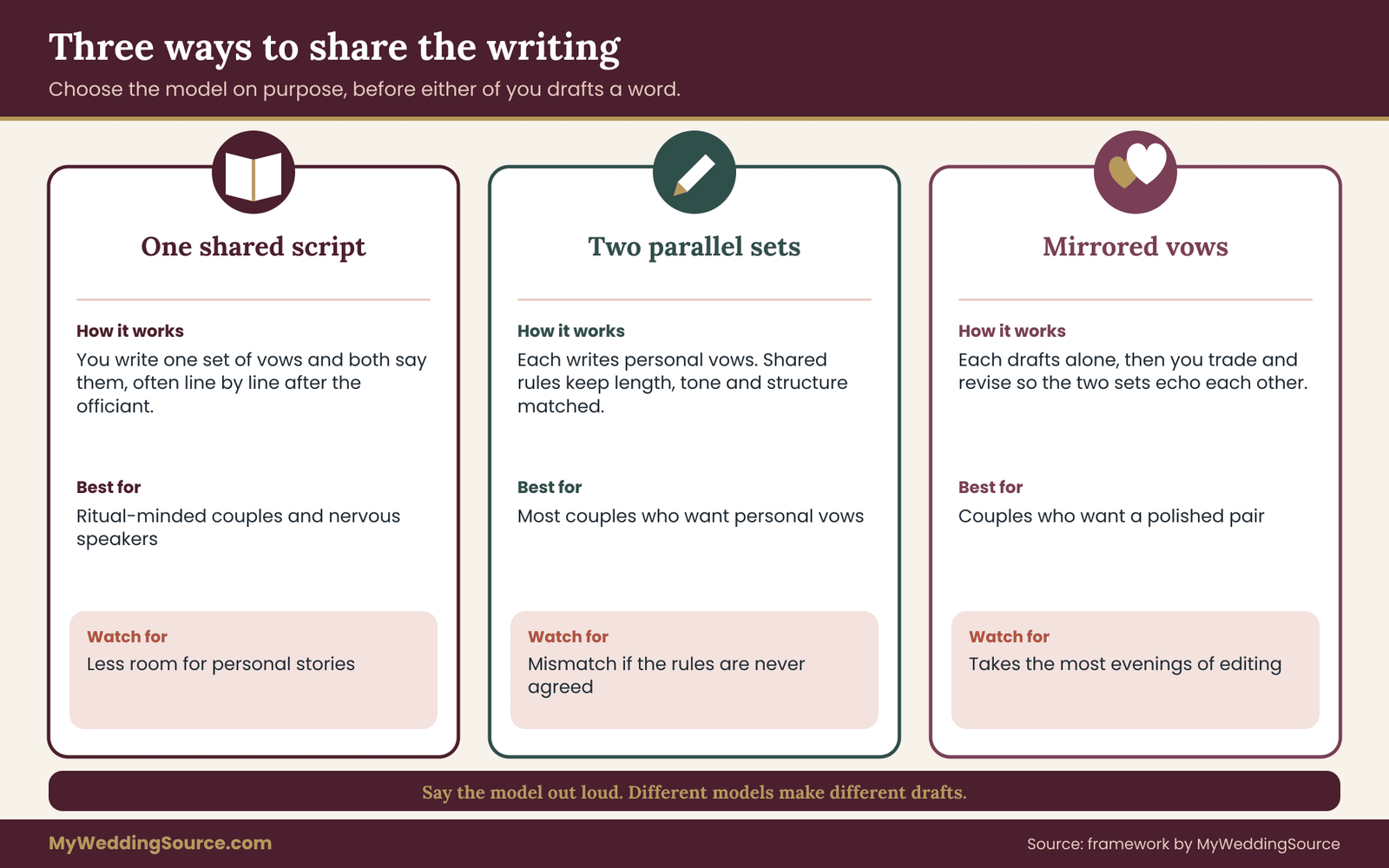
The phrase can describe three quite different arrangements, and the first job is to pick one on purpose. Couples often assume they are on the same page, then discover one partner imagined a single shared script while the other pictured two private speeches.
Model one: one shared script. You write a single set of vows and both say them, often in a call-and-response format where the officiant reads a line and each of you repeats it. This is the traditional shape. Writing vows together here is literal: you sit side by side and choose the sentences. It suits couples who like ritual, who are nervous about public speaking, or who want the vows to feel like a unit. In practice, writing vows together under this model feels closer to editing one document than composing two.
Model two: two parallel sets. Each of you writes your own vows, but you agree on rules so the two sets match in length, tone and structure. You may or may not read each other’s drafts. This is the most common choice for couples who want personal vows, and it is where the alignment worksheet earns its keep. Here, writing vows together is mostly a matter of shared rules rather than shared sentences.
Model three: mirrored vows. You write individually, then exchange drafts and revise so the two sets echo each other. A promise one of you makes may be answered by a promise from the other. The vows are separate but obviously in conversation. This takes the most editing and gives the most polished result. Of the three, it is the model where writing vows together takes the most evenings.
None of these is better. A couple with a quiet, formal ceremony may love model one. A couple with a casual backyard wedding and a crowd of friends may want model two with room for humor. What causes trouble is when the partners hold different models in their heads without saying so.
A quick test for which model fits
Ask yourselves three plain questions and answer each with a first instinct, not a debate.
First: do we want to hear each other’s vows for the first time at the ceremony? If both answers are yes, model two with firm structure rules is your most natural fit, because you will not see each other’s drafts. If either of you wants to read the other’s vows beforehand, model three is open to you.
Second: how comfortable is each of us speaking in front of a crowd? If one partner dreads it, a call-and-response script or a short vow with a clear structure takes pressure off. A partner who loves the microphone can still do a longer personal vow, but the difference in comfort should be known and respected.
Third: how much of the ceremony do we want to be about us as a pair, and how much about the families and guests present? Some couples treat vows as a private promise said in public. Others treat them as a moment to thank the people in the room. The two views lead to very different drafts.
If you answer differently on any of these, you have found something to settle before drafting. That is the point of the exercise. Differences like these are normal when writing vows together, and finding them early is a good sign.
Why a process helps even when you trust each other
Couples sometimes resist the idea of a worksheet for something as personal as vows. It can feel like paperwork laid over a love letter. But the worksheet does not ask what you feel. It asks about format, length, privacy and tone, the practical decisions that surround the feeling. Settling them early frees you both to write honestly, because neither of you is worrying about whether you are about to embarrass the other. Writing vows together with a worksheet is closer to agreeing on a recipe than to writing a poem.
There is also a plain scheduling reason. Wedding planning produces a long list of decisions that each have a deadline, and vows tend to slide to the bottom because they have none. A shared process turns “we should write our vows” into dated steps. The wedding decision-making guide describes how couples assign decision rights across a wedding; vows are one of the few items where both partners hold equal rights and neither can delegate, so a clear process matters more than usual. Writing vows together turns a vague intention into dated steps.
Finally, a process protects the relationship from the most common vow-writing conflict: unequal effort. One partner works on the vows for weeks and the other writes them the night before. That gap is not a character flaw, and it often reflects different writing habits rather than different love. Agreeing on a deadline and a shared minimum, say a first draft by a fixed date and a read-aloud timing by another, prevents resentment without forcing identical working styles.
How the rest of this guide fits together
The sections that follow move in the order a real project moves. First comes the alignment worksheet, which you complete separately and then compare. Next come boundaries, which turn the worksheet answers into rules. Then tone, which is the hardest thing to agree on and the easiest to hear when it is wrong. After that, a draft structure you can both follow whatever your style. Then the schedule, a set of case examples, the permissions question for quoted material, and finally rehearsal and delivery.
Two reading notes. The first is that every example couple in this guide is invented for illustration. They are there to show how a decision works, not to report what real couples do, and none of the sample wording is quoted from anyone. The second is that you do not need to follow every step.
A couple saying a short traditional vow in a small ceremony can use the quick answer above and skip most of the rest. A couple planning two-minute personal vows in front of two hundred guests will want the full process. Both apply to every section on writing vows together that follows.
A last point before the worksheet. Writing vows together is a negotiation between two people who each want the moment to be true to them. Compromise is built in. Expect to give up a line or a joke you like, and expect your partner to do the same. Couples who accept this at the start tend to find the editing easier, because a cut is not a rejection, just a trade made for the sake of a shared frame.
If you remember one thing from this opening, make it this: the shared part of writing vows together is the frame, not the words. Length, tone, boundaries and structure are shared. Memories, phrasing and the particular promises are yours. Keeping that line clear is what lets two people write from the heart without stepping on each other.
The partner alignment worksheet for writing vows together
The worksheet is a set of questions you each answer alone, in writing, without looking at the other person’s answers. Then you sit down and compare. Answering alone matters. If one partner answers aloud first, the other tends to agree, and the real preference stays hidden until it surfaces as a problem in the draft.
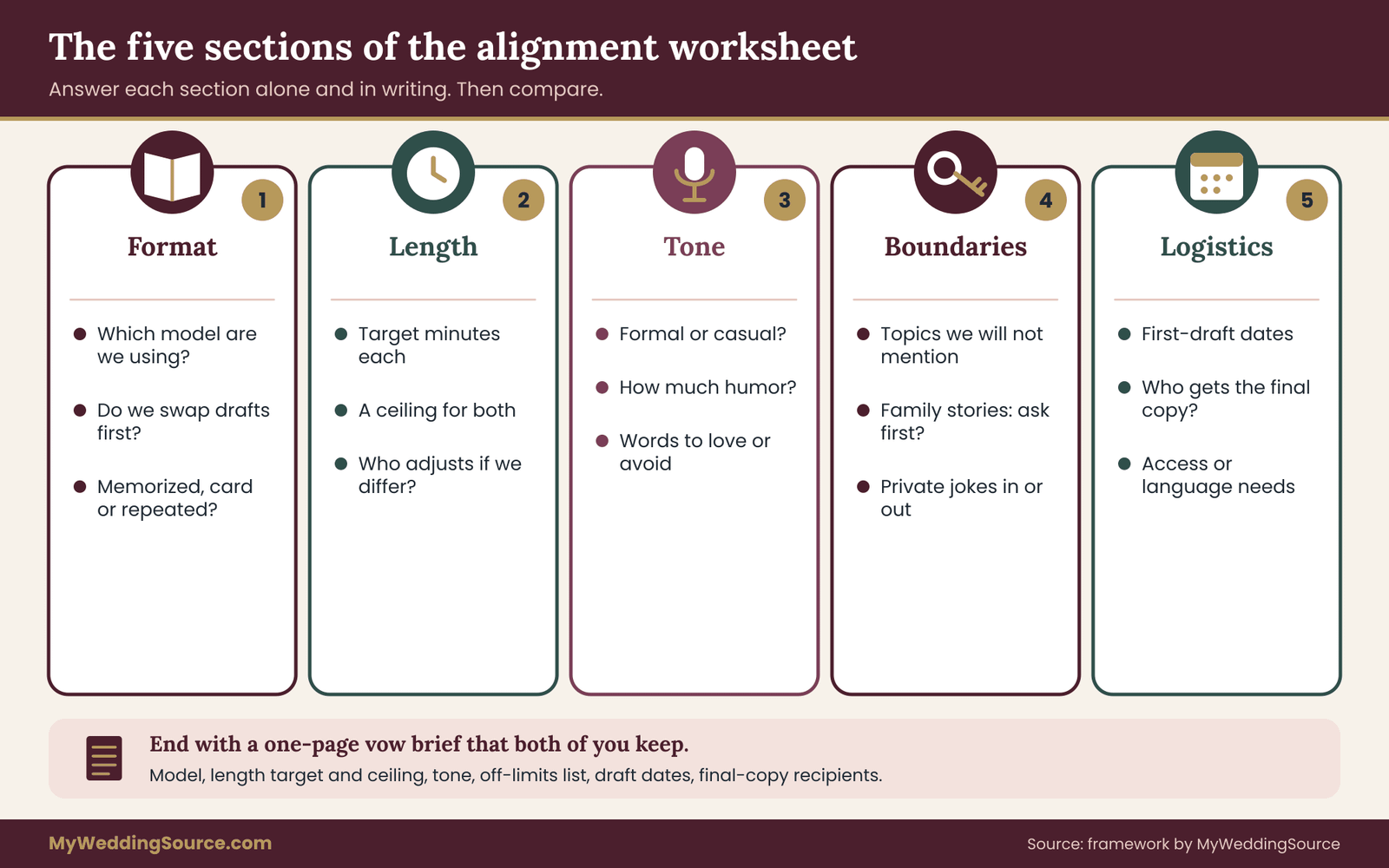
Plan about forty-five minutes alone and an hour together. Use a shared document or two copies of the same page. The worksheet has five sections: format, length, tone, content boundaries and logistics. Each question has a rule for what to do when your answers differ, so the comparison does not turn into an argument. Treat this as the first working session of writing vows together, not as homework.
Section one: format
These questions settle which of the three models from the previous section you are using.
Do we want one shared script, two parallel sets, or two mirrored sets? Write the model by name. If your answers differ, choose the one that asks less of the more nervous speaker, then add a detail from the other model. For example, one partner wants a shared script and the other wants personal vows. A workable answer is a short shared opening line said together, followed by individual promises of equal length. Say the model out loud, because writing vows together under different models produces different drafts.
Will we exchange drafts before the ceremony, or hear them for the first time on the day? A first-time hearing can be moving, but it carries risk if you have not agreed on boundaries. Many couples choose a middle path: agree on rules, skip the full draft exchange, but share a one-line summary of each promise’s theme so neither is blindsided.
Who will hear the vows? The guests, the officiant, a photographer and a videographer will all be in the room. If you want a private moment instead, say so now, because a private exchange changes the whole structure. Where a private moment is the plan, the sections below on length and delivery apply to the version you will share with the room, and you can write the private version separately without any alignment at all.
Will the vows be spoken from memory, read from a card, or repeated line by line after the officiant? Settle this before the length question, because call-and-response and memorized vows suit different lengths. Holding a card is fine and common; the choice is about comfort, not sincerity.
Section two: length
Length is where mismatched vows are most visible. A ninety-second vow followed by a four-minute vow feels unbalanced even if both are lovely. Agreeing on length is the single most useful step in writing vows together.
How long should each person’s vows run, measured in minutes spoken aloud? Speaking pace varies, but most people read aloud somewhere around one hundred and thirty words a minute, so a ninety-second vow is roughly two hundred words. Treat that as a rough planning figure and time yourself, since nerves and pauses change it. Agree on a target and a ceiling: for instance, about two minutes each, with neither going past three.
What is the total time the ceremony has for both sets of vows? Ask your officiant how much time the vows section usually takes and where it falls in the order. The officiant requirements guide explains what officiants typically need to know before the day, and vow length belongs on that list.
If our answers differ, who adjusts? Settle this with a rule rather than a bargain. A common rule is that the shorter target wins, because a long vow can always be said in a private letter, while a short vow beside a long one feels lopsided in public. Another rule is that the more nervous speaker sets the ceiling.
Section three: tone
Tone questions are the ones that people skip, and then regret skipping. Write short answers. Tone is the hidden half of writing vows together, because it decides how each draft sounds beside the other.
On a scale from very formal to very casual, where should the vows sit? Use a simple five-point scale and mark a number. If you mark a three and a five, you have two different ceremonies in mind.
How much humor is welcome? Choose from none, a light touch, a running joke, or a funny vow with a serious ending. Humor is the most common source of mismatch. One partner may picture a warm laugh in the middle and the other may picture a solemn promise throughout. Both are legitimate, but neither will work if the other does not know.
Are there words, phrases or images you love, and some you would rather avoid? You may adore a certain poem or phrase that your partner finds sentimental. This is the place to say so gently.
What should the guests feel when we finish? Some couples want tears. Some want laughter. Some want quiet. Writing the intended feeling down gives both drafts a target.
Section four: content boundaries
This section is the one that prevents harm. It is covered in more detail in the next major section, but the worksheet needs short answers now. Boundaries are what keep writing vows together safe for both of you.
Are there topics we will not mention? Common examples are past relationships, health conditions, money, family conflict, religious beliefs one of you does not share, and anything about a guest that the guest has not agreed to have mentioned.
May we tell stories about our families? If yes, which families, and do we show the relatives involved first? A story that charms one partner may land badly with the other’s parent.
Are there private jokes only the two of us understand? Decide whether to keep them in or explain them in a few words. A joke that needs a footnote usually works better in a private card.
May we mention how we met, and if so, is the story the same one we usually tell? Partners sometimes remember the same event differently. Reconcile that now, not in the middle of a vow.
Section five: logistics
The last section covers dates, tools and delivery. These details feel dull, yet writing vows together stalls without them.
By what date will each of us have a first draft? Pick a date well before the ceremony. The schedule section later gives a sample timeline.
What tools will we use? A shared document is easiest for comparing structure, but keep drafts in separate files if you want each to stay private until you choose to share.
Who will receive the final copy? Your officiant may need it, either to cue you or to be ready if someone freezes. A designated person may need to carry a backup card. Add the people, not just the file.
Do we need an accessibility or language accommodation? If a guest uses sign language, relies on captions, or speaks a different first language, you may want to share the vows ahead of time or arrange for interpretation. The Americans with Disabilities Act pages on ada.gov are a place to start for questions about access at a public venue, and the officiant and venue can tell you what they offer.
How to compare the answers
When you meet, read each section aloud, one partner at a time, and mark every answer pair as matching, close, or different. Spend your time on the different ones. This comparison is the heart of writing vows together as a joint project.
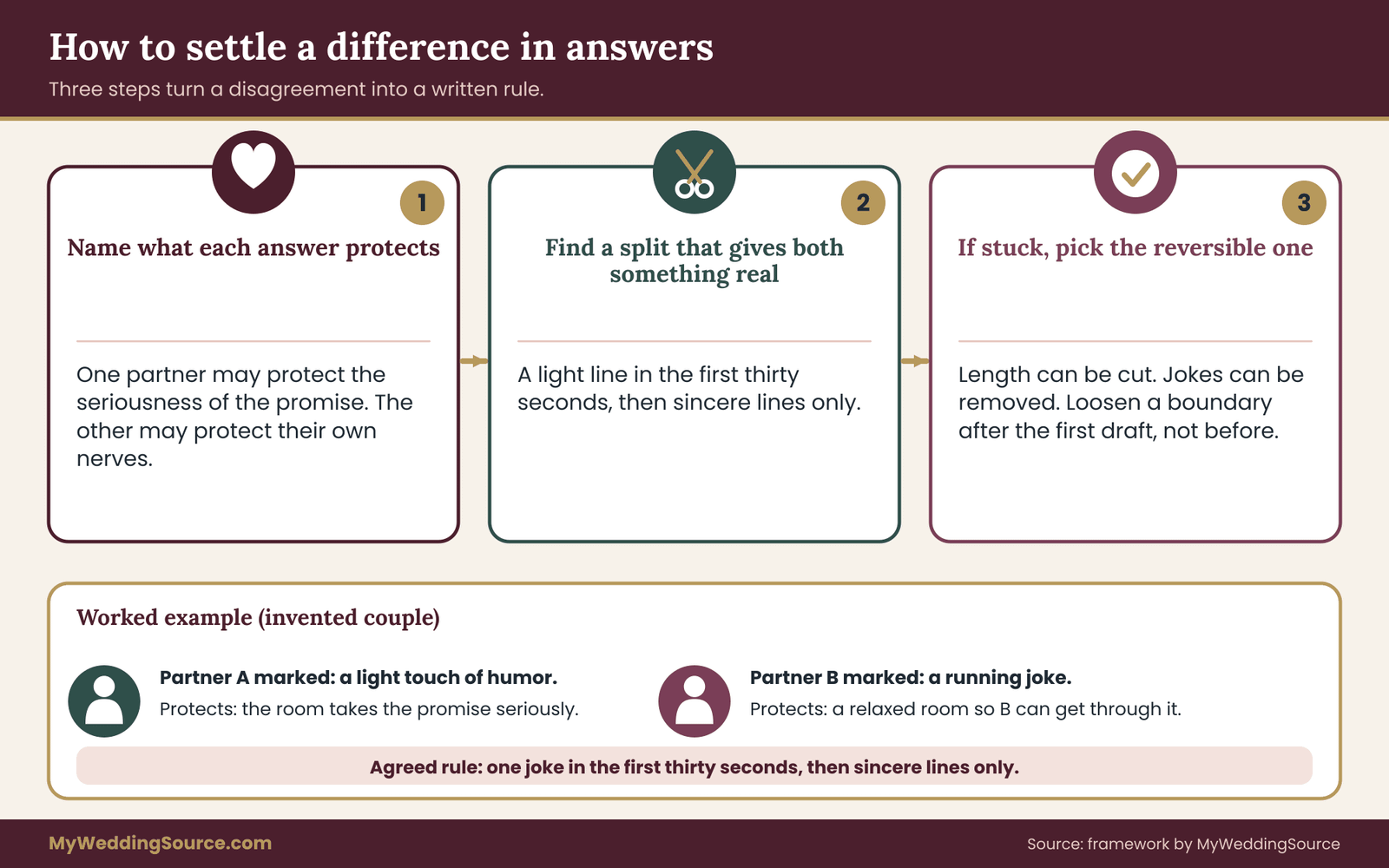
For each difference, use this order. First, ask what each answer protects. A partner who wants no jokes may be protecting the solemnity of the promise. A partner who wants jokes may be protecting their own comfort, because humor lowers their nerves. Naming the thing protected often reveals a third option that serves both.
Second, look for a split that gives each person something real. A short serious promise at the end with a light story at the start is such a split. So is a funny first minute followed by a quiet last minute.
Third, if you cannot agree, pick the option that is easiest to reverse. Length can be cut. Jokes can be removed at the edit stage. A boundary that is too strict can be loosened later, whereas one that is too loose cannot easily be tightened after something has been said aloud. When in doubt, choose the cautious setting now and relax it after the first draft exchange.
Finally, write down the agreed answers in a single shared note of one page. Call it the vow brief. It should list the model, the target length and ceiling, the tone setting, the off-limits list, the draft dates and the people who need the final copy. Both partners keep a copy. When a later argument starts, the brief is the thing you check, and it often settles the matter in a minute. A one-page brief is the simplest record of writing vows together that you can keep.
A short example of the worksheet in use
Consider an invented couple, Dana and Marcus, who planned a small evening ceremony. Their worksheets matched on format, since both wanted two parallel sets and a first-time hearing. They differed on humor. Dana had marked “a light touch” and Marcus had marked “a running joke.”
Asked what each answer protected, Dana said she wanted the room to take the promise seriously. Marcus said he wanted the room to relax so he could get through it. They settled on a joke in the first thirty seconds of each vow, then nothing but sincere lines after that. Neither gave up what they cared about, and the vow brief recorded the rule in one sentence.
That is the whole method. The worksheet does not make the decisions. It makes sure each decision is made by both of you, early, and written down. Writing vows together comes down to making each decision jointly, early and in writing.
What to do if one partner will not fill it in
Sometimes one partner treats the worksheet as overkill. Do not force it. Offer a shorter version: three questions only, on length, humor and off-limits topics. Those three prevent most of the damage. Frame it as a favor to them, since it also prevents an unwelcome surprise. If they still decline, send your own answers and ask them to reply with anything they would change. Silence is not agreement, so confirm out loud once before you draft. Writing vows together works best when both partners opt in, even to a shorter version. ## Setting boundaries while writing vows together
Boundaries are the part of writing vows together that most couples treat as obvious and then fail to say aloud. Vows are public. They are said in front of relatives, coworkers, old friends and sometimes strangers, and they may be recorded and replayed for years. Anything you say there is no longer private, so it helps to decide in advance what belongs in the room.
A boundary here is not censorship. It is a plain agreement about what each of you is willing to have said publicly, in your name and in the other’s hearing. The worksheet gave you short answers. This section turns them into rules that you can apply to an actual draft. Clear rules make writing vows together calmer, because neither of you is guessing.
Four kinds of boundary
Most vow boundaries fall into four groups. Naming them makes the conversation easier, because you can ask about each in turn rather than waiting for a problem. Each group matters differently when writing vows together.
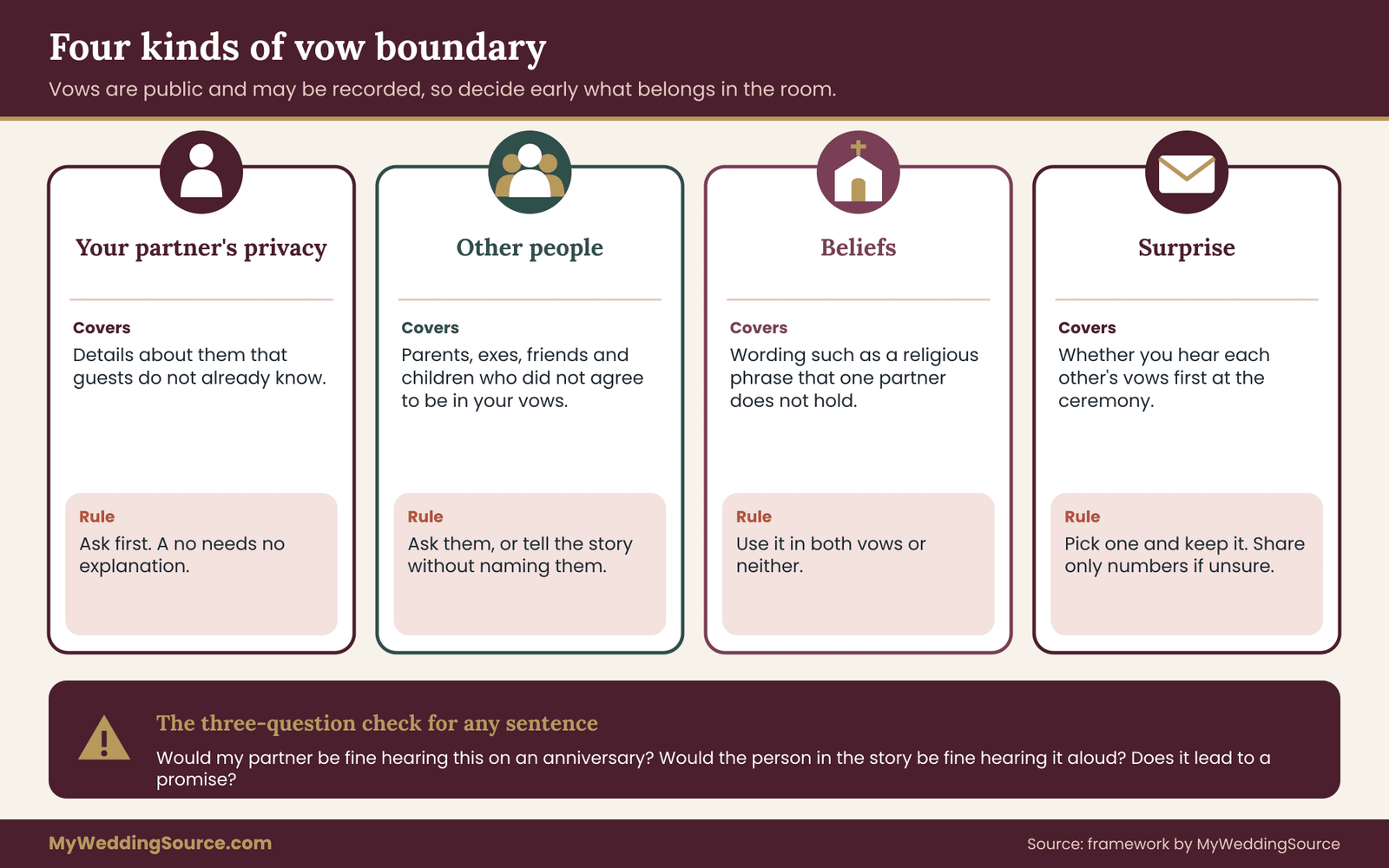
Privacy of your partner. Your vows will describe your partner, so you are speaking about someone who is standing next to you. Some partners are happy to have a story about their shyness, their cooking disasters or their old apartment shared with a crowd. Others are not. The rule is simple: if the detail is about them and is not already public knowledge among the guests, ask first.
A partner who says no is not being difficult; they are keeping a tidy line between what belongs to the couple and what belongs to the room. Writing vows together means treating your partner’s privacy as part of the project.
Privacy of other people. Stories about parents, former partners, friends and children involve people who did not agree to be in your vows. A story that reads as affectionate to you may feel exposing to them. Before including one, ask the person, or choose a version in which they are not identifiable. This applies strongly to anything touching illness, grief, family conflict, fertility, money or a past relationship. The wedding etiquette guide covers the wider question of what is welcome in front of guests, and vows follow the same common-sense rules.
Beliefs. If one partner is religious and the other is not, or the two traditions differ, vow wording can quietly claim a belief one of you does not hold. A line that reads “before God” may be natural for one partner and awkward for the other. Decide together whether the vows will include religious language, and if so, whether it appears in both sets or in neither. If your ceremony blends traditions, the interfaith wedding ceremony guide covers how couples approach shared wording across faiths.
Surprise. Some couples want the pleasure of hearing each other’s vows for the first time. Others want to read them in advance. This boundary is about information, not content. Choose one and keep it. A partner who agreed to a surprise and then reads the other’s draft has broken the agreement just as surely as one who breaks a content rule. Writing vows together with a surprise built in needs the numbers-only check described later.
Writing the off-limits list
The most practical boundary tool is a short written list of topics that neither of you will mention. Keep it to eight lines at most, or it becomes a document nobody remembers. Keep the list short so writing vows together does not become an exercise in policing.
Start with each partner’s private list, written alone. Then merge. A topic goes on the shared list if either partner names it. You do not need to explain why. This rule matters, because asking a partner to justify a boundary invites debate, and a boundary that needs defending is already weakened.
Typical entries include a previous marriage or engagement, a health diagnosis, a family estrangement, a sensitive financial history, a child from another relationship if the child has not agreed to be mentioned, the name of a person the other partner dislikes, and any story that involves alcohol if either of you has reason to avoid the topic.
Review the list at two moments: before drafting, and again after the first exchange. Some boundaries loosen once you have heard the draft and realize a story is gentler than you feared. Others tighten. Both changes are fine as long as both of you agree to them. Reviewing it is a normal part of writing vows together, not a sign of distrust.
The three-question check for any sentence
When you are unsure about a line, run it through three questions. Use this check whenever writing vows together raises a doubt.
Would my partner be comfortable if this line were played back to them at an anniversary? If the answer is no, cut or soften it.
Would the person in this story be comfortable hearing it from the microphone? If you cannot be sure, ask them or generalize the story.
Does this line make a promise, or does it only tell a story? Vows are, at their core, promises. A line that only shows off a clever memory without leading toward a promise can usually be shortened or moved to a toast, where stories have more room.
That last question is also a quiet way to protect length. Many first drafts are three-quarters memories and one-quarter promise. Checking each sentence for its promise function trims the draft without an argument.
Boundaries about humor
Humor is a content boundary and a tone choice at once, so it deserves its own rules. A joke at a partner’s expense, even a gentle one, lands differently when thirty relatives are listening. Many couples agree to a simple rule: you may tease yourself, but not each other, unless the other has approved the specific line. Humor needs its own rules when writing vows together, because it carries the most risk.
Another rule is to avoid jokes that rely on a stereotype, a bodily detail, a past mistake or an inside reference that only some guests will understand. Those jokes tend to split the room into people who are in on it and people who are not, and vows are supposed to include everyone.
If your couple’s natural voice is funny, you do not have to suppress it. Funny vows can be warm and memorable. The key is that the humor serves the promise rather than competing with it, and that both partners know the rules. A common structure is a short funny opening, a pause, and a sincere core. The structure section later in this guide shows where that fits. Writing vows together does not mean muting a funny couple.
What if a family member wants input
Parents, siblings and friends often volunteer opinions about vows. Some offer a favorite poem. Some suggest a story. Some ask to read a draft. These offers are kind, but outside input complicates boundaries, because every extra reader widens the circle that knows what you plan to say. Outside input is a real factor in writing vows together, since weddings attract opinions.
Agree on a policy before the offers arrive. One simple policy is that drafts stay between the two of you and the officiant. Another is that each partner may share their own draft with one trusted person for a read-through, and no one else. A third is that nobody reads anything, and you accept suggestions only in general terms. Setting a policy early keeps writing vows together a two-person project.
When someone offers input you do not want, a short, warm refusal works. You might say that you have decided to keep the vows between the two of you so they stay a surprise, and that you appreciate the thought. If a relative proposes a reading or a line, you can thank them and note that you will consider it, then decide privately. You owe them gratitude, not inclusion.
Boundaries around recording and sharing
Vows may be filmed, livestreamed or posted. Decide whether you are comfortable with that. A vow that feels fine in the room may feel different as a clip that circulates. If you want the words to stay in the room, tell your videographer and ask guests politely not to record, in the way your ceremony handles phones generally. If you do want a recording, ask for a clean audio source, since vows are often spoken softly and lost to wind or room noise. Recording is a boundary issue like any other in writing vows together.
You may also want to decide whether the text of the vows will be shared afterward. Some couples print them in a keepsake. Others keep them private. Agree on this together, and remember that writing vows together includes agreeing on the afterlife of the words, not only the ceremony itself.
When a boundary is crossed in a draft
It will happen. A partner reads the other’s draft and finds a line they did not expect. Handle it in three steps. Pause the conversation if tempers are high. Then name the line and the boundary it touches, without judging the intent. Finally, offer a replacement or an edit. Most boundary slips are not malicious; they are enthusiasm that went a step too far. Slips are a normal part of writing vows together and rarely signal a deeper problem.
Do not edit your partner’s draft without asking. Suggest, don’t rewrite. A vow is a personal statement, and a partner who finds their words changed may feel they have lost ownership of them. The next sections on tone and feedback rules cover how to suggest changes in a way that keeps both voices intact.
Tone is the quality that guests feel before they register any single sentence. Two sets of vows can have the same length, the same structure and the same promises, and still feel mismatched if one is wry and the other is solemn. Writing vows together does not require the same voice. It requires voices that can stand next to each other. Writing vows together does not require the same voice.
The worksheet asked you to mark formality and humor on simple scales. This section shows how to turn those marks into something you can hear.
The tone dial
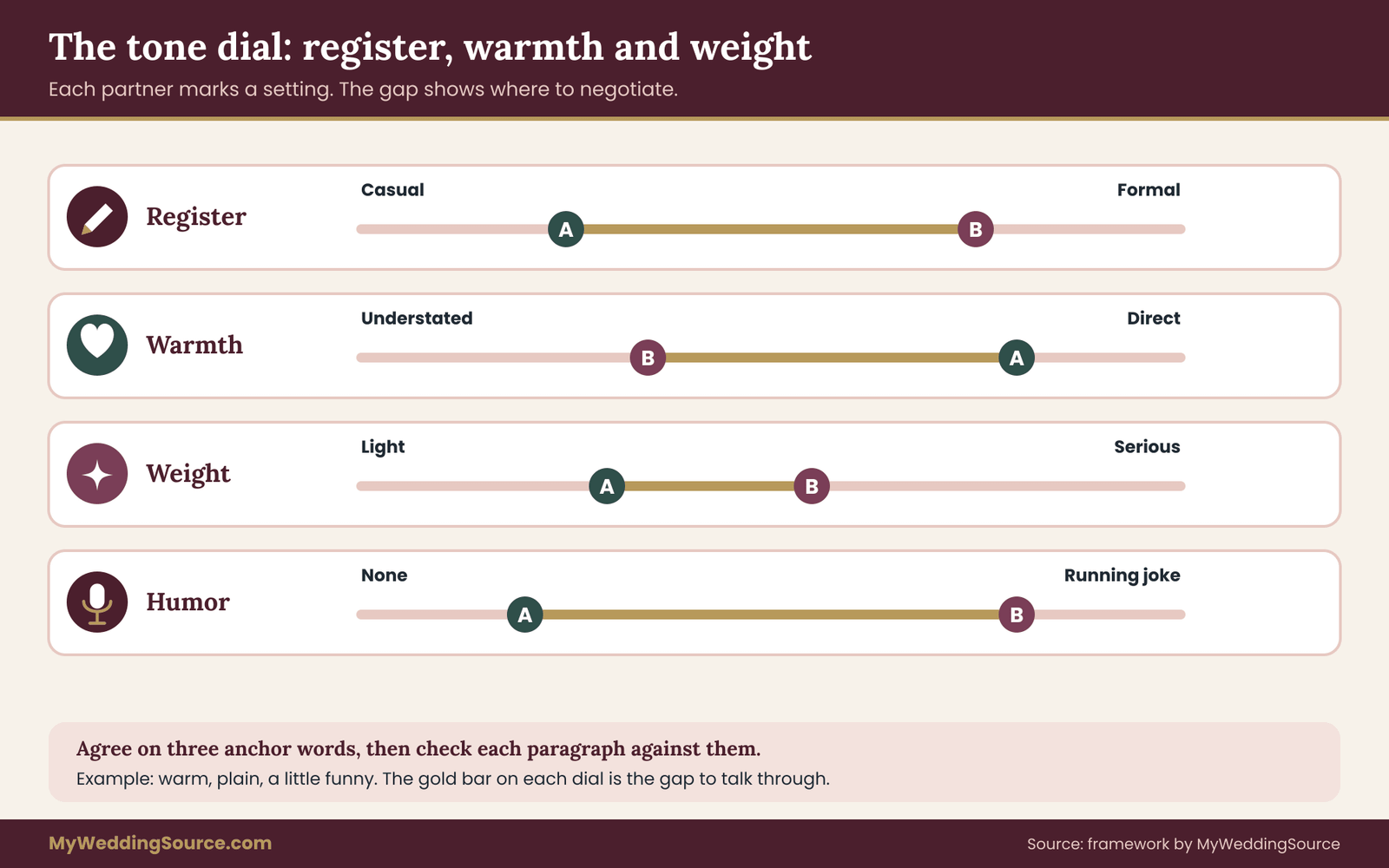
Picture a dial with three settings that matter for vows: register, warmth and weight.
Register is how formal the language is. A formal register uses complete sentences, avoids slang and addresses the partner with full names or familiar endearments used sparingly. A casual register sounds like the way you speak across a kitchen table. Neither is more sincere. Pick the one you can say aloud without feeling like you are acting.
Warmth is how much emotion is expressed directly. Some people state feelings plainly. Others show them through detail: the way a partner makes coffee, or the habit of leaving a lamp on. Both are warm. A mismatch appears when one partner is plainly emotional and the other is deliberately understated, and each reads the other as too much or too little. A shared rule helps: both vows include at least one direct statement of feeling and at least one concrete detail.
Weight is how serious the moment is treated. A heavy vow talks about commitment through hardship and the long run. A light vow talks about daily life and shared jokes. Most vows blend both, and the question is the proportion. A useful target for a balanced pair is a lighter opening and a weightier close, since the promise sits at the end.
Each of you can mark your own settings on the dial. The gap between marks tells you where to negotiate.
Matching tone without matching voice
Two people who speak differently should not be forced into a single voice. The goal is compatibility, not sameness. Writing vows together is a search for compatible voices.
One technique is to agree on three anchor words that describe the tone you both want, such as warm, plain and a little funny. Each partner keeps the anchor words beside the draft and checks each paragraph against them. If a paragraph feels off, you can usually identify which anchor word it violates. This is a small habit that makes writing vows together easier.
Another technique is to agree on one shared structural element that carries the tone, such as a repeated opening phrase, a closing line spoken together, or a promise formula both use. A single common thread lets the rest of each vow differ freely.
A third technique is a deliberate contrast. If one partner is witty and the other is quiet, let the witty vow come first and the quiet vow second, so the room has relaxed by the time the quieter words arrive. Contrast, when planned, reads as balance rather than mismatch.
Common tone mismatches and how to fix them
Here are the mismatches that come up most often, with a workable fix for each. Most of these appear when couples start writing vows together without talking about tone.
The joker and the poet. One draft is full of lines designed to get laughs; the other is lyrical and sincere. Fix it by trimming the humor to a single beat in the opening and giving the poet’s draft one concrete, plain sentence to ground it. Each moves slightly toward the middle without losing identity.
The long one and the short one. One partner has written three minutes and the other ninety seconds. Apply the length rule from the worksheet. If the long vow has real material, move some of it to a letter or toast and keep the promise core in the public version.
The religious one and the secular one. One draft invokes a tradition and the other avoids it. Settle whether any religious language appears, and where it does, whether the other partner is comfortable saying or hearing it. A neutral phrasing such as “in front of the people we love” can bridge the gap without claiming a belief.
The performer and the nervous one. One partner is comfortable on stage and the other is not. Do not ask the nervous partner to match the performer’s delivery. Instead, give them a structure that makes delivery easy: short sentences, a card in hand, and a clear final line.
The grand promises and the small ones. One vow promises to love through every storm and the other promises to share the dishes. Both can be true. The fix is to keep both kinds of promise in each vow, so the pair feels balanced. A grand promise grounded by a small one reads as honest.
Testing tone aloud
Tone is hard to judge on paper. Read both drafts aloud, in order, as they would be delivered. Better still, record them on a phone and listen without looking at the text. Mismatches that were invisible on the page become obvious in the ear. Reading aloud is the best tool for writing vows together that sounds like one ceremony.
Listen for three things. First, does the energy shift abruptly between the two vows? Second, does either vow contain a sentence that sounds like someone else wrote it? That is a sign the writer borrowed a phrase that does not suit them. Third, does the second vow feel like an answer to the first or a separate event? It need not be an answer, but it should not feel like a different ceremony.
Make adjustments in small steps. Changing one adjective or cutting one sentence is often enough.
A draft structure for writing vows together
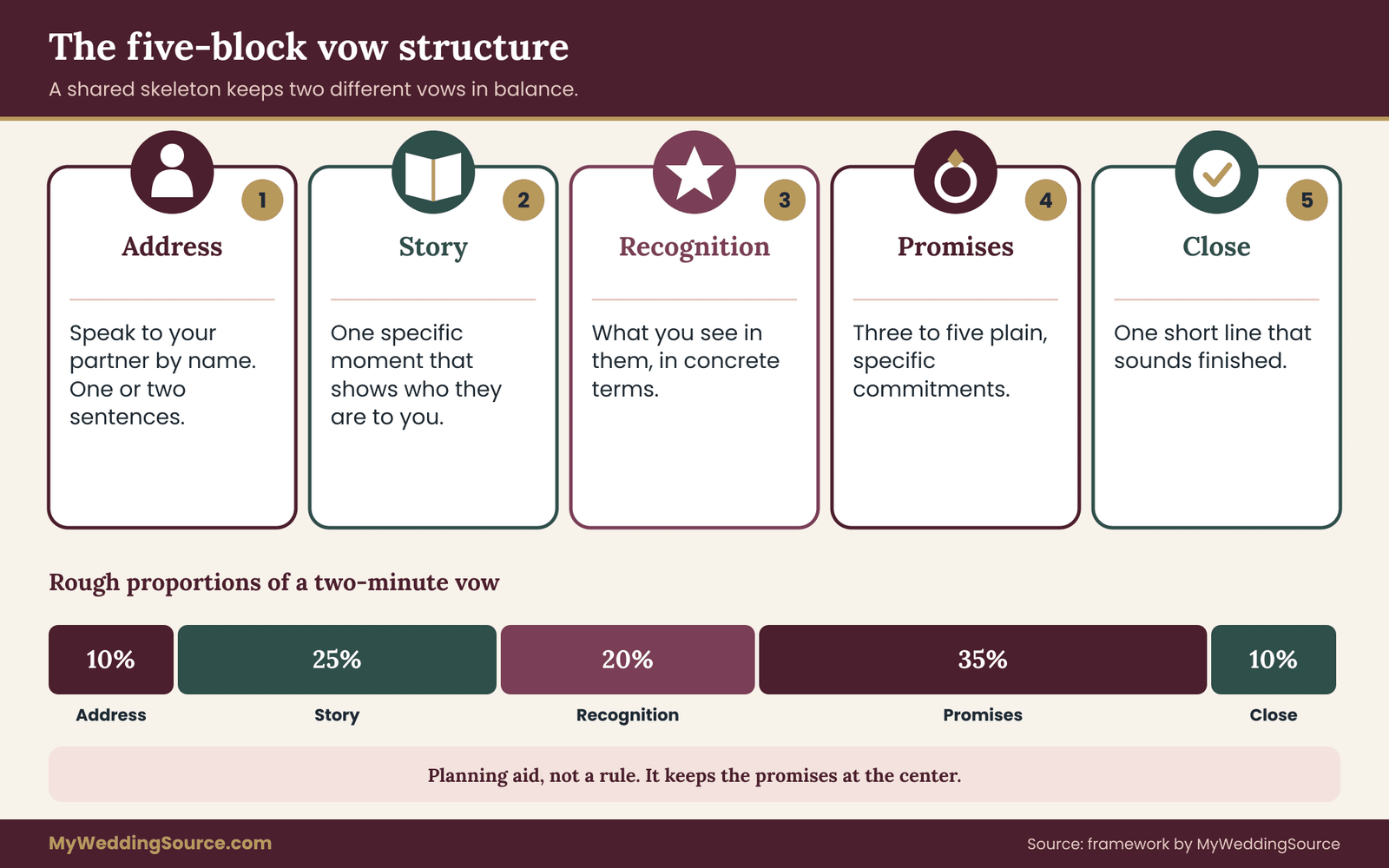
A shared structure is the most practical tool in this guide. It makes the two vows feel related without making them identical, and it gives a nervous writer a map. The structure below has five blocks. You can use all five, or drop the ones that do not suit you. When writing vows together, a common skeleton does more than any style rule.
The five blocks
Block one: the address. Open by speaking directly to your partner, by name or by the word you usually use. This sets the tone that you are speaking to one person, not performing for a crowd. One or two sentences are enough.
Block two: the story. Share one specific moment or detail that shows who your partner is to you. One story is usually better than three, because a single vivid detail is more convincing than a list. This is the block where boundaries matter most, so check it against your off-limits list.
Block three: the recognition. Say what you have learned or what you see in your partner that you value. Keep it concrete. Rather than saying you admire their kindness, describe a time their kindness showed. This block connects the story to the promise.
Block four: the promises. This is the core. State what you commit to, in plain, specific terms. Three to five promises are usually plenty. Mix large and small, and write them in the present or future tense so they sound like commitments rather than descriptions.
Block five: the close. End with a short line that sounds finished. It might be a simple declaration, a repeated phrase, or a line addressed to the guests. A good close is one sentence, not a paragraph, and is easy to say clearly.
Proportions for a two-minute vow
A two-minute vow is roughly two hundred and fifty words at a comfortable pace, though you should time your own reading. A balanced split looks like this: the address takes about ten percent, the story about twenty-five, the recognition about twenty, the promises about thirty-five and the close about ten. These proportions are a planning aid, not a rule. Their value is that they keep the promises, which are the heart of a vow, at the center rather than crowded out by memories.
If your vows run shorter, drop the recognition block first and let the story do the work. If they run longer, resist adding more stories; add specificity to the promises instead.
Agreeing on the structure without losing freedom
You do not have to follow the blocks in strict order or use every one. What you agree on is the skeleton: for instance, both vows will open with an address, include one story, contain at least three promises and end with a one-sentence close. Within that skeleton, wording, order of the middle blocks and personal style are yours. Agreeing on the skeleton is the shared core of writing vows together.
This is where the shared structure pays off. When each of you drafts from the same skeleton, you can compare drafts block by block. If one partner’s story is three times the length of the other’s, you see it at a glance. If one set of promises is all abstract and the other all concrete, the contrast is easy to spot and fix.
Optional shared elements
Some couples add a shared element that appears in both vows and ties them together. A few ideas follow. These are choices, not requirements. Shared elements can help writing vows together feel connected, but they are optional.
A repeated phrase, said at the same point in each vow, such as the opening address or the final line. A shared image, such as a place, object or season that each of you references in your own way. A shared promise, where one commitment is identical in both vows and said in unison or in turn. A closing exchange, where one partner’s last line is answered by the other’s first.
Choose at most one or two. Too many shared elements make the vows feel scripted and take away the personal feel that most couples want.
Writing the promises well
Because the promises are the center, they deserve extra care. A strong promise is specific, within your control and something your partner would recognize as true to you. Strong promises are what separate good results from merely pleasant ones when writing vows together.
Avoid promises that no one can keep, such as never getting angry or always agreeing. They sound romantic and read as hollow. Avoid promises that belong to your partner, such as a promise that they will always be happy. Avoid promises that depend on luck, such as a promise that you will always be rich or healthy.
Prefer promises about attention, effort and behavior: to listen before answering, to say sorry first when it is your turn, to keep the kitchen light on, to tell the truth when it is awkward. Small and real beats large and abstract. One test is to ask whether your partner could, a year from now, point at an instance where you kept the promise. If yes, it is a good one.
An eight-week schedule for writing vows together
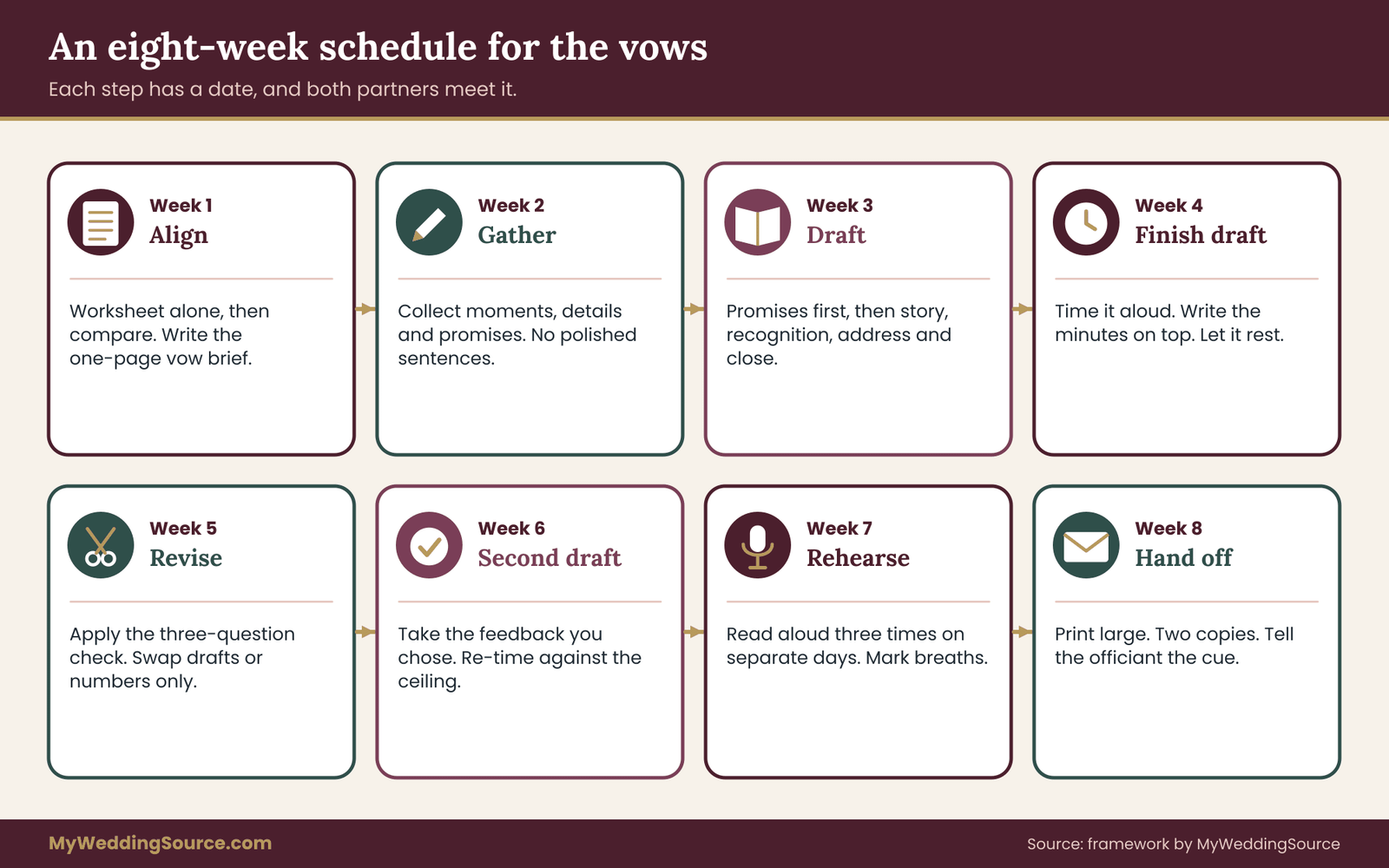
Writing vows together needs a calendar more than it needs inspiration. The schedule below runs eight weeks and assumes you start roughly two months before the ceremony. If you have less time, compress the middle weeks, but keep the order. If you have more, spread the steps out and add a rest week between drafts.
The schedule uses one rule throughout: each step has a date, and both partners meet it. Missing a date is not a crisis, but saying so early is better than saying nothing.
Weeks one and two: align and gather
In the first week, do the alignment worksheet alone, then compare and write the vow brief. This takes about two sessions. Put the brief where both of you can find it. The first week of writing vows together is about agreement, not prose.
In the second week, collect material without writing sentences. Make a list of moments, details, phrases and promises that come to mind. Keep it unpolished. Use your phone’s notes app, a paper list or voice memos. The aim is to fill a bucket you can draw from later, so you are not staring at a blank page.
Some prompts help. What did you notice first about your partner? What small habit of theirs do you rely on? What is a time they surprised you? What is something you want to be better at, because of them? What would you promise if you were certain you could keep it? Write short answers. You will use maybe a fifth of what you collect.
Weeks three and four: first drafts
Each partner writes a first draft alone, following the agreed skeleton. Give yourself a time limit for the session, perhaps ninety minutes, and stop when it ends. A first draft is meant to be rough, and the goal is to get the blocks on paper. This is the point where writing vows together becomes two parallel projects.
Write the promises first. They are the core, and writing them first keeps you from burying them under stories. Then add the story, the recognition, the address and the close. Many writers find the close easiest to write last, once they know where the vow has gone.
Do not edit as you go. Editing during drafting is the main reason first drafts stall. Mark awkward spots with a symbol and move on.
When the draft is done, read it aloud once and time it. Write the time at the top. Do not share it yet. Let it rest for two days.
Week five: first revision and the exchange decision
Return to your own draft with fresh ears. Cut anything that fails the three-question check from the boundaries section. Replace general words with specific ones. Shorten sentences that run out of breath when spoken. Revision is where writing vows together improves most.
Now decide, based on your worksheet, whether you will exchange drafts. If you chose a surprise, skip to the next step and use the alternative check described below. If you chose to share, exchange drafts and follow the feedback rules in the next section.
For couples who prefer to keep the vows secret, writing vows together still benefits from a limited exchange. Share only the numbers: running time, number of promises, and a one-line description of the tone. That is enough to catch a length or tone mismatch without revealing a word. If your numbers are far apart, adjust before the second draft.
Week six: second draft and feedback
Incorporate the feedback you chose to accept. Resist the urge to rewrite from scratch; the first draft usually has more good material than it seems. Re-time the vow. Check the length against the ceiling in your brief.
If you exchanged drafts, now is a good moment for a second, lighter exchange. Do not ask for new feedback on every sentence. Ask one question: is there anything here that you would be uncomfortable hearing aloud? That question catches the boundary problems that matter most and leaves the voice untouched.
Week seven: read-aloud and rehearsal
This week moves from page to voice. Read your vow aloud at least three times on separate days. The first reading is for timing. The second is for breath: mark where you naturally pause and adjust punctuation to match. The third is for feeling: stand up, look at an imagined partner and say it at ceremony pace. Voice is where writing vows together finally becomes real.
Rehearse in the clothes or shoes you will wear if you can, since posture changes breathing. If your venue allows a walk-through, ask the officiant whether you can speak the vows in the space once, to hear how the room carries sound. The ceremony cue sheet guide describes how couples fold vow timing into the written order so the officiant and musicians know when to step in.
Week eight: finalize and hand off
Print the final version in a readable size, at least fourteen points, with generous spacing. Make two copies. One goes with you; the other goes to a designated person who will be near the ceremony and can hand it over if the first is lost. Send the final text to your officiant if you agreed to, or send them only the cue, such as the first and last words of each vow. A tidy handoff is the last practical step of writing vows together.
Decide who holds the cards during the ceremony. If the officiant is handing them over at the right moment, say so in the rehearsal. If you are holding them, practice with them in hand.
Stop editing seven days before the ceremony. Late changes create memory errors. Accept the draft and trust the work you have done.
Feedback rules for trading drafts
Exchanging drafts is where relationships either gain from writing vows together or collect small injuries. A few simple rules make the difference.
Ask a specific question. Do not hand over a draft and say “thoughts?” That invites a verdict on everything. Ask something narrower: is it too long? Does the middle drag? Does any line make you uncomfortable?
Respond to what is on the page, not what you imagined. A partner reading a draft may feel disappointed that a favorite memory is missing. That is a reaction to the draft you hoped for. Say it kindly, as a wish, not a flaw.
Separate three kinds of comment. There are boundary comments, which concern something you do not want said. There are clarity comments, which concern something you did not understand. And there are taste comments, which concern what you would have written differently. Boundary comments carry weight. Clarity comments are useful. Taste comments are the lightest; the writer may ignore them.
Use a two-pass method. In the first pass, the reader notes only what they felt and where they got lost. In the second, they suggest edits. Separating the passes keeps feedback from collapsing into rewriting.
Let the writer decide. The author accepts or declines every suggestion. If a boundary comment is declined, discuss it once, calmly. Beyond that, the vow is still the author’s statement.
Say something good first, and mean it. Specific praise tells the writer what to keep. “The line about the lamp made me smile” is more useful than “it was lovely.”
Handling mismatched pace
One partner may finish a draft in a week while the other needs the full eight. That is normal, and it is not a measure of devotion. The risk is that the faster partner grows anxious and starts to nudge, or the slower partner feels judged. Different paces are common when writing vows together.
Respect the dates in the brief and agree on a gentle check-in rather than daily reminders. A short message midway, such as a plain question about whether the schedule still feels right, is better than silence. If the slower partner is stuck, offer a prompt, not a draft. Ask them the questions from week two aloud on a walk. Many people find that speaking the answers is easier than typing them, and a voice memo can become the raw material of a draft.
If the delay reaches the last two weeks, shorten the plan rather than abandoning it. A short vow built on the five-block skeleton can be drafted in a single focused evening. Fewer words, well chosen and well delivered, are better than long vows said in a hurry. A short vow still counts as success when writing vows together under time pressure. ## Five illustrative cases of writing vows together
The cases below are invented. They show how the worksheet, boundaries and structure play out under realistic pressure, and none of them reports what real couples did. Use them as thinking aids, not as templates. Each shows a different pressure point in writing vows together.
Case one: different comfort with the microphone
Priya enjoys speaking in public and teaches for a living. Jonah avoids it and dreads the ceremony more than the dinner. Their worksheets matched on format (two parallel sets) but split on length: Priya marked three minutes, Jonah marked one.
They applied the shorter-target rule and set the ceiling at ninety seconds each, which Jonah could manage. Priya felt her material was cut, so they gave her a second outlet: a handwritten letter to read privately before the ceremony. The public vows used the five-block skeleton with a short story, three promises and a one-line close. Jonah held a card. Priya spoke without notes. The difference in delivery read as personality, not mismatch, because the length and structure were identical. Writing vows together here meant protecting the more nervous speaker.
The lesson is that equal length matters more than equal delivery. Guests forgive different styles but notice different durations.
Case two: humor versus solemnity
Elena wanted laughter. Sam wanted quiet. Both said so on the worksheet and both asked what the other protected. Elena said humor kept her from crying so hard she could not speak. Sam said he feared a joke would make the promise feel less real.
Their solution was an order and a rule. Elena would go first, with one joke in the opening and a sincere core. Sam would go second and open with a single light line in reply, then move into the promises. The joke gave Sam a gentle way in, and Elena’s sincerity set the weight for his vow. Both agreed that no joke would appear after the promises begin.
The lesson is that humor and solemnity coexist when each has a place. Writing vows together lets you assign places on purpose.
Case three: a boundary about a family story
Marcus’s draft included a story about his mother’s long illness and how it taught him to value time. Dana read it and felt it was moving. She also noticed that Marcus’s mother, who would be in the front row, had not been asked.
Dana raised it as a boundary comment: the story involves another person who has not agreed. Marcus agreed and called his mother. She said she was happy for it to be mentioned in general terms but did not want the illness named. Marcus rewrote the story around what he learned, without the diagnosis. The edited version was shorter and stronger. Writing vows together makes this kind of question easy to raise.
The lesson is that a quick call can turn a risk into a gift. Asking the person involved is faster than guessing and keeps the story from becoming a surprise for the wrong person.
Case four: a blended tradition
Amira and Daniel come from different faith traditions. Both wanted vows that did not choose one over the other. They worried that borrowing a religious phrase would please one family and unsettle the other.
They agreed on a shared structure with no invocation of any tradition in the vows themselves. Each family’s tradition appeared elsewhere in the ceremony, through a reading and a blessing the officiant introduced. The vows stayed personal and plain, anchored on promises about attention and respect. The officiant, who had been told the brief, introduced the vows by saying only that the couple had written their own. Writing vows together in a mixed-tradition couple often comes down to this kind of separation.
The lesson is that vows do not have to carry every identity at once. A ceremony has many parts, and a belief can live in a reading while the vows stay personal. For wording ideas that avoid a particular tradition, the non-religious ceremony script guide and the Christian ceremony script guide show two ends of the range, and a mixed couple can borrow structure from either without borrowing doctrine.
Case five: one partner stalls
Lena finished her draft in three weeks. Theo had not started by week five and felt guilty. Lena was anxious and began to send reminders.
They revisited the brief. Theo explained that he found a blank page paralyzing but spoke easily. Lena offered to ask him the week-two prompts on a walk while he recorded the answers on his phone. Theo turned two of those answers into the story block and a promise, and wrote a first draft in an evening. The last-two-weeks rule from the schedule allowed a short vow rather than none. Writing vows together at different paces calls for patience on both sides.
The lesson is that the obstacle is often the medium, not the motivation. Switching from writing to speaking unblocked him. The brief gave both of them a calm way to talk about the delay without blame.
What the cases share
Across the cases, four habits repeat. Each couple named the underlying concern rather than arguing about the surface request. Each set a length rule that favored the more cautious partner. Each used the shared structure to compare drafts. And each handled a risk by asking a person, not by guessing. None of this requires special skill. It requires a few early conversations and the willingness to adjust. These are the habits that make writing vows together manageable.
Permissions, quoted material and what the ceremony requires
Most couples who go to the trouble of writing vows together want the words to be their own. But some want to include a line from a poem, a song, a film or a book. Doing so is common and usually harmless in spoken form, yet a few points are worth understanding so you do not run into a problem with a printed program, a recorded video or an officiant’s policy. Permissions are a small but real part of writing vows together.
Quoting a few lines in spoken vows
Saying a short quotation aloud at a private ceremony is generally a low-risk act, and many couples do it. The questions that matter rise when the words are copied into printed programs, posted online with the recording, or sold or distributed. Copyright law protects original works such as poems, song lyrics and books, and the rules about what you may reproduce depend on length, purpose and the rights holder. The U.S. Copyright Office publishes general information and answers to common questions at copyright.gov, and it explains that it cannot give legal advice on individual situations.
A practical approach is to keep quoted material short, attribute it, and put it in the spoken vow rather than in a widely distributed text. If you plan to print or publish the vows, consider using your own words in those versions and leaving the quotation for the spoken moment.
If a particular quotation matters a great deal to you, contact the publisher or rights holder to ask what is permitted. Reading a quote or a poem in a ceremony is a different matter from reproducing it widely, and it is the second case where permission becomes relevant.
Public-domain and original wording
Works whose copyright has expired, often called public domain, may generally be quoted freely, though the status of a given edition or translation can differ from the original. Project Gutenberg at gutenberg.org hosts many older works that are in the public domain in the United States, and the Library of Congress at loc.gov holds historical and literary materials. Check the specific text before relying on it, because a modern translation or annotated edition may carry its own rights.
The simplest solution is also the one most couples prefer: write your own words. Original wording avoids the question entirely, and it is usually what makes vows feel personal. If you want the flavor of a favorite passage without quoting it, paraphrase the idea and add your own detail. A line that says what the poem meant to you reads as more authentic than the poem itself.
Song lyrics and music under vows
Some couples have music playing softly during the vows or choose to quote a lyric. Music licensing is a separate matter from quoting words. The venue or the performance rights organizations that license public performance, such as ASCAP at ascap.com, publish information about licensing, and venues typically hold blanket licenses. Whether a particular live or recorded use needs permission depends on the setting, so ask your venue and your musicians what is covered, rather than assuming.
What your officiant needs to know
Your officiant leads the ceremony and may have rules, templates or time limits. Share the vow brief early. Ask whether the officiant expects to see the text, whether they have a preferred way to introduce the vows, and whether they handle the cues, such as nodding to start or prompting a line if someone loses their place. Some officiants require the vows to be reviewed in advance; others are comfortable with surprises.
The ceremony order guide shows where vows usually fall in the sequence. Ask also what the ceremony must include. In many places the law requires the couple to declare that they take each other as spouses, in some form of words, in front of the officiant and sometimes witnesses. Personal vows are usually in addition to that declaration, not instead of it, but the details differ by state. Your marriage license office, the officiant and the guidance collected at usa.gov can tell you the current requirements where you are marrying. Confirm them, and do not rely on a template or a friend’s experience from another state.
Accessibility and language
Vows are for the guests as well as the couple, so think about who may have trouble following them. If a guest is deaf or hard of hearing, ask the venue about assistive listening systems or captioning, and consider sharing a printed copy of the text or arranging for an interpreter. If guests speak another first language, a translated line or a printed card may help.
The ADA information at ada.gov is a starting point for understanding what public venues are expected to provide, and your venue coordinator can tell you what is available. Access is part of writing vows together that many couples overlook.
Speak clearly and slowly, and face the guests when it makes sense, so lip readers and the back rows can follow. A microphone is worth the trouble if the room is large, since vows spoken softly in an outdoor setting are often lost.
Rehearsing and delivering the vows you wrote together
The work of writing vows together does not end with a finished text. A vow is a spoken thing, and the last step is learning to say it without stumbling, in a room that may be warm, noisy or windy, with an audience and a person you love looking at you. Rehearsal turns a good draft into a good moment.
Practice for sound, not for memory
Most people try to memorize vows and end up reciting them in a flat voice. A better aim is to know the vow well enough that you can look up from the card. That comes from reading aloud many times, not from drilling lines. Rehearsal is the part of writing vows together that gets the least attention.
Read the vow standing, at ceremony pace, with a pause after each sentence you care about. Mark the pauses on your card with a slash. Mark any word you tend to stumble on and consider replacing it. Rewriting a tricky phrase is a perfectly good rehearsal result.
Vary your practice. Read it once to the mirror, once to a friend you trust, and once while walking. Each setting exposes something different. The mirror shows your face. The friend gives timing. The walk shows where your breath runs out.
If you are using a call-and-response script, practice the rhythm with a stand-in officiant. The officiant will give a short phrase and you will repeat it, and the common error is to start talking before the phrase ends. Practice waiting.
The card and the backup
Print the vow on a card or sheet that is easy to read: large type, plenty of line spacing, and no more than a few lines per paragraph. Keep the card in a pocket, a small folder or a clean envelope, and decide who carries it between the getting-ready room and the ceremony. These details belong to writing vows together as much as the drafting does.
Always make a backup. A second copy should travel with a different person, ideally one who stands near the front. A phone with the text saved also helps, though a phone can fail, and screens are hard to read in sunlight. The backup is there for the rare moment when a card blows away or a speaker’s mind goes blank.
If you plan to hold a microphone, ask who will hand it over and when. If you are using two microphones, practice passing the card between hands. These small mechanics sound trivial and cause real stumbles.
Nerves and the body
Almost everyone is nervous. Nerves are not a sign that you wrote the vow poorly. They are a physical response that has simple, ordinary remedies: slow breathing, relaxed shoulders, a sip of water, feet firmly on the ground. The National Institute of Mental Health at nimh.nih.gov provides general information about anxiety, and if nerves around speaking are severe, a conversation with a health professional is the right step. Nerves are normal even for couples who have spent weeks writing vows together.
Practical steps help in the final minutes. Eat something light beforehand. Take a slow breath before the first line, and let a silence pass. Look at your partner rather than at the crowd. If your voice shakes, pause and continue; guests read a pause as emotion, not failure. A moment of tears is not a mistake in a wedding ceremony, and most guests welcome it.
If a partner is especially anxious, agree on a small signal in advance, such as a squeeze of the hand or a nod, that means “pause and begin again.” The officiant can prompt a line when needed. Knowing that a net exists is often what keeps a speaker from falling.
Keeping the two vows in balance on the day
You worked hard to make the two sets of vows fit together, and delivery can undo some of that if one partner speaks fast and the other slow. Agree on a pace. A good rule is to speak slightly slower than feels natural, since nerves speed everyone up. Delivery is the final test of writing vows together.
Decide who goes first and stay with the decision. The first speaker sets the length and tone for the second. Some couples go in order of nervousness, with the more anxious partner first so the wait does not build. Others let the more confident partner lead to set a comfortable weight. Choose it during rehearsal and tell the officiant.
If you chose to hear each other’s vows for the first time, remember that the listening partner will be moved or amused. Plan a pause for that reaction. A speaker who barrels through while the listener is laughing or crying loses the moment. Leave a beat after each promise if you can.
After the ceremony: keeping the words
Many couples regret that they cannot recall their vows a year later. Decide how you will preserve them. A recording is one option, if you are comfortable with it and have agreed with your videographer on audio. A printed copy of each set is another. Some couples frame the cards, tuck them into a keepsake box or read them aloud on their first anniversary. Keeping the words is the quiet last step of writing vows together.
If you want privacy, store the text in a place both of you can find and keep out of public posts. Writing vows together included an agreement about what happens to the words afterward, and this is where the agreement becomes real. Revisit it once the day is over, because feelings about sharing sometimes change.
Your next steps
You can start today with a short list. Block an hour this week for the worksheet and answer it alone. Schedule a second hour to compare. Write the vow brief on a single page and save a copy each. Pick your two draft dates and one date for the read-aloud. Tell your officiant the model, the length ceiling and whether you want to share the text. The guide on what officiants need to know lists other questions worth asking. Choose the person who will hold your backup card.
If time is short, do the quick version: agree on length, humor and off-limits topics, use the five-block skeleton, and read aloud twice before the day. If you have more time, use the full eight-week schedule and add a rest week. In either case, the shared part of writing vows together is the frame, and the words are yours.
FAQ
Do we have to write the same vows when writing vows together?
No. Writing vows together usually means agreeing on length, tone, structure and boundaries while each person writes their own words. Some couples do choose one shared script, often repeated line by line after the officiant. Either approach is fine. What matters is that you both know which model you are using before you begin drafting, so there are no surprises.
Should we read each other’s vows before the wedding?
It is a personal choice. Reading them ahead lets you fix mismatches in length and tone. Keeping them secret preserves the surprise. A middle path works well: share only the running time, the number of promises and a one-line description of the tone. That catches most problems without revealing any wording, and it keeps the first hearing fresh.
How long should each person’s vows be?
Most couples aim for between one and three minutes each, but the right length depends on your ceremony and your comfort. Agree on a target and a ceiling, time yourselves reading aloud, and let the shorter target win if you disagree. Speaking pace varies, so test your own. Equal length matters more than a specific number.
What if one of us is much better at writing than the other?
Skill differences are common and do not need to affect fairness. Use the shared five-block structure so both vows have the same bones. The less confident writer can start by speaking answers aloud and recording them, then shaping the recording into text. Short, specific, sincere vows often land better than long, polished ones.
Can we include a quote or a poem in our vows?
Spoken quotations are common, and a few short lines are usually low risk at a private ceremony. Rules matter more when you print, record or publish the text, since copyright law protects many poems, lyrics and books. Keep quoted lines short, attribute them, and check copyright.gov or the rights holder for anything you plan to reproduce widely.
How do we handle a joke one of us dislikes?
Ask what the joke is meant to do, then look for another way to do it. A partner who dislikes a joke is often protecting the seriousness of the promise. You can move the humor to the opening, aim it at yourself rather than your partner, or cut it. If you cannot agree, choose the cautious option and soften it later.
Does our officiant need to see the vows?
Not always, but ask early. Some officiants want the text, some only want to know the length and the cue, and some are comfortable with surprises. At minimum, tell your officiant the order, the approximate length and how you plan to start and finish, so they can cue you or prompt a line if someone loses their place.
What if we disagree about what to include?
Start by naming what each choice protects, then look for a split that gives each person something real. If you still disagree, choose the option that is easiest to reverse, such as a shorter length or a stricter boundary, and relax it after your first draft exchange. The written vow brief gives you a neutral reference for settling the question.
Sources
- U.S. Copyright Office: general information on copyright and reproducing protected works.
- U.S. Copyright Office, frequently asked questions: answers on quoting, permissions and fair use.
- USA.gov: government guidance and links to state marriage and license offices.
- Plain Language Guidelines: federal guidance on clear, direct writing.
- National Institute of Mental Health, anxiety disorders: general information on anxiety.
- ADA.gov: U.S. Department of Justice information on disability access.
- Project Gutenberg: public-domain texts available in the United States.
- Library of Congress: historical and literary collections.
- ASCAP: music licensing information for public performance.
- BMI: music licensing information for public performance.