
Dessert alternatives are the cookies, pies, frozen treats, candy, fruit and regional sweets that couples serve beside a cake or in place of one. This guide gives you a portion and display plan for mixed guest tastes: how many servings to order, how to show them, and what to confirm in writing before you book.
Plan dessert alternatives around four jobs: a visible moment, coverage so every guest has something to eat, real choice for different tastes, and a leftover plan. Count servings in dessert units instead of pieces, keep a separate safe lane for guests with allergies, and match the display format to your room, your staff and the clock. Then get the counts, labels, holding temperatures and service windows into your vendor paperwork. Official allergen and food safety rules sit with the FDA, the USDA and your local health department, so confirm them there.
Cake is a habit, not a rule, and dessert alternatives are a normal choice. Many couples like the idea of dessert alternatives such as a table of small desserts, a pie bar, a frozen cart or a family recipe, and then discover that the idea is the easy part.
Who counts the servings? What happens when a guest with a nut allergy walks up to a table of twelve items? Where does the ice cream wait while the toasts run long? The answers decide whether dessert alternatives feel generous or chaotic.
This article is about those answers. It does not tell you which of the dessert alternatives is best, because that depends on your guests, your caterer and your venue. It gives you a way to decide among dessert alternatives: a four-job test, a portion ladder, a taste map of your guest list, a display fit test and a short list of questions for every vendor involved.
Three invented case examples show the method at work, and a day-of run sheet closes the gap between plan and service.
A note on scope. This is general planning information, not legal, tax, medical or financial advice, and food rules differ by state and county. Where a rule matters, such as allergen labeling or how long perishable food can sit out, the article names the agency that sets it so you can check the current version.
What dessert alternatives are, and when they fit
Wedding dessert alternatives fall into a few families, and it helps to name them before you compare them. Each family has its own cost pattern, its own handling needs and its own way of going wrong.
Baked small items. Cookies, brownies, mini pies, tarts, bars, macarons, cupcakes and doughnuts. These travel well, store at room temperature for a while, and are easy to count. Their weakness is sameness: five baked items with butter, flour and sugar do not give a guest with a different diet much choice.
Frozen and chilled items. Gelato, ice cream sandwiches, sorbet, mousse cups, panna cotta, cheesecake bites. These feel special and suit warm weather, but they depend on cold storage and a short service window. They are the family most affected by venue limits.
Fruit, candy and confections. Fresh fruit, chocolate-dipped fruit, candy displays, caramel, brittle, truffles. They are often the easiest route to a dairy-free, gluten-free or nut-free option, and the hardest to label, because candy comes in packages with ingredient lists you have to read.
Fried and made-to-order items. Churros, funnel cake, crepes, s’mores. These bring a live element, but they need power, ventilation, an attendant and a line that moves.
Cultural and family desserts. A regional pastry, a grandmother’s recipe, a sweet tied to a tradition. These carry meaning, and they often come from a family kitchen rather than a licensed one, which changes how you handle them. A separate section later covers that decision.
A smaller cake plus extras. Many couples keep a cutting cake for the photograph and add other desserts for variety. These count as dessert alternatives in the sense that matters for planning, because the cake no longer carries the whole job.
When dessert alternatives make sense, and when they do not
Dessert alternatives fit when your guest list has a wide spread of tastes and needs, when you want to spend on variety instead of tiers, when your venue has a catering kitchen or a good caterer, or when a family tradition deserves its own place on the table. Dessert alternatives also fit when you want guests to move around, because a table or cart gives people a reason to leave their seats at the right time.
They fit less well in a few situations. A venue with no cold storage and a summer date makes frozen items risky. A tight reception schedule leaves little room for a self-service line. A very small staff cannot manage a passed tray, a live station and a coffee service at once.
If you have a guest with a severe allergy who is also a close family member, a mixed table of shared tongs and open trays may be the wrong format entirely, and a plated individual dessert prepared separately may be the better answer.
None of this means dessert alternatives are riskier than cake. A traditional cake has its own constraints: a fixed number of slices, one flavor set, and a cutting ritual that takes time. The point is that dessert alternatives spread the risks across more items, so the planning has to be more deliberate. The sections that follow give you the tools.
How this guide connects to the rest of your menu
Dessert is the last course of a larger plan, and dessert alternatives are only as good as the meal around them. The wedding menu planning guide covers how the whole meal fits different ages and dietary needs, and your dessert plan should follow the same rules for labeling and substitutions rather than invent new ones. If your dinner is plated, a self-service dessert table changes the mood of the evening.
If your dinner is a buffet, guests have already stood in one line, and a second line may feel like a chore. Read the dessert plan against the dinner plan, not on its own. If the sweets will also appear earlier, perhaps as a small bite during the cocktail hour, count them as part of the same plan.
Money matters too, and dessert alternatives are no exception. Dessert alternatives can cost less or more than a cake, depending on how many items you order and how they are served, and a later section explains why the comparison is harder than it looks. The wedding budget page is a good place to set a total for sweets before you request quotes, so the vendors quote against a number instead of guessing.
The four jobs framework for dessert alternatives
Most plans for dessert alternatives start with items: we want a pie bar, we want gelato, we want cookies in boxes. A better starting point is jobs. A plan for dessert alternatives has four jobs to do, and an item earns its place by doing at least one of them. If an item does none, it is decoration, and decoration costs money.
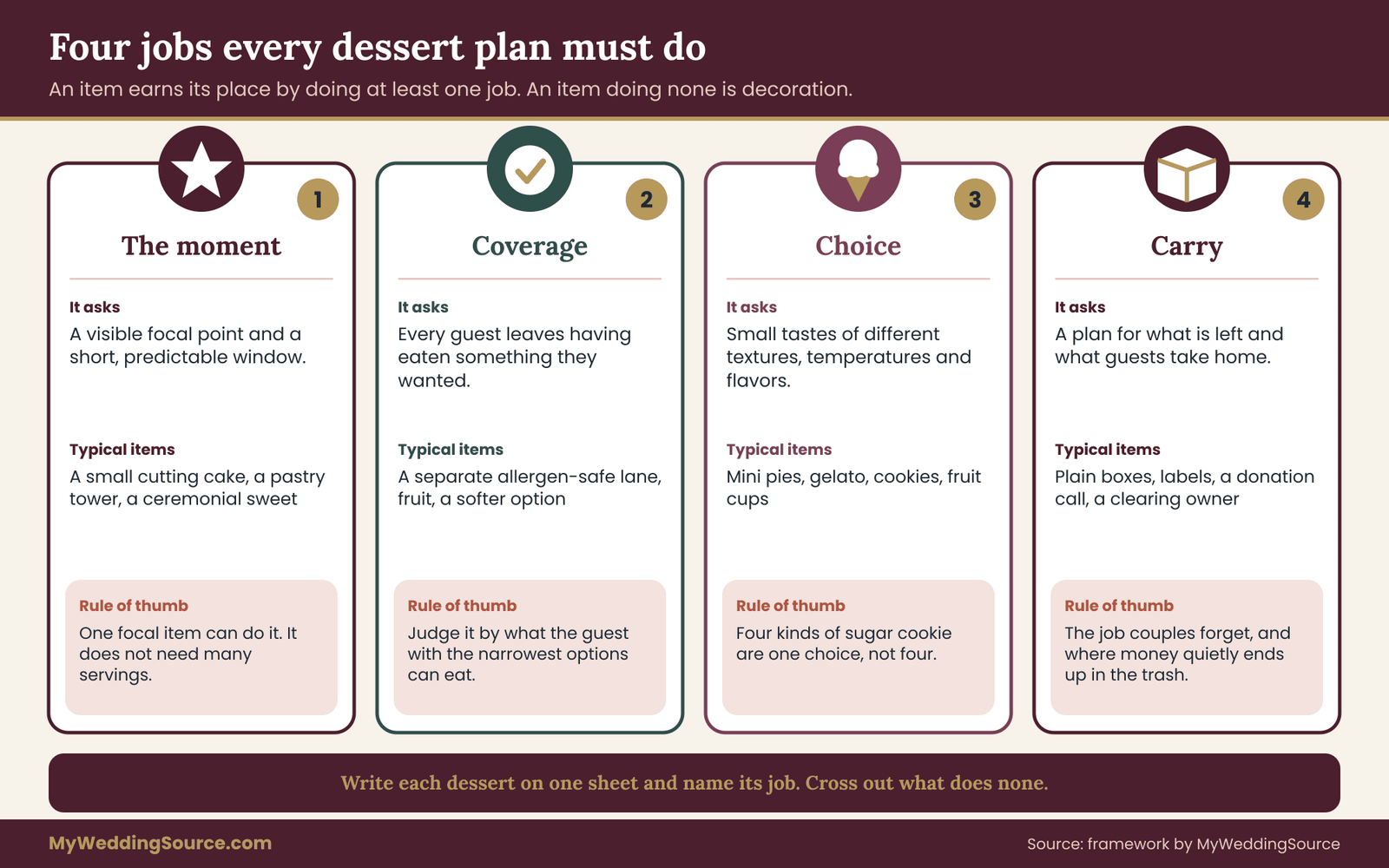
Job one: the moment. Dessert often marks a point in the evening. The couple cuts something, guests gather, photographs happen, the energy shifts. This job needs a visible focal item and a short, predictable window. It does not need many servings. A single small cake, a tower of pastries or a ceremonial dessert can do this job for a fraction of what a full cake costs.
Job two: coverage. Every guest should be able to leave the dessert hour having eaten something they wanted. That includes guests with allergies, children, older guests with dental limits, guests who avoid sugar and guests who simply do not like chocolate. Coverage is about the floor, not the ceiling: it asks what the guest with the narrowest options will eat.
Job three: choice. Guests who have eaten a full dinner often want a small taste of two or three things rather than a full portion of one. Choice is what dessert alternatives do best. This job asks for variety in texture, temperature and flavor, not variety in quantity. Four kinds of sugar cookie are one choice, not four.
Job four: carry. What happens to the desserts nobody ate and the desserts guests want to take home? This job covers packaging, leftovers, labeling for take-home and the plan for whoever clears the table. It is the job couples forget, and it is where a lot of money quietly ends up in the trash. The wedding waste reduction guide looks at the broader cleanup picture, and the carry job is where dessert fits into it.
Using the four jobs as a test
Write your draft list of dessert alternatives on one sheet. Next to each item, write which job it does. Then check three things.
First, is each job covered at least once? A plan with ten items and no safe lane has failed job two no matter how generous it looks. A plan with a beautiful table and no focal moment has failed job one.
Second, is any item doing three jobs at once? That is usually a sign the item is carrying too much. A large cake that must be the moment, the coverage and the choice is the situation that makes couples feel they need a very big cake.
Third, is any item doing no job? A fifth cookie flavor, a candy jar that matches the colors but that nobody will eat, a dessert chosen only because a vendor suggested it. Cross it out or move the money to a job that is under-served.
A short example of the test
Imagine a couple with ninety guests who want mini pies, a small cutting cake and fruit. The cutting cake does job one. The mini pies do job three, because they offer flavors and a handheld format. The fruit does job two only if it is clearly labeled and kept away from the pies, because fruit is the easiest allergen-friendly item on the table.
Nobody has planned job four. When the couple asks, they realize the venue will throw away anything left on the table at the end of the night, and the pies, which keep well, would be a fine take-home item in small boxes. Adding a stack of boxes and a sign costs little and covers the job.
That is the whole point of the framework for dessert alternatives. It does not choose desserts for you. It shows what your list is missing and what it has too much of, before you pay for either.
Counting servings across dessert alternatives: the portion ladder
The hardest question in any plan for dessert alternatives is how much to order. Cake has a built-in answer: a tiered cake is sold by the slice, and a bakery will tell you how many slices it yields. Once you add cookies, pies, gelato and fruit to your dessert alternatives, no single number applies. Guests take smaller amounts of each item when there are many items, and some guests take nothing at all.
This guide does not give you an average uptake figure for dessert alternatives, because no honest universal figure exists. Appetite depends on the meal that came before, the time of night, the climate and the crowd. What it gives you is a method for building your own count with your vendors, in five steps called the portion ladder.
Rung one: define the dessert unit
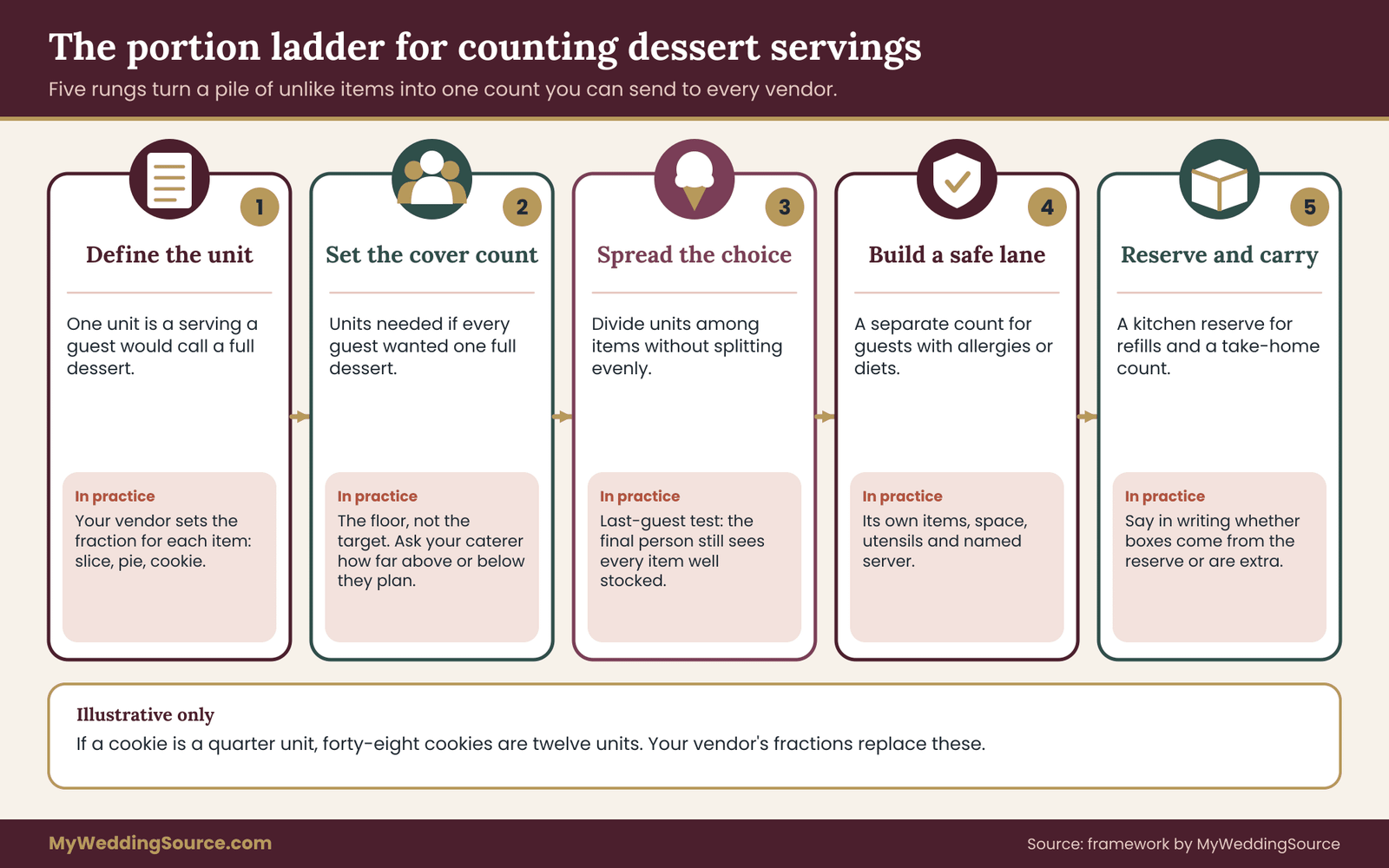
A dessert unit is one serving at the size a guest would call a full dessert if it were the only one offered. A standard cake slice is one unit. A mini pie about the size of a cupcake might be half a unit, and a single bite-sized cookie might be a quarter. Your bakery or caterer decides what counts as a unit for each item, and you write the fractions down.
The reason to do this is that it lets you compare unlike dessert alternatives. Ten dozen cookies sound like a lot. If each cookie is a quarter unit, ten dozen is thirty units, which is not a lot for a hundred and twenty guests. Without units, couples overbuy the items that sound large and underbuy the items that are expensive per piece.
Rung two: set the cover count
The cover count is the number of units needed so that every guest could have one full dessert. For a hundred guests, the cover count is a hundred units. This is the floor, not the target. It answers the question: if every guest wanted a full dessert, would the table run out?
Many couples planning dessert alternatives find that a cover count is more than they will need and less than they fear. Once you know the number, you can decide how far above or below it to plan. Some caterers plan below the cover count when several desserts are offered, because guests share the appetite among items.
Others plan at or above it for informal events with a lot of dancing. Ask your caterer which they use and why, and write the answer next to the number.
Rung three: spread the choice
Now divide the units among items, and keep the spread honest. A common mistake with dessert alternatives is to split units evenly: eight items, each with an equal share. Real tables of dessert alternatives do not work that way. One item is always the favorite, and it empties first. The guest at the back of the line sees an empty tray and a few leftovers of the least popular items.
A better rule is the last-guest test. The last person to reach the table should still see every item you offer, in a quantity that looks intentional. That means ordering more of the popular items and accepting that the least popular will have leftovers. It also means being willing to offer fewer items, because six well-stocked items look more generous than ten thin ones.
Rung four: build a separate safe lane
The safe lane is a set of units that guests with allergies or dietary restrictions can eat, kept physically apart from everything else. It is counted separately, not as part of the main spread. If two guests have declared nut allergies and four have declared a dairy-free diet, you do not need a hundred safe units. You need enough that those guests can have a full dessert and a second small taste, with a few extra in case others want to try them.
Allergen handling has its own section later in this article. For the counting step, the point is only that the safe lane is a separate line in your order, with its own quantity, labeled in your paperwork as its own item.
Rung five: set the reserve and the take-home count
The reserve is a small buffer of units held in the kitchen, not on the table, for refills. It exists so staff can restock the popular item without a panic call. The take-home count is the number of units you want packed for guests to carry out, separate from the table. If you plan boxes, the take-home units are bought in addition to the table counts, or they come from the reserve, and your paperwork should say which.
A worked example of the ladder
These numbers are illustrative assumptions, not benchmarks. Suppose a hundred and twenty guests and these item fractions set by the caterer: a cutting cake slice is one unit, a mini pie is half a unit, a cookie is a quarter unit, a fruit cup is half a unit, and a scoop of gelato is one unit.
The cover count is a hundred and twenty units. The couple and caterer agree to plan a little under that, at a hundred, because five items are offered and guests will not take a full unit of each. They split it this way: forty units of cake, from a small cake plus sheet cake in the kitchen; thirty units of mini pies, which is sixty pies; twelve units of cookies, which is forty-eight cookies; eight units of fruit cups, which is sixteen cups; and ten units of gelato, which is ten scoops-worth in a cart.
Then they add a safe lane of twelve units, made of dairy-free sorbet and fruit cups prepared separately, plus a reserve of ten units of pies and cookies in the kitchen. Take-home boxes are set for forty cookies from the reserve.
The point of the example is the process, not the figures. Another caterer might plan higher or lower for the same dessert alternatives, and a hot outdoor afternoon will produce a different outcome than a cold evening ballroom. Treat every number here as something to replace with your own vendor’s answer.
What to write down
When you finish the ladder, you should have a short list: each item, its unit fraction, its unit count, the number of physical pieces that count produces, and who is responsible for the reserve. Send that list to every vendor involved, not just the baker. The caterer needs it to staff service, and the venue may need it to schedule kitchen use.
If you also keep a cutting cake, the wedding cake timeline explains how final guest counts feed into production, and the same deadlines apply to your pastry order. A change in headcount after the cutoff affects dessert alternatives as much as it affects cake.
Reading mixed guest tastes before you order
Mixed tastes are the reason couples consider dessert alternatives in the first place. Yet many plans for dessert alternatives treat the guest list as one crowd. A better plan sorts guests into groups with different needs, then checks that each group has something to eat. This is the taste map.
Building the taste map for dessert alternatives
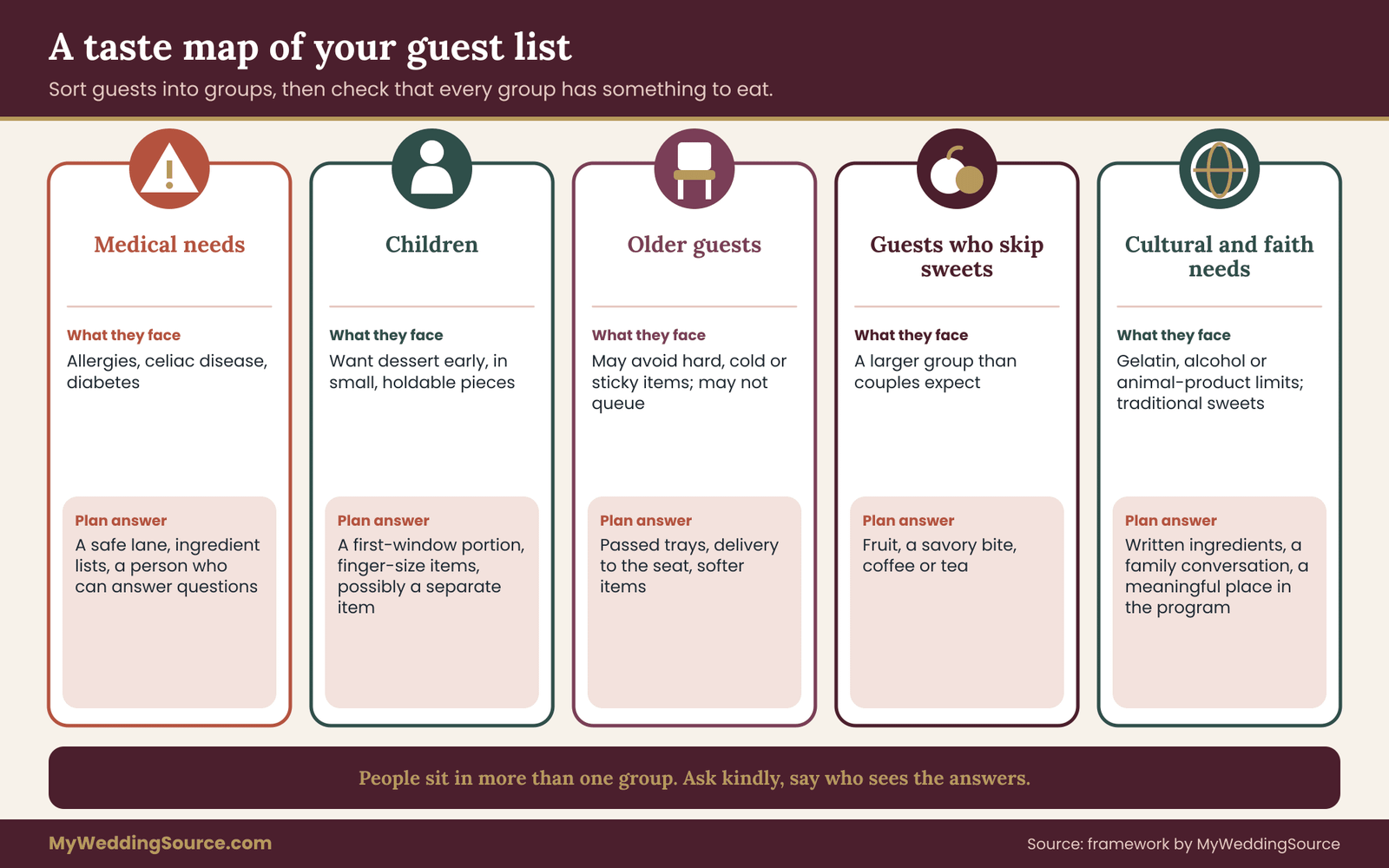
Start with your RSVP list and any dietary notes you collected. Create five rough groups, knowing that people sit in more than one.
Guests with medical needs. Allergies, celiac disease, diabetes and other conditions where the wrong dessert has a real cost. These guests need clear information and a safe lane. They also need a way to ask questions, which usually means a labeled table and a staff member who can answer.
Children. Children want dessert early, in small portions, in formats they can hold. They often leave before late-night service. Plan a portion that reaches them in the first dessert window, and consider whether a separate children’s item makes sense.
Older guests. Older guests may avoid very hard, very cold or very sticky items, and some will not stand in a long line. A passed tray, a table delivered to their seats or a softer item solves this without singling anyone out.
Guests who avoid sweets. Some people simply do not want a sweet dessert after dinner. A fruit option, a cheese plate, coffee or a small salty item gives them something to do while others eat. This group is larger than couples expect, and ignoring it is a quiet failure of job two.
Guests with cultural or religious practices. Some guests avoid certain ingredients, such as gelatin, alcohol or particular animal products, for reasons of faith or conscience. Others expect a dessert tied to a tradition. This group is not a problem to manage. It is information to use.
Asking without prying
You can gather this information with the RSVP card or a wedding website question. Keep the question short: ask whether any guest has an allergy or dietary need your caterer should know about, and give a space to describe it. Do not ask guests to explain a medical history. Say who sees the answers, which is usually the couple and the caterer only.
For guests who do not reply, assume nothing. If a close relative has a known allergy, ask directly rather than rely on the form. Many allergic guests are used to managing their own safety and will appreciate a short note: here is what we are serving, here is how we are labeling it, tell us if you would like to see ingredient lists in advance.
Turning the map into decisions
Once you have the map, put it beside your draft list of dessert alternatives from the four-jobs test. For each group, ask whether the plan has at least one item they can eat and enjoy. If the answer is no for any group, add or change an item. If the answer is yes only because of a single item, check that you have enough of it.
A few patterns come up often. A plan for dessert alternatives heavy on nuts, such as pralines, marzipan and almond pastries, leaves guests with tree-nut allergies with only the cutting cake, if that. A plan built around frozen dairy leaves lactose-intolerant and vegan guests with fruit. A plan with only chocolate leaves everyone who dislikes chocolate behind. None of these are fatal, but each is easy to repair on paper and awkward to repair at the event.
Where the guest list and the budget collide
A broad taste map pushes toward more dessert alternatives, and more items push the budget up. A way to hold the line is to let each group choose from two or three items, not all of them. A guest with no restrictions can eat anything, so they do not need their own item.
A guest with a narrow list does need one, so the safe lane is where the money should go first. If the headcount itself is still moving, remember that every change to the list moves the unit count.
The goal with dessert alternatives is not to please every taste with a custom item. It is to make sure that no guest leaves hungry or unsure, and to let the rest of the table be generous in a way that suits your budget.
Display formats for dessert alternatives, compared in prose
Once you know what you are serving and how much, you have to decide how it reaches guests. Format shapes cost, staffing, safety and mood more than the dessert itself, and this is true of every one of the dessert alternatives. A pie bar and a plated pie are the same food in two different events, which is why dessert alternatives need a format decision. This section compares the main formats for dessert alternatives and gives a test for choosing between them.
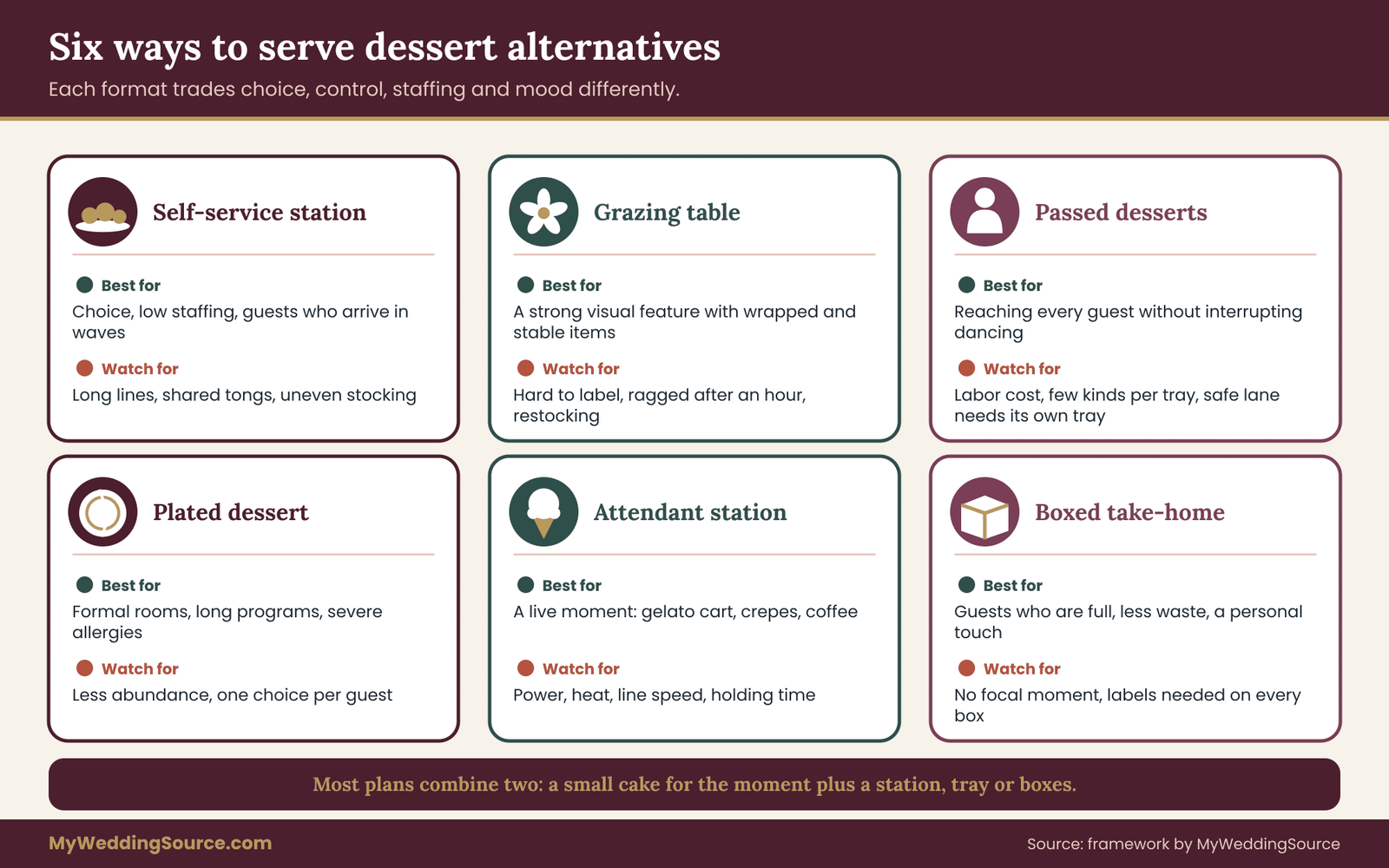
Self-service dessert station
A station is a table or set of tables where guests serve themselves or are served by one attendant. It suits dessert alternatives such as baked items, wrapped candy, fruit and anything that holds at room temperature for the length of the window. Guests can take small amounts, return for more and choose what they like.
The strengths of this format for dessert alternatives are choice and low staffing. The weaknesses are line length, uneven stocking and shared serving tools. A station with fifty guests arriving at once creates a queue that blocks the dance floor or the path to the bar. Shared tongs and open trays raise cross-contact risk for allergens, so a station needs labels, separate utensils for each item and a staff member watching the table.
Stations work best when guests arrive in waves, when there is enough room to spread the table out, and when a staff member can refill. They work poorly when the whole room rises at once after a toast.
Grazing table
A grazing table is a station built as a visual feature: a long, abundant spread arranged for looks as well as eating. It may carry fruit, candy, small pastries, cookies and chocolate on risers and boards. The strength is visual impact, which is why couples choose it. The weakness is that a spread arranged for photographs is often arranged without regard for handling, labeling or temperature.
If you choose a grazing table, ask the vendor how it is restocked, how items are labeled, how much is wrapped and what happens to the food left out during a long evening. A design that looks full at the start and ragged an hour later is a staffing problem, not a design problem. The broader question of presenting many items safely is covered in the section on allergens and temperature below.
Passed desserts
Passed desserts are carried on trays by servers. They suit small bites, one-handed items and moments when you want everyone to have something without leaving a seat or a dance. They give servers contact with every guest, which is useful for answering allergen questions and for reaching older guests.
The strengths are control and reach. The weaknesses are labor cost and limited variety, because servers can only carry so many kinds on a tray and guests can only take what passes by. Passed service also needs a clear plan for the safe lane. A server who carries one tray of everything mixed together cannot guarantee separation. A separate server and tray for allergen-safe items is cleaner.
Passed service of dessert alternatives fits a reception with a lot of moving around, a dance floor that should not be interrupted, or a venue with a kitchen and trained staff. It fits poorly when the caterer is thin on staff or when the item needs a plate and fork.
Plated dessert
A plated dessert is set in front of each guest, usually with coffee. It gives you the most control over portions, allergens and timing, and it is the format closest to a traditional cake service. The cost is a reduced sense of abundance and less choice, since each guest receives one thing.
A plated format can still include alternatives. Some couples offer a duo or trio plate with a small cake slice, a fruit item and a cookie. Others offer a choice of two plated desserts on the RSVP card, which helps the caterer count and lets guests with restrictions choose in advance. Plated service of dessert alternatives works well when the room is formal, when guests are seated for a long program, or when a severe allergy makes a self-service table too risky.
Dessert stations with an attendant
A dessert station with an attendant serves items made or finished on site: gelato from a cart, crepes, churros, coffee drinks. The attendant controls the portion and the line. The live element gives guests something to watch, and it makes a late-evening moment feel like an event.
The constraints are physical. A gelato cart needs freezer capacity or dry ice and a plan for how long it holds. A fryer or griddle needs power, ventilation and a safe surface away from foot traffic and fabric. A made-to-order station serves one guest at a time, so line speed matters.
A common planning rule is to ask the vendor how many guests it can serve in the window and compare that with your headcount. If the answer is half, you need two stations or a different format.
Boxed or packaged take-home dessert
A boxed dessert, among the simplest dessert alternatives, is wrapped and given to guests as they leave, or set on tables for them to take. It suits cookies, small pastries, candy, brownies and anything that holds well. It reduces waste, solves the problem of guests who are full, and carries a personal touch.
The weakness of boxed dessert alternatives is that they do not do job one, the moment, and it can feel like a goodie bag if it is not paired with something served at the event. Boxed items also need ingredient labels on the package, because the guest may eat it later, away from your staff. If you serve packaged items, treat labeling as a requirement, not an extra.
Combining formats
Most plans for dessert alternatives combine two formats. A common pairing is a small cutting cake for the moment, a station or passed tray for choice, and boxes for the carry job. Another pairing is a plated dessert for those who want a seated finish and a late-night station for those who want more.
Combining formats raises one question that single formats avoid: do the formats overlap in time, and do they overlap in space? A late-night station that opens while the cake is still being cut splits the room and thins attention. The reception guest flow guide explains how to sequence entry, seating, food and exit so the room does not jam, and the same logic applies to when each dessert format opens and closes.
The display fit test for dessert alternatives
With the formats in mind, a short test helps you choose among dessert alternatives. It has five questions, and a format must pass all five to be a good fit for your event.
Hands. Who touches the food, and how many people? A self-service table has many hands. A plated dessert has few. If a severe allergy is involved, fewer hands is safer.
Heat. What temperature does each item need, and who controls it? A frozen item needs a freezer or a cart with a known holding time. A hot fried item needs a fryer and a short window. A room-temperature item is the easiest to place anywhere.
Line. How many guests will arrive at the same time, and where will they stand? Measure the space. A table that looks wide in a floor plan may produce a line that crosses the dance floor.
Light and labels. Can guests see what each item is and what is in it? A dark room, small type and a decorative sign in script lettering fail this test. Labels should be readable at arm’s length by a guest in dim light.
Lead time. How long does the vendor need to prepare, deliver and set up, and does the venue permit it? Ask for a written load-in time and an access route.
Using the test to choose
Write your top two or three formats for dessert alternatives on a sheet and run each through the five questions. Mark each answer as clear, uncertain or a problem. A format for dessert alternatives with any problem needs a fix before you commit: a different table position, a second attendant, a change of item. A format with two or more uncertain answers needs a conversation with the vendor and the venue.
Often the test removes a format you loved, and that is normal for dessert alternatives. A grazing table that fails the hands and line questions may become a pre-set table with wrapped items and a staff member. A gelato cart that fails heat may become a pre-scooped dessert in a cold box. These are not defeats. They are the ordinary way a plan for dessert alternatives becomes workable.
Matching format to room and crowd
A few quick pairings of dessert alternatives follow from the test. A small, formal dinner with fewer than sixty guests usually suits plated or passed service, because a station would hold only a few people at once and the staff can reach everyone. A large, informal reception suits stations and boxes, because staff cannot reach everyone and guests like to roam.
A venue with a poorly ventilated room is a bad home for fried items. A tent in summer is a bad home for chocolate, frosting and frozen items without a plan.
The match is never perfect, and good plans for dessert alternatives have a fallback. If rain moves the reception indoors, where does the table go? If the caterer’s cart fails, what is the backup item? Write the fallback next to the main plan, so a person other than you can carry it out.
Keeping dessert alternatives safe: allergens, labels, temperature and venue limits
More items mean more places for things to go wrong with dessert alternatives. This section covers the three areas where dessert alternatives most often cause trouble: allergens, temperature and the limits of the venue. It describes planning practices, not legal rules. For the rules themselves, use the agencies named in the sources list and your local health department.
Allergens among dessert alternatives
In the United States, federal law identifies nine major food allergens: milk, eggs, fish, crustacean shellfish, tree nuts, peanuts, wheat, soybeans and sesame. The FDA publishes the current list and explains how packaged foods must be labeled. Of the nine, six or seven show up easily in desserts: milk, eggs, tree nuts, peanuts, wheat, soybeans and sesame. A typical table of dessert alternatives touches most of them.
That is why label-reading matters for dessert alternatives. A packaged candy or a purchased cookie has an ingredient list and a statement of major allergens. A cake from a bakery, a family recipe or a custom pastry may have no printed label at all, so someone has to write one.
For every item on your table, you want the ingredients, the major allergens it contains and a note on whether it was made in a kitchen that also handles other allergens. Your baker or caterer should supply this in writing, and you should keep a copy.
A useful habit is to ask each vendor the same three questions. What are the ingredients, including any hidden ones such as flavorings, glazes and fillings? Which of the nine major allergens does the item contain? Is it prepared on shared equipment or surfaces with other allergens? A vendor who cannot answer the third question is telling you something about their kitchen.
Cross-contact and the separate lane
Cross-contact happens when a trace of an allergen reaches a food that does not contain it. It can occur through shared tongs, shared trays, shared gloves, crumbs, airborne flour or a server who touches one item and then another. For a guest with a serious allergy, a trace can matter.
You cannot eliminate cross-contact on a busy open table, and a vendor who promises you can should be asked to explain how. What you can do is reduce it and be honest about what remains. For dessert alternatives, the safe lane described in the portion ladder is the main tool. A safe lane means different items, in a different spot, with different utensils, handled by a different person, and labeled with a plain sign. It does not mean the same table with a small card.
For items in the safe lane, packaging can help. A wrapped or individually plated dessert, prepared in the kitchen and delivered by a named staff member, is safer than a loose item on a shared tray. Ask the guest in advance whether they are comfortable with this, and ask whether they prefer to bring their own dessert. Some guests with severe allergies would rather bring a known item than trust a new kitchen, and that choice should be easy for them to make without embarrassment.
A deeper treatment of label planning belongs in a dedicated guide on that topic, and your caterer’s own allergen procedures take priority. The same allergen decisions should match across dinner and dessert, so compare your dessert list with your dinner labels before anything is printed.
Writing labels guests can use
Labels on dessert alternatives fail in predictable ways. The type is too small. The lettering is decorative and hard to read. The words are vague: “contains nuts” does not say which nuts. The sign says “gluten-free” when the item is made in a shared kitchen and the baker would not describe it that way. The signs are in the wrong place, away from the item.
A usable label for dessert alternatives names the item, lists the major allergens it contains in plain words, and notes any dietary tag such as vegan or dairy-free only if the vendor has confirmed it. Place it directly in front of the item, at table height, in a large plain typeface with good contrast.
Add a short line on the main sign saying where guests can ask questions and who to ask. Keep a printed ingredient list at the table for guests who want more detail.
If you print labels, proofread them against the vendor’s written ingredient list, not against your memory. A last-minute substitution at the bakery changes the label, and someone has to tell you.
Temperature and time
Perishable dessert alternatives, including anything with dairy, eggs, cream, custard, fresh fruit that has been cut, or meat-free fillings that spoil, need temperature control. The USDA and FDA both publish guidance on holding foods, and the general idea is the same: keep cold food cold and hot food hot, and do not leave perishable food at room temperature for long.
The key terms come from the USDA Food Safety and Inspection Service. Between 40 and 140 degrees Fahrenheit, bacteria can grow quickly, and this range is called the danger zone. Perishable food should not sit out for more than two hours, and in hot weather above 90 degrees the limit drops to one hour. Check the current guidance on the agency pages, because your caterer and local health department may apply stricter rules for events.
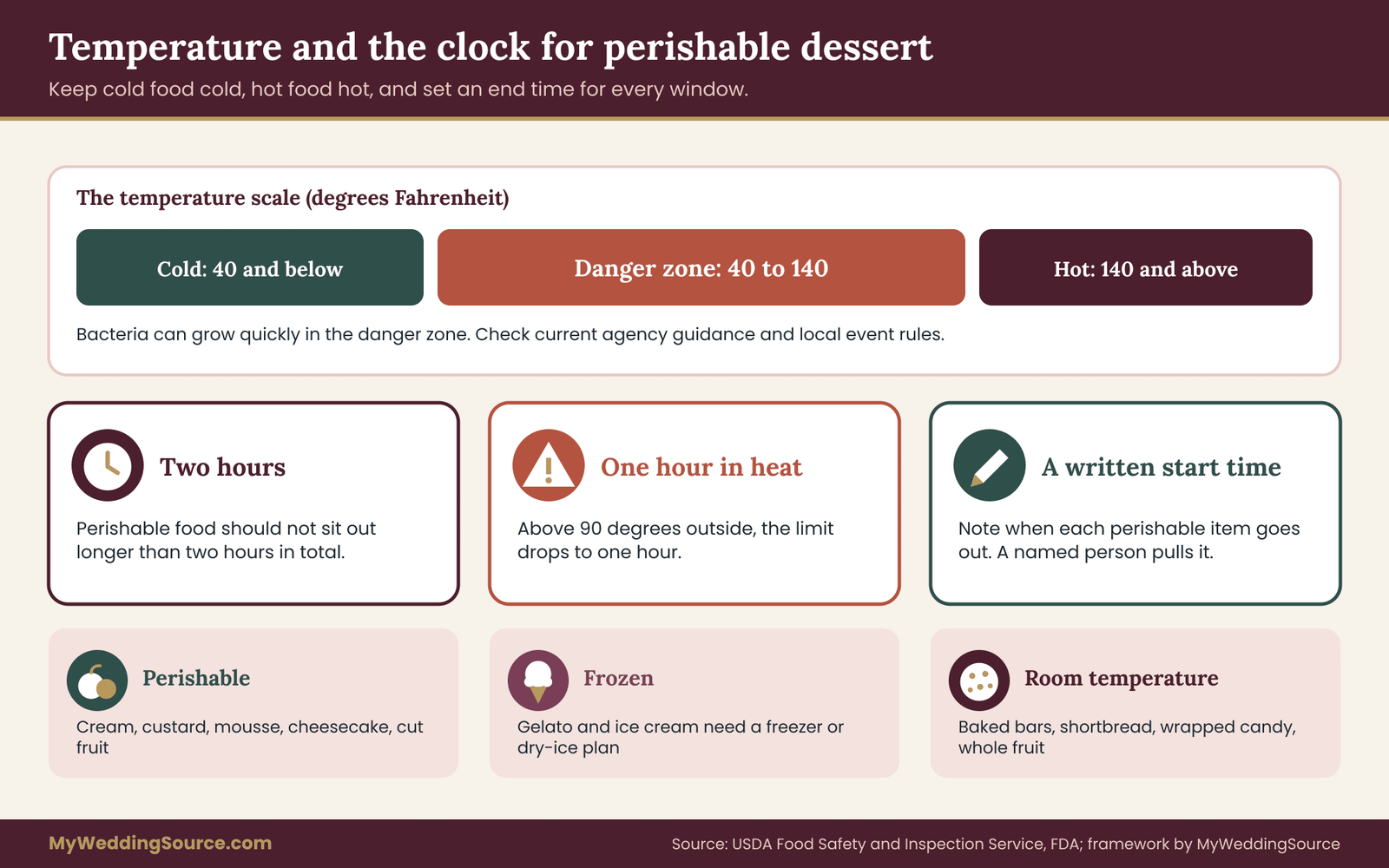
What does this mean for dessert alternatives? A mousse cup, a cheesecake bite, a custard tart and a cut fruit platter all count as perishable. They need a cold source, a time limit and a person who is responsible for pulling them from the table. Ice cream and gelato need a freezer or dry-ice setup, and they melt faster than you expect in a warm tent.
Items that are stable at room temperature, such as baked cookies, brownies, wrapped candy and many fruit-free pastries, are more forgiving, but the rule still applies to anything with fresh cream or custard filling.
Ask your caterer how they will track time for each of your dessert alternatives. A simple way is a written start time for each perishable item and a staff member who removes it at the end of the window. Ask how they will keep items cold in transit and at the venue, and what happens to items that have been out too long. A good caterer has a clear answer. A vague answer is a reason to choose different items.
Venue limits that change the plan
Many venues have rules that affect dessert alternatives. Some require outside food to be prepared in a licensed kitchen. Some prohibit open flames, which rules out flambéed desserts and some candle features. Some do not allow fryers, and some limit power draw, which matters for a freezer cart and a coffee machine on the same circuit. Some charge a cake-cutting fee or a plating fee for outside desserts. Some forbid certain surfaces, such as a table placed on a historic floor.
Ask the venue for its rules in writing, and ask specific questions. Is there refrigerator or freezer space we can use, and for how long? Is there a prep area for the caterer? How many outlets are near the dessert location, and on how many circuits?
Is there a permitted route for deliveries? Can a vendor set up before the ceremony, or only after? The wedding venue technical walkthrough page covers how to gather these details on a site visit, and the same questions apply to a dessert table.
Homemade family dessert alternatives
Many couples want a family recipe among their dessert alternatives, and it can be the most meaningful item of all. It can also be the one with the least documentation. A relative who bakes a regional pastry may not know the full ingredient list of the store-bought filling, and a home kitchen is not the same as a licensed one.
Rules differ by state and county on whether a home-prepared item can be served at a wedding, especially when a caterer or venue is involved. Some venues refuse outside food outright. Some require a licensed source. Some allow a guest to bring a personal item and prohibit serving it to others. Ask the venue and your caterer before you promise anything, and check your local health department for any rules that apply to private events.
If you proceed, the practical steps are simple. Get the recipe in writing, with brand names for packaged ingredients. Write a label as you would for any item. Decide who is responsible for handling it on the day. Keep it out of the safe lane.
And give the family member a clear role, so the meaning of the dessert is honored even if the logistics force it to be served in a smaller way, for example as a plated tasting for family at the head table.
Vendors, quotes, contracts and budget for dessert alternatives
A plan for dessert alternatives becomes real when vendors agree to it in writing. With a single cake, one vendor usually handles everything. With dessert alternatives, three or four parties may be involved: a bakery, a caterer, a specialty vendor such as a gelato cart, and the venue. The most common source of trouble is a gap between them, where each assumes someone else is handling delivery, labels, service or cleanup.
Who is responsible for what in a plan for dessert alternatives
Begin by listing every task that dessert alternatives create, then assign each to one named party. The tasks include production, delivery, setup, labeling, serving, refilling, monitoring temperature, clearing, packing leftovers and returning rented items. If two parties both think the other will set up the table, nobody does.
A useful method is a responsibility sheet with one line per task and one name per line. Share it with every vendor and ask each to confirm their lines. A caterer who also plans to serve a baker’s pastries should say so. A baker who delivers at three o’clock should know who accepts the delivery and where it goes. This sheet is not a legal document, but it prevents arguments, and it makes a later contract review easier.
Questions worth asking each vendor
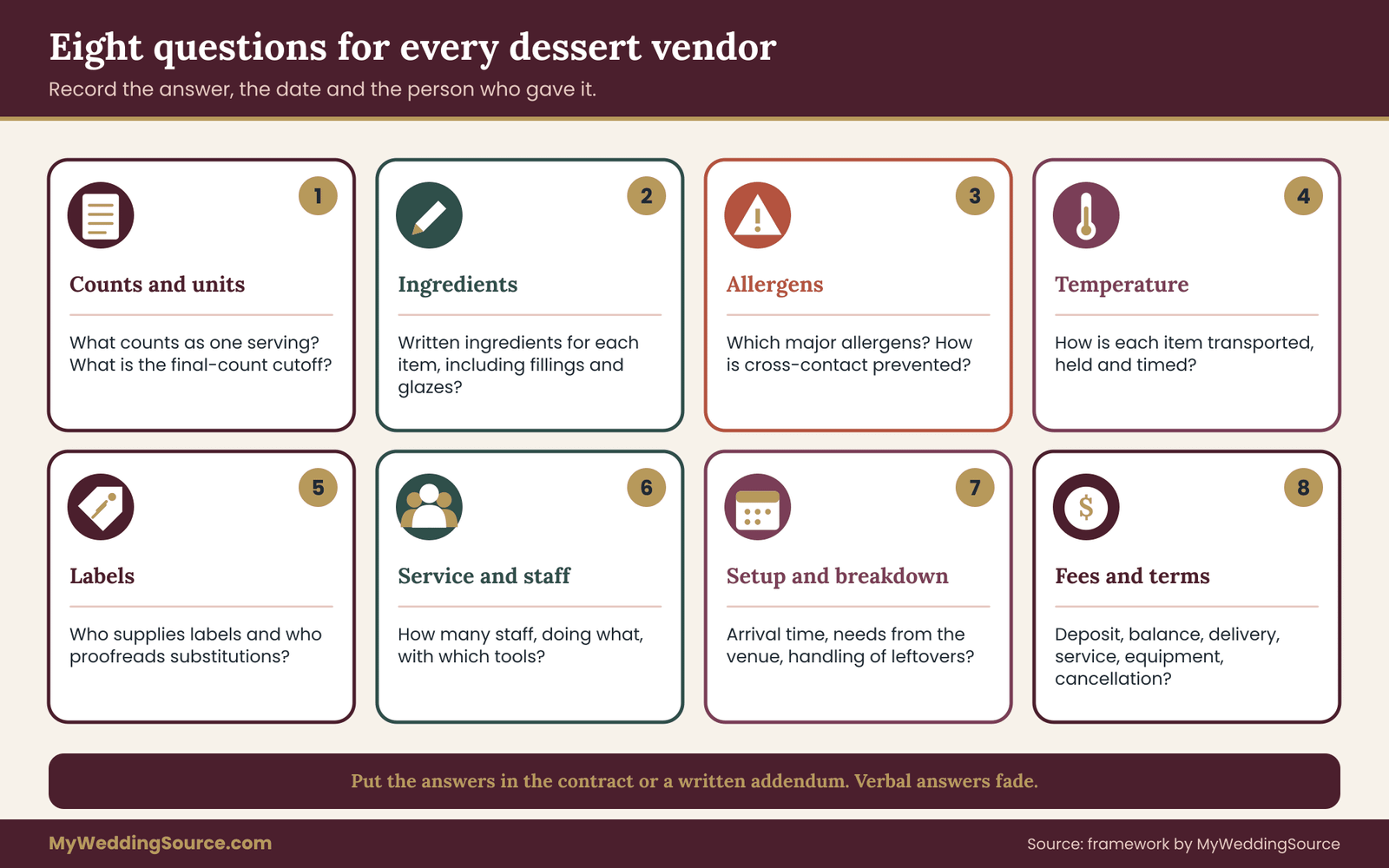
The questions below apply to nearly any vendor involved in dessert alternatives. Keep them in a shared note and record the answer, the date and the person who gave it.
Counts and units. What do you count as one serving of each item? How many pieces make a unit? What is your minimum order for each item, and can you scale down? What is the cutoff for final counts, and what happens if the count changes after the cutoff?
Ingredients and allergens. Can you provide a written ingredient list for every item, including flavorings and fillings? Which major allergens does each item contain? What do you do to prevent cross-contact in your kitchen, and can you prepare a separate set of items for guests with allergies?
Temperature and handling. How do you transport each item and at what temperature? What holding equipment do you provide? How long can each item sit on the table? Who is on site to monitor it?
Labels and signs. Do you provide labels? In what form? Will you review ours? Who is responsible if a substitution changes an ingredient?
Service and staff. How many staff will be on site, and what exactly will they do? Are tongs, plates, forks, napkins and boxes included? Who refills? Who clears?
Setup and breakdown. When do you arrive? How long do you need? What do you need from the venue, such as tables, power, water or refrigeration? What do you do with leftovers, trays and equipment?
Substitutions and failure. If an item cannot be made, what is the substitute, and who approves it? If a delivery is late, what is the plan? What is your policy if an item arrives damaged or at the wrong temperature?
Fees and terms. What is the deposit, and when is the balance due? Are there charges for cake cutting, plating, equipment rental, delivery, service staff, gratuity or taxes? What is the cancellation policy if the count or date changes?
Putting the answers into the contract
Verbal answers fade. A contract for dessert alternatives should state the items, the quantities, the unit definitions, the allergen information, the delivery time and place, the service window, the staff count, the equipment supplied, the substitution policy and the total cost with all fees. If a vendor uses a standard form that omits these, ask to attach a written addendum with the missing details.
The wedding vendor contract guide goes through the general clauses worth reading in any wedding contract: payment schedules, cancellation, liability and force majeure. Read it beside your dessert paperwork, and note anywhere the dessert terms differ from your other vendors. A baker who requires full payment sixty days before the wedding and a caterer who takes the balance a week before create a cash-flow gap you should see in advance.
If a vendor is a home baker or works under a cottage food rule, ask about their licensing and whether their local rules permit sale for an event. Rules differ by state and county, and some limit what a cottage food business can sell and how. Your health department or state agriculture office can explain the rules that apply where the baker operates.
Insurance and venue requirements
Some venues require vendors to carry liability insurance and to provide a certificate. This often applies to caterers and may apply to bakers and specialty vendors. Ask the venue what it requires, and ask each vendor whether they can provide it. A small vendor who cannot may still be allowed under the venue’s own policy, but you should learn that early, not the week before.
Budget logic for dessert alternatives
Couples often assume that dessert alternatives cost less than cake. Sometimes they do. Often they do not, and the difference is hard to see without a clear comparison. A cake is priced by the slice, and the price includes design, labor and delivery. A set of dessert alternatives is priced by item, and the price may exclude labor, service, equipment and packaging that a cake quote includes.
The right way to compare dessert alternatives is by total cost per dessert unit, using the same unit definition for each option. Add the item cost, delivery, setup, service staff, equipment rental, boxes, labels, taxes and gratuity. Divide by the number of units. You may find that a table of small items costs more per unit than a cake, but it feeds guests more happily and wastes less.
Or you may find that a simple cookie table costs far less. You cannot know until you add every line.
Be careful with quotes that look low because they leave out something. A per-piece price with no staff, no delivery fee and no equipment is not comparable to an all-inclusive price. Ask each vendor of dessert alternatives for a quote that lists every cost, and ask them to say what is not included.
The wedding budget page explains how to set categories and track what you have committed, and your dessert total should live there as one line with sub-lines for each vendor. If costs rise, the four-jobs test tells you where to cut. Items doing no job go first. Then reduce choice before you reduce coverage. Do not cut the safe lane or the staff who monitor temperature, because those protect guests.
Cost levers for dessert alternatives that do not hurt the plan
A few changes reduce cost without hurting any of the four jobs. Order a smaller cutting cake and rely on dessert alternatives for volume. Choose room-temperature items that need less staff. Skip custom packaging for the table and use plain boxes for take-home. Limit the number of items but stock each well. Use one attendant station instead of two. Serve dessert during a window when guests are already moving, so you need fewer servers.
Levers that do hurt include dropping the safe lane, removing temperature monitoring, accepting an unlabeled item from a vendor who cannot supply ingredients, and ordering no reserve. Each saves a little and exposes the plan to a larger loss.
Keeping a decision log
Keep a one-page log of every decision about dessert alternatives: what was chosen, who agreed, when, and what it costs. When a vendor changes something, add a line. When your caterer says the venue approved a table location, record who at the venue said so. The log is a memory aid and a record if anything goes wrong, and it is the first thing a planner or family helper will want to read if they have to step in.
Three worked examples of dessert alternatives
The cases below show dessert alternatives in practice and are invented for illustration. The couples, venues and numbers are assumptions chosen to show the method, not records of real weddings and not averages. Use them to see how the four jobs, the portion ladder, the taste map and the fit test combine, then replace every detail with your own.
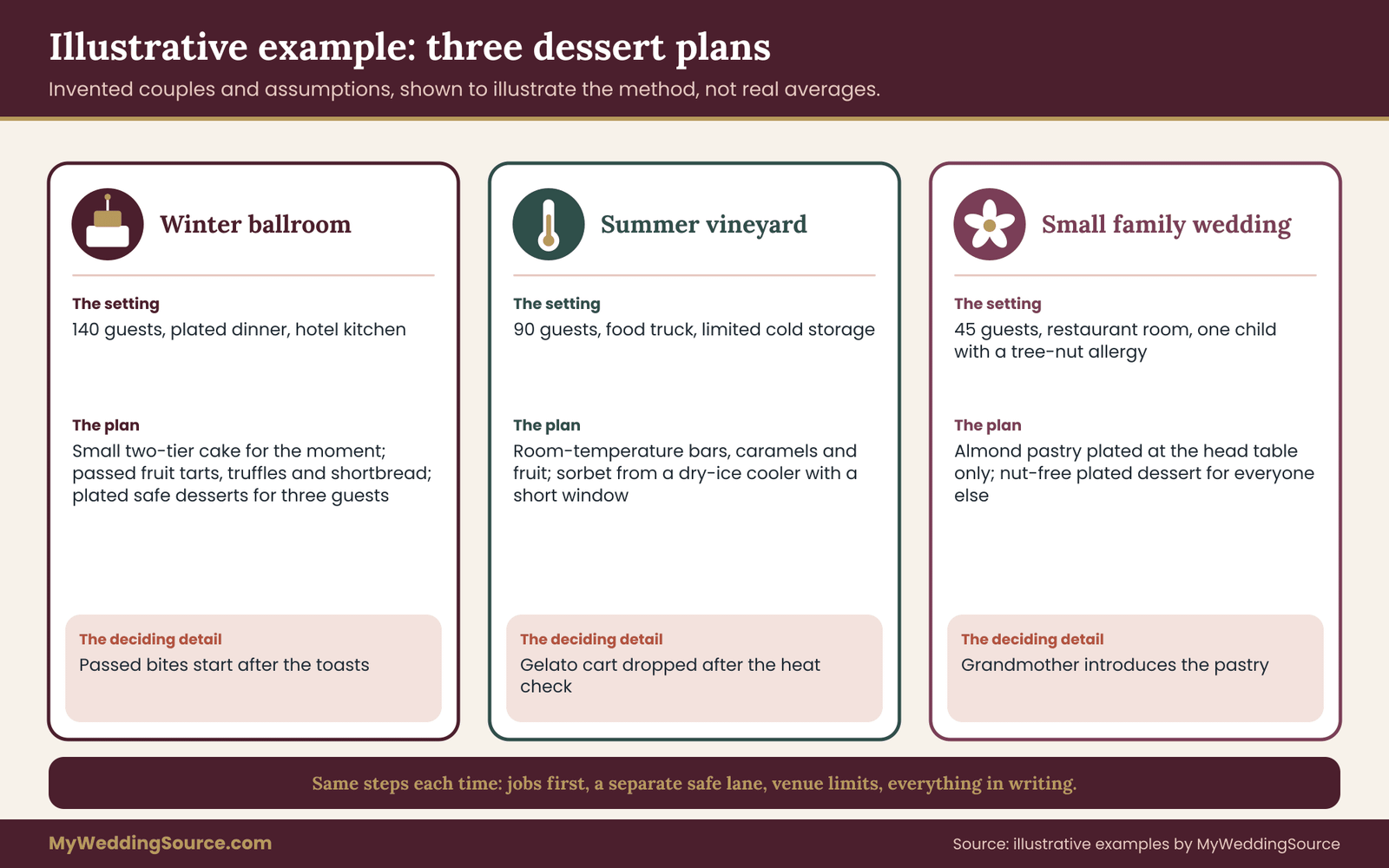
Case one: a winter ballroom with a seated dinner
A couple planning dessert alternatives expects a hundred and forty guests in a hotel ballroom in January. Dinner is plated. The hotel has a full kitchen, cold storage and trained servers. The taste map shows two guests with tree-nut allergies, one with celiac disease, eight children, a group of older relatives, and about a dozen guests who the couple expects will skip sweets.
The couple starts the dessert alternatives with the four jobs. For job one, they choose a small two-tier cake that will be cut and photographed. For job two, the hotel’s pastry chef agrees to prepare plated desserts for the three guests with medical needs in a separate area, delivered by a named server.
For job three, they choose passed bites: mini fruit tarts, chocolate truffles without nuts, and small shortbread. For job four, they ask for small boxes with a label so older guests and children can take something home.
The portion ladder runs on units the pastry chef sets. The couple plans a bit below the cover count because dessert follows a large dinner and guests will also have cake. They keep a reserve in the kitchen.
The fit test raises one concern. Passed service competes with the toasts, which run long in the program. The couple shifts passed bites to start after the toasts end, and the cake cutting moves to the start of dancing, so the servers are not working through speeches. They ask the hotel to confirm the allergen process in writing. The plan is simple, uses the venue’s strengths and keeps the safe lane separate.
What the example shows is that dessert alternatives do not have to be elaborate. Here the alternatives are a few passed items and a set of plated safe desserts, and the work is mostly in the timing and the paperwork.
Case two: a summer vineyard with no refrigeration
A couple plans ninety guests at a vineyard in July. The venue provides tables and a covered tasting room, but the caterer works from a food truck and has limited cold storage. The temperature is expected to be high in the afternoon and mild in the evening. The couple loves gelato, but the taste map and the fit test change that plan.
The heat question fails for gelato. Frozen items would need a freezer cart and a reliable power supply, and the venue’s outlet is shared with the band. The couple decides against it. They choose a room-temperature spread instead: baked bars, shortbread, wrapped caramels and whole fruit, plus a small cutting cake kept in the shade until the cutting.
They add one cold item, a sorbet served from a cooler with dry ice by a caterer’s attendant, with a short window and a plan to stop service when the cooler is empty. They ask the caterer in writing about how the dry ice will be handled, because the supplier’s instructions require ventilation and safe handling.
For allergens, the safe lane is wrapped items prepared in the caterer’s kitchen and packed in a labeled box, kept at the attendant’s station. For the carry job, they order extra shortbread and bars for take-home because those items hold well and will be wanted by guests driving home late.
The fit test removes the item the couple wanted from their dessert alternatives and adds a plan for the one they could still have. The timeline sets the dessert window for the cooler of sorbet to coincide with the cooler part of the evening, and the room-temperature items stay out for the entire reception. Nobody leaves without eating a dessert, and nothing sits in the sun beyond the limit.
Case three: a small family wedding with a cultural dessert and a severe allergy
A couple plans forty-five guests at a restaurant private room. The groom’s grandmother wants to serve a traditional pastry made with ground almonds, which is central to the family’s celebrations. One of the bride’s cousins, a child of nine, has a severe tree-nut allergy and will attend with her parents.
The tension is real and the answer is not to remove the pastry. The couple talks with the grandmother and the cousin’s parents before deciding. They ask the parents what they prefer. The parents say the child is used to bringing her own dessert and would be happy with a safe item at the table, as long as the almond pastry is kept away from her seat.
The couple and the restaurant agree on a plan. The pastry is served as a plated item at the family head table only, brought in from the grandmother’s source with a written ingredient list, and the restaurant confirms in advance that it accepts outside desserts and under what conditions. The rest of the room receives a nut-free plated dessert prepared in the restaurant’s kitchen.
The child receives a nut-free dessert delivered by the same named staff member, and her parents are given the ingredient list in advance. The pastry is brought in by a family member after the plated desserts are served, and the almond pastry is not placed anywhere near the safe items.
The couple writes a short note to the guests at the family table explaining what the pastry is and why it matters. The grandmother is given a role: she introduces it during dessert. The result honors the tradition without making the allergy a footnote.
What the cases have in common
The three plans for dessert alternatives look different, but each follows the same steps. Each starts with jobs, not items. Each treats the safe lane as a separate line. Each lets the venue’s real limits remove an item. Each puts the key facts, such as ingredients, timing and responsibility, in writing. And each ends with a small decision that matters more than the dessert itself: where the item sits, who carries it, when it opens.
Cultural and family desserts as dessert alternatives
Many couples want one of their dessert alternatives to carry a tradition, and the cases above show one approach. A few extra points apply when the dessert is meaningful.
First, talk with the family member who owns the tradition before you plan around it. Ask what the dessert means, how it is traditionally served, and what changes they would accept. A dessert treated as a novelty, for example placed on a table with a decorative sign and no context, can feel like a reduction of something that matters.
Second, check the practical side early. Who makes it, in what kitchen, with what ingredients? Does the venue accept it? Can it hold for the service window? Does it conflict with a guest’s allergy or a religious practice? Settle these questions before you announce it.
Third, give it a place in the program. A short introduction by a family member, a mention in the printed menu, or a plated tasting for the people closest to the tradition turns a dish into a moment, and it does job one in a way a decorative cake sometimes cannot.
Finally, accept that the tradition may need a smaller form than the family expects. A pastry that takes a day to make may serve forty portions, not a hundred and twenty. Plan the cover count around what is real and fill the rest with items that do not depend on one cook’s capacity.
Connecting dessert to the cocktail hour and late night
Some couples shift part of their dessert alternatives to other moments. A small dessert item at the cocktail hour can serve as a first taste and spread the load, and a late-night item such as a boxed treat or a coffee and cookie station gives guests who stayed a final moment.
Each added moment needs its own count, staff and labels, and each risks splitting your budget thinner. Consider a shift only if one of the four jobs is still under-served, not because it sounds festive.
Day-of run sheet and common mistakes with dessert alternatives
A good plan for dessert alternatives can still fail on the day if nobody owns it. The run sheet turns the plan into a one-page list that a coordinator, a family helper or a caterer can follow without calling you. It also protects you, because on your wedding day you should not be the person who knows where the extra boxes are.
What the run sheet contains
Keep it to a single page, printed, with a copy for the caterer and the venue contact. It should list, in time order, the arrival of each vendor, the setup of each dessert area, the time each perishable item goes out and comes off, the start and end of each service window, the cake cutting, the restock points and the breakdown.
Next to each time, write a name. A task without a name is a task nobody does. Next to each dessert area, write who answers questions about ingredients and where the printed ingredient list sits. Add phone numbers for the baker, the caterer and the venue contact, and a note on where the reserve is kept.
Include the safe lane for dessert alternatives as its own section. It should say what items it includes, where they are stored, who delivers them and to whom, and what to do if a guest raises a concern. A guest with an allergy who asks a question should receive a calm, accurate answer from a person who has read the ingredient list, not a guess.
The timing of the dessert window
Match the dessert window to the energy of the room. Cake cutting is a short event that gathers everyone, so it works best when most guests are seated or nearby, often right before or right after the first dances. Stations work best when guests are already moving, not in the middle of a toast. Passed bites work best when the room has settled into dancing or conversation.
Protect a few quiet minutes for the safe lane. Guests with allergies often prefer to receive their dessert early, before the crowd arrives at a table, so staff can serve them without a line. A child who has to wait is a child who may leave without dessert.
Give each service window an end time. A window with no end invites food to sit out too long. A fixed end time, written on the run sheet and known to the caterer, makes the temperature rule easy to follow. If guests are still eating at the end of the window, the caterer can offer to extend it for items that are stable at room temperature and close it for perishable ones.
Restocking without a crowd
Plan restocking of dessert alternatives before the line forms. Ask the caterer to refill a popular item at a set level rather than when the tray is empty, because an empty tray is a signal for guests to leave the line. Keep the reserve in the kitchen and bring it out in small batches, not all at once. Remove used plates and tongs often, and replace utensils for each item, especially in the safe lane.
If a crowd forms anyway, the person in charge can ask guests table by table to come up, which is a standard way to handle a large buffet. A short announcement from the DJ or emcee can open the table in two or three waves, so the line stays short and the dance floor stays open.
Clearing and carrying
When the window closes, staff should know what happens to every one of the dessert alternatives. Perishable items that have passed the time limit are discarded. Stable items go into boxes for take-home or into storage for the couple, if you have arranged it. Unopened packaged items can go home with a family helper. Written instructions help here, because tired staff at the end of a long night follow the sheet.
Decide in advance whether leftover dessert alternatives should be donated. Rules for food donation differ by state and by the receiving organization, and many require that food be handled and stored under specific conditions. If you want to donate, call the organization before the wedding, ask what it accepts and arrange pickup, instead of improvising at midnight.
Common mistakes with dessert alternatives
Some mistakes with dessert alternatives appear again and again. Knowing them helps you avoid them.
Choosing items before jobs. The list of dessert alternatives looks attractive but misses coverage or the carry plan. Fix it by running the four-jobs test before you pay a deposit.
Counting pieces instead of units. A table covered with small items looks generous and runs out, or looks sparse and wastes money. Fix it with the portion ladder and vendor-defined unit fractions.
Ignoring the guests who skip sweets. A table of sugar leaves a group of guests with nothing to do. Add fruit, a savory bite or coffee.
Treating the safe lane as a label. A small card next to a shared tray is not a lane. Give it a separate item, space, utensils and person.
Trusting verbal answers. A vendor says an item is nut-free, and nothing is written down. Ask for the ingredient list and a written statement about the kitchen.
Underestimating the clock. A gelato cart and a long toast do not coexist. Check the timing of every perishable item against the program.
Overlooking the venue. The plan needs a fryer, a freezer or four outlets the venue does not have. Ask early, in writing.
Forgetting who clears. Nobody owns the table at the end. Assign the task before the event.
Letting a tradition become decoration. A meaningful dessert is placed on a table with no context. Give it a role and a voice.
Skipping the fallback. Rain, a late delivery or a failed cart leaves no option. Write a fallback next to every main item.
How to know your dessert alternatives are ready
The plan for dessert alternatives is ready when five things are true. Every item does at least one of the four jobs. Every item has a unit fraction and a count in writing. Every guest group on your taste map has something to eat, and the safe lane is separate. Every vendor has confirmed in writing the delivery, handling, labels, service window and cost. And every task on the run sheet has a name next to it.
If one of these is missing, go back to the relevant section and fix it. If all five are true, you can stop revising and let the plan run. Over-planning has a cost too: a plan so detailed that nobody can follow it is no better than no plan.
Your next steps
Work through these in order to finish your dessert alternatives. Each takes an evening or less.
- Write your draft list of dessert alternatives on one sheet, and mark which of the four jobs each item does. Cross out items doing none.
- Build the taste map from your RSVP notes. Confirm that each group has something to eat, and ask directly about any known severe allergy.
- Ask your bakery or caterer how they define a dessert unit for each item, and write the fractions down.
- Run the portion ladder: cover count, spread, safe lane, reserve and take-home count.
- Run each format you are considering through the display fit test, and drop or fix any with a problem.
- Ask each vendor the questions in the vendor section, record the answers, and request a written quote that lists every cost.
- Ask the venue for its food, power, storage and access rules in writing.
- Put the details into contracts or written addenda, and note the cutoff dates on your calendar.
- Draft the one-page run sheet with a name beside every task, and share it with your caterer and a trusted helper.
- Check current food safety and allergen guidance with the FDA, the USDA and your local health department before you finalize labels and holding times.
FAQ
Are dessert alternatives cheaper than a wedding cake?
Sometimes, but not reliably. A cake price usually includes design, labor and delivery, while alternatives may be priced per item with service, equipment and packaging added. Compare total cost per dessert unit, using the same unit definition for each option and including every fee. A simple cookie table can cost far less, while a staffed gelato cart can cost more than a cake of similar size.
How many servings of dessert alternatives should I order per guest?
There is no universal figure. Start with a cover count of one dessert unit per guest, then ask your caterer how far above or below that number they plan when several items are offered. Appetite varies with the meal, the hour and the weather. Keep a small reserve in the kitchen and a separate count for guests with dietary needs.
Can I skip the cake entirely and serve only dessert alternatives?
Yes. Many couples choose dessert alternatives instead. The cutting ritual is a custom, not a requirement. If you want a moment of gathering and a photograph, a small cake, a pastry tower or a single ceremonial dessert can do it for less. If you skip a focal item completely, plan another way to mark the moment, such as a toast or a dessert introduction by a family member.
How do I serve guests with severe allergies safely among dessert alternatives?
Give them a separate safe lane: different items, a different location, different utensils and a named staff member. Individually plated or wrapped desserts prepared in the kitchen are safer than loose items on a shared tray. Ask the guest in advance what they prefer, since some would rather bring a known dessert. Get ingredient lists in writing from every vendor.
What dessert alternatives work in hot weather?
Room-temperature items hold best: baked bars, shortbread, brownies, wrapped candy and whole fruit. Avoid items with cream, custard or soft frosting unless they are kept cold and removed within the time limit. Frozen items need a reliable freezer or dry-ice plan and a short service window. Ask your caterer how they will monitor temperature and time.
Can a family member bring a homemade dessert to the wedding?
It depends on the venue, the caterer and local rules. Some venues forbid outside food, and some require a licensed kitchen. Ask the venue and your caterer first, then check with your local health department if the rules are unclear. If it is allowed, get the recipe and ingredients in writing, label it like any other item, and keep it out of the safe lane.
How do I label dessert alternatives so guests can trust the labels?
Use large, plain type placed directly in front of each item. Name the item and list the major allergens it contains in plain words. Add tags such as vegan or gluten-free only if the vendor has confirmed them in writing. Proofread the labels against the vendor’s ingredient list, keep a printed list at the table and tell guests whom to ask.
What should I put in the contract for dessert alternatives?
Include the items, quantities, unit definitions, allergen information, delivery time and place, service window, staff count, equipment, substitution policy, final-count cutoff and total cost with all fees. If the vendor’s standard form leaves these out, attach a written addendum. Also ask about licensing, insurance requirements and what happens if an item cannot be made or arrives at the wrong temperature.
Sources
- U.S. Food and Drug Administration, Food
- FDA, Food Allergies: major food allergens and labeling
- FDA, Food Code for retail and food service
- USDA Food Safety and Inspection Service
- FoodSafety.gov, government food safety information
- Centers for Disease Control and Prevention, Food Safety
- U.S. Department of Agriculture
- Americans with Disabilities Act, ADA.gov
- Food Allergy Research and Education
- NSF International, food equipment and safety standards