

An alternative wedding registry replaces or sits beside a store list of towels and cookware with gifts of money, experiences, services, shared goals or donations. This guide gives you a registry decision matrix that scores every option on fees and flexibility, so you can choose the mix that fits your plans, your guests and your records.
Before you build an alternative wedding registry, name the job each gift should do. Then score every option on two columns: fees (what it costs you and your guests) and flexibility (what happens if your plans change). Add two checks: guest comfort and proof you can keep. Choose low fees where your plans are vague, accept lower flexibility only where your plans are specific, and read the platform terms for payout timing, expiry and refunds before you share a single link.
Couples usually look for an alternative wedding registry for a simple reason. They already own the pots, the sheets and the blender, and a list of more of them feels like busywork for everyone. The alternative sounds easy: ask for a honeymoon fund, a cooking class or a donation. In practice each of those choices comes with its own fee schedule, its own rules about when money moves, and its own social risks with guests. Those details are what this article covers.
The goal is not to talk you out of an alternative wedding registry or into one. It is to help you decide with open eyes, build it so it works on the day guests start buying, and keep clean records afterward. You will get a scoring method, a plain-language guide to fees and fine print, option-by-option notes, wording for the awkward moments and four worked cases.
A note on scope. This is general information, not legal, tax or financial advice. Platform terms, gift card rules, tax rules and payment protections differ by company and by state, and they change. Where a rule matters, the article names the agency or company that publishes it so you can confirm the current version yourself.
What an alternative wedding registry is, and what it is not
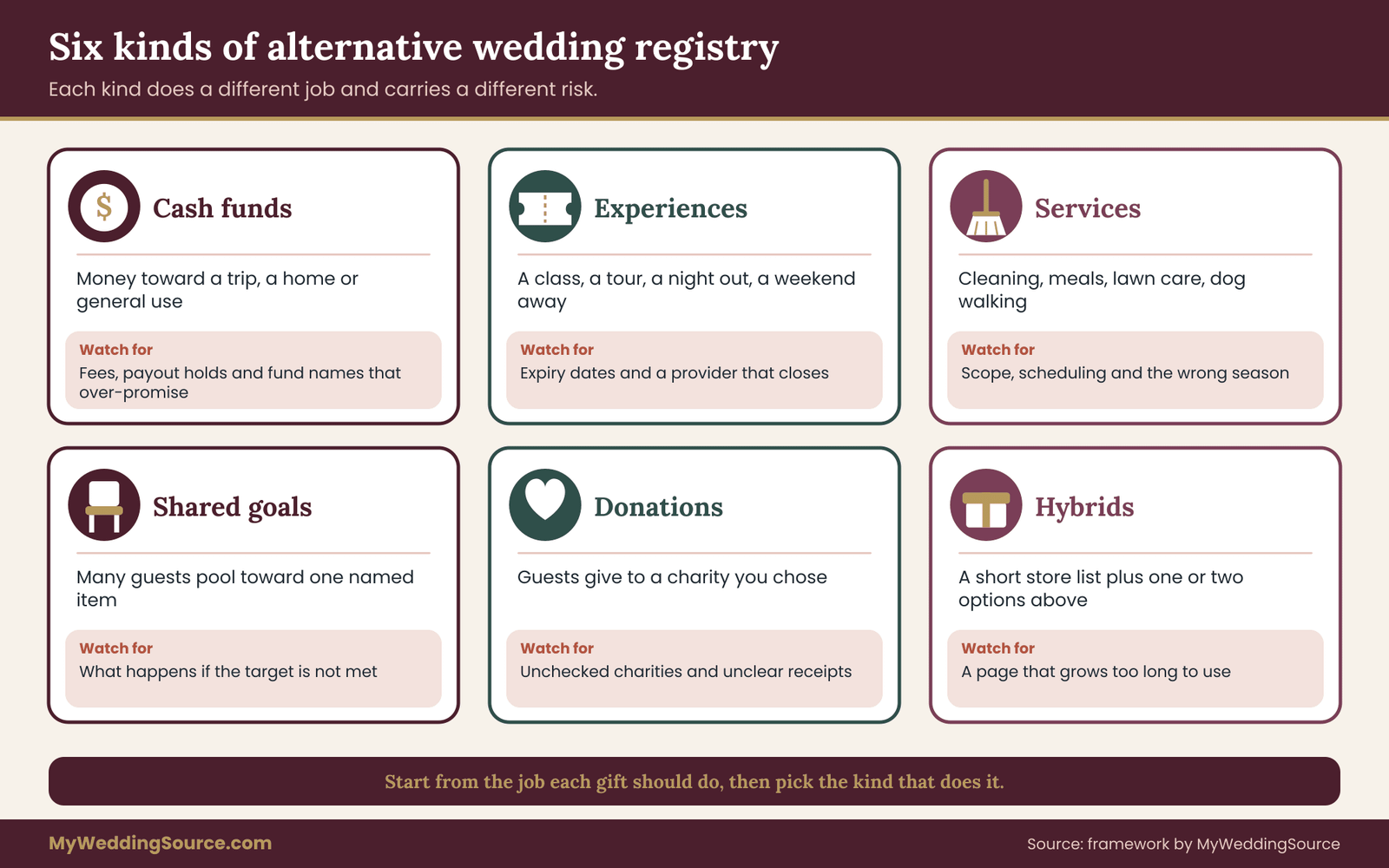
An alternative wedding registry is any way of telling guests what would help you that is not a list of household products at a store. That definition is wide on purpose, because couples mix approaches. Some keep a short traditional list and add a fund. Some skip products entirely. The broad family has six members.
Cash funds. Guests send money toward a stated purpose: a honeymoon, a house, a first-year cushion, or no stated purpose at all. Money moves through a registry platform, a payment app, a bank transfer or a physical card.
Experiences. A cooking class, a concert night, a weekend away, a museum visit. The gift is the event, either bought from a provider directly or contributed to through a platform.
Services. Someone else does work for you: house cleaning, meal delivery, lawn care, dog walking, moving help. The gift is time you get back.
Shared goals. A larger target that many guests contribute to, such as a sofa, a kitchen repair or a garden. The couple names the goal and a progress bar shows how close it is.
Donations. Guests give to a charity you choose, often in honor of the couple.
Hybrids. A short store list for guests who want an object, plus one or two of the above.
None of these is a better version of a store registry. They are different tools, and one alternative wedding registry can combine several of them. A store list is good at preventing duplicates and giving guests a specific object to buy. An alternative wedding registry is good at matching your real needs when those needs are not objects. The sections below help you decide which tool fits which need.
What an alternative wedding registry is not
An alternative wedding registry is not a way to collect money from people who did not offer. A registry is an answer to a question guests keep asking: what would you like? Nobody owes you a gift, and no registry design changes that. Guests who are close to you will give in their own way, and guests who send nothing are not failing a test.
An alternative wedding registry is also not automatically more personal than a store list. A fund with a cute name still asks guests for money, and some guests find that colder than choosing a gift. A cooking class chosen with thought can feel warmer than a cash fund, but only if the class exists, is bookable and does not expire before anyone uses it.
Finally, it is not a replacement for general registry advice. The wedding registry ideas guide on this site covers the ordinary list: how many items, how to spread price points and how to use store features. This article stays on the alternatives and on the decisions that make them work.
Five jobs an alternative wedding registry can do
Start from the job, not the product. Most couples are trying to do one or more of these five things.
The first job is to avoid things you do not need, which is the most common reason to build an alternative wedding registry. If you have lived together for years, a store list may duplicate what you own. A fund or an experience fits better.
The second job is to pay for a specific plan, such as a honeymoon, a repair or a down payment. Here the question is how directly the money reaches that plan.
The third job is to give guests choices across budgets. A good alternative wedding registry offers some low-cost entries and some larger ones, so a student cousin and a wealthy uncle can both find a fit.
The fourth job is to ease a practical burden, which is where services come in. A month of meals delivered after a wedding week can be worth more than another serving dish.
The fifth job is to express values. A charity donation or a community project says something about what you care about, and it gives guests a way to join in.
Write your top two jobs on a sheet of paper before you look at any platform or sketch an alternative wedding registry. Every decision later in this guide will refer back to those two lines.
Who tends to want an alternative wedding registry, and who should think twice
Couples who tend to enjoy an alternative wedding registry include those who already share a home, couples marrying later or for a second time, couples with small living spaces, couples who travel and couples whose families are spread across countries, where shipping gifts is awkward. If any of those fits, an alternative wedding registry will probably match your life better than a store list.
Think twice if your guest list skews toward people who strongly expect a physical gift, or if the people closest to you have told you directly that a fund would bother them. That is not a veto. It is information, and a hybrid list is often the way to respect both your needs and their comfort.
Think twice about an alternative wedding registry too if the plan behind your fund is vague and you would feel obliged to justify spending. A fund called “honeymoon” that ends up paying for a sofa invites questions. The matrix in the next section handles this by pushing vague plans toward general, honestly labeled funds rather than narrow ones.
There is also a quieter case: couples who have no strong need at all. If you truly have everything, one option is to ask guests to give nothing and simply celebrate. Some couples add a donation link for those who insist on doing something. That is a legitimate alternative wedding registry too, and it carries the lowest fee and flexibility risk of anything in this guide.
How this guide is organized
The next section explains the matrix and how to score each part of an alternative wedding registry. The one after covers fees and fine print, which apply across every option.
Then come the individual options in turn: cash funds, experiences and services, shared goals and donations. After those, you will find a method for combining options, wording for invitations and conversations, four worked cases and a records section. If you only have an evening to plan an alternative wedding registry, read the matrix, the fine print and your next steps at the end, and skim the rest as you need it.
The registry decision matrix: scoring fees and flexibility for an alternative wedding registry
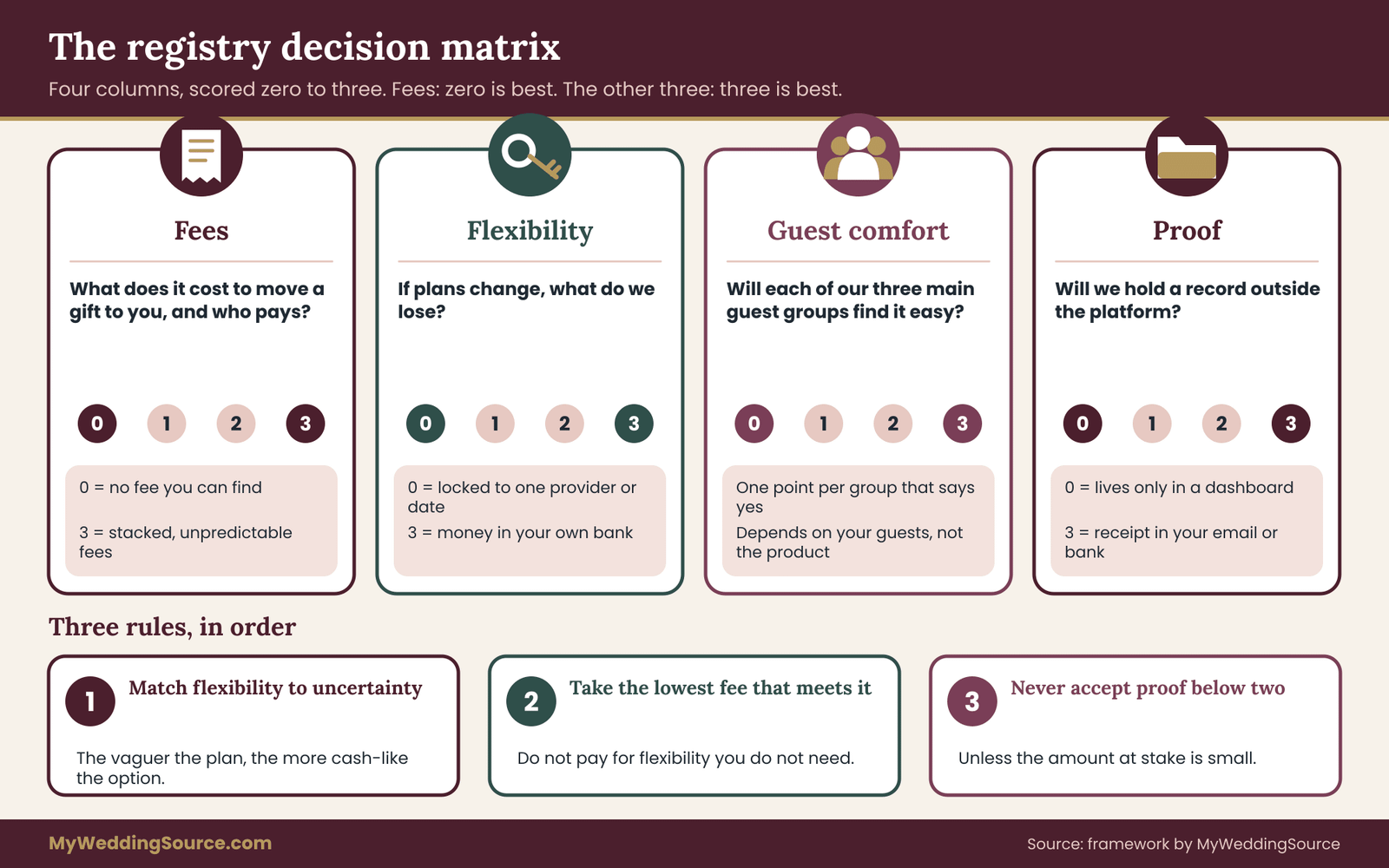
Most advice on an alternative wedding registry lists options and leaves you to guess which is best. A matrix does more, because it forces the same questions onto every option. This one has four columns. Two of them, fees and flexibility, decide most cases. The other two, guest comfort and proof, break ties and protect you afterward.
Treat the scores for your alternative wedding registry as your own judgment, not as measurements. They are a way to compare, and they only work if you fill them in from the real terms of the real option you are considering, not from how the option feels.
Column one: fees
The fee column asks what it costs to move a gift from a guest to you. Score it from zero to three.
A score of zero means no fee that you or the guest can find: for example, a guest who hands you a card with a check, or a donation to a charity that takes no processing charge at the point of giving.
A score of one means a single small cost, such as a payment processing charge on a card payment. A score of two means two layers, such as a platform charge plus a card charge. A score of three means stacked costs that you cannot easily predict, such as a platform charge, a card charge, a withdrawal charge, a currency conversion and an add-on fee presented to the guest at checkout.
For any alternative wedding registry option, ask two questions. Who pays each charge, the guest or you? And is each charge shown before the guest confirms? A fee that appears only after a guest clicks “send” is a fee that will come back to you as an awkward message.
Column two: flexibility
The flexibility column asks what happens when your plans change. Score it from zero to three as well, but here three is best.
A score of zero means the gift is locked to one provider, one date or one use, and it may expire. A voucher for a single restaurant on a single weekend is a zero. A score of one means the gift is tied to a category you can change slowly, such as credit at a travel company that you can redeem for any trip but cannot turn into cash.
A score of two means you can redirect funds within the platform or convert them with some friction. A score of three means the money lands in your own bank account and you decide what it does.
The question to ask about an alternative wedding registry entry is simple. If we cancel the trip, move cities or decide we want something else, what do we lose? Write the answer in a sentence, not just a number.
Column three: guest comfort
Guest comfort asks whether the people on your list will find the option easy and pleasant. It depends on your guests, not on the product. A younger, online-comfortable group may be happy with a payment link. An older group may want a card and a check, or a physical item. A mixed group often needs two routes.
Score it from zero to three by asking about your three largest guest groups. Would each group know what to do, trust the link and feel the ask is reasonable? Give one point for each group that says yes, with a maximum of three.
Column four: proof
Proof asks whether your alternative wedding registry will leave you with records you can keep. A gift that produces a receipt, a confirmation email or a bank statement line is easy to track and to thank for. A gift that lives only inside a platform dashboard, which may disappear when you close the account, is harder. Score it from zero to three, where three means the record sits in your own email or bank, not only in someone else’s system.
How to use the four columns together
Score every option you are considering for your alternative wedding registry, then apply three rules in order.
Rule one: match flexibility to uncertainty. The less sure you are about how you will use a gift, the higher the flexibility you need. If you know you are taking a trip next June, a travel credit with flexibility of one may be fine. If you only know you want “something for the future,” you need a two or three.
Rule two: among options that meet the flexibility you need, take the lowest fee. Do not pay for flexibility you do not need, and do not accept low fees at the price of flexibility you do need. If two options tie on both, move to guest comfort.
Rule three: never drop below a proof score of two. If you cannot keep the record, you cannot reliably thank, track or resolve a problem. A proof score of one or zero should only be accepted when the amount at stake is small.
Here is a short worked pass. Suppose a couple considers a platform fund with a fee score of two and flexibility of two, a direct payment app with fee score of zero or one and flexibility of three, and an experience voucher with fee score of one, flexibility of zero and proof of two. If their plans are vague, the voucher fails rule one. Between the platform and the payment app, the payment app wins on fees and flexibility.
But if their guests are older and distrust apps, guest comfort may push them toward a platform that accepts cards or to a card-and-check route. The matrix does not give an answer by itself. It shows you exactly which trade you are making.
What the matrix is not
It is not a ranking of every alternative wedding registry option for everyone. It does not tell you that cash funds are better than services or the reverse. It does not use industry statistics, because platform fees and policies change often and differ by company, and any number printed here would be out of date soon. It is a structured way to read the terms you actually have in front of you before you commit to an alternative wedding registry.
Fees and fine print for an alternative wedding registry
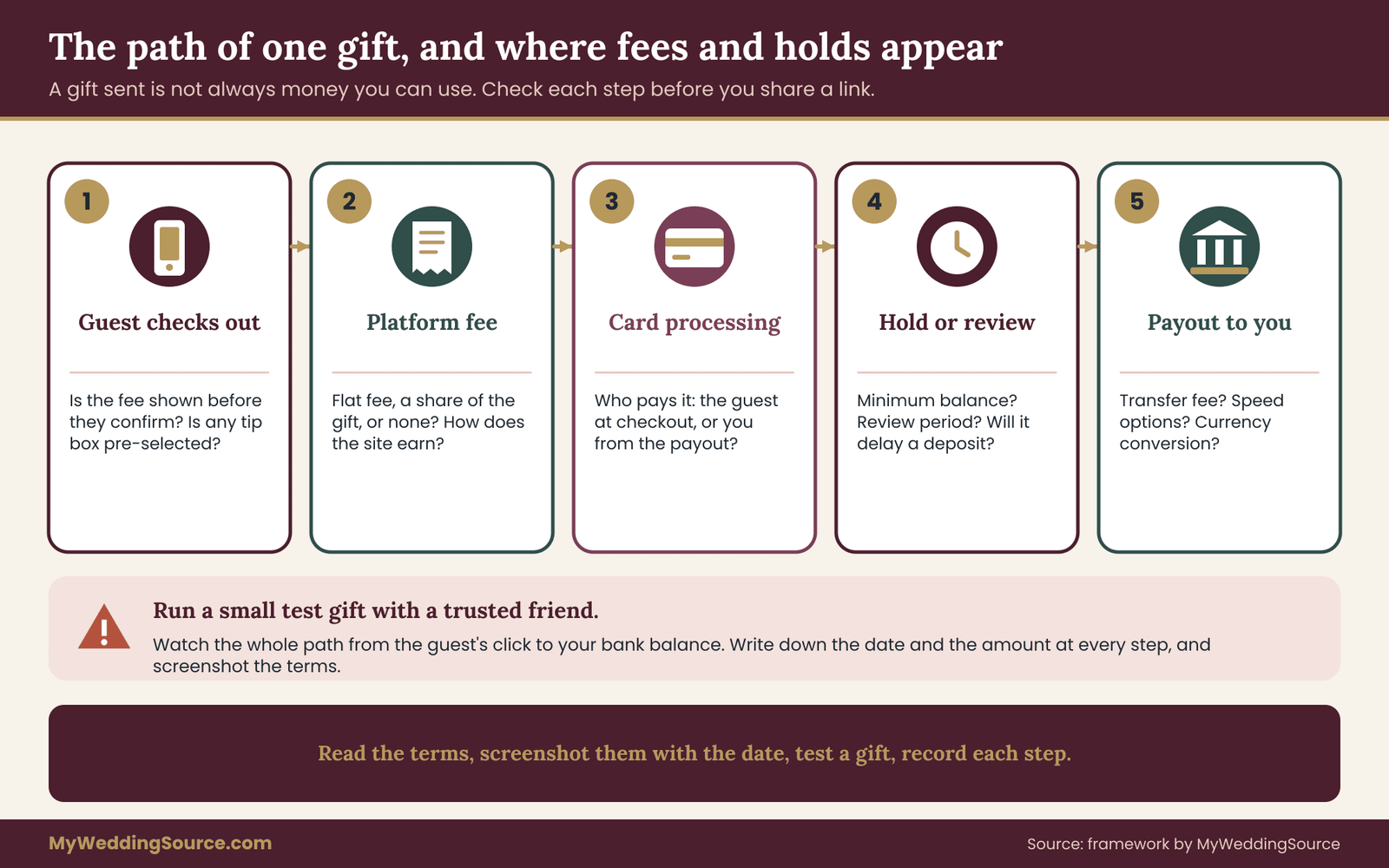
Fees and terms look dull and decide more outcomes than any design choice. Spend an hour reading them before you share an alternative wedding registry link with anyone, and screenshot what you read, because pages change.
The types of fee to look for
Platforms and payment tools charge in a handful of ways, and a single alternative wedding registry option can combine several.
Platform or service fees. A registry site may keep a share of each gift or charge a flat fee, or it may charge nothing and earn money elsewhere. Read how the site says it earns, because that shapes the default settings guests see.
Payment processing fees. Card payments cost whoever receives them. A site may deduct this from your payout or ask the guest to cover it at checkout.
Withdrawal or transfer fees. Moving money from the platform to your bank may be free, may cost a flat amount or may cost a percentage. Faster transfers often cost more than slower ones.
Currency conversion. If a guest abroad pays in a different currency, or if you receive in one, there may be a conversion margin built into the rate.
Optional add-ons or tips. Some checkouts suggest the guest add a voluntary amount for the platform. Check whether the box is pre-selected, because a guest who does not notice it will pay something you never intended.
For plain-language descriptions of payment app protections and limits, the Consumer Financial Protection Bureau publishes consumer guidance, and the Federal Trade Commission explains how scams that use payment apps work. Both are listed in the sources at the end.
Timing of payouts
A gift sent through an alternative wedding registry today is not always money you can use today. Check three points: how long before a gift appears as available, whether the platform holds funds until a minimum balance is reached, and whether it holds funds for review. A hold is not a sign of a problem, but it matters if you plan to pay a deposit with the money by a certain date.
If you will use fund money to pay vendors, line the payout schedule up with your payment calendar. The wedding cash-flow planning guide explains how deposits and balances fall due, and the gap between a gift arriving and the money being usable is a gap you want to know about before a payment is due.
Expiry, refunds and what happens to unused credit
For experience and service gifts on an alternative wedding registry, expiry is the largest hidden term. A voucher that lapses in a year can become a total loss. Federal rules limit how quickly many store-issued gift cards may expire, and the Consumer Financial Protection Bureau explains them, but those rules have scope and exceptions, and they may not cover a voucher sold by a small provider or a credit tied to a particular service. Read the specific terms.
Ask these questions in writing for any provider-issued gift.
“If we cannot use this on the date or in the way described, can the credit be moved, extended or refunded to the purchaser? Please tell us how, and by when.”
Ask about your own refund route too. If a guest buys something on your behalf and a plan falls through, who gets the refund, the guest or you? In most cases the purchaser does, which can make a refund awkward. Platforms that sit between guest and provider usually have their own rules, so read those.
Who owns the page and the money
Check whose name your alternative wedding registry account is under and who can change the payout destination. If one partner opens the page, the other should be able to see the dashboard, and both should know the login recovery method. A fund tied to one partner’s personal account is a problem if the partners later disagree or if the person is unavailable at a key moment.
Ask what happens when you close the page. Do you keep access to a record of gifts, names and amounts? If not, export the list before you close it. The wedding records after the event guide explains how to keep that kind of record safely.
A short fine-print routine
Before you commit to any alternative wedding registry option, do these four things in one sitting. Read the terms and fee page. Take screenshots with the date visible. Do a test gift for a small amount with a trusted friend, and watch the whole path from the guest’s click to the money appearing in your account. Write down the dates and the amounts at each step.
That test is cheap and it reveals problems no description will. It also shows you what the guest sees, so you can judge guest comfort with your own eyes.
Cash funds in an alternative wedding registry: honeymoon, home and general
Cash is the option most couples think of first when they picture an alternative wedding registry, and it is also the one with the most variation in how it works. Three questions shape it: what you call the fund, where the money lands and how guests send it.
Naming the fund honestly
A fund name is a promise. If you call it a “honeymoon fund,” guests picture you on a beach, and many will give with that picture in mind. If you then spend the money on a security deposit, nothing illegal has happened, but some guests will feel misled, and you will feel awkward.
Pick one of three honest approaches for the cash part of your alternative wedding registry. A specific fund names a specific use and you stick to it as far as you can. A broad fund names a category, such as “starting our home” or “our first year,” which covers many uses. A general fund says plainly that gifts of money go toward whatever you need. Matching the name to your real certainty is rule one of the matrix applied to words.
If you want both a trip and general support, make two entries. Guests can then choose, and you do not have to explain how a single pot was split.
Where the money lands
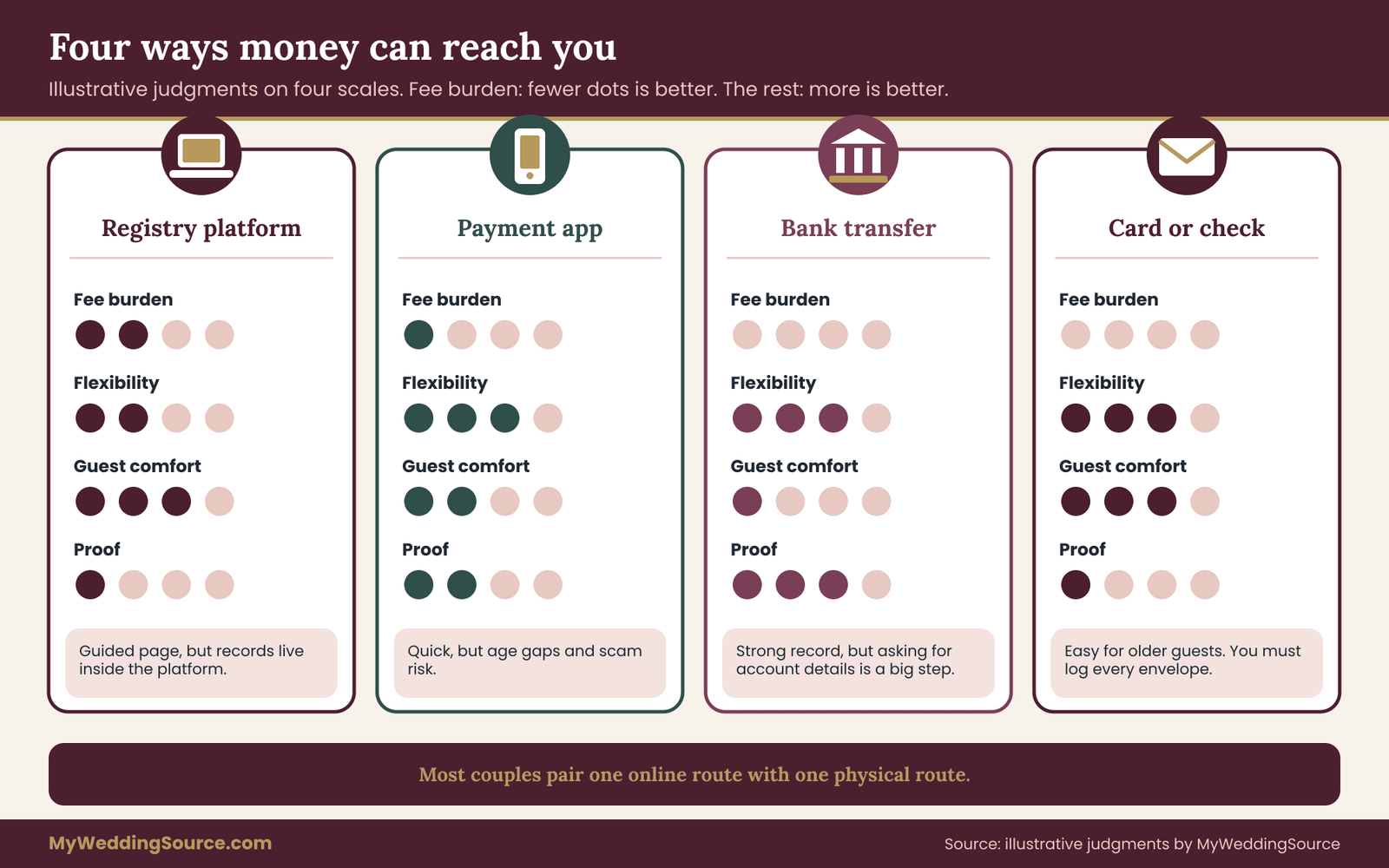
There are four common routes, and the matrix scores them differently.
A registry platform. The platform shows a page, takes payment and sends you the balance. Fee score is often one to three, flexibility of two or three depending on payout rules, guest comfort is usually high because the page is guided, and proof is mixed because records live inside the platform.
A payment app. Guests send money straight to your handle. Fees can be zero for friends-and-family style transfers and higher for card-funded or business-style transfers. Flexibility is high. Proof is decent, since each transfer appears in your app and often your bank. Guest comfort varies a great deal by age. The main risk is misdirected payments and scams.
A bank transfer. Fees are usually low or none, flexibility is high and proof is excellent. Guest comfort is lower, since asking for account details is a bigger step than clicking a link, and you should be cautious about sharing account numbers widely.
A card or check at the wedding. Fee score is zero, flexibility is three and guest comfort is high for older relatives. Proof depends on you keeping a log, and the physical envelopes can get lost. A locked card box and a plan for who carries it home are worth arranging.
Most couples end up with an alternative wedding registry that has two routes: one online and one physical. That is a good pattern, not a sign you have been indecisive.
Where the money should sit
Money you receive is yours to hold and manage, and where it sits matters. If a gift arrives in a payment app balance, it may not be treated like a bank deposit for protection purposes. The Federal Deposit Insurance Corporation explains how deposit insurance works for bank accounts and what it does not cover, and that is worth reading before you let a large balance sit anywhere. Move larger sums to an insured bank account on a regular schedule and keep the proof of each transfer.
If you want the fund to remain a separate pot, open a separate savings account and name it. That makes the cash-flow picture clear, helps you spend on purpose and makes it easier to check later that you used the fund as you described.
How guests actually send money
The guest side is where cash funds succeed or fail in an alternative wedding registry, so walk through it as a guest would.
Does the link work on a phone? Does it show your names, so a guest knows it is the right page? Does it show the fee before payment? Does the guest get a receipt by email? Can the guest add a short note? Can they choose an amount, or must they pick from preset sizes?
Then test the sad paths. What happens if the guest closes the page halfway? What if a card is declined? Where does a guest write if something goes wrong, and who answers? A page with no contact route sends confused guests to you.
The scam problem
Funds and payment links attract fraud, and any alternative wedding registry page is public. Be wary of any message that asks guests to send money to a new account, that claims you changed your handle or that urges speed. The Federal Trade Commission publishes consumer guidance on payment app scams, and its main lessons are simple: confirm a request through a separate channel, and treat a request for urgent payment as a warning sign.
Protect your alternative wedding registry page. Use two-step sign-in on any account that holds money, give the partner a recovery route and keep the exact link in one trusted place, such as the wedding website, so guests learn where the real one lives. Tell guests in advance that you will only ever share links from that site. If a guest receives something that looks off, they will know to check.
Cash gifts and your guests’ feelings
Some guests will love a fund in an alternative wedding registry because it solves their shopping problem. Others will feel that giving cash lacks thought. You cannot satisfy both with a single design, but you can reduce friction.
Give guests a reason in a sentence. “We live in a full home, so a contribution toward our first-year plans would help” is more graceful than a line that simply lists a link. Offer a physical route for guests who prefer to give an object, perhaps a short list at a store or a note that cards are welcome. Never rank or compare guests’ amounts, and avoid suggested amounts that look like price tags for attending.
The social details belong in the wording section, but the principle belongs here: make the cash route easy and optional, and let guests who prefer other routes use them without comment.
Cash fund pitfalls to check against the matrix
A fund with fee score of three and no test gift is a bad bet. A fund tied to a single partner’s account with no recovery route has weak proof. A fund named for a specific purpose that you cannot be sure of has a flexibility mismatch. A fund shared through public social media with no warning about scams invites trouble. And a fund with no physical route will leave out guests who are not comfortable online.
Each of these is easy to fix before you launch, and hard to fix after guests have started giving.
A short example of reasoning
A couple building an alternative wedding registry lives together and plans a trip, but they have not picked dates and may postpone a year. They compare a platform travel fund that pays out only as a credit toward bookings through one partner company (fee score one, flexibility of one) with a general fund that pays cash to their bank (fee score of two, flexibility of three).
The trip is uncertain, so rule one points to the cash route. They accept the higher fee score. To soften it, they choose the platform setting where the guest covers the processing charge and they show the amount to the guest before payment. They also add a card box for the wedding day. The result is not perfect, but each trade-off was a choice, and each can be explained.
When to pick a travel-specific credit anyway
Travel credit is a reasonable choice when the plan is firm, the dates are set, the provider is established and the terms allow changes. It is also reasonable when guests like the idea of giving a particular experience and you are fine with the lower flexibility. In that case, save the written terms, ask about changes and expiry in advance and decide how much of the trip you will cover yourselves, so a gift does not have to carry the entire cost.
Experiences and services as gifts
Experiences and services in an alternative wedding registry share a feature that cash does not: they depend on a third party that has to be there when you want to use the gift. That dependence is where most problems arise, and it is why the matrix gives these options lower flexibility scores by default.
What counts as an experience gift
An experience gift is a defined event or activity. Examples include a pottery class, a food tour, a concert, a sailing afternoon, a spa visit, a museum membership or a weekend stay. The gift can be a prepaid voucher from the provider, a credit toward that provider on a platform or a contribution toward the cost of the experience that you then book yourselves.
These three forms differ a great deal in flexibility. A prepaid voucher is the least flexible, because it is tied to one provider and often to one set of dates. A platform credit is somewhat more flexible when it can be spent with any listed provider. A contribution that you book yourselves is the most flexible, because you can choose the provider and the date.
What counts as a service gift
A service gift is work someone does for you. Common ones include house cleaning, meal delivery, lawn care or snow clearing, dog walking, laundry service, grocery delivery and moving help. The appeal is practical: those hours return to you at a time when you want them most, often just after the wedding.
Services raise two special issues. The first is that the provider relationship is with you, not the guest, so the quality of the work and any disputes are your responsibility. The second is that scope has to be clear: how many visits, of what length, at what times, covering which tasks.
Questions that apply to every experience or service gift
Before you list a gift on your alternative wedding registry, ask the provider in writing, and keep the answers. These questions match the matrix columns.
On fees: what is the full price, who pays any tax or booking charge and are there any add-ons that the voucher does not cover? On flexibility: does the gift expire, can the date be changed, can the name be changed and what happens if the provider cancels or closes? On proof: will you receive a confirmation, a voucher number and the terms by email? On guest comfort: can a guest buy online without creating an account, and will the provider handle questions?
“We are building a gift list that includes your class. Could you send the current voucher terms, including expiry, rescheduling and any blackout dates, so we can describe it accurately to guests?”
A provider who answers clearly and promptly is a good sign. A provider who is vague about expiry or refunds is a warning.
Check how the provider will handle closure and change
Small businesses close, move and change their offerings. A voucher from a provider that closes before you use it may be difficult to recover, and the protections that apply depend on how it was bought and where. Read the terms, favor providers with a track record and consider paying for experiences in smaller steps rather than in a single large prepaid package.
If a provider sells a package of services, such as ten cleaning visits, ask what happens to unused visits and whether a partial refund is possible. A shorter first package with the option to add more is safer than a long prepaid one.
For service work performed in your home, read the provider’s terms about access, insurance and breakage. The wedding vendor contract guide covers the habits of reading terms, asking about insurance and writing down what was agreed, and the same habits help here on a smaller scale.
The gift card and voucher rules in plain terms
Many experience and service gifts are sold as gift cards or certificates. Federal rules set limits on how quickly certain gift cards may expire and on some fees. The Consumer Financial Protection Bureau explains them in plain language, and the Federal Trade Commission publishes consumer guidance on gift cards, including how to spot scams that ask for payment by gift card. Both are useful background.
Do not assume the rules cover every voucher. Some promotional vouchers, some service credits and some arrangements with small providers fall outside the standard rules, and state laws vary. The safe approach is to read the specific terms, ask the provider and treat the stated expiry date as real.
How platforms present experiences
Some registry platforms list experiences from partner providers, and others let you create a custom item with a link and a price. The first kind is convenient but may limit your choices and may include a platform fee. The second kind is flexible, but you handle more of the follow-up.
Ask the platform two things. Who is the seller, the platform or the provider? And what happens if the experience becomes unavailable? The answers tell you who is responsible for a refund or a replacement.
Making experience gifts work for guests
Guests respond to alternative wedding registry experiences that feel concrete. A line such as “A pottery class for two at a studio near our home” is easier to buy than “an experience.” Price points matter too. Offer a few entries that cost little, such as a coffee and a pastry at a favorite cafe, and a few that cost more.
Describe each one honestly. Say what is included, how it will be used and when. If you plan to use an experience gift only after a long delay, such as after a baby or a move, say so in a sentence.
Avoid using a pile of tiny experiences to reach a large total. A dozen small items, each with its own provider and its own terms, create a dozen small follow-up tasks for you. Fewer, clearer items are usually better.
Service gifts and the post-wedding calendar
Timing is the great advantage of a service gift in an alternative wedding registry and also its risk. A week of meal delivery right after the wedding fits well. Lawn care in a season that has not started yet does not. Match each service to the period when you will use it, and put the use window on a calendar.
If the service begins months later, ask whether the provider honors the price and the booking. If a provider changes terms, you want to know early. A calendar reminder one month before the start date is a small step that avoids a lot of regret.
Local versus national providers
A local provider can be warmer and more flexible, and it can also be more fragile. A national provider usually has clearer terms and more resilience, but it may be less personal. The matrix does not pick for you. It does ask you to read the actual terms of the one you choose and to give weight to proof.
Common mistakes with experiences and services
Choosing an experience you cannot actually schedule, because of travel, work or health, is the most common one. Accepting an expiry of a few months for a gift you will not use in that time is the second. Neglecting to list the provider’s refund route for the purchaser is the third. And putting everything on one provider is the fourth, since a single closure then eliminates the entire section of your alternative wedding registry.
When an experience or service gift fits best
These options fit best in an alternative wedding registry when your plans are specific, when the provider is established, when the terms are clear and when you have a real use for the gift soon. They fit least when your plans are uncertain, when terms are vague or when the amounts are large. For uncertain plans and large amounts, a cash route, which scores a three on flexibility, is usually the sounder choice, and experiences and services work as a small, concrete layer on top of it.
Two options in an alternative wedding registry turn many small gifts into one visible outcome. A shared goal pools guest contributions toward something you name, and a donation points them toward a cause. Both feel meaningful to many guests, and both carry rules that are easy to miss.
Shared goals: how they work
A shared goal, sometimes called a group gift, sets a target amount for a defined item or project. A sofa, a bike, a kitchen repair, a garden bed, a piece of art or a share of a larger purchase all fit. Guests see a progress bar and choose how much to add.
The appeal is clear. A guest who cannot afford the whole item can still take part, and the gift has a story. The catch is the same one that applies elsewhere in this guide: what happens if the goal is not met, is exceeded or changes?
Ask the platform four things before you add a shared goal to your alternative wedding registry. Does the money reach you if the target is not met, or only when it is? What happens to contributions above the target? Can you change the goal after guests have contributed? And can a guest get a refund if the item becomes unavailable? The answers decide the flexibility score. A platform that releases whatever has been raised, regardless of the target, scores higher than one that holds funds until the full amount arrives.
Sizing a shared goal
Pick a target the crowd can plausibly reach, not the full price of an expensive item. If the item costs more than you expect guests to raise, name the goal as a contribution toward it, and say so: “toward a new sofa” rather than “a new sofa.” That wording keeps you honest if you only reach part of the amount and make up the rest yourselves.
Avoid stacking many large goals. A page with five big goals asks guests to make hard choices and often leaves several half-funded. Two or three goals, plus smaller options, usually works better.
Big-ticket goals and honest labeling
Large goals, such as a home deposit or a renovation, deserve careful words. Some guests will feel comfortable giving toward a home. Others will feel uneasy about a large personal financial goal on a public page. Describe the goal in plain terms, avoid pressure, and consider a broad label such as “toward our first home” with no amounts displayed.
If a goal involves money you are putting aside for a major purchase, a licensed financial adviser can answer questions specific to your situation, such as where to hold the funds and how they affect other plans. That is outside what this guide can say. The wedding budget guide helps you see where gift money fits in the wider plan, but it does not replace individual advice.
Donations: what an alternative wedding registry can ask
Some couples build an alternative wedding registry around a charity, asking guests to give to it instead of, or alongside, a gift. The wording matters: guests should feel invited, not steered. You can name one cause or offer a short list of two or three, and you can let guests choose.
Donations carry three design choices. The first is whether guests give directly to the charity or through your registry page. Direct giving is simpler for the charity and gives guests their own receipt. A page that collects on behalf of a charity adds a layer that you must understand. The second is whether you announce amounts. Most couples do not, and it is kinder not to. The third is whether the charity is local or national, which affects how personal the gift feels.
Check the charity before you name it
Naming a charity on your alternative wedding registry lends it your credibility, so check it. The Internal Revenue Service publishes a search tool for tax-exempt organizations that shows whether an organization is recognized and eligible to receive deductible contributions. The Federal Trade Commission explains how to research a charity and how to spot signs of a scam, such as pressure to give immediately or requests for payment by gift card or wire.
Take these steps. Search the organization’s name in the IRS tool. Read the organization’s own page about how donations are used and how receipts are issued. Be careful with similar names, because scammers and lookalike groups often use names close to real ones. If the cause is local and small, call or email the group to confirm that they accept gifts made in honor of someone.
Who owns the receipt
A donation made by a guest belongs to the guest. Any receipt goes to the donor, and whether the gift is deductible is a question for the donor and their own adviser. You cannot promise guests a deduction, and you should not suggest one. If the donation passes through your page rather than going straight to the charity, ask how receipts and records work and who issues them. The Internal Revenue Service publishes general guidance on charitable contributions that guests can read.
A simple phrase handles this well: “Donations go directly to the organization, which will send its own receipt.” If that is not true for your setup, say what is true.
Donation pitfalls
Avoid naming a cause to which close family members have strong, opposing views, unless you have discussed it with them. A donation page can become a political statement without anyone intending it. Avoid adding a donation option you have not checked. And avoid mixing donations with your own fund in a way that blurs which money belongs to whom.
A donation is also a good place to remember that you cannot control what guests choose. Some will give to the cause, some will give to you, some will do both and some will do neither. All of those are fine.
Building a balanced alternative wedding registry
Individual options are only half the work of an alternative wedding registry. An alternative wedding registry succeeds when its parts fit together and when a guest can find a sensible entry within a minute. This section gives a method for combining options.
The three doors method
Offer guests three doors in your alternative wedding registry, so everyone finds one that fits.
The small door is for guests who want to give a modest amount or a simple gift. It might be a small experience, a low-cost service, a donation or a small contribution to a fund. It should be easy and quick.
The middle door is for guests who want to give something noticeable. It might be a class, a meal delivery package or a mid-sized contribution toward a shared goal.
The large door is for guests who want to give something substantial. It might be a larger share of a goal or a general fund. Keep it modest in number and tone, and make sure it is not the first thing guests see.
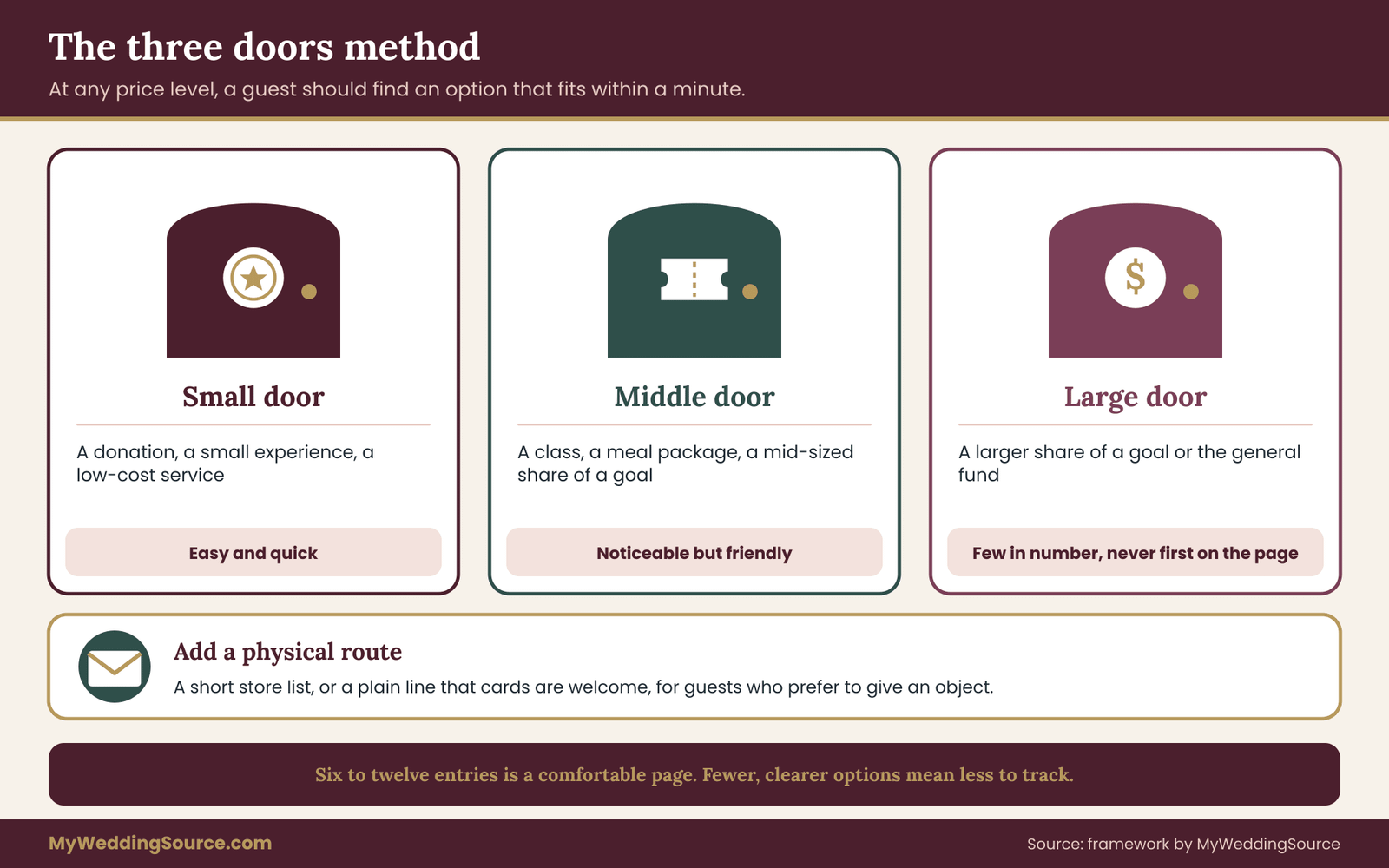
Three doors do not mean three of everything. They mean that at any price level, a guest can find an option that suits them without feeling that the page is built around a single route.
Add a physical route
Even if your alternative wedding registry has no store list, include some way for a guest who wants to give an object. That can be a short list of a handful of items, a store page with a few things you will genuinely use or a plain line that says cards are welcome. This is the physical route in the matrix: it protects guest comfort for people who find money or experiences awkward.
For help designing a store list, the broader registry guide covers how to choose items and how many to include, so you do not need to repeat that work here.
Balance the fee and flexibility scores across the page
Look at the whole page, not just each option. If every option has a fee score of three, the page is expensive for guests and for you. If every option has flexibility of zero, a single change of plan will cost you. Aim for a mix: a couple of high-flexibility options with modest fees, a few specific options with lower flexibility but clear value and a couple of lower-cost entries to broaden the range.
A rough check is to ask what you would lose if one option failed completely, for example if a provider closed or a platform held funds for a month. If the answer is “a small part of the page,” you are balanced. If it is “most of it,” you are over-concentrated.
Keep the number of options manageable
A long alternative wedding registry is not a generous one. Guests faced with dozens of entries tend to freeze or to pick whatever is first. Between six and twelve entries is a comfortable range for most couples, although your own list will depend on your guests. Fewer, clearer options mean fewer follow-ups and less to track afterward.
Decide what you will do with leftover or unused gifts
Decide in advance what happens to funds that exceed a goal, to credits you cannot use and to items you do not need. A good default is that excess in a specific fund goes into your general savings and is described that way on the page. For unusable credits, ask the provider about options early. For duplicates, check the return and store-credit terms before you accept anything you plan to exchange.
Having these decisions written down before guests give removes a source of stress later and keeps you consistent.
Wording and sharing your alternative wedding registry without pressure
How you share an alternative wedding registry matters nearly as much as how you build it. The same alternative wedding registry can feel gracious or demanding depending on the words around it. This section gives principles and sample wording for the places guests will meet your registry.
Where the link lives
Put your alternative wedding registry on your wedding website, on a page of its own, and keep the link in one place. Etiquette advice on invitations generally discourages printing registry details on the invitation itself, and the wedding invitation etiquette guide explains the usual practice and the reasons. A website link on a separate insert or a line in a shower invitation sent by the host are the common routes.
For guests who do not use the internet, give a person to call. A parent, a sibling or a close friend can answer simple questions and take a note. Tell that person what the page says and which options exist, so the answers match.
The tone that works
Calm and brief wins. A sentence about why you chose this format, a sentence that gifts are optional and then the options. Avoid humor that hints at expectations, rhymes about cash and anything that sounds like a price list for attending.
Here is a plain version.
“Your presence is the gift we care about most. If you would like to give something, we live in a full home, so we have set up a few options: contributions toward a trip, a couple of experiences we would enjoy and a donation to a local food bank. There is also a short list of household items. Please do whatever feels right to you.”
Notice what the wording leaves out. It gives a reason without apologizing. It lists options without ranking them. It repeats that guests choose. It does not use the word “should.”
Wording for different parts of the page
Each entry needs a title, a short description and a price. Make the title plain: “Pottery class for two,” not “A magical evening of creativity.” Make the description a single sentence that says what the gift is and how you will use it. Show the price and any fee before the guest confirms.
For funds, say what the money is for in one sentence and how it moves. For shared goals, say the target and what happens if it is not reached. For donations, say where the money goes and who issues the receipt. For services, say how many visits and over what period.
What to say when guests ask
Some guests will ask directly, and a prepared answer helps. Here are four common situations.
If a guest asks what you would like, point to the page first: “Thank you for asking. We put a few ideas on our website, and any one of them would be lovely.” If they ask for something simpler, offer a physical idea: “A card is a perfect gift for us.”
If a guest asks whether cash is acceptable, answer yes warmly and briefly. There is no need to explain.
If a guest says they dislike funds, do not argue. “Of course, we are grateful for any gift you choose” ends the conversation kindly, and a short store list or a donation option gives them a path.
If a guest asks which amount is right, decline to set one: “Please give whatever suits you. There is no right number.”
Talking with parents, hosts and elders
Parents and shower hosts often field the most questions, and they may hold strong views. Talk to them before the page goes public. Explain what the options are and why you chose them, and ask whether any option would be hard for their guests. Their answers often reveal a physical route you need to add.
Elders may not recognize a payment link as a gift at all. A printed line on a card, a phone number and a plain explanation can save a lot of confusion. Offer to take a call, or ask a family member to help.
If a family member objects to the format, listen first. You can keep your choice and still respect the concern, perhaps by adding a store list or by putting the physical route first on the page.
Shower hosts and the registry link
A host may include your alternative wedding registry in a shower invitation. Give the host one sentence to use and one link, and ask them to keep to that wording. Without guidance, hosts sometimes describe your fund in a way that sounds pushy or inaccurate. A short note from you avoids that.
Thank-you notes and the honest description of use
Guests like to know what their gift did. A short note that names the gift and a specific use is better than a generic line. “Your contribution went toward our first week of meals, and we ate well” is warmer than “thank you for your generosity.” If a fund was general, describe a real use after the fact, and only when it is true.
For anonymous gifts or those sent through a platform with limited detail, send a note to the person you believe gave and let them tell you if they did not. A short, kind message is rarely unwelcome.
Four worked cases for choosing an alternative wedding registry
The cases below, each an alternative wedding registry for a different couple, are invented for illustration. They show how the matrix and the doors method work in different circumstances. The numbers are simple scores, not data.
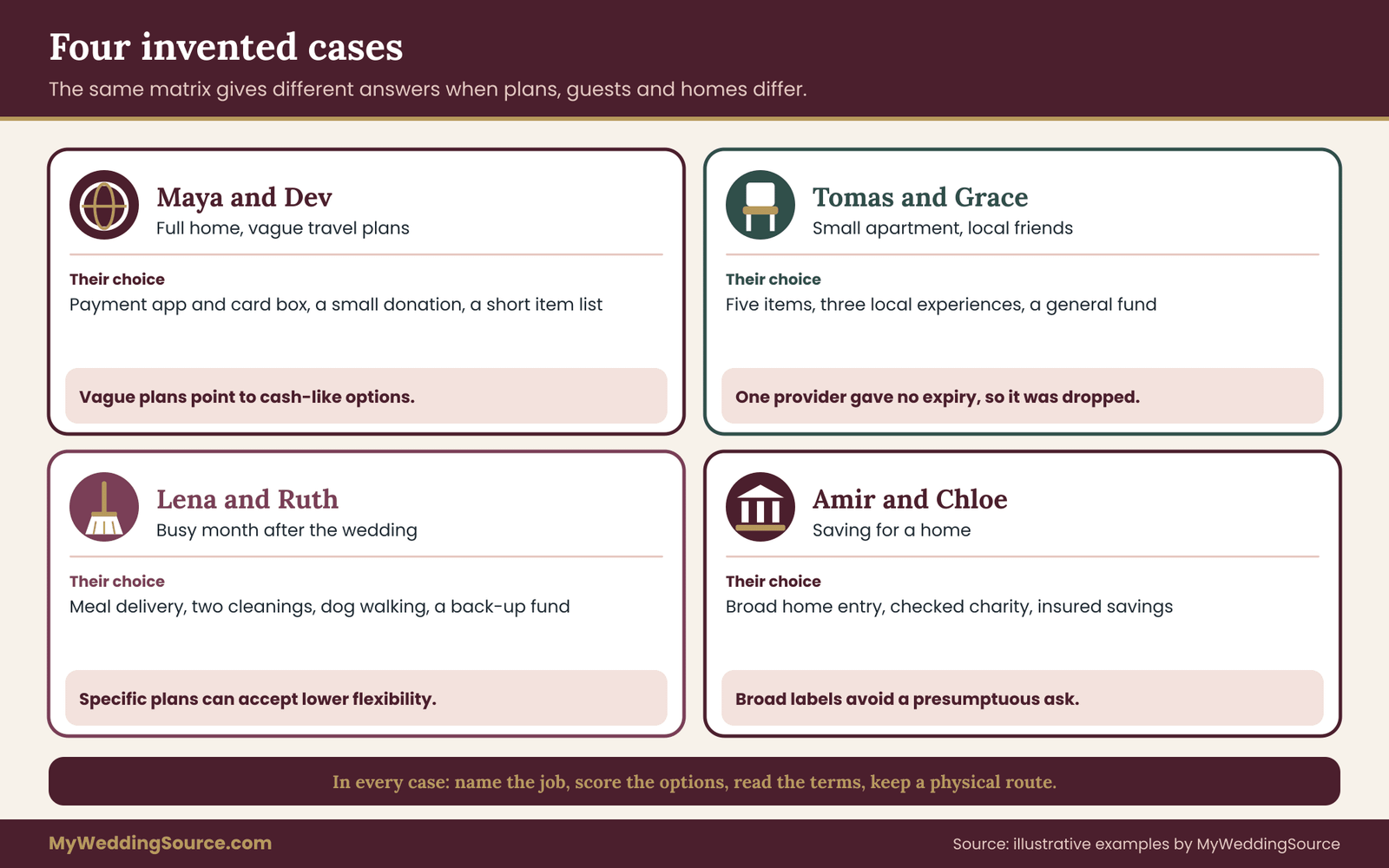
Case one: Maya and Dev, who already share a full home
Maya and Dev have lived together for six years and own what they need. They want to travel, but dates are not set and one of them may change jobs. Their guests range from friends in their twenties to relatives in their seventies.
They score a platform travel credit at fee one and flexibility one, a cash fund on a registry site at fee two and flexibility two, a direct payment app at fee one and flexibility three, and a card box at fee zero and flexibility three.
Their plans are vague, so rule one eliminates the travel credit. Between the others, they choose the payment app and the card box as primary routes, because both score a three on flexibility and low on fees. They add a small donation entry and one short list of household items for guests who want an object. Their alternative wedding registry has three doors and a physical route.
Their one concern is guest comfort for older relatives with the app. They solve it by listing a family member’s phone number, who can explain, and by putting the card box on the wedding website’s first line.
Case two: Tomas and Grace, who live in a small apartment
Tomas and Grace have little storage. They want a few things for the apartment but cannot take much. They have many local friends who would enjoy giving an experience.
They choose a small store list of five items, three experiences from local providers with simple vouchers and a general fund. They write to each provider for the terms. One provider will not state an expiry, and another gives a twelve-month expiry. They drop the first and keep the second, but they plan to book the experience within six months and put a reminder on a calendar.
The matrix shows why the local experiences sit at flexibility zero or one while the fund sits at three. They keep experiences small, so that a closed studio would cost them little.
Case three: Lena and Ruth, who want services after the wedding
Lena and Ruth expect a busy month after the wedding and want practical help. They look at meal delivery, house cleaning and dog walking.
Their meal delivery provider sells credit in fixed blocks and allows use within six months. The cleaner sells a package of four visits. The dog walker will accept payment by the visit. They pick meal delivery for the first month, a two-visit cleaning package and a pay-as-you-go dog walking contribution.
They write to each provider asking about changes and closure, and they record the answers. They also note that services are a relationship with them, not the guest, so they add a short line on the page: “We will book each service ourselves.” The matrix shows lower flexibility, but their plan is specific and their timing is clear, so they accept it. They also hold a general fund as a back-up.
Case four: Amir and Chloe, who are saving for a home
Amir and Chloe are saving for a down payment. They worry that a “house fund” will look presumptuous and that guests may balk at large sums.
They set up a broad entry, “toward our first home,” on a registry site that pays out regardless of the target, and they do not show a target amount. They also add a donation to a housing charity that they checked with the IRS search tool and a short list of small items. They tell guests that gifts are optional.
They place the fund money, once received, in an insured savings account and ask a licensed adviser about how to handle the amounts. The matrix confirms their choice: flexibility is high and fee score is modest. The social risk is handled by tone and by giving guests multiple doors.
What the four cases share
In each alternative wedding registry the couple named a job, scored options, read the terms and kept a physical route. In each case flexibility followed uncertainty: the vaguer the plan, the more cash-like the option. And in each case they used fewer options than they first imagined. These patterns are the real content of the matrix, and they hold across very different weddings.
Tracking gifts and keeping records for an alternative wedding registry
A store registry keeps its own tidy log of who bought what, but an alternative wedding registry rarely does. An alternative wedding registry usually does not, because money and experiences arrive through several routes at once. Without a plan, you end up reconstructing a list from emails, app histories and envelopes. A little structure at the start prevents that.
One gift log, all routes
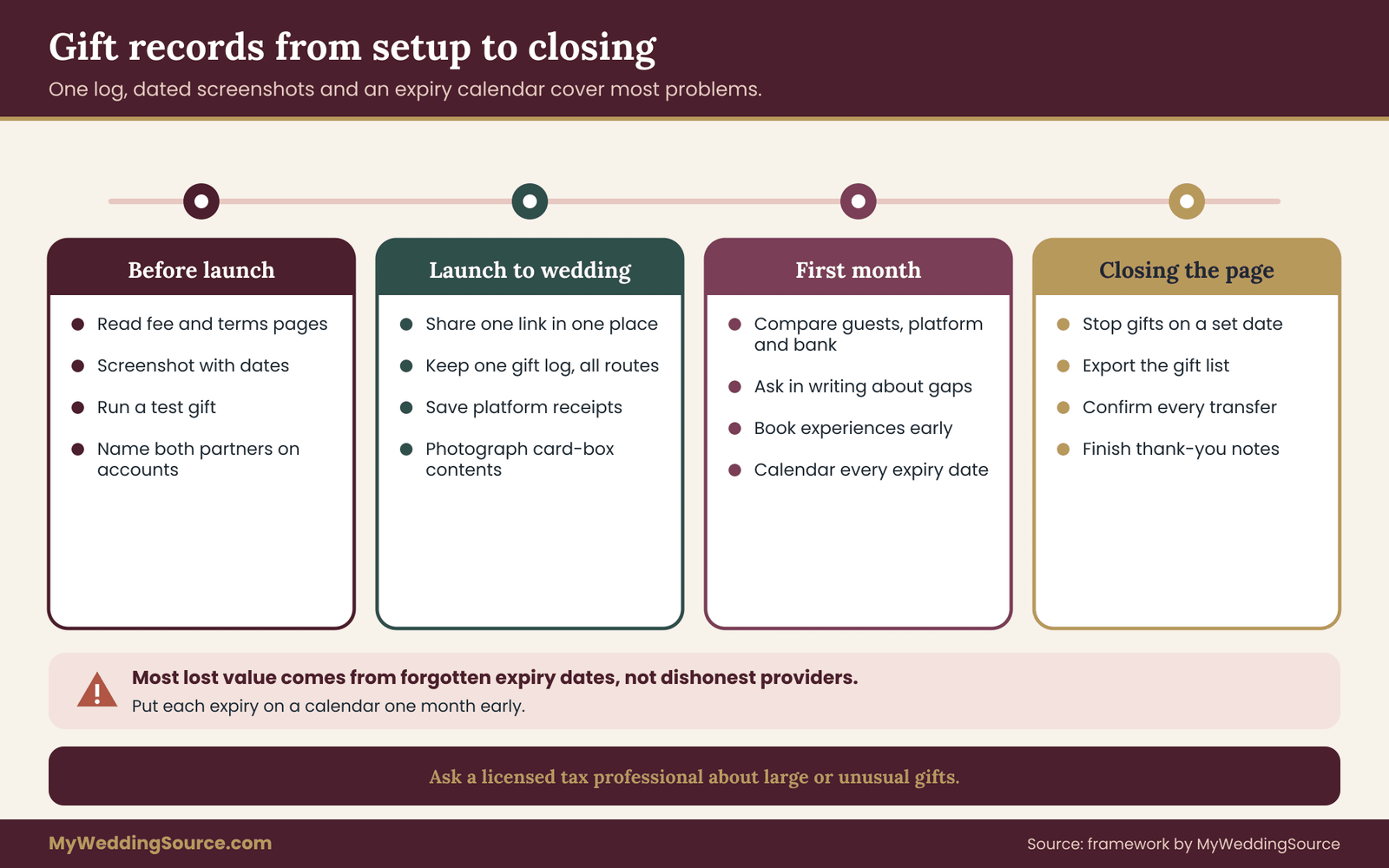
Keep a single log that covers every route: platform, payment app, bank transfer, card box and physical gifts. For each gift, record the date, the giver’s name as you know it, the route, the amount or item, the fee if any, what you received after fees, the thank-you status and a note on use.
The log is for your records, not for ranking guests, and it should stay private. The same folder logic you would use for any post-wedding paperwork works here: one place, clear names and a backup.
Capture proof as gifts arrive
Proof is the fourth column of the matrix, and it is easier to collect as you go than to rebuild. Save platform email receipts in a folder. Export or screenshot the platform’s gift list each month. Photograph card-box contents before you open envelopes, if you can do it without fuss, and note who gave what as you open each one.
Save the terms you read before launch, with dates. If a dispute ever arises about a fee or a refund, a dated copy of the terms you saw is useful.
Reconciling fees and payouts
At the end of the first month and again when the page closes, compare three numbers: what guests say they gave, what the platform reports and what reached your bank. The differences are fees, holds and mistakes. If a gap is larger than the fees you expected, ask the platform in writing and keep the reply.
For payment apps, compare the app history to your bank statement. For card payments made by guests, the guest’s own statement is their record, and you should not need it.
If you used fund money to pay a vendor deposit, record the date it was available and the date the payment was made. That connects the fund to your payment timeline and makes it easier to see whether a hold ever caused a delay.
Experiences and services: tracking use
For every experience or service, make a small card with the provider, the voucher number, the terms, the expiry and the date you plan to use it. Put the expiry on a calendar one month early. After use, note the date and any issue.
This habit is the single most effective protection against wasted vouchers. Most lost value in this category comes from forgotten expiry dates, not from dishonest providers.
Taxes: what to ask, not what to assume
Tax treatment of gifts is a subject where individual facts matter. The Internal Revenue Service publishes plain-language material on gifts and on gift tax, and a reader can start there. In general terms, the IRS explains that gift tax rules focus on the person who gives, not the person who receives, and that most gifts do not lead to a tax filing, with limits and exceptions that change over time. Check the current IRS pages for figures and forms.
For anything beyond that, such as how to treat a very large gift, a gift connected to a property purchase or a gift from abroad, a licensed tax professional is the right person to ask. This guide cannot answer those questions, and an alternative wedding registry does not change who is responsible for them.
Closing the page
When your alternative wedding registry has served its purpose, close it deliberately. Set a date, perhaps a few weeks after the wedding, to stop accepting gifts and to turn off links. Before closing, export the gift list and confirm that all funds have been transferred. Check that no pending payments remain, and save the final statement.
If you have a goal that was partly funded, decide what to do with the balance, and tell contributors if you changed the use. A brief note is enough: “We reached part of our goal, and we have put the rest toward the same plan ourselves.” Keep any such note honest and short.
Thank-you notes with a deadline
Set a target date for finishing notes and work through the log in order. Many couples aim to finish within a few weeks to a few months, and the exact timing is a personal choice. Mark each note in the log as you go. If a gift arrived through a platform that hid the guest’s name, include a line in a short message to the group on your site or in a general note, so people know it arrived.
Common mistakes with an alternative wedding registry
Several errors repeat often enough to list.
Launching an alternative wedding registry before you read the fee page is the first. Fees that appear at checkout surprise guests and then come back to you.
Putting all your options on one platform is the second, because a policy change or an outage then affects everything. Choosing narrow labels for uncertain plans is the third, since it leads to awkward explanations later. Skipping a test gift is the fourth. Forgetting a physical route is the fifth. And treating the registry as finished at launch is the sixth: terms change, links break and goals shift, so check the page again a few weeks before the wedding.
A review you can do in one evening
After you have scored your options, run this last check. Does each entry map to one of your two top jobs? Does each have a fee score and a flexibility score you can explain in a sentence? Do you have at least a proof score of two for every entry with a meaningful amount? Is there a physical route? Can a guest reach a person if the link fails? If the answer to any of these is no, fix that entry before you share your alternative wedding registry.
Your next steps
Tonight, write down the two jobs your alternative wedding registry should do. Tomorrow, list every option that could do those jobs and read the terms of each. Score fees, flexibility, guest comfort and proof for each option, and apply the three rules. Run a small test gift on any platform you plan to use.
Then build an alternative wedding registry with three doors and a physical route, share the link in one place and write the wording once. After the wedding, keep a single gift log, reconcile fees, use experiences before they expire and close the page on a date you chose. If you want help with the broader list, the wedding etiquette guide covers how couples and guests usually handle gifts and thanks, and the wedding planning checklist can help you place these steps on the calendar.
FAQ
What is an alternative wedding registry?
An alternative wedding registry is a gift list that is not made of store products. It can include cash funds, experiences, services, shared goals and donations, or a mix of these with a short store list. The point is to match what you actually need and what your guests can easily give. It is optional for guests and you should make that clear.
Is it rude to ask for money instead of gifts?
Etiquette views on an alternative wedding registry differ, and no rule applies everywhere. Many guests are happy with a fund, and some prefer an object. You can ask politely, keep the wording brief, state that gifts are optional and include a physical route. If close family members have strong feelings, talk to them first. Tone and choice for guests matter more than the format.
What fees should I expect on an alternative wedding registry?
Fees vary by company and change over time. Look for platform fees, card processing charges, withdrawal or transfer fees, currency conversion and optional add-ons shown to guests at checkout. Ask who pays each one and whether guests see it before they confirm. Read the current terms and run a test gift, because a description cannot show you the whole path.
How do I choose between a fund and an experience?
Use the matrix for your alternative wedding registry. If your plans are vague, you need high flexibility, which points to a cash route. If your plans are specific and the provider is established, an experience can work and may feel more personal. Compare fees, check expiry and refund terms in writing, and use cash as a base with experiences as a smaller layer.
Are wedding gifts taxable?
Tax rules depend on your facts, and this guide cannot give tax advice. In general terms, the Internal Revenue Service explains that gift tax rules focus on the giver, not the recipient, and that most gifts do not require a filing. Limits and exceptions change, so check the current IRS pages and ask a licensed tax professional about large or unusual gifts.
Can I ask guests to donate to charity instead?
Yes, and many couples build an alternative wedding registry around a donation. Choose a charity you have checked, using the Internal Revenue Service tax-exempt organization search and the Federal Trade Commission’s charity guidance. Say where donations go and who issues receipts. Avoid naming amounts or pressuring guests, and keep a simple route for anyone who prefers to give to you directly.
What happens if a gift expires or a provider closes?
Federal gift card rules limit expiry for many store-issued cards, but they do not cover every voucher or service credit, and state laws vary. Read the terms before you list a gift, ask the provider in writing about changes and closure, and put the expiry on a calendar. Favor established providers and avoid very large prepaid packages.
How many options should an alternative wedding registry include?
Between six and twelve entries is a comfortable range for most couples. Offer a small, a middle and a large option, plus a physical route for guests who want to give an object. A shorter, clearer page is easier for guests to use and easier for you to track, so cut anything that does not match one of your two main jobs.