
Private vows and public vows solve different problems, and most couples pick a format by habit instead of by need. This guide compares the two on what each one protects, what each one costs in time and coordination, and when a split format works better than either. It is about the format decision, not about writing the words.
Choose private vows when the words are fragile, sensitive or meant for one person, and when you want to say them without performing. Choose public vows when you want witnesses to hear a promise and be bound to it socially. Most couples do best with a split: a short, shared public promise during the ceremony and the personal words in a private moment that is recorded or kept only if both partners agree. Sort each sentence of your draft by who it is for, then pick the format that fits the sort.
Every wedding has a point where two people say what they promise. What changes from couple to couple is who is in the room when it happens. For some couples the answer is everyone they love, seated in rows, holding tissues. For others it is two people on a hillside at seven in the morning, and the guests find out later that it already happened.
Neither choice is more romantic or more mature than the other. They do different jobs. Public vows create witnesses. Private vows create room to be honest. When a couple picks the wrong one for their situation, the cost shows up in small ways: a partner who rushes through the words because three hundred phones are pointed at them, or a family that feels shut out of the one moment they were waiting for.
A note on scope. This is general information, not legal, tax or financial advice. Marriage license requirements, who must witness the ceremony and what must be said aloud differ by state and by officiant, so confirm those points with the county office that issues your license.
What private vows and public vows actually mean
The two terms get used loosely, so it helps to pin them down before comparing them.
Public vows are spoken in the ceremony in front of guests. The guests hear them live, they are part of the program, and they are usually the moment the officiant builds toward. Public does not have to mean long or elaborate. A single sentence said aloud to a full room is a public vow.
Private vows are spoken or exchanged with no guests present. They might be said in a quiet room before the ceremony, during a first-look window, on a walk, over breakfast, or in the form of letters that each partner reads alone. Private does not have to mean secret from everyone forever. Some couples play a recording of their private vows to each other on their first anniversary, and some never share them at all.
Between those two sit several hybrids, such as vows said in front of only the officiant and two witnesses, or vows heard by the immediate family. The next sections lay out five formats along that line so you can place yourselves on it.
One distinction matters more than any other. The legal wedding and the vow exchange are not always the same moment. In many places the legal requirement is a short declaration made in the presence of an officiant and sometimes witnesses. The longer personal vows that many couples add are a custom, not a legal requirement. That gap is what makes the private-versus-public decision possible, and it is why you can usually move the personal words without touching the legal ones. For the wider sequence of a ceremony, the wedding ceremony step-by-step guide shows where vows normally sit.
Why this decision deserves its own conversation
It is tempting to treat the format as a detail to settle after the venue, the date and the guest list. In practice the format touches several other decisions at once.
It changes the ceremony timeline, because a private moment needs a protected window. It changes what the photographer and videographer are asked to do, because private vows may be unrecorded, recorded by one person, or recorded only as audio. It changes how the officiant structures the ceremony, because a ceremony with a short public vow has a different shape from one built around two long speeches. And it changes how guests feel, because guests who expected to hear vows and did not may need a sentence of explanation.
None of those effects are large on their own. Together they are the reason a decision made three weeks out feels rushed, while a decision made three months out feels easy.
The question under the question
When couples argue about private vows versus public vows, the surface question is about a room full of people. The real question is usually one of these four.
Do I want to be heard by the people who love us, or by my partner without an audience? Am I afraid of crying, freezing or sounding unlike myself in front of a crowd? Do the words include things that are not mine alone to share, such as a family history or a health fact? And does my partner want the same thing?
Notice that only the last question is about the two of you as a pair. The first three are about each person separately, which is why the discussion goes better when each partner answers privately before comparing notes. The scoring method later in this guide gives a structured way to do that.
Three jobs a vow can do
Instead of asking “private or public,” it is more useful to ask what job a given sentence is doing. A vow can do three different jobs, and each job has a natural audience.
Job one: the legal declaration. This is the short statement of intent that the law or the officiant requires. The wording is often fixed or lightly flexible, and it is usually said in front of the officiant and, depending on the state, one or more witnesses. This job is not optional and it is not private. Your county clerk or the officiant can tell you the minimum.
Job two: the witnessed promise. This is the part of the vow where you promise something to each other and ask the community to remember it. Its value comes from being heard. A promise to be there for your partner’s kids, to keep the household’s budget honest, or to take care of an aging parent means more when the people who might help hold you to it were in the room.
Job three: the private message. This is the part that is only for your partner. It includes the specific memory, the apology, the private joke, the fear you admit to, the thing you could not say on a first date. It does not need witnesses. In fact, witnesses can make it worse, because a message written for one person bends when it is performed for many.
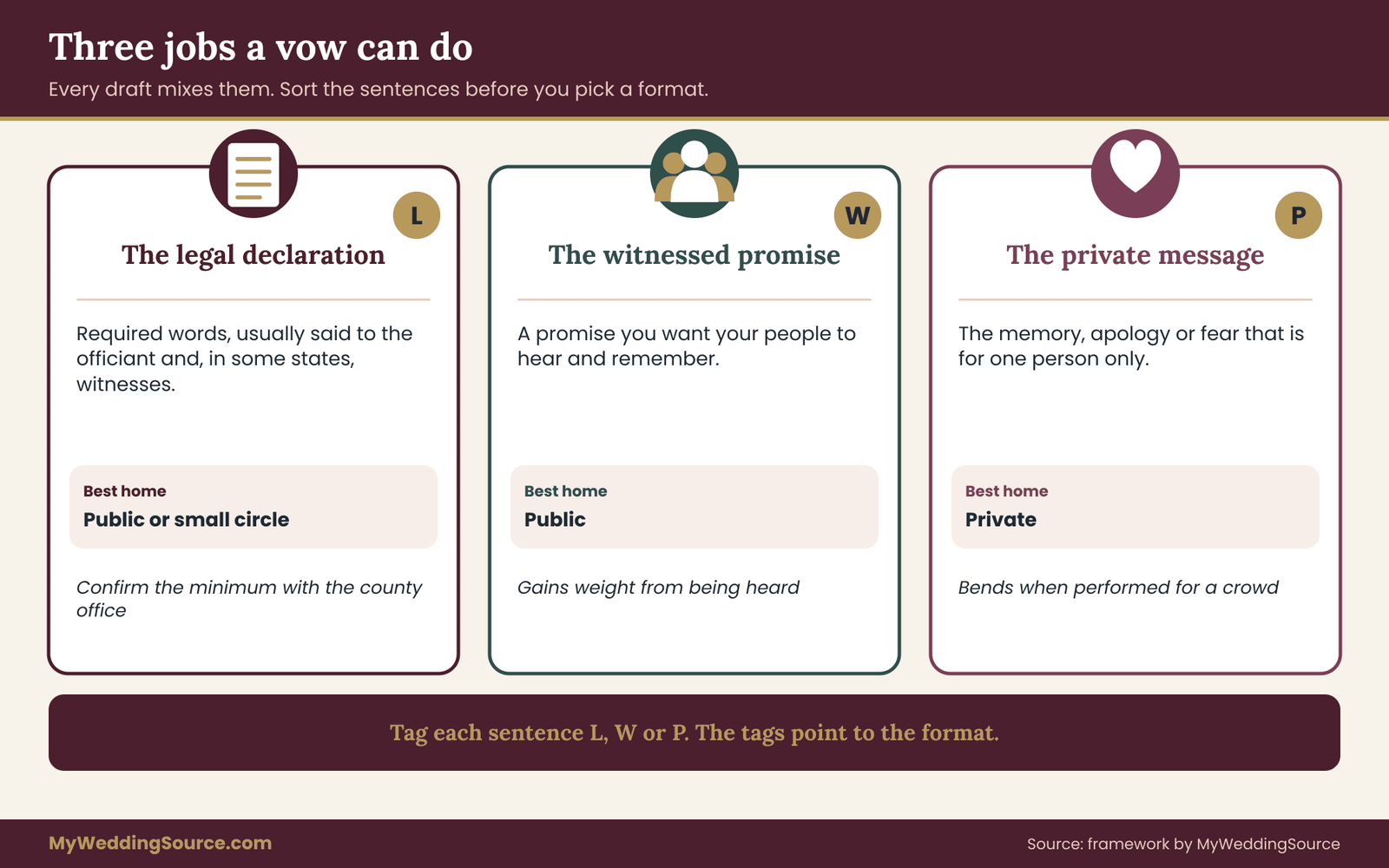
Most draft vows contain all three jobs mixed together in one document. That is why a single format often feels slightly wrong. A full-room reading is a good home for job one and job two, and a poor one for job three. A private exchange is a good home for job three, and a poor one for job two. The sorting step below turns that observation into a method.
The sort-sentence method
Take a draft of your vows, or a list of what you want to say if you have not drafted anything yet. Go through it one sentence at a time and tag each sentence with one of three letters.
L for legal or ceremonial. These are the words that the officiant or the license process requires, or the words you want in a formal, traditional shape.
W for witnessed. These are promises or statements you would be glad for guests to hear and remember. If you imagine your grandmother, your boss and your college roommate all hearing the sentence, you feel fine or proud.
P for private. These are sentences that would feel exposed, confusing or unfair to the people around you if said aloud in the room. They are not shameful. They are simply addressed to one person.
Do not overthink the tags. The test is a gut reaction: imagine the sentence said into a microphone with every guest listening. If your stomach tightens, it is probably a P. If it makes you stand a little taller, it is a W. If it is a fixed phrase the officiant will lead, it is an L.
Here is a small invented example, so the method is concrete. A partner has written five lines.
“I take you as my spouse.” That is an L.
“I promise to keep showing up at your mother’s Sunday dinners even when you are traveling.” That is a W, because her family would like to hear it, and the promise gains weight from being public.
“I promise to stop checking my phone during the first hour after we both get home.” That is a P for many couples, because it is a specific, slightly embarrassing household promise that works better said quietly.
“I still remember how scared I was the night you got the call about your father.” That is a P, and probably a firm one, because it touches a family event that other people in the room may not know about.
“I choose you, today and every day after.” That is a W, and a good candidate for the shared public line.
Count the tags. If almost everything is L and W, a public format will serve you well and a private moment would be a nice extra. If a large share is P, you are likely to feel cramped in a public-only format. If the tags are split evenly, you have just identified your best option: a split format.
The five formats between private vows and public vows
There is no switch with two positions. Couples choose from at least five formats, and the differences between them are practical, not philosophical. The names below are working labels for this guide, not industry terms.
Format A: fully public vows. Both partners say all their vows aloud in the ceremony. This is the traditional default. Guests hear everything, the officiant introduces it, and the photographer and videographer capture it as part of the ceremony coverage.
Format B: short public vows plus private vows. Both partners say a brief shared promise in the ceremony, often one or two sentences that the officiant leads, and then exchange longer personal vows privately. The private part might happen before the ceremony, during a first-look window, or in the quiet minutes after the ceremony while guests move to cocktails.
Format C: private vows with a small witness circle. The personal vows are heard by the officiant and two or three people, such as parents or the best friends who will sign the license. The large ceremony then stays brief.
Format D: private vows only, with the legal declaration done separately. The couple exchanges personal vows alone, and the legal declaration is handled in a brief, simple ceremony with the officiant and required witnesses. This is common with elopements and courthouse weddings that add a celebration later.
Format E: written or recorded private vows. Each partner writes or records the vows alone, and they are exchanged as letters or audio files that are read in private. Nothing is said aloud in front of anyone, but the words are still addressed and delivered.
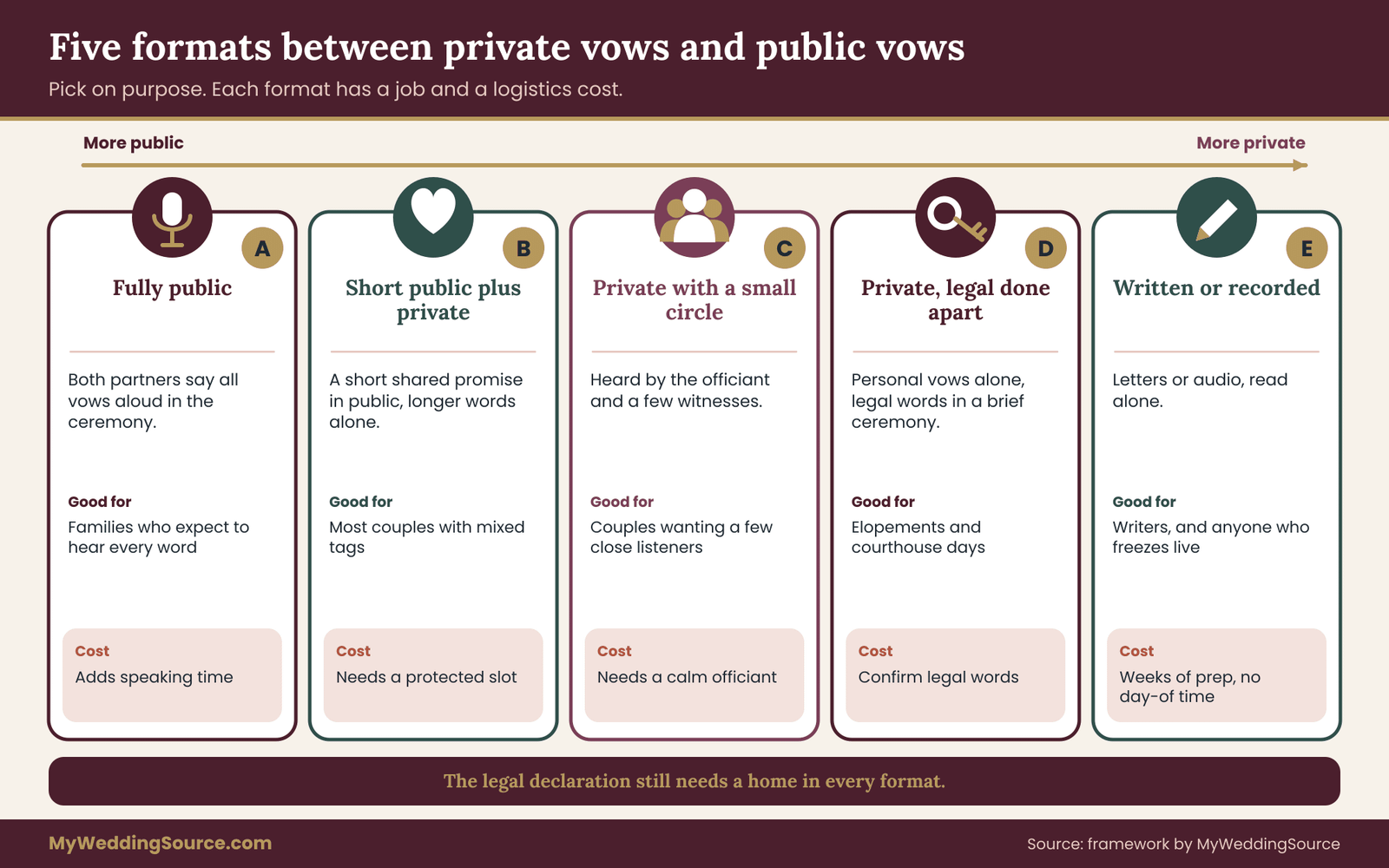
These formats are not ranked. Format A can be the right answer for a couple whose families need to hear them, and Format E can be the right answer for a couple who both freeze in front of a crowd. What matters is that you pick a format on purpose and that both partners can tell you what job it is doing.
Where the legal declaration fits in each format
The most common mistake with private vows is forgetting that the legal words still need a home. In formats A and B the legal declaration happens in the public ceremony, so there is nothing to arrange. In formats C and D, the couple should confirm with the county clerk or the officiant which words must be spoken, in whose presence, and whether witnesses are required.
In format E the legal declaration is again said in the ceremony or in a short formal moment, because exchanging letters does not replace it. If the ceremony is brief, tell the officiant ahead of time so they do not build the script around speeches that will never happen. The wedding officiant requirements guide covers what officiants typically need to complete a license, and it is worth checking before you settle on a format with a shorter ceremony.
The timing consequence of private vows
Each format also changes the clock. Format A adds speaking time to the ceremony. Format B adds a short block of private time somewhere earlier or later. Formats C and D usually shorten the main ceremony and add a small side event. Format E adds almost no time during the day, but it adds a pre-wedding task: the letters have to be finished, exchanged and read.
A rule of thumb that holds up in practice: any private moment needs a protected window with a named owner and a start time, or it will be crowded out by the schedule. The logistics section for private vows, later in this guide, returns to this with a working timeline.
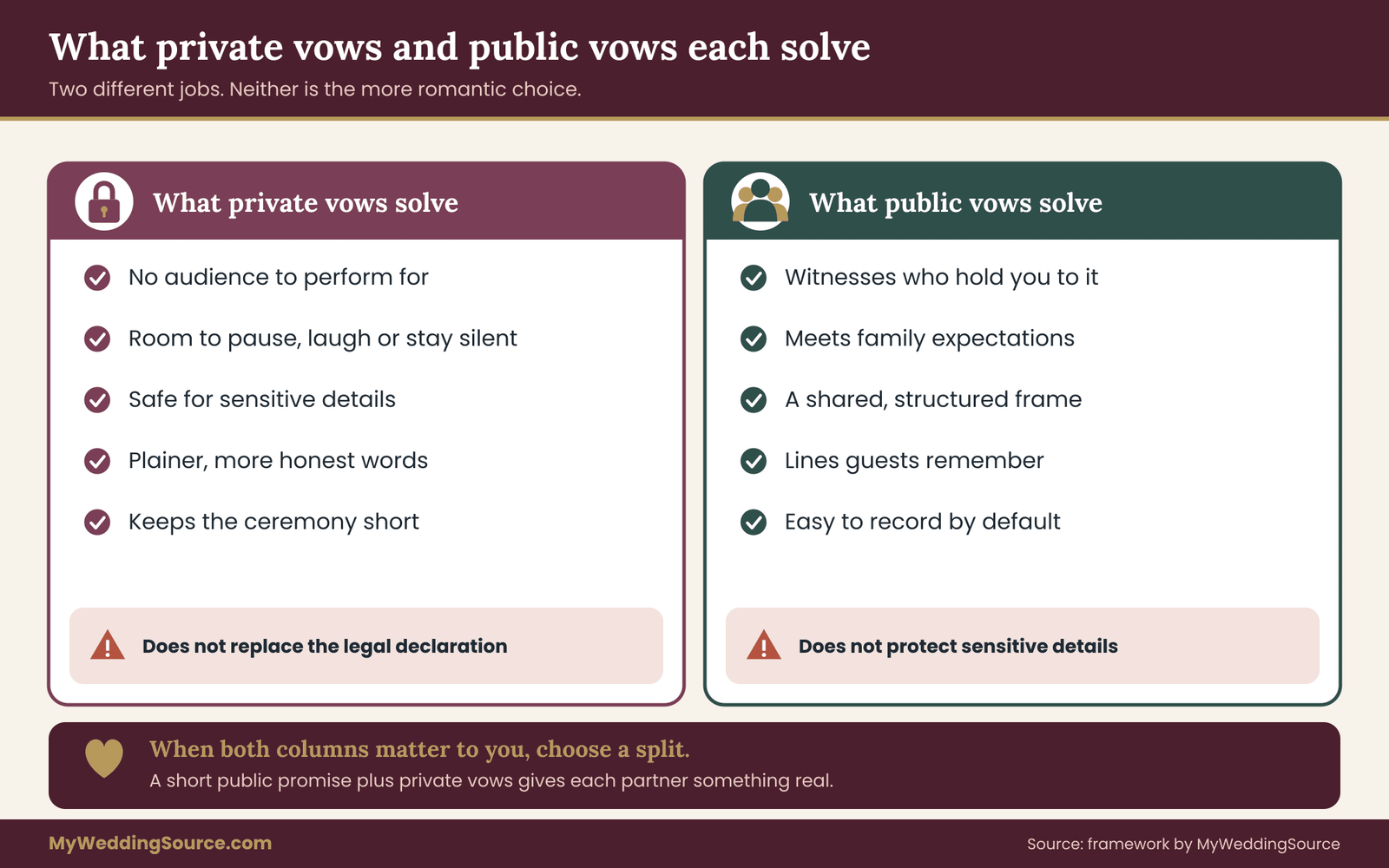
What private vows solve
Private vows exist because some words get worse when they are performed. That is the single honest reason to choose them, and it covers more ground than it first sounds.
They solve the audience problem. When you speak to a room, part of your attention goes to the room: the pace, the laughter, the person in the third row who is already crying. Private vows remove that second job. Each partner speaks to exactly one listener, and the speaker can pause, laugh, start over or stay silent for ten seconds without anyone filling the gap.
They solve the nerves problem, partly. Some people speak calmly in front of a crowd and others lose their voice. Private vows do not cure anxiety about the wedding, but they take away one of the most public triggers. A partner who knows the vows will be said in a quiet room often relaxes through the rest of the day. If your nerves feel strong or unusual, the National Institute of Mental Health publishes general information on social anxiety, and a licensed professional can advise on your situation.
They solve the sensitivity problem. Some of what couples want to say involves a health condition, a loss, a family conflict, a past relationship or a private fear. Those details belong to the couple, and sometimes to other people as well. Private vows let you say them to the person they are for without deciding what the room is allowed to know.
They solve the honesty problem. In front of guests, people soften. They choose the funnier version, the safer version, the version their mother will like. Private vows give permission for the plainer version. A couple that has said the plain version first often finds the public version easier, because the hard sentences are already out.
They solve the pacing problem. A ceremony with two long speeches in the middle can stall. Moving the longest, most personal words into private vows lets the public ceremony stay short and steady, which suits an outdoor setting, a hot day, or a ceremony with small children and older guests.
What private vows do not solve
Private vows are not a fix for every wedding worry, and it helps to be clear about the limits.
They do not satisfy the legal declaration, which still has to happen with the people your jurisdiction requires. They do not give guests the emotional moment some of them are counting on. They do not create a record unless you decide to make one. And they do not settle a disagreement between partners, because choosing private vows to avoid a hard conversation just moves the conversation to the day before the wedding.
There is also a quieter limit. Private vows have no accountability built in. A promise said with a hundred witnesses carries a social weight that a promise said alone does not. Some couples do not want or need that weight. Others realize it is the whole point. Which kind you are is something only the two of you can answer.
Four signs that private vows fit you
You will not know from a checklist alone, but these patterns tend to point the same direction.
One or both of you write more easily than you speak. A written or recorded exchange gives you your best version.
The words you want to say include sentences you would not say to a guest at the reception. If you have already tagged several lines as P in the sort-sentence method, you have your answer.
The wedding is large, and you worry the vows will turn into content for the room instead of words for each other.
You want a quiet moment with your partner on the wedding day because the rest of the day will be shared with everyone. In that case private vows are less about secrecy and more about reserving time. For many couples this is the real value: ten calm minutes between a morning of preparation and an afternoon of being looked at.
What public vows solve
Public vows exist because a promise gains force when other people hear it. That is also a precise, practical reason, and it covers a different set of needs from the ones above.
They solve the witness problem. A wedding is partly a community event. Guests are there to witness, and hearing vows is how they take part in that role. A public promise tells the people around you what you intend to do, which makes them more likely to support you when it is hard.
They solve the family expectation problem. For many families, especially those with religious or cultural traditions around the ceremony, hearing the vows is the moment that makes the wedding feel real. If a grandparent has traveled a long way, the vows are what they traveled for. A fully private format can leave them feeling that the real event happened elsewhere. Short public vows or a public repetition of a shared line often restore that feeling at small cost.
They solve the clarity problem. Public vows are usually structured, shorter, and led by an officiant. A fixed shape protects both partners from a speech that wanders or from a mismatch in length. When one partner writes a short promise and the other writes two pages, a shared public format gives both a common frame.
They solve the shared-memory problem. Guests remember what they heard. A line from a public vow gets quoted at the reception, repeated by a cousin, and returned to in a toast a decade later. Private vows do not leave that trail, which is a benefit or a loss depending on what you want.
They solve the record problem. Public vows are usually captured by default, because the photographer and videographer are already in position and the audio system is already running. You do not need to arrange anything extra. If you want a recording of the words, this is the lowest-effort route, though you should still confirm that the audio will actually be captured and ask who owns the file.
What public vows do not solve
They do not make the words honest. A public vow can be warm and still say very little. They do not reduce nerves. They do not protect sensitive details, and once something is said into a microphone, you cannot unsay it. They also do not guarantee that every guest can hear. Poor acoustics, wind, a soft voice or a hearing difficulty can mean that part of the room misses the vows altogether, and a public format only works if people can actually follow it.
Guests who cannot hear well deserve an equal place in the moment. The National Institute on Deafness and Other Communication Disorders offers general information on hearing, and the ADA.gov site gives a starting point on communication access. If your guest list includes people who rely on captioning, an interpreter or a hearing loop, plan that when you choose the public format, not after.
Four signs that public vows fit you
Both of you are comfortable speaking in front of people you love, or willing to practice until you are.
Your families or traditions expect the vows to be heard, and meeting that expectation matters to you.
You want a recording of the words and would rather not arrange a separate recording process.
You see the vows as a promise to a community as well as to each other, and you want that community to hear it.
If you checked boxes on both lists, you are in the majority, and that is where the split format earns its place. The next section explains how to decide in a way that gives each partner an equal say.
Choosing between private vows and public vows: a scoring method
Intuition about format tends to be loud on the day and unreliable before it. A short scoring method makes the decision calmer, and it makes disagreements visible early. This is the framework this guide offers, and you can complete it in one evening.
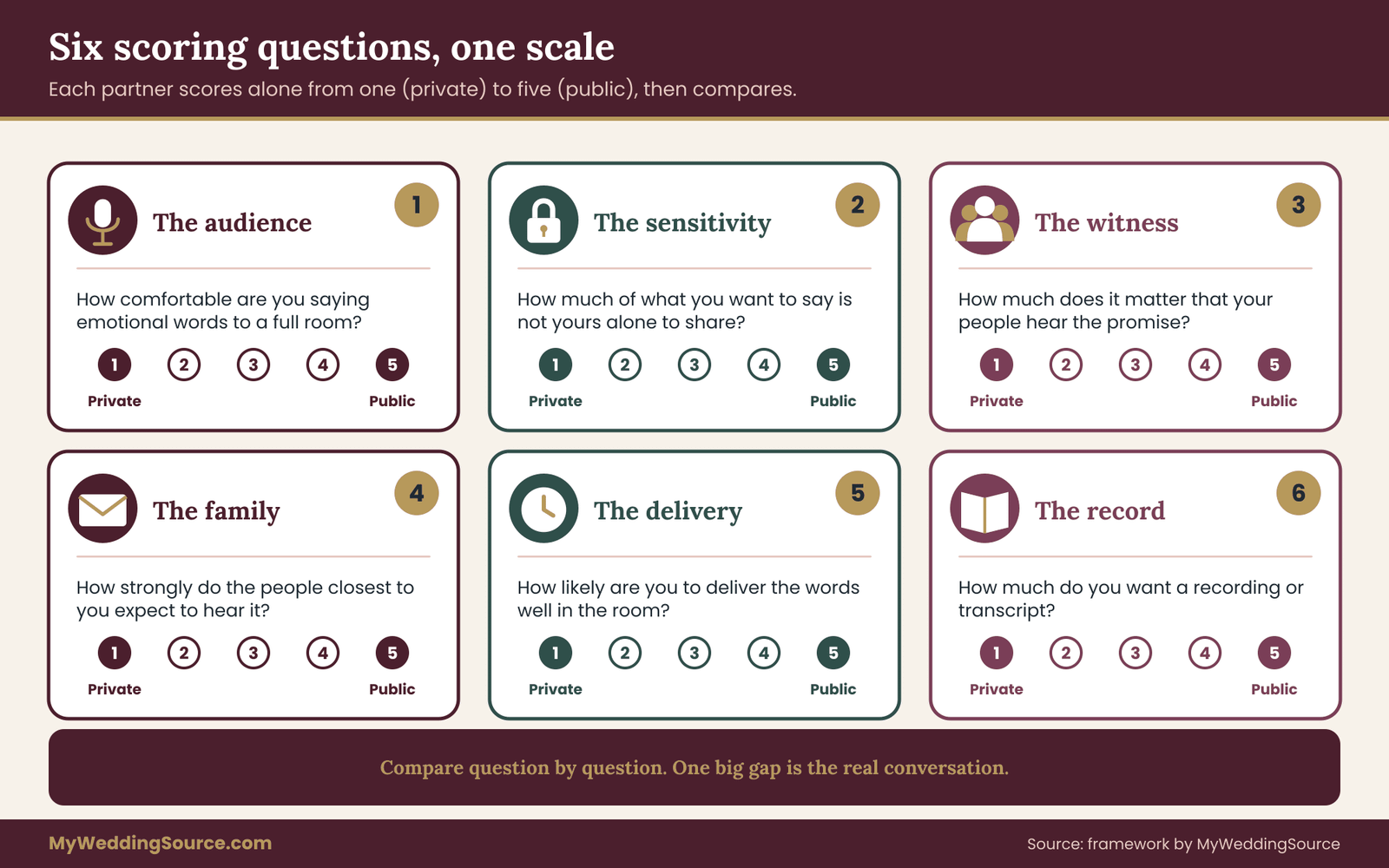
Each partner answers six questions on their own, without conferring. Each question gets a score from one to five, where one means “leans strongly toward private vows” and five means “leans strongly toward public vows.” Write the scores down before you share them.
Question one: the audience. How comfortable are you saying emotional words to a full room? One is “I would avoid it if I could.” Five is “I would enjoy it.”
Question two: the sensitivity. How much of what you want to say involves information that belongs to other people, or that you would not want repeated? One is “a lot.” Five is “almost none.”
Question three: the witness. How much does it matter to you that your people hear the promise? One is “not much.” Five is “it is the point.”
Question four: the family. How strongly do the people closest to you expect to hear the vows? One is “they would not mind at all.” Five is “they would be hurt.”
Question five: the delivery. How likely are you to deliver the words the way you intend in the room, given your nerves, the acoustics and the schedule? One is “unlikely.” Five is “very likely.”
Question six: the record. How much do you want a recording or a transcript of the words? One is “I would rather not.” Five is “I want it kept.”
Reading the scores
Add each partner’s six scores, and also compare them question by question. A total gives you a rough lean: a low total points to private vows, a high total to public vows, and a middle total to a split. The comparison tells you more than the total.
A large gap on one question is the real finding. If you each score yourselves four or five on every question except sensitivity, and one partner scores a one, then the format conversation is really a conversation about what that partner wants to say and why. Solve that and the rest follows.
If both partners land in the middle, choose format B, short public vows plus private vows, and treat it as the default. It is the format that most often gives each partner something they care about without forcing a trade-off.
If the totals are far apart, do not average them and call it a decision. The next section covers what to do when partners truly differ.
Why six questions and not one
A single question such as “do you want guests to hear it?” collapses six different concerns into one answer, and the answer you give depends on which concern is loudest that day. Splitting the question lets you see that you may want a witness and a recording while still wanting privacy about specific lines. That is exactly the case in which a split format works.
It also gives you a vocabulary. When you tell your officiant, your parents or your photographer what you chose, you can say what problem it solves in one sentence, and that tends to settle questions faster than “we just prefer it.”
When partners disagree about private vows
Disagreement is common, and it is usually about different fears, not different values. One partner pictures an audience and feels pride. The other pictures the same audience and feels dread. Both reactions are legitimate, and neither one is a character flaw.
Start by finding out what the preference is protecting. Ask each other the same open question: “What are you worried would go wrong?” Then listen for the answer underneath. The person who wants public vows may be protecting their family’s expectations, or a belief that promises should be witnessed. The person who wants private vows may be protecting a fragile sentence, a fear of crying, or a wish to be present instead of performing.
Those worries often have small fixes that do not require a winner. A fear of crying can be handled by a short script and a glass of water. A fear of saying private things in public can be handled by moving those lines out. A family expectation can be met by one shared public sentence. Most disagreements shrink once the underlying worry is named.
Four compromises that actually hold
When the worry cannot be fixed directly, these compromises tend to work, because each one gives both partners a real piece of what they asked for.
The shared line. Both partners say the same one or two sentences in the public ceremony, led by the officiant. The personal words go into private vows. The partner who wanted a public moment gets one, and the partner who wanted privacy keeps the part that matters to them.
The reading swap. Each partner reads the other’s private vows aloud only in a small circle, such as the wedding party at the rehearsal dinner, after both have agreed to exactly which lines are shareable. This works for couples who want some audience but not the full room.
The delayed reveal. The couple exchange private vows on the wedding day and agree to share a selected passage later, perhaps in a thank-you note or at the first anniversary. The public gets a taste without having been present.
The trial run. The partner who is unsure about public vows says them aloud once, in the real venue or one like it, to a single trusted person. If it feels fine, the public format stays. If it does not, the private format takes over. This turns a guess into evidence.
What not to do
Do not settle the question by one partner conceding in silence. A concession made to end the conversation tends to return as resentment on the wedding morning, when it is hardest to fix. If one partner gives way, they should say so aloud and name what they want in return, even if it is small.
Do not let a parent decide. Parents may have strong feelings, and those feelings deserve a hearing, but the format belongs to the couple. The wedding decision-making guide explains how to take family input without handing over the decision, and the same approach applies here.
Do not use the vendor as the tiebreaker. A photographer who prefers to capture public vows is giving a coverage preference, not advice about your marriage. Ask for their opinion on logistics only.
A short script for the conversation
If you are not sure how to open the conversation, a plain script helps.
“I want us to decide how we say our vows without either of us feeling steamrolled. Can we each write down what we are worried about, and what we are hoping for, and then swap?”
When the notes are swapped, read yours aloud without defending anything. Then ask one question each: “What would make this feel right to you?” If the answers are compatible, you are done. If they are not, return to the compromises above before you try anything else.
A worked example: one couple, three drafts of the decision
The following couple is invented, and the numbers are illustrative, not data. It shows how the sort-sentence method and the scoring method fit together.
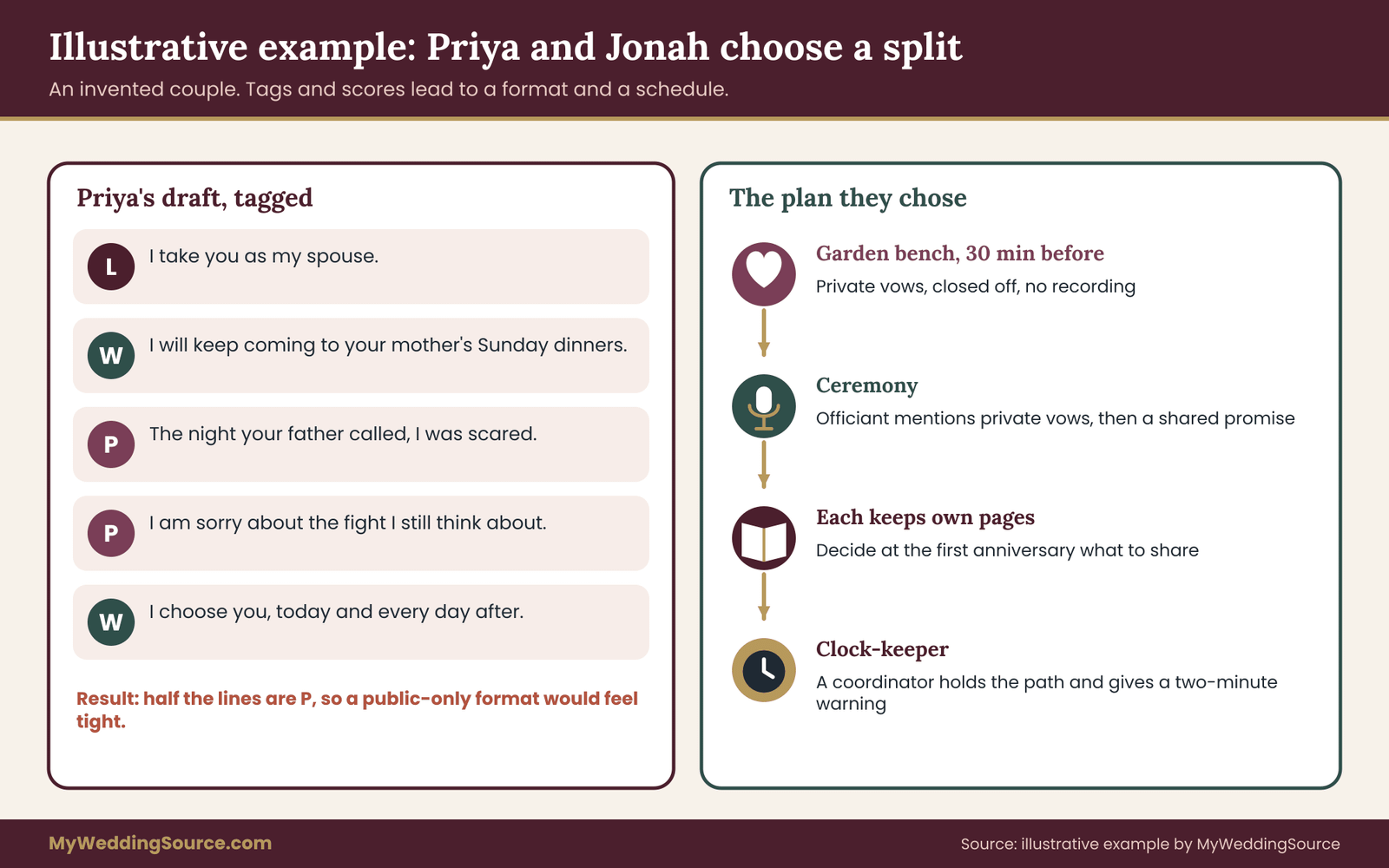
Imagine Priya and Jonah, planning a ceremony for about eighty guests at a garden venue. Priya writes easily and cries easily. Jonah is a calm public speaker who dislikes sentimental language aloud. Both of their mothers expect to hear the vows.
Draft one: the default
Their first plan is format A, fully public vows. Each will speak for about two minutes. When Priya drafts hers, she tags the sentences and finds that roughly half are P. She wrote about the year her brother was ill, about a fight she is still sorry for, and about a private nickname. Jonah’s draft is almost all W: short, warm, safe to say anywhere.
They score separately. Priya’s scores lean low on audience and sensitivity, and high on family. Jonah’s lean high across the board except for record, where he does not mind either way.
Draft two: the split
The gap is concentrated in two questions: audience and sensitivity. They agree that the family expectation is real, so they do not drop public vows. They choose format B. In the ceremony they each say a one-sentence promise that the officiant leads, plus one short line each of their own that was tagged W. The long personal words go into private vows, to be exchanged in the thirty minutes before the ceremony.
For the private moment they add three small rules. It happens in a quiet room with a closed door. Nobody records it. Each of them keeps their own pages, and they will decide on the first anniversary whether to share anything.
Draft three: the adjustment
At the venue walkthrough, they learn that the only quiet room is far from the bridal suite, which would eat ten minutes of the schedule. They move the private exchange to a bench in the garden, thirty minutes before the ceremony, with a coordinator holding the area. They also ask the officiant to mention at the ceremony that the couple have already exchanged private vows, so no guest wonders why the personal part is brief.
The result is a ceremony that runs about eight minutes shorter than the original plan, and private vows that have enough time to be real. The mothers hear a public promise. Priya says the sentences about her brother only to Jonah. Jonah gets to be brief in public and still say one longer thing, in private, that he would never say aloud to eighty people.
What this example shows
Three things carry over to your own decision. First, the format emerged from tags and scores, not from a general feeling. Second, the compromise gave each person a concrete benefit, not a vague one. Third, the logistics, the bench, the coordinator, the officiant’s mention, were part of the decision, not an afterthought. A format is only as good as the arrangement that makes it work.
Logistics for private vows: time, place and who holds the clock
Private vows are easy to want and surprisingly easy to lose. On a wedding day, any unprotected block of time gets absorbed by the next urgent thing. Treat private vows like a vendor appointment: they need a start time, a place and an owner.
Choose the slot
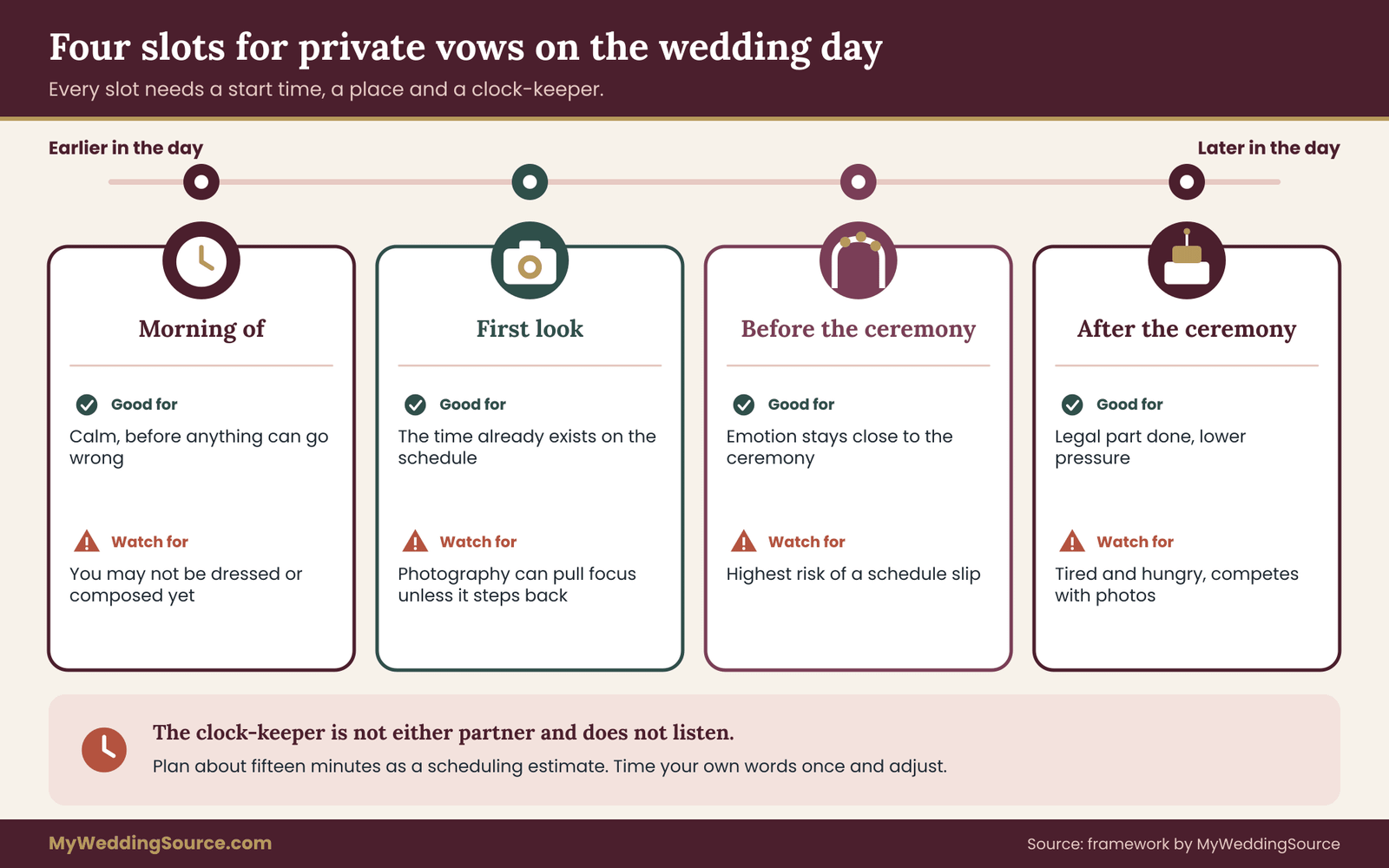
Couples usually choose one of four slots, and each has trade-offs.
The morning-of slot. This happens before hair and makeup or just after, in a calm window. The advantage is clarity: nothing has gone wrong yet. The disadvantage is that you may be thinking about the day ahead, and you may not yet be dressed or composed.
The first-look slot. This is the quiet window when the two of you see each other before the ceremony. Many couples add private vows here because the photographer is already scheduled around it. The advantage is that the time already exists. The disadvantage is that photography can pull attention away unless the photographer steps back for the vow itself.
The pre-ceremony slot. This is a short exchange immediately before guests are seated. It keeps the emotion close to the ceremony. It carries the highest risk of a schedule slip, so give it a buffer and a person who is responsible for ending it on time.
The after-ceremony slot. Private vows said here happen in the minutes after the ceremony, while guests move to cocktails and the photographer handles family photos. The advantage is that the legal part is done and the pressure is lower. The disadvantage is that you may be tired and hungry by then, and it competes with photographs.
Choose the place
A good place for private vows has four qualities. It is quiet enough that you can hear each other without raising your voices. It has seating, because standing still for ten minutes in dress shoes is harder than it sounds. It has some shelter from wind, sun and passing staff. And it has a way to keep people out without making a show of it.
If the venue has a bridal suite, ask whether it can be used for this purpose at the right time, and whether anyone has a key. If you are outdoors, ask the venue about a screened corner or a bench away from the service path. A venue walkthrough is the cheapest time to note the quietest corner, and it costs nothing to ask the coordinator to point it out.
Name the clock-keeper
Pick one person who is not either partner to hold the clock. This is often a coordinator, a sibling, or a close friend. Their job is small. They confirm the start time, guard the door or the path, and give a gentle two-minute warning. They do not listen.
Give them a script, because people hesitate to interrupt a moment like this.
“We are about two minutes out from the next thing on the schedule. Take whatever time you need to finish, and I will knock once.”
Having that sentence ready makes it easier to say and easier to hear.
How long to allow
A set of private vows for two people usually takes less time than you expect when you are planning it, and longer when you are inside it. A workable plan allows about fifteen minutes in total for arriving, settling, reading or speaking each set of vows, and a few quiet moments afterward. If you are also exchanging letters or small gifts, add a few more. These are planning estimates for scheduling, not studies, so adjust them after you have timed your own words aloud once.
Logistics for public vows: length, sound and access
Public vows put every detail in front of an audience, so small problems become obvious problems. The good news is that most of them are cheap to prevent, and they can be handled in a single conversation with the officiant and the sound provider.
Settle the length
Two people speaking for three minutes each add six minutes to the ceremony, plus pauses. That is fine for most weddings. It becomes a problem when a ceremony is already carrying readings, a ritual, a musical performance and a long processional. Decide how much time the public vows get before anyone starts writing them.
If one partner prefers a short public promise and the other wants a longer one, agree on a shared ceiling, such as “neither of us goes over ninety seconds,” and let the private vows hold the rest. A matching length avoids the awkward feeling that one person gave a speech and the other gave a sentence. The wedding ceremony cue sheet guide shows how to place each spoken piece on a timed run of the ceremony, which makes the total visible.
Decide how the words are delivered
Public vows are delivered in one of four ways, and each has a risk.
Memorized. It looks natural and feels intimate, but one slip can derail a nervous speaker. Not recommended unless you have a backup.
Read from a card or booklet. It is the safest, and it can look as good as any other method if you hold it low and look up at the key lines. Print the text in a large size, because dim light and tears make small type hard to read.
Repeated after the officiant. The officiant says a phrase and each partner repeats it. This is the most forgiving for anyone with nerves, because there is nothing to remember. It is also the most traditional and the least personal.
Read from a phone. It works in a pinch, but screens glare outdoors, notifications can appear, and the phone becomes a distraction in the photographs. If you must, switch on do-not-disturb and bring a printed copy as backup.
Plan the sound
If guests cannot hear the vows, the public format has failed, no matter how good the words are. Before the ceremony, ask the person who runs the sound three direct questions: Will each partner have a microphone, or will one be shared? Who tests the microphones at the venue, and when? And what is the backup if a microphone fails?
For outdoor ceremonies, wind and traffic matter more than most couples expect. A lapel microphone on each partner often works better than a handheld microphone, because both hands stay free for holding a card and a partner’s hand. If you are using wireless microphones, the venue or the sound provider should know the rules for the frequencies in use; the Federal Communications Commission publishes information on wireless microphone operation, and a professional provider will already be familiar with it.
Acoustics deserve a test. If you can, stand in the real ceremony position during the venue walkthrough, speak at the volume you would use, and have someone stand in the back row. Ask them if they can follow each word.
Plan for access
Public vows are only public for guests who can take part. Think through three groups.
Guests who are deaf or hard of hearing may want captioning, an interpreter, a printed copy of the vows or a seat near the front. Ask on the invitation or the website, and respond privately.
Guests who do not speak the language of the ceremony may want a printed translation, or a short summary read by a bilingual friend. If a partner is more at ease in another language, you may want to say the vows in that language and print a translation in the program.
Guests who use mobility aids need clear routes and seating that allows a view and a clear line of sight. The ADA.gov site is a starting point for general information on accessibility obligations and good practice.
Decide who may record
Public vows are an obvious target for phones. Decide in advance whether you want an unplugged ceremony, one phone-free line only for the vows, or open recording. Say so in the program and have the officiant repeat it before the ceremony starts. The wedding photography consent guide covers guest boundaries and image use in detail, and the same principles apply to the sound of your voice as to your image.
Edge cases that change the answer
Most couples fit one of the formats above. A few do not, and it helps to see the unusual cases before they surprise you.
One partner will not say vows at all
Some people do not want to say personal vows in any format. They may be uncomfortable with the idea, or the culture they come from does not include them. This is not a failure of the relationship. Offer a low-pressure option for private vows or none at all: a fixed script repeated after the officiant in public, and the option of a short written note in private. The partner who wants to say more can put it into private vows, and the other can receive the words without matching them.
The ceremony is religious or has fixed vows
Many religious ceremonies have vows set by tradition or by the officiant’s community. In that case the public vows are the fixed ones, and the personal words move into private vows by default. Ask the officiant what flexibility exists before you plan anything, and if the answer is none, treat the private exchange as an addition outside the service. If the service blends traditions, settle who owns each ritual first, and use the same conversation to decide where private vows can sit.
The words are in two languages
Couples who speak different languages often want to say vows in each. Decide whether to say them privately in the language that feels most natural and publicly in a shared one, or to say both aloud. A bilingual public exchange doubles the time, so check the schedule.
One of you is grieving
If a parent or someone close has died recently, vows may include words about them. Some couples want that mention in public so the guests can honor it. Others want it said only to each other, because aloud it may unsettle the room. Ask yourselves which version helps you get through the day.
A partner may become overwhelmed
If a partner is likely to be overcome, build a pause into the plan. In a public format, the officiant can give a signal and a moment of silence. In a private format, the clock-keeper can give extra time. In either case, the plan should treat emotion as expected, not as a failure.
Distance or illness
If a partner cannot attend in person, or a family member who must hear the vows cannot be there, a recorded or livestreamed exchange can bridge the gap. The wedding day digital contingency plan explains how to keep a backup of audio and video files and how to set permissions for shared links.
Elopements and courthouse weddings
A courthouse ceremony is often brief and the legal words are fixed. This makes it a natural home for format D: the legal declaration in the courthouse, and the personal vows said alone afterward, in a place that means something. The non-religious ceremony script shows how short, secular ceremony wording can be structured if you want the officiant to say a few lines.
Briefing the officiant, photographer, venue and family on private vows
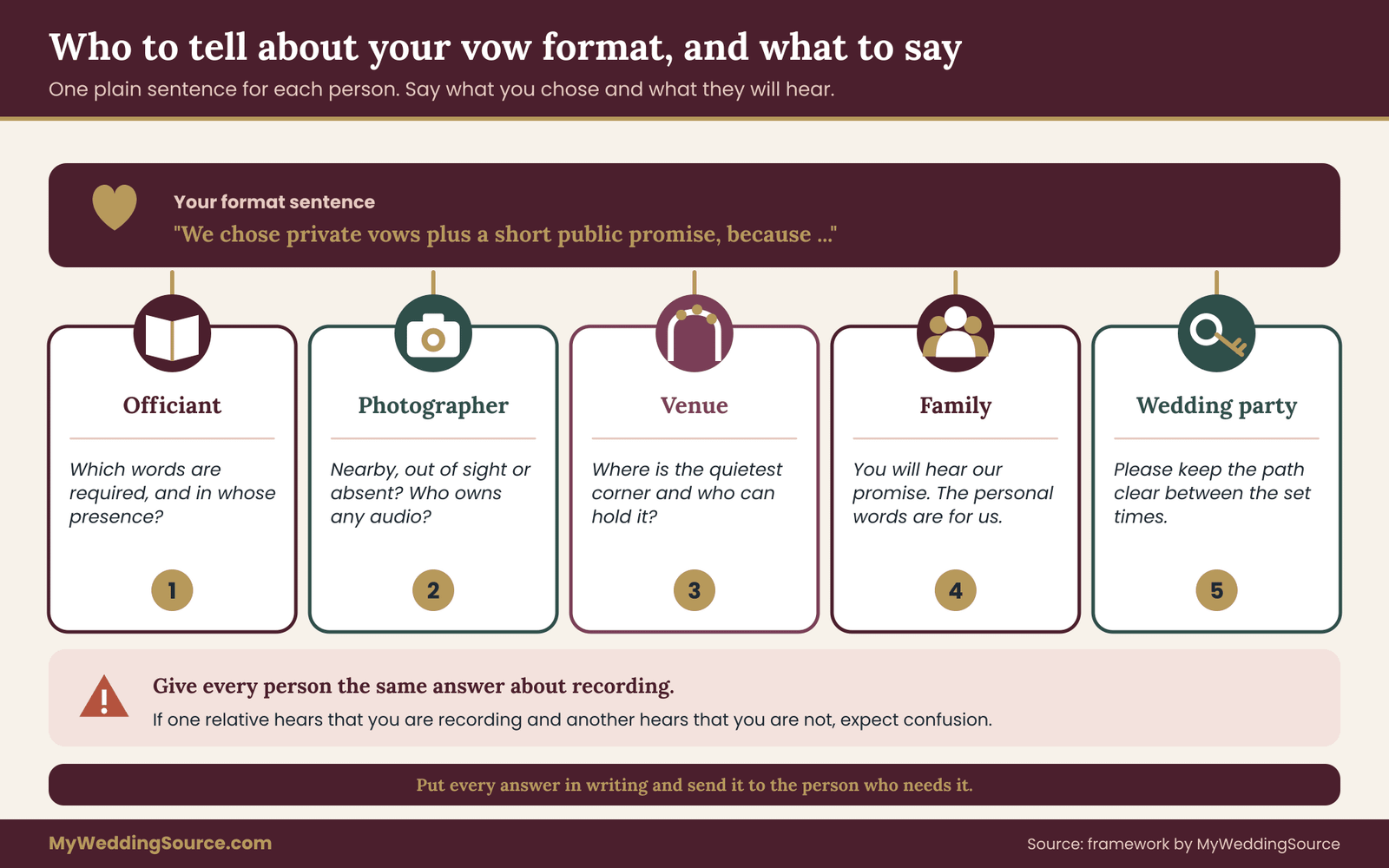
Once you have a format, three people shape whether it works: the officiant, the photographer or videographer, and whoever runs the venue. Each needs a clear brief. Short, specific questions get better answers than a general “we are doing private vows,” which means different things to different people.
What to ask the officiant
The officiant owns the structure of the ceremony, so start there. Ask these in order.
“Which words are required for the license, and who has to hear them?” This confirms what must happen in public or in front of witnesses, whichever format you choose.
“If we exchange private vows beforehand, how would you like to mention it in the ceremony?” Some officiants prefer a sentence of acknowledgment, and others prefer silence. Either works, but you want to know.
“Can we keep the public vows to one or two sentences, and will you lead them?” Many officiants are glad to, because it simplifies the ceremony.
“If we want to say personal vows in front of a small group, can you shape that moment?” Format C needs an officiant who is comfortable running a small, quieter segment.
A good officiant will tell you honestly if a format makes the ceremony awkward. Take that seriously, and ask for what they would change, not just what they object to. The wedding officiant requirements guide explains what an officiant normally needs from you, which helps you phrase these questions with the right documents ready.
What to ask the photographer and videographer
Private vows often fall in the middle of a photography schedule, and the photographer has no way to know what you want unless you say.
“For a private vow moment, do you want to be present, stay out of sight, or stay nearby?” Some couples want a photographer a short distance away, capturing silhouettes without hearing the words. Others want no photographs at all.
“Can you record audio only, using a small recorder placed by us, and give us the file without listening to it?” If you want a private recording, this puts control in your hands. Some professionals will agree, and some will not. Ask early, and put the answer in writing.
“Who owns the audio and video files from the ceremony, and for how long will you store them?” This matters for public vows too, because the recording of your voice may sit on a vendor’s server for a period set in the contract.
“If we ask you not to record, will you also keep the vow moment out of any promotional use?” Image and audio use clauses are worth reading closely. Read the usage and ownership clauses in the contract closely, and ask for any change in writing.
What to ask the venue
The venue controls spaces, schedules and sound. Ask where the quietest place is, who can hold it, and what the access rules are for a private moment. Ask whether the sound system includes lapel microphones, who operates it, and when it can be tested. Ask whether the building has a policy on recording, and whether any restrictions apply to livestreaming.
Ask too about the schedule. If the ceremony start time is tied to a hard curfew or to a buffer before the next event, a longer private moment may need to come from earlier in the day, not from the ceremony block.
What each format costs in time, money and attention
Format decisions rarely change the budget by much, but they change how time and attention are spent. Being honest about these costs helps you choose without surprises. The points below are about logic, not price quotes. Actual prices vary by vendor and region, so ask for a written quote for anything you add.
Time
Format A uses ceremony minutes. Format B uses a few ceremony minutes plus a private block elsewhere in the day. Formats C and D shift the weight to a smaller event. Format E uses almost no day-of time but needs weeks of pre-wedding effort. If your day is already tight, choose the format that costs the time you actually have.
A useful habit is to write the private moment into the run-of-show with a start time, a length, a place and a name beside it. If it is not on the schedule, it is not protected.
Money
Private vows are usually free of direct cost, but they can bring small costs in other places. A small audio recorder or a good microphone for a private recording is a modest purchase or rental. A coordinator, a photographer or a videographer may charge for extra time if the private moment adds to the working day, so check how the contract treats added coverage. A separate legal ceremony, as in format D, may involve its own fee or its own time at an office, so confirm with the issuing office.
Public vows can bring costs in sound and recording. If the venue does not provide microphones, renting them has a cost. If you want vows captured on video with clean audio, the videographer may need a dedicated microphone, which can affect the package.
None of these costs usually decide the matter. Where a cost does appear, compare it to what the format solves. If a private recording is worth keeping for decades, a modest equipment cost is easy to justify. If it is a vague wish, you may not need it.
Attention
This is the cost couples undercount. A public ceremony asks both partners to manage an audience while delivering words. Private vows ask both partners to be fully present with each other and nobody else. They tax different parts of you. A couple who expect to be exhausted by the end of the cocktail hour may want to keep the heaviest emotional moment in the quieter slot, and a couple who thrive on energy from a crowd may prefer to keep it in the public ceremony.
Think about the state you will be in at each point of the day. A moment placed at the wrong time costs more than it should.
Telling family and guests what to expect
Private vows only feel wrong to guests when they are surprised. A few plain sentences, said at the right time, remove the surprise.
Tell the people who expect to hear
Parents and grandparents are the group most likely to feel left out. Tell them before the wedding, kindly and directly, and tell them what they will get. A script helps.
“We decided to say our personal vows privately, because there are things we want to say only to each other. In the ceremony you will hear our promise to each other, and we would love for you to be there for that.”
Do not apologize for the format, and do not ask for permission. Say what you chose and what they will hear. Most people accept a plain explanation, and those who feel disappointed usually soften when they know a public moment still exists.
Tell the wedding party
The wedding party should know the format because they may be asked to hold a door, keep the time or protect a space. Tell them the schedule and ask for one specific favor, such as “please keep guests out of the garden between 3:30 and 3:45.” Specific requests are easier to carry out than “give us some privacy.”
Tell the guests
Guests do not need a long explanation. Two simple options work. The officiant can say a line at the start of the ceremony: “The couple has already shared their personal vows with each other, and now they will make their promise in front of you.” Or the program can include a short note with the same message. Either one tells guests what happened and invites them into the part that remains.
If you want to share something afterward, such as a short passage from the private vows, say so in advance, or surprise guests with it in a toast. Never put pressure on a partner to share more than they agreed to.
What to avoid
Do not announce private vows in a way that sounds like a secret kept from the guests. Avoid wording such as “they said something that only they will ever hear,” because it makes some guests curious in an unhelpful way. Say what you did and move on.
Do not ask guests to respect the privacy without explaining what that means. If you want phones away during a public moment, say that clearly and early.
Keeping private vows private, or sharing them later
Choosing private vows does not end the decision. The words still exist, either in your memory, on paper or in a file, and what you do with them matters more than most couples expect. This section covers storage, recording, sharing and the legal edge of quoting other people’s work.
Decide what exists afterward
For each set of private vows, choose one of four outcomes before the day, and tell each other what you chose.
Spoken only. Nothing is written down or recorded beyond a draft that you will discard. The words live in memory. This gives the most privacy and the least permanence.
Written and kept. The pages exist, and each partner keeps their own. They may be stored with keepsakes and read on anniversaries.
Recorded and kept. An audio or video file exists. It can be listened to later, but it can also be copied, shared by accident or lost with a device.
Recorded and shared. A selected piece is shared with family or friends, by agreement.
Neither partner should decide the outcome alone. If one wants a recording and the other does not, the answer is no recording, or a recording stored by the partner who wants it and never opened by the other. Agree on this in writing, in a short note, so there is no argument later.
Store the files like sensitive papers
If you record private vows, treat the file the way you would treat a certified marriage record: limit access, keep copies in more than one place, and decide who can find it if something happens to you. The wedding records after the event guide describes access levels that work well for a file like this, with a master copy, a backup and a short list of who may open it. The Library of Congress and the Cybersecurity and Infrastructure Security Agency both publish general guidance on keeping digital files safe, and the principles are the same.
A few practical rules help. Name the file in a way that does not reveal what it is. Keep it out of any shared family album and out of automatic photo backup that syncs to a shared account. Check which cloud accounts are shared with a partner’s family, a parent or an assistant before saving anything. And test that you can play the file on a device you expect to own in ten years, because formats change.
Recording consent, plainly
Recording a conversation between two people is simple when both agree. Problems arise when a third person or a device records without everyone knowing. Rules on recording vary by place, so do not assume that what is legal in one state is legal in another. When you ask a vendor to record, make sure everyone in the space knows. When you record privately, both partners should agree on it, in advance, aloud.
If a family member or friend asks to record a private vow moment, a kind and firm no is appropriate. Say it before the day, not at the door.
Quoting other writers in private vows or public vows
Many vows include a line from a poem, a song or a book. A short quotation is usually fine to say aloud in a private moment.
If you plan to print the vows in a program, publish them online, or play a recorded performance, the rules change. Song lyrics and poems are usually protected by copyright, and reproducing them in print or online may require permission. The U.S. Copyright Office publishes plain explanations of what copyright covers and when permission is needed, and it is the right place to start. When in doubt, paraphrase in your own words, or limit the quotation to a very short phrase and credit the source.
This matters most for public vows that will be printed or posted. Private vows spoken to one person are lower risk, but the same care applies if you plan to share a recording.
Sharing a piece later
If you choose to share a passage after the wedding, decide what counts as shareable before you reopen the file. A simple rule works: only lines tagged W in the sort-sentence method go out. Lines tagged P stay private. That keeps the private vows private even if you later decide to share part of them. For the broader step-by-step flow of a ceremony and where these moments sit, the wedding ceremony guide on this site is a useful reference.
Mistakes that undo private vows, and a five-minute decision rule
Most failures of a vow format are not about the format. They are about a missing piece of the arrangement. These are the ones to look for.
No one owns the time for private vows. It is on a wish list, not on the schedule. The day runs long, and the vow exchange shrinks to three minutes or disappears. Put it on the run-of-show with a name beside it.
The legal declaration gets forgotten. A couple exchange wonderful private vows and arrive at the ceremony assuming the officiant can simply declare them married. The officiant needs the legal words said in the right way. Confirm the minimum early.
The public vows are too long for the room. A seven-minute speech in a hot garden is not romantic. Agree on a ceiling and hold to it.
Guests are surprised. A short note in the program or a line from the officiant removes the surprise. Without it, guests may guess that something went wrong.
One partner agreed to end an argument. The concession returns on the wedding morning. Revisit the decision once, a few weeks out, and ask, “Are we both still glad about this?”
The recording becomes an expectation. If you tell one family member that you are recording and another that you are not, you are heading for a misunderstanding. Settle the recording question and give everyone the same answer.
The words are too exposed for the format. A line that is fine in private can be painful in public, and a public line can feel hollow in private. If a sentence keeps bothering you, re-tag it. Re-tagging is part of the process, not a sign of failure.
The microphone fails. For public vows, ask what happens if it does. Have a backup plan, and ask the officiant to repeat the vows in a clear voice if necessary.
A pre-mortem you can do in ten minutes
Sit down with your partner and imagine that, a week after the wedding, one of you wishes the format had been different. Ask what the most likely reason would be. Then write the answer as a sentence, such as “I wish we had said more in front of my grandmother,” or “I wish I had not felt rushed during the private exchange.” Each sentence points to a small change you can still make: add a line, add ten minutes, move a start time. This is a cheap way to find the weak point before the day.
A five-minute decision rule
If you want a short version of everything above, use this rule. It is not a formula. It is a way to reach a defensible answer when time is short.
First, name the three jobs your vows must do. If you cannot name the legal one, ask the officiant or the county office. If you cannot name the witnessed promise, you may not need public vows. If you cannot name the private message, you may not need private vows.
Second, tag five or six key sentences with L, W or P. If there is a clear majority, follow it.
Third, run the six scoring questions and compare, not just add. If one question shows a big gap, talk about that one.
Fourth, if the result is a tie or a mix, choose format B and write down who owns the private moment, when it happens and what exists afterward.
Fifth, tell your officiant, photographer, venue, wedding party and the family who expect to hear the vows. Use one sentence each.
That sequence takes an evening, and it avoids most of the regret that comes from deciding by default.
Your next steps
Here is a sequence you can finish in about two weeks, at an easy pace. Each step produces something you can point to.
- Write your three jobs. On one page, each partner lists the legal words, the promise they want witnessed and the message that is only for their partner. This makes the private vows and public vows visible as separate things.
- Tag the draft. Mark every sentence L, W or P. Do it alone, without discussing.
- Score the six questions. Swap scores, then talk only about the questions with the biggest gap.
- Pick a format. Choose one of the five formats, and write one sentence that says what problem it solves. If you cannot write the sentence, the choice is not ready.
- Confirm the legal minimum. Ask the officiant and the county office what must be said, and in whose presence.
- Book the private moment. Put the slot, the place and the clock-keeper on the run-of-show. Check that the venue can protect the space.
- Brief the vendors. Send the officiant, photographer, videographer and sound provider one short written note each, using the questions in this guide.
- Decide what exists afterward. For private vows, choose spoken only, written, recorded or shared, and write it down together.
- Tell the people who expect to hear. Use the script in this guide. Say what they will hear, not what they will miss.
- Hold a ten-minute pre-mortem a few weeks out, and adjust anything that still bothers either of you.
If you do only three of these, do the sort, the legal check and the clock-keeper. Those three prevent most of the problems that couples report afterward, and they take the least effort.
FAQ
Are private vows legally binding?
Private vows spoken only between the two of you do not take the place of the legal declaration your state requires. The binding step is the declaration made with the officiant, and in many places witnesses, followed by a properly signed and returned license. Ask the county office that issues your license what must be said, and then treat private vows as an addition to that.
Can we do private vows and still have an officiant?
Yes. Many couples exchange private vows alone and then have the officiant lead a short public ceremony. Tell the officiant what you plan, so the script can acknowledge it or leave room for it. A good officiant will adapt the ceremony without much fuss and will often suggest where the private moment fits.
Will our guests be disappointed if they do not hear our vows?
Some may be, especially parents and grandparents who expected to hear them. Tell those people ahead of time what you chose and what they will still hear. A short public promise often meets the need. Most disappointment comes from surprise, not from the format, so a plain sentence beforehand usually solves it.
How long should private vows take?
Plan about fifteen minutes in total for the moment, including arriving, settling, speaking or reading, and a few quiet minutes afterward. The words themselves are often shorter. Treat that as a scheduling estimate, not a rule, and time your own vows aloud once. Add a buffer, because a rushed private moment defeats the reason for having one.
Should we record our private vows?
Only if both partners agree, in advance, and know who will keep the file. A recording gives you something to return to, and it also creates a file that can be copied or lost. If you record, store it like any sensitive document, with limited access and a backup in a second place, and decide whether anyone else ever hears it.
What if one of us wants public vows and the other wants private vows?
Start by asking what each preference protects, because the fear underneath is usually easier to solve than the format. Then try a compromise: a short shared public line, with personal words moved into private vows. If neither works, try a trial run with one trusted listener. Do not settle it by silent concession.
Do we have to tell the photographer about private vows?
Yes, because the photographer does not know the plan unless you say so. Tell them whether you want them nearby, out of sight or absent, and whether any audio may be captured. Ask what the contract says about ownership and use of the files, and put any special request in writing before the wedding day.
Can we change our mind on the wedding day?
You can, and the split format makes that easier, because the public promise is already planned and the private moment is flexible. If one of you wakes up wanting to say more in public or less, talk it through with the officiant and agree on a change you can both live with. Avoid a change that surprises your partner at the microphone.
Sources
- U.S. Copyright Office, general information on copyright and permission: https://www.copyright.gov/
- USA.gov, government guidance on marriage and name-change topics: https://www.usa.gov/
- ADA.gov, U.S. Department of Justice information on accessibility and effective communication: https://www.ada.gov/
- National Institute of Mental Health, information on social anxiety and public speaking worries: https://www.nimh.nih.gov/
- National Institute on Deafness and Other Communication Disorders, hearing information: https://www.nidcd.nih.gov/
- Federal Communications Commission, wireless microphone and spectrum information: https://www.fcc.gov/
- Cybersecurity and Infrastructure Security Agency, guidance on protecting and backing up digital files: https://www.cisa.gov/
- Library of Congress, personal digital archiving guidance: https://www.loc.gov/
- National Archives and Records Administration, records care and preservation information: https://www.archives.gov/