
A courthouse wedding celebration is everything you plan around a short legal appointment: the meal, the photos, the guests, the announcement and the party that may come weeks later. This guide gives you a two-clock method for building that plan, so a ten-minute ceremony at the clerk’s office turns into a day, or a season, that feels like yours.
Treat the legal appointment and the courthouse wedding celebration as two separate events with two separate clocks. The appointment clock is fixed by the office: license rules, booking slot, witnesses, security screening. The celebration clock is yours: decide its job first (witness, feed, announce, honor or rest), pick a timing option (same day, same weekend, within a month or later), then build a schedule backward from the appointment with real buffers. Confirm every office rule with the clerk before you tell a single guest anything.
Plenty of couples choose the clerk’s office because they want the marriage without the machinery of a full wedding. That is a sound reason. The trouble starts about a week before the appointment, when someone asks, “So what are you doing afterward?” and the honest answer is a long pause. The legal part has a form, a fee and a time slot. The courthouse wedding celebration has nothing built in, which is both its charm and its risk.
This article is about that second half. It does not try to explain how to get the license or how the clerk’s office runs your appointment. It covers what to decide, in what order, and how to protect the day from the small gaps that make it feel anticlimactic: a parking meter that expires mid-ceremony, a restaurant that cannot seat eight, a parent who finds out by text.
A note on scope. This is general information, not legal, tax or financial advice. Courthouse rules, hours, fees, witness requirements and waiting periods differ by county and state and change over time, so confirm each one with the office that will perform or record your marriage.
What a courthouse wedding celebration is, and what it is not
A courthouse wedding celebration is the set of choices you make around a civil ceremony so that the day feels like a wedding to the people who matter to you. It is not a smaller version of a venue wedding with the same checklist trimmed down. It has a different shape, and trying to force the old shape onto it is the most common source of stress.
Think of the whole thing as three layers. The first layer is the legal appointment, which is short and fixed. The second is the celebration window, the hours immediately before and after the appointment, when everyone who showed up is still in the same place and the same mood. The third is the extended celebration, which can be a dinner that night, a party that spring or a backyard lunch next summer.
Many couples only plan the first layer and hope the other two will arrange themselves. They rarely do. A courthouse wedding celebration works when each layer has an owner, a time and a budget, even if the budget is small and the owner is a cousin who loves organizing.
What the courthouse itself controls
The office controls the ceremony. Depending on where you live, that might mean a clerk performs it in a room with a counter and two chairs, a judge or magistrate performs it in a small chamber, or a staff officiant uses a designated room on a published schedule. It also controls who may enter, how many people the room holds, whether photos are allowed and whether you may bring flowers or music.
The office does not control the sidewalk, the steps outside (usually), the restaurant down the street or what you do afterward. That boundary is useful. Everything on the far side of the courthouse door is your design space, and this guide is about that space.
For the rules on who may legally officiate and what a civil officiant must do, the officiant requirements guide on this site explains the general picture, and your county clerk gives the local answer.
What a courthouse wedding celebration is not
It is not a way to prove anything to anyone. It is not a compromise that needs to be defended to relatives, and it does not need to be bigger than the appointment to count. It is also not automatically cheap. A quiet courthouse wedding celebration with a good dinner, a photographer for an hour and a few travelers can cost more than people expect, and later sections show how to see that cost before it surprises you.
Why a courthouse wedding celebration needs its own plan
A full-size wedding comes with scaffolding. There is a venue that anchors the day, a timeline that vendors share, a guest list that has been argued over for months. A courthouse wedding celebration has none of that scaffolding, so the gaps show up in places couples do not expect.
The first gap is dead time. Civil offices often book appointments in short slots with other couples before and after you. You may arrive at 10:15 for a 10:30 appointment and be walking out at 10:50. Nobody told you that the next three hours are empty, so the couple, the witnesses and a grandmother with a cane all stand on a sidewalk wondering what happens now.
The second gap is information. At a venue wedding, guests receive an invitation, an address and a start time. At a civil appointment, you may have told two people, who told three more, and now a group text contains four different versions of the schedule.
The third gap is permission. Venue weddings give guests a clear role. A courthouse wedding celebration often leaves relatives unsure whether they are invited to the ceremony, the meal, both or neither, and nobody wants to ask.
The two-clock method in one paragraph
This guide uses a simple method. Clock one is the appointment: it has a start time, a hard stop, a set of documents and a head count that the office decides. Clock two is the celebration: it has a start time you choose, a length you choose and a guest list you choose. You plan clock one by asking the office. You plan clock two by deciding what your courthouse wedding celebration is for. Then you connect them with a short handoff, usually thirty to ninety minutes, from the courthouse door to the first place on clock two.
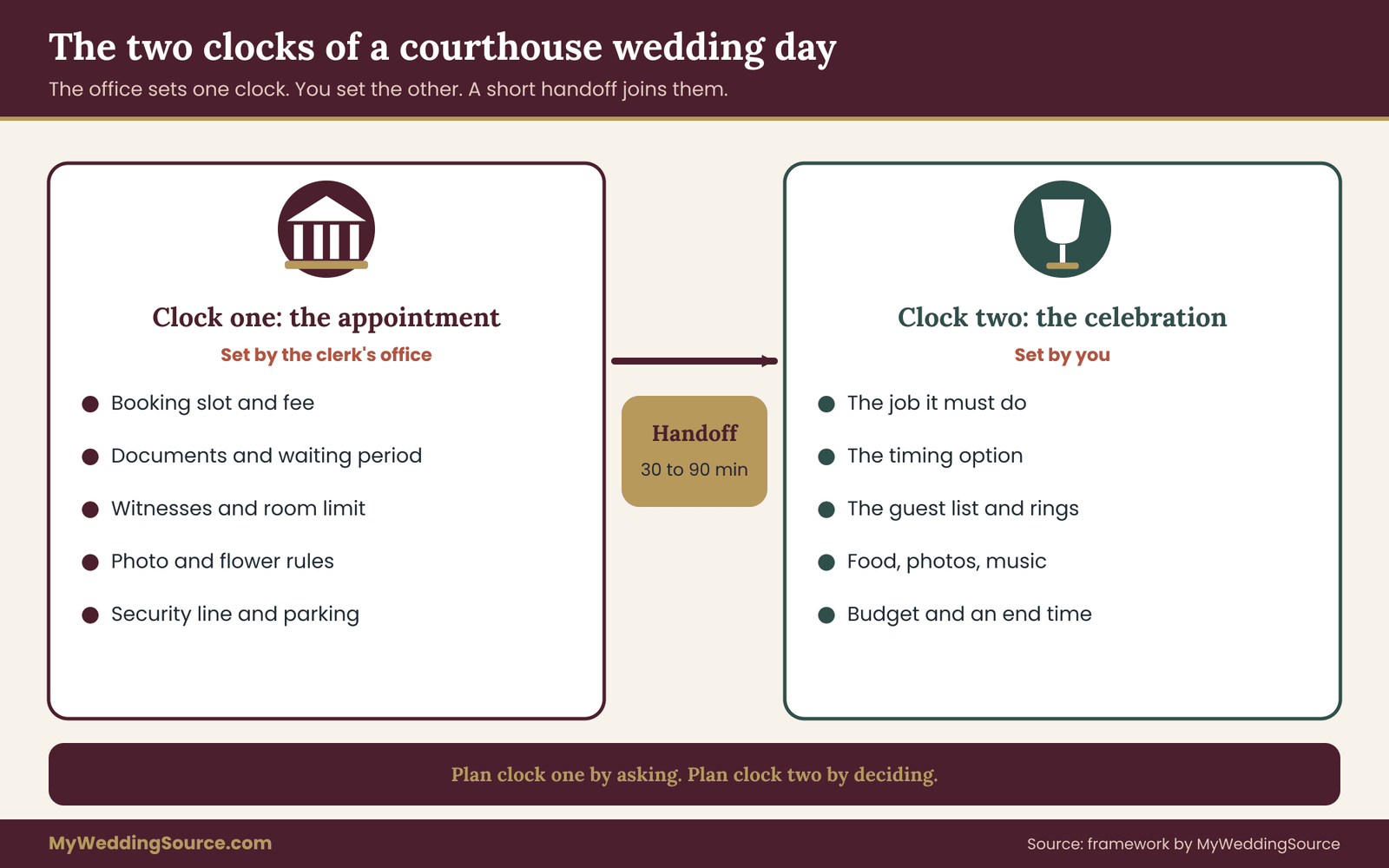
Everything in the rest of the article hangs from that method. If you only read one section, make it the one that explains how to write the handoff, because that is where most courthouse days wobble.
Who this guide is for
This guide fits couples marrying at a county clerk’s office, a city hall, a court or a similar civil venue, whether the ceremony is a few minutes long or part of a longer program. It also fits couples who are still deciding whether a courthouse is right for them. If you are weighing a courthouse wedding celebration against a full venue wedding, read the sections on jobs and timing first; they show what each path asks of you.
It is less useful if your appointment is with a religious officiant in a place of worship, or if a venue wedding is already booked. Some parts, such as the handoff and the three rings of guests, apply to any small ceremony.
The decision order for a courthouse wedding celebration
Before you book a table or order flowers, settle five decisions in a fixed order. Doing them out of order is how couples end up with a reservation for twelve and a ceremony room that holds four.
Decision one: the job of the courthouse wedding celebration. Is it meant to include witnesses, to feed people, to announce the marriage, to honor a family tradition or to give you two a quiet evening? Most couples want a mix, but one job should lead. The next section covers each job in detail.
Decision two: the timing option. Same day, same weekend, within a month or months later. Each option changes the budget, the guest list and the stress level.
Decision three: the head count at the appointment. Ask the office first. The room limit is a fact, not a preference.
Decision four: the handoff. How the group gets from the appointment to the first stop of the celebration, including parking, transit, accessibility and a plan for the half hour you do not control.
Decision five: the announcement. Who hears before, who hears the same day and who hears afterward, and in what words.
Why the order matters
The job of the courthouse wedding celebration drives the timing. The timing drives the budget. The head count at the appointment drives which relatives become witnesses and which become dinner guests. The handoff turns decisions into a real schedule. The announcement comes last because you cannot tell people what is happening until you know. That is the whole chain, and later sections walk down it one link at a time.
If you are working with a planner or a trusted friend as coordinator, hand them this order and ask them to hold you to it. The couples who skip straight to the restaurant tend to do the work twice. ## Choosing the job of your courthouse wedding celebration
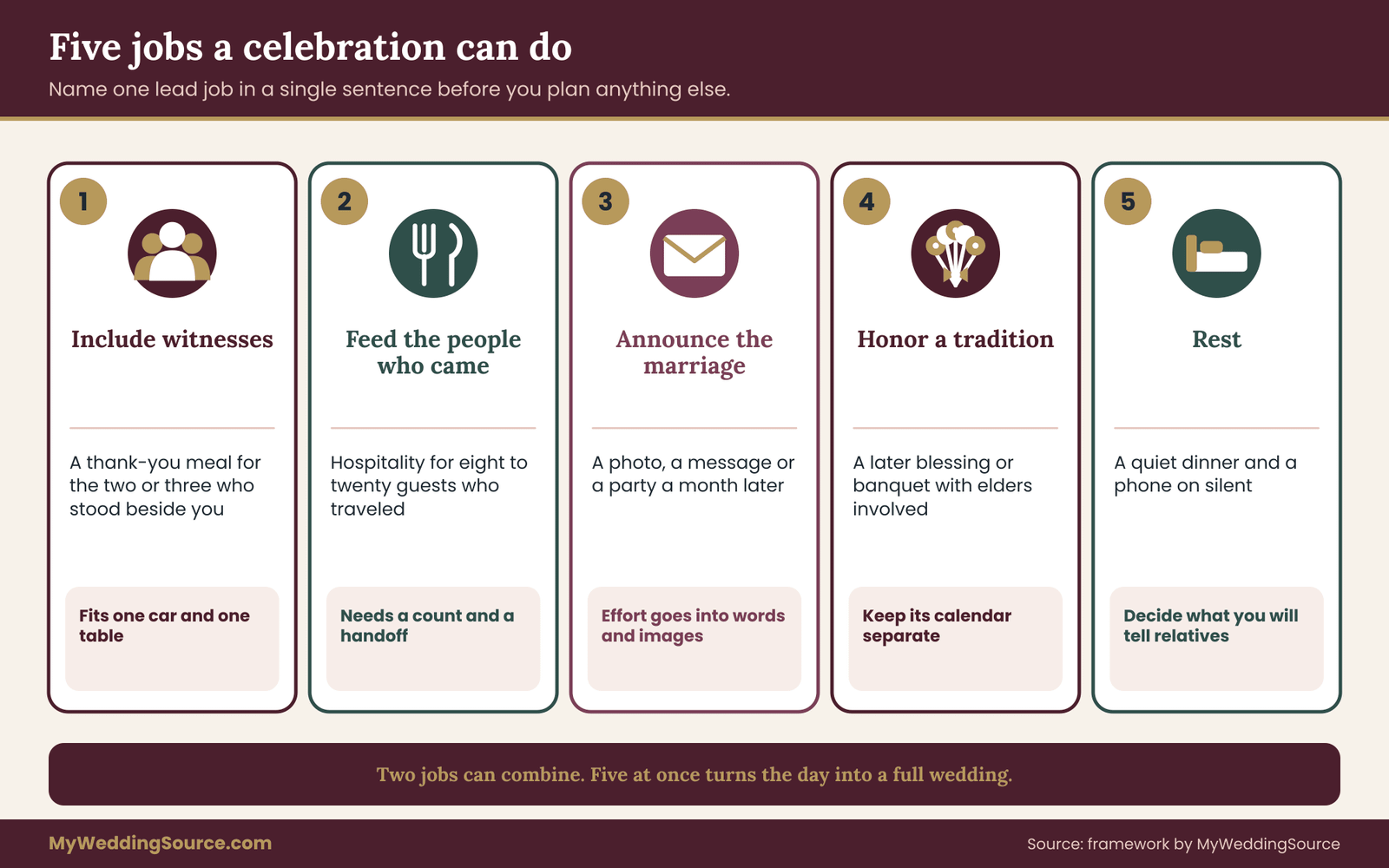
Ask five couples what they want from the day after a civil ceremony and you will hear five different answers. Some want a feast. Some want no one to know until Monday. The useful move is to name the job in one sentence before you plan anything else. Here are the five common jobs, with what each one asks of you.
Job one: include the witnesses
The simplest courthouse wedding celebration is a thank-you to the two or three people who stood beside you. Many offices require witnesses or allow them, and the rules differ, so ask the clerk. If witnesses are part of the day, the celebration can be as small as a table for five at a restaurant you already like. The decision rule is easy: if the whole guest list fits in one car, plan one meal and stop.
Job two: feed the people who came
If eight to twenty people show up, the job is hospitality. They traveled, took time off or dressed up, and a sidewalk goodbye feels thin. A seated lunch, a private room, a buffet at home or a catered picnic all work. This job needs a count, a reservation and a way to tell people where to go, which is why the handoff matters so much here.
Job three: announce the marriage
Some couples marry with two witnesses and want the courthouse wedding celebration to be a public announcement: a photo, a message, an open house, a party a month later. The job is communication. The planning effort goes into the words, the images and the timing, not into the meal. The section on guests and messages covers sample wording.
Job four: honor a family or cultural tradition
A civil ceremony does not replace a religious or cultural ritual for every family. Some couples sign the license at the courthouse and hold a ceremony, blessing or banquet later with elders involved. If that is your job, the courthouse wedding celebration is the legal chapter and the tradition is a separate event with its own planner. Keep the two calendars independent so a delay in one does not push the other.
Job five: rest
Some couples simply want to be married without an audience, then go home. This is a legitimate courthouse wedding celebration. The job is protection: a quiet meal, a phone on silent, one photo you actually like. The risk is guilt, so decide in advance what you will say to the relatives who wish they had been there.
Combining jobs without losing the lead
You can combine two jobs. Witnesses plus announcement is common, and so is feed plus tradition. What fails is five jobs at once. If the plan tries to feed forty, announce to a thousand, honor three traditions and keep it quiet, it is no longer a courthouse wedding celebration; it is a wedding with an extra step. Pick the lead job and let the second one be a smaller add-on.
A worked example of choosing the job
Consider a couple who cannot agree. One partner wants a dinner with both families, and the other wants nobody to know for a month. Neither is wrong. The way through is to put each wish into a job and a timing option.
The dinner becomes job two, feed the people who came, with the timing option of the same weekend. The quiet month becomes job five, rest, which they give to the appointment day itself. So the plan becomes: marry on Friday with two witnesses and a quiet evening, then host both families on Saturday. Each partner gets the thing they cared about, and the courthouse wedding celebration has a clear shape.
The test of a good choice is whether you can say it in one sentence to a relative without apologizing. “We are marrying Friday with two friends, and we would love to have you for dinner Saturday” passes. A plan that needs three paragraphs of explanation is usually trying to do too much.
Timing options for a courthouse wedding celebration
Once the job is clear, choose when the courthouse wedding celebration happens relative to the appointment. There are four timing options. Each has a different cost, a different level of risk and a different feeling.
Option one: the same day
The celebration happens within hours of the appointment. This keeps energy high, makes travel easy for guests who came for the day and lets you use the clothes and flowers once. It also compresses everything. Venue and vendor schedules have to survive a ceremony that runs late, an office that runs behind or weather that changes the plan. Same-day works best when the group is small, the first stop is close to the courthouse and the appointment time is early enough that a second event fits in the afternoon.
Option two: the same weekend
Appointments are usually on weekdays, since many county offices do not marry couples on weekends, though some do and some courts run special weekend hours. A common pattern is a Thursday or Friday appointment and a Saturday celebration. The pattern gives you a recovery night, lets out-of-town guests arrive without rushing, and opens up more restaurant and venue choices. The cost is a second round of travel and, sometimes, a second round of clothes.
For the second event’s layout, the guide to reception guest flow covers how guests enter, find seats, eat and leave, which matters even for a party of twenty.
Option three: within a month
A gap of a few weeks lets you do things properly: send real invitations, book a photographer for the party, order a cake, plan a playlist. It also gives you time to receive certified copies of your marriage certificate and start any name changes before the party, so the day feels less like paperwork. The risk is momentum. Plans that wait become plans that grow, and a “small dinner” becomes a hundred-person event if you let it.
Option four: months later
A celebration months after the appointment is the closest thing to a traditional wedding party. The legal part is done, so no date is under legal pressure, and you can choose a season, a venue and a guest list without compromise. It suits couples who married at a courthouse because of a deadline, such as a move, insurance or a deployment, and want a full celebration when life settles.
How each timing option changes the guest experience
Guests feel timing before they feel anything else. With a same-day courthouse wedding celebration, people who came for the ceremony stay for the meal, and the day has a single arc. Nobody has to travel twice, and the memory is one continuous afternoon. The cost is that late arrivals and slow offices affect everyone at once.
With a same-weekend courthouse wedding celebration, guests get a night to rest and a second chance to dress up. Out-of-town relatives can arrive on Friday evening and settle in, which makes the party feel unhurried. The cost is that the inner ring sees the ceremony and the middle ring sees only the party, so you need a way to share the ceremony with those who were not in the room, such as a photograph, a short video if the office allows one, or a few words at the table.
With a courthouse wedding celebration weeks or months later, guests have time to plan, but they may feel the real moment has already passed. A short toast that names the date of the appointment helps, because it connects the party back to the marriage. Some couples also display a photo from the courthouse steps so the party has a visible starting point.
A quick way to choose
Ask three questions. Will the people you most want to see be in town on the appointment day? How much can you afford to spend this month, not this year? And will you regret skipping a celebration entirely if the week goes badly? If the first answer is yes, same day or same weekend. If the second is “not much,” plan small now and big later. If the third is yes, put a date on the later celebration before the appointment so it is real.
The clerk’s office rules that shape your courthouse wedding celebration
You cannot design the courthouse wedding celebration until you know what the appointment allows. These are the questions to ask, ideally in one phone call or a visit to the website the office publishes. Write down the answers and the date you asked.
Booking. Does the office take appointments, or is it first come, first served? How far ahead can you book? Is there a separate fee for the ceremony and for the license? Fees are set locally, so confirm the current amount with the office rather than relying on an article.
Documents and waiting periods. What identification is required, how long is the license valid once issued, and is there a waiting period between issuing and marrying? Some places have one and some do not. The federal government’s page on marriage certificates, listed in the sources, explains how to request copies afterward.
Witnesses. How many are required, if any, and can you bring your own? Some offices provide staff witnesses. If you want photos with your own witnesses, you need to know in advance.
Room limits. How many guests can attend, and may children come? This number decides who is at the ceremony and who meets you afterward.
Photos, video and music. Can a friend photograph the ceremony? Is a professional photographer allowed inside? Can you stream it? Many offices say yes to a phone and no to a tripod. Ask what is permitted and where.
Flowers, attire and decorations. Bouquets are almost always fine. Confetti, rice and petals often are not, inside or outside, because staff clean up after you.
Arrival and security. Is there a security checkpoint? How long is the line at your time of day? Where do guests park, and is it free, metered or in a paid garage?
Accessibility. Is the ceremony room step-free? Where is the accessible entrance? If a guest uses a wheelchair or walker, confirm the route from the curb to the room.
Changes. What happens if you are late, if a witness does not arrive or if you need to reschedule? The answers affect your buffer, and a later section builds that buffer into your schedule.
Turning the answers into a single sheet
Collect the answers on one page and share it only with the people who need it, usually your witnesses and your coordinator. This sheet is the backbone of clock one. It is not a document you send to every guest. Guests need a different, shorter message, covered later in the article. ## Building the courthouse wedding celebration schedule backward
The schedule is the part of the plan people skip and then regret. Build it backward from the appointment, not forward from the morning. That way every buffer protects something real.
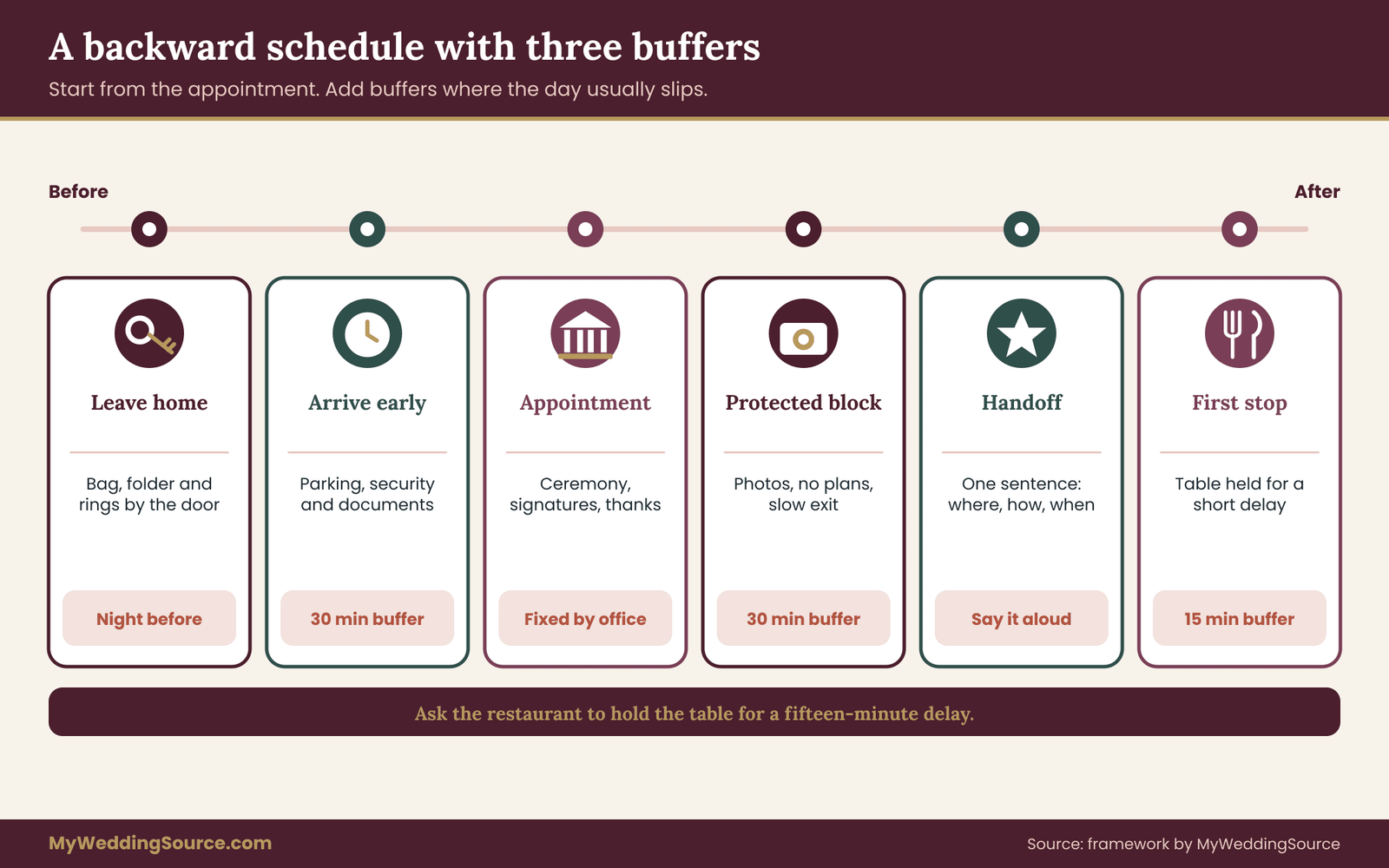
Start with the appointment start time. Subtract the arrival buffer, which covers parking, security and finding the right room. Subtract the getting-ready window. Then add forward: the ceremony length, the exit and photos, the handoff and the first stop. Here is a worked frame for a same-day plan with an appointment at 11:00 that you can adapt.
The morning side
Arrive at the building at least thirty minutes early. Offices often check documents before the ceremony, and a missing paper is easier to fix at 10:30 than at 10:58. Guests should arrive fifteen to twenty minutes early, because a line at the metal detector can eat that time without anyone doing anything wrong.
Dress and hair finish an hour before you leave home, not when you leave. Flowers, rings and the folder of documents go in one bag by the door the night before. That sounds fussy until the morning you cannot find the license.
The appointment side
Plan for the ceremony itself to take far less time than you expect. Many civil ceremonies are short enough that a rushed photo is the only thing left. If you want a few quiet minutes with your witnesses afterward, ask the clerk whether there is a corridor, a garden or a bench where the next couple will not be waiting behind you.
Do not schedule anything for the thirty minutes after the ceremony, whatever shape your courthouse wedding celebration takes. Treat it as the protected slot. The office may need your signature on documents, you may want photos on the steps, and guests need time to find each other and their cars.
The handoff
The handoff is the sentence that says, “Now we all go to X.” Without it, guests drift. With it, the group moves together. A good handoff has four parts: where, how, who rides with whom and a time to be seated or to start.
Name the first stop clearly and give the address on a card or in a single message that goes to everyone attending the courthouse wedding celebration. If the stop is within walking distance, say so and say how long the walk takes at a slow pace. If it requires cars, assign the seats so the grandmother who cannot walk far rides with someone who is not going to be pulled away for photos.
The first-stop buffer
Leave a gap between the end of the ceremony and the reservation. For a same-day plan with a restaurant, reserve at least ninety minutes after the appointment start, not sixty. A ceremony that begins ten minutes late and ends fifteen minutes late should not make you lose the table. Tell the restaurant when you book that your arrival time is approximate and ask whether they will hold the table for a fifteen-minute delay.
The night before
The night before the appointment, run one short check. Put the license paperwork, identification, rings and any fee payment method in a single folder or bag. Confirm the appointment time and address from the office’s own page, not from memory. Check the forecast and the route, including parking.
Message the inner ring with the arrival time and the handoff sentence. Confirm the restaurant or host for the courthouse wedding celebration, and ask them to hold the reservation for a short delay. Charge phones, lay out clothes and agree on who carries the bag.
Then stop planning. A courthouse wedding celebration does not improve with a midnight spreadsheet, and sleep helps the ceremony more than another round of edits.
What to say at the handoff
Handoffs fail when the instruction is vague. “Let’s grab food” sends six people in six directions. Use a sentence with a place, a time and a way to get there: “Lunch is at the Corner Table, two blocks east, we are seated at noon, and Jordan has room in the car for two.”
Write the sentence on a card or send it in one message before the appointment. At the courthouse, say it aloud once when the group gathers, then repeat it to anyone who was late. A single voice giving a single instruction does more than any map.
If you are using more than one stop, such as the steps for photos and then the restaurant, give each stop its own sentence and its own time. The courthouse wedding celebration is easiest to follow when each sentence starts with a place and ends with a time.
Name one person as the answer to questions. When guests have a doubt, they should not have to ask the couple. That person holds the printed schedule, the restaurant’s phone number and the clerk’s office number, and they keep a phone charged for the afternoon.
A sample courthouse wedding celebration day, hour by hour
The schedule below is an example, not a template to copy. It shows how the pieces fit, using a made-up couple and a made-up county. Replace every time with your own.
Imagine a couple with an 11:00 appointment, six guests and a lunch reservation.
At 9:00 they finish getting ready, and at 9:45 they leave for the courthouse with the document folder and the rings. At 10:15 they park, clear security and find the ceremony room. At 10:30 their witnesses arrive. At 11:00 the ceremony starts, and it ends around 11:15. From 11:15 to 11:45 they sign, take photos on the steps and thank the clerk. At 11:45 the group walks four blocks to the restaurant. At 12:15 lunch begins.
Lunch runs ninety minutes. At 1:45 they say goodbye to the witnesses, and at 2:00 they walk to a nearby park for twenty minutes of photos in better light than the courthouse steps offered. At 3:00 they go home, where a friend has left a small cake and a bottle on the doorstep.
What this example gets right
The schedule has three buffers: before the appointment, after it and before the reservation. It has a protected block for photos. It separates the people who need to be somewhere at a precise time from the people who can arrive casually. And it has an ending, which matters more than couples expect; a party without an end drifts, and a courthouse wedding celebration works better when the last event is clear.
What it leaves out
It leaves out any complication. No one is late, the weather holds, the restaurant honors the reservation. The next section covers what to do when those assumptions break.
When the schedule breaks: contingencies for a courthouse wedding celebration
A civil office is a public building with its own rhythms. Things will go wrong in small ways. The plan does not need to prevent every one; it needs to survive them.
The office runs behind
Some offices run behind, particularly on Fridays and in the weeks around holidays and popular dates. The buffer solves most of this. If the delay is long, call the restaurant before the delay becomes a late arrival. The clerk’s desk can tell you roughly how long it will be, so ask rather than guess.
A witness does not arrive
If you rely on a particular witness, name a backup, and ask the office whether staff can serve. Tell the backup in advance, not at the door. If you have no backup, the clerk may be able to help, but that depends on local practice.
Weather
Outdoor photos on courthouse steps look lovely and are unreliable. Pick an indoor option inside the building, a covered porch or a nearby lobby. If you plan a park portrait stop, set a rain plan that moves it to the restaurant’s doorway or to a later date. A courthouse wedding celebration can survive rain; it cannot survive a group standing in it with no plan.
Parking and transit
Metered spots run out, garages fill up and a bus line may run less often midday. Give guests the most reliable option, not the cheapest one. If the cost matters, say what you will cover and what you will not, in the same message that lists the address. Guests would rather know than guess.
Late guests
A guest who arrives after the ceremony starts may not be admitted if the room is full or the office has a rule about interruptions. Tell guests the real start time, not a padded one, and tell them the building rule. If someone misses it, plan a toast or a short moment at the first stop where they can still be part of the day.
A change to the appointment
If the appointment moves, the courthouse wedding celebration should be able to follow. Hold your reservations with the most flexible terms you can find, avoid nonrefundable deposits until the appointment is confirmed and keep a short list of who must be told first. Later sections cover the cost side of this, and a dedicated change-of-plan guide may be useful once you have the basics in place.
Illness and last-minute absences
The most common change is not logistical. Someone gets sick or cannot come. Decide in advance whether the ceremony can be streamed on a phone if the office allows it, and who is in charge of holding the phone. This is a small thing that matters a lot to a grandparent at home. ## Formats for a courthouse wedding celebration after the appointment
With the schedule built, choose the format of the courthouse wedding celebration itself. There are six formats that work well, and each one fits a different job, budget and group size. None of them is more authentic than the others. The right choice is the one that matches what you named in the first decision.
A meal at a restaurant
This is the most common courthouse wedding celebration format, and for good reason. The venue supplies tables, staff, food and cleanup, and you supply a guest list. For a small group, a regular reservation at a place you already love is enough. For ten or more, ask about a private room or a set menu, because large parties on a regular dining-room floor often slow the kitchen.
Questions to ask the restaurant: Is there a minimum spend for the room? Is a fixed menu required? How are drinks charged, per glass or per bottle? Is gratuity added automatically for large groups? Can you bring a small cake, and is there a cutting fee? Write down the answers and keep the confirmation. The vendor timeline guide shows how to keep contact details and confirmation times in one place even for a small day.
A gathering at home
A home gathering costs less and feels warm, but it asks more of you. Someone has to cook or order, set up, serve and clean up, and it should not be the couple. Hire or ask a friend to take that role for the afternoon. Order food from a caterer or a favorite restaurant, rent a few chairs if you need them and keep the menu simple. This format works best for groups of fifteen or fewer and for families with young children or older guests who prefer a familiar room.
A small rented space
A rented room, a community hall, a garden or a private dining space gives you the feel of a wedding venue at a smaller scale. Read the rental agreement carefully for time limits, setup and cleanup windows, insurance requirements, noise rules, alcohol policies and cancellation terms. If the courthouse appointment moves, a venue with a rigid date becomes a problem. This format fits couples who want a longer party and are comfortable with a contract.
A picnic or park gathering
Public parks can be lovely and are not free of rules. Many require a permit for groups, reserved shelters or amplified music, and permit fees and rules differ by city and county. Check with the parks department before you pick a date. Bring a rain plan and a plan for restrooms, shade and accessibility. A park courthouse wedding celebration is a good fit for a casual group that includes children.
A destination or trip
Some couples marry at the courthouse and leave for a short trip. The trip becomes the courthouse wedding celebration, with a dinner in a new city or a hotel stay. This format is the quietest and the easiest on the guest list. The risk is that relatives feel left out, so plan a later gathering or a thoughtful announcement. For travel with deadlines, such as an early flight after the appointment, double the buffer at the courthouse and confirm your documents the day before.
A delayed party
The delayed party is the full celebration held weeks or months after the appointment. It may be a dinner, a cocktail party, a barbecue or a dance. This is where a courthouse wedding celebration most resembles a traditional wedding, and where the checklist can balloon. Set a head count and a budget cap before you send a single invitation, and treat the party as a small event, not a late wedding.
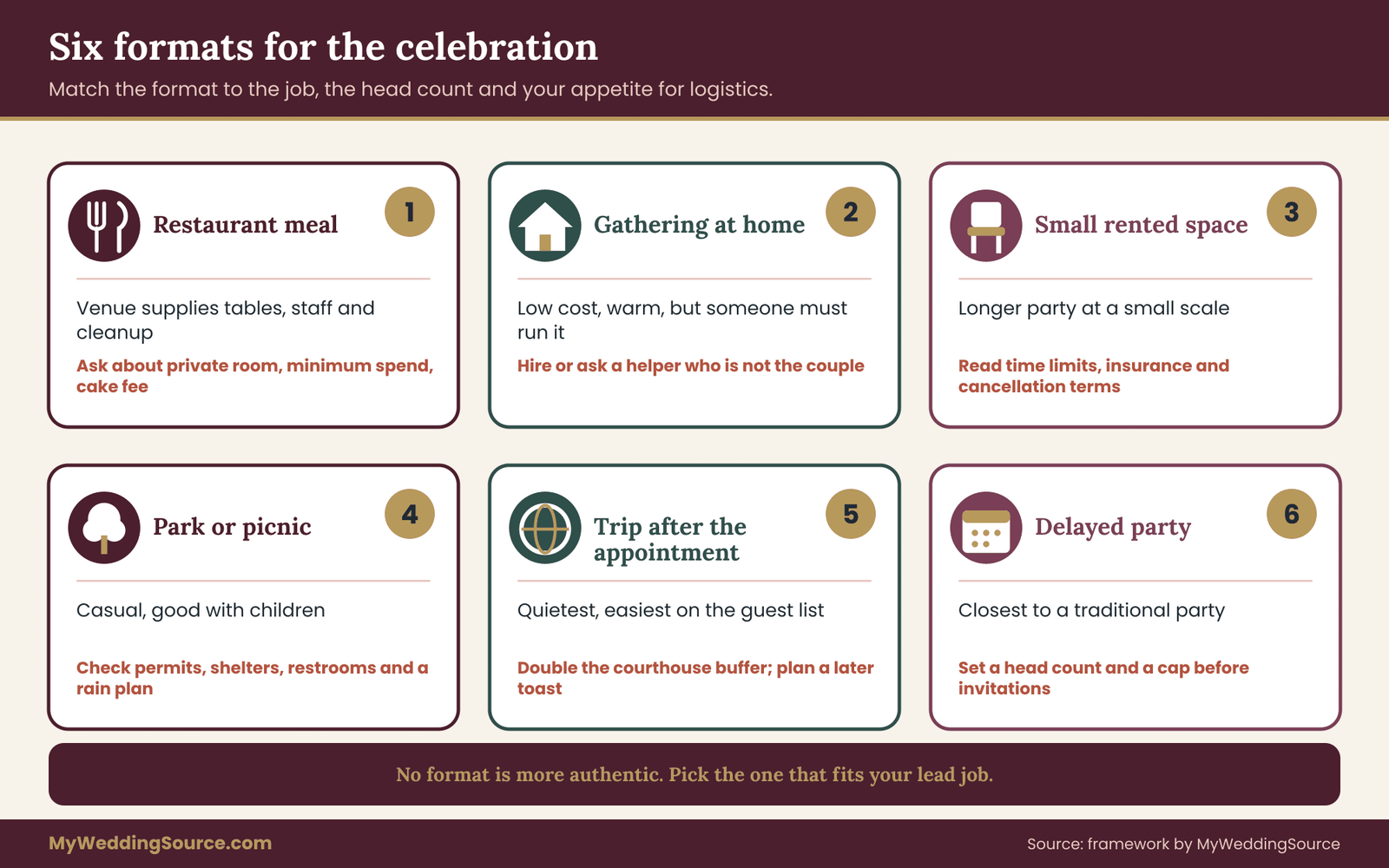
Matching format to job
The format is where a courthouse wedding celebration becomes concrete, so match it to the job before you book anything.
If the job is to include witnesses, a restaurant meal usually wins. If the job is to feed a group, a home gathering or small room tends to work. If the job is to announce the marriage, a delayed party or a message with a photo fits. If the job is tradition, the format follows the tradition. If the job is rest, the trip or a quiet dinner is the answer. Use the match as a starting point and adjust to your own circumstances.
Guests, communication and the announcement
A courthouse wedding celebration succeeds or fails on communication. The ceremony itself is simple. The hard part is telling people what is happening, what is expected of them and what they should not assume.
Sorting guests into three rings
Draw three rings. The inner ring is the ceremony group: the people who will be in the room, limited by the office. The middle ring is the celebration group: the people you want at the meal or party. The outer ring is the announcement group: the people who will hear the news but not attend.
Writing names into the three rings before you contact anyone forces useful decisions. It also prevents the situation where a person is in the middle ring in your head and in the outer ring in a relative’s version of the story. For help trimming a list without fights, the guide to how to cut a wedding guest list gives general decision rules that work at any scale.
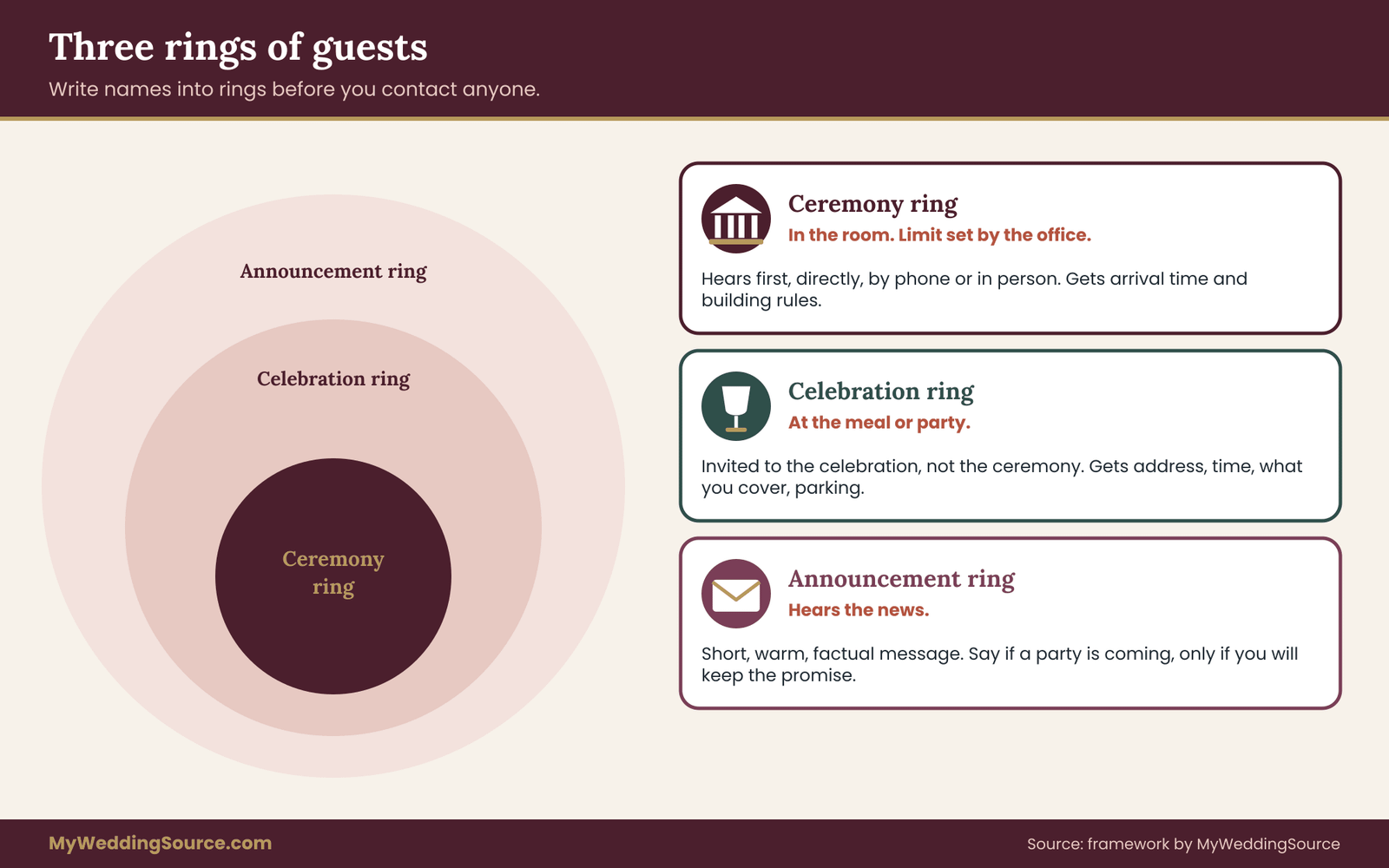
Telling the inner ring
The inner ring should hear first and directly, by phone or in person if possible. Tell them the date, the time, the arrival instructions and the building rules. Ask them to confirm. Do not rely on a group chat for this; use a single message with the facts and a single person to answer questions.
Telling the middle ring
The middle ring gets an invitation to the celebration, not the ceremony, unless the room allows more. Be clear about what they are invited to. A short message might say that you are marrying at the courthouse with a small group, that you would love for them to join you for lunch afterward and that the details are below. Give the address, the time and what you are covering. A sentence about dress, parking and accessibility prevents a dozen small questions.
Telling the outer ring
The outer ring hears after, or just before, by message or card. A good announcement is short, warm and factual. It states that you married, gives the date and says whether a celebration is planned. If a delayed party is coming, say so and promise details later, but only if you will keep the promise. People forgive a quiet wedding more easily than a vague one.
Sample wording for each ring
Words matter, so here are plain templates. Adapt them to your voice and your family.
For the inner ring: “We are marrying at the courthouse on the date at the time. The room holds a limited number of people, and we want you there. Please arrive by the early time to clear security. Afterward, we are walking to lunch together.”
For the middle ring: “We are keeping the ceremony small, and we would love for you to join us afterward for lunch at the place at the time. We will cover the meal. Parking is easiest in the garage on the street.”
For the outer ring, after the fact: “We got married today at the courthouse, with two friends beside us. We are so happy, and we wanted you to hear it from us. We are planning a celebration later and will send details.”
Each message is short, specific and warm. None apologizes for the size of the courthouse wedding celebration, and none makes a promise you cannot keep. If you are not sure a later party will happen, leave that sentence out.
The hard conversations
Some relatives will be hurt. A parent may have imagined a large wedding, or a sibling may feel left out. Prepare a short, kind script and use it. For example: “We chose a small ceremony because it fits us right now. We would love to celebrate with you at dinner, and we hope you will come.” You do not owe a long defense. Say it once, listen and move on. If a relative wants to give money, help or a gift of time, thank them and decide later what you can accept.
Etiquette questions come up often in this situation, and the wedding etiquette guide covers the general expectations for announcements, gifts and thanks without turning a small day into a formal one.
Gifts and the question of registries
Guests often ask about gifts after an announcement. You can say that their company is the gift, point to a registry if you have one, or ask for nothing. The key is to be consistent. Do not tell one cousin that gifts are unnecessary and another that you would love a toaster. If you accept cash gifts, keep a simple list so you can thank people properly. That list is a record worth keeping.
Children, elders and accessibility
Ask the office whether children may attend the ceremony and whether strollers fit in the room. For elders, confirm seating, step-free access, restrooms and a drop-off point. For guests who use mobility aids, tell them the accessible entrance and parking plan in the first message, not the second. If anyone needs an interpreter or has a sensory need, ask what would help. These are small asks that tell guests they are wanted.
Out-of-town guests
If guests travel, give them as much notice as possible. The date may change, so say that the courthouse appointment is the fixed point and the celebration is flexible. Suggest lodging, but do not make anyone pay for a room they did not want. Offer to share the plan with their families, and keep the group chat tidy. A courthouse wedding celebration that starts with a confusing flight schedule has a rough first hour. ## What a courthouse wedding celebration really costs
A civil ceremony has a low legal cost, and that fact leads many couples to assume the whole day will be cheap. Sometimes it is. Often the celebration is where the money goes, because the costs that a venue package would bundle are now separate line items. This section shows how to see them before they arrive. It does not use averages or invented figures, because costs vary widely by region, and you should replace every placeholder with a real quote.
The four cost buckets
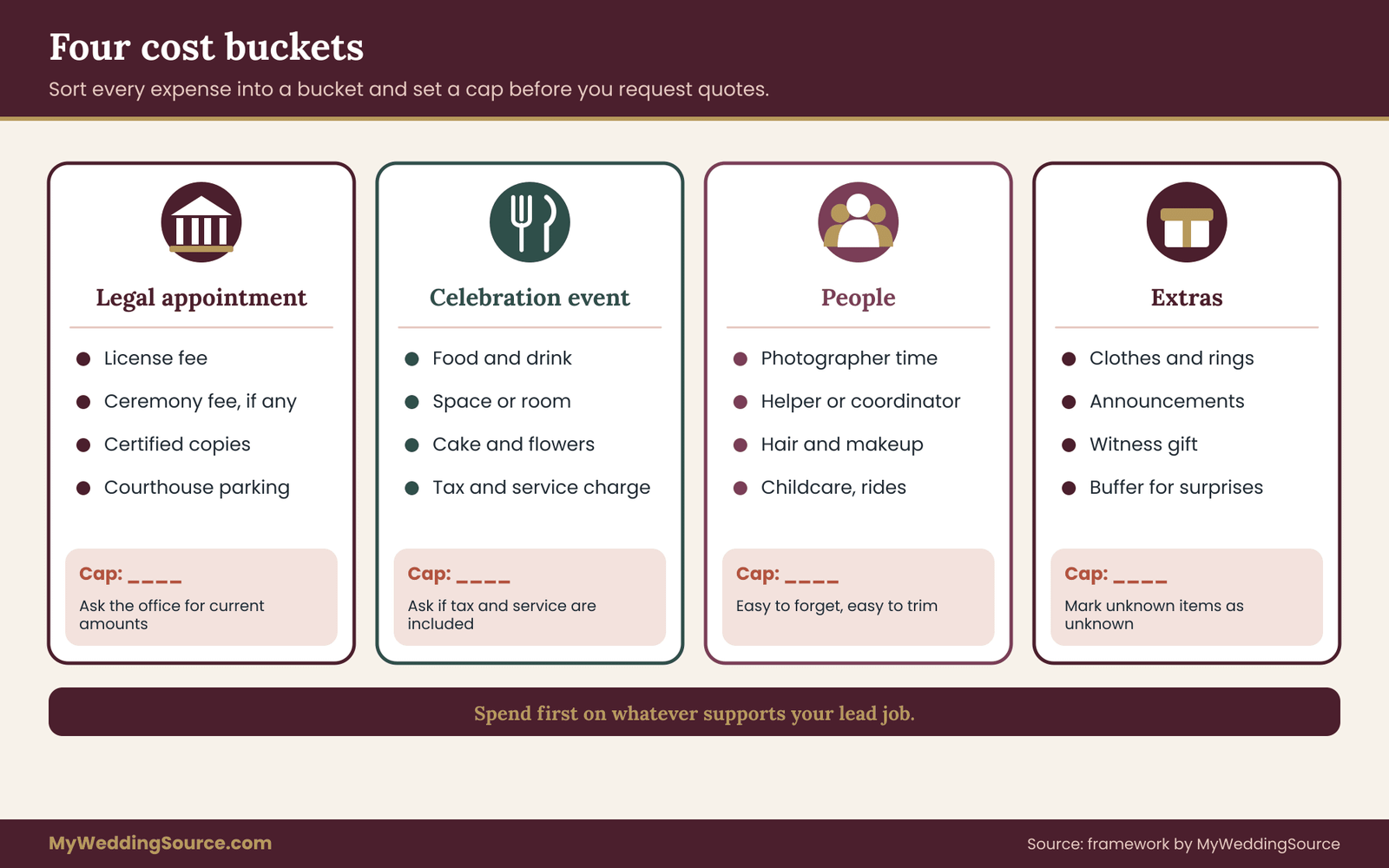
Sort every expense into four buckets: the legal appointment, the celebration event, the people and the extras.
The legal appointment bucket holds the license fee, the ceremony fee if any, certified copies of your marriage certificate and parking at the courthouse. These are set by the local office, so ask for current amounts rather than assuming. The federal government’s marriage certificate page explains where copies come from, and the sources list at the end of this article has the link.
The celebration event bucket holds food, drink, rental space, cake, flowers, décor, music and any service charge or gratuity. Ask each vendor whether tax and service charge are included in a quoted price, because they often are not.
The people bucket holds photographer time, a coordinator or helper, hair and makeup, childcare for the afternoon, and transportation for guests who cannot drive. These costs are easy to forget and easy to cut when you know they are there.
The extras bucket holds clothes, rings, announcements, thank-you cards, a small gift for witnesses and a buffer for things that go wrong.
The decision rule for spending
Spend first on whatever supports the job you named. If the job is to feed the group, protect the food budget. If it is to announce the marriage, protect photography and messaging. If it is rest, spend on a very good dinner and nothing else. A courthouse wedding celebration that spends evenly on everything usually leaves the lead job underfunded.
Write a cap for each bucket before you request quotes. When a quote exceeds the cap, you decide whether to raise the cap or change the plan, and you do it deliberately. This is the same discipline that works in a larger budget, and the wedding budget guide lays out how to set categories and track actual spending against them.
Deposits, minimums and timing
Restaurants and venues often ask for a deposit or a minimum spend for a group. Read the terms for what happens if the appointment moves, if the head count drops or if the date changes. A deposit that cannot be moved is a risk for a date that is not yet confirmed. Ask for the cancellation and change policy in writing, and keep it with your records.
Payments by credit card carry some protections, and the Consumer Financial Protection Bureau explains how to dispute a charge. That is worth knowing, but it is a backup, not a plan. The better practice is to pay with a method that leaves a record and to keep every receipt and confirmation.
What to do if someone offers to pay
Parents, relatives or friends often offer to cover a dinner or a venue after learning about a courthouse wedding celebration. Accept with warmth and ask what they have in mind, because help sometimes arrives with expectations. If a gift comes with a request about the guest list, the menu or the date, decide whether you can honor it. If not, say so kindly and decline that portion. Write down who is paying for what so no one is confused later.
A cost worksheet in prose
Here is how to run the numbers without inventing any. Open a blank page and make four headings, one for each bucket. Under the first, write the license fee, the ceremony fee, certified copies and parking, each with the amount the office quoted and the date you asked.
Under the second, list the event: food, drink, space, cake, flowers and service charge. Write the quote beside each line and note whether tax and service charge are included. If an item has no quote, mark it unknown, not zero.
Under the third, list people and their time. Under the fourth, list clothes, rings, cards, a witness gift and a buffer. Add each column, then add the four totals. Compare the result to what you can spend this month, not what you hope to spend overall.
If the total is higher than your cap, change the plan before you change the quality. Shorten the guest list, move to a later date, drop an extra, or choose a simpler format. The courthouse wedding celebration should fit the money, not the other way around.
The hidden cost of a second outfit
Many couples wear one outfit for the appointment and want another for the courthouse wedding celebration. That is a choice, not a requirement. If you plan to change, build the time into the schedule and have a place to do it. If you keep one outfit, think about whether it can handle a restaurant, a park and a dance floor. Comfort is a quiet budget item.
Photos, food, music and clothes for a courthouse wedding celebration
Four categories of detail do most of the work of making a short ceremony feel like a wedding. None of them requires a large budget, but each needs a decision.
Photography
Of the four details, photography is the one a courthouse wedding celebration cannot repeat later.
Photography is often the single most valued purchase after a courthouse wedding. Ask the office first what is allowed inside the ceremony room. If a professional is not allowed to shoot inside, you can ask a friend with a phone for the ceremony and hire the photographer for the steps, the walk and the first stop. A photographer booked for an hour or two of coverage is a normal request, and many offer short sessions designed for this kind of day.
When you contact photographers, ask about minimum hours, travel fees, delivery time, gallery length, usage rights and what happens if the ceremony shifts. Ask for the answer in writing. The family photo list guide helps you decide which group photos matter so a short session is spent on the faces you will want in ten years.
Food and drink
Choose food that travels and holds. If you are heading from the courthouse to a restaurant, the restaurant’s menu does the work. If you are hosting at home, favor dishes that do not need last-minute cooking: a grazing table, sandwiches, a salad, a tray of pastries. Ask guests about allergies and dietary needs in the first message, and label dishes. For alcohol, check the venue’s rules and local law, and plan non-alcoholic options that feel festive, not like an afterthought.
A cake or a dessert is optional but meaningful. A small cake from a bakery is enough for a group of ten. Ask about delivery, storage and the temperature of the room, because a cake left in a warm car loses its shape quickly.
Music
Music at a courthouse wedding celebration is limited by the office inside the ceremony room. A phone with a speaker may or may not be allowed, so ask. For the celebration, a playlist on a speaker is enough at home or in a park, and a restaurant may have rules about outside music. If you play recorded music in a public place, be aware that licensing can apply in some settings, and that venues usually manage it. Keep the playlist short and clean, and give a friend the job of pressing play.
Clothes
Clothes for a courthouse wedding celebration range from a suit or a dress to a favorite jacket and nice shoes. The only rules are those of the office, which may expect neat attire, and those of the weather. If you plan photos outdoors, check the forecast and bring a layer. If you want a specific item altered, schedule the alteration well before the day, because alteration time is not something you can compress. Guests do not need a dress code beyond “dress as you like,” unless you want one.
Flowers and small details
A bouquet and a boutonniere are traditional and portable. A few stems from a grocery store or florist, tied with ribbon, look good in photographs. For the celebration table, a small arrangement is plenty. Ask the office whether loose petals or confetti are allowed, and assume they are not unless told otherwise. A small card or sign thanking the witnesses is a tidy detail that costs almost nothing.
A short list of what to bring
Bring the license and any required identification, the rings, a pen, a folder for documents, a few tissues, a phone charger, water, a snack, a spare shirt or shawl and an umbrella if the sky looks doubtful. Assign one person, not the couple, to carry the bag. A calm courthouse wedding celebration begins with a bag that someone else is holding.
Vendors and the written confirmation habit
Every vendor you hire for even a short time should confirm the date, time, location, price and cancellation terms in writing. Keep those messages in one folder. The same habit protects you if a ceremony date moves or a vendor does not appear. If you want a deeper look at how to compare quotes and spot problems, the vendor due diligence checklist walks through it in plain terms. ## Four illustrative courthouse wedding celebration plans
The cases below are invented to show how the method behaves under different constraints. They are not real couples, and the details are chosen to make decision points visible. Use them as thinking aids, not as targets.
Case one: the two-witness lunch
Dana and Luis have a Thursday appointment and two friends as witnesses. Their lead job is to include the witnesses, and the secondary job is rest. They choose the same-day timing option. The office allows four people in the room, so the inner ring is the four of them. The middle ring is empty, and the outer ring is both sets of parents, who will get a call that afternoon.
Their schedule is simple: the appointment at 10:00, steps photos by a friend at 10:30, lunch at 11:30 at a restaurant a block away. The decision that mattered was the reservation buffer. They booked for 11:45 after the clerk said the office sometimes runs twenty minutes behind. The courthouse wedding celebration cost one lunch for four and a bottle of something good, plus a friend’s gas.
The lesson is that a small plan still benefits from the handoff. They told the witnesses the restaurant name and walking route in advance, and nobody wondered where to go.
Case two: the family-heavy appointment with a weekend party
Amara and Teo have large families and a room limit of ten. Their lead job is to feed the people who came, with a secondary job of announcing the marriage. They pick the same-weekend timing option: appointment on Friday morning, a backyard gathering on Saturday for thirty people.
The inner ring is the couple, both sets of parents and two siblings. The middle ring is everyone else invited Saturday. They send the middle ring a message the week before with the address, the time, the food plan and a note that Friday’s ceremony is small by design. They hire a friend to run the Saturday cleanup and a local caterer to deliver trays.
The tricky part was Friday afternoon. The inner ring had a quiet lunch, and a grandfather asked whether the family should drive to the backyard to set up. The couple said no and had a cousin handle chairs. The cost of the courthouse wedding celebration was mostly the caterer and rentals. The lesson is to give the day between events a job, even if the job is nothing.
Case three: the deadline marriage and the delayed party
Priya and Marcus must marry quickly because of a job move that affects insurance and housing. They book the earliest appointment and plan a modest dinner for six that evening. Their lead job is to honor the legal deadline, and their secondary job is announcement, with a larger party in the spring.
They send a short announcement to friends and family that night: they married today, they will celebrate in April and details will follow. In March they pick a venue, set a head count of fifty and send invitations. Because the legal part is done, they negotiate a weekday evening rate with the venue and avoid peak pricing.
The lesson is that a delayed party needs a head count and a cap before the invitations go out. Without those, a delayed courthouse wedding celebration can grow into a second wedding. They also order certified copies early, so the paperwork is ready before the party, not after it.
Case four: the quiet marriage and the family tradition
Noor and Samir marry at the courthouse with two witnesses and no guests. Their lead job is rest, and their secondary job is tradition: their families expect a religious blessing and a shared meal, which they will plan with elders later.
They keep the two events entirely separate. The courthouse day is a quiet dinner at home. The tradition has its own date, its own leader and its own budget. They tell the families in a short phone call that the civil ceremony is done and the blessing will follow on a date the elders suggest, and they ask the elders to lead that planning.
The lesson is that separate calendars protect both events. The couple did not have to defend the courthouse day to anyone, because it was clearly the first of two steps.
Common mistakes in a courthouse wedding celebration, and how to avoid them
Most mistakes in this kind of plan are small and repeat from couple to couple. Here are the ones that cause the most stress, with a fix for each.
Treating the appointment as the whole event
The appointment is short. If it is the only thing planned, the day ends by noon and feels flat. The fix is to name the job of the courthouse wedding celebration and put at least one real event after the ceremony, even if it is a walk and a coffee.
Telling people too early or too late
Tell the inner ring early so they can arrange travel and time off, and tell everyone else at a time that matches their role. Telling too early invites opinions. Telling too late makes people feel excluded. Use the three rings to decide who hears what and when.
Not confirming the room limit
Couples sometimes invite more people than the room allows. Everyone arrives, and some are left in the hallway. Ask for the limit, write it down and invite no more than that to the ceremony. Everyone else goes to the celebration group.
Booking nonrefundable items before the date is firm
A deposit paid before the appointment is confirmed can be lost if the date moves. Hold items with flexible terms until you have the confirmation. If you must pay a deposit, ask what happens if the date changes and keep the answer in writing.
Skipping the buffer
A buffer feels wasteful until the day it is used. Add fifteen minutes to the arrival, thirty to the post-ceremony block and fifteen to the reservation. If none of it is needed, you have time for a walk. If all of it is needed, you have saved the day.
Forgetting who is holding the bag
Someone has to carry the folder, the rings, the water and the umbrella. If no one is assigned, the couple does it and cannot relax. Assign a person and tell them in advance.
Letting the celebration drift
A party with no end time loses its energy, and the guide to how guests move from arrival to exit shows how to give even a small meal a clear shape. Decide the last event, say it plainly and thank people for coming. A courthouse wedding celebration with a clean ending leaves everyone feeling cared for.
Ignoring accessibility until the day
Steps, long walks and tight rooms are easy to miss when you do not live with them. Ask the office and the restaurant about access, and share the answers with guests who need them. It takes five minutes and prevents real difficulty.
Overbuilding the delayed party
The delayed party attracts extra ideas: a larger list, a photographer, a band, a theme. Each idea is reasonable alone. Together they undo the reason you chose a courthouse. Return to your lead job and cut what does not serve it.
Working with a helper or planner
A helper can make a small day much calmer. You do not need a full planner for a courthouse wedding celebration, but you may want a friend, a relative or a hired coordinator for the few hours that matter. Give that person the schedule, the handoff sentence, the vendor contacts and the authority to make small decisions without asking you.
Be specific about the job. “Handle everything” is too vague, and the helper will either do too little or take over. Say instead: you hold the bag, you speak to the restaurant, you gather the group after the ceremony and you manage the group chat. A person who knows the boundaries of the role enjoys the day more.
If you hire a coordinator, ask what a short engagement covers, what it costs and what happens if the appointment shifts. A professional familiar with civil offices can be a real help with timing, but the same rule applies as with any vendor: get the scope and price in writing.
Edge cases that need a little extra thought
Some situations call for a short extra step. If either of you was married before, ask the office what documents are required, since some places want proof that a prior marriage has ended. If either of you needs an interpreter, ask the office whether it can arrange one or whether you may bring your own.
If a witness or a parent cannot travel, ask whether the office allows a phone or video connection, and if it does, assign a person to hold the device. If one of you is traveling from abroad, check the identification rules with the office well before the date.
If privacy matters to you, ask the office whether marriage records are public in your county, and plan the announcement with that in mind. If a family conflict makes you anxious, give a trusted friend the job of managing the door and the tone, so the courthouse wedding celebration stays calm.
If you are marrying with a deadline, such as a move or a benefit date, ask the office about the earliest available slot and whether waiting periods apply, then plan the celebration around that fixed date.
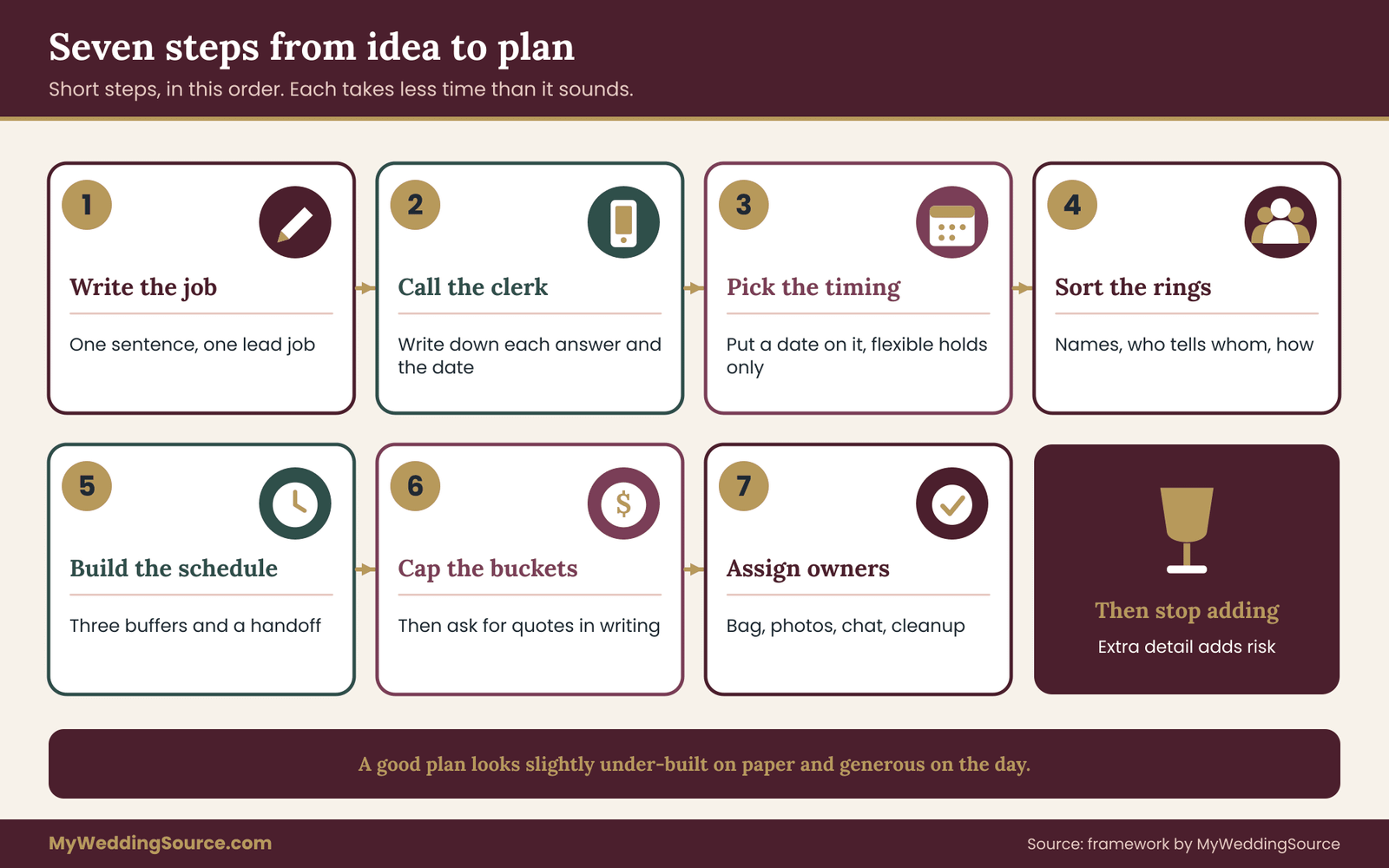
Your next steps
Here is the order to work in, from today to the week after the appointment. Treat it as a short sequence, not a long list. Each step takes less time than it sounds.
First, write the one-sentence job of your courthouse wedding celebration. If you and your partner give different answers, talk until you agree on a lead job and a second job. Everything else depends on this sentence.
Second, call or visit the clerk’s office and collect the answers to the questions in the rules section. Write the date of the call next to each answer. Ask for a copy of any written policy, and save the web page address.
Third, choose a timing option and put a date on the courthouse wedding celebration, even if the date is months away. A date on the calendar turns an idea into a plan. Hold flexible reservations only, and avoid nonrefundable deposits until the appointment is confirmed.
Fourth, sort your people into the three rings and write the names down. Decide who tells whom, and by what method. Draft the short messages for each ring and read them aloud once.
Fifth, build the schedule backward from the appointment, with three buffers and a named handoff. Share the schedule with the witnesses and one coordinator, and keep the full clerk sheet to yourselves.
Sixth, set a cap for each of the four cost buckets, then ask for quotes. Keep every confirmation in one folder.
Seventh, give every role in the courthouse wedding celebration an owner: assign the bag carrier, the photographer, the person who handles the group chat and the person who handles cleanup. Say thank you now, not later. A courthouse wedding celebration run by people who know their jobs is a calm one.
Records and next-day tasks after the appointment
The marriage is legally complete only when the office records it, and the timing and process vary by place. Ask the clerk what happens after the ceremony: whether the officiant returns the signed license, how long recording takes and how to request certified copies. The federal government’s marriage certificate page and the National Center for Health Statistics both point you to the right state or county office for copies.
Order certified copies before you start name changes or other updates, because many agencies will not accept a plain photocopy. Check each copy for spelling errors the day it arrives, since errors are easier to fix early. The guide to who can officiate is a useful companion if you have questions about who performed the ceremony and how it is documented.
The week after
In the week after your courthouse wedding celebration, do four things. Confirm the license was returned and recorded. Send thank-you messages to witnesses and helpers. Save the photos from friends and family into one folder. And write down what worked and what you would change, while the details are fresh. If a delayed party is coming, that note helps you plan it.
How to know the plan is finished
A courthouse wedding celebration plan is finished when five things are true. The clerk’s answers are written down. The job, the timing option and the head count are agreed. The schedule has its buffers and its handoff. Every guest knows which ring they are in and what they are invited to. And every vendor has confirmed in writing.
When those five hold, stop adding. Extra detail at this point usually lowers the quality of the day, because it adds things that can go wrong without adding things that matter. The best courthouse wedding celebration plans feel slightly under-built on paper and generous on the day.
FAQ
How long should a courthouse wedding celebration last?
It depends on the job you chose. A lunch with witnesses usually runs two to three hours from arrival at the courthouse to goodbye. A home gathering or small rented space can run three or four hours. A delayed party follows the length of any evening event. Pick an end time, tell guests, and stop on a high note instead of letting the day drift.
Can we have guests at the ceremony and a separate celebration?
Yes, and many couples do. The office sets how many people may attend the ceremony, so ask the clerk for the room limit. Invite your closest people to the room and everyone else to the celebration. Make clear in each message what the person is invited to, so nobody assumes they are welcome at both when the room holds only a few.
Do we need a photographer for a courthouse wedding?
No, but many couples value one for an hour or two. Ask the office what photography it allows inside the ceremony room, because professional gear is sometimes restricted. A friend with a phone can cover the ceremony, and a photographer can cover the steps, a short portrait session and the first stop. Ask about minimum hours, delivery time and usage rights in writing.
Should we hold the courthouse wedding celebration the same day or later?
Same day keeps energy high and makes travel easy, but it compresses the schedule and leaves little room for delays. A later date gives time to send invitations, book vendors and receive certified copies, but plans tend to grow. If the people you most want will be in town, go same day or same weekend. If budget is tight, plan small now and larger later.
How do we tell family we are marrying at the courthouse?
Tell the closest people directly, by phone or in person, before anyone else hears. Be warm, brief and clear about what is happening and what they are invited to. You do not owe a long defense of your choice. A simple line works: you chose a small ceremony, and you would love to celebrate together. Then answer questions once and move on.
What should we budget for a courthouse wedding celebration?
Start with the four buckets: the legal appointment, the celebration event, the people and the extras. Get real quotes for each, and add a buffer for surprises. Costs vary a great deal by region, so avoid relying on averages. Set a cap for each bucket and spend first on whatever supports your lead job. Keep every receipt and confirmation with your wedding records.
What if the courthouse appointment gets moved?
Hold reservations with flexible terms until the appointment is confirmed, and ask each vendor what happens if the date changes. Keep a short list of who to tell first. If the celebration is the same day, call the restaurant or venue as soon as you know. If it is later, the date may be easy to keep. Written confirmations make every change smoother.
Do we need to plan for accessibility at a courthouse?
Yes. Ask the office about step-free entrances, the route to the ceremony room, seating, restrooms and parking, and share the answers with guests who need them in your first message. Do the same for the restaurant or venue. Federal accessibility guidance exists for public buildings and businesses, but local conditions differ, so confirm the details directly before the day.
Sources
- How to get a copy of a marriage certificate or a marriage license, USAGov
- Where to write for vital records, Centers for Disease Control and Prevention, National Center for Health Statistics
- How do I dispute a charge on my credit card bill?, Consumer Financial Protection Bureau
- Information and technical assistance on the Americans with Disabilities Act, U.S. Department of Justice
- How do I change or correct my name on my Social Security number card?, Social Security Administration
- Change or correct a passport, U.S. Department of State
- Marriage means making changes before next filing season, Internal Revenue Service
- Tax to-dos for newlyweds to keep in mind, Internal Revenue Service
- Personal archiving: preserving your digital memories, Library of Congress
When the legal appointment is done, a small restaurant reception is a common next step, and the booking notes cover deposits, room splits and timing.