
A farewell brunch is a hosted meal or gathering on the morning after a wedding, and whether it helps your guests depends on who is still in town, when they have to leave, and how much energy and money you have left. This guide gives you a six-question worksheet that points to one of three answers: build the farewell brunch, shrink it, or skip it.
Hold a farewell brunch only when it does a job nothing else in the weekend does, such as giving traveling guests a last chance to talk to you or bringing two families together once more. Map when your guests wake up, check out and head for the airport or the road. Score the six worksheet questions from zero to two. A high score means build it, a middle score means shrink it to a coffee hour or a hotel breakfast, and a low score means skip it and send a warm note instead. Either hosting capacity or budget scoring zero caps the answer at “shrink.”
Most couples hear about the farewell brunch the same way: a parent mentions it, a friend says “everyone does one now,” or a venue lists it as an add-on. Nobody asks what it is supposed to accomplish. A farewell brunch can be a lovely last hour with the people who traveled to see you. It can also be a stiff, half-attended meal that costs real money, eats the only quiet morning you will have for months, and leaves guests who are racing to a flight feeling guilty for missing it.
This article treats the farewell brunch as a decision first and an event second. You will decide whether it earns its place, and only then work out time, place, food and cost. If the answer turns out to be no, that is a good result, not a failure of hospitality. The wedding is the main event, and a considerate goodbye can be much smaller than a meal.
A note on scope. This is general planning information, not legal, tax or financial advice, and venue contracts, local alcohol rules and food-handling requirements differ by place, so confirm specifics with the venue and the agencies named in the sources.
The guide is organized in the order you will need it. First, what the event is for. Then how to read your own guest list, the six-question worksheet, the formats that sit between “full farewell brunch” and “nothing,” cost logic, invitations, food and vendor details, three worked cases, and a run of show for the morning itself. For the wider job of building a weekend schedule, the wedding planning checklist shows where a morning-after event sits among everything else you are tracking.
What a farewell brunch is for
Start with the plain definition. A farewell brunch is any hosted gathering the morning or early afternoon after the wedding where guests are fed and you say goodbye. It might be a sit-down meal in a hotel restaurant, a buffet in a private room, a pastry and coffee table in a lobby, or a backyard spread at a parent’s home. The common thread is that someone, usually the couple or their families, is hosting and guests are invited as guests, not expected to pay.
That last point matters because it is what separates a farewell brunch from a group of friends who happen to meet for breakfast. When you host, you take on a headcount, a bill, a start time and a responsibility for how people feel. You also take on a social signal: those invited are included, those not invited are not.
The four jobs a farewell brunch can do
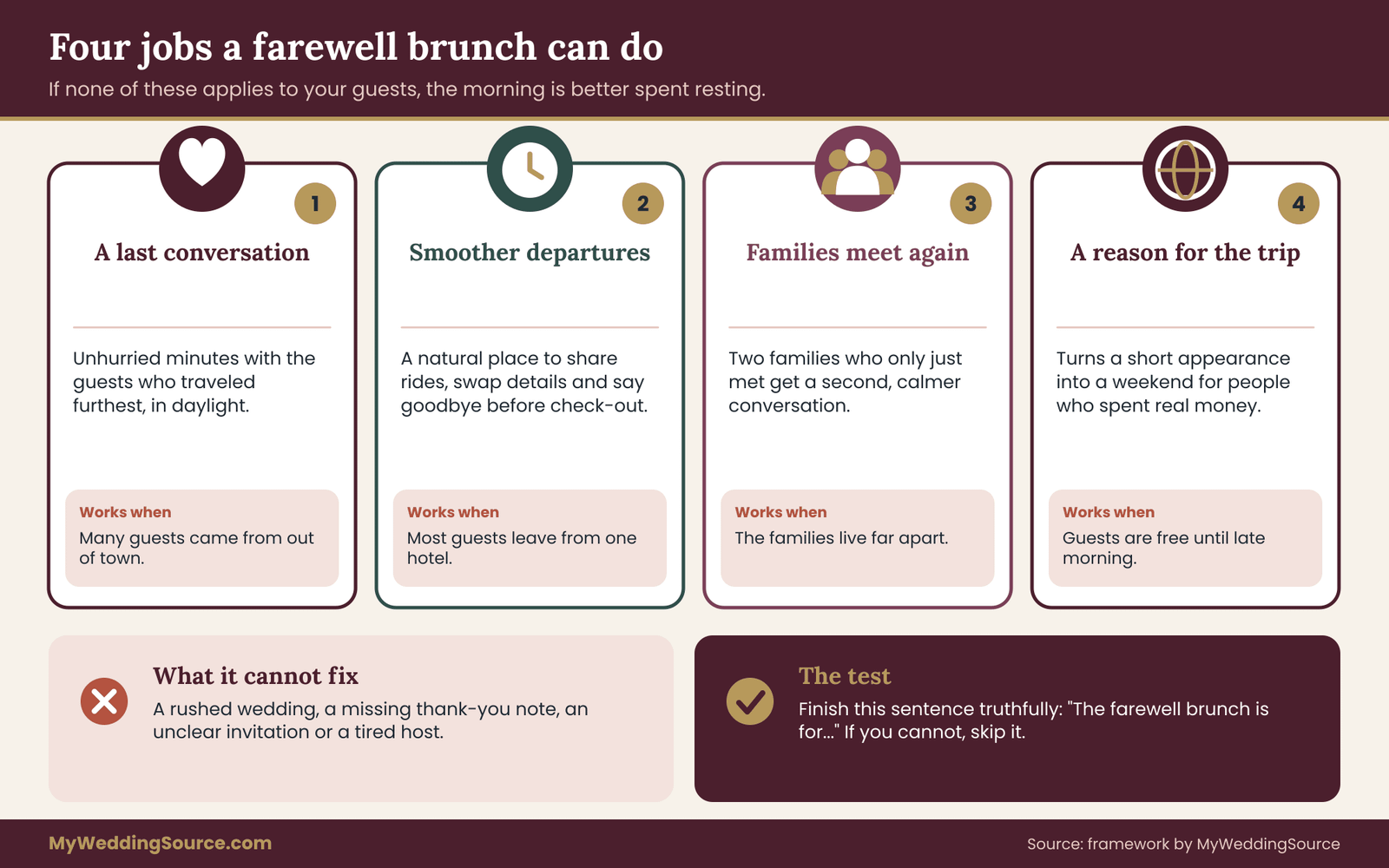
A farewell brunch is worth building when it does at least one of four real jobs.
It gives people a last conversation. At most weddings the couple speaks to each guest for a minute or two. Guests who flew in from another state may have traveled a long way for that minute. A relaxed morning gives you ten unhurried minutes with the people for whom you matter most, in daylight and sober.
It smooths departures. If guests are checking out at eleven and many have a long drive, a meal beforehand is a natural place to gather, swap contact details, share rides and confirm who has whose jacket. This works only when a meal does not delay the drive.
It lets families meet again. When two families met properly for the first time at the wedding, the morning after is often when real conversation happens. Grandparents compare notes. Cousins plan to see each other. That is a legitimate reason to host, especially if the families live far apart.
It gives out-of-town guests a reason that justifies their trip. Guests who spent real money and vacation days to attend sometimes appreciate a second event that makes the trip feel like a weekend rather than a six-hour appearance. This is a softer reason, and it only holds if those guests are actually free that morning.
What a farewell brunch cannot fix
It cannot repair a wedding that felt rushed. It cannot substitute for a thank-you note, a call to a grandparent who could not travel, or a conversation with a relative you wanted to see more of. It cannot make up for an unclear invitation, a venue that was hard to reach, or a guest list that put friends at the back of the room. And it will not feel relaxed if the hosts are exhausted, because guests read host energy quickly.
Some couples also hope the farewell brunch will absorb overflow they could not fit at the wedding, such as extended family or coworkers. That usually backfires. A morning event with a different crowd from the wedding creates a second guest list with its own rules and feelings, and the people added at the last minute know they were added late.
The honest case for and against
It helps to put the arguments on the table in plain terms before you start scoring anything, because both sides are stronger than their usual presentation.
Reasons couples build a farewell brunch
The best reasons are specific. A couple whose families span three countries has real value in a second shared meal. A wedding in a small town with one hotel and a single flight out on Sunday afternoon creates a natural gathering moment. A couple who could not stop to eat at the reception, which is very common, may genuinely want a meal where they can sit down. And some families simply have a tradition of a morning-after gathering, in which case skipping it would be the surprising choice.
There is also a quieter reason. If a wedding ends late and the next morning is empty, many guests will wander between the hotel lobby and the coffee shop anyway. Giving that drifting a structure can feel kind, and it costs little if you keep it small.
Reasons couples skip it
The best reasons to skip are equally concrete. Many guests live within an hour’s drive and will go home that night. Late weddings produce slow mornings, and a meal at nine will be attended by a fraction of those invited. Hosts are tired. The budget is already stretched. The venue’s rate for a second day is high. A family member has strong opinions about who must be invited. Or the couple simply wants a quiet morning with each other before real life resumes.
Skipping is also a good choice when the farewell brunch would be the third or fourth event in a long weekend. By then, guests are tired of scheduled togetherness, and an additional meal becomes a chore.
The mistake behind most unhappy brunches
The usual failure is not poor food or a bad venue. It is the lack of a stated purpose. A farewell brunch with no job tends to drift: nobody knows when to arrive, how long to stay, or whether it is a full meal or a snack. Guests ask each other, “Are you going?” and that question alone signals that the event is optional in a way the hosts did not intend.
When you can write one sentence that begins “The farewell brunch is for…” and finish it truthfully, you have the start of a good event. When you cannot, you probably have an obligation dressed as a plan, and the worksheet later in this guide will help you see that.
Reading your guest list before a farewell brunch
The worksheet depends on facts about your own guests, and most couples have those facts in their heads in blurry form. “A lot of people are staying over” is not a fact you can plan a meal around. Before you decide anything about a farewell brunch, spend an hour turning that blur into a short, honest map of who will be where on the morning after.
This map is not a second guest list. It is a working note that tells you how many people could realistically attend, which of them would need to be rushed, and which have a reason to want a quiet morning. Your wedding guest list guide covers building the main list; this step reads the same list through one question: who is physically able to be at a table at a given hour?
Sort guests into five morning groups
Go through your list household by household and assign each a morning group. You will find that every household fits one of five groups, and that the proportions between them decide a great deal.
Local day guests. They live within a comfortable drive and will sleep in their own beds. They can attend a farewell brunch easily, but many will not want a second trip, especially with children or a late night behind them.
Overnight guests at the main hotel or venue lodging. These are the easiest to reach. They are already on site, and a gathering in the hotel is a short walk. Their constraint is check-out and departure, not travel to the farewell brunch.
Overnight guests at scattered lodging. Rental houses, relatives’ spare rooms, a different hotel across town. They need a reason to cross town, and they need directions that work without a long discussion.
Hosted guests. Relatives who are staying at a parent’s or sibling’s home. Their attendance usually follows their host’s schedule, so one phone call settles a whole group.
Early leavers. Anyone with a morning flight, a long drive with children, a care responsibility at home, or a work obligation. They will not attend whatever you do, and they should not feel they have disappointed you.
Write the number of people in each group. Do not guess the proportions; count households. Once you have the numbers, the picture usually becomes clear very quickly. A wedding in which most guests are local day guests and early leavers rarely supports a full farewell brunch. A wedding in which most guests are overnight at one hotel and leave after noon often does.
Ask guests for facts, not for opinions
You will learn more from a plain travel question than from asking “would you attend a farewell brunch?” People answer the second question politely and inaccurately. They say yes because yes is kind, then oversleep or leave early.
A better approach is to ask, on your wedding website or with the RSVP, which day each household plans to travel home and roughly when. Phrase it as a practical logistics question that also helps with shuttle and hotel arrangements. Most guests are happy to answer, and the answers are honest because they are about travel, not about you.
If you already printed invitations without that question, send one short message to overnight guests only. Something like:
“To help us plan the morning after the wedding, could you tell us roughly when you expect to leave town on Sunday? A rough hour is plenty.”
That wording does not mention a farewell brunch, which matters. You are collecting facts before you decide, and you do not want to announce an event you may later cancel.
Turn departure times into a usable window
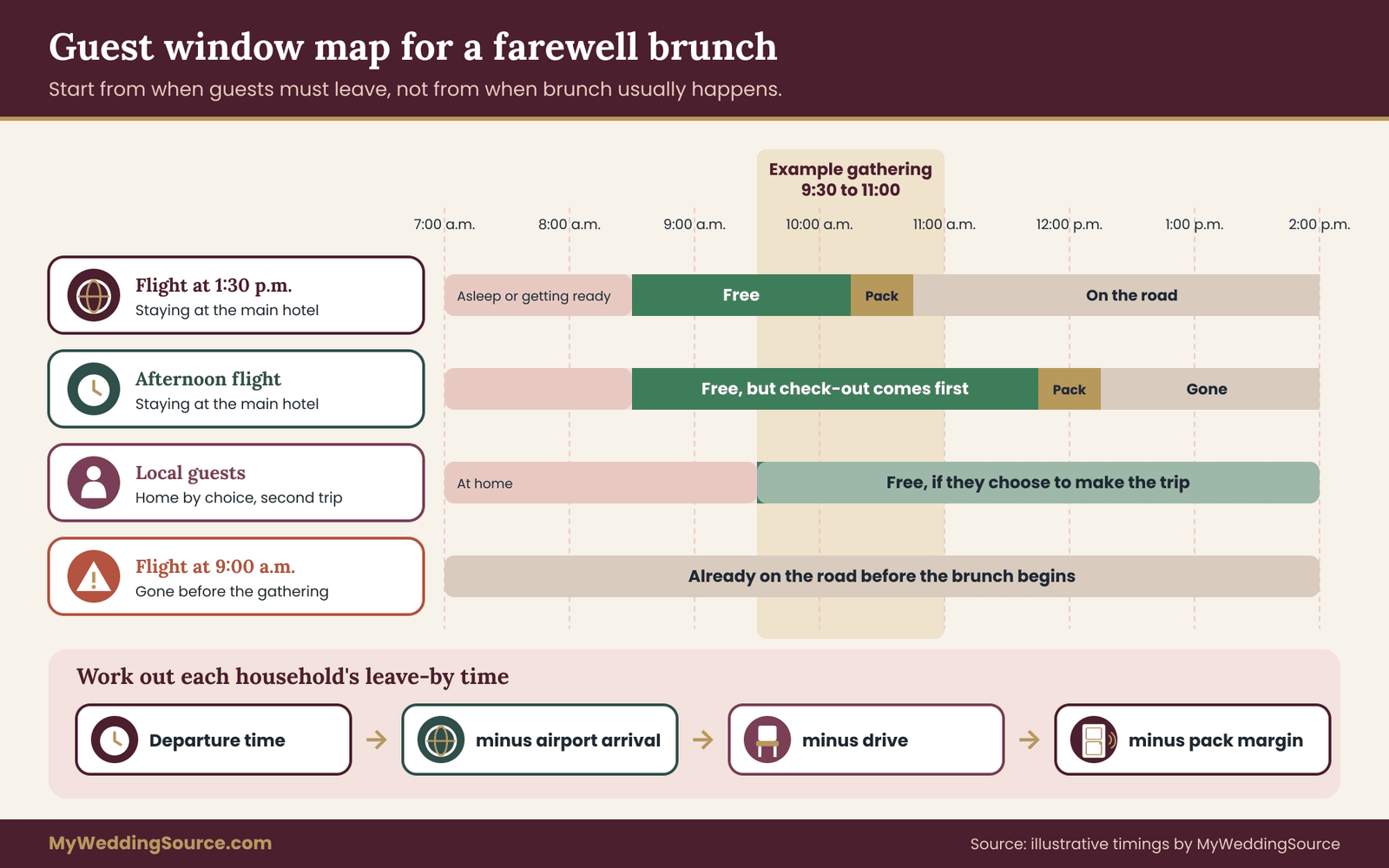
Once you know when people are leaving, convert each departure into the latest time they could realistically still be at a table. This is simple arithmetic, and it is the single most useful thing in this section.
Start with the time they need to be at the airport or on the road. For flights, use the time your airline and the Transportation Security Administration advise for arrival at the airport, and check current guidance yourself, since it varies by airport and season. Add the travel time from the hotel, and add a margin for checking out, loading bags and getting children into car seats. Subtract all of that from the departure time, and you have the moment that person needs to be leaving.
Here is an illustrative example. One guest has a flight at half past one. The airport is forty-five minutes from the hotel, and the airline recommends arriving two hours early. That means being at the airport by half past eleven and leaving the hotel by a quarter to eleven. Add a half hour to pack and check out, and that guest needs to be in their room, finishing up, by a quarter past ten. A brunch from half past nine to eleven would give that guest about forty-five minutes at most, and only if everything runs on time.
Do this for each overnight household, even roughly, and you can see where the cutoff sits. Most weddings have a natural grouping of departure times. Often you will find that the great majority of guests need to be gone by late morning, which puts the useful window earlier than couples imagine.
Allow for the late night before the farewell brunch
A wedding that ends at midnight produces a slow morning. Guests who danced until the last song are not at their best at eight, and the wedding party may have been awake long after that. Be honest about how late your own event will run, including cleanup and after-party time.
As a general rule, the later the reception ends, the later a farewell brunch should start, and the shorter the window before departures begins to close. If those two pressures leave you a window of ninety minutes or less, that is a sign the format needs to be light. A seated three-course meal does not fit into ninety minutes with people arriving at different times. A coffee and pastry gathering does.
Alcohol also affects this. Guests who drank at the reception may still be impaired in the morning, and anyone driving soon after should not do so on the assumption that sleep has cleared it. The National Highway Traffic Safety Administration publishes guidance on impaired driving. For a farewell brunch, this is mostly a reason to make sure there are plenty of non-alcoholic choices and to avoid pushing a drink on guests who are about to drive.
Think about who each choice includes and leaves out
A farewell brunch always has an invitation boundary, and you should choose it on purpose. There are four common boundaries, and each carries a message.
Inviting everyone, including local guests, sends a message of generosity and often produces the lowest attendance rate, because many people will assume it is optional.
Inviting out-of-town guests and family says that this event is for people who traveled. It is easy to explain and cheaper, and it needs clear wording so local friends do not feel excluded.
Inviting the wedding party and immediate families says this is a closer, more private gathering. It is understood by most people, but it can sting if a few close friends are just outside the line.
Inviting only the people staying at a particular hotel is a boundary of convenience. It is practical, but it can create awkward cases, such as a guest who stayed elsewhere and finds out afterward.
Whichever boundary you pick, you will want one sentence that explains it in kind, neutral words. If you cannot write that sentence without feeling defensive, the boundary may be harder to hold than you expect, and a smaller, less formal gathering might serve better. The wedding etiquette guide is a helpful reference for the principle that a host decides the scope of an event and explains it without apology or over-explanation.
Account for guests with extra needs
Older relatives may need a ground-floor room, step-free access, or simply a chair near the door. Parents of babies may need a table with space for a stroller and a quiet corner. Guests who use mobility aids need clear paths and a venue that has been checked, not assumed. If a guest is traveling with a caregiver, count the caregiver.
Include these needs in the headcount map from the start. They also affect which format works. A buffet with long lines and standing cocktail tables is hard for someone using a walker, while a simple seated meal or a pastry table with chairs nearby is easier. The guest hotel coordination guide explains how to collect mobility and budget information together, so you ask each household only once.
What you should have at the end of this step
By the end of this hour you should have five numbers (one for each morning group), a rough cutoff time for the useful window, a likely boundary for who is invited, and a list of guests with special needs. With those you can answer the worksheet questions with facts instead of impressions, which is the whole point.
The farewell brunch value worksheet
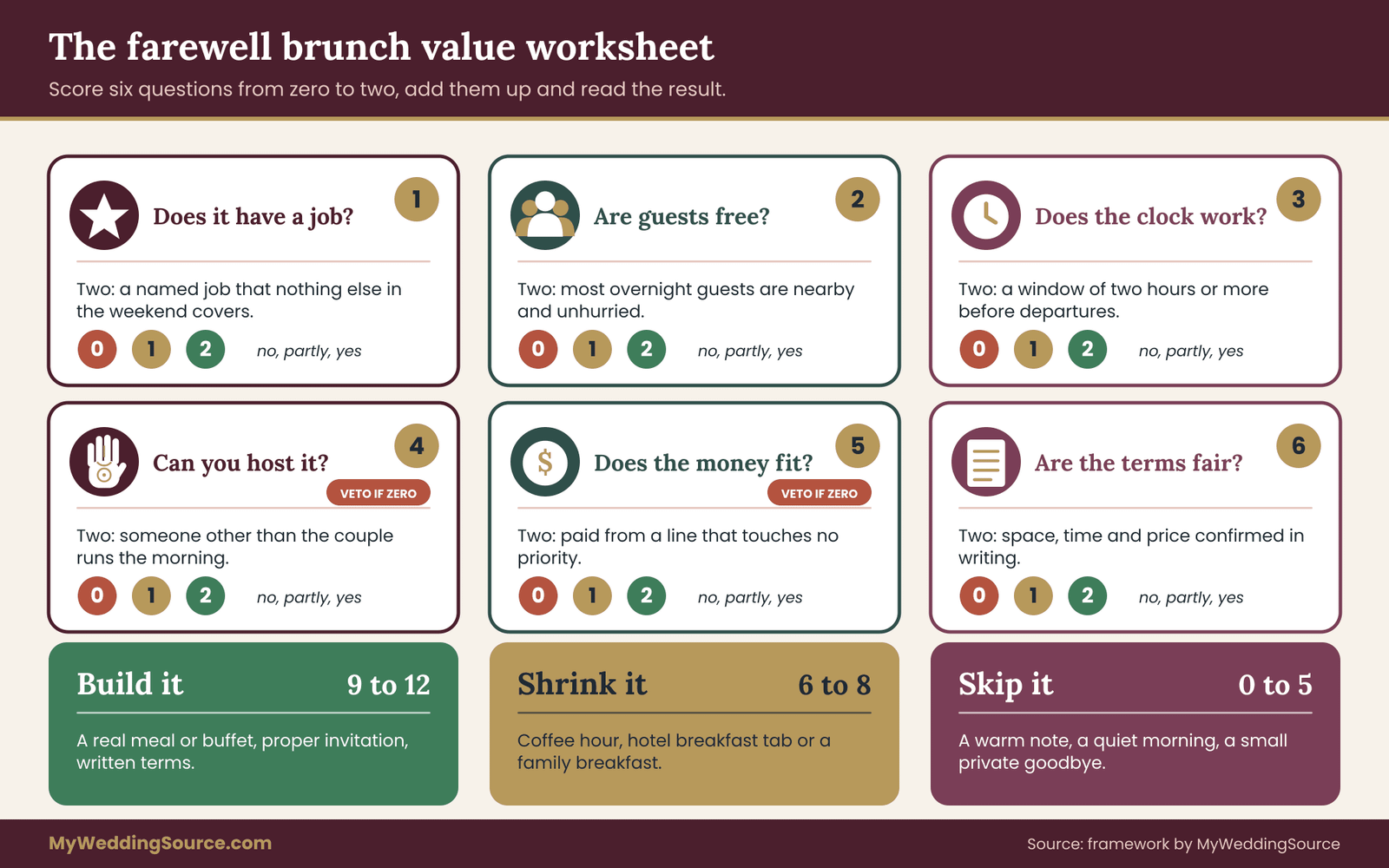
This is the core of the guide. The worksheet has six questions. You score each one zero, one or two, using the facts from your guest map, and add the six scores. The total points to one of three outcomes. Two of the questions also carry a veto, which keeps a high score elsewhere from talking you into something you cannot actually host.
The scale is the same for every question. A zero means the answer is no or unknown. A one means partly, or yes with real reservations. A two means a clear yes that you could explain to a skeptical friend. If you hesitate between two numbers, pick the lower one. A farewell brunch you are unsure about is usually one you will resent halfway through.
Question one: Does it have a job?
Score two if you can name a specific job from the four earlier in this guide and point to the guests it serves. Score one if the job is real but modest, such as “it would be nice to see people once more.” Score zero if the honest answer is “people expect it” or “the venue offered it.”
The test is whether the job could be done another way. If the real goal is to thank traveling guests, a handwritten note at each place setting the night before does that at almost no cost. If the goal is a last conversation with your grandparents, a private breakfast with them does that without a guest list. A farewell brunch whose job can be done more cheaply earns a one at most.
Question two: Are enough guests actually free?
Look at your morning groups. Score two if most overnight guests are staying within easy reach of the venue and do not need to leave until after the window you identified. Score one if about half are free, or if the free guests are mostly family. Score zero if most guests are local day guests, early leavers, or scattered in lodging that makes attendance a chore.
Be firm here. A brunch for a hundred invited people where thirty attend is not a disaster for the guests, but it is a poor use of money and a poor feeling for the hosts, who stand in a half-empty room and wonder what went wrong. The cause is almost always an optimistic read of this question.
Question three: Does the timing work for departures?
Use the window you calculated. Score two if a useful window of at least two hours sits between a realistic start and the time most travelers must leave. Score one if the window is about ninety minutes, or if it works for most guests but strands a meaningful group. Score zero if the window is too short for any meal and only works if guests hurry.
This question is separate from the previous one because guests can be nearby and still have no time. A hotel full of people with noon flights has plenty of overnight guests and almost no useful morning.
Question four: Do you have the capacity to host it? (veto)
Capacity means energy and people, not money. Score two if someone other than the couple will run the event: a parent, a sibling, a friend, a planner or a venue coordinator who has agreed to specifics. Score one if the couple will be present but supported, with someone handling food, arrival and cleanup. Score zero if the couple would have to manage the details themselves, or if either partner is already worn out.
A zero here is a veto. If you cannot host it without running it, shrink the event to something that runs itself, such as a hotel breakfast with a tab arranged in advance, or skip it. The morning after a wedding is not a good time to supervise a caterer. It is also the one question where honest, private conversation between partners matters most, because one partner may be quietly dreading something the other is excited about.
Question five: Does the money make sense? (veto)
Score two if the cost sits comfortably inside a budget line you already set, and paying it will not pull money from a vendor payment, a honeymoon deposit or an emergency reserve. Score one if it fits only by trimming something you would rather keep. Score zero if it requires borrowing, using a card balance you cannot pay in full, or taking money from something more important.
A zero here is also a veto. For a farewell brunch, cost matters less as a number and more as a source. A modest brunch paid from savings you set aside is a far lighter decision than a modest brunch paid from the cushion that was meant to cover a late vendor invoice. The wedding budget guide covers how to give every line a source, and the cost section later in this guide shows how to estimate the farewell brunch from your headcount map.
Question six: Can the venue and vendors support it on fair terms?
Score two if you have a confirmed space, a confirmed time, written pricing and a vendor who has done this before. Score one if you have a probable space but terms are not final. Score zero if the venue is unavailable at that hour, if the price requires a large minimum, or if vendors cannot confirm in writing.
Venue contracts sometimes carry hidden effects on a second day: extra rental time, a separate service charge, an overtime rate for staff, or a food-and-beverage minimum that applies to any hosted event on the property. Read the contract language yourself and ask questions in writing. The wedding vendor contract guide is a good reference for what to look for.
Reading the total
Add the six scores. The total ranges from zero to twelve.
Nine to twelve: build it. The farewell brunch has a job, enough guests are free, the clock works, someone will run it, the money is clear, and the venue is ready. Plan a real meal or a well-organized buffet for the farewell brunch, invite your chosen group, and treat it as a proper part of the weekend.
Six to eight: shrink it. Some of the pieces are missing. The right answer is usually a lighter event: a coffee and pastry hour, a hotel breakfast with a hosted tab for a defined group, a drop-in gathering with a clear end time, or a farewell brunch for the closest family and wedding party only. The next section of this guide describes those options in detail.
Zero to five: skip it. Do not feel guilty. Write a warm note, make a plan for a quiet morning, and put your energy into the part of the weekend that matters more. If a few people matter to you, see them in a small, unscheduled way: a coffee with a grandparent, a short call with a friend.
The veto rule. If question four or question five scored zero, the highest answer available is “shrink,” whatever the total says. That rule exists because the two things most likely to ruin a morning-after event are an exhausted host and a worried budget, and neither is improved by a larger meal.
Score separately, then compare
If both partners care about the decision, score the worksheet independently, without talking, and compare afterward. Differences are informative. When one partner scores question four as a two and the other as a zero, you have found the real conversation, which is about how much support each of you expects. When you disagree on question one, one of you may have a specific person or tradition in mind that the other has not heard about.
If parents are contributing money or have strong views, consider having them answer questions one and two only, since those are about guests, not about the couple’s energy or finances. Their answers often reveal what they are hoping for, and you can respond to that directly instead of guessing.
Write down the answer and the reason
When you reach an outcome, write the total, the three or four scores that mattered most, and a one-sentence reason. For example: “We are shrinking it to a coffee hour because most guests leave by late morning and neither of us wants to run a meal.” Keep the note somewhere both of you can find it.
That sentence does two things. It gives you the words to explain the decision kindly to a relative who asks. And it protects you from reopening the question every time someone has a new idea, because the note shows what you decided and why.
When to score again
Scores change when the facts change. Score again if the date moves, if the guest count changes meaningfully, if the venue changes, if a flight problem or weather event reshuffles travel, or if the budget shifts after a vendor invoice arrives. Do not score again just because someone you love is unhappy with the answer. Re-scoring is for new facts, not for new pressure.
Timing, venue and format choices for a farewell brunch
If the worksheet says build or shrink, the next decisions are when, where and in what shape. They interact, so make them together. Start with time, because the time you pick limits the venue and the format.
Choose a start time from the window, not from tradition
Most guides suggest a start around ten or eleven in the morning because that is when brunch normally happens. Your guests do not live on a farewell brunch schedule. They live on departure times and sleep debt. Use the window you built in the guest map and work backward from the cutoff.
A useful rule is to start the gathering about half an hour after the earliest time most overnight guests could plausibly be up and presentable, and to end it a comfortable margin before the first big wave of departures. If your cutoff is eleven, a start at half past nine gives ninety minutes. If your cutoff is noon, a ten o’clock start gives two hours.
Notice what this does to the idea of “brunch.” On many weddings, the honest time is earlier than brunch and closer to a late breakfast. That is fine. Name the event for what it is on the invitation. A gathering called “Breakfast and goodbyes, 9:30 to 11:00” sets better expectations than a vague “Farewell brunch” with no end.
Pick a duration that guests can use
For a seated meal, plan about ninety minutes to two hours so the food can be served, eaten and followed by conversation. For a buffet or drop-in event, a window of about two hours with a clear end works well, because people arrive and leave at different times. For a coffee and pastry gathering, an hour to ninety minutes is plenty.
State the end time. An open-ended gathering makes the first guest to leave feel rude and leaves the hosts unable to wrap up. A stated end gives everyone permission to go and lets a venue schedule staff accurately.
Where the event can happen
There are six common venues, and each has a particular strength.
The hotel restaurant or a hotel meeting room. This is the most convenient for overnight guests, since no one has to travel. A private room with a set menu is simple to price. The downside is that hotels often require a food-and-beverage minimum or a service charge, and rooms may be booked by other events on Sunday morning.
The wedding venue itself. If the venue has a free space and staff on Sunday morning, the logistics are familiar. But many venues charge a full second-day rate, require a separate rental period, or restrict hours, so read the contract before assuming it is a small add-on.
A restaurant nearby. This works for a defined group, such as the wedding party and family, and can be simple to book. For larger groups, check the restaurant’s capacity for a private party and its rules about pre-ordering and payment.
A parent’s or relative’s home. This can feel warm and costs less, but it shifts the work to the household and asks guests to travel there. It works best for a smaller family gathering and not for an open invitation.
A park or outdoor space. It can be pleasant in good weather and difficult in bad. Public spaces often require permits and have rules about food, alcohol, amplified sound and tents, so check with the local parks office and have a backup plan.
The hotel lobby, courtyard or breakfast area. For a coffee hour, this can work with the hotel’s consent. Always ask first. A hotel will usually be happy to help if they know in advance, and unhappy if a crowd arrives uninvited at its breakfast service.
Capacity, fire code and accessibility are not optional
Any room has a posted occupancy limit, and a hosted event should respect it. The National Fire Protection Association publishes the model codes that many jurisdictions use, and the local fire marshal or the venue’s management can tell you the limit for a particular space. Do not assume that because the room held the reception, it holds a seated farewell brunch for the same number. Tables, buffet lines and chairs take more room than a standing crowd.
For accessibility, the Americans with Disabilities Act sets requirements for many public venues, but compliance on paper does not tell you whether a particular route works for a particular guest. Walk the route from the front door to the table yourself, or ask someone who can. Check doors, thresholds, restrooms and seating. If you have guests with mobility needs, confirm in writing that the room is step-free and that tables allow space for a wheelchair or walker.
Seated, buffet or stations
For a farewell brunch, format shapes cost and mood more than venue does, so choose it deliberately.
A seated meal feels formal and gives guests a place. It requires a firm headcount, fixed menus or choices, and enough staff to serve everyone at about the same time. It works for small, closer groups, where conversation is the point.
A buffet is flexible and suits mixed ages and diets. It needs good flow: separate lines or double-sided tables, clear labels and enough serving space so people are not queuing in a corridor. The reception guest flow guide explains the principles of entry, food lines and movement that apply here at a smaller scale.
Stations can work if there is a theme and staff, but they cost more in staffing and space and are rarely worth it for a morning event.
A drop-in table of coffee, tea, juice, pastries and fruit is the simplest format. It needs little equipment, is easy to scale up or down, and lets guests come and go.
A short note on alcohol
Many couples assume a farewell brunch means mimosas. It does not have to, and guests who are driving or flying soon may prefer coffee. Some guests will not want alcohol at all. If you serve it, offer it as one choice among many, set a clear limit, and have non-alcoholic options that look festive, such as sparkling juice or a good coffee setup. Check the venue’s liquor rules, since a venue that is licensed for the reception may need separate arrangements for a second event, and local law may limit when alcohol can be served on a Sunday morning.
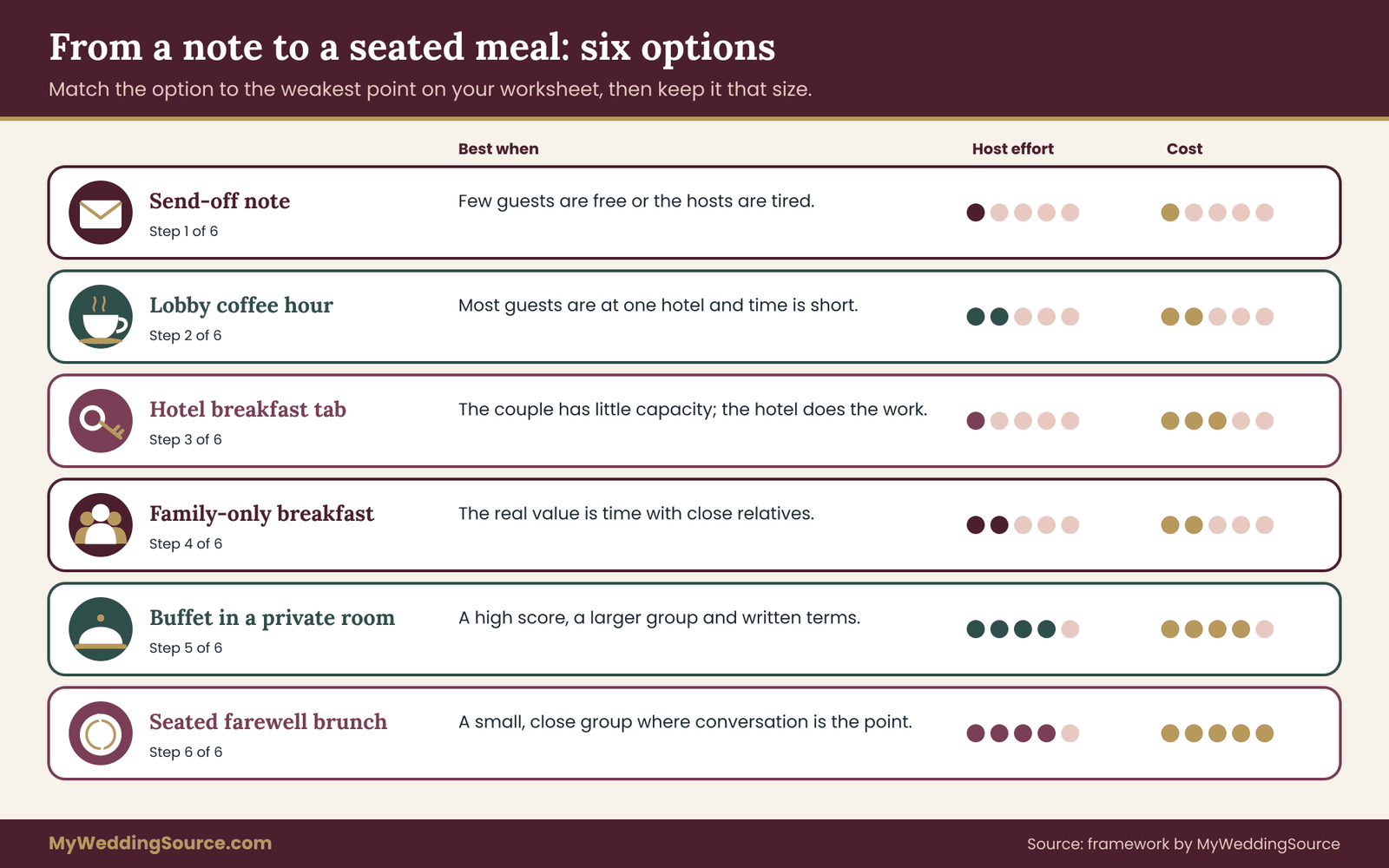
Lighter options that replace a full farewell brunch
Between “full farewell brunch” and “nothing” there is a wide middle, and for many couples the best answer lives there. The worksheet’s “shrink” outcome usually points to one of these.
A send-off note. A short printed or handwritten note placed in welcome bags or left at the front desk thanks guests, gives travel wishes and mentions that you are resting. Cost is close to nothing. It fits when the worksheet scored low on guests and capacity but you still want to acknowledge people.
A lobby coffee hour. A host-arranged table of coffee, tea and pastries in a hotel lobby or meeting room for one hour. It fits when most guests are at one property and time is short. Cost is modest and predictable, and attendance can vary without waste if you order by the dozen and not by the plate.
A hosted hotel breakfast tab. You arrange with the hotel for a defined group to eat at the regular breakfast and charge it to your account, within a stated limit. It fits when the couple has little capacity to host, because the hotel does the work. Be clear about the limit and which items are covered, so there is no confusion at the table.
A buffet or catered farewell brunch in a private room. This is the traditional farewell brunch. It fits when the worksheet scored high, the group is large enough to justify the cost, and a vendor can confirm terms in writing.
A family-only breakfast. A smaller gathering of the closest relatives, often at a parent’s home or a restaurant. It fits when the main value is time with family and a broader invitation would stretch capacity.
A late-day or next-day alternative. Some couples hold a casual gathering the afternoon or evening after, such as a picnic or a backyard meal. That suits guests who stay longer and spares those with early flights from feeling pressure. Because it has its own considerations, treat it as a separate event with its own worksheet pass.
How to choose among them
Match the option to the weakest point on your worksheet. If question two scored low because few guests are free, pick something smaller. If question three scored low because the window is short, pick something that does not need a seated schedule. If question four scored low because you cannot host, pick something that someone else operates. If question five scored low, pick something where cost scales with attendance, such as a coffee hour ordered by the dozen, and not something priced per head with a fixed minimum.
A common mistake is to choose a middle option and then upgrade it by habit. A simple coffee hour starts to grow a menu, then a bar, then place cards. Decide the shape and keep to it. The point of a lighter option is that it stays light.
Budget logic for a farewell brunch
Cost surprises usually come from the structure of a quote, not from the food. A farewell brunch looks cheap per plate and then grows through lines you did not see: a room fee, a service charge, a gratuity, staff overtime, rentals, taxes, and a minimum spend. This section shows how to estimate the whole cost from your guest map and how to compare it fairly with the lighter options.
No average price appears here on purpose. Costs differ widely by region, venue and season, and a made-up average would only give you false comfort. Use quotes from the vendors in front of you. The goal is to build the structure of the estimate so that any quote slots into it.
Estimate attendance before you price anything
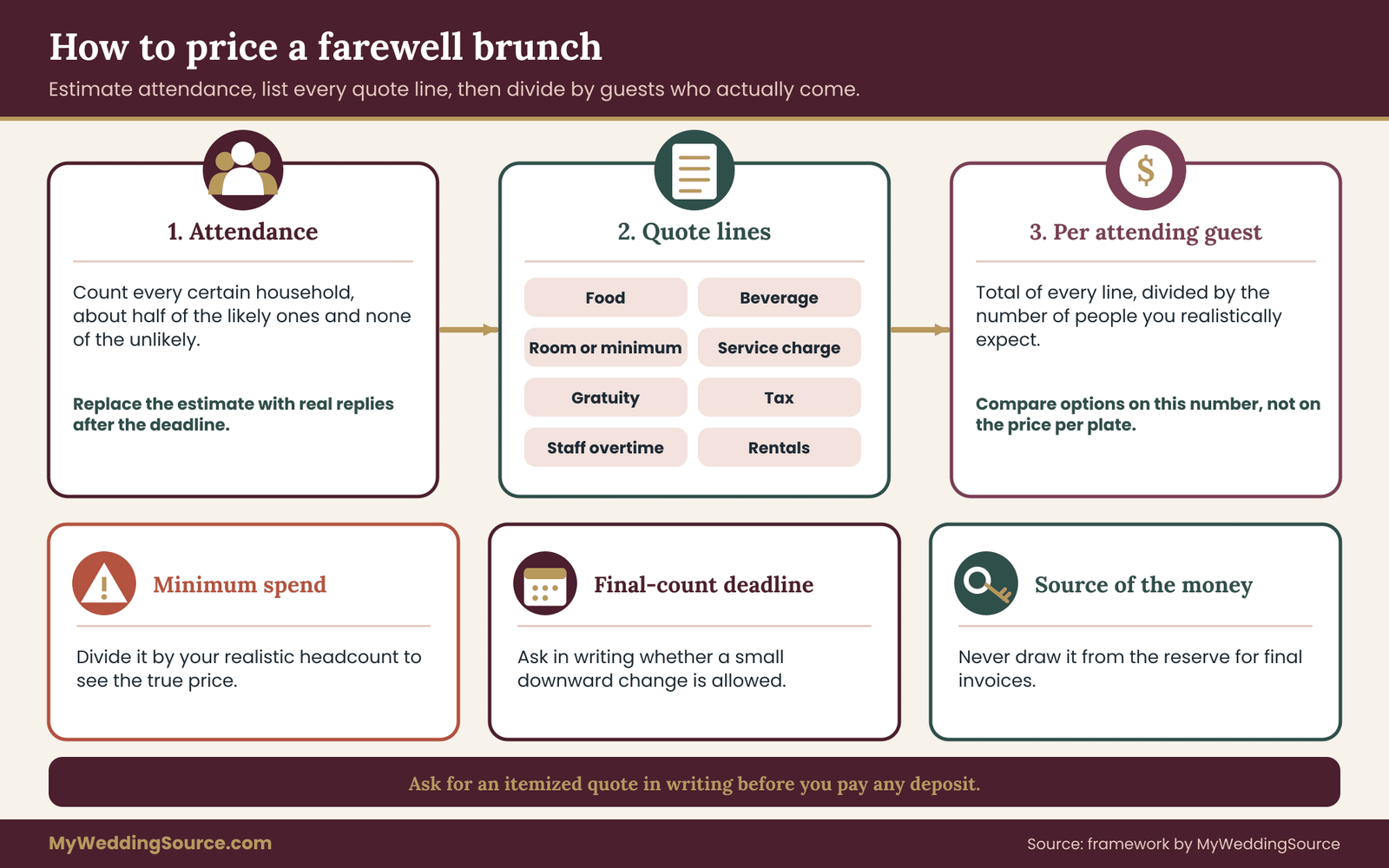
Start from the morning groups, not from the invited list. For each group, sort households into three piles: certain to come, likely to come, and unlikely to come. Be strict. “Certain” means the household has told you the plan and the timing works. “Likely” means they are staying nearby and have no known conflict. “Unlikely” is everyone else.
For pricing and ordering, count all of the certain households, about half of the likely ones, and none of the unlikely. This is a working method, not a statistic. Its purpose is to stop you from pricing for the full invited list and then paying for food nobody eats. After the RSVP deadline you replace the estimate with real numbers.
Keep the three piles visible. If you invited sixty people and your own estimate lands at thirty-five, the decision is not about sixty. It is about thirty-five, and some formats are poor at that size. A plated meal for thirty-five is expensive per head. A coffee and pastry table for thirty-five is easy.
List every line a quote can contain
When a vendor quotes a farewell brunch, ask for an itemized quote in writing and look for these lines. Each can be a separate charge.
The food itself, per person or per tray. The beverage package, if any, and what it includes. A room or space fee, or a minimum spend that replaces it. Service charge and gratuity, which may be separate lines or combined. Applicable taxes. Staffing, including any overtime or minimum staff hours. Rentals such as tables, linens, chairs and warming equipment. Delivery or setup fees if the food is catered into another space. Decor, signage or printed menus. Cleanup and trash removal. Any charge for a second day of access to the property.
Ask three questions about the pricing itself. Does the service charge go to staff, or to the house? Is a gratuity already included in it, so that adding a tip would pay twice? And are taxes calculated on top of both? These are the same questions you ask about the wedding, and the answers change the true price by a meaningful amount.
Understand minimums and final-count deadlines
Many venues and caterers set a food-and-beverage minimum: a floor on spending that applies even if fewer people attend. If your estimate falls below the minimum, you will pay the difference, and the “per person” price you were quoted no longer describes reality. Divide the minimum by your realistic headcount to see the effective price per attending guest.
Caterers also set a final-count deadline, often several days before the event, after which you pay for the number you gave even if fewer arrive. A farewell brunch has an unusually unpredictable headcount because late-night weddings thin morning attendance. If the deadline falls before your RSVP data is firm, ask whether the vendor will accept a small downward adjustment, and get the answer in writing.
For a longer treatment of how headcount drives catering cost, the menu planning guide covers how food quantities, dietary needs and service style fit together.
Compare cost per attending guest, not cost per invitation
The fair way to compare a seated farewell brunch, a buffet and a coffee hour is to divide the total, including every line above, by the number of people you realistically expect. A seated farewell brunch might look affordable per plate and still be the most expensive per attending guest, because you pay for every seat you reserved.
Write each option as a short sentence: “For about thirty-five people, this costs X in total, or about Y per attending guest, and has Z of risk if attendance drops.” The risk part matters. A coffee hour ordered by the dozen has low risk, because you can order less. A plated meal with a fixed count has higher risk.
Decide where the money comes from before you commit
This is the same test as worksheet question five. Name the budget line the cost will come from. If the answer is “the miscellaneous line,” ask whether that line is already promised to something such as final vendor balances, tips, alterations or travel. If the farewell brunch needs money that the rest of the weekend is counting on, that is a signal to choose a lighter option.
The cash flow planning guide explains how to keep a reserve for the final weeks, when invoices tend to arrive together. A farewell brunch should be paid for from money left after that reserve is protected, not from the reserve itself.
Watch for payment terms and card fees
Ask whether the vendor requires a deposit, when the balance is due, and what the cancellation terms are. If you pay by card, ask whether a surcharge applies. The Consumer Financial Protection Bureau explains billing disputes and consumer rights for card payments, and the Federal Trade Commission has general guidance on avoiding unfair charges. Keep every quote, agreement and receipt, including emails that change terms.
If a deposit is nonrefundable, treat it as spent the day you pay it. That is a reason not to book until you have scored the worksheet, and a reason to ask for a refundable hold if the venue offers one while you wait for RSVPs.
Invitation wording for a farewell brunch
How you invite people shapes who comes, how they feel, and how much you pay for. Good wording is short, specific and kind. It answers four questions: who is invited, what is happening, when it starts and ends, and whether guests need to reply.
Choose the channel to match the boundary
If you are inviting everyone, put a line on the wedding website and a small insert or line in the invitation suite, so it is part of the weekend schedule. If you are inviting out-of-town guests only, a note in welcome bags or a message sent directly to overnight guests is cleaner, since it reaches the right people without announcing the event to the rest. If you are inviting the wedding party and families, a direct message from you or a parent is enough.
Avoid group chats for the invitation. They create a public yes-or-no scoreboard and make it awkward for anyone who cannot attend.
Wording that sets expectations
Include the start time, the end time, the place with an address, the kind of food in a few words, and a reply deadline. Say whether the event is hosted, so no one wonders about the bill. Here is a sample for an all-guests boundary.
“Join us for a farewell brunch on Sunday morning at the hotel, 9:30 to 11:00, in the garden room. Coffee, pastries and a light buffet. Please let us know by Wednesday if you plan to come, so we can order the right amount.”
For a smaller boundary, say what the event is without apologizing for it.
“We are hosting a family breakfast on Sunday at 9:30 at the hotel restaurant for our parents, siblings and the wedding party. We would love for you to join us.”
For a lobby coffee hour, drop-in language is enough.
“We will have coffee and pastries in the hotel lobby from 9:30 to 10:30 on Sunday morning. Stop by for a hug before you head home. No reply needed.”
Handle the people who are not invited
Someone will ask, directly or through a relative. Have a plain answer ready that is true and does not invite negotiation. For example:
“We are keeping Sunday small, just family and the wedding party, because we are heading out soon after. We are so glad you were at the wedding.”
Do not over-explain. Long explanations sound like apologies, and apologies invite counter-offers. If someone insists, repeat the shorter version once and move on.
Collect replies that help the vendor
A reply request is for planning, not for politeness. Set the deadline before the vendor’s final-count date, with a few days of margin. Ask for the number of people in each household and any dietary needs, which is also a chance to note allergies. If guests do not reply, follow up once with a short, friendly message, then use your attendance estimate.
If you cancel after announcing
Sometimes a change of facts, such as a travel disruption or a venue problem, means you have to cancel or shrink an event you already announced. Do this quickly and plainly. Send one message to everyone who received the invitation, say what changed, and say what replaces it, even if the replacement is nothing more than a note of thanks. Then check any deposit terms with the vendor and put the new information in your records.
Food, safety and vendor details for a farewell brunch
Once the format is chosen, the food itself is the easiest part, which is a reason not to overthink it. Morning menus are forgiving, and a farewell brunch menu is no exception. The real work is in safety, dietary needs and the written terms with whoever is serving.
Keep the menu simple and the timing honest
A morning gathering needs coffee first. Order more coffee than you think, in a form guests can pour themselves, and add hot water and tea. Add juice and water. Then choose a short list of food that holds well: pastries, fruit, yogurt, a baked egg dish, breakfast breads, potatoes, a salad or a few savory items. Items that must be cooked to order slow the line and require more staff.
Match the menu to the time. If the gathering is ninety minutes and half of the guests arrive in the last thirty, food that is best served immediately will be wasted. Choose items that are fine after thirty or forty minutes in proper holding equipment, and ask the caterer how long each dish holds well.
Think about what guests ate the night before. After a full wedding dinner and a late dessert table, many people want something light in the morning. A modest spread that people can pick at often goes over better than a heavy meal that looks generous on the quote.
Food safety basics
Morning buffets are often left out longer than intended. The federal food safety guidance at FoodSafety.gov says perishable food should not sit out for more than two hours, and for only one hour when the air temperature is above ninety degrees Fahrenheit. Hot food should be kept hot and cold food kept cold, using chafing dishes, warming trays or ice. Ask the caterer how they will hold each item, and who will check temperatures and replace trays.
Eggs, dairy, cut fruit, smoked fish and cooked potatoes are the items most worth watching. If your event is outdoors in summer, assume the clock runs faster. If a spread is nearly finished at the two-hour mark, remove it and do not top it off with fresh food mixed into the old.
Ask a licensed caterer or the venue’s kitchen for their food-handling approach. For home-hosted gatherings, the Centers for Disease Control and Prevention and the U.S. Food and Drug Administration publish consumer guidance on safe preparation, storage and serving. A family kitchen is not a commercial one, and when serving thirty or more people the margin for error narrows.
Dietary needs and allergens
Collect dietary needs at the same time as RSVPs, and treat allergies as safety information, not preferences. The Food and Drug Administration lists the major food allergens as milk, eggs, fish, shellfish, tree nuts, peanuts, wheat, soybeans and sesame. Pastries and breads often contain several of these, and shared tongs and trays spread them from one dish to another.
Ask the caterer how they will label items, how they will prevent cross-contact, and whether a separate plate can be prepared for guests with serious allergies. Label items on the table, with ingredient information the caterer can stand behind, and place a staff member nearby who can answer questions. If a guest has a severe allergy, speak with them directly before the event instead of relying on a label.
Plan for vegetarian, vegan, gluten-free and religious dietary needs without making them an afterthought. A plain fruit platter is not a vegan entrée. A good farewell brunch menu contains several items that fit these needs without a special request.
Children and older guests
Children eat early and tire fast. A few simple items they will eat, a place to sit near their parents and an end time that respects naps all help. For older guests, think about seating near the food, a staff member who can bring a plate, and chairs with arms. Check that the temperature of the room is comfortable and that there is a quiet corner.
Vendor terms to confirm in writing
Whether the vendor is the hotel, a caterer or a restaurant, get the following in writing: the date, start and end times, the headcount deadline, the price and what it includes, the cancellation and refund terms, the setup and breakdown times, and a day-of phone number for someone who will answer. Ask what happens if fewer guests arrive, and what happens if more do.
If you bring in an outside caterer, ask the venue whether it permits outside food, whether it charges a fee, and whether the caterer must supply proof of insurance. Check the rental terms for a second-day time slot and ask who is responsible for trash removal. The same habits that protect your wedding contracts protect this one, and the vendor contract guide linked earlier lists clauses worth checking.
Plan for weather and a plan B
If any part of the gathering is outdoors, a clear backup is essential. Name the decision point, such as “we decide at eight o’clock the morning of,” name who makes the call, and tell guests where to look for the update. If the backup is indoors, confirm in advance that the space is available and large enough.
Three worked cases for a farewell brunch decision
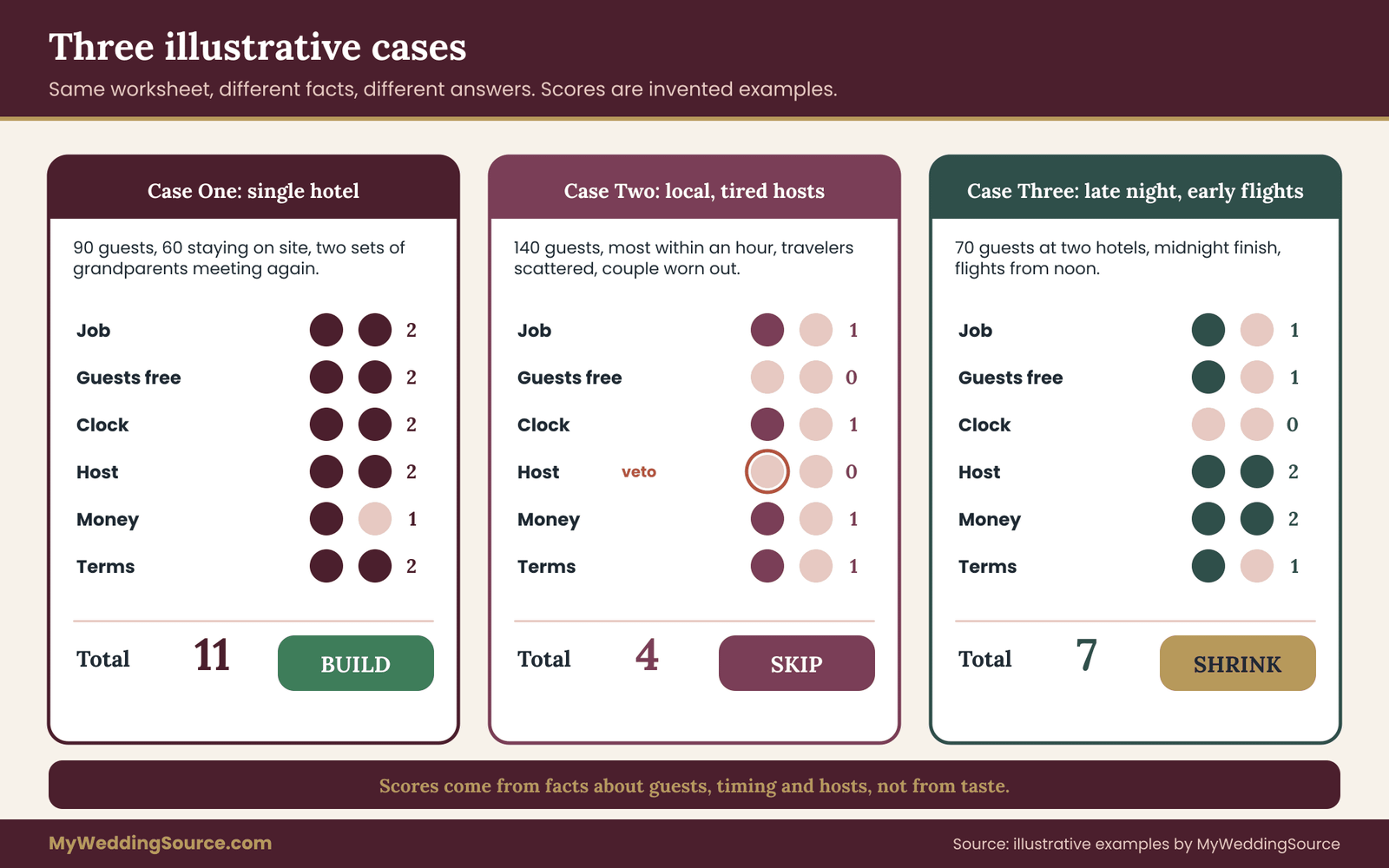
The cases below are invented for illustration. They show how the worksheet works with different facts. The numbers are not data about real weddings, and your own scores may differ even in a similar situation.
Case one: the weekend wedding at a single hotel
A couple marries on a Saturday evening at a hotel in a small city. About sixty of the ninety guests are traveling and staying at the hotel. Most have flights or long drives on Sunday afternoon. Two sets of grandparents who have never met are among the guests, and the couple’s families live in different states.
They score question one at two, because the grandparents and the traveling families have a clear reason to see each other once more. Question two scores two, because most guests are on site. Question three scores two, because departures bunch up after one o’clock, leaving a window of about two hours. Question four scores two, since the bride’s sister has volunteered to coordinate with the hotel. Question five scores one, because the cost fits but only by trimming the flowers budget. Question six scores two, because the hotel offers a private room with a written quote.
The total is eleven, and no veto applies. They build a buffet farewell brunch from half past nine to eleven, invite out-of-town guests and family, and tell local friends in a kind sentence that the morning is for those who traveled.
Case two: the local wedding with tired hosts
A couple marries on a Friday evening in their hometown. Most of the one hundred forty guests live within an hour. About twenty are traveling, and they are staying in several different places. The couple’s parents offered to host a farewell brunch, but both partners are already worn out from planning.
Question one scores one, since it would be nice to see people again but no particular job is clear. Question two scores zero, because most guests are local and the travelers are scattered. Question three scores one. Question four scores zero, since the couple would end up running it. Question five scores one. Question six scores one.
The total is four, and the veto on question four applies as well. The result is to skip the farewell brunch. They send a warm note to the traveling guests, arrange a quiet breakfast with the couple’s grandparents at a family home, and spend the morning resting. The parents are told that the couple is grateful for the offer and wants a quiet start to married life.
Case three: the late night and the early flights
A couple marries at a venue about forty minutes from a major airport. The reception ends after midnight. About seventy guests are staying at two hotels, and many have flights between noon and two in the afternoon. The couple has capacity and a modest budget line.
Question one scores one. Question two scores one, because guests are split between two hotels. Question three scores zero, since the realistic window before departures is about an hour. Question four scores two, since the couple’s friend is a hospitality manager who offers to help. Question five scores two. Question six scores one.
The total is seven, so the answer is to shrink. They arrange a coffee and pastry hour at the larger hotel from half past nine to half past ten, ordered by the dozen, and send a message to guests at the second hotel with the plan. The couple stands in the lobby, says goodbye as people pass, and finishes by half past ten.
What the cases show
The three outcomes were not decided by taste. They were decided by facts about who was free, how long the window was and who would run the morning. The same couple with different guests, or the same guests with a different host, could reach a different answer. That is the point of scoring the questions, and a good reason to revisit the worksheet if your circumstances change.
Run of show for the farewell brunch morning
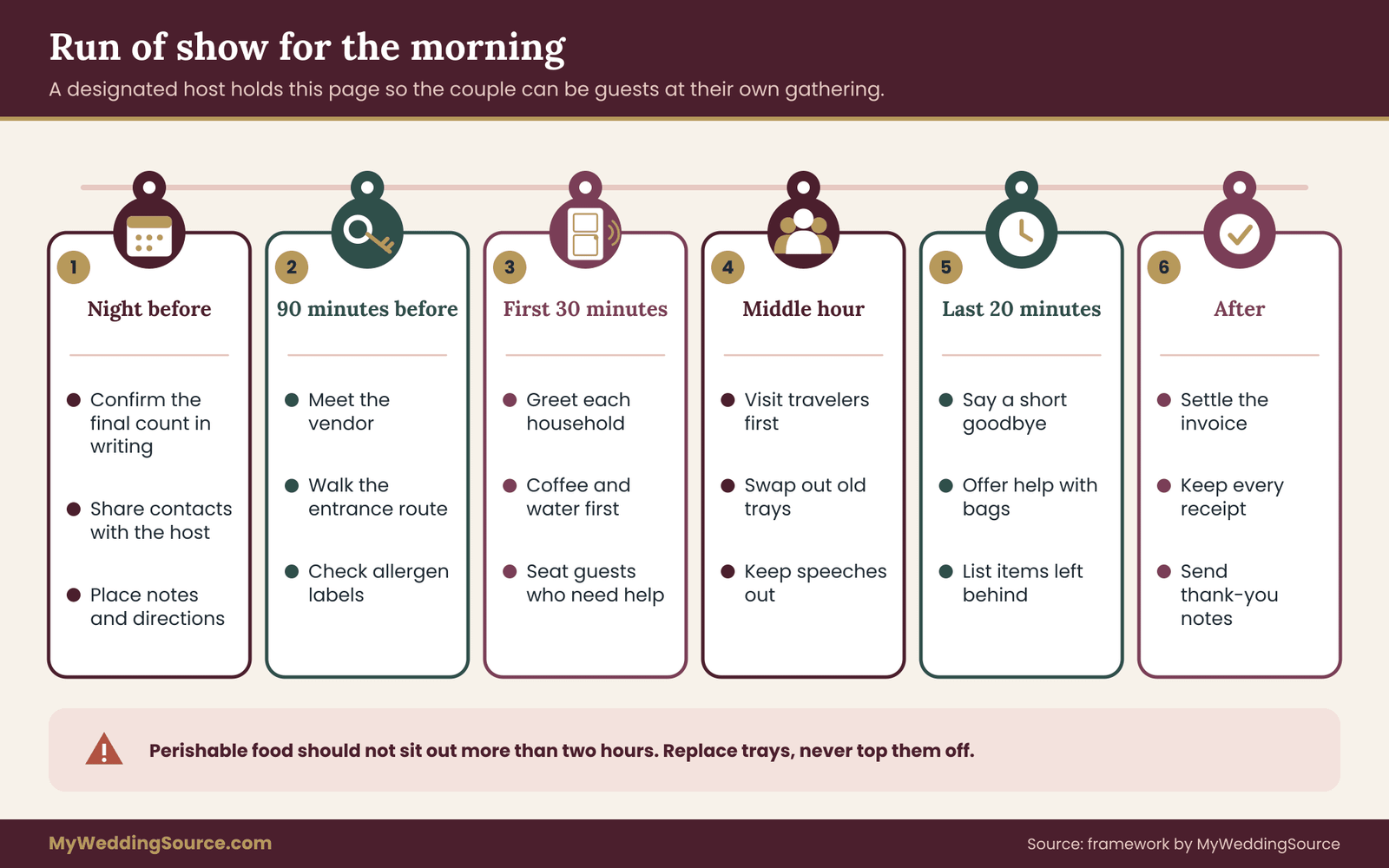
If you decide to host, the morning itself should run on a short written schedule that someone other than the couple holds. The schedule does not need to be elaborate. It needs to tell a few people what to do and when, so that the couple can be guests at their own farewell brunch.
The night before
Confirm the final headcount with the vendor in writing, using the replies you collected. Put the venue contact, caterer contact and the name of your designated host in one note and share it with that host. Place any welcome-bag notes or directions where guests will find them. Check the address, the room name and the start time against the invitation, since small mismatches cause real confusion at nine in the morning.
Decide in advance whether the couple will arrive at the start or a little after. Arriving at the start lets you greet people as they come in and avoids the awkward moment of guests waiting for the hosts. Arriving later gives you a calmer morning. Either is fine, as long as the designated host knows which one it is.
Ninety minutes before
Whoever is hosting arrives early to meet the vendor, check the room and confirm what is set. Walk the route from the entrance to the table. Make sure signs point to the right room and that doors are open and unobstructed. Check that labels on food match what is on the tray, especially for allergens, and that serving utensils are separate for each dish. Confirm that coffee, hot water and water are available first, because those are the first things people look for.
The first thirty minutes
Greet each household and point them to the food. Keep any announcements to a single sentence, and skip speeches. A farewell brunch works best when it feels like a continuation of conversation, not a program. If you want to thank people, do it person by person as they come through, and keep it brief.
If grandparents or other guests with extra needs are arriving, make sure someone has walked them to a seat and brought a plate. Do not leave that to chance.
The middle hour
This is the time the couple talks with the guests who traveled furthest. Aim to speak with each overnight household for a few minutes, with a bit longer for people you saw least at the wedding. A useful habit is to carry a short list of the households you most want to reach, and to move from table to table with a purpose. Photos at this point are optional, and a casual group photo of the families is a nice keepsake if someone else takes it.
Watch the food. Replace trays that have been out too long, in line with the two-hour guidance, and do not combine fresh food with old. If a dish runs out, let it go. A morning spread does not need to be endless.
The last twenty minutes
Guests will start to drift out as departure times approach. Let them. Stand near the door if you can, and say a short goodbye to each household. Offer help with luggage or rides to anyone who needs it. Keep a list of items left behind, such as jackets, chargers and gifts, and tell the hotel front desk where to find them.
At the end time, stop. Thank the venue staff, confirm with the host that the vendor has what they need, and leave the cleanup to the people who are paid or have agreed to do it.
After the farewell brunch closes
Settle the invoice within the terms, keep a copy of the receipt, and note any difference between the quote and the final bill. Send brief thank-you notes to the helpers: the person who ran it, the vendor contact, the relative who brought something. If you took the lighter route, such as a note and a quiet morning, the closing task is simply to send that note.
When things go wrong at a farewell brunch
Most problems at a morning event are small and have simple remedies. A few are worth thinking about in advance.
Low turnout. If only a fraction of the expected guests arrive at the farewell brunch, do not apologize and do not count heads out loud. Enjoy the people who came, send leftover food home with willing guests only if it has been held safely, and treat the lesson as information for the next event.
A late or missing caterer. Have a phone number and a backup. If the vendor is more than a short time late, call at once, and ask the hotel or venue whether it can supply coffee and something simple while you wait. Keep notes of what was promised for any later conversation about refunds.
Weather. If the plan involves an outdoor space, use the decision point you set earlier. Tell guests promptly where to go. A move indoors is a minor change if people know about it early.
Too much drinking. Offer food, water and coffee, and do not refill glasses by habit. If a guest seems impaired and plans to drive, make a quiet offer of a ride or a later departure. Your hotel can often help arrange a taxi.
A family disagreement. The morning after a wedding is a tender moment, and old tensions sometimes surface. Give the designated host permission to step in, change seating, or walk someone outside for a conversation. The couple should stay out of it where possible.
An allergic reaction. If a guest shows signs of a serious allergic reaction, such as trouble breathing, swelling or widespread hives, call emergency services immediately. Staff and hosts should know where the nearest phone and the venue address are, and the guest’s travel companion should be brought in at once.
You oversleep or feel unwell. This is why the designated host exists. A farewell brunch that runs without the couple for the first twenty minutes is not a failure. Send a short message and arrive when you can.
Your next steps
Work through these in order. Each takes about an hour or less.
- Build the morning map: count households in each of the five morning groups, and list guests with special needs.
- Collect departure times from overnight guests with a short, neutral question.
- Calculate the useful window between a realistic start and the cutoff for departures.
- Score the six worksheet questions on your own, then compare scores with your partner.
- Apply the veto rule, then read the total: build, shrink or skip.
- Write down the outcome and the one-sentence reason.
- If building or shrinking, get an itemized written quote and compare cost per attending guest.
- Send invitations with a start time, an end time and a reply date.
- Name a designated host who is not the couple, and share a one-page schedule.
- After the event, close the invoice and send your thank-you notes.
If you decide to skip it, a kind note and a quiet morning are a complete and generous answer. Whatever you choose, add the result to your overall planning checklist so the morning sits beside the rest of the weekend tasks.
FAQ
Is a farewell brunch required after a wedding?
No. A farewell brunch is optional and is a family or regional custom more than a rule. Many weddings have none, and guests do not expect one unless the invitation suggests it. What guests do expect is clear information about the weekend schedule. If you skip a farewell brunch, a short thank-you note or a few words at the end of the reception is a perfectly good way to say goodbye.
How many guests should attend before a farewell brunch is worth hosting?
There is no universal number. What matters is the share of your guests who are free and nearby, and whether the cost per attending guest fits your budget. Use the worksheet to test it. When a small number of people attend, a lighter format such as a coffee hour usually serves better than a full meal, since cost can scale down with attendance.
What time should a farewell brunch start?
Start from your guests’ departure times, not from tradition. Work out when most overnight guests must leave for the airport or the road, then end the gathering a comfortable margin before that. Many weddings end up with a start around half past nine or ten, especially if the reception ended late, and a stated end time that guests can plan around.
Do we have to invite everyone to a farewell brunch?
No. You can choose a boundary, such as out-of-town guests and family, or the wedding party and immediate families. Choose it on purpose, state it kindly and keep the explanation short. The risk is not the boundary itself but vague wording that leaves people guessing whether they were meant to come. Direct messages to the people invited, instead of announcements to everyone, help avoid hurt feelings.
What can we do instead of a full farewell brunch?
Several lighter options work well: a send-off note, a lobby coffee hour, a hosted hotel breakfast tab for a defined group, a family-only breakfast, or a casual gathering later in the day. Match the option to the weakest point on your worksheet. If you cannot host, choose something a vendor runs. If budget is tight, choose something priced by attendance and not by head count.
How do we keep the cost of a farewell brunch under control?
Estimate attendance from your guest map, ask for an itemized quote in writing, and look for minimums, service charges, gratuity, taxes and second-day fees. Compare options by cost per attending guest. Do not commit until you know where the money comes from, and ask about final-count deadlines and cancellation terms before paying a deposit.
How do we handle allergies and dietary needs at a farewell brunch?
Ask about dietary needs when guests reply, and treat allergies as safety information. Ask the caterer how items will be labeled, how cross-contact will be prevented and whether a separate plate can be prepared. The Food and Drug Administration lists the major allergens, and pastries and breads often contain several. For a severe allergy, speak with the guest directly before the event.
What if the couple is too tired to host a farewell brunch?
That is a legitimate reason to shrink or skip it, and the worksheet treats it as a veto. Either choose a format that runs itself, such as a hotel breakfast with a tab arranged in advance, or name a designated host who is not the couple. If neither is possible, skip the event, send a warm note and rest. Guests would rather you were well than present and worn out.
Sources
- U.S. Food and Drug Administration: Food safety and allergen information
- FoodSafety.gov: Safe food handling, including the two-hour rule
- Centers for Disease Control and Prevention: Food safety
- ADA.gov: Americans with Disabilities Act information for public venues
- U.S. Department of Transportation: Aviation consumer protection
- Transportation Security Administration: Airport screening and travel guidance
- National Fire Protection Association: Fire and occupancy codes
- Consumer Financial Protection Bureau: Credit card billing and consumer rights
- Federal Trade Commission: Consumer protection guidance
- National Highway Traffic Safety Administration: Impaired driving