
A wedding gift warranty is the coverage that comes with a mixer, a vacuum, a set of knives or a television someone else paid for, and it only helps if you can prove the purchase and meet the registration terms. This guide shows how to build a one-page gift warranty inventory, collect proof of purchase from givers and registries, and register the gifts that matter before the clocks run out.
Treat every registry gift as having three separate clocks: the store’s return window, the manufacturer’s registration period if there is one, and the gift warranty term itself. Log each gift in a single inventory with the giver, the store, the order number, the date it arrived and the model and serial number. Rank gifts by replacement cost so you spend effort where it counts. Photograph the serial plate, ask givers for the order confirmation instead of a paper receipt, and keep the evidence until the coverage ends. Check the written warranty for what it actually requires.
Most couples open their gifts in a rush, in between thank-you notes, and by the third week half the boxes are flattened and recycled. The model number was printed on the box. The only record of who bought the stand mixer was a packing slip that went in the trash. Then, fourteen months later, the motor stops, and the manufacturer asks for a date of purchase and a proof of purchase that you do not have.
That moment is the reason this guide exists. A wedding gift warranty problem is almost never about the gift warranty itself. It is about evidence: who bought the item, when, from whom, and what the serial number was. Gifts are different from ordinary purchases because the person who has the proof is not the person who owns the product. The giver has the order confirmation and the card statement. You have the item, and often not much else.
This article is narrow on purpose. It covers the inventory, the evidence, the registration steps and the decision rules for gifts bought through a registry or sent by guests. The broader job of filing contracts, certificates and photos is covered in the guide to organizing wedding records after the event, and you can treat the gift warranty inventory here as one more folder in that system.
A note on scope. This is general information, not legal, tax or financial advice. Warranty terms, return rules and consumer protections differ by product, retailer and state, and they change. Where something matters, the article points you to the agency or company that issues the rule so you can confirm the current version yourself.
What a wedding gift warranty covers and who it belongs to
Start with the vocabulary, because a lot of confusion comes from using one word for four different things.
A manufacturer’s warranty is a promise from the company that made the product. It usually says that the product will be free of defects in materials and workmanship for a set period, and it says what the company will do if it is not: repair it, replace it, or in some cases refund it. This is what most people mean by a wedding gift warranty.
A retailer’s return policy is not a warranty at all. It is the store’s own rule about taking a product back, often for a short window and often with conditions about packaging and use. It matters because the return window usually ends long before the gift warranty does, and the actions you take in the first weeks can either preserve or close off your options.
An extended protection plan is an optional contract sold separately by a store, a manufacturer or a third party, often at the register or in the cart when the giver was checking out. It runs alongside or after the manufacturer’s coverage. If a giver bought one, the paperwork went to the giver.
A credit card benefit is a feature some card issuers offer that extends or duplicates a warranty for items bought with that card. The benefit belongs to the cardholder and the account that made the purchase. For a gift, that is the giver, so it rarely helps you, and you should not count on it.
Keeping these four apart makes every later gift warranty decision easier. When something breaks, you will be asking which of the four applies, and the answer depends on documents that may be sitting in someone else’s email.
Who is the owner for gift warranty purposes
Many written warranties describe their coverage in terms like the “original purchaser” or the “first retail owner.” Others cover any owner during the gift warranty period, and some require nothing more than the product and proof of its date. Which wording applies to your gift is a matter of reading the document, and you should not assume either way.
A gift is a transfer of ownership from the giver to you, and a company that sells products as gifts expects gift recipients to use the gift warranty. Still, the wording is the wording, so read it once when the gift arrives and note what it says in your inventory.
The federal rules give some background here. The Magnuson-Moss Warranty Act, which the Federal Trade Commission enforces, sets requirements for written warranties on consumer products, including that the terms must be stated clearly and be available to buyers before purchase for products above a modest price threshold. It does not require any company to offer a warranty, and it does not decide what your particular warranty says.
The FTC’s business guidance on federal warranty law is a plain-language place to see what companies must disclose, and it is useful to know that the document in the box is supposed to be readable.
Why gift warranty paperwork disappears faster than it does for purchases
Three things happen to gifts that rarely happen to things you buy yourself.
First, the paper goes to the wrong person. Registry orders usually produce an order confirmation for the buyer, not for you. Even when the retailer sends a notification to the registry owner, it often shows the item and the giver’s name, not the price paid or a full receipt.
Second, the unboxing is communal. Gifts are opened at a shower, at a reception or in a pile of fifty packages. Nobody is checking the serial number on the underside of a blender while a relative is waiting for a reaction.
Third, the first few weeks after a wedding are the busiest weeks of the year. A stack of boxes can sit in a spare room for two months, and by then the return window has closed and the gift receipt has gone missing.
None of this is anyone’s fault, and none of it makes a gift warranty unusable. It is simply the shape of the problem, and the fix is a short, steady routine rather than a big organizational project.
The three clocks: return window, registration deadline and coverage term
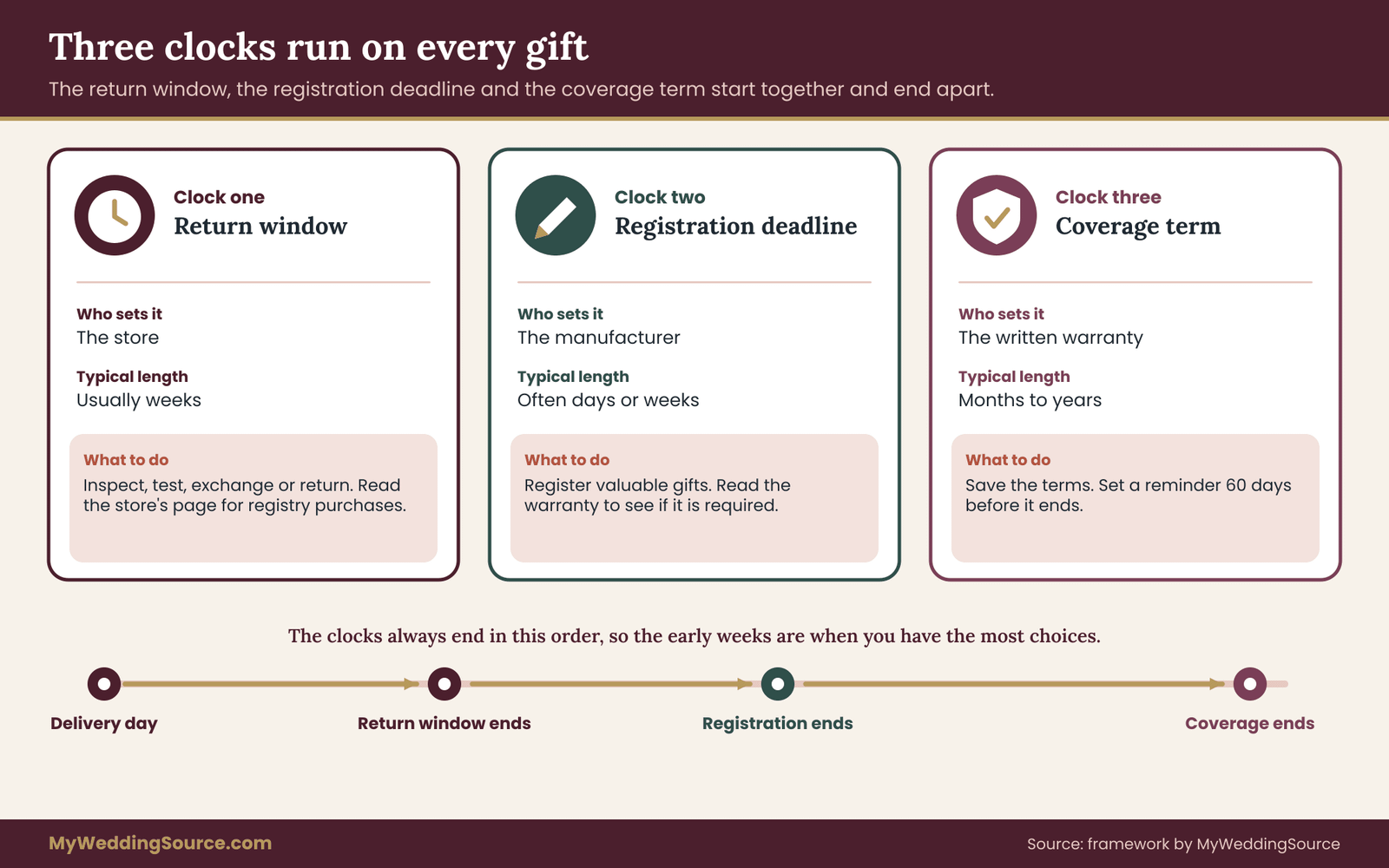
The most useful idea in this guide is that every gift warranty runs on three clocks at once, and they start at different moments and end at different times. If you track them separately, you stop being surprised.
Clock one: the return and exchange window. This is set by the store. It typically starts on the purchase date or the delivery date, depending on the retailer, and it is often measured in weeks. Registry purchases sometimes come with a longer or more flexible window than ordinary purchases, and some stores run special post-wedding completion periods. These policies differ so much from one retailer to the next that the only reliable approach is to read the returns page of each store on your registry and write down the end date.
The window matters most for the duplicate you want to swap, the item that arrives damaged and the gift that simply does not suit your kitchen.
Clock two: the registration deadline. Some manufacturers ask you to register a product within a certain number of days of purchase, and a few attach conditions to coverage when you do not. Many companies do not require registration at all, but offer it for recall notices, support and a record of your date of purchase. Whether registration is mandatory is something the written warranty will say.
The FTC’s guidance explains that a registration card generally cannot be a condition of coverage under a full warranty, and that a limited warranty may require it if it says so clearly. Because the details vary, the safe approach is to register anything valuable anyway, and to read the gift warranty for the deadline.
Clock three: the coverage term. This is the gift warranty period itself, whether it is ninety days, one year, five years or a “lifetime” promise with its own definitions. It usually begins on the date of purchase or the date of delivery, and the gift warranty will say which. This is the clock that runs the longest, and it is also the one that is hardest to prove if you do not know when it began.
Why the order of the gift warranty clocks matters
The clocks end in a predictable order: the return window first, the registration deadline second and the coverage term last. That order is the reason to act early on gifts that matter. In the first weeks you still have every option. You can return a defective unit for a new one at the store, register it with the maker and photograph the evidence. By the time the return window closes, your options narrow to the manufacturer’s process. By the time the coverage term ends, you have none left, and the only remaining question is whether the item survived.
A simple gift warranty rule follows from this. Do the clock-one tasks in the first two weeks: inspect, test and decide whether to keep. Do the clock-two tasks in the first month: register and file. Do the clock-three tasks once and set a calendar reminder for sixty days before the coverage ends, so you have a deliberate moment to check whether anything has gone wrong.
A small gift warranty example: the clocks in action
Suppose a guest buys a robot vacuum from your registry. The store allows returns within a set number of days of delivery. The manufacturer offers a limited warranty for one year from the date of purchase and a longer term on the battery. Registration is optional but gives access to app support and recall alerts.
On delivery day you open the box and find that it works. You photograph the serial plate and the model label. Within a week you ask the giver, in a friendly message, to forward the order confirmation. Within a month you register the vacuum on the maker’s site. In your inventory you write three dates: the end of the return window, the end of the one-year coverage and the end of the battery coverage. You set a reminder for a month before the first year runs out.
That is perhaps fifteen minutes of work in total, spread over a month. If the vacuum fails in month ten, you have the date, the serial number, the order confirmation and a registration record. If it fails in month fourteen, you will know that the main coverage has ended and can check whether the battery term still applies.
Everything else in this guide is a more detailed version of that same gift warranty routine.
Building a wedding gift warranty inventory in one evening
The inventory is the center of the system. It is a single document, either a spreadsheet or a plain notes page, with one entry per gift that is worth tracking. The goal is not elegance. The goal is that anyone in your household can open it in two years and find the serial number of the dishwasher.
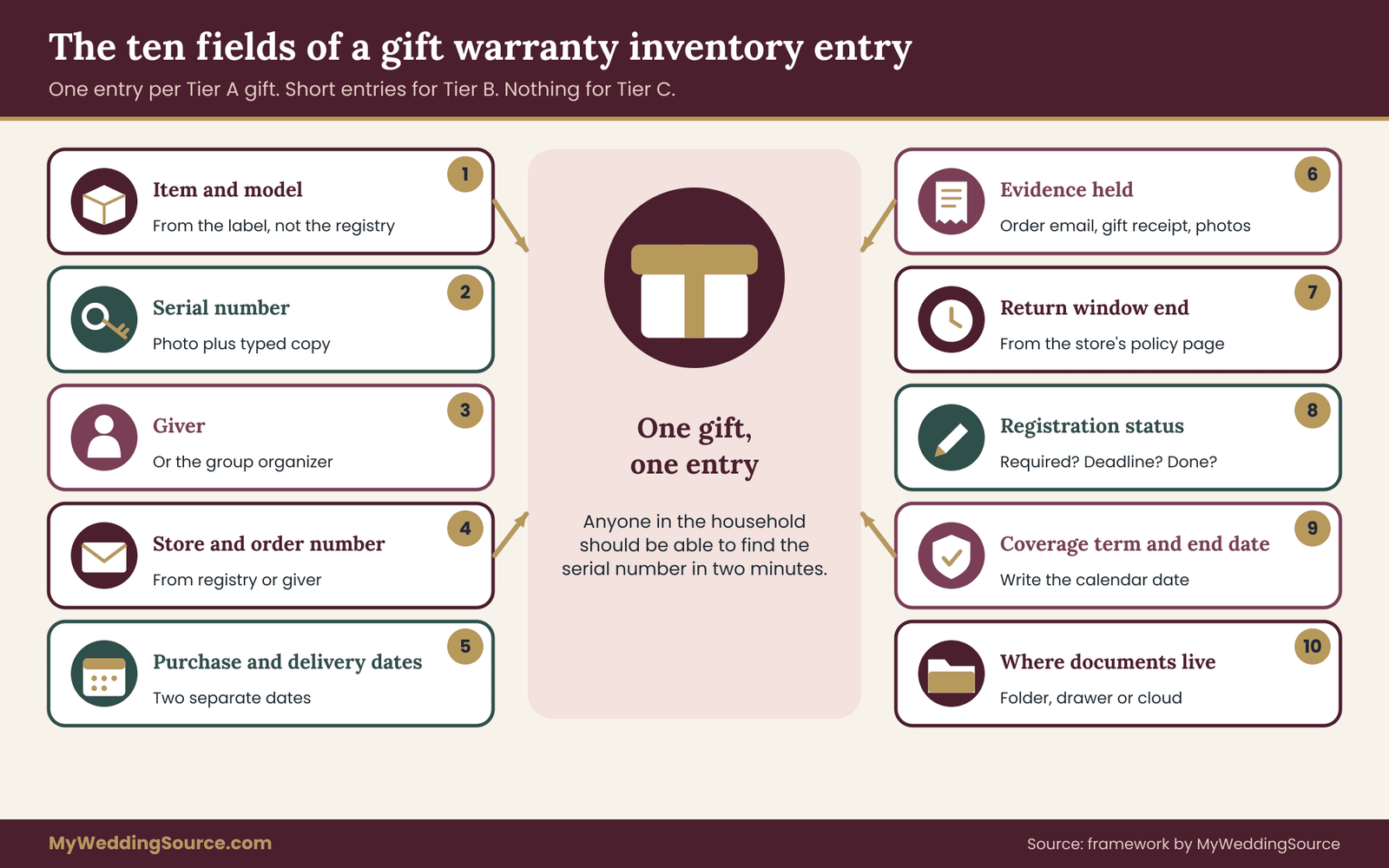
An entry has ten fields. Each one answers a question you will otherwise have to answer later under pressure.
1. Item and model. The product name, the brand and the exact model number from the label, not from the registry listing. Registry listings sometimes describe a product family, and the label on the item is what a support agent will ask for.
2. Serial number. Printed on a rating plate, inside a door, on the underside or on the back panel. Photograph it where it is, and also type it into the entry, because a photo is hard to search and the typed number is not.
3. Giver. Who sent or brought the gift, including the name of the person who coordinated a group gift if several people chipped in. You need this for the thank-you note and for the next field.
4. Store and order number. Where it was bought and the order or confirmation number, if you can get it. For a registry gift, this is often visible in your registry account, or the giver can find it in an email.
5. Date of purchase and date of delivery. Two separate dates, because warranties and return policies start on different ones. If you only know the delivery date, record that, and note that the purchase date is unconfirmed.
6. Evidence held. A short code for what you actually have: order confirmation, gift receipt, packing slip, photo of the serial plate, registration confirmation, or nothing yet. This is the field that shows you where the gaps are.
7. Return window end. The last day the store will take it back, as stated on the store’s policy page for your type of purchase.
8. Registration status and deadline. Whether the manufacturer asks for registration, whether it is required for coverage, the deadline if there is one and the date you finished.
9. Coverage term and end date. The length of the manufacturer’s warranty, the date it began and the date it ends. Write both the term and the calendar date, because “two years” means little in the future.
10. Where the documents live. The folder name, the drawer or the cloud location. Even a perfect gift warranty inventory is useless if the PDF of the gift warranty is nowhere to be found.
Where to keep it and how to name things
Put the inventory in the same place as the rest of your post-wedding paperwork, with a clear, boring file name such as “Gift warranties and proof of purchase.” A spreadsheet is the easiest format for sorting by end date. A shared notes page works if you will actually keep it updated. Whatever you choose, both partners should be able to open it from their own devices.
For the supporting files, use one folder per gift or one folder per room, and name each file with the item, the document type and the date, for example “Stand mixer, order confirmation, 2027-03.” A consistent file name helps when you search a phone or a mailbox years from now. It also helps in the unpleasant moment when a support agent asks you to upload “proof of purchase” and you are scrolling through two hundred images called IMG_4821.
Photographing at unboxing for the gift warranty file
The most valuable thirty seconds in the whole process are at unboxing. Before the box goes anywhere, take four photos: the product as delivered, the model and serial label, the shipping label on the carton showing the date and the sender, and the packing slip or gift receipt if one came inside. If the packaging is bulky, you can flatten it and recycle it after the photos.
Some warranty and return processes ask for original packaging, so for expensive or fragile items, keep the box until the return window has passed. A neat habit is to write the return-window end date on a sticky note and attach it to the stored box.
What not to record
Keep the inventory free of anything sensitive. You do not need card numbers, passwords or the giver’s home address in it. If you register products with accounts, store those passwords in a password manager, not in the inventory sheet. The inventory describes the gifts and their evidence. It is not a place for credentials.
Which gifts deserve a full wedding gift warranty entry
A hundred and fifty gifts do not need a hundred and fifty gift warranty entries. A set of napkins has no warranty, and a candle is used up before any problem could arise. Spending an evening logging low-value items would waste the effort you need for the few that matter. The way around that is a short tiering rule.
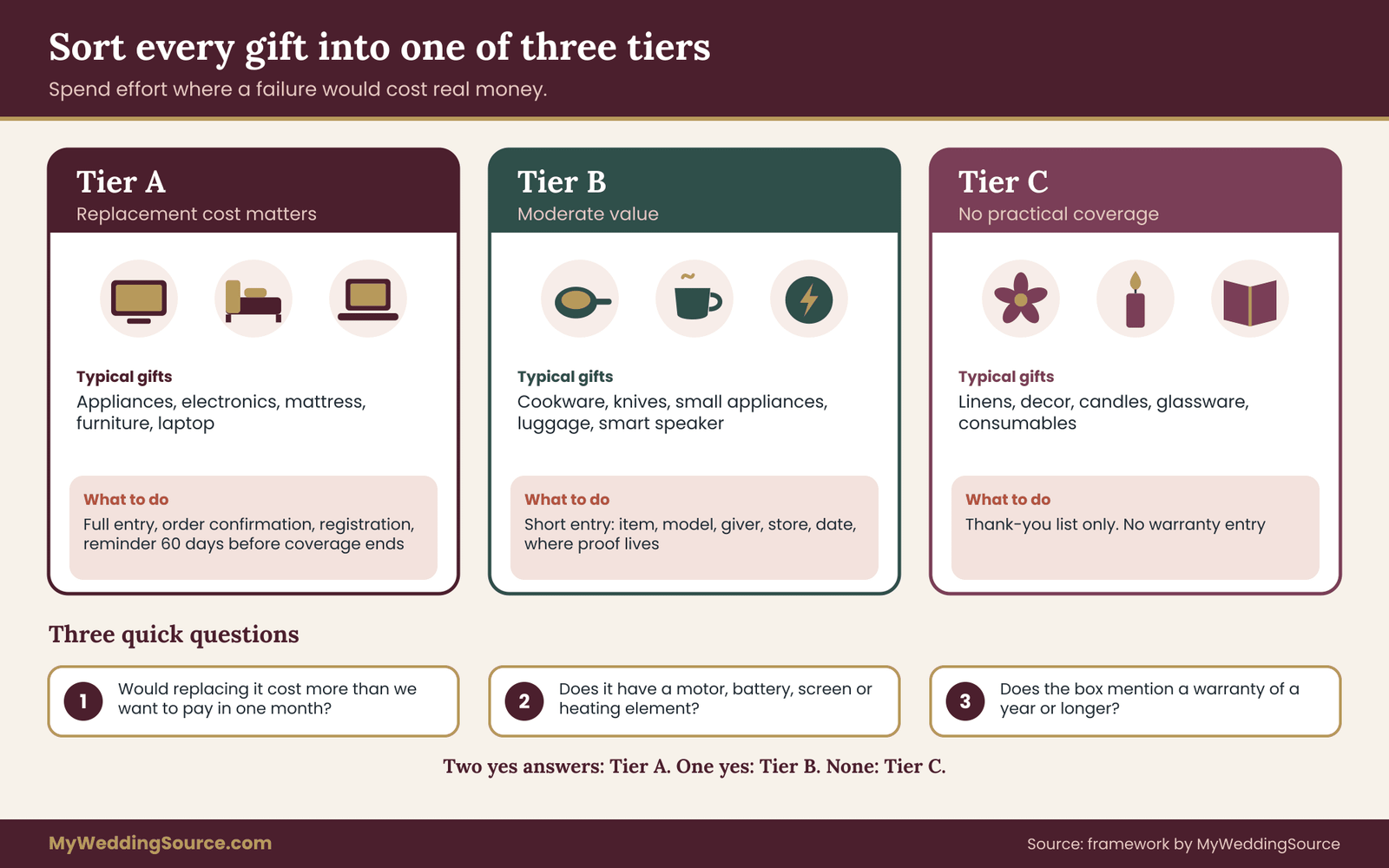
Tier A: replacement cost matters. These are items you could not casually replace and that have moving parts, electronics, motors or heating elements. Think of a major appliance, a television, a robot vacuum, a stand mixer, a high-end blender, a pressure cooker, a coffee machine, a laptop, a vacuum, a mattress or a piece of furniture. Tier A gets the full entry: all ten fields, a manufacturer registration and a calendar reminder before coverage ends.
Tier B: moderate value, limited risk. Cookware with a limited or lifetime promise, a knife set, a small appliance, a set of luggage, a good vacuum flask, a quality bedding set, a smart speaker. Tier B gets a short entry: item, model, giver, store, date and where the proof lives. Register only if the maker offers it and the process takes under five minutes.
Tier C: no practical coverage. Linens, decor, candles, glassware, picture frames, consumables and anything with no gift warranty text at all. Tier C goes on the thank-you list and nowhere else, with no gift warranty entry at all. You will probably never need to claim on a throw pillow.
How to place a gift in a tier
There are three quick questions. Would replacing this cost us more than a few hundred dollars, or more than a month of an ordinary grocery budget? Does it have a motor, a battery, a screen or a heating element? Does the box mention a warranty of a year or longer? Two yes answers puts a gift in Tier A. One yes answer puts it in Tier B. Zero puts it in Tier C.
You can adjust the thresholds to your own situation. A couple on a tight budget may reasonably treat a hundred-dollar blender as Tier A. A couple with plenty of savings may treat the same item as Tier B. What matters for a gift warranty file is that you decide once, write the rule at the top of the inventory and apply it the same way to every gift.
Edge cases when tiering a gift warranty
Some gifts do not fit the three tiers neatly, and a few judgment calls come up again and again.
A gift that is cheap but part of a system, such as a smart plug that controls an expensive appliance, can move up a tier because a failure has a larger effect. A gift that is expensive but handmade by a small maker may have no written warranty, but a repair offer or a note from the maker, so keep that note with the entry.
Heirlooms and secondhand items given as wedding gifts have no manufacturer’s warranty at all, though an appraisal or a repair record is worth filing. Gift cards and cash do not belong in the inventory, though a card with an expiry date belongs on your calendar and in your money records.
Furniture and bulky items sit in their own category. A delivered sofa or table often comes with a store-level warranty on the frame or finish, a delivery date that starts the clock and a short window for reporting damage. A damaged delivery is usually something to report right away, and the delivery paperwork is the evidence. Keep the delivery receipt and photograph the item in place.
A word about quantity
If you registered for duplicates by design, say two matching sets of towels or four identical wine glasses, record them as one entry with a count. If you ended up with two of the same Tier A item, such as two blenders, decide quickly whether to keep both, because the return clock is running on the one you do not want. The section on returns later in this guide covers how to make that call without insulting a giver.
Cataloging gifts as they arrive instead of all at once
Many couples try to do the whole gift warranty inventory in a single burst after the wedding. A steadier way is to build it in three passes so that no pass is overwhelming.
Pass one: during the engagement and shower period. Registry orders begin arriving before the wedding. As each Tier A or Tier B gift lands, take the four unboxing photos and add a skeleton entry: item, giver, date. Do not worry about the other fields yet. This pass takes two minutes per gift and spreads the work across months.
Pass two: in the first two weeks after the wedding. Gifts brought to the reception, gifts mailed to a parent’s house and gifts delivered in the days around the event all arrive at once. Sort them into the three tiers before you open anything else. Fill in the skeleton entries for Tier A and Tier B. For each gift that came without any identifying paperwork, mark “evidence: none” so you can spot the gaps.
Pass three: in the first month. Complete the entries, send the evidence requests to givers, register the Tier A items, and set the calendar reminders. By the end of this pass, the inventory is finished and the box clutter has gone.
The thank-you note connection
There is a natural link between the gift warranty inventory and your thank-you notes, and it can save you time. When you write a note for a Tier A gift, you are already looking at the giver’s name and the item. A short note that also asks for the order confirmation can feel like part of the same conversation.
We cover the wording in the next part of this guide, along with a few lines you can adapt. For the etiquette of timing and tone around thank-you notes, the site’s wedding etiquette guide is the better reference, and you can keep this article for the paperwork side.
Dividing the work between partners
It helps to split the tasks by clock rather than by gift. One partner owns the unboxing photos and the return-window decisions in the first two weeks. The other owns the registrations and the calendar reminders. Both can see the inventory. Splitting by gift tends to leave half of them unattended, while splitting by task gives each person a recurring job they can finish.
If one of you is the more organized person, avoid the trap of giving them everything. The goal of the gift warranty system is that either partner can find a serial number alone, on a day when the other is traveling. A shared view of the inventory and a shared folder are non-negotiable, even if one partner does most of the typing.
Proof of purchase for a wedding gift someone else bought
Proof of purchase for a gift warranty is a chain, not a single piece of paper. A claim usually needs to establish three things: that the product is the one you are holding, that it was bought on a date inside the coverage period, and that it was bought from a legitimate seller. Different documents prove different links in that chain, and you rarely need all of them. What you need is enough of them that a support agent or a store clerk can see a consistent story.
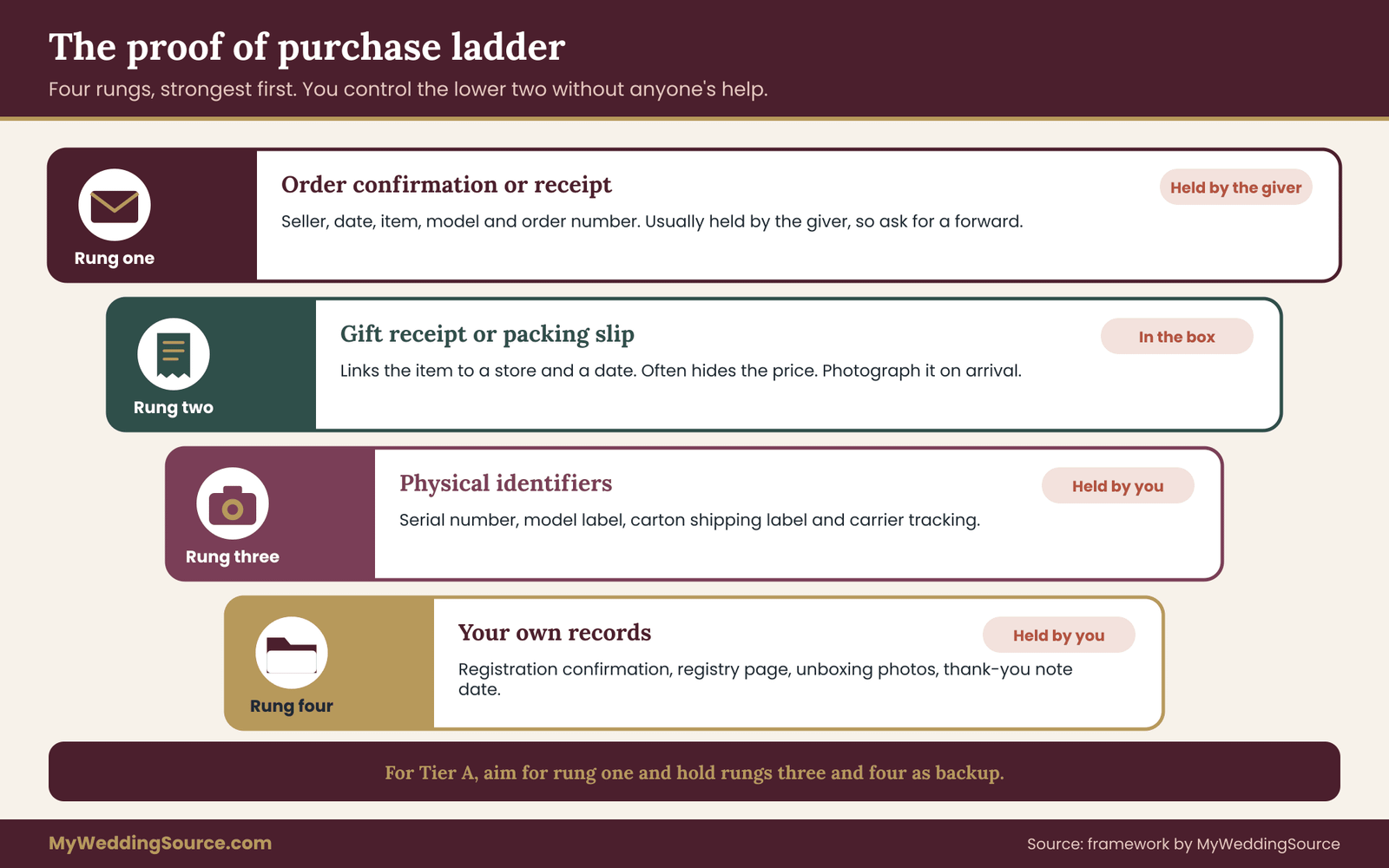
Think of the evidence as a ladder with four rungs, from strongest to weakest.
Rung one: the order confirmation or receipt itself. An email or PDF showing the seller, the date, the item, the model and the order number. For a gift, this document normally belongs to the giver, so getting a copy means asking for it. Some retailers also let a registry owner see order details inside the registry account, so check yours before asking anyone.
Rung two: a gift receipt or packing slip. A gift receipt shows the item and often an order or barcode reference but usually hides the price, which is its point. It still links the item to a store and a date, and it is what most stores will accept for an exchange. For gift warranty purposes it is good supporting evidence, but not always enough alone. Keep it flat and photographed.
Rung three: physical identifiers. The serial number on the unit, the shipping label on the carton and the tracking number from the carrier. Together these show what the product is and roughly when it arrived. A tracking page may expire, so screenshot it.
Rung four: your own records. The registration confirmation, your inventory entry with the unboxing photos, the registry account showing the item as purchased and the thank-you note you wrote with the date on it. None of these come from the seller, but all of them show a consistent timeline.
How the ladder is used for each gift warranty
The ladder tells you how hard to work for each gift. For a Tier A gift warranty, aim for rung one, and be content to hold rungs three and four as a backup. For Tier B items, rungs two through four are usually enough. For Tier C, you need nothing.
Notice that rung three and rung four are entirely in your control. You do not need anyone’s cooperation to photograph a serial plate or to register a product. This is why the unboxing routine matters so much. If a giver never answers your request for the order confirmation, you are still left with a reasonable body of evidence, and you have not damaged a relationship over a toaster.
Asking givers for receipts without making it awkward
Many people feel uncomfortable asking a guest for a receipt, even when a gift warranty depends on it. It can sound as if you are checking up on the gift or hinting at a return. It does not need to, if you present the request as protecting the item rather than questioning it.
The key is to put the reason first, keep it short and make the action easy. Givers generally do not mind forwarding an email. They mind being asked to hunt for paper in a drawer.
Here is a message you can adapt for a Tier A gift, after the thank-you note has gone out:
“Thank you again for the mixer. We use it every week. One small favor when you have a minute: could you forward the order confirmation email? We keep the gift warranty details for our bigger gifts in one place, and the order number is the part we are missing.”
This does several things at once. It starts with real thanks. It explains the purpose in one sentence. It names the exact document, which is far easier to find than “the receipt.” And it asks for a forward, not a scan.
Variations for different situations
If the giver is older and less comfortable with email, offer an easier route: “If it is simpler, a photo of the receipt from your phone is perfect.” If the gift came from a group, direct the request to the organizer, since they usually made the purchase. If the gift was bought in a physical store, ask whether they paid by card, because the store may be able to look up the purchase from the card and date.
Do not ask for the card number or any account details. The store can look up a transaction with the giver’s help at the counter, and you never need to see their financial information.
If you do not know the giver well, a parent or friend can act as a go-between. A short line such as “Could you ask Aunt Lena whether she still has the email for the vacuum?” avoids a long chain of awkward messages.
When not to ask
Skip the request for Tier C gifts, for anything with an obvious personal meaning, and for gifts where the giver might feel the question is about price. A handmade gift from a relative has no receipt to find. If a giver is going through a hard time, a request for paperwork is the wrong thing to add. Remember the fall-back rungs. Photos, serial numbers and registration create a good body of evidence without involving the giver at all.
Timing the gift warranty request
The best moment to ask is when the giver is already thinking about the gift, which is when your thank-you note arrives. The next best moment is within the first two months, before the giver deletes their old email. Many online stores keep order history in a customer account, so the record may still be there years later, but a person who has switched email addresses or phones loses easy access. Asking early makes it much more likely that the confirmation still exists.
Using the registry itself as a record
A registry is one of the best proof-of-purchase tools you have for a gift warranty, because it already links an item, a giver and a store. How much detail it shows depends on the retailer, so spend a few minutes learning what yours provides.
Look for the order history or “gifts received” section in each registry account. Depending on the retailer, you may see the item, the giver’s name, the purchase date, the order number and the status of delivery. Some stores let you print or download a gift receipt, request a duplicate, or look at the return policy that applies to registry purchases. Take a screenshot or export the list as soon as the wedding is over, because accounts can be closed after a set period and the pages you see today may not exist in two years.
What a registry record can and cannot prove about a gift warranty
A registry page proves that a given person bought a specific item through that store on or around a date. It does not by itself prove the date of delivery, and it usually does not show the price. Treat it as rung four of the ladder: useful, consistent and easy to produce, but not a substitute for a receipt on an expensive item.
If you have registries at more than one store, keep one screenshot folder per store and label each file with the retailer and the date you captured it. When a store merges registries or closes a program, the screenshots become the only record you have.
Registry completion programs and post-wedding offers
Some stores offer a completion discount, an extended return window or store credit after the wedding, to help you finish buying items you registered for. These offers have terms, deadlines and sometimes exclusions, and they can change from year to year. They are a feature of the retailer, not a warranty, so we treat them as part of clock one.
Write the deadline on your calendar and keep a copy of the terms as they read when you used them. The site’s page on wedding registry ideas is useful for deciding what to put on a registry in the first place, and this article takes over once the gifts start to arrive.
Gifts that arrive from outside the registry
Not every guest uses the registry. A relative may bring a wrapped box from a store you have never heard of, or order something from an online marketplace. For these gifts, there is no registry record at all. The ladder matters more here, because you have fewer ways to connect the item to a source. Ask the giver where it was bought, photograph the item and any packaging, and apply the same tiering.
If it is a Tier A item, ask for the confirmation. Marketplaces also complicate the question of who the seller is, since the product may have been sold by a third-party merchant rather than the marketplace itself. The seller’s identity affects who handles returns and sometimes who stands behind the product, so note the seller’s name if you can find it.
Gift receipts, packing slips and what each one proves
People often treat any piece of paper in the box as interchangeable. They are not, and knowing what each one shows saves time.
A gift receipt is designed for returns and exchanges without showing the price. It typically lists the item and a reference code or barcode, and it identifies the store. It is useful at the store’s service desk. It is weaker for a manufacturer gift warranty claim, because it may omit the date or the price, although some manufacturers accept it together with a serial number.
A packing slip lists what was shipped in a given order, sometimes with an order number, a ship date and a return code. It is a shipment document, not a payment document, so it does not show that the buyer paid. It is still a helpful link between the order number and the item.
An order confirmation email is the most useful everyday document. It usually has the seller, the date, the item and model, the quantity, the order number and often the price and payment method in summary form. When a giver forwards this, you have rung one.
A shipping notification shows when the carrier picked up and delivered the package. It is helpful for the delivery date, which many warranties use as the start date.
A credit card statement line shows the merchant, the date and the amount, but not what was bought. It is a last-resort corroboration and a document the giver may not want to share. Do not ask for it.
Fading ink and thermal paper
Many store receipts are printed on thermal paper, which fades. If a giver hands you a paper receipt, photograph or scan it the same day, and keep the image as the master. If you wait a year, the numbers may be unreadable. For this reason, a paper receipt is a bad primary record regardless of how neatly it is stored.
What to do when your gift warranty has no proof behind it
Sometimes the evidence simply is not there. The giver has passed away, moved away or cannot be reached. The registry has been closed. The packing slip went out with the carton. This is not the end of the road. A manufacturer can often work with a serial number, because many companies can estimate a manufacture date or a ship date from it. A retailer may be able to find a gift receipt from the original transaction if you can identify the giver or the date range.
Some warranties have a fallback of using the manufacture date when no purchase date can be shown. Contact support early, describe the situation honestly and ask what they accept. Do not invent a purchase date, and do not alter a document. An honest explanation will usually get a better result than a made-up receipt, and a false statement can void coverage.
Wedding gift warranty registration step by step
Gift warranty registration is the step most couples either skip or do carelessly. It is also the cheapest part of the whole routine, usually five minutes per product. The following sequence works for most manufacturers, and it keeps you from handing over more information than you need to.
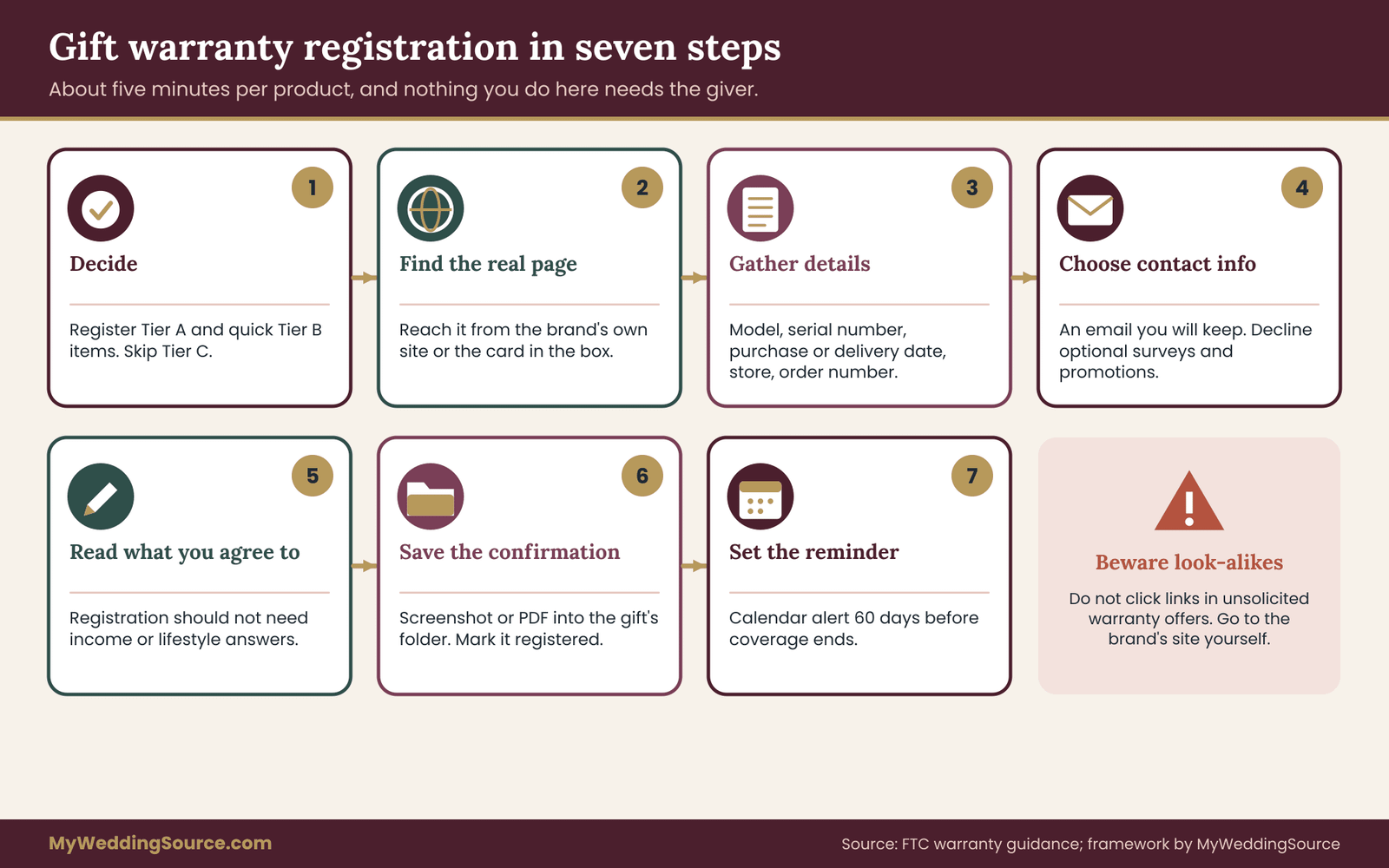
Step one: confirm that the product is worth registering. Use your tiers. Register every Tier A item and any Tier B item where the process is short. Skip Tier C.
Step two: find the real registration page. Look in the box for a card or a printed address, and compare it with the manufacturer’s own website, reached by typing the brand name yourself. The registration page is typically under a “support,” “register your product” or “warranty” heading. If you are unsure whether a page is official, go to the brand’s main site and follow the links from there. Do not use a link from an unsolicited message, an advertisement or a search result that looks like a coupon site.
Step three: gather the details. The model number, the serial number, the date of purchase, the store and the order number. For a gift, use the purchase date if you have confirmed it. If you do not have it, many forms accept the date you received the product. Be honest about which one you are entering, and note in your inventory which it was.
Step four: choose the contact details deliberately. Most forms ask for an email address, a postal address and sometimes a phone number. Use an address you will still have in five years. A shared household email works better than a work address that disappears when you change jobs. Register under the name of the person who will make the claim, and remember that a name change after the wedding can create a mismatch between the registration and the person calling support.
Note the name used in your inventory, and if you change your name later, update the registration accounts for the Tier A items as part of the normal name-change routine.
Step five: read what you agree to. Registration forms often include marketing checkboxes. Unchecking the box that asks for promotional email is fine and does not affect your coverage. Decline optional surveys about your income, household size or lifestyle. You do not need to provide those to register a product, and a warranty form that insists on them is worth a second look.
Step six: save the confirmation. Take a screenshot or save the confirmation email as a PDF, and file it in the gift’s folder. Write the date in the inventory and mark the status “registered.”
Step seven: set the gift warranty reminder. Add a calendar event sixty days before the end of coverage, titled with the item and the model. When it fires, test the product, and if anything is off, start a claim while you still have time.
What to do if gift warranty registration is required and the deadline has passed
If the gift warranty says registration is required within a certain number of days and you have missed it, do not give up. First, reread the exact wording, because sometimes the requirement is described as “recommended” or the registration only affects extended terms. Second, contact the manufacturer and explain that the product was a gift received after the wedding.
Some will accept a late registration, especially with a confirmed delivery date. Others will not, and the honest answer is that the coverage may be reduced. The FTC’s guidance is a useful reference for what a full or limited warranty can require, but the company’s written terms are what apply to your claim.
Gift warranty registration by phone, mail or app
A few products, especially older models or items made by small companies, use a mailed card or a phone number rather than a web form. Keep a copy of anything you mail, and send it with tracking if the product is expensive. Many smart appliances are registered through an app, which creates an account that holds the product’s data. For these, note which account you used and where the login lives, because the registration is useless if neither partner can sign in.
Gift warranty scams and look-alike pages
Warranty registration has attracted its share of fake pages and unwanted calls. Be cautious about any message that says your gift’s warranty is about to expire and offers to extend it. Genuine manufacturers do not usually contact a gift recipient out of the blue, and an unsolicited extended warranty offer is a common pitch for scams and aggressive sales. If a call or email arrives, do not click on links in it.
Go directly to the manufacturer’s official site, or call the number printed on the product or the box. The Federal Trade Commission’s consumer site has current guidance on common warranty and service-contract scams, and it is worth a read if you have received an offer you cannot place.
Reading the gift warranty before you need it
A warranty document is usually short, and reading it once at the start saves a surprising amount of guessing later. You do not need to read every line. Look for six things and write each in a sentence in your inventory.
What is covered. Most limited warranties cover defects in materials and workmanship under normal use. Many do not cover accidents, drops, spills, misuse or wear and tear on parts such as filters, seals, blades or batteries.
How long it lasts, and from when. The term, and whether it starts on the date of purchase, the date of delivery or the date of installation. For gifts, this is where the delivery date and the purchase date can differ, and the difference can matter if the term is short.
Who it covers. The wording about the “original purchaser,” the “first owner” or “the consumer.” If the wording looks like it excludes gift recipients, ask the manufacturer before you assume it does. Some companies treat the gift recipient as the consumer in practice.
What the company will do. Repair, replace, refund or a combination. Many warranties give the company the choice. Some require you to ship the product at your own cost, and a few include free return shipping.
What you must do. Register, keep the proof of purchase, use only approved parts or service, or contact support within a set number of days of discovering the defect. These conditions are where claims get denied, so they deserve a close look.
What voids it. Commercial use, use outside the country of sale, unauthorized repairs, using the wrong voltage and removing serial labels are typical exclusions. For a gift from overseas, check whether the product is covered where you live.
Gift warranty terms that sound better than they are
A few phrases deserve care. “Lifetime warranty” usually means the lifetime of the product or of a defined component, as the company defines it, and it often covers defects but not wear. “Satisfaction guarantee” is a return policy with its own time limit. “Limited” is the normal word for a warranty that does not meet the requirements of a “full” warranty under federal law, and it is not a warning sign by itself, since most consumer warranties are limited.
If a warranty is vague, the federal framework gives some comfort. The Magnuson-Moss Warranty Act requires that written gift warranty terms on consumer products be clear and available, and a company that offers a written warranty has to say what it covers. Separately, state law may provide implied warranties, which are basic expectations that a product works for its ordinary purpose. These rules differ by state, and sellers can sometimes disclaim them, such as with “as is” sales. A state attorney general’s consumer protection office can explain what applies where you live.
Storing the gift warranty text
Do not rely on the paper in the box. Photograph or scan the gift warranty pages, save a PDF from the manufacturer’s site and store it in the item’s folder. Manufacturers update their websites, and a link that works today can disappear. A saved copy of the terms as they read at your purchase date is the best evidence of what you were promised. If the manufacturer later changes the terms, your copy shows what applied when you received the gift.
Extended protection plans and card benefits on a gift warranty
Extended protection plans are offered at checkout, and givers sometimes buy them without thinking about who will need them later. Whether to buy one is outside the scope of what the gift recipient can decide, since the purchase is already done. What you can decide is how to treat an existing plan, and whether to buy one yourself.
If a giver bought a plan, ask for the plan document and number at the same time as the order confirmation. The plan is a separate contract with its own terms, its own claims process and often a different company behind it. It typically follows the product, though the terms may require you to contact the plan administrator rather than the manufacturer, and some plans are tied to the buyer’s account. If the plan paperwork never turns up, call the store with the order number and ask whether a plan was attached.
Buying a protection plan on top of a gift warranty
If you are considering a plan for a Tier A gift, weigh a few things. First, the manufacturer’s coverage already runs for a period, and a plan generally begins after it ends or overlaps with it, so check what you would actually be adding. Second, check what the plan covers that the gift warranty does not, such as accidental damage or power surges.
Third, compare the cost to the replacement cost of the item and to your own capacity to absorb a repair. A couple with a healthy emergency fund may reasonably decide to self-insure most small and mid-priced items. Fourth, read the cancellation terms and the claims process, including any deductible or service fee, before paying.
There is no universal right answer, and this is a decision for you rather than a requirement. If you do buy a plan, treat it like any other contract: keep the document, record the plan number in your inventory and mark the end date.
Credit card benefits and a gift warranty
Some credit cards extend manufacturer warranties or offer purchase protection on items bought with the card. These benefits are tied to the cardholder and the purchase. A gift bought by a guest with their own card is normally covered, if at all, under their account, so the recipient typically cannot claim it. If you bought something for your own use with your own card, the benefit may apply, so read your card’s benefit guide.
For what you pay for yourself after the wedding, such as replacement items or a plan, the Consumer Financial Protection Bureau explains your rights when disputing a charge on a credit card. In general, a billing error has to be reported in writing within a short window of the statement that shows it, so review statements promptly.
Duplicates, returns and exchanges without losing wedding gift warranty protection
Almost every couple ends up with something to return. A duplicate, the wrong color, a size that does not fit your cabinets or a product that simply does not suit how you cook. The return clock is the shortest of the three, so decisions here need to be made first, and they should be made with the gift warranty in mind.
The keep-or-return decision rule for a gift warranty
For any Tier A or Tier B gift you are unsure about, run through four questions in order.
One: does it work and does it fit? Plug it in, run a cycle, measure the space. If it fails or does not fit, the choice is easy, and you should return or exchange it inside the window.
Two: will we use it at least monthly? An appliance that will live in a cupboard is not a gift you need to keep for the sake of manners. Most givers would rather see you exchange it for something you use. If the answer is no, exchange it.
Three: do we already own the same thing? A true duplicate is the most common reason to return. If both copies are Tier A, keep the one with the better evidence, such as the one with a full order confirmation, and return the other. If both are equal, keep the better model.
Four: is the window about to close? If the return window ends in a week and you have not decided, make a decision with a lean toward exchange rather than waiting. A store credit you can spend is worth more than a product you resent and cannot return.

How to exchange tactfully
Etiquette on this point is mostly about not telling the giver. A guest who chose a gift from your registry expects that you can exchange it, and does not need to hear that you did. If you return a gift that did not come from the registry, it is also reasonable to exchange it quietly.
What you should not do is leave the giver with a wrong impression about whether the original gift is in use, for instance by saying you love something you have returned. Keep the thank-you note truthful and about the thought, and you will be fine. The site’s wedding etiquette guide has more on gift manners.
How a return affects the gift warranty paperwork
When you exchange a gift, the new product has its own date, its own serial number and often its own receipt, which will be a store credit, a gift card or an exchange receipt. The old entry in the inventory should be closed with a short note: “returned on this date, credit issued, receipt saved.” The new item gets a new entry.
If you exchange for something in Tier A, you now hold a purchase made by you, with the exchange date as the likely start of the gift warranty clock. Make sure you receive and keep a proper receipt for the exchange, and photograph the new serial plate.
A common trap is a store credit that arrives as a card with an expiry date or a balance that is easy to forget. Add it to your money records, with its end date on the calendar. The exchange is only finished when the credit has been spent.
Returning something bought by someone else without a receipt
Stores handle gift returns differently. A gift receipt is the simplest route. Without one, some stores will look up a registry purchase, while others will offer a store credit at the lowest recent selling price, or decline the return. Because policies differ so much, the best approach is to call the store or read its returns page before making a trip, and to have the registry details ready. Do not be surprised if a return without a receipt comes back as store credit rather than money, since the store does not know what the giver paid.
When a gift is damaged or fails: a calm claim process
Most gifts work fine, and most never need a gift warranty claim. When one does not, the order of your actions decides how easily it is resolved. The idea is to start with the cheapest route that is still open, document everything and avoid giving away rights by accident.
Stage one: the first fourteen days or so, damage on arrival. If a carton arrives crushed, or an item is cracked, stop. Photograph the packaging and the damage before you move anything. Note the carrier’s delivery date. Contact the seller promptly, and if the item came from a registry, use the registry’s customer service route. Retailers generally want to hear about shipping damage quickly, and carriers often have their own short reporting windows, so do not wait.
Stage two: inside the return window, a defect. Contact the store first. Explain that the item is a registry gift, give the order number or the registry name and say what is wrong. A store can often replace the product directly, which is faster than a manufacturer claim. Ask what they need and keep a record of the reference number they give you.
Stage three: outside the return window but inside the gift warranty, a defect. Contact the manufacturer. Prepare the model number, the serial number, the purchase or delivery date, the evidence you hold and a clear, short description of the fault, including when it started and what you tried. Photograph or record a video of the problem if it is visible.
Stage four: the company refuses or stalls. Reread the gift warranty to confirm what it says. Write a short, factual message that quotes the relevant clause and asks for a specific result. If that does not work, a state attorney general’s consumer protection office or the Federal Trade Commission’s complaint process may help, and if you paid for a protection plan or used a card, the plan administrator or card issuer may be another route. Keep your tone calm in writing, because a reasonable message is more likely to be read carefully.

A claim script you can adapt
“Hello, we received a [product, model] as a wedding gift on [date]. The unit stopped [doing what] on [date]. The serial number is [number]. It is within the [term] warranty, and the original order number is [number]. Could you tell us how to arrange a repair or replacement, and what you need from us?”
Notice what the script does. It states the facts and the clock, and it ends with a clear question rather than a complaint. Support agents work from forms, and a message that contains the fields they ask for moves quickly.
Keep a gift warranty claim log
For every claim, write a log entry: date, who you spoke to, reference number and what was promised. Save emails and chat transcripts. If the claim takes a long time, the log protects you from having to repeat the story, and it creates a record if a dispute grows. Attach the log to the item’s folder and update the inventory status to “claim open.”
Do not self-repair or send the item out unless the gift warranty says so
Opening a device, replacing parts or using an unapproved repair shop can sometimes affect coverage, depending on the terms. Check the gift warranty before you do any repair, and ask the manufacturer in writing if you are unsure. If the company asks you to ship a product, take photos of what you pack, send it with tracking and insure it for its value if the gift warranty does not cover the shipment.
Recalls, safety notices and why registration still helps
A product recall is a different process from a gift warranty claim, and it can arrive years after the gift. Recalls apply to safety hazards, and the remedy, such as a repair, replacement or refund, is typically offered free of charge, often without needing a receipt. You can find them at Recalls.gov, the U.S. Consumer Product Safety Commission and, for other product types, the agencies that oversee them.
The practical benefit of recording the model number and serial number in your inventory is that checking a recall takes thirty seconds. The benefit of registering a product is that, in some cases, the manufacturer can contact you directly. If a recall notice is mailed or emailed to you, take it seriously, and follow the instructions on the notice by going through the official site rather than a link in a message.
A yearly recall and gift warranty check
Once a year, on your anniversary, say, scan the model numbers of your Tier A items against the recall databases. It takes ten minutes, and a household that does it once a year will find out about a hazard far sooner than a household that does not. If you find a recall for a gift, tell the giver only if it is natural to do so. They may have bought the same product for others.
Reporting a safety problem
If a product causes an injury or a close call, stop using it, keep the product and its packaging, and report it. The CPSC runs SaferProducts.gov for consumers to report harm or risk from a consumer product. Also contact the manufacturer. A report helps the agency spot patterns, and it creates a record in case you later need to show the problem was not caused by misuse.
Keeping wedding gift warranty records current after a move or a name change
A good inventory on day thirty can become a bad one by year three, because life moves. The records are only as useful as their ability to survive three common events: a name change, a move and a change of email address.
Name changes and gift warranty registrations
After the wedding, one or both of you may change your name. The gift warranty registration may still be under the old name, and a support agent may ask you to verify details such as the name on the account. A mismatch is usually easy to explain, but it can slow things down, and it helps to avoid it for the products where a claim is most likely.
The sensible approach is to update the Tier A registrations after your main name-change tasks are done, not before. The order for the legal changes, starting with the Social Security Administration, is covered in the wedding records guide, and the gift warranty updates belong at the end of that list. When you update a registration, save the new confirmation and write the date next to the entry. If a registration cannot be edited, you can usually contact support and add a note that the owner’s name has changed, along with the serial number.
If you do not change your name, none of this applies, but you may still want to add your partner as a second contact on the registration so that either of you can make a claim.
Moving to a new home with a gift warranty file
A move creates two risks. The first is that the registration still carries the old address, which matters if a recall notice is mailed. Update the address for each registered Tier A item, or at least for the ones where mail notices are likely. The second is that moving crews damage appliances and furniture, and the gift warranty will not cover damage in transit.
Before you move, photograph the serial plate of each Tier A item once more, note its condition and, if you are using professional movers, check how they handle claims and what they require. For high-value pieces, ask the mover what documentation they need to process a damage claim, and read the policy before the truck arrives. If you move abroad or to a different country, check whether the gift warranty is valid outside the country of purchase, since many are limited to the region of sale.
Changing your email address
The email address you used to register a product is often the key to an account. If you stop using it, you may be unable to reset a password or confirm your identity. Before closing an old account, search it for registration confirmations and warranty documents and forward them to your current address or save them to the folder. A few minutes of cleanup can prevent a claim from stalling because the account is out of reach.
Updating the gift warranty inventory
Every year or so, on the same day as your recall check, scan the inventory for entries that are out of date. Mark items as expired, discarded, donated or sold. Remove the entries you no longer need, but keep the closed ones in an archive tab for a while, since a record that an item was returned or replaced can be handy later. The aim is to keep the active list short, so that when something fails you can see at a glance which coverage is still running.
Storing proof of purchase so you can actually find it
Poor storage is the second most common cause of failed claims, after never collecting the evidence in the first place. A storage system has to be simple enough that you will keep using it, and robust enough that a hard drive failure or a lost phone does not destroy it.
One folder structure, applied the same way
Keep a single top-level folder for the gift warranty file, called something like “Gift warranties.” Inside it, create one subfolder per Tier A gift, named by item and year, and a single shared subfolder for Tier B items sorted by room. Inside each Tier A folder, keep at most six files: the order confirmation, the unboxing photos, the gift warranty text, the registration confirmation, the claim log if any, and a short note file with anything else. If a folder has more than that, you are probably storing duplicates.
For a list of Tier B items, one document with a section per item is plenty. Store the images in a single subfolder named for the room.
Digital first, paper second
Paper receipts fade and get lost. Photograph or scan every paper document and treat the image as the master. If you want to keep the paper for a while, put it in a single envelope labeled “gift paperwork” and give it a home with your other important household documents. Do not scatter receipts across several drawers. After the coverage ends, shred the paper but keep the closed entry in the archive tab.
Copies and access
Follow the same principle as for your photos: more than one copy, in more than one kind of place, with one copy away from home. A cloud folder shared with your partner and a periodic copy on an external drive are a reasonable setup. The site’s guide to organizing records after the wedding describes the idea of access levels, and for warranty records, the rule is simple: both partners have full access, and nobody else needs any. Do not share the folder with relatives or friends. If a giver needs to see their own order, forward only that one file.
Privacy and what not to store
Order confirmations sometimes include the giver’s address, the last digits of a card or personal messages. Before saving a forwarded confirmation, glance at it and crop or redact anything that is not needed. Do not store card numbers, full account numbers or passwords in the folder. If you need to keep a login for a product account, use a password manager. These steps protect the giver’s privacy as well as yours.
How long to keep gift warranty paperwork
There is no single rule, so use a simple one: keep each document until the coverage it supports has ended, plus a buffer of about a year. If a warranty lasts three years, keep the file for roughly four. This gives you room for a claim filed near the end of the term and for any slow-moving dispute.
For some items, the right retention period is longer. A lifetime warranty or a very long coverage period means the proof stays relevant for as long as you own the item. High-value pieces such as a major appliance or an electronics set may also matter for your home insurance, since a household inventory with photographs and serial numbers is useful if you ever need to document a loss. Ask your insurer what they want to see, and consider the gift inventory as a head start.
What the gift warranty inventory does not replace
A gift warranty inventory is not a tax record, and most wedding gifts are not taxable income to the couple. Gift tax rules generally apply to the giver, and most gifts do not trigger any tax, according to the Internal Revenue Service. If you have questions about a large cash gift or a gift of property, a qualified tax adviser can answer them for your situation. For your own purchases made to fit out a home, keep the receipts in your normal money records, and use your wedding budget tracking to separate wedding costs from household costs.
The overlap with vendor and wedding-day purchases
Do not confuse gifts with things you bought yourself for the wedding. Rented items, décor, favors and anything you bought for the event have different return windows, different evidence and sometimes different owners. If a vendor supplied equipment that you were supposed to return, the paperwork belongs in the vendor’s file, not in the gift inventory. The vendor purchase order checklist explains how to keep order terms and deliverables straight for the purchases you made on the planning side, and the gift inventory covers only the products that people gave you.
Special cases for a gift warranty: shipped, overseas, heirloom and group gifts
Some gifts do not follow the standard path, and they are where most surprises happen. A short list of situations and what to do with each.
Gifts shipped to a parent’s or friend’s home. The unboxing photos may be taken by someone else, and the carton may be discarded. Ask the person to photograph the serial plate and the shipping label before they pass the gift on, and ask them to keep the packing slip. If the gift travels to you in a car, put the paperwork in the same bag.
Gifts from overseas. An item bought in another country may have a warranty valid only there, and it may run on a different voltage or use a different plug. Check whether the manufacturer honors the gift warranty in your country before you plug it in. If not, the better move may be to exchange it, if the giver purchased it from a store with an international policy, or to use it with the right adapter and accept that there is no coverage.
Group gifts. The organizer usually made the purchase, so direct requests for the confirmation to them. Record the organizer’s name in the giver field and list the group in a note. When you write the thank-you note, address the whole group.
Heirlooms and secondhand gifts. These have no manufacturer’s warranty. Record what you know of the item’s history, photograph it and store any repair or appraisal paperwork with it. If it has a sentimental value, the record is as much for the family story as for a claim.
Experience gifts and vouchers. A voucher for a class, a trip or a service has an expiry date and terms, not a warranty. Put the date on the calendar and record the terms. These belong in your money and keepsake records, not in the gift warranty inventory.
Custom and handmade items. Ask the maker if there is any care instruction or repair policy. A short note or email from the maker is the equivalent of a warranty, so file it.
Gifts that came with installation. A mattress, a large appliance or a television that was installed by a technician may have a separate installation warranty or a service call record. Keep the technician’s paperwork with the item, and note the installation date, since some warranties start then.
When the giver is also a vendor
Occasionally a vendor, such as a florist or a venue, gives a couple a gift that comes with its own terms. Keep it separate from the vendor’s contract, so that a gift does not get confused with a deliverable. This is a rare case, but when it occurs, noting it in the inventory prevents later confusion about who owes what.
A worked example of a wedding gift warranty inventory
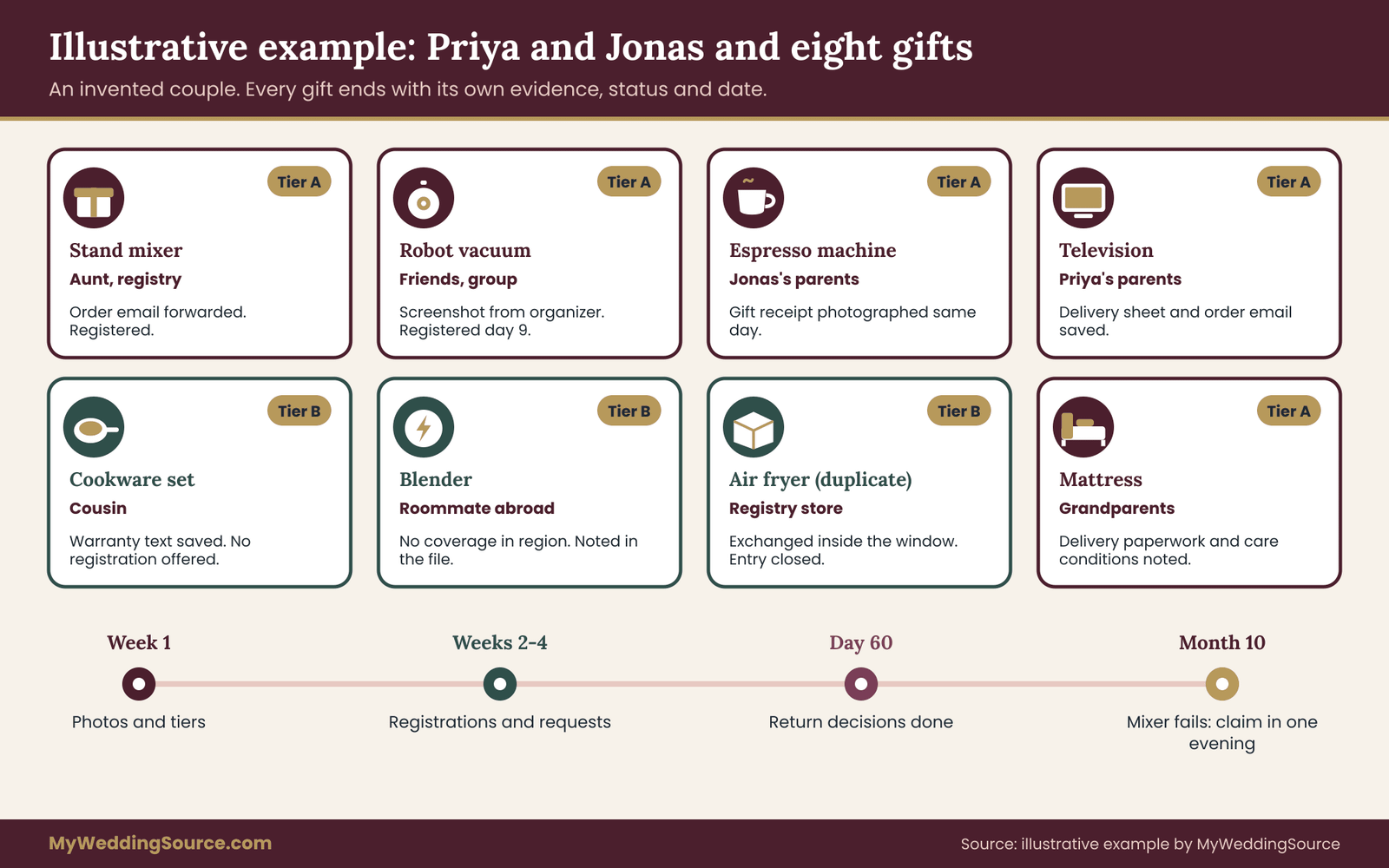
The following example is invented to show how the pieces fit together. The couple, the gifts, the stores and the gift warranty terms are made up for illustration and do not describe any real product or policy. Call the couple Priya and Jonas. They were married in late spring and received about a hundred and twenty gifts. They decided that a gift would be Tier A if it cost more than they would want to replace in a month and had a motor, battery or screen.
After a first sort in the week following the wedding, they had eight items in the inventory.
A stand mixer from Priya’s aunt. Tier A. It came through the registry, so the registry account showed the giver, the store and an order number. Priya photographed the serial plate on delivery and sent the thank-you note with a request for the order email. The aunt forwarded it within two days. Evidence: rung one and rung four. The manufacturer offered a one-year limited warranty with optional registration, so they registered it.
A robot vacuum from Jonas’s college friends, as a group gift. Tier A. The organizer, a friend named Teo, had made the purchase. Jonas asked Teo for the order email and received a screenshot instead, which was good enough. The manufacturer’s terms required registration within thirty days of delivery for the extended battery term. They registered on day nine and wrote the battery term’s end date on the calendar.
An espresso machine from Jonas’s parents. Tier A. Bought in a physical store, with a gift receipt in the box and no registry record. They photographed the receipt the same day, because it was thermal paper. They asked Jonas’s mother for the card statement date, not the statement itself, so that the store could look up the purchase if needed. Evidence: rung two, three and four.
A television from Priya’s parents. Tier A. It was delivered and installed. The delivery paperwork showed the date and the model. Priya’s father forwarded the order confirmation. They kept the installer’s sheet, since the store’s installation warranty started on that date.
A cookware set from a cousin. Tier B. A limited lifetime warranty on the pans. They saved the gift warranty text and the cousin’s order email in one folder, and did not register, because the maker did not offer it.
A blender from a college roommate who lives overseas. Tier B, with a catch. It was bought abroad, ran on a different voltage and the gift warranty applied only in the country of purchase. They exchanged nothing, because the giver had bought it online with no easy return route. They checked the manufacturer’s site, confirmed that there was no coverage in their region and decided to use it with a converter and accept the risk. They recorded “no warranty in our region” in the inventory so that nobody would waste time on a claim later.
An air fryer, the duplicate. Tier B. They already owned one. They checked the registry store’s return window, found that they had about three weeks left and exchanged it for a set of baking pans. They closed the entry, saved the exchange receipt and put the store credit’s end date on the calendar.
A mattress from Priya’s grandparents. Tier A. The store’s delivery paperwork and the gift warranty card went in the folder. The gift warranty, like many mattress warranties, had conditions about using a proper foundation and keeping it free of stains. They wrote those conditions in the inventory, since those were the rules most likely to cause a denied claim.
What the gift warranty example shows
Three things stand out. First, the inventory took about three hours in total, spread across four evenings, and the unboxing photos were the longest part. Second, the pieces of evidence were different for each gift, and none of them was perfect. The couple did not need perfect evidence. They needed consistent evidence. Third, the decisions that mattered most happened in the first three weeks: the exchange, the registrations and the evidence requests. After that, the system mostly ran on calendar reminders.
Ten months later, the mixer’s motor failed. Priya opened the inventory, found the serial number, the order confirmation and the registration, and used the claim script. The company asked for the serial number and a photo and shipped a replacement unit. The mixer was outside its return window but inside the manufacturer’s coverage, which is exactly the situation the three-clock approach is designed for. In this invented case, the process took one evening and two emails.
A week-by-week gift warranty routine for the first ninety days
A routine you can follow without thinking is better than a perfect system you never start. This one breaks the three clocks into dated tasks. Adjust the timing to your own wedding date and to the dates on your own return windows.
Week one. Photograph each gift at unboxing and decide the tier. Create skeleton entries for Tier A and Tier B items. Check the return window for each store on your registry and write down the end dates. Return or exchange obvious problems and duplicates early.
Weeks two to four. Request order confirmations from givers of Tier A items, using the thank-you note as the opening. Register Tier A products. Capture screenshots of each registry account. Save the gift warranty text for each Tier A item.
Days thirty to sixty. Fill any gaps in the inventory. Follow up once, politely, with givers who have not replied, or accept the fallback evidence. Make the final keep-or-return decisions before the last return window closes. Spend or schedule any store credit.
Days sixty to ninety. Back up the folder to a second place. Set calendar reminders for each coverage end date, sixty days before. Review the inventory with your partner and agree where the folder lives. Add a yearly reminder for the recall check and the inventory review.
The shorter gift warranty routine if you are overwhelmed
If the whole routine feels like too much, do three things only. Photograph the serial plate of every Tier A item. Register those items. Put the coverage end dates on a calendar. Those three actions cover most of the value, and you can add the rest later.
Common mistakes to avoid
- Throwing away the box and packing slip before photographing the labels.
- Assuming the giver kept a receipt, or that a gift receipt is enough.
- Registering with an old email address or a work account.
- Letting the return window pass while deciding whether to keep a duplicate.
- Trusting a warranty summary from a retailer’s page without reading the manufacturer’s own terms.
- Paying for an unsolicited extended warranty offer received by phone or text.
- Storing the only copy of the inventory on one phone.
Your next steps
Pick one evening this week and do three things. First, make a list of your Tier A gifts, using the three questions: replacement cost, moving parts and a warranty of a year or longer. Second, photograph the serial plate on each one and write down the return-window end date for the store where it was bought. Third, send one polite request for an order confirmation to the giver of your most expensive gift.
After that, work through the routine a week at a time. Register the Tier A products, save the gift warranty text, set the reminders and back up the folder. Within a month, your wedding gift warranty records will be finished, and the next time something stops working, you will know where to look. For the rest of your post-wedding paperwork, the guide to organizing wedding records is a good next stop, and the wedding planning checklist covers anything still left on the planning side.
FAQ
Do I have to register a wedding gift to keep the gift warranty?
Not always. The written warranty states whether registration is required. Under federal guidance, a registration card generally cannot be a condition of coverage for a full warranty, while a limited warranty may require it if the terms say so clearly. Because rules and terms vary, register your more valuable gifts anyway, keep your proof of purchase and read the gift warranty text for any deadline.
Can I use a warranty on something my guest bought for me?
Often yes, but read the wording. Some warranties cover the original purchaser or first owner, while others cover any owner during the coverage period. Gifts are normal transfers of ownership, and many companies serve gift recipients as a matter of course. Ask the manufacturer in writing if the terms are unclear, and keep the order confirmation from the giver to support your claim.
What if the giver cannot find the receipt?
Use the other evidence. A registry account page, the serial number, a photo of the shipping label and a registration confirmation all help show what the item is and when it arrived. Contact the manufacturer early and ask what it accepts. Be honest about the situation, and do not invent a purchase date or alter any document.
Is a gift receipt enough as proof of purchase?
Sometimes. A gift receipt is designed for returns and exchanges, and stores usually accept it for that purpose. It may not show the price or a full date, so a manufacturer may ask for more. Pair it with a photo of the serial number and, if possible, the giver’s order confirmation. Photograph the receipt the day you receive it, since thermal paper fades.
How long should I keep wedding gift warranty paperwork?
Keep each document until the coverage it supports has ended, plus about a year as a buffer. For lifetime warranties or long-lived items such as major appliances, keep the file for as long as you own the item. Digital copies are fine, and a second backup is worthwhile, since the evidence is only useful if you can find it.
Which gifts are worth registering?
Focus on items that would be costly to replace and have motors, batteries, screens or heating elements, such as major appliances, electronics, a mixer or a robot vacuum. Register smaller items only if it takes a few minutes. Linens, decor, glassware and consumables rarely have coverage, and tracking them takes more time than it saves.
Does my credit card extend a gift warranty?
Usually not. Card warranty extensions generally apply to purchases made with that card, so the benefit belongs to the giver’s account rather than to you. If you bought a gift for your own household with your card, check the issuer’s benefit guide for the terms. A card benefit is not a substitute for the manufacturer’s warranty or your own records.
What should I do if a gift breaks in the first month?
Photograph the problem, then contact the store inside the return window, using the order number or registry name. A store can often replace the item faster than a manufacturer. If the return window has passed, contact the manufacturer with the model, serial number, date and evidence. Keep a short log of every call, reference number and promise.
Sources
- A Businessperson’s Guide to Federal Warranty Law, Federal Trade Commission
- Magnuson-Moss Warranty Federal Trade Commission Improvement Act, Federal Trade Commission
- Consumer advice, Federal Trade Commission
- U.S. Consumer Product Safety Commission
- Recalls.gov, U.S. government recalls
- SaferProducts.gov, report an unsafe product
- Ask CFPB, Consumer Financial Protection Bureau
- Frequently asked questions on gift taxes, Internal Revenue Service
- USAGov, consumer protection information
- National Association of Attorneys General, find your state office