
Vow length is the number of seconds your vows take to say out loud in the room, not the number of lines on a page. This guide gives you a read-aloud stopwatch log, editing thresholds and a worked example so you can decide how long wedding vows should be by measuring your own voice instead of guessing.
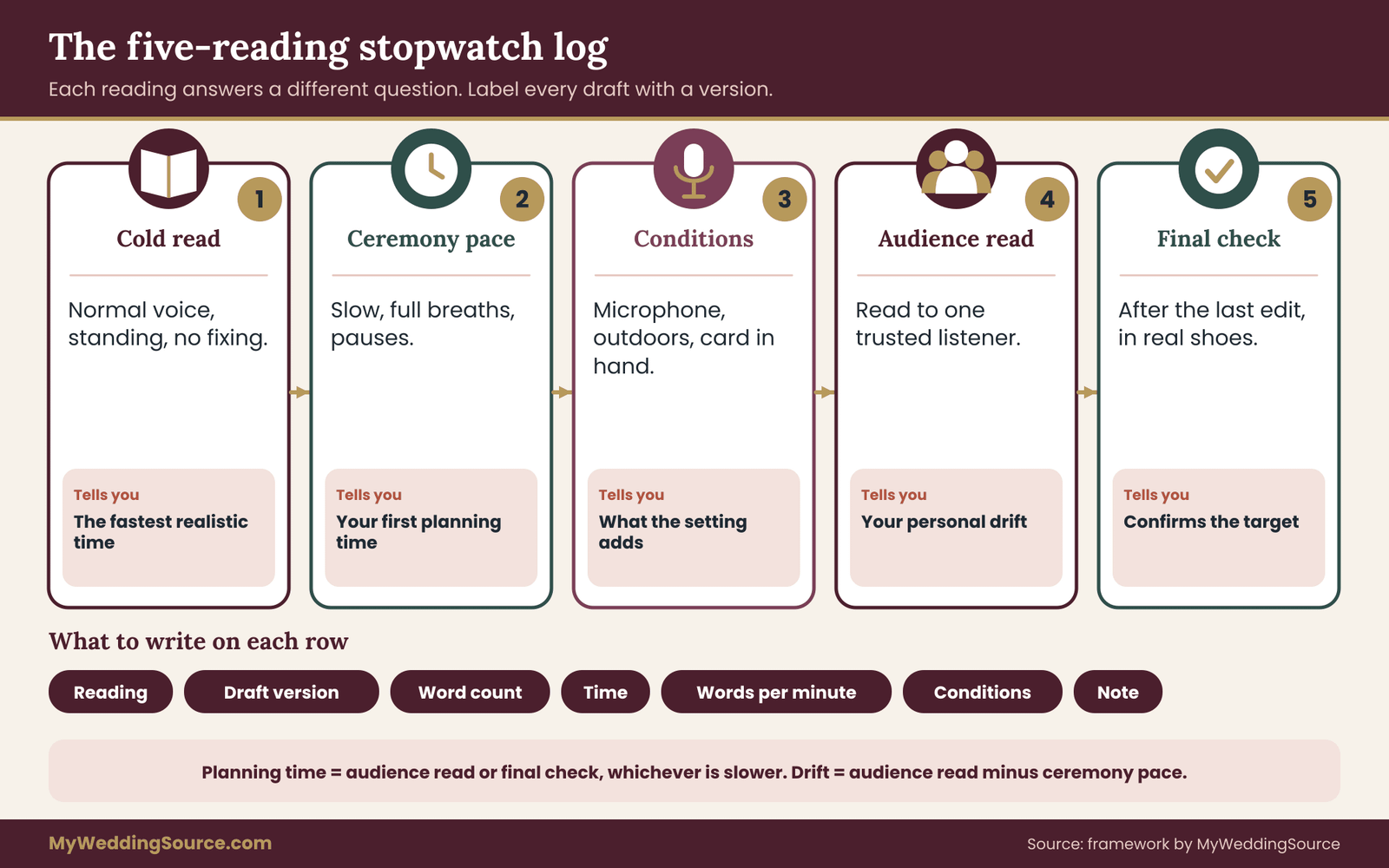
Time your vows five ways: a cold read, a slow ceremony-pace read, a read with real conditions (a microphone, an outdoor space or a standing position), a read in front of one listener, and a final check after your last edit. Write each result in a log. Then compare your planning time with three bands: under about forty-five seconds is brief, forty-five seconds to two minutes is comfortable for most ceremonies, two to three minutes needs a reason, and past three minutes is a signal to cut or move material elsewhere. Keep both partners’ vow length close, and confirm the number with your officiant.
Ask ten people how long wedding vows should be and you will hear ten confident answers, most of them delivered in minutes and none of them measured on your voice. The number that matters is the one produced by a stopwatch while you read your own words, at the pace you will really use, in something like the conditions you will really face. That number is usually larger than your first guess and smaller than your draft’s author hoped.
Vow length is easy to get wrong for a simple reason. Written words and spoken words behave differently. A paragraph that looks like a modest half page can take almost two minutes to say once you add breaths, pauses at the ends of sentences, a moment to look up, and a laugh or a catch in the voice. A page that looks long can fly by if it is made of short lines. Page counts, word counts and gut feelings all hide this, which is why a timed read-aloud log works better than any of them.
This guide stays on one question: how to measure and set vow length. It does not teach you how to write the vows themselves, how to split the work with your partner, or whether to say vows privately or in front of guests. Those are separate decisions, and they come before or after this one. The wedding ceremony step-by-step guide covers the order of the ceremony as a whole.
Here you will learn how to run the stopwatch log, how to read it against editing thresholds, how to bring two partners’ vows into balance, how to cut a draft without gutting it, and what to ask your officiant, venue and photographer once you have a number.
A note on scope. This is general information, not legal advice, and what a ceremony must include differs by state and by officiant, so confirm current requirements with your marriage license office and your officiant (the officiant requirements guide explains what to check). The thresholds in this guide are planning rules built for this article, not research findings or industry standards.
What vow length really measures
When couples say “how long should our vows be,” they are usually asking three different questions at once. It helps to pull them apart before you pick a number.
The first question is about the page. How many words or lines are in the draft? This is the easiest to see and the least useful, because it says nothing about how the words will sound.
The second question is about the clock. How many seconds does it take to say them? This is what vow length means in practice, and it is the number this guide teaches you to measure. It decides how long the guests stand or sit, how long the photographer holds a frame, how long a musician waits for a cue, and how long a nervous speaker has to stay composed.
The third question is about weight. Does the length feel right for what the moment is? A thirty-second promise can feel complete, and a three-minute speech can feel thin. Weight is a judgment call, and it comes from the writing, not the stopwatch. But the stopwatch protects it: when a draft is cut to a sensible time, the strongest lines stand out instead of being buried in the middle.
Treat the clock as a constraint and the weight as the goal. A good vow length is the shortest time in which your promise still sounds like yours.
Three clocks inside one ceremony
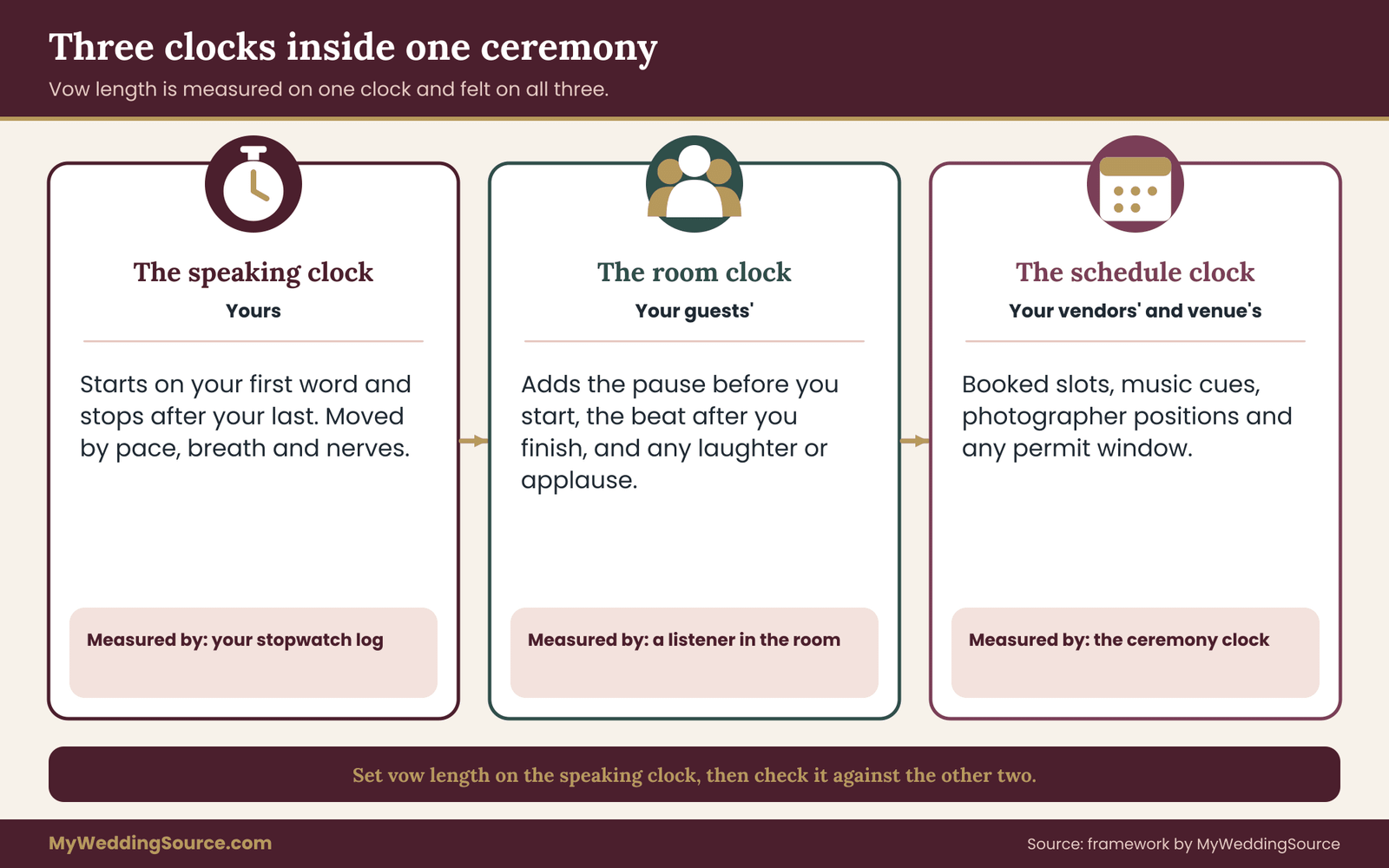
Your vows do not run on a single clock. There are three, and each one answers to a different person.
The speaking clock is yours. It starts when you say the first word and stops after the last. It is affected by your pace, your breathing and how you feel.
The room clock belongs to your guests. It includes the pause before you start, the beat after you finish, laughter or applause if it happens, and the time it takes for the officiant to take back the moment. A ninety-second set of vows can occupy a full two minutes of the room’s attention.
The schedule clock belongs to your vendors and venue. Ceremony slots are booked, music is cued, photographers plan their position, and a ceremony site may have a time window set by contract or permit. Your vow length is one input into that schedule, and an unplanned extra minute on each side adds two minutes that someone else has to absorb.
Knowing which clock you are talking about prevents most arguments about vow length. When one partner says “two minutes is nothing” and the other says “two minutes is forever,” they may be describing the speaking clock and the room clock respectively.
Why page counts and gut feelings mislead
Three habits cause most of the trouble with vow length.
The first habit is silent timing. People read their draft quietly in their head, notice that it takes about a minute, and assume it will take a minute aloud. Silent reading skips the work of forming each word, leaves out breaths and runs faster than speech. A silent read is useful for editing and useless for judging vow length.
The second habit is the one-shot read. A single timed attempt, done fast and alone in the kitchen, becomes the number everyone repeats. But a single read at your fastest pace is the least likely to match the ceremony. You will be standing, probably shaking a little, and holding eye contact. Nobody speaks at kitchen speed in that moment.
The third habit is borrowed numbers. Someone tells you that vows should be about a minute, or that two minutes is the maximum, and the number settles in as a rule. Maybe it fits your ceremony and maybe it does not.
A short civil ceremony with a quick signing and a small group can take a longer exchange. A forty-minute ceremony with readings, music and a unity ritual may have no room for it. The right vow length depends on the ceremony around it, which this guide treats as a variable you can measure rather than a rule you inherit.
The stopwatch log for vow length: five readings
The log is a one-page record you keep as you edit. It has five readings, each done on purpose and each telling you something different. You need a phone stopwatch, a printed copy of the current draft, a pen and a quiet room for the first two. For the later readings you will need a listener and, if possible, the conditions of the ceremony.
Before you start, decide what counts as the draft. Give every version a label (version one, version two and so on), count the words in each, and never time a draft you have since changed without relabeling it. Most confusion about vow length later comes from not knowing which version produced which time.
Reading one: the cold read
Stand up, hold the printed draft, and read it aloud at the pace you would use to read a bedtime story to a friend. Start the stopwatch on your first word and stop it on your last. Do not stop to fix anything. If you stumble, keep going and note where.
This reading gives you the floor, the fastest realistic vow length. Write down the time, the word count and the version label. Then divide the word count by the minutes to get words per minute. If you read two hundred and ten words in one minute and twenty-four seconds, that is one hundred and fifty words per minute. The figure is a personal measure, not a norm. Its job is to let you convert any later edit from words to seconds without timing it again.
Mark the places where you stumbled, ran out of breath or rushed. Long sentences with several clauses are the usual culprits. Those marks guide the later edit.
Reading two: the ceremony-pace read
Now read the same draft again, but slow down on purpose. Pause at the end of each sentence for a full breath. Pause longer where you would look at your partner. Say each promise as if it were the only sentence in the room. This is closer to how vows sound when they carry weight.
Time it, record it, and compare it with reading one. Most people find the second reading runs noticeably longer than the first. The gap is not a flaw. It is the space between words that makes spoken vows land, and a draft that only works at cold-read speed is a draft that will feel rushed on the day.
The ceremony-pace time is the first vow length you can plan with. Divide the word count by the minutes again, and you have a second personal pace. Keep both. The cold-read pace tells you how fast you can go in a pinch, and the ceremony-pace figure tells you how many words fit in a given amount of ceremony time.
Reading three: the conditions read
The third reading adds whatever your real setting will add. If your vows will be spoken into a microphone, read into one, or into a phone held at a distance with the volume turned up so you can hear a delay in your own voice. If the ceremony is outdoors, read outside, where wind, traffic and open space change how you pace yourself. If you will stand for the exchange, stand. If you will hold a card, hold a card and look up at an imagined face every few lines.
Some couples also need to account for the structure of the exchange. If the officiant will introduce each set of vows, if the two of you will alternate lines, or if you will pass a microphone back and forth, those handoffs cost seconds. Time a rehearsal that includes them. A handoff that takes ten seconds does not look like much until it is repeated four times.
Record the conditions next to the time, in a few plain words: “outside, wind, standing, card in hand.” A time without conditions is a number nobody can interpret a month later.
Reading four: the audience read
Find one person you trust and read the draft to them, aloud and in full, with eye contact. This is the reading that tells you the most, and it is the one people skip.
Reading to a listener changes your vow length for reasons that have nothing to do with the words. You look up, so you lose your place. You smile, laugh, hesitate or tear up. You wait for a reaction that does not come. A listener also tends to hear things you cannot: a line that is confusing out loud, a phrase that repeats, an in-joke that needs a sentence of context.
Compare this time with your ceremony-pace read. The difference is your personal drift, the extra time the real situation adds to your clean read. Drift varies a great deal from person to person. A calm speaker may add five seconds, while someone who gets emotional may add thirty. Write your drift into the log and use it as your buffer. You have now replaced a generic “add some extra time” rule with a number that belongs to you.
Ask the listener two questions afterward and write down the answers without arguing. Which line did you remember? Where did your attention drift? The first marks the part to protect, and the second marks the part to cut.
Reading five: the final check
After your last edit, and about a week before the ceremony, do a final timed reading in conditions as close to the day as you can manage. Wear the shoes if you can. Stand where you would stand. Use the same printed card or device you will hold.
This reading has a single purpose: confirming that the edited draft still lands inside your target. Editing often shifts timing in surprising ways. Cutting a sentence can remove a natural pause, and adding a transition can add ten seconds. A final read catches those shifts while there is still time to adjust.
Record the final time as your planning time, and send that number to the people who need it. The audience read plus any handoff time is usually the figure to use. If your final check is faster than your audience read, do not celebrate and shorten your buffer. Use the slower number.
What the log looks like on paper
The log needs only a handful of columns, and you can draw it by hand on a single sheet. For each row, write the following in this order: the reading number, the draft version, the word count, the time, the words per minute, the conditions and a short note. Add one more line under the five rows for your drift and your planning time.
A tidy vow length log has two useful side effects. First, it lets both partners see their numbers side by side without a debate, because the numbers are on the page. Second, it keeps you from re-timing a draft you already measured, which is the quickest way to waste an evening.
If you prefer a phone note or a spreadsheet, the same fields work. What matters is that each time is paired with a version and a condition, so nothing gets compared that should not be.
Reading a vow length log that does not behave
Sometimes the five readings do not line up the way this guide describes, and each pattern has a plain meaning.
If the cold read and the ceremony-pace read are almost identical, you probably did not slow down on the second pass. Try again with deliberate pauses, and read the promise lines even more slowly.
If the audience read is much shorter than the ceremony-pace read, you may have rushed because of nerves. A fast read in front of someone is a common reaction to being watched, and it tends to be the version you will deliver on the day if you do not practice slowing down. Treat the longer number as the plan, and rehearse reading at that pace until it feels natural.
If the times vary wildly between attempts of the same draft and the same conditions, you may not have settled on the wording. Hold the draft still for a couple of readings before you time it again. Constantly editing between reads makes any comparison meaningless.
If your drift is large, do not try to eliminate it. A large drift is part of your vow length, not an error in it. Plan around it when you set your vow length, and give yourself permission to be human. A vow with a long, honest pause in the middle is not a failure of timing. It is the reason the buffer exists.
Converting vow length from words into seconds, and back
Once you have a ceremony-pace figure, you can convert in either direction. To estimate the time for a draft, divide its word count by your ceremony-pace words per minute and multiply by sixty. To find how many words fit a target, multiply your target in seconds by your ceremony-pace words per minute and divide by sixty.
A short example shows the arithmetic. Suppose your ceremony pace is one hundred and ten words per minute and you want a planning time of two minutes and twenty seconds including your drift of fifteen seconds. Subtract the drift to get two minutes and five seconds of speaking time, which is about one hundred and twenty-five seconds. Multiply one hundred and twenty-five by one hundred and ten and divide by sixty, and you get roughly two hundred and thirty words. That is your word budget.
A word budget makes vow length concrete. “Cut it down” is vague, while “we are one hundred words over budget” is a task. It also removes the temptation to argue about whether a particular sentence is too long, because the question becomes whether the sentence earns its words.
Two cautions apply. The conversion assumes a steady pace, and real vows speed up and slow down. And it measures only your words, not the extra time from handoffs, applause, wind or interpreters. Treat the budget as a starting line to be checked by a real read, not as a result that replaces one.
Editing thresholds for vow length
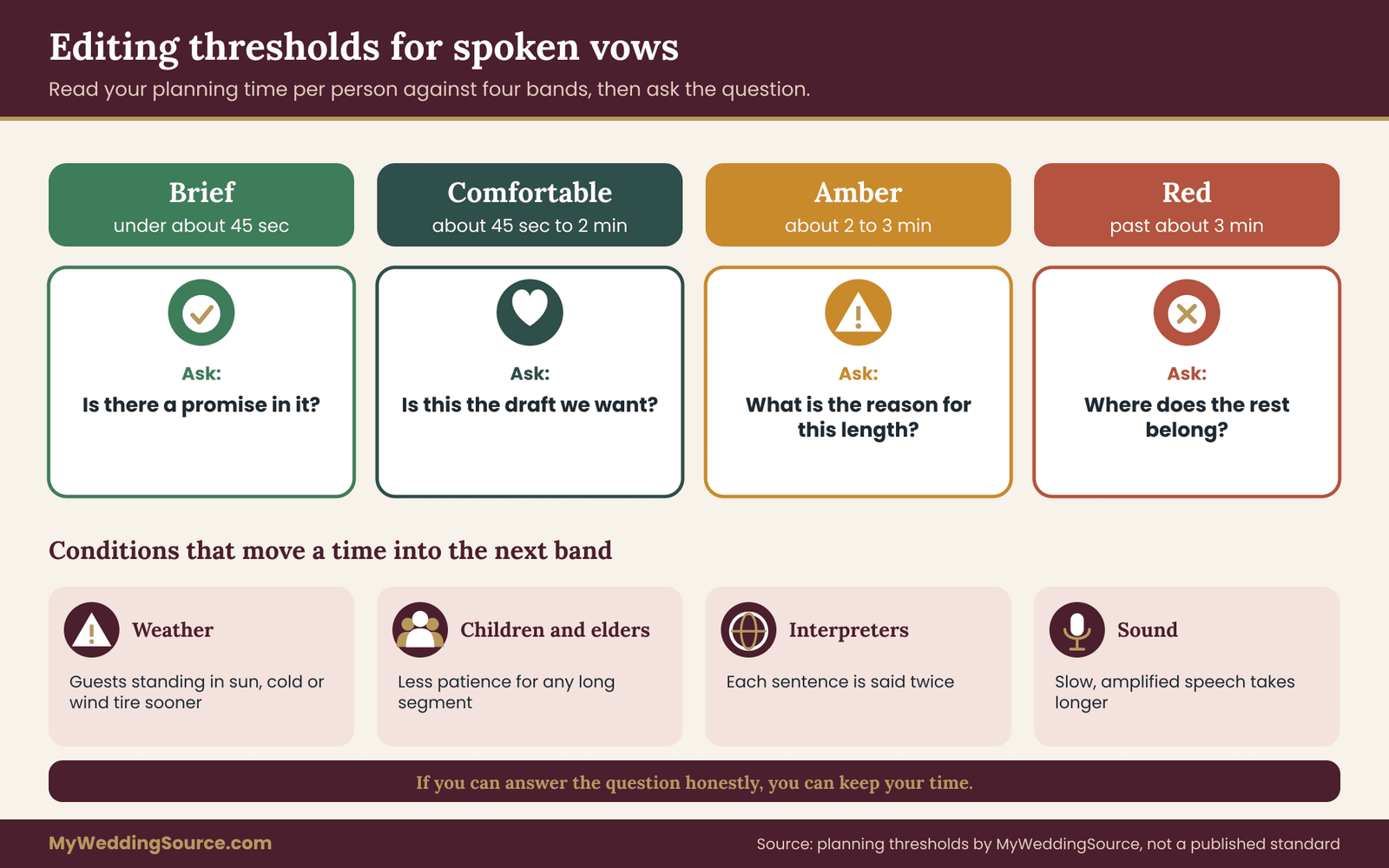
A stopwatch gives you a vow length, and a vow length needs a rule to read it against. The thresholds below are a planning tool for this article. They are not measured averages, and no wedding authority has set them. They are meant to give you a quick way to decide whether a draft needs cutting, keeping or a closer look.
Apply them to your planning time, which is your audience read (or your final check, if it is slower), measured per person. Do not apply them to the cold read.
The brief band: under about forty-five seconds
A vow in this band is short enough to say in a couple of breaths. It suits quiet ceremonies, call-and-response formats, couples who are nervous about speaking and settings where the exchange sits between other long elements.
The question to ask in this band is not “should we add more” but “does it contain a promise?” A short vow can be complete if it names what you commit to. It feels thin only when it is mostly greeting, thanks or description, and no actual commitment appears. If you have a promise, a brief vow length is a legitimate choice, not an apology.
The comfortable band: about forty-five seconds to two minutes
This is the range where most personal vows fit without strain. It is long enough for a short opening, two or three specific promises and a closing line, and short enough that guests stay with you. It also fits most ceremony schedules without special arrangements.
If your vow length lands here, you have no urgent edit to make. You may still want to tighten the draft, but you are not fighting the clock. Use the spare effort on delivery instead: pauses, eye contact and a steady pace.
The amber band: about two to three minutes
A vow length in this band can work, and it needs a reason. The reason is usually one of these: the ceremony is small and unhurried, the couple has a particular story that guests will want to hear, or the vows are the main event of a short ceremony.
Before you accept a time in the amber band, check four things. Does the draft make one arc, or does it circle back to the same idea in different words? Do the strongest lines come early enough that a listener’s attention is still with you? Is the other partner’s vow length close enough that the pair feels balanced? Can your voice and your composure hold for that long, standing, in front of people? If any answer is no, edit before you accept.
The red band: past about three minutes
A vow length past three minutes is a signal to stop and decide. It does not mean the draft is bad. It means the material is probably doing more than a vow exchange can carry. Long vows often contain a toast, a thank-you, a family tribute or a love letter, and each of those has a better home.
Your options are to cut, to move or to split. Cutting means removing repetition and secondary stories. Moving means placing thank-yous and family messages in a reception toast, a letter you exchange privately or a handwritten card. Splitting means keeping a short, spoken vow in the ceremony and giving the longer version privately. Any of these keeps the words. None of them forces them into a few minutes of standing in front of a crowd.
Conditions that shift the bands
The thresholds assume a typical setting: seated or standing guests, moderate weather, a microphone that works and a ceremony that is not rushed. Several conditions move the bands earlier, so a vow length that is fine in a quiet room becomes amber outdoors.
Weather is the biggest. Guests standing in strong sun, cold or wind lose patience with long speeches faster than guests in a comfortable room. If your plan involves a long stand outdoors, treat the top of the comfortable band as your limit.
Children and older relatives also matter. A ceremony with many young children or many guests who tire easily has less room for any single segment to run long. This is a matter of kindness more than etiquette.
A bilingual or interpreted ceremony roughly adds the interpretation time to each segment. If every sentence is repeated in a second language, your effective vow length can nearly double, and the bands apply to the combined time.
Sound conditions count too. If guests may struggle to hear, slower speech and more pauses help, and both add time. Build the extra time into your planning rather than hoping the room will be quiet.
Finally, the other ceremony elements matter. If readings, a unity ritual, music and a long officiant address already take a lot of the ceremony, your vows share a tight schedule. The ceremony clock section later in this guide shows how to check.
Using the thresholds as questions, not verdicts
The bands do not tell you what to do. They tell you what to ask. A time in the comfortable band prompts “is this the draft we want?” A time in the amber band prompts “what is the reason for this length?” A time in the red band prompts “where does the rest belong?”
If you can answer the question for your draft honestly, you can ignore the band. A couple who wants a four-minute vow exchange and has a ceremony built to hold it, with guests seated and a ceremony slot with room, can choose it. The thresholds exist so your vow length is a conscious choice and the people affected know about it, not so that everyone lands in the same band.
Matching vow length between partners
Two sets of vows whose vow length differs greatly create an imbalance that guests notice immediately and the partners feel acutely. The person who spoke for forty seconds beside a partner who spoke for three minutes may feel that their promise counted for less, and the person who spoke for three minutes may feel exposed. Neither feeling reflects the actual love in the vows. It is a matter of timing.
You do not need identical vows. You need vows that sit in the same neighborhood. Matching vow length is about neighborhoods, not twins.
A simple balance rule for vow length
Use the planning times from each partner’s log and divide the longer by the shorter. Our rule of thumb is that a ratio of about one and a quarter or less reads as balanced, a ratio up to about one and a half is acceptable with a conversation, and anything higher is worth discussing before the vows are final. This is a planning rule from this guide, not a standard, and you may set your own.
For example, planning times of one minute fifty and two minutes twenty give a ratio of roughly one and a quarter. That pair is fine. Planning times of fifty seconds and two minutes forty give a ratio over three, and that pair needs a conversation.
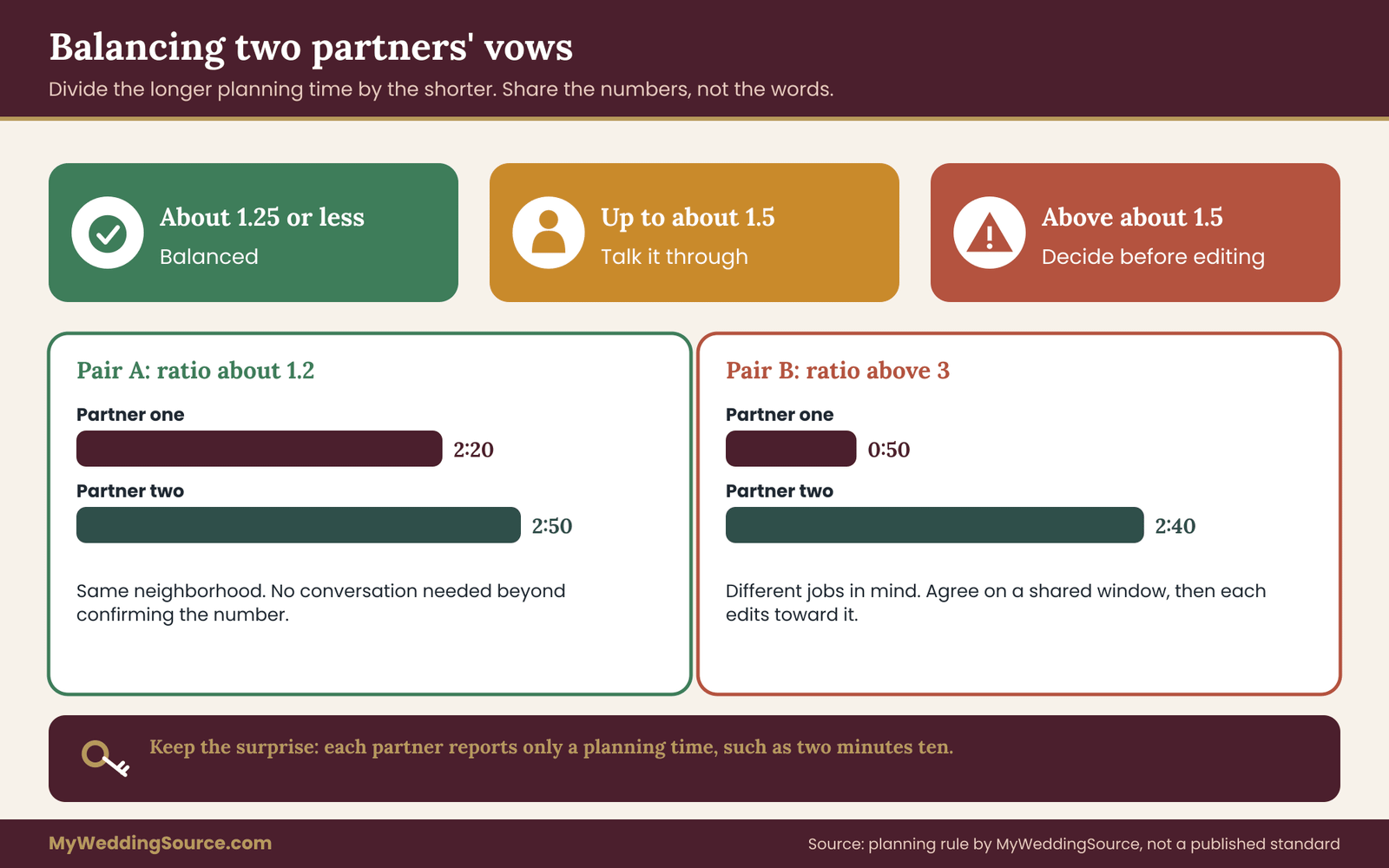
The ratio is not the whole story. A pair of vows that are equal in time but wildly different in tone can still feel uneven, and a pair that differs by thirty seconds can feel natural. The ratio is a prompt to talk, not a verdict.
Who edits, and in which direction
When the vow length differs between partners, the instinct is to ask the longer speaker to cut. That can be the right answer, but it is not the only one. A speaker who has said what they needed to say in fifty seconds should not be pressed to pad. In that case the better move may be for the longer speaker to trim and the shorter speaker to check whether something real was left unsaid.
Agree on the direction in advance. A useful approach is to settle on a shared target window, such as a planning time between one minute thirty and two minutes thirty, and let each person edit toward it. This treats the window as the constraint, not either partner as the problem.
What to do when one partner is more comfortable speaking
Comfort with public speaking varies, and it is often the hidden cause of a vow length gap. One partner enjoys a microphone and writes with room to spare. The other dreads it and writes a few careful lines.
Name this difference kindly. The more confident speaker can choose to trim, not because they are doing anything wrong, but because the pair benefits from balance. The nervous speaker can choose a format that supports them, such as repeating lines after the officiant, reading from a card or practicing until their pace is steady. If it would help, they can also keep the vow short and add one handwritten line in a private letter. No partner should be coached into a length that makes them dread the moment.
If a partner’s anxiety around speaking is intense or affects their daily life, the National Institute of Mental Health describes social anxiety disorder and where to find help, and a doctor or licensed counselor can advise on your situation. That is health advice territory and not something a ceremony guide can resolve.
Keeping the surprise, sharing the number
Many couples want to hear each other’s vows for the first time at the ceremony. That is entirely compatible with matching vow length. You do not have to share a word. You only have to share a number.
Agree on the target window, then each of you reports your planning time to the other, or to the officiant, without the content. A single line such as “I am at two minutes ten” is enough to confirm that you are both inside the window. The surprise stays intact, and the imbalance is caught early.
If you want to go further, ask a neutral third person, such as the officiant or a trusted friend, to hear both vows and report only whether the lengths feel matched. That person holds the secrets, and the partners get confirmation. Make sure the person understands that their job is to report on timing and balance, not to critique the content.
When the partners disagree about the right number
Occasionally one partner wants short vows and the other wants long ones, and the log does not settle the vow length question. This is a values conversation, not a math problem. One partner may see length as a measure of effort, and the other may see brevity as a measure of sincerity.
A way through is to separate what is said in the ceremony from what is shared elsewhere. Keep the ceremony vows within the comfortable band for both, and offer the partner who wants more room an additional channel: a letter exchanged before the ceremony, a toast at the reception or a private reading in the morning. This respects both views. The ceremony stays balanced, and nobody is told their words do not matter.
For decisions that touch families as well as the couple, the guide to wedding decision-making offers a way to share input without losing control, and the same principles apply to a disagreement between the two of you.
A worked example of a vow length log
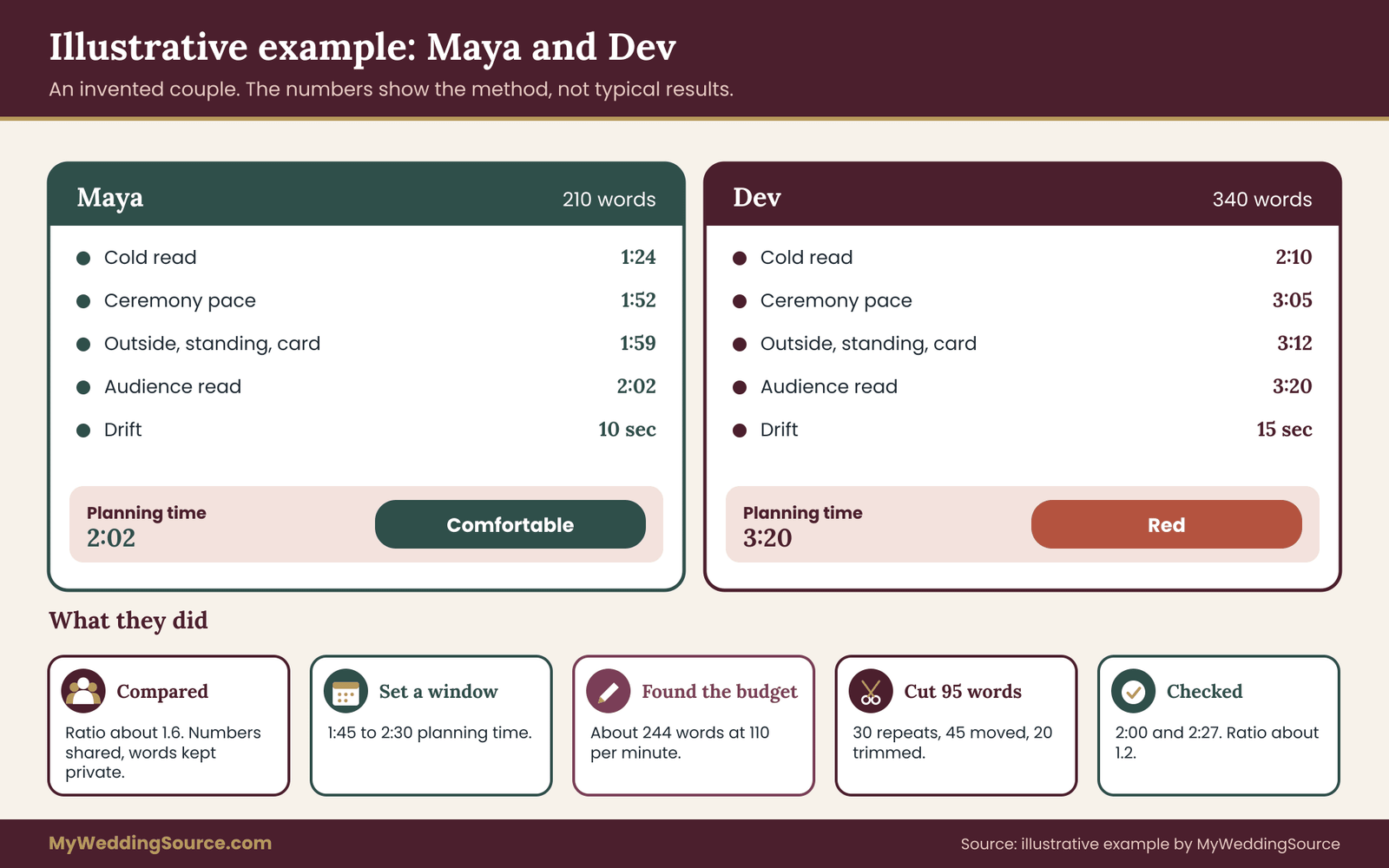
The couple below is invented. They exist to show the arithmetic and the decisions, and the numbers are illustrative, not typical. Call them Maya and Dev. They are planning a ceremony outdoors with about seventy guests, a short officiant address and one reading, and they want to hear each other’s vows for the first time at the altar.
First drafts and first readings
Maya wrote two hundred and ten words. Her cold read took one minute and twenty-four seconds, which works out to about one hundred and fifty words per minute. Her ceremony-pace read took one minute fifty-two, about one hundred and twelve words per minute. She read it outside, standing, with a card, in one minute fifty-nine, and then to her sister in two minutes and two seconds. Her drift, the gap between her ceremony-pace read and the audience read, was ten seconds. Her planning time was two minutes and two seconds, comfortably inside the comfortable band.
Dev wrote three hundred and forty words. His cold read took two minutes and ten seconds, about one hundred and fifty-seven words per minute. His ceremony-pace read took three minutes and five seconds, which is about one hundred and ten words per minute. Outside and standing, he took three minutes twelve. Reading to his brother, he took three minutes twenty, and his drift was fifteen seconds. His planning time was three minutes and twenty seconds, inside the red band.
Notice what the cold read hid. Dev’s cold read of two minutes ten seconds looked like a comfortable draft. It was the ceremony-pace read and the audience read that revealed a draft more than a minute longer in practice.
What the log told them
Comparing their vow length, the ratio of planning times was two hundred seconds to one hundred and twenty-two, about one and six-tenths. That is past the point where the rule of thumb suggests a conversation. Maya and Dev did not share their words. They shared their numbers, and the gap was obvious.
They talked it through. Dev had written his vows partly as a thank-you to Maya’s parents and a story about their first apartment. Maya had written three promises and a closing line. Neither draft was wrong. They simply had different jobs in mind.
They agreed on a shared window of one minute forty-five to two minutes thirty for planning time. Maya’s draft was already inside it. Dev’s needed to come down.
Turning a target vow length into a word budget
Dev’s target planning time was two minutes twenty-eight. Subtracting his fifteen-second drift left two minutes and thirteen seconds, or about one hundred and thirty-three seconds, of speaking time. At one hundred and ten words per minute, that is roughly two hundred and forty-four words. His draft had three hundred and forty, so he was about ninety-five words over.
That figure turned a vague worry about vow length into a job. Ninety-five words is about a quarter of a draft: a couple of paragraphs, not a rewrite.
What Dev cut, and where it went
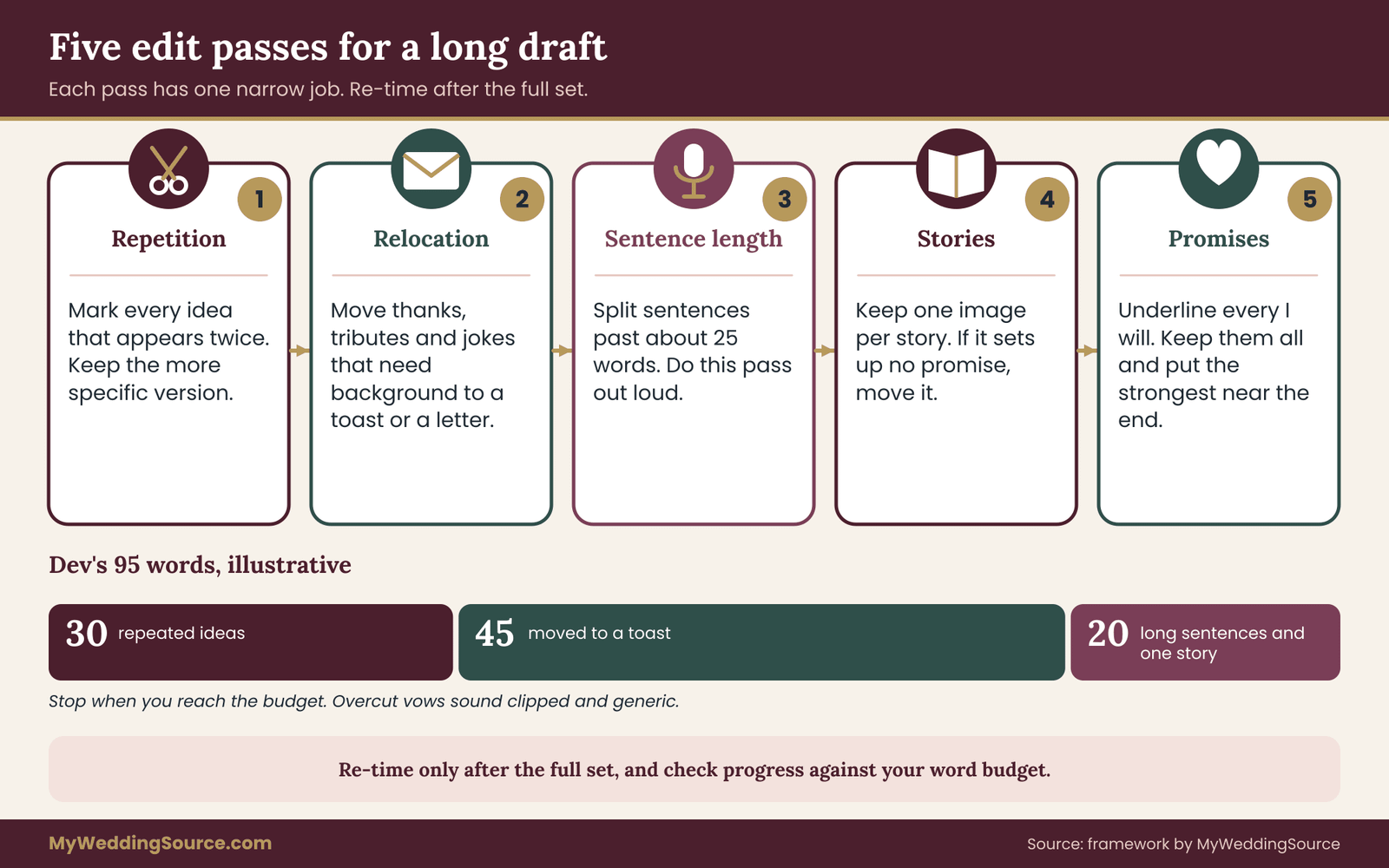
Dev took the draft through the edit passes described in the next section. He removed about thirty words that repeated an idea he had already stated. He moved about forty-five words of thanks to Maya’s parents into a toast he planned for the reception. He shortened several long sentences and trimmed one story to a single detail, together saving the remaining twenty words.
Nothing he cut was thrown away. The thank-you found a better home, and the story about the apartment survived as one image in the vow. When he read the edited draft aloud, the line he had kept about promising to keep the porch light on stood out much more than it had in the longer version.
The final check
A week before the ceremony, both ran a final check outside, standing, with cards, in their ceremony shoes. Maya, who had trimmed five words, read her vows to her sister in two minutes exactly. Dev, now at two hundred and forty-four words, read his to his brother in two minutes and twenty-seven seconds.
The ratio was now about one and two-tenths, well within the balance rule. Both used their audience read as the planning time and sent it to their officiant: two minutes and two minutes twenty-seven, with the note “outdoors, standing, no microphone.”
What the example does and does not show
This example is made up. Real people differ: some speak faster in front of an audience, and some have no drift at all. The thresholds are planning rules, not facts about weddings. What generalizes is the process: measure, compare, set a window, convert to a word budget, cut, and check again. It does not matter whether your numbers resemble Maya’s and Dev’s. What matters is that you know your own.
Cutting a draft to your target vow length
Once you know how many words you are over, the cutting begins. Many people approach cutting vow length as a hunt for sentences to delete. That is the slowest method, and it tends to remove the best material by accident. Passes work better, because each one has a narrow job and you can see what is left.
Work on a copy of the draft, keep the original, and relabel the version after each pass. Re-time only after the full set, using your word budget to check progress along the way.
Pass one: repetition
Read for ideas, not wording, and mark every point that appears twice. Spoken vows tend to circle. You introduce a thought at the start, expand on it in the middle and restate it near the end. On the page it feels like emphasis, but out loud it feels like a draft.
Keep the strongest version of each idea and delete the others. If two versions are both good, keep the one with the more specific image. A concrete detail usually beats an abstract statement of the same feeling.
Pass two: relocation
Now look for material that is not a vow. A vow is a promise from one person to another, and many drafts contain other things: thanks to parents, jokes that depend on a story only a few guests know, a tribute to a friend who helped, a summary of how you met.
None of this is wrong. It is just in the wrong place. Move each item to somewhere it can stand on its own: a reception toast, a letter, a note in the program, a card for your parents. The words survive and the vow becomes more focused.
Be honest when sorting. If a line reads like a speech to the crowd instead of a promise to your partner, relocate it.
Pass three: sentence length
Look for sentences that run past about twenty-five words or that carry several clauses. Long sentences are hard to say in a single breath, and they cost extra time because speakers pause to recover. They are also harder for guests to follow by ear.
Plain-language guidance from the federal government favors short sentences and everyday words, and the advice carries over well to speech. Split a long sentence into two. Replace a formal phrase with the plain version. A shorter sentence is usually faster to say, easier to remember and easier to deliver with feeling.
Do this pass aloud. A sentence that looks fine on the page can leave you gasping when spoken.
Pass four: compress stories
Stories are the most expensive part of any vow. A paragraph of narrative can take thirty seconds and add a single idea. Check each story against a simple test: what promise does this story set up?
If the answer is clear, keep a trimmed version, ideally one image or one line that holds the memory. If the answer is vague, the story belongs somewhere else. Often a single detail, such as a porch light, a shared umbrella or a burned dinner, carries the whole memory without the setup.
Pass five: protect the promises
The last pass protects the content that justifies the vow in the first place. Underline every line that begins with “I promise,” “I will” or anything that names an action you commit to. These are the load-bearing sentences.
Check that every one survived the previous passes and that none is buried in the middle. Move the strongest promise close to the end, where it will be the last thing the room hears from you. Then read the draft to a listener and ask them which line they remember. If it is one of your promises, the edit worked.
How much vow length to cut in one sitting
If you are only slightly over budget, a pass or two will do it. If you are far over, such as Dev’s ninety-five words, expect to use most of the passes and to feel some loss. That feeling is normal, and it does not mean the draft got worse.
Stop cutting when your vow length reaches the budget, even if you can think of more to remove. Overcutting leads to vows that sound clipped and generic, and it is as easy to do as overwriting. If a trimmed draft feels cold, add back one specific line and re-time it.
Cutting is also the right moment to check whether quoted material, such as song lyrics or a poem, belongs. Short quotations take time, and lyrics and published poems are often protected by copyright. The U.S. Copyright Office explains the basics of what copyright covers and how permission works. Reading a few lines in a private ceremony is a different matter from reproducing text in a printed program or a published video, so check before you print or post anything.
Vow length by ceremony format
The same vow length behaves differently in different ceremonies. A ninety-second exchange fits easily into a forty-minute service and feels large in a ten-minute civil ceremony. Before you settle on a number, place it inside the format you have chosen. The formats below are the ones couples ask about most. Where a ceremony tradition has its own wording or rules, your officiant is the authority on what is expected, so ask them early.
Call-and-response vows
In this format the officiant says a phrase, and each partner repeats it. The words are fixed, usually short, and often come from a ceremony script the officiant already uses. The vow length is set by the script, and your stopwatch work shifts from editing to measuring.
Time the exchange as spoken, including the officiant’s prompts, because the prompts take as long as the repetitions. A call-and-response set that looks like a few lines can take a surprising amount of time when each phrase is delivered, repeated and followed by a pause. If you want to adjust it, ask the officiant whether they can shorten the phrases or let you speak a full sentence at a time, rather than three fragments.
Some couples combine formats: repeated traditional words followed by a short personal promise. In that case, time the two halves separately and add them, so you can see which half is carrying the length. The non-religious ceremony script guide and the Christian ceremony script guide show how the vow exchange fits into the wording of each kind of ceremony.
Personal vows read from a card
Most of this guide assumes this format: each partner speaks their own written vows, usually from a card or paper. The log works as described. Two details are worth adding for this format.
First, plan the card handling. Holding a card, turning to face your partner and finding your place again all take seconds. Practice with the real card, not a phone screen that dims, and use a card with large type so you can look down and up quickly. Time the read with the card in hand, since it affects your pace.
Second, decide who goes first and how the handoff works. If one partner speaks and the other responds in turn, the second partner may start with the first one’s emotional momentum or in its aftermath. Rehearse the order you will use, and time the transition.
Memorized vows
Some people prefer to speak without a card. Memorization gives eye contact and an easy, natural feel when it works, and a painful blank when it does not. It also tends to compress the pace, because people who are reciting rush.
If you memorize, time the memorized version separately from the card version. The recitation is often faster than the read, and the gap is another kind of drift. Keep a card or a prompt with the officiant as a safety net, and agree on a signal for when you need a cue. Add a few seconds to your planning time to cover a pause for recall.
A middle path is to memorize the opening and the final promise and read the middle. That keeps eye contact at the points that matter most and relieves the pressure of recalling a full draft.
Vows exchanged in a very short ceremony
A short civil ceremony, such as a courthouse or town hall exchange, may run only a few minutes in total. The officiant may have a set script, a set time and a line of couples waiting. In that setting, the vow length has to fit inside whatever the officiant allows.
Ask what is permitted before you write. Some offices let couples add a short personal statement, and some keep strictly to a fixed form. If personal vows are not allowed in the room, a common solution is to say them in a private moment before or after, which also keeps your own timing flexible. Your local county clerk or marriage license office can tell you what the ceremony in their office includes, and your officiant can tell you what theirs allows.
Religious and traditional ceremonies
Many religious ceremonies have required wording, and the vows may be set by the tradition, not by the couple. In such cases the officiant leads, and any personal statement is added at a point the tradition allows, if it is allowed at all.
Do not assume that personal vows fit, or that your preferred vow length does. Ask the officiant what is customary, whether personal remarks are welcome, where they would go in the order, and whether there is a time or length expectation. Some will welcome a brief personal moment, and others will suggest a place outside the formal rite, such as the reception. The interfaith wedding ceremony planning guide covers how to agree on ritual ownership when more than one tradition is involved, and the same questions apply to timing.
Long ceremonies with many parts
A ceremony with several readings, a unity ritual, music, a homily and a blessing leaves less room for any one section. If your ceremony is already long, the vow length you can afford is smaller than the one you would pick in a vacuum.
In that case, reverse the order of your thinking. Start from the total ceremony time you can ask guests to hold, list the fixed elements, and see what remains. The ceremony clock section later in this guide shows a method. If the remainder is smaller than your planning time, adjust the vow, or adjust another element. Cutting a reading is sometimes easier than cutting a vow, and the choice is yours.
Small gatherings and elopements
With a handful of guests, or none, the pressure of the room is lighter, and a longer vow length can work well. There is no crowd to tire, no schedule to protect and often no permit window ticking down.
Even so, keep the log. A private exchange in a park or on a mountaintop is still affected by weather, sound and your own composure. The National Park Service notes that weddings and similar events in park areas may require a permit, and permits are tied to specific places and times, so if you are exchanging vows on public land, check the managing agency’s rules for time limits or group size before you plan a long exchange.
Edge cases that change your vow length
The rules above cover the usual situation. A handful of circumstances change them, and each deserves a plain answer.
Interpreted and bilingual vows
When vows are translated sentence by sentence, the vow length roughly doubles, and the pace of the speaker is shaped by the interpreter. Time the exchange with the interpreter present, not separately. Give the interpreter your final text well ahead of the ceremony so that they can prepare, and ask whether they prefer short segments or full paragraphs.
If you are using a sign language interpreter, the same logic applies, with the added point that the interpreter needs to see you and may need you to pace your speech. The Americans with Disabilities Act sets requirements for effective communication in many public settings, and the ADA website explains the general rules. Ask your venue and your interpreter what is needed so every guest can follow.
Speaking differences and speech disorders
Some speakers stutter, have a voice condition or find that stress affects their speech. A timed read-aloud log still helps, but the goal changes. Pace is not a problem to fix. It is a variable to plan around.
If you stutter, for example, practice at your natural pace in front of a trusted listener, plan for a longer vow length and consider a format that removes pressure, such as a shorter vow or a pre-agreed pause. The National Institute on Deafness and Other Communication Disorders and the American Speech-Language-Hearing Association publish plain information on stuttering and voice, and a speech-language pathologist can advise on your situation. Nobody should be pushed into a “standard” length or pace.
Emotional breaks and the unplanned pause
Even a well-rehearsed vow can be interrupted by tears or a sudden loss of words. This is part of why the buffer exists. If you tend to get emotional, your audience read will often show it as drift.
Plan the pause instead of fighting it, and count it as part of your vow length. Agree with your officiant that, if you stop, they will wait quietly and not step in. Pick a line you can restart from, ideally the last full sentence you said. A planned pause of ten seconds in a quiet room is rarely noticed, and a rushed recovery is.
Hearing, sound and distance
In a large space or outdoors, guests at the back may struggle to hear. If the vows are meant to be heard by everyone, a microphone and a slower pace help. If the vows are meant to be quiet and intimate, accept that the back rows may hear less, and consider a short, written version in the program or a recording shared later.
The choice between audible and intimate is a real trade-off. Slower, amplified speech lengthens vow length, and a quiet exchange shortens the time but narrows the audience. Decide which matters more and plan for it, and do not expect a quiet voice to carry over wind.
Children, pets and interruptions
Young children and animals are unpredictable, and a short pause for an interruption is part of the day. If a child is involved in the ceremony, consider shaving a little off your planning time so that an interruption does not push the ceremony over. It is better to finish a few seconds early than to feel pressured to hurry through a promise because a toddler needs attention.
Late changes
A late change, such as a new line added in the final week or a section cut at the last minute, resets the log. Any edit, however small, changes the word count and often the rhythm. Re-time the draft, relabel it and update your planning time. Tell your officiant and your photographer if your vow length changes by more than about fifteen seconds.
The same goes for a change in the ceremony itself. If the officiant adds a reading or moves the vows earlier, recheck whether the exchange still sits comfortably. Small changes combine.
What speeds up and slows down spoken vows
Your pace is not a fixed trait. It moves with conditions, and so does your vow length. Knowing which conditions push it which way helps you read the log and plan the final weeks.
Things that slow you down
Emotion is the first. Tears, laughter and the simple weight of the moment all add time, and they are hard to rehearse. This is why the audience read matters more than the solo reads, and why drift belongs in the plan.
A microphone is the second. Hearing your own voice slightly delayed, or being unsure how close to hold it, makes many people slow down or stop and start. If you will use one, practice with it.
Eye contact is the third. Looking up from a card, finding the next line and looking up again costs a second or two each time. Eight look-ups add up.
Formal clothing, shoes on grass, a veil in the wind and a bouquet in one hand all change how you stand and move. They rarely change the words per minute, but they change the confidence behind them, and a hesitant speaker tends to slow.
Applause and laughter are the fourth category. If a line is likely to get a laugh, build in the pause. A joke that lands needs a beat of silence, and a speaker who steps on the laugh loses it.
Things that speed you up
Nerves are the great accelerator. People who are anxious speak faster, breathe higher and skip pauses. A vow that took two minutes at ceremony pace can drop to a minute and a half under pressure, and then feel rushed and clipped.
Memorization can speed you up as well, because recited text tends to come out quicker than text read with care. A cold script has a rhythm of its own.
Familiarity does the same. After twenty rehearsals, you may run through the draft faster than you would for a first-time listener. Rehearsal builds confidence, and it also builds speed, so keep checking your pace with someone new.
Pace practice that works
You cannot remove nerves, but you can train a slower pace. Three short exercises help.
Mark the draft. Put a slash at the end of every sentence and a double slash before each promise. On those marks, breathe and look up. Practice until the marks feel natural.
Read to a metronome of your own making. Record yourself on a phone and listen back. Most people are surprised by how fast they sound. A recording is the quickest way to hear what a listener hears.
Practice in pieces. Rehearse the opening five times, then the middle, then the ending, then the whole. Whole-draft readings are valuable for timing, but pieces are where delivery improves. Keep the full timed reads for the log.
Do not over-rehearse in the last twenty-four hours. A final read the night before can soothe nerves, but a late round of editing introduces new words you have not practiced.
Questions about vow length for your officiant and vendors
Once you have a vow length, a handful of people need to know it. Sending them a number is a small act that prevents several kinds of day-of friction. Ask these questions early enough that the answers can still change your plan.
For the officiant
The officiant sets the pace of the whole ceremony, so begin there. Ask these questions, in roughly this order.
Do you have a preferred vow length for each partner, and does it change by ceremony type? Where in the order do the vows come, and what comes immediately before and after? How do you handle the handoff, and do you prompt us or wait? Will you hold the microphone, a card or nothing? If one of us stops or breaks down, what will you do? Can you review our timed vows and tell us whether the lengths seem balanced? Is there anything about our local rules or your own practice that limits personal vows?
The wedding officiant requirements guide covers who may officiate and what to confirm, and the wedding ceremony cue sheet guide shows how to turn answers like these into a one-page document everyone can follow.
For the venue or site manager
Venues often schedule ceremonies in fixed blocks, and the next event may be waiting. Ask how long your ceremony slot is, what happens if it runs over, and whether there is a fee or a hard stop. For an outdoor site on public land, ask whether the permit has a time window.
Ask about sound as well. Is there a built-in system or does your sound person bring one? Is there a place for a microphone stand, and what is the range? Does the site have its own noise rules that affect an amplified voice? A venue that offers a sound check will let you test your vow length with a microphone in the real space.
For the photographer and videographer
The photographer plans their position around the moments that matter. If your vow length is two minutes, they may move to catch an expression, change a lens or work from another angle. If you give them the number, they can plan.
Ask whether they need to change cards or batteries during the ceremony, which is a reason to keep the total ceremony time predictable. Ask whether they want a quick line about your vow length to decide when to take photos and when to stay still. A videographer will also want to know about microphones: whether you will wear a lavalier mic or whether they will record from a distance, and how they will capture vows spoken quietly.
If you have decided you want vows kept private or not recorded, tell them early. That is a separate question from length, and it is better settled before the day.
For the musician or DJ
If music plays before, after or during the vows, the person in charge needs a cue. A soft instrumental bed under vows is a common choice, but it complicates timing, because the musician has to decide when to fade, when to stop and when to resume.
Give the musician your planning times and ask them to wait for a visual cue from the officiant, not a clock. A stopwatch will not capture an emotional pause, and a musician who starts too early cuts across a moment.
For the interpreter, if you have one
Send the final text and the planning time in advance. Ask whether the interpreter prefers to receive text sentence by sentence or in a block, and arrange a rehearsal if possible. Confirm where they will stand, and make sure you and your partner can see them if you need to match their pace.
For your wedding party and family
You do not need to share a script, but a short note helps. Tell the people who handle the timeline, such as the coordinator or a designated friend, the approximate time for the vows. Tell parents or grandparents who may need to sit for a long time, if you think it matters. This is not a matter of etiquette. It is about being considerate of the people who will be standing or sitting while you speak.
Where vow length sits on the ceremony clock
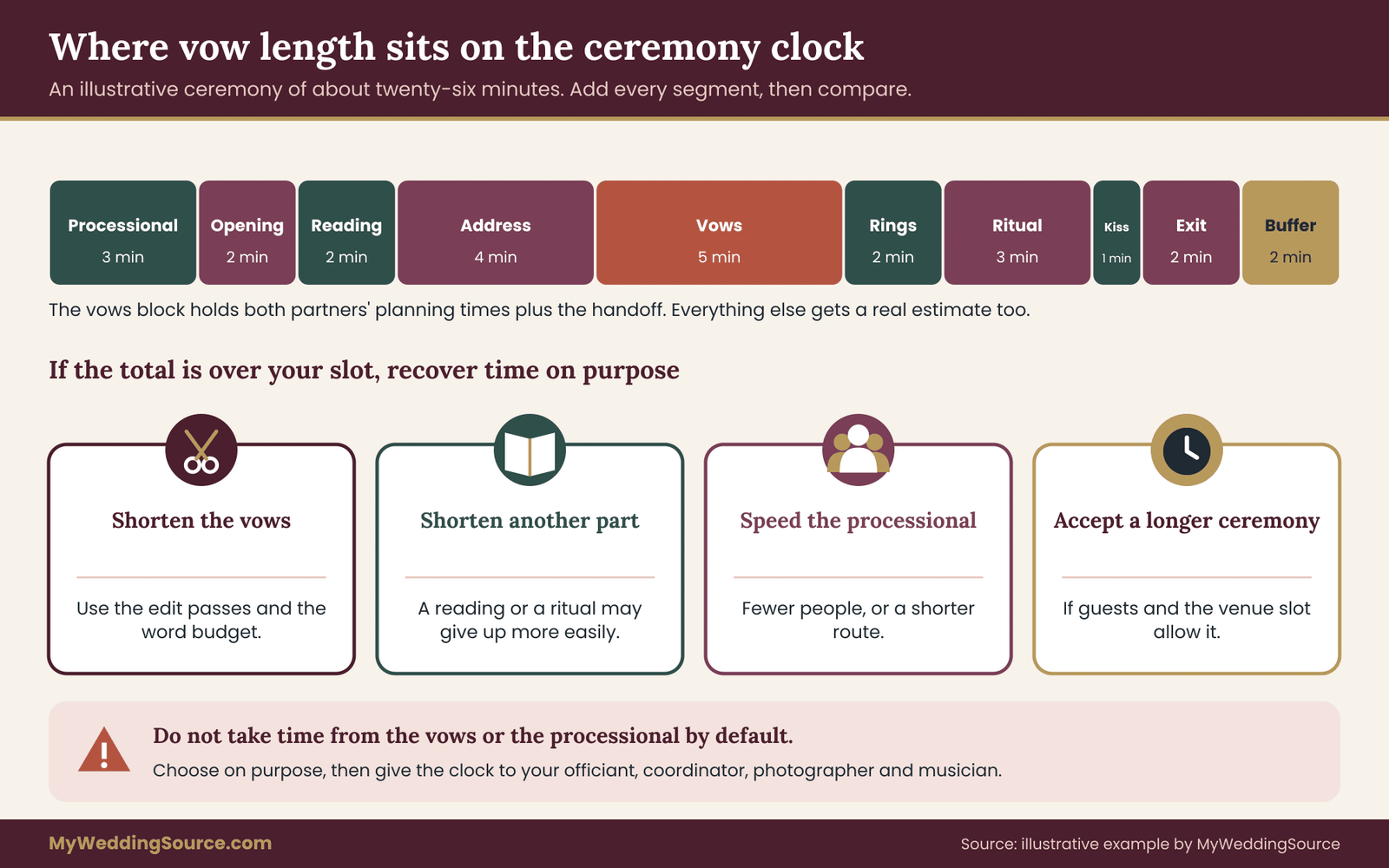
Your vows are one part of a ceremony that has its own total time. A planning time that is fine in a vacuum can be wrong in context, and the quickest way to check is to lay out the ceremony as a sequence of segments with times.
Build the ceremony clock
Write the elements of your ceremony in order. A typical list includes the processional, the opening words, any readings, an officiant address, the vows, the exchange of rings, any ritual, the pronouncement, the kiss and the recessional. For each element, write an estimated time.
Use real numbers where you have them. For the processional, count the people and estimate the walk. For readings, ask each reader to time themselves, as you did for your vows. For the officiant’s address, ask for a time.
Then add everything. Include a buffer of a minute or two for small delays: a guest settling, a microphone being passed, a moment of applause. The total is the ceremony clock.
Compare it with the slot you have
Compare the total with the time you have available. The available time is set by guest comfort, venue rules, the permit or booked slot, your own preferences and the plan that follows. A long gap between the ceremony and the next event, such as a meal or a cocktail hour, allows more room. A tight transition, such as a bus waiting for guests, allows less.
If the total fits, you are done. If it is over, you have four ways to recover time. Shorten the vow length, shorten another element, speed the processional or accept a longer ceremony. Choose on purpose. Do not take time from the vow length by default, and do not take it from the processional by default either.
Share the clock
Give the clock to the officiant, the coordinator, the photographer and the musician as a single sheet. This is your cue sheet in embryo, and the wedding ceremony cue sheet guide shows how to turn it into a working document. It keeps everyone on the same assumptions, so that a vow length of two minutes twenty does not turn into a surprise for the person running the sound.
For a broader look at how the segments of a ceremony fit together, the wedding ceremony step-by-step guide describes the usual order and where each element can move.
A two-week schedule and the mistakes that distort vow length
The log is easiest to run on a calendar. This schedule assumes you have a finished or nearly finished draft about two weeks before the ceremony. If you have longer, spread it out. If you have less, compress it but keep the order.
Days fourteen to eleven: baseline
Run readings one and two on the current draft and fill in the first two rows of the log. Convert to words per minute. Compare your cold read and your ceremony-pace read. Share only the planning numbers, never the words, with your partner, and see how far apart they are.
If the ratio is past one and a half, have the balance conversation now, while there is time to edit, and not on the night before.
Days ten to seven: edit
Compute your word budget from your target window and your ceremony-pace figure. Work through the five edit passes. Relabel the draft after each one, and note the word count. Stop when you reach the budget.
Do the audience read with a listener once the draft feels settled. Record your drift. Ask the two questions about which line they remembered and where their attention drifted. Make one more small edit if needed.
Days six to four: conditions
Run the conditions read as close to the real setting as you can. If you can visit the venue, read in the space with a microphone. If you cannot, mimic it: stand outside, hold the card and wear the shoes. Time the handoff with your partner if you alternate.
Send your planning time to the officiant, and the photographer and musician if they need it. Ask the officiant to confirm the order and the handoff.
Days three to one: final check
Do the final check, once, and record it. Do not edit after this unless something is clearly wrong. A late edit invites an untested sentence into the ceremony.
Print the final card in large type, with a clean copy and a spare. Give the spare to someone who will be near you. Practice the opening line and the last promise one more time, slowly, and stop.
On the day
Eat something and drink water. Take three slow breaths before you begin. Say the first line slower than feels natural, because the first line sets the pace for the rest. Pause at the marked places. Look up at your partner at the promises. If you lose your place, stop, breathe and find the last full sentence. The room will wait.
Mistakes that distort vow length
A few errors account for most of the trouble.
Timing only silently, or only once, produces a vow length that does not survive contact with the ceremony. Use at least the cold read, the ceremony-pace read and the audience read.
Timing a draft that later changed means the number belongs to a different set of words. Relabel and re-time every time.
Ignoring handoffs, microphones and interpreters means the real time is longer than the log says. Include them.
Sharing words instead of numbers spoils the surprise when sharing numbers would have been enough.
Padding a short vow to match a longer one or the reverse. Match the neighborhood, not the exact length, and never pad.
Cutting the promises first. When time is tight, people trim the plain commitments and keep the stories, which inverts the point of a vow. Protect the promises.
Treating the thresholds as rules. They are prompts for questions. If you have a good reason for an amber or red time, you can keep it, as long as the people it affects know.
Skipping the final check. Editing shifts timing in small ways, and one more read catches it.
Your next steps
Start with one timed reading tonight. Everything else in this guide builds on one vow length you can measure.
- Print your current draft, label it as a version and count the words.
- Run the cold read and the ceremony-pace read, and write both times in a log with your words per minute.
- Read the draft to one trusted listener and record your drift and your planning time.
- Compare your planning time with the bands, and compare it with your partner’s number, sharing only the times.
- Agree on a shared window, compute your word budget and work through the edit passes.
- Ask your officiant, venue, photographer and musician the questions in this guide, and give them your planning time.
- Run the conditions read and the final check, then print the card and stop editing.
If it helps, put the final numbers on your ceremony cue sheet so everyone is working from the same page.
FAQ
How long should wedding vows be?
There is no single correct vow length, and no authority sets one. Many couples find that a planning time between about forty-five seconds and two minutes per person fits most ceremonies comfortably, but that is a planning band, not a rule. Measure your own reading aloud with a stopwatch at ceremony pace, add your personal drift, and check the result against your ceremony’s schedule and your officiant’s guidance.
How many words is a one-minute vow?
It depends on how fast you speak, and that varies from person to person and from moment to moment. Time yourself instead of trusting a general figure. Read the draft at ceremony pace, divide the word count by the minutes to get your own words per minute, then multiply by the minutes you want. Your number will usually be lower at ceremony pace than at a cold read.
Should both partners have the same vow length?
Vow length should be close, not identical. A useful check is to divide the longer planning time by the shorter. A ratio of about one and a quarter or less usually feels balanced, and a larger gap is worth a conversation. Partners can share only their times, not their words, so the surprise stays intact while the balance is confirmed before the ceremony.
Do I need to time my vows if I am using call-and-response?
Yes, though the job differs. The officiant’s prompts and the pauses between repetitions take time, and a short script can run longer than it looks. Time the exchange as it will be spoken, with the officiant if possible. If you want it shorter, ask whether the officiant can use fewer, longer phrases or whether a different version of the script is available.
What if my vow length runs too long?
First, check whether the extra material is really a vow. Thanks to parents, jokes that need background and long stories often belong in a toast, a letter or a card. Then cut repetition, shorten sentences and compress stories to one detail. Keep your promises. If the vow is still long, ask whether your ceremony has room and whether guests will be comfortable.
How much extra time should I allow for emotion?
Measure it instead of guessing. Read the draft to one listener and subtract your ceremony-pace time from that audience read. The difference is your personal drift. Some people add only a few seconds and others add much more. Use your own number as your buffer, and plan for a pause of several seconds in case you stop to collect yourself.
Does a microphone change my vow length?
Often it does. Many people slow down with a microphone, wait for their voice to carry or adjust their distance. Time a reading with the real equipment or a close substitute, and ask your venue about a sound check. If guests at the back need to hear, a slower, amplified delivery is usually worth the extra seconds.
Who should I tell about my vow length?
Tell your officiant first, because they run the ceremony. Then tell anyone whose work depends on timing: the venue, if there is a booked slot or permit window, your photographer and videographer, any musician and an interpreter if you have one. Share the planning time, not the words. Update them if a late edit changes the time by more than about fifteen seconds.
Sources
- U.S. Copyright Office for what copyright covers and how permission works for quoted lyrics and poems.
- ADA.gov, U.S. Department of Justice for effective communication requirements in places open to the public.
- National Institute of Mental Health for information on social anxiety disorder and where to find help.
- National Institute on Deafness and Other Communication Disorders for plain information on stuttering and voice.
- American Speech-Language-Hearing Association for information on fluency and voice and for finding a speech-language pathologist.
- PlainLanguage.gov for federal guidance on short sentences and everyday words.
- National Park Service for permit rules on weddings and events in park areas.
- USA.gov for links to state and local government offices, including marriage license offices.
- Library of Congress for general reference on copyright and published works.