
A wedding candy buffet looks like the easiest dessert on the menu: fill some jars, set out scoops, let guests help themselves. It is also one of the few self-serve stations where food is handled by dozens of bare hands, so the real work is deciding how much candy, in what containers, with which tools, and who keeps it clean. This guide gives you a one-page station inventory that answers all of that before you buy anything.
For a wedding candy buffet, write down one line per candy: the container, the serving tool, the weight guests will take, the weight needed to keep the jar looking full, the point at which you refill, and the person who owns cleanliness. Pick a per-guest portion based on the job the buffet does (dessert, add-on, favor or late snack), weigh three real scoops with your own tools, and then multiply. Buy for the larger of the serving need and the display need, add a modest reserve, and confirm handling rules with your venue.
A wedding candy buffet is rarely the most expensive part of a reception, and that is exactly why it gets planned in a hurry. A couple sees a photo of tall glass jars in ombre colors, orders a few pounds of everything, and finds out at 8:30 p.m. that the chocolate has softened, the gummy bears have fused together, the scoops are on the floor and the take-home bags ran out before the cake was cut.
None of those problems is about taste. They are quantity, container, tool and sanitation problems, and they can all be settled on paper beforehand. That is the purpose of this article. It does not recommend candy brands or rank shops. It gives you a method for sizing the wedding candy buffet, a method for choosing containers and tools that match each other, and a method for keeping a self-serve station clean for the length of your reception.
A note on scope. This is general planning information, not legal, tax or financial advice, and food-handling rules, labeling requirements and venue policies differ by place and change over time, so confirm current requirements with your local health department, your venue and your caterer.
What a wedding candy buffet asks of you
Think of a wedding candy buffet as a small, temporary retail counter. Guests walk up, choose, take, and leave. Nobody is standing behind it unless you pay for that. Compared with a plated dessert, three things change.
First, the food is exposed for hours. A plated slice leaves the kitchen and is eaten within minutes. Candy sits in open containers for the entire evening and is touched by a rotating crowd.
Second, you lose control of portion size. A caterer can cut a cake into a fixed number of slices. A guest at a wedding candy buffet decides how much to take, and a few enthusiastic guests, children included, can change the math for everyone behind them.
Third, the display does double duty. The table is also decor, so a jar that looks half empty at 7 p.m. defeats the purpose even if plenty of candy is left in the back. You are buying candy to eat and candy to look at, and those are two different quantities.
Because of this, the standard advice, which is a number of pounds per guest and a list of colors, leaves out most of what goes wrong. A better approach is to treat each candy as its own small system with a container, a tool, a quantity and a cleaning rule. We will call the written version of that system a portion and sanitation station inventory, and it is the thread through the rest of this guide.
If you are still deciding what the whole reception menu should include, the wedding menu planning guide explains how courses, stations and late-night food fit together. The wedding candy buffet is one decision inside that larger picture, and it should be sized after you know what else guests will be eating.
The wedding candy buffet inventory in one page
The inventory is a single sheet, kept in your planning folder and shared with whoever sets up the wedding candy buffet. It has one line for every candy on the table and seven fields on each line. Skipping a field is how most mistakes enter.
Field one: the candy. Name the product by what it is, not by color. “Lemon sour belts, individually unwrapped” is useful. “Yellow candy” is not, because the container, scoop and storage all depend on the actual product.
Field two: the container. Which jar, bin, bowl or tray holds it, how large it is, and whether it has a lid.
Field three: the tool. The scoop, tongs or spoon that goes with that container, and how many spares you have. A tool is part of the sanitation plan, not an accessory.
Field four: serving weight. The total weight guests are expected to take over the evening, based on your portion choice and your guest count.
Field five: display weight. The weight needed to fill the container to a presentable line at the start, and to keep it looking generous at the end.
Field six: refill trigger. A visible marker, such as a line on the jar or a fraction of the volume, that tells whoever is watching the wedding candy buffet to refill.
Field seven: sanitation owner. A named person or role responsible for lids, tools, wiping and replacing anything that touches the floor.
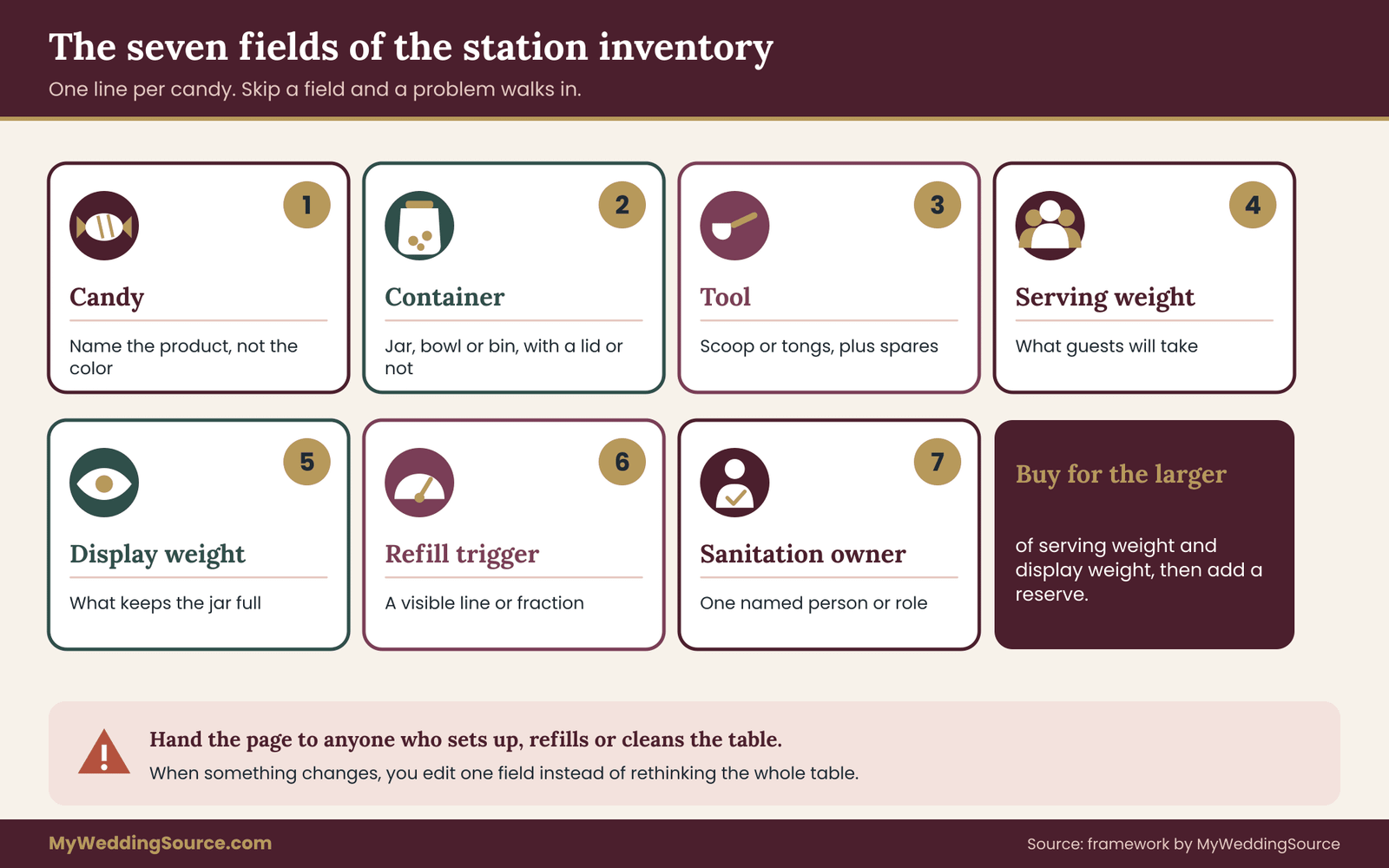
Two of these fields, serving weight and display weight, are where the buying decision lives. Serving weight is a guess about people. Display weight is a measurement of glass. You will find the larger of the two for each candy and buy to that number, and then add a reserve for breakage, melting, spills and the one guest who brings a friend.
The other fields are about preventing the problems that spoil an otherwise nice table. A tool with no assigned container ends up in the wrong jar. A jar with no refill trigger gets refilled either too early, which wastes candy, or too late, which leaves a sad display. A table with no sanitation owner is, on a practical level, owned by nobody.
You do not need software. A sheet of paper or a simple spreadsheet works, and the point is that the page exists. When a florist, a coordinator or a friend asks “what do you want on the wedding candy buffet?” you can hand them the page. When a vendor quotes jar rentals, the inventory tells you exactly how many you need. And when something changes, such as a heat advisory or a guest count update, you adjust one field instead of rethinking the whole table.
The sections that follow work through the fields in order. We start with the question that changes every number: what job is this buffet doing?
Who the wedding candy buffet is for, and what it replaces
Before you pick a single candy, decide what job the wedding candy buffet has. This is the decision that most affects quantity, and it is the one couples most often leave unstated.
Consider four common roles. The table can be the main dessert, standing in for cake or a dessert course. It can be an add-on, sitting beside cake and offered as a bonus. It can be a favor station, where guests fill a bag to take home and the wedding candy buffet is closed after dinner. Or it can be a late-night snack, opened when the dance floor is busy and closed when the music stops.
Each role implies a different guest behavior. A main dessert is eaten on the spot, so portions are bigger and the wedding candy buffet is busiest right after dinner. A favor station is about bag size more than appetite, so the bag is your portion control. An add-on is mostly browsed and sampled. A late-night table is visited in bursts, and guests are more likely to carry candy around.
The role also decides whether you need a second dessert. If the wedding candy buffet is the only sweet, you have a different obligation to guests with allergies, dietary rules or no interest in candy than if it sits beside cake. We return to that in the allergen section, but the role should be settled first.
Write the role at the top of your inventory in one line, for example: “Add-on to cake, open from cake cutting until the last dance, guests may fill small bags to take home.” A sentence like that drives the quantity method in the next sections, and it is the sentence you will reread when someone suggests doubling the order.
A final point about expectations. Some couples assume candy is cheaper than cake. That depends on the candy, the containers you must rent or buy, the labor to set up and refill, and the guest count. We will come back to cost logic in a later section, and the wedding budget page is a good place to record where this line item sits next to cake, catering and rentals.
Wedding candy buffet quantity estimates, step by step
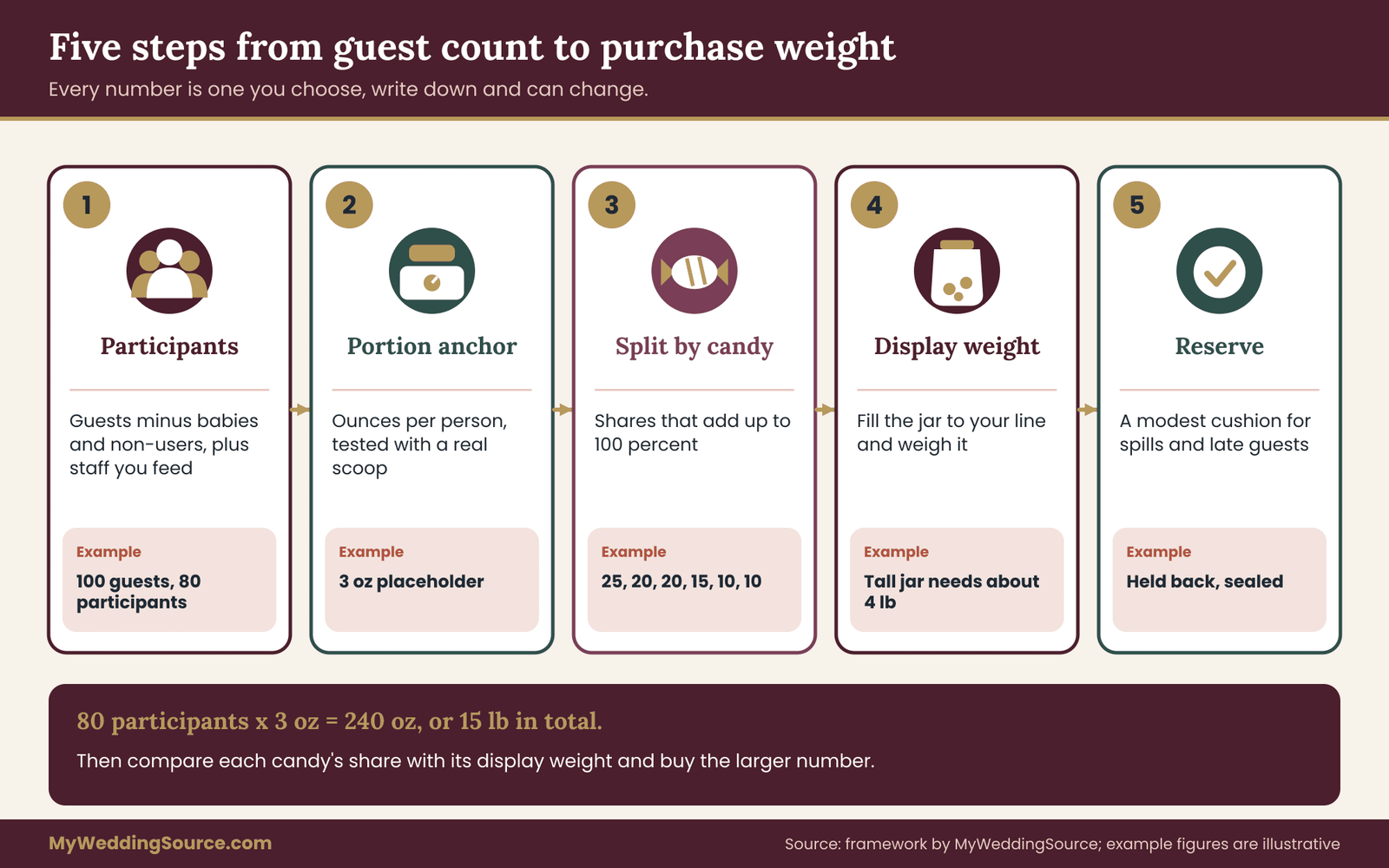
Quantity is where couples either overbuy by a wide margin or run out early. The method below is arithmetic, not folklore. It has five steps, and each step uses a number you choose and can change.
Step one: count participants, not guests. Start with your confirmed guest count and subtract people who will not use the wedding candy buffet. That includes babies, guests who avoid sugar, and anyone you know will skip it. Then add back any vendors or staff you have agreed to feed from the wedding candy buffet.
Give this number a name, “participants”. It is a judgment call, so write down the percentage you used and why. If you assume four in five guests will visit a wedding candy buffet, say so on the page, because the guest who reads it later may adjust it.
Step two: choose a portion anchor. This is the weight of candy you expect each participant to take over the evening, in ounces or grams. There is no universal figure to borrow, and a published average for a different kind of party would not help you. Instead, choose the anchor from the role you settled earlier, and test it with a scale.
A favor station is limited by bag size. A dessert replacement should be larger than an add-on. For arithmetic below we use a placeholder of three ounces so that you can follow the logic. It is an illustration, not a recommendation.
Step three: split the anchor across candies. If you plan eight candies, you do not need three ounces of each per person. You need three ounces in total, divided by how popular each candy will be. Guests take a little of many things when variety is wide. Divide the total using shares that add up to one hundred percent, and give the shares to the inventory lines.
Step four: add display weight. For each container, find the weight needed to fill it to your chosen line. Compare it to the serving weight from step three. Use the larger.
Step five: add a reserve. A small cushion covers spills, melting, the guest who takes a handful, and a late headcount change. Decide the cushion as a share of the serving total, and write it down.
A short example with placeholder numbers
Suppose you expect 100 guests and, after removing infants and a few guests who avoid sweets, you set participants at 80. You choose a placeholder anchor of three ounces. Total serving weight is 80 times 3, which is 240 ounces, or 15 pounds.
You have six candies. You decide the shares are 25, 20, 20, 15, 10 and 10 percent. The first candy has a serving weight of 25 percent of 15 pounds, or 3.75 pounds. The last has 1.5 pounds.
Now check display. The first candy goes into a tall jar that, when filled to your line, holds about four pounds. So the display weight is larger than the serving weight, and you buy for four pounds, not 3.75. The last candy sits in a small jar that holds a pound at the fill line, which is less than the 1.5 pounds you expect to be taken, so you buy for 1.5 and plan to refill the small jar once.
Notice what happened. A small container can hold less than guests will take, so the refill rule matters more than the purchase number. A tall container holds more than guests will take, so you can end the night with leftovers by design. Both are fine, as long as you chose them on purpose.
Weigh a scoop before you trust the anchor
The portion anchor is a guess until you check how much your actual scoop moves. This is a five-minute measurable check, and it is the single most useful thing you can do with a kitchen scale.
Buy a small sample of two or three candies, ideally from the shop that will supply the order. Using the scoop you plan to put on the table, take three scoops of each candy and weigh each scoop. Record the average and the spread. Light candy, such as puffed marshmallow pieces, moves a different weight than dense candy, such as hard rolls or chocolate coins.
If one scoop of a dense candy equals a quarter of your portion anchor, you have learned that a guest who takes four scoops has taken your entire per-person allowance in one candy. You can adjust by choosing a smaller scoop, by placing a note beside the jar, or by accepting the variation and including it in your reserve.
Most couples find the spread more informative than the average. A scoop that varies a lot from one scoop to the next will make the wedding candy buffet hard to predict. Tongs, which pick up individual pieces, vary less for wrapped candy.
What changes the number
The arithmetic above assumes a typical wedding crowd on a typical evening. Several conditions change the quantity enough that you should adjust the participants number or the anchor.
Meal timing. If dinner ends late and the wedding candy buffet opens as a late-night snack, appetite may be lower for sweets right after a large meal, and higher an hour later after dancing. A table that opens at the start of the cocktail hour competes with appetizers and drinks. Pick the window and write it on the inventory.
Children. Children usually take more attention than weight. A small guest with a large bag can empty a jar. If children are a large share of the guest list, consider a kids’ station with small scoops, a dedicated table height, and bags of a fixed size. The point to remember is that the wedding candy buffet is a place where a child takes the portion decision away from a parent.
Bag size. If guests fill take-home bags, the bag is your portion control. A small bag holds a few ounces. A larger bag holds several times that. Choose the bag first, then compute the total weight as participants times the bag weight you tested, plus the candy eaten at the wedding candy buffet.
Open hours. A table open for forty-five minutes needs less than one open for four hours, but only if the crowd arrives in a wave. Peaks matter: your refill trigger has to work during the rush, not only at the start.
Competing desserts. When there is cake, a dessert bar, or a late-night food truck, candy shares appetite. The wedding cake timeline guide covers when cake is served and cut, which helps you decide when the wedding candy buffet should open so the two do not collide.
Weather and venue. Heat shortens the life of chocolate and soft candy. A table that is fine indoors at 68 degrees can fail outside at 85. We cover that in its own section, but if the conditions are likely to be hard, build the reserve around candies that survive them, not around more of the ones that will not.
None of these adjustments is a reason to throw out the method. They are reasons to write down the assumption you made and the date you made it. When your guest count changes in the final weeks, you recalculate with the same steps and the same page, and the new numbers are a minute of work.
Comparing a wedding candy buffet with the alternatives
Sometimes the right answer to a quantity problem is to change the format. Three alternatives share most of the same goals, and each solves a different weakness of a self-serve table.
Pre-bagged favors. Candy sealed in small bags or boxes and handed out at the door or placed at each seat. The quantity is exact, because you count bags. Sanitation is simple, because nobody reaches into a shared jar. You lose the display and the fun of choosing, and you pay for packaging and labor beforehand. If your venue limits self-service, this is the usual fallback.
An attended candy station. A server fills bags or cups on request. Portions are controlled, hands stay off the candy, and the line moves in a predictable way. You pay for the person, and the wedding candy buffet needs a clear front and back. For a large guest list, an attended wedding candy buffet often needs two servers at peak times.
Wrapped-only self-service. A self-serve table that offers only individually wrapped candy, with tongs and lidded bowls. It gives up some visual variety, such as loose gummies and colorful bulk, in return for easier cleaning and fewer allergen unknowns.

To compare, put the same four numbers beside each option: total candy weight, container and tool cost, labor, and the risk you are accepting. The risk line is a sentence, for example “guests touch shared tools” or “no visible variety”. A wedding candy buffet in its full self-serve form usually has the highest display value and the highest sanitation workload, so choose it when you have a person who can own the workload.
Choosing the candy mix for a wedding candy buffet
Once you know the total weight, you can decide what it is made of. A mix that looks good in a photo can still fail at a wedding, so judge each candy on five practical points before you add it to the inventory.
Does it survive the room? Chocolate, soft caramels and some gummies change in warm rooms. Hard candy, wrapped lollipops and sugar-coated pieces tolerate more. Ask the supplier what temperature range the product is meant for, and read the package, not just the website.
Is it wrapped or loose? Individually wrapped candy is easier to keep clean, because a guest touches the wrapper, not the candy. Loose candy such as gummies, jelly beans or chocolate-covered nuts is more fragile and more exposed. Many couples choose a mostly wrapped mix and add a small number of loose items in containers with lids and proper tools.
Does it stick to itself? Gummies and some soft chews fuse in warm, humid rooms and become a block that no scoop can handle. Coated candy can bleed color onto a neighbor. Keep sticky candy apart, and avoid stacking it deeply in a large jar.
Can a guest tell what is in it? If you serve a loose candy that contains nuts, milk, soy or wheat, a guest with an allergy cannot tell by looking. The label has to travel with the candy, which means a card at the container and the original package kept for reference. More on that below.
Is it safe for small children? Whole nuts, hard candy and large round candies can be a choking hazard for very young children. You are not responsible for every family’s choices, but a table placed within reach of toddlers should either avoid those items or keep them behind a clear signal for adults.
A mix built for variety without chaos
Many tables go wrong by trying to fill every color. A more reliable shape is to choose a small number of candies per role and let color follow.
A base candy or two covers the largest share. These are the familiar, crowd-pleasing, sturdy choices. A few accent candies add texture or flavor, such as something sour, something chewy and something crunchy. One or two statement pieces carry the color theme or a sentimental link, such as a candy tied to the couple’s story. And, where it fits, one or more alternatives cover common dietary needs, so the wedding candy buffet is not a blank wall for a guest with restrictions.
Count the candies, not the jars. Eight to twelve distinct candies is a typical range for a mid-size table, and more than that makes the page and the setup harder without adding much for the guest. A smaller selection in generous containers often looks better than a long line of nearly empty jars.
Color, but with a check
Many couples build a wedding candy buffet around their color palette. That works as long as you remember that color is a property of dye, and dyes vary by manufacturer and batch. Order a sample before you commit. If the shade matters, hold it against the linens and flowers under the light you expect at the reception, and if your wedding colors are still being settled, a guide to wedding color palettes covers how to choose and test them.
One more reminder about display: a container filled with one candy always looks neater than a mix. Mixed jars are charming for a favor bag but difficult to refill and difficult to label.
Containers: what holds the candy, and why it matters
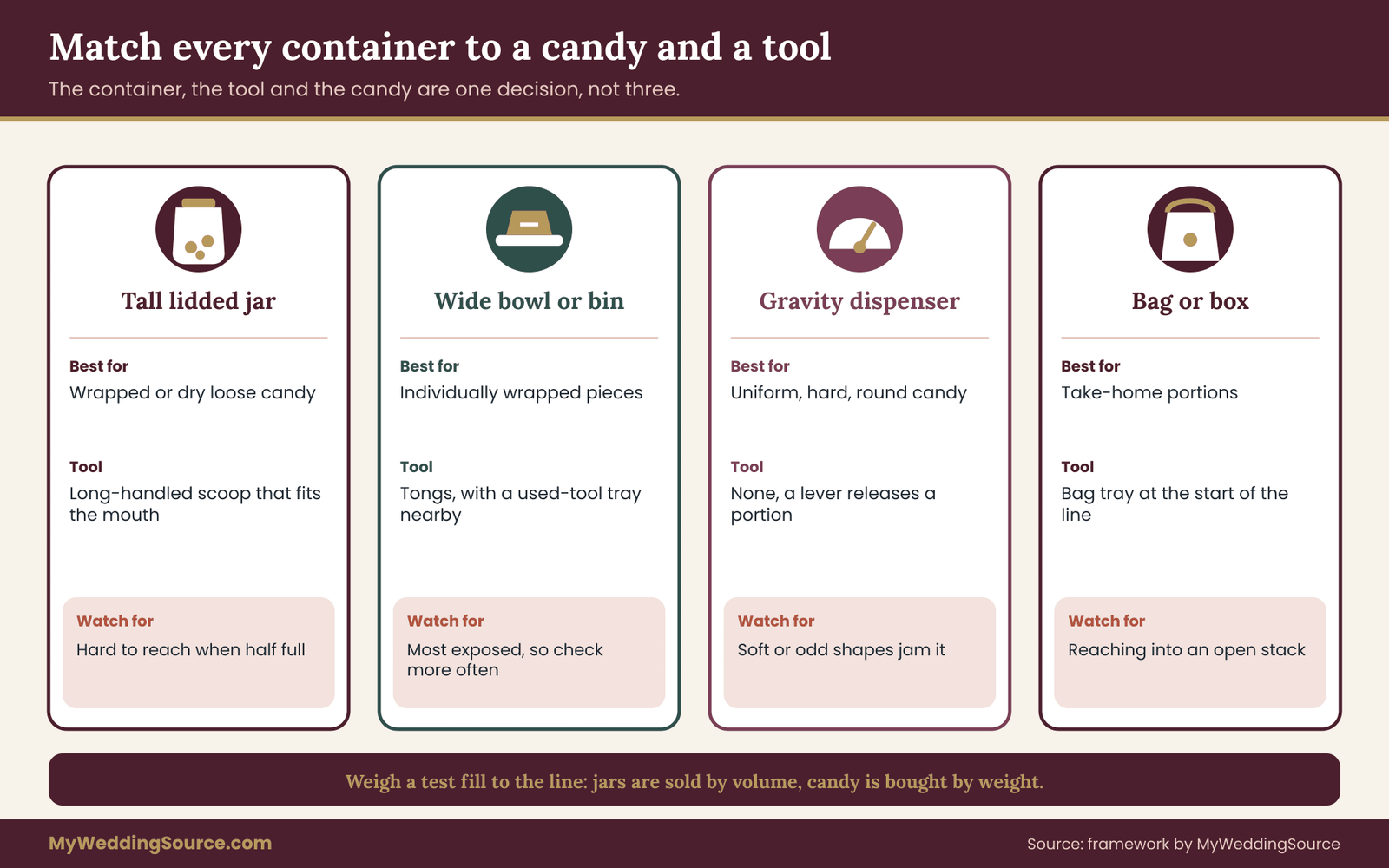
The container is the part couples think about first and plan least. It is also where display, hygiene and tool choice meet. Think about containers in four families and match each to a candy and a tool.
Tall jars with lids. Apothecary jars, glass canisters and cylinders. They look generous when full and protect candy from dust and breath. The trade-off is reach. A tall narrow jar is hard to scoop from when half full, and a guest has to tilt or reach in. They suit wrapped candy and loose candy that is not sticky, along with a long-handled scoop that fits the mouth.
Wide bowls and open bins. These are easier to access and easier to refill but fully exposed. They suit individually wrapped candy, ideally with a tool the guest uses rather than a hand. Open bins are the least forgiving for sanitation, and a plan for them should include more frequent checks.
Dispensers and chutes. Gravity dispensers release a portion when a lever is pressed. They reduce hand contact, but they work best with uniform, hard, round candy. Soft or irregular candy jams them. If you consider dispensers, test one with each candy before you rent, and ask whether the contact surfaces can be cleaned between events.
Bags and boxes for take-home. These are containers too, and they decide how much a guest takes. Pick them with the same care as the jars. Clear bags let guests see what they chose. Boxes protect fragile pieces. A stack of bags near the wedding candy buffet needs its own tray so that guests are not reaching into the open stack with candy-sticky fingers.
Questions that decide a container
Ask four questions of each container on your inventory.
Does it have a lid, and does the lid stay on when guests are using the wedding candy buffet? A lid that sits on the table beside the jar is a tool-handling problem. A lid that attaches or rests securely is better.
Can it be refilled without lifting everything? A jar with a narrow mouth and a delicate neck is a risk when someone refills in the dark at 10 p.m. A jar that can be refilled from a funnel or a wide scoop is practical.
Is it stable? Glass is heavy and breaks, which is a concern near children and dance floors. Acrylic and plastic are lighter and safer, though they can scratch and carry static. Check the base, not only the top.
Can it be cleaned and returned? A rented container usually has to come back clean, and a purchased one has to be stored. Ask the rental company what the return condition is, how long they allow before pickup, and what they charge for breakage. The wedding rental planning checklist is a useful companion for pickup windows, damage terms and who signs for returns.
Matching volume to weight
Containers are measured in volume, such as quarts or gallons, and candy is bought by weight. A calibration step connects them, and it is another small, measurable check.
Before the wedding, fill a spare container to your intended line with the actual candy you plan to buy, or a candy of similar size, and weigh the candy. Write that number on the inventory as the display weight. If a rented jar is two weeks away, a test with a similar household jar still gets you close. Candy shape changes density: small round pieces pack tightly, bulky wrapped pieces leave air gaps, and the same jar may hold quite different weights of each.
With that number, you no longer buy “enough to fill the jars”. You buy a known weight per jar. That reduces the risk of ending up with ten pounds of one candy that fills half a jar and ten pounds of another that fills three.
Heights, groups and the shape of the wedding candy buffet
Mix jar heights. A table with every jar at the same height looks like a shelf. Use risers or stands to vary the height, but keep the working jars, the ones guests actually scoop from, at a height that is easy to reach. Place decorative jars that are not for scooping on the back row or on a different level, and label them if they are display only. A guest should never have to wonder whether a jar is for eating.
Group containers by type of candy, not by color alone. Wrapped candy in one zone, loose candy in another, any allergen-free items together with their own tools. That grouping also makes it easier for whoever is refilling to follow the inventory.
Scoops, tongs and bags: tools for a wedding candy buffet
Tools are the part of the inventory that couples forget to count. A table with eight jars and four scoops has an obvious problem, and a table with eight jars and eight scoops of the wrong size has a less obvious one. Each container needs its own tool, because sharing a tool across candies moves flavors, colors and allergens from jar to jar.
Scoops. A scoop fits a loose candy in a wide container. The size of the bowl sets the portion, so the scoop you weighed earlier is the scoop that goes on the table. A long handle keeps hands away from the candy, but the handle also has to be short enough that the scoop does not fall into a nearly empty jar. If a guest drops a scoop in, the tool is out until it is cleaned, so spares are part of the plan.
Tongs. Tongs suit wrapped candy and larger pieces, and they limit what each guest touches. They are less useful for small loose candy, which slides through, and they can be awkward for small children and for guests with limited grip strength. Offer a scoop alongside tongs on tables where that matters.
Spoons and small ladles. These suit sticky or powdery items and nothing else on a typical table. They are slow, and guests tend to use them as scoops anyway. Use them only where a scoop would not work.
Gloves. Disposable gloves can look like a hygiene solution, but they can also spread contamination if the same pair is used for many tasks. If your caterer or venue uses gloves for refilling, ask when they change them and what they touch between candy jars. Gloves do not replace hand washing.
Bags and baskets. Provide the bag stack on a separate tray, preferably at the entrance to the wedding candy buffet, so a guest takes a bag before picking up a tool. Provide a place to put used tools that is not the table surface. A small tray or labeled bowl for “used tools” gives guests a clear, hygienic option and gives staff a quick way to swap.
Assign one tool per container, and mark it
Write the tool name in the inventory line, and add a visual marker. A ribbon, a tag, or a color on the handle tells everyone, including the person refilling in low light, which tool belongs to which jar. Without it, tools migrate. A scoop from the licorice jar ends up in the chocolate jar, and anyone who tracks allergens loses confidence in the whole table.
Count spares. A common approach is to hold at least one spare of each tool type, plus a few extras, in a clean, covered container away from the wedding candy buffet. Whoever owns sanitation swaps a used tool for a clean one at the stated trigger, such as every time a jar is refilled.
A quick measurable check on tools
Do a ten-minute reach test at home, or at the venue when you walk it. Set up three jars at the heights you plan, put the actual tools in them, and have two or three people of different heights and ages try to take candy without help. Watch for four things: a tool that is hard to grip, a jar too tall to scoop comfortably, a tool that falls into the jar, and a bag that is hard to hold open while scooping.
Fix what you can by changing a tool or a height. Accept what you cannot fix and plan for it, for example by placing a helper at the wedding candy buffet during the first rush.
Bags and fixed portions
For a wedding candy buffet that includes take-home bags, the bag is the cleanest portion control you have. Choose a bag size that fits the amount you want a guest to take, and test it: fill one with your actual candy, weigh it, and write that weight on the inventory. A small bag filled loosely holds less than the same bag packed tight, so decide what “full” means and show it with a sample bag at the start of the table.
Place the bag stack where guests meet it before any tool, and keep it on a tray so loose candy does not fall into it. If you offer a larger and a smaller bag, put a note beside them that says which is for whom. A children’s size is easier to defend than a rule that nobody follows.
Some couples ask guests to fill one bag and then return to the wedding candy buffet for a second round later. A written rule on a small sign helps more than a staff member trying to police it. Keep the tone friendly, because the aim is to stretch the supply, not to spoil the evening.
Think, too, about what happens to the bag afterward. Guests carry it to the dance floor, into a car, or home on a plane. Candy that melts, leaks or stains is a bad parting gift, which is another reason to match the mix to the bag.
Sanitation at a self-serve candy station
A self-serve table is a food-safety question as much as a design question. The details of what is required where vary, so treat this section as a checklist of questions to take to your venue and caterer, not as a ruling. The Food and Drug Administration publishes the Food Code, a model that many state and local health departments adopt in some form, and your local health department can tell you what applies to your event.
Who is responsible, in writing
The most common sanitation failure at a wedding is not a dirty tool. It is a table that nobody owns. Decide who is responsible for the wedding candy buffet and write the name or role on the inventory. It might be the caterer, a coordinator, a friend, or a paid attendant. Whoever it is should know what the job includes, when it starts, when it ends, and what to do about a problem.
If a caterer is providing the candy station as part of service, their food-safety practices apply, and you can ask for them in writing. If you are supplying the candy yourself, ask your venue whether outside food is allowed, whether there is a fee for it, and whether the venue or caterer requires that your station be run by licensed staff.
These rules differ from venue to venue, and it is far easier to ask in the contract stage than at the setup. The wedding vendor contract guide lists clauses worth checking for exclusivity and outside-food rules.
The hand and contact points
Guests handle the table at four points: the bag, the tool, the container lid, and the candy itself. Each is a place where you can reduce contact.
Make hand sanitizer or a handwashing option available near the entrance to the wedding candy buffet, and place a small sign that politely invites guests to use it first. Sanitizer is a convenience and does not replace washing, so tell guests where the restrooms are if hand washing matters to your crowd. The Centers for Disease Control and Prevention publishes plain-language guidance on handwashing that is a good source if you want wording for a sign.
Keep lids on except during use. A lid is the simplest barrier against dust, hair and coughs. If a container has no lid, treat it as higher risk and move it toward the staffed end of the table.
Keep the tools in the containers they belong to, with handles resting on the lip so they do not fall in. Offer a place to put used tools aside.
Provide a trash receptacle that is easy to find, so wrappers do not accumulate on the table. A table that fills with trash invites people to put used items near the candy.
Refilling without contaminating
Refilling is the riskiest moment, because the person doing it is touching both the container and the supply. Set simple rules that anyone can follow.
Wash and sanitize hands before refilling. Use a clean scoop or a clean funnel to transfer candy from a sealed bulk bag to the jar. Do not pour back leftover candy from the wedding candy buffet into the bulk supply. Do not top up a jar by adding fresh candy to old candy if the old candy has been exposed for a long time or has visible damage, because the older candy stays in the jar longer.
Instead, empty the jar into a discard bin, wipe it, and refill.
Store the bulk supply in sealed, labeled containers away from the table, and keep it covered until it is used. Keep a labeled bin for rejected candy, with a note about what happened to it. It is easier to throw away a spoiled handful than to explain it later.

What to do when something goes wrong
Write the contingency rules on the inventory. They can be short, and they have to be specific.
If a tool falls on the floor, take it out of service and replace it with a clean spare. If a child reaches into a jar with bare hands, remove the candy that was touched, or the whole top layer if you cannot tell, and refill from the supply. If a jar breaks, stop service at that table, remove the candy in and near the glass, sweep thoroughly, and do not reopen the wedding candy buffet until the area is confirmed clear.
If you see a guest with a reaction, the table is not the priority, and the person responsible for guest care should follow the emergency plan for the venue.
These rules are easier to follow when they are agreed in advance and kept on a card by the wedding candy buffet, out of sight but within reach.
Layout, labels and allergens at the wedding candy buffet
A good layout lets guests help themselves without crowding, helps staff refill without crossing the line, and keeps allergen information where people can see it. A wedding candy buffet that fits on a small table can still need more floor space than you expect, because people stand, bend, and hold bags.
Space and flow
Plan for a single working side. Guests approach from the front, staff work from the back, and the two do not cross. If the table must be reached from both sides, treat each side as its own station with its own tools, labels and sanitation checks.
Leave room for a short line. A table with only one point of access, such as a narrow ledge, creates a queue that blocks the room. Place the wedding candy buffet out of the main route to the bar and restrooms. The wedding reception guest flow guide covers how traffic moves through a reception, which helps you decide where a self-serve station belongs.
Think about reach for guests of different heights and abilities. Working jars should sit within comfortable reach of someone seated, and the front edge of the table should allow a wheelchair user to come close. The 2010 ADA Standards for Accessible Design, published by the Department of Justice, describe reach ranges for public spaces, and while a private reception is not governed in the same way, the ranges are a useful guide if you want to be inclusive. Ask your venue about its own access rules.
Put bags at the start and the trash at the end. That gives guests a natural order: bag, tool, candy, exit, with a place for used tools and wrappers on the way out.
Keep the wedding candy buffet away from heat sources and direct sun. A table near a window, a spotlight, an uplight, a candle or a heating vent will warm candy faster than the room itself. Ask your lighting vendor how hot their fixtures run near your table.
Labels guests can actually use
Each container needs a label, and each label should say three things: what the candy is, any major allergens in it, and whether it is wrapped or loose. A guest who is standing in front of the table with a bag in one hand should be able to read that at a glance.
The Food and Drug Administration identifies milk, eggs, fish, shellfish, tree nuts, peanuts, wheat, soybeans and sesame as the major food allergens, and packaged foods sold in the United States have to declare them on the label. That requirement applies to the package, not to your table card, but it is the best source for what to write. Copy the allergen statement from the package, word for word, onto your card, and keep the original package or a photo of it available for anyone who wants to check.
Do not guess. If you do not have a label for a bulk candy, ask the supplier for an ingredient and allergen sheet. If the supplier cannot provide one, do not make a claim on the card. A card that says “contains nuts” when it only might is far less useful than one that says “ingredients unknown, ask a staff member.”
Avoid the phrase “allergen free” on a label unless you have written proof from the maker, because cross-contact can happen in factories, in shipping, and on the table. Many labels instead say “made without” or “may contain.” Use the manufacturer’s wording.
Wedding signage has its own design questions. The wedding signage system guide explains how to choose type size, contrast and placement so that cards at a table are legible in dim light, and the same principles apply to small container labels.
A separate zone for guests with restrictions
If you have guests who need allergen-conscious candy, treat that candy as its own sub-station. Use separate containers, separate tools, a separate bag stack, and a clear label. Keep it at one end of the wedding candy buffet, away from candies that contain the allergen, and refill it first, before any other jar, with clean hands.
A separate zone is a reasonable measure, not a guarantee. Cross-contact can still occur if a guest uses the wrong tool, and a family with a severe allergy may prefer a pre-packed option. A simple solution is to set aside a few pre-bagged, sealed packets of a safe candy for those guests and hand them over directly. Talk to the guest or their family about what they need, and let them decide.
The rule for any mixed dessert table is simple: never offer a guarantee you cannot document.
Heat, humidity and other edge cases
Candy is more sensitive to conditions than most wedding foods, and the problems tend to appear late in the evening, after the room has filled with warm people.
Temperature and humidity
Chocolate begins to soften at temperatures that are not unusual in a reception hall, and it can develop a whitish film called bloom when it has been warm and then cools again. The film is cosmetic, but it looks unappealing. Soft candy absorbs moisture and gets sticky in humid rooms, and hard candy can become tacky. Sugar-coated candy can weep color.
Check the forecast the week before and the room temperature when you walk the venue. If the room is warm or the table is outdoors, shift the mix toward candy that tolerates it, and keep chocolate in the bulk supply, in a cool place, to be brought out in small amounts. Do not put chocolate in a refrigerator right before service, because moving it from cold to warm air can cause condensation on the surface.
Ask your supplier about packaging, too. Some candies ship in bulk bags with a stated shelf life and storage temperature, and the label is a better guide than a general rule.
Outdoor tables
An outdoor wedding candy buffet faces sun, wind, insects and dust. Use lids on everything. Use shade, but not a canopy so low that guests bump it. Weigh down light items, and consider a covered display with a hinge or lift-off cover. If the wedding candy buffet must stand on grass, check that the legs are stable under the load of glass jars.
Insects are drawn to sugar, so a table that is left unattended can quickly become a problem. If the ground is uneven, a spill is more likely.
For both heat and wind, build a trigger into the inventory: if the temperature at the table passes a number you have chosen, the staff move the chocolate indoors, close lids, and reduce the wedding candy buffet to the sturdy candies. The number is yours to set after reading the packaging and talking with your supplier, and it should be written, not remembered.
Edge cases worth a line on the page
Guest count jumps late. If the count rises after you have ordered, calculate the added serving weight with the same anchor and add it to your largest-share candies first, because a shortage in the base candy is the one most noticeable to guests. If the count drops, you will have leftovers, and the inventory can say in advance what you will do with them.
The venue limits outside food. Some venues allow candy as decor but not as food service, or require a licensed caterer to handle anything guests eat. If the rule changes your plan, the fallback is to move the candy to individually wrapped favors that guests pick up at the door. Ask early, in writing.
A food truck or dessert bar arrives. If the reception includes other late-night food, treat the wedding candy buffet as the minor partner and reduce the serving weight. A late snack plus a wedding candy buffet can easily outrun appetite.
You want leftovers to go home. Plan this on paper. Decide whether sealed, unopened bulk goes home with you, and whether opened candy is discarded. Candy that has been on an open table for hours is not something to put back into the bulk bag or to give to guests the next day.
Candy for later. If you are saving candy for a morning-after brunch or a welcome bag, keep it separate from the table supply from the start, in sealed containers, and mark it so no one adds it to a jar by mistake. The wedding waste reduction planning guide has ideas for handling leftover food and packaging sensibly.
A worked wedding candy buffet inventory, start to finish
The example below is invented. The couple, the numbers and the candies are illustrations of the method, not recommendations and not measurements. Replace every figure with your own.
Mara and Jon are planning a reception for 120 guests in a hall with a 5 p.m. ceremony and a dinner that ends around 8. They have cake, and they want a wedding candy buffet as an add-on that opens after the cake cut and closes when the band takes its last break. It will not be a favor station, but guests may fill one small bag each to take home.
Step one: the role and the window
They write the role at the top of the page: “Add-on to cake, open from cake cutting until the final set, one small bag per guest.” That sentence tells their coordinator what the table is, when it is open, and what limits to enforce.
Step two: participants
They have 120 confirmed guests, including nine children under five and seven guests who have told them they avoid sugar. They remove those sixteen from the count and add four vendors who will be offered candy, for a participant number of 108. They write the assumption: “Almost everyone else will visit once.”
Step three: the anchor and the scoop test
They choose a placeholder anchor of three ounces per participant for the eating portion, plus a take-home bag they have tested to hold about two ounces of mixed candy. Before they buy, they weigh three scoops each of the two loose candies they plan to use. The average scoop of the first candy is lighter than they guessed and heavier than they hoped for the second, so they switch the second candy to a smaller scoop and note the new figure on the page.
Eating portion: 108 times 3 ounces equals 324 ounces. Take-home: 108 times 2 ounces equals 216 ounces. Total serving weight: 540 ounces, or just under 34 pounds.
Step four: the lines
They choose seven candies and assign shares. The inventory lines are summarized in prose below, which is how the same information would look if the page were written as a list.
A sturdy wrapped chocolate coin in a tall lidded jar with tongs takes the largest share. Wrapped hard candies in a wide bowl with a scoop come next. A loose gummy candy goes in a lidded jar with a small scoop, because the room is likely to be warm. Wrapped caramels in a bowl with tongs cover the soft, chewy slot.
A sour wrapped candy in a small jar supplies the accent. A colored candy that matches the linens fills a tall jar with a lid and is mostly for display. And a separate jar of individually sealed, nut-free hard candies sits at one end with its own tongs and a card.
For each line they compute serving weight from the share, display weight from a test fill, and the larger of the two. The tall coin jar needs more display weight than serving weight, so they buy for the display. The accent jar needs less display than serving weight, so they buy for serving and plan a refill.
Step five: reserve, triggers and owners
They add a reserve of a modest share of the serving total to cover spills and the late arrivals they expect, and they decide to hold it back in sealed bags at the caterer’s prep area. Each jar gets a refill line marked with a small tag. The coordinator’s assistant owns sanitation from the cake cut until close, with a written card listing the rules for dropped tools, spills and breakage.

Step six: the night itself
At the cake cut, the assistant removes the lids from the working jars, places clean tools, and opens the bag tray. Every twenty minutes, the assistant walks the wedding candy buffet: checks the refill tags, swaps any tool that has been dropped, wipes the surface, and removes wrappers. At the last set, the assistant replaces the lids, packs the remaining bulk supply into sealed bags, and notes what was thrown away.
The point of the example is not the numbers. It is the habit of writing a line for every candy and a rule for every task. The first time the plan meets reality, such as a spill, a warm room or a rush after the cake cut, they already know who does what.
What they would adjust
If the room is warmer than expected, they pull the chocolate coins from the jar and substitute the wrapped hard candies in the tall jar. If the cake service runs late, the table opens later and closes later, and the refill cycle shifts. If guests ignore the one-bag rule, the take-home share of the reserve shrinks and the staff offer a second round of small bags near the end of the night only if candy remains.
Vendor questions, quotes and cost logic
Whether you are buying candy yourself, working with a candy shop, or hiring a caterer or planner to run the wedding candy buffet, put the inventory in front of every vendor and ask them to respond to it line by line. A vendor who can answer each field is a better bet than one who sends a flat price for “a candy bar.”
Questions for a candy supplier
Ask what the candy is, its ingredients and allergen statement, and whether the packaging lists a storage temperature and shelf life. Ask whether the candy is sold by weight, by case or by count, and what the minimum order is. Ask about shipping time and how it is packed in warm weather. Ask whether you can order a sample, and what the return or substitution policy is. Ask for the net weight on each package, because quantities on some products are listed by piece and not by ounce.
If a shop offers a custom color mix, ask how it will be packaged and whether it can be delivered to the venue sealed. Ask in writing whether any items are made in a facility that handles major allergens, and keep the answer with your inventory.
Questions for a rental company
Ask for the exact dimensions and capacity of each container at the fill line, not at the brim. Ask about lids, since some jars are rented with lids and some without. Ask what condition the jars must be returned in, how long you have before pickup, and what the fee is for breakage and for missing pieces. Ask about delivery and setup, and whether someone from the company is on site. The wedding rental planning checklist mentioned earlier can help you compare terms.
Questions for a venue or caterer
Ask whether outside candy is permitted, whether guests may self-serve, and whether a licensed provider must handle it. Ask about fees, such as a cake-cutting or outside-food fee, and whether they apply to candy. Ask who owns cleanup and trash. Ask about refrigeration and storage for the bulk supply, and about the room’s temperature range for the hours the table will be open. Ask what happens to leftover candy.
Cost logic without invented prices
Prices vary by candy, region and season, so use a structure, not a number. Your total cost has five parts.
The first is the candy itself, which is your purchase weight times the price per pound for each candy. The second is containers and tools, rented or bought, along with spares. The third is bags, labels, signs and trays. The fourth is labor, whether you pay a vendor for setup and attendance or ask friends to help. The fifth is delivery, return and any venue fees for outside food.
Compare the cost to the alternatives you are choosing between, which could be a dessert bar, extra cake, or favors. If a wedding candy buffet replaces a dessert, include the cost of what it replaces. If it is an add-on, include the effect on other food, because guests who fill up on candy may leave other desserts untouched.
Record the estimate and the final spend on the wedding budget sheet so that next time you can see which assumptions were wrong. If part of the expense is on a vendor invoice, keep the quote that matches it.
Finally, if the wedding candy buffet is one of several stations, return to the wedding menu planning guide to compare how stations share appetite and staff time.
A timeline for the wedding candy buffet, from ordering to teardown
A wedding candy buffet has a short supply chain, but the steps need an order. Work backward from the day and give each step an owner and a date.
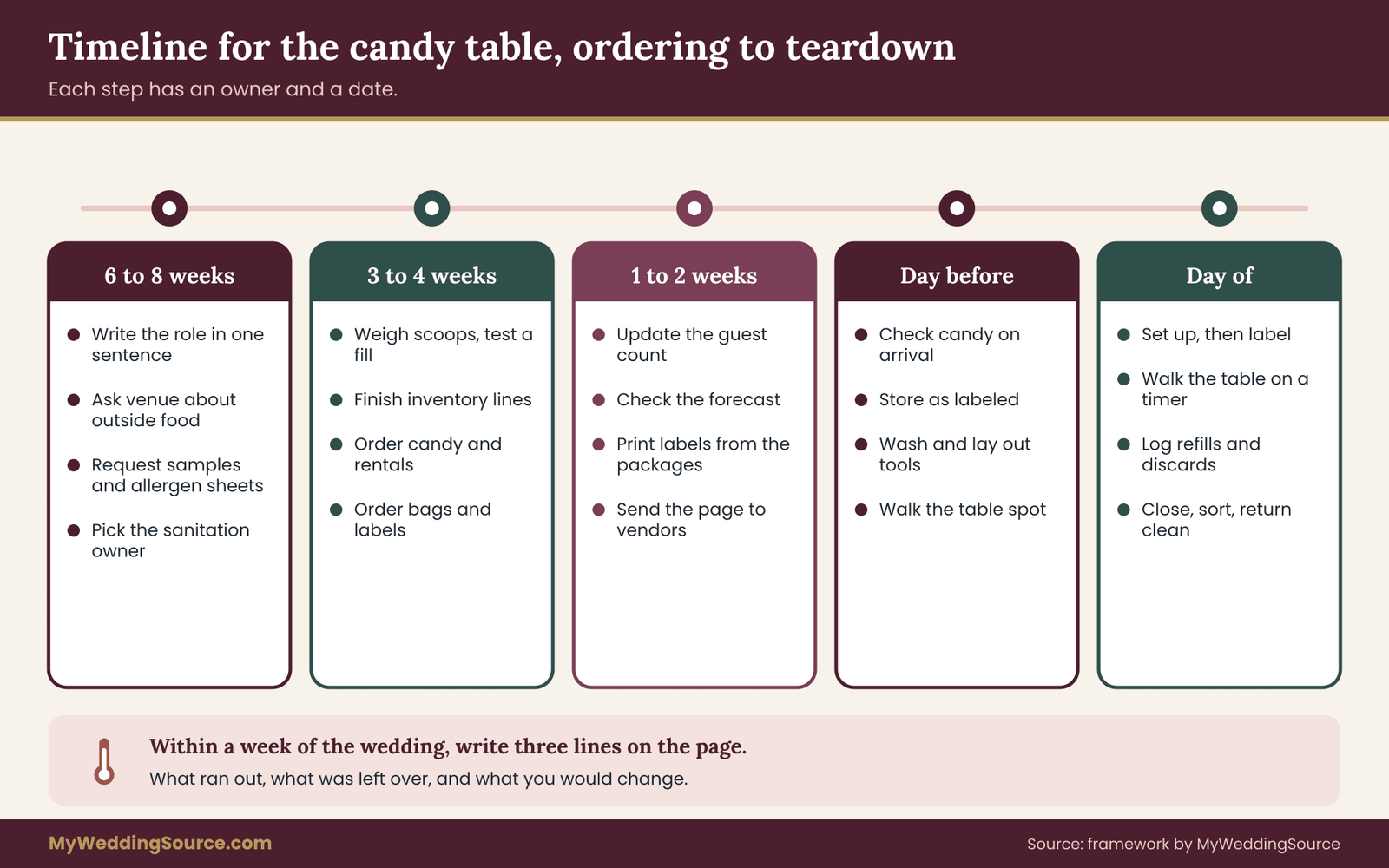
Six to eight weeks out
Settle the role of the table and write it at the top of the inventory. Confirm the guest count range with your caterer or planner, and set the participant number you will use for the first calculation. Ask the venue about outside food, self-service rules and any fees, and get the answer in writing. Decide who will own sanitation on the day, because that person may need to be hired or briefed.
Choose the candy mix and request samples of any items you are unsure about. Request ingredient and allergen sheets for every loose or bulk candy. Start a list of containers and decide whether to rent or buy.
Three to four weeks out
Run the scoop test and the fill test. Weigh scoops, fill a container to the line, and update the display weights. Finalize the inventory lines and compute the purchase weights. Place the candy order with the supplier, and confirm delivery dates, storage needs and packaging. Book the container rental with pickup and return windows. Order bags, labels and tray liners.
If you are using a vendor to run the wedding candy buffet, share the inventory with them now and ask for their agreement to each field. Ask them to confirm their sanitation steps in writing.
One to two weeks out
Update the guest count and recalculate. Check the weather forecast, and compare it to the heat rule you wrote. Finalize labels and print them from the allergen statements you collected. Pack labels, tags, spare tools and a small cleaning kit in a labeled bin. Confirm delivery or pickup with the supplier and the rental company.
Send the inventory page and a one-paragraph summary to the coordinator, caterer and venue contact, and ask them to note anything that conflicts with their own rules.
The day before
Check the candy on arrival. Look at packaging for damage, melting or signs of moisture, and compare the net weight to your order. Store the candy where the label says, away from heat and strong odors. Wash and dry the containers and tools, and lay them out with the labels and tags so setup is a short job.
Walk the table location if you can, and check the light, heat sources, floor and distance to power or water. Make sure the owner of sanitation has the card with the rules and the contact details of the person to call.
Setup on the day
Set the table cloth and risers first, then the containers, then the candy, then the tools, then the labels and signs, and last the bag tray and trash. Fill containers to the lines you tested. Confirm that each tool is in the right container and that each label matches the candy. Photograph the finished table for your records, and for the vendor.
Keep the bulk supply, reserve and spare tools at a covered point out of view. Check the temperature at the table at the start, and again before the wedding candy buffet opens.
During service
The sanitation owner walks the table at the interval you set. At each walk, check refill tags, swap tools, wipe the surface, collect wrappers and replace the lids on any jar not in use. Log what was refilled and what was thrown away, even if the log is a few lines on the back of the page.
Close and teardown
Replace lids and close the wedding candy buffet at the end time. Sort what is left: sealed bulk goes into the supply bins, opened candy is discarded, and display-only items are either kept or boxed for later. Return rented items clean and counted, with a photo. Pack labels and unused tools. Within a week, write three lines on the inventory page: what ran out, what was left over, and what you would change. Those notes make the next table easier, whether it is your own or a friend’s.
Your next steps
Start with one sheet of paper or one spreadsheet tab, and do these in order.
- Write the role and the open window for your wedding candy buffet in one sentence.
- Set the participant number and write down the assumption behind it.
- Choose a placeholder portion anchor, then weigh three scoops of two sample candies and adjust it.
- List each candy with a container, a tool, a serving weight, a display weight, a refill trigger and a sanitation owner.
- Collect ingredient and allergen statements for every candy, and draft labels from them.
- Ask your venue and caterer about outside food, self-service and cleanup, and get the answers in writing.
- Write the dropped-tool, spill and breakage rules on a card for the person who owns the table.
Do the first four steps this week, and the rest as your guest count settles. A finished page takes less time than choosing jars.
FAQ
How much candy do I need for a wedding candy buffet?
It depends on the role of the wedding candy buffet, the number of participants and the portion you choose. Multiply participants by a tested per-person weight, split the total by candy, compare each line with the weight needed to fill its container, and buy the larger number. Add a reserve for spills and late guests. Weighing three real scoops of your actual candy is the best way to check your assumption.
Do I need a different scoop for every candy?
Yes, whenever possible. Giving each container its own tool keeps flavors, colors and allergens from moving between jars, and it makes a dropped tool easy to replace. Mark each tool with a tag or a ribbon that matches its jar, and keep clean spares out of sight. If tools are shared, someone must wash them between candies, which is hard to do during a busy reception.
Is a wedding candy buffet safe for guests with allergies?
It can be made safer, but no self-serve table can promise zero risk. Copy the allergen statement from each package onto a card, use separate containers and tools for allergen-conscious candy, and keep original packaging available. For severe allergies, offer sealed, pre-packed options and talk with the guest or family. Avoid claims you cannot document from the manufacturer.
Can I put out a wedding candy buffet outdoors in summer?
You can, with limits. Use lids, shade and sturdy candy, keep chocolate and soft candy in cool storage until needed, and set a written trigger for moving fragile items indoors. Insects, wind and uneven ground add risk, and unattended tables fail quickly. Check packaging for storage temperatures and compare them with the forecast and the shade at the table.
Should guests use gloves or tongs at the wedding candy buffet?
Tongs or scoops are the more useful tools, because they keep hands away from candy and are easy to swap. Disposable gloves can spread contamination if they are worn for several tasks, and they do not replace hand washing. Provide sanitizer near the table, point guests to restrooms, and ask your caterer what they do when staff refill.
What is the best way to refill without contaminating the candy?
Wash and sanitize hands, use a clean scoop or funnel, and refill from a sealed supply. Do not pour used candy back into the bulk bag, and do not top up a jar that has been open for hours or has damaged pieces. Empty it, wipe it and refill. Keep a discard bin and a short log so you can explain what was thrown away.
Do venues allow outside candy for a wedding candy buffet?
Policies vary. Some venues allow candy as decor but not as food service, some charge an outside-food fee, and some require a licensed caterer to run any self-serve station. Ask early and get the answer in writing. If the wedding candy buffet is not allowed, wrapped favors that guests collect at the door can keep the idea without the self-serve risk.
What should I do with leftover candy after the wedding?
Decide before the day. Sealed bulk that was never opened can go home or be donated if the packaging allows it. Candy that sat on an open table for hours should be discarded, not returned to the supply or given away the next day. Keep a separate sealed batch if you want candy for a brunch or welcome bags.
Sources
- U.S. Food and Drug Administration, Food
- FDA Food Code
- FDA, Food Allergies
- FoodSafety.gov
- Centers for Disease Control and Prevention, Clean Hands
- Centers for Disease Control and Prevention, Food Safety
- ADA.gov, ADA Standards for Accessible Design
- U.S. Consumer Product Safety Commission
- NIST Office of Weights and Measures