
Tabletop wedding games are the card decks, trivia cards, puzzles, dice and drawing sheets that guests play at their seats, and dinner is the one moment when they compete with plates, glasses and servers for the same few square feet. This guide gives you an original footprint and clearance test, so you can decide whether tabletop wedding games belong on the tables during the meal, between courses, or not at all.
Treat the table as three zones: the plate zone where each guest eats, the pass lane where servers reach in and out, and the play zone in the middle that is left over. Measure the play zone after the centerpiece, bread, water and bottles are counted. Then run a short clearance test with the caterer’s lead server, with the game on the table, and a noise check with a phone meter. Games that pass both can sit on tables through dinner. Games that fail should wait until plates are cleared or move to a lounge.
A reception table at dinner is a crowded piece of furniture. By the time the first course lands, the surface holds place settings, glassware, a centerpiece, menu cards, bread plates, perhaps a water pitcher or a wine bottle, and sometimes a table number or a favor. A deck of cards or a trivia stack looks small beside all of that, which is exactly why it gets added without much thought.
The trouble shows up later, in small ways. A server reaches across a puzzle to set a plate and knocks the pieces. A table of eight gets loud over a trivia round while the person giving the toast waits at the microphone. A guest with a mobility aid cannot get close enough to the table to reach the cards. None of this ruins a wedding, but all of it is avoidable.
This article is about tabletop wedding games and the dinner service they share a table with. It does not try to cover every reception activity, because other guides on the site already cover the wider menu of reception activities. It does not cover game content either. It answers one narrow question: how much game can a dinner table actually carry, and what does it cost in noise and in service speed?
A note on scope. This is general planning information, not legal advice, and venue rules, accessibility duties and local fire codes differ, so confirm the current version with the venue, the caterer or the issuing agency.
What tabletop wedding games are, and why dinner is the hard moment
For this guide, tabletop wedding games are any games a guest plays at their own seat, using items that live on the table. That includes a deck of conversation or trivia cards at each table, a short word puzzle printed on the place card, dice or a small set of tiles, a “draw the couple” sheet with a pencil, a photo challenge card, and a table-versus-table scavenger list. It leaves out lawn games, a photo booth, a dance-floor game and anything that needs guests to stand and move.
Tabletop wedding games have real strengths. They give people at a table a reason to talk when they only know the couple, not each other. They help shy guests, because the activity does the work that small talk usually has to do. They cost little, they need no stage, and they fill the quiet gaps between courses when guests are waiting for food and have nothing to look at.
Dinner is the hard moment because every other part of the reception gives the game more room. At cocktail hour, guests stand with drinks and the tables are empty. During dancing, the tables are mostly abandoned. At dinner, the table is at its fullest and the room is at its busiest, since the kitchen, the service staff, the bar, the band or DJ and the toast schedule all converge on the same forty minutes to ninety minutes.
Who is affected when a game is wrong
Three groups feel a badly placed game, and they do not all complain. Servers feel it first, because they have a timed task and a game on the table makes each reach longer or riskier. Guests next to the game feel it, because the person who wants to eat quietly sits beside the person who wants to play. And the couple feels it, because dinner that runs long pushes toasts, cake and dancing later, which the reception guest flow guide treats as a chain of dependencies rather than a list of separate events.
The person who rarely feels it, at least out loud, is the guest who does not want to play. That guest usually will not say so, since refusing a game at someone’s wedding feels rude. The test in this article therefore includes a check for what happens when a guest simply wants the game to be absent from their part of the table.
The footprint and clearance test for tabletop wedding games
The method has two halves and one decision rule. The footprint half asks how much surface the game can have. The clearance half asks whether the service team can work around it at speed. A short noise check sits on top of both. Together they give each game one of three results: stays on the table during dinner, comes out between courses, or lives somewhere else.
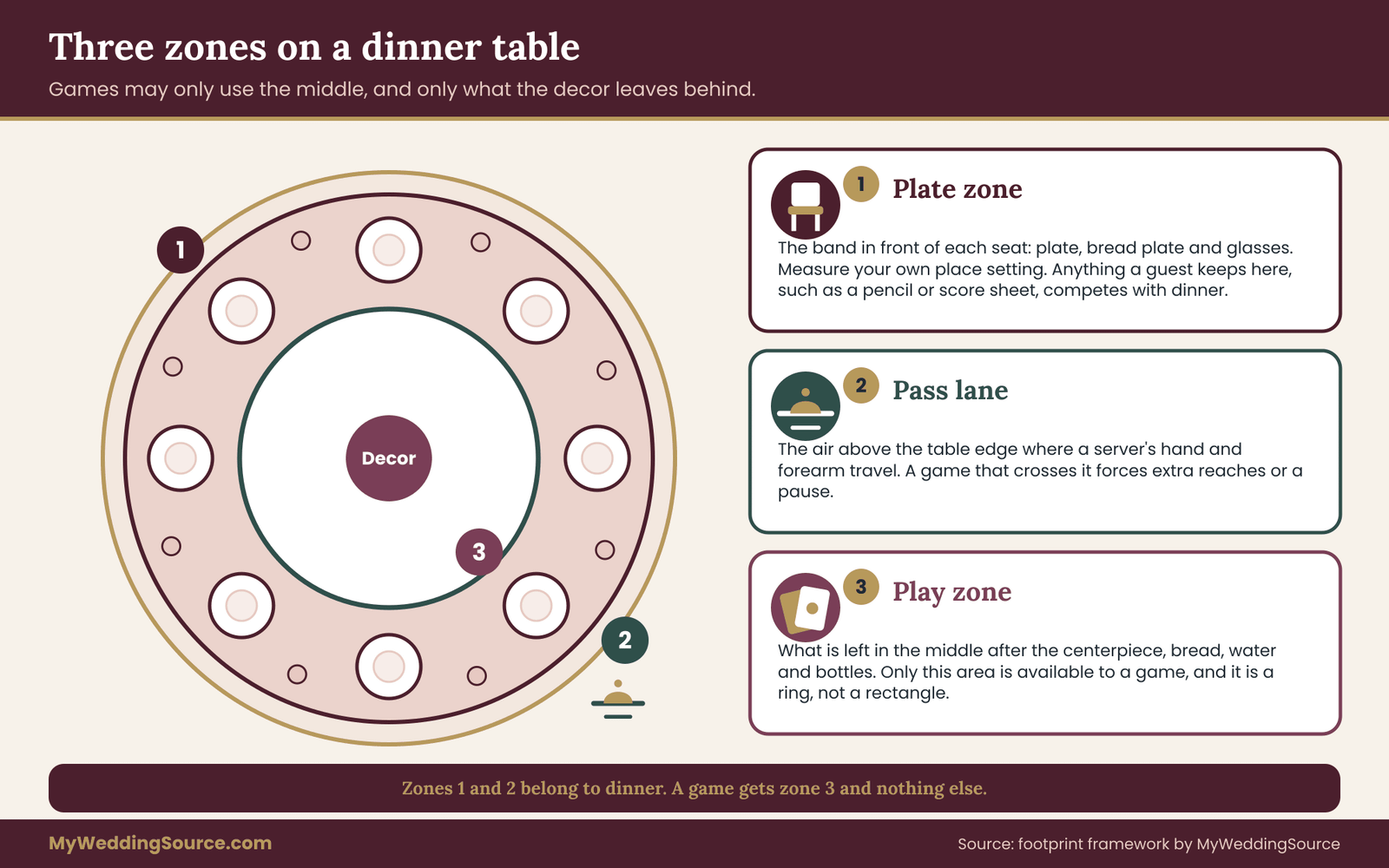
The footprint half divides a round or rectangular table into three zones. The plate zone is the band of table directly in front of each seat, deep enough for a dinner plate, a bread plate and glassware. The pass lane is the narrow strip of air above and around the plate zone where a server’s hand and forearm travel.
The play zone is whatever surface remains in the middle after the plate zone and the permanent decor are subtracted. A game may only use the play zone, and only the part of it that the decor does not already occupy.
The clearance half is a hands-on trial. The lead server or captain performs a mock plate set and a mock plate clear at one fully set table with the game in place. You time it, watch where hands go, and listen for what the server says.
The measurable results are the number of extra reaches around the game, whether any item moved or fell, and whether the server asks to move something. A caterer who says “we would just pick it up as we go” has told you the answer already: the game belongs between courses.
The noise check uses a free phone sound meter at a table during a mock play session, compared with a quiet baseline. You are not looking for a dangerous level. You are looking for the point where a table cannot hold a conversation without raising voices, because that is the point where neighboring tables, the toast and the audio system start to suffer.
One practical point before the test itself: do the test on each game separately, not on the whole package. Couples often bundle three or four tabletop wedding games into one “table kit” and then discover that the kit fails because of a single piece. Testing each piece on its own shows which tabletop wedding games can stay and which should leave the table.
The decision rule
Each game gets the weakest of its three results. A game that fits the play zone but needs servers to reach over it is a between-courses game. A game that passes both physical checks but pushes the table’s volume up by a lot is a lounge game.
Only a game that passes all three stays on the table through dinner. The rule sounds strict, but most couples find that about half of their ideas pass, and the ones that fail can often be adjusted by changing size, number of pieces or when the game is handed out.
The rest of this guide covers each half in turn. It gives the math for the footprint, a script for the clearance trial, a way to think about noise, a prose comparison of common game types, a worked example with an invented couple, and the vendor questions that tie it all together. If you are still choosing between big categories of activities, settle that first, and return here once you have decided on tabletop wedding games specifically.
Measuring the table: the footprint math for tabletop wedding games
You do not need a design program for this. You need a tape measure, a calculator and the real dimensions of the table your venue or rental company will use. Rental companies publish round and rectangular table sizes and the number of guests each size seats, so the first step is to get the exact table you will have, not the one in the mood board.
Step one: find the usable surface
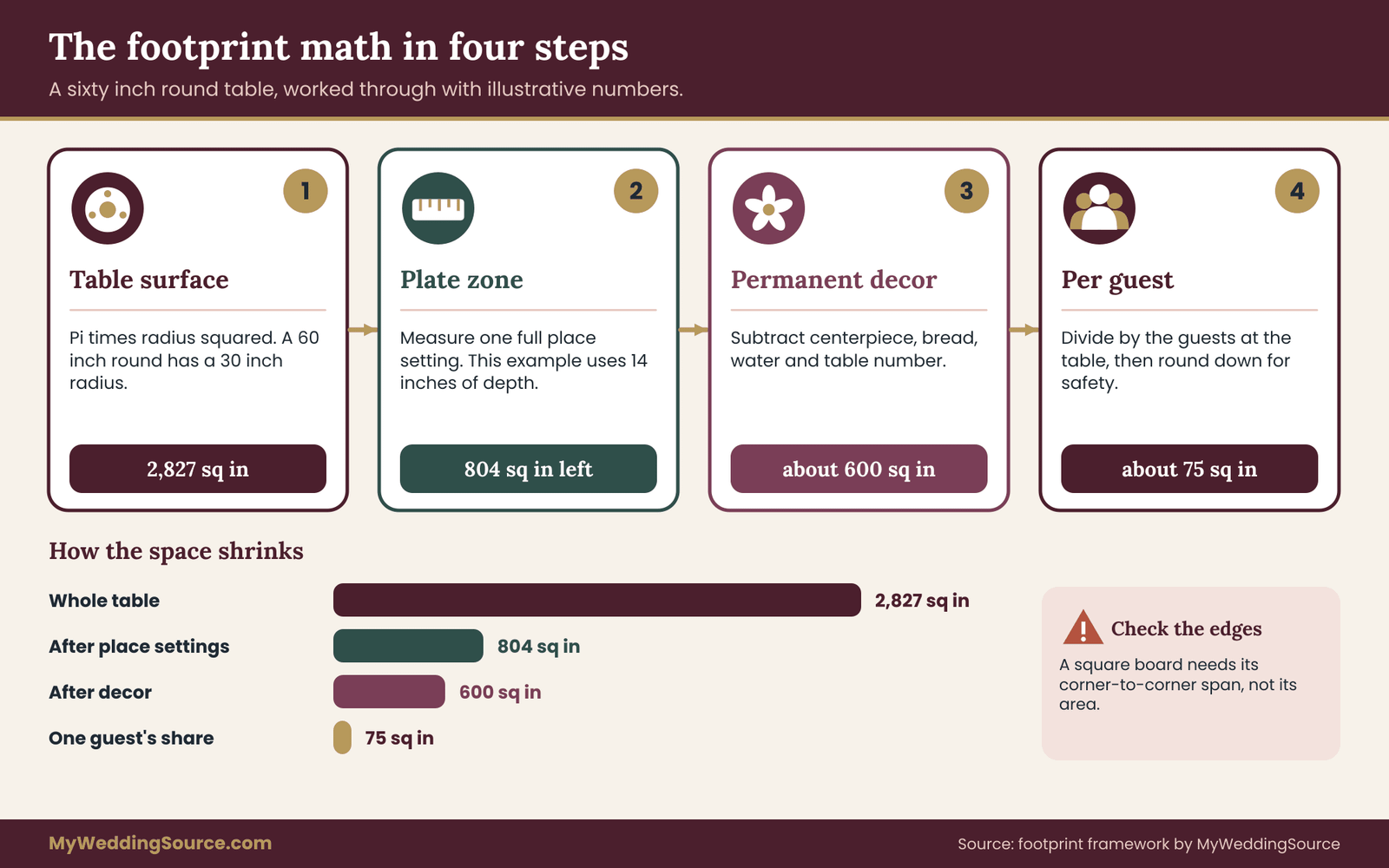
For a round table, the surface area is pi times the radius squared. A table with a sixty inch diameter has a thirty inch radius, so the surface is about 2,827 square inches. That number is a ceiling, not a budget, because most of it is already spoken for.
Next, measure the plate zone. Place one complete setting on a table: dinner plate, bread plate, the glasses you will use, and cutlery. Measure from the table edge to the far edge of the farthest item, usually the water glass or the top of the dinner plate.
People often find that this depth is somewhere in the range of twelve to sixteen inches, but your own setting decides it. For a worked number, use fourteen inches. The plate zone then runs from the edge inward to the sixteen inch radius mark, because thirty minus fourteen is sixteen.
The circle left in the middle, with a radius of sixteen inches, has an area of about 804 square inches. That is the maximum play zone before anything else is placed in it. For tabletop wedding games, think of it as a round tray in the center of the table that is thirty-two inches across.
Step two: subtract the permanent items
Now subtract everything that has to be in the middle during dinner. A centerpiece with a base ten inches wide takes a circle with a five inch radius, about 79 square inches. A water pitcher or two wine bottles, bread baskets, a table number stand and a menu card each take a few more. Call these together another 100 to 150 square inches, but measure your own, since a family-style dinner will fill the middle with serving dishes.
In this example the centerpiece, one basket and a table number leave roughly 804 minus 79 minus 120, or about 600 square inches of free surface. For a table of eight, that is about 75 square inches per guest, roughly the size of an eight by nine inch rectangle. A standard deck of playing cards is about two and a half by three and a half inches, so a single deck fits easily. A fifty-piece puzzle usually does not.
Step three: check the edges, not just the area
Area is only half the story, because the free space is a ring around the centerpiece, not a rectangle. A square game board that is ten inches on a side needs a corner-to-corner span of about fourteen inches. If the ring around a ten inch centerpiece is only about eleven inches wide at its narrowest, the board overlaps the plate zone at the corners. Test the actual shape with a cardboard cutout of the game’s footprint before you decide.
This is also why shape matters more than area for tabletop wedding games. A long, narrow item such as a rolled scroll fits where a square board cannot. A set of small cards that can be dealt out and held in the hand uses almost no table surface at all.
Rectangular and banquet tables
For a rectangular table, multiply length by width, then do the same plate zone subtraction along both long edges. An eight foot by thirty inch table seats guests down both sides, and each long side has a plate zone about fourteen inches deep.
That leaves only two inches of free surface across the width of the table, because thirty minus twenty-eight is two. The center line of a narrow banquet table is a runway for decor, not a play zone. This is a common surprise, and it is the main reason cards and trivia sheets work on rounds but often fail on narrow banquet rows.
Wide farm tables and sixty inch rectangles behave differently, and they can offer a true center strip. The tape measure still decides. If the free strip is under about ten inches, you are looking at hand-held games or a between-courses format.
The per-guest allowance
Once you have the play zone for your tabletop wedding games, divide it by the number of guests at the table to get a per-guest allowance in square inches. This single number is easier to compare across tables than a pile of measurements. It lets you ask a clear question about each game: does it need more than its share? A game with one shared item and no individual pieces uses space as a group. A game that deals a sheet and pencil to every guest uses the plate zone, which is already full.
That second point matters. The footprint test is not only about the center. Any game piece that a guest keeps in front of them, such as a card, a pencil or a score sheet, lives in the plate zone and competes with the bread plate. Put those pieces on the chair or in a pocket, or hand them out when plates are cleared.
A quick way to feel this in practice is to build a model table. Lay out a sheet of paper cut to the size of your table, draw the plate zone around the edge and the centerpiece in the middle, and place cardboard cut-outs of each of your tabletop wedding games on top. Ten minutes with scissors and a ruler will tell you more about tabletop wedding games than an hour of browsing ideas, and it costs nothing.
Rounding conservatively
Round the numbers against the game. If the math says the play zone is 600 square inches, assume 500 for the test, because tables get bumped and decor drifts. If a game needs 450 of those, it passes narrowly, and the clearance trial should be strict. Games that need more than about half of the free surface are almost always the ones that servers end up moving.
Clearing space for service: how servers actually move around a table
The footprint tells you which tabletop wedding games fit. It does not tell you whether the people who work around the table can do so quickly and safely. Servers are trained to approach from a guest’s side, set or clear without reaching across another guest, and move on. Their routine is the thing a game must not interrupt.
Servers rarely get a second chance at a plate. A plate that is set in the wrong spot is a plate that has to be lifted and set again, and a dropped item at a table of guests in formal clothes is a small emergency. That is why caterers tend to be wary of tabletop wedding games that sit near the edge, and why an early conversation with the lead server is worth more than any amount of guessing.
Reach, lane and sequence
Think of three parts of a server’s move. The reach is how far the hand and forearm extend from the edge of the table inward. The lane is the clear path above the table edge and between chairs along which the plate travels. The sequence is the order in which guests are served, which often moves around the table in a set direction. Tabletop wedding games interfere if they sit in the reach, blocks the lane, or forces the sequence to pause.
The plate zone is where the server’s hand ends up, so a game that lives in the plate zone is a direct conflict. A game in the center only becomes a conflict when something needs to cross it, such as a shared platter or a bottle passed from one side of the table to the other. At a plated dinner, the center is usually quiet. At a family-style dinner, the center is the main stage for food, and a game there is a problem from the start.
Chair spacing is part of the lane
The lane is also affected by how closely tables are packed. A venue that fits more tables into the room leaves less aisle between chair backs, so servers turn sideways and carry plates at chest height. In that setup, a game that makes guests lean in, shift chairs or turn toward the center blocks the aisle further.
When you walk the room plan with the venue, ask for the planned distance between chair backs of neighboring tables and compare it with the way guests will sit while playing. The wedding seating chart guide explains how table counts and layouts get decided, and it is worth reading before you ask for changes to either.
Running the server clearance test
The clearance test turns all of that reasoning into a ten-minute trial. Ask the caterer or venue for it at your tasting, at the walk-through, or at the final detail meeting. Most event teams are glad to help if you ask early and keep it short.
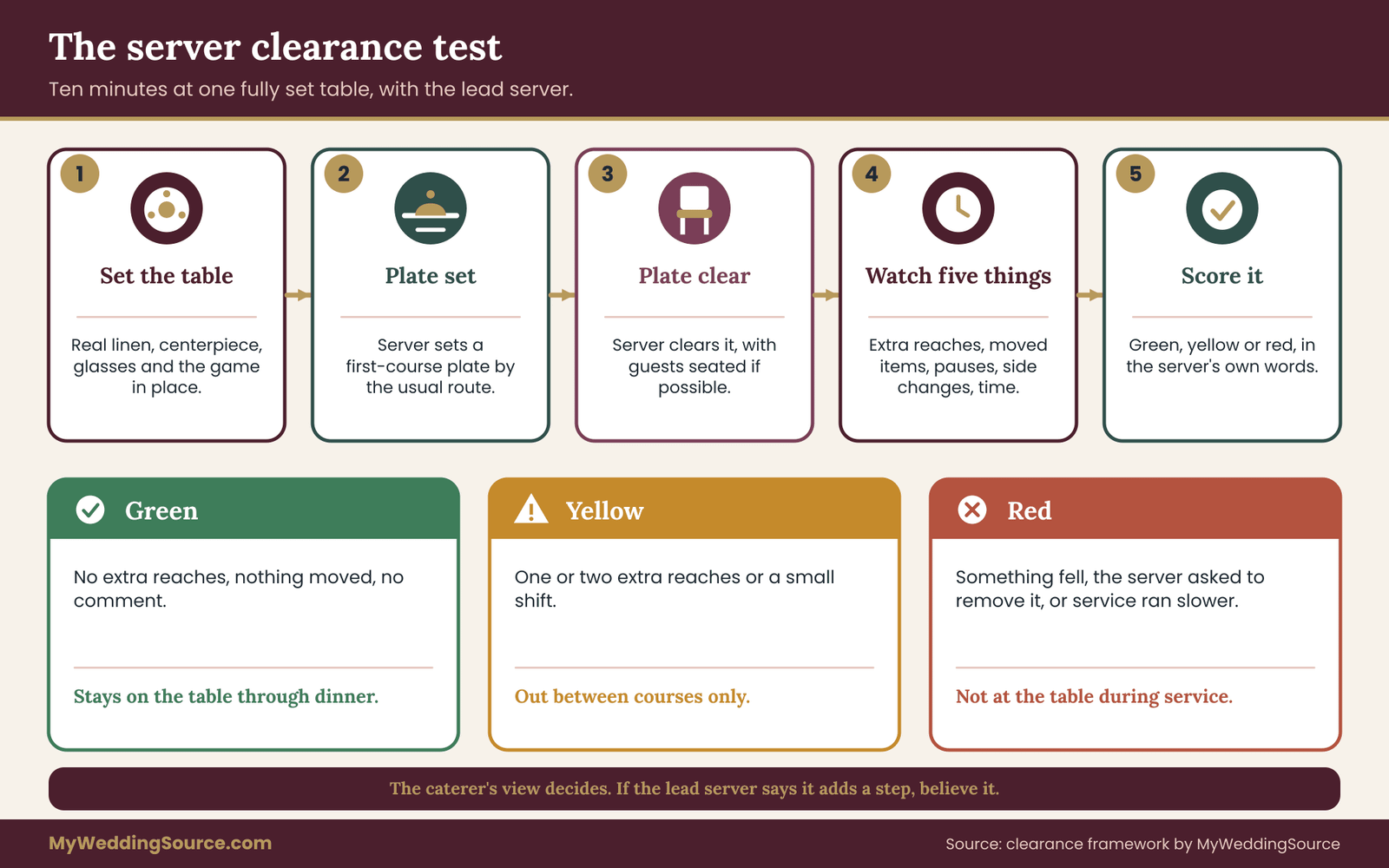
Set up one table exactly as it will look at dinner, including the tablecloth, the centerpiece, every glass and the game. If you can, seat real people, because a table with chairs pushed in behaves differently from an empty one. Ask the lead server or captain to perform a plate set for the first course and a plate clear after it, using the route they would take on the night.
Then watch five things and write them down. How many times did a hand pass over or around the game? Did anything move, tilt or fall? Did the server pause, ask a question or reposition an item? Did the server choose a different side of the table than usual? And did the whole sequence take noticeably longer than at a table without the game? You do not need a stopwatch to the second, but a phone timer on both tables gives you a plain comparison.
Scoring the trial
Give the game one of three results. Green means no extra reaches, nothing moved and no comment from the server. Yellow means one or two extra reaches or a small adjustment, such as shifting the game two inches. Red means anything fell or moved without being asked, the server asked to take the game off the table, or the sequence clearly ran slower.
The caterer’s view is the authority here. If the lead server says that a game adds a step per guest, believe it, and do the arithmetic. If each guest takes five extra seconds, a table of ten adds almost a minute per round of service, and a room of eleven tables adds several minutes across two service points. Those minutes are not trivial when the kitchen is plating to a clock, as the wedding menu planning guide explains in the context of course timing.
If you cannot get a mock service from the caterer, ask for a conversation instead. Show the lead server a photo or a sample of each of the tabletop wedding games and ask where they would put it, move it or refuse it. Many teams will answer in thirty seconds.
The answer is not as good as a trial, but it is far better than finding out at the first course. Either way, record what you hear, since the caterer who said yes in March may not be the captain who works your wedding in June.
Why you test with the real tablecloth
Small details change the result. A floor-length cloth that hangs to the ground hides a game’s edges and makes it harder to nudge back. A linen with a slight texture holds cards in place better than slick satin. A raised centerpiece on a pedestal changes how far the free surface really is from the table edge. A candle, even a battery one, will make servers more cautious. It is better to find these out with a spare cloth and a spare set of glasses a week before the wedding than on the day.
Noise, dinner and tabletop wedding games
Noise is the second cost of putting tabletop wedding games on a dinner table, and it behaves differently from the footprint, because it travels. A table of eight at normal conversation fills a space of about one table with sound. A table playing a competitive trivia round fills the neighboring tables too. Because the dining room is one acoustic space, the loudest table sets the tone for the quieter ones.
What is actually being measured
Sound is measured in decibels, usually with an A-weighting that matches how human hearing responds. Two facts help. A change of about three decibels is a doubling of sound energy, yet it is only barely noticed by listeners. A change of about ten decibels is commonly perceived as roughly twice as loud. A game that pushes one table up by ten decibels is therefore obvious to everyone nearby, while one that adds three is mostly invisible.
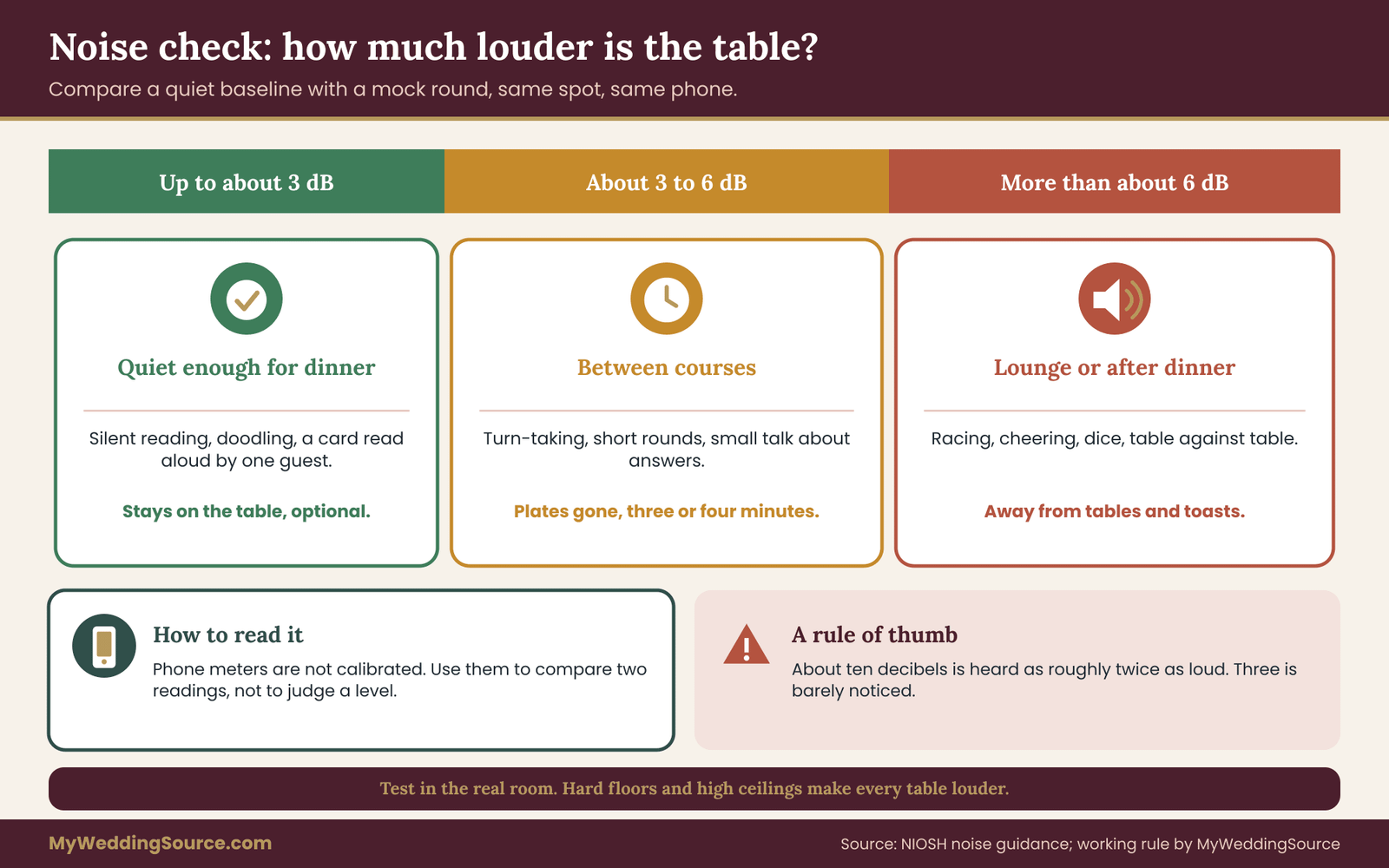
The National Institute for Occupational Safety and Health publishes guidance on noise and has released a free sound level meter app for iPhones, and many Android apps do the same job less formally. A phone microphone is not a calibrated instrument, so use it only to compare one situation with another. Take a reading at a table during quiet conversation, then another during a mock game round, from the same distance. The difference is the number you want.
A working rule for the noise check
This guide uses a simple rule, which you can adjust. If a mock round raises the table’s level by about three decibels or less, the game is quiet enough for dinner. If it raises the level by about three to six, it is a between-courses game, because the sound is noticeable but brief.
If it raises the level by more than about six, or if the table has to shout to be heard, it is a lounge game or an after-dinner game. These thresholds are not a standard. They are a starting point meant to be tested against how your room actually sounds.
A room with a hard floor, high ceiling, glass walls and no drapery reflects sound back and makes every table louder, while a room with carpet, fabric and a lower ceiling soaks it up. Ask the venue which sort of room you have, and test in the room if you can, not in a living room.
Who the noise hurts
The people most affected are not the players. They are the guests at neighboring tables who are trying to talk, the grandparent who struggles to follow conversation in a noisy room, the guest with a hearing aid that amplifies everything, and anyone who is sensitive to sudden sounds. Dinner is also the time when toasts begin, so a room that is already loud forces speakers to lean on the microphone and makes the audio vendor’s job harder.
The wedding reception music planning guide covers how a DJ or band manages volume through dinner, and it is useful to align the two, since the loudest tabletop wedding games and the loudest music are rarely a good pair. If the DJ is playing at a level that already forces guests to lean in to talk, adding a game on top of it will push people to shout. If the music is soft background, tabletop wedding games have more room.
Quiet games and loud games
Tabletop wedding games differ sharply in how much sound they make, and the difference is usually in the mechanism, not the theme. A game in which each guest reads a card silently and then shares an answer makes short bursts of speech. A game in which the whole table races to answer makes overlapping speech. A game with dice or tiles adds a physical clatter. A game with competition between tables makes cheering. A drawing or doodling game is near silent.
When you choose tabletop wedding games, look at the sound each mechanism makes. The most reliable way to keep tabletop wedding games quiet at dinner is to choose turn-taking over racing, soft materials over hard ones, and cooperation within a table over competition across tables.
There is also the matter of conversation itself. Part of the appeal of tabletop wedding games is that they help guests talk. Part of the risk is that they replace talk with play. If a table spends the whole dinner looking at cards, the guests may never learn who the person across from them is. A good rule is that tabletop wedding games should start a conversation and then step aside, not run the whole meal.
The toast overlap
One edge case deserves its own line. Toasts, speeches and any announcements need a quiet room, and tabletop wedding games running at the same time will sabotage them. Because tabletop wedding games and toasts share the same hour, decide in advance who signals the end of play, and how.
A clear rule works better than a quiet plea into a microphone. Common approaches include a card on each table that says games pause when the toasts start, a short announcement from the host before the first course, and a servers’ cue to collect any loose pieces as the first speaker stands.
If a toast is likely to run long, put the tabletop wedding games away before it begins. People pick them up again more happily after an interruption than they tolerate a pile of distractions during a speech.
Comparing the main kinds of tabletop wedding games
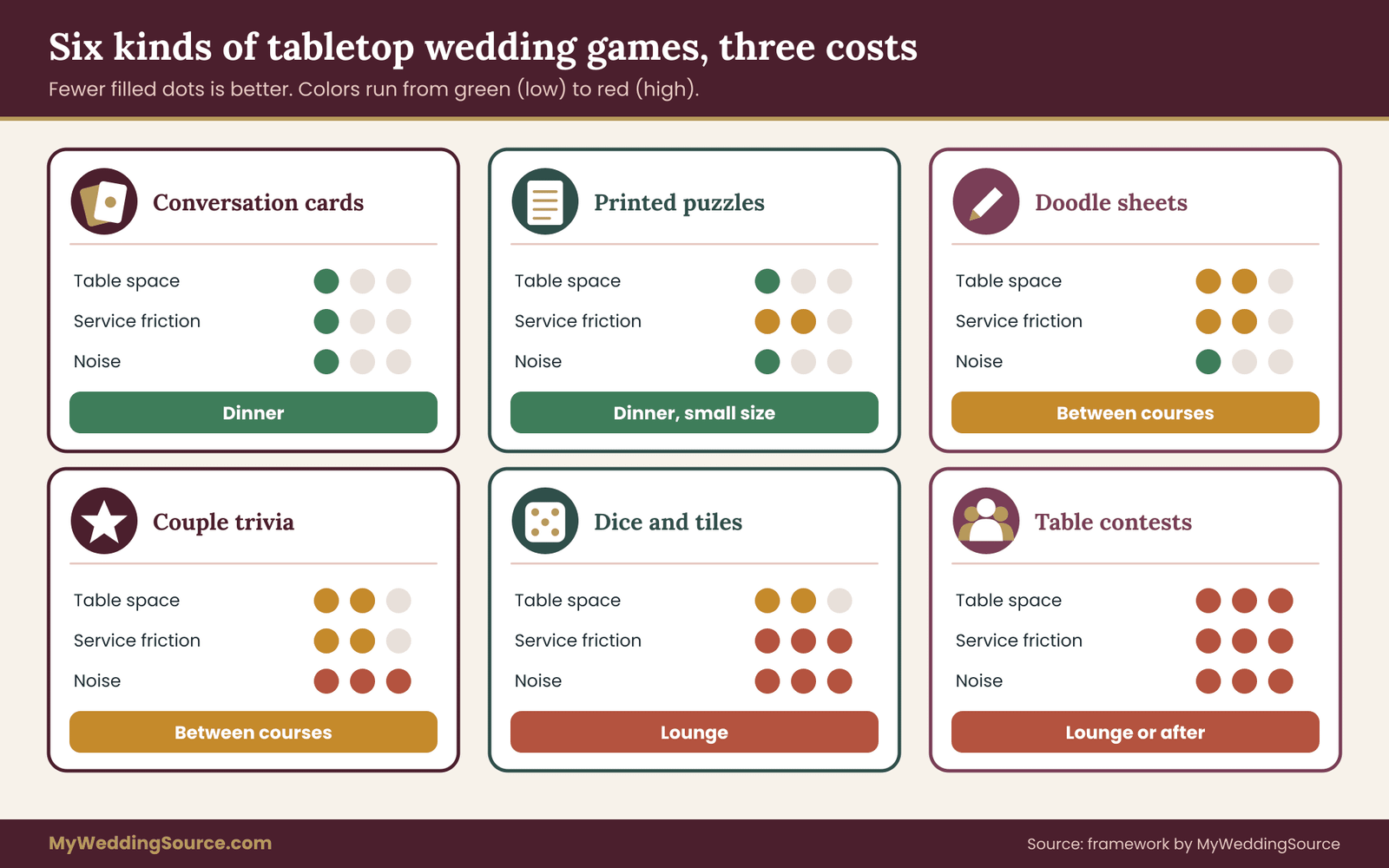
With the three checks in hand, you can compare tabletop wedding games honestly. The comparison below is in prose, not a ranking, because the right choice depends on your tables, your room and your guests. Each kind of game is judged on footprint, service friction and noise, the three things the test measures.
Conversation cards
A small deck of question cards, one deck per table, is the lightest option. It uses a few square inches, it can be held in the hand, and it makes only the sound of people talking, which is the sound dinner already has. The service friction is low if the deck sits in the center or is held by one guest.
The main risk is content: a question that is fine for one table may be awkward for another, and a card that asks about family, money or past relationships can create a pause that no server can fix. Screen the cards the way the wedding signage system guide suggests screening any text that goes in front of guests, with a second reader who does not know the couple’s backstory.
Trivia about the couple
Trivia has more energy and more noise. It asks guests to compete, which makes them speak over each other and cheer. It also needs a score system, which means paper and pencils that live in the plate zone. Trivia works well as a between-courses game, with one round handed out after plates are cleared and answers shared before the next course. It works poorly while guests are eating, because answering takes both hands and attention.
Printed puzzles and word games
A crossword, word search or maze printed on a place card or a table card needs only flat space and a pencil. It is quiet, it asks nothing of other guests and it respects people who want to be left alone.
The footprint risk is the pencil and the paper in the plate zone, and the service risk is that a half-finished puzzle sits where a server needs to reach. Print puzzles small and let guests fold them away. They suit the long gaps between courses and the stretch between the main course and cake.
Dice, tiles and small physical games
Dice and tiles make clatter, they roll, and they can fall. On a linen cloth, a roll is soft, but on a hard table at a rental-company reception it is loud. Many dice games also need a little space for the throw. These are lounge games more often than table games, and they should not appear until plates are gone. If you love the idea, choose silicone or felt-covered pieces and require a tray or a mat.
Drawing and doodle sheets
A draw-the-couple sheet or a doodle card is quiet, low-risk and inclusive, because no guest has to speak. It needs a pencil, a flat surface and about a letter-size sheet. The problem is the surface: the sheet is large, so it only fits in the play zone when the table is large or the centerpiece is small. A half-size card solves this. The product is also a keepsake, which is a bonus, but the couple should decide in advance whether they will keep guest drawings or ask guests to take them home.
Every one of these categories has a quiet version and a loud version, so treat the list as a starting point for your own tabletop wedding games, not as a verdict on a type. A trivia round can be played in whispers over a printed card, and a conversation deck can become a shouting match if the table chooses to make it one. What the test measures is what actually happens at your tables, and tabletop wedding games behave differently in different rooms.
Photo and scavenger challenges
A photo challenge asks guests to take pictures of certain things at the table or in the room. It is silent and needs no table space, but it needs phones, and phones at dinner can feel intrusive for guests who would rather be present. Ask whether the couple has already set rules for devices at the reception. The wedding photography consent guide is a good companion here, because a photo game puts guests’ faces on other guests’ phones.
Table-versus-table competitions
Any game that compares tables, whether by score, speed or number of items, raises the volume. It also changes behavior. Guests move between tables, collect pieces, and leave chairs unoccupied while servers need access. These tabletop wedding games are better placed in the post-dinner hour, when plates have gone, or as a cocktail-hour activity that does not need a table at all.
A short comparison in words
Put the whole set in order and a pattern appears. In tabletop wedding games, the quiet, small-footprint items, which are conversation cards and printed puzzles, are good dinner candidates. The medium items, which are drawing sheets and trivia, are between-courses candidates. The loud or spread-out items, which are dice, tiles and table competitions, are lounge or post-dinner candidates. The pattern is not a rule, since a clever design can change an item’s category, but it is a useful first cut before you spend any time at the table with a tape measure.
When to play: tabletop wedding games course by course
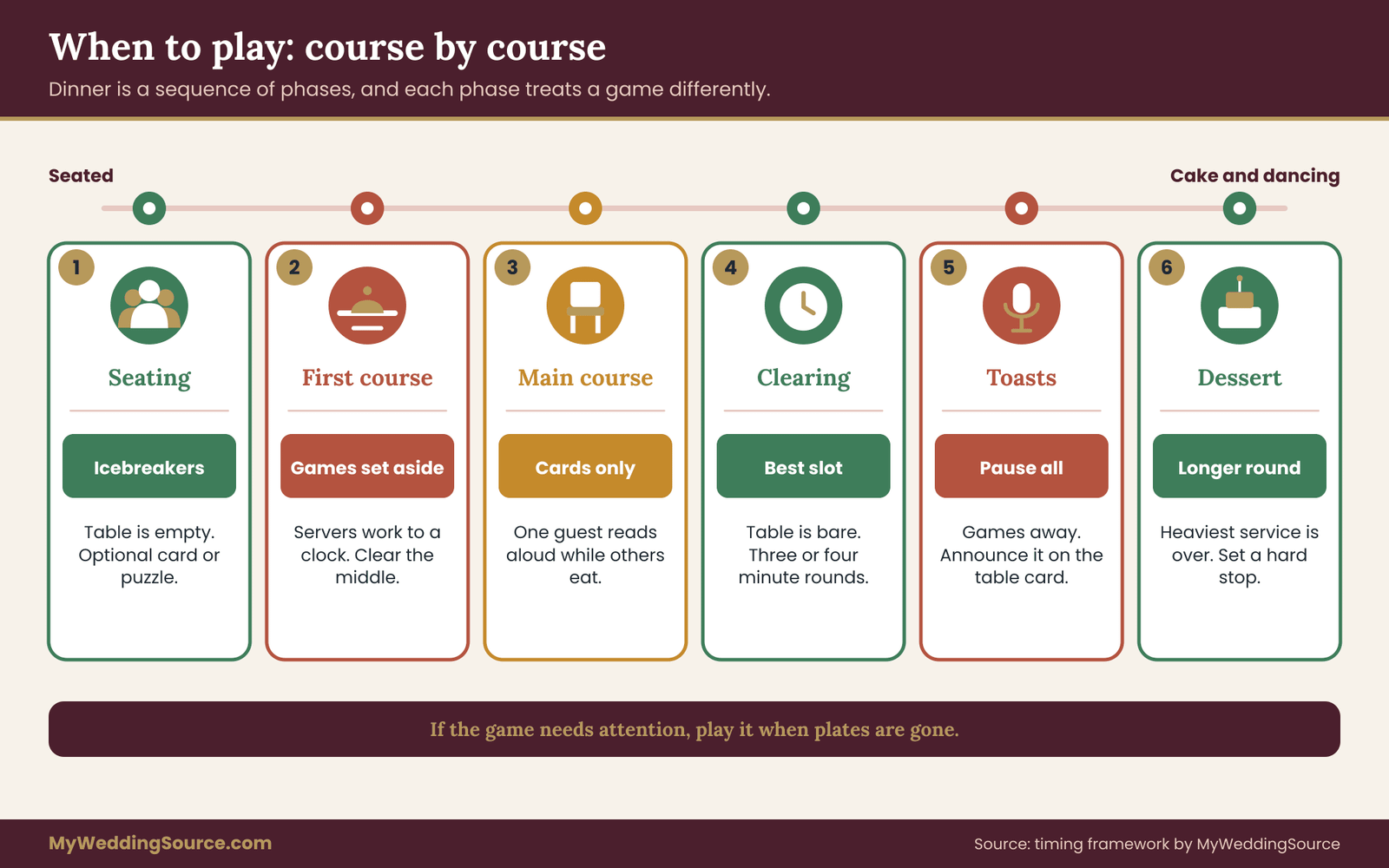
Dinner is not one block of time. It has phases, and each one has a different relationship to a game. Looking at the meal phase by phase lets you place a game where it fits and avoid the phases where it cannot.
Seating and first drinks
When guests first sit, they are looking for their names, getting settled, ordering or receiving drinks and greeting the table. The table is mostly empty, because the first course has not arrived. This is the strongest moment for an icebreaker game, because guests have nothing else to do and are most in need of something to say to people they have not met. A conversation card or a short puzzle on the place card works here. The game should be brief and clearly optional.
First course service
This is the first real test. Servers arrive with plates on a set schedule, and the first course is often the one where timing is most visible. Remove tabletop wedding games from the middle of the table if they need hands, or ask guests to set them aside. A rule that works is to treat the first course as a no-game window until the last plate is down, then let the game come back while guests eat.
The main course
The main course is the longest eating period and the busiest for the kitchen and servers. It is the worst time for any game that needs both hands or sustained attention. Conversation cards that one guest reads aloud work, because eating can continue. Competitive games do not. If the main course is served family style, the center of the table is a serving area and tabletop wedding games should be off it.
Between courses and during clearing
The space between plates being cleared and the next course arriving is the best slot for tabletop wedding games with any complexity. Guests are free, the table is mostly bare and the next course is on its way. Keep the game short enough to finish or pause before the next course arrives. A round that lasts three or four minutes works better than a round that has to be abandoned halfway.
Toasts and announcements
Pause all tabletop wedding games. Rules do not need to be elaborate, but they must be clear and they must be announced. The easiest approach is to tell guests that games will be put away for the toasts, and to put that line on the table card.
Dessert and coffee
After the main course is cleared, guests are relaxed and the table is clear again. This is the second-best slot for a game, and it is often the best slot for a longer game, because the heaviest service is behind you.
Some couples put the biggest tabletop wedding games here, with a short award or a reveal as cake is cut. Keep an eye on the clock, though, because the schedule after dessert is often tight. The wedding vendor timeline guide is a good reference for how many vendors depend on that dessert hour ending on time.
A simple timing rule
For most couples, the practical outcome is a two-stage plan. One or two very quiet tabletop wedding games stay on the tables through dinner as an optional extra. One livelier round is held for the clear-down between the main course and dessert, led by a host or a DJ. Anything beyond that moves to a lounge. This keeps tabletop wedding games present without letting them take over the meal, and it gives the caterer a plan they can staff.
If the game needs attention, play it when plates are gone. If the game is optional and quiet, let it sit through dinner. If you are not sure, start it between courses and see whether guests ask to keep it going. It is much easier to extend a game that guests like than to take away one that they have started and enjoyed.
A worked example: one invented couple and twelve tables
The numbers in this example are illustrative. They come from an invented couple, not from a real event, and they are here to show the method, not to set a standard. Your tables, your room and your caterer will give different results, which is the point of running the test yourself.
Maya and Daniel are planning a reception for ninety-six guests in a converted warehouse. There are twelve round tables of eight, each sixty inches across, with a plated three-course dinner, toasts after the main course, and a dessert and dance block to follow. The floor is polished concrete and the ceiling is high, so the room is lively. They have four ideas for tabletop wedding games: a deck of conversation cards, a draw-the-couple sheet, a trivia round about the couple, and a set of dice for a table game.
Footprint results
They measure their rental table and a full place setting. The plate zone is fourteen inches deep, which leaves a sixteen inch radius in the middle, about 804 square inches. Their centerpiece has a ten inch base, taking about 79. A bread basket, two water carafes and a table number take about 120 together. That leaves roughly 600 square inches, or about 75 per guest. They round down to 500 for the test.
The conversation deck needs under ten square inches and passes with room to spare. The draw-the-couple sheet is a full letter-size page, 8.5 by 11 inches, which is about 94 square inches in area but 13.9 inches corner to corner. With only eleven inches of ring width around the centerpiece, it overlaps the plate zone at the corners. They fail it as designed and redraw it at half size, 5.5 by 8.5 inches, which passes.
The trivia round needs a score sheet and pencil for each table, which is manageable in the center, plus a question card. It passes on area but uses plate zone space if guests keep their own sheets. They decide on one shared sheet per table. The dice set needs a landing area of about ten inches by ten inches, which is about 100 square inches of clear surface, and passes on paper but will clatter on the table.
Clearance results
At the tasting, the catering captain agrees to a ten-minute trial. She sets a table with the linen, centerpiece, glasses and each game in turn. With the conversation deck, she makes no comment and no hands cross the center. With the half-size doodle card, she asks the couple to place it near the center, not at the edge, and then it passes. With the trivia sheet, she moves it aside twice and says she would prefer it off the table during service. With the dice, a die rolls off the edge during the clear.
Her words are noted and scored. Conversation cards are green, the doodle card is green after a small shift, trivia is yellow and dice are red. Daniel asks her how much time she thinks trivia might add. She says it is hard to say exactly, since it depends on how engaged the table is, but it would force servers to ask guests to move items. That answer is enough.
Noise results
At a mock table in the actual room, using a phone meter held at the same spot, the baseline conversation reading is a number they call sixty-eight. During a round with conversation cards, the reading is sixty-nine. During a mock doodling round it is sixty-eight again.
During the trivia round, with four friends cheering a point, the reading rises to seventy-six, a jump of eight. During a dice round with the felt mat, it reads seventy-two. These numbers come from an invented example and the phone meter is not calibrated, but the pattern is realistic: talking games add little, racing games add a lot.
Applying the rule, conversation cards add about one, which is quiet. The doodle card adds nothing. Dice add four, which is between-courses at best. Trivia adds eight, which is a lounge game.
Final decisions
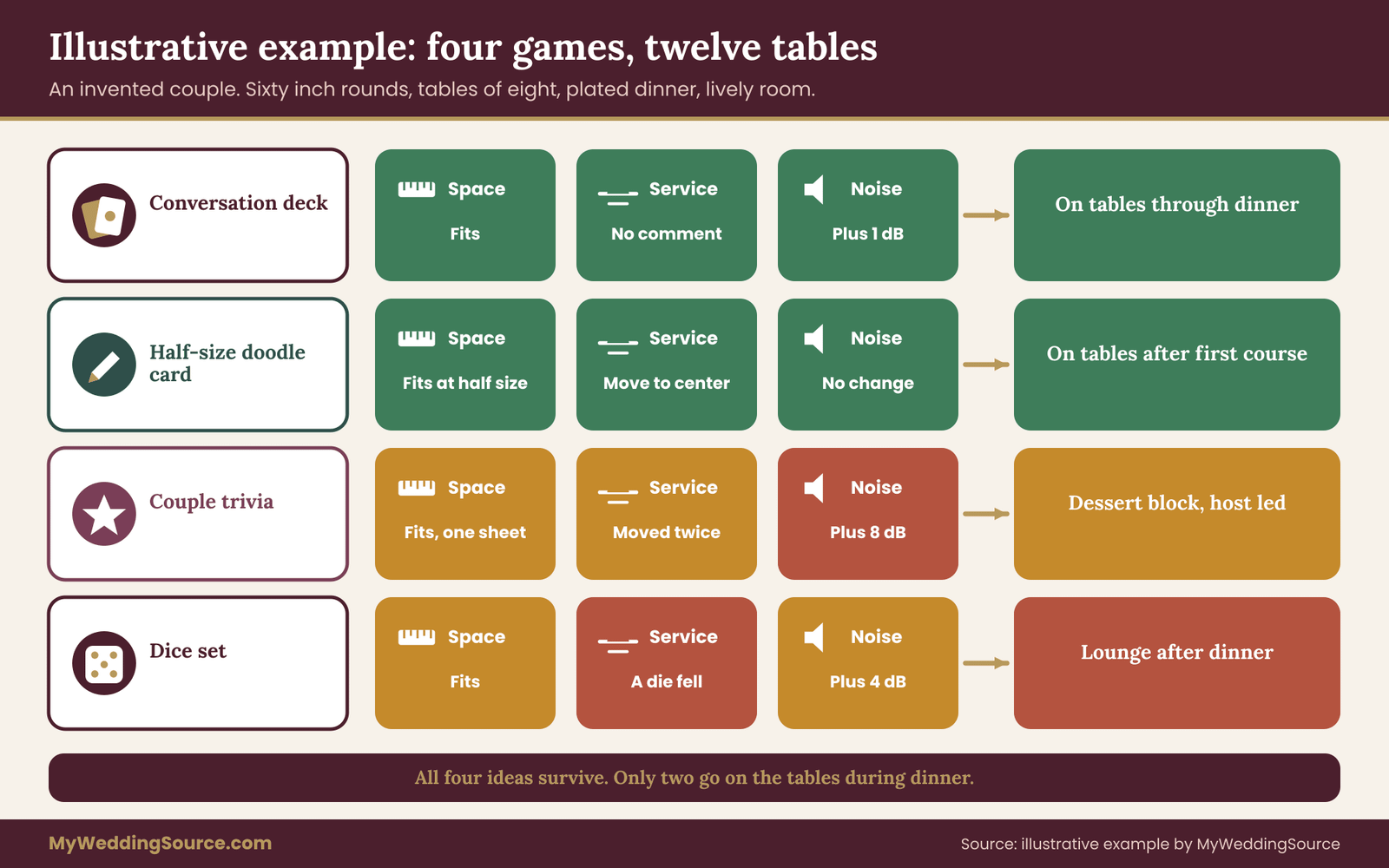
Combine the three tests. Conversation cards are green on footprint, green on clearance and quiet on noise, so they stay on the table through dinner. The half-size doodle card is green on all three, so it stays too, though the couple decides to hand it out after the first course is cleared. Dice are red on clearance and between-courses on noise, so they move to the lounge after dinner. Trivia is yellow on clearance and loud on noise, so it moves to the dessert block as a short, host-led round with servers paused.
The result is not that two games were thrown away. It is that each game found the time and place where its costs are lowest. Maya and Daniel keep all four ideas, but only two of them go on the tables during dinner. The wedding reception guest flow guide would call that sequencing: the right activity in the right zone at the right time.
If you recreate this example with your own numbers, expect your results to differ. A smaller centerpiece may leave room for the full-size doodle sheet, and a softer room may make trivia quiet enough for dinner. A venue with a lower ceiling will change the noise results entirely. What stays the same is the sequence of tests, which is why it is worth doing the same three checks on your own tabletop wedding games and tables. The example is a worked method, not a set of answers.
What the example teaches
Notice what drove each result. Footprint failed the full-size doodle sheet only because of the geometry of the ring. Clearance failed the dice because of what happens when an object rolls. Noise failed the trivia round because of competition, not because of the questions. These are three different failures with three different fixes, which is why one test is not enough. A game can be small, tidy and still loud, or quiet and still in the way.
Guests, access and consent at the dinner table
Every one of the tabletop wedding games on a dinner table places a small demand on the guests who sit there. Some guests enjoy the demand, some tolerate it and some find it difficult. A good plan assumes that all three groups are present at every table and designs for the least comfortable.
Accessibility at the table
The Americans with Disabilities Act sets accessibility rules for public accommodations, and the 2010 ADA Standards for Accessible Design describe dining surface heights and knee clearance for accessible seating. The standards are published by the Department of Justice and the U.S. Access Board, and the venue is responsible for meeting them.
As a couple, you are not an ADA enforcer, but you do control what you put on the table. If a guest uses a wheelchair, a game that sits in the center must be reachable from a seated position, and any item placed at the edge of a table can block knee space.
Think about reach and grip as well. A deck of cards that must be fanned in one hand is hard for guests with limited hand function. Small dice and tiles are hard to pick up. Pencils may be hard to grip. The easy fix is to offer larger cards, a card holder or a spoken version of the game that does not need handling at all. Guests with low vision may not be able to read small print on a card, and the same large-print approach used for signs applies here.
Hearing, sound and sensory comfort
For a guest who is deaf or hard of hearing, a noisy table makes conversation harder. For a guest with sensory sensitivity, sudden shouts, clattering dice or a flashing light can be unpleasant. None of this means tabletop wedding games should be avoided. It means a quiet mechanism helps, and it helps to have a place away from the tables where a guest can step out. The guest care planning guide covers quiet spaces and other comfort needs in more detail.
Food is one more consideration. If a game uses candy, small treats or anything edible as a prize or a token, allergens can enter the table. The U.S. Food and Drug Administration explains the major food allergens and how cross-contact happens, and a guest with a serious allergy may not be able to touch an item that has been near their trigger. Keep edible tokens out of tabletop wedding games at dinner, and give prizes away at the end of the evening, labeled with their ingredients.
Opting out without a scene
The simplest consent rule is that no game should require participation. Put that into the design: the game sits on the table, and the card says it is optional. A guest who does not want to play can leave the deck untouched. Avoid any mechanism that makes a guest wait while the table takes turns, speaks about themselves or performs. A game where each person must share a personal story is a poor choice for a group of strangers.
The same applies to content. Questions about relationships, family, money, age or health can hurt even when they are meant kindly. A card that asks “who at this table has known the couple longest” is mild. A card that asks about past relationships is not. Write questions that anyone can answer about the day or the couple’s public story, not about the guests’ private lives.
Children and teens
Where children sit at tables, tabletop wedding games with small pieces are a choking risk for very young children. The Consumer Product Safety Commission publishes guidance on small parts and age labeling for toys. If any child under about three will be at a table, keep small pieces away from them, or give the children’s table its own safe activity such as coloring. Teens often want to join in but dislike being singled out, so avoid a separate “kids’ version” for them.
Alcohol and games
If the game involves drinking, do not put it at the dinner table. Drinking games create pressure to drink, they speed up alcohol service and they can make a guest uncomfortable who is not drinking, is pregnant, is driving or is in recovery. The wedding bar service planning guide covers how a bar can pace service to the evening. Keep the game and the drink separate.
Vendor questions and who owns tabletop wedding games on the day
A game on a table, and tabletop wedding games in general, are small things with an unclear owner. The couple designs it, a stationer or the couple prints it, a planner or coordinator sets it, servers work around it, the DJ may announce it and someone has to collect it afterward. When nobody owns it, it fails at the moment the room is busiest. Assign it to a named person before the wedding.
Questions for the caterer
The caterer’s lead server holds the most useful information about tabletop wedding games, because the caterer’s team will work around them for hours. Ask these in a short, specific list.
- Which side of the table do you serve from, and does that change with our menu?
- Will you pre-set items on the table, such as bread, butter or water, and where do they go?
- How long are you allowed to take for a plated course service across all tables?
- Is anything on the table at the time of a course that you would prefer to be absent?
- Who clears the table, and what happens to loose game pieces during clearing?
- If something goes missing or breaks during service, who is responsible for it?
Write down the answers. If the caterer’s answer to the third question is a number, use it, because it tells you how much slack the schedule has. If the answer is vague, ask the venue.
Questions for the venue
The venue controls table size, table count, room acoustics and house rules. Ask about the room layout, the sizes and types of tables included in the rental, any restriction on items such as confetti, loose small items or open flame, and whether staff will help with setup. Ask whether there is a sound limit or a curfew that affects after-dinner games. If the venue has an in-house coordinator, ask if they have seen other tabletop wedding games work well, and what went wrong at other events. They will usually tell you.
For a venue with unusual tables, such as long farm tables or tables with a built-in edge or lip, ask for photographs or a visit before you order anything. A table with a raised edge will trap loose cards and make them harder to pick up, and a table with a lip may make a clipboard unusable.
Questions for the DJ, band or host
Ask the person who runs the microphone whether they are willing to announce the start and end of each game, and whether they have any background music level that they need to stay above. If you plan a pause cue for toasts, tell them the exact words you want. Ask whether their sound system includes a feature that lets them lower music for announcements. Because the music planning conversation usually happens earlier, this is a short follow-up, not a new debate.
Questions for the printer or maker
If the game involves printed cards or sheets, ask the printer about paper weight, coating and size tolerance. A card that curls at the edge in a warm room or on a damp table will not sit flat. A laminated card will slide on satin but grip on linen. Ask for a proof and test it on a spare tablecloth. Ask how long printing takes and when files must be final, because a game card that needs a change after the proof is a game that arrives late.
Be sure that any text you print is correct before you pay, since errors multiply across every table. The same advice applies to signs, and it applies just as strongly to a card deck.
One more point is commercial. If a vendor or a friend supplies tabletop wedding games and you receive a discount, a free product or a payment for featuring them, tell the people who read your recommendations, because the Federal Trade Commission expects clear disclosure of material connections when something is endorsed. For a private wedding that rule seldom comes up, but if you write about tabletop wedding games on a blog or social account, keep it in mind.
Who sets, who resets, who collects
Set a simple three-name assignment. One person places the games at the tables before guests arrive, usually a planner, coordinator or a trusted friend. One person, usually a captain or the host, signals when games pause and when they restart. One person collects the games at the end of the night and counts them, since reusable items such as decks can go missing. Write the names on your day-of sheet, and make sure they know.
If you do not have a coordinator, give the job to someone who will be present all evening and who is not a member of the wedding party, since those people have their own schedule. A calm cousin or a friend who volunteers is a better choice than a busy sibling.
Cost, materials and a simple budget for tabletop wedding games
Tabletop wedding games are cheap compared with most reception items, but their cost is easy to misjudge, because it is a per-table cost multiplied by the number of tables, plus the hidden cost of a failed service.
Direct costs
Count the items per table: a deck, a card, a sheet, a pencil, a tray or a stand. Multiply by the number of tables, then add a spare set for loss and damage. Many couples find that a spare of ten to fifteen percent saves a trip back to the printer, but that is a planning habit, not a rule. Add printing, trimming, packaging and delivery. If you have the pieces made by a vendor, get a quote and ask what happens if you change the count at the last minute.
Indirect costs
Indirect costs are harder to see. A game that slows service by a minute per course adds minutes to the evening, which can push the end of the dinner into overtime for a venue or caterer that charges for extra hours. A game that gets lost or damaged may cost a replacement fee. A game that makes a table loud may cost goodwill with neighboring tables. None of these can be exactly priced, but you can ask the venue and caterer whether overtime applies and at what rate, and keep a margin.
Another small cost is time. Someone has to assemble, label and deliver the tabletop wedding games to the venue, and someone has to carry them back. If you build them yourself, give that job to a friend with a free afternoon at least a week before the wedding, and count the time it takes when you decide whether to buy or make tabletop wedding games.
Reusable or disposable
A reusable deck can be used again at a shower, a family gathering or another wedding, but it needs to be collected and counted. A disposable card is cheaper to replace and needs no collection, but it adds waste. A sensible general approach is to choose items that guests will take home on purpose or that you will reuse. A game that guests are told they may keep has a better chance of leaving the venue with the guests, not in a bin.
A small budget logic
A practical budget comes down to four lines: pieces per table times tables, a spare allowance, printing or making, and a contingency for corrections. Compare that total with the alternative of not doing the game at all. If the tabletop wedding games cost about the same as one extra centerpiece, ask whether they give guests as much value as the flowers would. For many couples they do, because they do something flowers cannot, which is give strangers a reason to talk.
Edge cases: when the standard test needs adjusting
The test above works for a typical plated dinner with round tables. Real receptions are rarely typical, and a few common situations need a different approach.
Family-style and shared platters
At a family-style dinner, the center of every table carries serving dishes. The play zone does not exist during the meal, and the pass lane is occupied by guests passing platters. Skip tabletop wedding games during dinner and hold them for before or after. A game that arrives with dessert, once the platters have gone, is the right fit.
Buffets and food stations
At a buffet, guests leave tables in waves. A game that needs everyone at the table, such as trivia, will not work, and a game that tolerates someone leaving and returning, such as a conversation deck, will. Tables are usually released to the line in sequence, and you can use that order to time a game for the tables that are already seated.
Long banquet tables and head tables
A long, narrow table has no real play zone, as the math showed. Use hand-held games only, or replace the game with a printed card at each place that guests can read quietly. A head table or sweetheart table is also a poor place for a game, since it is a stage and its occupants are often interrupted for photographs.
Candles, florals and lighting
A table with open flame, dense low florals or fragile glassware is a table where a rolling die or a falling pencil can cause real damage. The National Fire Protection Association publishes safety guidance on candles, and venues often have their own rules. If a table has open candles, keep paper and cards well clear.
Outdoor receptions
A breeze will move paper. A card pinned under a small weight works, as does a game that uses heavier tiles. A sudden change in weather will make loose paper a litter problem. Plan to collect games quickly if the weather turns, and have a rule about what happens to them.
Very large tables and very small ones
A seventy-two inch round table has more play zone but also places guests farther apart, so a game in the center is harder to reach. A forty-eight inch or smaller table has almost no free surface at all. At a small table, treat the game as hand-held, or schedule it for the time when plates have gone.
Mixed-age and multilingual tables
A game with text assumes that every guest reads the language in which it is printed and can see the print. If your guests include relatives who read another language, or young children, include pictures, short prompts or a bilingual version. The aim is that nobody at the table is left out of the one activity meant to bring them together.
Where tabletop wedding games go when they fail the test
A failed test is not a failure of the idea. It is information about where the game belongs. Most games that do not suit the dinner table find a good home somewhere else in the evening, and the planning work is to name that place before the wedding, not on the night.
The lounge and the cocktail hour
A small seating area away from the tables, with a low table and a few chairs, is a good home for dice, tile games and table-versus-table contests. Guests who want to play can drift in and out without disturbing anyone, and guests who do not can stay at their seats. The cocktail hour is the other natural home, since guests are standing, mingling and looking for something to do while the room is flipped. A game that needs no table, such as a short photo challenge, suits that window well.
The dessert and dance block
After the main course, tabletop wedding games with more energy fit well, since service is lighter and guests are loosened up. A short host-led round, five to eight minutes, bridges the gap between dessert and the first dances. Keep it clearly optional, and have the DJ ready to start music as soon as the round ends. A game that runs too long competes with the dance floor, so set a hard stop and tell the host what it is.
If you cannot find a home for a particular game, drop it. A tabletop wedding game that is too loud for dinner, too bulky for the table and too fussy for the lounge is probably not a good fit for this wedding, and the guests will not miss it. The couple’s job is to keep the evening comfortable, not to use every idea they saved on a mood board.
Handed out at the door or on departure
Some games work best as a take-home item. A deck of cards or a small puzzle given as a favor lets guests play on their own time, with no table or service in the way. This is also the cheapest approach to the noise question, since the sound leaves the room with the guests. If you go this route, check that any printed text is accurate and that nothing in the packaging is a hazard for children.
A pre-wedding checklist for tabletop wedding games
Use this as a short working list in the last two weeks before the wedding. It is written as sentences, not boxes, so you can paste it into your own notes.
Confirm the exact table size, shape and count in writing with the venue or rental company. Measure one full place setting and calculate the play zone using the steps earlier in this guide. Cut a cardboard shape of each game and test it on a real table or a table of the same size. Run the server clearance trial with the lead server and record green, yellow or red for each game. Take a baseline noise reading and a mock-game reading in the actual room, and note the difference.
Assign the set, signal and collect roles to three named people and write them on the day-of sheet. Add the pause cue for toasts to the host script. Check that every printed card is proofread by a second reader who does not know the couple’s private history. Confirm that any game involving pieces is safe near children and near the candles on your table. Have a spare set of every game in a labeled box.
Last, decide in advance what you will do if a game goes wrong on the night. A short rule, such as “if a server asks to remove a game, remove it and do not argue,” saves a conversation that no one wants to have at the dinner hour.
Common mistakes with tabletop wedding games
Most problems come from a short list of habits. Planning around them is easier than fixing them during service.
A related error is treating tabletop wedding games as a decoration. Decor sits still, but games move, make sound and attract attention, so they need a plan in the way that a bouquet does not.
The first is testing the game on an empty table. A bare table has all the room in the world, and a set table has almost none. The second is testing in a living room, where sound behaves very differently from a reception hall. The third is choosing a game because it is clever, not because it fits the table. The fourth is forgetting that the plate zone belongs to guests and servers, so that a pencil or a score sheet quietly takes a place that was already full.
The fifth is not telling anyone who is in charge. The sixth is making a game that requires everyone to join, which leaves quiet guests with nowhere to go. The seventh is ignoring the clock, so that a pleasant game runs through the toasts. If you can avoid those seven, your tabletop wedding games will probably do what you hoped, which is to give a table of mixed guests something to talk about without getting in anyone’s way.
Your next steps
This week, measure one place setting and the table you will use, and work out the play zone with the footprint math. Pick two game ideas and cut a cardboard shape for each. At the next caterer meeting, ask for a ten-minute clearance trial, and take a baseline noise reading in the room if you can.
Then sort each idea into one of three places: on the table through dinner, out between courses, or in the lounge or dessert block. Name the three people who will set, signal and collect. Write the pause cue for toasts into the host script. With a short test and three decisions, tabletop wedding games stop being a risk and become a small, reliable part of the evening.
FAQ
Should we put tabletop wedding games on the tables during dinner at all?
Only if they pass three checks: they fit in the play zone after the centerpiece and serviceware, servers can work around them without extra reaches, and they do not raise the table’s volume noticeably. Quiet, small items such as a conversation deck often pass. Racing, rolling or sheet-based games usually do not, and they work better between courses or after dinner.
How much table space do tabletop wedding games really get at dinner?
Less than most people expect. On a sixty inch round with a fourteen inch place setting depth, the middle circle is about 804 square inches before the centerpiece and shared items. After those, a table of eight may have about 75 square inches per guest. Measure your own table and setting, since rental sizes and place settings vary.
What is a server clearance test for tabletop wedding games?
It is a short mock service at one fully set table with the game in place. The lead server sets and clears a plate while you watch for extra reaches, moved items, pauses and requests to remove the game. Score it green, yellow or red. If the server says the game slows service, move it to between courses.
How do we measure noise at a table?
Use a free sound level meter app on a phone, held at the same spot, once during quiet conversation and once during a mock round of the game. A phone microphone is not calibrated, so use it only to compare. A rise of about three decibels or less is quiet, while more than about six suggests a lounge game.
Are tabletop wedding games a good idea for a family-style dinner?
Usually not during the meal. The center of the table holds serving dishes, and guests pass platters across it, so there is no play zone. Hold the games for before the first dish arrives or after the platters are cleared. A dessert-time game, once the table is bare, is a better fit.
How do we keep tabletop wedding games from being awkward for guests who do not want to play?
Make it clearly optional and passive, so a guest who ignores it loses nothing. Avoid turn-taking that forces guests to speak, and avoid questions about private topics. Put a line on the table card saying the game is optional. Provide a quiet alternative such as a printed puzzle, so guests have a choice that is not a refusal.
Do we need to worry about accessibility with tabletop wedding games?
Yes, a little. The venue is responsible for accessible seating under the ADA, but you control what is on the table. Keep items within easy reach from a seated position, avoid blocking knee space, and offer large-print or spoken versions for guests who cannot handle small pieces or small text. A hand-held card deck is usually easier than a board.
Who should be responsible for setting out and collecting tabletop wedding games?
Name three people for your tabletop wedding games: one to place games before guests arrive, one to signal when games pause for toasts and restart afterward, and one to collect and count them at the end. A coordinator, captain or reliable friend is a better choice than a busy member of the wedding party. Write the names on your day-of sheet.
Sources
- ADA home page and information for businesses, U.S. Department of Justice
- 2010 ADA Standards for Accessible Design, U.S. Department of Justice
- ADA Standards and guidelines, U.S. Access Board
- Noise and hearing loss prevention, National Institute for Occupational Safety and Health
- Occupational noise exposure overview, Occupational Safety and Health Administration
- Small parts and toys for children, U.S. Consumer Product Safety Commission
- Candle safety, National Fire Protection Association
- Food allergies, U.S. Food and Drug Administration
- Consumer information, Federal Trade Commission