
A dry after party is the late-night gathering that follows a wedding reception with no alcohol served, and it only works when the music, the food and the room do the job a bar usually does. This guide gives you an original zero-proof menu ladder, an energy arc for the night and a safe departure design, so the party stays lively and everyone gets home well.
Treat a dry after party as a design problem with three parts. First, set one clear rule about alcohol and tell guests early. Second, build a zero-proof menu ladder of five rungs (welcome pour, fizz, a grown-up complex drink, something warm, a late bite) so no guest feels left with tap water. Third, plan the energy arc and a departure ladder in writing, because without a bar the music, food and a clear ending carry the night, and everyone still needs a safe ride home.
Some couples choose a dry after party for personal reasons, some for religious or cultural ones, some because the venue allows no alcohol after a certain hour, and some because they want a gathering where the people in recovery, the pregnant cousin and the sixteen-year-old can all stay until the last song. Whatever the reason, the planning problem is the same.
A bar solves several jobs at once without anyone noticing: it gives guests something to hold, it gives strangers something to talk about, it fills the first awkward ten minutes and it sets a pace. Take it away and those jobs do not disappear. They land on you.
This article is about that handoff for the dry after party. It does not argue for or against alcohol, and it does not assume your reception was dry. Many couples serve drinks at the reception and then want the late-night portion to be different. Others skip alcohol all evening and are simply planning the second half. Both situations are covered, and the departure section applies especially to the first.
A note on scope. This is general planning information, not legal, tax or financial advice, and venue, liquor and labor rules vary by location, so confirm the ones that apply to you with the venue and your local authorities.
What a dry after party is and when it fits
A dry after party is a planned continuation of the wedding night, usually starting after the formal reception ends or in the last stretch of it, with no alcohol served or allowed on the premises. It can be a room at the same venue, a lounge in the hotel, a rented space nearby or a backyard. The group is often smaller than the reception. The mood is looser. The schedule is shorter, commonly two to three hours.
The word “dry” can mean three different things, and mixing them up causes most of the confusion guests feel. In one version the host serves no alcohol, but guests are free to bring a drink from the reception. In another version the whole venue is alcohol-free, which means nothing is poured or carried in. In a third the party is “sober-friendly”: alcohol exists in the building, but nothing is served at this event and the zero-proof offering is treated as the main attraction. Decide which of these you mean before you write a single invitation line.
When the format fits well
A dry after party tends to fit when several of these are true. The guest list at the late hour includes a wide age range. Many guests are driving rather than taking a hotel shuttle. The couple’s families have different views on drinking and want a space with no friction. The venue has a strict end time and a late bar would need extra permits or staff.
The couple wants the photos and videos from late in the night to look the way they remember the evening. Or the main goal is dancing, and the couple would rather everyone still be dancing at midnight than slowing down at eleven.
When it needs more care
It needs more care when the reception was heavy on drinks and the dry portion follows immediately, because some guests will arrive feeling the evening already and will have nowhere to go with that energy. It needs more care when the late crowd is mostly friends who are used to a bar-based night out. It needs more care when guests will be staying in a hotel with a bar downstairs, since a dry room next to an open lounge invites a quiet exodus.
None of this is a reason to drop the idea. It is a reason to plan the first thirty minutes and the last thirty minutes more carefully than the middle.
Why the planning is different from a dry reception
A dry reception has a long dinner, toasts and a program to hold attention. A dry after party has none of those. It begins with guests who have already been socializing for hours, it has no meal to anchor it and it ends at an hour when people are tired. That changes everything from the length of the playlist to what you serve. The sections below are built around that difference.
For the broader question of how an after-party fits against the reception schedule, the wedding bar service planning guide covers the drinks side of the main event, while this article stays on the late-night room.
Setting the rule for a dry after party
The rule is the first decision because everything else depends on it. A vague rule creates awkward moments at the door. A clear rule, announced early and stated kindly, creates almost none.
Write the rule in one sentence
Try to write your rule as a single sentence that a guest could repeat to a friend. For example: “The dry after party is alcohol-free, and we will have a full zero-proof bar and hot food from ten to midnight.” Or: “No alcohol will be served at the dry after party, and we ask that drinks stay outside the room.” The first version describes what you are offering. The second states a boundary. Most couples find that leading with the offering and then adding the boundary feels warmer than the reverse.
Notice what the sentence leaves out. It does not explain why. You do not owe guests a reason, and a reason can invite debate. If a guest asks, a short true answer is enough: “We wanted a late-night party everyone could stay for.” That is a complete answer and it needs no defense.
Decide what “outside the room” means
Guests will ask where the line is, usually at the door and often with a glass in hand. Decide in advance whether guests may finish a drink they carried over from the reception, whether they may step outside to a patio with a drink, and whether coolers and flasks in cars are your concern at all. A workable pattern is a simple “finish it before you come in” request placed on a small sign at the entrance, backed by a staff member or a friend with a friendly script.
The wedding signage guide covers readable sign wording and placement if you want the sign to look like part of the event instead of a warning.
Check the venue, caterer and bartender terms
Your own rule is only one layer. The venue may have its own alcohol policy that you must follow regardless of your plan, such as a requirement that any alcohol in the building be served by licensed staff, or a rule that guests may not carry drinks between rooms. A caterer’s liquor license may cover the reception only. A bartender hired for the reception may have a contract end time that is earlier than your after party.
Read the alcohol clauses of each contract and ask one question of each vendor: “What changes for us if alcohol is not served after a certain time?” The wedding vendor contract guide explains how to read those clauses and what to get in writing.
Tell guests early, in plain words
Guests decide whether to attend, whether to drive and what to expect based on what you tell them. If the dry after party is on the invitation or the website, put the rule beside the time and place, not in a footnote. A line such as “Late-night party, 10 p.m. to midnight, with mocktails, coffee and snacks” does two things at once. It states the rule without the word “no,” and it tells guests there will be something worth coming for.
Put the same line in the text message you send on the day. Guests who skipped the website will still arrive with the right expectation. The goal is that nobody arrives surprised, and nobody who would have preferred a bar feels tricked.
Who the rule applies to
Decide whether the rule applies to the wedding party and the families in the same way. A dry after party in which the couple’s friends can quietly bring drinks, while an uncle is stopped at the door, will cause more hurt feelings than any rule. If the rule has an exception, such as a toast with a bottle of champagne at the start, say so openly and make the exception small and shared with everyone.
Keep a short decision record
After you set the rule, write four lines in a shared note: the sentence, the places it applies, who will say it at the door and what the fallback is if a guest pushes back. This is not paperwork for its own sake. On the night you will be tired, and the person at the door will be a friend or a coordinator who needs something to read from. The record is also what you hand to the venue manager when they ask what to expect.
The three dry types at a glance
To keep the options straight in your own head, think of the rule as a dial with three settings. Setting one is a no-service rule: the host pours no alcohol but guests may carry in a drink. Setting two is a no-alcohol rule: nothing is poured or brought in. Setting three is a quiet-building rule: alcohol may exist elsewhere in the venue, but this event is a separate, deliberately zero-proof space. Pick one setting, write it down and use the same words everywhere.

The energy arc of a dry after party
Energy is what a bar quietly manages. Guests loosen up, get louder, get bolder on the dance floor and then wind down, all roughly on the same schedule, and the bartender and the DJ read that curve without comment. In a dry after party nobody is reading it for you unless you plan it. The tool for that is an energy arc: a simple written outline of how the room should feel in each phase, and which lever you will pull to get there.
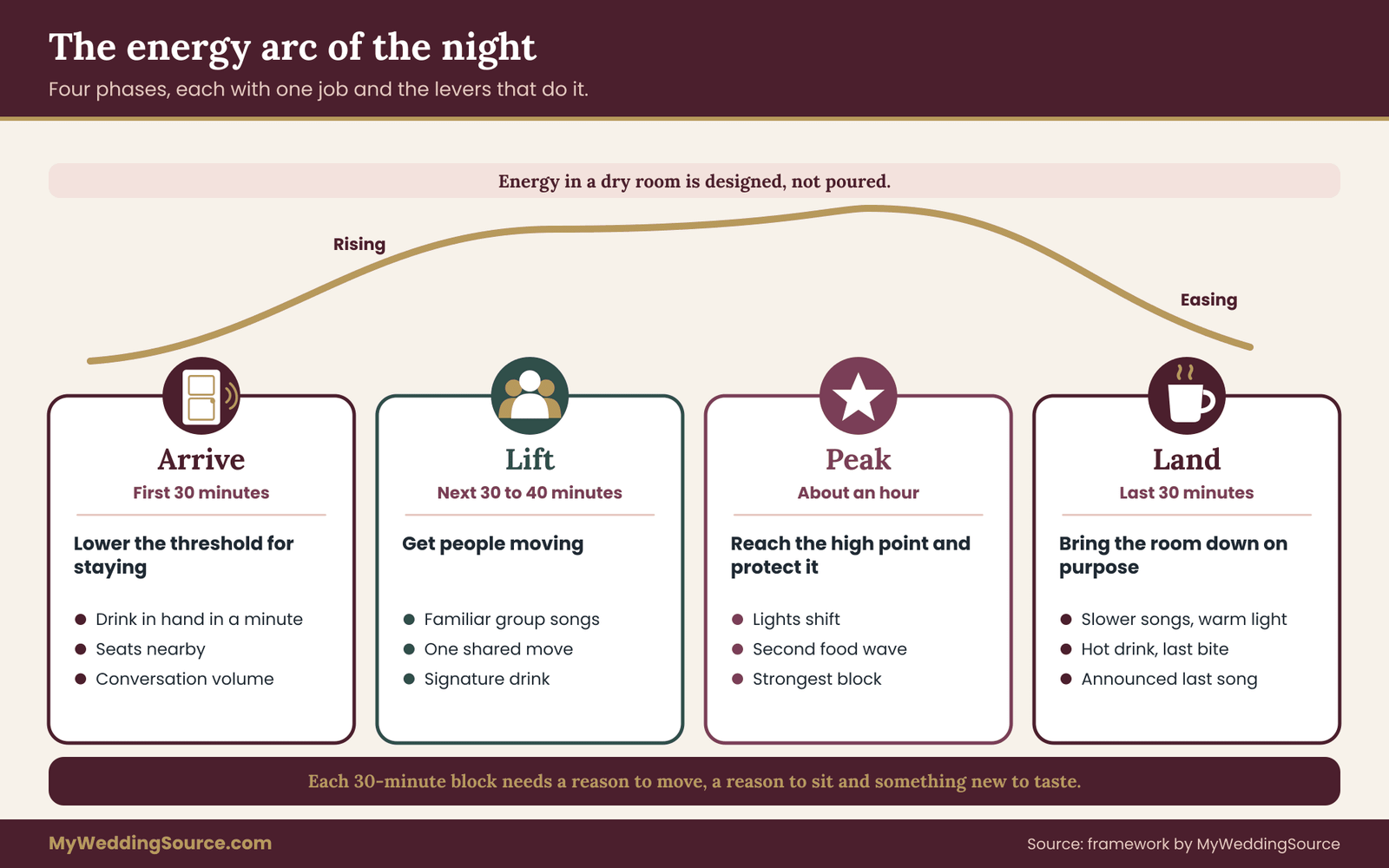
Four phases, each with a job
Divide a two or three hour party into four phases. The names are plain on purpose, because you will say them out loud to vendors.
Arrive is the first twenty to thirty minutes. Guests are moving from one room to another, finding coats, finding friends and deciding whether they are staying. The job is to lower the threshold for staying. A drink in hand within a minute of walking in, a seat available, music at conversation volume and a clear place to go next are the levers.
Lift is the next thirty to forty minutes. The job is to get people moving. Familiar songs, a group song, a simple shared activity and a first round of the signature drink all help. This is the phase in which a dry after party most often stalls, because the push a bar gives is missing and someone has to start the dancing.
Peak is the middle stretch, usually forty-five minutes to an hour. The job is to give the room its highest point of the night and then protect it from drifting. Lights, volume, a surprise element and a second food wave belong here.
Land is the last thirty minutes. The job is to bring the room down on purpose, so guests leave feeling that the night ended well instead of being told to go home. Slower songs, warmer light, a hot drink, a last bite and a clear final song are the levers.
The six levers you can pull
A bar is one lever. Without it you have six others, and a good dry after party uses most of them.
Music sets pace and mood and is the strongest of the six. Food gives people a reason to stand together and a break from dancing. A zero-proof drink gives hands something to hold and gives conversation a starting point. Light changes how a room feels more than almost anything else, and it costs little. Layout decides where people cluster and whether the dance floor looks inviting or exposed. Novelty is anything unexpected and shared, such as a surprise guest song, a photo moment or a late dessert reveal.
Write the six words down the left side of a page and the four phases across the top. For each phase, put a short note in each cell. It is a tool for thinking, not a document to give anyone. When the notes in the Lift column are thin, you have found the spot where a dry after party is most likely to stall.
Why the first ten minutes matter most
Guests make a quick decision on arrival about whether this is a night they will stay for. In a room with a bar, the bar answers the question by itself: there is a line, a drink and a reason to be there. In a dry after party room, guests look around for the equivalent. If they see a table of plain water and a few cans of soda, the room answers poorly. If they see a clearly designed zero-proof station, a hot drink, someone greeting them by name and music that suits the moment, the room answers well.
For that reason, build the arrival experience first and everything else second. A greeter or a friend at the door, a welcome pour handed over without the guest having to ask and a seat or a standing spot within a few steps are cheap and make a large difference.
Matching the arc to the reception that came before
The arc has to start where the guests actually are, not where you wish they were. If the reception ended with a loud dance set, guests will arrive with some energy still in the tank and the Arrive phase can be short. If the reception ended with a long dinner and speeches, guests may be tired and the Lift phase needs more help. If a large share of guests have been drinking at the reception, the Arrive phase should lean on food and water, and the Lift phase should start gently.
Ask your coordinator or a friend to describe, in two sentences, how the room feels at the moment the reception ends. Then pick the opening of your arc to match. The reception guest flow guide explains how entry, seating, food and exit shape the way guests move through a room, and the same ideas apply at a smaller scale to the late-night room.
A pacing rule of thumb you can test
Here is a rule you can test instead of take on trust: in every thirty-minute block there should be at least one reason for guests to move, one reason to sit and one reason to eat or drink something new. If a block has only dancing, tired guests have no graceful way to rest. If a block has only seating, the room goes quiet. If a block has no food or drink change, people drift toward the door.
Count the blocks in your own plan. A two-and-a-half-hour party has five. Mark each with a move, a sit and a taste. If any block is missing one, add it. You do not need to invent elaborate events. A move can be a group song. A sit can be a quiet corner with soft chairs. A taste can be a small dessert passed on trays.
What energy does not mean
Energy does not mean volume in a dry after party. Many dry parties fail by turning the music up to make up for the absence of a bar, which tires guests faster and pushes older relatives out of the room. Energy also does not mean constant activity. A room where something is always happening is exhausting, and guests who do not enjoy organized fun will leave. The goal is a room with several ways to take part, so a guest can choose to dance, to talk, to eat or to watch.
This is why a good dry after party offers contrasts: a loud corner and a quiet corner, a standing area and a seated area, a sweet table and a savory one. The contrast gives guests choices, and choices let different people have a good night in the same room.
A short scenario
Imagine a couple hosting seventy guests at a hotel ballroom after a seated dinner. About forty guests plan to stay for the late party. The reception ends at nine-thirty with the cake. The dry after party starts at ten.
For Arrive, a friend greets people at the door with a small tray of sparkling welcome drinks, and a warm drink station is open. The music is mid-tempo and familiar. For Lift, the DJ plays three group songs in a row at ten-thirty, and the couple starts the first one together. For Peak, the lights shift at eleven, a late bite arrives on trays and the DJ plays the songs the couple chose as their highest-energy block.
For Land, from eleven-thirty the music slows, the lights warm up, hot chocolate and tea go out and the last song is announced from the stage.
None of this is complicated. It is just written down, so that three different people can do their parts without asking.
Telling the DJ and the coordinator what the arc is
An energy arc is useful only if the people running the night have it. Give the DJ or band the four phases with clock times, plus two or three songs that should be played in each. Give the coordinator the same page with the food and light cues added. Walk the coordinator through it once, out loud. If the venue staff control lighting, send them the light cues in writing, with the clock times, a few days ahead.
Do not hand over a song list as the only instruction. A song list tells a DJ what you like. An energy arc tells the DJ what you are trying to do, which lets a professional adapt when the room changes.
What to do when the arc breaks
The arc is a plan, and plans bend. If the room is livelier than expected, extend the Peak phase and shorten Land, as long as the departure plan allows. If the room is flat at the start of Lift, move a food moment forward to give guests something to gather around, then restart the music.
If the guest count is far below what you expected, close part of the room with a screen, a ribbon or lights so the space feels full instead of empty. An empty dance floor feels like a verdict; a smaller floor with ten people on it feels like a party.
Pick one person who has the authority to change the arc and tell the others. That is often the coordinator, a friend of the couple who is not in the wedding party or the DJ, and it should not be the couple. You want to be inside the dry after party, not managing it.
Music that carries a dry after party
In a dry after party, music does most of what the bar did. It tells people when to talk and when to dance, it gives the shy guest something to hide behind and it gives the confident guest a stage. Because of that, the music plan for a dry after party deserves more care than the music plan for a late-night set at a reception with a bar. The wedding reception music planning guide covers programming across generations for the whole evening. This section is about the late-night room only.
Build the set in blocks, not in a straight line
A common mistake is to treat a late-night playlist as a long climb that ends on the highest song. That structure works in a room where alcohol keeps pushing energy upward. In a dry after party, a long climb ends with guests who have been dancing for ninety minutes and have nothing left. Build the set in blocks instead.
A block is a group of songs, usually three to five, with a shared feel. After each block comes a short breather: a slower song, a talking moment or a food announcement. Plan four to six blocks for a two-and-a-half-hour party. The blocks follow the energy arc: gentle, building, peak, peak again, easing, closing.
The breathers matter more than they seem. They let people leave the floor without feeling they are leaving the party, and they let others join. Without them, the only way off the floor is to give up and go home.
Choose songs for who is in the room at that hour
The people who stay for a late party are not a random sample of the reception. Usually they are the couple’s friends, some younger relatives and a few older guests who have a great deal of stamina. Look at your actual late list and ask what each group will recognize.
A useful test is the singalong test. For each song you plan to include in the Lift and Peak blocks, ask whether at least half the likely late guests could sing the chorus without hearing the lyrics. Songs that pass belong in the main blocks. Songs that only the couple love can go in the Arrive phase, when guests are mostly talking, or in a special moment you introduce on purpose.
Include a few songs from different decades on purpose, spaced so that a different group has its moment in each block. This is not about pleasing everyone every minute. It is about making sure that no group sits down for an entire hour.
Why familiar songs work harder without a bar
Alcohol lowers self-consciousness, and so a bar-heavy room will dance to unfamiliar songs more readily. Without it, guests are more likely to dance when they know the song well, when a friend pulls them in and when nobody is watching. That is the practical argument for familiar songs in the Lift phase, and for group songs with an obvious shared move or a chorus everyone can shout. Save the deep cuts for the Peak block, after the room has warmed up.
Requests, do-not-play lists and lyrics
Decide how requests will work before the night, because a dry after party attracts more requests than a bar room. Guests have fewer distractions and a phone in hand. A simple rule is that the DJ takes requests only through a single friend or the coordinator, and plays them only if they fit the current block. Tell the DJ ahead of time what the rule is so that the DJ can say it politely.
Give the DJ a short do-not-play list and a note about lyrics. A late-night room often includes teenagers and older relatives at the same time, and the list protects everybody. Ask the DJ to read the list back to you, and check the lyrics of anything in the main blocks yourself before the night.
Volume and hearing
A dry after party can be loud without being comfortable. Because there is no bar noise to mask, guests notice sharp, loud music quickly. The National Institute on Deafness and Other Communication Disorders describes sound at or above 85 decibels, roughly the level of heavy city traffic, as capable of damaging hearing over time, and it recommends limiting exposure and using ear protection when levels are high.
You do not need to measure a decibel level at your party. You do need to keep the dance floor volume in a range where two people can still talk a meter or so apart without shouting, and to keep the sound lower near the seating and food areas.
Ask the DJ where the speakers will point, and whether a smaller speaker can be placed in the quiet corner so that guests there hear the music at a lower level. Offer earplugs at the door for guests who want them, which costs very little and is useful for people with sensory needs or small children who are still awake.
Live music versus a DJ at this hour
Some couples planning a dry after party consider a live band, a solo musician or an acoustic duo for the last part of the night. A band brings visible energy and a sense of occasion, and for a dry after party that can stand in for the draw of a bar. A band also costs more, takes more space, has set breaks and may be limited by venue noise rules.
A DJ is flexible, can read the room and can follow a block structure exactly. A hybrid works well: a DJ for the main set and a short live moment, such as a friend singing one song or a duo playing the final slow song, to mark the Land phase.
If you plan live music, ask the same questions you would ask for the reception, including setup time, the electrical needs, the break schedule and what happens if a break lands in the middle of the Peak block. A planned break track or a playlist on a speaker keeps the room from going flat while the band rests.
Sound at the venue: curfews, neighbors and rules
Music at a dry after party runs into local limits. Venues often have a noise curfew that is stricter than the reception end time, and neighbors, hotels and city ordinances may set limits of their own. Ask the venue manager, in writing, what the latest permitted time for amplified music is, what volume limits apply and what happens if a complaint is made. A dry after party gets no special exemption, and a good plan has a version that works at a lower volume if staff ask you to turn it down.
When the music has to end at a fixed hour, work backward from that time: last song, then the final food, then the departure plan, and set the start of the Land phase accordingly.
The first song, the group song and the last song
Three songs deserve special attention. The first song of the dry after party sets the tone and should be something that makes people smile on recognizing it, played at a volume that lets them keep talking. The group song, usually in the Lift phase, is the song that gets the shy and the tired onto the floor. It should have a chorus people know and a move people can copy or ignore. The last song is the one guests will remember. Choose it deliberately and announce it, so the room can gather.
A strong final song for a dry after party is often a slower singalong, because it brings the room together and signals that the night is ending without anyone saying it. It also helps people leave in a good mood. Tell the DJ that after the last song the lights come up halfway and a short announcement about rides will follow, which is the start of the departure plan described later.
Guests who do not dance
Not every guest will dance, and a good dry after party does not treat that as a problem. Give non-dancers a reason to be in the room: a photo corner, a game table, a quiet chat area and the food. If the music is so loud that conversation is impossible, they will leave. If the dance floor is in the center of the room with no way to cross it, they will leave. Think of the floor as one part of the room, not the whole.
A music brief you can hand over
A one-page brief to the DJ keeps all of this in one place. Include the four phases with clock times, the block structure, five songs you want in Lift and Peak, five songs you do not want at any point, the request rule, the volume goals near seating, the noise curfew, the last song and the plan for the announcement after it. Add the name and number of the person who can change the plan on the night.
Give the DJ the brief at least two weeks before the wedding and ask for a short reply confirming the points. If a DJ pushes back on something, such as the blocks or the request rule, it is better to learn that early. A professional will often have a good reason and a better idea.
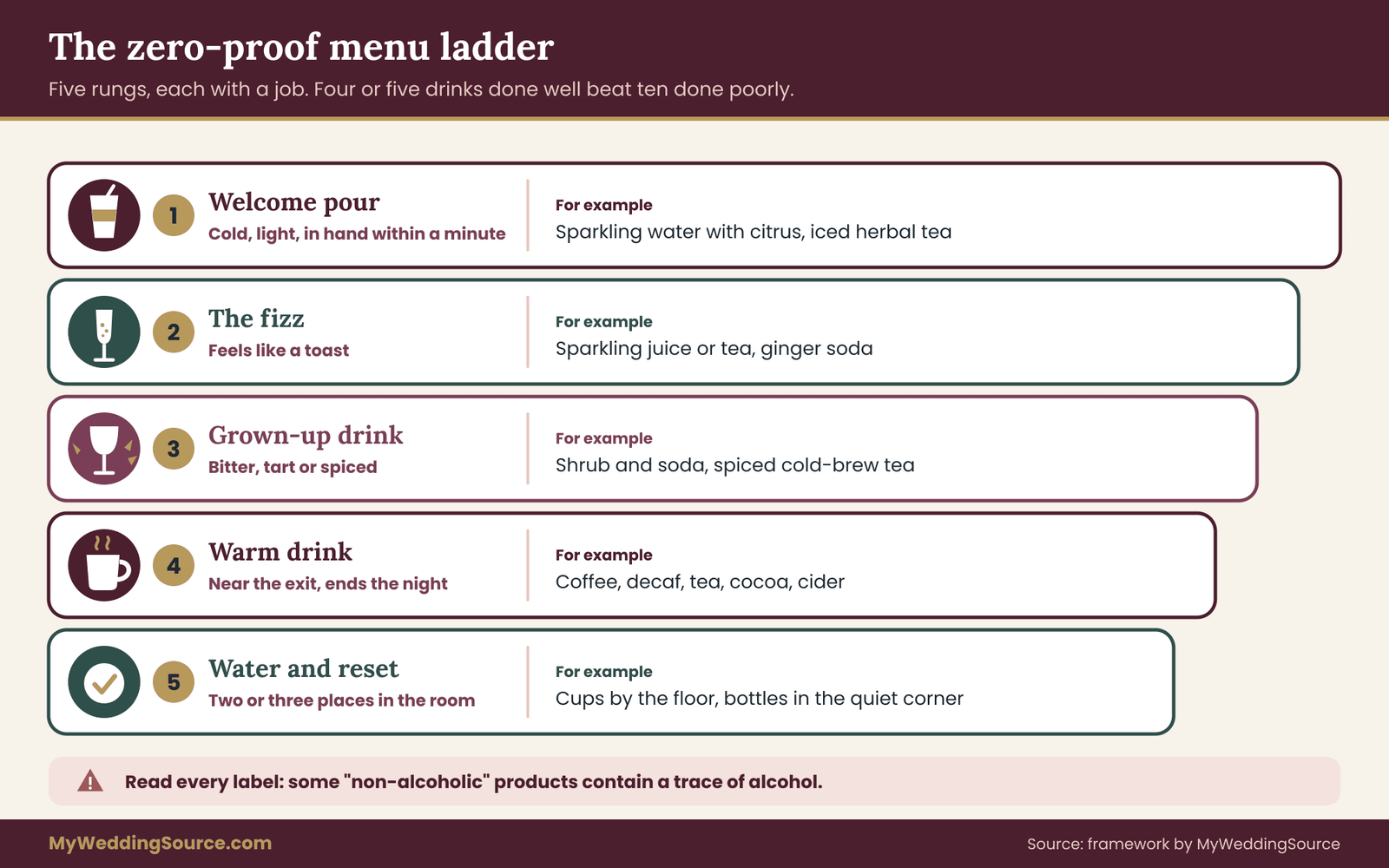
The most common complaint about alcohol-free events is that the drinks feel like an afterthought: a pitcher of lemonade, a cooler of soda and a stack of cups. A dry after party can do much better, and the way to do it without a large budget is to build the drink menu as a ladder. Each rung has a job, a typical guest and a service style. Five rungs cover almost every need, and you can build the whole dry after party drink menu from a short shopping list.
Rung one: the welcome pour
The welcome pour is what a guest receives within a minute of walking in. It should be cold, light, pretty and easy to hold with one hand. Sparkling water with a citrus peel, a chilled herbal iced tea or a pre-poured fruit spritz works. The point is not flavor complexity. The point is that a drink is in the guest’s hand before they have decided whether to stay.
Pour these ahead of time into the glasses guests will use, and put them on a tray near the door. If a friend carries the tray, guests also get a greeting. This single rung does more for the Arrive phase than any other detail.
Rung two: the fizz
Fizz is what makes a drink feel like a celebration. Carbonation signals a toast, and guests often reach for it instinctively when they want something festive. Offer one or two fizzy options that are clearly different from soda: a sparkling juice, a sparkling tea, a ginger-based soda made with real ginger or a house spritz made from fruit syrup and soda water.
Serve the fizz in stemmed or tall glasses where the venue permits. A glass guests would be happy to be photographed holding changes how the drink is received. This is where dealing with the venue’s glassware rules, which you can find in your contracts, becomes useful; the wedding bar service planning guide explains how glassware, ice and staffing are normally handled at the main event.
Rung three: the grown-up complex drink
This is the rung most dry menus skip, and it is the one that stops adult guests from feeling they got the children’s option. A grown-up zero-proof drink has some bitterness, acidity, spice or smoke, the elements that make cocktails interesting. Ideas include a shrub, which is fruit and vinegar and sugar mixed into a syrup, served with soda water; a cold-brewed tea with citrus and a little spice; a non-alcoholic spirit-style bottle mixed with tonic; or a house drink with ginger, lime and a pinch of salt.
Name the drink. A short, plain name on a small card, with three or four ingredients listed, makes it feel intentional. Do not name it with a pun at the couple’s expense. A name such as “The Late Hour” or the couple’s street name works fine.
Rung four: the warm drink
By the end of a late night, people want something hot. A warm drink station is one of the best features of a dry after party and one of the cheapest. Coffee, decaf, tea, hot chocolate and spiced cider are enough. The station also works as a gathering point in the Land phase.
A warm drink serves a second purpose. Guests who need to drive can sip something and linger, which helps them settle before leaving. Put the warm drinks near the exit side of the room so they become part of the wind-down, and keep the decaf clearly labeled.
Rung five: the water and the reset
Water is not a rung that gets applause, but it holds up the rest of the ladder. Keep water in more than one place: a self-serve station with cups near the dance floor, bottles or cans in a cooler in the quiet corner and a pitcher at the food table. Add a slice of cucumber or citrus so it feels like part of the setup. Guests who are dancing for an hour will drink a lot, and a station that runs dry or is out of cups creates an immediate line.
The ladder is not a ranking, and every dry after party can use it in its own order. A guest can start at rung one, move to rung three and finish at rung four. It is a set of roles that a drink menu needs to play.
Sizing the ladder without invented numbers
Couples often ask how much to order. There is no honest universal number, because it depends on the length of the dry after party, the temperature of the room, the guests’ habits and how much you serve at the reception. What you can do is a simple calculation that you check against your caterer’s own guidance.
Start with the number of guests you expect at the late hour, which is usually lower than the full guest list; use your most realistic estimate, not the best case. Multiply by the number of drinks you want to have available per guest across the dry after party, which you pick yourself, for example two to three on a two-and-a-half-hour night.
Split the total across the five rungs by how you expect guests to use them, putting more weight on the welcome pour and the fizz at the beginning and on the warm drinks at the end. Then ask your caterer or beverage supplier what their own rules of thumb are and compare.
Treat the first calculation as a draft. Round up on water and warm drinks, which are rarely wasted, and round down on the specialty drink, which is the most expensive and the one guests sample once. Keep a few extra cases of whatever sells out in the first hour, if returns are possible, and read the return terms before you buy.
Serving style: staffed bar, self-serve or passed
You can serve the ladder in three ways. A staffed zero-proof bar gives you the most polished look and allows the complex drink to be made to order, but it needs a trained person and creates a line. Self-serve stations are cheap and quick and work well for water, tea and coffee, but they need regular refills and a person to watch them. Passed drinks suit the welcome pour and a late dessert, and they are the best way to reach guests who are not at the bar.
A mixed approach is usually best: passed welcome pours, a short staffed bar for the fizz and the complex drink, and self-serve for water and the warm drinks. If you hire bartenders for the late hour, ask whether they have experience with zero-proof drinks and ask to see a short menu. The skill is different from pouring alcohol.
Reading labels on non-alcoholic products
Many products are sold as non-alcoholic beer, wine or spirits. Some contain trace amounts of alcohol. U.S. federal agencies regulate the labeling of these products, and the Alcohol and Tobacco Tax and Trade Bureau and the Food and Drug Administration publish the current rules. In plain terms, a product labeled non-alcoholic is not always entirely free of alcohol, and some guests, including people in recovery, people who avoid alcohol for religious reasons and people who are pregnant, may want a drink with none at all.
Read the label of every bottle you buy and keep the bottles or the labels for the night. If a guest asks, you or the server can tell them the exact product and amount shown. For guests who need to avoid all alcohol, offer drinks made from juice, tea, soda water, syrups and herbs, none of which raise the question. The wedding menu planning guide covers how to handle dietary and ingredient questions across a whole menu, and the same label-reading habit applies here.
Allergens, sugar and caffeine
Drinks carry allergens too. Nut-based syrups, dairy in hot chocolate and some herbal teas can matter to specific guests. Put a short ingredient list on the cards beside each drink and label the decaf. Offer at least one low-sugar choice, such as plain sparkling water with citrus or unsweetened tea. If the dry after party runs late, place the caffeinated drinks so that guests can find the decaf easily, since many will want to sleep soon after.
What the menu should look like on the night
Keep the written menu for the dry after party to a single small card or sign. List the five or six drinks by name, with one short line for each. Do not list prices or quantities. Place it at the entrance, the bar and the warm drink station. Print a few extras in case one is moved.
A dry after party works best when the menu is easy to read at a glance, because guests who have never seen a zero-proof menu will take their cue from the sign. If the names and descriptions are clear, they will try the more interesting options. If the menu is hard to read, they will fall back on soda.
Costs and where to save
Zero-proof drinks are not automatically cheap, and a dry after party budget still needs a line for them. Specialty non-alcoholic bottles can cost as much as spirits, and bartender time is the same. The budget logic is straightforward. Spend on the welcome pour, the one signature drink and the warm drink station, because guests notice those.
Save on mixers by making syrups in advance and buying soda water in bulk. Save on glassware by using the venue’s or the caterer’s stock if it is included. Do not spend on a long menu; four or five drinks done well outperform ten done poorly.
Ask each supplier for a written quote and read it for what is included: ice, garnishes, glassware, staffing and cleanup. The wedding budget guide helps place this cost in the larger picture.
Late-night food that keeps a dry after party moving
Food does a surprising amount of work at a dry after party. It gives guests a reason to stay near each other, it slows the clock in a pleasant way and it takes over a role that alcohol often plays at a late-night event: it makes the evening feel like an occasion. At a dry after party the aim is not a second dinner. The aim is a short sequence of small food moments, each timed to a phase of the energy arc.
Three waves instead of one buffet
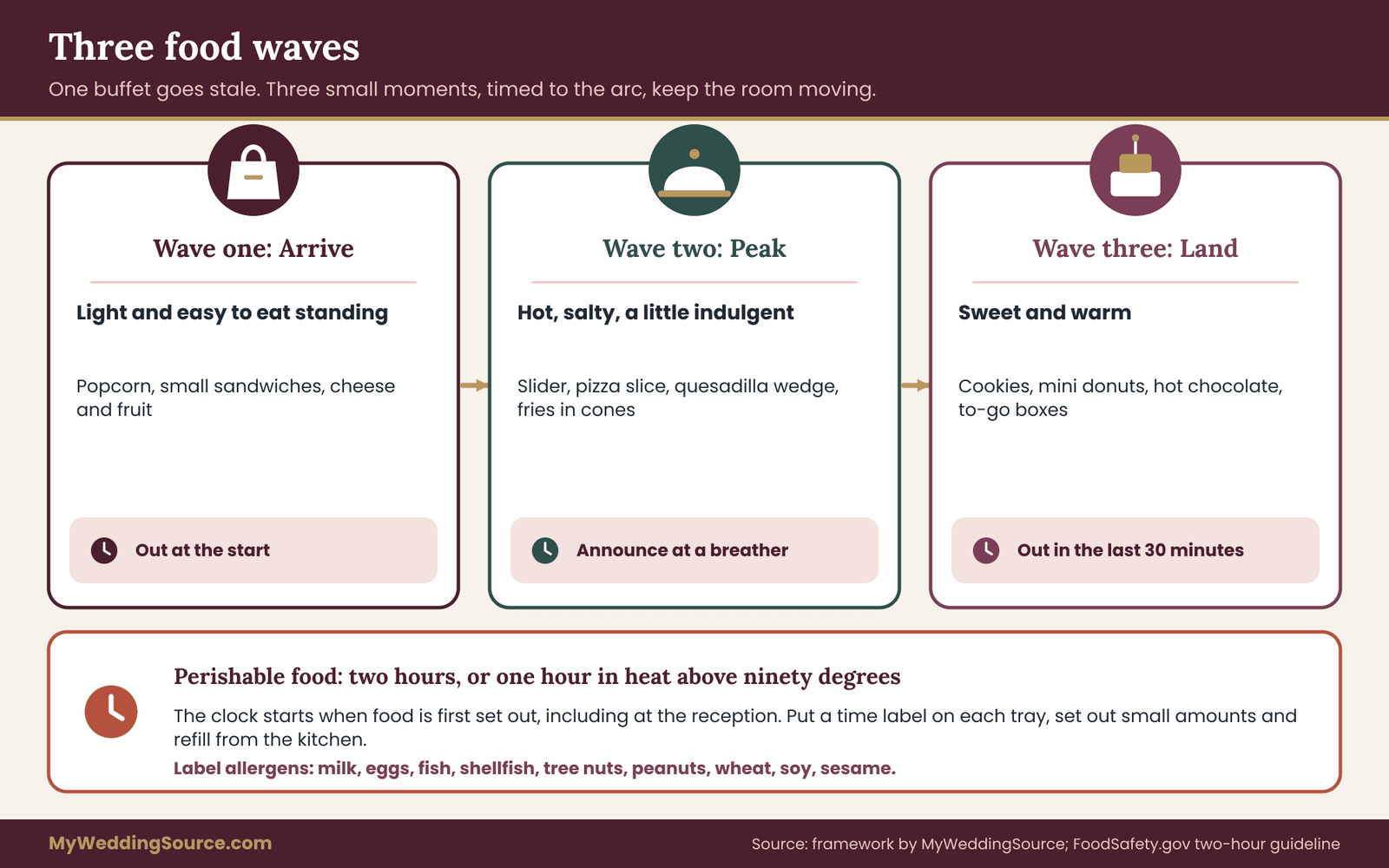
A single table of food, set out at the start and left there, loses its appeal within thirty minutes. Cold food gets stale, the table is picked over and nobody has a reason to go back. Plan three waves instead.
The first wave appears during Arrive. It is light and easy to eat standing, such as a bowl of popcorn, a tray of small sandwiches or a cheese and fruit board. Guests who are still full from the reception will take a bite and move on, and guests who skipped dinner have something right away.
The second wave arrives at the start of Peak. This is the real late-night bite: hot, salty and a little indulgent. Sliders, pizza by the slice, quesadilla wedges, soft pretzels, dumplings or fries in paper cones are typical choices. The announcement can be as simple as a DJ line, “food is out,” and the arrival of trays gives the room a natural reset.
The third wave belongs to Land. It is sweet and warm. Think cookies, mini donuts, churros or a small pastry with hot chocolate. It tells guests the night is winding down, and it gives them something to carry on the way out.
Match the food to the room, not to a theme
It is tempting to build a dry after party menu around a theme or a trend. A better approach is to look at the room. A ballroom with white tablecloths takes passed trays naturally. A backyard takes a taco cart. A hotel lounge takes room-service-style trays from the kitchen. If the room has no kitchen, the food has to be reheatable, delivered or served from a vehicle.
When you book a cart or truck, ask about its power needs, its footprint, where it will park and how long a line will take to clear at a late hour, and check those answers against the venue’s loading and access rules.
Timing: when food should land
Food timing follows the arc. Do not serve the second wave while guests are in the middle of a group song, and do not announce it when the dance floor is full. Wait for a breather, either a slower song or a short pause between blocks. Then announce it and let guests come to the table in their own time.
For the third wave, time it so that the warm sweet food is available during the final thirty minutes, not after the last song. A guest who gets a cookie on the way out feels cared for. A guest who finds the table cleared as they leave feels dismissed.
Food safety at a late hour
Food that sits out for long periods can become unsafe. Federal food safety guidance, published at foodsafety.gov, advises that perishable food should not be left out for more than two hours, and no more than one hour when the temperature is above ninety degrees Fahrenheit. The two-hour clock includes the time at the reception, so if the late bites are made from reception leftovers, count from the time they were first set out.
Put time labels on perishable items, set out small quantities and refill from the kitchen or a cooler instead of leaving everything at once. Keep hot food hot and cold food cold. If the caterer is handling it, ask what their policy is for late service and who is responsible for checking the temperature. If friends or family are helping, give one person the job of watching the clock.
Allergens and dietary needs
A dry after party menu is often an informal one, and informal menus are where allergen labeling goes wrong. Label each item with its main ingredients and mark the common allergens: milk, eggs, fish, shellfish, tree nuts, peanuts, wheat and soy, and sesame as well. Keep serving utensils separate. Ask the caterer to tell you about cross-contact risks in shared fryers and shared prep areas.
Include at least one vegetarian option, one that is free of gluten and one that is free of nuts, and make sure that they are clearly marked. Think also about guests who do not eat pork or beef, and about guests who are fasting, whose customs about when and what to eat vary by community. A short sign is enough: “Vegetarian,” “Contains nuts,” “Gluten-free option available at the end of the table.”
Portion logic without invented numbers
How much late-night food should you order? Again, there is no universal answer, but there is a sensible method. Estimate the number of guests who will actually be there. Estimate how much they ate at dinner. If dinner was heavy and ended an hour or two earlier, count on about a bite or two per guest for the first wave, and a more substantial portion for the second wave. Ask your caterer or vendor how they size late-night service, and compare their suggestion with your own estimate.
If there is a gap, lean toward the vendor’s number for savory items and your own for sweets. Savory food is eaten first, and running short of it is the most visible failure. Extra sweets can be boxed, which is a gift in itself.
The to-go box
Guests who are about to drive or take a ride home often want something for the morning. A stack of small boxes or paper bags near the exit, along with a sign that says “take a treat,” makes the third wave last. It also reduces the leftover food and cuts waste; ask your caterer whether larger surplus can be donated under their own food safety rules.
Staffing the food
Someone has to put the food out, watch it, refill it and clear it. If the caterer handles this, confirm the overtime or late-service hours in the contract, since late staffing is a common extra. If friends handle it, give them a short written list and a phone number to call. Do not assign the job to a member of the wedding party who should be dancing.
Ask the venue whether the kitchen is available at the late hour, whether there is a charge for using it and who is responsible for cleanup. Read the loading and access rules for delivery trucks, because a late arrival through a locked door is a failure that is easy to prevent.
Room, light and activities for a dry after party
If food and drinks are the fuel and music is the engine, the room itself is the shape of the dry after party. A well-planned room helps a dry after party work even when the guest count is smaller than expected.
Zones, not a single open floor
A good dry after party room has zones. A dance zone is the largest and most open and is near the speakers. A drink zone holds the zero-proof bar and the warm drink station and is placed so the line does not block the dance floor or the exit. A food zone is placed away from the speakers so guests can talk.
A quiet zone has soft seating, lower light and lower sound, for guests who need to rest or talk. A photo zone, if you have one, is a small area with good light and a simple backdrop, placed where its line will not block anything else.
Draw a quick floor plan, even on paper, and place each zone. Check that guests can reach the restrooms, the exit and the quiet zone without crossing the dance floor.

Light is the cheapest tool you have
In a dry after party, changing the light changes the feel of the room faster than anything else. Bright overhead light makes a room feel like an office. Low, warm light makes it feel like a night out. Colored uplights, string lights or candles in safe holders, and a few spot lights over the dance floor, can create a very different atmosphere from the same room.
Plan three light settings tied to the phases: moderate and warm for Arrive and Lift, dim with some color for Peak and warm and soft for Land. Ask the venue whether lighting can be changed on the day, who controls it and whether there are limits on how dark the room can be for safety reasons, since exits and stairs must stay visible.
Temperature and air
A room full of dancing guests gets warm, and a warm room is a reason to leave. Ask the venue about the air handling at a late hour, since some buildings reduce cooling after hours. Keep doors to a patio or terrace open if the weather allows, and put the water station near them. If the room is cold, the warm drink station and a stack of wraps or blankets near the quiet zone are kind touches.
Activities that suit a dry after party
Activities are optional, and the best ones are low pressure. They give people who do not dance a way to take part, and they break up a long night. A few ideas, each with its own tradeoffs:
A photo moment, such as a simple backdrop and a few props, or a phone-based photo booth. It needs light and a place to stand. A shared game table with cards or dice or a large puzzle. A late dessert reveal, in which a cart or tray is brought in at a set time. A group song with a known move.
A short toast with sparkling drinks, kept to under two minutes. A message wall, where guests write a note on a card that you read the next day. A karaoke corner, though that needs its own sound control and a clear stage flow so it does not take over the room.
Choose two or three, not all of them.
Seating and sightlines
Soft seating, high-top tables and a few low benches make a room feel like a lounge. Place seating around the edge of the dance zone so guests can watch and join in. Avoid rows of chairs, which feel like a waiting room. Make sure that older guests and anyone with a mobility need can reach seating without crossing the floor, and that the quiet zone has some chairs with arms.
Kids, teens and older guests at a late hour
Many dry after parties include children and teenagers who would not be at a late event with a bar. Their needs are different. Children need a way to rest, and a corner with cushions and a quiet activity helps. Teens often want to dance and be photographed and are happy with a dry after party as long as it is not treated as a children’s event.
Older guests may need to sit, to hear and to leave on time. Think about each group when you place seating, set the volume and schedule the last song. The wedding guest care planning guide covers how to support babies, children and older relatives across the day.
Safe departure design for a dry after party
A dry after party does not remove the risk of the drive home, and it is a mistake to assume it does. Many guests will have had alcohol at the reception earlier in the night. Others will be driving tired at an hour when they would usually be asleep. The National Highway Traffic Safety Administration treats both impaired driving and drowsy driving as serious risks and publishes guidance on each.
For a dry after party, departure design is the part of the plan that turns that concern into steps, and it is the part guests remember most if something goes wrong.
The departure ladder: last song, last bite, last ride
The framework has three markers, each with an owner and a time. The last song is the end of the music. The last bite is the final food and drink service. The last ride is the point by which every guest has a way home that you have confirmed. Together they form a ladder that guests climb down in order, instead of a cliff they fall off when the lights come up.
Set the times backward from the venue’s end time. If the venue requires everyone out by midnight, the last ride should be confirmed by eleven-forty-five, the last bite should finish by eleven-thirty and the last song should begin around eleven-thirty-five and end by eleven-forty. The details depend on your venue and your guests, but the order stays the same.

Know who is leaving how
A week before the wedding, for the dry after party, collect a simple list of how each late-night guest plans to get home. The list has four possible entries: staying in the hotel or on the property, riding with a designated driver, using a ride service or taxi and driving themselves. Add a fifth entry for guests who do not yet know. Do this through the wedding website, a short form or a text from the coordinator. Keep it private and keep it short.
The list does two things. It tells you where the gaps are, and it lets you plan the right number of shuttle seats or ride vouchers. It also changes the tone: when you ask guests how they are getting home, you are saying plainly that you care about it, and you give them a reason to make a plan before the night.
Ride options and what each needs
A hotel on site is the lowest-risk option for most guests and needs only a clear walking route and a front-desk note. The guide to guest hotels across budgets and mobility needs explains how to help guests with different budgets and access needs find rooms close to the venue.
A shuttle is the next best option. Ask the vendor about its schedule, its capacity, where it picks up and drops off, how late it can run and what happens if it is late. A single late shuttle is easy to fill, but guests will not wait around for one that does not leave when they are ready. Offer two departure times: one at the start of Land and one after the last song.
Ride services and taxis work for small groups. Set up a pickup point away from the venue’s front steps, ask the venue whether there is a loading or waiting zone and tell guests what name or number to look for. At a late hour, ride availability can be limited depending on the location, so a backup, such as a local taxi company’s number printed on a card, is worth having.
A designated driver works best when it is agreed in advance, since a dry after party might lead people to assume that everyone is fine to drive. Ask your guests to name their driver before the night.
The ride board
A ride board is a simple tool: a small sign or card near the exit with the shuttle times, the pickup point, the taxi number and a line that says where to ask for help. Add a friend or staff member to the exit during the Land phase who can answer questions and make sure no guest leaves alone without a plan. The ride board is not about checking up on people. It is about making the easy choice the obvious one.
Drowsy driving and the late hour
A party that ends at midnight puts guests on the road at a time when many are already tired. The NHTSA describes drowsy driving as a risk that is similar in some ways to impaired driving, since both reduce attention and reaction time. A dry after party helps with the first risk and does nothing for the second, which is why the departure plan matters even if no alcohol is served.
Build in the small supports: the warm drink at the end, a place to sit for ten minutes before leaving, a suggestion to guests who live far away that they stay in the hotel and the shuttle option. If a guest says they are too tired to drive, treat that as a good decision and help them find another way.
The last-call equivalent
At a party with a bar, the bartender calls last call. A dry after party needs a replacement, because a clear end signal helps both guests and staff. The last-call equivalent is a short announcement made after the final song: thank guests, say where the rides are, point them to the warm drinks and the take-home treats and say that the room will close in fifteen minutes. Keep it warm and short, and have the DJ or a friend with a microphone say it.
The announcement is also your chance to remind guests of a few things: collect coats and bags, check pockets and chargers, and do not leave anyone behind. A short lost-and-found plan, including who will hold items and how guests can retrieve them, saves a lot of messages the next morning.
Special cases: guests who should not drive
You may notice that a guest should not be driving, whether because they drank earlier, because they are exhausted or because they seem unwell. Decide in advance who will step in and what they will say. A friend, a family member or the coordinator can offer a ride, a room or a shuttle seat. A short, kind script helps: “We have a spot in the shuttle for you and we would feel better knowing you are on it.” Do not argue about whether the guest is fine. Offer an alternative and make it easy.
Have a backup plan if a guest refuses. A friend can offer to hold the keys until morning, or can drive the guest’s car home while another friend follows. If a guest is in distress or the situation is unsafe, call emergency services. Make sure the coordinator knows the venue’s address and the nearest entrance to give to responders.
Staff, vendors and the end of the night
Staff and vendors also need to get home. The DJ, the caterer, the shuttle driver and the venue team may all be on a long day. Plan the end of the night so that they are not waiting on guests who linger. If you have hired staff for the late hour, confirm the end time in writing, including whether there is overtime and who approves it.
The Occupational Safety and Health Administration publishes information on worker safety, and a venue’s own safety rules for staff, such as limits on lifting and teardown hours, may affect the end of the night.
What to write down
Write one page for the departure plan. It should list the three markers with times, the ride options with phone numbers and pickup points, the name of the person at the exit, the script for a guest who should not drive, the contact for emergency help and the venue’s end time. Give it to the coordinator and one friend who is not in the wedding party. You will not need most of it, and that is the point of having it.
Vendor and venue questions for a dry after party
A dry after party is not unusual for vendors, but a late one with a specific energy plan is. Good questions, asked early and answered in writing, protect you from surprises at the end of a long day.
Questions for the venue
Ask what time the venue’s alcohol service must stop, whether the building has any area that can be used for a dry event after that time and what the venue’s rules are about guests carrying drinks between rooms. Ask about the end time for music, for staff and for the room, and what the overtime terms are if the dry after party runs long. Ask about lighting control, heating and cooling at night and the availability of the kitchen. Ask whether there are security staff at that hour and who is responsible if there is a guest incident.
Questions for the caterer and bartender
Ask whether the caterer can provide service for the dry after party, and what it costs. Ask what zero-proof options they can offer, and whether they can build the five-rung ladder. Ask who staffs the late hour and how late they can stay. Ask about their approach to allergens and cross-contact for the late bites. Ask about the terms for non-alcoholic products: whether they buy them, whether leftover bottles come back to you and whether the liquor license affects how they can serve these drinks.
Questions for the DJ or band
Ask whether they can play a late-night set with a block structure, whether they have experience with dry parties and what they do when the room goes quiet. Ask about their equipment’s volume range and whether they can play quietly in one zone and loudly in another. Ask about their end time and overtime.
Questions for the shuttle or ride vendor
For the dry after party, ask about the number of seats, the pickup times, the latest departure, the pickup and drop-off points and the cancellation terms. Ask what happens if the shuttle is late or breaks down.
Put it in writing
Whenever a vendor agrees to something that is not in the original contract, ask for an email or an amendment. Keep the amendment with the original contract. Remember that venue curfews, transport rules, alcohol rules and worker rules need local verification. This guide is not a substitute for the terms your vendors give you and the laws that apply where you live.
A worked example of a dry after party
The following couple is invented, and the numbers are illustrative planning figures, not data from any real event. The purpose is to show how the pieces fit together.
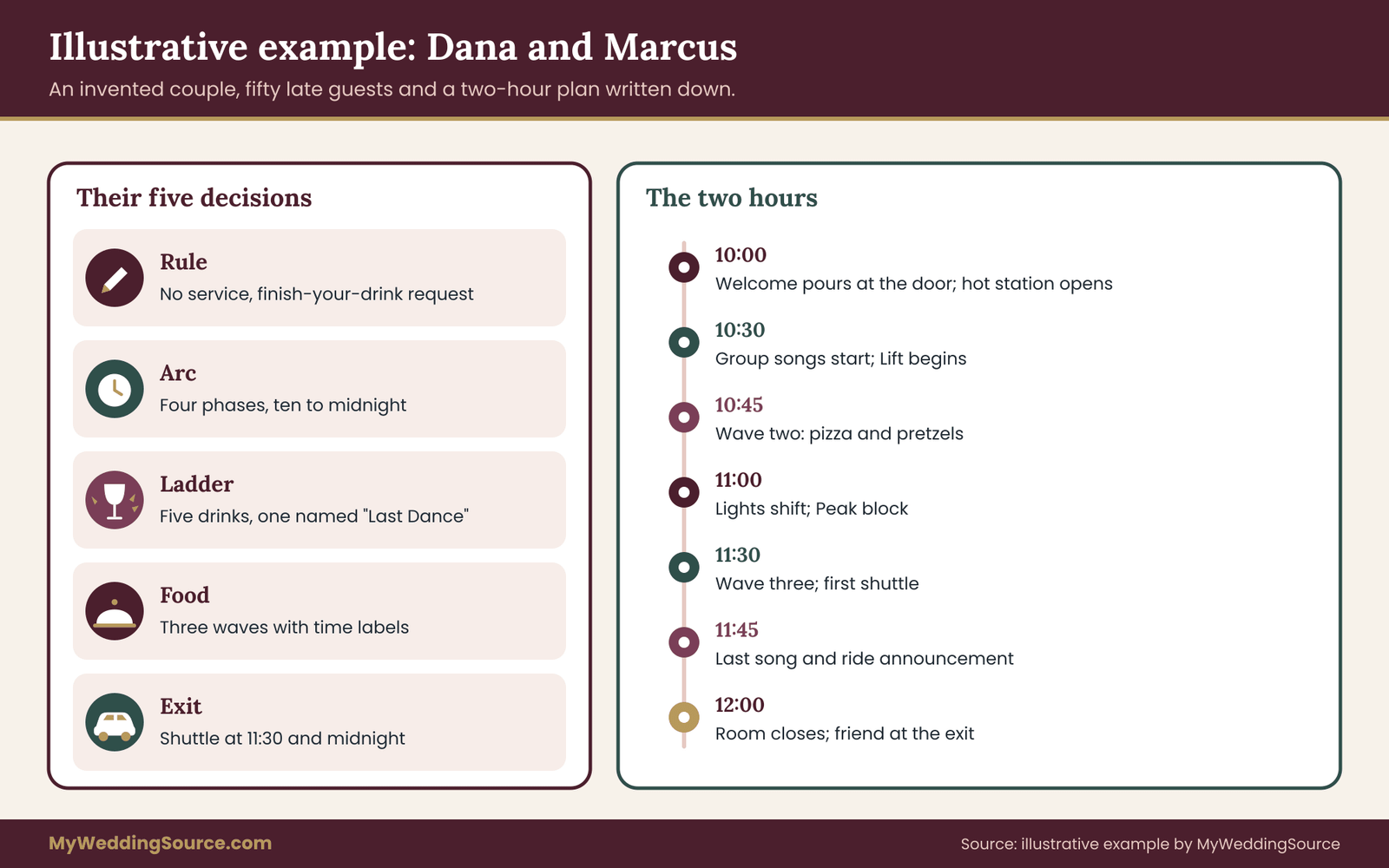
Dana and Marcus are hosting a reception for one hundred and ten guests at a rented hall with a bar, which closes at ten. They want a dry after party for the last two hours of the venue contract, in a second room across the lobby. They expect about fifty guests to stay, and they know that about a third of those will be teenagers and cousins who came for the dancing, along with a handful of grandparents who will leave early.
The decisions they wrote down
Their rule is a no-service rule with a finish-your-drink request: no alcohol is poured in the second room, and guests are asked to finish a drink before crossing the lobby. A friend with a small tray stands at the door with the welcome pour, and a sign beside the door states the rule in one friendly sentence.
Their energy arc has four phases from ten to midnight, with Arrive from ten to ten-thirty, Lift until eleven, Peak until eleven-thirty and Land until midnight. The DJ gets a one-page brief with the blocks, five songs for each of Lift and Peak and the last song.
Their zero-proof ladder has five items: a sparkling citrus welcome pour, a ginger fizz, a shrub-and-soda drink called “Last Dance,” a hot drink station with decaf coffee, tea and hot chocolate and a water station by the doors. They buy none of the non-alcoholic spirit-style bottles, because the budget is better spent on the late food.
Their food has three waves: popcorn and fruit at ten, pizza slices and soft pretzels at ten-forty-five and cookies with hot chocolate at eleven-thirty. They put a time label on the pizza and set out one tray at a time. A friend checks the clock.
The departure plan
Twenty guests are staying in the hotel next door. Eleven are riding with a designated driver whom the guests named on the website. Twelve plan to use a ride service, and seven said they would drive themselves. The coordinator reaches out to the seven drivers during the evening to check that they feel rested and that no one is relying on a long drive, and she offers two of them a room-share option with a friend. A shuttle runs at eleven-thirty and at midnight.
The last bite ends at eleven-forty. The last song begins at eleven-forty-five, and the DJ makes the announcement at five minutes to midnight: warm drinks, treats to go, the shuttle at the front door and the taxi number on the ride board. A friend stands at the exit and says goodnight to each guest.
What went right and what they would change
In this illustration, the welcome pour and the warm drink station get the most use, the “Last Dance” drink is sampled by about half the guests and the pizza is gone in twenty minutes. The Lift phase stalls briefly at ten-forty, and the DJ responds by moving a group song forward. One guest arrives with a drink from the lobby and a friend collects it with a smile. The shuttle is half full at eleven-thirty and full at midnight.
What the couple would change: they would add a second pizza tray, since the first wave went faster than expected, and they would put a second water station near the dance floor. They would also ask the hall to turn up the heat a few degrees in the quiet corner, where guests found the room cool.
Notice what the example does not claim. It does not say that every dry after party goes this smoothly, and it does not predict how many guests will choose each drink. It shows that a short, written plan gives you room to adjust during the night.
Edge cases for a dry after party
A plan that works for the average guest can still fail one specific guest. A few edge cases come up often enough to deserve their own section.
Guests who object to the rule
Some guests will dislike a dry after party and say so. A calm, short answer works: “We wanted a late-night party everyone could stay for. We hope you enjoy the food and the music.” Do not apologize at length or debate the choice. If a guest leaves to find a drink somewhere else, that is their decision, and a polite goodbye is enough. If you are the host and you are worried about it, put a trusted friend in charge of handling the conversation.
Guests who bring alcohol anyway
Someone may carry a flask or a bottle in a bag. If the rule is clear and the venue has asked you to enforce it, a quiet word from a friend or the coordinator is the best first step. Keep it private and short: “Hey, we are keeping the room alcohol-free tonight. Can you leave it in your car or finish it outside?” If the guest refuses, the coordinator can raise it with the venue manager. Do not make a scene at the party.
People in recovery and guests who avoid alcohol
A dry after party can be a welcome relief for guests in recovery, and they may also be wary of stigma. Do not single anyone out, do not ask guests about their reasons and do not offer a special drink in a way that draws attention. The best help is to make the whole party alcohol-free in the way you said it would be, to have a zero-proof menu that all guests share and to avoid jokes about drinking.
If a guest tells you privately that they would like support, such as a quiet room, listen and offer one. The Substance Abuse and Mental Health Services Administration publishes resources for people and families.
Pregnant guests and guests with health conditions
Public health agencies advise that no amount of alcohol is known to be safe during pregnancy, and the Centers for Disease Control and Prevention explains the reasons. A dry after party makes it easier for pregnant guests to enjoy a late night without having to explain. Check that the late food is safe for them as well, which means labeling items with unpasteurized dairy or raw ingredients. Guests with diabetes will want lower-sugar options and a sense of what is in each drink.
Non-alcoholic products with trace alcohol
As described earlier, some drinks sold as non-alcoholic contain a trace of alcohol. If a guest asks, you or the server should be able to read the label. If you cannot confirm a product, do not serve it to a guest who needs to avoid all alcohol. Choose a drink without the question.
Guests who drank earlier at the reception
Guests who arrive from a reception with a bar may have been drinking for hours. A dry after party does not clear that. Give those guests food, water and a chance to sit, and treat the departure plan as a requirement, not a suggestion. If a guest seems unwell, keep them in the room, bring water and food, and arrange a ride. If the situation looks serious, call emergency services.
Religious and cultural observances
Some guests do not drink for religious reasons, and some communities have rules about food, music and timing that affect a late party. Ask close family members about the points that matter to them. A short conversation early can prevent a misstep later. Do not assume what any one guest needs based on a name or a background; ask the couple’s own family about their own practice.
Accessibility at a late hour
A late room should be as accessible as the earlier one. Check that step-free access, seating and restrooms work at the late hour, since some venues lock doors or turn off elevators after a certain time. Check that signs are readable in low light. The Americans with Disabilities Act sets accessibility standards for public places, and the Department of Justice publishes guidance at ada.gov. Ask the venue about the late-hour arrangements in writing.
If the party is outdoors or in a rented home
A dry after party at a home or an outdoor site adds its own questions: noise rules for neighbors, a firepit or heater and its safety, restrooms, lighting along paths and parking. Ask the owner what is allowed and what insurance applies. For a rented space, read the rental agreement for rules on alcohol, noise, number of guests and hours.
Measurable checks for a dry after party
Planning is easier to improve when you can measure it. These checks are simple and you can do them with a watch and a notebook, or by asking a friend to keep notes. None of them require an app.
Before the night
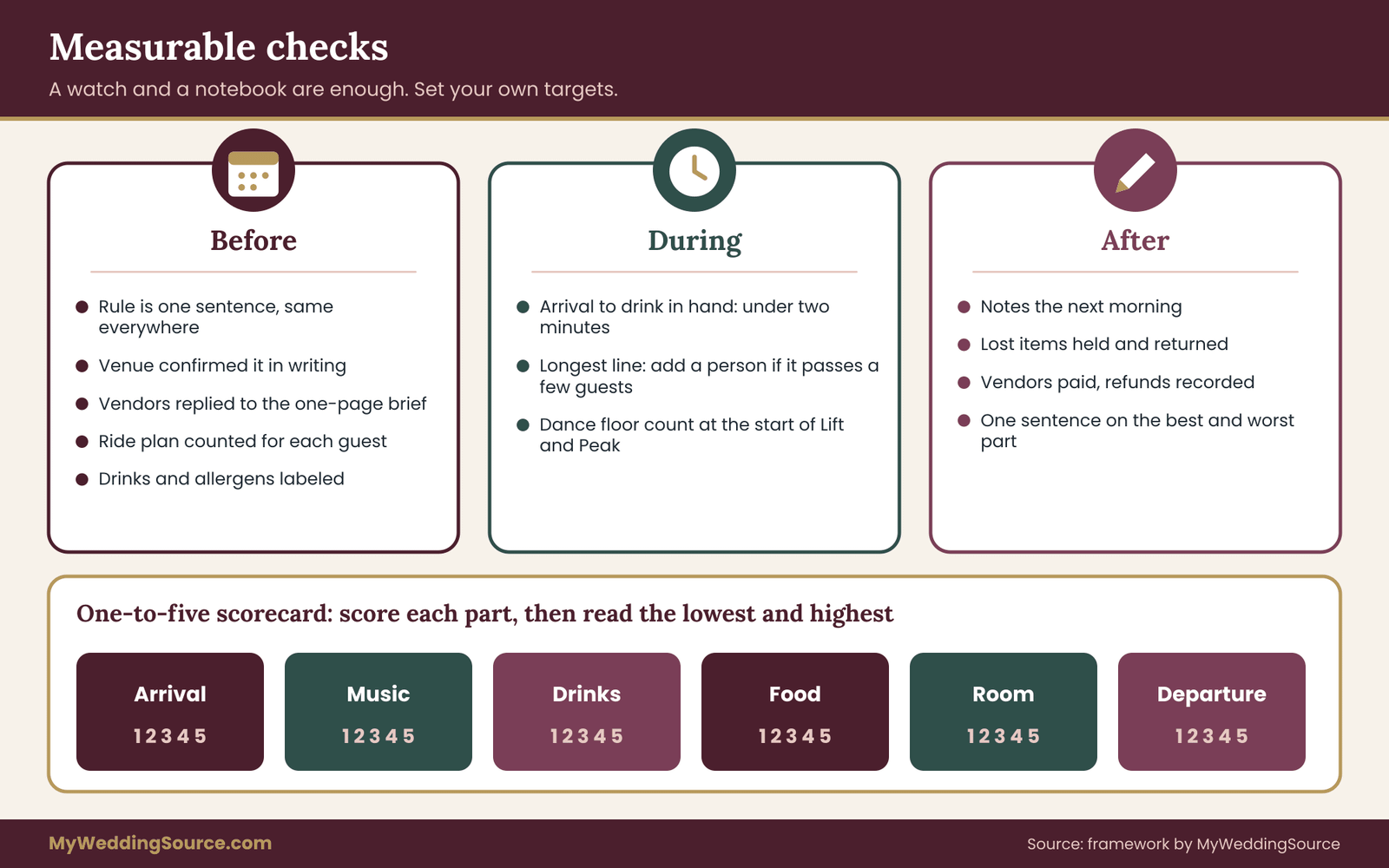
Check that the rule is written on the invitation or website, that the sentence is the same everywhere and that the venue has confirmed it in writing. Check that every vendor has the one-page brief and has replied. Check that the departure plan lists times, contacts and a ride count for each guest who responded. Check that you have a list of drinks with ingredients, a label for each allergen and enough staff for each station.
During the night
Pick three numbers to watch and ask a friend to note them. First, the time from a guest’s arrival to a drink in their hand: the goal is under two minutes. Second, the length of the longest line at the drink zone or the food table: if a line runs past a few guests, add a person or a station. Third, the number of guests on the dance floor at the start of Lift and Peak: if it is low, change the song or the activity. These are your own targets, and you can set different ones.
After the night
Write a short note the next morning: what worked, what did not and what you would change. Ask the coordinator and one friend for their notes. Check for lost items. Check that all vendors have been paid and that any returns or deposit refunds are recorded. Keep the notes with your other wedding records, which is useful if you or a friend ever plan a similar night.
A short scorecard
Score each part of the night from one to five on your own: arrival, music, drinks, food, room, departure. Do not average them. Look at the lowest score and the highest, and write one sentence about each. The point is to learn which lever carried the night and which one needs more attention next time.
Your next steps
Start with the rule. Write the one sentence, decide which of the three dry types you mean and check it against the venue’s terms and your contracts. Then draft the energy arc on a single page, with four phases, six levers and clock times, and send it with a song list to the DJ.
Next, build the zero-proof ladder: five rungs, three or four drinks you can make well, a warm drink station and a water station. Plan three food waves, label them and time them. Finally, write the departure ladder: last song, last bite, last ride, with a ride count, a shuttle or ride plan and a person at the exit.
Put the final plan in one shared document, give it to your coordinator and a friend and then enjoy the party. A dry after party works when the details are handled before the night, so that on the night you can be inside it.
FAQ
What is a dry after party at a wedding?
It is a late-night gathering after the reception where no alcohol is served and, usually, none is brought in. It runs for two to three hours with music, food and zero-proof drinks. The format suits guest lists with a wide age range, venues with strict hours and couples who want everyone able to stay until the end.
How do we tell guests the dry after party is alcohol-free?
Put it on the invitation or website next to the time and place, in a sentence that lists what you are offering, such as mocktails, coffee and late snacks. Repeat it in a text on the day. Guests then arrive knowing what to expect, and nobody feels surprised at the door.
What should be on a zero-proof menu for a late-night party?
Cover five roles: a light welcome pour, a fizzy option, one grown-up drink with bitterness or spice, a warm drink such as coffee, tea or cider and plenty of water. Four or five drinks done well beat a long list. Label ingredients and allergens, and keep the decaf clearly marked.
Do non-alcoholic beer and wine contain any alcohol?
Some products labeled non-alcoholic contain a trace amount of alcohol, and federal agencies set the labeling rules, so check the current rules with the Food and Drug Administration and the Alcohol and Tobacco Tax and Trade Bureau. Read each label. For guests who must avoid all alcohol, serve drinks made from juice, tea, soda water and syrups instead.
How do we keep the energy up without a bar?
Use the energy arc: four phases with set clock times, music in blocks with short breathers, three food waves and light that shifts with each phase. Open with a welcome drink and familiar songs. A dry room benefits from group songs and a shared moment more than from louder volume.
Do we still need a plan for getting guests home?
Yes. Many guests will have had alcohol earlier at the reception, and tired drivers are a risk at a late hour. Collect each guest’s plan in advance, arrange a shuttle or ride pickup and set times for the last song, the last bite and the last ride. Put a friend at the exit.
What if a guest brings alcohol into the room?
Have a friend or the coordinator speak to them privately and kindly, and ask them to finish the drink outside or leave it in the car. If the venue has asked you to enforce the rule and the guest refuses, the coordinator can involve the venue manager. Keep it quiet, short and free of debate.
How long should a dry after party last?
Two to three hours suits most groups, since the guests who stay are already tired. Set the end time by the venue’s curfew and work backward: last ride, last bite and last song. If the party is going well, you can extend the peak phase, as long as the departure plan and vendor overtime terms allow it.
Sources
- Drunk driving, National Highway Traffic Safety Administration
- Drowsy driving, National Highway Traffic Safety Administration
- Alcohol and public health, Centers for Disease Control and Prevention
- Alcohol topics, National Institute on Alcohol Abuse and Alcoholism
- Food safety, Food and Drug Administration
- Alcohol and Tobacco Tax and Trade Bureau
- Food safety guidance, FoodSafety.gov
- Noise-induced hearing loss, National Institute on Deafness and Other Communication Disorders
- Worker safety and health, Occupational Safety and Health Administration
- Americans with Disabilities Act, U.S. Department of Justice