

A venue pet policy that says no animals does not have to mean no animal in your wedding story. This guide shows you how to read the venue pet policy, ask the venue the right questions, and choose a nearby portrait plan and a home-care plan that keep the pet safe, the venue happy and the photos possible.
Start by getting the venue pet policy in writing, including what it says about service animals and about the grounds outside the building. If the answer is still no, climb a five-rung ladder: ask for a limited exception, ask for a photo-only visit in a set time window, book a portrait at a nearby place that allows animals, take the portrait on a different day, or celebrate the pet without the pet being there. Then pick a home-care option for the wedding day, name one responsible person, and write down the pickup time.
Many couples find out about their venue pet policy late. They love the venue, sign the contract, and only then picture the dog beside them at the ceremony. A phone call or a re-read of the contract delivers the news: no animals on the property, or none inside, or none at all after a certain hour. The disappointment about a venue pet policy is real, and it is usually sharper than people expect, because a pet is family and the picture in your head already had that family member in it.
The good news is that a no-pets rule is a planning constraint, not a dead end. Venues write these rules for reasons that are usually practical, and most of the time there is more than one way to include an animal without touching the venue pet policy at all. A short portrait taken a few minutes’ drive away, a photo session the weekend before, or a quiet day at home with a trusted person can all give you the picture and protect the animal.
This guide explains how to choose among them and how to ask for each one politely.
A note on scope. This is general information, not legal advice. Rules about service animals, health codes and local ordinances differ by place and change over time, so where a rule matters, the article points you to the agency or the venue that sets it. Welfare, access and the venue’s written rules come before aesthetics every time.
What a venue pet policy actually covers
People say “the venue doesn’t allow pets” as if it were one rule. In practice a venue pet policy is a bundle of smaller rules, and the details change what you can ask for. Before you decide anything, sort your venue into one of four types.
A full ban. No animals anywhere on the property, indoors or out, at any time during your rental. This is common where the property is a restaurant, a hotel ballroom or a historic building with strict insurance terms. Service animals are handled separately and are covered later in this guide.
An indoor ban with grounds access. Animals may not enter the buildings but may be on the lawn, patio or garden. Some barns and outdoor estates work this way. The nuance is whether “grounds” includes the ceremony lawn, the parking area or only a path.
A permission-based policy. Pets are allowed only with the venue’s written approval, often with conditions such as a leash, a handler who is not part of the wedding party, a signed agreement or a fee. This is the type where a polite request has the best chance.
A silent policy. The contract and website say nothing at all. Silence is not permission. It means you have to ask, and you should treat the answer as binding only once it is written down.
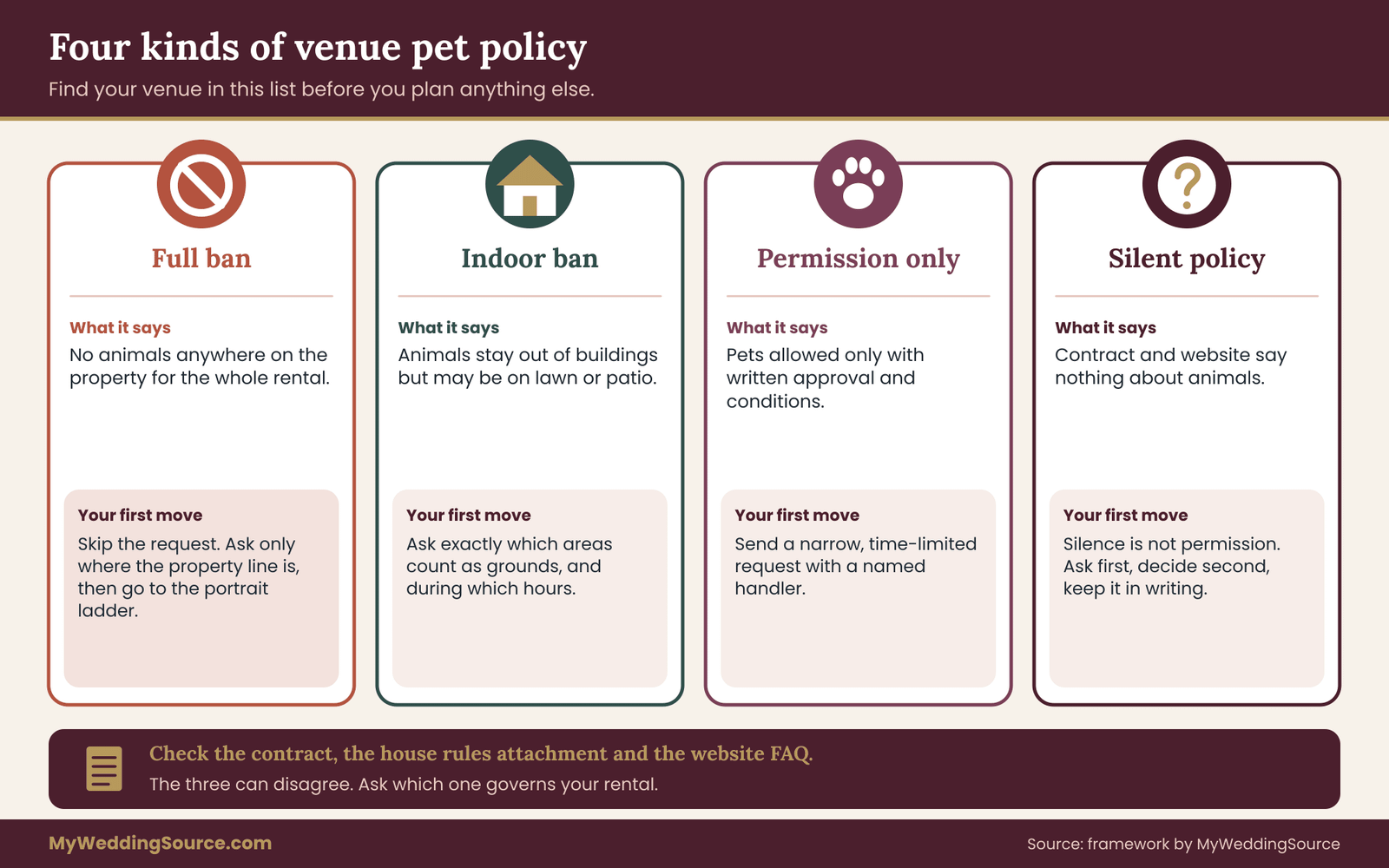
Seeing the four types of venue pet policy side by side matters because each one points to a different first move. With a full ban you skip the request and go straight to the portrait and home-care options. With permission-based rules you ask for the conditions. With a grounds-only rule you ask exactly where the line is. With silence you ask first and decide second.
The clauses that hide the venue pet policy
The venue pet policy is rarely labeled “pets.” Look for these places in the paperwork, and read all of them, because the venue pet policy may be stated differently in each.
The rental agreement often has a “rules and regulations” or “house rules” attachment. That attachment may use words like “animals,” “livestock,” “domestic animals” or “non-service animals.” The facility use terms may mention cleaning fees, damage deposits or “extra cleaning” that apply when an animal is present. A catering exhibit may mention food-safety rules that limit animals in food areas. An insurance exhibit may restrict animals or require a separate rider.
The website may carry a separate FAQ or “plan your event” page that states the venue pet policy more plainly than the contract does. If the website and the contract differ, ask the venue which one governs your rental, and ask for the answer in an email.
What the venue pet policy does not decide for you
A venue pet policy answers one question: may an animal be on this property during your event. It does not tell you whether the animal would enjoy being there, whether a nearby park allows pets, whether your photographer can work off-site, or whether a sitter is the right choice for your particular animal. Those are your decisions, and the rest of this guide gives you a way to make them without guessing.
It also does not settle how guests behave. If guests may bring pets, or if a guest will arrive with a dog in a vehicle, you may need a short line on your website or in your arrival notes. The wedding guest care planning guide on this site covers the wider question of looking after people who need extra support on the day, and the same habits of planning apply here.
Why a venue writes its pet policy the way it does
It is easier to ask well when you understand why the venue pet policy exists. Most venues do not write a venue pet policy out of dislike. They ban them because of a handful of practical pressures, and each pressure suggests what kind of exception, if any, might work.
Food and health rules. Many local health codes follow the model published by the U.S. Food and Drug Administration, which generally keeps live animals out of food preparation and service areas, with exceptions for service animals. Local rules differ, so treat that as background and ask your venue what applies. A venue that serves food in the same room where your ceremony would happen may have very little room to bend.
Allergies and shared spaces. Venues host many events in the same space. A wedding on Saturday follows a corporate lunch on Friday and precedes a child’s birthday on Sunday. Dander and hair linger in carpet, drapery and upholstery, and a venue cannot ask every future guest about allergies. This reason favors exceptions that stay outdoors or in a single easy-to-clean zone.
Insurance and liability. A venue’s insurer may limit what animals may be on site, and a bite or a fall caused by a leash is the kind of claim a venue wants to avoid. A venue that wants to keep its policy simple often finds it easier to say no to everyone than to judge each animal. This reason favors requests that arrive with a named handler and a short, clear plan.
Damage and cleanup. Scratched floors, chewed decor, accidents on a rental carpet and noise complaints cost staff time. A venue often cannot predict how much. This reason favors a time-limited visit rather than an all-day presence.
Other people’s comfort. Some guests, staff and neighboring tenants are afraid of dogs or have had bad experiences. A venue that wants every guest to feel comfortable may decide that animals create more problems than they solve.
Consistency. If a venue lets one couple bring a dog, the next couple asks for a cat, and the next for a parrot. A flat rule is easy to enforce and easy to explain. This reason is the reason a venue is least likely to bend, and it is the reason to ask for a limited, specific exception rather than a general change.
What the reasons tell you about what to ask
Look at the list again with your own venue in mind. If the dominant reason is food-service rules, a photo-only visit outdoors or at the entrance may be possible even when a ceremony role is not. If the dominant reason is insurance, a short visit supervised by a handler and a signed acknowledgment may be possible.
If the dominant reason is allergies in a shared interior, a visit on the lawn before guests arrive may work. If the dominant reason behind the venue pet policy is consistency, expect a firm no and go straight to a nearby portrait.
You usually cannot learn the real reason by asking “why.” Staff often repeat the venue pet policy without knowing the rationale. A better way is to ask which parts of the property the venue pet policy covers, whether any area or time window is treated differently, and whether the venue has ever approved a short exception. Those questions invite a concrete answer and avoid putting anyone in the position of defending the venue pet policy.
The venue pet policy is also a protection for your pet
It helps to look at the venue pet policy from the animal’s side as well. A wedding venue is a long day of strangers, noise, unfamiliar floors, music, doors that open and close, food on the ground and a schedule nobody can pause. A venue pet policy that says no animals is, in effect, removing a hazard you might not have had the heart to remove yourself. The American Veterinary Medical Association publishes pet-owner guidance on stress, heat and safety, and it is a reasonable place to read general background.
If a vet who knows your animal says the day would be hard for them, that is a good reason to stop pushing for an exception, and the rest of this guide gives you ways to include the animal that do not depend on one.
Get the venue pet policy in writing before you plan around it
A verbal answer from a friendly coordinator is a starting point, not a plan. Staff change, event managers differ in how strictly they enforce the rules, and a promise made in March can be forgotten by October. Before you build any portrait or care plan around what the venue pet policy allows, turn the answer into text you can point to.
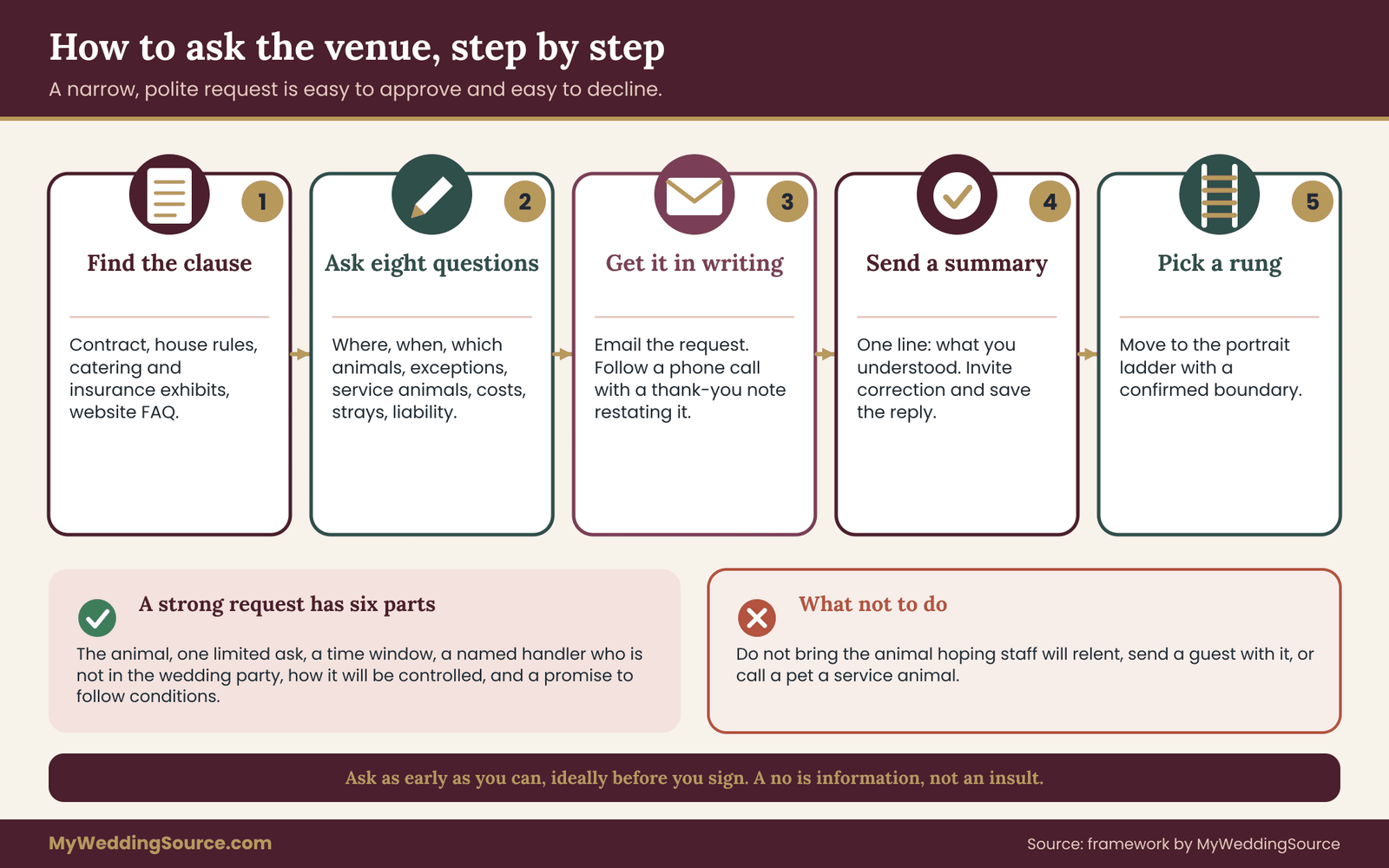
Write down the answers to eight specific questions. Each one closes a gap that tends to cause trouble on the day.
Where does the venue pet policy apply? Ask whether the venue pet policy covers only the buildings or also the lawn, the patio, the parking lot, the entry drive and any path between them. A rule that bans animals indoors but is silent about the parking area leaves room for a handoff point.
When does it apply? Ask whether the venue pet policy covers only your event hours or the whole rental, including setup and teardown. Ask whether an hour before your rental begins or after it ends is treated differently. That hour can become your photo window.
Which animals does it cover? Ask whether the venue pet policy treats dogs, cats, birds and small animals the same way, and whether the answer changes for animals that stay in a carrier.
What are the exceptions? Ask whether the venue has ever approved an exception, what conditions it set, and who has the authority to approve one. If the answer is “the owner decides,” ask how far ahead to ask.
What does it say about service animals? Ask the venue to describe its approach in general terms and to confirm that it follows applicable accessibility law. The service animals section later in this guide explains why this is a separate question.
What are the costs? Ask whether any exception comes with a fee, a deposit or an added insurance requirement, and ask for the amounts in writing.
What happens if an animal arrives anyway? Ask how staff handle an animal that appears at the door, for example a guest’s dog. You need to know whether the venue would ask the guest to leave or take the animal to a separate area.
Who is responsible if something goes wrong? Ask whether the contract requires the couple to indemnify the venue for any animal-related damage or injury, and read that clause before you sign anything.
Putting the answers into one page
Once you have the answers, copy them into a single page of notes with the date, the name of the person who answered, and the exact words they used. Attach the email that confirms them. This one page does three jobs. It tells your photographer and planner what is allowed. It gives your day-of contact something to show if a new staff member challenges a plan. And it keeps the conversation fair, because you will never be in a position of saying “someone told us it was fine” without proof.
If the answer to any question is unclear, say so in your notes. “Unclear: grounds access during setup” is more useful than a guess.
Reading a contract clause calmly
Contract language about animals can sound harsh. A clause that says animals are “strictly prohibited” and that violations may result in “immediate removal and forfeiture of deposit” is standard boilerplate, and it does not mean the venue will refuse a reasonable written request. It does mean you should not test the clause by showing up with an animal and hoping for the best.
If the venue pet policy is ambiguous, ask the venue to clarify it in a short amendment rather than an email. The wedding vendor contract guide on this site explains how to read and amend contract terms, and the same habits apply here. An amendment that says “a dog may be present on the south lawn between 3:00 and 3:45 p.m. under the handler’s control” is worth more than ten friendly phone calls.
How to ask the venue about its pet policy
How you ask matters as much as what you ask. A request that sounds like a demand to change the venue pet policy gets a flat no. A request that sounds like a small, well-planned, low-risk idea gets a considered answer. The aim is to make it easy for the person on the other end to say yes, or to say no kindly and quickly.
Pick the right person and the right channel
Ask the person who can actually interpret the venue pet policy and decide on exceptions. At a small venue that is often the owner or the events director. At a larger property it may be the event manager, with the general manager approving exceptions. If the first person you reach says they cannot approve anything, ask who can and how long that decision takes.
Use email for the request itself so there is a record, and use a phone call for the follow-up if the email stays unanswered for several business days. A call alone leaves nothing behind. If a call is the only way you can get an answer, send a thank-you email afterward that restates what you heard, and invite correction.
What a strong request contains
A request the venue can approve quickly usually has six parts. It names the animal and its basic details. It names the specific, limited thing you want. It gives a time window. It names the person who will handle the animal and confirms that this person is not part of the wedding party. It describes how you will keep the animal under control. And it states that you are happy to follow any conditions the venue sets.
Here is a script for the permission-based or silent case.
“Hello, we are getting married at your venue on the date in our contract. We have a small dog who is part of our family. We understand the venue pet policy may not allow animals, and we would like to ask whether a very short photo visit outdoors could be possible. We are thinking of fifteen minutes on the lawn before guests arrive, with our dog on a leash and a family friend handling the dog the whole time.
The friend would take the dog home right after. We are glad to follow any conditions you set and to sign an acknowledgment. Could you tell us whether this might be possible, and who we should confirm the details with?”
Notice what this request does not do. It does not ask the venue to allow the animal at the ceremony, at the reception or inside. It does not ask for a change to the general rule. It does not ask the venue to take on any responsibility. Each of those omissions makes yes easier.
And here is a script for the full-ban case, where you are asking not for an exception but for information.
“Thank you for confirming the venue pet policy. We understand and we will plan around it. Could you tell us whether there is any part of the property, such as the entry drive or the parking area, where our photographer could take a short portrait with a family member holding our dog before the rental begins? If not, no problem at all. We would just like to know so we can plan a portrait nearby.”
This script accepts the venue pet policy, asks only about the edge of the property, and leaves the venue free to decline without awkwardness.
Timing the request
Ask as early as you can, ideally before you sign. If you are still comparing venues, put the venue pet policy on your comparison list next to price, capacity and accessibility, and ask each venue the same questions. The wedding venues guide on this site lists many other items worth settling before you commit, and the animal question belongs on that list for any couple who cares about it.
If you have already signed, ask within the first few weeks after you realize the venue pet policy exists. A request made six months out has time to travel through an approval process. A request made the week before the wedding is a problem for the venue, and it will probably get a quick no.
Handling a no gracefully
A no under the venue pet policy is information, not an insult. Thank the person, ask whether the answer is final for the whole property or only for the building, and ask whether the venue knows of nearby places that welcome animals for photos. Venue staff often know the neighborhood well, and they may know a park, a garden or a downtown courtyard that photographers already like.
Then close the loop. Send a short email that says what you understood, for example, “Thanks for confirming that animals are not permitted anywhere on the property during our rental.” That one sentence prevents a later misunderstanding, and it tells your photographer and planner that the next step is the nearby portrait plan.
What not to do
Do not bring the animal to the venue hoping staff will ignore the venue pet policy. Do not arrange for a guest to bring the animal “just for pictures” without permission. Do not describe a pet as a service animal unless it is one. Doing so can harm people who rely on genuine service animals, and it can lead the venue to tighten its rule for everyone. The next section explains what service animal rules actually say, so you can see why that line is firm.
Service animals and a venue pet policy: general information
Almost every venue pet policy has a sentence about service animals, and almost every couple misreads it at least once. A service animal is not a pet that got special permission. Under U.S. disability law it is a different category, with its own rules, and those rules apply even when the venue pet policy otherwise bans animals completely.
What follows is general information drawn from the U.S. Department of Justice’s published guidance. It cannot cover every situation, state law or venue type. For your own case, read the Department’s current materials or ask a qualified professional.
What counts as a service animal
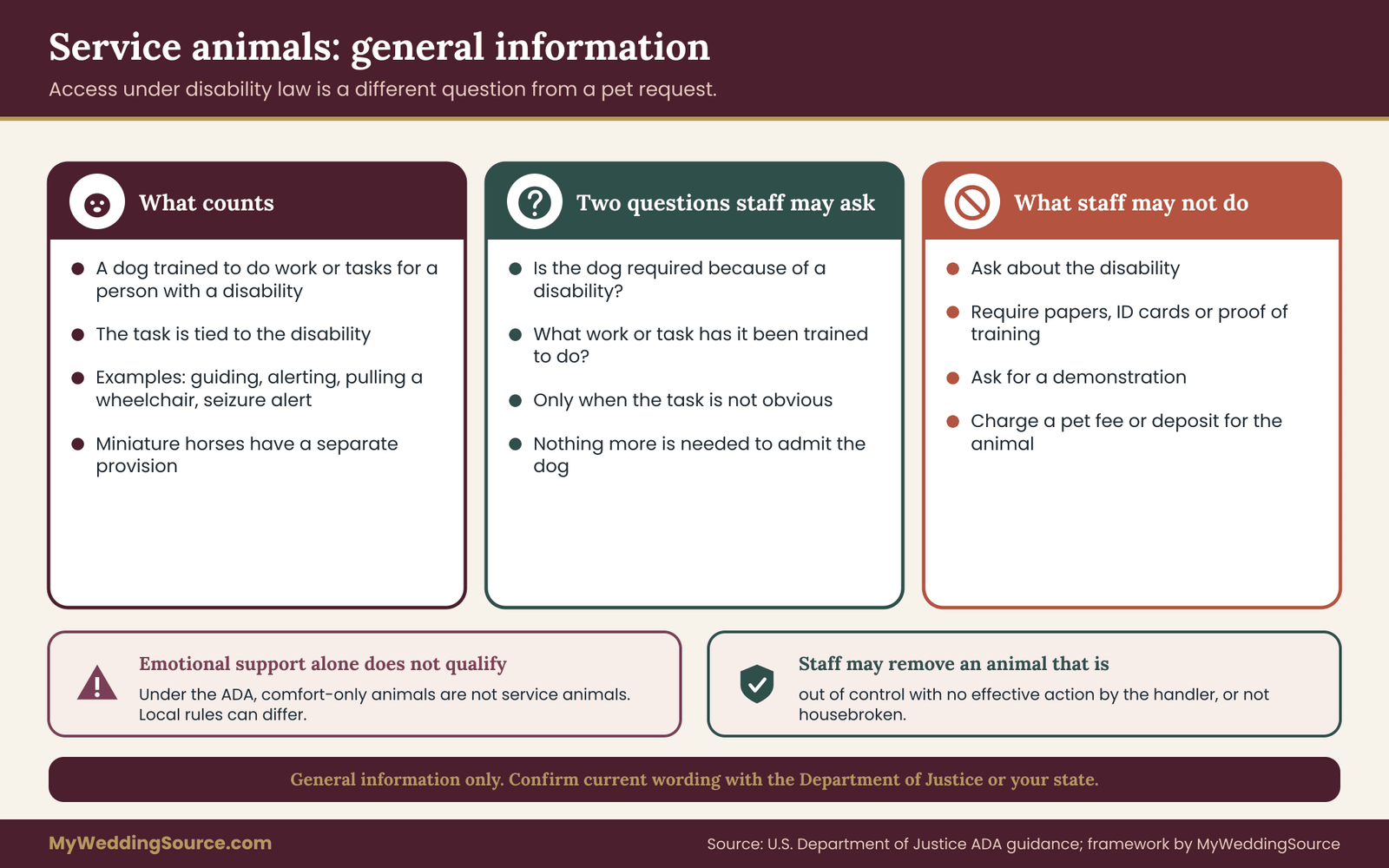
Under the Americans with Disabilities Act, as the Department of Justice explains it, a service animal is a dog that has been individually trained to do work or perform tasks for a person with a disability. The task must be directly related to the person’s disability. Examples include guiding a person who is blind, alerting a person who is deaf, pulling a wheelchair, alerting to a seizure or interrupting a harmful behavior linked to a psychiatric condition.
Several things are not service animals under the ADA. Dogs whose only function is comfort or emotional support do not qualify. Animals of other species generally do not qualify either, with a separate provision for miniature horses that is subject to its own conditions. A dog that is a pet, however well-behaved and however beloved, is a pet.
Some state and local laws define service animals more broadly than federal law, and some housing and air travel rules differ from the rules for public places. That is why the question “what does our venue have to do?” has a local answer. The Department of Justice and your state’s civil rights or disability office are the places to check.
What venue staff may and may not ask
When it is not obvious what a dog does for a person, the Department of Justice says staff of a business may ask only two questions: whether the dog is required because of a disability, and what work or task the dog has been trained to perform. Staff may not ask about the person’s disability, may not require medical documentation, a special ID card or proof of training, and may not ask the dog to demonstrate its task.
A venue also generally may not charge a pet fee or deposit for a service animal, or place the person in a separate area, because of the animal. The venue may still charge for actual damage in the same way it would for any other guest. These details matter for the couple because they explain why a venue cannot simply apply its general venue pet policy to a guest who arrives with a service dog, and why the venue’s staff are usually trained to handle the situation calmly.
When a venue may ask a service animal to leave
The same guidance describes two situations. The animal may be removed if it is out of control and the handler does not take effective action to control it, or if it is not housebroken. The person is then free to return without the animal. These rules protect everyone’s comfort and safety, and they are a reminder that a service dog is expected to behave in public.
The handler, not the venue, is responsible for care and supervision of the animal. Venue staff are not required to feed, walk or look after a service animal.
Why a pet cannot borrow the label
It can be tempting to describe a beloved pet as an emotional support animal and hope the venue relaxes. Please do not. The label does not carry the legal weight many people believe it does in a venue setting, and misrepresenting a pet can cause real harm: it makes staff more suspicious of genuine service animal teams, and it can lead venues to question or turn away people who truly need their dogs.
It also creates a practical problem for you, because a pet in a service-animal vest is still an animal in a crowded room with no specific training and no easy way out.
If you want to include a pet in your wedding, choose one of the approaches in the next sections and ask the venue honestly. A clear, truthful request has a better chance than a workaround, and it never puts anyone else at risk.
If a guest or one of you has a service animal
This is the situation where the venue pet policy most often goes wrong, and where a little advance planning pays off.
If one of the couple has a service animal, tell the venue in your first conversation about the rental and describe the practical needs: the route from the entrance to the ceremony space, a spot where the dog can lie down without being stepped on, access to water and a relief area, and a plan for the first dance, the processional and the cake cutting. You do not need to prove anything, and the venue cannot ask you to. You are sharing information so everyone can plan well.
If a guest has a service animal, you do not need to ask the guest for documentation, and you should not. If the guest mentions the animal on an RSVP, ask what would help: a seat near an aisle, a place for the dog to lie down, a quiet spot nearby. Then tell the venue so the staff are not surprised.
Think about the other guests as well. Service animals are working, and guests should not pet, feed or call to them. A short line in your welcome notes or from the officiant, such as “Please let any working dogs focus on their person,” is enough. The wedding guest care planning guide on this site covers how to plan support for guests with different needs without singling anyone out.
What a service animal does not change about your pet plan
A service animal on the premises does not change the venue pet policy for pets, and it does not open the door for your own pet. If the venue pet policy bans pets, a guest’s service animal is not a precedent, and you should not cite it as one. Likewise, a service animal in your party does not mean the venue has to approve other animals.
Keep the two questions apart in your notes and in your emails: one is about access under disability law, the other is about a request for an exception to the venue pet policy for pets.
Quick reference for a conversation with the venue
You can keep the following short list in your notes before you call. These are general points, and the Department of Justice materials in the Sources section are the place to confirm current wording.
- Service animals under the ADA are dogs trained to do specific tasks for a person with a disability.
- Staff may ask the two questions only when the task is not obvious, and may not ask for papers.
- A pet fee or deposit generally does not apply to a service animal.
- Emotional support animals are not service animals under the ADA, and local rules may differ.
- The handler is responsible for the animal’s behavior and care.
- Your own pet is a separate question from access for a service animal.
Venues that sit outside the usual rules
Not every venue falls under the same set of rules. Private clubs and religious organizations have some exemptions under the ADA, and a venue that is a private home or a family property rented only occasionally may fall under different rules from a hotel or a restaurant. A rented church hall run by a congregation may follow the congregation’s own policies.
Again, this is general background. If you are not sure which category your venue falls into, ask the venue plainly, and ask your state’s disability rights office if the answer matters for someone attending.
The takeaway is simple. Treat the service animal question as a matter of access and treat the pet question as a matter of permission. You can ask kindly about the second without ever confusing it with the first.
The nearby portrait plan: five rungs from exception to keepsake
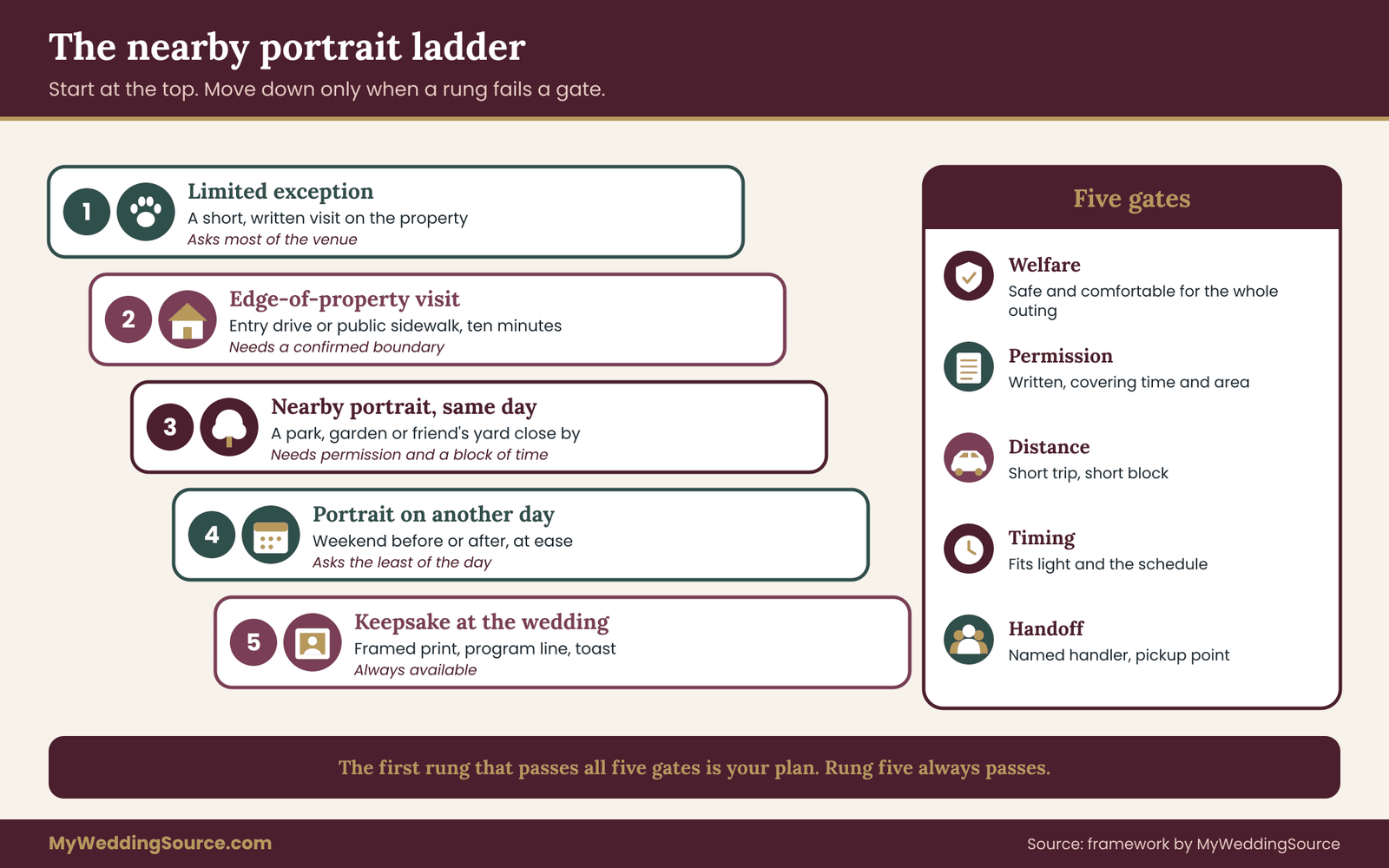
When the venue pet policy rules out an animal at the wedding, most couples jump straight to an unhappy compromise: no pet at all, or a pet photographed hurriedly in a parking lot. A better method is to treat the options as a ladder. You start at the top rung, which asks the least of the animal and the most of the venue, and you move down only when the rung above fails a check.
This section describes each rung. The next sections explain how to run the portrait itself and how to choose a care plan for the day.
The ladder is meant to be used in order, whatever your venue pet policy says. Do not skip to rung four because it feels safe if rung two would work. Each rung gives something up: time with the venue, convenience, or the sense that the pet was part of the day itself.
Rung one: a limited exception on the property
The first rung is a request for a narrow, written exception to the venue pet policy. It might be a ceremony photo on the lawn, a short appearance in the garden before guests arrive, or a walk through an outdoor space with a handler. It works best where the venue pet policy is permission-based or silent, and where the venue’s main concern is shared interiors or food service.
Keep the request small. A request for fifteen minutes on the south lawn has a far better chance than a request for the dog to attend the ceremony. If the venue says yes, write down the exact conditions, share them with your photographer and planner, and name the handler.
Rung one fails if the venue pet policy stays a firm no, or if the conditions it attaches are impossible: for example, a requirement for a fee you do not want to pay, or an insurance rider the venue will not describe clearly. In that case move down.
Rung two: a photo-only visit at the edge of the property
The second rung is a visit that never enters the venue’s controlled space. It might happen in the entry drive, the public sidewalk in front of the building or the parking area, and it often takes place before your rental begins or after it ends. It works with an indoor ban or a full ban only if the venue says the area outside the rental is not covered.
What makes this rung different from the first is that you are asking not for an exception to the venue pet policy but for confirmation that an area is outside the venue pet policy. Ask the venue to describe the boundary precisely, and ask whether the entry drive, a nearby sidewalk or a stretch of the lawn is on its property.
If the answer is a clear yes, the visit can be as short as ten minutes. If the answer is vague, do not guess. Move to rung three.
Rung three: a nearby portrait the same day
The third rung is a short portrait at a place near the venue that allows animals. It is the rung most couples end up using, and it is the heart of what this guide calls the nearby portrait plan. The place might be a public park, a garden, a downtown courtyard, a friend’s yard, a pet-friendly business or the grounds of your getting-ready location.
Three measurable checks keep the plan honest. The place should be close enough that the handler’s round trip, from home to the portrait spot and back, fits inside a block of time you are comfortable with. The place should be on the way or a short detour from where you and your photographer already need to be. And the place should have confirmed rules: a public park may require a leash, a permit for professional photography or a fee, and a private garden will need the owner’s permission.
The National Park Service and many city and county park departments publish their pet and commercial photography rules online, and those rules differ widely. Treat any park as unconfirmed until you have read its current page or asked its office.
Rung four: a portrait on a different day
The fourth rung moves the portrait away from the wedding day entirely. You might do it the weekend before, the morning before the ceremony at home, or the weekend after. A different-day portrait is often the best result for the animal and for the photo, because the animal is at ease, the light is chosen rather than inherited, and no one is racing a schedule.
It works especially well for animals that are older, anxious, easily overheated or new to crowds. It also works for animals that do not travel well. The cost is that the portrait does not capture the wedding clothes unless you plan for that. Some couples wear the outfits for a short session before the wedding. Others take the portrait in everyday clothes and have the animal appear in a framed print on the welcome table.
If you want the clothes in the picture, plan the session around the practical fact that pet hair and dirt travel. Take the pet portrait before the dress or suit is put on for the day, or take the dressed portrait for a short window at the end of the session, and have a lint roller and a spare cover ready. Dry-clean or steam only after the session.
Rung five: the pet is celebrated without being present
The fifth rung is the one that most couples dread and some find most peaceful. The animal stays home, and you include the pet through a keepsake: a framed portrait on the welcome table, a line in the program, a mention in a toast or a paw print on a card. This rung asks nothing of the animal and nothing of the venue, and it costs very little.
It is the right choice when the animal would be distressed, when the logistics do not work, when no rung above is approved, or when a veterinarian suggests the day would be hard. It is also the right choice when a pet has died and the couple wants to remember it. Naming a pet in a program is a gentle way to say that it mattered.
Five gates every rung must pass
Each rung above has to pass five gates, whatever the venue pet policy allows, before you commit to it. Think of them as five yes-or-no questions, answered in this order.
Welfare gate. Would the animal be safe and reasonably comfortable for the whole outing, including travel, waiting, heat or cold, noise and handling by strangers? If anyone who knows the animal well says no, the rung fails.
Permission gate. Is there written permission from whoever controls the place, and does it cover the exact time and area?
Distance gate. Is the portrait spot close enough that the round trip and the visit together fit in a block of time that is easy on the animal and the handler?
Timing gate. Does the visit fit the day’s schedule, including light, the photographer’s availability, hair and makeup, and the venue’s arrival times, without squeezing anyone?
Handoff gate. Is there a named handler who is not in the wedding party, a clear pickup point and a plan for what happens afterward?
How to choose a rung
Work from the top. For each rung, ask the five gate questions. The first rung that passes all five is your plan. If none passes, rung five is always available, and it always passes.
Be honest about the gates. A common mistake is to treat a vague answer as a pass. “I think the park is fine with dogs” is not permission. “The handler can be there at 9:30” is not a handoff if the handler is also a bridesmaid. A rung that passes only because of optimism will fail on the day.
It also helps to record which rung you chose and why. A line such as “Rung three: Millbrook Garden, 9:15 a.m., confirmed with the garden office by email on October 4” is all you need. Share it with your photographer, your planner and the handler.
The ladder protects the relationship with the venue
There is a quiet benefit to climbing in order. Each time you ask the venue a narrow question and accept the answer graciously, you build goodwill that will matter for the rest of your planning. A venue that sees you respecting its rules is more likely to help with loading, timing, extra chairs or a late request. A couple who argues the venue pet policy or tests it tends to find the venue less flexible on everything else.
Running the nearby portrait so nobody is rushed
A nearby portrait is a small production with three moving parts: the animal, the handler and the photographer. Run it like a short, well-planned appointment rather than a bonus scene squeezed into a busy morning. The goal is a handful of good frames and an animal that goes home calm.
Build a handler block, not just a photo slot
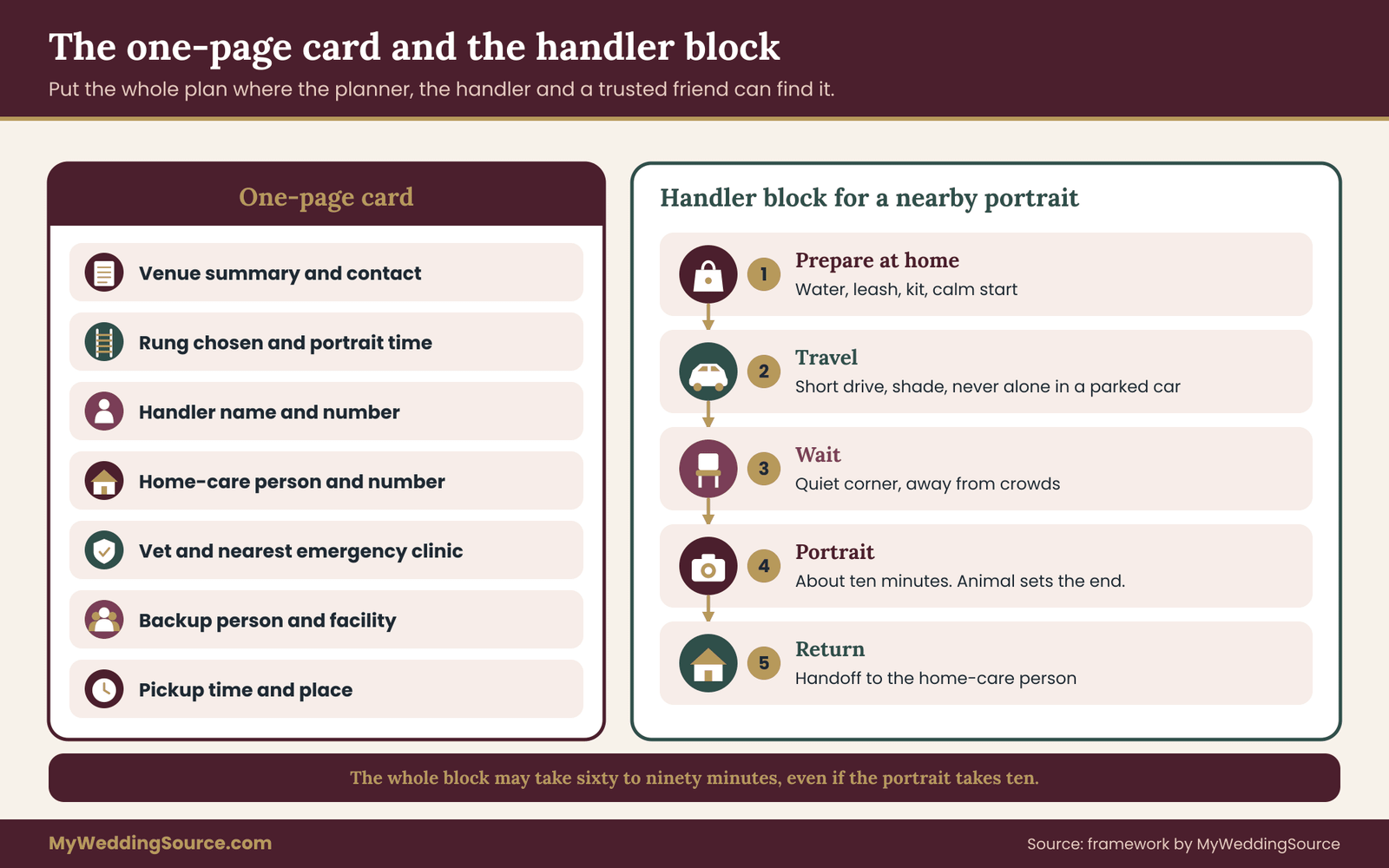
Think in terms of the handler’s whole block of time rather than the minutes in front of the camera. A block has five stages: preparing at home, traveling, waiting for the photographer, the portrait itself and the return trip. The portrait may take ten minutes. The block around it may take sixty to ninety, and every stage has to be comfortable for the animal.
Set the block’s length by asking the veterinarian or someone who knows the animal well how long the animal can comfortably be out and about, and add a margin. If the answer is short, choose a closer spot or move down the ladder. A good rule of thumb for your own planning: if the handler cannot say the plan out loud in two sentences, including the pickup time, it is too complicated.
Choose a portrait spot with a short checklist
Visit the spot ahead of time, ideally at the hour you will use it. Check six things. Is there shade, and will the sun move before you arrive? Is the footing safe, with no hot pavement, broken glass or slippery stone? Is there a quiet corner where the animal can wait away from crowds and other dogs? Is there somewhere to park close by, so the animal does not walk far? Is there water nearby? And are the rules posted or confirmed, including leash, hours and any photography permit?
If the spot is a public park, ask its office whether professional photography needs a permit or a fee, and whether a single photographer with a small camera counts. Rules vary a great deal between parks, and an unpermitted session can be shut down, which is the last thing a nervous animal needs.
Agree a short shot list with your photographer
Photographers are used to working fast, but animals are not. Agree a short list before the day so the portrait finishes quickly. A useful list has four items: one portrait of the animal alone, one with both partners, one with the handler out of frame holding the lead, and one close detail such as the collar tag or the paws. If the animal is calm and the light is good, add one more.
Tell the photographer plainly that the animal’s comfort sets the end of the session, not the clock. If the animal shows signs of stress, such as panting, pulling away, tucking the tail, yawning repeatedly or refusing treats, the handler calls time and the session ends. Agree this in advance so nobody feels awkward.
Ask the photographer whether they have worked with animals, whether their insurance covers an outdoor off-site session and whether they would take the portrait at a time other than the day itself. The wedding family photo list guide on this site explains how to sequence family portraits, and a pet portrait fits well alongside the same kind of list.
Pack a small kit
The handler carries a small kit: a sturdy leash and a well-fitted harness or collar with a current ID tag, water and a bowl, waste bags, a towel, a familiar blanket, treats the animal already likes, a lint roller for the people who will be photographed, and a printed note with the veterinarian’s contact details. If the animal is on medication, pack the day’s doses as well.
Never leave an animal in a parked car, even for a few minutes. Cars heat up quickly, and the American Veterinary Medical Association warns against it. If the handler needs to leave the animal, someone else must stay with it.
Plan for weather and delays
Pick a backup that does not require a different permission. A covered porch at the getting-ready location, a garage with the door open or a hallway with a plain wall can all serve as a fallback. If the weather is hot, move the portrait to the cooler end of the morning. If it is wet or windy and the animal dislikes it, skip to the next rung and use a different-day portrait.
Build a margin on the day. If the portrait runs late by twenty minutes, the handler should be able to leave anyway. A common source of regret is a handler who stays through a delay because the couple is not quite ready and then misses the home-care handoff. Decide beforehand which comes first, and make sure it is the animal.
A home-care matrix for the day the venue pet policy keeps the animal out
If the portrait is only the first part of the plan, and the venue pet policy rules out any wait at the venue, the second part is where the animal spends the rest of the day. A venue pet policy that bans animals also means the animal cannot be tucked into a quiet back room of the venue, which some couples might otherwise have hoped to do. You need a real home-care plan, and the best way to choose one is to compare a few options against the same four checks.
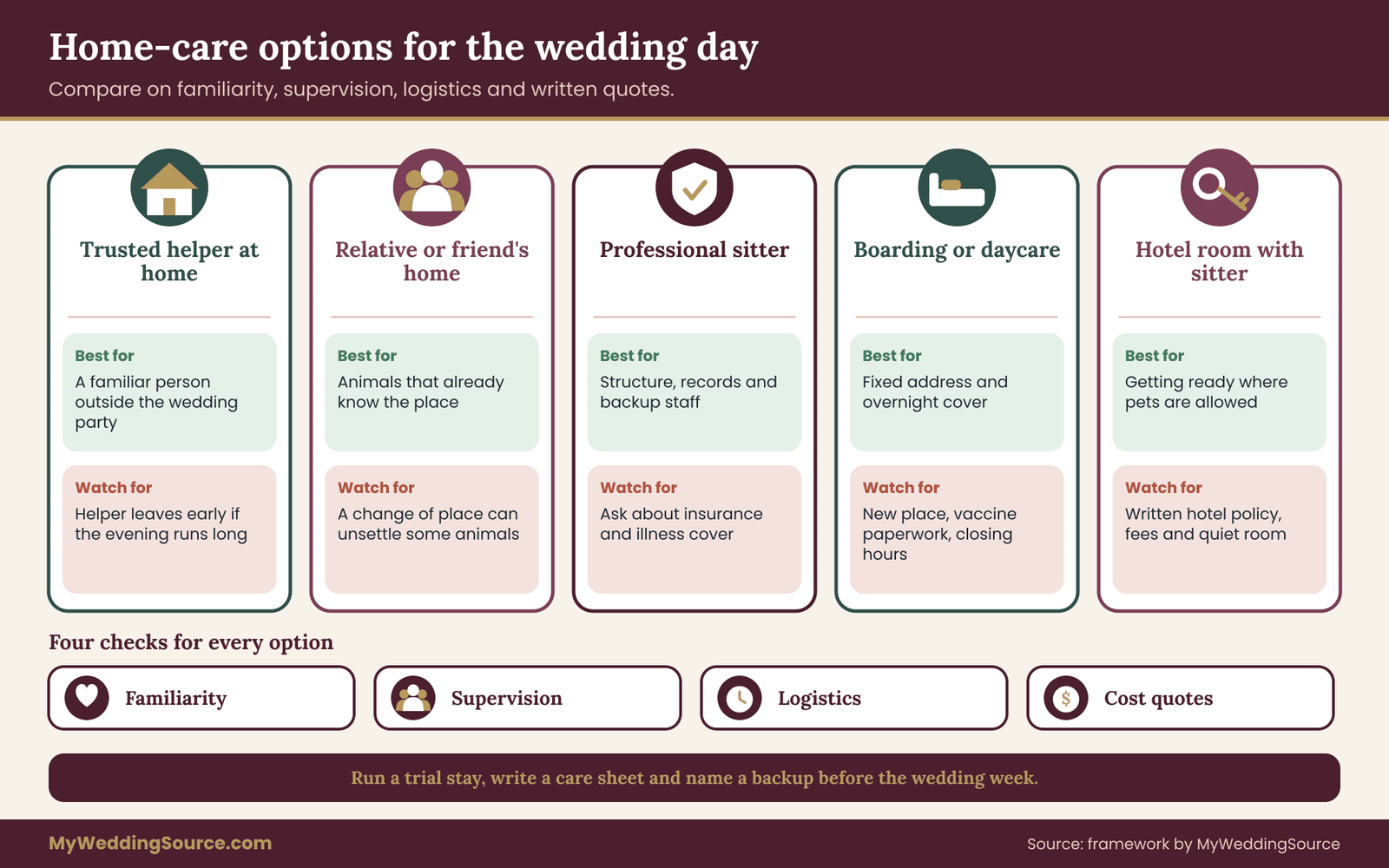
The four checks
Familiarity. How well does the animal know the place and the people? A familiar home with a familiar person is usually the least stressful. A boarding facility the animal has never visited is usually the most.
Supervision. How many hours will the animal be alone, and who can respond if something goes wrong? Ask the veterinarian how long your animal can comfortably be without company, and aim well below that.
Logistics. How far is the place, how much travel does it involve, and does the pickup time still work if the wedding runs late? A plan that depends on a tight handoff at midnight is a risky plan.
Cost logic. What does it cost, what do you get for it, and what is the cost of the alternative? Ask for written quotes, and compare what each includes. Do not rely on a guess or on someone else’s price from another city.
The options
Option one: the animal stays at home with a trusted person who is not in the wedding party. This is usually the most familiar and often the most affordable option. The person comes in the morning, stays through the key hours or visits at planned intervals, and has a written care sheet. The weakness is that your helper may have commitments and may be tempted to leave early if the evening runs long. Choose someone with no role in the ceremony and no reason to rush to the reception.
Option two: the animal stays at a relative’s or friend’s home. This is a good option when the animal already knows the place and the people. It also helps when your own home is far from the venue or when you are staying away the night before. The weakness is that some animals cope poorly with a change of place, and a house that works for a short visit may not work for an all-day stay.
Option three: a professional sitter. A professional who visits your home or stays there can provide structure, written records and backup if they have a team. Ask whether they carry insurance, how they handle emergencies, whether they require a meeting beforehand and how they respond if the sitter is ill on the day. Pet Sitters International and similar trade groups publish general guidance about what to ask a sitter, and it is a sensible place to begin.
Option four: boarding or daycare. A facility offers supervised care and a fixed address, which helps if you will be away overnight. It also has the largest unknowns. Ask about vaccination and health requirements, which can take weeks to complete, and ask about hours, since a facility that closes at 6 p.m. cannot help with a late reception. An animal that has not stayed there before should have a trial visit well ahead of the wedding.
Option five: a pet-friendly room at the getting-ready location or hotel, with a sitter. If the hotel or rental where you are getting ready allows animals, a sitter can keep the animal in the room and bring it out for a short portrait. This can be convenient, but it requires the hotel’s written policy, a quiet room away from the corridor and a plan for housekeeping. Confirm any pet fee and any limit on the time an animal can be left alone in the room.
Choosing among them
Rank the options on the four checks, and give extra weight to the first two: familiarity and supervision. A cheaper option that leaves a stressed animal alone for hours is not cheaper in any way that matters. A more expensive option that keeps the animal calm and supervised may be a very good use of money, particularly if you are already paying a wedding-day premium for other services.
Plan a trial. If you have chosen a sitter, a relative or a facility, run a short trial a few weeks before: a four-hour stay, then a full day. Watch how the animal eats, sleeps and greets you afterward. If the trial goes badly, you have time to change course.
The written care sheet
Whoever looks after the animal needs a written sheet. It lists feeding times and amounts, medications and doses, water and walking schedule, favorite toys and calming habits, the veterinarian’s name and number, the nearest emergency clinic, two contacts who can make decisions if you cannot be reached and a note about anything that worries the animal, such as fireworks, doorbells or other dogs. It also states the pickup or return time and who is authorized to approve treatment if a problem arises.
Confirm that the animal wears a current ID tag and, if it has one, that the microchip registration lists a phone number that will be answered on the wedding day. If the animal ever slips out, that registration is the fastest way home. Check the harness or collar for fit and wear before the day.
Plan the evening and the next day
Decide in advance what happens after the reception. Who collects the animal, at what time, and where does it sleep? If you are leaving for a honeymoon the next morning, book the boarding or sitter before anything else, because the wedding is the busiest week of your year and the last time you will think clearly about a dog’s dinner. Make sure the person on duty knows that the animal may be unsettled by the change in routine and has no need to be sociable.
Worked example: one couple, one dog and a venue pet policy with no exceptions
The following example is invented to show the method in action. The people, the animal, the places and the times are illustrative, and nothing here describes a real event or a measured result.
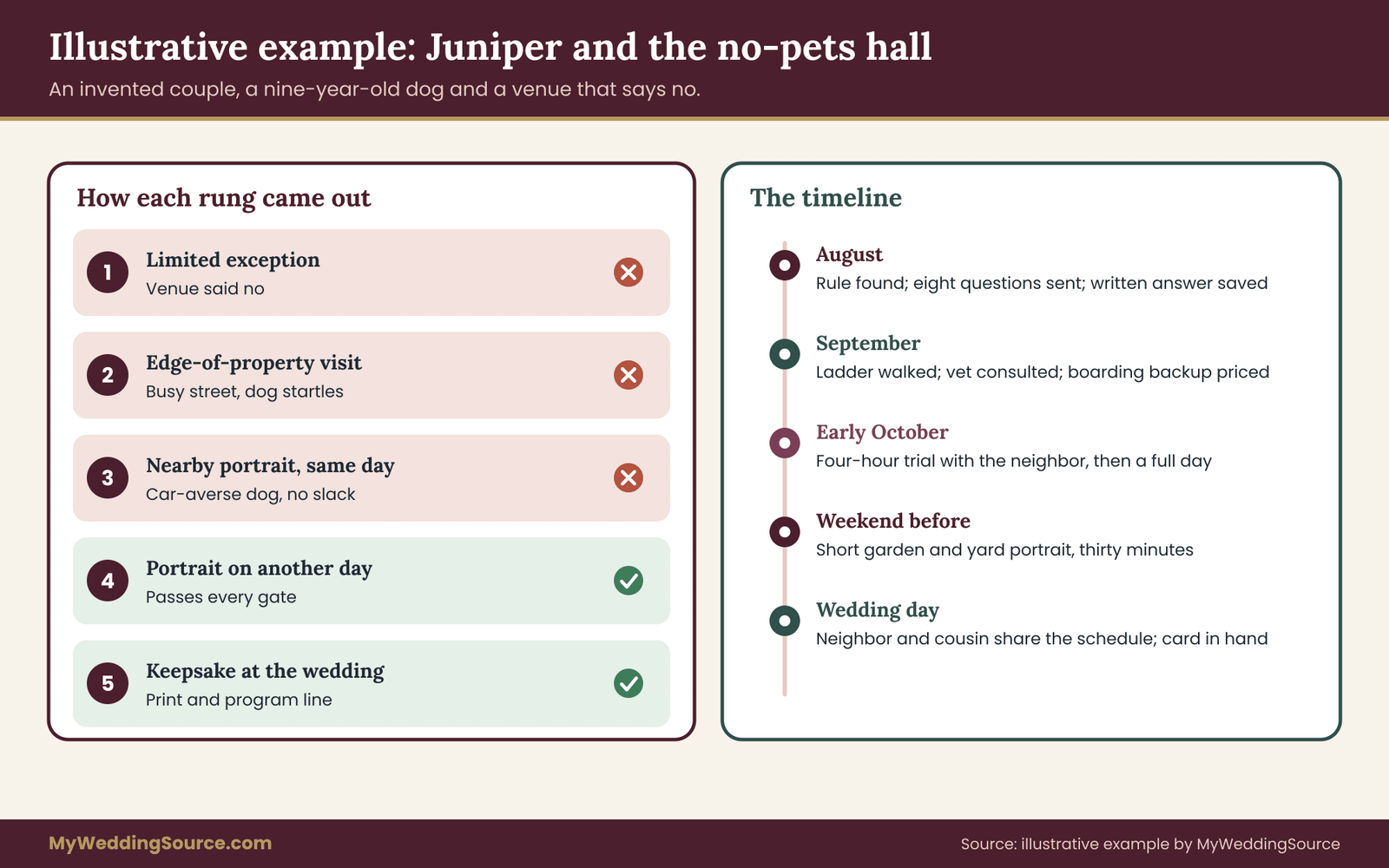
Priya and Marcus are marrying in a restored hall in the fall. Their dog, Juniper, is a nine-year-old beagle mix who sleeps most of the day, loves their neighbor, dislikes car rides and startles at loud noises. They signed the venue contract in the spring. In August, while rereading the attachments for a different reason, Priya finds a line in the house rules: “No animals permitted on the premises, indoors or outdoors, during the rental period.”
Step one: read and confirm
Priya emails the venue’s events director and asks the eight questions from earlier. The answers come back within two days. The venue pet policy covers the building, the garden and the parking lot. It applies from the start of setup until the end of teardown. There are no exceptions for pets, and the director says the owner would not approve one because of the hall’s insurance and the fact that food is served in the same room.
The venue follows applicable law for service animals. There are no fees because there is no exception.
Priya thanks the director and sends a one-line summary back: “Understood: no animals on the property for the whole rental, no exceptions.” The director replies “Correct.” Priya saves the thread in a folder labeled with the date.
Step two: walk the ladder
Priya and Marcus take a piece of paper and go down the ladder, treating the venue pet policy as fixed.
Rung one, a limited exception. The director has already said no. It fails the permission gate. They do not push.
Rung two, a photo-only visit at the edge. Priya asks whether the public sidewalk in front of the hall is part of the property. The director says the sidewalk belongs to the city, but the lot behind it does not. A visit on the public sidewalk would be outside the venue pet policy, but the sidewalk is on a busy street with a bus stop. It passes the permission gate and fails the welfare gate, because Juniper startles at buses and traffic.
Rung three, a nearby portrait the same day. A garden is twelve minutes from the hall, and its website says leashed dogs are welcome. Professional photography needs a permit, and the office does not answer by the end of the week. The ride is the bigger problem. Juniper dislikes car rides, and the garden would add two trips on a day with no slack.
The veterinarian, when Priya asks, says a short ride would likely be tolerable but that a wedding morning with extra stress is not what she would choose for a nine-year-old dog. Rung three fails the welfare and timing gates.
Rung four, a portrait on a different day. The weekend before the wedding, the couple can take Juniper to the garden for a short midday visit, on a day with no other pressure, in casual clothes. They can also take a second set at home in the yard in their outfits, without the car ride. The photographer agrees to a thirty-minute session and a lower fee than a full day, which Priya asks about directly instead of assuming. It passes every gate.
Rung five, a keepsake. They also choose to print one portrait for the welcome table and to add a short line in the program. This costs almost nothing, and it gives guests something to smile about.
Step three: choose the home-care option
Priya and Marcus compare options against the four checks.
Their neighbor, Dana, has known Juniper for years, is not in the wedding party and has said she would be glad to help. That is familiar and supervised. Dana works until noon on the wedding day, so Priya asks her whether she can be at the house by one o’clock.
That leaves a gap in the morning, so Marcus’s cousin, who is not attending the wedding, offers to sit with Juniper for the morning. Two handoffs are more complex than one, but both people are familiar, and they write the schedule on the care sheet.
A boarding facility would have supervision but would be a new place and would need vaccination paperwork. The couple judge that stress is the greater risk, and they put the facility down as the backup in case Dana or the cousin cancels. They call it in September and learn what proof of vaccination it requires and how long it takes to process.
They run a trial in early October. Dana stays for four hours on a Saturday afternoon. Juniper eats, sleeps and greets them calmly. The couple raise the plan to a full-day trial a week later, and again it goes well.
Step four: check the cost logic
Priya and Marcus do not guess at prices. They ask Dana whether she would like a gift or a payment, and they get quotes from the boarding facility and from one professional sitter. They note what each quote includes: number of visits, medication, overnight care, cancellation terms. The cheapest plan with the most familiar person is the one they choose, and they keep the quotes in the file in case a change is needed.
Step five: the written plan
The final plan fits on one page. It lists the rung (four, with five as the keepsake), the portrait date and time, the people involved, the home-care schedule for the wedding day, the backup, the care sheet location, the vet’s contact and the date by which each task must be done. Priya sends it to the photographer, the planner and both helpers.
On the wedding day, nobody needs to think about the dog. The plan has already done that for them.
What the example shows
Three lessons stand out. The first is that the plan changed several times as the gates failed, and each change was cheap because the couple moved early. The second is that the choice of rung followed the animal’s needs, not the couple’s wishes. The third is that the venue pet policy never became an argument. It was a fixed fact, and the couple spent their energy on the parts they could change.
Vendors, contracts and the day-of handoff when the venue pet policy limits animals
Several people have to know the plan, and each of them needs slightly different information. This section lists what to tell and ask each one, and how to put the plan into a contract, a timeline and a one-page card for the day.
Questions for the photographer
Ask whether the photographer is comfortable working with animals and whether they have done an off-site or different-day session before. Ask whether a pet portrait is included in your package or priced separately, and whether the contract covers a second location, travel time and any permit fees. Ask how they handle an animal that will not cooperate, and agree that the animal’s comfort ends the session. Ask about image rights and delivery for the portrait session so that it is covered by the same terms as the wedding gallery.
The wedding vendor timeline guide on this site shows how to line up vendor arrivals and handoffs, and the pet portrait should appear on the same page.
Questions for the planner or day-of coordinator
Give the planner the confirmed venue pet policy summary and the rung you chose. Ask who will answer if a guest arrives with an animal, how the venue contact will be told about a service animal and who will hold the handler’s phone number. Ask the planner to treat the pet plan as a real item on the schedule, with a start, an end and a named person.
Questions for the sitter, relative or facility
Ask each of them the same set of questions. When can you arrive and leave? What happens if you are ill or delayed? Who do you call if the animal is unwell? Do you have the authority and the means to take the animal to a clinic? What have you done in an emergency before? For a professional, ask about insurance and written terms. For a facility, ask about hours, health requirements and cancellation policy.
Putting the plan in writing
Add the portrait to the photographer’s contract, with date, place, length and fee. Add the pet-care arrangement to a short written agreement with a professional sitter or facility, covering dates, times, tasks, fees and cancellation. For a friend or relative, a shared message with the same details is enough. If any part of the plan depends on the venue, such as a confirmed boundary or an exception, keep the venue’s email attached to your planning file.
The wedding vendor due diligence checklist on this site covers how to verify a vendor before you rely on them, and a pet sitter or a boarding facility deserves the same care as a florist or a caterer. A sitter you have never met is not a safe plan for the one day you cannot easily intervene.
The one-page card for the day
Print a card with the following: the venue pet policy summary and the venue contact, the rung and the portrait time, the handler’s name and number, the home-care person’s name and number, the veterinarian and the nearest emergency clinic, the backup person, and the pickup time. Give copies to the planner, the handler and one of your parents or close friends who is not in the wedding party. Keep a copy in your own bag.
Telling guests about the venue pet policy
If guests may expect to see your pet, for example because you have talked about the dog for years, a short line on your website or in your invitation suite can avoid confusion. A phrase such as “Our dog will be celebrating at home” is friendly and clear. If any guests might bring their own animals, say plainly that the venue does not allow animals other than service animals, and ask them to tell you about any questions in advance.
The wedding planning checklist on this site is a good place to add a line for animal arrangements alongside the other tasks you track.
Edge cases when a venue pet policy gets in the way
The ladder handles the common situation, in which the venue pet policy is simply a firm no. A few less common ones deserve their own notes, because they change which rung is sensible or whether the venue pet policy is even the right thing to focus on.
You have not signed yet. If the pet matters a great deal and the venue pet policy is firm, you can still choose to look elsewhere. Before you do, weigh the whole venue against one rule. Ask yourself whether a nearby portrait and a good home-care plan would give you most of what you wanted.
For many couples the answer is yes, and the venue’s other qualities outweigh the venue pet policy. If the answer is no, compare venues that allow animals using the venues guide and the same checks of price, access and capacity, and read the new contract’s wording as carefully as the old one.
You have signed and the cancellation terms are costly. Changing venues for a pet is rarely worth the lost deposit. Read your cancellation and transfer terms before you consider it, and talk to a qualified adviser if the sums are large. The wedding vendor contract guide on this site explains the common terms.
The venue changes the venue pet policy after you book. Rules can change when a venue changes owners, insurers or managers. If the new rule is stricter than the one you signed, ask whether the original terms still apply to your rental, and ask for the answer in writing. A change in an important term after signing is worth raising politely with the venue’s management.
The ceremony and the reception are in different places. Many couples have a ceremony at one site and a reception at another. Each place has its own rule. A church may allow a dog in the courtyard for a minute and a banquet hall may not. Ask both places separately, and consider using the more permissive one for a short portrait.
The venue has its own animals. Farms, ranches, vineyards and some barns keep livestock, dogs or cats on the property. A venue that allows its own animals but bans yours may seem inconsistent, but the reasons can be legitimate: its animals are trained to the setting, they are covered by its insurance, and they are not a new element on a day with strangers.
Treat the farm animals as part of the scenery, ask the venue about contact rules for guests and children, and do not use their presence as an argument for an exception.
Someone in the wedding is allergic. If a partner, a family member or a guest has a serious allergy, the animal’s presence may be a health problem rather than a convenience problem. A portrait taken at a distance from the person, and a dressed portrait taken well before they put on their wedding clothes, can protect them. Ask the person what would help, and do not guess at their threshold.
Guests plan to bring their own pets. If a guest asks to bring an animal, tell them kindly that the venue pet policy does not allow it, unless it is a service animal. Offer a practical alternative, such as a suggestion for a local boarding option. Do not make the guest justify their question.
A guest arrives with an animal anyway. Prepare one calm sentence for staff or your coordinator: “The venue does not allow animals here. Would you like help finding a safe place for yours?” If the animal is a service animal, venue staff know what they may ask, and the two questions earlier in this guide apply. Do not argue in front of other guests.
The pet is very old, ill or recovering. A rung that would be fine for a healthy animal may be wrong for this one. Ask the veterinarian before any outing, any boarding stay and any change of routine. For some animals, the kindest plan is a different-day portrait at home in comfortable surroundings and a quiet wedding day with a familiar person nearby.
The pet has died. Many couples want to include a pet that is no longer alive, and a venue pet policy has nothing to say about it. A framed photograph on a memory table, a line in the program or a quiet moment in the toast are all possible. It is simple to start with one photo and one sentence, and to let the people who loved the pet add their own touch.
You have more than one animal. Count the handling needs, not just the number of animals. Two calm animals may be easier than one reactive one, but two handlers may be needed. Use the same gates, and consider photographing each animal separately before a group shot.
The animal is not a dog. Cats, rabbits, birds, small animals and reptiles each have different travel, heat and stress needs. Many of them do not travel well at all. A portrait at home is almost always the better choice, and a veterinarian who knows the species can tell you how long a trip is safe.
You are marrying far from home. For a destination wedding, taking an animal across state or national lines adds health papers, quarantine rules and transport risks. Check the destination’s rules with its official animal-health agency, and the airline’s rules if you fly. In most cases, the animal stays home and the portrait happens before you leave.
The weather turns extreme. Heat, cold, storms and smoke change the welfare gate on any outing. If the forecast is poor on a portrait day, move down the ladder. A skipped portrait is a minor loss. A stressed or overheated animal is a serious one.
When the plan itself fails
Even a good plan can fail. The sitter is sick, the photographer runs late, the animal refuses to eat. Decide in advance who can make decisions without calling you, and write down the order of fallbacks. The backup person, the backup facility and the veterinarian’s emergency contact belong on the card. A plan that needs the couple to solve problems on the wedding morning is not yet finished.
Keeping the animal in the story when the rules say no
A pet that cannot attend can still be part of the day’s meaning. The point is not to compensate the couple for a missing animal, but to include the animal in a way that fits the animal as well.
A few simple choices tend to work well. A framed portrait on the welcome table or beside the guest book lets guests meet the animal. A line in the program, for example “Juniper is cheering from home,” gives a smile without any fuss. The officiant or a toast can mention the pet’s name. A small photo on a keepsake such as a menu card or a favor tag can echo the portrait. After the wedding, a print of the portrait in your album or on the wall extends the memory.
Keep these touches modest. The aim is warmth, not a competition for attention. The same restraint applies to the portrait itself: a few honest photographs of the animal you know will mean more later than an elaborate set that the animal tolerated.
Your next steps
Start with the paperwork. This week, find the venue pet policy in your contract, house rules and website, and write down what it says about indoors, outdoors, service animals and exceptions. Send the venue the short questions from this guide, and ask for the answers in writing.
Then climb the ladder. Once you know what is allowed, choose the highest rung that passes the five gates: welfare, permission, distance, timing and handoff. Book the portrait, brief the photographer and write down the date. Next, choose a home-care option, run a trial, and write the care sheet. Finally, put it all on a one-page card, share it with your planner and your helpers, and add the dates to your planning checklist.
When the day comes, the animal will be safe and calm, the venue pet policy will be respected, the venue will have no reason to worry, and you will have your picture.
FAQ
Can I ask a venue to make an exception to its venue pet policy?
Yes, and a narrow, polite request has the best chance of changing how the venue pet policy applies to you. Ask for something small and specific, such as a fifteen-minute photo visit outdoors before guests arrive, with a named handler and a leash. Offer to follow conditions and to confirm in writing. Some venues will say no because of insurance or food-service rules, and that is a reason to move to a nearby portrait.
What is the difference between a pet and a service animal at a wedding?
Under the Americans with Disabilities Act, a service animal is a dog trained to perform specific tasks for a person with a disability. A pet is not, and comfort or emotional support alone does not qualify. A venue’s pet rule generally cannot be applied to a service animal in the same way. This is general information, and local rules may differ, so check the Department of Justice guidance.
Can my photographer take the portrait at a park?
Possibly, but confirm the park’s rules first, since the venue pet policy will not cover a park. Many parks require leashes and some require a permit or fee for professional photography. Rules differ by park and by city, county or national agency. Ask the park office in writing, and choose a backup spot, such as a covered porch or a friend’s yard, in case permission or weather fails.
Is it better to take the pet portrait before the wedding?
Often yes. A portrait taken the weekend before, or on a calm morning at home, gives the animal a relaxed setting and gives you control over light and time. The trade-off is that it will not show your wedding clothes unless you plan a short dressed session. If the animal is old, anxious or sensitive to heat, a different day is usually the kinder choice.
Who should look after my pet on the wedding day?
Choose someone the animal knows who is not in the wedding party and has no reason to leave early. Options include a trusted friend, a relative, a professional sitter or a boarding facility, and each has trade-offs. Run a trial stay before the wedding, write a care sheet, and name a backup. Ask your veterinarian how long your animal can comfortably be alone.
What should I do if a guest brings a dog despite the venue pet policy?
Stay calm and keep it private. Have your planner or a family member say, “The venue does not allow animals. Can we help find a safe place for yours?” If the guest says the dog is a service animal, staff may ask only whether the dog is required because of a disability and what task it is trained to do. They cannot demand papers.
Can I call my pet an emotional support animal to bring it in?
No. Emotional support animals are not service animals under the Americans with Disabilities Act, and misdescribing a pet can make venues more suspicious of people who truly rely on service dogs. It also puts the animal in a crowded setting with no training or exit plan. Choose a portrait and home-care option and ask the venue honestly instead.
How early should I ask about the venue pet policy?
As early as you can, ideally before you sign. Add the question to your venue comparison list next to price, capacity and accessibility. If you have already signed, ask within a few weeks of discovering the venue pet policy, so any exception has time to be approved and the portrait, sitter or boarding can be booked well before the wedding.
Sources
- Frequently asked questions about service animals and the ADA, U.S. Department of Justice, Civil Rights Division
- ADA requirements: service animals, U.S. Department of Justice, Civil Rights Division
- Americans with Disabilities Act home page, U.S. Department of Justice
- ADA National Network, information, guidance and training on the ADA
- FDA Food Code, U.S. Food and Drug Administration
- Healthy Pets, Centers for Disease Control and Prevention
- American Veterinary Medical Association, pet owner resources
- Animal Welfare, Animal and Plant Health Inspection Service, U.S. Department of Agriculture
- National Park Service, visiting parks with pets
- Pet Sitters International, pet care professional resources