

A live wedding painter creates an artwork during your celebration, and the decisions that decide whether you love the result are made months earlier on paper: how big the canvas is, who holds the rights, and how the finished piece gets safely into your home. This guide gives you a written scope you can hand to any artist, plus a care checklist for the weeks after the event.
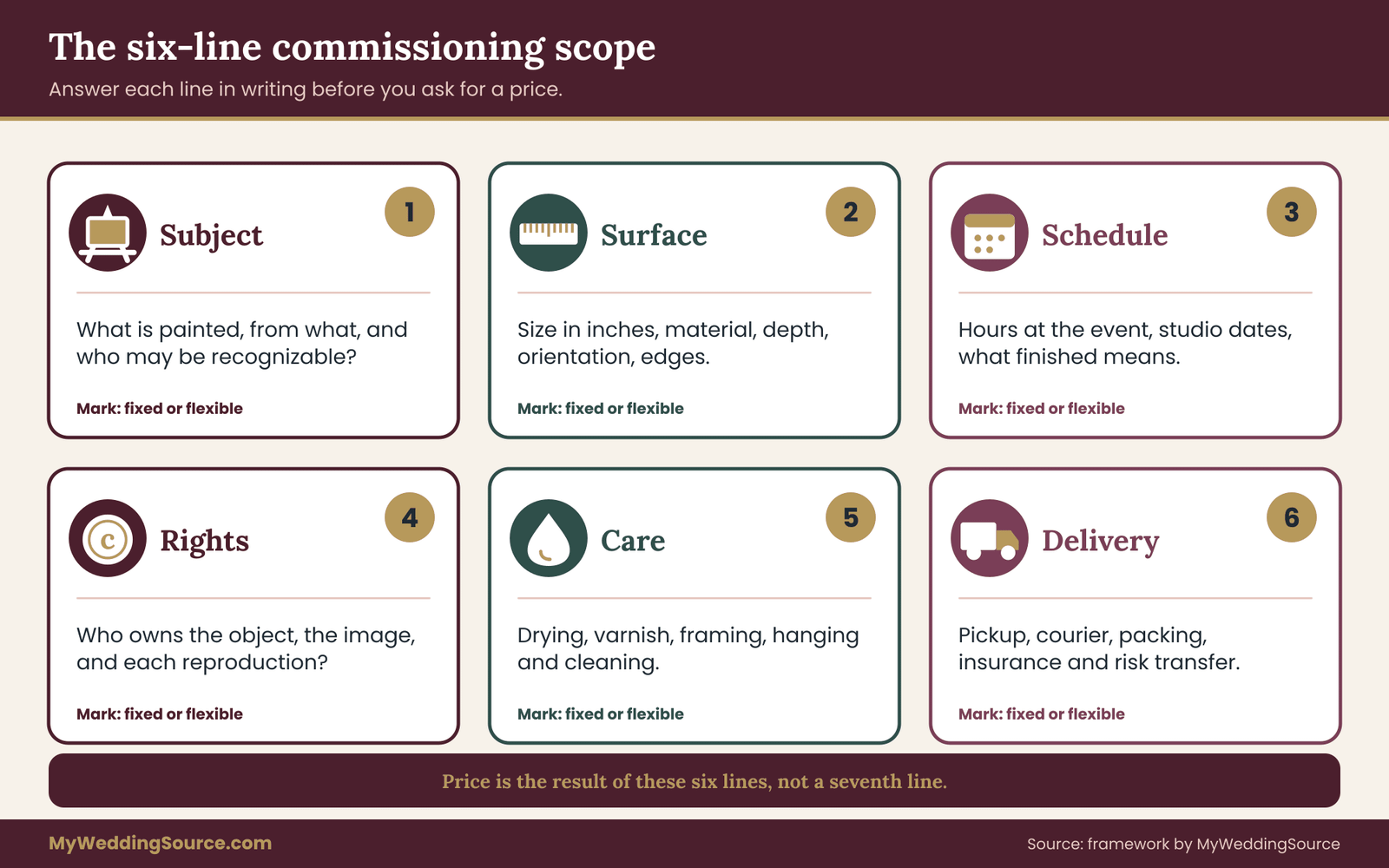
Before you book a live wedding painter, settle six lines in writing: subject (what gets painted), surface (canvas size and orientation), schedule (when the artist works and when the piece is finished), rights (who owns the object and who may copy the image), care (drying, varnish, framing) and delivery (who carries it, ships it and insures it). Choose the canvas by the wall it will hang on and the car it must ride in, not by how big it looks on a screen. Expect it to be wet at the end of the night.
Most couples who consider a live painter picture one moment: an easel near the dance floor, a brush moving, guests drifting over to watch.
That picture is accurate and it is the easy part. The hard part is everything the picture leaves out. How large is the canvas, and does it fit through your front door? Will it be finished at midnight, or is it a loose underpainting that the live wedding painter completes in a studio over the next month? May the live wedding painter post it, sell prints of it, or use it in an advertisement?
Who carries a wet painting to a car at the end of a long night?
None of these questions is difficult once they are asked. They only become difficult when they are asked after the contract is signed, or after the painting is already in the trunk. The goal here is a short document, which this article calls a commissioning scope, that makes the answers explicit while changing your mind is still free.
A note on scope. This is general information, not legal, tax or financial advice. Copyright, contract and consumer rules differ by state and by situation, so where a rule matters the article points you to the agency that issues it and suggests that you confirm the current version.
What a live wedding painter actually delivers
The phrase “live wedding painter” covers several different services, and they do not carry the same risks. Before comparing quotes, decide which one you are really buying, because two artists with the same hourly rate can be offering very different products.
A scene painting. The artist stands at an easel and paints the ceremony, the reception room, the venue exterior or the couple’s first dance, working from the scene in front of them. This is the classic form. The finished piece is a memory object that you hang at home. It tends to be a medium or large canvas, and it often needs studio finishing after the event.
A portrait painting. The live wedding painter paints the couple, sometimes from a pose held briefly during the evening, sometimes from reference photos taken that night. Because faces are unforgiving, many portrait painters complete the likeness in the studio and use the live session mainly for the underpainting and the atmosphere.
A guest-participation painting. The live wedding painter prepares a canvas with an outline or a loose composition and guests add strokes, thumbprints or dots. This is closer to an activity than to a commission. It produces a piece that records who was there, and it raises its own questions about supervision, materials and what the artist is actually responsible for finishing.
A series of small pieces. Some artists paint several small panels during the event, for example one per hour or one per table. The pieces are smaller and quicker, and they can serve as gifts or place keepsakes.
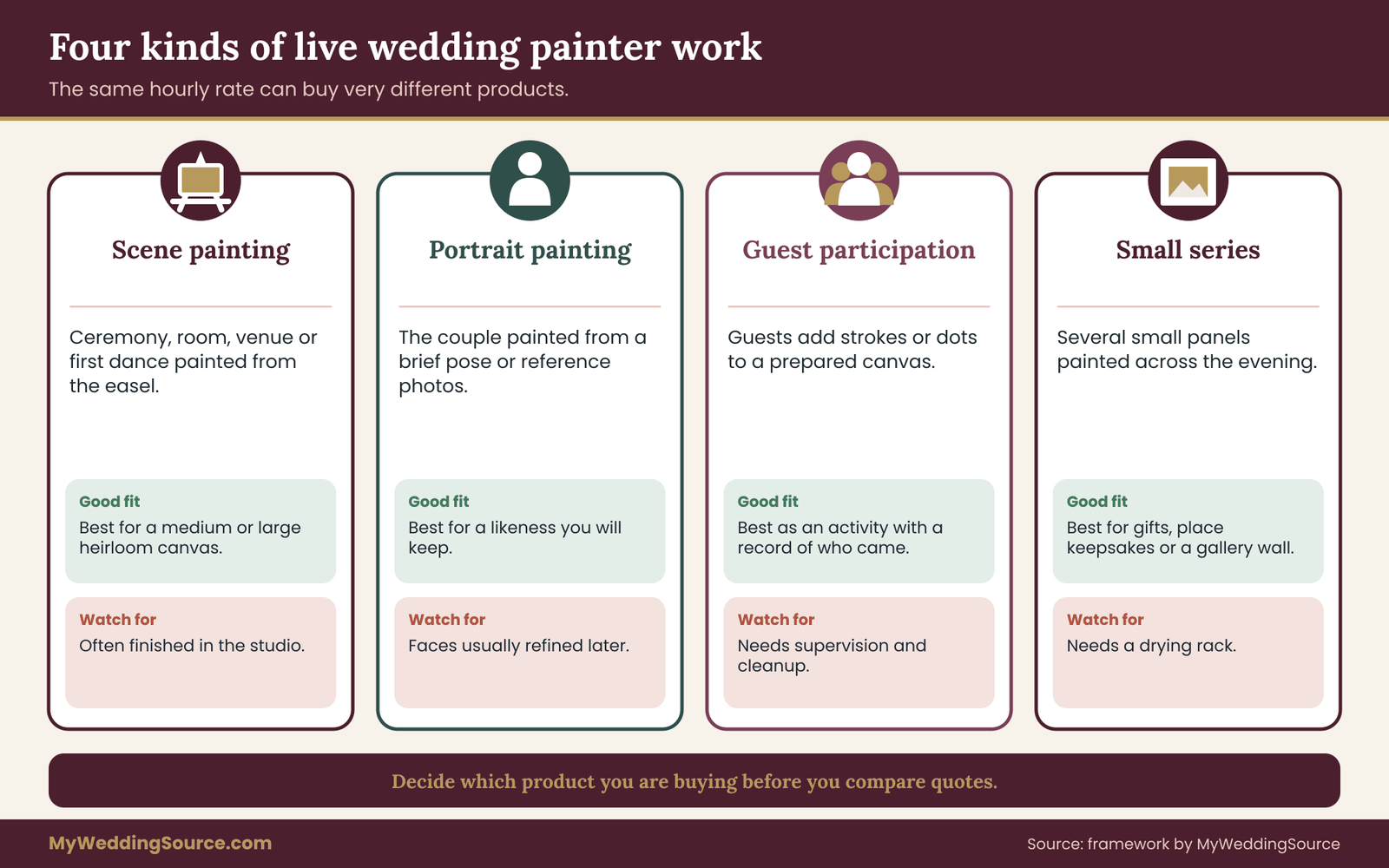
These categories blur at the edges, but the distinction helps with every later decision. A scene painting needs a good sightline, a stable easel and a clear view of the thing being painted. A portrait needs a model and a pause. A participation canvas needs a table, a supply tray and an adult who watches the brushes. A series needs a steady supply of small surfaces and a place to dry them.
What the live portion can and cannot produce
It is worth saying plainly what a few hours of painting at a party can do. Paint takes time to dry, a venue is rarely lit like a studio, and the live wedding painter is being watched, bumped and talked to. Many artists therefore treat the event as the first stage of the work. They capture composition, movement and color relationships live, and they refine edges, faces and details afterward.
That is not a flaw. It is how many commissioned pieces are made, and an honest artist will tell you so. The risk lies in an unspoken assumption: you may expect a finished painting at the end of the night while the live wedding painter expects to deliver a nearly finished one weeks later. The scope in the next section closes that gap with a single line, the schedule line, that states exactly what “finished” means and when it happens.
Where this sits among your reception decisions
A painter is one element of the evening, not the whole of it. The artist’s easel takes floor space, needs light and holds attention, so it interacts with your seating, your service times and the routes guests walk. The guide to wedding reception guest flow covers how entry, seating, food and exit connect, and it is a useful companion for deciding where the easel can live without blocking the line to the bar. This article stays on the commissioning side: what you ask for, what you sign and what you do with the result.
The commissioning scope: six lines to settle before you book
A scope is a one-page statement of what the artist will do, what you will receive and who is responsible for what. It is not a contract by itself, but it becomes the backbone of one. Writing it first has a practical benefit. When you send the same six questions to three artists, their answers are comparable, and the differences show you what you are really paying for.
The six lines are easy to remember because each one answers a plain question.
1. Subject. What is being painted, and from what? A named scene, the couple, a group, or a composition the live wedding painter chooses. Say whether faces are expected to be recognizable, whether the venue name may appear, and whether any person should be excluded.
2. Surface. What is the painting on, how large is it, and which way does it face? Canvas, panel or paper; the exact dimensions in inches; portrait, landscape or square; stretched, framed or unframed.
3. Schedule. What does the live wedding painter do before, during and after the event, and what counts as finished? Arrival time, painting hours, breaks, studio completion date, and the date by which you will have the finished piece in hand.
4. Rights. Who owns the physical painting, who owns the copyright in the image, and what each side may do with photos and reproductions. This is the line couples most often skip.
5. Care. Drying time, varnishing, framing, hanging and cleaning. Who does what, and what the artist recommends you do and avoid.
6. Delivery. Pickup or courier, packing method, insurance, who signs for it and what happens if it is damaged on the way.
How to use the six lines
Send the six lines as questions, in that order, before you ask for a price. A good artist will answer most of them in a few sentences, because they have answered them many times. An artist who cannot say how large the canvas will be, or who answers the rights question with silence, has told you something useful before any money moves.
Notice that the price is not one of the six lines. Cost matters, and the wedding budget is where a line item for this belongs, but price is a result of the six decisions rather than a separate one. A larger surface, a longer studio finish, a broader reproduction license and an insured courier all add cost. Decide what you need first and the quote becomes easier to read.
Weighing each line honestly
Not every line deserves equal attention for every couple. A couple who plans to hang the piece in a hallway and never copy it can treat the rights line lightly, and a couple who lives in a small apartment should give the surface line its full weight. The point is to decide deliberately rather than by default.
One useful habit is to mark each of the six lines as “fixed” or “flexible” before you write to artists. A fixed line is a limit you will not move, such as a maximum canvas width because of a doorway, or a delivery date because of a family visit. A flexible line is something you will adjust to get a better fit. Telling an artist which lines are fixed saves a round of messages and makes it easier for them to say honestly whether they can do the job.
Finally, keep the scope in the same folder as the rest of your vendor documents. When a vendor contract arrives, you can lay the scope beside it and check that every line made it in. Anything that was promised in conversation but is missing from the paper is a gap to close before the deposit, not after.
Choosing the subject and canvas size for a live wedding painter
The subject and the surface are linked, so decide them together. A sweeping view of a garden reception needs more room than a close study of two people dancing, and a crowded scene shrinks every face on it. If you start with a size because it “feels right,” you may find that it cannot hold the subject you actually want.
Start with the subject, in one sentence
Write the subject as a single sentence that a stranger could follow. “The two of us during the first dance, with the string lights behind us” is workable. “Something that captures our day” is not, because it hands every decision to the artist and leaves you nothing to approve.
Then add the limits. Should guests appear as recognizable people or as softened figures? A painting that includes identifiable guests brings in questions about permission, which the section on rights covers later. Should the venue be named or shown clearly? Some venues have rules about commercial use of their image, and a painting that the live wedding painter later sells prints of is a commercial use. If you want children in the scene, say so, and say whether their faces should be recognizable.
A live wedding painter who works from the room will naturally paint what is visible from the easel. If the best view of the dance floor is from the far corner, the subject and the easel position are the same decision. Ask the live wedding painter to describe, before the event, what the painting will look like from the spot they intend to use.
Size from the destination backward
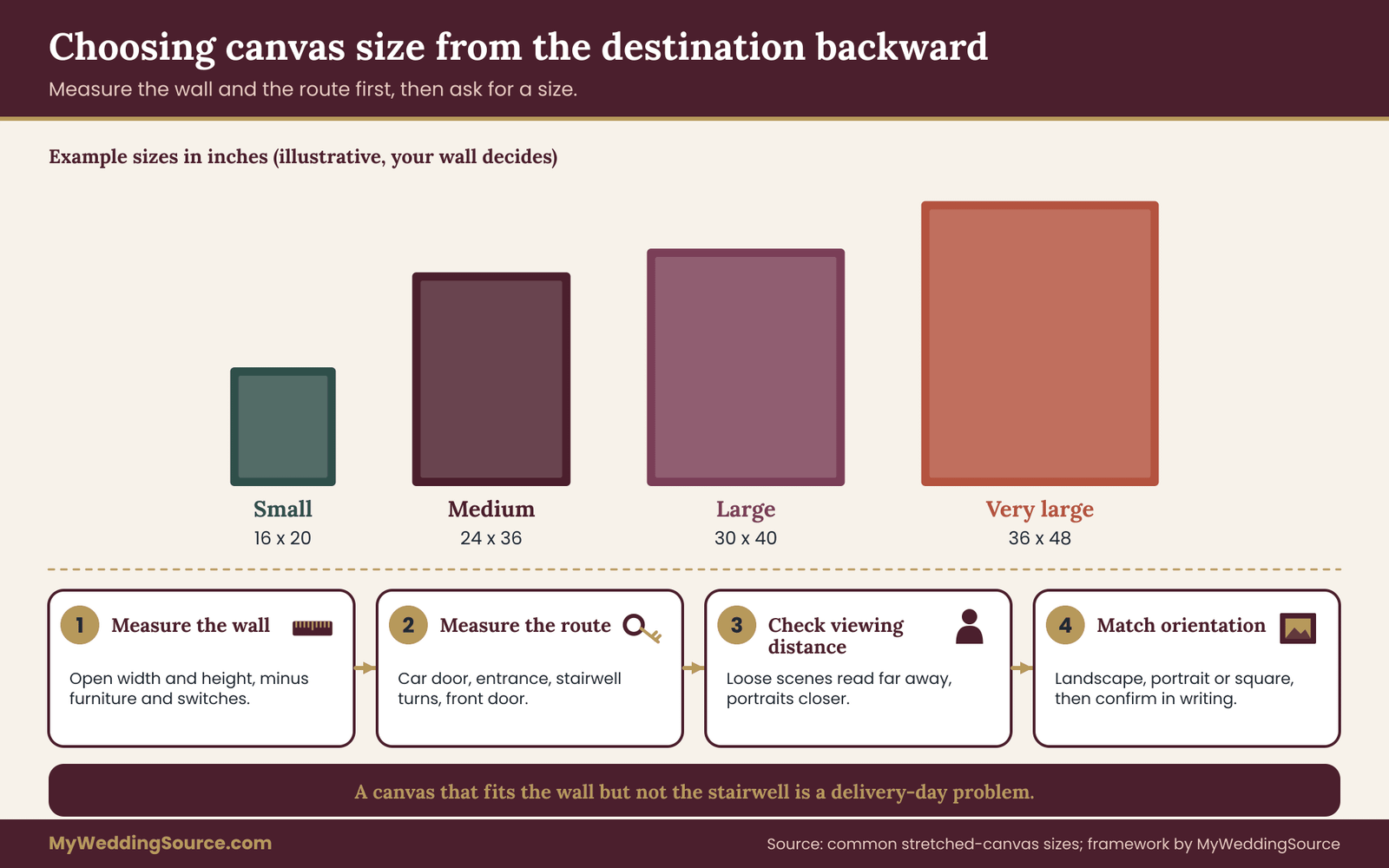
Decide where the painting will hang before you decide how large it is. A canvas bought for the abstract idea of “a nice big piece” often arrives in a house that has no wall for it. Work backward in four steps.
First, measure the wall. Note the width and height of the open space, and subtract room for furniture, light switches, windows and the frame itself. A common decorating rule of thumb is that a single piece looks balanced when it fills roughly two thirds of the width of the furniture beneath it, though that is a guideline and not a law.
Second, measure the route. A large stretched canvas has to go through your car door, your building entrance, your stairwell and your front door. A canvas that fits the wall but not the stairwell is a problem you discover on delivery day.
Third, consider viewing distance. A loose, expressive scene painting can be read from across a room, so it suits a larger size. A detailed portrait is meant to be seen closer, so a medium size usually reads better than a very large one.
Fourth, choose the orientation to match the subject. A wide ceremony scene suits landscape, a couple suits portrait, and a square works for a symmetrical composition. Ask the artist to confirm the orientation in the scope, because turning a canvas on its side after the event is not possible.
A size ladder to anchor the conversation
Standard stretched canvases come in common sizes, and artists often keep them in stock. The following ladder uses widths and heights in inches as examples of common dimensions, not as recommendations. Your wall and your doorway decide.
A small canvas, around sixteen by twenty inches, is easy to carry, fits almost any room and suits a single close subject such as the couple’s first dance.
A medium canvas, around twenty-four by thirty-six inches, is the most common choice for a scene or portrait that you want to display as a focal point over a sofa or a bed.
A large canvas, around thirty by forty or thirty-six by forty-eight inches, suits a wide scene and a generous wall, but it changes how you transport and insure it. A very large canvas, beyond that, usually needs a dedicated plan for the vehicle, the hanging hardware and sometimes a second person to lift it.
Larger is not automatically better in a live setting. A bigger canvas takes more time to cover, which pushes more of the work into the studio phase, and it needs a larger and sturdier easel that takes more floor space at the reception. If the room is tight, a medium canvas that the live wedding painter can complete more fully may serve you better than a large one that is mostly underpainting at the end of the night.
Orientation, depth and edges
Two details that couples rarely think about affect how the finished painting looks on the wall. The first is depth. A gallery-wrapped canvas has thick sides, and the image usually continues around the edges so that it can hang without a frame. A flatter canvas is meant to sit inside a frame. Ask which one the live wedding painter is using, because it changes your framing cost and the final look.
The second is edges. If the image runs around the sides, the artist will paint there, and a frame that covers the sides will hide part of the work. If the sides are left plain or painted a flat color, a frame is the natural choice. Put the decision in the scope: “gallery wrap, image continuing around the edges, hung without a frame” or “standard depth, painted edges, to be framed.” The wording is dull and it prevents an argument.
Surfaces that are not canvas
Not every live wedding painter works on stretched canvas. Some paint on rigid wood or hardboard panels, which resist sagging, travel more safely and can be framed more simply. Some work on heavy watercolor paper, which is lighter and dries quickly but needs glass or acrylic glazing in a frame. A few paint on large sheets of linen or board for a more mural-like result.
Each surface changes the care line later. A paper painting needs framing under glazing and must stay away from damp. A panel is sturdier in transit but heavier on the wall. Ask which surface is planned and why. A professional artist usually has a clear reason, such as speed of drying, portability or the look they are known for, and the reason tells you something about how they work.
A short worksheet for this decision
Before you contact artists, fill in these lines for yourself. Wall width available, in inches. Wall height available, in inches. Narrowest door or stairwell on the route, in inches. Vehicle that will carry it and its opening size. Subject in one sentence. Preferred orientation. Whether you want it framed. Then ask each artist to propose a size that fits those numbers.
If an artist proposes something much larger than your numbers allow, ask what they are trying to achieve. Sometimes the answer is a reasonable creative one, and sometimes it is simply the size they have in stock. Either way, you have moved the decision from a vague wish to a measured limit, which is exactly what the surface line is for.
Placing the live wedding painter in the reception: space, light and air
Once you know what is being painted and how large it is, the next question is where in the room the work happens. The easel is a piece of furniture with unusual demands. It needs light that does not change color, floor space that guests will not trample, a clear view of the subject and air that does not carry paint fumes to the dinner tables.
Floor space and footprint
A live wedding painter needs more space than the easel itself. Add room for the live wedding painter to step back and judge the work, a small table for paints and brushes, a bin for rags, and a margin so that guests who stop to watch do not stand in the artist’s elbow. As a working assumption, ask the live wedding painter for their footprint in feet, width and depth, and mark that area on your floor plan.
Keep the footprint out of the main walking routes. A spot beside the dance floor is popular because it is lively, but it sits near the place where guests move fastest and carry drinks. A spot near the cocktail area works well during the first hour of the evening, when people are standing and chatting, and it may need to move before the party gets crowded. Ask the venue whether a protective floor covering is required, since paint on a carpet or a polished wood floor is a damage claim waiting to happen.
Light that does not lie
Color is the whole job, and venue lighting changes color. Warm bulbs push everything toward yellow, colored uplighting can turn a blue sky purple, and a dimmed room makes shadows harder to judge. A painter working under colored lights may be mixing a color that looks correct in the room and wrong in daylight.
Ask the artist what lighting they need. Many bring a small clip-on or standing light with a neutral bulb. Tell your lighting vendor or the venue where the easel will be so that the uplighting plan does not wash over it. Colored washes change how every surface in a room looks, and a canvas on an easel is no exception.
If the room will be dark for dancing, agree in advance on the transition. The live wedding painter may paint the scene in the brighter first part of the evening and shift to details or a quiet corner later, or they may stop live work at a stated time. Write the stop time into the schedule line.
Ventilation, materials and safety
Some paints and mediums release fumes. Water-based acrylics are generally the mildest, while oil paints and the solvents used to thin them and clean brushes carry stronger odors. The U.S. Environmental Protection Agency publishes guidance on indoor air quality, and the Consumer Product Safety Commission enforces labeling rules for art materials, which is why legitimate products carry hazard information on the package.
Ask the live wedding painter which paints and solvents they will use at the event, and whether they use odorless alternatives indoors. Ask where solvents are stored and how rags are disposed of, since oily rags can be a fire concern. Fire marshals and venues care about open containers and flammable liquids, and a venue may restrict solvents altogether. Confirm the venue’s policy before the live wedding painter arrives, not on the day.
Accessibility around the easel
An easel, a table and a crowd of onlookers can narrow a path quickly. The Americans with Disabilities Act sets design standards for accessible routes, and the general figure for a clear route width is at least thirty-six inches, though the ADA site and your venue can confirm what applies. Whatever the formal rule, the practical test is simple: could a wheelchair user, a guest with a walker or someone carrying a toddler pass the easel without squeezing?
Place the setup so that an accessible route stays open on at least one side. Leave a spot where a seated guest can watch at eye level, rather than forcing everyone to stand. If you offer a participation moment, make sure the table height and reach work for people who are seated, and consider offering a way to take part that does not require standing at an easel.
A pre-event checklist for the space
Walk through these items with the venue and the artist, ideally at the technical walkthrough. The guide to a venue technical walkthrough shows how to measure and confirm access, and the easel can be added to that list.
Confirm the footprint in feet and mark it on the floor plan. Confirm the floor covering and who supplies it. Confirm the lighting plan, including any colored washes near the easel. Confirm the paint and solvent list and the venue’s policy on them. Confirm power needs, if the live wedding painter uses a lamp. Confirm the load-in door and time, since a canvas and an easel travel as awkward objects. Confirm the stop time for live painting and where the work goes afterward.
Guest participation without pressure
Many couples want guests to take part, and many live wedding painters offer it. A participation moment can be one of the warmest parts of the evening or one of the most awkward, and the difference is mostly design. The aim is an invitation that guests can accept or ignore without noticing that they did either.
Three modes, from quiet to busy
Watch only. Guests stand at a respectful distance and watch the work develop. Nobody touches the canvas. This is the lowest-risk mode, it suits a portrait or a detailed scene, and it still gives guests a reason to gather and talk. A small sign near the easel that says what is being painted is enough.
Add a mark. Guests are invited to add one stroke, one thumbprint or one dot, usually to a prepared area that the artist has marked out. The live wedding painter controls where marks go, so the composition survives. This works well for a scene with a large open area, such as a sky, a field or a border.
Paint along. Guests paint on their own small panels at a table while the main artist works at the easel. This is closer to a craft table than to a commission. It needs supplies, aprons or protection for clothing, handwashing access and an adult who supervises materials and cleans up.

Choose the mode before the event and write it into the scope. A live wedding painter who expects a quiet evening and a couple who expect a long line of guests painting are headed for disappointment on both sides.
Opt-in, never coaxed
A participation moment should never become a performance that guests feel obliged to join. Some people dislike being watched while they create, some are in good clothes, some have health or sensory reasons to avoid wet paint, and some simply prefer a drink and a conversation. Make participation visibly optional. A sign that reads “Add a mark if you like” reads differently from a host who walks the room asking people to come over.
Avoid anything that shames a guest who declines. Do not announce names over a microphone, do not build a leaderboard, and do not place the participation table where it forms a gauntlet that everyone must cross. If you want the piece to include every guest, consider a quiet method that does not require an audience, such as a prepared border where names or initials can be added at any point in the evening.
Children and supervised materials
Children often love painting and are a natural audience for an easel. They also touch things, and a wet canvas and a table of paint are tempting. If children will be near the work, assign an adult, not the live wedding painter, to supervise them. The artist is focused on the painting and should not be the one managing a crowd of excited small hands.
Ask about the paints. Art materials sold in the United States carry labels, and the Consumer Product Safety Commission enforces labeling for hazardous art materials. Ask the live wedding painter to confirm that any paint children may touch is labeled as non-toxic for that use, and keep solvents and mediums well out of reach. Provide wipes or a handwashing option near the table, and keep a sealed cover for any open paint.
Also decide where children’s work goes. If a child paints a panel, who takes it home, and who keeps it while it dries? A simple rule helps: wet panels stay on a drying rack until the end of the event and go home with the family in a flat box.
Guest portraits and image use
If the live wedding painter intends to paint recognizable guests, or to take reference photos of them, permission matters. Some guests do not want their likeness reproduced, shared online or used in the artist’s portfolio. The guide to wedding photography consent explains how to set guest boundaries for images, and the same thinking applies to a painting made from a guest’s face.
The simplest approach is to keep individual guests unrecognizable by default. The live wedding painter can paint figures as softened shapes, silhouettes or backs of heads, and reserve recognizable faces for the couple and for people who have agreed. If you want a family portrait included, ask the people involved first and tell the live wedding painter who has agreed.
What to tell your guests
Guests need very little information, and a short note prevents a few common mishaps. A small sign near the easel can say that the painting is wet, that the artist is working, and that guests are welcome to watch. If participation is offered, the sign should say what to do and that it is optional. If photographs of the painting are welcome, say so. If they are not, say that too, since an artist may prefer to control the first images of an unfinished work.
Tell the wedding party and the person running the room, not only the guests. A bridesmaid who knows that the canvas is wet will stop a guest from leaning on it. A DJ who knows that the painter stops at a certain time will not announce a participation moment after the easel is packed away.
Rights and licensing for a live wedding painter
Rights are the line that couples most often leave blank, and it is the one that causes the longest arguments later. Two ideas do most of the work, and neither is complicated: owning the painting is not the same as owning the copyright in the image, and permission to use something has to be written down to be reliable.
The object and the image are two different things
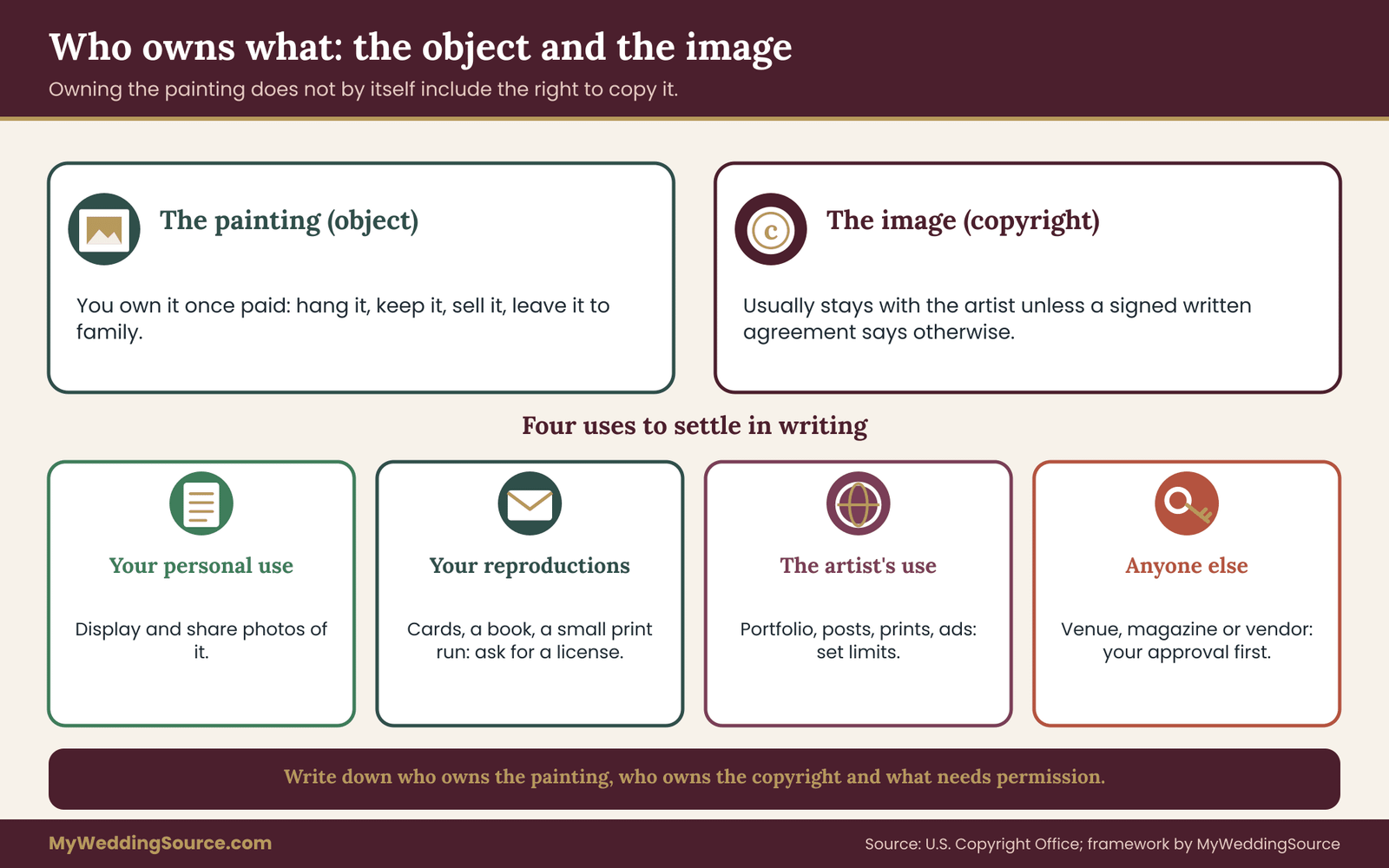
When you buy a painting, you own the physical object: the canvas, the paint on it and the right to hang it, sell it or leave it to your children. The copyright in the image is a separate right. Under U.S. copyright law, transferring ownership of a physical object does not by itself transfer the copyright, and the U.S. Copyright Office explains this distinction on its website.
In practice the default is that the live wedding painter keeps the copyright unless a written agreement says otherwise. A commissioned painting does not usually fall within the narrow categories where commissioned work counts as “made for hire,” and that arrangement requires a signed written agreement in any case. So unless your paperwork says something different, you own a painting and the live wedding painter owns the right to copy it.
What does that mean day to day? Owning the object lets you display it in your home. It does not by itself let you print it on a hundred thank-you cards, sell reproductions or license it to a magazine, and it does not stop the artist from posting a photograph of it or including it in a portfolio. Those uses depend on what the agreement allows.
The four uses to settle
Think of rights as four separate uses, and decide each one on its own.
Your personal use. Displaying the painting, photographing it for family, and sharing a picture of it with friends. Most artists allow this freely, and a good agreement says so to avoid doubt.
Your reproductions. Printing the image on cards, a wedding book, a small run of prints or a photo album page. This is a gray zone, so ask for a simple written license, ideally covering personal and non-commercial reproductions up to a stated number.
The artist’s use. Posting photos of the work, including it in a portfolio or website, entering it in a show, selling prints and using it in advertising. Many artists will want this, and it is reasonable. You can agree to it with conditions, for example no use of guests’ faces, no naming of private details and no sale of prints for a set period.
Third-party use. Anyone who is not you or the live wedding painter: a venue, a magazine, a vendor who wants to feature the piece. Decide whether anyone needs your approval and how it is given.
What can be in the image
Rights also run into the content of the painting. A scene may include a venue, a logo, a sign, a piece of music’s lyrics or a character from a film printed on a guest’s shirt. The more clearly such an element appears, the more likely it is to raise a question, especially if the live wedding painter later sells prints or uses the image commercially.
For a private memory painting hanging in your home, this is rarely a problem. It becomes relevant when the artist commercializes the piece. If you care about avoiding it, add a line to the scope that says the image will not be used commercially without your written approval, or that prints will be limited to a certain period.
People are part of content too. A recognizable guest who is painted and then featured in an advertisement may feel misused, even if no rule was broken. Keeping recognizable faces limited to the couple and consenting people avoids the problem, and it fits the guest consent approach in the previous section.
Putting it in writing
A rights clause does not need to be long. A workable version states who owns the painting, who owns the copyright, what the couple may do with it, what the live wedding painter may do with it and what requires further written permission. If the live wedding painter assigns the copyright to you, which some will do for an additional fee, the assignment has to be in writing and signed by the artist.
If any of this feels uncertain, the Copyright Office website has plain-language guidance, and a local attorney can review a contract in a short appointment. The price of a quick review is small compared with the cost of an unclear agreement about something you will keep for decades.
Keep the signed scope and the rights clause together with your records. The guide to organizing wedding records after the event describes the vendor files where a painting agreement belongs.
Contract clauses and vendor questions for a live wedding painter
A scope turns into a contract when both sides sign something that includes it. The details below are the clauses that matter for this particular vendor. The broader guide to the wedding vendor contract covers general terms such as payment schedules and liability, and this section adds the points that are specific to a live painter.
The completion standard
The most important clause is the one that defines “finished.” Without it, a live wedding painter and a couple can honestly disagree. Write what the deliverable is at the end of the event, what the artist will do afterward, and the date by which the finished piece will be ready. For example: “The live wedding painter will paint on a 24 by 36 inch gallery-wrapped canvas during the reception, complete the work in the studio within five weeks, and share two progress photographs for the couple’s comment before final varnishing.”
Spell out what the progress photographs are for. If the couple may request changes, say how many rounds are included and what kind of change is reasonable. A tweak to the color of a dress is reasonable. A request to repaint the composition is a different job, and a clear clause saves both sides from an argument about it.
Payment structure
Painters generally ask for a deposit to hold the date, since the booking removes other work from their calendar. A common structure is a deposit at signing, a balance before or at the event, and sometimes a separate charge for framing or shipping. Whatever the structure, write the amounts, the due dates and what each payment covers.
Think about the final balance. If the painting is not finished at the end of the night, is the full balance due that evening, or when the work is delivered? Many couples prefer to hold a portion until delivery, and many artists are comfortable with a staged payment when it is stated in advance. Ask, and write the answer down. For payment methods, use one that leaves a record, and keep the receipts with the rest of your files.
A card payment also gives you dispute rights that a cash payment does not. The Consumer Financial Protection Bureau explains how billing disputes work, including the generally short window for reporting a billing error in writing. That is a safety net for a real error, not a plan for dealing with a disagreement about taste.
Cancellation, illness and substitutes
Ask what happens if the live wedding painter cannot attend. Artists get sick, and weather and travel disrupt schedules. A good agreement states whether the artist will find a replacement of comparable style, whether you may refuse the substitute and what is refunded if no one can come. A clause that gives the live wedding painter the right to send “another artist” with no standard is worth questioning.
Ask what happens if the event is canceled or postponed. Does the deposit transfer to a new date, and for how long? Does the live wedding painter keep any of it for lost opportunity? The wedding vendor timeline is a useful place to see when other vendors need decisions, so that a date change does not collide with the painter’s studio schedule.
Insurance and venue requirements
Some venues require vendors to carry liability insurance and to provide a certificate. A painter who works inside a venue with paint, solvents and an easel may be asked for one. Ask the venue first, then ask the artist whether they carry coverage and can provide a certificate by a date. Do not assume that a small independent artist has it, and do not assume that they do not. A direct question gets a direct answer.
Also ask who is responsible for damage to the venue’s floors or walls and to your own property. A clause that says the live wedding painter is responsible for materials they bring and for any damage they cause is reasonable. A clause that places all responsibility on the couple deserves a conversation.
Questions worth asking before you sign
Use this list as a call script. It is deliberately plain.
- Can you describe what the painting will look like at the end of the reception, and what remains to be done afterward?
- What is the exact canvas size, depth and orientation, and what is it made of?
- How many weeks do you need after the event to finish, and when would I have it?
- May I see two progress photos before final varnish, and how many changes are included?
- What do you need from the venue: floor space in feet, lighting, power, a table?
- Which paints and solvents will you use indoors, and are there any odors?
- Who owns the copyright, and what may I do with photographs and reproductions?
- What will you do with photographs and prints of the work, and will guests be recognizable?
- What is your policy if you are ill or unable to attend?
- What do you recommend for drying, varnishing, framing and hanging?
- How will the painting be transported on the night and afterward, and who carries it?
- Do you carry liability insurance, and can you send a certificate?
Doing the basic due diligence
A new vendor deserves a few checks before money moves. Ask for examples of live event work, not only studio portfolio pieces, because working at a party is a different skill. Ask for references from past event clients and speak to one. Check that the business name on the contract matches the name on the payment request, and be cautious about any request to pay by an unusual method or to rush a deposit. The Federal Trade Commission publishes consumer guidance on common payment scams, and a legitimate artist will not mind slow, careful questions.
Pay attention to how the live wedding painter answers. A professional live wedding painter usually answers these questions easily, offers examples and welcomes a written scope. Vagueness about size, timing or rights is not proof of bad intent, but it is a reason to ask again in writing before you book.
From live session to finished work: the studio stage
For many commissions, the event is only the first stage. Understanding the second stage helps you set expectations, ask for the right checkpoints and avoid worrying when the painting looks unfinished on the night.
What the live session accomplishes
During the event, a live wedding painter typically establishes the composition, the main shapes, the color relationships and the mood. These are the decisions that benefit from seeing the real scene and the real light. They also benefit from the energy of the room, which is the very reason people hire a live painter rather than commissioning a painting from photographs.
What a live session often leaves for later is the fine work. Faces, hands, edges, small details, corrections and the final tonal adjustments take time and steady light. Paint that is still wet cannot take another layer cleanly, so many artists let the surface dry before refining it.
The studio timeline, in plain steps
Think of the studio stage as a short series of steps, each with a date you can write down.
First, the painting rests. After the event the artist lets the surface dry enough to handle, which can take from a day or two for thin acrylic to considerably longer for thick oil.
Second, the live wedding painter refines. This is the studio work, usually over a few weeks, and it may involve several sessions. Third, you review. The live wedding painter shares photographs of the nearly finished piece, and you can comment within the agreed number of changes.
Fourth, the artist finalizes and, for some media, varnishes. Fifth, the piece is prepared for delivery: dried, protected, packed and, if agreed, framed.
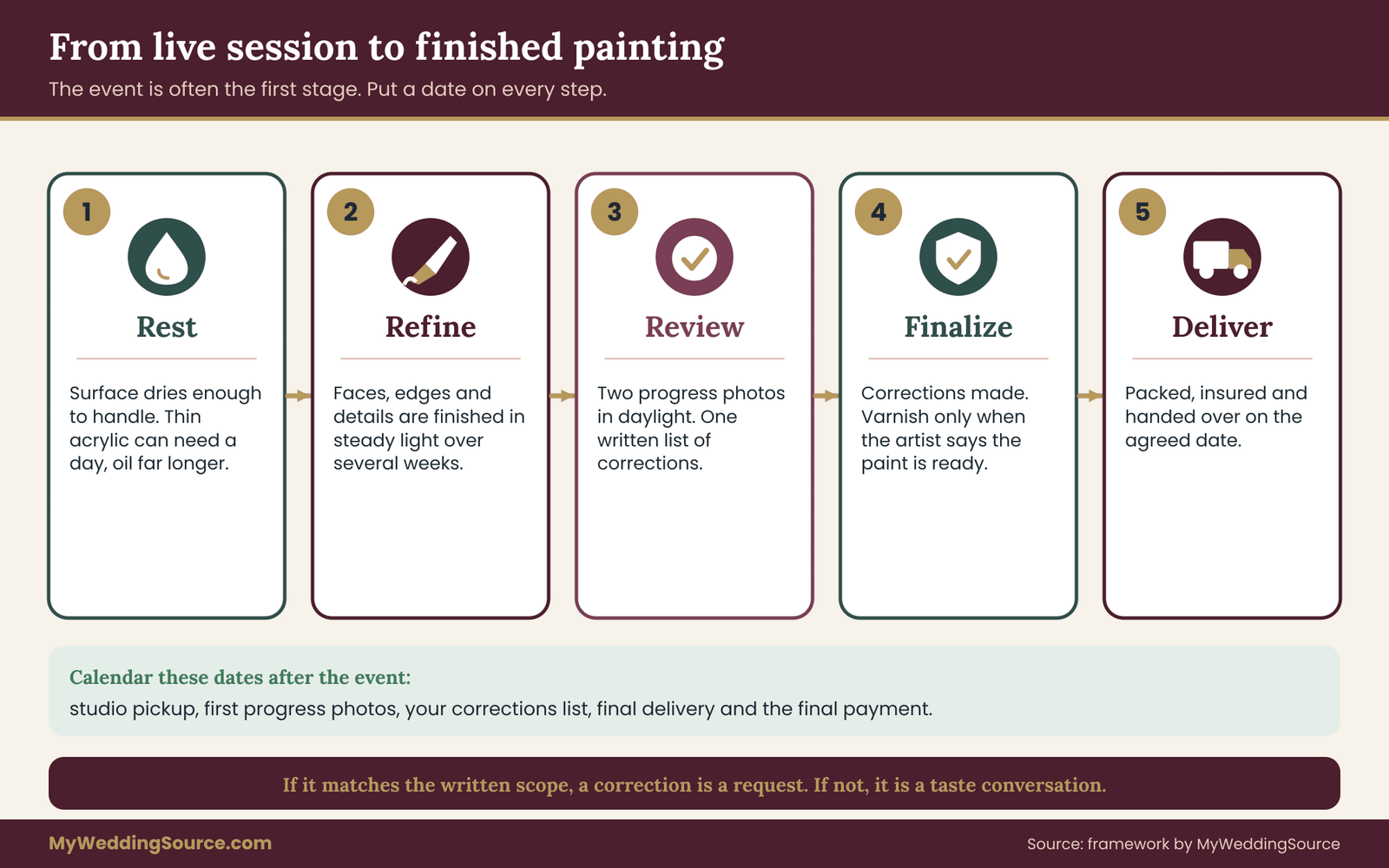
Ask for the dates of each step in the scope, or at least the final delivery date and the date of the review. A vague “a few weeks” is easy to say and hard to hold anyone to.
Reviewing progress without micromanaging
The progress photographs are your chance to catch a misunderstanding early. Look at the things that matter to you: do the faces look like the people, are the colors close to what you remember, is anything in the scene wrong, such as a missing family member or an incorrect detail? Photographs of a painting rarely match its color exactly, so ask the live wedding painter to take them in daylight and to say honestly how the colors differ in person.
Give your feedback once, in writing, as a short list. A single organized list helps the live wedding painter more than several scattered messages, and it creates a record of what was requested. Resist the urge to redesign the painting at this stage. The review is for correcting errors and fine-tuning, and a change in direction belongs earlier in the process.
What if you do not like it
Taste is subjective, and this is the question couples worry about most. The fair answer is that a commissioned painting that meets the scope is generally the artist’s to define, which is why the scope matters so much. If the painting does not match the agreed description, you have a reasonable basis to ask for a correction. If it matches the description and you simply wish it were different, the remedy is usually a negotiated one.
Reduce the odds in advance. Look closely at an artist’s previous work and ask whether the style on display is the style you want. Ask for an early sketch or color study if the artist offers one. And put the revision allowance in writing, so that both sides know how far feedback can go.
A calendar for the studio stage
Put these dates in your calendar after the event, using the numbers your artist gave you: the day the painting is collected or moved to the studio, the date of the first progress photographs, the date by which you will send your list of corrections, the date of final delivery and the date of the final payment. Adding the painter’s dates beside those of your other vendors keeps the whole picture in one view.
Post-event care: drying, varnish, framing and hanging
The care line of the scope covers the weeks and years after the party. It is the part couples find least glamorous and often regret skipping. A painting that is handled badly in its first days can smudge, dent or discolor, and the damage is difficult or impossible to reverse. Good care is mostly patience and a few simple habits.
The first night: a wet painting at the end of the party
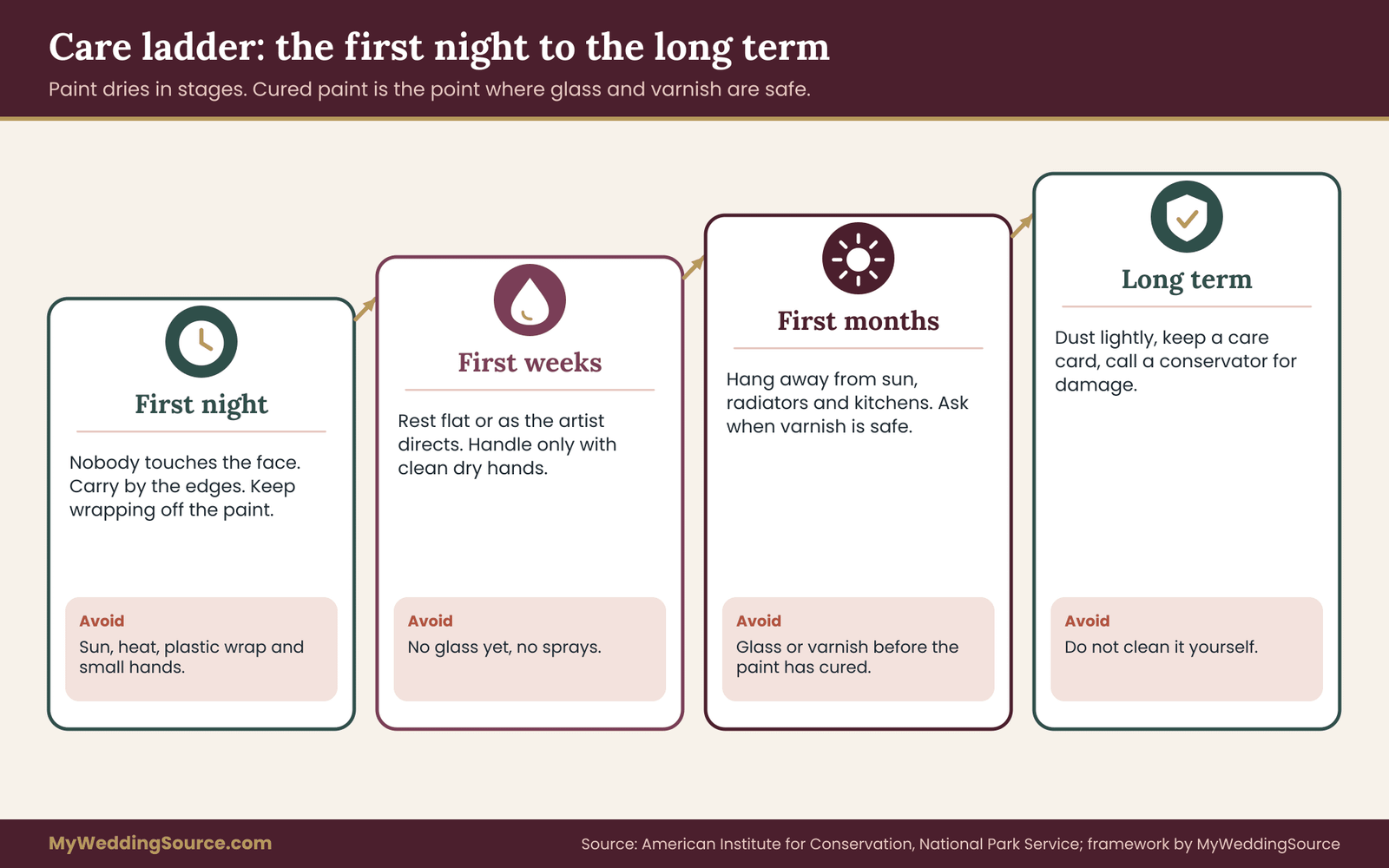
Plan for the possibility that the canvas is still wet when the guests leave. Paint that looks dry on the surface can be soft underneath, and thick oil paint can stay tacky for days. The rule for the first night is simple: nothing touches the painted surface, and the painting travels flat or upright according to the artist’s instruction.
Before the event, agree on who handles the painting at the end of the night. The best answer is usually the artist or an assistant, because they know how the work was made. If the live wedding painter leaves early, name one reliable person, such as a family member or a day-of coordinator, and show them in advance how to carry the canvas. Carry by the edges or the stretcher bars, with clean dry hands, and keep fingers off the face of the work.
Decide where the painting spends the night. A spare room, a quiet corner of the venue or the artist’s vehicle are all better than a car trunk at a hotel. Keep it away from direct sunlight, radiators, damp and anywhere that guests, children or pets could knock it. Do not wrap a wet painting in plastic, bubble wrap or paper that touches the surface, because wrapping materials can stick to wet paint. Ask the live wedding painter what protective method they use, such as a rigid cover that holds the packing away from the face.
Drying and curing are different things
Paint dries in stages, and the words people use for them hide the difference. Touch dry means the surface no longer feels sticky. Dry enough to move means it can be handled with care. Cured means the paint film has fully hardened, and that is the stage at which the painting can safely be varnished and framed behind glass.
The timeline depends on the medium. Water-based acrylics tend to dry to the touch quickly, often within hours for thin layers, though thick passages take longer. Oil paints dry far more slowly and can take months to cure fully. Gouache and watercolor dry fast, but paper can be sensitive to damp. Rather than quote numbers here, ask your live wedding painter for the specific timeline for the paints they use, and write the answer into the scope.
If the artist varnishes, ask when and why. A varnish is a protective layer that evens the surface and can be removed by a conservator in the future. Applying it too early can trap solvent in paint that is still curing, so many artists wait, in some cases for months, before varnishing an oil painting. An acrylic piece is generally varnished sooner. The point is to know who will do it and when.
Framing: timing, glazing and fit
Framing is a decision with timing attached. A painting that is not yet cured should not go behind glass, because glass can press on soft paint and trap moisture. An unvarnished or recently finished oil painting often hangs unframed or in a floater frame for a while, and the final frame comes later.
For a stretched canvas, a “floater” frame leaves a small gap around the edges and shows the full image. A traditional frame overlaps the edge slightly. For a painting on paper, a frame with a mat and protective glazing is the standard approach, and a conservation-grade mat and backing board keep acidic materials away from the paper. Ask the framer which materials they use and request that they be conservation-grade.
Whatever you choose, tell the framer the true outer dimensions and whether the image wraps around the sides. A framer can only do good work with measurements in hand, which brings us back to the surface line of the scope.
Hanging and living with it
Choose a wall with stable conditions. Direct sunlight fades pigments over time. Heat and humidity swings, such as above a radiator, a fireplace or in a bathroom, cause the layers of a painting to expand and contract. The American Institute for Conservation publishes plain-language guidance on caring for paintings, and the National Park Service museum program offers care leaflets that apply equally well at home.
Use hanging hardware rated for the weight of the framed piece, and anchor it to a stud or a proper wall anchor for anything heavy. Hang it where it will not be bumped, and leave a little space behind it so that air can circulate. Never hang a painting where it will be splashed or exposed to cooking vapors.
Cleaning and long-term habits
For the first few years, the best cleaning is none. A soft, clean, dry brush, used lightly, can remove surface dust from an unframed painting. Avoid sprays, cleaners and damp cloths on the painted surface, because they can lift paint or leave marks. If a painting is dirty or damaged, contact a conservator rather than trying to repair it.
Keep a small care card with the painting. It should record the artist’s name, the date, the medium, the varnish date, the dimensions and the artist’s care advice. That record is helpful when you move, insure the piece or pass it on.
Delivery, shipping and insurance
How the painting gets from the live wedding painter to your wall is the sixth line of the scope. There are four common routes, and each one carries a different level of risk, cost and effort.
Four ways a painting reaches you
Same-night handoff. You take the painting home from the venue. This works for a small or medium piece that the live wedding painter says is dry enough to move, and it needs a plan for the vehicle and the first night. It is the simplest and the riskiest if the paint is still soft.
Pickup from the studio. You collect the finished piece on an agreed date. This gives you a chance to see it in person, to ask about care and to inspect it before you take it home. Bring a blanket, clean towels and enough room in the vehicle to lay the piece flat or secure it upright.
Artist delivery. The artist or an assistant brings the painting to your home. This is convenient for a large piece, and it often costs extra. Agree on a window of time and on who needs to be present.
Shipped by courier or carrier. The painting is packed and shipped to you, either by the live wedding painter or by a fine-art shipper. This is the route with the most steps and the most risk of damage in transit, and it deserves a proper packing and insurance plan.
Packing, in terms you can ask about
You do not need to be a packer to ask good questions. Ask how the painting will be protected on the surface, whether the packing touches the paint, how the corners are protected, how the piece is boxed and whether the box is rigid. A professionally packed painting is usually wrapped in a protective layer that does not stick to the surface, cushioned at the corners, and placed in a box or crate with room around it.
Ask what the shipper’s labeling says and whether the package is marked fragile. Ask whether a signature is required at delivery and whether you can be present. When it arrives, open the box with care and photograph it as you unpack, so that any damage is documented from the start.
Insurance and declared value
Shipping insurance and homeowner or renter insurance work differently. A carrier’s insurance covers loss or damage in transit up to a stated value, and the rules and limits vary by carrier and service. The U.S. Postal Service describes its insurance options on its website, and private carriers publish theirs. Read the terms for artwork before you assume that a painting is covered, and ask about exclusions.
Declare a value that matches what you paid or what the painting would cost to replace, and keep a copy of the invoice. A photograph of the finished painting, taken before it is packed, is useful evidence of its condition. If you plan to keep the painting for years, ask your insurer whether a painting of this value needs to be listed separately on a homeowner’s or renter’s policy.
A condition record
Before the painting leaves the live wedding painter, ask for a short condition note: the date, the dimensions, the medium, the condition, and a photograph of the front, back and corners. On arrival, compare the painting with the note. If something has changed, photograph it before you touch it, contact the carrier within the time their rules require and notify the artist.
The same record helps in the future. If you ever sell the painting, ask a conservator to examine it or file an insurance claim, a clear history of its condition is valuable.
Who signs for what
Ask the live wedding painter who is responsible for the painting until the moment you receive it. In most agreements, the live wedding painter carries the risk until delivery or pickup, and the couple carries it afterward. If you pick up the painting or take it home from the venue, responsibility passes to you at that moment. Write down the point at which the risk transfers, because it affects who files the insurance claim if something goes wrong.
A worked example: a garden reception for ninety guests
The following example is invented to show how the six lines work together. The names and numbers are illustrative, not data from a real event, and your own choices will differ.
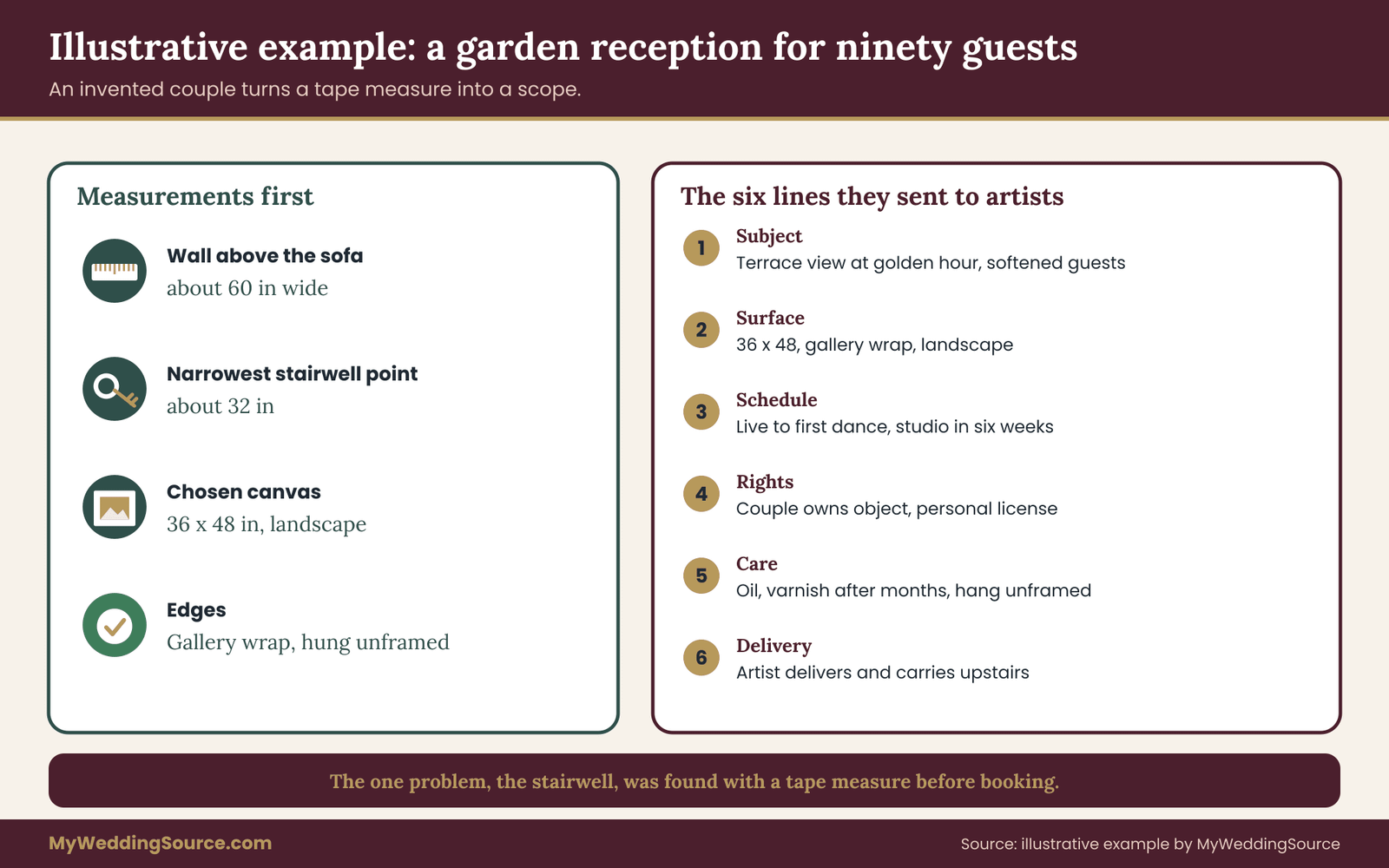
Maya and Daniel are planning a garden reception for about ninety guests. They like the idea of a live wedding painter because they want one object from the day that is not a photograph. They have a narrow entry hall in a second-floor apartment and a bare wall above the sofa that measures about sixty inches wide.
Step one: the measurements
They begin with the destination, as the size section recommends.
The wall above the sofa is wide, and the sofa is about eighty inches long. Using the two thirds rule of thumb, a single piece around fifty inches wide would be balanced, but the stairwell turns tightly and the narrowest point is about thirty-two inches. A canvas of thirty-six by forty-eight inches fits the wall comfortably and, when carried upright and turned, will clear the stairs. They decide on a landscape orientation, because the garden view is wide, and they choose a gallery-wrapped canvas to hang without a frame.
They rule out a larger size, even though the wall could take one, because it would not clear the stairwell and because their car’s rear opening is limited. That single measurement saves them from a delivery problem.
Step two: the six-line scope
They write the scope and send it to three artists.
Subject: the garden reception seen from the terrace at golden hour, with softened figures dancing and the two of them recognizable in the foreground. No other guests recognizable. The venue name does not appear.
Surface: thirty-six by forty-eight inches, gallery-wrapped, landscape, stretched canvas, image continuing around the edges.
Schedule: the artist paints from the start of cocktail hour until the first dance, which is about two and a half hours, then completes the work in the studio within six weeks, sends two progress photographs and delivers by a stated date.
Rights: the couple owns the painting. The live wedding painter keeps the copyright and may post photographs and show it in a portfolio, without naming the couple or showing guests’ faces. The couple receives a written license for personal reproductions up to fifty cards and one small print run for family.
Care: the live wedding painter uses oil paints, advises waiting several months before varnishing and recommends hanging the piece unframed for the first year.
Delivery: the artist delivers the finished piece to the apartment and carries it up the stairs, with the couple present.
Step three: comparing the answers
The three artists respond differently. One artist proposes a larger canvas and does not mention the stairwell. Another agrees with the scope and adds a charge for delivery. The third wants full commercial rights to the image and does not offer a personal reproduction license. Maya and Daniel use the scope to compare, not just the price. They choose the second artist, whose answers match their measurements and whose rights terms are clear.
They sign a contract that includes the scope as an attachment. The deposit is paid by card, and they keep the receipt with their vendor records. They put the artist’s studio dates in their calendar beside the dates of their other vendors.
Step four: the evening and the aftermath
On the day, the live wedding painter sets up on the terrace near the cocktail area, away from the walkway to the bar, using the same guest movement thinking that shaped the rest of the room. A small sign says that the painting is wet and that guests are welcome to watch. The live wedding painter stops live painting at the first dance, and the canvas is carried to a quiet room, covered with a rigid cover that does not touch the surface, and collected by the artist the next morning.
Six weeks later the live wedding painter sends two photographs taken in daylight.
Maya notes that one family member’s jacket is the wrong color and sends a short list of two corrections. The live wedding painter makes them. The artist delivers the painting on the agreed date, and the couple hangs it without a frame, away from direct sun and the radiator. They record the artist’s care advice, the date and the dimensions on a card kept in their records folder, and they put a reminder in their calendar to discuss varnishing with the live wedding painter later in the year.
What worked here was not luck. Every decision was made on paper before it became a problem, and the one question that would have gone wrong, the stairwell, was found with a tape measure.
Alternatives to compare and edge cases to plan for
A live wedding painter is one of several ways to put hand-made art into your celebration. Comparing the alternatives helps you confirm that painting is the right choice, and thinking through the edge cases helps you recover when something does not go to plan.
Comparing the alternatives
Caricature or sketch artist. These artists draw quick portraits of guests, typically a small piece per person. The result is lighter, faster and aimed at the guests rather than the couple, and it shifts the planning questions toward throughput, queue and consent. A live painter produces one lasting piece for the couple. If you want every guest to leave with something, a sketch artist is the stronger fit. If you want one heirloom, a painter is.
Painting from photographs after the wedding. A studio painter works from your photographs in the weeks after the event. You gain control over the reference, the time pressure disappears and the likeness can be more careful. You lose the live atmosphere and the guest interest. This suits a formal portrait of the couple better than a loose scene.
Silhouette or paper-cut artist. Fast, tidy and low in materials. It produces small keepsakes, with little drying and little care needed, but it does not offer the single large piece.
Calligraphy or lettering at the event. Practical and elegant for names, place cards or a poem, with minimal mess. It does not offer a scene.
A guest-painted canvas on its own. A simple canvas on a table, painted by guests with a loose outline. It is inexpensive and participatory, and the result depends on supervision and on the guests. It serves as an activity more than as a commission.
Choose by asking what you want to hold afterward. One heirloom piece of the day points to a live wedding painter. A keepsake for every guest points to a sketch or silhouette artist. A flexible activity for the room points to a guest canvas.
Edge cases and how to handle them
Rain or an indoor move. If an outdoor event moves inside, the easel footprint, the lighting and the ventilation change. Ask the live wedding painter in advance what their indoor fallback looks like, and whether they can work in a smaller space. The guide to the wedding cocktail hour can help you decide where the easel fits if the cocktail area shifts indoors.
A venue that bans easels or solvents. Confirm the venue’s rules before you book. If solvents are banned, ask whether the artist can work with water-based paints. If easels are banned, ask whether a tabletop easel is acceptable.
Low or colored light. Tell the live wedding painter what the room will look like. If the room is dim, the live wedding painter may bring a lamp, schedule the live work earlier or paint a simplified version.
The artist is late or ill. Follow the substitute clause. If there is none, contact the live wedding painter as soon as you can and ask for options, such as a rescheduled studio painting from photographs or a partial refund.
A guest bumps or touches the canvas. Have the artist’s repair guidance in mind. For a small smudge, the live wedding painter may fix it during the studio stage, which is another reason the studio stage is useful. Do not try to fix it yourself.
A change of mind about the subject. If you decide on the day to change the subject, say so to the artist early. A change before painting begins is easy. A change after hours of work is a new job.
A damaged painting in transit. Photograph everything before you touch it. Notify the carrier within their time limit and the live wedding painter as soon as possible. The condition record and the insurance terms are your support.
A dispute about rights. If the live wedding painter uses the image in a way you did not agree to, begin with a polite written request that points to the clause. The U.S. Copyright Office offers general guidance, and an attorney can advise if the matter does not resolve.
When not to hire a live painter
A live wedding painter is not right for every event. If the venue is dark, cramped and strictly regulated, the conditions may work against the artist. If the guest list is small and the room is intimate, a studio portrait may serve you better. If the budget is tight, a guest canvas or a painting made later from photographs may offer the heirloom feeling without the live cost. Choosing against a live painter is a good decision when the conditions are wrong, and it beats an expensive one that disappoints.
Your next steps
You do not need to do everything at once. A sensible order is below, and each step takes a short sitting.
- Decide what you want to hold afterward: one heirloom, keepsakes for guests or an activity. This tells you whether a live wedding painter is the right choice.
- Measure the wall, the doorway, the stairwell and the vehicle, and write the numbers on one page.
- Write the six-line scope, marking each line as fixed or flexible.
- Send the six questions to two or three artists and compare the written answers.
- Ask the venue about easels, solvents, floor coverings, lighting and insurance requirements.
- Choose the artist, then put the scope into the contract as an attachment, including the completion standard and the rights clause.
- Add the studio dates and the delivery date to your calendar, and tell your coordinator or a family member who will handle the painting at the end of the night.
- After the event, record the care advice, the dimensions, the varnish date and the artist’s name on a card, and keep it with your vendor records.
If you only have time for one thing today, measure the wall and the stairwell. It takes ten minutes and it settles more decisions than any other single step.
FAQ
How far ahead should I book a live wedding painter?
Popular artists plan their calendars well ahead, especially for peak wedding months, so start asking as soon as your date and venue are firm. Booking early also leaves time to write the scope, check the venue’s rules and arrange a studio schedule. There is no universal lead time, so ask each artist how far in advance they usually fill dates and when they need a deposit to hold yours.
Will the painting be finished by the end of the reception?
Often it will not be. Many artists complete the composition live and finish faces, edges and details in the studio over the following weeks, because wet paint cannot easily take more layers and venue lighting is limited. Ask the artist exactly what the painting will look like at the end of the night, and write the studio completion date into your scope so both sides expect the same thing.
What canvas size should I choose?
Choose from the destination backward. Measure the wall, the doorway, the stairwell and the vehicle first, then ask the artist to propose a size that fits those numbers. Medium canvases suit most homes, while a large canvas needs a wide wall and a transport plan. A bigger surface also takes longer to cover, which can push more of the work into the studio stage.
Who owns the painting and the image?
You usually own the physical painting once you have paid for it, but the artist generally keeps the copyright in the image unless a signed written agreement says otherwise. That means you can display the piece, while reproductions, prints and commercial use depend on what the agreement allows. Ask for a clear rights clause, and see the U.S. Copyright Office for general guidance.
Can guests paint on the canvas?
They can, if you and the artist decide on it in advance. Options range from watching only, to adding one mark in a prepared area, to painting on separate small panels. Keep participation optional, supervise children with an adult who is not the artist, and ask the artist to confirm that any paint guests may touch is labeled appropriately for that use.
How long until the painting is dry enough to hang?
It depends on the medium. Thin acrylic can feel dry within hours, while oil paint can stay soft for days and take months to cure fully. Ask the artist for the timeline for the specific paints they use, and ask when varnishing is safe. Until the artist says the piece is ready, keep it away from sunlight, heat and anything that touches the surface.
How should the painting be transported and insured?
Keep wrapping materials off the painted surface, carry it by the edges or stretcher bars, and ask the artist how they pack it. For shipping, read the carrier’s terms for artwork, declare a realistic value and photograph the piece before and after. Ask your own insurer whether a painting of this value needs separate listing on a homeowner’s or renter’s policy.
What if I do not like the finished painting?
Start with the scope. If the painting does not match what was agreed, ask for a correction in writing and point to the relevant line. If it matches the scope but is not to your taste, the remedy is usually negotiated. You reduce the risk by studying the artist’s earlier work, requesting a sketch or progress photos and writing the revision allowance into the contract.
Sources
- Americans with Disabilities Act, ADA.gov: accessible routes, event access and design standards.
- U.S. Copyright Office: ownership of copyright versus ownership of a physical work, licenses and transfers.
- American Institute for Conservation, Caring for Your Treasures: care of paintings and works on paper.
- National Park Service Museum Management Program: care leaflets on handling, light, humidity and storage of artworks.
- U.S. Environmental Protection Agency, Indoor Air Quality: ventilation and indoor air guidance.
- U.S. Consumer Product Safety Commission: labeling of hazardous art materials.
- National Fire Protection Association: fire and life safety codes that venues apply to flammable materials.
- U.S. Postal Service: shipping and insurance options for fragile items.
- Consumer Financial Protection Bureau: billing disputes and payment protections.
- Federal Trade Commission, Consumer Advice: common payment scams and consumer guidance.