
Welcome notes are the short, handwritten or printed messages tucked into a guest’s welcome bag, and writing them for a whole guest list is a production problem as much as a writing one. This guide gives you a three-layer method for welcome notes that sound personal, take hours instead of weeks, and reach the right guest every time.
Sort your guests into six or seven segments before you write anything. Write one shared base text, one short segment line for each group, and one personal line per guest or household. Keep each note under about forty words. Then error-proof the delivery with a label on every bag that matches the name on the note, and check a sample of bags before anything leaves your hands. Plan welcome notes as a small production run with a ledger, not as a pile of inspiration.
Most advice about welcome notes is a list of cute phrases. Phrases are the easy part. The hard part appears around guest number thirty, when your hand hurts, the messages start sounding identical, and you realize you cannot remember whether the Hendersons are staying at the hotel or driving home. By guest number eighty, a note that was meant to feel warm is either a copy-pasted line that reads as a form letter or an unfinished stack of cards in a drawer.
The method in this article solves that in three ways. It breaks your guest list into segments so you only have to think about a few kinds of reader. It splits every note into layers so the shared work is done once. And it adds labels and checks so a lovely message does not end up in the wrong room, with the wrong name, or beside an item that a guest cannot eat.
Who receives a bag at all is a separate question; the wedding guest list guide covers how to settle the confirmed list, and normal wedding etiquette applies to every guest equally.
A note on scope. This is general planning information, not legal, safety or financial advice. Delivery rules, food labeling rules and hotel policies differ by place and by supplier, and they change, so confirm the current version with the hotel, the venue, the vendor or the agency that issues the rule. The sources at the end point to the main ones.
What welcome notes are for
A welcome note has a narrow job. It tells a guest, in a few seconds, that someone expected them, that they are glad they came, and what to do next. That is all. It is not a speech, a thank-you letter for the gift they will bring, or a place to settle old family business. When couples try to make a note do more, it gets longer, the writing time doubles, and the reader skims it anyway.
Think about the moment of reading. A guest arrives after a flight or a long drive. They are tired, they have a suitcase, and a bag is waiting in the room or at the check-in desk. They open it standing up. They will read the note for about as long as it takes to decide whether the bag is for them. Whatever you write has to survive that moment.
The three jobs of a good note
A good note does three small things. First, it recognizes the person: a name, and ideally one detail that shows you know who they are. Second, it orients them: where to be, when, and who to call. Third, it lowers the pressure: it tells them what they do not need to do tonight. A guest who reads “No need to dress up tonight, and no need to find us. Rest, and we will find you” has been given something more useful than any candle.
You do not need all three jobs in every note. A note to a close friend might do only the first and third. A note to a great-aunt who knows nobody might lean hard on the second. The segmenting step later in this guide decides which job leads for which group.
What welcome notes should not do
Several habits make welcome notes worse. Avoid thanking guests for things they have not yet done, such as a future gift, because it reads as a hint. Avoid inside jokes that only half the recipients will understand, since the other half will feel like outsiders in a message meant to welcome them. Avoid reminders about dress code, money, or behavior. Those belong in the invitation and the wedding website, and a bag is the wrong place for a rule. And skip anything you would not want read aloud at the rehearsal dinner.
What goes in the bag is a separate decision. This article is only about the words, and about getting the words to the right person.
Setting the tone, length and format of welcome notes
Before you write a single line, make three decisions that govern everything after: how long the welcome notes can be, what voice they will use, and what format they will take. Doing this first saves hours, because it turns a creative task into a series of small choices.
Pick a length ceiling
Length is the first lever for welcome notes, so fix it before anything else.
Set a hard maximum. For most couples, thirty to forty words is plenty on a small card, and it forces you to cut. A note this length has room for a greeting, one specific line and a closing. It does not have room for a paragraph of reminiscence, which is a feature, not a flaw. Longer welcome notes are for a handful of people, and you should decide who those people are in advance rather than letting the length grow guest by guest.
The ceiling also helps with the physical card. A small folded card or a flat card of the kind sold for place settings holds a short note in readable handwriting. A longer note forces smaller writing, and smaller writing is harder for older eyes. If you want to know why this matters for the segment of guests with low vision or reading difficulty, the plain-language guidance from the federal government is a good starting point, and the article returns to it in the section on legibility.
Pick a voice you can keep up
A steady voice makes a hundred welcome notes read like one person wrote them on a good day.
Your voice should be one you can sustain for a hundred welcome notes without strain. If you do not normally write with exclamation points and nicknames, do not start now; by note twenty you will be tired and the voice will wobble. A calm, warm, plain voice is easier to repeat and easier to read. Imagine you are speaking to the guest across a doorway. Short sentences. Their name. One real thing.
If one partner will write most of the welcome notes, let that partner’s natural voice carry them, and let the other partner handle the segments they know best. Two voices in a bag are fine when they are consistent within each note. What does not work is one note where the voice changes halfway through because two people edited it.
Pick a format: handwritten, printed, or mixed
Welcome notes can be made three ways, and each has a cost in time and in feel.
There are three practical formats, and each has a cost in time and in feel.
Fully handwritten. Every word is written by hand on a card. It feels the most personal, and it is the slowest. It suits small guest lists, or a split where the base text is pre-printed and only the personal line is handwritten.
Fully printed. The note is typed, merged from your guest list and printed. It is the fastest and the most consistent, and it can still feel warm if the personal line is specific. It also lets you fix a typo once rather than on forty cards.
Mixed. A printed card carries the base text and the segment line, with a blank space at the bottom for a handwritten personal line and a signature. This is the format most couples settle on for lists above fifty, because it protects your hand and your schedule while keeping the part that matters most in your own writing.
For a guest list of about a hundred, a handwritten personal line of ten to fifteen words takes roughly a minute once the ledger is ready. That is a day and a half of focused writing in short sessions, not a month. The worked example later shows how to schedule it.
Language and accessibility choices
Decide now whether any welcome notes need another language. If a grandparent reads Spanish, Vietnamese or Hindi more comfortably than English, one line in their language, checked by a fluent family member, is better than a translated paragraph run through software. Ask the fluent relative to read the final line aloud, and ask whether it sounds like something a person would say. Machine-translated phrases can read as stiff or wrong, and a note meant to welcome someone should not be the place they find a mistake.
Also decide on a type size for printed welcome notes. A readable size for most adults is a full size larger than you would choose for a decorative card. Use dark ink on a light, matte background. Avoid script fonts for anything beyond the signature; they look pretty and read badly.

With length, voice and format set, you have a frame for your welcome notes. The next step is to find out who you are writing to, which is where most couples skip ahead and pay for it later.
Guest segmentation for welcome notes: who is reading
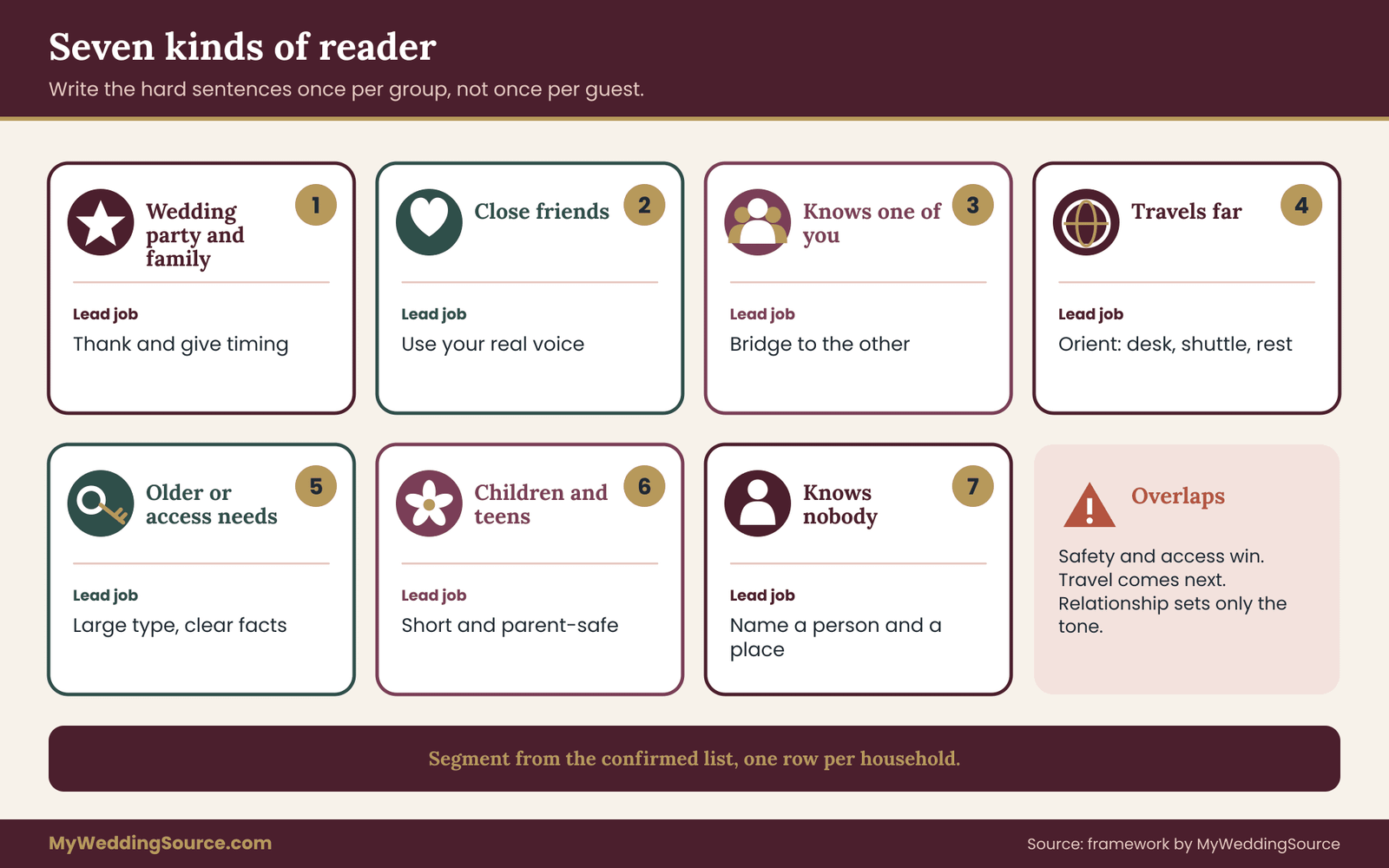
You are not writing to a hundred individuals. You are writing to six or seven kinds of reader, and within each kind, a few personal details. Segmenting your guests is the single move that makes welcome notes at scale possible, because it lets you write the hard sentences once per group rather than once per person.
The segmenting step also protects you from a common mistake: writing everything for the guests you know best. Your college friends will get beautiful welcome notes and your partner’s second cousins, whom you have met once, will get “Welcome! So glad you could make it!” Segments force you to ask what each group needs to hear.
Start with the guest list you will actually deliver to
Do not segment from the invitation list. Segment from the confirmed list, after your RSVP deadline, because only confirmed guests get bags. Pull the names into a single sheet with one row per household, not per person, and add a column for where they are staying. If you offered a hotel block, the hotel’s rooming list will help, and the guide on coordinating guest hotels across budgets and mobility needs explains how rooming lists work and why they change late.
Your RSVP handling affects this directly. If you are still chasing replies, the advice in the wedding RSVP etiquette guide will help you close the list so your segments are stable before you start writing.
The seven segments
Most guest lists fall into the same seven groups. Your list may have more or fewer, but start here and adjust.
Segment one: the wedding party and immediate family. These guests are working, not just attending. They are tired by the weekend, they already know the plan, and what they want is a sign that you see the effort. Their welcome notes lean on thanks and a practical line about timing.
Segment two: close friends and extended family who know you well. They know your voice, so a note in your real voice, with one specific memory or running joke, is welcome. This is the segment where inside jokes are safe, because every recipient is inside.
Segment three: guests who know one of you well and the other barely. These are partners’ coworkers, old neighbors, a friend’s plus-one’s friends. Their note has to bridge. It introduces the person who is a stranger to them and gives them one easy reason to start a conversation.
Segment four: guests who travel far. Anyone who flew in, took a long drive, or crossed a border. They need orientation: where to eat, how to get around, who to call. Warmth matters, but a map matters more.
Segment five: older guests and guests with mobility, vision or hearing needs. Their welcome notes need larger type, shorter sentences, and clear information about what is nearby and accessible. A well-meant joke can be lost if the card is hard to read.
Segment six: children and teens. If they have their own bags, their welcome notes should be addressed to them, short, and written for their reading level. Parents will read the note first, so keep it parent-safe.
Segment seven: guests who do not know anyone. A colleague of a parent, a college roommate from far away, a plus-one who has never met the group. They are the guests most likely to feel adrift on the first night. A good note gives them a name to look for and a time and place to find company.
Overlapping segments and how to resolve them
Guests belong to more than one segment. An aunt can be family, travel far, and need large type. Resolve the overlap with a lead segment: pick the one that changes what the note must say, and treat the others as adjustments. For the aunt, large type changes the card, travel changes the content, and family changes the tone. Write a family tone, include a travel line, print in large type.
A simple rule works for most cases. Accessibility and safety needs always win, because they change what is physically possible. Travel comes next, because it changes what the guest needs to know that evening. Relationship comes last, because it changes only the tone.
Write the segment key once
The key is the quiet engine behind welcome notes that stay consistent from the first card to the last.
Put the segments on a single page. For each, write three things: who is in it, what job the note leads with, and one example sentence in the voice you chose. This page is your segment key. It should fit on one side of a sheet. Everything you write afterward comes back to it, and if you hand some of the writing to a bridesmaid or a parent, the key is what keeps their welcome notes consistent with yours.
The base, segment and name method for welcome notes
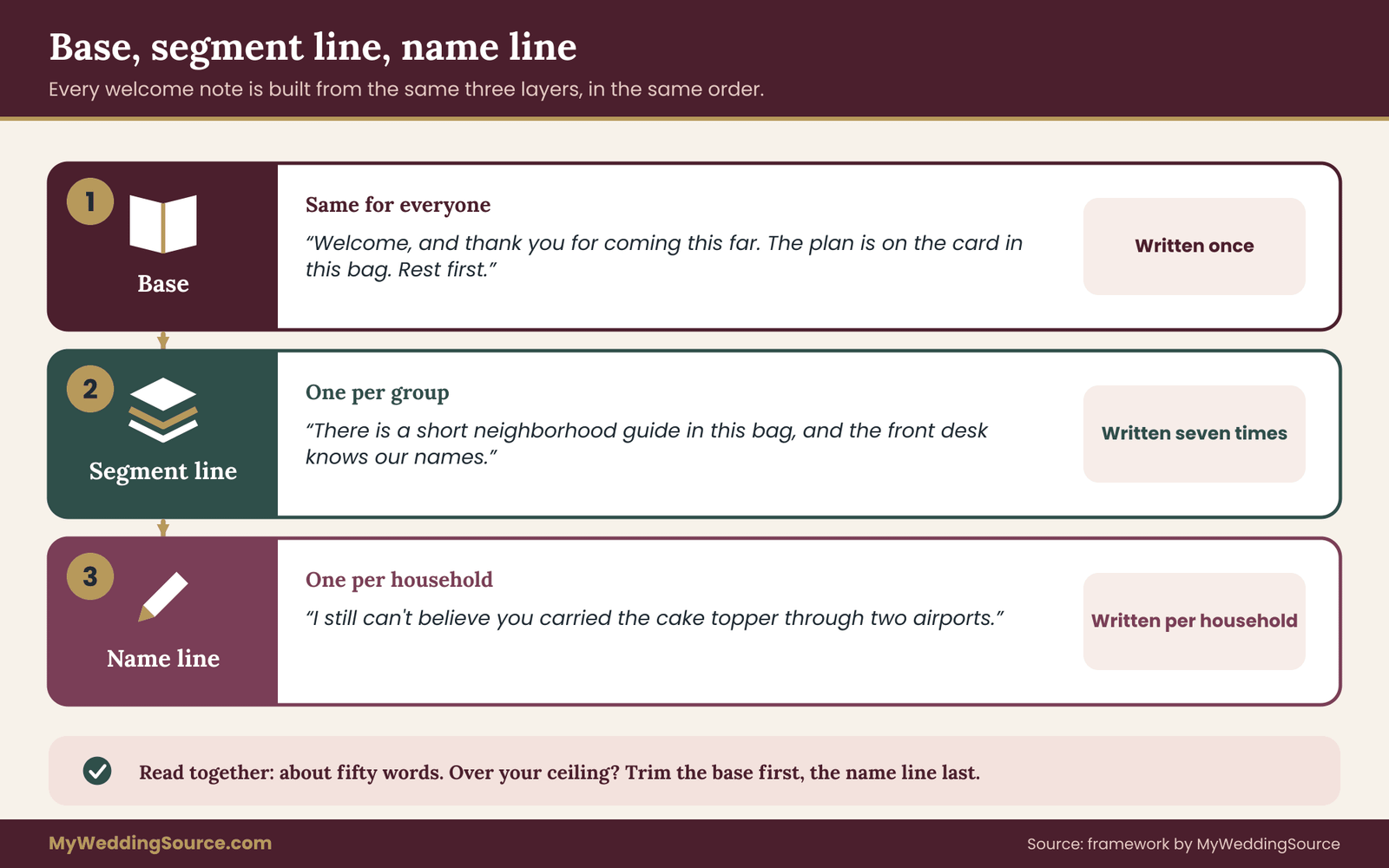
With segments set, you can build the welcome notes in layers. The method has three layers, and every note is made of the same three parts in the same order.
Layer one: the base
The base is the text every guest gets. It is two or three short sentences. It says welcome, it says you are glad they are here, and it points to one piece of shared information, such as where the welcome gathering is or where to find the weekend schedule. Because it is identical for everyone, you write it once, proof it carefully, and never touch it again.
A good base has no names, no jokes and no details that would be wrong for any guest. For example: “Welcome, and thank you for coming this far. The weekend plan is on the card in this bag. Rest first; we will find you.” Read it from the point of view of someone who has never met either of you. Is anything in it confusing, presumptuous or exclusive? If not, it is ready.
Layer two: the segment line
The segment line is one sentence, written once per segment, that matches the reader. For travelers it might be “There is a short guide to the neighborhood in this bag, and the front desk knows our names.” For the wedding party it might be “Hair and makeup start at nine; the schedule has the rest, and we owe you more than this bag.” For guests who know nobody, “Look for Dana at the welcome gathering; she is expecting you and she is easy to talk to.”
You will write seven of these. Each takes a few minutes. When you are finished, a guest in any segment will get a line that speaks directly to what they need.
Layer three: the name line
The name line is the personal part. It is one short sentence for each person or household, written by hand or typed from the ledger, that could only be about them. It is where the note stops being a form letter. It does not have to be a memory or a joke. “So glad your whole crew made it” is about them. “Thank you for driving through the storm” is about them. “I still have the mix you made me” is about them.
The key is specificity at a small size. The name line is not a paragraph. It is a single true thing about the reader. Because you write it last, after the base and segment line are already printed or written, it takes only a minute.
How the layers fit together
A finished note reads in one breath. Using the three layers, a note for a friend who flew in might read: “Dear Maya, welcome, and thank you for coming this far. There is a short neighborhood guide in this bag, and the front desk knows our names. I still can’t believe you carried the cake topper through two airports. See you at the lawn tonight.”
Count the words: about fifty. If that is over your ceiling, trim the base. The base is the safest layer to cut because it is the least personal. The name line should be the last thing you cut.
Why the method works at scale
Splitting welcome notes into layers is what lets two busy people finish them without cutting corners.
The method turns a writing task into a filling task. Once the base is written and printed, and the segment lines are written and merged, the only remaining writing is the name line. For a list of a hundred households, that is a hundred short lines, which is a manageable evening or two. The ledger, covered next, makes each of those lines faster.
It also makes the welcome notes consistent without making them identical. Every guest gets the same warmth and the same information, shaped to their situation, with one line that is theirs. That is what “personalized at scale” actually means: the structure is shared and the detail is individual.
Writing the base text for welcome notes
The base deserves its own attention, because it is the only part every guest sees. A weak base weakens every note. A good base is boring in the right way: clear, kind and free of traps.
What the base must contain
Include a greeting that is not “Dear Guest.” Use their name in the name line, but the base can open with “Welcome” and stand on its own. Include one sentence of thanks that is true for everyone: they came, they traveled, they made time. Include one pointer to where information lives, such as a printed schedule or the wedding website. Include one sentence that lowers pressure.
What the base should not contain is anything that could embarrass or exclude someone. That means no references to the couple’s history that some guests would not know, no jokes at the expense of families or nationalities, and no phrases that assume everyone drinks, eats everything, or is comfortable in crowds.
Four base examples in different voices
A base for welcome notes should sound like you on a calm day.
Here are four bases in different voices. Use them as shapes, not scripts.
Welcome. We are so glad you are here. Everything for the weekend is on the card in this bag, and the rest can wait until you have slept.
Thank you for making the trip. There is a schedule in this bag and a number to call if anything goes wrong. Please do not be shy about calling.
You are here, and that is the best part of the weekend. Settle in, and we will see you soon.
Welcome to the weekend. The plan is simple, the food is good, and nobody has to do anything tonight.
Each is under thirty words, and none depends on a specific relationship. Pick the one closest to your voice and change the details.
Testing the base with three readers
Ask three people, ideally from different segments, to read the base and tell you what they think it means. A friend from your side, a relative from your partner’s side, and someone who knows neither of you. If any of them hesitates over a phrase, change it. The goal is not to sound clever. The goal is that nobody has to decode anything after a long travel day.
Also have one of the three read it on a phone, as if they had found it in the guest message thread. Notes sometimes get photographed and shared, so they should not depend on a card’s layout to make sense.
When to refresh the base
Write the base once, but keep it in a file with the date. If your plans change, for instance the welcome gathering moves or the schedule card is reissued, the base is the first thing to check, since it points to information that may have shifted. A base that tells guests to “find the schedule in this bag” is only true if the schedule is in the bag. Treat the base as part of the bag’s contents list and confirm it at assembly.
Segment lines for welcome notes: examples for every reader
The segment line is the layer where welcome notes start to feel written for someone. Each of the seven lines needs a different lead job, so here is how to write each one, what to avoid, and a few shapes to adapt.
The wedding party and immediate family
Welcome notes for this group should be small, specific and quick to read.
These guests are the busiest people at the wedding. They have jobs, timing and responsibilities, and many of them are also quietly worried about the day. The segment line should do two things: thank them in a way that is specific enough to be believed, and give them one practical line so they know what to do next.
Good shapes: “You are carrying more than a bag this weekend. Here is the timing for tomorrow, and a snack for the car.” Or: “Thank you for being the person we call first. Your schedule is on the back of this card.”
Avoid grand declarations that put pressure on the relationship. “You are the reason we are here” is lovely at a toast and heavy in a hotel room at nine at night. Keep the line small and true.
Close friends and extended family who know you well
Welcome notes to close friends can borrow your real voice.
This segment can take the most freedom. Use the voice you actually use with them. A shared joke is fine, because everyone in this group will understand it. A short memory, a nickname or a reference to a trip is fine too.
Good shapes: “Of course you came. Of course you are early.” Or: “The playlist you made for my first apartment is still the best thing I own.” One real detail does more than three generic compliments.
The risk is length. Because these are the people you know best, the lines run long. Hold them to the ceiling. If a friend deserves a full letter, write one separately and give it at another moment.
Guests who know only one of you
Welcome notes to this group are bridges, and bridges should be short.
Their note must bridge. It should name the person they know, mention the person they do not, and give a reason to connect. The bridge is the whole job.
Good shapes: “You know Sam from the old office. Sam’s partner, Rae, has been looking forward to meeting you; she is the one with the loud laugh.” Or: “You’ve heard about the other side of the family for years. Find my brother Theo at dinner and ask about the boat.”
Avoid pushing guests into forced introductions. A bridge says “here is a person who is glad you came.” It does not say “you two must talk.”
Guests who travel far
Welcome notes for travelers lead with orientation and follow with warmth.
Their note leads with orientation. Include one or two useful facts: the front desk is expecting them, there is a coffee place around the corner, the shuttle runs from a specific spot. Keep the facts few. A list of eight restaurant tips belongs on a separate sheet, not in a note.
Good shapes: “Thank you for the long trip. The front desk knows your name, and the shuttle schedule is in this bag.” Or: “You crossed a lot of time zones for us. Sleep first; we will not be offended.”
If you are coordinating delivery through a hotel, the note’s information has to match what the hotel will actually do. The delivery piece of the process is covered in the section on labels and in the vendor questions, and the wedding vendor timeline helps you place the delivery date in your overall schedule.
Older guests and guests with access needs
Welcome notes for these guests succeed or fail on the physical card.
For this segment the physical card matters as much as the words. Print in large type on a light, matte stock. Keep the line short and the information concrete. If there is a seating plan, an accessible entrance or a quiet room, say so plainly.
Good shapes: “There is a seat saved for you near the front, and the elevator is to the left of the lobby.” Or: “The lounge near the ballroom is quiet if you need a break; ask any of us and we will walk you there.”
Avoid language that points at the guest’s need in a way they might find awkward. State what is available. Do not describe why they might want it. The guidance in the guide to wedding guest care planning goes deeper on this, including how to ask about needs without putting anyone on the spot.
Children and teens
Welcome notes for children are really written for two readers, the child and the parent.
If children have their own bags, their welcome notes should be addressed to them and written at their reading level. Short words, short sentences, one fun fact. Parents will read the note first, so it should be parent-safe: no promises about treats, no instructions that conflict with household rules, and nothing that assumes a child will be unsupervised.
Good shapes: “Hi, Jonah! Your job this weekend is to find the best dessert and tell us where it is.” Or: “Hi, Priya. There is a puzzle in this bag. The answer is somewhere at the party, and we will give you a hint at dinner.”
If a bag includes any item with small parts or food, check that the note does not contradict the label on the item. The kids’ bag safety questions are a separate topic and a separate guide, but the principle here is simple: the note should never encourage a child to do something the label warns against.
Guests who do not know anyone
Of all welcome notes, these do the most good per word.
This is the segment where a note does the most good. Name a person to look for, a time and a place. Make the instruction small and easy. “Look for Dana at the welcome gathering at six; she knows you are coming and she will introduce you” is much better than “Please mingle!”
Avoid anything that makes the guest feel like a project. They are not a problem to solve. They are a guest who would like a friendly first minute.
Personal lines at scale: the ledger method
Once the base and segment lines exist, the name line is the only writing left. It is also the part that tends to be skipped. The ledger turns it from a creative demand into a simple lookup.
What the ledger is
The ledger is the memory behind your welcome notes.
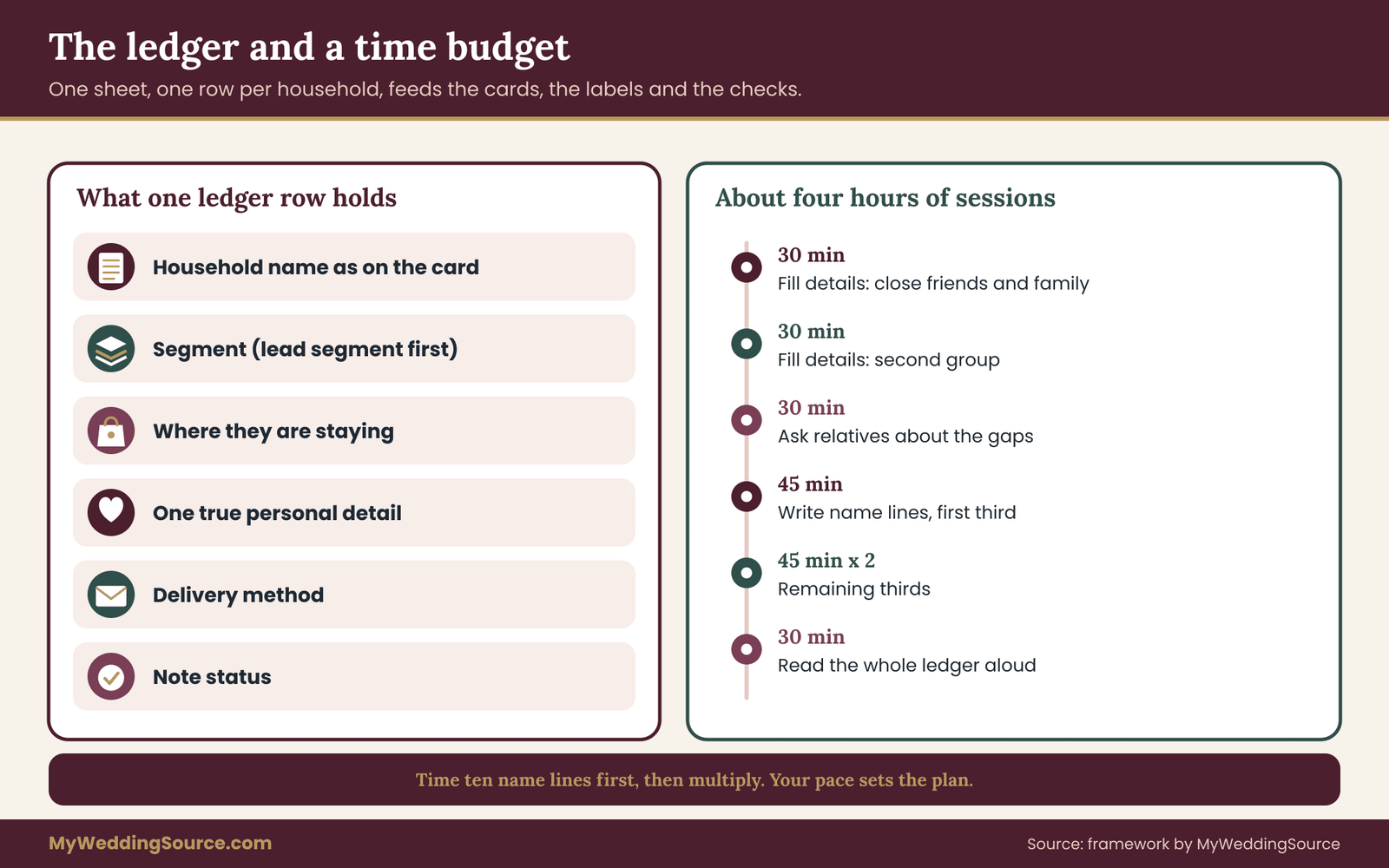
The ledger is a single sheet, with one row per household, that holds everything you need to write or print a note without having to think. A paper sheet works as well as a spreadsheet. The columns are few: the household name as it should appear on the card, the segment, where they are staying, one personal detail, and the status of the note.
The personal detail column is the one that matters. In it you write one true thing about the guest in a few words: “drove through the storm,” “brought the twins,” “first wedding since their own,” “makes the best pie.” That detail becomes the raw material for the name line.
How to fill the personal detail column
Do not try to fill it all at once. Spend short sessions on it, thirty minutes at a time, and go segment by segment. For close friends the details come easily. For distant relatives and plus-ones you may need to ask. Ask your parents, siblings or a mutual friend: “What is one thing I should know about the Okonkwos?” People enjoy being asked, and the answers are often the best lines.
If you cannot find a real detail for a guest, do not invent one. Use the segment line and a plain closing. A short, accurate note is better than a long, wrong one. “So glad you are here” is always true.
Turning a detail into a line
A detail is a fragment; a line is a sentence. The conversion is simple. Take the detail and say it as you would to the person: “drove through the storm” becomes “Thank you for driving through that storm.” “Makes the best pie” becomes “I am still thinking about your pie.” “First wedding since their own” becomes “I hope this weekend reminds you of yours.”
Keep each line under fifteen words. A short line is easier to write well, easier to read, and less likely to contain a mistake.
Handing part of the ledger to someone else
Parents and bridesmaids can help. The method makes this easy because the base and segment lines are already fixed, so a helper only writes name lines. Give them the segment key, three examples of good name lines and three examples of lines to avoid. Review everything they write before it goes into a bag. This is not about distrust; it is about catching a typo or a name mix-up while it is still cheap to fix.
When a helper writes in your name, the note should still sound like you. If a helper’s voice differs a lot, ask them to write in first person plural: “we” instead of “I.” It is easier to be consistent when the writer is the couple together rather than one partner.
A time budget you can trust
Here is a plan for a list of about one hundred households. It assumes the base and segment lines are already done.
Session one, thirty minutes: fill the personal detail column for close friends and family. Session two, thirty minutes: the same for the second group. Session three, thirty minutes: ask for details you do not have. Session four, forty-five minutes: write name lines for the first third. Sessions five and six, forty-five minutes each: the remaining thirds. Session seven, thirty minutes: proofread the whole ledger aloud.
That is about four and a half hours across a week or two. If you handwrite the name line on mixed cards, add about a minute per card for writing, which is roughly another hour and a half for a hundred. Your numbers will vary, so time yourself on ten welcome notes before you commit to a schedule.
The ledger also serves a quieter purpose. It is a record. If a guest says, a month later, that the note meant a lot, or that it felt wrong, you will know what you wrote and why. It is also useful if you plan to write thank-you notes afterward, since the details you gathered are a ready source.
Making welcome notes readable: cards, ink, type and language
A note nobody can read is just a card. Readability sounds like a small issue until you are the guest at the hotel desk trying to read a pale gray script by a lobby lamp. These choices cost nothing extra if you make them early.
Card stock and size
Welcome notes get handled, tucked, carried and dropped, so the card has to be sturdy.
Choose a card that stands up to handling. A flat card around the size of a place card or a folded card the size of a half sheet works for the lengths in this guide. Very thin paper curls in a humid bag and shows ink from the other side. Very thick paper is hard to fold and does not take ink well. A smooth, matte, medium-weight stock accepts both pens and printers, which matters if you are mixing the two.
Ask for a sample pack before you buy a full run. Write on three or four of the samples with the pen you plan to use. Leave them overnight, then check for smearing and bleed-through. Test one in a warm car or a damp bag if you can. It is a small test with a big payoff.
Pens and ink
If you handwrite, use a pen that dries quickly and does not feather. Gel and fine felt-tip pens often work on smooth card, but test them first. Avoid metallic inks on dark stock unless you have tried them, because they can smear when stacked. Whatever you pick, buy more than you think you need. A pen running dry on note sixty is a small tragedy.
Write in one position and one posture. Handwriting changes when you are tired. If your hand is cramping, stop. Resume in the next session rather than pushing through, because the last ten welcome notes of a tired run are the ones you will re-read with a wince.
Type size and contrast for printed welcome notes
For printed welcome notes, use a plain, open typeface at a size larger than feels natural for a card. Dark text on a light background is easiest to read. Avoid pale text on a colored background, small italic type and long lines of script. Keep the line length short; a note of thirty to forty words should break into four or five lines, not run edge to edge.
The federal plain-language guidelines describe clear writing in practical terms: short sentences, common words, active voice and the information the reader needs first. They were written for government documents, but they work just as well for a card in a hotel bag. If you want an outside reference for these habits, the Plain Language site run by the federal government is a good one and is listed in the sources.
Handwriting that other people can read
Handwriting that you can read is not always handwriting that your guests can read. Print in clear block letters if your cursive is loose. Leave space between lines. Keep the signature simple. Ask someone who does not know what you wrote to read three cards aloud, and watch where they stumble.
If you are writing in a second language, ask a fluent reader to check the spelling and any accent marks. Missing accents can change words. A name written wrong on a welcome note is worse than no note, because the card is the one place the guest will look to see whether you got their name right.
One thing to avoid: the QR code note
It is tempting to add a QR code that links to a video message or a playlist. Think carefully before you do. Guests with older phones, with limited data abroad or with vision difficulty may not be able to use it, and a code on a card in a dim hotel room is an extra hurdle. If you want to share a link, print it as a short plain web address as well. Better still, put the link on the wedding website and mention it in the base text.
Translating and bilingual welcome notes
A short bilingual line is a lovely touch when you have a reliable reader for it. For an elder who reads another language, one or two sentences in that language, written or checked by a fluent family member, is more than enough. If several languages are in play, resist the urge to translate the entire note into all of them. Write a clear base in the shared language, and add a single line in each other language where it will be read.
If the guest speaks the language but not the register you used, ask your fluent relative to write the line in their own voice. A formal phrase may sound cold; a casual phrase may sound disrespectful to an older reader. A fluent family member will know.
Error-proofing labels for welcome notes: match, seal, check
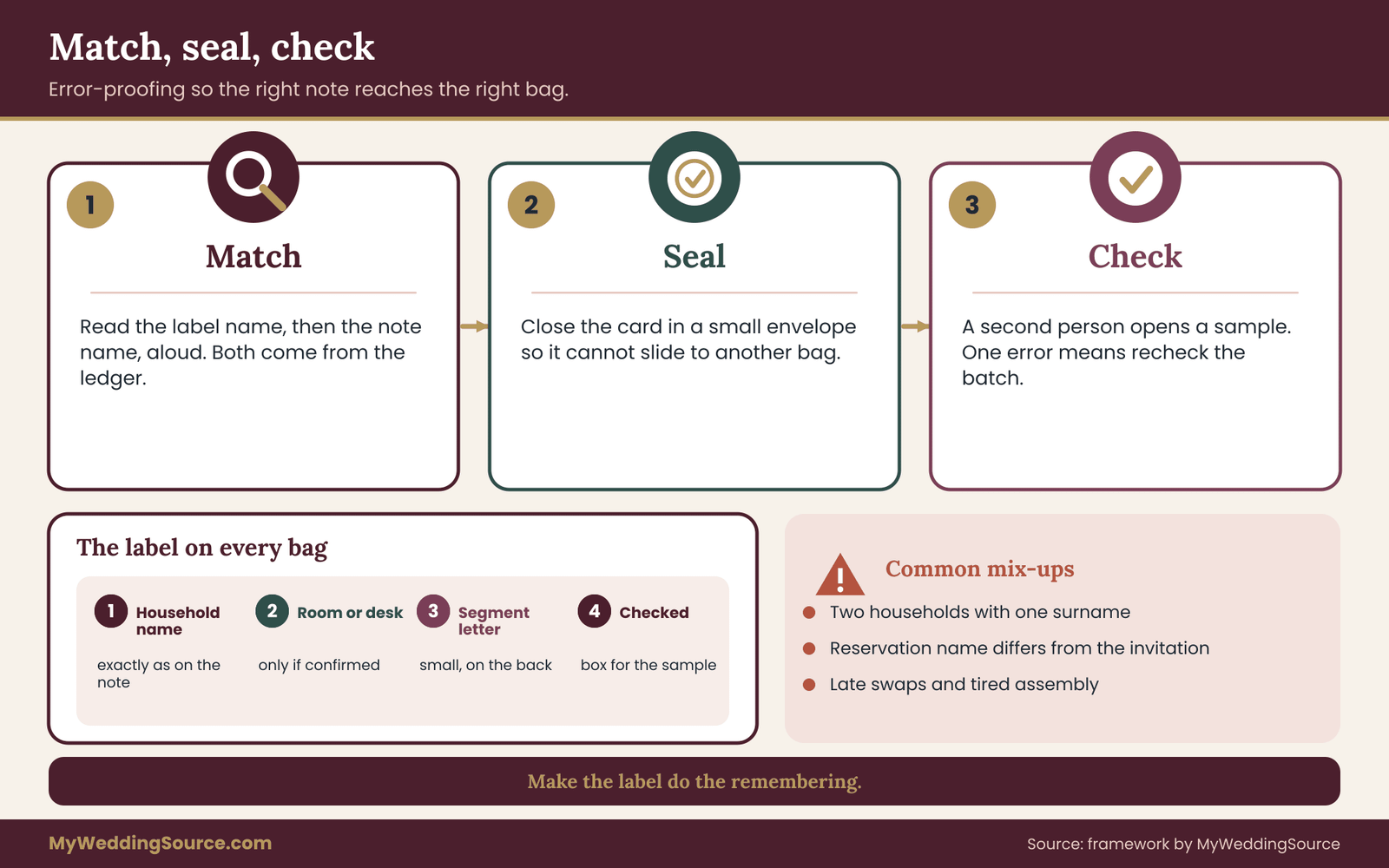
You can write the best welcome notes in the world and still fail if they end up in the wrong bags. Mix-ups are the most predictable problem at scale, and they are also the most preventable. This section introduces an error-proofing method built on labels. The idea is simple. Instead of trusting that people will not make mistakes, you arrange the work so that a mistake is hard to make and easy to catch.
Why mix-ups happen
Mix-ups are the most common way welcome notes go wrong, and the least dramatic.
Three things cause most mix-ups. First, similar names: two households called Park, two guests named Chris, a father and son with the same name. Second, changes late in the process: a guest moves rooms, a household swaps who is attending, a plus-one is added. Third, tired people working from memory at the end of a long assembly session.
None of these is a character flaw. They are what happens when many small items pass through many hands. The fix is to make the label do the remembering.
The label on the bag
Every bag gets one label, in the same place, in the same format. The label has four parts: the household name exactly as on the note, the room or delivery location if known, a segment code, and a check mark space. Keep it small and put it on the outside, where it can be read without opening the bag.
The segment code is a single letter. Use the first letter of the segment name, or any key you like, as long as you write it on the segment key page. The code does not need to be visible to the guest; a small mark on the back of the label is enough. Its job is to let you spot a bag in the wrong group at a glance.
Match: the note and the bag share one name
Matching is the step that keeps welcome notes with the people they were written for.
The match step is the heart of the system. The household name on the label must match the household name on the note, character for character. When you tuck a note into a bag, read the name on the label, then read the name on the note, aloud if you are alone. If anything differs, stop. The most common differences are small: a married name on one and a maiden name on the other, a nickname, or a transposed letter.
Use the ledger as the master. Print or copy the household name from the ledger onto both the label and the note, so that a single typed source feeds both. If you are handwriting, copy from the ledger rather than from memory. A tiny habit of reading from the ledger every time removes most errors.
Seal: close the loop so nothing moves
Once a note is matched, seal it. That can mean a sticker on the envelope, a small piece of tape on the card’s edge, or simply placing the note in a small envelope and closing the flap. The point is that a sealed note is not shuffled between bags during transport or delivery.
An unsealed card slides. In a hotel delivery cart, in a trunk or on a table, loose cards travel. Sealing is cheap and takes seconds, and it keeps the note with the bag it was matched to.
Check: a second person confirms a sample
The check step is a second pair of eyes on a sample, not on every bag. Choose a sample size you can finish: for example, every fifth bag, or ten bags chosen at random across segments. The checker reads the label, opens the bag, reads the note and the contents list, and confirms they all agree.
If the sample has no errors, you can move on with reasonable confidence. If it has an error, check every bag in that batch. That is the rule: one error in the sample means a full recheck of that batch. Write down what kind of error it was. If three errors are the same kind, fix the cause, such as a ledger column that was sorted wrong, before you reassemble.
Allergen and ingredient labels versus notes
Welcome notes can accidentally contradict labels. If a bag has food in it, the note should not make claims about it that the label does not support. Avoid phrases such as “nut-free” or “safe for everyone” on a card unless the supplier’s own label and documentation clearly support the claim. Food labeling rules in the United States are set by federal agencies, and the Food and Drug Administration explains how major allergens must appear on packaged foods. Your note is not a label and should not try to replace one.
The safest approach for any food item is this: leave the claim to the manufacturer’s label, and keep the note to a friendly line such as “There are snacks in the bag; please check the labels if you have any allergies.” If you are packing homemade items, tell guests plainly that they were made in a home kitchen and list the main ingredients on a separate card, or leave them out of bags for guests with known allergies. The wedding menu planning guide covers how to gather dietary information so you know who needs what before assembly.
Matching welcome notes to hotel delivery
If the bags are delivered by a hotel, the label must be understandable to hotel staff, who do not know your guests. Use full names as they appear on the reservation, and include the room number only if the hotel has confirmed it. Ask the hotel what format it wants. Some hotels hold bags at the front desk, and others deliver to rooms, and each policy changes what the label needs to say. The vendor questions section lists what to ask, and the same idea underlies the wider coordination in the wedding guest hotels guide.
A name on a label is only as good as the reservation it matches. A guest may have booked under a spouse’s name or a company’s name, and the hotel may not find a bag labeled with the name you know. For guests whose reservation name differs from their wedding invitation name, write both on the label, with the reservation name first.
A worked example of welcome notes for eighty-four guests
The example below is invented for illustration. The couple, the numbers and the hotel are made up, and nothing here is a real statistic. It shows how the three layers, the ledger and the labels fit together on a real timeline.
The setup
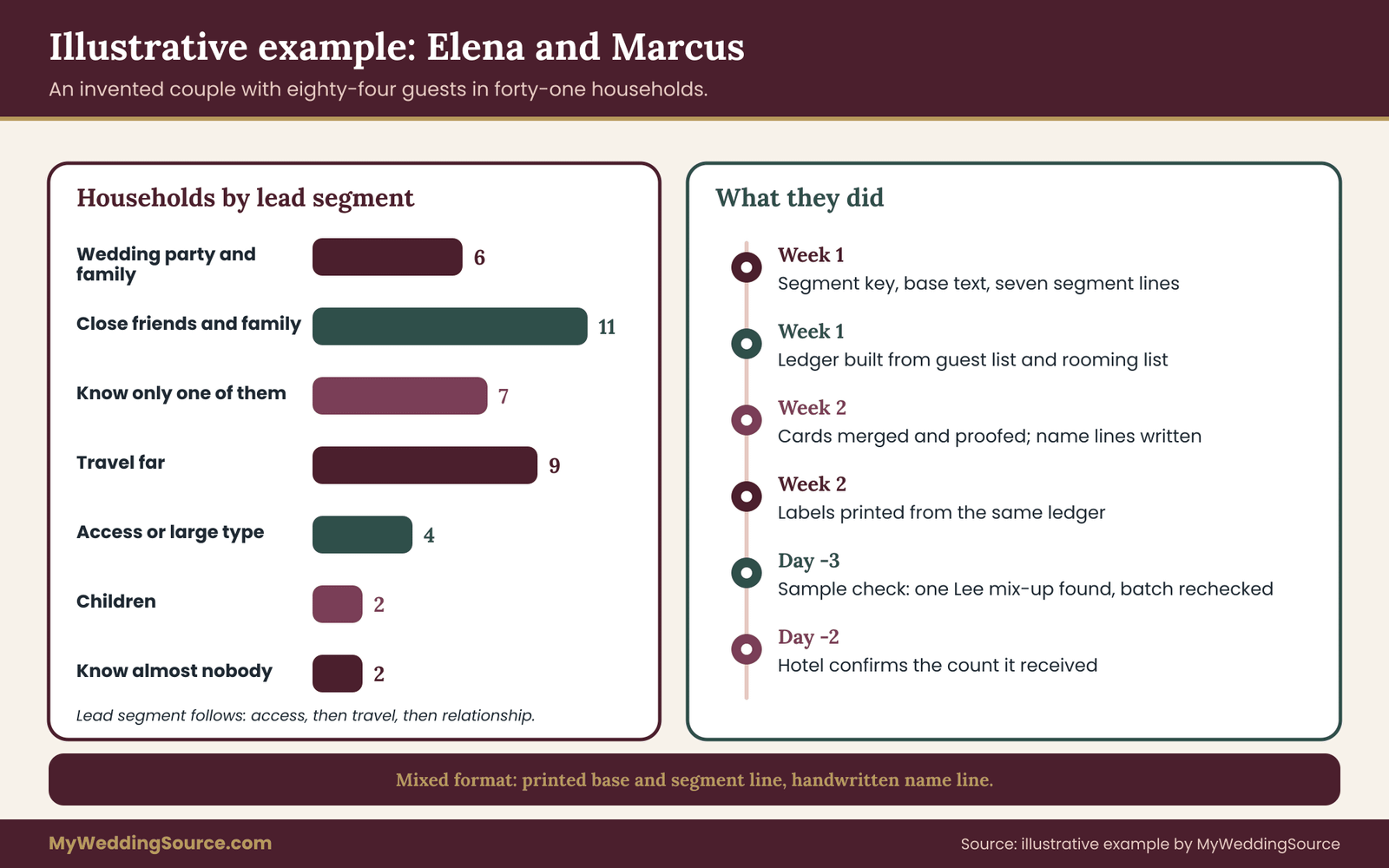
Imagine a couple, Elena and Marcus, with eighty-four confirmed guests in forty-one households. Thirty-two guests are staying at a hotel they have a block with. The rest are local or staying with family. The welcome gathering is on Friday evening; bags go to the hotel on Thursday afternoon.
They want every guest to feel expected, but they have a full-time work schedule and only about two weeks of evenings. They decide on a mixed format: a printed card with the base text and the segment line, plus a handwritten name line and signature.
Step one: segments
They sort the forty-one households into the seven segments. Six households are the wedding party and immediate family. Eleven are close friends and family who know them well. Seven know only one of them. Nine travel far. Four need large type or access information. Two households bring children. Two households are guests who know almost nobody. Some households fit more than one segment, so they assign a lead segment using the rule from earlier: access and safety first, travel next, relationship last.
That makes the segment key a single page. For each segment, they write the lead job and one sample sentence. The key takes about forty-five minutes.
Step two: base and segment lines
They write the base together in one sitting, using the two-sentence shape. It reads: “Welcome, and thank you for being here. The weekend plan is on the card in this bag, and tonight is just for settling in.” They test it on three readers, change one word, and lock it.
They write seven segment lines, one per segment. This takes a bit over an hour in total, because they argue happily over two of them. Neither line goes past twenty words.
Step three: the ledger
Elena builds the ledger in a spreadsheet with six columns: household name as on the card, segment, lodging, delivery method, personal detail and status. She fills in the first four from the guest list and the hotel’s rooming list. Together they fill the personal detail column in three short sessions, asking Marcus’s sister for help with his side’s cousins.
For two households they cannot find a personal detail. They agree not to invent one. Those welcome notes will carry the base, the segment line and a plain closing.
Step four: print and write
They print the cards with a mail merge that places the household name, the base and the segment line. Forty-one cards, printed on two sheets with a few spares. Elena checks the print on the first card against the ledger, finds that one household name has an extra space and a missing accent, and corrects it before printing the rest.
They split the handwriting. Elena writes the name lines for her side and the wedding party; Marcus writes his. Each of them writes in two sessions of about forty minutes. They time the first ten welcome notes and find that it takes about a minute each, so the estimate holds.
Step five: labels and checks
They print labels from the same ledger, so the household name on the label and the card come from one source. Each label has the name, the room or delivery spot, a segment letter and a small check box. They match each card to its label, seal the card in a small envelope, and place it in the bag.
A friend does the sample check: every fifth bag, plus any bag in the access or children segments, which they treat as higher stakes. Of nine bags checked, one has a mismatch: a card for a household named Lee in a bag labeled for a different household named Lee. They treat this as an error in the sample, so they recheck all the bags in that batch and find one more near-duplicate name. They add the first initial to both labels and cards for both households and continue.
Step six: delivery
The hotel confirms that it can hold bags at the front desk and add a delivery slip to each reservation. Elena sends a list with the household names exactly as they appear on the reservations. For the two households whose reservation name differs from the invitation name, she lists both. Two days before delivery, she asks the hotel to confirm the count it has received, and the hotel’s count agrees with hers.
What the example shows
The example is small, but it shows how welcome notes can be both personal and orderly.
Three things stand out. The time was manageable because the shared work was done once. The errors were caught because the system had a check, and the check was sized to be doable. And the welcome notes were still personal: every card had a line in a human hand that could only have been written about that household.
Handwritten, printed or mixed welcome notes: choosing by guest count
The right format depends on your list size, your time and your hands. There is no universally best choice, and the comparison below is in terms of effort and risk, not feel. Think of each as a trade.
Fully handwritten
Handwritten welcome notes are the warmest and the slowest option.
This format fits lists up to about forty households and couples who enjoy writing. Its strength is warmth: every word is yours, and the guest can see it. Its costs are time and risk. Each note takes several minutes, because you are writing the base and segment line as well as the name line, and every repeated sentence is a chance for a typo or a slip of voice.
If you choose this, shorten the base so it is quick to write, and pre-write the segment lines on a reference sheet so you copy rather than invent. Plan for breaks. A handwritten run of forty welcome notes over three or four short sessions is pleasant; the same run in one evening is not.
Fully printed
Printed welcome notes are the fastest and the easiest to proof.
This format fits large lists, tight schedules and couples who dislike handwriting. Its strength is speed and consistency. A mail merge can place the right name and segment line on every card, and it can be proofed once. Its cost is that it can feel impersonal if the name line is generic, and it is easy to produce many cards with a shared mistake if the template is wrong.
If you print everything, put your effort into the name line. A printed card with a specific, true line about the guest reads as personal. A printed card with “So glad you could come!” reads as a form letter. Proof the merge against the ledger on at least ten cards before you print the full run.
Mixed: printed card, handwritten name line
This format suits most lists above fifty households. The printed part carries the base and the segment line, and your handwriting carries the name line and the signature. It protects your time and your hand and keeps the part that matters in your own writing.
Leave real space on the card for the handwritten line. A card that is printed to the edge leaves no room, and a cramped line looks like an afterthought. Test one before you print the run.
A simple decision rule
Count households, not guests, since most welcome notes go to households. Then use this rule. Under about forty households, handwrite if you enjoy it and print if you do not. Between forty and about one hundred and twenty, use mixed. Above that, use mixed with a helper or a shared ledger, or print everything and reserve handwriting for the guests who most need it. Adjust for your calendar. If you have under two weeks, lean toward more printing.
Cost logic without invented numbers
Printing costs depend on your printer, your stock and your quantity, and they change. Do not rely on a figure from an article, including this one. Get a written quote for your exact size and stock, and ask what a reprint costs if you find an error. Compare that quote to the value of your own time, using your own estimate of how many minutes a handwritten note takes you, which you can get by timing ten.
The comparison is usually less about money than about risk. A printed error affects every card. A handwritten error affects one. A mixed format puts the shared text on a template you can proof carefully and the personal text on a card you can redo individually. That balance is why mixed is the common choice.
Edge cases that trip up welcome notes
The method handles the ordinary list well. The trouble comes from the exceptions, which are usually the guests with the most at stake. These are the edge cases that come up most often, with a decision rule for each.
Late additions and late drops
Welcome notes always meet a change of plans somewhere, and a late addition is the usual one.
A guest is added after you have printed the cards. A guest cancels two days before delivery. Both happen. For an addition, write a handwritten card using the base and segment line in your own hand, and add the guest to the ledger and the hotel list at once. For a cancellation, pull the bag and the note, mark the ledger, and tell the hotel immediately so that the bag is not delivered to an empty room.
Keep a small stack of blank cards with the base printed, and a few spare labels. A late addition is an annoyance if you have nothing ready and a five-minute job if you do. Keep the spares for a week after the wedding in case a guest turns up late.
Plus-ones and guests whose names you do not know
Some invitations say “and guest.” If the guest has not given a name by the time you write, do not guess. Address the card to the person you know, and leave the second name off, or write “and guest” only if you are sure that is how the household is listed. Then add a line that lets the plus-one feel welcome without a name: “We are glad you are both here.”
If you learn the name later, write a second small card and slip it in. A plus-one who sees their own name on a card feels welcomed. One who sees “and guest” understands that you did not know them, which is fine, but a name is better when you can get one.
Shared rooms, shared names and surprise roommates
Two guests who are not a couple may share a room. A parent may share with an adult child. Two friends may split a suite. In these cases, write separate cards for each person, place them in the same bag or in two bags labeled for the same room, and confirm with the hotel which they prefer. A single card addressed to two people who barely know each other is a quiet kind of awkward.
If you cannot tell who is sharing, ask the guests directly when you confirm their reservations. It is better to ask than to assume, and it prevents a bag from being delivered to a room where a guest is not staying.
Names that are easy to get wrong
Names that include accents, apostrophes, hyphens or unfamiliar spellings are the ones most likely to be wrong on a card. Ask guests how they want their names written, especially if the spelling differs from what is on the invitation. Check the spelling on the ledger once, and then copy from the ledger every time.
For guests who go by a nickname, a middle name or a name that differs from their legal one, use the name they use. If a guest has told you they go by something new, use it, and do not draw attention to the change. A card that gets someone’s name right without comment is a quiet courtesy.
Sensitive situations: grief, estrangement and illness
Some of the hardest welcome notes to write are the shortest ones.
Some guests are carrying something. A widow attending her first wedding since her husband died. A guest whose family is not speaking to another family. Someone recovering from illness. The right note for these guests is usually simpler than you think. A warm, short line that does not mention the hardship is better than a heavy one that does.
Do not name a loss in a card unless you are very close to the person and know it would be welcome. You can instead write something that does not require them to respond: “I am so glad you are here” or “We saved you a seat by the window.” If you are unsure, ask a mutual friend or leave the line out. Consider the effect on the whole household: a note that mentions one person’s loss may be read by someone else in the room.
If two families are in conflict, place their welcome notes in separate bags and avoid lines that pit them against each other. A note should never contain a message meant for someone else.
Religious, cultural and dietary considerations
A line about food or drink in a note should not assume what a guest eats or drinks. “Enjoy the wine in your bag” will not suit a guest who does not drink. “There is something for the evening in your bag” is more flexible. If you know a guest’s dietary or religious practice, you can adjust the item and the note to match, and the segmenting step will make that easier.
When a guest observes a fast, a Sabbath or a holiday, ask before you write anything that depends on timing. A note that tells guests to meet at six on a Friday evening is not helpful to someone who cannot travel or use a phone then. The point is not to make assumptions but to ask early and write the note to fit.
Notes for guests you did not invite to the welcome gathering
Some weddings have a smaller welcome event than the full list. If a bag goes to a guest who is not invited to the gathering, do not mention the gathering in their note. A base text that points to the gathering will cause hurt. Make a second base for guests who are not invited to the event, and mark those guests in the ledger so they get the right version.
This is also the place to be careful with any line that suggests “the group” or “everyone.” In a mixed list, “everyone” is rarely true.
What to do when you realize a card was wrong
It will happen once. A card is in the wrong bag, a name is misspelled or a line is inaccurate. If you catch it before delivery, replace it quietly. If you catch it after, fix it kindly: a short, sincere apology in person, with a replacement card, is enough. Do not over-explain. Guests tend to forgive an honest mistake handled gracefully far more readily than they would forgive a defensive one.
Questions for hotels, printers and helpers, and checks you can measure
The last piece of the system is the outside world: the hotel that holds the bags, the printer that makes the cards and the helpers who assemble them. Asking the right questions early prevents most of the late surprises. You can also set a few measurable checks, so you know before the weekend whether the system is working.
Questions to ask the hotel
Ask each of these and write down the answers with the date and the name of the person who gave them. A confirmation by email is better than a verbal one.
Does the hotel accept packages for guests before they arrive, and from whom? Is there a fee for holding or delivering, and is it per bag or per delivery? How early can bags arrive, and is there a cutoff? Who signs for them? Where will they be held, and is that space secure? Will the hotel deliver bags to rooms, or must guests pick them up at the desk? What information does the hotel need on each label: name, room number, confirmation number? What happens to a bag if a guest cancels or checks in late?
A hotel that answers these questions clearly is a hotel you can plan around. A hotel that is vague deserves a second conversation, or a plan B such as handing bags out at the welcome gathering. The coordination of room blocks and delivery timing is also part of the broader full guest list guide, which explains how the confirmed list and lodging details fit together.
Questions to ask a printer
Ask about card stock options, minimum quantities and turnaround time. Ask whether a proof is included, and whether you can approve a digital proof and a physical sample. Ask what happens if you find an error after printing. Ask whether a mail merge is supported and what file format the data needs. Ask whether the printer can handle special characters and accents in names, since some systems drop them.
Get the quote in writing. If a printer’s terms matter, such as a restocking or reprint policy, quote them exactly in your welcome notes rather than from memory. Terms change, and a screenshot of an email is better than a recollection.
Questions to ask helpers
If friends or family are helping, ask each one what they can commit to: a block of time, a task, a date. Give them a one-page instruction sheet. Tell them what to do when they are unsure: stop and ask, rather than guess. Ask them to work in pairs when matching, so one person reads and the other checks.
Be clear about privacy. The ledger contains personal details, such as who is estranged from whom or who is ill. Share only the columns a helper needs, and ask them not to discuss what they read. A helper who only needs names and room numbers does not need the personal detail column.
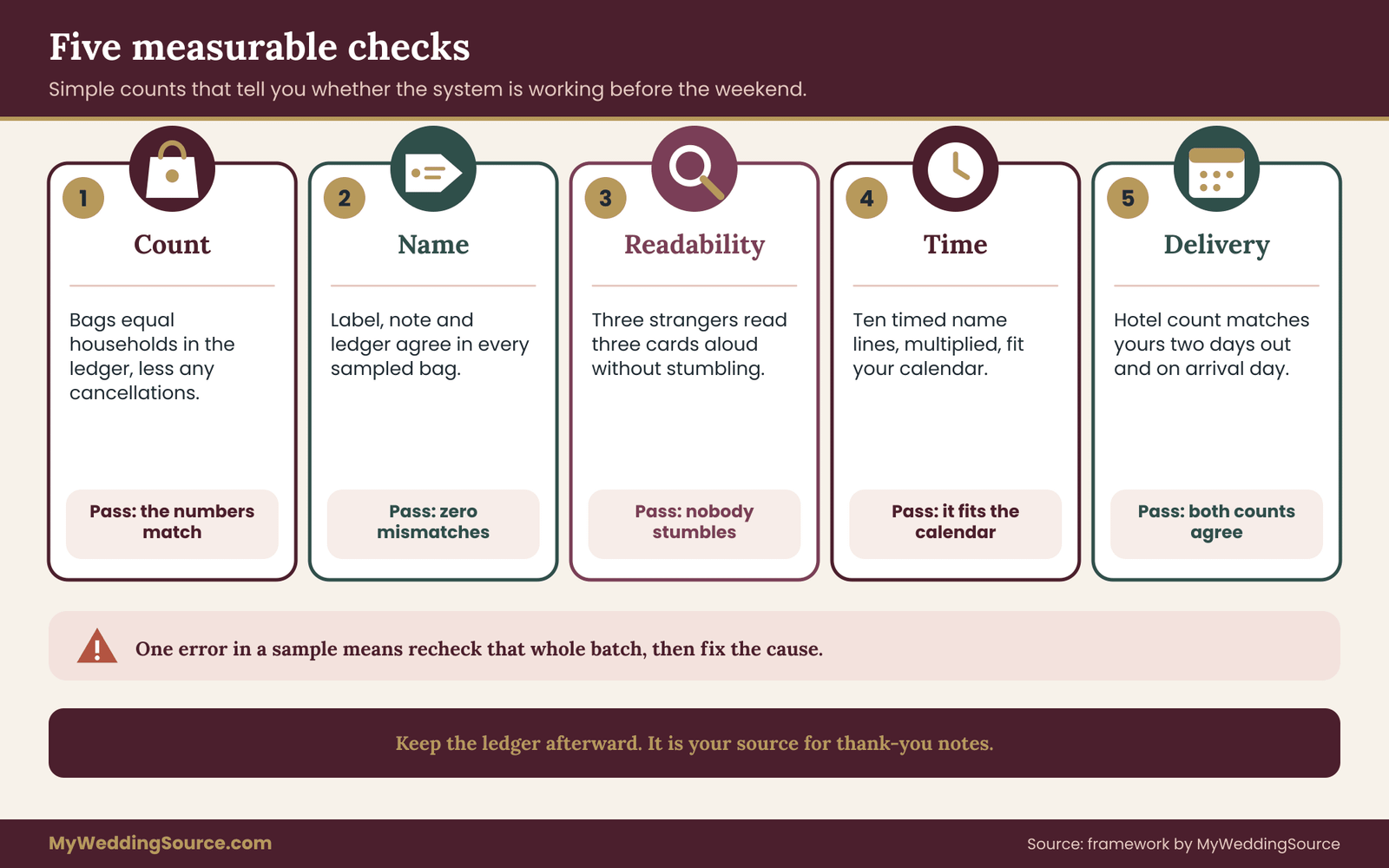
Five measurable checks
You can test the system with a few simple counts. None of them requires special tools.
Count check. The number of bags equals the number of households in the ledger, minus any who have cancelled. Count them before and after packing.
Name check. In a sample, every label name equals the card name equals the ledger name. Aim for no mismatches. If you find one, recheck the batch.
Readability check. Hand three cards to three people who have not seen them. Ask each to read a card aloud. If any of them stumbles, fix the type size or the handwriting.
Time check. Time the first ten name lines. Multiply by the remaining count. If the total does not fit your calendar, move toward more printing.
Delivery check. Two days before delivery, confirm the hotel’s received count against your own. Confirm the same again the morning of check-in.
After the weekend
Review how your welcome notes performed while the details are fresh.
Keep the ledger. If you plan to send thank-you notes, the personal details you gathered are a ready source. Note any lessons: which segment line worked, which name lines got a reaction, which part of the process cost the most time. If you ever write welcome notes for another event, you will start with a better template.
For guests who have questions about the weekend after reading their welcome notes, direct them to the wedding website or to one named person. Do not put your own phone number on every card unless you want to be the help desk. A single contact, listed in the base text or on the schedule card, keeps the welcome notes clean and the weekend calmer. Etiquette for how to handle guest communication in general is covered in the wedding etiquette guide.
Your next steps
You do not need to do everything at once. Work in this order, and each step makes the next one lighter.
First, close your confirmed guest list and group it by household, with a lodging column. Second, write the segment key on one page: the seven segments, the lead job for each and one sample sentence. Third, write the base text and test it on three readers. Fourth, write the segment lines. Fifth, build the ledger and fill the personal detail column in short sessions.
Sixth, decide the format and time ten name lines to confirm your schedule. Seventh, print or write the cards, proofing against the ledger. Eighth, print labels from the same ledger, then match, seal and check a sample. Ninth, send the hotel a list that matches its reservations and confirm the count twice.
Finally, put the last two checks for your welcome notes on your calendar: a delivery count two days before, and a short readability test on three cards before the full run. If you do only one thing from this guide, make it the ledger. Everything else in the system draws from it.
FAQ
How long should welcome notes be?
Thirty to forty words is enough for most guests. That fits a greeting, one specific line and a closing on a small card, and it keeps the writing readable for older eyes. Set a hard ceiling before you start, and decide in advance which few guests, if any, will get a longer note. Longer welcome notes multiply your writing time and rarely improve the reader’s experience.
Do welcome notes need to be handwritten?
No. A fully handwritten note is warm but slow, and a fully printed one is fast but can feel generic if the personal line is vague. Most couples with more than fifty households use a printed card with the base text and segment line, plus a short handwritten name line and signature. That protects your time and keeps the personal part in your own hand.
What should I write in welcome notes for a guest I barely know?
Keep it short, true and kind. Use the segment line for guests who know only one of you, name the person they do know, mention the person they do not, and give them one easy reason to connect. If you cannot find a real detail, skip it. “So glad you are here” is always accurate. Never invent a memory or a compliment.
How do I stop welcome notes from sounding the same?
Keep the base identical and make the other two layers different. The segment line changes with the reader, and the name line is one true sentence about that person or household. Gather those details in short sessions and ask relatives for help with guests you do not know well. A single specific line of under fifteen words changes how the whole card reads.
How do I make sure each note reaches the right guest?
Use a label on every bag that carries the household name exactly as it appears on the note, the room or delivery spot and a segment code. Match the label to the note, seal the card, and have a second person check a sample. If the sample shows one error, recheck the whole batch. For hotel delivery, send names exactly as they appear on reservations.
Can I mention food or drinks in welcome notes?
Yes, but keep claims light. Do not call anything nut-free, allergen-free or safe for everyone unless the manufacturer’s label and documentation clearly support it. A line such as “There are snacks in the bag; please check the labels if you have any allergies” is accurate and friendly. Leave ingredient claims to the label and check the Food and Drug Administration’s allergen guidance.
What if I am running out of time before the wedding?
Move toward printing. Print the base and segment lines, and handwrite only the name line for the guests who matter most, using the plain closing for the rest. Time ten welcome notes to know your real pace. Drop the optional extras first, such as translated lines, before you cut the label check, because mix-ups are the harder problem to fix once bags are delivered.
Should children get their own welcome notes?
If they have their own bags, yes, and a short note addressed to them is a nice touch. Write at their reading level, keep it to a sentence or two, and make it parent-safe, with no promises about treats or instructions that could conflict with house rules. Make sure the note does not encourage anything the label on an item advises against, especially for toys with small parts.
Sources
- Federal Trade Commission: guidance for businesses and consumers on honest advertising and endorsements, relevant to supplier claims and any commercial relationships you mention.
- U.S. Food and Drug Administration, Food Allergies: how major food allergens are identified and labeled on packaged foods.
- Food Allergy Research and Education: practical information on food allergies and labeling for families and hosts.
- U.S. Consumer Product Safety Commission: safety information on children’s products and small parts.
- PlainLanguage.gov: federal guidelines for writing clearly, useful for short readable welcome notes.
- ADA.gov, U.S. Department of Justice: information on accessibility and effective communication.
- Transportation Security Administration: rules for carrying items, including liquids, in carry-on bags.
- United States Postal Service: shipping, address and delivery standards for mailed items.
- American Hotel and Lodging Association: industry information on hotel operations and guest services.
- Centers for Disease Control and Prevention, Food Safety: general guidance on handling and storing food safely.