
A wedding cat is any cat you are thinking of bringing into your ceremony, photos or reception, and for most cats the kind answer is a loving no. This guide gives you a three-gate decision tree, built around the wedding cat instead of the picture, so you can decide calmly whether your cat comes, comes briefly, or stays home with a better job than being a prop.
Run your wedding cat through three gates in order. Gate one is the cat: temperament, health, handling history and carrier habits. Gate two is the place: written venue rules, guest allergies, escape routes, noise and hazards. Gate three is the day: how many hours away from home, who is responsible every minute, and what happens if the cat needs to leave. A wedding cat that fails any gate stays home. A cat that passes all three can still be limited to a short, quiet cameo away from the crowd.
Cats and weddings have a mismatch built into the biology of the animal. A wedding is crowded, loud, scented, full of strangers who want to pick things up, and held in a place the animal has never smelled. Most house cats do their best in a small, predictable territory with familiar people. That does not make every cat a bad candidate, and it does not make the wish to include a beloved pet silly. It means the decision deserves a method rather than a mood board.
This article is about that decision for cats specifically. If you are weighing pets in general, the broader planning of roles, permissions and photos belongs to a separate welfare-first guide on this site, and the dog-focused questions about attire, leashes and ring-bearing differ in many ways from what a cat needs. Here the question is narrower: should this cat be there at all, and if not, how do you honor the cat and keep your day intact?
A note on scope. This is general planning information, not veterinary, legal or financial advice. Only a veterinarian who knows your wedding cat can judge your cat’s health and temperament, and only the venue’s written terms and your local rules decide what is permitted.
Why the wedding cat question is different from the dog question
Most pet-at-wedding advice online is written with dogs in mind, because dogs walk on a leash, tolerate a crowd more often, and have a long cultural record as ring bearers. Copying that advice for a cat creates problems, because the two animals handle stress and containment differently.
A dog that is overwhelmed will often look for its person. A cat that is overwhelmed will often look for a hiding place, and if none exists, it will try to get away. That difference matters at a venue with open doors, a catering entrance, a loading dock and a hundred guests holding the doors for each other. A dog on a leash has a tether. A wedding cat has a carrier, a harness if it has been trained to one, or nothing at all.
There is also the question of consent in a practical sense. Dogs, as a species, are more likely to seek out strangers and attention. Many cats are not. A cat passed from one guest to the next for photographs is an animal being handled by people it did not choose, in a place it cannot read. That is the picture to keep in mind when someone says “it will only take a minute.”
None of this is a rule that cats cannot attend a wedding. Some cats are confident, socialized, comfortable in a carrier and calm around people, and some couples arrange short, quiet appearances that work out. The point is that a wedding cat starts from a lower baseline of fit than most people assume, so the burden of proof sits with the plan rather than with the cat.
What the wedding cat usually stands for
Before running the gates, it helps to name what you hope the cat will add. Couples rarely want the cat for its own sake. They want something the wedding cat represents: the household that came before the marriage, a pet that introduced the two of you, a comfort object on a nerve-wracking morning, or simply a photograph that feels like your real life.
Write the wish in one sentence. “We want our cat in the photos because it was part of how we became a family.” “We want the cat nearby because I am anxious and the cat calms me.” “Our families expect it.” Each of these leads to a different set of alternatives, and most of those alternatives do not require the cat to leave home. A wish stated clearly is easier to satisfy than a wish left vague.
A word on the cost of getting it wrong
A cat that bolts at a venue is not an inconvenience. It is an emergency that can pull your photographer, your family and your guests into a search, and a lost indoor cat in an unfamiliar area is in genuine danger. A wedding cat that is stressed all afternoon may stop eating, hide for days, or develop a stress-related illness. Even the best outcome, a cat that endures the day, uses up goodwill from the animal that you will not see in the photographs.
Set that against what the cat adds to the day. The honest comparison is rarely close, which is why the guide is titled the way it is. Staying home is not the consolation prize. For most cats, it is the correct answer, and the rest of this article shows how to reach it without guilt and how to make the cat part of the story anyway.
The three-gate decision tree for a wedding cat
The decision tree has three gates, and the order matters. Each gate is a set of yes-or-no checks written so that “no” is final unless you can change the facts. You move to the next gate only when the previous one is passed.
Gate one: the wedding cat. Is this particular animal suited to leaving home, being carried, and tolerating strangers and noise? This gate uses temperament, health, age, carrier history and the opinion of your veterinarian. It is the gate most couples want to skip, and it is the one that matters most.
Gate two: the place. Does the venue permit animals in writing? Can the cat be kept away from the crowd, from the doors, and from hazards such as lilies, candles, ribbon and open catering? Are any guests, vendors or staff allergic? This gate turns on documents and walkthroughs, not on goodwill.
Gate three: the day. Can the cat’s presence be limited in hours, supervised every minute by a named adult who is not part of the wedding party, and ended at any moment without drama? This gate is about logistics, and it is where many well-meant plans fall apart.
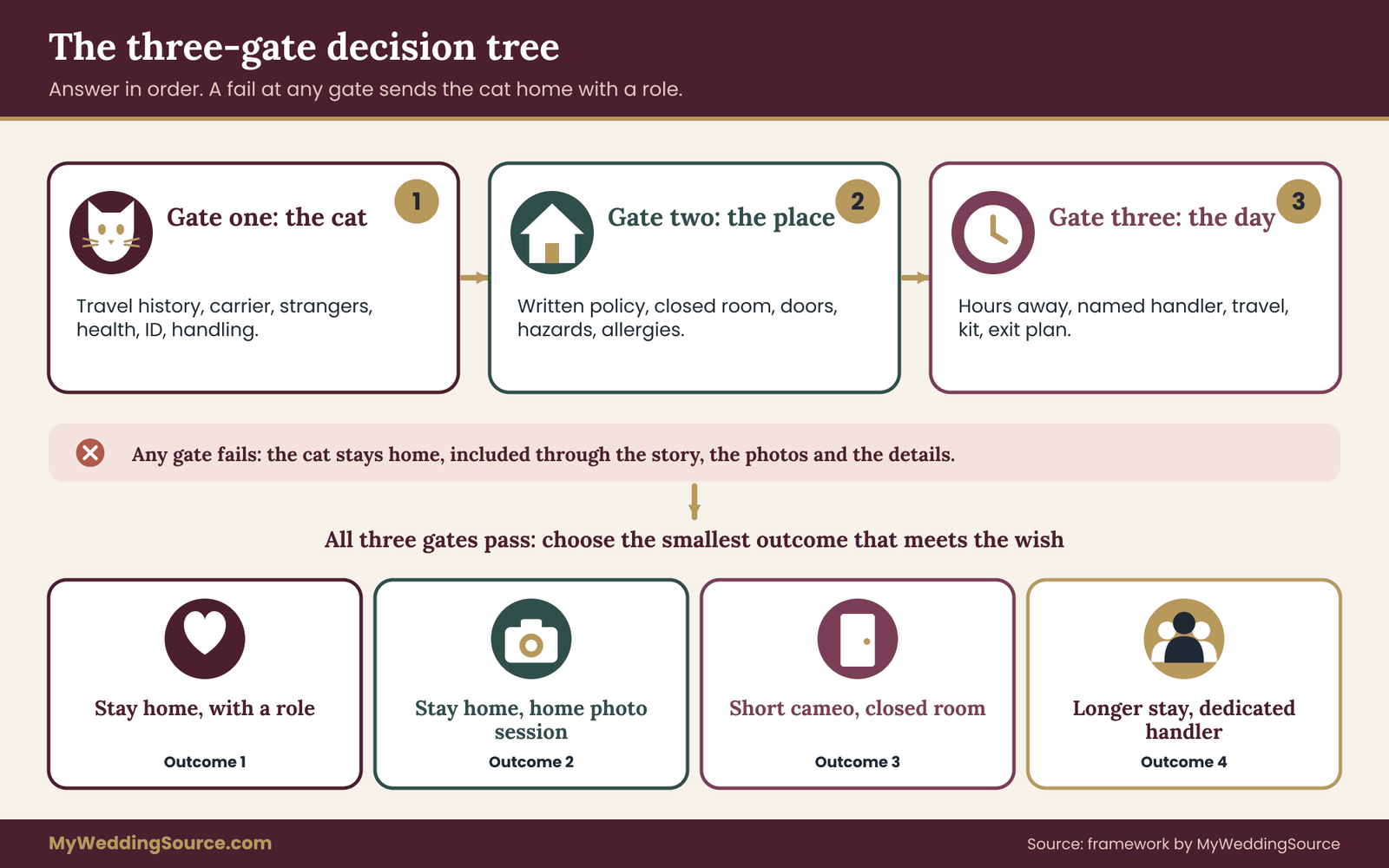
A cat that clears all three gates reaches one of four outcomes, described in detail later: stays home with an included role, stays home with a pre-wedding photo session at home, makes a short supervised cameo in a quiet space, or attends for a longer stretch with a dedicated handler. The most common result of an honest run through the tree is one of the first two outcomes.
How to use the tree without fooling yourself
The tree fails when it is used to justify a decision already made. Two habits protect you against that. First, answer each check in writing, with a date and a reason, rather than in your head. Second, give one other person, ideally someone who knows the cat and is not emotionally invested in the photographs, the right to say “no” on any check and have it stand.
A few rules help in a borderline case. When a check is “maybe,” treat it as “no” for this decision and ask what would turn it into a yes. When the answer relies on something you hope will happen, such as “the wedding cat will probably settle once she is there,” it is a no. When the answer relies on something you can arrange and verify, such as “the venue’s written policy permits cats in the bridal suite only,” it can be a yes.
It also helps to separate the cat’s presence from the cat’s role. A cat can appear in your invitation art, on your cake topper, in your vows, on your welcome sign and in an engagement-style session at home without ever entering a venue. Moving the role away from the day itself often resolves the conflict. The wedding planning checklist on this site is a good place to record the decision and any follow-up tasks, so that it does not stay in the back of your mind through the final weeks.
The timing of the decision
Make the decision early, not on the morning of the wedding. A wedding cat that must be carried, observed, boarded or sat needs time to be prepared, and a cat that stays home needs a care plan that is already booked. Early decisions also let you tell your families, your photographer and your venue the same thing at the same time, which prevents the awkward phone calls that happen when a plan is hinted at and then reversed.
A sensible window is a few months before the wedding, when the venue contract is signed and the schedule is roughly settled, and again about a month out, to confirm that nothing has changed in the cat’s health or in the day’s plan. If a check was a “yes” at the first review and becomes a “no” at the second, the answer is no. Cats get older, sicker and more anxious without warning, and a last-minute change of mind is a sign the process worked, not a failure of it.
Gate one: is this wedding cat suited to leaving home?
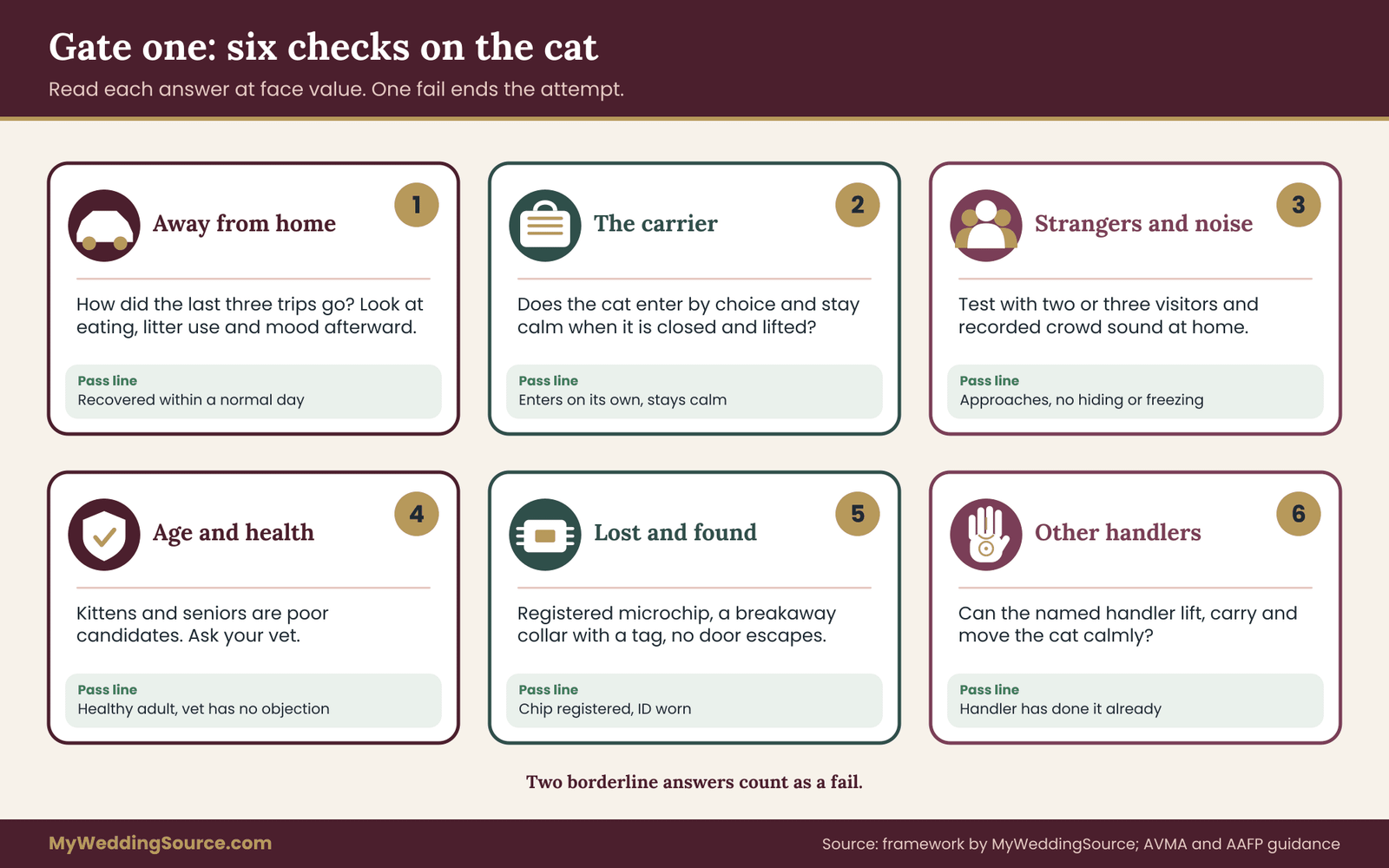
Gate one has six checks. They are written as questions you can answer from what you already know about your cat, plus two small tests you can run at home over a few weeks. Treat a single clear “no” as enough to stop. You do not need to collect more evidence against the idea once the cat has told you the answer.
Check one: how does the cat behave away from home?
Think about the last three times your wedding cat left the house. A vet visit counts, so does a move, a boarding stay or a car trip. Did the cat settle within minutes, cry for the whole drive, lose control of its bladder, refuse food for a day, or hide under the bed for the following week?
A wedding cat needs a record of calm in unfamiliar places, and a history of distress is the strongest predictor you have. If the only trips your cat has ever taken are to the veterinarian and it howled the whole way, the wedding is not a gentle upgrade from that experience. It is the same stress for a much longer time.
The pass line: the cat has been somewhere new on more than one occasion and recovered within a normal day, without a lasting change in eating, litter box use or mood.
Check two: is the carrier a safe place or a threat?
A carrier is the cat’s only portable territory. If the wedding cat associates the carrier with the vet and fights its way in, you will carry a distressed animal into a crowd. If the cat walks in by choice and naps in the carrier at home, the carrier can be a refuge at a venue.
Run a home test. Leave the carrier open in a living area for two weeks with a blanket that smells like the cat and a few treats inside. Watch whether the cat goes in on its own. Then close the door for a few minutes while you are in the room, and see whether the wedding cat stays relaxed, then lift it and walk around the house. Each step either goes well or it does not, and where it does not, the plan ends there.
The pass line: the cat enters the carrier voluntarily, stays calm with the door closed and tolerates being carried for several minutes without panic.
Check three: how does the cat respond to strangers and noise?
Many wedding plans quietly assume that a cat who is friendly with the couple will be friendly with a hundred relatives. That assumption deserves a test. Invite two or three people the cat has never met to the house, and keep the setting normal. Do not force contact. Notice whether the cat hides, watches from a distance, comes closer on its own, or tolerates a stranger’s hand.
Then add noise. Play recorded crowd sounds, clapping and music at a moderate volume while the wedding cat is in a room it knows. If the cat bolts, flattens its ears, stares fixedly or stops moving, that is information. If the cat shrugs and goes back to its nap, that is information too, though the result at home is not a guarantee of the result at a venue.
The pass line: the cat remains relaxed and approaches strangers voluntarily, and ordinary noise does not cause hiding, freezing or flight.
Check four: what is the cat’s age and health?
Kittens and senior cats are both poor candidates for most events. Kittens are curious, fast and easily lost, and they are still learning what scares them. Senior cats may have arthritis, kidney disease, thyroid problems or sensory decline that make a new place difficult, and stress can aggravate medical conditions that are otherwise well managed.
Cats with chronic conditions, especially those that involve the urinary tract, are particularly sensitive to stress, and a cat on regular medication or a special diet adds tasks the day cannot absorb. Even a healthy adult can be a poor fit if an unusual diet, a medication schedule or a recent illness complicates things.
Ask your veterinarian directly. A short script helps: “We are considering having our cat at our wedding for a short time. Here is the wedding cat’s history. Do you see any medical reason this is a bad idea, and is there anything you would want us to do or avoid?” A veterinarian who knows your animal can say things no article can. Their answer, in writing if you can get it, is part of Gate one.
The pass line: a healthy adult cat whose veterinarian has no medical objection, with vaccinations current and a record you can produce if the venue asks.
Check five: could the cat get lost, and could it be found?
Even a calm cat can bolt when a door opens, a chair falls or a guest reaches too quickly. The question is not whether this is likely. It is whether you have done what you can to make the outcome recoverable.
Identification is the practical minimum. A microchip registered with current contact information is the most reliable form of identification, and a collar with a tag and a break-away clasp adds a visible clue for anyone who finds the cat. Check with your veterinarian that the chip is registered and the information is current before the wedding, whatever the cat’s plans, because a chip that points to an old phone number is worth very little.
The pass line: the cat is microchipped with registered, current contact details, wears identification and has never escaped through an open door in the past.
Check six: does the cat tolerate handling by someone other than you?
On a wedding day the wedding cat will not stay with you. You will be busy, dressed in something hard to hold a cat in, and surrounded by people who want your attention. The person responsible for the cat, discussed in Gate three, must be someone the cat tolerates being held or moved by.
Test that now. Have the proposed handler spend time with the cat over several weeks: feeding, sitting in the same room, moving the wedding cat in the carrier. A cat that is comfortable only with one person is a cat that cannot attend without that person, and that person is you.
The pass line: the named handler has already moved the cat in its carrier, with the wedding cat staying calm.
Reading the six checks together
Score each check as pass, borderline or fail. Do not average. One fail ends the attempt. Two borderlines also end it, because borderline checks stack up on the day, when the cat is tired, hungry and facing a room it does not know.
A worked way to read the results: if your cat is a four-year-old indoor cat with a calm vet-visit history, a carrier she sleeps in, a tolerance for a few visitors, a clean bill of health, a registered microchip and a familiar handler, Gate one is passed. That is a cat for whom Gate two and Gate three are worth running. If your cat is a nervous eleven-year-old who has not left the home since a move six years ago, the tree ends here, and the rest of this guide is about how to include that cat from home.
What Gate one cannot tell you
A passed Gate one tells you the wedding cat is a candidate. It does not tell you the cat will have a good day. Cats vary from hour to hour, and a cat that handled a quiet Sunday visit well may react differently to a crowd and a marquee. Treat a pass as permission to continue the analysis, not as permission to book the cat’s place in the processional.
It is also worth noticing your own motives while you run the checks. If you catch yourself looking for reasons to excuse a fail, such as “she was just sick that day,” pause. The checks are designed to be read at face value, and a cat whose history requires an excuse is a wedding cat whose history is the answer.
Common mistakes at Gate one
Three mistakes show up repeatedly in pet-at-wedding planning. The first is using a photo of a calm cat as evidence of a calm cat. Photographs capture a moment, and a cat sleeping in a lap says little about how it will respond to a loud room.
The second is relying on social media examples of cats at weddings, which are curated successes and tell you nothing about the animals whose days went badly and never became posts. The third is assuming that a bonded, affectionate cat is a tolerant one. A cat who adores you can still be frightened of everything else.
If any of those mistakes sounds familiar, rerun the checks using only direct observation. What has the cat actually done, in your presence, in the last year?
Gate two: is the venue safe and permitted for a wedding cat?
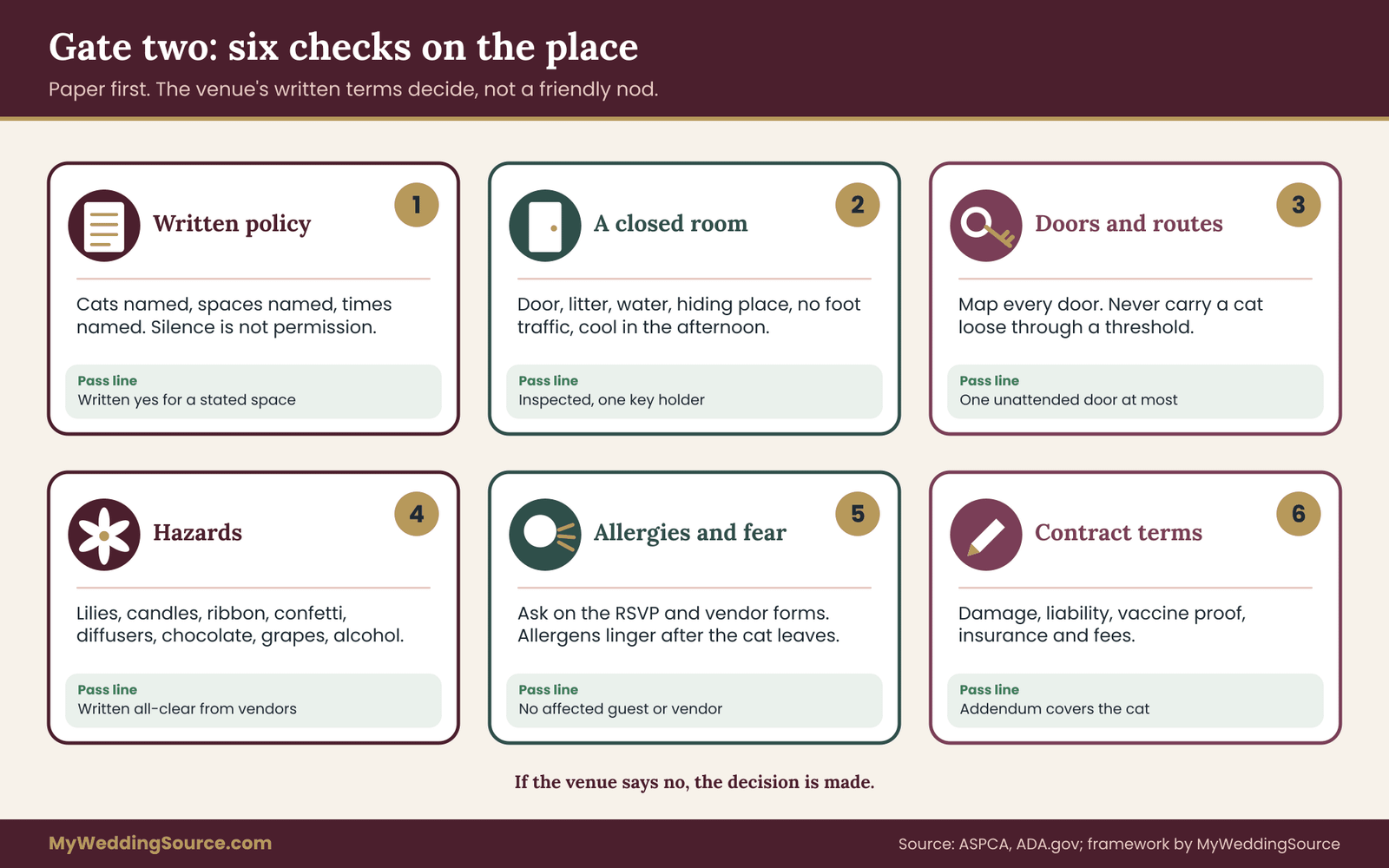
Gate two begins with paper. A wedding cat is not welcome at a venue because a staff member smiled when you mentioned it, and it is not permitted because the venue allows dogs. Policies on animals vary widely, and many venues say nothing about cats at all, which is different from saying yes.
Check one: does the written policy permit a cat, and where?
Ask for the policy in writing and read it for three things: whether animals are permitted at all, whether cats are named or only dogs, and which spaces are covered. A venue that permits “pets” in outdoor areas may not permit them in the building. A venue that permits a dog on a leash may have no provision for a cat in a carrier. And a venue that allows animals for photographs may not allow them during the reception.
If the policy is silent, ask the venue manager the question directly and ask them to confirm the answer in an email. A script that works: “We are considering a brief appearance by our cat, in a carrier, in a closed room. Does the venue permit that? If so, which room, for how long, and are there any fees, insurance or documentation requirements?” Save the reply with your other venue papers, because it becomes part of your agreement.
When the venue’s rules and your wishes differ, the venue’s rules win. If the answer is no, the decision is made. The broader process of choosing and questioning venues is in the wedding venues guide, and this gate is one additional line of questions you can add to that list.
The pass line: the policy, or a written confirmation from the venue, permits a cat in a specified space at specified times.
Check two: is there a quiet, closed room that belongs to the cat?
A cat at a venue needs a place to be a cat. That means a closed room with a door, a litter box, water, a hiding place and no foot traffic. A bridal suite, a groom’s room, a storage room or an office could work. A hallway, a lobby, a tent corner or a “pet area” in the open does not.
Walk the space with your coordinator. Look for gaps under doors, ceiling panels that can be climbed into, vents, open windows, gaps behind equipment and anything the wedding cat could squeeze behind and not come out of. Ask who holds the key, whether staff will enter the room during the event and whether the room’s temperature can be controlled. A suite that is hot in the afternoon because it faces west is not a refuge.
The pass line: a closed room is available to the cat alone, has been inspected, and no one will enter it without your handler.
Check three: what are the escape routes, and who controls the doors?
The most dangerous moment for a cat at a venue is when a door opens. Caterers bring in trays, photographers move between rooms, guests hold doors for others, and children dart in and out. An indoor cat that slips out into an unfamiliar outdoor area can disappear in seconds.
Map every door between the cat’s room and the outside. Decide how the cat will be moved, if it must be moved, and by what route. A rule that works well is the two-door rule: the wedding cat is never in a space where a single open door leads outside. The cat stays in its closed room, and when the room must be opened, the carrier is closed first. Cats are never carried loose through any threshold.
The pass line: the cat’s route from vehicle to room to carrier passes through no more than one unattended threshold, and the handler controls every door the cat passes.
Check four: what hazards will be in the space?
A wedding is a collection of things that are harmful to cats. Not all of them are obvious.
Flowers are the first concern. Lilies are highly toxic to cats, and the ASPCA lists them among the plants that are dangerous, even in small exposures such as pollen on fur or water from a vase. Other floral materials can also cause problems. Ask your florist for a full list of the flowers, foliage and greens in any room the wedding cat will use or pass, and ask for lilies to be left out of those spaces. If you already have lilies in the plan, they cannot be anywhere near the cat.
Then look at what else is on the floor and at cat height. Ribbon, string, tinsel, confetti and balloon fragments are tempting to play with and dangerous if swallowed. Candles and flame decor are a burn risk and a fire risk. Diffusers, essential oils and scented products can irritate or poison cats.
Food and drink at the reception include chocolate, onions, garlic, grapes, alcohol and sugar-free sweeteners, none of which should reach a cat. Cables, power strips and heaters are a chewing and tripping risk, and any heat source in a small room is a concern for a cat who cannot leave.
The pass line: your florist, caterer and decorator have confirmed in writing that no toxic plants, food or decorations will be in the cat’s room or on its route.
Check five: who is allergic, and who is afraid?
Cat allergies are common enough that you should assume at least one guest, vendor or staff member is affected. A wedding cat that has been in a room leaves allergens behind, on surfaces, in the air and on clothing. A guest with asthma may react without ever touching the cat.
The practical response is not to guess but to ask. Add a simple question to your RSVP or to your vendor intake form: “Do you have any animal allergies we should plan around?” If your vendors list allergies, a cat in the building may be a reason to change the plan. Photographers and videographers who handle gear all day are especially exposed, and catering staff who handle food have additional constraints. The vendor due diligence checklist on this site is a good home for the question, alongside insurance and policy questions.
Fear counts too. A guest who has been bitten or scratched, or who simply dislikes cats, deserves not to be cornered with a cat in the crowd. Another reason to keep the wedding cat in a closed room.
The pass line: no known allergy among guests, vendors or staff that the cat’s presence would harm, or an alternative that separates them completely.
Check six: what does the venue contract say about animals, damage and liability?
Contracts commonly include language about damage and liability. A cat that sprays, scratches or stains something is a damage claim, and a cat that bites or scratches a guest is a liability matter. Read the contract for clauses about animals, damage deposits and insurance, and ask the venue directly if any extra coverage or fee applies. If the venue requires proof of vaccination, ask which vaccines and what format, and check with your veterinarian whether your cat’s records meet it.
The wedding vendor contract guide on this site explains how to read clauses like these, and it is worth rereading the damage and indemnity sections with the wedding cat in mind. If the contract is silent, get the venue’s answer in writing and attach it.
The pass line: the contract or a written addendum covers the cat, damage and liability, and you know what you would owe if something went wrong.
When the place says no
Sometimes the check that fails is one you cannot change. The venue does not permit cats, or the only available room is not secure, or the florist cannot avoid lilies, or an essential vendor has an allergy. When that happens, the decision tree has done its job. The cat stays home, and the work is to include it from there.
Do not try to negotiate a rule down by promising to be careful. Rules about animals exist because of past problems, and a venue that makes an exception for you is making a risk decision on your behalf. If the answer is yes only because you pushed, think hard about whether it should count as one.
A short venue question list for cats
Bring these to your venue walkthrough, and write down the answers: Are cats permitted, in which spaces, and at which times? Is there a closed room we can use, and who has keys? Where are all exterior doors, and which are used by staff and vendors? Can the room’s temperature be controlled? What is the policy on documentation, vaccines or fees? Are there known animal allergies among staff? Has the venue hosted a cat before, and what did it learn?
The last question tends to produce the most useful answer. A coordinator who has seen what goes wrong will often tell you without being asked twice. Pair this list with a technical walkthrough of the room if you can, and measure the quiet by visiting at the hour the cat would be there.
Gate three: can the day support a wedding cat?
A wedding cat that passes the first two gates can still fail the third, because the third is about the day itself. Weddings run on tight schedules and divided attention, and a cat needs the opposite: slow time, one person’s attention and the ability to leave early.
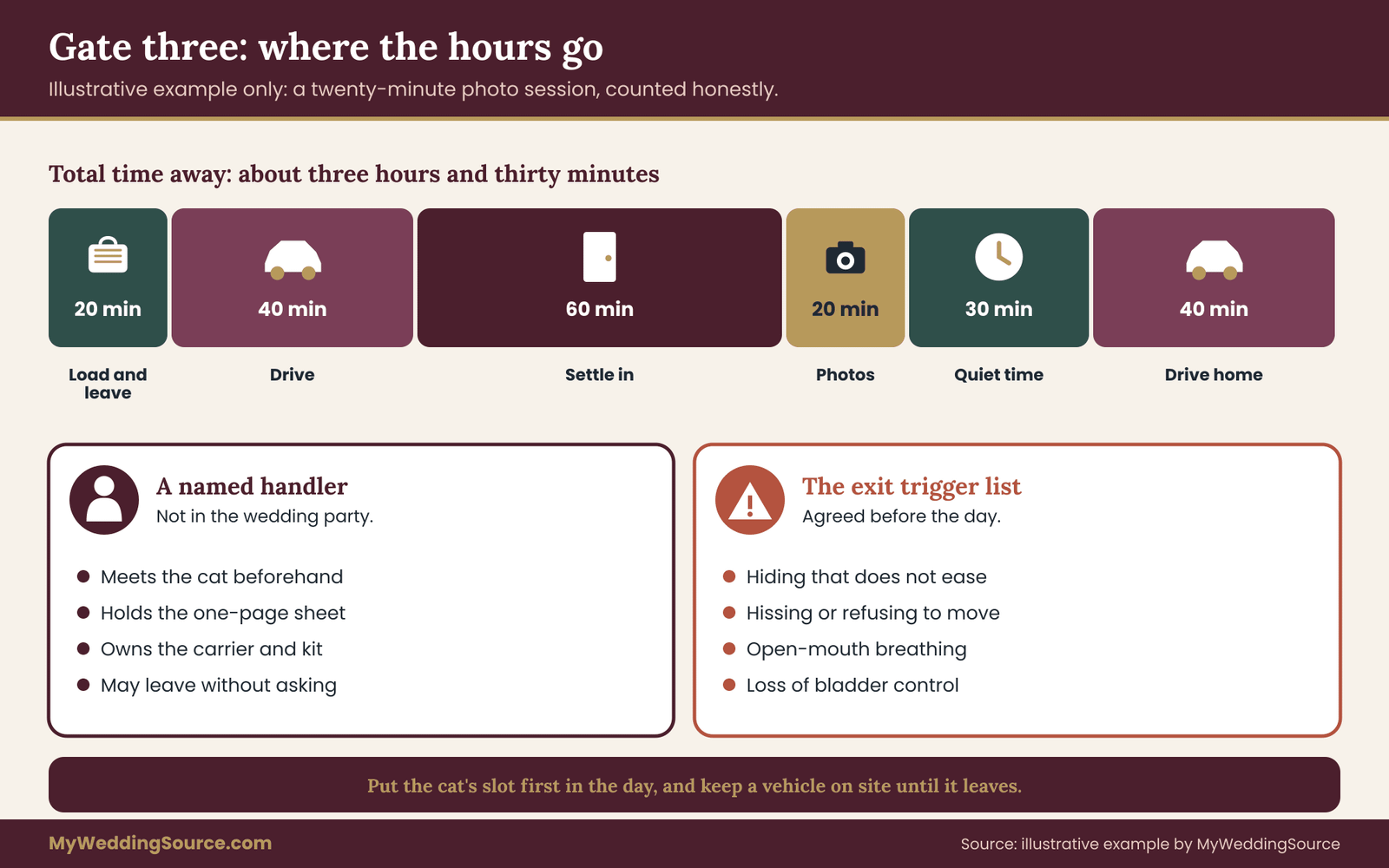
Check one: how many hours would the cat be away from home?
Count the hours honestly, from the moment the cat enters the carrier to the moment it is back in its own room. That includes loading, the drive, any wait at the venue before the cat’s slot, the appearance itself, and the drive home. A “ten-minute photograph” can easily become a five-hour absence once travel and waiting are counted.
Here is an illustrative piece of arithmetic. Suppose the venue is forty minutes away. The wedding cat must arrive early enough to settle in its room before the appearance, say an hour. The appearance and photographs take twenty minutes. The cat then needs a quiet period before leaving, another thirty minutes, and the drive is forty minutes again. That is about three hours and a half for twenty minutes of photographs. The numbers are examples, not measurements, and the point is the ratio: the cat’s cost is mostly invisible waiting.
Shorten the absence by choosing the shortest possible window, scheduling the cat’s slot first in the day rather than during the ceremony, and arranging for the cat to go home immediately afterward. A wedding cat that attends a morning portrait session and is home by noon has a very different day from a cat that sits in a room until a ten o’clock reception.
The pass line: the total time away is short enough that your veterinarian would not object, and the cat’s slot is scheduled at the start of the day, not the middle.
Check two: is there a named handler who is not in the wedding?
The most common plan failure is “someone will keep an eye on her.” On a wedding day there is no such person. Everyone with a role has a job, and everyone without a role is a guest who wants to enjoy the day.
Name a person for the cat. It should be an adult the cat knows and tolerates, who is not in the wedding party, not a parent hosting the day and not someone with a speech to give. Possible choices are a friend who is not attending the ceremony, a professional cat sitter, or a veterinary technician you hire for the hours. The handler’s only job is the wedding cat, from loading the carrier to unloading it at home.
Write a one-page sheet with the handler’s name and phone, the veterinarian’s number, the nearest emergency veterinary clinic’s address and hours, the cat’s medical notes, and your instructions. Ask the handler to confirm they have read it. A handler who is happy to stay with the cat in a room for several hours is a gift. A handler who says “of course” while checking the time is telling you something.
The pass line: a named, adult handler who is not otherwise needed at the wedding has agreed in writing, has met the cat, and holds the information sheet.
Check three: how will the cat travel?
Cat travel is mostly about the carrier. Use a hard-sided, well-ventilated carrier that closes securely, and secure it in the vehicle so it cannot slide or tip. Cover it lightly with a familiar cloth if the wedding cat prefers darkness, and never leave the cat in a parked car. A vehicle can heat quickly, and a cat that cannot leave a hot car is in real danger.
Do the practice drive. Take the cat on one or two short rides in the weeks beforehand, in the same vehicle, with the same driver, and notice the behavior. Do not feed a full meal right before the trip. Ask your veterinarian whether the cat should have food, water or any calming measure on the day, and do not give medications or supplements that have not been approved by your veterinarian for this wedding cat.
The pass line: the cat has made at least one practice trip in the planned carrier and vehicle without extreme distress, and a driver other than the couple has been assigned.
Check four: what are the day’s cat-specific needs?
A cat away from home needs water, a litter box, a hiding place and a familiar blanket, and it may need food at its usual time. These items take space and attention that a wedding venue rarely plans for.
Prepare a small kit and leave nothing to chance: a spare carrier or a towel, a small litter box and litter, cleaning supplies for accidents, a water dish, food in a sealed container, a familiar blanket and a first-aid note. Put it with the handler, not with the wedding luggage.
If the cat needs medication at a particular hour, give the handler explicit written instructions and a practice run. Medication on a wedding day is one more reason the wedding cat might be better at home.
The pass line: the kit is packed, the handler knows the cat’s feeding and litter routine, and nothing in the plan depends on the venue providing cat supplies.
Check five: can the cat’s presence end at any moment?
An exit plan is a rule: if the cat shows signs of distress, it goes home. That rule only works if it has been agreed before the day and does not depend on anyone’s feelings about the photographs.
Agree on a trigger. For example: hiding that does not ease after a short time, hissing, open-mouth breathing, a refusal to move or a loss of bladder control. When the trigger occurs, the handler ends the appearance without needing permission, loads the cat and goes home. You should not have to be asked, and no one should be able to argue the handler into staying “just for one more shot.”
Arrange the transportation to make this easy. The handler needs a vehicle on site, the route to the cat’s room must be short, and the keys must be accessible. If the wedding cat arrived with a rideshare that has left, there is no exit plan.
The pass line: an agreed trigger list, a handler with authority to leave, and a vehicle that stays on site for as long as the cat does.
Check six: where does the cat fit in the run of the day?
Even a short appearance needs a slot in the schedule, and it needs the people involved to know the slot. Add the cat to the day’s timeline, including the arrival, the quiet period, the appearance and the departure. The wedding ceremony step-by-step guide and the ceremony cue sheet guide on this site show how to build a timeline where each moment has an owner, and the cat’s schedule belongs in the same document.
A useful principle is to separate the cat from the guests’ attention. A wedding cat in the processional invites hundreds of faces, flashes and sounds at once. A cat photographed in a closed room with the photographer and the two of you is much quieter. If the cat attends at all, the second is the better design.
Tell your photographer ahead of time. They need to know how long they have, that the cat will not be moved, that flash may be inappropriate, and that the appearance can end without notice. A photographer who has been briefed will work faster and more gently than one who is surprised on the morning.
The pass line: the wedding cat’s slot is on the written timeline, the photographer and coordinator know the rules, and the appearance is separated from the ceremony and the crowd.
Adding up Gate three
As with the first two gates, a single fail ends the plan. If you cannot name a handler, the plan ends. If the cat would be away for most of a day, the plan ends. If the only exit plan is “we will see how she does,” the plan ends.
That sounds strict, and it is meant to be. Gate three exists because good intentions survive the planning stage and break on the day, when a hundred small demands crowd out the animal in the corner. A plan that cannot hold the cat’s needs under pressure is a plan that is not ready.
The day-before and morning-of routine
If the cat clears all three gates, a calm routine helps. The day before, keep the cat’s schedule normal, check the carrier and kit, and confirm the handler’s arrival time. On the morning, feed as your veterinarian advises, keep the wedding cat’s room quiet, and keep the household calm. Cats read the mood of their people, and a house full of rushing and tension is not a good launching pad.
On the day, the first task of anyone responsible for the cat is to check the room before the cat arrives: door closed, litter set, water down, hazards cleared, temperature comfortable. The second is to settle the cat quietly, without audience, and leave it alone for a while. The third is to resist the temptation to show the wedding cat off.
Reading stress in a wedding cat before it becomes an emergency
If your cat passes every gate and attends in any form, someone must be able to read the animal in real time. Cats hide discomfort well, and the signs of stress are often quiet. The handler’s job is to notice the early signs and to act on them, not to wait for a dramatic one.

A four-step ladder of signals
Think of a wedding cat’s state as a ladder. The lower rungs are normal, and the upper rungs mean the cat should leave.
Rung one: relaxed. The cat’s body is loose, the ears are in a natural position, the eyes are soft, the tail is resting or gently moving, and the cat explores or naps. Eating and drinking are normal. This is the state that justifies continuing.
Rung two: watchful. The wedding cat becomes still, the ears turn toward sounds, the pupils widen and the cat looks at the source of the change. Many cats pass through this rung and return to rung one. It is a signal to pause, lower the noise and give the cat a moment, not a signal to continue.
Rung three: stressed. The cat crouches or presses its body low, flattens its ears, tucks the tail, hides, freezes, grooms excessively, cries, growls or hisses. It may refuse food or water. This is the point at which the plan stops being about photographs. The handler removes the cat from the stimulus, closes the door and lets the wedding cat settle. If it does not settle in a short time, the cat goes home.
Rung four: urgent. The cat breathes with its mouth open, collapses, vomits repeatedly, cannot be calmed, loses control of its bladder, attacks or tries to bolt through any opening. Open-mouth breathing in a cat is a warning sign that needs prompt veterinary attention, and so is any sign of illness that persists. The handler contacts the veterinarian or the nearest emergency clinic from the information sheet, and the wedding waits.
Cat behavior guidance from veterinary organizations, including the American Association of Feline Practitioners and the American Veterinary Medical Association, describes these kinds of signs and encourages low-stress handling. For specifics about your wedding cat, ask your veterinarian.
Why a plan needs a trigger list
A signal ladder is only useful if it leads to action. The risk is not that the handler misses a sign. It is that the handler sees it and talks themselves out of acting, because the photographer is ready, the grandmother is watching or the couple looks hopeful. The trigger list from Gate three exists to remove that decision from the moment. Before the day, you and the handler agree: at rung three, the cat is separated and given time. At rung four, the cat goes home or to a veterinarian. No one needs to ask.
Write it on the handler’s sheet. It sounds fussy. It is the single piece of paper most likely to protect the animal.
What not to do with a stressed cat
Do not restrain a frightened cat to finish a photograph, and do not hand the cat to a guest to hold. Do not try to comfort the cat by passing it around, and do not use food or toys to push it past its limit.
Do not give any calming product, supplement or medication that your veterinarian has not approved for this wedding cat. Do not open the door to check on the cat when it is hiding, as this is when many cats escape. Let the animal settle behind a closed door, and approach it quietly with the carrier ready.
When the signs are strong, do not punish or scold. A cat that growls is communicating, and the most useful response is to give it space.
The four outcomes for a wedding cat
Running the tree produces one of four outcomes. They are arranged from the most conservative to the most involved, and the first two are, in practice, the most common results.

Outcome one: the cat stays home and has a role there
The cat does not travel and does not attend anything. It is included through the story, the design and the details. This is the right outcome when the cat fails Gate one or when the venue cannot accommodate it, and it is also a good outcome when the wedding cat passes everything but the plan is more trouble than it is worth.
Staying home does not mean being left out. The next section lists ways to put the cat into the day: in the invitation, in the vows, in the photos before or after, in a keepsake or in a toast. Many couples find that the staying-home version produces images and moments the cat could not have given at the venue, because the cat is relaxed and at home.
Outcome two: the cat stays home and appears in a separate photo session
You photograph the wedding cat at home, on another day or the morning of the wedding, with you in your wedding clothes or in everyday clothes. The photographer or a friend takes pictures in the cat’s own territory, where it is calm, and the pictures join the album later.
This outcome gives you most of what a venue appearance would, with almost none of the risk. It works well when the cat is photogenic and relaxed at home but would not cope with travel. If you hire a photographer, ask whether a short home session is possible, and read the wedding photography consent guide on this site if the session will be shared widely, since the usual rules about who is photographed and how images are used still apply.
A home session also leaves the cat’s routine intact, and the cat has no idea it is part of a wedding.
Outcome three: a short, supervised cameo in a quiet space
The wedding cat travels to the venue, stays in its closed room and appears for a brief photograph with you and the photographer, with the door closed and no guests. It then goes home with the handler. The entire time away is kept as short as the logistics allow.
This outcome requires that the cat passes all three gates, that the venue has permitted it in writing and that the handler is experienced. It is not a small version of outcome four. It is a deliberately limited plan with a built-in exit, and the cat never meets the crowd. It is a reasonable option for a calm, travel-experienced adult cat and a venue that is supportive.
Outcome four: a longer attendance with a dedicated handler
The cat remains at the venue for a longer stretch, perhaps through the ceremony or a part of the reception, with a dedicated handler and a retreat room. This is the rarest outcome and the one most likely to go wrong. It should be considered only when the wedding cat is unusually confident, the venue has confirmed everything, the handler is experienced and the time is limited.
Even then, the cat does not walk the aisle, does not circulate and is not handled by guests. Think of it as the cat being present in the building rather than present at the event. If you are not sure whether to choose outcome three or outcome four, choose three. If you are not sure between three and two, choose two.
Choosing between outcomes in a tie
When two outcomes are both possible, use a small set of tie-breakers. Pick the outcome with the shorter time away from home. Pick the outcome where the cat meets fewer new people. Pick the outcome where a mistake costs less. Pick the outcome that you can run with fewer things going right at the same time. These rules lean towards outcomes one and two, and that is intentional. The rest of the day also gets easier with a cat that is somewhere safe.
A last test is to imagine the end of the day. Picture the wedding cat at home, fed and asleep, and you looking at pictures of it in your vows or on a card. Then picture the cat in a closed room at the venue, listening to the music through a wall. Which version would you rather have chosen, looking back?
Staying home with honor: ways to include a wedding cat without bringing it
If the cat stays home, the question becomes how to give it a place in the day that is real and not a consolation. The best ideas share a principle: they carry the cat’s presence into the wedding without carrying the cat.
In the paper and the words
The wedding cat can appear in the invitation suite as a small illustration, in the program as a line in the “about us” page, or in a note on the welcome sign. A couple whose cat introduced them might include a sentence in the ceremony. A vow can mention the cat by name, and an officiant can read the line with a smile. These touches cost almost nothing, and they put the cat in the room in a way every guest understands.
Keep the wording kind and plain. A line like “Biscuit is at home, supervising from the sofa” does more for the mood than a long joke, and it answers the question guests may ask when they notice the cat missing from the photos.
In the photographs
A home session before the wedding, or a few frames on the morning of the day, can give you the pictures you wanted. Put a wedding ring on a ribbon near the wedding cat, a bouquet on a chair beside it or a veil on the back of a couch. Photograph the cat in its favorite spot and let it do what it usually does. Be careful with props. Keep ribbons, flowers and anything small away from the cat’s mouth, and do not use lilies at any point in the session.
If a photographer visits, tell them in advance about the cat’s habits, such as a dislike of flash or a tendency to hide from strangers. A quiet visit of an hour or two, with the photographer sitting on the floor and waiting for the cat to approach, is easier on the animal than any venue appearance.
In the reception details
A framed photo of the wedding cat on a table, a cat illustration on a custom cocktail sign or a cake topper that looks like the cat are small gestures that carry the cat’s personality. A donation in the cat’s name to an animal rescue, noted in a card at the reception, gives guests a way to share the idea without a live animal in the room. Keep any donation note plain and optional, and choose an organization whose work you have checked yourself.
Placement matters. A framed photo or sign needs a place where guests can see it without crowding a doorway or the bar, and the wedding reception guest flow guide on this site shows how to map traffic so small details like these land where they will be enjoyed instead of in the way.
In the guest experience
Some couples set up a short slideshow or a table with photos of their pets, including the wedding cat, near the entrance. Others mention the cat in the welcome message or in a text update sent on the day. Guests who love animals often enjoy the glimpse, and guests who are allergic or afraid do not have to approach anything. The wedding guest care planning guide on this site covers the wider question of how to look after guests’ comfort, and an animal allergy note is one more item on that list.
In the keepsakes
After the wedding, the cat can be in the album, on the thank-you card or in a framed print. A paw-print impression, a small portrait or a custom ornament is a gentle way to mark the day. None of it requires the cat to be anywhere but home.
The home care plan: what the cat needs while you are away
A wedding day pulls the whole household out of the house, sometimes for the day before and the day after too. A wedding cat that stays home still needs care, and the plan matters as much as the plan for a cat that attends.
Who will be there, and when
Arrange a visit schedule rather than a vague promise. A cat is usually fine alone for a normal working day with food and water, but a long wedding day, a rehearsal and travel can stretch beyond that. Decide who will check on the cat in the morning, at midday and in the evening, and what each visit will include: fresh water, food, litter scooping, a few minutes of company and a look at the cat’s behavior.
A professional pet sitter or a trusted neighbor with a key is the usual choice. Meet the sitter with the wedding cat in advance, show them the house, the food, the litter and the hiding places, and give them the veterinarian’s contact details and your written permission to seek care. Make sure the sitter knows the cat’s baseline behavior so they can tell when something is off.
What to leave for the sitter
Write a single page. Include the feeding schedule and amounts, the litter routine, any medication with exact timing, the cat’s quirks, its hiding spots, the veterinarian’s phone, the emergency clinic’s address, your own phone and a second contact who is not at the wedding. Check that the cat’s microchip details are current and that the wedding cat wears identification. Lock windows, check screens and tell the sitter how to prevent the cat from slipping out through the door.
Keeping the cat calm
A cat at home on a wedding day may be affected by the changes. Suitcases, dress bags, strange visitors and tense people are signals that something is happening. Keep the cat’s routine as normal as possible, give it a quiet room, and avoid leaving the house in a rush. A familiar item such as a worn shirt left in the cat’s bed provides reassurance. If you have a wedding cat that is sensitive to change, ask your veterinarian before the day whether anything else is appropriate, and do not use products that have not been recommended for your cat.
The return
When you come home, greet the cat quietly. A cat that has been alone may be anxious, clingy or distant, and it may react to the smells you bring back. Give the cat time, food and your attention, and watch for changes in eating or litter use over the next few days. If anything looks wrong, call the veterinarian.
Four worked examples of a wedding cat decision
These are invented scenarios to show how the tree works. They are not case studies of real couples and the details are illustrative.
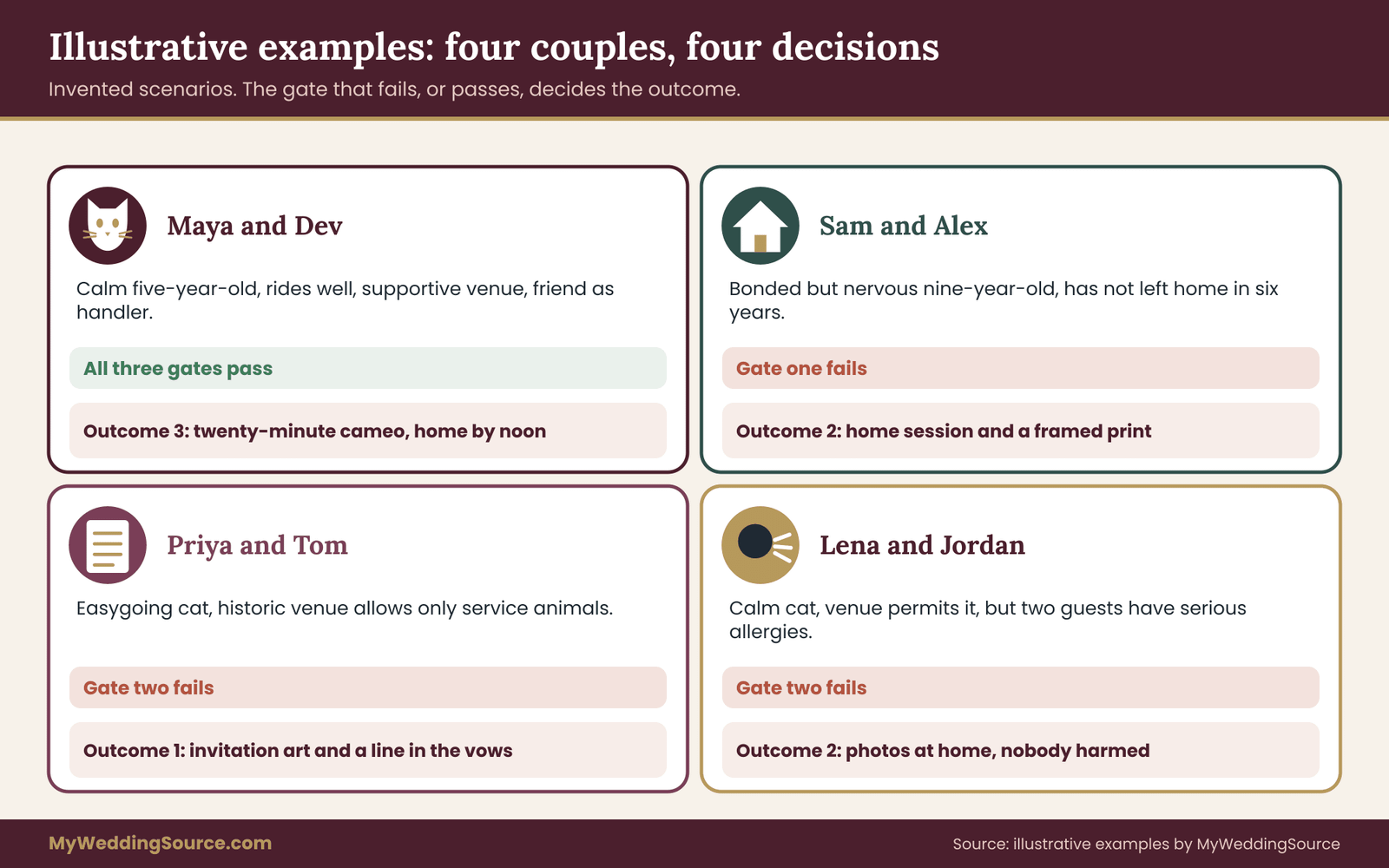
Example one: the calm adult with a supportive venue
Maya and Dev have a five-year-old cat, Juniper, who sleeps in her carrier, rides well and meets visitors with curiosity. Their veterinarian has no objection. The venue’s written policy permits animals in the bridal suite for photographs, with no fee. The wedding cat’s handler is a friend who is not attending the ceremony. They plan a twenty-minute photo session in the bridal suite first thing in the morning, with the door closed, followed by an immediate return home. This is outcome three. They add a trigger list, tell the photographer and keep the plan short.
If Juniper shows signs of stress, the handler takes her home.
Example two: the bonded but nervous cat
Sam and Alex have a nine-year-old cat, Moss, who loves them and hides from everyone else. Moss has not left the house in six years. Gate one fails on two checks. They do not run the other gates. They choose outcome two: a home session two weeks before the wedding, with a photographer who sits quietly, and a framed print of Moss at the welcome table. A sitter who has visited three times checks on Moss on the wedding day. Moss never knows anything happened.
Example three: the venue that says no
Priya and Tom have a healthy, easygoing cat and a historic venue whose policy permits only service animals. Gate two fails at check one. They ask the venue to confirm in writing and accept the answer. They choose outcome one, with a cat illustration on the invitations and a line in the vows. They do not try to negotiate. The only thing they lose is a photograph that they were able to take at home in the weeks before.
Example four: the cat with the guest allergy
Lena and Jordan have a calm cat and a venue that permits cats in a closed room. Their RSVP form includes an allergy question, and the officiant and one groomsman respond that they have serious cat allergies. Lena and Jordan decide not to bring the cat. The decision is easy because they asked early. A cat in a room that a person with asthma later enters is a problem they have decided not to create. They take pictures at home instead.
What the examples show
In each case the decision was made by the facts that came up in the gates, not by the wish to have a wedding cat in the photographs. In two cases the cat did not attend, in one it attended briefly and in one the venue made the decision. Notice also how much time each couple spent on the cat’s care, which was little in every case. The tree is a fast way to reach a decision, and the plan that follows is usually short.
Talking about the wedding cat with family, venue and vendors
The decision is easier to make than to explain. Families have expectations, vendors have questions and friends have opinions. A few prepared sentences save a lot of friction.
With family who expect the cat
A parent who has always pictured the cat in the photographs may be disappointed. Lead with the cat’s welfare and your decision, not with a debate. A script that works: “We thought about it carefully, and the kindest thing for her is to stay home where she is calm. We are putting her in the photos at home, and she will be in the album.” This acknowledges the wish, states the decision and offers something real.
Avoid asking for permission. A decision framed as a question invites argument. If a relative offers to carry the wedding cat or “keep an eye on her,” thank them and decline. The tree exists so that goodwill does not substitute for a plan. If the relative insists, the answer is that the handler for the cat is already arranged and the cat is not attending.
With a partner who disagrees
Sometimes the couple does not agree. One partner wants the cat there, and the other is worried. Run the gates together, answering each check in writing, and let the one who is more worried hold a veto on the checks. The tree makes the disagreement concrete. A shared document with each check, each answer and each reason lets you see where you differ, and it is often one check rather than the whole idea.
If you cannot agree, choose the more conservative outcome. A home session can be added later if you decide to. A cat that bolted cannot be undone.
With the venue
Keep the conversation short and specific. Ask the policy question from Gate two, ask for the answer in writing and thank them. Do not suggest that you will bring the wedding cat regardless of the answer, and do not ask a coordinator to quietly allow something the policy does not. If the venue says no, ask whether any outdoor area permits animals for a short photo session before guests arrive. Sometimes a grounds-only exception exists, though it still has to pass Gates one and three.
Add the answer to your vendor and venue paperwork. The vendor due diligence checklist offers a place to record the venue’s policy, the contact who confirmed it and the date, so the paper trail does not live only in an inbox.
With the photographer and videographer
A photographer needs to know whether a cat will be part of the day, and if so, when, where and for how long. They should be told that the cat’s session may end at a moment’s notice, that the cat will not be moved for a better angle and that flash may not be used if your veterinarian advises against it. Ask whether they have photographed animals before, and ask to see examples that are not edited into impossible calm.
If the wedding cat is not coming, tell them anyway and ask for the home session if you want one. Vendors who are told early can fit it in. Those told on the morning cannot.
With the florist and decorator
Tell your florist about the cat whether it attends or not. Lilies and some other flowers can be dangerous if you bring blooms home after the wedding, and a cat that finds a fallen petal on the floor is at risk. Ask for a plant list, and ask whether the arrangements can be kept lily-free or placed out of reach after the event. Many couples take centerpieces and bouquets home, and a cat that stays home is exposed to everything that comes back.
With guests
Guests do not need a long explanation. If asked, a sentence is enough: “She is at home with her sitter. Too many people for her.” Most guests will accept it, and many will say they are relieved. If you decided to include an allergy question on your RSVP, thank anyone who answered and let them know their answer was a factor.
Edge cases and awkward questions
The tree covers most situations, but a few come up often enough to deserve attention.
The cat is an emotional support animal
An emotional support animal is not the same as a service animal under the Americans with Disabilities Act, and the ADA’s definition of a service animal is limited to dogs, with a separate provision for miniature horses. A cat does not qualify as a service animal under the federal definition. Venues may have their own policies, and other laws, such as housing and air travel rules, treat assistance animals differently.
If you rely on your wedding cat for emotional support, ask the venue about its policy, ask your veterinarian or health care provider about options and think about what support you will have if the cat stays home. A comfort routine that does not depend on the animal being present is useful for the day.
The cat is the reason you are anxious
Some couples want the cat nearby because they fear leaving it alone. That is a different problem from wanting it in the photographs. The answer is a better home care plan: a sitter who visits more often, a camera so you can check on the cat, a clear plan for emergencies and the handler’s number on your phone. A wedding cat that is cared for at home is a cat you can stop worrying about.
The wedding is at your home or your own property
A wedding at home removes the travel and the unfamiliar place, but not the crowd, the noise or the open doors. The cat can still stay in a closed room with a litter box and water, and the doors can still be controlled. The gates apply in the same way, and Gate two is mostly about your own house. A home wedding makes outcome three easier and outcome four still difficult.
The venue allows pets, but the guests have a different view
If the venue says yes and one guest says no, the difference matters more than a general preference. A severe allergy or a real fear should outweigh the wish for a picture. You are free to host a cat-free event even in a place that permits cats.
The destination or travel wedding
Travel with a cat adds large layers of risk: airline or border rules, long carrier time, unfamiliar lodging and heat. Rules differ by airline, country and state, and some require health certificates or limit travel by season. For anything beyond a car trip, ask your veterinarian first and check the rules with the airline and the destination’s authorities. In most cases, the cat stays home with a sitter, and the destination wedding is a clear case for outcome one.
The cat dies or becomes ill before the wedding
If the wedding cat that was meant to be part of the day is lost, a space can be made for its memory. A photograph, a line in the ceremony or a note in the program are quiet ways to include a pet who has died. How you do it is up to you, and there is no obligation to say anything. If the cat is ill, put its health first. A cancelled appearance is not a failure, and it is a decision your veterinarian will likely support.
A rescue cat or a recently adopted cat
A cat adopted in the last year may still be adjusting to the home. Many rescue cats have unknown histories and carry stress responses that have not yet been mapped. Gate one asks for a history of calm in new places, and a recently adopted cat does not have one. For this cat, outcome one or two is the sensible default.
Your next steps
If you are deciding about a wedding cat, a short sequence gets you from a vague wish to a clear plan without spending many evenings on it.
First, write the wish in one sentence and decide what you want from the cat’s presence. Second, run Gate one at home over two or three weeks, including the carrier and stranger tests, and book a vet conversation. Third, if the wedding cat passes, ask the venue for its animal policy in writing and add an allergy question to your RSVP or vendor forms. Fourth, name the handler, write the sheet and set the trigger list.
Fifth, choose an outcome, tell your families, venue and vendors the same message and record the decision in your planning checklist. The planning checklist for your wedding is a good place to keep it with the rest of your tasks.
If the cat stays home, book the sitter, plan the home session and choose two or three ways to include the cat in the paper, the photographs and the reception. Then return to the rest of the wedding, which has plenty of other decisions waiting. The tree took you a few evenings and probably saved you a day of worry. Review the decision about a month before the wedding and again a week before, and let the cat’s health and behavior have the final say.
FAQ
Can a cat be at a wedding ceremony at all?
Yes, in limited cases. A healthy, calm adult cat that travels well, with a venue that permits it in writing and a dedicated handler, can make a short appearance in a closed room away from guests. Most cats fail at least one of those conditions. For those cats, staying home with a role in the photos or details is the safer and kinder plan.
Is it cruel to leave a cat at home on a wedding day?
No. A wedding cat left in a familiar home with food, water, a clean litter box and a sitter who visits is in its normal environment. Stress from a crowded, unfamiliar venue is the larger welfare concern for most cats. Arrange a reliable sitter, keep the routine as normal as you can and give the cat a quiet room.
Can a cat walk down the aisle?
It is rarely a good idea. An aisle puts the cat in front of a crowd, with flashes, music and movement, and few options for retreat. A cat in a carrier is safer, and a short photograph in a quiet room is better still. If you want an aisle moment, consider a dog, a child or a keepsake representing the cat.
What if my venue does not mention cats in its policy?
Silence is not permission. Ask the venue manager whether cats are permitted, in which spaces and for how long, and ask for the answer in writing. Also ask about fees, vaccination proof and insurance. If the venue does not allow them, the decision is made, and you can include your wedding cat in other ways.
Should I give my cat medication to keep it calm?
Only if your veterinarian prescribes or approves it for your cat. Products and doses that suit one animal can harm another, and some medications cause side effects that make a day worse. Do not try something for the first time at a wedding. Ask your veterinarian well in advance, and consider whether needing medication means the cat should stay home.
What if a guest is allergic to cats?
Their health comes first. Even a cat kept in a closed room leaves allergens in a space, and guests with severe allergies or asthma can react without touching the animal. Ask about allergies on your RSVP or vendor forms, and if someone important is affected, choose a home photo session instead.
Are cats service animals at weddings?
Not under the federal Americans with Disabilities Act, which defines service animals as dogs, with a separate rule for miniature horses. Emotional support animals are not service animals under the ADA. Venues may set their own policies, and other laws may apply in other contexts. Ask the venue for its written policy and your health care provider for guidance.
How do I include my cat without bringing it?
Use the cat in the invitation art, the program, a line in the vows or a toast, a framed photo at the reception, a cake topper or a keepsake. Schedule a home photo session before or after the wedding. Add a donation to an animal rescue if you wish. Guests tend to enjoy these touches as much as a live appearance.
Sources
- American Veterinary Medical Association: pet care and animal welfare resources
- American Association of Feline Practitioners: Cat Friendly Practice and feline behavior resources
- ASPCA: toxic and non-toxic plants and pet care information
- Americans with Disabilities Act: service animal requirements
- Cornell University College of Veterinary Medicine: Cornell Feline Health Center
- Centers for Disease Control and Prevention: healthy pets, healthy people
- U.S. Department of Agriculture, Animal and Plant Health Inspection Service: animal travel rules
- American Animal Hospital Association: pet owner resources
- The Humane Society of the United States: pet care and animal protection