
Wedding fasting is the plain fact that some people in your wedding, whether guests, family, officiants or the couple themselves, will not be eating at the hours your schedule assumes. This guide shows how to find out who is affected, ask the right questions of the right people, and build a meal and event timeline that works for everyone without turning the day into a negotiation.
Treat every wedding fasting request as a timing question, not a menu question. Collect each request on a short card with five fields: who, what kind of fast, which hours, how firm the rules are, and who confirms the details. Then choose one of three moves for each conflict: move the event, split the service, or add a parallel option. Ask a faith adviser chosen by the person fasting, never guess from a religion’s reputation, and tell guests the schedule early enough that they can plan their own day around it.
Most wedding menus are built around what people eat. Vegetarian, halal, kosher, gluten-free, nut-free: caterers have forms for all of that. Far fewer couples think about when people eat, and that gap is where wedding fasting causes trouble. A guest who is fasting until sunset arrives at a four o’clock ceremony and finds a cocktail hour of passed appetizers. A relative who cannot eat before a ritual is seated at a table where service starts at six and ends at eight-thirty. Nobody meant any harm. The schedule simply never asked the question.
This article is about asking the question early and answering it calmly. It covers the main kinds of wedding fasting you are likely to meet, who to consult, how to record a request so that a caterer can act on it, a decision rule for choosing among your options, and how fasting touches the date, the ceremony time, the reception meal, the toasts and the vendors. There is one invented worked example and a list of the usual mistakes. Throughout, the aim is a calm approach to wedding fasting that a first-time planner can follow.
A note on scope. This is general planning information, not legal, medical, religious or financial advice. Fasting practices differ between traditions, between communities inside one tradition, and between individuals inside one community, so nothing here describes what any religion requires. Where a fact matters, the article points to the person or agency that can confirm it.
What wedding fasting means for your planning
The phrase covers more ground than it first seems to. In everyday planning, wedding fasting means any situation where a person involved in the wedding is limiting food or drink for a stated period, for reasons of faith, conscience or health, and that period overlaps with a wedding event or the meal schedule around it.
Three things make it different from an ordinary dietary request.
It is about hours, not ingredients. A guest with a fish allergy needs a different plate. A guest who is fasting until nightfall may need the same plate, but at a different moment, and may be uncomfortable being handed a drink at the door. You cannot solve a timing problem with a menu change alone. You have to look at the clock.
It is usually predictable, and usually fixed by something other than you. Many fasts are tied to a calendar date, a time of day, or a ritual. That means you can often see the conflict months ahead, which is the best time to deal with it. The date of your wedding is yours to choose. The date a fast begins is usually not.
It is private and personal. Whether a person fasts, how strictly, and why are matters of conscience. Some guests will tell you without being asked. Others will say nothing and quietly skip the meal because they did not want to bother anyone. A good process lets people speak up without having to explain themselves.
You do not need to understand every tradition in depth to handle this well. You need a method that works for any tradition, because the person fasting, not you, is the authority on what their practice asks of them. The rest of this guide is that method.
Good wedding fasting planning is mostly a matter of asking early, writing things down and sharing only what each person needs to know.
Where wedding fasting comes up most often
Couples tend to meet wedding fasting in one of four settings.
The first is a shared calendar overlap. The wedding date lands inside a season or on a day when a meaningful number of guests are fasting. This can be a few relatives or half the guest list, and it changes your options quite a bit.
The second is a fast attached to the wedding itself. In some traditions the couple, the families, or particular participants limit food on the wedding day until a certain point in the ritual. Here the conflict is internal: the people most important to the day are the ones who will not be eating at the start of it.
The third is a ritual role. An officiant, a reader, a musician or a ritual assistant may follow a fasting rule on the day they serve, or before a service they lead. They are not guests in the usual sense, and their needs run through your vendor and program schedule rather than your RSVP list.
The fourth is medical or personal fasting. A guest may be fasting for a procedure, may be managing a condition with a strict meal schedule, or may be following a personal discipline. The planning move is the same, but the sensitivity is higher, and the right response is usually quiet flexibility rather than discussion.
If your wedding involves two or more traditions, the first three can stack. The guide to planning an interfaith wedding ceremony covers how to name who owns each ritual, which is a useful companion here, because the person who owns a ritual often also owns the food rule attached to it.
Five kinds of food-timing request
It helps to sort the requests you receive into a small number of types, because each type points toward a different fix. These five cover most of what couples report. They are working categories for planning, not descriptions of any religion.

Type one: the full fast. The person takes no food and, depending on the practice, possibly no drink, for a set stretch that can run from several hours to a full day or longer. If your event falls inside that window, the person may simply attend without eating. The planning questions are how long the window runs, when it ends, and whether the person will want to break the fast at your event or at home.
Type two: the daylight fast. The person abstains from food and drink between dawn and sunset, then eats after dark. Because sunset moves through the year and varies by location, the end time changes by date and by city. A wedding in one season may be fully clear of the fast while the same venue a few months later is entirely inside it. The right hour comes from a local sunset table, and the right interpretation comes from the person or their community.
Type three: the pre-ritual fast. The person refrains from food for a period before a particular ritual or service, then eats afterward. A short abstention before receiving a sacrament is the familiar example. Here the conflict is usually narrow: a guest cannot eat during the hour before the ceremony, so a pre-ceremony snack table does nothing for them, but the reception meal is unaffected.
Type four: the food-type fast. The person eats during the day but gives up certain foods, such as meat, for a period. This is a menu question on a calendar. It rarely changes your timeline, and it is the easiest type to handle, as long as you know about it before the caterer locks the menu. It is also easy to miss, because the guest will not look like someone who is fasting.
Type five: the medical or personal schedule. The person has meal timing that is not tied to a tradition at all, or is tied to a personal commitment. The details are private, the response is quiet, and the usual fix is a flexible option that anyone can use without having to ask.
Notice that none of these types names a religion. That is deliberate. Two guests of the same faith can fall into different types, and a single guest can fall into two. A person might keep a daylight fast during a certain month and also hold to a food-type rule on certain weekdays. Sort by what the person needs from your schedule, then confirm with them. That keeps wedding fasting planning grounded in real people and not in assumptions.
Why the type matters more than the label
A common planning shortcut is to look up what a religion “does” and apply it to everyone who belongs to it. This goes wrong in three ways.
It overgeneralizes. Observance varies enormously. Some members of a tradition keep every fast in its strictest form, some keep a lighter version, some keep none, and some keep practices that are specific to their family or region. Telling a guest “we have made arrangements for your fast” when they do not fast at all is awkward at best.
It misses the individual. A guest who has a strong practice may have asked for nothing from you, and a guest who rarely fasts may need an accommodation for a one-time reason. Looking up the label tells you about neither.
It puts you in the position of judging. You do not want to decide whether a guest’s fast is “required.” You want a process where the guest describes what they need and you plan around it.
So the working rule is simple. Learn the types so you can recognize patterns and ask good questions. Do not use the types to decide for anyone. The next section covers who you can ask instead.
Who to ask about wedding fasting: advisers, officiants and the guest
Once you know that a request is coming, the next question is whom to trust for the details. There are three sources, and they play different roles.
The person fasting is the first and best source. They know which practice they keep, how strictly, and what would make the day easy or hard. Ask them directly, privately and with no assumption. A short message works better than a conversation in a group chat.
A faith adviser chosen by that person is the second source. This can be a priest, imam, rabbi, pandit, pastor, elder, teacher or another recognized figure in their community. The key word is chosen. You are not hunting for an authority to rule on your guest. You are offering to speak with someone the guest already trusts if the question turns out to be bigger than a single person’s preference, for example if you are planning the ceremony time around a fast that members of the whole family observe.
Your own officiant or ritual leader is the third. If a religious ceremony is part of the wedding, the person leading it will often know the timing rules attached to that ritual, and may already have a view on when food is appropriate around it. The guide to wedding officiant requirements explains how to confirm who is authorized to officiate, and a short conversation on this point can happen at the same meeting.
What a good first message looks like
The first message matters because it sets the tone. It should be short, warm and specific, it should offer a way out, and it should not ask the guest to justify anything. Here is a version you can adapt.
“We are planning the wedding for a Saturday afternoon, with the ceremony at four and dinner at six-thirty. We want everyone to be comfortable with the food timing. If any part of the day overlaps with a fast or a meal schedule you follow, could you tell us what would help? A few words are plenty, and nothing is too small. If it would be easier to talk, we are glad to.”
That message does five things. It gives the real schedule, so the guest can see for themselves whether there is a conflict. It asks a question that can be answered with a sentence. It does not name a religion. It makes clear that the request is welcome. And it leaves the guest in control of how much to share.
Avoid messages that begin, “Since you are Muslim,” or “I know your family doesn’t eat before…” Even when the guess is right, it tells the guest that you have already decided something about them. It also pushes them to correct you, which is more work than answering a neutral question.
When to ask
Ask earlier than feels necessary. Three moments are worth marking.
The first is before the date is final, if you have any choice about it. This is the only time you can fully avoid a conflict. If you are weighing two or three dates, a casual question to the closest family members, “Is there anything about these weekends we should know?”, can save an enormous amount of work later. The guide to choosing a wedding date covers how guest availability and calendar conflicts should weigh in the decision.
The second is with the invitation or the website, where a single line invites guests to share timing needs along with their meal choice. At this point it feels routine and not like a special favor.
The third is after the RSVP deadline, as a short follow-up to anyone who mentioned a timing need or who is in a group likely to have one. Not everyone will answer the first time, and some will answer only when they see that the question is genuine.
What to do with a request that comes late
Late requests happen. A guest mentions a fast at the rehearsal dinner, or a relative learns that the ceremony will end at the hour they were hoping to eat. The right response is the same as for an early one: thank them, ask what would help, and look for the smallest change that works. A late wedding fasting request is still a request worth meeting. The sections below on moving, splitting and adding give you the options. Keep in mind that the caterer needs notice for anything involving a separate plate or a changed service time, and that the smallest changes are usually the ones that can still happen a week out.
The five-field timing card
A request that lives in your memory, a text thread and a sticky note is a request that will be lost between the RSVP list and the kitchen. The fix is a small record for every wedding fasting request, kept in one place. This guide calls it a timing card, but it can be a row in a spreadsheet, a note on your phone, or an actual index card. What matters is that each card has the same five fields.
A consistent record is the backbone of any wedding fasting plan, because it turns scattered messages into something a caterer can act on.

Field one: who. The person’s name, their role (guest, family, wedding party, officiant, vendor), and their table or event assignments. The role matters because it tells you which schedule the request touches. A guest’s card touches the reception. An officiant’s card touches the ceremony and any pre-ceremony time.
Field two: what kind. One of the five types from the previous section, in the person’s own words if they gave them. If you are not sure, write “unclear” and ask. A card with the wrong type is worse than a card with none.
Field three: which hours. The actual window, with a start and end, in clock time or tied to an event, such as “no food from dawn until sunset” or “nothing for an hour before the ceremony.” If the window depends on sunset, write the sunset time for your wedding date and location, and note where you got it. The United States Naval Observatory and the National Weather Service both publish sun data, and a local source will always beat a guess.
Field four: how firm. This is the field most couples skip, and it is the most useful one. Ask the guest, gently, whether the timing is fixed or has some give. A strict rule can mean a plan has to be built around it. A preference can often be met with a lighter fix. You are not asking the guest to rank their beliefs. You are asking what you can do if the venue runs twenty minutes late.
Field five: who confirms. The name of the person who can confirm the details if a question comes up: the guest themselves, or a faith adviser they named. This protects everyone. If a caterer asks, “Does the dinner have to wait until after sunset, or can it be earlier?”, you have somewhere to take the question that is not your own guess.
A filled-in card, as an illustration
Here is an invented card, so you can see how little it takes.
Who: Dara, a cousin of the groom, guest, Table 6. What kind: daylight fast, which Dara says she keeps during a particular month. Which hours: dawn to sunset; sunset on the wedding date at the venue is listed on the local sun table as 6:12 pm. How firm: strict, but she is comfortable breaking the fast with water and dates if the meal is late. Who confirms: Dara herself.
That card tells the planner what to do. Dinner service should not start until sunset has passed. A tray of water and dates, or a plain light snack, should be ready for anyone who is breaking a fast. Cocktail hour offerings before sunset should not be the only thing available to her table. Nothing in it required knowing anything about her religion beyond what she said.
Keeping the cards private
Cards contain personal information, so treat them that way. Store them in a document that only you and your planner or coordinator can open. Share with the caterer only the details they need to act, such as “twelve guests are breaking a fast at sunset, please plan a light first course at 6:15,” and not names or reasons. If the caterer or venue asks for a list of names, ask why. Usually a headcount and a timeline are enough.
Wording for the invitation or website
Because the first message goes to individuals, you will also want a general line for the invitation suite or wedding website. Keep it plain and put it beside the meal question, not in a separate box. For example: “Please let us know if you follow a fast or meal schedule that overlaps with the day. We will plan around it.” Add a place for a short free-text answer. Skip long explanations of what the wedding will include, and do not name any specific tradition. Naming one invites guests of other traditions to wonder whether their needs count.
If your RSVP form already has a dietary field, a separate “timing” field is worth the extra line. Most online RSVP tools let you add a custom question. If you use printed response cards, a single blank line labeled “meal timing or other needs” does the same job.
Move, split or add: a decision rule for wedding fasting
When a timing card shows a conflict, you have three kinds of response. Almost every wedding fasting problem can be solved by one of them, or by a small combination. The skill is choosing the lightest one that actually works.
The rule is the center of this guide, and it applies to any wedding fasting request, whatever its cause.
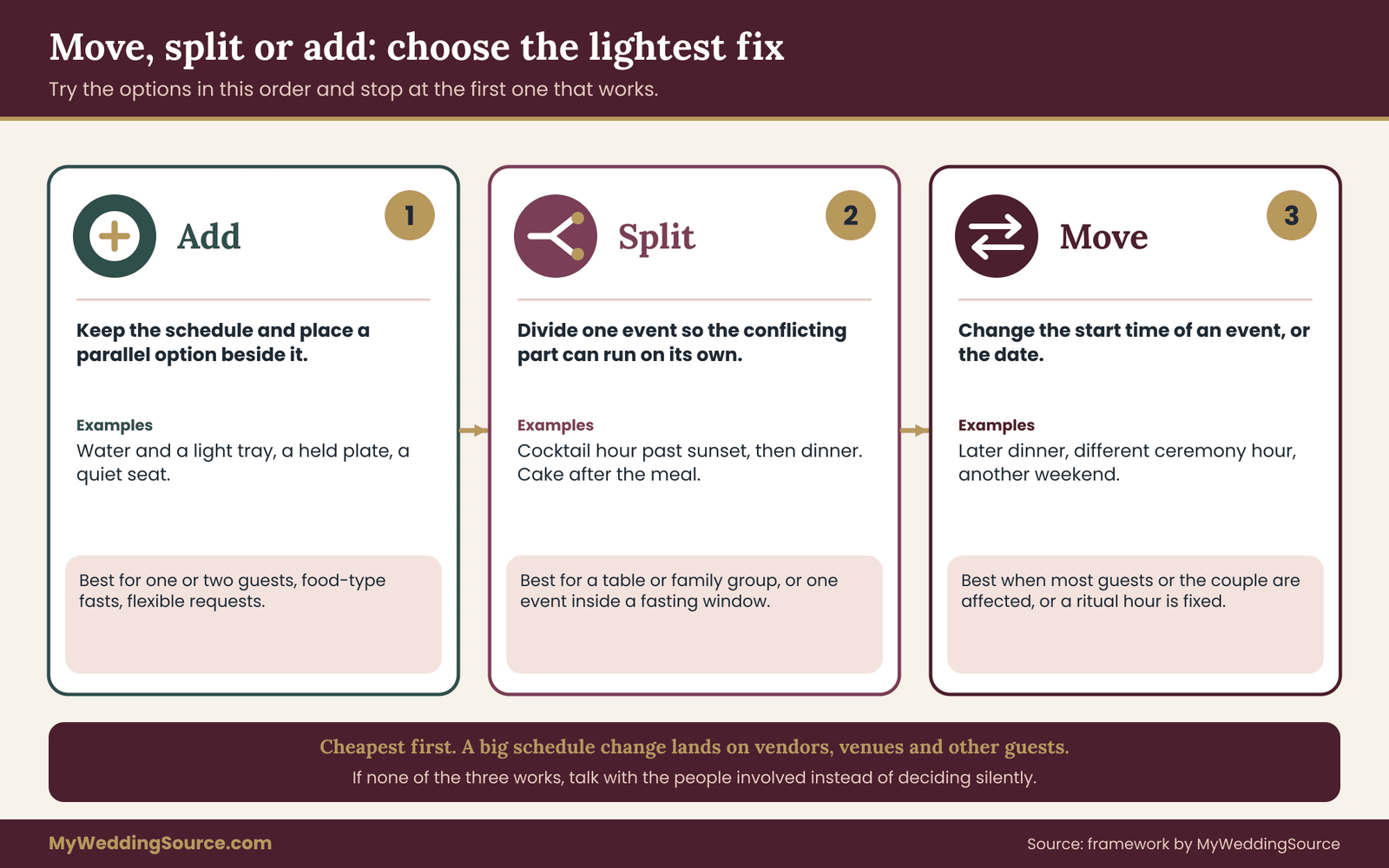
Move means changing when something happens. You shift the ceremony, push dinner back, or choose a different date. It is the strongest response because it removes the conflict entirely, and it is the most expensive because it affects everyone.
Split means dividing one event into two parts so that the part that conflicts can be handled separately. A reception might have an early social hour and a later seated meal, or the cake might be served after sunset while the main meal is earlier. A split keeps the overall timeline but gives each group a moment that works.
Add means keeping your schedule and putting a parallel option beside it. A quiet table with water and a light snack for guests breaking a fast, a boxed plate to take home, a second course timed for after sunset, a seat outside the room during a pre-ritual window. Adding is the cheapest response and the one that leaves the most guests untouched.
A rule for choosing
Use these questions in order. Stop at the first one that gives you a workable answer.
First, can you add something small? If the conflict is one or two guests, or a food-type fast, or a request with real flexibility, an added option usually works. A plate held back, a water station, a snack at a quiet table. Cost is low, nothing else changes, and the guest never has to explain.
Second, can you split? If the conflict touches a block of guests, for example a table or a family group, or if a single event runs across the wedding fasting window, look for a natural division. Is there a cocktail hour that could be extended past sunset, with the seated meal after it? Could dinner begin with a light course at sunset and move into the main service afterward?
Third, can you move? If the conflict touches most of the guest list, or the couple, or a ritual that cannot change, consider moving the event. This usually means a different start time, and in a few cases a different date.
If none of the three works, you have a real tradeoff, and it deserves a direct conversation with the people involved, not a silent decision.
Why not always move?
Couples sometimes jump to the biggest fix because it feels like the most respectful one. It rarely is. A large schedule change has costs that fall on other people. Vendors may have fixed windows. The venue may have a curfew. Other guests may have flights and babysitters built around the original time. The clock at the end of the night is often less flexible than the clock at the start.
Moving also does not always solve the problem. If the schedule shifts to accommodate one tradition, it may create a conflict with another. A later start that fits a daylight fast may land past the point when elderly guests or small children can reasonably stay. The lightest effective response is usually kinder to everyone, including the person with the fast. In wedding fasting planning, a small fix that works beats a large one that disrupts the day.
Why not always add?
The opposite mistake is relying on add when the conflict is deeper. A snack table does not help a guest who cannot eat anything until after a specific ritual. A water station is not a reason to hold a three-hour ceremony in the middle of a fast that began at dawn. If you notice that the added option is the same thing the guest has already said they cannot use, stop and move up the list.
How fasting shapes the date, the ceremony time and the schedule
The biggest planning choice you make about wedding fasting is when the event happens, because that sets what you will be able to do about everything else.
The date
If you are still choosing a date, check three things before you commit.
Look at the calendar of observances for the traditions that are present at the wedding, using the person or community’s own published calendar, not a general holiday list. Many observances move from year to year against the civil calendar. Some begin at sunset the evening before and end at nightfall the day after. Some depend on the sighting of the moon, which means the exact start can shift by a day. If a date is close, ask a person in that community what they expect.
Look at how many guests are likely to be affected. One or two guests is an add or a split. Twenty percent of the guest list may justify moving to another weekend. A number you cannot estimate yet is a reason to ask before you sign a venue contract.
Look at what the date forces on the schedule. A wedding that falls near a fast may need dinner later, a lighter menu, or a longer cocktail hour. That affects the catering quote, the venue booking and the overtime clauses. Ask the vendors what changes before you assume nothing does.
If the date is already fixed, skip to the schedule. You are no longer deciding whether to avoid the conflict. You are choosing how to meet it.
Either way, treat the date as the first wedding fasting decision, because it limits every later one.
The ceremony time
For wedding fasting, the ceremony time matters more than almost any other detail, because it determines how many hours the wedding fasting guests have already gone without food before the event, and how many remain.
A morning ceremony may be easy on guests who are fasting before a ritual, because the wait for the meal is short. It may be hard on guests keeping a daylight fast, because the whole day is still ahead of them. A late-afternoon ceremony can be the opposite. In either case, the questions are the same. How long is the ceremony? When does the fast end? How long is the gap, and what is in the gap?
A useful way to see it is to draw the day as a line. Mark the earliest hour anyone’s fast starts and the latest hour anyone’s fast ends. Mark the ceremony, the photographs, the cocktail hour, the dinner and the toasts. Look at where wedding fasting windows overlap events. That drawing, not a rule, shows you where the pressure falls.
Pay attention to the gap between ceremony and meal. In many weddings this gap is two or three hours, filled with portraits, travel between locations, and a cocktail hour. For a guest who is fasting, a long gap is a long wait with nothing offered. If you can shorten it, even by thirty minutes, it helps. If you cannot, have a plan for what the waiting guests will do, including a quiet room with seating and water.
The ceremony itself
If a religious service is part of the day, the order of the service may include food or drink: a shared cup, bread, a ritual sweet, a blessing over wine. Fasting guests may not take part in those, and the programme should make clear that participation is optional. The guide to the wedding ceremony step by step shows how a ceremony is structured, which helps you spot where food or drink enters it.
Some traditions also fix the hour of the ceremony itself. If a ritual leader tells you a service must happen before or after a certain time, you do not have a preference to weigh. You have a constraint. Record it on the schedule first, then build the rest of the day around it.
A fixed ritual hour is the clearest case where wedding fasting planning starts from the constraint and works outward.
Travel and time zones
Do not forget the guests who travel. A daylight fast is tied to local sun times, and guests who have flown in from another time zone, or who are staying in a hotel an hour away, will have an extra layer of questions. When do they eat in the morning? Is the hotel breakfast a problem? Does a long shuttle ride between the ceremony and the reception add an hour of waiting? For out-of-town guests, a short note on the website that gives sunset time, shuttle schedule and the first food offered does a lot of work.
The reception meal in three lanes
The reception meal is where wedding fasting meets the kitchen, and it is where a clear structure saves the most trouble. Instead of treating wedding fasting guests as a special case that bends the whole service, think of the meal as having three lanes that run side by side.
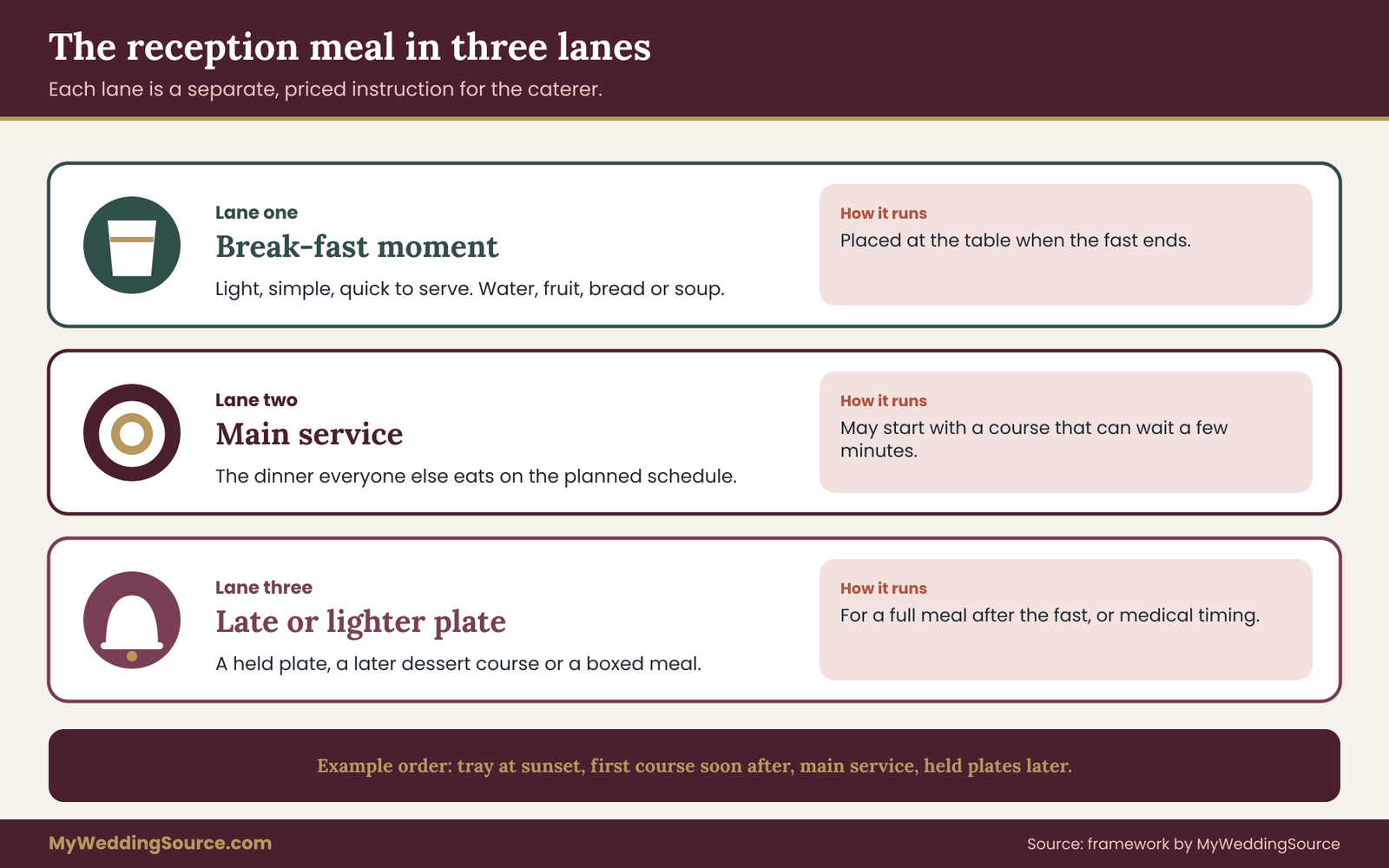
Lane one: the break-fast moment. This is the first thing a wedding fasting guest eats once the wedding fasting window ends. It should be light, simple, easy to serve fast, and available to anyone. Water, a plain fruit or a bread or a small soup is the usual shape of it. The contents depend on the tradition and the person, so ask them. A guest who is breaking a fast often prefers something gentle before a full meal, and a tray at the table or at a nearby station lets them do it quietly.
Lane two: the main service. This is the dinner everyone else is eating, on the schedule you planned. If the wedding fasting window ends before dinner, lane one and lane two happen to meet, and the wedding fasting guest simply sits down with everyone else. If the wedding fasting window ends after dinner starts, the main service may need to start with a course that can wait, or the guest may take a plate home.
Lane three: the late or lighter option. Some guests will want a full meal after the wedding fasting window ends, not just a light start. A plate held back and plated late, a dessert-and-hot-drink course timed for the end of the fast, or a boxed meal for the room are all versions of lane three. It also helps guests with medical timing needs and anyone who arrived hungry and missed the early service.
The three lanes are useful because each one is a separate decision for the caterer. You can say, “We need a light first course at 6:15 for about twelve people, the normal dinner at 6:45, and eight plates held for 7:30.” That is clear and priced. Compare it with “Some guests are fasting and we need to accommodate them,” which can mean anything from one plate to a rewritten service.
That clarity is the main benefit of the lane method for wedding fasting: each lane is a small, separate instruction.
How the lanes work in practice
Suppose the sunset time on your wedding date is just after the planned start of dinner. You have several ways to shape the lanes.
You can delay the start of dinner by fifteen to thirty minutes so that the wedding fasting window ends before the first course. This is a small move that often keeps everything else on schedule. Ask the caterer whether the kitchen can hold plated courses that long, and whether the delay creates overtime.
You can start with the break-fast tray. A simple tray at each table, delivered as the sun sets, can bridge the gap. The hosts of the table, the couple or a family member can quietly signal the start, so that the guests who are fasting can eat when they choose. This works well with a seated dinner and requires no schedule change.
You can serve a light first course, such as soup or salad, when the wedding fasting window ends, and hold the heavier courses for a few minutes after. For buffets, a staggered release of tables can do the same thing, and the guide to reception guest flow explains how to sequence table releases so that the line does not turn into a crowd.
The menu connection
The menu itself needs some thought. Guests who have been fasting for many hours often prefer food that is not heavy, and may want a drink first. Rich dishes, spicy dishes and large portions can be a rough start for someone who has not eaten all day. This is not a rule. Some guests want a full, hearty meal straight away.
The point is to include at least one choice that is easy on an empty stomach and to avoid making the only light option something that must be ordered in advance. The wedding menu planning guide describes how to build a menu that works across dietary needs, and the same logic applies here: offer a range, label it clearly and let guests choose.
A flexible menu is one of the easiest wedding fasting accommodations to build, because it helps many other guests too.
If the food itself is part of someone’s practice, such as halal, kosher, vegetarian or another rule about what may be eaten and how it is prepared, that is a separate and equally important question. This guide covers timing. The caterer will need to be told about food rules at the same time, and the two conversations should not be mixed up in a single note. A guest who fasts and also keeps food rules needs both handled correctly.
Drinks, water and the bar
Drinks deserve their own line. A guest who is fasting until sunset may not take water, or may take only water, depending on the practice. A guest who has just broken a fast may prefer water or a warm drink before anything else. Alcohol is its own question: some guests do not drink for religious reasons all the time, not only during a fast.
Put clear water at every table and at the entrance, and make sure that a non-alcoholic option is visible and available at the bar from the start, not only after a request. The guide to wedding bar service planning covers how to set up a bar so that non-drinkers are not an afterthought. A welcome drink handed to every guest at the door is a kind thought that can go wrong, because a wedding fasting guest has to decline in front of others. A tray at a side table is better.
Passing food and where it goes
Passed appetizers during the cocktail hour are a trap for the unwary. A server walking among wedding fasting guests with a tray they cannot touch puts the guest in a small, repeated social moment, each time declining and perhaps explaining. If a notable share of your guests are fasting during the cocktail hour, consider holding passed food until the wedding fasting window ends, or placing it at a station that guests can approach by choice. The caterer can usually shift when passing begins without changing the menu.
Cocktail hour, toasts and the first dance when guests are fasting
Beyond the main meal, the other food and drink moments in a wedding deserve a quick check.
Cocktail hour
For wedding fasting guests, cocktail hour can be the most awkward part of the day, because it is built around eating and drinking while standing and talking. The good news is that it is also the easiest to adjust. A few ideas help.
Start it later or shorter if the wedding fasting window ends soon after the ceremony. Provide seating, since a guest who has gone without food for many hours may want to sit. Offer an obvious non-food activity: a lawn game, a guest book, a photo area, music. The guide to the wedding cocktail hour explains how to design this part of the day, and a few of its suggestions, such as seating and a visible water station, fit well with wedding fasting needs.
Toasts and blessings
Toasts are timed around the meal, and in many weddings they happen while guests are eating or holding drinks. If a toast is meant to be shared with a drink, ask whether a wedding fasting guest would prefer to raise a glass of water or simply to listen. No one needs to be put on the spot. It helps to have the host say, “Raise whatever you have in your glass,” in place of “Everyone raise your champagne.”
Some traditions place a blessing or a short prayer before a meal, and the person leading it may also be fasting. Check with them on timing. If the blessing is sung or spoken at the start of the meal, it should happen when the wedding fasting window ends, not at the hour on the programme.
Cake and dessert
The cake cutting is a ritual in its own right and often happens late in the evening, which makes it a natural fit for guests whose fast ended recently. If your cake is cut earlier, it is worth knowing that for some guests the first thing they eat after a fast may be sweet and light, and that cake can serve the break-fast moment well when the timing happens to align. If you are planning a dessert bar, serving it later and leaving the main meal on time can be an elegant split.
The first dance and the party
The dancing part of the evening raises a different question: energy. A guest who is fasting, or who has just broken a fast, may have less stamina than usual. A seat near the dance floor, a water station, and a mix of music that is not all high-energy let guests stay without strain. These are small touches, and they work for anyone, including older guests and those who are simply tired.
Keep a short list of “when does food appear”
A short list on the schedule can help your coordinator and your caterer. Write down each moment when food or drink is offered, and next to it, which lane it belongs to. It might look like this: cocktail hour at 5:00 with seated light snacks and water, no passed food until 6:15; break-fast tray at 6:15; first course at 6:30; main service at 7:00; held plates at 8:00; cake at 9:00. That list is the whole plan in a few lines, and anyone running the day can follow it.
If you keep only one page of wedding fasting notes on the day, make it this one.
Wedding fasting for the couple, the wedding party and the family
Up to this point the focus has been on guests. Some of the most significant wedding fasting questions involve the people at the center of the day: the couple, their parents, the wedding party and the people carrying out the ritual.
The couple
In some traditions, the couple, or one of them, limits food on the wedding day until a point in the ritual. In others, they eat as usual. A couple who comes from different traditions may find that one partner expects to fast and the other does not, and each may be unsure how to say so. That conversation belongs early in the planning, long before the caterer or photographer asks about the schedule.
Wedding fasting for the couple is a personal matter first and a scheduling matter second.
If one or both of you will be fasting for part of the wedding day, the effects on the schedule are practical.
You will be on your feet, in formal clothes, in front of a camera, for most of the day. Plan the morning so that you are not rushed, and decide in advance when and how you will eat or drink once the wedding fasting window ends. A small plate set aside for the two of you, away from the guests’ tables, is common sense, whatever tradition you follow. Couples often find that they hardly eat at their own reception because they are busy greeting guests, and a wedding fasting couple has the same problem on top of an empty stomach.
Tell the photographer. Portraits taken in the hours before the wedding fasting window ends may be tiring, and a photographer who knows the plan can schedule the shots that need the most energy for when you feel best, and keep an easy sitting position for the rest. The photographer can also be told in advance not to schedule a “first bite” or a cake shot at the hour when it would be uncomfortable.
Choose a person to carry the plan. A friend, a sibling or your coordinator should know when the wedding fasting window ends, where the plate is and what to say if someone offers you food in the meantime. You should not have to remember any of this on the day.
Parents and elders
Parents and grandparents often keep the strictest observance in the family, and they are also the people whose comfort the couple most wants to protect. They may not say anything, either because they would never ask a child for a favor, or because they are sure the arrangement will be fine.
Ask them directly, and ask in a way that makes it easy to say yes. “Would you like us to hold dinner until after the sun sets?” is easier to answer than “Is there anything you need?” Offer specific options and let them choose. If an elder’s practice sets the ceremony time or the meal time, make sure the person making that decision has actually spoken to the elder, not only to the elder’s child.
Older relatives also have health considerations, and some may take medicine that has to be taken with food. If a fast and a medical need collide, the family should handle the question privately. Make sure a quiet room is available.
The wedding party
Bridesmaids, groomsmen, ushers and attendants are on the clock earlier than guests and finish later. They get ready, take photos, stand through the ceremony and move between locations. If any of them follows a fast, the planning questions are the same as for a guest, but the stakes are higher because they are working.
A simple approach is to include a question in the wedding party’s group message early on: “We will have lunch for the group at noon and a late meal after the ceremony. Does the timing work for everyone? Tell us if something needs to change.” Set up the same lanes for them as for the guests. Provide water and a place to sit. Do not assume that a lunch order for the whole party is going to suit everyone, and do not make the wedding fasting member eat in front of the group to avoid being left out.
Readers, musicians and ritual assistants
People who take part in the ceremony may be fasting for reasons of the ritual itself. A reader or a cantor may not eat before they perform. A musician may be fasting as part of their own observance. A ritual assistant may follow rules that begin well before the event and extend through it.
These roles are easy to overlook because the people in them are not on the guest list and may not see the catering forms. The best move is to ask each of them directly when you confirm the role, and to keep their answers on the same timing card system. If a musician is fasting and has a long performance, a break with water, a seat and a plate waiting for the end of the fast is a courtesy that costs almost nothing. The vendor guide on wedding vendor contracts explains how to confirm meal and break terms for paid vendors, and the same questions apply to musicians who are not on a standard contract.
The officiant
An officiant leading a religious service may have fasting rules that affect the schedule as much as any guest’s. Some will not eat before the service. Some will want to break a fast right afterward. Some will be happy to sit at the head table and some will prefer a private moment. Ask them what they need, put it in writing, and pass it to the coordinator. The conversation about interfaith ceremony planning also shows how to confirm what each leader expects before the day.
Talking to caterers, venues and other vendors about wedding fasting
Vendors can only plan around a request they understand. The way you present it makes a big difference to what you get back.
What to tell the caterer
Give the caterer a timeline, not a story. They need to know the following.
How many guests need what, in numbers and not names. “Twelve guests will break a fast at sunset, which is 6:12 pm on the date. Three more would like a plate held for later.”
What the lanes look like on the clock. Break-fast tray at 6:15. First course at 6:30. Main service at 7:00. Held plates at 8:00.
What the service staff should do. “At 6:12, the table captains place water and the break-fast tray. Please do not pass food or pour drinks at the fasting tables before then.”
What the kitchen can hold and for how long. Ask whether a plated course can wait twenty minutes without losing quality, and what the options are if it cannot.
What it costs. A different service time may involve overtime. A held plate is still a plate. A light first course may be priced as a course. Ask for these items as separate line items, so that you can see what each choice costs and decide which is worth it.
Then put the agreement in writing. A changed service time or a special lane belongs in the event order, which is the document that the kitchen and servers follow, not in an email thread. A caterer who confirms by email and then runs the standard service because the event order was never updated is a common reason for a plan to fail. The guide to wedding vendor timelines covers how to turn decisions into a schedule that every vendor can use.
What to tell the venue
The venue may have rules that affect the plan. A curfew, a limit on when kitchen staff must clear out, a restriction on outside food, a rule on how long the room can be held. If your plan involves a later dinner or a held plate, check these rules before you commit. A short email works: “We are planning a dinner start of 6:45 to accommodate guests breaking a fast at sunset. Does that conflict with the kitchen or the room release time?”
Ask also about space. A quiet room for guests who need to wait, a place to set a water station away from the bar, access to the kitchen for plates held late. These are small requests, and most venues can grant them if they know early.
What to tell the photographer, DJ and planner
The photographer should know when the wedding fasting window ends so that they can avoid shots of eating or drinking before then, and so that the wedding fasting couple’s portraits happen at the right moment. The DJ or band should know that toasts and blessings may happen later than the usual slot. The planner or day-of coordinator should have the complete lane list, the card summaries without names where possible, and the sunset time.
Do not assume that vendors will ask. Many have never run a wedding with a fast in the middle, and they will be relieved to have a clear plan.
A clear, early brief is the most useful thing a couple can give vendors when wedding fasting affects the day.
Questions for a faith adviser and a planning calendar for wedding fasting
When a wedding fasting question is bigger than one guest’s preference, you may want a conversation with a faith adviser. Perhaps the fast affects a large part of the family, or it is tied to the ceremony, or you simply cannot tell what is flexible. Going in with a short list of questions makes the conversation useful for both of you.

One: What does the observance ask of people, and who does it apply to? Start broad. You want to learn the shape of it, for example whether it applies to adults only, or to everyone old enough, and whether it applies to guests as well as to those taking a ritual role.
Two: What are the exact hours, and how are they set? Ask whether the window is tied to sunrise and sunset, a clock time, a ritual, or a calendar day. If it depends on the sun, ask which source the community uses, because sources differ slightly. Write down what you are told and ask for the source.
Three: What can be done during the fast? Some practices limit food only. Others limit drink, or also limit other activities. A guest who can attend, sit and talk, but not eat, is a different case from one who cannot attend a certain event at all. This answer decides whether the event can proceed with a parallel option or needs a bigger change.
Four: What is the preferred way to end the fast? Many communities have a customary first food or drink and a customary way to begin. Ask what would help and what would be a mistake. Do not guess. A well-meant choice, such as pork at a break-fast table or a drink that is not permitted, can be more upsetting than doing nothing.
Five: Where is there flexibility, and where is there none? This is the most useful question. Practices often have room for health, travel and special circumstances, and the adviser can tell you where they are. Ask how a guest who is unable to keep the full fast would be treated, and how the family would prefer that situation to be handled.
Six: Is there anything about the wedding itself that would change this? Ask directly whether a wedding changes the usual rules for the couple, the families or the guests. Some practices have special provisions for wedding days, and some do not. This is also the right moment to ask whether the adviser would be willing to speak to your caterer or coordinator, if needed, or to review the draft schedule.
Be ready to hear “it depends” and “ask the family.” Both are good answers. They tell you that the real authority is closer to home.
How to take notes
Write down the answers in plain words and read them back to the adviser. Then share the summary with the person fasting, so they can correct anything. If your wedding includes several traditions, keep a separate page for each. Do not combine them into a single list of “rules.” What one adviser says is true for one community, and the same words may not hold for another.
Respecting the adviser’s time
Advisers are often busy, especially in the weeks before holidays and festivals. Make the ask short and specific, offer to send the questions in advance, and thank them in a way that fits the community. If the conversation requires real time, consider whether a donation or gift is customary, and ask the adviser or a family member what is appropriate. Do not offer payment in a way that might seem to put a price on their guidance.
A planning calendar for wedding fasting
Wedding fasting is easier to handle when you spread the work over time. The calendar below shows a sequence that works for most weddings. The months are approximate, and a shorter engagement can compress the steps without dropping any.

Many months before: choose the date and learn the calendar. Look at the observance calendars of the traditions in your wedding. Ask close family before the date is final. If a conflict affects many guests, decide whether to move the date. This is also the time to tell your officiant and your venue that fasting may affect the schedule.
Around six months before: ask and record. Send the first message to guests and wedding party, add a timing question to the RSVP, and start the cards. Contact any faith advisers whose input you need. If the ceremony has a fixed hour, record it.
Around three months before: choose the move, split or add. With the cards in hand, decide which of the three responses fits each conflict. Draft the lane plan. Talk to the caterer about the numbers, the service times and the cost. Check venue rules on room release and curfew.
Around one month before: lock the schedule. Update the event order with the lane times. Send the schedule to every vendor. Update the website with sunset time, shuttle times and what food will be offered when. Follow up with anyone who has not answered.
The final week: confirm and brief. Confirm the final headcount for each lane. Brief the coordinator, the table captains and the wedding party. Make sure that the couple’s plate, the water stations and the quiet room are in the run-of-show. Send a short reminder to guests with the key times.
On the day: watch the clock. Have one person responsible for the sunset moment or the end of the fast. They should signal the caterer, the host and the first table captain. A phone alarm set ahead of time is a modest and effective safeguard.
If you only have a few weeks
A short engagement does not make the method impossible, only tighter. Collapse the first three steps into one week: ask early, record quickly and choose the lightest response. Skip the move option unless the conflict is large. Rely on add and split, which can be arranged with a caterer even at short notice. Put the plan into the event order as soon as the caterer agrees.
Wedding fasting planning on a short timeline is still manageable, because add and split rarely need long notice.
A worked example of wedding fasting planning
The example below is invented to show how the pieces fit. The couple, the guests and the numbers are made up, and no tradition is described beyond what the fictional guests say themselves.
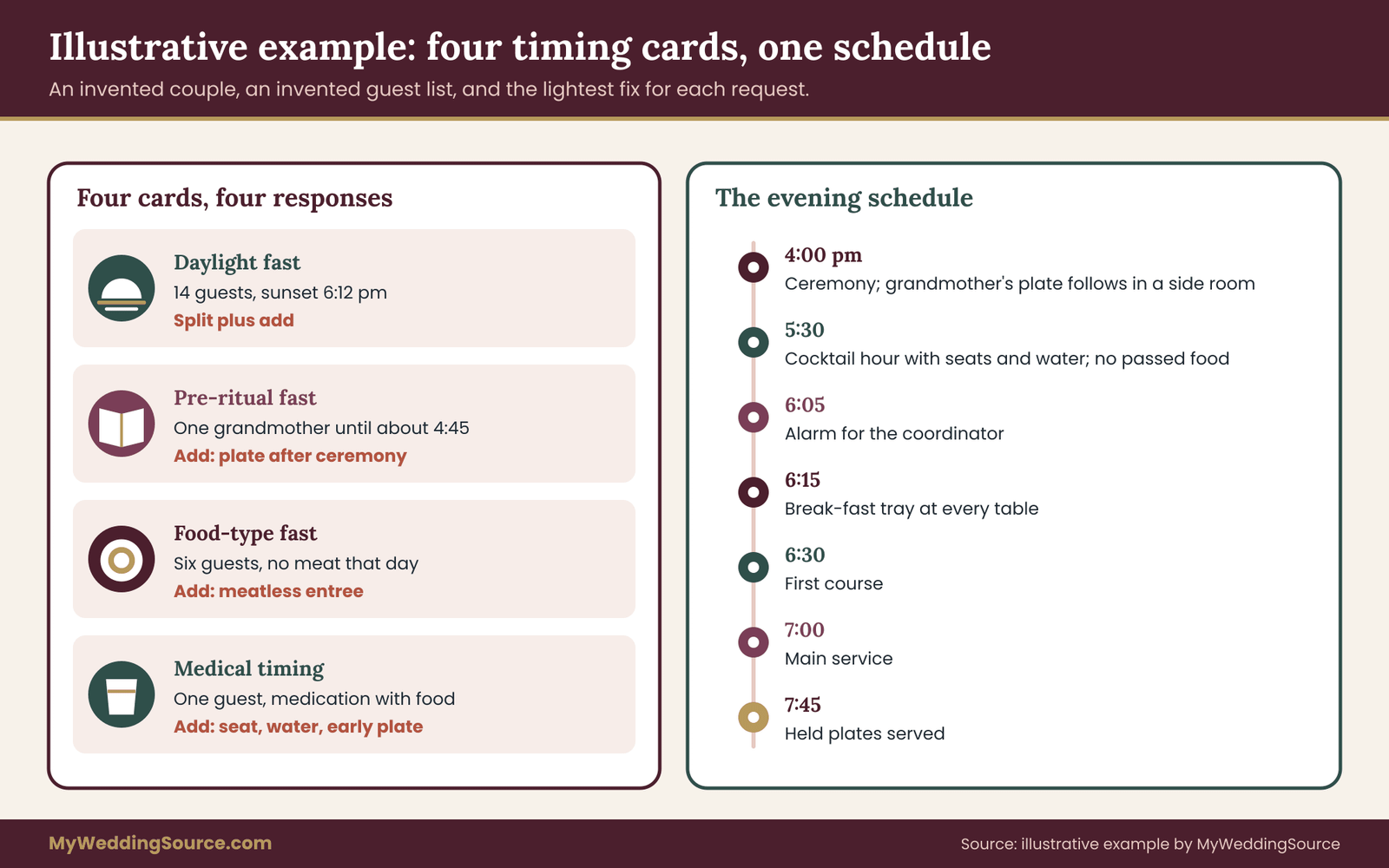
Imagine a couple, Maya and Daniel, planning a Saturday wedding with a four o’clock ceremony, portraits until five-thirty, cocktail hour, and a seated dinner planned for six-thirty. They have a guest list of 120. They send a short message and add a timing line to the RSVP.
The responses give them four cards.
Card one: a daylight fast. Fourteen guests, mostly from one side of the family, will be fasting from dawn until sunset. The sun table for the venue lists sunset at 6:12 pm on the wedding date. These guests say they are comfortable breaking the fast with water and something light, and that a full meal can follow.
Card two: a pre-ritual fast. Maya’s grandmother will not eat for a period before the ceremony because of a sacrament she plans to receive, and she will eat afterward. Her window ends when the ceremony ends, around 4:45. She is the only person with this need, and she says there is flexibility if she cannot eat immediately.
Card three: a food-type fast. Six guests will not eat meat on the wedding day because of the season. They eat at normal hours. They ask for nothing except a meatless option, which the caterer’s menu already includes.
Card four: a medical timing need. One guest tells Daniel privately that he takes medication with food at set times. He asks for nothing except a place to sit and a plate that is not delayed.
The couple walks through the decision rule.
For card three, the answer is add. They confirm the meatless entree with the caterer and mark the table assignments.
For card four, the answer is add again. He is seated near the exit, near a water station, and his plate is marked to be served as soon as the first course starts. The coordinator is told, without details.
For card two, they add a small plate that Maya’s grandmother’s family can bring to her right after the ceremony, in a quiet side room, while photos continue.
For card one, they have fourteen guests whose fast ends at 6:12. They choose a split with a small add. The cocktail hour is held between 5:30 and 6:15, with seating and water but without passed food. A simple break-fast tray, with water, fruit and bread, is placed at each table at 6:15. The first course comes at 6:30. The main service follows at 7:00. Plates for guests who want a fuller meal after the first course are held until 7:45.
They tell the caterer the numbers, ask for each lane to be priced as a line item, and confirm the plan in the event order. They tell the venue about the 7:45 held plates and confirm that the room release time allows it. They tell the photographer that no eating shots will be taken before 6:15. They set a phone alarm for 6:05 on the coordinator’s phone, to start the break-fast tray at sunset.
The total effect on the day is small. The dinner moves back by thirty minutes. Passed appetizers are replaced by seated light food after sunset. Three vendors are told something new. No guest has to ask for a special favor on the day, and no one has to explain.
What the example shows
Notice what the couple did not do. They did not guess at anyone’s religion. They did not move the date or ceremony, because adding and splitting solved each problem. They did not announce anything to the room. And they put every change into the event order, so that the day did not depend on anyone’s memory.
The example is also deliberately modest. A different guest list could produce a different result: a larger number of wedding fasting guests might call for moving the dinner later, or a ritual might need a fixed hour. The method is the same. Collect the cards, sort the conflicts, choose the lightest response, price it, write it down.
That is wedding fasting planning in one sentence.
Health, respect and the limits of wedding fasting planning
A plan built around wedding fasting has limits, and it helps to name them honestly.
Health comes first
Fasting is a personal practice, and the people who follow it often have good reasons to adjust it for health. Guests who are pregnant, nursing, older, managing a chronic condition, or taking medicine may be advised by a clinician to eat or drink on a schedule. The same is true of children, who are often exempt from fasts. If you see a guest who looks unwell, do not question their practice. Offer water, a seat and a quiet place, and let them decide.
Good wedding fasting planning protects health before it protects the schedule.
Your planning should assume that a guest may change their mind on the day. Someone who intended to complete a fast may feel faint in the heat and need to eat. Someone who had planned to eat may choose to wait. Neither should be made to feel noticed. A water station that anyone can use, seating that is not hidden away, and a plate that is available without a conversation make this easy. Agencies such as the Centers for Disease Control and Prevention publish general guidance on staying safe in the heat, and a hot outdoor ceremony makes that guidance more relevant for guests who have not had anything to drink.
Food safety is part of the picture too. A plate held for an hour or two before serving needs to be kept at a safe temperature, and a break-fast tray set out early may sit in the open. The Food and Drug Administration and foodsafety.gov publish the basic rules for holding hot and cold food. Ask your caterer how they handle held plates, and do not rely on guesswork.
Respect means letting people opt out of attention
The second limit is social. The goal of wedding fasting planning is to make the day easier, not to make a wedding fasting guest the subject of attention. That means no announcements, no pointing out who is and is not eating, no special seating that marks people, and no questions at the table about why someone has not touched their plate. If a family member asks, “Why isn’t she eating?”, the answer is, “She is fine, thank you.”
It also means accepting that a guest may decline your arrangement. You may have a perfect plan and a guest may say, “I will eat at home, thank you.” That is their right. Thank them, and keep the plan in place for everyone else.
What you cannot know
You cannot know the exact rules of each tradition, the specific practice of each guest, or the views of each family. You cannot know when a moon will be sighted, or how a community will interpret an unusual situation. The article cannot tell you, and neither can a search engine. What you can do is ask, record the answers, build in flexibility, and rely on the people whose practice it is.
You also cannot resolve a disagreement between two traditions or two family members about what is right. If the grandmother says the fast must be kept in full and the groom’s aunt says it can be eased, the couple is not the judge. The best course is to ask each person what they need, build a plan that works for those needs, and keep the conversation kind.
Wedding fasting planning works best when the couple acts as a coordinator, not as a judge of anyone’s practice.
Legal and employment notes
If any part of your wedding involves paid staff, such as a coordinator, caterer or musician, remember that workplaces in the United States have obligations about religious accommodation, and that the Equal Employment Opportunity Commission publishes guidance on the topic. You are not an employer in the usual sense, but your vendors are, and they may have rules about breaks and meals that apply to their staff. Ask vendors early about how they handle staff who fast, and do not assume that their schedule matches yours.
For the marriage license and the legal side of the ceremony, the government’s own pages, starting with USA.gov’s marriage license guidance, tell you what is required in your state. Those requirements are separate from your religious ritual, and a fasting rule does not change them.
Common mistakes with wedding fasting, and how to avoid them
After the method, here are the errors that come up most often, with a short fix for each.
Assuming from a name or a label. A guest’s religion, ethnicity or family name tells you very little about what they will need. Fix: ask everyone the same neutral question and listen to the answer.
Treating a fast as a menu item. Moving a guest to a “special meal” without checking the timing leaves the real problem in place. Fix: record the hours first, and choose the menu second.
Forgetting the gap between ceremony and meal. A guest who is fasting feels a long gap more than anyone. Fix: draw the day as a line and shorten or fill the gap.
Serving the welcome drink at the door. A tray of drinks at the entrance puts wedding fasting guests in a position they cannot easily leave. Fix: use a side table or a hosted station.
Passing appetizers to a room of wedding fasting guests. Fix: delay passing, or use a station that guests approach on their own.
Relying on verbal agreements. A caterer who agrees on the phone and then runs the standard service has not broken a promise that was ever written down. Fix: put each change in the event order and confirm it in writing a week out.
Naming the guest in front of others. Fix: share numbers and timings with vendors, not names and reasons. Keep the cards private.
Overcorrecting. A plan that moves the date, delays dinner by two hours, and cancels cocktail hour because one guest mentioned a fast can burden many people without being asked for. Fix: use the decision rule and choose the lightest response that works.
Ignoring the couple. The people who are working hardest at the wedding are often the ones who eat the least. Fix: set aside a plate, a time and a person for the couple, whatever the tradition.
Forgetting to tell the day-of team. A beautiful plan that lives on the couple’s phone does not survive the afternoon. Fix: give the coordinator, caterer, photographer and wedding party the same lane list and the same sunset time.
Your next steps
Here is a short sequence to start with, in the order that tends to work.
First, draw the wedding day as a timeline, from the earliest guest arrival to the end of the evening. Mark the ceremony, the photographs, the cocktail hour, the dinner and the toasts.
Second, look up the sunset time for your date and venue from an official source, and keep it with the timeline.
Third, send a short, neutral message to your wedding party and close family, and add a timing question to the RSVP or website. Do not name any tradition.
Fourth, make a timing card for every answer. Fill in all five fields, and ask about the gaps.
Fifth, sort the conflicts with the move, split or add rule. Choose the lightest response for each, and confirm anything that is not clear with the person fasting or a faith adviser they trust.
Sixth, brief the caterer and venue with numbers and times, request line-item pricing, and put the final plan into the event order.
Seventh, brief the day-of team, set a reminder for the moment the wedding fasting window ends, and set aside a plate for the couple. Then enjoy the day.
FAQ
How early should I ask guests about fasting?
Ask when you send the invitation or launch the wedding website, and follow up after the RSVP deadline. If you are still choosing a date, ask close family before the date is final, because that is the only moment when you can avoid a conflict entirely. A short, neutral question works better than a long explanation, and it should be easy to answer in one sentence.
Should I ask a guest about their religion to plan for fasting?
No. Ask about timing, not belief. A question such as “Do you follow a fast or meal schedule that overlaps with the day?” gives you what you need without asking anyone to name a faith. Many guests will volunteer more, but they should not have to. The same neutral wording works for religious, medical and personal reasons, which keeps the request simple for everyone.
Do I need to move my wedding date because of a fast?
Not usually. If a few guests are affected, adding a light option or splitting the meal solves most problems. Consider moving the date only when a large share of the guest list or the couple is affected, or when a ritual has a fixed time you cannot change. Check the observance calendars before you sign a venue contract, since that is when a move costs the least.
How do I find the exact time a daylight fast ends?
Use a local sunset time for your wedding date and venue from an official source such as the National Weather Service or the United States Naval Observatory. Then ask the guest or their faith adviser how their community interprets that time, since some practices add a few minutes or use a different source. Record the time and the source on the timing card.
What should I serve a guest who is breaking a fast?
Ask the guest, since customs differ. A light option such as water and a simple fruit or bread is common, and many guests like to start gently before a full meal. Keep it separate from the main service so it can be served at the right moment. Remember that food rules about ingredients and preparation are a separate question from timing, and both need to be confirmed.
Can I hold the reception dinner after sunset without upsetting other guests?
Usually, yes, if you plan for the gap. A cocktail hour with seating, water and light food, a clear start time on the invitation and a short wait between ceremony and meal keep most guests comfortable. Elderly guests and families with small children may need an earlier option, such as a light plate. Tell everyone the schedule ahead of time so they can plan.
What if the couple is fasting on the wedding day?
Plan for it as you would for any wedding fasting participant. Decide when the wedding fasting window ends, set aside a plate and a quiet moment, and assign one person to carry the plan. Tell the photographer so that the most tiring portraits fall when you feel best. If you are unsure of the rules, talk to your officiant or a faith adviser you both trust, and write down what they tell you.
How do I tell the caterer without exposing guests’ private details?
Share numbers and times, not names or reasons. For example, “twelve guests will break a fast at sunset, which is at 6:12, and three want a plate held for later.” Ask for each lane to be priced as a line item and confirm the final plan in the event order. If the caterer asks for names, ask why, since a headcount and a timeline are usually enough.
Sources
- USA.gov: Marriage license
- U.S. Equal Employment Opportunity Commission
- FoodSafety.gov
- U.S. Food and Drug Administration
- Centers for Disease Control and Prevention
- National Weather Service
- U.S. Naval Observatory
- National Institutes of Health
- U.S. Department of Justice: Civil Rights Division
- American Diabetes Association