
Chuppah setup is the work of turning a ritual canopy into something a venue will approve, a vendor can build and an officiant will recognize as right. This guide shows how to write one short structure brief that the officiant, the venue and the rigger all review before anything is ordered, delivered or hung.
Settle the ritual needs first, because the officiant decides what the canopy must be. Then pick a structure type that fits the site, get written venue rules for floors, ceilings, flame, power, access and weather, and name one owner for every task from delivery to strike. Put it all in a one-page structure brief and have the officiant and the rigger sign it before the florist or rental company commits to a design. The fastest way to protect a chuppah setup is to decide who can say no, and to ask them early.
A chuppah looks simple in a photograph. Four poles, a cloth or floral top, a couple standing underneath. In practice it is a small temporary structure with a religious purpose, and it touches four different groups of people who rarely talk to each other. The officiant cares about what the canopy means and how the ceremony moves beneath it. The venue cares about floors, ceilings, fire rules and liability. The florist or rental company cares about the design and the delivery truck. The couple cares about all of it, and usually learns where the gaps are on the wedding morning.
Most problems with a chuppah setup are not dramatic. A freestanding frame is delivered but nobody brought weights for a windy lawn. A florist designs an overhead arrangement that the venue will not let anyone hang. A rabbi arrives and finds that the glass-breaking spot is on a stage carpet that the venue does not want covered in shards. Each of these is cheap to fix three weeks out and expensive to fix at four o’clock on the day.
A note on scope. This is general planning information, not legal, safety or religious advice. Jewish practice varies by community, by family and by officiant, and nothing here describes the one correct way to do anything. Where a rule about structures, fire safety or accessibility applies, the article points to the body that issues it so you can confirm the current version with the venue and your local authority.
What chuppah setup covers, and where it goes wrong
In this guide, chuppah setup means everything between choosing a canopy and taking it down: the design, the materials, the delivery, the installation, the anchoring, the safety checks, the ceremony itself and the strike afterward. It does not cover the meaning of the ritual in depth, or the full shape of an interfaith ceremony. For the wider question of how two traditions share one ceremony, the guide to planning an interfaith wedding ceremony with clear ritual ownership covers who decides what. This article takes one object and one question: how does a chuppah get built, approved and staffed in a particular place?
It helps to see a chuppah as four separate things that happen to share a name.
A ritual requirement. Whatever else it is, the canopy is part of a ceremony. Your officiant may have firm needs about how many people stand beneath it, what covers it, whether the sides are open, whether it stands under the sky, and what must fit inside it. These needs differ between communities, and a florist cannot guess them.
A physical structure. It has a footprint, a height, a weight, a way of staying upright and a way of coming apart. It can fall over in the wind, block a sightline, sag in the middle or tip into a guest.
A set of venue conditions. Every site has rules, some written and some assumed. Floors that cannot be drilled, lawns that cannot be staked, ceilings that cannot carry load, candles that cannot be lit, doors that must stay clear.
A team of people with tasks. Someone brings it. Someone builds it. Someone checks it. Someone holds the poles if it is handheld. Someone moves it for the reception. Someone takes it away. When nobody owns a task, it lands on the couple or on whoever is standing nearest.
Why the four owners rarely meet
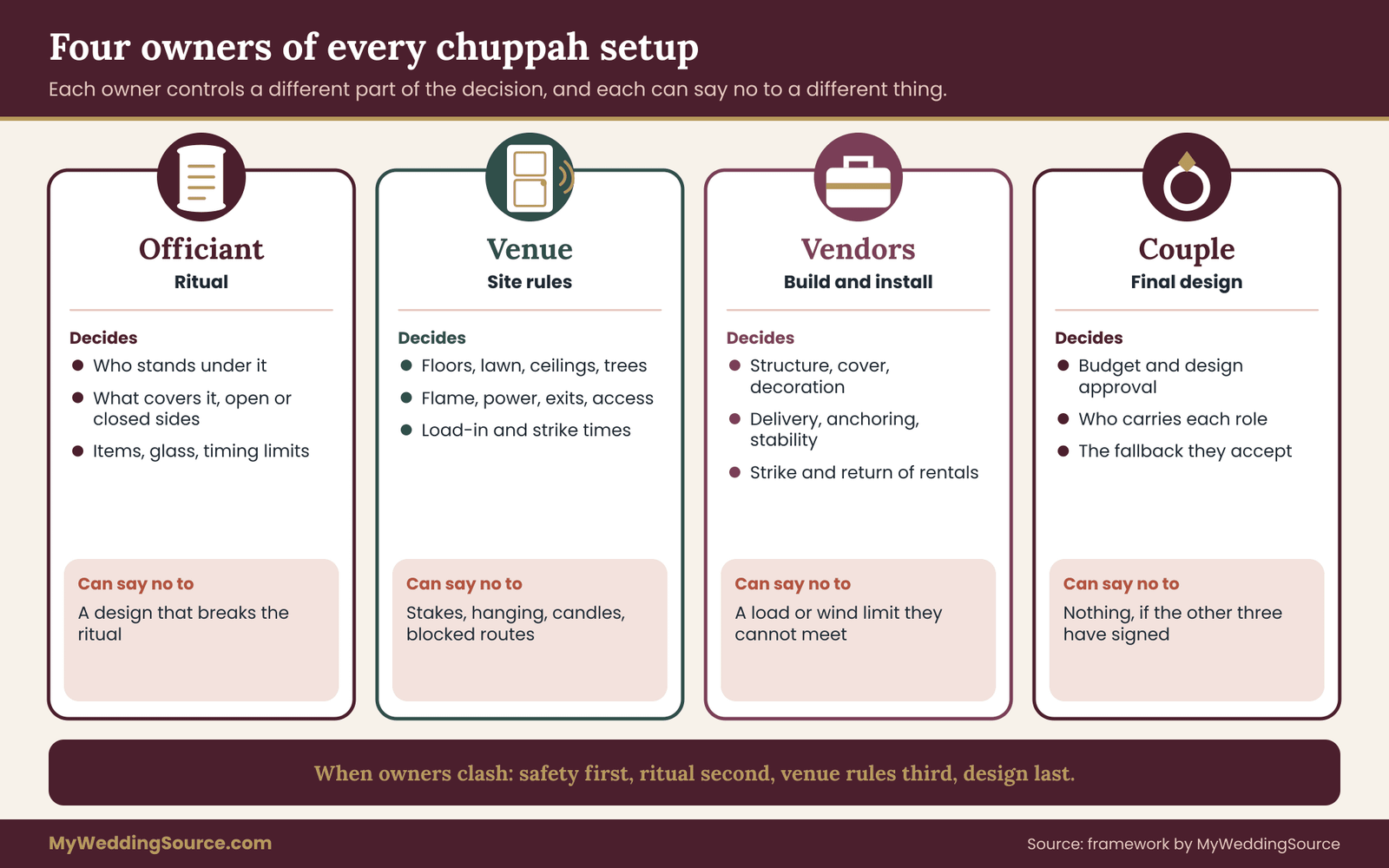
A wedding usually has a planner or coordinator, a venue contact, a floral or décor vendor, a rental company and an officiant. Each was hired separately, often months apart, and each reports to the couple. The officiant is often not contacted about the physical structure at all, because the couple assumes the florist will “just know.” The rigger or installer, if there is one, may only appear on the schedule as a line item. The venue may not hear about a structure until the vendor’s certificate of insurance arrives.
That arrangement works when the structure is simple and the site is forgiving. It fails when any one of the four has a requirement the others did not hear. The cure is not more meetings. It is one short document that every owner reads and answers in their own area, which this guide calls the chuppah structure brief and builds step by step in a later section.
What this guide does not decide for you
It does not tell you what a chuppah must look like. Some families use a large prayer shawl held on four poles. Some use a freestanding frame covered with fabric or flowers. Some marry beneath a canopy that a family has used for generations. Some use something very simple and put the effort elsewhere. All of these can be right, and the person who can tell you which is right for your ceremony is your officiant, together with your families.
It also does not replace local rules. Codes for tents, flame, rigging and public access are set by local authorities and the venue’s own policies, and they change. The brief gives you the questions to ask and the people to ask. The answers must come from them.
The cost of finding out late
Late discoveries cost money in predictable ways. A change of design after fabric is cut means paying for the first design and the second. A rigger called in the week of the wedding charges for the short notice. A venue that refuses an overhead hang forces a switch to a freestanding structure that needs weights, a larger footprint and perhaps a different aisle layout. Even small changes ripple into the cue sheet, the photographer’s plan and the seating, which is why the ceremony cue sheet guide treats the physical layout as an input, not an afterthought.
Finding out early costs a few emails and one phone call with each owner. The rest of this guide is the sequence for doing that in a sensible order: ritual first, then structure, then site, then people, then paper.
A note on language
You will see “chuppah” used here for the canopy and “officiant” for whoever leads the ceremony, whether a rabbi, a cantor, a lay leader or another person your community recognizes. Spellings vary, and “huppah” and “chuppah” both appear in everyday use. Use whichever spelling your officiant uses when you write to vendors, so that nobody searches for the wrong word in a contract or a rental catalog.
Ritual needs that shape every chuppah setup
Start with the person who will lead the ceremony, and start before any design conversation about the chuppah setup. The officiant’s answers are the only part of the brief that cannot be negotiated by price or convenience. A florist can swap flowers, a venue can offer another corner of the lawn, but a ritual requirement is what makes the ceremony the ceremony.
Ask for a call about the chuppah setup, not a quick text. Many officiants have clear views and will give them freely when asked directly. Many have never been asked about the physical side, so they will answer from habit and may need a moment to think about the specific venue. Send your questions in writing afterward so the answers become part of the record.
“We are planning our chuppah setup and want the structure to fit what you need. Could we spend twenty minutes on what the canopy must include, who stands under it, and what has to be on hand? We will write up what we agree and send it back for you to correct.”
That short message does three useful things. It says the officiant’s needs come first. It sets a small time limit. And it promises a written summary, which is the start of the brief.
The questions that change the chuppah setup
Some ritual questions are purely about meaning. Others have direct physical consequences, and these are the ones the brief needs. Work through them in this order.
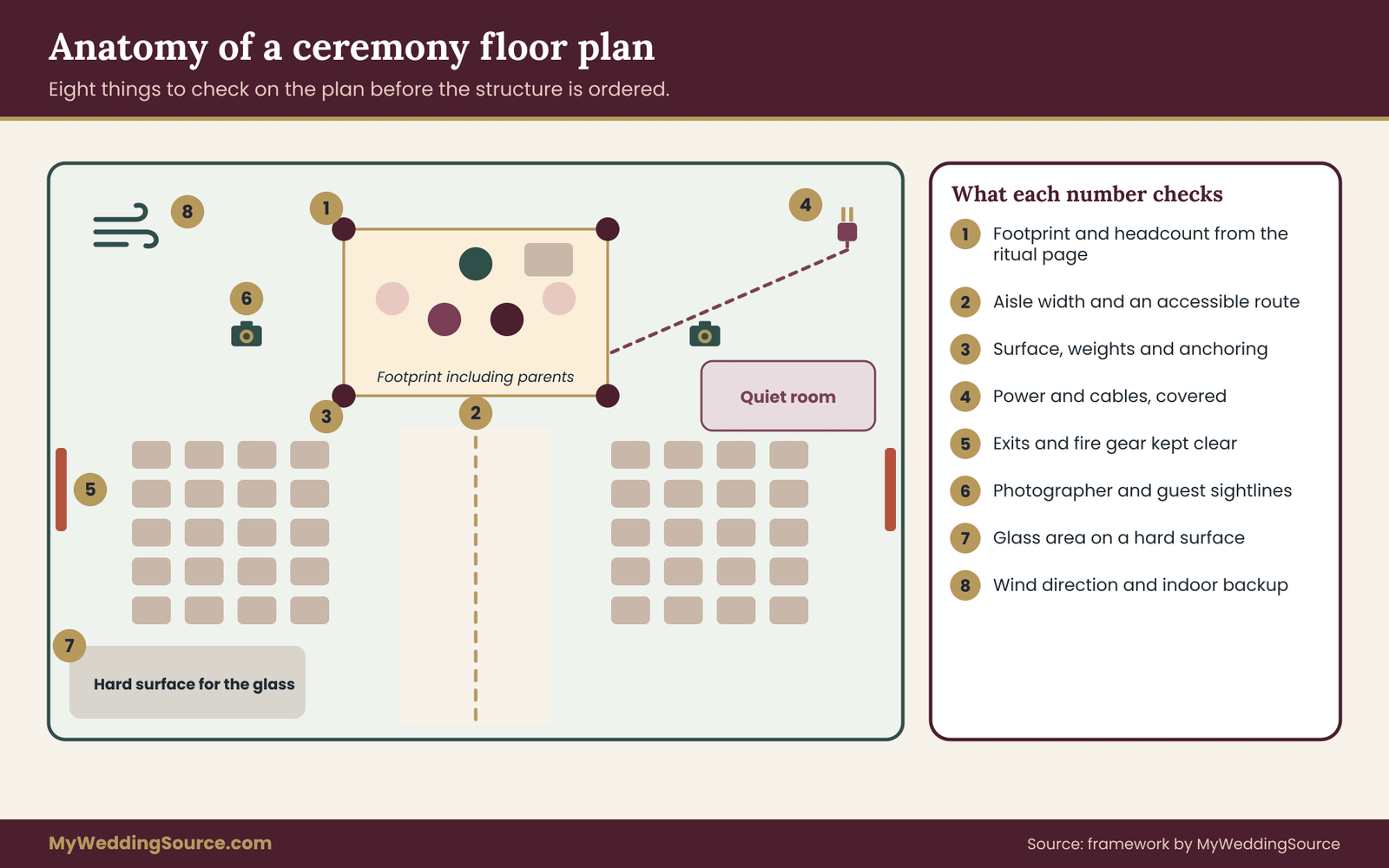
How many people will stand under the canopy? Couples often picture two. Depending on custom, the number can include the officiant, a cantor, parents, grandparents, witnesses or attendants. Some communities place parents beside the structure rather than under it. The count sets the footprint of the chuppah setup, and the footprint sets almost everything else: how large the frame is, how much fabric it needs, how many weights or anchors it takes and how wide the stage or lawn area must be.
Is the canopy a roof only, or does it have sides? Many explanations of the custom point to the open sides as a sign of welcome, and many couples keep all four sides open. A canopy that hangs fabric or flowers down the sides changes how it behaves in wind and how it looks from the guests’ seats. Ask whether the officiant has a view, and ask your families if they do.
What covers it? Some couples use a prayer shawl, a family textile, a custom-printed cloth, a lace panel, a floral top or a simple fabric. If a family piece is involved, someone must decide how it will be attached without damage. Heirloom cloth should not be pinned, stapled or draped over a frame with sharp edges, and the person who owns it should approve the method in advance.
Does the ceremony need to happen under open sky? Some communities prefer to marry outdoors, under the sky, and some do not mind an indoor ceiling. If the officiant prefers an open sky and the venue is a ballroom, that question deserves an early answer, because it may change the site, the date or the rain plan.
Is the structure freestanding, handheld or hung? A freestanding structure stands on its own. A handheld one is carried by people, often four honored guests or friends. A hung one is suspended from something above. Your officiant may have a preference, and your community may have a custom about who holds the poles. The choice leads directly into the structure types covered in the next section.
Which way does the couple face? Some communities have a custom about direction, such as facing a particular compass point. Where that applies, the floor plan, the sun and the guests’ seating all change. It is a small question that is easy to ask early and hard to adjust on the day.
The items that go under the canopy
The second set of questions about the chuppah setup is about objects. Each one has a physical home, and each needs someone to bring it and someone to remove it.
- A table or stand for documents, a cup or other items. Ask whether one is needed, how big, and where it goes. A table under a four-post frame needs a clear gap that the frame does not block.
- A cup of wine or juice. Check whether the officiant supplies it, who provides the cup, and whether the venue has a rule about alcohol outside its own bar service. Many venues are strict about outside alcohol even in tiny amounts, so it is worth a sentence in the venue conversation.
- Rings. Someone holds them before the ceremony. This is a cue-sheet matter, but it affects how the couple stands and whether anyone needs a pocket or a small dish.
- A glass or other object to be broken at the end. Ask what it will be, who supplies it, where it sits and what the floor surface is. A thin glass on a hard floor shatters widely. A glass wrapped in cloth or placed in a bag breaks more safely. Some couples use a lightbulb, which is also common. The officiant and the venue should both be comfortable with the plan.
- Candles or other flame. If any are part of the ceremony, the fire rules move into the brief. They are covered in detail with the venue questions.
- Microphones and speakers. A canopy that muffles the officiant, or hides a microphone stand, gets noticed immediately by guests at the back. Ask who will be amplified, whether lavalier microphones or stand microphones will be used, and where the cables run.
Documents and the ketubah
Many Jewish weddings involve a marriage contract called a ketubah, and the signing may happen before the ceremony in a separate space or as part of the ceremony itself. The custom varies by community and the officiant knows the usual practice. For the chuppah setup the point is practical: where does the signing happen, who needs to be there, what surface does it need, and does it happen near the canopy or somewhere else? If the answer is a quiet room, the venue needs to confirm that a room is free and that the timing of other vendors does not interrupt.
A small, hard-to-forget item for the brief: the ketubah, its pen, any witnesses’ details and a clean surface must all be available at the right time. The person who brings them should be named, not assumed.
Time, calendar and chuppah setup limits
Some communities observe days and times when certain activities are not done, including some kinds of work, travel or setup. Whether this applies to your wedding, and how it affects vendors and staff, is a question for your officiant and your family, not a general rule. It can matter for the date you pick, for the time vendors can start the chuppah setup, and for when the structure can be struck afterward.
If your celebration falls near a Sabbath, a holiday or another period with its own practices, tell the venue and the vendors early and in plain words. Ask the officiant what the family needs. Then ask the venue whether it can set up a day in advance, hold the structure in a locked room, or provide a vendor who can work at the needed times. The tidy answer is rarely the same in two communities.
After the ceremony: the quiet room
Some communities include a short period of privacy for the couple immediately after the ceremony, often in a nearby room. If your officiant mentions it, the venue needs to know. The room has to be close to the ceremony space, private, comfortable, and stocked with whatever the couple might need, such as water or a small snack. It also has to be free at that moment, which means other vendors and staff must not use it as a staging area.

Turn the answers into a ritual page
After the call, write up the answers for the chuppah setup in plain language. A good ritual page is short enough to fit on half a page and covers the headcount under the canopy, the type of cover, the sides, the sky preference, who holds or stands, the items to be present, the timing limits, the glass plan and the items the officiant treats as non-negotiable. Send it back with the sentence “Please correct anything I have misunderstood.” Treat the reply as the official version.
Two rules keep this page useful.
Ritual outranks décor. If the florist’s design conflicts with a ritual need, the chuppah setup changes, not the need. Say so to the florist before the first sketch, so nobody is disappointed.
Do not guess for another tradition. In an interfaith ceremony, the officiant of the other tradition may have needs of their own, and the two sets of needs have to be reconciled. The site’s guide to interfaith ceremony planning explains how to settle who decides what. For this article, assume both lead officiants have given you their needs in writing, and put both on the ritual page.
A final point on tone. Asking about ritual details is not intrusive. Officiants and families generally appreciate being asked rather than assumed. The danger is not asking too much; it is quietly finishing a chuppah setup and finding out on the day that it does not fit the ceremony.
Choosing a structure type for your chuppah setup
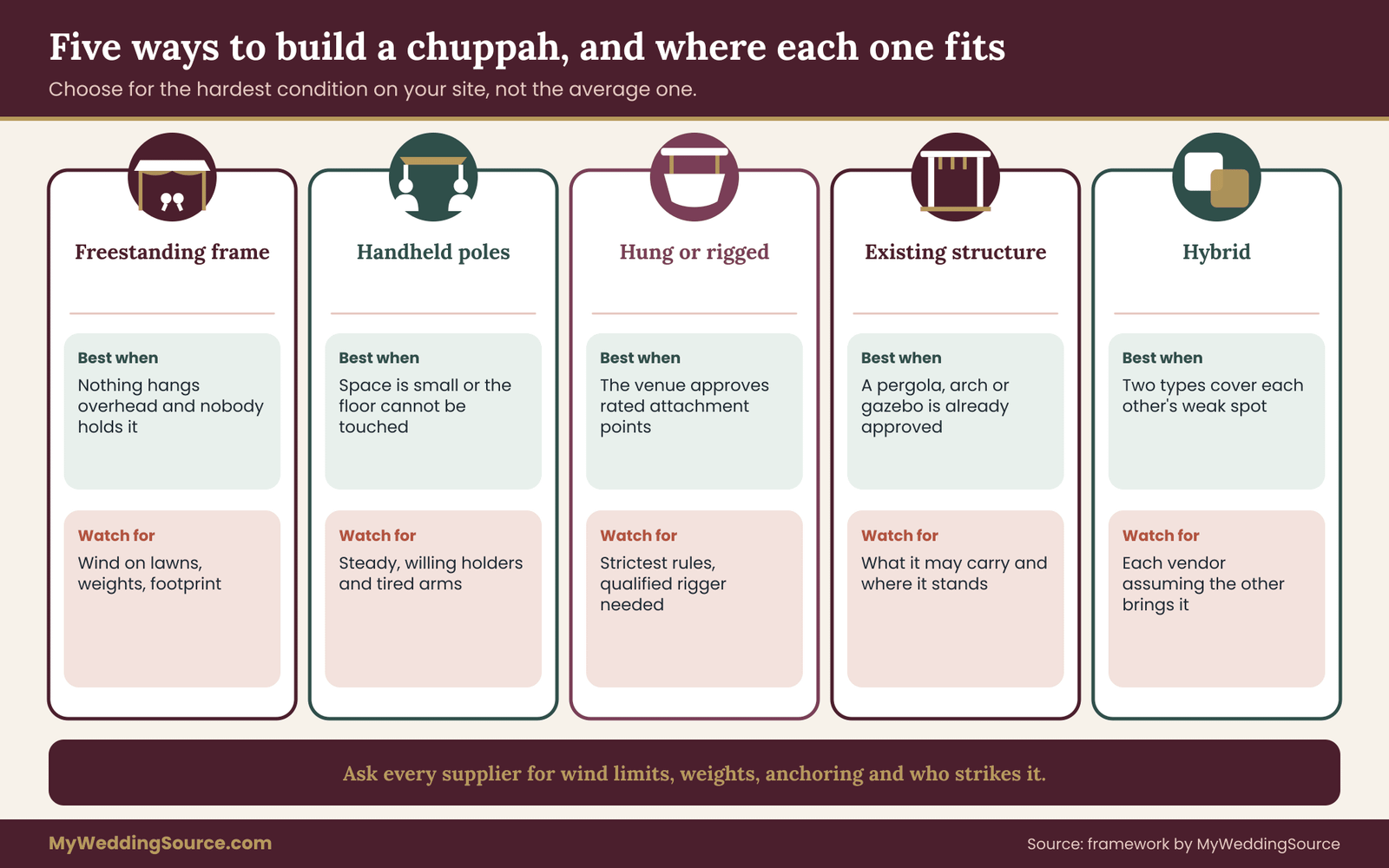
Once the ritual page exists, choosing a chuppah setup is mostly a matter of fit. There are five common ways to build a canopy, and each one suits some sites and fails at others. The mistake is to choose by appearance first and discover the limits afterward.
The five common structures
A freestanding frame. Four posts, usually joined at the top by a frame or by the cover itself, standing on bases or weights. It is the structure most people picture. It can be wood, metal, bamboo or another material, and it can be covered with fabric, flowers or both. Its strengths are that it needs nothing from the ceiling and nobody has to hold it. Its weaknesses are footprint, weight and wind. A frame that is stable indoors can be a hazard on an open lawn unless it is properly ballasted.
Handheld poles. Four people carry the poles, and the cover, often a prayer shawl or a large cloth, is held above the couple. It is light, easy to move and can be set up in almost any space, including a room that is too small or too restricted for a frame. It depends on the people holding it. They need to be able to stand still for the length of the ceremony, hold their arms steady, and keep the cloth level. They should be asked well ahead, told what the job involves, and given a way to rest their arms if the ceremony runs long.
A hung or rigged chuppah setup. The cover is suspended from something overhead, such as a ceiling grid, a beam or a truss. It creates a clean look with no posts at the corners, and it keeps the floor clear. It is also the structure with the strictest rules. Anything hung overhead depends on a load-bearing point that someone qualified has approved, so the venue has to say whether hanging is allowed at all, and a qualified installer has to do the work. Never assume a ceiling can carry a floral installation because it looks solid.
An existing structure adapted. A pergola, a gazebo, a pavilion, a tent frame, an arch or a built-in feature of the venue can serve as the anchor, with fabric or flowers added. It saves on materials and is often already approved by the venue. The questions are different: can you attach things to it, how much weight can it take, and is it where the ritual needs it to be?
A hybrid. Many real chuppah setups combine two types. A freestanding frame with a handheld cloth for the ceremony itself. A light frame with weights for the rehearsal and a hung cover for the day. An existing arch with a cloth stretched from it. Hybrids work when the roles are clear and fail when each vendor assumes the other brings the missing piece.
How to pick: the weakest-condition rule
Pick the chuppah setup that works under the hardest condition on your site, not the average one. If the lawn is exposed and the forecast could be windy, plan for wind first. If the ballroom ceiling cannot carry load, rule out hanging and start from freestanding or handheld. If the stage is narrow, the footprint decides. The chuppah setup should survive its worst plausible hour, because that is the hour guests and photographers are watching.
A workable way to apply the rule is to list the site’s three hardest conditions on a card and choose the structure that handles all three. The usual three are the ground or floor, the overhead space and the weather.
A hotel ballroom might read: carpet over concrete with no drilling, a ceiling with no approved rigging points, no weather. That points to a freestanding frame with weighted bases or to handheld poles. A garden might read: soft ground with no stakes allowed, trees overhead that drop debris, strong afternoon wind. That points to a ballasted frame, or to a lighter design with a wind limit and a backup plan, covered in the weather section.
Size and height of the chuppah setup: measure the real people
Footprint comes from the ritual page. Height comes from the people. Measure the tallest person who will stand beneath the canopy, then add room for any headpiece, hat or veil, the person’s likely posture and a margin so nobody ducks. Remember that handheld poles are carried at a height the holders can keep, and a cloth held above shoulder level tires arms.
If anyone under the canopy uses a wheelchair, walker or other mobility device, the base plates and the cables around them must not catch wheels or feet. Confirm the clear width between posts and the height of any frame crossbars. If a step or platform is involved, ask whether a ramp is available. The accessible route to and under the canopy is part of the structure, not an extra.
Materials, weight and what flowers add to a chuppah setup
The cover and the decoration change the load on a chuppah setup more than most couples expect. Fabric can act like a sail in wind. Fresh flowers add weight, especially in wet foam or water tubes, and overhead arrangements add weight where it is hardest to carry. Heavy hanging pieces swing and tip a light frame. Ask the florist to give you the weight of the overhead pieces in writing and give that number to the installer, because a frame is rated for a load, not for a style.
Fabric near flame matters. Many fire codes ask that decorative materials, drapery and fabric used in public venues be treated or labeled as flame-resistant. If you bring your own fabric, ask the venue what proof it wants. If you use a family textile, a flame-resistant treatment may not be appropriate, so the better answer is usually to keep flame away from it entirely.
Rent, build, borrow or buy a chuppah setup
There are four ways to source a chuppah setup, and each has a different set of obligations.
Rent from a rental company. The company supplies the frame, often delivers and sometimes installs it. Check what its quote includes: delivery, setup, strike, weights, base plates, cover and any damage fee. Ask whether the company has insurance and whether it can provide a certificate to the venue.
Hire a décor vendor to build. A florist or décor company designs and builds a custom piece. The design is more tailored, the responsibility is wider. Confirm whether the vendor will anchor and test the structure itself, and whether it works with a rigger for anything overhead.
Borrow from family or a community. A family chuppah carries meaning, and it may also be old, fragile or built for a different size. Test it before the day. Assemble it, stand under it, check the joints, and get the owner’s approval for any added weights or fasteners. Decide who takes responsibility for damage before anyone lifts it.
Buy. Buying makes sense if you plan to keep the structure for family use, or if a rental would cost more than the purchase and you can store it. Check that the product’s stated load and wind limits match your site, and that someone knows how to assemble it.
Questions to ask any chuppah setup supplier
Put these to the vendor in writing and keep the replies.
- What are the footprint, height, weight and material of the structure, and what does the base look like?
- What wind speed or weather conditions is it designed for, and what do you do if conditions exceed that?
- How is it anchored on grass, on a hard floor, on carpet and on a stage?
- Who delivers, who installs, who checks it and who takes it away?
- What does the quote include, and what costs extra, such as weights, labor, travel, stairs or a long carry?
- Can you provide proof of insurance for the venue, and any proof of fabric treatment the venue requires?
- What is your plan if the venue limits access, changes the location or closes the lawn?
A supplier who answers these clearly is probably someone who has set up in unfamiliar venues before. A supplier who cannot answer them yet is not necessarily a bad choice, but the gaps become the owner’s tasks in the brief, and you need to know that before signing.
A simple decision rule for the final chuppah setup choice
When two versions of the chuppah setup both fit the site, pick the one that keeps more decisions in the hands of the people qualified to make them. A handheld cloth avoids a rigging decision, but puts the weight on four volunteers. A rigged cover removes the volunteers, but puts the weight on the venue and the installer. A ballasted frame needs no one to hold it, but needs a wind plan. None of these is wrong. The right choice is the one whose weak spot you can cover with a named person and a written step.
Venue rules that shape your chuppah setup
A venue’s rules are the second hard limit after the ritual. They are also the part couples most often learn late, because venue contracts describe vendor behavior in general terms and rarely mention a chuppah setup. The way to get specific answers is to ask specific questions of the person who actually decides, usually the venue’s event manager or operations lead, and to ask for the answer in writing.
Before you send questions, read what you already have. The venue contract, the vendor policy sheet and any site map often answer half of them. The wedding vendor contract guide explains which clauses usually govern outside vendors, insurance and damage, and it is worth rereading with the chuppah setup in mind. If you have not walked the site with a tape measure, the venue technical walkthrough describes how to measure access routes and gather vendor needs in one visit.
Access, timing and the loading path for the chuppah setup
The structure has to get from a truck to the ceremony spot. Ask the venue where vendors may park, which entrance and elevator they must use, what the load-in window is, and whether there are blackout times when another event is using the route. A frame in sections can be carried by two people; a fully assembled frame may not fit through a standard door, and a long-carry fee is easy to miss. If the venue has a loading dock with its own rules, ask for them.
If the ceremony space is used by an earlier event that same day, ask how long the room turns over and who clears it.
Time matters on both ends of the chuppah setup. Build time, check time and the officiant’s walk-through all need to fit before guests arrive, and strike has to fit before the next booking or the venue’s closing time. Write the times down in the brief, not just in an email thread.
Floors and ground under the chuppah setup
Ask what the surface is and what it can take. Carpet over concrete, a hardwood floor, a stage deck, a patio, a stone terrace and a lawn all have different rules. Typical questions:
- May the vendor drill, screw or fasten anything into the floor? (The usual answer is no.)
- May stakes be driven into the lawn? If so, has the venue checked for buried irrigation, cables or utilities? In the United States, anyone digging should have the site cleared through the national call-before-you-dig service, 811, and in practice that means the venue or a qualified vendor handles it.
- Are weighted bases, water weights or sandbags allowed, and how are they protected so they do not mark floors or stain carpet?
- Is the surface level? A slope changes how a frame stands and may need shims or leveled bases.
- Are there floor protections the venue requires under heavy items?
A frame that is meant to be anchored and cannot be, must instead be ballasted. Weights add bulk, trip hazards and a visual element. Plan for them in the footprint and in the design.
Overhead limits on a chuppah setup: ceilings, beams, trees and trusses
Anything hung from above needs a place to hang. Ask whether the venue permits hanging at all, which points are approved, what load they are rated for, and who must do the work. Many venues allow hanging only through an in-house rigger or an approved outside company with proof of insurance, and some do not allow it for decorative items. If the venue says no to hanging, believe it and plan a freestanding chuppah setup.
Trees and outdoor structures follow the same logic. Do not tie, nail or hang from a tree or fixture without permission, and expect the venue to say no to anything that damages it. Overhead trees also drop leaves, sap or branches, and a branch above a ceremony is a safety matter that the venue should assess.
Fire, candles and flame near the chuppah setup
Venues and local fire officials set rules about open flame, decorative materials and the way structures are placed. Check these points with the venue and, where relevant, the local fire authority:
- Are candles or any open flame allowed in the ceremony space? If so, are there rules about enclosed holders, distance from fabric or a trained attendant?
- Must fabric used in or near the canopy carry proof of flame resistance? Who supplies it?
- Does the structure block an exit, an aisle, a sprinkler head or a fire device? Egress and fire equipment must stay clear.
- For a tent or pavilion, does it need a permit, and who obtains it?
Fire codes are adopted and enforced locally. The National Fire Protection Association and the International Code Council publish widely used model codes, but your venue and local authority apply them, so ask them what applies to your site rather than reading a model code and guessing.
Power, sound and lighting for the chuppah setup
A canopy that needs lighting, a microphone or a speaker needs power. Ask where outlets are for the chuppah setup, who may connect to them, what the cable path is and how cables will be covered so nobody trips. Outdoor power must be suitable for outdoor use and protected from moisture, and a venue may only allow its own electrician to connect it. If lights are woven into the canopy, ask about their weight and heat and whether the venue has rules about string lights.
Keep the microphone plan consistent with the ritual page: who is amplified, how many microphones, whether any are wireless and where they hide.
Accessibility and egress around the chuppah setup
Venues open to the public generally have duties around accessible routes, and the U.S. Department of Justice’s ADA site is the place to read what applies to your situation. For planning purposes, check that the route from seating to the canopy can be used by someone in a wheelchair or with a walker, that nothing about the structure narrows that route, and that guests with mobility needs have a seat with a clear view. Make sure the structure and its weights do not pinch the aisle width the venue has to keep clear for exits.
Glass, wine and other ceremony items
Ask the venue about the specific items the ritual page lists. Typical answers cover whether glass may be broken on the floor or lawn, who cleans it, whether outside alcohol is allowed for a ceremonial cup, and whether open containers are allowed outside the bar area. If there is a rule, work with it rather than around it. A venue that bans glass can still allow a safe wrapped object, and one that bans outside alcohol can often allow grape juice or supply wine from its own bar.
Weather and the indoor alternative
If the ceremony is outdoors, the venue should have a written weather plan. Ask what the backup space is, how much room it has, how long a switch takes, who decides and by what time. A backup room that cannot hold the chuppah footprint and the guest seating is not a backup, so check it against the brief. The weather section later in this guide turns this into a decision rule.
Insurance, fees and approved vendors
Venues commonly require outside vendors to carry insurance and to provide a certificate naming the venue. Ask what limits it wants, who sends the certificate and by when. Ask whether the venue charges a fee for outside rentals, rigging or décor, and whether it has a preferred or exclusive list. If you plan to hire an installer who is not on the list, ask in writing whether the venue will accept them and what paperwork they need.
Get each chuppah setup rule in writing, and read it back
Verbal approvals disappear. After every call, send a short message saying what you understood and asking the venue to correct it. If the venue replies with a policy sheet, add it to the brief. If it gives a yes with conditions, copy the conditions into the brief’s site page. A useful phrasing:
“To confirm: we may place a weighted freestanding frame on the east lawn, no stakes, with a load-in at two o’clock and no open flame. Please correct anything that is wrong.”
If the answer is “we will figure it out on the day,” treat that as an unresolved item, name an owner and set a date for the venue to answer. Open items on the venue side are the most common cause of last-minute surprises.
When a venue says no to part of your chuppah setup
A refusal is information, not an insult. Ask what is possible instead. A no on hanging might become a yes on a freestanding frame. A no on stakes might become a yes on weights. A no on a flame might become a yes on LED candles. Ask for the closest allowed version of what you want, then take it back to the officiant if it touches the ritual. A rule-based no is cheaper to adapt to than to argue with.
Who does what in a chuppah setup: vendor and owner responsibilities
A chuppah setup with several owners fails at the handoffs. The delivery driver assumes the venue has weights. The venue assumes the florist does. The florist assumes the rental company will check the frame. Everyone is doing their part, and the structure still arrives without the one thing that holds it up. The cure is to write the responsibilities down by task and to give every task one name.
The people involved
Not every wedding has all of these roles, and some people hold more than one. Name them anyway, even if a role is “the couple’s cousin” or “our planner.”
The couple own the final design decision and the budget. They approve the brief. They should not be the person who ties down cloth on the morning of the wedding.
The officiant owns the ritual requirements. They sign the ritual page and, where they can, walk through the structure on the day to confirm it matches what they need. They are not responsible for the structure’s safety, and they should not be asked to be.
The planner or coordinator, if any, owns the schedule and the communication. If there is no planner, one named person, often a family member or a trusted friend, must take this role for the day.
The venue’s event manager owns site rules, access, and approval of anything that touches the building, the grounds or the fire system. They decide whether a structure may go where it is planned.
The florist or décor vendor owns the design and the decoration. They may also build and install, but the contract should say so.
The rental company owns the physical structure it supplies: its condition, its stated limits, its delivery and, if included, its installation and removal.
A rigger or qualified installer owns the safe suspension of anything overhead and, where they are engaged, the check that a freestanding structure is stable. Someone in this role should hold the pen on the structural line of the sign-off. For overhead work, they work from rated hardware and approved attachment points, not from guesswork.
The audio and lighting vendor owns the microphones, speakers and any lights, along with their power and cable paths.
The photographer and videographer do not build anything, but they need to know the structure’s position, its cover and any element that blocks sightlines, because they often arrive early and notice problems others miss.
Pole holders or honorees, if the structure is handheld, own the steady hold. They are guests doing a job, and they need a briefing.
The venue’s cleanup crew or vendor team owns strike, removal of any debris and the return of the space.
The tasks that go missing in a chuppah setup
Almost every chuppah setup has a handful of tasks that no one is assigned. Check this list against your own team and make sure each has a name beside it.
- Weights, sandbags or other ballast, and the cover for them.
- Leveling the structure on uneven ground or a stage.
- Steaming or pressing fabric, and attaching the cover without damage.
- Securing the cover against wind, with clips or ties that do not mark the cloth.
- Running and covering power and microphone cables.
- Bringing and placing the ceremony table or stand.
- Supplying the ritual items: the cup, the glass, the ketubah, the pen.
- Keeping the canopy area clear of other vendors, children and chairs before the ceremony.
- Briefing the pole holders and walking them through the ceremony.
- Deciding who moves the structure after the ceremony, if it is needed for photos or the reception.
- Striking the structure, carrying it out and cleaning the area.
- Returning rented parts by the deadline.
- Checking what the venue will do if the structure is left behind.
If a task has two names, it has none. When two people share it, in practice each assumes the other is doing it. Name one person to do it and one person to check it, for every part of the chuppah setup.
Put chuppah setup responsibilities in the contracts
Contracts are where assumptions turn into obligations. The site’s vendor contract guide explains the general clauses. For a chuppah setup, check that each vendor’s agreement answers these:
- What exactly is being supplied, with dimensions and materials?
- Does the price include delivery, installation, anchoring, strike and removal?
- Who is responsible if the structure is damaged, either by the vendor or by a guest?
- What is the vendor’s weather policy, and what is the cutoff for changing the plan?
- What time will the vendor arrive and leave?
- What is the cancellation policy for the structure and the design?
- Does the vendor carry insurance and will it provide a certificate to the venue?
If a quote is a single line item such as “chuppah,” ask the vendor to break it into the components in writing. A simple list of deliverables prevents misunderstandings far better than a longer paragraph of general terms.
If you are renting several items for the ceremony, the rental planning checklist is a good companion, because it covers order confirmation, pick-up and return timing in a way that applies to frames, bases, tables and chairs alike.
One point person for the chuppah setup on the day
On the wedding day, someone has to be the person the vendors can find. For the chuppah setup, the point person should have the brief, the contact list and the authority to make small calls: to move the structure a few feet, to ask a vendor to wait, to tell the venue that the officiant has arrived. If a planner or coordinator is hired, this is the planner. If not, choose someone organized, not emotionally involved in the day and not in the wedding party. A relative who is also an usher is a poor choice, because they will be needed elsewhere at the critical moment.
Give that person the brief, a printed copy and a digital copy, and a short list of phone numbers. Make sure every vendor has the point person’s number, not the couple’s.
The legal side is separate
A chuppah is a ritual and cultural structure. It does not make a marriage legal, and the absence of one does not stop a marriage from being valid. The legal steps, such as the license and the signature of an authorized officiant, are set by the state or other jurisdiction. The officiant requirements guide explains how to confirm that your officiant is authorized where you are marrying, and USAGov’s marriage license page points to the office that issues licenses in your state. Keep these two tracks apart in the brief. The chuppah setup sign-off is about the canopy. The license is about the marriage.
The communication rule for a chuppah setup
Use one thread or one shared document for the chuppah setup brief, and refer every vendor to it. Do not let the chuppah setup’s details spread across six email chains. When something changes, update the brief and send a short note to the affected owners saying what changed and asking them to confirm. A short version log at the top, with date and change, keeps the whole team on the same page.

What to do when chuppah setup responsibilities clash
Conflicts usually come from one of four places. The florist’s design conflicts with the rigger’s weight limit. The venue’s rule conflicts with the rental company’s installation method. The officiant’s need conflicts with the venue’s policy on flame or glass. The schedule conflicts with the vendors’ arrival times. Use a simple order to settle them:
- Safety first. If the rigger or the venue’s safety lead says a design is unsafe, the design changes.
- Ritual second. If the officiant needs something, the design changes to fit it where safety allows.
- Venue rules third. If a venue rule blocks a design, look for the closest allowed version.
- Design and budget last. Aesthetic and cost choices flex around the first three.
This order is easy to state to a vendor in advance, and it keeps arguments short. It also protects the couple from being the arbiter of a technical dispute they are not equipped to judge.
The chuppah setup brief: one document, five sign-offs
The chuppah setup brief is the working tool of this guide. It is a short document, one to two pages, that records what the canopy must be, what the site allows, who does what and who has agreed. It exists so that every owner can read the same facts and answer for their own part. It is not a contract and it does not replace one. Its value is that it is written before anyone orders anything.
The chuppah setup brief has five pages, in this order, and the order matters. Each page depends on the one before it.
Page one: the ritual page
This is the page from the officiant call. It lists the headcount under the canopy, the cover, whether the sides are open, the sky preference, the direction if any, the items present, the glass or other object, the timing limits, the quiet room if needed, and anything the officiant has said cannot change. End the page with a line for the officiant: “Ritual page reviewed and correct. Name, date.”
A good test is whether a vendor who knows nothing about the tradition could read this page and avoid a mistake. If the answer is no, add the missing plain-language sentence. “Four people hold poles, so no frame is needed” is better than “handheld structure.”
Page two: the structure page
This is the design, in physical terms. It states the structure type, the footprint, the height, the material and weight of the frame, the cover, the decoration and its weight, the base or anchoring method, and the wind or weather limits supplied by the vendor. It also lists what each supplier brings. The rigger or qualified installer reviews this page, and signs a line like: “Structure and anchoring suit the stated conditions and loads. Name, date.”
If an overhead element is part of the design, the page states the attachment point, the rated hardware and the weight. If nothing is overhead, the page says so, which tells the venue and the installer there is no rigging to approve.
Page three: the site page
This is the venue’s page. It names the exact location on a plan, with a sketch or photograph, and records the surface, the slope, the access route, the load-in window, the power, the fire and flame rules, the weather plan and any accessibility routes. It lists the venue’s conditions in the venue’s own words where possible. The venue’s event manager signs: “Location and conditions approved. Name, date.”
Include the fallback space here. If the ceremony moves indoors, the same structure should be able to fit, or the brief should state which alternative structure goes in.
Page four: the roles page
This page lists every task from delivery to strike, with one name beside each and one name for checking. It lists times: arrival, installation start, officiant walk-through, safety check, guest arrival, ceremony start, strike. It lists phone numbers, the point person and the weather decision-maker. The coordinator or the point person signs: “Schedule and roles workable. Name, date.”
Because this page changes most often, put the version date at the top and update it whenever a time or a name changes.
Page five: the contingency page
This is the page nobody wants to write and everyone uses. It states the weather triggers, such as the wind or rain conditions that move the ceremony, the time by which the decision must be made, the person who makes it, and what happens at each step. It also lists the breakage kit, the backup cover if the first one is damaged, and the plan if a vendor does not arrive. The couple sign this page along with the design: “Design and contingency approved. Names, date.”
Five sign-offs for one chuppah setup
Each sign-off is a small, specific statement, not a general approval.
- Officiant: the ritual page is correct.
- Rigger or installer: the structure is sound for the stated site and loads.
- Venue: the location and conditions are approved.
- Coordinator or point person: the roles and schedule work.
- Couple: the design and the fallback are approved.
An email reply that says “Confirmed” next to the relevant page is enough. The point is that each person has looked at a specific page and said yes to it. If someone replies with a condition, put the condition into the brief and ask them to confirm again.

The order of review calls
Run the chuppah setup reviews in sequence, because later answers depend on earlier ones.
First, the officiant call. Write the ritual page. This takes one conversation and a follow-up message.
Second, the venue call. With the ritual page in hand, ask the venue the questions from the venue section. The ritual page tells you which questions matter, such as flame, glass, open sky or the quiet room. Write the site page.
Third, the build call. Bring the florist, the rental company and the rigger or installer together, by phone or in writing. Give them the ritual and site pages and ask them to propose the structure page. This is where the real design happens, with real limits on the table.
Fourth, the final read. About a week before the wedding, send the whole brief to everyone, ask each owner to confirm their page and ask for any last changes. If a late change comes in, update the brief and reconfirm with the affected owners.
Do not let a vendor design the chuppah setup before the first two calls. It sounds efficient and it produces expensive revisions.
What the rigger reviews in a freestanding chuppah setup
The word “rigger” suggests hanging, and many couples think they do not need one because nothing goes overhead.
The role is wider than that. A qualified installer understands loads, stability, anchoring, wind and the way a structure fails. For a freestanding frame on a lawn, the question is whether the weights and base can hold under the conditions the brief names. For a handheld structure, the question is the pole design and the cloth tension. For a hybrid, it is the join between the two. If the supplier is a rental company that installs its own frames routinely, that company’s installer can fill this role, provided they review the specific brief and the specific site.
If nobody on your team has this expertise, say so in the brief and ask the venue whether it has a recommended installer. It is better to discover a gap before the wedding than during the setup.
How to keep the chuppah setup brief short
The temptation is to add everything. Resist it. A brief that runs to eight pages is a brief nobody reads. Put each fact where it belongs, link to longer documents instead of copying them, and use plain sentences. A reader should be able to find the answer to “who brings the weights?” in ten seconds.
What the brief is not
It is not a legal document, a safety certification or an engineering report. It does not replace the venue’s policies, the vendor’s insurance, a permit where one is required or the judgment of a qualified professional. It is a coordination tool for the chuppah setup that makes sure the right questions get asked by the right people in the right order. When a question is beyond what a florist, a coordinator or a couple can answer, the brief should say who will answer it and by when.
A worked example of chuppah setup: Talia and Marcus at the garden venue
The following is an invented example, built to show how the brief works in practice. The names and details are made up, and no real event is described.
Talia and Marcus are planning the chuppah setup for an outdoor wedding at a garden venue with a ballroom as the rain plan. Talia’s family follows a particular community’s customs. Marcus’s family follows a different one. They have an officiant who is willing to lead a ceremony that includes both families’ needs.
The ritual page
On the officiant call, they learn that the officiant wants a canopy with open sides, a cloth cover that Talia’s grandmother will lend, and room for the couple, the officiant, both sets of parents and two witnesses. The ketubah will be signed in a side room before the ceremony. The couple will share a cup of wine under the canopy and break a glass at the end.
The officiant prefers an open sky if the weather allows, and is comfortable with an indoor ceremony if it does not. The couple have asked four friends to hold poles, but the officiant says a freestanding frame is fine if the poles are well steadied.
The officiant also names one thing that cannot change: the cloth must not be pinned or sewn to anything, because it is an heirloom.
The venue answers
The garden venue’s event manager says: no stakes in the lawn, weights allowed if covered, load-in between noon and three, no open flame, no hanging from trees. The venue will provide power at a side path. Glass may be broken only on a hard surface, so the venue offers a flagstone patch beside the lawn. For the ballroom, there are no approved hanging points, carpet cannot be fastened to, and there is a standard turnover time between a morning event and the wedding.
Choosing the chuppah setup
The weakest conditions for this chuppah setup are clear. On the lawn, wind and no stakes. In the ballroom, no hanging and no fastening to the floor. Both point to the same answer: a freestanding frame with covered weights that works in both spaces, plus handheld poles as a backup.
The heirloom cloth rules out a pinned cover. The rental company proposes a light frame with a plain fabric top and a separate way to lay the cloth over it using weighted clips that clamp without piercing. The rigger who works with the rental company reviews the proposal and says the weights are enough for moderate wind but that the cloth acts like a sail, so there must be a wind limit and a plan.
The chuppah setup roles
Talia’s cousin is the point person. The rental company delivers and installs the frame at one o’clock, adds the weights and the weighted clips, and checks stability. The florist adds a small ground arrangement at the base only, with no overhead pieces. The officiant arrives early to confirm the layout. The cousin places the ceremony table and the cup, and Marcus’s brother supplies the glass, wrapped in a cloth bag. The venue’s crew sets the flagstone patch with a broom and dustpan at hand. The rental company returns after the ceremony for strike.
The contingency page for this chuppah setup
They agree on a decision at two points. At noon, the venue manager and the rental company’s installer check the wind and the forecast. If the wind is above the vendor’s stated limit, the ceremony moves to the ballroom and the same frame is moved indoors, which takes the venue crew and the rental company a stated number of minutes. If the wind is borderline, the heirloom cloth goes on only for the ceremony itself, held by the four pole holders in addition to the weights. If conditions worsen during the ceremony, the officiant has agreed to shorten the ceremony rather than stop.
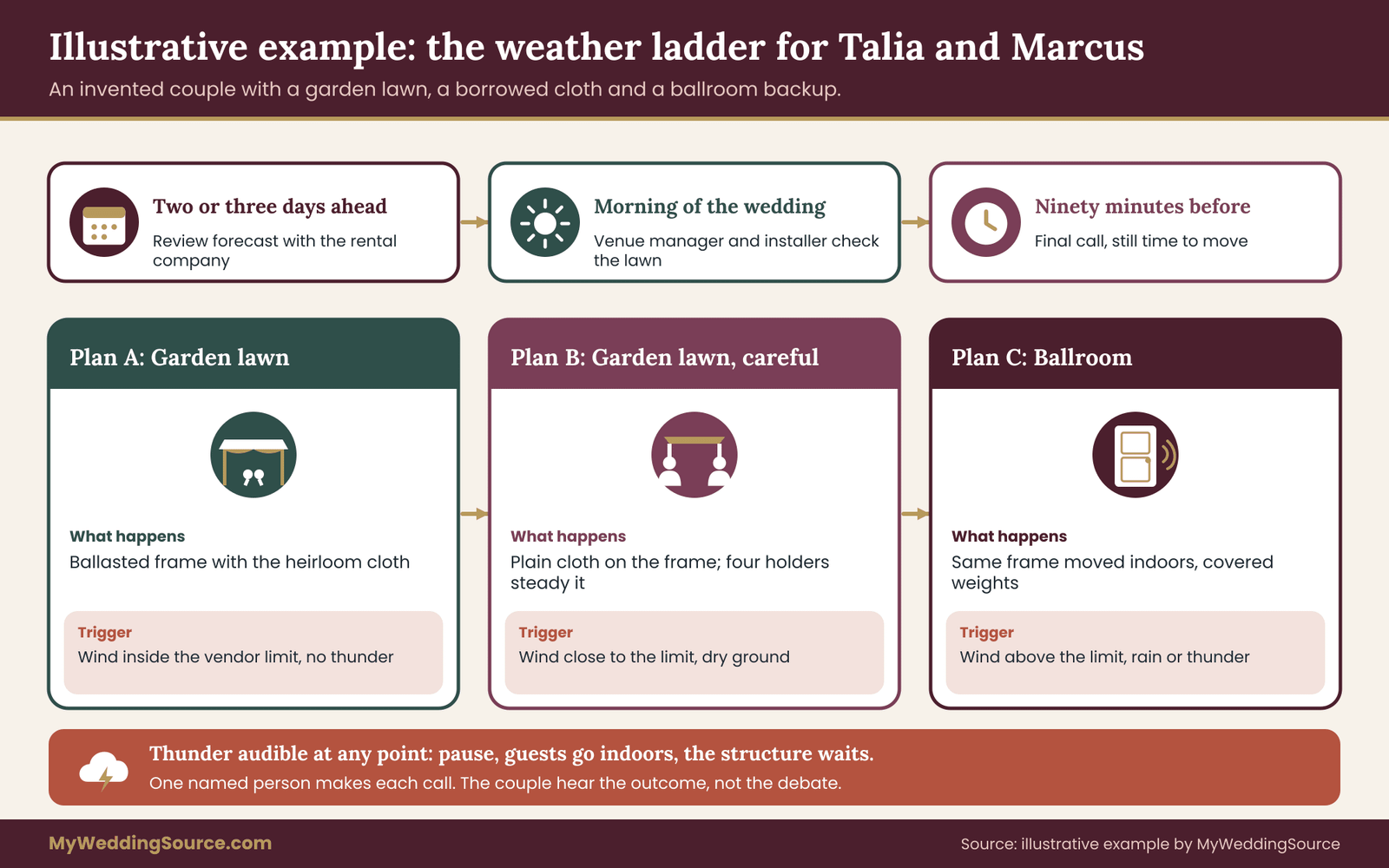
What the brief prevented in this chuppah setup
Each of the following would have been a surprise on the day without the brief. The officiant’s rule about the cloth. The venue’s no-stakes policy. The glass on the patio rather than the lawn. The wind limit. The decision time and the person who decides. The strike time. None of these needed special skill to solve. All of them needed someone to ask early, write the answer down and give each task a name.
Weather, timing and contingency plans for chuppah setup
An outdoor ceremony needs a weather plan that exists in writing before the forecast turns. The reason is simple: on the day, tired people make fast decisions, and a plan made in advance replaces argument with a checklist. The contingency page of the brief is where this lives.
Decide the chuppah setup weather triggers in advance
Wind is the main hazard for a chuppah setup with a cloth top, because fabric catches air and a frame with a cover behaves like a sail. Ask the supplier for the wind conditions the structure is designed for, and ask what they do when conditions exceed it. Write the limit on the contingency page in the supplier’s own words. Then agree on who watches conditions and how.
The National Weather Service publishes forecasts and safety guidance, and a local forecast is a starting point, not a promise. The installer or venue manager on site is a better judge of whether a structure feels stable on that lawn.
Rain changes what the cloth and the floor can take. A wet cloth is heavier, wet grass is slippery and wet weights are harder to move. If rain is forecast, ask whether the structure can stay, whether the cover can be changed for a lighter or more weatherproof one and whether the aisle surface is safe.
Lightning is not a trade-off. The National Weather Service advises that if you can hear thunder you are close enough to be at risk and should move to a safe indoor space, and it advises waiting a period after the last thunder before going back out. Put that into the brief as a hard stop: if thunder is audible, the ceremony pauses, guests go indoors and the structure waits. Heat and sun matter too. A cloth top gives some shade, and elderly guests and pole holders need water and a place to sit.
Set the decision times for the chuppah setup
A weather decision for a chuppah setup is two decisions: when to decide and who decides. A workable pattern uses three checkpoints.
- Two or three days ahead: the coordinator and venue review the forecast, and the rental company confirms whether the planned structure suits it. Changes that need design work happen here.
- The morning of the wedding: the venue manager, the installer and the point person look at actual conditions and choose outdoor or indoor. This should be done early enough that a move takes place without rushing.
- Ninety minutes before the ceremony: a final check. If the call changes, there is still time to move the structure, reseat guests and tell vendors.
Name one person who makes the call, and tell everyone, including the officiant, that this person decides. Group decisions at this point waste the time the plan was supposed to save. The couple should be told the outcome, not asked to weigh the wind.
Moving a chuppah setup indoors
If the plan includes an indoor alternative, test it on paper. Check that the space has the footprint, the ceiling height and the aisle width. Check that the structure can pass through the doors, and that it does not block exits. Decide who moves it, how long it takes and what changes: the weights, the cloth, the table, the cables, the microphones, the glass area. Update the floor plan and let the photographer, the music vendor and the officiant see it. The cue sheet and the seating may need adjusting, and the ceremony cue sheet is where those changes land.
Ask the venue how long a flip from outdoor to indoor takes, because the answer shapes the final decision time.
A small breakage kit for the chuppah setup
A kit of spare parts costs little and removes a surprising number of problems. Put it in a labeled box with the point person. Useful contents are extra clips or clamps that do not damage fabric, a spare cover or a plain backup cloth, shims for uneven ground, extra weights or sandbags, tape that is safe for the venue’s floors, scissors, a small steamer or lint roller, spare cable covers, a dustpan and brush for the glass, a cloth bag for the glass and a few towels. Ask the vendors what they bring and cover the gaps.
If a vendor for the chuppah setup does not arrive
A late or missing vendor is rare, and it is worth planning for anyway. Ask each vendor for a phone number that someone answers on the day and agree on a time after which you will move to a backup. For the structure, the simplest backup is handheld poles with a cloth, which needs only people and fabric. Keep a second cloth available, and keep the pole holders’ names in the brief.
The day itself: a chuppah setup timeline and a rehearsal
The brief’s roles page gives times. This section shows how to arrange them so the structure is built, checked and approved with room to spare. Times below are relative to the ceremony start, so you can adjust them to your own schedule and your venue’s load-in window.
A sample chuppah setup sequence
- Four hours before: the venue opens the ceremony space and confirms access. The rental company or décor vendor arrives for load-in.
- Three hours before: the structure goes up. Weights, bases and cover go on. The installer checks stability and any overhead attachments.
- Two hours before: the florist adds decoration. The audio vendor sets microphones and checks power. The venue crew confirms the aisle and the fire exits are clear.
- One hour and a half before: the officiant arrives, walks the space and checks the structure against the ritual page. The officiant confirms the placement of the table, the cup and the glass area.
- One hour before: final safety check by the installer and the venue manager. The point person signs off on the roles page, and the photographer sees the final layout.
- Forty minutes before: pole holders, if any, arrive and are briefed. If the structure is freestanding, the point person keeps the area clear of chairs and children.
- Twenty minutes before: the ritual items are placed or ready. The quiet room, if needed, is set.
- Ceremony: the structure stays as it is. The point person stays nearby.
- Right after: the glass is cleared. The structure is moved if the plan says so, or left in place for photos.
- At strike: the vendor removes the structure, the venue checks the area and the point person records any damage or missing item for the file.
The numbers are a pattern, not a rule. If your venue gives a short load-in window or a tight turnover, compress the sequence, and make sure the safety check and the officiant walk-through still happen before guests arrive.
The officiant walk-through
The single most useful ten minutes of the day is the officiant standing under the finished structure. Ask them to check the ritual page line by line: the headcount, the cover, the sides, the sky, the direction, the items. If anything is wrong, it is fixed while the vendors are still on site, not after the guests are seated.
Rehearsal with the real chuppah setup
If the structure is available, a short rehearsal under it is worth the effort, even if the full ceremony is not rehearsed. Stand in the positions with the people who will be there. Check the headroom for the tallest person, the space for the parents, the position of the table, the officiant’s microphone and the photographer’s line of sight. If pole holders are involved, let them hold the poles for a minute so they know the weight and can say if they cannot keep it up. If the real structure is not available, mark the footprint with tape and rehearse on that.
Sightlines and photography around the chuppah setup
A canopy sits between the couple and many of the people who want to see them. A low, dense top blocks the view from the back, and heavy side drapes block it from the sides. Ask the photographer and videographer where they plan to stand, and check that the structure’s posts and decoration do not hide faces. Light, open designs photograph well and let guests see. Overhead cloth can cast shade or color on faces, so check it in the actual light at the actual time.
If a livestream is planned for remote relatives, check the camera position and the audio before the ceremony. A microphone near the officiant does more than a camera at the back.
Budget logic for chuppah setup
This guide does not give prices, because costs vary by region, season, vendor and the details of your design, and any number here would be out of date or wrong for your situation. What it can give is a way to think about cost and a way to compare quotes fairly.
What drives the cost of a chuppah setup
Several factors move the cost of a chuppah setup, and knowing them helps you ask better questions.
- Size and materials. A larger footprint and a heavier frame cost more to make, carry and weigh down.
- Overhead work. Anything hung requires qualified labor, rated hardware and time, and that adds cost.
- Decoration. Flowers, fabric, lighting and special pieces each carry their own cost, and fresh flowers vary with season.
- Labor and time. Installation, checks, strike and return take staff hours. A difficult site with a long carry or stairs takes more.
- Delivery distance and timing. Travel, early arrival, late strike and weekend or holiday work can raise the price.
- Venue charges. Some venues charge for outside rentals, rigging approval, extra staff or damage deposits.
- Insurance paperwork. Certificates may carry a fee from the vendor’s insurer or the venue.
- Change costs. Late design changes, a move indoors or a second delivery usually cost extra.
Compare chuppah setup quotes by scope
When quotes differ, compare what is in them, not the total. Make a short list of the components and mark each quote against it: the frame, the cover, the weights, delivery, installation, strike, decoration, any rigging, any insurance fee and any change fee. A quote that looks cheaper may leave out installation or strike, and the gap falls to you or to another vendor. A quote that looks high may include things you would otherwise pay for separately.
Where to save, and where not to
Savings are fair where the design can be simpler: a plainer cover, fewer overhead pieces, a smaller floral base, a borrowed or owned cloth. Savings are risky where the structure’s stability, the installer’s time or a safety check is reduced. A cheaper structure that fails in wind, or a design that cannot be approved, costs more than the one that was done properly. Treat stability and sign-offs as a fixed cost and spend elsewhere first.
Deposits, cancellations and damage
Ask each vendor about deposits, the final balance date, the cancellation policy and what happens if the weather or the venue forces a change. Ask the venue about damage deposits and who is liable if a guest knocks the structure over. Keep the answers with the brief and the contract. If the vendor’s payment schedule affects your cash flow, the guide to wedding cash-flow planning shows how to line up deposits and final balances with your other commitments, though the rules for any one vendor are in that vendor’s contract.
Edge cases and situations that change the plan
No guide can cover every situation, and religious practice varies too much to write a rule for each. These cases come up often enough to deserve a short answer. In each one, the first step is to go back to the officiant and the families, not to assume.
Interfaith ceremonies
When two traditions share a ceremony, the canopy may be one part of a longer program with its own items, readings and timing. The second officiant may have needs for the same space, such as a different table, a different item or a different order. Combine both sets of needs in the ritual page, and settle conflicts before the design starts. The broader question of how families and officiants divide decisions is covered in the guide to interfaith ceremony planning, and the ceremony step-by-step guide shows how the pieces of a ceremony fit in order.
A venue that is also a place of worship, or has its own religious rules
A church, a synagogue, a community hall or a hotel with a religious affiliation may have its own rules about what can be placed in the space, which items may be used and which rituals may take place. Ask early, in writing, and ask what is allowed rather than what is forbidden. If the space has fixed features, such as an altar or a platform, the structure must work around them.
Homes, yards and small gatherings with a chuppah setup
A smaller wedding at home or in a family yard has fewer vendors and fewer rules, but the same physics. Wind, ground and weights still matter, and a neighbor or a local rule may apply to tents and structures. Without a venue manager, assign someone to play the role of the site checker. Ask the owner of the property for permission, and check for utilities before anything goes in the ground.
Elopements and very small ceremonies
A ceremony with a handful of people can use a very simple canopy, even a cloth held by four people, in a place where permits or permissions are simple. Check the rules for public spaces such as parks, which often require a permit for structures or amplified sound and often forbid fastening anything to trees or fixtures.
Heirlooms and family cloth
A family textile may be fragile, valuable and meaningful. Ask the owner how it can be used. Ask whether it can be laid over a frame, whether weights or clips can touch it and how it should be stored. Give the point person clear instructions and keep the cloth out of damp or crowded areas before the ceremony. If there is any doubt, use a plain backup cloth for the structure and bring the heirloom only for the moment it is needed.
Pole holders with different abilities
The people who hold the poles should be chosen for steadiness and for willingness. A very young child, an older relative who tires easily or someone with a medical condition may find the task hard. Ask them privately, and have a backup ready. If the ceremony is long, ask the officiant whether the pole holders can rest their arms at certain moments. A freestanding frame removes the problem, but it gives up the honor.
Moving the chuppah setup after the ceremony
Sometimes the canopy is moved for family photographs or reused at the reception. Decide this in advance, with the installer. A structure that is built to stay in one place may not be safe to move once dressed, and a structure that moves needs people and a path. If a move is planned, put it on the roles page with a name and a time.
Guests with access needs
If a guest uses a wheelchair or other aid and is part of the ceremony, check the structure’s footprint, the base plates and the aisle. If a guest is hard of hearing, ask about the audio. If a guest has a sensory sensitivity, tell the audio vendor and the officiant about the plan for the glass and any sudden sound. These are small additions to the brief and they make the ceremony easier for the people involved.
Your next steps
Start with one phone call. Ask your officiant for twenty minutes and write up the ritual page from what they say. Send it back and ask for corrections. Then ask the venue the questions in the site section and write the site page from the answers. Only after that, talk to the florist, the rental company and the installer, and give them the first two pages before they design.
Then build the roles and contingency pages, run the final read a week out, and collect the five sign-offs. Put the brief where the point person can find it on the day. With the brief in place, the chuppah setup becomes a plan with names and times rather than a hope that everyone remembered everything.
FAQ
Who should we ask first when planning a chuppah setup?
Ask your officiant first. The officiant’s needs, such as who stands under the canopy, what covers it and which items go beneath it, set the requirements everyone else works from. Once those are written down, ask the venue what the site allows, and only then ask vendors to design. Asking in that order avoids paying for designs that the ritual or the venue later rules out.
Do we need a rigger if the chuppah is freestanding?
Not always, but you need someone qualified to judge stability. If nothing hangs overhead, the rental company’s installer may serve that role if they review your specific site and conditions. If anything is hung from a ceiling, beam or truss, a qualified rigger is the safer choice, and the venue will probably require approved attachment points and proof of insurance. Ask the venue what it requires.
Can the venue refuse a chuppah or part of its design?
A venue can set rules about floors, ceilings, flame, glass, access, insurance and approved vendors, and it can refuse specific methods that conflict with them. It is unusual for a venue to refuse a canopy outright, but it may refuse stakes, hanging, candles or outside alcohol. Ask early, get the answer in writing and look for the closest allowed version of what you want.
How much does a chuppah setup cost?
It depends on the size, materials, decoration, labor, delivery, venue charges and any overhead work, so no single figure applies. Ask each vendor to list what is included, such as delivery, installation, weights, strike and insurance paperwork, and compare quotes by scope rather than total. Treat stability and safety checks as fixed costs and look for savings in decoration and design.
What if the weather is bad on the wedding day?
Write the weather plan into the brief ahead of time. Name the triggers, such as the wind limit the supplier states, rain or audible thunder, name the person who decides and set the decision times. Check that the indoor space can hold the structure and the guests. If thunder is audible, pause the ceremony and move everyone indoors, following the National Weather Service guidance.
Can we use a family tallit or heirloom cloth?
Many couples do, but the owner and the officiant should approve how it is used. Ask whether it can lie over a frame, whether clips or weights can touch it and how it should be protected from damp, wind and handling. Have a plain backup cloth ready, and keep the heirloom out of the way until the moment it is needed.
Who strikes and removes the chuppah after the ceremony?
The roles page should name this. Often the rental company or décor vendor returns to remove the structure, and the venue’s crew checks the area. If a family member borrowed the structure, a named person must take it down and carry it out. Confirm the strike time with the venue, so the structure does not block the next event or the reception setup.
Does the chuppah make the marriage legal?
No. A chuppah is a ritual and cultural structure, and the legal requirements for a marriage are set by the state or other jurisdiction where you marry, such as the license and an authorized officiant. Check with the office that issues marriage licenses in your area, and with your officiant, about the legal steps. Keep that track separate from the structure’s planning.
Sources
- Marriage license and certificate information, USAGov
- Americans with Disabilities Act, U.S. Department of Justice
- Codes and standards, National Fire Protection Association
- International Fire Code and model codes, International Code Council
- Occupational Safety and Health Administration, U.S. Department of Labor
- Technical standards for entertainment rigging, Entertainment Services and Technology Association
- Weather safety, including lightning and wind, National Weather Service
- Reform Judaism resources on weddings, Union for Reform Judaism
- Orthodox Union, Jewish life and law resources
- Rabbinical Assembly, Conservative Judaism resources