
A multicultural wedding parent entrance is the moment when each partner’s parents come into the ceremony, and when two families expect two different versions of it, the fix is a short conversation held early, not a clever compromise invented at the rehearsal. This guide gives you a family consultation script and a shared-cue choice matrix so that every parent entrance in your ceremony has an owner, a cue and a place to end up.
Do not start by picking an order. Start by asking each family, separately, who they expect to walk, from where, with whom, to what signal and where they sit afterward. Write the answers side by side. Then choose one of four patterns for the parent entrance (hold, blend, sequence or split), give every walker a cue they can hear or see without guessing, and confirm the plan with your officiant, venue and music vendor. Keep a short written order that every parent has seen before the rehearsal.
Most processional advice assumes one family tradition, one aisle and one set of expectations. That assumption breaks the first time a groom’s parents expect to lead a procession of their own, while the bride’s mother expects to be seated last, to a particular piece of music, and neither family has told the other. Nobody is being difficult. Each side is describing a wedding the way their own family has always done it.
This article is about one narrow piece of that problem: the parent entrance. It covers who walks, in what order, to which cue, and how to bring two sets of expectations into one ceremony without anyone feeling erased. It does not try to teach you any single tradition, and it deliberately avoids describing what “a” culture or faith does, because practice varies by family, region, generation and congregation. The people who can tell you what a custom means in your family are your family and your faith leaders.
A note on scope. This is general planning information, not legal, tax or financial advice, and rules for marriage licenses and who may officiate differ by state, so confirm the current requirements with the issuing office.
What a multicultural wedding parent entrance includes
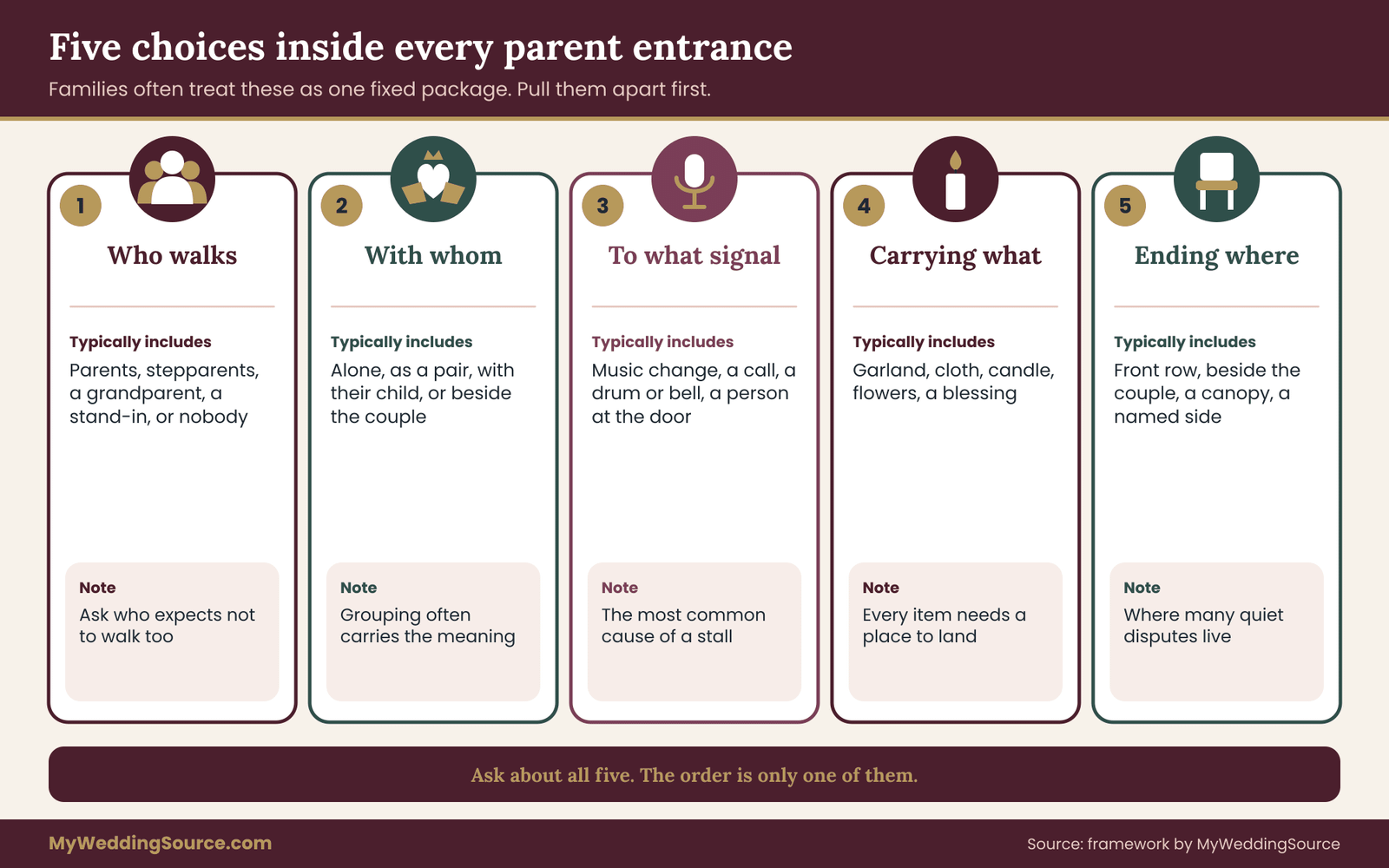
Before debating the order, it helps to agree on what you are actually ordering. A parent entrance is more than a walk down an aisle. In most weddings it bundles together several separate choices that families tend to treat as one fixed package.
Who walks. One parent, both parents, a stepparent, a grandparent, a guardian, a sibling standing in, or nobody at all. Some families expect a mother and father to walk together. Others expect a father and a mother to enter at different moments. Some expect an older relative to lead.
Who they walk with. A parent may walk alone, walk with a partner, escort their own child, or walk beside the couple. In some families the parents of both partners walk the couple in. In others, each parent group enters before the couple and takes a seat or a place at the front.
What they walk to. Instrumental music, a live singer or drummer, a recorded track, a call from the officiant, a procession with an instrument or a bell, or silence. For some families the sound is the point of the moment, so a change of music can matter more than a change of order.
What they carry or wear. A garland, a cloth, a candle, flowers, a shawl, a ceremonial item, a bouquet, a blessing. These items often carry the meaning, and they need a hand free, a place to be set down and sometimes a person to receive them.
Where they end up. A front row, a place beside the couple, a spot under a canopy or arch, a seat on a particular side. Seating after the parent entrance is where many quiet disagreements live.
When a family says “that is how it is done,” they usually mean the whole bundle. Your job is to pull the bundle apart, find out which pieces matter most to each side, and rebuild one sequence that keeps the pieces people care about.
Why the order matters less than the meaning
It is tempting to treat a disagreement over the parent entrance as a seating-chart problem: put one family first, the other second, and move on. That works only when the real disagreement is about sequence. Often it is about something else. A parent who expects to escort their child may be telling you that this is the moment their role as a parent is publicly recognized. A parent who expects to be seated before the music changes may be telling you that the ceremony proper starts when they are in place.
If you only negotiate the order, you can produce a plan that is perfectly fair and still leaves one parent feeling invisible. If you learn what each parent entrance is meant to say, you can usually protect that meaning in a different position or form. A parent who loses the escort can gain a blessing, a reading, a gift of an item or a place of honor in the front row.
Where this fits in the larger ceremony
The parent entrance sits inside the processional, and the processional sits inside the full ceremony order. If you are still working out the overall flow, the ceremony order guide walks through the usual sequence of a ceremony from seating to recessional, and this article assumes you have at least a rough version of that. The question here is narrower: what happens in the first few minutes, when two families who may not yet know each other’s customs take their places in front of all your guests.
Why two families expect different processionals
Families rarely disagree because one of them is wrong. They disagree because they learned the ceremony from different rooms. Understanding the usual sources of difference makes the consultation easier, because you can ask better questions and spot which differences are real constraints and which are habits.
Different traditions of faith or culture. One family may be used to a ceremony where parents are part of the procession of the couple, while another expects parents to be already seated, with only an escort or none at all. Neither is a mistake. They are different structures for the same moment, and some include steps that other families do not have at all.
Different generations in the same family. A grandparent may expect the order they saw at their own wedding, a parent may expect the order they used at theirs, and the couple may have a third idea drawn from weddings they have attended. Within one family the “expected” version is often a negotiation among generations.
Different local practice. Congregations, communities and even individual officiants run each parent entrance differently. A parent who says “we always do it this way” may mean their own congregation, which is not the same as the tradition at large.
Different family structure. Divorced or remarried parents, stepparents, single parents, a deceased parent, an estranged parent or a parent who cannot walk all change what a “standard” parent entrance can look like. Any fixed script will fit some families badly.
Different ideas about whose moment it is. Some families treat the parent entrance as the couple’s moment, with parents as supporting players. Others treat it as a parents’ moment, when the older generation presents their child to the gathering. Both views can be sincere, and they pull toward different structures.
It also helps to accept that you will not be able to verify every claim about “what is traditional.” Reasonable people inside the same tradition disagree. You do not need to settle that debate. You need to find out what the people who will actually walk are expecting, and what each of them can live with.
The three kinds of difference
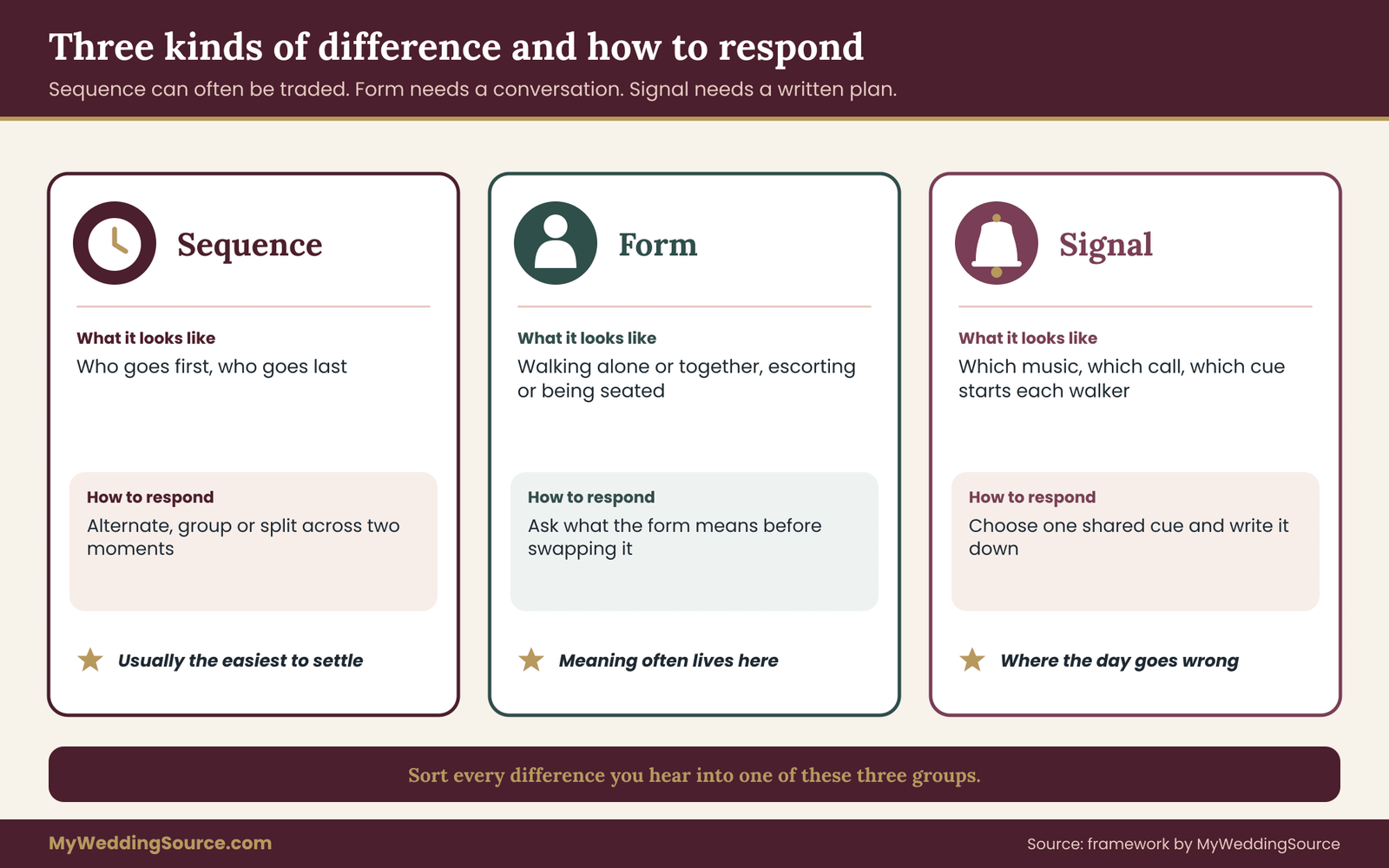
When you sort the differences you hear, they tend to fall into three groups, and each group calls for a different response.
The first group is differences of sequence: who goes first, who goes last. These are the easiest to resolve, because many sequences can honor both sides. You can alternate, you can group, or you can split the parent entrance across two moments.
The second group is differences of form: walking alone versus walking together, escorting versus being seated, carrying an item versus carrying nothing. These need more care, because the form often carries the meaning. A negotiation that swaps one form for another can feel like a loss even when the order is fair.
The third group is differences of sound and signal: which music, which call, which cue starts each person. These are the ones that cause problems on the day, because a cue that one family expects and the other does not recognize leaves someone standing in a doorway waiting for a signal that never comes.
Sorting what you hear into these three groups lets you spend your effort where it matters. Sequence can often be traded. Form needs a conversation. Signal needs a written plan.
What not to do
A few approaches reliably make things worse, and they are worth naming early.
Do not ask one family to “just go along” with the other’s version because it is simpler or because that family is paying for more of the wedding. It may be simpler for you, but you have shifted the cost onto a parent who may feel the loss for years.
Do not pass messages between families through one partner. A relayed request loses tone, and a relayed refusal sounds harsher than it was meant to. Where you can, let each family state its own expectations in its own words to someone neutral, which is why the consultation in the next section starts with separate conversations.
Do not announce a decision before everyone has been heard. Once a plan is presented as settled, a parent who disagrees has to push back against the couple, which is the position you are trying to avoid.
Do not borrow a ritual because it looks good without asking the people it belongs to. If one partner’s family has a custom that carries religious or cultural meaning, the family and its leaders decide whether and how it appears in a mixed ceremony. If you are bringing together two faith traditions, the interfaith ceremony planning guide covers how to name who owns each ritual, and a parent entrance is one more place where that question comes up.
What a good outcome looks like
It helps to define success before you start, because a good result for the parent entrance rarely looks like the one you pictured at the first argument.
A good result is not that both families got everything they wanted. That is rarely possible. A good result is that each family knows exactly what will happen, has been asked what matters most to them, has kept at least the piece of their custom that carries the most meaning, and is confident that nobody will be left standing without a cue.
It is also not that the plan is complicated. A plan with four moving parts and three different musical signals is more likely to fail on the day than a plan with one clear cue and a few small adjustments. Simpler tends to be safer. The framework in this guide is meant to give you a way to find the simplest structure that still respects both sides.
Finally, a good result is one that survives the day. A ceremony is not rehearsed for hours the way a performance is. Older relatives may be nervous, children may wander, an usher may be absent, music may start a beat late. The best parent entrance plan is one that tolerates small errors without a family feeling slighted, which means building in cues that are easy to follow and a person who can quietly correct course.
Start with a family consultation before you plan the parent entrance
The consultation is a set of short, separate conversations held before anyone draws up an order. Treat it as the first real task in planning any parent entrance for two families. Its purpose is to collect what each family expects and why, without anyone having to defend a position against the other side. It works best when the couple hosts it but does not argue the case. You are gathering information, not negotiating yet.
Who to talk to, and in what order
Begin with the people who will walk. For most weddings that means each partner’s parents, stepparents or guardians, plus any grandparent or older relative who expects a role. Then talk to the person who knows the tradition best, which may be a parent, an aunt, an elder or a faith leader. Finally, talk to your officiant and, if the venue has an events manager, that person too.
Hold the conversations separately for each family. Your partner should speak with their own parents, and you should speak with yours. That is not secrecy. It lets each family describe what they expect in their own words, in the language they usually use, without anyone feeling outnumbered or judged. You can share the results afterward, side by side, once you understand them.
If one partner is estranged from a parent, or a parent is not part of the day, say so early to your officiant and to the other family. A plan that quietly leaves a space for a person who is not coming is awkward for everyone, and a plan that never mentions an absent parent can hurt a relative who expected a mention.
A short script that keeps it calm
Most people respond well to a request that is specific, warm and clearly about gathering information. You can adapt something like this to your own voice.
“We are putting together the order for the ceremony and we want your family’s customs to be part of it. Before we decide anything, can you tell us how you would expect your side to come in? Who walks, who goes with them, what music or signal starts them, and where they sit afterward. We are not deciding today. We just want to understand what matters most.”
Then listen. Take notes. Ask follow-up questions that begin with “what” rather than “why,” because “why” can sound like a challenge. “What does that moment mean in your family?” is easier to answer than “why do you do it that way?”
When a parent describes a custom, resist the urge to solve it on the spot. If you say “that will be hard because the other family does it differently,” you have turned a conversation into a negotiation and you may hear less than they would have told you. Instead say what you heard, thank them and say that you will bring all the notes together.
What to listen for
Some details are easy to miss in the moment but cause trouble later. As you listen, mark each of these.
The non-negotiables. Most people have one or two parts of a parent entrance that they cannot let go of. It might be walking beside their child, being announced, entering to a specific piece of music, wearing a specific item or being first. Ask directly: “If we could only keep one part of this, which part?” The answer tells you where to hold firm.
The flexibles. Equally useful is what they can adapt. A parent who says “the escort matters, but the song is flexible” has just given you room to move. Write down both.
The hidden constraints. Mobility, health, language, anxiety about being on display, a recent loss, a complicated relationship with the other parent. These are rarely raised unprompted. You may learn them only if you ask what would make the day comfortable for them.
The dependencies. Some customs only work if another person is in a certain place. A blessing may require someone to receive it. A procession may need a specific number of people. An escort may need a free arm. Ask what has to be true for the custom to work.
The people who matter to them. Often a parent’s real concern is what a particular relative will think. A father who insists on a certain order may be thinking of his own mother in the third row. Knowing who is in the audience in their mind can change what a good compromise looks like.

Keep one written record
After each conversation, write a half-page summary in plain language. Include who you spoke with, what they described, their non-negotiable, their flexible points and any constraints. Send it back to them and ask whether you got it right. That small step catches misunderstandings early and signals that you took their expectations seriously.
Keep the summaries together in one document. When you reach the choice matrix in the next section, you will fill it in from these notes, not from memory. It also helps when a relative says months later, “I told you we always do it this way,” because you can show what was actually said and agreed.
If your family is already working through who has a say in different parts of the wedding, the guide to wedding decision rights offers a way to separate “we want your input” from “you decide,” which is worth settling before you gather opinions about the parent entrance. A parent who believes they are deciding will react very differently from one who knows they are being consulted.
The five questions behind every parent entrance
Every parent entrance, in any tradition, can be described by five questions. If you ask all five of each family, you will have enough to compare their expectations on equal terms. The questions are deliberately plain so that a grandparent and a teenager can both answer them.
Question one: who walks?
List every person who expects to walk, with their relationship to the couple. Include the obvious names and the less obvious ones. A grandparent who has always led the family into a ceremony. A stepparent who raised the partner and expects to be included. A sibling who is standing in for a parent who has died. A guardian. A parent who does not want to walk alone.
Be careful about assuming that a “mother” and a “father” are a pair. In some families they walk together, in others separately, and in many modern families they are not both present or not on speaking terms. Ask each person how they picture themselves entering, not how a generic couple of parents would.
Also note who expects not to walk. A parent who prefers to be seated in advance is just as much part of the plan as one who wants an aisle moment, and a plan that treats that preference as a problem to be fixed will upset them.
Question two: with whom, and in what grouping?
Some parents expect to walk alone. Some expect to walk with a spouse. Some expect to walk their child and then separate. Some expect to enter as a group with relatives, sometimes in order of seniority. Record the grouping each family expects, and note whether it is one fixed unit or flexible.
This question also catches the situation where the bride’s side expects the father and mother to enter together while the groom’s side expects the groom to walk with each parent separately. Both are internally consistent. Neither is compatible with the other as written, and you will need a pattern from the next section to reconcile them.
Question three: to what signal?
For each walker, find out what tells them to start. Common options include a change in the music, a verbal cue from the officiant, a nod from an usher, a bell or drum, a line in a song, a door opening, or simply the person ahead of them reaching a mark. In many families the signal is so familiar that nobody mentions it, which is exactly why it must be asked.
Signals are where multicultural ceremonies come apart most easily. A family used to one specific piece of music for the parent entrance may sit waiting while a different piece plays, assuming it is not yet their turn. A parent used to an announcement may not move without one. Write the signal for each walker down in plain words, and notice where the two families expect different signals for the same moment.
Question four: carrying or wearing what?
List any item that is part of the parent entrance. Ask what it is called in the family, who provides it, who receives it, and where it goes after the walk. An item that nobody has planned a destination for usually ends up in an awkward pause at the front of the room.
Also ask whether the item can be handed over. Some can be carried by anyone. Others have to be carried by a particular person, and a swap that seems trivial to the couple may change its meaning.
Question five: where do they end up?
Finally, find out where each parent expects to be when the parent entrance is over. The front row on a particular side. Standing beside the couple. Seated at a table. Standing in a line. Many disagreements over the parent entrance turn out to be disagreements about this question, because seating tells the guests who the key family members are.
If the room is set up with two sides and the families expect to be seated by side, check how that works when both families want the front. In a large wedding there is often more than one front row. In a small one there may be only one, and you will need to decide how it is shared.
Add one more column: what is flexible?
The five questions give you the structure, and the consultation gives you the answers. Add one extra note beside each: what that person can adapt. A matrix that records only expectations produces a standoff. A matrix that also records flexibility produces options, because you can see where one family’s flexible point meets another’s non-negotiable.
For example, a parent whose non-negotiable is “walk with my spouse” and whose flexible point is “which side we sit on” has told you something useful. If the other family’s non-negotiable is “the mother is seated last” and their flexible point is “the song,” you can usually build an order that honors both without anyone feeling overruled. You need all four facts to see it.
With the consultation notes in hand, you can build the matrix. Think of it as a worksheet with one block per family and one line per question, plus a note on what is fixed and what is flexible. You do not need software. A notebook page, folded in half, is enough. What matters is that both families’ answers sit next to each other in the same wording. A matrix built for a parent entrance can be short, because only five questions need answers for each family.
Fill in each family’s block in this order: who walks, with whom, to what signal, carrying what, ending where. Then add two short lines at the bottom of each block. The first says “keep at all costs,” which is the one element that family named as non-negotiable. The second says “can adapt,” which lists the points they said were flexible.
Read the matrix for collisions
Now read across. You are looking for four kinds of collision, and each has a typical fix.
Position collisions. Both families expect to go last, or both expect to go first, or both expect the front row on the same side. The fix is usually to change the structure, not to pick a winner. Alternating, pairing or using two front rows are all possible, depending on the room.
Form collisions. One family expects a parent to escort a child, the other expects parents to be seated before the couple enters. These can both be honored if the escort happens in a different position than expected, for example as an escort to the front by an usher or as a short walk from the side, but only if the family agrees that this keeps what mattered.
Signal collisions. The two families expect different music or cues for the same moment. This is the most common collision in a multicultural wedding parent entrance and the one with the simplest fix, because you can choose a single shared cue that every walker has been told about and has practiced with. The shared cue is the core idea of this guide, and the next two sections spend time on it.
Item collisions. Two families expect to carry different items, or the same item to be carried by different people, or an item to be received by someone who is not in the plan. These need a destination for each item and a person assigned to receive it.
If you find no collisions, check again. A matrix with no differences usually means a question was skipped, or someone told you what they thought you wanted to hear.
Sort every difference into one of three actions
Each difference you find should end up in one of three buckets, and writing the bucket beside it keeps you from circling.
Honor as is. The custom goes into the ceremony as the family described it. This is right when the custom is a non-negotiable and does not clash with anything else, or when it can be accommodated at no cost to the other family.
Adapt. The custom is kept in spirit but changed in form, position or timing. This is the usual answer for a collision. An adapted custom should be checked with the family that owns it, because the adaptation is where meaning can be lost.
Move. The custom is taken out of the shared parent entrance and given a different moment, such as a pre-ceremony gathering, the reception or a private blessing. This is the right choice when the custom cannot fit in the ceremony without disrupting it, and when the family agrees that its meaning survives the move. It should never be proposed as a quiet downgrade.
A family that hears “honor” or “adapt” usually feels respected. A family that hears “move” can feel set aside unless it is told why, offered a good new location and asked whether it works. Say plainly what you are suggesting, and ask whether they can live with it.
Weigh the two kinds of fairness
Couples often default to symmetric treatment: equal time, equal position, equal music for both families. Symmetry looks fair and is easy to explain. General wedding etiquette tends to favor even treatment of both sides for the same reason. It is also not always right, because the two sides do not always have symmetrical customs. One family may have a long parent entrance with several steps, while another has a brief one. Equal time would shorten the first and stretch the second.
The alternative is fairness by meaning: each family keeps the parts that carry the most weight for them, even if the shapes differ. This often looks asymmetrical on paper and feels fair in the room, but it requires that you actually know what carries the weight, which is why the consultation comes first.
Decide which kind of fairness you are using before you start choosing patterns, and say so to both families. “We want each side to keep the part that matters most to them” is a sentence both families can accept. “We want everything to be exactly equal” sounds fair until one family discovers that its most important moment has been cut to match a shorter one.
Choosing a pattern: hold, blend, sequence or split
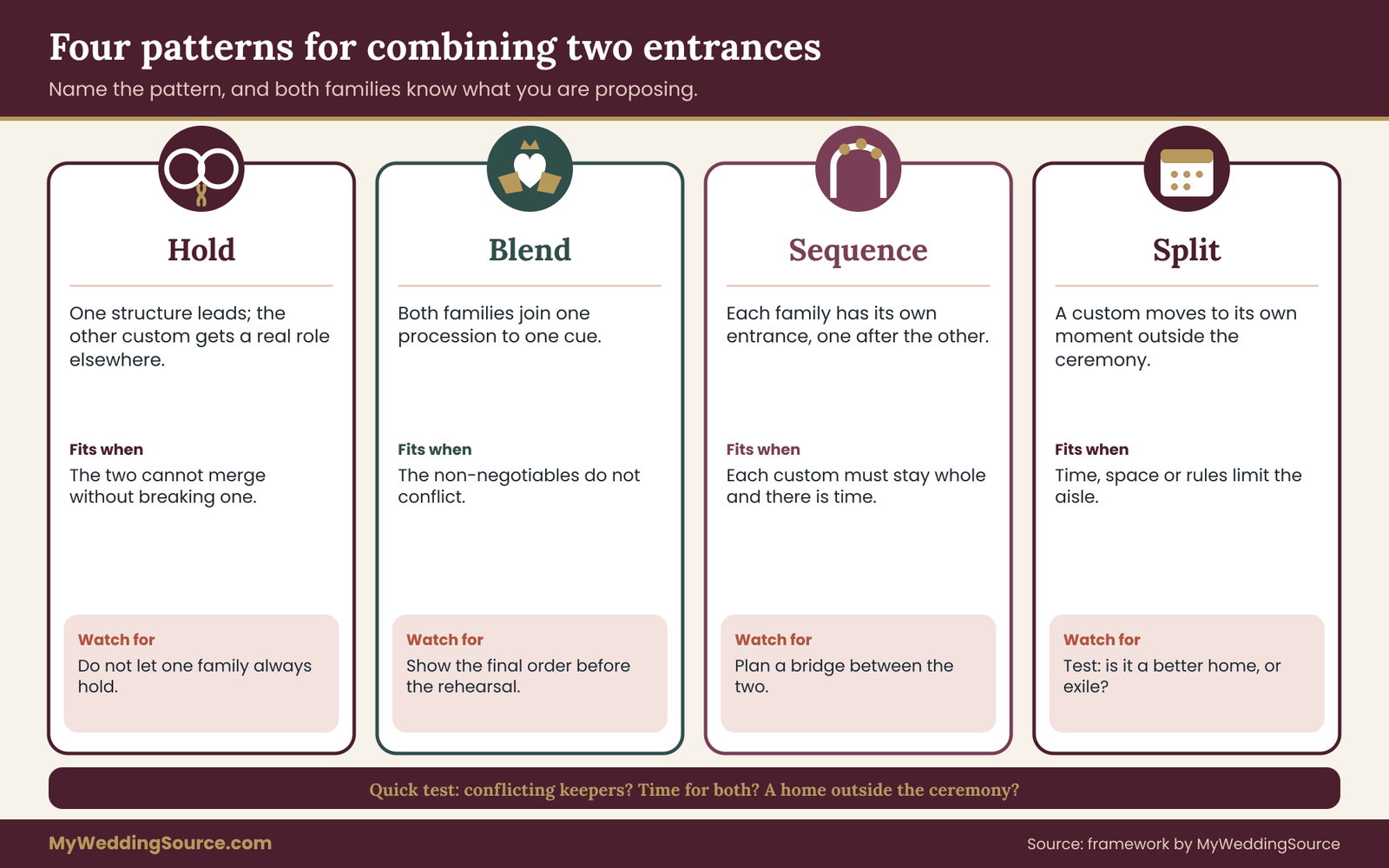
Almost every combined parent entrance falls into one of four patterns. Knowing them by name makes the conversation easier, because you can say “we are leaning toward sequence” and people know what that means. You can also mix patterns for different parts of the ceremony, though the simplest result usually wins.
Pattern one: hold
In a hold, one family’s structure leads the parent entrance, and the other family’s customs are honored elsewhere in the ceremony or the day. It is the right choice when the two structures cannot be merged without breaking one of them, and when the second family has a moment that fits better in another place.
Holding does not mean ignoring the other family. It means choosing, openly and with that family’s agreement, which structure runs the parent entrance and which customs move or adapt. The family whose structure is held for another moment needs a visible, real role somewhere else: a reading, a blessing, an honored seat, a ceremonial presentation.
Hold works poorly when it is decided by default, for example because one family is hosting or paying for more. If one family always “holds,” the second family learns that in this marriage its customs are guests. If the couple wants to use hold, the cleanest approach is to alternate what is held across the wedding, so that each family leads somewhere.
Pattern two: blend
In a blend, the two structures are woven into one procession. Parents from both sides walk in a single order, perhaps alternating, perhaps grouped, to a single cue. A blend feels unified, which many couples want, and it can be done simply.
Blending takes more planning than holding because it changes both structures. Each family gives up something to make a common shape. It succeeds when each family has been shown the final order and has agreed that it keeps what matters. It fails when the order is invented by the couple and announced at the rehearsal.
A blend is easiest when the families’ non-negotiables do not conflict, for instance when one cares about who walks and the other cares about the music. It becomes difficult when both care about the same element, such as being the last to enter. If you find that, a blend may need a different cue structure, or you may be better off with sequence or split.
Pattern three: sequence
In a sequence, each family has its own parent entrance, one after the other, each with its own signal and form. The groups do not blend. They follow each other, and the ceremony treats each as a distinct, complete moment.
Sequence respects each custom whole. It suits situations where each family’s parent entrance is quite specific and cannot be altered, and where the room and time allow two distinct moments. The cost is time. If each parent entrance takes several minutes, the combined parent entrance can run long, and guests who do not know either tradition may lose the thread unless the officiant or a printed program explains what is happening.
Sequence needs a clear bridge between the two entrances. Without one, the second family waits through a gap that feels like a pause in the ceremony. A short spoken line, a change of music or a brief silence can mark the shift so that both families feel they are being honored in turn.
Pattern four: split
In a split, one or both parent entrances are moved out of the shared ceremony processional and into a separate moment. A procession that belongs to one family’s gathering can take place before the ceremony, with a short presentation at the ceremony door. A parent blessing can happen at the reception. A family arrival can be held at a separate event the night before.
Split is the right answer when the custom is too long, too specific or too tied to a different setting to fit in a shared ceremony. It also works when a venue, a time limit or a safety rule limits what can happen at the ceremony site. Done well, a split gives a custom more room and more attention than it would have had squeezed into a shared aisle.
Done badly, it feels like exile. The test is whether the family that owns the custom would call the new moment a better home for it. If the answer is only “it is not what we wanted but we understand,” keep looking.
A quick way to choose
Use the matrix to answer three questions, in this order.
First, do the two families’ non-negotiables conflict? If not, a blend is likely to work. If so, go to the second question.
Second, can each family’s parent entrance be done whole in the available time and space? If yes, sequence works. If not, go to the third.
Third, does either custom have a home outside the ceremony that its family would accept as equal? If yes, split. If neither does, hold, and give the family whose parent entrance is not leading a prominent role elsewhere in the ceremony.
This is a rule of thumb, not a law. It is meant for a parent entrance that must work in one room, on one day, with the people you actually have. Treat the answer as a starting proposal to bring back to the families, not a decision to announce.
A shared cue is a single signal that both families have agreed to, understand and have practiced, and that tells each walker when to move. It is the most practical idea in this guide, because the parent entrance fails on the day far more often from a missed signal than from a disagreement about order.
The reason is simple. People walking into a ceremony are nervous, they cannot see what is happening behind them, and they are often listening for a cue from their own tradition. If the cue that arrives is not the one they expect, they wait. A shared cue replaces the unspoken, family-specific signals with one you have chosen together.
What makes a cue work
A good cue has four qualities.
It is perceivable by the person who needs it. A parent with hearing loss needs a visual cue. A parent walking from a corridor with no sightline needs a sound or a person. A parent who is easily flustered needs a cue that comes with a person next to them, not one they must notice alone.
It is distinct. If the same piece of music plays for the first entrance and the second, nobody knows which one they are in. If an usher gives the same nod for every walker, a walker may start too early. A cue should say “this is you, and this is now.”
It is practiced. A cue that has been explained but not tried is a theory. Everyone who depends on a cue should hear or see it at least once before the ceremony, ideally in the room.
It is simple. Each additional cue is one more thing that can go wrong. Where one clear cue can start a whole group, do not give each person their own.
Six cues to choose from
Most couples pick from a short list, and each has strengths and weaknesses. These cues can be mixed, but start with one per entrance.
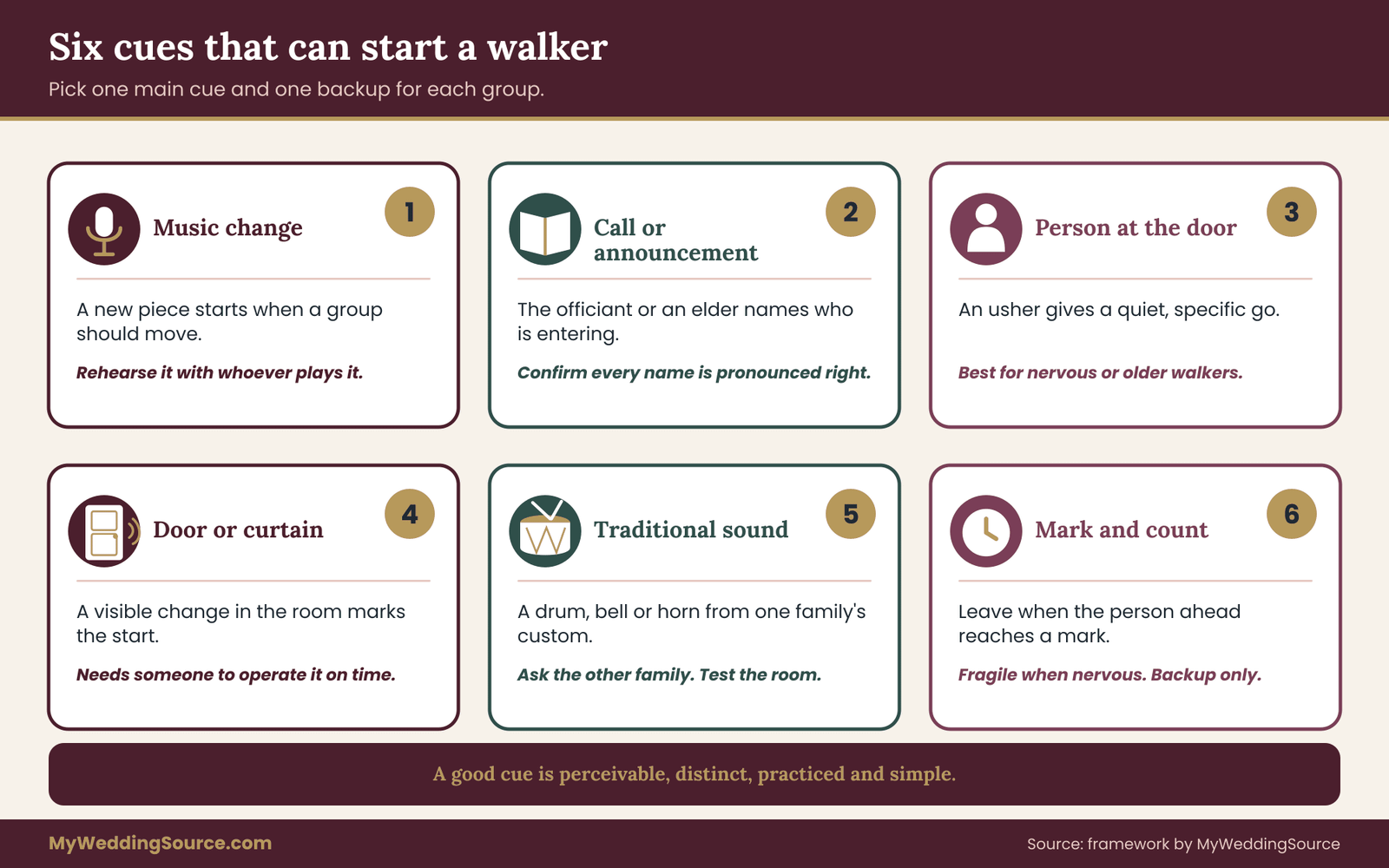
A change of music. A new piece begins when it is time for a group to move. It is audible to everyone, it suits families who expect a particular sound, and it sets the mood. Its weakness is that it assumes the walkers can hear it and recognize the change. It also ties your plan to a musician or a playlist, so it must be rehearsed with whoever operates it.
A call or announcement. The officiant, an emcee or a family elder names the group or person who is about to enter. It suits families where being announced is part of the custom, and it helps guests understand what they are seeing. It depends on a clear sound system and on the speaker knowing how to pronounce each name, which is worth confirming ahead of time.
A person at the door. An usher, coordinator or relative stands beside the walkers and gives a quiet, specific signal, such as a touch on the arm or a spoken “now.” It is the most reliable cue for nervous or older walkers because a human is next to them. It requires someone who is calm and who has been given the exact moment.
A door or curtain opening. A visible change in the room, such as doors opening or a screen moving, marks the start. It is easy to see and tied to the space, but it depends on a person operating the door and on timing with the music.
A traditional instrument or sound. A drum, a bell, a horn or a call from one family’s custom can serve as the shared cue if the family wants it. It carries meaning and can be striking. Because it belongs to one family’s tradition, the other family should be told about it and asked whether it works for them, and the sound should be tested in the actual room.
A mark and a count. Walkers leave when the person ahead reaches a marked spot or when they have counted a number of beats. It needs no equipment, but it is fragile in a nervous moment and should be used only as a backup.
Pair a cue with a backup
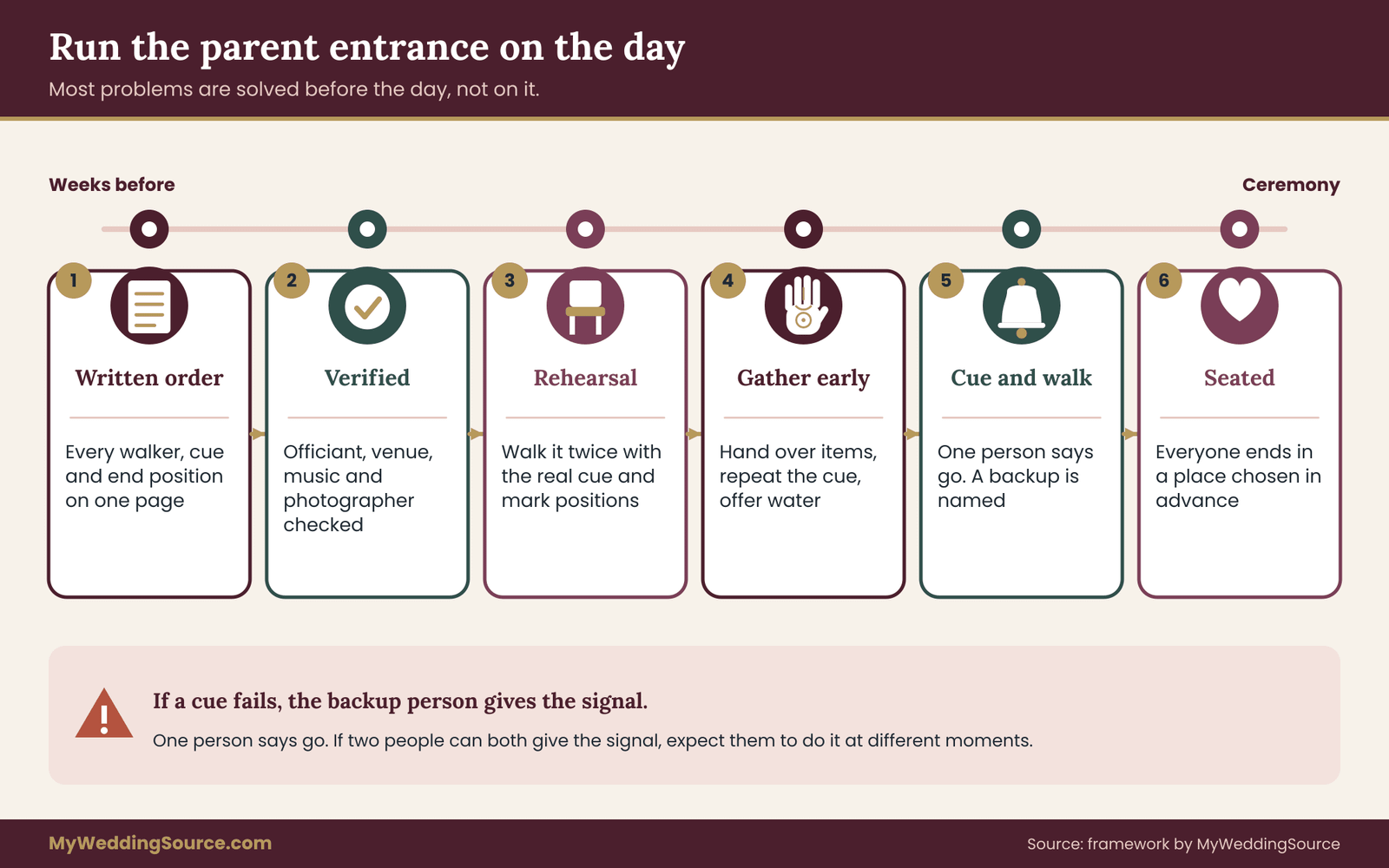
Whichever cue you pick, name a backup and tell the walkers what it is. If the main cue is a change of music and the music runs late, the backup might be the usher at the door. If the main cue is the usher, the backup might be a glance toward the coordinator. The backup keeps one failed cue from freezing the whole parent entrance.
It also matters who is in charge of the backup. One person, not two, should be able to say “go.” If two people can both give the signal, expect them to do so at different moments.
Writing the cue into a sheet
The cue should appear on a written order that every person involved has seen. A cue sheet is a plain list of moments, each with the people involved, the cue and the next step. The ceremony cue sheet guide covers how to build one, including how to list officiant, music, readers and timing, and it is a useful model for the parent entrance section.
For the parent entrance, each line should answer: who moves, from where, to what cue, to what place, and what happens next. If a line cannot answer all five, the plan is not finished. Share the sheet with the officiant, the musician, the coordinator or whoever acts as one, the photographer and the parents who are walking.
Explain the cue to guests where it helps
Guests who do not know the customs cannot follow them. A short line in the program or a few words from the officiant can turn an unfamiliar moment into a welcome one. Keep the explanation short and respectful, and have the family that owns the custom approve the wording. A parent entrance with a short, approved note feels welcoming, and one with none can feel like a puzzle to guests. Do not turn the ceremony into a lecture. One or two sentences before each distinct entrance is plenty.
A family that has asked for its custom to appear often cares about whether guests understand it. If you can explain it in a way the family approves, you give the parent entrance more meaning for everyone who sees it.
Seating, standing and where the parent entrance ends
Many couples plan the walk and forget the arrival. The last few steps of a parent entrance decide where people stand and sit, and they influence how the rest of the ceremony looks and feels. Plan the ending as carefully as the beginning. A parent entrance that ends well is remembered as a good one even if the start was a little shaky.
Decide the first row early
If both families expect the front row, the room needs a plan before the parent entrance is finalized. Options include reserving two rows on each side, setting the front row in a single curved line, placing family seating on both sides of the aisle in a mirror, or giving one family the front and the other a special position at the side. Check that the arrangement does not break a custom that requires, for example, a particular side or a certain order.
If a parent will stand rather than sit, make sure there is a clear spot to stand and that guests behind them can still see. If a parent uses a mobility aid, the end of the walk should be at a place they can reach without stairs or a tight turn, and with a seat close at hand.
Handle the people who do not walk
Plan for relatives who expect a role and do not have one in the parent entrance. A grandparent who is not walking but expected to be recognized could be escorted to a reserved seat earlier, or invited to carry an item, or announced by the officiant. These small recognitions are often what keeps an extended family comfortable with a plan that cuts some customs.
Watch the transition to the couple’s entrance
The parent entrance leads into the couple’s own entrance, and the handoff between them is where timing goes wrong. Decide what happens between the last parent taking a seat and the first partner starting to walk. A short pause lets guests settle. A clear musical shift tells everyone the next phase has begun. Leaving this unplanned can create a gap that feels awkward or a jam that feels rushed.
If the couple walks in together, the question is who goes first and what the last parent does. If one partner walks with a parent, plan how that parent separates at the front and where they then sit. If the couple walks with both sets of parents, plan how the group moves as a unit, who is at each side, and how they split at the front.
Keep the ending visible to photographers
Whatever you choose, tell the photographer and videographer what is happening and in what order. They cannot guess when a family custom is about to begin, and a missed moment cannot be redone. If a custom involves an item or a blessing, tell them where it will happen so they can be in position. The family photo list guide is useful for the formal photos that follow, since the same family groupings often appear again.
A worked example: two families, one aisle
The following example is invented to show the method. The names and the customs are made up and should not be read as a description of any culture or faith. Real families differ, and the point is the process, not the particular customs.
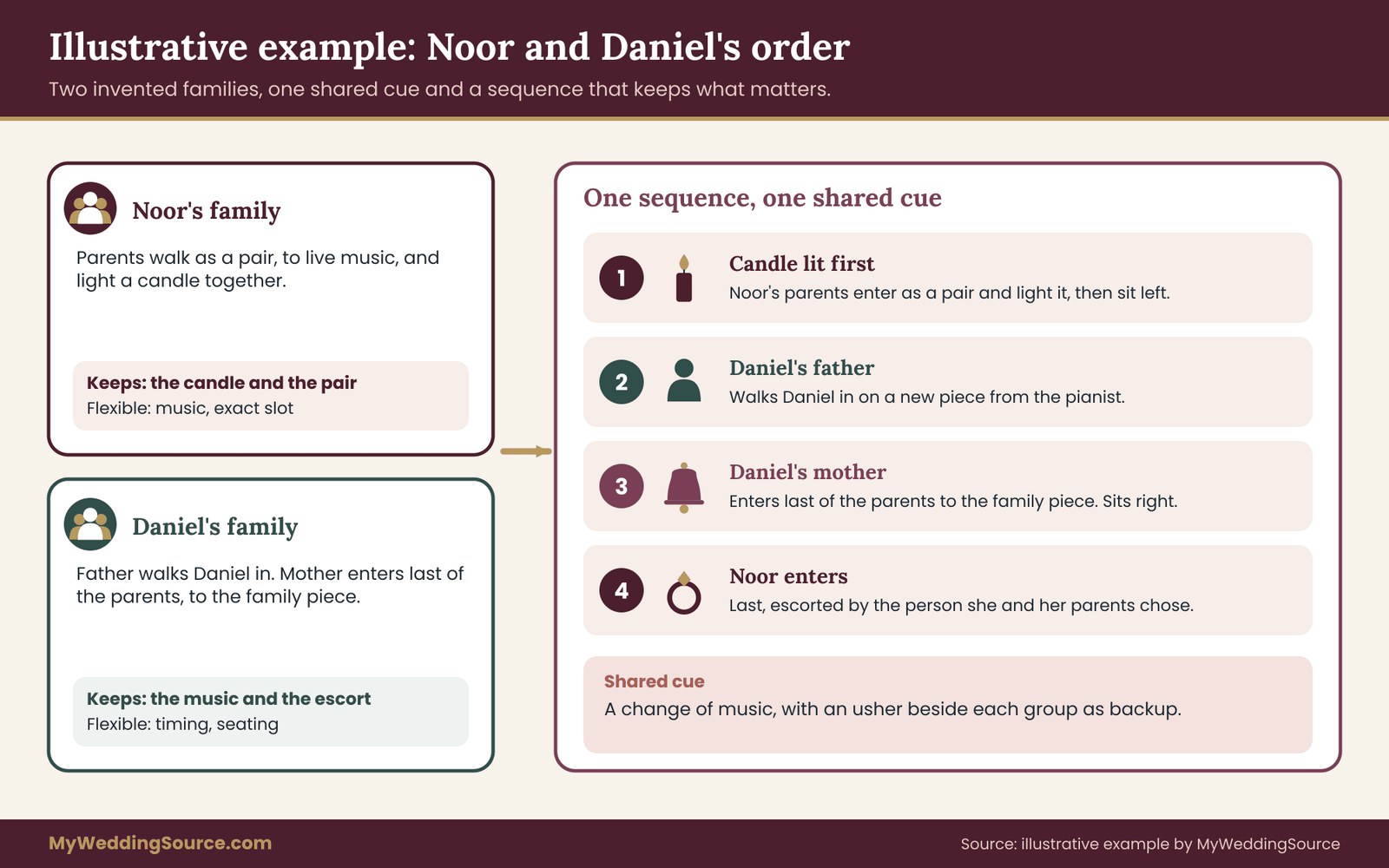
Imagine a couple, Noor and Daniel. Noor’s family expects the parents to enter as a pair, together, ahead of the couple, to live music, and to light a single candle at the front before sitting. Daniel’s family expects his father to walk him to the front, and his mother to enter last of all the parents, after other guests are seated, to a piece of music that his family has used at every wedding for three generations. The ceremony is in a hall with one center aisle, a hundred and twenty guests, a hired pianist and an officiant who has not met either family before.
At first glance the two parent entrances cannot coexist. Both want to come in late. Both want a specific piece of music. One wants parents as a pair, the other wants a parent beside a child. Here is how the matrix turns that into a workable plan.
Step one: the consultation
Noor talks with her parents and learns that the non-negotiable is the candle. Her mother says, “The walk matters, but what we need is to light it together before the ceremony begins.” The music is flexible. The order is flexible, as long as they are not hidden at the back.
Daniel talks with his parents. His mother’s non-negotiable is the music, because it was played for her own wedding. His father’s non-negotiable is walking his son in. The mother can adapt the timing, as long as the piece is heard when she enters. Both are flexible about where they sit afterward.
Notice what the consultation surfaced. The two parent entrances looked identical in their demand to be last and different in their structure. But their non-negotiables are different: one is a candle, the other is a piece of music and an escort. They do not conflict.
Step two: fill the matrix
Noor’s side: parents walk together, to live music (flexible), carrying nothing but ending by lighting a candle at the front, then sitting in the front row on the left. Non-negotiable: the candle and walking as a pair. Can adapt: the music, the exact position in the order.
Daniel’s side: his father walks him in, his mother enters last of the parents to the family piece, and both end in the front row on the right. Non-negotiable: the music and the escort. Can adapt: the timing, the seating.
Now read for collisions. A position collision exists: both want to be last. A signal collision exists too, because the family piece belongs to one parent entrance and cannot play for both. There is no form collision, because the two forms can sit in sequence. There is a small item collision: the candle needs a table, a lighter and someone responsible for it.
Step three: choose a pattern
Run the three-question test. Do the non-negotiables conflict? Not directly, so a blend is possible, but a blend would have to merge the pair walking in with the escorted walk, which would damage both. Can each parent entrance run whole in the available time? Yes. The room is small enough and each parent entrance takes only a few minutes. So the answer is sequence.
The order they propose is this. The candle moves to the front of the ceremony, before the processional. Noor’s parents enter as a pair, to a short piece the pianist selects, light the candle and take their seats. Daniel’s father then walks Daniel in, and Daniel’s mother enters last of the parents to the family piece. Then Noor, escorted by whomever she and her parents decide, enters last.
Step four: choose the shared cue
The two families have different signals. Noor’s family is used to a verbal call from the family elder. Daniel’s family is used to the music itself being the signal. The couple picks one shared cue structure, so that no one has to guess.
They choose a change of music as the main cue, with an usher beside each group as the backup. The pianist will play a short, quiet piece while guests settle, a different piece for Noor’s parents, a pause, and then the family piece for Daniel’s mother. The usher at the door gives each group a touch on the arm when the previous piece ends, and tells them “go” quietly, so no one relies on recognizing the change alone.
The officiant speaks one sentence before each parent entrance, approved by the family that owns it. Before Noor’s parents walk, the officiant says that a candle will be lit to begin the ceremony. Before Daniel’s mother walks, the officiant says the piece is one the family has chosen for generations. Neither sentence explains a meaning that the family has not approved.
Step five: handle the leftovers
Two issues remain. First, both families wanted to be last. The plan gives Noor’s parents the first slot and Daniel’s mother the last slot of the parent group, with the couple’s own entrance after. Noor’s mother accepts this because the candle gets a visible, early place and a front-row seat. She can see why the closing slot suits the other family’s tradition, where the mother enters last.
Second, the front row. The hall has one front row on each side. Noor’s parents sit on the left and Daniel’s on the right, which matches what each family expected. Grandparents sit in the second row with reserved signs, and each is escorted by a cousin who has been told the cue in advance.
The couple also sends a half-page summary to all four parents: who walks when, to what cue, where they sit and who the backup is. They ask each pair to reply with any corrections. Noor’s mother asks whether the candle can be lit by both parents together rather than one. Yes. The plan is adjusted. This costs ten minutes of email and saves a possible problem on the day.
What the example shows
Three lessons are worth drawing out. First, the apparent conflict was smaller than it looked, because the demand to be last was a position preference, not a non-negotiable. Asking for the non-negotiable separated what could move from what could not.
Second, a shared cue worked where a verbal call or a single family’s music alone would not have. The two families kept their meaning, and the cue structure was neutral between them.
Third, the plan was written down and checked with the people it affects. The best parent entrance design in the world does not help if one parent first hears of it at the rehearsal. A parent entrance that surprises a parent is not finished, however fair it looks on paper.
Where the example would change
Change one fact and the answer changes. If the hall had no center aisle, or if the candle could not be lit because the venue forbids open flame, the item would move or change. If Daniel’s mother used a mobility aid and could not walk the aisle in the time of the piece, the music might be cut or the order rearranged. If the two sets of parents were not on speaking terms, the separate parent entrances would be a relief and the pair entrance might need to be reframed. If the officiant could not agree to speak the lines, the program would carry them instead.
This is the point of using a matrix rather than a template. The template gives you one answer. The matrix lets you re-run the same method with different facts and get a different, equally fair result.
A shorter version for a small wedding
Not every wedding needs a six-step process. In a small gathering of thirty people the same method can be done in one long conversation at a kitchen table. The five questions still apply. You will still find a non-negotiable and a flexible point for each family. You will still choose a pattern and a cue, though the cue may be simply a nod from the officiant. The written summary can be one text message that each parent confirms.
The mistake is to skip the method because the wedding is small. Small weddings often have the most intense family expectations, because every guest is close to the couple and the stakes feel personal. A few minutes of structure saves a lot of discomfort.
A larger version for a big wedding
A large wedding adds more walkers, more distance, more people who cannot see the cue and more room for a missed signal. The pattern to watch is a sequence that becomes too long. If each of several family groups wants its own parent entrance, the combined time may exceed what guests and the schedule can absorb. In that case decide early which parent entrances stay in the ceremony and which move to a split, and add ushers or a coordinator at more points so that a cue can be relayed down a long aisle or across a large venue.
Verify the parent entrance with your officiant, venue and vendors
A plan that both families have accepted still has to work in the actual room, with the actual people who run it. Verification is the step where you check that nothing in the plan is blocked by an officiant’s rules, a venue’s limits or a vendor’s capabilities. Do it before you finalize the order, not after.
Start with the officiant
Officiants differ in how much they control. Some leave the processional entirely to the couple. Some, particularly those serving a congregation or following a faith’s required order, have a set sequence they must keep. Ask early, and ask in plain terms: “Here is the order we are considering for the parent entrance. Is there anything in it you cannot do or would want changed?”
Also ask what the officiant needs to say or do. Will they announce each parent entrance? Will they explain customs to guests? Can they pronounce the names and any ceremonial terms correctly? If a custom involves words in another language, ask the family to provide the text and a recording or phonetic spelling, and ask the officiant to practice it. A mispronounced blessing can hurt more than a missing one.
If your ceremony involves a faith leader from one family’s tradition and an officiant from another, bring them into the same conversation, or at least share the draft with both. Each may have a view on what the parent entrance can include. The officiant requirements guide explains who can legally solemnize a marriage and what a couple should confirm with the person leading the ceremony. For legal details of the license itself, the federal government’s marriage license page points you to the state office that issues it, and that office has the current rules.
Then the venue
Ask the venue for a list of limits that touch the parent entrance. Many venues restrict open flames, so a candle may need to be electric or lit elsewhere. Some limit confetti, petals, incense or smoke. Some restrict amplified sound or live percussion. Some have a firm start time and a strict end time that leaves little room for a long parent entrance. Some have width limits on the aisle or limited sightlines from a side door.
Check access for everyone who will walk. The Americans with Disabilities Act sets accessibility standards for many public venues, and the access board publishes technical guidance on routes and ramps. You do not need to become an expert. You do need to ask whether the route from the door to the front is step-free and wide enough for a person with a mobility aid, and whether there is somewhere to sit near the end of it. A parent who cannot complete the planned walk should be able to find that out from the plan, not at the doorway.
Fire and safety rules also matter. Aisles and exits are regulated by local codes, which often follow model standards published by organizations such as the National Fire Protection Association. A venue manager can tell you what the local rule requires. If you plan anything that adds objects, people or flame in the aisle, ask before you design it.
Then the music
If the parent entrance depends on a particular piece, check how it will be played. A live musician needs the score or a recording, a note about the right tempo and the exact moment to start and stop. A DJ needs the file, a clean cut point and a person to signal. A recorded track needs a tested file on a device with a backup.
Ask the musician how many different pieces they can manage and how they will receive the cue. A pianist who cannot see the door needs a person to signal them. A DJ who cannot see the aisle needs a clear verbal cue from a coordinator. Do not assume that “play the song when they start” will work without a plan for who starts first.
Music licensing is a separate question. If you plan to play recorded music at the ceremony, the venue or the performer may already hold the licenses that cover it, which is worth confirming. The U.S. Copyright Office explains the basics of copyright, and the performing rights organizations describe how licensing for live and recorded performance works. If a piece is part of a family custom, check whether the version you want is available in a form you can use.
Then the photographer and videographer
Share the order with the people who will record it. Ask where they can stand without blocking the aisle, whether any custom restricts photography, and whether the family wants any moment left unrecorded. Some customs include moments that a family prefers not to photograph, and asking in advance avoids an awkward correction during the ceremony. The same goes for livestreams, which put the ceremony in front of relatives who may not expect to see it.
Check with the families again
After verification, return to each family with the near-final plan. Explain what changed and why. If the venue forbids an open flame, say so and offer the alternative. If the officiant cannot include a particular line, say so and offer a different place for it. People generally accept a change if they hear it from you, early, with a reason and an option.
Rehearsal and day-of: running the parent entrance without drama
A rehearsal exists to test the plan, not to create it. Think of it as a trial run of the parent entrance, with the real people and the real cues. If you are deciding the order at the rehearsal, you have started too late. By the time everyone arrives, the plan should be written, shared and known, so the rehearsal can focus on timing, positions and cues.
Before the rehearsal
Send the written order to everyone who walks, with a short note about when and where to arrive. Name the person who will lead the rehearsal, which may be the officiant, a coordinator or a trusted friend. Name the person who will give each cue. Confirm who can attend, because the most important walkers are sometimes the ones who cannot be there, and a short phone call or video walk-through can fill the gap.
If a parent will not be at the rehearsal, assign someone to walk them through the plan separately, ideally at the venue, with the same cue they will have on the day.
At the rehearsal
Walk the parent entrance in full, with the real cue, at the real pace, from the real starting point. Do it at least twice. The first time shows where people are unsure. The second shows whether the fixes work.
Mark positions. A small, discreet mark on the floor or a card on the seat tells each person where to stop or sit. Check that every parent can see or hear the cue from where they wait. Check that an item has a place to be set down. Check that the pace works for the slowest walker.
Take time to listen to any parent who says “this feels wrong.” The rehearsal is the last easy moment to change something. Ask what feels wrong, find out whether it is a position, a cue or a meaning, and fix it if you can.
On the day
Name one person to run the parent entrance. That person should be able to see the door, the aisle and the front. They give the cue, they handle the backup and they are the one who says “wait” or “go.” If you have a coordinator, it is them. If not, ask a calm friend or relative who is not walking and who has attended the rehearsal.
Gather the walkers a few minutes early in a spot they know. Hand each the item they carry. Remind them of their cue and their end position. Give them water and a quiet moment. A parent who is anxious about being on display will do better with a task and a person next to them.
When something goes wrong
Something small usually does. The music starts late, an usher is delayed, a relative steps into the aisle early. The best response is to keep calm and to have a prepared correction. If the cue fails, the backup person gives the signal. If a walker starts too soon, the person at the front gestures them to wait. If a custom needs to be repeated, the officiant says one calm sentence and starts it again.
Guests rarely notice a small error if the people on the aisle handle it without fuss. What they notice is visible distress. A calm face and a slow walk cover most mistakes.
If a serious problem occurs, such as a parent becoming unwell, stop and attend to the person. No order of parent entrance matters more than someone’s health. A coordinator or a trusted friend should know what to do in that case, including who to call and where the nearest exit is.
After the parent entrance
Once the parents are seated and the couple has entered, the parent entrance is done. Do not circle back to discuss how it went until after the ceremony. A comment from a relative during the reception is usually emotion, not a complaint. Thank each family warmly and privately, and name the specific moment that mattered to them, such as the candle or the music. That small act often repairs more than any compromise.
Edge cases that change a parent entrance
Some situations do not fit a standard plan, and a framework that ignores them is not much use. These are the ones that come up most often. In each, the same rule applies: ask the person concerned what would make the day comfortable for them, and do not decide on their behalf.
Divorced or separated parents. If two parents of one partner are divorced, do not assume they will walk together, and do not assume they will not. Ask each separately. Some are glad to enter as a pair for the day. Others want separate parent entrances, separate seats or separate positions. A sequence or split often works well because it gives each parent their own moment. If a new partner of a parent is attending, decide whether that person walks, sits with the parent or sits elsewhere, and tell the parent the answer before the day.
Stepparents. A stepparent may have raised the partner and expect to walk, or may prefer to sit. Ask them and the partner, and ask the biological parent how they feel. A plan that treats a stepparent as a guest can hurt, and a plan that places them equally with a parent who is uncomfortable can cause a different hurt. Often the answer is a distinct but visible role, such as walking with the partner for part of the way or standing with the family at the front.
A parent who has died. Families handle this in many ways. Some leave a seat with a flower or a photo. Some have a sibling or a relative walk in their place. Some name the parent in the program or have the officiant mention them. Some prefer no mention at all. Ask the partner and the surviving family what they want, and let them choose. Do not assume that a tribute is welcome.
An estranged parent. If a parent is not part of the day, either by choice or by circumstance, decide how to handle the question when other relatives ask. The officiant, coordinator and ushers should know the plan so that no one asks the partner or the family in the middle of the ceremony. If a parent is attending but the relationship is strained, plan seating and arrivals to avoid contact that would cause distress.
A parent who cannot or does not want to walk. Illness, injury, anxiety, language barriers or personal preference may rule out an aisle walk. Offer alternatives: being seated before the parent entrance, being escorted by an usher, being wheeled or helped, entering from a side door, or taking part from their seat. Let them choose without pressure. A parent who feels forced into a walk they dread will not enjoy it.
Multiple siblings or relatives with a claim to a role. In a large family, more than one person may expect to stand in for a parent or to take a role in the parent entrance. Decide by asking what role each wants and whether it can be divided: one person walks, another carries an item, another reads. A role does not have to be an aisle walk to be meaningful.
Children. Young children who are part of the family may be expected to walk with a parent or to carry something. Children are unpredictable, so give them a short, simple task, a helper next to them and a plan for what happens if they stop. If a child has a role in one family’s custom, ask whether another child can share it.
Guests who do not know the custom. Some customs involve noise, movement or participation that surprises people. A short program note or a word from the officiant helps. If a custom invites guests to respond, such as standing, clapping or singing, say so ahead of time. Do not assume guests will pick it up from watching.
When the families will not agree
Sometimes, after consultation, two families still hold positions that cannot both be honored. It is worth being honest about that, because a forced compromise can fail on the day.
When that happens, return to the couple’s own priorities. The couple decides what the ceremony says about them, within the limits of what they can responsibly ask of their families. A framework for who decides what is useful here, and the wedding decision rights guide covers how couples can listen to family input without handing over the decision. If a decision is yours, make it kindly, explain it to both families in the same words at the same time, and offer a meaningful alternative role to the family whose preference was not chosen.
If the disagreement involves a religious requirement, ask the faith leader rather than relying on family claims. A leader may know whether a practice is required or customary, and whether there are accepted ways to adapt it. If the ceremony includes more than one tradition, the interfaith wedding ceremony planning guide offers a method for deciding who owns each ritual, and the same thinking applies to the parent entrance.
Common mistakes with a multicultural wedding parent entrance
A few errors recur, and most are easy to avoid once you see them.
Treating one family’s custom as the default and the other as an add-on. This tells the second family that their way is an extra. Even if one structure leads, make sure the other is visibly part of the ceremony.
Asking for opinions after the decision. If the plan is already settled, a request for feedback is a courtesy at best and a trap at worst. Consult before you decide, and tell people which stage you are at.
Using a relayed message. When a request or a refusal passes through two or three people, it changes. Speak to the people concerned directly, or have the partner speak to their own family.
Assuming a custom is universal. A family’s practice may differ from what you read about “the” tradition. Ask the family, and ask a leader if the question is religious.
Overcomplicating the signals. More cues mean more chances of failure. Pick one main cue and one backup per group.
Leaving the ending unplanned. Where people stand and sit after the parent entrance is often the actual disagreement. Decide it with the same care as the walk.
Skipping the rehearsal or running it as a performance. The rehearsal is for testing cues and positions. If it becomes a negotiation, the plan was not ready.
Forgetting the people who record. Photographers, videographers and livestream operators cannot catch a moment they do not know about.
Limits of this framework
This guide gives you a method, not a ruling. It does not tell you what any tradition requires, because that is not something an outside article can know. It does not replace the guidance of a faith leader, the policies of a venue or the law of your state. It does not guarantee that every family will be content, because some disagreements are not about the ceremony at all.
It also assumes that the families are willing to talk. If a family refuses to take part in the consultation, you may need to decide with what you know, tell them what you decided and leave a door open. The method still helps in that case, because it makes your reasoning visible and fair.
Finally, the framework adds some work. For a very small, informal ceremony, a short conversation may be enough. Use as much of the method as the situation calls for, and skip the rest.
Your next steps
Work through these in order over a few weeks.
First, hold a separate conversation with each family, using the five questions, and write a half-page summary of each. Ask what is non-negotiable and what can adapt.
Second, fill in the matrix side by side, mark the collisions and sort each difference into honor, adapt or move.
Third, choose a pattern (hold, blend, sequence or split) using the three-question test, and draft a proposed order.
Fourth, choose one shared cue and one backup for each group, and write them into a cue sheet.
Fifth, verify the plan with the officiant, the venue, the music provider and the photographer, and adjust for what they cannot do.
Sixth, send the near-final plan to each family for corrections, and thank them for their input.
Seventh, rehearse the parent entrance with the real cues, mark positions, and name the person who runs it on the day.
FAQ
What is a parent entrance in a wedding ceremony?
A parent entrance is the moment when one or both partners’ parents, or the people standing in for them, come into the ceremony before or with the couple. It can be a walk down an aisle, a procession, a presentation or a quiet seating, depending on the family, the tradition and the venue. It usually includes a choice of who walks, to what signal, and where they end up.
How do we plan a parent entrance when our families expect different things?
Ask each family separately who walks, with whom, to what signal, carrying what and ending where. Write the answers side by side, mark what each family cannot give up, and look for collisions. Then choose a pattern (hold, blend, sequence or split) and a shared cue. Check the plan with each family before you announce it, and confirm it with your officiant and venue.
Who should walk first in a combined parent entrance?
There is no single correct order. The right answer depends on what each family expects and what carries the most meaning for them. A family that cares about position may be fine with a different slot if its non-negotiable, such as a candle, a piece of music or an escort, is protected. Ask each family what they would keep if they could keep only one element.
What if one family’s custom conflicts with venue rules?
Ask the venue early what it restricts, such as open flame, amplified sound, confetti or aisle use. If a custom is blocked, look for an adaptation that keeps its meaning, such as an electric candle, a different location or a different time. Tell the family the reason and the alternative yourself, and ask whether it works for them before you finalize anything.
Do both sets of parents have to walk?
No. Some families expect parents to walk, and others expect them to be seated beforehand or to play a different role. Ask each parent how they would like to take part. A parent who prefers to be seated is as much a part of the plan as one who walks, and a seat can be paired with an honor elsewhere in the ceremony, such as a reading or a blessing.
How do we handle divorced or remarried parents?
Ask each parent separately how they want to take part and where they want to sit, and do not assume they will walk together or apart. A sequence or split often gives each parent their own moment. Tell new partners and stepparents their roles before the day, and make sure the officiant and ushers know the plan so no one improvises under pressure.
What is the best cue to start a parent entrance?
The best cue is one that each walker can perceive, that is distinct from other cues, and that has been practiced. A change of music, a spoken line from the officiant, or a person at the door are common choices. Pick one main cue and one backup, and name a single person who gives the signal. Test it in the venue so no walker has to guess.
Who has the final say on the parent entrance?
The couple usually decides what their ceremony includes, after listening to their families, while religious requirements are decided by the faith leader, and venue and legal limits by the venue and the issuing office. Be clear with each family about whether you are asking for input or asking for a decision, and give the same explanation to both families at the same time.
Sources
- Marriage license, USAGov
- Where to Write for Vital Records, Centers for Disease Control and Prevention
- Information and Technical Assistance on the Americans with Disabilities Act, U.S. Department of Justice
- Guidelines and standards for accessible design, U.S. Access Board
- Codes and standards, National Fire Protection Association
- Copyright basics, U.S. Copyright Office
- Music licensing, ASCAP
- Music licensing, BMI
- Consumer information, Federal Trade Commission