
A baraat procession moves music, family, a groom and sometimes a horse through spaces that belong to other people. This guide shows how to plan a baraat procession around the venue’s rules, the street’s rules and your own family’s customs, with a route sheet, a sound plan, a transport plan and an order for asking permission.
Split the route into three zones: where the baraat gathers, the stretch it travels, and the venue grounds where it ends. For each zone, find out who controls it, what that person allows (sound, animals, flame, blocked lanes), and get the answer in writing. Ask the venue first, because it decides whether the baraat procession may reach the entrance at all. Then ask the city or police about public streets, noise and traffic. If any zone says no, change that stretch. Keep a rain and delay plan, and name one person per zone who can act on the day.
A baraat procession is one of the most joyful parts of many South Asian weddings, and one of the least forgiving to plan. Nothing about it fits neatly into a venue contract. It starts somewhere that is usually not the venue, it moves, it is loud on purpose, it often happens in the evening, and it ends at a door where two families are waiting to greet each other. Every one of those facts touches a rule held by someone who is not in your family.
Couples and parents tend to discover this late. The hall’s contract says nothing about drums in the parking lot. The hotel where the groom’s side is staying would rather the baraat not start in its driveway. The street in front of the venue belongs to the city, and a group walking in the road is a different matter from a group walking on the sidewalk. A neighbor across the road calls the non-emergency line at the first beat of the dhol. None of this is unusual, and almost all of it can be solved with a few honest emails sent early.
This guide is written for the people who actually carry the logistics: the couple, a parent or an uncle who has been given the job, or a planner who has not worked with a baraat before. It does not tell you how a baraat must look. It helps you find out what your procession needs, and then match that to what a venue, a street and a city will allow.
A note on scope. This is general information, not legal, tax or financial advice. Customs differ between families, regions and faiths, and local rules differ from one town to the next, so the guide points you to the person or office that decides each question and tells you what to ask them.
What a baraat procession asks of a venue, a street and a family
In broad terms, a baraat is the groom’s wedding procession to the place where the wedding will happen. In many families it gathers away from the venue, travels with music and dancing, and arrives at the entrance, where the bride’s family meets it with a greeting often called the milni. Some families use other words for the baraat procession, including barat, varghodo or janj, and the details differ a great deal. Some include a horse, some a decorated car, some walk the whole way, and some keep it to a short stretch of the entrance drive.
Because of that variety, the first planning step is not a permit. It is a conversation. Before you check anything with the venue or the city, work out what your own baraat procession is meant to include, and which parts are fixed.
Sort the baraat procession into must, prefer and flex
Sit down with the people whose wishes carry weight: the parents or elders on both sides, the person who will lead the ceremony, and the couple. Ask the same three questions about each element of the baraat procession.
Must. Elements the family would not skip. For one family this is the groom arriving on a horse. For another it is live drumming at the gate. For another it is simply that the two families greet each other at the entrance, with the music as a bonus.
Prefer. Elements people want but would trade for a good reason, such as a longer walk or a particular song list.
Flex. Elements that are nice but easily changed, such as the starting point, the exact route, the length of the dancing, or whether the final stretch is on foot.
Write the answers on one page. This sheet becomes your negotiating tool. When a venue says “no amplified sound outside after eight,” you will know whether that touches a must (a live dhol player, which is not amplified) or a flex (a speaker on a cart). When the city asks you to shorten the route, you will know whether shortening costs the family something they care about or only changes a detail.
Be careful not to guess. A planner who has seen ten baraats may have a confident idea of what is normal, but the family in front of you has its own. The guide on planning an interfaith wedding ceremony makes the same point about rituals in general: ask who owns each element before you build the schedule around it.
What makes this procession different from other wedding entrances
Most wedding arrivals are quiet and unplanned from the venue’s point of view. Guests park, walk in and sit down. A baraat procession differs in four ways that matter to a venue and to the neighbors.
It is moving, so it crosses boundaries between private property and public space, and between one owner’s rules and another’s. It is loud, since drums and speakers are part of the point. It is crowded at its endpoint, because a large group arrives at one door at once and stops there for a greeting. And it is often led by people who are not guests in the usual sense, such as hired drummers, a horse handler or a driver, who are working under their own terms and insurance.
Each of these has a practical consequence. Movement means you need a route sheet. Sound means you need a sound plan. A crowd at the door means you need a stop point that does not block a fire lane or an accessible entrance. Outside workers mean you need their details on file with the venue before the day.
The zone sheet: who controls each stretch of the baraat procession
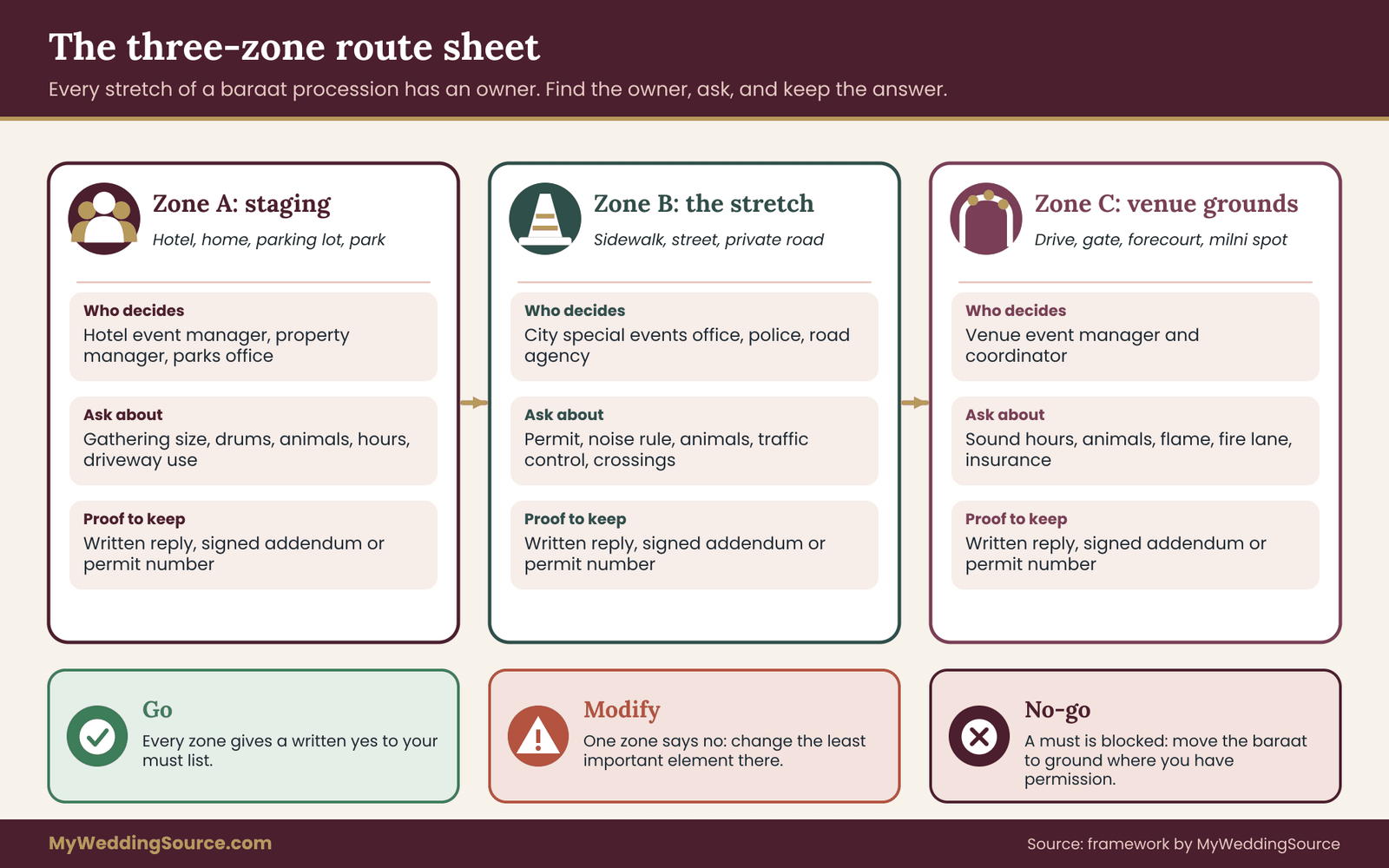
The most useful tool in this guide is a simple three-zone route sheet. It turns a vague idea (“we will walk from the hotel to the hall”) into a short list of owners and permissions.
Zone A: where the baraat procession gathers
This is the staging area, the place where the groom’s side assembles before moving. It might be a hotel lobby and driveway, a family home, a temple or community-center parking lot, a park, or a corner of the venue’s own lot. Whoever owns or manages that space decides whether a crowd with drums can gather there, for how long, and with what equipment.
Hotels often have rules on noise in outdoor areas, on use of the driveway where guests arrive, and on liability when a hired animal is on the property. A parking lot belongs to a landlord or an association. A home may sit under neighborhood covenants. You are not trying to be difficult; you are trying to find out who can say yes.
Zone B: the stretch the baraat procession travels
This is the path from staging to the venue. It might be a single block of sidewalk, a quiet residential street, an access road shared by several businesses, or only a few hundred feet. Whoever controls it varies. Public streets and sidewalks are controlled by the city or county, and traffic control by the road agency or police. A private road belongs to the property owner or a management company. A campus path belongs to the campus.
This is where most of the permit questions live. They are covered in detail later, but the zone sheet gives you the first test: if Zone B is longer than you need, you may be creating the permit problem yourself.
Zone C: the venue grounds and the entrance
The last zone is the venue’s entrance drive, forecourt, gate or door. The venue controls it, and it will have rules for sound, animals, open flame, fire lanes, accessible routes, load-in traffic and the schedule of other events on the same property. This is also the zone that matters most for the milni, since the greeting needs a place to happen.
Fill in three lines for each zone
For each zone, write three lines on your sheet.
Controller. The person or office that can actually decide: the hotel’s event manager, the venue’s coordinator, the city’s special events office, the police department’s permit unit, the property manager. Write a name and a way to reach that person on the day.
What they decide. The specific things you need answered: sound, animals, flame, number of people, blocking of lanes, time limits, insurance.
Proof. The form the answer takes. An email reply, a signed addendum to the venue contract, a permit number, a certificate of insurance on file. A verbal yes from a friendly staff member is not proof, and it often disappears when the staff member changes shifts.
Go, modify or no-go
Once every zone has an answer, apply a simple rule.
Go when every zone has a written yes for everything your must list requires.
Modify when one zone refuses something. Change the least important element in that zone first. If the street will not allow amplified sound, use acoustic drums only. If the horse is not permitted on the grounds, have the groom mount at a point where it is allowed, or arrive by a decorated car for the final stretch.
No-go when a zone refuses something that sits on your must list and no workable change exists. This is rare, but it is better to know it five months out than five minutes before the groom is due to leave. A no-go does not mean the end of the baraat. It means the baraat procession moves to a different place, such as the staging lot or a courtyard where you do have permission.
The next section turns the zone sheet into a route.
Choosing the route for your baraat procession
A route is a set of choices, and each one has a cost. The common instinct is to start as far from the venue as the family likes, because a long walk feels celebratory. Sometimes that is right. More often, a shorter route in a better place gives a better baraat procession: the music is tighter, the elders are not tired, the permit question shrinks, and the groom arrives with energy rather than with sore feet.
Start from the end and work backward
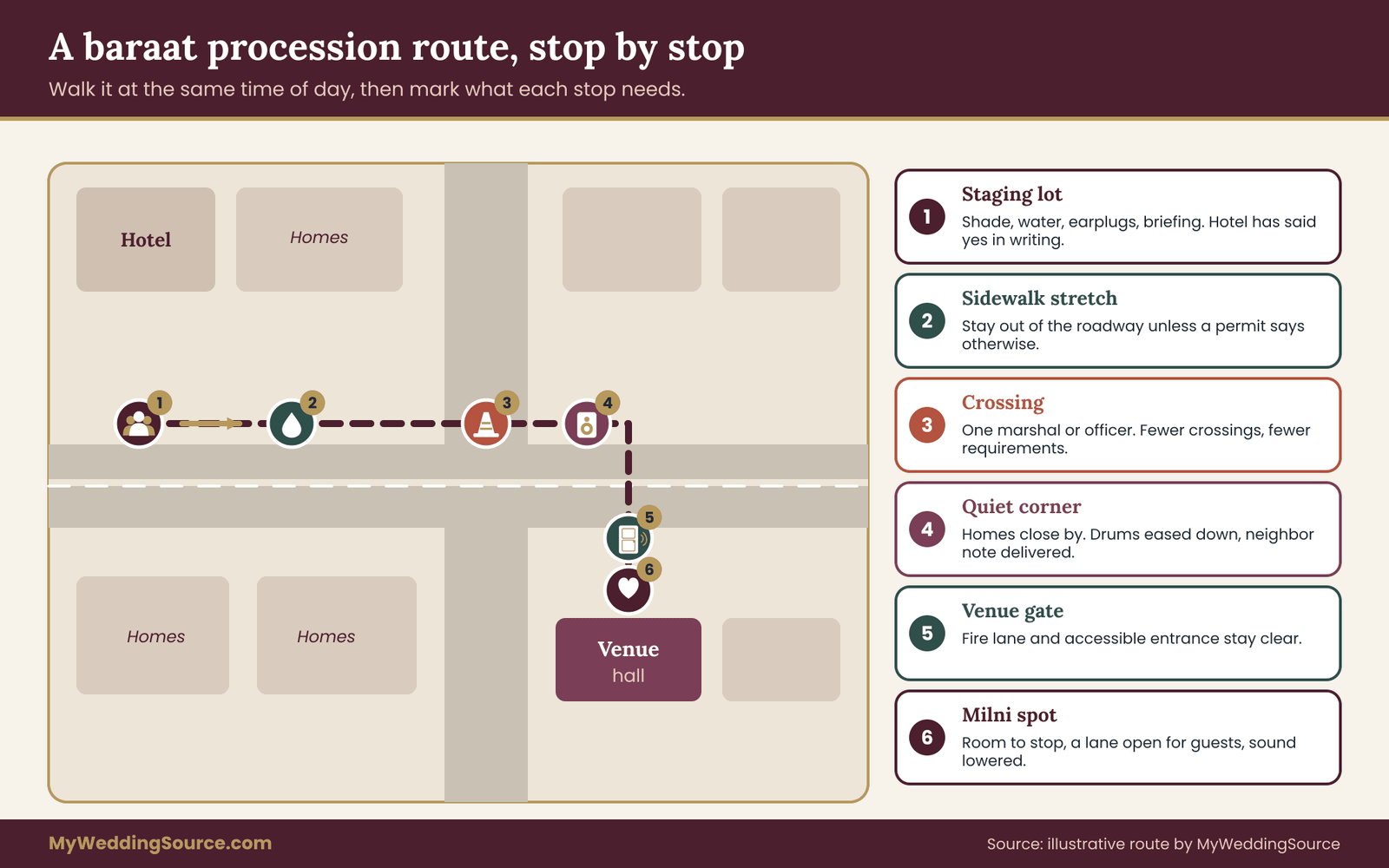
Plan the route from the milni spot, not from the starting point. Decide where the two families will greet each other, and make that place work first. It needs enough room for the whole group to stop without spilling into the drive, a clear way for guests who are not part of the baraat procession to get past into the building, and a surface that people in formal shoes and heavy clothing can stand on comfortably.
Then ask how the baraat gets there. The last stretch before the milni is the most important part of the route, because it is where the energy peaks and where the crowd is densest. If the venue permits the group only on the final fifty feet of its own grounds, you can still have a meaningful baraat procession. If the venue permits nothing and the street permits only the sidewalk, the shape of the day changes, and it is better to know that early.
Choose a staging point that earns its place
A good staging point has five qualities.
It is close enough that the group can walk or ride without leaving a safe, supervised space. It has room to gather without blocking traffic, because the baraat does not move on the stroke of the minute and people will wait. It offers shade, shelter and restrooms for people who may stand around in formal clothing for a while. It has a place for the groom to prepare, including a quiet room or a car for the groom, the horse’s handler or a few minutes with family. And it is owned by someone who has said yes.
A hotel with a quiet side lot and a back entrance often beats the hotel’s front driveway. A community center with a large parking area beats a residential street. A corner of the venue’s own lot that is out of sight of the entrance sometimes works best, because the venue already controls it and can approve it in the same email as everything else.
Measure the route on foot
Walk the proposed route once in daylight and once at the time of day the baraat will take place. A few things only show up on the ground.
Check surfaces. Gravel, brick pavers, grass, cobblestones, grates and curbs matter for people in formal shoes, for people using wheelchairs or walkers, and for a horse, whose handler will have views on footing. Check crossings. Every road the group must cross is a decision point: crossing at a signal, at a marked crosswalk, or in mid-block. Check slopes. A gentle uphill that nobody notices in sneakers becomes a real effort for an older relative in a heavy outfit.
Check overhead and edge hazards: low branches for a horse or a groom seated high, signs, power lines near an entrance gate, decorative arches, tent stakes. Check where sound will bounce. A narrow street between tall buildings will make a dhol sound far louder than it does in an open lot. Check who is nearby: residences, a house of worship, a hospital, a care home, a school, other events. Those are the places a complaint will come from, and some are places where a noisy procession is a poor idea no matter what the rule says.
Take photos and a short written note of each point, and mark where you would put a person with a high-visibility vest. Those notes go into the route sheet and into the email to the venue. The guide to a venue technical walkthrough describes how to measure entrances and access routes for vendors, and the same habits apply to a baraat procession.
Keep the route simple enough to describe in two sentences
If you cannot describe the route in two sentences, it is probably too complicated for a crowd, for the people who will give permission, and for the family. “The baraat gathers in the hotel’s side lot, walks along the sidewalk to the venue gate, and continues up the drive to the milni at the front steps.” That is a route. “We start at the hotel, go around the block, cross at the light, then come back along the other side” is a route that needs a map, a marshal at every corner and a very patient group.
The single most useful simplification is to avoid crossing traffic wherever you can. Every crossing needs a person, a signal or a police officer. Remove one crossing and you may remove a requirement for a traffic control plan.
A route sheet to share
The route sheet is one page, and it is the document you will send to the venue, the permit office and your own marshals. It should include:
- A simple map with the three zones marked and the route drawn in one color.
- The starting time, the expected walking time and the arrival time at the milni, with a margin.
- The number of people expected in the group, and how many are hired performers.
- The equipment: drums, speakers, a cart, a horse, a vehicle.
- The names and phone numbers of the person in charge of each zone.
- The plan if it rains or the permit is denied.
Keep the sheet to a page. People who give permission read the first page and rarely the second.
Venue rules: what to ask in writing before the baraat procession
The venue is the first stop in the approval order, and it is the one with the most direct power over your plan. A venue that dislikes a baraat procession can ask for conditions you cannot meet. A venue that understands it can solve problems you did not know you had. The difference is usually how early and how clearly you ask.
Ask before you sign, not after
The best time to raise the baraat is before the contract is signed, when you can still choose another venue. Many couples sign first and mention the baraat procession later, and by then the venue’s standard terms are the only terms. Ask directly, in writing: “Our wedding will include a groom’s procession with live drumming and possibly a horse, arriving at the front entrance in the early evening. Can your venue host that?” The answer, and how quickly and warmly it comes, tells you a lot.
If you already have a contract, read it for the clauses that touch a baraat procession: outdoor sound, hours of operation, vendor access, animals, open flame and fireworks, insurance requirements, and any language about use of the grounds beyond the booked space. The guide on wedding vendor contracts explains how to read those clauses and how to ask for an addendum when the standard form does not cover your situation.
The questions to put in your email
Send one email with numbered questions, so the answers can be numbered too.
- May a baraat procession of about this many people enter the grounds, and by which gate or drive?
- Where may the group stop for the milni, and is that spot clear of fire lanes, accessible entrances and delivery routes?
- Is live acoustic percussion allowed outdoors? Is amplified sound allowed, and until what time? Is there a decibel limit or a measuring point?
- Are animals allowed on the property? If so, what are the requirements for the handler, the insurance, the cleanup and the hours?
- Is open flame, sparklers, smoke effects or confetti allowed outside? Who decides?
- Do outside performers and handlers need to be on a vendor list, and do they need to provide a certificate of insurance? Who must be named on it?
- What is the venue’s schedule on the same day? Is another event, load-in or arrival happening at the entrance during the baraat window?
- Are there fees for outdoor use of the entrance, extra staff, security, overtime or cleanup?
- Who from the venue will be on site during the baraat procession, and who can approve a change that day?
- If weather or a delay moves the baraat, what is the latest the baraat procession can arrive without affecting the ceremony and the rest of the schedule?
These are neutral questions, not accusations. They show the venue that you have thought about the details, and they tend to produce a kind, specific reply.
Insurance and the outside performer
Venues often require outside vendors to carry liability insurance and to provide proof, called a certificate of insurance, before they work on the property. A hired drummer, a horse handler or a car service may or may not have a policy that fits. Ask the venue exactly what it requires, including the coverage amount and whether the venue itself must be named on the certificate. Then ask each vendor early whether they can provide it.
A handler with a real horse business will usually know the paperwork. An informal arrangement, such as a friend who owns a horse, is harder, and the venue may reasonably say no. The transport section later in this guide covers what to ask an animal handler directly.
Get the answer in the contract, not just in an email thread
A written reply from the event manager is far better than a conversation in the hallway. A signed addendum is better still. If the answer is “yes, with conditions,” ask the venue to add the conditions to the contract or to attach the email. Staff change, managers go on leave, and a venue’s coordinator on the wedding day may never have seen your email thread. A one-page addendum, “Groom’s procession: permitted route, hours, sound, animal and insurance terms,” protects everyone.
What a fair no sounds like
A venue may say no to parts of your plan, and some of those refusals are reasonable. A venue next to a residential area may ban outdoor amplification after a set hour. A historic site may refuse animals on its lawn. A downtown hotel may not be able to give up its front drive during check-in. When you hear a no, ask two follow-ups: what part of the request is the problem, and what version would they approve.
A “no animals” may come with a “but the groom may arrive in a decorated car and mount a ceremonial seat at the steps.” A “no amplified sound” may come with “acoustic drumming is fine until nine.” These alternatives are often better than the original idea, because they come from people who know the site.
If a venue seems unable to accommodate any version of a baraat procession and your family treats it as a must, it is better to say so and look at the wedding venues guide for how to compare other sites than to keep pushing a venue that will resist at every step.
Sound planning for a baraat procession: drums, speakers and noise rules
Sound is the part of a baraat procession people remember, and the part most likely to bring a complaint. Planning it well does not mean making it quiet. It means knowing where it will be loud, for how long, who has to be told, and who can turn it down when someone with authority asks.
List every sound source
Start by writing down everything that will make noise during the baraat procession, because the sources are treated differently by rules and by neighbors.
Acoustic percussion. A dhol player, sometimes two or more, with or without other drummers. These instruments are loud without any electronics, and many local rules draw no distinction between an acoustic drum and a speaker. Some venues, though, are more relaxed about live drums than about recorded music, and it is worth asking.
Amplified music. A speaker on a cart, a portable sound system carried by a helper, a truck or trailer with speakers, or a DJ’s set-up at the staging area. This is the source that most often needs a separate permit or an exemption request, since many ordinances single out amplified sound.
Horns, brass bands and other live musicians. Some families hire a band. A band is a larger sound source, a larger group of people and often a larger vehicle, and the same questions apply.
The crowd. Cheering, singing and dancing add up. A hundred people reacting to a groom’s arrival is a sound source too, and it is the one you cannot cap with a volume knob.
Effects. Firecrackers, cold-spark machines, confetti cannons, air horns. These are a separate issue, usually restricted by fire rules, and the next section on safety returns to them.
How noise rules are usually built
Noise rules are local in the United States, so you cannot rely on a general statement from any national source. The structure of local rules is, however, fairly familiar, and knowing it helps you ask better questions.
Many ordinances use time-of-day limits: certain hours when amplified or loud sound is not allowed, often late evening through early morning. Some use a plainly audible standard, which says a sound is a problem if it can be heard at a stated distance or inside a neighboring residence. Some use decibel limits measured at a property line, with different numbers for different zones or times. Some require a special permit or variance for amplified sound in public space, separate from any parade or event permit. And many make a complaint-driven system, in which officers respond when someone calls, then judge the sound on the spot.
None of these can be answered from this page. What you can do is ask the city’s special events office, or the police department’s non-emergency line if there is no event office, five direct questions. What hours does the noise rule restrict? Is there a decibel or distance standard? Does amplified sound need a permit when it is on a public street or sidewalk? Is there a separate rule for sound at a permitted event? And does a private venue’s own permit or zoning conditions add limits? Write the answers down, with the name of the person and the date.
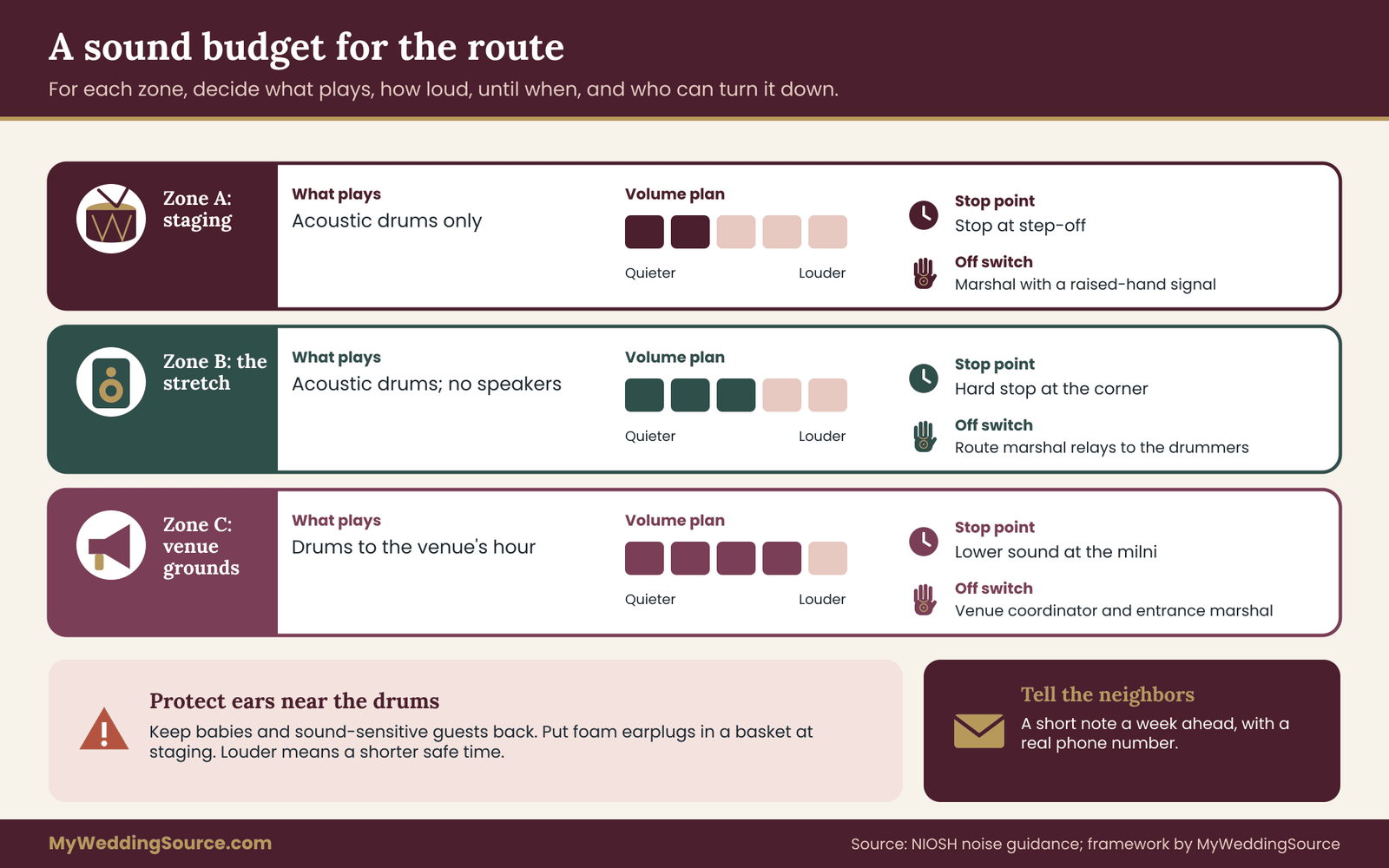
Build a sound budget for the baraat procession
A sound budget is a one-page plan that answers four questions for each zone: where, when, how loud and who controls the off switch.
Where. Sound at the staging area, along the route and at the entrance is each its own line. A dhol at full strength may be fine in a large staging lot and a problem at a residential corner.
When. The baraat procession has a start time and an end time, and the loud part is shorter than the whole thing. A baraat that runs for thirty minutes with sound at its peak for the final ten is easier to approve than an open-ended “evening of music.” Give a start, a stop and a hard stop.
How loud. You may not have a meter, and you may not need one. You do need a stated plan: “acoustic dhol only on the street; amplified sound only on venue grounds; no speakers on the cart past the corner.” If the venue or the city uses a decibel limit, ask who measures and where. A free phone meter app is not an official measurement, but it can show you the rough difference between the staging lot and the street before the day.
Who controls the off switch. Name one person for each sound source. The dholi knows when to stop playing, but is not always the right person to decide to stop. Pick a family member or a marshal whose single job is to relay the instruction “we need to wind down” to the drummers and the sound operator, with a signal everyone understands, such as a raised hand and a few seconds to finish a phrase.
Brief the drummers like any other vendor
A dhol player is a professional musician, and many have performed at hundreds of weddings. They will also have seen venues where the rules were different, and they may assume yours are like those. Do not leave it to chance. Before the day, confirm in writing:
- How many players, and for how long, including how many breaks. Drumming while walking is physically demanding, and a long route with no breaks is a poor plan for anyone.
- Whether they bring amplification, and if so what kind and how it is powered.
- How they travel and where they warm up. A drummer warming up in the venue’s lot an hour early can be the first complaint of the day.
- What the volume plan is at the entrance, where the milni takes place, and how they will respond to a signal to lower it.
- What happens in rain or heat. Some instruments are sensitive to moisture, and a player may prefer to wait, switch to a covered position or use a different drum. Ask them.
- What they will charge if the baraat procession starts late or runs over, and whether the fee changes if the route is cut short.
Share the route sheet and the sound budget with them. It costs nothing and it prevents the version of the day where the dholi hears about the quiet hour at the corner of the street.
Hearing, children and older relatives
Loud sound at close range is not only a neighbor issue. The National Institute for Occupational Safety and Health recommends limiting workplace exposure to 85 A-weighted decibels averaged over eight hours, and it uses a three-decibel exchange rate, which means that each three-decibel rise roughly halves the recommended time. A wedding is not a workplace and nobody will be there for eight hours, but the principle is useful: louder means a shorter safe time, and the people nearest the drum, including the drummers themselves, take the most.
In practice, plan a little distance. Keep very young children, babies and anyone with a hearing condition or a sensory sensitivity away from the drums, and offer foam earplugs from a small basket at the staging area. Place elders who want to take part in the front of the crowd where there is room to step back, rather than directly beside the drummers. It is a small courtesy that many guests quietly appreciate.
Tell the neighbors
A short note before the day can turn a complaint into a wave. Neighbors who know when the baraat procession will pass, how long it will last and whom to call are less likely to phone the police first. Deliver the note to the homes and businesses along the route and facing the venue entrance, a week or so before the wedding. Keep it short, kind and specific.
“Our family is holding a wedding celebration at the hall on Saturday. A traditional procession with live drumming will pass along this street between 5:30 and 6:00 p.m. It will be loud for about thirty minutes. If anything is a problem, please call our coordinator, whose number is below, and we will respond right away.”
Put a real name and a working phone number in the note, and make sure that person will answer on the day. A neighbor who gets a call back in two minutes is a neighbor who does not need to call anyone else.
If an officer arrives
On the day, an officer may stop by in response to a call. This is not necessarily a crisis. Have the marshal for that zone meet the officer, say hello, explain what the event is, show the permit or the venue’s written approval, and ask what the concern is. If the officer asks you to lower the sound or end it by a time, agree, relay the instruction and note the time. Arguing about whether the complaint is fair does little good in the moment, and cooperating protects the rest of the night.
Afterward, thank the neighbor if you know who called, and learn from it. The next section turns to how people and vehicles move.
Transport for the groom, family and guests during a baraat procession
How the groom travels is often the first thing people picture when they imagine a baraat procession, and it is the choice with the most practical weight. A horse, a decorated car, a walk on foot and a mix of the three each create different demands on the route, the venue, the permit and the people who have to manage it.
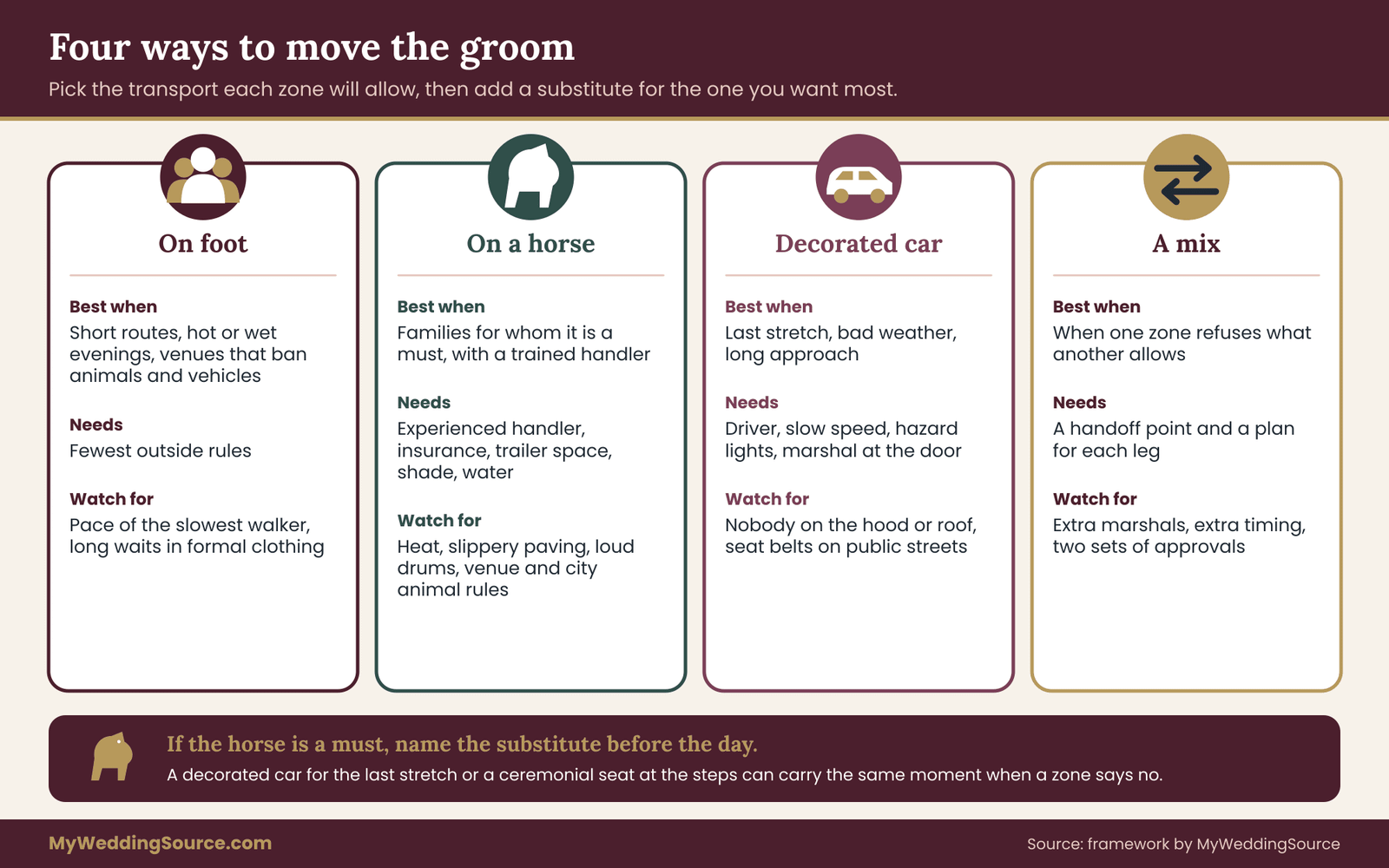
Four ways to move the groom
On foot. The simplest option, and the one with the fewest outside dependencies. It suits a short route, a hot or wet evening, a groom in heavy clothing, or a venue that bans animals and vehicles on its grounds. Its limits are pace and fatigue: the group moves at the speed of its slowest member, and a long walk in formal clothes tires people.
On a horse. Beloved in many families and the most demanding to arrange. A horse needs a trained handler, transport by trailer, a place to unload and wait, a calm approach to loud music, and permission on every zone it will enter. We return to this below.
In a decorated vehicle. A car, an open vehicle or a vintage car, sometimes driven slowly at the front of the walking group. This reduces fatigue and weather exposure and avoids animal rules, but it brings traffic rules, a driver, insurance and a safe speed. A vehicle moving slowly through a crowd needs a marshal at each corner and a clear rule that nobody rides on the outside of it.
A mix. Many families combine them, and a hybrid is often the best answer to a permit problem. The groom arrives by car to a point where animals and drums are permitted, mounts there, and rides the final stretch. Or the group walks the first part and moves into a vehicle for the portion along a busy road. The zone sheet makes this easy to design, since you can match the transport to what each zone allows.
Planning for a horse
If your family has a horse as a must, plan it as seriously as you would any hired vendor with a living animal involved. The goal is to protect the animal, the groom, the guests and the venue, and a good handler wants the same.
Ask the handler these questions before you book, and get the answers in writing.
- How many baraat or wedding events has this animal worked, and with live drums and crowds? A horse that is calm in a field may not be calm beside a dhol.
- Will the handler stay at the horse’s head for the whole route, and will a second helper be present?
- What does the handler require for the route surface, the length of time and the temperature? Many handlers will refuse to work in extreme heat, on slippery paving or in a thunderstorm.
- Where does the trailer park, how much room does unloading need, and how early must the horse arrive to settle?
- What is the plan for water, shade and rest before the baraat procession and afterward?
- Does the handler carry liability insurance, and can they provide a certificate that names the venue if the venue asks?
- What is the cancellation rule if weather, a permit or the animal’s condition forces a change, and who makes that decision on the day?
- Who cleans up after the animal, and when?
Then ask a question about the groom. Not every groom rides, and a nervous rider on an animal surrounded by drums and dancing is a problem for everyone. Ask the handler how to introduce the groom to the horse before the day, whether a short practice session is possible, and what the handler recommends the groom wear.
A turban or ceremonial headwear is part of the outfit in many families, but a handler may have views on footwear, on how the outfit is arranged and on whether a child traditionally seated with the groom is appropriate that day. Follow the handler’s judgment on the animal’s behavior. It is the handler’s name on the arrangement.
The decision to skip the horse
Some baraats do not include a horse, and some that planned one let it go. A handler may withdraw, a venue may say no, the weather may turn, or the route may be too busy. Decide in advance that this is acceptable, and name the substitute. A decorated car for the last stretch, a ceremonial seat at the steps or simply walking with the groom’s family in the middle of the group can all carry the same meaning for many families. Ask your elders now rather than in the parking lot.
A horse that is stressed or overheated is a poor outcome for the animal and a risk for people nearby. If the handler says the horse should not go on, the answer is yes, the horse stays behind. Build the plan so that this decision costs the family a little, not everything.
Vehicles, speed and the people on the outside
A decorated car at the front of a baraat procession moves at walking speed with hazard lights on, and the driver needs a clear line of sight. Make these ground rules before the day.
- The driver is sober, has a clean driving record and has agreed to the speed and route in advance. If you hire a driver or a car service, confirm that the company knows the vehicle will be moving slowly in a crowd.
- Nobody rides on the hood, the roof, the trunk or the running boards, and nobody dances in front of the vehicle. A moving car and a dancing crowd is where the most avoidable injuries can happen.
- Everyone inside wears a seat belt for the portion on public streets.
- A marshal walks at the driver’s door or just ahead with a clear way to signal “stop.”
- The vehicle does not leave the route to find parking while the group is still moving. A second driver or a helper moves it afterward.
If the route requires crossing a road with traffic, the vehicle is part of the problem. Decide with the permit office or police whether the vehicle can lead through the crossing, or whether the group should cross on foot and rejoin the vehicle at the other side.
Guest transport and elders
The baraat procession is not only about the groom. Guests, elders and children travel to the staging point, take part or watch, and then go on to the venue. Think of three groups.
The walkers are able to join the route and want to. Make sure the pace, surface and distance work for them, and have water.
The riders are guests who cannot walk the route, such as older relatives, people with mobility needs, small children and anyone in heavy dress. Arrange a vehicle or shuttle that takes them directly to the venue, ahead of the baraat procession, so that they are seated at the milni and can watch. The guide on coordinating guest hotels across budgets and mobility needs covers how to think through that range of needs.
The watchers are guests already at the venue. Tell them where to stand, so the entrance is not blocked, and let them know roughly when the baraat procession will arrive.
Parking and drop-off for the baraat procession
Vehicles tied to the baraat procession all need somewhere to go: the groom’s car, the handler’s trailer, the drummers’ vehicles, the shuttle and any trucks carrying sound equipment. Ask the venue where each can wait and when it can leave. A horse trailer parked at the front of a venue after the animal has unloaded is a problem for guest drop-off. A drummer’s van that blocks a fire lane is a problem for everyone.
Put the vehicles on the route sheet. Name the unloading point, the waiting point and the departure time for each. If the venue has a loading area, check how it is used by caterers and other vendors during the same window. The loading dock and service entrance at many venues are managed on tight schedules, and a baraat vehicle that arrives early may collide with a catering delivery.
The marshal team
A baraat procession of any size needs people whose only job is to keep it safe and on time. They are not performers or guests of honor. Recruit them from cousins, friends and members of the wedding party who are comfortable being firm and polite, and brief them in person.
Use one marshal at the front, one at the back, one at each crossing and one at the venue entrance for the milni. Give each a vest or a visible band, a printed copy of the route sheet and the phone number for their zone’s controller. Their job is simple. Keep the group on the route, keep the vehicle lane clear, call a stop if anyone is hurt or overheated, and relay the instruction to lower the sound. A marshal who dances at the same time is a fine marshal, if there is another one watching.
Permits and approvals for a baraat procession on public streets
The moment a baraat procession steps off private property onto a public sidewalk or street, a different set of rules applies, and the answer to “do we need a permit?” is “it depends on where, how many and how.” Many families skip this step because they assume a wedding is a private event. A baraat procession that uses a public street is, in the eyes of a city, a use of public space, and the city decides what that use requires.
Why there is no single answer
Cities and counties set their own rules, so what is routine in one town can be a formal process in the next. Some towns treat any organized group walking on a sidewalk as ordinary pedestrian traffic. Some use a head-count threshold above which a group needs a parade or special event permit. Some allow a short procession on a quiet street with a notice to police and nothing more. Some require a permit to use any part of the roadway, even for a few minutes, and a separate permit for amplified sound.
USAGov’s directory of local governments is a reasonable place to find the right office for your town. Look for the special events office, the city clerk, the parks and recreation department or the police department’s permits unit. If the venue is in an unincorporated area, the county may be the authority. If it is on a campus, a military base or a tribal or federal property, a different office applies. When in doubt, the venue’s event manager has often dealt with the city before and can tell you whom to call.
The permits and approvals that may come up
Not every baraat procession needs every item below. This is a menu of the things to ask about, not a to-do list.
Special event or parade permit. For a group that will use public streets, parks or sidewalks in an organized way. Ask how the city defines a parade, what size or route triggers the requirement, how far ahead you must apply, and what the application needs.
Street use or temporary road closure. If any lane must be closed, even briefly, a road agency usually decides, and the permit typically comes with conditions about signs, barricades and notice to residents.
Traffic control plan. A document showing where people and vehicles will be and how cars will be stopped or redirected. The Federal Highway Administration’s Manual on Uniform Traffic Control Devices sets the national standards for traffic control, and local road agencies apply them. In practice this means you should not improvise your own cones and signs on a public road. Ask whether the city provides barricades or flaggers, or whether you must hire certified traffic control.
Police or traffic officers. Some jurisdictions require, or strongly suggest, off-duty officers directing traffic at crossings. The cost is often billed by the hour, so ask for the rate and the minimum number of hours.
Amplified sound permit or noise variance. Separate from the event permit in many places. Ask whether acoustic drums need one and whether a time or distance limit applies.
Animal approval. Some cities regulate animals on public streets or in parks, others forbid them downtown, and others do not mention them at all. Ask whether a horse is permitted on the route, and under what conditions.
Fire department approval. If you plan any open flame, sparklers, smoke effects or pyrotechnics, the local fire marshal usually decides. Fire codes are written by national organizations such as the National Fire Protection Association and adopted by local governments, with local changes. Many venues prohibit these effects outright.
Insurance. A city may require liability coverage and ask that it list the city as an additional insured. An event insurance policy or a rider on a homeowner’s policy may satisfy this, and an insurer can tell you what applies. Ask the city for its exact wording first.
Park or private road approval. A park is controlled by the parks department, and a private road by the owner or management company. Each has its own request form.
What the permit office wants to see
If a permit is required, the application usually needs the same few items, and the route sheet from earlier carries most of them.
- A map of the route with start and end points and the direction of travel.
- The date, the start time, the end time and the expected number of participants.
- A description of what the group will include: drums, amplified sound, a horse, a vehicle, flags or banners.
- A plan for traffic and crowd control, including the number and location of marshals.
- A named contact who will be present and reachable on the day.
- Proof of insurance if requested, and the venue’s written permission for the end point.
Offices tend to appreciate a short, clear application from someone who has already thought about safety. They are far less sympathetic to a request that arrives a few days before the date with no route, no contact and no plan.
What it costs
Fees vary widely, and nobody can responsibly give you a number here. The main cost categories are application or permit fees, police or traffic control charged by the hour, barricade or equipment rental, insurance and any cleanup deposit. Ask the office for the current fee schedule, and ask whether fees can be reduced for a small, short event or for a route that stays on the sidewalk. In your wedding budget, create a line for procession approvals and, in it, a modest cushion for the fees and staff you cannot predict.
If the cost of a permit rises sharply when the route reaches a certain length, compare the cost against the value of that last stretch to the family. A shorter route may be cheaper, simpler and just as meaningful.
When you do not need a permit
Sometimes the answer is that no permit is needed. A small group walking on a sidewalk, staying out of the road, obeying signals, with no amplification, may need nothing at all. A baraat procession that stays entirely on the venue’s private property and ends at the venue’s own door may be governed only by the venue’s rules. But the lack of a permit does not mean the lack of rules. Noise, obstruction of the sidewalk and public safety rules still apply.
If you believe no permit is required, ask anyway, and ask for the answer in writing. A short email works: “We plan a walking procession of about eighty people on the sidewalk along this route on this date, with acoustic drums. We believe no permit is required. Can you confirm, or tell us what we need?” A reply of “no permit needed for a sidewalk group under the threshold” is worth saving. It is the document you show the officer if someone calls.
The approval order: who to ask first for your baraat procession
The order in which you ask matters. A request to the wrong party first can waste weeks, and a request in the wrong sequence can create a conflict between two answers. A workable order follows the zone sheet from the inside out.
Step one: your families
Before you ask anyone outside the family, agree among yourselves on the must, prefer and flex list and on who is the coordinator. Decide who will speak for the family when you talk to the venue and the city. This avoids the situation in which three relatives contact the venue with three different versions of the plan.
Step two: the venue
Next is the venue, because it controls Zone C, because the city will ask what the venue allows, and because your end point decides the route. Send the numbered questions from the earlier section. Do this before you hire drummers or a horse handler, so you know whether the plan is possible.
Step three: the staging owner
Then ask the owner or manager of the staging area. If it is the hotel, ask the hotel’s event or sales manager, not the front desk. If it is a lot or a park, find the property manager or the parks department.
Step four: the city or county
With the venue’s answers in hand, go to the city. Take your route sheet, the venue’s written terms and your question list. If the venue is outside city limits, ask the county sheriff’s office or the county’s special events contact. You will usually be asked for the same documents again, and having them ready speeds everything up.
Step five: your vendors
With approvals in sight, book or confirm the drummers, the handler, the car service and the traffic control company, and share the terms with them. A vendor who knows the conditions can promise what is realistic.
Step six: insurance and neighbors
Then confirm insurance requirements with the venue, the city and each vendor, and send your neighbor notes. Finally, confirm everything in writing a week before the day, with a short summary email to each controller: “This is our understanding of the approved route, hours, sound plan and contact for Saturday. Please let us know if anything has changed.”

Lead times
How far ahead you must ask depends on the place, so do not assume. Some venues review outside-vendor and procession requests at the time of booking. Some city offices require applications weeks or months ahead, and some limit the number of events allowed on a street or in a park on a given date.
A practical rule is to begin the conversation with the venue as soon as the date is firm, and with the city as soon as the venue has agreed to the end point. If the office is slow, send a polite follow-up in a week. If it says “too late,” ask what a smaller version would require. The guide to building a wedding vendor timeline shows how to place these asks on a calendar with the rest of your vendor deadlines.
Safety, weather and accessibility on the baraat procession route
A baraat procession brings together a crowd in formal clothing, loud music, movement along a road and, sometimes, an animal. Those are four reasons to think about safety in advance. Most of it is common sense, written down so that someone owns each item.
Heat, cold and rain
Evening weddings in summer can still be hot, and heavy wedding clothing, a long wait and dancing add to the load on the body. The Centers for Disease Control and Prevention and the National Weather Service both publish guidance on heat illness, including its early signs: heavy sweating, dizziness, headache, nausea and muscle cramps.
Put water at the staging area and again at the venue entrance, offer shade, and pick marshals who will notice someone who has stopped sweating or looks confused and act on it. If the forecast is high on the heat index, shorten the route, move the start later or earlier, and ask the drummers to take breaks.
Cold has its own problem: a long wait in an open staging lot in a thin outfit. Have a place indoors for the elders and the groom’s party to wait until the last moment.
Rain deserves a stated decision before the day. Does the baraat go ahead with umbrellas, move to a covered path, shrink to the final stretch or happen indoors? Wet pavement is a hazard for a horse, for a decorated car and for people in smooth-soled shoes, and some drums and instruments are sensitive to moisture. Decide who makes the weather call, and by what time. A common sequence is a check twenty-four hours ahead, a second check three hours before, and a final decision at the staging area by the person in charge, with the handler and the drummers’ input.
Lightning is simpler: the National Weather Service’s advice is that if thunder can be heard, the lightning is close enough to be a danger, and people should move indoors. A baraat procession in an open lot or a street with a tall prop, a metal frame or a tall umbrella is no place to wait out a thunderstorm.
Crowd safety at the door
The densest moment of the baraat procession is the stop at the entrance for the milni. A large group on a narrow drive, drummers still playing, a horse nearby and guests trying to enter makes for a real crowd. Take these steps.
Set the stop point away from the door itself, in a place where guests who are not part of the baraat procession can still pass. Mark the line where the drummers will stop, so the group does not push forward into the entrance.
Assign a marshal to the door whose job is to keep a lane open for people who need to enter or leave, including wheelchair users and parents with strollers. If a horse is present, keep it at the edge of the crowd with its handler and an exit path, never in the middle of the crowd, and bring the groom down when the handler says it is safe.
Keep fire lanes, hydrants, fire department connections and emergency exits clear. The venue will point them out on a map, and a short phone call with a staff member at the walkthrough will help you see them on the ground.
Open flame, sparks and effects
Sparklers, cold-spark fountains, smoke, fireworks and confetti cannons add drama and add risk. Venues, fire marshals and insurers often limit or forbid them, particularly near tents, dry grass, buildings and crowds. If the family wants an effect as part of a must, ask the venue and the fire department early, ask for the approval in writing and have a trained operator, not a cousin. If it is not a must, leaving it out is the easiest way to protect the rest of the plan.
Accessibility for the people who matter to you
A baraat procession is a family event, and the family includes people who use wheelchairs, walkers and canes, people with low vision, people with hearing sensitivity, people who are autistic or who have other sensory needs, and people who are simply old or tired. Plan for them as part of the route rather than as a footnote.
Check that the route includes curb ramps, firm surfaces and a path wide enough for a wheelchair beside the crowd. The Americans with Disabilities Act sets accessibility standards for public spaces, and the Department of Justice’s ADA site explains them in plain language, including what an accessible route is. At a private venue, ask the staff to show you the accessible entrance and the accessible path to the milni spot. If the accessible entrance is not the one the baraat will use, think about how people can meet the baraat procession there, and not at the back.
Offer a place to sit near the milni, a quiet spot away from the drums for anyone who needs a break, and a clear message about when the sound will begin and end. A short note in the invitation or on the wedding website, “A drumming procession arrives at 5:45; a quiet seating area is available at the east entrance,” tells people what to expect and where to go.
The baraat procession clock: from staging to the milni
A baraat procession is easy to start late and hard to start early. Treat the schedule like a flight plan, counted backward from the moment the families meet.
Count back from the milni
Choose the target time for the milni, which is also the time the venue’s coordinator and the ceremony leader will plan around. Then work backward with a buffer. A baraat typically moves much more slowly than ordinary walking, with stops, dancing and photos. Test the pace on a rehearsal walk with a few relatives, or assume the walk takes about twice as long as you would normally expect, and add a buffer of at least ten minutes on top.
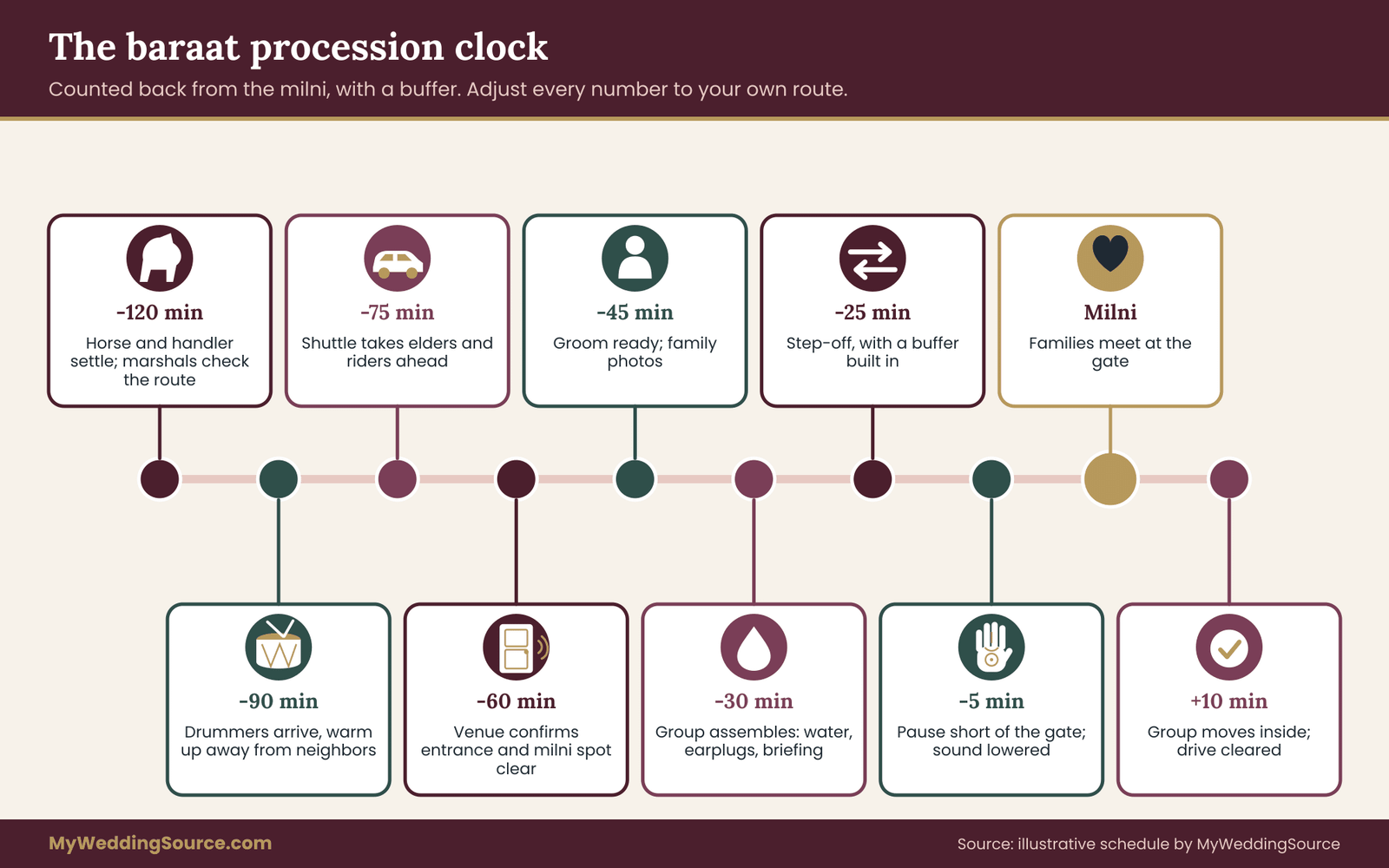
Here is a sample clock, in minutes before the planned milni. Adjust the numbers to your own route.
- 120 minutes before: The handler and the horse, if any, arrive and settle. Marshals check the route and walk the stops. Sound equipment is set up.
- 90 minutes before: The drummers arrive, away from the neighbors, and warm up quietly.
- 75 minutes before: The shuttle with elders, small children and riders leaves for the venue, so they are in place and seated well ahead.
- 60 minutes before: The coordinator confirms with the venue that the entrance, the drive and the milni spot are clear. Each zone controller checks in.
- 45 minutes before: The groom is ready, with photos and a few quiet minutes with family.
- 30 minutes before: The group assembles. Water, earplugs and a short briefing: route, pace, stops, signals.
- 25 minutes before: Step-off, for a route that takes about fifteen minutes plus buffer.
- 5 minutes before: The group pauses short of the entrance. A marshal confirms the bride’s family is ready, and sound is lowered.
- 0: The milni.
- 10 minutes after: The group moves inside. Drummers step aside, vehicles leave, and the marshals clear the drive.
Protect the handoff to the ceremony
The baraat procession leads into the next part of the day, whether that is a religious ceremony, a civil one, a reception or a combination. A late baraat delays everything behind it, and a baraat that ends in confusion leaves the ceremony without a start. Share the clock with the person who will lead the ceremony, the photographer and the venue’s coordinator, and agree on a single cue, such as a call from the entrance marshal, that tells them the milni is done.
Every vendor who works after the baraat procession needs the same information. The guide to wedding ceremony cue sheets shows how to turn a timeline like this into a cue sheet that the officiant, the musicians and the coordinator can read at a glance.
The baraat procession is a custom. The legal marriage is a separate process with its own paperwork, and that depends on your state and on who is officiating. The officiant requirements guide explains what to confirm so that the license is valid, and USAGov’s marriage license page points to the state offices that issue it. Neither needs to affect the baraat, but both belong on the same planning calendar.
A worked example: a hotel-to-hall baraat procession
This is an invented example, built to show how the zone sheet and the approval order fit together. It is not a template for any family’s customs.
The situation
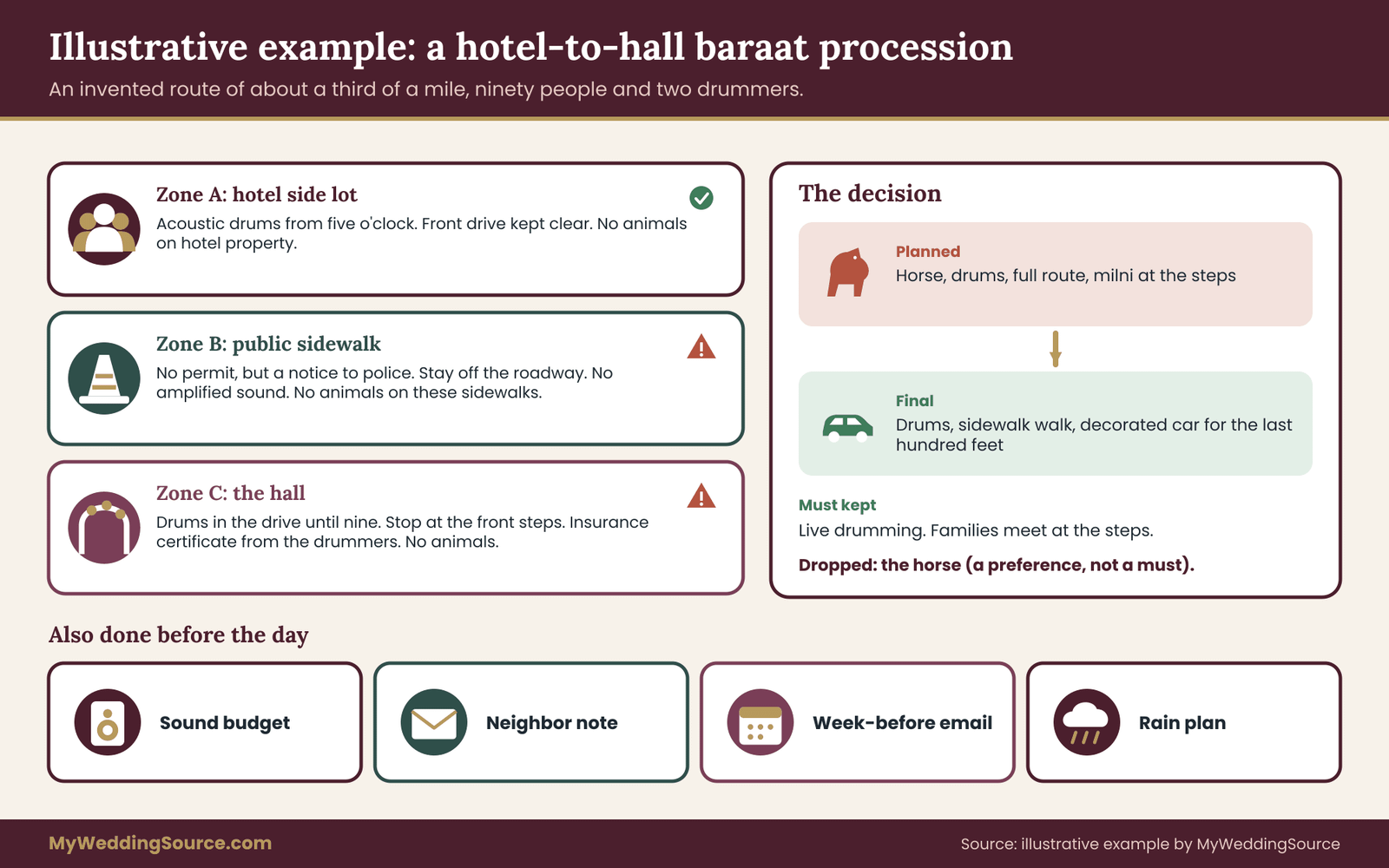
Two families are planning an evening wedding at a banquet hall. The groom’s side is staying at a hotel about a third of a mile away. About ninety people are expected to join the baraat procession, led by two dhol players. The groom’s parents want him to arrive on a horse, and the bride’s parents are looking forward to meeting the group at the hall’s front steps.
The must, prefer and flex list
After a talk with the elders, the families agree. Must: live drumming and the families meeting at the front steps. Prefer: a horse and a route of about the full distance. Flex: the starting point, the exact path, the length of the dancing and the song list.
The zone sheet
Zone A, the hotel. The event manager agrees to the group gathering in the side lot, with acoustic drums only, from five o’clock, and asks that the front drive stay clear. A written email confirms it. No horse on hotel property.
Zone B, the sidewalk. The city’s special events office explains that a walking group of this size on the sidewalk does not need a permit, but asks for a notice to the police department a few weeks ahead and for the group to stay out of the roadway. The city’s noise rule restricts loud sound after a stated evening hour, and amplified sound on the sidewalk is not allowed. Animals are not permitted on city sidewalks in that district. The response comes by email.
Zone C, the hall. The venue allows acoustic drumming in its drive until nine o’clock, a stop for the milni at the front steps clear of the fire lane, and one marshal-sized lane kept open for guests. It does not allow animals on the lawn or drive and asks for a certificate of insurance from the drummers.
The decision
The horse breaks two zones. That is a modify: the horse was a prefer, not a must. The family asks the handler whether the horse could take part in the staging lot, which is private and where the hotel has said no animals. It cannot. The family chooses to keep the live drumming, the walk along the sidewalk and the milni, and to drop the horse. To give the groom’s parents something meaningful in its place, the family arranges a decorated car that waits at the hall’s gate to take the groom the last hundred feet, which the venue approves.
The coordinator fills in the sound budget: acoustic drums only; a marshal with a signal at the corner; a hard stop at the milni; a neighbor note a week ahead. The cost of the horse and handler is redirected to a second drummer and a traffic marshal vest set, and the insurance certificate is requested from the drummers’ company. Everything is confirmed in a week-before email to each controller.
What this example shows
The family lost one element, the horse, and kept both things they listed as a must. The decision was made months ahead, when it cost very little, and not at the curb. Each approval came from the person who owned that zone, in writing. And the changes made the baraat simpler, which is often what a good plan looks like.
When the baraat procession plan goes wrong: rain, delay, denial and complaints
Most baraat planning problems are predictable. A short plan B written in advance, and shared with the people who would carry it out, turns a crisis into a change of plan.
A permit or venue approval is denied late
If a zone says no after you have booked vendors, go back to the zone sheet and the must, prefer and flex list. Ask the zone controller what version they would approve. Cut the flex items first, then the prefer items. If a must is blocked, consider moving the baraat procession to a zone where you do have permission, such as the staging lot or the venue’s own courtyard, and holding the full procession there. A shorter baraat on private ground with proper permission is better than a longer one that gets shut down halfway.
The group runs late
Lateness is the most common failure. The groom’s side arrives later than planned, the drummers wait for a relative, someone has to go back to the hotel for a forgotten item. The effect lands on the bride’s family, the guests waiting at the entrance, the venue’s schedule and everyone after.
Build a hard time into the plan: the latest step-off that still lets the baraat arrive before the ceremony start. If the group has not left by then, the plan changes, as agreed ahead of time, to a shorter route or a car for part of the way. Tell the venue coordinator the moment you know the group is behind, and not when it arrives. Ask the entrance marshal to relay updates to the bride’s family so that they are not left standing without news.
A drummer, driver or handler does not show
Keep a phone number for each vendor and a named backup if you can. A second drummer from the same group, a friend who can drive a car or a recorded music option for the final stretch, played only where amplified sound is allowed, can fill the gap. For an animal handler, the backup is the plan to go without the horse, which you have already agreed with the family.
A neighbor complains or an officer arrives
Meet the officer, show the written approvals, listen and relay the request. If you are asked to end the sound, do it promptly and politely, and then make a plan for the next stretch, perhaps by moving to the venue grounds where the sound is allowed. A cooperative response protects the rest of the evening and the venue’s relationship with its neighbors.
Someone is hurt or overheated
Stop the group. A marshal stays with the person, another calls for help if needed, and the drummers hold. The coordinator informs the venue. Keep a basic first aid kit with the marshals, along with water and a list of important phone numbers. People can restart the baraat procession when the person is safe. Nobody will remember a delay that was handled well, and everybody will remember one that was not.
Weather turns
If the forecast shifts, follow the weather decision you made in advance. A covered or indoor baraat, an abbreviated route, an umbrella walk or a delayed start are all reasonable. Tell the drummers and the handler early. Hold the decision with one person, and make it before the group is on the road.
Common mistakes in baraat procession planning
Most of these are not the result of carelessness. They come from assuming that the people who own each zone know what you have in mind.
Assuming the venue knows. A contract for a banquet hall does not mention a baraat procession unless you add it. Ask in writing, early.
Treating the street as a private space. A baraat procession that uses the roadway is a public use, and the city decides what it needs. Ask the city, even if the answer is that nothing is required.
Building the route from the start, not the end. A beautiful long route that ends at a blocked entrance does not help anyone. Plan from the milni backward.
Hiring first and asking later. Booking a horse, a band and a truck with speakers before checking the rules leaves you with vendors you cannot use and a deposit you may not recover. Check the permissions, then hire.
Leaving sound unmanaged. A speaker with no one in charge of the off switch is a complaint waiting to happen. Name a person and a signal.
Forgetting the guests who are not in the baraat procession. Elders, small children, people with mobility needs and guests already seated at the venue each need a place and a message.
Having no plan for weather or delay. Rain, heat, traffic and a late start are not rare events. A plan costs an hour of thought.
Relying on verbal agreements. The person you spoke to may not be on shift on the day. A written reply, or a signed addendum, makes the agreement visible to whoever is there.
Overloading the day. A baraat procession is a lovely event and a demanding one. A group that has been standing, walking and dancing for an hour will be tired when the ceremony begins, so keep the rest of the schedule realistic.
Generalizing the tradition. What one family calls essential, another does not do at all. The people who understand your baraat are in your own families and in the faith or community leaders who know them. Ask them what they want and follow it, and use the planning in this guide to make that possible. If the ceremony itself mixes traditions, the guide on clear ritual ownership in an interfaith ceremony can help you decide who leads which part.
Checking the details for your own baraat procession
This guide gives a method, not rulings. The rules that bind your baraat procession are the venue’s contract, your city’s or county’s ordinances and the conditions of any permit you receive, and these change by place and over time. Verify these directly.
Verify with the venue: the current terms on outdoor sound, animals, flame, vendor insurance, hours and the use of the entrance, and a written approval for the plan you present.
Verify with the city or county: whether a permit is required for the route, what the fees and lead times are now, how the noise rule is written and measured, and what the rules are for animals and amplified sound. Rules and fees are updated, so the most recent information comes from the issuing office.
Verify with your vendors: that each has insurance and experience that match what they will do, and that each has the same version of the route sheet and the sound budget.
Verify with your families and leaders: what the baraat procession means for your family, what must be done and in what order, and who is responsible for each part. Customs vary within families as well as between them, and nothing in this guide replaces that conversation.
A few limits are worth stating plainly. The article cannot tell you what your local ordinance says. It cannot judge whether a particular horse or handler is safe. It cannot predict whether a venue’s manager will say yes. What it can do is give you the questions and the order for asking them, so you hear the real answers while you still have room to adjust.
FAQ
Do we need a permit for a baraat procession?
It depends on where the baraat procession goes and how large it is. A small group walking on a sidewalk may need nothing, while a larger group in the roadway, with amplified sound or an animal, often needs approval. Ask your city’s special events office or the police department, describe the route and the group, and request the answer in writing even when the answer is that no permit is needed.
Who do we ask first about a baraat procession at our venue?
Start with the venue’s event manager, in writing, before you sign the contract if you can. The venue controls the entrance, the drive and the milni spot, and the city will ask what the venue allows. Send numbered questions about sound, animals, flame, insurance, hours and the stop point, and ask for the answers to be added to the contract.
Can we use a loudspeaker or DJ cart during a baraat procession?
Possibly, but this is where most rules apply. Many cities restrict amplified sound in public space and limit loud sound by hour, and many venues set their own limits. Acoustic drums are sometimes treated more gently, though not everywhere. Ask the city and the venue separately, plan a sound budget by zone, and name one person to control the off switch.
Is a horse allowed in a baraat procession?
Only if every zone it enters allows it. Hotels, venues and city streets often restrict animals, and handlers set their own limits on heat, surfaces and noise. If a horse is important to your family, ask the venue and the city early, hire an experienced handler with insurance, and agree in advance on a substitute, such as a decorated car, in case the horse cannot take part.
How long should a baraat procession route be?
Shorter than most families first imagine. A baraat moves slowly, with dancing and stops, and long routes mean more crossings, more tired elders and more permit questions. Choose the shortest route that still gives the family what it listed as a must. Walk the route at the same time of day, and plan for about twice the usual walking time.
What should we tell the neighbors?
Tell them what is happening, when and for how long, and give them a real person’s phone number to call. A short note delivered about a week before the wedding, to homes and businesses along the route and facing the venue, works well. Keep the tone friendly and specific, and make sure the person named will answer the phone on the day.
What if it rains on the day of the baraat procession?
Decide before the day, not at the curb. Options include a covered path, a shorter route, an indoor baraat in a large lobby or courtyard where the venue allows it, or a delayed start. Name the person who makes the call, check the forecast at set times, and tell the drummers and the handler early, since some instruments and animals are sensitive to wet weather.
Does the baraat procession change our marriage license or officiant plans?
No. The baraat is a custom, and the legal marriage is a separate process, with a license from the state and a ceremony led by someone authorized to officiate. Confirm the license rules with the issuing office and the officiant’s requirements in your state, and then build the baraat clock so that it ends in time for the ceremony to begin as planned.
Your next steps
Start with a single page. List the elements of your baraat procession and mark each one must, prefer or flex, after talking with the elders on both sides. Then draw the three zones on a simple map: where the group gathers, the stretch it travels and the venue grounds where it ends.
Next, write to the venue with the numbered questions, and ask for answers in writing. Once you have them, contact the owner of the staging area and the city’s special events office or the police department, and ask what the route requires. Build a sound budget, brief the drummers, name your marshals and send the neighbor note. Finally, write the clock, the plan for rain and delay, and a one-page route sheet that each controller has received. A baraat procession that has been agreed in writing, zone by zone, tends to look effortless on the day, which is how it should feel.
Sources
- Marriage license and marriage certificate, USAGov
- Local governments, USAGov
- Manual on Uniform Traffic Control Devices, Federal Highway Administration
- Noise and hearing loss prevention, National Institute for Occupational Safety and Health
- Heat and your health, Centers for Disease Control and Prevention
- Noise pollution, U.S. Environmental Protection Agency
- Heat safety, National Weather Service
- Lightning safety, National Weather Service
- ADA information and technical assistance, U.S. Department of Justice
- Codes and standards, National Fire Protection Association