
Nigerian wedding attire is not one dress code. It is a set of choices that belong to specific families, specific ceremonies and specific traditions, and the wording you send to guests should say exactly that. This guide shows how to write Nigerian wedding attire guidance for a Nigerian or Nigerian-American wedding that is clear, kind and accurate, and that never reduces a whole country to a single costume.
Do not write one line that says “Nigerian attire.” Instead, list each event, name whose tradition it follows, say how strongly you are asking guests to dress for it (required, requested, invited, optional or not expected), and describe the look in plain words with two or three examples. Have an elder from each family read the draft before it goes out. Offer a no-cost option, give fabric and tailoring dates early if matching cloth is involved, and keep one named contact for questions.
Somewhere in the middle of wedding planning, a couple sits down to write the attire line for the website. It is usually a short line. “Traditional Nigerian attire encouraged.” It looks harmless, and it quietly causes several problems at once. Guests from the groom’s side who are not Nigerian wonder whether they are expected to buy something. Guests whose families come from a different part of Nigeria wonder whether the line describes them at all. An aunt reads it and says, gently, that nobody she knows would call it that.
Few parts of Nigerian wedding attire guidance are as quick to write and as easy to get wrong.
The core issue is that Nigerian wedding attire is plural. Nigeria is home to hundreds of ethnic groups, and the best-known wedding traditions come from several of them, each with its own cloth, its own head coverings, its own colors and its own ideas about who wears what at which moment. A couple may be drawing on one tradition, on two, or on a deliberate blend. Guests may be Nigerian, Nigerian-American, married into a Nigerian family, or attending a Nigerian wedding for the first time. One sentence cannot serve all of them.
Put simply, Nigerian wedding attire has no single rulebook that every family follows.
What can serve all of them is a short, structured piece of guidance that you build once and reuse across the invitation, the website and the reminder messages. This article walks through how to build it. You will define the events, tie each event to a tradition that your families have confirmed, choose how firmly to ask, write the description, and test it with the people most likely to read it closely. A worked example later in the guide shows the finished result for an invented couple. That is the whole idea behind a good Nigerian wedding attire card.
A note on scope. This is general planning information, not legal, tax or financial advice, and it is not a substitute for the people in your own families and faith communities who know your traditions. Where a rule matters, such as a venue’s dress policy or a marriage license requirement, the guide points to the issuing office or the venue so you can confirm the current version yourself. Nothing here is meant to settle what Nigerian wedding attire should look like at your wedding.
Why Nigerian wedding attire wording needs more care than a dress-code line
A standard dress code works because everyone shares a rough vocabulary. “Black tie,” “cocktail” and “casual” mean roughly the same thing to most guests in a given region. Nigerian wedding attire does not have that kind of single shared vocabulary, and pretending it does is where most wording mistakes begin. Nigerian wedding attire does not fit into that kind of shorthand.
Consider what a short phrase has to carry. It has to say which ceremony it applies to, because the clothes for a traditional marriage rite and the clothes for a church service or a reception are often different. It has to say whose custom it follows, because Yoruba, Igbo, Hausa, Edo and other communities each have their own garments and their own etiquette.
It has to say how much it matters, because a hard requirement and a warm invitation are very different requests. And it has to say what a guest can do if they cannot or do not want to follow it. “Traditional Nigerian attire encouraged” answers none of those questions.
Where stereotyping sneaks in
Stereotyping in Nigerian wedding attire wording rarely looks hostile. It looks like shorthand. A few patterns are worth recognizing before you write anything.
The first is flattening. Calling everything “African attire” or “tribal wear” erases the differences between regions and communities, and “tribal” in particular is a word many people find reductive. The second is costume language.
Phrases like “dress up in your best Nigerian outfit” or “come in your traditional costume” treat clothes that carry family meaning as a theme party. The third is exoticizing, where the wording hints that the attire is a spectacle for non-Nigerian guests to enjoy. The fourth is assuming that every Nigerian guest owns, wants or can afford specific outfits. And the fifth is assuming that every non-Nigerian guest will want to wear them, or will know how.
None of these usually come from bad intent. They come from trying to be brief. The fix is not more words for their own sake. It is better-chosen words, each doing a job. The same care applies whether the wording is on a website, a card or a text message about Nigerian wedding attire.
What good wording does
Good guidance has four qualities, and the rest of this article builds on them. Each quality can be checked against a draft of your Nigerian wedding attire notes.
It is specific. It names events and traditions rather than a nationality. It is graded, so guests can tell the difference between “this is expected” and “this would be lovely.” It is verified, meaning someone from the relevant tradition has read it and agreed it describes their customs fairly. And it is kind to the guest’s budget and comfort, because attire is one of the few parts of a wedding that guests pay for personally.
If you keep those four qualities in mind, you can write wording for any tradition, not just the ones named here. That matters because no single guide can speak for every Nigerian community, and this one does not try to. It gives you a method and a set of examples, and it sends you to your own families for the specifics. If a religious rite sits beside the traditional ceremony, the guide to planning an interfaith ceremony with clear ritual ownership explains who decides what, and it is worth reading if the families have different expectations.
The cost of getting it wrong
The practical costs of vague wording are easy to underestimate. If guests read a hard requirement into a soft invitation, they may spend money on cloth and tailoring they did not need to buy. If they read a soft invitation into a hard requirement, someone arrives underdressed for a ceremony whose family cares about it, and feels embarrassed. If the wording insults a tradition, you hear about it from the family member who matters most, and you hear about it at the worst moment.
A vague line about Nigerian wedding attire can turn a small question into a family matter.
There is also a quieter cost. When couples cannot get the wording right, they tend to delay it, and Nigerian wedding attire questions then arrive by text in the final weeks, when tailoring and fabric orders can no longer be fitted in. Clear wording sent early is the cheapest fix for that.
Start with the events, not the outfits
Before you write a word about clothes, write down the events. Attire is attached to occasions, so the wording should be too. This is the single most useful change you can make to a draft, and it takes about twenty minutes.
Many Nigerian and Nigerian-American weddings are not a single event. Depending on the families, the weekend might include a traditional marriage ceremony or introduction, a religious ceremony in a church or mosque, a civil ceremony or legal signing, a reception, and a thanksgiving service or family brunch.
Some couples hold the traditional ceremony and the religious ceremony on the same day, some on different days, and some in different countries. The legal marriage may happen at a courthouse or inside the religious service, depending on where you live and who officiates. How the legal side works in your state, and who may officiate, is explained in the wedding officiant requirements guide.
Each of those events can have its own Nigerian wedding attire expectations, and the guest needs to see them separately.
Build the event list
Write one line for each event with four facts: the name your families use for it, the date and time, the venue, and who is hosting. Use the names your families actually use. If the groom’s mother calls it “the introduction” and the bride’s father calls it “the traditional wedding,” write both once, then pick one and use it everywhere. Inconsistent names are a hidden source of attire confusion, because guests can think two events are one.
Then add a column in your own notes, not on the public page, that says whose custom the event follows. A traditional ceremony usually follows the custom of one family’s community, though some couples blend two. A church service follows the denomination’s norms. A reception follows whatever the couple chooses. This is the step where you discover whether your assumptions match your families’ assumptions. If the bride’s family expects the traditional ceremony to follow their community’s customs and the groom’s family expects it to follow theirs, you have found a conversation to have now rather than in the receiving line.
Give each event a four-line attire card
For each event, write a card with four lines. The card is the core of the method, and the first infographic below shows it.
Line one is the event and its place in the weekend. Line two names the tradition it follows, in words your family has approved. Line three states the ask level: required, requested, invited, optional or not expected. Line four describes the look in plain words, gives two or three example options, and says what to do if a guest has no such outfit.
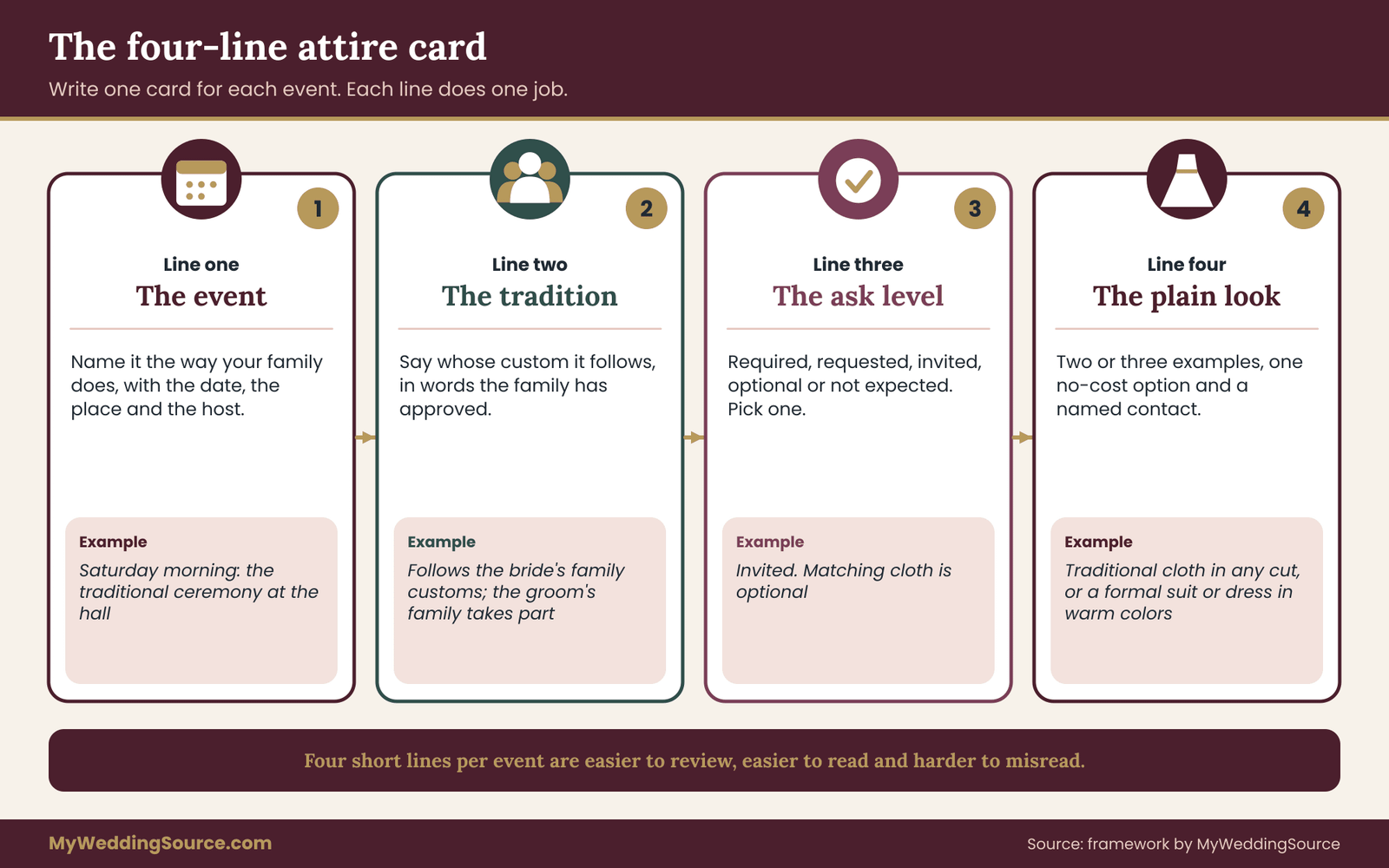
The reason to build a card per event is that Nigerian wedding attire expectations really do differ between events. The same guest might be asked for coordinated family cloth at the traditional ceremony, a suit or a dress for the church service, and whatever feels celebratory at the reception. Without cards, those distinctions collapse into one vague line.
A quick test for each card
Read each card as three different guests. A Nigerian cousin from the bride’s community should recognize her own tradition in line two and feel respected. A friend from work who has never attended a Nigerian wedding should know exactly what is being asked and what to do if she does not own the clothes. And a Nigerian guest from a different community should see that the card does not claim to speak for everyone.
If a card fails any of those three readings, rewrite line two or line four. Most failures come from line two being too broad or line four being too vague.
What to leave off the card
Some details do not belong on a public card. Private family discussions about who is wearing which cloth, the price of a family’s chosen fabric, and any disagreement between elders about customs should stay out of guest-facing text. The card states the decision, not the debate behind it. If there is a genuinely unresolved question, finish resolving it before the card goes out, and use a friendly “details to follow” note rather than guessing in public.
Keep the cards short enough that a guest can read all of them in a minute. A weekend with four events produces four cards of about forty words each. That length is long enough to carry the four lines and short enough to survive a phone screen.
The family review: who checks the wording and how to ask
A draft card is a proposal. It becomes guidance only after the people who know the tradition have read it. This step is the one that separates respectful wording from wording that merely sounds respectful, and it is the step couples most often skip because it feels awkward to hand an elder a piece of paper about clothes. Reviewing your Nigerian wedding attire draft is the step that separates accurate wording from wording that merely sounds respectful.
It does not need to be formal. It does need to be deliberate, and it needs to reach the right people.
Choose the right reviewers
You are looking for three kinds of reviewer. The first is a knowledgeable elder from each family, someone who has attended or hosted weddings in the tradition and whom other relatives respect on questions of custom.
The second is a practitioner of the specific ceremony, which might be a family elder, a master of ceremonies who handles traditional weddings, or the person your family hires to guide the rites. The third is a peer from your own generation who will read the wording as a guest would, someone who can say “this reads as pushy” or “I would not know what to wear.”
If a religious ceremony is part of the weekend, add the officiant or a leader from the congregation, because houses of worship often have their own norms for covering, modesty and footwear that the public wording should not contradict. Questions about who may officiate, and what an officiant expects of the couple, are covered in the officiant requirements guide mentioned earlier.
Avoid choosing a single “cultural expert” from outside the families. A friend who loves Nigerian fashion can be a good peer reader, but she cannot confirm that your family’s tradition works a certain way. Only the family can. Only the family can say what their Nigerian wedding attire customs actually require.
How to ask without making it a test
Hand people a specific, short document and ask a specific question. “Is this a fair description of how your side does the traditional ceremony?” is easier to answer than “What should people wear?” Sending only the cards, not the whole wedding plan, keeps the conversation on attire.
Here is wording you can adapt for a message or a call.
“We are writing the Nigerian wedding attire guidance for guests and we want to describe your family’s tradition correctly. Could you read these four lines about the traditional ceremony and tell us anything that is wrong, missing, or said in a way your family would not say it? We would rather fix it now than after it goes out.”
Notice what that does. It asks for corrections, which is easier to give than approval. It names the stakes honestly. And it gives the reviewer permission to be direct.
If an elder prefers to talk rather than read, take notes during the call and send them back for confirmation. That small loop, “here is what I heard, is it right?”, prevents the most common error, which is a well-meant paraphrase that changes the meaning.
What to ask each reviewer
Different reviewers can answer different questions. Keep your questions short and few. Each question below is aimed at one piece of the Nigerian wedding attire picture.
For the elders: Which garments or cloth are customary for the bride, groom and families at this ceremony? Are there colors that should be avoided, or colors that are reserved for the couple or the families? Are there items, such as head coverings, beads or caps, that carry meaning and should be worn only by certain people? Is there anything a guest might do with good intentions that would feel disrespectful?
For the ceremony practitioner: What does the sequence look like, and when do guests change or add items? Do guests need to be seated at particular times, or dressed at particular points? Are there parts of the ceremony where photography or movement is restricted?
For the peer reader: What did you understand from this? What would you have asked us? Where did you feel pressure?
For the officiant or congregation: What is the dress guidance at your place of worship, and is there wording you would like us to use or avoid?
Resolve disagreement before it is published
You may hear two answers that conflict. One elder says a color is fine, another says it is not. One says guests may wear their own regional dress, another says the ceremony should follow a single community’s style.
Do not average the answers or choose the one that is easiest. Take the disagreement back to the people involved, ideally to the couple’s own parents, and ask them to settle it, since it is their ceremony and their family’s name. The framework for sharing input without losing control, including who has the final say in each decision area, is in the guide to family decision rights.
If the disagreement cannot be settled, narrow the claim. Instead of “guests should wear X,” write “the bride’s family will wear X, and guests are welcome to dress in anything festive.” The wording can be honest about the family’s choices without prescribing guest behavior in an area where the families differ.
Record what was approved
When a reviewer approves a card, note who approved it and when, in a private document. This is not paperwork for its own sake. When a later question arrives, “Aunty said guests should wear white,” you can check what was actually said and by whom. It also lets you update only what changed when a detail is revised, rather than reopening every card. Keep this record with the rest of your Nigerian wedding attire notes.
Words that stereotype, and plain replacements
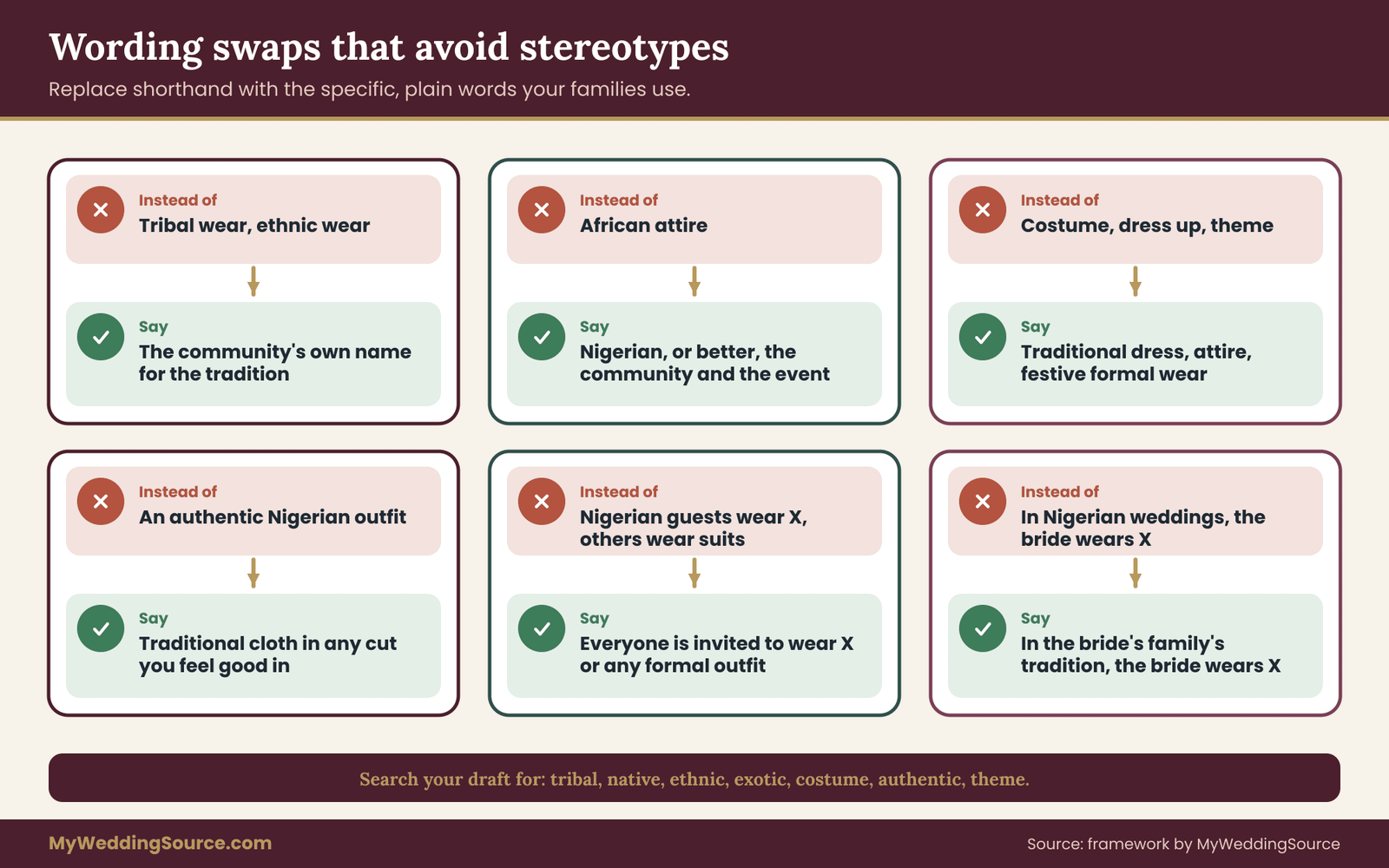
Wording problems are easiest to fix when you can see them. The list below groups the most common phrasing traps and offers plain replacements. The second infographic shows the same swaps visually, so you can use it as a checklist when you proofread. These swaps apply to any Nigerian wedding attire message, whether it is a card, a text or a caption.
“Tribal,” “native” and “ethnic wear”
“Tribal” and “ethnic wear” are catch-all labels that tell guests nothing and may offend people who find them dated or reductive. Replace them with the name of the tradition or community your family uses, for example the name of the specific people whose ceremony it is. If you do not know the right name, ask the family. If the ceremony blends two traditions, say so: “The traditional ceremony follows the customs of the bride’s family, and the groom’s family will take part in theirs.”
“African attire” used for Nigerian events
Africa is a continent of many countries and many more cultures. Using “African attire” when you mean something Nigerian, or something specific within Nigeria, is a flattening. Name Nigeria, or better, name the community and the ceremony. If you are inviting guests to wear a festive look and you do not mean any particular tradition, say “festive” or “colorful” without attaching a continent to it. If you mean Nigerian wedding attire, say Nigerian wedding attire, and then narrow it further when you can.
“Costume,” “dress up” and “theme”
Clothes worn at a family ceremony carry family meaning. “Costume” turns them into a prop, and “theme” turns the ceremony into an event design. Use “attire,” “dress” or “traditional dress” instead, and keep the language of celebration for the party rather than the rite. A sentence such as “We would love to see our guests in traditional dress for the ceremony” lands better than “Come in your best Nigerian costume.” Describing Nigerian wedding attire as a costume is one of the quickest ways to offend the people whose clothes they are.
“Authentic” and “real”
Telling guests to wear “authentic” Nigerian clothing creates a test nobody can pass. It also implies that other choices, such as a modern cut in traditional cloth or a tailor in the United States who made the garment, are somehow fake. Describe what you would like to see, such as “traditional cloth in a tailored cut,” and leave authenticity out of it.
“Everyone must” and “required” without a reason
Required attire is possible, and in some families it is genuinely important. But a requirement with no reason invites resentment. If a request is firm, give the reason in a short clause: “The family asks that guests at the ceremony wear the family’s chosen colors so that relatives can be seen together in the photographs.” If you cannot give a reason a guest would accept, soften the ask. A required item of Nigerian wedding attire should always come with a plain reason.
Assuming guests’ nationality or heritage
Avoid wording that sorts guests by background, such as “Nigerian guests, please wear traditional dress; other guests may wear suits.” It assumes you know who is Nigerian, assumes that Nigerian guests want to wear traditional dress, and places non-Nigerian guests in a second category. Write instead for everyone: “Guests are warmly invited to wear traditional dress or any formal attire they prefer.” Everyone can then choose.
Overpromising what the day will look like
Phrases such as “an authentic Nigerian wedding experience” suggest a performance for visitors. Describe what is happening instead: a traditional ceremony, a church service and a reception. Guests will understand the weekend from the schedule, and the event gets to be a wedding rather than a showcase. The same goes for any line that makes Nigerian wedding attire sound like entertainment.
Treating one family’s way as the national way
When a couple writes “In Nigerian weddings, the bride wears X,” they have made a general claim about a country on the strength of one family’s custom. Write “In the bride’s family’s tradition” or “At our ceremony” instead. This small change keeps the claim true and, in practice, makes guests more curious rather than less. Claims about Nigerian wedding attire in general are almost always claims about one family.
A short proofreading pass
When you proofread the cards, search the text for these words: tribal, native, ethnic, exotic, costume, authentic, real, theme, and the phrase “African attire.” Each hit deserves a second look. Then read the whole thing aloud, because spoken language catches condescension that written language hides.
Finally, check whether each time you wrote Nigerian wedding attire in a general sense, you could have written the name of a ceremony or a community instead. In nearly every case, you can, and the card improves when you do. The phrase Nigerian wedding attire is useful in a guide like this one, and in a title or a page heading, where you are naming the topic. In a guest-facing card, specific wording is almost always better than the topic label.
Describing Nigerian wedding attire by tradition without prescribing it
Once the events and the reviewers are settled, you reach the part everyone expects to be the hard part: describing the clothes. It is easier than it looks, because the method is to describe, not to prescribe. You say what the family will wear and what guests are welcome to wear, using vocabulary your family has confirmed, and you stop there. Describing Nigerian wedding attire is easier when you treat it as description rather than instruction.
The notes below are a general orientation to commonly discussed traditions. They are not a rulebook, and they are deliberately incomplete. Families differ within every community, customs change across generations and between Nigeria and the diaspora, and the people reviewing your wording are the authority on your own ceremony. Use this section to recognize vocabulary, not to supply it. For authoritative background on Nigerian textiles and dress, the museum resources in the sources list are a good starting point.

Yoruba traditions
In many Yoruba families, the traditional marriage ceremony is a major event with its own program, its own family roles and its own dress. Women commonly wear a wrapper and blouse, often called iro and buba, and many add a head tie called a gele. Men commonly wear a robe-style garment such as an agbada, or a shirt-and-trousers set often called buba and sokoto, and a cap often called a fila. The families frequently coordinate cloth, a practice known as aso ebi, which has its own section below because it is where most guest-facing wording goes wrong.
What this means for wording: if the ceremony follows Yoruba custom, you can say so, give two or three example garments in the family’s own words, and note whether the family is coordinating cloth. You should not say “Yoruba attire is required” unless the family genuinely means that, and in most families the better phrasing is an invitation to wear traditional dress and a description of what the families themselves will wear. For Nigerian wedding attire in a Yoruba ceremony, specific beats general every time.
Igbo traditions
In many Igbo families, the traditional marriage ceremony is built around a sequence of rites that families describe in detail, including the well-known wine-carrying ceremony often called igba nkwu. Dress varies by family and by role. Women may wear wrappers and blouses in coordinated cloth, with a head tie and, depending on the family, beads. Men may wear a long or short wrapper, or a garment such as the isiagu, a shirt with a distinctive pattern, together with a cap and, in some families, a ceremonial staff or beads that mark title or status.
What this means for wording: some of these items carry rank or title, and a guest wearing them without knowing what they mean could create an awkward moment for a family. Rather than inviting guests to wear “chief’s attire” or similar, describe the look at a general level and ask the family which items are best left to the people they are meant for. A line such as “Some items, such as caps and beads, have meaning in our family’s tradition; if you would like to wear them, please ask us first” is both honest and welcoming.
This is a good example of why Nigerian wedding attire cannot be summed up in a single sentence.
Hausa and northern traditions
In many Hausa families, men commonly wear a long, flowing robe often called a babban riga with a cap, and women commonly wear long wrappers or dresses with a head covering, with modesty customs that follow the family’s faith and practice. Marriage customs in northern communities often include several events spread over days, and some events may be separated by gender in ways that matter for guests.
What this means for wording: Nigerian wedding attire guidance for a Hausa or northern wedding should mention modest coverage and, where relevant, whether events are mixed or separate. Say this as a description of the event, not as a rule for guests, and invite questions. Where Islamic customs apply, the family may have specific expectations about covering, and the family or the imam is the right reviewer. Nigerian wedding attire in northern communities often involves modesty customs that deserve their own line.
Edo, Delta and south-south traditions
Edo, Urhobo, Itsekiri, Ijaw, Efik, Ibibio and other south-south communities each have their own wedding customs and dress. Beads, particularly coral beads in some Edo traditions, are significant and often belong to particular people or families. Wrapper styles, headwear and cloth choices differ by community.
What this means for wording: these traditions are often less familiar to general guests, which makes careful wording more important rather than less. Do not borrow vocabulary from another community because it is better known. Ask the family what they call each garment, which items are for the couple or the families only, and what guests may wear. If your reviewers cannot agree on how to describe it, fall back on a general description such as “traditional dress or festive formal attire” and let the ceremony itself carry the details.
When Nigerian wedding attire comes from a less familiar community, borrowed vocabulary does the most damage.
Blended and diaspora weddings
Many couples blend traditions: a Yoruba bride and an Igbo groom, a Nigerian bride and a groom from another country, or a Nigerian-American couple who want a ceremony that honors both families without being a performance of either. The wording here should say plainly that the ceremony blends traditions and name each. Do not apply one family’s dress style to the other family’s guests by default. Blended Nigerian wedding attire works best when each tradition is named and neither is treated as the default.
Diaspora weddings add practical constraints. Cloth and tailoring may have to be ordered from abroad. Local tailors may be unfamiliar with a particular cut. Venues in the United States may have rules about candles, open flame, drums or amplified music that affect the ceremony. For this reason, Nigerian wedding attire wording for a diaspora wedding is better sent earlier than for a local one.
A reliable way to describe a garment
For each tradition-specific garment, use the same three-part description, so the guidance stays consistent. Use the same pattern for every item of Nigerian wedding attire you describe.
First, the name your family uses, spelled the way your family spells it. Spellings and transliterations vary, and your family’s preference matters.
Second, a short plain-English description, such as “a long, wide-sleeved robe worn over matching trousers.” This is for guests who have never heard the name.
Third, a role marker: who wears it, at which event, and whether guests are invited to. “Worn by the groom and his brothers at the traditional ceremony; guests are welcome to wear a robe or a suit.”
That three-part pattern does two jobs. It teaches guests the vocabulary respectfully, and it prevents accidental assumptions about roles. It also reads as hospitality rather than instruction.
Avoid unreviewed shorthand
Do not copy vocabulary from articles, social media or wedding blogs without checking it with your family. Names for garments overlap and differ across regions, and a term that is correct in one community can be wrong, or even offensive, in another. If something is not in your family’s own vocabulary, leave it out. Unchecked terms are a common weak spot in Nigerian wedding attire wording.
Beads, caps and items with meaning
Some elements of Nigerian wedding attire carry meaning beyond fashion: beads that mark status or family, caps associated with titles or roles, cloth reserved for the couple or the families. These items are best handled with a simple rule. Describe them to guests only at the level your family approves, and say whether guests are welcome to wear them. If you are unsure, the safest wording is that “certain items carry meaning in our family; we have noted below which are for the family and which are open to everyone.”
This also protects guests. A non-Nigerian guest who buys beads online and wears them to a ceremony with good intentions can accidentally wear something associated with a title or role. A single line of guidance prevents that.
Modern and mixed styles
Plenty of guests and families wear modern cuts in traditional cloth, such as tailored dresses, jumpsuits, sets with contemporary silhouettes, and suits with a cloth accent. These are normal choices in the community and should be welcomed in your wording. If your wording implies that only a classic cut counts, you will push guests toward expense and stress for no reason. A phrase such as “traditional cloth in any cut you feel good in” tells guests they have room. Modern cuts are a normal part of Nigerian wedding attire today and your wording should treat them that way.
Reading your own family back
After you have drafted each tradition description, ask the reviewing elder to read it back to you in their own words. If they paraphrase it differently from what you wrote, the difference tells you where the wording is unclear. Adjust until their paraphrase matches your intention.
This is also the right moment to decide how much detail guests need. A guest-facing website does not need a full account of a ceremony’s meaning, and some families prefer that sacred details stay within the family. A good rule is to tell guests what they need in order to dress and behave comfortably, and no more than the family wants published. That principle also governs photography at religious and cultural ceremonies, which is covered in the guide to wedding photography consent on this site.
Aso ebi in Nigerian wedding attire: wording, cost and fairness
Aso ebi is a Yoruba phrase commonly understood to mean family cloth, and the practice of friends and relatives wearing matching fabric at a celebration is widespread across Nigeria and the diaspora, well beyond the Yoruba community. A family or couple chooses a cloth, makes it available to guests, and those who join in wear it, usually sewn into an outfit of their own design. At a large celebration the result is a visible sea of matching color that says who is with whom. Few topics in Nigerian wedding attire generate as many questions from guests.
For many families this is one of the best parts of the day. For many guests it is also the most expensive part of Nigerian wedding attire, and the part with the most deadlines. That combination is why the wording here deserves its own section. Most complaints about Nigerian wedding attire guidance are really complaints about an unclear aso ebi request.
What a guest needs to know
A guest asked to join in matching cloth needs six facts. If any one is missing, the request is incomplete. Treat the aso ebi request as a small product description inside your Nigerian wedding attire page.
What the cloth is, in a photograph or swatch, and its colors. How much it costs and what that price covers: a set length of fabric, a head tie, a matching accessory. Where and how to buy it, and from whom. By what date the guest has to order. How much time to allow for tailoring, and whether the family can recommend a tailor. And what the guest can do if they would rather not take part.
Missing the last one is the most common problem. A request that cannot be declined is not a request, and a guest who feels cornered will either comply resentfully or avoid the event. A single sentence such as “Joining in is entirely optional, and you are welcome to wear any formal or festive outfit in similar colors” resolves it.
Who is asking, and on whose behalf
Aso ebi may be arranged by the couple, by one family, by a group of friends, or by several of these separately. A bride may have one cloth for her side, another for her friends, and a third for the groom’s family. The wording should make clear who is asking whom. “The bride’s family is offering cloth in green and gold to relatives and close friends” is better than “Please wear green and gold.” The first tells each guest whether the request is addressed to them. The second assumes everyone is included.
Make the source of each cloth clear on the Nigerian wedding attire page.
If several cloths are offered, show them side by side on one page with a short label for each. Guests then see the full picture and do not have to hunt through messages to discover that a second cloth exists.
The cost question
Money is the part of aso ebi that couples most often handle badly, mostly out of embarrassment. Three principles keep it fair. Honest cost wording is one of the kindest things you can do for guests in any Nigerian wedding attire plan.
First, state the cost up front, in the same place as the swatch. Guests should never have to ask. If the cost is subsidized by the families, say so in a neutral way; if not, say that too.
Second, treat the cloth cost and the tailoring cost as separate, because they are. A guest who buys the cloth still has to pay a tailor, and at busy times of year tailors are booked weeks ahead. The wording should remind guests that tailoring costs extra and takes time, so nobody is surprised.
Third, offer a path that costs nothing. The cleanest version is a sentence that says a guest can wear something they already own in a matching color family, or any formal outfit, and will be just as welcome. If the family is truly open to this, the wording should say so without hedging. If the family would prefer that close relatives match exactly, narrow the request to those people instead of the whole guest list.
Describing costs in general terms is fine, but do not quote prices you have not confirmed. When you list a price, source it from the seller or the tailor, and say that prices were confirmed on a particular date. Fabric prices vary by supplier and season, and you should not guess.
Timing: the part that is easiest to get wrong
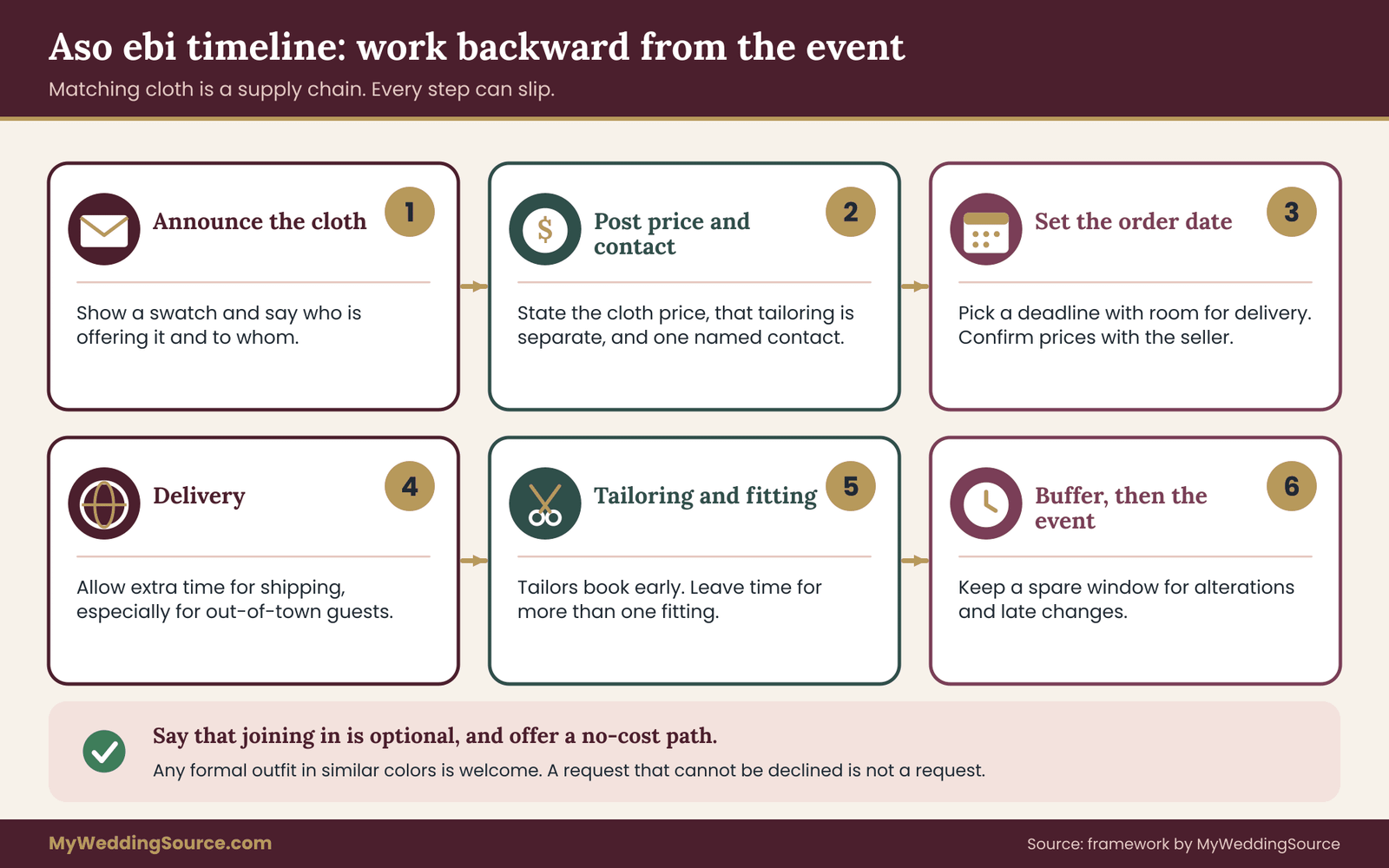
Aso ebi is a supply chain. Cloth has to be ordered, often from overseas or from a specific supplier, then delivered, then taken to a tailor, then fitted, then adjusted. Each step can slip. A good Nigerian wedding attire message therefore works backward from the event date. Nigerian wedding attire that involves matching cloth needs a calendar, not just a description.
Choose the date by which cloth has to be ordered, leave generous time for delivery, leave generous time for tailoring, and add a buffer for alterations. Then send the first message early enough that guests who want to participate can do so without paying rush fees. For couples with guests traveling from other states or countries, shipping adds time, and the alterations guide at wedding dress fit and alterations explains why fittings tend to take longer than people expect, a point that applies to guest outfits as well.
If you are collecting orders yourself, decide in advance who handles the money and the paperwork. Name one person, give a clear way to ask questions, and keep a simple record of who ordered what. This is where small misunderstandings cost money, and a spreadsheet kept by one reliable cousin prevents most of them.
Coordinating with guests who sew or shop locally
Some guests will want to make or buy their own outfit in coordinating colors rather than purchase the family cloth. The wording can help by describing the color range clearly, perhaps with a swatch image, and by saying that close matches are welcome. “A similar shade is fine” is a kind sentence, and it prevents a lot of worry.
Inclusion and fairness
A matching-cloth request can create two classes of guest: those in the cloth and those who are not. Think about how that will feel at the ceremony and in photographs. Some families like the visible grouping; others prefer that everyone feel equally part of the day. If the second, say that cloth is available but not expected, and avoid seating or photograph arrangements that segregate by cloth. The family photo list guide explains how to plan group photographs so that nobody is left out of the shot. Fairness is part of good Nigerian wedding attire wording, not an extra.
When the cloth is the couple’s gift
Some families give the cloth to close relatives rather than selling it. This is generous, and it also changes the wording: say that the cloth is provided, say who is receiving it, and say whether tailoring is covered. If tailoring is not covered, say so, because “free cloth” can be misheard as “free outfit.” Keep the two ideas separate in your message. Say clearly in the Nigerian wedding attire notes what the gift includes.
When guests decline
Some guests will decline, and the right response is warmth. Do not ask guests to explain, and do not send reminders to people who have said no. A short reply, “Thank you for letting us know, we will be glad to see you in whatever you wear,” is enough. Keep a record of who has declined, so that no one hears about it a second time.
Resale, returns and leftover cloth
If you are purchasing cloth in bulk, find out the seller’s return and refund terms in writing before ordering, because custom or printed fabrics are often non-returnable. Decide in advance what happens to leftover cloth. If you are acting as an intermediary, make it clear whether you earn anything from the sale. The Federal Trade Commission publishes general consumer guidance on fair dealing, and if you are handling other people’s money for a group order, being transparent about prices and terms protects both you and your relatives. Never add a markup without telling people.
Group orders are a quiet risk in Nigerian wedding attire planning, so keep the terms in writing.
A worked sentence for the aso ebi section
Here is a way to put the key facts in a few lines that a guest can read at a glance: “The bride’s family is offering cloth in deep green and gold to relatives and close friends who would like to match at the traditional ceremony. The cloth is available through one named relative at a price listed on this page, and tailoring is arranged and paid separately. Please order by the date shown so there is time for sewing. Joining in is optional, and you are warmly welcome in any formal or festive outfit.”
That paragraph names who is asking, what is offered, where to get it, what it costs, how to buy, the deadline, and the option to decline, in about eighty words. It is the standard to hold every aso ebi message to, and it is the kind of sentence a Nigerian wedding attire guide should leave readers able to write on their own.
Fit, fabric, weather and access in Nigerian wedding attire
Attire guidance that only describes how things look misses half of what guests need to know. They also want to know whether they will be comfortable, whether the outfit will fit through a door or a car, and whether the venue will let them wear it. This section covers the practical details that turn a good description into usable guidance.
Weather, season and the heat problem
Nigerian wedding attire often uses substantial cloth, layered pieces and head ties, and a layered outfit can be punishing in a hot room or an outdoor tent. A ceremony in a July afternoon is a different proposition from a ceremony in a November evening. The wording should mention the season and the setting plainly, for instance “the traditional ceremony is outdoors in the afternoon, so lighter fabrics are a good idea,” and should not leave guests to find out by sweating.
The Centers for Disease Control and Prevention publishes general guidance on staying safe in hot weather, and if your event is outdoors in a warm month it is worth reading, especially for older relatives, children and anyone who will be standing for a long time. Pair the Nigerian wedding attire wording with a practical note about shade, water and seating, because clothing guidance and comfort planning belong together.
For cold weather, the same logic applies: say whether the ceremony is indoors, whether there is a coat check, and whether wraps and shawls are welcome. Your venue or planner can answer these questions, and so can anyone who has planned for older relatives and children before.
Size, fit and body-friendly language
Wording about attire should leave every body room. Avoid phrases that suggest a single silhouette, and do not describe garments as “flattering” or “slimming.” When you give example garments, describe a range: wrapper sets that tie rather than fit, loose robes, tailored sets, and separates. Tell guests that tailors can adjust any of these and that many people choose cuts that suit their own comfort. Nigerian wedding attire wording should leave every body room.
Tailoring for plus sizes, pregnancy or recovery from surgery may need more fitting time, so mention that the earlier dates are for everyone and that anyone who needs extra fitting time should feel free to tell you. You do not need to ask guests for reasons. A neutral sentence such as “If you need extra time or a different cut, tell us and we will help” is enough.
Mobility, accessibility and shoes
Many ceremonies involve standing, dancing, processions or walking on uneven ground. Long wrappers can be a tripping hazard on stairs, heavy headwear can be tiring, and high heels are difficult on grass. Mention the ground surface and any steps in your Nigerian wedding attire notes, and say that comfortable shoes are welcome. If the ceremony involves dancing or a procession, say so. Think about how Nigerian wedding attire behaves on stairs, grass and dance floors.
Guests who use wheelchairs, walkers or canes should not need to ask permission to dress in ways that work for them. Say that mobility aids are welcome and that any outfit is fine as long as the person can move comfortably. The Americans with Disabilities Act sets accessibility rules for many venues, and the ADA website explains what places of public accommodation must provide, which is useful background if you are choosing a venue with guests who have mobility needs.
Children and teenagers
Children are often asked to match the family, and the same cost-and-timing questions apply. Say whether children are included in any cloth offer, say that comfort matters, and note that children grow quickly and may need alterations or a second fitting. If children are not expected to match, say so, because parents will otherwise assume they are.
Photography and color
Matching color is partly a photographic choice. If the family wants a consistent look in photographs, say which events are photographed and which colors are intended for which groups. If photographers will be present at the traditional ceremony, tell guests so that they can feel comfortable, and if there are restrictions on photographing certain moments, include them in the card. Questions of color across the whole wedding, including the reception, are covered in the wedding color palette guide.
One practical point: white is often reserved or expected for the bride at some events, and other colors may be chosen by the families for other roles. If white, or any other color, is off-limits to guests, say so in the wording, with a reason. Guests are generally happy to avoid a color when they know why.
Venue rules that affect attire
Some venues restrict candles, open flames, confetti, drums, or amplified music, and some restrict certain items such as ceremonial staffs. Others have dress policies for religious buildings. Confirm each with the venue in writing before you finalize the wording, and keep the venue’s reply with your records. If a ceremonial item is important to the tradition, check early whether the venue allows it, because a refusal at the last minute leaves little time to adapt. Venue limits can reshape Nigerian wedding attire plans, so ask before you publish.
If your venue shares space with other events, check whether your guests will pass through public areas in ceremonial dress and whether the venue has any rules about outfits in common areas.
Faith settings, head coverings and modesty wording
Nigerian weddings often include a religious ceremony. Christian services, Muslim marriage rites and, in some families, ceremonies tied to traditional religion each carry their own expectations for dress and conduct. The attire card for the religious event should be written with the place of worship, not just the couple. Nigerian wedding attire for a religious event should follow the place of worship.
Christian services
Many Nigerian Christian congregations expect formal, modest attire, and some expect women to cover their heads or wear a head tie. Others have no such expectation. Ask the clergy. If the service follows the congregation’s custom and the congregation has a written dress guide, link to it or quote the key line in your own words. Keep the card practical: “The service is formal. Many women wear a head tie, and it is optional for guests.”
If the wedding is interfaith, with a Christian service for one family and a different rite for the other, treat each as its own event with its own reviewer. The guide to interfaith wedding ceremony planning explains how to give each ritual a clear owner so that attire does not become a proxy argument about whose tradition leads.
Muslim marriage rites
For a Muslim marriage ceremony, expectations about covering for both women and men, about footwear at the entrance, and about the separation of men and women in some settings can matter a great deal to the families. Ask the family or the imam what to say to guests, and write it as information about the event. A line such as “Modest dress is customary at this ceremony, and women may wish to bring a scarf” informs without instructing. Provide a few spare scarves at the entrance if the family agrees, so that nobody is turned away for want of one.
Nigerian wedding attire for a Muslim ceremony should be described with the family and the imam.
Court and civil ceremonies
Many couples complete the legal marriage at a courthouse or registry, with little ceremony. Courthouse dress norms vary, and you can check with the clerk’s office. The USAGov marriage license page is the place to start for how to find the office that handles licenses in your state. Attire for a civil ceremony is usually simple, but if you plan to wear traditional dress to the courthouse, mention it so guests do not feel underdressed.
Mixed audiences and respectful language
When a religious ceremony draws guests from several faiths or none, the card should offer the practical facts, such as covering, footwear and quiet during the service, and leave doctrine out of it. A line such as “Guests of all backgrounds are welcome. Here is what to expect at the entrance” sets the right tone.
Writing the modesty line
Modesty wording can slide into judgment very quickly. Avoid language that implies a guest’s usual clothing is inappropriate. Describe what the space is like and what the family’s customs are, then let guests decide. “Shoulders and knees covered” is a clear request; “dress respectfully” leaves guests guessing and may sound like a rebuke. Nigerian wedding attire notes about modesty should describe, never judge.
A short checklist for faith settings
Before you publish a card for a religious event, confirm in writing with the person who runs the space: what covering is expected, whether it is expected of all guests or only some, whether shoes are removed, whether the space is separated by gender, whether photography is allowed, and whether the ceremony has times when guests stand, kneel or move. Add only what the leader approves, and thank them.
Guests who are not Nigerian: inviting without making a costume of it
A large share of weddings that include Nigerian traditions also include guests who are not Nigerian: the other partner’s family, friends, colleagues, neighbors. Many of them will be delighted to take part, and many will be anxious about getting it wrong. The wording is what decides which of those feelings they arrive with. Clear Nigerian wedding attire wording is what helps those guests arrive relaxed.
The balance to strike is hospitality without pressure. You want guests to know that they are welcome to wear traditional dress, that doing so is an honor to the family, and that choosing not to is perfectly acceptable. You also want to keep them from stumbling into the very mistakes this article is about.
Set the ask level honestly
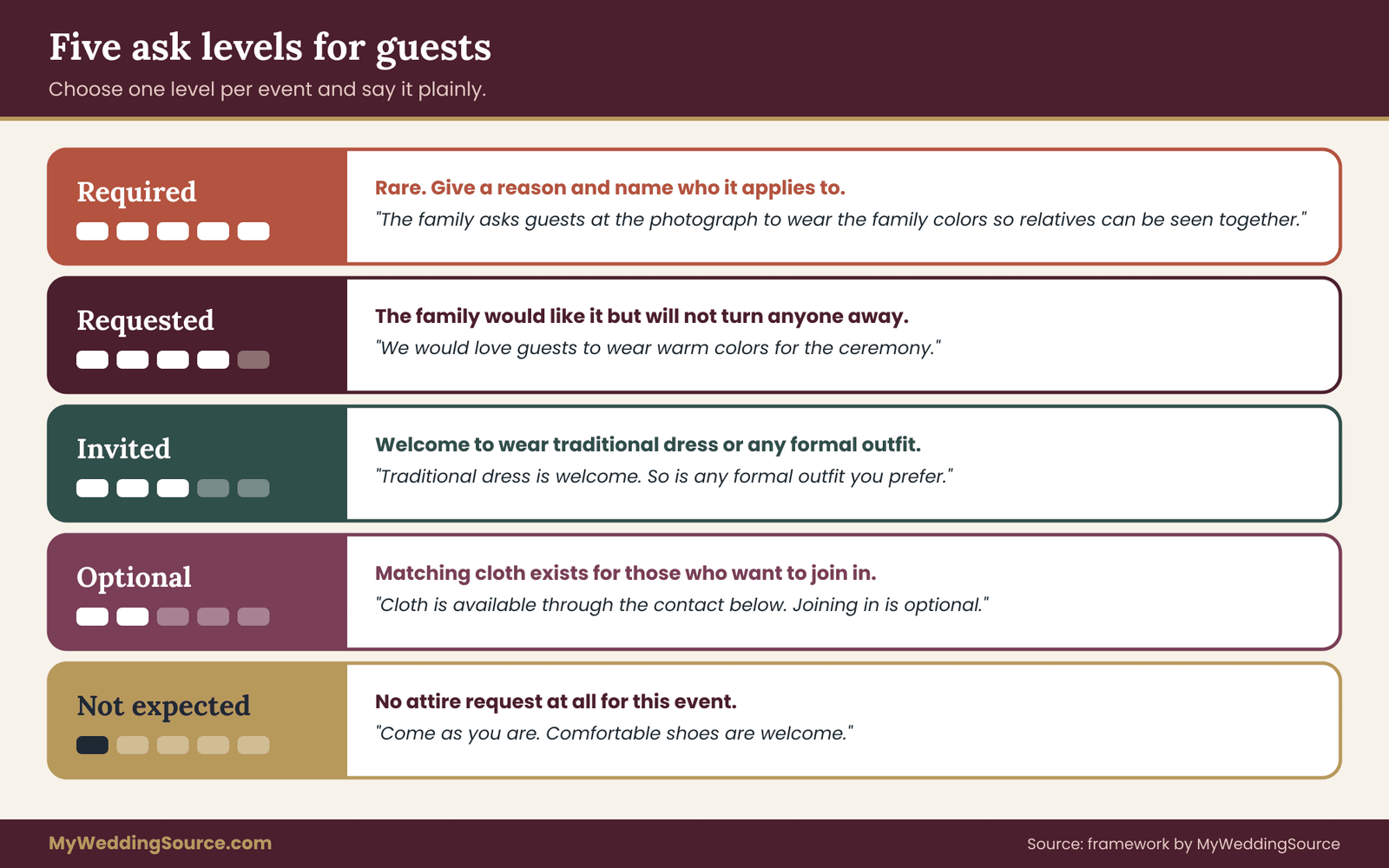
The most useful single decision in the whole process is the ask level for each event. Five levels cover almost every case, and the fifth infographic shows them as a ladder. Every card about Nigerian wedding attire should show its ask level.
Required means the family genuinely expects it. Use this rarely, give a reason, and make sure it applies to the right people. Requested means the family would like guests to follow the guidance but will not turn anyone away. Invited means guests are welcome to wear traditional dress or any formal outfit. Optional means a matching cloth or color is available for those who want to join in. Not expected means the family has no attire request for the event at all.
Most guest-facing events are best described as invited or optional. Reserve required and requested for the parts of the day where the family has a real reason, such as a family photograph in coordinated cloth. Using the right level for each event protects you from the single most frequent complaint: that guests were told one thing and expected to do another.
Wording for non-Nigerian guests, in plain language
You do not need a separate message for non-Nigerian guests, and in fact separate messages can sort people in ways that feel uncomfortable. A single message, written for everyone, usually works better. It can include a brief friendly paragraph that answers the questions newcomers tend to have. One message about Nigerian wedding attire, written for everyone, is usually enough.
For example: “If you have not been to a Nigerian wedding before, welcome. Many guests wear traditional cloth, and you are warmly invited to do the same. You are equally welcome in a suit, a dress or any formal outfit. If you would like to wear traditional dress and are not sure where to start, write to the person named below and we will happily point you in the right direction.”
That paragraph welcomes, reassures and offers help. It does not tell the guest what they are, and it does not make them feel they are a visitor to a performance.
Respect without stiffness
Non-Nigerian guests who choose to wear traditional dress are doing something generous, and the wording can say so. What it should not do is imply that wearing the clothes makes someone an insider, or that not wearing them makes someone an outsider. The difference is subtle but important: gratitude, not judgment.
It helps to offer a guide to buying respectfully. Suggest that guests buy from Nigerian designers, tailors or vendors where possible, or from the vendor the family recommends, rather than from mass-produced imitations. This is a kind way to support the community, and it also usually yields better clothes. Phrase it as a tip, not a rule.
Items to leave to the family
Some elements of Nigerian wedding attire carry specific meaning, as noted earlier: certain caps, beads, staffs and cloths are associated with title, role or family. Tell guests plainly that these items are best left to the people they belong to, and give a reason. “Some beads and caps are tied to family roles, so please leave those to the family” is respectful and clear. Most guests will be relieved to have a boundary, since they did not want to guess.
What if a guest wears something you did not expect
Sometimes a guest will arrive in something you did not anticipate: a garment from another Nigerian community, a mix of styles, or a piece that is not customary at the event. In nearly every case the right response is to say nothing. The best planners treat guest outfits as gifts, and a wedding is not the place to correct them. If a particular item would cause real offense to an elder, the family can handle it quietly and privately, but that situation should be rare if your guidance was clear.
Guest choices about Nigerian wedding attire are not yours to grade.
Wording for the “no costume” worry
Some couples worry about the opposite risk: that non-Nigerian guests will arrive in clothes that read as costume. You can reduce this risk with wording rather than rules. Describe garments with their real names, show real photographs of the cloth, and say that guests are welcome to dress in the way that feels natural to them. A guest who sees photographs of how family members will dress, taken from real life rather than from a costume catalogue, has the information they need to make a thoughtful choice.
Plus-ones, children and out-of-town guests
Guests who bring partners or children will want to know whether the Nigerian wedding attire guidance applies to them. State it plainly: “This applies to everyone in your party” or “Children are welcome in anything comfortable.” Out-of-town guests also benefit from knowing whether the family can recommend a tailor or a shop near the venue, and whether any outfits can be rented or borrowed. If a family member can lend a head tie or a wrap, say so, since this is a common and generous solution.
Where Nigerian wedding attire wording lives: invitation, website, texts and RSVP
Having drafted and reviewed the cards, you have to put them somewhere guests will actually find them. Wording that is accurate but buried is almost as unhelpful as wording that is wrong. Each channel has a different job. Where Nigerian wedding attire wording appears matters nearly as much as what it says.
The invitation
The invitation should carry a light touch. A single line such as “Attire details are on our wedding website” is usually enough, and it avoids cramming a full explanation onto a card. If the invitation is for the traditional ceremony only, a short phrase such as “Traditional dress welcome” is acceptable, but only if the website supplies the details. The wedding invitation etiquette guide covers wording norms for invitations in general.
Avoid the temptation to use the invitation to impose requirements. A printed requirement cannot be corrected without reprinting, and it reaches guests before you have had a chance to explain anything.
The wedding website
The website is where the full cards live. Create a page called “What to wear” or “Attire” and put the cards in event order, each with its four lines. Add photographs of garments, labeled with the names your family uses, and the swatches for any matching cloth. State the contact person, the dates for ordering and tailoring, and the no-cost option. Keep all Nigerian wedding attire information on one page so guests never have to hunt.
Make the page easy to read on a phone, because most guests will check it that way. Keep each card short and use clear headings. If your site supports it, add a short FAQ for the questions you receive most often. Update the page when anything changes, and say when it was last updated, so that guests know they are reading the current version.
Reminder messages
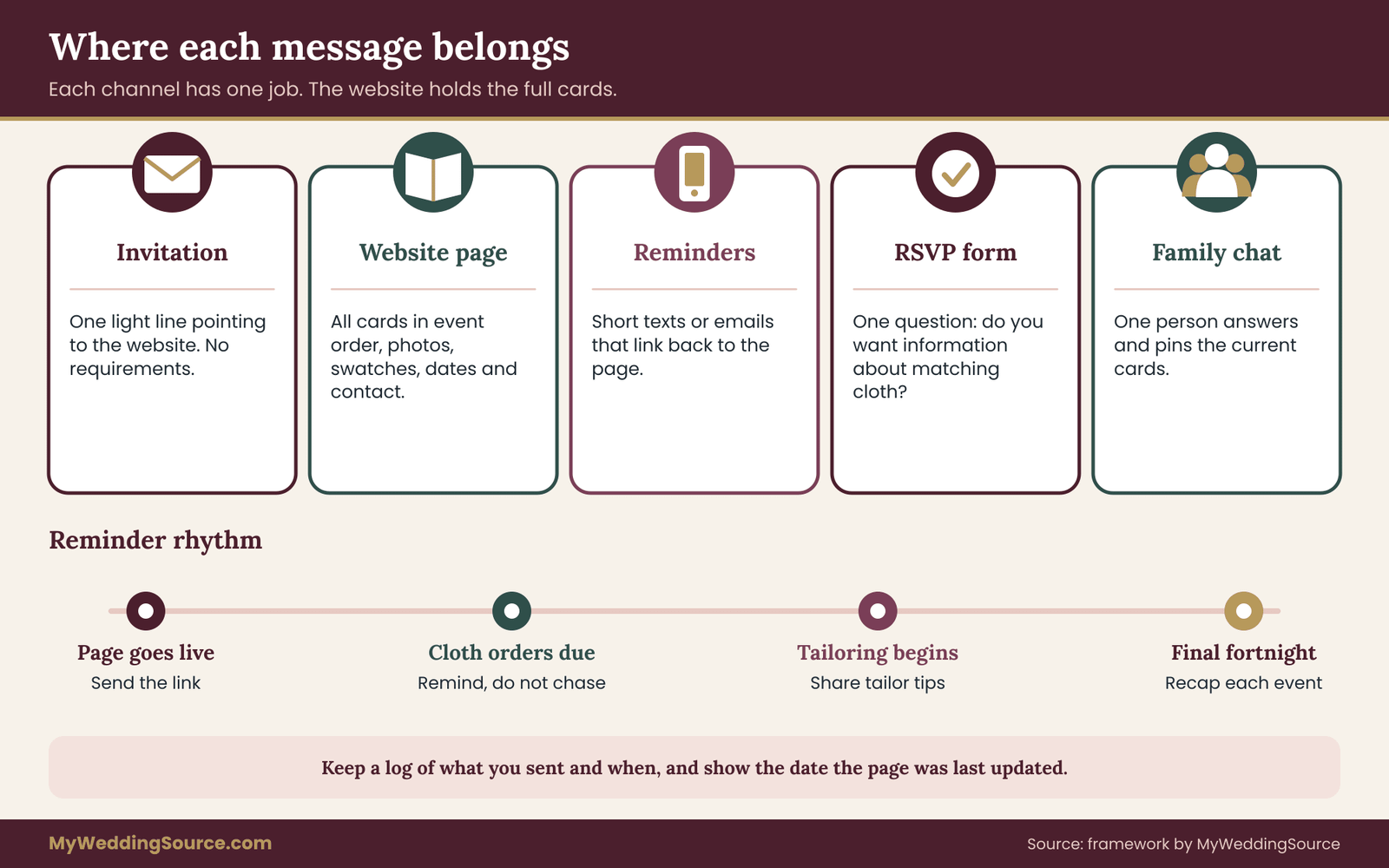
A short text or email, sent at planned intervals, reminds guests of key dates and gives them a chance to ask questions. A sensible rhythm is one message when the website goes live, one when cloth orders are due, one when tailoring should begin, and one in the final fortnight with a recap of each event, its attire, and the practical details. Each message should link back to the website page rather than repeating all of it. The sixth infographic shows this rhythm.
Keep a log of what you sent and when. If a guest says they never got a message, you can check, and you can send it again without arguments.
The RSVP
An RSVP form is a good place to ask a practical question: “Would you like information about matching cloth?” A yes or no lets you prepare without guessing, and it gives guests a quiet way to opt in. Do not ask guests whether they will wear traditional dress, since that sorts them and may put pressure on them. Ask about cloth orders only if cloth is genuinely being coordinated. The RSVP etiquette guide explains how to handle questions and deadlines in a way that keeps guests comfortable.
The family WhatsApp group and other chats
Many families coordinate through group chats, and Nigerian wedding attire questions will appear there whether you invite them or not. It helps to appoint one person to answer Nigerian wedding attire questions and to pin the current cards at the top of the chat. Ask relatives to direct questions to that person, so that you do not have six different answers circulating. If an elder gives an answer that differs from the website, resolve the difference quietly and update the page, rather than correcting the elder in public.
Translating and adapting the wording
If some guests read another language more comfortably than English, offer a translation of the cards. Ask a fluent family member to do it, not a machine, because attire vocabulary translates badly, and check the translation with the same reviewers. Keep both versions on the same page, with the same update date.
Accessibility of the page itself
Use plain text for the cards, not only images, so that screen readers can read them. Describe photographs in alt text. Make sure colors in any graphic are not the only way a guest can tell cloths apart. These are small steps, and they keep the page usable for people with low vision.
A worked example: the Okonkwo and Reyes weekend
The following example is invented to show how the method works. The couple, the families and the events are made up, and the details are illustrative rather than a template for any real tradition. Your own families’ answers always come first.
Adaeze Okonkwo and Marcus Reyes are planning a weekend wedding in a mid-sized American city. Adaeze’s family is Igbo and has strong feelings about the traditional ceremony. Marcus’s family is Mexican American and has never attended a Nigerian wedding. Adaeze’s mother is the main family reviewer. Her cousin, who helps run a friend’s wedding events, is the practitioner reviewer, and Marcus’s sister is the peer reader.
Step one: the event list
They write four events. Friday evening is a small family gathering at a restaurant. Saturday morning is the traditional ceremony at a rented hall, following the customs of Adaeze’s family. Saturday afternoon is a church service, with a reception that evening. Sunday is a thanksgiving brunch.
Step two: the cards
For the traditional ceremony, the card reads in four lines. The event: the traditional ceremony on Saturday morning at the hall. The tradition: it follows the customs of the bride’s Igbo family, with the groom’s family taking part. The ask level: invited, with matching cloth optional for relatives and close friends. The look: traditional cloth in any cut, or a formal suit or dress in warm colors, with swatch photographs and a contact person for questions.
For the church service, the card is short. The service is formal. Many guests wear traditional cloth or a suit, and a head covering is optional. The ask level is not expected, since the service has its own dress norms.
For the reception, the card says festive formal, any outfit that feels celebratory, and comfortable shoes for dancing. For Friday and Sunday, the card says casual and comfortable.
Step three: the family review
Adaeze sends the cards to her mother, with a short note asking what is wrong or missing. Her mother changes one line: she wants guests to leave certain beads and caps to the family, and she wants a sentence explaining why. Adaeze adds it and sends the revised card to her cousin, who asks whether the hall allows the procession drums. They check with the hall in writing and add a note about volume and timing.
Marcus’s sister reads the cards as a guest. She says she would not know whether to buy cloth, that she was worried about wearing something wrong, and that the wording about beads helped. She asks for a line saying that borrowed head ties are available, and the family agrees.
Step four: the cloth and the timing
Adaeze’s family offers one cloth to relatives and close friends, in green and gold. They name an aunt as the contact, list the price confirmed by the supplier, state that tailoring is separate, and set an order date well ahead of the weekend. They add the no-cost option: wear any outfit in warm colors, and there is no obligation. The aunt keeps a simple list of who has ordered. A few guests ask about the cost, and the aunt answers with the same wording each time.
The fourth infographic’s timeline is the one they adapt, counting backward from the Saturday ceremony.
Step five: publish and maintain
The couple publishes the cards on the wedding website under “What to wear,” with garment photographs labeled with the family’s own spellings. The invitation carries a single line directing guests to the page. Reminder messages go out when the page goes live, when cloth orders are due, when tailoring should begin, and in the final fortnight. The RSVP asks only whether the guest wants cloth information.
Two weeks before the wedding, a relative asks in the family chat whether guests must wear green. The designated contact answers with a link to the card, which says green and gold are for those who choose the family cloth, and that any warm color is welcome. The question closes in one reply.

What the example shows
Three things stand out. The couple never wrote a single line that said “Nigerian attire.” Every card named an event, a tradition and an ask level. And most of the work happened in conversations with the family, not in the writing. The final wording is short, because the thinking behind it was careful. The method works for any Nigerian wedding attire plan, because it asks for specifics.
Verification, limits and when the wording needs to change
No guide, including this one, can certify that wording is right for your families. What it can do is give you a method that makes mistakes less likely and easier to catch. This section covers what to verify, what the limits are, and when to revisit the cards. This applies to every guide to Nigerian wedding attire, including this one.
What to verify, and with whom
Verify tradition-specific details with your own families and, where relevant, the officiant or religious leader. Verify venue rules with the venue, in writing. Verify prices and delivery dates with the seller or tailor, in writing.
Verify accessibility questions with the venue and, where appropriate, the guests concerned. For a marriage license and the legal side of the ceremony, the USAGov marriage license page points to the correct state or local office, and that office is the authority on its own requirements and fees. Do not rely on a blog, including this one, for a figure that an agency or vendor publishes.
What this guide cannot tell you
It cannot tell you what your family’s tradition requires. It cannot speak for every Nigerian community, which differ from one another and within themselves. It cannot tell you what a particular garment means in a particular family. And it cannot replace a conversation with the elders. If a statement here conflicts with what your family says, your family is right and this guide is not.
The examples in this article are deliberately general. Some families will recognize what is described and some will not. Treat the differences as information about your own family’s choices, not as errors on anyone’s part.
Disclosure and independence
If you work with a wedding planner, a cultural consultant or a vendor who is paid to recommend particular products, ask them to disclose that relationship. Consumer protection guidance from the Federal Trade Commission treats clear disclosure of material connections as a basic expectation for endorsements. This matters for attire because fabric and tailoring are often sold through personal networks, and a guest deserves to know whether a recommendation comes with a commission.
When to revisit the cards
Revisit the wording whenever something changes: the date or venue, the weather forecast, the family’s decisions about cloth, a new reviewer’s comments, or a guest’s question that reveals a gap. A short list of triggers keeps the page current without constant checking. After the wedding, keep a copy of the final cards with your other records. If you ever help a friend or a relative plan a similar event, the cards are a good starting point, though they will still need review by that family’s elders.
A final check before publishing
Before you send the cards out, read them once more with one question in mind: would the elder who reviewed them be comfortable seeing them on a screen in front of the whole family? If yes, you are done. If you hesitate, find out why, and fix it.
Your next steps
Start with a single evening. Write the list of events your families use, with dates, venues and hosts. Add the tradition each event follows, in the words your families use. Then write a four-line card for the first event and send it to one elder with a short note asking for corrections. Nigerian wedding attire wording is built one event at a time.
Over the following weeks, work through the other events, settle the ask levels, and decide whether matching cloth is part of the plan. If it is, confirm prices, ordering dates and tailoring timelines with the seller and a tailor before announcing anything. Put the cards on your website, link them from the invitation, and set the reminder dates in your calendar. Keep one named contact for questions.
If any point in the wording makes a family member uneasy, treat that as the most useful feedback you will get, and change it. Clear, specific and kind wording is within reach, and it is mostly a matter of asking the right people early.
FAQ
Is it acceptable to ask guests to wear Nigerian attire?
Yes, if you say which ceremony, whose tradition it follows and how firmly you are asking. A warm invitation is usually better than a requirement. Include a no-cost option such as formal wear in warm colors. A single line that just says “Nigerian attire” leaves guests guessing which community and which event you mean, so replace it with a short card for each event.
What should I call it instead of “African attire” or “tribal dress”?
Use the name your family uses for the tradition and the ceremony, such as the community’s own name for the event, and plain words like traditional dress or festive formal attire. “Tribal” and “African attire” are broad labels that many people find flattening. If you are unsure of the right term, ask an elder in the family and use their phrasing.
How early should we send Nigerian wedding attire guidance if there is matching cloth?
Earlier than feels necessary. Cloth must be ordered, delivered, taken to a tailor and fitted, and each step can slip. Work backward from the event date, add a buffer for alterations, and publish the first message when the ordering date is still comfortably ahead. Guests traveling from other regions need extra time, since shipping and fittings take longer than people expect.
Do non-Nigerian guests have to wear traditional dress?
No, unless the family has a specific reason and says so. Most couples do better inviting rather than requiring. Say that traditional dress is welcome, that any formal outfit is equally welcome, and name a person who can answer questions. Mention that some caps, beads and similar items carry meaning in certain families and are best left to the family unless you have asked first.
How do we handle aso ebi costs fairly?
State the price in the same place as the cloth swatch, separate the cost of cloth from the cost of tailoring, give an ordering deadline, and offer a clear way to opt out. Confirm prices with the seller instead of estimating. If the family is giving cloth to close relatives, say so, and say whether tailoring is included. Keep the request optional unless there is a firm reason otherwise.
Who should review our wording before we publish it?
At least one knowledgeable elder from each family, someone who knows the specific ceremony, and a peer who reads as a guest would. Add the officiant or a congregation leader for a religious service. Ask them to correct errors, not simply approve. A friend who loves Nigerian fashion can help as a reader, but cannot confirm your family’s own customs.
What if our families describe the dress differently?
Take the disagreement back to the people involved, ideally the couple’s parents, and ask them to settle it. If they cannot, narrow the claim. Write what each family will wear and tell guests they are welcome in any festive formal outfit. Do not average two answers into something neither family recognizes, since that often pleases nobody.
Where should the Nigerian wedding attire details go?
Put the full cards on a wedding website page, listed by event, and keep the invitation to a single line pointing there. Send short reminder messages that link to the page, and name one person to answer questions. Use plain text so screen readers work, add alt text to photographs, and show the date the page was last updated.
Sources
- Marriage license and marriage certificate, USAGov
- Smithsonian National Museum of African Art
- The Metropolitan Museum of Art
- The British Museum
- Americans with Disabilities Act information, ADA.gov
- Extreme heat and your health, Centers for Disease Control and Prevention
- Consumer advice, Federal Trade Commission
- Endorsements, influencers and reviews, Federal Trade Commission
- UNESCO culture and intangible heritage