

A wedding guest guide for a multi-day South Asian wedding is the one organized set of pages that tells each guest where to be, when, in what clothes, and how to get there, event by event. This article shows how to build one from an event card, a transport map and a delivery schedule, so that guests stop texting the family at midnight to ask what happens tomorrow.
Build the wedding guest guide around events, not around the wedding as a whole. Give every event its own card with seven fields: name, purpose, time and place, dress, what guests do, phones and photos, and food. Then draw a transport map that breaks each trip into legs with a buffer time. Send a short overview with the invitation, the event cards after RSVPs close, and a one-page day-of text. Let each family and each faith leader confirm the details that belong to them.
A three-day wedding can ask a lot of a guest. One person is invited to a henna evening on Thursday, a music night on Friday, a ceremony at a temple, hall or gurdwara on Saturday morning, and a reception that night. Each event has a different dress, a different host, a different address and a different set of unspoken rules.
The couple and the parents know all of this by heart. Guests do not, and many of them are flying in from places where nobody has ever explained what a baraat is or why shoes come off at one door and not another.
That gap is what a wedding guest guide closes, and the rest of this article builds one. It is not an invitation, and it is not a schedule for vendors. It is a guest-facing set of instructions, written in plain language, that answers the questions guests actually ask. What do I wear on Friday? Is the Saturday ceremony indoors? Will there be food before it? Can I take pictures during the vows? How do I get from the hotel to the hall, and what time does the last bus leave?
A note on scope. This is general planning information, not legal, tax or financial advice, and it is not religious guidance. South Asian weddings cover many faiths, languages, regions and family customs, so nothing here describes what your wedding should contain. The article only shows how to organize and communicate whatever your families have chosen.
Why a wedding guest guide matters more for a multi-day wedding
For a one-day wedding, the invitation plus a website page usually covers it. Multi-day weddings change the arithmetic in three ways.
First, the number of separate decisions a guest has to make grows with every event. A guest who attends four events has four dress choices, four arrival times and possibly four different transport plans. If the information lives in four different messages from four different relatives, some of it will be missed or contradicted.
Second, the events often have different hosts and different guest lists. The bride’s side may host the henna evening, the groom’s side may host the music night, and both families may share the ceremony and the reception. A cousin invited to only two events needs only two cards, and sending the full schedule to everyone can cause hurt feelings about who was or was not invited elsewhere. A well-built wedding guest guide handles this by giving each guest only the cards that apply to them.
Third, guests often travel. People who fly in need to know the whole sequence in order to book flights, hotels and time off work. The guide to wedding guest hotels across different budgets and mobility needs covers the lodging side in depth. The wedding guest guide covers the information that sits around it: which events fall on which days, when the earliest and latest commitments are, and what gaps exist in between.
What the wedding guest guide is not
It helps to be precise about what belongs in the wedding guest guide and what does not, because scope creep makes it unreadable.
It is not a vendor run-of-show. Cue times for the DJ, the caterer and the photographer belong in a separate document, and the wedding vendor timeline guide explains how to build one. Guests do not need to know when the sound check happens.
It is not a religious explainer. A brief, respectful note about what is happening and what guests may be asked to do is helpful. A theological essay is not, and families would rarely want a couple to write one on their behalf.
It is not a substitute for the invitation. The invitation carries the formal request, the names and the main date and place. The wedding invitation etiquette guide covers what belongs on it. The wedding guest guide carries the detail that would clutter a printed card.
Who writes it, and who checks it
One person should hold the pen. In practice this is often the couple, or a trusted sibling or cousin who has volunteered to coordinate. That person drafts every card, and then each card goes to the person who knows the event best for a correction pass. The parent who hosts the music night checks the music night card. The family’s priest, imam, granthi or other ceremony leader checks the ceremony card for the points that are theirs to decide, such as head coverings and footwear. The venue coordinator checks the logistics lines: doors, parking, flames, outside food.
This review step is not optional. The point of the exercise is accuracy, and a card that says the wrong thing about a ritual causes more trouble than no card at all. The interfaith wedding ceremony planning guide describes how to settle who owns each ritual decision, and the same principle applies here: the person with authority over a ritual approves the wording about it.
Start with the event list, not with assumptions
Before writing any card, list the events. This sounds obvious, but the most common error in a wedding guest guide is copying an event list from a blog or a friend’s wedding. South Asia is not one culture, and diaspora families blend traditions from several regions and faiths.
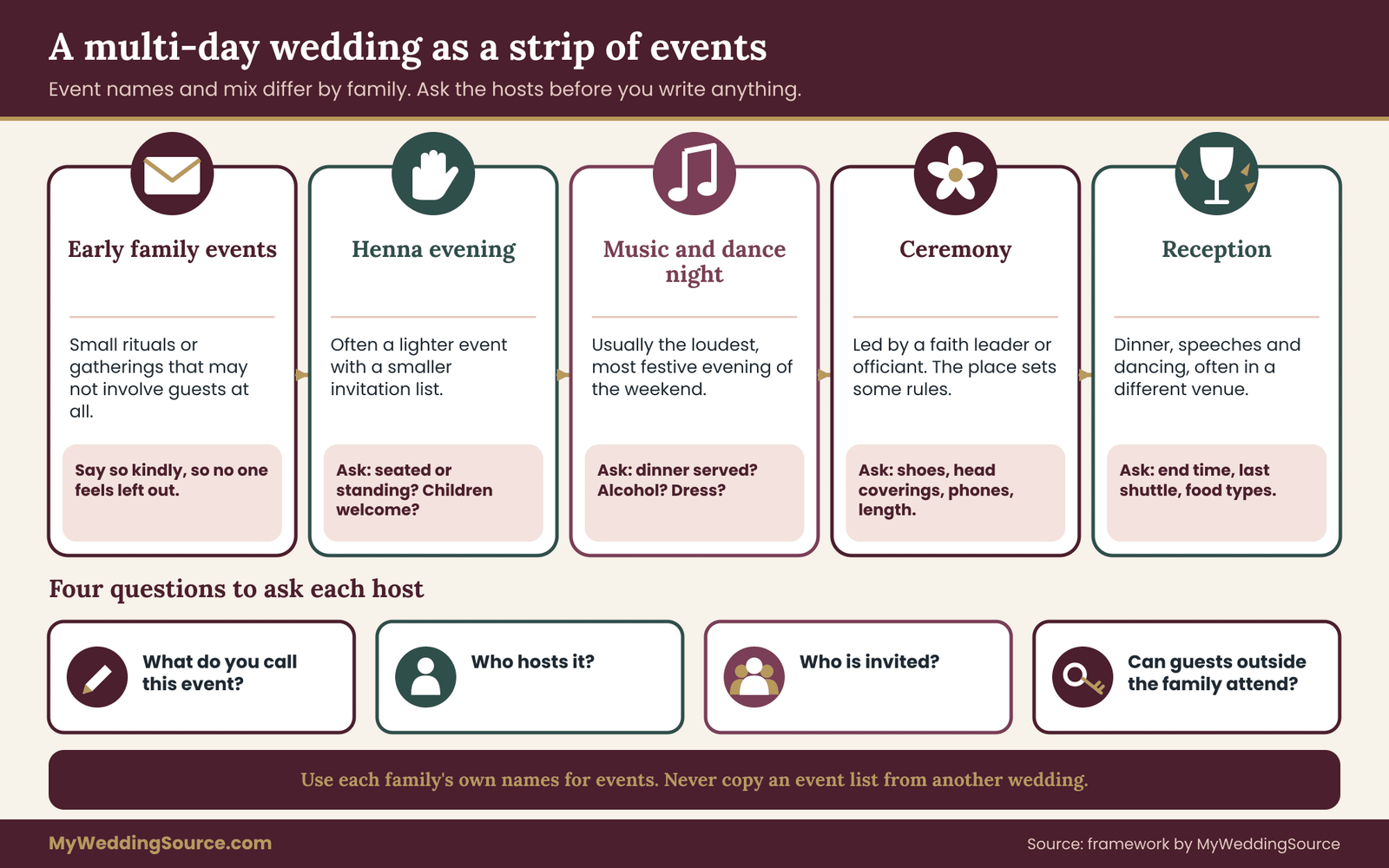
Some couples hold a roka or engagement ceremony, a henna event, a turmeric or similar pre-wedding ritual, a music and dance night, a groom’s procession, a meeting of the families, the ceremony itself, a farewell, and a reception. Others hold two of those. Others hold events with names that appear in no list at all.
The right method is to ask the families. Sit down with the parents, and for each event ask four questions. What do you call this event? Who hosts it? Who is invited? Is it open to guests who are not family?
Write the answers down using the family’s own names for the events. If one side calls the evening before the ceremony by one name and the other side uses a different one, put both in the card title the first time and pick one for the rest of the wedding guest guide. Guests who hear a term from the bride’s mother and a different term from the groom’s aunt will otherwise assume there are two separate events.
Separate the events that guests attend from the events that guests hear about
Some rituals happen within the family, or among a small group, before the public events begin. Guests may hear about them but are not asked to attend. If the couple does not want guests at an event, say so kindly rather than leaving the event off the wedding guest guide entirely. A line such as “Thursday morning has a small family ritual; there is nothing for guests to do” prevents a guest from wondering whether they have been left out of an event everyone else seems to know about.
Decide the guest tiers early
Most multi-day weddings have tiers: everyone, most guests, and close family and friends. Decide which events belong to which tier before writing any card, because the tiers decide who receives which pages. A tier decision is also a guest list decision, and the wedding guest list guide covers how to make those decisions without leaving relatives guessing.
A simple way to hold this is a grid on paper where rows are guest groups and columns are events. Mark each cell invited or not invited. You will use it later to build personal guest pages. Keep it for planning only; do not send it to guests, because seeing the full matrix is exactly how people learn what they were not invited to.
The first test: could a stranger follow it
When the event list is settled, test it by handing it to someone outside the families, such as a friend who has never attended a South Asian wedding. Ask them to say back, in their own words, what the weekend looks like. If they stumble on a term, a day or a location, the wedding guest guide needs a clearer line there. Do this test again at the end of the project with the full cards.
The event card: seven fields for every page of the wedding guest guide
The core of the wedding guest guide is the event card. It is one page, or one screen, per event, and every card has the same seven fields in the same order. Sameness is the point of the wedding guest guide. A guest who has read one card knows where to look on the next, and the writer cannot forget to cover dress or transport on the fifth event because the template asks for it.

Field one: the name and a one-line purpose. Use the family’s name for the event, then a single plain sentence saying what it is. For example: “Sangeet: an evening of music, dance and dinner hosted by the bride’s family.” Do not explain the history. A guest needs to know whether the evening is a quiet ritual or a loud party, because that decides how they dress, whether they bring children and whether they expect to sit or stand.
Field two: time and place. Give the date, the arrival time, the start time and the expected end time. The arrival time and the start time are different things, and the gap between them is where most confusion lives. If the printed invitation says six and the event begins at seven-thirty, say that guests are welcome from six and the program starts at seven-thirty.
If a ceremony has a fixed moment that guests must not miss, such as the point at which the groom’s party arrives, say what time guests should be seated by. Give the full street address and the name of the entrance to use. Large venues have several doors, and the wrong one can add a ten-minute walk.
Field three: dress. One line for the dress level, one for color guidance, and one for anything practical. The next section covers this field in detail because it generates the most questions.
Field four: what guests do. This is the field that is unique to a multi-day South Asian wedding guest guide and the one most often left out.
It tells guests what is expected of them physically: whether they will be seated, whether they will walk in a procession, whether they will be invited to join in a dance or a ritual, whether they will be asked to remove shoes, cover their heads, or sit on the floor. It also tells them what they are not expected to do. People are often relieved to read that no one will be pulled onto a dance floor.
Field five: phones and photos. State whether guests may photograph, and whether any moment is off limits. The wedding photography consent guide explains how to plan guest boundaries for images. In the event card it comes down to one or two sentences, such as “Photos are welcome at the sangeet. During the ceremony the photographer is the only one taking pictures, so please keep phones away.”
Field six: food and drink. Say whether a meal is served, what kind of meal it is, and when. State clearly if the event is vegetarian, if alcohol is or is not served, and if there are any dietary accommodations guests can request. Do not leave guests guessing about whether to eat before they arrive.
Field seven: how to get there and who to ask. One line for the transport arrangement, linking to the transport map. Then one name and one phone number or messaging contact for questions on the day. Never list a family elder as the point of contact unless that person has agreed to answer questions all day; choose a coordinator whose job is to answer them.
Keeping the cards short enough to read
A card should fit on one phone screen when scrolled once or twice. If it does not, something is wrong. Usually the problem is that history or reasons have crept in. Reasons are good for a short paragraph on the wedding website, not for the card. A useful trick is to read each card aloud. If it takes longer than about a minute, cut it.
Keep paragraphs short. A paragraph of more than a few lines on a phone is a wall. Use a bolded label for each field, and write each field as one to three sentences. No field needs a bullet list of ten items.
Writing for guests who may not read English first
Many guests, especially older relatives, may prefer to read in another language. Whether to translate is a family decision, and it depends on who is invited. A practical approach is to translate only the elements that carry action: the time, the place, the dress and the food. Ask a fluent family member to translate, and ask a second person to translate it back as a check.
Machine translation can distort cultural and religious terms in ways that are hard to spot if you do not read the language. If you cannot get a reliable human translation of a particular card, say so and offer a phone number for questions instead of publishing text you have not checked.
Plain English helps in either case. Short sentences, common words, and one idea per sentence are easier to translate and easier for a tired guest to read at an airport. The federal plain language guidance at plainlanguage.gov is a good, free reference for this style, and its advice about writing for the reader applies directly to event cards.
A sample card, written out
The following is an invented example for illustration. It is not a template for any particular tradition, and every detail would be replaced by the real ones.
Friday evening: Music night. An evening of live music, dancing and dinner, hosted by the bride’s family. Doors open at six-thirty and the program starts at seven-thirty at the ballroom on the ground floor of the Garden Hotel; use the entrance on Maple Street, which has a covered drop-off. Dress is festive evening wear. Bright colors are welcome. Please avoid all white. Shoes should be comfortable enough for dancing.
Guests are welcome to join in the dancing or to stay seated, and there are no performances that require guests to take part. Phones and photos are welcome throughout. Dinner is served at nine, is fully vegetarian, and includes a bar with beer, wine and soft drinks. A shuttle leaves the hotel lobby at six-fifteen and six-forty-five, and returns every thirty minutes from ten. Questions on the day: Meera at the number on the next page.
Notice what the card does. It gives one purpose line, two times, one entrance, one dress rule with a reason, one participation line, one photo line, one food line and one transport line. It does not explain the history of the sangeet, and it does not tell guests how to feel.
Dress notes in your wedding guest guide: clear, kind and checkable
Dress questions are the single biggest source of guest anxiety, and they are also the area where a wedding guest guide can do the most good. Guests worry about two opposite mistakes: wearing something too plain or too Western to an event where others will be in elaborate traditional clothing, and wearing something that is inappropriate to the occasion or to a religious setting. Clear notes remove most of the worry.

Say the dress level first
Use a short, consistent vocabulary and define it once. For example: “relaxed” means everyday nice clothes; “festive” means bright, celebratory clothes such as a dressy outfit or traditional wear if you own it; “formal” means the kind of clothes you would wear to a formal evening event or a ceremony. Define each term in a sentence on the first page of the wedding guest guide and then use the same terms on every card. Do not invent a new term for each event.
Offer options, not an obligation
Many guests will want to wear traditional South Asian clothing and may not own any. Tell them what is acceptable and what is optional. A good sentence is: “Traditional outfits are warmly welcomed and entirely optional. Formal Western clothing is fine.” That wording signals welcome without pressure. If the family would like most guests in traditional clothes, say so plainly rather than hinting. Then point to practical routes: borrowing from friends, buying from a local shop, or renting, with the caution that renting and tailoring take time, so guests should begin early.
If you offer help, offer help that you can actually deliver. A couple might arrange for a local boutique to hold a few outfits to try, or for relatives to lend scarves and wraps. Do not promise to dress guests unless someone has agreed to do it. Count how many guests are likely to ask before you promise anything.
Color guidance that does not rely on assumptions
Color rules vary by family, region, faith and event, and they are often stated as universal when they are not. Some families ask guests to avoid white at celebratory events, others avoid black, others ask guests not to match the wedding party, and others do not mind at all. Ask the hosts of each event what they want, and write exactly that, with a short reason if it helps.
“Please avoid white; it is traditionally associated with mourning in some families” is more helpful than a bare rule, because it tells guests the rule is about meaning and not about taste. Even so, do not state the reason as a universal fact. Say “in our family” or “for this event” so you are describing your own wedding and not defining a whole culture.
If the couple has chosen a color palette for the wedding party, say which colors are reserved for them. Guests then know where there is room.
Religious settings and practical dress
Where an event takes place in a place of worship, the building and its community decide the dress rules, not the couple. Many places of worship ask for covered shoulders and knees. Some ask that heads be covered, and may provide scarves or cloths at the door, while others expect guests to bring their own.
Some ask that shoes be removed before entering the main hall. Call the place or its coordinator and ask what they require of visitors, then write what they said. Do not guess. A guest who arrives at a gurdwara or temple having read an accurate note in the wedding guest guide is a guest who is relaxed and respectful.
Note practical points that affect clothing. If shoes come off, say so, so guests can wear socks without holes and avoid complicated lace-up boots. If guests will sit on the floor for an extended time, tell them, because that affects what older guests or guests with limited mobility can manage; the cards should then say whether chairs are available. Heavy fabrics and long garments can make a hot venue uncomfortable, so say if the room is air-conditioned or not.
Weather and layers
For outdoor events, add a line about the expected weather range and what to carry. Check a forecast source such as the National Weather Service at weather.gov near the date, and update the card in the final week. Cooler evening air, rain, or a long walk between a hotel and a venue changes what is practical to wear. Mention umbrellas, shawls and flat shoes where they matter.
Children and teenagers
Give children their own line. If children are welcome, say whether they should dress up. If a particular event is adults-only, say that in the first line of the card, politely and without apology, and say whether childcare is available. Do not hide an adults-only rule in the fine print of the final page.
What guests do: the participation notes in a wedding guest guide
Field four of the event card is the one guests value most, so it deserves a section of its own. Participation notes answer the question every first-time guest silently asks: what will happen to me at this event, and what will I be expected to do?
The approach is the same at every event. Describe the guest’s physical experience in the order it happens, using plain verbs, and keep the explanation of meaning for one short sentence. Then say what is optional.
Four kinds of participation
It helps the writer to sort each event into one of four kinds, because the kind decides the wording.
Watching. Guests sit or stand and observe. This is common during parts of a ceremony. The note says where to sit, how long it will last, and whether guests may move around.
Following. Guests move with a group, such as in a procession or from one room to another. The note says where the group gathers, who leads it, how far it goes and what the ground is like. Guests with mobility needs need to know the distance and surface in advance.
Joining. Guests are invited to take part, for example in dancing, in a blessing line, in applying henna or in throwing flower petals. The note says that joining is welcome, how it works, and that it is optional.
Being served. Guests receive something, such as food, a blessed offering, a garland or a gift. The note explains how to accept it and whether there are any customs about what to do with it.

If you label each event in your own draft with one or more of those four kinds, you will see gaps quickly. An event that is all following and joining with no seats is a different experience for a guest who uses a cane than an event that is mostly watching.
Procession and movement notes
If the groom’s party arrives in a procession, and some families call this a baraat, guests often wonder whether they are meant to dance along. State what is expected. For instance: “The groom’s party arrives from the hotel parking lot with music and dancing. Guests who would like to join gather at the front steps at four. Guests who prefer to watch can stand along the walkway or stay inside.”
Include the approximate length of the route, the surface, the likely noise level, and where chairs are. If the procession is on a public street and requires approvals from the city, that is for the planning team to settle; the guest’s note only needs to say where it goes and how long it takes. For the planning side, the wedding signage system guide explains how directional signs support a route like this.
Ceremony notes
The ceremony card is the most delicate. It should describe the structure at the level a guest needs and leave interpretation to the officiant or the family’s own materials. Typical content includes how long the ceremony is expected to last, whether it is in one language or several, whether there will be explanations in English, where guests sit, and whether they stand at any point.
Some families provide a printed or digital program with short descriptions of each stage. That is a separate document from the event card, and it is worth doing if the ceremony is long and the guests are unfamiliar with it. The wedding ceremony step-by-step guide on the site covers the general shape of a ceremony, and the interfaith ceremony guide covers how to divide ownership among traditions. If the ceremony is led by a religious officiant, ask them what they would like guests to know. Many are glad to provide a few lines.
A short list of ceremony points that guests commonly ask about, which the card can answer in a sentence each:
Is there a fire in the ceremony, and where will guests be seated relative to it? Do guests stand when the couple walks in? Will there be a moment when guests are invited forward? Are there parts of the ceremony when guests must be quiet? Is there a break, and can guests leave their seats? Can children stay? Are there restrooms close by, and will someone hold the doors?
Not every item applies to every wedding. The list is for the writer to scan and decide which ones apply to the wedding at hand.
What guests may be asked to bring or give
Some events involve gifts, offerings or envelopes. Customs vary and are sensitive, so use the family’s own guidance. If the family prefers no gifts, say that kindly. If they have a registry, link it from the main page of the wedding guest guide and not from the event cards, so that cards stay about the event.
The wedding registry ideas guide covers the general approaches. If there is a custom of giving cash or a particular gift, the family can decide whether to mention it and in what words. A couple that does not want to talk about money can say nothing; a family that wants to guide guests can add a single line. Either choice is fine.
Do not tell guests what to bring to a ritual unless the family has asked you to. If a card says “please bring flower petals,” a guest will wonder where to buy them. Say what is provided and what is not.
Rituals that include guests directly
Some rituals invite guests to participate, for instance by offering blessings, applying a small amount of a substance, or tying a thread. Rather than describing what each action means, say how it works. “Guests are invited to come forward in a line after the vows. A family member will guide each person.” That sentence helps guests more than an explanation of the meaning would, and it leaves interpretation to those who hold the tradition.
What to say about food at religious events
Rules about food at a religious event are decided by the place and the faith leader. Some places of worship do not allow meat, alcohol or tobacco on the premises. Some serve a shared meal that guests are invited to join as part of the visit. Ask, then write exactly what the host said. If a meal follows the ceremony at a separate hall, say where it is and how guests get there. If a meal is served as part of a place of worship’s custom, say so, and say that guests are welcome but not required to eat.
Gaps, rest and the guest who needs a quieter option
Multi-day weddings are tiring. Guests, especially older relatives and those traveling across time zones, need rest. Building a wedding guest guide that acknowledges this makes the whole weekend feel kinder, and it makes attendance more realistic for people who would otherwise decline.
Show the gaps on the overview page
Add a one-page overview to the wedding guest guide that displays the events in order with the gaps between them. A strip works well: day, event, start time, expected end time. Within it, leave visible space where guests are free. Free time is information. A guest who sees that the Saturday ceremony ends at one and the evening event starts at seven will plan a rest, a meal or a sightseeing trip. A guest who sees no gaps may assume that the entire day is spoken for.
Be honest about end times. If a ceremony typically runs long and a start time is flexible, say that. If a late event might end after midnight, say that too. Guests who need to leave early can then plan their own ride home, and older guests can decide whether to attend the second half.
Plan a quiet space
If the venue can spare a room, designate a quiet space for guests who need a break, whether because of noise, crowds, medical needs or small children. The wedding guest care planning guide covers care operations for babies, children and others in more detail. In the wedding guest guide, a single line suffices: “A quiet room is available on the second floor. Ask any volunteer in a green sash.”
Accessibility notes
Include accessibility facts on each card, stated plainly. Say whether the venue has step-free access, where the accessible entrance is, whether there are accessible restrooms, whether seating is available, and how far it is from the drop-off to the seat. The ADA information site at ada.gov explains what accessibility means in public places in the United States, and venues should be able to tell you what they provide. Ask the venue in writing, and do not repeat a general claim of “fully accessible” without checking what it means. Instead, report the specific facts you were given.
Invite guests to tell you their needs. A line on the RSVP form and on the overview page, such as “Tell us if you need step-free access, seating throughout, a quiet space or a dietary accommodation,” reaches guests who would never otherwise ask. Give them a person to talk to, not only a form.
Guests with sensory sensitivities
Events with loud drums, fireworks, smoke from ceremonial fires, heavy incense or strong scents can be difficult for guests with asthma, migraines, sensory sensitivities or young babies. State in the card what to expect: “A ceremonial fire burns during the ceremony; the hall is ventilated, and seats near the exits are available for guests who prefer fresh air.” Hosts do not need to remove the fire or the music.
They need to describe them so that guests can choose. Venue fire rules also matter here, and the National Fire Protection Association at nfpa.org publishes codes that local authorities apply. Ask the venue and local fire officials what is permitted for open flames and incense indoors, and put those rules in the planning file. Do not promise guests that a flame will be allowed until the venue has confirmed it in writing.
A guest who must skip events
Some guests will attend only part of the weekend, because of work, health or religious observance. Make that easy. State clearly that attending any single event is welcome, and that a guest need not attend all of them. Many couples find that guests are more willing to travel for a multi-day wedding when they know they will not be judged for skipping a Thursday evening. If it matters to the family that certain guests attend certain events, say so to those guests personally and not on the shared page.
The transport map in a wedding guest guide: legs, buffers and owners
Getting around is the second great source of guest stress. A multi-day wedding commonly involves two or three venues, a hotel or several, a procession or a ceremony off site, and a late return. Each trip is a possible failure, and most failures come from the same causes: a guest did not know a shuttle existed, did not know when it left, or assumed there was a ride when there was not.
The fix is a transport map. It is a single diagram, backed by a short written list, that shows every place guests may need to be and every way to get between them. This section explains how to build it.

Break the weekend into legs
A leg is one trip between two places. Hotel to the henna evening is a leg. The henna evening back to the hotel is another. Hotel to the ceremony site is a third. Do not describe journeys; describe legs, because each leg has its own time, its own vehicle and its own owner.
List every leg for every event. For a three-event weekend with one hotel and two venues this is usually between eight and twelve legs, counting returns. Write them as a plain list first, in order: leg, from, to, day, first departure, last departure, travel time, vehicle and owner. You will be tempted to merge legs. Do not. A merged leg hides the return trip, and returns are where guests get stranded.
The five facts for every leg
For each leg, collect five facts and write them without abbreviation.
The distance and the real travel time. Check the time at the hour of day the leg will run, not at midnight. Navigation apps let you set a future departure time. Test the route on a weekday and a weekend if the weekend differs. Ceremonies often start at times that coincide with local traffic, and a short drive can take much longer than expected.
The vehicle. A shuttle, a hired coach, a rideshare, private cars, walking, or public transit. The vehicle decides how many guests can travel, how long boarding takes and whether wheelchairs and strollers fit.
The owner. The person or company responsible for the leg. If the family hired a shuttle company, the owner is the company, and one named family member is the contact. If guests are expected to find their own rides, the owner is the guest, and the wedding guest guide says so plainly.
The cost. Say whether the leg is free to guests, paid by the family, or paid by the guest. Do not make guests discover costs on the curb.
The backup. What happens when the leg fails. A late shuttle, a full vehicle and a broken-down bus are all realistic. Name the backup: a second vehicle on call, a rideshare credit, or a coordinator with a car.
Buffers: the time that makes legs reliable
A buffer is the extra time between when a guest should leave and when they must arrive. It is the most useful single number on the transport map. Without buffers, one delay cascades into every later event.
A workable rule is to add a boarding buffer, a travel buffer and an arrival buffer. The boarding buffer is the time it takes a group to load, which is longer than most people expect when the group includes elders, children and people in elaborate clothing. The travel buffer covers traffic and unexpected stops. The arrival buffer covers parking, security checks, shoes, restrooms and finding a seat.
Rather than trust a rule of thumb, set the numbers by asking the transport provider and the venue. The provider can tell you how long a full load takes. The venue can tell you how long it takes for a large group to enter. Then add an honest margin. Use the biggest buffer on the leg that has a fixed deadline, such as the ceremony, and use the smallest on the legs with no deadline, such as the return from a party.
Mark the legs with a fixed deadline in a different color
Most legs have flexibility. A few do not. The one that carries guests to a ceremony with a fixed auspicious moment, or to a venue where the place of worship has a time slot, is not flexible. Mark these legs on the map. Tell the transport provider which legs are critical, and agree that those legs get the first vehicles and the best drivers. Tell guests plainly: “The ceremony starts on time. The last shuttle leaves at nine.”
Return legs and the late night
Return trips need a plan as much as outbound trips. At the end of a long evening, guests are tired, some have been drinking, and rideshare prices and availability may be poor. Plan the last shuttle for a time that suits the likely end of the event, and add a late rideshare plan for those who stay longer. If the family offers rideshare credits, set the rules and the cap in advance.
If alcohol is served at an event, make the plan for getting home explicit. A card that says “A shuttle runs every thirty minutes until one in the morning” lets guests decide how to leave without driving. If the venue cannot provide the shuttle, give the number of a local taxi company.
Parking, drop-off and loading zones
For guests who drive, give parking facts: which lot, whether it is free, whether it is far, where accessible spaces are, and where the drop-off is. A venue may restrict parking to certain hours or require permits. Ask the venue in writing and report what they said.
A drop-off point matters for elders and guests with mobility needs. Mark it on the map and say how long a walk it is from there to the seat. Provide a second pickup point if the first one will be crowded after the event.
The map itself
Draw the map in simple terms. Put the hotel or hotels on one side and the venues on the other. Draw each leg as an arrow, label it with the departure times, and color the arrows by vehicle. Put the time next to every arrow. A guest should be able to find their hotel, find their event and see the arrow between them in ten seconds. Do not draw an exact geographic map unless it is accurate and clear; a schematic is easier to read.
Add one line for guests who are not staying at the main hotel. For them, the map shows the venue pick-up points, and the wedding guest guide says that the shuttle runs only from the listed stops.
Arrivals, hotels and the days around the wedding
The legs of the weekend do not begin on Thursday evening. They begin when guests land. A good wedding guest guide treats arrival and departure as part of the program.
The arrival page
Create a short page, separate from the event cards, called something like “Arriving and departing.” It answers what airport guests should fly into, how far it is from the hotel and the venues, what transport options exist, and whether there is a greeting or a welcome desk. A simple version is a table in the hotel lobby with a coordinator who hands out the wedding guest guide, answers questions and checks guests in for shuttles.
Give the earliest and latest times at which the weekend makes demands on guests. If the first event is on Thursday evening, guests who want to attend must arrive by Thursday afternoon. If the last event is Sunday brunch, guests who must leave Sunday morning should know that they will miss it. State these facts, then let guests decide.
International travel notes
Some guests will travel from abroad. They need to know their own entry and visa rules, and the couple cannot supply those. Point them to the official sources: the State Department’s travel site at travel.state.gov explains visa and travel document basics for people entering the United States, and Customs and Border Protection at cbp.gov explains what can be brought across the border.
If guests will bring wedding clothing, jewelry, gifts or food from abroad, they should check the rules for those items before they pack, because restrictions on food and plant products can be strict. Do not give visa advice yourself. A couple can write an invitation letter on request, but whether a visa is granted is not in their hands, and the wedding guest guide should avoid making promises.
Health and vaccination guidance for travelers is available from the Centers for Disease Control and Prevention at cdc.gov/travel. A line in the wedding guest guide pointing guests there is enough.
Time zones and jet lag
If many guests are flying across time zones, schedule realistically. A morning event the day after a long flight is hard on guests. Say in the overview which events are the main ones, and mention that the first evening is relaxed, so guests who have just landed are not made to feel that they must attend everything. The planning team should also avoid scheduling an important event for the first morning after arrival when most guests will be exhausted.
Departure day
The wedding ends, but guests still need to leave. Add a short departure section: checkout time, the last shuttle to the airport, luggage storage if the hotel offers it, and when the final event ends. The Transportation Security Administration at tsa.gov explains what guests may and may not carry through airport security, which matters for guests carrying ceremonial objects, oils, ghee, spices and sweets home. For guests who travel with items of religious significance, the TSA site has guidance, and guests can check before they travel.
If the hotel offers a block of rooms, link to the booking details from the arrival page, and state the cutoff date for the rate. If there is no block, tell guests how to book on their own and give two or three options at different prices.
Phones, photos, flames and house rules in the wedding guest guide
Each venue has rules, and each event has norms. Guests break both mostly because nobody told them. The wedding guest guide is the place to say what is allowed, in a tone that sounds like a host and not like a security notice.
Photos and phones, event by event
Photo rules differ across events, and a single blanket rule rarely fits. A music night is usually a place where guests happily film and post. A ceremony often is not. Some families ask guests to keep phones away during the ceremony because a hired photographer and videographer are working, and a crowd of raised phones blocks both the view and the shot. Others have religious reasons for restricting photography at certain moments or inside certain rooms. In a place of worship, the place sets the rules, and the couple should ask what they are before promising anything to guests.
Write the rule for each event in the card, and write the reason when it is short. “Please keep phones in your pocket during the ceremony so everyone can see; the photographer will share pictures afterward” gives the rule and the reason and promises something in return, which makes compliance easier. Only promise to share photos if the photographer’s contract allows it. Check the photographer’s own contract for what is allowed.
Social media gets its own line. Some couples welcome posts and offer a hashtag. Others ask guests to wait until the couple has posted first, or to avoid posting images of other guests or of children without asking. Whatever the family wants, say it once on the overview page and repeat it on the cards where it matters. If you are asking guests not to post, give them a reason that respects them, such as that older relatives would prefer not to appear online, rather than an order.
Fire, candles, incense and fireworks
Many South Asian ceremonies and celebrations involve a flame, incense, lamps or, at outdoor events, fireworks. Venues and local authorities regulate all of them. A hotel ballroom may ban open flames altogether. A hall may allow a contained fire only in a specific vessel and with a staff member present. An outdoor site may need a fire permit. The couple’s planning team handles that, and the guest card describes the result.
What the wedding guest guide should do is avoid promising what is not approved. If the family hopes to have a ceremonial fire but has not yet received the venue’s written approval, the card should wait. Write nothing, or write “details to follow,” until the answer is in hand. Guests who read a promise and then arrive to see no fire are disappointed, and the family is embarrassed.
Once approved, describe what guests will see and where they will be: how close the seating is, whether smoke is expected, whether windows or doors will be open, and what guests with breathing difficulties can do. Fire safety information from the National Fire Protection Association at nfpa.org is a good reference for understanding why venues are cautious, and venues will usually tell you their rules without difficulty.
House rules from the venue
Ask each venue for its guest-facing rules in writing and fold the relevant ones into the cards. Typical ones include: no outside food or drink, no confetti or rice or petals thrown, no open flames, no nails or tape on walls, quiet hours, a closing time for music, and restrictions on drones. A venue’s rules on confetti and petals often surprise couples who have planned a flower-petal moment. If petals are allowed only in certain areas, or only if they are fresh and not synthetic, the guest card should say so.
Guests often carry items to be shared or gifted, such as sweets, flowers and garlands. Some venues restrict outside food. If so, tell guests not to bring it. Quietly pointing guests to the family’s designated welcome table is kinder than turning someone away at a door.
Noise, neighbors and the end of the night
Music nights and processions can be loud. Venues and cities often have noise limits and end times. Neighbors may have rules, and hotels have quiet hours. Tell guests when music ends and what happens after. If the party moves to a hotel lobby or a hospitality suite, say whether that is an official part of the wedding or simply what guests do on their own. People are more careful about volume when the wedding guest guide says plainly that neighbors will be asleep.
Alcohol
If alcohol is served, say what kind and when. If it is not served, say that clearly. Guests who attend several events will meet different rules: a gurdwara or temple will probably not have alcohol, while a reception hall may. Do not make guests guess. For the guest card, the facts are enough: is there a bar, is it hosted, and what are the last-call and shuttle times.
For families who prefer not to serve alcohol, a line such as “This event is alcohol-free” is enough. Do not apologize for it. For families who do serve alcohol, add the safe-ride line from the transport map.
Food and dietary information, written so guests can plan
Food is one of the most visible and most personal parts of a South Asian wedding. Meals can be large, varied and shared, and guests ask about them early. The wedding guest guide should give enough information for guests to plan, without turning into a menu.
Say what kind of meal it is
For each event, one line on the meal. Is it a full meal, light snacks, tea and sweets, or nothing? A guest who arrives at a ceremony at ten in the morning needs to know whether lunch follows or whether the next food is at three. If the event runs through a mealtime without food, say that too, kindly: “Light refreshments will be served after the ceremony; lunch is at the reception at one.”
Dietary categories
Families have different norms around meat, eggs, alcohol, onion and garlic, and the way food is prepared. Do not assume any of them. Ask the caterer what is on offer and how it is prepared, then write down exactly what is served. Useful categories to state clearly are vegetarian, vegan, and the main allergens, as well as whether food is prepared with or near meat.
Words like “halal” and “kosher” and “jain-friendly” have specific meanings, so use them only when the caterer and family can confirm the standard they are following. If an event is fully vegetarian, say so in the card heading so no guest has to ask.
Keep the menu details with the caterer. What goes in the wedding guest guide is a short statement: what is served, what is not, and how guests can ask for something different.
The RSVP as a dietary tool
Ask for dietary needs and allergies on the RSVP. The wedding RSVP etiquette guide covers the structure of an RSVP. For a multi-day wedding the RSVP should be per event, with a dietary field, an access field and a transport field. A guest who answers “attending the ceremony, not the sangeet, vegetarian, needs step-free access, arriving Friday” has given the team everything it needs in one pass.
Offer a simple way to follow up. A guest with a severe allergy should be able to speak to a person. Provide a contact and say that the caterer will receive the information. Do not promise a particular safety outcome; promise that the information reaches the caterer and that the guest can speak with the caterer on arrival.
Eating before, between and after
On long days, add an eating guide. If a ceremony begins early and a meal is late, say that guests may want to eat beforehand. If food is served at an event that begins in the evening, say whether guests should eat first. Guests with diabetes, pregnant guests and elders rely on this information.
Fasting, observance and prayer
Some guests will be fasting for religious reasons on certain days, or will pray at set times. If the schedule overlaps with a major observance, the couple might not be able to move it, but they can acknowledge it. Offering a quiet room, a time window or a note that guests can step out for prayer shows respect and lets guests plan. Ask guests to tell the coordinator if they have such needs, and make it a matter of routine and not of exception.
Sweets, favors and leftovers
Sweets and gifts are often handed to guests. Say whether guests may take leftover sweets and whether they can take food home, and be honest about any limits from the caterer or the health department. If you are unsure whether leftover food can be donated or packed, ask the caterer and your local health department.
What the wedding guest guide should leave out
Many weddings run into trouble not because of what was missing but because of what was added. Some items do not belong in a wedding guest guide, however good the intention.
Leave out explanations of why a family’s custom is the right one. Leave out comparisons with other cultures’ weddings. Leave out jokes about relatives, about the length of the weekend or about the groom. Leave out instructions to guests on how they should feel. Leave out any statement about what “all” Indian, Pakistani, Bangladeshi, Sri Lankan, Nepali or other families do. The wedding guest guide describes one wedding, and that wedding belongs to specific people.
Leave out private information. Do not include phone numbers of family members who have not agreed to take calls, medical details about guests, or seating information for events the reader is not invited to.
Leave out anything that has not been confirmed. A card with “details to follow” is better than a card that is wrong. Add a date for when the details will arrive.
Delivering the wedding guest guide: what to send, when and how
A wedding guest guide that nobody opens helps no one. Delivery is part of the design. The goal is to give each guest the right amount of information at the moment they need it, in a form they can find again on a phone at the airport.
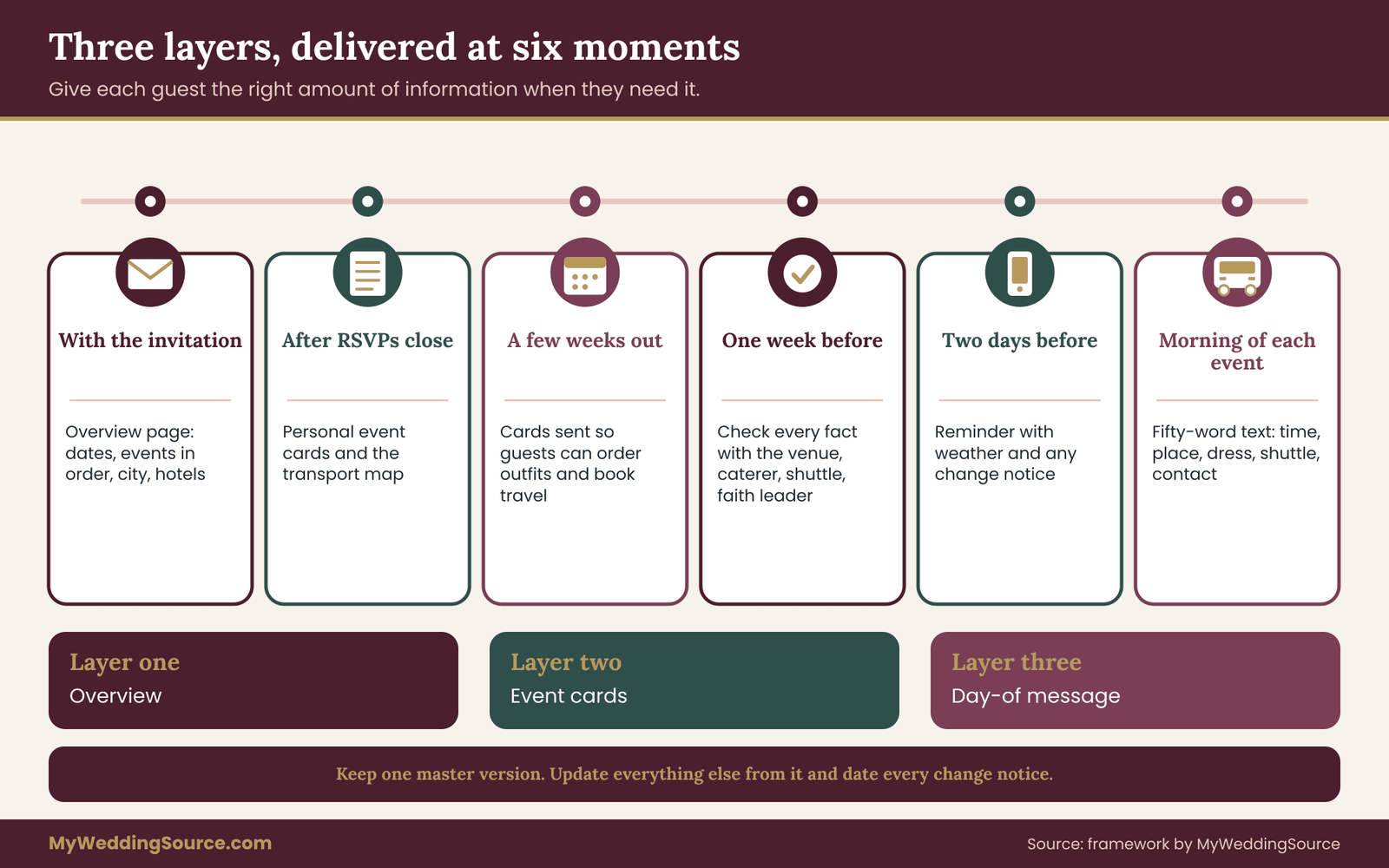
Three layers, three moments
Think of the wedding guest guide as three layers, each delivered at a different time.
Layer one: the overview. One page that shows the weekend at a glance: the dates, the events in order, who is invited to which, the city, the hotels and the main contact. It goes out with the save-the-date or the invitation, early enough for guests to book travel. At this stage you do not need dress details or transport legs, because those can still change. You do need to say which dates guests should hold and which events are the main ones. The overview should match the printed invitation exactly on dates, names and places.
Layer two: the event cards. The full set of cards for the events each guest is invited to, plus the transport map. These go out after the RSVP deadline, when the guest list for each event is known, and some weeks before the weekend. Sending them after RSVPs means that you can write personal pages, and that guests who declined an event are not sent a card for it.
Layer three: the day-of message. A short text or message on the morning of each event, with the time, the place, the dress reminder, the shuttle times and the name and number of the coordinator. Nobody should have to open a long document at a bus stop. A message of fifty words does the job.
Choosing the channel
Different guests prefer different channels, and the best guides use more than one. A wedding website is a good home for the full set, because it can be updated and linked. A PDF is useful for guests who want to download and print it. A group text, or a broadcast list, suits day-of messages. Printed cards in welcome bags help older guests who are not comfortable with a phone.
Whichever mix you choose, keep one source of truth. If the website and the PDF disagree, guests will follow whichever they saw last. Name one master version, and update every other version from it. When something changes, send a short change notice that says what changed, in a message guests will notice, and mark the date at the top of the master page.
Do not use a password gate that makes older guests give up. A simple password on a shared page is fine if you share it clearly. If a guest cannot log in, they will call someone, so give that person a script.
Personal pages, not one page for all
For a wedding where guests are invited to different events, build personal pages. Each guest or household sees only their cards, in the order of their attendance. This takes more work, but it reduces confusion and avoids the hurt of seeing events one was not asked to.
A simple way to do this without special software is to build one master document and then export a version for each guest group, using the invited-to grid you made earlier. If you have three groups, you need three versions. If you have thirty, a dedicated wedding website with guest-specific access is worth the cost, and you should check the site’s privacy practices before putting guest names and addresses in it.
Timing, working backward
Work backward from the first event.
Begin collecting event details from the hosts as soon as dates and venues are set. Draft the overview before the save-the-date goes out. Send the overview with the save-the-date or invitation, in good time for travel. Hold the event cards until you have confirmed dress, transport and venue rules; then send them after RSVPs close. Give guests a few weeks between the cards and the first event, so that they can order outfits and arrange travel.
A week before the first event, check every fact on every card against its source: the venue, the caterer, the shuttle company, the faith leader. Send a change notice if anything moved. Two days before, send a reminder with weather and any last-minute changes. On the morning of each event, send the day-of message.
Do not promise a schedule you cannot keep. If the venue has not confirmed a time, write “time to be confirmed by this date” instead of a guess. A wrong time that has been shared widely is hard to correct.
Who answers the questions
Appoint a small team of coordinators who know the wedding guest guide. Their job is to answer guest questions on the day and in the days before it. Give them a one-page cheat sheet: the overview, the transport times, the key contact numbers and the five questions guests ask most. Do not assign this to the parents, who will be busy being hosts. A cousin, a friend or a hired day-of coordinator is a better choice.
The wedding officiant is not a coordinator, and any question about the ceremony itself belongs with the officiant or the family. The wedding officiant requirements guide covers what an officiant must and must not do, including legal requirements for the license, which are separate from anything in the wedding guest guide. For marriage license rules, the official starting point is the federal government’s marriage license page at usa.gov/marriage-license, which points to the state or local office that actually issues the license.
Testing the wedding guest guide before it goes out
Give the full wedding guest guide to three testers: one person who knows the families well, one who has never attended this kind of wedding, and one older relative who reads slowly. Ask each to plan their own weekend from the wedding guest guide alone, and watch where they hesitate. Every hesitation is a place where a guest would have called someone.
Ask the testers three questions. Where and when do you need to be on each day? What do you wear to each event? How do you get from your hotel to each place and back? If any answer is wrong, the card is wrong, and the fix belongs in the card.
A worked example: a three-day wedding guest guide from start to finish
The following example is invented. It shows how the method works for an imaginary couple, and is not a model of any particular tradition. Details will differ for every wedding.
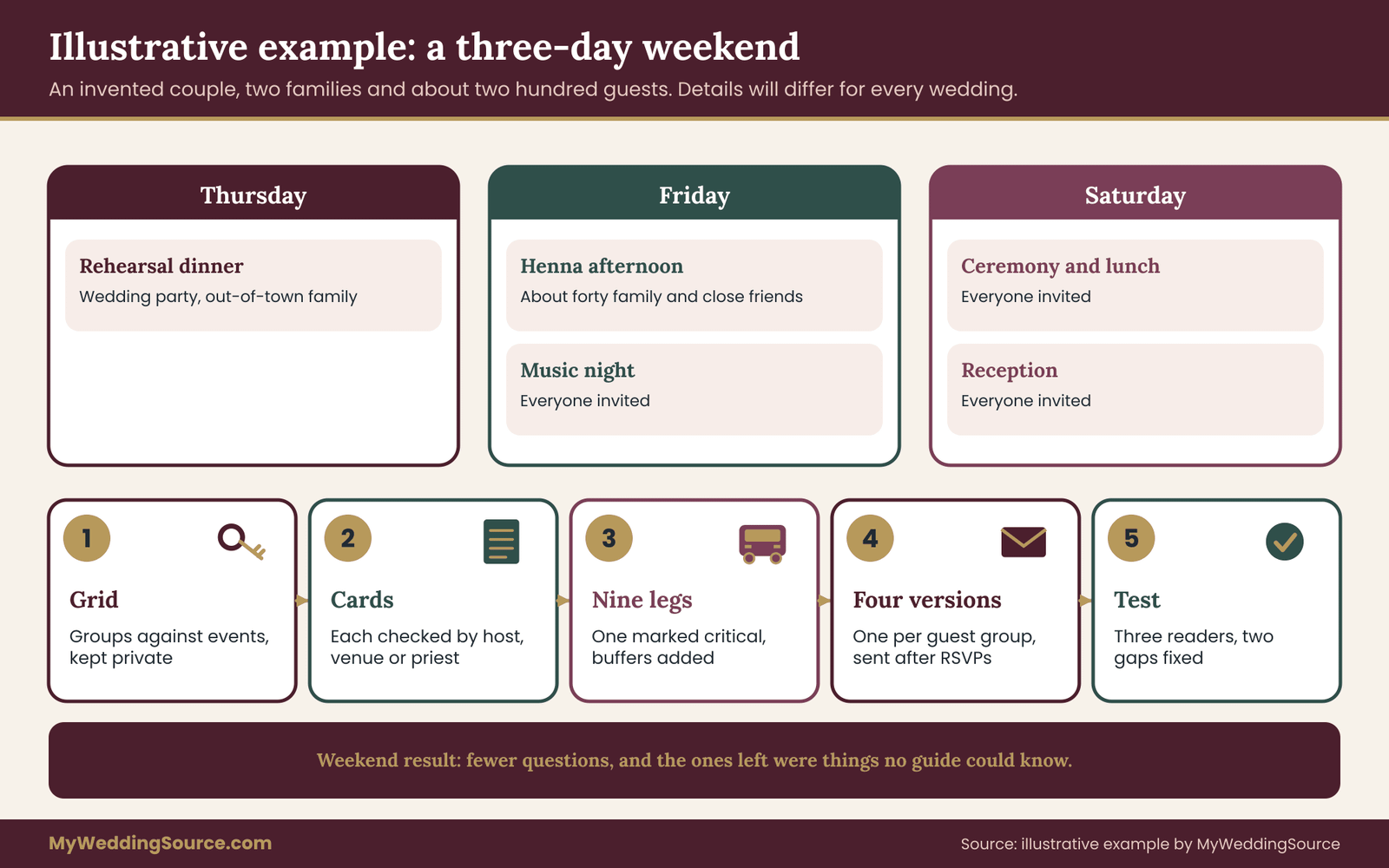
Priya and Daniel are planning a wedding in a mid-sized city for about two hundred guests. Priya’s family is Gujarati and Daniel’s is from the American Midwest. Daniel’s family has never attended a South Asian wedding. Priya’s parents are hosting some events and Daniel’s parents are hosting the rehearsal dinner. The weekend has three days and five events: a henna afternoon on Friday, a music night on Friday evening, the ceremony on Saturday morning, a lunch following it, and a reception on Saturday evening. About sixty guests are traveling from out of town, and about twenty of them are international.
Step one: the event list and the grid
Priya sits down with both sets of parents and writes down each event, its name, its host and its guest tier. The henna afternoon is for family and close friends, about forty people. The music night is for everyone. The ceremony and the lunch are for everyone. The reception is for everyone. Daniel’s parents’ rehearsal dinner on Thursday evening is for the wedding party and out-of-town family only, so it appears only on the personal pages of those guests.
She builds the grid: guest groups as rows, events as columns. There are four groups. She keeps it private.
Step two: the cards
Priya drafts each card using the seven fields. For the ceremony she calls the venue’s coordinator, who tells her that shoes come off inside the main hall, that chairs are available along the walls for guests who cannot sit on the floor, that head coverings are not required for guests, and that no alcohol is permitted on the premises.
She writes exactly that. She asks the priest what he would like guests to know, and he asks that phones stay away during the ceremony and that guests stay seated until the end. She writes both lines and gives the priest the card to read. He changes one word.
For the music night she asks her mother what she wants guests to wear and receives a clear answer: bright colors, no white. She writes that and adds the reason as “our family’s preference for this event.”
Step three: the transport map
Priya lists the legs. The hotel to the henna afternoon, back; the hotel to the music night, back; the hotel to the ceremony hall, back; the hall to the reception venue; the reception venue to the hotel. That is nine legs. She asks the shuttle company for times, and learns that a full coach takes about fifteen minutes to load. She adds a buffer. She marks the hotel-to-hall leg as critical because the ceremony has a fixed start time, and asks the company to send the first coaches there at two intervals before it.
She asks the hotel about its checkout time and the last shuttle to the airport, and puts both on the arrival page.
Step four: the personal pages and delivery
She sends the overview with the invitations. After the RSVPs close, she builds four versions of the wedding guest guide and sends each group its own link and a PDF. She sends the transport map as a single image for sharing.
Three testers read the wedding guest guide. The reader who is unfamiliar with South Asian weddings asks whether the ceremony will have a meal. Priya had left out the meal line for the ceremony and added it. The older relative asks whether there is a place to sit during the henna afternoon, and Priya checks with the host and adds the answer.
Step five: the weekend
On Friday morning she sends a day-of message for the henna afternoon. A shuttle runs late, the coordinator uses the backup car, and a short change message goes out within ten minutes. By Saturday, guests are asking the coordinators fewer questions, and the questions are about things the wedding guest guide could not have known, such as where someone left a scarf.
What the example shows
The method works because each step has a clear owner and each card goes to the person who can correct it. It would have failed if Priya had copied a list of events from another wedding, had sent every guest every card, or had guessed at the venue’s rules. The effort is in the checking, not in the writing.
Mistakes and edge cases in a multi-day wedding guest guide
Most problems with a wedding guest guide repeat from one wedding to the next. Knowing them in advance saves hours.
Treating one family’s customs as the standard
The commonest mistake is writing the wedding guest guide as if the couple’s customs define “a South Asian wedding.” They do not. Two families from the same city may do things differently, and a couple from different regions, faiths or countries will blend practices. Write “at our wedding” and “in our family,” and stop there. This is more accurate, and it avoids offending relatives whose own practices differ. If part of the wedding is led by someone with religious authority, let them state what is theirs to state.
Copying a template that does not fit
Templates from the internet are fine for structure and dangerous for content. A template that says “guests may remove their shoes” may be wrong for the actual place. Use the seven-field structure, then fill every field from a person or a document that is specific to your wedding. If a field has no verified answer, leave it open with a date for when the answer will arrive.
Too much, too soon
Some couples send the full wedding guest guide with the save-the-date. Details change, and guests who received a first version often follow it after it has been replaced. Send the overview early and the cards late. The only exceptions are facts that will not change, such as the dates and the city.
Hidden events and awkward tiers
Guests talk to one another. A guest who was not invited to Friday will probably learn about it from someone who was. Prepare a calm, short answer for the coordinators, such as “Friday is a small family evening,” and make sure that the wedding guest guide itself does not reveal more than it needs to. Do not lie. If a guest asks directly whether there is an event they were not invited to, the coordinator should answer honestly and kindly, and refer larger questions to the hosts.
Not naming a decider
When a question comes up, such as whether a particular guest may bring a child to an adults-only event, someone must decide. If the wedding guest guide does not name a decider, the question goes to whoever is nearest, and answers will conflict. Name one decider for each category of decision. The couple decides the program. The hosts of an event decide the dress and the guest list for that event. The venue decides its own rules. The faith leader decides ritual content. Assign these roles before the stress begins.
Letting the wedding guest guide go stale
The wedding guest guide is a living document until the weekend ends. Venues change room assignments, shuttles change times, weather moves outdoor events indoors. Assign a person to own updates and to publish a dated change notice. Keep the old versions so that, if a guest says they read a different time, you can see what they saw.
Edge cases to think through
A venue change late in the process. Update the transport map first, then the cards, then send one change notice that lists every affected event. Do not send five separate messages.
Rain on an outdoor event. Decide the weather trigger in advance. Say in the card who decides, by what time, and how guests will hear. Weather forecasts from the National Weather Service at weather.gov are the official source for the United States, and the decision should be made against a forecast and not a feeling.
A ceremony that runs long. If the ceremony may run longer than planned, tell the transport provider and the caterer, and build slack into the timeline. Tell guests the expected range, not a single number.
A guest with a medical need that conflicts with the schedule. A guest who cannot sit on the floor, cannot be near smoke, or needs to eat at set times should be able to tell a named person and get a real answer. Offer practical alternatives: a chair near the back, a seat near an exit, a snack before the event. Do not make the guest justify themselves.
Guests who travel with young children. Decide whether children are welcome at each event and whether a childcare room or sitter is available. Say so on each card. Guests will plan around it.
Guests who are unfamiliar and nervous. Offer a short note on the overview page: “If this is your first South Asian wedding, welcome. Each card tells you what will happen, what to wear and how to get there. Ask any coordinator if you are unsure.” Guests tend to relax when someone says plainly that questions are welcome.
A split between households. If the two families disagree on a detail, such as what time to be seated, the wedding guest guide cannot paper over it. Settle it between the families first, then write the answer.
A last check on tone
Read the whole wedding guest guide once as if you were a polite stranger who is a little nervous. Does it sound warm? Is any line condescending? Does anything read as an instruction that would feel odd at a family celebration? Edit toward a host’s voice, a person welcoming someone into their home. Short, concrete sentences help. So does leaving out adjectives about how wonderful everything will be.
When the weekend is over, keep the final version. It is useful to the family as a record, and, if you later take part in another family wedding, the structure carries over.
Your next steps
Work through these in order. Each step takes a short sitting.
- Sit down with both families and list every event, using each family’s own names, plus the host and the guest tier for each.
- Build the private grid of guest groups against events, and decide which guests receive which cards.
- Draft one event card per event for the wedding guest guide with the seven fields, and send each to the person who can correct it: the host, the venue coordinator, the caterer, the faith leader.
- List every transport leg with its departure times, vehicle, owner, cost and backup, and add a buffer to the legs with fixed deadlines.
- Ask each venue in writing about flames, incense, confetti, outside food, photography, noise limits and accessibility, and write down what they say.
- Draft the overview page of the wedding guest guide, and send it with the invitation. Hold the cards until RSVPs close.
- Have three testers plan their own weekend from the wedding guest guide, and fix every point where they hesitate.
- Appoint coordinators, give them a one-page cheat sheet, and name one person who owns updates until the weekend ends.
For the ceremony-specific questions about who decides what, return to the guide to planning an interfaith wedding ceremony, and bring the answers back into the ceremony card.
FAQ
What should a wedding guest guide for a multi-day South Asian wedding include?
Include an overview of the weekend and one card per event. Each card gives the name, purpose, time and place, dress, what guests do, phone and photo rules, and food. Add a transport map, an arrival and departure page, and a contact for questions. Keep each card in the wedding guest guide short and confirm every fact with the host, venue or faith leader before sending it.
How far ahead should we send the wedding guest guide?
Send the wedding guest guide overview with the save-the-date or invitation so guests can book travel. Send the full event cards after RSVPs close, giving guests a few weeks to arrange outfits and transport. Send a short message on the morning of each event. If details are not final, say when they will be, instead of guessing.
Do we need a separate wedding guest guide for each guest?
Not always, but guests invited to different events should see only their own cards of the wedding guest guide. A small wedding can use one document with clear labels. A larger one benefits from a version per guest group. Keep the full event matrix private, because it shows who was not invited to what, which can cause avoidable hurt.
How do we describe dress in a wedding guest guide without stereotyping?
In a wedding guest guide, say the dress level, offer options, and describe your own preferences as yours. Write “traditional outfits are welcome and optional” if that is true. Give color guidance only as the hosts wish it, and attribute it to the family or event. At a place of worship, ask the place what it requires and repeat that.
What belongs on the transport map in a wedding guest guide?
In the wedding guest guide, show every leg between hotels and venues, with departure times, vehicle, cost, owner and a backup plan. Mark legs with a fixed deadline, add buffers for loading and arrival, and include return trips and the last shuttle. Add parking and drop-off facts for guests who drive. Check travel times at the hour they will actually run.
Should the wedding guest guide explain the meaning of rituals?
In a wedding guest guide, keep explanations short and let the people who hold the tradition decide what to say. Tell guests what they will see and what they may do, and give one plain sentence on meaning if the family wants it. A separate program with brief descriptions is fine for a long ceremony. Do not claim that your customs are universal.
How do we handle photography and phone rules in a wedding guest guide?
Set a rule for each event in the wedding guest guide, and give the reason in a sentence. Music nights are often open to photos, while ceremonies often are not, and a place of worship sets its own limits. State your social media wishes once on the overview page. Promise photo sharing only if the photographer’s contract allows it.
What if guests need accessibility help or have dietary needs in the wedding guest guide?
Ask on the RSVP, per event, and give a named person to contact in the wedding guest guide. State accessibility facts on each card: step-free entrances, seating, distances and quiet spaces, as confirmed by the venue. For food, say exactly what is served and how it is prepared, and pass allergy details to the caterer directly.
Sources
- USAGov: Marriage license
- U.S. Department of State: Travel
- U.S. Customs and Border Protection
- Transportation Security Administration
- ADA.gov: Americans with Disabilities Act information
- PlainLanguage.gov: Federal plain language guidelines
- National Fire Protection Association
- CDC: Travelers’ Health
- National Weather Service
- U.S. Department of Transportation