
A wedding ceremony cue sheet is a one-page call sheet that tells every person with a job in the ceremony what they do, when they do it, who signals them, and who steps in if they are not there. This guide shows how to build a wedding ceremony cue sheet for the officiant, the musicians, the readers and the processional, with real timings, backup owners and a sound-check routine.
A wedding ceremony cue sheet lists each moment of the ceremony in order, with the time or trigger, the person who owns it, a named backup, and a short note. Build it around the handoffs, such as the officiant nodding to the musician or the usher releasing the next pair, because that is where ceremonies stall. Keep a master copy for the coordinator and short, role-specific copies for the officiant, the musicians, the readers and the ushers. Rehearse the handoffs, not the vows, and test every microphone with people in the room.
Picture the moment just before a ceremony starts. The guests are seated. The officiant is at the front, the partner is waiting at the back of the aisle, and the musician is looking around for someone to tell her to begin. Nobody has said anything. Everyone assumed someone else would.
That pause lasts maybe ninety seconds, and it feels like ten minutes to the couple at the back. It is also entirely preventable. A ceremony has perhaps twenty or thirty small transitions in it, and each one needs a person who knows it is theirs. A wedding ceremony cue sheet is the document that gives those transitions an owner.
This article is built for the person who has to make the thing: the couple planning their own ceremony, a coordinator who needs a better template, or a friend who has been asked to “run the ceremony” and does not know where to start. It is long because the topic has several layers, so use the sections you need. The wedding ceremony cue sheet itself sits in the middle. Around it you will find processional math, music and reader handoffs, sound checks, contingency cues and a worked example you can adapt.
What a wedding ceremony cue sheet is, and what it is not
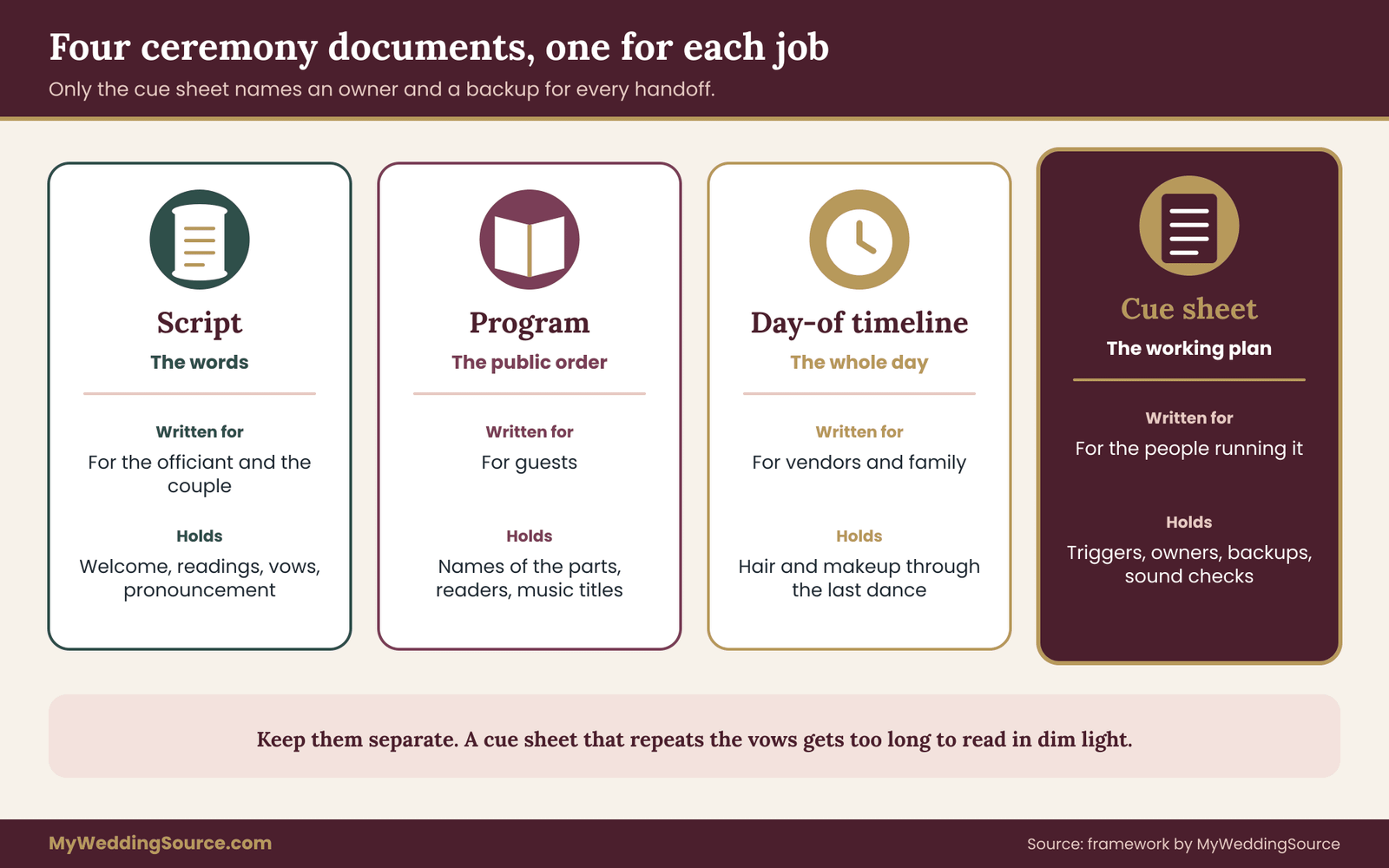
People mix up several documents that sound alike. Keeping them apart saves a lot of confusion.
The script is the words: the welcome, the readings, the vows, the pronouncement. It belongs to the officiant and the couple. If you are still writing those words, start with our guides to wedding ceremony script templates and to the order of a ceremony, step by step.
The order of service or program is the public version of the sequence, printed for guests. It names the parts but not the mechanics.
The wedding-day timeline covers the whole day, from hair and makeup to the last dance. The ceremony is one block on it.
The wedding ceremony cue sheet is the working document for the ceremony block alone. It does not repeat the vows. It says who starts the prelude, when the ushers close the doors, which song begins when the first bridesmaid steps off, who hands the officiant the license, and what happens if the sound system fails. It is written for the people who run the ceremony, not for the people who attend it.
One sheet, several versions
A well-built sheet is really one master with a few trimmed copies. The master is for the coordinator or whoever is calling cues. The others carry only what each person needs.
- Master copy. Every line, every owner, every backup, with notes. Two or three pages at most.
- Officiant copy. The order of events, names and pronunciations, the points where the officiant pauses or hands off, and the legal steps at the end.
- Music copy. Track or piece names with the exact trigger and length for each one, plus the fade or stop rule.
- Reader copy. A short card: when you walk up, where you stand, what you read, where you sit afterward.
- Usher and wedding party copy. Seating rules, line-up order, the spacing rule, and who they look to for the signal.
Everyone sees the same underlying times, so nothing contradicts. People just see less of it, which is a kindness. A reader does not need to know when the grandparents are seated; she needs to know where to stand.
Why a ceremony goes wrong without one
Ceremonies rarely fail dramatically. They fail by small delays that pile up, and the same few places cause most of them. Knowing the usual suspects tells you what a wedding ceremony cue sheet must cover.
The silent start. No one is named as the person who starts the music. The guests wait, the wedding party fidgets, and someone eventually waves a hand at the DJ.
The processional that runs short or long. The song ends while two bridesmaids are still halfway down the aisle, or the next walker enters on a beat that has no relation to the music. This is a timing problem, and it can be calculated in advance.
The missing reader. The reader went to the restroom, or sat in the back row, or did not realize it was her turn. The officiant stands there and then improvises.
The dead microphone. A battery runs out, a wireless receiver picks up interference, or the sound person is on a break. Guests in the back cannot hear the vows, and the video has no audio.
The unclear ending. The officiant pronounces the couple married, and then nobody knows whether to start the recessional music. The couple kisses, waits, and waits.
The legal tail. The license and the pen are somewhere in a bag. Signing happens forty minutes later, in a rush, and a witness cannot be found.
Each of these is a missing line on a wedding ceremony cue sheet. None needs a professional to fix. It needs someone to have written the line down and told the right person.
Who owns each cue: roles and the one-voice rule
The hardest part of a good wedding ceremony cue sheet is not the format. It is deciding who calls the cues. Without a named person, every cue becomes a negotiation.
The cue caller
One person should be the voice that releases the major cues: opening the doors, starting the processional, signaling the officiant to begin, and ending the ceremony. This is often a coordinator, a venue manager or a day-of helper. If you do not have a professional, assign a calm friend with a phone or a printed sheet and a watch.
The rule that makes this work is the one-voice rule: during the ceremony, only the cue caller gives signals to the wedding party, the music and the doors. The officiant leads the ceremony itself. The photographer, the family and the venue staff do not give signals to anyone. A single voice keeps two people from sending the bridesmaids down the aisle at different times.
The roles on a typical ceremony
- Cue caller. Releases the major cues, checks the time, handles surprises.
- Officiant. Leads the ceremony, cues the readers, ring bearer and music at set points, and handles the license.
- Musician or DJ. Plays the prelude, processional, interlude and recessional, starting on a defined signal.
- Sound operator. Controls microphones and levels. Sometimes the DJ, sometimes a separate technician, sometimes the venue.
- Ushers or greeters. Seat guests, close the doors at the right time, hand out programs.
- Wedding party lead. A friend or the coordinator who lines up the group and sends them down at the right spacing.
- Photographer and videographer. Not cue givers. They need a copy of the wedding ceremony cue sheet, so they know when the key moments land.
- Readers and participants. Each needs a time to arrive, a place to wait, and a clear cue.
If the ceremony is small, one person may cover several of these. Write that down. “Maria, cousin” owning both the guest book table and the reader handoff is fine, as long as the wedding ceremony cue sheet says so and the two jobs do not happen at the same time.
Backups are the difference between a wedding ceremony cue sheet and a wish
For every owner, write a backup. A backup is a named person, not “someone from the family.” Ask the backup in advance, hand them the same copy, and tell them when they would step in.
Backups matter most for four cues: starting the music, starting the processional, handing the license to the officiant, and managing the microphones. If the cue caller is delayed in traffic or caught in a restroom line, somebody else has to know that they are now the voice. Tell the vendors who the backup is as well. A musician who is looking for the coordinator and sees a stranger needs to have been told in advance.
If the venue provides a coordinator, ask what they handle and what they do not. Some venue coordinators open doors and manage the schedule but do not cue music or direct the wedding party. Find out early, because it decides who you must assign. Our wedding party coordination checklist has a longer breakdown of who does what with a group of attendants. ## How to build a wedding ceremony cue sheet, line by line
A wedding ceremony cue sheet is a list of lines, and each line is one moment. The skill is in deciding how much to put on a line. Too little and people guess. Too much and no one reads it with a violin in one hand.
The anatomy of a line in a wedding ceremony cue sheet
Every line carries the same six parts, in the same order, so the eye learns where to look.
- Time or position. When it happens. This is either a clock time, such as 4:12, or a time relative to the start, such as “T plus 6”. More on that in a moment.
- The cue. What happens, in a few words. “First pair enters” or “Reader one to lectern”.
- The trigger. What sets it off. A trigger is an event or signal, not a time. “Officiant nods to the musician” is a trigger. “4:12” is not.
- The owner. The one person responsible for making it happen.
- The backup. The named person who steps in if the owner cannot.
- A short note. The detail that prevents a mistake: “Wait for the last chord,” “Hand over the ring box, not the rings,” “Mic is on the left stand.”
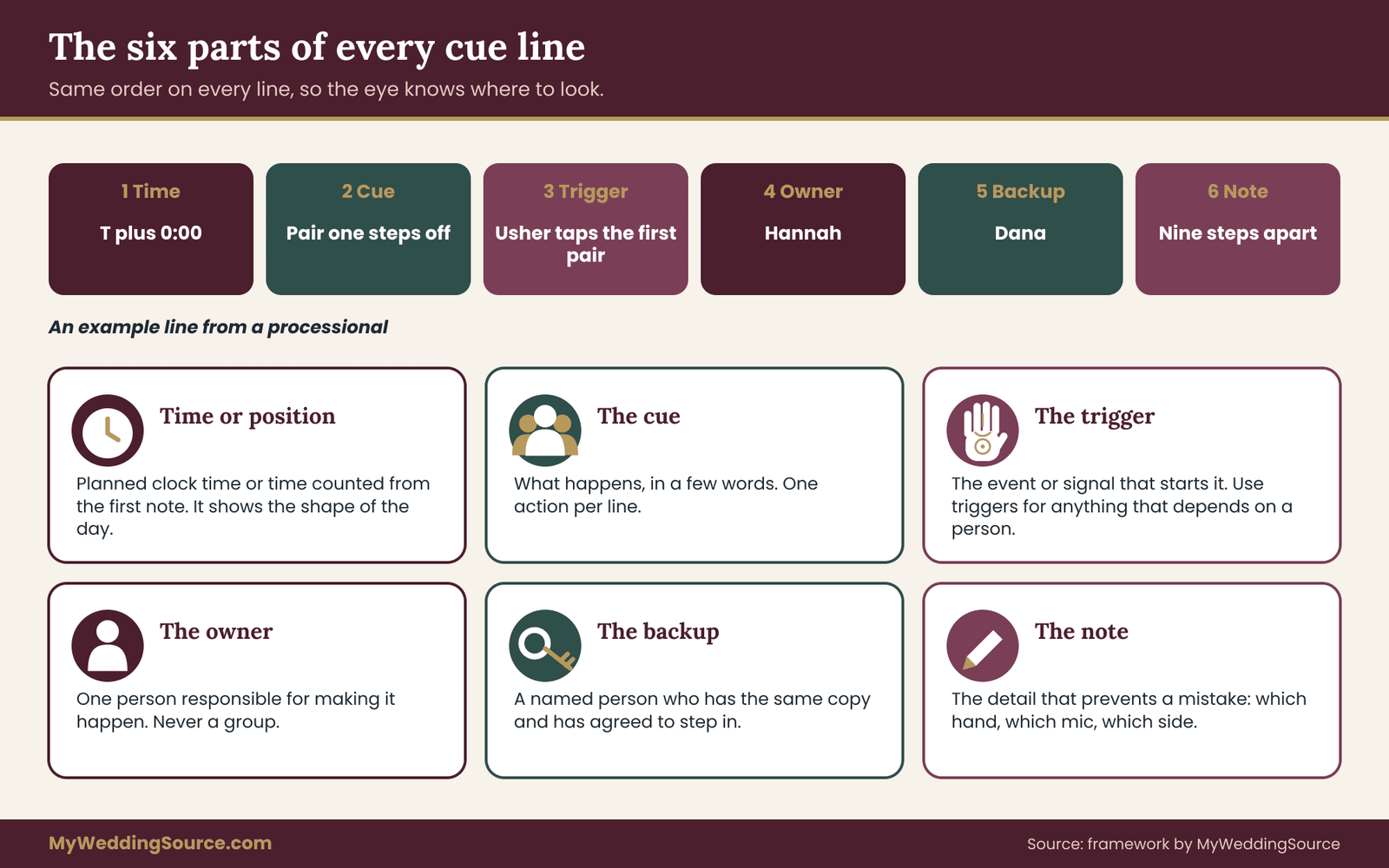
Written out, one line reads like this: “4:12 / Processional music begins / Trigger: cue caller raises a hand / Owner: DJ Sam / Backup: Priya (laptop at table) / Note: Start with the soft piano intro, not the full chorus.”
You can lay this out as a list with the six parts on separate short lines, or as a single sentence per cue. A fixed form matters more than the particular layout. Avoid dense blocks of text, and do not rely on a spreadsheet grid that cannot be read in dim light or from three feet away. Large type, short lines and plenty of white space work better than clever formatting.
Triggers, not times, in a wedding ceremony cue sheet for anything that depends on a person
Clock times are fine for fixed points: when the doors open, when guests should be seated, when the music starts. They are poor for anything that depends on a human action. A ceremony that was planned to begin at 4:00 will start at 4:07 if the partner’s ride was late, and every clock time after that is wrong.
So a good wedding ceremony cue sheet uses both. It lists planned times to show the shape of the ceremony, then names the trigger for every cue that follows a person. The processional music starts when the cue caller signals, not at 4:12. The signing music starts when the officiant says “please be seated for the signing,” not at 4:31. If the wedding ceremony cue sheet slips by seven minutes, every trigger still works.
T-minus and T-plus: a clock that survives delays
Many professionals use a relative clock. T is the moment the processional music begins, which is the best single anchor for a ceremony. Before it, the clock counts down: T minus 30 is half an hour before. After it, the clock counts up: T plus 12 is twelve minutes into the ceremony.
The benefit is that you can print one sheet that works whenever the ceremony actually begins. If T moves from 4:00 to 4:15, the whole schedule moves with it, and nobody has to rewrite anything. Add real clock times in a column beside the relative ones if people prefer, and treat the clock times as a plan, not a promise.
How detailed a wedding ceremony cue sheet should be
A useful test is to ask, “If this line were missing, could someone reasonably make the wrong call?” If yes, it earns a place. If no, cut it. Lines that nearly always earn a place: anything involving music, microphones, doors, the license, the ring bearer, children, elderly guests and any item that must be physically carried to the front.
Lines that usually do not: how the officiant introduces a reading, as the officiant knows. The words of a vow. A detail that never changes and never goes wrong.
Two or three pages cover almost any wedding ceremony cue sheet. A short civil ceremony may fit on one. A long religious service with several participants and a full musical program may need four. If the master runs longer, split it into a pre-ceremony section and a ceremony section.
The pre-ceremony run: from T minus 90 to the first note
Most of the trouble in a ceremony begins before it starts. The pre-ceremony block is where the sound check, the line-up and the seating happen, and it is the part of the wedding ceremony cue sheet that deserves the most care. The times below are a starting point; adjust to your venue and the length of your guest list.
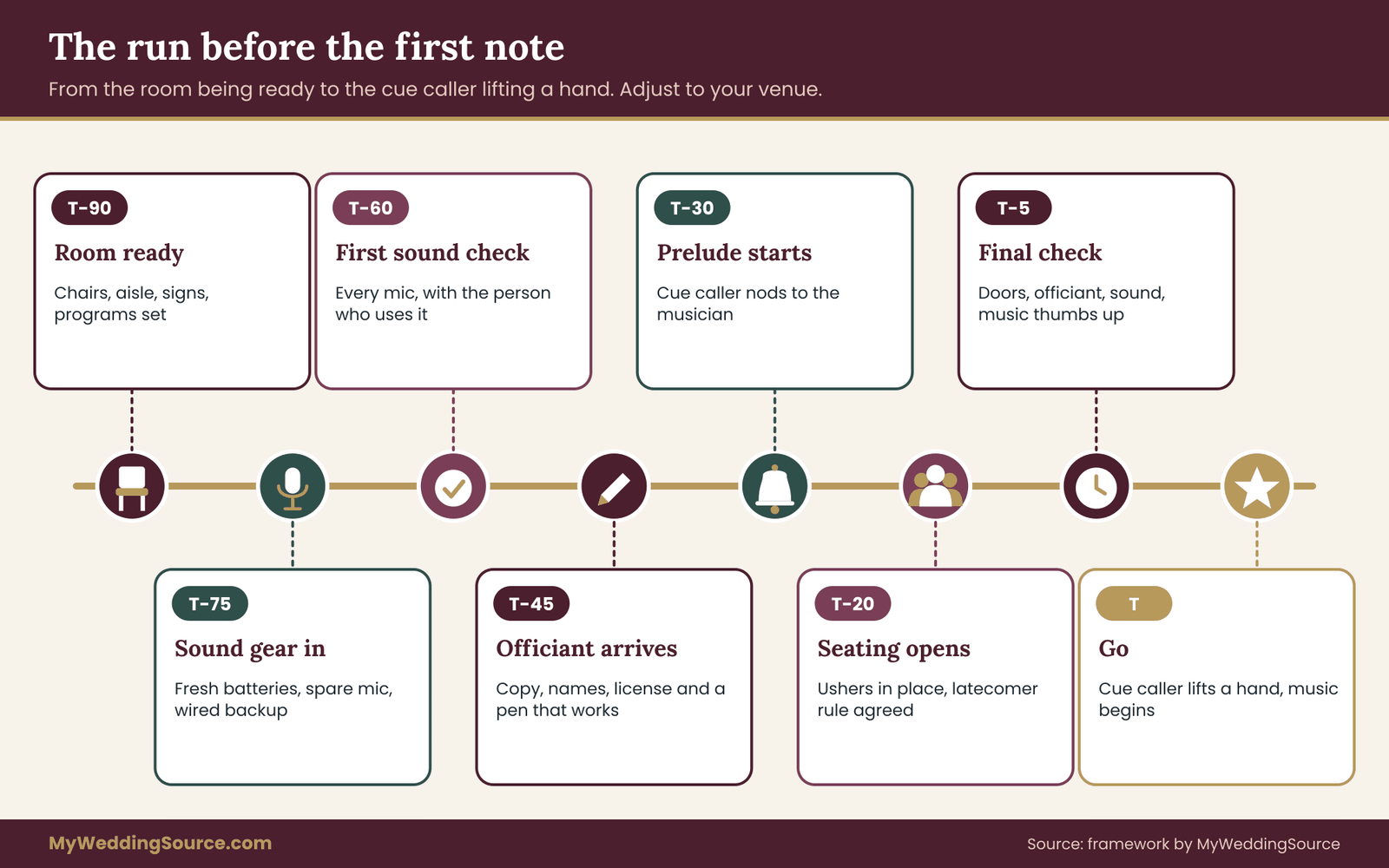
T minus 90 to T minus 60: the room and the gear
- Venue access and setup complete. Chairs set, aisle clear, signage and programs in place. Owner: the venue contact or the coordinator.
- Musicians and DJ arrive and set up. Ask for arrival at least ninety minutes before the ceremony so there is time to solve a problem. The more complicated the equipment, the earlier they should come.
- Microphones placed and powered. Fresh batteries in every wireless unit. Owner: the sound operator.
- The cue caller walks the aisle. Not to inspect decor. To check where the doors are, where each person will wait, and where they will see the cue.
T minus 60 to T minus 40: the sound check, with something to listen for
A sound check at 3:30 with an empty room tells you almost nothing about 4:00 with a full one. Guests absorb sound. Their voices add noise. A microphone that sounded fine at 3:30 can feed back at 4:00. Plan for a quick second check as the first guests arrive.
During the first check, test every microphone that will be used, with the actual people who will use it if possible. The officiant speaks at the volume and distance they will use. A reader stands at the position and reads a line. If the couple will say vows into a microphone, the couple tests it, in a normal voice, not a performer’s. The sound operator walks to the back row and gives a thumbs up or a correction. We cover the full routine in the sound check section below.
- Test the music start. Play the first ten seconds of the prelude and the processional start. Confirm volume, and confirm that the start is clean.
- Confirm the file names and order. The DJ’s list matches the wedding ceremony cue sheet. Any change from the plan is written on the sheet.
- Check the signal path. If the cue caller will signal by hand, make sure the musician and the doors person can see her. If by earpiece or text, test that.
T minus 40 to T minus 20: the people
- Officiant arrives and receives the master or officiant copy. The officiant checks names and pronunciations, and confirms the license is present and the pen works.
- Readers and participants arrive and receive their cards. They are told where to sit and when to move.
- Wedding party lined up out of sight. If the aisle begins at a set of doors, the party waits behind them. If outside, a screen or a separate path keeps guests from seeing them early.
- Ring bearer and flower children paired with an adult. A named adult walks them to the start and stands where the child can see them.
- The couple is in a private waiting space. With water, a tissue, and the person who will tell them when to go.
T minus 20 to T minus 5: guests arrive and are seated
- Ushers or greeters in place. Programs handed out, seating guided.
- Prelude begins. Typically about twenty to thirty minutes before the start, depending on how many guests are expected to arrive early. Owner: musician or DJ.
- Family seating begins. Grandparents and parents, seated in the order you agreed, usually just before the processional.
- Late arrivals plan set. Decide when the ushers will stop seating and how they will handle latecomers. This line prevents the awkward whisper at the back.
T minus 5 to T: the final check
- Doors closed or aisle cleared. Cue caller confirms.
- Officiant and groom or first partner in place. Whoever is at the front is told that the processional is about to begin.
- Phones off, or an announcement made. If you are asking guests to put away phones, someone announces it. If you are not, skip the line. Our wedding audio and lighting checklist covers the equipment side of the announcement.
- Final thumbs-up from the sound operator and musician. A deliberate, visible check.
When the cue caller lifts a hand, the first cue of the ceremony begins. That is T. ## Processional timing in a wedding ceremony cue sheet: the arithmetic behind the walk
The processional is the part of a wedding ceremony cue sheet that benefits most from a calculator. It looks like a casual walk. It is really a chain of timed entrances set to music, and the music has a fixed length. If you do not do the math, the song either ends early or runs on while the last person is still walking.
The inputs
You need four numbers, and you can measure all of them in ten minutes at the venue.
- Aisle length. Measure from the point where each person becomes visible to guests to the spot where they stop. Walk it with a tape or count paces. Many couples guess and are off by half.
- Walking pace. A processional is slower than a normal walk. A common instruction is to step together, pause slightly, and let each foot land on a beat. Time yourself or a friend walking the aisle at the pace you want, and use that number.
- Spacing. The gap between one person and the next. A common rule of thumb is eight to ten steps, or the length of a few rows of chairs. Smaller gaps look crowded. Larger gaps look empty.
- Number of entrances. Count every entrance, not every person. A pair walking together counts once. A child with an adult counts once.
A worked example (illustrative numbers)
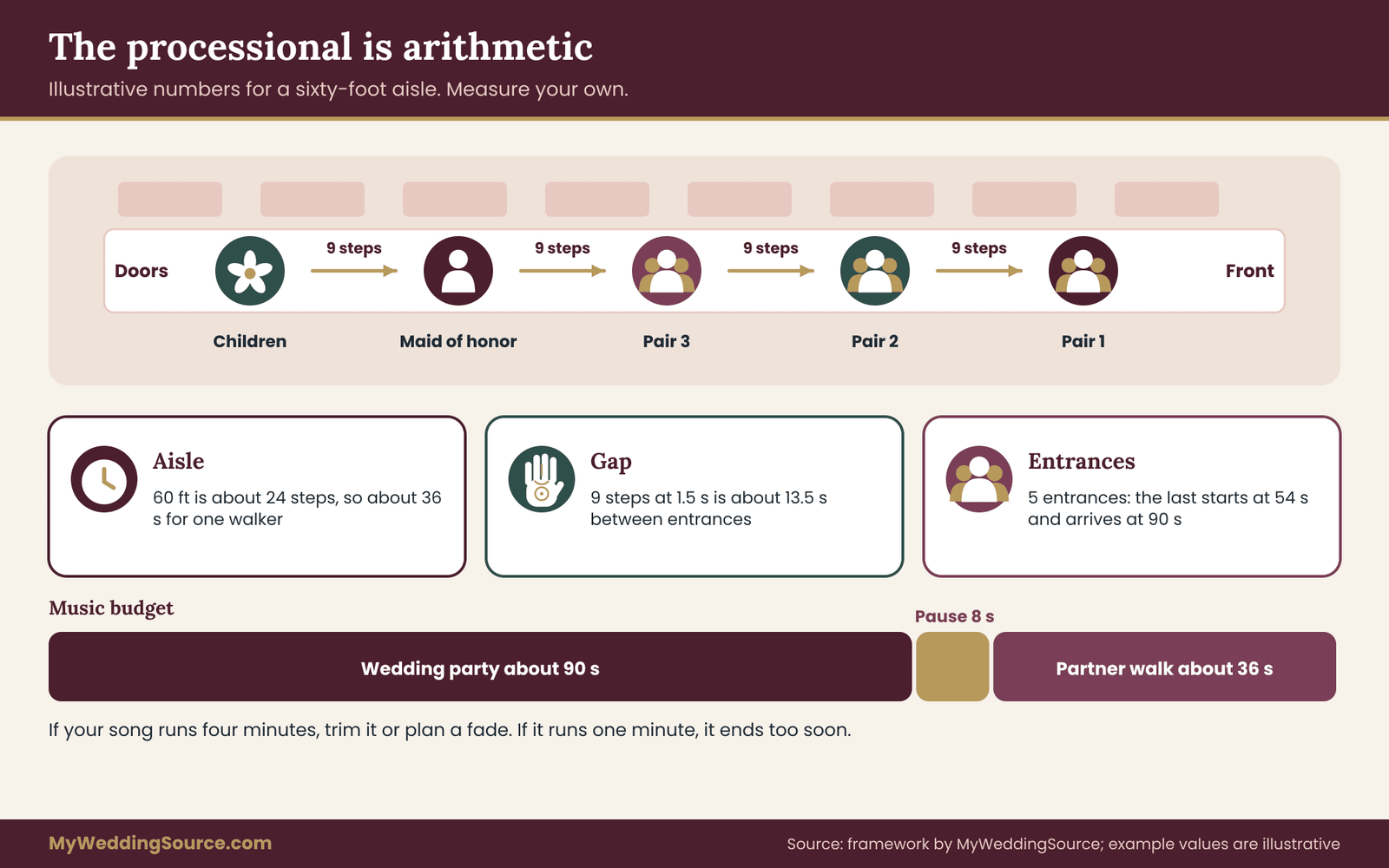
Take an outdoor aisle sixty feet long. Say a slow walking step covers about two and a half feet and lands once every second and a half. That makes twenty-four steps, or about thirty-six seconds, from the start of the aisle to the front.
Now say there are five entrances before the partner: three pairs from the wedding party, the maid of honor on her own, and a ring bearer and flower girl together. Grandparents and parents were seated earlier, so they do not count. If each new walker steps off when the one ahead is about nine steps down the aisle, the gap is about thirteen and a half seconds, which is nine steps at a second and a half each.
The first walker takes thirty-six seconds. Each of the next entrances starts one gap after the one before, so the fifth starts at about fifty-four seconds and reaches the front at about ninety seconds. That is a minute and a half from the first step to the last attendant’s arrival. Then the partner needs a pause of a few seconds, plus thirty-six seconds of walking.
So the wedding party’s music needs about ninety seconds, and the partner’s walk needs about forty-five seconds including the pause. That is the rough budget. If your chosen processional piece lasts four minutes, you have too much music. Choose a shorter arrangement, trim the track, or plan to fade it. If it lasts sixty seconds, it will end before the last attendant arrives.
Your numbers will differ, and that is the point. This arithmetic is a template, not a rule. Do it with your own aisle.
Time the aisle with real people
Paper math is a good start, but a rehearsal tells the truth. Ask one person to walk the aisle at the pace you want, and time it with a phone. Do it twice and use the longer time. Then check three things.
- The longest walker. An older attendant, a child, or a person in long skirts and heels takes more time than a young adult in flats.
- The first step. People take a few seconds to start. If your sheet says “step off on the downbeat” and nobody told them, expect a delay.
- The last arrival. Some people stop too early or too late. Mark the stopping place on the floor with something discreet, such as a small ribbon on a chair, or a spot on the grass.
Cueing each entrance
There are three ways to release each person, and the wedding ceremony cue sheet should name which you are using.
By a person. An usher or the coordinator stands out of sight with a clear line to the aisle, and taps or nods each walker when the gap is right. This is the most reliable method, and it works with any music.
By the music. Each pair steps off at a set point in the song, such as the start of a new phrase. This looks beautiful, but it only works if everyone has rehearsed it, and if the music is exactly as long and as steady as the rehearsal version. A live musician who plays a little faster on the day can throw it off.
By a count. Each pair waits a set number of seconds after the one before. This is the middle path. Pair it with a visible signal, so the walker does not have to look at a watch.
Most ceremonies use the first, with the second as a visual bonus. Do not rely on walkers to judge the gap themselves. They will hurry, because they are nervous.
Choosing the order
The order of the processional is a matter of tradition and family. The usual shapes are all variations on one idea: the people nearest the couple come last. Some couples seat grandparents and then parents before the processional starts. Others have the parents walk in. The officiant is often already at the front. The partner or partners enter last, and some couples walk in together.
Write down your order explicitly, with names, pairings and sides. Do not assume that “the usual” is understood by everyone. If you are unsure which order suits your ceremony, our guide to the order of a ceremony lays out the common sequences.
Three small cues that prevent big problems
- Doors. If the aisle starts behind a set of doors, name who opens them, and when. A door that opens early reveals the wedding party. A door that opens late leaves a pair standing in view of nobody.
- The pause for the partner. Many couples want a breath between the last attendant and the partner. Add a line for it, and name who signals it, usually the cue caller, with a short musical shift.
- Standing. If guests are meant to rise for the partner’s entrance, decide who prompts it. The officiant can say “please rise,” or the musician’s change of piece can do the job. If neither is named, half the room will stay seated.
Music cues: preludes, processional pieces, interludes and the recessional
Music is the most cue-dependent part of a ceremony because it has to start and stop on time, and it has to change at the right moment. It is also the area where small gaps in communication cause the most embarrassment.
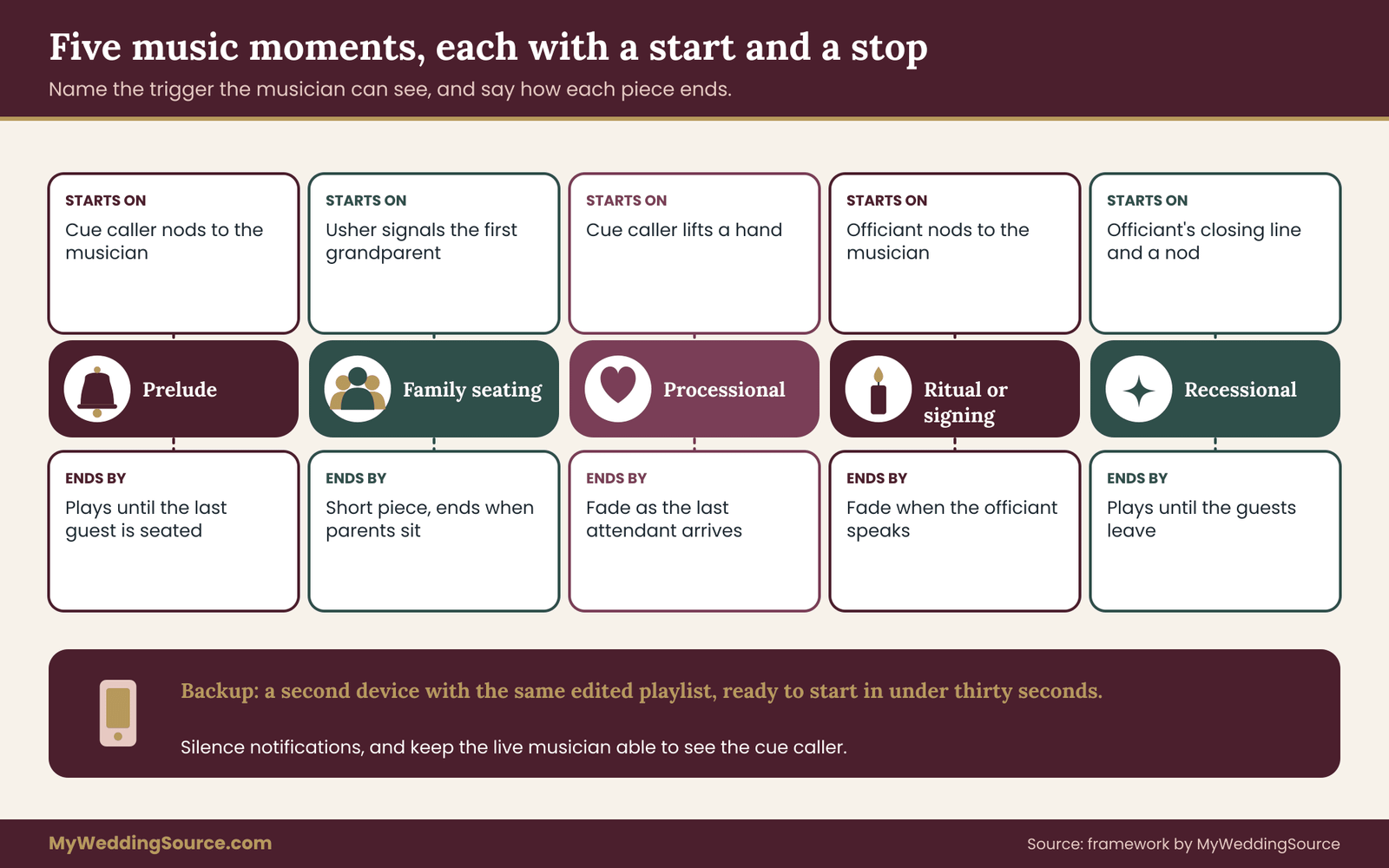
The five music moments
- The prelude. Music that plays while guests arrive and are seated. It has no fixed end and fills whatever time it needs to.
- The seating of family. Often a distinct piece or a transition, so that guests know the ceremony is close.
- The processional. Usually one piece for the wedding party and a different piece, or a different section of the same piece, for the partner.
- The interlude or ceremony music. A song during a reading, a unity ritual, or the signing of the license.
- The recessional. Upbeat music that plays as the couple leaves and as guests exit.
Each one needs a start trigger, a stop rule and a length. The wedding ceremony cue sheet carries all three.
The start trigger
Name a trigger the musician can see or hear. A raised hand from the cue caller. A nod from the officiant. A message on a phone. The trigger should be visible from where the musician stands. A violinist in a corner who cannot see the doors is not able to start on a signal. If the musician will play facing the guests, decide where the cue caller will stand so the signal is in sight.
For the partner’s entrance, a common pattern is that the cue caller signals when the last attendant is a few steps from the front. The musician finishes a phrase, or moves into the second piece, and the doors open on that change. Agree on the exact sound that counts as the signal, and rehearse it once.
The stop rule
Say how each piece ends. Options include a fade to silence over a set number of seconds, a clean ending where the player finishes the last chord, or a hard stop on a signal. The wedding ceremony cue sheet should say which, and who controls it. A recorded track that plays through to its natural end can leave the partner standing at the front with two minutes of instrumental outro. A live player who stops abruptly can feel jarring. Decide in advance.
For the processional piece, a common approach is to loop or extend the music until the partner reaches the front, then fade. For a recorded track, the DJ can trim the file to the planned length, or set a fade point. Whatever you pick, write it down.
Recorded or live: what changes on the wedding ceremony cue sheet
With live music, you are working with people who can respond. A musician can repeat a phrase, slow down or extend if a walker is late. The wedding ceremony cue sheet should give the musician a clear idea of how long each section needs to be and what the signal is, and trust them to adjust.
With recorded music, you have exact lengths but no flexibility. The DJ or the person running the playlist needs to know the file names, the order, and the points where the track should be paused or faded. Prepare an edited version of each song with the right length, and keep a copy on a second device. If the music is being played from a phone or a laptop, turn off notifications and set the device to do not disturb. A text message that pops up at the wrong moment is a classic way for a quiet ceremony to be interrupted.
Whatever the source, keep a backup you can start in under thirty seconds. A second device with the same playlist, or a USB drive in the DJ’s bag, is enough.
Music rights, briefly
Music that is performed in public is usually protected by copyright, and in the United States, performance rights organizations such as ASCAP, BMI and SESAC license public performance on behalf of songwriters and publishers. Venues and professional performers often hold the licenses they need, and a private ceremony with a hired musician or DJ is typically handled by them. Ask your musician or the venue how they handle licensing, and keep the answer on file. This is a general overview and not legal advice. If you are unsure, ask the venue or a lawyer.
Writing the music line in your wedding ceremony cue sheet
A music line on the wedding ceremony cue sheet might read: “Processional, wedding party. Trigger: cue caller lifts a hand. Owner: Sam (DJ). Backup: Priya with the laptop. Track: soft piano arrangement, trimmed to two minutes. Fade at the last attendant’s arrival.” It is short and complete. The musician knows what to play, how long, what starts it, and who steps in. ## Officiant cues in the wedding ceremony cue sheet
The officiant leads the ceremony, so it is tempting to treat them as outside the wedding ceremony cue sheet. That is a mistake. The officiant is the person who triggers most of the cues after the processional: the readers, the ring bearer, the music during rituals, the signing. They need to know the wedding ceremony cue sheet, and the wedding ceremony cue sheet needs to know them.
What the officiant needs from you
Send the officiant their copy at least a week before the ceremony, along with a short list of information they cannot guess.
- Names and pronunciations. The full names of the couple, the parents, readers and anyone they will mention. Add a phonetic spelling for anything unusual, and ask the person to record themselves saying their name if it is complicated.
- The sequence of events, with the handoffs marked. The officiant wants to see where each reader walks up, where the music starts, and where the ring bearer appears.
- Where people stand. A short note on who stands where at the front, including whether the couple faces each other, faces the guests, or stands beside the officiant.
- Special requests. A moment of silence, a shared ritual, a mention of a person who has died, a point where the officiant should wait for applause.
- The ending. The exact wording, if you have a preference, and what happens right after: the pronouncement, the kiss, the introduction, and the music that follows.
If you have not yet chosen an officiant, or you are unsure what they must do to be legally recognized, start with our guide to wedding officiant requirements. Requirements differ by state, and in some places an officiant must be registered or authorized before the ceremony.
The officiant’s cue points
Mark these moments on the officiant’s copy. At each one, the officiant either gives a cue or receives one.
Before the processional. The officiant takes their place when the cue caller says so, and watches for the partner at the back of the aisle. Some officiants wait at the front for the whole prelude. Others enter with the groom or with the couple. Choose one and write it down.
The welcome. After the partner arrives and the music ends, the officiant begins. They should not speak over the last notes. A short silence of two or three seconds helps guests settle.
Readers and participants. The officiant introduces each reader by name, steps aside or toward the reader, and takes the floor back when the reading ends. If the reader is nervous, the officiant can stay close.
Ring bearer and rings. Decide who holds the rings and when they are handed over. A ring bearer with a pillow often carries decoy rings. The real ones go with the best man, the maid of honor or the officiant. Write it down: “Real rings with Marco. Hand to officiant at the ring exchange.”
Music during a ritual. If a song plays during a unity ritual, a candle lighting or a family blessing, the officiant gives the musician a signal to start and a signal to end. Do not leave this to chance.
The pronouncement and the kiss. The officiant pronounces the couple married, waits for the kiss, then gives the final line. Tell the photographer and videographer in advance, so they are ready.
The recessional cue. The officiant tells the guests to stand, or says a closing line, and then nods to the musician. The wedding ceremony cue sheet should name the exact words or gesture that starts the recessional music.
The signing. If the license is signed at the ceremony, the officiant invites the couple and witnesses to a table. The wedding ceremony cue sheet should say who brings the license, the pen and the table, and whether music plays.
The license: a small item with real consequences
The marriage license is the legal document that makes the marriage official, and it tends to disappear in the crowd. In most states, the couple, the officiant and sometimes witnesses sign it, and the officiant returns it to the county clerk or the issuing office within a set time. The time limit and the rules about witnesses differ from place to place. For example, one state may require witnesses, and another may not, and some places allow a short window after the ceremony for the officiant to file the license.
Because these rules vary, check with the county clerk’s office where the license was issued. The U.S. government’s guidance on marriage licenses points people to the state and local authorities for the rules in their area, and a license that is not filed on time can cause trouble later.
For the wedding ceremony cue sheet, the license needs three lines: who has it before the ceremony, who hands it to the officiant, and who takes it afterward to be filed. Many couples name a calm person who is not part of the wedding party, such as a parent, a coordinator or a friend, to carry it. Add a second line for the pen, because a good pen disappears at the exact moment you need it.
Readers and participants: briefing, timing and handoffs
Readers are often the most nervous people in the ceremony, and the least experienced at public speaking. A good wedding ceremony cue sheet treats them with care. The goal is to make their job obvious, short and difficult to get wrong.
Choose and brief the reader early
Give each reader their text at least two weeks ahead. If they are reading something you wrote or chose, tell them why you picked it, because that helps them read it with feeling. Ask them to practice aloud at least three times, with a timer.
Tell them four things.
- When you walk up. The trigger, such as “when the officiant says your name.”
- Where you stand. At the microphone, a lectern or beside the officiant. Show them in person at the rehearsal.
- What you carry. A printed copy, with large type and double spacing. Do not rely on a phone, because screens dim, notifications arrive, and glare ruins visibility outdoors.
- Where you go afterward. Back to a seat, or to join the wedding party. Without a clear instruction, some readers stand awkwardly at the front.

Timing a reading
Reading time depends on the text. As a rough rule of thumb, an average speaker reads aloud at roughly 120 to 150 words per minute, and slower when nervous or when the passage is emotional. Time your reader reading the real text at a calm pace, and then add ten to fifteen seconds for the walk up and the return.
Add the numbers up. A reader who speaks for ninety seconds, plus twenty seconds of movement, takes about two minutes. Three readers take about six. Five readers take ten minutes, which is a large share of a twenty-five minute ceremony. Cut or combine readings if the total is longer than you want.
The handoff
The handoff is the moment when the officiant steps aside and the reader steps in. A smooth one needs a cue and a place. The officiant says, “Now Maria will read,” and gestures toward the lectern. Maria stands and walks. The officiant steps to the side. When the reading ends, Maria says thank you or nods, walks back, and the officiant resumes.
Write the line on the wedding ceremony cue sheet: “Reading one. Trigger: officiant introduces Maria. Owner: Maria. Backup: Daniel (reads from the second row). Note: Maria’s card is on her chair.” The backup is not a guest who happens to be nearby. It is a person who has seen the text and said yes in advance.
If the reader is not in their seat
Ask the reader to sit near the aisle, in the front half of the room, and give them a cue buddy: a person sitting next to them who will nudge them when the reading is next. If the reader is absent at the moment, the officiant has two options. Wait thirty seconds while an usher finds them, then skip. Or use the backup reader. The decision should be on the wedding ceremony cue sheet so the officiant is not making it on the spot.
Participants other than readers
Other people with parts in a ceremony include a person who delivers a blessing, a family member who joins a ritual, a child who carries a sign or a pet that walks the aisle. Each needs a line on the wedding ceremony cue sheet. A common failure with children is the cue: they do not know when to walk. Pair each child with a named adult who stands just out of sight and walks them to the start. If a child refuses to walk, have a fallback line: “If the flower girl stops, her mother joins and they walk together.”
Language access and interpreters
If any guests use sign language, or if a language other than English is part of the ceremony, the wedding ceremony cue sheet should include the interpreter. A qualified sign language interpreter needs a place to stand where the person they serve can see them, a copy of the script and the wedding ceremony cue sheet ahead of time, and a signal for when to begin.
Federal guidance on effective communication explains that a qualified interpreter should be able to interpret accurately and impartially, and that a family member is not a substitute, particularly a child. The wedding ceremony cue sheet should list who arranged the interpreter and how to reach them, and it should note where the interpreter stands relative to the lighting and the couple.
For readings in another language, tell the officiant in advance whether a translation follows and who gives it. If you plan to give guests printed translations, add a line for who hands them out.
Sound checks and microphones for the wedding ceremony cue sheet
A ceremony is only as good as the sound that carries it. A microphone fault is the most common problem that a wedding ceremony cue sheet can prevent, and the cause is almost always that no one tested the system under real conditions.
What to test, and with whom
Test every microphone that will be used, with the person who will use it. The line “mic check” should appear on the wedding ceremony cue sheet for the officiant, each reader position and the couple, if they will use a microphone for vows. Ask each person to speak normally, not to whisper and not to project. The sound operator listens at the back, at the sides and near any speakers.
Then test the whole chain, not only the microphone. The sound operator confirms that the system switches cleanly between music and speech, that the music level drops when the officiant begins, and that no feedback appears when someone walks near a speaker.
Wireless microphones, interference and frequencies
Many ceremonies use wireless microphones, which are sensitive to interference from other devices. Wireless systems operate on specific radio frequencies, and the Federal Communications Commission regulates who may use which bands. Licensed and unlicensed uses differ, and the rules have been updated in recent years. You do not need to master them. What you do need is a sound professional or a venue technician who knows how to scan for a clear frequency at your venue and has done so recently.
Ask your vendor three questions. Do you scan for open frequencies at the venue before the event? Do you carry spare microphones and batteries? What do you do if a unit fails during the ceremony? The answers should end up as lines on the wedding ceremony cue sheet.
Batteries, spares and a ten-second swap
Put fresh batteries in every wireless unit at T minus 60, and keep a set of spares in the sound operator’s pocket. Note the time on the sheet. A wireless unit with a fresh battery typically runs for hours, but a worn one fails without warning. Keep a wired microphone and a cable available as a backup for the officiant. A wired backup is not elegant, and it is reliable.
The row-by-row listening test
Before guests arrive, someone walks to the last row, then to the side and then to the front, while another person speaks through the system. Ask the listener to write down whether they could understand every word. A hearing test is more valuable than a level meter. Outdoor ceremonies need an extra test, because wind carries sound away from the back rows and into microphones as noise. A windscreen on each microphone helps, and so does standing the officiant with their back to the wind.
Assistive listening
In a ceremony with older guests, or with guests who are hard of hearing, an assistive listening system can make a real difference. Assistive listening systems send audio directly from the sound source to a receiver worn by the listener. Common types include hearing loops, FM systems and infrared systems. Advocacy groups note that venues with assembly areas that use a public address system often need to provide such a system, and that the number and type depend on the venue. For a private wedding, ask the venue what it offers. If the venue has a system, add a line on the wedding ceremony cue sheet: who hands out the receivers, where they are available, and who tells guests.
If the venue has no system, ask guests who need help to sit near the front or near a speaker, and tell the officiant so they can face the guests and speak clearly. Do not wait until the day to ask. A short note on the wedding website lets guests tell you what they need. ## Contingency cues: what the wedding ceremony cue sheet says when something goes wrong
Nobody wants to plan for failure at their own wedding. The reason to do it anyway is that a problem with no plan costs five minutes of confusion, and the same problem with a plan costs thirty seconds. The goal is not to predict everything. It is to decide, in advance and calmly, who makes a call and by when.
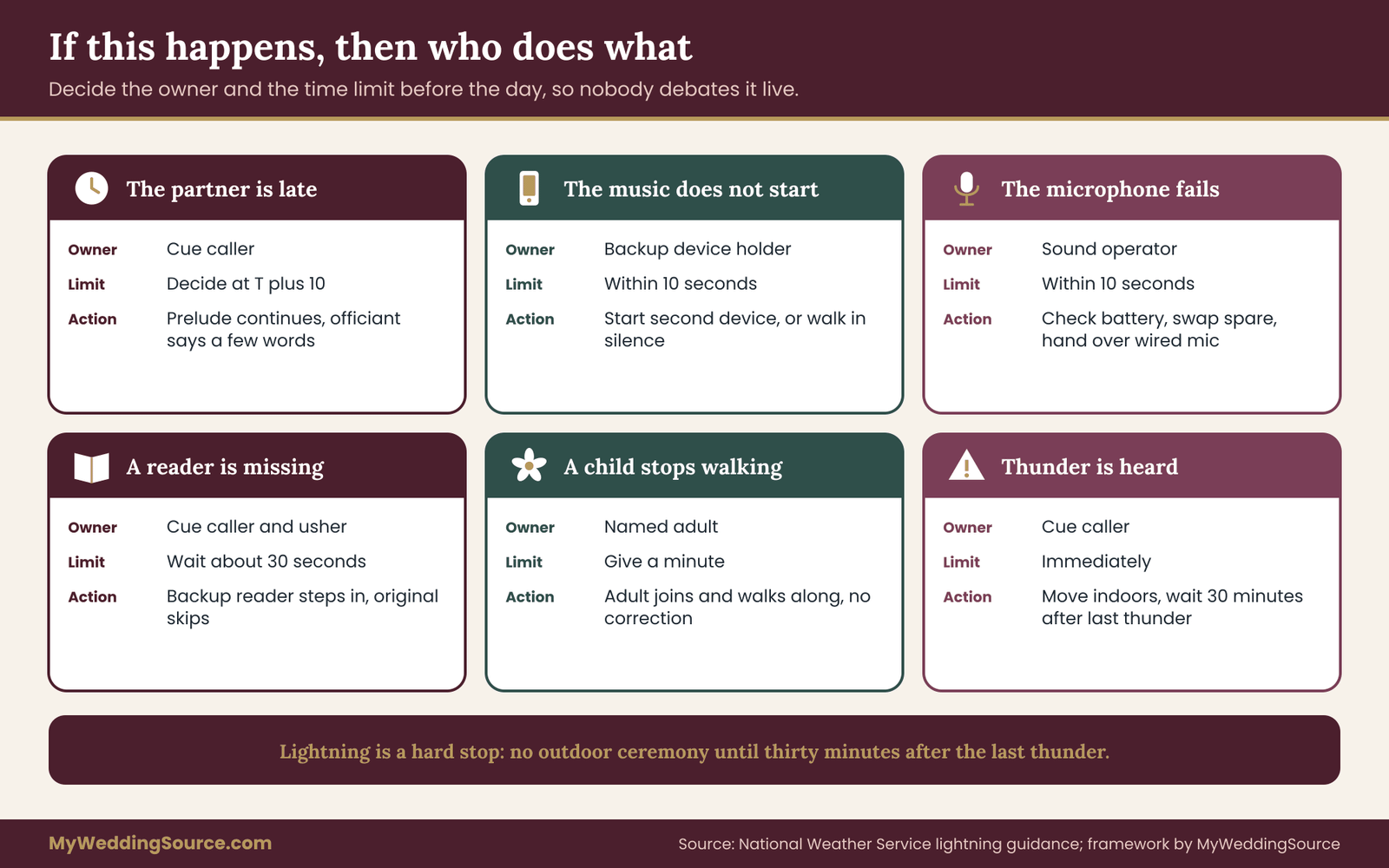
For each contingency, the wedding ceremony cue sheet needs four things: the trigger, the owner of the decision, a time limit, and the action. Keep each to two or three lines on a separate page of the master. People will read it under stress, so brevity is a courtesy.
The partner is late
Set a start rule in advance. For example: “If the partner has not arrived by T minus 10, the cue caller tells the officiant and musician. The prelude continues. Ushers keep seating. Decision point at T plus 10: the cue caller consults the partner’s contact and the officiant, and the officiant makes an announcement.” The point is that someone owns the decision and that guests are told something before they start guessing.
Guests tolerate a short delay without comment. They tolerate silence badly. A musician who keeps playing and an officiant who says a few words keep the room calm.
The music does not start
If the music fails at the start of the processional, the cue caller waits a few seconds, signals the backup, and the backup starts the second device. If the second device also fails, the officiant says, “We will begin,” and the processional goes ahead without music, or with a cappella humming from the musicians, or with a guest singing. Decide whether you would rather walk in silence or wait, and write the answer down. Many couples would take silence over a ten-minute wait.
The microphone fails
The sound operator has ten seconds. First, check the battery switch and the mute button. Second, swap to the spare. Third, give the officiant the wired microphone. If nothing works, the officiant projects without amplification and moves closer to the front row, and the couple’s vows are said quietly and repeated aloud by the officiant in phrases so the guests hear them. A ceremony without a microphone is not a ruined ceremony, as long as the officiant knows it might come to that.
A reader or participant is missing
Use the backup reader. The cue caller sends an usher to look for the missing person. If the backup is ready, the officiant says, “Thank you for waiting, Daniel will read.” If the reader returns midway, they sit down and skip. Do not make the reader feel guilty on the spot. You can talk later.
The wedding party gets out of order
If someone steps off at the wrong time, the person at the doors steps in quietly and holds the next walker. Do not try to correct the order in front of guests. A small mistake in the order is invisible after thirty seconds, while a visible correction draws attention.
A child refuses to walk
Give the child a minute. If the adult beside them cannot coax them, the adult walks with them or carries them. Ask the child’s parent in advance what works. Some children walk only with a particular adult, a particular toy or a pre-rehearsed game. Write it on the sheet.
Rain, wind and lightning
Outdoor ceremonies need a weather rule with a named decision-maker and a set time. A common approach is to set a decision point an hour or two before the ceremony, with a named person who decides whether to move indoors. Our guide to the outdoor wedding rain plan explains how to set trigger times and decide who makes the call.
Lightning is different from rain. The National Weather Service advises going indoors as soon as you hear thunder, and waiting thirty minutes after the last thunder or lightning before going back outside. That makes lightning a hard stop. If thunder is audible during the prelude, the cue caller does not wait for the officiant’s opinion. The doors open, guests move inside, and the ceremony starts later or in a different space. Write this rule down, and tell the vendors that the cue caller has the authority to call it.
Wind is the other quiet disruptor. It carries sound away, topples signs and arches, and disturbs microphones. Plan windscreens, weights for signs and a place for the officiant to stand with their back to the wind.
A medical emergency or a serious disruption
Assign a person, outside the wedding party, who handles this. They know the location of the nearest exit, the nearest first aid kit, and the address of the venue for an emergency call. They do not interrupt the ceremony unless they have to. If something serious happens, the cue caller pauses the ceremony, the officiant says a calm line, and the person in charge calls for help. Add the venue’s address and the phone number for emergencies at the bottom of the master sheet. This takes thirty seconds to write, and it is a line you will be glad to have if you ever need it.
A worked example of a wedding ceremony cue sheet
What follows is an illustrative example. The names, times and details are invented, and a real sheet should reflect your own venue, your own people and your own ceremony. Priya and Marcus are marrying outdoors at a garden venue, with about a hundred and twenty guests. The ceremony will last about twenty-five minutes. A DJ handles recorded music and microphones, a friend named Dana is the cue caller, and the venue manager, Ellis, handles access and seating.
Master sheet: Priya and Marcus, ceremony. T is the start of the processional music.
Before the ceremony
- T minus 90. Venue setup complete. Owner: Ellis. Backup: Dana. Note: chairs counted, aisle runner taped down.
- T minus 75. DJ and sound setup complete. Owner: Sam (DJ). Backup: venue technician. Note: fresh batteries in two wireless units, wired mic on a second stand.
- T minus 60. First sound check. Owner: Sam. Test officiant, two readers’ positions and the couple’s vow mic. Backup: Dana listens from the back row.
- T minus 50. Officiant arrives. Owner: Dana. Receives the officiant copy, confirms license and pen. Backup: Ellis.
- T minus 40. Readers arrive and receive cards. Owner: Dana. Seating: row three, aisle seat. Cue buddy: the person on their left.
- T minus 30. Prelude begins. Trigger: Dana’s nod to Sam. Track list on the music copy.
- T minus 20. Ushers open the seating area. Owner: two ushers, Leo and Hannah. Backup: Ellis.
- T minus 10. Wedding party lined up out of sight. Owner: Dana. Child pair with named adult. Backup: Hannah.
- T minus 5. Second sound check, with guests present. Owner: Sam. Thumbs up to Dana.
- T minus 3. Grandparents seated. Owner: Leo. Backup: Hannah.
- T minus 2. Parents seated. Owner: Leo.
- T minus 1. Officiant and Marcus take their places. Owner: Dana. Backup: Ellis.
The processional
- T. Processional music begins. Trigger: Dana lifts a hand. Owner: Sam. Backup: Priya’s cousin Anil with the laptop. Note: soft piano arrangement, two minutes, fade at the last attendant.
- T plus 0:00. Pair one steps off. Owner: Hannah (at the start of the aisle). Backup: Dana.
- T plus 0:14. Pair two steps off. Same owner. Each pair is released when the previous pair is nine steps down the aisle.
- T plus 0:28. Pair three steps off. Same owner.
- T plus 0:42. Maid of honor steps off. Same owner.
- T plus 0:56. Ring bearer and flower girl step off with their adult. Same owner. If a child stops, the adult joins.
- T plus 1:30. Last attendant arrives at the front. Cue caller signals the pause. Sam fades the music.
- T plus 1:35. Partner’s music begins on Dana’s signal. Owner: Sam. Guests rise as the music changes. Officiant says “please rise.”
- T plus 2:20. Priya arrives at the front. Music ends on the last chord. The officiant waits two seconds, and then begins.
The ceremony
- T plus 3:00. Welcome. Owner: officiant. Guests are seated.
- T plus 6:00. Reading one. Trigger: officiant introduces Maria. Backup: Daniel.
- T plus 8:00. Reading two. Trigger: officiant introduces Ben. Backup: Nina.
- T plus 10:00. Vows. Trigger: officiant. Couple uses the lavalier on Marcus and the handheld mic. Sam confirms both are live.
- T plus 15:00. Ring exchange. Real rings with Anil, who hands them to the officiant. Backup: the maid of honor.
- T plus 18:00. Unity ritual with a short guitar piece. Trigger: officiant nods to Sam. Fade rule: fade out when the officiant speaks.
- T plus 21:00. Pronouncement and kiss. Owner: officiant. Photographers notified.
- T plus 22:00. Introduction of the couple. Recessional music begins on the officiant’s nod. Owner: Sam.
After the ceremony
- T plus 23:00. Couple exits. Dana releases rows in order.
- T plus 27:00. License signed at a table near the exit. Owner: officiant. Witnesses: Anil and Maria. Backup: Dana. Note: pen in Dana’s bag.
- T plus 30:00. Officiant takes the license for filing. Confirm county office instructions and deadline.
Notice the shape. Every line has an owner and a backup. The wedding ceremony cue sheet uses relative times, so the plan survives a late start. Triggers are visible. A person looking at this page for the first time can run the ceremony.
Rehearsing the wedding ceremony cue sheet, not the vows
A rehearsal is the one chance to find problems while no one is watching. It does not need to be elaborate, and it should focus on the parts that depend on coordination.
What to rehearse
Rehearse the processional and recessional with the real music or a rough version. Rehearse the handoffs: officiant to reader, reader back to seat, officiant to ring bearer. Rehearse the pause before the partner enters and the guests’ cue to stand. Practice one failure: what happens if a reader does not move, or if the music starts late.
Skip the vows and the words. Couples who rehearse their vows aloud in front of the wedding party often feel self-conscious, and the words are the one part of the ceremony that does not need coordination. The officiant can walk through the sequence by describing the vows rather than saying them.
Who needs to be there
The officiant, the cue caller, the wedding party, the readers, the ring bearer and flower children with their adults, and the parents. A musician or DJ is useful for the music cues, but if they cannot come, send them the wedding ceremony cue sheet and ask for a phone call. If the venue has a coordinator, they should join.
A rehearsal without a rehearsal
If you cannot hold a formal rehearsal, run a shortened walk-through on the wedding day, at T minus 60, with the people who are already there. Twenty minutes is enough for the officiant, cue caller, musicians and the wedding party. Walk the aisle once, check the places where people stand, and rehearse the one or two tricky cues. It is better than none. Our wedding party coordination checklist covers rehearsal logistics in more detail.
Sharing the wedding ceremony cue sheet and keeping it current
A wedding ceremony cue sheet that stays on your laptop is not a wedding ceremony cue sheet. It works only if the right people hold the right version at the right time.
When to finalize and share
Aim to finish the master draft two to three weeks before the ceremony, and share the trimmed copies a week before. That gives people time to ask questions and gives vendors time to prepare. Our wedding vendor timeline shows when final details are normally due to each vendor. Send the same file name with a version date, and tell people to throw out older copies.
Printing and carrying
Print more copies than you think you need. Large type, single-sided, and one clean copy in a plastic sleeve or folder for the cue caller. Put the officiant’s copy in their folder. Put the music copy on the DJ’s table. Keep a digital copy on a phone, with offline access, in case the printed one disappears. If the ceremony is outdoors, use clipboards and weights. Paper blows away.
Make one change at a time, and tell everyone
If something changes on the day, change it on the master and tell the people affected, in person or by message. Do not rely on a verbal change passed through three people. If the processional order shifts at T minus 30, the cue caller walks over to the ushers and the DJ and tells them directly.
Common mistakes, and how to avoid them
- Writing for yourself instead of for the person who will use it. If the DJ does not understand a line, rewrite it. Ask someone who is not in the planning loop to read the wedding ceremony cue sheet and tell you what is unclear.
- Using clock times for human actions. Use triggers. Keep clock times as a guide.
- No named backup. “Someone will handle it” is not a plan. Name the person.
- Skipping the second sound check. An empty room sounds different from a full one. Check again as guests arrive.
- Leaving the license to chance. It is the one piece of paper that matters legally. Assign it a carrier and a backup.
- Too many cue givers. One voice during the ceremony. Everyone else looks to that person.
- Overloading the ceremony. Every addition costs time. If the ceremony grows by ten minutes because of extra readings, you will feel it in the guests’ attention. A tighter ceremony is easier to run.
- Forgetting the guests who need support. Plan for accessible seating, interpreters, assistive listening and a clear path for wheelchairs. Our wedding planning checklist can help you track these items alongside everything else.
What a wedding ceremony cue sheet cannot do
A wedding ceremony cue sheet organizes people. It cannot guarantee that every cue goes perfectly, that the weather behaves or that the sound system works. It also does not replace professional advice on legal, religious or safety matters. The rules for who can officiate, how the license is signed and when it must be filed vary by state and county. Religious ceremonies follow their own traditions, and a priest, a rabbi, an imam or another leader may have requirements that override any sheet. Check with your officiant and with the local authority that issues your license.
Ceremony preferences are personal. A sheet that fits a twenty-minute garden ceremony will not fit a ninety-minute service with communion. Use the ideas here as a structure, not as a rulebook, and change them to fit the people involved. The best sheet is the one that your own cue caller can pick up and use.
FAQ
What is a wedding ceremony cue sheet?
It is a working document for the ceremony only. It lists each moment in order, with the time or trigger, the owner of the cue, a named backup and a short note. It is different from the script, which contains the words, and from the wedding-day timeline, which covers the whole day.
Who should make the wedding ceremony cue sheet?
Often the coordinator or the planner builds it, with input from the couple and the officiant. If you do not have either, the couple or a trusted friend can draft it using the structure in this guide. Whoever builds it should share it with the people who use it, and ask them to point out confusing lines.
How long should a wedding ceremony cue sheet be?
For most ceremonies, one to three pages for the master, and a half page for each role-specific copy. If it runs much longer, you may be including details that do not need cues, such as the exact wording of readings.
Do I need a wedding ceremony cue sheet for a small ceremony?
A small ceremony needs a shorter sheet, but it still benefits from one. Even with twenty guests, someone has to start the music, hand over the rings and carry the license. A half-page list with owners and backups is enough.
Should I use clock times or relative times?
Use both. Relative times, counted from the start of the processional, keep the wedding ceremony cue sheet accurate if the ceremony starts late. Clock times are useful for fixed points, such as when guests arrive. Triggers, rather than times, should control anything that depends on a person.
How do I time the processional?
Measure the aisle, time a person walking at the pace you want, decide on the gap between walkers, and count the entrances. Multiply the gap by the number of entrances and add the time for the last walker to reach the front. Then choose music of about that length, or plan to trim or fade it. Check it at the rehearsal.
What if the officiant does not want to follow a sheet?
Most officiants welcome a clear outline, particularly the handoffs and the legal steps. If yours prefers to run the ceremony their own way, give them the music cues and the license line at minimum, and let them know who will be giving signals. Talk about it early, not at the venue.
Who is responsible for the marriage license?
The couple is responsible for obtaining it, and the officiant normally signs it and files it. Rules about witnesses and filing deadlines differ by state and county. Ask the office that issues the license what is required, and put the carrier, the signing and the filing on the sheet.
Your next steps
Start with a short list. Name the cue caller and a backup. Ask the officiant what they need to see on their copy. Ask the musician or DJ how they want to be cued and whether they have a second device. Measure the aisle and time one walk.
Then draft the master. Use the six-part line, relative times and named triggers. Share the trimmed copies a week before the ceremony, run a short rehearsal of the handoffs, and test every microphone with people in the room. On the day, print extra copies, give the cue caller a clipboard, and let the people you chose do their jobs.
Sources
- Wedding ceremony order of events, Joy
- Wedding ceremony order: what happens and when, Paperlust
- Wedding processional order traditions explained, Mayfair Farms
- Ask the coordinators: timeline tips, Castle Farms
- Effective communication, ADA.gov
- ADA and assistive listening in public accommodations, Hearing Loss Association of America
- Wireless microphone rules, Federal Register, October 2024
- Wireless microphone rules updated, Radio World
- Wireless microphone rules, Federal Communications Commission presentation
- Lightning safety overview, National Weather Service
- Music public performance rights, Dorsey and Whitney
- Marriage license basics, The Knot
- A guide to marriage licenses, Zola
If you plan a phone-free ceremony or limit where the photographer can stand, tell the officiant early. Our guide to wedding photography consent explains how to set those boundaries politely.
Mixed-tradition ceremonies need extra clarity on who does what. See interfaith wedding ceremony planning for how to divide roles and keep the timing tidy.
Deciding where personal remarks go in the program? See how personal statements differ from formal vows and where each fits on the cue sheet.