
Wedding linen swatch testing means looking at a small piece of the exact fabric under the exact kinds of light your guests will sit in, so that the color you approve in a showroom is the color that actually lands on your tables.
Quick answer
For wedding linen swatch testing, order or borrow a physical swatch of every linen you are considering, including the napkin, and look at it beside your flowers, your menu card, and your dress fabric in at least four conditions: open daylight, shade or an overcast sky, warm indoor light, and the venue’s own lighting at the hour of your reception. Score each condition on a short sheet, keep the swatch away from your phone screen, and ask the rental company about dye lots, sample return rules, and damage terms before you commit. Done well, it costs little compared with a table-wide reorder, and it takes an afternoon.
What wedding linen swatch testing is, and what it cannot do
Linens are one of the largest visible surfaces at a reception, which is why wedding linen swatch testing deserves a little time. A tablecloth covers most of what a guest sees when they look down, and the napkin sits in the middle of the place setting. That is why a color that looked right on a product page can feel wrong once a hundred tables are dressed in it. Wedding linen swatch testing is the habit of checking the fabric itself, in person, in the light it will live in, before you pay for the full order.
This guide to wedding linen swatch testing gives you a repeatable method: what to request from a rental company, how to set up a fair comparison, how to score what you see, and how to handle awkward cases such as velvet, whites, and tents at dusk. Wedding linen swatch testing is written here for couples and planners who are choosing rental linens, and it assumes you are working with a rental company or a venue that supplies linens, not sewing your own.
Why wedding linen swatch testing is a test, not a preview
In wedding linen swatch testing, a swatch is not a miniature of your future table. It is a sample of one property of the fabric, its color and surface, and your job is to test whether that property holds up in the conditions that matter. Treating wedding linen swatch testing as a real test changes how you use the sample: you set it up deliberately, compare it with other things on the table, and write down what you see instead of relying on a first impression in a bright showroom.
What a swatch can tell you
A good swatch shows you the real hue and depth of the fabric, how much it shines, whether the weave is visible, how the napkin feels in the hand, and whether a color that your screen called “sage” is closer to gray-green or yellow-green. One linen rental company, Premier Table Linens, says its swatch cards include a one-inch square of every color in a fabric line plus a napkin sample, so you can judge both the color and the feel. Another, A Classic Party Rental, tells customers to order a swatch or visit the showroom before committing, because colors, especially whites, ivories, and sheens, look different in person than on a screen.
What a swatch cannot tell you
A small square cannot show how a full cloth drapes, how folds catch light, or how a large expanse of one color changes your impression of it. A tiny piece also cannot show you the variation from one cloth to the next, which is where dye lots come in. And a swatch cannot show you the venue’s light unless you carry it there. Think of the swatch as strong evidence about color and surface and weak evidence about everything else. That is why wedding linen swatch testing, as described later in this guide, includes a full-size cloth wherever one is available.
Why one linen can look like several colors
If you have ever bought a sweater that matched your pants in the store and clashed outside, you already understand the problem. Color is not a fixed property of a fabric, which is the reason wedding linen swatch testing exists. It is a result of three things working together: the light source, the object, and the person looking at it. Change any one of them and the color you perceive can change.
Color scientists have a word for part of this. Metamerism is the situation in which two samples look like the same color under one light and different under another. Datacolor, a color-measurement company, describes it as two colors appearing to match under one lighting condition, and notes that the most common type in manufacturing and color approval is illuminant metamerism, where a match under one light source fails under another. For anyone doing wedding linen swatch testing, the practical lesson is simple: a match is conditional. A tablecloth that matches your bridesmaid dresses at your fitting may not match them at the reception.
Light is the first variable
The light falling on a surface is not the same everywhere. The U.S. Department of Energy’s solid-state lighting program notes that illuminant-induced metameric mismatch can make colors appear to match under one light and differ under another. The same program points out that color rendition affects how complexions look and that even wood tones can vary noticeably under different sources. Your linen sits under the same effect. Warm string lights, cool daylight through a tent wall, and a pinspot on the centerpiece can each push the same fabric in a different direction.
The fabric itself is the second variable
Fibers and dyes absorb and reflect light differently. A textile glossary entry on metamerism explains that this is why a color can shift as the lighting changes, and that mills deal with it by measuring fabrics and using color-matching software to adjust dye formulas. You cannot see that process, but you can see its result: two linens in the same named color, made from different fibers, can drift apart under certain lights even if they looked identical in daylight. Napkins and tablecloths made from different fabrics are a common place for this to show up, so include both in wedding linen swatch testing.
Your eyes and your screen are the third
A phone or monitor adds its own variation. Let’s Do Linens, a rental company, warns that what you see in a virtual showroom may not exactly match the real linen because monitors display colors differently. Premier Table Linens goes further and calls its on-screen swatches a representation that is in no way a color match, and it also points out that color names are unreliable, since a “navy” can differ between fabrics and manufacturers. Both statements come from sellers who have an interest in selling you linens, which makes them more credible, not less: they are telling you not to trust their own photos.

How light changes the color of a linen
Before you set up your wedding linen swatch testing, it helps to know what you are testing against. Light has a color of its own, and it has a quality, meaning how fully it shows the colors of objects. Both can be read off a bulb package or a lighting spec sheet, and both explain most of what you will see in your test.
The two numbers on a light: Kelvin and CRI
Lighting professionals describe the color of white light with a temperature in Kelvin and describe how faithfully a source shows colors with the Color Rendering Index. You do not need to become a lighting designer, but knowing what the numbers mean lets you ask a venue or a lighting vendor a precise question instead of a vague one.
Color temperature in Kelvin
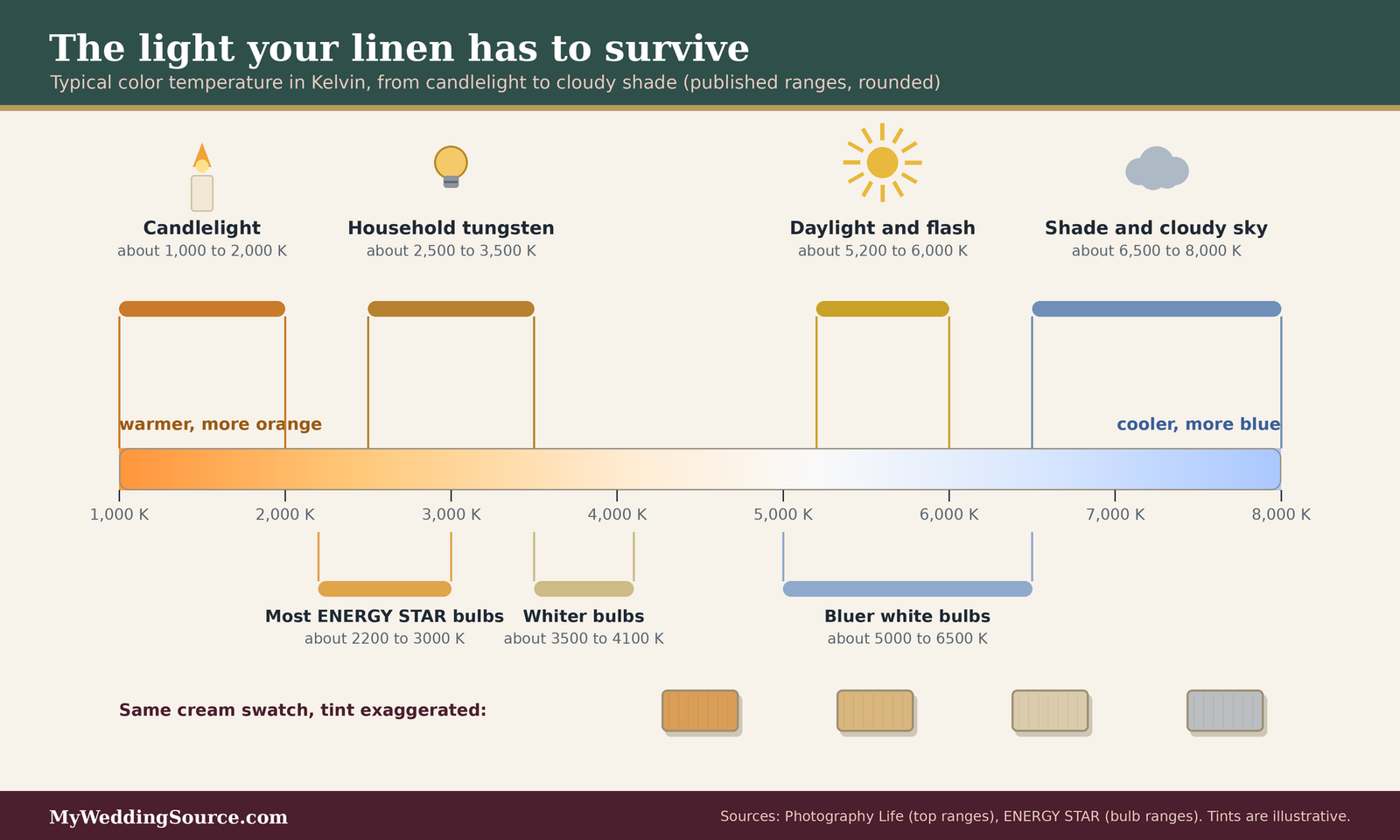
On the Kelvin scale, lower numbers look more yellow or orange and higher numbers look whiter or bluer. ENERGY STAR explains that most of its certified bulbs are designed to match traditional incandescent bulbs at about 2200 to 3000 K, that a whiter light is found at about 3500 to 4100 K, and that a bluer white is found at about 5000 to 6500 K. A photography guide from Photography Life gives typical values for natural and household sources: candlelight at about 1,000 to 2,000 K, household tungsten bulbs at about 2,500 to 3,500 K, daylight and flash at about 5,200 to 6,000 K, and shade or cloudy skies at about 6,500 to 8,000 K.
Put those side by side and you can see the range your linen will live in. In wedding linen swatch testing, remember that a cream tablecloth in candlelight is being lit with something many times warmer than the same cloth in open shade, so it is not surprising that the cloth appears to change.
Color rendering and CRI
CRI, or CIE Ra, is a score that compares how a light source renders a set of reference colors with how a reference light renders them. One lighting company’s explainer (Kreon) describes it as a scale that tops out at 100, says a score above 80 is acceptable for nearly all applications and above 90 counts as high CRI, and warns that the test uses only eight color samples. It adds that two lamps with the same CRI can render colors differently and that a higher CRI does not guarantee a more pleasing result. The Department of Energy makes a similar point, noting that average fidelity alone, and especially CRI, is a weak predictor of human perception of color quality.
For a couple, that means CRI is a useful screening number, not a verdict. If your lighting vendor can tell you the CRI of the fixtures they plan to use, a high number is a good sign. But the only check that settles the question for your linen is to look at your linen under that light, which is exactly what wedding linen swatch testing does.
Where the light comes from at a wedding
A reception usually has several light sources at once, and they change over the course of the evening. For wedding linen swatch testing, you are not choosing a color for one light. You are choosing a color that has to survive a sequence of lights: afternoon sun, golden hour, dusk, and a dark room with candles and uplights.
Daylight, shade, and the hour of the day
Daylight is not a single color. Photography Life’s figures put daylight at roughly 5,200 to 6,000 K and shade or cloudy skies at roughly 6,500 to 8,000 K, so the same cloth in open sun and in the shade of a tree or a tent is lit by noticeably different light. Time of day matters too. Golden hour is warmer than midday, and the sky after sunset is cooler. If your ceremony and reception span those hours, ask what time dinner will be served and look at your swatches at that hour, not at noon.
Candles, string lights, and uplights
Indoor and evening lighting is where most surprises happen. Candles are very warm, household-style bulbs are warm, and colored uplights add tint on top of whatever the room is already doing. A rental linen in a pale color can pick up the tint of an uplight on the wall behind it. If your lighting vendor plans color washes, ask whether the uplights will be a single color or will change during the night, and look at your swatch under a sample of that light if you can arrange it. Our guide to wedding lighting and the wedding audio and lighting checklist walk through what to confirm with the lighting vendor.
The fabric traits that react most to light
Not every linen is equally sensitive, so wedding linen swatch testing should be tailored to the fabric. Some fabrics barely change from one light to the next, and others are famous for it. Knowing which category your choice falls into helps you decide how many conditions to test.
Whites, ivories, and off-whites
White is the hardest color to judge. A Classic Party Rental says whites, ivories, and sheens look different in person than on screen, and anyone who has tried to match a white wall paint knows how much a faint tint matters. Under warm light, a white cloth can look cream, and under cool light, a cream cloth can look nearly white. If your napkins are one white and your tablecloths are another, a mismatch you cannot see in daylight can become obvious by candlelight. Put those two side by side in the test, not in separate drawers.
Sheen, satin, and velvet
Fabrics with a surface sheen respond to the angle of the light as well as its color. Party Rental Ltd, a rental company, explains that the same velvet linens can appear to be two different colors because of the direction of the pile, combined with the light in the room, and suggests rotating the cloth until the colors match. Datacolor calls this kind of change geometric metamerism, triggered by a change in viewing angle, and says it is common with metallic, pearlescent, and textured materials. In practice, that means you should tilt a satin or velvet swatch, look at it from the seated height of a guest, and then look at it from standing height, because both views will occur at your reception.
Getting swatches: what to ask a rental company for
You cannot run wedding linen swatch testing without samples, and rental companies handle samples differently. Some sell small swatch cards, some lend full-size cloths for a limited time, some mail pieces of fabric, and some expect you to visit a showroom. All of these are reasonable, and the right choice depends on how much you are spending and how far you are from the company.
The kinds of samples you may be offered
Sample formats for wedding linen swatch testing range from a postage-stamp square to a full cloth. A larger sample shows more but usually costs more or comes with stricter return rules, so it helps to know the options before you ask.
Swatch cards and fabric squares
Premier Table Linens describes swatch cards with a one-inch by one-inch square of each color in a fabric line plus a napkin sample, and lists prices for the cards that run from a few cents for some lines to sixteen or eighteen dollars for others, with a note that swatches can be ordered without starting a rental agreement. Those prices are the retailer’s own and may have changed, so treat them as an example of the range rather than a quote. Some premium products, according to Let’s Do Linens, are available only as a single sample square rather than a full-size cloth, so ask what you will actually receive.
Full-size cloths, yardage, and showroom visits
Larger samples show drape and scale. Urquid Linen, a linen seller, says its swatches are about the size of a sheet of paper and that it recommends two to three yards of fabric for a larger preview. Let’s Do Linens describes free showroom sample orders for display that are limited to two months, plus client samples for one-time tastings or appointments that must be returned after the appointment. Castle Farms, an event venue, says it can mail physical swatches so couples can match them with a dress fabric or centerpiece flowers, and that couples can also look at swatches during a meeting with a venue coordinator. The point is not that every company offers every format. It is that you should ask which one you can get, rather than assuming the answer is a small card.
What to ask before the swatches arrive
A few questions at the start of wedding linen swatch testing prevent most sample-related surprises. They are about money, time, and responsibility, and the answers should be in writing.
Cost, deposit, and return rules
Ask whether the sample is free, how much it costs, whether the cost is applied to the order, how long you can keep it, and who pays for return shipping. Let’s Do Linens states that free showroom orders are limited to two months and that items kept past the return date are billed a monthly rental charge. It also states that lost items must be paid for at the replacement price within two weeks and that damaged items are billed at replacement cost. That is one company’s policy, not an industry standard, but it shows what kinds of terms exist. A sample you spill coffee on could cost more than you expect.
Dye lots and replacements
Urquid Linen warns that its fabric may occasionally vary by dye lot, and that last-minute orders may be out of stock or come from a different dye lot, which can cause slight color differences. Ordering extras up front, the company says, helps maintain consistency. Even if your rental company owns its inventory rather than buying new fabric for you, ask a version of the same question: will the cloths for my event come from one set, and what happens if a few of them are a slightly different shade? A swatch can only show you one piece of cloth, so ask how the company manages variation across the pieces.
Questions to ask about swatches
- What exactly will I receive: a card, a napkin, a full cloth, or yardage, and is the napkin the same fabric as the tablecloth?
- Is there a cost, and is it credited toward the order?
- How long can I keep the sample, and what happens if it is stained, lost, or returned late?
- Will the cloths for my event come from the same dye lot or production batch as the sample?
- If a few cloths arrive in a slightly different shade, what is your process and timeline to fix it?
- Can you tell me how this color tends to read in a venue like mine, and can I see it in a space with similar light?
The wedding linen swatch testing protocol
This is the working part of the guide, and the heart of wedding linen swatch testing. It turns the ideas above into a procedure you can finish in one afternoon plus one visit to your venue. The goal is to end with a short sheet that says, for each linen, how it looked in each condition and whether it passed. A written record matters because memory is unreliable: by the third fabric, most people cannot remember what the first one looked like.
The wedding linen swatch testing protocol has three stages. First you gather a small kit, then you look at the swatches in a series of lights, and then you score and decide. If you are choosing between several candidates, run the whole protocol on all of them at the same time so they are compared under identical conditions.
Build the wedding linen swatch testing kit
Wedding linen swatch testing does not need special equipment. Wedding linen swatch testing is fair when the swatches are compared against the same things, in the same order, on the same background. The kit below is cheap, and most of it is already in your house.
What to gather
For wedding linen swatch testing, collect the swatch and napkin for every linen candidate, labeled with the company, fabric name, and color name written on a piece of tape on the back. Add the things the linen will sit beside: a sample of your main flower colors or a clear photo from your florist printed on paper, a menu or place card if you have a proof, a piece of your dress or attire fabric, and the plate or charger if you can borrow one. Our guides to wedding table settings and wedding centerpieces explain what usually shares the table. Castle Farms, an event venue, describes couples matching swatches with their dress fabric or centerpiece flowers, which is a good habit whether or not you use that venue.
Add a neutral gray or white surface to lay everything on, such as a sheet of plain paper or a gray mat board, and a notebook or the score sheet at the end of this section. If you plan to photograph your results, a gray card is optional but useful. Photography Life describes an 18 percent gray card as the most accurate way to set white balance in a camera, and explains that it needs to be repeated whenever the lighting changes. For this purpose you are not calibrating a camera, only making notes, but a gray card in the frame helps you see how much the light changed from one photo to the next.
Set up a fair comparison
Lay the swatches on a neutral surface in a fixed order. Keep them the same distance from your eyes and at the same angle. Leave a margin of plain background around each so that a neighboring color does not change how you read it. If you are testing a white against an ivory, put them edge to edge, because small differences are easiest to see when two samples touch.
Turn off or move away from any strongly colored surroundings. A bright red wall will tint the swatch you hold in front of it. Do not use your phone as a light source, and do not compare the swatch with a photo of itself on your screen. Datacolor notes that visual assessment often remains the final approval step even in industrial color matching, so your own eyes, used carefully, are a legitimate tool. The aim of wedding linen swatch testing is to remove distractions, not to turn your kitchen into a laboratory.
Run the lighting walk-through for wedding linen swatch testing
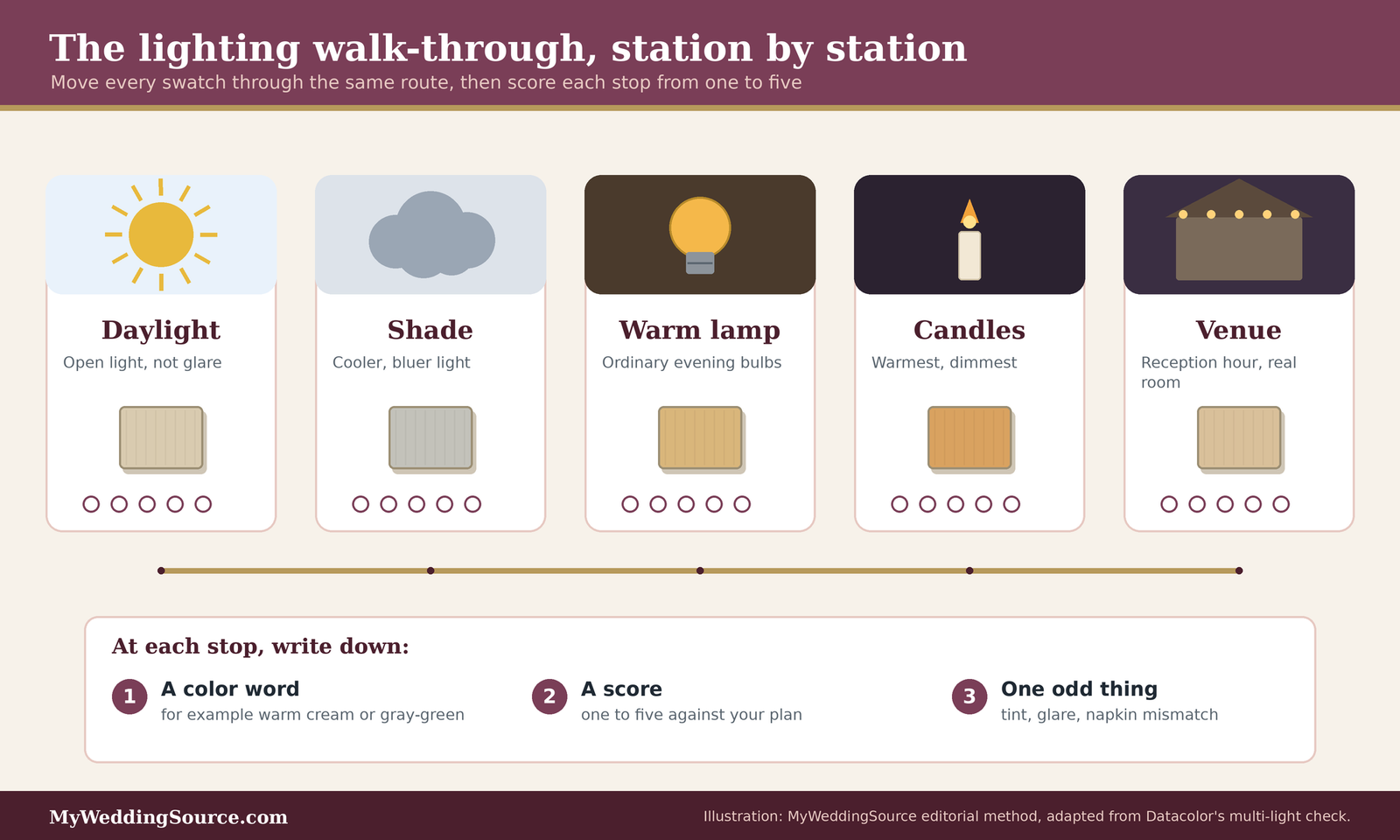
Datacolor describes checking for metamerism by viewing samples under multiple light sources and notes that checking under a third source helps confirm the result. You can do a household version of wedding linen swatch testing with sources you have already. Move the swatches through the wedding linen swatch testing stations below, and at each one, look first at the swatches alone and then beside your flowers and your other items.
| Station | Where and when | What to look for | Common surprise |
|---|---|---|---|
| Open daylight | Outside or by a bright window, mid-morning or mid-afternoon, not in direct glare | The true hue and depth; compare with the paper name | Whites may look crisp and cool; creams may look paler |
| Shade or overcast | Under a tree, a porch, or on a cloudy day | Cooler, bluer light; does the color go gray or flat? | Warm neutrals may look duller; blush may turn gray |
| Warm indoor light | A room lit by ordinary warm household bulbs in the evening | The color under a warm source; does it turn yellow, orange, or muddy? | Whites may look cream; sage and gray-blue may lose their blue |
| Candlelight | A room with candles only, or candles plus a dim lamp | The color in the most flattering and the most forgiving light | Deep colors may read as nearly black; pale colors may glow |
| Venue light | At the venue, at the hour of the reception, with the venue’s own lighting | The color in the actual setting, beside the actual flowers and walls | Tint from walls, drapes, or uplights may show up |
Daylight and shade first
Start outdoors or by a window, because daylight is the reference most of us carry in our heads. Look at the swatch in full light, then move it into shade, and look again. If you are planning an outdoor or tented reception, this is also the condition most guests will see during cocktail hour. A color that holds its character in both open light and shade is a good candidate for a daytime event, and one that falls apart in shade is a warning. Our guide to outdoor wedding venues covers the light and weather questions that shape this choice.
Warm indoor and candle light next
Return in the evening and look again under ordinary warm bulbs, then in a darkened room with candles. This is where whites and ivories separate and where blue-greens and grays can lose their character. ENERGY STAR says most of its certified bulbs are designed to match traditional incandescent bulbs at about 2200 to 3000 K, so a swatch tested under an ordinary warm household lamp is a reasonable, though imperfect, stand-in for warm indoor lighting. Candles are warmer still, per the Photography Life figure of about 1,000 to 2,000 K, so check them separately if you plan to use many.
The venue’s lighting last
The venue stage of wedding linen swatch testing is the most important one, and the one most couples skip. Ask your venue or planner whether you can bring swatches at a time of day that matches your reception. If the reception is at dusk, a bright midday tour tells you little. Bring the swatches, the napkin, the flowers or a proof, and the other items, and set them on a table of the shape you plan to use. Our wedding venue questions guide has a longer list of what to confirm on a site visit.
Score and decide
A score sheet turns your wedding linen swatch testing impressions into a decision you can defend. It also gives you something to show your rental company if there is a dispute later, because you can point to what you saw and when.
A simple score sheet
For each linen and each station of your wedding linen swatch testing, write three things: a color word (for example, “warm cream” or “gray-green”), a rating from one to five for how well it matches your intent, and a note about anything odd, such as tint, glare, or a mismatch with the napkin. Rate the swatch against your plan, not against a perfect standard. A fabric that scores three or above everywhere is a safe choice. One that scores five in two stations and one in a third is a risky choice, and whether you accept the risk depends on which station is the one your guests will experience most.
| Linen | Daylight | Shade | Warm indoor | Candle | Venue | Notes |
|---|---|---|---|---|---|---|
| Example: ivory cloth | 4 | 3 | 4 | 5 | 4 | Napkin looks whiter than the cloth in shade |
| Example: sage cloth | 5 | 3 | 2 | 3 | 3 | Loses blue in warm light |
Reading the results
In wedding linen swatch testing, look for the weakest score, not the average. A linen that has one very low score is a linen that will look wrong for some part of your event. Then ask how long that part will last: if the weak station is candlelight at the end of the night, you may accept it, and if the weak station is the cocktail hour in shade, you may not. If two candidates are close, choose the one whose napkin and tablecloth agree with each other across the stations, because a mismatch between pieces is easier for guests to notice than a small shift in the overall color.
Testing at the venue, with flowers, and for photos
The linen is only one part of the table, and guests read it in context, so good wedding linen swatch testing includes the room. A cloth that looks fine alone can clash with the flowers, the chargers, or the walls. That is why the best version of it includes the other pieces and the room.
Visit at the right hour for wedding linen swatch testing
A site visit is the one chance to do wedding linen swatch testing in the room itself, and it can be wasted if the timing or the materials are wrong. A little planning makes a short visit useful.
Match the time of day
For wedding linen swatch testing at the venue, ask for a visit at the hour your reception will begin and, if possible, a second look as the light fades. The venue’s coordinator can tell you what time sunset falls on your date and which windows or tent walls let in light. If you cannot visit at the right hour, ask the venue whether they can turn on the lighting scheme they typically use for evening events and whether you can see it with your swatches. A Classic Party Rental says its team can advise how a color will read in your venue, and a rental representative who has seen the room can be a useful second opinion.
Bring the whole table, not only the linen
Set the napkin and the swatch on a surface beside the flower sample, a printed menu card, and a plate. Look from the angle of a seated guest. A pale linen that looks soft in your hand can disappear against a white plate, and a deep linen can make a dark menu card hard to read. Our guide to wedding charger plates discusses how chargers sit on the table, and the wedding table shapes guide explains how table size changes how much linen guests actually see.
Test against the rest of the palette
A linen is judged by its neighbors. The same ivory can look warm beside a cool blue and cool beside a rich gold, so test it against the colors you actually plan to use rather than against a generic card.
Flowers, dress, and attire
Bring something from each of the main items: a printed photo or a real stem for the flowers, a scrap of the dress or bridesmaid fabric if you can get one, and a sample of any suit or tie color that will be near the table. Castle Farms describes matching swatches with a dress fabric or centerpiece flowers, and a florist can often supply a stem or a swatch of ribbon in the exact flower color. Our guide to wedding colors helps you decide how many colors to use in the first place, and the wedding decor hub shows how decor choices fit together.
Candles, glassware, and metallics
Candles and glassware add warm points of light and reflections, and metallics such as gold or champagne chargers pick up the color of whatever they sit on. If you plan to use them, bring a sample and look at how the linen reads behind them in the evening light. If a gold charger turns a cream cloth green or a silver one makes an ivory look gray, you will see it in the test rather than at the reception.
Linens and photographs
Your photographer will see the linens too, so wedding linen swatch testing should consider the camera, and the camera does not see color the way you do. A camera sets white balance to compensate for the light, and when a scene has several sources of different color temperature, the camera has to compromise.
How a camera treats mixed light
Photography Life explains that mixed lighting causes color casts when a scene has light sources at different color temperatures, such as window daylight and indoor tungsten, and that one white balance setting can correct one source while making the others look off. A reception that begins in daylight and continues under string lights is a mixed-light setting by nature. A linen that is a very pale cream may photograph as white in one area and yellow in another, and the photographer may correct for one while leaving the other. Ask your photographer how they handle mixed light, and see our wedding photographer shot list and wedding photography guide for what else to confirm.
What to ask your photographer
Before relying on wedding linen swatch testing alone, ask whether they shoot in a format that lets them adjust white balance later, whether they will take a test frame with a gray card at the venue at the start of the reception, and whether they have photographed in your venue before. Photography Life notes that shooting RAW makes white balance much more forgiving because the file does not lock in color, and that JPEG files allow only small corrections. That is a question about their workflow and not a request you should make in the middle of a busy evening, so raise it when you book. A Classic Party Rental notes that deep tones photograph well indoors and lighter fabrics suit outdoor daytime events, which is a useful starting rule of thumb, but your own test frames will tell you more. ## What swatches cost, and which damage terms to read
Samples for wedding linen swatch testing are cheap compared with the order they protect, but they are not always free, and they come with terms. Reading those terms before the package arrives keeps a small test from turning into a surprise charge.
The cost of testing against the cost of being wrong
The numbers below come from the companies named, on the dates we checked them, and they are examples of what exists rather than typical prices. Linen pricing varies by region, fabric, size, and season, and we did not find a source that gives a reliable average, so we do not offer one.
What the sources show
Premier Table Linens lists swatch cards from a few cents to about sixteen or eighteen dollars depending on the fabric line. Let’s Do Linens says showroom sample orders are free for display for up to two months and then billed as a rental if kept longer. Castle Farms gave example quotes of thirty-five dollars per linen for a navy shantung 120-inch round and forty dollars per linen for a 90-by-156-inch size, with tax and shipping included, and said the quote changes if your count changes. A Classic Party Rental charges a damage waiver of ten percent of the rental total, which it describes as optional and non-refundable. These are four different companies with four different pricing models, so do not compare them directly.
A worked estimate
Here is a simple estimate using the Castle Farms example, which you should replace with your own quote. If you needed fifteen round-table cloths at thirty-five dollars each, the linen order would come to about five hundred twenty-five dollars. If you tested three fabrics using swatch cards at the high end of Premier’s range, sixteen dollars each, the testing would cost about forty-eight dollars, or roughly nine percent of that order. That arithmetic is our own estimate and is only meant to show the scale: a modest amount spent on wedding linen swatch testing protects a much larger amount spent on cloths.
What this can cost
Swatch cards and samples range from free showroom loans to a few dollars per card in the sources we checked, and full-size linen quotes in one example ran thirty-five to forty dollars per cloth. A damage waiver at one company is ten percent of the rental total. Our estimate, not a quote: three fabric tests at sixteen dollars each is forty-eight dollars, against about five hundred twenty-five dollars for fifteen cloths at thirty-five dollars. Ask every company for its own sample price, return rule, and waiver terms in writing, and date the answers.
Damage terms that touch swatches and rental linens
Damage language appears in two places: the terms that cover your sample, and the terms that cover the linens on your order. They are separate documents in many companies and are easy to confuse.
Terms that cover the sample
Let’s Do Linens, as described above, bills lost showroom items at the replacement price within two weeks and damaged items at replacement cost, and it says some premium products come only as a single sample square. Treat any sample used for wedding linen swatch testing as something you will be financially responsible for. Keep it away from drinks, candle wax, and makeup, store it flat, and photograph it when it arrives so that you can show its condition if someone later questions it.
Terms that cover the order
A Classic Party Rental describes an optional damage waiver of ten percent of the rental total that covers minor wear, such as small tears in linen, but not misuse or loss, and it asks customers to shake off debris and return linens in the company’s bags, leaving a bag open if anything is damp. Those details come from one company’s page. Your company’s waiver may cover more, less, or nothing at all, and it may or may not apply to stains from candle wax or red wine. Our guide to wedding rental damage waivers goes through the language in detail, and the returning wedding rentals after a Sunday reception article covers the end of the rental.
| Situation | What to ask the company | What to get in writing |
|---|---|---|
| A swatch is stained or lost | Is there a fee, and what is it? | The replacement price and the deadline |
| A cloth arrives in a visibly different shade | What is the process and the time limit to report it? | The reporting window and the remedy |
| A cloth is torn or stained at the event | Does the waiver cover it, and what is excluded? | The covered items and the excluded causes |
| Wax or wine stains linens | Is this treated as normal wear or as damage? | The company’s definition of normal wear |
| Linens are returned damp or with debris | Are there extra fees? | Return and cleaning rules |
Lock-in dates, dye lots, and what to do if the color is wrong
Even a well-tested linen order can go wrong if the counts change, the order is placed late, or a batch differs. Knowing the deadlines and the response plan in advance keeps these problems small.
Know when the order locks
Urquid Linen says orders cannot be changed or canceled once placed. Castle Farms says it submits a formal order to its supplier once style, size, and quantity are finalized, which locks pricing, and that the final quantity order is due two weeks before the wedding, with the balance due one week before. A Classic Party Rental describes cancellation fees that start within thirty days of the event. These are different policies and different dates, so write down your company’s lock-in date on your calendar and plan to finish testing well before it.
If the color looks wrong when the linens arrive
Let’s Do Linens suggests checking the whole shipment to see whether the error affects every item or only some, comparing the linens with your order details under good light, contacting the supplier promptly with a clear description and photos, and preparing a backup such as borrowed linens, overlays, or fabric covers. That sequence works because it separates a real error from a lighting illusion before you escalate, and it is the same logic as wedding linen swatch testing. This is where your score sheet and photos from wedding linen swatch testing pay off: you can show the company what you approved and in what light.
Venue rules, fire safety, and the paperwork for linens
Some of the questions about linens are not about color at all. They are about whether the venue will allow the fabric, and who has to approve it. These are boring questions, and they are the ones that cause last-minute substitutions.
Fire-retardant fabric and what applies to linens
Venues in some places are required to use or accept only fabrics that meet certain fire standards, especially for draperies and décor. Whether those rules reach table linens depends on the place and the venue, so it is a question to ask, not a rule to assume.
What the standard is, and what it is not
Sew What?, a drapery and event-fabric company, explains that NFPA 701 is a standard developed by the National Fire Protection Association for flame propagation of textiles and films, and says it is a standard, not a law in itself, with no official federal regulations for drapery flame retardancy. According to the same company, state and local governments make and enforce the rules, and examples include a Florida fire code requirement for places of assembly and separate California and New York City requirements. The company’s page addresses drapery and special event décor and does not discuss tablecloths, so it does not tell you whether linens are covered. Treat it as a reason to ask.
Who to ask
Before you finish wedding linen swatch testing, ask your venue whether they have a fire-retardant requirement for fabrics and whether it applies to table linens, overlays, backdrops, or only to drapery. Sew What? advises contacting the local fire department or the city or state fire marshal’s office and requesting a certificate of flame retardancy when you order, because vendors may not provide one automatically, and it notes that an “FR” label does not guarantee compliance with every state, city, or venue. If your linen company says its linens are treated or inherently fire-retardant, ask for the certificate and ask your venue whether it accepts it. This is not legal advice, and local rules vary.
Who approves what: venue, planner, and rental company
Linens sit at the intersection of three parties, and the contract language often differs among them. A short conversation early prevents a dispute later.
Outside vendors, exclusive lists, and change orders
Some venues supply linens, some allow outside rentals, and some require approved vendors, so the swatch you love may not be allowed. Confirm that before you invest in wedding linen swatch testing. Our wedding venue questions and wedding vendor contract guides cover outside vendor rules and the contract clauses to read, and our wedding contract change orders article explains how to handle a change after signing, which is useful if your linen choice changes late.
Counts, floor plan, and delivery
Castle Farms notes that the linen count can still change as RSVPs come in and the table count is finalized, which is a reminder that the final order depends on your floor plan. Our reception floor plan guide explains how to settle tables and spacing, and the wedding rental planning checklist puts the linen order in the wider schedule of rentals.
Edge cases: velvet, layers, tents, and no swatch at all
Standard wedding linen swatch testing works for most linens. A few situations need extra care, and it is better to know them before you are standing at a table looking at the wrong shade.
Velvet, satin, sheer, and metallic fabrics
These fabrics reflect light in ways flat fabrics do not, so they need to be tested at more than one angle and, ideally, as a full cloth rather than a small square.
Nap, pile, and direction
Party Rental Ltd explains that velvet can appear to be two different colors depending on the direction of the pile, together with the room light, and recommends rotating the cloth until the colors match, while also offering a swatch order so customers can see how the velvet looks in their space. Ask your rental company whether the cloths will be laid with the nap in the same direction, who is responsible for that, and whether staff can be told on the day. A small swatch will show you the effect if you turn it, so rotate it during your test.
Sheen, sheers, and metallic threads
Satin and metallic fabrics throw light back at the viewer, so a color can look lighter from one seat and deeper from another. Sheer overlays change the color of whatever is underneath, so a sheer needs to be tested on top of the cloth it will actually cover. Datacolor lists metallic, pearlescent, and textured materials as typical cases of geometric metamerism. In wedding linen swatch testing, check these at the seated height of a guest, hold the swatch at different angles, and ask the company to show you a full cloth on a table if they can.
Layers, runners, and napkins that do not match the cloth
Most tables have more than one linen. A cloth, a napkin, perhaps a runner or overlay. Each may be a different fabric, and they have to agree with each other under every light, not only in the showroom.
Overlays and runners
A Classic Party Rental describes table runners and overlays as ways to add texture, a second color, or a pattern. That is a design choice, and a question for wedding linen swatch testing: the second layer changes the first. Build a small stack in the test, with the overlay on top of the cloth, and check it in each light. If you plan a runner in a deep color on a pale cloth, look at the edge where they meet.
Napkins in a different fabric
Premier Table Linens includes a napkin sample on its swatch cards so customers can judge texture and quality. If your napkins are a different fabric from your tablecloths, ask for the napkin sample, not only the cloth. Two fabrics in the same named color can drift apart under warm light, so put them edge to edge in your test. This is the single most common place where a wedding linen swatch testing session turns up a problem that the first look missed.
Tents, dusk, and colored light
Some spaces make linens harder to judge because the light is unusual or changes quickly. If your reception is in one of them, give wedding linen swatch testing more time.
Tents and translucent walls
Light passing through a tent roof or wall takes on the color of the material, and the tent can change color as the sun moves. We did not find a source that measures this, so do not rely on a general rule: if you have access to the tent or a similar one, look at your swatch inside it at the hour you plan to eat, and ask the tent company whether their tents come in different tints or liners. Our outdoor wedding venues guide covers other tent and weather questions.
Uplights, dance-floor light, and the first dance
Colored uplights and moving lights can change the look of linens near them, so include them in wedding linen swatch testing when you can, and your lighting vendor controls them. Ask what colors they plan to use, whether the colors change through the night, and which tables will be nearest. Our guide to first dance lighting explains how lighting for key moments is planned, and a short conversation with the vendor can save you from discovering that the blush linens turn pink under a magenta wash.
When you cannot get a swatch
Sometimes a company is far away, sells only online, or runs out of samples, and wedding linen swatch testing seems out of reach. You still have options, and you should know what they are before you decide to order blind.
Ordering fabric by the yard or asking for photos
Urquid Linen recommends two to three yards of fabric for a larger preview, and Premier Table Linens says swatches can be ordered without starting a rental agreement. If neither is possible, ask the company for photographs of the actual linen taken in daylight, ideally with a known object in the frame, and ask whether they will describe the color in plain words. Remember that Premier says on-screen images are no color match, so photos are a weaker substitute.
Writing a backup into the plan
If you must order without a swatch, ask for the return and exchange policy in writing before you pay, and plan a backup such as a second neutral linen or overlays, as Let’s Do Linens suggests when a color is wrong. Ask whether a deposit is refundable if the color is unsuitable, and keep every message in a single thread. A backup plan is not a sign that you expect trouble. It is a way to make a bad surprise manageable.
FAQ: wedding linen swatch testing questions
Getting and using swatches
Do I need wedding linen swatch testing?
Not always, but wedding linen swatch testing is inexpensive insurance. Rental companies say screens misrepresent color, and one says most of its returns come from customers who skipped the swatch. If your linens are plain white from a company you have used before, you may skip it. For any color, sheen, or off-white, test a real sample.
How many swatches do I need for wedding linen swatch testing?
Request your top two or three candidates plus one safe backup, and ask for the napkin if it is a different fabric. A short list is easier to compare fairly. If you are undecided across a whole palette, narrow first with photos and fabric names, then order samples for the finalists only.
Where should I do wedding linen swatch testing?
For wedding linen swatch testing, look in at least four places: outdoors in daylight, in shade or on an overcast day, in warm evening light, and at your venue at the hour of your reception. Bring the flowers, the napkin, and anything else on the table. Write down what you see so the details do not blur together.
Light, color, and photos
Why does the same linen look different in photos and in person?
The camera adjusts for light and can only correct one source at a time, so mixed lighting can leave color casts. Photography Life says shooting RAW makes white balance more forgiving. Ask your photographer how they handle mixed light, and compare your swatch under the same conditions the photos will use.
Which light is best for judging linen color?
No single light is best, because your guests will see the linen in several. Daylight is a useful reference for true hue, but your reception may be lit by candles, warm bulbs, or colored uplights. Judge the linen under the lights it will actually sit in, and weight the one your guests will see longest.
What is CRI, and should I ask about it?
CRI measures how accurately a light shows object colors on a scale to one hundred. Lighting sources say eighty-plus is acceptable for most uses, though the Department of Energy calls CRI a weak predictor of perceived quality. It is fair to ask your lighting vendor, but judge by looking at your linen.
Rules and problems
What if the linens arrive in the wrong color?
Check whether every item or only some are off, compare them with your order under good light, and contact the company quickly with photos. One rental company advises preparing a backup such as overlays or borrowed linens. Your score sheet and the swatch you approved give you evidence for the conversation.
Do venues require fire-retardant linens?
It depends on where you are. A drapery company explains that NFPA 701 is a standard, not a federal law, and that state and local governments set the rules, so some places require it for drapery. Ask your venue whether it applies to table linens, and ask the company for a certificate.
Your next steps
Start the test
Choose finalists and request samples
Pick your top two or three linens plus a backup for wedding linen swatch testing, and ask each company what sample it provides, what it costs, how long you can keep it, and what happens if it is damaged. Request the napkin if it is a different fabric. Save the answers in one note with the date.
Block an evening and an afternoon
Set aside one daytime session and one evening session of wedding linen swatch testing at home, then arrange a venue visit at the hour of your reception. Gather the flowers, dress fabric, menu card, and plate before the samples arrive so that you can test all of it on the same day.
Lock in the decision
Fill in the score sheet and choose
Score each linen under each light and choose the one with the best weakest score, not the best average. Take your wedding linen swatch testing photos and notes with you to the order meeting so you can point to what you approved. Our wedding rental planning checklist shows where this step fits.
Confirm dates and paperwork
Write down the order lock date, the final count date, and the balance date. Ask for any fire-retardant certificate your venue requires, confirm damage terms, and see our wedding rental damage waivers guide before you sign.
Sources & methodology
How we built this guide
What we relied on
This guide combines published explanations of light and color from the U.S. Department of Energy, ENERGY STAR, a lighting company, a color-measurement company, a textile glossary, and a photography publication with sample policies and advice from linen rental companies, linen sellers, and one event venue. Where a statement comes from a company, we name the company, because its advice reflects its own products and policies. We read the pages on November 12, 2026, and prices and policies may have changed since. The cost estimate and the sample score sheet are our own illustrations and are not data.
What we did not do
We did not test linens, measure light, or photograph fabric, and we did not find a source that gives average linen rental prices or tests wedding linens under specific lighting, so we do not claim any. We do not give legal, fire-safety, or financial advice. Local fire codes, venue rules, and rental contracts vary, so confirm them with your venue, your local fire authority, and your own contracts.
Source list
Government and standards-related sources
- U.S. Department of Energy, Solid-State Lighting program, Color rendition: https://www.energy.gov/eere/ssl/color-rendition
- U.S. Department of Energy, LED lighting (Lighting Facts label guidance): https://www.energy.gov/energysaver/led-lighting
- ENERGY STAR, Light bulb purchasing guide: https://www.energystar.gov/sites/default/files/asset/document/Light%20Bulb%20Purchasing%20Guide%5F16Mar2020.pdf
- ENERGY STAR, Color and mood: https://www.energystar.gov/node/5794
Color science and photography sources
- Datacolor, What is metamerism: https://www.datacolor.com/business-solutions/blog/what-is-metamerism/
- Textile Glossary, Metamerism: https://www.textileglossary.com/terms/metamerism.html
- Kreon, Color rendering index, CRI and LED lighting: https://blog.kreon.com/en-us/color-rendering-index-cri-and-led-lighting-what-is-it-and-how-is-it-measured
- Photography Life, White balance: https://photographylife.com/white-balance
- Sew What? Inc., Navigating flame retardancy regulations in the United States: https://sewwhatinc.com/resources/flame-retardancy/navigating-flame-retardancy-regulations-united-states/
Rental company, seller, and venue sources
- A Classic Party Rental, Choosing linens for your wedding: https://aclassicpartyrental.com/tips-for-choosing-linens-for-your-wedding/
- Castle Farms, Ask the coordinator: linen rental: https://castlefarms.com/?p=54242
- Let’s Do Linens, Sample policy: https://www.letsdolinens.com/sample-policy
- Let’s Do Linens, When party linen rentals arrive in the wrong color: https://www.letsdolinens.com/post/when-party-linen-rentals-arrive-in-the-wrong-color-quick-fixes
- Party Rental Ltd, Why do the same velvet linens appear to be two different colors: https://help.partyrentalltd.com/why-do-the-same-velvet-linens-i-ordered-appear-to-be-of-2-different-colors
- Urquid Linen, Tips for first-time customers ordering table linens: https://www.urquidlinen.com/blogs/news/5-essential-tips-for-first-time-customers-ordering-table-linens-from-urquid-linen
- Premier Table Linens, Swatch cards and samples: https://premiertablelinens.com/default/fabric-swatch-cards