

A gown that looks right in the salon can behave very differently on soft sand, in a steady breeze, and under midday sun, so the most useful way to choose beach wedding dresses is to decide how the dress has to work first and how it should look second.
Quick answer
For most beach ceremonies, start with a light, breathable fabric (retailers commonly point to chiffon, stretch crepe, crepe-back satin, and tulle), a hem that stays out of the sand (tea-length or an ankle-length hem without a train is the lowest-contact choice, and a sweep train is the gentlest long option), and flat or barefoot-style footwear you wear for every fitting. Plan the purchase around alterations, not around the order date: one large bridal retailer suggests ordering six to nine months out and starting alterations eight to twelve weeks before the wedding. Budget for the finished dress, because The Knot’s reported average dress price of about $2,100 does not include alterations.
This guide is written for couples comparing beach wedding dresses before they buy, and for anyone who has already chosen one and wants to check it against real conditions. It does not tell you which silhouette is prettiest. It gives you tests, thresholds, and questions, so you can judge any gown against the sand, the wind, the heat, and the calendar. The same checks work whether you are marrying on a public beach a short drive from home or flying to a coast.
A note on what you will and will not find here. We rely on retailer and bridal-industry advice, a few government sources for weather and safety, and The Knot’s published survey data. Where a statement comes from a retailer, we say so, because retailers sell the garments they describe. Anything labeled as an estimate is our own arithmetic. We did not test dresses on a beach, and we cannot tell you how a specific gown will perform; only a fitting, a fabric swatch, and your venue can do that.
If you are still narrowing silhouettes in general, our guide to wedding dress styles covers the basic shapes, and this article picks up where that one stops: with what happens when the shape meets an outdoor shoreline.
Start with fit and function before aesthetics for beach wedding dresses
Fit and function come first because a beach changes the physical demands on a gown in ways a bridal salon floor never does. The floor is flat and indoors. The shoreline is soft, sometimes sloping, often windy, and rarely shaded. A dress that is only slightly uncomfortable in a fitting room can become the thing you think about all afternoon on the sand.
That is not an argument for dressing plainly. It is an argument for making decisions in the right order. Choose the movement you need, the climate you will stand in, and the distance you will walk. Then look for the gowns that fit inside those limits. You will find that the limits remove fewer beautiful options than you might expect, and they remove the ones most likely to cause problems on the day.
Translate body proportions and movement needs into design choices in the beach wedding dresses decision
Your body and your day both set requirements. Some are measured with a tape, and some are measured by asking how far you will walk and whether you will dance. Writing those requirements down before you shop keeps a salon appointment from becoming a search for whatever gown photographs best.
Explain which measurements matter for beach wedding dresses
Bridal salons size gowns, including beach wedding dresses, from your bust, waist, and hip measurements, according to Kleinfeld’s published sizing guide. Because designers do not make split sizes, the dress is ordered to your largest measurement and then altered down to fit. That has a practical meaning for beach wedding dresses: a gown ordered for your widest measurement will usually need taking in elsewhere, and every seam that must be reshaped adds work, cost, and time.
A few other dimensions matter more on sand than they do indoors, and they are worth bringing up with the stylist. The first is the length from the hollow of your neck to the floor in the shoes you will actually wear. We did not find this measurement described in the Kleinfeld guide, so treat it as a question to ask rather than a rule: ask who measures hem length, in what footwear, and when. The second is the distance between the hem and the ground, because a hem that skims a salon carpet may drag in sand. The third is arm and shoulder movement, since you will hug people, hold flowers, and raise your arms for photographs.
Identify where sample sizing distorts expectations
Salon samples of beach wedding dresses are tools for judging shape, not predictions of how the final dress will fit you. Kleinfeld says most in-store samples come in bridal sizes 8, 10, 12, 18, 20, or 22, that bridal sizes run larger than street sizes, and that standard samples usually carry a B cup, with plus-size samples typically carrying a C or D. A sample that is clipped in the back, or one that hangs loose at the bust, shows you a silhouette, not a fit.
This matters more for light fabrics. Chiffon and other fluid materials drape from the body, so a sample that is too large can make a gown look looser and heavier than the one that will arrive. A crisp, structured sample that is too small can look more tailored than it will be after the seams are let out. When you try a sample, ask the stylist to describe what the final gown will do differently, and ask for a fabric swatch you can take outside and hold in the wind.
Match fabric and construction to season and venue in the beach wedding dresses decision
Fabric is where beach wedding dresses diverge most from the gowns you see in ballroom photography. Weight, weave, and lining decide how warm you are, how the skirt moves in a breeze, whether sand clings, and how wrinkled the dress looks by the time you walk out.
Connect weight, lining, sleeves, train, and ventilation in beach wedding dresses
Retailers tend to agree on the light end of the range for beach wedding dresses. Azazie, a bridal retailer, recommends chiffon for breathability and quick drying, stretch crepe for wrinkle resistance and easy movement on uneven ground, tulle for its light weight and open weave, and crepe-back satin for holding its shape better than traditional satin. Moonlight Bridal, another retailer, likewise names chiffon and crepe-back satin as light, comfortable choices, and describes tulle as airy but delicate.
The same retailer sources are cautious about the heavy end. Azazie advises care with heavy satin, which it says traps heat and shows wrinkles in humidity, and with structured or heavy lace, which it says traps warmth and catches sand. It also notes that thick organza can stiffen in humidity and rustle in a breeze. These are retail opinions rather than laboratory findings, and they come from a seller of lighter gowns, but they match the practical logic: heavier layers hold heat, and rougher textures hold grit.
Lining and sleeves complete the picture. A lining adds a layer against the skin, so a lightweight lining in a breathable fiber matters as much as the outer fabric. Moonlight Bridal observes that full sleeves can be warm and that strapless, skinny-strap, or cap-sleeve designs are usually more comfortable. For a closer look at how sleeve styles change both comfort and coverage, our guide to wedding dresses with sleeves walks through the options, including lighter ones that suit warm weather.
Flag mobility, heat, snag, and transparency risks in beach wedding dresses
Think of four separate risks in beach wedding dresses and test each one. Mobility is whether you can climb a dune boardwalk, step over driftwood, and sit down without help. Heat is how long you will stand in the sun in the dress. Snag is whether beading, sequins, or raised lace will catch on a wooden railing, a chair back, or a guest’s jewelry. Transparency is how the fabric looks when sunlight comes from behind you, which is the usual condition for a beach ceremony at sunset.
The last risk is easy to miss indoors. Sheer, light-colored fabrics can show more through them in strong backlight than they do under salon lighting. The practical test is simple: ask the stylist whether you can step into natural light by a window or doorway, and look at the dress with the light behind you. If the salon cannot do that, take photographs with a flash and without one, and compare them. Then ask about linings or underskirts that could solve what you see.
| Factor | What it means for the dress | Alteration or fit risk |
|---|---|---|
| Soft sand underfoot | Shorter or off-the-ground hems; flat or barefoot-style shoes; simple hem details | Low if the hem is set to the actual footwear; higher for a long hem on a heeled sandal |
| Steady breeze | Fluid fabrics that move with the wind, or a skirt with a little weight; secure veil and hair plan | Medium for very light skirts that lift, since a lining or weight may be added |
| Hot, humid weather | Breathable fabrics, lighter colors, fewer layers, minimal sleeves | Low to medium; heavy lace can be costly to alter |
| Cooler coastal evening | A removable layer, a wrap, or sleeves that detach | Medium if sleeves are added later; detachable pieces raise the price |
| Long walk to the ceremony site | A hem you can lift and a bodice that stays put | Medium if a bustle or hem lift must be built in |
| Photographs in backlight | Lining or an underskirt that controls transparency | Medium; lining changes may need new construction |
| Flying to the venue | A dress that packs and steams well, with fewer fragile layers | Low to medium; tulle needs extra care when traveling, according to Moonlight Bridal |
| Stairs, boardwalks, uneven ground | Hem length that clears the shoe by a safe margin | Low if tested in the fitting room |
What wind, heat, and sand do to beach wedding dresses
A beach ceremony is a weather event in a way that few other venues are, and that shapes every choice about beach wedding dresses. The dress is outdoors, the surface is soft, and the conditions can change between the fitting and the first photograph. You cannot control the weather, but you can learn how much of it a dress can take, and build in some tolerance.
Wind: measure it, then design for it
Wind is the most dramatic variable, and also the one people most often describe in vague terms. Turning it into miles per hour gives you something to compare a dress against.
Read the wind the way forecasters do
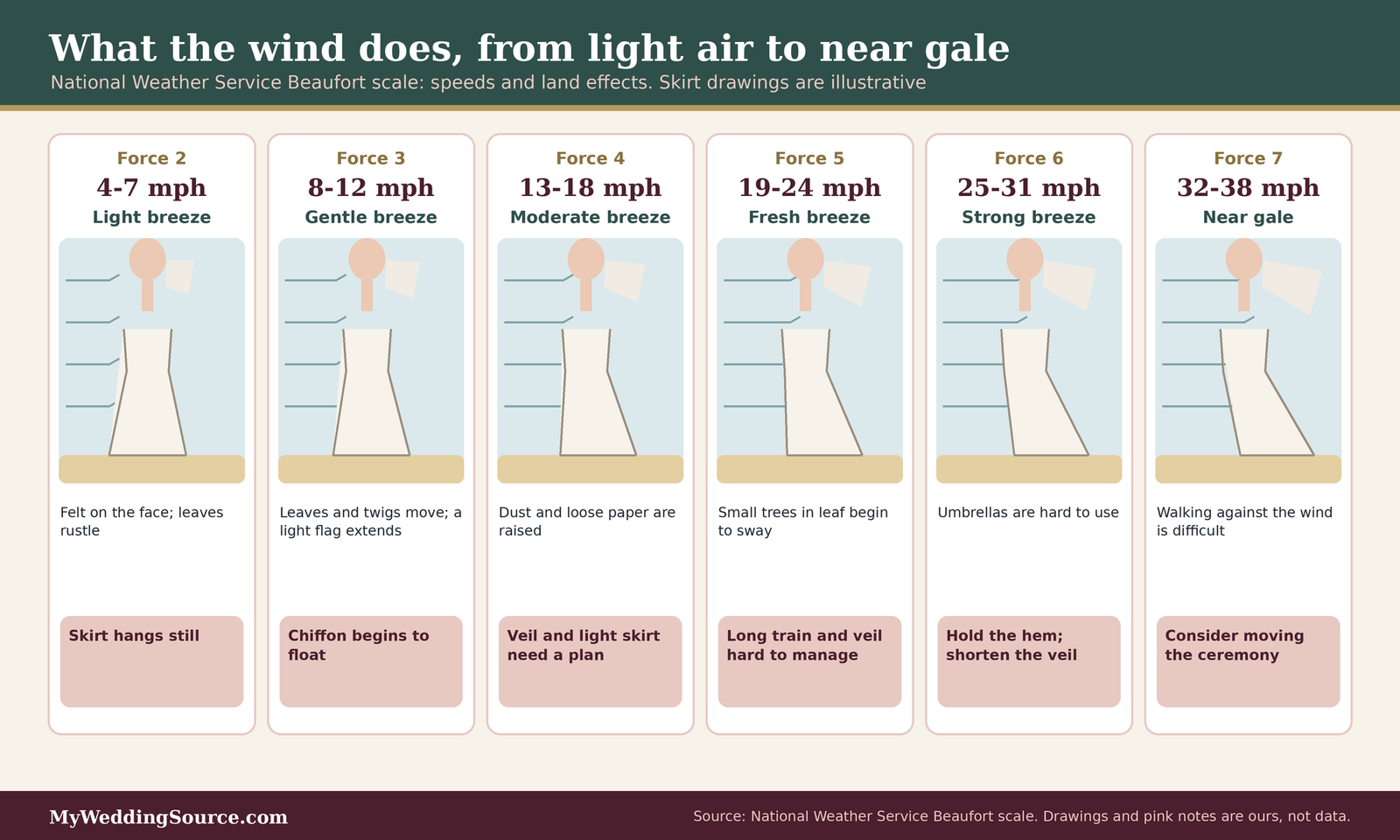
The National Weather Service publishes a Beaufort wind scale that links speeds to what you can see on land. A light breeze of 4 to 7 miles per hour is felt on the face and rustles leaves. A gentle breeze of 8 to 12 mph keeps leaves and small twigs moving and extends a light flag. A moderate breeze of 13 to 18 mph raises dust and loose paper. A fresh breeze of 19 to 24 mph begins to sway small trees, a strong breeze of 25 to 31 mph makes umbrellas hard to use, and a near gale of 32 to 38 mph makes walking against the wind difficult.
The illustration below pairs those ranges with a simple drawing of how a skirt and veil might behave. The skirt drawing is our illustration of the idea, not a measurement, and real fabrics differ. The speed ranges and their land descriptions are the National Weather Service’s. As a planning rule of our own, treat anything at or above the moderate-breeze range as a day when a veil, a long train, and a very light skirt need a plan, and check the forecast for your hours on the coast, not just the nearest city.
Choose details that behave in a breeze
On beach wedding dresses, fluid fabrics move with the wind and settle again, which many photographers like, while a very light skirt can lift higher than you want. Joy, a wedding planning platform, notes that flowing fabrics can move gracefully in wind. Both things can be true: a chiffon skirt that floats in a gentle breeze may be harder to manage in a strong one. A skirt with an extra layer, a slightly heavier hem, or a lining that clings less can calm the movement, and a stylist can tell you which of these suits the gown you like.
The rest of the wind plan sits outside the dress. Joy suggests pinned hairstyles over loose ones, secure accessories such as headbands, combs, or hair vines, and skipping large dangling earrings that can tangle. A cathedral-length veil is a different proposition on a windy beach than in a chapel; if you love a veil, ask about a shorter one, a veil that detaches after the ceremony, or a comb with a second anchor point. Ask your photographer how they handle wind, because some of them will tell you they love it and others will tell you where to stand.
Heat and sun: treat the dress as part of your cooling system
A gown is clothing, and clothing is part of how your body handles heat. Heat is a health issue as well as a comfort issue, so it deserves more than a note about fans.
Match beach wedding dresses to the temperature you will stand in
Azazie offers a rough climate guide that we find useful as a starting point, with the caveat that it comes from a retailer. For tropical conditions of about 80 degrees Fahrenheit and above it suggests chiffon, lightweight crepe, and cotton blends and cautions against heavy satin, velvet, and thick lace. For temperate conditions of 70 to 80 degrees it suggests crepe, tulle, and stretch satin. For cooler coastal conditions of 60 to 70 degrees it suggests stretch crepe, matte satin, and light jersey.
The Centers for Disease Control and Prevention advises wearing loose, lightweight clothing in light colors and using sunscreen, and notes that sunburn reduces the skin’s ability to release heat. A fitted bridal bodice is not loose clothing, so the way to follow that advice is to choose breathable fabrics, avoid unnecessary layers, and keep a plan for cooling between photographs. Azazie also says ivory and other light shades reflect sunlight and keep the wearer cooler, while it suggests champagne can hide sand dust better than pure white.
Schedule shade, water, and breaks around the ceremony
The CDC points out that thirst is a late signal, so it recommends drinking fluids regularly, and it lists muscle cramps, heavy sweating, weakness, and dizziness among signs of heat exhaustion. It also notes that older adults, young children, and people with chronic medical conditions face higher risk. That is a reminder that heat planning protects your guests too, especially grandparents who may be sitting in the sun while you take photographs.
None of this is medical advice, and your own health history matters more than a general guide. In planning terms, it supports a few concrete decisions: ask the officiant how long the ceremony will run, set the ceremony time away from the hottest part of the afternoon if the calendar allows, provide shaded seating and water for guests, and give yourself a cool place to step away from between the ceremony and portraits. Our guide to planning a wedding ceremony covers the timing questions that connect to this.
Sand and moisture: texture, hems, and salt
For beach wedding dresses, sand is a small problem in a single moment and a larger one across a whole afternoon. It gets into textures, collects on heavy hems, and, mixed with moisture, can leave marks that do not brush away.
Keep texture above the sand line on beach wedding dresses
Azazie notes that beading, sequins, deep lace, and raised embroidery trap sand, and suggests keeping those details on the bodice, which stays above sand level, while lighter hems lift off the sand and heavy beaded hems collect it. This is a sensible rule for choosing among beach wedding dresses: ask where the texture is, and whether it reaches the skirt. Smooth fabrics such as crepe, polished cotton, and stretch jersey are described by the same retailer as resisting sand adhesion.
Shaking the dress out often and brushing sand off before it works into the fibers is the retailer’s advice. We would add that a quick check for a gritty hem before you hug someone is worth doing, because sand on a skirt is also sand on a suit jacket or a relative’s dress.
Plan for sea spray, damp ground, and stains
Sea spray, humidity, and perspiration all matter for dress fabrics, according to Azazie, which also notes that chiffon dries quickly if sprayed. Joy suggests a fabric protector on the hem to resist sand and dirt stains, baby wipes for light smudges, and a professional cleaner for stains that remain afterward. A protector can change how a fabric looks or feels, so test it on a hidden spot or ask the seller whether it is safe before applying it to the hem.
For stains that set, an early call to a specialist is cheaper than a late rescue. Look for a cleaner who regularly handles bridal gowns, ask how they treat salt water and beading, and book the cleaning before the wedding so the dress is not waiting in a closet. The Federal Trade Commission’s Care Labeling Rule requires makers of covered clothing to attach a permanent label with regular care instructions and to warn when a garment cannot be cleaned without harm, so read that label before you buy and ask what it means for sand and salt.
Choose hems and trains for sand: how much contact will you accept
Of every design decision in beach wedding dresses, hem and train length have the most direct effect on the day. A train adds drama in photographs, but on sand it also adds weight, drag, and risk. The decision comes down to how much contact with the ground you are willing to manage.
Choose a length by how much sand it touches
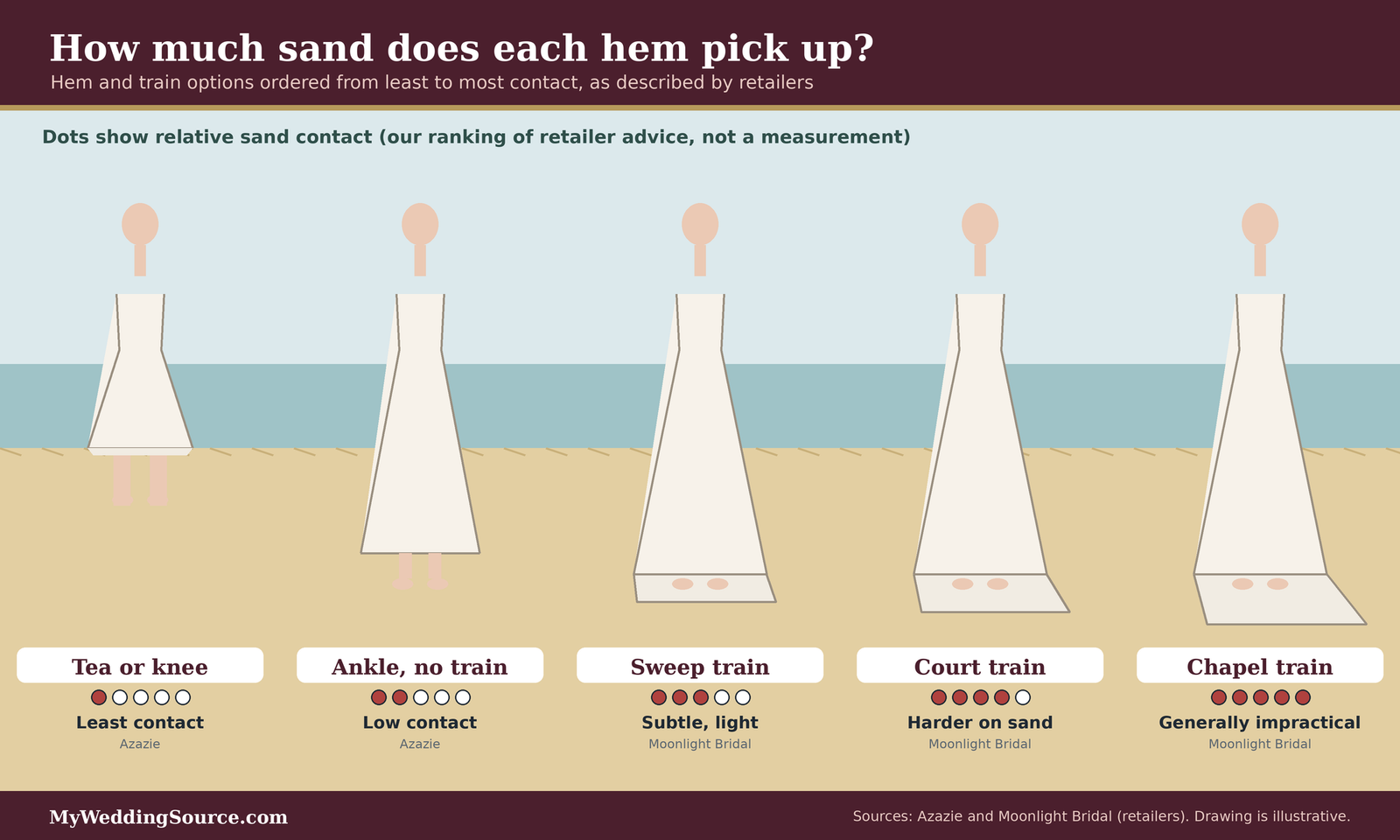
Retailers largely agree on the order of the options for beach wedding dresses from least to most contact, even if they differ on where to draw the line.
Tea-length, knee-length, and ankle-length hems for beach wedding dresses
Azazie recommends tea or knee length for minimal sand contact, and suggests ankle length without a train if you choose a floor-length gown. Joy likewise notes that tea-length hems avoid dragging in sand and saltwater, and describes tea-length and mini dresses as easier to pack. Moonlight Bridal says shorter is generally better for a beach wedding, while noting that a streamlined floor-length gown can still work.
A shorter hem on beach wedding dresses also changes how the shoe looks. Tea-length gowns show your footwear, so decorative sandals or a pedicure become part of the outfit. Ankle-length hems hide less of the foot and are easier to manage on boardwalks and steps than a gown that must be lifted. If you are unsure, try a floor-length gown with a deliberately short hem in the fitting room and see whether you like the length before you commit.
Sweep, court, and chapel trains on beach wedding dresses
According to Moonlight Bridal, a sweep train is subtle and light, so it is less likely to drag in sand, while a court train is more dramatic and harder to manage on sand, and a chapel train is generally impractical on a beach. We would add a practical point about all long trains: the problem is not only the sand, it is also the helper. A train on soft ground needs a person to manage it for portraits, and the ceremony needs a plan for who lifts it and when.
If you love the look of a train, there are workable compromises. A short sweep train can be kept clear with a bustle after the processional. A detachable train, which Joy suggests as a way to change the look without a full outfit change, lets you remove the heaviest part after the ceremony. And a train that is wide and light, rather than long and heavy, can look dramatic without dragging as much. Ask the stylist to show you how each option moves on a surface like sand, which a salon floor cannot imitate, by walking it on a rough rug or on the lawn if the shop allows.
Bustles, overskirts, and a second look
A hem is only one tool for beach wedding dresses. Bustles, detachable overskirts, and a second outfit each solve the same problem in different ways, and each has costs.
A bustle that works on soft ground
A bustle lifts the train off the ground so you can move and dance. David’s Bridal says the bustle is usually pinned at the second fitting and taught to the helper at the final fitting, and recommends bringing the person who will bustle the dress on the wedding day. For a beach, ask whether the bustle design keeps the hem off the sand when you walk, not just when you stand, because a bustle that looks tidy on a salon podium can sag when you step.
The Knot, citing alterations professionals, reports that a bustle typically costs between $75 and $175, depending on the number of layers and the style, and that multiple bustles cost extra. That figure is helpful for budgeting, but it is a reported range, not a quote, so ask your own seamstress what a bustle costs for your gown. If your ceremony is on the sand and your reception is on a patio or in a ballroom, ask whether two different bustle points make sense, one for the sand and one for the dance floor.
Detachable trains and a reception change
A detachable train or overskirt can make one of your beach wedding dresses work on two surfaces. Joy suggests a detachable train, an overskirt, or a lace topper as ways to change the look without a full outfit change, and notes that a shorter reception outfit allows easier movement. Moonlight Bridal says you can wear one dress for the ceremony and another for the reception, such as a tea-length dress for dancing.
The Knot notes that detachable elements such as overskirts, sleeves, and capes raise the price of a dress, so price the extra piece before you fall for the look. A second dress is a larger budget item than a detachable piece, and it brings its own fitting appointments. If you take that route, our wedding reception guide can help you think through when the change should happen so that you do not miss part of the party.
Pick shoes, or no shoes, for beach wedding dresses
Shoes are where beach wedding dresses meet the ground, and they are the most common reason a good hem becomes the wrong hem. Because the hem is set to a heel height, the footwear decision has to happen before the final hem decision, not after.
Footing on sand: what retailers and planners advise
Footing on sand is a different problem from footing on a floor. The surface gives way, which changes both balance and the effective height of any heel.
Why standard heels are a problem with beach wedding dresses
Moonlight Bridal says to avoid high heels and suggests sandals, wedges, or flats for walking on sand, and Joy likewise advises avoiding regular heels, which sink. We agree with the logic and would add a planning step: if a heel is non-negotiable for a photograph, pick a block or wedge with a wide base, and ask whether you can wear a flat for the processional and change afterward.
A wedge or wide platform has an advantage that thin heels do not, because it spreads your weight. It also changes the hem, since a three-inch wedge and a flat sandal differ by roughly the height of the wedge, and a hem set for one will be wrong for the other. That is a good reason to buy the shoe early.
Barefoot sandals, bare feet, and venue shoe stations
Both Moonlight Bridal and Joy mention barefoot options. Moonlight describes going barefoot or wearing foot jewelry as a popular choice that also reduces tripping risk, and Joy suggests barefoot sandals with ankle chains or toe decorations. Joy also notes that some venues provide shoe stations where guests can remove footwear before the sand.
If you plan to go barefoot, there are practical details to settle. Ask the venue whether the sand near the ceremony site is likely to be hot, whether there are shells, glass, or debris, and whether the walkway from the parking area is paved or sandy. Moonlight Bridal suggests a good pedicure for open-toed styles. Hot sand and cold sand both change how comfortable bare feet are, and the decision is easier to make once you have stood on the actual beach at the same time of day.
Hem height and the shoe you will actually wear
The best test of a hem is a walk in the real shoe. It is a simple rule that is often broken because the shoe arrives late.
Buy the shoe before the first fitting
David’s Bridal describes the first fitting as the appointment when the alterations artisan pins major changes such as the hem. If you arrive at that fitting in a different shoe from the one you will wear, the hem will be set to the wrong height. Our recommendation, which is editorial advice and not a rule from any source, is to buy or borrow the exact shoe, or one with the same sole thickness, before that first appointment.
If you are undecided between a flat and a wedge, bring both and ask the seamstress to mark the hem for the one you are more likely to wear. A hem that is slightly too long on the sand can be bustled, but one that is too short cannot be lengthened without extra fabric. When in doubt, ask the seamstress which error is easier to fix for your particular gown.
Check the walk, the pedicure, and the sun
A shoe that works in a fitting room may not work in sand. If you can, practice walking in the shoe on a softer surface such as grass, and see how your hem moves as you step. Add the sun to the test by wearing the shoe outdoors for a few minutes, because leather or synthetic straps can feel different when feet are warm and slightly swollen.
For sun, the CDC says to use sunscreen, and bare feet and open sandals are easy places to miss. Apply sunscreen to the tops of your feet before the ceremony, let it dry fully so it does not stain the hem, and ask your helper to carry a small tube for touch-ups. A little planning here prevents a sunburned foot line in every photograph.
Support, coverage, and sleeves in beach wedding dresses
On beach wedding dresses, a bodice does more work than it does in a salon: it has to stay put in wind, hold up through hugs and photographs, and handle hours of heat. The best bodice is the one you forget about.
Keep the bodice secure without adding heat
Support is a combination of construction and undergarments. The two should be planned together, because adding one without considering the other can solve a problem and create another.
Built-in support versus separate undergarments under beach wedding dresses
Some gowns have boning, cups, or a built-in corset that offers support, while others expect you to wear a separate garment. Kleinfeld notes that cup size generally increases with dress size and that some designers can customize the bust, which suggests that built-in support is something to ask about at the time of the order. The Knot’s alterations experts, speaking of price drivers, list a corset closure replacing a zipper at about $100 to $300 and a bodice take-in at about $100 to $200, so changes to a bodice’s structure are a cost to anticipate.
Undergarments themselves are not covered in the sources we read, so we will not make claims about particular products. As a planning principle, wear what you will wear on the day to every fitting after the first, ask whether the garment fits under the gown without showing at the seams, and check how it feels after an hour of standing, since heat and humidity can make a close-fitting garment less comfortable. If you are flying, pack the undergarments in your carry-on with the dress, so a lost bag cannot separate them.
Neckline and movement in photographs
A deep neckline or an open back is a popular beach choice. Moonlight Bridal suggests a plunging neckline or open back with a mermaid silhouette, and Joy notes that backless gowns offer drama and cooling, with some options offering more coverage for cooler evenings. The practical test is whether the neckline holds when you raise your arms, bend to hug someone, and turn in a breeze.
Ask the stylist to watch you do each of those movements in the fitting room. Then ask a friend to take a short video while you move, because a neckline that looks stable in a mirror can shift when you are not looking at it. If you are concerned, double-sided tape or a discreet fashion-tape solution can help for the day, and Joy lists double-sided tape among the quick fixes to keep on hand for hems and bustles.
Sleeves, straps, and sun coverage
Sleeves on beach wedding dresses are as much about sun as style. They also change the temperature in the dress, and they are among the most expensive alterations to add after the fact.
Choose sleeves for the temperature, not just the photograph
Moonlight Bridal says full sleeves can be hot, so strapless, skinny-strap, or cap-sleeve designs are usually more comfortable, and Joy notes that off-shoulder and long-sleeved designs offer some sun coverage. Those two ideas pull in different directions, which is the real decision: more coverage means more protection from sun and a cooler evening, and also more heat. A light, sheer sleeve in a breathable fabric is one way to split the difference.
If you are drawn to sleeves, consider a detachable or removable option, because it lets you choose on the day. The Knot notes that detachable sleeves raise the price, and its alterations experts list straps at up to about $200, with more for added lace or beading, so price any change before you commit. Our guide to wedding dresses with sleeves discusses sleeve types in more detail.
Sun protection beyond the fabric
Even the best of beach wedding dresses will not protect you from sun on its own. The CDC recommends sunscreen as part of heat safety, so plan to apply it to the shoulders, chest, back, and arms before you dress, give it time to dry, and ask the stylist whether it is safe for the fabric. Some sunscreens can leave marks on light fabrics, so test them on a spare piece of fabric if you can get one, or ask the seller for guidance.
Think also about what will cover your skin for hours after the ceremony. A light wrap or shawl, a hat for portraits, or a small umbrella for a guest-heavy receiving line can be easier than reapplying sunscreen to a dress with a delicate bodice. For makeup that holds in heat and wind, our bridal makeup guide covers the planning questions to bring to your artist.
Build the shopping timeline around alteration reality for beach wedding dresses
Many couples shopping for beach wedding dresses start from the wedding date and count backward to when they should order. A more reliable way to plan beach wedding dresses is to start from the last fitting and work back, because alterations, not shipping, are the step that people squeeze. A gown that arrives on time but needs more work than the calendar allows is a late dress.
Work backward from fittings and delivery in the beach wedding dresses decision
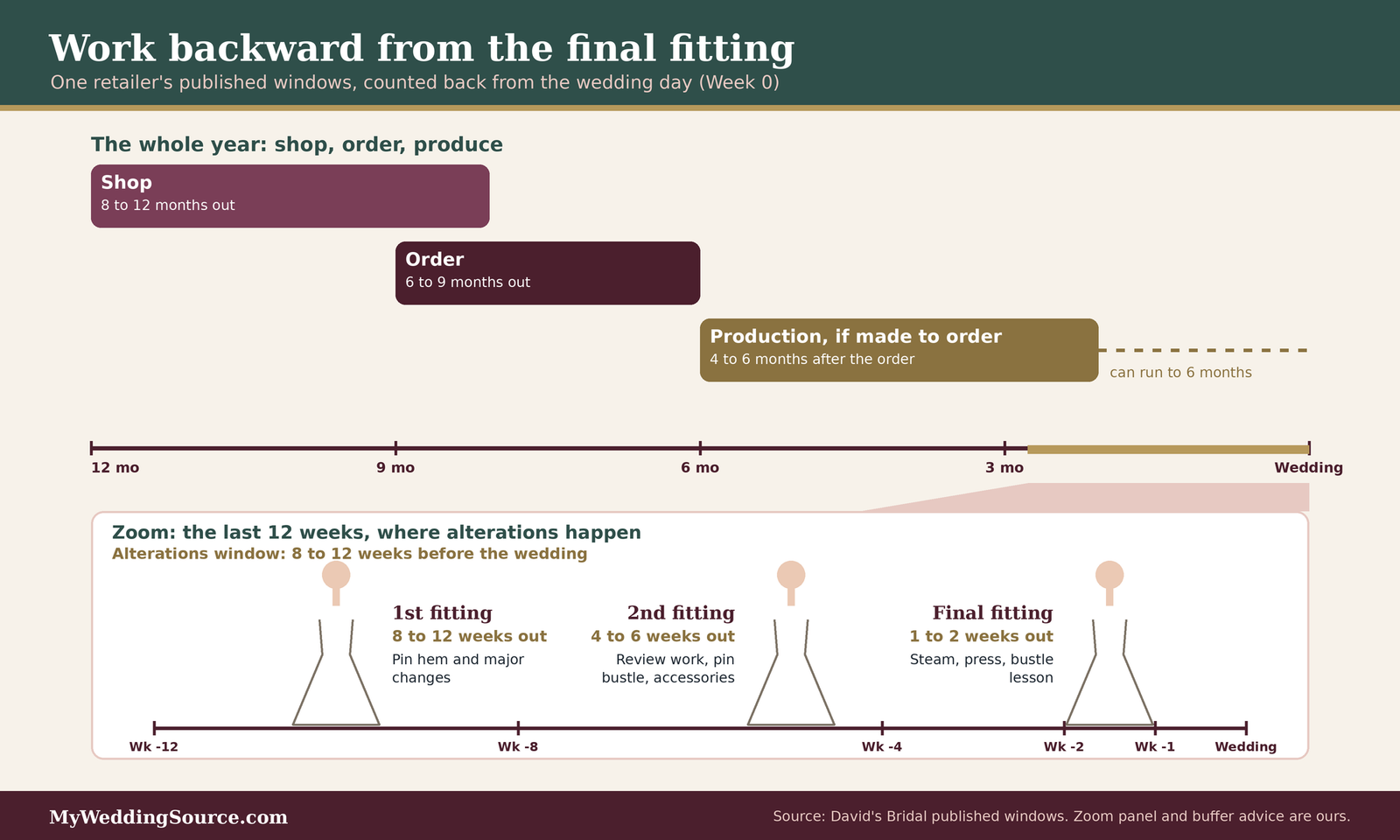
The published windows below for beach wedding dresses come from one large bridal retailer, so treat them as a reasonable template, not a guarantee. Salons and designers set their own lead times, and a made-to-order dress from a small studio can run on a different schedule.
Show when a custom order, a rush, or an off-the-rack dress changes the schedule
David’s Bridal advises starting to shop eight to twelve months before the wedding, ordering six to nine months out, and starting alterations eight to twelve weeks before the wedding, once the dress has arrived. It says made-to-order gowns can take four to six months to produce. It describes most brides needing three fittings, with some needing four for intricate customization and some needing only two for simple hems. Its published fitting schedule puts the first fitting eight to twelve weeks out, the second four to six weeks out, and the final one to two weeks out.
Those numbers suggest three paths. A custom or made-to-order gown needs the longest runway, since the production window alone is four to six months by that retailer’s account. An in-stock or off-the-rack gown can shorten the wait, but you still need time for fittings, so the shortcut applies to delivery, not to alterations. A rush order, if a designer offers one, usually comes with a fee and less margin for error; the sources we read did not give rush prices, so ask for the exact fee and the guaranteed date in writing.
A destination wedding adds a separate step. If you are marrying away from home, decide where the alterations will happen. Doing them at home before you travel is easier, but it means the final fitting may be earlier than you would like, and travel can wrinkle a dress that was pressed. We cover that in the travel section below.
Add buffer for correction, steaming, and accessories
A schedule with no margin works only if nothing goes wrong. In practice, a fitting often reveals something to correct, such as a hem that is a little uneven, a bustle that does not hold, or a strap that shifts. Each correction needs a few days of the seamstress’s time and another appointment. We recommend adding at least a few weeks of slack on top of the retailer’s windows, and we label that recommendation as ours, not a standard.
Accessories deserve their own buffer. Shoes, a veil, a wrap, and undergarments all affect how the dress fits and hangs, so they should be in hand by the second fitting at the latest. David’s Bridal notes that accessories can be settled at the second fitting. Steaming and pressing happen at the final fitting, according to the same retailer, and an optional fourth fitting the day before or the day of the wedding can handle last steaming or adjustments, which may be worth asking about if you are traveling or wearing a structured gown.
Turn the schedule into dates you can check
A table of windows for beach wedding dresses is useful only when it becomes a list of dates on a calendar. The worked example below uses the retailer’s published ranges and adds our own buffer.
Worked example: counting backward from the wedding day
This is an illustration, not advice about any particular wedding. Suppose the wedding is on a Saturday we will call Week 0. Using the published windows, shopping begins eight to twelve months out, so roughly Weeks minus 35 to minus 52. The order is placed six to nine months out, about Weeks minus 26 to minus 39. If the gown is made to order, production takes four to six months, which brings delivery to roughly Week minus 8 at the latest if the order is placed at the six-month mark. That leaves very little room before the first alterations window of eight to twelve weeks out.
Run the same arithmetic on the order date. An order placed at the six-month mark is about 26 weeks out. Production of four to six months is roughly 17 to 26 weeks, so the gown would arrive between about Week minus 9 and Week 0. At the long end of that range, the dress is delivered on the wedding day, which is no use to anyone. An order placed at the nine-month mark is about 39 weeks out, and the same production window brings delivery between roughly Week minus 22 and Week minus 13, which leaves room for the first fitting and a correction round. Our editorial estimate is that couples ordering a made-to-order gown should aim for the early end of the range, or ask the designer to confirm a delivery date in writing before paying the deposit.
| Stage | Published window (before the wedding) | What happens | Buffer we suggest |
|---|---|---|---|
| Start shopping | 8 to 12 months | Try silhouettes, fabrics, and hem lengths; bring your venue details | Add time if you will travel to shop |
| Order the dress | 6 to 9 months | Place the order and pay the deposit | Confirm the delivery date in writing |
| Production, if made to order | 4 to 6 months | The designer makes the gown | A few weeks of slack before the first fitting |
| First fitting | 8 to 12 weeks | Major alterations are pinned, including the hem | Bring the real shoe and undergarments |
| Second fitting | 4 to 6 weeks | Review work, pin the bustle, settle accessories | Allow time for one correction round |
| Final fitting | 1 to 2 weeks | Last adjustments, steam and press, bustle lesson | Bring the person who will bustle the dress |
| Optional fourth fitting | Day before or day of | Last steaming or adjustments | Worth asking about if you are traveling |
Plan for travel and time zones as part of the schedule
If you are flying, the final fitting should leave a few days before departure, and the dress should travel as a carry-on rather than checked luggage if the airline allows it. Our general planning guides, including the wedding planning timeline and the wedding planning checklist, can help you place the dress schedule among the other deadlines you are managing.
Add the practical details for your beach wedding dresses to the calendar as well: when the dress will be picked up, who will carry it, where it will hang the night before, and when it will be steamed. A destination wedding with a rental space or hotel room may offer limited access to a steamer, so ask in advance. Each of these items is small, but together they decide whether the final days are calm.
Budget for the finished garment, not the rack price, in beach wedding dresses
The price on the tag is the first number for beach wedding dresses, not the last one. The cost of beach wedding dresses includes the gown, the alterations, the pieces that go underneath and on top of it, and the care afterward. Looking at the finished garment is the only way to compare two gowns fairly.
What this may cost
The Knot’s 2026 Real Weddings Study, which surveyed 10,474 U.S. couples who married in 2025, reports an average wedding dress price of about $2,100, with about $2,900 for international destination weddings. The Knot says alteration costs are not included in that average. Its alterations experts, in an article updated March 2025, put a standard package of hem, bustle, and a top or bottom adjustment at $700 to $1,000.
Our estimate, which is simple addition and not a quote: $2,100 plus $700 to $1,000 is about $2,800 to $3,100 before shoes, undergarments, accessories, steaming, cleaning, and preservation. At the international destination average, the same arithmetic gives about $3,600 to $3,900. Your gown, your seamstress, and your region will differ, so get written quotes.
Separate purchase, alteration, undergarment, and preservation costs in the beach wedding dresses decision
A useful budget for beach wedding dresses has line items. Put each one on a separate row so that you can see which ones are known and which are guesses.
Reported averages and what they leave out
The Knot reports averages by budget tier: roughly $1,200 for lower-budget couples, $2,000 for the middle tier, and $3,200 for the highest tier. It also reports regional differences, including about $2,200 in the Mid-Atlantic and about $2,500 in the Midwest, and about $2,000 for hometown weddings. These figures describe what couples spent in a survey, not what a particular gown will cost, and they do not include alterations. The Knot adds that retailers and designers typically take a deposit of 30 to 50 percent, with the balance due at pickup.
Averages for beach wedding dresses are context, not targets. A survey average combines very different dresses, from simple gowns to heavily embellished ones, and your gown may be well below or above it. Use the number to check whether a quote is far out of range, and then compare actual written quotes for the same scope.
Costs nobody quotes up front
Several items for beach wedding dresses rarely appear on the tag. Shoes and undergarments are chosen separately. A veil, wrap, or cover-up for evening is another. Steaming and pressing may be included in the alterations package or billed separately, so ask. Cleaning and preservation after the wedding are additional, and a beach dress may need more attention than average because of sand and salt. The sources we read did not give a dependable price for cleaning or preservation, so we will not guess; request a written quote from a cleaner who works with bridal gowns before the wedding, and decide in advance whether you want the dress preserved, donated, or reworn.
Travel is the other hidden cost. If you fly, you may need a garment bag that suits a carry-on, a travel steamer, or a tailor near the venue in case something goes wrong. For a broader look at how the dress fits into the whole plan, our wedding budget calculator can help you see how a higher dress budget changes other categories.
Show which design details drive alteration complexity in beach wedding dresses
The Knot’s alterations experts say that the number of changes, the complexity of the garment, beading and lace, the number of layers, the seamstress’s experience, location, and time are what drive the price. Time is, according to one of the experts quoted, the main reason wedding gown alterations cost more than everyday alterations.
Lace, beading, and layers in beach wedding dresses
Lace and beading take longer to take apart and rebuild, which is why the same expert groups them among price drivers. The Knot gives a hem range of $125 to $450 and notes that lace or trim makes hemming take longer. For beach wedding dresses that means a lace-trimmed hem, which looks lovely, may cost more to shorten and may also catch sand. A simple chiffon hem is usually cheaper to adjust, though very light fabrics need a careful hand.
Layers matter in the same way for beach wedding dresses. A skirt with several layers of tulle or chiffon needs each layer hemmed, and a bustle on a multi-layer skirt costs more than on a single-layer one, according to The Knot’s experts. When you compare two gowns, ask the seamstress which of them she would charge more to alter and why.
Where a simpler dress saves money and where it does not
Azazie notes that simpler fabrics such as chiffon and crepe often cost less than heavily embellished ones, and Moonlight Bridal’s advice that shorter is generally better for a beach wedding points the same way: a simpler gown with a shorter hem has less to adjust. The saving is real but not automatic. A fluid fabric can be harder to hem evenly, and a bias-cut gown can shift after hanging, so a simple dress still needs a skilled seamstress.
Also ask whether a ready-to-wear or made-to-measure option reduces the number of alterations. Azazie says it offers made-to-order sizing, and presents that as a way to avoid alteration costs. That is a promotional claim from a seller, so compare what is included, what is not, and what happens if the gown still needs work.
Use the fitting room to test the wedding day for beach wedding dresses
A fitting for beach wedding dresses is not only a measurement appointment. It is the one chance to run a rehearsal of the day in a space where the dress can still be changed. The more of the wedding you can simulate, the fewer surprises you will have on the sand.
Move, sit, dance, hug, and walk stairs in the garment in the beach wedding dresses decision
The test list for beach wedding dresses is short and specific. You want to find out whether the dress holds up through the movements of the day, and you want your seamstress to see the same problems you do.
Test the actual shoes or heel height
Wear the shoes you intend to wear, or ones with the same sole height, to the first fitting and every one after it. Walk away from the mirror and back, climb a step if the shop has one, and turn around the way you would at the end of an aisle. Look at the hem from behind, because the front often looks fine when the back is dragging.
If you plan to go barefoot, ask the seamstress to mark the hem at the height you would have with bare feet, and ask what that does to the bustle. A dress hemmed for bare feet will be lower in a sandal, and vice versa. If the real shoe is a wedge, you may also want a second hem check with a flat shoe as a backup in case the sand is too soft for the wedge.
Check the neckline and support under photography movement
Raise your arms as if you were hugging someone over their shoulder. Bend as if you were picking up a child or a bouquet. Turn as if you were being called from behind. Then sit, and see how the bodice behaves. Ask a friend to take a short video, and watch it with the sound off so you can see what moves.
Check the dress in the lighting you will have, since photographs of beach wedding dresses are often taken in strong backlight. Moonlight Bridal and Joy both describe open backs and plunging necklines as popular choices for beach weddings, so photographs of those designs are everywhere, but a photograph tells you little about how the dress stays in place for hours. If anything shifts, ask the seamstress whether it is a fit issue that can be solved or a design issue that can only be managed with tape or a different dress.
Document what must change before the next fitting in the beach wedding dresses decision
A fitting of beach wedding dresses can produce a long list in a short time. Writing it down protects you from forgetting, and it protects the seamstress from guessing.
Photograph pin placements and notes
Ask whether you can photograph the dress with pins in place, from front, back, and side, and photograph the shoes on your feet. Make a short voice memo or a written list of what was agreed, such as hem length, bustle style and number of points, any strap change, and any change to the lining. David’s Bridal suggests recording the bustle instructions on a phone, and the same habit works for everything else.
Bring those photographs and notes to the next fitting and compare them to the work that was done. If something looks different from what you remember, you have a reference instead of a disagreement.
Get alteration scope and deadlines in writing
Ask for a written list of what will be done, the quote for each item, and the dates for the next fitting and for the completed dress. The Knot says that alterations professionals set prices according to the number of changes and the complexity of the garment, so a written scope prevents a surprise bill after the work has begun. David’s Bridal says the alterations artisan provides a quote at the first fitting, so ask for it in writing at that appointment.
Add the deadlines you care about, such as the date the dress must be finished before travel, and ask what happens if the date is missed. If the seamstress is independent and not part of the salon, ask whether the salon has any role in the work, since a salon may refuse to cover alterations done elsewhere. The point of the conversation is to have the answers before the work begins.
Pack, travel, and steam beach wedding dresses
Many beach weddings involve travel, and beach wedding dresses are no exception, and even local ones involve a drive and a changing room that is not your own. Moving a dress from a closet to a shoreline is a project of its own.
Get the dress to the coast in good condition
The goal is to arrive with a dress that is clean, uncrushed, and accessible. Airlines and hotels each have their own rules, so ask in advance.
Carry beach wedding dresses on board instead of checking them
The Transportation Security Administration says a wedding dress is allowed through the security checkpoint, recommends packing it in a garment-style bag or similar packaging, and advises contacting your airline about its policy on bringing it on board and fitting it within carry-on limits. If the dress is too large for the X-ray machine, TSA says it will use alternate screening that requires opening the garment bag. Joy likewise advises carrying the dress rather than checking it, asking flight attendants for hanging space, or laying it carefully on top of other carry-on items.
Call the airline before the day of travel, and ask for the policy in writing or take note of the agent’s name. Pack the dress last, and consider a second person to carry the shoes and accessories, so that nothing is left behind. If you are using a train or driving, hang the dress in a garment bag from a hook, not folded in a trunk.
Unpack and steam on arrival
Joy recommends removing the dress from its garment bag right after arriving so wrinkles can fall out, then steaming any remaining creases the day before the ceremony and allowing time for the fabric to dry completely. Azazie similarly suggests steaming wrinkle-prone fabrics right before the ceremony. Those two instructions agree on the principle and differ on the timing, so ask your seamstress which is right for your fabric.
Do not steam the dress while wearing it unless a professional is doing it. Ask your venue or hotel whether a steamer is available, and if not, bring a handheld one. Check the care label first, since the FTC’s Care Labeling Rule requires a warning when a process would harm a garment, and a steamer can damage delicate trims or glued details.
Build a day-of kit and a backup plan
The best backup plan for beach wedding dresses is one you never use. Preparing it takes an hour, and it makes the day calmer.
What goes in the kit
Joy suggests double-sided tape for quick bustle or hem fixes, baby wipes for smudges, and a call to a professional cleaner for stains that remain. We would add a few items that follow from the rest of this guide: a small sewing kit and safety pins, sunscreen, a handheld fan, a small towel for your feet, a spare pair of flat sandals, and a lint roller. Assign the kit to one person and tell them where it is.
Ask the same person to carry water for you and to remind you to drink it. The CDC says to drink fluids regularly, and that is easy to forget in the middle of a ceremony.
A weather plan that does not require a new dress
Wind, rain, and unexpected cold are all possible, and a plan for each is inexpensive compared with a replacement gown. A wrap or jacket, a pinned veil, a shorter second look, and an indoor backup location can all be arranged ahead. Joy mentions a detachable train, overskirt, or lace topper as ways to change the look without a full outfit change.
Ask the venue where the ceremony would move in bad weather, and ask whether the dress will still work there. A narrow indoor aisle may be easier with a shorter train, and a wooden floor is a different surface from sand. For photographs, our wedding photography guide and the wedding photographer shot list can help you plan a few indoor and outdoor shots so that bad weather does not erase the portraits.
Questions to ask before you buy beach wedding dresses
Good questions about beach wedding dresses turn a pleasant appointment into a decision you can defend. Ask for the answers in writing and keep them with your receipt.
Questions worth asking before you buy
- What fabric is the outer layer, the lining, and any trim, and what does the care label say?
- Where does the texture, beading, or lace sit, and does it reach the skirt or hem?
- What hem length and train do you recommend for sand, and why?
- What is the estimated delivery date, and what happens if it is late?
- What does your alterations service include, what does it cost, and how many fittings does it cover?
- Will you quote the bustle, hem, and any bodice changes in writing before I pay the balance?
- What is the cancellation, substitution, and refund policy?
- Can I see the dress in natural light, with the light behind me?
About the dress
These questions confirm what you are buying when you shop for beach wedding dresses, and they are most useful when you ask them about the specific gown, not the style in general.
Fabric, lining, and care for beach wedding dresses
Ask for the fiber content of every layer and for the care label before you pay. The FTC’s Care Labeling Rule requires covered garments to carry permanent care instructions, and a warning if a garment cannot be cleaned without harm, so a seller should be able to show you the label. Ask how the fabric of these beach wedding dresses handles sea spray, sweat, and sand, and whether the retailer or designer has any guidance specific to outdoor weddings.
If the seller tells you the dress is wrinkle-resistant, ask what that means in practice and whether it applies to the lining as well. A claim from a retailer is useful information, but it is a claim, and a swatch you can crumple in your hand is stronger evidence.
Hem, train, and construction
Ask where the hem will fall in the shoe you plan to wear, how much extra length there is to adjust, and how the train is attached. Ask whether the train can be removed or bustled in more than one way, and whether the bustle can be changed after the first fitting.
If the dress has beading or lace near the hem, ask how the seamstress would shorten it and what the extra cost would be. If the seller says no alterations are needed, ask for that in writing, and ask what happens if you find that you do need some.
About the policy
These questions decide what happens if something goes wrong or changes.
Deposits, delivery, and changes
The Knot says that retailers and designers typically take a deposit of 30 to 50 percent, with the balance due at pickup. Ask what the deposit secures, when the balance is due, and whether the order can be changed or cancelled. Ask for the production and delivery date, and ask what happens if the designer is late, or if the dress arrives with a flaw.
Ask whether the seller will confirm a size change if your measurements change, and what the cost would be. Keep every email and receipt, because a policy that was explained verbally can be hard to prove later.
Alterations, rush, and aftercare
Ask whether alterations are done in house, who does them, and whether a seamstress outside the shop would affect any warranty. Ask for a quote for the bustle, the hem, and any expected changes, and ask if a rush is possible and what it would cost.
Ask also about cleaning and preservation. Many couples assume these are handled easily after the wedding, but a beach dress with sand and salt exposure may need a specialist, and it is easier to compare prices before the day than after it.
FAQ: beach wedding dresses questions
Choosing the dress
What is the best fabric for beach wedding dresses?
Retailers most often point to chiffon, stretch crepe, crepe-back satin, and tulle, because they are light and handle humidity better than heavy satin or thick lace. The best choice depends on your climate, your venue, and how much sand contact you expect, so ask for a swatch and test it in the wind.
Can I wear a long train on the beach?
You can, but it needs a plan. Moonlight Bridal calls a sweep train subtle and unlikely to drag, a court train harder to manage on sand, and a chapel train generally impractical. If you love a longer train, ask about a bustle, a detachable piece, and a helper who will manage it during photographs.
Should I wear a second dress for the reception?
It is a common solution, not a requirement. Moonlight Bridal and Joy both mention a shorter reception outfit for dancing, and Joy suggests a detachable train or overskirt as a lower-cost alternative. Compare the price of a second gown, extra fittings, and the time needed to change against a bustle or detachable layer.
Comfort and conditions
What shoes work with beach wedding dresses?
Both Moonlight Bridal and Joy advise avoiding standard heels, which sink in sand, and suggest sandals, wedges, flats, or barefoot sandals instead. Whatever you choose, wear the exact shoe or one with the same sole height to every fitting so the hem is set for the way you will actually walk.
How do I keep my dress and veil from blowing around?
You cannot control the wind, but you can plan for it. The National Weather Service describes a moderate breeze of 13 to 18 miles per hour as strong enough to raise dust and loose paper. Ask about a lined or slightly weighted skirt, a shorter or detachable veil, and secure hair accessories, and check the hourly forecast.
How do I stay cool in a gown outdoors?
Choose breathable fabrics and fewer layers, and use the other cooling tools you have. The CDC advises light, loose clothing, sunscreen, and drinking fluids regularly, and it lists cramps, heavy sweating, weakness, and dizziness as warning signs. Schedule shade and breaks, and let a medical professional guide you if you have health concerns.
Timing and cost
When should I order a beach wedding dress?
David’s Bridal suggests starting to shop eight to twelve months before the wedding and ordering six to nine months out, and it says made-to-order gowns can take four to six months to produce. Salons and designers differ, so ask for a written delivery date, and leave room for fittings and one round of corrections.
How much do wedding dress alterations cost?
The Knot’s alterations experts, quoted in an article updated in March 2025, put a standard package of hem, bustle, and a top or bottom adjustment at $700 to $1,000. Lace, beading, and layers raise the price. That is a reported range, not a quote, so ask your seamstress for a written estimate.
Your next steps
Narrow the field
Write down your conditions
Before the next appointment, list your venue, month, ceremony time, the distance you will walk, and whether you will fly. Bring the list to the salon, and ask each stylist to show you gowns that fit it. That keeps the conversation on function, which is where beach wedding dresses are easiest to get wrong.
Test two finalists the same way
Choose two gowns and put them through the same checks: a swatch in the wind, a walk in the real shoe, a look in backlight, and a written alteration quote. Compare the finished cost of each, not the tag price. If you are still deciding on shape, our guide to wedding dress styles is a good place to review silhouettes before you go back.
Lock in the details
Put the dates on a calendar
Work backward from the final fitting, using the windows in the timeline table and your own buffer, and add pickup, travel, and steaming dates. Our wedding planning timeline can help you place those dates among everything else. If you are marrying away from home, also check local requirements in our marriage license guide, and think about how the trip fits with honeymoon planning.
Tell the people who will help
Give your bustle helper, your photographer, and your day-of coordinator a short note about the dress: the bustle plan, the weather plan, and where the kit is. Share the sand and shoe plan with guests too, since our cocktail attire guide can help you word a dress-code note for guests who are walking on a beach.
Sources & methodology
How we built this guide
What we relied on
This guide combines federal and public-agency sources on clothing care labels, heat safety, wind, and airport screening with The Knot’s published survey and expert cost data and with advice from bridal retailers and a wedding-planning platform. Where a statement comes from a retailer, we say so, because retailer advice reflects the seller’s products. The timeline arithmetic and the cost sums are our own and are labeled as estimates. The illustrations of skirt movement and hem contact are editorial drawings, not measurements.
What we did not do
We did not test fabrics or dresses on a beach, and we did not obtain price quotes from salons or seamstresses. We did not find reliable published figures for rush alteration fees or for dress cleaning and preservation, so we give none. Heat and sun information is general, and this guide is not medical advice. Ask your salon, seamstress, and venue for written answers that apply to your own wedding.
Source list
Government and public-agency sources
- Federal Trade Commission, Clothes Captioning: Complying with the Care Labeling Rule: https://www.ftc.gov/business-guidance/resources/clothes-captioning-complying-care-labeling-rule
- Transportation Security Administration, What Can I Bring: Wedding dress: https://tsa.gov/travel/security-screening/whatcanibring/items/wedding-dress
- Centers for Disease Control and Prevention, Protect Yourself From the Dangers of Extreme Heat: https://www.cdc.gov/nceh/toolkits/extremeheat
- National Weather Service (Miami), Beaufort Wind Scale: https://www.weather.gov/mfl/beaufort
Industry, retailer, and planning sources
- The Knot, This is the Average Wedding Dress Cost Today: https://www.theknot.com/content/average-cost-of-wedding-dress
- The Knot, How Much Do Wedding Dress Alterations Cost? Experts Dish: https://www.theknot.com/content/wedding-dress-alterations-cost
- David’s Bridal, The Wedding Dress Alterations Timeline: https://www.davidsbridal.com/content/wedding-planning/the-wedding-dress-alterations-timeline
- Kleinfeld Bridal, Wedding Dress Sizes 101: https://kleinfeldbridal.com/blogs/advice/wedding-dress-sizes-101
- Azazie, Which Fabrics for Beach Wedding Dresses Handle Humidity and Sand Best?: https://www.azazie.com/blog/which-fabrics-for-beach-wedding-dresses-handle-humidity-and-sand-best/
- Moonlight Bridal, Guide to the Perfect Beach Wedding: Dresses, Shoes and More: https://www.moonlightbridal.com/Blog/8-wedding-ideas-inspiration-and-insider-tips/23-guide-to-the-perfect-beach-wedding-dresses-shoes-more
- Joy, Beach Wedding Dresses: A Bride’s Guide to Looking Perfect in the Sand: https://withjoy.com/blog/beach-wedding-dresses-a-brides-guide-to-looking-perfect-in-the-sand-2026/