
Noise complaints are rarely about the music itself. They are about surprise, missing information and a neighbor who has nobody to call. This guide gives you a three-touch notice, a one-page contact card and a response ladder, so that a backyard wedding with neighbors next door starts with goodwill and ends with a thank-you note instead of a visit from the police.
Find your local sound rules first, because they decide your real end time. Then tell neighbors three times: a friendly letter several weeks ahead, a short reminder with the schedule a few days before, and a day-of text with a named person who answers. Lower the noise you can control (speaker placement, ceremony amplification, parking, an early wind-down). If noise complaints still arrive, respond in order: acknowledge, check, adjust, confirm, write it down.
A wedding at home puts a party that would normally live inside a rented venue onto a street where people sleep, work night shifts, nurse babies, own anxious dogs and keep their own plans for a Saturday evening. Nobody at a banquet hall has to ask the neighbors for anything. At your house, you do. The ask is small, but when it is missing, it turns into resentment very quickly. Most noise complaints in a situation like this begin as a feeling of being left out of the plan.
Most advice on this topic is either a vague “be nice to your neighbors” or a list of local laws that differ by town. Neither one helps when you are sitting with a guest list, a rented tent and a four-hour reception window, wondering what to put in a letter and when to send it.
This article is built around a specific deliverable instead: a respectful advance notice and a contact response plan that you can finish in about two evenings, with the exact decisions it forces you to make. A plan for noise complaints has to be concrete enough to follow on a busy weekend.
The core idea is simple. Noise complaints from neighbors usually come from one of three gaps. The neighbor did not know the event was happening. The neighbor knew, but had no idea how long it would last or how loud it would get. Or the neighbor knew all of that, but when something went wrong there was no person to tell. Each gap has a fix, and each fix costs very little compared with the stress of a late-night argument at the fence.
A note on scope. This is general planning information, not legal, insurance or financial advice. Noise limits, permits, quiet hours and association rules differ by city, county and community, and they change. Where a rule matters, the article tells you which office to contact so that you can confirm the current version yourself.
This guide sits next to the broader material on the site, so it does not try to cover everything about a home wedding. If you are still deciding where to hold the event, start with the wedding venues guide. If you have already chosen your own yard and want to know whether the property, power and parking can handle it, that is a separate readiness question. What follows is narrower: the human side of the street. Within that narrower scope, preventing noise complaints is mostly a matter of order and timing.
Why noise complaints from neighbors start before the music
Think about the last time a neighbor’s party kept you awake. Chances are the music was not the worst part. The worst part was that you had no warning, no idea when it would end, and nobody you could reasonably ask to turn it down. A reasonable person in that position gets irritated within the first hour, and a lot of people reach for the phone within two.
Now flip the situation. Suppose the neighbor had left a note a month earlier, said the party would wind down by a stated time, and included a phone number. The same music, at the same volume, produces a very different reaction. The sound did not change. The sense of control did. That gap is exactly where noise complaints grow or shrink.
This is the central observation behind everything in this guide. People tolerate noise better when they have been informed, when it has a known end, and when they feel someone is accountable. That does not mean communication replaces volume control. It means communication changes how much volume the same neighbors will accept before they call someone. The same pattern shows up in almost every account of noise complaints between households.
The three gaps that produce noise complaints
Looking at how neighbor disputes tend to unfold, three gaps account for most of them.
The information gap. The neighbor learns about the wedding from the sight of a tent going up or a delivery truck blocking the driveway. By the time the first guest arrives, they are already annoyed, and everything afterward is read through that mood. Information that arrives late is the cheapest way to create noise complaints.
The boundary gap. The neighbor knows there is a wedding, but not whether “a wedding” means a quiet ceremony and dinner or an amplified party running past midnight. Without a stated end time and a stated sound plan, they imagine the worst version. Vague boundaries are among the most common roots of noise complaints.
The accountability gap. Something does go wrong, such as a speaker pointed the wrong way or a crowd of guests lingering on the sidewalk after the last song. The neighbor has nobody to tell except the authorities, so they call the authorities.
Closing all three gaps is what the three-touch notice is for, and it is also why the notice is not a single letter. A single letter closes the first gap and half of the second. It does nothing for the third, which only a live contact can solve. Think of the notice as a small system for managing noise complaints, not as a single polite gesture.
Why the polite approach also protects you
There is a practical side to this that has nothing to do with manners. If a complaint reaches your city or a police dispatcher, a record exists. Depending on where you live, repeated complaints about one address can lead to warnings, fines or conditions on future events. A written notice sent in advance, plus a log of what you did when a neighbor reached out, shows that you acted in good faith.
It does not erase a violation, but it changes the tone of the conversation with the person who knocks on your door. Preparing for noise complaints in this way is also a form of record-keeping.
There is also a relationship side. You will keep living next to these people long after the cake is gone. A wedding is a single day, and the neighbors are a decade. Treating them as a stakeholder group, rather than an obstacle, protects the longer game. Noise complaints tend to leave a longer trail than the party itself.
What noise complaints actually cover at a backyard wedding
When people picture a noise complaint, they picture a loud speaker. In practice, the sources are more varied, and several of them are easy to miss until they are pointed out. Listing them in advance tells you what to mention in your letter and what to control. Knowing the full list helps you answer noise complaints about sources that the neighbor may not be able to name.
Amplified music. A DJ, a band, a playlist through rented speakers, or a phone connected to a portable system. Low-frequency sound is the part that travels furthest and passes through walls most easily, so bass is usually the first thing neighbors notice even when the volume at the party seems moderate.
Ceremony amplification. A microphone and small speaker for vows and readings. This is often short and moderately loud, and it happens in the daytime or early evening, so it is rarely the problem. It becomes one when a ceremony shares a fence line with a neighbor who has a toddler asleep.
Crowd noise. A hundred voices, laughter, toasts and cheering add up to a steady murmur that is harder to control than a speaker, because there is no volume knob. It is loudest at the start of a dinner, during toasts, and when guests spill outside after the music stops.
Vehicles and parking. Car doors, engines, rideshare drivers waiting at the curb with the radio on, and guests talking at full voice on the walk to their car. This source often matters most at the end of the night, when the neighborhood is quietest. Arrival and departure traffic is a frequent subject of noise complaints, even when the music is mild.
Vendor activity. Deliveries in the morning, a generator, tent crews, trucks reversing with their beeping alarms, and the teardown at the end. Teardown is the one most couples forget, and it can run late.
Special effects. Sparklers, fireworks, confetti cannons and the loud cheers that go with an exit send-off. Some of these are restricted or banned in many places, and none should be added without checking local rules.

How sound behaves in a residential setting
You do not need an engineering degree to plan around sound, but a few plain facts help. In open air, sound gets weaker as you move away from the source, roughly by six decibels each time the distance doubles. That is a useful rule of thumb, not a precise prediction, because fences, buildings, trees, tents and weather all change the result.
Hard surfaces, such as a neighbor’s house wall facing your yard, reflect sound back and forth, which can make a yard feel like a small amphitheater. Cool evening air and light wind can carry sound further than you expect on a warm afternoon. A tent with open sides does little to contain noise. A tent with closed walls helps a bit, though not as much as people assume.
The conclusion is not to measure everything. It is to remember that the person standing at your property line hears a very different event from the one your guests hear. Whoever is responsible for sound on the day should regularly walk to the fence and listen. That habit prevents more noise complaints than any single piece of equipment.
What a complaint looks like in practice
A neighbor rarely begins with a formal report. The usual sequence is a text or a knock, then a call to a non-emergency line, and only then, if the first two went unanswered, a report to the authorities. That order is good news. It means there is a window in which a quick, friendly reply ends the matter, and the contact plan in this guide is designed around that window. Early, friendly contact is the best defense against formal noise complaints.
The response ladder later in the article uses that window directly. For now, the point is that the goal is not to eliminate all noise complaints by silencing the party. The goal is to make sure the first complaint, if it comes, reaches you, and that you can act on it within minutes.
Find your local rules before you promise anything
A notice that says “the music will end at ten” is only useful if ten is a time you are allowed to keep. So rules come first, and they come before the letter, the guest invitations and the DJ booking. Skipping this step is how couples end up writing an apology letter instead of an advance one.
Noise is mostly regulated locally. Federal agencies publish guidance on hearing health and workplace sound, but the rules that decide whether your Saturday reception counts as a violation usually come from your city, county or township. Some places use a decibel limit measured at the property line. Many use a “plainly audible” test, which asks whether sound can be heard at a stated distance. Others simply set quiet hours and leave the rest to an officer’s judgment. Those local rules define what counts as grounds for noise complaints in your area.
The five questions to put to your local office
Call or write to the city or county office that handles noise, which is often the code enforcement office, the clerk, the planning department or the non-emergency police line. Ask these five questions and write down the answers with the date and the name of the person who gave them.
- What are the quiet hours for amplified sound at a residence, and do they differ on Fridays and Saturdays?
- Is there a decibel limit, a distance test, or both, and where is it measured?
- Does an event with amplified music or a rented tent need a permit or a notification, and who issues it?
- Are there limits on the number of guests, the number of cars, or street parking for a private event at a home?
- What happens if a neighbor complains: does an officer visit, is there a warning first, and are there fines for a repeat?
The answers do three jobs. They set your real end time. They tell you whether you need paperwork before the date. And they tell you what a complaint will actually trigger, so that you can decide how much risk you are willing to carry. They also tell you how seriously your town treats noise complaints and what follows one.
Rules that sit outside the city code
Local ordinance is only one layer. Check the others before you commit to a schedule.
Homeowners association covenants. Many associations have their own quiet hours, rules about tents, limits on events and a requirement to notify the board. These are often stricter than the city code, and they are enforced by a different body with a different set of penalties.
Lease terms. If you are a renter, the lease and the landlord’s written permission matter more than any ordinance. A neighbor complaint can reach your landlord even when it never reaches the city.
Permits for the structures and effects. A large tent, a generator, open flame, fireworks and temporary electrical work can each need their own approval, usually from a fire or building office. Your rental company may know the local practice, but the responsibility to ask is yours.
Insurance. A homeowner or renter policy may cover some liability from a private party and exclude others. Ask the insurer, in writing if possible, what is covered for an event with outside vendors and alcohol, and whether the venue or a vendor should provide a certificate. The site’s guide to certificates and vendor contracts explains the questions to bring to those conversations.
Turning the answers into a sound budget
Once you have the answers, convert them into three plain numbers that go onto a single page. The first is the legal latest time for amplified sound. The second is the time you want to end, which should be earlier than the legal limit by at least a margin you choose, for example thirty minutes. The third is the time that vehicle and vendor activity must be finished.
Most couples find that the gap between the legal limit and a comfortable end time is where the goodwill lives. If the ordinance allows sound until ten and you tell neighbors you will finish by nine thirty, then a small overrun still keeps you inside the law and inside your own promise. That is a more defensible position than telling everyone ten and finishing at ten fifteen. Keeping that gap is the quiet way to avoid noise complaints about a few minutes of overrun.
What if the rules say no?
Sometimes the answers are discouraging. The ordinance may ban amplified sound after dusk, the association may prohibit tents, or the city may require a permit that takes longer than your timeline allows. Those answers are useful. They are better to hear from a clerk in January than from an officer on the night. Better to learn that now than to read it in a notice about noise complaints at your address.
If the rules do not fit the wedding you imagined, there are three honest choices. Adjust the event to fit the rules, for example by running a daytime ceremony and an early dinner with acoustic or lower-level music. Seek the permit or exception the rules allow. Or move part of the event elsewhere, such as holding the ceremony at home and the dancing at a rented room. The failure conditions section later in this guide returns to this decision with more detail.
Who counts as a neighbor: drawing your notice map
“Tell the neighbors” sounds easy until you try to write the list. Do you tell the house on each side only? The whole street? The person whose backyard faces yours across an alley? Leaving the wrong person out is how one complaint turns into the only complaint that matters.
Instead of guessing, draw a simple map. It takes about twenty minutes and produces a list that you can defend. A good map shows where noise complaints are most likely to originate.
Three rings of notice
Sketch your property and mark every home within each of three rings.
Ring one: shared boundary. The homes that touch your lot at any point, including the ones across a fence, a hedge or a shared driveway. These get a hand-delivered letter and, if possible, a short face-to-face conversation.
Ring two: line of sight and line of hearing. The homes across the street, the ones behind you across an alley, and any that face the yard where the music will be. Think about direction too. A house that is two lots away but directly in line with your speakers may hear more than the house next door. These get a letter in the mailbox or at the door. Households in this ring are the second most likely source of noise complaints.
Ring three: the street and the parking spill. The homes along the route guests will drive and park on, plus any building at the end of the road that guests will pass on foot. These get a lighter notice, such as a short printed card, mainly about parking and traffic. Ring three rarely produces noise complaints about music, but often about cars and blocked driveways.

Adding the people with special reasons to care
Beyond geography, some neighbors have reasons to need extra warning. You do not have to ask about anyone’s private life. A simple line in the letter that says “if the timing is a problem for someone in your household, please tell us” invites people to speak up without making them explain. Asking early lowers the chance of noise complaints from the households that have the most to lose.
Common examples include a household with a newborn or a young child on a fixed sleep schedule, someone who works nights and sleeps in the day, a person who is recovering from illness, an elderly neighbor who goes to bed early, and households with pets that react badly to sudden sounds or to fireworks. You cannot meet every need, but you can often adjust something small, such as the time of the loudest toast or the direction of a speaker, once you know.
Keep the list in one place
Write the final list as plain rows: address, name if you know it, which ring, how you will deliver notice, the date delivered and any reply. This is the record you will use later, both for the reminder and for the day-of contact plan. A single page is enough. Keep it where your liaison can reach it if noise complaints come in during the evening.
If you do not know the names, do not guess. Use the address and a polite greeting. If you know that a house is a rental, think about whether the tenant or the landlord needs the letter. When in doubt, notify the person who lives there, because they are the one who hears the party.
The conversation matters more than the paper
A letter is the minimum. For ring one, a five-minute conversation on the doorstep is worth more than several pages. It lets you read the neighbor’s reaction, answer a worry on the spot and learn something you would not have thought to ask, such as the fact that their daughter’s bedroom faces your patio. Neighbors who have met you are much less likely to file noise complaints without calling you first.
Keep that conversation short and open. Say who you are, what is happening and on which date, when it will be quiet again, and that you will leave a letter with a number. Then stop talking and listen. If the neighbor sounds uneasy, ask what would help, and write down what they say. You are not asking for permission. You are showing that you take the effect on them seriously, and that attitude is what shapes the rest of the evening.
The three-touch notice that prevents noise complaints
Here is the framework in one view. Each touch has a different job, a different timing and a different format. Together they close the information, boundary and accountability gaps described earlier. Used together, the three touches are the core method for preventing noise complaints.
Touch one: the courtesy letter. Sent several weeks before the wedding. Its job is to inform and invite. It says what is happening, on what date, how long the loud part will last, and how to reach you. It also asks for concerns early, while there is still time to change something.
Touch two: the schedule reminder. Sent a few days before. Its job is to confirm and be specific. It gives the actual timeline for the day: when vendors arrive, when the ceremony happens, when music starts and when it stops, and when cars will leave. It also repeats the contact number.
Touch three: the day-of message. Sent on the morning or early afternoon of the wedding, usually as a text or a note at the door. Its job is to put a live human in reach. It names the person who will answer and promises a short response time.
Those three touches are not three letters with the same content. People ignore repeats. Each one adds something the earlier one could not know, which is why the second contains the real schedule and the third contains a live name.
Why three and not one
A single letter is easy to lose in a stack of mail, and neighbors often read it once and forget the date. A second touch restores the memory. A third turns the idea of “someone is in charge” into a concrete name. When noise complaints are prevented, it is usually because all three were in place, rather than because any single note was especially clever.
More than three starts to feel like pressure. If you are tempted to send a fourth message, the better move is usually to knock on a door and ask whether the plan works for that household.
Choosing the timing
There is no universal number of weeks, so choose by working backward from the date and from the neighbors’ likely planning needs. A reasonable pattern is to send the courtesy letter once your date, your end time and your vendors are firm enough to state without hedging, and early enough that a neighbor could arrange a night away if they wanted to. If your event is in a season when neighbors travel, give more notice. Earlier notice means fewer last-minute noise complaints.
The reminder works best when it is close enough to feel immediate, but far enough that it can still change someone’s weekend plan. The day-of message goes out when the first vendors arrive or a few hours before, so that it is read before the noise starts rather than after it has begun.
Writing the advance notice letter, line by line
The letter is the piece people dread, so it helps to break it into parts. A good one fits on a single page, uses plain words and reads like a note from a neighbor, not a legal notice. Warm, short and specific beats long and apologetic. A short, warm letter is the single most useful tool against noise complaints.
What belongs in the letter
Include these items, roughly in this order.
Who you are and where you live. Name, address and a friendly sentence. “We live at the house with the blue door” works if the neighbor does not know you.
What is happening and when. The date, the type of event, the approximate number of guests and the broad shape of the day, such as an afternoon ceremony followed by an evening dinner and music.
The part that will be audible. Be honest. If there will be a DJ or a band, say so. Say when amplified music begins and when it ends. Neighbors respect candor more than a vague promise of “just a small gathering.”
The end time. Give a firm time for the end of amplified sound, and a separate time by which guests and vendors will have left the street. Of everything in the letter, the end time answers the question behind most noise complaints.
What you are doing about it. Two or three concrete measures: speakers pointed toward the house, a volume limit, no sound after the stated time, guests asked to leave quietly and a parking plan.
How to reach you. A phone number that someone will answer, plus a promise to respond fast. Say who will pick up on the day.
An invitation to raise concerns. One sentence asking the neighbor to tell you about anything that might be a problem, with a date by which you would like to hear.
A thank-you. Short and sincere, with no gift attached. Small gestures are fine, but they can read like a payment to stay quiet if they come with the letter.
A sample letter in plain language
Hello, we are the family at the house with the blue door. We are hosting our wedding at home on Saturday, the fourteenth. About sixty guests will be in the backyard from three in the afternoon. The ceremony is at four, dinner follows, and there will be recorded music through a small speaker system from six until nine thirty. After nine thirty the music stops and we will ask guests to leave quietly by ten.
We will point the speakers toward our house, keep the volume moderate, and have someone walking to the fence line during the evening to check how it sounds from your side. Guests will park in the church lot two blocks away and walk over, and a friend will be at the corner to help.
If any of this is a problem for someone in your household, such as a sleeping baby or an early shift, please tell us by the first of the month, and we will do what we can. You can reach us on the number below, and on the day my sister will answer it. Thank you for your patience. We would be happy to bring you a plate of food, if you like.
Notice what the letter does not do. It does not apologize five times, does not ask for permission as though a neighbor holds a veto, and does not promise silence. It states a plan, shows the care behind it and offers a real contact. That tone is respectful without being weak. It is built to head off noise complaints without sounding defensive.
Mistakes that make the letter backfire
A few habits turn a good intention into a poor first impression.
Hiding the loud part. Calling a band and a hundred guests “a small party” invites the kind of anger that comes from feeling misled. Understate nothing. Surprises create noise complaints faster than volume does.
Promising what you cannot control. “It will be very quiet” is a promise that a toast and a tipsy crowd can break. Use “we will keep music below a set level and end by nine thirty” instead.
Writing a legal warning. Phrases such as “per local ordinance” or “we are permitted to” read as a challenge. Your permit status can be one calm sentence, not the headline.
Leaving out a number. A letter with no phone number defeats the third gap entirely.
Sending it too late. A note that arrives the day before reads as an announcement, not an invitation. Neighbors can tell the difference.
The second touch: the schedule reminder
The reminder is shorter than the letter and more factual. A card or half page works. It repeats the date, then lists the schedule in plain times. The reminder is where many potential noise complaints are quietly resolved.
- When vendors arrive and when the last truck should be gone.
- When the ceremony happens and whether there will be a microphone.
- When recorded or live music starts, and the firm end time for amplified sound.
- When guests are asked to leave and how cars will exit.
- The name and number of the person who will answer on the day.
Add one sentence that acknowledges anything that changed since the first letter, such as a shifted start time. If nothing changed, say that nothing changed. Neighbors like to know that the plan they read about is still the plan.
The third touch: the day-of message
On the day, the message should be as short as a text. The point is not information. It is presence. A good one names the person and shows that someone is awake to the situation. A message like this prevents noise complaints by showing that someone is paying attention.
Hi, it is the blue-door house. Today is the wedding. Music starts at six and ends at nine thirty. If anything is too loud or in your way, text or call this number and my sister Dana will answer within a few minutes. Thank you for bearing with us.
Send it to everyone in ring one by text if you have their number, and leave a printed copy for ring two. If you do not have numbers, a note on the door or a conversation at the fence works. Keep the exact words short, because nobody reads long messages on a day they are already busy.

For more on timing the whole day so that the loud part lands where you promised, the site’s vendor timeline guide helps you set the schedule that the reminder will repeat.
Lowering what you can control so the notice stays honest
A notice is a promise, and a promise only holds if the party matches it. So before you finalize the letter, decide what you will actually do to keep the sound reasonable. These are practical decisions, not technical ones, and most of them cost little or nothing. They also reduce noise complaints more reliably than any apology, because they change what the neighbor hears. Reducing noise complaints starts with making the party match the notice.
Speaker placement and direction
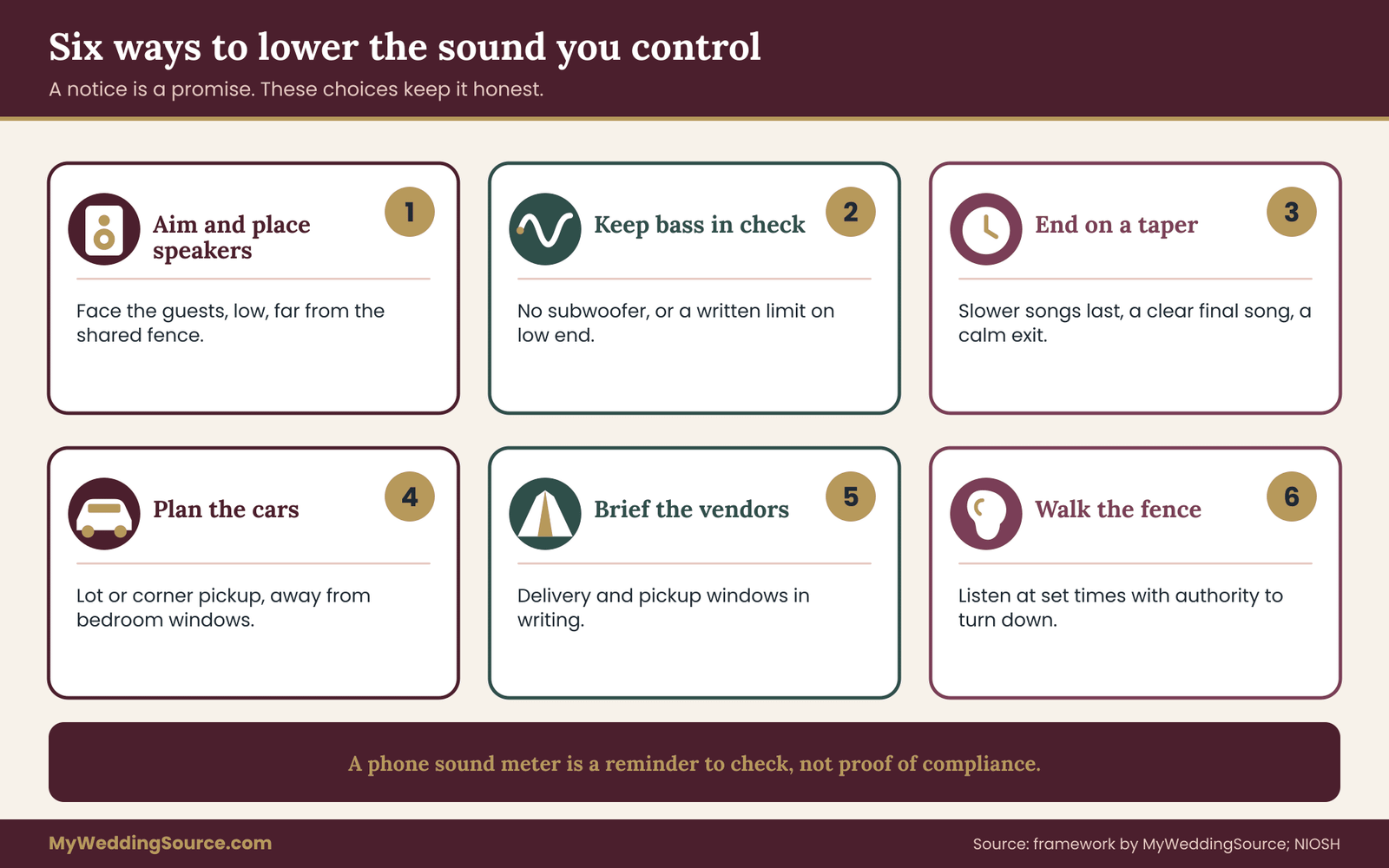
Point speakers away from the nearest house and toward the guests, and keep them low and aimed at the crowd rather than raised high where sound travels over the fence. A speaker on a stand at head height, angled down, sends much of its energy into the people who came to listen. A speaker on a tall pole sends it over their heads and across the street. This one change prevents a surprising share of noise complaints.
Put the dance area as far from the shared boundary as the yard allows. If the layout offers a choice, the corner furthest from the bedrooms next door is usually the best home for music. Close to a fence is the worst spot, because the neighbor’s wall is the first thing the sound meets.
Bass is the neighbor’s problem
Low frequencies are the ones that pass through walls and fences with the least effort. A subwoofer that seems modest in a yard can be the loudest part of the evening in a neighbor’s living room. If your DJ or band uses one, ask them to keep it off, turn it down or place it carefully, and agree on this in writing.
A music system with no sub can still sound full to guests while being much less intrusive across the street. Bass is the most common subject of noise complaints at weddings with amplified music.
When you read the site’s guide to programming reception music, pay attention to energy levels across the evening. A set list that builds toward the end and stops abruptly at the curfew is the kind that produces the loudest final hour. A set list that tapers, with slower songs last, makes a quiet finish feel natural.
Ceremony amplification
Vows and readings often need amplification, but a small battery speaker aimed at the seats is usually enough for a backyard. Ask the officiant and readers to speak toward the guests, and decide in advance whether a microphone is needed at all. For a short ceremony in a small yard, a mic is often unnecessary, and skipping it removes one more source from the neighbor’s list.
Crowd management and the exit
People are loudest when they are leaving. Plan a clear end: the last song, a short thank-you, a friendly request to head out quietly, and someone who walks guests to cars. Avoid a dramatic send-off at the curb if the street is narrow and the houses are close. A calm exit with a small gesture, such as a handwritten card or a quiet toast, serves the same purpose without the cheering. The final stretch of the night often produces the last round of noise complaints.
Ask hosts and family to model the volume. Guests take cues from the people around them, and a group that lowers its voices at the gate tends to keep them low on the sidewalk. A friend stationed at the front door with a clear, kind request can prevent a lot of noise complaints in the final fifteen minutes.
Parking and vehicles
Cars are an underrated source of friction. Doors slam, engines idle, and rideshare drivers wait with windows open. Decide where guests will park, whether a shuttle or a nearby lot will carry some of them, and where rideshare pickups will happen. A pickup point at the corner, rather than in front of a neighbor’s bedroom window, solves a lot. The site’s guest flow guide covers entry and exit patterns in detail, and the same logic applies to a driveway. Car doors and engines are a quiet source of noise complaints late at night.
Put the parking plan in the letter. Neighbors usually forgive noise they were told about more easily than a blocked driveway they were not.
Vendors and teardown
Brief every vendor on the quiet standard. Delivery trucks should arrive and leave within a stated window, and reversing alarms should be avoided where possible by having a spotter. Teardown should finish before the quiet hour or be done quietly the next morning. Ask the tent and rental companies about their schedules in writing, because a pickup truck at seven in the morning on Sunday is an unpleasant surprise for a neighbor who was told that everything would be over by ten the night before.
Vendor noise is a source of noise complaints that couples often overlook.
Put the end time into vendor agreements as a plain requirement. The DJ or band should agree to an amplified-sound end time and a volume ceiling, and to turn down on request. The section on contracts in the site’s vendor contract guide shows how to phrase terms that are specific without being adversarial.
A walk-the-fence check
The most useful sound tool is free. Give one person the job of walking to the property line, then to the street, and listening at several points during the event. This person should have a phone, the neighbors’ numbers and the authority to ask the DJ to turn something down. Ten minutes into the music, then again an hour later, then at the start of the final hour, is a sensible rhythm. Regular checks like this catch noise complaints before they are made.
You can add a simple smartphone sound meter app if you like, though a phone microphone is a rough indicator, not a certified measurement. If your local rule uses a decibel limit, the municipality’s own method decides what counts, so use the app only as a reminder to check, never as proof of compliance.
Day-of contact plan: one number and one person
The third gap, accountability, closes only when a real person can be reached quickly. The contact plan is short, but it is the part most couples skip because they assume someone will sort it out. On the day, nobody sorts it out unless a name has been written down in advance. A named person is the most direct way to turn noise complaints into a short conversation.
Choose a neighbor liaison
Pick one trusted person who is not the couple. A sibling, a close friend or a parent works well, as long as they are sober, reachable and comfortable having a polite conversation with a stranger. Their job is to carry a charged phone, answer neighbor calls and texts, walk to the fence, and take a request to the DJ. The liaison is the person who turns noise complaints into a quick, friendly exchange.
Do not give the number of the couple. On the day, the couple should not be handling neighbor calls, and a neighbor will hesitate to call someone who is in the middle of their own wedding. A liaison turns a possible confrontation into a friendly exchange.
The contact card
Print or write a small card for the liaison with everything they need on one side.
- The legal and promised end times for amplified sound.
- The phone numbers of every ring-one neighbor.
- The numbers for the DJ or band lead, the tent company and the main caterer.
- The three-step response to any complaint: thank them, check, adjust.
- Where the log lives, such as a notes app or a sheet of paper on a clipboard.
- A note on who may authorize turning off the music, and a reminder that it is always allowed.
Hand the card over a day or two earlier, and spend ten minutes walking through it. The liaison should know that turning the music down on request is never a failure. It is the whole point of having the role.
The response clock
Decide ahead of time how fast the liaison will respond. A promise of “a few minutes” in the day-of text sets a standard, and the liaison should aim to hit it. Most neighbors who reach out are simply asking whether anyone is aware. A reply within minutes, and a visible change in the sound, is often enough to end the matter. Fast replies keep noise complaints from moving on to the authorities.
If the liaison cannot answer, there should be a backup name, so that the number in the letter never rings unanswered. This is the equivalent of a second key to the house.
What the liaison says
A short script prevents awkwardness. The liaison thanks the neighbor, says that they will check, and then actually goes to listen. After adjusting something, they return with a short report. Calm scripts keep noise complaints from becoming arguments.
Thank you for telling us. I am going to check the sound now and ask the DJ to bring it down. I will text you in ten minutes to confirm it is better.
That last line matters. A follow-up shows that the first reply was real, and it gives the neighbor a reason to hold off on calling anyone else. The log note, with the time and the adjustment, becomes your record.
Training the helpers
Tell the DJ or band lead, the caterer and one or two family members who the liaison is and that a request to turn down always passes through them. This avoids the common problem of a neighbor knocking at the door and being sent from guest to guest while the music plays on. If a neighbor arrives in person, any guest should know to say, “Let me get Dana,” and not try to resolve the matter themselves. Everyone on the team should know how noise complaints are routed.
For a deeper treatment of digital backups and who holds which phone number on the day, the site’s guide to wedding day digital contingency planning covers shared contact lists and device charging.
The response ladder when noise complaints still arrive
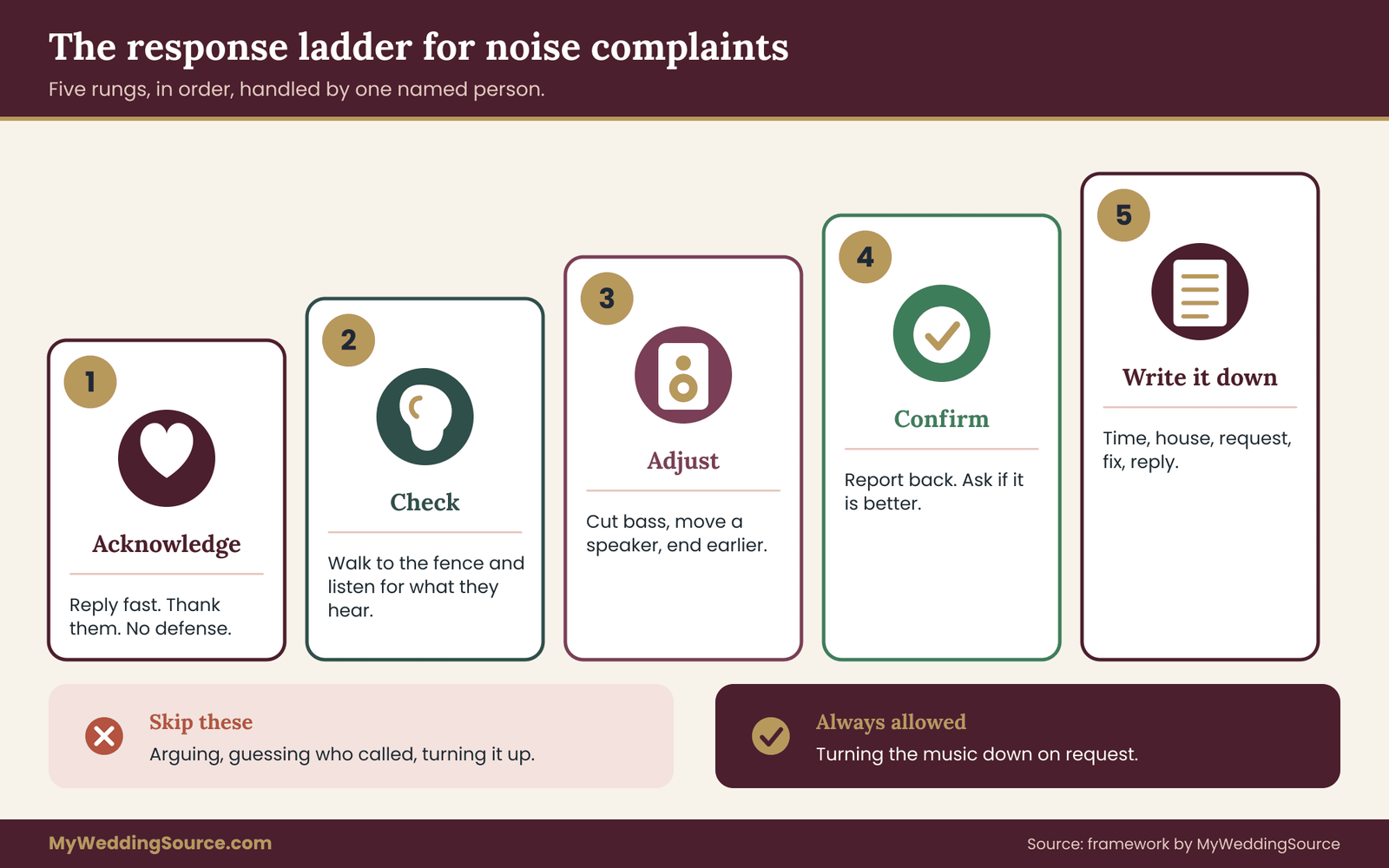
Even a careful plan can meet a bad moment. A gust changes the sound, a guest turns up a speaker, a neighbor has had a hard week. When noise complaints come in anyway, the quality of your response decides whether it ends in a text exchange or in a visit from an officer. The ladder below gives the liaison five rungs to climb, in order.
Rung one: acknowledge
Reply fast and warmly, and never argue. The neighbor is telling you something real about their evening. A reply that begins with thanks lowers the temperature immediately. Do not start with “we have a permit,” “it is still before ten” or “we told you in the letter.” Even when every one of those is true, they sound like a defense. Handled well, noise complaints at this stage are a conversation, not a conflict.
If the neighbor is at your door, step outside, close the door behind you and speak at a normal level. If the contact comes by text, reply in a sentence or two. Short and kind works better than long and careful.
Rung two: check
Go and listen. This takes a few minutes and cannot be skipped, because the neighbor’s report may be accurate even if the sound seemed fine at the party. Walk to the fence line, then to the neighbor’s side if they will allow it, or to the street. Listen for what they hear: bass, voices, a particular speaker, the clatter of dishes, a crowd by the gate. Noise complaints are often accurate about one narrow thing, such as bass or voices at the gate.
Be honest about what you find. If the sound is louder than the promise, say so to yourself and act. If it seems within what was promised but the neighbor is still unhappy, you can still adjust. The goal at this rung is to understand the specific problem, not to win a debate over decibels.
Rung three: adjust
Make a visible change. Turn the volume down, shift the speaker, cut the bass, close a tent wall, move the crowd away from the fence or bring the end time forward. Choose the change that addresses the actual source of the complaint, not the easiest one. A vague “we turned it down a little” rarely satisfies. A specific “we cut the bass and moved the speaker to the far side” usually does. The right fix for noise complaints is the one that targets the source the neighbor named.
The liaison should have clear permission to make these changes without asking the couple. A decision that has to wait for someone to find the groom in a photo line is too slow to matter. Agree in advance that any request to reduce volume is granted on the spot.
Rung four: confirm
Go back to the neighbor and tell them what you did. A text works if you have the number, but a person at the door works better for ring one. Ask whether it is better. If it is not, return to rung two and try again. Offering to check again in half an hour shows that the response is not a one-time gesture.
This rung is the one most hosts skip, and it is the one that prevents a second call. A neighbor who is told, “We changed this, is it better now?” feels heard. A neighbor who never hears back tends to assume nothing changed. Closing the loop is what stops repeat noise complaints.
Rung five: write it down
Record the time, the name or address of the neighbor, what they said, what you changed and the reply. A line or two in a notes app is fine. This log helps in three ways. It lets you hand over information between helpers. It gives you something to refer to if the matter comes up later. And it shows a pattern, such as one house that complains about bass every time, which tells you where to put extra effort next time. Over time, the log shows which kinds of noise complaints repeat at your address.
When the neighbor is angry
Some neighbors arrive upset. They may have had a poor night’s sleep, a difficult day or a longer history with the house. Your job is not to fix their mood. It is to be calm, to listen to the specific complaint and to make a change if one is possible. Lower your voice, keep your hands visible and open, and use their name if you know it. Angry noise complaints deserve the same calm and the same fix as polite ones.
Avoid explanations that sound like excuses. Avoid reminding them of the letter, even if they ignored it. And avoid any hint of threat, even a joke. If the neighbor is aggressive or the situation feels unsafe, step back and end the conversation politely. You are not required to stay in a confrontation, and a wedding day is not the time to resolve a long dispute.
If an officer arrives
Sometimes a neighbor goes straight to the authorities. If an officer comes to the door, the liaison or the couple should answer with courtesy, listen to what was reported and ask what the officer needs. Do not argue about whether the complaint is valid. Say that you will address it, then do so at once by turning the music down or off as asked. Formal noise complaints are easier to defuse when you can show that you acted at once.
If you hold a permit, have the paper or a photo of it ready. If you told neighbors in writing, the letter shows good faith, though it does not excuse a violation. Ask the officer whether any warning will be recorded, and note the officer’s name or badge number, the time and what was said, in the log. Afterward, a short note to the neighbor who called, thanking them for their patience, is a useful way to repair the relationship.
What not to do
A few habits make a bad evening worse.
Do not retaliate. Turning the music up in defiance, or confronting a neighbor in front of guests, escalates the situation and creates a story that follows you for years. Retaliation turns small noise complaints into long disputes.
Do not guess who called. If a call came from the authorities and you do not know the source, treat every neighbor kindly. Accusing someone wrongly can poison a relationship that was perfectly fine.
Do not ignore a second request. Two reports in an evening usually mean the first fix did not work. Treat it as a signal to change something larger, such as ending earlier. Repeat noise complaints in one evening are a signal to change something larger.
Do not drink and negotiate. The liaison should be sober enough to hold a calm conversation and a clear head about what to adjust.
Using the ladder as a pattern for the whole evening
You can also use the ladder as a rhythm rather than a response. Just before the music begins, check from the property line, and adjust. When dinner ends and the crowd grows louder, check again. Before the final hour, check once more and confirm with ring-one neighbors by text that all is well. A pattern of small, proactive checks heads off many noise complaints before they are ever made. Used this way, the ladder heads off noise complaints before they are made.
Worked example: an illustrative evening on a quiet street
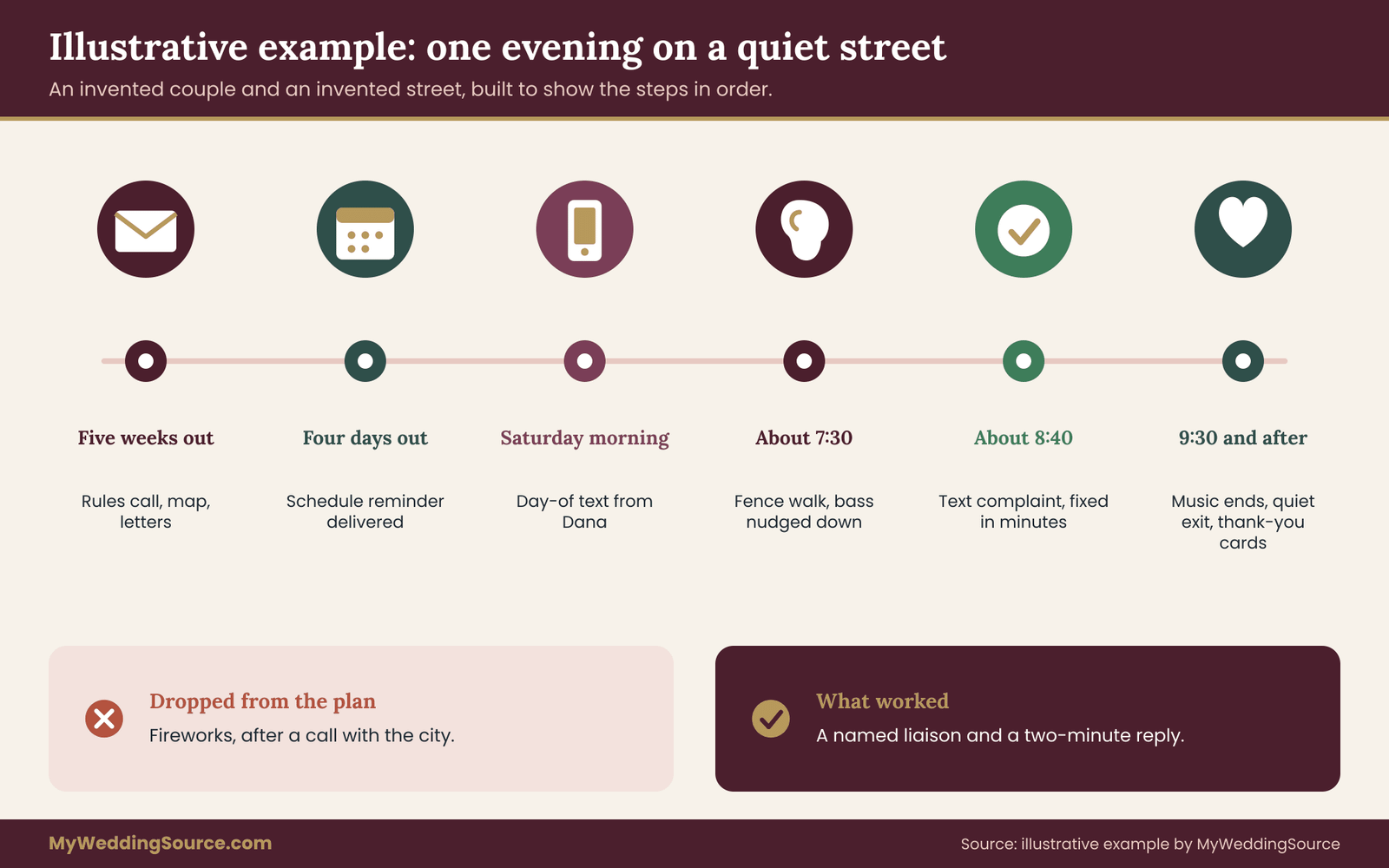
This is an invented example, built to show how the pieces fit together. It is not a report of a real event, and the numbers are chosen for clarity, not as typical figures. Your own street, rules and guest list will differ. It shows how the steps limit noise complaints in an ordinary setting.
The setup
Imagine a couple, Mara and Joel, who plan to marry in her parents’ backyard on a Saturday in late September. About sixty guests are expected. The yard backs onto one neighbor and shares a side fence with another. A third house sits across a narrow street, facing the side where the dance area would be. The street ends in a cul-de-sac with room for only a few cars.
They want a ceremony at four, dinner at five thirty and dancing until a late hour. Mara’s father also hopes there will be a small fireworks display, which he says is a family tradition.
Step one: the rules
Mara calls the city office with the five questions. She learns that amplified sound is permitted until ten at night on weekends, that an outdoor event with a rented tent over a stated size needs a notification to the fire office, and that fireworks are not allowed in residential areas. She writes down the clerk’s name and the date. She also asks what happens after noise complaints are reported.
The fireworks idea ends there. Instead, Mara and Joel choose a quiet sparkler-free exit with a warm toast at the gate. They also set their own end time for amplified music at nine thirty, which leaves thirty minutes of margin.
Step two: the map
They draw three rings. Ring one is the two houses sharing a boundary. Ring two is the three homes across the street. Ring three includes the six homes along the likely parking route. Mara notices that the family across the street has a newborn, because she has seen a stroller on the porch, though she does not mention it by name in the letter.
Step three: the three touches
Five weeks before the wedding, Mara hand-delivers the courtesy letter to ring one and puts it in the mailboxes of ring two. She chats briefly with the neighbor behind the yard, who says he usually goes to bed at nine. They agree that the music will be turned toward the house at the front, away from his bedroom.
Four days before, she delivers the reminder with the schedule. On the morning of the wedding, her sister Dana texts ring one with the day-of message. A short card goes to ring two.
Step four: lowering the noise
They book a DJ who agrees in writing to stay below a stated volume, leave out the subwoofer and stop amplified sound at nine thirty. Speakers go on stands near the dance floor, aimed at the guests and away from the fence. Guests park at a nearby church lot with the church’s permission, and a friend waits at the corner to direct rideshare pickups.
Step five: the evening
Around seven thirty, Dana walks to the fence and listens. It sounds fine at the back but a little heavy from the street. She asks the DJ to bring it down a notch. At eight forty, the neighbor across the street texts that the bass is rattling a window. Dana replies within two minutes, asks the DJ to cut the low end and texts back ten minutes later to confirm. The neighbor replies with a thumbs up.
At nine thirty the music ends, guests move toward the gate quietly, and Dana logs the exchange. The following week, Mara and Joel leave a short thank-you card at each ring-one and ring-two door.
What the example shows
Nothing here was dramatic. The couple did not eliminate sound. They learned the rules, gave notice, kept a promise about the end time, put a person in charge and responded fast. One neighbor still had a concern, and it was resolved in a few minutes because the system existed. That is the realistic goal: not zero contact, but contact that ends well. Noise complaints still came up once, and the system handled it.
Edge cases that change how you handle noise complaints
The framework above fits an ordinary suburban street. Real situations bend it. These cases come up often enough to be worth thinking through, and each one adjusts a specific part of the notice or the response. Each case below changes how you prevent or answer noise complaints.
A neighbor who does not reply
Silence is not consent, and it is not objection either. Many people simply never answer a letter. Do not chase them. Deliver the reminder, deliver the day-of note and treat them as someone who might still call. If you get to the day with no reply from a ring-one neighbor, a friendly knock in the afternoon, when setup is underway, is a good way to put a face to the name and to learn whether any problem exists.
A neighbor who says no
Sometimes a neighbor writes back to say they are unhappy. You do not need their permission to hold a wedding at your home if the event complies with local rules, but you do need to take the concern seriously. Ask what specifically worries them. Often it is one fixable thing: the time of the loudest part, the speaker direction, a blocked driveway, a dog that reacts to sudden sounds. Hearing an objection early is better than facing noise complaints on the night.
Offer the concrete change that you can make, and be honest about the changes you cannot. If the neighbor is still opposed, thank them, keep the contact line open and consider adjusting the plan further, such as ending earlier. Write down the exchange. A reasonable record of a courteous conversation is helpful if a complaint later reaches an officer.
Neighbors who are also guests
If a neighbor is invited, the problem mostly disappears, because a guest is unlikely to call about their own party. This is a good reason to invite ring-one neighbors where your guest list and your budget allow it. Be careful, however, not to turn the invitation into a transaction. Invite them because you would like them there, and still send the notice, because the people next to them may be affected as well.
A homeowners association
An association can add rules beyond the city’s and may require notice to the board or approval for tents and events. Read the covenants and ask the board in writing what they require. Send the notice letter to neighbors as usual, and ask whether the association has a preferred format or a deadline. Association rules are enforced by a different group of people, so a courtesy copy to the board can avoid a disagreement later. Association rules can turn a single neighbor’s noise complaints into a formal matter.
A rental property
If you rent, the landlord’s written permission comes first. Ask about quiet hours in the lease, about tents and stakes in the ground, and about the landlord’s preferred way to handle neighbor concerns. Provide the landlord with the same three touches you give neighbors, because a complaint to the landlord can be more damaging to your tenancy than a complaint to the city.
Shared driveways and tight lots
When houses are close, the line between a neighbor and a guest is thin. Shared driveways make parking and vendor access a joint matter, and a delivery truck can block someone’s car for hours. Agree with the neighbor on a specific window for deliveries and teardown, and consider moving heavy vendor activity to another access point. On a tight lot, lower-level music, a closed tent wall and an earlier end time are more important than on a wide rural lot.
Rural properties
A large lot does not remove the need for notice. Sound carries across open land, and a farm neighbor may have livestock, a night-time work schedule or a bedroom window facing the field. A reception on a long lot can be heard half a mile away on a still night. The three-touch notice still applies, though ring two may stretch across a field and ring three may be the road itself.
For a barn-style setting, the site’s guide to barn wedding venues explains how professional venues handle the same questions. Rural noise complaints tend to come from fewer households but from farther away.
Neighbors with sensitive needs
Pets, babies, shift workers and people who are ill are the most common sensitive cases. You do not have to ask about anyone’s health. A single open sentence in the letter, inviting people to tell you about timing problems, is enough. When someone responds, take the information at face value, make a reasonable adjustment and do not share the details with guests. These households are the likeliest to make noise complaints, and the most deserving of notice.
For pets that react to sudden bangs, the most reliable adjustment is to avoid fireworks, cannons and loud pops, and to warn the neighbor of any loud moment, such as a toast with a cheer. A short heads-up at the right time costs nothing.
A smaller reception that moves late
Some couples hold a short ceremony and dinner at home, then move the dancing elsewhere. This is among the cleanest solutions, but the move itself creates a short burst of noise as cars leave. Include it in the schedule and in the exit plan, and ask guests to keep voices low during the departure.
A weather change
Rain or heat can send the party indoors or under tent walls, which changes how sound travels. A closed tent traps sound inside, which helps the neighbors but can make the party louder in the tent, prompting someone to turn the music up. If the plan changes, let ring-one neighbors know by text, and have the liaison re-check the sound from outside.
Failure conditions: when the plan will not hold
A good plan states honestly when it will fail. The three-touch notice and the response ladder work well in many settings, and they do not work in some. Recognizing those conditions early is part of the planning, and it saves you from a larger problem later. Knowing when noise complaints cannot be prevented is part of planning.
Signs that the plan is not enough
Consider changing the event, and not just the notice, when any of these is true.
The rules forbid the core of the event. If the ordinance bans amplified sound at the hour you need, or the association bans tents, a polite letter cannot change that. Adjust the schedule, seek a formal exception or move the affected part elsewhere. No letter can prevent noise complaints about something the rules prohibit.
A neighbor has a serious, specific need you cannot meet. If someone in a ring-one household has a medical situation that makes evening sound a real problem, a good-faith adjustment may not be enough. Be willing to change the date, the hour or the venue for that part of the event.
Previous disputes have damaged the relationship. If there is a history of conflict with a neighbor, a letter may not repair it. Consider a mediator, a mutual acquaintance or a short, respectful in-person meeting before the wedding, and keep expectations modest.
You cannot staff the plan. If nobody reliable can serve as liaison, walk the fence and answer the phone, the contact promise in the letter is empty. Do not promise what you cannot deliver.
The event is larger than the property can hold. A guest count that exceeds what the lot, parking and street can comfortably take makes every other part harder. In that case, the answer is fewer guests or a different site, as the site’s guest list guide discusses. Note that this guide is not a substitute for checking occupancy rules.
The alternatives
If the plan fails, there are several honest alternatives, each with its own trade-offs.
Split the event. Hold the ceremony and dinner at home during the day and early evening, and move the dancing to a rented room, a restaurant or a venue designed for it. You keep the home setting for the part that matters most and put the loud part where it belongs.
Shorten the loud window. Move the music earlier and end it sooner, perhaps with a daytime reception and a late afternoon finish. A reception that ends at dusk has fewer noise complaints than one that runs into the night. A reception that ends at dusk has fewer noise complaints than one that runs into the night.
Change the sound. Use acoustic music, a quiet playlist at low volume or a small ensemble instead of a full amplified system. A string trio at conversation level draws far fewer complaints than a DJ with a subwoofer.
Rent a professional venue. If the home option carries too much risk, a venue built for events solves the neighbor problem by design. The wedding venues guide outlines how to compare options and what to ask.
Move the date or the hour. A weekday or a Sunday afternoon reception is usually quieter on the neighbors than a Saturday night, and it may be easier on the budget too.

None of these is a defeat. Many couples who change one element find that the event is better for it, with less stress for the hosts and a more relaxed evening for the guests.
What it costs to prevent noise complaints
Prevention is cheap compared with the alternative, but it is not free, and it helps to list the real items so that nothing surprises the budget. None of the figures below is a price. Quotes differ by region and vendor, so ask for current numbers and write them into your own sheet. The aim is to keep noise complaints from costing anything more than your time.
Your time. Calling the city, drawing the map, writing three notes and briefing a liaison takes a few evenings. This is the main cost.
Printing and delivery. A few pages of letters and cards. Trivial, but worth listing.
Permits and notifications. Some places charge a fee for an event notification or a tent permit. Ask the office when you call, and ask what the lead time is.
Sound choices. A DJ who agrees to leave out a subwoofer or to follow a volume ceiling may charge the same as one who does not, or may adjust the package. Ask when you get the quote, and note the answer.
Parking and shuttles. A shuttle service, a borrowed lot or a valet can be a larger line than any other item. Decide whether the cost buys enough peace to be worth it. Often a free option, such as a church or school lot with permission, does the job.
Staffing. A paid coordinator or a hired helper who handles the neighbor contact can be an alternative to a family liaison if the family is stretched. For comparing what to budget for helpers and rentals, the site’s rental planning checklist is a useful companion.
A modest gesture. Some couples bring a small thank-you after the event, such as a card, a plate of leftovers or flowers from the day. This is optional. Do it for kindness and do not treat it as a way to buy silence.
The cost logic is easy to state. The time and small fees of prevention are certain and modest. The cost of a serious dispute, such as a fine, a shut-down music system, a damaged relationship or a stressful night, is uncertain and can be large. A sensible couple pays the small certain cost.
Putting the sound promise into contracts
Your letter makes a promise to neighbors, and your vendors must be able to keep it. Add a short sound clause to each relevant agreement. A short sound clause protects you from noise complaints that vendors could cause.
For a DJ or band: the end time for amplified sound, a volume limit or an agreement to follow the host’s reasonable request, no subwoofer or a stated limit on low-frequency output, and the right of the host or liaison to ask for a reduction at any time without penalty.
For the tent or rental company: the delivery window, the pickup window and a promise to avoid reversing alarms where possible.
For the caterer: the time that loading and cleanup will finish, and the route trucks will use.
For the photographer and videographer: any use of drones, which may be restricted by local rules or by privacy expectations, and the time that equipment will be packed.
Keep the clauses short and plain. A vendor who resists a reasonable sound clause is telling you something about how they will handle the evening.
After the wedding
The last step is the one that protects the next ten years on the street. Within a week, thank the neighbors who were most affected, whether by a short note, a quick visit or a plate of cake. If you had a concern raised, mention it and say what you learned. A follow-up note is the best repair after any noise complaints.
Check the log and file it with your wedding records. If an officer visited, note what was said and whether a warning was recorded. If a neighbor was upset, consider a short, humble follow-up. The goal is not to win an argument but to leave the street in as good a state as you found it.
If the neighbor relationship improved, which it often does after a respectful notice, keep that goodwill alive. A wave over the fence and a thank-you at the holidays cost nothing.
A reusable one-page checklist in prose
If you want to compress everything in this guide into a short routine, it runs like this. Call the city and the association with the five questions and write down the answers. Set your promised end time with a margin. Draw the three rings and list the addresses. Deliver the courtesy letter and, for ring one, a short conversation. Choose the liaison, give them the card and brief the vendors.
Put sound clauses into contracts. Deliver the reminder a few days before and the day-of text on the morning. Walk the fence at set times. Climb the response ladder when a request comes in. Write down what happened. Thank everyone afterward. It is a compact method for noise complaints at any home event.
That sequence is the entire deliverable. It fits on a page, it can be finished in a couple of evenings and it works for a small garden wedding as well as for a large tented reception.
Your next steps
- This week: call the city or county office with the five questions, and check any association covenant or lease terms. Write down the answers and the name of the person who gave them.
- Set your promised end time for amplified sound, with a margin before the legal limit, and the time that vendors and cars will be gone.
- Draw the three rings of notice and write the address list, including how you will deliver each notice.
- Draft the courtesy letter using the lines in this guide, and deliver it by hand to ring one with a short conversation.
- Choose a neighbor liaison and a backup, write their numbers on a contact card, and brief the DJ, caterer and tent company.
- Add a sound clause to each vendor agreement and confirm delivery and teardown windows in writing.
- Send the schedule reminder a few days before, and the day-of text on the morning, then walk the fence at the times you set.
- Afterward, thank the neighbors, file the log with your wedding records and note what to improve next time.
FAQ
Do I legally have to tell my neighbors about a backyard wedding?
Usually there is no general law requiring you to notify neighbors of a private event, though some places require a permit, a notification to an office or a notice to an association. Rules vary by city, county and community, so ask your local office. Even where nothing is required, a courteous notice is the most effective way to prevent noise complaints.
How far in advance should I send the first letter?
Send it once the date, end time and vendors are firm, and early enough that neighbors can raise concerns or make their own plans. Several weeks is a sensible starting point. Send a shorter reminder a few days before the event and a text on the day, so that each touch adds something new.
What if a neighbor objects to the wedding?
Thank them, ask what specifically concerns them and offer the changes you can make, such as an earlier end time or speakers aimed away from their house. You do not need their permission if you follow local rules, but a calm, documented conversation reduces the chance that a complaint escalates into a call to the authorities.
What time should the music end?
Check your local quiet hours and any association rules, then end earlier than the legal limit by a margin you can keep, such as thirty minutes. Tell neighbors that time in the letter and stick to it. A promise you keep builds more goodwill than a later hour you hope no one notices.
Should I give neighbors a gift or invite them?
An invitation is a kind gesture if you would genuinely like them there, and it often removes the problem. Small gifts are fine after the event as thanks. Avoid presenting a gift with the letter, because it can look like payment for silence. Either way, still send the notice so that other households are informed.
Who should answer neighbor calls on the wedding day?
Choose a trusted, sober friend or relative who is not the couple, with a backup. Give them a contact card with end times, numbers for the DJ and vendors, and permission to turn the music down on the spot. A quick reply, ideally within a few minutes, resolves most requests before they become official complaints.
What should I do if the police come?
Answer politely, listen to what was reported, and do what the officer asks, usually turning the music down or off. Do not argue about whether the report was fair. Note the time, the officer’s name and what was said in your log, and send the neighbor a kind note afterward if you know who they are.
Do I need a sound meter?
No. A phone app can remind you to check, but it is only a rough indicator and not an official measurement. What matters more is that someone walks to the fence and the street at set times and listens like a neighbor would. If your area uses a decibel limit, ask the local office how and where it is measured.
Sources
- USA.gov: government services and local government directory
- U.S. Environmental Protection Agency: noise and community sound
- CDC NIOSH: noise and hearing loss prevention
- OSHA: occupational noise exposure
- National Fire Protection Association: codes and standards for tents and open flame
- National Association of Insurance Commissioners: consumer insurance information
- ADA.gov: accessibility guidance for events
- National Weather Service: forecasts and wind conditions
- Federal Aviation Administration: drone rules for recreational flyers