
A newborn wedding ceremony works best when the schedule bends around the baby instead of the baby being squeezed into the schedule. This guide gives you a caregiver handoff card, a flexible cue timeline with built-in hold points, one worked case, the alternatives to consider, and the conditions under which you should shorten, move or skip the ceremony.
For a newborn wedding ceremony, split your timeline into fixed anchor cues (the legal moment, the officiant, the venue slot) and floating cues (processional start, readings, music, photos). Put two or three hold points where the whole newborn wedding ceremony can wait without harm. Write one handoff card that tells a named caregiver how the baby is fed, soothed and settled, and what each cue from the baby means. Agree failure conditions in advance, so a hungry or unwell baby triggers a plan, not an argument.
Planning a newborn wedding ceremony around a newborn is a particular kind of scheduling problem. Most wedding timelines assume that every person involved can be told to stand here at four o’clock and will do so. A newborn cannot be told anything. A baby of a few weeks old feeds, sleeps, cries and needs changing on a rhythm that is partly predictable and partly not, and that rhythm is the one thing on your wedding day that nobody can reschedule.
This does not make a newborn wedding ceremony a bad idea. Plenty of couples marry in the weeks after a birth, because a date was already set, because family is in town, because a visa or a lease or a military posting is fixed, or because they simply want to. The question is not whether to do it. The question is how to build a ceremony that survives a baby who is hungry at the wrong moment.
The approach in this guide is a short method with four working parts: a timeline made of anchors and floats, a handoff card for the person caring for the baby, a set of feeding and care windows, and a list of failure conditions. Each part is something you can write on one page and hand to someone. Nothing here requires special equipment or a large budget.
A note on scope. This is general planning information, not medical, legal or financial advice. Decisions about feeding, sleep, travel, crowds and recovery after birth belong to your own clinicians, and the guide points to public health sources so you can read their current advice yourself.
What a newborn wedding ceremony asks of the schedule
Start by being honest about what changes when a baby under about three months old is part of the day. Four things do, and each one has a different consequence for the timeline.
The baby’s needs arrive on their own clock. Feeding, changing and settling to sleep happen when the baby signals, not when the run of show says so. Public health guidance, including material from the American Academy of Pediatrics, describes newborn feeding as responsive to the baby’s cues rather than a fixed timetable. For your wedding day, that means the baby’s next feed is a range, not an appointment.
The person who usually meets those needs may also be in the newborn wedding ceremony. If the baby’s birth parent is one of the people getting married, the feeding parent and the bride, groom or spouse-to-be are the same person. That single fact drives most of the planning. It means the baby’s care has to be covered by someone else during the stretches when the parent is at the front of the room.
Recovery is part of the schedule. Someone who gave birth recently is also recovering. Standing through a long ceremony, wearing a fitted garment, going without food, or managing pain and tiredness all affect how a day goes. The American College of Obstetricians and Gynecologists publishes guidance on postpartum recovery, and your own clinician knows your situation. Plan the ceremony around what that person can comfortably do, not around what a standard ceremony expects.
A newborn changes the risk profile of a crowd. Young babies are more vulnerable to infections than older children and adults. Questions about how many people will be close to the baby, who will hold them, and who should stay home if unwell are reasonable and belong with the pediatric clinician. The health section later in this guide covers the practical side without making medical claims.
What this guide does and does not cover
This article is narrowly about the newborn wedding ceremony: the stretch from guests being seated to the couple walking out, plus the thirty minutes on either side. It does not try to cover the whole of planning a wedding during pregnancy or after birth, and it does not cover the reception, where a different set of timing questions applies. For a broader approach to dates and priorities, the site’s guide to choosing a wedding date covers how to weigh guest availability and vendor capacity before you commit.
The newborn wedding approach also assumes that you are already working from a cue sheet or will build one. If you have not written a newborn wedding ceremony run of show before, read the site’s guide to the wedding ceremony cue sheet first, because this method adds a layer on top of that document and does not replace it.
Finally, it assumes the baby is physically present at or near the ceremony. If you are leaning toward a ceremony without the baby, a separate section on alternatives covers that, and much of the handoff card still applies to whoever cares for the baby elsewhere.
The three people the plan has to serve
A newborn wedding ceremony serves three groups at once, and trade-offs between them are normal.
The baby needs feeding, warmth, a safe place to sleep, and not to be passed through a long line of well-meaning arms. The parents need the newborn wedding ceremony to happen, the baby to be safe, and some room to be present in the moment instead of monitoring a clock. The guests need to know what to expect, to be told kindly when to stay back, and to be able to enjoy the ceremony even if there is a cry halfway through the vows.
When these goals conflict, the order of priority is usually clear. The baby’s safety and basic needs come first, the legal act of marriage second, and the planned details of the newborn wedding ceremony third. The method in this guide is built to make that order automatic, so nobody has to argue about it with a hungry baby in the room.
The Hold-Point Method in one page
The method has five steps. You can complete the first draft in an evening, and each later section of this guide expands one step.
Step one: sort every ceremony moment into anchor or float. An anchor is something that cannot move without a real cost: the time your venue or officiant is booked for, the moment of the legal vows, the sunset photo if sunset is the whole point of the ceremony. A float is something that can start earlier, later or not at all: the prelude music, the readings, the unity ritual, the family processional.
Step two: place hold points. A hold point is a place in the timeline where everything can pause for a stated number of minutes, with someone designated to call the pause. The most useful ones are before the processional starts, between the readings and the vows, and just after the vows.
Step three: write the handoff card. One page that tells the baby’s caregiver the baby’s name, the feeding method, the usual signs of hunger and tiredness, where the supplies are, who can be called, and which contacts are authorized to hold the baby.
Step four: set the care windows. Decide, with your own clinician’s guidance, roughly when the baby is likely to be fed before the newborn wedding ceremony and how long a gap the baby can comfortably manage. Then arrange the day so the ceremony sits inside the most comfortable stretch, with hold points available if the stretch ends early.
Step five: write the failure conditions. A short list of events that trigger a defined response: the baby cries for longer than a stated period, the baby is unwell, the feeding parent needs a break, the weather or venue changes. Each trigger has one pre-agreed action and one person who decides.
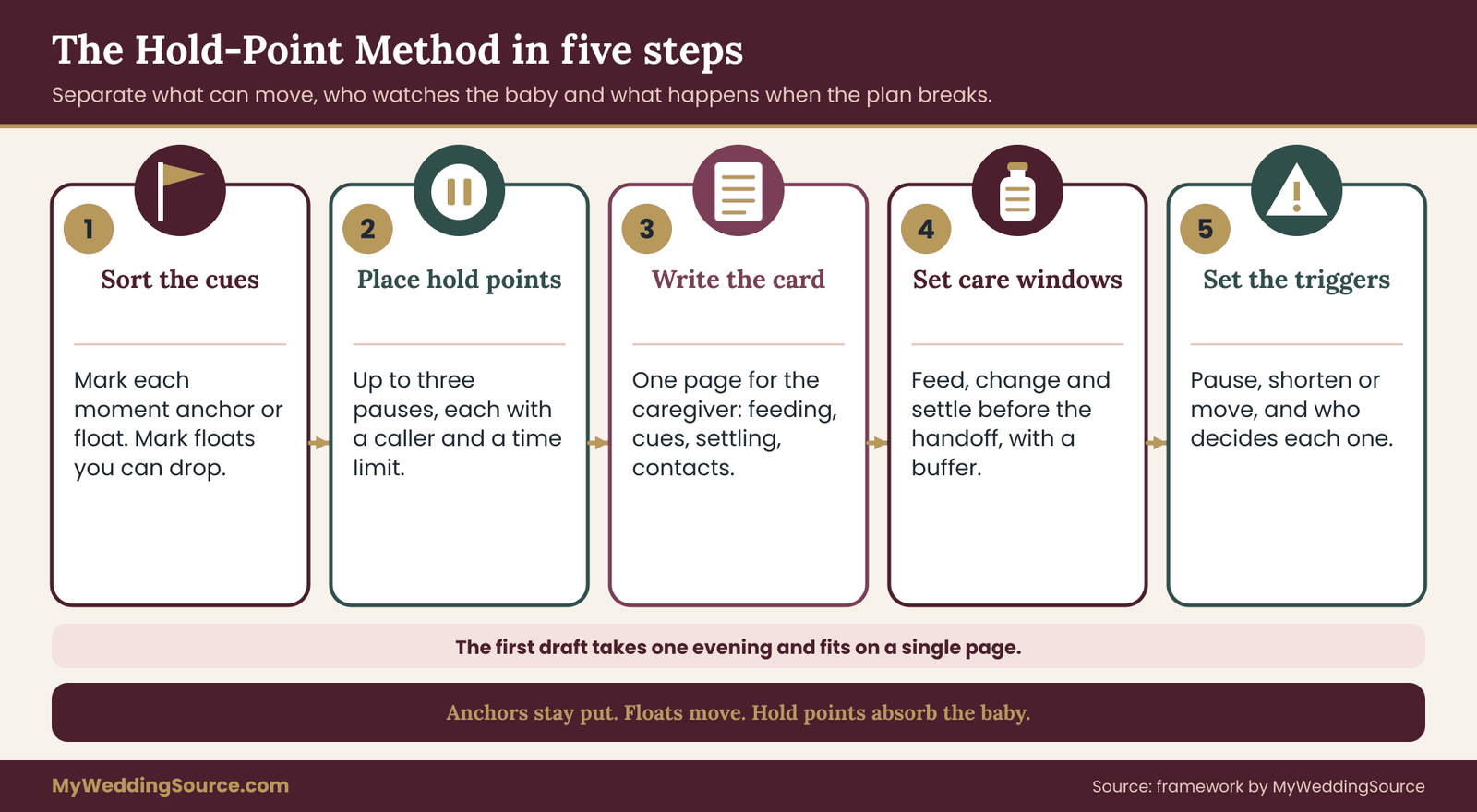
The method works because it separates three questions that usually get tangled together. What can move, who is watching the baby, and what happens when the newborn wedding plan breaks. Once those are written down and shared, the people around you can act without asking, which is what you want on the day.
Why a single page beats a long plan
A newborn wedding ceremony tends to attract advice. Relatives have views on feeding schedules, sleep, and how long a baby can go without being held. Some of it is helpful. Much of it contradicts the next person’s advice. A one-page plan gives you something to point to, and it gives helpers a clear boundary: the plan says who holds the baby, so the newborn wedding plan answers the question.
Keep the page short enough to read in two minutes. A longer document will not be read on the day, and the people who need it most, usually a grandparent or a close friend acting as caregiver, are the ones least likely to read a long one. A newborn wedding day rewards short documents.
Reading the baby’s day without a clock
Before you can schedule around a baby, you need a working picture of what the baby does in a day. That picture should come from the baby and from your pediatric clinician, not from a chart on the internet, but the planning logic is simple enough to describe in general terms.
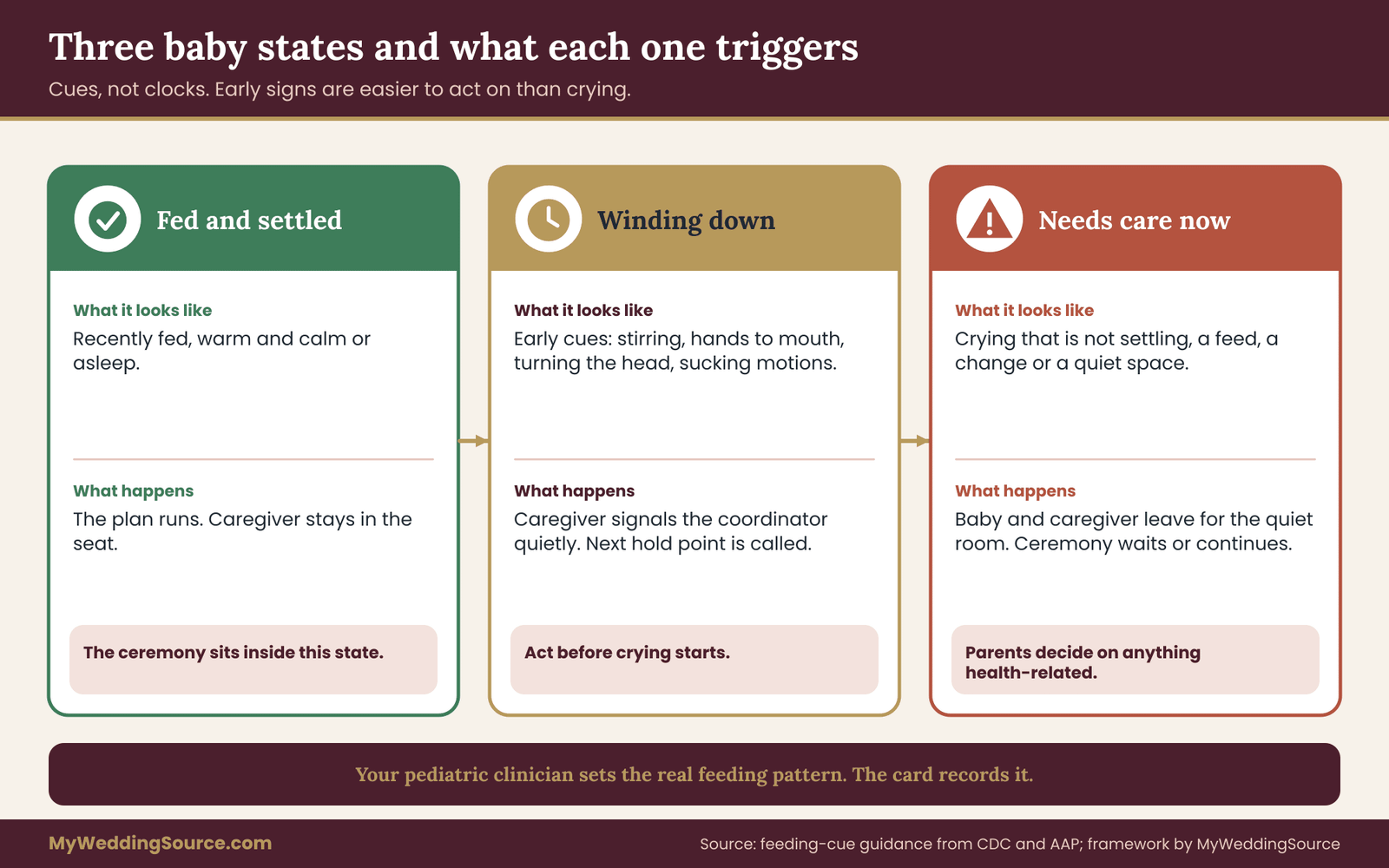
Three states the schedule has to handle
For planning purposes, think of the baby as being in one of three states at any moment of a newborn wedding day. These are not medical categories. They are a way to decide what the people around the baby should do.
Fed and settled. The baby has recently eaten, is warm and comfortable, and is either awake and calm or asleep. This is the state in which the baby can be present at the newborn wedding ceremony. The goal of the whole timeline is to put the ceremony inside this state.
Winding down. The baby is showing early signs of tiredness or hunger. Public health guidance, such as the material on responsive feeding from the Centers for Disease Control and Prevention, describes early hunger cues as small movements: stirring, turning the head, bringing hands to the mouth, making sucking motions. Crying is usually a late cue. A caregiver who knows the early cues can act before the baby is distressed.
Needs care now. The baby is crying and not settling, needs a feed, a diaper change or a quiet space. In this state the baby leaves the room, or the feeding parent does, and the hold point or failure plan takes over.
The point of naming three states is that each one has a pre-agreed response. Fed and settled means the plan runs. Winding down means the caregiver signals the hold-point owner. Needs care now means the baby is taken somewhere quiet and the newborn wedding ceremony waits or continues without that person, as the newborn wedding plan says.
What you can predict and what you cannot
Some things about a newborn day are reasonably predictable once a family has had a few weeks together. Many babies fall into a loose pattern of feeding, awake time and sleep. Parents often know within a rough window when the next feed is likely. That knowledge is worth writing down on the handoff card.
Other things cannot be predicted at all. A baby who slept well at home may be unsettled by new sounds, a new building or a crowd. A baby who is usually easy after a feed may have a rough afternoon. A growth spurt, a cold or a rough night can all move the pattern.
So the honest approach is to plan for a range, not a point. Treat the baby’s likely feed as “somewhere in this window” and build the timeline so that if the baby needs care at the early end of the window, the ceremony can pause. If the baby is calm past the late end of the window, the newborn wedding ceremony can run on. This is the entire logic of the hold point.
Why you should not fix the feed time to the minute
It is tempting to build the day backward from a feed: the baby eats at three, the ceremony is at three thirty. The risk is that the timeline treats a flexible event as an anchor. If the baby wakes early, or feeds longer than expected, or needs a change afterward, the newborn wedding ceremony start slides and every vendor behind it slides too.
A better approach is to put the feed into the timeline as a float with a window and a buffer. For example, write “feed window opens at two fifteen, ceremony start no earlier than three, hold point open until three twenty.” The numbers are yours to choose, ideally after talking with the baby’s clinician about what is realistic for your baby. The structure is what matters: a window, a start that sits after it, and a buffer for the unexpected.
The role of the pediatric clinician
Questions that sound like planning questions are sometimes medical ones. How long can this baby comfortably go between feeds? Is it safe to travel to the venue? Should the baby be in a crowd of people at this age? Is the baby’s feeding method affecting the plan, for example if supplementation or a special formula is involved? Those questions go to the baby’s clinician, and the answers go onto the handoff card.
If you do not have a regular pediatric clinician yet, ask the hospital or birth center, or the clinician who cared for you during pregnancy, who to call with a question like this. The American Academy of Pediatrics publishes parent-facing material through HealthyChildren.org, which is a sensible place to read general guidance before you speak with your own clinician. Nothing in this article replaces that conversation.
Choosing the time for a newborn wedding ceremony
The time of day is the single biggest lever you have. It decides how many of the baby’s likely needs fall inside the ceremony and how much room you have to absorb a surprise.
Questions that decide the time
Four questions usually settle it. Ask them in order.
First, when does the baby tend to be most settled? Many families see a calmer stretch after a feed, and some see a fussier period at the end of the day. Parents usually know their own baby’s pattern within a couple of weeks. If the pattern is still unclear, choose a time with room to hold.
Second, when is the feeding parent at their best? A parent who is recovering may have more energy at one end of the day. Someone who has not eaten, slept or sat down since morning is a risk to the day in the same way a hungry baby is.
Third, which parts of the day are fixed? If a venue offers only a particular window, or sunset matters for photographs, or a religious calendar, a family member’s travel or a legal appointment fixes the start, you have an anchor and everything else flexes around it. The site’s guide to wedding vendor timelines explains how fixed vendor slots interact with the rest of the schedule.
Fourth, how long is the newborn wedding ceremony, really? A ten-minute civil ceremony and a seventy-minute ceremony with readings, music, a ritual and a full liturgy are different problems. If the newborn wedding ceremony itself is short, the baby’s window almost takes care of itself. If it is long, you will want hold points, or a shorter version.
Morning, midday and late-day ceremonies compared
There is no universally right time, but each time of day has a different risk profile for a newborn wedding ceremony.
A morning ceremony often has the advantage that the baby’s day has just begun and the household has had time to settle. The risk is the rush: getting a newborn, a recovering parent, a wedding party and a venue ready at an early hour, with a night’s disrupted sleep behind everyone. A brunch-style schedule with a late-morning ceremony can soften that.
A midday or early-afternoon ceremony tends to give more room for a feed beforehand and for a settled period afterward. The risk is that the baby’s longest sleep may fall in the middle of the day, and a newborn wedding ceremony that interrupts it may be harder than one that follows a nap. Families who know the baby’s nap pattern can use it.
A late-afternoon or evening ceremony is often the fussiest period for some babies, and also the one when the guests, the light and the catering clock all press on the schedule. The risk is that a baby who is tired at the end of a long day meets a ceremony that is also the climax of the day. If the evening is fixed, plan for the baby to be elsewhere, with a caregiver, for the newborn wedding ceremony itself, and join afterward.
None of these descriptions is a rule, and no time of day is automatically right for a newborn wedding ceremony. They are prompts for a conversation with the person who knows the baby best.
A simple rule for the start time
Once you know the baby’s likely feed window, set the ceremony start so that it falls shortly after the window opens and well before it is likely to close. Then place the first hold point just before the processional, so a baby who is stirring early is caught before the newborn wedding ceremony starts rather than during it.
Put the start time in the cue sheet as an anchor with a tolerance: “start no earlier than this, no later than that.” The tolerance is the room that lets everyone relax. Vendors tolerate a stated window much better than a start time that moves on the day without warning. Tell the officiant, the musicians and the photographer about the window in advance, and see the section on vendors later in this guide.
When the time is already fixed
Many couples reading this have a venue, an officiant and fifty guests already booked for four in the afternoon. Moving the ceremony may not be an option. In that case, do not try to change the time. Change what surrounds it.
Move the baby’s care plan: arrange a feed and a settled period before the start, and a quiet room close by. Move the cue structure: shorten the newborn wedding ceremony, or reorder it so the legally essential part comes early. Move the roles: make sure someone other than the parent can be with the baby for the entire ceremony. Fixed time with a flexible care plan is a perfectly good newborn wedding plan, and many a newborn wedding ceremony has gone ahead on exactly that basis.
Building the flexible cue timeline
A cue timeline is a list of moments, each triggered by the one before it, with named people responsible for giving the signal. The standard ceremony cue sheet is described in the site’s ceremony cue sheet guide. The version for a newborn wedding ceremony adds three things: a label on every cue (anchor or float), hold points between cues, and a baby line that runs alongside the ceremony line.
Step one: list the cues in plain order
Write every cue from the first guest seated to the last person leaving the aisle. A typical list runs: guests seated, prelude music, family seating, officiant takes position, processional music for the wedding party, processional music for the couple, welcome, reading, vows, ring exchange, pronouncement, kiss, recessional, announcement of next steps.
Your list may be shorter or longer. What matters is that each item is one action by one person, so there is a clear moment when someone says “go.” If your ceremony has a ritual such as a unity candle, a tea service, a handfasting or a blessing, list it as its own cue.
Step two: label each cue anchor or float
Go down the list and ask one question of each cue: what breaks if this moves by fifteen minutes? If the answer is “the venue fee,” “the officiant’s next booking” or “the point of the newborn wedding ceremony,” it is an anchor. If the answer is “nothing much,” it is a float.
In most ceremonies the anchors are few. Often they are the booked start window, the legal vows and declaration, and the finish before the next booking at the venue. Nearly everything else floats: the prelude, the readings, a musical interlude, a family tribute, the order of the wedding party’s entrance.
Mark floats you are willing to drop as drop-ready. A drop-ready float is a cue you have already decided you can remove without regret if the baby needs time. Having this list in advance turns a stressful moment into a quick one.
Step three: set the hold points
A hold point is a named place in the timeline where the whole newborn wedding ceremony can pause for a stated length of time. It needs three things: a location in the sequence, a person who can call it, and a maximum duration.
Place the first hold point before the processional begins. This is the cheapest pause, since nobody is yet standing at the front and guests are still settling. The second sits between the readings and the vows, where a pause feels natural and the ceremony is not yet at its emotional peak. The third is immediately after the vows and pronouncement, so that if the baby needs care, the legal act is already complete.
Do not place a hold point in the middle of the vows or the ring exchange. Interrupting those moments is the thing everyone will remember.
Decide the maximum hold in advance. Choose a number your officiant and venue can live with, such as a few minutes at each point, and write it down. A hold with no limit is not a hold point, it is a delay, and delays cascade into the rest of the day.

Step four: add the baby line
Alongside the newborn wedding ceremony cues, write a second short line for the baby. It lists, in order: the feed window before the ceremony, the time the caregiver takes over, where the baby will be during the newborn wedding ceremony, the signal the caregiver gives if the baby needs care, and the newborn wedding plan for rejoining.
The baby line sits beside the ceremony line in the same document. When the officiant or coordinator looks at the cue sheet, they should see both. If your coordinator or day-of helper works from a cue sheet and nothing about the baby appears on it, the baby’s plan exists only in someone’s head.
Step five: name the person who calls the hold
Someone has to be allowed to say “pause.” In a typical wedding this is the coordinator, a day-of helper or the officiant. For a newborn wedding ceremony, add the caregiver: a trusted person with the baby who can send a signal to the coordinator, and a coordinator who is empowered to act on it without asking the couple.
The signal can be simple. A caregiver holding up a hand or a folded card, a discreet text to the coordinator, or a message through a second helper who sits near the aisle. Agree on one signal and rehearse it for thirty seconds.
If the couple are at the front, they should not be expected to notice a signal from the back of the room and decide. The decision belongs to the coordinator under rules you have set in advance.
Writing the timeline in practice
Here is the shape of the document, in prose. Beginning at the top, the cue sheet lists a ninety-minute arrival window, a fixed guest seating window, and the newborn wedding ceremony start as an anchor with a tolerance. Beneath each cue is a one-word tag: anchor, float, or drop-ready float. The hold points appear as bracketed lines between cues, each with a limit. The baby line runs in a second column or a second color.
Print it on a single page and give a copy to the coordinator, the officiant, the caregiver, the photographer and one trusted family member. Send the same version to everyone, with a version date at the top, so a late change does not leave two people working from different plans.
Keeping the timeline honest
A timeline can look neat and still fail if it assumes things you have not checked. Test it with three questions. Can every anchor survive the baby needing a ten-minute break? Is every drop-ready float genuinely droppable, or does someone care about it more than they admit? Does every hold point have a person who can call it, and does that person know?
A newborn wedding ceremony timeline that has never been read aloud is still only a draft. Run through it once with the people who will use it, even if it takes only ten minutes. A rehearsal with the actual coordinator and caregiver catches more problems than any amount of careful writing. The site’s step-by-step ceremony guide describes the standard sections of a newborn wedding ceremony, which can help you decide what can be shortened without changing the meaning of the day.
Shortening the ceremony without losing it
If the baby window is narrow, the most useful single change is a shorter ceremony. Many couples who are happy with a longer ceremony in principle find that a short one is just as meaningful when circumstances are tight. A short ceremony still has a welcome, a statement of intent, vows, a ring exchange and a pronouncement.
What often goes first in a shortened newborn wedding ceremony: extra readings, long musical interludes, a unity ritual that can be done later, and speeches by guests. What stays: the people, the vows and the legal declaration. You can hold the ritual or the readings at the reception, in a smaller moment, or in a separate private ceremony with a few family members. The aim is a ceremony that fits inside the baby’s good window with room to spare.
Placing the family and the wedding party
The processional and the seating also affect the baby’s day. If the baby is being carried by a caregiver who is also in the wedding party, that caregiver cannot be in two places. Assign the baby’s caregiver to the role of caregiver only, not also an usher, a reader or a witness.
Seat the caregiver on an aisle in the second or third row, close enough to reach the baby’s supplies and the door, and far enough from the front that a quiet exit does not cross the sightline of the ceremony. Put a cushioned seat, a small bag, and a bottle of water in reach so the caregiver is as comfortable as the guests. If the baby will be elsewhere during the newborn wedding ceremony, the same logic applies to the baby’s room: near, quiet and reachable by a short route that avoids the newborn wedding ceremony space.
The caregiver handoff card
The handoff card is the second half of the method. It is a single page that lets another adult take over the baby’s care for the newborn wedding ceremony without calling the parents. The goal is that the caregiver can answer, on their own, every question that is likely to come up in the first hour.
Choosing the caregiver
The caregiver is the most important single choice in a newborn wedding ceremony plan. Look for someone who has cared for a baby recently, who is calm in a crowd, who is not in the wedding party, and who the parents trust completely. A grandparent, an aunt, a close friend who is a parent, or a hired professional childcare provider can all fit. The site’s guide to wedding guest care planning covers how to think about supervision for babies and children across the whole day, including how to vet and brief a hired helper.
Choose a backup too. The primary caregiver may be tired, unwell or pulled into a family issue. A backup who has read the same card and met the baby beforehand means the plan does not collapse if one person is unavailable.
Meet the baby and the caregiver together before the wedding, if you can. A caregiver who has fed, changed and settled this baby once is far more useful than one who has only read about it.
What goes on the card
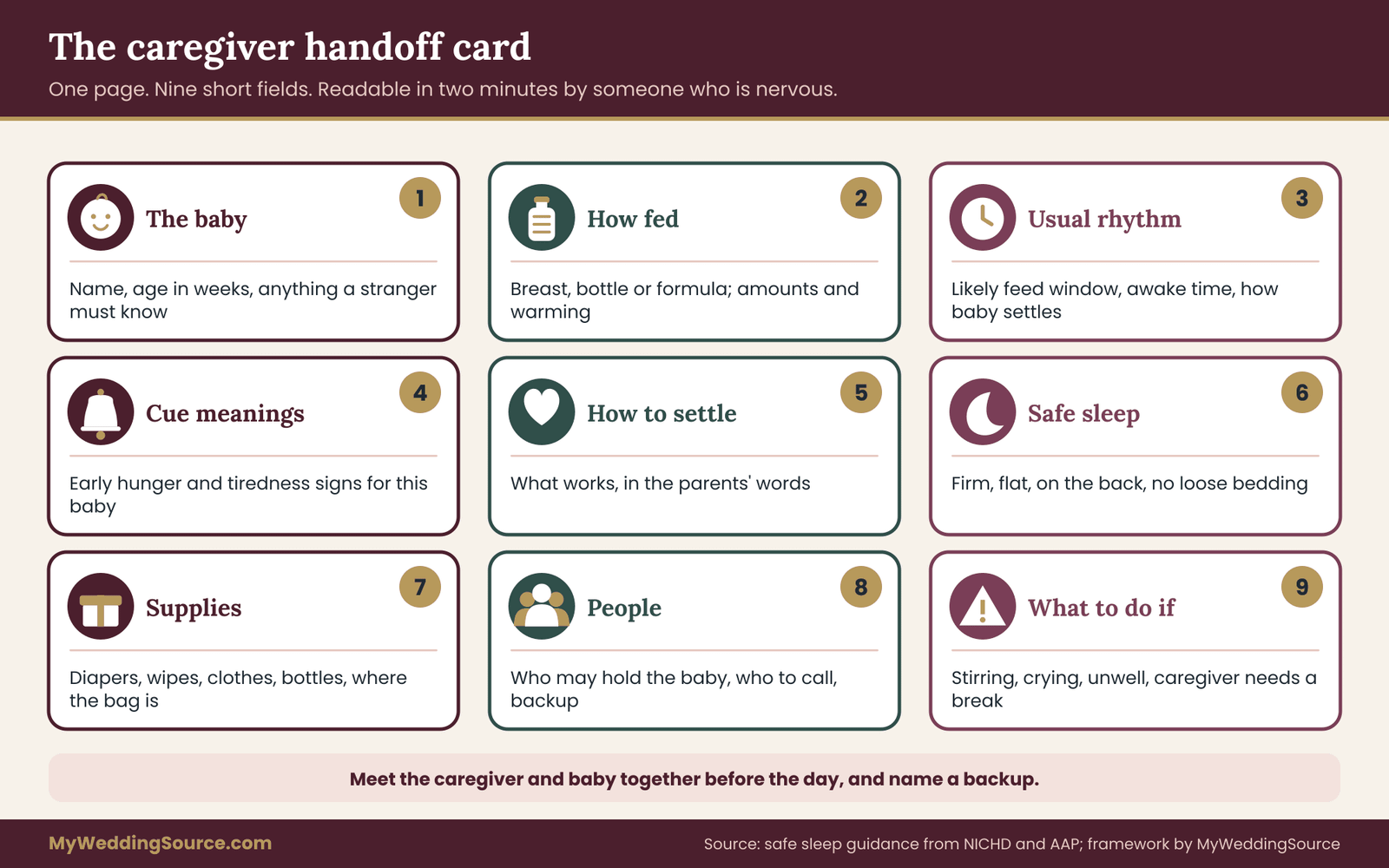
The card has nine fields. Keep each one short enough to read in a few seconds.
1. The baby. Name, age in weeks, and anything a stranger should know: a medical need, an allergy, a condition, a doctor to call. Only the parents decide what to include, and only what is needed.
2. How the baby is fed. Breast, bottle with expressed milk, formula, or a mix. If a bottle is used, say what kind, how much is usually offered and how it should be warmed. The Centers for Disease Control and Prevention publish guidance on handling and storing breast milk and preparing infant formula, and the card should reflect the family’s own clinician-approved routine.
3. The usual rhythm. The likely feed window, the usual length of an awake period, how the baby tends to settle, and what the baby does when upset. Write it in the parents’ words.
4. Cue meanings. Three or four signs of hunger and three or four signs of tiredness that this baby shows. Early signs matter more than crying.
5. How to settle the baby. What works: holding position, a particular sound, a blanket, a pacifier if the family uses one, a walk. What does not. This is the most personal field and the most useful.
6. Safe sleep. Where the baby will sleep and how. The Safe to Sleep campaign, run by the National Institute of Child Health and Human Development, and the American Academy of Pediatrics both publish guidance on safe infant sleep. The short version for the card: a firm, flat sleep surface, on the back, with no loose bedding, and never left to sleep on a couch or armchair. Check your own clinician’s current advice.
7. Supplies and where they are. Diapers, wipes, spare clothes, bottles or formula, burp cloths, a blanket, a change of clothes for the caregiver, a pacifier if used, a charged phone. Give the bag a bright tag and say where it sits.
8. People. Who is authorized to hold the baby, who is not to be left alone with the baby, and who to call. Include the cell numbers of both parents, the coordinator and the backup caregiver. Never put a number on the card that is not monitored during the ceremony.
9. What to do if. Four lines, one per trigger: the baby is stirring, the baby is crying and not settling, the baby seems unwell, the caregiver needs a break. For each, the action and the person to tell.
Who may hold the baby
One of the most common sources of friction at a newborn wedding ceremony is the line of people who want to hold the baby. The card is the way to manage it without a conversation.
Give the caregiver a simple rule: the baby goes to people on a short list, and anyone else is thanked and redirected. A line like “thank you, we are keeping things quiet for now, you can see the baby at the reception” is enough. Write it on the card so the caregiver does not have to invent it under pressure.
Include a hygiene expectation on the card as well, in neutral terms. The Centers for Disease Control and Prevention recommend handwashing as a basic way to reduce the spread of germs, and a newborn’s clinician can tell you how much to ask of guests. A small bottle of hand sanitizer or a wash station near the baby’s seat makes it easy for people to comply without feeling accused.
The moment of handoff
The card is not enough on its own. The handoff itself needs a short ritual so that nothing is assumed.
Do it about thirty minutes before the newborn wedding ceremony. The parent and the caregiver sit together for five minutes. The parent reads the card aloud, adds anything missing, and shows the bag. The caregiver says back the three things they will do first if the baby stirs. Both confirm the signal that goes to the coordinator. Then the parent feeds, changes or settles the baby, and hands the baby over at a moment when the baby is calm.
A handoff made in a hurry, with a baby who is already fussing, starts the ceremony with the worst version of every problem. Build the five minutes into the morning timeline as an anchor in its own right.
Scripts for the handoff
Short wording helps people who are nervous. Here are three lines a parent might use, in their own words.
To the caregiver: “If she stirs before the vows, tell the coordinator quietly and take her to the quiet room. If she is calm, stay in your seat and do not worry about us.”
To the coordinator: “If the caregiver signals, pause at the next hold point. We would rather wait ten minutes than rush.”
To a guest who asks to hold the baby: “Not just yet, we are keeping her settled for the newborn wedding ceremony. Come find us at the reception.”
The scripts are short because short sentences are easier to say when the room is noisy. Adapt them freely.
When the caregiver is also a parent of the baby
Some couples are both parents and plan to have both parents at the front. In that case the caregiver covers the entire ceremony, and the handoff has to be especially clean. Other couples have a baby who belongs to one partner and a stepparent role for the other. The card still applies, and the authorization list should be explicit about the roles each adult has.
If the baby has other legal guardians or a co-parent who is not part of the wedding, discuss with them in advance who will be present and what the arrangement is. This is a family conversation more than a planning one, but it affects who is on the card. If a legal question arises, such as authorization to make medical decisions for the baby while the parents are at the altar, a family law attorney in your state can advise. This guide cannot.
What to do with the card afterward
Keep the card. It is a template for the reception, for the rest of the newborn wedding weekend and for every outing in the first months. After the wedding, update it with what worked and what did not. A card that has been used once is a better card the second time.
Feeding, pumping and bottles around the ceremony
Feeding is the part of a newborn wedding day that is most likely to drive the schedule, so it deserves its own plan. The details differ by family and by feeding method, and your clinician or a lactation consultant is the right person to tailor them. What follows is the planning structure, not medical advice.
Build the day around the feed window
Start from the baby’s likely feed window and work outward. A typical sequence for the hours before a newborn wedding ceremony looks like this: a feed that finishes well before the caregiver handoff, a diaper change and a short settled period, the handoff, and then the ceremony inside the stretch that follows. The exact gap is something your clinician or your own experience with the baby will tell you.
The common error is to schedule the feed too close to the start, so that it runs long, ends late, and leaves no time for burping or a change. The better habit is to put a buffer after the feed that is at least as long as the feed itself, and to treat the buffer as part of the feeding block, not as free time.
Think also about the reverse. If the newborn wedding ceremony will run longer than expected, the baby may need to feed again before the reception begins. Put a second feed window on the timeline between the ceremony and the first reception cue, with a private place to use it.
If the feeding parent is breastfeeding
When the person getting married is also feeding the baby at the breast, the baby’s schedule and the newborn wedding ceremony schedule are directly linked. The Office on Women’s Health, part of the U.S. Department of Health and Human Services, publishes plain-language breastfeeding information, and the Centers for Disease Control and Prevention cover feeding and storage. A lactation consultant can help you plan the specific hours.
Three planning points stand out. First, the clothing needs to allow a feed, a pump session or a quick change without a major undressing. Gowns with a lace-up back, a long row of buttons, or a rigid structured bodice can be difficult. Test the outfit for a feed before the day, and have a second option. Second, find a private, comfortable place near the ceremony, with a chair, a surface and water. The same principles as any guest nursing space apply: a door that closes, no sightlines and a short route.
Third, plan for comfort and supply. A person who is feeding may feel full, uncomfortable or leaking if a feed is delayed, and a long gap can matter. Pumping, if used, takes time and equipment. Ask your clinician or lactation consultant what is reasonable for you, and write the answer into the timeline as a protected block, not an optional extra.
Federal law in the United States requires many employers to provide break time and a private space to pump at work, and the Department of Labor publishes information on this. That rule applies to employees at their workplaces, not to a wedding, but it is a useful model for how much privacy and time pumping typically needs.
If the baby takes a bottle
Bottle feeding can be a flexible tool for a newborn wedding ceremony, because someone other than the parent can give the feed. It does not automatically make the day simpler. Warming, mixing, cleaning and storing all add steps, and each one needs a place and a person.
If the bottle contains expressed breast milk, the Centers for Disease Control and Prevention publish guidance on storing and preparing it, including how long it can stay at room temperature and in a cooler. Follow the current official guidance and your clinician’s advice, because the figures matter and change. Do not copy numbers from this page.
If the bottle contains formula, follow the preparation instructions on the container and the CDC’s guidance on safe preparation. Pack formula and clean water, or ready-to-feed bottles if your clinician agrees, so the caregiver is not mixing powder in an unfamiliar kitchen. Carry more than you expect to need. A delay, a spill or an extra feed is far more likely than a perfectly measured day.
Whatever the method, practice the bottle with the caregiver before the wedding. A baby who has never taken a bottle from a particular person may refuse it in a new environment, and a hungry baby who will not take a bottle is the scenario that most often ends a newborn wedding ceremony early.
Where feeding happens on the day
Pick two places and write them on the handoff card. The first is the quiet room: a small, private room near the newborn wedding ceremony space, with a chair that has good back support, a surface for supplies, a way to warm or cool things if needed, and a door. The second is the in-room option: a seat at the back or side of the ceremony where the caregiver can give a bottle or soothe the baby without leaving, if the baby is calm and the parent is comfortable with it.
Ask your venue in advance which spaces are available, whether they are locked, who has the key, and whether the route avoids the newborn wedding ceremony space. A bridal suite can double as a quiet room, but only if it is not being used by the wedding party for hair and makeup at the same moment. The site’s guide to the venue technical walkthrough is a good model for how to check access routes and room availability before the day.
Food and water for the feeding parent
A parent who is recovering or feeding needs to eat and drink during the day. This is easy to forget in the rush. Put a simple meal and a large bottle of water on the timeline for the morning, and a snack for the minutes before the ceremony. Assign a person to hand them over, not leave them in a bag.
Think also about fit and comfort: shoes that allow standing, a layer for temperature changes, and a chair at the front if the parent needs to sit. These are ordinary accessibility choices, and a ceremony that offers a seat to the couple is not a lesser ceremony. Ask your clinician about any limits on standing, lifting or movement.
What to do if the baby needs to eat early
Plan the response before it happens. If the caregiver signals that the baby needs feeding before the newborn wedding ceremony, the coordinator calls the first hold point. The baby is taken to the quiet room, and the feeding parent follows if needed. The coordinator informs the officiant, the musicians and the photographer that the start is delayed by a stated number of minutes, and tells guests there is a short pause. Guests are comfortable with a short, calm announcement; they are less comfortable with silence and visible worry.
If the baby needs feeding during the ceremony, the newborn wedding plan depends on who is feeding. If the caregiver can give a bottle at the seat, they do so quietly. If the parent is needed, a hold point is called, and the pause is announced with a smile. Keep a phrase ready: “We will take a brief pause for the baby and be right back.” Guests will understand, and many will find it endearing.
Sleep, noise, crowds and health at a newborn wedding
A newborn wedding ceremony puts a very young baby in a room with many people, new sounds and an unfamiliar building. None of these is a reason to cancel. Each is a reason to decide in advance what the baby will be exposed to, and for how long.
Safe sleep away from home
Wherever the baby sleeps on the day, the same safe sleep principles apply as at home. The American Academy of Pediatrics and the Safe to Sleep campaign recommend placing a baby on their back to sleep, on a firm, flat surface made for infants, with no pillows, loose blankets or soft toys. A car seat, a stroller, a sofa or an armchair are not safe places for unsupervised sleep, and a baby who falls asleep in a carrier should be watched and moved to a flat surface.
Bring or arrange a portable crib, bassinet or play yard that meets current safety standards, and set it up in the quiet room early, not at the moment it is needed. The U.S. Consumer Product Safety Commission publishes safety information on infant sleep products and recalls, and it is worth checking any borrowed or secondhand equipment against current recalls. Assign the caregiver to stay within sight or earshot of a sleeping baby throughout the newborn wedding ceremony.
Noise and the ceremony space
Loud music, applause, a sudden bell or a microphone can startle a very young baby. You do not need to eliminate sound, but you can choose where the baby is. A seat at the back, near a door, lets the caregiver step out quickly, and distance from speakers lowers the volume. A quiet room with a closed door can muffle most of the ceremony and still let the caregiver follow it through a doorway or a live stream.
If the newborn wedding ceremony includes amplified music, a cannon of petals, bubbles, a bell or applause on cue, tell the caregiver which cues are loudest, so they can brace the baby or step out beforehand. Ask your musicians to keep the processional at a moderate level if the baby is nearby. Hearing protection for babies is a question for your clinician; do not improvise it.
Crowds, touch and illness
Young babies are more vulnerable to infections than older children, and a wedding brings many people together. The Centers for Disease Control and Prevention publish vaccine guidance, including recommendations for people who are pregnant or who are around infants, such as whooping cough and flu and COVID-19 vaccination for close contacts. These recommendations change, so read the current page and ask your clinician what applies to your family.
The practical steps that most families consider are simple and polite. Ask guests who are sick to stay home, and say so kindly in a line on the invitation or the website. Place hand sanitizer or a wash station near the baby’s seat. Limit who holds the baby, and keep kissing of the baby’s face off the list by saying so up front. Keep the baby out of dense crowds, such as the receiving line, unless your clinician says otherwise.
Write these expectations once and share them with the wedding party and close family. Many people welcome clear instructions, because they would rather follow a rule than guess. A short line in the ceremony program or on a sign near the baby’s seat can do the work without a speech.
Temperature, travel and timing
The venue’s temperature, the weather and the travel time to the venue matter for a baby. An outdoor ceremony in heat or cold needs a plan: shade, layers, a place to retreat indoors. A long drive adds time to the feed window and the changing station. Talk to your clinician about travel with a newborn, including car seat use, since the car seat should be used correctly for every ride.
Build the travel time into the timeline as an anchor. Add a stop for a feed or a change if the trip is long. Arrive early enough that the baby can settle in the quiet room before the guests arrive, and avoid carrying a sleeping baby through a crowd of arriving guests.
Checking in on the recovering parent
If the person who gave birth is the one getting married, the health plan includes them, too. Postpartum recovery varies widely. The American College of Obstetricians and Gynecologists describes postpartum care as an ongoing process and not a single visit, and a clinician can tell you what is reasonable for you on the day, such as how long to stand, what to carry, and warning signs to watch for.
Agree with the person, in advance, on a signal that means “I need to sit down” or “I need a minute.” Give a helper the job of watching for it. A newborn wedding ceremony where the parent is quietly given a chair is better than one where they push through and regret it. If symptoms that concern you appear, the right step is to call the clinician or emergency services, and this should be written on the card the same way a baby’s needs are.
Telling the officiant, photographer and vendors
A plan that only the couple know is not a plan. The people who run the newborn wedding ceremony need to hear it, in enough detail to act, and early enough to adjust their own work.
What to tell the officiant
The officiant is the person who most often ends up waiting. Ask for a conversation, not just an email, and cover four points. The ceremony start is an anchor with a tolerance of a stated number of minutes. There are hold points, and the coordinator or the officiant can call one. The newborn wedding ceremony has a short version that the officiant can switch to if needed. And the legal moment has to happen within the window the venue and the officiant allow.
The site’s guide to wedding officiant requirements covers what an officiant must do legally and how to confirm it. If your newborn wedding ceremony is a civil one at a courthouse or registry, the appointment slot may be rigid, and the relevant office is the one to ask about rescheduling and arrival rules. A newborn is a perfectly good reason to ask for the first slot of the day or one with a waiting room you can use.
What to tell the photographer and videographer
Photographers can help or hinder a baby. A flash near a newborn’s face, a long session of posed portraits, or a request to pass the baby around for photographs are all things to rule out in advance. Ask the photographer to avoid flash near the baby, to take the family photographs in short blocks, and to plan the baby’s portraits for a moment when the baby is fed and settled.
The site’s guide to the wedding family photo list explains how to structure the portrait list so that groups are called in order and nobody waits. For a newborn wedding day, put the baby’s groups early on the list, directly after the ceremony, and have a fallback plan if the baby is asleep or fussy: photographs with the baby later, or a sleeping-baby photograph done quietly.
What to tell the coordinator, musicians and venue
The coordinator needs the whole plan, the signals and the authority to call a hold. The musicians need to know where the hold points are, so they can fill a pause with quiet music or silence as needed. The venue needs to confirm the quiet room, the route to it and the key arrangements, and whether the baby’s equipment can be set up before the newborn wedding ceremony.
Send these people a one-page summary of the newborn wedding plan, not the full guide. A short email with the cue timeline, the hold points and the contact for the day is enough. If any vendor pushes back, for example because their contract does not allow delays, that is a conversation to have well before the wedding, and the contract itself is the place to check. The site’s guide to the wedding vendor contract explains how to read overtime clauses and start-time terms.
A short script for vendors
You can adapt this: “We have a newborn who will be with a caregiver near the ceremony. Our start time is a window, not a single moment, and we have a few short pause points built in. If a pause is called, we will tell you how long it will be. Please let us know if any of this conflicts with your contract.”
This keeps the request neutral and factual and gives the vendor a chance to raise a problem early.
A worked case: one invented newborn wedding ceremony
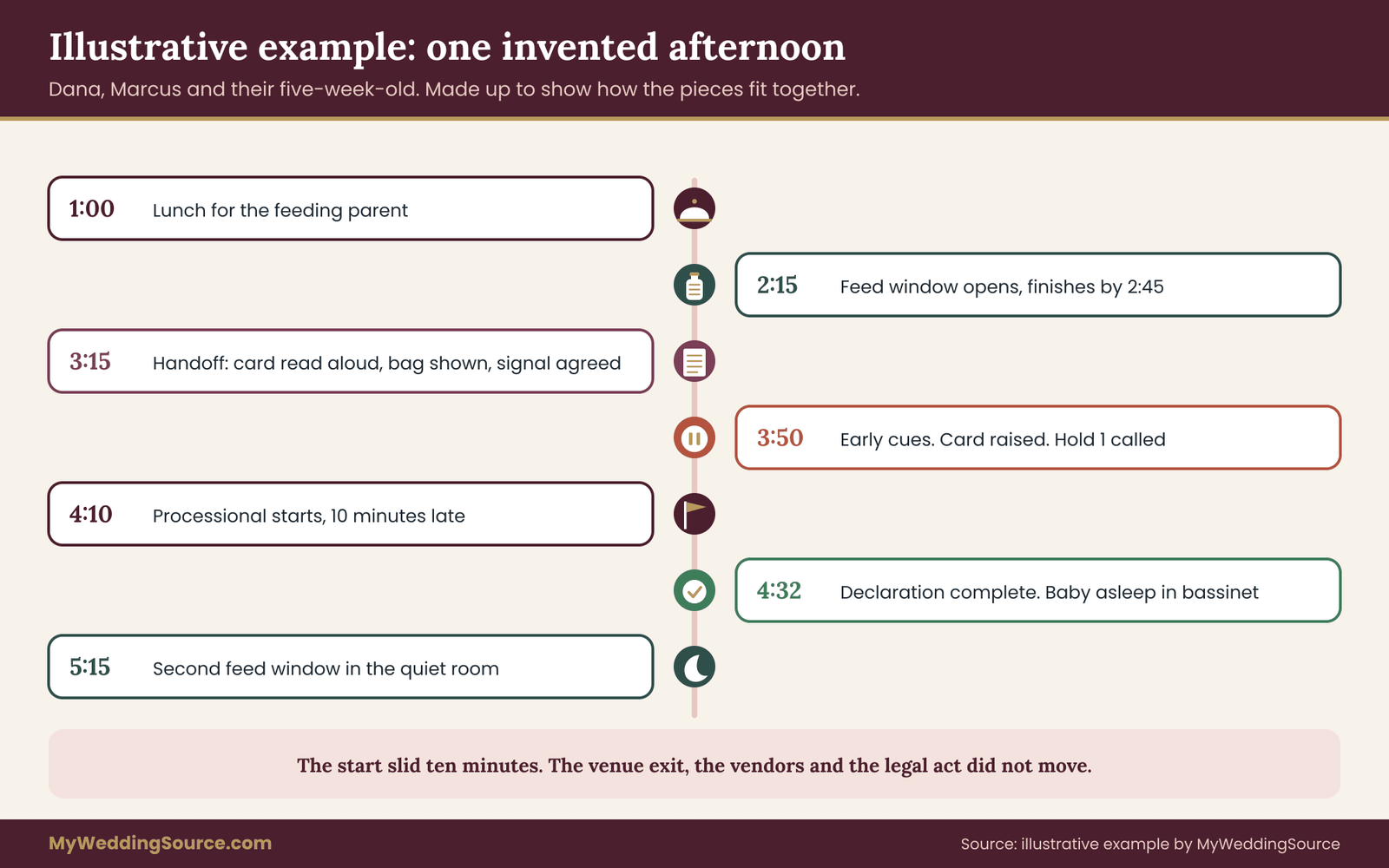
The following example is invented for illustration. The names, the times and the baby are made up, and it is not a case study or a report of something that happened. It is meant to show how the pieces of the newborn wedding method fit together on one page.
Imagine a couple, Dana and Marcus, who set their wedding date eight months before their daughter was due. She arrives five weeks before the newborn wedding ceremony. The venue is booked for a four o’clock start, a garden pavilion with a small indoor room next to it, and the ceremony will be about twenty-five minutes long. Forty guests are invited. Dana is feeding the baby, and her sister Priya, who has two children of her own, agrees to be the caregiver. A friend, Jo, is the backup.
Their anchors and floats
Dana and Marcus mark three anchors: the guests seated by three forty-five, the vows and declaration, and the venue exit at six. Everything else floats. Their drop-ready floats are the second reading, a musical interlude and the unity ritual, which they decide to hold privately at home afterward.
They set the newborn wedding ceremony start as “four o’clock, tolerance fifteen minutes.” They place the first hold point before the processional, the second between the reading and the vows, and the third right after the declaration, each with a limit of five minutes. The coordinator, Sam, may call any of them on a signal from Priya.
Their care windows
Dana’s clinician and the baby’s pediatrician tell them the baby has been feeding at fairly regular intervals and is generally content for a stretch after a feed. Dana plans to feed at two fifteen, finish by two forty-five, and have a change and a settled period until three fifteen. The handoff is at three fifteen, with Priya, in the indoor room, with the bag and the card.
Dana eats a proper lunch at one. A second feed window is placed at five fifteen, directly after the ceremony and the photographs, in the same indoor room. Her dress is a two-piece set chosen partly because it can be adjusted for a feed, and she tests it at home.
What happens on the day
The baby is calm at the handoff. At three fifty, Priya notices the early cues: stirring, hands to mouth. She holds up the agreed card to Sam. Sam calls the first hold point. Guests are told by the officiant, with a smile, that there will be a short pause. Priya takes the baby to the indoor room, where a bottle of expressed milk is warmed by a helper, and the baby feeds. Ten minutes later the baby is settled and the processional begins.
The newborn wedding ceremony runs for twenty-two minutes without a further pause. Priya sits in the back row on an aisle with the baby asleep in her arms, then moves the baby to the portable bassinet in the indoor room after the vows. The photographer takes family photographs in two short blocks, and the baby appears in the second, awake and fed. At five fifteen, Dana feeds the baby in the indoor room and then joins the reception.
What this example shows
Three things made it work. The hold point was cheap to use, because it sat before the processional, not in the middle of the vows. The caregiver knew the early cues and acted on them, which meant the baby never reached the crying stage. And the anchors were few: a ten-minute delay did not touch the venue exit, the vendors or the legal act.
It also shows what did not go to plan. The start slid by ten minutes. The unity ritual moved to a private moment. One guest wanted to hold the baby and was politely redirected. None of these is a failure of the plan. They are the planned flex.
Where an example like this can mislead
It is easy to read a tidy example and assume your day will go the same way. Babies do not follow examples. The invented case assumes a baby who eats on a loose pattern, a caregiver with experience, a venue with a spare room, and a short ceremony. If your circumstances differ, use the structure and change the numbers. The hold points, the handoff card and the failure conditions are the reusable parts. The times are not.
Alternatives when the plan does not fit
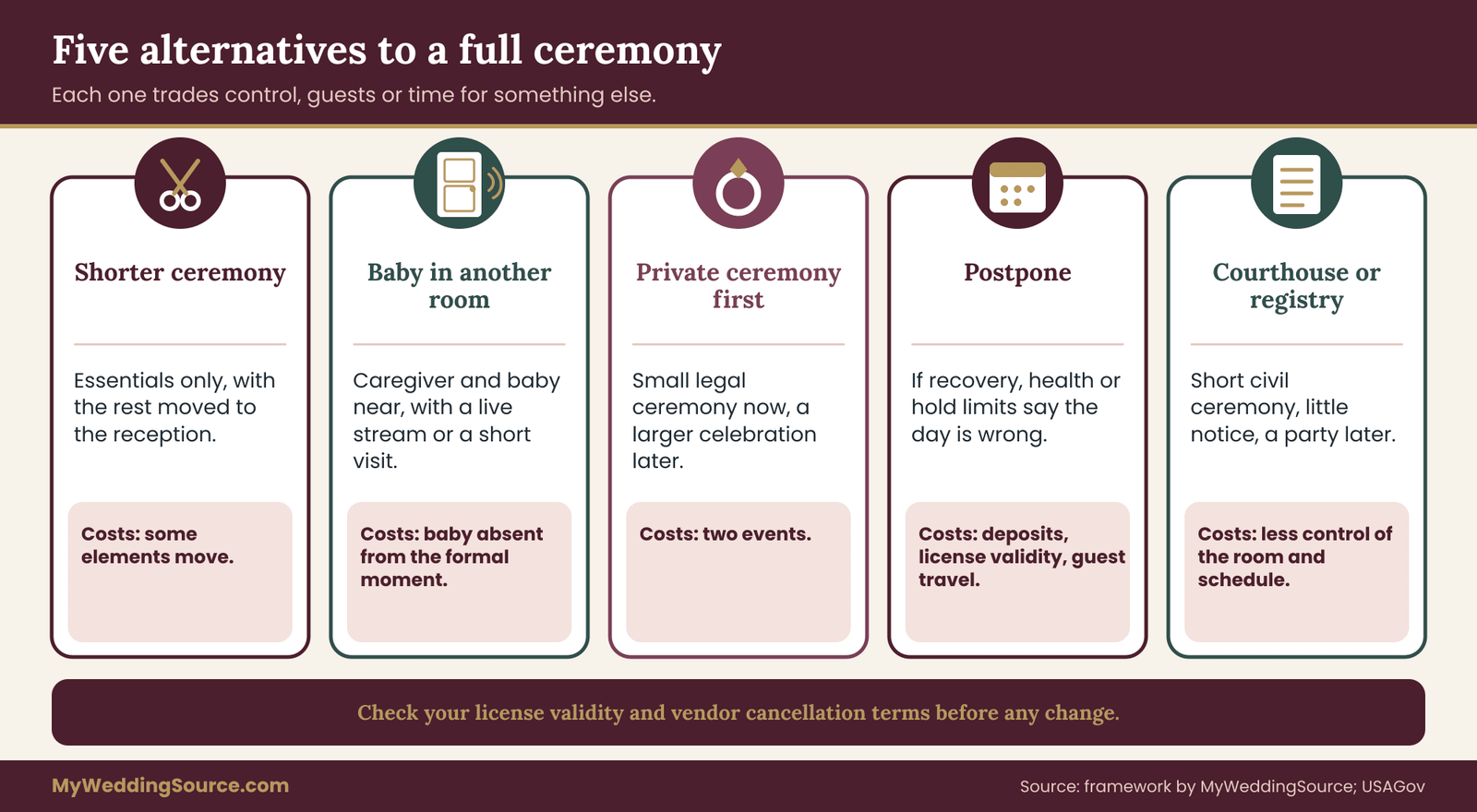
The newborn wedding method above assumes the baby is present, the ceremony is a full one and the date is fixed. Sometimes one of those assumptions is wrong. Here are the main alternatives and what each costs.
A shorter ceremony
A ten or fifteen-minute ceremony with only the essentials is the most practical alternative. It needs less hold time and fewer care decisions. The cost is that some elements you wanted must move. Many couples find that a short ceremony followed by a longer celebration gives the best of both.
A ceremony with the baby elsewhere
If the baby will be in the quiet room with the caregiver for the whole newborn wedding ceremony, the newborn wedding plan is simpler for guests and less stressful for the parents. The cost is that the baby is absent from the formal moment, and some parents want the baby present. A middle path is for the baby to join for the last few minutes or for the first photographs, depending on how the baby is doing. A live stream to the quiet room lets the caregiver and baby watch.
A private ceremony first, a celebration later
Some couples marry in a small ceremony with a handful of family members and hold a larger celebration weeks or months later, when the baby is older. The legal marriage happens at the first event. The celebration can then be a blessing or a party without legal weight. The cost is two events, and some guests may feel they missed the real thing. The benefit is a newborn wedding ceremony shaped around the baby’s earliest weeks and a party shaped around a baby who is easier to bring. The same date-weighing questions apply to the second event.
Postponing
If the parent’s recovery, the baby’s health or a family situation makes the newborn wedding ceremony unwise, postponing is a legitimate choice. The costs are practical: deposits, contracts, guest travel and a license that may expire. Check your marriage license’s validity period with the issuing office, and read your vendor contracts for cancellation and rescheduling terms. USAGov explains how marriage licenses and certificates work and points to state offices for current rules.
A courthouse or registry ceremony
A civil ceremony at a courthouse or a registry is short, usually has no guest list to speak of, and lets you plan around the baby with very little notice. It can be a formal first step, with a celebration later. The cost is less control over the room and the schedule, so ask the office about waiting areas, appointment lengths and whether the baby may attend.
Failure conditions: when to stop, shorten or move
A plan that does not say when it has failed is not finished. Failure conditions are the situations in which you agree, in advance, to change course. Writing them down removes the need to decide while stressed.
Three levels of response
Use three levels for any newborn wedding ceremony. Pause means a hold point is called for a few minutes. Shorten means the ceremony switches to its short version and drop-ready floats are removed. Move or stop means the newborn wedding ceremony is delayed beyond the hold limit, relocated, or postponed.

Triggers and who decides
Assign each trigger a level and a decision-maker. The following are examples to adapt.
The baby is stirring with early cues: pause at the next hold point; the coordinator decides on the caregiver’s signal. The baby is crying and has not settled after the caregiver’s usual methods: pause and move the baby to the quiet room; the coordinator calls the pause, and a parent decides whether to continue. The feeding parent needs to feed or pump: pause for the feed; the parent decides.
The baby seems unwell, for example with a fever, difficulty feeding, unusual sleepiness or any sign that worries the parents: stop, and follow the clinician’s advice. The pediatric clinician or emergency services are the decision-makers, not the coordinator and not the schedule. If you are worried about a baby’s breathing or responsiveness, call emergency services immediately.
The recovering parent feels unwell: stop and sit, call the clinician or emergency services if needed.
The pauses total more than the planned limit: shorten, by dropping the drop-ready floats. A pause longer than the venue’s tolerance: move to the short version or postpone the remainder to a private moment.
Who has the final word
Decide in advance who has the final word on stopping. For anything involving a baby’s health or the parent’s health, it is the parents and their clinicians. For the schedule, it is the coordinator within the rules you set. Tell the officiant that the parents can call an end at any moment, and that this is not a drama but a choice.
After a failure
If the plan changes, write down what changed and why. This is useful for the next event, such as the reception, and for your own memory of the day. Do not treat a changed plan as a sign you failed. A newborn wedding ceremony that bends around the baby has done what it was designed to do.
Your next steps
Start with three actions this week. First, ask the baby’s clinician the questions that affect the newborn wedding plan: how long between feeds is realistic, what is advised about crowds and travel, and anything specific to your baby. Second, sort your ceremony into anchors and floats, and mark your drop-ready floats. Third, choose your caregiver and a backup and show them the card.
Then work in order. Place three hold points. Fill in the nine fields of the handoff card. Test the outfit and the quiet room. Brief the officiant, photographer and coordinator with a one-page summary. Rehearse the hold signal for thirty seconds. Write down your failure conditions and who decides. With these in place, a newborn wedding ceremony becomes a manageable plan, not a gamble.
FAQ
How soon after giving birth can we hold a wedding ceremony?
There is no single date that suits everyone. Recovery varies, and the right timing depends on the birth, the parent’s health and the baby’s. Ask your own clinician what is reasonable for you, and plan the ceremony around what the recovering parent can do comfortably, including how long to stand, what to carry and when to sit. Build in flexibility so the date can move if needed.
Should the baby be in the ceremony or in another room?
Either can work, and the choice is personal. A baby in the newborn wedding ceremony needs a caregiver who can step out quickly, a seat near a door and a quiet room close by. A baby in another room is simpler to manage and quieter for guests, and a live stream or a short visit can include them. Decide based on how the baby does in noise and crowds, and your clinician’s advice.
What is a hold point and where should it go?
A hold point is a named place in the timeline where the whole newborn wedding ceremony can pause for a stated number of minutes, with one person able to call it. The best places are before the processional, between the readings and the vows, and directly after the declaration. Avoid the vows and the ring exchange. Always set a maximum length so a pause cannot turn into an open-ended delay.
Who should be the caregiver for a newborn at a wedding?
Choose an adult the parents trust completely, who has cared for a young baby recently, stays calm in a crowd and is not also in the wedding party. A grandparent, close friend or hired childcare professional can all fit. Name a backup too, brief both with the handoff card, and have them meet the baby beforehand if possible so the baby knows them.
Can guests hold the baby during the wedding?
That is the parents’ decision. Many families keep the list short at this age and ask the caregiver to politely redirect others. A simple line works well, such as thanking the guest and suggesting they visit the baby later. Ask guests who are unwell to stay home, put hand sanitizer near the baby, and check with the pediatric clinician about what to ask of guests.
What if the baby cries during the vows?
Plan for it before it happens. The caregiver or the parent steps out quietly, the ceremony continues or pauses briefly, and the officiant says a calm line if needed. A cry is not a failure and most guests are understanding. The best prevention is feeding and settling the baby before the newborn wedding ceremony, and putting the caregiver on an aisle near the door.
How do we handle breastfeeding or pumping during the wedding?
Ask a lactation consultant or your clinician for a plan that fits you. Practical steps include a private room with a chair and a door, a protected block in the timeline, an outfit you have tested for feeding, and food and water. Treat the time as an anchor, not an option. Public health sources such as the Office on Women’s Health and the CDC publish general information.
When should we postpone or move the ceremony?
Postpone or move if the baby or the recovering parent is unwell, if hold points keep exceeding their limits, or if the plan only works if nothing goes wrong. Write the triggers in advance and name who decides. Check your marriage license validity and vendor cancellation terms early, so you know the cost of moving. If a health concern arises, contact your clinician or emergency services first.
Sources
- American College of Obstetricians and Gynecologists, patient information on pregnancy and postpartum care
- HealthyChildren.org, American Academy of Pediatrics parent resources on newborn feeding and sleep
- Safe to Sleep campaign, National Institute of Child Health and Human Development
- Infant and toddler nutrition, Centers for Disease Control and Prevention
- Breastfeeding, Office on Women’s Health, U.S. Department of Health and Human Services
- Clean hands, Centers for Disease Control and Prevention
- Vaccines, Centers for Disease Control and Prevention
- Break time for nursing mothers, U.S. Department of Labor Wage and Hour Division
- Safety information for infant sleep products, U.S. Consumer Product Safety Commission
- How to get a copy of a marriage certificate or a marriage license, USAGov