

A library wedding ceremony works when you treat the room as a working library first and a venue second. This guide gives you a plan built on three lines (a sound line, a shelf line and a door line) so you can decide whether a library fits your library wedding ceremony, what to ask the staff, and what to do when the answer is no.
Before you fall for the photographs, check three things in writing. First, the door line: which hours the library is closed to the public, and who is in the building during your library wedding ceremony. Second, the sound line: how loud the room is when empty and how much of your library wedding ceremony can be spoken, not amplified. Third, the shelf line: which books, cases and aisles are off limits to guests, chairs and vendors. If all three are settled and signed, a library wedding ceremony can be calm and beautiful. If one is vague, change the plan before you print invitations.
Libraries look made for weddings. There are tall shelves, warm wood, long tables, quiet light and a built-in reason for guests to lower their voices. Couples who love books often picture a library wedding ceremony among the stacks without ever picturing the staff member who has to reshelve a cart at ten the next morning, or the patron who comes in at opening time to return an overdue novel. A library wedding ceremony sits at the meeting point of those two pictures.
This guide is about that meeting point. It is not a general guide to choosing a venue, and it does not repeat the broader rules for museums and libraries as event spaces. It focuses on three things that decide whether a library ceremony feels graceful or awkward: the acoustics of a room full of paper, the handling of books and shelving, and the public hours that shape the day. If you are still comparing venue types, the site’s guide to choosing a wedding venue covers costs, questions and red flags across all of them.
A note on scope. This is general planning information, not legal, insurance or conservation advice. Library policies, building codes and insurance terms differ by institution and change over time, so the library’s own written rules and its staff are always the final word on what is allowed.
What a library wedding ceremony is, and what it is not
The word “library” covers very different buildings. The first step is to know which kind you are dealing with, because the rules, the contacts and the noise change completely from one to the next.
A public library branch. These are funded by a city, county or district, and they exist to serve patrons every day. Many rent a community room or a lobby for private events. Fewer allow events in the main reading area, and those that do usually require the event to happen when the library is closed to the public. Staff members are often the only ones with authority to say yes, and they may need approval from a board or a director.
A university or college library. These sit inside a larger institution, so there is usually an events office, a facilities office and sometimes a rule that only affiliated people can book. Semester schedules, exams and building hours drive availability. Reading rooms may be generous in size and in echo.
A historic or private library. Think of a subscription library, a society library or a restored reading room attached to a museum. These often rent more freely and may have an event coordinator. They also tend to hold rare material that raises the stakes on handling, light, humidity and food.
A special collections or rare-book reading room. These are the most restricted spaces, and many do not host weddings at all. When they do, expect strict limits on guest numbers, no food or drink, and a staff member or conservator liaison present throughout.
Notice what is missing from that list: a bookstore with a back room, a reading-themed restaurant or an event hall decorated with shelves. Those spaces may be lovely, but they are ordinary venues with a theme, and the planning questions in this guide apply to them only in part.
Why the library is not a museum with more books
The broader overview of cultural venues treats museums and libraries together, which is sensible when you are comparing categories. For a library wedding ceremony, the difference matters more than the similarity. A museum controls objects that visitors look at. A library controls objects that visitors pick up, read, borrow and return. That changes the day-to-day reality in three ways.
Libraries are usually quieter than museums by default, so a loud room is more noticeable and a quiet library wedding ceremony feels more natural. Libraries have patrons with a habit of using the space daily, which creates conflicts around public hours that a ticketed museum does not face in the same way. And libraries have working collections, meaning the books on the shelves behind your guests are often in active use, not locked behind glass.
Those three differences become the three lines of the plan.
What the plan is meant to settle
A library wedding ceremony is also a small public event in a shared building, so the plan has to be shared too. Everything below is written so you can hand a single page to the staff, the officiant and the vendors.
By the end of the planning, you should be able to answer five plain questions in a sentence each:
- During which exact hours is the space ours, and who else is in the building?
- How loud is the room, and what is our noise budget for the library wedding ceremony?
- Where can guests, chairs, vendors and photographers go, and where can they not?
- What happens to the books, and who is responsible if something goes wrong?
- What will we do if the library changes its mind or a limit is exceeded?
If you can answer those in writing, you are ahead of most couples who book a reading room on enthusiasm alone.
The three lines: sound, shelf and door
The planning framework in this guide is deliberately simple. You draw three lines around your library wedding ceremony, and everything you do in the room has to stay inside all three.
The sound line is the loudest the library wedding ceremony is allowed to be, and the quietest it has to be to be heard. It covers voices, music, microphones, footsteps, doors, chairs and the building’s own hum. Its purpose is to protect the other people in the building, the staff doing their jobs and your own guests who want to hear the vows.
The shelf line is the boundary between the people and the collection. It covers how close a chair may sit to a shelf, which aisles must stay clear, whether anyone may touch a book, what may be placed on a table or cart, and which materials never leave their cases. Its purpose is to protect the collection and the staff’s work.
The door line is the boundary of time and access. It covers the hours you may use the room, how guests enter and leave, whether the public can walk through, how the building’s security and fire systems treat your event, and who locks up. Its purpose is to protect public access and the building’s safety.

How the three lines work together
The lines are not independent. A change in one moves the others. If you move the library wedding ceremony earlier to avoid public hours, you move the door line, but you may also need more staff, which changes the sound line because more people are working in the building. If you add a string trio to improve the atmosphere, you move the sound line and, because they need a place to set up, the shelf line. If you want a reading from a particular old book, you move the shelf line and probably the door line, because the staff will want a conservator liaison present.
The practical rule is this: never negotiate one line in isolation. When a library says yes to something, ask which line it affects and what that does to the other two. Writing the three lines on a single page and updating it after every conversation is the simplest way to avoid surprises.
A first-pass test before you visit
You can screen a library in an evening, before you spend a morning visiting. Look up the library’s website and find the page for room rentals, facility use or private events. Check three things:
- Does the page mention weddings or ceremonies by name, or only meetings and programs?
- Does it list hours when events are possible, such as before opening or after closing?
- Does it mention a rental fee, a staffing fee, an insurance requirement or a damage deposit?
If the page says nothing about weddings, that is not a no. It means you need a conversation with a named person. If the page says the space is limited to nonprofit or educational use, treat it as a no unless staff tell you otherwise in writing.
For a professional frame of reference on what libraries consider part of their public mission, the American Library Association publishes policy guidance and statements on access, which is a useful background for understanding why a branch will not simply close a reading room to the public for a Saturday afternoon.
Who to contact first
Couples who ask clearly and early usually find the staff more willing to help with a library wedding ceremony than they expected.
Skip the general information desk. Ask for the person who handles facility rentals or event bookings. At a public branch that may be a branch manager or a services coordinator. At a university it is typically an events or facilities office. At a historic library it may be an events coordinator or the director. If you do not get a name, ask for the title of the person who signs the rental agreement, and send your first message to that role.
A good first message is short and factual:
“We are planning a small wedding ceremony of about sixty guests and are interested in your reading room. Could you tell us whether private ceremonies are allowed, which hours are possible, and what the next step is to hold a date?”
That message does not promise anything, does not mention flowers or music, and gives the staff a clear question to answer. The details can follow once you know the answer is not an immediate no. ## Public hours: when a library wedding ceremony can actually happen
The door line is the first line to settle, because everything else depends on it. A library that is open to the public until evening cannot hand you a reading room at four in the afternoon, no matter how much you like the light. The question is not “is the room available?” but “when is the building ours, and who else is in it?”
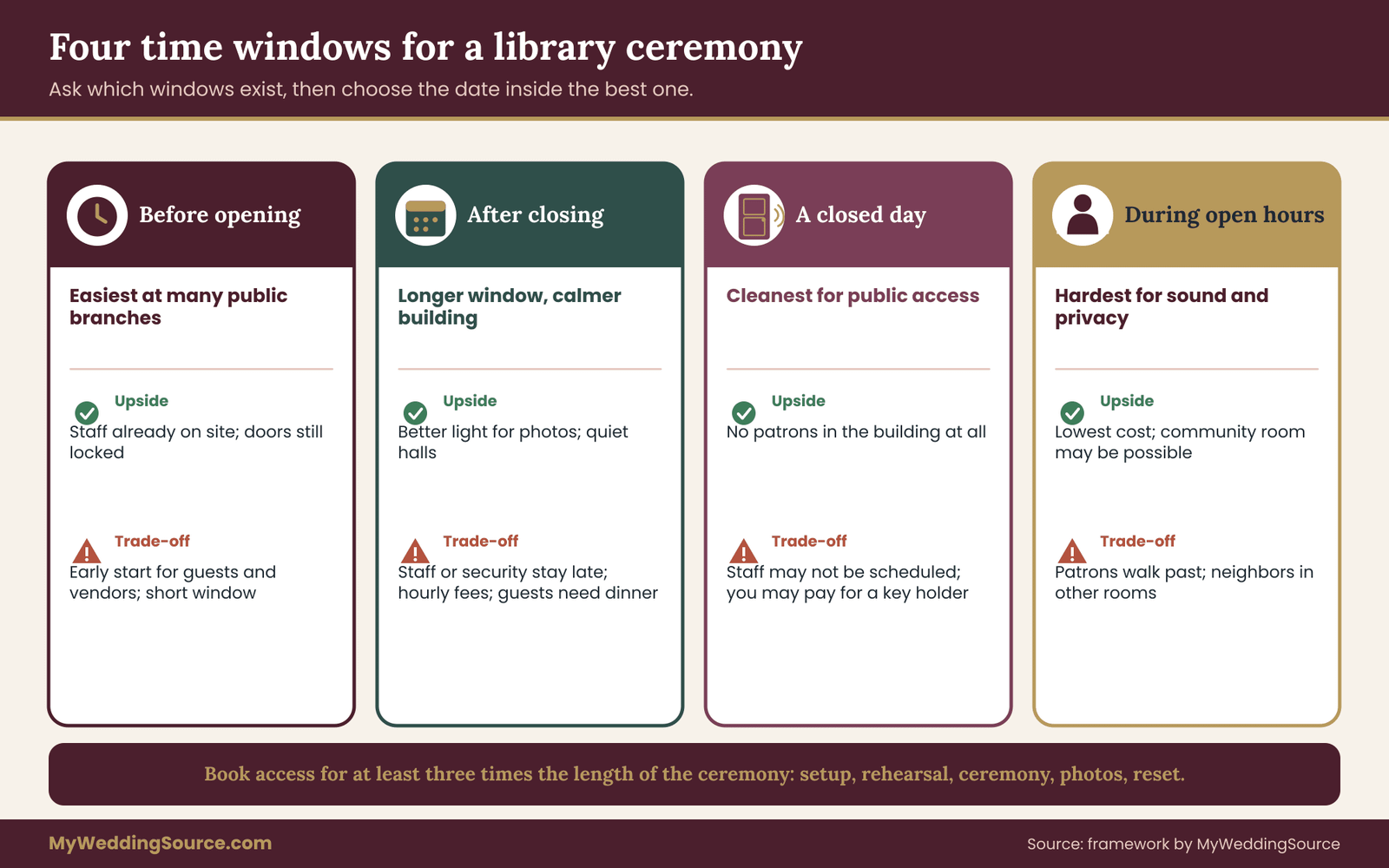
There are four common patterns. Each has trade-offs for the people attending and for the staff.
Before opening. Early-morning library wedding ceremonies are often the easiest to arrange at a public library, because the doors are still locked and the staff are already on site. The trade-off is guest comfort. Guests arrive in the dark or at dawn, hair and makeup need an early start, and the vendors have a narrow window to load in. It also compresses everything into a short time, since the library will want you out before patrons arrive.
After closing. An evening library wedding ceremony after the doors lock gives you a longer window and better light for photographs, but it costs more because staff or security stay late and the library may charge an hourly fee. Evening is also when the building quiets down, so the sound line gets easier. The trade-off is that guests may be hungry and you need a plan for food somewhere else.
A closed day. Some libraries are closed on specific weekdays, on holidays or during maintenance periods. A library wedding ceremony on a closed day is the cleanest from a public-access view, but the staff may not be scheduled, so you may pay for a custodian, a security officer or a staff member to open and close the building.
During open hours, in a defined space. Some libraries allow ceremonies in a community room or a mezzanine while the library remains open to the public. This is the most difficult case for the sound line and the door line, because patrons are walking past, children may be in the next room and the building’s regular noise continues.
Questions to ask about hours
Ask these in the first conversation and write down the answers with the date:
- What are the earliest and latest times we can be in the building, including setup and cleanup?
- Is the whole library closed to the public during our time, or only the room we are using?
- Which entrance do guests use, and who unlocks it?
- Who is on site from the library during the event, and what is their role?
- What happens if guests arrive early or the library wedding ceremony runs long?
- Are there any scheduled activities nearby, such as a story hour, a class or a maintenance contract?
The last question is easy to forget and surprisingly important. A reading room that is silent when you visit on a Tuesday morning may sit beside a children’s room that holds a program every Saturday. Visit at the same day and hour as your intended event if you can, or ask the staff to describe a typical Saturday in plain words.
Setup, ceremony, cleanup: the hidden hours
Couples often ask about the ceremony time and forget that the library counts the whole booking. A thirty-minute library wedding ceremony typically needs much more than thirty minutes of room access. A realistic booking includes:
- Vendor load-in. Chairs, an arch, flowers and sound equipment need to be carried in, often through a service entrance or a single door. A library with no loading dock may restrict carts or require protective floor coverings.
- Rehearsal or walkthrough. Many libraries will allow a short walkthrough with the officiant and a staff member. If not, ask for a site visit at a quiet hour with your officiant and photographer, even if it is not in the final room setup.
- Guest arrival buffer. Guests arrive earlier than the invitation says, and they need somewhere to wait that is not the ceremony space. A lobby, a vestibule or a nearby outdoor spot may serve.
- The ceremony. Often short. The brevity is an advantage in a library, since it limits noise exposure and staff hours.
- Photographs. Group photos after the library wedding ceremony are a common reason for overruns. Decide in advance which parts of the library you may use for portraits and which stay off limits.
- Teardown and reset. Staff will want chairs removed, the floor cleared and the room returned to its normal layout. Ask what the library expects and what it handles itself.
A rule of thumb that works for most reading rooms is to ask for access that is at least three times the length of the library wedding ceremony, then check whether the library offers that window. If the window is shorter, shorten the plan: fewer chairs, fewer vendors, simpler decor, no processional through the stacks.
Staffing, security and who is responsible
Staffing is often the largest hidden cost of a library wedding ceremony, so ask about it before you fall in love with a date.
Even when the building is closed to the public, someone has to be responsible for it. The library will usually require one or more of the following, and may charge for them:
- A staff member present for the entire event.
- A security officer or a custodian during load-in and teardown.
- A named key holder who opens and locks the building.
- A point person for alarms, lights, heating and cooling, who can respond if something goes wrong.
Ask what each costs, who chooses the person, and what that person is allowed to do. A staff member whose role is to watch the collection will behave differently from one whose role is to watch the door. If the library wants you to hire your own security, ask whether it needs to be a licensed firm and whether the library has any approved providers.
You will also want to ask about the building’s safety systems. Fire alarms, sprinkler systems and smoke detectors are designed to protect the collection and the people, and they place limits on candles, haze machines and open flames. The National Fire Protection Association publishes fire and life-safety codes that many local authorities adopt, and the local fire marshal or the library’s facilities office will tell you which rules apply in your building.
Public access is not a favor, it is the library’s job
It helps to understand why a branch may be firm about hours. Public libraries exist to give people access to information, and many consider uninterrupted access part of their mission. The Institute of Museum and Library Services supports libraries across the United States and describes their role in public service. A library that rents space for private use is balancing that mission against its budget, and it may have a policy that private events never displace public service.
Seen that way, a library saying no to a Saturday-afternoon wedding is not being difficult. It is protecting something it considers more important than your date. Couples who accept that tend to get better offers, such as a Sunday morning, a weekday evening or an early slot before opening, because they ask in a way that respects the library’s priorities.
The public walking through
If the library wedding ceremony takes place during open hours in a defined space, you need an honest plan for strangers. Patrons will walk past, and some will stop to look. Decide in advance how you feel about that, and what you will do.
Some couples welcome it. A patron who pauses at the edge of a library wedding ceremony is not a crisis, and a smile can be enough. Others want privacy and need physical separation, such as a closed door or a room that is not on the usual route. Libraries can rarely promise privacy in an open building, and a library should not be expected to turn away patrons from public areas.
If privacy matters, the safer choices are a closed-day library wedding ceremony, an after-hours ceremony or a smaller ceremony in a room with its own door. If you accept some public presence, brief your guests and your photographer so nobody is startled, and leave one row of chairs free at the back for anyone who wants to stay quietly. The guide to wedding ceremony order and structure can help you shorten the program so the time in the shared space is as brief as possible.
The first decision: choose your hours before your date
Most couples pick a date and then ask the library what hours are possible. Reverse the order. Ask the library which windows exist across several weeks, then choose the date inside the best window. A Sunday morning before noon may be easy where a Saturday afternoon is impossible, and a weekday evening after closing may be both cheaper and quieter than any weekend slot.
If your guests are traveling, a weekday evening is not out of the question, but it brings a trade-off in guest availability. Weigh that against what the library offers, and consider whether a smaller library wedding ceremony with the closest family inside the library and a larger celebration elsewhere fits better. That pattern appears again in the alternatives section later in this guide.
Writing the door line down
The door line is the least glamorous part of a library wedding ceremony, and the one that most often decides whether it happens.
By the end of this stage, you should be able to complete this sentence in writing: “We have the reading room from ___ to ___ on , the building is closed to the public during that time, is the library staff member in charge, and guests enter through ___.”
If any blank is missing, the door line is not drawn. Do not move on to flowers, music or invitations until it is. ## The noise budget for a library wedding ceremony
Sound is the line that most couples underestimate, in both directions. Some assume a library is naturally quiet and will carry every word. Others assume the room will be an echo chamber and rush to rent microphones. The truth depends on the room, and you can learn a good deal about it in a short visit.
Why library rooms sound the way they do
A reading room combines features that pull sound in opposite directions. Tall ceilings, stone or wood floors, large windows and plaster walls reflect sound, which makes voices linger. Shelves full of books, upholstered chairs, carpet and curtains absorb it. A stack area packed with books is often quite dead acoustically, because the uneven surface of spines scatters and soaks up sound. A grand reading room with a long table and a barrel ceiling can ring like a church.
The same room can sound very different empty and full. Guests in chairs absorb a surprising amount of sound, because bodies and clothing soak it up. An empty hall that echoes during your visit may be easier to speak in once sixty people are seated, and a room that feels intimate while empty can swallow a quiet voice at the back row.
You do not need to be an acoustician to get a useful read. You need a short test and honest listening.
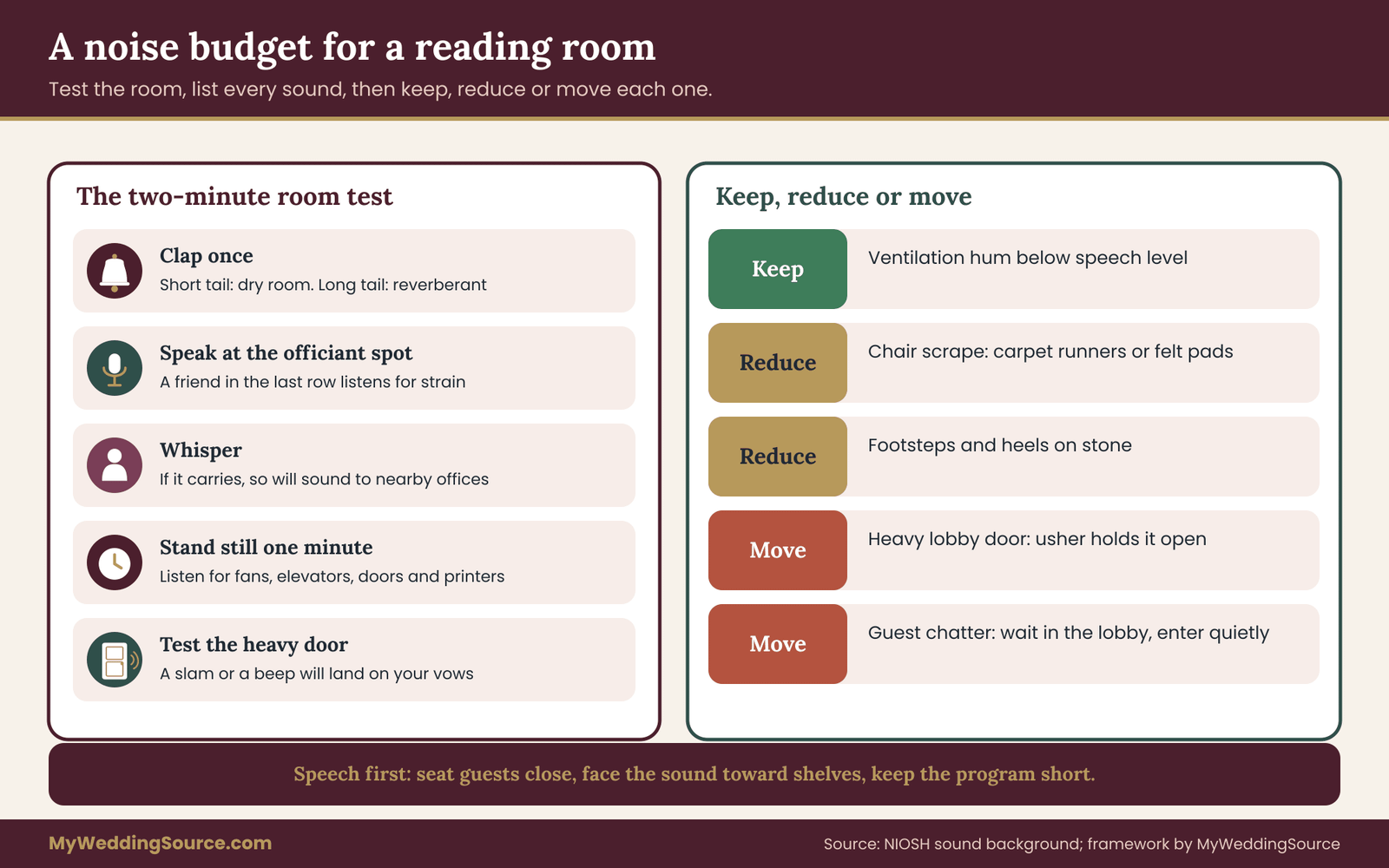
The two-minute room test
Visit the room, ideally at the same time of day as your event, and run these checks with a friend:
- Clap once and listen. If the sound dies quickly, the room is dry. If you hear a long tail, it is reverberant.
- Speak from the spot where the officiant would stand. Have your friend stand where the last row will sit and say whether they can follow ordinary speech without strain.
- Whisper from the same spot. Whispered words that carry clearly mean the room is lively and sound will travel, including to areas where other people may be working.
- Stand still for a full minute with your eyes closed. Listen for the building: ventilation fans, a refrigerator in a back room, footsteps overhead, elevator motors, traffic through a thin window, a printer or a security door that clunks.
- Check doors. Open and close the heaviest door in the room. A heavy door that slams, or an automatic one that beeps, will interrupt your vows if it runs during the library wedding ceremony.
You can use a free sound-level app on your phone to compare readings between rooms. Treat the numbers as rough comparisons, not measurements. The National Institute for Occupational Safety and Health, part of the Centers for Disease Control and Prevention, explains how loud sound is measured and why loud environments matter, and it is a reliable plain-language source if you want the background.
Building the noise budget
Every library wedding ceremony has a noise budget whether or not anyone writes it down. Writing it down simply means you spend it on purpose.
A noise budget is a short written list of every sound the library wedding ceremony will make and every sound the building will make, with a decision for each. It works like a money budget: there is a limit, and you spend it deliberately.
Start with the sounds you control:
- Spoken words, including vows, readings and the officiant’s remarks.
- Music, live or recorded, including prelude, processional, recessional and any short interludes.
- Chairs scraping, programs rustling, heels on hard floor.
- Applause, cheering and laughter at the end.
- Photographers and videographers moving and shooting.
Then list the sounds the building controls:
- Heating, cooling and ventilation, which cannot always be switched off.
- Elevators, doors, printers, book scanners or return machines.
- Other staff working in back rooms.
- Street noise through windows.
- Children’s programming in other rooms, if the building is open.
For each item, make one of three decisions: keep it, reduce it or move it. A scraping chair is reduced by felt pads or carpet runners. A noisy door is moved by propping it open, if allowed, or by asking a staff member to hold it. An air handler that cannot be silenced is kept, and the plan accounts for it by choosing music and speech that sit above it.
Speech first: designing for the back row
In a library wedding ceremony the spoken vows are the most valuable sound in the room, so everything else is arranged to protect them.
Most guests are there to hear two people say a few sentences. Protecting those sentences is the main job of the sound plan. Several simple choices help in most rooms:
- Seat guests closer. A tight semicircle of chairs near the officiant carries speech better than rows stretched down a long hall. If the room is long, turn the layout sideways and use the width instead.
- Face the sound toward absorption. If possible, place the couple with their backs to a stack of shelves or a heavy curtain, so the sound is absorbed behind them and not reflected at guests. Avoid placing the couple with their backs to a hard glass wall.
- Slow the pace. In reverberant rooms, a slower, more deliberate delivery helps. Officiants who know the space can adjust. Ask your officiant to try a few sentences during the walkthrough.
- Keep the program short. Every minute added to a library wedding ceremony is a minute of noise exposure. Short readings, one song, one clear exchange of vows.
- Pass out printed programs with the vows or readings, if the couple wishes. This helps guests who cannot hear well and reduces the pressure on the sound system.
When the room is quieter than you think
Libraries have a social sound line as well as a physical one. Many patrons and staff are used to hushed voices. A group of sixty people chatting before a library wedding ceremony will sound loud in a way that surprises everyone. Plan the arrival period so guests chat in a lobby or outside, then enter the library wedding ceremony space in a quiet stream. A greeter at the door who says, “Please come in and find a seat, we begin in ten minutes,” keeps the tone calm without announcing a rule.
Staff and neighbors: protecting the rest of the building
Even when the library is closed to the public, staff may be working in an office behind the wall. A friendly conversation about what they will hear, and when, helps both sides. If the building is open, the noise budget gets tighter, and your neighbors include patrons who came to study.
Questions to ask the library about nearby sound:
- Which rooms share a wall, floor or ceiling with the ceremony space?
- Are any of them in use during our time?
- Is there a maximum sound level, or a rule about amplified sound?
- Can the heating and cooling be adjusted for the event, and who adjusts it?
If amplification is allowed, ask whether it is limited to speech or can include music. Some libraries allow a small speaker for vows but not for a band. Others allow nothing but unamplified instruments. Get the answer in writing, because it changes your music plan and your vendor list.
Microphones and sound systems: the cautious path
For most small ceremonies in a library, the best system is no system. A good officiant projecting calmly, guests seated close and a short program carry far better than an amplified setup that fights the room. Amplification adds three problems: cables and stands near shelving, feedback in a reflective room, and the sense that the library wedding ceremony has become a performance in a place where quiet is part of the identity.
If you need amplification because of the room size, an older guest list or hearing needs, keep it small:
- A single small speaker aimed toward the guests, placed away from shelves and glass.
- A handheld or lapel microphone for the officiant, with fresh batteries and a backup.
- A volume that is set during the walkthrough, with a marked level, so the vendor does not raise it on the day.
- Cables taped and covered across any walkway, and none across a doorway used as an exit.
If any guest uses a hearing aid with a telecoil, or has hearing loss, ask whether the library already has an assistive listening system for its public events. Many do, and the staff can tell you how to use it. The wedding venue accessibility red flags article covers the questions to ask about access features in any venue, and the ADA information site run by the Department of Justice is a primary source for what accessible events and spaces should offer.
Music in the library: the short list
Music deserves its own treatment in the next part of this guide, but one rule belongs here. Choose music that fits the sound line, not music that tests it. A solo guitar, a harp, a cello or a quiet piano matches the library’s character and rarely overwhelms a reverberant room. A full brass quartet may not. The best test is the walkthrough: ask the musician to play two minutes in the room at the intended volume while you stand at the back and while a staff member listens from the nearest occupied office.
Writing the sound line down
A library wedding ceremony with a written sound line rarely produces an unpleasant surprise on the day.
The sound line can be written as a short paragraph: “Speech is unamplified or amplified at a maximum of . Music is . Doors ___ will be . Applause is . The staff member listening from ___ has agreed the level.” If you cannot complete the paragraph, you have not tested the room yet. Go back and clap. ## Music and readings that fit a library wedding ceremony
Music is where the sound line is most often tested, so it helps to choose with the room in mind, not the playlist. A library wedding ceremony does not need less music than any other ceremony. It needs music that sits comfortably in a room built for quiet attention.
Instruments in order of risk
For a library wedding ceremony, a short list of two or three musical moments usually does more than a long program.
Think of instruments on a scale from easy to difficult in a reverberant reading room.
- Easiest: solo acoustic guitar, harp, a single cello or violin, a quiet piano if the library already has one in good tune and permission to use it. Their sound is gentle and decays naturally.
- Manageable with care: a string duo or trio, a small vocal group, a single voice with piano. These are lovely in the right room and need a short test for balance.
- Difficult: drums, brass, electric instruments, large ensembles and any instrument that depends on amplification. They tend to fill a reflective room and push the sound line.
- Usually not worth the effort: a recorded track played through large speakers. Recorded music has no natural decay, so it can sound harsh in a room with hard surfaces.
If a musician has never played in a library, send them the building’s details and ask to try the room. A musician who knows what a stone floor does to a violin will tell you honestly whether it works. Agree on who signals the musicians to start and stop, and write that into the program order.
Where the musicians stand
Musicians need space, a stable surface for stands and sometimes a chair, and they bring cases that must be stored out of sight. In a library, musicians should not be placed in front of shelving that guests will walk past, in an aisle, or against a display case. A corner away from the aisle, with a clear floor for their equipment, is usually best. Ask the staff to approve the spot. If a harp must be moved in through a narrow door, confirm the route and the time well before the day.
Readings from books
Couples who choose a library often want a reading from a favorite book. That is a lovely idea, and the plan is simple. Use your own copy. A copy from your shelf, a new edition bought for the occasion or a printed card in a frame carries no risk to the library’s collection. A reading from the library’s own copy of a special edition is a request to make through staff, who will decide whether the item can leave its place, who may touch it and whether gloves, a stand or supervision are required.
If the book is part of the library’s rare or special collections, assume the answer is no unless a staff member proposes otherwise. A quick alternative is to ask whether the library will display the book in a case during the library wedding ceremony, so guests can see it but nobody handles it.
For the logistics of readers, introductions and timing, the ceremony cue sheet guide shows how to give every reader a clear cue and a simple place to stand.
Book handling and the shelf line
The shelf line protects the collection. It is the line that library staff care most about, and it is the one where couples can most easily cross by accident, usually with kind intentions.
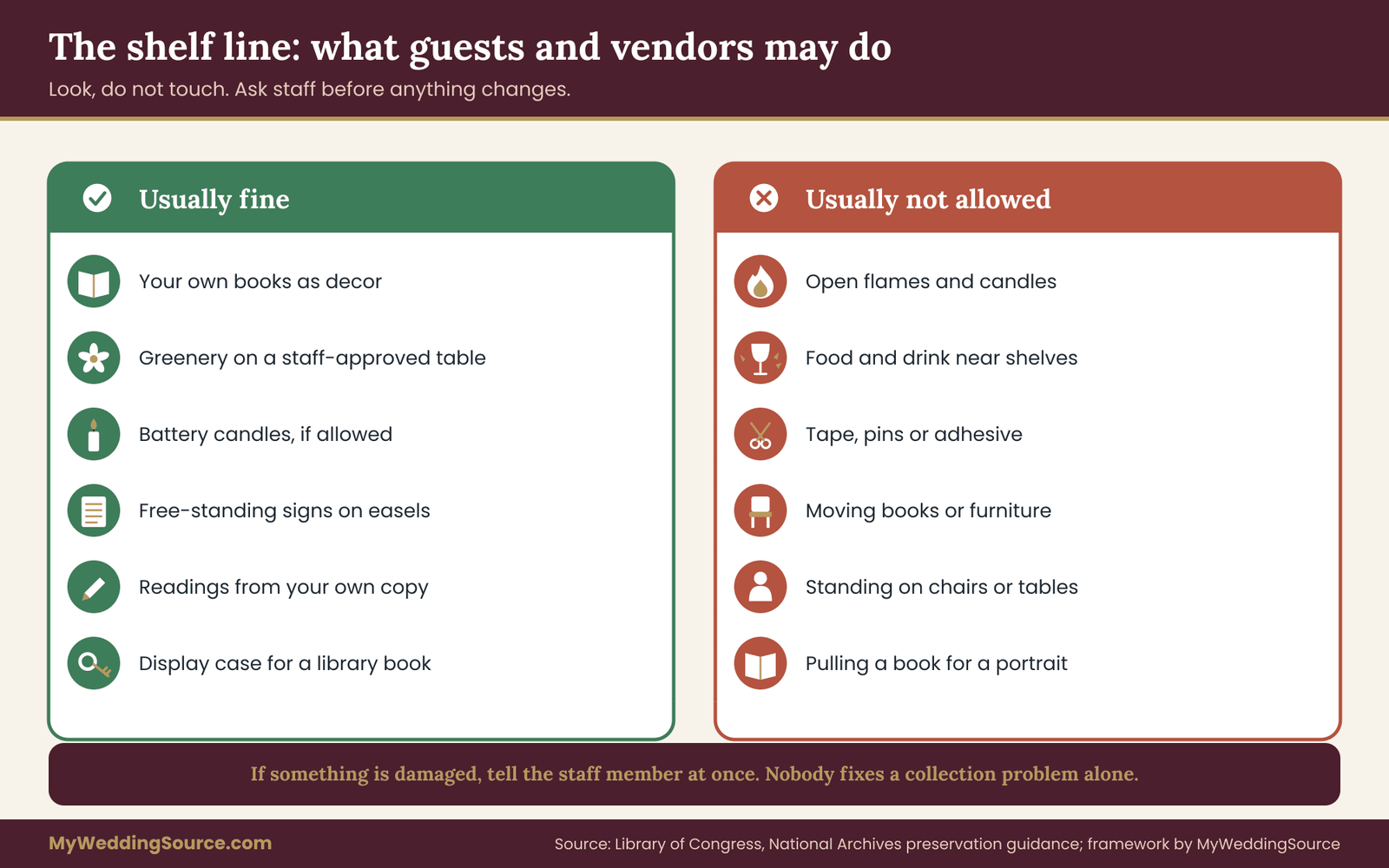
The simple rule: guests look, they do not touch
The shelf line is the part of a library wedding ceremony that the staff will care about most, so state it plainly to every guest and vendor.
A reasonable starting rule for any library wedding ceremony is that nobody handles books unless a staff member invites them to. Guests will want to browse. Photographers will want to pull a book for a portrait. Children will want to open a spine. All of these are understandable and all of them can cause damage, from bent covers to sticky fingerprints, and from misplaced volumes to a shelf that nobody can find a book on later.
The Library of Congress publishes basic care guidance for books and paper collections, and the National Archives offers preservation guidance for records. Both explain, in plain language, why handling, light, moisture and food matter. You do not need the technical detail. The point is that the library’s rules are based on how paper ages, not on fussiness.
Practical shelf-line rules
Ask the library to confirm each of these in writing, and share the answers with every vendor:
- Distance from shelves. Chairs, candles, flowers and equipment must be at least a stated distance from shelves. Libraries often set a distance to keep the aisles clear and avoid knocking books.
- Aisles stay clear. Fire and accessibility rules usually require clear aisles. A processional that uses an aisle between stacks may be a no.
- No food or drink near collections. Even water spills can harm books. If a toast is planned, move it to a room without shelves.
- No open flames. Candles are normally prohibited in libraries. Battery-operated candles are a common alternative, and the staff will tell you whether they are allowed.
- No adhesive, tape or pins on shelves, walls or furniture. Decorations that need sticking are usually refused. Free-standing decor is safer.
- No moving books or furniture without staff. Library furniture is often fixed or specially arranged, and shelving may be tied to the building’s layout.
- Flowers and water. Cut flowers in water, vases and potted plants bring moisture and spills. Some libraries ban them in reading rooms, and others allow them on specified tables only. Ask about pollen and fragrance as well.
- Photography. Flash may be restricted around certain materials. Ask whether any area bans flash, tripods or lights, and where photographers may stand.
Props and decor: what usually works
Decor that treats the library as the star usually succeeds. A simple arrangement of greenery on a table, a hand-lettered sign on an easel or a small number of battery candles near a lectern can match the setting and stay inside the shelf line. Large arches, heavy installations and anything that must be anchored are harder.
Books themselves can be part of the design, as long as they are your own. Stacks of secondhand books as table decor, a guest book that is a favorite novel, or a program printed on a bookmark all sit comfortably in the space. Resist the temptation to move the library’s books to create a backdrop. It may look good on a mood board but it creates reshelving work, and a misplaced volume can be hard to find again.
What staff may ask of you
Libraries often have a conservator, a collections manager or an archivist who is not a rental coordinator but who has a say in what happens near fragile materials. In large or historic libraries, that person may attend the walkthrough. Their questions are practical: What will be placed where? How will people move? Who will be responsible for the cart? Answer plainly, and accept their requirements with thanks. A conservator liaison who feels respected often becomes a quiet ally in finding workable solutions.
If a library employs a specialist for this, ask whether their time is billed and whether they must be present during the event. A requirement of a specialist or a staff member present for the entire event is a cost to budget for, not an insult.
Handling mistakes
Despite good planning, accidents happen. A guest picks up a book and puts it back in the wrong place. A flower arrangement leaves a ring on a table. A vendor leans a ladder against a shelf. Agree in advance on how the library wants such incidents handled. In most cases, the answer is that nobody tries to fix a collection problem alone. The guest or vendor tells the staff member present, who deals with it. A short briefing to every vendor that covers this single rule prevents small problems from growing.
Writing the shelf line down
Share this paragraph with everyone who will set foot in the room, because a library wedding ceremony involves more hands than most couples count.
The shelf line is complete when you can state: “Chairs and decor stay ___ from shelves. Nobody handles books except . Food and drink are only in . Flowers are allowed ___ and not allowed . Photographers may and may not . If something is damaged, is told immediately.”
Floor plan: chairs, aisles and the shelf line in practice
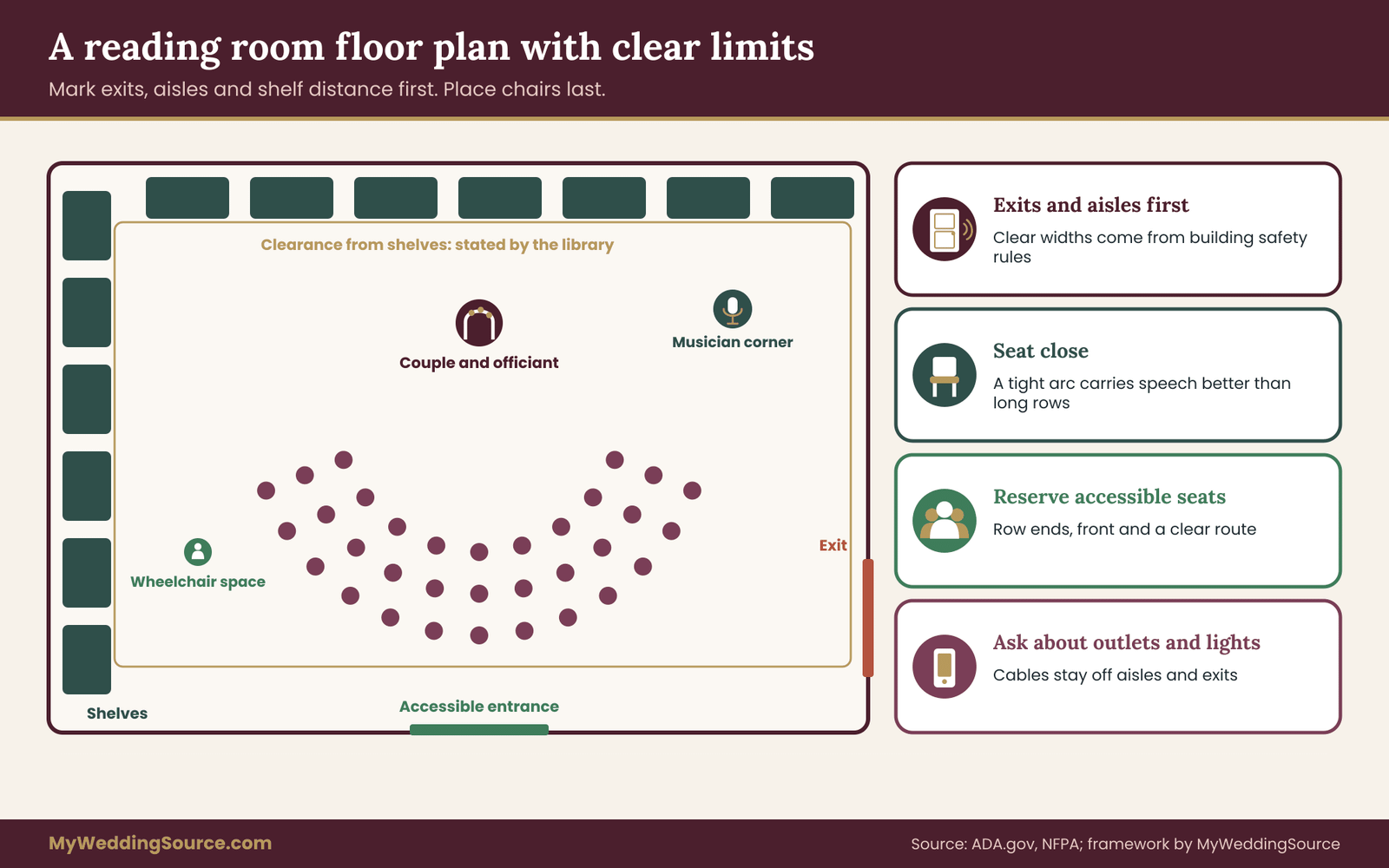
Once the three lines are on paper, the room needs a layout that honors all three. This is where a sketch beats a conversation. Ask the library for a floor plan, or draw your own on graph paper at the walkthrough, and mark the shelves, doors, exits, outlets and fixed furniture.
Starting from the limits
A library wedding ceremony layout begins with the limits and only then moves to style.
Begin with what cannot change. Mark exits and the paths to them. Mark the minimum clear aisle widths and the required distance from shelves. Mark the maximum occupancy that the library states for the room. These numbers come from the building’s safety rules, and the library’s staff or the local fire authority sets them.
Then place what is flexible. Chairs usually go in a block or a semicircle. The couple and the officiant stand near the focus of the room, which may be a fireplace, a window, a lectern or a long table. Musicians, readers and the guest book take smaller spots.
Layout patterns that tend to work
- The semicircle. Chairs arranged in a loose arc around the officiant, with an aisle on each side. It keeps guests close and gives clear exits.
- The long-table ceremony. Guests seated at the sides of a long reading table, with the couple at one end. It suits small groups and carries the room’s character, but access for guests with limited mobility has to be planned and fixed tables limit flexibility.
- Standing ceremony. No chairs, guests gather near. It saves floor space and reduces scraping, and it suits a short program. It is harder for older guests and anyone who tires standing, so offer a few chairs around the edge.
- The entry and the aisle. If the room’s natural aisle runs between stacks, a processional through it may be tempting. Check whether the aisle meets clear-width rules and whether anyone using a mobility device can pass without touching shelves.
Accessibility is part of the layout
A reading room may include steps, narrow doors, a mezzanine or an old elevator. Confirm the accessible route from the street to the library wedding ceremony seat, and make sure it is the same route that others use, not a separate service path unless there is no alternative. Reserve seats at the front and at the end of rows for wheelchair users and for anyone who needs space for a cane, walker or service animal. The ADA information site gives the federal baseline for accessible routes and seating, and your local rules may add more.
Power, light and the things nobody draws
A sketch should also include outlets, switches and lighting controls. Library lighting is often designed for reading, with overhead fixtures that are bright and flat. Ask whether lights can be dimmed, which zones switch on together and who operates them. If a photographer needs more light than the library provides, discuss it early, because extra lighting means cables and stands near the shelf line.
Walk the layout with the library’s contact present, and walk it again in your head as a guest arriving, as a guest using a wheelchair, as the officiant, as a musician and as a vendor carrying a box. If every route works for every person, you have a floor plan.
For a deeper process on measuring a room, checking access routes and gathering vendor needs, the site’s venue technical walkthrough guide offers a full checklist you can adapt to the library. ## Etiquette for guests, vendors and the public
A library wedding ceremony depends on good manners more than most venues do, because the setting makes everything visible. A guest who shouts across the room, a photographer who steps into an aisle or a vendor who props a door open and leaves it will be noticed by staff and by anyone passing. The etiquette plan is a short set of expectations, communicated kindly and early, that keeps the three lines intact.
Telling guests what to expect
Guests are the largest group at any library wedding ceremony, and the easiest to inform if you start early.
Guests cannot follow rules they have never heard. You do not need a long list, and you do not need a stern tone. A short note on the wedding website or on an enclosure card does the job. Keep it friendly and practical:
“Our ceremony will take place in a working library. Please arrive a little early, speak softly once you enter, and leave the books on the shelves. A staff member will be present to help. Thank you for helping us keep the library as we found it.”
Add the details that guests actually need, such as where to park, which entrance to use and whether the library wedding ceremony space is accessible. The wedding etiquette guide on this site covers the broader social rules; the library adds only a few specifics.
Think about particular guest groups:
- Children. A short, friendly briefing helps children enjoy the day. Libraries are often child-friendly places, but a library wedding ceremony is not a story hour. Suggest a quiet activity, a seat near an aisle and an adult who can step out with a restless child.
- Older guests. Offer a seat near the front and a clear route. Long walks across a library floor and stairs can be tiring, and the guest may not mention it.
- Guests with phones. Many couples ask guests to keep phones put away during the library wedding ceremony so the room stays quiet and the photographer has a clear view. Suggest it in the program, and let the officiant mention it kindly at the start.
- Guests who love books. They will wander. Give them a place and a time to browse, such as the lobby after the library wedding ceremony, with staff approval, so the shelves stay untouched during it.
Briefing vendors
Vendors who have worked in a library wedding ceremony before will usually have good questions of their own, so invite them.
Vendors know weddings. They may not know libraries. A short written brief for every vendor prevents the common mistakes. It should include:
- The hours of access, including load-in and load-out times.
- The entrance, the route and any restrictions on carts or wheels.
- The three lines in one paragraph each.
- The name and role of the library’s staff contact.
- The rule that nobody touches books or moves furniture without that person.
- The sound limits and any amplification rules.
- The decor limits, including flames, adhesives and water.
- Where to park, where to store cases and where to dispose of trash.
If a vendor resists a rule, that is useful information. A florist who insists on loose petals scattered across a reading room floor, a band who needs to run cables across an aisle, or a photographer who plans to move shelves for a backdrop may not be the right fit for this venue. The vendor due diligence checklist helps you ask vendors about experience with restricted venues and what they do when a rule limits their usual approach.
Photographers and videographers
The photographer is the vendor most likely to cross the shelf line, simply because the library is irresistible to photograph. Agree on a shot list that respects the rules, and share it with the staff contact in advance. Useful questions to settle:
- Which areas are open for portraits, and for how long?
- May the photographer use flash, off-camera lighting or tripods?
- May the photographer stand on chairs, tables or ladders? Usually not.
- May portraits include shelves, and may the couple lean on or touch them? Usually leaning is not allowed.
- May the photographer remove a book from a shelf for a portrait? Usually not unless a staff member does it.
Photographers also need to avoid capturing patrons who have not agreed to be photographed, if the building is open. A well-run plan includes a quiet spot for portraits away from public areas, and a request to staff about which areas are off limits to cameras. Write the photography terms into the vendor agreement, including how the library’s rules limit what the photographer may do.
The public and the staff
Treat the library staff as colleagues for the day. They are doing their jobs and giving up time and attention. A few habits go a long way:
- Learn the contact’s name and use it.
- Arrive at the agreed time, and leave at the agreed time.
- Say thank you in person at the end, and in writing afterward.
- If the staff member asks for a change, make it without debate. If you disagree, discuss it afterward through the proper channel.
- Leave the room cleaner than you found it, and take everything you brought.
If the building is open, treat patrons kindly. A patron who appears at the edge of the library wedding ceremony should be welcomed with a smile, not shushed. If the library asks you to keep a path open for patrons, keep it. That sort of generosity reflects well on the couple and on the venue, and it is the kind of behavior that keeps libraries willing to host weddings at all.
A short script for hard moments
Some moments need words ready. Here are a few that are brief and kind.
A guest picks up a book. “Thanks for being careful. Let’s leave the shelves for the library to look after today. We can show you the reading table after the library wedding ceremony.”
A patron walks in during vows. A smile and a nod from an usher. Nothing more.
A vendor wants to move something. “Let me check with the library contact first. They asked us to leave anything near the shelves to them.”
The ceremony runs long. The officiant or planner tells the staff contact quietly, who may extend the window or ask you to wrap up. Agree beforehand what happens if the time runs over, including any fee.
These are not scripts to recite. They are examples of the tone that works: warm, brief and respectful of the library’s authority.
Insurance, deposits and the written agreement
Library rental agreements are often shorter than those of commercial venues, and that can be both a relief and a risk. A short agreement that does not mention weddings may not answer your questions, so ask for the details to be written in.
What the agreement should say
Ask the library for the rental agreement, the facility use policy and any event rules before you pay a deposit, and read all three. Look for clauses on:
- The space and the time. The exact room or area, the exact date and the exact hours including setup and cleanup.
- Fees. Rental fee, staffing fee, security fee, cleaning fee, equipment fee and any hourly overage charges.
- Deposits. The amount, when it is due, when it is returned and what it can be kept for.
- Cancellation and changes. What happens if you cancel, if the library cancels, or if a weather or building emergency closes the building.
- Insurance. Whether you must provide a certificate of insurance, what coverage and limits are required and whether vendors need their own.
- Rules. Decor, flames, food, alcohol, music, amplification, photography and behavior, written or attached.
- Damage and liability. Who pays for damage and how it is assessed.
- Staff roles. Who attends, what they do and what authority they have on the day.
If the library does not allow alcohol, assume that includes a champagne toast in the reading room, and plan the toast elsewhere. If the library requires an alcohol permit or licensed server, that is a significant cost and a reason to move the drinks to another venue.
Insurance in plain terms
Insurance is a routine part of booking a library wedding ceremony, not a sign that anyone expects trouble.
Many libraries ask event hosts to carry liability insurance for the day and to name the library as an additional insured. The terms vary a great deal. Some accept a one-day event policy, some accept a rider on a homeowner’s or renter’s policy, and some require a certificate from each vendor. The Insurance Information Institute offers neutral consumer explanations of how event and liability coverage works. For the specifics, ask the library what it requires and ask an insurance professional how to meet it.
The site’s guide to the wedding vendor contract explains what to look for in vendor agreements, and its sections on insurance and liability apply equally to a library rental. Check that each vendor’s own coverage meets the library’s requirements before you sign, because a vendor who cannot supply a certificate can delay the whole event.
Deposits and damage
A damage deposit is not a fee. It is held against damage or violations and returned if the room is left in good order. Ask:
- How is damage defined, and who decides?
- Is a missing or misplaced book counted as damage?
- Is there a process for disputing a charge?
- How long after the event is the deposit returned?
A clear written answer keeps the relationship good if a problem comes up. A vague answer is a reason to ask again.
Keeping the paperwork together
Put every email, agreement, certificate and fee receipt into one folder. At the end of planning, review the folder against the three lines. Does the agreement match what the staff told you? If not, ask for an amendment or a signed email confirming the point. Written changes protect both sides, and library staff generally appreciate a tidy request. ## A worked case: one library wedding ceremony plan from first call to last chair
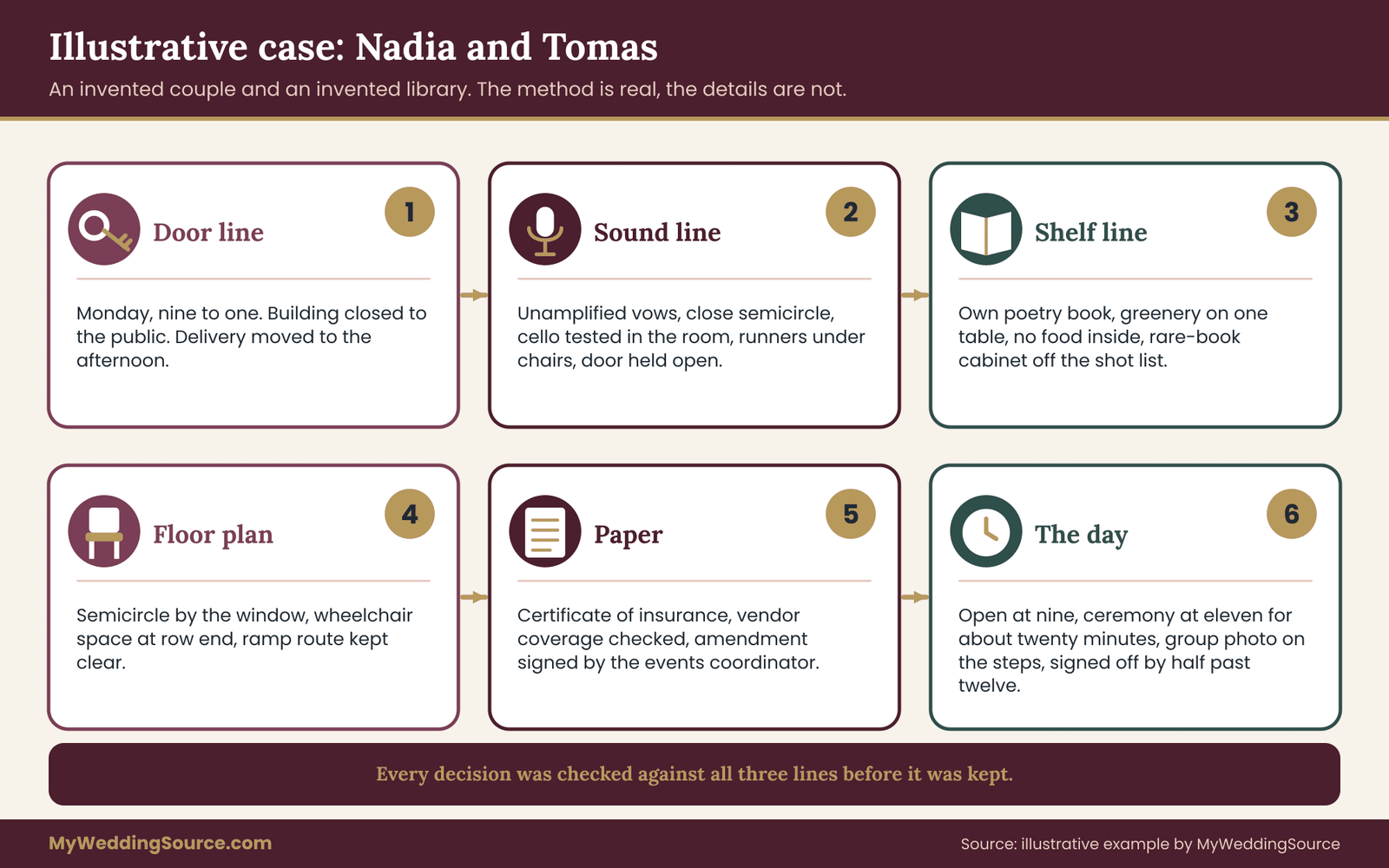
The best way to see the three lines in action is to follow one plan. The couple below is invented for illustration, and so is the library. The numbers are chosen to show the method, not to describe any real building, fee or policy.
The situation
Nadia and Tomas want a short civil library wedding ceremony with about fifty guests. They love the main reading room of a small city library: a high ceiling, wooden shelves along two walls, two long reading tables, tall windows and a stone floor. The library is open to the public six days a week and closed on Mondays. The events coordinator tells them the reading room can be rented for private library wedding ceremonies before opening or on Mondays, with a staff member present.
Step one: draw the door line
They ask for the earliest and latest times on both options. A Monday would give them the whole building, and a Sunday before opening would give them a window of about two hours. They choose Monday, mid-morning, because their guests include older relatives who prefer a gentle schedule. The library agrees to access from nine to one, with the library wedding ceremony at eleven and the building closed to the public all day.
They write the line: “We have the reading room from nine to one on a Monday, the building is closed to the public, the events coordinator is the staff member in charge, and guests enter through the side door beside the accessible ramp.”
They also ask what a typical Monday looks like. The coordinator explains that staff do back-office work on Mondays and that a delivery usually arrives around ten. The couple asks if the delivery can be moved to the afternoon. The coordinator says yes, and notes it in the agreement.
Step two: draw the sound line
At the walkthrough, Nadia claps once in the empty reading room and hears a clear tail of sound. She and her friend run the two-minute test. Speech from the officiant’s spot is understandable at the back row but with noticeable echo. The ventilation hums at a steady level. One heavy door to the lobby closes with a loud thud.
They decide:
- Keep: the ventilation hum, which sits below the speech level.
- Reduce: chair noise, using carpet runners on the stone floor in the seating area, with staff approval.
- Move: the heavy door will be held open by an usher during the library wedding ceremony, as the library agrees, or closed gently by the staff member after guests are seated.
- Speech: unamplified, with chairs arranged in a close semicircle and the officiant facing the guests with her back to the shelved wall.
- Music: a single cellist plays a prelude and recessional, tested in the room at the walkthrough. The processional is a short walk with no music, which also saves time.
The coordinator listens from the nearest office during the cellist’s test and says the level is fine.
Step three: draw the shelf line
The coordinator provides the library’s event rules. They include a minimum distance of about an arm’s length and a half between chairs and shelves, no flames, no liquids near shelves and no touching books. Nadia and Tomas add their own decisions:
- The couple’s reading is from Tomas’s own copy of a poetry collection, printed on a card in case the book is awkward to hold.
- Decor is limited to greenery on one reading table and a hand-lettered welcome sign on an easel.
- The guest book is a notebook, placed on the table by the door.
- The photographer receives a shot list that includes the long table, the window and the lobby, but not the rare-book cabinet.
- The toast and a small reception are scheduled for a nearby restaurant, so no food or drink enters the library.
Step four: the floor plan
At the walkthrough, they sketch the room. The stone floor and the shelves along two walls set the limits. They mark the exits, the required aisle width and the capacity the library states. Chairs are arranged in a semicircle in front of the window, with the couple and the officiant standing near the glass and the shelves behind the guests. The cellist stands in a corner by the window, away from the aisle, with a clear floor.
An older aunt uses a wheelchair, so a space is reserved at the end of the first row, and the route from the ramp to the room is checked for width. The usher’s job includes keeping that route clear.
Step five: insurance and paperwork
The library asks for a certificate of insurance for the day, naming the library as an additional insured. Nadia and Tomas ask their insurance agent how to get a one-day policy, and ask the photographer and the cellist whether they carry their own coverage. The photographer does, and the cellist does not, so the couple’s policy covers the musician as a guest performer with the library’s agreement in writing.
They request a short amendment to the rental agreement stating the hours, the delivery change, the use of carpet runners, the held-open door and the permission to use a cello without amplification. The coordinator signs it.
Step six: the day
On the day, the staff member opens the building at nine. The florist and the chair setup finish by ten. The photographer does a quick check with the coordinator about portrait spots. Guests gather in the lobby, speaking quietly. At a quarter to eleven, an usher opens the heavy door and invites guests to sit. The library wedding ceremony lasts about twenty minutes. Afterward, guests step outside for the group photo on the library steps, since the exterior is easier to control than the reading room.
By half past twelve, the chairs are folded, the runners are rolled up and the floor is checked. The staff member signs off, and Nadia and Tomas thank her in person.
What the case shows
This is how one library wedding ceremony plan can be assembled in a handful of conversations and a single signed page.
The plan works because every decision was checked against all three lines. The Monday choice protected the door line and also helped the sound line, because no patrons were in the building. The unamplified speech protected the sound line and the shelf line, because no cables crossed the floor. The outside group photo protected the shelf line and shortened the time in the room.
It also shows two limits. The plan depends on a staff member who can say yes and who agreed in writing. And it depends on a small group and a short program. If the guest count had been double, the semicircle would not have fit inside the aisle limits, and a different plan would have been needed.
Alternatives when a library wedding ceremony will not work
Sometimes the answer from the library is no, or the conditions are more than the couple can meet. That is not the end of the idea. There are several ways to keep the library in your wedding without forcing a plan that breaks one of the three lines.
Keep the library for photographs only
This choice suits couples who love the idea of a library wedding ceremony but cannot meet its conditions.
Many libraries allow portrait sessions on weekday mornings or by appointment, sometimes for a modest fee or for none. A short photo session in the reading room with the couple and a photographer gives you the images without a guest list, a sound plan or a long booking. Ask about hours, tripod rules and the number of people allowed.
Hold the ceremony nearby and visit the library after
A ceremony in a garden, a courtyard or the library’s own steps keeps the setting but places the sound and the guests outside the building. Some libraries have a terrace or a plaza that falls under a different rental policy than the reading room. If the library cannot host, ask whether a partner site, such as a nearby historic hall or park, shares its character.
Use a community room instead of the reading room
A meeting room or program room in a library offers a roof, restrooms and the building’s atmosphere without sharing space with the collection. These rooms usually have flexible seating, fewer shelf-line constraints and more generous rules. The trade-off is that the room may feel less special, so many couples bring in a few books, a bookish sign or a reading table of their own.
Use a different book-filled venue
A bookshop that hosts events, a private club with a library room or a historic house with a book-lined study can offer the look with fewer public-access constraints. These are ordinary venues with a theme, so the normal rules from the wedding venues guide apply: ask about capacity, fees, vendors and cancellation in the usual way, then use the three lines as a checklist for anything involving books.
Split the day
A small ceremony with close family in the library, followed by a larger celebration elsewhere, is a common way to respect both the library’s limits and the guest list. The ceremony can be short, quiet and held at the best hour for the library, while the party happens where music and food are easy. If you choose this path, be clear with guests about who is invited to which part and why, so nobody feels left out.
Reconsider the date
A no for one weekend may be a yes for another. Ask whether Mondays, holidays or off-season weeks have different rules. A library that is busy on weekend afternoons may have a much quieter Thursday evening. ## Failure conditions: when to change the plan or walk away
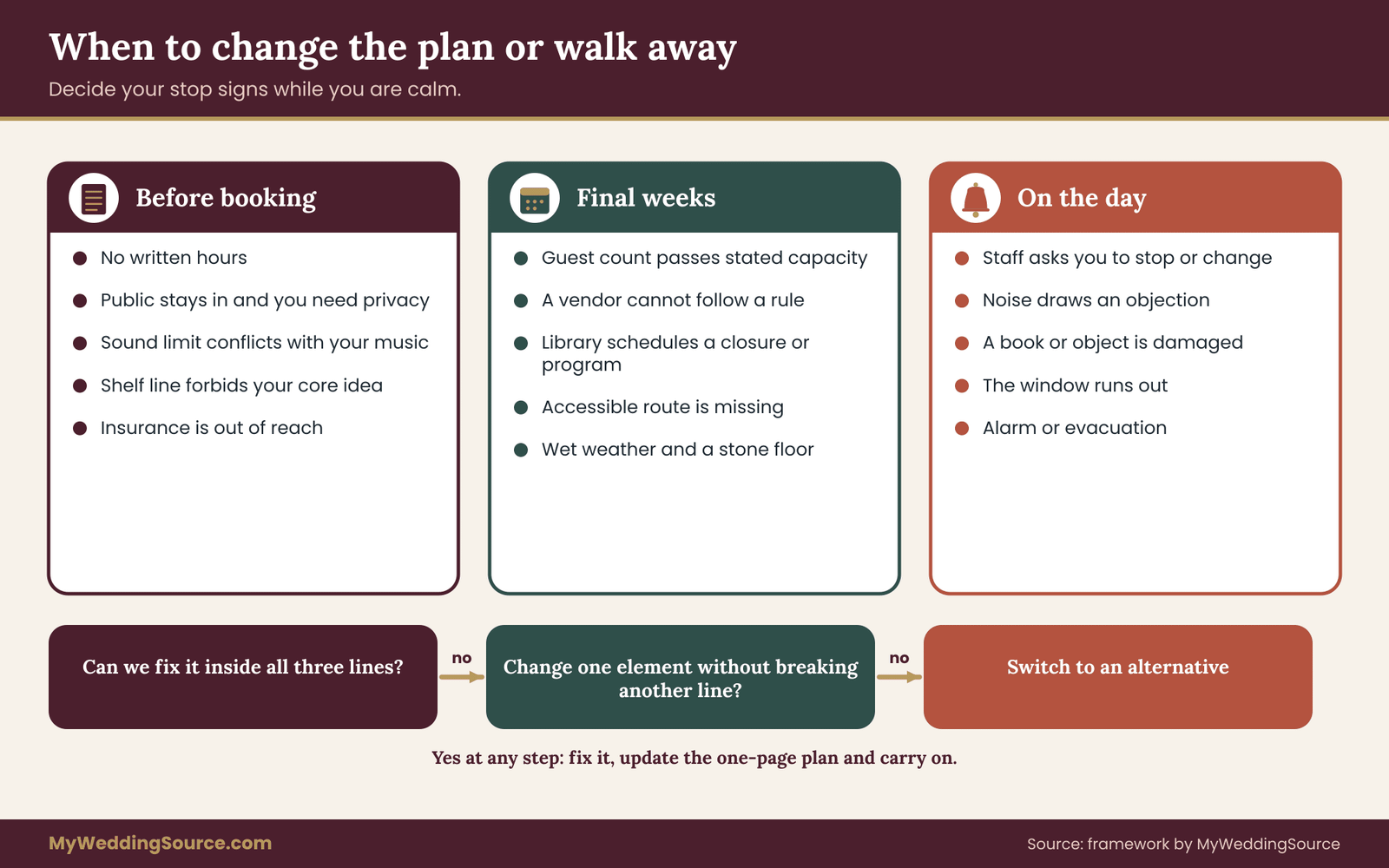
A good plan says what would make it fail. This is the part couples skip, and it is the part that saves the most trouble. Decide your failure conditions while you are calm, not on the morning of the library wedding ceremony when everyone is tired.
Conditions before the booking
Your own list of failure conditions for a library wedding ceremony may be longer or shorter than this one, and that is fine.
Some answers should stop you before any money changes hands. Treat these as reasons to look elsewhere or to scale down:
- The library will not put the hours in writing. A verbal yes about the door line is not a door line.
- The building must stay open to the public and you need privacy. If privacy matters to you, a library wedding ceremony in a working reading room will disappoint you.
- The sound limit and your music plan conflict. If the library bans amplification and you need it for guests with hearing needs, find another room or add a hearing-access plan the library accepts.
- The shelf line forbids your core idea. If the heart of your plan is a processional between the stacks and the library cannot allow it, the library is not right for that plan.
- Insurance requirements are out of reach. If a vendor cannot meet the requirement and you have no alternative, the booking is at risk.
- The staff contact changes the answers. If three conversations give three different rules, ask for one written document and wait for it.
Conditions in the final weeks
As the date approaches, certain changes should trigger a rethink:
- The guest count grows past the room’s stated capacity or aisle limits. Do not squeeze in extra chairs. Reduce the list or move the library wedding ceremony.
- A vendor cannot follow a rule. Replace the vendor or change the element. A band that needs a stage, or a florist who needs open flames, may not fit.
- The library schedules maintenance, a program or a closure near your time. Ask for a written update and, if needed, a new window.
- A guest needs an accessible route that the library cannot provide. Fix it or change the plan. Do not ask a guest to manage an obstacle that the plan could remove.
- The weather affects arrival or load-in. Rain on a stone floor is a slip risk and a mess for the library. Ask what the library expects, including mats and umbrellas.
Conditions on the day
On the day, a short list of stop signs keeps the event safe and the relationship intact:
- The staff member asks you to stop or change something. Do it, and talk afterward.
- The room’s noise reaches a level the staff member objects to. Reduce the source and continue.
- A book or object is damaged. Tell the staff member immediately, and nobody else tries to fix it.
- The ceremony runs past the end of the booked window. Close the library wedding ceremony, move the remaining photos outside and clear the room.
- A fire alarm sounds or the building must be evacuated. Follow the staff member’s instructions, and resume only when the library says it is safe.
The decision flow
The failure conditions work best as a simple flow. For each condition, ask: can we fix it within the three lines? If yes, fix it and update the page. If no, can we change one element without breaking another line? If yes, change it. If no, switch to an alternative.
Keeping a fallback ready
A fallback does not reduce the charm of a library wedding ceremony. It removes the fear of losing it.
A fallback is not pessimism. It is a short plan that makes the main plan calmer. For a library, the usual fallbacks are an outdoor spot near the entrance, a nearby venue with a similar mood or a shortened library wedding ceremony in the lobby. Tell the officiant, the photographer and the musician what the fallback is, even if it is only a sentence. Tell guests only if they need to know. A broader venue search is the place to find a backup if the library falls through before you have sent invitations.
Your next steps
You do not need to do everything at once. Work in this order and stop whenever an answer changes the plan.
- Screen the library online. Find the rental or facility page and note whether weddings are mentioned, which hours are possible and which fees apply.
- Contact the right person. Ask for the staff member who handles rentals and send a short, factual message with your guest count and what you are asking.
- Visit at the intended hour. Run the two-minute room test, walk the routes and photograph the shelves, exits and outlets for your records.
- Draw the three lines on one page. Write the door line, the sound line and the shelf line in your own words, and ask the staff to confirm each in writing.
- Check the people who must follow it. Share the page with your officiant, your musician, your photographer, your florist and your planner. The officiant requirements guide is useful for confirming that your officiant can legally and practically work in a space with a strict schedule.
- Sort out insurance and the agreement. Ask what is required, get the amendment that records every special arrangement and file it with your receipts.
- Brief your guests. Add a short, friendly note to the website or the invitation about arrival, quiet and the books.
- Prepare a fallback. Choose a short alternative that you can switch to without drama.
- Thank the staff. Say it on the day and in writing afterward.
FAQ
Can you hold a wedding ceremony in a public library?
Often yes, but it depends on the library. Many public libraries rent community rooms for private events, and some allow ceremonies in the reading area before opening or after closing. Others limit space to educational or nonprofit use. Contact the person who handles facility rentals, ask whether weddings are allowed by name and get the answer in writing before you plan anything else.
Is a library wedding ceremony loud or quiet?
It depends on the room. Rooms with stacks of books and carpet are often quiet and absorb sound, while grand reading rooms with stone floors and high ceilings echo. Test the room by clapping, speaking from the officiant’s spot and listening for the building’s hum. Most small library wedding ceremonies work best with unamplified speech, close seating and gentle acoustic music.
Can we read from a book at a library wedding ceremony?
Yes, if you use your own copy. A reading from a book on your shelf, or a printed card, carries no risk to the collection. Reading from the library’s own copy, especially a rare or special collection item, needs staff approval and may require gloves, supervision or display in a case. Ask early, and have a printed backup.
Can guests browse the shelves during the ceremony?
Usually not. A fair starting rule is that nobody handles books unless a staff member invites them to. Offer guests a time and place to browse after the library wedding ceremony, with staff permission, or point them to a display table of your own books. Telling guests the rule in advance keeps the mood friendly and protects the collection.
Are candles, flowers and food allowed in a library?
Rules vary, but candles and open flames are commonly prohibited, and many libraries limit liquids and food near collections. Battery candles are a frequent alternative. Cut flowers in water may be restricted to certain tables or banned in reading rooms. Ask for the library’s written decor and food rules, and plan toasts and meals in another room or venue.
What happens if the library is open to the public during our ceremony?
You share the building, so the sound line and privacy become harder to protect. Patrons may walk past, and noise from other rooms may carry. Many couples avoid this by choosing a time before opening, after closing or on a closed day. If you accept some public presence, brief guests and the photographer, and keep a quiet row at the back.
Do we need insurance for a library wedding ceremony?
Often yes. Libraries commonly ask event hosts for a certificate of liability insurance, sometimes naming the library as an additional insured, and may ask vendors for their own. Requirements differ by institution. Ask what the library requires in writing, then ask an insurance professional how to meet it. A one-day event policy is one common route.
What if the library says no to a ceremony?
Look at the alternatives. You can hold the library wedding ceremony in a courtyard or on the steps, book a community room, use a bookshop or historic house with a book-lined room, schedule a photo session in the library only, or split the day into a small library wedding ceremony and a larger celebration elsewhere. A no for one date may be a yes for another, so ask about other days.
Sources
- American Library Association: policy and guidance on library access and public service.
- Institute of Museum and Library Services: federal information on the public role of libraries and museums.
- Library of Congress, Preservation: care guidance for books, paper and collections.
- National Archives, Preservation: guidance on handling and storing paper records.
- ADA.gov, U.S. Department of Justice: federal information on accessible routes, seating and effective communication.
- National Fire Protection Association: fire and life-safety codes that many local authorities adopt.
- NIOSH, Centers for Disease Control and Prevention: background on measuring sound and why loud environments matter.
- Insurance Information Institute: consumer explanations of event and liability coverage.
- National Park Service, Museum Management Program: conservation guidance for collections care.