
A vacation rental wedding means holding a ceremony or reception at a house, villa or cabin that you booked as a short-term stay, and in most cases it is allowed only if the owner agrees in writing before you pay anything for the event. This guide gives you a five-permission verification checklist, a worked case and clear stop conditions, so you know whether to proceed, renegotiate or choose another place.
Do not assume a booking confirmation covers a vacation rental wedding. It needs five separate permissions: the owner’s written approval of the specific event, the listing and platform rules, any association, building or manager rules, the local limits on occupancy, noise and parking, and insurance and damage terms that name the vacation rental wedding. Ask for all five in writing, keep the answers in one folder, and treat any missing or vague answer as a no until it is fixed. If the owner will not put the event in writing, hold the wedding somewhere else.
Plenty of couples find a beautiful rental house, look at the photos of the lawn and the long dining table, and decide it would make a wonderful place to get married. The listing may even show a wedding-style photo. That is not an invitation. A listing photo shows what the house looks like. It does not show what the owner, the neighbors, the insurer and the local government will tolerate on a Saturday with eighty guests.
This article is about one narrow question: can you actually host a vacation rental wedding at the place you found, and how do you prove the answer before money changes hands? It does not repeat the full home-hosting topic. If the property is your own or a family member’s, the broader wedding venues guide covers the shared basics of choosing and judging a place. Here the difference is that the property belongs to a stranger, and the stranger sets the terms.
A note on scope. This is general information, not legal, tax, insurance or financial advice, and the rules for each property depend on its owner, platform, town and policy. Where a rule matters, the article points you to the party that issues it so you can confirm the current version yourself.
What a vacation rental wedding really means
The phrase covers several different situations, and the answers change with each. Before you ask anyone for permission, decide which of these you actually want.
The wedding itself at the rental. The ceremony, the meal and the party all happen on the property, with guests who are not staying there arriving for the day. This is the situation most listings prohibit by default, because the guests who are not on the booking are the main source of noise, parking and liability concerns. Whichever shape your vacation rental wedding takes, name it that way in every message.
The reception only. The ceremony happens elsewhere, perhaps at a courthouse or a park, and the guests come to the house afterward. The rules are the same in principle, but the arrival is more staggered and the setup can be simpler. A reception-only vacation rental wedding is the easiest version to get approved, though never automatic.
A small private ceremony for the guests who are staying. Ten or twelve people are already on the booking and no one else comes. This sometimes needs no special approval, but you still need to read the house rules, because some limit decorations, amplified sound or changes to the grounds even for registered guests.
A weekend of events spread across the stay. A welcome dinner on Friday, a ceremony on Saturday, a brunch on Sunday, with a different number of guests each time. Every one of those gatherings can be a separate event in the owner’s eyes. Each gathering in a vacation rental wedding weekend deserves its own line in the approval.
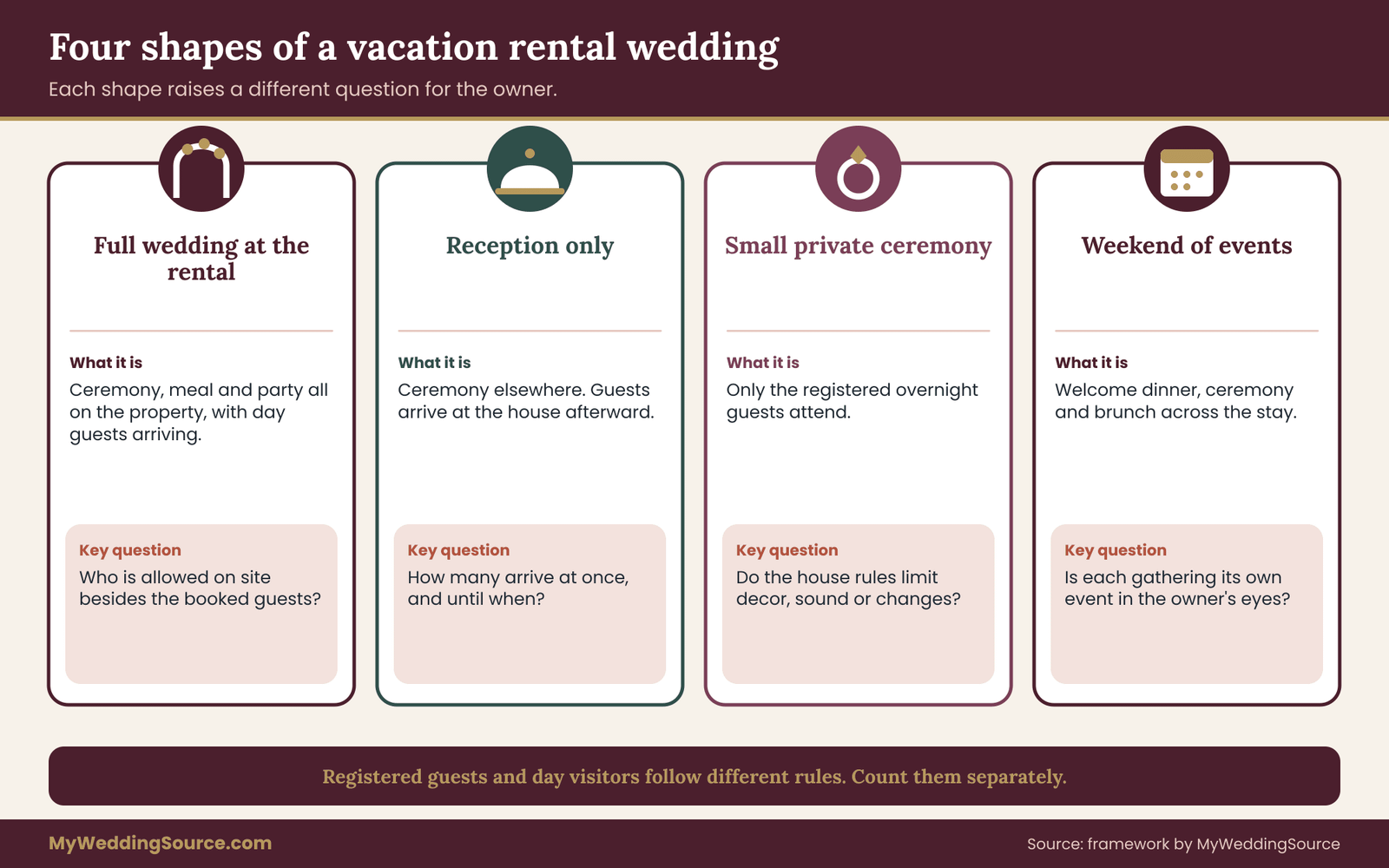
The distinction that matters most is between registered guests and visitors. A booking is usually priced and insured around a stated number of overnight guests. Day visitors, caterers, a band, a photographer and a rental delivery crew are all outside that number. When an owner or a platform says no events, this is the line they are drawing, and it is a reasonable one.
So the first useful step is to write down your real event in two sentences, including how many people will be on the property at the busiest moment and how many hours the vacation rental wedding runs. A vague request such as “a small gathering” gets a vague answer, and a vague answer is worth nothing later if something goes wrong.
Why a vacation rental wedding is a harder request than it looks
It helps to see the problem from the owner’s side, because that explains which answers you can negotiate and which you cannot.
An owner of a short-term rental has built the business around a predictable use. A small group sleeps there, cooks there and leaves. The pricing, the cleaning schedule, the insurance policy, the neighbors’ tolerance and sometimes the local permit all assume that use. A wedding changes nearly every one of those assumptions at once.
Wear on the property. Eighty people moving through a house built for ten is a different kind of use. Floors, lawns, septic systems, hot tubs, furniture and landscaping all take more load than they were planned for. Owners have seen the damage, and many have learned to refuse events altogether. A vacation rental wedding is hard on a house in ways a family holiday is not.
Insurance gaps. A standard short-term rental policy may exclude events, or may cover only a stated number of guests. Some owners would be putting their own coverage at risk by saying yes. Section five below covers how to ask about this without sounding like you are interrogating them.
Neighbors and complaints. A single noise complaint can cost an owner a permit, a platform account or a good relationship with the street. Weddings are loud in ways that a family dinner is not, and the owner remembers who complained last time.
Local rules. Many towns regulate short-term rentals separately from other housing, sometimes with a hard cap on occupants and sometimes with a rule that bars gatherings above a certain size. The owner may be required to comply whether they want to or not. Those rules apply to a vacation rental wedding whether or not the listing mentions them.
None of this means the answer is always no. Some owners run properties built for gatherings, and say so in the listing. Others will agree to a small event under written conditions. The point is that a yes has to come from the person with the authority to give it, and it has to cover the specific event you have in mind.
What a yes usually costs. When an owner does agree, expect conditions: a higher deposit, a cap on guest numbers, an end time, a required cleaning, sometimes a proof of insurance from you or your vendors. These are normal. A host who asks for them is usually protecting a property they care about, and a host who asks for nothing at all may not have thought through the risks, which is a warning in its own right.
Finally, understand what you are not buying. A booking of a house is a lodging contract. It is not a venue contract. A venue usually carries event insurance, staffed support, restrooms sized for crowds, a parking plan and a fire-safety capacity set by the local authority. A vacation home has none of these by default, and each one becomes your job to supply or to confirm.
The rest of this guide gives you a way to check this systematically. It is built around five permissions, scored one at a time, and it ends with a worked case and a list of conditions under which you should stop. If you are still choosing between a rental and a conventional place, the broader venue material compares the options, and you can come back here once the rental is the serious candidate.
The five permissions behind a vacation rental wedding
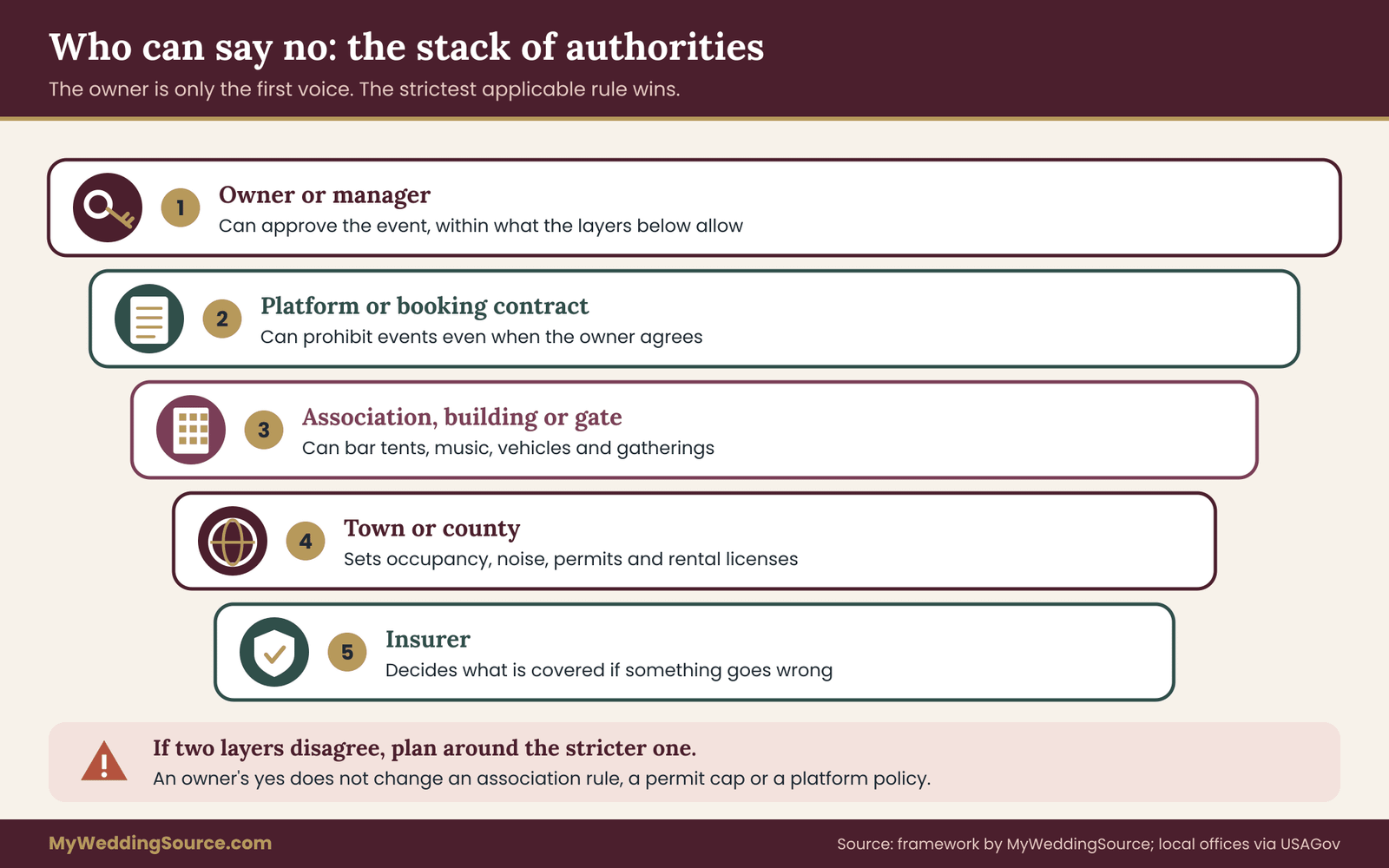
Instead of one big yes, a vacation rental wedding rests on five smaller permissions. Each has a different person who can grant it, and each fails in a different way. Treat them as separate gates, check them in order, and do not pay for anything non-refundable until all five are verified.
Permission one: the owner’s written approval. The person who owns the property, or the manager with delegated authority, agrees to this specific event, on this date, with this guest count. A friendly message in a chat thread is a start. A signed addendum is better.
Permission two: the listing, platform and booking terms. The rules printed in the listing and in the booking agreement, including the house rules, the maximum guests and any clause about parties or events, must not contradict the owner’s yes. Where they do, the stricter text usually controls, and the owner cannot always override a platform rule.
Permission three: association, building and manager rules. A neighborhood association, a condominium board, a gated community or a property management company may bar events or require their own approval, whatever the owner says. The owner may not even realize it applies.
Permission four: the physical and legal limits. Occupancy, fire safety, noise, parking, septic or water capacity, and any local event permit. These are set by the property and by the town, not by the people negotiating.
Permission five: insurance and damage terms. Who insures the vacation rental wedding, what happens if something breaks, how the deposit works, and what the cancellation terms say if any of the earlier permissions fails.
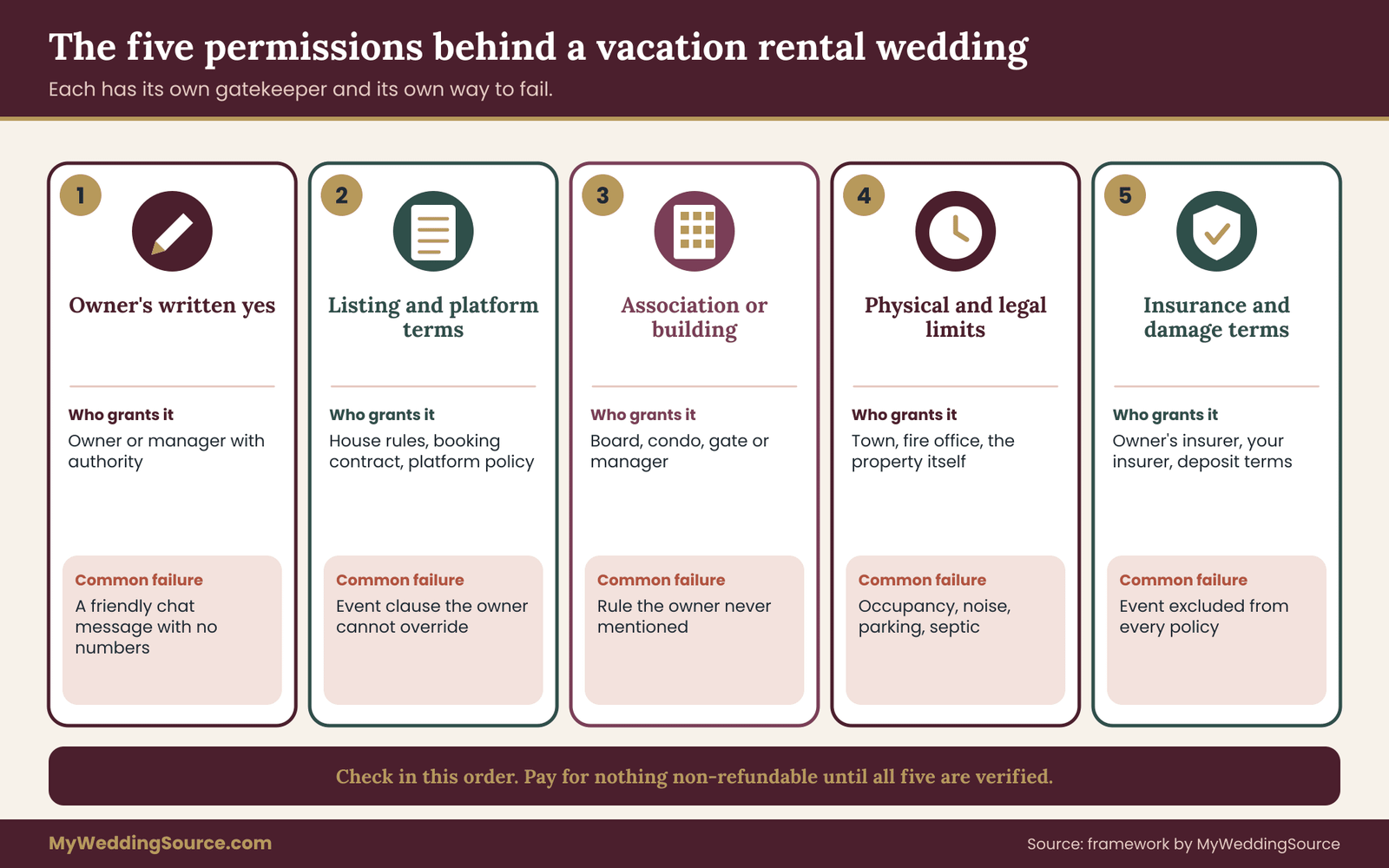
Notice that the order runs from the person you can talk to, the owner, toward the rules that no one can negotiate away. That order is deliberate. It is tempting to start with the dream details such as the tent, the band and the flowers. Resist that. Every vendor you book before the five permissions are in hand is a vendor you may have to cancel.
How to score each permission. Give each one of three verdicts. Verified means you hold written evidence from the party who can grant it. Pending means you have asked and are waiting, with a date by which you will follow up. Missing means you have not asked, or the answer was vague, verbal or from someone without authority. A Pending with no follow-up date counts as Missing. Score every vacation rental wedding the same way, so the results can be compared.
You need five Verified marks to proceed. Anything else is a reason to pause the spending, not a reason to panic. Many Pending items become Verified within a week of a polite, specific message.
Keep one folder. Create a single shared folder with five subfolders, one for each permission, and save every screenshot, email and attachment in it. This matters more than it sounds. When something goes wrong months later, such as a deposit dispute or a neighbor’s complaint, the person with a clear record of who agreed to what is in a far stronger position.
The habit is the same one described in the guide on wedding vendor contracts, where the written terms decide the outcome. One folder per vacation rental wedding keeps the evidence in a single place.
The next five sections take each permission in turn: what to ask, who to ask, what a good answer looks like, and what a worrying one looks like. ## Permission one: the host’s written yes to a vacation rental wedding
Everything else depends on this one, so it gets the most care. The first job is to identify who actually has the authority. On a booking platform, the person messaging you may be the owner, a co-host, a local manager or a company that runs dozens of properties. Ask directly: “Are you the owner, and if not, does the owner approve events through you?” A manager who says yes but cannot show that the owner agreed is giving you an opinion, not a permission.
Ask about the event, not about the house. A common mistake is to write, “Would it be okay if we had some friends over for a celebration?” The owner reads that as a dinner party. Then the real event arrives, and the owner feels misled. Describe it plainly instead: a wedding ceremony and reception, the number of people at the busiest moment, the hours, whether a band or amplified music is planned, whether a tent or other structure will go up, and whether outside caterers are coming.
Say the words vacation rental wedding, or at least wedding, so that nothing is left to interpretation.
Here is a message that works for most situations. Adjust the details, but keep every element.
“We are hoping to hold our wedding ceremony and a short reception at your property on [date], from about [start] to [end]. We expect up to [number] people at the busiest moment, including [number] who are not on the booking. We would use a caterer and a photographer, and possibly a small speaker for the ceremony. We would like to know whether this is something you allow, and if so, what conditions, fees or limits apply. We will not commit to any vendors until we have your approval in writing.”
That message tells the owner you are serious, organized and willing to follow rules. Many owners respond better to honesty than to a vague request they later discover was a wedding.
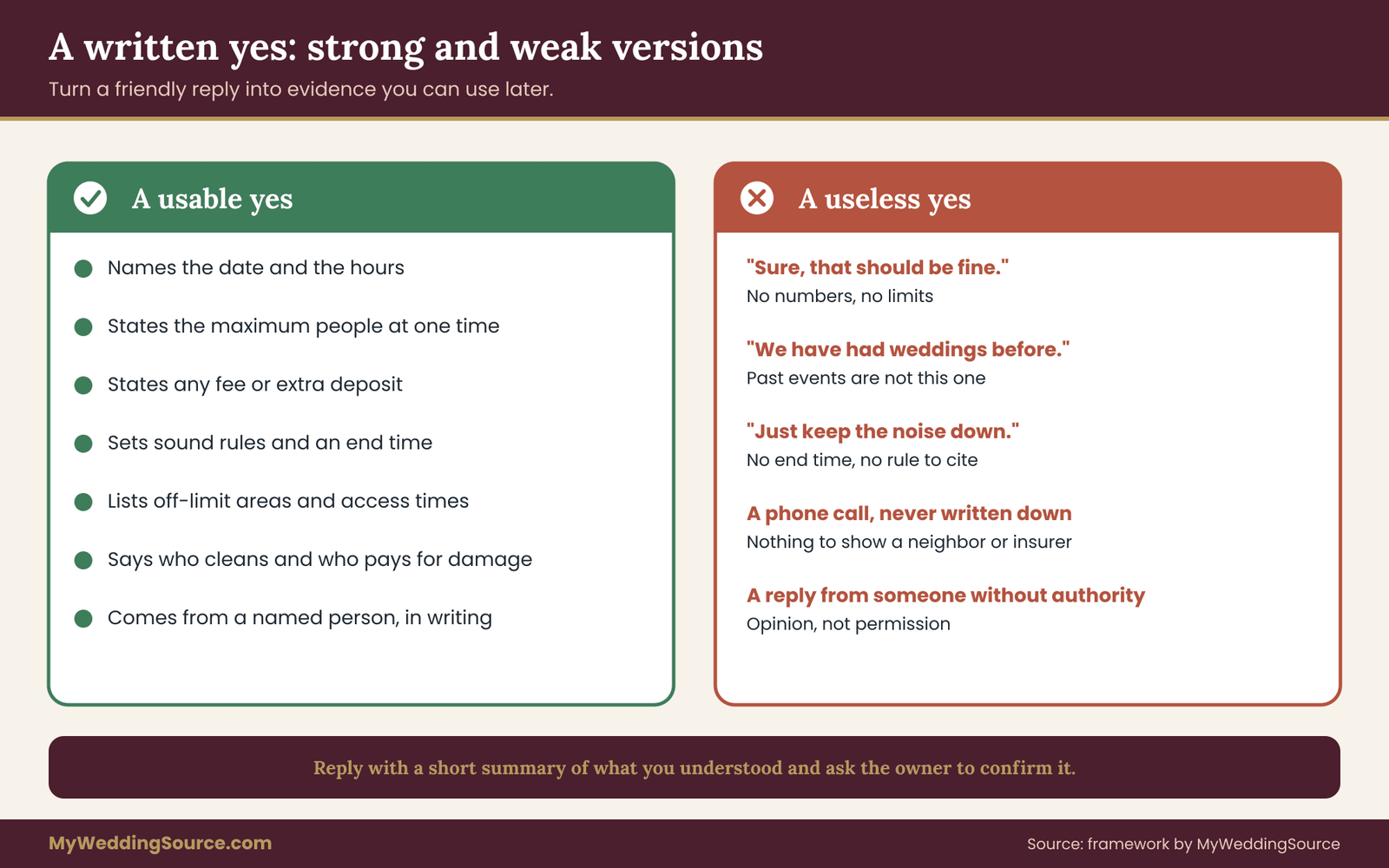
What a good yes looks like. A useful approval states the date and times, the maximum number of people on the property at one time, any fee or extra deposit, rules on sound and end time, areas that are off limits, how setup and teardown access works, who is responsible for cleaning, and what happens if conditions are broken.
It comes from a named person and is in writing, either in the platform’s message thread, in an email, or in a short signed addendum. That is the standard for approving a vacation rental wedding.
What a weak yes looks like. “Sure, that should be fine.” “We’ve had weddings before.” “Just don’t make too much noise.” Each of these is friendly and each is useless as evidence. They leave the guest count, the hours and the money unspecified, and they leave you exposed if a neighbor complains or something is damaged.
Turn a friendly yes into a written one. Reply to the friendly message with a short summary: “Thanks, that is great to hear. To make sure we are on the same page, here is what we understood: [date, hours, maximum guests, any fee, end time, vendor access]. Could you confirm that this is correct, or tell us what to change?” Now the owner only has to type “Confirmed” and you hold a dated record in their own words.
The addendum. For anything above a small ceremony, ask for a one-page event addendum. It does not need to be elaborate. It should name the parties, the property address, the event date and times, the guest cap, the added fee or deposit, the sound and end-time rules, the vendor access arrangements, the cleaning and damage terms, and the cancellation terms if either side backs out.
If the owner has a standard form, ask to see it before you commit to the date. If not, offer to draft a simple one and let them edit it. Offering to do the paperwork is often what turns a hesitant owner into a cooperative one. An addendum is the cleanest record a vacation rental wedding can have.
When the owner is a company. Larger rental operators often have an events team or a fixed policy. In that case, ask for the policy in writing and for the name of the person who can approve exceptions. Do not argue the policy with a front-line agent who cannot change it. Ask whether there is an event-approved property in the same portfolio, which is a common and easy fix. Companies often have a formal route for a vacation rental wedding, so ask where it is.
Red flags in the response. Be careful if the owner agrees to everything instantly without asking a single question about guest count, noise or insurance. Be careful if the answer comes only by phone or text with no way to save it. Be careful if the owner asks you to pay the event fee outside the platform, because that separates the event from any protection the booking terms offer, and it may also break the platform’s rules. In each case, go back to the written route or move on.
Permission two: the listing, the platform and the booking terms
Even a sincere yes from the owner sits inside a booking made on a platform or through a manager’s contract, and those documents have their own text. A vacation rental wedding has to be consistent with that text, not just with the owner’s mood.
Read the whole listing, not only the highlights. The house rules section is usually near the bottom, collapsed or in small type. Look for a maximum number of guests, a statement about parties or events, a quiet-hours rule, a ban on outside guests, limits on decorations, rules about candles or open flame, and any mention of cameras or sound.
Take screenshots with the date visible. Listings change, and your record of the version you booked under may matter later. Any clause that touches parties, guests or noise bears on a vacation rental wedding.
Check how the platform treats events. Large platforms publish their own policies on parties and events, and they can change them. Some prohibit parties outright, some allow hosts to set event rules, and some distinguish between gatherings by registered guests and events with outside attendees. Read the current policy on the platform’s own site rather than relying on a blog post or a forum comment, including this one.
If the owner’s yes seems to conflict with the platform’s text, ask the owner how they reconcile the two. A good host will know. The platform’s position on a vacation rental wedding can differ from the owner’s.
Understand what a conflict means for you. If the platform prohibits events and the owner agrees to one anyway, the owner may be taking a risk on their account, and you may be taking a risk on your booking. A host who is cavalier about that risk is telling you something about how they treat other rules too.
If a complaint reaches the platform, you might face a cancellation, a loss of the stay and difficulty recovering the money. Ask the platform’s support team, in writing, whether a vacation rental wedding with outside guests is allowed at this listing, and keep the reply.
Booking terms and the guest count. The number of guests named on the reservation matters for price, for insurance and for local rules. Do not understate it to get around a limit. Reservations with too few named guests are a classic way for a booking to unravel at the worst moment, such as when a neighbor counts cars or an inspector asks who is there. Give the real numbers and negotiate honestly. A vacation rental wedding always involves more people than a normal stay.
Cancellation and refund terms. Read what happens if the owner withdraws approval, if the platform cancels the stay, if bad weather ruins the plan, or if your guest list changes. Some terms refund most of the lodging payment on an owner cancellation, and some do not. Compare that with the deadlines for your other vendors, because the dangerous situation is a cancelled house with non-refundable caterers and a rented tent already paid for.
A basic rule helps here: do not make any vendor payment that cannot be refunded until you hold the written approval and the terms say what happens if it fails.
Direct bookings and manager contracts. If you booked through the owner’s own website or through a property manager, there may be no platform at all, and the contract is the whole story. Read it as you would read any lease or service agreement. Look at the clauses on use of the property, number of occupants, damage and cleaning, indemnity, and termination.
If something is unclear, ask for a plain-language explanation in writing. For disputes you cannot resolve, a lawyer licensed where the property sits can answer questions that general articles cannot. Treat the contract as the rulebook for a vacation rental wedding.
Payment safety. Pay through the platform or by a method that gives you dispute rights. Be wary of requests to send event fees by a transfer service that cannot be reversed. If a deposit is requested for damage, ask where it is held, what the release conditions are, and when it is returned. Official consumer-protection agencies publish guidance on payment methods and on recognizing scams, and fake listings are a real problem, which is why verifying the host and the property matters before you send money for anything.
Verify that the listing is real. Before you rely on any of this, confirm that the person you are dealing with controls the property. Search the address, compare photos, check that the listing has a history of genuine stays, and be wary of any host who pushes you to move the conversation off the platform. A fake host can give you a lovely written approval for a house they do not own.
Record the conclusion. After reading everything, write one sentence for the folder: “The listing and booking terms [do / do not / do not clearly] allow a vacation rental wedding with outside guests, and the platform support reply says [summary] on [date].” If you cannot complete that sentence honestly, the permission is Pending, not Verified. ## Permission three: associations, buildings and managers behind a vacation rental wedding
The owner can say yes and still be wrong about what they are allowed to approve. Many vacation homes sit inside a layer of private rules that the owner agreed to when they bought, and those rules sit above the owner’s own wishes. A vacation rental wedding in one of these places needs the second layer of consent too.
Neighborhood and homeowner associations. Communities with shared roads, pools or amenities usually have covenants and rules. These can restrict short-term rentals, limit the number of vehicles, ban large gatherings, control exterior structures such as tents, and require notice or a fee for any event. Ask the owner a direct question: “Does the property belong to an association, and have you checked its rules for events?” If the answer is yes, ask for the rules or the contact for the board or the community manager.
A vacation rental wedding in such a community needs the association’s answer, not only the owner’s.
Condominiums and townhouse complexes. Here the walls are shared, and so are elevators, stairs, loading areas and parking. Many buildings require advance notice for deliveries, charge fees for elevator use and ban amplified sound at any hour. A wedding in a unit is a different matter from a stay in one. If the property is in a building, treat the building rules as a second contract and ask for the same written approval. In a building, a vacation rental wedding affects every neighbor on the floor.
Gated communities and private roads. Guards at a gate may only admit people on an approved list. A delivery truck, a band or a shuttle may be turned away. Ask whether the gate can be set to accept a guest list for the day, who submits it, and how far ahead.
Property management companies. A manager may run the home under a contract that limits what the owner can approve. The manager may also have its own damage, cleaning and insurance terms. Ask for the event policy of the company and for the name of the person who signs approvals.
Resort communities and shared grounds. Some vacation homes sit within a resort or a managed community where the grounds, beach access, pool and clubhouse are not part of the rental. The owner cannot lend you areas that belong to someone else. If your ceremony is planned for a lawn, a beach or a deck, confirm that the location is actually part of the property you are renting.
Ask for evidence, not reassurance. An owner who says “the association is fine with it” has given you a belief. Ask for the association’s message, a copy of the relevant rule, or the manager’s approval in writing. The folder for permission three should contain a document from the second authority, not a comment from the owner about it.
Local government and the short-term rental license. Many towns and counties require a permit or license for short-term rentals, and the permit may limit the number of occupants, the number of vehicles or the use of the property for gatherings. This is where a legal question appears that you cannot settle by reading a listing.
The owner should know whether the property is licensed for the number of people you are planning. Ask directly, and ask what the permit says about events. The license may say outright whether a vacation rental wedding is allowed.
USAGov, the federal government’s official portal, can point you to the right local office, and the town or county website usually lists permit categories, events, noise rules and zoning. A single phone call to the clerk’s office, planning department or code enforcement office, made with the address in hand, often answers a question that an owner cannot. Write down the date, the name of the person you spoke with and what they said, then ask them to send a short confirming message if they can.
Special event permits. A wedding on private property may or may not need a permit, depending on the town, the size and the features of the event. Triggers sometimes include a tent over a certain size, amplified sound, alcohol service, street parking or road closures, open flame, cooking equipment, and temporary structures. Ask the local office a simple question: “We are considering a private wedding of about [number] people at [address].
Is any permit, notice or inspection required for the vacation rental wedding, the tent or the sound?” Then ask who is responsible for filing it, the owner or you. Ask whether a vacation rental wedding of your size triggers one.
Alcohol. The rules around serving alcohol at a private event differ widely between states and localities. Some require the caterer or bartender to hold a license and carry coverage, some require a temporary permit, and some limit what hosts can do. A host’s rental booking does not usually change those rules. If you plan a bar, ask the state alcohol authority or the local office about it early. The guide to wedding bar service planning covers the planning side, and the local rules cover the legal side.
What if the rules conflict? Sometimes the owner approves, the association prohibits and the town says nothing. The strictest applicable rule is the one that matters, because the strictest authority can enforce it. Do not go forward on the theory that no one will notice. A complaint from a neighbor is how most of these rules get tested, and the damage lands on your guests, your vendors and your deposit.
Neighbors, honestly. You are not required to ask permission from the people next door in most places, but it is good manners and good strategy to tell them. A short note a few weeks ahead, with the date, the hours and a phone number, turns many potential complaints into a friendly nod. Ask the owner whether they already have a relationship with the neighbors, and whether any of them has complained about gatherings in the past.
A house with a history of noise disputes is a poor choice for a wedding whatever the rules say. A quiet word before a vacation rental wedding costs nothing.
Scoring permission three. It is Verified when you hold a written statement from every private authority that applies, or a written statement from the owner that none applies together with the owner’s own evidence, and when the local office has told you whether any permit or notice is required. It is Pending when you are waiting on any of those. It is Missing when you have not asked, and that is the most common failure.
Permission four: occupancy, noise, parking and safety at a vacation rental wedding
The fourth permission is not given by any person. It is a set of physical and legal limits that the property and the town impose, and no amount of friendliness from the owner can move them. A vacation rental wedding that ignores them is an accident waiting to be reported.
Occupancy. Rentals are usually limited by the number of overnight guests, often tied to bedrooms and to the septic or sewer capacity. Separately, fire codes limit how many people may be inside a building at one time, and these limits depend on the use, the exits and the floor area. A living room that sleeps four comfortably may be unsafe with fifty people standing in it.
Ask the owner, and where in doubt the local fire marshal or building office, what the safe number is for indoor and outdoor areas. Occupancy is the first limit a vacation rental wedding runs into.
For the indoor limit, think about the worst weather case. If your ceremony is outdoors and it rains, can everyone fit inside? If the honest answer is no, you need a tent, a second location or a smaller guest list, and each of those has its own approvals.
Noise. Many places have quiet hours, often starting in the evening, and some set decibel limits measured at the property line. Amplified music, a DJ and a band are the usual causes of complaints. The U.S. Environmental Protection Agency publishes general information about noise and its effects, though the enforceable rules are local. Ask the town what the limit is, and ask the owner what time they require the music to stop. Plan the schedule around the earlier of the two times. Noise is the second.
A practical approach is to move the loud parts of the day earlier. A late-afternoon ceremony, a meal and dancing that finishes at a sensible hour work far better in a residential area than a party that runs past midnight. If dancing is important, a shorter dance block at a sensible hour keeps the neighbors on your side.
Parking and access. Count the cars. Eighty guests are not eighty cars, but they might be thirty-five. Ask where those cars will go. Streets in residential areas often ban event parking, and an owner whose guests block a driveway across the road will hear about it. A shuttle from a nearby lot or hotel, or a ride-hop arrangement, can solve the problem.
Also consider emergency access: a fire truck or ambulance must be able to reach the house, so do not let a tent, a food truck or a line of cars block the way. Parking is the quiet problem behind many a vacation rental wedding.
Fire and life safety. The National Fire Protection Association and the U.S. Fire Administration publish guidance on safety for gatherings, candles, heating and cooking. For a house, the practical checks are plain. Are smoke and carbon monoxide alarms working? Are exits clear? Are candles and open flame allowed by the house rules and by the local fire office? Is a heater or a fire pit part of the plan, and is it permitted? Are extension cords overloaded? Keep fire extinguishers visible, and know where they are.
Water, septic and restrooms. A house with two bathrooms and a septic tank can be overwhelmed by a crowd. If the property is on septic, ask the owner what the system can handle, and whether portable restrooms are allowed and where they would go. The cost of a few rented restrooms is trivial compared with the cost of a failed septic system, which an owner can bill to you under the damage terms.
Power. A kitchen circuit and a few outdoor outlets cannot run a band, a caterer’s warming equipment and string lights at once. Ask vendors for their power needs, add them up, and talk to the owner about circuits. If a generator is the answer, find out whether it is allowed and where it can stand, because exhaust and noise are both concerns.
Pools, hot tubs and water. If the property has a pool, hot tub or pond, decide in advance who supervises it, whether it is open during the vacation rental wedding, and whether the owner’s terms require a fence, a cover or a closure. Alcohol and water are a risk combination, and an owner will want to see that you have thought about it.
Accessibility. Not every guest can climb stairs, cross gravel or use a small bathroom. The Americans with Disabilities Act website explains accessibility requirements for public spaces, and a private rental house is not held to the same standards as a venue, but your guests’ needs still matter. Walk the route from parking to the ceremony site and to the restroom, and decide whether a ramp, a path surface or a seat is needed.
Scoring permission four. Verified means you hold figures for safe occupancy, noise limits and end time, parking and access, and restroom capacity, each from the owner or the local office, and your plan fits inside them with a margin. Pending means a figure is missing. Missing means you are guessing. ## Permission five: insurance, deposits and damage terms for a vacation rental wedding
The last permission is about what happens when something goes wrong. A vacation rental wedding concentrates risk: guests who are not registered, vendors with equipment, alcohol, open flame, children and a property that belongs to someone else. Insurance and damage terms decide who pays, and the time to read them is before the contract is signed, not after the first claim.
The owner’s policy. Ask the owner a direct, non-accusatory question: “Does your insurance cover a vacation rental wedding with outside guests, or should we arrange our own coverage?” Some owners carry policies written for short-term rentals that exclude events or limit the number of occupants. Others require guests who host events to buy a temporary policy.
The owner may not know the answer, in which case ask them to check with their insurer or agent and report back in writing. Do not guess. The owner’s policy is the first place a vacation rental wedding can run into trouble.
Platform protections. Booking platforms may offer damage protection or liability coverage for hosts and guests. These programs usually have stated limits and exclusions, and events or unregistered guests are often among the exclusions. Read the actual terms on the platform’s site. Do not assume that a protection program written for a family holiday applies to a wedding.
Your own coverage. You may be able to buy a one-day event liability policy. These are commonly sold for private events and they typically cover bodily injury and property damage claims from guests, sometimes with an optional rider for alcohol. Terms, limits and exclusions differ, so compare them in writing. The National Association of Insurance Commissioners and your state insurance department explain how coverage works and how to check that a company is licensed.
The central point is that general articles cannot tell you what a particular policy covers. Only the policy text and a licensed agent can. If a policy requires the property owner to be named as an additional insured, ask the agent how to do that and what it costs.
Vendor insurance. Caterers, bartenders, rental companies, tent installers, bands and photographers working on private property often carry their own liability coverage and can provide a certificate of insurance on request. Some owners require certificates from every vendor before the vacation rental wedding. Ask the owner whether they do, and collect the certificates early, because vendors may need several days to produce one. The planning habits are the same as in the site’s material on vendor due diligence.
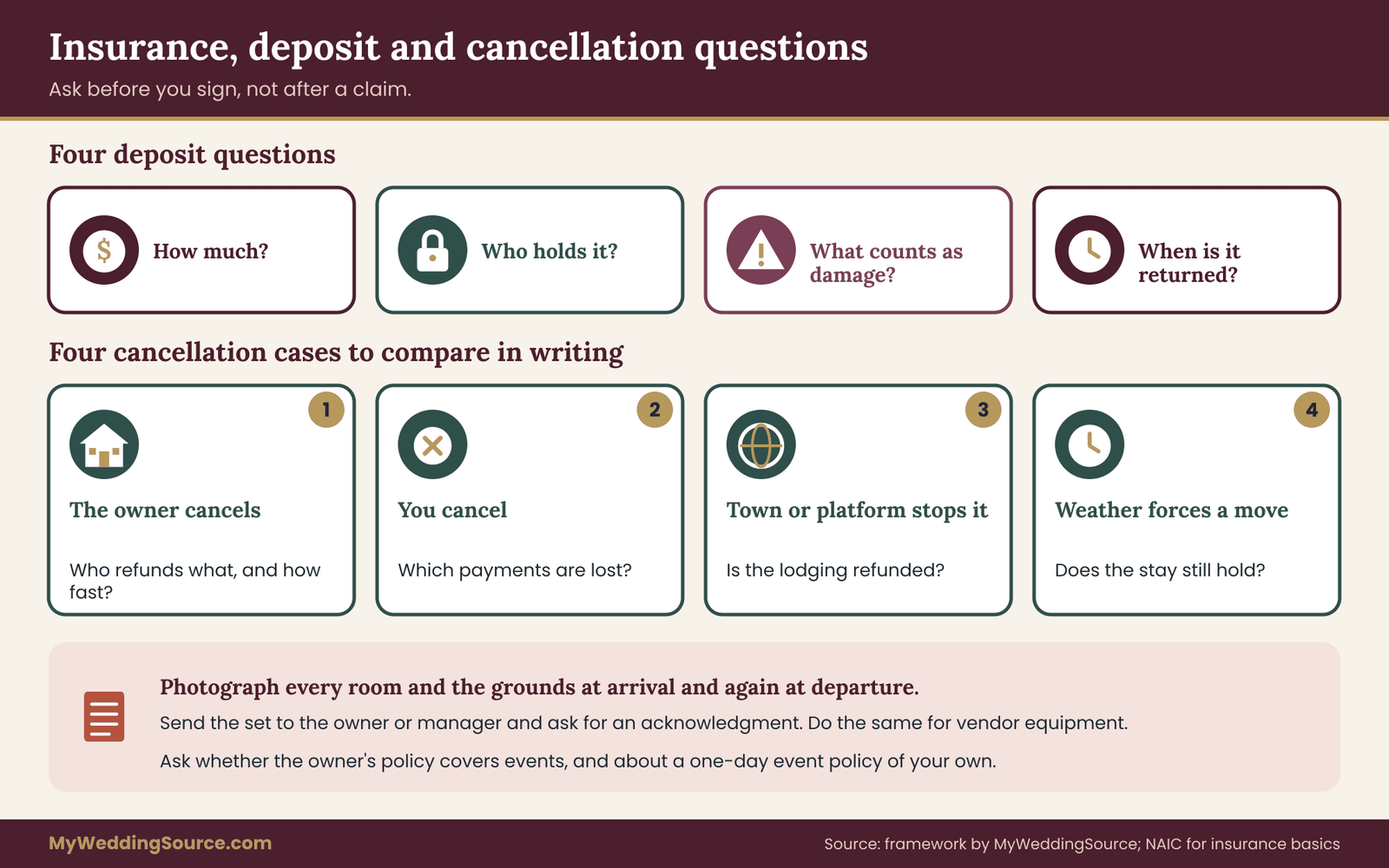
Damage deposits. A deposit is normally held against breakage, extra cleaning, rule violations and missing items. For an event, owners often raise it. Ask four questions. How much is it? Where is it held and by whom? What counts as damage, and how is it assessed? When is it returned, and what evidence will the owner provide for any deduction? A vague answer on any of these is a risk. Expect the deposit for a vacation rental wedding to be higher than for an ordinary stay.
Document the condition. The simplest protection for a deposit is a record of what the property looked like before you arrived. On arrival, photograph or video every room, the lawn, the furniture, the pool area and any existing damage, with timestamps. Send the set to the owner or manager by message and ask them to acknowledge it. At departure, repeat the process. The same habit applies to vendors who bring equipment into the home.
Cleaning. Standard cleaning fees assume ordinary use. After a vacation rental wedding there is often much more to clear: food, trash, glassware, rental delivery material, tape residue and mud. Ask the owner what is included, what an extra cleaning costs, and whether a deep clean is required. If the property is left in a worse state than the terms allow, the owner may deduct charges, and you want to know the rate beforehand.
Trash and recycling. Eighty guests generate far more waste than a household bin can hold. Ask about pickup days, the size of the containers, and whether the owner allows rented dumpsters or hauling. The material on wedding waste reduction helps with cutting the volume, but the real constraint is the property’s capacity and the municipality’s schedule.
Cancellation terms. Compare four scenarios against the written terms. The owner cancels. You cancel. The platform or town stops the vacation rental wedding. Weather forces a move. In each, ask who keeps what, and how quickly refunds are paid. A time-limited approval, such as one valid only if the association signs by a certain date, should be written down with that condition and a clear refund if it fails. A vacation rental wedding has more ways to fall apart than a normal booking.
Liability and responsibility. Reading the owner’s documents carefully, you may find an indemnity clause, which says that you will cover the owner’s losses arising from your vacation rental wedding. These clauses are common and can be broad. Do not sign one you do not understand. For anything beyond a small ceremony, a short consultation with a lawyer in the state where the property sits is a sensible expense, because the rules about liability and damages differ by state and you are not a lawyer, and neither is this article.
Alcohol liability. If alcohol is served, ask your insurer and your caterer about host liability and about who is licensed to serve. In some places, a host who serves alcohol can be held responsible for harm caused by an intoxicated guest. A licensed and insured bartender is one way to reduce that risk, and so is a clear end time for service.
Scoring permission five. Verified means you have a written answer on the owner’s coverage, your own or a vendor’s coverage that fits the vacation rental wedding, a deposit amount with a stated release rule, a condition record method, and cancellation terms that cover each of the four scenarios. Pending means one or more of these is waiting for a reply. Missing means none of this has been discussed, which is far more common than couples admit.
The event-permission verification checklist for a vacation rental wedding
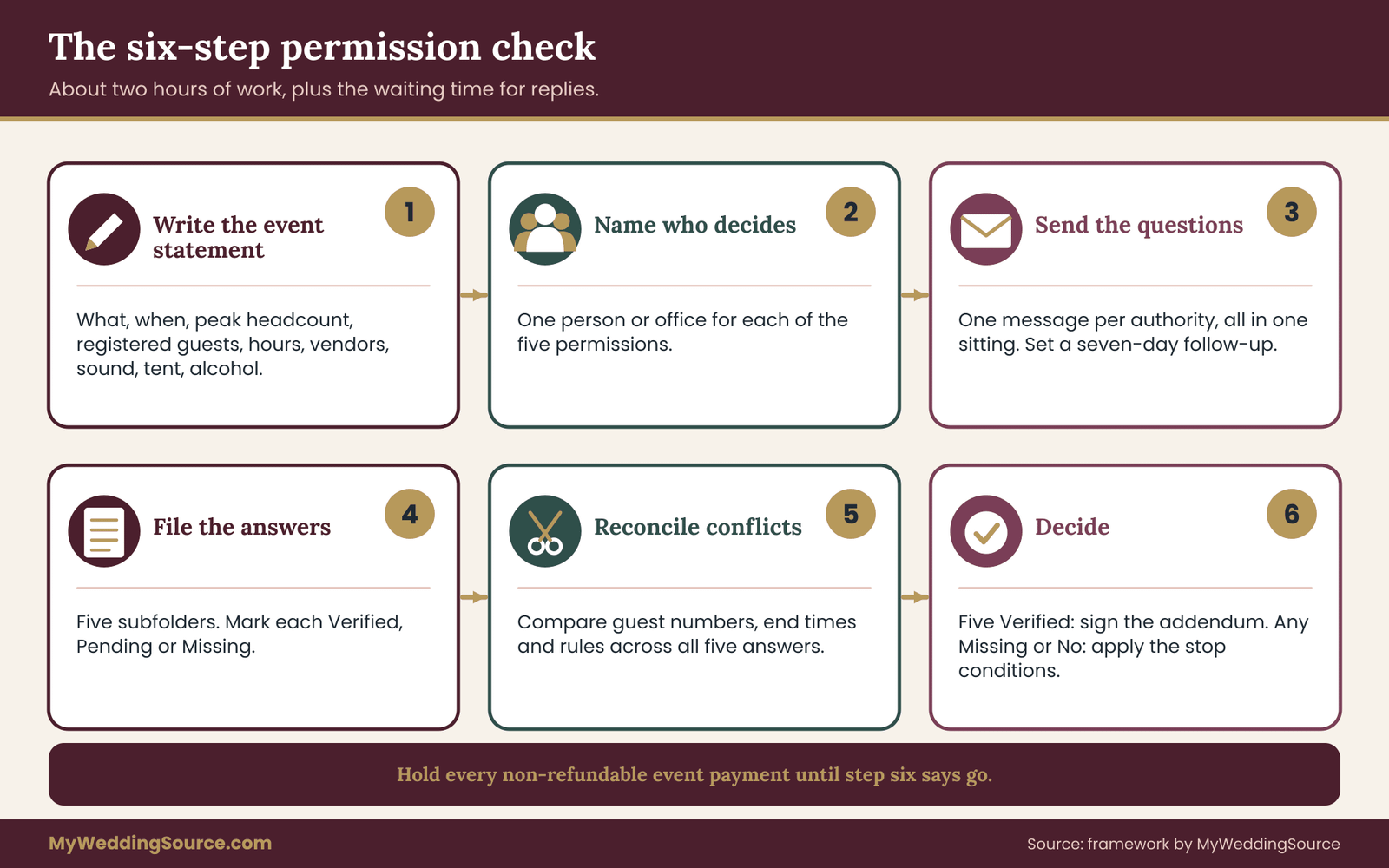
You now have the five permissions. This section turns them into a single checklist you can run in about two hours, plus the waiting time for replies. The point is to leave you with a decision you can defend, not a vague sense of reassurance.
Step one: describe the event in writing. Write a two-sentence description: what, when, how many at the peak, how many on the booking, hours, vendors, amplified sound, tent or structure, alcohol. This is your “event statement”. Use it in every message so that every party answers the same question. This is the foundation of every vacation rental wedding approval.
Step two: identify the authorities. For each of the five permissions, list the actual person or office who can grant it. Owner or manager. Platform support or contract. Association, building or gate. Town or county office. Insurer or agent. Put names and contact routes beside each.
Step three: send the questions. Use the scripts below, one per authority, in a single sitting, so that replies arrive together. Set a follow-up date seven days out in your calendar.
Step four: file the answers. Save each reply in the matching subfolder. Mark each permission Verified, Pending or Missing, and note the date.
Step five: reconcile the conflicts. Read the five answers side by side. Do the guest numbers match? Do the end times match? Does the owner’s yes sit inside the association’s rules? Resolve every mismatch in writing before moving on.
Step six: decide. All five Verified: proceed to the owner’s addendum and then to vendors. Any Pending: set a deadline and keep vendor spending refundable. Any Missing or any No: apply the stop conditions in the last section. The decision should be one you could explain to a vendor, a parent or the owner.
Scripts for the other authorities. For the association or manager: “We have booked [property] for [dates]. We would like to hold a private wedding with up to [number] people on [date] from [start] to [end]. Does your community or building allow this, and what notice, fee or conditions apply? Please reply in writing so we can share it with the owner.”
For the town or county: “We are considering a private wedding of about [number] people at [address] on [date]. Does the location require any permit, notice or inspection for the vacation rental wedding, a tent or amplified sound, and does the short-term rental permit allow a gathering of this size?”
For the platform support team: “The listing for [property] has a maximum of [number] guests and [quotes the relevant rule]. The owner has said they are willing to approve a wedding of [number] people. Is an event with outside guests allowed at this listing, and what would we need for our booking to remain protected?”
For the insurer or agent: “We are planning a private wedding at a rented house with about [number] people, a caterer, a band and [alcohol or none]. What coverage would we need, what would it cost, and does the property owner need to be named?”
A time budget. If you send the messages on a Monday, expect most replies by the following Monday. Associations and local offices can take longer, and insurers vary. Allow two to three weeks for the whole check if you have a date in mind, and longer if the property needs a permit. This is a reason to start before you announce the date, not after.
A rule on money. Do not pay any non-refundable event-related deposit, other than the lodging booking itself under its stated cancellation terms, until all five permissions are Verified. If the date forces you to book the house first to hold it, choose the most flexible cancellation option and put the event conditions into the booking message immediately. It is the simplest rule in a vacation rental wedding budget. ## Vendors, guests and logistics at a vacation rental wedding
Once the five permissions are Verified, the work shifts to making the day run inside a house that was never designed for it. This is where a vacation rental wedding differs most from a booked venue: nobody on site is paid to solve your problems, and every limit you accepted in the approvals now shapes what a vendor can do.
Give every vendor the approval summary. Send each vendor the property address, the owner’s conditions, the guest cap, the access and setup times, the end time and the sound rules. Vendors who have worked in homes will ask good questions: where can the truck stop, where is the water, how far is the power from the work area.
Vendors who have only worked in ballrooms may not, and that is worth noticing. Ask each of them how they handle a site without a loading dock, a staffed kitchen or a house manager. Vendors price a vacation rental wedding differently from a venue wedding, and the summary explains why.
The planning questions in the guide on venue technical walkthroughs apply here with extra force. Measure the doorways, the path from the delivery point to the setup area, the ceiling heights, the ground slope and the distance to power and water. Do it with the owner’s permission, ideally at a pre-event visit, and share the notes with every vendor who needs them.
Catering in a home kitchen. A residential kitchen may be fine for finishing and plating, but it is rarely suited to full-scale cooking for a crowd. Ask the caterer whether they cook off-site and bring food in, whether they need refrigeration space, whether they bring their own warming equipment, and how many circuits that equipment draws.
Agree who cleans the kitchen and what the owner expects to see afterward. Some caterers are licensed for off-premises service and some are not, and local health rules can require it. Catering is the vendor decision that most shapes a vacation rental wedding.
Rentals and delivery. Tables, chairs, linens, tents and dance floors arrive on a truck and are placed by a crew. Ask the rental company for the delivery window, the access they need, the weight of heavy items, and whether the ground can bear them. Lawns, septic fields and irrigation lines are easy to damage, and the owner will deduct for repairs.
The checklist on wedding rental planning covers delivery, damage terms and pickup in more detail, and those points matter more on someone else’s grass. Delivery is where a vacation rental wedding most often damages the lawn.
A tent changes the permission picture. It may need a permit, an inspection or a fire-retardant certification, and stakes can strike buried lines. Ask the owner where utilities and sprinklers run, and ask the tent company how it marks and protects them. If ground stakes are not allowed, weighted bases are an alternative, and the company should say so before you book.
Sound. A ceremony speaker with a handheld microphone is a different request from a full DJ setup. If the permissions limit amplified sound, say so to the musicians and the officiant right away. Some musicians can work acoustically, and a string trio on a patio is rarely the cause of complaints. A band that cannot turn down is not a fit for a quiet residential street, and finding that out in the permission stage is far cheaper than finding it out on the day.
Photographers and video. Photographers need to know about light, space and any restricted areas. Make sure the owner agrees that bedrooms, closets and personal items are off limits for portraits, because a getting-ready scene in someone else’s bedroom is a privacy matter. The owner may have cameras of their own on the property, and the rental terms usually disclose where. Ask, and keep guests out of any area covered by a monitored device.
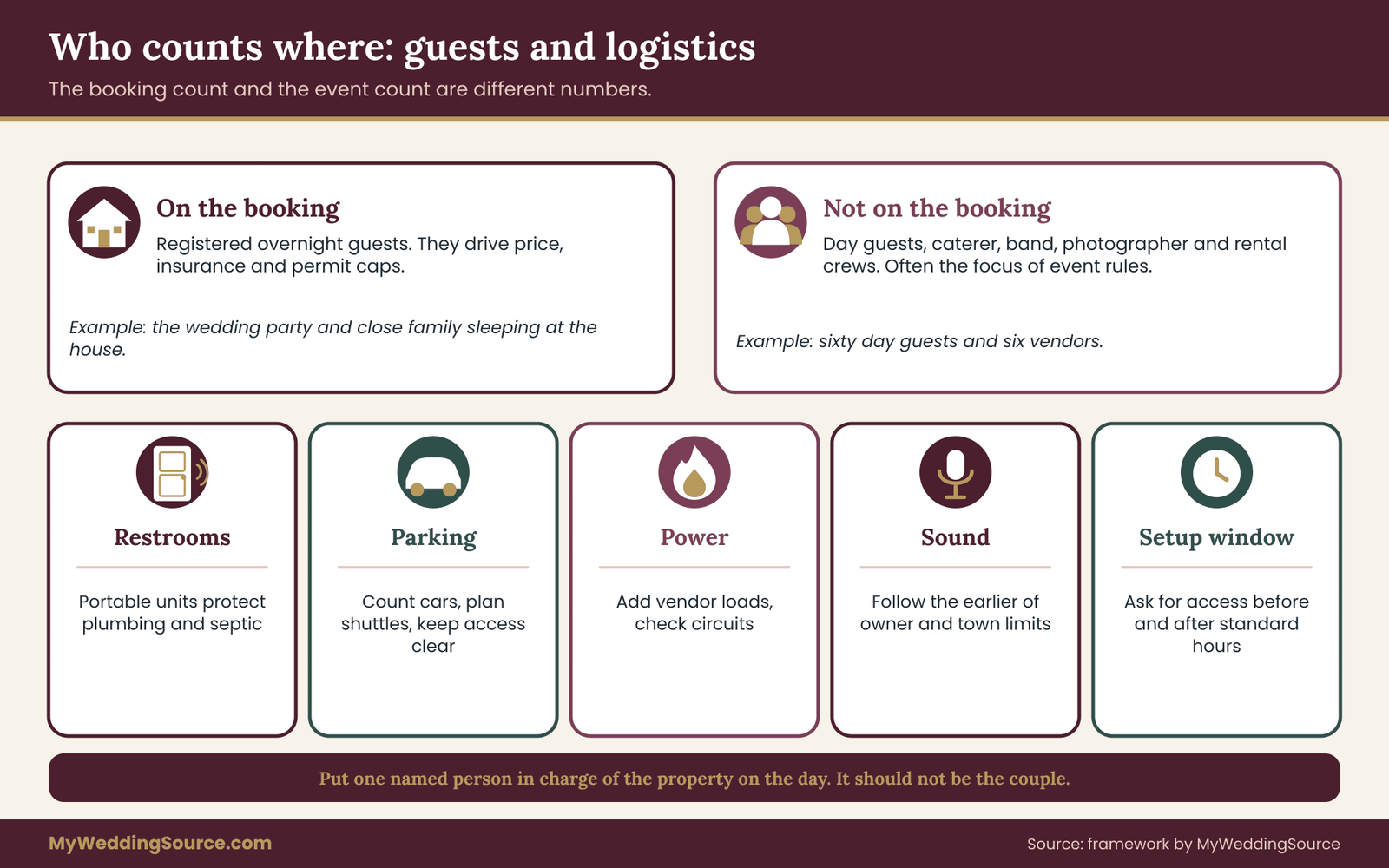
The guest list and the booking count. Decide who sleeps at the house and who does not. Only registered overnight guests count toward the booking, so a wedding party of ten sleeping there and sixty day guests arriving later are two groups with different rules. Share the guest cap with the person managing your list, and keep to it. The principles in the guide to the wedding guest list help you decide who must be invited when the property forces a smaller number.
Where everyone else sleeps. Day guests and out-of-town visitors need rooms elsewhere, and a rental house cannot hold everyone. Hotels near the property solve this, but a wedding weekend in a small resort town can fill them fast. The lessons in the material on coordinating guest hotels across budgets and mobility needs apply directly: book blocks early, offer a range of prices, and account for guests who cannot manage stairs or long walks.
Transportation. If the property is remote or parking is limited, plan shuttles from hotels or a central lot. Write the pickup times on the invitation or the guest website, and tell the shuttle company about the narrow roads, the gates and the turnaround space. Guests who leave after drinking need a safe ride, and the end time you agreed with the owner should leave time for them to depart without a crowd at the door.
Restrooms. Portable restrooms, with an accessible unit among them, are often the single best investment for a vacation rental wedding. They protect the plumbing and the septic system, and they keep guests out of bedrooms. Ask the owner where they can go, and tell the supplier about access and ground conditions. No vacation rental wedding should rely on two household bathrooms.
Staffing. Someone on your side should be in charge of the property that day, and it should not be you. A friend or family member, or a day-of coordinator, can greet vendors, watch the clock, handle the owner’s rules and call the owner or manager if something goes wrong. Give that person the folder, the contact list and the authority to say no. The same logic as larger events applies, even at small scale: one named person, one clear job list.
The pre-event walkthrough. Visit the property a week or two before, if the booking allows it, with the main vendors or at least with a floor plan. Confirm the setup zones, the walking routes, the power points, the trash area, the restroom location, the parking layout, the quiet hours and the owner’s off-limits list. Photograph everything, and send the owner a short message summarizing what you agreed. Even a short visit makes a vacation rental wedding less of a guess.
Setup and teardown windows. A rental booking normally has check-in and check-out times. A wedding needs earlier access for setup and later access for teardown, and the owner may not be able to provide it if another guest is staying. Ask for the specific hours, and pay for an extra night if it removes the pressure. A rushed teardown is when things get broken.
The leave-no-trace standard. Aim to leave the house cleaner than you found it. Assign a cleanup team, supply bags, brooms and a vacuum, and walk the property with the owner’s checklist before you leave. Photograph the final state. The same record that protects you at arrival protects you at departure.
When the day goes wrong. Weather, a late vendor, a complaint, a power failure. Write the contact numbers for the owner, the manager, the platform, the caterer and the local non-emergency line on one sheet, and give it to your day-of lead. If a neighbor complains, the response should be polite, immediate and specific: lower the volume, move the music indoors, or end the party earlier, and thank them afterward.
That response is worth more than any argument about who is right. Every vacation rental wedding has a moment like this, and a sheet of numbers handles it. ## A worked case: one vacation rental wedding, five permissions
The following example is invented for illustration. It is not a real couple, a real property or a real legal result, and the specific numbers are only there to show how the checklist works. Your own figures will differ.
The situation. Priya and Daniel want to hold a ceremony and dinner for forty people at a lakeside rental house in a small town. The listing sleeps ten. They have an October date in mind and a budget that makes the house attractive compared with local venues. They find the listing in a platform search, and the photos show a wide lawn and a covered deck.
Step one: the event statement. Priya writes it down: “Ceremony at 4 p.m. on the lawn, dinner on the deck and in a tent, ending at 9:30 p.m. About forty people at the peak, ten of whom are staying. A caterer, a photographer, a string duo and a rental company. Wine and beer served by a licensed bartender. A 20-by-40-foot tent.”
Step two: the authorities. The owner is a person living in another city, with a local manager who handles keys. The platform is a large booking site. The house is in a lakeside association. The town has a short-term rental permit rule. Insurance comes from the owner’s policy, and Priya will ask about a one-day event policy.
Step three: the messages go out on a Monday. Priya sends the owner the script from permission one. She asks the platform’s support team the question from the checklist. She emails the association’s manager. She calls the town’s planning office and writes down what she hears. She emails an insurance agent.
Step four: the replies. Over about ten days, the picture builds.
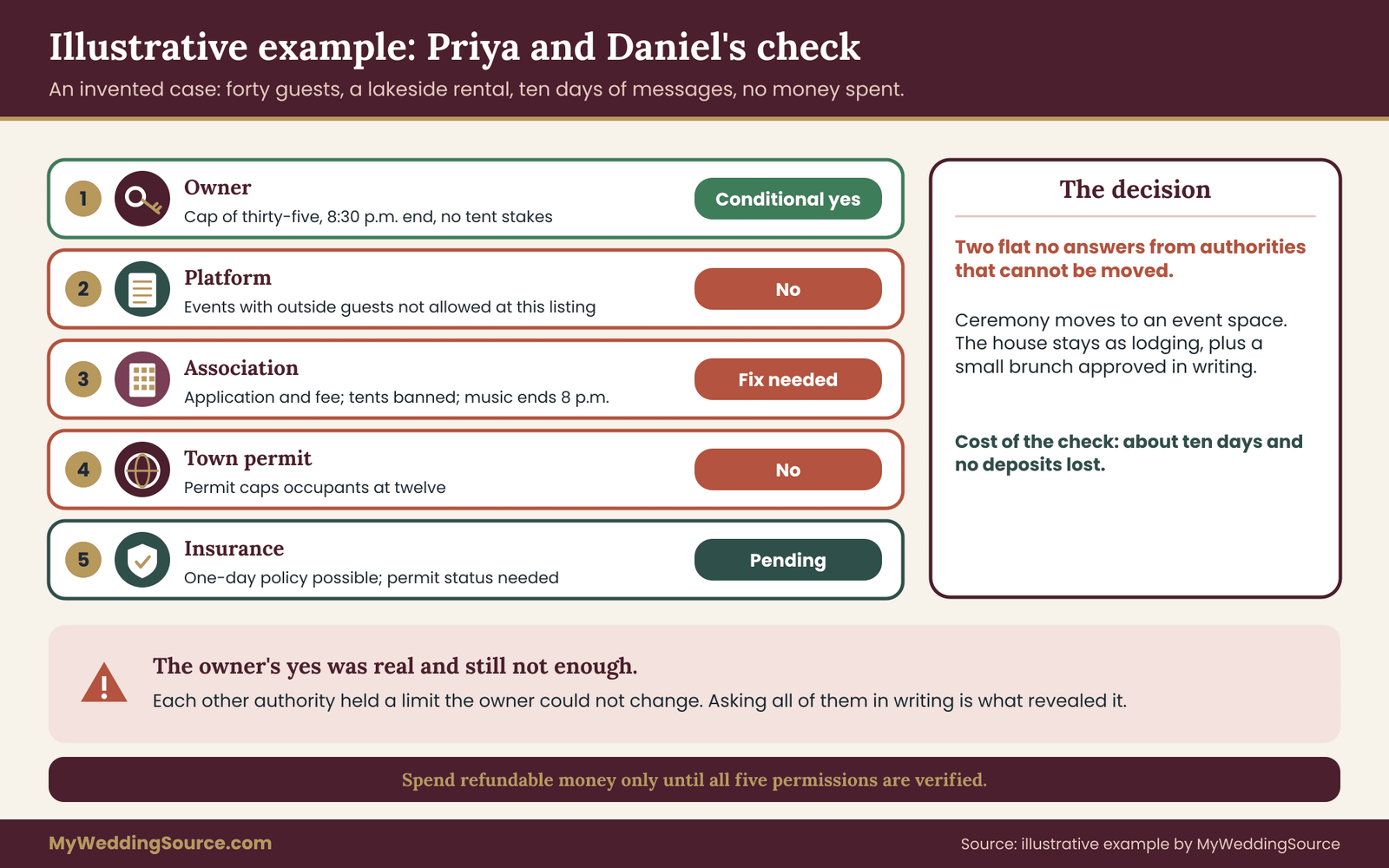
The owner is friendly and replies within a day: “We have had small events before and it has been fine. Forty is a lot, though. Let me check with my manager.” This is Pending, not Verified. Priya answers with the summary message, and three days later the owner confirms a cap of thirty-five people, an 8:30 p.m. end time, a higher deposit and no tent stakes.
The platform’s support team replies that events with outside guests are not permitted at listings that do not state otherwise, and that hosts cannot override this. This is a problem. The owner’s yes is not enough for permission two.
The association’s manager replies that events above twenty-five people need a written application and a fee, that tents are not allowed on lakefront lots, and that music must end at 8 p.m.
The town’s planning office says the short-term rental permit for the property allows a maximum of twelve occupants at any time, and that a gathering above that number would violate the permit.
The insurance agent explains that a one-day event policy is available, but that the owner’s policy exclusions and the platform’s terms still apply, and that the insurer would want to see the property’s permit status.
Step five: the scoring. Priya sets out the five permissions in the folder.
Permission one: the owner’s approval is Verified for the owner’s own conditions, though it conflicts with the rest. Permission two: Missing in effect, because the platform says no. Permission three: the association’s rules give a tent ban and an 8 p.m. music end, which contradict the owner’s tent plan. Permission four: the occupancy cap of twelve in the permit conflicts with forty guests, and this is a legal limit, not a negotiable one. Permission five: insurance is Pending on the permit status.
Step six: the decision. Under the stop conditions, any permission that is a flat no from an authority that cannot be moved is a stop. Two are. The couple does not argue with the town or the platform. They move on.
What the exercise did was cheap and fast. They spent about ten days and no money. They avoided paying for a tent, a band and a caterer for a house that could never lawfully hold the vacation rental wedding. Without the check, the first sign of trouble would probably have been a neighbor’s call to the town on the wedding day.
What they did next. Three options followed from the findings.
First, a much smaller version at the house: twelve people for the ceremony and dinner, within the permit, with a larger celebration later in another place. The owner would likely agree and the platform issue would be lighter, since the gathering would be close to the registered guests. They would still ask in writing.
Second, a venue that allows events, with the house as lodging for the wedding party only. This is a common and tidy split: the property does what it is built for and the venue does the rest.
Third, a property marketed for weddings, with an event policy, a stated capacity and event insurance already in place. These cost more per night but often cost less overall once the tent, restrooms, parking and legal risk are counted.
They chose the second. The house was kept as a lodging base for the immediate family, the ceremony moved to a nearby event space, and the farewell brunch stayed at the house with a small group, which the owner approved in writing.
What the example shows. The yes from the friendly owner was real and still not enough. Each of the other authorities held a limit the owner could not change. Only by asking all of them, in writing, did the couple find out before spending money. And the cost of the check was an afternoon of messages. The vacation rental wedding never happened at the house, and that was the right result.
A variation worth knowing. Suppose the platform had said events were allowed with the host’s approval, the association had no event rules, and the town’s permit allowed forty occupants. Priya would then have moved to permission four’s practical checks: the septic limit, the restroom plan, the parking count and the noise rules. Many weddings clear the legal gates and then fail on physical limits. The sequence handles both.
Alternatives to a vacation rental wedding, and the conditions that mean stop
Some answers are no, and the useful response is a better plan, not a louder request. If a permission fails, match the alternative to the gate that failed.
If the owner says no. Look for a property that advertises events. Many rental homes and estates are set up for weddings, with a stated capacity, an event policy, a coordinator and the right insurance. Ask the owner whether they know of a nearby property that allows events. Some owners run several homes and will point you to one. A no to a vacation rental wedding is not a no to the house as lodging.
If the platform says no. Book directly with an owner who has an events policy, or choose a venue. Do not run the event outside the platform’s rules while keeping the booking, because a policy breach can cancel the stay with the event still ahead.
If the association or building says no. Move the vacation rental wedding off the property and keep the lodging. The house can host the getting-ready, the rehearsal dinner for a small group, or the farewell brunch if rules permit. Ask in writing which gatherings are allowed.
If the occupancy or noise limits say no. Reduce the guest list for the house and hold a larger gathering later in a place that fits. A small ceremony at the house with a bigger reception somewhere else is a common solution. The guidance in how to cut a guest list is useful if the number has to shrink.
If insurance says no. Buy a one-day policy, or move to a venue that carries its own. Do not go uninsured and hope.
If money is the reason you want the house. Compare the whole cost, not the nightly rate. Add the tent, the restrooms, the generator, the delivery fees, the extra cleaning, the damage deposit, the shuttle, the added insurance and the staff time. A venue that looks expensive can cost less once everything is counted. A simple side-by-side budget can help you lay out both options side by side. Few couples price a vacation rental wedding honestly before they commit.
The stop conditions. Stop and change the plan if any of the following is true.
- The owner or the manager will not put the approval in writing.
- The platform or contract prohibits events and no one with authority will amend it.
- An association, a building or the town sets a limit below your guest count and will not change it.
- The property cannot hold the crowd safely in bad weather.
- You cannot get an answer on insurance or damage terms.
- The host pushes you to pay outside the platform or to understate the guest count.
- A Pending permission has no deadline and no reply after two follow-ups.
- Any vendor you need cannot work within the sound, access or power limits.
Any one of these is enough. You do not need all of them. A stop is not a failure. It is a cheap result produced by a careful check, and it means you caught the problem before it cost you the deposit, the vendors and a Saturday.
What you do not need to do. You do not need to give up the house altogether. A vacation rental can still be where the wedding party stays, where the families gather the night before or where a quiet brunch happens the next morning, and those uses are usually welcome. Many of the best weddings pair a proper venue with a rental house for the people who love it most. ## Your next steps
Work through these in order, and stop at the first step that fails.
- Write the event statement: what, when, the peak headcount, how many are registered guests, the hours, the vendors, any amplified sound, tent or alcohol.
- Read the listing’s house rules and the platform’s current event policy. Take dated screenshots.
- Message the owner with the event statement and the request for written approval. Turn any friendly reply into a written summary and ask for confirmation.
- Ask whether an association, building, gate or manager applies. Request their rules and their written approval.
- Ask the town or county office about occupancy, noise, permits and the short-term rental license for the address.
- Ask the owner, the platform and an insurance agent about coverage, the damage deposit and cancellation terms.
- Score the five permissions in your folder as Verified, Pending or Missing. Set a follow-up date for each Pending item.
- Hold every non-refundable vendor payment until all five are Verified. When they are, get the one-page addendum signed and brief your vendors.
- If any stop condition applies, move the wedding to a venue and keep the house as lodging or for a small gathering.
If the rental is still one option among several, the broader material on choosing a place, starting with the venue options on this site, can help you compare it against a conventional venue before you spend more time on approvals.
FAQ
Can you legally host a wedding in an Airbnb or other vacation rental?
It depends on the owner, the platform, any association and the local rules, so there is no single answer. Many listings prohibit parties and events, and some towns limit occupants at licensed rentals. Treat a vacation rental wedding as allowed only when the owner, the listing terms, any association and the town all permit it in writing for your specific date and guest count.
Is a friendly message from the host enough approval?
Usually not. A message like “sure, that should be fine” leaves the guest count, hours, fees and conditions unstated. Reply with a short summary of the date, times, maximum guests, fees and end time, and ask the host to confirm. For anything beyond a small ceremony, ask for a one-page signed addendum so both sides hold the same terms.
What should I ask the host before I plan a vacation rental wedding?
Ask whether they own the property or manage it for someone else, whether events with outside guests are allowed, the maximum number of people at one time, any extra fee or deposit, quiet hours and end time, areas that are off limits, vendor access and setup hours, and whether their insurance covers an event. Put your event description in the first message.
Do the number of guests on my booking matter?
Yes. Price, insurance and local occupancy rules are often tied to the number of registered overnight guests, and day visitors and vendors are separate. Understating the headcount to get around a limit can void protections and lead to a cancelled stay. Give the real numbers, and negotiate a cap and conditions honestly instead.
Will the booking platform protect me if something goes wrong at the event?
Do not assume so. Platform damage and liability programs have stated limits and exclusions, and events or unregistered guests are often excluded. Read the current terms on the platform’s own site, ask support in writing whether a vacation rental wedding is allowed at the listing, and consider a one-day event liability policy from a licensed insurer.
Do I need a permit for a vacation rental wedding?
Possibly. Requirements depend on the town and on features such as tents, amplified sound, alcohol, parking and the guest count, and the property’s short-term rental license may cap occupants. Call the local clerk, planning or code office with the address and ask directly, then ask whether the owner or you must file anything. USAGov can help you find the right office.
What if the owner says yes but the neighborhood association says no?
The stricter rule controls in practice, and the association can enforce its covenants against the owner and the vacation rental wedding. Do not go ahead on the assumption that no one will notice, because a neighbor’s complaint is how these rules are usually tested. Ask the association for its position in writing, and move the event if it will not agree.
What is a good alternative if the rental cannot host the wedding?
Hold the ceremony and reception at a venue that allows events, and use the rental as lodging for the wedding party or for a small brunch if the owner agrees in writing. You can also look for a rental property that advertises weddings, with a stated capacity, event policy and insurance. Compare the full cost before choosing.
Sources
- USAGov: find local government offices and services
- Airbnb: current party, event and house rules policies
- Vrbo: current host and traveler policies
- National Association of Insurance Commissioners: insurance basics and licensing
- National Fire Protection Association: fire and life safety for gatherings
- U.S. Fire Administration: fire safety information
- U.S. Consumer Product Safety Commission: generator, heater and fire safety
- ADA.gov: accessibility information
- U.S. Environmental Protection Agency: noise information
- Federal Trade Commission: consumer scam and payment guidance