
A maternity wedding dress is any wedding gown you buy, order or alter while your body is changing, and the whole job comes down to two things: how much the maternity wedding dress can change with you, and how much money you lose if it cannot. This guide gives you a four-checkpoint measurement plan, a ladder of return-policy questions and one worked case, so you can shop with a clear head instead of a guess.
Pick a dress that can flex (lacing, ties, a forgiving cut) and keep the final decision as late as the seamstress allows. Measure yourself at four checkpoints: at purchase, at the midpoint, at the pre-final fitting and at the final fitting. Ask every shop who owns the risk of a size change before you pay. Do not allow a permanent cut until the return window has closed or a checkpoint tells you the size has settled. Ask your own clinician about anything medical.
Most advice about a maternity wedding dress is about style: empire waists, wrap bodices, which necklines flatter a bump. That matters, but it is not where people lose money or sleep. The trouble starts with logistics. Gowns are often ordered months ahead, altered in the last weeks, and sold under return rules written for a body that stays the same size. A pregnancy does not follow that script, so the paperwork and the calendar have to be adjusted instead.
This article covers that logistics layer. It does not try to pick a silhouette for you or to tell you how your body will change, because that varies from person to person and from pregnancy to pregnancy. It treats the maternity wedding dress as a small project with deadlines, measurements, a seamstress and a seller, and it gives you a way to run that project when one input, your measurements, will not hold still.
A note on scope. This is general information, not medical, legal or financial advice. Your own clinician is the right person for anything about your health, your body and your pregnancy, and the shop’s written terms and your state’s consumer rules are what govern a purchase. Where a rule matters, this guide points you to the office or agency that publishes it.
What a maternity wedding dress plan has to solve
Take an ordinary dress purchase and list its assumptions. The body is one size when the gown is ordered. It is the same size at the fittings. It is the same size on the day. Alterations are done once, to a fixed target. Returns, if allowed at all, happen before the cut. Every one of those assumptions can break in a pregnancy, and a maternity wedding dress plan exists to catch the breakage early and cheaply.
Think of it as four separate problems that happen to arrive together.
A measurement problem. Some measurements will change, some may stay close to where they were, and you cannot know ahead of time which is which. A bodice that fits at the bust and ribcage may be tight over the belly, or the reverse. The plan has to track several points, not one dress size.
A timing problem. Measurements taken at the order date may be out of date by the delivery date, and the final fitting may be too early or too late to reflect the day itself. The plan has to decide when each measurement is taken and when it stops mattering.
A policy problem. Most bridal sellers write their terms for a standard purchase. Made-to-order gowns are frequently final sale, deposits are often non-refundable, and alterations usually end any right to return. The plan has to find out what the terms actually say before you pay, not after.
A comfort and safety problem. A maternity wedding dress that fits the measuring tape can still be wrong for the day if you cannot breathe, sit, eat, walk or use the bathroom in it. What counts as comfortable or safe for your body is a clinician question, not a tailoring one. The plan leaves room for that advice instead of replacing it.
Why the usual dress timeline fails
The standard advice for a dress is to order many months ahead, schedule fittings in the final weeks and finish a few days before the wedding. That advice works because the body at the order date and the body at the wedding are close enough for a seamstress to bridge the gap.
For a maternity wedding dress that gap may be much wider, and it is not predictable. If the order happens early, the measurements on the order form describe a body that will not be the one wearing the maternity wedding dress. If the order happens late, the dress may arrive too close to the date for a seller to fix a problem. Neither choice is wrong. They simply carry different risks, and the plan’s job is to make the risk visible and priced.
The site’s guide to wedding dress fit and alterations explains the ordinary sequence of ordering, fittings and pressing. Use that for the baseline. This article adds only the parts that change when the body is changing.
What this guide does not decide for you
It does not tell you what size to expect, what you will feel, or when your body will change. It does not say what is safe to wear, how long to stand or whether a corset-style closure is appropriate for you. Those are questions for your obstetric clinician, midwife or other care provider, and the American College of Obstetricians and Gynecologists publishes patient information on pregnancy that is a reasonable starting point for the conversation.
It also does not rank shops or sellers. Policies differ, change, and are written in the documents they hand you, so the method here is to read and question those documents rather than to trust a reputation.
The measurements that move
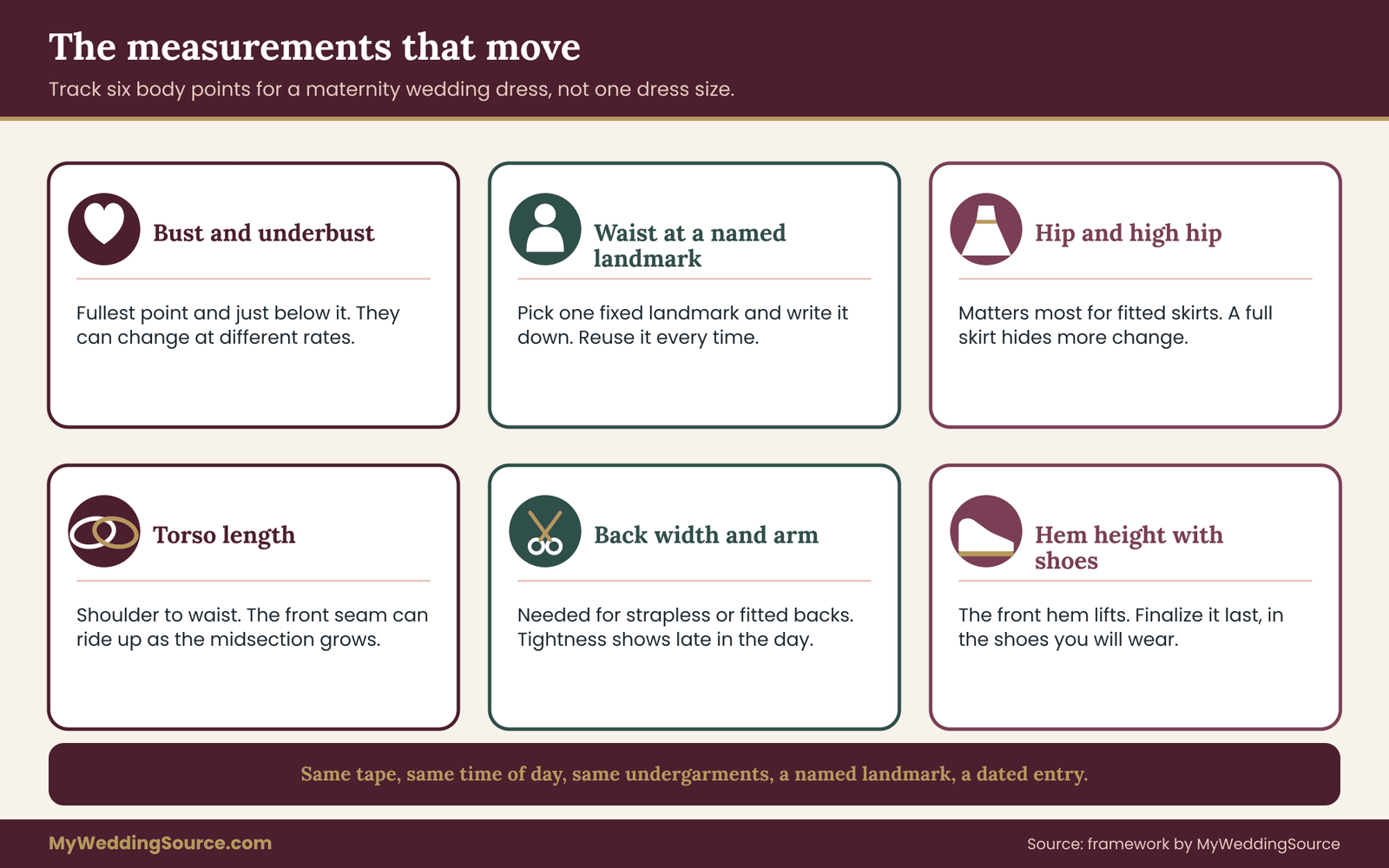
Before you plan around change, it helps to know which measurements a gown actually depends on. A fitted dress is built around a handful of body points, and each behaves differently when a body is changing. You do not need to predict how they will move. You only need to know what to watch.
Bust and underbust. The bust measurement drives the cup area of a fitted bodice. The underbust, the measurement just beneath the bust, sets how a bodice sits against the ribcage. Both can change, and they do not always change together, which is why one number is rarely enough.
Waist and midsection. The natural waist is the narrowest part of the torso. Around the midsection, a pregnancy may make a defined waist hard to find, so a more reliable method is to measure at a fixed landmark, for example a set number of finger-widths below the bust, and to write down which landmark you used.
Hip and high hip. Hip measurements matter for skirts that fit closely, such as sheath or mermaid cuts. A full A-line skirt hides most of the change. A fitted skirt does not.
Torso length. The distance from shoulder to waist, and from waist to hip, decides where a bodice seam lands. A growing midsection can shorten the visible length at the front, so a bodice that sat well may ride up.
Back width and upper arm. These are less talked about, but a strapless or fitted-back design relies on them. A tight band across the back is a comfort problem that often shows up late in the day.
Hem length. The hem is the measurement most people forget. A growing belly lifts a skirt at the front, so a hem that looked even at the first fitting may be short at the front and long at the back. The hem should be finalized with the shoes you will wear and at the latest practical fitting.
Why a single dress size is a poor guide
Gown sizes are a rough label based on a size chart, and many seamstresses ignore the label and work from the body. A pregnancy can make the gap wider, because the size you order may be based on the largest measurement, while the maternity wedding dress may need to be smaller or larger at other points. If a seller offers only whole sizes, ask what the size chart is based on and which measurements it follows.
This matters for returns as well. If a shop sells you a size by your largest measurement and the other measurements fall well below the chart, the alteration may need to take in a lot of fabric. That work is real and costs real money, and it is the usual reason a cheap-looking gown turns into an expensive one.
Why you track points, not a size
The practical consequence is simple. Keep a short log of the same body points over time and ignore the size label. The log lets your seamstress see direction and speed of change, which is what they need for a plan, and it lets you compare a quote from two shops on the same inputs. The log is also your evidence if a dispute arises about what was measured when. Later sections show how to keep it.
A word on what you can safely ignore
You do not need to take every measurement a tailor might want. A long list of numbers that you measure badly is worse than a short list measured carefully. Start with bust, underbust, waist at a named landmark, hip, torso length and hem height with shoes. Add back width and upper arm if the design is strapless or fitted at the back, and add anything else your seamstress asks for.
Also set expectations about your own effort. Measuring yourself well takes about ten minutes, two or three times over the course of the project, and it is far cheaper than discovering a fit problem after a cut. The method is plain, and the next sections show how it fits with the design, the alterations and the policy.
Choosing a maternity wedding dress by how it can change
A good maternity wedding dress is not defined by a label. It is defined by how many ways it can be adjusted after you buy it. Two gowns at the same price can differ sharply here, and the difference is almost always in the construction, not in the look. Learn to read construction and you can compare dresses on a fair basis.
Start with the closure. This is the part of the gown that holds it on your body, and it sets how much the maternity wedding dress can flex.
Lace-up and corset backs. A lacing panel can be loosened or tightened over a range, which makes it the most forgiving of the common closures. It also needs a modesty panel or lining behind it so the lacing does not show skin you did not plan to show. Ask whether the lacing runs the full length of the bodice or only part of it, because a short panel gives a smaller range.
Tie backs, sashes and wrap styles. These adjust at the waist or across the bodice and tend to forgive changes in the midsection. They offer less control at the bust and underbust, so check those points separately.
Zipper closures. A standard zipper is fixed. It can only be moved by a seamstress, and only within the fabric that is available. If the zip is the only closure, the gown has the least tolerance for change.
Buttons and loops. A row of buttons behaves like a fixed closure in practice, because moving each button is slow work. Some designs add a hidden elastic panel behind the buttons, which can help.
Hook-and-eye or hidden elastic panels. A stretch insert at the side or back adds forgiveness without changing the look. Ask the seller to show the panel and explain whether it was designed in or added afterward.
The cut and the fabric
Beyond the closure, the cut of the maternity wedding dress decides how well it hides change.
An empire waist sits just under the bust and releases fabric below it, so the midsection has room. A full A-line skirt is more forgiving at the hip than a fitted one. A wrap bodice adjusts with the wrap. A separates set, a top and a skirt, lets you change the size of each half independently, which can be a real advantage if the top and bottom change at different rates.
Fabric matters too. Stretch crepe and jersey give a little. Heavy satin, structured brocade and stiff taffeta hold their shape and give nothing, so they punish small changes. Lace over a stretch base is common and flexible, while lace over a rigid base is not. Ask what the base layer is, not just the visible fabric.
A boned bodice, built with stiff strips along the seams, holds a shape and is hard to alter. A bodice without boning, or with a soft structure, is easier to adjust and easier to wear for hours. Boning also affects comfort around the ribs, which is an area where a clinician’s advice about what is comfortable for you is worth having.
Seam allowance: the hidden resource
When a gown is made, extra fabric is often left inside the seams. That extra fabric, called seam allowance, is what a seamstress uses to let a maternity wedding dress out. Some gowns carry generous allowance, and some carry almost none, especially if they are cut close to the final size or sewn by machine with the fabric trimmed to save material.
You cannot see seam allowance from the outside. You can ask about it. A good seamstress or experienced shop assistant can look inside a gown and say roughly how much there is at the bodice side seams and at the back. Ask that question at the first appointment, and write down the answer. A dress with almost no allowance is a risk for a maternity wedding dress unless it has a flexible closure to make up for it.
A quick rule for ranking flexibility
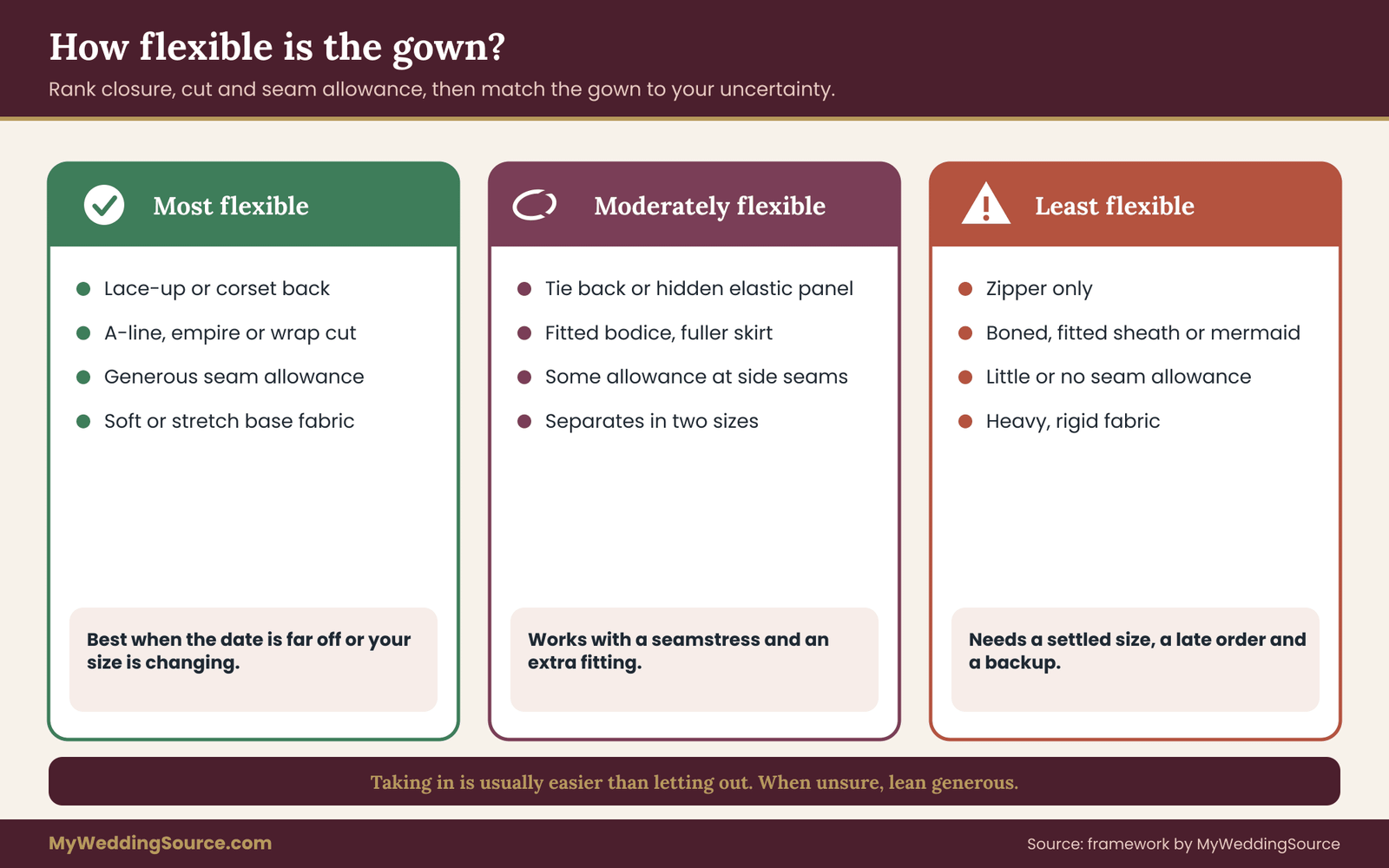
When you compare dresses, give each a plain rank on three things: closure range, cut forgiveness and seam allowance. Do not assign numbers to compare unlike things. Instead, sort the dresses into three groups: most flexible, moderately flexible and least flexible. A lace-up back with an A-line skirt and generous allowance sits in the first group. A boned, zipped sheath with little allowance sits in the last.
The point of the ranking is to match the maternity wedding dress to the uncertainty you face. If your wedding is a few weeks away and your size is fairly settled, a less flexible gown may be fine. If the date is months out or the body is changing quickly, put the flexible group at the top of your list, and treat the least flexible group as a choice that needs a backup plan.
Sample gowns, stock gowns and made-to-order gowns
The way a gown is supplied changes both the flexibility and the policy.
A sample gown is the shop’s try-on piece. It may be sold at a reduced price and is often final sale. It can be taken home quickly, which helps if time is short. Because it has been tried on many times, check the condition and any marks, and ask what has already been altered.
A stock gown is a ready-made gown in the shop or the maker’s warehouse. It ships fast and may be returnable under a clear policy, which suits an uncertain size.
A made-to-order gown is produced after you order, often to measurements taken at the order date. It can have the best fit for a stable body, and the longest lead time. For a maternity wedding dress, a long lead time is the main danger, because the maternity wedding dress is cut to a body that has changed before it arrives. If you choose this route, ask whether the order can be adjusted after production begins, and what each adjustment costs.
What alterations can and cannot do
Alterations are the safety net under a maternity wedding dress, so it pays to know how far the net stretches. A seamstress is a skilled person with fabric, thread and limits. The limits are not about skill. They are about material, time and how the gown was built.
Taking in and letting out are not equal
Taking a maternity wedding dress in is usually the easier direction. The seamstress removes fabric or moves a seam inward, and the extra material can often be trimmed or tucked away. Letting a gown out is harder. It depends on how much seam allowance is available, and when there is none, the only fix is to add fabric, a panel or an insert, which changes the look and the price.
That asymmetry should shape your size decision. If you are unsure whether you will be larger or smaller at the wedding than at the order date, the safer choice is a maternity wedding dress that is a little generous, because it can be taken in. A gown that is too snug at the start has nowhere to go.
Common adjustments and what they involve
Bodice takes in or lets out. This is the most common change, and it affects boning, lining, lace and any beading along the seams. The more embellishment along the seam, the more work and the higher the cost.
Adding a corset panel or lacing insert. A seamstress can sometimes replace a zipper with a lacing panel or add a panel behind an existing zipper. It gives a wide range but changes the back of the dress, and it needs enough structure at the back to hold a panel.
Adding side or back inserts. A strip of matching fabric or lace can be set into a side seam or the back to add width. A good match makes it nearly invisible, and a poor match makes it obvious.
Strap and neckline changes. Straps can be shortened, lengthened or replaced. Moving a neckline is a bigger job and can affect the whole bodice.
Hem changes. Hem work is common and is usually done last. Lace hems, layered tulle and horsehair trim add time and cost. Because the belly changes the front hem, schedule hem work as late as the seamstress can manage.
Bustle work. A bustle lifts a train for dancing. The points that hold it are tied to the structure of the skirt, so a change in how the maternity wedding dress sits at the hip can shift them. Check the bustle at the final fitting, not just the earlier ones.
What alterations usually cannot do
There are several things that a seamstress will often decline or warn against.
If a gown has no seam allowance and no flexible closure, it may not be possible to let it out by more than a small amount without rebuilding it. If the fabric is delicate or heavily beaded at the seams, repeated alterations can damage it. If a maternity wedding dress is a sheath or mermaid cut and the change is mostly at the midsection, the shape of the skirt may no longer work, however it is altered.
Some changes are also simply out of scope. A seamstress alters the dress. A seamstress cannot make a maternity wedding dress comfortable for a body in a situation the dress was not designed for, and they are not the right person to judge whether a closure is appropriate for your health. Take comfort and safety questions to your clinician.
The site’s guide to wedding day accessories planning covers the items that travel with the maternity wedding dress, from undergarments to emergency repair supplies, and is worth reading alongside the fitting plan.
Cost logic without invented numbers
Alteration prices vary widely by region, by shop and by the complexity of the gown, and any figure printed here would be a guess. Use cost logic instead. The price of an alteration usually follows three drivers: the amount of fabric involved, the number of layers, and the amount of beading, lace or boning that has to be undone and replaced.
That means two simple rules. First, ask for a written estimate for each likely adjustment, not a single lump sum, so you can compare them. Second, ask what happens to the estimate if a second round of changes is needed, because a maternity wedding dress is more likely than most gowns to need one. A shop that includes a second fitting in the price may be a better value than one that quotes less and charges per visit.
Who does the alterations matters
Some boutiques have an in-house seamstress. Others send gowns to a partner, and some leave it to you to find someone. An in-house service can be convenient and may keep the work under the shop’s guarantee. An independent seamstress may have more experience with unusual fabrics and be more flexible about timing.
If you use an outside seamstress for a gown bought elsewhere, ask the seller first whether outside work voids any return or warranty term. Many sellers say it does. That tradeoff is the subject of a later section on the point at which a return stops being possible.
The four-checkpoint plan for maternity wedding dress alterations
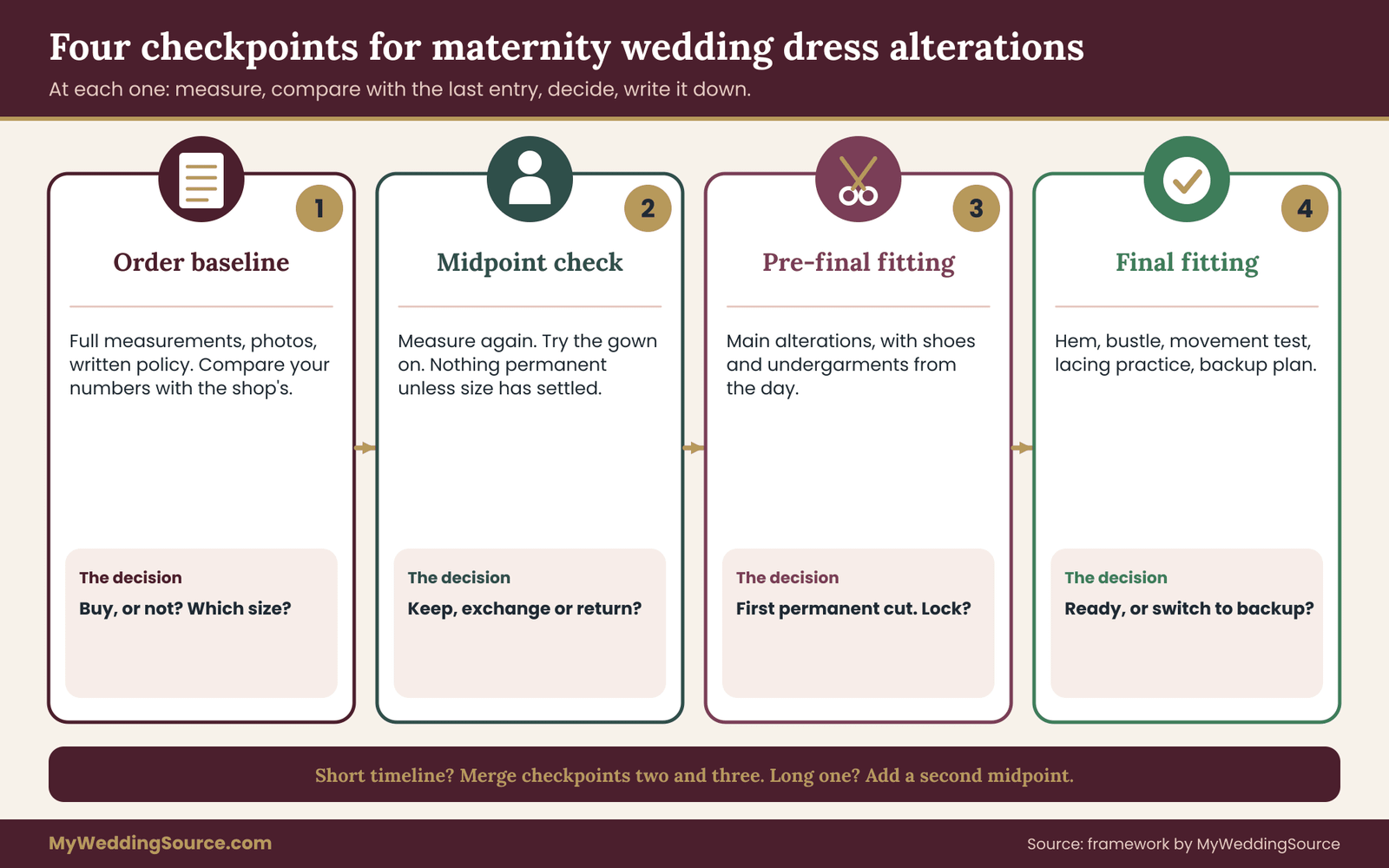
The core of this guide is a simple structure: four fixed checkpoints, each with a purpose, a set of measurements and a decision. The plan for maternity wedding dress alterations works because it replaces a vague “we will see how it goes” with dates and rules. At each checkpoint you measure, compare with the last log entry, and decide whether to proceed, adjust or stop.
The checkpoints are named by purpose, not by date, because your dates depend on your wedding and your seamstress. A later section shows how to place them on a calendar.
Checkpoint one: the order baseline
This happens when you pick the maternity wedding dress and before you pay a non-refundable deposit. Its purpose is to record your starting measurements, to learn the seller’s terms and to choose a dress that matches the level of uncertainty you face.
Take the full measurement set (bust, underbust, waist at a named landmark, hip, torso length, hem height with shoes) and date it. Ask the seller to measure you as well, and compare the two sets. A difference of more than a small amount means one of you measured badly, and it is worth fixing now. Photograph yourself in the try-on gown from the front, side and back, because a photograph shows where fabric is pulling.
The decision at checkpoint one is whether to buy, which size to buy and whether to size up for a take-in. The default rule is to order the size that fits the largest of your measurements and ask the seamstress to plan for a take-in, but the right choice depends on how fast the maternity wedding dress can be made and how much time is left.
Checkpoint two: the midpoint check
This is a mid-project measurement, taken after the dress arrives or about halfway between the order and the wedding. Its purpose is to see direction and speed. If measurements have moved a lot since the baseline, the plan needs more flexibility. If they have moved little, the plan can be simple.
At this checkpoint the maternity wedding dress is tried on, but nothing permanent is done unless the size is clearly settled. The decision is whether the gown still fits the range the seamstress can work with, and whether the return or exchange window is still open. If the maternity wedding dress is clearly wrong, this is the moment to return it, not after a cut.
Checkpoint three: the pre-final fitting
This is the fitting at which the seamstress does the bulk of the work. It is placed late enough that measurements are close to final, and early enough that a second round of changes is still possible. Its purpose is to make the main alterations and to leave one more fitting for tuning.
The decision here is the first permanent one: where to cut or stitch. Because it is permanent, check the return policy first. Ask the seller in writing whether the alterations end any right to return or exchange, and decide knowingly. Bring the shoes, undergarments and any shapewear or supports you will wear on the day, since they change how the gown sits.
Checkpoint four: the final fitting
The last fitting sits as close to the wedding as the seamstress’s schedule allows. Its purpose is to confirm the fit on the body you have now, to adjust the hem and bustle, and to rehearse getting into and out of the gown.
At this checkpoint you also test movement. Sit, stand, walk, raise your arms, climb a step and, if you can, take a short walk wearing the maternity wedding dress. Check the neckline, the closure and the hem. Ask for a plan for the day: who laces or zips you, how the closure can be adjusted in a few minutes if needed, and what the backup is.
The decision at checkpoint four is whether the gown is ready or whether the backup plan comes into play. Later sections describe the conditions that should trigger the backup.
Why four and not two
Two checkpoints, one at the start and one at the end, miss everything in between. A pregnancy can change the picture between the order and the wedding in ways that do not show up until the middle. A midpoint check turns a surprise into a managed event. Four also keeps the effort modest, because each checkpoint takes under an hour once you have the habit.
If your timeline is short, merge checkpoints two and three. If it is long, add a second midpoint. The rule is not the number but the practice: measure, compare, decide, write it down.
Taking and logging measurements you can trust
A measurement log is only useful if the numbers are comparable. The most common failure is not a wrong measurement but an inconsistent one: different landmarks, different clothes, different times of day. These habits make the numbers reliable.
Use the same conditions each time. Measure at about the same time of day, since the body can change over the day. Wear the same kind of thin, close-fitting clothing or the same undergarment you plan to wear with the maternity wedding dress. Stand with your feet together, relaxed and breathing normally.
Use a soft tape and keep it level. A cloth or flexible measuring tape works best. The tape should be snug without pressing into the skin. Look in a mirror or have a second person check that it is level around the body, because a tape that dips at the back gives a false reading.
Name each landmark. For the bust, measure around the fullest part. For the underbust, measure directly below the bust where a band would sit. For the waist, state the landmark, such as the narrowest point or a fixed distance below the underbust, and use the same one each time. For the hip, measure around the fullest part. For torso length, measure from the top of the shoulder, over the bust, to the waist landmark. For the hem, measure from the waist landmark to the floor wearing the shoes.
Ask a second person to help. It is hard to measure your own back and torso length alone. A partner, friend or the seamstress will get better numbers. If you measure yourself, do it twice and write both numbers.
Record in a fixed format. Write the date, the time, the landmark names and the number in the same order each time. Add a note if anything was different, such as swelling at the end of a long day or a new pair of shoes.
A log that tells a story
The log is a list of dated entries, but its value is in the comparison. After each entry, write one line: bigger, smaller or about the same, for each point. Do not try to calculate rates or forecasts. Your seamstress can use the direction and the size of the change to judge how much room to leave, and you only have to supply clean data.
A plain notebook, a note on your phone or a shared document works. Keep the photos with the numbers and give each photo the same date as the entry. If you use cloud storage, share the folder with the seamstress or the shop so everyone works from the same record.
Measuring for the day, not for the shop
It is easy to measure for the order form and forget the day. On the day you will wear shoes, undergarments, perhaps a slip or a wrap, and you may have eaten and sat for hours. Take at least one measurement set in those conditions at checkpoint three or four. A gown that fits at ten in the morning on an empty stomach may feel different at the reception.
This is also where your own comfort matters most. A maternity wedding dress that meets every measurement but leaves you short of breath, unable to sit or in pain is not a fit. If you feel that, say so to your seamstress and to your clinician, and do not assume the answer is to tighten or loosen the closure.
Privacy and who sees the log
The log includes personal body data and, depending on who sees it, information about your pregnancy. You decide who gets it. Share only the numbers the seamstress needs, and share them with the person doing the work, not with every vendor. If a shop asks you to enter measurements in an online form, read what the form says about storage and use before you submit. The site’s guide to wedding vendor contracts explains how to read the data, deposit and cancellation language in a vendor agreement, which applies to a dress seller as much as to a venue.
When your numbers and the shop’s disagree
Sometimes the shop’s measurements and yours do not match. Do not argue about it in the abstract. Ask the shop to measure you again with you watching, write down both sets side by side, and look at where they differ. A difference at one point may reflect a landmark, a posture or a tape that was not level. A difference at every point suggests one of the sets is off.
If you cannot resolve it, bring in a third measurement, such as an independent seamstress’s, and use the two that agree. The goal is not to win but to avoid ordering or cutting a maternity wedding dress on a number you do not trust. A maternity wedding dress is too hard to fix after the fact to rely on a single unchecked measurement.
Working backward: lead times and the alteration service
A dress plan is a calendar problem. Start from the wedding date and count backward, and the dates for the four checkpoints more or less place themselves. Doing it in this direction also shows you early when the calendar is already too tight.
Build the calendar from the wedding date
Take four pieces of information. First, the wedding date. Second, the production time, which is how long the seller says the gown takes to arrive after you order. Third, the alteration lead time, which is how many days or weeks the seamstress needs between the last fitting and pickup. Fourth, the buffer, a margin for something going wrong, such as a late delivery, a sick seamstress or a change of plans.
Work backward. The wedding date minus a few days for pickup and pressing gives the latest date for the final fitting. Subtract the alteration lead time and you have the latest date for the pre-final fitting. Subtract the buffer and the gap between fittings, and you have the latest date for the maternity wedding dress to arrive. Subtract the production time and you have the latest date to order. If that date has already passed, you are in a short-timeline situation, and the right choices change.
Get each of these numbers from the seller or seamstress in writing. A verbal “about six weeks” tends to drift, and a written estimate is something you can point to if it does.
Short timelines call for different dresses
If the date for ordering has already gone by, a made-to-order gown is probably the wrong choice. A stock gown, a sample gown, a pre-owned gown or a rental with alterations can be in your hands much sooner. The ordinary dress process handles a tight schedule with the same options, and here they carry extra weight on return terms.
A stock gown that can be exchanged is a sensible choice when time is short and the size is uncertain. A sample gown can be fast, but if it is final sale, the flexibility has to come from the design, not the policy. A rental often includes alterations within limits and a clear return date, and may suit a body that is changing, as long as you read the limits on what the renter allows to be altered.
What to ask an alteration service
Before you commit to a seamstress or shop, ask a short list of questions. Write down the answers.
How many fittings are included, and what does each additional fitting cost? A maternity wedding dress is more likely than most to need an extra one.
What is the turnaround between a fitting and the finished work? Can they rush a change in the final weeks, and is there a fee?
Have they altered gowns for clients whose size changed during the project? Ask what they would do differently for this case, and listen for a concrete answer rather than reassurance.
Will they look inside the gown and tell you how much seam allowance there is and where the limits are? A seamstress who declines to say is not necessarily a bad one, but you are working with less information.
What is their schedule in the last two weeks before the wedding? Seamstresses book up near popular dates, so a firm slot matters.
What do they need from you at each fitting? Shoes, undergarments, the veil, anything else that affects the fit.
What happens if the maternity wedding dress cannot be made to fit? Do they refund any part of their fee, and do they tell you early?
Putting the dates on the page
Once you have the numbers, write the calendar as a list of dates with a name and a purpose beside each one: order by this date, dress arrives by this date, midpoint check, pre-final fitting, final fitting, pickup. Share it with your partner and, if appropriate, whoever helps you dress on the day.
The site’s wedding planning checklist has a place for dress milestones inside the larger planning schedule, and the dress dates should sit beside the venue, vendor and guest dates so a change in one shows up in the others.
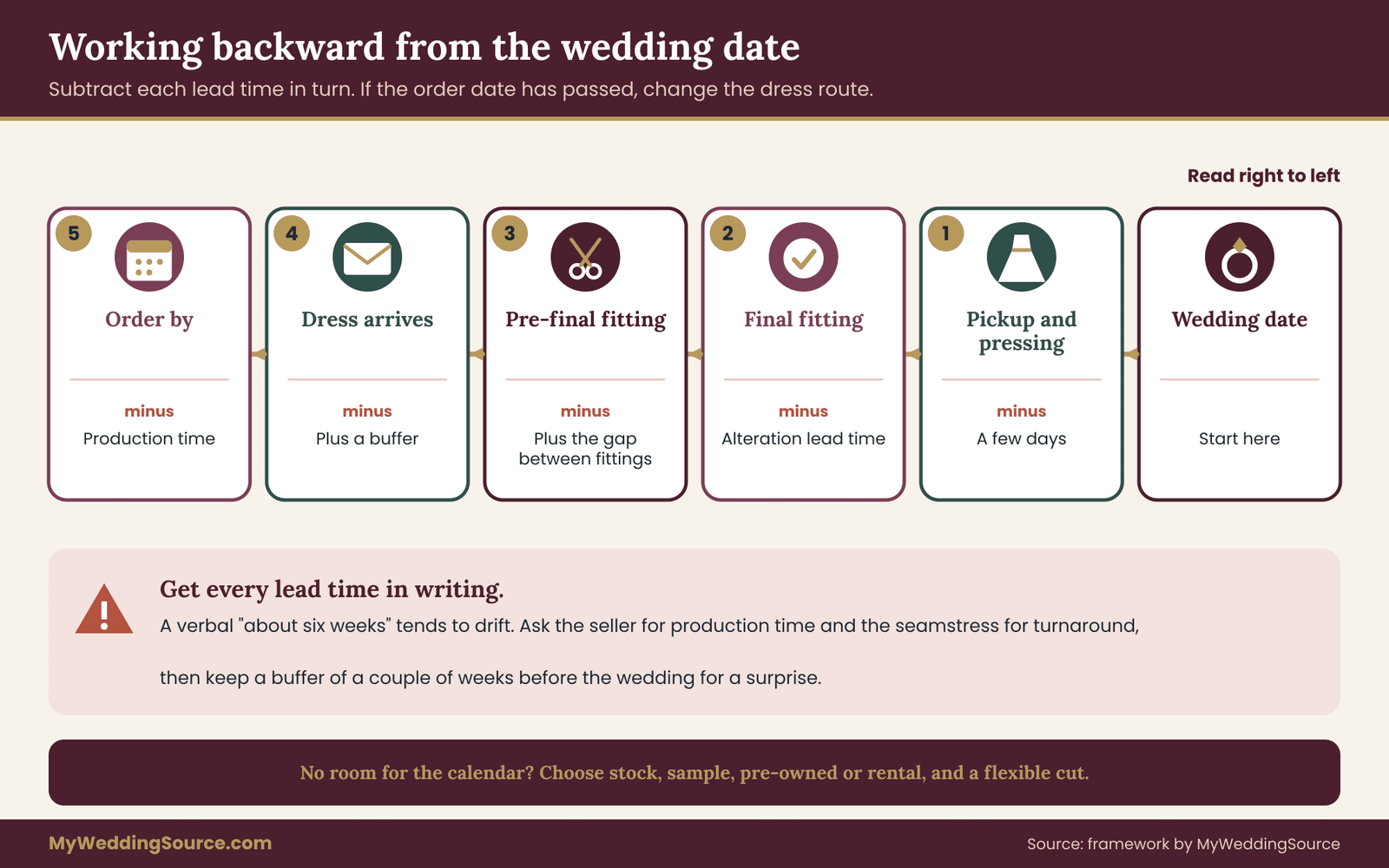
The buffer is not optional
The buffer is the part people skip, and it is the part that protects the plan. A buffer of a couple of weeks between the final fitting and the wedding gives you room for a surprise: a size change that needs a quick tweak, a delay at the seamstress, or a day when you are simply unwell. Without it, any problem becomes an emergency.
If you cannot fit a buffer into the calendar, treat that as a signal to choose a more flexible gown, to move the final fitting as late as possible and to arrange a backup in advance. The cost of those measures is a lot smaller than the cost of a maternity wedding dress that does not fit on the day.
Comfort checks to build into the fittings
The fittings are your chance to test the gown in conditions close to the day. Use them.
Wear the shoes you plan to wear, including a half size larger as a backup if swelling in the feet is a worry for you. Your clinician can tell you what is typical and what needs attention. Wear the undergarments, supports or underlayers you intend to use, since a maternity wedding dress can feel different once they are in place.
Sit down in the gown, and stay seated for a few minutes. Check that the bodice does not ride up, the waist does not dig and the skirt lets you sit without having to hold it. Practice getting up from a chair. Eat a small snack and see whether the bodice still feels right. Raise your arms as if for a hug and check the shoulders and back.
Practice the bathroom. Ask the seamstress or boutique how you will manage a bathroom visit in the gown, and who can help. A maternity wedding dress that needs three people to manage may keep you out of the room, and it is better to learn that in a fitting than on the day.
Check temperature. A heavy gown in warm weather, or a strapless gown in a cold venue, changes how you feel. A light wrap, shawl or jacket is an inexpensive fix. The same idea applies to every small backup you pack.
Who helps you dress
Decide ahead of time who will help you into the gown and what they need to know. If the maternity wedding dress has lacing, one person should learn how to lace it, and a second should know as well. Write short instructions and keep a spare length of ribbon or cord in the emergency kit. If the closure is a zipper, test it at the fitting and practice with the person who will do it.
If you are wearing shapewear or a support garment, test the full combination at least once. A gown that fits over a garment you decide not to wear on the day is a maternity wedding dress that no longer fits. Medical questions about supports or compression belong with your clinician.
What changes after the baby arrives
This guide is mostly about the period before the birth, but some couples plan a wedding for the months after. The same method applies with one difference: the direction of change may reverse, and recovery varies from person to person. Do not size the dress to a past body or an imagined future one. Size it to the body you have at the final fitting, with a closure that tolerates a small change, and ask your clinician about anything related to recovery. Budget for a possible second round of fitting costs if the timeline is long.
Return policies and the alteration lock
Return policies are where a maternity wedding dress purchase is won or lost. A seller can have a flexible gown, a skilled seamstress and a friendly manner, and the terms can still leave you holding a dress that does not fit. Terms differ from shop to shop, and none of them can be guessed, so this section gives you a way to read them.
There is no general federal rule that gives a shopper the right to return an item bought in a store. Refund and return rights are usually set by the seller’s own written policy, along with state and local rules, so what the seller wrote down is what matters. The Federal Trade Commission publishes consumer information on returns, refunds and sales, and your state attorney general or consumer protection office can tell you how local rules apply. The terms you are given at the counter are the starting point.
The alteration lock
Here is the single most useful idea in this section. Call it the alteration lock: the moment after which the maternity wedding dress can no longer be returned or exchanged because it has been altered. For many sellers, the lock begins at the first cut, stitch or alteration, whether done by the shop, by an outside seamstress or by you. Some sellers apply it even to a minor change such as a hem.
The lock matters because it turns a flexible purchase into a fixed one. Before the lock, a wrong size is a return. After it, a wrong size is a loss or a rebuild. The plan therefore has one rule: do not trigger the lock until you have confirmed, with a measurement and in writing, that the gown is the one you want to keep.
Ask the seller four things about the lock. Does the shop’s policy say that alterations end returns? Does it make an exception for a size exchange? Does it cover alterations done elsewhere? And is the policy written, in a document you can keep?
The policy ladder
Think of the seller’s terms as a ladder of questions, from the most basic to the most detailed. Climb as far as you need to, and stop when the answers become clear. A maternity wedding dress that fails a rung can still be a good choice, but only if you know that and the price reflects it.
Rung one: can it be returned at all? Some sellers say no, particularly for custom or made-to-order gowns and sample sales. If the answer is no, the dress is a fixed risk, and the flexibility has to come from the design.
Rung two: when does the window start and end? Some windows start at the order date, which can be months before delivery and may close before the maternity wedding dress arrives. Others start at delivery. Ask for the exact start and end dates.
Rung three: what condition is required? Most policies need the dress to be unworn, unaltered and with tags attached. Ask whether a try-on at home counts as worn, and whether a fitting at the shop counts.
Rung four: what does it cost to return? Restocking fees, return shipping and a deduction for any alterations already done can all reduce a refund. Ask for the amount or the formula, written down.
Rung five: is a refund, credit or exchange offered? A credit is only worth something if you will use it. A size exchange is only useful if the maker offers another size in time.
Rung six: what about deposits? Many sellers treat deposits as non-refundable once an order is placed. Ask what the deposit covers and when it becomes non-refundable.
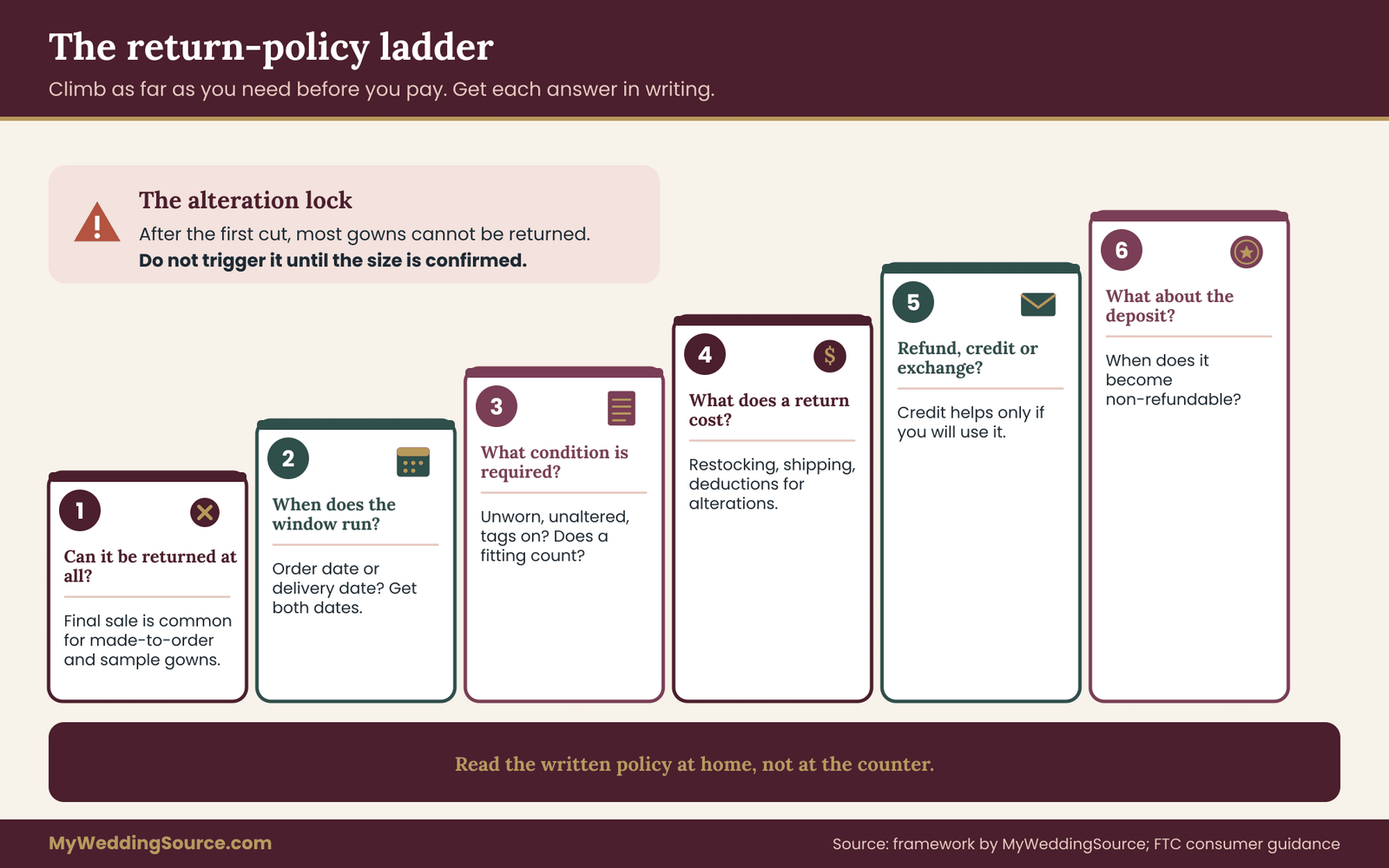
Reading the terms yourself
Ask for the policy in writing before you pay, and read it away from the shop counter, where there is no pressure. Look for the words that limit a promise: “final sale,” “non-refundable,” “custom,” “altered,” “worn” and “store credit only.” If a salesperson says something that conflicts with the written policy, ask them to put it in writing or to correct the document, because the paper usually governs.
Keep a copy of the policy, the order form, the receipt and any emails in your wedding records folder. The site’s guide to wedding vendor contracts explains how to read amendments and cancellation clauses, which are the same kinds of terms you will see in a maternity wedding dress order.
Questions to ask when you buy online
Online purchases bring extra questions. Who is the seller, and who is the maker, since they can be different companies? Is the size chart in the seller’s own measurements, and does it match what the maker uses? What is the return address and who pays for shipping? How long does the refund take, and can it be refused if the gown arrives with signs of wear?
Photographs and descriptions can differ from the delivered gown. Ask whether the policy covers a gown that does not match the listing, and what proof the seller wants. Keep screenshots of the listing and the size chart on the day you order, since pages change.
If you ship a maternity wedding dress back, use a tracked and insured method and keep the receipt. The United States Postal Service publishes information on tracking and insurance for packages, and a carrier’s insurance has its own limits that you should read before you rely on it.
When the seller’s policy is no help
Sometimes a policy is strict, the gown is right and the risk is yours. In that case, the options are to reduce the risk elsewhere. Choose the most flexible version of the maternity wedding dress. Ask the seller for a written agreement about alterations or an exchange, even if it is an exception. Buy a stock gown or a pre-owned gown instead. Or accept the risk with a clear backup plan and a limit on how much you are willing to lose.
You can also ask about a payment method that offers some protection. A credit card may offer dispute rights for goods that are not delivered or not as described. The Consumer Financial Protection Bureau explains the rules for billing errors, which generally require you to write to the card issuer within sixty days of the statement that shows the error. Disputes are not a way to undo a bad size choice, so treat them as a safeguard for real problems, not a substitute for a good policy.
Orders, deposits and size uncertainty with a maternity wedding dress
An order is a promise from both sides. You promise to pay and, often, to accept a gown made to the measurements you gave. The seller promises to deliver a maternity wedding dress that matches the order. When your size may change, the order needs a bit of extra thought, because the usual safe path, ordering the size that fits you today, may not be the safe one.
Choosing the order size
Many makers size their gowns by a chart, and the usual advice is to order by the largest measurement among bust, waist and hip. For a maternity wedding dress, that advice is a starting point rather than a rule. If your largest measurement will probably stay the same or grow, ordering by it is sensible, because the dress can be taken in more easily than let out. If you are unsure, ask the seller and the seamstress together what they would choose and why, and notice whether their answers agree.
If the maternity wedding dress is made to order, ask whether it can be made to custom measurements and whether you can submit updated measurements before production begins. Ask for the cutoff date after which changes are not possible, and write it on the calendar.
What a deposit buys
A deposit usually pays to start production, and the seller treats it as the point at which they begin to spend money on your behalf. Many sellers state that deposits are non-refundable. Ask exactly when that applies: at the time of order, when the fabric is cut, or at a later point.
If your date is uncertain, ask whether the deposit can be moved to a different gown or a different date. Some sellers will agree to a credit or a change of order, and some will not. A written answer is worth more than a hopeful one.
Think about the deposit in terms of loss: if the dress does not work, how much do you lose? If the answer is a sum that would hurt, that is a reason to choose a more flexible or more returnable gown, or to wait until the size is clearer. The site’s guide to wedding cash-flow planning shows how to keep a reserve for this kind of risk without breaking the rest of the budget.
Changing or cancelling an order
Ask three things before you order. Can the order be changed after it is placed, and what does each change cost? Can the order be cancelled, and what is the fee? What happens if the gown arrives late? A late delivery is a real risk on a tight calendar, and a written delivery date with a remedy, such as a refund or a rush at the seller’s cost, is something to ask for.
If the seller tells you the maker controls these terms, ask for the maker’s terms in writing as well. A maternity wedding dress with two companies behind it has two sets of rules, and the stricter one usually wins.
Pre-owned, sample and rental choices
Because a deposit and a made-to-order timeline are the biggest risks, other routes deserve a look. A pre-owned gown can be bought and altered at lower cost, which reduces what you lose if you change your mind. A sample gown can be bought quickly and is often final sale, so it works best when the design is flexible. A rental sets a firm return date and often limits alterations, which can suit a body that is changing, as long as the limits fit your needs.
Each of these routes has its own tradeoffs, and a fair comparison counts the full cost: the purchase price, the alterations, the return rules and the risk of a second purchase. A cheap gown that needs a major rebuild is not cheap. An expensive gown that cannot be returned is not safe. The right choice is the one whose worst case you can afford.
Keeping a record of the order
Create a folder for the dress and keep every document in it: the order form, the receipt, the policy, the size chart, emails, photos of the maternity wedding dress, your measurement log and notes from fittings. Write down what each person said and when, especially promises about alterations, exchanges and delivery dates. If something goes wrong, this folder is the difference between a clear complaint and a vague one.
If you need to raise a problem, start with the seller in writing, state what was agreed, what happened and what you want, and give a reasonable deadline. Keep the tone calm. If the seller will not respond, your card issuer, your state consumer protection office and the Federal Trade Commission are places to look for next steps. Having the folder ready is what makes any of those steps possible.
A worked case: one gown, four checkpoints
The case below is invented to show how the plan runs. The people, dates and amounts are made up, and nothing here is a forecast of how any body will change. The point is the sequence of decisions.
Alex and Jordan are planning a wedding for a date about twenty weeks away. Jordan is pregnant, with a due date that falls some weeks after the wedding, and Jordan’s clinician has said ordinary activity is fine and has asked to be told about anything unusual. Jordan wants a fitted bodice and a full skirt, and has found a boutique with a gown in that style. This is the plan for the maternity wedding dress, step by step.
Step one: the order baseline
Jordan takes the full measurement set at home, with Alex holding the tape, and writes the numbers in a shared note with a date and photographs. At the boutique, the consultant measures too. The numbers differ at the waist, because the consultant used the narrowest point and Jordan used a fixed distance below the bust. They agree to use Jordan’s landmark from now on and write it in the note.
The boutique says the maternity wedding dress is made to order, takes about sixteen weeks to arrive and is final sale once ordered. That leaves four weeks between arrival and the wedding, which is not enough for two fittings and a buffer. Jordan rules the gown out. This is the plan doing its job: a problem found at checkpoint one costs nothing.
Jordan asks the consultant about alternatives, and the boutique offers a stock version of a similar gown with a lace-up back, which ships in a few weeks and can be returned within a stated number of days if unworn and unaltered. Jordan asks for the policy in writing, and reads it at home. It says that any alteration, including a hem, ends the return right. The maternity wedding dress is a stock gown with a flexible closure and a generous seam allowance, according to the seamstress who looks inside it.
Jordan orders it in the size that fits the largest measurement, and pays a deposit that the policy says is refundable until the gown ships.
Step two: the midpoint check
The gown arrives about seven weeks before the wedding. Jordan measures again and writes one line per point: bust about the same, underbust about the same, waist at the landmark a little larger, hip slightly larger, torso length slightly shorter at the front. Jordan tries on the maternity wedding dress in the seamstress’s studio without any alteration. The bodice fits at the bust and ribcage, is snug at the waist and the lace-up back has room to loosen.
The decision is to keep the gown and not alter anything yet. The return window has a few days left, and Jordan does not want to lock the maternity wedding dress until the pre-final fitting. The seamstress notes that the hem will need work and that the front of the skirt is rising slightly. Jordan asks the clinician if the lacing has any comfort concerns and is told to stay in touch about how it feels.
Step three: the pre-final fitting
Three weeks before the wedding, Jordan measures again and goes to the seamstress with the shoes and the undergarments planned for the day. The numbers are close to the midpoint. The seamstress takes in the bodice slightly at the bust, keeps the lacing, shortens the hem a little at the back and leaves the front hem for the final fitting. Jordan checks the policy before the cut and accepts that the lock starts now, because the gown has been tried at two checkpoints and the measurements are consistent.
The seamstress estimates the time for the changes and notes that a final fitting fits into her calendar ten days before the wedding, with a pickup four days later. That leaves a buffer of a few days. Jordan sets the dates on the calendar.
Step four: the final fitting
At the final fitting, Jordan measures first and finds the waist landmark a little larger again. The lacing is loosened, and the seamstress adjusts the hem at the front and sets the bustle. Jordan sits for several minutes, eats a small snack, raises both arms and walks across the room, and says the bodice feels comfortable. Alex learns to lace the back, and the seamstress writes down the steps and gives a length of ribbon as a spare.
Jordan packs the shoes, a light wrap and a second pair of shoes in a half size larger. The backup plan is a plain, loose dress already owned, to be used only if the maternity wedding dress cannot be worn. The wedding happens with the first gown.
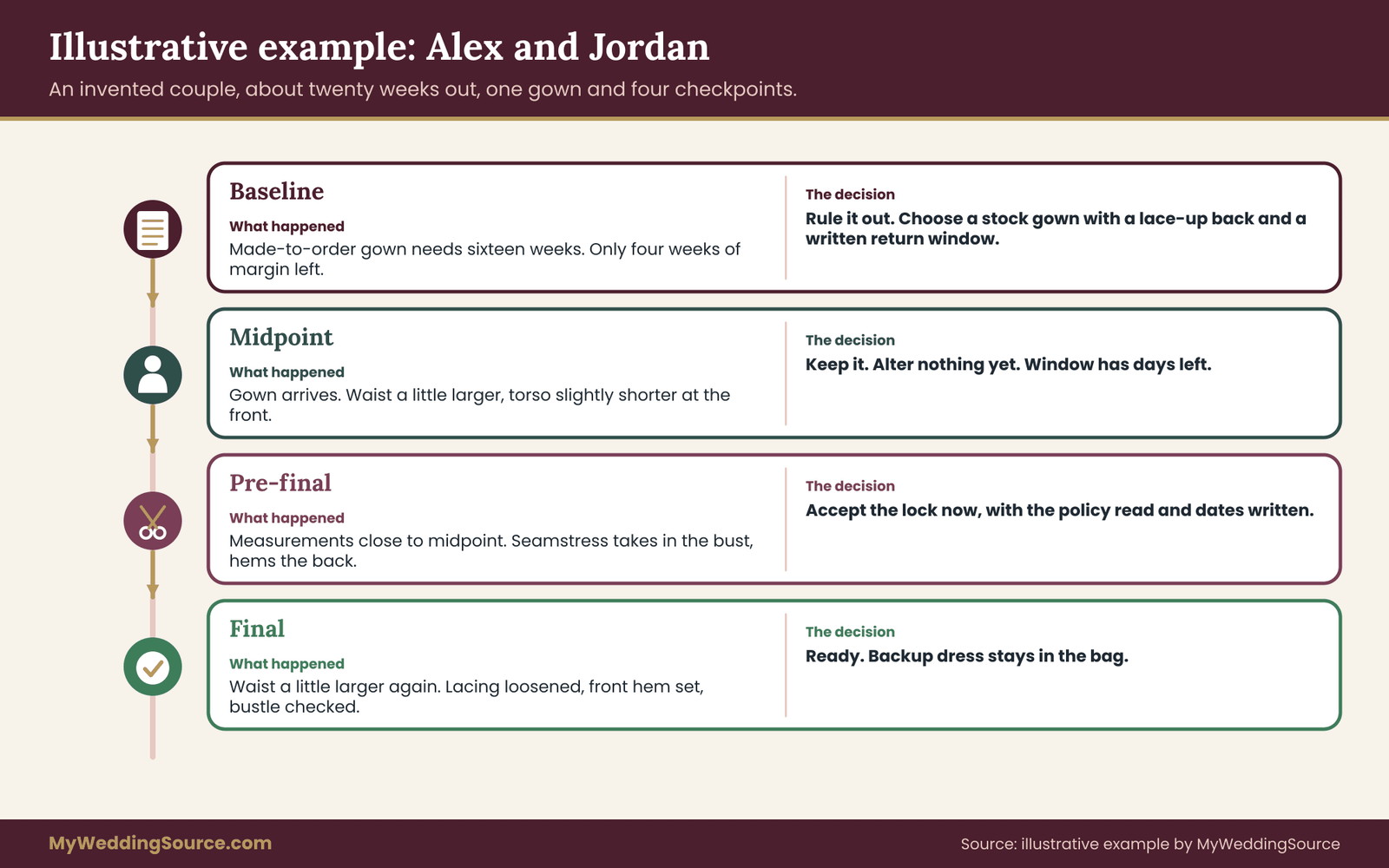
What the case shows
Three things stand out. First, the plan found the real problem, a sixteen-week lead time on a four-week margin, before any money was spent. Second, the policy lock was a chosen event, with the dates and the return rules in writing, not a surprise. Third, the lacing and a seamstress with an extra fitting were worth more than a perfect cut at the start, because the body moved a little at each checkpoint.
The case also shows what the plan cannot do. It cannot tell Jordan how the body will change, and it did not try. It used measurements, a calendar and a written policy to make each decision cheap to reverse until the last possible moment. If the waist had grown faster than the lacing could handle, the backup would have come into play, and the next section describes how that works.
Variations on the same case
Change one fact and the plan changes with it. If the wedding were ten weeks away instead of twenty, a made-to-order gown would be out of the question, and the choice would be between a stock gown, a sample gown, a pre-owned gown and a rental. If Jordan wanted a sheath instead of a full skirt, the hip and torso measurements would matter more, and the seamstress would likely want an extra midpoint check.
If the boutique allowed a size exchange after alterations, the lock would move later, and one more fitting could be used for testing. If the gown were a rental, the lock would be the renter’s limit on alterations, and the plan would focus on what could be pinned or adjusted without cutting.
The skeleton stays the same: measure, compare, decide, document. The details move around it.
How the case would look with a pre-owned gown
Suppose Jordan buys a pre-owned gown from a private seller instead. The checkpoints are the same, but the policy ladder is different, because a private sale may carry no return right at all. The risk is shifted to the buyer, so the other safeguards matter more: ask for measurements of the maternity wedding dress itself, not just the label size, ask for photographs of the inside seams to judge allowance, and ask for the seller’s alteration history. The site’s guide to wedding dress fit and alterations explains how to inspect a used gown.
A pre-owned gown also carries condition risks that a new one does not, such as odors, stains, repairs and weakened seams. A seamstress should look at it before any money moves beyond a refundable deposit, if the seller will allow it. Pay by a method that gives you a record, and keep the listing and the messages.
How the case would look with a rental
A rental changes the equation again. The renter owns the gown, sets the alteration limits and sets a firm return date. That suits a plan in which flexibility matters more than ownership. Ask what the renter allows to be altered, such as pinning, temporary stitching or taking in at a seam, and what fees apply if the gown is damaged or returned late. Ask what happens if the maternity wedding dress does not fit on the day and whether a replacement size is available on short notice.
The renter’s terms usually matter more than the price. A low rental fee with a large damage deposit and strict limits may be more costly than it looks, and the cost shows up in the worst case rather than the average one.
Alternatives and failure conditions for a maternity wedding dress
Every plan needs a way to say stop. A maternity wedding dress plan works best when you decide in advance what counts as failure and what you will do about it, because the decision is far harder on the morning of the wedding. This section gives you failure conditions, a switching rule and a short menu of alternatives.
Failure conditions
These are the signs that the gown is no longer the right path. Each one has a clear check, so you are not left guessing.
The maternity wedding dress cannot be adjusted to the measurements. If the seamstress says in writing that the gown cannot reach your current measurements, or cannot reach the measurements you expect, the maternity wedding dress has failed the fit test. Ask the seamstress to say how far off it is and whether a panel or insert could help, and ask for the cost and time.
Measurements are moving faster than the remaining time. If one checkpoint shows large change and the next fitting is only days away, the calendar no longer has room for the work. Tell the seamstress at once, because a rush fee or a different approach may be possible, and tell the seller if the return window is still open.
The comfort test fails. If you cannot sit, breathe, eat, walk or manage the bathroom in the gown at a fitting, a better cut will not necessarily fix it. Tell your clinician about any discomfort and ask what changes are appropriate. A maternity wedding dress that requires you to ignore pain or shortness of breath is not a gown to wear.
The policy lock would trap you. If the next step is a permanent cut and the policy says the gown cannot be returned afterward, and the measurements are still moving, wait. If waiting is not possible, treat the cut as a purchase decision and ask whether you could afford the loss if it fails.
The seller or seamstress cannot commit to dates. A vague timetable on a short calendar is a failure condition on its own. If they will not write down dates, move to a source that will.
The cost of the next step exceeds the cost of a replacement. Sometimes a rebuild costs more than buying a simpler gown. Compare the total cost of the repair, including a second fitting, with the total cost of an alternative, and be willing to walk away from sunk costs.
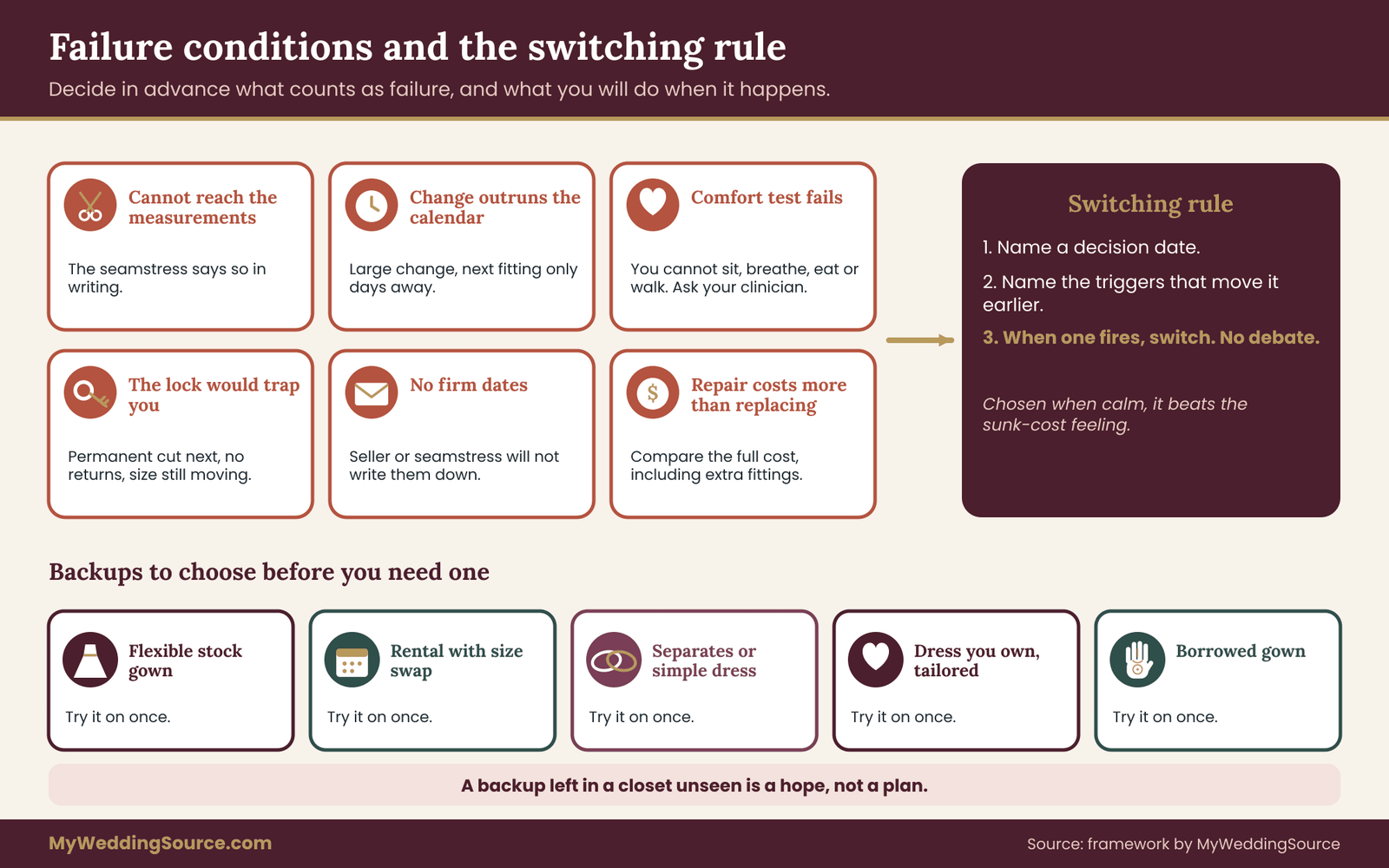
The switching rule
Set a switching rule before the first checkpoint. A workable one has two parts. First, name a decision date, a day on which you will decide whether to continue or switch, based on the latest measurements and the seamstress’s written view. Second, name a trigger, any failure condition above, that moves the decision date forward.
When the rule fires, do not argue with yourself. Move to the backup you chose in advance. Because the rule was set when you were calm and informed, it protects you from the sunk-cost feeling that makes people keep investing in a maternity wedding dress that has stopped working.
Choosing a backup
A backup does not have to be a second wedding gown. It has to be something you can wear, feel good in and obtain on the calendar you have left. These are the usual options.
A flexible stock or sample gown. Buy a second gown only if the price is something you can afford to lose, and choose one with a forgiving closure.
A rental. A rental sets a firm return date and may offer a size swap. Check the alteration limits and the delivery window.
A separates set or a simple dress. A skirt and top, or a plain dress in a fabric with some stretch, can be more comfortable and easier to fit than a structured gown. Many people choose a simple dress for the ceremony and a gown for photographs, or the reverse.
An existing dress, tailored lightly. A dress you already own and like, adjusted by a seamstress, can be a reliable backup. A long dress in a light color can work for a small ceremony, and the choice says nothing about the importance of the day.
A borrowed gown. A friend or relative may lend one. Ask about alteration limits and the care required, and write down what you agreed so it does not become a source of strain.
Choose the backup before you need it, try it on once and keep it somewhere you can reach. A backup that sits in a closet unseen is a hope, not a plan.
Alternatives to altering at all
If the idea of a series of fittings worries you, alternatives exist that avoid cutting the maternity wedding dress. A gown with a wide range of lacing and an A-line skirt may need only a hem. A wrap or tie-front style can be adjusted by you on the day. A maternity wedding dress with an elastic or stretch panel can accommodate a small change without a stitch. A two-piece design lets you adjust the halves separately.
These alternatives trade some look for some flexibility, and the trade is a personal one. Neither is better in general. The question is which risk you would rather carry: the risk of a tight calendar with a structured gown, or the risk of a style you like a little less with a flexible one.
When to ask for help
If the plan starts to feel overwhelming, narrow it. Hand the calendar and the log to a trusted person, such as a partner, a friend or a family member, and let them make the calls to the seller. A shared note and a single folder make that easy. The site’s wedding budget guide can help you set a limit for what you will spend on the dress and its alterations, and the plan wedding guide shows where the dress sits among the other decisions.
Remember what the dress is for. It is one part of a day that is mostly about the people in it, and a calm, comfortable bride or groom or spouse in a simple dress has a better day than an anxious one in a perfect gown.
Your next steps
- Take the baseline measurements, date them, add photos and name your landmarks.
- Ask your clinician any questions about comfort, closures and what to avoid, and follow their advice over anything in this guide.
- Decide the wedding date minus production time, alteration lead time and buffer, and see if your calendar works.
- Shortlist dresses by flexibility: closure, cut and seam allowance.
- Ask each seller for the written policy and read the lock, the window and the deposit terms.
- Place four checkpoints on the calendar and book the seamstress for each.
- Choose a backup and a switching rule before you pay a non-refundable deposit.
- Start a folder for the order, the policy, the log and every message.
FAQ
When should I order a maternity wedding dress?
Order as late as the production time and your calendar safely allow, and no later. Count back from the wedding: pickup, final fitting, pre-final fitting, buffer, then production time. If that date has passed, choose a stock, sample, pre-owned or rental gown. A made-to-order gown with a long lead time is the riskiest choice when your measurements are still changing.
Which size should I order if I am unsure?
A common approach is to order by the largest measurement among bust, waist and hip, because fabric can usually be taken in more easily than let out. That is a starting point, not a rule. Ask the seller and the seamstress what they would choose and why, and share your measurement log so they work from the same numbers.
Can a seamstress let out any gown?
No. Letting out depends on seam allowance, the closure and how the gown was built. A gown with generous allowance or a lacing panel can often be adjusted over a range. A boned, zipped sheath with little allowance may not. Ask the seamstress to look inside the gown at the first appointment and tell you the limits in writing.
Are returns usually allowed on wedding gowns?
It depends on the seller. Made-to-order and sample gowns are often final sale, and many policies end returns once any alteration begins. Stock gowns may be returnable if unworn and unaltered. Ask for the policy in writing before you pay, read the exact window and conditions, and ask whether any alteration, including a hem, ends the right to return.
How many fittings will I need?
Plan for at least three: a midpoint check, a pre-final fitting where the main work is done and a final fitting. A fourth may help if your measurements are changing quickly or the wedding is close to a due date. Ask the seamstress how many fittings are included in the price and what each extra one costs.
What if the dress does not fit on the day?
Prepare for it in advance. Choose a backup you can wear, try it on once and keep it close. Choose a closure that can be adjusted in minutes, give two people the steps and pack spare ribbon or cord. If the gown cannot be worn comfortably, switch to the backup without argument. Comfort and health come before the gown.
Is it safe to wear a corset-style or fitted bodice?
That is a question for your own clinician, not a tailor or a seller. Comfort, breathing, circulation and what is appropriate for your pregnancy vary from person to person. Ask your care provider before you commit to a structured or tightly laced design, and tell the seamstress if they advise against anything so the fit can be planned around it.
Should I tell the shop I am pregnant?
You decide what to share. Telling the consultant and the seamstress usually helps, because it changes their advice about size, fabric, construction and timing, and it lets them plan extra fittings. If you prefer not to say, you can still ask about seam allowance, closure range, lead times and return terms without giving a reason.
Sources
- American College of Obstetricians and Gynecologists: patient resources on pregnancy and postpartum care
- Centers for Disease Control and Prevention: pregnancy and women’s health information
- MedlinePlus, National Library of Medicine: pregnancy and body changes
- Office on Women’s Health, U.S. Department of Health and Human Services: pregnancy
- Federal Trade Commission: consumer information on returns, refunds and sales
- Consumer Financial Protection Bureau: billing errors and credit card disputes
- USAGov: consumer protection and state attorney general offices
- United States Postal Service: package tracking and insurance
- National Institutes of Health: health information for women