
A missed deliverable is any item, service or result a wedding vendor promised in writing and did not provide as promised. This guide shows how to handle a missed deliverable with facts instead of anger: how to record what happened, how to read your contract, how to send a notice that gets action, and how to choose a fair remedy.
When a vendor misses a deliverable, do four things in order. First, protect the day or the deadline by asking for a fix right away. Second, write down the facts in an incident log with four columns: the promise, the proof, the gap and the impact. Third, check the contract for a notice or cure clause and send a short written notice that follows it. Fourth, choose a remedy (redo, replace, credit, partial refund or full refund) and get it confirmed in writing before you pay any remaining balance.
Most couples never expect to need a plan for a missed deliverable. The florist is friendly, the photographer is booked a year ahead, the caterer has done a hundred weddings. Then a Saturday comes and eight centerpieces are missing, or the gallery is three weeks late, or the band shows up with a smaller lineup than the contract lists. The next hour decides a lot. Couples who write facts down calmly give the vendor something to act on. Couples who argue from memory often get only an apology.
This article is about the second group of moments: the ones where something specific was promised and something specific did not arrive. It does not try to cover every vendor problem. It does not tell you how to pick vendors or how to write a contract from scratch, and for those you will want the site’s guide to the wedding vendor contract. It focuses on one job: recording the facts of a missed deliverable so that a resolution becomes possible.
A note on scope. This is general information, not legal, tax or financial advice. Consumer remedies, contract law, card rules and insurance terms differ by state and by situation, so confirm the current rules with the agency or professional that applies to you.
What counts as a missed deliverable
A deliverable is something a vendor agreed to hand over, do or provide. It can be a physical item (forty chairs, a cake, a printed sign), a service (two hours of setup, a rehearsal visit, a first-dance song), a result (edited photos, a signed marriage license returned to the county, a clean room) or a time (arrival by three o’clock). The test is simple: could you point to a sentence in the quote, contract, invoice or confirmed email where the vendor said it would happen?
If the answer is yes and it did not happen as described, you have a missed deliverable. If the answer is no, you may still have a disappointment, but you do not yet have a gap you can prove. That difference matters, because everything in this guide depends on comparing a written promise with an observed result.
Four ways a deliverable gets missed
Vendors rarely fail in just one way, and the way they fail changes the fix. It helps to name the type before you decide what to ask for.
A useful habit is to say the type out loud when you first describe a missed deliverable to your partner or planner. “This is a partial missed deliverable, two of twelve” is a sentence that points straight at a fix.
Absent. Nothing arrived. The arch was never delivered, the second shooter never showed, the sparkler send-off supplies were left off the truck. The remedy usually centers on replacing the item if time allows and a credit or refund if it does not.
Late. The thing arrived, but after the agreed time or date. The ceremony flowers came forty minutes after guests were seated. The album proofs came six weeks after the promised window. Lateness can be cheap to forgive or expensive, depending on what depended on the delivery.
Partial. Part of the promise was kept. Ten of twelve tables got centerpieces. Five hours of coverage were delivered out of six. A partial miss is the easiest kind to argue about, because the vendor can honestly say they delivered most of what was promised. The log is what keeps the discussion about the missing portion.
Different. What arrived is not what was described. The flowers are a different color family, the cake has a different filling, the sound system is a smaller model, the officiant read a different script. This type needs a clear before-and-after comparison, and it often needs the vendor’s own wording about substitutions.
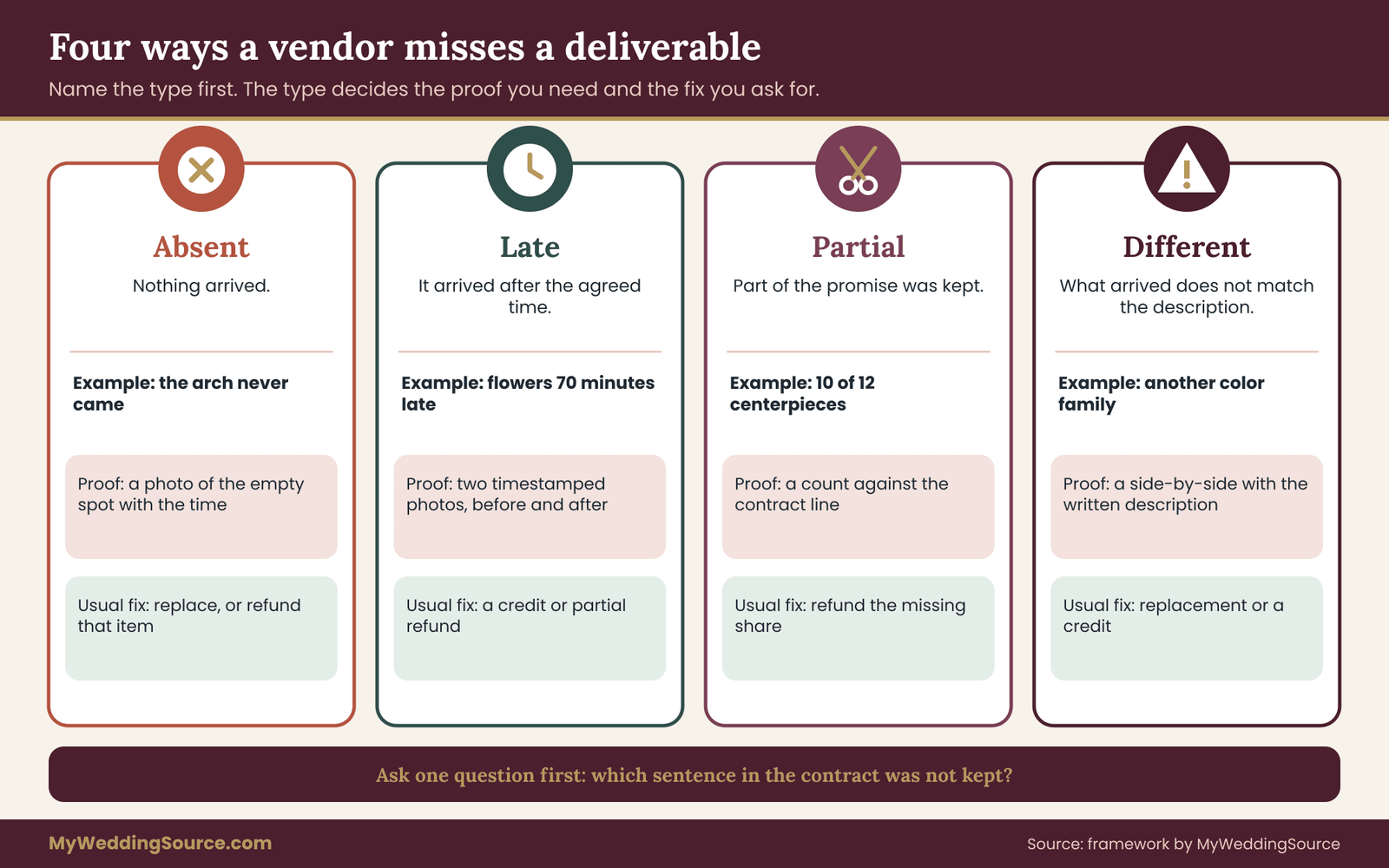
Naming the type helps you stay specific. “The florist ruined our wedding” cannot be answered. “Ten of twelve centerpieces were delivered, and the two missing were the head table and the guest book table” can be.
Another benefit of naming the type is that it shows you which evidence to gather. An absent item needs proof of nothing arriving, while a late item needs two timestamps, and a different item needs a side-by-side comparison. Each missed deliverable has its own best proof.
What a missed deliverable is not
Some problems feel like a missed deliverable but fall into other categories. Sorting them out early saves you from sending the wrong kind of notice.
A quality complaint is about how well something was done, not whether it was done. A photographer who delivered every promised image, but you dislike the editing, has a style disagreement. Check the contract for a quality standard, such as “professionally edited,” but understand that subjective standards are hard to enforce.
A change you requested is not a missed deliverable, even if it feels like one. If you moved the cocktail hour by thirty minutes and the bartender arrived on the original schedule, the change record decides who was right. The site’s guide to the wedding change order approval chain explains why every change needs a written yes from both sides.
An act of the venue or weather is a different category too. A florist who could not deliver because the venue’s loading dock was closed is not in the same position as one who simply forgot. You will want to find out which it was before you assign blame, and the later section on edge cases covers shared fault.
A verbal-only promise is the hardest. If someone told you at the tasting that the dessert table would include six flavors, but the contract lists “assorted desserts,” you have a conversation to document, not a clear breach. You can still raise it, and the vendor may do the right thing, but your position is weaker.
Whatever the category, you can always write down the facts of the missed deliverable first and sort out its category afterward. Sorting is easier with the log in front of you.
The first hour: stop, look, record
The first hour after you notice a missed deliverable is mostly about not making things worse. You are probably tired, possibly in your wedding clothes, and surrounded by people who want to help. That is exactly when it is easy to say something that will be quoted back to you, or to skip the one thing you will wish you had done later.
Step one: protect the day
If the missed deliverable is happening during the event, solve the problem in front of you first. Ask the vendor, the venue coordinator or your planner what can be done in the next fifteen minutes. A late florist can be asked to bring the ceremony pieces first and the reception pieces second. A missing speaker can be replaced by a venue speaker for the ceremony. Decide what matters most to the two of you and ask for that.
Do not delegate the argument to a family member. A parent who is angry on your behalf can say things that make the vendor defensive, and anything said in anger can complicate a later request for a refund. Choose one person, usually a planner, coordinator or the more even-tempered partner, to speak to the vendor. The other partner stays out of it for now.
Step two: look at the exact gap
Before you ask for anything, look at what is actually missing. Open the contract on your phone if you can. Find the line that describes the item or service. Read it in the vendor’s wording, not in your memory of the conversation. The gap you can prove is the gap between those words and what you see.
This moment is also when you notice that a gap is smaller than it felt. Sometimes the contract says “approximately 100 stems” and the vendor delivered ninety-six. Sometimes the contract says “centerpieces for guest tables” and you remember promises about the head table. Knowing the difference early keeps you from making a claim you cannot support.
Step three: capture proof before it changes
Take photographs and short videos of the gap, with something in the frame that shows scale or context. Capture the room, the table number, the clock on a wall or the timestamp on your phone. If a vendor tells you something in person, such as “we ran out of the pink ones,” write the sentence down with the time. If it was a phone call, make a note of the number and the minute.
Evidence is easier to gather when it is fresh. Flowers wilt, tables get reset, a missing item gets replaced by a cheaper stand-in, and the original problem disappears. A photograph taken at five o’clock and a second one taken at five-thirty can show that something was delivered late, which a memory cannot.
Step four: say the minimum
Say what is wrong, say what you need, and say when you need it. For example: “The contract lists twelve centerpieces and I count ten. Can you tell me what you can do about the two missing tables before dinner?” Then stop. Do not say “this is unacceptable,” do not threaten a review, do not mention a refund. Each of those can wait until you have the facts in order and the day is over.
The same restraint applies to text messages. A short message such as “We see a missed deliverable on the head table and would like to talk about it tomorrow” keeps the door open without arguing the case in writing at midnight.
If the vendor offers an immediate fix, accept it if it works for you and write down exactly what was offered. If they say “we will make it right,” ask what that means in plain terms, and note the answer. “Make it right” is a feeling. A refund of a stated amount by a stated date is a remedy.
Step five: start the log the same day
Even if you are exhausted, write down three lines before bed or the next morning: what was promised, what you saw, and who you spoke to. Send them to yourself as an email, or put them in a shared note with your partner. Timestamped notes carry more weight than reconstructions made three weeks later. The next section shows the full log, but a rough version written the same day is worth more than a polished version written next month.
Couples sometimes worry that starting a log looks hostile. It does not. A log of a missed deliverable is private until you choose to share parts of it, and it protects both sides by keeping the story accurate.
One last point for this first stage. If a vendor missed a deliverable and the issue also involves safety, such as an electrical hazard or an allergen mix-up, treat it as urgent and separate from the commercial dispute. Get the person safe first and handle the paperwork afterward.
The incident log: four columns for every missed deliverable
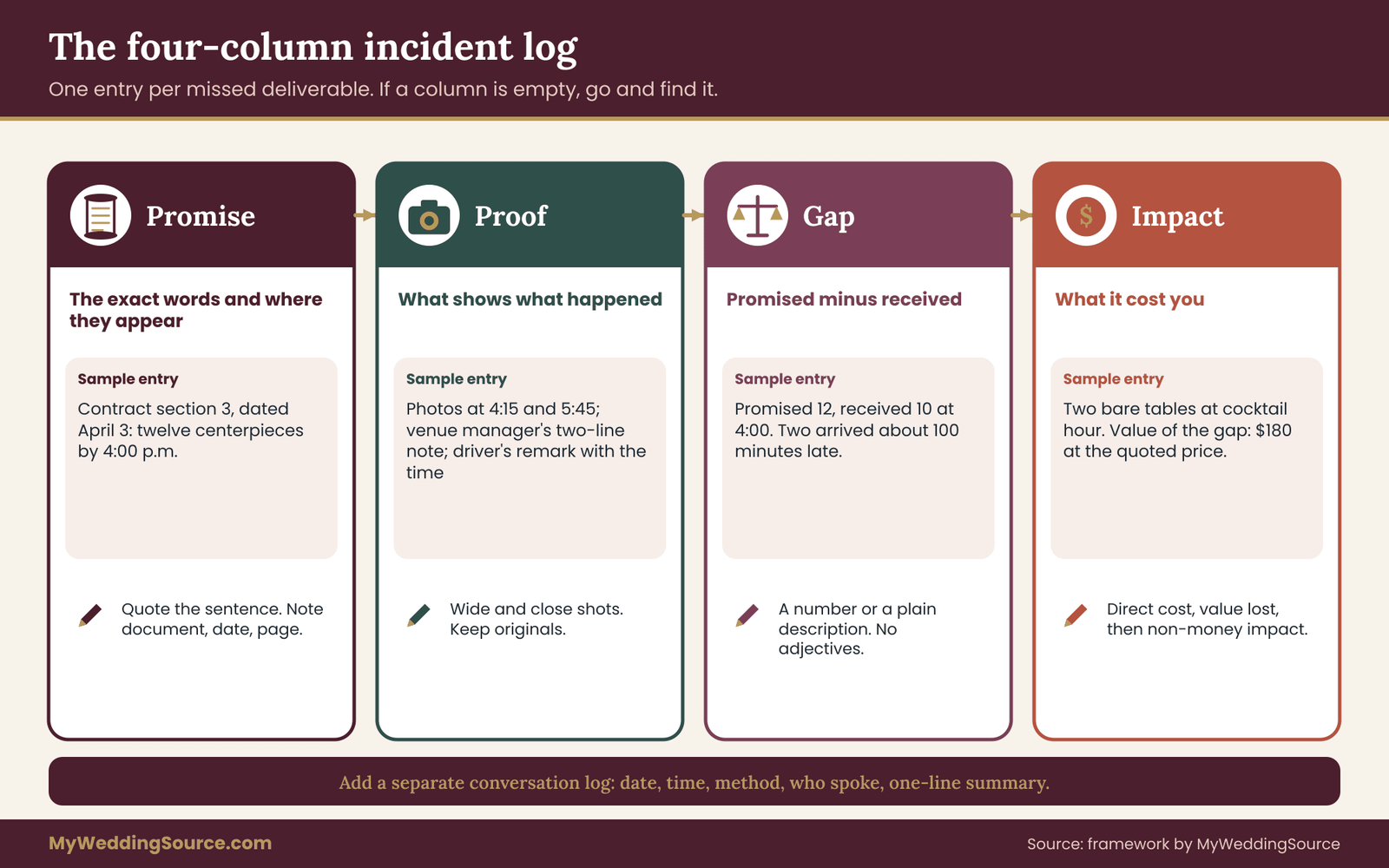
The center of this guide is a simple tool, the four-column incident log. It is a document, a spreadsheet or even a page in a notebook, with one entry for each missed deliverable. Each entry has four parts: Promise, Proof, Gap and Impact. Everything you later send to a vendor, a card issuer or a mediator can be built from these four parts. If a column is empty, you know what to go and find.
The log works because it separates what you can show from what you feel. Feelings are real and they matter, but a claim made of feelings is easy to dismiss. A claim made of a quoted sentence, a dated photograph, a counted gap and a stated consequence is hard to dismiss, and it is also easier to write calmly.
Keep one rule in mind from the start: every claim about a missed deliverable should be traceable to a line in one of the four columns. If it cannot be, leave it out of anything you send.
Column one: the promise
Copy the exact words the vendor used, and note where they appeared. Quote the contract clause, the quote line item, the invoice description or the email where the vendor confirmed the detail. Include the document name, the date and the page or section if there is one.
When the promise is split between documents, note which one controls. Contracts often say that the signed agreement overrides earlier emails, and that point can decide whether a missed deliverable is measured against the quote or the final contract.
A good promise entry looks like this in plain words: “Contract, section 3, dated March 4: florist will deliver twelve guest-table centerpieces to the reception room by 3:00 p.m.” A weak entry says “they said they would do flowers.” You want the sentence, not a summary of it.
If the promise appears in more than one place, list each place. A promise repeated in a quote, a contract and a final-details email is stronger than a promise in one document, and it also shows what the vendor knew at the time.
If the promise exists only in conversation, say so in the entry and write down who said it, when and where. You cannot treat a verbal promise as strongly as a written one, but you can still log it honestly. Mark it clearly as “verbal, not confirmed in writing,” so you do not overstate your case later.
Column two: the proof
Proof is whatever shows what actually happened. Photographs, short videos, delivery receipts, timestamps, text messages, call logs, emails and witness names all count. Record each item with a file name and the time it was created or received.
Three habits make proof much stronger. First, take wide and close shots, so a viewer can see both the place and the detail. Second, keep original files; do not crop or edit the only copy. Third, ask one neutral person who saw the problem, such as a venue coordinator or a planner, to write a two-sentence note with their name and the date. A short, factual line like “I saw ten centerpieces on the tables at 4:15 and the head table was bare” is more useful than a long statement written in anger.
Proof also includes absence. If you are waiting on a gallery or a rental return, a screenshot of an empty portal, or an email with no reply after a stated number of days, is proof of a gap. Date it, and save it.
Column three: the gap
The gap is the arithmetic of the problem: promised minus received. Write it as a number or a clear description. “Promised 12, received 10, gap 2.” “Promised arrival 3:00, actual arrival 3:52, gap 52 minutes.” “Promised 6 hours of coverage, photographer left after 5 hours 15 minutes, gap 45 minutes.” “Promised ivory and sage, received ivory and blush; color mismatch on all pieces.”
Keep this column free of adjectives. Words like “terrible” and “disastrous” belong in your private notes, not in the gap line. The gap is just the difference, and its clean wording is what makes a vendor’s reply easier to predict. A vendor can argue with your tone, but they cannot argue with an accurate count.
If the gap can be partly measured and partly judged, write both. For example: “Ten centerpieces arrived, two missing (measured). Two of the ten arrived in damaged vases (judged; photos attached).”
Column four: the impact
Impact is what the missed deliverable cost you, in time, money and effect. Be honest and specific. If the missing centerpieces meant two tables were bare, say “two of twelve guest tables had no centerpiece during dinner.” If you paid a coordinator an extra hour of overtime to fix something, say “coordinator overtime, one hour, invoice attached.”
If the impact is still unknown, say so. “Impact not yet known; waiting for the gallery” is an honest entry about a missed deliverable that has not finished unfolding, and you can update it with a dated line later.
Impact has three layers worth separating:
Direct cost. Money you spent because of the missed deliverable, such as a replacement item, extra staff time, a rush courier or a last-minute purchase. Keep receipts.
Value lost. The part of what you paid for that you did not receive. If a vendor delivered ten of twelve items, the value lost is roughly the price of two, and you can usually calculate it from the quote’s line items.
Non-money impact. Stress, a delayed ceremony, a missed photo of a relative, a moment that could not be repeated. This is real, and you should note it, but understand that vendors and card issuers usually respond to the first two layers. Do not inflate the log with dramatic claims. A calm line like “the first dance photos are missing because coverage ended early” says what you need.
Putting an entry together
Here is a compact example entry, written in plain prose so you can adapt it:
“Item: ceremony arch flowers. Promise: contract section 2, dated February 10, lists one floral arch installed by 2:00 p.m. Proof: photograph at 2:05 showing bare arch; text from florist at 2:20 saying the truck was delayed; photograph at 3:10 showing arch installed. Gap: installed 70 minutes late; ceremony start moved by 15 minutes. Impact: guests waited with no flowers at seating; coordinator rearranged the processional timing; no direct cost.”
Notice what the entry does not contain. It does not say whether the florist was careless or unlucky, and it does not say what you want yet. That comes later. The log records facts, and the remedy decision comes after.
Keeping the log simple
A log is useful only if you keep it. A few simple rules help.
Use one document for all incidents, with a separate entry for each missed deliverable. Add a short header line to each entry with the vendor name, the incident date and a status such as open, notice sent, resolved. Put the log in a shared location both partners can open, and keep the evidence files in a folder with matching file names, such as “florist-arch-photo-1405.jpg.” The site’s guide to organizing wedding records after the event covers how long to keep these files and who should have access.
Do not rewrite old entries. If you learn something new, add a dated line below the original. A log that shows its edits is more trustworthy than a log that has been polished, and if a dispute reaches a card issuer or a court, the original wording matters.
A conversation log is part of the record
The four columns handle each deliverable, but you also need a conversation log: a running list of every contact with the vendor about the missed deliverable. Each line holds the date, the time, the method (email, call, text, in person), who spoke, and a one-sentence summary. Send any call summary back to the vendor in an email the same day: “Thanks for the call today. To confirm, you said you would send a revised invoice by Friday.” If they disagree, they can say so, and if they do not, you now have it in writing.
This is also the place to record what you did not say. If you never threatened to leave a review, and the vendor later claims you did, your log will back you up. Likewise, if the vendor made an offer on the phone, your same-day email is the record of it.
Why the log changes the conversation
Many vendors respond differently to a structured entry than to a general complaint. A message that cites the contract section, the time stamps and the counted gap tells them you are organized and that you will not be satisfied with a vague apology. It also helps the vendor see the issue clearly. Some vendors genuinely do not know what went wrong on the day, because the crew who delivered is not the person who answers email. A clean entry gives the owner something they can check with their own team.
Vendors also tend to take a second look at their own processes when a missed deliverable arrives with clean documentation. That second look is often where the fix and the fair refund come from.
The log is not a weapon, and it should not read like one. Think of it as a shared fact sheet. If you can send the vendor the Promise, Proof and Gap columns and ask “does this match your records?”, you often learn quickly whether the vendor disagrees about facts or only about what to do next. Those are two different conversations, and the log lets you tell them apart.
What to leave out
Leave out guesses about motive. You may suspect the vendor oversold their capacity or double-booked the date, but suspicion is not proof, and stating it as fact can create trouble for you. Stick to what you observed and what the documents say.
Leave out other people’s private information. If a guest photographed the problem, ask permission before you attach their image of themselves or their children. Leave out screenshots that show unrelated personal messages. And leave out anything you obtained improperly, such as access to a vendor’s private account.
Finally, leave out comparisons to other couples’ weddings. “They gave our friends a refund” is not a fact about your contract. It might be a useful negotiating thought, but it does not belong in a log of what happened to you.
Building the log before anything goes wrong
You can set up an empty log before the wedding. Many couples build a pre-event version: for each vendor, a short list of the three or four deliverables that matter most, copied from the contract, with a column ready for the day-of check. This takes perhaps an hour and turns the wedding-day inspection into a quick comparison instead of a scramble.
Your coordinator or a trusted friend can walk the room with the list and note each item as arrived, late or missing. The site’s guide to wedding vendor purchase orders shows how to turn a signed agreement into a delivery checklist like this.
A pre-built log also helps you recognize a missed deliverable before it becomes a surprise. If the contract says the cake arrives at 4:00 and your coordinator checks at 4:15, you have a note and a conversation to start, not a crisis at 6:00 when the cake is meant to be cut.
Reading your contract for a missed deliverable
Once the log is started, open the contract and read it again with one question in mind: what does this document say should happen when a vendor does not deliver? Many wedding contracts say very little on the point. Some say a lot, in small print. You are looking for six kinds of language.
The scope clause. This is the description of what the vendor will provide. It is the source of the Promise column. Read whether items are listed one by one or lumped together as “full-service florals.” Specific lists give you a stronger gap. Vague descriptions give the vendor room to say they delivered “what was customary.”
The substitution clause. Many contracts allow a vendor to substitute items of equal or greater value if the original is unavailable. This is common for flowers, rentals and menu ingredients. If your contract includes such a clause, a different item may not be a breach at all, depending on whether the substitute really was equal in value and whether you were told. Look for words like “comparable,” “equivalent,” “at vendor’s discretion.”
The notice clause. This explains how a complaint must be given: in writing, to a named address or contact, within a number of days. Notice rules are easy to skip over and costly to ignore. If the contract says “written notice within ten days of the event,” an angry phone call may not count.
The cure clause. A cure clause gives the vendor a chance to fix a problem before you can claim a breach. It may say “vendor will have five business days to cure after written notice.” Not every wedding contract has one, but if yours does, you will want your notice to trigger it clearly.
The remedy and refund clause. This tells you what the vendor says you will receive when something goes wrong. It may promise a credit, a replacement, a partial refund or nothing at all. Pay attention to whether it says “sole remedy,” which attempts to limit you to one option.
The limitation of liability clause. Often a sentence such as “vendor’s liability is limited to the amount paid.” This clause may cap how much you can recover, and its enforceability depends on where you live and how it is written. It is one of the places where a licensed review is worth paying for if the amount at stake is large.
Where to find the clauses
These clauses are not always labeled. Search the document for the words “notice,” “cure,” “breach,” “refund,” “cancel,” “substitute,” “force majeure,” “liability,” “dispute” and “arbitration.” Read the paragraph around each hit. Also check any attachments, such as a terms-and-conditions page, a policies PDF or the fine print on the signature page. A vendor’s online terms may be part of the agreement even if they were not attached to the PDF you signed.
Read the whole agreement once before you decide what a missed deliverable means under it. A clause on page two may be changed by an exception on page six.
Note the page and section number of each relevant clause in your log. When you write your notice, you will cite them.
A reading checklist, in prose
Read the contract with these questions in mind, and write the answer in your log for each.
What exactly did the vendor promise, in their words? Does the promise include a time, a quantity and a place? Is there a notice deadline, and has it passed or not? Is there a cure period, and how long is it? Does the contract describe a remedy, and does it call that remedy exclusive? Is there a dispute path, such as mediation or arbitration, that comes before court? Does the contract name which state’s law applies? What does it say about cancellation and refunds in the vendor’s favor, and do those clauses apply to a failure on the vendor’s side?
If a clause is unclear, do not guess in your favor. Write the unclear line in your log and plan to ask for a clarification in writing. A simple email, “Can you confirm how section 7 applies when an item is not delivered?”, costs nothing and may produce a helpful admission.
When the contract is silent or one-sided
Some contracts say nothing about missed deliverables at all, or they say only what the vendor will keep. That does not mean you have no options. General consumer and contract rules may still apply, and card issuers have their own dispute processes. But it does mean your best path is likely negotiation and documentation, not enforcement of a clause. You will want to be realistic about what you can get and quick about keeping your records.
Even a silent contract leaves you with the facts of the missed deliverable, and those facts are the same whatever the paperwork says. Document them and negotiate from there.
If the contract was a form the vendor wrote and you were not able to change it, a court or agency may read unclear language against the vendor, depending on local law. That is a question for a licensed professional, and you should not assume it applies to you.
The cure ladder: five steps from a note to a remedy
A cure notice is a short written request that tells a vendor what was missed and gives them a defined chance to fix it. You may never need to send one. Many missed deliverables are resolved with a phone call and a corrected invoice. But if the contract has a cure clause, or if the vendor is slow to respond, you want to move through a clear sequence so that no step is skipped.
This guide uses a five-step cure ladder. Each step is a little more formal than the one before. You start at the lowest step that could work and climb only when needed.

Step one: the factual note
This is a calm message, within a day or two of the event if possible, that states the facts and asks for a response. It is not a complaint. It says, in effect, “here is what the contract says, here is what we saw, please tell us what happened.” Most vendors respond to this step, because it is easy for them to answer and it does not threaten anything.
Name the missed deliverable in the first sentence and the contract section in the second. A vendor who can see the issue in two sentences can answer it in two sentences.
Keep it short, attach the relevant evidence, and ask for a reply by a specific date. Seven days is a common and reasonable window, unless your contract gives another.
Step two: the specific request
If the vendor replies and agrees something went wrong, ask for a specific remedy. The remedy depends on the type of miss and what is still possible. A partial miss might call for a partial refund. A late gallery might call for a delivery date in writing. A different item might call for a credit. Say what you are asking for and by when.
Match the request to the type of missed deliverable you logged. A partial miss points to a proportional refund, a late delivery points to a date, and an absent item points to replacement or return of the money paid for it.
Give the vendor an easy way to say yes. A request like “Please refund the two missing centerpieces, listed at ninety dollars each on the quote, to our card by the fifteenth” is a clear yes-or-no question. A request like “Make this right” is not.
Step three: the formal notice
If the vendor does not respond, disputes the facts or delays, move to a formal written notice. This is where your contract’s notice clause matters. Send the notice the way the contract requires, whether by email to a named address, by certified mail or through a portal. If the contract does not say, send it by a method that leaves a record, and do both email and a tracked paper copy if the amount at stake is large.
A good formal notice has seven parts, and each comes straight out of your log:
- The parties and the contract (names, date, service).
- The promise, quoted with section number.
- The facts and the gap, stated plainly, with a list of attached evidence.
- The impact, with amounts and attached receipts.
- The cure you are requesting and the date by which you need it.
- A statement that you are giving notice under the contract’s notice or cure clause, if it has one.
- How to respond, and a polite statement that you would prefer to resolve the matter directly.
Do not include threats, speculation about motive or insulting language. The notice may later be read by a card issuer, a mediator or a judge. A short, neutral document looks reasonable. It is also more likely to be read all the way through by the vendor’s owner.
Step four: the third-party channel
If the vendor still does not cure the problem, you may want an outside party. Options include your credit card issuer’s dispute process, a mediation service, your state or local consumer protection office or the state attorney general’s complaint form. The Federal Trade Commission accepts reports as well, though it does not resolve individual disputes. Each channel has its own rules and deadlines, and some of them are short. The payments section later in this guide covers how card disputes work.
Before you use an outside channel, reread your own log for any weak spots. A third party will ask the vendor for their side of the missed deliverable, and you want your facts to hold up when the two accounts are placed together.
You do not have to use all of them. Choose the one that fits the facts and the money involved, and keep your log updated as you go.
Step five: formal claim or small claims
The last step is a formal claim, such as small claims court or arbitration if the contract requires it. Small claims courts are designed for people without lawyers, but their filing limits, fees and procedures vary a great deal by state and county. This is the point at which a short consultation with a licensed attorney can be worth the cost, especially if the contract has an arbitration clause or a limit on liability.
Do not file in a hurry. If you have followed the earlier steps, you have a log, a notice and a record of the vendor’s reply, and that is the foundation of any claim.
Moving up and down the ladder
The ladder is not a one-way street. If a step-one note gets a quick, fair reply, stop there. If a vendor responds to a step-three notice by offering what you asked in step two, accept and close the matter. The aim of a notice is to get the missed deliverable fixed or paid for, not to win an argument.
At each step, write the next date in your log: when you sent the message, when a reply is due and what you will do if there is none. Calendar reminders stop you from losing track in the weeks after the wedding, when everyone is busy and a vendor’s silence can become a quiet loss of leverage.
Tone, timing and the cost of waiting
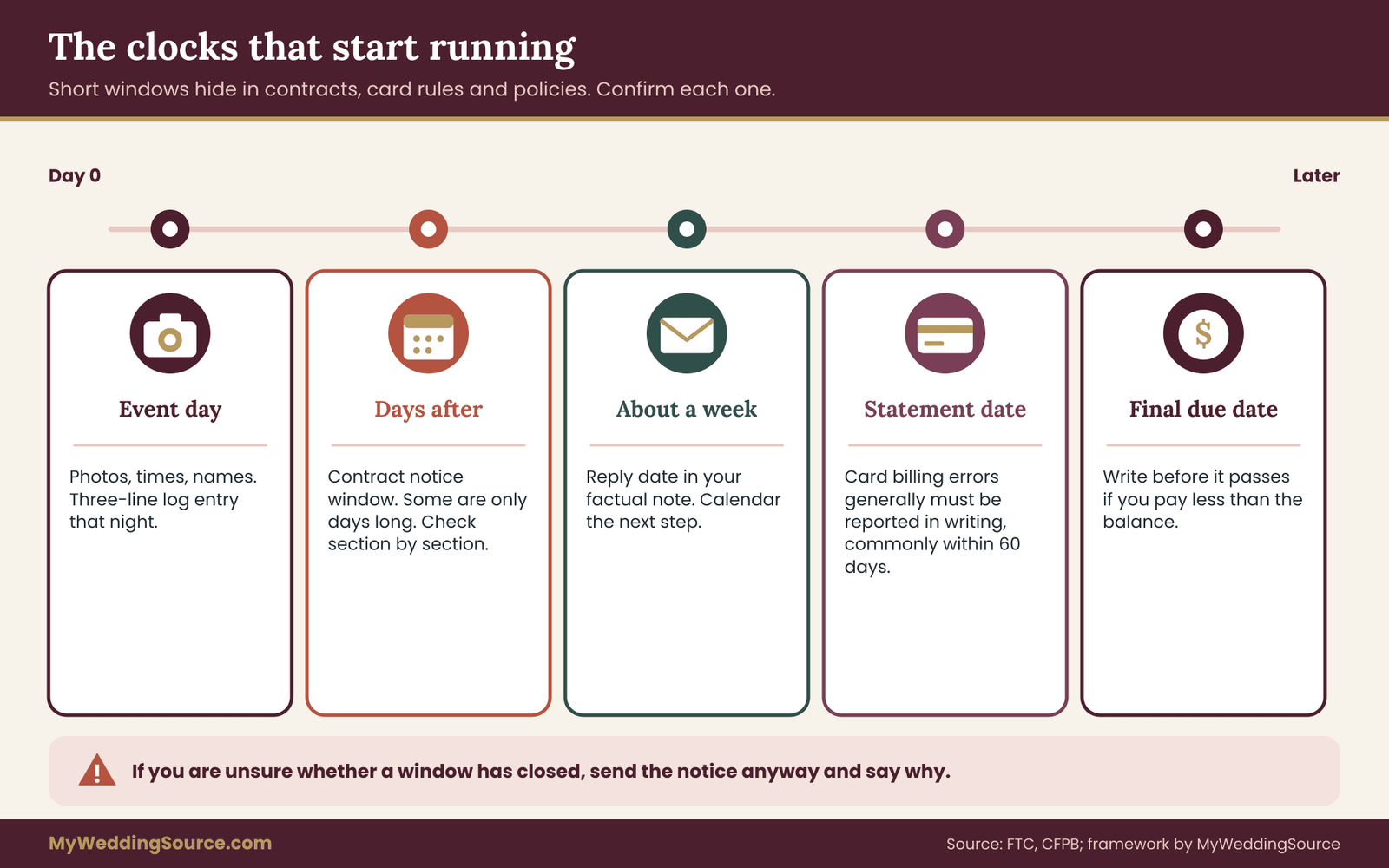
Speed matters, but not panic. Waiting a few days after the event to calm down is fine. Waiting six weeks is risky, because notice windows may close, memories fade and vendors may have thrown away materials. Contracts commonly set short windows for reporting problems, and card dispute rights have time limits as well. If you are unsure whether a window has passed, send the notice anyway and note why. A late notice is often better than none.
Write the date of each message about the missed deliverable in your calendar along with the date a reply is due. The calendar, not your memory, should tell you when to climb a step.
Keep your tone steady. A vendor who feels attacked will protect themselves. A vendor who feels respected and sees the facts is more likely to look for a way to fix the problem. You can be both firm and kind in the same paragraph: “We are asking for a partial refund and a corrected invoice. We appreciate your quick attention.”
What to say about a missed deliverable: scripts you can adapt
Knowing what to say is half the battle. Most couples either say too much, in anger, or too little, in politeness. The scripts below are meant to be changed to fit your voice. They are not legal forms. Each one follows the same shape: the fact, the source, the ask and the date.
The on-the-spot script
Use this when you notice a missed deliverable during the event and the vendor is present.
Keep your voice level and your sentences short. You are describing a missed deliverable, not a character flaw.
“Hi, thank you for being here. I am checking the contract and it lists twelve centerpieces. I count ten, and the head table and the guest book table are empty. What can you do about those two before dinner starts at six?”
Then listen. Vendors often have a fix they did not think to offer, such as moving pieces from the ceremony space, using extras from a bridesmaid’s bouquets or sending someone to a nearby shop. If they offer something, repeat it back: “So you will bring two arrangements to those tables by 5:30. Thank you.” If they cannot fix it, ask only one more question: “Can you send me a note tomorrow about what happened and what you propose?” Then let them go to work.
What to avoid: telling them how disappointed you are, mentioning reviews, or asking for money at the event. Keep those conversations for after the wedding, with a clear head and a complete log.
The same-day confirmation message
Send this by text or email that evening or the next morning, short and plain:
This confirmation is also the first dated entry in your conversation log about the missed deliverable, so keep a copy.
“Thank you for your help today. To confirm what we discussed: ten of twelve centerpieces were delivered by 3:00, and the two missing arrangements were brought at 5:40. We will send details of what we noticed and ask how you plan to address it. We are keeping the notes below for our records.”
Add two or three bullets with the facts. The message does three things at once. It thanks the vendor, which keeps the tone cooperative. It records the time of the late fix. And it tells the vendor a fuller note is coming, so they are not surprised.
The factual note by email
Use this about a week after the wedding, or sooner if you are ready, as the first step of the cure ladder.
“Subject: Contract dated February 10: centerpieces for our wedding on June 14
Hello [name],
Thank you for the work your team did for our wedding. We want to raise one item. Section 3 of our contract lists twelve guest-table centerpieces to be delivered by 3:00 p.m. On the day, ten were in place at 3:00 and the remaining two were delivered at 5:40. Photographs from 3:05 and 5:45 are attached, along with the contract page.
Two tables had no centerpiece during cocktail hour and the start of dinner. The quote lists each centerpiece at ninety dollars.
Could you let us know by [date, seven days out] how you would like to address the two late arrangements? We would like to settle this directly.
Thank you, [names]”
Notice that the note contains no accusation and no adjective. It lets the numbers do the work. It also leaves the vendor a path to propose a remedy first, which sometimes yields a better offer than you would have asked for.
The specific request
If the vendor agrees there was a problem but has not offered a remedy, follow with a clear ask.
A request that cites a number from the quote shows that you have treated the missed deliverable as a matter of arithmetic. Vendors often find that easier to accept than a general demand.
“Thank you for confirming. We would like a refund of ninety dollars per late arrangement, one hundred eighty dollars in total, to our original card by [date]. Please confirm by reply, and tell us if you need anything else from us.”
The numbers come directly from the quote and the Gap column of your log. If you ask for more than the value of the missed deliverable, explain the extra with a receipt or a line item. Over-asking tends to slow things down.
The formal notice
If you reach step three, adapt the following. Replace bracketed parts, and match the delivery method to what the contract requires.
“Re: Notice of missed deliverable under contract dated [date]
To [vendor legal name and contact named in the contract]:
This is written notice under [section number, if any] of our agreement. The contract at section [x] states: [short quote or paraphrase]. On [date], the following was delivered: [facts, with times and counts]. The shortfall is [gap]. Documents attached: [list].
As a result, we incurred [direct costs, with receipts] and did not receive [value lost].
We ask that you [specific cure: replace, refund of $X, credit of $X] by [date, matching the contract’s cure period or a reasonable number of days]. If you disagree with any of the facts above, please send your version and any records by the same date.
We would like to resolve this directly and appreciate your response.
[names, date, contact]”
Keep the quote short. Use your own words for anything longer than a sentence.
A script for a phone call
Sometimes a call is faster than an email. Prepare three lines: the fact, the ask and the deadline. Open with “I would like to go over one item from our contract and then confirm what we agree in writing.” State the fact. Ask for the remedy. Close with “I will email a summary of what we agreed today, so we both have it.” When the call is done, send the summary within the hour.
If the vendor becomes upset, do not match their tone. Say, “I hear you. I want to find a fair outcome. Can we go back to what the contract says?” That sentence redirects the conversation to the document and lowers the temperature without giving anything up.
What to say to a vendor who denies it
Vendors sometimes deny that anything went wrong. Sometimes they are right, and the record you thought you had is weaker than it seemed. Sometimes they are wrong and will not budge. The phrase to use is, “Our records show something different. Can you send us yours?” This asks for evidence without calling anyone a liar. A delivery log, a crew sheet or a time-stamped photo from the vendor may clear up the disagreement, or it may show that both sides are partly right.
When a vendor denies a missed deliverable, check your own log before replying. If you find a weak spot, say so and adjust the request. Honesty about your own record keeps the rest of your claim credible.
If the vendor sends nothing, note the date of your request in your log. Silence in response to a polite request for records is itself a fact.
What to say to family and guests
You will also have to say something to people who noticed. Keep it brief: “There was a mix-up with one delivery, and we are sorting it out.” You do not need to give the vendor’s name, and you do not need to apologize for them. Public complaints can complicate a private resolution, so keep details out of the group chat for now.
When a deliverable is missed on the wedding day itself
A missed deliverable on the day itself is a different problem from a missed deliverable discovered later. The clock is running, other vendors depend on the schedule, and you cannot pause. This section covers how to handle a missed deliverable while the event is still going on.
Decide who owns the problem
Before the day, decide who handles vendor issues. A planner or day-of coordinator is ideal. If you do not have one, name a calm friend or relative and tell your vendors that this person is the single point of contact. This avoids the common problem of three well-meaning relatives each telling the vendor something different.
Tell the vendor in advance who that person is. A vendor who knows where to send news of a missed deliverable will send it to the right place, and your own phone stays quiet.
Give that person a one-page list: the vendor’s name, their mobile number, the three most important deliverables and the time each is due. The site’s guide to the wedding day digital contingency plan covers how to keep contact lists and files available if your phone or network fails.
Ask for the smallest fix that works
Under time pressure, ask for the smallest fix that protects what matters most. If the florist is late, ask for the bridal bouquet and ceremony flowers first. If the DJ’s microphone fails, ask for a handheld backup for the vows and toasts. If a cake is late, ask the caterer to keep dessert service flexible. A good fix is not necessarily the one you would have chosen in a calm moment. It is the one that keeps the day moving.
Write down what was offered and accepted. In your log, add a line to the Impact column such as “accepted replacement vase set as stopgap; no cost to us.”

Keep one eye on the next dependency
A missed deliverable often creates a second problem. A late caterer pushes the toast. A late photographer misses the first look. When you learn of a missed deliverable, ask your coordinator which later items depend on it, and tell those vendors. A DJ who knows dinner is running thirty minutes late can adjust the music. A photographer who knows the ceremony start moved can plan lighting.
Do not accept a release on the spot
Some vendors, anxious to settle things quickly, will ask you to sign a note or accept a verbal “we are even.” Be careful. Do not sign anything that releases the vendor from claims until you know the full extent of the gap and have had a chance to review it. You can say, “Thank you, we will look at everything after the wedding and respond in writing.” That is calm, firm and does not commit you to anything.
Capture proof as it unfolds
Ask your photographer, if they are still there, to take a couple of frames of the issue, such as the bare tables or the empty arch. Ask your coordinator to note the time the issue was fixed. If the vendor leaves early, note the time and who told you. These small facts carry more weight than a general memory.
Capture proof of the fix too, not only the missed deliverable. A photograph of the corrected table at the later time shows both the problem and its length.
After the day: a ten-minute debrief
Within twenty-four hours, sit down together and write the first version of each log entry while details are fresh. It does not have to be polished. Ten minutes of notes, with your coordinator’s input, will save hours later and will help you decide whether the problem is minor, such as a late arrival that was fixed, or serious, such as an unpaid-for service that never happened. Then give yourselves a few days off. A missed deliverable will still be there after the honeymoon starts, and you will respond better rested.
Choosing a remedy for a missed deliverable
Once the facts are logged and the vendor has acknowledged the problem, or failed to, you have to decide what you actually want. Many couples skip this step and react emotionally, asking for either everything back or nothing at all. A better habit is to choose the remedy that matches the type of miss, the time left and the value lost.
There are six common remedies. Each fits some situations better than others.

Redo or complete the work
If there is still time, ask the vendor to finish what was promised. A gallery that is missing the reception images, a signage order short by two pieces, an alteration that was not finished: these can often be fixed with a new delivery date. This is the best remedy when the item is still useful to you after the delay. It is the worst when the moment has passed, such as a missing ceremony arch.
Whenever you accept a redo, set a firm date in writing and say what happens if the date is missed, for example “if not received by the 20th, we will request a refund of the unfulfilled portion.” This turns an open-ended promise into a short, enforceable plan.
Replace with an equivalent
When the original cannot be fixed, a replacement may do. A different centerpiece style, a loaner speaker, a substitute dessert. Replacements work best when they are agreed before they arrive. Ask for a photograph or description, and say clearly whether the replacement is accepted as full resolution or only as a stopgap. If you accept it as a stopgap, say so in writing, so the vendor cannot later claim the matter was closed.
Credit toward future services
A credit can be useful if you plan to use the vendor again, for an anniversary shoot, a vow renewal or a related event. For most couples, though, a credit is less valuable than cash, because it ties you to a vendor who just disappointed you. Accept a credit only if you genuinely expect to use it, and note any expiration date or conditions. Credits can disappear if a business closes, so cash is safer when the vendor’s stability is uncertain.
Partial refund
A partial refund is the most common fair outcome for partial and late misses. Calculate it from the contract’s own numbers. If the quote lists twelve centerpieces at ninety dollars and two were missing, the value of the gap is one hundred eighty dollars. If coverage ran fifteen minutes short of a six-hour package, a proportional share of the package price is a reasonable starting point. State your arithmetic in your request so the vendor can check it.
Where a package price covers many items, ask whether the vendor can show an itemized breakdown. If not, a proportional estimate is usually the clearest method, and you can explain it in a sentence.
Full refund
A full refund is appropriate when the vendor delivered little or nothing of value, or when the missed deliverable defeated the purpose of the contract. A photographer who never delivered any images, a rental that never arrived, a service that was entirely absent. A full refund may be harder to obtain if the vendor performed a lot of work or if the contract has non-refundable language. In those cases, the more specific your log, the better your case that the contract’s purpose was not met.
Accepting the gap
Sometimes the right remedy is to let a small gap go. If the missed deliverable was minor, the vendor was honest and apologetic, and the cost of pursuing it would be more than the value, you might simply thank them and move on, perhaps with a short written note that you are not claiming further.
Choosing this is not weakness. It is a decision, and you can make it on purpose, with the facts recorded. Just be careful that “moving on” does not turn into a signed release you did not mean to give. Confirm in writing what is being closed and what is not.
Even when you accept a gap, keep the entry. A closed note on a missed deliverable is still useful if the same vendor later asks for a referral or you are asked for a reference.
A rule of thumb for choosing
Ask four questions in order.
Write the chosen remedy next to the entry for the missed deliverable, with the reasoning in a single line. When you read it a month later, you will remember why you asked for a partial refund instead of a credit.
First, can the gap still be fixed in a way that is useful to you? If yes, ask for a redo. Second, if not, is there an acceptable replacement? If yes, accept it, noting whether it is full or partial resolution. Third, if neither is possible, what is the value of what was missing, using the contract’s own numbers? Ask for that as a partial refund. Fourth, did the missed deliverable defeat the whole purpose of the contract? If yes, ask for a full refund and explain why.
The point of the sequence is to keep your request tied to facts. A vendor can say yes to “refund the two missing items at the quoted price.” It is much harder to say yes to a demand that goes beyond what was lost.
Timing your request
Ask for the remedy in your first formal written note if the facts are clear. If the vendor needs time to investigate, ask for a response date and say you will revisit then. Do not accept an open-ended “we are looking into it.” Each undefined week reduces your leverage, especially if a final balance is still due or a card dispute window is closing.
Watching for the release
When a vendor agrees to a refund or credit, they may send a short agreement or release. Read it. A fair release says that the vendor will pay a stated amount by a stated date and that you will treat the specific incident as resolved. An overbroad release might waive all future claims, including ones you do not yet know about, or include a promise not to post any review.
You can ask to narrow the language, or you can pay a lawyer for a short review if the amount is meaningful. Never sign a release before the money has arrived unless the agreement spells out when and how it will.
Payments, card disputes and insurance after a missed deliverable
Money is where most of the leverage lives, and it is also where most of the deadlines hide. This section covers what to do about unpaid balances, how card disputes generally work, and what to look into with insurance. It is general information. Your card agreement, your policy and your state’s rules control, so confirm details with the issuer, the insurer and a licensed professional when the amount is large.
The unpaid balance
If a final payment is still due when a deliverable is missed, think carefully before you pay. The contract may require payment on a date regardless of any dispute, and withholding the whole balance could create a breach on your side. A more careful approach is to pay the undisputed portion, put the disputed portion in writing and explain exactly why. For example, “We are paying the balance minus one hundred eighty dollars for the two centerpieces that were not delivered on time, as set out in our note of June 20.”
If a missed deliverable is still unresolved on the due date and you are unsure what to do, ask the vendor in writing how they want to handle the final invoice. Their reply tells you whether they treat the issue as open.
Whatever you do, write to the vendor before the due date, not after. A short note that explains a partial payment is much better than silence. The site’s guide to wedding vendor payment tracking shows how to keep a payment ledger that makes this kind of calculation quick.
If the contract allows you to pay by card, using one for the final balance may preserve your dispute rights. That is one reason couples often keep a card for large vendor payments. Be aware that some vendors add a surcharge for cards, so read the contract before choosing.
Deposits and retainers
A deposit that has already been paid is harder to recover than a balance you have not yet paid. Whether it is refundable depends on how the contract labeled it and on state law. The difference between a retainer, which pays for holding a date, and a deposit, which is credited toward the price, can shape what you can ask back. The site’s guide to wedding retainer versus deposit contracts explains that distinction in detail. For a missed deliverable, the key question is usually whether the money you paid bought the specific item or service that was not provided.
How card disputes generally work
If you paid by credit card and the vendor did not provide what was agreed, you may be able to dispute the charge with your card issuer. The Federal Trade Commission and the Consumer Financial Protection Bureau both describe billing-error and dispute rights for credit cards, and they explain that you generally need to notify the issuer in writing within a limited number of days after the statement showing the charge, commonly sixty. Debit cards, prepaid cards, bank transfers and payment apps follow different rules, and some are less protective.
Keep the dispute narrow and tie it to one missed deliverable at a time. Issuers handle clear, specific claims more easily than a broad complaint about an entire event.
A few practical points help.
Contact the vendor first. Many issuers expect you to have tried to resolve the problem with the merchant before they will step in. Your log and notices show that you did.
Dispute the specific amount in question, not the whole bill if the vendor delivered most of what was promised. Provide the issuer with your Promise, Proof and Gap columns, the contract and the correspondence. A clean, short package is more persuasive than a long narrative.
Watch the date. If your event was on a Saturday in June and the card statement closed June 25, the sixty-day clock may already be running before you have finished talking to the vendor. If a statement is approaching its deadline and the vendor is not responding, file the dispute rather than wait. You can often withdraw it later if the vendor resolves the issue.
Be honest. A dispute that overstates the problem can be denied and can damage your account standing. Describe exactly what was missing, and let the documents speak.
What a dispute does and does not do
A card dispute is a process between you and your issuer, and between the issuer and the vendor’s bank. It can return money, but it is not a judgment about the vendor’s character, and it may take weeks. The issuer may ask the vendor for their side. The vendor can respond with their own records, so your log has to hold up. A card dispute also does not replace the contract. If the dispute goes the vendor’s way, you may still have other options, but the issuer’s decision is not a ruling on whether a breach occurred.
Travel and event insurance
Some couples buy event insurance, and some venues require it. Policies differ widely. Many cover cancellation or a vendor’s failure to appear for covered reasons. Few cover “the florist delivered fewer arrangements than promised.” Read your policy for how it defines vendor default, whether it covers partial performance, what deadlines it sets for reporting and what documentation it wants. The site’s guide to wedding contingency reserve draws covers how to decide when money from a reserve is the practical answer.
Ask the insurer in plain words whether a missed deliverable of the kind you logged could ever fall under the policy. Even a “no” answer is useful, because it tells you the reserve or the vendor must carry the cost.
If you think a policy might apply, contact the insurer promptly and ask what they need. Insurers often have strict notice rules, and your log is useful here as well.
Keep your own costs separate
If you spent money to fix the missed deliverable, such as a rushed replacement or extra coordinator hours, keep those receipts together and label them to the incident. You may ask the vendor to cover them, but the request is stronger when each cost is clearly tied to the gap. Avoid including unrelated expenses, since one questionable item can weaken a request that is otherwise sound.
A worked example of a missed deliverable, start to finish
The following case is invented for illustration. The names, amounts and dates are made up, and the outcome is one realistic path among several. It shows how the log, the notice and the remedy fit together. Real vendors and real contracts will differ, so use it as a pattern, not a prediction.
The situation
Dana and Marcus held their wedding on a Saturday in October. Their contract with a florist, signed in the spring, listed in section 2 a floral arch for the ceremony, installed by 2:00 p.m., and in section 3 twelve centerpieces for guest tables, delivered to the reception room by 4:00 p.m. The quote priced the arch at six hundred dollars and each centerpiece at ninety dollars.
The total was one thousand six hundred eighty dollars, with half paid as a deposit by credit card and the balance due seven days after the event. Section 9 required written notice of any problem within ten days of the event, and gave the florist five business days to cure after notice.
Notice how many details in the situation come straight from the paperwork: section numbers, times, prices and a notice window. A missed deliverable is easier to discuss when these facts sit on one page.
What happened on the day
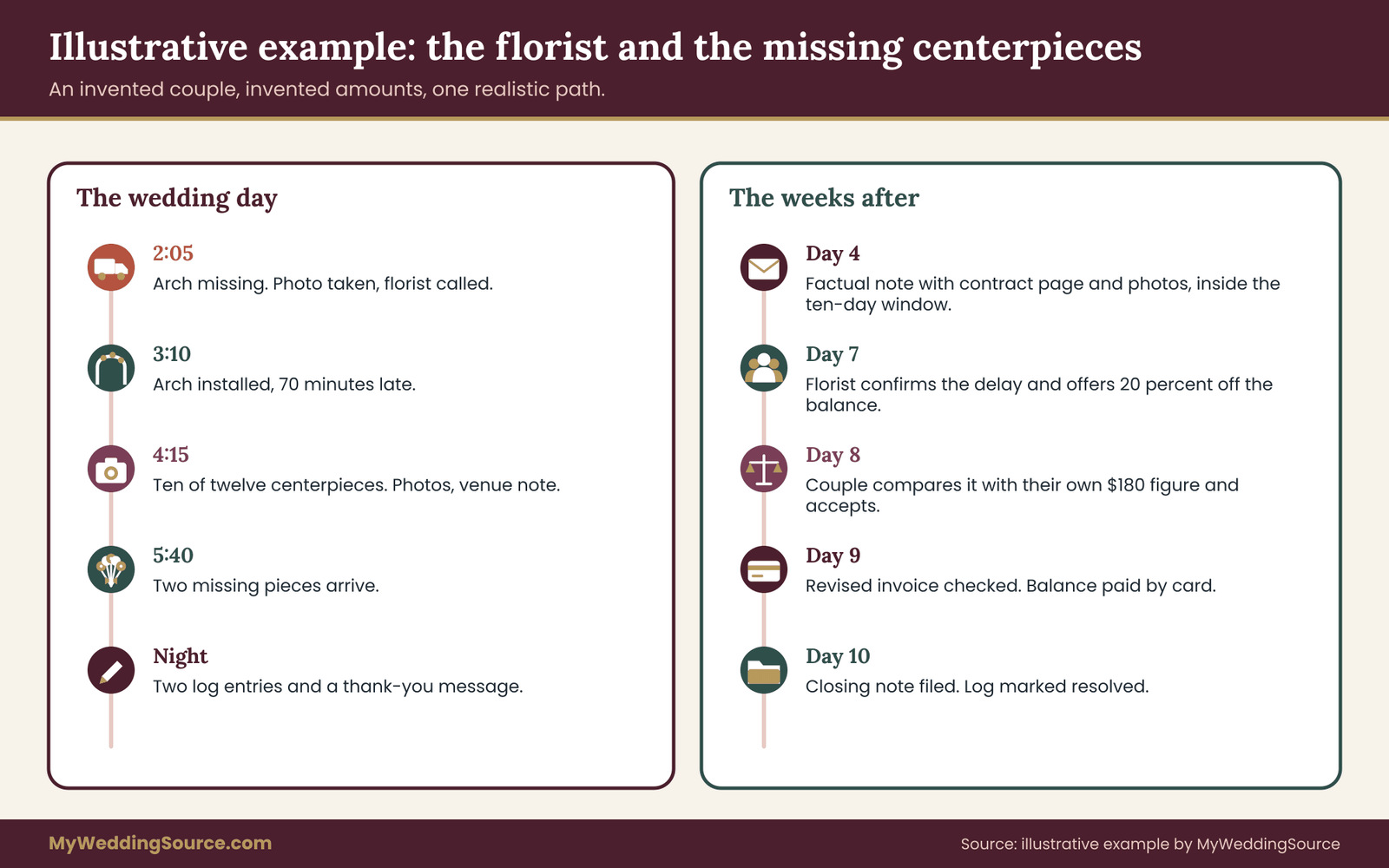
Their coordinator, Priya, checked the arch at 2:05 and found it missing. She photographed the empty ceremony space with the time showing on her phone and called the florist, who said the truck was delayed by traffic and promised arrival within the hour. The arch was installed at 3:10. The ceremony, set for 3:30, started on time after Priya shifted seating by a few minutes.
At 4:15 Priya counted ten centerpieces in the reception room. The head table and the guest book table were bare. She asked the driver, who said two arrangements had been left behind and would be brought later. They arrived at 5:40, as dinner began. Priya photographed the empty tables at 4:15 and the full ones at 5:45, and she asked the venue manager to write two sentences confirming the times.
Marcus did not argue with the driver. He thanked him, asked that the two pieces be brought as soon as possible, and went back to the party.
The log, filled in
That night, Dana wrote two entries.
Entry one, arch. Promise: contract section 2, dated April 3, arch installed by 2:00 p.m. Proof: photographs at 2:05 (empty) and 3:10 (installed); text from the florist at 2:20 about the truck; coordinator’s note. Gap: installed 70 minutes late. Impact: ceremony prep was disrupted and the coordinator adjusted guest seating; no direct cost; the arch was in place before the ceremony.
Entry two, centerpieces. Promise: contract section 3, twelve guest-table centerpieces by 4:00 p.m. Proof: photographs at 4:15 and 5:45; venue manager’s two-sentence note; driver’s statement noted with time. Gap: two of twelve missing at 4:00; delivered at 5:40, about 100 minutes late. Impact: two tables bare during cocktail hour and the start of dinner; no direct cost; value of the gap at quoted price is one hundred eighty dollars.
Dana also started a conversation log: the call at 2:10, the driver exchange at 4:15, and the thank-you message she sent that evening.
Choosing the remedy
The couple talked it over the next day. The arch was fixed before the ceremony, and neither of them wanted to chase a refund for it, though the delay had been stressful. They decided to accept the arch gap as resolved with a short acknowledgment. For the centerpieces, the pieces had eventually arrived but at a time that left two tables bare through cocktail hour. They concluded that a partial remedy was fair. Using their four questions, they saw that a redo was impossible because the moment had passed, and a replacement had already been delivered late.
That left a partial refund, calculated at a fraction of the missing items’ value. They decided to ask for the full ninety dollars for each of the two pieces, since the pieces were missing during the part of the event when they were most needed, and they were prepared to accept less.
The first notice
Four days after the wedding, Dana sent a factual note to the florist’s named contact, with the contract page and photos attached. It quoted sections 2 and 3, gave the times, stated the gap and asked how the florist would like to address the two late arrangements, by a date seven days later. It also said the arch delay was noted but that they were not seeking anything for it. Dana kept her tone warm and left out any opinion.
The note named each missed deliverable separately, one for the arch and one for the centerpieces, instead of folding them together. Separate entries let the vendor respond to each one on its own terms.
The email was inside the ten-day notice window of section 9. Dana had not realized this until she reread the contract on day three, which is why she wrote it that week.
The florist’s reply
The florist responded in three days. They apologized, confirmed the traffic delay and the shortfall and offered a twenty percent discount on the final balance. Dana and Marcus compared that to their own arithmetic. Twenty percent of the one thousand six hundred eighty dollar total would be three hundred thirty-six dollars, which was more than the one hundred eighty dollars they had planned to ask for.
They were surprised but did not feel it was unreasonable. They wrote back to accept, and asked the florist to send a revised invoice showing the discount and a note that the matter was closed.
Paying the balance
When the revised invoice arrived, the balance was lower by the agreed amount. Dana checked that the new total matched the discount and paid by card before the due date. She saved the invoice, the receipt and the florist’s closing note in the vendor folder. She updated both log entries with the outcome and marked the incident resolved.
What could have gone differently
It is worth thinking about the paths that were not taken, because they show why the log mattered.
Each branch above starts from the same record. That is the practical value of logging a missed deliverable early: the record supports whichever path the vendor chooses.
If the florist had denied the late arrival, the venue manager’s note and the time-stamped photographs would have answered that. If the florist had offered nothing, Dana would have moved to a specific request for one hundred eighty dollars, then to a formal notice within the cure clause and, if needed, a card dispute for the disputed amount within the issuer’s time limit.
If the florist had gone silent, the date in the log would have told Dana when to move to the next step. And if the couple had waited until week four to write, they would have missed the ten-day notice window and weakened their position.
None of this required a confrontation. It required a few photographs, a contract page and a clear message.
What the example does not show
This example is deliberately tidy. Real cases often involve a vendor who disagrees on the facts, a contract with no cure clause or a missed deliverable that is only discovered weeks later. In such cases, the same four columns apply, but the path may take longer and may require a card dispute or professional help. The point of the example is the habit: facts first, ask second, record everything. If you want the earlier step of turning a signed agreement into a delivery checklist, the guide to going from scope agreement to final acceptance shows how.
Reviews, complaints and small claims after a missed deliverable
After you have sent notices and received a reply, or not, you may want to share your experience with others or take the matter to an outside body. This section explains how to do that without creating new problems for yourself.
Writing a review
A review is public speech about a business, and it can help other couples. It can also provoke a response. Wait until the matter is resolved, or until you have clearly exhausted direct attempts, before posting. A review written in the first days of anger tends to be longer, more emotional and easier to challenge.
If you decide to mention the missed deliverable in a review, use the facts from your Promise and Gap columns and leave out the Impact column’s emotional notes. Facts are harder to dispute than feelings.
Keep a review factual. State what the contract promised, what happened and how the vendor responded, in a few sentences. Avoid guessing at motives, calling the business names or revealing private information about employees. Write only about your own experience. If the vendor fixed the problem fairly, say that too, because a balanced review is more believable and more useful.
Be aware of two cautions. Some contracts contain clauses that restrict reviews, such as non-disparagement terms or requirements to remove content. In the United States, the Consumer Review Fairness Act limits certain form-contract clauses that try to prevent honest reviews, according to the Federal Trade Commission, but the details matter and the law does not protect false statements. If you have a clause like this, ask a licensed professional before you post. Also, if you accepted a refund in exchange for removing or not posting a review, read your settlement carefully, because it may bind you.
Complaints to agencies and organizations
Several channels exist for filing a complaint. USAGov lists ways to report consumer problems and points to state and local consumer protection offices. State attorneys general often take complaints about business practices, and some will contact the business on your behalf. The Federal Trade Commission collects reports about deceptive business practices, although it does not usually resolve individual disputes. If a card was used, the Consumer Financial Protection Bureau accepts complaints about card issuers.
Before filing, reread your log and ask whether a stranger could understand the missed deliverable in one minute. If not, shorten the story until they can.
Industry groups and local business organizations may also have complaint processes. Their value varies. Use them if they fit, but understand that they carry no legal force.
Each of these channels will ask for facts: who, what, when, how much and what you have done so far. Your log and your notices are the answer. Keep the complaint short, attach a few key documents and stay on the facts. State what outcome you want. Many agencies cannot award money, but a complaint can create a record and sometimes prompts a vendor to respond.
Mediation
Some contracts require mediation before arbitration or court, and some communities have low-cost mediation services. In mediation, a neutral person helps both sides talk, and any agreement must be accepted by both. It is voluntary in nature even where the contract requires you to try it, and it tends to work well when the disagreement is about a number rather than about facts. Bring your log, your notice and a clear figure you could accept.
Small claims court
Small claims courts handle disputes up to a limit set by each state, often a few thousand to ten thousand dollars or more. Their rules differ. Some allow lawyers, some do not. Filing fees vary, and in some places you must try to resolve the matter first and show it. A court clerk can tell you the rules and give you the forms, though they cannot give legal advice.
Bring only what proves the missed deliverable: the contract page, the photographs, your notice and the vendor’s reply. A short, well-ordered folder helps a judge or clerk follow the case quickly.
If you consider small claims, count the cost against the amount at stake. A one hundred eighty dollar gap may not justify a day in court. A vendor who never delivered a four thousand dollar package might. Consider also whether the vendor is still in business and whether a judgment could be collected. If the contract includes an arbitration clause, small claims may not be available, or may be limited. A short consultation with a licensed attorney, or a call to a local legal aid or bar association referral service, can clarify this.
Keeping your standing
Whichever route you pick, behave as though a stranger will read every message you wrote. Do not threaten, do not exaggerate and do not post details of the dispute while it is ongoing in a way that could undermine your case. Keep copies of everything. If the matter ends with an agreement, make sure it is written, specific and complete, with a payment date and a statement of what is resolved.
Most couples will never reach small claims. A clear log, a polite note, a reasonable request and a bit of patience settle many everyday problems. The outside channels exist for the cases that do not.
Edge cases: when a missed deliverable is not simple
Real situations rarely match a clean pattern. This section covers the complications that come up most often, with a suggested way to think about each. In every case the same method holds: write down the promise, the proof, the gap and the impact, then choose the lowest step on the cure ladder that could work.
Shared fault with the venue or another vendor
A vendor may miss a deliverable because something outside their control failed. The venue’s loading dock was locked, the elevator was out, the power was off or another vendor blocked access. In that case, a claim against one vendor may be unfair, or at least incomplete.
Record the shared fault plainly in the log. A missed deliverable with two causes should have two lines in the Gap column, one for each.
Ask what each party knew and when. If the florist was told the dock opened at noon and it opened at two, the florist’s lateness may follow from the venue’s error. Your contract with the venue may have a clause about access times. Gather the facts for both sides, and consider whether the right request goes to the venue, the vendor or both. The site’s guide to the wedding vendor due diligence checklist covers asking vendors about access and insurance before the event, which prevents many of these disputes.
A change you made without a written record
If the vendor says you changed the order, and you did, but only by phone, the vendor’s version may be as strong as yours. In that case, do not insist on the original contract language. Focus on what both sides agree was the intended result. Then fix the habit: every change should be confirmed in writing by both sides before the event.
Force majeure and events outside anyone’s control
Many contracts include a force majeure clause, which excuses performance during events such as severe weather, government orders or natural disasters. Whether such a clause applies depends on its wording and on the facts. A snowstorm that closed the roads may excuse a delay. A vendor’s staffing shortage usually does not. Read the clause’s list of events and the notice steps it requires. If the clause applies, the remedy may be a rescheduled delivery or a partial refund of what was not performed, depending on the contract and local law. This is a good point to ask a professional.
The vendor goes out of business
Sometimes a vendor closes before or after the wedding and cannot deliver. If you paid by card, a dispute may be your best route, and you should file it quickly. If the business filed for bankruptcy, you may be able to submit a claim as a creditor. Notices of bankruptcy usually arrive by mail, and you can also search court records for the case.
Collect your contract, payment proof and correspondence, and ask the court clerk or a licensed professional what the process is. Recovery in these cases is uncertain, which is another reason to pay larger balances in ways that offer dispute rights.
If a vendor closes with a missed deliverable still open, the date of the closure goes into the log as well, since it affects which routes remain.
A missed deliverable discovered long after the event
Some deliverables are only checked weeks or months later: an album, a video, a marriage license that was supposed to be returned to the county by the officiant. When you discover a gap late, act quickly and check for any deadlines. Start the log the same day, and write to the vendor without blame: “While reviewing our order, we found that …” Ask what the vendor’s records show, and request a specific fix.
Contract windows may have passed, but vendors often still honor reasonable requests, especially when you have been polite and have a clear record. For anything involving a legal document such as a marriage license, contact the issuing office promptly.
When a missed deliverable surfaces late, note in the log when and how you found it. The date of discovery often matters to deadlines and to how a vendor responds.
Multiple vendors, one problem
When a missed deliverable involves several vendors, such as a cake that was not delivered because the rental company’s truck did not arrive, resist the urge to send the same angry message to everyone. Make one log entry for the underlying problem and note each vendor’s role. Then send each vendor a note that covers only their part. You may find that one vendor accepts responsibility and the others do not need to be pursued.
Family-hired vendors and gifts
Sometimes a relative booked or paid for a vendor, such as an uncle who hired the band as a gift. The contract may be in the relative’s name, and they may feel awkward asking for a refund. Decide together who will handle the matter. The person who signed the contract usually needs to send the notice, or to give you written permission to act. Be gentle: the relative is not responsible for the vendor’s performance, and you want the relationship to survive the dispute.
The same four columns work when someone else hired the vendor. Ask the relative for a copy of the contract so you can document the missed deliverable accurately.
Vendors you work with again
You may need to deal with the same vendor again, such as a venue where you hold a family event, or a photographer whose studio a friend uses. If the missed deliverable was modest, consider whether a cooperative tone and a small remedy are worth more to you than maximum recovery. The point is not to be a pushover, but to choose deliberately.
Partial payment already made and a vendor who stops responding
If a vendor has your deposit and goes silent, the ladder is the same but the timeline is tighter. Send a factual note, then a formal notice by a method that leaves a record, then consider the card issuer, the state consumer protection office and, if the amount justifies it, small claims. Keep every attempt to reach them in your log, including calls that went to voicemail, because those entries show good faith and a pattern.
Misses by a vendor you found through a platform
If you booked through a marketplace or a venue’s preferred list, the platform may have its own policies, such as a guarantee, a dispute process or a deadline for reporting issues. Read those policies and use them in addition to your contract with the vendor. Do not assume the platform is a party to the contract; whether it is depends on how it is set up. Keep your communication in the platform’s system too, since it may be the only record they consider.
Your next steps
If you are reading this before your wedding, spend one hour building a delivery checklist for your top vendors, copied from your contracts, and decide who will check it on the day. Read each contract for the notice and cure clauses and write the deadlines on a calendar.
If you are reading this after a missed deliverable, do these in order. Write the first log entry today, even if it is rough. Gather the contract, photographs and messages in one folder. Check the notice window and the card dispute window, and mark both. Decide which step of the cure ladder you are on, and write or send the factual note. Choose a remedy using the four questions, and put the figure in writing. Keep the log updated until the matter is closed, and then file it with the rest of your wedding records.
Most of all, keep the tone steady. A missed deliverable is a business problem, and business problems are solved with documents, dates and clear requests. If the amount is large or the vendor is unresponsive, ask a licensed attorney or your state’s consumer protection office what to do next.
Whichever path you are on, remember that a missed deliverable is a solvable problem. A short log, a calm note and a clear request are enough to begin.
FAQ
What should I do first when a wedding vendor misses a deliverable?
Protect the day if the event is still going on by asking for the smallest fix that works. Then photograph the gap, note the time and what the vendor said, and compare the result with the exact words in your contract. Hold off on refunds, reviews and accusations until the facts are recorded in an incident log.
How long do I have to complain about a missed deliverable?
It depends on your contract and the route you choose. Many contracts set a short written-notice window, sometimes only days. Credit card billing disputes generally have their own limit, commonly sixty days from the statement showing the charge. Check both, and send a written note promptly if you are unsure.
What is a cure notice and do I need one?
A cure notice is a written message telling the vendor what was missed and giving a set time to fix it. You need one if your contract has a cure or notice clause, or if the vendor is not responding to simpler requests. Many problems are settled with a factual email before that step.
Can I withhold the final payment if a vendor misses a deliverable?
Be careful. Withholding the whole balance can put you in breach if the contract requires payment regardless. A safer approach is often to pay the undisputed amount, explain the deduction in writing before the due date and tie it to the contract’s prices. For large sums, ask a licensed professional first.
Is a different item than I ordered a missed deliverable?
It can be, if the contract described the item and the vendor delivered something that does not match. Check for a substitution clause that lets the vendor swap items of comparable value. If one applies, the question becomes whether the replacement was truly comparable and whether you were told.
Will a credit card dispute work for a missed wedding deliverable?
It may help if you paid by credit card, contacted the vendor first and filed within the issuer’s time limit. Debit cards, transfers and payment apps often offer less protection. Describe the specific shortfall, attach your contract and log, and ask the issuer about its current rules and deadlines.
What if a vendor will not respond to my notice?
Record each attempt in your log with dates and methods, then move up the ladder. You can file a card dispute, send a formal notice by a method that leaves a record, contact your state consumer protection office or consider small claims. Choose the route that fits the amount and the contract.
Do I need a lawyer for a missed deliverable?
Not for most small problems, which are often settled with a clear log and a polite request. Consider a licensed attorney when the amount is large, the contract has an arbitration clause or a liability limit, the vendor threatens legal action or you are asked to sign a broad release.
Sources
- Disputing credit card charges, Federal Trade Commission
- Fair Credit Billing Act, Federal Trade Commission
- How do I dispute a charge on my credit card bill?, Consumer Financial Protection Bureau
- Submit a complaint, Consumer Financial Protection Bureau
- Consumer Review Fairness Act: What businesses need to know, Federal Trade Commission
- Consumer complaints, USAGov
- State consumer protection offices, USAGov
- Find my attorney general, National Association of Attorneys General
- Consumer advice, Federal Trade Commission
- Personal archiving: preserving your digital memories, Library of Congress