

Raw bar safety at a wedding comes down to one idea: every oyster, clam or piece of raw fish your guests eat should have a paper trail behind it and a cold, clean path in front of it. This guide gives you a six-link chain, the questions to put to caterers and venue operators, and a way to decide when a raw bar is a good idea and when something cooked is the better choice.
Treat raw bar safety as six links: source, receive, store, serve, inform and document. Ask your licensed caterer to show proof for each link in writing: shellfish bought from a certified supplier with harvest tags kept, cold storage that stays cold from the truck to the ice, a station with time limits and trained shuckers, a clear notice for guests, and records you can ask for later. If a caterer cannot answer a link plainly, that is your answer. Offer a fully cooked option beside the raw one, and check local health department rules before you sign.
Raw oysters on crushed ice look wonderful at a cocktail hour. They also carry a different kind of risk than a sheet cake or a pasta course, because nothing in the preparation kills the germs that may be present. The safety work has to happen before the food reaches the station, and it depends on people you may never meet: harvesters, shippers, the caterer’s receiving staff and the person with the knife.
That is why raw bar safety is a conversation about process rather than about taste. You are not expected to inspect a cold room or read a shellfish tag with a magnifying glass. You are expected to ask good questions, listen for specific answers and put the important promises into the contract. This article shows you how, step by step, without turning a pleasant part of the party into a source of dread.
A note on scope. This is general information, not legal, medical or food safety advice. Rules for permits, shellfish sourcing and temperatures differ by state and county and they change, so each section points you to the agency that issues or enforces the rule. Your caterer’s licensed food safety professional and your local health department have the final word.
What raw bar safety covers at a wedding
A wedding raw bar is any station where guests are served seafood that has not been cooked. In practice that usually means oysters on the half shell, and often clams, shrimp cocktail, ceviche, crudo, tuna or salmon crudités, sushi-style rolls and tartare. Each of these has its own risks, and mixing them on one table of ice adds a few more.
Here is how the common items sort. Raw molluscan shellfish (oysters, clams, mussels) are filter feeders, which means they can concentrate bacteria and viruses from the water they grew in. They are the center of most raw bar safety conversations. Raw finfish (tuna, salmon, hamachi and similar) raises different questions, mainly parasites and temperature control. Cured or marinated seafood such as ceviche is a gray area, because citrus changes the texture but is not a reliable way to make raw fish safe. Cooked chilled seafood such as peeled shrimp or crab claws is not raw, but it sits on the same ice and shares the same cold-holding rules.
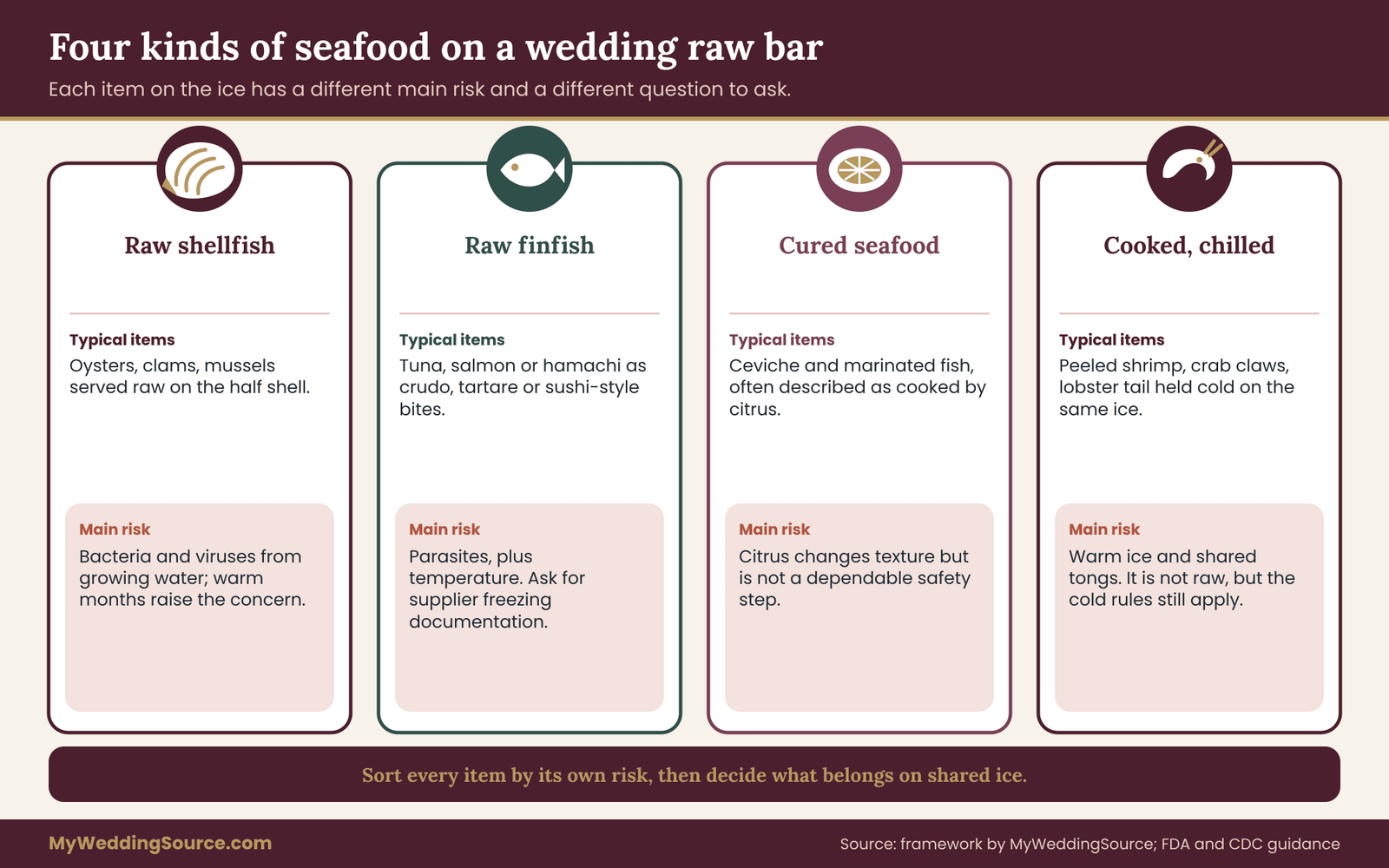
The rest of the article treats the raw bar as a system with six links. The name is simple on purpose, because it needs to be remembered by a nervous couple at a tasting and by a banquet captain at six in the evening.
The six links of raw bar safety
Source. Where the seafood came from and whether that supplier is certified and traceable.
Receive. What happens when the delivery arrives: temperature checks, tag checks, rejection rules.
Store. How it is kept cold, separated and labeled until service.
Serve. The station itself: ice, time limits, utensils, shuckers, guest handling.
Inform. How guests learn what they are eating and what the risks are.
Document. What records exist afterward so that a problem can be traced.
A weak link anywhere defeats the others. Perfect ice cannot repair an unknown supplier, and an excellent supplier cannot repair a station left in the sun. When you ask caterers questions later, you will be asking about one link at a time and listening for specifics.
Keep this chain in view, because every later section of this guide is one link of raw bar safety looked at closely.
Who is responsible for what
Couples often assume the venue handles food safety, the venue assumes the caterer does, and the caterer assumes the guests understand the risk. Sorting this out early is part of the work.
The caterer is normally the licensed food business. In many places a caterer holds a food service license or permit from the local health department, and a raw bar may need an additional approval or a written procedure. The caterer buys the seafood, receives and stores it, and serves it.
The venue controls the space: electricity, water access, drainage, shade, kitchen access, and often its own rules about outside caterers and raw items. Some venues run their own catering and are the licensed operator. Others require approved caterers only, and may carry their own insurance requirements.
The couple chooses the menu, signs the contract and decides how much risk to put in front of guests who did not choose it. You are not the food safety officer, but you are the person who can say yes or no to the raw bar. If you want a broader view of how a menu holds together before you decide, the site’s wedding menu planning guide covers the full picture. This article stays with the raw bar.
The local health department sets and enforces the rules. It can tell you whether a raw bar at your venue needs a permit, who must apply for it and how far ahead.
Write down who owns each link before you sign, since raw bar safety fails most often in the gaps between the caterer, the venue and the couple.
Most wedding food is cooked, and cooking is a safety step. Heat kills the organisms that cause most foodborne illness. A raw bar removes that step. Everything depends on the earlier links being intact, and there is no later moment when an error is corrected.
That does not make a raw bar reckless. Millions of oysters are eaten safely every year, and an established regulatory system exists to keep them that way. In the United States that system includes state shellfish control authorities, a national program that sets standards for growing areas and dealers, and a federal food code that local health departments adopt in some form. What it does mean is that the quality of your caterer’s habits matters more here than almost anywhere else on the menu.
What can go wrong
The risks fall into a few families, and it helps to know their names because caterers will mention them.
Bacteria from the water. Oysters and other shellfish grown in warm water can carry Vibrio bacteria. The Centers for Disease Control and Prevention notes that Vibrio infections are linked to eating raw or undercooked shellfish, particularly oysters, and that the illness can be severe for some people. Warm weather makes this a higher concern, which matters for a July wedding in the Gulf region or a summer clambake.
Viruses from contaminated water or handlers. Norovirus is the common one. It can reach shellfish through contaminated growing water, and it can also reach any food through an infected worker. Cooking reduces the risk for hot dishes, but a raw bar has no cooking step, so worker health rules and handwashing matter a great deal.
Parasites in raw fish. Some raw finfish can carry parasites. Food safety rules for sushi-type fish normally rely on freezing the fish at specified temperatures and times before it is served raw, and a caterer should be able to describe how that is handled.
Temperature abuse. Cold food that warms up gives bacteria time to multiply. A tray of oysters on melted ice in an August garden is a temperature problem before it is anything else.
Allergens and cross-contact. Fish and crustacean shellfish are among the major food allergens named under United States labeling law. A raw bar puts several of them in one spot, with shared knives, shared ice and curious guests.
None of these is a reason to cancel. They are the reasons the six links exist.
Each of these risks has a matching link in the chain, which is how raw bar safety turns a long worry list into six manageable questions.
A calm way to think about risk
Risk with a raw bar is not the same for every guest. Most healthy adults who eat properly handled oysters have no trouble. A smaller group, including people with certain liver conditions, weakened immune systems, some chronic illnesses and pregnant guests, faces a higher chance of serious illness from raw shellfish and raw fish, according to federal food safety guidance. You will not always know who is in that group, which is one more reason to offer an appealing cooked option and to tell guests plainly what the station contains.
Notice what this framing does. It moves the question away from “is a raw bar safe?” and toward “have we done the things that make this raw bar as safe as it can reasonably be, and have we told people honestly?” That second question has answers, and the rest of the article helps you find them.
That is the realistic goal of raw bar safety: honest preparation, honest labeling and a good alternative, not a promise of zero risk.
What this article will and will not do
It will give you questions, listening cues, a decision framework and a worked example. It will not tell you which temperature your county requires, because that differs and changes. It will not certify any caterer. And it will not promise that a raw bar can be made risk-free, because it cannot. What you can reach is a documented, well-run, honestly described raw bar, and a menu that still works for guests who skip it.
Two parts of the wider wedding plan touch this topic, and both are worth a glance. The wedding cocktail hour guide explains where a raw bar fits in the timeline and flow of the early evening. The wedding vendor contract guide explains what to look for in the paperwork you will sign. Keep both in mind as you read the sections that follow.
Use it as a working document for your raw bar safety conversations, and let the agencies and your caterer fill in the local numbers.
Source: where raw bar safety begins
The first link is the one you can do the least about directly and the most about by asking. Shellfish safety in the United States starts in the water. Growing areas are classified by state authorities based on water quality testing, and areas can be opened, restricted or closed. Dealers who ship shellfish across state lines must be certified by their state, and those certified dealers are listed in a public directory maintained as part of the National Shellfish Sanitation Program, which the Food and Drug Administration oversees together with states.
You do not need to memorize the system. You need to know that a safe oyster has a traceable address, and that a caterer who buys from an uncertified source, a roadside seller or a friend with a boat has broken the chain at its first link.
Shellstock tags and what they tell you
Live shellfish in the shell, called shellstock, is shipped with a tag attached to the container. The tag is a short record. It generally shows the harvester or dealer, the harvest location, the harvest date and the type of shellfish. Food safety rules require the receiving business to keep these tags on file for a set number of days after the last shellfish from the container is sold or served. The commonly cited period in the federal model food code is ninety days, but your local code may state it differently.
Why does this matter to a couple? Because if illnesses are reported after an event, public health investigators use tags to trace shellfish back to a growing area and a harvest date. A caterer who keeps tags can help that investigation. A caterer who throws them away with the packing ice cannot.
A good, direct question is: “Do you keep the shellstock tags for each event, and can you tell us how long?” The right answer is a plain yes, with a number of days and a place the tags are kept. The wrong answers are vagueness (“our supplier handles all that”) or surprise.
Tags are a small piece of paper with a large role in raw bar safety, because they are what lets anyone trace a problem back to its source.
Certified suppliers
Ask the caterer who the shellfish supplier is. You do not have to look up the supplier yourself, but you can. Ask whether the supplier is a state-certified shellfish dealer and whether the caterer buys directly or through a broker. A caterer who orders from a regular, licensed seafood distributor with a dealer number on the invoice is in a different position from one who sources opportunistically from whoever has stock the week of your wedding.
Some caterers will say they buy from a particular farm or a particular region. That is fine and often a point of pride. The question is the same: is the farm’s product shipped through a certified dealer, and are tags kept?
Raw bar safety also depends on how far the product travels. Oysters shipped overnight in insulated containers from a coastal dealer to an inland venue are normal. A multi-day trip with unclear cold storage is a flag. Ask how many days pass between harvest and service, and what the caterer does if a delivery is late.
A named, certified supplier is the clearest early sign of a caterer who takes raw bar safety seriously.
Origin, season and region
Water temperature affects bacteria. Many regions have seasonal rules or advisories about harvest and handling in warm months, and some states require extra cooling steps after harvest for oysters during summer. A caterer who knows the rules for the region the oysters come from, and who can say what changes in July compared with November, is usually a caterer who has done this many times.
Seasonality also affects your choices. An autumn wedding often has cooler water, a more comfortable cold chain and a longer tradition of oyster service in many regions. A midsummer outdoor wedding makes the same menu item harder to hold safely. You are allowed to let the weather change your menu.
Season changes the raw bar safety picture more than most couples expect, so let the date on your calendar shape the menu.
Raw finfish sourcing
If the raw bar includes tuna, salmon or similar fish served raw, the sourcing question changes. Ask whether the fish is intended for raw consumption, how it was handled before arrival, and how parasite risk is controlled. The federal model food code generally calls for freezing certain raw fish to specified temperatures and times before service, with exceptions for a few categories, and it asks suppliers to provide written documentation of the freezing. You can simply ask: “Can you show us the supplier’s documentation for the fish you serve raw?”
Do not accept “sushi grade” as an answer on its own. That term is a marketing phrase, not a legal category with a single meaning in the way many people assume. The documentation is the answer.
Raw fish adds its own sourcing paperwork to raw bar safety, and the caterer should be able to show it rather than describe it.
Red flags and green flags at the source link
Use this short list as listening cues rather than a score sheet.
Green: the caterer names the supplier without hesitation, mentions tags and dealer numbers, describes how long the product travels, and explains seasonal adjustments. They sound like they have said it before.
Amber: they describe a good supplier but cannot say how tags are kept, or they rely on the venue’s kitchen to handle it.
Red: they cannot name a supplier, they talk about price as the main reason for their source, or they say they “never have problems,” which is not an answer to a question about records.
Treat red as a reason to pause the raw bar, not necessarily to drop the caterer. A well-run caterer can still decline to serve raw items, and a thoughtful one will tell you so honestly.
Use these cues as a first pass on raw bar safety, then ask for the specific documents behind any answer that sounds confident but thin.
Guests at higher risk: planning around the people you cannot see
A raw bar is one place where couples often feel awkward. The topic touches health, and you do not want to quiz your guests. Fortunately you do not have to. You can plan so that the guests who should skip raw items can do so without ever having to explain why.
Who federal guidance names as higher risk
Federal food safety agencies advise that some people should avoid raw or undercooked shellfish and raw animal foods because infection can be serious for them. The groups named include pregnant people, young children, older adults, and people with weakened immune systems or certain chronic conditions such as liver disease, diabetes, cancer treatment or conditions that affect iron levels. The CDC specifically notes that Vibrio infections tend to be more severe in people with liver disease and other chronic conditions.
At a wedding of any size, a few guests will almost certainly fall into at least one group. You will not know who. Some will not have told anyone yet, such as a guest in early pregnancy. Others will know and will quietly avoid the station, which is the right thing for them to do, as long as the menu leaves something else for them to eat.
Knowing the groups is not meant to make you ask questions of guests; it is meant to shape a raw bar safety design that works for everyone.
Design the menu so skipping is easy
Four habits make it easy for anyone to skip the raw bar without a conversation.
First, never make the raw bar the only appetizer. Put at least two cooked options at the cocktail hour, ideally including one seafood item that is fully cooked, such as grilled shrimp skewers or crab cakes, so a guest who avoids raw seafood still feels included.
Second, give the station a plain sign. A short, kind card works: “Raw oysters and raw fish are served here. Cooked options are at the next table.” That moves the decision to the guest, which is where it belongs. Later sections cover the wording more fully, and the site’s guest care planning guide covers broader ideas for helping guests with health needs feel looked after.
Third, separate the cooked and raw items physically. A guest who avoids raw seafood should not have to reach across a bed of oysters to take a cooked shrimp.
Fourth, tell your catering captain about your concerns in advance. A good captain can steer guests who ask, and can answer questions like “is that cooked?” without guessing.
Good raw bar safety for guests includes the social side: nobody should have to explain why they are passing on the oysters.
The pregnant guest, the child and the guest with a health condition
Pregnancy is the case most couples ask about. Federal advice is to avoid raw or undercooked fish and shellfish during pregnancy. That is a reason to make sure pregnant guests, who are likely to be in your close circle, have plenty of choices, rather than a reason for you to ask anyone about their pregnancy. If a close relative has shared the news with you, you can quietly let the caterer know there will be a guest who avoids raw foods, without any detail.
Children at a raw bar are another quiet risk. Children are on the higher-risk list for some foods and they also tend to grab things from displays. A station with a staffed shucker, a sign and a physical barrier or counter height that discourages small hands is safer than a self-serve tray at child level.
Guests with chronic liver disease, diabetes, weakened immune systems or cancer treatment should check with their own clinicians. You do not need to know. You need to make a visible, easy alternative.
Plan these cases quietly into your raw bar safety setup instead of raising them at the station.
What not to do
Do not announce the risks to the room or single out guests. Do not suggest that hot sauce, lemon or alcohol makes raw oysters safe, because that is a myth and the CDC states that these do not kill Vibrio. Do not rely on a caterer’s comment that “everyone eats them.” Instead, do what good hosts do everywhere: offer choice, label clearly, and stay out of other people’s medical details.
Honest, light-touch communication is part of raw bar safety, and so is avoiding claims that no agency makes.

A short script for the caterer
When you tell the caterer how you want to handle higher-risk guests, you can use something like this: “We want the raw bar to be a treat for guests who enjoy it and easy to skip for anyone who prefers not to eat raw seafood. Please plan cooked seafood and non-seafood appetizers at separate tables, with a clear sign at the raw station, and have your captain ready to answer questions about what is raw.”
That one paragraph covers menu design, signage and staff readiness. A good caterer will agree immediately and may add ideas of their own.
Share this paragraph early, because a raw bar safety plan is easier to build before the menu is printed than after.
Receive and store: the cold chain behind raw bar safety
The second and third links are where most real-world failures happen, because they depend on routine rather than certification. A certified supplier can ship perfect oysters and a caterer can still ruin them in a hot van. The words “cold chain” describe the unbroken path of cold from the supplier’s cooler to the ice at your station.
What cold means for each food
Cold-holding temperatures in the federal model food code are generally set at 41 degrees Fahrenheit or below for most foods that need refrigeration. Live shellfish have their own receiving and storage provisions, which differ somewhat from other foods, and your state may adopt them in its own form. Frozen foods are held frozen. Because the numbers differ by state and food type, do not memorize them. Ask the caterer what their written temperature standards are, and ask them to show the thermometer.
What you are listening for is not a specific figure but a habit: that temperatures are measured, written down and acted on. A good caterer will mention a calibrated probe thermometer, a log sheet and a rule for what to do with product that arrives too warm.
Ask for the caterer’s written numbers as part of your raw bar safety review, and let the health department confirm the local standard.
Receiving: the thirty seconds that matter
When the delivery arrives, a trained receiver does four things. They check the temperature of the product or the air in the container. They check that tags are attached and legible and that the shellfish are alive, with closed or tightly closing shells. They check that packaging is intact and that the product matches the order. And they reject or flag anything that does not pass.
For a wedding, this receiving step may happen at the caterer’s commissary days before, or at the venue on the morning of the event. Ask where it happens and who does it. A common weak point is “the van driver unloads it,” with no one checking anything at the venue loading dock. If the oysters arrive for service the same morning, the receiving check at the venue is the last chance to catch a problem.
A useful question: “If the shellfish arrive warmer than your standard on the morning of our wedding, what do you do?” The right answer is some version of “we reject it, we have a backup order or we pull the raw bar and offer a cooked substitute at no extra charge to you.” The wrong answer is a pause.
A careful receiving check costs a minute and protects the whole event, which is why it deserves a place in any raw bar safety discussion.
Storage between delivery and service
Between receiving and service, raw shellfish must be kept cold, protected from drips and separated from ready-to-eat and cooked foods. Three storage questions are worth asking.
Where is it stored? A commercial walk-in or reach-in refrigerator that holds temperature is the norm. A cooler full of ice in the back of a van is a short-term fix, not storage. At a remote venue the caterer may bring refrigerated trucks or large coolers, and the plan for those should be written down.
How is it separated? Raw seafood should sit below ready-to-eat foods, in sealed containers, so drips cannot fall onto salads or desserts. Raw shellfish should be kept away from raw finfish and from cooked shellfish where possible. This is a basic principle taught in every food safety course, and a caterer who has taken one will describe it without effort.
How long does it sit? Ask how many hours before service the seafood leaves cold storage and how it is kept between the walk-in and the station. A short, planned gap is normal. A two-hour wait on a loading dock is not.
Storage is the quiet middle of raw bar safety, where good habits are invisible until the one day they are missing.
The truck, the drive and the late delivery
Many wedding caterers work out of a commissary kitchen and drive to the venue. That drive is part of the cold chain. Ask how the seafood travels: in insulated containers with ice or gel packs, in a refrigerated vehicle, or loose in the back of a van. Ask what the travel time will be and whether the vehicle will be parked in the sun while setup takes place.
Late deliveries deserve their own plan. A delay of an hour for the oyster order, if it arrives cold and tagged, is a scheduling problem. A delay with an unknown cold history is a safety problem. Ask whether the caterer has a backup supplier and what trigger would make them cancel the raw bar for the day.
Ask about the drive and the backup, because raw bar safety includes the hours when the seafood is nowhere near your venue.
Venue refrigeration
Venues vary a great deal. A hotel ballroom with a full kitchen and walk-in coolers is one situation. A barn, a garden or a rented hall with a small fridge is another. The more remote or improvised the venue, the more the cold chain depends on the caterer bringing everything.
Ask the venue: Is there refrigerated storage available for outside caterers, and how much? Can the caterer use it on the morning of the event? Is there a place to store ice, a floor drain nearby and a clean sink? A venue that has hosted raw bars before will answer all of these quickly. For a venue that has not, the caterer’s mobile setup becomes the whole system, and you should ask to see their plan. If the venue is outdoors, expect the practical limits of shade, power and water to shape the raw bar more than the menu does.
The venue’s equipment sets the limits of your raw bar safety plan, so find out what exists before you promise guests a menu.
Ice: more important than it looks
Ice at a raw bar does two jobs, and both matter. It keeps the seafood cold, and it forms the visible bed that looks so attractive. Ice melts, and when it does it carries water and residue down and away. A raw bar needs a plan for ice resupply and drainage.
Ask: How much ice will be on hand, and how often will it be replaced? Is the display ice separate from any ice used in drinks? Where does meltwater go? Ice used under raw seafood should not be reused for beverages, and a caterer who says “we just use the same ice” has told you something about the habits you are about to rely on.
For warm weather, a good caterer will explain how they use deeper pans, ice under and over the seafood, shaded tents or small batches replenished from cold storage in rotation, so no tray sits for long. That is exactly the kind of practical, boring answer you want.
Ice is the visible part of raw bar safety, and the details of supply, drainage and separation matter as much as the look.
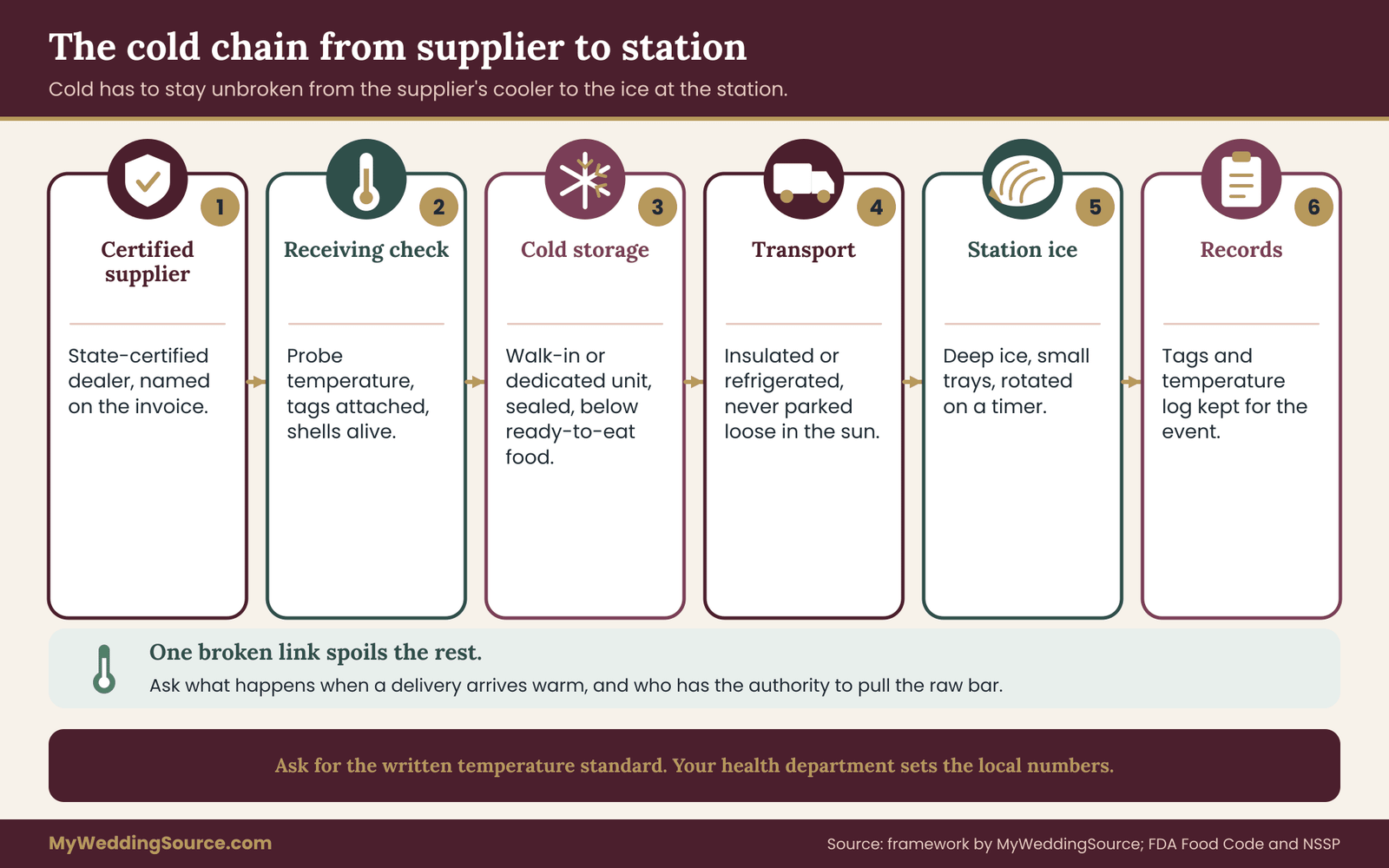
Time as a control
Food safety rules recognize that a food can be out of temperature control for a limited time if the operator follows written time limits and discards the food at the end. Many caterers apply a four-hour limit to foods held without temperature control. For a raw bar, a good practice is far shorter: small batches taken from cold storage to the station, with a limit measured in an hour or two in warm conditions, and discard of anything that has gone beyond the limit.
You do not need to specify the limit. You need to ask what it is, and whether the staff track it. A caterer who uses a written start time on each tray, or who refreshes trays on a timer, is doing the right thing. A caterer who leaves “one big display” out for the whole four-hour reception is not.
Short, tracked display times are among the simplest raw bar safety habits and among the easiest to check.
Documenting the cold chain
The practical test of a cold chain is whether it can be shown on paper after the fact. Ask the caterer whether they keep a temperature log for the delivery, storage and service period of your event, and whether they will give you a copy on request. Many will not volunteer it, but many will agree when asked, particularly if the question is friendly and specific.
You can ask in a sentence: “Do you log temperatures for the shellfish from delivery through service, and can you give us a copy of the log for our event afterward?” The answer shapes your confidence in everything else, and it takes thirty seconds.
Raw bar safety is, in the end, a matter of repetition. The oyster that was cold at the dock, cold in the walk-in, cold in the van and cold on the ice has been through four checks. Each one is simple. Each one needs a person who does it every time, and your questions help you find out whether that person is on the team.
A log is the proof behind raw bar safety: if it is not recorded, you are trusting memory.
The station itself: serving raw seafood with care
The fourth link is the part guests actually see. A well-designed station does quiet safety work: it keeps food cold, keeps hands clean and keeps knives under control. A poorly designed one looks the same until something goes wrong.
Staffing: the shucker matters most
Raw bar safety at the station rests heavily on one person, the shucker. A trained shucker knows how to open shellfish without cutting themselves or contaminating the meat, how to check that each oyster is alive and intact, how to discard doubtful ones and how to keep their hands clean between handling raw shells and serving guests.
Ask these questions about staffing. Who will shuck at our event, and how many shuckers for how many guests? Have they completed food handler or food manager training that is current for this jurisdiction? Do they have a way to wash hands and change gloves between tasks? Is there a second person at the station to manage guests, ice and resupply, so the shucker is not distracted?
For a guest count of around a hundred, a common arrangement is one or two shuckers, plus a runner who moves product between cold storage and the station. For larger events, the caterer will scale up. Ask for the caterer’s own ratio and the reason behind it; the reason matters more than the number.
Of all the staffing choices in raw bar safety, the trained shucker and a second set of hands at the station are the ones to protect in the budget.
Worker health
Norovirus and similar illnesses often reach food through the hands of an infected worker. Food safety rules generally require food workers to report illness and be excluded from handling food when sick, and require handwashing at specific moments. Ask: “What is your policy if a staff member is sick the day of the event?” A professional caterer has a backup plan and a rule that sick workers do not handle food. They should say it without embarrassment.
Worker health is easy to overlook in raw bar safety because it never shows on the menu, yet it matters as much as the ice.
Station layout
The station should have a clear logic: product comes from cold storage into a staffed, iced display; guests take from the front; shuckers work behind a counter or table; waste goes into a covered container out of guests’ view; and cooked items are on a separate table.
A few specifics are worth confirming. The display should be elevated off the ground and shaded from sun and heat lamps. Shucking should happen behind or beside the display, not over the guests’ plates. Shells and used ice should have a designated disposal path. Handwashing facilities, or an approved hand sanitizing arrangement according to local rules, should be available to the staff. And there should be a protected spot for utensils, lemon wedges and sauces so guests are not touching shared tongs with bare hands more than they must.
A station laid out with raw bar safety in mind looks simply tidy to guests, which is exactly the point.
Self-serve versus staffed
A fully self-serve raw bar, with trays of oysters guests help themselves to, is the easiest to run and the hardest to keep safe. Guests touch shells, drop them back, use shared utensils and leave trays unattended. A staffed station, where the shucker opens each oyster and hands it to the guest on a plate or on a tray, is far safer and also more elegant.
Staffed also gives you a place for the Inform link. The person handing out oysters can answer questions, point out the cooked table and notice guests who seem unsure. If your budget forces a choice, spend on the staffed station, even if it means fewer varieties.
If you can afford one upgrade to raw bar safety, make it staffed service.
Sauces, garnishes and condiments
Sauces such as mignonette, cocktail sauce and hot sauce are usually safe in small portions if kept cold and served in clean containers with their own spoons. Dairy-based sauces and anything with raw egg require attention to temperature. Citrus wedges and horseradish are fine, but the knife used to cut them should not be the shucking knife, and no one should reach into a bowl of lemons with hands that just touched shells.
If sauces contain allergens such as soy, wheat, egg, fish or shellfish, they should be labeled. The allergen section addresses this in more detail.
Small items follow the same raw bar safety logic as the large ones: keep them cold, clean and labeled.
Replenishment and the end of the night
Replenishment is the point where many stations get sloppy. A tidy approach: trays are replaced rather than topped up, so older oysters do not stay under newer ones for hours. Used shells are cleared quickly. Any food that has passed the caterer’s time limit is discarded, even when a few dozen remain.
At the end of service, leftover raw shellfish are normally not served again or sent home with guests. A simple rule to put in your contract: no raw seafood leftovers are given to guests or couples to take away, since the cold history is no longer controlled.
The close of service is part of raw bar safety, because a good station ends as carefully as it begins.
Allergens and cross-contact in raw bar safety
Allergy safety belongs inside raw bar safety, because a raw bar concentrates some of the most common allergens in one place. United States food labeling law names fish and crustacean shellfish among the major food allergens, and the Food and Drug Administration publishes plain guidance on all of them. Molluscs such as oysters and clams are not on the federal major allergen list, yet some people react to them, and anyone with a shellfish allergy should ask their allergist before assuming which shellfish are safe.
The practical point is simple. A guest who is allergic to shrimp should not stand next to a bed of ice holding shrimp, oysters, clams and tuna, handled with shared tongs and a shared towel, and be told “it’s all fine.”
How cross-contact happens at a raw bar
Cross-contact means an allergen moves from one food or surface to another. At a raw bar it can happen in several quiet ways.
Shared ice. Meltwater from shrimp running under oysters, and the reverse, moves proteins around the display. Separate pans or separate sections reduce this.
Shared utensils. One pair of tongs for everything, one cocktail fork in the sauce, one knife for both citrus and shells.
Shared hands. A guest who picks up a shrimp, puts it back and then takes a lemon wedge has just transferred shrimp protein to the lemon.
Shared fryers and grills at the cooked table. If the cooked seafood is fried in the same oil as hush puppies, or grilled on the same surface as the chicken skewers, the allergen story changes for guests with fish allergies or wheat allergies.
Shared surfaces and cleaning cloths. A towel that wipes the shucking board and then the cheese tray spreads more than crumbs.
The answer is not to ban anything. It is to separate, label and give guests a way to ask.
Seeing these routes clearly makes raw bar safety for allergic guests a design question, not a matter of luck.
Asking caterers about allergens
Use the same direct approach as for temperature. These questions work well.
“Which of the foods at the raw bar contain fish, crustacean shellfish or other major allergens, and how will you label them?”
“Can you set up separate sections, utensils and ice for shrimp and other shellfish, so a guest allergic to one is not exposed to meltwater and tongs from another?”
“If a guest tells your captain they have a fish or shellfish allergy, what do you do?”
A good caterer will have a process: the captain knows the allergen content of every dish, there are separate utensils for each tray, and there is a person who can answer guest questions without guessing. A caterer who says “we can’t guarantee anything, so just be careful” is being honest about a limit but has not answered the question about what they will do.
Put these allergen questions into your raw bar safety call with the same weight as the temperature questions.
Honest limits
No caterer should promise a raw bar free of allergens. Shared kitchens, shared suppliers and shared air in a busy tent make a promise like that unwise. A responsible caterer will explain the steps they take to reduce cross-contact and the limits that remain, and will say so in writing. Treat a promise of “completely allergen-free” as a warning sign rather than a comfort.
Guests with serious allergies know how to manage them, and many will simply avoid the station. What you can do is give them a clear sign, a reliable person to ask and a different table to eat from. If you have collected dietary information on your RSVP cards, forward the seafood and shellfish allergy entries to the caterer a few weeks ahead. A short dietary line on the reply card is enough to collect that kind of detail.
Honest limits are part of raw bar safety: a caterer who explains what cannot be controlled is easier to trust than one who promises everything.
Labeling and signage
Signs at a raw bar are not decoration, and they need to be accurate. Each tray or section should be labeled with what it contains. A short list of contents, including likely allergens, lets guests decide quietly.
A simple model for a raw bar sign:
“Raw oysters and clams. Raw tuna. Contains fish and shellfish. Served on shared ice. Cooked seafood and non-seafood appetizers are at the next table. Ask our team about any allergy or dietary question.”
That sentence takes a moment to read and tells a guest everything needed. The same wording can go on a small printed menu. If you have a detailed signage scheme for the event, the site’s wedding signage guide shows how to keep that scheme consistent with the rest of the reception.
A good sign is the cheapest raw bar safety tool on the menu and one of the most effective.
A decision rule for allergens
Here is a rule that couples can use when the caterer’s answers are mixed. If the raw bar is staffed, labeled, uses separate utensils and the caterer can describe a response process, keep it. If the raw bar is self-serve with shared tongs and no signage, either convert it to staffed service or remove the shellfish and fish items that carry the highest risk of cross-contact. A cooked seafood table with separate service is almost always easier to defend than a mixed ice display.
Apply the same rule you use for the rest of raw bar safety: if the process is staffed, labeled and explained, keep it; if not, change it.
Permits, licensing and venue rules for raw bar safety
The fifth thing couples tend to forget is that a raw bar can be regulated differently from the rest of the menu. In many places a raw or partially cooked animal food item triggers extra requirements for the operator. These requirements are set by the local health department, not by the couple, and they vary a great deal.
What a licensed operator is
A licensed food operator is a business that holds the permit or license required by the local jurisdiction to prepare and serve food to the public. A restaurant, a licensed caterer and a hotel kitchen all qualify. A friend who loves to cook, an uncle with a smoker or a hobby oyster farmer does not, and that difference is not a technicality. It determines whether the person selling or serving the food follows inspected procedures, carries the right insurance and can be held to a standard.
For raw bar safety, couples should insist on a licensed operator. Self-catered raw bars, or raw bars run by well-meaning amateurs, are the riskiest version of this idea, and many venues will not permit them.
Insisting on a licensed operator is the first practical raw bar safety decision a couple can make, long before the first tasting.
Questions for the health department
You can ask the local health department a few direct questions, either by phone or through its website.
Does a raw bar at a private event require a special permit or approval for the caterer? Does the caterer need to submit a plan or procedure for serving raw animal foods? Are there rules about consumer advisories, meaning written notices about raw or undercooked foods, at the station? What is the lead time for any application? Are there rules on temporary events, outdoor service or serving at a private home versus a rented venue?
The federal model food code includes consumer advisory provisions for foods that are raw or undercooked, usually a disclosure of the item and a reminder about the risk. Whether and how your jurisdiction applies that to a private wedding is a local matter. Ask, and write down the name of the person who answered.
One short call to the health department can settle the permit question and shape the rest of your raw bar safety plan.
Temporary events and private venues
A wedding in a restaurant or hotel is usually covered by that establishment’s existing permit. A wedding at a barn, a park, a private estate or a rented hall may require the caterer to hold a temporary event permit, or to operate from an approved commissary and bring food in. Some parks and public venues have their own rules for outside caterers.
If your caterer says “we do this all the time and never need a permit,” politely ask for a copy of their current license and any raw-food approvals. You may never need to use them, but the willingness to share them is informative.
Where the wedding happens changes which permits apply, so confirm that early in your raw bar safety planning.
What venue operators need to tell you
Venues tend to have their own policies, written or unwritten, about raw bars. Some require approved caterers only. Some prohibit open flame or raw items in certain rooms. Some require proof of liability insurance and sometimes that the venue be named as an additional insured. Some have only one outlet for the whole kitchen, which does not help a refrigerated display.
Questions to ask the venue include whether raw seafood service is allowed, whether there are rules on outside caterers’ raw foods, what insurance certificate is required, where the caterer can set up and receive deliveries, and who from the venue will be on site to help with water, power and waste. The site’s rental planning checklist is helpful for the equipment side: tables, chilled display equipment, tents and generators that a raw bar may require.
Venue answers are an essential input for raw bar safety, because they decide what the caterer is able to do on site.

Insurance and liability
Two kinds of insurance often come up. A caterer’s general liability coverage is normally required by venues and is a standard sign of a professional operator. Some couples also buy event liability insurance. Read the policy carefully, since some policies exclude certain alcohol or food service situations or have conditions on caterers. A policy is not a substitute for the six links, and no policy can reverse an illness. It simply spreads the financial consequences.
Ask the caterer for a certificate of insurance and ask what it covers. Your own contract review should confirm that the raw bar service falls under the caterer’s insurance and that your contract includes the caterer’s responsibility to follow local health and safety rules.
Insurance sits behind raw bar safety as a financial backstop; it never replaces the steps that prevent a problem.
Documenting permits and approvals
Keep a simple folder with the caterer’s license number, the health department contact, any permit for the event, the venue’s written policy and the date of each conversation. If something is unclear, ask for it by email. You do not have to be adversarial about this. You are doing what a careful host does when someone else is responsible for the safety of your guests.
If the caterer or venue pushes back on a request for documents, you can explain it in one sentence: “We want to be sure we’ve covered everything for our guests, and the paperwork helps us do that.” Professional operators receive this kind of request often and do not take offense.
Keeping these papers together turns raw bar safety from a feeling into a file.
The vendor due diligence habit
Raw bar safety is one case of a more general habit: asking vendors for proof of the things you are paying them to do. The site’s vendor due diligence checklist covers the general process, including license checks, references and the paperwork trail. What is distinctive about a raw bar is that the stakes of skipping the habit are higher, because the food is not cooked.
A practical approach is to run the raw bar questions as a single conversation, ideally at the tasting or on a call with the head chef or the person who will be in charge on the day. Do not run it only by email with a salesperson, because the salesperson may not know the answers and may feel pressure to say yes. The next part of this article gives a full question list, grouped by link, with the answers to listen for.
Raw bar safety questions to ask your caterer, link by link
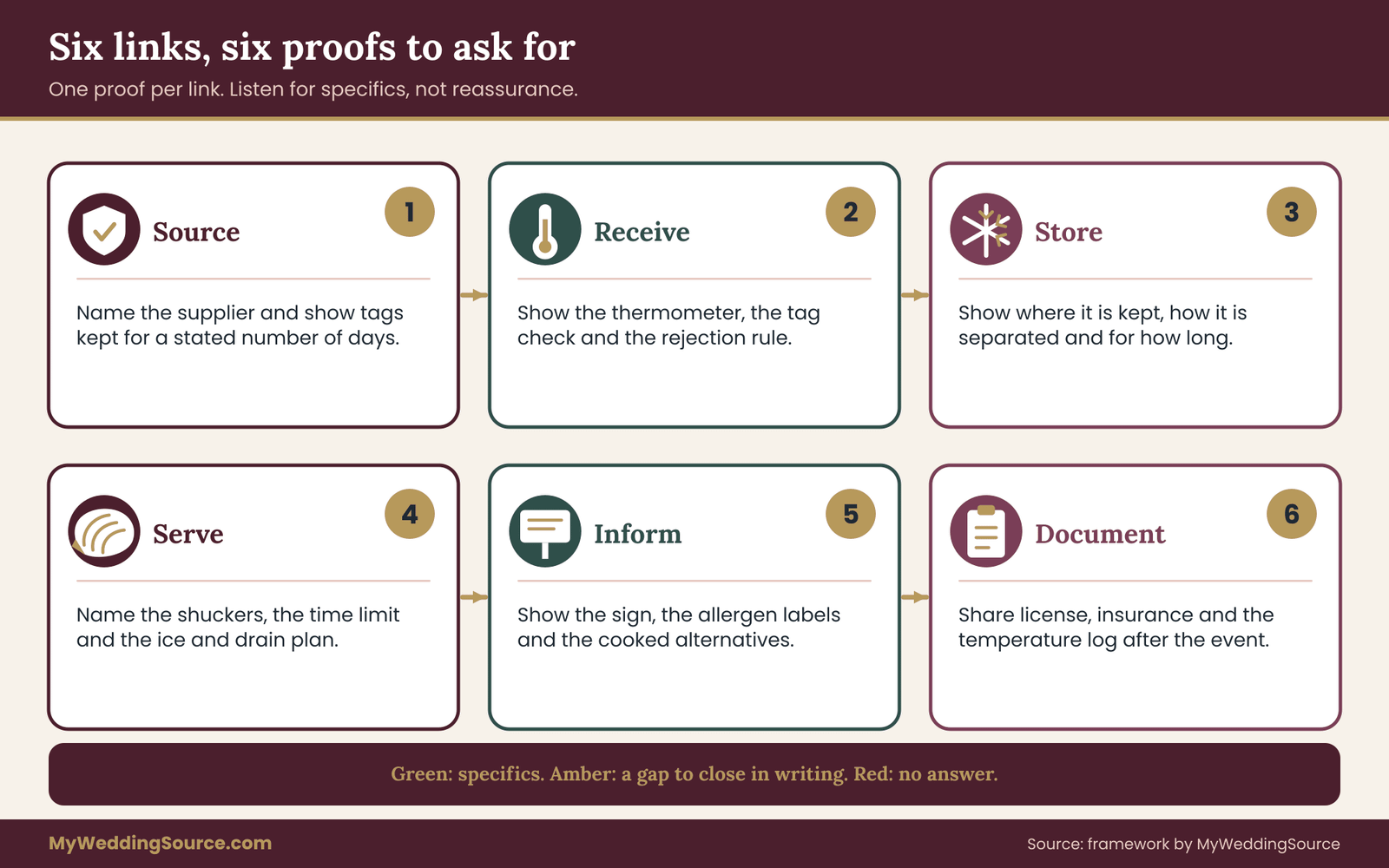
Here is the working part of the guide. The questions below follow the six links, and each comes with what a good answer sounds like and what should make you pause. Ask them at a tasting, on a call or in a meeting with the person who will run the event. You do not need to ask all of them in one sitting; choose the ones that match what you have not yet heard.
Before you start, set the tone. You can open with something like: “We love the idea of a raw bar, and we want to make sure it is handled well. Can we spend fifteen minutes on how you source, store and serve it?” A professional will welcome that. Caterers who are asked these questions regularly often have a one-page procedure sheet ready.
Source questions
Who is your shellfish supplier, and are they state-certified? Good: a named supplier, a dealer number or a confident yes. Pause: “a local guy” or “whoever has it.”
Do you keep the harvest tags for each event? Good: yes, for a stated number of days, in a file or binder. Pause: they are discarded or the supplier keeps them.
How many days from harvest to service? Good: a short, specific range and a plan for delays. Pause: no idea.
For raw fish, what documentation do you have for parasite control? Good: written supplier documentation, available on request. Pause: “it’s sushi grade.”
Source answers set the tone for the rest of the raw bar safety conversation.
Receive and store questions
Who receives the delivery, and what do they check? Good: a named role, a probe thermometer, tag check, live shellfish check. Pause: whoever is nearest.
What is your rejection rule? Good: a clear one, with a backup plan or a cooked substitute. Pause: “it never happens.”
Where will the seafood be stored at our venue before service? Good: a specific refrigerated unit or insulated container system with ice, and a person responsible. Pause: “we’ll find a spot.”
Do you keep a temperature log for our event, and can we have a copy? Good: yes. Pause: no records at all.
Serve questions
How many trained shuckers will work our event, and what training do they hold? Good: specific numbers, with current food handler or manager credentials where required. Pause: “our servers can do it.”
What is your time limit for seafood on display? Good: a defined limit, with trays rotated from cold storage. Pause: “it’s on ice all night.”
How do you handle ice and meltwater? Good: separate ice for display and drinks, a drain plan. Pause: shared ice and a shrug.
Is the station staffed or self-serve? Good: staffed, or at minimum staffed with a captain. Pause: unattended trays at guest height.
What is your policy for staff who are sick? Good: exclusion from food handling, a backup person. Pause: no policy.
Inform questions
How will guests know what is raw? Good: signs, small menus, captain briefing. Pause: “everyone knows it’s raw.”
What allergen information will you display, and how will you handle cross-contact? Good: labeled items, separate utensils, trained staff. Pause: an unconditional promise.
What cooked alternatives will sit beside the raw bar? Good: two or three, at a separate table. Pause: none.
Document questions
Can we see your license, your insurance certificate and any raw-food approvals? Good: yes, quickly. Pause: delays or irritation.
If a guest reported feeling ill afterward, what would you do? Good: a procedure: take the report, preserve tags and logs, contact the health department as required, cooperate with the investigation. Pause: “that has never happened.”
The last link closes the loop on raw bar safety, because records are what make the earlier answers checkable.
How to listen
Listening matters as much as asking. Specific answers, even imperfect ones, suggest a caterer who thinks about the issue. Vague answers delivered with confidence suggest the opposite. A caterer who says “I’d have to check with my chef, and I will get back to you by Friday” and then does so is better than one who gives an immediate and wrong answer.
Notice also what the caterer asks you. A thoughtful one will ask your guest count, your venue, the season, whether there are children or pregnant guests, and whether anyone has a seafood allergy. Those questions show they are designing the raw bar safety plan for your event rather than selling a package.
Listening for specifics is a skill, and it is the one that makes a raw bar safety conversation worth having.
Scoring answers without a spreadsheet
You do not need a table of scores. A plain rule works: assign each link green, amber or red based on the answers. Green means you heard specifics. Amber means a gap that can be closed with a written promise. Red means the caterer cannot explain the link or does not do it.
Your decision rule then reads as follows. All links green or amber with written fixes: proceed. Any link red: pause the raw bar and ask for either a fix by a date or a cooked alternative. Two or more links red: remove the raw bar, regardless of price or how good it looked at the tasting. The decision section later turns this into a ladder you can use with a partner or planner.
This three-color habit keeps raw bar safety decisions simple enough to make with a partner over dinner.
Questions that sound clever but tell you little
Some questions feel useful and are not. “Is your seafood fresh?” gets a yes from everyone. “Is it safe?” gets the same. “Have you ever had a complaint?” gets an answer that cannot be checked. Replace each with a question about process. Instead of “is it fresh?”, ask “how many days from harvest and how do you check on arrival?” Instead of “is it safe?”, ask “what records do you keep?”
Process questions give you real raw bar safety information; reassurance questions only give you a mood.
Questions for venue operators about raw bar safety
The venue is the other half of the picture. It may seem odd to ask a venue manager about oysters, but venues control several things that determine whether a raw bar is practical.
Access, storage and utilities
Ask whether outside caterers may bring raw seafood and whether the venue has restrictions. Ask where deliveries arrive and how close that is to the setup area. Ask what refrigeration an outside caterer may use and for how long. Ask about power: a chilled display, refrigerated trailers or a warming kitchen may all draw significant electricity, and a tripped breaker mid-reception ends a raw bar quickly.
Ask about water. A raw bar needs access to potable water for handwashing and cleaning, and a place for wastewater that is not a flower bed or a storm drain. Many venues have a designated utility sink, a service corridor or an outdoor spigot, and the caterer needs to know which.
Ask about ice. Can the caterer bring their own, and is there a freezer space for bags of ice? Does the venue sell or supply ice? Is there a limit on how much meltwater can be dumped on a lawn or patio?
Utilities decide whether a raw bar safety plan is practical at your particular venue, so ask about them early.
Shade, wind and weather
For an outdoor raw bar, ask where shade is available at cocktail hour and for how long. Ask what the venue does if heat or rain moves the cocktail hour indoors, and whether the raw bar can move with it. A raw bar in direct afternoon sun is a problem even with generous ice. The shift of the sun across a courtyard during a two-hour cocktail hour is easy to miss on a site visit in the morning.
Wind blows ice, napkins and signs around. Rain can drip into trays. A tent with sides, even a simple one, solves many of these problems, and the venue can tell you whether tents are allowed and who provides them. The site’s bar service planning guide is useful here, since a raw bar often sits near the bar and shares traffic flow, power and ice supply with it.
Weather is the least controllable part of raw bar safety, which makes a backup plan for it essential.
Venue policy and paperwork
Ask whether the venue has a written food and beverage policy, what insurance certificates it requires and whether it must be named on them. Ask whether it has a list of approved caterers and whether the raw bar will be treated differently from other stations. If the venue has its own catering, ask the same six-link questions as you would of any caterer. In-house catering does not exempt anyone from good practice, and venue kitchens vary widely.
If the venue says “our caterer does that all the time,” ask the caterer the six-link questions anyway. A venue is not a substitute for answers about sourcing, temperatures or training.
Venue paperwork is the written side of raw bar safety, and it is much easier to collect before the event than after.
Emergency and contingency
Ask what the venue’s plan is for power failure, severe heat or a delayed delivery. Ask who the venue contact will be on the day, and how to reach them. Some venues have an on-call manager who can help solve a refrigeration problem quickly. Others have no one after the setup crew leaves.
A good contingency question for the venue: “If we need to take the raw bar down in the middle of the cocktail hour because of heat or a cold chain problem, is there a place to move or remove it quickly?” The venue may never have been asked, and that tells you something too.
A contingency plan is part of raw bar safety, because failures are rare but they are never scheduled.
Putting the conversation on paper
After the call, send a short note summarizing what you understood, with a request for confirmation. For example: “Thank you for walking us through the venue’s policies. To confirm: outside caterers may serve raw seafood, there is a walk-in cooler available on the morning of the event, and the caterer will provide their own ice and a drain plan. Please let us know if we have misunderstood anything.” That note becomes part of your file and protects everyone.
Raw bar safety works best when the venue, the caterer and the couple have the same facts. A five-minute written summary prevents most of the misunderstandings that surface at six o’clock on the day.
A written summary turns a pleasant chat into a checkable raw bar safety record.
A worked raw bar safety review: Dana and Marcus, 120 guests
The following example is invented to show the process. The couple, the caterer and the numbers are illustrative, and your own situation will differ. It shows how the six links turn into decisions.
Dana and Marcus are planning a late-September wedding for 120 guests at a converted barn two hours from the coast. They love oysters and want a raw bar at the cocktail hour. The caterer is a regional company they like. They have a tasting scheduled and want to run a raw bar safety review before they sign the menu.
Step one: the call
Before the tasting, Dana emails the caterer’s event manager with a short note: “We’d like to talk through how the raw bar works, from sourcing to service, at the tasting. Could the chef or the person who will run the station join for fifteen minutes?” The caterer agrees and brings the executive chef.
Notice how modest the first step of the raw bar safety review is: one short request for fifteen minutes with the right person.
Step two: the six links
At the tasting, they walk through the questions. Here is what they hear and how they score it.
Source. The chef names a regional seafood distributor and says the oysters come from two named farms on the Atlantic coast, shipped through that distributor. Tags are kept for ninety days in a binder at the commissary. For the raw tuna, the chef says the supplier provides written freezing documentation. Score: green.
Receive. The oysters will be delivered to the commissary on the day before the wedding, checked by the sous chef with a probe thermometer and a tag check, then transferred in insulated containers with ice to the venue on the morning of the event. The chef describes rejecting product that is warm or has dead shells. Score: green. Dana asks what the backup is if the delivery is late. The chef says they have a second supplier but have not used them for a raw order. Score: amber, with a request that the second supplier be confirmed in writing.
Store. At the barn there is a small reach-in refrigerator, which the venue says is available. The chef says it will be shared with desserts and wedding cake components. Dana worries about cross-contact and space. The chef agrees to bring a refrigerated unit for the seafood alone. Score: amber until the unit is written into the proposal.
Serve. Two shuckers and a runner will be assigned. The chef says all hold current food handler cards from their state. Display ice is separate from beverage ice. Trays are rotated every thirty minutes from cold storage. The tent has sides, and the setup is in the shade of the barn’s west wall. Score: green. Marcus asks about worker illness, and the chef describes the written policy. Green.
Inform. The caterer will place a sign and a small menu card. Dana asks for the wording to include “raw oysters and raw tuna” and “cooked options are at the next table.” The chef agrees to place two cooked seafood items at a separate table. Score: green.
Document. The caterer provides its license and insurance certificate. Dana asks about temperature logs; the chef says the staff keep them but have not given copies to clients before. After a pause, he agrees to share a copy of the log for the event. Score: green, with the log added to the contract.

Step three: the venue
Dana and Marcus call the barn. The manager confirms outside caterers may serve raw seafood and that a refrigerated trailer may be parked near the service entrance. She says there is a hose bib for water and a gravel drain area behind the building for meltwater. Power is available on a dedicated circuit. The manager mentions that the barn gets warm in the afternoon but that the cocktail hour will be at five in the evening in late September, when temperatures are usually moderate. She asks for the caterer’s insurance certificate. All green. Dana follows with a short email summarizing the call.
Step four: the health department
Dana calls the county health department and learns that the caterer’s existing license covers private events, but that raw shellfish service requires the caterer to carry a written procedure on site and to display a consumer advisory. The caterer confirms they have both. Dana notes the name of the person she spoke with and the date.
Step five: the contract
Marcus and Dana ask the caterer to add language to the contract. The clauses, in plain terms, say that the caterer will source shellfish from state-certified dealers and keep tags for the period required by local rules, that the caterer will store and serve raw items according to local health regulations, that a licensed, trained shucker will staff the station, that the caterer will provide a consumer advisory sign and a cooked alternative, that the caterer will supply a copy of the event temperature log on request, and that the caterer may cancel the raw bar at its discretion if cold chain conditions fail, with a substitution of equal value at no extra charge. The caterer reviews and signs.
Step six: decisions
The result is a green or amber on every link with fixes in writing. They proceed. Notice what they did not do. They did not interrogate the caterer for hours, quote statistics or demand anything unusual. They asked each question once, wrote down the answers, closed the gaps by asking for specific written changes and chose a cooked option to sit beside the raw one.
The finished review is a short, practical record of raw bar safety decisions, not a binder.
What would have changed the decision
If the chef had said “I’m not sure where the oysters come from; my buyer handles it,” Dana and Marcus would have paused the raw bar until the buyer could answer. If the venue had no shade and the cocktail hour fell at two o’clock in August, they would have asked about a different time, an indoor cocktail hour or a cooked seafood station. If the caterer had insisted on a self-serve tray with no signs, they would have asked for staffed service or removed the raw items. Each change is small, and any one of them could be the difference between a station that is merely attractive and one that is well run.
Every one of these changes is a normal outcome of a raw bar safety review, and none of them means the couple did anything wrong.
What a raw bar safety review costs, and what the contract should say
A raw bar is not cheap. It is not always more expensive than other stations either. The cost logic is mostly about labor and equipment, which are the parts that protect safety.
Where the money goes
Product. Oysters are priced per piece, and the price depends on variety, region and season. Raw finfish is priced by weight. Ask your caterer for a per-guest estimate and the assumptions behind it, such as pieces per guest and how many guests are expected to eat from the station.
Labor. A trained shucker is a skilled job, and staffing a station with two or three people costs more than a buffet table of cooked appetizers. This is a cost that protects raw bar safety, so cutting it is usually a false economy.
Equipment. Refrigerated units, ice machines, display pans, a shaded tent, handwashing equipment, thermometers, signage and the cleanup supplies all have a price. Some are included in a caterer’s fee, others are billed separately.
Ice. More than you expect. A raw bar in warm weather can use many bags over a reception, and ice has to arrive cold and in the quantity planned.
Permits and fees. Some jurisdictions charge for temporary food permits. If so, these are generally the caterer’s responsibility, but it is worth knowing whether the cost passes through to you.
Most of the cost of raw bar safety is people and equipment, which is why cutting corners there is tempting and unwise.
How to compare proposals
If two caterers offer a raw bar at different prices, the cheaper one may have left out labor, equipment or a backup plan. Ask each to list what is included. A proposal that spells out the number of shuckers, the refrigeration, the ice supply and the sign is a better value than a lower price with a vague line item.
Do not compare prices alone. Compare answers to the six links. A slightly higher quote from a caterer who can show tags, logs and a staffing plan is a better investment than a bargain from one who cannot. Your wedding budget guide helps you decide where a raw bar fits among the other priorities, and a small shift in guest count or service style can pay for the safety steps.
Comparing proposals by raw bar safety answers, not just by price, usually reveals which quote is the better value.
Ways to keep costs reasonable without cutting safety
Reduce the variety. One or two oyster types served well are better than six served in a rush. Reduce the hours. A raw bar open for the first ninety minutes of the cocktail hour keeps ice fresh and product rotating. Reduce the portion. Offer two oysters per guest as a taste rather than a meal. Add a cooked station that fills guests up more economically, such as grilled shrimp or crab cakes.
What you should not cut: trained staff, cold storage, ice, signs and the documentation. Those are the things that make the rest of the station work.
Scale the menu, not the raw bar safety steps, when the budget gets tight.
A note on deposits and cancellation
If a raw bar is canceled for safety reasons on the day, who pays? Ask for the answer in writing. A fair contract states that if the caterer cancels the raw bar because of cold chain failure, weather or supply problems, the cost of the raw items is refunded or replaced with equal-value cooked items. If the couple chooses to cancel because of an unexpected concern, such as a heat wave, the terms should be stated too.
Settle who pays for a canceled raw bar before the day, so that raw bar safety decisions are never made under financial pressure.
Writing raw bar safety into the contract
Contracts are where conversations turn into obligations. A caterer’s standard agreement may say little about raw service, and you can ask for additions. Keep them plain.
The clauses worth asking for
Sourcing. The caterer will purchase shellfish only from suppliers certified under state and federal shellfish programs, and will retain tags as required by law.
Compliance. The caterer will hold all licenses and permits required for the event and will follow local health regulations for raw animal foods.
Staffing. The raw bar will be staffed by trained personnel, with a stated minimum number of staff.
Temperature and records. The caterer will keep temperature records for the raw items and provide a copy on request after the event.
Advisory and alternatives. The caterer will post a consumer advisory and offer cooked alternatives at a separate station.
Right to modify. The caterer may remove or substitute raw items if safety conditions cannot be met, at no loss of value to the couple.
Leftovers. No raw seafood is given to guests or couples to take away.
Insurance. The caterer will provide a current certificate of insurance and will name the venue as additional insured if the venue requires it.
These clauses protect everyone. They also give the caterer a clear, written standard to follow, which many appreciate. A general contract guide walks through how to read the rest of the agreement, including cancellation terms, force majeure and payment schedules.
These clauses put raw bar safety into the same document that sets the price, which is where it belongs.
What to avoid in a contract
Avoid clauses that make you responsible for guest illness, waive claims you do not understand or shift food safety to the venue without the venue’s agreement. Read any “assumption of risk” language carefully. A couple is not the right party to carry the risk of how a caterer handles shellfish. If a clause looks one-sided, ask a lawyer to review it.
Raw bar safety belongs to the operator who controls it, so be wary of terms that move it onto you.
Version control
When you amend the contract, save the signed version with the date, and keep a short log of changes. If a dispute arises later, the final signed text is the one that counts. A simple folder with the contract, the emails and the insurance certificate is enough.
A decision ladder for raw bar safety: keep, adjust or skip
By now you have the six links, the questions and a worked example. The remaining task is the decision itself. A ladder is a simple way to make it, because it turns a pile of answers into one of four outcomes.
The four rungs
Rung one: keep the raw bar as planned. Every link is green or amber with a written fix, the station is staffed, signs are in place and a cooked alternative sits next to it. This is the normal outcome for a well-run caterer.
Rung two: adjust the raw bar. One link is weak and can be repaired by changing the design. Examples: move the cocktail hour out of direct sun, switch from self-serve to staffed, reduce the display time, cut the menu to oysters only, or bring in a refrigerated unit. The raw bar stays, but it changes shape.
Rung three: swap the raw items. The raw component is the problem, but the idea of a seafood station is still good. Replace raw oysters with a cooked equivalent such as grilled or baked oysters, steamed clams, chilled cooked shrimp or crab claws, or a seafood chowder shooter. Guests still feel the coastal theme, and the high-risk step disappears.
Rung four: skip the raw bar. Two or more links are red, the venue cannot support the cold chain, the weather makes the plan unsafe or your guest list contains many higher-risk guests. This is not a failure. It is the right outcome of a careful review, and a thoughtful caterer will help you find something that fills the same role at the party.
The ladder keeps raw bar safety decisions proportionate: most couples land on the first or second rung.

Rules for moving down the ladder
A few concrete triggers help you decide without agonizing.
Move down a rung if the caterer cannot name a certified supplier. Move down if the delivery cold chain depends on guesswork. Move down if the station would be self-serve and unsigned. Move down if the forecast shows heat that the shade and ice plan cannot handle. Move down if the caterer will not put the key promises in writing.
Move up, back toward the raw bar, if the caterer fixes the issue in writing, if the venue offers a better location or time, or if you decide to reduce the scale to a small staffed station.
Having these rules written before the stressful days matters. It is easy to talk yourself into “it will probably be fine” when the invitations are out and the deposit is paid. A rule agreed in a calm moment is easier to follow than a judgment made at the last minute.
Agree on these triggers while things are calm, so raw bar safety is not decided by deposits and deadlines.
The day-of decision
Even a good plan needs a trigger for the day itself. Agree with the caterer beforehand on who decides to pull the raw bar, and on what conditions: a delivery that arrives warm, a refrigeration failure, an unexpected heat spike, a worker illness, or a station that cannot be staffed. Decide that the caterer’s captain, not the couple, makes the call, and that the couple will not be asked to bless a risky service at the last minute.
You can say this directly: “If any of those things happens, please pull the raw items and serve the cooked backup. We would rather have a smaller menu than a risky one.” Most caterers are relieved to hear it.
A named decision-maker is the last piece of raw bar safety, and it is easy to arrange in advance.
Alternatives that keep the spirit of a raw bar
Not every couple wants raw seafood, and not every guest list can support it. Several options keep the look and the pleasure while removing the riskiest step.
A cooked seafood bar. Chilled cooked shrimp, crab claws, lobster tails and smoked salmon on ice give a similar presentation. Cold-holding rules still apply, but the raw shellfish question disappears.
Baked or grilled oysters. Oysters cooked with butter, herbs or breadcrumbs are a favorite in many regions. Heat changes the risk picture considerably, and the station can still look dramatic.
A raw bar for a small group. If only a few guests want raw oysters, a small private tasting during a quiet hour may be easier to run safely than a public display for the whole crowd.
Raw vegetables and chilled items. Crudités, marinated mushrooms, chilled soups and cheese plates share the cool, fresh look of a raw bar and welcome vegetarian guests.
A smaller cocktail-hour moment. One oyster per guest served by a roaming server, with a cooked alternative on the same tray, preserves tradition without the long display.
If your menu is built around guests with diverse needs, the menu planning guide shows how a raw item can sit within a balanced menu rather than carry it. That perspective helps: the raw bar should be one pleasant part of the evening, not the center of it.
Common mistakes in raw bar safety
Most problems with a wedding raw bar are not exotic. They are ordinary lapses. Knowing them in advance lets you steer around them.
Choosing on price alone. The cheapest raw bar is usually the one with the fewest staff, the least ice and the weakest paperwork.
Assuming the venue handled it. The venue provides space. It rarely checks your caterer’s cold chain.
Letting the raw bar run for the whole reception. A station left out for four hours cannot be kept as cold or as fresh as one that runs for ninety minutes with rotating trays.
Skipping the cooked alternative. Guests who avoid raw seafood feel left out and may eat nothing at the cocktail hour.
Trusting a verbal promise. If it matters, it should be written.
Ignoring the weather. An outdoor raw bar in heat, with no shade plan, is the single most common avoidable risk.
Relying on lemon or hot sauce. They taste good. They do not make shellfish safe.
Forgetting the leftovers rule. Raw seafood that has sat out should not go home with anyone.
Treating “sushi grade” as proof. Ask for documentation instead.
Not keeping records. If a guest becomes ill, you want the tags, logs and contact details to be available.
FAQ
Is a wedding raw bar safe?
It can be well run, but it carries a risk that cooked food does not, because nothing in the preparation kills germs. Safety depends on certified sourcing, tags kept, a cold chain, trained staff, clear signs and records. Ask your licensed caterer to explain each step, and offer a cooked alternative so guests who prefer to avoid raw seafood have a real choice.
Which guests should skip raw oysters and raw fish?
Federal food safety agencies advise that pregnant people, young children, older adults and people with weakened immune systems or certain chronic conditions, such as liver disease, should avoid raw shellfish and raw fish. You do not need to ask guests about their health. Post a clear sign, provide cooked options at a separate table and let guests decide quietly.
Does hot sauce or lemon make raw oysters safe?
No. The Centers for Disease Control and Prevention states that hot sauce, lemon juice and alcohol do not kill Vibrio bacteria in raw oysters. Only cooking reduces that risk reliably. Condiments are fine as flavor, but they are not a safety step, so do not rely on them or tell guests they help.
What paperwork should a caterer show for a raw bar?
Ask for the caterer’s food business license, any permit or approval needed for raw animal foods in your area, a certificate of insurance, and the supplier’s name with proof of state certification. Also ask whether harvest tags are kept and whether a temperature log can be shared after the event. A professional caterer expects these requests.
How long can raw oysters sit out at a wedding?
There is no single answer for every place. Food safety rules allow limited time without temperature control only under written procedures, and many caterers use a four-hour limit for other foods. For a raw bar, ask for a shorter, defined limit with trays rotated from cold storage. In hot weather, shorter is wiser. Your local health department sets the rule that applies.
Can a raw bar work at an outdoor summer wedding?
It can, with careful planning: shade, deep ice, small rotating batches, a refrigerated backup, a staffed station and a clear rule for pulling the service if the heat becomes a problem. If the venue cannot offer shade and cold storage, a cooked seafood bar is usually a better choice. Ask the caterer for their written hot-weather procedure.
What if a guest has a shellfish or fish allergy?
Fish and crustacean shellfish are major allergens under federal labeling law, and cross-contact at a shared ice display is easy. Ask the caterer for separate utensils and sections, clear labels and a captain who can answer allergy questions. No caterer should promise a raw bar free of allergens, so also offer a separate, clearly labeled table for guests.
Who is responsible if a guest gets sick after a raw bar?
Responsibility depends on the facts, the contract, the insurance and the local law, and this is a question for a lawyer, not a guide. What you can do beforehand is use a licensed caterer, put key promises in writing, ask for a certificate of insurance and keep records. If a guest reports illness, encourage them to see a clinician and tell the caterer promptly.
Your next steps
Start with three small actions this week. First, decide whether a raw bar is a firm wish or a nice idea; if it is only a nice idea, the cooked alternatives above may do the job more easily. Second, write down the six links (source, receive, store, serve, inform, document) and the questions you want answered under each. Third, call your local health department and ask whether a raw bar at your venue needs any permit or advisory.
Then book a short call with the caterer’s chef or station lead and go through the questions. Score each link green, amber or red, ask for written fixes for the ambers, and use the ladder to choose between keeping, adjusting, swapping or skipping. Keep every answer in one folder. A raw bar handled this way is a calm part of the day: guests enjoy it, nobody feels pressured, and you have the records if anyone ever asks.
Sources
- Food Code, U.S. Food and Drug Administration
- National Shellfish Sanitation Program, U.S. Food and Drug Administration
- Food allergies, U.S. Food and Drug Administration
- Advice about eating fish, U.S. Food and Drug Administration
- Vibrio and oysters, Centers for Disease Control and Prevention
- Norovirus, Centers for Disease Control and Prevention
- Food safety, Centers for Disease Control and Prevention
- Food safety information for people at risk, FoodSafety.gov
- Recalls, market withdrawals and safety alerts, U.S. Food and Drug Administration