

A vegan cake for a wedding is a promise about what is in the cake and what has touched it, and a bakery can only promise what it can document. This guide gives you a one-page verification sheet for a vegan cake: five claims to check, four levels of evidence, and a way to decide whether the answers you get are good enough for your guests.
“Vegan” describes ingredients. It does not describe cross-contact, which is the unintended transfer of an allergen such as milk or egg from one food or surface to another. For any vegan cake, ask the bakery to put five claims in writing: the recipe, the supplier ingredients, the handling steps, the kitchen environment and the label wording. Then rate each claim as stated, shown, documented or checked by someone outside the bakery. If a guest has a true allergy, treat anything below documented as not enough, and talk to that guest’s clinician about the decision.
Most couples who order a vegan cake do it for a simple reason. A parent, a best friend or a partner eats no animal products, and nobody wants that person staring at a plate of fruit while everyone else cuts cake. That is a good instinct. The trouble starts with how the order is usually placed. The couple says “vegan,” the bakery says “no problem,” and a sentence of reassurance replaces a record of what was actually agreed.
That gap is small when the guest simply prefers not to eat animal products. It is large when the same guest also has a milk, egg, soy, wheat or tree nut allergy, or when a guest assumes “vegan” means “safe for my allergy.” The word vegan has no single legal definition in the United States for food labeling, and it says nothing about shared mixers, shared pans, shared ovens or shared hands. A bakery that makes buttercream with real butter on Friday and your vegan cake on Saturday is making a vegan cake in a kitchen full of milk.
This is why the useful question is not “can you make a vegan cake?” Nearly any bakery can. The useful question is “what can you show me about how you make it, and what will you put in writing?” The rest of this guide is a method for asking that question and for reading the answer calmly.
A note on scope. This is general planning information, not legal, medical or food-safety advice. Allergen rules, bakery licensing and inspection requirements differ by state and by type of operation. For anything that affects a guest’s health, rely on the bakery’s local health authority, the guest’s own clinician and the agencies listed in the sources.
You do not need a food-science background to use this method. You need a few emails, one sheet of paper per cake, and a willingness to accept “we cannot promise that” as a useful answer rather than a rude one. A bakery that tells you plainly what it cannot guarantee is giving you more information than one that says everything is fine.
What a vegan cake claim promises, and what it does not
Start with the word itself. In everyday use, a vegan cake contains no meat, fish, eggs, dairy, honey or other animal-derived ingredients. That is a recipe statement. It tells you what went into the batter, the filling and the frosting. It does not tell you how the batter was mixed, whether the pans were washed with the same sponge that touched a butter cake, or whether the baker’s gloves touched a cheese Danish an hour earlier.
Because the food industry has no single binding definition of the word, two bakeries can both say “vegan” and mean slightly different things. One may mean “no animal ingredients in the recipe.” Another may mean “no animal ingredients, and we also avoid refined sugar processed with bone char, and we use a separate set of tools.” A third may mean “we use a vegan recipe, but we cannot promise the kitchen is free of dairy.” All three are honest answers. Only the second would satisfy a strict vegan or a guest with a milk allergy, and you will not know which one you are dealing with unless you ask.
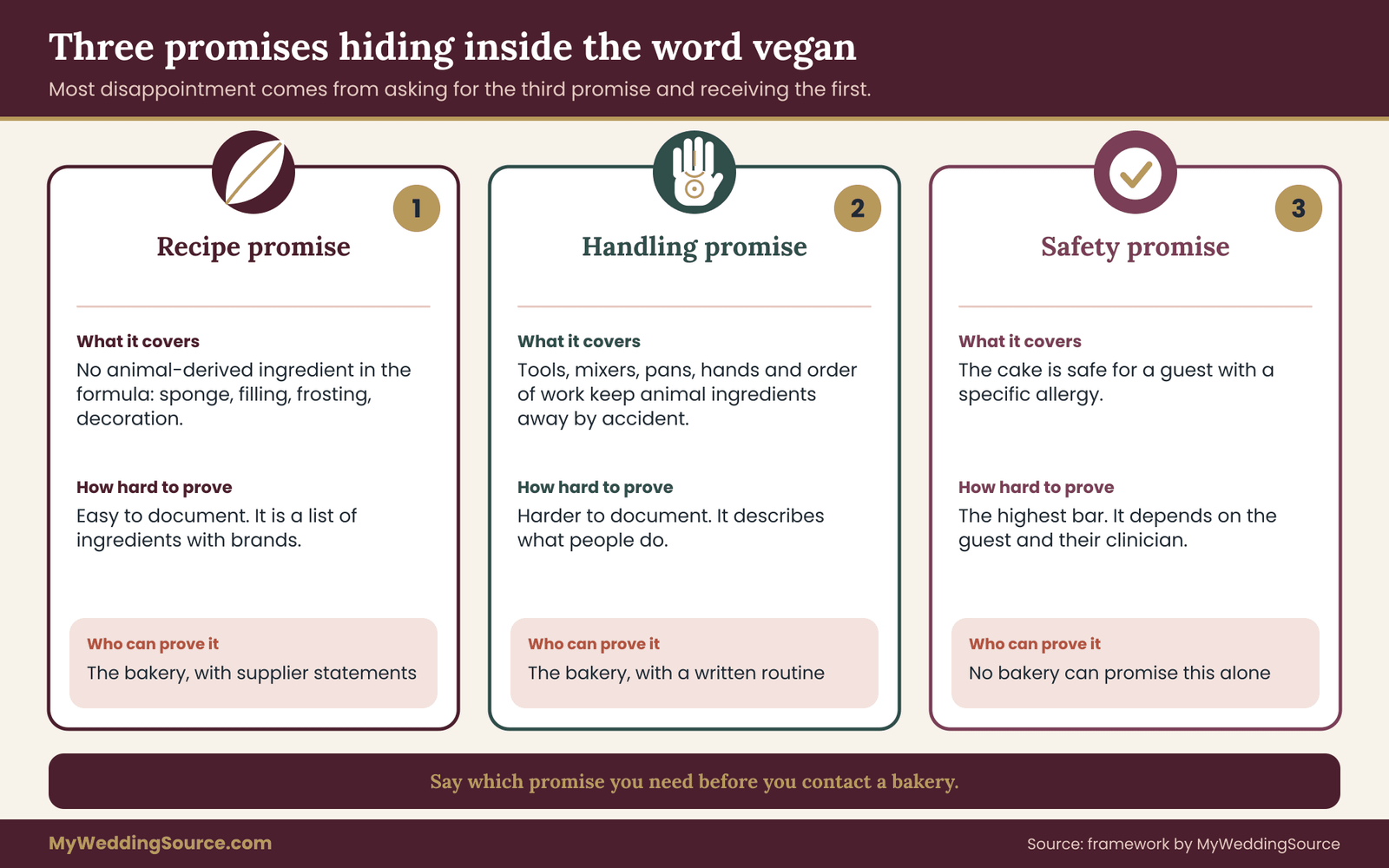
Three promises hiding inside one word
When a couple says they want a vegan cake, they are usually asking for one of three different things, and it helps to separate them before you contact a bakery.
The first is a recipe promise: nothing in the formula comes from an animal. This is the easy one to deliver and the easy one to document, because it is a list.
The second is a handling promise: the cake was made, assembled, transported and cut in a way that kept animal ingredients from reaching it by accident. This is a process claim, and it is harder to document because it describes what people do rather than what the recipe says.
The third is a safety promise: the cake is safe for a guest with a specific allergy. This is the highest bar. It depends on the recipe, the handling, the exact ingredients, the guest’s particular allergy and the guest’s clinician’s advice. A bakery cannot give you this promise on behalf of a medical condition, and a good one will say so.
Keep these three apart in your own head. Most disappointment comes from asking for the third and receiving the first.
Why the wedding setting makes it harder
A vegan cake at a Tuesday birthday is a small risk. A vegan cake at a wedding is a different job, for practical reasons that have nothing to do with the recipe.
The cake is usually built in stages across a day or more. It travels. It is often assembled at the venue by a person who is not the baker. It sits on a table beside a dessert display that may include tiers of regular cake. It is cut by a caterer’s staff member, sometimes with the same knife that cut the other tier, and served onto plates that may be set out in the same stack. Every one of those steps is a point where a vegan cake can meet milk, egg or butter, and almost none of them appear in a bakery’s recipe card.
The broader timeline for a wedding cake, from the final guest count to the cutting service, is covered in the guide on planning wedding cake production. This article stays on one narrow question: what a bakery can document about a vegan cake, and how you verify it.
Vegan cake, allergen-aware cake, and cross-contact: three different ideas
Three phrases get used as if they were interchangeable. They are not, and the difference decides what you should ask for.
Vegan is a statement about ingredients, as above.
Allergen-aware or allergen-friendly is a marketing phrase with no standard meaning. It might mean the bakery avoids peanuts, or that it has a nut-free recipe, or that it is simply willing to talk about allergens. It is not a promise that anything is absent.
Cross-contact is the term food-safety agencies use for the unintended transfer of an allergen from one food, surface or utensil to another. The U.S. Food and Drug Administration uses “cross-contact” for allergens, and reserves “cross-contamination” for microorganisms like bacteria. The distinction is not pedantic. Bacteria can be killed by heat. An allergen protein is not removed by cooking, so a trace of milk protein on a baking sheet can end up in a cake that never contained milk in its recipe.
Vegan does not mean free of the major allergens
A vegan recipe removes milk and eggs, which are two of the nine major food allergens recognized under U.S. law. It does not remove the others. Vegan baking leans on exactly the ingredients that cause the other allergen problems. Soy shows up in soy milk, soy lecithin and some vegan butters. Wheat is the base of most cake flour. Tree nuts appear in almond flour, almond milk and cashew-based fillings. Coconut, which some people avoid, is a common substitute for butter and cream. Sesame, the ninth major allergen on the federal list, can appear in tahini-based fillings and some baked goods.
So the guest who is vegan and has a nut allergy needs a different cake from the guest who is vegan and has a soy allergy, and neither is served by the single word “vegan.” If a guest has any allergy, name that allergy to the bakery, in writing, along with the vegan request. Otherwise the bakery will optimize for the label you gave it.
Cross-contact is about the kitchen, not the recipe
The central idea of this guide fits in one sentence. A recipe is a list of ingredients, and cross-contact is a property of the room those ingredients are used in.
You can read a recipe at a tasting. You cannot read a kitchen from a tasting plate. The only way to learn about a kitchen is to ask what it does and to ask for that answer in a form you can keep. That is what the verification sheet in a later section is for.
Where “may contain” labels fit
You may have seen packaged foods with lines like “may contain milk” or “made in a facility that also processes eggs.” These are precautionary allergen statements. In the United States, the FDA treats them as voluntary and says they should not be used in place of good manufacturing practices. For a custom cake, there is usually no package, so there is no label of this kind unless the bakery chooses to write one. The absence of a “may contain” line on a cake card therefore tells you nothing at all about what else the kitchen handles. It tells you only that nobody wrote one.
The two kinds of guest you are planning for
It helps to be explicit about who the cake is for, because the right level of evidence depends on it.
The first kind of guest chooses a vegan diet. For this guest, a trace of butter from a shared mixing bowl is a values question. Many such guests are comfortable with a bakery that uses a vegan recipe and careful tools, and some are not. Ask the guest, privately and politely, where their own line is. Do not guess for them.
The second kind of guest needs to avoid something for health reasons. For this guest, a trace of milk or egg protein can matter. Here the verification sheet is a minimum, not a finish line, and the final decision belongs to the guest and their clinician, not to you or the bakery.
Both kinds of guest deserve a good cake. They deserve different levels of evidence, and being honest with yourself about which one you are planning for saves the most time and worry.
How cross-contact reaches a vegan cake
A bakery is one of the harder places to keep a vegan cake separate, because the core ingredients of an ordinary bakery are butter, eggs, milk and flour, and they are in the air, on the counters and on everyone’s hands. That does not make a clean vegan cake impossible. It means the separation has to be deliberate, and each point of contact has a specific fix. It helps to walk through the path a vegan cake takes, in order, and name the places where contact happens.
Shared surfaces and tools
The most common route is also the least dramatic. A sheet pan, a bench scraper, an offset spatula or a turntable is used for a butter cake, rinsed, and used again for the vegan cake. Rinsing is not the same as washing, and washing is not always enough. Food-allergy organizations and food-safety agencies generally advise that allergen residue is removed by thorough washing with soap and water, followed by rinsing and sanitizing, rather than by wiping with a damp cloth. A sanitizer alone is meant to reduce microbes, and it is not designed to remove food protein.
So when you ask about tools, the better question is not “do you clean them?” Every bakery cleans its tools. Ask which tools are used only for vegan work, which tools are shared, and what the cleaning steps are for the shared ones. A bakery that keeps a dedicated set of pans, bowls, spatulas and a separate piping bag stock for allergen-sensitive orders has a very different answer from one that washes the common set between jobs.
Shared mixers and bowls
A stand mixer with a bowl and a paddle is a surprisingly hard item to clean thoroughly. Batter gets into the bowl’s base, around the paddle shaft and under the splash guard. If a bakery has one large mixer and mixes buttercream in it all day, a vegan batter mixed in the same machine may carry traces unless the whole assembly has been fully taken apart and washed.
A well-run vegan cake process usually answers this in one of three ways: a separate bowl and attachments used only for vegan batters, a scheduled order of work so that the vegan batch is mixed first on freshly cleaned equipment, or a physically separate station. Any one of these is a documentable answer. “We wipe it down” is not.
Shared ovens, racks and the order of baking
Ovens add a second route, mostly through racks, liners and the sheet pans themselves rather than through the heat. If vegan layers are baked on the same racks as butter-based layers, drips and crumbs can land on them. Many bakeries solve this with fresh parchment, dedicated pans and baking the vegan cake first in a clean oven, then everything else.
Ask about the sequence. A bakery that says “vegan always goes first on a clean rack, on its own pans, lined with fresh parchment” is describing a process. A bakery that says “we bake it with everything else” is describing the opposite.
Hands, gloves, aprons and the person doing the work
Cross-contact travels on people. A baker who handles a butter cake, then picks up a spatula for the vegan cake without washing hands and changing gloves, has just moved milk protein onto a vegan tool. Aprons and sleeves can do the same thing, and so can a rag tucked in a waistband.
You are not trying to police the bakery’s staff. You are trying to learn whether the bakery has a rule. A written rule such as “hands washed, fresh gloves, clean apron before any allergen-sensitive order” is a handling claim you can put in the file. An unwritten habit is still better than nothing, but it is weaker, and the sheet later in this guide gives it a lower rating for that reason.
Airborne flour and dust
Flour dust is a real route for wheat, and powdered ingredients can drift. Milk powder, powdered sugar and cake flour all become airborne when poured or sifted. If the bakery also handles nut flours or powdered milk, those can settle on nearby surfaces. This is one reason a separate room or a separate time block gives you stronger evidence than a separate bowl in the same space.
Decorating, filling and finishing
A vegan cake usually survives baking cleanly and meets trouble at decorating. Fillings and frostings are often made in batches from shared containers, and piping bags are reused across cakes. Fondant is sometimes rolled on a surface dusted with cornstarch or powdered sugar that has been used for other products. Sprinkles, sugar flowers, edible glitter and chocolate decorations are frequent sources of milk, egg white and shellac.
Ask where the finishing happens, who does it, and whether decorations are made in-house or bought in. Each answer changes what you need to document.

The case for “last-touch” thinking
A useful habit is to trace the cake backwards from the table. Start at the plate: who cut it, with what, and on what? Then the stand: what was it built on, and what was it covered with? Then the box: what lined it, and what else was in the van? Then the decorating bench, the filling bowl, the oven, the mixer and finally the ingredients. At each step, ask whether an animal-derived ingredient could have touched the cake. You will find that most of the answers are in the steps after baking, which is where a recipe-only conversation never looks.
Hidden animal ingredients in a vegan cake
Separate from cross-contact is a quieter problem: ingredients that are animal-derived but do not look it. A bakery can sincerely believe it is making a vegan cake and still use one of these. They are worth knowing because each one is a single line on a verification sheet.
Sugar, honey and sweeteners
Honey is the obvious one. Less obvious is refined cane sugar. Some cane sugar is filtered through bone char during processing, and the sugar itself carries no mark of it. Many strict vegans avoid sugar that is processed this way, and others do not mind. The point for your sheet is that the bakery should be able to say which sugar brand it uses, and you or the bakery can check with that supplier. Organic sugar and beet sugar are commonly cited as alternatives, but the only reliable answer comes from the supplier of the specific product.
Dairy and egg in places you would not look
Several ingredients carry milk or egg under unfamiliar names. Casein and whey are milk proteins used in some “non-dairy” creamers and a few dairy-free cheeses. Lactose appears as a filler. Albumen means egg white, and lecithin can come from egg, though most commercial lecithin used in baking comes from soy or sunflower. Mono- and diglycerides can come from plant or animal fat. Under U.S. labeling law, milk, egg, wheat, soy, peanut, tree nut, fish, shellfish and sesame must be declared in plain terms on packaged food, so those allergens are easier to spot on a label than other animal-derived ingredients, which are not covered by that rule.
That last point matters for a vegan cake. A packaged ingredient may be legally labeled for allergens and still contain something a vegan avoids, such as gelatin, carmine or shellac, none of which is one of the nine major allergens.
Colors, glazes and gelatin
Carmine, also listed as cochineal extract or carmine color, is a red dye made from insects and is used in some pink and red frostings and candies. Confectioner’s glaze or shellac, which comes from the lac insect, gives sprinkles and chocolates their shine. Gelatin turns up in marshmallow fondant, some mousse fillings, some gummies used as decoration and some whipped toppings. Each of these is an ingredient a bakery can look up on a supplier’s product page or ask the supplier about.
Chocolate, caramel and “dark” products
Dark chocolate is often assumed to be dairy-free. Some dark chocolate contains milk fat or milk powder as an ingredient, and many are made on equipment shared with milk chocolate and carry a precautionary statement. Caramel is commonly made with butter and cream. Even a “vegan caramel” can be made with coconut cream, which is fine for a vegan and a concern for a guest who avoids coconut.
Vegan substitutes can be allergens too
The substitutes that make a vegan cake possible are themselves common allergens. Vegan butter is frequently made from soy, palm, coconut, almond or cashew oils or ingredients. Plant milks are soy, oat, almond, coconut or pea. Egg replacers can use wheat or soy or potato starch. Aquafaba, the liquid from chickpeas, is popular for meringue and some people with legume allergies avoid it.
The takeaway is not that substitutes are dangerous. It is that you should ask for the specific substitute by name and brand, and check it against the guest’s actual restrictions. A vegan cake that replaces butter with an almond-based spread is a poor choice for a guest with a tree nut allergy, however vegan it is.
What a supplier can tell a bakery
Most commercial suppliers publish an ingredient statement, an allergen statement and, on request, a letter or specification sheet confirming whether a product is made from animal-derived materials. Some also hold third-party certifications, such as a vegan certification mark. A bakery that buys from established suppliers can usually forward this paperwork in a few minutes. A bakery that cannot name its supplier for a given ingredient has told you something useful as well.
The ingredient trace for a vegan cake
Put these pieces together and a pattern emerges. For every component of the vegan cake, you want the bakery to be able to name the ingredient, the brand, and where the proof of its status lives. Sponge, filling, frosting, decoration and support materials such as dowels and boards all count. The next section turns that pattern into a concrete sheet you can fill in with the bakery.
The claim verification sheet for a vegan cake
This is the working tool of the guide. It is one page per cake, and you fill it in with the bakery, either at a tasting or by email. It has two parts: five claims to check, and four levels of evidence to rate each claim. The point is not to catch the bakery out. The point is to turn a friendly conversation into a record you can read again in three months, when the details have blurred.
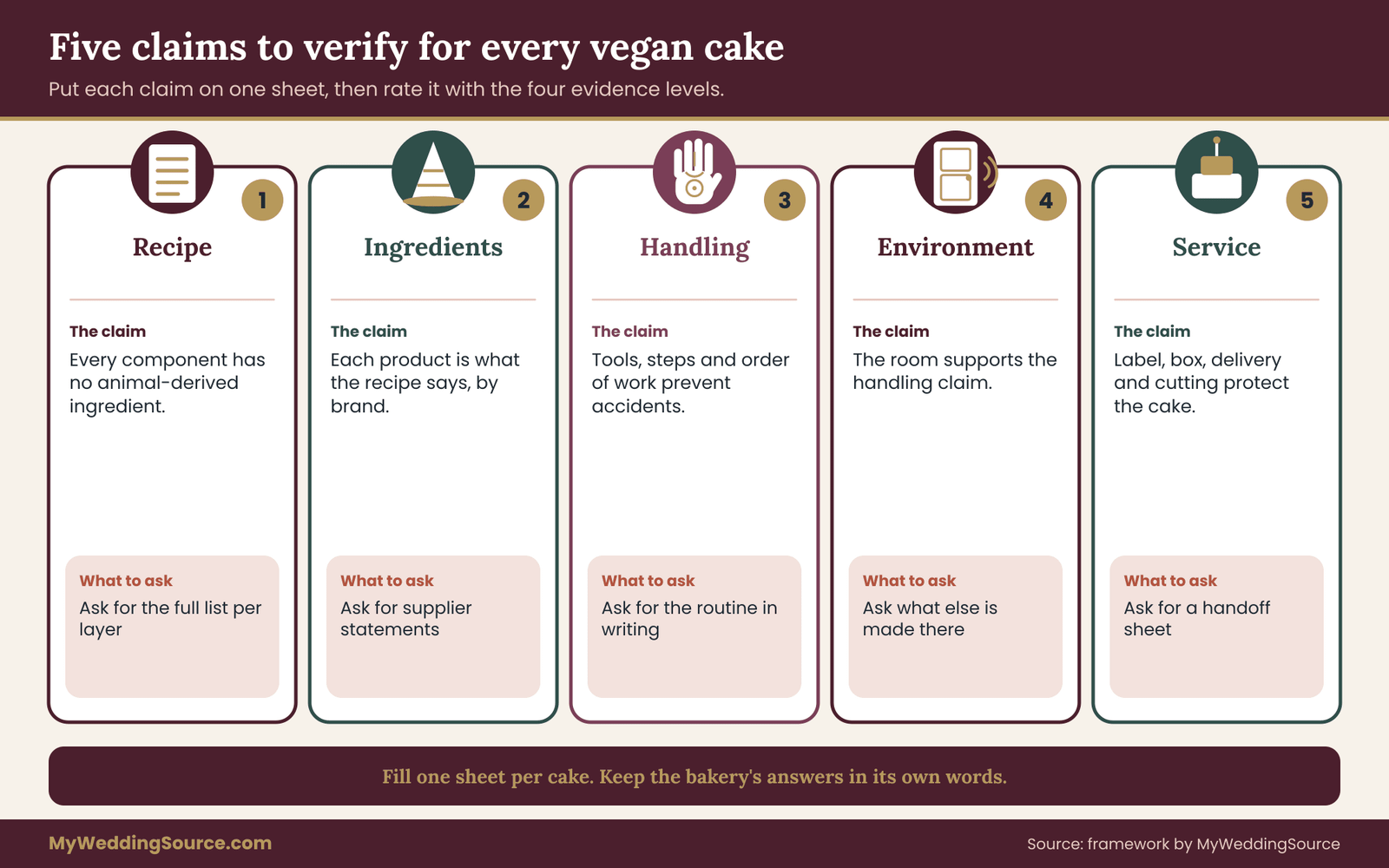
The five claims
Claim one: the recipe claim. The vegan cake’s formula, layer by layer, contains no animal-derived ingredient. This covers the sponge, the filling, the frosting, the glaze, the decoration and any inclusions such as fruit curds, chocolate pieces or crumbs. Ask for the full ingredient list for each component, not a summary.
Claim two: the ingredient claim. Each ingredient in the recipe is actually what it is said to be, by brand and product. This is where bone-char sugar, carmine, shellac, gelatin and milk-containing chocolate get caught. A recipe can be vegan on paper and not on the shelf.
Claim three: the handling claim. The steps used to make this cake keep animal ingredients from reaching it by accident. This covers tools, bowls, mixers, pans, oven racks, liners, hands, gloves and aprons, and the order in which products are made.
Claim four: the environment claim. The place where the vegan cake is made supports the handling claim. A dedicated vegan bakery, a separate room, a separate time block, a separate station, or a shared bench with cleaning steps are all different environments, and each supports a different level of confidence.
Claim five: the service claim. The cake stays what it is from the bakery door to the guest’s plate. This covers the vegan cake card or label, the box and board, delivery, who assembles it, what it sits next to, what cuts it, and what it is served on.
The four levels of evidence
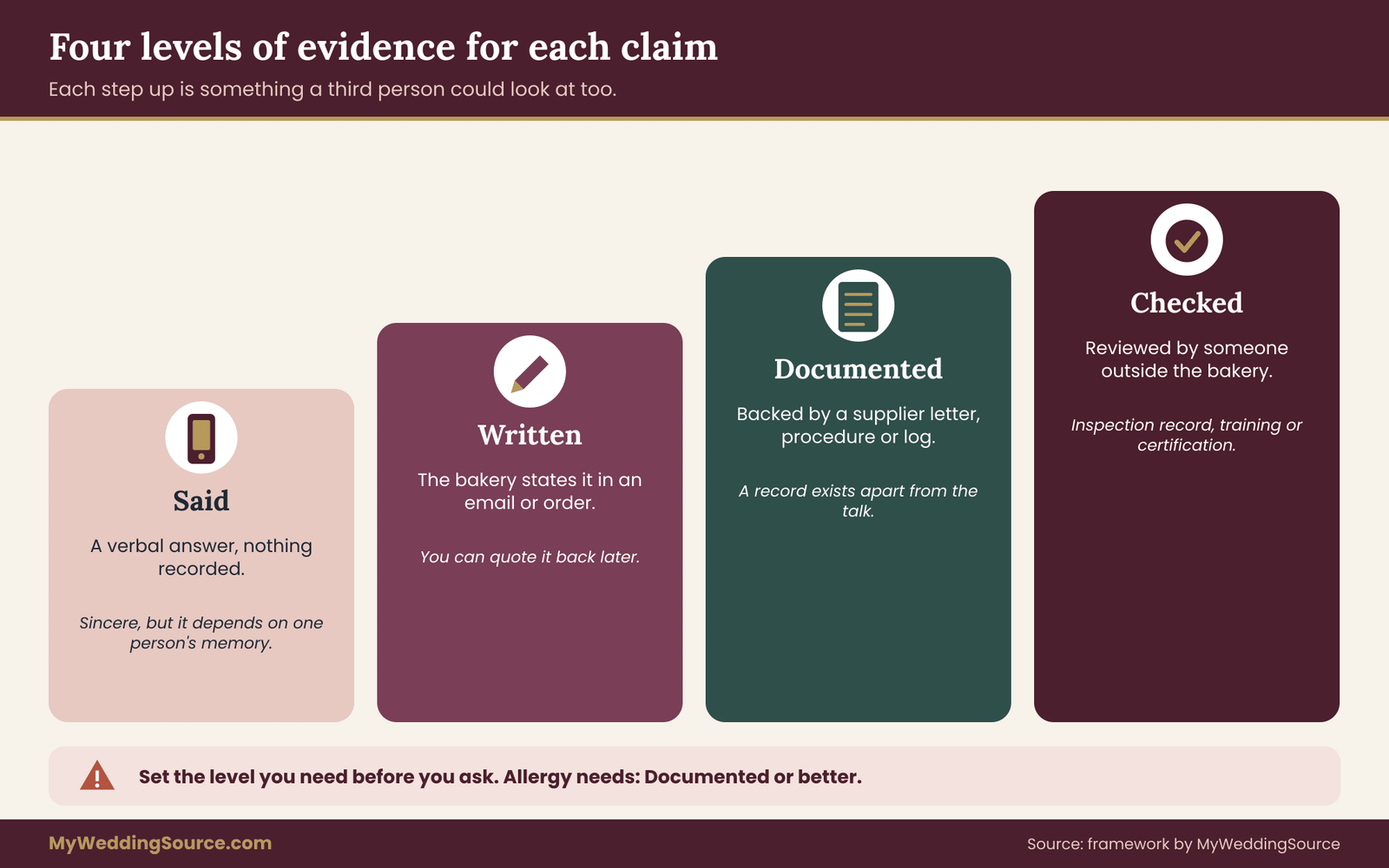
For each claim, the bakery’s answer lands on one of four levels. Think of them as rungs.
Said. The bakery tells you something verbally, such as “yes, it is fully vegan, we are careful.” This is sincere and useful as a starting point, and it is the weakest evidence because nothing is recorded. It also depends on the memory of whoever happened to answer the phone.
Written. The bakery states the claim in an email, order form or contract in specific terms: which ingredients, which steps, which tools. “Our vegan cakes contain no eggs, dairy or honey, and are made on dedicated pans” is a written claim. The bakery has put its name to a statement, and you can quote it back later.
Documented. The claim is backed by a record that exists independent of the conversation. Examples include a supplier letter confirming a product has no animal-derived ingredients, a written cleaning procedure the staff follows, a cleaning log, a photograph of the labeled dedicated tools, or an ingredient list on the supplier’s own product page. You are no longer relying on trust alone. You are looking at something a third person could look at too.
Checked. Someone outside the bakery has reviewed the claim. This might be a local health department inspection report, a food-handler or allergen-training certificate for the staff who will make your cake, or a vegan or allergen certification from a recognized organization for a specific product or facility. Even this has limits, which are set out at the end of this guide, but it is the strongest level of evidence a couple can reasonably ask for.
How to fill in the sheet
Write the five claims down the left side of a page. Beside each, leave space for the level, the evidence, and any gap. Then work through them with the bakery in order.
For each claim, record three things. First, the bakery’s answer in its own words. Second, the level it reaches. Third, if the level is below what you need, the single smallest step that would raise it. Often that step is cheap: an email asking the bakery to confirm in writing what it just told you, or a request for a supplier letter.
Avoid scoring the bakery on a mood. If the owner is charming and the answer is vague, it is a Said. If the owner is brusque and hands you a printed procedure, it is Documented. The sheet is useful precisely because it ignores charm.
A plain-language version of each rung per claim
It helps to see what each level looks like for each claim, so the ratings are consistent. Here is the pattern in prose.
For the recipe claim, Said is “there is no dairy in it.” Written is an email listing every component and its ingredients. Documented is the written list plus the recipe card or formulation sheet itself. Checked is rare for a recipe, and usually only applies if a product carries a vegan certification.
For the ingredient claim, Said is “we use vegan butter and plant milk.” Written names the brands. Documented attaches supplier specification sheets or product-page ingredient statements for the sugar, chocolate, fondant, coloring and decorations. Checked applies where an ingredient carries a recognized certification mark and the bakery can show the mark on the package.
For the handling claim, Said is “we wash everything.” Written describes which tools are dedicated and which are cleaned between jobs, and how. Documented is the written standard procedure for allergen-sensitive orders, plus evidence the staff follow it, such as a cleaning log or labeled dedicated equipment. Checked is staff holding a current food-handler or allergen-awareness certificate from an accredited course.
For the environment claim, Said is “it is a separate area.” Written describes the area, who uses it and what else happens there. Documented adds photographs, a floor plan or a walkthrough where you see the space yourself. Checked is a health-department inspection record showing the facility’s status, or a facility-level certification, such as a dedicated vegan bakery operating under its own license.
For the service claim, Said is “we label it.” Written specifies the vegan cake card wording, the box labeling, the delivery arrangement and who will assemble and cut. Documented adds a handoff sheet that travels with the vegan cake and is signed by whoever receives it. Checked is uncommon here, and the venue’s or caterer’s own written allergen procedure is the nearest equivalent.
Setting the bar before you ask
Decide the required level before you start, not after you see the answers. If you decide afterward, you will tend to accept whatever the bakery offers, because by then you like the bakery and the vegan cake.
A simple decision rule works well:
- If the guest chooses a vegan diet and has no medical restriction, Written on all five claims, with Documented on the ingredient claim, is a sensible target.
- If the guest has a diagnosed allergy, Documented on all five claims is the minimum, with Checked where the bakery can offer it. The guest should see the evidence and make the call.
- If the guest has a severe or life-threatening allergy, no sheet substitutes for the guest’s clinician. In that case the decision is theirs, and some guests will reasonably prefer to bring their own dessert from a source they trust. Plan for that without making it awkward.
Write the target level at the top of the sheet. When you finish, compare the ratings with the target and note where you fall short.
What to do with a gap
A gap is not a failure. It is an item. For each gap, there are only four sensible choices.
You can close it, by asking the bakery for the missing record. You can narrow it, by changing the vegan cake so that the gap disappears, for example by dropping a decoration whose supplier cannot be identified. You can accept it, if the guest is comfortable and the risk matches the target level. Or you can move it, by choosing a different bakery or a different dessert for that guest.
Writing the choice next to each gap forces a decision. It also gives you something to show the guest if they ask what you did.
Keeping the sheet useful
Keep the sheet and any attachments in one folder, labeled with the bakery name and the order date. Save the bakery’s emails as they arrive rather than at the end. If something changes, such as a new supplier or a substitute ingredient, update the sheet and ask the bakery to confirm the change in writing. A sheet that is three months old and out of date is worse than none, because it looks authoritative.
A sheet also travels well. When the day arrives, a printed copy goes to the person assembling the vegan cake, another goes to the caterer or venue coordinator who will cut it, and a short version goes to the guest who is relying on it. The later sections cover those handoffs.
Why a sheet beats a good conversation
Conversations feel thorough because they are friendly and detailed. They fail in three predictable ways. People forget what was said. Details shift between the tasting and the order. And the person who answers is not always the person who bakes. A sheet fixes all three by putting the claim, the evidence and the owner in one place.
It also protects the bakery. A baker who has agreed in writing to a defined process knows exactly what is being asked. That reduces the chance of a mistake on a busy Friday, when the person assigned to your cake did not hear the original conversation.
Questions to ask the bakery about a vegan cake and how to read the answers
A good question has two jobs. It gathers a fact, and it shows you how the bakery thinks. This section gives you the questions in the order they are most useful, with notes on what a solid answer sounds like and what should slow you down. Use them at the tasting, on the phone or by email. Email is best for anything you want on the record.
Opening the conversation
Begin with the kind of vegan cake you need, not with a list of demands. Say who it is for, whether there is a medical restriction, and which one. For example: “One of our guests is vegan, and another has a tree nut allergy. We would like to understand what you can offer and what you can document.”
This framing tells the bakery you are asking for information, not accusing it of anything. It also gives the baker the chance to say “we can do the first, not the second,” which is the single most valuable sentence you can hear.
Questions about the recipe
Ask for the full ingredient list of each component of the vegan cake: sponge, filling, frosting, decoration. Ask whether the vegan recipe is a regular item or a custom one made for this order. A recipe the bakery has made many times is easier to document than a first attempt.
Ask what replaces the eggs and the butter, by product name. Ask whether any component contains soy, wheat, almond, coconut, cashew, peanut or sesame. Even if the guest has none of these allergies, the answer tells you how the bakery builds a vegan cake.
A good answer is specific: “The sponge uses oil, plant milk and a vinegar-baking soda lift, and the frosting is made with a soy-based vegan butter.” A vague answer is “we use a vegan mix,” which could mean almost anything.
Questions about ingredients and suppliers
Ask which brand of sugar, chocolate, fondant, food coloring and sprinkles the bakery uses for the vegan cake. Ask whether the bakery can share the supplier’s ingredient statement or a letter confirming no animal-derived ingredients.
If the answer is “we check labels,” ask what happens with an ingredient that has no label, such as a bulk sugar from a restaurant supplier. A bakery that has thought about this will describe how it handles unlabeled bulk goods, usually by buying only from suppliers that provide specification sheets.
Do not ask a bakery to guarantee the status of an ingredient it did not make. You are asking it to show what the supplier says. That is a fair request, and it keeps responsibility where it belongs.
Questions about handling
These are the questions most couples skip, and they matter most.
Ask: “What do you do differently for a vegan order?” Then listen for specifics. Dedicated tools, a clean bench, a particular order of work, fresh liners, a glove change. If the answer is “nothing special, we just do not use eggs or dairy,” you have learned that the vegan cake is vegan by recipe and not by process, which is a legitimate answer for some guests and not for others.
Ask whether the bakery uses dedicated equipment, shared equipment with a cleaning procedure, or shared equipment with no change. Ask what the cleaning procedure is for shared items. Ask who will make the vegan cake, and whether that person has had allergen or food-safety training.
Ask whether the bakery has a written procedure for allergen-sensitive orders, and whether you may see it or receive a copy. A written procedure is the difference between a Written claim and a Documented one.
Questions about the environment
Ask what else is made in the kitchen on the day your cake is made and the day before. Ask whether any nut products, dairy-based products or egg-based products are handled in the same room. Ask whether there is a separate area or time block for vegan or allergen-sensitive orders.
Ask whether you can see the space. A walkthrough is a legitimate request for a bakery with a retail or kitchen operation, though some home-based and shared-kitchen bakers cannot offer it for practical or insurance reasons. If a visit is not possible, ask for photographs of the vegan workstation and labeled tools.
Questions about service and delivery
Ask how the vegan cake will be labeled, boxed and transported, and whether it travels with other cakes. Ask who will assemble it at the venue, and what they will use to stack, support and finish it. Ask whether decorations such as fresh flowers or sugar flowers will be added on site. If you are splitting a display tier from a serving cake, tell the bakery which one is the vegan cake so it is never mixed up.
Ask what happens if something goes wrong on the day: a dropped tier, a delay, a substitute ingredient. A bakery that has a plan will describe it. One that has not will say “that never happens,” which is a polite way of saying there is no plan.
Questions about records
Ask whether the bakery keeps batch records, ingredient lot numbers or a production sheet for each order. Ask whether it will confirm the final ingredient list in writing before the day. Ask whether it will provide a printed cake card and ingredient list to hand to the venue.
These are not unusual requests. Many professional bakeries already keep production sheets, and the question simply asks for a copy of one.
How to read the answers
Answers come in a handful of recognizable types. Learning to tell them apart makes the sheet quick to fill in.
The specific answer
“Our vegan sponge is made with oil and plant milk, we use a dedicated set of pans and bowls kept in a labeled bin, and we bake vegan orders first on a cleaned rack.” This answer names things. It can be turned into a Written claim immediately, and probably into a Documented one if the bakery sends a photo or a procedure. Treat specificity as the best sign you will get.
The reassuring but empty answer
“Don’t worry, we do this all the time, it’s totally fine.” This is kind and may be true, but it gives you nothing to record. Reply by email with a polite restatement, for example: “Thank you. To make sure we have this right, could you confirm in writing which tools are dedicated and what the cleaning steps are for the rest?” Many bakeries respond well to this, because it lets them show what they actually do.
The honest limit
“We make vegan cakes, but our kitchen also uses milk, eggs and nuts, so we cannot promise there is no cross-contact.” This is a good answer. It is accurate, it protects your guests, and it tells you exactly which rung you are on. A bakery that says this is more reliable, not less, than one that offers unlimited assurances. For a guest who simply prefers a vegan diet, this may be all you need. For a guest with an allergy, it is a clear signal to look elsewhere or plan a separate dessert.
The defensive answer
“We have never had a complaint.” Or: “If you are that worried, maybe a bakery is not for you.” Defensive answers usually reflect discomfort with the question, not bad intentions. Still, they do not help you. If the bakery will not describe its process, record that as a gap and consider whether you want to rely on it for the guest who most needs the answer.
The overreaching answer
“Our vegan cake is 100 percent allergen free.” Be careful here. A bakery cannot responsibly make this claim for a facility that handles multiple allergens, and the phrase itself has no regulated meaning. Ask what exactly the bakery means and how it supports the claim. A bakery that backs the statement with a dedicated facility and documentation has earned it. One that cannot is using a slogan.
The answer that changes
Sometimes the answer shifts between the first call and the contract. The baker said “dedicated pans” on the phone and the order form says “standard process.” Treat any change as a gap, ask for the reason, and have the bakery put the final answer in writing.
The deferral
“I will have to ask the head baker.” This is fine, and often the most honest answer. The follow-up is to ask by when, and to set a date on your sheet. A deferral that never resolves is a gap.
A calm way to run the conversation
A few habits keep the process friendly.
Ask once, in writing, then confirm. A single email with your questions lets the bakery answer thoughtfully, rather than on the spot. Follow up with a short call if needed and send a one-line email confirming what you heard.
Keep tone curious, not suspicious. “Help me understand your process” works better than “prove it.” Bakers who care about their work usually enjoy explaining it.
Do not ask the bakery to carry the medical decision. Say plainly that the guest’s clinician or the guest will make the call, and that you are collecting information to help them do that. This takes pressure off the bakery and puts the decision with the right person.
Respect a no. If the bakery says it cannot offer the level of documentation you need, thank it and move on. You have saved yourself a problem, and the bakery has saved itself from a promise it cannot keep.
Compare bakeries on the same sheet. If you are choosing between two or three, send each the same questions and rate them the same way. The comparison is then about evidence, not impressions. The same logic of asking every vendor identical questions runs through the vendor due diligence checklist.
Questions the bakery may ask you
Expect the bakery to ask a few questions back, and have the answers ready. It will want to know the guest count for the vegan cake, which allergies are involved, whether the vegan cake is a full cake or a small separate cake, whether it will be displayed or served, and who will receive it at the venue. It may ask whether the guest is comfortable with a specific ingredient or has other restrictions.
Answer plainly, and keep the answers in the sheet. If you do not know a guest’s restrictions, ask the guest, not the bakery.
What each kind of baker can document
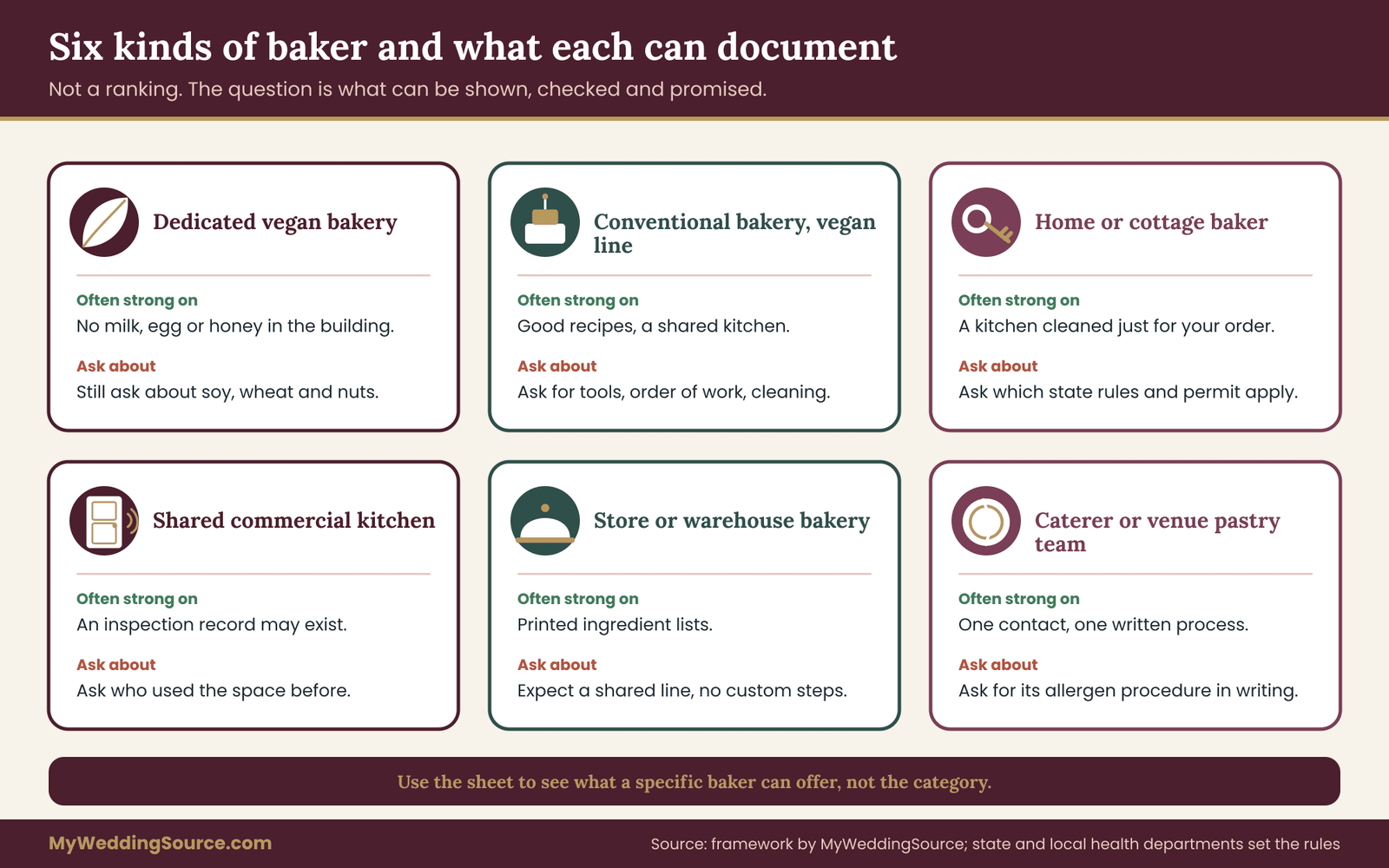
Bakeries are not all built the same way, and the evidence a baker can give you depends heavily on the type of operation. This is not a ranking of good and bad. A small home baker may make a better vegan cake than a large shop. The difference is in what can be shown, checked and promised. Knowing the categories helps you set a fair expectation before you ask.
The dedicated vegan bakery
A bakery that makes only vegan products has removed the largest source of cross-contact, which is animal ingredients in the building. It can usually say with confidence that no milk, egg or honey enters the kitchen. For a guest who chooses a vegan diet, this is the strongest practical answer you can get for the recipe and environment claims.
What it does not remove is the other allergens. A fully vegan bakery commonly works with soy, wheat, almond, coconut and cashew. If your guest has a tree nut or soy allergy, the same questions about dedicated tools, cleaning and ingredient lists still apply. A dedicated vegan bakery can often document the ingredient claim well, because its whole supply chain is built around the question. Ask for the same sheet anyway, and expect a quick, specific answer.
The conventional bakery with a vegan line
Many bakeries make a vegan cake as one item in a mostly conventional range. The recipe may be excellent. The environment is shared. Here the handling claim carries most of the weight, and the quality of the answer varies widely. Some of these bakeries run a careful allergen process, with a separate bench and dedicated tools. Others have a good recipe and an ordinary kitchen.
For a guest who prefers a vegan diet, a good recipe and sensible habits may be enough. For a guest with an allergy, you need the handling and environment claims at the Documented level, and an honest answer may be that the bakery cannot reach it. That is a fine thing to learn at the tasting stage rather than the week of the wedding.
The home-based or cottage food baker
Many states allow small-scale baking from a home kitchen under cottage food laws. Rules differ a great deal. Some states limit which products can be sold, require a particular label, restrict how and where sales happen, or cap annual revenue. Some require registration and others do not. Many exempt these operations from the routine inspections that apply to a commercial bakery. Some states restrict or exclude wedding cakes with certain fillings, and the rules around allergen labeling on cottage food also differ.
None of this means a home baker is unsafe, and plenty are careful and skilled. It does mean that “Checked” evidence, such as a health department inspection record, may not exist, and that a home kitchen is often a shared family kitchen that also handles ordinary groceries. Ask your state or county health department, or the state agency that regulates cottage food, what applies to the baker you are considering. Ask the baker which rules they operate under and whether they hold a permit or registration. Treat their answer as information, and verify it with the issuing office.
For the handling claim, a home baker can sometimes offer something a larger shop cannot: a kitchen cleaned from scratch and used only for your order that day. If they can describe that clearly and put it in writing, it reaches the Written level, and photographs of the setup can reach Documented.
The shared commercial kitchen baker
A shared or commissary kitchen is a licensed facility rented by several small food businesses. The baker holds their own permit and works in a kitchen inspected as a commercial operation. This often gives a stronger Checked level for the environment, because there is an inspection record. It also creates its own cross-contact risk, because other tenants use the same spaces, ovens and sinks on other days.
Ask which days and times the baker has the kitchen, who used it before, and what the cleaning and storage arrangements are. A baker who rents a dedicated shelf and a labeled set of equipment can usually document this well. One who stores tools in a communal bin has a gap.
The grocery or warehouse store bakery
Large store bakeries often make cakes at volume with ingredient lists that are available, and sometimes with a printed allergen statement. They also run high-volume lines with shared equipment and commonly state that their products may contain or be exposed to major allergens. You are unlikely to get a custom handling process. If a store bakery offers a vegan cake, treat it as a recipe claim with a documented ingredient list and assume the environment claim is a shared one.
The caterer or venue pastry team
Sometimes the vegan cake comes from the caterer or the venue’s own pastry kitchen. Then the same people who handle the vegan cake also handle every other dessert and the full meal service. The advantage is a single point of contact and a single written process. The risk is that a large kitchen is the busiest, most shared environment of all. Ask the caterer for its allergen procedure, and if it has none in writing, make that your first gap.
What each can reasonably offer, in short
A dedicated vegan bakery can often reach Documented on recipe, ingredients and environment. A conventional bakery with a careful process can reach Written or Documented on handling. A home or cottage baker can reach Written on most claims and may not have Checked evidence. A shared kitchen baker may have an inspection record but a shared environment. A store or caterer kitchen can usually document ingredients and rarely guarantee handling.
Use this as a calibration, not a verdict. The sheet will tell you what a specific baker can actually offer.
A worked example: one vegan cake, one sheet
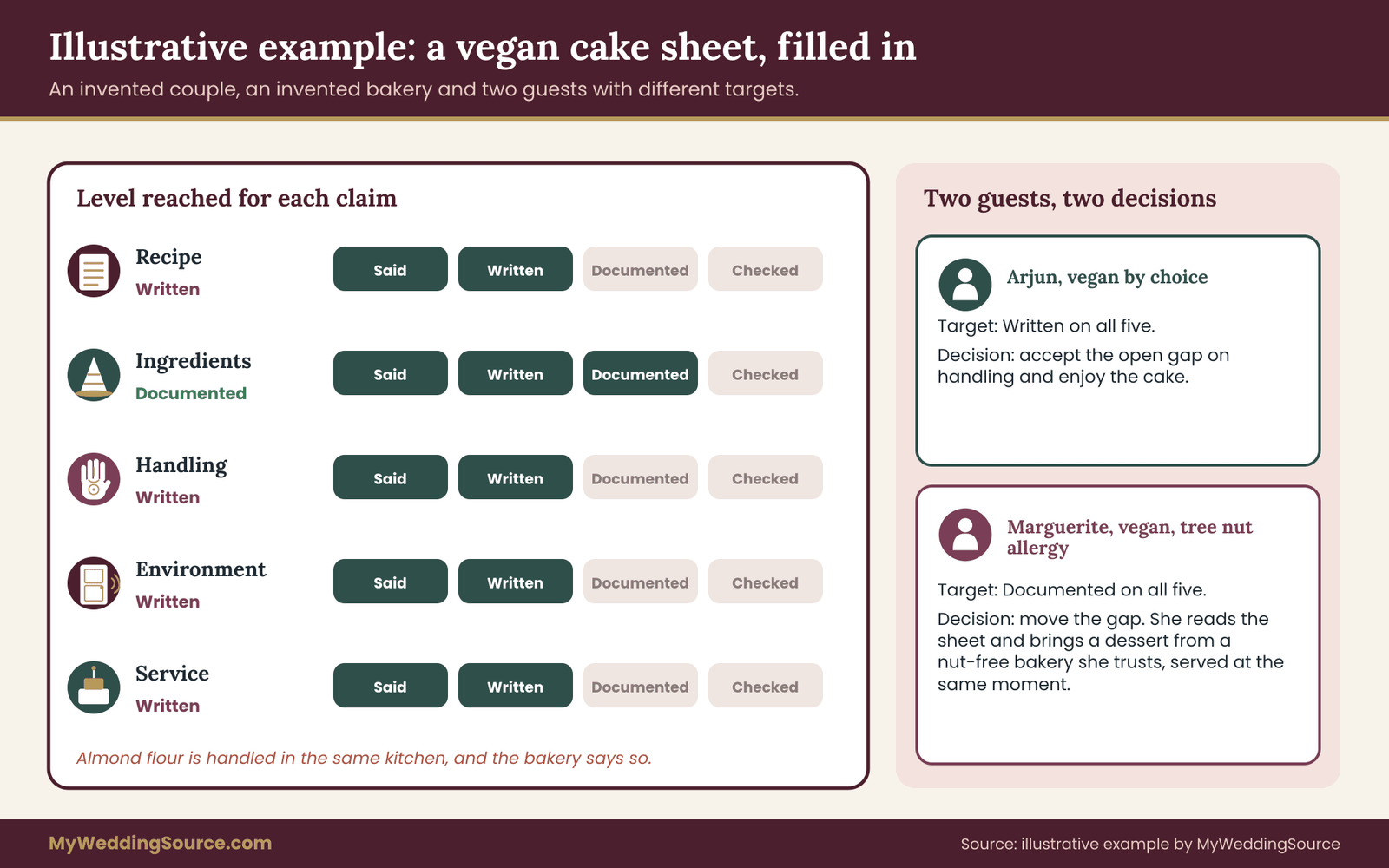
An invented couple makes the method concrete. Dana and Priya are planning a wedding for ninety guests. Priya’s brother, Arjun, is vegan by choice. Dana’s aunt, Marguerite, is vegan and has a diagnosed tree nut allergy. This is an illustrative example, not a real order, and the bakery in it is made up.
The setup
Dana and Priya choose a bakery called Fieldhouse Bakery, which sells a regular tiered cake with a separate vegan tier. They plan a two-tier display where the lower tier is the regular cake and the upper tier is a small vegan cake, cut and served separately. They set the target level before the tasting.
For Arjun, who simply prefers a vegan diet, they set Written on all five claims. For Marguerite, who has a tree nut allergy, they set Documented on all five claims, and they decide that Marguerite, not the couple, will make the final call after seeing the evidence.
The first email
Before the tasting, Dana sends the bakery a short email naming the guests’ needs: one vegan guest, one vegan guest with a tree nut allergy. It asks for the full ingredient list of the vegan cake, the brands of sugar, chocolate, fondant and coloring, a description of what is done differently for vegan orders, and whether the bakery handles tree nuts in the same kitchen.
What comes back
The bakery replies with a clear email. The vegan sponge is made with oil, plant milk and a vinegar lift. The filling is a fruit preserve, and the frosting is made with a plant-based spread that contains no nuts. It names the brands for the sugar, the spread and the coloring. It says the bakery bakes vegan orders first on dedicated pans and uses fresh liners. It also says plainly that the kitchen uses almond flour for other products and that it cannot promise the absence of tree nut traces.
Rating the claims
Dana fills in the sheet.
The recipe claim is Written: the email lists every component. The ingredient claim is Written, and goes to Documented after the bakery attaches the spread’s specification sheet and the sugar supplier’s statement. The handling claim is Written: dedicated pans, fresh liners, vegan first. It is not Documented, because the bakery has no written procedure to share. The environment claim is Written, but the written statement itself says the kitchen also handles almond flour, which is exactly what Marguerite needs to avoid. The service claim is not yet addressed.
For Arjun, this meets the target of Written. For Marguerite, it does not meet Documented on handling and environment, and the almond flour is the deciding fact.
The decision
Dana lists the gaps and picks an action for each. For handling, she asks whether the bakery can share its allergen procedure. The bakery says it has an informal routine and no written document. Dana decides to accept that for Arjun’s portion. For Marguerite, she decides to move the gap: she shares the sheet with her aunt and asks what she would prefer.
Marguerite reads the sheet and says she appreciates the thought, but with almond flour in the same kitchen she will happily bring a small dessert from a nut-free bakery she already trusts. Dana arranges for it to be plated separately and served at the same time as the vegan cake, so Marguerite is not singled out in front of the table.
What the sheet achieved
The couple ended with an honest vegan cake for Arjun, documented to the level they chose, and a better answer for Marguerite than a hopeful guess. They also have a one-page record of who said what. Nothing in the process required a bakery to be perfect. It required it to be specific, which Fieldhouse was.
The service claim, completed
Closing the loop on claim five, Dana asks Fieldhouse to confirm the vegan cake card wording, which tier is vegan, who will carry and assemble it, and who will cut it. The bakery agrees to deliver the vegan tier in a separate, labeled box, to place it on its own board, and to send a printed card with the ingredient list. Dana adds the venue coordinator’s name to the handoff note, and attaches the whole page to the final order.
This one page is the entire product of the method. It is the thing you hold in your hand on the wedding day, and it is the thing that answers a guest’s question in ten seconds instead of ten minutes.
Labels, delivery, assembly and cutting for a vegan cake
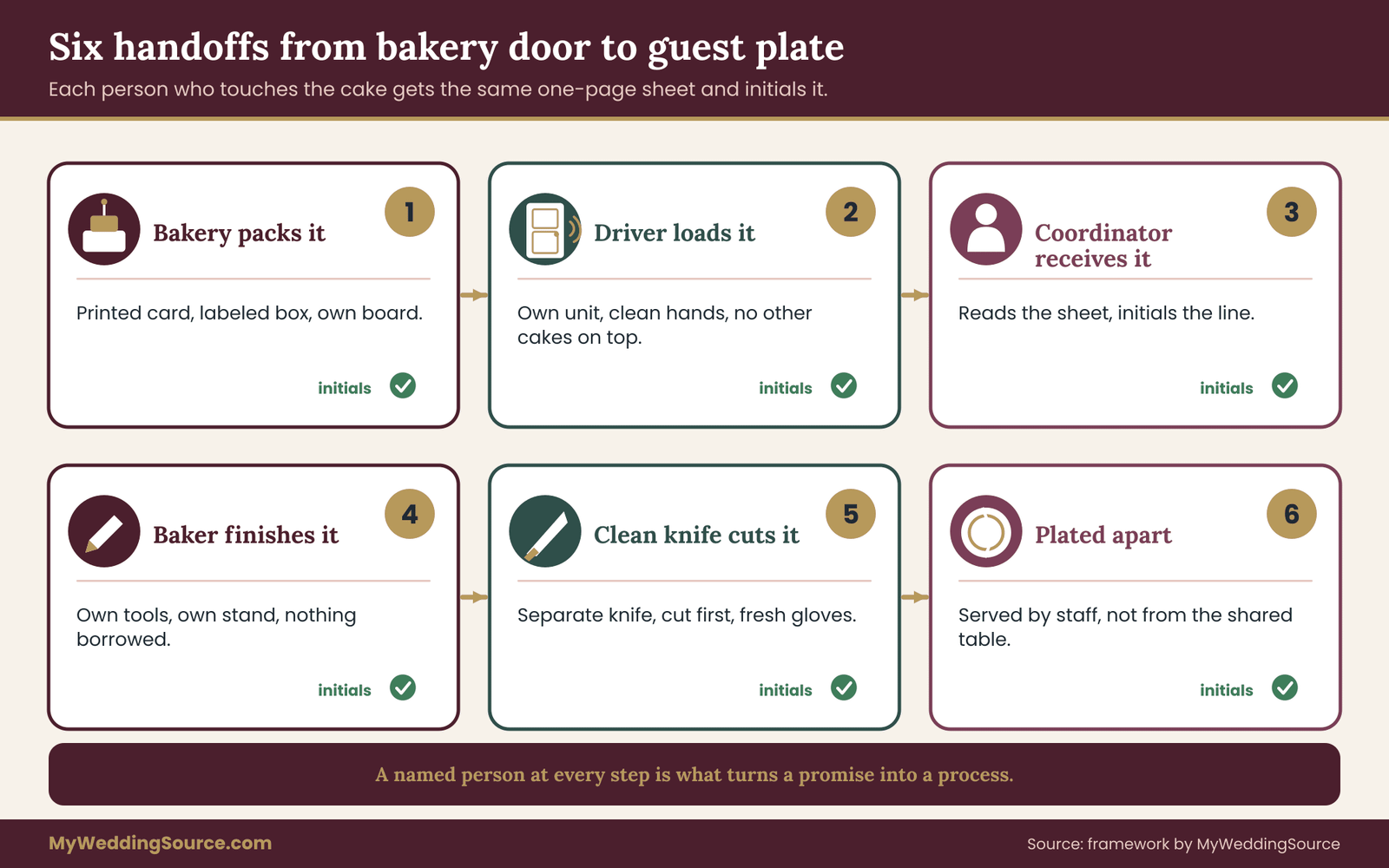
A vegan cake that left the bakery in good shape can still be spoiled in the last two hours. Most of the risk after baking is not in the recipe or the bakery at all. It is in handoffs between people who have never met: the delivery driver, the venue coordinator, the caterer’s server and the guest at the table. This section follows the cake from the bakery door to the plate and gives each handoff a simple written control.
Starting with the label
A cake card is a small printed card that identifies the cake and, ideally, its main ingredients. For a vegan cake, it should say the flavor, that the cake is vegan, and the main allergens in its recipe, such as soy, wheat or almond if they are present. It should also say, honestly, whether the bakery can promise anything about cross-contact. A line such as “Made without eggs, dairy or honey. Made in a kitchen that also handles milk, egg, wheat and tree nuts” is accurate and gives a guest what they need to decide.
Avoid vague phrases like “allergy friendly.” Avoid claims such as “free from all allergens.” If the card says the cake is nut free, the bakery has made a specific claim, and it should be able to support it on the sheet.
Ask the bakery to print the card, not to hand-write it on the day. A printed card can be reviewed and approved in advance. Ask that the same wording appear on the box, so that the label is attached to the cake before anyone separates the two.
Making the vegan cake visually distinct
When a vegan cake sits next to a conventional one, the simplest protection is that nobody can confuse them. A different color of frosting, a different decoration, a different board or a small flag marker can help, although the label remains the real control. A common wedding arrangement is a display cake of several tiers with a separate vegan cake placed on its own stand. The separate stand and board mean the vegan cake never touches the table surface or the decorations of the other.
If the vegan cake is one tier of a larger display, the situation is harder. Tiers are usually stacked and supported by dowels and boards that have touched other tiers, and a knife passing through multiple tiers carries frosting between them. For an allergy-sensitive guest, a separate small cake is almost always the cleaner choice, and the guide to planning wedding cake production explains how to size a second cake without wasting money on servings you will not use.
The box, the board and the van
A vegan cake should travel in its own labeled box, on its own clean board, not stacked above or beside other cakes in an open tray. Ask the bakery how many cakes are in the vehicle and how the vegan cake is separated from them. If a driver loads several orders, ask that the vegan cake be loaded and unloaded as its own unit and not decorated or touched during transport.
For deliveries, ask who is carrying the cake and whether they will wash their hands or wear fresh gloves before handling it. This sounds fussy. It takes five seconds and it is the type of step a documented process includes.
Assembly at the venue
If the vegan cake arrives fully assembled, assembly is not an issue. If it needs finishing on site, such as adding flowers, a topper or a final layer of frosting, ask who will do it, with what, and on what surface. Fresh flowers have their own rules. Some flowers are not edible and should never touch the cake, so ask the florist and the baker together which stems, if any, may be placed on the cake and how they will be kept from touching it.
Ask the baker to specify the tools used on site and to bring their own, rather than borrowing the venue’s knives, spatulas or cake stands. A cake stand from a venue’s storage may have been used for anything. A stand the baker brings, cleaned and labeled, is a documented item.
The cutting knife
The knife is the most overlooked single object at a wedding. A knife that cuts the regular cake and then the vegan cake carries butter, egg and filling from one to the other. The fix is straightforward: a separate, clean knife and server kept with the vegan cake and used only for it, set out already washed.
Ask the caterer or the venue coordinator who will cut the cake, and give them a printed note. The note should say which cake is vegan, which knife and server go with it, and that the vegan cake is to be cut first, before any other cake is touched, using clean hands and fresh gloves. If the couple will do the ceremonial first cut with a decorated knife, treat that as a photograph, then hand the cake to the person responsible for real service. The ceremonial knife is rarely clean enough for the vegan cake and should not be used for service.
Plates, forks and the serving line
Plates, forks and napkins matter less than knives, but they still matter for a guest with an allergy. Plates stacked by the caterer are normally clean. The risk is a serving station where plates are stacked beside other desserts, where crumbs and frosting can spread. Ask the caterer to plate the vegan cake in the kitchen or at a separate spot, using clean utensils, and to deliver it directly to the guest rather than placing it on a shared dessert table.
Many couples like a dessert table with several treats. If a vegan cake is on that table, place it at one end on its own board, with its own server and its own labeled card, and ask guests who are relying on it to be served by a staff member rather than self-serving. Self-service and shared tongs are common routes for contact at buffet-style dessert displays.
Decorations and extras
Decorations are small, and they are an easy place to lose track of an animal ingredient or an allergen. Sugar flowers made with egg white, chocolate decorations made with milk chocolate, edible gold with shellac, sprinkles with confectioner’s glaze: none of these look different from vegan versions. If a decoration was not made by the bakery, ask for its ingredient list. If the bakery cannot supply one, leave it off the vegan cake.
Toppers and keepsake items such as dried flowers or figurines should not be edible, should not touch the cake in a way that leaves residue, and should be placed on after the cake is on its stand. A silent decision to add a plastic topper from a previous cake can also introduce residue, so ask the baker to use a clean one.
The handoff sheet
All of this is easier when it fits on one page that travels with the cake. A handoff sheet lists the cake’s name, its ingredients, the allergens it contains, the claims the bakery has made and their evidence levels, the people responsible for each step, and the instructions for assembly and cutting. It ends with a signature or initials line for each person who receives the cake: driver, venue coordinator, caterer.
The handoff sheet does two things. It forces each person to read it, even briefly. And it assigns responsibility, so if something goes wrong, you know where it did. Print three copies. Give one to the baker, one to the venue coordinator and one to the caterer’s lead.
A short script for the venue coordinator
Many venue coordinators handle dozens of dietary requests, and a short, clear note works better than a long one. Something like this does the job in plain language:
“The small cake on the separate stand is vegan and has been prepared with extra care for two guests. Please keep it on its own stand, cut it first with the separate knife in the box, and serve it from a separate spot. Please do not touch it with tools used for other desserts. The printed card lists the ingredients.”
Add a name and a phone number for the person who can answer questions about the cake on the day. Mention the guests by table number, not by name on any public sign, and tell the server quietly.
What can go wrong anyway
Even with every control in place, mistakes happen. A server may grab the wrong knife. A tray may be set down on the wrong table. A guest may reach for the wrong slice. Plan a fallback for the guest who needs the vegan cake, and let them know about it before the event. A guest with an allergy usually has their own routines and may prefer to ask a server directly or carry a small backup. Respect that, and do not treat a guest’s caution as a criticism of your arrangements.
If a guest believes they have been exposed to an allergen, follow their own emergency plan and call emergency services if symptoms are serious. That is the guest’s call, and an ambulance is always the right answer to doubt about a severe reaction. Make sure the venue coordinator knows the address and the entrance for emergency vehicles.
Contracts, records and the limits of a vegan cake claim
The sheet is for you. The contract is for both of you. Once the bakery has agreed to the claims in writing, the next step is to make sure the agreement lives in the order itself and not only in an email thread that nobody will reread. This section covers what to put in the contract, what records to keep, what cannot be promised by anyone, and how to decide when paper is not enough.
What to put in the order
The general rules for reading a vendor agreement are covered in the guide to wedding vendor contracts. For a vegan cake, a handful of additions make the agreement specific. These are plain statements, not legal language, and a baker can usually accept them without trouble.
The product description. The cake is described as a vegan cake, with the flavors, the sizes, the servings and the decoration listed. The description refers to the ingredient list attached to the order, by date.
The allergy disclosure. The order states that you told the bakery about any guest allergy, names it, and records what the bakery said it could and could not do. If the bakery said it cannot guarantee the absence of an allergen, that goes in the order too. This protects both sides, because it makes the actual limit visible to everyone.
The handling statement. The order lists the handling steps the bakery agreed to: dedicated pans, fresh liners, vegan orders first, a hand wash and glove change, and so on, using the bakery’s own words from your sheet.
The substitution rule. If an ingredient becomes unavailable, the bakery will not substitute without telling you first and getting a written yes. Substitutions are among the most common sources of surprises, because a supplier’s out-of-stock vegan butter can turn into an ordinary one with no one noticing.
The delivery and assembly terms. The order states who delivers, who assembles, what they bring, and the time they will arrive. It names the person at the venue who will receive the cake.
The labeling terms. The order says the bakery will provide a printed card and box label with the agreed wording.
The change and cancellation terms. The order states how late a guest count or dietary change can be made, and what happens to deposits. A guest’s allergy may be discovered late, and you need to know in advance what a change would cost.
For payments and deposits on this order, see the guides on vendor purchase orders and the general wedding budget. Neither is specific to cake, but both help you keep the cost of changes in view.
Keep records in one folder
Create one folder for the vegan cake and keep everything in it. The folder should hold the completed sheet, the bakery’s emails, any supplier letters and spec sheets, the contract or order, the final ingredient list, the printed card, the handoff sheet and photographs of the cake as delivered. Date each item.
This is partly for your own protection and partly for a more ordinary reason. If a guest asks a month later what was in the cake, you can answer. If a question arises about whether the bakery followed its own handling statement, the answer is in one place.
Timing the sheet against the wedding calendar
The sheet works best when it runs early. Supplier letters can take days to arrive, and a baker who needs to buy a different ingredient needs lead time. A sensible sequence is to raise the vegan request at the first bakery contact, complete the sheet before you pay the deposit, finalize the ingredient list at the same time as the final guest count, and confirm the handoff sheet in the last week. The broader schedule for cake decisions, from guest count to cutting service, sits in the wedding cake timeline, and the vegan sheet fits inside it as a parallel track.
Collecting dietary information from guests
Everything in this guide depends on knowing who needs what. Ask on the RSVP, in plain words, whether a guest has dietary needs, and ask a follow-up question for details. The guide on wedding RSVP etiquette covers how to word that question kindly. Then ask the guest directly, by phone or message, about anything serious. Do not rely on a checkbox for an allergy. A guest who writes “vegan” may mean a lifestyle choice or a health requirement, and the follow-up is how you find out which.
Treat the information as private. Share it with the bakery and the caterer as needed, and do not post it on a public sign or a place card that others will read.
The limits of what any bakery can document
It is worth stating the limits plainly, because it is easy to leave a sheet feeling more certain than you should.
What documentation cannot do
A record shows what a bakery says it does and what it can prove. It cannot show what happened on a particular Friday afternoon when the kitchen was busy. A cleaning log shows a cleaning step was logged. It does not show the cleaning was perfect. A supplier letter shows what the supplier claimed on a given date. It does not show that the batch in the bakery is identical to the one described.
An inspection report shows the state of a facility on the day it was inspected. Inspections generally focus on food safety, such as temperature control and sanitation, and are not designed to certify that a kitchen is free of an allergen. A vegan certification mark shows that a product or facility met a standard set by the certifier, and standards differ by certifier.
None of this makes documents useless. It means they are evidence, not proof, and evidence reduces risk without removing it.
What a bakery cannot promise
A bakery cannot promise that a guest with an allergy will not react. Allergic reactions depend on the person, the amount, and other factors that no baker can know. A bakery can describe what it does, show its records, and be honest about what it cannot control. If a bakery promises more than that, treat the promise as a reason for caution, not comfort.
A bakery also cannot make a medical decision on a guest’s behalf. That decision belongs to the guest and their clinician. The most useful thing you can do is give the guest the evidence and let them choose.
When to choose a different dessert
There are cases where the right answer is not a better sheet but a different plan. If a guest has a severe allergy and the only bakeries within reach share a kitchen with that allergen, a separate dessert from a source the guest trusts may be the safest option. If a guest has a history of serious reactions, they may prefer to bring their own food and eat it without discussion. Both are reasonable. Offer the option warmly, and treat it as a normal part of the event, not as a failure of your planning.
If a guest simply prefers a vegan diet, a Written or Documented vegan cake from a careful bakery is usually a good outcome, and the sheet is as much about honest labeling as about safety.
Agencies and the information they publish
Several public agencies publish plain-language information on allergens and food handling. The U.S. Food and Drug Administration explains the major food allergens, labeling rules and the term cross-contact. FoodSafety.gov collects federal food-safety guidance. The Centers for Disease Control and Prevention publishes information on food allergies. Food Allergy Research and Education, a nonprofit, publishes practical guidance on avoiding cross-contact and reading labels. Your local or state health department regulates bakeries in your area, including home-based operations, and is the right place to ask what applies to a specific baker. The sources list at the end of this guide gives starting points.
Rules and recommendations change. Confirm the current version with the agency before you rely on any detail.
Where this fits in the larger plan
A vegan cake is one item in a larger menu and a larger set of decisions about what guests eat. If you are working through the whole menu, the guide to building a wedding menu for different ages and dietary preferences covers the dinner side. The wedding planning checklist shows where cake decisions sit among everything else. Keep the vegan cake sheet as a small attachment to both.
Your next steps
Work through these in order. Each one is small.
- Decide who the vegan cake is for, and whether any guest has an allergy. Ask the guest if you are not sure.
- Set your target evidence level for each guest type before you contact a bakery.
- Make a one-page sheet with the five claims: recipe, ingredients, handling, environment and service.
- Email two or three bakeries the same questions, and ask for written answers.
- Rate each answer as Said, Written, Documented or Checked, and note the smallest step that would raise it.
- For each gap, choose one action: close it, narrow it, accept it or move it.
- Put the agreed claims into the order, including the allergy disclosure and the substitution rule.
- Ask for a printed cake card and a separate, labeled box, and plan a clean knife and server.
- Print a handoff sheet and give copies to the baker, the venue coordinator and the caterer.
- Tell the guest what you arranged, and let them make the final call.
FAQ
Is a vegan cake automatically safe for someone with a milk or egg allergy?
No. A vegan recipe leaves out milk and egg, but the kitchen may still handle both, and traces can reach the cake through shared tools, surfaces and hands. Safety for an allergy depends on handling and environment as well as the recipe. Ask the bakery to describe its process in writing, share the evidence with the guest, and let the guest and their clinician decide.
What is the difference between cross-contact and cross-contamination?
Food-safety agencies use cross-contact for the unintended transfer of an allergen from one food or surface to another. Cross-contamination usually refers to microorganisms such as bacteria. The difference matters because cooking can kill bacteria, but it does not remove allergen proteins. A utensil washed badly can pass milk protein to a cake that contains none in its recipe.
Can a bakery that also makes butter cakes make a safe vegan cake?
It can make a vegan cake with careful handling, such as dedicated tools, clean equipment and a set order of work, but it usually cannot rule out every trace. For a guest who chooses a vegan diet this may be fine. For a guest with an allergy, ask what the bakery can document and whether the guest is comfortable with the answer.
What should I ask a bakery to put in writing?
Ask for the full ingredient list by component, the brands of key ingredients such as sugar, chocolate and coloring, the handling steps used for vegan orders, what else is made in the kitchen, and what the bakery cannot promise. Also ask that any ingredient substitution be approved by you first. A short email reply that covers these points is a Written claim you can keep.
Does “vegan” on a cake card mean anything legally?
There is no single binding federal definition of vegan for food labeling in the United States, so the word describes the bakery’s intent rather than a regulated standard. That is why the card should also list the main allergens and be honest about the kitchen. Ask what the bakery means by vegan and have it say so on the card.
Is a home baker allowed to make a vegan wedding cake?
Many states allow home-based baking under cottage food laws, but the rules vary on which products are allowed, labeling, permits and inspections. Some limit certain fillings or require a particular label. Ask the baker which rules apply to them, and check with your state or county health department or the agency that regulates cottage food.
Should the vegan cake be a separate cake or a tier?
For a guest with an allergy, a small separate cake on its own stand is usually the cleaner choice, because tiers share boards, dowels and knives. For a guest who simply prefers a vegan diet, a tier may be fine if it is clearly labeled and cut first with its own knife. Tell the bakery which version you want.
What if a guest is too allergic for any bakery to be sure?
Offer an alternative they trust. Some guests prefer to bring their own dessert from a source they know, and that is a sensible choice. Ask quietly, plate it separately and serve it at the same time as the cake so they are not singled out. The decision belongs to the guest and their clinician, not to you or the bakery.
Sources
- U.S. Food and Drug Administration: Food Allergies
- U.S. Food and Drug Administration: Retail Food Protection and the FDA Food Code
- FoodSafety.gov
- Centers for Disease Control and Prevention: Food Allergies
- National Institute of Allergy and Infectious Diseases
- U.S. Department of Agriculture
- Federal Trade Commission
- Food Allergy Research and Education
- Association of Food and Drug Officials