
Memorial rituals are the moments, objects and words a couple uses to honor relatives who have died, and at a multicultural wedding they carry more weight than most details on the day. This guide gives you a way to decide which memorial rituals belong in your wedding, who must agree to them, and how to keep grief, privacy and each tradition respected.
Treat every proposed tribute as a small proposal that must pass three gates. First, the people who loved the person who died welcome it. Second, someone who actually practices the tradition confirms it is done that way. Third, the venue, officiant and timeline can carry it safely. Write each idea on a one-page options matrix with a privacy setting and a named owner. Ask the closest relatives early, in private, with an easy way to say no. Then brief guests in plain words so no one is surprised.
Most couples who want to remember someone at their wedding start from a good place. A grandmother who would have loved the day, a father who never met the partner, a sibling whose chair would be empty. The wish to include memorial rituals is simple and honest. The trouble begins when that wish meets two or three families, each with its own customs about death, grief and what belongs at a celebration.
One family lights a candle and says a name aloud. Another considers it unlucky to speak of the dead on a wedding day. A third keeps its observances inside the home and would be uncomfortable seeing them in a hotel ballroom. None of these families is wrong. But a ritual that comforts one side can quietly hurt the other, and the couple in the middle often learns this too late, usually from an aunt’s face during the ceremony.
This article is about planning memorial rituals early and calmly. It covers how to sort memorial rituals into levels of visibility, how to gather approval from the right people, how to set privacy boundaries, how to handle overlapping traditions, and how to run the logistics so a quiet tribute does not become a fire code problem or a timing problem. It includes a worked example with invented people and a short set of scripts you can adapt.
A note on scope. This is general planning information, not legal, tax or financial advice. It also does not describe what any religion or culture requires. Traditions vary by region, family, community and generation, so the article teaches you how to ask the right people rather than how to guess. Where a legal step is involved, such as the marriage license, check the issuing office for the current rules.
What memorial rituals at a multicultural wedding really involve
The phrase covers a wide range. A memorial ritual can be as small as a pressed flower tucked into a bouquet or as formal as a prayer for the dead led by a community elder. It can be silent, spoken, displayed, performed or simply carried. What makes something a memorial ritual is not its size. It is the intention to include someone who has died in a day that is mostly about the living.
At a single-tradition wedding, that intention usually fits an existing script. The officiant or the family already knows what is customary, and the couple chooses within a familiar range. At a multicultural wedding, there is often no shared script. Each family brings its own, and the couple must decide which ones appear, in what order, and who speaks for each.
That is why memorial rituals deserve their own process. The broader questions of splitting ceremony elements between two faiths are covered in the guide to planning an interfaith wedding ceremony. Here the focus is narrower: the dead are not present to give consent, the living who loved them may disagree, and the emotional stakes are higher than for a unity candle or a readings list.
Why memorial rituals go wrong
Memorial rituals rarely fail because of bad intentions. They fail in four predictable ways.
Surprise. A relative learns about the tribute at the same moment as the guests. Even a loving gesture can feel like an ambush when it involves a parent’s late spouse or a child’s late grandparent.
Mismatch. The ritual borrows a gesture from a tradition without the people who own that tradition knowing about it. A candle, a libation, a prayer or an altar can mean something specific to a community, and an approximate version can read as careless.
Exposure. A photo, a name or a cause of death appears somewhere the family never agreed to, such as a printed program, a livestream or a social media post.
Collision. Two families want incompatible things in the same ten minutes. One wants silence and the other wants a spoken prayer. Nobody decided who has the final word, so the louder voice wins.
Each of these problems with memorial rituals is preventable with a short conversation and a written plan. The rest of this guide is built around that idea.
Who counts as a loved one worth honoring
Start by widening the list a little before you narrow it. Couples often think first of grandparents and parents. The list may also include a sibling, a close friend, a former partner of a parent, a child lost before birth, a mentor, or a relative the couple never met but whose absence shapes the family.
Not every name on the list needs visible memorial rituals. Some people are best honored privately. Some are included in a single line in the program. Some are named by the family only in the home. Writing the full list first prevents the common mistake of honoring one loss prominently while another, equally felt by someone in the room, goes unmentioned.
Keep the list in a shared note that only the couple edits. You will add columns to it in the next sections, and you will want to show relatives only the part that concerns them.
The three gates: a test for every memorial ritual
The simplest way to protect everyone is to run every one of your memorial rituals through the same three questions, in the same order. Call them gates, because an idea that does not pass one should not move to the next.
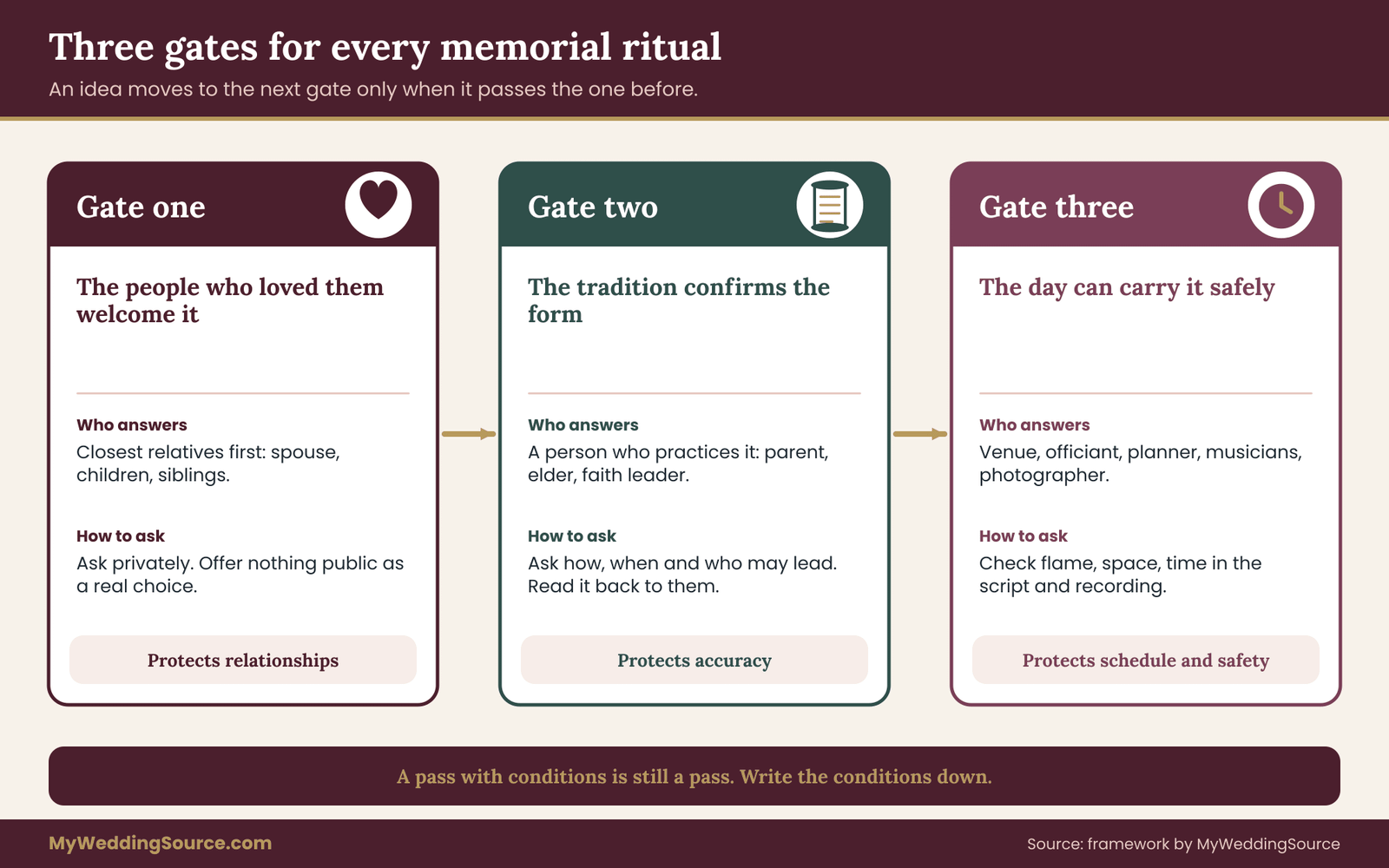
Gate one: the people who loved them welcome it. The closest relatives of the person who died are the first audience. This includes the spouse or children, then siblings, then others. If a widow does not want her husband’s name spoken at a wedding, that preference outranks the couple’s wish, even when the couple’s wish is tender. You are not asking for a vote. You are asking whether the tribute is welcome, and whether it is welcome in this form.
Gate two: the tradition confirms it. If a memorial ritual comes from a religious or cultural practice, someone who actually practices it should confirm how it is done, when it is done and who may do it. That might be a parent, an elder, a faith leader or a community member the family trusts. The point is accuracy and respect, not permission from an authority. A single online article, including this one, is not a substitute for a person.
Gate three: it is workable on the day. A ritual that passes the first two gates still has to fit the room. Does the venue allow open flame? Does the officiant have time in the script? Is there a place for an altar or a framed photo that will not be knocked over? Can a person who cannot stand take part? Gate three is where good ideas become real or quietly die, and it belongs in the plan from the start, not the week before.
Running the gates in order
The order matters for memorial rituals because each gate protects something different. Gate one protects relationships. Gate two protects accuracy. Gate three protects the schedule and the guests’ safety.
If you start with gate three, you may fall in love with a beautiful candle display and then discover that a grandmother finds it distressing. If you start with gate two, you may spend weeks learning an elaborate practice that a parent never wanted in the room. Starting with the people keeps the effort proportionate.
Memorial rituals can also pass a gate with conditions. A grandfather’s widow might welcome her husband’s photo on a memory table but not a spoken tribute. A faith leader might confirm a prayer but ask that it be said privately before the ceremony. Write the conditions down in the matrix. A conditional pass is still a pass, and it is often how the best solutions emerge.
What to do when a gate says no
A no at gate one is final for that form of memorial rituals. It does not mean the person cannot be honored at all. You can ask what would feel acceptable, or you can move the tribute to a more private setting, such as a quiet moment with the family before the day begins.
A no at gate two usually means adjusting the form. If a practice belongs to a community you are not part of and its members are uneasy about an outsider performing it, consider whether a family member from that community could do it, or whether a simpler, more neutral gesture would serve the same purpose.
A no at gate three is a puzzle to solve with substitutes. An electric candle can stand in for a flame. A printed card can stand in for a spoken name. A reserved seat can stand in for an altar. The intention survives even when the object changes.
The memorial rituals ladder: five levels of visibility
Not all memorial rituals ask the same thing of the people in the room. Some are invisible to guests. Others take over the center of the ceremony. A useful way to compare them is a ladder with five rungs, from most private to most public. Choosing a rung before choosing a gesture keeps the conversation concrete.
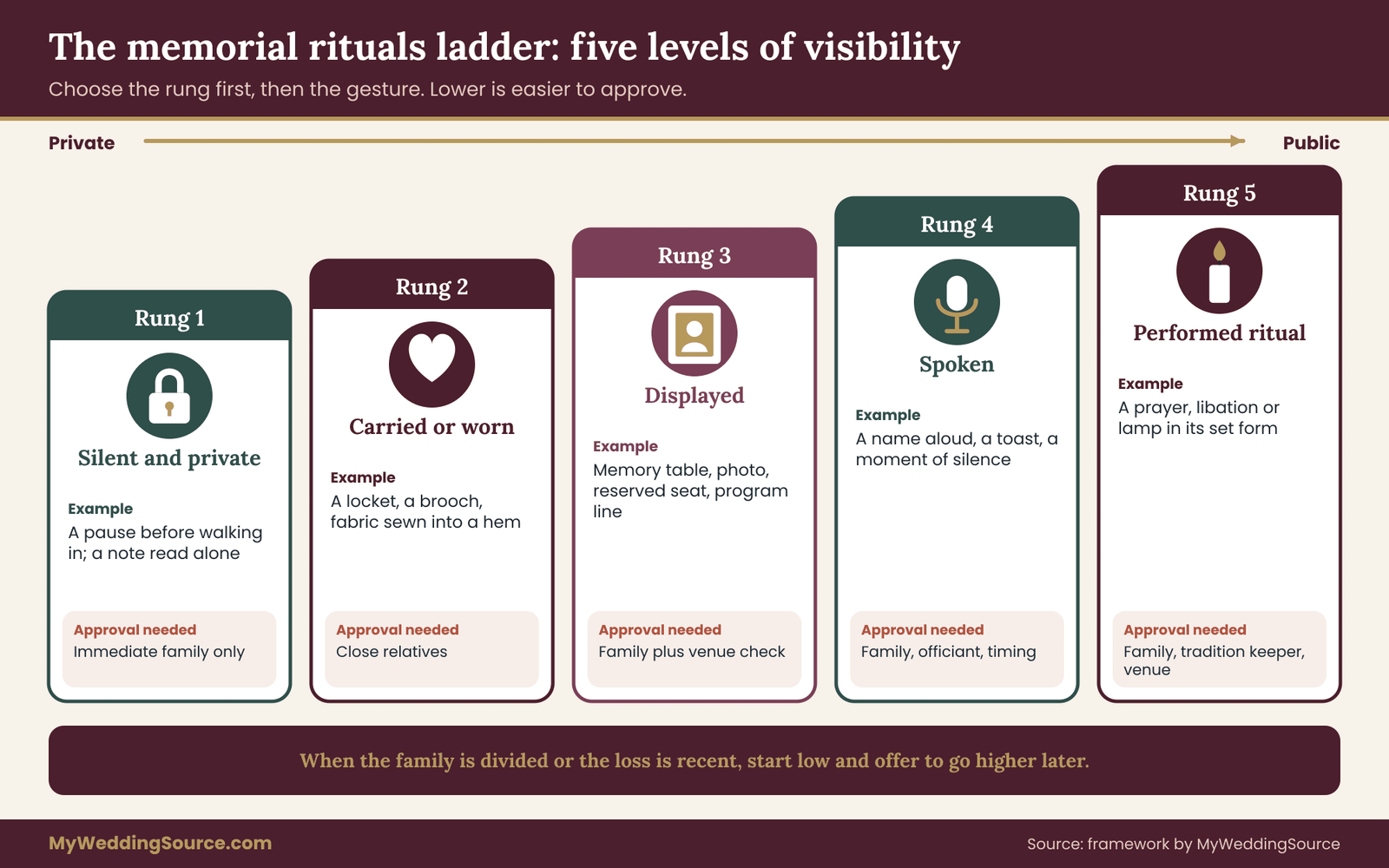
Rung one: silent and private. The tribute exists only for the couple or a few relatives. A pause before walking in, a note read alone in the morning, a ring or handkerchief that belonged to someone. Guests never know. This rung needs almost no approval beyond the immediate family, and it is often the right choice when a loss is recent or contested.
Rung two: carried or worn. A small object that travels with the couple or a relative. A photo in a locket, a brooch pinned inside a jacket, fabric from a late relative’s garment sewn into a hem, a charm on a bouquet. Guests may notice it if they look. It is visible without being announced, which is why many families find it the most comfortable middle path.
Rung three: displayed. A memory table, a framed photo, a reserved seat with a small card, a note in the program. Guests see it and can choose how closely to engage. Displays invite conversation, so they raise the privacy questions covered later: whose photo, whose name, which story.
Rung four: spoken. A name said aloud, a short remembrance in a toast, a moment of silence announced by the officiant, a reading. Now every guest is asked to pause with you. The wording becomes a decision, and so does who speaks. This rung needs the most care about tone and timing.
Rung five: performed ritual. A defined practice with a set form, such as a prayer for the dead, a libation, lighting a lamp at an altar, or a procession to a family shrine. This rung overlaps most with gate two, because the form matters and the people who own it will notice errors.
Why the ladder helps
The ladder turns an emotional argument about memorial rituals into a practical one. Instead of debating whether to “do something for Grandpa,” the family can ask which rung each person is comfortable with. A widow might be happy on rung two and uneasy on rung four. A sibling might want rung five. Seeing the options laid out in order lets people say “that high, but no higher” without feeling they are rejecting the person who died.
It also reveals mismatches early. If one parent wants rung four for a late spouse and the other parent’s family treats rung four as improper, you learn that in a living room conversation in March rather than at the microphone in June.
Combining rungs
Most weddings end up with a combination of memorial rituals. One person might be honored on rung two (a charm), another on rung three (a photo on the memory table), and the whole group of departed relatives on rung four (a single sentence from the officiant). Combining rungs is usually better than escalating one tribute. A modest tribute for each person, matched to what their family wants, tends to feel more respectful than one grand gesture for a single relative.
Be careful about creating a hierarchy of grief among your memorial rituals without meaning to. If a late grandfather gets a spoken tribute and a late aunt gets only a line in the program, her family may read that as a ranking. Where a difference in treatment is unavoidable, a short private conversation beforehand takes most of the sting out.
Choosing a rung for memorial rituals when you are unsure
Two rules of thumb help. First, when the family is divided or the loss is recent, choose a lower rung and offer to go higher later. A quiet tribute can be expanded at a first anniversary party. A loud one cannot be taken back. Second, when a practice belongs to a community you are not part of, choose a rung where you are a guest of the practice rather than its performer. Displaying an item from that tradition, with a family member’s blessing, is different from performing its rite.
Matching rungs to common situations
A few decision rules cover most cases. They are starting points for a conversation, not verdicts.
If the loss happened within the past year, begin with the lower rungs of your memorial rituals and let the closest relatives pull them upward. If the person died long ago and the family speaks of them often, higher rungs are more likely to be welcome.
If the family is divided about how openly to grieve, use rung two or three, where each guest chooses their own level of engagement. If the family is united and wants something shared, rungs four and five become realistic.
If the tradition behind a ritual is strict about who may perform it, keep that rung inside the family that owns the practice, and let the couple support rather than lead. If the memorial rituals are personal to the couple, you have more freedom, but you still owe the relatives a conversation.
If the venue or schedule is tight, a lower rung done well beats a higher rung done in a rush. A calm line in the program is better than a rushed prayer squeezed between the readings and the vows.
Finally, if you cannot tell which rung is right, ask the people closest to the loss which rung they would pick for themselves. Their answer is usually clearer than the couple expects, and it makes the rest of the memorial rituals easier to plan.
Building the family-approved memorial rituals matrix
A matrix of memorial rituals sounds clinical for something so personal, and it is. That is its value. When feelings run high, a plain one-page sheet lets everyone see the same facts and keeps the couple from relying on memory or hallway promises. The matrix is not shown to every guest. It is a working document that you share, in parts, with the people who need to approve each line.
The columns
Give the sheet one row per proposed tribute and these columns, described here in prose rather than as a grid.
The person honored. Use the name the family uses, not the one on a document, and note the relationship. Include any name spelling or pronunciation guidance, because a mispronounced name at the microphone is a small wound.
The proposed tribute and its rung. Write the gesture in one line and mark which of the five rungs it sits on. If two options are being compared, give each its own row.
The tradition behind it. Name the cultural or religious source if there is one, or write “personal” if the gesture is the couple’s own. Add the name of the person who will confirm the details.
Gate one status. Record who in the family was asked, when, and what they said. Use plain words: welcomed, welcomed with conditions, declined, not yet asked.
Gate two status. Record who confirmed the form, and any adjustments they asked for.
Gate three status. Record the venue, officiant and vendor checks: flame allowed or not, time in the script, space needed, who sets it up and who removes it.
Privacy setting. Choose one level for each of name, photo and story: private, family only, guests in the room, or public. Public means any place that can be copied, such as a printed program that guests take home, a livestream or a post.
Owner. One named person is responsible for delivering the tribute on the day. Without an owner, a tribute depends on someone remembering at the right moment.

Reading the matrix
Once the memorial rituals matrix is filled in, color the rows. Rows where all three gates are welcomed and the privacy settings are agreed are ready. Rows with conditions are workable once the conditions are written into the plan. Rows with a decline at any gate are either redesigned or removed.
A matrix with every row ready is not the goal. A healthy matrix often has a few rows marked “redesigned” or “moved to private.” That is the process working, not failing.
Keeping the matrix honest
Three habits keep the sheet of memorial rituals from becoming a formality. Record the date of every conversation, so you can tell whether a yes was given before or after the plan changed. Write down who is not yet asked, so a gap does not turn into a surprise. And review the sheet with one neutral person, such as a trusted friend or the planner, who can ask the question you have stopped seeing: “Who in the room might be hurt by this?”
If your family is the kind where decisions are made collectively, the same approach works as a shared discussion. The principles in the guide to wedding decision rights apply here too: say in advance who has a vote, who has a voice and who simply needs notice. For memorial rituals, the closest relatives of the person who died should hold a veto over how that person is honored, even if they hold no vote elsewhere in the wedding.
A short example of a filled row
Imagine a row for a late grandfather. The person honored is “Grandpa Sam,” and the family asks that his nickname be used. The proposed tribute is a framed photograph on the memory table, rung three. The tradition is personal. Gate one shows that his widow welcomed it on one condition: no story about his final illness. Gate two is not applicable. Gate three notes that the venue allows tabletop frames and that the cousin who set up the welcome table will place it. Privacy: name and photo are guests in the room; story is private.
Owner: that cousin. The row reads as ready, and every condition is written down.
Notice how much information fits in a few lines, and how little of it concerns what to feel. The matrix does not replace the emotion. It protects it.
Who must approve memorial rituals, and how to ask
Approval for memorial rituals is the part couples avoid, because asking feels like exposing a wound. In practice, a well-timed question is a kindness. It tells a grieving person that their relationship to the one who died is taken seriously. The trick is asking the right people in the right order, in a way that makes “no” an easy answer.
Four circles of approval
Think of approval as four circles, from the inside out.
Circle one: the closest relatives of the person who died. A surviving spouse, then children, then siblings. They own the memory most directly. Their answer decides whether and how that person is honored.
Circle two: the keepers of the tradition. A parent, elder, faith leader or community member who knows how the practice is done. They own accuracy. If the tribute is purely personal, this circle may be empty.
Circle three: the people who run the day. The officiant, the venue manager, the planner, the musicians, the photographer. They own feasibility and timing. Their questions are practical: where, when, how long, what equipment, what risk.
Circle four: the guests. They do not approve, but they need notice. A guest who understands what is about to happen can take part comfortably. A guest who is surprised may feel intruded upon or unsure how to behave.
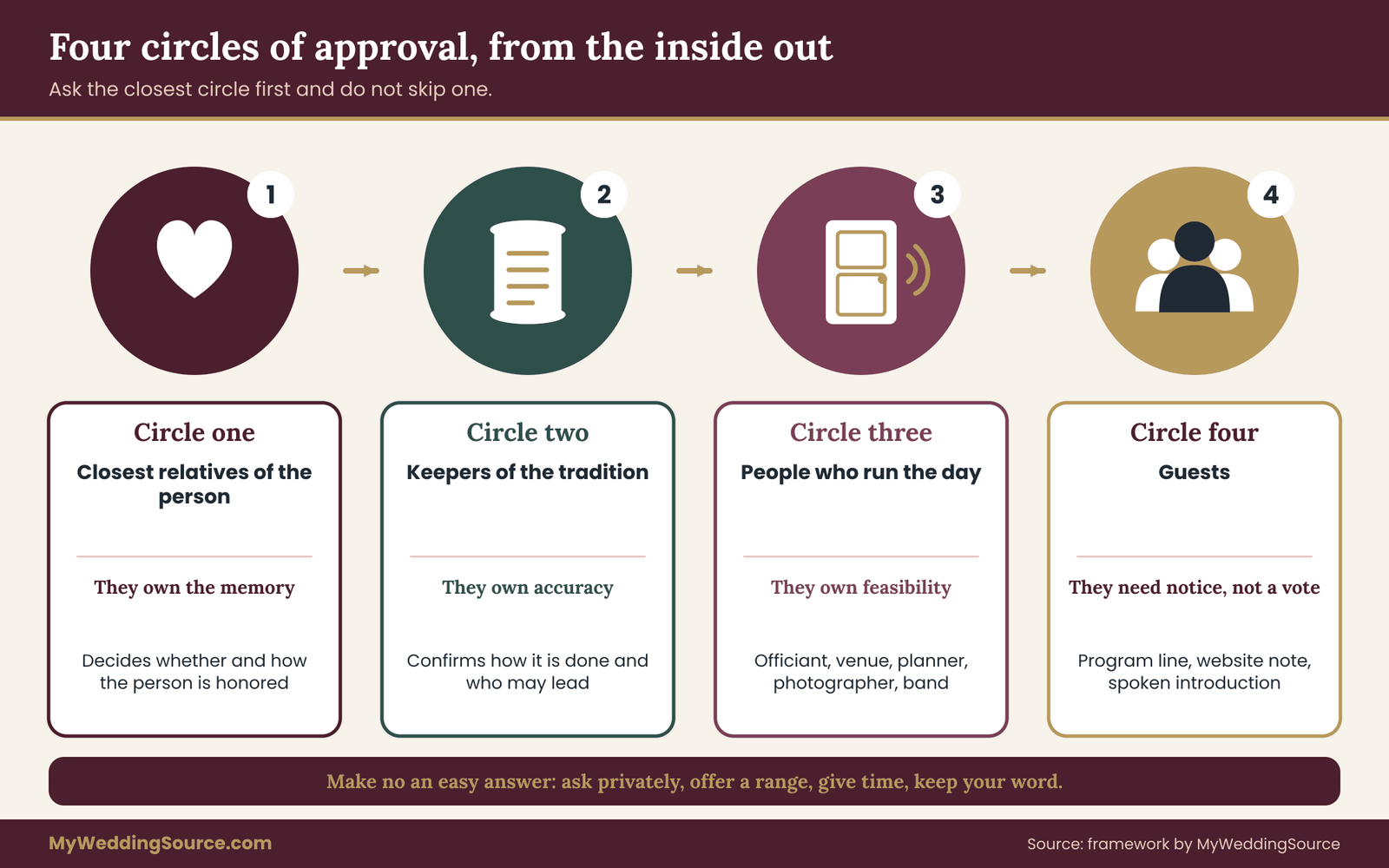
Work from the inside out and do not skip a circle. A beautiful plan of memorial rituals that has pleased circle three but never reached circle one is not ready.
Who speaks for a family
When a family has several voices, ask who is the right person to consult first. In some families that is a widow or widower. In others it is an eldest child or a respected relative who handles such matters. If you are unsure, ask a parent: “Who in the family should we talk to about remembering Grandma at the wedding?” The answer tells you a good deal about how decisions work in that household.
Avoid collecting approval from the most agreeable relative and treating it as family consent. The person most likely to say yes is not always the person whose feelings are most at stake. If a late father’s widow and his adult child from an earlier marriage might feel differently, speak to both, separately, before drawing any conclusion.
Asking so that no is easy
How you ask shapes what you hear. A few habits make honest answers more likely.
Ask privately, not at a family gathering. A person asked in front of others may say yes to avoid a scene and regret it later.
Offer a range, not a single idea. “We were thinking of a photo on the memory table, or a short mention in the ceremony, or nothing public at all. What would feel right?” This signals that nothing public is a respectable answer.
Give time. Say you do not need an answer today and ask when would be a good time to check back.
Say what you will do with a no. “If you would rather not, we will keep it private, and we will not bring it up again.” Then keep your word.
Scripts you can adapt
These are examples to adapt, not formulas. Use your own words and your own family’s manner of speaking.
For a surviving spouse: “We have been thinking about how to remember your husband at our wedding, and we wanted to ask you first. There are quiet ways, like a photo on a table, and more visible ways, like a spoken mention. There is also the option of doing nothing in public. Whatever you prefer, we will follow.”
For a faith leader or elder: “Our family would like to honor a relative who died, and the form we have in mind comes from your tradition. Could we ask how it is usually done, who normally takes part, and whether it would be appropriate for us to include it in a ceremony that has more than one tradition in it?”
For an officiant: “We would like to include a short remembrance of three relatives. Here is the wording and the approximate time it needs. Is there room in the ceremony, and how would you prefer to introduce it?”
For a relative who may be uneasy: “We want to be sure the day feels right for everyone who loved Grandpa. If anything we are planning would be hard for you, please tell us, even if it is awkward.”
When approval conflicts
Sometimes circle one disagrees with itself. A late parent’s widow wants a spoken tribute and the adult children do not, or the reverse. Resist the urge to split the difference by default. First, find out whether the disagreement is about the tribute itself or about something older that the wedding has dragged to the surface. If it is the latter, a smaller tribute may be wise for now.
You can offer each person a form of their own. One may read a short remembrance at the rehearsal dinner while another places the photo. Two small tributes in two settings can honor the same person without forcing a shared form on people who grieve differently.
If agreement on memorial rituals is truly impossible, choose rung one or two and let the couple carry the memory privately. It is not a failure. A wedding is not obliged to settle every family tension, and a quiet tribute that no one objects to is better than a grand one that someone dreads.
Etiquette on who sits where and who is honored first is covered more broadly in the guide to wedding etiquette, but for memorial rituals the guiding principle is simpler: the people closest to the loss decide first.
Timing, mourning and when a tribute is not yet welcome
Timing is a gate of its own for memorial rituals, even though it does not appear on the matrix as a separate column. A tribute that would be welcome next year may be too raw this month, and a wedding date can fall inside a period that a family treats as a time for quiet.
Recent loss
When it comes to memorial rituals, timing matters. If someone close to either family has died in the last year, the first question is not how to honor them but whether the wedding itself should proceed as planned, and how the family wants to be consulted. Some families want the loss acknowledged openly. Others want the celebration to feel normal, so that the day offers relief from grief. Both are legitimate, and the only way to learn which applies is to ask the closest relatives directly.
When a death happens close to the wedding, resist making fast decisions. Give the immediate family a few days, then ask what they would like. Offer options that lower the burden, such as a short line in the program, a reserved seat, or a private moment before the ceremony, rather than asking them to design a tribute during their grief.
Mourning periods and observances
Many traditions observe a period of mourning after a death, and in some families that period affects whether celebrations are held, how they are held, or what is worn or served. The details differ widely between and within communities. A couple should not assume that a tradition has a particular rule, nor assume that it does not. If a relative’s death falls within a recognized period for a family, ask a person from that family, in private, how they would like the wedding to proceed and whether any adjustments are expected.
Remember that observances may bind some relatives and not others, even in one household. A grandmother may follow practices that her grandchildren do not. A couple’s task is to learn who is observing what and to plan so that those who are observing are not forced to choose between the wedding and their practice.
Anniversaries and dates with meaning
Check the date against dates that carry weight. Memorial rituals can collide with other dates. A death anniversary, a remembrance day in one family’s calendar, or a seasonal observance tied to honoring ancestors may fall near your date. Sometimes that coincidence is welcome and the couple chooses to acknowledge it. Sometimes it makes the date difficult for a key relative. Ask early, because moving a date after invitations are out is expensive and disruptive.
The same applies to the time of day and the days around the wedding. If a relative will be fasting, in mourning or observing a rest day, a rehearsal dinner or a farewell brunch may need to be scheduled around it. You can explore scheduling in depth in the guide to choosing a wedding date.
When grief shows up uninvited
Even carefully planned memorial rituals can stir strong emotion. A parent may cry during a song, a sibling may leave the room, a guest may be overwhelmed by an unexpected memory. Plan for this lightly. Designate a calm person to sit near anyone likely to be affected. Know where a quiet room or a hallway is. Keep tissues and water accessible without making a display of it.
Tell the people leading the ceremony that tears are acceptable and that the ceremony does not need to pause for them. Sometimes the kindest thing is to continue gently. Other times a short breath is welcome. The couple’s job is to avoid making a person feel observed in their grief. A tribute should lift people, not put them on show.
Privacy boundaries for memorial rituals
A tribute is a public act performed with private material. The photograph, the name, the story and even the grief belong to people who may not have agreed to show them. Setting privacy boundaries in advance is how you keep memorial rituals generous without making them invasive.
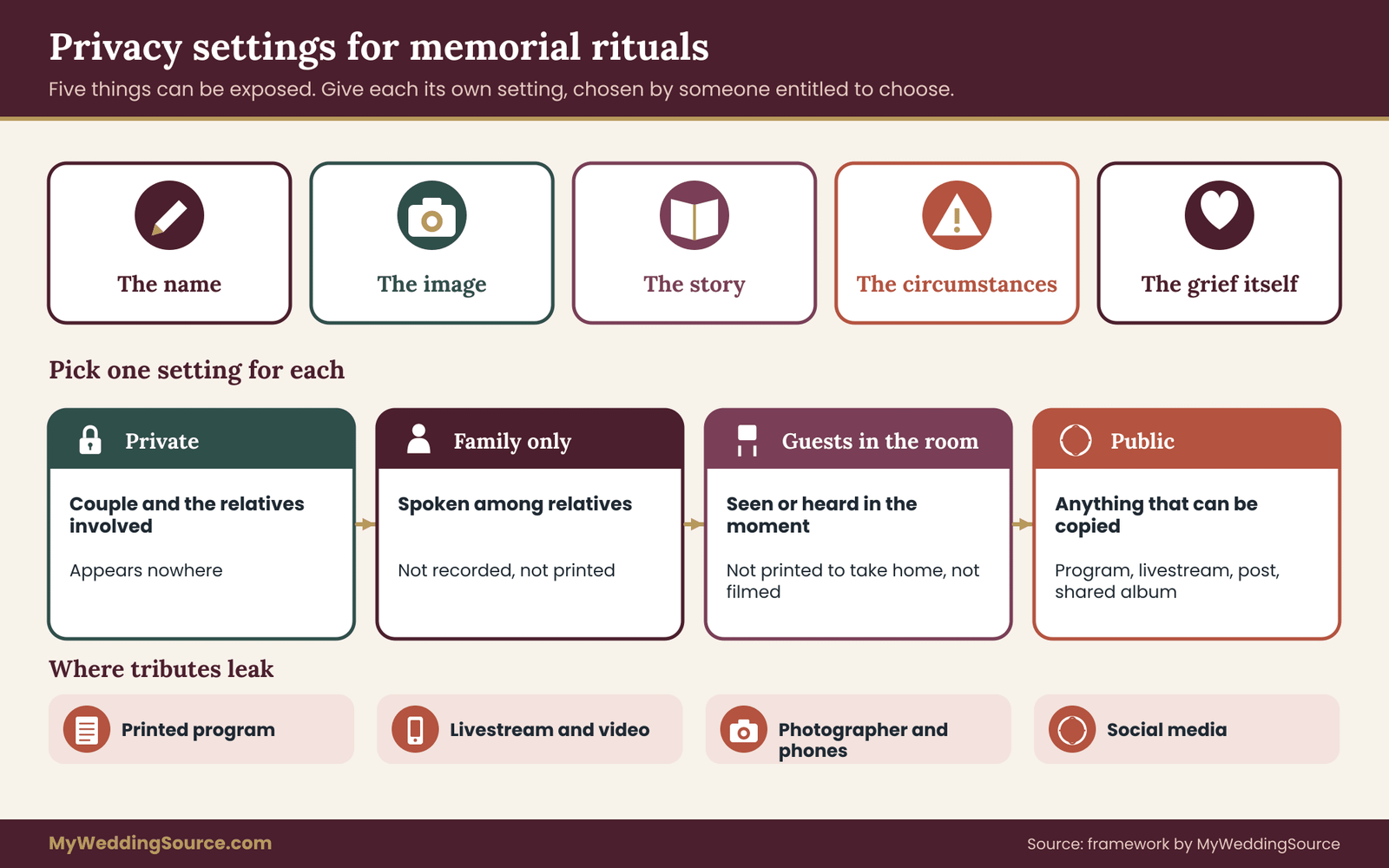
The five things that can be exposed
Each proposed tribute touches up to five kinds of private information. Decide each separately.
The name. Some families freely say the name of a person who died. Others avoid it in certain settings, or use a title or a relationship instead. Ask which form the family prefers, and whether the name may be printed, spoken or both.
The image. A photograph is the most common item on a memory display and the most common source of regret. Ask whether the family has a preferred image, whether the person would have wanted to be shown in it, and whether the image may be copied, printed in a program or shown on a screen.
The story. An anecdote can be funny and affectionate to one relative and painful to another. Never assume that a family story is common property. Ask the owner of the story, and ask the people who appear in it.
The circumstances. Cause of death, a long illness, a sudden loss or a conflict that preceded it. Unless the family chooses to share these, leave them out entirely. A tribute does not need to explain how someone died.
The grief itself. A relative’s tears, a child’s questions, a widow’s silence. These are not content for the day. Do not ask a grieving person to perform emotion, and do not direct a photographer or videographer toward it.
Four privacy settings
For each of those five items in your memorial rituals, choose one of four settings, and write it in the matrix.
Private. Known only to the couple and the relatives involved. It does not appear anywhere physical or digital.
Family only. Shared among relatives in conversation, at a family meal or in a small gathering. It may be spoken but not recorded or printed.
Guests in the room. Visible or audible to everyone attending, in the moment. Not printed to take home, not filmed for sharing.
Public. Anything that can be copied, saved or forwarded: a printed program, a livestream, a recording, a post, a photo album shared online.
A name might be public while a photograph is guests in the room and a story is family only. Mixing settings is normal. What matters is that each choice was made on purpose, by someone entitled to make it.
Where tributes leak
Most privacy problems come from the channels around memorial rituals, not the rituals themselves. Watch four of them.
The printed program is the most durable leak. Guests take it home, post a picture of it, and keep it for years. If a name or photo should not be public, do not put it in print.
The livestream and the video are the next. A moment that feels intimate in the room can reach hundreds of people online. If a tribute is meant only for the guests present, tell the videographer and anyone running a livestream to pause or to avoid that segment, and put it in writing.
The photographer and guest cameras come next. Many couples use a polite request that phones stay away during the ceremony, and they ask the professional photographer to follow the matrix. The guide to wedding photography consent covers how to set boundaries for guests and image use in more detail.
Finally, social media. A guest’s well-meant post may name a person or share an image the family kept private. A short, kind line in the program or from the officiant can set expectations: “We ask that tributes remain in the room.” Ask the closest relatives whether they would like it said.
Children and memorial rituals
Children may take part in memorial rituals, and they may be affected by them. A child who knew the person who died may have strong feelings. A child who did not may be confused by the attention. Ask the child’s parents what the child understands, whether the child wants a role, and whether the role is manageable.
Give children a simple, optional job, such as carrying a photo or placing a flower, only if the parents agree and the child wants it. Never make a child speak about a death in front of a crowd. And never use a child’s presence to pressure an adult into a tribute.
Privacy for the living
Do not forget the living people connected to a tribute. A divorced parent, a late spouse’s later partner, a half-sibling or a former in-law may be affected by how a person is honored. They may be entitled to a say, or at least to a heads-up. A tribute to a late father that omits his second wife’s role, or that names her in a way she did not expect, can be painful.
When in doubt, speak to everyone with a strong connection before the plan is final. It takes an hour and prevents a lasting hurt.
A plain privacy statement for your memorial rituals
Many couples find it easier to write a short privacy statement than to repeat the same boundaries in every conversation. It can be three or four sentences kept in the same file as the matrix. It might say which memorial rituals are family only, which are open to guests, which may be photographed and which may not, and who to ask when something is unclear.
Share the statement with the planner, the photographer, the videographer, the officiant and the person running the memory table. Each of them will meet guests who ask questions, and a shared statement keeps the answers consistent. A guest who asks to photograph a private prayer should hear the same polite answer from everyone: that the family has asked for it to remain private, and that the couple is grateful for the understanding.
Review the statement after every conversation with a relative. A boundary agreed in February may shift by May, and the written version is the only way to be sure the team is working from the newest one. When a relative changes their mind, treat the change as new information, not as an inconvenience. The goal of the privacy settings is to serve the grieving, and the people who grieve are allowed to change course.
Keep the statement short and kind. It is not a legal document. It is a plain note that helps the people running your memorial rituals protect what the families asked them to protect.
When traditions overlap or conflict
At a multicultural wedding, where memorial rituals can differ sharply, two or more families may have different, even contradictory, expectations about death at a celebration. This is the center of the topic, and it deserves honest treatment rather than a tidy formula.
Three kinds of tension
Memorial rituals clash in three main ways.
Different practices for the same purpose. Both families want to honor the dead but do it differently. One lights a lamp, another says a prayer, a third pours a drink. These can often coexist if each family leads its own element, in sequence, with clear introductions.
Opposite attitudes to speaking of death. One tradition welcomes remembrance at a wedding. Another treats it as inappropriate or unlucky at a joyful event. These cannot be blended in one moment. They must be separated by place or time, or one family’s wish must give way.
Overlapping claims to the same person. A late parent may be honored differently by the family of origin and a stepfamily. A relative who changed faith may be remembered in a way not everyone accepts. The couple must resist being the arbiter.
Separate memorial rituals by place and time
When two approaches cannot share a moment, give each its own. A family that prefers silence about the dead can have a quiet ceremony. A family that wants a spoken remembrance can have it at the rehearsal dinner, the welcome gathering or a reception toast, where attendance is more flexible.
Splitting by place is also an option. A memory table in the entrance area lets guests choose whether to engage. Guests who prefer not to may walk past it. An altar or display in a side room serves those who wish to visit it, without imposing on the entire room.
Keep traditions distinct, do not blend them into a new one
A common temptation is to design a combined ritual that borrows from each tradition. It feels inclusive, but it often goes wrong. A practice that carries religious meaning in one community can feel diluted or even offensive when merged with another. Rather than inventing a hybrid, present each tradition on its own terms, led by a person who belongs to it, with a brief explanation for guests.
Ownership matters. The guide to planning an interfaith wedding ceremony describes how to decide who owns each ritual and who leads it. The same logic applies to memorial rituals: name an owner for each tradition’s element, and give that person the authority to say how it is done.
What an outsider should and should not do
If you are marrying into a tradition that is not your own, you may be asked to take part in memorial rituals belonging to your partner’s family. Take part if you are invited and comfortable. Ask beforehand what is expected, how to stand or dress, what to say, and what to avoid. It is better to say “I would like to do this right, can you show me?” than to guess.
If you are asked to do something that conflicts with your own beliefs, say so kindly and early, and propose an alternative that still shows respect. A respectful presence, such as standing quietly or holding a flower, is often acceptable even when a full participation is not.
If you want to include a practice from a tradition that is no one’s in your family, because you admire it, pause. Ask whether a member of that community would be comfortable with it, and whether it can be done in a manner true to its meaning. Often the more honest tribute is one built from your own family’s life, such as a favorite recipe, a song or a story, rather than a borrowed rite.
Logistics: making memorial rituals workable on the day
Gate three is where intentions meet physical reality for memorial rituals. The best-planned tribute can still fail because a candle is not allowed, a microphone is not on, or no one knew who was supposed to carry the photo. Treat the logistics of memorial rituals as seriously as the catering.
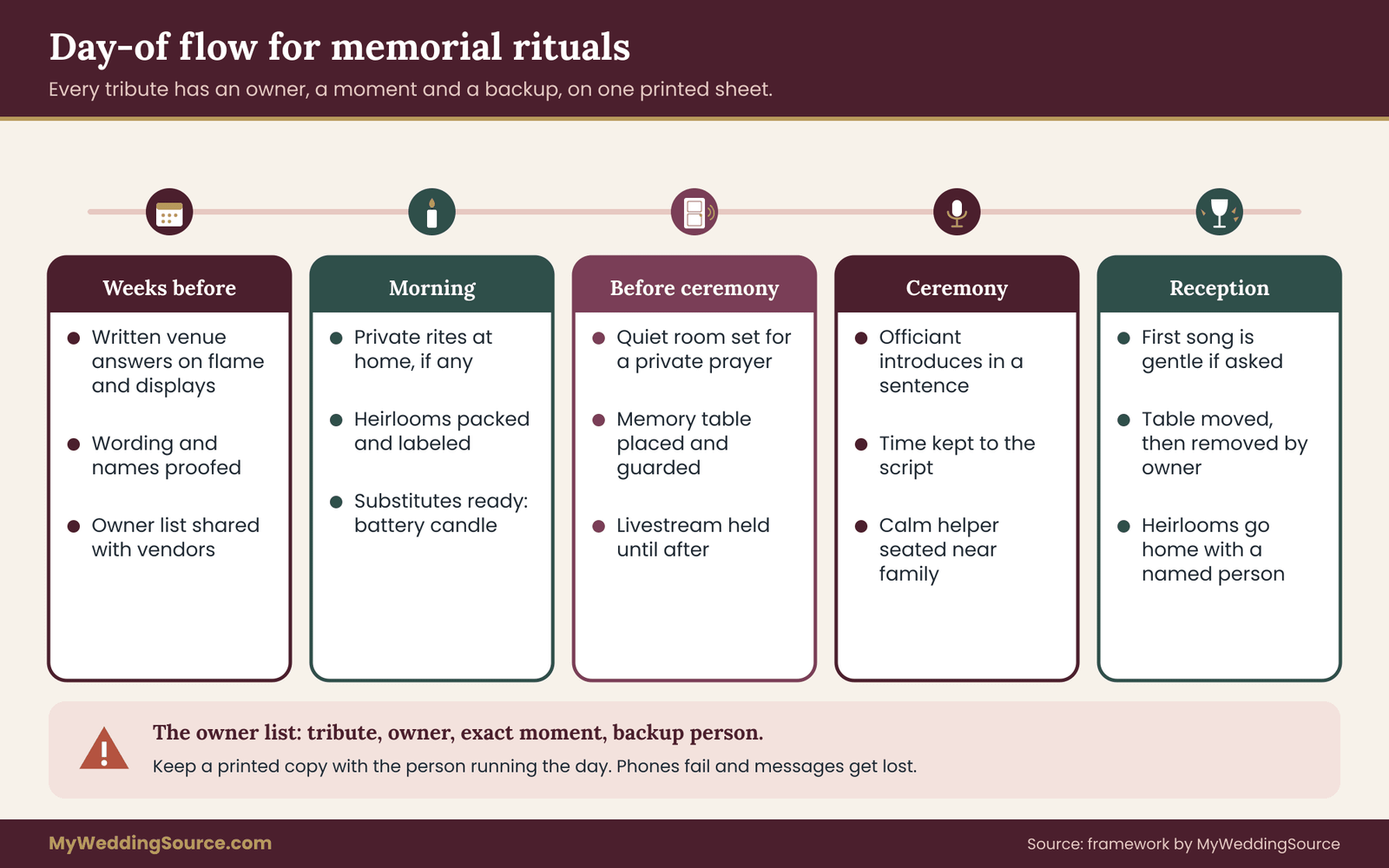
Open flame, incense and smoke
Candles, lamps, incense and similar items appear in the memorial rituals of many traditions. Venues, however, often restrict them. Ask the venue in writing whether open flame, incense or smoke is allowed, in which areas, and under what conditions. Some venues permit candles only in enclosed holders. Some forbid incense because of smoke detectors or the comfort of other guests. Some require a staff member to be present.
Fire safety rules also vary by city and building, so confirm with the venue and, if needed, the local fire authority. The National Fire Protection Association publishes general candle safety guidance that explains why many venues are cautious.
If flame is not allowed, ask which substitutes are accepted. Battery-operated candles and lamps are common. Some families prefer to light a real candle in a private setting beforehand and bring a photograph of the lit flame, or light it at home the morning of the wedding. Ask the family whether a substitute is acceptable or whether it would empty the gesture of meaning. That is a gate-two question, and it needs the answer of a person who practices the tradition.
Liquids, food and offerings
Some practices involve pouring a drink, setting out food or placing an offering at an altar. Check with the venue and caterer about floors, carpets and outdoor surfaces. A libation poured on grass may be fine; poured on a hotel carpet it is a cleaning problem. Offer a container, a plant or a designated outdoor spot. If food is offered at an altar, agree who will remove it and when, so it is not left to spoil or be mistaken for catering.
Allergens matter too. If a ritual involves sharing food or drink with guests, give the caterer the details and list the main ingredients on a card.
Space, setup and removal
A memory table or altar needs a stable surface, good light and a place away from foot traffic, spilled drinks and wind. Ask the venue where such a display can go, how early the family may set it up, and who is responsible for taking it down. Keep fragile items, such as framed photos and glass, away from the edge of tables.
Name a person to guard the display and to bring valuables home. A family heirloom left on a table at the end of a long night is a preventable loss. If the display must be moved from ceremony to reception, write down who moves it and when.
Think also about access. A display set low or tucked in a corner may be hard for guests who use a wheelchair or walker. Leave room for movement and avoid steps. An older relative who wants to visit the table should be able to do so without a long walk or a crowd.
Time in the ceremony
Every one of the spoken memorial rituals takes time, and the time must be in the script. Ask the officiant how long the moment is, where it fits, and how it will be introduced. A short remembrance of one to two minutes fits most ceremonies. A longer practice may need its own segment. The guide to wedding ceremony cue sheets explains how to write the order of events so every participant knows their cue.
If the ceremony is led by a faith leader or officiant who is not familiar with a particular tradition, share the wording and the purpose in advance. If more than one officiant is involved, decide who introduces the tribute and who closes it. The legal side of who may officiate is a separate matter, covered in the guide to wedding officiant requirements, and your local marriage license office is the source for current rules.
Music, silence and sound
Music can set the tone of memorial rituals, and silence can do it better. If a moment of silence is planned, tell the DJ or band so that no one starts a track too early. If music is played for a person who died, check licensing if the event is recorded or streamed, and ask the family about song choice. A song that was a favorite of a late relative may carry associations that not everyone expects.
Test the microphone, and make sure anyone speaking has a copy of what they plan to say. A person overcome by emotion may need a printed card to fall back on. Assign someone to stand nearby in case a speaker cannot continue, with an agreed signal and a graceful way to take over.
Questions to ask each vendor about memorial rituals
Vendors can make memorial rituals easier or harder, and most are glad to help when they know early. Bring a short list of questions to each.
For the venue: Where may a memory table or altar stand, and when can it be set up? Are open flame, incense, liquids or food offerings allowed, and where? Who is on site to handle a request on the day? Is there a quiet side room for a private prayer or a moment of grief?
For the officiant: How much time can the memorial rituals take? Where do they fit in the order? Will you introduce them, or should a family member? Are you comfortable with wording from a tradition that is not your own, and would you like it in writing?
For the photographer and videographer: Which moments are off limits? Which are for the family album only? Who tells you when a private moment begins and ends? Will you follow the written privacy statement?
For the DJ or band: Which moment should be silent, and when does the first song start? Is there a recording or a song with meaning for the family, and who approved it?
For the caterer: Are any foods or drinks part of the memorial rituals, and who handles setup and removal? Does a shared item need an allergen note?
Write the answers into the matrix under gate three. A vendor who says yes in conversation and forgets in the moment is a common source of trouble, and a written reply is the best protection for the families.
The day-of owner list
Create a short list with every tribute, its owner and the exact moment it happens. Include who sets up, who moves, who cues, who removes and who handles problems. Share it with the planner, the officiant, the photographer and the venue coordinator. Keep a printed copy with the person running the day, because phones fail and messages get lost.
A good list is brief: the tribute, the owner, the time, the backup. If a person cannot attend, such as an ill relative or a delayed flight, the backup person should be named and briefed beforehand.
Preparing guests for memorial rituals
Guests are the last circle, and they decide how memorial rituals land. A guest who understands what is happening can take part with ease. A guest who is surprised may feel uncertain, awkward or intruded upon. A little preparation turns an unfamiliar moment into a shared one.
What to tell guests, and when
Use three touchpoints to prepare guests for memorial rituals. In the invitation suite or on the wedding website, a single line can mention that the day will include moments of remembrance. In the printed program, a short note can explain what will happen and how guests can take part. And at the moment itself, the officiant or a family member can introduce it in a sentence or two.
For guests unfamiliar with a tradition, offer a brief explanation in plain words and without commentary. For example, a card might say that a family will pour water in memory of ancestors and that guests are welcome to watch quietly. That tells guests what to expect and what is expected of them.
If wording must be set in print, plan it early. The guide to wedding invitation printing explains proofing and printer handoffs, which matter when a name, a spelling or a short note about a person must be exactly right. A misspelled name in a memorial line is the kind of error that cannot be undone after printing.
Telling guests how to take part
Be clear about whether participation is optional. Say whether guests may stand, bow, say a response, light a candle or simply be present. Do not assume guests know how to behave in a ritual they have never seen. A short instruction from the officiant, such as “Please join us in a moment of quiet,” sets the tone and removes anxiety.
Respect those who prefer not to take part. A guest may belong to a different faith, may be uneasy with certain practices, or may be grieving a different loss. Make it easy to stay seated or to step out without comment. A tribute that guests can join freely feels warmer than one they are required to perform.
Interpreting for guests who speak other languages
At a multicultural wedding, some guests may not speak the language of a prayer or reading. A printed translation, a short summary or a bilingual reader makes the moment accessible. Check the translation with a fluent speaker who knows the tradition, because a literal rendering can miss the tone. Keep it short and respectful.
If a prayer is sung or chanted, a short note on its meaning helps guests understand without needing to follow the words. Place the explanation in the program rather than interrupting the moment with a lecture.
Guests who are grieving
Some guests may be carrying a recent loss of their own. A tribute can bring that to the surface. Create a quiet space where a guest can step away, and let the host team know. Avoid calling attention to anyone who leaves. If a guest approaches a family member in tears, a warm word and a little time are usually enough.
Do not expect guests to be solemn throughout. Many families prefer that a tribute be followed by laughter and music, so grief does not take over the day. The tone you set in the first moments of the reception shows guests that remembering and celebrating can share a room.
A worked example: Nisha and Tom
The following example is invented. It is not a portrait of any real couple or any community, and the family choices in it are only one set of outcomes among many. Its purpose is to show the process from first idea to final plan.
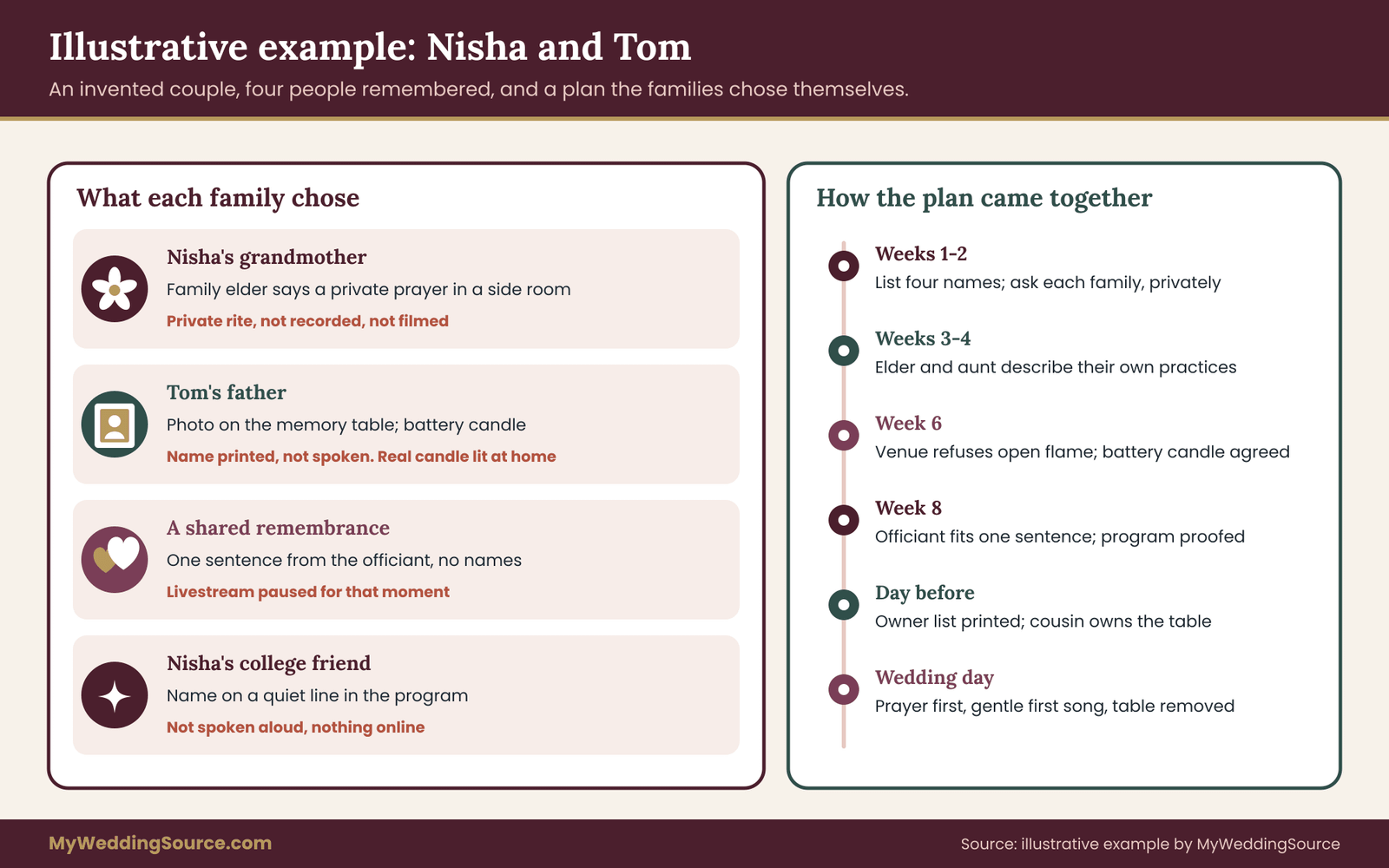
The starting point
This example follows memorial rituals from first idea to final plan. Nisha Rao and Tom Brennan are planning a wedding for about one hundred and twenty guests. Nisha’s grandmother died eight months before the date. Tom’s father died three years ago. Both want to honor them, and each assumed the other’s family would be fine with whatever they chose. They listed four names: Nisha’s grandmother, Tom’s father, Tom’s father’s brother, and a close friend of Nisha’s who died in college.
They began with the list and a blank matrix, and set aside two weeks for conversations before choosing any gesture.
Gate one: asking the family
Nisha spoke privately with her grandfather, the surviving spouse. She offered a range: a photo on the memory table, a short prayer, or nothing public. He said the family was still in a quiet period and asked that the day not begin with celebration music. He wanted to say a prayer himself, before the ceremony, with close family only, and he did not want it recorded.
Tom spoke with his mother, Maureen. She said she would like Declan remembered but did not want his name spoken during the ceremony, because she expected to cry. She welcomed a photograph and asked if a candle could be lit, as the family did for anniversaries. Tom’s late father’s brother was asked separately, and he asked only that his brother’s photo be the one from a certain fishing trip, which he would bring.
Nisha’s friend’s parents were reached by a short, kind message. They were touched and asked that the name appear in the program but not be spoken aloud.
Gate two: confirming the form
The grandfather’s prayer belonged to his own family, and he knew how to do it. Nisha asked him what he needed: a quiet room, a place to sit, a small table and a few minutes. She did not ask him to explain the meaning, and she did not research it herself and invent the details. She wrote down what he told her and read it back to him.
For the candle, Tom asked his mother and an aunt how the family had done it. They described a short moment at home, with a few quiet words. That was a personal family habit, not a formal rite, so there was no outside authority to consult, and the family’s own description was enough.
The couple considered adding a ritual from a tradition neither family practiced because Nisha admired it. After a conversation with a friend from that community, who suggested it was better left to those who live it, they dropped it. Two quiet, honest tributes from their own families seemed truer than a borrowed one.
Gate three: the venue and the day
The venue did not allow open flame in the ceremony space. The couple offered Maureen a battery candle, and she agreed, adding that she would light a real one at home that morning with her sister. The grandfather’s prayer was placed in a small side room before guests arrived, with a staff member keeping the door closed and the photographer told to stay out.
The officiant agreed to a single sentence in the ceremony: a brief remembrance of those who were not present, without names. The program listed the four names in a quiet line at the bottom of a page. The memory table held two photos, with a card reading each person’s nickname and the year of birth and death. A cousin was named as the table’s owner. The livestream was set to start after the private prayer, and it paused during the officiant’s remembrance because the families had asked that it not be shared.
Privacy settings in the example
For Nisha’s grandmother, the name and photo were set to guests in the room, and the story to family only. For Tom’s father, the name was printed in the program and shown on the table but not spoken, the photo was guests in the room, and the circumstances of his death were private. For the friend from college, the name was in print and everything else was private. No tribute was shared online.
What happened on the day
The grandfather said his prayer, the family stepped out, and the ceremony began quietly. The officiant spoke the sentence. Maureen pressed her hand to her lips, and her sister sat beside her. A guest asked who the man in the photo was, and a cousin told the fishing story that Tom’s uncle had approved. At the reception, the DJ’s first track was a gentle one, and the dancing started later, which matched what Nisha’s grandfather had asked for.
Nothing in the plan was dramatic. That was the point. Each person who mattered to the memorial rituals had been asked, had said what they wanted, and found it honored. The couple spent perhaps six hours on conversations and a few more on logistics, and they avoided the kind of hurt that cannot be repaired with an apology.
What the example shows
Notice three things about these memorial rituals. The couple let the surviving relatives set the form, and used the ladder to offer choices rather than a single idea. They kept private rites private, with a staff member and written instructions to protect them. And they declined to borrow a ritual, choosing instead to build from their own families’ lives.
Your own memorial rituals will differ. A different family might want a loud, joyful tribute with music and storytelling. What matters is that the process asks first, writes things down and checks the room.
Effort and cost logic for memorial rituals
Most memorial rituals cost little money and a good deal of attention. The real budget is time: hours of conversation, careful proofreading and a few extra minutes on the rehearsal schedule. Plan for those first.
The modest purchases are predictable. Frames and stands for photographs, battery candles or lamps, a card or two for the memory table, a small amount of extra printing, and perhaps a thank-you note for the elder or relative who leads a practice. If a family member travels to lead a ritual, ask early whether the couple should help with the trip, and make the offer gracefully, without turning it into an obligation.
Vendor charges can appear in a few places. A venue may charge for extra setup time, staff presence for a flame or a longer ceremony slot. A photographer or officiant may need extra time. Ask each of them in writing whether memorial rituals change the price, and keep the replies with your contracts. Current fees and rules are set by each vendor and venue, so verify them directly rather than relying on a general estimate.
The best use of money is often a small one. A well-made frame, a clear program line and a calm helper at the memory table do more for the families than an elaborate display. Spend your attention where the feeling lives.
Edge cases and hard situations
Not every situation with memorial rituals fits the neat path above. These are some of the harder ones, with approaches that tend to work.
A death in the weeks before the wedding
Give the immediate family space and ask what they want rather than proposing. Offer to postpone, trim or adjust the day if the couple themselves are affected. If the wedding proceeds, offer a very small tribute, such as a reserved seat or a line in the program, and let the family say yes or no. Do not make decisions on behalf of the grieving, and do not fill their silence with assumptions.
An estranged or disputed relationship
A person who died may have been loved by some and hurt others. A tribute can reopen the conflict. If the family is divided about whether the person should be honored, choose a private form on rung one or two, or leave the tribute to the people who want it, in a setting that others need not attend. Never insist on a public tribute to make a point.
A loss that is rarely acknowledged
A miscarriage, a stillbirth, an early death in infancy or a pregnancy loss can be among the most painful and least discussed losses. Ask the people most affected, in private, whether they wish to be included, and in what form. Some will welcome quiet acknowledgment. Others will want no mention at all. Take your cue from them, and never name a loss on someone else’s behalf.
A previous spouse or partner
A parent’s late spouse from an earlier marriage may matter deeply to adult children and to the surviving parent’s new partner in different ways. Ask each person. A tribute that honors the late spouse without explanation may confuse guests or hurt the new partner. A short, thoughtful conversation with all involved usually finds a form that respects everyone.
Someone who wanted no tribute
Sometimes the person who died was private, or made it known that they would not want a fuss. Honor that wish. A quiet gesture that fits their character, such as a favorite flower in a boutonniere, may suffice. Do not override a stated preference because the living want a bigger gesture.
Pets and non-human companions
Many families grieve a pet, and a modest tribute can feel right, such as a photo or a name on the memory table. Ask whether the family wants it and keep the tone light enough that it does not offend someone grieving a person. This is rarely a conflict, but it is worth a thought if the table is crowded.
A tribute that no one wants
You may find that after asking, no one wants a visible tribute at all. That is a valid result. A couple can honor someone by living well, by giving a donation in the person’s name, or by carrying a private memory through the day. The wedding does not need to hold a memorial to be a way of remembering.
When a relative objects on the day
If someone objects in the moment, stay calm. Do not argue before guests. Ask a trusted person to speak with the relative privately, and be ready to adjust. A tribute abandoned for a better moment later is not a failure. It is an act of care, and the person who objected will usually remember it.
Your next steps
You do not need to finish your memorial rituals plan in one weekend. Work through this sequence over several weeks, and expect the conversations to take longer than the paperwork.
Step one: write the full list of people your memorial rituals will honor. Include everyone either partner or either family wants to remember, even if some will end up as private tributes. Keep this list to yourselves until the next steps are done.
Step two: decide the starting rung of memorial rituals for each person. Choose a modest level first. You can raise it if the family welcomes more, and lowering it later is much harder than raising it.
Step three: ask the closest relatives, one at a time and in private. Use a range of options, make “nothing public” an acceptable answer, and write down what you hear and the date.
Step four: confirm any tradition-based form with a person who practices it. Ask how it is done, who takes part and what the venue should know. Write it down and read it back.
Step five: check the venue, officiant and vendors. Ask about flame, incense, liquids, display space, timing in the script and recording policies. Get the answers in writing.
Step six: set privacy levels for name, photo, story, circumstances and grief. Decide what appears in print, on screen and online, and tell the photographer and videographer.
Step seven: prepare guests. Add a line to the website, a note to the program and a short introduction for the officiant. Offer translations where needed.
Step eight: name an owner and a backup for each of the memorial rituals. Give the planner or day-of coordinator the owner list and a printed copy.
Step nine: leave room for the day. Plan a quiet space, a calm helper and a kind response if someone needs to step out. After the wedding, thank the families who helped, and ask whether anything should be done differently for future gatherings.
If you do only one thing from this guide for your memorial rituals, make it step three. A short, private, unhurried conversation with the right person prevents most of what goes wrong with memorial rituals.
FAQ
How early should we start planning memorial rituals for our wedding?
For memorial rituals, start at least three to four months before the date, and earlier if several families or faith leaders are involved. The conversations take longer than the logistics, and approval from grieving relatives cannot be rushed. Starting early also leaves time to adjust if a relative says no, to proofread printed names, and to confirm venue rules about flame, incense and displays.
What if one family wants memorial rituals and the other family does not?
Separate them by place and time rather than forcing a compromise. A family that wants a spoken remembrance can hold it at the rehearsal dinner or reception, while a family that prefers silence keeps the ceremony quiet. A memory table that guests can choose to visit also works. Avoid blending practices into one new ritual, because that often dilutes the meaning for both sides.
Can we include a ritual from a tradition that is not ours?
Only with care. Ask a member of that community whether it is appropriate, how it is done and who may lead it. If they are uneasy, choose a different tribute. A respectful alternative is displaying an item from that tradition, with a family member’s blessing, rather than performing its rite. Often a tribute drawn from your own family’s life feels more honest than a borrowed one.
How do we protect privacy when honoring someone who died?
Decide what is shared for each tribute: the name, the photo, the story, the circumstances and the grief. Choose private, family only, guests in the room or public for each. Keep sensitive items out of printed programs and livestreams, and tell the photographer and videographer in writing. Ask the closest relatives before using any photograph or story.
What do we do if the venue does not allow candles or incense?
Ask which substitutes are accepted, such as battery candles or lamps, and ask the family whether a substitute respects the meaning. Some families light a real candle at home that morning. If a practice needs flame or smoke, ask the venue whether a designated outdoor area is possible. Always get the answer in writing and check local fire rules.
Should children take part in a tribute?
Only if their parents agree and the child wants to. A simple, optional task, such as carrying a photo or placing a flower, can be meaningful. Never ask a child to speak about a death in front of a crowd. Ask the parents what the child understands first, and give the child an easy way to step back.
What if a relative objects on the day?
Stay calm and avoid a debate in front of guests. Ask a trusted person to speak with the relative privately, and be ready to shorten or skip the tribute. A tribute set aside for a better moment is not a failure. Afterward, ask what the objection was about, so you can repair any hurt and learn from it.
Do memorial rituals need to be mentioned in the invitation?
Not necessarily. Memorial rituals rarely need invitation space. A single line on the wedding website or in the printed program is usually enough, with a short note on what will happen and how guests can take part. Invitations rarely have room. If a tribute involves an unfamiliar practice, an explanation card or a brief spoken introduction from the officiant helps guests feel at ease.
Sources
- USA.gov: Marriage license and certificate guidance
- National Fire Protection Association: candle and fire safety resources
- ADA.gov: U.S. Department of Justice, Americans with Disabilities Act information
- Library of Congress: American Folklife Center
- Smithsonian Center for Folklife and Cultural Heritage
- Pew Research Center: Religion and Public Life
- U.S. Copyright Office: music and image use basics
- 988 Suicide and Crisis Lifeline: support during grief and distress
- Federal Trade Commission: consumer protection guidance for vendors and contracts