
A service charge on a wedding invoice looks like a tip and behaves like a fee. This guide shows how to read each service charge line, separate it from a true gratuity, and ask the vendor plain questions about where the money goes, so you can decide on any extra tip with facts instead of guesses.
A service charge is a percentage or flat amount the business adds to your bill, usually because the contract says so. A gratuity is money meant for the people who served you, and a tip is a voluntary extra. Decode each invoice line with four questions: what is it called, what is it calculated on, is it taxed, and who receives it. Then ask the vendor in writing how the service charge is distributed to staff before you add a cash tip on top.
Picture a couple reading a catering proposal for the first time. Near the bottom, after food, drinks, rentals and staffing, there is a line that says “service charge, 22%.” A few lines later there is another line called “administrative fee.” The couple’s first thought is a fair one: is that the tip? If it is, do the servers actually get it? And if it is not, how much extra should they set aside for the night?
Those questions are the whole subject of this article. The wording on a wedding invoice is not standardized, and two caterers can use the same words to describe different things. One caterer’s service charge pays hourly wages for the event staff. Another caterer’s service charge covers kitchen overhead, insurance and the owner’s margin, and the servers receive a separate gratuity line. A third caterer splits the service charge between the company and a staff pool. You cannot tell which model you are looking at from the label alone.
This guide does not tell you how much to tip. It also does not argue that a service charge is good or bad. It gives you a repeatable way to find out what you are paying for, a set of questions that vendors can answer in a few minutes, and a worked example with a full invoice so you can see the arithmetic. If you are still deciding how to fit these costs into the bigger picture, the wedding budget guide on this site covers how to set categories, and this article zooms in on one slice of that budget.
A note on scope. This is general information, not legal, tax or financial advice, and the rules on mandatory charges, tip pooling and sales tax differ by state and change over time, so confirm the current rule with the issuing agency or a local professional.
Why a wedding service charge confuses so many couples
The confusion comes from three places at once: vocabulary, timing and incentives.
Vocabulary. In everyday speech, “service charge,” “gratuity,” “tip,” “admin fee” and “labor fee” blur together. Restaurants often use “gratuity” for a charge added automatically to large parties. Banquet halls often use “service charge” for a percentage added to every event. Both are mandatory in practice, but the words suggest different things to a guest who sees them. Guests tend to assume that anything called a gratuity goes to servers and anything called a service charge goes to the house. Sometimes that assumption holds. Often it does not.
Timing. The service charge appears early, in a proposal you read months before the wedding. The decision about a tip comes late, on the wedding day, usually when you are tired, distracted and holding an envelope. Couples who never decoded the service charge line in the proposal end up making a money decision at the worst possible moment. Reading the invoice early moves the decision to a calm Tuesday evening.
Incentives. A vendor who lists a charge under a familiar name has a reason to let the familiar meaning stand, and a client has a reason to assume the best. Neither side is acting in bad faith most of the time. The issue is that nobody asked the question, so nobody answered it.
A business that distributes its service charge fully to staff is usually glad to say so, because it is a selling point. A business that keeps most of it for operations can usually explain why, and the explanation is often reasonable. Either way you want the answer in writing.
There is also a practical reason this matters for your own budget. If a service charge of around one fifth of the food and beverage subtotal is already in the contract, and you also tip on top out of habit, you may be spending noticeably more than you planned for staff compensation without knowing whether the staff saw any of it. The reverse can happen as well. If you assume the service charge covers staff and it does not, the people who worked a long reception on their feet may receive less than you wanted them to.
A short, plain definition of the terms
Before going further, here are working definitions that this article uses consistently. They are practical definitions for reading invoices, not legal definitions, and a contract’s own wording always controls.
A service charge is a mandatory amount the business adds to the bill. The business sets the rate, the contract states it, and the business decides how to use it. It may pay wages, cover overhead, or be shared in some mix. A key feature is that you cannot opt out of it in the ordinary course.
A gratuity in a wedding context is an amount intended for the people who provide the service. It may be included in the contract as a set percentage or flat amount, or it may be left to the client. Whether a gratuity is mandatory depends on how the contract describes it.
A tip is a voluntary payment decided by the client. If you can legitimately choose not to pay it, it is a tip.
An administrative fee or event fee is a charge for the business’s own coordination, paperwork or overhead. It is generally not meant for service staff, though the wording varies.
The sorting rule that follows from these definitions is simple. If the business requires you to pay it, treat it as part of the price. If you choose the amount and the recipient, treat it as a tip. Everything in between needs a written answer.
Service charge vs gratuity: what actually separates them
The words matter less than three practical features: who decides the amount, whether you can decline it, and who receives it.
Who decides the amount. A service charge is set by the business. A gratuity in the strict sense is set by the person who is giving it. When a contract lists “gratuity: 20%,” the business has decided on a number, which makes it behave like a service charge even though the label says gratuity. The label and the behavior differ.
Whether you can decline it. If the contract says the charge is mandatory, it is part of the price. If the contract says “suggested gratuity” or “gratuity not included,” it is voluntary. The word “suggested” is a signal worth looking for, and so is the phrase “at the client’s discretion.”
Who receives it. This is the hardest feature to see on an invoice. A charge that is called a gratuity and is automatically added might still be kept partly by the business, depending on the contract and local rules. A charge called a service charge might be paid out entirely to staff as wages. The invoice alone rarely says.
Federal agencies treat these categories differently, which is one reason the wording matters to the vendor too. The Internal Revenue Service has explained that a charge the customer is required to pay is generally treated as a service charge rather than a tip, and that a payment which is voluntary, set by the customer and not subject to negotiation is the kind of payment that counts as a tip. The Department of Labor describes how tips belong to the employees who receive them under federal wage law.
You do not need to become an expert in either, but it helps to know that the distinction is not just a matter of taste. It affects how the business records the money and how it can lawfully handle it. Rules differ by state, so the official pages listed at the end of this article are the place to confirm details.
Why this is not a moral question
Some couples feel uneasy asking where a service charge goes, as if the question accuses the vendor of something. It does not. You are buying a service, and a service charge is a line in the price. Asking what it covers is no different from asking whether the quote includes setup, breakdown, linens or tableware. Most professional caterers, venues and planners field this question all the time. A calm, neutral question gets a calm, neutral answer.
It also helps to remember that a vendor who keeps part of a service charge for operations is not doing anything improper by default. Event staffing has real costs: payroll taxes, workers’ compensation insurance, training, uniforms, transportation, management time on the day, and the cost of keeping people on call for a Saturday. A service charge often funds these things. The point of asking is not to catch anyone out. It is to avoid paying for the same thing twice, or assuming a payment exists when it does not.
The money map: where one wedding dollar can go
To keep the ideas concrete, here is a simplified map of the places a service charge dollar can travel. Real businesses mix these, and your vendor may use only one or two.
- Direct wages for event staff. The charge funds the hourly pay of servers, bartenders and captains on your event. Staff may or may not also receive tips on top.
- A distributed pool. The charge, or a stated portion of it, is pooled and shared among service staff according to hours or role.
- Operating cost recovery. The charge covers payroll taxes, insurance, equipment, transport and administration related to your event.
- Business revenue. The charge is part of the company’s income, with no promise about staff distribution.
- A blend. For example, a stated share goes to staff and the rest stays with the business.
None of these is automatically wrong. What makes a service charge confusing is when you assume model two and the contract describes model four. The decoder in the next section is built to catch that gap early.

The infographic above lays out the five destinations side by side. Notice that the first two reach staff directly, the third and fourth stay with the business, and the fifth splits between the two. Your job as the client is not to prefer one over another. Your job is to know which one you are paying for, and to confirm it before you decide on a tip.
The four-question invoice decoder for any service charge
Here is the working tool for the rest of this guide. It is a four-question decoder you can apply to any line on any wedding invoice: caterer, venue, bartending company, rental company, transportation, even a photographer’s travel line. The questions are the same every time, and the answers go into a short note you keep with the contract.
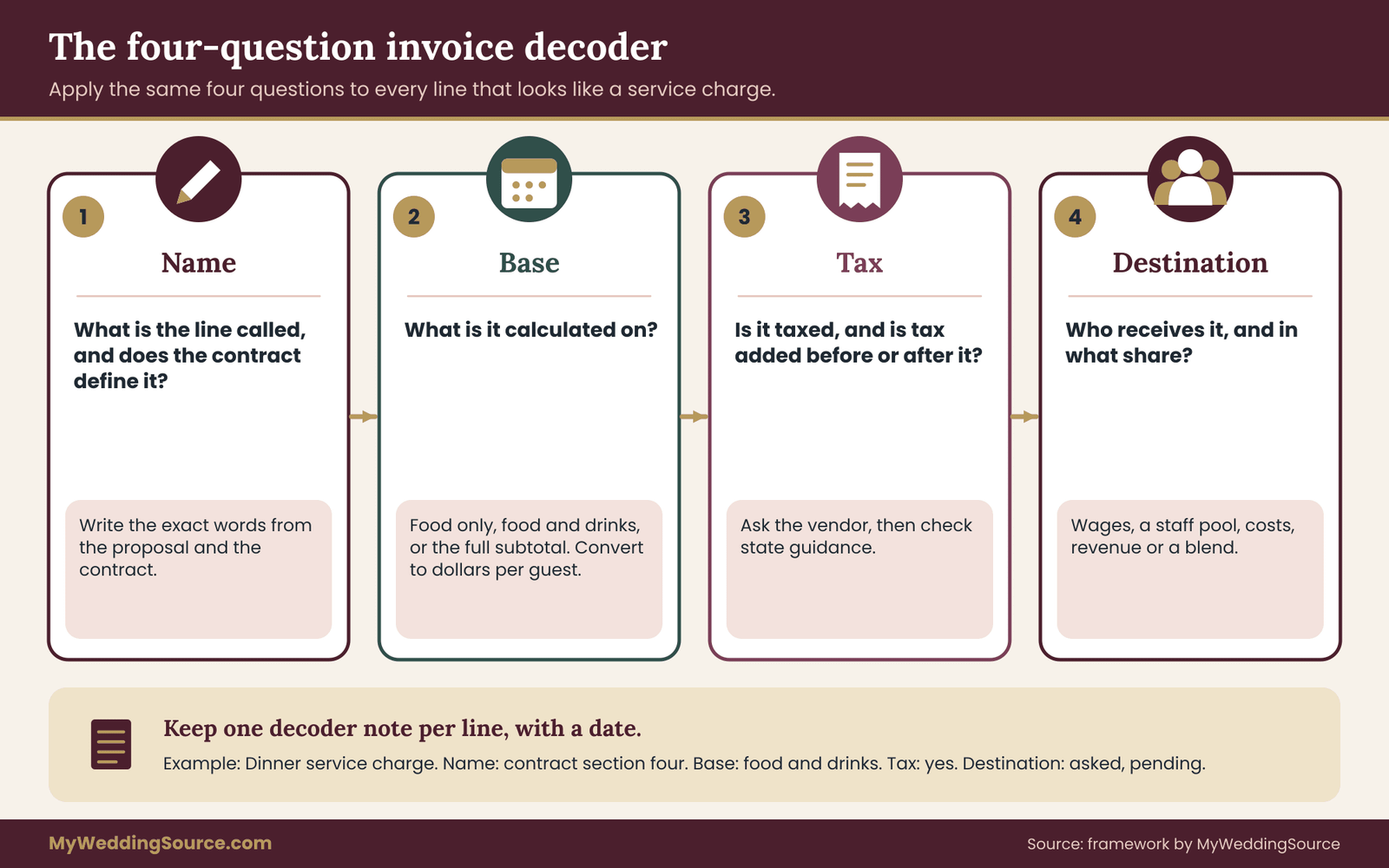
The four questions are Name, Base, Tax and Destination.
1. Name. What does the contract or invoice call this line, and does the contract define the term anywhere? Write down the exact words. “Service charge,” “gratuity,” “administrative fee,” “labor surcharge” and “staffing fee” are different words that may or may not describe different things. If the proposal and the contract use different words for the same amount, note both.
2. Base. What is the charge calculated on? A percentage needs a base, and the base changes the dollar amount a great deal. Some caterers calculate the service charge on food only. Others include beverages, rentals, equipment, delivery or even the tax. If the charge is a flat amount rather than a percentage, write down what it is meant to cover, such as “bar staff for five hours.”
3. Tax. Is the service charge itself taxed, and is the tax calculated before or after the charge is added? Some jurisdictions tax mandatory service charges as part of the sale, and others do not. Do not guess. Ask the vendor how they handle it, and check the state revenue department’s guidance if the answer matters to your total. The tax treatment can change the final bill by a meaningful amount on a large event.
4. Destination. Who receives the money, and in what proportion? This is the question that usually has no answer on the invoice. Ask for a plain statement: “The service charge is used for X, and Y percent is distributed to service staff.” If the vendor does not distribute any of it to staff, that is also a complete and useful answer.
Why the order matters
The order Name, Base, Tax, Destination is deliberate. The first three questions can be answered from the paperwork in a few minutes, and answering them first gives you the specific numbers you need for the fourth conversation. When you finally ask about destination, you can refer to a specific line and a specific amount, which makes the answer more concrete and harder to dodge. “Where does the twenty-two percent service charge on the dinner subtotal go?” is a better question than “Do the servers get a tip?”
It also keeps the conversation tidy. Many couples start with the destination question because it is the one that worries them. Vendors who are asked cold, with no reference to the paperwork, often answer in generalities. A specific question gets a specific reply.
The decoder note
For each line, write a four-part note. Keep it short enough to fit in a spreadsheet cell or on an index card. For example:
Dinner service charge. Name: “service charge,” defined in contract section four. Base: food and beverage subtotal before tax. Tax: vendor says taxed; confirm with state guidance. Destination: asked on the date of the call, answer pending.
Then update the note when the answer arrives. A finished note has all four parts filled in and a date. Keep these notes with your contracts. The wedding vendor contract guide explains what else to keep in a vendor file, and the decoder note is one more page in that file.
Using the decoder on lines that are not labeled clearly
Some invoices do not use any of the standard words. You may see “event labor,” “banquet fee,” “house fee,” “facility surcharge” or just “fee.” Apply the same four questions. The label does not decide whether the line is a service charge. The behavior does. If the charge is mandatory, set by the business and added to your total, treat it as a service charge for decoding purposes and ask about its destination.
A useful tell is whether the line scales with your guest count or hours. A charge that rises when your guest count rises is probably funding variable costs such as staff and food handling. A flat charge that stays the same regardless of the guest count is more likely a fixed overhead or coordination item. This is a pattern, not a rule, but it helps you form the right question.
Four common invoice patterns and what each one usually means
After you have decoded a few invoices, you start to notice that they fall into a handful of patterns. Recognizing the pattern gives you a head start on what to ask. Treat the following as typical patterns, not promises about any particular vendor.
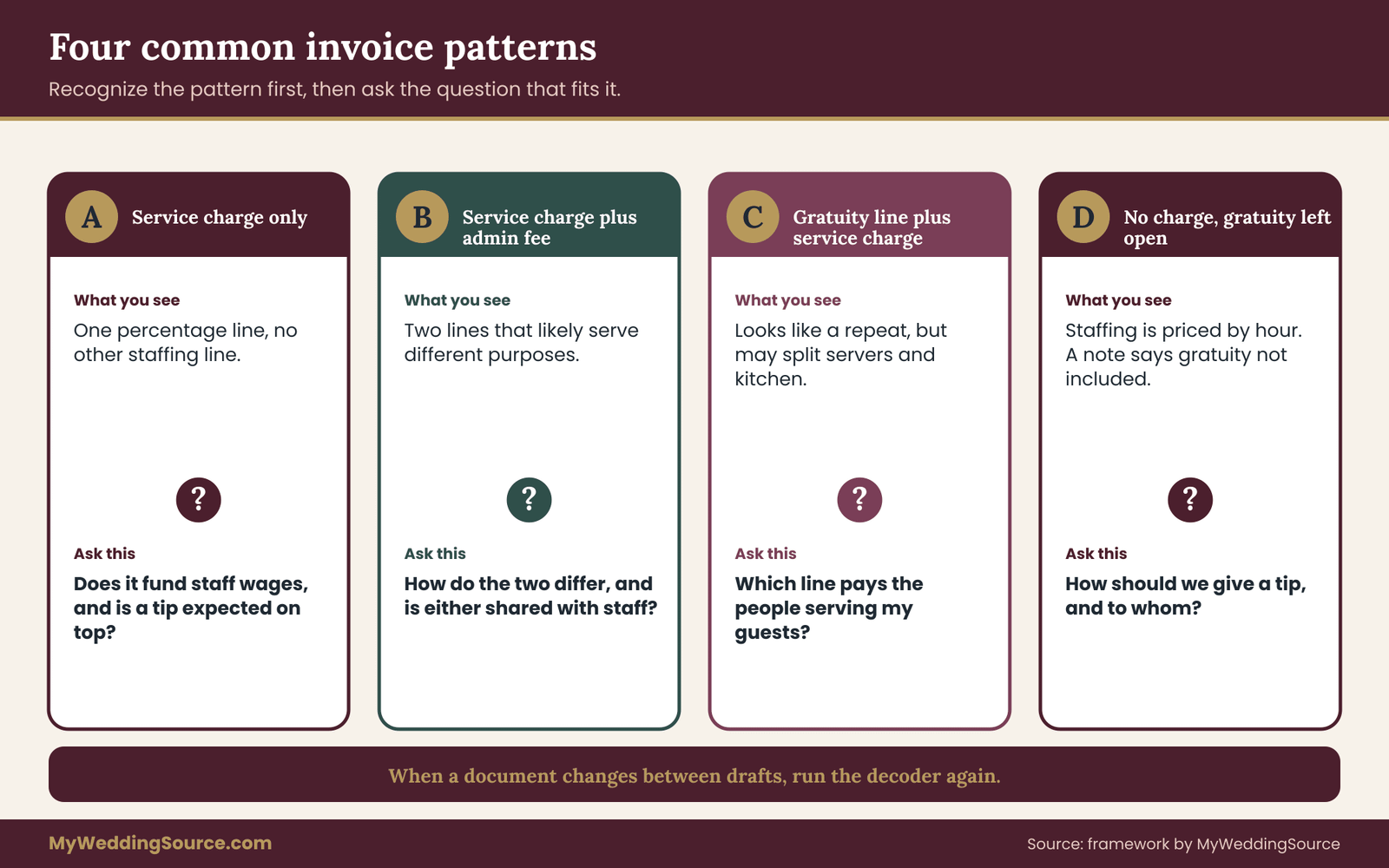
Pattern A: Service charge only. The invoice shows a single percentage service charge and no other staffing line. The usual follow-up question is whether the service charge funds staff wages and whether service staff also expect tips. Some vendors in this pattern say the service charge fully covers staff compensation and no further tip is needed. Others say a tip is appreciated but optional. Get the answer in writing, because this is the pattern where couples most often double pay or underpay.
Pattern B: Service charge plus administrative fee. The invoice has both. The two lines probably serve different purposes, with the service charge related to event labor and the administrative fee related to office or coordination costs. The question to ask is how the two differ and whether either is shared with staff. It is not unusual for the administrative fee to remain entirely with the business.
Pattern C: Gratuity line plus service charge. This looks redundant, and sometimes it is. In other cases the gratuity line is meant for servers and the service charge is meant for the kitchen and management. Ask the vendor to describe each in one sentence. If the sentences overlap, ask which one pays the people serving your guests.
Pattern D: No service charge, gratuity left open. The invoice shows food, beverage and staffing at stated rates, with a note such as “gratuity not included.” The tip is yours to decide. In this pattern the couple needs a budget line for tips, and a plan for who hands out the envelopes. The section on budgeting later in this guide covers that.
Many invoices are blends of these patterns, and some switch pattern between the proposal and the final contract. When the document changes, rerun the decoder, because the underlying arrangement may have changed even if the percentage did not.
Mini example: the same percentage, different meanings
Imagine two caterers who each add a twenty percent service charge. The first pays all of it into a pool that is split among the servers, bartenders and captains based on hours worked, and states this in the contract. The second uses it to cover payroll taxes, insurance, vehicles and management, and does not distribute any to staff, though it pays staff a regular hourly wage. The percentage is identical. The effect on the people serving your wedding is not.
If you treat both as “the tip is included,” you will probably under-tip the second team. If you treat both as “the tip is not included,” you may pay twice at the first. This is exactly why the decoder asks about destination instead of relying on the label, and why the answer belongs in writing.
How the base changes the number
Couples often compare service charge percentages across caterers without checking what each percentage applies to. That comparison can mislead, and it is worth a few minutes of arithmetic to see why.
Suppose one proposal lists food at a stated per-guest price, beverages as a separate package, rentals as a flat amount and staffing as an hourly total. A service charge calculated on food only will be smaller than the same percentage calculated on everything. A service charge calculated on the full subtotal, including rentals, will be larger, and a service charge calculated after tax is larger still.
The decoder’s “Base” question handles this. When you compare two proposals, convert each service charge into a dollar amount and divide by the number of guests. The dollar figure per guest is a fairer comparison than the percentage, because it shows what you actually pay for each person at the table. Two proposals with the same percentage can differ by hundreds or thousands of dollars in total because of the base alone.
A useful habit: ask each vendor to confirm the base in a sentence, then restate it back in your own words in an email. “To confirm, the twenty-two percent service charge applies to the food and beverage subtotal and does not apply to rentals or delivery. Is that correct?” If the answer is yes, you have a record. If the answer is no, you have just caught a difference that would have shown up as a surprise on the final invoice. The wedding cash-flow planning guide explains why surprises on the final balance are the ones that hurt most, because they arrive when the money is already committed elsewhere.
The same logic for flat charges
A flat service charge, such as a fixed amount per bartender or per hour, works differently. You do not need to ask about the base, but you do need to ask what it covers. “Bar service charge of three hundred dollars” might mean one bartender for four hours or two bartenders for six. Ask for the staffing assumptions behind the number, including the number of staff, their hours and any overtime rules. Flat charges are easier to check, because you can ask whether the stated staffing matches the guest count and layout of your venue, and whether extra hours will add to the cost.
Where a catering service charge usually goes
With the decoder in hand, the next step is to understand the realistic range of answers you may hear about destination. The honest summary is that a wedding catering service charge usually funds some mix of staff pay, payroll costs and business operations, and the mix varies from company to company. This section describes the common arrangements in plain terms so you can recognize them when a vendor explains.
Wages and payroll costs. In many catering companies, event staff are employees paid an hourly wage, and the service charge helps cover that wage plus the employer’s payroll taxes and insurance. A server working your wedding might earn a set hourly rate regardless of how the service charge is allocated. In this arrangement the service charge does not show up as a separate payment to the server. It is part of how the company funds the payroll for your event. The server may still hope for a tip, because the hourly rate is the only compensation without one.
A staff pool or bonus. Some companies distribute part of the service charge to service staff as an event bonus or share, on top of hourly pay. The share might be tied to hours worked or to role. A company that does this usually says so in its contract or its marketing, and can describe how the pool is divided.
Management and kitchen. A service charge may also fund the work of the event manager, the kitchen team and the person who spends the week before your wedding coordinating deliveries. These people rarely receive tips from clients, so the service charge is the main way their time is paid for.
Overhead. Equipment, vehicles, uniforms, insurance, licenses and storage all cost money, and a service charge is one way a company recovers these costs. In this arrangement the line item resembles a general operating fee.
Profit margin. Like any business, a caterer needs revenue above costs. Some of the service charge may simply be part of the company’s margin. This is not a criticism. It is how most businesses are built.
Why there is no single right answer
It is tempting to look for a universal rule such as “a service charge always goes to staff” or “never to staff.” No such rule exists. What does exist is a set of legal and practical boundaries that vary by jurisdiction. Federal wage law, state wage law, tax rules and the terms of your own contract all shape what a business can say and do.
The Department of Labor’s published guidance on tipped employees explains the federal baseline for tips, and many states add their own rules on top. Because those rules change and differ by location, the safest approach is to ask the vendor, read the contract, and confirm anything important with the relevant state agency.
One idea from that guidance is worth knowing as a client. Under federal wage law, tips are generally the property of the employee who receives them, and an employer is not supposed to keep them. A service charge is different, because it is a charge the business imposes, so it is not treated as a customer’s tip in the same way.
That difference is part of why a service charge can lawfully fund overhead while a true tip generally cannot. If a vendor tells you that tips you give will be kept by the company, that is worth a polite follow-up question and perhaps a call to the labor agency in your state.
Tip pooling basics for couples
Tip pooling means that tips from many customers are collected and shared among a group of staff instead of each person keeping what they individually receive. At a wedding, pooling is common because many people contribute to the experience and the client cannot see who did what. A server who spends the evening at table four does not necessarily deserve more than the runner who kept the kitchen moving, and pooling reflects that.
You do not need to design a pool, but you should know three things about how they work in practice.
Who is in the pool. Typically the pool includes people who provide direct service to guests: servers, bartenders, runners, bussers and captains. Depending on the company and the law in your state, it may or may not include kitchen staff. Managers and owners are generally treated differently, and federal law places limits on managers keeping tips that employees earned. Ask whether the pool you are contributing to includes only service staff or also includes others.
How it is divided. Common methods include equal shares, shares by hours worked, and shares by role with weights. The company usually chooses. A fair process is clear and written down, and the vendor can describe it in a sentence or two.
When and how it is paid. Staff may receive pooled money the same night in cash, on their next paycheck, or in a later pay period. Credit card tips usually go through payroll, which means taxes are withheld. Cash tips are the responsibility of the staff member to report. Neither is your concern as a client, but if you are handing over cash, it helps to know whether the recipient is the whole crew or one person.
Cash, check or card
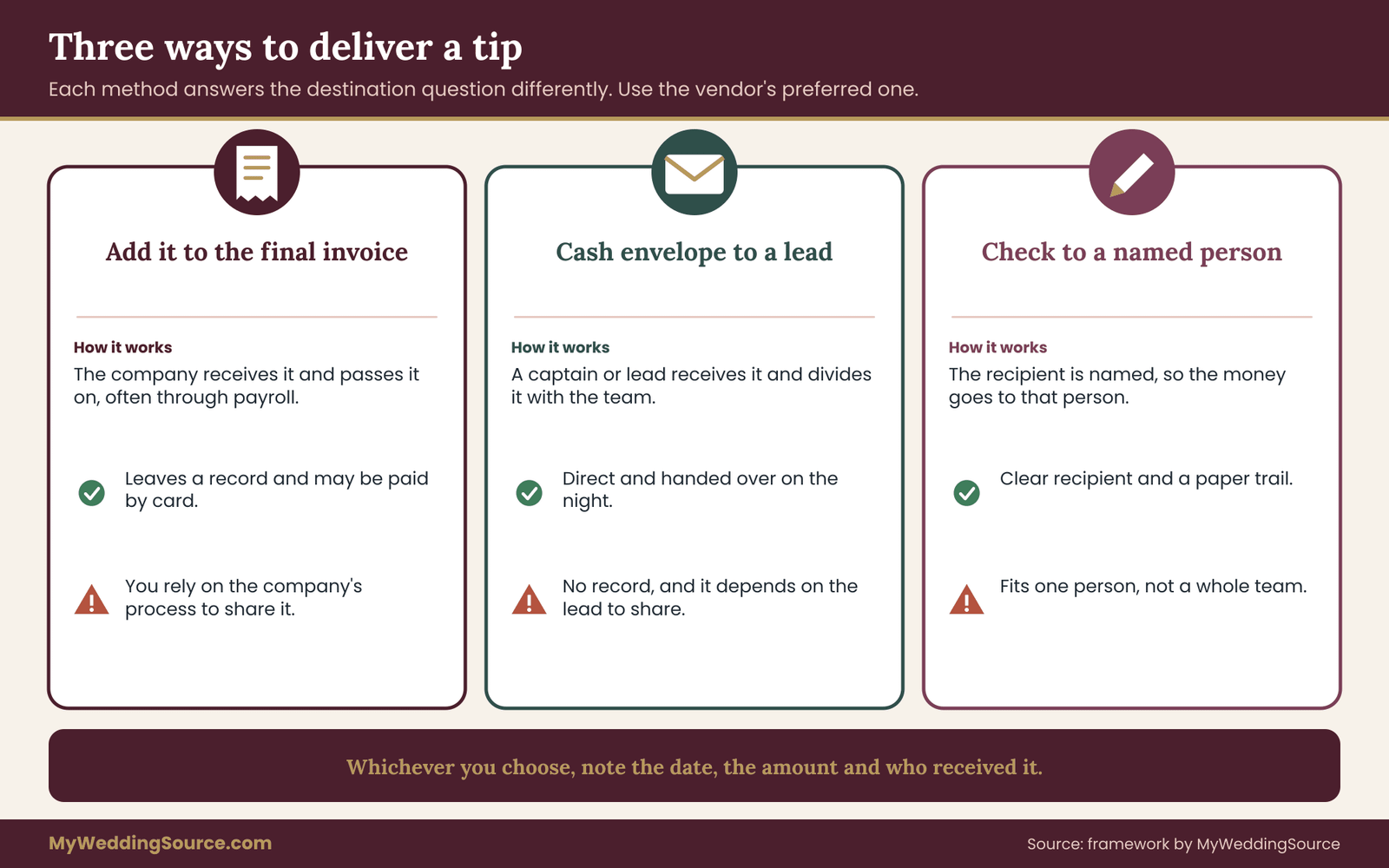
The method you choose affects who ends up with the money. A cash envelope handed to a lead captain at the end of the night may be divided carefully among the team, or it may stay with the lead. A tip added to the final invoice goes to the company, which then decides how to pass it on. A tip written as a separate check to a named person goes to that person. None of these is wrong, but each answers the destination question differently.
Before the wedding, ask the vendor which method they prefer and why. Many companies have a preferred practice, such as adding any tip to the final invoice so it can run through payroll, or handing envelopes to the captain to distribute. Follow the vendor’s practice unless you have a reason to do otherwise, and write down what you did.
What you can reasonably expect from a vendor
You can reasonably expect a vendor to explain, in a few sentences, how the service charge and any tips are used. You cannot reasonably expect a vendor to disclose payroll details, individual wages or internal accounting. Keep your questions at the level of “what does this charge fund” and “how are tips shared.” That level is usually enough to decide on your own tipping and is not intrusive.
Staff-distribution questions to ask before you sign
The decoder tells you what to look for. This section gives you the actual questions. Use the ones that fit your invoice, and send them by email so the answers are in writing. Short, neutral questions work best. Here are the core questions, grouped by purpose.
Questions about the service charge itself
- “What does the service charge on the proposal cover?”
- “Is any part of the service charge paid to the servers, bartenders or captains working our event? If so, what share?”
- “Is the service charge the same percentage for every event, or does it vary?”
- “Is the service charge calculated on food only or on the full subtotal?”
- “Is the service charge taxed, and is tax calculated before or after it?”
Questions about tips and gratuity
- “Is a tip expected on top of the service charge, or is the staff compensated through it?”
- “If we choose to tip, what is the best way to give it so it reaches the whole team?”
- “Are tips pooled? Who is in the pool?”
- “Do kitchen staff, the event manager or drivers receive tips from clients, or is that handled differently?”
Questions about the contract
- “Can the contract state how the service charge is used, or how it is distributed?”
- “Does the service charge change if the guest count or timeline changes?”
- “Is the service charge refundable if part of the service is cancelled?”
You do not need to ask all of them. A short email with four or five questions is plenty. If you want to see how these questions fit into a broader vendor review, the wedding vendor due diligence checklist covers what else to confirm before you sign.
A sample email
Here is a short template you can adapt. It is neutral and specific, which is what makes it easy to answer.
“Hello, we are reviewing the proposal for our reception and want to make sure we understand the service charge line. Could you tell us what it covers, whether any part of it is distributed to the service staff, and whether you recommend an additional tip? Also, is the service charge calculated on food and beverage only, and is it taxed? We would like to plan our budget accurately. Thank you.”
Notice what the email does not do. It does not accuse, it does not compare the vendor to competitors, and it does not demand a justification. It asks for information so that the couple can plan. Most vendors reply within a day or two, and the reply often contains more detail than you asked for.
How to read the answer
A good answer is specific. It names what the service charge covers, gives a proportion if any of it goes to staff, and gives a clear recommendation on tips. A weak answer is vague, such as “it’s all taken care of” or “whatever you feel is right.” Weak answers are not proof of a problem, but they mean the question is still open.
If the answer is vague, reply with a narrower question. “Thank you. To plan accurately, can you confirm whether the servers receive a share of the service charge, or whether they are paid hourly wages only?” A narrower question is harder to answer vaguely. If it still does not get a clear reply, treat the service charge as purely a fee, and decide on your tip as if no part of it reaches the staff.
When a vendor will not answer
Occasionally a vendor declines to explain how the service charge is used. Some say it is proprietary. Others redirect to the contract. You are not entitled to payroll details, but you are entitled to understand what the contract charges you for. If the contract itself does not describe the service charge at all, ask for an addendum with a single sentence describing it.
If the vendor will not provide one, consider that when you compare proposals. A vendor who is open about its pricing is easier to work with in every other area too, from change orders to final balance timing.
A worked example: decoding one catering invoice line by line
Abstract rules are easier to trust once you see the arithmetic. The example below is invented for illustration. The couple, the caterer and every number are made up, and your own proposal will differ. The point is the method, not the amounts.
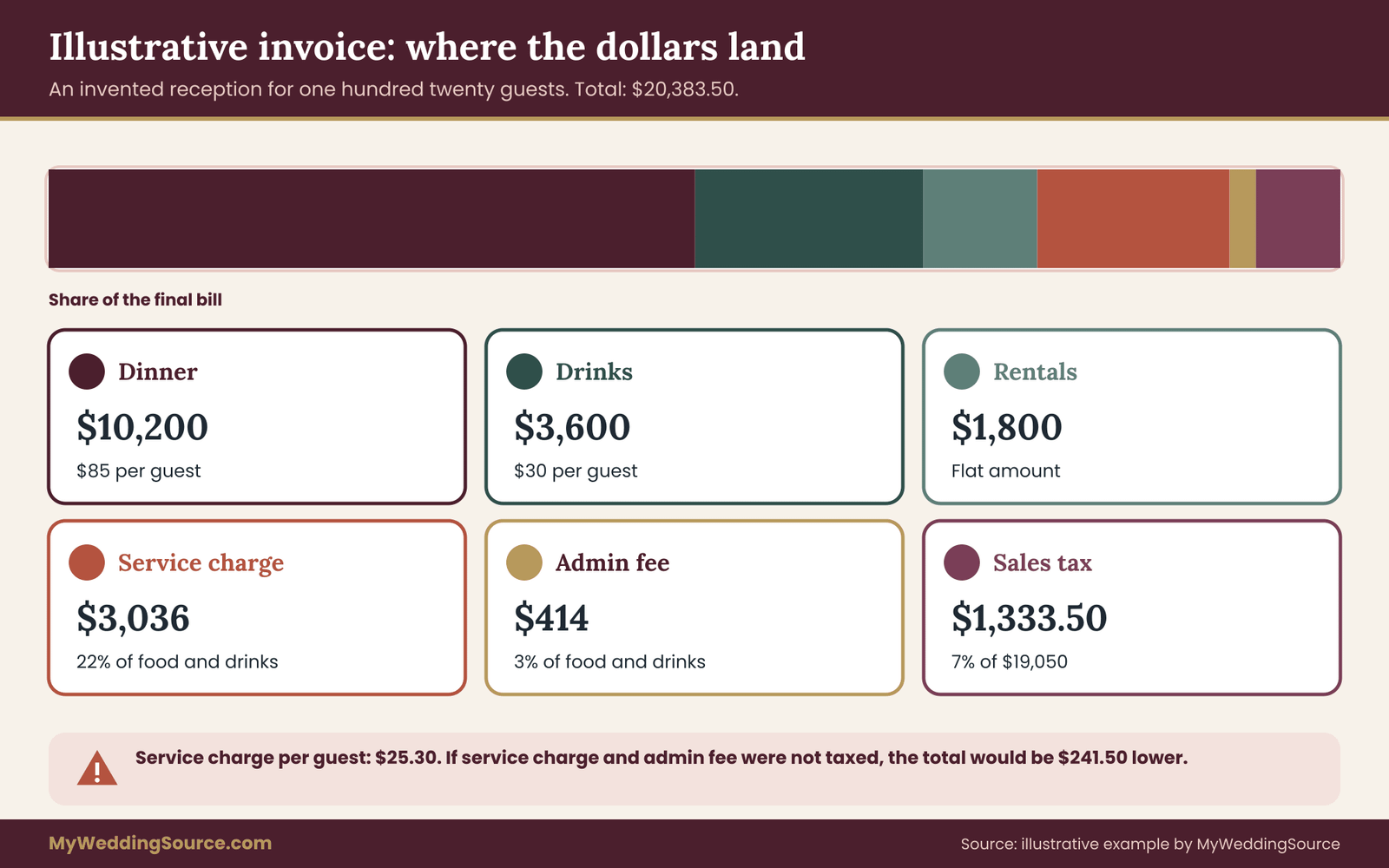
Imagine a couple planning a reception for one hundred twenty guests. They receive a proposal with these lines:
- Plated dinner at eighty-five dollars per guest: $10,200
- Beverage package at thirty dollars per guest: $3,600
- Rentals, flat: $1,800
- Service charge, twenty-two percent, calculated on food and beverage only
- Administrative fee, three percent, calculated on food and beverage only
- Sales tax, seven percent
Food and beverage together come to $13,800. Add the $1,800 of rentals and the pre-charge subtotal is $15,600.
Step one: run the numbers
The service charge is twenty-two percent of $13,800, which is $3,036. The administrative fee is three percent of $13,800, which is $414. Together these two lines add $3,450 before any tax.
Per guest, the service charge works out to $25.30 and the administrative fee to $3.45. Seeing the per-guest figure helps, because it shows that this service charge is not a small rounding item. For a seated dinner it is close to a third of the dinner price per head.
Now the tax question. The couple asks the caterer whether the service charge and administrative fee are taxed. The caterer says yes, because the company treats both as part of the taxable sale. The couple then checks the state revenue department’s guidance and finds that the answer is consistent with how the state treats mandatory charges, though they note a date and keep a screenshot. (In your own state the answer may differ, so you would check your own.)
With both charges taxed, the tax base is $15,600 plus $3,036 plus $414, or $19,050. Seven percent of that is $1,333.50, and the total is $20,383.50.
If the service charge and administrative fee had not been taxed, the tax would apply only to $15,600, which is $1,092, and the total would be $20,142. The difference is $241.50. That is not dramatic, but it is real money, and it is the sort of amount that is easy to miss until the final invoice arrives. It also shows why the Tax question sits inside the decoder.
Step two: ask about destination
The couple sends the short email from the previous section. Suppose the caterer replies with the following, which is one realistic possibility among several:
“The service charge funds hourly wages for our event staff, payroll taxes, insurance and the event manager. Servers and bartenders are paid an hourly rate, and they are not paid a separate share of the service charge. Tips are not expected but are appreciated and are divided among the service team. The administrative fee covers our office and coordination costs.”
The couple now has a decoder note with all four parts filled in. They know the Name, the Base, the Tax treatment and the Destination. The destination answer is useful, because it tells them the service charge does not itself reach the servers as a separate payment. The staff are paid by the hour, and any tip would be extra.
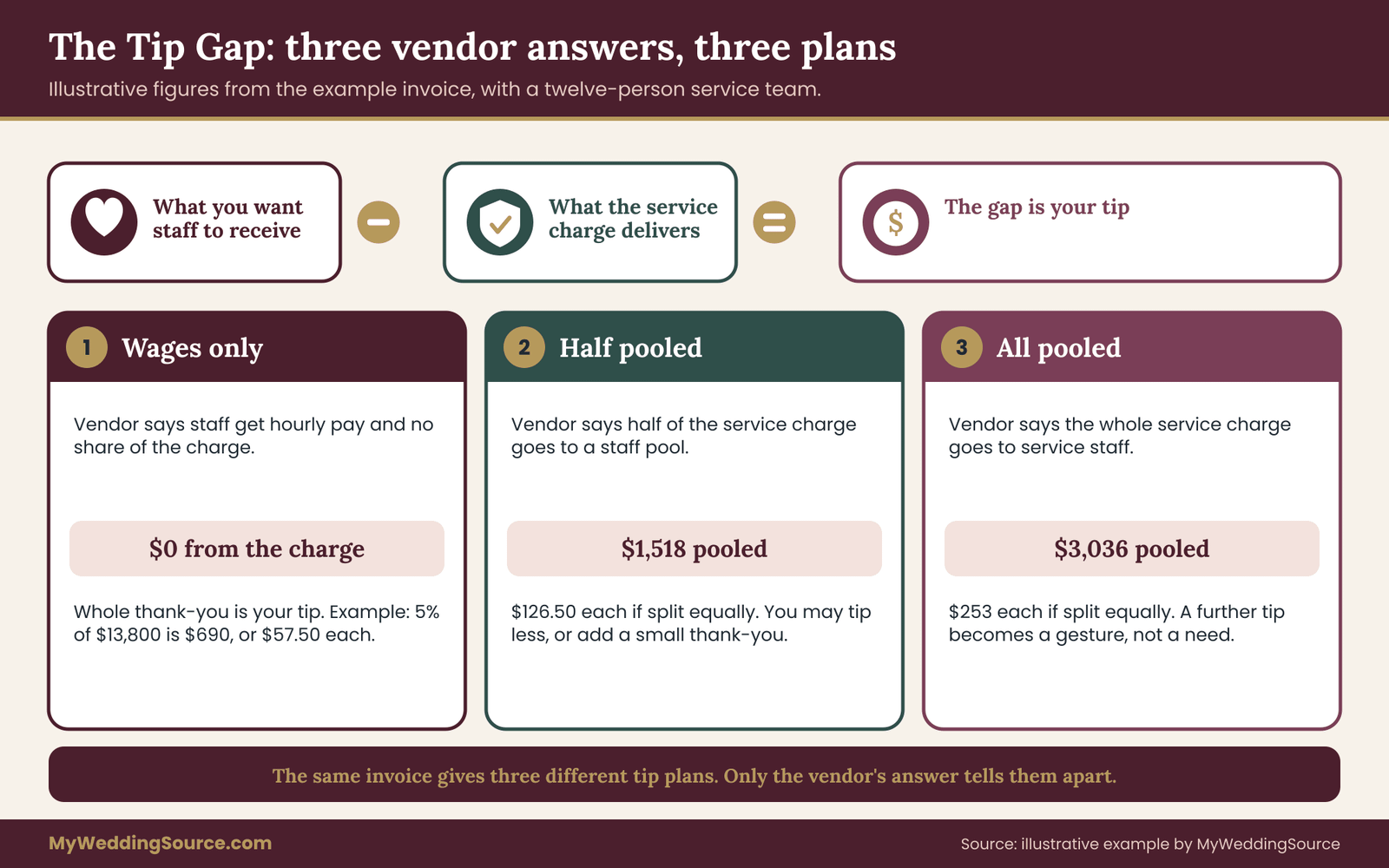
Step three: the Tip Gap
Here is the decision tool this guide recommends. Call it the Tip Gap. It has three parts:
- Decide what you would want the service team to receive in total for working your wedding. This is your own judgment, based on your values, your region and your budget. It is not a standard figure. Some couples want the team to receive a clear thank-you in addition to wages. Others are content with a smaller gesture.
- Subtract what the vendor says the service charge already delivers to staff. In this example the answer is zero beyond wages. In another vendor’s case the answer might be a defined share of the charge.
- The gap that remains is your tip. If the gap is zero, you do not tip. If the gap is large, you plan for it, and you ask how to deliver it so it reaches the people you meant.
The method works because it keeps three questions separate: what you want, what the service charge already does, and what is left. Couples who skip the middle step tend to either tip out of habit or skip the tip out of confusion.
Three possible answers, three different tip plans
To see how the Tip Gap changes with the vendor’s answer, suppose the couple’s own thank-you target is some amount per member of a twelve-person service team. The exact target does not matter here, and the numbers below are only to show the effect.
If the service charge funds wages only. The vendor says staff receive hourly pay and nothing from the service charge. The whole thank-you is the tip. If the couple chooses to give an additional five percent of the $13,800 food and beverage subtotal, that is $690, or $57.50 per person if shared equally among twelve.
If half the service charge is pooled. The vendor says fifty percent of the service charge goes to a staff pool. Half of $3,036 is $1,518, which is $126.50 per person if shared equally among twelve (real pools usually divide by hours, so individual amounts will differ). The couple may feel the staff are already receiving a meaningful share and may choose a smaller additional tip, or none.
If the whole service charge is pooled to staff. The vendor says all of the charge goes to service staff. That would be $3,036, or $253 per person if split equally among twelve. The couple may reasonably decide that no additional tip is needed, or they may add a modest gesture for outstanding service.
The numbers here are not recommendations. They show how the same invoice leads to different plans once you know the destination. Without the vendor’s answer, all three plans look identical on paper, which is exactly the trap.
Step four: compare proposals on the same footing
Suppose the couple also receives two other proposals using identical food and beverage prices. Caterer B charges eighteen percent calculated on the full $15,600 subtotal, including rentals. Caterer C charges twenty percent calculated on food and beverage only.
- Caterer A (the original): 22 percent of $13,800 = $3,036
- Caterer B: 18 percent of $15,600 = $2,808
- Caterer C: 20 percent of $13,800 = $2,760
The headline percentages suggest A and C are close, with B lowest. The dollars say otherwise. B is the second cheapest, because its base is larger than the others, and C is the cheapest. Without converting to dollars, the couple would have ranked them by percentage and gotten the order wrong.
Now add destination. If Caterer C pays nothing from the service charge to staff and Caterer A pays half to a pool, A’s real cost to the couple for staff-related purposes may be lower than it looks, because the couple would need to tip less. A per-guest comparison of service charge dollars and a separate comparison of what reaches staff is a more honest analysis than looking at either alone. Each comparison takes minutes once the decoder notes exist.
What the example does not show
This example is deliberately tidy. Real proposals may include overtime rules, minimums, separate bar staffing, delivery fees, cake-cutting fees, corkage and other lines, each with its own treatment. A real caterer may also give an answer that is partly clear and partly not. The method still works. You decode each line, note what is confirmed and what is pending, and decide with what you know. If you want help seeing how these payments fall across months, the payment ledger in the cash-flow planning guide has room for percentage-based lines like these, which are easy to underestimate in early budgets.
Reading proposals that change between versions
A proposal is a starting point. Between the first version and the signed contract, numbers move, and a service charge can move with them. The most common changes are an updated guest count, an added bar package, a new rental, or a revised timeline that adds hours.
Because a service charge is usually a percentage, any change to the base changes the charge automatically. Adding a bar package of $3,000 to a twenty-two percent service charge adds $660 in service charge, not just $3,000 in bar cost, and may add tax on both. Couples who think of a bar package as “a $3,000 line” are sometimes surprised at the total effect.
Make it a rule to recalculate the whole stack after every change. A simple practice: keep a short running list in your own notes with the subtotal, service charge, fees, tax and total, and update it each time the proposal changes. Re-run the decoder note whenever a line changes name. If a vendor replaces “service charge” with “gratuity” between drafts, ask what changed, because the underlying arrangement may have changed too.
Guest count and the service charge
Guest counts rarely stay fixed. When the final count goes up or down, the food and beverage subtotal moves, and the service charge moves with it. Check whether the contract has a minimum guest count, which is a common feature, because a minimum count means you pay the service charge on at least that many guests even if fewer attend. Ask the caterer to show the calculation at both your low and high guest counts, so you see how the service charge moves in each case.
Service charge vs gratuity beyond the caterer
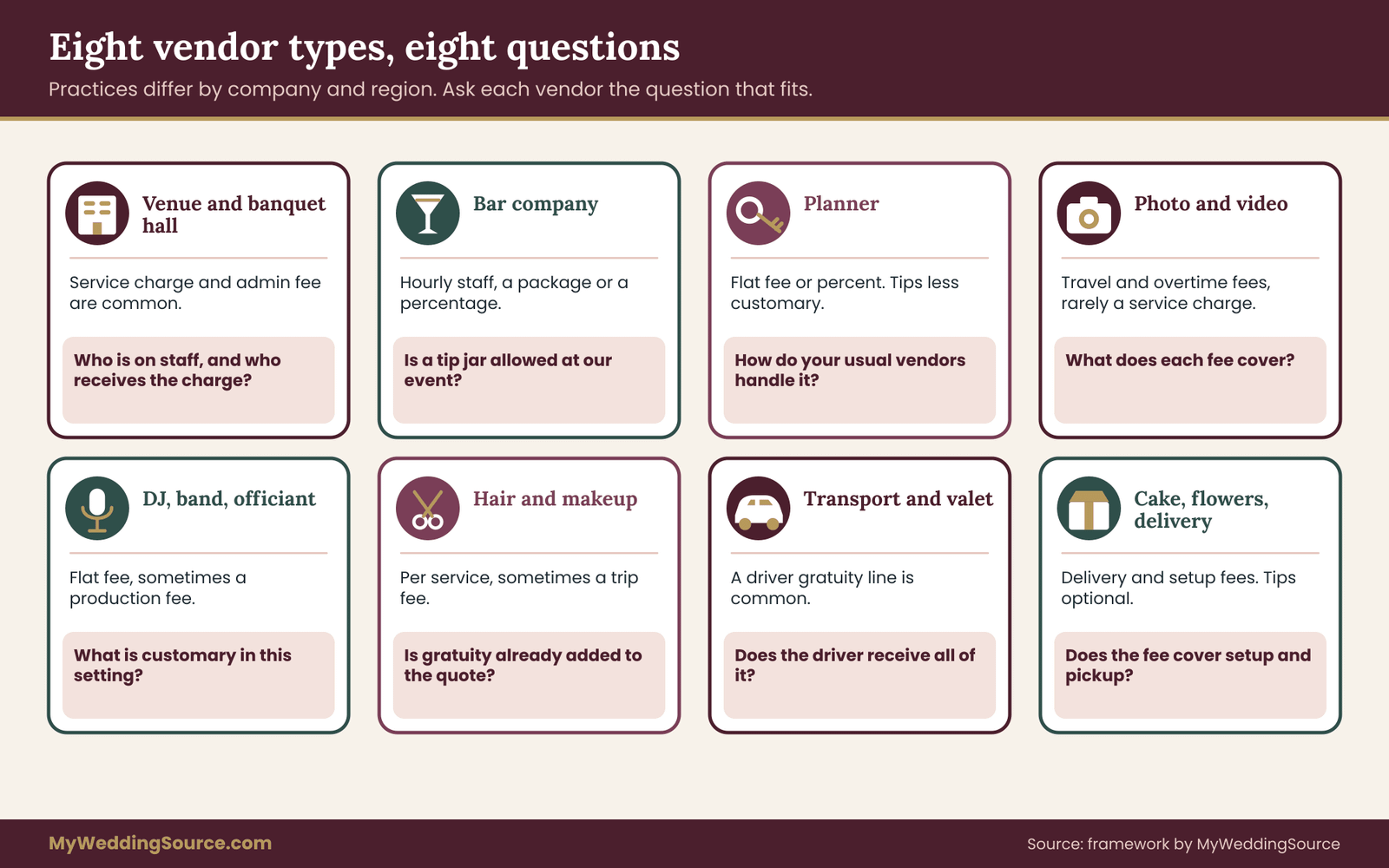
Most of the attention goes to catering because it is the largest line, but the same confusion appears across the vendor list. Each type of vendor tends to use the words a little differently, and the decoder works on all of them. Here is how to think about each, with the usual caution that practices differ by company and by region.
Venue and banquet hall
Many venues that provide their own food and beverage add a service charge and an administrative fee to the event total. The service charge is often a percentage of food, beverage and sometimes room rental. The destination can include servers, bartenders, banquet captains, setup and breakdown crews and the venue’s event staff.
Venues that act as a landlord and let you bring your own caterer may charge a different kind of fee, such as a cleaning fee, a security fee or a staffing fee for their own employees. These are not service charges in the catering sense, though they may be labeled that way. Apply the decoder, and ask who the staff are and whether they receive any of it. If the venue staff include a coordinator who is on site for the whole event, ask whether tips for that person are customary or whether the fee covers it.
Bar and beverage companies
A bartending company may charge by the bartender per hour, add a percentage service charge, or build everything into a per-guest package. The destination question matters here because bartenders often rely on tips for much of their income, and some companies prohibit tip jars at private events because the client is already paying a service fee.
Ask whether a tip jar is allowed, whether a tip should be handed to the lead bartender, and whether the service charge goes to the bartenders. The wedding bar service planning guide covers the other bar decisions, such as who pays for what and how to choose packages.
If you provide the alcohol and hire bartenders only, the invoice is usually simpler. It lists the number of bartenders, the hours and the rate, plus any minimum. A service charge may still appear on top. Ask the same questions.
Planners and coordinators
Planners usually charge a flat fee or a percentage of the total budget, and tips are less customary in this relationship. Some couples give a thank-you gift or a bonus when the planner has gone far beyond the contract. A service charge is rare on a planner’s invoice, but a planner may work with other vendors who add one, and a good planner can often tell you from experience how a particular caterer or venue handles its service charge. That is useful second-hand information, but it is not a substitute for the vendor’s own written answer.
Photographers and videographers
Most photographers and videographers are self-employed or run small studios. A service charge is unusual, and tips are optional. The more common charges are travel fees, overtime fees and second-shooter fees. These are not service charges, and the question to ask is simply what each covers. If a second shooter is hired as a contractor by the lead photographer, a tip to the second shooter is sometimes given, but it is not required.
Musicians, DJs and officiants
DJs and bands are usually paid a flat fee. Some add a service charge or a “production fee” that covers equipment and setup. A tip is optional and is often given to a DJ who stayed beyond the contracted time or handled special requests well. For officiants, the convention differs by tradition and region. Some officiants have a fixed fee and do not expect more. Others work within a community where a donation to the congregation is customary. Ask politely what is typical, and follow the officiant’s or institution’s guidance rather than a general rule.
Hair, makeup and beauty services
These providers usually quote per service and per person, and some add a travel or trip fee. A service charge is uncommon, and a tip is a customary extra in many places. Ask whether the quote includes gratuity, because some salons add it to wedding-party bookings and others do not. If you are paying for a group, say so in advance, so you do not double up on tips when individual members of the party also tip.
Transportation and valet
Limousine and shuttle companies often add a gratuity line as a percentage, sometimes labeled “driver gratuity” or “service charge.” The wording matters here. Ask whether the driver receives the full amount, and whether an additional tip is expected. Valet companies tend to have a flat fee or a per-car charge, with tips handled separately. In both cases the contract should say what is included.
Bakeries, florists and delivery vendors
Delivery and setup charges are common, and they are fees for a service, not tips. A delivery person who goes above and beyond, such as carrying a cake up several flights of stairs, may appreciate a tip, but it is voluntary. If the delivery line is called a service charge, ask whether it covers setup and breakdown, because some of these companies bill separately for pickup of rented items.
A common thread
Across all these vendors, the pattern is the same. The service charge is a business decision, the tip is a client decision, and the invoice rarely tells you where the money goes. The decoder gives you a method you can apply without learning the particular conventions of each trade. If you are weighing how many vendors you can reasonably ask, prioritize the ones with the largest service charge dollar amounts and the ones whose staff work longest on your day. The catering team and the bar team usually fit both descriptions.
Budgeting for tips and service charges without double counting
Once you have decoded the invoices, the next step is to put the numbers into your budget. This is where many couples make avoidable mistakes, and it is where the cash-flow side of the planning matters.
Build a line for the service charge, not just for the food. When you estimate the cost of catering, include the service charge, administrative fee and tax in the estimate from the beginning. A rough way to see the effect is to ask the caterer for a sample total at your expected guest count, then compare it to the per-guest price you were first quoted.
The gap is the real add-on. Many couples learn the gap from the final invoice, which is too late for planning. The wedding budget guide gives a way to set category totals, and these add-ons belong inside the catering category.
Create a separate tip line. Keep tips in their own line, so they do not hide inside another category. The size of the line comes from the Tip Gap analysis for each vendor. If you have not decided yet, a placeholder is better than leaving the line empty, because a missing line tends to turn into last-minute improvisation.
Do not count the service charge as the tip line. This is the most common double-counting error. If the service charge is treated as a fee in the contract, and your tip line also assumes the service charge is a tip, the budget shows a tip that never reaches anyone. The reverse error is also real: assuming the service charge is only a fee when part of it is distributed to staff, and then overspending on tips.
Decide who carries the envelopes. On the day, someone needs to hand over tips. This is not the couple’s job. Pick a trusted person, such as a family member or the planner, and give them a labeled set of envelopes, the names or roles of recipients, and the instructions you gathered from each vendor. Include a note about timing, because some vendors prefer tips at the end of the night and others prefer them added to the final invoice in advance.
Paying tips by invoice or in cash
Adding the tip to the final invoice has advantages. It leaves a record, it may let you pay by card, and the vendor can run it through payroll. The drawback is that the money goes through the company, and you rely on the company to pass it on. Handing cash to a captain or a lead has the opposite profile: it is direct, but it leaves no record and relies on the captain to share.
If you want a record without relying on the company’s process, ask the vendor to describe how they handle invoice tips in writing. For your own records, a note of what you gave and to whom is enough. A single line in your own payment ledger, with the date, the amount and the recipient, is enough.
Contract wording that settles the service charge question
An email answer is helpful, but the contract is what binds both sides. If the way a service charge is used matters to you, ask for a sentence in the contract or an attached addendum. Vendors often agree, because a clear sentence protects them from misunderstandings as much as it protects you.
You are not trying to draft legal language. You are trying to make four facts visible in the document: the name of the charge, what it is calculated on, whether it is taxed, and what it funds. Here are examples of plain statements that would answer those points. They are illustrations of the kind of wording to request, written in general terms, and a contract attorney or the vendor’s own template may phrase them differently.
- “The service charge is a percentage of the food and beverage subtotal and does not apply to rentals or delivery.”
- “The service charge is a mandatory fee retained by the company to cover event labor, payroll costs and operations. It is not a gratuity.”
- “A stated percentage of the service charge is distributed to service staff who work the event.”
- “Gratuity is not included. Any tip is at the client’s discretion.”
- “The service charge and the administrative fee are subject to sales tax.”
Each of these removes a question. The first fixes the base. The second and third answer the destination question in two different ways. The fourth keeps the tip voluntary. The fifth settles the tax question. You can pick the statements that match what the vendor told you, and ask them to confirm in writing.
Where the clause belongs
If the vendor has a standard contract, the service charge usually appears in a pricing section, and a definition may appear in a terms section further down. Read both. A contract can define “service charge” in one place and use “gratuity” in another, creating a mismatch that only shows up when you read the whole document. If you find a mismatch, ask which one controls.
A vendor-specific addendum is often the easiest route for a single clarifying sentence. It is short, it carries a date and signature, and it does not require rewriting the standard contract. The wedding vendor contract guide explains how to read the rest of a vendor agreement, including cancellation and substitution terms that interact with the service charge.
What happens to the service charge when the event changes
A wedding plan changes over time, and the contract should say what happens to the service charge when it does. Ask about four situations in particular.
Guest count changes. If the count drops, does the service charge drop in proportion, or does it stay at the contract minimum? If the count rises, does the service charge rise with it, and is there a cap?
Timeline changes. If the reception runs longer, are extra staff hours billed separately, and does the service charge apply to those extra hours? Overtime is a frequent source of surprise on the final invoice.
Cancellation or postponement. If you cancel or reschedule, is any part of the service charge refundable? Most contracts treat the deposit and the service charge as part of the total, so the refund terms depend on the cancellation clause. Ask for the refund rule in plain terms.
Menu or service style changes. If you switch from plated to buffet, or add a late-night snack, the base changes, and so may the staffing the service charge was meant to fund. Ask whether the percentage stays the same.
Deposits and the service charge
Many couples assume a deposit is a percentage of the food and beverage price. Some contracts calculate it on the full estimated total, including the service charge and tax, so the deposit is larger than expected. Others calculate it on the food alone. Ask which applies, because it affects both the cash you need early and the amount at risk if plans change. A quick check is to ask, “Is our deposit calculated on the estimated total including service charge and tax?” The answer helps you place the payment in a cash-flow ledger accurately.
Pitfalls and edge cases worth knowing
Even after decoding and clarifying, some situations deserve a second look. The following are the ones that cause the most confusion in practice.
Double charging for the same thing. A service charge and a “gratuity” line can both appear on the invoice, and each can be intended to cover staff. If both exist, ask whether they overlap. If the vendor says yes, ask why both are charged. There may be a legitimate reason, such as one covering servers and the other covering the kitchen, but the answer should be clear.
Mandatory gratuity on a small group. Some restaurants and private dining rooms add a mandatory gratuity for parties above a certain size. If your rehearsal dinner is at such a place, the menu or reservation terms may say so. Ask before the evening, not on the check, and decide whether to add anything on top.
A service charge on top of a tip prompt. Payment terminals sometimes prompt for a tip even when a service charge has already been added. Ask the vendor whether the prompt is intended to be an additional tip. If you are unsure, hold off and ask rather than tapping through.
Tipping on the tax. If you decide on a percentage tip, you need to choose a base. Some people tip on the pre-tax food and beverage subtotal, some on the total, and some on the pre-tax subtotal plus the service charge. There is no required answer. State your base in your own notes, so the number is repeatable and you can explain it to the person who hands out envelopes.
Counting your own family’s tips. A parent or relative may offer to tip the staff at the end of the night. That is a kind gesture, but it can produce double tipping if nobody coordinates. Let one person handle gratuities, and tell family that the plan is covered.
The service charge on a cash bar or a consumption bar. In a cash bar, guests pay for their own drinks, and a tip jar may be allowed. In a consumption bar, the host pays based on what is poured, and the service charge applies to the total. Ask how the service charge is calculated for each, since the base is not the same.
Differences abroad. If your wedding is overseas, local custom may include a service charge that is understood to cover staff, and tipping practice may differ from what you are used to. Ask the venue or planner in advance. Treat any local rule as local, and confirm with official sources for that country rather than applying U.S. assumptions.
Charges that arrive after the wedding. A few vendors bill for overtime, extra rentals, damaged items or cleaning after the event. If the original contract describes a service charge on the post-event bill, ask how it will be calculated. Keep a record of the final balance and the date you paid it. The wedding venues guide covers the questions to settle with venues before booking, and post-event charges are one of them.
Credit card fees on top of service charge
Some vendors add a card surcharge when you pay by credit card. If the surcharge is calculated on the full invoice, it also applies to the service charge portion. Check whether it is allowed in your state, how it is described in the contract, and whether paying by check or bank transfer avoids it. The point is not to avoid every fee, but to understand the stack of charges that sit on top of the food price, because each one adds to the next.
When the service charge is negotiable
Couples sometimes ask whether a service charge can be negotiated. The honest answer is that it depends on the vendor. Some treat it as a fixed part of their pricing model and will not change the percentage. Others have room to adjust, for example by changing the base or removing it in exchange for a higher price per guest. A change in structure does not necessarily lower the total, but it can make the invoice easier to understand.
If a vendor offers to remove the service charge and raise the food price instead, run the numbers. A service charge that applies only to food and beverage, replaced by an equivalent increase in per-guest price, may produce the same total but different tax treatment, because the per-guest price is almost certainly taxed. A change like that is a trade-off, not a discount, so compare totals, not labels.
When you want staff to receive more
Some couples want to make sure the service team receives a larger share than the vendor’s policy provides. There are straightforward ways to do that. You can add a tip through the vendor’s preferred method, give envelopes to the captain, or ask the vendor if they can run an extra gratuity through payroll so that it is documented. If you choose to give cash, keep a record of the amount and the date, and decide in advance whether it is for a named person or for the whole team.
If a vendor says that tips go entirely to the company, you can ask whether a direct tip to staff is allowed, and what the company’s policy is. Federal guidance describes tips as belonging to employees, so a company policy that conflicts with that is worth a polite question and, if needed, a call to your state’s labor department.
When the answer changes after you sign
Vendors change policies, sometimes at the same time they raise prices. If the vendor updates its service charge between the contract and the event, check the contract. In most cases the signed terms control, and a vendor who wishes to change them needs your agreement. If you receive a notice of change, reply in writing and ask whether it applies to your event. If the change is unavoidable, ask for the revised destination in writing, and rerun the decoder note.
A short decision guide for the final week
In the final week before the wedding, review each vendor’s decoder note and ask three things. Is every service charge line understood? Has every vendor’s tipping method been confirmed? Who is carrying the envelopes? If the answer to any of these is no, send a short message to the vendor and fix it before the day. A review that takes ten minutes now spares you a rushed conversation on the wedding day, when no one has time to explain anything.
If a vendor’s answer is still unclear at that point, choose the simplest safe option: treat the service charge as a fee, treat your tip as separate, and use the vendor’s preferred delivery method. That option may leave you tipping a little more than strictly needed, but it avoids the opposite problem of staff receiving less than you meant. The purchase-order approach in the wedding vendor purchase order checklist is a good model for confirming scope in writing, and the same habit works for confirming a service charge.
Your next steps
You do not need to do everything at once. A sensible order follows the way proposals and contracts arrive.
- Gather every invoice and proposal that has a percentage or a fee. Include the caterer, the venue, the bar company, transportation and any vendor with a staffing line.
- Apply the four-question decoder to each line. Write Name, Base, Tax and Destination for every service charge, gratuity or administrative fee, and mark the parts you cannot answer yet.
- Send one short email per vendor. Use the sample earlier in this guide, adjusted to the vendor, and ask for the answer in writing.
- Convert each service charge to dollars and to a per-guest amount. Use that figure to compare proposals, not the headline percentage.
- Run the Tip Gap. Decide what you want each team to receive, subtract what the service charge already delivers, and enter the remainder as a separate tip line in your budget and payment ledger.
- Ask for one clarifying sentence in the contract where the destination or the base still depends on a verbal answer.
- Choose a delivery method and a person. Decide whether tips go on the final invoice or in envelopes, and name the person who will hand them out.
- Review in the final week. Check the decoder notes, confirm the envelope plan and keep a record of what was paid.
If you do only three things, do these: ask the destination question in writing, convert the service charge to dollars, and keep tips in a separate line. Those three steps catch most of the double counting and under-tipping that couples run into. The official pages listed below explain the federal rules on tips and service charges, and your state labor and revenue agencies explain the local ones.
FAQ
Is a service charge the same as a gratuity?
Not necessarily. A service charge is a mandatory amount the business adds and uses as it chooses, which may include wages, overhead or profit. A gratuity is meant for the people who serve you, but a contract can label a required percentage as a gratuity too. Read the contract’s wording and ask the vendor what the money funds and who receives it.
Do servers get the service charge on a wedding invoice?
Sometimes, in part or in full, and sometimes not directly. Some caterers pay a share of the service charge to staff, while others use it to fund hourly wages, payroll costs and operations. The invoice usually does not say. Ask in writing whether any of it is distributed to service staff and in what proportion, then plan your tip based on the answer.
Should I tip on top of a service charge?
It depends on what the service charge funds. If the vendor says staff receive a defined share, you may want to add little or nothing. If it covers wages and overhead only, a tip is a separate way to thank the team. Use the Tip Gap method: decide what you want staff to receive, subtract what the service charge delivers, and tip the difference.
Is a wedding service charge taxable?
It depends on the state and on how the vendor treats the charge. Some jurisdictions tax mandatory service charges as part of the sale, and others do not. Ask the vendor how they handle it, and check your state revenue department’s guidance. On a large catering bill, whether tax is calculated before or after the service charge can change the total by a noticeable amount.
How can I find out where a service charge goes?
Ask a specific question in an email: what does the service charge cover, is any part distributed to service staff, and is a tip expected on top. Refer to the exact line and amount. If the answer is vague, ask a narrower follow-up. For anything important, request a one-sentence statement in the contract or an addendum so the answer is on record.
What is tip pooling at a wedding?
Tip pooling means tips are collected and shared among a group of staff instead of each person keeping what they individually receive. At a wedding it is common because many people contribute and the client cannot see who did what. Ask who is in the pool, how it is divided and whether tips given in cash or on the invoice are handled the same way.
Can a vendor keep the tips I give?
Federal guidance generally describes tips as belonging to the employees who receive them, with limits on employers and managers keeping them, though rules vary by state and situation. A service charge is different, because it is the business’s charge. If a vendor says tips go to the company, ask politely about the policy, and contact your state labor department if the answer concerns you.
Can I negotiate the service charge?
Sometimes. Some vendors treat it as a fixed part of their pricing, while others will adjust the base, restructure it into the per-guest price, or clarify how it is used. A restructure may change the tax treatment, so compare final totals rather than labels. Even when the percentage is fixed, you can usually ask for a written description of what it covers.
Sources
- Tax Topic 761, Tips: withholding and reporting, Internal Revenue Service
- Tip recordkeeping and reporting, Internal Revenue Service
- Revenue Ruling 2012-18 on service charges and tips, Internal Revenue Service
- Publication 15, Employer’s Tax Guide, Internal Revenue Service
- Fact Sheet 15, Tipped employees under the Fair Labor Standards Act, U.S. Department of Labor
- Wage and Hour Division, U.S. Department of Labor
- State consumer protection offices, USAGov
- Consumer Financial Protection Bureau
- National Association of Attorneys General
- Better Business Bureau