
Welcome bag delivery to a hotel is a small logistics job with real rules attached: someone has to be allowed to drop the bags off, someone has to hold them, and someone has to match every bag to a guest who is actually staying there. This guide gives you a welcome bag delivery authorization sheet and a room-tracking worksheet so each bag reaches the right door, and you know what it cost and who signed for it.
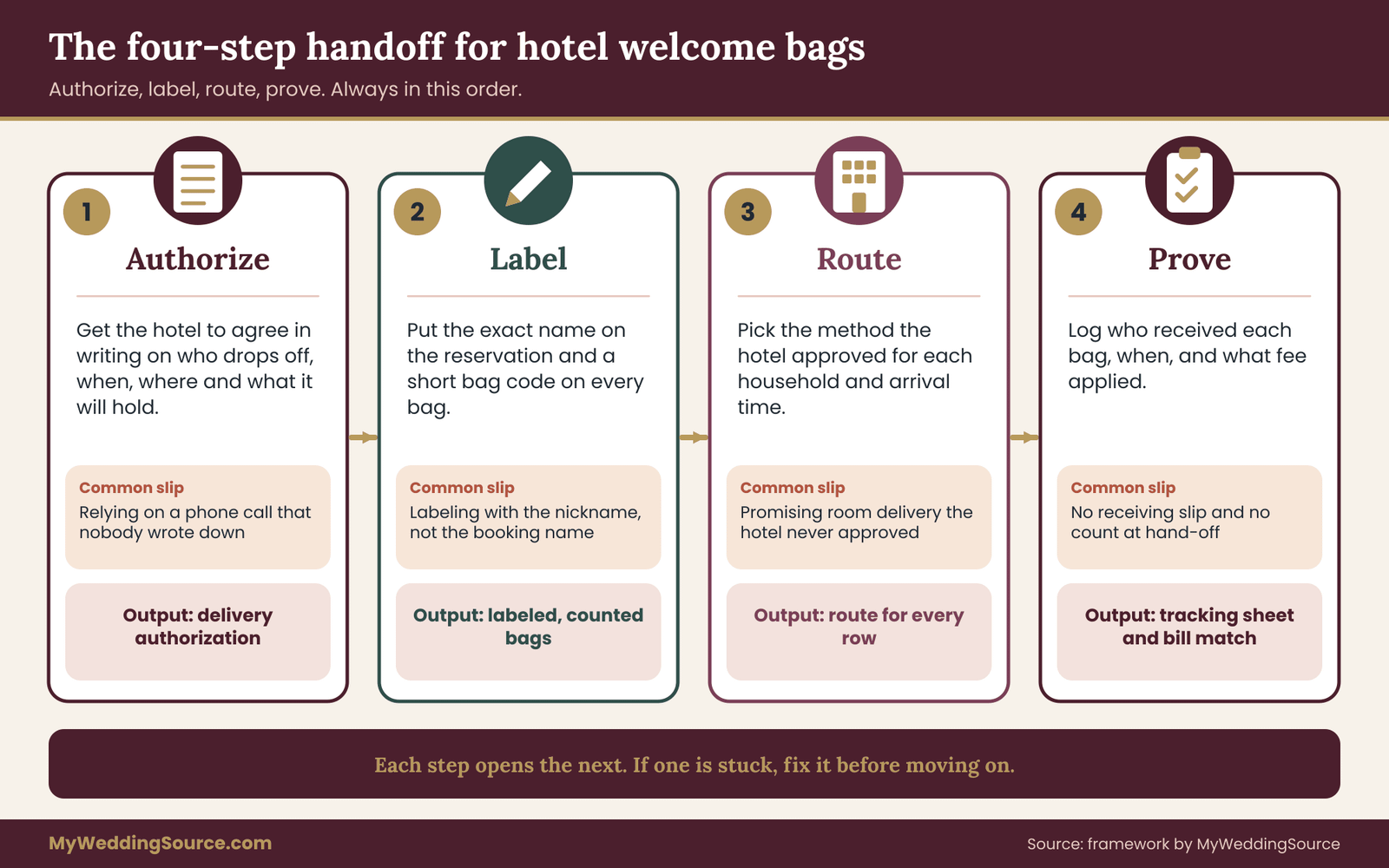
Treat welcome bag delivery as four steps in a fixed order: authorize, label, route, prove. First get written permission from the hotel for who may drop off, when, where and what the hotel will hold. Then label every bag with the name the room is booked under, not the name you use for the guest. Route each bag by the method the hotel confirmed: front desk hold, room delivery, welcome desk pickup or a check-in packet. Finally, keep a log that shows which bag went where, who received it and what fees applied.
Most couples picture welcome bag delivery as the easy part. The bags are packed, the hotel is nearby, and surely someone at the front desk will take a few dozen totes. Then the first questions arrive. The desk asks whose name the bags go under, a manager says the hotel does not give out room numbers, a second shift has never heard of the arrangement, and a guest who checked in at noon never receives the bag that was left for a three o’clock arrival.
None of this is anyone being difficult. A hotel is responsible for the privacy and safety of every guest in the building, and a pile of unlabeled bags from a stranger is a security question before it is a hospitality question. Once you see welcome bag delivery from the desk’s side of the counter, the process becomes much easier to plan.
This article covers the delivery side only: permission, fees, guest lists, front desk policies, tracking and the awkward edge cases. What goes in the bag is a separate question. If you are still deciding on contents, settle that first, because the weight, the perishables and the number of bags all change how welcome bag delivery works.
A note on scope. This is general information, not legal, tax or financial advice. Hotel policies, fees, local rules and product safety requirements differ by property and change over time, so confirm every term with the hotel itself and keep the confirmation in writing.
What hotel welcome bag delivery actually involves
Welcome bag delivery sounds like one task, but it is a chain of at least five handoffs, and each handoff is a place where a bag can be lost, delayed or sent to the wrong person.
The chain runs like this. The bags leave wherever they were assembled. They travel to the hotel, by your own car, a helper’s car or a courier. They are received by hotel staff or left in a storage area. They are matched to guests as those guests check in. And finally they reach the guest, either in the room, at the desk or in a hand-delivered packet.
Each link has an owner. Until you have written down the owner of each link, nobody owns it, and the bags tend to sit in whichever place was least convenient.
Three kinds of hotel handling
Hotels generally handle outside welcome bag delivery in one of three ways, and it helps to know which one you are dealing with before you call.
Hold and release at the desk. Staff accept the bags, store them, and give each one to the guest when that guest checks in or asks. This is the simplest and often the cheapest option, but it depends on the desk knowing which guests are yours.
Room delivery. Staff place a bag in each room, usually after the guest has checked in. This is the most gracious result for the guest, and it is the one most likely to carry a per-bag fee, because it takes staff time and requires the hotel to use room information it normally keeps private.
No outside items. Some properties, especially large ones with strict security, will not accept items from anyone but a recognized carrier, or will accept them only with advance approval. In that case the plan changes to a pickup at a table or a separate room.
“Could you tell us how your hotel handles welcome bag delivery for a group, and who is the right person to approve it?”
That single question, asked to a sales or events contact rather than the front desk, will usually tell you which of the three you are dealing with.
Who you are actually asking
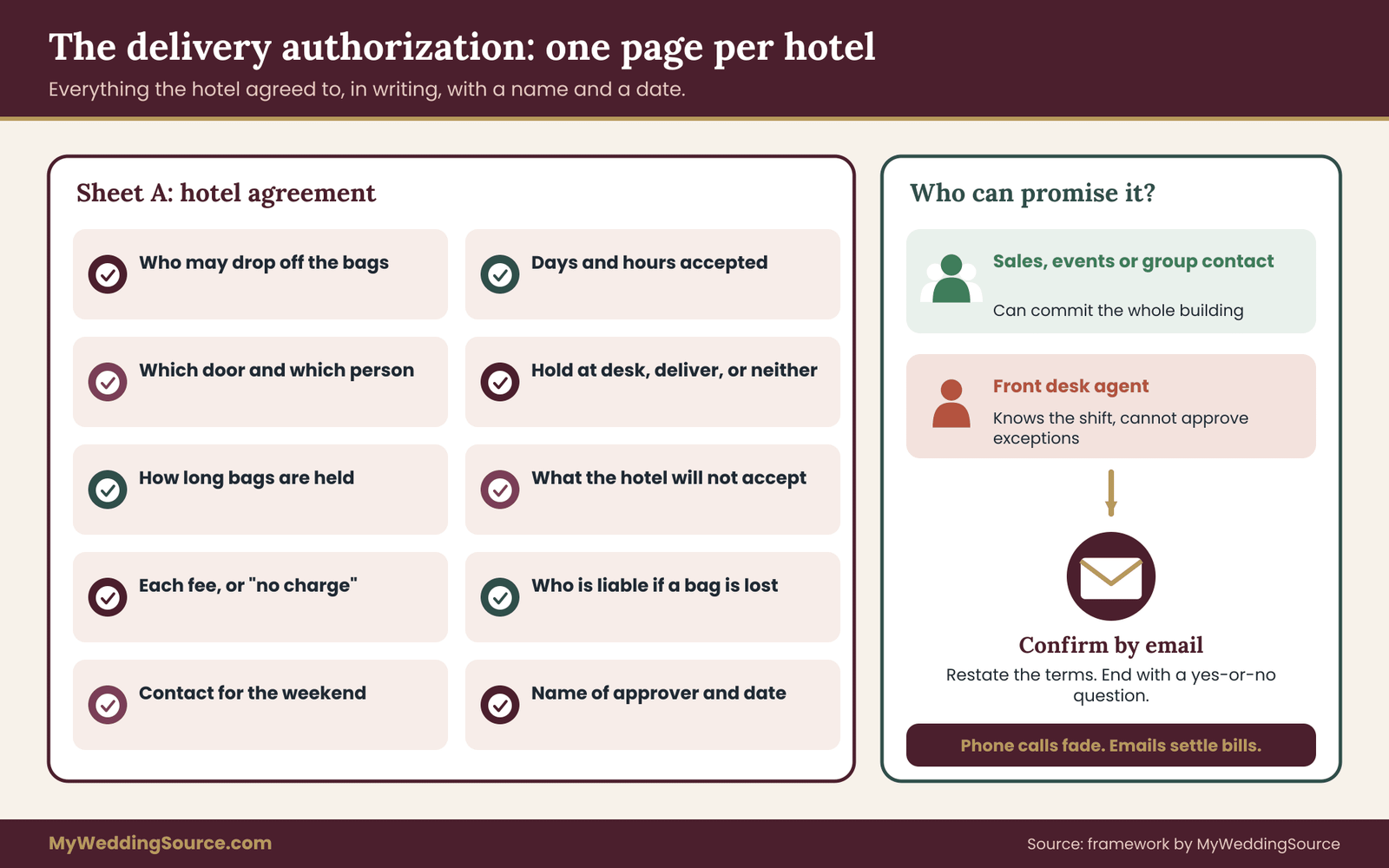
It matters whom you ask. Front desk agents know how things run on an ordinary shift, but they often cannot approve exceptions, set fees or promise anything about another shift. A sales manager, an event services manager or a group coordinator can make a commitment that the whole building will honor.
If your guests booked through a room block, the person who set up the block is the natural first contact. If guests booked on their own, you may be dealing with a general manager or guest services manager. The guide to wedding guest hotels across different budgets and mobility needs covers how to set up lodging in the first place, and the contact you used there is usually the right starting point here too.
Whoever you speak to, get their name, their role and the date. A commitment from “someone at the front desk on Tuesday” is hard to enforce on a Friday night. Ask for the same person again when you confirm welcome bag delivery.
Why hotels set rules for welcome bag delivery
If a policy seems excessive, it usually exists because of something specific. Understanding the reason helps you ask for the right accommodation instead of arguing with the rule.
Privacy. Most hotels will not confirm that a person is a guest, and will not say which room anyone is in. This protects people from unwanted visitors, and it is a legitimate safety practice. It also means the hotel may refuse to take a bag addressed to a guest by name unless you have a documented relationship with the property, such as a group contract.
Security. Unattended items left at a desk or a door are a concern for the hotel. Staff cannot always tell what is in a bag, and a sealed tote that appears from nowhere is a reasonable thing for a security team to check. Some hotels require that outside welcome bag delivery be opened, inspected or received only at set hours.
Storage. Hotel back-of-house space is limited, particularly on a busy weekend. Fifty tote bags take up real space, and a bell stand is not a warehouse. Perishable items add another problem, because food kept at room temperature behind a desk is not a risk a hotel wants to own.
Labor. Delivering a bag to a room means a staff member leaves a post, walks to the room, and either knocks or leaves it. Multiplied by dozens of rooms, this is a measurable amount of work, and most hotels price it.
Liability. If a bag goes missing, or a guest has a reaction to something in it, the hotel does not want to be the party responsible. Many hotels disclaim liability for items left by outside parties, and some require you to say so in writing.
What the rules tell you about the hotel
A hotel that has a clear, short process for outside welcome bag delivery is usually one that handles group events regularly. That is a good sign. A hotel that says “just drop them off and we will figure it out” may be friendly, but it is also telling you that nothing is written down.
Neither response is a reason to cancel a booking. It is a reason to document more. When a process is informal, your written confirmation becomes the process, and informal welcome bag delivery needs more paper, not less.
The guest’s side of the same problem
Spend a minute thinking about the guest, because the guest is the person all of this is meant to serve. A guest arriving after a long trip wants to check in quickly, find the room and rest. A bag is a pleasant surprise if it is waiting. It is a minor annoyance if the guest has to ask for it at the desk, spell their name twice and wait while an agent searches a back room.
That is why this guide keeps returning to one rule: the best welcome bag delivery is the one that asks nothing of the guest. If the guest has to remember, ask, find or sign, the welcome bag delivery is doing less than it could. Pick the method that reduces the guest’s effort first, and the hotel’s effort second.
How early the problem starts
Many couples start thinking about welcome bag delivery in the last week before the wedding, when the bags are nearly assembled. By then the options are narrow. The hotel’s weekend is already staffed, storage space is already allocated, and the person who could have approved an exception may be out of the office.
The practical point is to open the conversation with the hotel when you set up the room block or confirm the guest list, not when the bags are in your trunk. Make welcome bag delivery a line item on the lodging checklist from the start. A short question at the contracting stage costs nothing. The same question three days before arrival may cost a rush fee, or get a no.
The four-step handoff for welcome bag delivery
The framework in this guide has four steps, always in the same order. Authorize, label, route, prove. Skipping one makes the next one harder, and most failed welcome bag delivery plans trace back to a missing first or second step.
Step one: authorize. Get the hotel to agree in writing to who may bring bags, when, where, and what the hotel will do with them. This is the welcome bag delivery authorization, and the next section shows what it contains.
Step two: label. Put on every bag the name the room is booked under, plus the arrival date and a short code that ties the bag to your tracking sheet. Guests are known to you by nicknames and family titles. The hotel knows them by whatever appears on the reservation.
Step three: route. Choose the welcome bag delivery method for each household based on what the hotel confirmed and when that household arrives. Not every guest needs the same route.
Step four: prove. Keep a record of what was handed over, to whom, at what time, and what was charged. If a bag goes missing, or a fee shows up on a bill, this record is what you point to.
Why the order matters
The steps feel obvious in a list and are easy to scramble in practice. A couple who labels first, because the bags are in front of them, may discover that the hotel wants a different naming format. A couple who routes before authorizing may promise guests room delivery that the hotel never agreed to. A couple who skips the proof step has no way to settle a dispute about a fee.
Think of it as a sequence of locks. Each step opens the next. If a lock is stuck, do not skip ahead, because you will only meet the same problem later and with less time. That holds for every welcome bag delivery, large or small.
What the framework does not do
It does not make the hotel agree to anything. If the hotel will not accept outside welcome bag delivery at all, the framework tells you to move to another route early, not to push harder. It also does not replace common sense about perishables, medications or valuables, which are a bad fit for any unattended drop. The point is to organize the work, not to guarantee an outcome, because good welcome bag delivery is mostly organization.
The welcome bag delivery authorization is a one-page document, one per hotel, that records what the hotel has agreed to. It can be an email exchange, a signed addendum to a group contract or a short form the hotel provides. What matters is that it is written, dated and specific.
Here is what a useful authorization contains.
Who is authorized to deliver. Names or roles of the people who may bring bags to the hotel: you, a family helper, a florist, a courier. If a person is not listed, assume the desk may turn them away. If a courier is bringing the bags, ask whether the hotel accepts that carrier, and whether anyone has to sign.
When deliveries are accepted. The days and hours the hotel will take outside items. Some properties will only accept items during business hours, or only up to a day or two before the first guest arrives. Early arrivals are a common problem, because bags dropped off a week ahead may take space the hotel cannot spare.
Where to bring them. The front desk, a loading dock, a bell stand, an events office or a back entrance. Hotels with a freight entrance often want outside welcome bag delivery to come in there. Ask which door and which person.
What the hotel will do with the bags. Hold them, deliver them to rooms, or place them in a designated pickup area. This is the central term. Everything else follows from it.
How long the hotel will hold them. Until the last guest checks in? Until Sunday morning? Until check-out? Ask what happens to bags that are never claimed.
What the hotel will not accept. Common exclusions include alcohol, perishable food, flowers in water, items that need refrigeration, and anything the hotel considers a safety issue. Some hotels also prohibit open food or loose snacks. Get the list in writing, and read it against your actual bag contents.
What it costs. A per-bag fee, a flat handling charge, a storage fee, or no charge. If the hotel says “no charge,” write that down too.
Liability. Whether the hotel takes responsibility for lost or damaged bags. Many will not, and that is a reasonable position. You simply need to know.
A confirmation reference. The name of the person who agreed, and the date. If the answer came by phone, send a short email afterward summarizing it, and ask them to reply to confirm.
A short confirmation message
If the hotel agrees by phone, a follow-up email protects both sides.
“Thank you for speaking with us today. To confirm: we will drop off bags on the day before arrival, you will hold them at the front desk, and there is no handling fee. Is that correct?”
Notice that it restates the terms and ends with a yes-or-no question. A hotel contact can reply with one word. A vague “sounds good” is not a confirmation, and a detailed summary that you wrote yourself and they answered “yes” is.
When the contract already says something
If your guests booked through a group contract, read it before you ask anything. Contracts for room blocks often contain clauses about amenities, outside welcome bag delivery or guest information. The overview in the wedding vendor contract guide explains how to read clauses of this kind, and the same habits apply to hotel contracts.
You may find the contract is silent on welcome bag delivery. Silence does not mean permission, and it does not mean prohibition. It means the point is open, and you should ask.
Who signs for what
One small detail trips up many couples: who signs for the bags when they arrive. If a helper drops the bags off, the hotel may ask for a name and a signature on a receiving log. Decide beforehand who that is, and make sure the person knows the number of bags, because a count on the receiving slip is useful evidence later. It is the first document in your welcome bag delivery record.
If a courier delivers, ask the hotel whether a package receiving fee applies. Some hotels charge one for each package, and a pallet of boxes can add up. The same question applies if bags are being shipped from another city, and the issue is covered in more detail in the cost section below.
What welcome bag delivery can cost
Fees for welcome bag delivery vary widely and are not standardized. This section does not give prices, because any number would be invented. It shows you the structure of fees so you can ask the right questions and compare quotes fairly.
Hotels that charge usually use one or more of these structures.
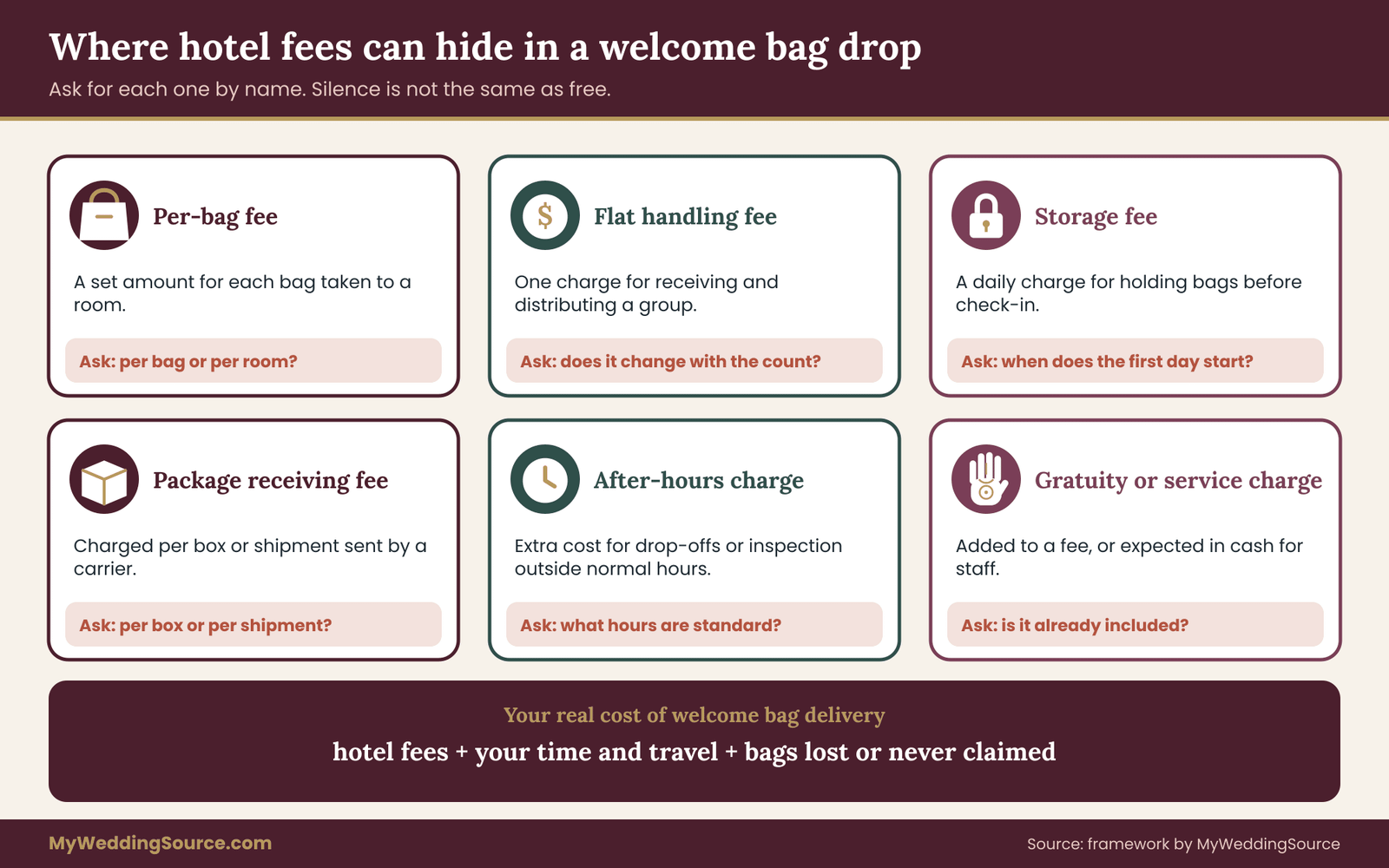
A per-bag fee. A set amount for each bag delivered to a room. This is the most common structure when the hotel provides the delivery labor. It scales with your guest count, so it is easy to estimate once you have a number.
A flat handling fee. A single charge for accepting and distributing a group of bags, regardless of count. It is more predictable and usually better for larger groups. It is sometimes lower per bag than the per-bag option when the count is high, and higher when the count is low.
A storage fee. A daily charge for holding items before guests arrive. Ask whether the hotel counts days from the drop-off date or from the first check-in.
A package receiving fee. If the bags arrive by courier or shipping service, some hotels charge per package. Ask whether the fee applies to each box or each shipment.
An after-hours or special-handling charge. Applied if you need a delivery outside standard hours, or if the hotel has to open and inspect each bag.
A gratuity expectation. Some hotels add a service charge to the fee. Others expect you to tip the staff directly. Ask which, and whether it is included.
Cost logic you can do on paper
You do not need a quote to build a comparison. Use this simple structure for each option.
Total cost of an option equals the hotel’s fees, plus your own travel and time, plus the cost of replacing any bag that is lost or goes unclaimed.
The second term is the one most couples forget. If you deliver the bags yourself to every room, the hotel charges nothing, but you spend hours, and you need the hotel’s permission to be in the corridors. If a friend does it, that friend’s time is not free. If a courier ships the bags, add the shipping cost and any receiving fee.
The third term is quieter still. A bag delivered to the wrong room, or never picked up, is money spent on nothing. A method that wastes ten percent of bags can cost more than a method with a small fee and no waste. The room-tracking worksheet exists to keep that waste visible.
“What is the per-bag fee for room delivery, and is there a flat option for fifty bags?”
Asking for both structures in one question lets the hotel pick the cheaper one for you, or at least shows you the difference.
Compare per household, not per guest
Welcome bags are usually made per household or per room, not per person. A couple sharing a room gets one bag. A family of four in two rooms may get two. Your fee comparison for welcome bag delivery should use the same unit the hotel uses to charge: bags or rooms. If the hotel charges per bag and you have forty-one households in fifty rooms, your count for fees might be forty-one, fifty, or something in between depending on how the hotel treats shared bags. Ask.
Fees to avoid agreeing to by silence
If a fee is not mentioned, do not assume it is zero, and do not assume it is absent. Ask about every fee that could touch welcome bag delivery. Ask the hotel to state either “no charge” or the amount. A line that appears on a master bill after the event is much harder to dispute than a line you saw in advance. The same principle runs through the wedding budget planning page: every cost is easier to manage when it has a name and a number before the event, not after.
Guest lists and privacy in welcome bag delivery
A hotel cannot deliver a bag to a guest it cannot identify, and you cannot hand over a guest list casually. The balance between those two facts is the main tension in welcome bag delivery, and it is worth a few minutes of thought.
Your guest list contains names, family relationships and sometimes notes about health, mobility or dietary needs. The hotel needs far less. For welcome bag delivery, the hotel usually needs only the names on the reservations and the dates of stay. It does not need to know who is the bride’s aunt, who is allergic to nuts, or who uses a wheelchair, unless a specific accommodation depends on it.
Share the minimum
A good rule is to share the smallest list that lets the hotel do its job. That list usually has three columns of information in each row: the name on the reservation, the expected arrival date and a bag code. Nothing else. Sharing less is the safer way to run welcome bag delivery.
Leave out phone numbers, email addresses, home addresses, relationship labels and any notes about the guest. If a bag contains a flyer for a guest with a mobility or dietary need, handle that in the bag itself, not in the hotel’s records. The broader habits for handling guest data are covered in the wedding guest list guide, and the same restraint applies here.
Where the list actually comes from
There are two sources, and they do not always agree.
The first is your own guest list: who you invited and who said yes. This is the list you know best, but it says nothing about where each guest is staying. Some guests will book a different hotel, stay with family or drive in the same morning.
The second is the hotel’s reservation list for your room block, which the hotel can often share with you in some form. It tells you who actually booked, under what name and for which dates. It is the authoritative list for welcome bag delivery at that property, and it is usually the better starting point.
Ask the hotel for a rooming list or pickup report for your block, and ask how often it can be refreshed. Some hotels send it on request. Others send it only at set intervals, such as thirty days and fourteen days before arrival. If the hotel will not share any list, you can ask guests to tell you where they are staying, using your wedding website or a short RSVP question. The principle is easy to state: the list will change, so plan for revisions.
Name mismatches
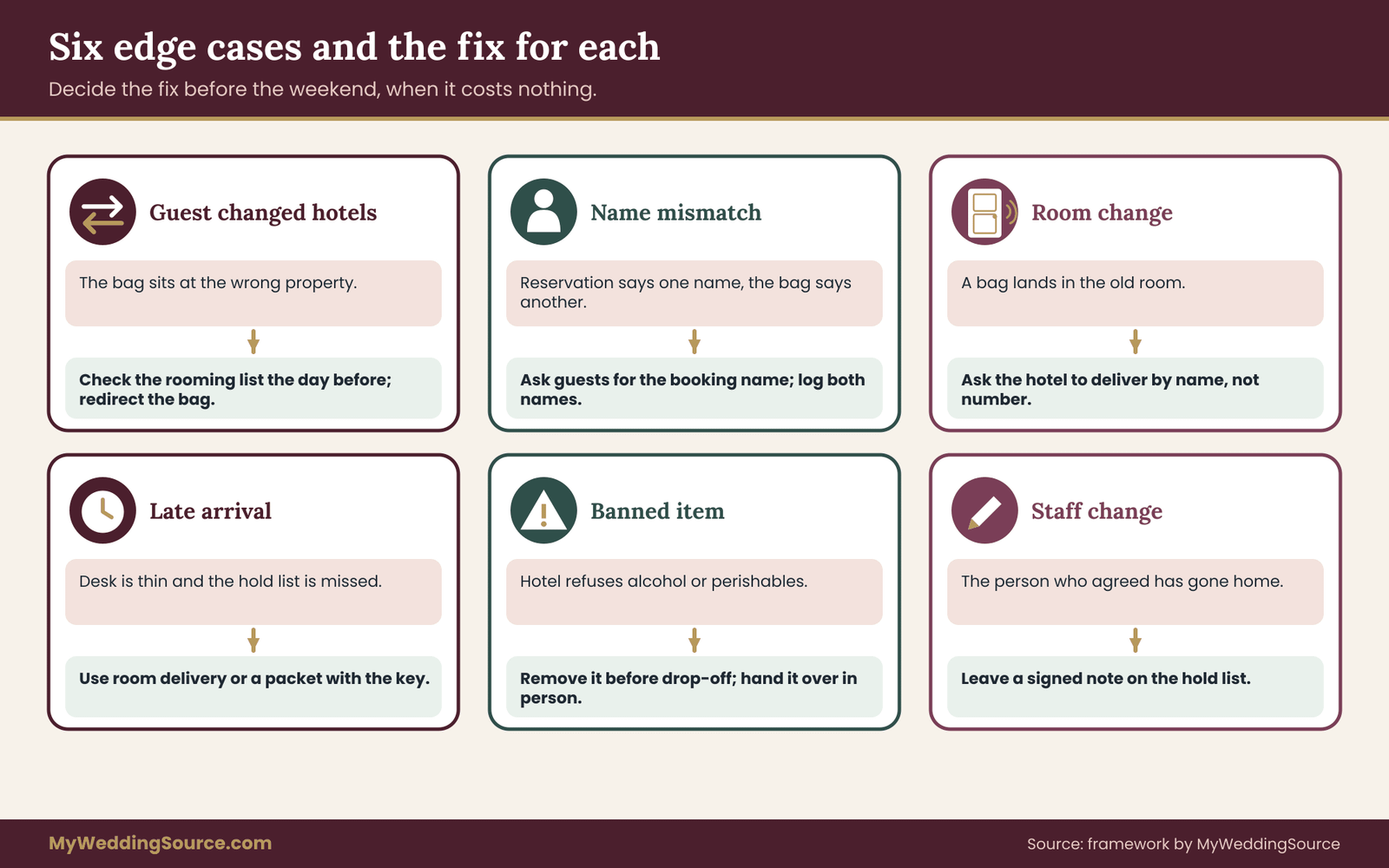
The most common reason a bag is not delivered is a name mismatch. The reservation says “Jonathan Okafor-Reyes.” Your list says “Uncle Jon.” The bag says “The Okafors.” The desk finds no match.
Reservations can be made under a different spouse’s name, a maiden name, a company name or a travel agent’s name. A guest who booked through an employer may appear under the employer. A guest who is part of a couple may not be the person who made the booking.
Fix this at the source. Ask guests, in the same message where you ask for travel details, to give you the name on their reservation. Then use that name, exactly as written, on the bag label. If the reservation is under a name you did not expect, record both names in your tracking sheet so a person at the desk can look up either. Name checks are the cheapest protection a welcome bag delivery has.
What to do about room numbers
Many hotels will not give you room numbers, and some will not even tell you whether a named person is registered. That is a normal privacy practice, and you should not push against it.
You have three alternatives. You can ask the hotel to deliver by name, so the hotel looks up the room itself. You can ask the hotel to hold bags at the desk and release them on check-in. Or you can ask guests to send you their room number after they check in, if they wish, and treat that as optional.
Do not ask a guest to give out a room number in a group message. If a guest chooses to tell you, keep it in the tracking sheet that you control and delete it afterward, because a room number is something you do not need to keep after the weekend. Welcome bag delivery works without them.
Consent and sensible limits
It is reasonable to tell guests that you are sharing their name and arrival date with the hotel so that a welcome bag can be waiting. A single sentence on the wedding website or in the lodging message is enough. A guest who prefers privacy can say so and collect a bag from a table instead.
This is not a legal formality, and nothing here is legal advice. It is a courtesy that costs nothing and avoids a surprise. The principle is the same one that applies to photos and any other guest data: tell people what you are doing with information about them.
The room-tracking worksheet for welcome bag delivery
Here is the original part of this guide: a worksheet that runs from the first bag count to the last claimed bag. It has two sheets. Sheet A is the welcome bag delivery authorization, one per hotel, covered above. Sheet B is the room-tracking sheet, one row per household. You can build it in a spreadsheet, a notebook or a shared document. It does not need software.
The purpose of Sheet B is to answer five questions at any time, quickly.
- How many bags exist, and where is each one right now?
- Which guests should have a bag and do not yet?
- Which bags are still sitting somewhere unclaimed?
- What did we pay, and for which bags?
- If a guest says they never got one, what do we know?
The fields in Sheet B
Each row represents one household, meaning one room or one group sharing a bag. The fields are these, and each earns its place.
Bag code. A short, unique code such as B01, B02, B03. It goes on the bag and on the sheet. Codes mean the hotel can handle a bag without reading a name aloud in the lobby.
Name on reservation. Exactly as the hotel has it. If it differs from the name you use, add a second field for your usual name.
Hotel. If guests are spread across two or three properties, this field keeps the sheets separate.
Arrival date and rough time. From the guest’s own message. It tells you which wave the bag belongs to.
Departure date. Useful for the edge case of a guest who leaves before the weekend ends.
Route. Front desk hold, room delivery, welcome desk pickup, or check-in packet. This is the method you chose in step three.
Needs note. A short code for anything that changes the bag itself, such as allergy-safe contents, large print or a hotel-compatible route for a guest who uses a wheelchair. Keep the note short, and keep it off any list the hotel sees.
Status. One of six values, described below.
Handed to, and time. The name of the hotel staff member or the guest who received the bag, with the time.
Fee charged. The amount, if any, and whether it appears on a master bill or on your own card.
Issue. A free-text field for anything that went wrong.
The six status values
Use the same six words for every row, so the sheet can be scanned at a glance.
Packed. The bag exists and is labeled.
Counted. The bag was counted into a delivery batch, and the batch count matches what you packed.
Handed off. The bag has left your hands and been accepted by the hotel, with a receipt or a named staff member.
Held. The bag is in the hotel’s storage or at a pickup table, waiting for the guest.
Delivered. The bag is in the guest’s hands or in the guest’s room.
Confirmed. Someone has verified delivery, by a note from the guest, a staff report or a check of the room list.
Two more terms cover exceptions: Returned, for a bag taken back, and Lost, for a bag that cannot be found. These are not stages in the normal path, but you want them in the vocabulary so you can record them without inventing words on the day.

How the sheets work together
Sheet A tells the hotel what you agreed. Sheet B tells you what is happening. If a guest asks about a bag, Sheet B answers the question. If the hotel asks for the agreed process, Sheet A answers it. If a fee appears on a bill, both sheets together answer it.
Keep both in one shared place that at least two people can open. Welcome bag delivery should never depend on one person’s memory. If you are the only person who knows where the bags are, a flat tire or a missed call can leave guests with nothing, and an administrative record that nobody else can see is not much of a record. The vendor side of the same habit is described in the vendor purchase order checklist, which shows how a written scope helps both sides.
Keep it light
A worksheet with a dozen fields for thirty bags can feel like too much. If your count is small, use fewer fields: bag code, name on reservation, route, status and one line for notes. The structure scales down, and a small welcome bag delivery can run on five fields. What does not scale down is the habit of writing something down each time a bag changes hands, because that is the part that saves you when something goes wrong.
Comparing routes and timing for welcome bag delivery
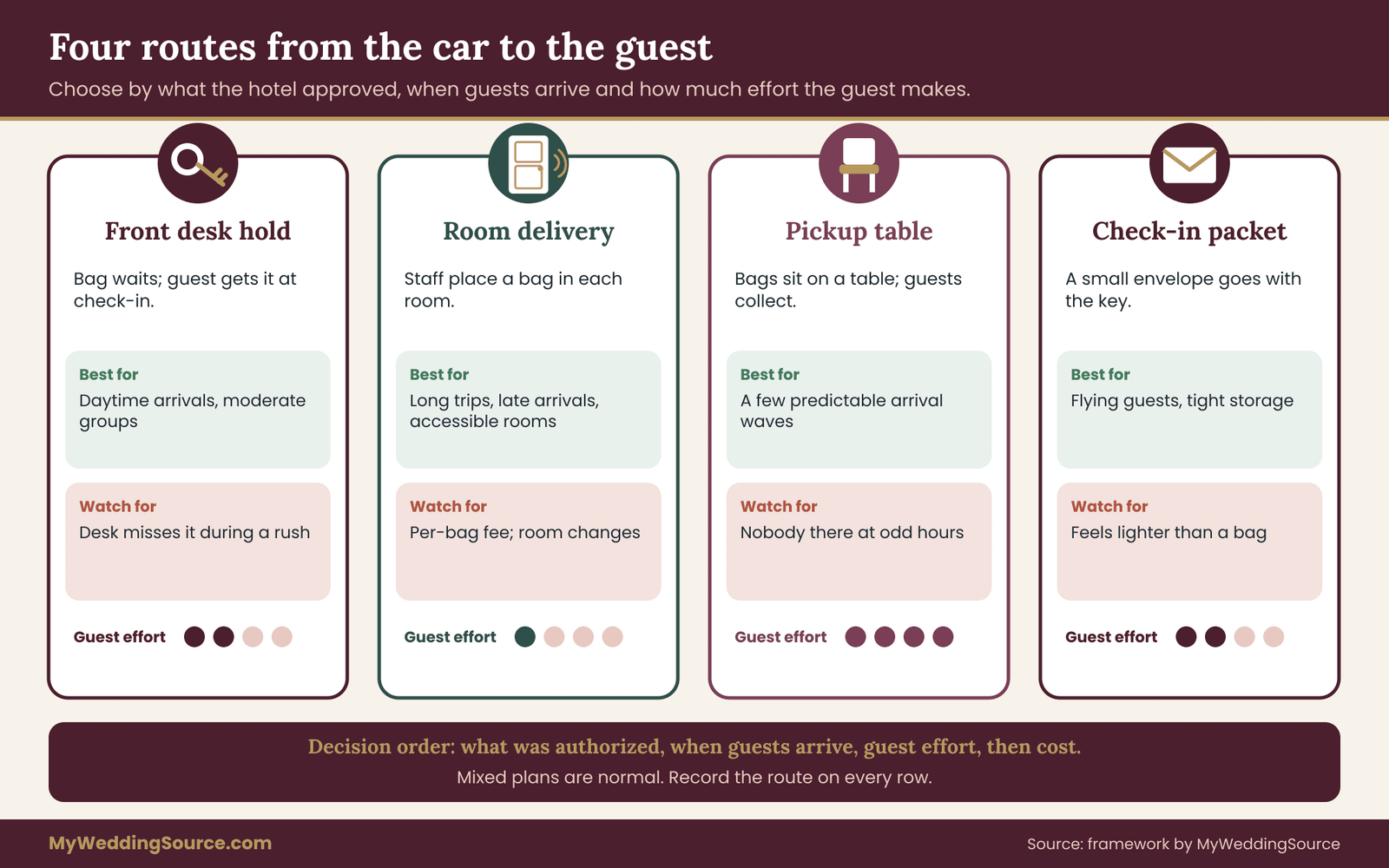
Once the hotel has told you what it will do, you choose a route for each household. There are four common routes, and most weddings use two of them. Each has a cost, a risk and a kind of guest it suits best.
Route one: front desk hold
Bags are left with the front desk, labeled by name and code. When a guest checks in, the agent hands over the bag along with the key.
This route is cheap or free at many hotels, easy to explain and gentle on staff. Its weak point is the handoff at check-in, which depends on the agent noticing that the guest has a bag waiting. A busy desk at four o’clock on a Friday will miss some. To reduce misses, ask the hotel to attach a note to each reservation, or to keep an alphabetical list at the desk.
It suits groups of moderate size, arriving mostly in daylight, when a hotel has a permanent desk team. It suits poorly any guest arriving late at night, when staffing is thin, or any hotel that changes shifts without a handover note. For a simple welcome bag delivery, it is the usual starting point.
Route two: delivery to the room
Staff place a bag in each room, either before check-in or shortly after. This is the warmest experience for the guest and the one that most often carries a fee.
The risks are practical. A bag placed in the wrong room, left on a bed that has been booked for someone else, or removed by housekeeping as abandoned property are all real possibilities. Rooms can also change between booking and arrival, and a bag assigned to room 412 may land in an empty room if the guest was moved.
Ask whether the hotel delivers before or after check-in. Before check-in is nicer, but it makes a bag more vulnerable to room changes. After check-in is safer, but depends on staff acting within an hour or two of arrival. Also ask how the hotel handles do-not-disturb signs and whether it will put a bag outside a door.
This route suits hotels that routinely do amenities, groups that pay for the service and guests who have traveled long distances. It suits poorly a group of eighty rooms with a tight budget. Room-by-room welcome bag delivery is where a clear fee matters most.
Route three: welcome desk or pickup table
Bags sit on a table in the lobby, a meeting room or near the check-in area. Guests collect their bag on arrival, either unassisted or with a volunteer.
This route is the most flexible and the cheapest, since no hotel labor is involved beyond the table space. It also lets you greet guests in person. Its risks are that guests walk past the table, that bags stay unclaimed, and that nobody is there when a guest arrives at an odd hour. If you want the table staffed, plan volunteers in shifts and give each one the tracking sheet.
This route suits groups that arrive in a few predictable waves, couples who want to meet guests, and hotels that offer a hospitality suite. It suits poorly spread-out arrivals over several days, or hotels with strict rules about unattended items in public areas. A table is the fallback for welcome bag delivery when the hotel declines.
Route four: check-in packet
Instead of a bag, each guest receives a smaller item at check-in, such as an envelope with the schedule, a map, a snack and a note. The hotel may place it with the key packet, so the guest gets it automatically.
A packet is small enough that most front desks will accept it without fuss. It avoids the storage and weight problems of a full tote. It is also the easiest route to deliver by mail ahead of time, which has its own constraints discussed below.
This route suits flying guests, hotels with limited storage and couples who want to reduce cost. It suits poorly couples who want a gift-like presentation, since a packet is not the same thing as a bag. It is a lighter form of welcome bag delivery.
A decision rule for choosing a route
Choosing a route can feel like a matter of taste, but a short rule gets you most of the way there. Ask four questions in this order.
First, what did the hotel actually authorize? If the answer is only “hold at the desk,” then route two is off the table for now. Do not plan on a route the hotel has not approved.
Second, when do guests arrive? If most arrive in a window of a few hours, a staffed table (route three) works well. If they arrive across two or three days, front desk hold (route one) or room delivery (route two) copes better, because they do not need a person present.
Third, what is the guest’s effort? Rank the routes by how much the guest has to do. Room delivery asks nothing. Front desk hold asks the guest to receive a bag at check-in. A pickup table asks the guest to find the table. Choose the lowest-effort route you can afford for each guest, and the highest-effort route only where no other is available.
Fourth, what is the cost? Compare totals using the cost logic from the earlier section, including your time and likely waste.
It is common to end up with a mixed plan. Front desk hold for daytime arrivals, room delivery for guests who arrive after the desk’s busy hour, and a pickup table for the Friday evening wave. A mixed plan is fine as long as the tracking sheet records the route for each row. Mixed routes are normal in welcome bag delivery.
Mixing routes across two hotels
If guests are split across two properties, do not assume the second hotel works like the first. Each needs its own authorization, its own fee comparison and its own sheet. A route that worked beautifully at the larger hotel may be impossible at the smaller one, where the front desk is one person and the storage room is a closet. Every hotel changes the terms of welcome bag delivery.
The tracking sheet has a hotel field for this reason, and the room-tracking worksheet section above explains how to keep both hotels visible on one sheet without mixing their bags.
Timing welcome bag delivery around arrivals
Timing causes more welcome bag delivery failures than any other factor. A bag that arrives at the hotel two days early may be lost in storage. A bag that arrives after the guest has checked in may sit unclaimed. The skill is to match bag timing to arrival timing.
Work backward from the first check-in
Find the earliest likely check-in time for your guests. Most hotels have a standard check-in time in the afternoon, but some guests will arrive earlier and ask to leave luggage, and some will arrive late at night. The earliest realistic arrival is your deadline for having bags at the hotel.
Aim to deliver the bags to the hotel the afternoon or evening before the first guest arrives, if the hotel allows it. That gives the hotel time to store them, and gives you time to fix a problem. A same-day drop-off leaves no margin, and a drop-off several days early may be refused or charged for extra storage.
Plan for waves, not an average
Guests do not arrive evenly. Arrivals tend to cluster around a few moments: the first afternoon, just before a welcome event, and late in the evening after flights. If you plan for an average, you may staff nothing at the busiest hour.
Look at your guest travel data. Which guests are flying, and what times do their flights land? Which are driving a short distance and likely to arrive early? Group them into two or three waves and plan each wave on its own. Sorting guests by how they travel is the simplest way to do it.
The late arrival problem
Guests who arrive after midnight are the group most likely to get no bag. The desk is thin, the hold list may not be at hand, and the staff member who knew about your arrangement went home hours ago. Late arrivals are where welcome bag delivery most often fails.
For these guests, choose room delivery or a note at the desk that the bag is in a named location. If the hotel will not do either, a check-in packet that is placed with the key envelope is the next best option. Do not leave late arrivals to the pickup table, since nobody will be there.
Perishables and time
If any bag contains perishable food, the timing question becomes a safety question. Food that needs refrigeration cannot sit at room temperature for hours behind a desk. If you include any such items, ask whether the hotel can refrigerate them, and for how long, and what its policy is for outside food. Many hotels do not accept it.
The simplest approach is to choose shelf-stable items. Food labeling and allergen rules are published by the U.S. Food and Drug Administration, and any packaged food that you assemble yourself should carry a clear ingredient list so a guest with an allergy can check it. If the hotel needs a list of contents, give them one. The relevant agency pages are in the sources at the end of this guide.
What to do on the day of welcome bag delivery
On the day you deliver the bags to the hotel, follow a short routine.
Count the bags before you leave your location, and again at the hotel with a staff member present. Write the count and the time on the receiving slip, if there is one, and take a photo of the bags and the slip.
Ask the staff member where the bags will be kept, and ask to see it if possible. Confirm that the person at the desk tomorrow knows about them. A quick written note on the hold list, with your name and the contact on your sheet, helps a great deal.
Update Sheet B. Mark every bag in the batch as handed off, and record the name of the person who received them. The next step in the process starts from that record.
Questions to ask before approving welcome bag delivery
A good phone call or email thread has a short list of questions and a clear order. The questions below are grouped by what they settle. You do not need to ask all of them at every hotel, but you should know the answer to each before you commit to a route.
Questions about permission
Ask who at the hotel approves outside welcome bag delivery for a group, and whether approval needs to be in writing. Ask whether your group contract covers it, or whether it needs a separate request. Ask whether anyone besides you may drop off bags, and what the person at the door will need to show.
If a courier will bring the bags, ask whether the hotel accepts that carrier, whether it requires advance notice, and whether someone must sign for the packages.
Questions about handling
Ask whether the hotel will hold the bags, deliver them to rooms or do neither. If it does both, ask which it recommends for your group size. Ask where bags will be stored, who has access and whether the storage area is locked.
Ask how long bags may be held, and what the hotel does with unclaimed bags after check-out. Some will throw them away, some will give them to a charity, some will return them to you if you ask in advance. Decide which you want and say so.
Ask whether the hotel attaches a note to the reservation so the desk knows to hand over the bag at check-in. Ask whether that note carries across shifts.
Questions about contents
Give the hotel a plain list of what is in the bag, and ask whether anything is a problem. Alcohol, perishable items, flowers in water, candles and anything with a strong smell are the usual issues. Ask whether the hotel inspects bags, and whether it requires them to be sealed or open.
If the bag contains food, say so, and mention any common allergens in the ingredient list. Keep a copy of the list in your records so you know what you handed over.
Questions about money
Ask for each fee by name: per-bag, handling, storage, package receiving, after-hours and gratuity. Ask whether each applies to you, and whether it appears on a master bill or must be paid separately. Ask for the answer by email. Fees for welcome bag delivery should never be a surprise.
A useful follow-up: “If we deliver fewer bags than we told you, does the fee change?” The answer tells you whether a flat fee is truly flat.
Questions about information
Ask what guest information the hotel needs, and in what form. Ask whether it will share a rooming list or arrival report, how often it refreshes and who sends it. Ask what it can and cannot confirm about a named guest. Ask how you should label bags so the desk can match them.
Questions about problems
Ask what happens if a guest is not found, if a room is changed, if a guest checks out early, or if a bag is damaged. Ask who the best contact is on the weekend, with a phone number that reaches a person and not a general line. Ask whether that person works the whole weekend or just the day.
Finally, ask whether the hotel accepts responsibility for lost bags. Most will not. Knowing that does not hurt you. Not knowing it does.
A short email you can adapt
Writing the questions in an email is better than relying on a call alone. Keep it short enough that a busy manager will answer all of it.
“We are hosting a wedding group at your hotel on the dates in our block. May we arrange welcome bag delivery for about forty rooms? We would like to know who may drop bags off, whether you hold or deliver them, any fees, and anything you cannot accept.”
Four short questions, one reply. If the answer is a phone call, follow up with the confirming message described earlier in this guide and file it with the authorization sheet.
Reading the answers
Pay attention to how the hotel answers, not just what it says. A manager who answers each question specifically and offers a written summary is easy to work with. A manager who says “we will take care of it” without detail is friendly and unreliable. In the second case, restate what you understood, and ask for a yes or no.
If the answer is “no outside welcome bag delivery,” do not argue. Ask what the hotel does recommend for welcome bag delivery, because many properties have a sanctioned alternative such as an in-house amenity program, a partner florist or gift shop, or a hospitality suite. Those options often cost more, but they may be the only route open.
A worked example of welcome bag delivery
The following example is invented to show the process. The couple, the hotels and the amounts are illustrative only. Real hotels set their own terms, and your quotes will differ.
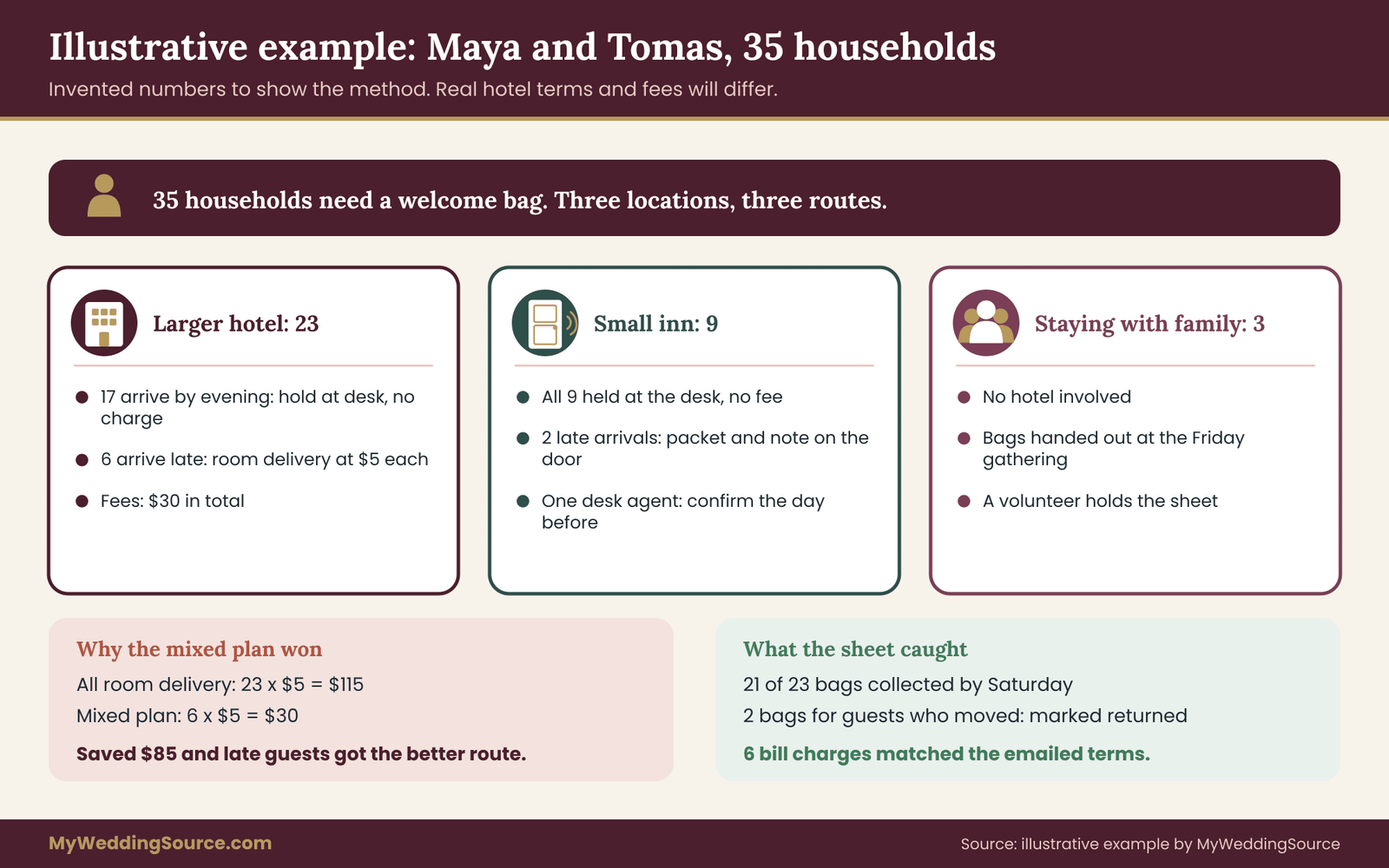
Maya and Tomas are hosting a Saturday wedding. They expect thirty-five households to need a welcome bag. Twenty-three are booked in a room block at a larger hotel, nine are at a small inn nearby, and three are staying with relatives in town.
Step one: authorize
Maya calls the larger hotel’s group sales contact and asks about welcome bag delivery. The contact says the hotel will hold bags at the front desk at no charge for up to two days before check-in, and will deliver to rooms for a per-bag fee that they quote as five dollars. The contact also says no alcohol, nothing perishable. Maya asks for this by email and receives a reply naming the contact and the date.
At the inn, the owner says they will take the bags at the desk and hand them out at check-in. There is no fee. There is one person on the desk, and the inn cannot promise anything for guests who arrive after ten at night.
Step two: label
Maya asks guests for the name on their reservation in a short lodging message. Four guests turn out to be booked under different names, and she records both. Each bag gets a code, such as H01 to H23 for the larger hotel and I01 to I09 for the inn, and the reservation name goes on the tag, with a first name and a last name.
Step three: route
Maya compares costs for the larger hotel. Room delivery for all twenty-three bags would come to one hundred fifteen dollars. Hold at the desk is free. She looks at the arrival times: seventeen guests land or drive in before six in the evening, and six arrive late. She chooses hold at the desk for the seventeen and room delivery for the six, at thirty dollars total. The mixed plan saves eighty-five dollars compared with delivering every bag to a room, and it gives the late arrivals the better experience.
At the inn, all nine bags are held at the desk. Two guests arrive after ten at night, so Maya puts a packet with a note in an envelope on the door with the inn owner’s approval, and asks the owner to confirm the plan on the phone the day before.
For the three households staying with family, Tomas brings their bags to the Friday welcome gathering, with a volunteer holding the tracking sheet at the door.
Step four: prove
On Thursday afternoon, Tomas drops the bags at the larger hotel. A staff member counts twenty-three, writes the count on a slip and initials it, and Tomas photographs the slip and the stack. He marks all twenty-three as handed off in the sheet, with the staff member’s name and the time.
On Friday, a volunteer checks the front desk list at four, at seven and at ten in the evening and marks bags as delivered. By Saturday morning, twenty-one of twenty-three bags have been collected. The two that remain belong to guests who changed hotels. Maya finds out from a text message, marks both as returned, and picks them up.
At checkout, Maya reviews the master bill. Six per-bag charges appear, matching her sheet. Total fees: thirty dollars.
What the example shows
Three things are worth noting. The mixed plan was cheaper and better than a single method. The tracking sheet caught two bags that would otherwise have sat unclaimed all weekend. And the fee on the bill matched what the hotel promised in writing, because Maya had the email. The whole welcome bag delivery cost thirty dollars and a few hours of planning.
None of this required special software or a large effort. It required asking the right questions early, writing down the answers and keeping one list.
Edge cases that break welcome bag delivery
Plans fail at the edges. The following cases come up often enough to prepare for, and most have a cheap fix if you decide on it before the weekend.
Guests who change hotels
A guest cancels the block room and books elsewhere, sometimes the night before. The bag is now at a hotel where the guest is not staying. Keep a line in your sheet for “moved,” and ask the hotel to tell you when a reservation is cancelled. If it will not, check the rooming list the day before arrival. A bag that arrives at the wrong property can be collected and redirected, but only if you know it is there.
Guests who arrive early or stay a night longer
Early arrivals check in before your bags are ready, or before the hotel has them on its list. Late departures pass the date on which the hotel stops holding items. For early arrivals, consider a check-in packet that can be left as soon as a guest shows up. For long stays, write the hold period into the authorization and check it against your guest list.
Room changes and upgrades
If a guest is moved between rooms, a room-delivered bag may be left in the first room. Ask the hotel to deliver by name rather than by number, so the staff member looks up the current room at the time of delivery. If the hotel can only deliver by room number, ask it to confirm the number on the day.
Shared rooms and several names
Cousins sharing a room, a couple booked under one partner’s name, a family of five across two rooms. Decide in advance how many bags each gets, and make the choice visible in the sheet. For shared rooms, one bag per room is the usual rule. For families split across rooms, one bag per room is common too, with a note in the bag for children.
A guest who needs an accessible room
A guest who uses a mobility device may be in an accessible room on a particular floor, and the hotel may give that guest a specific entrance or elevator. Room delivery is usually the kindest route for this guest, since it avoids a trip to a pickup table. Accessibility requirements are set by law and by the hotel’s own policy, and the guide to planning guest hotels for different mobility needs covers how to confirm room types, so ask the hotel to confirm what it offers, and check the U.S. Department of Justice ADA resources listed in the sources.
Do not mention the reason for a room assignment in any note to the hotel. A bag does not need to carry that information.
Bags that do not meet the hotel’s rules
If the hotel says an item is not allowed, take it out. A bag with a banned item may be refused entirely, or opened and altered by staff. Replace the item with something permitted, or move it to a separate gift that you hand over in person. The cost of doing this on Thursday is small. The cost of discovering it on Friday afternoon is a delay and an awkward conversation.
Bags that arrive damaged or open
Check each bag when the hotel hands it back, and when you receive it from a courier. A bag that has been dropped, crushed or opened is a loss you want to document right away. Take a photo, tell the hotel, and note it in the sheet. If food is involved, and the packaging is broken, remove it from the bag rather than trusting it.
Packages shipped to the hotel
Shipping bags to the hotel ahead of time can save a trip, but adds more steps. Hotels vary in whether they accept packages at all. Some accept them only for registered guests, some only for event organizers, and some charge per package. Ask for the shipping name and address format the hotel wants, and which date it will start accepting packages.
Use a carrier that provides tracking, and note the tracking number in your sheet. Check the carrier’s own rules for what it ships and how long it holds, using the carrier’s official page. Mark the shipment as handed off when the carrier gives you a delivery confirmation, and as held only when the hotel confirms it has the boxes.
Staff turnover
The person who agreed to your arrangement will not be at the desk all weekend. Shifts change, and the information may not change with them. A short written note, left on the hold list and signed with the name of the approver, will survive a shift change. A verbal promise will not, and welcome bag delivery has to survive a shift change.
Ask for the name of the weekend contact, and put that name and a phone number at the top of Sheet B.
The guest who does not want a bag
A guest may decline a bag or prefer one handed over in person. Make it easy. The tracking sheet should have a line for “declined,” and nothing should be added to the guest’s room without a reason. Remove the bag from the batch, and use it for the next guest on the waitlist or return it.
When nothing works
If the hotel refuses all outside welcome bag delivery and no alternative is available, switch to a table or a welcome event. A small table near the venue, a basket at the rehearsal dinner or a bag handed to each guest at the first gathering all work, and none require anyone’s permission but the venue’s. It is less elegant than a bag on the bed. It is also better than a failed welcome bag delivery, and it is an honest substitute when the hotel says no.
The broader point about handling plans that fall apart is covered in the wedding etiquette guide, which has a good deal to say about keeping hospitality gracious when something goes wrong behind the scenes.
Measuring whether welcome bag delivery worked
A welcome bag delivery is not done when the bags are handed over. It is done when the guests have them and the bill matches the agreement. The checks below take a few minutes and tell you whether the system worked.
Five measurable checks
Count match. The number of bags packed equals the number handed off, plus any bags you kept for a separate route. If the numbers differ, find the gap before the weekend begins.
Name match. Every reservation name on the hotel’s rooming list matches a row in Sheet B, and every row has a bag. Do this the day before arrival and again the morning of the first check-in.
Delivered share. Of all bags, how many are marked delivered or confirmed by the end of the first evening? There is no universal target, but you should know what your share is, and which bags are outstanding.
Unclaimed bags. At the end of the weekend, how many bags remain? For each one, a reason in the issue field: guest did not come, guest changed hotels, bag was missed.
Fee match. Every fee on the final bill appears in the authorization, and every authorized fee appears on the bill. A fee that is on the bill and not in the authorization needs a question. A fee that is in the authorization and not on the bill is a credit you may be owed, or an error in your sheet.
A quick day-of routine
On the first arrival day, keep a short loop. Check the hold list at the desk at a set time, such as late afternoon, early evening and last thing at night. Mark bags that have gone out. Ask the desk about any that have not. If a bag is still waiting after the guest has checked in, find out why.
A volunteer can do this. It takes ten minutes each time, and it catches most of the problems in the same afternoon.
After the weekend
Reconcile Sheet B with the bill within a few days. Mark every bag with its final status, record the fee against each row, and note anything that did not work. If a bag is unclaimed, decide what to do with it: bring it to the guest at home, donate non-perishable contents where appropriate, or discard what cannot be used.
Keep the authorization, the confirmation emails and the final sheet with your other wedding paperwork. They are small, but they settle questions about fees and responsibility later. Review welcome bag delivery while it is fresh. The habits for storing this kind of record are explained in the guide to wedding records after the event, and a welcome bag folder fits easily into that system.
Feedback for next time
Spend a few minutes writing down what you would change. Which route worked best? Which questions did the hotel need a second email to answer? Did the labels hold up? If you are helping a friend or family member plan an event, that note is the most useful thing you can hand over.
Who owns each handoff and what guests are told
Welcome bag delivery goes wrong most often when two people each assume the other one called the hotel. Assign one owner to each handoff, and give each owner the page they need.
Four roles, kept small
Most weddings need only four roles, and one person can hold more than one.
The hotel contact owner speaks to the hotel, gets the welcome bag delivery authorization in writing and is the single person the hotel calls. This is usually a partner or a planner, not a parent who is also hosting.
The sheet keeper maintains Sheet B, updates statuses and answers any question about where a bag is. This person needs access to the guest list and should be someone comfortable with a spreadsheet or a notebook.
The drop-off person brings the bags to the hotel, counts them with staff, and photographs the slip. This person should be named on the authorization.
The weekend checker visits the front desk at set times during arrivals and reports what has gone out. A cousin or a friend who is already staying at the hotel is ideal.
If you have a planner or coordinator, they may take two or three of these roles. Even then, name them. The purpose is clarity, not bureaucracy.
Hand over the pages, not the whole plan
Each person needs only their own page. The drop-off person needs the authorization, the hotel contact, the drop-off window and the bag count. The weekend checker needs the sheet, the hold list times and the phone number to call about a problem. Handing every helper the whole plan makes it likelier that nobody reads it.
A written contract term helps more than a verbal promise. If the hotel agrees to hold bags, put it in the group agreement or an addendum, in the same way the wedding vendor contract guide describes for other vendors. The clause does not have to be long: what the hotel will do, for how long, at what cost.
Telling guests what to expect
Guests should know a bag is coming, where it will be, and what to do if it is not there. A short message, sent with the lodging details, does this without spoiling the surprise of what is inside.
“A small welcome bag will be waiting for you at the front desk when you check in. If it is not there, tell us and we will sort it out.”
Include your name or a helper’s contact for a problem, and do not make guests choose among routes. The couple arranges the route, and the guest simply arrives.
For guests who prefer not to have their name shared with the hotel, offer a pickup option at the first event. Ask in the same message, and keep the answer in the sheet. The wedding guest list guide covers how to gather guest details in one pass, and you can add the reservation name and hotel to the same form instead of sending a second request.
A note on thank-yous and tips
If hotel staff go out of their way, a thank-you matters. Ask the contact whether tips are customary and how to give them, and whether the hotel adds a service charge. Some hotels pool gratuities, and others prefer that guests or hosts tip staff directly. Do not assume. A short written thank-you to the manager, with a copy to the person who helped, costs nothing and makes a later request easier.
Your next steps
You can set up welcome bag delivery in an evening, plus one phone call to each hotel.
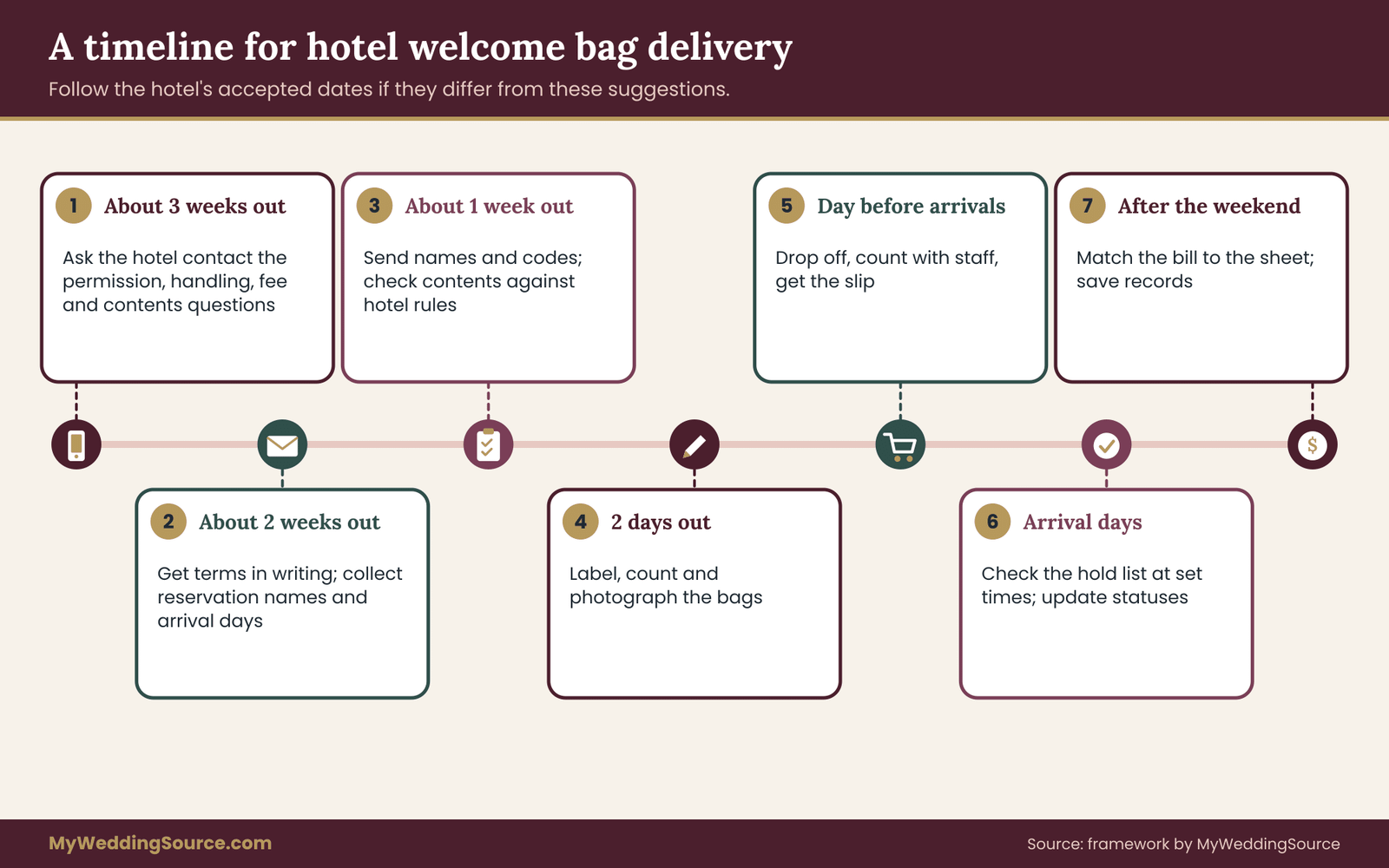
- Decide how many households need a bag, and which hotel each is staying in.
- Contact the hotel’s sales, events or group contact, and ask the questions in this guide about permission, handling, fees and contents.
- Get the answers in writing, and file them as Sheet A, the welcome bag delivery authorization.
- Ask guests for the name on their reservation and their arrival day, and build Sheet B with a bag code for each household.
- Choose a route for each household, using the decision rule: what the hotel authorized, when guests arrive, how much effort the guest makes, and what it costs.
- Label the bags with the reservation name and code, and check each against the sheet.
- Deliver the bags the day before the first arrivals, count them with staff, and photograph the slip.
- Assign a weekend checker, check the hold list at set times and update statuses.
- After the weekend, reconcile the sheet with the hotel bill and save everything with your other wedding records.
If a hotel refuses outside welcome bag delivery, skip to a table at the first event and use the same sheet to track who has collected a bag.
FAQ
Do hotels charge for welcome bag delivery?
Some do and some do not. Common structures include a per-bag fee for room delivery, a flat handling charge, a storage fee and a package receiving fee. Many hotels hold bags at the desk at no charge. Ask the hotel to name each fee or confirm there is none, and get the answer in an email so the final bill can be checked against it.
Can the hotel tell me my guests’ room numbers?
Usually not. Hotels generally protect guest privacy and may not confirm that a person is staying there. Ask whether the hotel will deliver by name, hold bags at the desk or share a rooming list for your group block. Do not ask guests to post room numbers in a group chat. If guests volunteer them, keep them private and delete them afterward.
Who should drop off the bags?
Choose one named person, list that person on the welcome bag delivery authorization and tell the hotel in advance. That person should count the bags with a staff member, get a receiving slip and photograph it. If a courier delivers instead, ask the hotel whether it accepts that carrier, who signs and whether a package receiving fee applies.
How early can we deliver the bags to the hotel?
It depends on the hotel’s storage space and policy. Many prefer welcome bag delivery the day before the first guest arrives, and some refuse items sent days ahead or charge for storage. Ask for the earliest and latest accepted dates, and plan to deliver the afternoon or evening before the first expected check-in so there is time to fix problems.
What if a guest is not on the hotel’s list?
First check the name. The reservation may be under a spouse, a maiden name, an employer or a travel agent. Ask the guest for the exact name on the booking and add it to your sheet. If the guest is at a different hotel, redirect the bag. If the guest is staying with family, hand the bag over at a gathering instead.
Can we put food or alcohol in the bags?
Check with the hotel before you pack. Many hotels will not accept alcohol or perishable food from outside parties, and unlabeled food can be a problem for guests with allergies. Choose shelf-stable items with a clear ingredient list, give the hotel a plain list of contents and read the U.S. Food and Drug Administration’s labeling guidance for packaged food.
What if the hotel refuses outside welcome bag delivery?
Ask what it does allow for welcome bag delivery, since some hotels run their own amenity program or offer a hospitality suite. If nothing is available, hand out bags at a table near the first event, such as a rehearsal dinner or welcome gathering. Use the same tracking sheet, so you still know who has received a bag and who has not.
How many bags do we need if guests share rooms?
One bag per room is the common rule, since a bag is a household item and not an individual one. Check your reservation names to see how many rooms each family has, and decide in advance how to treat families in several rooms. Record the choice in your sheet so the count of bags matches the count of rooms.
Sources
- Federal Trade Commission: consumer protection and privacy guidance for businesses and consumers.
- U.S. Food and Drug Administration, Food: food labeling, allergen and food safety information for packaged foods.
- ADA.gov, U.S. Department of Justice: Americans with Disabilities Act requirements and guidance on accessible lodging.
- Centers for Disease Control and Prevention, Food Safety: guidance on keeping food at safe temperatures.
- U.S. Consumer Product Safety Commission: product safety information for items included in gift bags.
- U.S. Postal Service: shipping rules, tracking and delivery confirmation for mailed packages.
- UPS: carrier shipping terms, tracking and package delivery options.
- FedEx: carrier shipping terms, tracking and package delivery options.
- Consumer Financial Protection Bureau: guidance on reading bills, disputing charges and understanding fees.
- USA.gov: entry point to federal consumer information and agency contacts.