
A wedding coat check is a staffed or self-serve system for holding guests’ coats, bags and umbrellas during the reception, and it works only when three numbers agree: how many items arrive, how many people can handle them at the peak, and how many claim tickets come back at the end. This guide gives you a way to estimate each number, run the wedding coat check, and settle the night without arguments about a missing scarf.
Plan a wedding coat check in four moves. First, decide whether you need one at all, using the weather, the venue’s built-in storage and your guest list. Second, estimate coat volume: guests in the room, times the share you expect to wear coats, plus a buffer for bags and hats. Third, staff the two busy windows, arrival and departure, not the whole evening. Fourth, use a two-stub claim ticket system and count the stubs at the end, so every item is either returned or accounted for.
Coats are the quiet logistics problem of a cold-weather or rainy wedding. Nobody puts them on a mood board. Yet in the first twenty minutes of a reception, a pile of wet wool near the entrance can block the doorway, make guests feel unwelcome and leave you with a nagging question at midnight: whose gray coat is this?
A wedding coat check solves the problem, but only if it is sized and run with some care. An undersized desk produces a line while the cocktail hour waits. An oversized one costs staff hours you did not need. A desk with no ticket discipline loses things, and then you are on a phone call the next week trying to match a description to a lonely scarf.
This guide is built around one idea: a coat volume and staffing estimate, followed by claim-tag reconciliation. The estimate tells you how much to rent and whom to schedule. The reconciliation tells you, before everyone leaves, whether anything is missing. Between them sit the practical choices about space, tickets, scripts for your staff and what to do when an item goes astray.
A note on scope. This is general planning information, not legal, insurance or safety advice. Fire codes, occupancy rules and liability terms differ by venue and jurisdiction, so the specific numbers and rules in your building come from the venue, its fire authority and your own contract, not from this article.
The guide sits inside the wider topic of how guests move through a reception, which the wedding reception guest flow guide covers from entry to exit. Here we stay with one stretch of that path: the minute a guest walks in wearing outerwear and the minute they walk out again.
What a wedding coat check covers, and what it does not
The phrase sounds simple, so it helps to say what the service includes. A wedding coat check is any arrangement where guests hand over outerwear and small belongings at arrival, receive some proof of that handover, and get the items back when they leave. Everything else, from valet service to a gift table, is a different job with different risks.
In practice a wedding coat check covers four kinds of items:
- Outerwear. Coats, jackets, capes, wraps and shawls, from light cardigans to heavy parkas.
- Accessories. Hats, scarves, gloves and umbrellas. These are small, easy to lose and often the items guests ask about afterward.
- Bags. Totes, backpacks, small suitcases from guests traveling in, and diaper bags. Handbags are a judgment call, covered later.
- Mobility and baby gear. Folded strollers, car seat bases and similar items, if the venue allows them to be stored at all.
What it does not cover is equally important. It does not cover valuables. It does not cover gifts and cards, which belong on a separate, watched table with its own plan. And it does not cover items guests leave on chairs, which are a lost-and-found matter rather than a wedding coat check matter.
The three ways a wedding coat check can run
Almost every setup falls into one of three models, and the model you choose changes the staffing and the ticket system.
Attended with tickets. Staff or hired attendants take each item, hang or shelve it, and hand over a numbered ticket. This is the model most people picture, and the one this guide focuses on because it needs the most planning.
Self-serve racks. Guests hang their own coats on racks or hooks with no tickets. It is cheap and quick, but nobody is accountable for what happens to the items, and coats get mixed up. It can work for a small, casual wedding in a space you can see from where you sit.
Hybrid. Guests hang their own coats, but a single attendant sits nearby to watch, hand out tags for bags and valuables, and answer questions. This is a common middle route, and it is often the best choice at mid-sized weddings.
A reasonable question is whether any of this belongs in your budget when the venue may already have a closet. The next section gives a decision rule for exactly that.
Do you need a wedding coat check? A decision rule
Plenty of weddings do not need a formal desk. A July garden party with a mild evening and a handful of wraps does not justify a staffed counter. A January ballroom reception with a long arrival line plainly does. The more useful question is where your wedding sits between those poles, and a short decision rule keeps you from guessing.
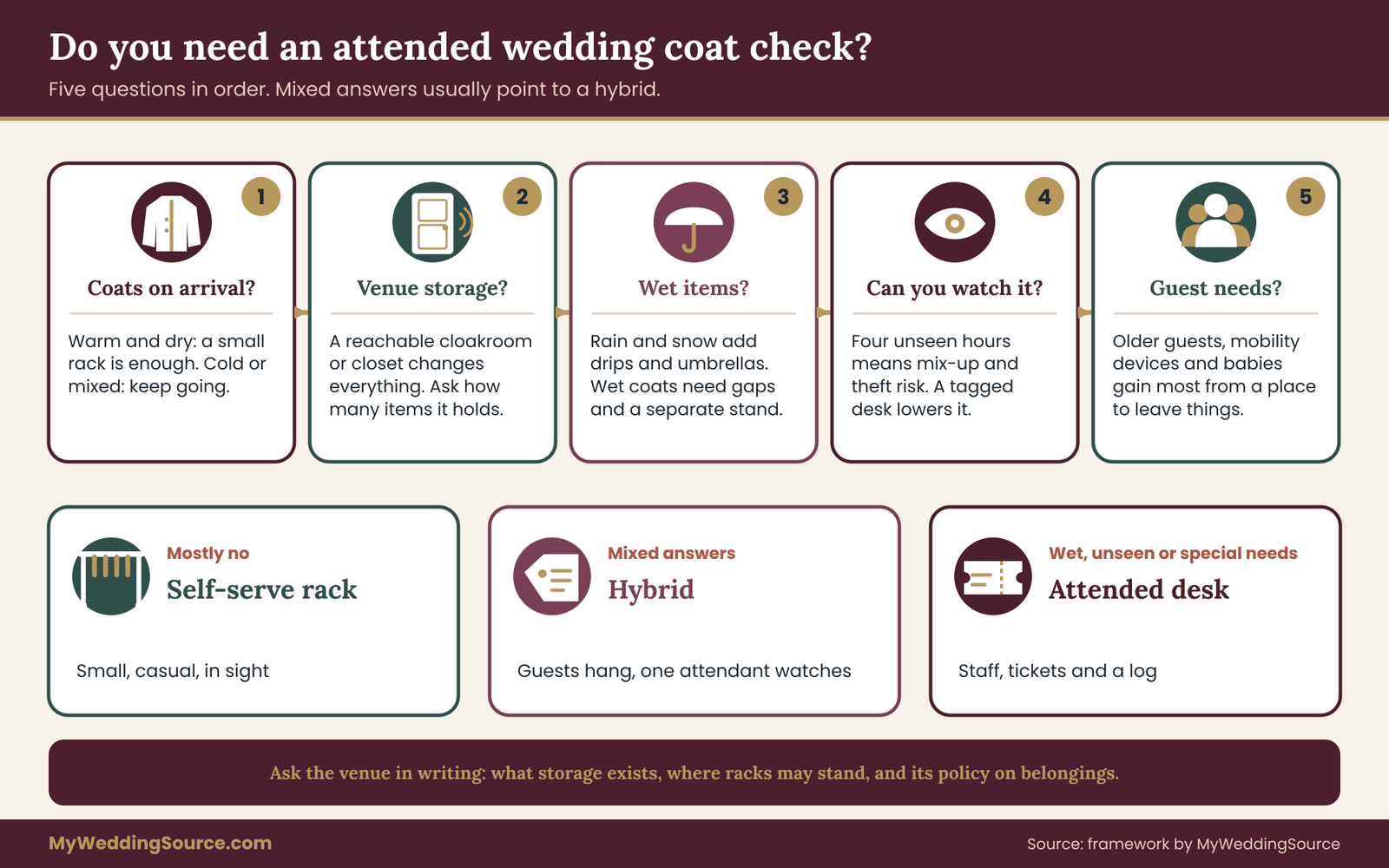
Ask five questions, in order. The first “no” that matters to you usually settles the answer.
- Will most guests arrive wearing outerwear they will not want on during the evening? If the weather is warm and dry, the honest answer may be no, and a small self-serve rack for the few who need it is enough.
- Does the venue have storage that guests can reach without crossing the main path? A closet by the entrance, a cloakroom or a lockable side room changes everything. Ask to see it, and ask how many items it holds.
- Is the weather likely to leave wet items? Rain and snow add weight, drips and the need for umbrella handling. Wet coats should not hang pressed against dry ones, so wet weather pushes you toward more space and more attention.
- Can you watch the storage area? If the coats will sit out of anyone’s sight for four hours, you have a theft and mix-up risk that tickets and an attendant reduce.
- Does your guest list include people who will struggle to carry or keep track of belongings? Older guests, guests with mobility devices and guests traveling with small children benefit most from a place to leave things.
If your answers point to “yes” on questions three, four or five, plan for an attended wedding coat check. If they point to “no” on one and two, a self-serve rack is likely enough. Mixed answers are where the hybrid model earns its keep.
A worked reading of the rule
Take an invented couple, Dana and Marcus, weighing a wedding coat check for a late-November evening wedding of around 140 guests in a converted warehouse with no cloakroom. The forecast in their area is typically cold but they cannot know the day’s weather this far out.
Question one: yes, most guests will arrive in coats. Question two: no storage that is out of the way. Question three: possibly, since November often brings rain or sleet where they live. Question four: the entrance is near the bar, so they can see the area from the cocktail space, but not from the dining room. Question five: three older relatives and two guests with babies.
Reading that, they plan an attended wedding coat check. It is not a close call. If the same wedding were in a venue with a staffed cloakroom, they would simply confirm the cloakroom’s capacity and fee and skip the planning work below.
What the venue may already provide
Before you rent anything, ask the venue four things in writing. Does it have a coat room or closet, and how many coats does it hold? Does it provide racks or hangers at no extra cost? Does it supply an attendant, and at what hourly rate? And does it have any rule about where racks may stand, because racks near exits and in corridors are a safety question for the venue’s fire authority, not a decoration choice?
Many venues will have a standard answer. Some include a wedding coat check attendant with certain packages; others have a firm no-liability policy printed in the contract. Get the answers before you design your setup, because the venue’s answer sets the limits within which your plan has to fit. The wedding vendor contract guide explains how to read clauses like these, and it is worth reading before you sign anything that mentions belongings.
When to skip an attended wedding coat check
There are honest reasons to skip it. A small wedding where everyone sits in one room can use a rack in the corner of that room, in plain view, and that is better than a staffed desk by the door. A micro-wedding of a dozen guests rarely needs more than a few hooks. And a mild-season wedding with an outdoor ceremony and indoor reception may produce so few coats that a single attendant is paying for decoration.
What you should not skip is the question. Even a tiny wedding benefits from knowing where the coats will go before the first guest arrives, because the alternative is a heap on a chair that someone has to move at the first toast.
The wedding coat check volume estimate
Volume is the number that drives everything else in a wedding coat check: hangers, rack length, tickets printed, attendant count. The good news is that you can get a usable figure from four inputs and a few minutes of arithmetic. The honest caveat is that two of the four inputs are judgment calls, not data, and the method below says so out loud.
Call the method the Four-Input Count. It produces a planned number of tickets and a planned number of hanging spaces, each with a buffer.
Input one: people in the room
Start with the number of guests you expect to attend, not the number you invited. Use your confirmed responses and subtract the no-shows you would normally expect, or simply use the confirmed count if you have it. Then add the people who will be in the room but are not on the guest list: the wedding party if they are not counted, the officiant, the photographer and videographer, the band or DJ, and any hired staff who might bring a coat.
Vendors are the group people forget. A band of five and a photography team of three are eight more coats that will want somewhere to go. Ask each vendor whether they will keep their belongings in a separate back-of-house area, which most do. If they will, leave them out of your count. If not, include them.
Input two: the share of people who will wear coats
This is the first judgment call. The share depends on the weather, on how long guests spend outdoors between car and door, and on whether the ceremony is outside. There is no reliable national figure for it, and anyone who offers one is guessing, so build your own range.
A simple way to set it is with three bands:
- Warm and dry. Few guests carry a coat. Plan for a low share, such as one guest in four, and keep a spare margin.
- Cool or mixed. Many guests bring a jacket or wrap. Plan for a middle share, around half to three quarters.
- Cold, wet or snowy. Almost everyone arrives in outerwear. Plan for a high share, roughly nine in ten or even everyone.
Those bands are planning assumptions, not statistics. The point is not to be exact. It is to avoid planning for fifty coats and receiving a hundred and ten. When in doubt, plan for the higher band, because an unused hanger is cheaper than a pile on the floor.
For the actual weather, look at the forecast close to the date from the National Weather Service, and make a final decision about the band a few days before. The agency’s safety pages are a sensible place to check how cold, wet or windy conditions are described. Your wedding coat check plan should have a “weather switch”: a note of what you will add or drop if the forecast moves from one band to another.
Input three: items per coat-wearer
A coat-wearer rarely brings only a coat. Hats, scarves, umbrellas and bags all arrive with them. You do not need one ticket per item. You need to decide whether a guest’s belongings are grouped under one ticket or split.
The cleanest approach is one ticket per guest, one tag per group of items. A guest hands over a coat, a scarf and an umbrella, and receives one ticket. The attendant bundles the scarf into the coat sleeve or sleeve-pocket, and bags the umbrella in a thin sleeve or hangs it by the handle on the same hanger. If you allow bags or other large items, give each a separate tag number on the same ticket, so the count of tickets and the count of items can differ without confusion.
For planning, assume a modest number of extra items beyond the coat. Maybe one guest in five brings a bag they want to leave, and a few bring umbrellas. Again, these are your judgment, so round up.
Input four: the buffer
Add a buffer of roughly ten to fifteen percent to cover two things: guests who arrive without a coat and change their mind, and the extra items from guests who do not attend as planned. A buffer also protects you against a miscount of the room. If your ticket stock runs to zero at the hundred-and-eleventh guest, you have a problem that costs far more than a few extra ticket pairs.
The formula, with a worked example
Write the wedding coat check estimate plainly:
Planned coat spaces = people in the room × coat share × (1 + buffer)
Use Dana and Marcus again, planning for 140 guests plus 8 vendors who will use the guest area. That is 148 people in the room. They expect a cold, possibly wet evening, so they use a coat share of nine in ten, or 0.9. They choose a buffer of 0.12.
- People in the room: 148
- Coat-wearers: 148 × 0.9 = 133.2, which they round up to 134
- With buffer: 134 × 1.12 = 150.08, which they round up to 151
So they plan for 151 hanging spaces and print ticket sets numbered 1 to 175, a larger run than the hanging count, to cover bag tags and spare tickets. That gives them a number they can send to the rental company and the venue. If the forecast turns mild, they can drop the share to 0.6 and the planned number to about 100.

How wet weather changes the count
Wet weather does not change the number of people, but it changes how much space each coat needs. A wet coat should not hang packed against a dry one, because moisture transfers and the dry one comes back damp. A practical rule is to leave a gap between wet and dry items and to give umbrellas a separate stand or a lined bin.
You can express this as a space multiplier. If you normally plan for one rack space per hanger, plan for roughly one and a quarter to one and a half spaces per wet coat. That extra room is a planning assumption, not a measurement, but it points in the right direction. In practice it means ordering one more rack than the dry-weather number suggests, or making sure the venue’s closet is not the only storage.
Umbrellas deserve a separate sentence. They drip, they get taken by mistake because many look alike, and they are easy to lose. If rain is likely, plan an umbrella station with its own numbered tags, or encourage guests to leave umbrellas in the vestibule if the venue has one. Some couples prefer to provide a few shared umbrellas near the door for the walk to cars, which keeps personal umbrellas out of the wedding coat check entirely.
Edge cases that change the count
A few situations move the number more than weather does.
Guests who stay only briefly. A short appearance by a neighbor or an older relative still puts a coat on the rack. Count them.
Out-of-town guests. Travelers may arrive straight from the airport with luggage. Ask in your invitation materials or on your wedding website whether guests plan to bring suitcases, and arrange a luggage spot or say plainly that the venue cannot take them.
Guests changing clothes. If your wedding has a ceremony in one place and a reception in another, guests may stash a coat at the first location. Ask each venue what it can hold, and decide whether the second site needs its own desk.
A cocktail hour in a different room. The wedding cocktail hour guide covers how guests flow through that stretch of the evening. If guests spend that hour in a space with no coat storage, they will carry coats until they sit down, which means the wedding coat check must be reachable from the cocktail space.
Checking the estimate against reality
A good wedding coat check estimate is one you can check. Two weeks before the wedding, ask for the final guest count from your caterer and compare it with the one you used. Update the number. Two days before, check the forecast and adjust the share. On the day, the person managing the wedding coat check can keep a running tally of tickets issued and compare it with the plan, which tells you by the half-hour mark whether you are on track or short.
That live tally is also the start of reconciliation, which the later sections describe. If you count tickets as you hand them out, you already know at the end how many items you should have.
Where to put the wedding coat check: space, racks and egress
Once you have a number, you need somewhere to put it. Placement is a safety and flow decision first, and a decor decision a distant second. A wedding coat check in the wrong spot blocks exits, slows entry and strands staff far from the action.
Choosing the location
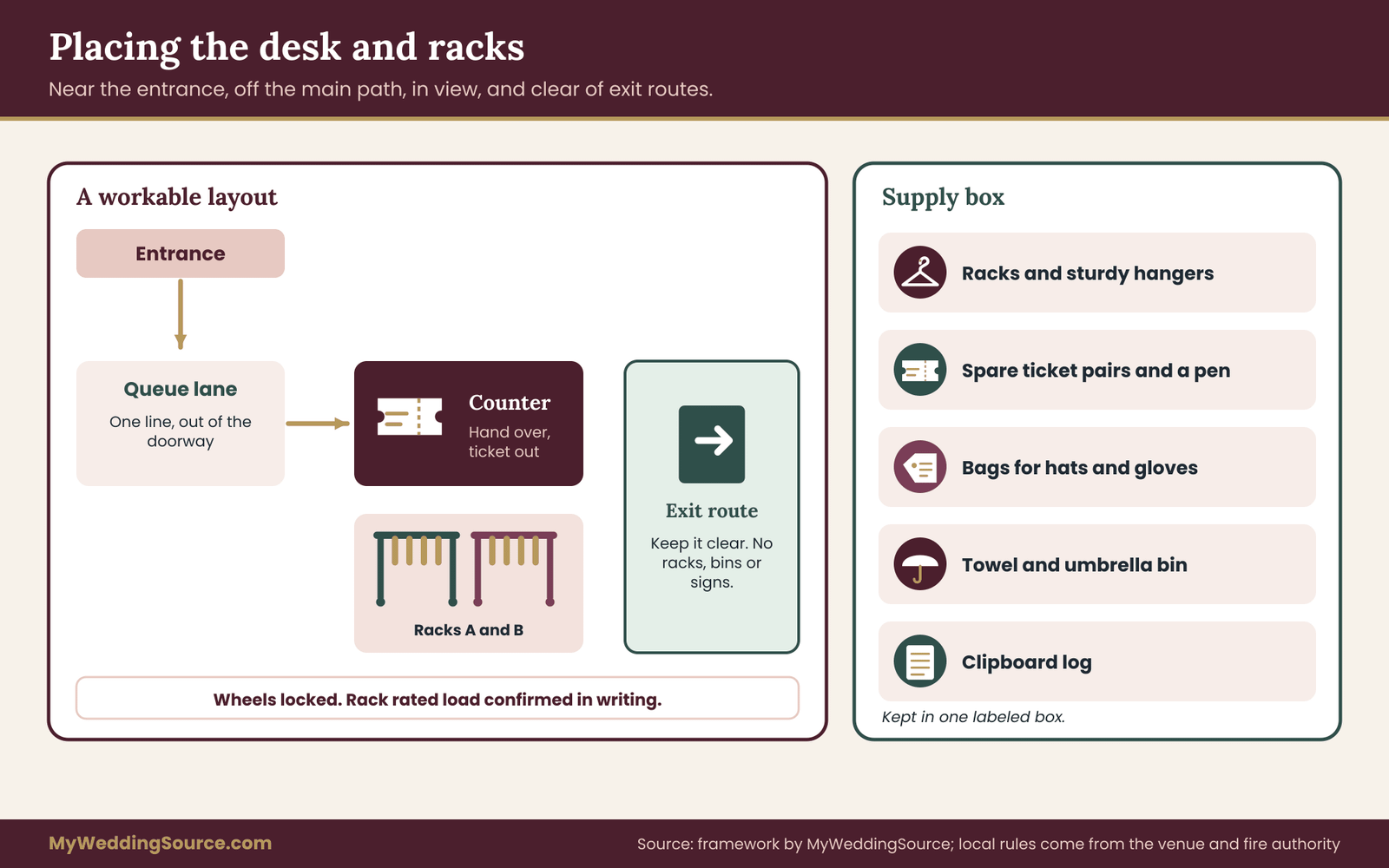
The best location has four qualities. It is near the entrance, so guests meet it naturally on the way in. It is off the main path, so a line does not spill into the doorway. It is visible from somewhere staff can see, so nobody wanders off with an item. And it is out of the exit route, which is the point that matters most.
Egress is the word for the paths people use to leave a building, especially in an emergency. Racks, tables, stanchions and bins can narrow those paths without anyone noticing. Rules about how much clear width a corridor or doorway needs, and about what may stand in it, are set by building and fire codes, and they differ by place. Do not guess. Ask the venue for a floor plan with exits marked, and ask where a rack may and may not stand. If the venue’s own cloakroom exists, use it, because it has already been cleared with the fire authority.
This guide gives no universal figure for capacity or clear width, and it would be wrong to quote one. The venue’s coordinator, and where needed the local fire marshal’s office, can tell you what applies to your room. The National Fire Protection Association publishes the model codes many jurisdictions build on, which is useful background, but your local adoption is what counts.
Rack types and what each does well
You will meet four kinds of storage, and each suits a different wedding.
Rolling garment racks. These are the standard rental. They hold coats on hangers along a bar, they roll to a new position and they fold away. Their weakness is tipping, especially with heavy winter coats on one side. Ask the rental company to confirm each rack’s rated load and whether it has locking wheels.
Wall hooks or a fixed coat rail. If the venue has them, they are the most stable option and need no setup. Capacity is fixed, so you must know the number before you promise to use them.
Shelves or open cubbies. Good for bags, hats and folded items. Not good for hanging coats, but a helpful addition to a rack.
Bins and totes. Cheap, stackable and fine for small items such as hats, gloves and scarves when bagged and tagged. They cannot hold heavy coats without crushing them.
For most weddings the plan is racks for coats plus a shelf or bins for everything else. Order the racks as a number of linear feet or a number of rated spaces, as the rental company prefers, and ask them to put the rated capacity in writing. The wedding rental planning checklist covers delivery windows, damage terms and pickup, all of which apply to racks as much as to chairs.
Hangers, covers and small supplies
Hangers are the quiet detail. Thin wire hangers collapse under a wool coat, and a rack of coats on bent wire is a rack of creased shoulders. Ask the rental company for sturdy hangers, and plan more hangers than coats. Padded or wide-shoulder hangers are kinder to heavy coats if you can get them.
Beyond hangers, a small supply kit prevents most mid-evening scrambles:
- Spare claim tickets and a pen that works
- Small paper or cloth bags for gloves, hats and scarves
- A roll of removable tape or a few safety pins to attach a tag to a garment
- A towel or two for wet weather, and a bin for umbrellas
- A small flashlight or phone light for dim corners
- A folding table or counter to work on
- A clipboard or notebook for the running log
Keep the kit in a single box, labeled, and ask the lead attendant to check it before doors open.
Layout inside the wedding coat check area
Think of the wedding coat check as a short assembly line: guests approach, hand items over, receive a ticket and leave. At departure the line runs in reverse. A layout that keeps those two flows from crossing prevents the sort of crowding that makes people hold coats rather than check them.
A workable layout has a front counter or table where the exchange happens, racks behind it so attendants can hang and fetch without leaving the area, and a clear lane for guests to walk past without queuing in the doorway. If space allows, create a short queue lane with a visible “start here” and a clear exit side, so a line forms in an orderly way.
Number the racks or sections, even in a small setup. When each rack has a letter and each hanger position has a number, a ticket number can map to a location, and retrieval is fast. With no system, an attendant looking for coat number 87 starts at one end and walks the whole rack. Even a simple two-zone split, with tickets 1 to 80 on rack A and 81 to 160 on rack B, cuts the search time sharply.
Signage that sets expectations
Guests behave better when they know what to expect. A small sign by the wedding coat check, with plain wording and no jokes at guests’ expense, does most of the work. It might say where to leave coats, which items go in bags, that tickets are needed to collect items and that valuables should stay with the guest.
Your venue or planner may have its own wording about liability, which should come from the venue’s contract rather than an improvised line on a sign. The wedding signage system guide covers how to keep signs consistent in tone and design across the whole day, including directional signs that point guests to the wedding coat check.
Accessibility at the wedding coat check
A desk that works for some guests and not others is not finished. Check three things. First, the counter or table should be reachable from a seated position, or an attendant should be willing to come around to the guest. Second, the path to the wedding coat check should be clear and wide enough for a wheelchair, walker or stroller, and should have no threshold or step the venue has not addressed. Third, the staff should be told, in advance, to offer help without being asked to guess who needs it, and to hold a mobility aid only if the guest asks.
The Americans with Disabilities Act sets legal requirements for public accommodations, and the Department of Justice’s ADA site is the primary source for what that means in general terms. Your venue is responsible for the building’s compliance, but your setup should not undo it. If you put racks and tables in an accessible path, you may be narrowing a route that was compliant before you arrived.
Heat, damp and fabric care
A wedding coat check that holds coats for four hours has a small fabric-care duty. Do not stack heavy coats in a heap, because it creases them and traps damp. Keep racks away from radiators and heating vents, which can scorch or overheat fabric. In rain, wipe wet umbrellas and hang wet coats with a gap. And if guests leave fur, leather or fine wool, treat them as higher-value items, covered in the lost items section below.
None of this requires special training. It requires one person who has been told that it matters, and a place to hang a towel.
A quick placement check
Before you commit to a spot, walk it with the venue coordinator and run through five questions. Is the area clear of exits and exit paths? Is it near the entrance but out of the doorway? Can racks sit without tipping, with the wheels locked? Is there power or light if needed? And can an attendant see both the entrance and the racks? If any answer is no, move the wedding coat check rather than the problem.
Staffing the wedding coat check: arrival and departure waves
Staffing is where most wedding coat check plans either waste money or fall apart. The reason is the shape of demand. A reception does not produce a steady trickle of coats. It produces two spikes: a surge as guests arrive, and a second surge as they leave. In between, the wedding coat check is almost idle. Staffing for the average is staffing wrong.
The two-wave model
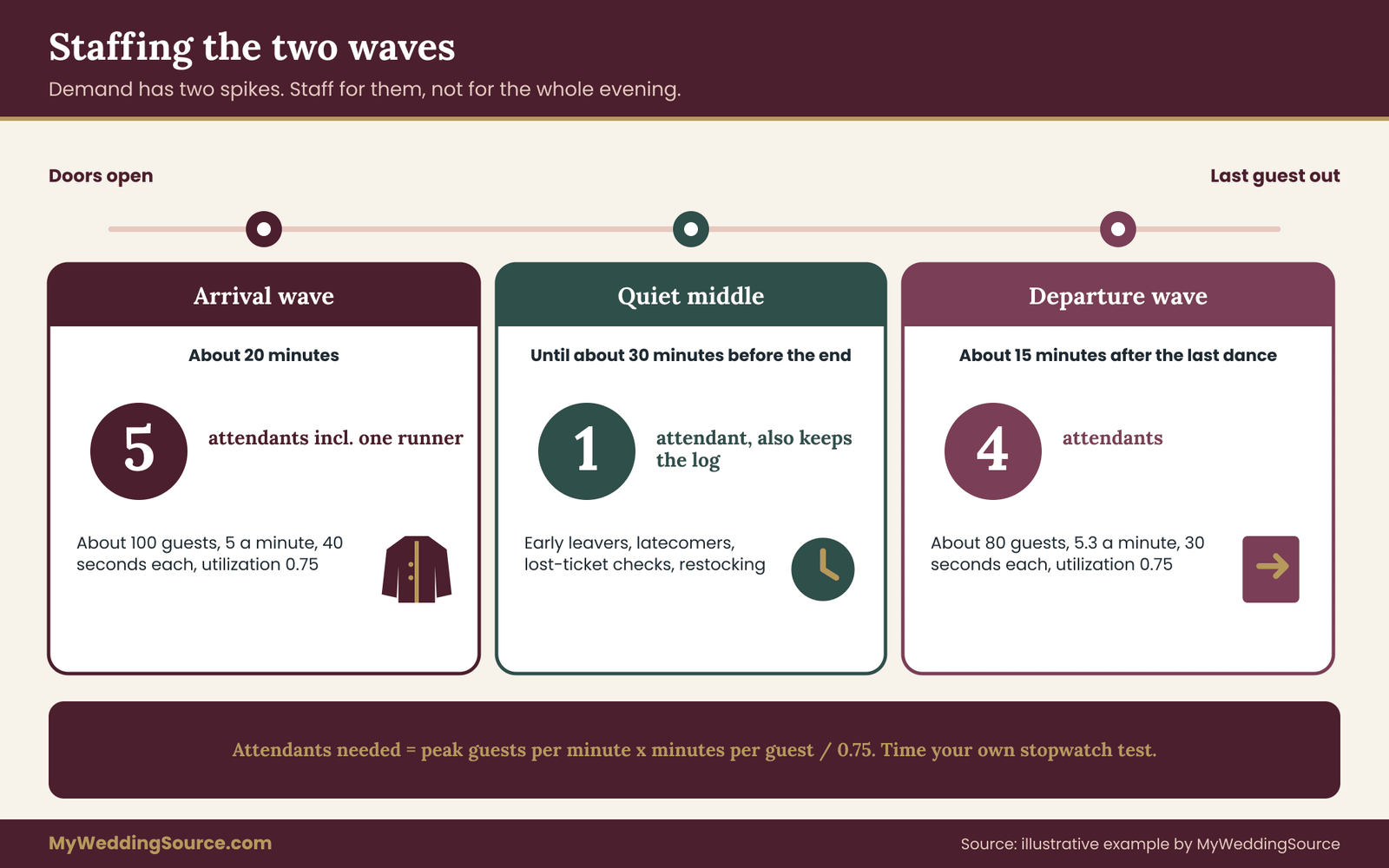
Think of the evening as four periods. Before guests arrive, setup. Then the arrival wave, when most guests check items in a short window. Then a long quiet middle, during which only latecomers, early leavers and the occasional retrieval happen. Finally the departure wave, when many guests collect items in the last stretch of the evening, often as soon as the last dance or the send-off is announced.
A wedding coat check should be fully staffed for the two waves and minimally staffed for the middle. That is the core of the staffing estimate.
The staffing formula
You need three inputs: how many guests check items in the peak window, how long the window lasts, and how long each guest takes to serve.
Peak guests per minute = guests checking items in the window ÷ window length in minutes
Attendants needed = peak guests per minute × minutes per guest ÷ target utilization
Target utilization is a way of leaving breathing room. An attendant working at full speed with no pause will fall behind at the first tangle. Setting the target at about three quarters, or 0.75, means attendants are busy but not saturated. It is an assumption you can adjust, but it is a more honest basis than hoping.
The time per guest is the second judgment call, and you can measure it rather than guess. Before the wedding, run a stopwatch test: ask four or five friends to arrive with coats, one at a time, and time how long the exchange takes from the greeting to the ticket in hand. Do the same for retrieval. Use the average, then add a little, because real guests ask questions and drop gloves.
The worked example, continued
Dana and Marcus planned 134 coat-wearers. In their stopwatch test, an attendant took about 40 seconds to hang a coat and hand over a ticket, and about 30 seconds to find and return one. These are illustrative figures from an invented test.
Arrival. They expect about three quarters of coat-wearers to arrive in the 20-minute window before the ceremony or cocktail hour starts. That is 134 × 0.75 = about 100 guests in 20 minutes, or 5 per minute. At 40 seconds each, which is two thirds of a minute, the work is 5 × 0.67 = about 3.3 attendant-minutes of work per minute. Dividing by a utilization of 0.75 gives 4.4, which rounds to 4 or 5. They choose 4 attendants and add one runner who hangs and sorts, for a total of 5 people in the first 20 minutes.
Departure. They expect 60 percent of coats to be collected in the 15 minutes after the last dance is announced. That is 134 × 0.6 = about 80 guests in 15 minutes, or 5.3 per minute. At 30 seconds each, or half a minute, the work is 5.3 × 0.5 = about 2.7 attendant-minutes per minute. Divided by 0.75, that is 3.6, rounded up to 4 attendants.
The middle. From the end of the arrival wave until about 30 minutes before the departure wave, one attendant is enough. That person also handles early leavers and keeps the log.
So their staffing plan is five people for roughly 45 minutes at the start, one person for the long middle, and four people for roughly 45 minutes at the end. The total staff hours are a fraction of what a flat four-person shift would cost.
Who staffs the wedding coat check
You have four real options, each with trade-offs.
The venue’s own staff. Some venues offer attendants as part of a package or for an hourly fee. The advantage is that they know the building and the venue’s liability terms. The risk is that the staff may not be assigned until the day, and quality varies.
A hired wedding coat check attendant or event staffing company. These people do this work for a living, they know ticket systems, and they carry the professional habits that reduce errors. The cost is the highest of the four, and the minimum shift length may force you to pay for the quiet middle. Ask whether the company offers split shifts or a minimum.
Friends or family. The cheapest option, and a common one. It carries a real cost: the people you ask are guests you want to see enjoying the party, and they are not trained. If you use friends, give each a short shift, no longer than the arrival wave or the departure wave, and tell them in advance. Never ask one person to work the whole evening.
Teenage or young-adult relatives or local students. A reasonable choice if they are paid and supervised. Make sure someone older is responsible for the wedding coat check, and check local rules on minors working at events and on serving in an environment where alcohol is present.
Whoever staffs the wedding coat check, if people are paid, the pay, hours and classification are matters of employment law that differ by state, and the U.S. Department of Labor is the primary source for the federal baseline. If you hire through a company, the company handles that. If you pay individuals directly, check the rules or ask the venue or planner how they handle it.
Briefing the staff
A ten-minute briefing prevents most problems. Cover five points: the ticket system, the location numbering, what to accept and refuse, what to say if something goes missing and who to call with a question. Hand each person a one-page card with these points, in large type, and make sure the lead attendant is not also trying to attend the ceremony.
Here are scripts that work, in plain words:
- Greeting: “Hello, welcome. Can I take your coat? Here is your ticket. Please keep it with you.”
- A guest with valuables: “I would keep your wallet and phone with you. We can hold the coat and bag.”
- A guest with a large bag: “We can hold this one. It gets its own tag, so you will have two tickets.”
- At retrieval: “Could I have your ticket, please? One moment.”
- A guest who has lost the ticket: “No problem. Could you describe the coat? I will check it with you before I hand it over.”
The last script matters. A lost ticket is a retrieval problem and a security problem at once. The approach is described in the claim-ticket section: ask for a description, have the guest identify the item before the attendant shows it, and keep a note.
Cost logic without invented prices
Cost depends on your area, the vendor and the date, so use your own quotes rather than a number from an article. What you can do is understand the pieces:
- Labor hours. Attendants multiplied by the hours in each wave, plus setup and close-down time. Get quotes for split shifts.
- Equipment. Racks, hangers, tables, bins, signage. Rental quotes usually include delivery and pickup, with separate charges for damage.
- Supplies. Tickets, tags, bags and a pen or two. These are small but easy to forget.
- Venue fees. Some venues charge for wedding coat check service, for use of their closet or for staff.
- Contingency. A small reserve for a rack that does not arrive or an extra hand during a surprise wave.
Compare the total with the cost of the alternative. A self-serve rack is cheaper but moves the risk of loss onto guests and onto you, in the sense that a lost coat is an unhappy guest even if no one is liable. How much that is worth to you is a judgment, and for some couples a modest attended desk is a sensible part of the guest-care budget. The wedding vendor timeline guide helps you place the wedding coat check crew’s arrival alongside every other vendor’s, so staff do not turn up at the same moment as the caterer’s trucks.
Claim tickets for a wedding coat check: the two-stub system
The ticket is the heart of an attended wedding coat check. It is the only thing that links a guest to an item after the handover, and it is the only thing that lets you prove, at the end of the night, that every item went to the right person. A ticket system does not need to be elaborate. It needs to be consistent.
Why two stubs beat one
A single ticket handed to the guest tells the attendant nothing about the item. At retrieval, the attendant has a number and has to find the coat by position. If the numbering is wrong or two coats share a spot, there is no backup.
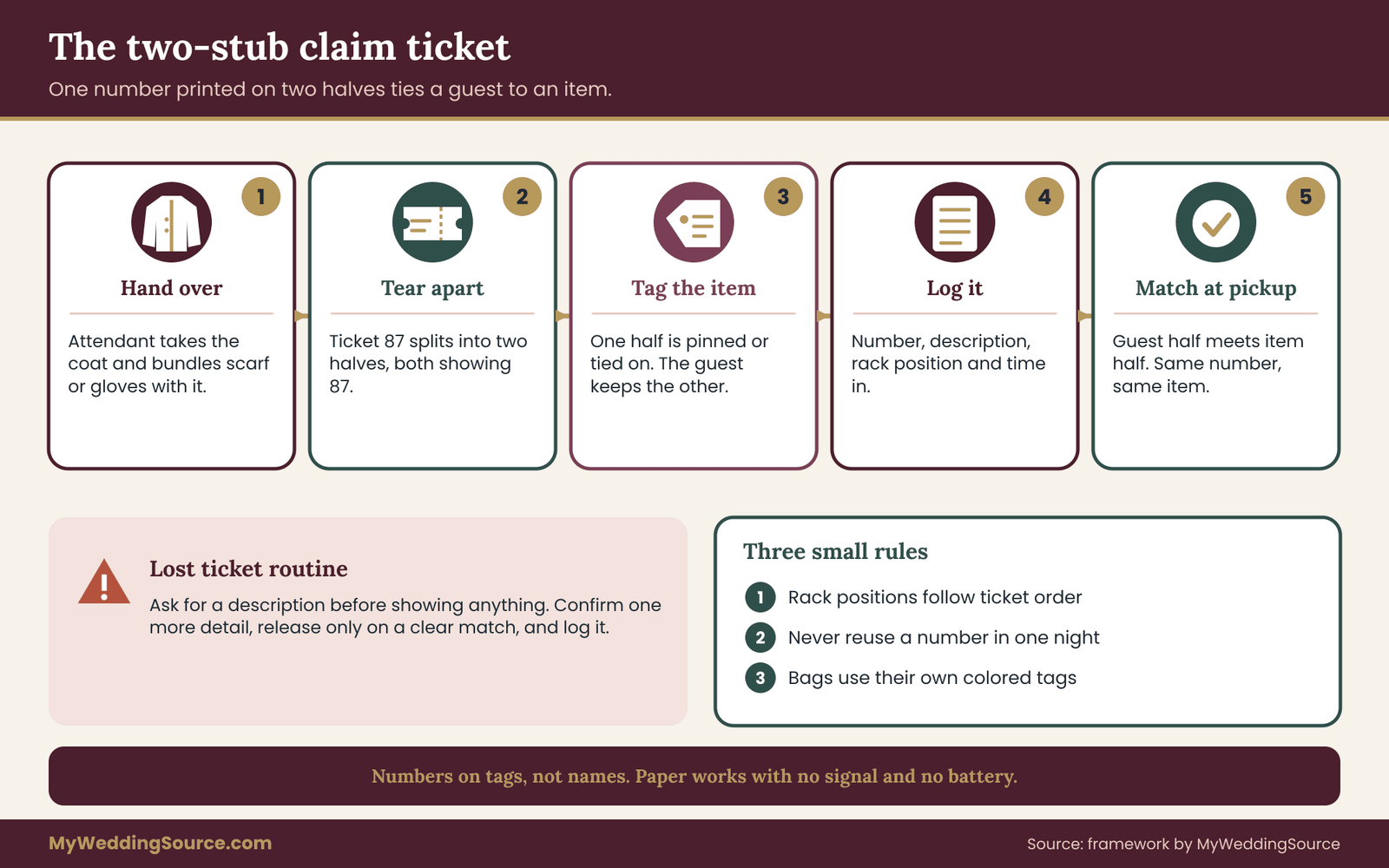
The two-stub system fixes this. Each ticket is a matched pair with the same number printed on both halves. One half goes to the guest. The other half goes on the item: pinned, tied, taped or clipped to the coat, or placed in the bag. At retrieval, the guest hands back their half, and the attendant finds the item carrying the matching half, then compares the two before handing it over.
This gives you three checks in place of one. The number on the ticket must match the number on the item, the item must be in the position the log says, and the two stubs, once joined, close the loop. At the end of the night, a pile of matched stub pairs is a record of every item returned.
Choosing and printing tickets
Ticket stock is cheap, so do not improvise. You can buy numbered wedding coat check tickets in rolls or books from party and office suppliers, with perforated stubs and consecutive numbers. If you prefer to make your own, print or write numbers clearly on card stock, cut in two and punch or hole each half. Whichever you use, check four things.
- Numbers are unique and in order. No repeated numbers, no gaps.
- The numbers are big. A guest in a dim room should be able to read their own.
- Both halves match exactly. A one-digit smudge becomes a lost coat.
- There are more than you need. Use the planned count and add spare sets, as in the volume estimate.
Color helps. If you can, use different colored tickets for coats and for bags. At a glance an attendant can tell which rack to search.
Attaching the tag to the item
How you attach the item half depends on the item. Coats take a tag clipped to a loop or hanger, or safety-pinned to the lining, never through the outer fabric of a good coat. Bags take a tag tied to the strap or zipper pull. Hats and gloves, which are small, should go into a bag with the tag, and the bag hangs with the coat of the same guest, sharing the same number.
Do not write the guest’s name on a tag where others can see it. Numbers are enough, and names add a privacy cost with no benefit. A first name written on a tag by the attendant can help in the odd case, but the number should still be what governs the exchange.
Avoid rubber bands, loose notes tucked into pockets and anything that can slip free. The point of a tag is that it stays with its item through four hours of being moved, brushed against and picked up.
The log
Alongside the tickets, a running log keeps the whole system honest. In its simplest form, it is a sheet with one line per ticket: number, item description, extra items, rack position and time in, with a mark for time out added at retrieval.
You can run the log on paper, on a clipboard, or on a phone. Paper is reliable, needs no battery and does not depend on a signal in a thick-walled venue. Phones are quicker for photos. If the wedding coat check uses a phone, keep photos of items limited and private, and delete them when the night is over. A shared spreadsheet that guests can see is not a good idea.
Note unusual items in the log in plain words: “black wool coat, silver pin on lapel,” “red umbrella, bamboo handle,” “child’s yellow jacket.” The goal is a description specific enough to settle a doubt, and short enough to write in ten seconds.
What to do when a guest loses the ticket
This will happen, probably more than once. Have a calm, consistent routine, because it is the point at which a desk is most vulnerable to a mistaken or dishonest claim.
- Reassure the guest: “No problem, we can sort it out.”
- Ask the guest to describe the item without being prompted: color, brand, anything in the pockets, any distinguishing detail.
- Check the description against the log and the rack. Do not show the item first.
- If the description matches, ask a second detail, such as what is in a pocket, to confirm.
- If the guest is confident and the match is clear, release the item and record it in the log: “ticket lost, released after description, time, attendant initials.”
- If there is doubt, hold the item to the end and ask a couple member or a family contact who knows the guest to confirm.
Most guests will pass this easily. The few who cannot are better handled at the end of the night, when the rack is nearly empty and the remaining items can be matched by elimination.
Wording that keeps the mood light
A claim ticket is a small bureaucratic moment in a celebration. The tone matters. Staff should treat it as a friendly exchange, not an inspection. A short line like “I just need to confirm which coat is yours” feels respectful. Interrogating a guest who has misplaced a ticket does not.
It also helps to give guests a reason to keep the ticket safe. Some couples attach the stub to a small card with a note, “Keep this safe, it is your coat’s name tag,” or print the number on a placeholder card at the guest’s seat, so a guest who loses their ticket can check the table card, a practice that only works if the number is not shared with other guests. Use whatever suits the tone of your wedding.
Digital alternatives and their limits
Some desks use phone-based systems: guests scan a code, receive a text with their number, and staff track items in an app. These can work, and they save paper. They have limits that matter at a wedding. Guests may have no signal in thick-walled buildings, a phone battery may be dead at the moment of retrieval, and asking a guest to give a phone number to an unknown service creates a privacy question. Paper tickets have none of these problems.
If you want a digital system, use it alongside paper, not in place of it, and check what data the service collects and how long it keeps it. Keep it simple: a wedding coat check does not need a database of your guests.
Numbering rules that prevent mix-ups
Three small rules prevent most errors. Number racks and hanger positions in the same order as ticket numbers, so ticket 45 hangs between 44 and 46. Never reuse a number during the night, even if an item has left, because a returned half might surface later. And keep a short list of “special” tickets, such as numbers set aside for bags, so a bag tag cannot be mistaken for a coat tag.
The ticket and the log together give your wedding coat check something valuable at the end of the night: a way to confirm, rather than guess, that the wedding coat check is clear. That is the subject of the next section.
Claim-tag reconciliation: closing out the wedding coat check
Reconciliation is the step most couples never hear about when they plan a wedding coat check, and it is the one that turns a loose service into a controlled one. The idea is plain: at the end of the evening, count what you issued, count what came back, and explain the difference before anyone leaves the building. It takes fifteen minutes and saves days of uncertainty.
The balance equation
Reconciliation rests on one equation:
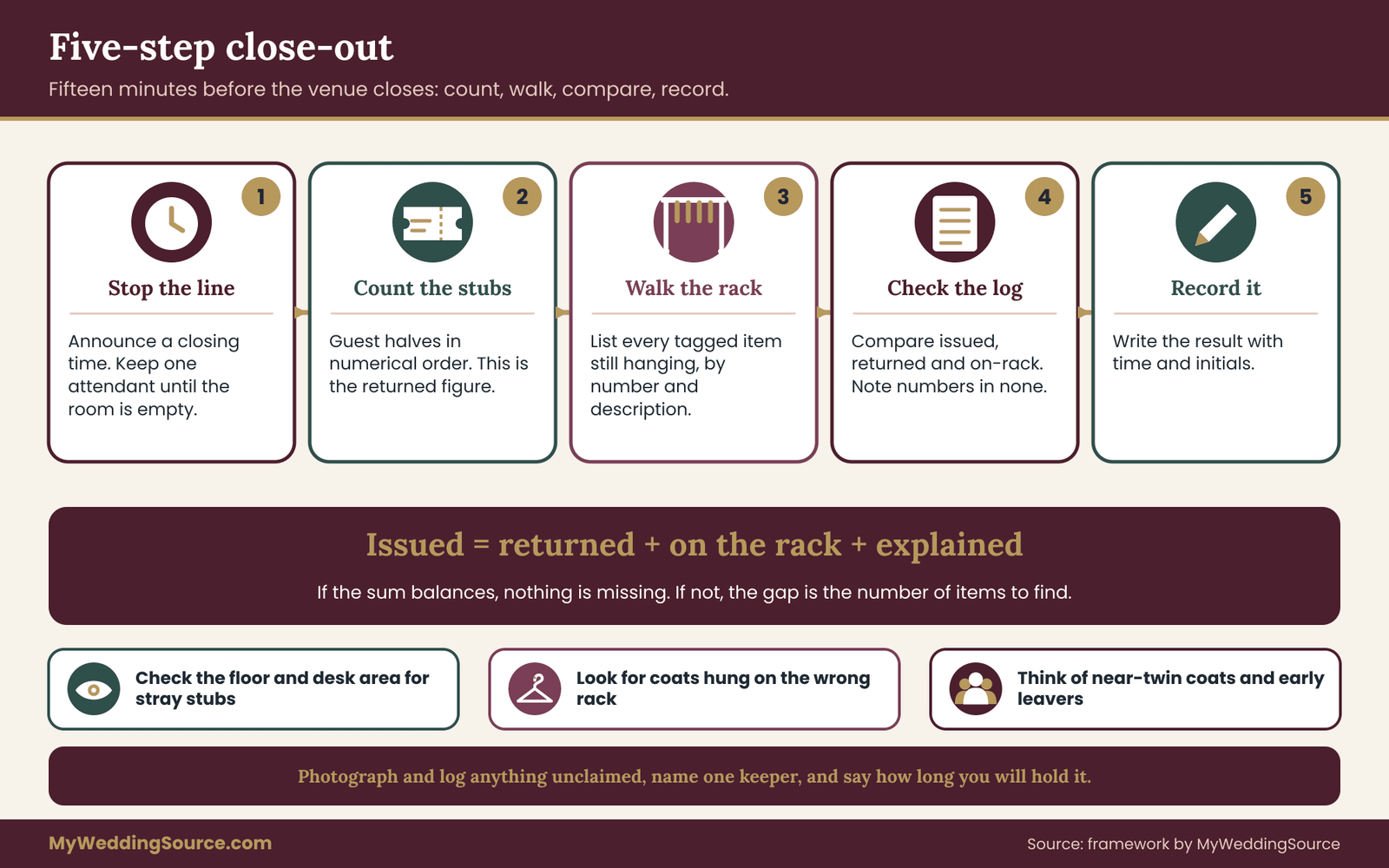
Tickets issued = tickets returned + items still on the rack + items explained
Each term is a count you can check. Tickets issued comes from the running log, or from the highest ticket number used. Tickets returned is the number of guest stubs collected at retrieval. Items still on the rack is a physical count. Items explained covers anything handled outside the normal flow: a coat released after a lost ticket, an item given to a family member by arrangement, a coat moved to the venue’s lost property box.
If the equation balances, nothing is missing. If it does not, the difference is the number of items to find, and you have a number to work from rather than a feeling.
The five-step close-out
The close-out can be run by the lead attendant alone, ideally with one other person as a witness. The steps are short.
- Stop the line. After the last announced departure, post a sign or ask the DJ or emcee to say that the wedding coat check will close at a stated time, so latecomers know. Keep at least one attendant at the wedding coat check until the room is empty.
- Count the stubs. Gather the guest halves collected at retrieval, in numerical order, and count them. This is the “returned” figure.
- Walk the rack. Go through the rack and shelves from one end to the other, listing every item that still carries a tag, by number and description. This is the “on the rack” figure.
- Check the log. Compare the issued count, the returned count and the rack count. List the numbers that appear in none of the three.
- Record the outcome. Write the result at the bottom of the log with the time and initials: “issued 140, returned 134, on rack 6, none unexplained.”
Do the walk-through before the venue’s closing time, not after. Items left on a rack when the doors close become hard to deal with, because the staff and the guests who could claim them have already gone.
Finding the difference
Sometimes the numbers do not balance. Common reasons are plain ones: a stub dropped on the floor, a guest who took a coat by mistake, an item given out without a stub, a ticket counted twice. Work through the list in order.
First, check the floor and the wedding coat check area for stray stubs. Second, check the other racks and the venue’s closet, in case an item was hung in the wrong place. Third, look at the log for items marked as released after a lost ticket. Fourth, think about who left in a hurry, because a guest who left early may have taken their own coat without a stub. And fifth, if the gap is a single item, check whether a coat was taken by a guest wearing a similar one, a common mistake in a dim room.
Many missing items turn out to be near-twins. Two gray wool coats, two black umbrellas. The ticket number is what separates them, which is why releasing items without a stub carries risk.
What to do with unclaimed items
If items remain after the room empties, you have a small lost-and-found problem. Handle it as follows.
- Tag and bag. Keep the numbered half attached, and add the log description.
- Photograph. A quick photo of each item, taken on a phone, helps with later matching. Keep the photos private.
- Choose a keeper. Name one person, often a family member or the planner, who takes the items home and is responsible for them. Write their role in the log, not their private contact details on a public sign.
- Set a time limit. Tell guests how long you will hold items, for example a few weeks, and what happens after: donation, or disposal of low-value items.
- Announce quietly. Send a message to the group of guests through your wedding website or group text, saying that some items were left and describing them in general terms. Do not post photos of personal items online.
Use the channel you already use to tell guests about the weekend, and keep the message short and neutral.
Returning items after the event
When a guest asks about a missing item, ask for a description before you reveal anything you hold. If it matches, arrange pickup or shipping. Shipping at the guest’s expense is a fair default, and many couples cover it for something small. Keep a note of when and how each item was returned, and do not post an address publicly. If an item is of real value, such as a designer coat or a watch in a pocket, use a tracked, insured method and ask the guest to confirm receipt.
Close the log once all items are returned or the time limit passes. A tidy end to the process is as much a kindness to yourself as to the guests.
Lost items, liability and what to say when something goes missing
Reconciliation tells you what is missing. This section covers what to do about it, including the awkward question of who is responsible.
Who is responsible for a lost item
There is no single answer, and this article does not give legal advice. Responsibility depends on who runs the wedding coat check, what the venue contract says, what any hired staffing company’s terms say and the law where you live. Three common situations show the range.
The venue runs the wedding coat check. The venue’s contract or posted policy usually sets the terms, and venues often limit liability or disclaim it entirely. Read the clause before the day, and ask what happens if a coat is lost or damaged.
A hired company runs it. The company’s agreement should say whether it carries insurance and what it covers. Ask for that in writing, and ask whether limits apply to a single item or to the whole event.
Friends or family run it. Here nobody has a contract, and responsibility is a social matter more than a legal one. Treat it carefully, because a missing coat at a friend-run desk can strain relationships.
Whatever the model, it helps to know whether your own insurance, a special event policy or a homeowners or renters policy has anything to say about a wedding coat check. The wedding vendor contract guide is a good companion for reading terms like these, and your insurance agent can explain what a policy does and does not cover. Do not assume that a general liability policy covers guests’ belongings.
Posted notices and what they do
Many desks post a sign saying the host is not responsible for lost items. Such a sign may or may not have legal force, depending on the place and circumstances, and it does nothing to soften a guest’s disappointment. If you choose to post one, base the wording on what the venue or your insurer suggests, and pair it with the practical message that guests should keep valuables with them. A sign is a notice, not a protection. The surest protection is a good process.
Valuables, fur, leather and designer coats
Some items deserve extra care. Guests should be told, before the wedding or on the sign, that they should not leave wallets, phones, keys, medication or jewelry in a coat. If a guest does leave a high-value item, such as a fur or a designer coat, a good attendant can note it in the log and hang it in the most visible spot, near the attendant’s own chair.
Do not offer to guarantee the safety of high-value items. You cannot, and the promise could create a liability that nobody intended. A friendly suggestion that the guest hold on to it, or keep it at the table, is a better answer, and there may be a chair back available.
Medication, keys and phones
Medication in a coat pocket is the case that causes the most worry. A guest who leaves a coat with insulin, an inhaler or an allergy auto-injector inside, and cannot reach it, may be at risk. Staff should know to tell guests, politely, to keep medication on their person. If a guest asks for a coat during the evening to retrieve a medication, treat it as urgent and fast, and do not make the guest wait for a ticket ritual.
Keys are the second case. A guest who loses car keys inside a coat that has gone astray has a problem that ends the evening. A line in the sign or the briefing, “keep keys and phone with you,” costs nothing.
The guest who is upset
Sooner or later someone will be annoyed. The right response is calm and specific. Listen without interrupting. Say what you will do and by when: “I will check the log and the rack now, and if it is not here we will look again tomorrow.” Do not argue about the ticket system or speculate about what happened. Take the details, record them in the log and follow up on the promised day.
If a coat is genuinely lost or damaged and you are the one responsible, think about a fair remedy. That might be a repair or cleaning bill, a replacement of modest value or a conversation with the venue or the insurer. How far to go is your call, but a prompt, respectful answer usually matters more to the guest than the exact remedy.
Keeping records after the event
Keep the log, the stub count and any notes about lost items for a while after the wedding. If a claim arises weeks later, a dated record that says what was issued, what was returned and what was held will be the main thing you have. The wedding guest care planning guide covers other ways to look after guests before and after the day, including the follow-up that makes a lost-item process feel kind, not bureaucratic.
Weather switches and special cases for the wedding coat check
A plan built on a forecast needs a way to change when the forecast does. The simplest tool is a weather switch: a short list, written in advance, of what you add or drop when conditions move from one band to another.
For a move from cool to cold and wet, the switch might read: add one rack, add two attendants to the arrival wave, add an umbrella station, move the wedding coat check closer to the door and confirm that the venue vestibule can hold wet items. For a move from cold to warm, it might read: drop one rack, release two attendants and keep one for bags and wraps.
Write the switch on one page, and give it to the lead attendant and the venue coordinator. Make the decision two days before the wedding, with the forecast from the National Weather Service in front of you, and again on the morning of the day.
Outdoor and split-venue weddings
A ceremony in one place and a reception in another splits the problem in two. Guests may arrive at the ceremony in coats, be warm in the sun, and want somewhere to put a jacket for the walk to the second site. Decide where the items go in the meantime. Some couples set a small self-serve rack at the ceremony and a full desk at the reception. Others keep the items with the guests all day and use only the reception desk.
If guests will be moved by shuttle or car between venues, tell them in advance where they can leave bags and what to bring. The wedding venues guide covers the questions to ask about storage, load-in and hours when you compare sites, and it is worth reading before you sign for a venue that has no cloakroom.
Late arrivals and early exits
The estimate assumes a neat arrival wave and a neat departure wave, but real weddings have stragglers. Guests who arrive after the ceremony starts need a path to the wedding coat check that does not disturb the room, and the middle-shift attendant should be somewhere they can find. Guests who leave early, such as parents of small children or older relatives, want their items quickly and quietly. Tell the attendant not to wait for the main departure wave to open the rack, and to retrieve early items as they are asked for.
Children, strollers and car seats
Small guests bring a surprising amount of equipment. Decide in advance whether you can store strollers and car seat bases, and say so on your wedding website. If you can, give each item a tag and place it in a spot that does not block the aisle. If you cannot, say so plainly so parents can plan. A diaper bag should stay with the parent, as it contains what they need during the evening.
Alcohol and the late-night pickup
At the end of a long reception, some guests are tired and some have been drinking. A ticket system matters more then, because a guest in that state may confuse one coat for another or lose a ticket. Staff should be patient, check each ticket against each item and not hand over a coat on a vague claim. Nothing in the wedding coat check should be a reason for a guest to drive. If a guest asks to retrieve car keys from a coat and seems unfit to drive, the staff should tell the couple, the planner or a family member, who can arrange a ride.
Small weddings and micro-weddings
For a small wedding, the full method is too much. The arithmetic still helps, in a lighter form. Count the coats, give each one a numbered hook, and put a friend in charge of the hooks for the first twenty minutes. At the end, check that no hook is occupied. That is a wedding coat check in its simplest form: a count, a place and a person.
A full worked example, from estimate to reconciliation
Here is the whole method, applied to the invented November wedding from earlier. The numbers are illustrative.
Three weeks out. Dana and Marcus confirm 140 guests and 8 vendors who will use the guest area. They ask the venue about storage, learn that there is none, and decide on an attended desk. They request quotes for two rolling racks rated in writing, sturdy hangers and a folding table, and ask three staffing sources for split-shift rates.
One week out. They run a stopwatch test with friends: 40 seconds to check a coat in, 30 to return one. They compute 151 spaces, order three racks to be safe, and print ticket pairs numbered 1 to 175. They write a weather switch. They brief a lead attendant, a professional hired for the whole evening, and book four additional people for the two waves: two paid students and two relatives who have agreed to a 45-minute shift each.
Two days out. The forecast shows cold rain. They stay in the high band, add an umbrella station and ask the venue whether wet items can wait in the vestibule.
Doors open. Five attendants work the arrival wave. The lead attendant tallies tickets as they go. By the thirty-minute mark, 118 tickets have been issued, close to the plan. Two guests ask about strollers, and the lead attendant tags both.
Quiet middle. One attendant stays. Early leavers collect their items. A guest loses a ticket and gives an accurate description, including a small notebook in the pocket. The attendant releases the coat after a second question and records it.
Departure. The DJ announces the last song and the wedding coat check closing time. Four attendants work the wave. Stubs are dropped in a box, tickets 1 to 140 in order where possible.
Close-out. The lead attendant counts: 140 tickets issued, 133 stubs returned, 1 coat released after a lost ticket and 6 items still on the rack. One coat on the rack carries tag 77, yet stub 77 is already in the returned box, so a guest took a near-identical coat by mistake. A short message to the guest group identifies the swap, and it is sorted out within the hour. The remaining unclaimed items are photographed, logged and handed to Dana’s sister for a three-week hold.

None of this took heroic effort. It took about an hour of planning per step, a few hours of friends’ time and a log. The result is a desk that handled the rush without a line and finished the night with a clean count.
Reading the example against your own wedding
Your wedding will differ in size, season and venue. The method still applies. Use your numbers, run your own stopwatch test, set your own utilization and check your own venue’s rules. If any figure in the example surprised you, take it as a sign to test that part of the plan with your own assumptions, not to adopt mine. For the whole guest journey, from the first greeting to the last goodbye, the guest flow design guide shows where the wedding coat check fits among the other stops.
Your next steps
Start with the decision. Walk through the five questions in the decision rule and write down whether you need an attended desk, a self-serve rack or a hybrid. Then ask the venue three things in writing: what storage exists, what the rules are for racks and egress, and what its liability policy says about guests’ belongings.
Next, run the Four-Input Count with your own guest number and weather band, and run a stopwatch test with five friends to get your own time per guest. Use those figures to set your staffing for the two waves, order racks and hangers, and print numbered two-stub tickets with spares. Write the weather switch and brief your lead attendant. On the day, tally tickets as you issue them, and finish with the five-step close-out so that every item is returned or explained before the room empties.
FAQ
How many coats should a wedding coat check plan for?
For a wedding coat check, multiply the number of people in the room, including vendors who will use the guest area, by the share you expect to wear coats, then add a buffer of about ten to fifteen percent. Use a low share for warm, dry weather and a high share for cold or wet weather. Check the forecast again two days before.
How many attendants does a wedding coat check need?
For a wedding coat check, it depends on how many guests arrive in the peak window and how long each takes to serve. Divide peak guests per minute multiplied by minutes per guest by a target utilization of about three quarters. Staff the arrival and departure waves fully, and keep one person for the quiet middle.
Do we need claim tickets for a small wedding coat check?
Not always. For a small wedding coat check where everyone sits in one room and the rack is in view, numbered hooks and a friend watching may be enough. Tickets matter more as the guest count, the weather and the distance from the rack grow. When in doubt, use them, since they cost very little.
What is a two-stub claim ticket at a wedding coat check?
It is a matched pair of tickets with the same number. The guest keeps one half, and the other half goes on the item. At pickup, the attendant matches the two before handing the item over. At the end of the night, the returned stubs can be counted against the number issued.
What if a guest loses their claim ticket?
Ask the guest to describe the item before showing it, check the description against the log and ask for one more detail, such as something in a pocket. If the match is clear, release the item and record it. If there is any doubt, hold it until the end of the night.
Who is liable if a coat is lost or damaged?
It depends on who runs the wedding coat check, what the venue or staffing company contract says and the law where you live, so this is not something an article can settle. Read the venue’s terms before the day, ask any hired company about insurance in writing, and ask an insurance agent what your own policies cover.
Should guests leave valuables in their coats?
No. Tell guests, on a sign or in your wedding website notes, to keep wallets, phones, keys, medication and jewelry with them. Staff should say the same in a friendly way at drop-off. Never promise to guarantee the safety of a high-value item, since you cannot control every risk.
What do we do with items nobody claims at the wedding coat check?
Once the wedding coat check closes, tag and photograph each item, name one person to hold them and tell guests how long you will keep them. Send a short, neutral message through your usual channel without posting photos of personal items. Return items after confirming a description, and donate or dispose of unclaimed items once the stated time passes.
Sources
- Weather safety, National Weather Service, NOAA
- National Weather Service forecasts, NOAA
- Cold weather safety, National Weather Service, NOAA
- National Fire Protection Association, codes and standards
- U.S. Fire Administration, Federal Emergency Management Agency
- ADA.gov, U.S. Department of Justice, Civil Rights Division
- U.S. Department of Labor, Wage and Hour Division
- Occupational Safety and Health Administration
- Federal Trade Commission, consumer advice
- USAGov, consumer help and complaints