
Returned invitations are the envelopes that come back to your mailbox with a sticker, a stamp or a handwritten note instead of a guest’s RSVP. This guide shows you how to read each one, log it, verify the guest’s address from more than one source, and resend without guessing, so a postal problem does not turn into a missing guest.
Do not re-mail returned invitations as they are. Open a simple log and record the date, the guest, the postal marking and your best guess at the cause. Sort each one into a cause class: typo, moved, missing unit number, vacant or refused, damaged or underpaid, or unknown. Verify the address from two independent sources plus one human confirmation, then choose a resend route: a fresh envelope, a hand delivery, or a phone call plus a digital copy if your RSVP deadline is close. Close each entry only after the guest confirms receipt.
Most couples expect a few returned invitations and few are ready for them. The envelope shows up in the mail three weeks after you sent a hundred of them, wearing a yellow label you cannot quite read. It belongs to someone you care about, and you have no idea whether the guest knows they are invited. The next thirty minutes decide whether this is a minor housekeeping item or the reason a favorite aunt learns about your wedding from a cousin.
The good news is that returned invitations are among the most fixable problems in wedding stationery. The post office tells you something with every one of them, the cause usually falls into one of a few predictable groups, and the repair is mostly a matter of verifying information you can check. What goes wrong is order of operations: people re-mail first and investigate later, or they ask the guest for a new address in a way that makes the guest feel audited. Handled calmly, returned invitations cost a stamp and a few messages.
A note on scope. This is general information, not legal, tax or financial advice, and mailing rules and fees change, so confirm the current rules with the United States Postal Service and your stationery printer before you pay for anything. The rest of the guide assumes a typical United States mailing of paper invitations with response cards, sent a couple of months before the wedding.
If you are still designing, proofing and ordering your suite, the wedding invitation printing guide covers quantities, proofs and printer handoffs. If your question is about wording, who is named on the envelope or whether to include a plus-one, the wedding invitation etiquette page is the better place to start. This article starts at the moment an envelope comes back and ends when the guest has actually received the invitation.
What returned invitations tell you
An envelope that comes back is a message from the postal system, and sometimes from the person who received it. It is not a verdict on the guest, and it is rarely a verdict on your list. (For broader courtesy questions, the wedding etiquette guide is the place to look.) Before you do anything else, treat it as evidence. Where did it travel, what marking did it pick up, and what does that say about the real cause?
It helps to know what the postal system is doing. Letter carriers and processing equipment read the address, match it to a delivery point, and deliver. When something does not match, the piece may be forwarded, returned to the sender, or sent to a central location that tries to resolve it. A returned invitation usually carries a label or stamp giving a reason, such as an attempted delivery that failed, no such number, a unit that could not be found, or a forwarding order that has expired.
The Postal Service publishes the underlying rules in its Domestic Mail Manual, and the section on undeliverable mail explains the handling in detail. You do not need to read it cover to cover, but it is useful to know where the authoritative version lives.
Now the more important idea. Returned invitations come in two kinds. The first kind is a mailing failure: the address was right in the sense that the guest lives there, but something about the envelope, the postage or the unit number let the piece fall through. The second kind is a data failure: the address in your list was wrong, outdated or incomplete, and the post office did exactly what it should. The repair is different for each, and mixing them up is how couples end up mailing the same wrong address twice.
The six usual causes
Almost every returned invitation traces back to one of six causes. Learning them now makes the log in a later section quick to fill in.
A typo or format slip. A transposed digit in a street number, a misspelled street name, a wrong ZIP code, or a state abbreviation that does not match the city. This is the most common data failure and the easiest to fix. It often comes from retyping addresses by hand from text messages or from a save-the-date list assembled quickly.
The guest moved. They changed addresses after you collected theirs. If they filed a change of address with the post office, the piece may have been forwarded for a while, and a returned invitation can mean that the forwarding period has ended. Young adults, renters and people between jobs are the most likely to be in this group, which is why it is worth checking those addresses first.
A missing or wrong secondary address. Apartment, suite, unit or floor numbers matter in multi-unit buildings. A letter addressed to the building without the unit can bounce even when the street number is perfect, because the carrier cannot tell which mailbox to use.
Vacant, refused or unclaimed. The address no longer receives mail from that household, the recipient declined the piece, or it was held and never picked up. A seasonal home, a snowbird address or a long vacation hold falls into this group. So does a household that has quietly separated or lost a member.
Damage, postage or size problems. A heavily embellished envelope, a square one, a stiff one or one with a bulky closure may need extra postage or get damaged in processing. A returned invitation can say nothing about the guest at all. It may simply have lost a fight with a sorting machine.
Unknown. Sometimes the marking is unclear, the label is missing, or the envelope simply arrives with no explanation. This group is real, and the log gives it its own category so you do not force a cause you cannot support.

Why the cause matters more than the fix
It is tempting to treat every returned invitation the same way: find an address, buy another stamp, and send it back out. That works some of the time. The reason it fails the rest of the time is that each cause calls for a different response. A typo calls for checking the original source of the address. A move calls for contacting the guest through some channel other than the mail.
A missing unit number calls for confirming the unit. A vacant or refused piece calls for a human conversation. A damaged envelope calls for a new envelope and better packaging. An unknown cause calls for the most cautious path, which is to verify before you spend anything.
Think of it as the difference between a plumber who replaces the faucet and one who first checks whether the water is on. The second plumber asks one diagnostic question before touching anything. For returned invitations, that question is always the same: what did the post office tell us, and what does it not tell us?
What returned mail does not tell you
Two limits are worth stating plainly, because they prevent a lot of unnecessary worry. First, a returned invitation does not tell you whether the guest knows about the wedding. Many guests hear about the date from family, from a save-the-date, or from your wedding website long before the formal invitation arrives. Second, the absence of a returned invitation does not prove that every other invitation arrived. Some pieces are delivered to the wrong mailbox, held by building staff, or sit unread in a stack. An envelope that did not come back is not a confirmed delivery. Only a reply is.
That second point shapes the whole approach in this guide. A returned invitation is the one case where the system tells you that something failed. Treat it as a gift: you have a chance to fix the problem while there is still time, and the same chance may not exist for guests whose invitations quietly went somewhere unhelpful. It is also the reason to compare your RSVP replies against the guest list a few weeks later, which a later section covers.
A few words on tone
Guests are not suspects, and a returned invitation is not an embarrassment. Nobody who sends a hundred paper invitations gets a perfect result. When you contact a guest to verify an address, keep it short, warm and specific, and give them an easy reason to answer. A message such as “We want to make sure your invitation reaches you, and one of ours came back. Could you confirm the best mailing address?” works better than any explanation of postal procedure. Later sections give scripts for different relationships and different situations.
Reading the envelope on returned invitations
Each returned invitation is a small document. Before you open a spreadsheet or a message thread, spend a minute with the physical piece. Put it on a table in good light, and do not open it yet if the invitation is still sealed. You are looking for four things: what is stuck or stamped on the front, what is written by hand, what has happened to the envelope’s condition, and where the return address sits.
The markings you are likely to see
Postal markings change in design over time, so use the meanings below as a general guide and confirm the specifics on the Postal Service’s own help pages. Most returned invitations carry one of a handful of reasons.
A label that says the piece is undeliverable as addressed. This is the broad category. It means the address as written could not be matched to a delivery. It does not by itself say why. Look for a secondary reason beside it.
No such number, or no such street. Something in the street line did not match. Read your own envelope first: is the number plausible, is the street name spelled the way the street is spelled, and does the ZIP code belong to that town?
Insufficient address, or unit not found. The building exists, but the piece could not be routed to a unit. This often points to a missing apartment number, or one written in a way the equipment or the carrier could not read.
Attempted, not known. A carrier tried and did not recognize the recipient at that address. This is a common marking when a household has moved, or when the name on the envelope does not match anyone at the address. It can also happen when the name is a nickname or an old surname.
Moved, left no forwarding address. The household moved and did not file a change of address, or the forwarding period has ended. You will need to find the new address another way.
Forwarding order expired. The household filed a change of address, and the period during which the Postal Service forwards that mail has passed. In some cases the returned invitation includes the new address in the label. When it does, treat it as a lead and not as proof, and verify it.
Refused, unclaimed or vacant. Refused means the recipient declined the piece. Unclaimed means it was held and never picked up. Vacant means the carrier believed nobody lived there. All three call for a human conversation before a resend.
No marking, or a hand-written note. A neighbor, a building manager or a family member may have written something on the envelope. Take it seriously, but read it carefully. A note such as “does not live here” is useful. A note such as “return to sender” repeats what the post office already did.

Reading the condition of the piece
The condition of the envelope is a second source of clues. A clean envelope with a label in good shape suggests a plain address problem. A scuffed, torn or flattened envelope suggests a handling problem, and a resend in a sturdier envelope, with the right postage, may be the entire fix. A corner crushed flat, a closure that popped open, or a line of machine marks across the address can all push a handwritten address into illegibility.
If you chose a square envelope, a wax seal, a stiff liner or a bulky vellum wrap, check with your printer and the Postal Service about extra postage. Nonstandard shapes and rigid pieces can face higher rates, and the postal rules on shape and thickness are published in the Domestic Mail Manual. A piece that was underpaid may come back with a postage due notice instead of an address reason. In that case the guest was never the problem. The fix is to correct the postage, and, if the envelope is otherwise intact, to resend it.
Where the return address sat
Check that your return address was clear and in the right place. Returned mail only comes back to you because there was a return address to send it to, so the fact that you are holding the envelope tells you that part worked. But if the return address was on the back flap, check that it was legible.
If you used a calligrapher, a vendor or a family member’s address as the return, confirm that the envelope did not return to someone who has not told you yet. Ask the people who might hold returned mail on your behalf to forward it to you promptly.
A related decision: some couples choose a return address that belongs to a parent or to a mailing service, not to their own home. That can be a smart choice if you will be travelling or moving before the wedding. It also means that returned invitations can pile up unseen. Whoever receives them should know to send you a photo of each one the day it arrives.
The photo rule
Before you touch an envelope, photograph the front and the back, with the label in focus. Save the photo with a file name that includes the guest’s household name and the date. This rule takes ten seconds and has three uses. It gives you a record to compare against the address in your list.
It lets you ask someone else, such as a parent or a stationer, for help without mailing the envelope again. And it preserves the postal reason if you later reuse the envelope for a different purpose or throw it away. Every returned invitation gets the same ten seconds.
The first hour: triage before you touch the address
When a stack of returned invitations arrives, resist the urge to fix them at once. A short triage pass keeps you from compounding errors, and it sets up the decision log in the next section. Work through the stack in this order. It should take about an hour for a dozen envelopes, and less for fewer.
Step one: gather and count. Put every returned invitation in one place. Count them. A single returned invitation in a hundred is a different situation from ten in a hundred, and a cluster from one part of the country or one batch can point to a shared cause such as a bad ZIP code format or a printing problem. Returned invitations that arrive together often share a cause.
Step two: photograph and number. Give each envelope a number, write it lightly in pencil on the back, and photograph it. The number will be the key in your log. Do not use guest names as the key, because households can have several envelopes and several last names.
Step three: do a first sort by marking. Put the pieces into three piles. Pile one is address-data problems: no such number, no such street, insufficient address, unit not found. Pile two is household changes: moved, forwarding expired, not known. Pile three is everything else: refused, unclaimed, vacant, damaged, postage due, unknown.
Step four: check the original source for pile one. For every envelope in the data pile, look at where the address came from. Was it from a spreadsheet you built, a form guests filled out, a text from a parent, or a save-the-date reply? The origin matters more than the marking, because it tells you who to ask. If a parent gave you the address, the parent is probably the right person to confirm it.
Step five: flag the sensitive ones. Some returned invitations belong to guests whose situations are delicate: a recent separation, a recent loss in the family, an estrangement, a guest who has asked for privacy. For these pieces, do not email or text a group, and do not ask a mutual friend to chase an address. Make a note to handle them personally, and see the part of this guide on handling guest data.
Step six: decide who owns each one. In many families one person knows the details of a branch of the family better than anyone. Write that person’s name beside the entry. If you have a planner, a coordinator or a parent managing a part of the list, decide who contacts whom before anyone writes a message. The worst outcome is three people asking the same guest three versions of the same question in a single afternoon.
A common mistake: fixing the envelope instead of the data
One pattern shows up again and again. A couple finds the error in the envelope, corrects it by hand with a pen, and mails it again. The envelope is now improved. The master list still contains the old address, and the next mailing, whether a thank-you card, a holiday card or an invitation to a post-wedding brunch, will repeat the error. Fixing the data first, in one place, and generating everything else from it, is the habit that saves the most time over the year.
If you built your guest records in a spreadsheet, a one-row-per-household spreadsheet works well here because each household has a single row, and an edit to that row feeds every later mailing. That way, a change entered once reaches the next list you print.
When a returned invitation is actually good news
A returned invitation with a forwarding address or a handwritten note can give you something you did not have before: confirmation that the guest is reachable and that a neighbor or family member cares enough to help. If a note says “she lives with her daughter now,” you have a new lead and a reason to get in touch kindly. Handled well, a returned invitation can lead to a warmer conversation than the invitation alone would have started.
Setting a time limit
Give yourself a rule for the stack. Returned invitations need attention within a few days, not a few weeks, because the closer you are to the RSVP deadline, the fewer resend options you have. A reasonable limit is that every returned invitation gets a log entry the day it arrives, a verification attempt within three days, and a resend or a conversation within a week.
If your timeline is tighter, tighten the limits. The countdown section later in the guide shows how to scale them against the days left before your RSVP deadline. A returned invitation that waits a month is far harder to fix than one handled in a week.
The decision log for returned invitations
A decision log is the one original tool this guide asks you to build. It is a single page, or a single sheet, with one row per returned invitation. It does not need software. Its purpose is to force three separations that panic tends to blur: what the post office reported, what you actually know, and what you decided to do. It also leaves a record, so if you pause for a week, or hand the project to a parent or a planner, nobody has to start over.
The columns, in order
Keep the log narrow enough to read on a phone. These are the fields that earn their place. That is why the log has one row for every returned invitation.
Number and date. The number you wrote on the envelope and the day it arrived. The date matters because every later deadline counts from it.
Household and guest count. Write the household name as it appears on your master list and the number of seats in the invitation. This is the line that tells you how much is at stake. An envelope for a household of five is a larger problem than one for a single guest, and it deserves earlier attention.
Postal reason. Copy the marking in the postal system’s own words, even if you think you understand it. If the label is unclear, write “unclear” and attach the photo.
Cause class. Choose one of six: data (typo or format), moved, unit, vacant or refused, handling or postage, unknown. You can change the class later when you learn more. Never leave it blank.
Address you sent to. The exact address as it was on the envelope, character by character.
Source of that address. Who gave it to you and when: a guest form, a parent, a text, a save-the-date reply, an old holiday card list. This column becomes your guide to who should confirm it.
Verified address. Left empty until the verification step is complete. The log never holds a guess in this column.
Verification trail. Which sources you used and what each said. The next part of the guide describes the three-source rule.
Resend route. New envelope, hand delivery, call plus digital copy, or hold.
Date resent and date confirmed. Two separate dates. The first is when something left your hands. The second is when the guest told you they received it.
Status. Open, resent, confirmed, or closed without a resend. A final status always needs a reason, and “guest declined” is a reason you must record.
The five-question triage
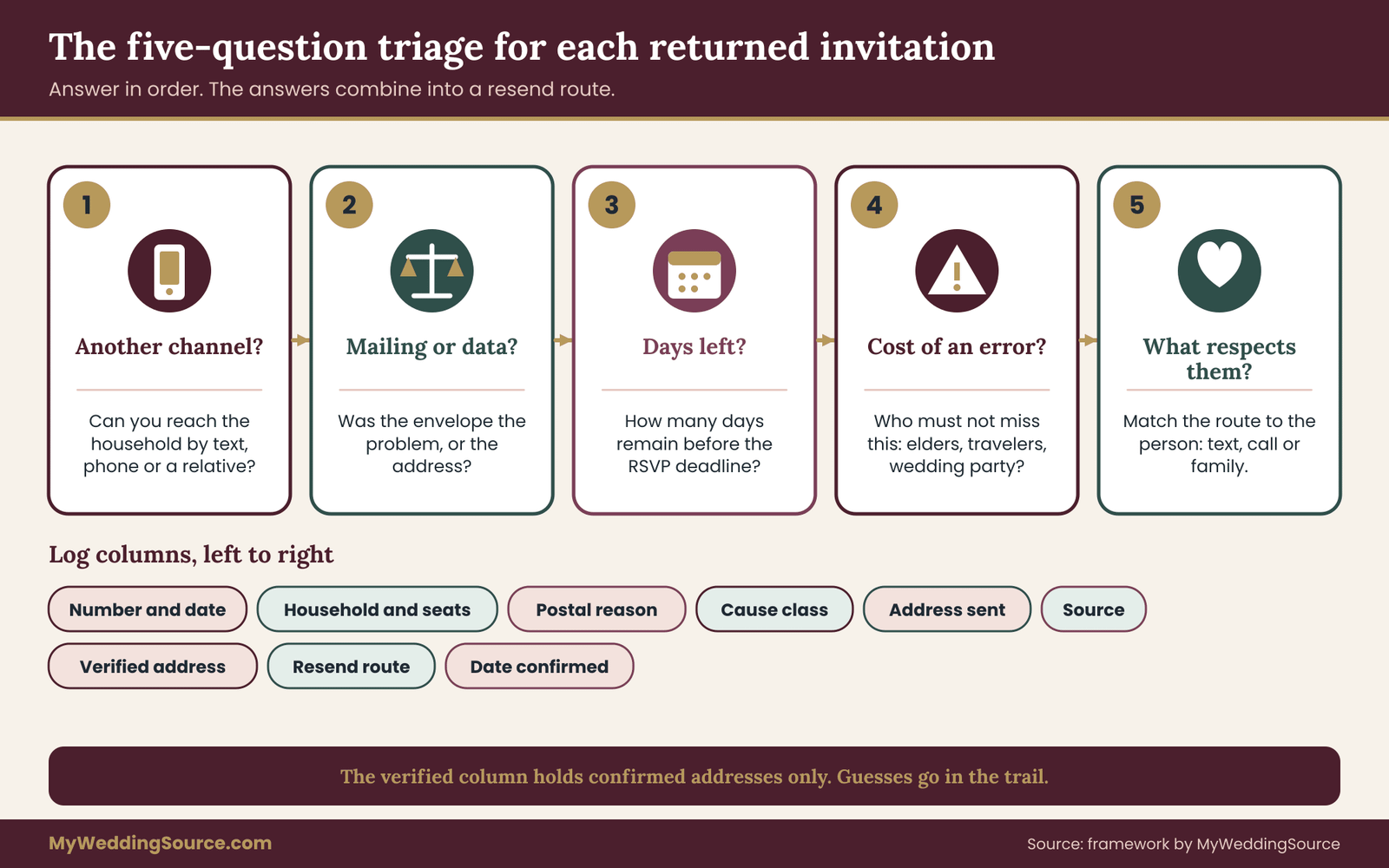
Every row passes through the same five questions in order. This sequence is the decision framework at the heart of this guide, and it is short enough to memorize.
Question one: is the household reachable by any other channel? If you have a phone number, a social media connection or a family contact, you can confirm the situation in minutes. If you have no other channel, you may be left with the mail and a public record search, and the verification step will take longer.
Question two: is the cause a mailing failure or a data failure? A mailing failure, such as a missing unit number or a postage issue, usually needs a corrected envelope and nothing else. A data failure needs a verified address from the guest or a trusted source before any resend.
Question three: how many days are left before the RSVP deadline? The answer controls the route. With many weeks left, a corrected paper invitation is a fine choice. With a few weeks left, you should pair the resend with a phone call or message. With only days left, the guest should hear from you by voice or text first, and the paper is an addition and not the delivery.
Question four: what is the cost of being wrong? For most guests, a second wrong address means a second wasted envelope. For a grandparent, a wedding party member or a person traveling a long distance, it could mean a missed event. Spend more verification effort where the cost of an error is highest.
Question five: what does this guest need to feel respected? Some guests will be happy to confirm an address by text. Others will prefer a call. A few will prefer that you ask a relative. Match the route to the person.
How the rules combine
The five questions do not each produce a separate action. They combine into a route. Here is how that works in prose, with common combinations.
If the cause is a missing unit number, the household is easy to reach by text, and the deadline is far away, you ask for the unit by message, update the master list, print a new label or envelope, and resend. The whole thing takes one message and one stamp.
If the cause is that the guest moved, you have no other channel, and the deadline is far away, you ask a mutual contact for a way to reach them, send a short message, and verify the new address before printing anything. You do not mail to the address a forwarding label suggests until a human has confirmed it.
If the cause is unknown, the household includes an older relative, and the deadline is close, you call a family member who knows them, confirm the address and the best contact, resend a corrected paper invitation by a trackable method, and keep a digital copy ready in case the mail fails again.
If the cause is vacant or refused, stop. Do not resend by mail. Make a human contact first, because a refusal can be a message in itself. The guest may have chosen not to attend, may be unwell, or may be avoiding someone, and a second envelope is not the answer to any of those.
If the cause is handling or postage, you resend in a stronger envelope with the right postage, and you check the rest of the batch for pieces made the same way.
Keeping the log honest
A log is only useful if it is truthful. Three habits help. A log of returned invitations that records only guesses is worse than no log.
Write the postal reason exactly as printed, not as you interpret it. If the label says “not known” and you write “moved,” you have already decided something you cannot prove. Keep interpretation in the cause class column, where you can change it.
Never write a verified address you have not verified. The verified column is for confirmed information only. A guess belongs in the trail column, labeled as a guess, with the source.
Record why you closed a row. A row that ends with “guest confirmed by text on this date” is useful. A row that ends with “done” is not. In a month you will want to know whether “done” meant the guest replied, or merely that you stopped trying.
A paper version for people who dislike spreadsheets
If you would rather work on paper, print one index card per envelope, with the same fields in the same order, and clip the photo to it. Cards can be stacked in three piles, open, resent and closed, and moved from one pile to the next as they progress. A pile of open cards is also a convenient thing to hand to a parent or a planner who has offered to help.
Sharing the log without sharing the data
A planner, a parent or a stationer may need to know the status of returned invitations, but they do not need the full address list. A short summary does the job: how many are open, how many are waiting on a guest, and which three need help this week. Keep the full log in the place where your master guest list lives, and share a view of it, not the file. The privacy section later in the guide explains why this matters beyond politeness. Returned invitations are a private matter between you and each guest.
How the log connects to the rest of your paperwork
Returned invitations are a small piece of the larger flow of guest information. The log connects to your RSVP tracking, your seating plan and your final headcount. When a household is waiting on a resend, mark them as “invitation pending” on your master list so the seating chart and the caterer’s count do not treat their silence as a no. The wedding RSVP etiquette page explains how to handle late replies, and your guest list guide covers how to keep the master list consistent.
A short checklist for the end of each week
At the end of each week during the return window, spend ten minutes on the log. Count open rows. Check that every row has a cause class. Look at the oldest open row and decide whether it needs a different route. Update the deadline countdown. And read through the notes column for anything that suggests a pattern: the same ZIP code on three rows, the same relative as the source of three addresses, or the same envelope style in the handling rows.
A pattern is a lead on the cause of the next returned invitation, and it is the most valuable thing the log produces. Watching returned invitations as a group, and not one by one, is what turns a log into a diagnosis.
Verifying an address before you resend returned invitations
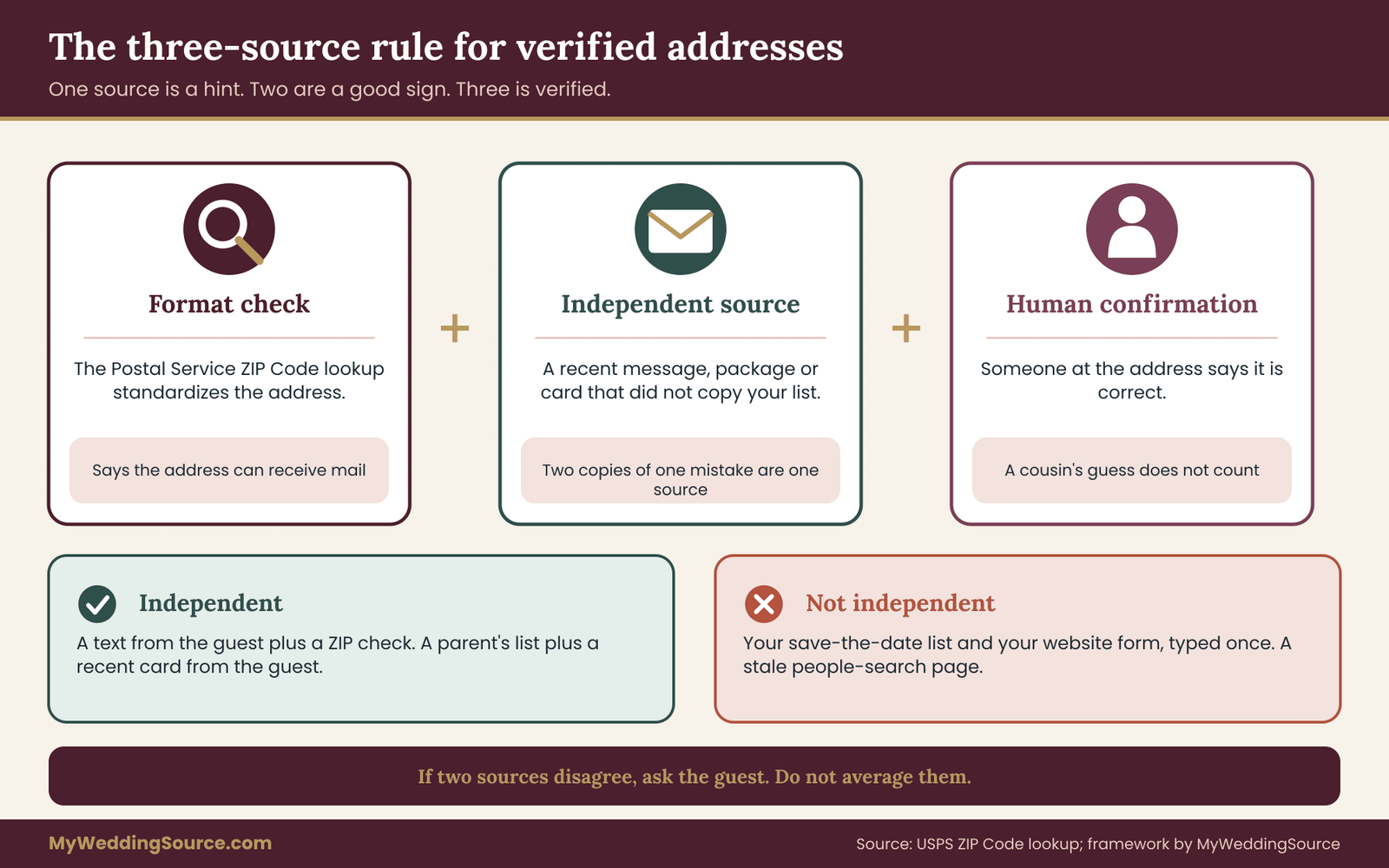
Verification is the step most couples skip, and it is the step that decides whether a second envelope arrives. The principle is simple. An address is verified when the Postal Service’s own format check agrees with it, when an independent source agrees with it, and when a person who actually lives there agrees with it. One of those three is a hint. Two are a good sign. Three is what this guide calls verified. Skipping it is the most common reason returned invitations come back twice.
The three-source rule
Source one: the format check. The Postal Service offers a free ZIP Code lookup on its website that can standardize an address and confirm whether a street address exists with a particular ZIP code. Enter the address you have, and compare the standardized version it returns with what is on your envelope. Look at the street suffix, the directional letters, the unit designator and the ZIP code. A format check tells you that an address can receive mail. It does not tell you that your guest lives there.
Source two: an independent source. This is any record or reference that did not come from the same place as your original address. Examples include a recent message from the guest that mentions where they live, a recent card or package they sent, a shared contact entry that a mutual friend maintains, or a parent’s address book. The point of the word independent is that two copies of one mistake do not make a confirmation. If your spreadsheet and your parent’s list both came from the same old holiday card, that is one source, not two.
Source three: a human confirmation. Someone who lives at the address, or knows the household well, tells you it is correct. This can be the guest, a spouse, an adult child, or a parent. A confirmation by text or phone counts. A guess by a cousin does not.
When you cannot reach a human confirmation, and the deadline allows, hold the entry in the log with the status “waiting on guest” and make a second attempt through a different channel. When the deadline does not allow it, move to the hand delivery or digital route in the next section.
What counts as independent
People over-count sources in a hurry. These examples show the line.
Independent: a text from the guest last month that includes their street address, plus a ZIP check that confirms the street exists in that ZIP code. That is two sources, and the text itself is nearly a human confirmation.
Not independent: the guest’s address from your save-the-date list, and the same address from your wedding website’s RSVP form, if the same person typed it in once. One origin, two copies.
Independent: a household that returned the save-the-date response card with a handwritten address, and a parent who confirms they visited the household recently.
Not independent: a web page you found by searching the guest’s name, if the page is out of date. Public records and data broker pages are often stale, sometimes wrong, and they raise privacy concerns of their own. Use them as a last-resort lead, and only after you have tried asking people.
Verifying a typo
For a data failure, start with the origin of the address. Open the source and compare character by character: the street number, the street name, the unit number, the city, the state abbreviation and the ZIP code. A common mistake is a ZIP code that belongs to a different town or a street suffix such as “Street” where the street is a “Lane.” If the source shows the right address and the envelope shows a different one, the typo happened at addressing time, which is usually a transcription slip.
In that case, regenerate every label from the master list and compare the rest of the batch against it, because a slip like this is rarely alone. One slip often produces several returned invitations from the same batch.
If the source and the envelope match, the error lies upstream: in whatever the guest or the relative first told you. Confirm with them.
Verifying a move
For a household that has moved, the fastest path is a direct message to the guest: a text, an email, a message on a platform you already use with them. Keep it brief. If you do not have a direct channel, ask a mutual contact to pass along a short note and your number, and let the guest decide whether to reply.
Do not ask a mutual contact to give you the address. That puts them in the position of sharing a friend’s information without permission. Asking them to forward your request does not. Moves are a common source of returned invitations.
If a returned invitation carries a new address in the label, treat it as a lead and run it through the three-source rule. Forwarding information is helpful, but it can describe a temporary address, a family member’s home or a mailbox the guest rarely checks. It can also be an address the guest would not want a wedding invitation going to.
Verifying a unit
A missing or wrong unit number is the most solvable category. Ask the guest for the full address as they write it on their own mail, and compare it with the standardized version from the format check. Pay attention to how they write the unit: “Apt 4B,” “#4B,” “Unit 4B” and “4B” are generally treated alike by the Postal Service, but a guess at a unit number is not a plan. If a building has several entrances or a ground-floor office that receives mail for all residents, ask the guest about it.
Verifying a vacant or refused piece
Do not use the three-source rule here until you have had a human conversation. A vacant marking may mean the guest is away for a season, in which case a hold-and-resend date makes sense. It may mean the household has moved and left nothing behind, in which case you are back to a move. A refusal is different: it means a person made a choice.
Reaching out is the right move, but the message should offer an easy exit. For example: “We sent you an invitation and it came back, and we want to be sure you have what you need. If a different address or a different way to reach you would be better, please tell us.” That message gives the guest control and does not demand an explanation.
Verifying a handling or postage problem
Here the address itself is usually correct. The fix is verification of the envelope and not the guest. Weigh the complete invitation with all inserts. Ask a post office clerk or consult the current rate and shape rules for the exact envelope you used, and ask for the correct postage before you mail. If the envelope was damaged, replace it.
If you have spare envelopes in the right size, use them. If you do not, ask your printer how quickly it can supply replacements, and what a small reprint costs. Prices vary by printer and process, so ask for a quote and do not assume a number.
Do not rely on a single digital tool
Address lookups, autocomplete features and map services are convenient, and they sometimes disagree. A map may place a building at a street number that the Postal Service does not use for mail delivery, particularly in new developments, rural routes and large multi-building complexes. Use maps to orient yourself, and use the postal format check and the guest to confirm the address.
A script for each relationship
The words you choose matter, and they should fit the relationship. These short scripts are starting points. Adjust them to the way you normally speak to each person.
For a close friend or sibling: “One of our invitations bounced. Is your address still the one on Maple? Send me the exact version you’d put on a package and I’ll fix it.”
For an older relative, by phone or through a family member: “We want to be sure your invitation reaches you. Could you tell us the best mailing address, and whether there is a unit or a mailbox number we should include?”
For a colleague or a more formal guest: “We sent your invitation, and the post office returned it. Could you confirm the best mailing address for you? We would like to be sure you receive everything.”
For a guest whose situation might be delicate: send a note by whatever channel you normally use with them, say that you want to be sure they receive the invitation, and let them choose how to reply.
None of these scripts asks the guest to explain anything. They ask for information and give a reason, which is the combination most people respond to.
Recording the trail
Every verification step goes into the trail column of the log. Write the source, the date and the result in a short phrase. “ZIP check agrees; guest confirmed by text on the 14th” is a complete entry. When the trail is complete, copy the confirmed address into the verified column, update the master list, and only then print the new envelope. A tidy trail lets a parent or planner pick up returned invitations without calling you.
When two sources disagree
Sometimes a guest’s text says one address and a relative’s list says another. Do not average them or choose the one you like. Ask the guest again, and show them what you have. For example, “I have two versions of your address. Which one is current?” The answer resolves the conflict and also tells you that your other records need an update. If the guest does not answer and the deadline is close, hold the paper and rely on a phone call or a digital invitation until you can confirm.
Choosing how to resend returned invitations
Once an address is verified, you have to pick a route. The default most people choose is a second paper envelope in the mail, and often that is right. But it is one of four routes, and the best choice depends on the cause, the guest and the calendar. This section gives you decision rules for each route and a way to match them to the days remaining before your RSVP deadline. The same logic applies whether you have two returned invitations or twenty.
Route one: a fresh envelope by mail
A new envelope is the right answer for most data failures and unit problems when time allows. Print a new label or address a new envelope from the corrected master list. Do not reuse the returned invitation, even if it looks clean. Postal markings, a label’s adhesive residue or a stamp over the address block can confuse sorting equipment and delay the piece again. Replacing returned invitations with fresh envelopes is the default, not the only choice.
A few practical points help the second attempt succeed.
Use the standardized form of the address from the format check, including the unit designator and the full ZIP code, and keep the line order the Postal Service expects. Make sure the address block is clear of embellishment, and that the contrast between ink and paper is strong. Ask your printer or the post office about the correct postage for the finished weight and shape, and have the piece weighed in its final form. Include your return address again, so that a second failure comes back to you and not into the void.
Consider adding a short, friendly note card that says the first invitation was delayed. It is not required, but it prevents confusion if the first one eventually surfaces from a forwarding system and the guest ends up with two. A single line works: “Our first invitation went astray, so this is the replacement. Please use this one.”
If you are not sure whether to use a tracked or signature service for a particularly important guest, the post office can explain the options and prices. Ask at the counter and do not assume a figure.
Route two: hand delivery
For guests who live nearby, or who are visiting someone you know, a hand-delivered invitation is a graceful solution and takes the postal question out of the picture. It also lets you confirm receipt on the spot. A relative who will see the guest at a family event can carry it, with a request to tell you when it has been handed over. Place the invitation in a clean envelope and add the guest’s name in the address line, since the carrier’s job is to give it to the right person, not to the right address.
The risk with hand delivery is that it relies on someone else’s memory. Ask the courier to send you a short message or a photo when it has been delivered, and write the date in the log. If you do not hear back in a few days, follow up kindly.
Route three: a call or message, plus a paper copy
When time is short, or when the guest is hard to reach through the mail, make contact first. Call or message the guest, tell them the invitation is coming, give them the date, the location and the RSVP deadline, and ask how they would like to receive the formal piece. Send the paper invitation as a follow-up, so that a second postal delay does not cost you the reply.
This is also the right route when a guest needs travel information early, such as someone who will fly in, someone who needs an accessible room or someone who has to arrange time off. The paper suite can wait a few days. The information should not.
Route four: a digital invitation
A digital copy is a supplement and sometimes a substitute. Send a clear photo or a PDF of the invitation and response card, with a note that explains how to reply. If you have a wedding website, point the guest to the RSVP page. For a guest who wants a keepsake, tell them you will deliver paper when you can.
Be consistent about what you consider a valid reply. If you accept RSVPs only by the website, or only by mailed card, say so. A digital invitation with an unclear reply method creates a new problem, which is a guest who thinks they answered when you did not receive anything.
Matching the route to the cause
The cause class in your log suggests a default route. These are defaults, not rules. Returned invitations with an unknown cause deserve the most caution.
For data failures with plenty of time, send a fresh envelope after confirming the address.
For a household that has moved, confirm the new address first, then send a fresh envelope, and consider adding a call or message, since moves often come with other changes.
For a missing unit, send a fresh envelope after the guest confirms the unit.
For a vacant or refused piece, begin with a conversation and let the guest choose the route.
For handling or postage problems, send a fresh envelope in stronger packaging, with the correct postage, and check the rest of the batch.
For an unknown cause, do not spend postage until you have verified the address. Use a call or message first.
Timing against your RSVP deadline
The most useful number in the whole process is the count of days between today and the RSVP deadline. Divide that count into three zones, and let the zone set your route.
The wide zone: four or more weeks left. You have room for a mail loop, which takes some days to deliver and some days for the reply to come back. A verified address and a fresh envelope are enough. Give yourself a checkpoint a week after resending to confirm receipt.
The middle zone: two to four weeks left. A mail loop is possible but tight. Pair the paper with a message or call so the guest can respond early, and consider asking for a reply by text or website to save the days a mailed card would take.
The narrow zone: under two weeks left. Do not rely on the mail to carry the invitation and the reply. Contact the guest directly, provide the details, and let them reply by whatever channel works. Send paper afterwards if you wish, and note in the log that the reply came by a different route.

If your RSVP deadline is firm because of a catering count, move your internal checkpoints earlier. Caterers commonly set a date for a final headcount, and it is often a few days later than your RSVP date. Ask your caterer for the exact figure, and keep a buffer between your own deadline and theirs. The wedding planning checklist can help you place these dates on a wider calendar.
What to do when you are close to the date and still missing replies
Late replies are normal, and returned invitations make them more likely. A short reminder message, sent a few days after the deadline, should include the date, a link or a way to reply, and a line that makes it easy to say no. If a household was on the returned list, mention that you are checking in to make sure the invitation reached them. Many people simply have not responded, and a prompt costs nothing. Returned invitations make late replies more likely, so build in margin.
If a household is still silent after a reminder, ask a family member who is close to them. A sentence such as “Do you know whether they have seen our invitation?” is usually enough. Record each attempt in the log, so that you do not repeat yourself and so that you can tell your caterer, with a clear conscience, that you made a good-faith effort.
Do not resend more than twice
A returned invitation may justify one resend. A second return is a signal that your information is wrong in a way you do not yet understand. Stop mailing, go back to the guest, and ask. Every additional envelope without a verification step adds cost and delays the real fix. If you reach two returned invitations for the same household, change the route, whatever the cause.
Keep spare invitations in reserve
Replacing returned invitations is easier if you ordered extras. Many couples keep a small reserve of invitation sets, response cards and envelopes for just this purpose, plus a few for keepsakes and for late additions to the list. How many to order depends on your guest count and your budget, and your printer can advise. The print production guide discusses quantities and handoffs. If you have no spares, ask your printer what a quick reprint of a few sets would involve before you need one, since lead times and minimums vary.
Mail enough, but not too early
A related timing point: the earlier you mailed, the more time you have to recover from returned invitations. Etiquette traditions suggest mailing several weeks to a couple of months before the wedding, and destination or holiday-weekend weddings often call for more lead time. If you are not sure where your wedding falls, the wedding invitation etiquette page covers timing and wording. A date near a holiday may also mean busier mail delivery, so give yourself an extra margin.
Worked example: nine returned invitations in two weeks
The following example is invented. The couple, the guests and the numbers are made up to show how the decision log and the verification rule work together, and nothing in it describes a real wedding. Call the couple Maya and Jordan. They mailed one hundred and twenty invitations about nine weeks before the wedding, with an RSVP deadline roughly four weeks later. In the first two weeks after mailing, nine envelopes came back. Here is how they handled the stack. The same steps apply to any stack of returned invitations.
Day one: gather, photograph, number
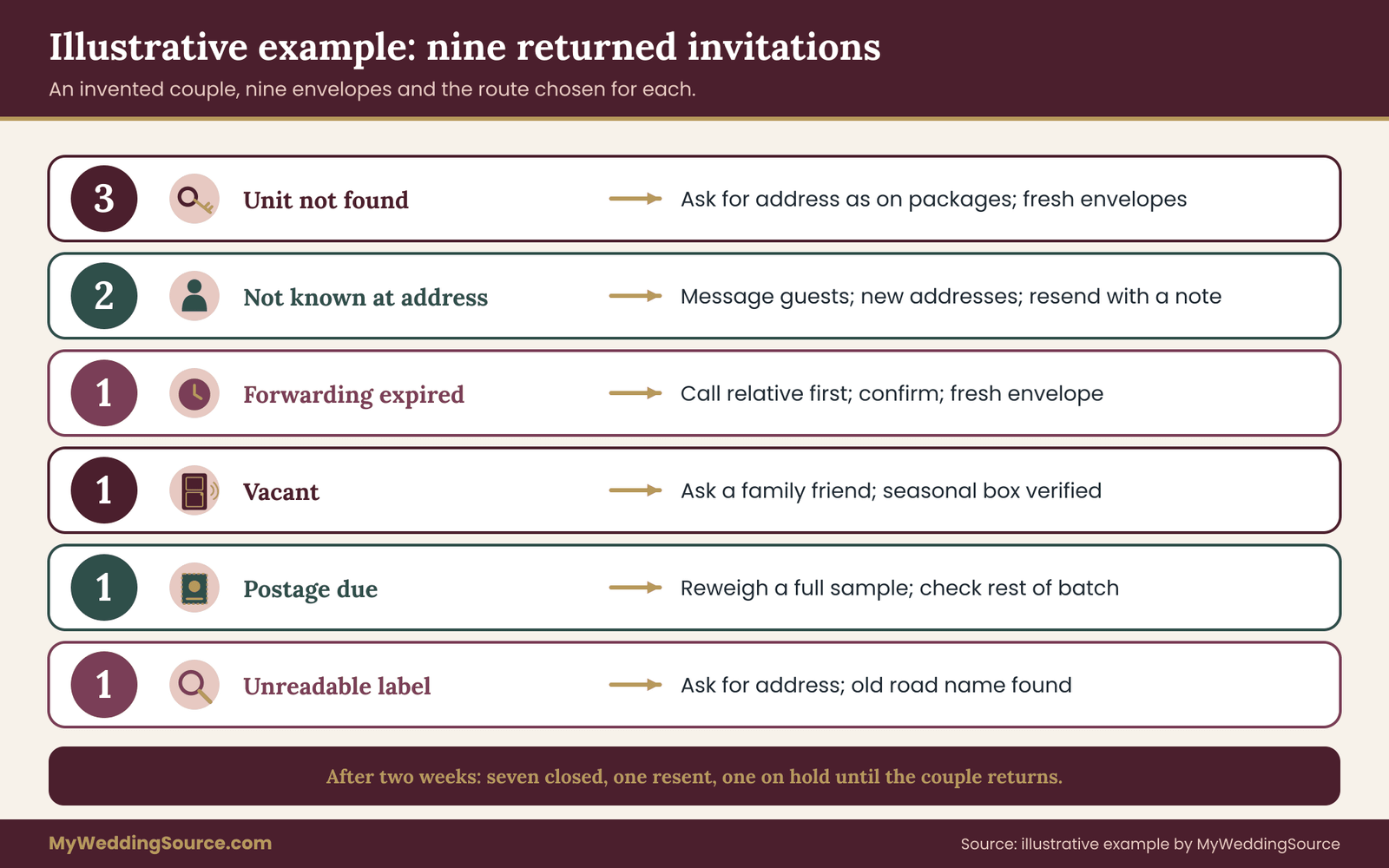
Maya laid the nine envelopes on a table and photographed each one, front and back. She wrote a pencil number on each back. Then she sorted them by marking: three said that the unit could not be found, two said the recipient was not known at that address, one said the forwarding order had expired, one said vacant, one had a postage-due notice, and one had a label so smudged it could not be read.
Counting also showed a pattern. Three of the nine came from the same side of the family. Jordan’s aunt had collected addresses for her branch and sent them in a single email. Maya noted this in the log as a lead to check before she contacted anyone.
The three unit problems
All three were from a single apartment building in a city where Jordan’s cousins had recently moved. The addresses in the aunt’s email had street numbers but no unit numbers. A format check on the Postal Service’s lookup page confirmed that the building was a multi-unit address and asked for a unit designator.
Jordan texted the cousins as a group, asking for the exact address as it appears on their packages. Two answered within an hour. The third did not answer, so Jordan asked one of the other cousins to confirm the third’s unit by text, which she did, and which Jordan then confirmed with the third cousin when she replied that evening.
All three rows passed the three-source rule: the format check, an independent source (the cousins’ own message) and a human confirmation. Maya updated the master list, printed new labels and resent all three on the same day. With roughly seven weeks to the RSVP deadline, a fresh envelope was an easy choice.
The two not-known pieces
Both were addressed to guests from Maya’s college friend group. The envelopes said that the recipients were not known at the address. Maya checked the source: a shared spreadsheet that her friend Priya had built from a group chat two years earlier. Two of the guests had moved since then.
Maya sent a short message to each, using the group chat they already had: “We want to be sure your invitation reaches you. Is your current mailing address the same as the one on the old list, or has it changed?” One replied with a new address within a day. The other did not reply for four days, and Maya sent a second, private message.
That guest answered with a new address and apologized for the delay. Both rows were verified through the guests themselves and a format check. Maya resent both, adding a short note that said the first invitation had been delayed.
The expired forwarding order
The envelope for Jordan’s great-uncle came back with a label showing a forwarding address, and a note that the forwarding period had ended. Jordan treated the new address as a lead. He called his mother, who said that the great-uncle had moved in with a cousin and that the cousin’s address was the one on the label. Jordan then called the cousin, who confirmed that the great-uncle received his mail there and mentioned that he liked to have invitations in his hands.
Here the route mattered. Jordan decided on a phone call first, to the cousin, to tell her what was coming, and then a fresh envelope in the mail with a short note. Because the great-uncle needed to arrange travel and a ride, Jordan also sent the date and venue details to the cousin by message. The row went to resent, and a few days later, to confirmed, when the cousin told Jordan that the invitation had arrived and that the great-uncle intended to come.
The vacant piece
One envelope was marked vacant. It was addressed to a couple, friends of Maya’s parents, who spent winters in another state. Maya did not resend. She asked her mother, who knew them well, whether the couple had a seasonal address. Her mother said yes and offered to call them. The couple gave their winter mailing address, a post office box, and said they would be back in town three weeks before the wedding.
Maya verified the box with a format check and a human confirmation, and sent a fresh envelope there. She also kept the home address on the list as the primary, with the seasonal box noted in the secondary column.
The postage-due piece
One envelope came back with a notice that it needed additional postage. It was a square envelope, and the couple had weighed one sample before they added the response card and a belly band. The guest’s address was fine. Maya went to the post office with a complete sample, asked about the cost, and found that the square shape and the final weight called for a higher rate. She then checked the rest of the batch: the other square envelopes had also been mailed with the lower rate. Some of them had been delivered. Others might have been delayed.
That led to an unplanned task. Maya asked the post office what would happen to underpaid pieces, and the clerk explained that policies can vary. She decided to message a few guests whose invitations she could not confirm, and to ask them lightly whether theirs had arrived. This step is the reason the log tracked the pattern as well as each piece. A single postage-due notice may reveal a systemic problem.
The unreadable label
The last envelope had a label that could not be read, so its cause class was “unknown.” Maya looked at the address and saw nothing wrong. She texted the guest, a coworker of Jordan’s, and asked for a mailing address “in whatever form you use for packages.” The coworker’s reply showed a different street name, because the original list used the name of the road before a recent renaming. Maya verified the new address, resent and logged the reason.
What the log showed at the end
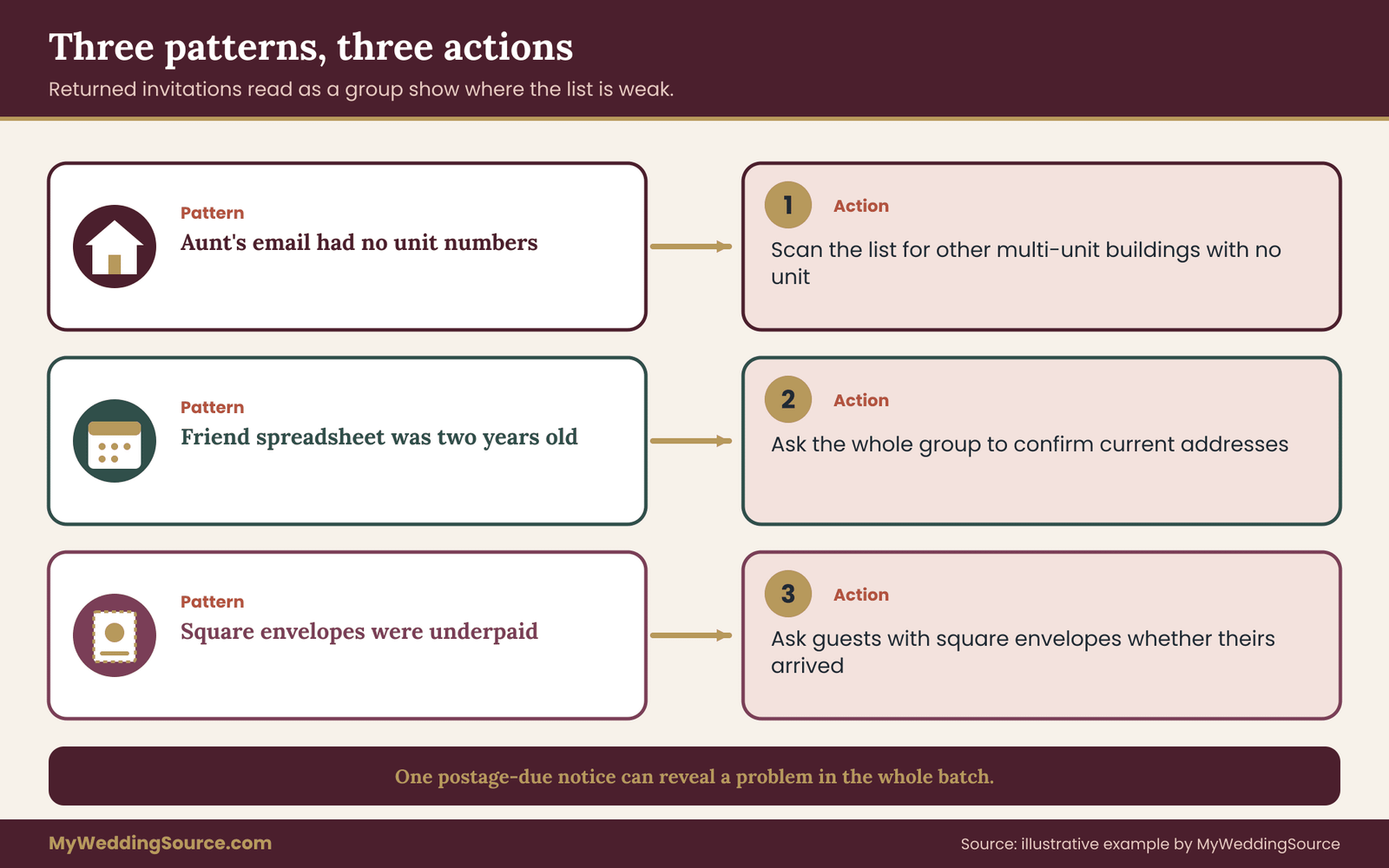
After two weeks, the log looked like this in summary. Seven of the nine rows were closed with the guest confirming receipt of the second invitation. One was resent and waiting for confirmation, and one, for the vacant piece, was in the “hold” state until the couple returned. The pattern notes recorded three things: the aunt’s email had no unit numbers, the friend group’s spreadsheet was two years old, and the square envelopes were underpaid.
Those three patterns led to three actions. Maya went through the master list and looked for other multi-unit addresses without a unit. She sent a general message to the college friend group asking everyone to confirm their current address. And she asked a few guests with square envelopes to confirm that theirs had arrived. Several replies came in over the following week, and two guests who had not seen their invitations were able to be reached in time.
What this example is meant to show
Nothing in the example required special skill. It required the same sequence every time: photograph, number, classify, verify from two sources and a person, choose a route, resend, record. The second lesson is that returned invitations are informative as a group. Three small clues pointed to three small gaps in the list, and fixing the gaps protected many guests whose envelopes had not come back. Read as a group, returned invitations tell you where your list is weak.
Handling guest data while you fix returned invitations
Fixing returned invitations means handling other people’s home addresses, phone numbers and sometimes sensitive family information. That is ordinary for a wedding, and it is worth doing with some care. The aim is not to turn your wedding into a compliance project. It is to treat your guests’ information the way you would want yours treated. Returned invitations put a spotlight on how you handle that data.
Collect and use only what you need
For a returned invitation, you need a verified mailing address and one way to reach the guest, if they are willing to give it. You do not need a guest’s date of birth, their reasons for moving, their relationship history or their opinion of the invitation. Ask only for what the task needs. If a guest volunteers additional details, you can leave them out of the log.
Ask the guest, not a stranger
When you can, get the address from the guest or their household. It is the most accurate source, and it respects their choice about who has their information. Data broker websites and people-search pages are tempting shortcuts, but they are often outdated, they sometimes mix up people with similar names, and many people are uncomfortable being looked up.
A guest who learns that you found their address through such a site may feel surveilled, even when your intention was kind. The Federal Trade Commission publishes consumer guidance on personal information and privacy, and it is a good primer on why people care about this.
Share narrowly
If you ask a relative or a friend to help, share the minimum. A message such as “Could you ask your sister for her new address and send it to me?” is better than forwarding a list of unresolved addresses. If a planner or stationer needs to see the log, share a view with the fields they need, and leave out the notes that describe sensitive situations. Avoid posting any guest information in a group chat where other guests can see it.
Be careful with sensitive situations
If a returned invitation involves a guest who has recently separated, lost a family member, moved for safety reasons or asked you to keep their address private, handle that row yourself and keep notes minimal. Do not publish the new address on a shared spreadsheet or pass it on to vendors who do not need it. When in doubt, ask the guest how they would prefer to receive the invitation, and let them choose.
Store the log where you keep the master list
A separate copy of guest addresses in a text thread, a photo of the log on a shared drive and a paper card in a purse are three more places for a guest’s information to leak. Keep one master list and one log, protect them with a strong password and two-step sign-in where available, and avoid sending address lists by unprotected means. The Cybersecurity and Infrastructure Security Agency publishes general advice on passwords and account security.
Decide how long you will keep the data
You will want addresses for thank-you notes after the wedding. After that, decide on a point at which you will delete or archive the log and the photos of envelopes. A simple rule is to keep the data until the last thank-you note is mailed and then keep only what you need for your own contact list. Photos of returned invitations show names and addresses, so they belong with the same protection as the list.
Vendors and printers
If you hand a guest list to a calligrapher, a printer or a mailing service, tell them what you expect them to do with it. Ask whether they keep a copy, for how long, and how it is protected. Reputable vendors will have a plain answer. If a vendor offers to address envelopes from your spreadsheet, send only the columns they need, such as the name and the mailing address, and leave out phone numbers and notes.
Preventing returned invitations at the next mailing
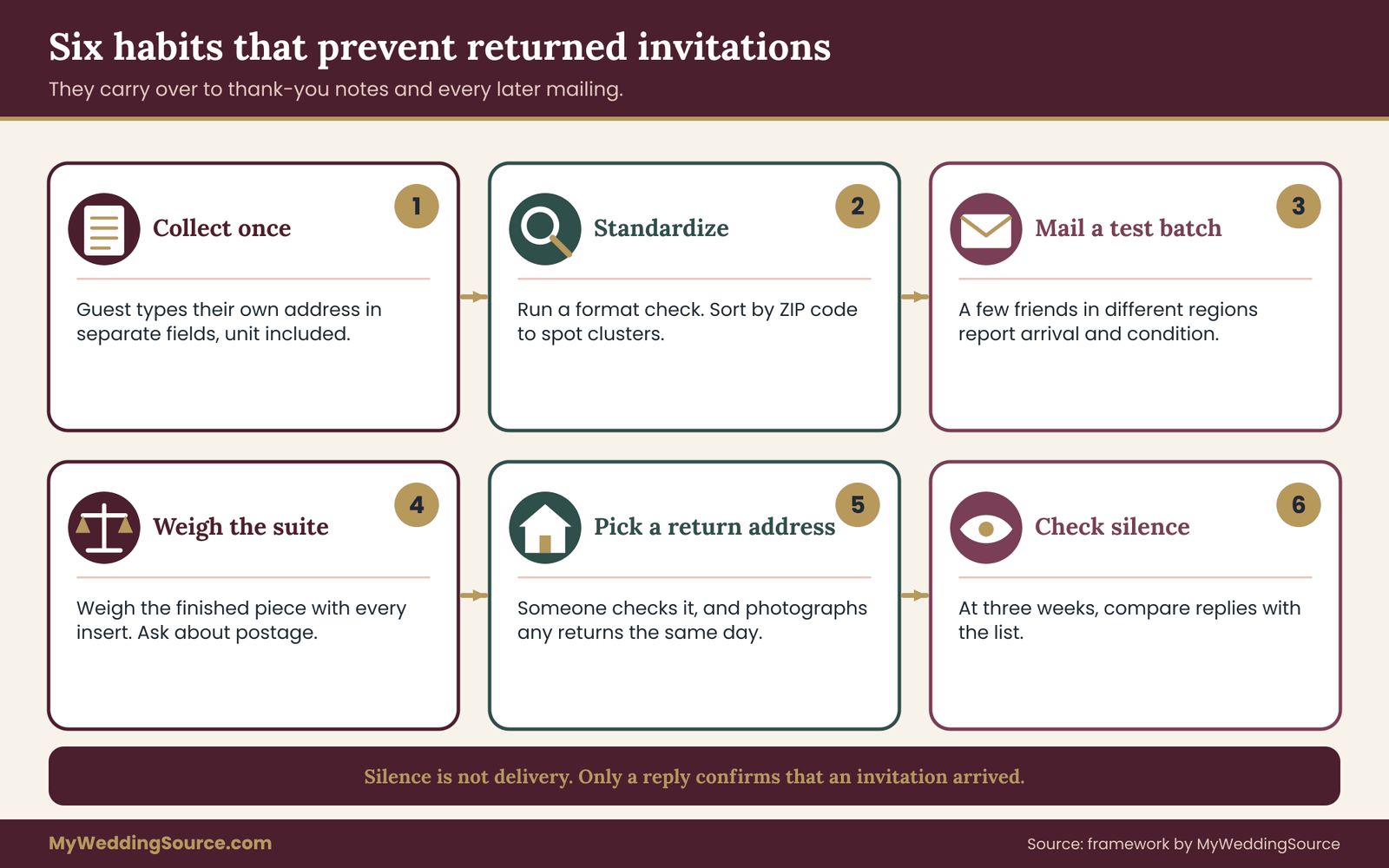
You may not have another full invitation mailing, but you will have more: thank-you notes, a day-after brunch, an announcement, a holiday card. The habits that prevent returned invitations carry across all of them, and a short prevention routine pays back every time you send something. Prevention is cheaper than repairing returned invitations.
Collect addresses once, in the way people write them
Ask guests to type their own address into a form, and ask for it in the format they use on packages. Use separate fields for street, unit, city, state and ZIP code, so the unit does not disappear into a single line. If you collect addresses by text or in a family email, copy each into the master list the same day, with the date and the source, so you can find the origin later.
Standardize before you print
Before the labels or envelopes go to a printer or a calligrapher, run the list through a format check on a sample, then on the full list if a tool allows it. Look for missing units, ZIP codes that do not match the city, and street suffixes that look wrong. Sort the list by ZIP code to find clusters of similar errors. A short review by a second person is worth more than a long review by one, because a fresh eye catches slips that the person who typed them cannot see.
Mail a test batch
Mail a few invitations to friends or relatives in different parts of the country, ask them to tell you when theirs arrives and what condition it was in, and wait for the answers before you mail the rest. A test batch costs a few stamps, and it checks the postage, the packaging and the handwriting at the same time. A test batch is the cheapest way to see returned invitations before they matter.
Weigh the finished piece
Weigh one complete suite in the final envelope, with every insert, and ask the post office about the postage for that weight and shape. Any embellishment you add later changes the weight, so redo the check. Square, rigid or lumpy pieces can require a higher rate under the Postal Service’s published rules, so ask before you buy stamps in bulk.
Choose a return address that will be answered
Pick a return address where someone will check the mail while you are busy. If it is a parent’s house, ask them to send you a photo of any returned invitation the day it arrives. If it is yours and you will be away, arrange a mail hold or a pickup. Returned mail that sits in a stack is a problem that grows.
Use the RSVP list as a second check
Three weeks after mailing, compare the replies you have received against the guest list. A household that has said nothing at all is worth a gentle check, since silence can mean that an invitation was misdelivered and never returned. This is the single most useful defense against the quiet kind of failure. It catches what returned invitations cannot.
Keep a short list of local rules
Mailing rules, postage and shape requirements change, and local post offices sometimes apply them differently. Write down the date you checked, who you spoke with and what you were told, so that if there is a question later, you have a record. Check again before any second mailing.
When resending is not enough
A few situations do not respond to any amount of verification. It helps to name them in advance, so you can make a decision without feeling that you failed. Some returned invitations stay unresolved, and that is allowed.
The guest cannot be reached by any channel. If you have tried the household, the family and every contact you have, and still have no confirmed address, you have done what a reasonable host can do. Record the attempts and set a date after which you stop. Another round of searching has little value, and some guests simply want distance.
The guest has asked you to stop. If a guest tells you that they would rather not receive the invitation, or that they cannot attend, honor it. Close the row with that reason and update your headcount.
Mail is unreliable in the guest’s area. Some rural routes, remote communities and international addresses face slower or less predictable delivery, and the Postal Service’s published rules and international mail services can differ from domestic ones. If a guest lives in such a place, plan for a call or a digital copy alongside the paper from the start.
The deadline has passed. When your caterer’s final count is due and a household is still unconfirmed, you may have to make a decision on the information you have. Tell the guest what you decided and why, and leave a path for a late yes if your venue and caterer can accommodate it.
The information is contradictory and the guest will not answer. Hold the paper, send a short digital message, and rely on a phone call or a relative to resolve it. Do not guess.
This guide is general information, and it cannot account for every local rule, vendor policy or family situation. For postal rules and fees, the Postal Service is the authority. For your printer’s capabilities, your printer is. For anything involving a guest’s personal circumstances, the guest is.
Your next steps
- Gather every returned invitation, photograph the front and back, and write a number on each.
- Open the decision log and enter the date, household, postal reason and your cause class for each row.
- Check the source of each address and note who should confirm it.
- Verify each address with the format check, an independent source and a human confirmation before you print anything.
- Choose a resend route by cause and by the days left before your RSVP deadline.
- Resend once, record the date, and confirm receipt with the guest.
- Compare replies against your guest list three weeks after mailing, and follow up with households that have been silent.
- Fix the master list, protect it, and delete or archive the log and the envelope photos after your last thank-you note.
FAQ
Should I resend returned invitations without checking the address?
No. If the address was wrong, a second envelope will usually come back and cost you more time. Verify the address first with the Postal Service’s format check, an independent source and a person who knows the household. If time is short, contact the guest directly by phone or message, share the details, and send paper afterward as a follow-up.
Does a returned invitation mean the guest is not coming?
No. It only means that this piece of mail did not reach them. They may already know about the date from family, a save-the-date or your wedding website. Treat the envelope as a delivery problem, fix it, and let the guest reply on their own timeline. Do not mark the household as declined.
How do I ask a guest for a new address without making it awkward?
Keep it short, warm and specific. Say that one of your invitations came back, that you want to be sure it reaches them, and ask for the best mailing address. Avoid explaining postal procedure or implying that the guest did something wrong. Match the channel to the relationship, such as a text for friends and a call for older relatives.
Can I reuse the returned envelope?
It is better not to. Postal markings, labels and adhesive residue can interfere with sorting and make the address hard to read. Use a fresh envelope or label addressed from the corrected master list. If your envelope was damaged or underpaid, replace it with a sturdier one and have the finished piece weighed before you mail it.
How many times should I resend before I stop?
Resend once after a verified correction. If the same household’s invitation comes back a second time, stop mailing and make a human contact, because your information is wrong in a way you have not found yet. Set a firm end date for your efforts, record each attempt, and move on if the guest cannot be reached.
Is it acceptable to use people-search websites to find an address?
It is a last resort, and many guests will not like it. These sites are often outdated or mix up people with similar names, and they can feel intrusive. Asking the guest, their household or a close relative gives you better information and respects their choice about who has their address. Never use a public lookup for a guest who has asked for privacy.
What should I do if the postal label is unreadable?
Record the cause as unknown and do not guess. Compare the envelope with your master list, look for an obvious error, and check the format on the Postal Service’s lookup page. Then contact the guest to confirm their address before you spend postage. If the envelope looks fine and the address checks out, ask a post office clerk about the piece.
How can I tell whether other invitations were delivered?
You cannot tell from the mail alone, because pieces that were misdelivered or ignored often do not come back. About three weeks after mailing, compare the replies you have received against your guest list, and follow up kindly with households that have said nothing. A short message or call asking whether the invitation arrived is usually enough.
Sources
- United States Postal Service
- Domestic Mail Manual, Postal Explorer
- USPS Frequently Asked Questions
- USPS ZIP Code Lookup
- USPS About: Postal Service information
- Postal Explorer: mailing standards and publications
- Federal Trade Commission: consumer privacy and personal information
- Cybersecurity and Infrastructure Security Agency
- U.S. Postal Inspection Service