
Wedding ceiling draping turns a plain room into a soft, glowing canopy, and it is also one of the few decor choices that asks the building for three separate permissions: a safe place to attach, a fabric that will not carry flame, and clearance from lights, sprinklers and air vents. This guide gives you a rigging load and fire approval sheet, a cost formula you can check, and the questions that keep the wedding ceiling draping from being cancelled the afternoon before your wedding.
Treat wedding ceiling draping as a permitted installation, not a styling extra. Before you pay for it, get four things in writing: the exact attachment points the venue allows and their rated load, a flame-resistance certificate for every fabric that will hang, the sprinkler and detector clearance the fire authority accepts, and the heat and power plan for lights under the cloth. Then price it with a formula: area covered, fabric, labor, lift time, treatment and strike. If any line has no answer, the design is not ready.
Picture a ballroom with a flat white ceiling and a dance floor that feels a little like a gymnasium. A designer sketches pleated white fabric radiating from a center point, with warm lights tucked behind it. It looks wonderful on paper. Then three questions arrive in a row. Where will the fabric be fastened? Is the fabric treated to resist fire, and can anyone prove it? How far will it sit from the sprinkler heads and the hot fixtures?
Those questions are not obstacles invented by cautious venues. They are the reason wedding ceiling draping is installed by trained crews with ladders, lifts and paperwork. This article is written for couples and planners who want the effect and want to stay on the right side of the venue, the fire official and the insurance policy. It stays on one narrow subject. The wider design of a reception room, including furniture and layers of light, sits in other guides on the site, and the broader job of choosing and comparing rooms is in the wedding venues guide.
A note on scope. This is general planning information, not legal, safety, fire-code or engineering advice, and the venue, the fire authority and a qualified rigger have the final say on what may be hung in a particular room.
What wedding ceiling draping is, and what it is not
The phrase covers several different looks, and each one carries a different set of risks. Naming the version you want is the first step toward an accurate quote.
Center-peaked canopy. Fabric runs from a high central point out to the walls or to perimeter points, like the inside of a tent. This is the classic version and it concentrates tension at the center, which is why the attachment point matters so much.
Swagged or pleated ceiling. Panels hang in repeated scallops across the room, usually from a grid of lines or pipes. The look is soft and layered, and the load is spread over more points.
Sheer cloud or sail. Lightweight fabric floats in sections over the dance floor or the head table, while the rest of the ceiling stays bare. The covered area is smaller, which lowers cost and risk.
Backdrop drape that rises into the ceiling. Long panels start on the wall, then travel up and across. These blur the line between wall drape and ceiling work and need the same approvals as any wedding ceiling draping fabric.
Fabric over truss or a freestanding frame. Instead of hanging from the building, the fabric hangs from a structure that stands on the floor. The ceiling is never touched, but the structure has its own weight, footprint and stability questions.
Wedding ceiling draping is not the same as decorating the ceiling with a few paper lanterns or a single floral piece. A floral cloud and a paper installation raise some of the same questions, but a fabric canopy covers far more surface. Surface area is what makes fire rules central to this one. A large, thin, hanging textile behaves differently in a fire than a small object does, and that is why the fabric itself gets scrutinized.
It is also not the same as wall draping, which lives at eye level and can often be done with freestanding stands. If you only need to hide a wall or soften a corner, a ground-supported option is usually simpler, cheaper and easier to approve, and a later section compares the two.
Why the look appeals, and what it can honestly do
Couples choose wedding ceiling draping for practical reasons as often as aesthetic ones. A ballroom with exposed ducts, a gym-style ceiling or a harsh grid of tiles can swallow candlelight and warm bulbs. Fabric lowers the visual ceiling, hides clutter and gives the lights something soft to glow against. In a very tall room it can make the space feel closer.
It also has limits. Fabric does not fix bad acoustics in any dependable way, it does not make a cold room warmer, and it will not hide a room that is the wrong size for your guest count. Ask your designer what problem the wedding ceiling draping solves. If the honest answer is “it looks lovely and the ceiling is ugly,” that is a perfectly good answer, as long as the budget and approvals follow.
The three gates every wedding ceiling draping plan must pass
Most trouble with wedding ceiling draping comes from treating one approval as if it were all of them. A venue manager says “sure, we allow draping,” and the couple assumes everything is settled. In fact, three different people hold three different keys.
Gate one: where it attaches, and how much it weighs. The venue, the building engineer or a qualified rigger decides what the structure can hold and which points may be used. This is about load. The fabric is light, but the lines, clamps, pipes and center hub add up, and the pull at one point can be much greater than the weight of the cloth itself.
Gate two: what it is made of, and how close it sits to things. The fire authority and the venue’s fire policy decide whether the fabric must be flame-resistant, how that is proven, and how far it must stay from sprinkler heads, smoke detectors, exit signs and hot lamps. This is about fire safety.
Gate three: what runs under it. Lights, haze machines, speakers, heaters, vents and cables share the space with the fabric. Electrical work and heat are the concern, and a licensed professional, not the florist or a friend with extension cords, should own them.
If a design clears only one or two gates, it is not approved. Put the three gates at the top of the approval sheet described later and make each one a separate signature or a separate written confirmation.
Who sits at each gate
Do not expect one person to answer for all three. A sales coordinator usually handles the first contact. The operations or events manager knows the house rules. A building engineer or the venue’s production crew knows the structure. The fire authority, usually a local fire marshal’s office or building department, interprets the fire code. Your decor company or lighting vendor knows what they plan to hang. Your planner, if you have one, is the person who keeps all of those conversations in one thread.
A simple habit helps: for each gate, write down the name and role of the person who can say yes, and the date they said it. If the answer is “I think so” or “that has never been a problem,” ask for it in writing and treat the gate as still closed.
Why surface area changes the conversation
A single hanging lantern and a wedding ceiling draping canopy that covers a dance floor are both “ceiling decor,” but venues treat them very differently. The second one introduces a large amount of fabric near the ceiling, where heat collects and where sprinkler heads, detectors and vents sit. A venue that welcomes a few hanging flowers may require a permit, a treated fabric certificate or an on-site fire watch for a wedding ceiling draping canopy. That is a reasonable response to a real difference in risk, not a sign that the venue is being difficult.
Wedding ceiling draping simply sits higher on the risk scale than a few hanging flowers.
The practical lesson is to ask about wedding ceiling draping by its coverage. “Can we drape the ceiling?” is too vague to answer well. “We would like to cover about a third of the dance floor with sheer fabric, hung from four points, with warm lights behind it. What do you need from us?” gets a precise reply, and it signals that you understand the process.
How this guide is organized
The sections that follow build up the approval sheet in the order the questions usually arise. Costs come first, because they decide whether the idea is worth pursuing. Attachment points and load come next, because they decide whether it can be done in your room. Fire rules and the heat and power plan follow, because they decide whether it can be done safely. Then comes a comparison with alternatives, the sheet itself with a worked example, vendor questions, contract language and the edge cases that catch people out.
If you are still touring venues, the guide to a venue technical walkthrough shows how to measure the room and meet the staff who actually know the building. Bring that checklist and add the questions in this article.
What wedding ceiling draping costs: a formula you can check
Prices for wedding ceiling draping vary so widely between regions, rooms and companies that any average quoted online should make you cautious. This section does not offer one. It gives you the structure of a quote, so that when three companies send three totals you can see which line explains each difference. Always get current pricing and supplier terms directly from the companies you are considering.
The cost formula
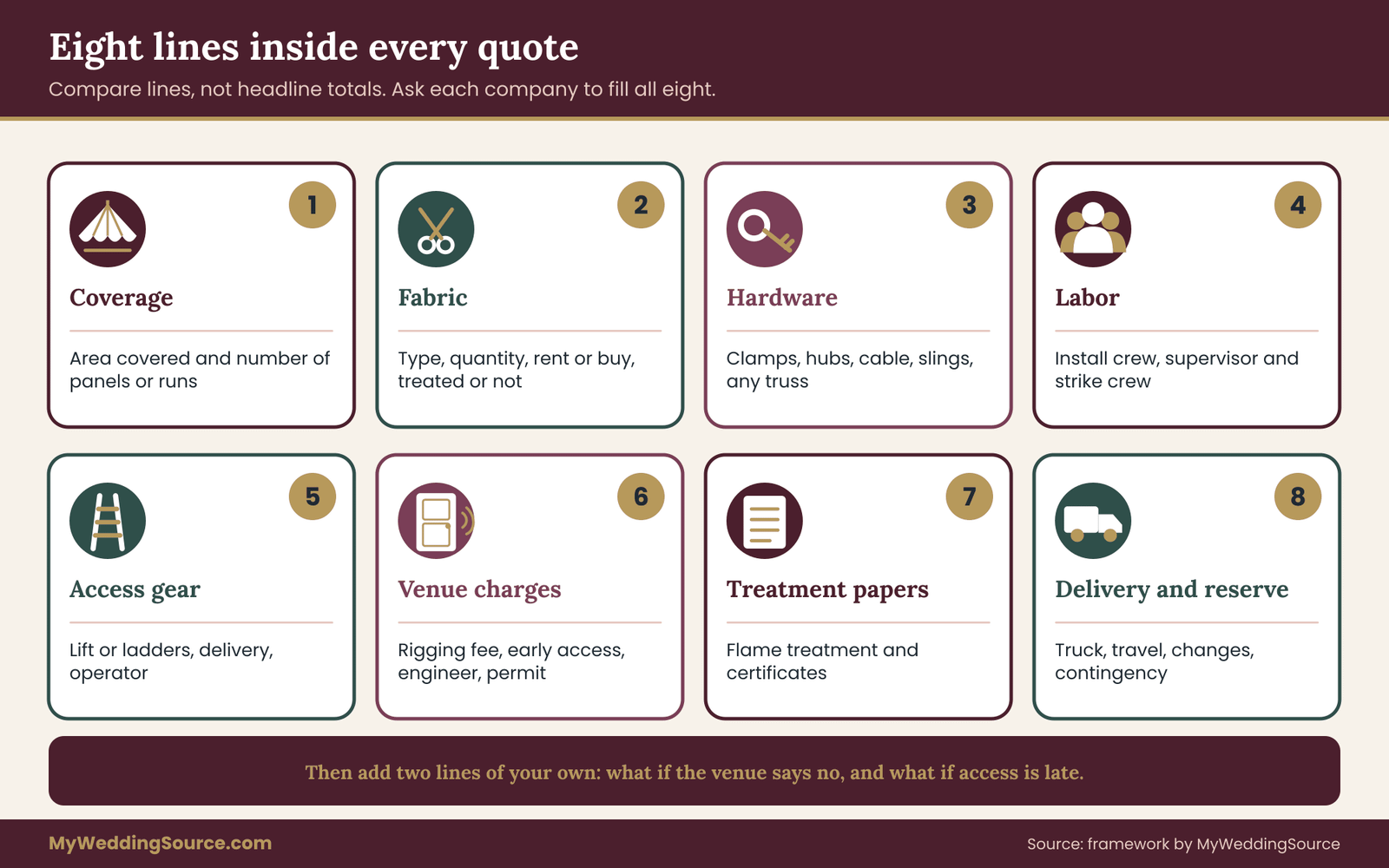
Almost every quote for wedding ceiling draping can be broken into the same eight lines.
1. Coverage. How much ceiling will be covered, in square feet or in sections. A full canopy over a ballroom and a cloud over a dance floor are different products. Ask each company to state the covered area and the number of fabric panels or runs.
2. Fabric. Quantity, type and treatment. Sheer voile, chiffon, polyester crepe and flame-resistant cotton all have different rental or purchase prices, and treated fabric may cost more than untreated. Ask whether the fabric is rented, owned by the company or bought new for your event.
3. Hardware. Clamps, pipes, cable, hubs, rated shackles, tensioners and any truss. Companies that do this regularly own this equipment, and the price usually shows up as a bundled rigging fee.
4. Labor. Install crew hours, strike crew hours and a supervisor. Ceiling work is slow, because every panel is raised, positioned, tensioned and checked.
5. Access equipment. Scissor lift, boom lift or tall ladders. The rental, delivery and operator are often a separate line, and the venue may have rules about floor protection or which lifts it allows.
6. Venue charges. Some venues charge a rigging fee, an overtime fee for early access, an engineer’s review, or an in-house labor charge. You may also pay for a fire watch or a permit.
7. Treatment and documentation. If fabric must be treated or re-treated, or a certificate must be produced, that can add a line.
8. Delivery, travel and contingency. Truck, mileage, overnight stays for a crew, and a reserve for changes.
Write these eight lines on a page for each quote. A company that gives you a single “draping package” number should be able to tell you what is inside it. Wedding ceiling draping quotes are only comparable when every line is visible.
Which choices move the total most
You do not need exact figures to understand the direction of each cost driver.
Ceiling height and access. A low ceiling reachable by ladder costs less than a thirty-foot ceiling that needs a lift and a larger crew. Height also increases the time to raise and tension each panel.
Coverage pattern. Covering the whole room needs more fabric and more attachment points than a smaller canopy over the dance floor. Partial coverage is the most common way to bring a quote down while keeping the visual effect where guests actually look.
Install window. If the venue allows access only a few hours before guests arrive, the company needs a bigger crew to finish in time. If the room is available the day before, the same work can be done with fewer people more slowly. Ask the venue for the earliest access time and what it costs.
Venue labor rules. Some venues require their own staff or approved vendors for anything overhead. That can add a fee or limit who you may hire.
Fabric volume. A fuller, more gathered look uses much more fabric than a flat run of the same size. Pleats and swags are pretty because they use extra material.
Lighting. Lights behind or inside the fabric can be a separate package from the wedding ceiling draping itself. If the same company supplies both, you may get a combined quote, but make sure the lighting line is visible.
What is usually priced separately
Treat these as “ask before you assume they are included.”
- Flame-resistance treatment or a certificate for fabric that is not already treated.
- A site visit before the quote, and a second visit for a technical walkthrough.
- Venue rigging engineer review or sign-off.
- A lift operator on strike night.
- Replacement of any panel damaged in handling.
- Delivery to a venue with a loading dock, a freight elevator or a long carry.
- A rehearsal install or a sample panel viewed in the room.
The guide to wedding rental planning explains how to read rental terms such as damage waivers, return windows and delivery schedules, which apply to rented fabric and hardware.
Rent, buy or build it yourself
There are three ways to source the fabric and the work, and each has a cost shape.
Hire a decor company. You pay a bundled price. In return the company supplies treated fabric, hardware, trained crew and usually a certificate and insurance. This is the most expensive on paper and the least likely to hit a surprise at the venue.
Rent the fabric and hire labor separately. This can reduce the total, but you become the coordinator. You must confirm that the rented fabric is treated, that the crew is qualified for wedding ceiling draping work, and that someone is responsible if a panel is damaged.
Buy fabric and do it yourselves. It looks cheapest, and it is the option most likely to run into trouble. Untreated fabric may be refused by the venue. Overhead work without proper equipment and training is a safety risk to helpers and guests. Many venues will not allow volunteer rigging at all. If a friend offers to help, treat that as a labor question to bring to the venue, not as a way around the process.
A useful rule: do the math on the whole job, not on the fabric. A bolt of fabric bought online may cost a fraction of a decor company’s price, but the lift, the crew, the treatment, the insurance, the strike and the risk of rejection are where the real money sits.
Building your own comparison
Put each quote into the same eight lines, and add two more lines of your own: “what happens if the venue says no” and “what happens if it rains or the room is not available early.” Then compare.
Suppose, as an invented illustration, that two companies quote for the same dance-floor canopy. Company A gives one total that includes treated fabric, hardware, a four-person crew, a lift and a certificate. Company B gives a lower total, but the fabric is untreated, the lift is “your responsibility,” and the certificate is “available on request.” After you add a treatment line, a lift rental and the cost of asking for the certificate, the totals may be much closer than they first looked. The numbers here are not data. They show the habit of comparing lines instead of headline prices.
If the headline totals are still far apart after you line them up, ask both companies to explain the largest difference in one sentence. A good company can usually say, “Ours includes X, theirs does not,” or “We use more fabric for a fuller look.”
Where the money should and should not go
Spend on the things that carry risk and are hard to fix on the day: rigging, flame-resistance documentation, a qualified install crew and strike labor. Save on things that carry no risk and can be adjusted: the amount of gathered fullness, the color of the fabric, how much of the ceiling is covered and how many lights sit behind it.
A modest, well-rigged canopy over a dance floor is almost always a better outcome than a room-wide design that is scaled back on the day because an approval was missing. The planning framework in the wedding budget guide can help you decide how much of your decor budget to allocate to wedding ceiling draping work, and what to trade if the number needs to come down.
Keeping a payment and quote record
Because wedding ceiling draping often involves a deposit, a balance and possible add-ons, keep a simple record from the start: the date of each quote, the version of the design, what was included, what was excluded and what you were told verbally. When the venue or the fire authority changes a requirement, update the record and ask the company to reissue the quote. A quote for a design that the venue has changed is no longer a quote for your wedding.
Ask also for the cancellation and change terms. If the venue refuses an attachment point three weeks before the date, you should know in advance what you owe, what you get back and what the company will do to redesign. This is covered further in the section on contract terms, but it belongs in the cost conversation from the first email.
A quick cost sanity check
Before you commit, answer these five questions in a few sentences each.
- What do we get visually for the covered area, and would a smaller area deliver most of the effect?
- Which lines are fixed and which depend on venue rules we have not yet seen?
- What happens to the price if the approval changes the design?
- Who pays if a panel is damaged, if the install runs late or if the strike is slow?
- Have we included the venue’s own charges?
If you cannot answer one of these, it is the line to resolve first. Good wedding ceiling draping budgeting is mostly the habit of asking what is missing.
Attachment points: where wedding ceiling draping can and cannot hang
The attachment point is the single most important detail in wedding ceiling draping, and it is the one couples see least. A beautiful canopy is only as secure as the place it is fastened. This section explains the common types of ceilings, what each usually allows, and how to ask for a clear answer.
Common ceiling types and what to ask about each
Venue ceilings fall into a handful of families. The notes below describe general patterns, not rules. Each building is different, and only the venue or a qualified professional can confirm what a given ceiling will accept.
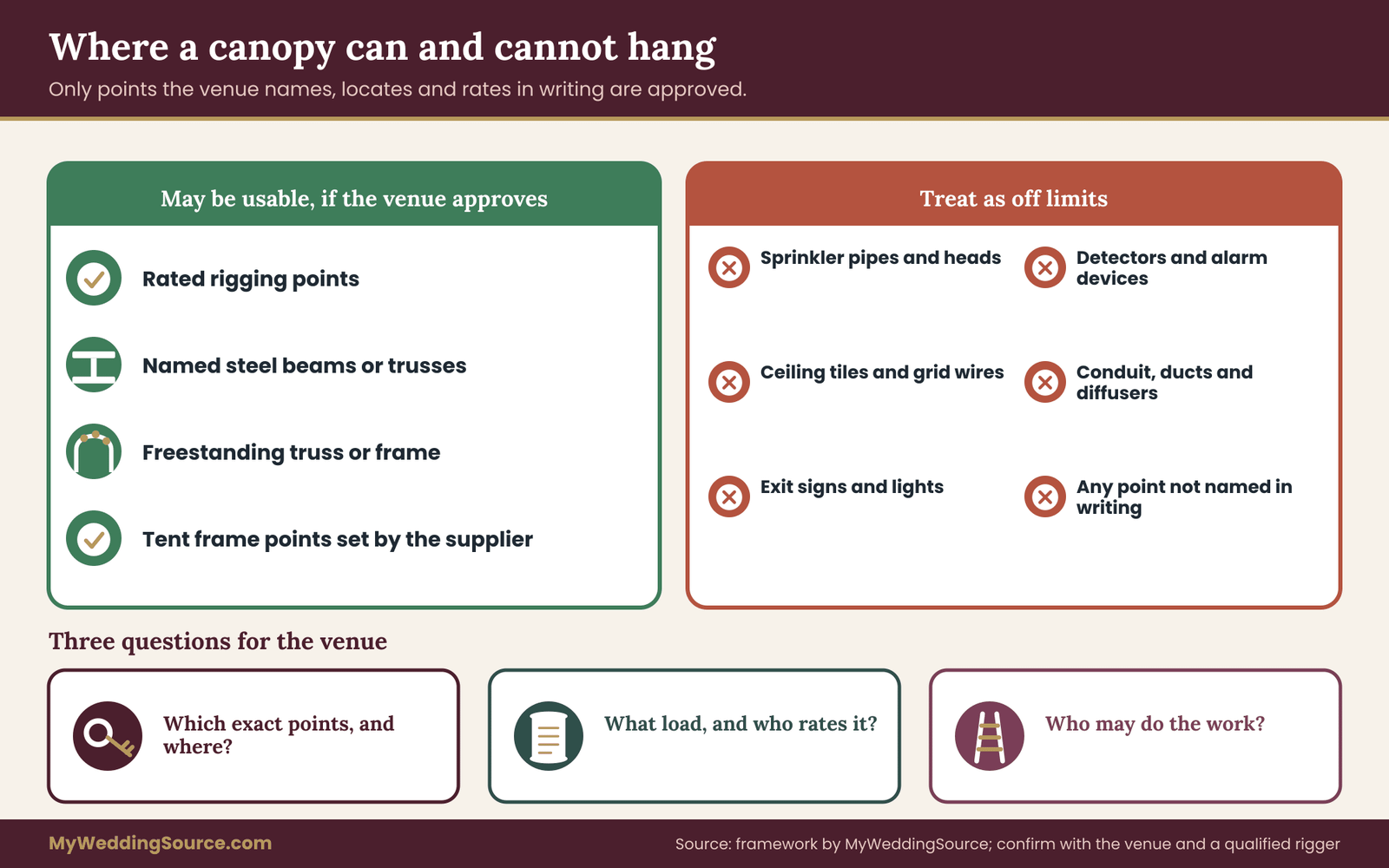
Exposed steel beams or trusses. Often the friendliest for wedding ceiling draping, because they offer solid points. Even so, the venue decides which beams may be used, how clamps or slings must be attached, and what rated hardware is required. Ask whether beam clamps are allowed or whether the building has a rigging policy.
Designated rigging points. Some ballrooms, theaters and event halls have rated points installed for this purpose, with a posted or documented capacity. These are the easiest to approve. Ask for the rating in writing and for any rules about distributing load across several points.
Suspended grid ceilings (drop ceilings). These are ceiling tiles in a metal grid hung from wires. They are generally not made to carry added load. The grid, the tiles and the wires are not meant to hold fabric, hubs or lines, and attaching to them is commonly forbidden. If the venue has a drop ceiling, wedding ceiling draping usually needs a different approach, such as a freestanding frame or fabric hung from the structure above with the venue’s permission.
Drywall or plaster ceilings. Venues often prohibit screws, hooks and adhesive here because of damage and uncertain strength. Ask what, if anything, may touch the surface.
Wood beams and barn rafters. Rustic venues may allow wrapping or clamping, but old timber, finished surfaces and historic status can change that. Ask about the condition and whether anything may be fastened or only draped over.
Tent frames. The tent supplier decides what the frame can carry and which points may be used. Tent draping often has its own accessories and rules, which are covered under edge cases.
Historic or landmark buildings. Preservation rules can forbid any attachment. Expect a conversation about freestanding structures.
Things you should never use as an attachment point
Without exception, ask that these be treated as off limits unless a qualified professional with the venue’s approval says otherwise.
- Sprinkler pipes, sprinkler heads and their hangers.
- Fire alarm devices, detectors, horns and strobes.
- Electrical conduit, cable trays and light fixtures that were not designed to carry load.
- HVAC ducts and diffusers.
- Ceiling tiles and grid wires.
- Emergency lighting and exit signs.
- Anything the venue has not named as an allowed point.
The reason is plain. Sprinkler piping is part of a life-safety system and is not designed to carry decor. Added weight can damage fittings or change how a head sits. Detectors and alarm devices must stay clear and visible. Conduit and fixtures were never rated for the pull of a wedding ceiling draping canopy.
The three questions to ask the venue
When you meet the person who knows the structure, three questions get you most of what you need.
“Which exact points may we use, and where are they?” Ask for a marked drawing or photographs with locations. A reply such as “the beams are fine” should be turned into “which beams, and are there any in the zone we want to cover?”
“What load can each point carry, and who determines that?” The answer may come from the building’s documentation, an engineer or the venue’s production manager. Do not estimate it yourself and do not accept a verbal guess. Ask for it in writing.
“Who is allowed to do the work, and what proof do they need?” Some venues require their own riggers or a list of approved vendors. Others accept outside crews with proof of insurance and training. Ask for the requirements before you hire anyone.
Load: weight, pull and movement
Couples often hear “the wedding ceiling draping is light” and stop thinking about load. The fabric is indeed light, but wedding ceiling draping adds weight and force in several ways.
Dead load. The static weight of the fabric, lines, pipes, hubs, clamps and any lights or decor attached. Add it up for each point, not for the whole room. A single center hub may carry the pull of many panels at once.
Angle and tension. A line pulled sideways at a shallow angle puts a larger force on the anchor than the fabric’s weight alone. When fabric runs from a central point to the walls, the tension in each run is not just the weight of the cloth. The flatter the run, the higher the force. This is why a wedding ceiling draping canopy that looks gentle can load its center point heavily, and it is a point that must be checked by someone qualified.
Dynamic effects. Air from vents, a door opening, a person bumping a line, a lift moving nearby or a guest pulling on a corner can add momentary forces. Riggers plan for those and keep a margin.
Added items. Lights, floral elements, signs or hanging decor attached to the wedding ceiling draping increase the load and may change the fire situation.
You do not need to calculate any of this yourself, and you should not. What you need is a clear written statement, from the person who is qualified to give it, that the planned system is within the limits of the chosen points. Ask your decor company to give the venue a list of components with their weights and the planned points, and ask the venue to confirm.
The rigging plan you should request
Ask the decor company for a simple rigging plan before any approval meeting. It should contain:
- A top-down sketch of the ceiling with each attachment point marked.
- A side view showing the height of the lowest edge of the fabric above the floor.
- A list of components, such as hubs, clamps, slings and lines, with rated capacities as stated by their manufacturers.
- The approximate weight at each point.
- The name of the person who will supervise the install.
- The inspection step before guests arrive.
A company that does this routinely can produce such a plan quickly. One that cannot is giving you useful information about the risk of hiring them.
Freestanding and ground-supported options
If the ceiling cannot be used, wedding ceiling draping can still be done from structures that stand on the floor. There are several versions.
Truss towers with a top frame. A rented frame stands in the room and carries the fabric. The ceiling is not touched. The frame has its own footprint, weight and stability concerns, and the venue may still require approval, floor protection and ballast.
Pole or pipe-and-drape stands. Common for backdrops and short canopies. They support fabric at a fairly low height, so they suit lounge areas or a ceremony canopy rather than a tall room.
A tent or sailcloth structure inside the room. This is a larger project, usually costly, and has its own fire and permit questions.
Lighting and fabric on a rented grid. A grid hung from stands over the dance floor can carry lights and sheer fabric. The ceiling stays clear, but the structure must be stable and the venue must accept it.
Each of these changes the quote and the approvals, and each can keep wedding ceiling draping alive in a room that seems to forbid it. The cost may be higher than hanging from a ready beam, but it often turns a flat refusal into a yes.
Heights, clearances and sightlines
Even when an attachment point is approved, the final height of the fabric needs to be checked.
- Keep the lowest edge high enough for guests, servers, tall hats and raised arms. Your decor company should state the minimum clearance above the floor.
- Check the route of any moving equipment, such as a catering cart or a stage riser, so the fabric does not catch.
- Look at the room from guests’ seats. Low fabric can block views of the head table or a screen, and it can make a room feel crowded.
- Mark vents, speakers, cameras and projector beams on the plan. A canopy that blocks a vent can create warm spots or air movement that makes the fabric move.
The guide on venue technical walkthroughs covers how to measure and record these items on one visit.
A decision rule for attachment
Here is a rule that keeps decisions simple. If a point is named, located and rated in writing by the venue, and the system’s weight at that point is confirmed by a qualified person, it can be used. If any of those three pieces is missing, the point is not approved. A friendly “that should be fine” counts as a prompt to ask for the document, not as an answer. Wedding ceiling draping approvals live or die on that habit.
Fire rules for wedding ceiling draping: fabric, sprinklers and heat
Fire rules are the part of wedding ceiling draping that most couples have never met. They are also the part where the venue and the local fire authority have the least flexibility. This section explains the usual building blocks so the conversation is easier, without pretending to tell you what your local code says. Codes and their local amendments differ, and the fire authority that covers your venue is the final word.
Why fabric overhead draws attention
In a fire, heat and smoke rise and collect near the ceiling. A large area of lightweight fabric hanging there can help a fire spread quickly if the fabric is not made to resist flame. It can also hang low, block or delay the spray from sprinklers, or cover detectors that need open air. That combination is why overhead textiles, and not just open flames, are on the list of things fire officials care about.
The agencies that write and teach fire codes, such as the National Fire Protection Association and the International Code Council, publish model codes and standards that many jurisdictions adopt, often with local changes. The U.S. Fire Administration offers public safety resources. None of these will tell you what a specific venue must do. They explain the basis for the questions you will hear about wedding ceiling draping.
Flame resistance: what the paperwork is for
Many venues and fire authorities require decorative fabric used in public assembly spaces to be flame-resistant, either because it is made that way or because it has been treated. A widely referenced standard for the flame propagation of textiles is NFPA 701, which is why you may hear the phrase “701 certified” from decor companies. Whether that exact standard, another test or a local rule applies in your venue is something to confirm with the venue and the fire authority.
Ask for the following, in plain terms.
What is the fabric’s status? Is it inherently flame-resistant, meaning made from a fiber that resists burning by design, or treated with a flame-retardant product? Treated fabric may lose protection after washing or after a number of uses, depending on the product and the cleaning method.
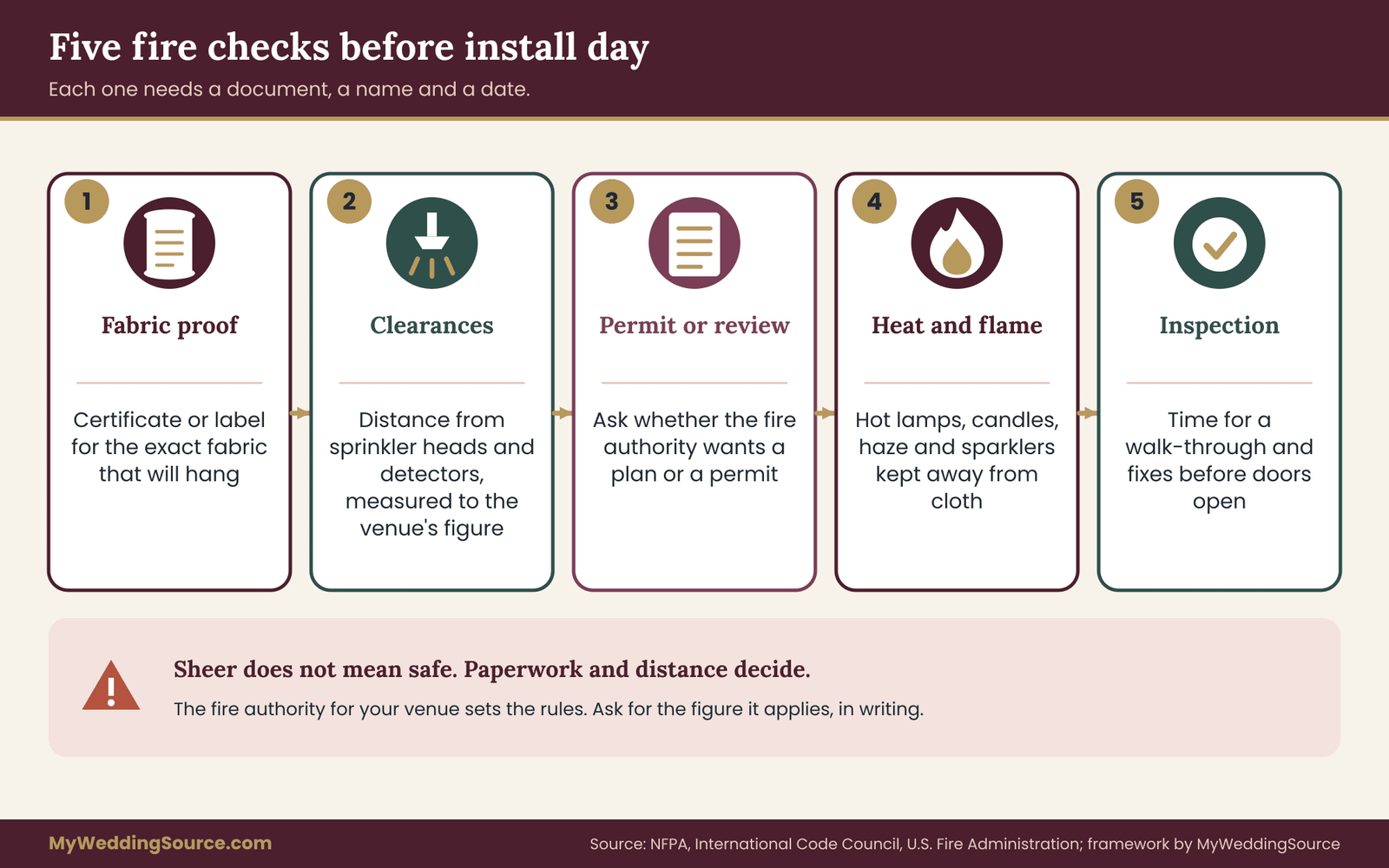
What is the proof? A manufacturer’s certificate, a treatment certificate or a test report that names the fabric, the standard and the date. Ask whether the fabric on the certificate is the same fabric that will hang in your room, not a similar product.
When was it treated, and by whom? A certificate from years ago for fabric that has been washed several times is weaker evidence than a recent one.
Is there a label or tag? Some fabrics carry a label. Others rely on paper documents. The fire official may want to see either one at the venue.
What happens if it fails a spot check? A fire official or a venue manager may ask to test a swatch or inspect the label. Ask the decor company what they do if a panel is rejected on site, and whether they carry spare compliant fabric.
A caution about do-it-yourself fixes. Spray-on products are sold as flame retardants, and some are widely used by professionals. Using one at home on fabric you bought does not by itself prove compliance to a fire official, and the treatment must be done and documented properly. If you are considering treating fabric yourself, ask the venue first whether they will accept it and what documentation they need. In many cases the answer is to rent treated fabric from a company that can supply the paperwork.
Sprinklers, detectors and clearances
Sprinkler heads and smoke or heat detectors are the devices that fabric must never interfere with. Standards and local rules often call for clear space around and below sprinkler heads so water can spread. The exact distance depends on the system, the building and the jurisdiction, so do not rely on a number from the internet. Ask the venue or fire authority for the figure they apply, in inches or feet, and the point from which it is measured.
Use these rules of thumb as questions, not answers.
- How far below the sprinkler head must the lowest part of the fabric stay?
- Does the rule apply to a sheer fabric the same way as to a dense one?
- May fabric pass between sprinkler heads, or must it stay in a separate plane?
- May any fabric touch or cover a detector, an alarm device or an exit sign?
- Must cutouts or gaps be left around specific devices?
The usual answer is that nothing may cover or touch these devices, and that the wedding ceiling draping must be designed around them. Ask the decor company to mark every device on the rigging sketch, and to show how the fabric avoids each one.
Permits, inspections and fire watch
Depending on the venue and the jurisdiction, wedding ceiling draping may involve more than a certificate.
Permit or plan review. Some fire authorities want to see a plan, or require a permit for temporary decor in assembly spaces. This takes time. Ask the venue early whether an application is needed and who files it.
Pre-event inspection. An official may visit the room before guests arrive, check the fabric and the clearances, and approve or request changes. Ask whether this is common at the venue, and leave time in the schedule for fixes.
Fire watch. In some places an on-site person must monitor the room. Ask whether it is ever required for an installation like yours and who supplies and pays for the person.
Occupancy and exits. Decor must not block exits, signs or egress paths. Your plan should show that the fabric stays clear of doors, exit signs and emergency lighting, and that low-hanging panels do not narrow a route.
Open flames, haze and heat sources near fabric
The risk of fabric is not only about the cloth. It is about what is near it.
Candles and open flame. Keep any open flame away from wedding ceiling draping fabric. Many venues restrict candles in general and ban them near drapes. Ask what the rule is for tabletop candles and fire effects in a room with a wedding ceiling draping canopy.
Hot lights. Incandescent, halogen and some theatrical fixtures run hot. Fabric too near a hot lamp can scorch or ignite. Ask the lighting vendor which fixtures they will use, how hot they run, and how far they must stay from fabric.
Haze and fog. Some haze machines can set off smoke detectors, and some venues forbid them. Ask before you plan haze under a wedding ceiling draping canopy.
Pyrotechnics, sparklers and cold sparks. Venues often ban these in rooms with wedding ceiling draping decor. Ask directly.
Heaters. Portable heaters and heat from kitchen or service areas near the fabric are worth including in the conversation.
What to do when the answers conflict
You may hear different answers from the venue, the decor company and the fire authority. This happens often, and it is usually resolved by writing down the question and asking the highest-authority party for a written reply. The fire authority’s interpretation generally outranks a verbal assurance from either of the others. If the fire authority wants a change, the venue and the decor company must adapt. If the venue has a stricter house rule than the fire code, the venue’s rule still applies in its building.
If you cannot get a clear answer, narrow the design until you can. A smaller canopy, a different fabric or a freestanding frame can turn a “maybe” into a “yes.”
A simple fire-readiness checklist in prose
Before the install day, you should be able to say, with documents in hand, that each fabric has a current flame-resistance certificate or label, that the clearance from every sprinkler head and detector has been measured against the figure the venue accepted, that any needed permit or plan review is complete.
Also confirm that exits and signs stay visible, that heat sources and flame rules for the room are agreed with the venue, and that a named person on the decor team can show the paperwork to an inspector. If one of these is missing, do not wait until the day to chase it.
Common misunderstandings
A few beliefs come up often and are worth correcting politely.
“It is sheer, so it is safe.” Sheer fabric is thin and can catch quickly if it is not resistant. The rule is about the fabric’s treatment and the venue’s requirements, not how see-through it is.
“The venue allowed it last year.” Rules and inspectors change, and your installation may differ from the earlier one.
“The company has always done it this way.” That is a reason to ask for the current paperwork, not a substitute for it.
“We will just not tell the fire marshal.” A venue that learns of an undisclosed installation may refuse to open the room. Insurers may also decline a claim linked to a known rule violation. Openness is cheaper, and wedding ceiling draping is far easier to approve when the fire authority has seen the plan early.
Lights, power and air under wedding ceiling draping
A canopy changes the room’s electrical and thermal behavior. Fabric is rarely just fabric. Most designs include lights behind it, speakers near it and vents above it, and the combination needs an owner. This section covers the third gate in more detail.
Lighting choices and how they interact with fabric
Lighting is what makes wedding ceiling draping glow, and the choice of fixture decides both the look and the risk.
LED fixtures. These generally run cooler than older lamp types, which is why they are common behind fabric. Cooler does not mean consequence-free. Ask the lighting vendor for the fixture’s heat behavior, its power draw and the distance it should keep from cloth.
Warm string or festoon lights. Often used above or within a wedding ceiling draping canopy. Strings add weight, need a safe route for cable and must be rated for the use. Ask whether lights may be attached to the wedding ceiling draping or must hang from a separate line.
Uplights from the floor. Light shining upward onto fabric creates the popular glowing effect. Check the distance between fixture and fabric and the fixture’s rating. A fixture too close can scorch cloth or cast an uneven hot spot.
Pin spots and spotlights. These are concentrated and can be hot. Ask the lighting vendor whether they are safe under or near the fabric you plan.
Chandeliers or hanging fixtures. These are heavier and need their own rated attachment point. They should not hang from the fabric or share a point not rated for them.
For wedding ceiling draping, a good principle is to let the lighting vendor choose fixtures after the fabric and clearances are known, not before. Lights chosen for color and then forced into a space too tight for them cause many last-minute changes.
Power, cables and who is allowed to do the work
The wiring that feeds lights and effects is an electrical job. Venue rules usually say who may connect to the building’s power, and some require a licensed electrician or the venue’s own staff. Ask these questions.
- Which outlets or circuits may be used, and what load can each carry?
- Who runs and secures the cables, and how are they kept off walkways?
- Is a generator involved, and where does it stand?
- Are there any limits on the number of fixtures or total wattage?
- Who is responsible if a breaker trips during dinner?
Cables that cross the ceiling should be secured, rated for the load and kept away from fabric folds where they could heat or snag. A trip hazard on the floor is as much a concern as a fire hazard overhead.
The article on vendor purchase order checklists shows a useful way to write each vendor’s scope, so the lighting vendor’s responsibilities and the wedding ceiling draping vendor’s responsibilities do not overlap or leave a gap.
Heat, air and movement
Warm air rises, and a wedding ceiling draping canopy can trap it. A room that feels comfortable without the fabric may feel warm underneath it, especially during dancing. In the opposite direction, air from vents can move sheer fabric in ways that look pretty at first and distracting after an hour.
Walk the room with your decor company and ask where the supply and return vents are. Fabric that sits in front of a vent can block air or flap in the stream. Venues often have rules about covering vents, so confirm before you plan to hide one. If you are marrying in summer or in a warm climate, ask the venue whether the system can handle a covered ceiling, and plan for a test of the air movement during the setup.
Outdoor or tent settings add wind, humidity and temperature swings. Fabric can stretch or sag in humidity, and it can billow in wind. If you are in a tent, ask the tent supplier what the structure can handle and what wind limit the supplier uses for the day.
Sound and projection
Fabric can soften some echo, but it should not be promised as a fix for poor acoustics. If you have a band, a DJ or a speaker system, ask the sound vendor where speakers and subwoofers will sit relative to the fabric. Low frequencies can make light fabric vibrate, which looks odd and can loosen things over time. If a screen or projector is part of the plan, check the beam path so the wedding ceiling draping does not block it.
Timeline for lighting under fabric
Order matters on install day. A sensible sequence is as follows: the rigging crew installs the structure and the fabric, the lighting crew then adds and aims fixtures, a quick check confirms clearances and heat, and the venue or inspector looks at the result. If the lighting vendor cannot start until the wedding ceiling draping is complete, the schedule must include that dependency, and any delay in the first step pushes the second.
Comparing wedding ceiling draping with alternatives
Wedding ceiling draping is one way to soften a room. It is not always the best. Comparing it with a few alternatives helps you spend on the version that fits your room, your venue’s rules and your budget. The comparison below is in prose rather than a ranking, because the right answer depends on the room.
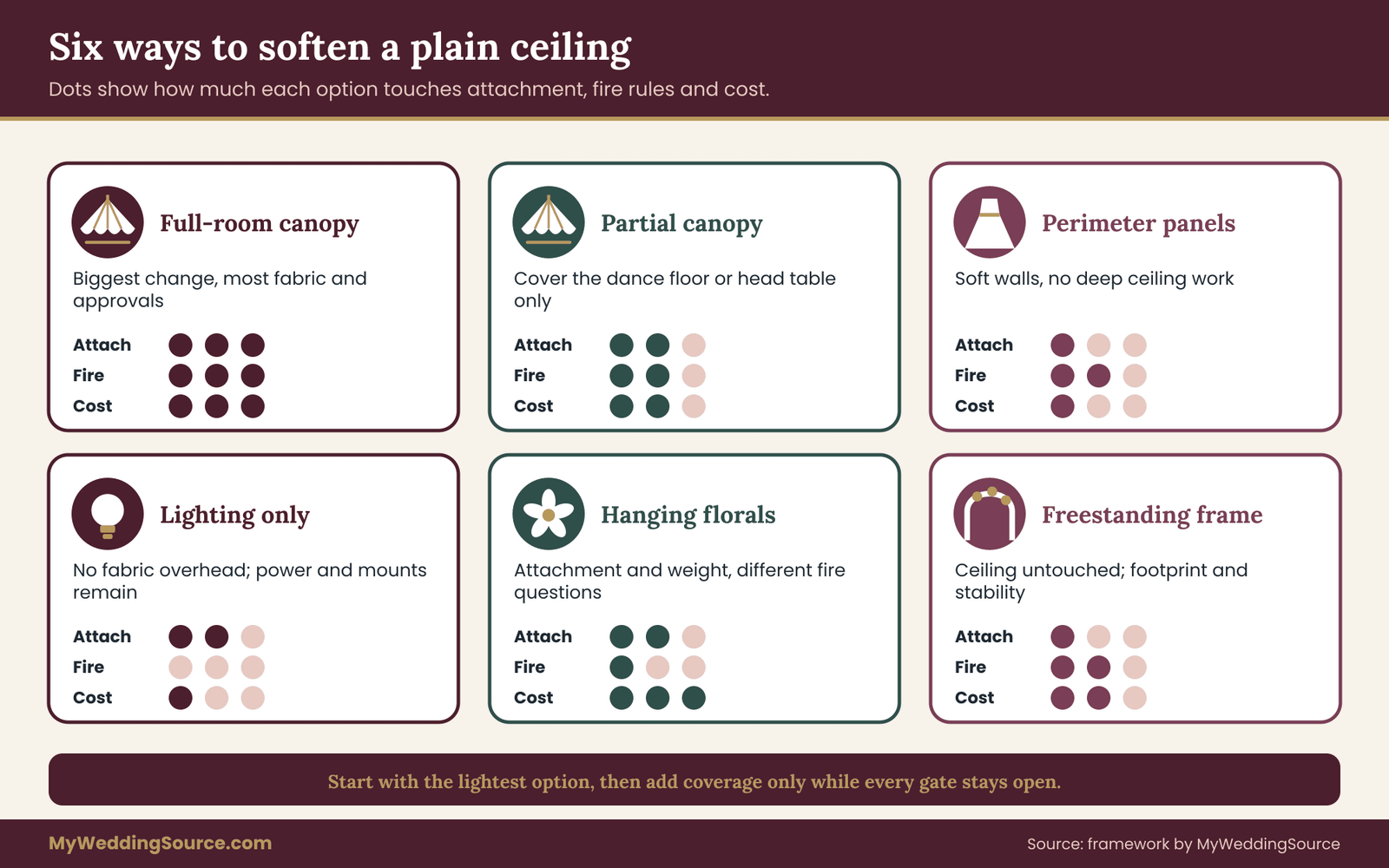
Full-room canopy
This gives the strongest transformation and uses the most fabric, hardware and labor. It also has the largest effect on fire rules and approvals. It suits rooms with good structure, a long install window and a venue used to this kind of work. It is a poor choice for a room with a drop ceiling, a short install window or a strict no-overhead rule.
Partial canopy over the dance floor or head table
A smaller area gets most of the visual payoff because guests look at those spots. Cost, load and risk fall together. It is usually the best first design to price, and it is often easier to approve because the venue can inspect a limited zone.
Sheer panels and swags along the perimeter
Panels hung from the walls or from low points, sometimes called a soft wall, avoid the center ceiling entirely. They change the room’s shape and hide ugly walls without involving the deepest overhead structure. Fire and clearance rules still apply, but attachment is simpler.
Lighting-only approach
Warm uplights, string lights over a dance floor or pin spots can change the mood with no fabric on the ceiling. This removes the fabric fire question, though it keeps the electrical and attachment questions. In a plain ballroom, good lighting can do more than cloth.
Ceiling-mounted florals or paper installations
A floral cloud or paper installation also hangs from the ceiling and needs attachment approval. Fire rules treat them differently, since flowers and paper have their own concerns. It is costly, but it does not cover as much surface.
Freestanding frames or arches with fabric
These keep the ceiling untouched and can be placed where you want focus, such as over the head table. The structure needs its own approval for footprint, stability and fire.
Dimming the room and using what is there
Sometimes the answer is to leave the ceiling alone, lower the house lights, add candles in safe holders where allowed, and put the effort into table design. If the budget or the rules make wedding ceiling draping work unrealistic, this option protects both.
Fabric choices compared in prose
The fabric you choose changes the look, the weight and the paperwork.
Voile and chiffon. Light, sheer and soft. They move easily, which is lovely and also means air can disturb them. Check their flame-resistance status carefully.
Tulle. Airy and textured, with a more structured appearance. It holds shape, and it can snag.
Polyester crepe or heavier drape. More opaque and heavier, so it covers more but adds weight. Heavier fabric increases the load calculation at every point.
Flame-resistant cotton or muslin. Common for large, simple canopies. It may be treated or inherently resistant, depending on the product. Ask for the paperwork.
Velvet or heavy, dense materials. Rare overhead because of weight, and they trap heat.
Metallic or reflective fabrics. These can reflect light in unexpected ways and may behave differently near hot fixtures. Ask the vendor.
Whichever fabric you choose, color matters as well. A very warm color can look orange under warm lights, and a bright white can look yellow. The wedding color palette guide helps you check how colors read under different light, and your designer should show you a swatch lit by the same type of light you plan to use.
A short decision rule
For wedding ceiling draping, choose the lightest option that delivers the effect you care about. Start with a partial canopy or lighting-only plan, test it against the three gates, and add coverage only if each gate stays open. Couples who start from the largest design and subtract tend to arrive late and tired at the same smaller result, with less time to get approvals.
The rigging load and fire approval sheet, step by step
This is the working tool of the article: a single sheet that follows wedding ceiling draping from idea to sign-off. It is not an official form for wedding ceiling draping, and no venue or fire authority is obliged to accept it as written. Its purpose is to make sure each question has a name, an answer, a document and a date. Print it or build it in a shared spreadsheet, and give a copy to everyone who signs.
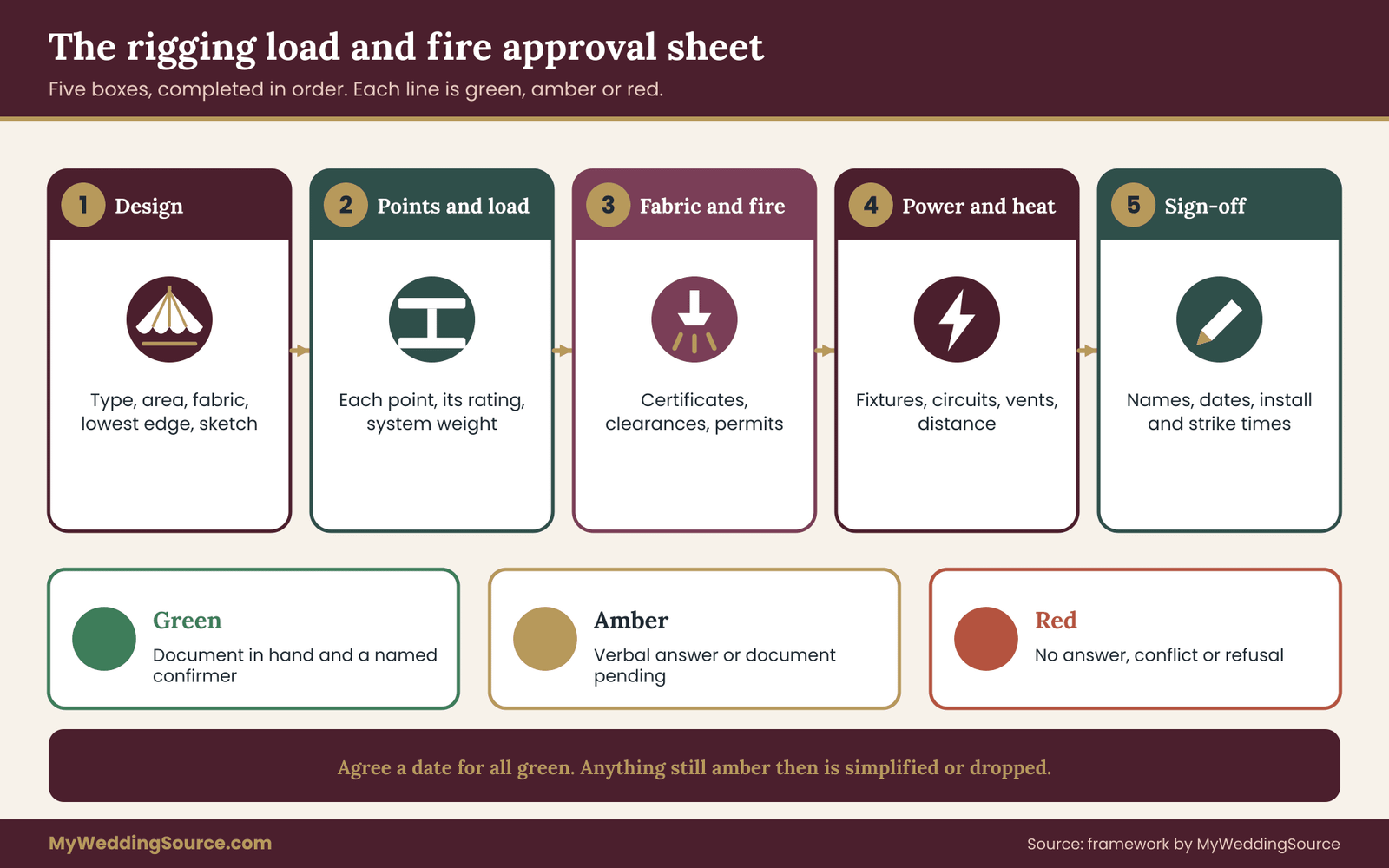
The five boxes
The sheet has five boxes. Complete them in order, because each depends on the one before.
Box one: Design. One paragraph and one sketch. State the type of canopy, the area covered, the fabric, the lowest edge height, the lights and the number of attachment points. If the design changes later, the sheet is reissued with a new date and the old version is marked as replaced.
Box two: Points and load. A list of attachment points, each with its location, who named it, the load the venue or engineer states, the weight your system adds, and the rigging method. The person responsible for rating confirmation is named here.
Box three: Fabric and fire. Each fabric listed with its flame-resistance status, the certificate or label, the date, and the clearance measurements from sprinkler heads, detectors, lights and exits. Any permit, plan review or inspection is logged here.
Box four: Power and heat. Fixtures, power source, cabling, heat distance from fabric, vent locations and the owner of the electrical connection.
Box five: Sign-off and schedule. The venue contact, the rigger, the fire authority contact if one is involved, the decor company supervisor and the lighting vendor, each with a date. Also the install window, inspection time and strike time.
Filling in box one
The design box forces clarity. Write sentences such as: “A pleated white canopy covering about a third of the dance floor, hung from four points on the steel beams on the north side, lowest edge at a minimum height your company states, warm LED lights behind.” The decor company should write the description, and you should confirm it matches what you were shown.
Attach a sketch. A rough hand drawing is fine if it shows the points, the covered area and the devices that must stay clear. Ask for a final drawing before approval.
Filling in box two
For each attachment point, write a line with the location (for example, “beam three from the north wall”), the type of hardware, who confirmed it, and the written capacity. Add a column in your own words for “weight at this point” supplied by the decor company. Do not do arithmetic beyond adding the components the company lists. The comparison between the point’s capacity and the system’s weight is for the qualified person to make and sign.
If any point lacks a capacity, mark the line red. It stays red until a document arrives. This is the most important discipline of the whole sheet.
Filling in box three
For each fabric, record the name, the supplier, the flame-resistance status and the document. Attach a copy of the certificate. For each sprinkler head, detector, exit sign and alarm device near the wedding ceiling draping, record the figure for clearance that the venue or fire authority accepts and the measured distance planned. If you do not have the figure, the question is: “What clearance do you require from sprinkler heads for fabric?”
Record any permit number, application date or inspector’s name. If the answer is “no permit required,” write who told you and when.
Filling in box four
The lighting vendor lists each fixture type, quantity, power draw and distance from fabric. The venue or electrician confirms the circuits. Mark where vents are and how the fabric avoids them. If haze or effects are planned, write the venue’s rule.
Filling in box five
This box is the one that makes the sheet work. Each person signs or sends a short written confirmation: “I have reviewed boxes one to four and confirm the items within my responsibility.” A signature does not mean the person approves everything. It means they approve the part they are qualified to approve. A venue manager, for example, approves house rules and access but may rely on an engineer for load.
Record the dates. An approval from several months ago may no longer be current if the design, the room set-up or the rules changed.
Red, amber and green
Use three colors on the sheet. Green means the item has a document and a named confirmer. Amber means the item has a verbal answer or a pending document. Red means no answer, a conflict or a refusal. The goal is to reach all green no later than a fixed point before the event.
Many couples pick two weeks before the date as the point at which any remaining amber becomes a decision: simplify the design or drop the item. Choose your own date with the venue and the decor company, and put it on the calendar when you sign the contract.
What the sheet does not do
It does not replace professional judgment. It does not certify that a design is safe. It does not stand in for a permit, an inspection or an engineer’s calculation where the law or the venue requires one. Its job is to make sure that the people who are qualified to decide have been asked, have answered and have left a record. That is a modest job, and it prevents most last-minute failures.
A worked example: one ballroom, one canopy
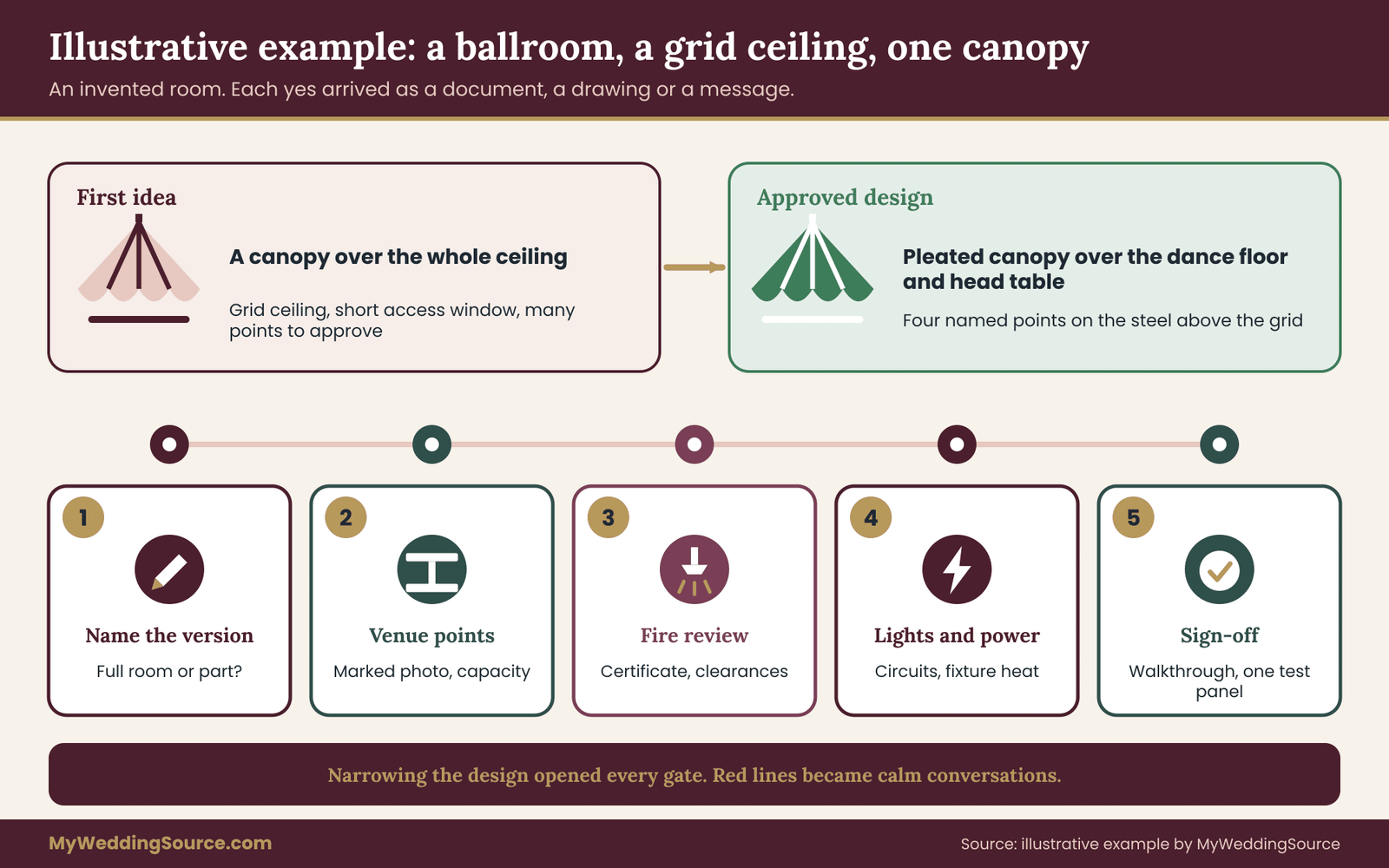
The following scenario is invented for illustration. It does not describe a real couple or a real venue, and the figures are placeholders that show how the sheet works, not typical prices or limits.
The situation
A couple is marrying in a hotel ballroom with a flat ceiling and a dance floor in the center. They love the idea of a pleated white canopy over the whole room. The ballroom is on a regular wedding schedule, so the room is available only a few hours before guests arrive.
Step one: name the version
On the first call, the decor company asks what the couple wants. The couple says “the whole ceiling.” The company asks what they mean by the whole ceiling and shows two sketches: a full-room canopy and a smaller canopy over the dance floor and head table. The couple realizes they care most about the dance floor and the head table. Box one is written for the smaller version, with a note that the full-room version is a possible later addition if every gate stays green.
Step two: ask the venue about points
The venue’s events manager says the ceiling is a suspended grid of tiles with a steel structure above. The manager says tiles and the grid may not be used, and that outside riggers may attach only to designated points on the steel, which the hotel’s production team identifies. The production manager sends a marked photo and a statement of the capacity for each point. Two of the points sit over the dance floor. Two others are near the head table. All four are marked green on box two once the capacities are attached.
Step three: ask the fire authority through the venue
The events manager says the hotel’s fire safety officer requires flame-resistant fabric with a certificate and a clearance below sprinkler heads at the figure the hotel provides. The decor company supplies a certificate for its treated sheer fabric, dated in the past year. The company’s drawing shows the fabric’s lowest and highest planes and the distances to each sprinkler head. The hotel’s officer reviews the drawing and asks the company to shift one run so it does not pass beneath a detector. The company revises the sketch and box three goes green.
Step four: lights and power
The lighting vendor proposes LED fixtures on stands behind the fabric and a warm string above one run. The hotel says the vendor must use specific circuits and that cables must be covered at the floor. The lighting vendor lists the fixtures and their heat behavior and a spacing from the fabric. Box four goes green after the hotel’s electrician confirms the circuits.
Step five: sign-off and schedule
The hotel’s production manager, the decor company’s supervisor and the lighting vendor each confirm in writing. The hotel schedules a walkthrough two days before the event in the empty room, where the decor company hangs one panel to show the result. Install is planned for the morning of the wedding, with a short inspection before the doors open, and strike is planned for after the last guest leaves. The couple adds a note: any further changes require a reissued sheet.
What the example shows
Three things about wedding ceiling draping. First, narrowing the design from the full ceiling to a smaller canopy made every gate easier. Second, the grid ceiling did not end the idea, because the venue knew where the structure above could be used. Third, nothing was approved by tone of voice. Each yes came as a document, a drawing or a confirmation message.
How the cost moved in the example
The couple’s first quote was for a full-room canopy. After the design narrowed, the covered area fell, the fabric volume fell, the number of attachment points fell and the crew time fell. The couple also saw new lines they had not expected, including a venue rigging fee and the added lift time, so the total did not fall as far as the fabric alone suggested. Because they had written all eight lines in the cost formula, they could see exactly why, and they kept the savings on fabric while paying the fees that carried real risk.
What could have gone differently
Imagine the venue had said no to outside riggers at all. The couple’s options would have been to use the hotel’s own production team at a higher price, to move to a freestanding frame or to cut the canopy. Imagine the certificate had been out of date. The company would have needed to retreat the fabric or switch to treated stock, and the couple would have needed the decor company to cover the cost under the contract. Because the sheet showed red on those lines weeks ahead, each of these would have been a calm conversation instead of an emergency.
Vendor questions and contract terms for wedding ceiling draping
The questions you ask early shape the quote you receive. The contract then fixes the answers. This section gives you scripts and terms to bring to both. The broader process of vetting a company before you pay is covered in the vendor due diligence checklist, and what follows applies it to wedding ceiling draping fabric.
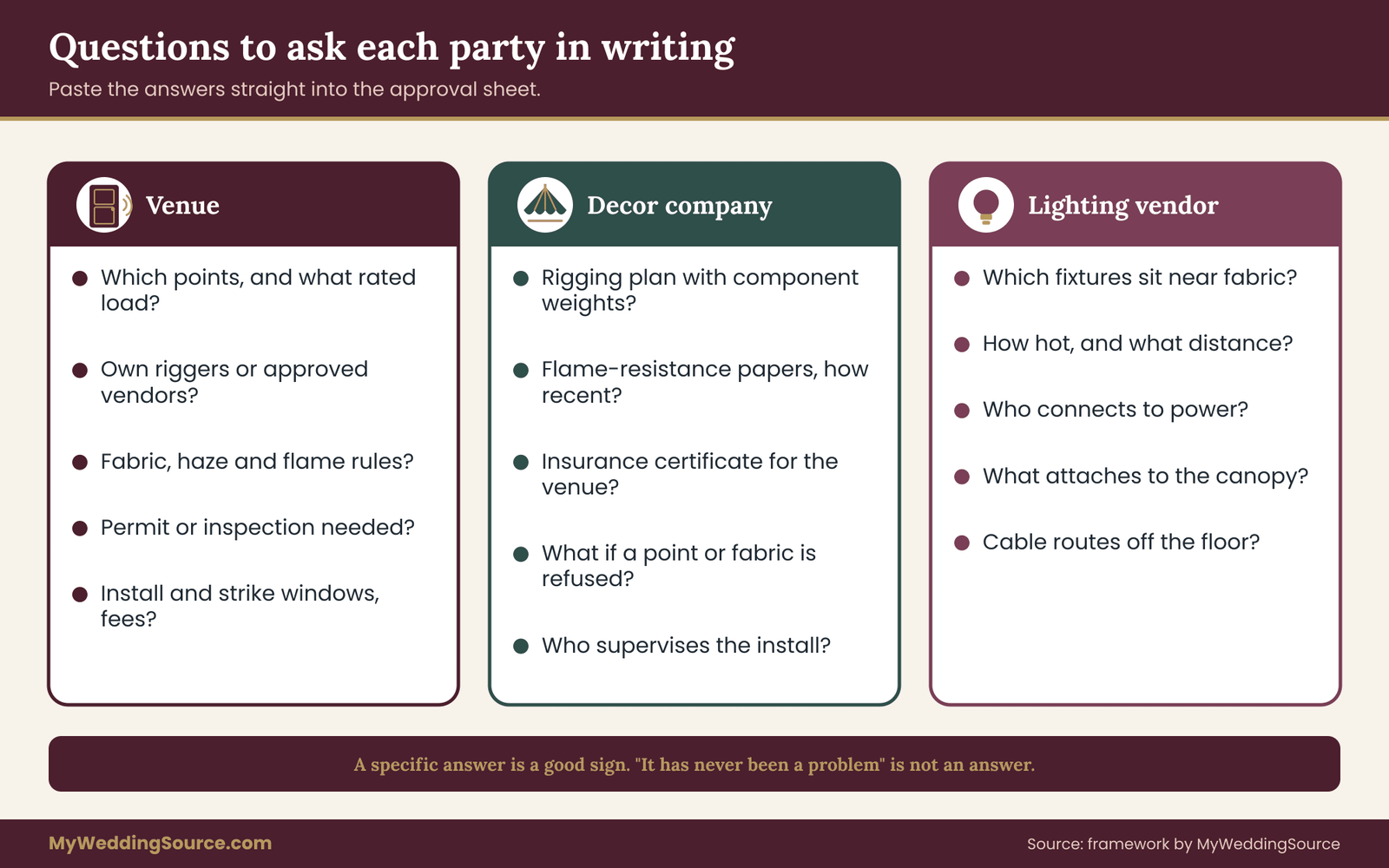
Questions for the decor company
Ask these in writing, so you can paste the answers into the approval sheet.
- How many wedding ceiling draping installations has your crew done in rooms like ours, and can you describe the most similar one without naming the couple?
- Which attachment methods do you use, and which will you not use?
- Who supervises the install and who signs the rigging plan?
- What flame-resistance documentation can you give for each fabric, and how recent is it?
- What insurance do you carry, and will you provide a certificate naming the venue if the venue asks?
- What happens if the venue or the fire authority rejects a point, a fabric or a clearance?
- How long does the install take, how many people are needed, and what access do you need?
- What do you need from us, and by what date?
A good answer about wedding ceiling draping is specific. A weak answer is a promise that “it’s never a problem.” You can read more about reading and comparing vendor commitments in the wedding vendor contract guide.
Questions for the venue
- Which points may be used, what are their rated loads and who confirms them?
- Do you require your own riggers, approved vendors or proof of insurance?
- What are your rules for fabric, flame resistance, haze and open flame?
- Has the fire authority reviewed wedding ceiling draping decor here, and is a permit or inspection needed?
- What are the install and strike windows, and what fees apply for early access or overtime?
- Who is the single contact for approvals?
Questions for the lighting vendor
- Which fixtures will sit under or near the fabric, and how hot do they run?
- What distance do you keep from cloth?
- Who connects to power, and what do you need from the venue?
- Which parts of your equipment attach to the wedding ceiling draping, and which hang separately?
Contract terms to look for
When you sign, make sure the agreement states the following in plain words.
Scope and design. The type of canopy, area, fabric, height and lights, with the approved sketch attached.
Approvals as a condition. The company’s work depends on venue and fire approvals, and the company will help obtain them. If an approval is refused, the design changes at no extra design fee, or the couple may cancel under stated terms.
Documents. The company will supply flame-resistance certificates, insurance certificates and rigging plans by a stated date.
Responsibility for damage. Who pays for venue damage caused by the installation, and who pays for fabric damage during strike.
Schedule. Install and strike times, with a plan if the room is not available on time.
Change and cancellation. What happens if the guest count, the room or the design changes. What portion of the deposit is refundable and when.
Substitution. If a fabric is rejected, the company must supply an acceptable substitute of similar look at its cost or at an agreed price.
Safety. The company will follow venue rules and applicable safety requirements, and will remove anything the venue or the fire authority directs.
Do not rely on verbal promises for any of these. If the company’s standard contract does not cover one, ask for an addendum. The approach in the vendor purchase order checklist can help you write scope, acceptance and exceptions in one document.
A script for a difficult conversation
If the venue refuses an attachment, try something like this: “Thank you for explaining. Can you tell us what you can allow, and who at the venue could confirm it in writing? We would like to adapt the design to fit.” This asks for the boundary instead of arguing with it. If the decor company says a design is fine but cannot provide a document, try: “Could you send the certificate or rigging plan so we can add it to our file and share it with the venue?” Calm and specific usually works better than pressure.
Edge cases and mistakes with wedding ceiling draping
Some situations do not fit the standard path. Others are simple mistakes that repeat. Both are worth knowing in advance.
Tents
A tent supplier owns the structure and decides what the frame can carry. Add decor only through the supplier’s approved methods, and expect restrictions on weight, wind and the use of heat. Tent liners and ceiling drape are common, and they often come from the supplier with documentation. Ask whether the supplier’s fabric is already flame-resistant and whether additional drape is allowed.
Barns and rustic venues
Barns offer beams and rafters that look ideal. Check the condition of the timber, the history of the building and any local rules about open frames. Dust and loose debris in rafters can be a fire and mess concern, and some barns have restricted lighting circuits. A site visit by a rigger is wise.
Hotel ballrooms with in-house labor
Some hotels require their own production team for any wedding ceiling draping work. This increases the cost, but it also simplifies approvals, because the team knows the room. Ask for the production team’s pricing early.
Outdoor, open-air structures and pergolas
Wind, rain and temperature swings affect fabric and attachment. A structure that was built for plants may not carry fabric. Ask the owner of the structure what it can hold, and check wind limits. Plan for the fabric to be removed or tightened if weather turns.
Historic buildings
Preservation rules may forbid any attachment, and the venue may ask for freestanding solutions with floor protection. Start the conversation early because approvals can take longer.
Second-hand or borrowed fabric
Fabric from a friend or a previous event may lack documentation or may have lost its treatment through washing. Without paperwork, a venue may refuse it. If you want to reuse fabric, ask the venue what proof it will accept.
Last-minute additions
A florist wants to attach flowers to the wedding ceiling draping, a photographer wants a light clipped to a line, or a guest wants to hang a banner. Each addition changes the load and sometimes the fire situation. Set a rule that nothing attaches to the wedding ceiling draping without the decor supervisor’s approval, and tell your vendors in advance.
Mistakes that repeat
Treating “allowed” as “approved.” A general yes does not equal an approval of your specific design.
Letting the fabric choice follow the color only. The paperwork is part of the product.
Leaving the strike out of the plan. Taking down is as much work as hanging and happens when everyone is tired. Confirm who strikes, when and how, and that the venue can stay open long enough.
Forgetting the guest count. More guests can change the room layout and the area the wedding ceiling draping must cover.
Changing the design after approval. Even small changes can reopen a gate. Reissue the sheet and re-confirm.
Skipping the walkthrough. A short visit with the decor company, the lighting vendor and the venue contact catches problems that drawings hide. The wedding venues guide explains why measuring the room on a real visit matters.
Assuming insurance will cover everything. Policies have conditions and exclusions. If you rely on insurance for any part of the installation, read the policy wording and ask the insurer directly.
When to walk away from the idea
Sometimes the best decision is to let wedding ceiling draping go. If the venue forbids all overhead attachment, no freestanding option fits, the fabric cannot be documented, or the cost is out of proportion to the effect, a lighting-led design may serve the room better. Choosing that early saves money and stress, and it is no failure to decide that wedding ceiling draping is not right for this room. The rental planning checklist can help you put the saved budget into items that guests will notice.
Your next steps
- Decide which version of wedding ceiling draping you want and sketch it, even roughly, with the covered area and the lowest edge.
- Ask the venue for the allowed attachment points, their rated loads, the fabric and fire rules, and the install window, in writing.
- Ask two decor companies for quotes broken into the eight cost lines, with flame-resistance documents and insurance attached.
- Start the rigging load and fire approval sheet and mark each box green, amber or red.
- Add the lighting vendor and the electrician to the conversation before fixtures are chosen.
- Put an approval deadline on the calendar and decide in advance what you will simplify if boxes are still amber.
- Sign a contract that makes approvals a condition and states what happens if one is refused.
- Book a short walkthrough with the venue, decor company and lighting vendor before the day.
FAQ
Is wedding ceiling draping allowed at every venue?
No. Some venues welcome it, some allow it only with their own staff, and some ban overhead attachments entirely. Ask for the written policy and the names of approved vendors before you design anything. If the ceiling cannot be used, a freestanding frame or a lighting-led design may give a similar softness without touching the structure.
How much does wedding ceiling draping cost?
It depends on the area covered, the ceiling height, the fabric, the crew, lift rental, venue fees and treatment. Rather than rely on an average, ask each company to break its quote into coverage, fabric, hardware, labor, access equipment, venue charges, documentation and delivery. Compare the lines, and confirm current prices and terms directly with each supplier.
Does the fabric have to be flame-resistant?
Many venues and fire authorities require it for decorative fabric in assembly spaces, and some refer to a standard such as NFPA 701. Requirements vary by location. Ask the venue and the fire authority what applies, and ask your decor company for current certificates for the exact fabric that will hang in your room.
Can we attach wedding ceiling draping to sprinkler pipes or ceiling tiles?
No, you should not. Sprinkler piping and ceiling grids are not designed to carry decor, and attaching to them is commonly prohibited. Fabric must also stay clear of sprinkler heads, detectors and alarm devices by the distance the fire authority accepts. Ask the venue which structural points are approved instead.
Who approves the attachment points?
The venue decides what may be used, and a building engineer or qualified rigger confirms what the structure can carry. The decor company supplies a rigging plan with component weights. Ask for the capacity in writing, and do not accept a verbal assurance. If a point lacks a documented rating, treat it as not approved.
Can we do wedding ceiling draping ourselves to save money?
It is risky and often not allowed. Overhead work needs proper equipment, training and insurance, and untreated fabric may be refused. Many venues require approved vendors for anything overhead. If you want to reduce cost, shrink the covered area or choose a simpler pattern rather than skipping qualified labor.
What if the venue or fire authority rejects the design?
Ask what they will accept and adapt. Options include a smaller canopy, different attachment points, treated or substitute fabric, a freestanding frame or a lighting-led design. Your contract should state how a rejection affects the price, the deposit and the schedule, so the change is a planned adjustment and not a dispute.
How early should we start the approval process?
As early as the venue tour, before you sign, because the answers may change your choice of room. After booking, aim to settle attachment points, fabric documents and any permit well before the event, with a firm date by which every item on your approval sheet is documented or simplified.
Sources
- Codes and standards for fire and life safety, National Fire Protection Association
- International Fire Code and model codes, International Code Council
- Fire prevention and safety resources, U.S. Fire Administration
- Fall protection, Occupational Safety and Health Administration
- Ladders and scaffolds, Occupational Safety and Health Administration
- Electrical safety, Occupational Safety and Health Administration
- Entertainment technology standards and rigging resources, ESTA
- Local governments directory, USAGov
- Americans with Disabilities Act standards and guidelines, U.S. Access Board