
A carry-on welcome bag is a welcome gift built for guests who will fly in with one small bag, fly home with the same bag, and have no spare room or patience for anything that is heavy, leaky or restricted at airport security. This guide gives you a four-gate audit, a packing-dimension budget and a set of questions for vendors and hotels, so every item in the bag earns its place.
Run every candidate item through four gates: it clears airport screening, it fits a small packing-space budget, it stays light and battery-safe, and it survives the trip home. Keep liquids, gels and creams at or under the carry-on container limit that the Transportation Security Administration publishes, skip anything sharp or heavy, and choose flat, sealed, dry items. A good carry-on welcome bag for flyers holds three to five small things, or it is replaced by a pickup envelope and a fee-free hotel drop-off.
Most welcome bag advice assumes that guests arrive by car with a trunk to fill. That assumption breaks the moment a quarter of your list books flights. A guest who has packed a suit, two shirts and a toiletry bag into a single cabin bag does not have a hand free for a tote that clinks. They also have a second trip to think about: the flight home, when the bag is open, the snacks are half eaten and the tote is now a thing they must carry back to the airport.
A carry-on welcome bag starts from the opposite assumption: the guest has almost no spare room.
That is the problem this article solves. It does not tell you what to put in a welcome bag in general. Instead it shows you how to test items against the reality of carry-on-only travel, so you can build a carry-on welcome bag that people are glad to receive and glad to carry. Each section that follows tests one part of a carry-on welcome bag against that reality.
A note on scope. This is general information, not legal, safety or financial advice. Airport screening rules, airline baggage rules and customs rules change, and officers make the final call at the checkpoint. Wherever a rule matters, the article points you to the agency or airline that publishes the current version.
What a carry-on welcome bag has to do
A welcome bag has three jobs. It tells guests they were expected, it handles a small problem they probably have on arrival (thirst, a dead phone, a headache, a missing schedule), and it gives them the plan for the weekend. A carry-on welcome bag has the same three jobs plus a fourth: it must not make the guest’s travel harder.
That fourth job changes which items qualify. A glass jar of local jam does the first job beautifully and fails the fourth twice, once at security and once in a packed suitcase. A single wrapped cookie passes all four. The difference is not price or thoughtfulness. It is whether the item respects the guest’s luggage.
Who counts as a carry-on-only guest
You do not need a perfect headcount, but you do need a working estimate. A guest is carry-on-only if they will travel with a bag that fits in the overhead bin or under the seat and nothing checked. There are several reasons guests choose this, and knowing them helps you predict behavior.
Some guests want to avoid checked-bag fees. Some have short connections and do not want to risk a bag arriving late. Some are staying only one or two nights. Some have a mobility aid, a medical kit or a child and need every free hand. And some simply like to travel light. Any of these guests may open your carry-on welcome bag in the hotel room and decide in two minutes what stays.
Basic fares on certain airlines also limit passengers to a small personal item that fits under the seat, with the larger cabin bag costing extra. That means a portion of your flying guests may be traveling with even less room than a standard carry-on. You cannot know which, so treat the personal item as the safe design limit when you are unsure.
What this guide leaves to other articles
Broad questions such as which snacks and comfort items guests usually appreciate, how to price a whole bag, and how to get bags to a hotel desk are covered elsewhere on this site and by the hotel itself. Here the focus is narrower: the flying guest, the airport checkpoint, and the second journey home. If you want the wider context first, the wedding guest care planning guide explains how welcome gifts fit into looking after guests across the whole weekend.
The cost of getting it wrong
Mistakes in this category are rarely dramatic. They are small, slightly embarrassing and quietly wasteful. A guest has to throw away a full-size bottle of something at the airport on the way home. A bag too bulky for a cabin bag gets left behind in the hotel room. A heavy keepsake gets handed back with an apologetic smile.
Each of those outcomes means you paid for an item that was not used. For a list of sixty bags, even a modest waste rate adds up, and the guests who throw things away remember the weight of the thing more than its charm. Planning around carry-on rules is partly good manners and partly good budgeting. A carry-on welcome bag that is cheap, light and easy to leave behind avoids all three.
Why guests flying carry-on only change the bag
Think of two guests. One drives two hours, parks at the hotel and has a full trunk. The other flies in from another state with a cabin bag that is already full at the zipper. The same welcome tote means very different things to each of them.
For the driver, a tote is a pleasant gift that goes in the trunk. For the flyer, it is a decision: carry it as a second bag through the rest of the trip, or open it, use what helps, and leave the rest. Many flyers will open it in the hotel room, eat the snack, charge nothing from it and set the tote aside. That is a reasonable outcome, but only if the bag was cheap and light enough that leaving it behind costs nothing.
Three travel moments that matter
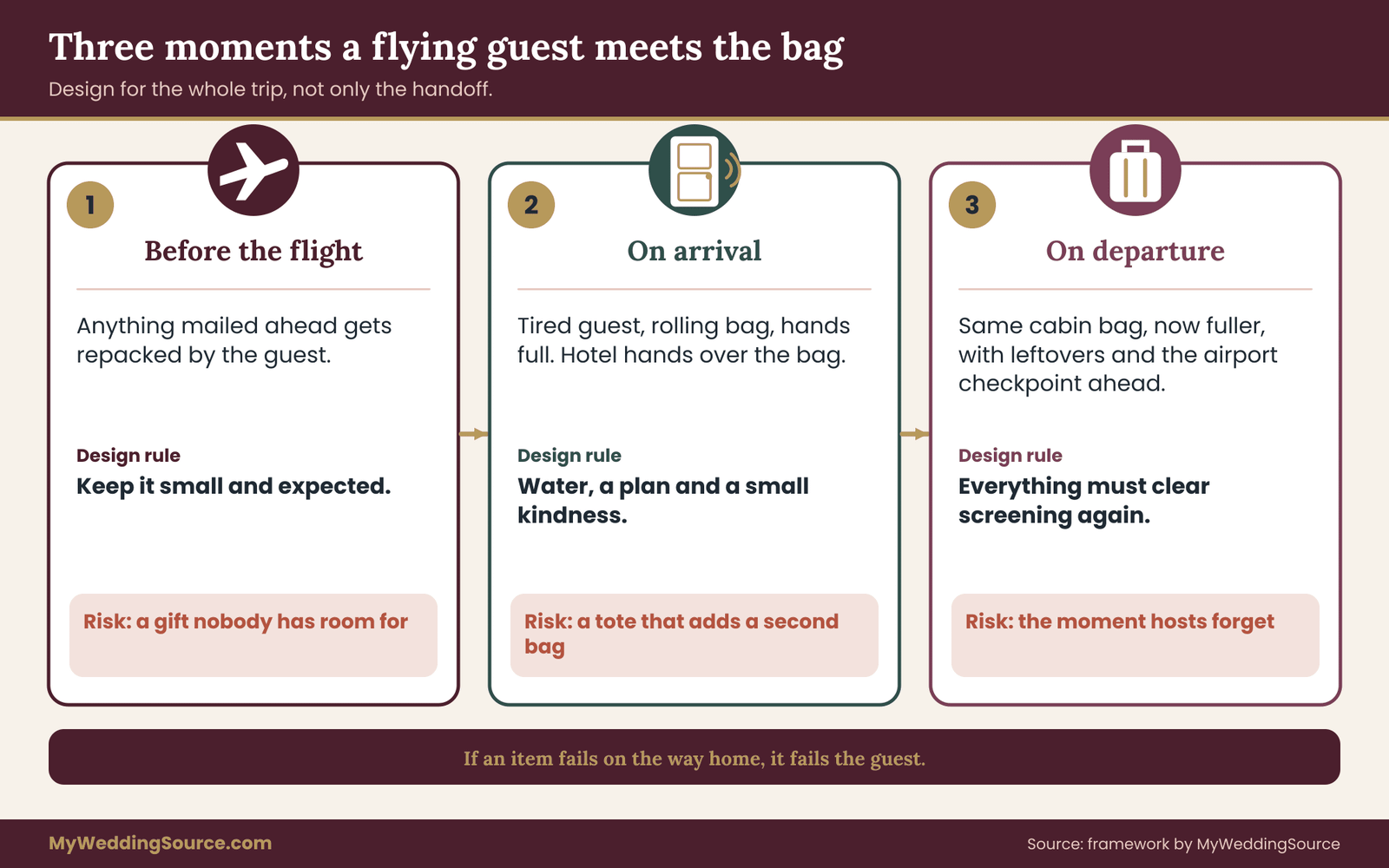
A flying guest meets your bag at one of three moments, and each has different constraints. The carry-on welcome bag has to make sense at each of the three.
Before the flight. If you ship anything ahead of time, it travels with them or arrives at their address. Guests rarely want to repack a gift they received in the mail, so anything sent early should be small and expected.
On arrival. The bag is handed over at the hotel, at a welcome desk or in the room. The guest has just finished a flight. They want water, a place to put their things and a clear plan. A heavy tote adds to the load.
On departure. This is the moment most hosts forget. The guest packs to go home, with the same carry-on bag and now a pile of leftover welcome items plus whatever they bought. Anything liquid has to meet the checkpoint rule again. Anything fragile has to survive the bag. Anything bulky has to fit or be left.
The departure leg is the real test
When you design only for arrival, almost everything looks fine. When you design for departure as well, the list shrinks. That shrinking is useful, because it removes the items that were always more decoration than help. That is the whole point of a carry-on welcome bag: fewer items, each one chosen for a reason.
Ask of every item: if the guest decides to bring this home, will it clear the checkpoint and fit in the bag? If the answer is no, then the item must be something they can enjoy or finish during the weekend, or the item should not be there. An open bottle of sparkling wine is a good example. It is wonderful on the night and a problem on Sunday morning.
A short working rule
Here is a rule you can use before reading any further. A carry-on welcome bag item should be dry, sealed, flat or compact, light enough to disappear in a pocket, and either used up or easy to leave behind. If it breaks any two of those, put it back on the shelf. The rest of this guide explains why the rule works and how to apply it with some precision. Keep it on a sticky note while you shop for the carry-on welcome bag.
Where a bag is not the right answer
For some weddings, the honest answer is that no physical bag is the best choice for flying guests. If most of your guests are flying and the weekend is short, a printed one-page welcome note at the front desk, a bottle of water and a small snack may do everything a bag would. Later sections compare that approach with others, and the choice is yours. The point of the audit is to stop you from buying a bag that the flyers cannot use.
The four-gate audit for a carry-on welcome bag
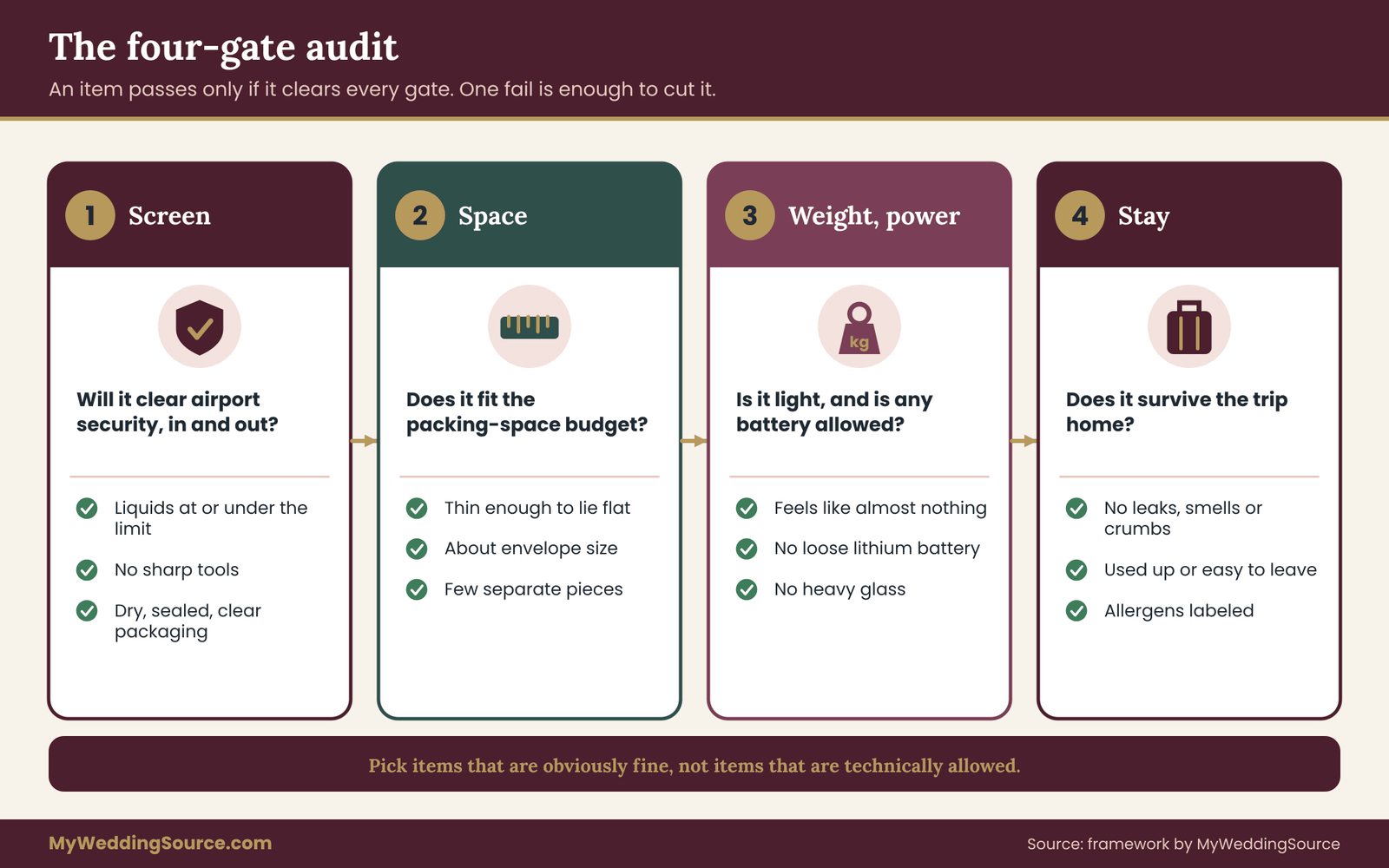
The audit is a short process you apply to each item on your shortlist. It has four gates. An item passes only if it clears all four. Treat it like a quality check, not a scorecard: one failed gate is enough to cut or change the item.
Gate one: screen. Will it clear airport security in a cabin bag, on the way in and on the way home? This covers liquids, gels, creams, sharp objects, tools and anything the Transportation Security Administration restricts or may want to inspect.
Gate two: space. Does it fit a small packing-space budget? This covers thickness, length, and whether it nests flat against a laptop or a folded shirt.
Gate three: weight and power. Is it light enough to be forgotten, and if it holds a battery, does it follow airline rules for batteries in cabin baggage?
Gate four: stay. Does it survive being opened, partly used, jostled and carried home? This covers packaging, mess, smell, allergens and whether it is still a good gift on day three.
How to run the audit in an evening
Lay out your shortlist, ideally ten to fifteen candidates, and give each one a row in a list on paper or in a notes app. Write the item name, then four short answers: pass, check or fail for each gate. Where you write “check”, add the question you need to answer and who can answer it, such as the product label, the TSA website or the hotel. Keep one sheet per carry-on welcome bag version, so the flyer version and the local version do not blur together.
Anything with a “fail” is removed or replaced with a version that passes. A full-size hand lotion fails gate one; a small tube at or under the limit passes it. Anything with a “check” must be resolved before you order, not after. This is the habit that separates a thoughtful bag from a bag that is simply cute.
Why four gates and not a long checklist
Long checklists hide the reasoning. Four gates keep the logic simple enough to explain to a vendor, a friend helping you assemble bags or a relative who suggests “something local.” When someone proposes a bottle of local hot sauce, you can say, in one breath, that it is a liquid and may not clear security in a cabin bag, and ask whether there is a dry version. Four gates also make it easy to hand the carry-on welcome bag project to a friend or a planner.
That small script is useful. People are more willing to adjust a suggestion when the reason is plain and not personal. A rule that is about airports and not about taste ends most debates in a sentence.
What “pass” means for each gate
Pass does not mean perfect. It means you checked, and the item does not create a problem you can predict. An item passes gate one if its size, form and contents are clearly within the published rules, or if you confirmed its status with the official tool or the product maker. It passes gate two if you measured it and it is thin enough to lie flat. It passes gate three if it is light and has no loose battery. It passes gate four if the packaging holds up and it is still welcome a few days later.
Because rules change and officers decide on the day, the audit is built to give a margin of safety. Pick items that are obviously fine, not items that are technically allowed. A guest who is delayed at a checkpoint by a gift from you will not be thinking about the technicalities.
Gate one: will the carry-on welcome bag clear security
Gate one is the one that most often cuts an item, so it gets the most space. The details below are general. The Transportation Security Administration publishes the current rules and a searchable tool for individual items, and the officer at the checkpoint makes the final decision. Use this section to learn which questions to ask, and confirm the answers on the official site before you order in volume. Treat gate one as the main filter for any carry-on welcome bag.
The liquids rule in plain terms
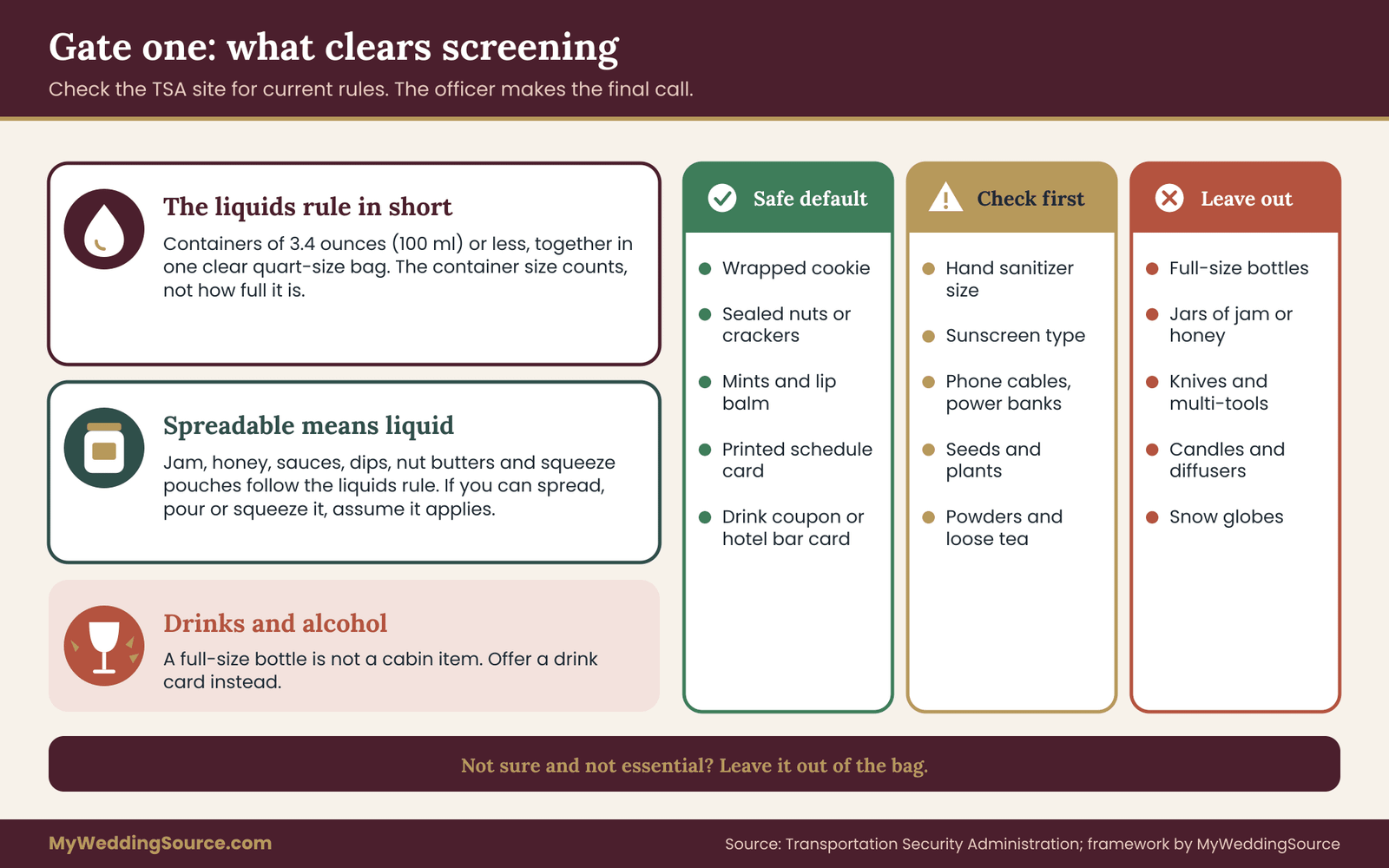
The TSA carry-on liquids rule is often called 3-1-1. In short, liquids, gels, creams, pastes and aerosols in a cabin bag must be in containers of 3.4 ounces (100 milliliters) or less, and those containers go together in one clear quart-size bag per passenger. The limit is about the size of the container, not about how much is left inside it. A half-empty 8-ounce bottle still does not meet the rule.
For a welcome bag, the practical lesson is that anything liquid-like needs to be small, or it should be consumed at the hotel. The rule applies to more than drinks. It covers lotions, sanitizer, sunscreen, lip gloss in tubes that are squeezable, spreads, sauces, honey, jam and many “gel” products.
Foods that look solid but behave like liquids
Hosts often miscategorize food. A bag of chocolate is solid. A jar of jam, a tube of honey, a cup of peanut butter, a small tub of hummus and a squeeze pack of fruit puree are all spreadable or pourable, and TSA treats those in the liquids family. A local honey stick may look neat and compact but is still honey.
A simple test helps. If you can spread it, pour it, squeeze it or pump it, assume the liquids rule applies. If it breaks, crumbles or snaps, it is most likely a solid. Dry snacks such as crackers, cookies, nuts, dried fruit, pretzels and wrapped candy are the safe default. Even so, officers may open or inspect any food item, so clear packaging helps. For a carry-on welcome bag, dry and wrapped is the safe default.
Drinks and alcohol
A sealed bottle of water is not allowed through the checkpoint if it is larger than the limit, but a guest can buy water after screening or pour out a bottle and refill an empty one at a fountain. For your bag, a bottle of water is fine on arrival. It is a mild nuisance on departure, so skip it in favor of a note about the filling stations or the hotel water.
Alcohol follows the same liquids rule in cabin bags.
A full-size bottle of wine, a four-pack of local beer or a canned cocktail is not suitable for a flyer’s cabin bag. Miniature bottles at or under the limit are technically within the rule, but they raise other questions: airlines generally limit drinking your own alcohol on board, and a bag full of minis can look odd in an X-ray. For a carry-on welcome bag, a drink coupon, a card for the hotel bar or a tasting at the welcome party is a better way to give a drink without the baggage.
Sharp objects, tools and surprise items
The next group of items to check are the ones nobody thinks of as weapons. A branded multi-tool, a bottle opener with a blade, a corkscrew with a foil cutter, a pair of metal scissors and a small knife as a keepsake can all draw attention at screening. Some are allowed in a cabin bag and some are not, and the rules differ by size, blade length and type. Because the list is long and specific, use the TSA “What can I bring?” tool and do not guess.
Other items that surprise hosts include snow globes, which are liquid-filled and generally limited by size, candles, which vary by type and fragrance container, aerosol sprays, lighters and anything with a battery. The general lesson is that an item with a story is not automatically an item with a clear status. When you hear a suggestion that begins with “everyone loves a,” ask whether it is on the TSA site.
Medicines and personal care
Guests often need basic comfort items on arrival, such as pain relievers, bandages, lip balm and stain-remover wipes. Pills in sealed packs, adhesive bandages and wet wipes in small packs are rarely a screening problem. Liquid medicines, creams and gels in larger sizes may be treated differently from other liquids, with TSA allowing medically necessary liquids in reasonable quantities if declared. That exception is for a guest’s own medication and not for a gift you hand out.
Be careful about packing medication into a welcome bag at all. You do not know guests’ allergies, interactions or preferences, and giving drugs to guests is not a hospitality gesture most people expect. A small pack of bandages is kind. A pack of pills from a host is a liability and a surprise. Leave medicine to the guest and to the hotel front desk. A carry-on welcome bag can be warm without being a pharmacy.
The gate one decision rule
Use this three-step rule for each item. First, is it a liquid, gel, cream, paste or aerosol? If yes, is the container 3.4 ounces or less and sealed? If not, remove it or move it to the welcome party. Second, is it sharp, a tool or something with unusual mechanics? If yes, check the TSA tool or choose something else. Third, does it contain a battery or a flame source? If yes, move to gate three. The three steps take about a minute per item, and they keep a carry-on welcome bag simple.
Anything that passes all three steps is a low-risk item for a carry-on welcome bag. Anything that does not pass is not banned from your wedding, only from the bag.
Clear packaging and labeling
One practical tip that costs nothing: keep items in transparent or semi-transparent packaging, or loosely wrapped in tissue, so an officer who wants a look can see what is inside without destroying your wrapping. Heavily sealed boxes with ribbons and adhesive can be cut or opened. A clear sleeve with a printed label is easier to inspect and easier to put back. Clear packaging is a small habit that makes a carry-on welcome bag easier to inspect and to repack.
Keep a short printed ingredient list or product label with food items. If a guest has an allergy, the label matters more than the design. For prepackaged items made by a commercial producer, the packaging already carries the required labeling. For homemade items, the ingredients and any common allergens should be written clearly, and the U.S. Food and Drug Administration publishes the list of major food allergens. Homemade food is also harder to explain at a checkpoint, which is another reason to buy sealed, labeled items.
Questions to ask a supplier about screening
When you buy a bag item from a vendor, you can ask direct questions and expect straight answers. Write the answers down, because you may need them later. Ask the same questions of every vendor so each carry-on welcome bag item is judged the same way.
- What is the container size in ounces or milliliters, as printed on the package?
- Is the product a liquid, gel, cream, paste or solid, and what is its ingredient list?
- Does the product contain any battery, magnet, lighter or flame source?
- Has the product been sold in airport shops or marketed as travel size?
- Can the vendor provide the label text in advance, so you can compare it with TSA guidance?
If a vendor cannot answer the first question, treat that as a reason to look elsewhere. A supplier of travel-size goods should know the size of its containers.
International guests and customs
Some of your guests may be flying in from outside the country, and others may be flying home to another country.
Food and plant products can be restricted at borders, and rules vary. U.S. Customs and Border Protection and the Department of Agriculture publish guidance for travelers bringing food into the United States, and other countries have their own rules. A bag filled with fruit, meat snacks or seeds is a poor fit for guests who have to cross a border. Dry packaged snacks are less likely to cause a problem, but guests are responsible for what they carry and for declaring it.
If you expect international travelers, one simple approach is to give them a small printed card with a note about local places to buy snacks, and a short list of items they can enjoy on site. That avoids putting food in their luggage and is kind to everyone who has to fill in a customs form. An international guest still deserves a carry-on welcome bag, just a lighter and drier one.
Gate one in a worked comparison
Consider two versions of a snack pouch. Version one holds a mini jar of local jam, a small bottle of hot sauce, a wedge of cheese and a mini wine. Version two holds a wrapped shortbread, a pack of roasted almonds, a mint tin and a small card pointing to a local jam seller with a hotel discount. Version one fails gate one on three items, and the fourth, cheese, depends on the rules and the weather. Version two passes with no research.
Version two is not less generous. It is the same local flavor reduced to what a flying guest can actually carry. And it points the guest to the real product if they want more.
When an item is almost fine
You will sometimes find an item that is allowed by the official guidance but looks borderline: a bag of loose tea, a small sachet of herbs, a powder drink mix in a pouch. Powders, in particular, have been subject to additional screening rules in some situations, and officers may ask a traveler to take larger amounts out of the bag. Instead of arguing over borderline cases, ask whether the item is essential. Usually it is not.
A final rule: when you are unsure and the item is not central to your theme, drop it. A welcome bag item exists to remove friction, not to introduce a new kind.
Gate two: packing dimensions for a carry-on welcome bag
Gate two asks whether the contents fit into the space a carry-on-only traveler actually has. This is where most welcome gifts fail without anyone noticing, because the problem is not the rules but the geometry. A gift can be perfectly legal and still not fit between a folded blazer and a laptop sleeve.
Airlines set different cabin limits
Cabin bag size and weight limits are set by each airline, and they vary between carriers and between fare types. Some fares include a full-size cabin bag, and some include only a personal item that fits under the seat. The Department of Transportation publishes consumer information on airline baggage policies, and each airline’s website lists the current dimensions for its own fares.
Do not guess at a number for your guests. Instead, design your carry-on welcome bag around the smallest common limit: the under-seat personal item. If the bag content passes that test, it passes everywhere. That choice costs you very little and removes the biggest uncertainty. A carry-on welcome bag built for the personal item will fit any cabin bag.
The packing-space budget
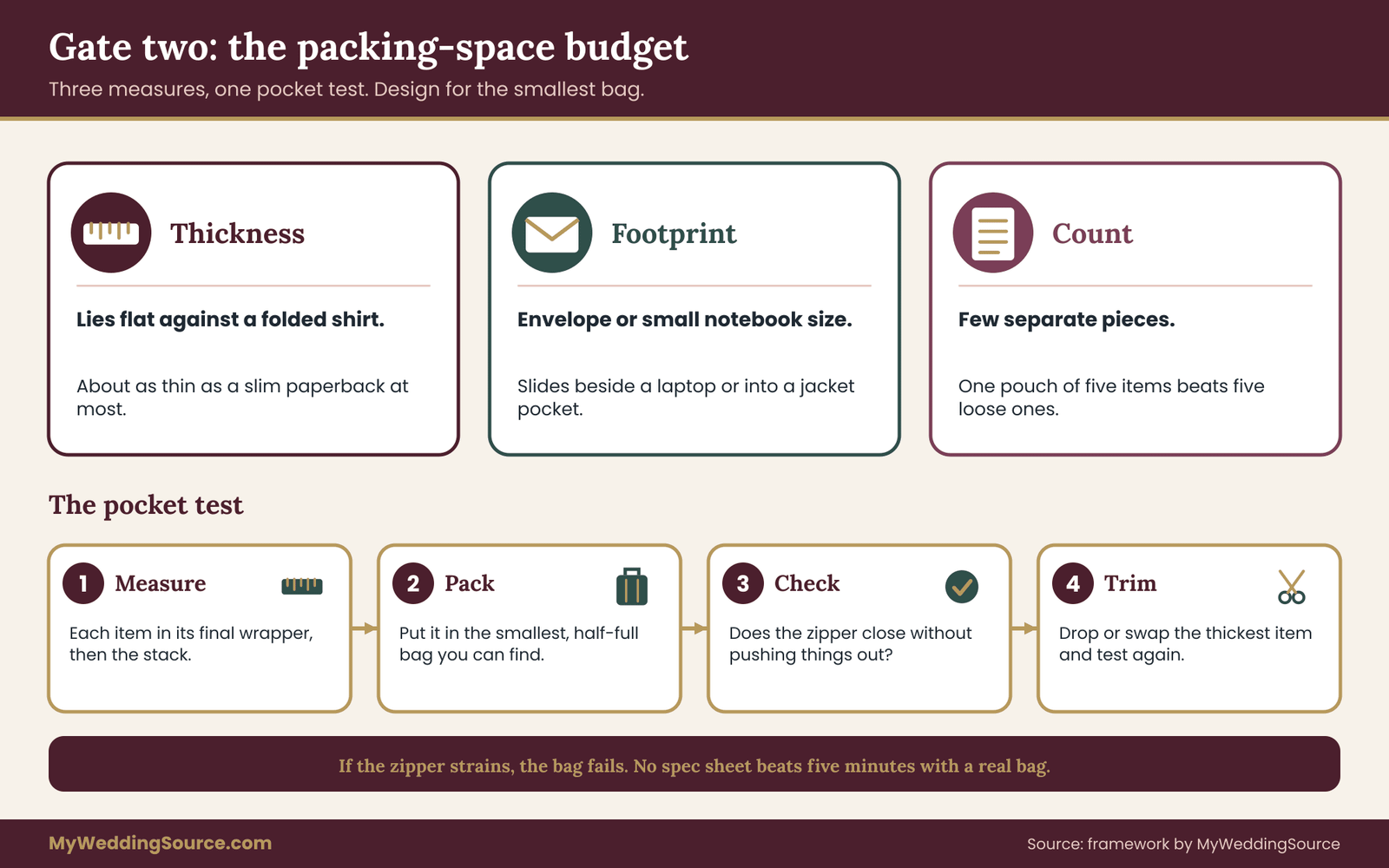
A packing-space budget is a simple way to turn “small” into something you can measure. It has three parts: thickness, footprint and count.
Thickness. Flat items slide into the gap in a bag, while thick items force the guest to repack. As a design habit, aim to keep the whole carry-on welcome bag thin enough that it lies flat against a folded shirt. If the total pouch is as thick as a paperback book, it is already a competing item in a small bag.
Footprint. The carry-on welcome bag should be about the size of an envelope or a small notebook, so it can slide into a laptop sleeve, a jacket pocket or the side of a bag. A tote bag folded flat is a footprint item; a rigid box is not.
Count. The number of separate pieces matters more than their total weight. Five loose items are five things to keep track of. One pouch with five items is one thing. A bag that must be unpacked and repacked is annoying; a bag that holds together is easy.
How to measure and test
You do not need special equipment. Use a ruler or tape and a bag you already own. Measure each item in its final packaging, not the product alone, because wrappers and boxes add bulk. Record length, width and thickness in inches or centimeters. Then stack the items together as they will be packed and measure the stack. Measure the carry-on welcome bag the way a guest will pack it, not the way it looks on a table.
Next, do a pocket test. Put the finished pouch into the smallest cabin bag or backpack you can find, ideally one that is already half full. If it fits without pushing other things out, it passes. If it makes the zipper strain, it fails. This test takes five minutes and is more reliable than a spec sheet.
Choose the container carefully
The container itself is a significant decision. There are four common options, and each interacts differently with the space budget. Choose the container before you choose the items, because it sets the size of the whole carry-on welcome bag.
A folding tote that packs flat into a pouch is very light and reusable, but it can read as another bag to carry. A paper envelope or flat kraft pouch is thin and easy to recycle, but it offers less protection. A small zip pouch is sturdy and reusable as a travel organizer, which makes it useful in a bag. And no container at all, with items placed in the room, avoids the packing question completely.
For a bag designed around flyers, the zip pouch or the flat envelope usually wins. A big tote only makes sense if guests will use it for the weekend, such as for a beach trip or a rehearsal dinner, and are happy to leave it behind.
Size of individual items
As a guideline, think in terms of items that are about the size of a deck of cards or smaller. A wrapped cookie, a mint tin, a pack of tissues, a small card, a sleeve of crackers, a lip balm and a travel-size hand sanitizer at or below the limit all fit in that category. Items that are the size of a paperback or larger belong in a different conversation: either they are the gift at the welcome party that guests use on site, or they should be left out.
If you want to give something larger, such as a framed print, a mug or a hardcover book, consider mailing it to the couple’s home addresses after the wedding, or offering it as a pickup for local guests only. The point is to keep a flying guest’s bag light and to avoid forcing a choice between your gift and their clothes.
Gate three: weight and power
Gate three asks two things: how heavy is it, and does it hold a battery or charge?
On weight, the rule of thumb is that the whole carry-on welcome bag should feel like almost nothing. Some airlines apply weight limits to cabin bags, and a carry-on-only guest may already be near the limit. A heavy gift, such as a glass candle or a bottle, is the kind of thing that pushes a bag over. If you pick up the carry-on welcome bag with one finger and it feels heavy, it is too heavy.
On power, spare lithium batteries and power banks are a special case. The Federal Aviation Administration advises that spare lithium batteries, including portable chargers, must travel in carry-on baggage and not in checked baggage, and airlines may set limits on capacity. That is fine for a cabin bag, but it means a power bank is a thing a guest must carry carefully and that may be subject to airline rules about use on board.
Should you give power banks or chargers
A phone charger sounds like the perfect travel gift. In practice, there are a few concerns. A power bank is a lithium battery, which the FAA treats with specific rules and which airlines have recently tightened in some places. A branded power bank of unknown quality is also a safety question, because poorly made batteries can overheat. And many guests already own a charger and prefer their own. A carry-on welcome bag does not need a battery to be useful.
If you want to help with phone power, consider charging stations at the welcome event or the reception, or a note telling guests where the hotel lends cables. That serves the same need without putting a battery in a guest’s bag. If you do give a battery product, buy from a reputable maker, choose a modest capacity, check the airline guidance for your guests’ carriers and include the rating printed on the unit.
The weight and power decision rule
Use this rule for gate three. If an item weighs more than a deck of cards or a mint tin, ask what it replaces and whether the guest would choose to carry it. If an item has a battery, take it out of the bag unless there is a very strong reason, and consider a shared charging station instead. If an item has moving parts or magnets, check the TSA tool. Gate three keeps a carry-on welcome bag from becoming a second suitcase.
Most items pass easily. The point of gate three is not to burden you with arithmetic. It is to make you notice weight and battery before you order.
A worked space budget
Suppose you plan a pouch for forty flying guests. You decide the carry-on welcome bag will be envelope-sized, lie flat and hold five items: a wrapped cookie, a nut pack, a mint tin, a lip balm and a folded one-page schedule. You measure each item and the stack, and you find the whole carry-on welcome bag is about as thick as a thin paperback. That is acceptable for a personal item but borderline for a half-full bag.
You drop the mint tin, since the hotel has mints at the desk, and replace the nut pack with a flat cracker sleeve. The carry-on welcome bag now lies flatter and is lighter. You run the pocket test with an ordinary backpack and it fits beside a laptop. The change cost nothing, took ten minutes and made the carry-on welcome bag easier to carry.
What to do about a heavy, treasured item
Sometimes the couple has an item they love and want to give: a handmade candle from a local maker, a letterpress card set, a small plant. The audit tells you the item fails, but you want to keep the idea. There are three honest options. A carry-on welcome bag is not the only place a keepsake can live.
You can give it at the welcome party or at the table, where it becomes part of the evening. You can mail it after the wedding as a thank-you. Or you can give a lighter version: a printed card with a photo of the candle and a note that a gift is waiting for them at home. Each option keeps the generosity without breaking the bag.
Documents and paper
Printed material is a good fit for carry-on guests if it is thin. A single folded sheet with the schedule, a simple map, the address of the venue, the hotel’s phone number and the transport times is far more useful than a booklet. Paper is cheap, flat and light, and it works without a charged phone. If the paper is sturdy, such as a card stock, it will also survive being squeezed in a bag. A single thin sheet is the best paper a carry-on welcome bag can hold.
Avoid thick programs, large magazines and stacks of postcards. And keep personal information out of anything guests might discard. Do not print other guests’ phone numbers or room numbers on a shared sheet.
Checking the guest side of the story
To confirm that you are planning for real guests, ask a few people who fly often to look at your shortlist. Show them the carry-on welcome bag, not the plan, and watch how they react. Would they take it into the airport? Would they leave it in the room? Ask what they usually do with welcome items when they fly home.
You are not looking for permission. You are looking for patterns. If three friends say they always throw away tote bags, the lesson is simple.
Gate four: will the carry-on welcome bag survive the trip home
Gate four is the quietest gate and the one that makes the biggest difference to how guests remember your bag. It asks what happens after the guest opens it. Does the packaging stay intact? Is there a mess? Does the item still make sense on Sunday, when the guest is half-packed and rushing to the airport?
Think in two bags
Picture the guest’s luggage at two moments. On arrival, their cabin bag has some free corners, because they have worn only the travel outfit. On departure, the same bag holds worn clothes, shoes with mud on them, maybe a leftover boutonniere and a program they decided to keep. The second bag is fuller and less organized. A carry-on welcome bag has to survive that second, messier bag.
A carry-on welcome bag has to work for the second bag as well as the first. That is why the best items are either used up during the weekend or small enough to disappear. An item that is delightful on Friday and an obstacle on Sunday is a poor trade.
Four ways items fail after opening
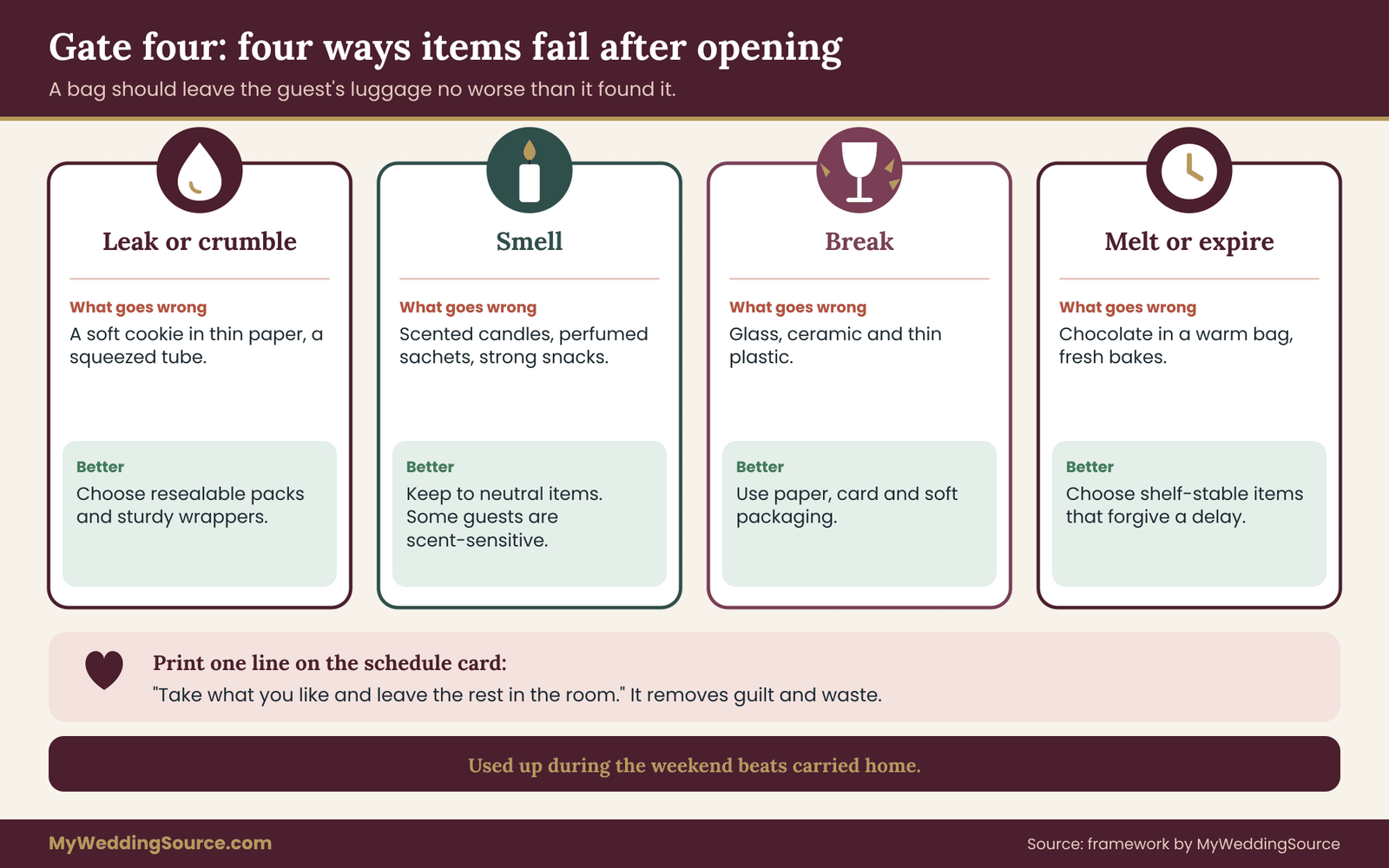
Items tend to fail gate four in four ways.
They leak or crumble. A soft cookie in thin paper becomes crumbs. A tube of lotion that has been squeezed once may leak under cabin pressure. Choose packaging that can be sealed again, or items that cannot leak.
They smell. Strong scents travel through a bag. A scented candle, a perfumed sachet or a pungent snack can flavor a suit jacket. Many guests also have scent sensitivities. Keep to neutral items.
They break. Anything made of glass, ceramic or thin plastic is vulnerable in a cabin bag. Even a small ornament can crack.
They expire or melt. Chocolate in a warm bag, fresh baked goods and anything that needs refrigeration are time-limited. A pretty item that must be eaten within a day is better placed in the room than in a bag.
What the guest can do with leftovers
You cannot control what guests do, but you can design for several outcomes. A guest might finish the snack, share it with a seatmate, leave the rest at the hotel or throw it away. A thoughtful pouch makes each of those easy. Food in single-serve wrappers can be shared. Paper can be recycled. A reusable pouch can be repurposed as a toiletry bag.
A short line printed on the schedule card can help: “Take what you like and leave the rest in the room.” That small permission removes guilt and keeps your room from filling with half-wrapped items. It also reduces waste, since hotel staff can choose to donate unopened snacks, within the hotel’s own policy.
The journey from door to door
Mapping the full trip helps you spot the weak points. A flying guest moves through at least seven moments: packing at home, security and boarding, landing, transfer to the hotel, check-in or bag drop, the weekend itself and the return trip. Your bag touches the last five of these, and each one has a small risk. Few of those moments involve a table, so a carry-on welcome bag should work in a guest’s hand.
At landing, guests may have a rental car or ride share, and they need hands free. At transfer, they may carry a bag on a shuttle. At check-in, they may be early, before the room is ready. During the weekend, they move between locations, so the bag is a small burden at each stop. On the return trip, it is a question of fit.
Handoff timing for guests who arrive early or late
A welcome bag works well when it is waiting in the room and poorly when it is handed over in a crowded lobby. For flying guests, arrival times are spread out, so a single handoff event does not work. Some guests land at dawn and wait for the room. Others land at midnight and want sleep. A carry-on welcome bag is easiest to hand over when it is already in the room.
If the hotel allows it, ask whether bags can be left in rooms before arrival, or held at the front desk with a name list. The details of hotel delivery are covered in other guides and by your hotel contact, so keep this part simple: confirm that the hotel will hold a pouch and hand it over, and choose a pouch that does not need a table to unpack.
What to do about very early arrivals
Guests who arrive before check-in time often have to store their bags. A carry-on welcome bag handed to someone who is standing at the desk with a rolling bag, a coat and a phone is a small burden. In that case, a quick verbal welcome and a single water bottle may be enough, with the carry-on welcome bag delivered to the room later.
This is a place where a written handoff note helps. Ask the hotel to keep a list of which guests have received their pouch and which have not, so staff do not repeat or skip anyone. A simple tick list on a clipboard is plenty.
The carry-on welcome bag and mobility needs
Some guests travel with canes, walkers, wheelchairs, medical equipment or service animals. For them, a bag that is awkward to carry is not just inconvenient but a real barrier. Do not hang anything on a mobility aid without asking. Do not hand a heavy tote to someone using a cane. A carry-on welcome bag for these guests should add nothing to carry unless they ask for it.
A good approach is to make the carry-on welcome bag light and flat, offer to deliver it to the room, and avoid asking guests to carry anything between venues. The Transportation Security Administration offers passenger support information for travelers with disabilities and medical conditions, and many airlines have their own services. If a guest tells you about specific needs, follow their lead and ask what would help, rather than guessing.
Family travel and children
Families flying with kids carry more, not less. A parent may already have a diaper bag, snacks, a tablet and a stuffed animal. A separate gift for the child can be sweet, but only if it is small, quiet and flat. A coloring sheet and two crayons fit into a pocket. A hard plastic toy or a big balloon does not.
Be especially careful with food for children. Check for choking hazards and major allergens, and keep treats in sealed packages. If you are not sure whether a snack suits a child’s age, a card that says “ask us for a kid-friendly snack at the desk” is safer than a guess.
Allergens and cross-contact in a shared pouch
A carry-on welcome bag that holds several foods may cause cross-contact if packages are loose. For guests with allergies, a loose almond in the same bag as a nut-free cookie is a risk. Keep each item sealed in its own wrapper, avoid homemade items unless you can label them thoroughly, and keep a list of the ingredients.
The Food and Drug Administration lists the major food allergens recognized in U.S. labeling. If your RSVP form asks about dietary needs, use that information to decide whether a food pouch is safe for each guest, and make a nut-free or allergen-free version where needed. Labeling is not a legal formality here but a kindness.
The “stay” decision rule
Apply a short rule for gate four. Ask whether the item can be fully used within the weekend. If yes, it passes. If no, ask whether it is flat, sealed, odor-free and unbreakable. If yes, it passes. If neither is true, it fails and should be cut or moved to a different part of the weekend, such as the welcome party or the room. A carry-on welcome bag that passes gate four is the one guests are glad to find on day three.
The rule reflects a simple idea: a carry-on welcome bag should leave the guest’s luggage no worse than it found it. When in doubt, choose the lighter and plainer item.
Departure morning and the farewell
The last moment you can help a flying guest is the morning they leave. If you are planning a farewell brunch or a send-off, consider whether it can include a small, useful item for the road, such as a wrapped pastry and a note with the airport transfer times. That gift is eaten before the checkpoint, so it never touches gate one.
A printed note with the hotel checkout time, the shuttle schedule and a thank-you also helps guests who are leaving at different hours. If you do plan a brunch, the wedding guest hotels guide can help you think through timing for guests with different travel needs and mobility.
When the flight goes wrong
Flights are delayed, canceled and rerouted. A guest whose flight is canceled may arrive late, miss the welcome event or stay longer than planned. The carry-on welcome bag does not need to solve that, but a note with the hotel’s front desk number and a name to call for help does. Keep a few spare pouches for guests who arrive off schedule, and do not make anyone feel they missed out. A carry-on welcome bag that is shelf-stable forgives a delay.
Avoid adding items that rely on an arrival time, such as a fresh pastry meant for the first night. The best carry-on welcome bag contents are shelf-stable and forgiving, so they work for the guest who lands on time and the guest who lands at two in the morning.
An item-by-item carry-on audit
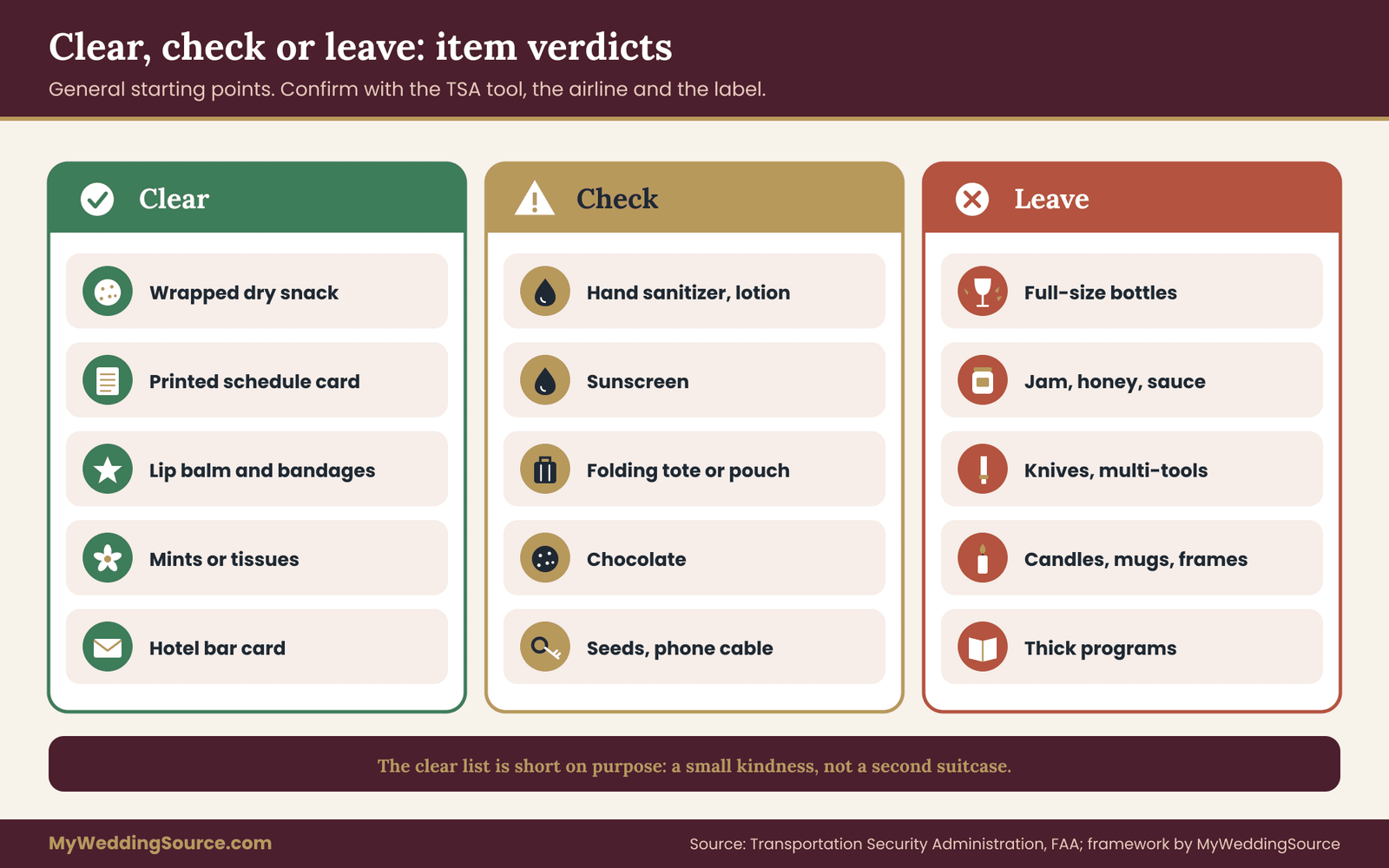
Now apply the four gates to the kinds of things people actually propose. The verdicts below are general starting points and not rulings. Rules and products differ, so confirm with the TSA tool, the airline and the product label where it matters. Each verdict has three levels: clear, check and leave.
Clear: items that usually pass all four gates
Wrapped dry snacks. A single cookie, a small bag of nuts, crackers, pretzels, dried fruit or wrapped candy. They are solid, light, flat enough and easy to finish. Check allergens and choose sealed packaging.
Printed schedule card. One sheet or a folded card with times, addresses and a contact. It is flat, light and useful without a phone.
Lip balm and small bandages. Tiny, dry or solid, and a real help after travel. Lip balm in a stick is usually straightforward, while a squeeze tube raises the liquid question.
Mints or gum. Small, light, and gone by Saturday. A tin is thicker than a sleeve of mints, so lean to the sleeve.
A sleeve of tissues or wipes. Compact and useful. Choose a small pack and avoid heavy fragrance.
A hotel-bar card or drink coupon. A paper card gives the welcome toast without a bottle. It is thin and it works.
Check: items that need a closer look
Hand sanitizer and lotion. They pass only if the container is within the carry-on liquid limit, and many guests already carry their own. Check the container size and the label.
Sunscreen. Useful for an outdoor wedding, but most lotions and sprays follow the liquid rules and aerosols have their own limits. A small stick may be simpler. Confirm on the TSA site.
Chocolate. Solid, but it melts in a warm bag and can make a mess. Choose sturdy, wrapped pieces and skip anything with a soft center for a summer wedding.
Reusable water bottle. Empty bottles can go through the checkpoint, and guests can fill them after screening. A bottle is bulky, though, so it passes only if the guest will truly use it all weekend. Consider a collapsible version.
Tote or pouch. Passes if it folds flat and is light. Fails if it is rigid, heavy or oversized.
Small plants or seed packets. Seeds and plants can be limited at borders and by agriculture rules. For domestic travel they may be fine, but for international guests they can be a problem. Check with the relevant agency.
Phone charger cable. A simple cable is light and has no battery, so it is fine. A power bank is a lithium battery and falls under gate three.
Leave: items that usually fail
Full-size bottles of anything. Wine, hot sauce, olive oil, lotion and perfume are all common ideas. All of them fail gate one for a cabin bag and gate three for weight.
Jars of jam, honey or sauces. Spreadable foods count as liquids or gels, and glass can break. Replace with a card pointing to the shop.
Candles and diffusers. Heavy, fragile, scented and sometimes restricted by type. Offer them at the party or ship them home.
Mugs, frames and glass keepsakes. Pretty but fragile and heavy. Put them on a table, not in a bag.
Knives, openers with blades and multi-tools. Check TSA, and even if allowed, skip them. A guest should not have to wonder whether a gift will cause trouble at the gate.
Books and thick programs. Heavy and bulky. A single page is plenty.
Fresh flowers or perishable food. They do not last and may be restricted at borders.
Why the clear list is short
You may notice that the clear list is short and plain. That is by design. A flying guest does not need a big gift in the bag. They need a small kindness at a moment when they are tired and a plan for the weekend. The other items can be present in other ways, at the party, on the table or at home. The short list is what keeps a carry-on welcome bag a kindness and not a chore.
A short list also has a budget benefit. Three to five items in a small pouch cost less than a full tote, and they reach guests in a form they will actually use. Money saved on items that would have been thrown away can go to a better hotel pickup or a nicer welcome drink.
Comparing alternatives for flying guests
A pouch is one of several ways to welcome flying guests. Each option trades cost, effort and guest experience differently. Here is how they compare in prose.
A small pouch in each room. The most personal option. It takes some assembly and coordination with the hotel. It works well when most guests stay at one hotel and the carry-on welcome bag is light.
An envelope at the front desk with a water bottle. The simplest option. The envelope holds a schedule and a note, and the water is handed over at check-in. It costs less than a pouch and nearly always passes the audit.
A digital welcome note. A text or email with the schedule and a warm message. It costs almost nothing and weighs nothing, though some guests will not read it and it does not feel like a gift. It pairs well with a very small physical item.
A gift shipped to the guest’s home after the wedding. It removes the packing issue entirely and lets you give a heavier keepsake. The tradeoff is cost and time, and you need addresses, which is a privacy matter to handle with care.
A credit at a local shop or the hotel café. This lets guests choose what they want and carry only what they buy. It needs coordination with a business and a clear limit, but it creates no luggage at all.
Choosing among the options
The best option depends on your guest mix and your budget. If most guests fly and stay at one hotel, the envelope with water plus one small item is hard to beat. If a quarter of guests fly and the rest drive, a pouch for everyone with a flyer-friendly design may be simpler than two kinds of bag. If you want to give a larger keepsake, a post-wedding shipment is the honest way to do it. Whichever you choose, a carry-on welcome bag should be the lightest thing in the guest’s luggage.
You can also combine options. A digital welcome note for everyone, a pouch for those who want one, and a credit for the guests who traveled the farthest is a perfectly reasonable mix. What matters is that no guest is forced to carry something they did not choose.
Splitting bags by guest group
Many weddings use one bag for everyone. For flyers, a simple split can help: a “flyer pouch” that is light and flat, and a “local pouch” that is larger and may include heavier items. The two share a theme but differ in contents. Label them on the inside, not on the outside, so no one feels sorted. A flyer version of the carry-on welcome bag can share a color and a note with the local version.
Splitting needs a clear list of who is flying, and that information comes from guests. A short RSVP question about travel mode is enough. The wedding RSVP etiquette guide covers how to ask for extra details without making the form heavy, and a one-line question about how guests are traveling will do for this purpose.
Naming and wording on the bag
Printed text on the bag or card can help. A sentence like “Everything in here is airport-friendly. Take what you like and leave the rest” is warm and useful. It tells the guest that you thought about their trip and relieves them of any duty to carry things. Avoid long personal notes that guests might feel they cannot throw away. A short handwritten line is sweet, and a stack of pages is a burden. A carry-on welcome bag that explains itself needs very little else.
You can also add a small label with a note about ingredients, such as “Contains nuts” on the almond pack. That is the sort of detail that earns trust.
Replacing the keepsake
Many couples want the bag to feel like a keepsake. For a flying guest, the keepsake can be the card itself. A printed card with a drawing of the venue, a short thank-you and the schedule on the back is light, personal and likely to be kept. It works as a bookmark or a fridge note.
If you want something with more presence, consider a wrapped treat that is eaten at the first dinner. A gift you can enjoy in the moment avoids the burden of carrying it and leaves a pleasant memory.
A worked example of a carry-on welcome bag audit
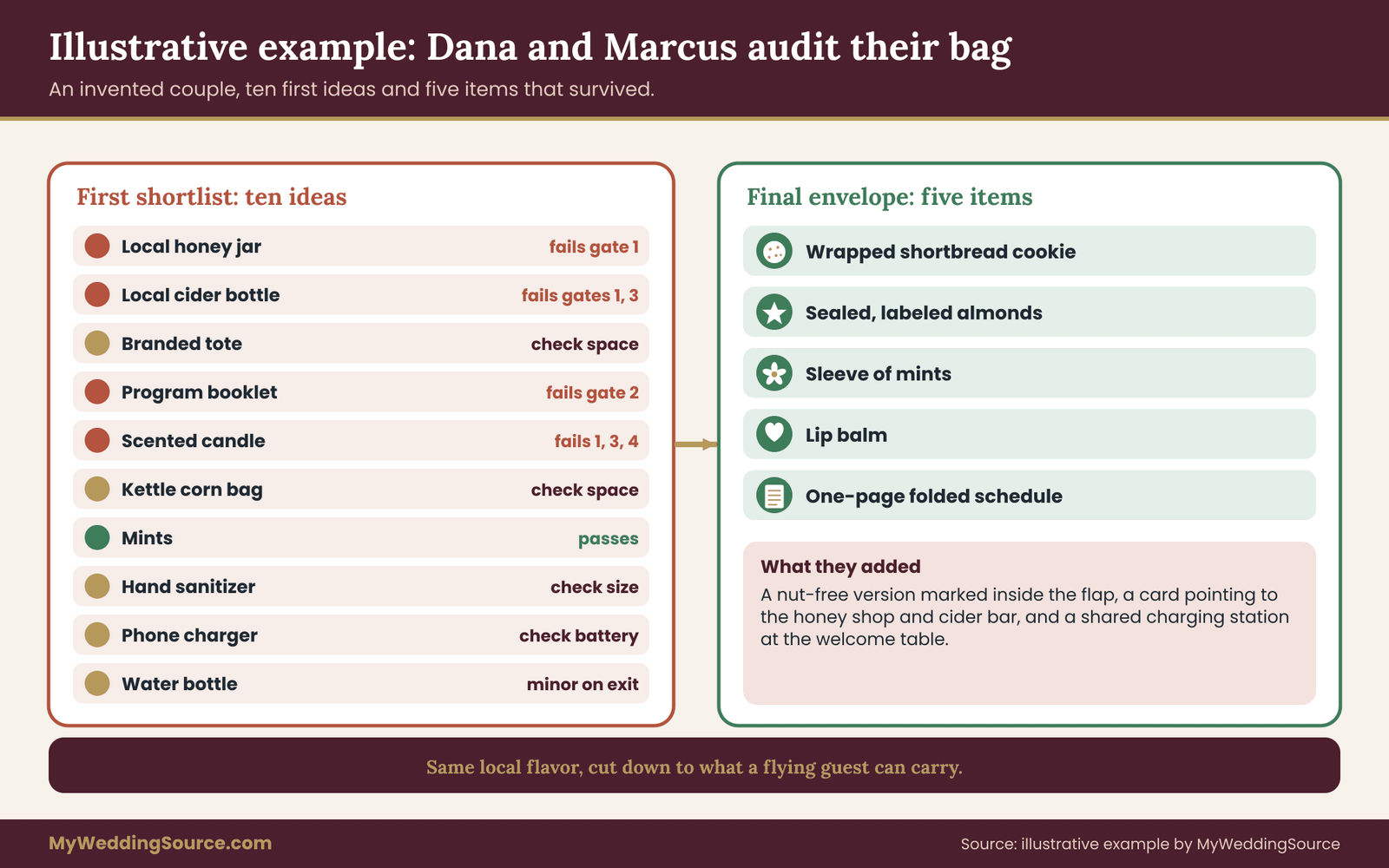
The example below is invented, so treat it as an illustration of the method and not as data. Imagine a couple, Dana and Marcus, planning a Saturday wedding with seventy-two guests. They have a list of sixty-eight invited households, and an RSVP question about travel shows that about half of the guests are flying, mostly with one bag each. The rest are driving or live nearby. The wedding is in early autumn, in a city with a single main hotel. The carry-on welcome bag in it is plain on purpose.
Step one: the first shortlist
Dana and Marcus first brainstorm the usual items. The list includes a mini jar of local honey, a bottle of local cider, a branded tote, a printed program booklet, a scented candle, a bag of kettle corn, a pack of mints, hand sanitizer, a phone charger and a small bottle of water. There are ten items, and they feel good about all of them.
They then run each item through the four gates, writing pass, check or fail for each.
The honey fails gate one because it is a spreadable food. The cider fails gate one, because it is a full-size drink, and gate three, because of weight. The tote is a check for gate two. The booklet fails gate two for bulk. The candle fails gates one, three and four. The kettle corn is a check on gate two, because the bag is large and crushable. The mints pass. The sanitizer is a check for container size. The charger is a check for the battery. The water passes arrival and is a minor problem on departure.
Step two: the revised list
After the audit, the couple keeps five items: a wrapped shortbread cookie from a local bakery, a small pack of roasted almonds in a sealed sleeve with a label, a sleeve of mints, a lip balm and a one-page folded schedule with a hand-drawn map. They replace the tote with a flat kraft envelope. They add a card that points to the local honey shop and the cider bar, with a note that the hotel can arrange a shipment home. They drop the charger and arrange for a charging station near the welcome table.
They also learn something unexpected: the almonds raise an allergy question. Two guests listed nut allergies on the RSVP. The couple makes a second version of the envelope with a second cookie in place of the almonds and marks it with a small dot on the inside flap.
Step three: the pocket test
Dana packs a finished envelope into her own carry-on backpack, already half full with a laptop and a sweater. It slides in beside the laptop without pushing anything out. She then puts the envelope in a jacket pocket and finds it fits there too. The whole envelope weighs about as much as a small paperback by her estimate, so she tests it again with the cookie and mints removed, to see what the guest would carry home. The answer is almost nothing, which is the goal.
Step four: the hotel conversation
The couple calls the hotel’s event contact with a short list of questions. Can the hotel place envelopes in rooms before guests arrive? Can it hold extras for guests who arrive off schedule? Is there a delivery or handling fee? Can it provide a printed list of guests who have received an envelope? The contact answers all four, and the couple writes the answers down along with the contact’s name and the date. The details of hotel delivery are the hotel’s to explain, and the couple asks for its terms in writing.
What changed
The final carry-on welcome bag is an envelope with five light items, a schedule and a note. It does not contain a single liquid, a sharp object or a battery. It is flat enough for a personal item, it is nut-aware, and it can be eaten or left behind with no waste. The couple spends less per guest than they would have on the first list, and they redirect the savings into a better welcome toast at the first dinner. This is what a finished carry-on welcome bag looks like after an audit.
The example is not a recipe to copy. A different couple, a different hotel and a different guest mix would produce a different list. What carries over is the process: shortlist, audit, test, ask, adjust.
What a carry-on welcome bag costs and who to ask
Cost is where hosts often get surprised, and the surprise usually runs in one direction. A pouch with several items, a custom print and a hotel handling charge can cost more than expected. A carry-on welcome bag built around the audit is usually cheaper than a full tote, because it contains fewer, smaller things. But do not assume. Price it out. A carry-on welcome bag deserves a line of its own in the budget.
A simple cost-per-bag logic
Here is an illustrative way to compare options, using made-up numbers to show the logic. Do not treat the figures as real prices.
Suppose a pouch has five items that cost, in total, some amount per bag, plus a container, a printed card and a hotel handling fee. Add those lines and divide by the number of bags. That is the cost per bag. Now ask a second question: how many of those items will a guest actually use? If a guest uses three of five, your cost per used item is higher than your cost per item.
The audit helps on both sides. It trims items that would not be used, which lowers cost, and it favors items that are consumed, which raises the share used. If you want to take it further, put the cost for flying guests and local guests on separate lines, so you can see where the money goes. In that sense a carry-on welcome bag is cheaper because it is smaller, not because it is lesser.
Costs people forget
A few lines tend to be missing from first budgets. Assembly time is real, even if volunteers do it, and it is worth planning a work session with food. Packaging for items that arrive loose, such as small bags and labels, adds up. Delivery to the hotel and any handling fee are separate. Spare pouches for late arrivals and for guests with allergies are worth setting aside. A modest buffer of extra pouches is cheaper than a last-minute scramble.
Also set aside a small amount for returns or replacements if a supplier sends the wrong size. For goods that must meet an exact container size, an error is not a small thing.
Questions for suppliers
When you order from a vendor, ask in writing, and keep the replies.
- What are the exact dimensions and weight of each item in its packaging?
- What is the container size in ounces or milliliters?
- What are the ingredients, and what allergens are present or handled in the same facility?
- What is the shelf life, and what is the best-by date for my event date?
- What is the minimum order, the lead time and the return policy for errors?
- Will you provide an itemized invoice that separates the product from fees?
Vendors who sell regularly to events will have ready answers. If a vendor hesitates on container size or ingredients, consider another source. The Federal Trade Commission publishes guidance on truthful advertising, and claims such as “TSA approved” or “airline friendly” on a product page are marketing phrases, and the TSA tool and the officer on the day are the references that count. Verify with the official source.
Questions for the hotel
For the hotel, the questions are about handling and timing.
- Will staff place envelopes in rooms, or hold them at the desk?
- Is there a fee for delivery, storage or handling, and is it per item or per guest?
- Can envelopes be held for guests who arrive early or late?
- Will staff record who has received one?
- What happens to unclaimed envelopes after checkout?
- Where can food items be stored if they need to stay cool?
Ask for the answers in an email so there is a record. Hotels differ, and a reply from one contact may not match what the front desk does on the day. A short confirmation a week before the event is a good habit.
Disclosing commercial ties
If you receive anything from a vendor in exchange for mention, such as a discount, a free sample or a sponsorship, say so plainly if you share the bag contents publicly. The Federal Trade Commission publishes guidance on disclosing material connections in endorsements. For a private wedding you are not publishing advice, but if you post the bag on a blog or social media and name vendors, a short note about any free or discounted items is the honest choice.
Writing to guests about travel
You can help guests plan with a short, friendly note before the wedding. It does not need to explain the audit. It only needs to say what to expect and what is not needed. Here is a sample that you can adapt in your own words. The note works best when it describes the carry-on welcome bag in one sentence.
“We will have a small welcome envelope waiting in your room. It is light and flat, so it will fit in a carry-on. Please feel free to leave anything you do not want behind.”
A second note for guests who ask what to bring is useful: “Nothing needed. If you are flying, travel light, and we will have water and snacks.” That avoids the common problem of guests bringing gifts they do not have room for. If you would like to read more about wording requests tactfully, the wedding invitation etiquette guide covers how to phrase details that go with the invitation.
Asking about travel without prying
An RSVP question about how guests are traveling is useful but optional. Keep it light. A single line such as “How are you traveling? Flying, driving, local” is enough. Do not ask which airline or what time the flight lands unless you are arranging transport, and tell guests why you are asking. The answers are used to plan bags and transfers, and you should store them with the rest of your guest data with care.
Edge cases for a carry-on welcome bag
Most weddings will not hit all of these, but each one is easy to handle if you have thought about it in advance. Each one changes the carry-on welcome bag only a little.
Guests who check a bag after all
Some guests who planned to travel light will check a bag, perhaps because they are bringing a dress, a gift or a larger group’s belongings. They are not a problem for your bag, but they change the rules. Items that fail gate one for a cabin bag might be fine in a checked bag, though the rules for checked baggage have their own limits, such as for alcohol, batteries and flammables. The FAA publishes a PackSafe guide on what may go in checked and carry-on bags.
You do not need to plan around those guests. Designing for the smallest bag serves everyone, and a guest with a checked bag can always take more if they wish.
Guests renting a car or using a shuttle
Flying guests who rent a car arrive at the hotel with a trunk, and your light pouch is fine. Guests using a shuttle or a ride share carry everything by hand and need the lightest options. You may not know which guests do which, so the design target remains the same.
If the venue is far from the hotel, ask guests to bring the carry-on welcome bag or leave it in the room, and say so on the schedule. A small card that says “You do not need to bring this with you” prevents the extra bag from following guests to the ceremony.
Guests with medical devices and supplies
Guests may carry medical devices, injectable medications or other supplies that take space and need quick access. Do not add items to their bag that could be confused with those supplies, and avoid anything that would require them to explain themselves at security. If a guest has told you about a need, such as a refrigerated medication at the hotel, ask the hotel about a mini fridge and tell the guest what you arranged.
The Transportation Security Administration publishes guidance for passengers with medical conditions and disabilities, and a guest who has questions can use its passenger support service. Your job is to keep the carry-on welcome bag simple and not to advise anyone on their health.
Guests traveling with infants
Infants add formula, breast milk, wipes, diapers and a bag that is already overflowing. The TSA allows formula, breast milk and juice for infants in quantities above the usual limit, with additional screening. That rule is for parents’ own supplies. You do not need to supply formula, and you should not hand out baby food that a parent has not chosen. A better gift is a quiet corner, a chair and a note about where to warm a bottle. Hotels with cribs can tell you how to arrange them, as covered in other guides on this site.
Weddings with a long weekend
If your wedding spans three or four days, with a welcome dinner, a ceremony and a farewell event, guests may want more than a one-night pouch. In that case, consider splitting the gift across events: a small item on arrival, a second small item at the reception and a final item at the farewell. This spreads the weight and makes each moment feel considered. A single large bag at the start tends to feel like a pile.
Destination weddings and international flights
For a wedding abroad, or for guests flying internationally, the rules multiply. Each country sets its own rules for liquids, food, plants and medicines, and airlines may set different baggage allowances on international fares. The best approach is to keep the bag nearly empty: a card, a flat snack that is shelf-stable and clearly labeled, and a note about local shops. Guests can then buy souvenirs and snacks when they land.
If you are planning a destination wedding, the wedding guest hotels guide helps with accommodations, but the airline and border rules are the responsibility of each traveler, and it is kind to point them to the official sources and let them decide.
Smaller guest counts and private flights
Weddings with a small guest list, for example thirty people or fewer, can customize each pouch. You may know which guests have allergies, which ones love chocolate and which ones will drive. Use that knowledge, and keep the audit as a guard against sending someone home with something that does not fit. A small wedding can make each carry-on welcome bag personal without breaking the audit.
At the other end, large weddings need a standard pouch and a simple process. The more guests you have, the more important it is to remove decisions from the day. Pre-assemble pouches, label the allergen version and hand the hotel a list.
Late changes to the contents
Sometimes a supplier substitutes an item or a product changes its packaging. Keep a final check a week before the wedding: open one finished pouch, look at every item, and confirm the size and label. Compare the label with the notes you made when you ordered. If anything has changed, replace it. A fifteen-minute check can save a lot of trouble.
When a guest leaves something behind
Hotels often find items that guests left in rooms. If a guest leaves the carry-on welcome bag or part of it, do not take offense. It usually means the item was not needed, not that the gift was unwelcome. Ask the hotel to donate unopened, shelf-stable food if its policy allows, and recycle the paper. Use the experience to improve the next version, or to tell a friend who is planning her own event.
Taking the lesson to other gifts
The audit works beyond welcome bags. Favors at the reception, gifts for the wedding party and thank-you items for out-of-town helpers all travel in luggage. The same four gates apply, and the same preference for flat, light, sealed and usable items makes everyone’s trip easier. If you are working through the wider list of guest-facing decisions, the wedding etiquette guide is a good place to see how small courtesies fit together.
Your next steps
Here is a short sequence you can finish in a few evenings. By the end, you will have a carry-on welcome bag that has passed every gate.
- Count how guests are traveling. Add a one-line travel question to your RSVP, or use the responses you already have.
- List ten to fifteen candidate items and run each through the four gates. Write pass, check or fail.
- Resolve every “check” before you order. Use the TSA tool, the product label and the airline’s own baggage page.
- Choose a container that lies flat, and test a finished pouch in the smallest bag you can find.
- Make an allergen version if any guest has told you about an allergy.
- Ask your hotel the handling questions and get the answers in writing.
- Add a short note to the carry-on welcome bag that says guests may leave anything behind.
- Add the carry-on welcome bag cost to your wedding budget, with a small buffer, and put the order date on your wedding planning checklist.
- A week before the wedding, open one finished pouch and check every item against your notes.
FAQ
What makes a welcome bag suitable for guests flying carry-on only?
A suitable bag is light, flat, sealed and free of items that airport security restricts. It should pass four checks: it clears screening, fits a small packing space, stays light without loose batteries, and survives the trip home. Most flyers do best with three to five small dry items, a printed schedule and a note saying they may leave anything behind.
Can guests bring liquids from a welcome bag through airport security?
Only within the limit. The Transportation Security Administration generally allows liquids, gels and creams in containers of 3.4 ounces or less, packed together in one clear quart-size bag. Larger containers are not allowed in a cabin bag even if mostly empty. Check the TSA website for current rules, and skip full-size drinks and lotions in the bag.
Are snacks allowed in a carry-on welcome bag?
Dry, solid snacks such as cookies, nuts, crackers and wrapped candy are usually fine, though officers may inspect any item. Spreads, jams, honey and dips behave like liquids and follow the container limit. Use sealed, labeled packaging, keep allergens in mind, and remember that guests crossing borders may face food rules set by the destination country.
Should we include a power bank or phone charger?
A simple cable is fine, but a power bank is a lithium battery, and the Federal Aviation Administration requires spare lithium batteries to travel in carry-on bags and not checked ones. Airlines may also set limits. A shared charging station at the welcome event meets the same need without putting a battery in a guest’s bag.
How big should a carry-on welcome bag be?
Think envelope or small notebook, thin enough to lie flat against a folded shirt. Airline cabin limits vary by carrier and fare, and some fares allow only an under-seat personal item, so design for that smaller space. Measure the finished pouch, then test it in the smallest half-full bag you can find.
What should we do about guests with food allergies?
Ask about dietary needs on the RSVP, keep every food item in its own sealed, labeled wrapper and avoid homemade items unless you can list every ingredient. The U.S. Food and Drug Administration lists the major food allergens used in labeling. Make a separate allergen-aware version for guests who need one, and mark it clearly inside.
Is it better to ship gifts instead of packing a bag?
Shipping suits heavier or fragile keepsakes, since it removes the packing problem and lets you give something larger after the wedding. It costs more and needs home addresses, which are private. For the weekend itself, a light envelope, a water bottle and a schedule at check-in usually serves flying guests better than anything shipped.
Do we need to disclose free items from vendors?
If you share your bag contents publicly and received free or discounted items in exchange for a mention, say so plainly. The Federal Trade Commission publishes guidance on disclosing material connections. For a private wedding you are not required to publish anything, but honesty with guests and readers keeps trust and avoids confusion about who recommended what.
Sources
- What can I bring? Search tool, Transportation Security Administration
- Liquids, aerosols and gels rule, Transportation Security Administration
- Passenger support, Transportation Security Administration
- PackSafe: what you can and cannot pack, Federal Aviation Administration
- Lithium batteries in baggage, Federal Aviation Administration
- Air travel consumer information, U.S. Department of Transportation
- Know before you go, U.S. Customs and Border Protection
- Travelers and agricultural products, U.S. Department of Agriculture, APHIS
- Food allergies, U.S. Food and Drug Administration
- Federal Trade Commission