
Welcome bag snacks made by local producers are the part of a wedding bag that guests remember, and also the part that can go wrong in the most ordinary ways: a label that hides an allergen, a best-by date that arrives before the guests do, a chocolate that melts in a hotel hallway. This guide gives you a five-check file to run on every snack, from the maker’s kitchen to the guest’s hand.
Treat every local snack as a small product that needs a short file with five checks: who made it and under what rules, what the label says about ingredients and allergens, how long it stays good compared with the day the guest opens it, how it handles heat on the way, and who touches it between the maker and the guest. A snack that passes all five goes in the bag. A snack that fails one gets swapped for a safer version or dropped. Welcome bag snacks without a legible label are the first to drop.
Most couples choose welcome bag snacks the way they choose a gift: by taste, by story and by how nice the package looks. That is a fair start. A pecan praline from the bakery your grandmother loved, a jar of granola from the farmers market, honey sticks from a family apiary two counties over: these things say more about a place than anything from a big-box shelf.
The trouble is that small local producers vary enormously. One may run a licensed commercial kitchen with printed labels and a batch log. Another may bake in a home kitchen under a state exemption and print labels at home. Both can make excellent food. But they hand you very different amounts of information, and you are the one passing that food to forty or a hundred and forty guests, some of whom have allergies, some of whom are children, and some of whom will open the bag three days after you packed it.
The same variation shows up in every batch of welcome bag snacks you might buy locally.
A note on scope. This guide is general information, not legal advice. Food rules differ by state and county, and they change, so confirm the current requirements with your state or local food regulator and with each producer.
Why welcome bag snacks need their own check
A welcome bag has a few jobs. It tells guests they were expected, it helps them through the first evening, and it gives them something small to enjoy. Snacks do the third job best, which is exactly why they deserve more care than a tote bag or a printed map.
Think about what is different about food. A mug or a luggage tag is inert. If it is a bit off, the worst result is a shrug. Food can trigger a medical reaction, spoil, melt, attract ants in a hotel room or taste stale. Guests also trust food handed to them by a host. Nobody reads the bag the way they would read a restaurant menu, so the host carries the responsibility that a restaurant would otherwise carry.
Local food adds a second layer. Supermarket snacks come with a standard label, a printed date, a manufacturer who has handled thousands of complaints and a supply chain that has been tested. A small producer might do all of that well, or might do it by hand and by instinct. That is not a reason to avoid local food. It is a reason to ask better questions before you order. Welcome bag snacks from small makers can match that standard, but only when you ask for the same information.
What this guide covers, and what it leaves to other guides
This article is about the food itself: sourcing from small producers, reading and demanding labels, thinking through allergens, matching shelf life to your calendar and keeping snacks from heat damage. It does not walk through choosing every item in a bag, which belongs to the wider guide on guest care planning and the way a bag fits a weekend. It does not cover getting the finished bags to a hotel desk, which is a logistics question of its own.
It also does not cover dinner or cake. Those fall under menu planning, where a caterer carries the licensing and the allergen process. A snack bag has no caterer behind it unless you create that structure yourself, and that gap is what the five checks fill.
The three people the checks protect
Every check in this guide protects someone specific. Knowing who helps you decide how strict to be.
The first is the guest with a food allergy. For that person a vague or missing label is not an inconvenience. It is a decision to eat nothing, or to take a risk they should not have to take. Guests with allergies are usually used to quietly skipping things. Your job is to give them a bag in which they can tell, in seconds, what is safe.
The second is the guest who simply wants a good snack on arrival. A stale cracker or a melted bar tells that person the welcome was an afterthought, however sweet the intention was. Fresh, intact welcome bag snacks are a quiet signal of care.
The third is you. If a guest has a reaction, or a producer turns out to have no permit, the question that follows is always the same: what did you check? A short file with answers is the difference between “we asked and wrote it down” and “we assumed.”
The five-check file for welcome bag snacks
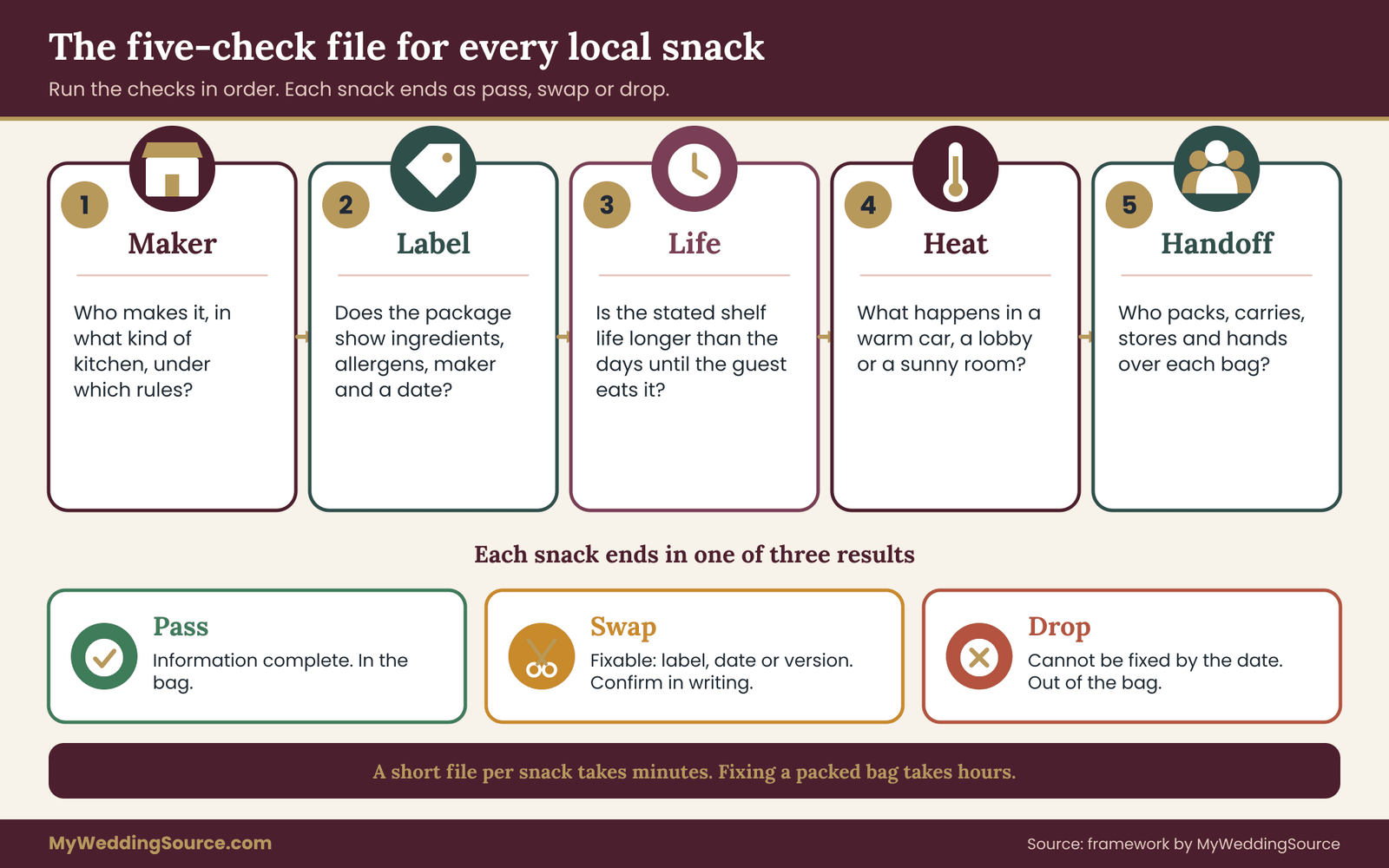
Here is the whole method in one place. For each snack you are considering, open a one-page file, on paper or in a spreadsheet, and answer five checks in order. The order matters because the early checks are cheap and eliminate the most candidates. These checks apply to all welcome bag snacks, whether you plan two or six.
Check one: Maker. Who actually produces this snack, in what kind of kitchen, under which permit or exemption, and can they give you the paperwork that applies to them? This check decides whether the producer can supply what the other four checks need.
Check two: Label. Does the packaged snack carry a legible ingredient list, a clear allergen statement, the maker’s name and place, and the net weight? If you are asking the producer to add a label, can they?
Check three: Life. How long does the snack stay good from the day it is made, and is that long enough for the date the guest will open it, plus a safety margin? The date on the package and the date in your calendar have to be compared on purpose.
Check four: Heat. What does the snack do in a warm car, a hot hotel lobby or a bag left on a window ledge? Some foods tolerate a hot afternoon. Some do not, and the difference matters more than people expect.
Check five: Handoff. Who packs it, who carries it, who stores it and who gives it to the guest? Every extra pair of hands is a chance for a mix-up, a spill or a swap of an allergy-friendly snack with the regular one.
How a snack passes or fails
Each check ends in one of three results. Pass means you have the information you need and it looks fine. Swap means the snack has a fixable problem, such as a missing label that the producer can add, a chocolate coating that could be replaced with a dry-baked version, or a best-by date that could be met by ordering later. Drop means the snack fails a check in a way that cannot be repaired by the wedding date. Keep the outcome beside the snack’s name so that your welcome bag snacks list always shows its current status.
You do not need a score. A single drop on the label check or the maker check is enough to take the snack out of the bag. For the other three, a swap is often available, and the file should record what the swap is so that your planning does not stall. Welcome bag snacks with a clean first check move on quickly.
This approach also helps you compare alternatives fairly. Two local producers might sell similar granola. One answers the five checks in a short email. The other cannot say where the product is made or what shares its equipment. The file shows the difference without arguing about taste. If you are already comparing vendors, the due diligence habits in the vendor due diligence checklist apply here at a smaller scale: ask for the same things from everyone, and write down what you were told.
How much effort each snack deserves
The five checks scale to the stakes. A sealed, store-bought-style bag with a printed nutrition panel from a producer with a commercial label passes most checks in a few minutes. A hand-wrapped paper twist of fudge from a stall needs more work. A relative’s homemade cookies, however loved, should not be in a welcome bag at all, and later sections explain why in plain terms. Even the easiest welcome bag snacks get a file.
Plan a short file for every candidate even if you end up using only two or three. The cost of a few emails is small. The cost of discovering a problem on the morning of packing is not.
Check one: who makes your local welcome bag snacks
The maker check answers a plain question: is the person selling you this food set up to sell it, and set up to tell you what is in it? It is not a judgment of quality or of how nice they are. A warm, careful baker with no label printer and a home kitchen can make wonderful food and still be the wrong source for welcome bag snacks that go to strangers.
In the United States, food safety rules come from several levels at once. The Food and Drug Administration sets national rules for most packaged foods, including labeling. States run their own food programs, inspect food businesses and write their own rules for small home-based producers. Counties and cities add permits and inspections. Because these layers differ from place to place, the safest habit is to ask the producer which rules they operate under, and to confirm anything unclear with the state or local food regulator.
Four kinds of local producers
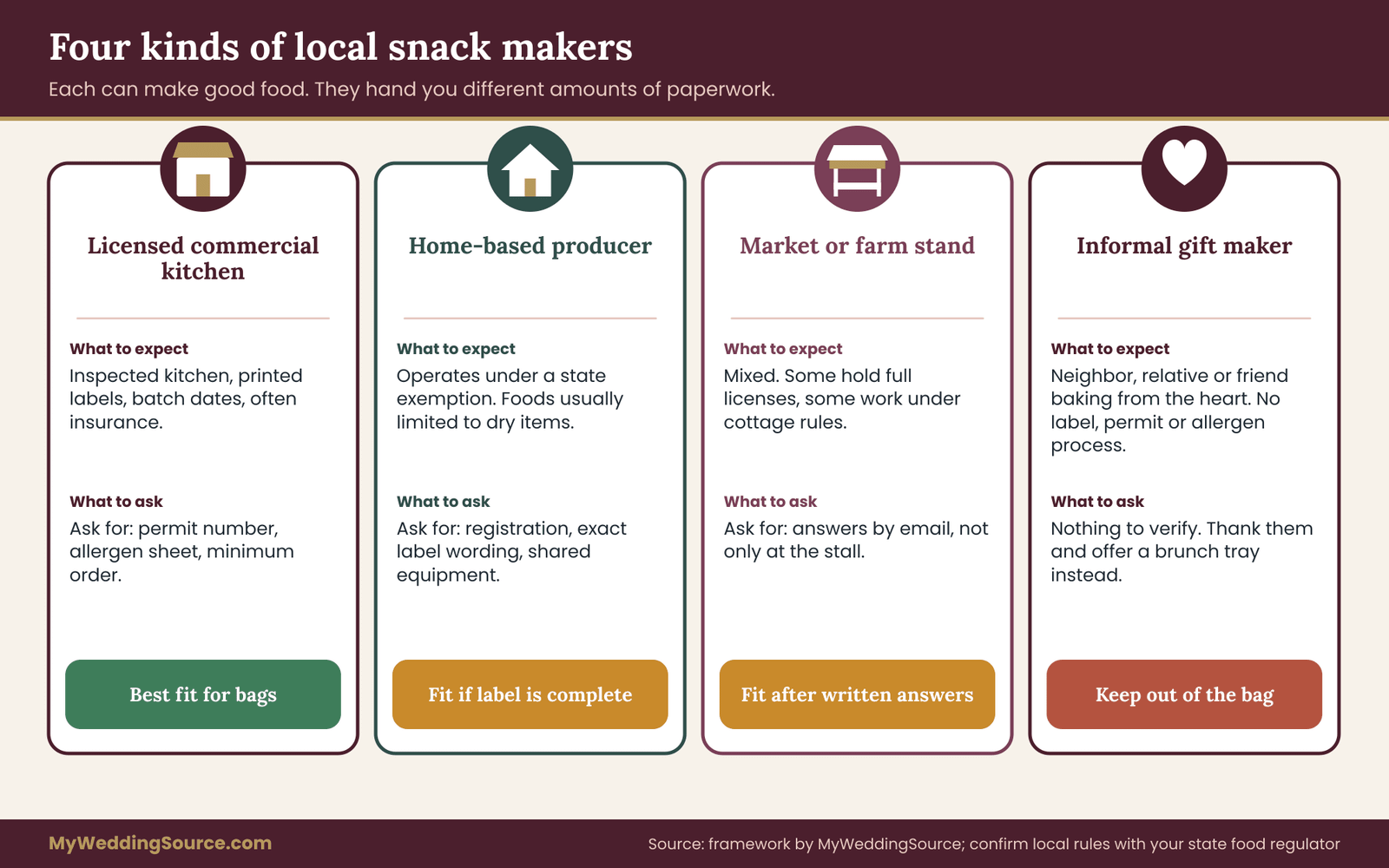
It helps to sort local sources into four rough types. The types are not official categories, just a practical way to know what to expect. Know which type you are dealing with before you plan around any welcome bag snacks.
The licensed commercial kitchen. This producer makes food in an inspected kitchen, often a bakery, a confectionery, a small manufacturer or a shared commissary kitchen. Labels are usually printed professionally. They often track batches and dates, and they commonly carry liability insurance. Expect the clearest answers here, and expect minimum orders and lead times.
The home-based producer under a state exemption. Many states allow small producers to sell certain foods made in a home kitchen, commonly called cottage food. These laws usually limit the kinds of foods, often to items that do not need refrigeration, such as dry baked goods, candy, jams and granola. They often require a specific label statement and may limit where and how the food can be sold. Rules differ widely, so the producer’s answer about what their state requires is part of the file.
The market or farm stand vendor. This is a mix. Some stand vendors hold full licenses. Some operate under cottage rules. Some sell farm products with minimal processing. At a market it is easy to ask a question and get a friendly but vague answer, so write the answer down and ask for the details in an email afterward.
The informal gift maker. A neighbor, relative or friend offers to bake. The food may be excellent. But without a label, a permit or a documented allergen process, it fails the maker check for a bag that goes to many guests. Later in this guide there is a kind way to redirect that offer.
What to ask a maker, in order
Send the same short list to every candidate so that the answers can be compared. Keep the tone friendly; most small producers are glad to be asked and many have a standard reply ready. Use the same wording for every producer of welcome bag snacks.
Start with the kitchen: is the food made in a licensed commercial kitchen, a home kitchen under a state exemption, or something else? Ask what permit, license or registration applies, and whether they can share a copy or a number. You are not auditing them. You are confirming they know the answer.
Then ask about ingredients: can you send the complete ingredient list for each snack, including sub-ingredients such as the oil in a granola or the flavoring in a candy? Which of the nine major allergens are present in the recipe? Which are handled elsewhere in the same kitchen, and how are they kept apart?
Next, ask about the product: what is the shelf life in the sealed package, what date will be printed and how is it chosen? What storage does the maker recommend? What happens to the product in heat?
Last, ask about logistics: what is the minimum order, how far ahead must you order, how is the product packaged for delivery and does the maker offer individual wrapping or custom labels?
A script that works: “We are planning welcome bags for guests arriving the weekend of our wedding and would like to include your granola. Could you tell us where it is made and under what license or exemption, send the full ingredient list and allergen information, and tell us the shelf life and the date you would print on a batch made two weeks before our event? We will also need individual packaging with a label.”
Reading the answers
A good answer is specific and comfortable. The producer names the kind of kitchen, says which allergens are in the recipe, explains how long the product keeps and offers a label. You do not need perfection. You need the maker to know the answers about their own product. This is what you hope to see from welcome bag snacks sellers.
A concerning answer is vague, defensive or unsure. “It should be fine” is not an ingredient list. “We use the same stuff as everyone” is not an allergen answer. “Our label is just a sticker with our name” means the label check may fail later. Vague replies are a warning for welcome bag snacks above all.
An honest “we cannot do that” is a good answer too. A small baker who says “I do not label individually and I cannot confirm shared equipment” has just told you exactly what the file needed. Thank them, record it and move on, perhaps offering to buy for the rehearsal dinner or an event where labeling is not the same issue.
Confirm what “local” and similar words mean
Words such as local, handmade, small batch, natural and artisan appear on many labels and menus. Most of them have no single legal meaning in food marketing. Local in particular can mean the same neighborhood, the same state or a region, and there is no one federal definition that governs how a seller uses it in ordinary marketing.
That matters for two reasons. First, if you describe the snacks to guests as local, you should know what that means in this case, so that your printed card says something true. Second, some terms are regulated when used in specific ways. “Organic” has federal rules behind it. “Gluten-free” has an FDA definition. If a producer uses such a word, you can ask what it rests on. Your guest card for welcome bag snacks should never promise more than that.
The Federal Trade Commission is the agency that looks at whether advertising claims are truthful, and it is a useful reference when you are unsure whether a claim is a promise or just a flourish. For your own writing, the simple rule is to state only what you have confirmed: “granola from a bakery in the next town” is better than “all natural, locally sourced granola” when you have verified only the first part. The same care applies to any local vendor claims in other parts of your planning.
Paying, contracts and insurance
Even for a small snack order, put the key terms in writing. A short email confirmation is enough: what is ordered, how many pieces, the ingredient list attached, the date printed on the package or the production date, the delivery day and the price. If the maker is a business, ask whether they carry product liability insurance and whether they would provide a certificate if the venue or hotel asks.
Hotels sometimes ask where outside food came from before they will accept a delivery. Orders for welcome bag snacks may be small, but they still deserve a paper trail.
Keep the deposit small and the payment record clear. If the producer cancels, you will want to be able to show what you paid and what was agreed: the amount, the date and the person who agreed.
The first drop
At the end of the maker check, you will probably have eliminated a few candidates. That is normal and useful. A shorter list of welcome bag snacks you can document is better than a long one you can only hope about. Keep the eliminated producers on a separate list; some will be perfect for another part of the weekend, such as a farewell brunch where a caterer or the venue handles labeling.
Making a short list of local welcome bag snacks
Once a few makers pass the first check, build a short list. Three to five candidates is enough. You will not use all of them, and the file for each one exists to show which ones deserve a place. These are the candidates for your welcome bag snacks.
Choose by category, not by novelty
Local welcome bag snacks fall into a few categories, and thinking in categories keeps the bag balanced and the file short.
Dry baked goods such as shortbread, biscotti, crackers or cookies that hold up without filling or frosting. They tend to pass the life and heat checks easily and are the easiest to label. They are the easiest welcome bag snacks to label and keep.
Nut and seed items such as roasted nuts, brittle or granola clusters. They are popular, but nuts and peanuts are major allergens, so these items need the strictest label and a plain alternative in the bag. These welcome bag snacks need the strictest label.
Fruit and preserves such as dried fruit, fruit leather, jam in a tiny jar. They keep well, travel reasonably, and often avoid several allergens, though sulfites and some processing aids need a label check.
Sweet items such as caramels, chocolates and candy. They are the most heat-sensitive and often involve dairy, soy and tree nuts. They can still work in a cool season. Use these welcome bag snacks only in cool seasons.
Savory items such as popcorn, pretzels, seasoned snack mixes or cheese crackers. They are good for guests who do not want sweets, but seasoning blends and shared equipment require a careful allergen answer.
Refrigerated and perishable items such as fresh cheese, cured meat, pimento cheese or filled pastries. These do not belong in a bag that will sit in a room for hours, and the guide treats them as drops unless a cold-chain plan exists. Perishables are not welcome bag snacks in any season.
How many different snacks
A common mistake is to include four or five types of food in each bag in the name of variety. Each type multiplies the number of labels to read, ingredients to ask about and mistakes to make on packing day. Two welcome bag snacks, one sweet and one savory, will serve most guests. Add a third only if one of the others contains a major allergen and you want a safe fallback.
Keep the sizes small. A guest who arrives tired wants something to eat that evening or the next morning. They do not want a whole box to carry home on a flight. Small, individually wrapped portions also reduce waste, a point that matters for any small favor.
Check two: the label on every snack Smaller portions also keep welcome bag snacks fresher.
The label check is where most local welcome bag snacks succeed or fail. The question is simple: could a guest with a food allergy, holding this snack in a dim hotel room, learn from the package alone what is in it? If the answer is no, the snack is not ready for a bag, however good it tastes.
A label also protects the host. When the ingredients and the maker’s name travel with the snack, you do not need to be present when the guest opens it, and you do not need to remember what the baker told you six weeks ago. Clear labels make welcome bag snacks easier to hand over with confidence.
What a complete label shows
For most packaged foods sold in the United States, federal labeling rules ask for a handful of basic elements. The product’s common name, the net quantity of contents, an ingredient list with ingredients named in descending order by weight, and the name and place of business of the manufacturer, packer or distributor. Packaged foods also have to declare the major food allergens in plain language. Nutrition information is required for many products, though small businesses and some small packages may qualify for exemptions. Apply this list to every one of your welcome bag snacks.
Small home-based producers often work under state rules instead of, or on top of, those federal requirements. Some states require a label statement saying the food was made in a home kitchen. Some require the producer’s registration number or address. Some specify wording or type size. The producer should know their own state’s requirement; you only need to confirm that the label they provide shows the items above and that the allergens are easy to find.
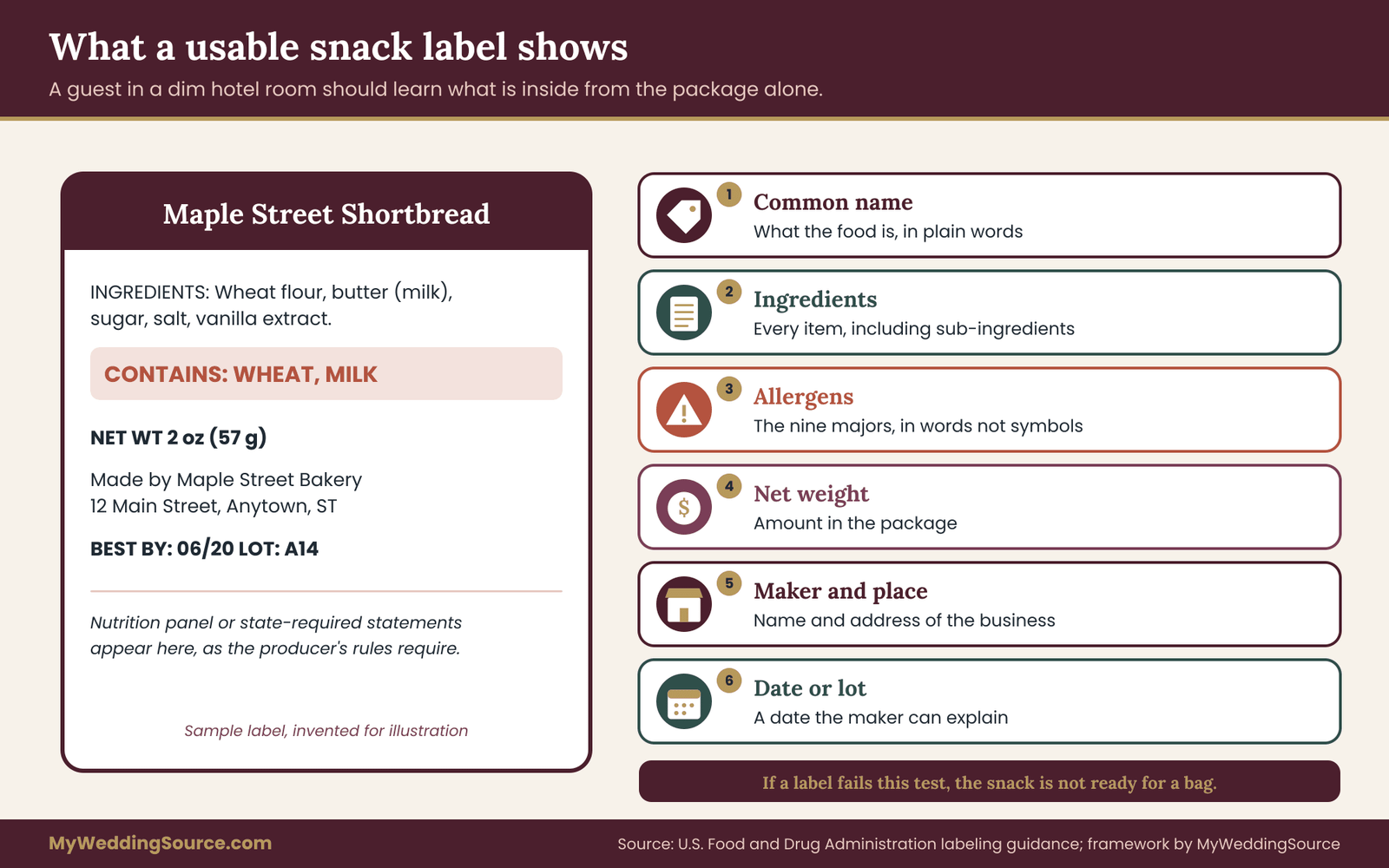
Use the following as your own acceptance test. The label must be legible without a magnifying glass. It must be attached so it cannot slip off. It must list every ingredient, including those inside compound ingredients. It must name the maker and the place. It must carry a date or a lot code that the maker can explain. It must state allergens in words, not symbols. If the snack is sold in a clear bag where the guest can see a thin paper tag stapled to the top, ask whether that tag is a label or a decoration.
The nine major allergens
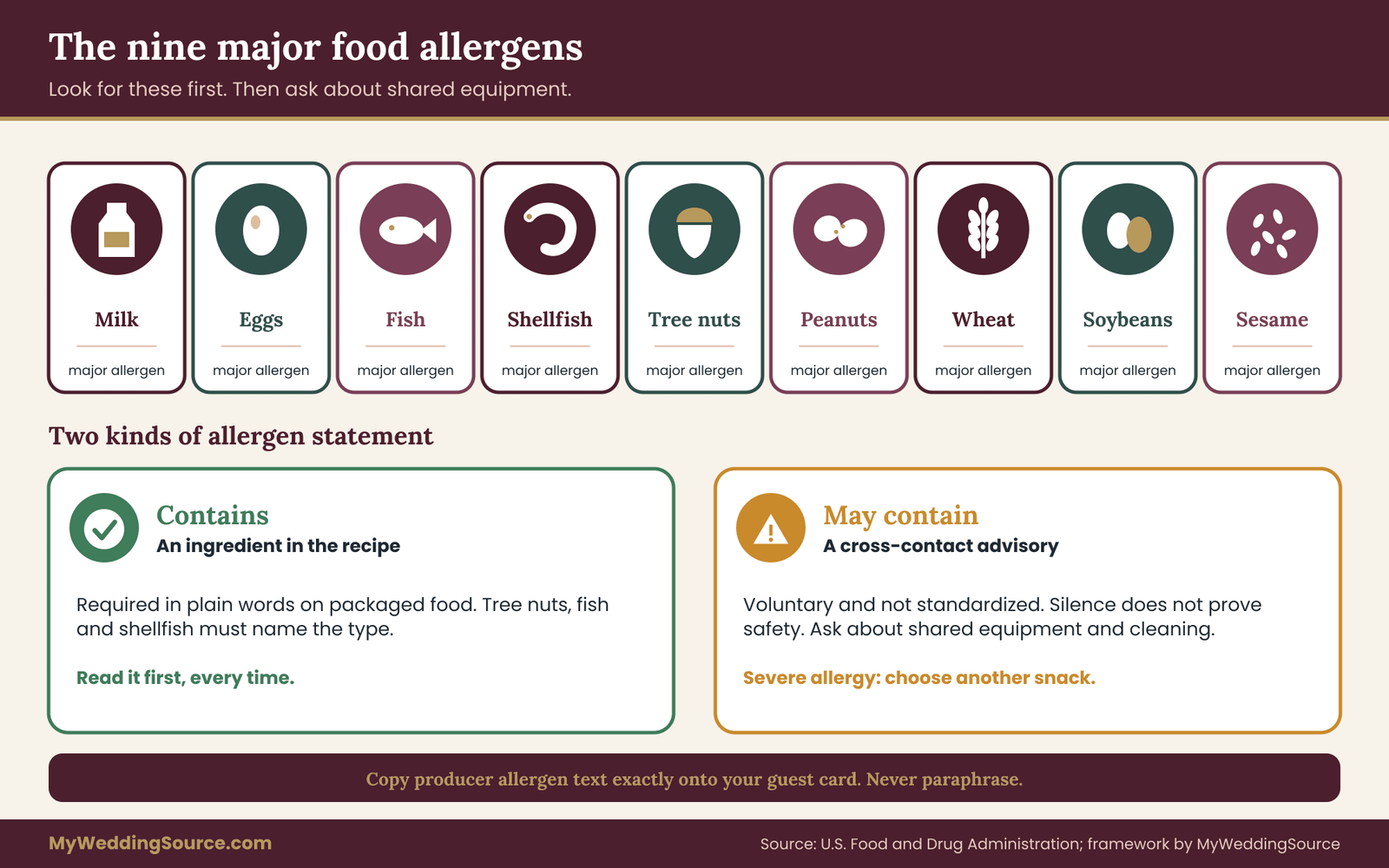
Federal labeling law identifies nine major food allergens that must be declared on packaged foods: milk, eggs, fish, crustacean shellfish, tree nuts, peanuts, wheat, soybeans and sesame. Sesame was added to the list most recently, and some small producers who have not updated older labels may still be unaware of it, so it is worth asking directly. These nine are the ones to look for first, because they account for most serious food allergy concerns in the United States.
For tree nuts, fish and crustacean shellfish, the label must name the specific type, such as almond or walnut, salmon or shrimp. For the rest, plain names are enough. Manufacturers may show allergens in the ingredient list in parentheses, or in a separate “Contains” statement after the list. Either format is acceptable. What matters for you is that the allergen is easy to find and written in ordinary words.
The nine allergens do not cover every food reaction. Guests may react to other foods, to sulfites, to certain seeds, to mustard, to coconut or to a spice. The label gives you a way to check what is declared, and your RSVP data tells you which guests have told you about a restriction. Together, they let you plan a bag without guessing. Your list of welcome bag snacks and your list of guest restrictions need to be read together.
“Contains” versus “may contain”
You will see two kinds of allergen statement. A “Contains” statement lists allergens that are ingredients in the recipe. That is the formal part. A “may contain” or “made in a facility that also processes” statement is something different: an advisory about possible cross-contact, meaning an allergen might be present from shared equipment or surfaces even though it is not an ingredient.
Advisory statements are generally voluntary, and there is no single standard wording that every producer follows. Their absence does not prove that cross-contact is impossible, and their presence does not tell you how the producer manages risk. For a guest with a severe allergy, an advisory statement is a reason to avoid the snack. For a guest without an allergy, it is irrelevant. This is why welcome bag snacks with advisory statements need a direct question to the maker.
For you as the host, the practical rule is to ask. “Is this made on equipment that also handles peanuts or tree nuts, and how is it cleaned between runs?” is a better question than looking at the package. A producer who runs a dedicated nut-free kitchen can say so and explain how. A producer who cannot answer has told you something as well.
Gluten-free and other claims
“Gluten-free” is a defined term for food labeling in the United States. FDA’s rule allows the claim when a food contains less than twenty parts per million of gluten, among other conditions. So the phrase has a basis you can ask about. Many other front-of-package words do not. “Allergy friendly,” “nut aware,” “clean,” “sugar conscious” and “free from” can mean almost anything.
When you see a claim you did not expect, ask what it is based on. If a producer says their cookies are gluten-free because they use rice flour, ask whether the cookies are made on shared equipment with wheat flour, and whether they test. If they say “nut-free,” ask whether that means no nuts in the recipe, or no nuts in the building. The answers sort quickly into snacks you can trust and snacks you cannot. Claims on welcome bag snacks are only as good as the answers behind them.
When the label is missing or weak
Many small makers can improve a label if you ask early. A producer who sells at markets with a hand-written tag may still have a printer, a template and a few spare weeks. Offer a clear list of what you need: ingredients, allergens, net weight, maker name and place, and a date.
You can also offer to design the label yourself if the producer approves the content, as long as the producer signs off on the ingredient and allergen text. That last point matters. You are not the authority on what is in the product, so the producer must confirm every line.
If a producer cannot or will not label, the snack becomes a drop for the welcome bag. It might still be a lovely thing to serve in a way where you or a vendor can communicate allergen information, such as at a plated dinner where the caterer holds the process, or at a farewell gathering where you can set out a card. The way caterers handle that is a different process from a bag. A bag handed to a guest who will open it alone in a hotel room is a different setting.
Reading allergen information for welcome bag snacks
Allergen planning is not only about the label. It is also about the guest list, the way the bag is packed and the way you communicate. This section turns the label check into a small process for the whole batch of welcome bag snacks. That process covers the whole batch of welcome bag snacks, not just one product.
Start from the guest list
If your RSVP form asked about dietary needs, you already hold the most important information. Sort the answers into three groups: guests with an allergy to a major allergen, guests with a dietary pattern such as vegetarian or halal, and guests with a preference. Welcome bag snacks need to serve the first group safely and the second group respectfully. The third group can look after itself.
For the first group, list each guest’s allergen against each candidate snack. This is a small grid, kept on paper or in a spreadsheet, and the snack file feeds it. If a guest has a peanut allergy and your granola contains peanuts, the guest’s bag gets a different snack. If three guests have different allergies, you may decide that a single safe snack for everyone is easier than a customized bag for each. Keep the grid beside your file of welcome bag snacks.
If you did not ask on the RSVP, you can still ask now. A short message to guests, sent with arrival details, works: “We are putting small snack bags together for arrival. If you have a food allergy we should know about, please reply by this date.” Keep it brief and private. The way guest information is gathered and used is covered in more depth in the guest care guide.
Decide how the bag handles allergens
There are three honest strategies, and each suits a different situation.
The first is a single bag designed to avoid as many major allergens as is reasonable. This works when the guest list is small and the number of restrictions is high. The downside is that the snack options narrow.
The second is a standard bag plus a small number of alternative bags, tagged discreetly, for guests with declared allergies. This is the most common approach. The alternative bag holds a different snack that fits the guest’s restriction, with its label intact.
The third is to leave snacks out of the bag and provide a printed note pointing to a nearby shop or to a snack table at a gathering where labels are on display. This suits very large lists with many restrictions, or situations where you cannot verify enough to be comfortable.
Whichever you choose, write the rule down for anyone who packs bags. One sentence is enough: nobody adds, swaps or removes a snack without checking the list.
Keep the original label visible
Never remove a snack from its labeled package to put it into a prettier container. A pretty tin with loose cookies inside is a bag with no label. If the producer’s package is plain, put the package inside the bag as is, or add your own card with the producer’s confirmed ingredient and allergen text next to it.
A small printed card in the bag listing each snack, its maker and its major allergens is a kind addition. Keep it plain and readable. The text should come from the producer’s own confirmed information, copied exactly, not paraphrased. A paraphrase can drop an ingredient. If the producer updates the recipe, the card must be updated as well, and a card with an old recipe is worse than no card. Update the card whenever the welcome bag snacks change.
Cross-contact during packing
The risk does not end at the label. When bags are assembled on a table, an open package of nut brittle can leave dust on a tray that later holds a sealed cookie. Keep packing simple: use sealed, individually wrapped snacks, wash hands and surfaces before starting, pack the allergy-friendly bags first and set them aside in a labeled box, and keep nut-containing snacks in their own tubs. Do not open any package. If every snack is sealed in its own wrapper, cross-contact during packing drops to a minimal level.
That is also why the brief to helpers should be short and firm. “Do not open any package. Do not substitute. If something looks wrong, set it aside and ask.” A volunteer who wants to be helpful by adding an extra cookie to a bag is the common cause of mistakes.
Check three: shelf life and dates for welcome bag snacks
The life check compares two dates that nobody tends to put side by side: the date the maker says the snack stays good, and the date the guest actually eats it. Welcome bag snacks are made weeks before they are opened, packed days before they are handed over and then often forgotten in a bag for another day or two. The date on the package has to cover that whole path with room to spare. Welcome bag snacks have a longer path than most gifts, so the dates deserve attention.
What date labels do and do not mean
Date labeling on food is less strict than most people assume. According to the United States Department of Agriculture’s Food Safety and Inspection Service, product dating is generally not required by federal law except for infant formula, and the dates that do appear are usually about quality rather than safety. Phrases such as “best if used by” describe when a product has its best flavor or texture. A “use by” date is the manufacturer’s last recommended date for peak quality, although for some foods it is a safety signal.
For welcome bag snacks that means two things. First, a snack past its best-by date is not necessarily unsafe, but it is likely to be less good, and “less good” is exactly what you do not want in a gift. Second, a small producer who prints a date has chosen how to set it. Ask how.
Many small makers set dates from experience: how long a cookie stays crisp, how long granola avoids going stale, how long a caramel holds its texture. Some base dates on testing. Some copy a date from a similar product. None of these is wrong, but the explanation shows how much confidence to place in the date. “We bake on Thursday and print a date three weeks out because the cookies stay crisp in sealed bags” is a good answer. “I just put a month” is a signal to ask for a sample test.
The shelf-life budget
Work out how much shelf life you need, on purpose, with a small budget. Start from the day the guest will most likely open the snack and count backward.
The first step is the latest realistic opening day. That is not the wedding day. A guest who arrives Thursday may eat the snack that night or may carry it home and open it the following week. For a welcome bag, plan for the first evening and the next morning as the most common times, and make sure the snack is still good for at least a week after the wedding for the guests who save it. Think about when welcome bag snacks will really be eaten.
The second step is the hand-off date: when the bag reaches the guest. The third is the packing date. The fourth is the production date: when the producer made the batch. Every day between production and opening uses up shelf life.
The final step is a margin. Add several days for delays: a late delivery, a postponed packing session or a guest who travels before the wedding weekend.
Add these up and compare the total with the shelf life the producer states. If the product keeps for three weeks and your budget needs two and a half weeks, the margin is thin. Either order later, choose a longer-lived snack or accept a swap. Do this sum for each of the welcome bag snacks on your list.
An illustrative budget
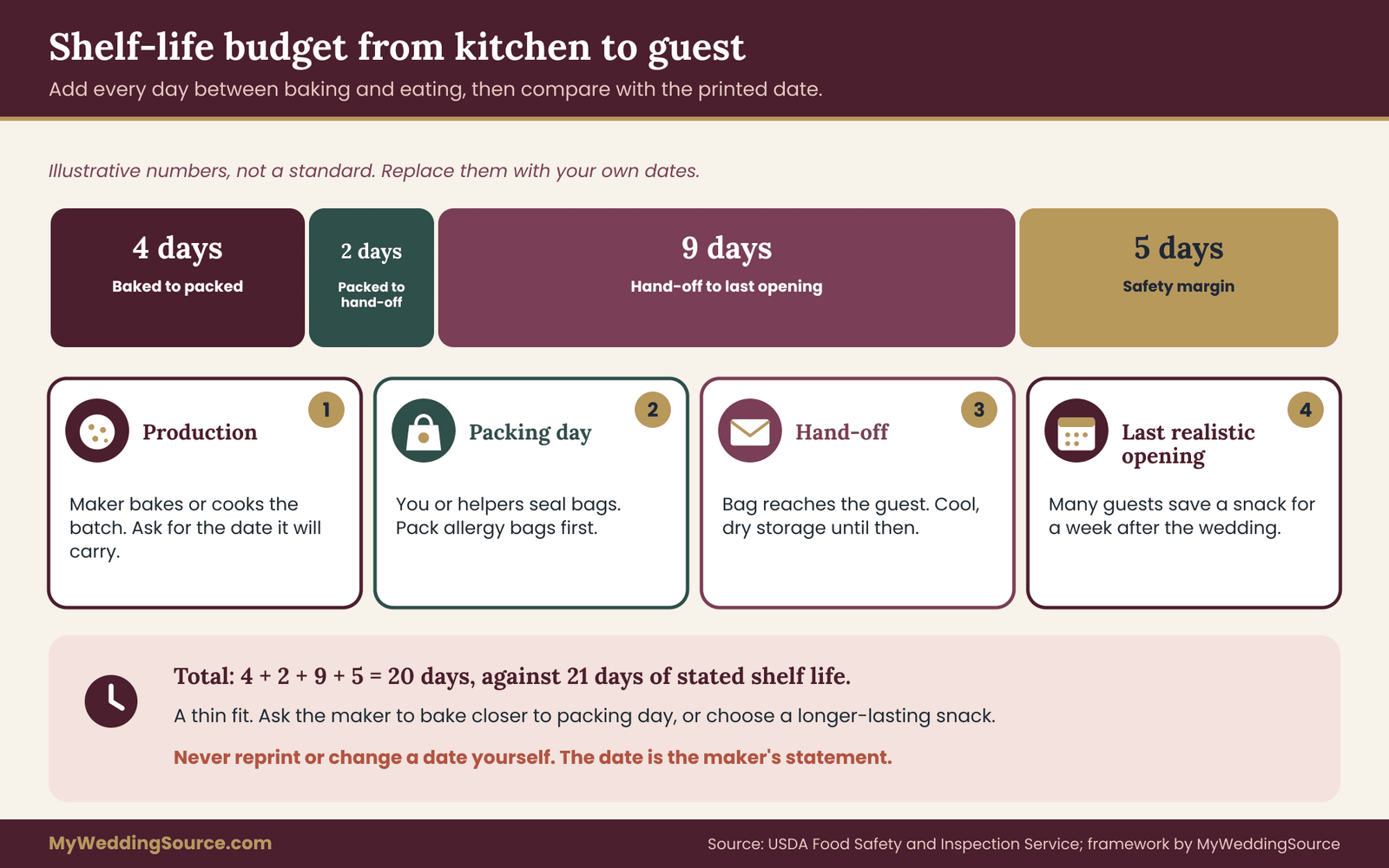
The numbers below are an invented example, not a standard. Say a producer states that sealed shortbread stays good for twenty-one days from baking. The wedding is on a Saturday and the first guests arrive Thursday. Guests might open the bag Thursday night, but a few will carry it home and eat it up to a week after the wedding, so the latest realistic opening is about nine days after Thursday’s hand-off.
If the producer bakes four days before packing, packing happens two days before hand-off, and hand-off to the last opening is nine days, the total is fifteen days. With a margin of several days, you are near twenty-one. That is workable but not roomy. Asking the producer to bake closer to packing, say two days before, brings the total down and restores the margin.
The logic is the point, not the numbers. Your product, your calendar and your producer’s date will differ. Do the arithmetic once per snack, put the result in the file and update it if any date moves. Redo the sum whenever any date for your welcome bag snacks changes.
Order timing and batch planning
Because shelf life is limited, ordering has to be timed, and small producers often bake or cook to order. Ask early about lead time, then lock the production date as late as the producer allows. Tell them the packing date and ask them to deliver within a day or two of it. Shelf life is the main reason welcome bag snacks should be ordered late.
Larger orders can strain a small kitchen. A producer who normally bakes a dozen boxes a week may need notice for a hundred and fifty individual portions. Ask whether they can make the whole order in one batch or in several, and whether all batches will carry the same date. If an order is split across days, each portion needs its own accurate date.
Order a few extra pieces. Wedding weekends produce broken packages, late guests and surprise plus-ones. An overage of a small fraction covers most of that, and surplus snacks can be donated, if they are sealed and labeled, or enjoyed by the couple and the wedding party. Guidance on handling leftovers appears in the broader material on waste reduction.
Test before you commit
A simple test tells you more than any claim on a label. Order two samples of each candidate from the same batch, at least a few weeks before your decision. Open the first right away and taste it fresh. Leave the second sealed, in its package, in a typical room, for the number of days your shelf-life budget says it needs to last, then open it and compare. Is it as crisp, as soft or as fresh as the first? Does the package seem intact? Is there any smell of oil gone off?
This is a measurable check. It costs the price of two samples and a few weeks of waiting, and it reveals problems that no email can. Granola with nuts may go flat. Brittle may turn sticky in humid air. A cookie that tastes lovely on day one may taste like cardboard on day twelve. No claim about welcome bag snacks is as convincing as a tasted sample.
If your timeline does not allow a few weeks, do a shorter version: open one sample, and keep the second sealed for as many days as you can. Even a few days will reveal obvious issues. Write the result in the file: “Day one good; day eight slightly softer; acceptable.”
Packaging that protects shelf life
Shelf life depends heavily on packaging. A crisp cookie in a loose paper bag will soften in humid air within days, while the same cookie in a sealed, moisture-resistant wrapper may last weeks. Ask the producer what the package is made of, whether it is sealed, and whether they use a small packet to absorb moisture or oxygen. Do not open such packets, and be aware they are not for eating. Packaging is half of what keeps welcome bag snacks fresh.
Check seals when the snacks arrive. A torn seal, a puffed package or a visible crack means the snack is exposed. Set it aside. Tell the producer, because they will want to know, and remember that an overage of a few pieces is what lets you replace those without panic.
Individual wrapping also helps with allergen control and hygiene. A snack that a guest can open on its own, without disturbing other food, is both safer and easier to pack.
Never re-date, never repackage
When a date is near, it is tempting to ask a producer to reprint labels with a later date or to repackage product in nicer containers. A date is a statement by the maker about their product. Ask the maker to set it. Do not change it yourself. Likewise, avoid repackaging food into your own containers, because the label and the protection of the original packaging are lost, and the food becomes homemade as far as the guest can tell.
Stale-but-safe and spoiled are different problems
A last note on this check. Most dry snacks that pass the life check lose quality slowly: they go soft, stale or flat. A few lose quality dangerously: items with moisture, dairy, meat, eggs or low-acid ingredients can grow bacteria. That second group is why perishable items are a drop in this guide. The next check deals with a related problem that affects even the dry items: heat.
Check four: heat and handling for local snacks
Heat is the check that couples forget until a box of chocolates arrives as a single brown block. It matters for quality with almost every snack, and for safety with a few. The check is about the real path your snacks travel: the producer’s delivery van, your car, a storage closet, a hotel lobby and a guest room with a south-facing window. Welcome bag snacks need a plan for heat as much as for dates.
Two different problems: quality and safety
Heat causes two different problems, and they need different responses.
The quality problem affects dry and shelf-stable snacks. Chocolate softens and develops a pale film when it melts and sets again. Caramels turn into a sticky mass. Gummy candy fuses to its wrapper. Nuts and nut-based granola go rancid faster at higher temperatures, because the oils in them break down. Crisp items absorb moisture in humid heat. None of this is dangerous in the usual sense, but all of it makes a welcome gift less welcome. Welcome bag snacks in this group lose appeal first.
The safety problem affects perishable snacks. The USDA’s Food Safety and Inspection Service describes a temperature range between forty and one hundred forty degrees Fahrenheit where bacteria multiply quickly, and advises that perishable food should not sit out for more than two hours, or one hour when the surrounding temperature is above ninety degrees.
A welcome bag containing fresh cheese, cured meat or a filled pastry will spend far longer than that in a bag or a room. That is why the guide treats such items as drops unless a proper cold chain is available, and a welcome bag does not provide one.
Dry snacks with low moisture, such as crackers, hard baked cookies and dried fruit, are low risk for safety in ordinary conditions. Even so, producers know their products best, so ask whether any snack in your list needs refrigeration or special storage, and believe the answer.
A heat ranking for common snack types
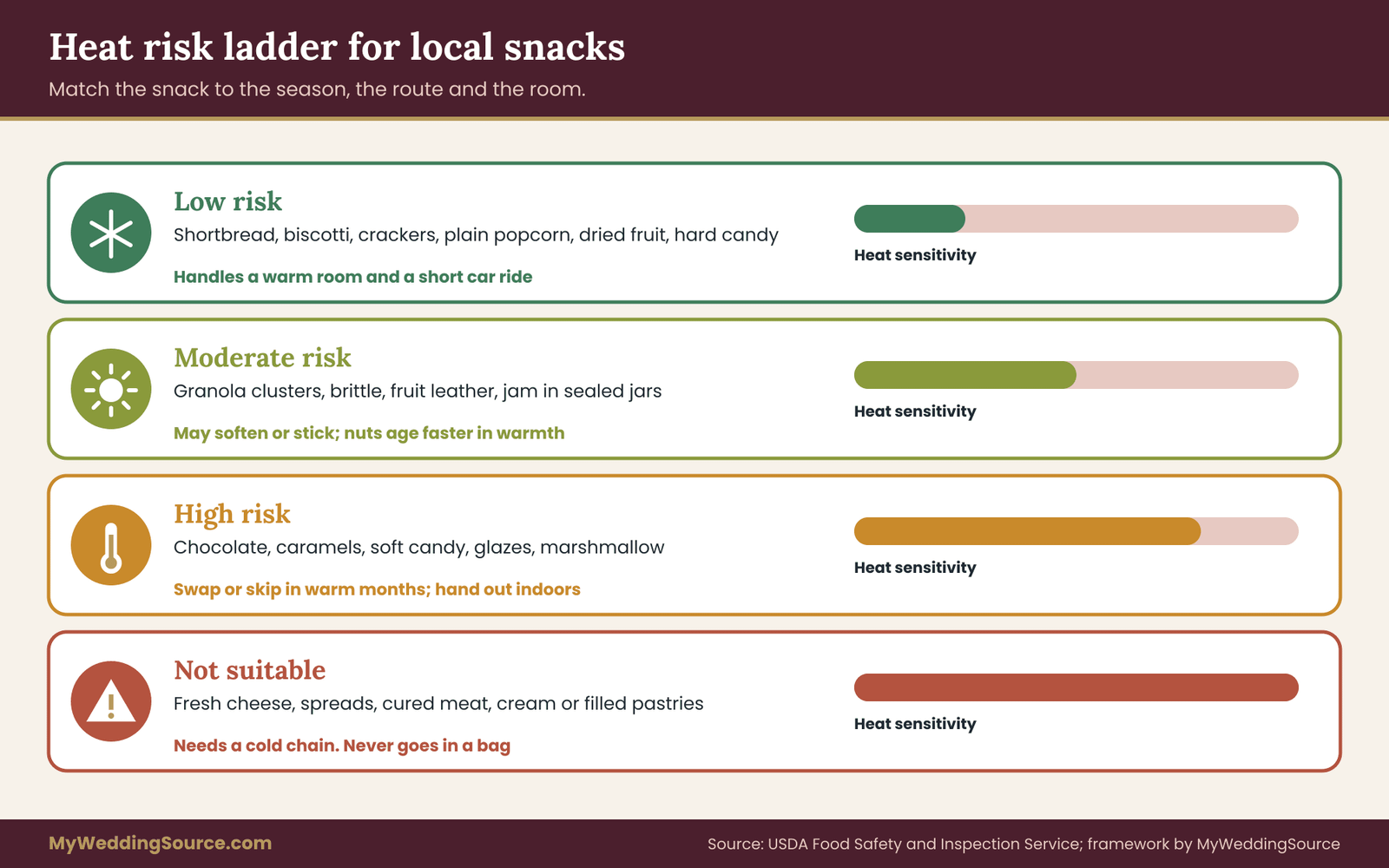
Rank your candidates from low to high heat risk. Here is a practical ordering, from the most tolerant to the most fragile.
Low risk. Hard baked goods such as shortbread, biscotti and crackers; plain popcorn and pretzels; dried fruit; hard candy. They tolerate warm rooms and a closed car for an afternoon with little change.
Moderate risk. Granola and nut clusters bound with syrup, brittle, fruit leather and jam in sealed jars. They survive heat but may soften, stick or, in the case of nuts, age faster over many days. Fine for most of the year with sensible storage.
High risk. Chocolate bars, chocolate-coated nuts or fruit, caramels, soft candies, marshmallow items and anything with a glaze that melts. In a warm season, these are the snacks to swap out or time very tightly. In a warm season, these welcome bag snacks are the ones to swap.
Not suitable. Anything that needs refrigeration: fresh cheese, spreads with dairy, cured meat unless shelf stable and labeled so, filled or cream pastries, items with custard or fresh fruit, and anything the producer says to keep cold. These do not belong in a bag.
Match the snack to the season
Season and location decide much of this check. A wedding in a cool month in a mild climate can include chocolate. A wedding in a hot month in a warm region should skip it. If you cannot decide, think about the guest’s route: where will the bag sit between hand-off and eating? A bag left in a rental car during an afternoon of wedding activities can reach temperatures far above the air outside. A bag set on a bedside table in a cool hotel room faces much less. Match your welcome bag snacks to the weather you expect.
Think also about outdoor welcome gatherings. If bags are handed out at a patio reception or a beach arrival event in the sun, do not hand out the heat-sensitive items there. Choose snacks that handle sun, or hand out the bags inside.
For destination weddings and travel weekends, climate may differ from home. Check the typical conditions at the location during your dates, using the local forecast closer to the day, and adjust the snack choice if a heat wave is likely. The planning logic for guests traveling to a wedding is covered in the guest hotel guide, which helps with the question of where guests will be staying and how they will arrive.
Storage before the hand-off
From the day snacks arrive until the day bags are handed out, they need a cool, dry, clean place. A closet inside the home, with stable temperature, is better than a garage, a trunk or a porch. Keep snacks away from strong smells, because baked goods can pick up the scent of nearby cleaning products or spices. Keep them off the floor and away from pests. Store them in the sealed boxes the producer used until packing day. Welcome bag snacks should wait in the calmest room you have.
Do not refrigerate dry snacks unless the producer says so. Cold storage can create condensation when a package returns to room temperature, and moisture is the enemy of crisp food. Likewise, do not freeze items to extend life unless the producer confirms that it works for that product.
Transport on the day
When you transport finished bags, load them last and unload them first. Keep them in the air-conditioned part of the car rather than in a trunk in summer. If you hire someone to deliver, tell them the bags contain food and must not be left in a hot vehicle while they run other errands. For long drives, place bags on the floor of the back seat out of direct sun, with a light cover. A cooler is not needed for dry snacks, and may do harm through condensation.
What to do when the heat fails
Despite planning, a heat problem may appear: a case of melted chocolate or soft caramels found at the hotel desk. Do not try to rescue them by refrigerating and re-handing them out. Replace the affected snack with the spare you ordered, or hand out the bag with a note and a small apology. This is where the overage pays for itself. Keep a spare box of a heat-proof snack, such as a sealed baked cookie, for exactly this case. A spare of the sturdiest welcome bag snacks is the best repair.
Check five: the handoff chain for welcome bag snacks
The fifth check is about people. Every person who touches a snack between the maker and the guest is a link in a chain. The chain is short, but mistakes at this stage are the ones that defeat the other four checks. Good welcome bag snacks still fail if the chain around them is careless.
Draw the chain
On a sheet of paper, write each step the snack takes: maker, delivery, your home or storage, packing, transport, hotel or venue, hand-off, guest. Under each step, write the name of the person responsible and the place the snack sits. It takes five minutes and shows where the weak links are.
For example, a snack that goes from the producer to your living room, then to a friend’s house for packing, then to a hotel front desk, then to guests’ rooms has four hand-offs. Each hand-off is a chance for a label to be lost, a box to be left in a warm car or an alternative bag to be mixed with the regular ones.
Give the packers a one-page brief
If friends or family help with packing, give them a one-page brief with five rules. Do not open any package. Do not substitute snacks. Pack alternative bags first and keep them in a marked box. Wash hands and wipe surfaces first. If something looks damaged, set it aside. Packers who understand why the welcome bag snacks are sealed will keep them sealed.
Show a finished sample bag and keep it on the table for reference. Assign roles: one person lays out items, one places them in bags, one checks each bag against the list. A check by a second person catches most mistakes. A simple tally sheet at the end, listing how many bags of each type were made, confirms that nothing was lost.
Special bags and tags
Allergy-friendly bags and children’s bags are the ones most at risk of getting mixed up with standard bags. Mark them in a way that is discreet to guests and obvious to staff: a small colored dot, a letter code on the tag or a different ribbon. Keep a key on a single card and give the same card to whoever hands the bags out. A name tag with the guest’s name, rather than a message about their allergy, keeps the process private.
Hotel and venue acceptance
If bags are going to a hotel, ask the hotel in advance about its rules for outside deliveries, including whether it holds food items, where it stores them, and for how long. Some hotels have a cool storage room; others have none. Send a delivery list with the number of bags, the guest names, the special bag types and a contact number. If a hotel cannot guarantee a cool, clean storage place, consider handing the bags out yourself at a welcome gathering. Tell the hotel that your welcome bag snacks need cool storage.
The broader logistics of delivering bags are a topic of their own, and this guide keeps to the food side: tell the hotel the bags contain food, tell them which bags are special, and ask where they will be kept.
Ant, pest and clean-up considerations
Welcome bag snacks left on a hotel desk or in a room can attract ants and other pests, especially sticky sweets in warm regions. Sealed wrappers help. A bag with a zipper or a tied top is better than one with loose items. If you are handing bags to guests in a place known for insects, add a reminder to the printed card: please keep snacks sealed. A small point, but one that hotel housekeeping staff will appreciate.
The decision rule at the end of five checks
By now, each snack’s file has five results. Use one simple rule to decide.
If every check passes, the snack goes in the bag. If one check shows a swap, record the swap and treat it as a pass once the swap is confirmed with the producer. If any check is a drop, the snack is out. If two or more checks are swaps, the snack is probably more trouble than it is worth, and you should consider replacing it with a different local option. The goal is a small list of welcome bag snacks that each have a clean file, not a long list with open questions.
Sourcing welcome bag snacks from small producers
Small producers are where the character of a place lives, and also where information is thinnest. This section turns the five checks into a sourcing approach: how to compare producers, how to compare local snacks with packaged national brands, how to count the cost and how to build a bag that is both local and safe.
Local versus national: a fair comparison
It helps to compare options on the same terms. A national packaged snack and a local snack are different tools, and each does something the other does not. This applies to welcome bag snacks as much as any other purchase.
A national packaged snack comes with a standard label, a printed date, wide distribution and usually a clear allergen statement. It is predictable. Its weakness is that it says nothing about where your wedding is, and guests have likely seen it before. A local snack tells a story and supports a nearby business. Its weakness is that you carry more of the checking, and its supply is limited.
The practical middle is what we might call a local anchor. Choose one local snack that passes all five checks, and pair it with one packaged snack that is simple, widely labeled and free of the most common allergens. The local item gives the bag its identity. The packaged item is the fallback for guests with restrictions and the safety net if the local producer has a problem.
If the local snack contains nuts, the packaged snack should not. If the local snack is sweet, the packaged one can be savory. Pair the two and your welcome bag snacks cover both identity and safety.
This is also a cost matter. Large, widely sold snacks cost little per piece and arrive on time. Local items often cost more and carry minimum orders. A bag with one local anchor often costs less than a bag with three local items and gives most of the same effect.
How local producers price an order
Small producers price differently from stores. Some charge per piece, some per box, some by weight. Ask for a written quote that lists the price per individually wrapped portion, the cost of labels or custom packaging, any setup charge, the delivery fee and the deposit. Use the quote to compute a cost per bag: add up the per-portion cost of each snack in the bag, then add a share of any fixed fees divided by the number of bags. Ask each seller of welcome bag snacks for the same written quote.
Do not forget the overage, which is the extra portions you ordered for damage and last-minute guests. Treat it as part of the cost, not as an optional extra. For a more complete way to price a bag and decide where the money goes, see the broader wedding budget guidance on allocating small line items. The principle is that a small item multiplied by a large guest count deserves a line of its own.
Be careful about prices that seem to be much lower than comparable local products. A very low price for an individually wrapped, labeled snack from a licensed kitchen may mean that something is missing: the labeling, the packaging or the permit. That is not always so, but it is a reason to ask the five questions with extra care.
Quotes also change. A producer who quotes in the spring may adjust prices by autumn because ingredient costs change. Ask how long a quote is valid, and get the final price confirmed in writing when you place the order.
Questions that separate good producers from risky ones
You have already seen the long list of questions. Here is a short form to use when you are comparing three producers side by side.
Where is it made, and under what permit or exemption? Can I see the full ingredient list and allergen list? What is shared on the equipment? What date will be on the package and how was that date chosen? Will you label each portion individually? What happens if the delivery is late or damaged? Can you supply a replacement? Do you carry liability insurance?
Notice that most of these are about the same few things: what is in it, where it is made, how long it lasts and what happens if something goes wrong. A producer who answers these promptly and clearly is one you can rely on for a bag. A producer who answers some and avoids others has given you the information you need to compare. Producers of welcome bag snacks who answer these quickly are worth keeping.
Replacing a snack that fails
Sometimes the snack that best represents the place fails a check. The cheese straws are lovely but have no label. The caramels are famous but too heat-sensitive for July. You do not have to abandon the idea. Not every favorite makes it into the final set of welcome bag snacks.
If the problem is the label, ask whether the producer can make a labeled version, even in a smaller portion. If the problem is heat, ask for a dry-baked version of the same flavor, such as a shortbread with the same spice. If the problem is shelf life, ask whether a later production date is possible. If the problem is the kitchen, use the snack in a place where a caterer or venue can manage allergen information, such as a dessert table, and put a packaged alternative in the bag.
Another approach is to put the story in the bag without the food. A small card that names the bakery, with its address and a line about why you chose it, lets guests visit and buy the snack themselves. The bag gets its local flavor without the checks, and the bakery gains customers.
A worked example: one couple, six candidates
The following example is invented to show the five checks in use. The couple, the town and the producers are made up, and the numbers are chosen for clarity, not to represent real prices or products. It follows a set of welcome bag snacks from first idea to final bag.
Imagine Hannah and Luis, planning a late-June wedding for ninety guests in a mid-sized southern town. They want welcome bags that feel local. Their RSVP form shows three guests with a peanut or tree nut allergy, one with a sesame allergy, two vegetarians and several children. Hotel check-in begins on Thursday, and the wedding is on Saturday.
They list six candidates and open a file for each.
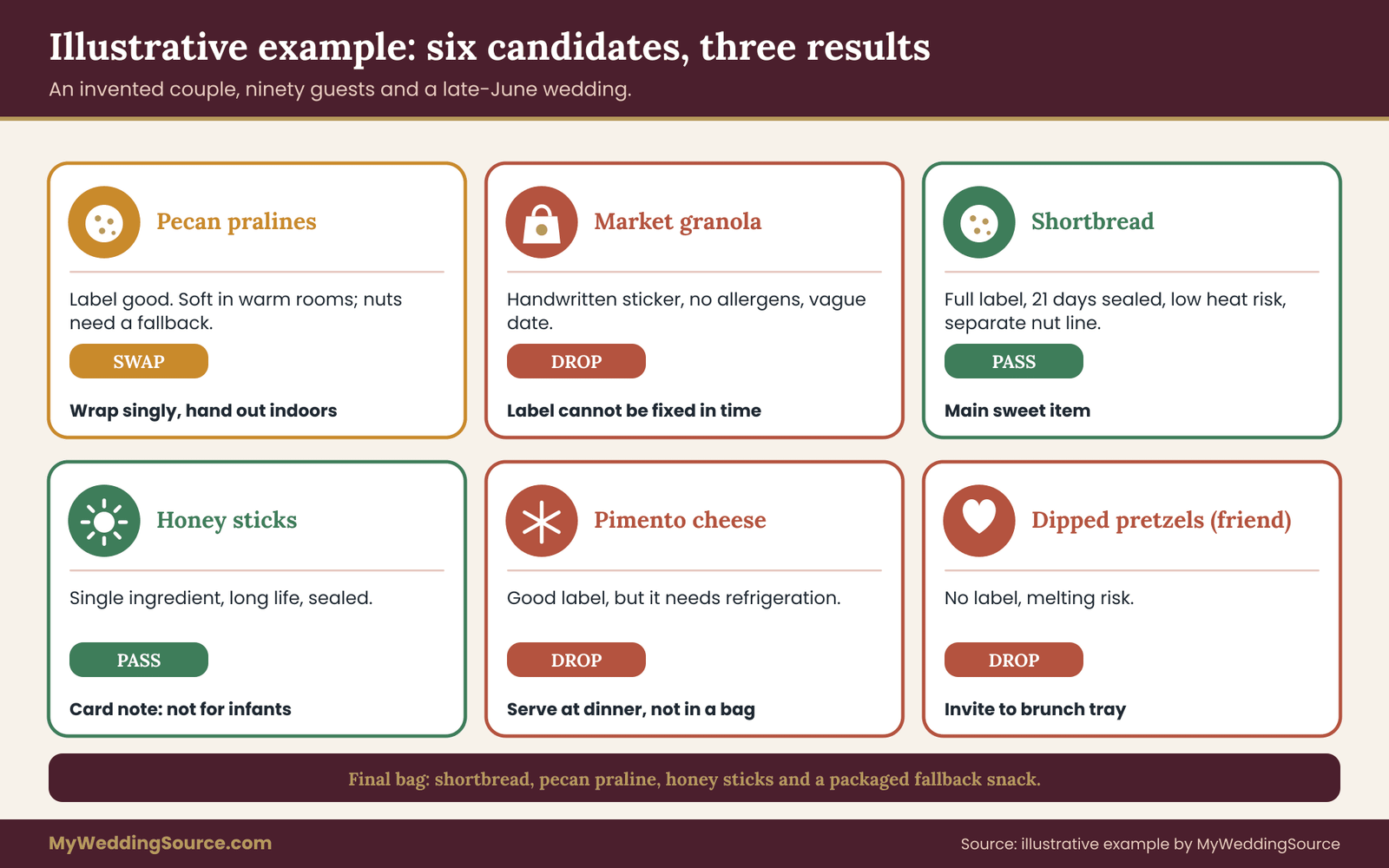
Pecan pralines from a family candy shop. Maker: licensed commercial kitchen, clear. Label: ingredient list and “Contains: milk, pecans,” good. Life: three weeks stated, adequate. Heat: praline is a sugar candy that softens in a hot room, and late June is warm. Handoff: simple. Result: heat is a swap; they ask for individually wrapped pieces and plan to hand them out at an air-conditioned welcome table, not in the hotel lobby. Pecans also mean a safe alternative is needed. Verdict: swap, then pass.
Small-batch granola from a market vendor. Maker: home kitchen under a state exemption. Label: a hand-written sticker with the name only. Life: unclear. The vendor says the printed date is “about a month.” Result: label fails. Asked whether they can print a full label with allergens, the vendor says they cannot before the date. Verdict: drop.
Shortbread from a licensed bakery. Maker: commercial kitchen. Label: full panel, “Contains: wheat, milk.” Life: twenty-one days sealed. Heat: low risk. Handoff: wrapped in pairs, easy to pack. Result: all pass. Verdict: pass. This becomes the main sweet item, and one that guests with nut allergies can have, subject to the bakery’s answer on shared equipment. The bakery says nuts are handled on a separate line. Hannah records that statement and its date.
Local honey sticks from a family apiary. Maker: commercial label, single ingredient, a short ingredient list. Life: long. Heat: tolerant but sticky when warm. Handoff: sealed straws are simple. Result: pass, with a card reminder that honey should not be given to children under one year old. This is a point the CDC and other health agencies make about infants. Verdict: pass with a card note.
Pimento cheese from a deli. Maker: licensed. Label: good. Life: a few days, refrigerated. Heat: fails. Verdict: drop. They plan to serve it at the rehearsal dinner under the caterer’s process.
Chocolate-dipped pretzels from a home baker friend. Maker: informal. Label: none. Heat: high risk. Verdict: drop. They thank the friend and ask her to bring a small tray to the farewell brunch, labeled with a card, where the venue can manage the allergen display.
What the bag becomes
After the checks, the final bag contains shortbread in pairs, a pecan praline for guests without nut allergies handed out at the welcome table, honey sticks with a note, and a packaged national pretzel snack with no major allergens as the safe fallback. The three guests with nut allergies receive a separate bag with shortbread and the pretzels but no praline. The guest with a sesame allergy receives the same alternative bag after the couple confirms that neither the shortbread nor the pretzels list sesame.
The couple orders the shortbread to be baked two days before packing. They order five extra portions of each. They test by sealing one sample for ten days at home, then eating it, and write the result in the file. They write the packing brief on one page. The hotel confirms a cool storage room and receives a list of the alternative bags.
None of this took many hours. Most of it was email. The result is a bag that tells the story of the place and has been checked, one snack at a time. That is what well-checked welcome bag snacks look like in practice.
What this example shows
The example shows several things the checks do in practice. They quickly eliminated two items with a clear reason, and they saved a third with a small adjustment. They produced a fallback that protects guests with restrictions. And they shifted the perishable favorite to an event where the caterer handles food safety. Welcome bag snacks that survive five checks are often fewer than first imagined, but each one carries a file that you can open if anyone asks.
Telling guests what is in the bag
A checked bag still needs a short, honest note. The note does two jobs: it tells guests what the welcome bag snacks are, and it lets guests with restrictions decide in seconds what to eat.
What the printed card should say
Keep the card small and plain. For each snack, give the name, the maker and the town, the major allergens as the producer confirmed them, and a line on storage if it matters. Add a sentence that says the snacks are sealed and labeled by their makers, and that the original package has the full ingredient list. The card should reflect the real welcome bag snacks in each bag.
An example of wording: “Shortbread from Maple Street Bakery. Contains wheat and milk. Made on a line that does not handle nuts, according to the bakery. Full ingredients are on the package.” The phrase “according to the bakery” is deliberate. You are passing on what you were told, and you are not guaranteeing it.
Avoid claims you cannot support. “Allergy-friendly,” “nut-free” and “safe for everyone” are promises, and you have not tested anything. Use the producer’s own words and attribute them. Avoid cute descriptions that hide information, such as “a mystery sweet from our favorite shop.” Guests with restrictions need names, not mysteries.
Keep the tone warm and the information easy to find
A card should not read like a warning label. Open with a welcome and then list the snacks. Put allergen information in a consistent place, such as a line in bold under each snack. Use a type size that is easy to read in low light. Guests who are tired from travel will look at this card for a few seconds at most, so make those seconds count.
If guests have told you about a restriction, mention that their bag has been prepared with that in mind, by a note on the tag or a quiet word at hand-off. Do not announce it to a group. The etiquette of asking about and handling guests’ dietary needs is covered more broadly in the wedding etiquette guide, and the principle there applies: ask once, use the answer and do not make anyone explain twice.
Edge cases and mistakes with local welcome bag snacks
The five checks cover most situations. A few edge cases come up often enough to deserve their own notes. Welcome bag snacks raise some of these more often than others.
A relative or friend offers to bake
This is the most common edge case and the most delicate. The offer is generous and the food is likely good. The difficulty is that homemade food has no label, no permit and no process for allergens, and a welcome bag goes to people the baker may not know. Welcome bag snacks and homemade food rarely mix well.
A kind way to redirect: “We are putting together labeled, sealed snacks for the bags because some guests have allergies, but we would love your cookies for the family brunch, where we can put out a card.” This keeps the generosity and moves it to a setting where it can be handled. For more on responding to well-meant offers without hurt feelings, the broader etiquette guidance offers useful phrasing.
Home-canned and fermented foods
Home-canned goods, pickles, fermented vegetables and low-acid preserves carry a specific risk when not processed correctly. Public health agencies such as the CDC warn about botulism from improperly canned food. Unless a producer is licensed and can document a tested process, home-canned items should not go into a bag. A commercial jar of jam from a licensed producer is a different matter, and ordinary high-sugar jam from a licensed kitchen is common.
Honey and young children
Honey is a popular local gift. Health agencies advise against giving honey to infants under one year old because of the risk of infant botulism. If any guests are bringing babies, a card note or a bag without honey for those families is a simple precaution. The same card can note that the snacks are not suitable for very young children when they contain hard pieces.
Hard, small and choking-risk items
Whole nuts, hard candy, popcorn and similar items are choking hazards for small children. If the guest list has young children, make a children’s bag with soft, easy-to-dissolve snacks, and keep the hard items for the adult bags. The children’s bag should be tagged and stored apart from the standard bags, like an allergy bag.
Gelatin, animal products and dietary patterns
Some candies contain gelatin, some baked goods contain lard, and some savory snacks use animal-derived flavorings. For vegetarian, vegan, halal, kosher or other dietary-pattern guests, ask the producer about these ingredients and list them on the card in plain words. A guest who follows a dietary pattern for religious reasons will appreciate a straight answer more than a vague reassurance. Where a snack cannot be confirmed, include a plain alternative.
Sugar, diabetes and other health needs
Not every guest wants a sweet snack, and some cannot have one. The savory item in the bag helps. You do not need to prepare for every health condition, and you should not make assumptions about guests. A bag with one sweet and one savory snack already serves a wide range of needs.
Recalls and changes after you order
Even careful producers sometimes have to recall or change a product. Between ordering and the wedding, check in with the producer a week before delivery: confirm the recipe has not changed, the allergen information is the same and the production date is on track. If a producer’s product is recalled, the maker should tell you, and you can also check the recall listings published by the FDA and USDA. Keep the producer’s last confirmation with your file.
Snacks that cross the country
If you ship snacks to guests ahead of time, or if guests will carry them on a flight, the heat and life checks matter more, because the path is longer and less controlled. Shipping perishable or heat-sensitive snacks in summer is a common cause of failure. The travel-day side of bags, including what happens at airport security, belongs in its own guide. For this one, the rule is that the more steps between maker and guest, the stricter your shelf-life margin and heat check need to be. Long journeys make welcome bag snacks harder to protect.
The common mistakes in one list
A short list of mistakes appears again and again with welcome bag snacks. Choosing by appearance and story without asking for an ingredient list. Taking a producer’s word on allergens without writing it down. Ordering too early and running out of shelf life. Ordering chocolate for a summer wedding. Removing snacks from their packages for a prettier look. Letting a helper swap an item. Forgetting an alternative bag for guests with restrictions. Keeping no record of what you were told.
Each of these is cheap to avoid and awkward to repair afterward. The file exists to make them visible while there is still time to change course. Keep a short list of these beside your file of welcome bag snacks.
A keep-it-simple rule
If the whole process feels like too much, reduce the scope instead of the care. One local snack, one packaged fallback, a short card and a file with five answers is a perfectly good plan. A bag with two snacks you have checked is better than a bag with six you have not. Guests rarely remember how many snacks were in the bag. They remember whether the bag felt thoughtful and whether anyone was left out. Welcome bag snacks do not have to be elaborate to be good.
Your next steps
This week, list three to five local producers you like and send each the same short email asking where the snack is made, what the ingredients and allergens are, what the shelf life is and whether they can label each portion. Open a one-page file for each reply. Welcome bag snacks begin with that first email.
Next, sort replies into pass, swap and drop using the five checks. Choose one local anchor snack and one packaged fallback. Order samples, seal one for the number of days your shelf-life budget needs and taste it when the time is up.
Then set dates: the production date the producer will commit to, the packing day, the hand-off day and the date you will check in for recipe changes. Write the packing brief on one page and draft the guest card using only what the producers have confirmed. Your welcome bag snacks will then be ready for guests who trust them without having to ask.
FAQ
Are homemade snacks from friends or family safe to put in welcome bags?
They can taste wonderful, but they usually lack a label, an ingredient list and a documented allergen process, and guests will open them without anyone to ask. For that reason, leave homemade food out of the bags. Invite the baker to bring a tray to a gathering where you can set out a card listing ingredients, and keep the bags for sealed, labeled snacks.
How far ahead should local snacks be made?
As close to packing as the producer allows. Count backward from the day guests will most likely finish the snack, including the days spent in storage, packing and hand-off, then add a margin of several days. If the producer’s stated shelf life barely covers that total, ask for a later production date or choose a longer-lasting snack.
What must an allergen label include?
Under federal labeling rules for packaged foods, the nine major allergens (milk, eggs, fish, crustacean shellfish, tree nuts, peanuts, wheat, soybeans and sesame) must be declared in plain words, and tree nuts, fish and shellfish must name the specific type. Small home-based producers may follow state rules as well, so ask what applies to them.
Does “may contain” mean the snack is unsafe for someone with an allergy?
It means the producer is warning of possible cross-contact, but the wording is voluntary and not standardized, so it tells you little about how the kitchen manages risk. For a guest with a severe allergy, treat it as a reason to choose something else. Ask the producer directly about shared equipment and cleaning rather than relying on the wording.
Can chocolate go in a summer welcome bag?
It is a poor choice in warm weather, because chocolate softens and can turn pale or sticky after melting and resetting, even if it stays safe to eat. Choose hard baked goods, dried fruit or a dry-baked cookie flavored like the chocolate item instead. If you must use chocolate, hand it out in an air-conditioned space shortly before guests eat it.
What if a local producer cannot provide a full label?
Ask whether they can add one before your date, and offer a list of what you need: ingredients, allergens, net weight, maker name and place, and a date. If they cannot, drop the snack from the bag. You might still serve it somewhere you or a caterer can show allergen information, such as a farewell gathering with a printed card.
Do I need to refrigerate welcome bag snacks?
Dry, shelf-stable snacks should not need refrigeration, and cold storage can cause condensation that softens crisp food. Perishable items such as fresh cheese, cured meats and filled pastries do not belong in a bag at all, because the USDA advises limiting how long perishable food sits out. Keep dry snacks cool, dry and sealed until hand-off.
Should every guest get the same bag?
Not necessarily. A standard bag with a small number of tagged alternative bags for guests who told you about an allergy or dietary need is the most common approach. Prepare the alternative bags first, store them separately, and hand them over quietly with the guest’s name on the tag. The aim is that nobody has to explain their needs in public.
Sources
- Food Allergen Labeling and Consumer Protection Act of 2004 (FALCPA), U.S. Food and Drug Administration
- Food labeling and nutrition, U.S. Food and Drug Administration
- Food allergies, U.S. Food and Drug Administration
- Food product dating, USDA Food Safety and Inspection Service
- Danger zone, 40 F to 140 F, USDA Food Safety and Inspection Service
- Food safety, USDA Food Safety and Inspection Service
- Food safety, Centers for Disease Control and Prevention
- Food safety information, FoodSafety.gov
- Advertising and marketing guidance, Federal Trade Commission
- Government services and information, USAGov