
Wedding karaoke turns a quiet late hour into the loudest, most unpredictable part of a night, and it comes with three practical questions: how loud it will be, who owns the songs, and how singers move on and off the stage. This guide gives you a four-gate check to run with your operator and your venue before you book.
Treat wedding karaoke as four gates that must each be open before you commit. Gate one is the operator and the equipment. Gate two is sound: your venue’s cutoff, local noise rules and a volume ceiling you can measure. Gate three is song rights: who holds the licenses and where the tracks come from. Gate four is stage flow: a singer queue, a time cap per song and a plan for the last song. Write each answer down and attach it to the contract.
Wedding karaoke is different from almost every other thing a wedding can offer after dinner. A dance floor needs a playlist and a DJ. A photo booth needs a corner and a power outlet. Wedding karaoke needs a person at a screen, a queue of nervous or overconfident volunteers, loud amplified voices that are not professionally trained, and a steady stream of songs that someone, somewhere, wrote and owns.
Each of those four ingredients creates its own small problem, and the problems tend to arrive together at about ten at night.
None of this means you should skip it. Many couples want wedding karaoke because it gives shy guests a way to join in, gives the loudest cousins a safe outlet and gives the whole room something to laugh about. The point of this guide is simply to plan it so that the laughter is the memorable part, not a call from the venue manager or a neighbor.
A note on scope. This is general planning information, not legal, tax or financial advice. Noise ordinances, curfews, alcohol rules and music licensing differ by city, county and venue, so the guide points you to the office or organization that sets each rule and expects you to confirm the current version yourself.
What wedding karaoke covers, and what it leaves to other guides
In this guide, wedding karaoke means a hosted session in which guests sing along to backing tracks with lyrics shown on a screen, using microphones and a sound system, usually run by a professional operator often called a karaoke host or KJ. It can happen at the reception itself, in a second room, on a patio, or at a later hour once the formal program is over.
The guide stays on three subjects only. The first is noise: what an amplified, mostly untrained crowd does to a room and to the street outside. The second is song rights: what has to be licensed for a performance of copyrighted music and who normally handles it. The third is stage flow: how singers are called, how long they sing, how the queue moves and how the session ends.
It deliberately leaves out several neighboring topics that the site already covers elsewhere. How to decide on a second-venue plan, who pays for late-night food, and how to measure guest demand for an extended evening belong to a broader hosting question, not a wedding karaoke one. Choosing a hotel bar, handling a room block and running party games each have their own guides too. Here the focus is narrow on purpose.
If you are still deciding what the music plan as a whole should look like, the guide to wedding reception music planning covers generations, dance styles and set structure. Come back to this page once you know that wedding karaoke is a real part of your evening.
Where wedding karaoke tends to sit in the evening
Wedding karaoke most often appears in one of three places. It can be a block of thirty to forty-five minutes mid-reception, a segment in the last hour of a formal evening, or a separate session that starts after the main reception has ended. Each placement changes the noise picture, the rights picture and the stage picture.
A mid-reception block has the most guests in the room, the most overall volume and the most listeners who did not choose to be there. A last-hour segment usually follows dinner and toasts, so people are warmer and more willing to sing, but the venue’s end time is close. A separate late session has the smallest, most enthusiastic audience and the strongest chance of noise complaints, because the surrounding area is quiet by then.
Decide which placement you want before you ask for quotes. Operators price by the hour and by the amount of equipment, and a venue that accepts wedding karaoke at seven in the evening may refuse it at eleven.
Who this guide is for
It is written for couples, planners and family members who are organizing the evening and have to hold the operator, the venue and the guests together. It assumes you have already signed a venue contract or are close to it. If you have not, the wedding vendor contract guide explains the general clauses you should expect, and this guide adds the karaoke-specific ones.
The four-gate check for wedding karaoke
The single decision framework in this guide is the four-gate check. It exists because most problems with wedding karaoke come from one question being answered by one person and never checked against the others. The operator says the volume will be fine. The venue says nothing about wedding karaoke because nobody asked. The couple assumes the operator handles the music rights. Nobody planned for the queue.
The check takes the four questions and puts each behind a gate. A gate is open only when you hold a written answer, not a verbal reassurance, and when the answer matches what the other gates assume.
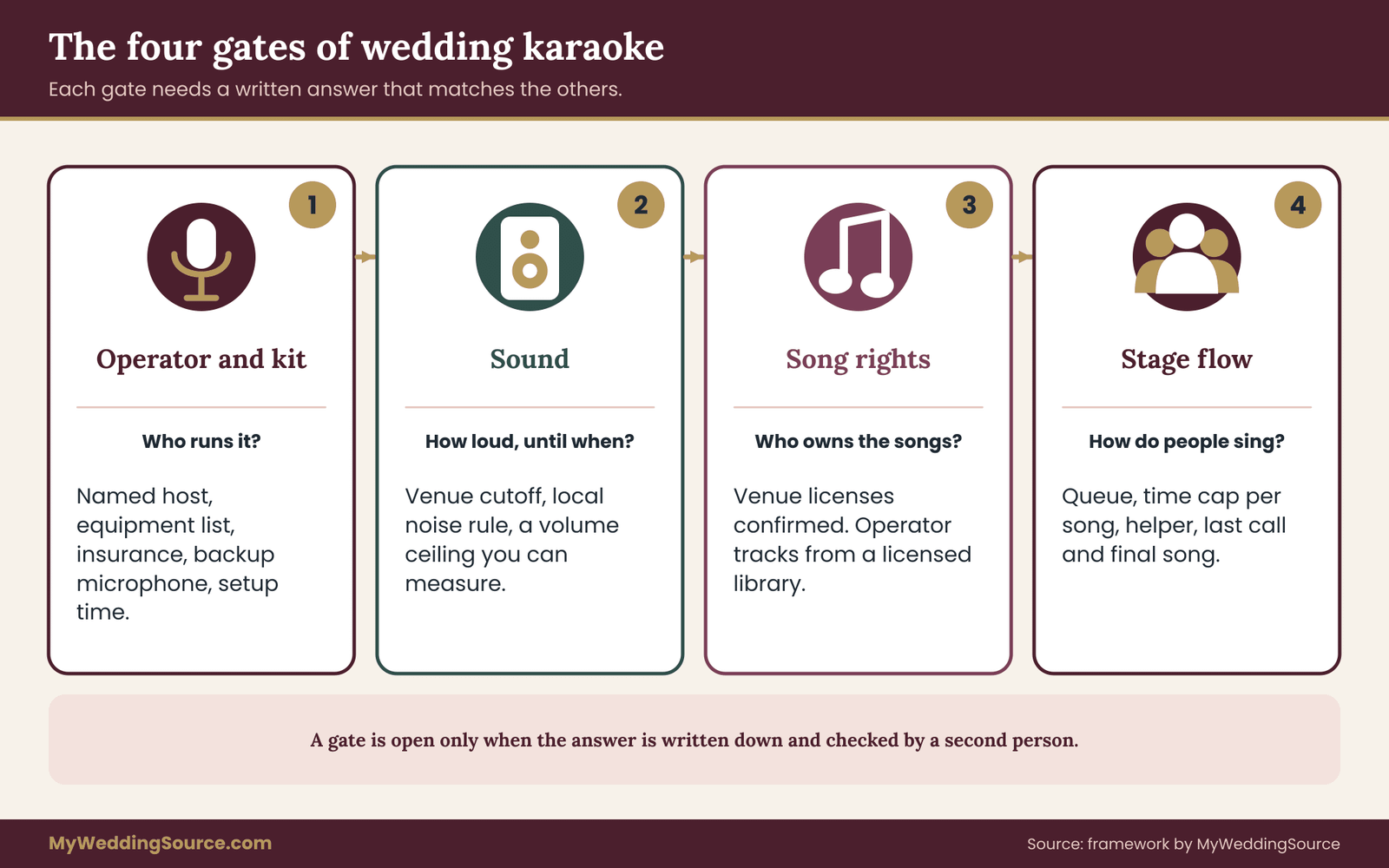
Gate one: operator and kit. Who is running this, what equipment do they bring, and what does the contract say they are responsible for? This gate covers insurance, setup time, backup equipment, microphones and the screen or screens that show the lyrics.
Gate two: sound. What is the venue’s last permitted amplified-sound time, what does the local ordinance say about the street, and what volume ceiling will you set and measure? This gate is where noise permits, venue rules and neighbor relations sit.
Gate three: song rights. Does the venue hold the music licenses that cover a public performance in the room, and where does the operator get the backing tracks? This gate is about the legal footing of the songs, not about taste.
Gate four: stage flow. How do singers sign up, how long can each song run, how do you handle the shy, the over-eager and the intoxicated, and how does the session end cleanly? This gate is about the people in the room.
Why the order of the gates matters
The gates are numbered for a reason. You can negotiate stage flow with almost any operator, but you cannot negotiate with a venue that has a firm eleven o’clock amplified-sound cutoff. So the sound gate, which depends on external rules, should be checked early, ideally before you pay a deposit to an operator.
Likewise, there is little point in debating a song library until you know whether the venue holds the licenses that cover live performance. If it does not, the operator or the couple may need to supply a solution, and that changes the price. Checking the gates in order saves you from planning the last one in detail while the first one is still closed.
How to run the check in practice
Set aside one hour, ideally with the venue contact and the operator on the same call or in the same email thread. Open a single page with four headings and write the answer under each as it comes in. Wherever an answer begins with “I think” or “it should be,” write “unconfirmed” next to it and a name of the person who will confirm it.
The goal is not paperwork for its own sake. It is that every person involved sees the same page, so the operator’s assumption about volume and the venue’s assumption about volume are the same number.
“We are considering a wedding karaoke segment from nine to ten-thirty. Could you tell us the latest time amplified sound is allowed, any volume limit you enforce, and who to contact if you need us to turn it down?”
A message like this is polite, specific and easy to answer, and it gives the venue a chance to mention anything you had not thought to ask about, such as a neighboring event or a restricted outdoor area.
Gate one: the operator and the equipment for wedding karaoke
Most wedding karaoke is run by a hired operator, and the quality of that person decides more of the night than any piece of equipment. A good operator reads the room, keeps the queue moving, protects the shy singer from embarrassment and quietly lowers the volume when the venue asks. A weak operator simply plays tracks.
You are not looking for a celebrity host. You are looking for someone who can answer practical questions precisely, who has run a session in a room like yours, and who is willing to put their answers in writing.
What the operator actually brings
A typical setup includes a sound system with speakers and a mixer, two or more wireless or wired microphones, one or more screens that show lyrics, a laptop or dedicated player for the tracks, cables, stands and a table. Some operators also bring lighting. Ask for the list in the contract, not just in conversation, because the size of the speaker system is directly connected to how loud the room can become.
Ask whether the speakers are sized for your room. An operator with equipment built for a large club may be able to run quietly in a small room, but the reverse is also a risk: a small portable system pushed to its limit in a big ballroom sounds harsh and invites the volume knob to creep upward.
Ask about the screens too. Lyrics need to be readable from where the singer stands, not just from where the operator sits. In a long room, a singer at one end who cannot see the words will look at the nearest screen, and that screen is often behind them.
Questions worth asking every operator
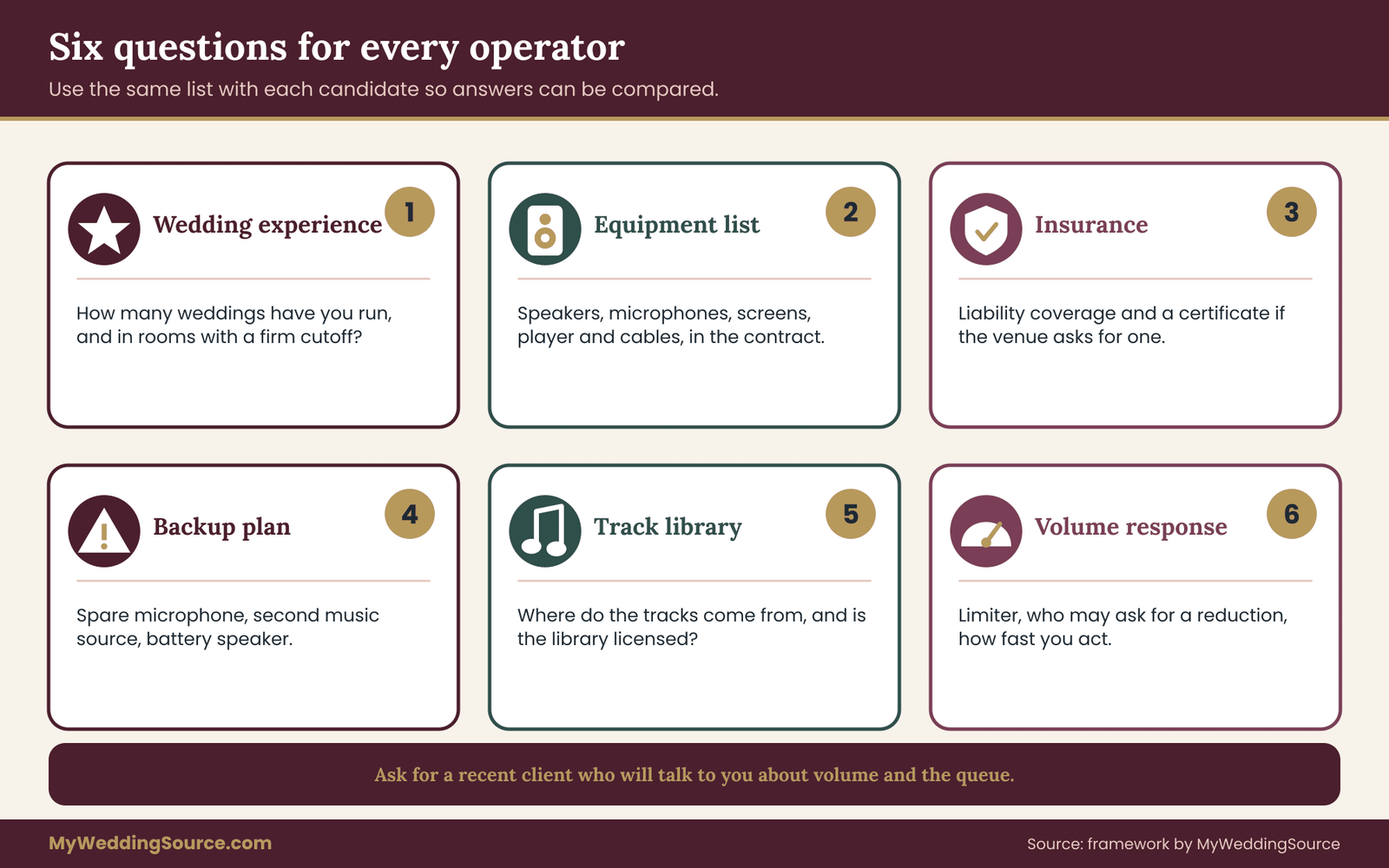
Use the same questions with each operator you consider so the answers can be compared. Ask how long the operator has run wedding karaoke at weddings specifically, since a pub session and a wedding session are different. Ask how many singers they can usually fit into a ninety-minute block and what they do to keep the queue moving. Ask whether they carry liability insurance and whether they can provide a certificate if the venue requires it.
Ask for the exact list of equipment and for the setup and teardown time they need. Ask what happens if a microphone fails, a laptop crashes or the venue’s power circuit trips. A reliable answer includes a backup microphone, a second source of music and a plain statement of how fast they can recover.
The general guide to wedding vendor due diligence shows how to check a vendor’s references and insurance, and the same checks apply here. For a karaoke host, ask for a recent client who will talk to you, and ask that client specifically how the host handled volume and the queue.
Where the operator’s responsibility ends
The contract should say which tasks belong to the operator and which belong to you or the venue. The operator is normally responsible for the equipment, the playback of tracks and the pacing of the session. The venue is normally responsible for the room’s power, the house rules and its own licensing. You are responsible for what you ask of the operator, such as the end time, the volume ceiling and the song restrictions.
Gaps are common in this division. Who plugs the system into which outlet? Who decides when to turn the volume down if the venue manager asks, the operator or the planner? Who tells the operator which songs are off limits? If your answer to any of these is “someone,” write down a name.
“Could you confirm in the agreement your setup time, your equipment list, your insurance coverage, and what you will do if the venue asks you to lower the volume during the session?”
Power, space and placement
Wedding karaoke equipment needs reliable power, and late in the evening a shared circuit may already be carrying a dessert warmer, a photo booth and lighting. Ask the venue which outlets are dedicated and what the maximum draw is. The guide to a venue technical walkthrough explains how to map outlets, access routes and measurements, and a wedding karaoke setup adds one specific item to that map: the stage area and the speaker positions.
Placement matters for noise as much as for sightlines. Speakers aimed at a wall that is shared with a neighbor, a hotel corridor or a bedroom wing will send sound where you do not want it. Speakers aimed along the room toward the guests, with the back of the speaker toward the nearest sensitive wall, usually behave better. You do not need to engineer this yourself. You need to ask the operator where the speakers will point and why.
Finally, give the operator a clear spot with a view of the whole room. An operator tucked behind a pillar cannot see the singer who is hesitating at the edge of the stage or the guest who has had too much.
What to confirm before you pay a deposit
Before a deposit changes hands, confirm four things in writing: the date and the hours, the equipment list, the setup time and the cancellation terms. If your wedding karaoke block depends on the venue allowing amplified sound after a certain hour, say so in the agreement, and ask what happens to the deposit if the venue refuses. A clause that lets you cancel or move the session if the venue’s rules block it protects you from paying for a service nobody can deliver.
If the operator is also your reception DJ, check that the contract covers the wedding karaoke block as a separate item with its own start and stop time. Otherwise an overrun in the dance hours quietly eats the wedding karaoke block, or the reverse.
Gate two: the venue’s rules and local noise limits for wedding karaoke
Sound is the gate that most often closes unexpectedly. The reason is simple: noise rules are set by people who are not at your wedding. A city sets an ordinance. A venue sets a house rule. A landlord, a homeowners association or a neighboring business may set its own. Your operator may know none of them.
Wedding karaoke raises the stakes because the sound source is not a controlled playlist. A guest holding a microphone at a quiet moment can be much louder than the same speaker playing a track, and the loudest moments come when people join the chorus together.
Start with the venue’s written rules
Ask the venue for its sound policy in writing. Many venues publish a rule such as “amplified music ends at a set hour” or “doors and windows closed after a set hour.” Others have no published rule but apply a limit through the manager on duty. Ask directly: what time must amplified sound end, does that include microphones and speakers inside a closed room, and what is the process if a complaint arrives during the event?
Also ask whether the rule differs indoors and outdoors. A patio session is often subject to an earlier cutoff than an indoor one. Wedding karaoke at an outdoor location can be much more audible to neighbors than wedding karaoke in a closed ballroom, even at the same internal volume.
Venue curfews have their own details, so here the important wedding karaoke point is only this: the end of amplified sound and the end of the event are often two different times, and your final song should finish before the first one, not the second.
Local ordinances
Most cities and counties have a noise ordinance, and the rules vary widely. Some set a clock time after which amplified sound is restricted. Some set a decibel limit measured at the property line. Some do both, with different numbers for day and night, residential and commercial zones, and special-event permits. The Environmental Protection Agency explains that noise control in the United States is largely a matter for state and local governments, so the authoritative source for your event is the city or county where the venue sits.
Look for the municipal code online, or call the city clerk, the police non-emergency line or the office that issues special-event permits. Ask three things: is there a limit on amplified sound at night, is there a permit for a private event with amplified sound, and does the limit apply at the property line or inside the venue.
Do not assume that a venue that has hosted weddings for years has every permit sorted. Venues typically hold their own approvals, but those approvals may carry conditions that apply to your event, such as a cap on the number of late events per month or a requirement for the client to sign a noise agreement. Ask to see the condition rather than relying on a summary.
The permit question, answered plainly
Whether you need a noise permit depends on your location and your venue. For many indoor weddings at established venues, no separate permit is required from the couple, because the venue’s approvals cover event use. For events at private property, parks, tents, farms or rented homes, a special-event or amplified-sound permit is often required, and lead times can be several weeks.
If a permit is required, find out who applies. If the operator says “the client handles that,” you need to know that before the week of the wedding. Write the answer on the gate sheet: needed or not, who applies, deadline, and the date the approval was received.
Neighbors and shared walls
Sometimes the limit is not a law but a relationship. A hotel with guests sleeping above the ballroom, a historic building with thin walls, or a residential street behind a barn can all turn a few decibels into a complaint. Ask the venue whether it has had complaints before and from whom. If neighbors are close, consider a short, friendly heads-up, which the venue may handle for you.
A courteous note can be as simple as telling nearby residents the date, the hours and a phone number for concerns. It does not promise silence, but it changes a complaint into a call, and a call can be answered by turning a knob.
“We are holding a wedding at the venue on the date below. There will be live music and a wedding karaoke session ending at ten-thirty. If it is ever too loud, please call this number and we will adjust right away.”
Keep the note short and leave out anything that sounds like a request for permission you do not need. Tone matters more than length.
Setting a volume ceiling you can actually measure
Everyone agrees that wedding karaoke should be “not too loud,” and nobody agrees on what that means. The fix is to replace the adjective with a number. A number can be written into a contract, checked with a meter and handed to the operator as an instruction.
You do not need laboratory equipment. A basic sound level meter or a well-reviewed smartphone sound meter application gives a rough reading in A-weighted decibels, written dBA. Phones differ in accuracy, so treat the reading as a consistent comparison, not as a legal measurement. If a municipality needs a certified measurement, it will use its own equipment.
Where the numbers come from
Two kinds of numbers matter. The first is the limit set by an authority, such as a city ordinance that gives a decibel level at a property line. The second is a comfort and safety target for the guests inside the room.
For the guests, the Occupational Safety and Health Administration and the National Institute for Occupational Safety and Health publish well-known reference points for workplace noise. OSHA’s permissible exposure limit is 90 dBA averaged over eight hours, and its hearing conservation program begins at an action level of 85 dBA. NIOSH recommends an 85 dBA limit for eight hours and halves the allowable time for every three-decibel increase.
Those are workplace figures for a full shift, not wedding guidance, but they make a useful point: sound that feels ordinary on a dance floor gets close to levels where time matters.
The staff matter as well. Your operator, bartenders and servers may work next to the speakers for hours. A venue that takes its own staff seriously will welcome a ceiling number, and the OSHA noise page and the NIOSH noise pages are the sources to read for the details.
A ceiling in three steps
Set the ceiling in three steps. First, ask the venue or local ordinance what limit applies, if any, and write it down. Second, pick a comfort target for the room, usually lower than the legal limit, so that guests can talk at a normal distance without shouting. Third, convert both into one instruction for the operator: “Keep the level at the front-of-house position at or below this number, measured with this meter, except for the final song.”
Why a fixed measurement position? Because sound level falls as you move away from the speakers. A reading beside the stage will be much higher than a reading at the back wall or at the property line. If you do not name the position, the number is meaningless. The next section gives a simple method for choosing three positions.
The three-position measurement method
Pick three places to measure. Position A is at the operator’s table or mixer, where the operator hears what the room hears. Position B is in the middle of the guest seating area, where people are trying to talk. Position C is at the edge that matters most: the property line, the nearest neighbor’s side, or the door nearest a hotel corridor.
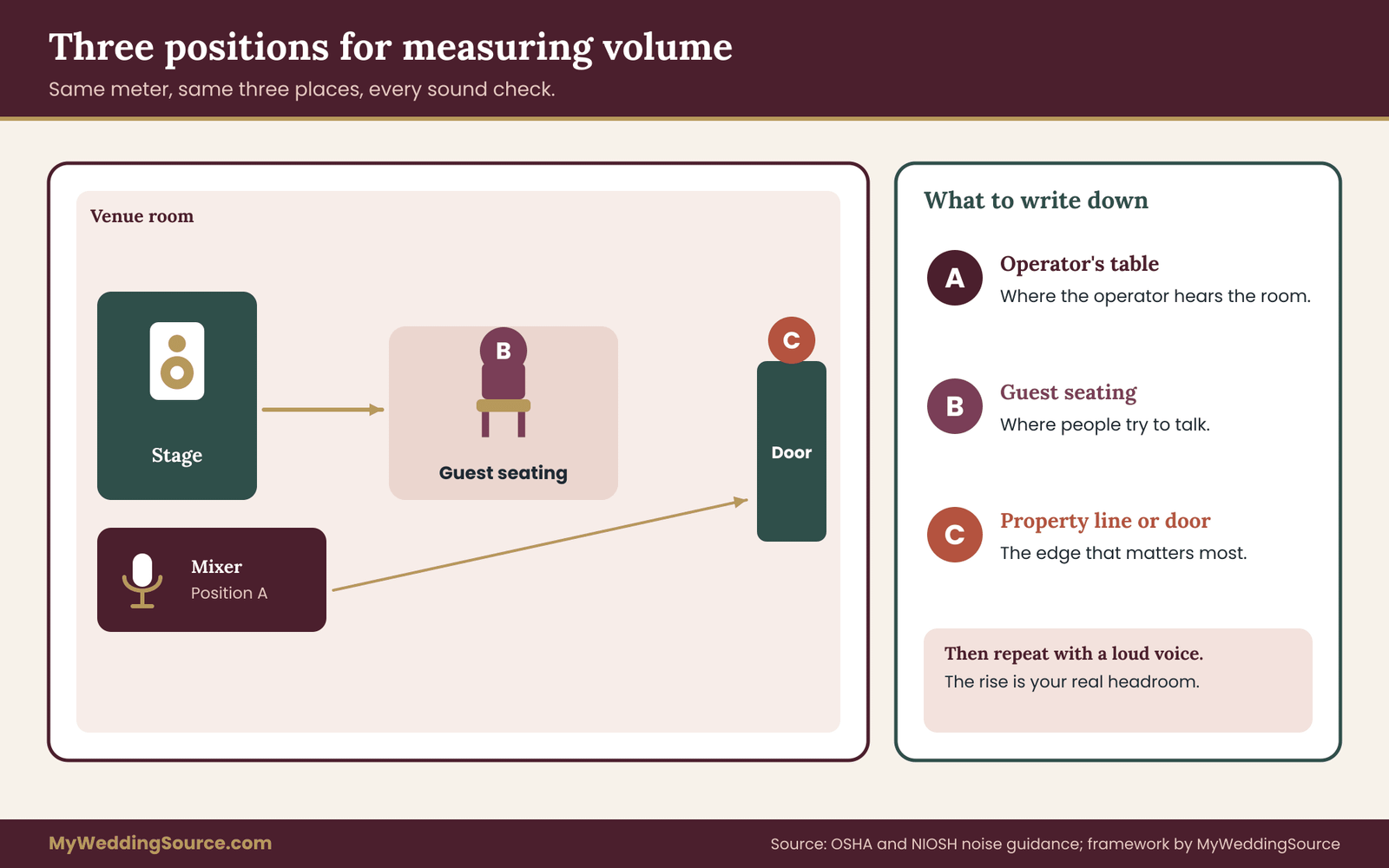
Take a short reading at each position during a sound check, with the system at the level the operator intends to use for a typical singer. Write the three numbers on the gate sheet. Then ask the operator to sing or speak into a microphone at normal volume and then at a loud volume, and note how much the numbers rise.
The difference between a typical singer and a loud one is the real finding. It tells you how much headroom the room has. If position C already sits near the limit with a quiet singer, there is no room for a cheering crowd, and the plan needs to change: lower the speaker level, move the session indoors, close the doors, shorten the block or shift it earlier.
What a limiter does and why to ask for one
Some sound systems include a limiter, which is a device or a setting that stops the signal from exceeding a chosen level. A limiter on the microphone channels is the single most useful safeguard in wedding karaoke, because it keeps one enthusiastic singer from jumping the volume above the agreed ceiling.
Ask the operator whether their system has one, whether they use it at weddings, and whether they can set it to your number. If the answer is no, ask what they do instead. A skilled operator can manage levels by hand, but a hand on a fader is slower than a limiter on a sudden shout.
A written volume instruction
Here is what the finished instruction might look like in prose. The operator keeps the level at the mixing position at or below the agreed number during normal songs. The operator checks the property-line position before the session begins and again once the room is full.
If the venue asks for a reduction, the operator lowers the level by an agreed step immediately and confirms with the venue manager. For the final song only, the operator may raise the level by an agreed amount, provided the end time has not passed.
Notice that the instruction names who checks, when, where and what happens when a complaint arrives. It does not say “reasonable” or “appropriate.” Those words move arguments to the end of the night, when everyone is tired.
A quiet-hours ladder for late wedding karaoke
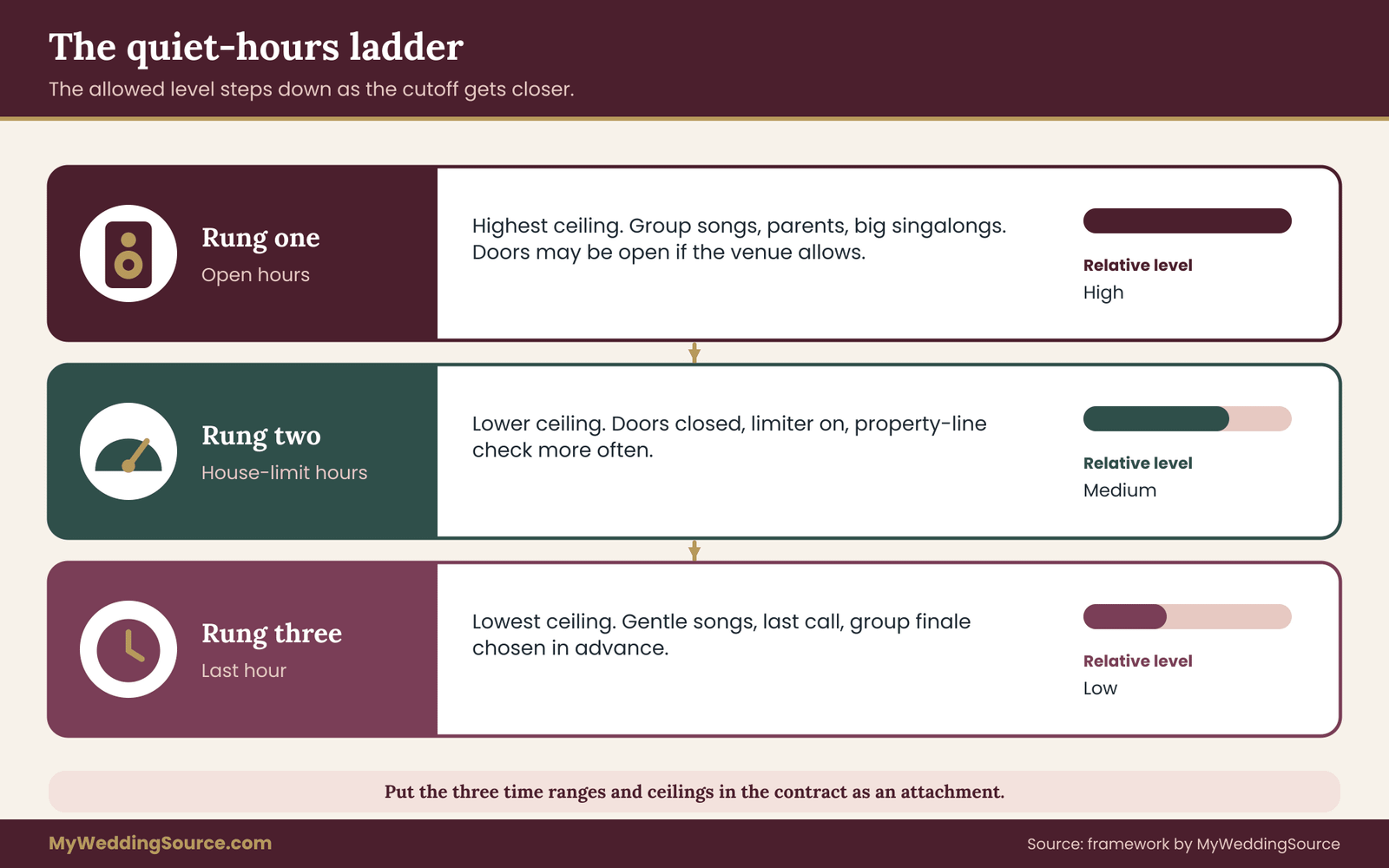
Even with a ceiling, the same number is not right for every hour. A sound level that is fine at eight in the evening may be a problem at eleven, because the surrounding area is quieter and tolerance is lower. The quiet-hours ladder is a simple plan in which the allowed level and the equipment setup step down as the clock moves toward the cutoff.
Think of three rungs. Each rung has a time range, a volume ceiling, a setup and a purpose.
Rung one: the open hours
This is the period when your venue and your neighborhood are least sensitive. Wedding karaoke is at its most relaxed here. The ceiling is the highest of the night, the doors can be open if the venue allows it, and the queue can be long. This is the time for group songs, parents, older guests and anyone who wants to sing early before nerves or alcohol change the mood.
Agree the bar’s last-call time at the same moment, since the wedding bar service planning guide shows that the end of drinks and the end of amplified sound are best set together.
If you can place your most enthusiastic singers here, do. A first block that is fun and has plenty of laughter makes the later, quieter block easier to run, because guests already feel they have had their turn.
Rung two: the house-limit hours
At a time set by the venue or by local rules, the level drops. This is the middle of the ladder. Doors and windows are closed, outdoor speakers are turned off or lowered, and the ceiling is a bit lower than in rung one. The operator uses the limiter and checks the property-line position more often.
In this rung, avoid songs that invite loud shouting from the whole room unless the room is well insulated. You do not need to ban anything. You can simply reserve the biggest singalongs for rung one and let the operator steer the queue toward songs that people can sing at ordinary volume.
Rung three: the last hour before the cutoff
The last stretch before the end of amplified sound is the quietest rung and the most delicate. The ceiling is lower again, the audience is smaller, and the operator’s job is as much about steering the mood as about running tracks. Many sessions end well with a “last call” announcement, a final song chosen by the couple and a clear moment when the screen goes dark.
The ladder gives the operator a script. Instead of arguing about volume with a tipsy guest, the operator can say that the room is at its late-evening level and that the next set of songs will be gentle ones. People accept a change in mood more readily than a restriction.
“From this point on we are keeping things a little quieter, so grab a seat, pick a favorite slow song, and we will do the loud finale together at the end.”
Outdoor and tented versions of the ladder
Outdoor wedding karaoke is the hardest case for noise, because there are no walls to hold the sound in. A tent reduces little. If you plan an evening on a lawn, patio or rooftop, expect the ladder to start lower and to end earlier than an indoor one. Ask the venue whether the outdoor cutoff is earlier than the indoor one, and plan the first rung so that the biggest group songs happen while it is still allowed.
A useful option for an outdoor venue is a hybrid. Run the early block outside, with the system pointed away from neighbors, and then move to a closed room for rung two and rung three. The move itself needs staffing, so check the guide on reception guest flow for ways to move a crowd without losing it.
When the ladder and the contract meet
Put the ladder into the operator contract as an attachment: the three time ranges, the three ceilings and the position where each is measured. When the venue manager asks for a reduction, the operator can point to the attachment and act without a debate. It also protects the operator, who is otherwise stuck between the couple’s wishes and the venue’s rules.
If the venue’s rules change after you sign, for example because a neighbor complained about a previous event, the attachment gives you a document to revise rather than a promise to remember.
Gate three: song rights for wedding karaoke
Song rights are the least visible gate and the one couples worry about most when they first hear the word “license.” The good news is that the common arrangement is simple. The bad news is that it depends on several parties each doing their part, and a gap is easy to miss.
Start with one idea. A song is usually protected by more than one right. The words and music, called the composition, are owned by songwriters and publishers. The recording that you normally hear on the radio is owned by an artist or a label. Wedding karaoke uses neither of those recordings. It uses a new backing track, made by a karaoke producer who re-created the music and who also pays for the right to show the lyrics on screen.
So the question is not “do we have the song” but “do we have the right set of permissions for a performance and for the track.”
Three rights that may be involved
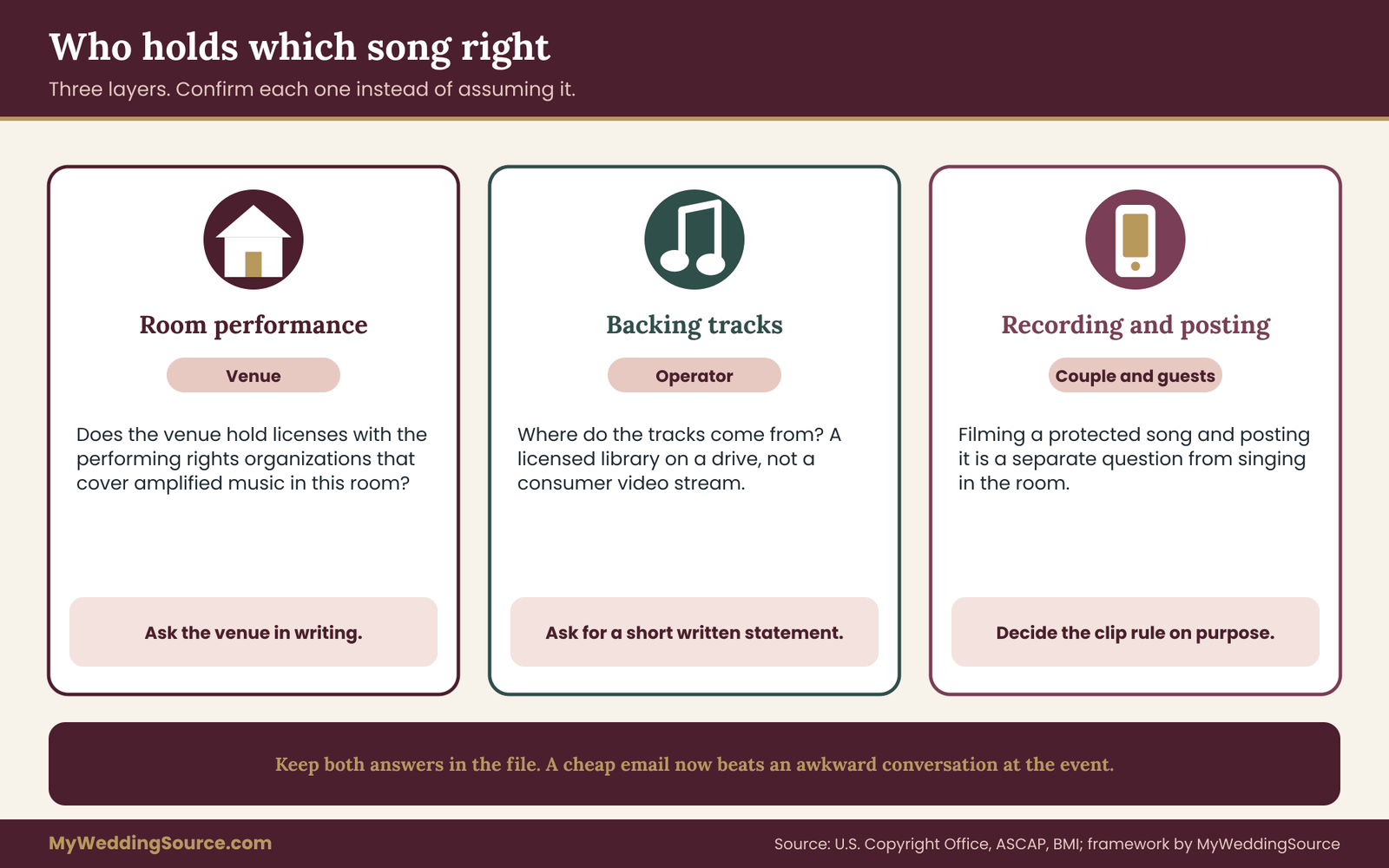
The first is the public performance right in the composition. When a song is performed in public, the songwriters and publishers are entitled to be paid. In the United States, performing rights organizations such as ASCAP, BMI, SESAC and Global Music Rights license that right on behalf of their members, and venues or businesses commonly hold blanket licenses that cover the music played or performed on their premises.
The second is the right in the backing track itself. A legitimate wedding karaoke track is produced under licenses from the publishers, including permission to synchronize the lyrics with the music on screen. Karaoke companies and commercial libraries pay for those permissions, and the price of a legitimate track reflects it.
The third is any permission for recording, livestreaming or sharing. Capturing a guest singing a protected song on video and posting it online is a different act from performing it in the room, and platforms may have their own rules and automated checks. The point is simple: treat recording and sharing as a separate question from singing.
Who normally holds what
In a typical arrangement, the venue holds the performance licenses that cover live and recorded music in the room, the operator uses a library of legitimately sourced tracks, and the couple holds nothing and signs nothing about rights. That is the arrangement you want to confirm, not assume.
Venues differ. A hotel or banquet hall that regularly hosts events often holds the relevant licenses and can tell you so in a sentence. A private estate, a barn, a park pavilion or a rented home may not hold any license, because it does not operate as a music venue. In those places the question of who is covering performance rights deserves an actual answer.
The performing rights organizations publish pages that explain how they license venues and events. Read them for the general picture, and ask the venue for its answer rather than interpreting the rules yourself. The U.S. Copyright Office also publishes plain-language information about copyright and licensing.
Questions for the venue
Ask the venue three questions in writing. Do you hold licenses with the major performing rights organizations that cover amplified music and live performance in this room? Do those licenses cover wedding karaoke performances by guests, or only recorded and live bands? Is there any requirement for the client to obtain a separate license for the event?
If the venue says it holds licenses, ask which ones and keep the reply. If the venue says it does not, ask whether it expects the operator or the client to cover it, and ask the operator the same question. A gap here is not a reason to cancel. It is a reason to resolve who is responsible before the night.
Questions for the operator
Ask the operator where the tracks come from. A professional operator can usually say which commercial library or licensed service they use, and many carry their library on a drive or laptop they purchased tracks for. An operator who cannot say, or whose library is a large unexplained collection of files, is a risk.
Ask whether the operator holds any license of their own for public performance, and ask whether their contract places responsibility for rights on the operator, the venue or the client. Ask whether the operator streams tracks live from a video platform. Terms of service for consumer streaming platforms commonly restrict use at public or commercial events, so a session that relies on one carries both a legal and a technical risk: advertising, buffering and a dropped connection.
“Could you tell us where your wedding karaoke tracks come from, whether you hold a license for the library, and who is responsible for performance rights at our venue?”
An operator who has thought about it will answer in a few lines. An operator who bristles has told you something too.
Why this matters even for a private party
A wedding is generally a private social event, and many couples reasonably assume that rights rules are for bars and clubs. In practice, the situation is less clear than people think. The definition of a public performance in United States copyright law includes performing a work at a place open to the public and also at a place where a substantial number of people outside a normal circle of a family and its social acquaintances is gathered.
A wedding mostly sits at the private end of that line, but a venue is still a business, and venues typically hold licenses in any case.
The practical advice is not to build a legal argument at your wedding. Confirm that the venue is covered, confirm that the operator’s tracks are legitimate, and keep both answers in the file. That is a one-page job, and it makes the rights gate open for the price of two emails.
Requests and the song list
Rights and taste are different questions, but they meet at the song list. Wedding karaoke works best when the operator’s library has the songs your guests actually sing. A library of tens of thousands of tracks is not much use if the five songs your family loves are missing.
Ask the operator to check your most-wanted songs against their library ahead of time, and send the list a few weeks before the date. Ask which versions they have: some tracks are close to the original, some are re-recorded, and a few are shortened. A shortened track suits a three-minute cap better than a seven-minute epic.
If you want certain songs avoided, such as songs with lyrics that would be awkward in front of grandparents or colleagues, tell the operator. The same reasoning applies as to a dance playlist, and the site’s reception music guide shows how to write an avoid list that a performer can actually follow. For wedding karaoke, the avoid list matters more because guests choose the songs themselves.
Custom lyrics, parodies and special songs
Guests sometimes want to sing rewritten lyrics, such as a song with the couple’s names in it. Singing a parody in the room is usually harmless in practice, but showing custom lyrics on screen or recording and posting the performance raises the same questions as any other use. If the couple wants a custom song screen, ask the operator whether they can display plain text, and keep the display to the room.
If your family wants a song in another language, check the library early. Coverage of songs in many languages varies, and a missing song is a bad surprise at the microphone. If an important song is absent, the operator may be able to add it from a licensed source before the wedding, or you may choose to perform it a different way, for example as a toast or a live accompaniment.
What the rights gate looks like when it is open
You can tell the rights gate is open when four things are true. The venue has confirmed in writing that its performance licenses cover amplified music in the room, or has said who will supply that coverage. The operator has stated where the tracks come from and does not rely on a consumer streaming platform for the session. The song list has been checked against the operator’s library, with notes about versions. And no one has promised to record, livestream or post the performances without a separate decision.
Those four statements fit on half a page, and they are easy to confirm. Add them to your gate sheet, and the third gate is done.
What to do if an answer is unclear
If the venue’s answer is vague, ask for the person responsible for music licensing, not the person who answers general questions. If the operator’s answer is vague, ask for a short written statement about their library. If you still cannot get a clear answer, consider a conservative fallback: reduce the number of songs that rely on uncertain sources, or switch to an operator whose library is clearly licensed.
Do not try to solve a rights question by splitting hairs. A planner or couple is rarely in a position to judge a licensing argument, and the cost of a clearer answer is usually small. When a rule is unclear, ask the organization that issues it. The Copyright Office, ASCAP, BMI, SESAC and Global Music Rights each publish contact routes for questions.
Gate four: stage flow for wedding karaoke
Stage flow is where wedding karaoke succeeds or fails as an event. The sound can be perfect and the licenses in order, and the night will still sag if the queue stalls, one singer takes ten minutes, or the room empties while the operator searches for a track.
Stage flow is mostly arithmetic and manners. The arithmetic tells you how many people can sing. The manners decide who feels welcome.
The arithmetic of a wedding karaoke block
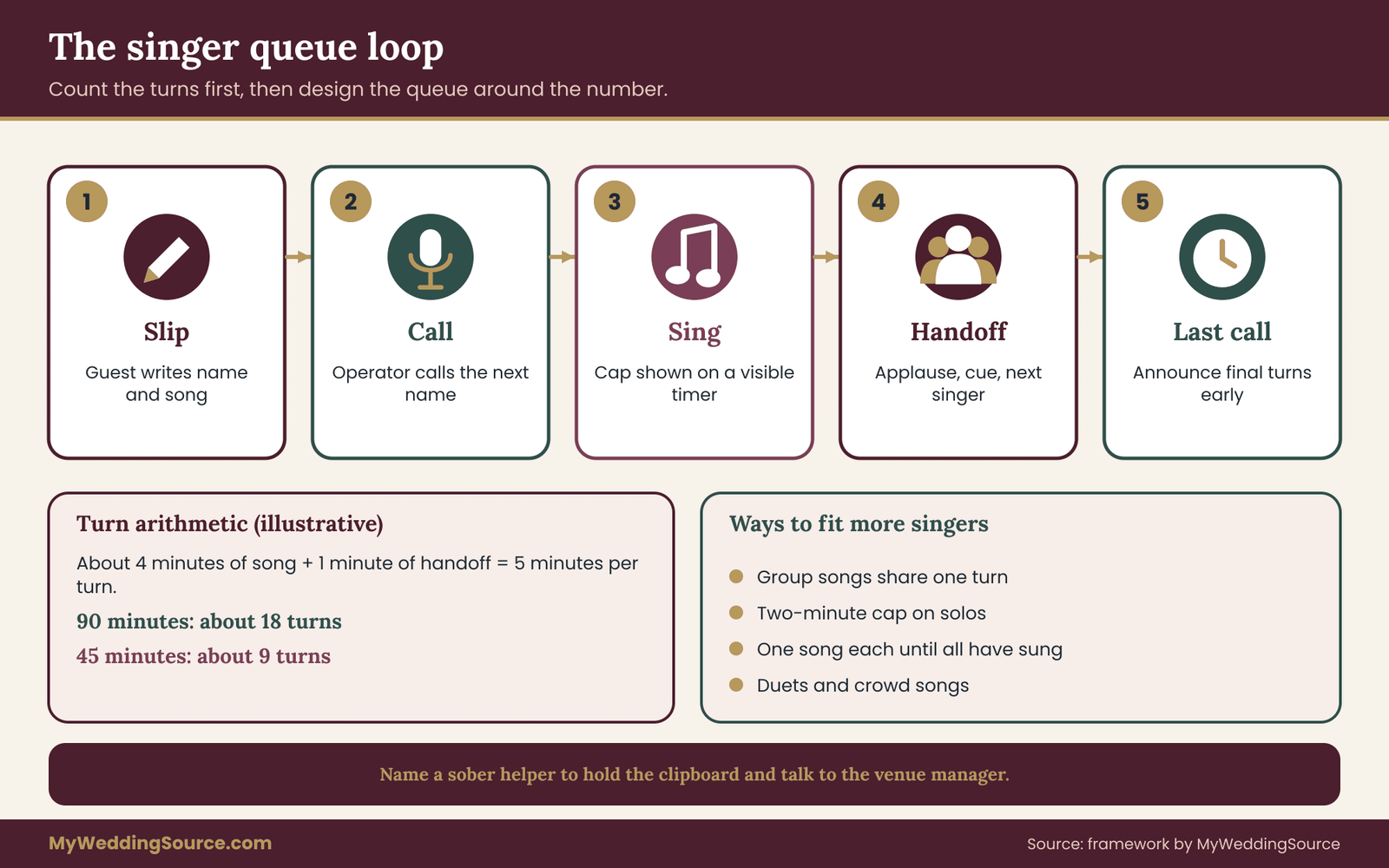
Start with a block length and a time per singer. A song runs about three to four minutes, and each handoff between singers, including the introduction, the cue and the applause, adds another minute or so. If the average turn takes five minutes, a ninety-minute block holds about eighteen turns. A forty-five minute block holds about nine.
That number surprises couples. With a hundred and twenty guests, eighteen turns means fewer than one in six people can sing alone. If you expect everybody who wants a turn to sing a full solo song, the block has to be much longer, or the design has to change.
The design changes available are simple. Group songs let several people use one turn. A time cap, such as the first two minutes of any song, doubles the number of turns. A rule of one song per person until everyone who wants a turn has had one keeps the same few voices from taking the night. Duets and group requests are the most efficient format of all, and they are usually the most fun.
The sign-up system
There are three common ways to run a queue. A paper slip system has guests write their name and song on a card and hand it to the operator. A digital request page lets guests choose from the library on their phones. A walk-up system lets people ask the operator directly.
Each has trade-offs. Paper slips are easy and need no signal, but handwriting can be unreadable and song titles get spelled wrong. A digital page is faster for the operator and reduces mistakes, but it depends on phone signal and on guests who are comfortable with a link. Walk-up is friendly but invites crowding around the operator’s table.
For most weddings, a slip system with a small table and a pen works well, paired with a printed sheet of popular songs for guests who do not know what is in the library. The guide to wedding day digital contingency plans explains how to prepare a backup if a digital page fails, and the same reasoning applies: always keep one analog route open.
Order of the queue
First come, first served is the fairest rule, but it leaves a risk. If the first three singers are also the three most confident, the room hears the same style three times in a row, and quieter guests may drift away. A good operator keeps a loose order but alternates: a group song, then a solo, then a duet, then a quiet song, then a singalong.
Ask the operator how they decide the order and whether they will follow your preferences. A short instruction is enough: shy guests may go earlier or later by request, a few guests such as the couple, parents or a best man might get priority slots, and no one sings twice until everyone who asked has sung once.
The time cap and how to enforce it
A cap only works if the operator has a graceful way to apply it. Some operators fade the track after a set time, some announce the length in advance, and some use a visible timer on the screen. A visible timer is the least personal, since the clock gets the blame rather than the operator.
Agree on the cap with the operator before the wedding, and decide whether the couple or a few family members are exempt. If you want a long song from the couple or from a parent, make it a planned item in the run of the night, not a request that appears at the microphone.
The last song
The session needs a clear ending. A plan that stops mid-queue with a number of disappointed guests is awkward, so announce a last call a few songs before the end and let everyone know how many turns remain. The last song is usually a group song that anyone can join, chosen in advance, and ideally one that suits the quiet rung of the ladder if it is late.
Make sure the end time for amplified sound is later than the planned finish by a margin. If the venue’s cutoff is at a certain time and the last song lands exactly at the cutoff, any delay creates a violation. A margin of ten to fifteen minutes is a comfortable buffer.
Staging and sightlines
A stage does not have to be a raised platform. A cleared patch of floor, a rug and some lighting works for most weddings. What matters is that the singer can see the screen, the audience can see the singer, and the area is clear of cables and glassware.
Check that the stage is not in a main walkway, since that creates a hazard and a bottleneck. In a long room, place the stage and screens where the queue can form to one side without blocking the exit or the bar. The reception guest flow guide describes how to read a room for bottlenecks, and a wedding karaoke stage is another point where a crowd collects.
Think about people with different needs. A singer who uses a wheelchair or a walker needs a route to the microphone without steps, and a guest who cannot read the screen easily needs a larger display or a printed lyric sheet. The ADA National Network and the U.S. Department of Justice publish general information about accessible design, and a quick check of the route to the stage costs nothing.
Singers, alcohol and guest comfort at wedding karaoke
Wedding karaoke is a social event, not a performance exam, and the people most likely to cause trouble are not the bad singers. Bad singers are usually the most fun. The problems come from three other categories: the guest who has had too much to drink, the guest who takes the microphone and will not give it back, and the guest who is dragged up against their will.
Alcohol and the microphone
Alcohol loosens nerves and raises volume at the same time, which is exactly the combination you do not want near an amplifier. The bar and the stage share the same room, and a late block of wedding karaoke often coincides with the heaviest drinking.
You do not have to police the bar yourself. You can set conditions that make the operator’s job easier. Ask the venue and the bartenders whether they will stop service to anyone who appears intoxicated, as many venues are required to do. Ask the operator whether they are comfortable declining a request from a guest who is visibly intoxicated and how they would do it.
The guide to planning bar service at a wedding explains how last call, drink limits and service rules work, and a bar that closes before the wedding karaoke ends is one of the simplest ways to keep the final songs calm.
An operator can decline gracefully by saying that the next few turns are already filled and offering a later slot. If a guest is clearly unwell or unsafe, the operator should pass the matter to a designated person instead of handling it alone, and you should name that person in advance.
The microphone hog
Every wedding karaoke session has someone who sings three songs in a row. The simplest remedy is the one-song rule combined with a visible queue. If the operator keeps the slips in view and calls names in order, a guest cannot jump the line without being obviously out of turn.
If one guest keeps coming back, the operator can offer a duet with someone else, which usually ends the problem kindly. For a persistent case, a designated family member or planner can step in with a quiet word. The operator should not be left to handle a drunk uncle alone.
The reluctant singer
The opposite case is just as common. A guest is pushed to sing by friends and does not want to. Nobody should be pulled up on stage. Ask the operator to make a standing offer: anyone can pass without comment, and the room should not applaud a refusal as if it were a joke.
Shy guests often sing happily in a group. Invite them to a chorus or a crowd song, and let them stand at the back with a microphone they do not have to use. The simplest welcoming gesture is a tambourine or a shaker for guests who want to take part without singing.
Hearing, comfort and children
Remember that a room with amplified voices is hard on some guests. Older guests, people with hearing aids, babies and anyone sensitive to loud noise may need a quiet corner or another room. If your venue has a second space, mark it as the quiet room. The site’s wedding guest care guide explains how to plan support for children and older relatives.
If children will be present, check the song list for language and themes you are not comfortable with, and consider ending the family-friendly rung early. Some couples schedule a children’s block earlier in the evening with songs from films and cartoons, and move to the general block after the children leave.
Microphone hygiene
Shared microphones are touched, breathed on and sometimes dropped. Ask the operator how they clean the microphones between sets and whether they carry spare windscreens or covers. A quick wipe with a cloth and a small bottle of cleaner between singers takes seconds and is a courtesy to guests. Wireless microphones need charged batteries, and the operator should carry spares.
Keeping the operator from carrying the whole night
An operator is a performer, a technician and a referee all at once. Give them a helper. A single friend or family member can hold the clipboard, call the next name, keep an eye on the quiet corner and take the pressure off the person at the mixer. Pick someone sober, calm and not otherwise needed, and tell them the plan.
The same person can be the contact for the venue manager if the volume needs to change, which means the operator keeps their hands on the system while the helper talks to the manager.
Wedding karaoke options compared in plain words
There is more than one way to put wedding karaoke into a wedding, and each way opens or closes the four gates differently. The comparison below is in words, not scores, because the right answer depends on your venue, your guests and your budget. Costs vary too much by region to quote, so the focus is on what changes in each gate.
A dedicated operator with a full system
This is the standard arrangement and the one the earlier sections assume. A professional brings the speakers, microphones, screens and a licensed library, and runs the queue. Gate one is the strongest, since you have a named person and an equipment list. Gate three is usually open when the operator can explain the library. Gate two depends on how well the operator uses a limiter and responds to the venue. Gate four is strong when the operator has wedding experience.
The trade-off is cost and the fact that you are paying for a block of time. It is the best choice when the room is large, the guest count is high or you want the evening to run without a family member working the controls.
Your reception DJ adding a wedding karaoke block
Some DJs offer wedding karaoke as an add-on. The advantage is one vendor, one setup and one contract, with a person who already knows the room. The risk is that DJ skills and wedding karaoke skills are not identical. A DJ who is excellent at reading a dance floor may be less practiced at managing a queue and soothing nervous singers.
Check the add-on against the same questions as a stand-alone operator. Ask whether the DJ has a separate library of wedding karaoke tracks, whether the system has enough microphones and screens, and whether the block has its own start and end time. The overrun problem mentioned earlier is most likely here, because a dance set that runs late pushes the wedding karaoke into the quiet hours.
A rented system run by a friend
Renting a karaoke machine and asking a guest to run it can look like the cheap and friendly option. It can work for a small gathering in a private home. At a wedding with a venue, an ordinance and a hundred guests, it tends to fail at the gates, not at the singing.
Gate one is weak because no one is accountable if the equipment fails. Gate two is weak because home wedding karaoke units are not built for a banquet room, and without a limiter or a trained hand the level climbs. Gate three depends entirely on where the tracks come from. Gate four falls on a friend who would rather be a guest. If you choose this route, assign a sober helper and write the same gate sheet.
A phone or tablet app and a speaker
A consumer app and a portable speaker are the lowest-cost option. They suit a small family gathering, a rehearsal dinner at home or a short moment in a living room. For a venue event, the problems are the same as above and a few more: consumer apps usually carry terms intended for personal use, the speaker is rarely loud enough for a room, and a dropped connection ends the music.
If you want a light, informal wedding karaoke moment, such as a single group song led by the couple, a well-prepared laptop and a licensed source may be enough. Make the decision on purpose, and check the terms of whatever service you use.
Live band karaoke
Some bands offer a format in which guests sing with live musicians instead of backing tracks. This changes the rights picture, because the band may handle performance rights as part of its own arrangement, and it changes the noise picture, because live instruments are louder and harder to control than a track. It also changes stage flow: songs are limited to the band’s repertoire and each song needs a short conversation about key and tempo.
Because of the noise factor, this option usually belongs in the open hours rung, not the late ones. Ask the band how it handles volume and whether the venue allows live drums at that hour.
A separate room or a quiet corner
A final option is not a vendor choice at all but a placement choice. A separate room with its own small system keeps the noise away from the main reception, keeps the wedding karaoke audience to people who want it and makes the quiet-hours ladder easier to apply. The cost is that the room needs staff and a clear route, and some guests will feel they are missing the main party.
For the late block, a separate room is often the most reliable way to keep the guests who want to sing and the guests who want to talk or go home from getting in each other’s way.
Which option for which situation
Choose a dedicated operator when the guest count is above about eighty, when the venue has a firm sound policy or when you want the evening to run without family labor. Choose a DJ add-on for a short block inside an already planned dance set. Choose a friend-run rented system only for a small private space and with a named helper. Choose an app and speaker for a brief, informal moment. Choose a live band when the open hours are available and the band has experience with guest singers.
None of these is the right answer for everyone. The gate sheet tells you which one your room can support.
A worked example of wedding karaoke
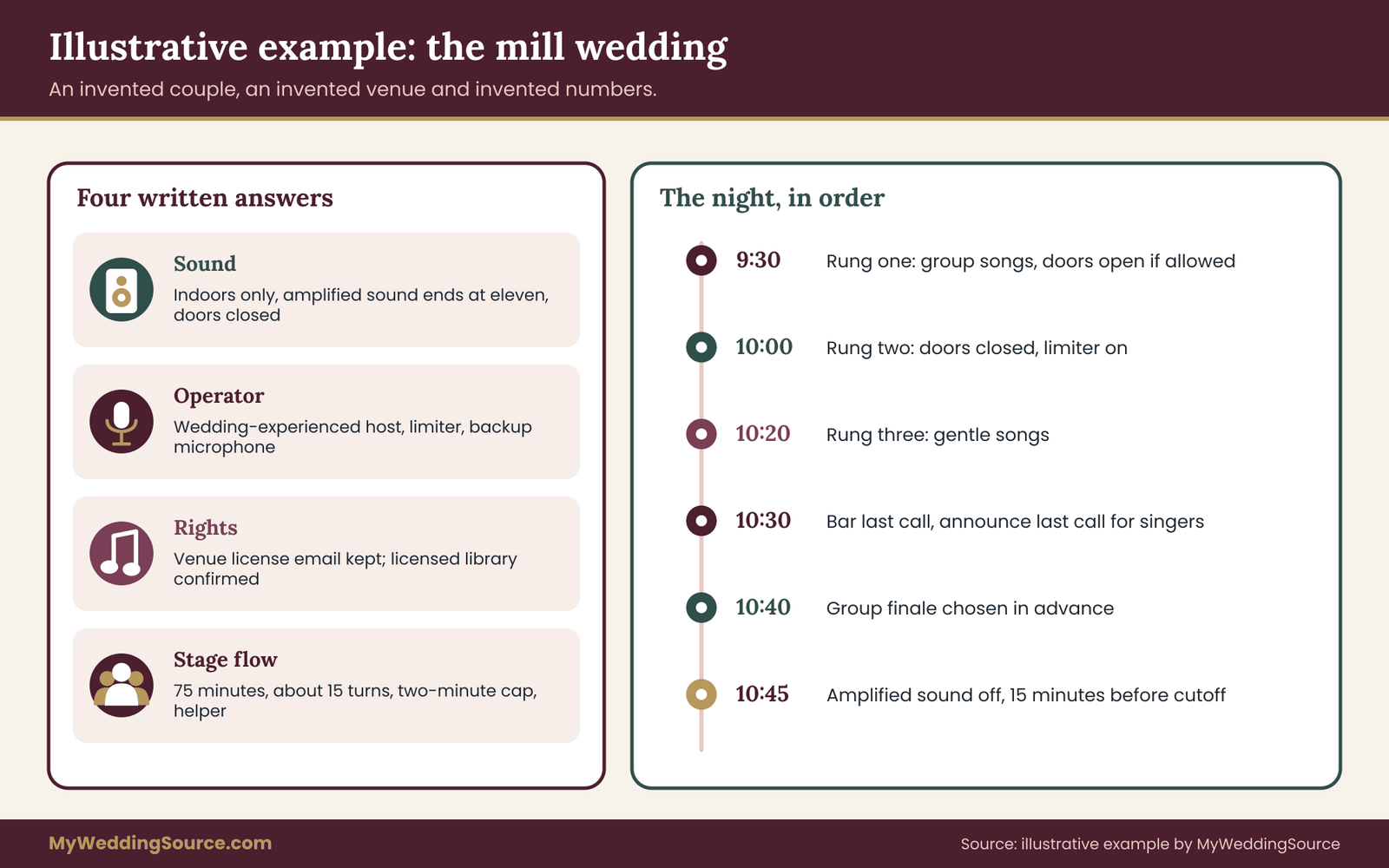
The following example is invented to show how the four gates work together. The couple, the venue and every number are illustrative, not data from a real event or a real venue.
Maya and Ben are planning a wedding for one hundred and ten guests at a restored mill beside a river, with a small neighborhood across the road. The venue’s contract says that amplified sound inside must end at eleven. Their families love singing, and Maya’s cousin has already asked for a wedding karaoke night.
Gate two first
Because sound is the gate most likely to close, Maya starts there. She asks the venue manager in writing for the sound policy. The reply says that amplified music ends at eleven, that outdoor amplified sound ends at nine, and that the manager will ask the client to reduce volume if neighbors call.
She calls the city’s special-event office and learns that, for her venue, the venue’s own permit covers amplified sound indoors and she does not need a separate one. She writes the date and the name of the person she spoke with.
Her decision at this gate is to hold wedding karaoke indoors only, between nine-thirty and ten-forty-five, with doors closed and a ladder in three rungs.
Gate one next
Maya and Ben interview two operators with the same questions. The first has run many weddings and can describe a limiter, backup microphones and a helper plan. The second runs wedding karaoke mainly in bars and has not worked with a venue that has a strict cutoff. They choose the first and put the equipment list, the setup time and the cancellation terms in the agreement. The contract also says that if the venue refuses wedding karaoke for any reason, the couple can move or cancel with the deposit returned.
Gate three
The venue replies that it holds licenses with the major performing rights organizations covering amplified music and live performance in the room. Maya keeps the email. The operator states that the tracks come from a licensed commercial library on a drive and that no streaming platform is used during the session. The couple send twelve most-wanted songs, and the operator confirms ten are in the library and offers close alternatives for two.
Gate four
The block runs seventy-five minutes. Using five minutes per turn, the operator estimates about fifteen turns. The couple decide on a two-minute cap for solos, group songs for the families, one turn per person until everyone who asked has sung, and a final group song chosen in advance. Maya’s cousin, who is the family helper, holds the clipboard and checks the quiet corner. The bar’s last call is set for ten-thirty.
The sound check
During the afternoon sound check, Ben uses a phone sound meter application at the three positions. The numbers are illustrative: a typical singer reads comfortably lower at the guest area than at the mixer, and the reading at the door nearest the road is lower again. When the operator speaks loudly into a microphone, the door reading rises noticeably. They set the ceiling so that the loud-singer reading at the door stays under the number the venue manager suggests, and the operator sets the limiter to match.
The ladder gives them a plan: rung one from nine-thirty, rung two from ten, rung three from ten-twenty, and a last call at ten-thirty with the final song ending before ten-forty-five. The final song may go slightly higher in volume, but only by an agreed step.
What the example shows
The example shows a pattern. Each gate produced a small written answer, and the answers had to fit one another: the end time came from the venue, the block length came from the end time, the number of turns came from the block length, and the volume came from the room. If any of those had changed, the others would need rechecking. That is the reason to keep the gate sheet in one place.
Edge cases for wedding karaoke
Real weddings throw up situations that a general plan does not cover. The cases below are the ones that come up most often, with a plain way to handle each.
The venue says no after you have booked the operator
Check the cancellation clause in the operator’s agreement first. If it lets you move or cancel when the venue refuses, you can adjust. If it does not, ask the operator whether the booking can shift to an earlier time or to a different room. Many operators would rather reschedule than lose the booking. The guide to a wedding vendor timeline can help you place a short wedding karaoke block into an existing schedule without displacing other vendors.
A neighbor calls or the manager knocks
Have a rehearsed response. The helper takes the call or speaks to the manager, the operator lowers the level by the agreed step at once, and the helper reports back when it is done. Do not argue on the spot. A prompt reduction almost always ends the matter, and the written ladder shows that the plan was reasonable.
The power trips
Wedding karaoke equipment, a dessert warmer and a photo booth can overload a shared circuit. Ask the venue which circuit the operator will use and whether anything else is on it. If the power fails, the operator should have a battery-powered speaker for a short announcement. Keep calm, apologize briefly and restart without drama.
A song with lyrics that fit badly
Sometimes a guest picks a song whose lyrics become awkward in the room: an ex’s name, a crude verse or a theme that would upset a grandparent. The operator can steer with a gentle suggestion, offer a shorter version or move the request to a later slot. Agree beforehand that the operator may decline a request without explanation, and that the couple will back them.
A guest wants to record and post
People will film. Decide whether you want that and how you will communicate it, for instance with a short line at the start of the session. Recording and posting involve the performers’ own wishes and, for protected songs, separate rules on platforms. If you want to avoid trouble, ask guests to keep karaoke clips private and share them with the couple directly.
A guest with a disability or a language barrier
Ask the operator how they handle a singer who cannot read the screen, uses a mobility aid or sings in another language. Large text, a printed lyric sheet, a clear path to the stage and a patient helper cover most of the needs. Treat any special request as part of the plan, not as an interruption.
The room is emptier than expected
Sometimes the late block draws a smaller audience than you planned. That is not a failure. Shorten the queue, let the couple and the closest friends have their turns and close the session early. A small, warm room is more pleasant than a half-empty large one, and ending early reduces the noise risk too.
What to put in the agreement for wedding karaoke
By now the four gates have produced a stack of answers. The agreement is where those answers become promises. Most operator contracts cover the date, the hours and the fee, and say little about volume, rights or the queue. An addendum fills those gaps in a page or less. The general clauses are explained in the guide to wedding vendor contracts, and these are the karaoke-specific additions.
Hours and overrun
State the start time, the end time and the latest time amplified sound may be used, with the venue’s cutoff written in. Say what happens if the schedule slips: whether the block is shortened, who decides, and whether any overtime is charged. An operator who bills by the hour has a reason to run past the cutoff unless the contract says otherwise.
Equipment and backup
List the system, the number of microphones, the number and size of screens, the laptop or player and the spare items. Add a plain line about backup: a spare microphone, a second source of music and a battery or other fallback for announcements. A contract that lists only the headline equipment leaves you without remedy if a piece fails.
Sound
Attach the quiet-hours ladder and the measurement positions. State that the operator will use a limiter if the system has one, will set it to the agreed level and will lower the volume at once on a request from the venue or the named helper. Say who has authority to ask: the venue manager, the planner, a named family member. Ambiguity about authority is a common source of arguments.
Rights and sources of tracks
Include a short statement from the operator about where tracks come from, that the operator uses a licensed library and does not rely on an unlicensed source, and who is responsible for any performance license the venue does not hold. If the operator will record or stream any part of the session, require a written agreement about it. Do not invent legal language. If the wording matters, ask a qualified professional to review it.
Conduct and refusal
Give the operator the right to decline requests that are unsafe, abusive or clearly intended to disrupt, and the right to pause the session if a guest is unwell or disruptive. State that the couple’s helper will back the decision. This protects the operator and, indirectly, you.
Insurance and certificates
If the venue requires a certificate of insurance from vendors, say so and give the deadline. Many venues need the certificate naming them as an additional insured. The operator should know what that means and how long it takes. Ask early, because insurers can take several days.
Cancellation and refunds
Write down what happens if the venue refuses wedding karaoke, if the weather forces a change, if the operator is ill, and if you cancel. Ask for a refund or a transfer of the deposit in the first case, a replacement or refund in the third and a clear schedule in the fourth. If the operator provides a substitute, ask that the substitute be approved by you and carry the same equipment and insurance.
The one-page gate sheet as an attachment
Attach the gate sheet itself. It should show the four gates, the answer at each, who gave the answer, the date and any items still unconfirmed. A contract with an attached sheet is easier to enforce than one that depends on memory, and the sheet gives the venue and the operator the same facts.
What wedding karaoke costs, and how to compare quotes
Prices for wedding karaoke vary widely by region, operator and equipment, and this guide does not quote them. Instead of a number, it gives a way to compare quotes so you can see what you are paying for.
What drives the price
Four things drive most quotes. The first is the length of the block, including setup and teardown, since many operators charge for time on site. The second is the size of the system, which depends on the room and the guest count. The third is whether the host provides extras such as lighting, a second screen or a digital request page. The fourth is travel and overtime.
Ask each operator to quote the same block under the same conditions: the same start and end, the same room and the same extras. Without that, a lower number may simply describe a smaller service.
Costs that hide outside the quote
Some costs do not appear on the operator’s quote. A venue may charge an additional fee for late amplified sound, extra security or a later closing time. A permit, if one is needed, has a fee. Power may require a generator at an outdoor site. A helper may need a meal. A late finish may need transport arrangements for guests, which the venue and which the venue should explain.
Add these to the comparison. A cheaper operator who needs a generator and an extra permit may cost more than a pricier one who works within the venue’s setup.
Paying for a block you may not use
Another cost consideration is whether to book a long block or a short one. A long block gives flexibility but costs more and increases noise exposure. A short block, with an option to extend if the room is lively, is often a sensible compromise, provided the venue’s cutoff allows the extension and the overtime rate is written down.
Common mistakes with wedding karaoke
Most of the problems described above repeat, so a short list of the mistakes is useful for a final read before you sign.
Starting with the operator and leaving the venue for later is the most common. The operator can be changed, but a venue’s amplified-sound policy cannot, so confirm the policy first.
Treating “not too loud” as a plan is the second. Replace the adjective with a number, a position and a person who checks.
Assuming that someone else handles song rights is the third. Ask the venue and the operator, and keep both answers.
Running a queue without arithmetic is the fourth. Count the turns, then choose group songs, caps and a one-song rule.
Forgetting the end of the session is the fifth. Plan last call and the last song, and leave a margin before the cutoff.
Leaving everything to the operator is the sixth. Give them a helper, a decision-maker and a written ladder.
Finally, there are the limits of this guide. It is general information. It does not replace the text of your city’s ordinance, your venue’s contract or advice from a qualified professional, and it cannot tell you what the rules are in your location. Where a rule matters, ask the office that issues it.
Your next steps
Pick one evening this week and do three things. First, open a page with the four gates and write down what you already know, marking each unknown as unconfirmed. Second, send the venue the sound and rights questions from this guide and ask for answers in writing. Third, shortlist two operators and send them the same list of questions.
Then work in order. Settle the sound gate before you pay a deposit. Set a volume number and three measurement positions. Confirm where the tracks come from. Count the turns in your block and decide on group songs and a cap. Attach the ladder and the gate sheet to the agreement, name a helper and rehearse the response to a complaint. With that done, wedding karaoke becomes the part of the evening people talk about for the right reasons.
FAQ
Do we need a noise permit for wedding karaoke?
It depends on your location and venue. Many established venues hold the approvals that cover indoor amplified sound, so the couple needs nothing separate. Private property, tents, parks and farms more often need a special-event or amplified-sound permit, sometimes weeks ahead. Ask the city or county office that handles special events and the venue manager, and write down who applies, the deadline and the date approval arrives.
How loud should wedding karaoke be?
Replace the adjective with a number your venue or ordinance allows, then measure it. Pick three positions, the operator’s table, the guest seating and the nearest property line or neighbor, and check each with a sound meter at sound check. Set the lowest comfortable ceiling, use a limiter on microphones, and lower the level in later hours. OSHA and NIOSH publish noise reference points.
Who is responsible for song licensing at wedding karaoke?
Usually the venue holds performance licenses with performing rights organizations such as ASCAP, BMI, SESAC and Global Music Rights, and the operator uses a licensed library of backing tracks. The couple normally holds none. Do not assume: ask the venue in writing which licenses cover the room, ask the operator where tracks come from, and keep both answers. Recording and posting performances is a separate question.
How many guests can sing during a wedding karaoke block?
Count it. If a turn runs about five minutes including the handoff, a ninety-minute block holds about eighteen turns, and a forty-five minute block about nine. To fit more people, use group songs, a two-minute cap on solos, duets and a one-song-per-person rule until everyone who asked has sung. A longer block helps, but it adds noise exposure.
Can the DJ run the wedding karaoke instead of a separate operator?
Often yes, and it simplifies logistics. The skills differ, though, so ask the same questions you would ask a dedicated operator: where the tracks come from, how many microphones and screens the system has, how the queue works, and whether the block has its own start and end time in the contract. Watch for overrun from the dance set.
What if the venue asks us to turn the volume down?
Act at once and calmly. The operator lowers the level by the agreed step, a named helper confirms with the manager, and the session continues. Having the quiet-hours ladder in writing shows that the plan was reasonable. Never argue on the spot. A prompt reduction usually ends the complaint, and a defensive reply tends to escalate it.
How do we handle guests who have had too much to drink?
Plan before the night. Ask the venue and bartenders about service rules, set a last-call time before the end of wedding karaoke, and agree that the operator may decline or delay a request. Name a sober helper who can take over a difficult conversation. A graceful offer of a later slot or a group song works better than a flat refusal.
Can guests record and post their wedding karaoke performances?
You can decide that. Recording and posting is separate from singing in the room, and platforms may have their own rules about protected songs. Many couples ask guests to keep clips private and send them to the couple instead. Mention the request briefly at the start of the session, and check the operator’s contract if they plan to record anything themselves.
Sources
- Occupational noise exposure, Occupational Safety and Health Administration
- Noise and hearing loss prevention, National Institute for Occupational Safety and Health
- Clean air and noise: noise pollution overview, U.S. Environmental Protection Agency
- Copyright basics and licensing information, U.S. Copyright Office
- Music licensing for businesses and venues, ASCAP
- Music licensing for businesses and venues, BMI
- Music licensing information, SESAC
- Licensing information, Global Music Rights
- Accessible design and ADA guidance, U.S. Department of Justice
- Hearing loss prevention, Centers for Disease Control and Prevention