
Dog attire at a wedding looks simple in a photo and gets complicated on the day: a bow tie that slides under the chin, a flower collar the dog starts eating, a harness that rubs after an hour on warm grass. This guide gives you one original three-gate check, covering fit, chew hazard and stress response, so you can decide what your dog wears, what stays off, and when everything comes off.
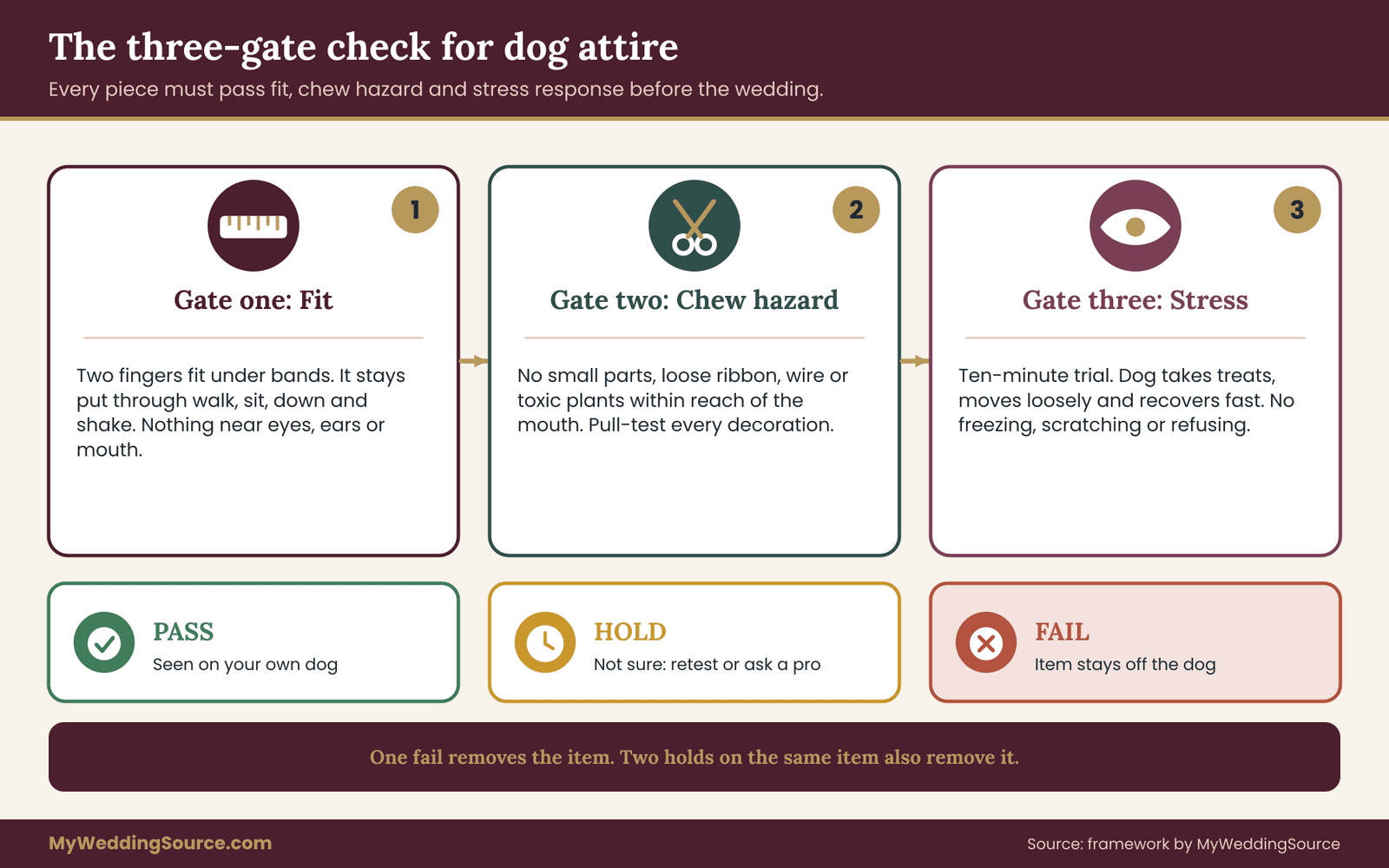
Run every piece of dog attire through three gates before the wedding. Gate one is fit: you can slide two fingers under any neck or chest band, nothing blocks the eyes, ears, mouth or legs, and the dog walks, sits and lies down normally. Gate two is chew hazard: no small parts, loose ribbon, wire or toxic plants within reach of the mouth. Gate three is stress response: the dog stays loose and curious in the outfit during a ten-minute trial. A fail at any gate means that piece of dog attire stays home.
Most advice about dressing a dog for a wedding starts with style: which color, which bow tie, which floral crown. That is the wrong order. A dog cannot tell you that a collar pinches, that the petals smell odd, or that the fabric on its back feels like a hand pressing down. It can only show you, usually in small signals that are easy to miss when forty people are watching and a photographer is calling your name.
So this guide reverses the order. Safety and comfort decide what is allowed, and style picks from whatever is left. The good news is that a lot is left. Dogs look wonderful in a plain, well-fitted bandana or a single fresh-flower accent on a safe collar, and a dog that is comfortable also photographs better than a dog that is tolerating a costume.
A note on scope. This is general information, not veterinary, legal or financial advice. Your own veterinarian knows your dog’s age, breed, health and temperament, and the venue and your vendors set their own rules. Where a fact matters, the guide points you to the organization that publishes it, so you can confirm the current version yourself.
The guide stays on one subject: what goes on the dog’s body. Whether your dog should attend at all, which role suits it and how the day is handled are covered in the wedding planning checklist and in the other planning guides on this site. Here, we assume the dog is coming, and ask what it should wear.
What dog attire is for, and where it goes wrong
Dog attire at a wedding does three jobs. It signals that the dog belongs to the day, so guests and photographers treat it as part of the wedding party. It ties the dog’s look to your color palette. And, on a practical level, it sometimes carries a function: a harness for control, an identification tag, a sign that says the dog is working or is not to be petted.
Those jobs pull in different directions. Decoration wants things to dangle, glitter, and sit high on the neck where a camera can see them. Safety wants things short, snug, smooth and easy to remove. Most of the problems couples run into come from letting decoration win without anyone checking the safety side.
The five common failure patterns
Across the typical ways dog attire goes wrong, five patterns show up again and again. None of them needs bad luck. They need only a piece of clothing that was never tested on the dog.
The first is slippage. A bow tie or bandana that was snug in the shop shifts when the dog moves, ends up under the jaw or over one shoulder, and gets adjusted by a guest every few minutes. The second is rubbing. A seam, buckle or elastic edge that is fine for ten minutes becomes a sore spot after an hour of standing, walking and lying down.
The third is chewing. A dog that has never touched a ribbon at home may mouth one that hangs near its nose when it is nervous or bored. The fourth is overheating or chilling, because a layer of fabric changes how a dog loses heat, and a garment that suits a cool morning rehearsal is wrong for a hot afternoon ceremony.
The fifth is refusal. The dog freezes, lies down, scratches at the dog attire or tries to back out of it. This is the clearest message a dog can send, and it should end the experiment, not start a negotiation.
Why a checklist beats a feeling about dog attire
Couples tend to judge dog attire by the first minute: the dog stood still, so it must be fine. Standing still is not the same as being comfortable. Some dogs freeze when they are uneasy, and a frozen dog looks calm to a person who is not watching closely. A written dog attire checklist forces you to look at specific things in a fixed order, and it gives your helper, your photographer and your venue coordinator something to point at when they ask what the plan is.
The three-gate check: fit, chew hazard and stress response
The check has three gates, and each gate has a short list of measurable questions. You answer each question with pass, hold or fail. Pass means you have seen it with your own eyes on your own dog. Hold means you are not sure yet and need another trial or a professional opinion. Fail means the dog attire does not go on the dog.
The rules for combining results are deliberately blunt. A single fail at any gate removes that piece of dog attire. Two holds on the same item also remove it, because two unknowns are a pattern. A piece of dog attire with all passes and at most one hold can be used on the day, with a named person watching that one point.
Gate one: fit
Fit questions are physical and measurable. Can you slide two fingers under every strap or band? Does the item stay in place through ten steps, a sit, a down and a shake? Is anything near the eyes, in the ear canal area or against the corner of the mouth? Do the legs move through their normal range without catching? Is there any spot where fabric bunches against skin?
Gate two: chew hazard
Chew questions are about what the mouth can reach and what happens if it does. Is there any part that could come off and be swallowed? Is there loose ribbon, string, elastic or wire? Is anything the dog could pull off whole and carry away? Are any plants included, and have they been checked against a toxic plant list? Can the dog reach the dog attire with its mouth, or with a paw that then goes to the mouth?
Gate three: stress response
Stress questions are about behavior. Does the dog eat a treat normally while wearing the item? Does it move toward people, or hang back? Do you see lip licking, yawning out of context, whale eye, a stiff tail or a tucked one, panting that is not from heat, or repeated scratching at the dog attire? Does the dog recover its normal body language within a minute or two of the dog attire going on?
The first infographic below shows the three gates and the pass, hold and fail rule on one page, so you can print it and take it to the fitting.
How much time the check takes
The whole check is smaller than it sounds. Fit takes one session of about fifteen minutes with a soft tape and a notebook. The chew review is a desk exercise plus a close look at each piece. The stress trial is the part that needs calendar time, and the schedule later in this guide spreads it over three weeks of very short sessions. If you are inside three weeks of the wedding, you can still run a compressed version, and the guide says what to drop first.
Who should own the check
Pick one person to own it, ideally the person who handles the dog most days, because they read its signals best. The couple often wants to own it, but they will be the busiest and most distracted people on the day. Make the dog’s handler the final decision maker on attire, and write that down so nobody argues with them at the moment the dog starts to scratch.
The wedding vendor due diligence checklist explains the same idea for vendors: one named owner, written criteria, and a clear rule about who can say stop. The same structure works for a dog’s wardrobe.
Gate one: measuring your dog for fit in dog attire
Fit is the gate you can fully control, and it is where most dog attire problems begin, because wedding items are often ordered online from size charts that assume an average dog. Your dog is not an average dog. Measure first, order second, and keep return options open until the trial is finished.
Take four measurements, not one
Use a soft tailor’s tape, or a piece of string you then lay against a ruler. Have a second person hold treats so the dog stands naturally. Take four measurements and write them down with the date.
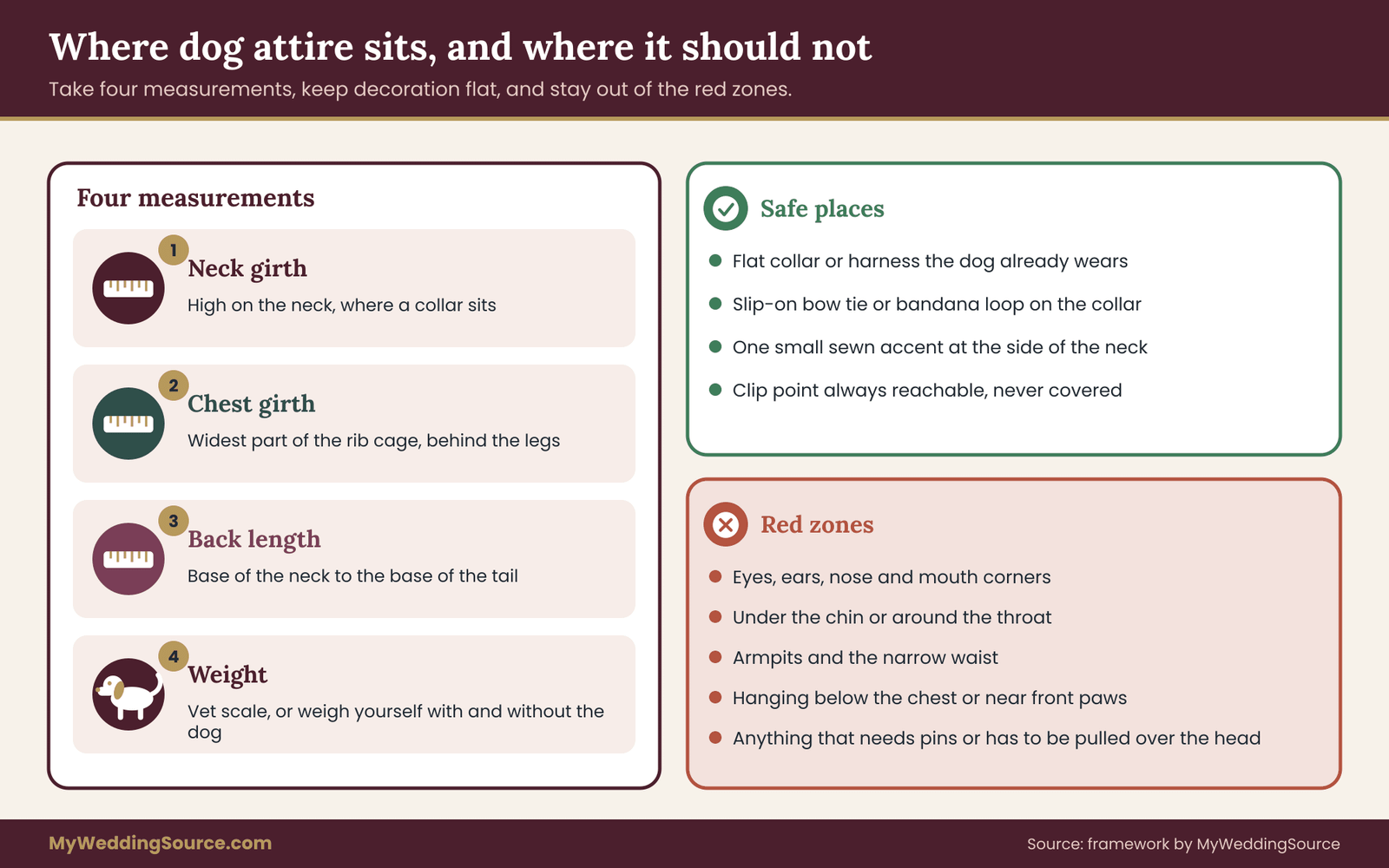
Neck girth is measured at the point where a collar would normally sit, high on the neck behind the ears, not down at the base near the shoulders. Chest girth is measured around the widest part of the rib cage, just behind the front legs. Back length runs from the base of the neck to the base of the tail. Weight comes from your veterinarian’s scale or a bathroom scale, with you holding the dog and then subtracting your own weight.
Dogs with thick coats need an extra step. Measure once over the coat as it is on the wedding day, because grooming changes the numbers. If a groomer visit is planned before the wedding, measure after that visit, and ask the groomer whether anything they do, such as a trim around the neck, changes where bands will sit.
The two-finger check and what it really tells you
The most widely repeated practical test for a collar or harness strap is the two-finger check: you should be able to slide two fingers flat under the band without forcing them. It is a rule of thumb, not a veterinary standard, and a dog’s build changes how it applies. A slim greyhound-type neck, a thick-necked bulldog and a long-coated spaniel all need a different feel. Treat the test as a floor for comfort, and ask your veterinarian or a professional fitter if you are unsure.
Then add movement. Fit while standing is half the answer. Walk the dog ten steps, ask for a sit and a down, let it shake, and have it step up onto a low surface and off again. Watch whether the dog attire rotates, rides up, or gapes. A band that was snug while standing can open a gap when the dog lowers its head to sniff, and that gap is where a paw or jaw can catch.
Pressure points and rub checks
Check four places on the dog after the trial. Look under the front legs where straps cross the armpit, along the neck where a band or bow tie knot sits, across the chest where a harness plate rests, and along the spine where a vest or dress seam runs. You are looking for flattened or ruffled fur, reddened skin, and any spot the dog flinches at when touched.
Dogs rarely complain about a rub until it is raw. A trial that ends with a quick hands-on check protects you from finding out at the reception. If any patch looks irritated, that piece of dog attire fails gate one, even if the dog seemed fine.
Breeds and bodies that need extra care
Some dogs need more caution with dog attire, and the reason is anatomical, not aesthetic. Short-nosed breeds can have narrower airways, so pressure on the throat or a tight neck band matters more, and so does heat. Deep-chested breeds can have trouble with straps placed on the narrow waist or across the ribs. Very small dogs and toy breeds are easy to overload with a garment that weighs more than they should carry. Long-backed breeds can struggle with stiff vests that limit spine movement.
Puppies and seniors have their own issues. A puppy is growing, so a fitted piece measured at an appointment may not fit by the wedding, and many puppies have not learned to tolerate anything on their bodies. A senior dog may have arthritis, thin skin or reduced heat tolerance, and a stiff garment can make standing and lying down painful. Ask your veterinarian, plainly, whether any condition your dog has should limit what it wears.
Sizing traps when buying dog attire
Online size charts are often based on body length alone, which says little about girth. A chart that says “medium” for dogs up to a certain weight may fit a muscular terrier poorly and a fluffy spitz well. Ask the seller for neck and chest measurements of the product itself, not only a weight range. Check whether straps are adjustable, how far, and whether the adjuster is a plain slide buckle or a fiddly fastener that a nervous dog might pull open.
Also ask about returns. Custom pieces, such as an embroidered bandana or a made-to-order flower collar, are often final sale. That is a reason to buy a plain, returnable fitting piece in the same size first, test it, and only then commission the custom one.
Collars, harnesses and attachment points in dog attire
Decorative dog attire usually sits on top of something functional: a collar that holds the identification tag, or a harness that lets a handler control the dog. The functional layer comes first, and decoration attaches to it, never the reverse.
Collar versus harness for the wedding day
Neither one is automatically better. A well-fitted flat collar with a tag is enough for a calm dog that walks nicely on a leash. A harness spreads force across the chest and shoulders and can be safer for dogs that pull, for small dogs with delicate necks, and for short-nosed breeds. A harness also gives the handler a better hold if the dog startles.
What matters is that the dog is already used to whatever you choose. Do not introduce a new harness the week of the wedding. Use the equipment the dog wears on ordinary walks, and design the decoration around it. If a new harness is needed, treat it as its own item in the three-gate check and start the three-week practice schedule with it.
Where decoration should attach
The safest attachment is a flat, snug accessory that slips onto the collar or harness strap itself, such as a bow tie on a short loop or a bandana whose tie sits at the back. Avoid anything that hangs below the chest, drags near the front paws, or ends in a long tail of ribbon. Avoid anything that fastens with a single thin elastic band around the neck, because elastic can cut in and is easy to chew.
Check how each piece comes off. Everything you attach should be removable in under ten seconds by a person who is not the dog’s owner, without scissors if possible. A quick-release buckle or a simple slip-on loop is ideal. A bow tie tied with a bow knot that has to be unpicked is a poor choice, and so is any piece of dog attire that has to be pulled over the head.
Tags, identification and the breakaway question
The dog’s identification should never be removed for style. A tag with a current phone number, a microchip registered with up-to-date contact details, and a handler who is reachable all matter more than the look of the collar. On the wedding day you may have strangers, noise, open doors and parked cars, which is exactly when a startled dog can slip away.
Some owners use breakaway collars on cats because they release under pressure, which reduces the risk of strangulation if the collar snags. Dogs are different, and whether a breakaway design suits yours is a question for your veterinarian. What is clear is that anything that could snag on a branch, a chair leg or a fence should be avoided for a dog that will move around the venue.
Leashes, handlers and the clip point
A dog in decorative dog attire still needs a way to be controlled, and that means a leash and a person. Decide in advance where the leash clips on, usually to the harness back ring or the collar ring, and make sure decoration never covers the clip or blocks the ring. Use a plain leash with no ribbon wrapped around it. Ribbon on a leash can twist, tangle around a hand or leg, and hide the clip when you need it quickly.
The handler’s job is to carry the safety kit: a spare leash, a few treats, a small towel, waste bags, water, and a pair of blunt-tipped scissors in case a garment has to be cut off. That last item is unusual, but it is the answer when a snag cannot be undone in seconds.
A quick rule for weight and bulk
A common error is to stack items: a collar, a bow tie, a flower crown, a vest and a ribbon. Each is acceptable alone and unmanageable together. A good limit is two layers on the body, one functional (collar or harness) and one decorative (a single bow tie, bandana, vest or flower accent). Anything beyond that fails gate one on bulk alone, since the dog cannot easily shake, groom itself or rest.
Pairing a harness with a decorative vest needs a particular check. Make sure the vest does not ride up and press on the harness straps, and that the clip point remains reachable through a slit or opening. If you cannot see the clip, the vest fails.
Planning the fitting day
Schedule a fitting at least four weeks before the wedding. Bring every piece of dog attire, all in its wedding-day arrangement, and photograph the dog from the front, the side and the back. Compare the photos with your notes. A fitting that happens at the last minute leaves no time to reorder, resize or drop a piece of dog attire, which is why a lot of dog attire ends up on the dog despite doubts.
Dog attire that fits at the fitting is far more likely to fit on the day. The fitting is also a good time to confirm who will handle the dog on the day, because that person should practice putting the dog attire on and taking it off. The second infographic shows the second half of the fitting: the safe attachment points on a typical dog and the zones where decoration should never sit.
Gate two: chew hazards in dog attire
Gate two asks a different question from fit. Fit asks whether the dog can wear the dog attire. Chew hazard asks what happens if the dog eats part of it. The honest answer for many decorative items is that nobody knows, so the gate works by removing the parts that could cause harm, not by predicting what any particular dog will do.
Why wedding dog attire is riskier than everyday gear
Everyday dog collars are designed for chewing and dragging. Wedding dog attire often is not. It is made to look good in photographs, so it uses thin ribbon, tulle, glued-on pearls, sequins, wire-edged bows, small buttons, magnets, elastic, glitter and craft adhesive. Each of those materials is fine on a wall hanging and a problem in a mouth.
A dog that is nervous, excited or bored may mouth a piece of dog attire it would ignore at home. Wedding days offer all three states in one afternoon. Treat a piece as chewable until it has proven otherwise, and design for the dog on its worst moment, not its average one.
The chew hazard list
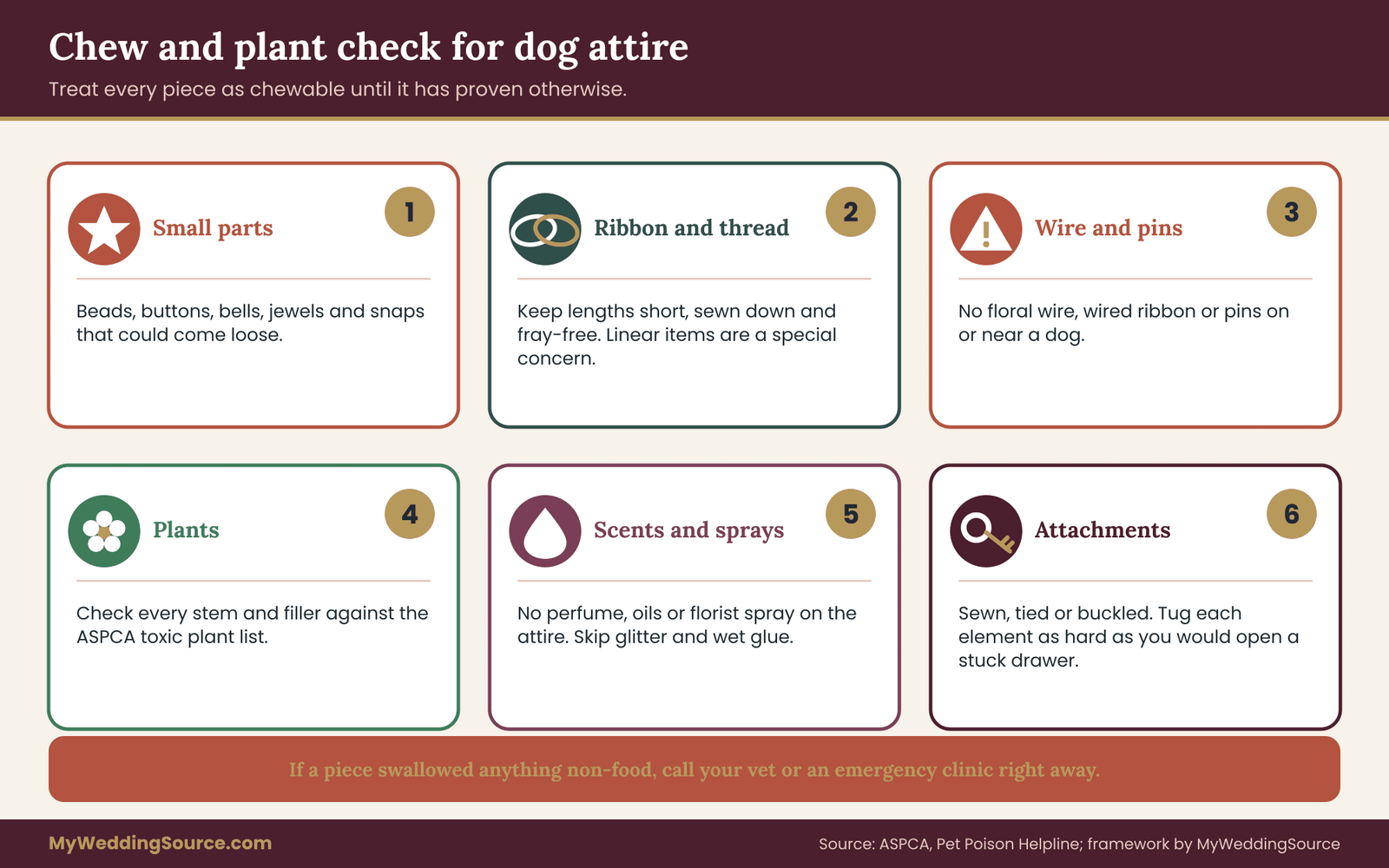
Go through each piece slowly and answer these questions in writing. Is there anything small enough to swallow that could come loose, such as a bead, button, jewel, bell or snap? Is there a length of thread, ribbon, string or elastic longer than a few inches that the dog could swallow? Is there wire, including the thin floral wire used in artificial flowers and wired ribbon? Is there glitter or loose decoration that sheds? Is there glue, paint or dye that has not fully cured, or fabric that has a strong smell?
Linear objects deserve special respect. Veterinary sources describe string, ribbon and similar items as a particular concern when swallowed, because they can cause serious problems in the digestive tract. If a ribbon is part of your dog attire, keep it short enough that it cannot be reached and swallowed as a length, and sew or bond the ends so they cannot fray into loose threads.
Attachments that look secure and are not
Some items are held on with a pin, a snap, a hook-and-loop strip or a small clip. A pin is never acceptable on a dog. A snap or clip that releases easily can also release under a dog’s paw or tooth. Hook-and-loop strips can catch on fur, and the rough side is irritating against skin. Choose sewn, tied or buckled attachments, and check that every stitch is intact by tugging firmly on each decorative element before the dog wears it.
A useful trial is the tug test. Pull each decorative element with moderate force, about the effort you would use to open a stuck drawer. If anything shifts, frays or comes away, the item fails gate two until it is repaired.
Edible and tempting materials
Not every hazard is small and sharp. Some are attractive. A bow tie made of faux leather, a collar scented with a florist’s spray, or a bandana soaked in something that smells like food will draw a dog’s mouth. Avoid any scented product on the dog attire itself, including perfume, essential oils and sprays, which can irritate a dog’s nose and skin. Keep the dog away from cake, dinner food, drinks and bouquet cuttings as well, because the first time the dog discovers a tempting item is often right after a garment makes it look like a guest.
Chocolate, grapes and raisins, xylitol-sweetened foods, onions, alcohol and some nuts are well-known dangers to dogs, and a wedding has all of them within reach at some point. The dog attire plan should include a line about food, such as who feeds the dog, where it eats, and who watches for dropped items. The ASPCA Animal Poison Control Center and the Pet Poison Helpline both publish lists of common household toxins, and both operate emergency lines you should save in your phone before the wedding.
Repairs, spares and the “what if it breaks” plan for dog attire
Bring a spare for each critical item. If the bow tie fails, a second one in the same style lets the dog stay in the picture without improvisation. If a decorative collar breaks, the plain collar that is always on underneath keeps the dog safe. Keep spares in the handler’s kit, labeled, and agree on a rule: when in doubt, the decoration comes off and the plain gear stays.
Plan for what a chewed piece means, too. If the dog swallows something that is not food, or you cannot tell whether it did, call your veterinarian or an emergency clinic, and keep the packaging or a matching piece so they can see what it was made of. Do not wait for symptoms to appear. Save the numbers of an emergency veterinary hospital near the venue and near the reception hotel before the day.
Flowers and greenery in dog attire
Floral dog attire is the most requested style and the one most worth treating carefully. A flower crown or a collar of blooms looks lovely, and it also puts plant material right at the dog’s mouth, on a body that cannot tell you what is safe.
Check every plant, every time
Plants vary widely in how they affect dogs. Some are mild irritants, some cause stomach upset, and some are dangerous. The ASPCA publishes a searchable list of plants toxic and non-toxic to dogs, cats and horses on its website. Use it for every stem in the arrangement, and ask the florist for the common and botanical names, because florists use trade names that do not always match the list.
Do not rely on a florist’s assurance that something is “pet safe” without seeing the names. Ask for the full ingredient list of greens and fillers, not just the flowers, since foliage and fillers are the parts that most often turn out to be a problem. Be careful with bulbs, seeds, and anything that has been treated with preservatives or sprays.
Fresh, dried, silk or none
Each choice has trade-offs. Fresh flowers can be checked against a toxicity list, but they wilt, drop petals, attract insects and may have been sprayed. Dried flowers shed and crumble and are easy to inhale or swallow. Silk and fabric flowers avoid toxicity but bring wire stems, glue and small parts, which are chew hazards of their own. Paper flowers dissolve in rain.
A practical compromise is a very small number of fresh, checked flowers attached to a collar the dog already wears, built by someone who understands the safety rules and replaced if anything droops. Another is a fabric flower sewn tightly, with no wire and no small parts, in place of fresh blooms. Ask your florist to prepare a sample you can test at home, and compare it to the guidance in the wedding vendor contract article so the florist’s agreement covers last-minute changes.
Floral crowns, collars and wreaths
Full flower crowns on dogs are a common photo idea and they usually fail the three-gate check. A crown sits near the eyes and ears, may need elastic or ties around the head, and puts fresh plant material at the nose. Most dogs dislike having anything on their heads, and the signs of stress, such as ear flattening and head shaking, show up quickly.
A floral collar is a better option, built on a flat collar the dog already wears. Keep it narrow, with the flowers on the top or side of the neck, not under the chin. Check that nothing sticks out where it could catch on a sleeve or chair, and that the stems are short, cut cleanly, and wrapped in a way that leaves no wire exposed.
Greenery, thorns and sap
Roses can have thorns, eucalyptus and some other greens carry oils that can bother dogs, and some common wedding greens and flowers appear on toxic plant lists. Evergreen sprigs can be sharp. Anything with sticky sap will transfer onto fur. Ask the florist to remove thorns and to choose greenery that appears on a non-toxic list, or to use none.
Lilies are the best-known example of a plant that is dangerous to cats, and a venue with a cat, or a guest who brings a small animal, makes that a real concern for the arrangement on the table, not only the one on the dog. Treat the whole room as a dog and cat space when deciding on flowers.
Wilting, wetting and the one-hour rule
Fresh flowers on a dog do not last a full wedding day. Heat, movement and the dog’s own body temperature shorten their life. Plan to put the floral piece on as close to the ceremony as the schedule allows, and take it off after photos and the processional. Many couples find that about an hour is realistic, and the one-hour limit is a planning figure that you should adjust to your dog’s tolerance and the weather, not a rule.
Replace the floral piece rather than patching it. A wilted piece with loose stems and shed petals is a bigger hazard than a fresh one, and a florist can make a second small piece cheaply when it is part of the original order. The third infographic gives a plant, material and attachment check you can hand to the florist.
Gate three: reading your dog’s stress response to dog attire
Gate three is the one that decides whether a perfectly fitted, perfectly safe item can still be used. A dog that is physically fine in an outfit can be miserable in it, and misery shows up as behavior. Learning to see that behavior early is the most useful skill in this whole guide.
What stress looks like in a dog
Dogs communicate with their whole bodies, and the signals are small. Behavior organizations such as the American Veterinary Society of Animal Behavior publish guidance on how to read and respond to them. Here are the signs most relevant to dog attire, grouped by how urgently they call for action.
Early signs include lip licking when there is no food, yawning that does not seem sleepy, turning the head away, a slower or stiffer walk, looking at you repeatedly, and ears held lower or further back than usual. These are signals to pause and reassess, not to push on.
Stronger signs include freezing in place, whale eye, where the whites of the eyes show as the dog looks sideways, a tail held tight or tucked, panting when it is not hot, trembling, trying to back out of the dog attire, scratching or biting at it, and refusing treats that the dog normally takes eagerly. Any of these means the dog attire should come off, calmly and without a fuss.
Escalated signs include growling, snapping, hiding, trying to bolt and sudden soiling. At this point the priority is the dog’s safety and the safety of nearby people. Remove the item, give the dog space, and do not treat the behavior as disobedience.
The treat test
The simplest measure is whether the dog will take food in the outfit. A relaxed dog takes a treat gently and keeps interested in more. A stressed dog may refuse, take it hard, or swallow it without chewing. Make the test fair by using a treat the dog loves, and by trying it in a quiet spot first and then in a place with some distraction.
The treat test is not about bribing the dog into acceptance. If the dog only tolerates the dog attire while being fed constantly, and stops as soon as the food ends, that is a hold at best. The goal is a dog that is comfortable in the item, not a dog that is distracted from it.
Freeze, flight, fight and fawn
Dogs respond to discomfort in different ways. Some become noisy and obvious. Others go quiet, which is easy to mistake for good behavior. A dog that stands still with a stiff body while a stranger fiddles with its bow tie is not calm. It may be holding still because it does not know what else to do.
If your dog is a freezer, look at the muscles and the eyes, not just the movement. A relaxed dog has a soft face, soft eyes and a loosely moving body. A dog under strain looks tight in the jaw, forehead and shoulders, and may hold its breath. When you cannot tell, treat it as a hold, and get a second opinion from your trainer or veterinarian.
The ten-minute trial
The trial is the test for gate three, and it is simple. Put the full wedding set on the dog in a quiet place and note the time. Give a treat. Then spend ten minutes doing something the dog enjoys, such as a short walk, a game of gentle tug, a sniff outside or a snack. Watch for signals, and write down any you see with the time.
At the end, remove the set calmly and give a treat. Watch for a few minutes afterward. A dog that shakes off dramatically, scratches the area, or seems relieved is telling you something. A dog that carries on as normal has probably been fine.
The trial has a pass rule: no strong or escalated signs at any time, at most a few early signs in the first two minutes that fade, and a normal appetite and interest throughout. It has a hold rule: signs that do not fade, or that appear only in busier surroundings. And it has a fail rule: any strong sign, any refusal to move, or any attempt to remove the dog attire.
Why the first minute lies
Dogs often accept a new item in the first moments, particularly if food is involved, and then show discomfort later, once the novelty fades or the item shifts. That is why the trial runs for ten minutes and why the fitting includes movement. Judge the dog in the minutes after the first minute, not during it.
Conditions matter too. A dog may do well in your living room and badly in a crowd, which is why the schedule below includes a trial in a more stimulating setting. The behavior you see at a quiet kitchen table is the best case, and wedding conditions are not the best case.
Individual differences in how dogs accept dog attire
Breed and age influence tolerance, but not as much as history. A dog that has worn raincoats and sweaters for years will accept a bow tie more easily than a dog that has never worn anything. A dog that was well socialized to handling by strangers will cope better with guests touching the dog attire. A dog that startles at noise, or that has had bad experiences with clothing, may never be comfortable.
Respect that. Some dogs do not wear attire, and that is a normal result. The same dog may be the star of the day without a single item on it, because the dog is the attraction. A dog that is allowed to opt out of dog attire is usually a calmer wedding dog, and the checklist is useful because it lets you reach that decision early and without guilt.
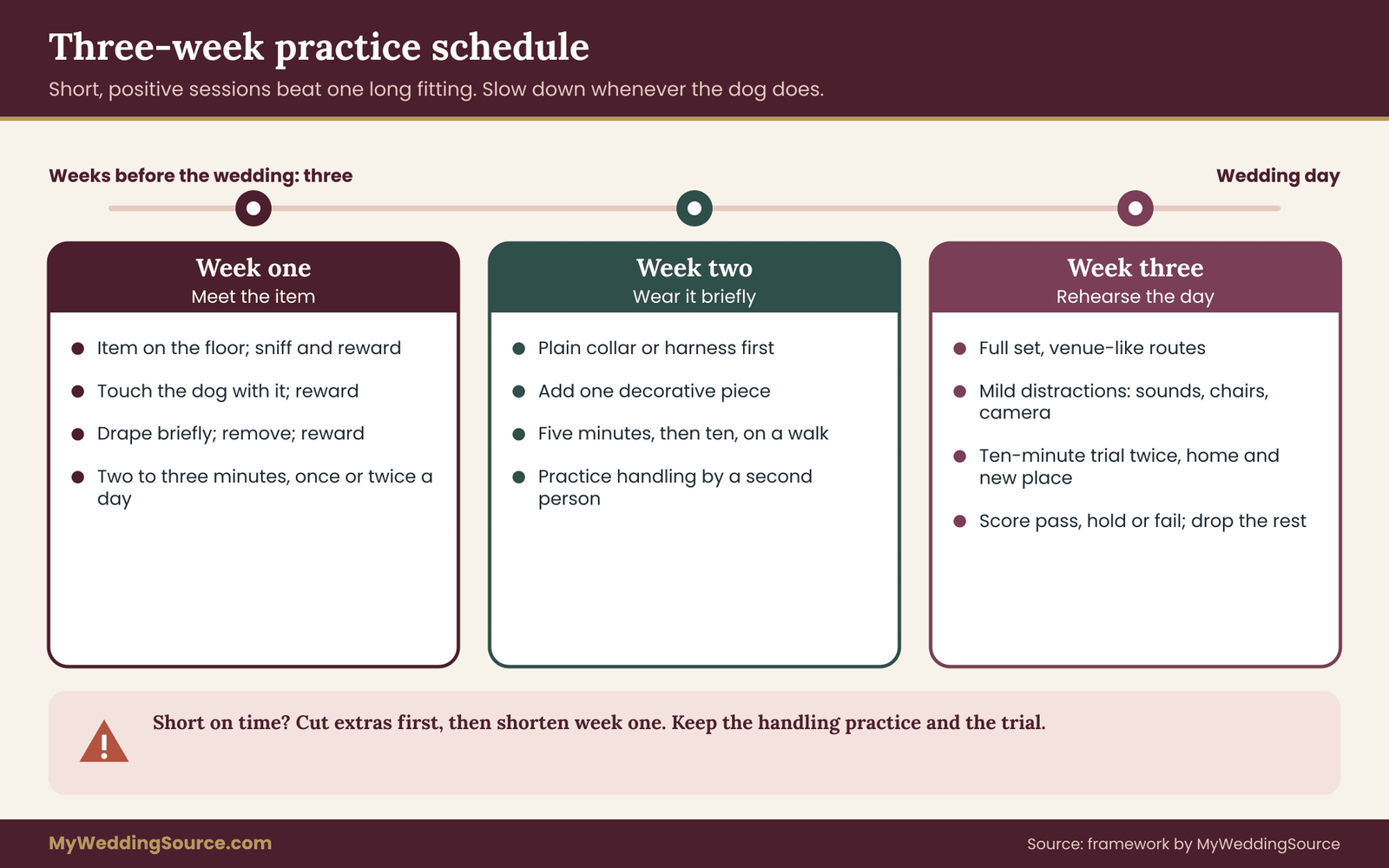
A three-week practice schedule for dog attire
A dog that can wear something comfortably has usually been taught to, in small steps, with food and choice. The schedule below is a planning framework built on the common idea of gradual, positive introduction. It is not a veterinary protocol, and a trainer can adapt it to your dog. If your dog has a history of fear, anxiety or aggression, start with a veterinary behavior professional instead.
Week one: introduction without wearing
In the first week, the dog meets each piece of dog attire without wearing it. Place a bow tie, bandana or collar on the floor and let the dog sniff it. Reward calm curiosity. Touch the dog with the dog attire, then reward. Lay it briefly over the neck or back, then reward and remove it. Sessions are about two to three minutes and happen once or twice a day. Stop while the dog is still interested.
The goal in week one is not to dress the dog. It is to make the item predictable and linked to good things. If the dog backs away or looks tense, go back one step and slow down. Do not hurry to make up for lost time, since a rushed introduction can create the stress response you were trying to avoid.
Week two: wearing for short periods
In the second week, the dog wears each piece of dog attire for a few minutes at a time, starting with the plain collar and harness the dog will wear underneath. Add the decorative piece, give a treat, and do something pleasant, such as a short walk. Increase the time gradually, to five minutes and then ten, and always end with the dog attire coming off while the dog is still relaxed.
Also add handling. Have a second person, preferably someone the dog knows, adjust the piece, straighten the bow tie, and touch the dog near the neck and shoulders. At the wedding, guests, the photographer and relatives will do exactly this, whether or not they are supposed to. A dog that has practiced is more likely to cope.
Week three: rehearsal in conditions that resemble the day
In the third week, rehearse the real sequence. The dog wears the full set, goes through the same routes it will use at the venue, and meets some mild distractions, such as another person, a sound recording, a chair being moved or a camera. If your venue allows a walk-through before the event, use it. If not, a park or a friend’s garden gives you a similar mix.
Run the ten-minute trial at least twice in the week, once at home and once somewhere new. Record the result in the three-gate sheet and decide which items pass. Anything with a hold or fail is dropped or replaced now, not on the wedding morning.
Compressed schedules for dog attire
If you have less than three weeks, cut in this order. First, drop extras, such as a second garment or a floral piece. Second, shorten week one by using only the items you are sure you want. Third, keep the handling practice, because it is the part of the schedule that most directly resembles the day. Do not cut the ten-minute trial. It is the cheapest and most informative part of the process.
With less than a week, the safest choice is usually the plain collar or harness the dog already wears, plus one small accessory that is easy to remove, and nothing else. A dog that has never practiced and wears nothing new is a calm dog. A dog in an untried costume is a gamble.
Keeping the practice positive
Use food the dog loves, keep sessions short, and stop before the dog loses interest. Avoid forcing, scolding or laughing at the dog’s reaction, because dogs read that as pressure. Praise calm behavior and let the dog walk away if it needs to. A dog that chooses to come back to the item is learning that it is safe.
The fourth infographic lays out the three weeks as a calendar with the signals to watch at each stage and the points at which to slow down or stop.
Bow ties, bandanas, vests and weather: choosing dog attire for the day
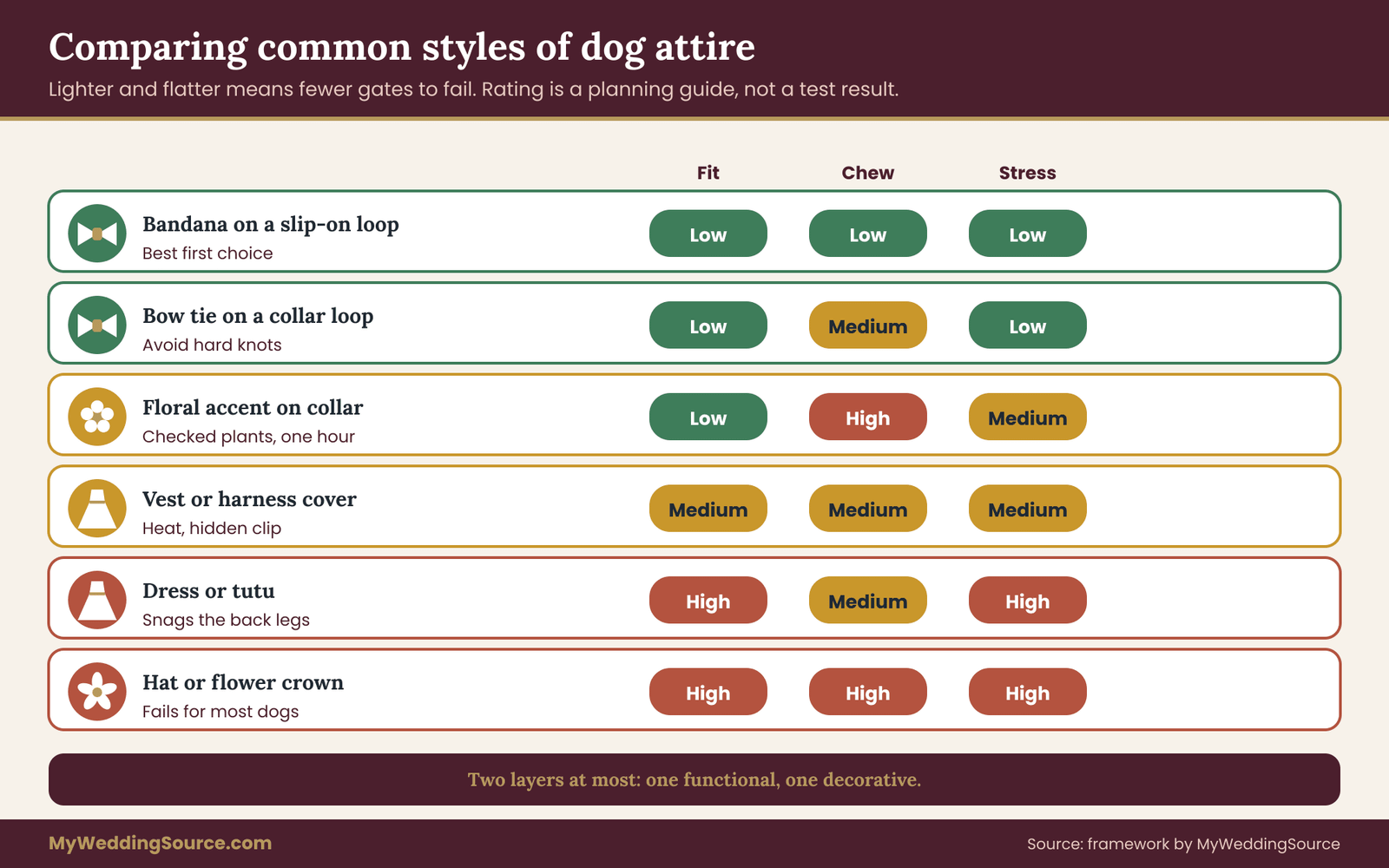
Once a piece of dog attire has passed the three gates, you still have to choose among the options, and the choice depends on the dog, the season and the schedule. This section compares the common styles of dog attire in prose, with the trade-offs a photographer’s mood board never mentions.
Bow ties and neckwear
A bow tie on a flat collar is the lowest-risk form of dog attire because it adds almost no weight and sits where a collar already is. Choose one that slides onto the collar band through a loop, not one that has its own elastic or a hook closure. Keep the fabric lightweight, the ties short, and the stitching tight. Skip anything with a hard center knot, which can poke into the throat when the dog lies down.
A bandana is a close second. It lies flat on the chest, can be tied loosely or snapped on, and gives room for a color or a pattern without adding bulk. The weak point is the tie. A bandana tied tightly in a knot at the back of the neck can slip forward and press on the throat. A slip-on style that threads through the collar avoids the knot completely. In warm weather, thin cotton is better than synthetic fabric, and a damp bandana can help cool a dog, although it should not stay wet for hours.
A neck wreath or bib is a larger piece. It looks striking and also fails more often, because it covers more of the neck, moves more, and gives a dog more to grab. Treat it as a gate-one risk and test it in motion before deciding.
Harness covers, vests and dresses
A vest or harness cover goes over the body and can hide the harness underneath, which looks neat in photos. The risks are heat, restricted movement and hidden hazards, such as a clip that you cannot reach. Choose a light, breathable fabric, make sure it does not cover the hips or restrict the shoulders, and check that the leash clip remains accessible.
A dress or tutu is the riskiest on the body. The skirt hangs behind the dog, can catch under a back leg when the dog sits, and brings a lot of fabric near the toilet area. If you want a skirt effect, a very short, lightweight piece attached to the harness is better than a full-length one. For many dogs, any garment that wraps the hindquarters will fail gate three.
Hats, headpieces and anything near the face
Hats, flower crowns, glasses and anything that sits on or near the head fail the three-gate check for most dogs. They block the view, trap heat, interfere with the ears, and often need a strap under the chin. The signals of discomfort, such as head shaking and ear pinning, appear within seconds. Unless the dog has a long history of wearing a hat without complaint, leave it out.
Shoes and boots are a separate case. They have real uses for protecting paws on hot ground or sharp surfaces, and some dogs get used to them. But a dog that has not practiced will walk oddly and may chew them off. A decorative boot is not worth the risk.
Weather, heat and cold
Weather changes the safe range of attire for a dog. Dogs cool down mainly by panting and through their paw pads, not by sweating through the skin as people do, so a layer of fabric over the body or neck can reduce their ability to lose heat. The American Veterinary Medical Association and other veterinary organizations warn that heat is a serious danger for dogs, and short-nosed, older, overweight and thick-coated dogs are at greater risk.
On a warm day, take as much off as you can. Choose a thin bandana or a single bow tie in place of a vest, shorten the time the dog wears anything, provide shade and water, and remove the dog attire between the ceremony and the photos. Hot pavement and dark surfaces can burn paws, so test the ground with the back of your hand before the dog walks on it.
On a cold day, a coat or sweater may be a real need, especially for small, short-coated, senior or thin dogs. If the dog needs one, make it part of the practice schedule and choose one that is dry, fitted and in a color that works with your palette. A dog does not need a bow tie over a winter coat.
Rain and wet grass change the plan. Wet fabric gets heavy and cold, and tulle and paper flowers fall apart. A waterproof cover that the dog already knows is a better choice than a new item that has never been wet. Check the forecast ahead of time and have a dry alternative ready.
Ground, surfaces and venue conditions
A venue with gravel, wood chips, thistles, burrs or uneven stones affects what the dog should wear on its body, too. Long ribbon, hanging tulle and floral trails pick up debris. Ground-level items catch on fences, steps and chair legs. Stairs and narrow aisles also matter for any garment that sticks out.
Ask the venue about surfaces, treatments and obstacles. Spray, weed killer and lawn chemicals can be present on grounds, and a venue should be able to tell you what has been applied and when. The wedding venues guide lists questions worth asking about access and rules, and the same approach works for questions about a dog.
Colors, patterns and what the camera sees
Dog attire looks best when it complements the dog, not when it fights the coat. A black dog disappears in dark fabric, and a white or cream dog can wash out against pale items. Mid-tone colors, a single accent that matches your palette, and plain materials usually photograph well and also avoid the shiny, reflective trims that can bother a dog’s eyes. If you have chosen a palette, the wedding color palette guide can help match the accessory to the rest of the wedding.
Matching the dog to the wedding party does not require matching each piece of dog attire. A bow tie in a color from the bridesmaid dresses or the groom’s pocket square ties the dog to the group without extra pieces.
A short decision rule for dog attire
Choose the lightest item that does the job. If the dog is calm and used to a collar, a collar accessory is enough. If the dog needs a harness, use the harness it already wears, and add at most one flat decorative piece. If the weather is hot, use less. If the dog has shown any stress in the trial, use nothing but the plain gear.
Cats, rabbits and other animals
Everything in this guide centers on dogs, because dogs are the animals most often dressed for a wedding. Cats, rabbits, birds and other animals have different bodies and different risks, and they are rarely suited to clothing at all. If another animal is part of your plans, speak to a veterinarian who treats that species before putting anything on it, and expect the answer to be no.
The fifth infographic compares the common styles of dog attire on three scales: how much risk each adds at the fit, chew and stress gates, so you can see where each option sits before you buy.
A worked example of dog attire: two dogs, two different answers
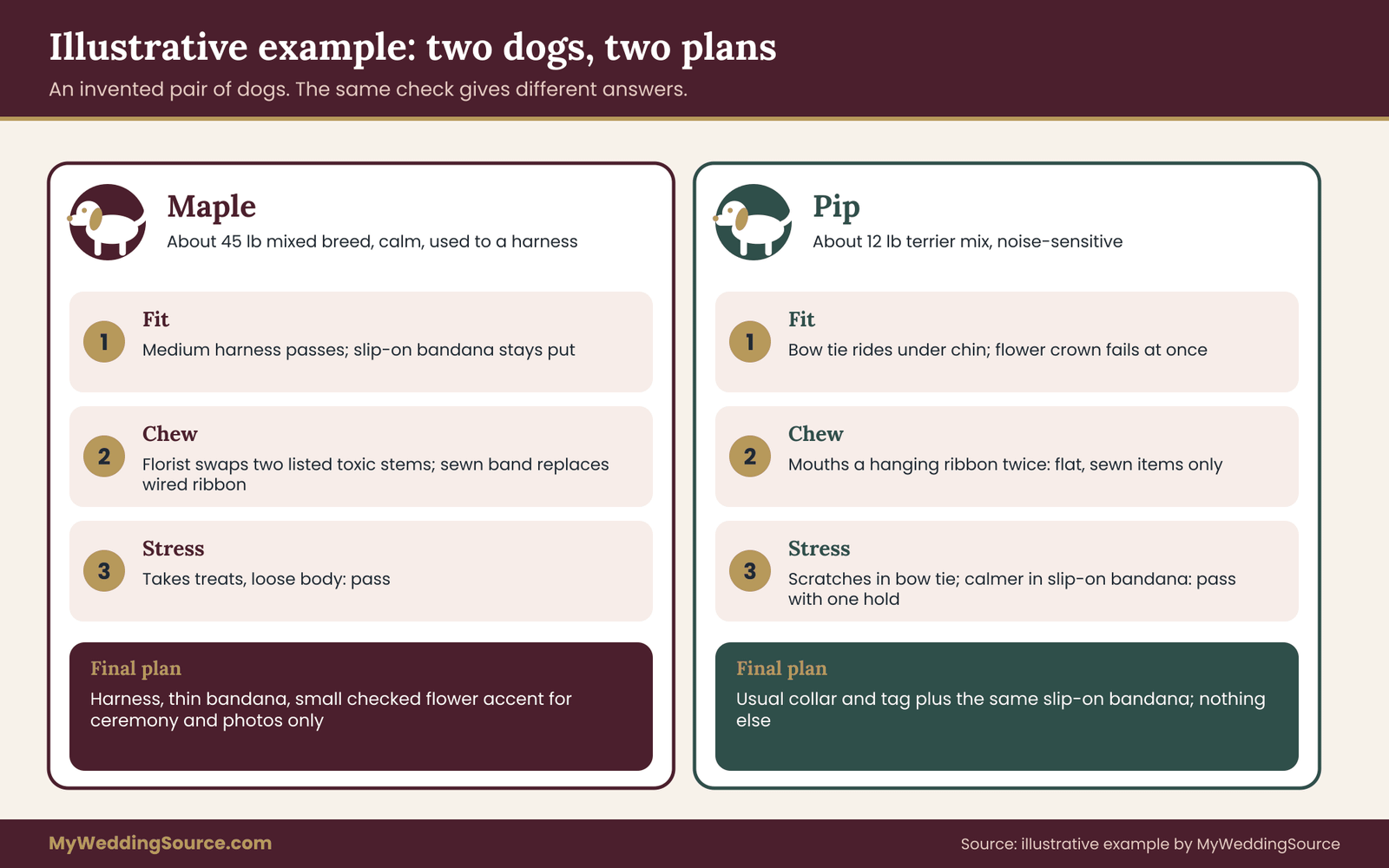
The example below is invented for illustration. It is not a case study of real people or a real wedding, and the numbers are examples, not recommendations. It shows how the three-gate check turns into decisions and how the same plan can give opposite answers for two dogs.
The setup
A couple plans an outdoor afternoon ceremony in early summer with about eighty guests. They have two dogs. Maple is a mixed-breed dog of about forty-five pounds, calm with people, used to a harness and to wearing a raincoat in winter. Pip is a small terrier mix, about twelve pounds, friendly but sensitive to noise and quick to scratch at anything on its neck.
The couple wants both dogs in the processional and in photos. Their first idea is matching floral collars, bow ties, and a small flower crown for Pip. A friend who knows both dogs, and who will handle them on the day, agrees to run the check.
Fit results
The friend measures both dogs at a fitting five weeks before the wedding. Maple’s chest girth and neck fit a medium harness with room to adjust, and the two-finger check passes at the neck and chest. A bandana on a slip-on loop stays in place through the walking, sitting and shaking test. Pip’s neck is narrow, and a bow tie that came with a size small collar rides up under the chin whenever Pip lowers its head. That is a fit hold.
The flower crown is a fail for Pip at once. It tilts over the eyes when Pip tips its head, and the elastic leaves a mark on the fur after a few minutes.
Chew results
The florist offers a fresh collar with several kinds of blooms and a wired ribbon. The friend asks for a list of plants and checks it against the ASPCA’s toxic plant list. Two of the stems are listed as toxic to dogs, so those are swapped. The wired ribbon is replaced with a short, sewn fabric band. The result is a narrow floral piece that passes, on paper, for Maple.
For Pip, the friend watches how it reacts to a ribbon tail hanging near its mouth. Pip mouths the end twice within a minute. That is a fail for any hanging ribbon on Pip, and the group decides that any decoration for Pip must be flat and sewn down.
Stress results
In the ten-minute trial, Maple takes treats, walks around the yard with a loose body and shakes off the bandana only once, when it is removed. Maple passes. Pip, in the plain bow tie and collar, stays near the friend, lip licks several times, and scratches at its neck twice in the first five minutes. After the dog attire is removed, Pip shakes and returns to normal at once.
The friend repeats the trial with a bandana on a slip-on loop, a different style, and gets a calmer result: no scratching and one lip lick in the first minute. That is a pass with one hold, to be watched on the day.
The final plan
Maple wears its usual harness, a thin bandana on a slip-on loop in the wedding color, and a small checked floral accent on the collar for the ceremony and photos only. Pip wears its usual collar and tag, and the same style of bandana. Neither dog wears a hat, a vest or a bow tie. Each dog has a handler, a spare bandana, and a plain collar kept in the kit. The dog attire comes off after the family photos, before the cocktail hour.
The result is not what the couple first pictured, and it is a better plan. It also took four short sessions and a single florist conversation, which suggests the checklist is cheap compared with how much it can save.
What the example shows
The same check produced different answers for two dogs because the dogs are different, and a rule that applies to one dog may not apply to another. It also shows the value of testing in the order of the gates, since each fail or hold pointed to a specific change. And it shows that “no” often means a smaller version of the idea, not no dog.
The sixth infographic follows the two dogs through the gates, so you can compare the route each one took to its final outfit.
Vendor questions and the wedding-day plan for dog attire
Dog attire touches several vendors, and each one can help or undermine the plan without knowing it. The florist decides what plants go near the dog, the groomer decides how the coat looks and feels, the photographer decides how long the dog stands still, and the venue decides where the dog may go. A short list of questions to each, asked early and recorded, prevents most surprises.
Questions for the florist
Ask for the common and botanical names of every flower, green and filler in any piece that touches or sits near the dog. Ask whether anything has been sprayed, dyed, glittered or treated with preservative. Ask whether the piece uses wire, tape, glue or pins, and how each is covered. Ask how long the fresh pieces last in warm weather, and whether the florist will make a second piece for later in the day.
Ask, too, what happens if the dog fails the trial. A good florist will agree to swap a dog piece for a different item, such as a handler’s boutonniere or a table arrangement, without a penalty, if you tell them in time. Put that agreement in writing, with the date by which you must decide. The wedding vendor contract guide explains how to record this kind of change, and a short email thread is better than a spoken promise.
Questions for the groomer and the veterinarian
Ask the groomer to avoid scented sprays, glitter, dyes and bows on the day of the wedding, and to leave the neck and chest coat in a state that you can fit over. Schedule the groom for a few days before, not the morning of, since a fresh trim can make skin sensitive and a freshly bathed dog is slippery in a harness.
Ask your veterinarian three things. Is there any health issue, such as skin conditions, joint problems, breathing difficulty, or heat sensitivity, that should limit the dog attire? Is the dog current on the vaccinations and preventives that the venue or a guest might ask about? And what is the nearest emergency clinic to the venue? The AVMA and other organizations publish general guidance on pet health, and your own veterinarian can turn it into advice for your dog.
Questions for the photographer
Ask how much time the photographer expects to need with the dog, and agree on a cap, such as a few minutes at a time, with breaks. Ask whether they are comfortable photographing animals, and whether they will accept direction from the dog’s handler. Share the stress signs the handler will watch for, and agree that a call to stop from the handler ends the shot immediately.
Ask the photographer to avoid flash close to the dog’s face and to avoid calling the dog or making sudden noises to get a reaction. A dog that startles may pull away or bolt, and a loose attire piece makes any scramble more dangerous. If you want portrait time with the dog, schedule it early, while the dog is fresh and the dog attire is neat. The wedding family photo list guide can help you slot the dog into the sequence without extending anyone’s wait.
Questions for the venue and planner
Ask whether dogs are permitted, in which areas, and under what conditions, such as leashes, vaccination proof, a handler, a deposit or a cleaning fee. Ask what surfaces and treatments the grounds have, where the dog can relieve itself, where shade and water are available, and whether there is a quiet room for the dog to rest. Ask whether the insurance or the venue contract covers animals, and whether the venue has rules about where the dog may be during food service.
Venue rules outrank aesthetic plans, and they are not always posted. Ask in writing, and keep the reply. Many venues limit animals in food areas, near open flames or on dance floors, and the plan for attire should match those limits. The planning guidance in the wedding venues guide shows how to ask for these answers in a way that produces a written reply.
Scripts that make the conversation easier
Short, plain wording works best. To a florist: “Our dog may wear a small piece. Could you send me the full plant list, and confirm there’s no wire or pins?” To a photographer: “Our handler will call time on dog photos if the dog shows stress. Is that fine with you?” To a guest who wants to adjust the bow tie: “Thanks, he’s easily stressed. Our friend will handle that.”
Give the handler a sentence they can use without apology: “He’s working, so we’re keeping him calm. Please don’t touch the outfit.” Many guests are glad to be told what to do, and few take offense when the request is calm and friendly.
The wedding-day sequence
On the day, the plan for dog attire runs on a short timeline. Feed and walk the dog on its normal schedule, with enough time to relieve itself before dressing. Put on the plain collar or harness first, then check it, then add any decorative piece as late as practical, ideally a short time before the ceremony. Give treats during dressing. Do a quick look for rubbing, loose parts and early signs of stress, and note the time.
During the ceremony or photos, the handler stays within reach and watches the dog, not the couple. After photos, the dog attire comes off, and the dog gets water, shade and rest. If the dog is staying for the reception, it wears only its plain collar and tag. The rest of the schedule belongs in your overall day-of plan, such as the one in your master schedule.
The removal point
Decide in advance when the dog attire comes off, and write the time on the schedule. A removal point turns a vague hope into a plan. It could be after the processional, after the family photos, or at the first sign of stress or heat, whichever comes first. Name who removes the dog attire and where they do it, such as a quiet area behind the ceremony space.
Without a removal point, attire tends to stay on all day. A dog that wears a bow tie for six hours in a crowd, with people leaning in, is likelier to rub, overheat and get stressed than one that wears it for thirty minutes. Treat the removal point as part of the plan, not an admission of failure.
The kit for dog attire
A small bag with the following goes with the handler. A spare collar and leash. A spare bandana or bow tie. Water and a collapsible bowl. A towel. Treats. Waste bags. Blunt-tipped scissors. A printed card with the dog’s name, the veterinarian’s number, the nearest emergency clinic and the poison control numbers. A written list of the plants used in any floral piece.
Include the dog’s medications if it takes any, and a note on how and when to give them. The handler is the dog’s advocate during the event, and the kit gives them the tools to act.
Who is the handler
The handler should be a calm, reliable adult who knows the dog, who is not in the wedding party’s most demanding roles, and who is willing to leave the party early if the dog needs it. A child is not a handler, however eager. A family member who is also a bridesmaid or an usher may be too busy. A friend who is happy to spend the afternoon with the dog is a better choice than a relative who will be pulled in a dozen directions.
If you want more detail on the care and supervision side, the wedding guest care planning guide covers how to arrange hand-offs for people who need attention, and the same logic applies to an animal.
Insurance and liability notes for dog attire
A dog at a wedding is a liability question as well as a welfare one. A guest can be startled, bitten or knocked over, and some venues require proof of insurance or a signed waiver. Ask the venue what it requires, and ask your own insurer or the venue’s insurer what a policy does and does not cover. Do not assume a wedding insurance policy covers animal incidents.
The seventh infographic shows the day-of timeline for dog attire, from the morning walk to the removal point, with the handler’s tasks and the stop signals at each stage.

Edge cases and alternatives to dog attire
Some situations do not fit the standard check, and some dogs do not wear anything at all. This section covers the common edge cases and gives you ways to include a dog without dressing it.
Service animals and working dogs
A service dog is not a pet in costume. Under the Americans with Disabilities Act, a service animal is a dog trained to do work or perform tasks for a person with a disability, and the U.S. Department of Justice explains how the rules apply to businesses and venues. Do not ask a guest about their disability, and do not decorate a working dog without the handler’s agreement. Many handlers prefer that nothing be added to the dog’s gear, since it can distract the dog or interfere with its work.
If the person with the service dog is a member of the wedding party and wants the dog included in the photos, ask them directly what would be comfortable and follow their answer. The same courtesy applies to emotional support animals and therapy dogs, whose handlers have their own preferences and whose legal status differs from a service animal’s.
Puppies, seniors and dogs with health conditions
A puppy is learning about everything, and the three-week schedule may be too long or too short depending on its age. Puppies chew more, grow quickly and tire fast. Keep any attire to a minimum, and ask your veterinarian whether the dog is ready for a crowd. A senior dog may have arthritis, poor eyesight or hearing, or lower tolerance for heat and noise, and the safest attire is often nothing but the plain collar.
Dogs with skin allergies, wounds, recent surgery, breathing problems or heart conditions need advice from a veterinarian before anything goes on. If a health condition limits what the dog can wear, treat that as the answer and move on to the alternatives below.
More than one dog
Two dogs add a second set of fit, chew and stress questions, and they also add dog-to-dog interaction. Dogs can chew each other’s attire, tangle leads, or respond to one another’s stress. Assign one handler per dog, fit and trial each separately, and then trial them together. Avoid matching items that invite play or tugging, such as dangling ribbons.
A dog that refuses dog attire
A dog that fails gate three has given a clear answer. Do not keep trying in the final days, since repeated attempts can turn mild dislike into a lasting fear. Switch to the alternatives below, and take pride in a plan that respects the dog. Guests will remember a happy dog far more than the bow tie.
Dogs that change their minds on the day
A dog that passed every trial can still refuse on the day, because the setting is new, the schedule is long, or something has startled it. The handler should be ready to remove the dog attire without discussion. A few minutes in a quiet place, with water and a treat, often resets the dog, and a dog that stays tense should be given a rest or sent home with a friend.
Strangers who touch the dog
Guests will want to pet, hug and adjust a dog in attire. A small sign near the dog’s area, or a polite word from the handler, helps. Ask guests to ask first, to let the dog sniff them, and to avoid touching the head and neck. Children need an adult beside them, and the dog should have somewhere to retreat.
Cultural and religious considerations
Some families have traditions around animals, flowers, colors and clothing, and some guests are afraid of dogs or have allergies, or have religious views about dogs. Ask the relevant guests early, plan seating and routes to match, and keep the dog’s attire simple so that it does not add to the discussion. A dog-free zone for guests who need one is a kindness and a practical solution.
Alternatives that include the dog without dressing it
If the dog will not wear dog attire, or you decide the risks are not worth it, there are many ways to include it. The handler can wear a small floral accent that matches the dog’s colors. A leash can be a plain, well-chosen color, with no ribbon. A framed photo of the dog can sit on the memory table or at the entrance. A dog’s name can appear on the program or on a sign. A professional pet portrait session before the wedding can give you photos without the crowd.
You can also give the dog a role with no attire. A dog that walks calmly with a handler on the edge of the processional, or that appears in a posed photo at a quiet moment, needs nothing more than its collar and tag. A dog with a bow tie that it dislikes looks worse than a dog in its own fur with a happy face.
Sustainability and reuse
Items made for one day often end up in the trash. A plain collar or bandana in a color the dog can keep wearing is a better buy than a single-use piece. If you buy decorative pieces, choose materials that are washable and reusable, and avoid glitter and plastic. The same reasoning applies to flowers, which can be composted when they are not treated, although a veterinarian or the ASPCA list should confirm that no part of the plant is a danger to wildlife or pets in your yard.
Accessories for the people around the dog
The handler and any family members who walk the dog can carry the style. A matching pocket square, a small ribbon on a wrist corsage, or a sash in the same fabric as the dog’s bandana makes the group look coordinated. The wedding day accessories planning guide covers how to choose items that move well, fit comfortably and have a backup, which is a useful lens for the handler’s outfit as well.
Your next steps
Here is a short sequence you can start this week. Write down which gate each piece of dog attire has to pass, and treat the list as a working document.
First, decide who owns the check and who will handle the dog on the day. Second, take the four measurements and record them with the date. Third, list every piece of dog attire you are considering, and mark the materials, small parts, plants and fastenings for each. Fourth, ask the florist, groomer, photographer and venue the questions in this guide, and file the answers.
Fifth, begin the three-week practice schedule with the plain collar or harness, then add one decorative piece at a time. Sixth, run the ten-minute trial twice, once at home and once in a new place, and score each piece of dog attire as pass, hold or fail. Seventh, drop anything that is not a clean pass, and pack the kit, the spare items and the numbers for the veterinarian and poison control.
Finally, set the removal point on the schedule, tell your photographer and your helpers, and let the dog have a calm day. If you want the full picture of how the pieces fit together, the full planning checklist covers the rest of the planning.
FAQ
What is the safest dog attire for a wedding?
The safest option is the plain collar or harness your dog already wears, plus at most one flat, lightweight accessory, such as a bandana on a slip-on loop or a bow tie on a short collar loop. Avoid hanging ribbon, wire, small parts and anything near the face. Whatever you choose, test it on your dog for ten minutes first and remove it at the first sign of stress or heat.
How tight should a wedding collar or harness be on a dog?
A common rule of thumb is that you can slide two fingers flat under the strap without forcing them, and that the dog attire does not rotate or gap when the dog walks, sits, lies down and shakes. It is a rough guide, not a veterinary standard, and breeds differ. A veterinarian, trainer or professional fitter can confirm the fit for your dog, especially for short-nosed or very small dogs.
Are flower collars and flower crowns safe for dogs?
They can be, but only with care. Check every flower, green and filler against the ASPCA’s list of toxic and non-toxic plants, avoid wire, thorns and sprays, and keep the piece narrow and short-lived. Flower crowns fail the check for most dogs because they sit near the eyes, ears and nose. A small fresh accent on a collar the dog already wears is usually the better choice.
How long can a dog wear wedding attire?
There is no single figure, because it depends on the dog, the weather and the item. Many couples plan around an hour or less for decorative pieces, and remove them after the ceremony and photos. Remove anything sooner if you see panting that is not from heat, scratching, freezing or refusal of treats. In warm weather, shorten the time further and offer shade and water.
What signs show a dog is stressed by its outfit?
Early signs include lip licking, yawning out of context, turning away and a stiff walk. Stronger signs include freezing, whale eye, a tucked tail, trembling, scratching at the dog attire and refusing treats. Growling, snapping, hiding or trying to bolt are urgent. At any strong sign, remove the dog attire calmly, give the dog space, and do not treat the behavior as disobedience.
Can a dog wear a harness under a wedding outfit?
Yes, and for many dogs it is safer than a collar alone. Use the harness the dog already knows, keep the decoration light, and make sure the leash clip stays reachable and the straps are not pressed by a vest or cover. A new harness should go through the three-gate check and the practice schedule, since a harness that rubs or restricts movement will show up in the dog’s behavior.
What should I do if my dog chews part of its outfit?
Take away what is left, check the dog’s mouth gently, and call your veterinarian or an emergency clinic if you think anything was swallowed, especially ribbon, string, wire, beads or plants. Keep the packaging or a matching piece to show what it was made of. You can also call the ASPCA Animal Poison Control Center or the Pet Poison Helpline for advice, and do not wait for symptoms.
Do service dogs need wedding attire?
No. A service dog is a working animal, and many handlers prefer that nothing be added to its gear, since decoration can distract the dog or interfere with its work. Ask the handler what they are comfortable with and follow their answer. Do not ask guests about their disability. The U.S. Department of Justice explains how the Americans with Disabilities Act treats service animals at venues.
Sources
- American Veterinary Medical Association: pet owner resources
- ASPCA: toxic and non-toxic plant lists
- ASPCA Animal Poison Control Center
- Pet Poison Helpline
- American Veterinary Society of Animal Behavior
- U.S. Department of Justice, ADA: service animals
- Centers for Disease Control and Prevention: healthy pets
- American Animal Hospital Association: pet owner resources
- Humane Society of the United States
- U.S. Department of Agriculture: Animal Welfare Act information