
An audio guest book records guests speaking to you on a vintage-style handset or microphone, while a written guest book collects handwriting on paper, and the two differ most in privacy, how long they last, what they cost and how comfortable guests feel using them. This guide compares them on those four tests and ends with a file preservation plan for the audio guest book, so the recordings are still playable long after the wedding.
Pick a written guest book if you want something that needs no power, no files and no consent wording, and that older or quiet guests can use in ten seconds.
Pick an audio guest book if you want voices, laughter and stories that paper cannot hold. Before you book one, decide who may hear the recordings, get the original files delivered to you in a common format, keep three copies on two kinds of storage, and test playback once a year. Many couples do both: a short written page for names and a recorded line for those who want to speak.
A guest book is one of the quietest items on a wedding day. Nobody plans a reception around it, and it rarely appears in a timeline. Yet it is one of the few objects that comes home with you and gets opened again, on an anniversary or after a loss, when a photo is not enough. That is why the choice of format deserves an afternoon of thought instead of a quick click on a rental page.
The old format is simple. A book, a pen, a table. Guests write a line, sign, and move on. The newer format is the audio guest book: a rotary phone, a telephone-style handset or a small microphone that plays a greeting, waits for a beep and records whatever the guest says. The recording is then delivered to you as digital files, sometimes within days, sometimes weeks later.
Both formats do the same job, which is to capture who came and what they wished you. They go about it in different ways, and those differences are not cosmetic. A written page is visible to everyone who walks past, never needs a battery and can be damaged by a spilled drink. The audio guest book is private at the moment of speaking, depends on a device and a file, and can be copied a hundred times at no cost. Those facts drive almost every choice below.
This article stays on that one comparison between an audio guest book and a written book. It does not cover how to run a guest book table or how to prevent a line forming there. It does not cover every kind of video or photo keepsake either; for the wider question of what guests may photograph and share, see our guide to wedding photography consent. The focus here is narrow: how an audio guest book and a written book compare on privacy, longevity and cost, how to ask vendors the right questions, and how to protect whichever you choose.
A note on scope. This is general planning information, not legal, tax or financial advice. Recording rules, privacy law and product terms vary by state, venue and vendor, so confirm anything that matters with the issuing agency or the supplier, and read the current contract before you sign.
What each format does, and what couples actually want from it
Before comparing anything, it helps to name what you want the book to do. Couples tend to want one or more of five things, and the five do not all point the same way.
A record of who attended. A written guest book is very good at this. Names are legible, spelled by the guests themselves, and sit on a page you can flip through in two minutes. An audio guest book is weaker here. A guest may forget to say a name, may be known to you only by a voice, or may record a message so long that you cannot tell who it was without listening to all of it.
Messages you will reread. Handwritten notes can be skimmed. You read at your own speed, skip the dull ones and linger on the good ones. An audio guest book has to be listened to in real time, which is slower, but it carries tone, accent, humor and pauses that print flattens.
A keepsake of the day itself. A written book also stores the look of handwriting: a grandfather’s careful cursive, a child’s block capitals. An audio guest book stores something that handwriting cannot, namely voice. If a relative may not be alive in ten years, a recording of their voice is often what couples later say they are most grateful for. That is a human observation, not a statistic, and it is the strongest argument for an audio guest book.
A way for shy or distant guests to take part. Some people freeze at a blank page and do not know what to write. Others freeze at a microphone. Neither format is easier for everyone, a point we return to in the guest comfort section.
Something you can share or display. A written book can sit on a shelf and be browsed by visitors. An audio guest book produces files you may want to share with parents, which raises the privacy questions that fill much of this guide.
Why the choice is not only about taste
Many articles present this as a style decision: classic or modern, quiet or lively. That framing hides the practical consequences. The format you choose decides whether strangers can read guests’ words, whether an employee at a rental company holds copies of recordings, whether you must tell guests about recording, how you will store the result, and who can still open it in thirty years.
A guest who writes “wishing you both a long and happy life” is giving the couple a sentence. A guest who says the same thing aloud is giving the couple a recording of their voice, which is personal data in a way that handwriting usually is not. Most guests will not mind. A few will, and the format should make it easy for them to decline without drama.
It also changes your work after the wedding. A written book needs a safe place on a shelf and perhaps a scan. An audio guest book produces a folder of files that must be received, verified, backed up and eventually moved to new storage as technology changes. The extra steps are small if you plan them and annoying if you discover them later.
Three questions to answer first
If you read nothing else, answer these three before looking at any product.
First, who is the first person other than the two of you who will ever hear or read an entry? If the answer is nobody, the privacy tests become simple. If the answer is “the vendor’s staff” or “family at the rehearsal dinner,” you need rules.
Second, how long should the entries last? A weekend, a decade, a lifetime? The answer shapes the storage plan more than any product feature does.
Third, who must be able to take part without help? Think of the guest who is hard of hearing, the guest who is more comfortable in another language, the guest with a tremor who cannot write easily, and the child who would love to leave a message but not alone. A good guest book plan leaves each of them a way in.
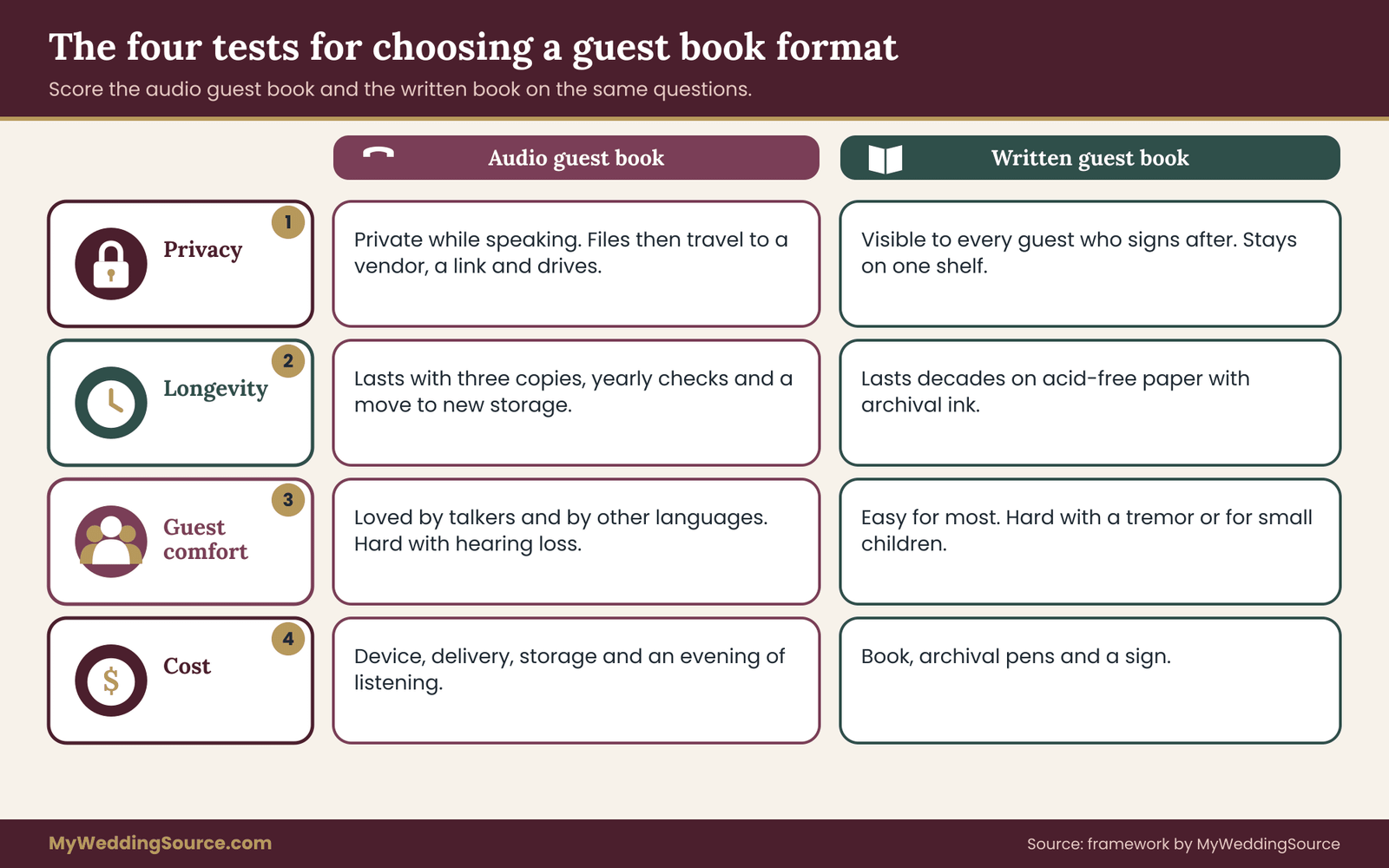
The four-test comparison for an audio guest book vs a written book
To keep this comparison fair, we use four tests: privacy, longevity, guest comfort and cost. Each has a plain question, and each can be answered for both formats. The result is not a winner. It is a clear picture of which trade-offs you accept.
Privacy. Who can read or hear what a guest said, and who keeps a copy? The question covers the moment of entry, the days after the wedding and the years that follow.
Longevity. If you do nothing special, how long will the entries stay readable or playable, and what would make them stop? The question includes both physical threats and technical ones.
Guest comfort. How many of your guests can use this format without help, embarrassment or delay? The question includes accessibility, language, age and confidence.
Cost. What do you pay in money, but also in setup time, follow-up effort and storage? Cost includes what you do after the party, not only the rental or purchase line on an invoice. If you are still deciding how much to set aside for small extras like this, the wedding budget guide explains how to set category limits.
How to use the four tests
Give each test a weight from one to three, based on what matters to your families. A couple with a large extended family and several elderly guests might weight longevity and comfort at three and cost at one. A couple with a tight budget and a young crowd might weight cost at three. Then rate each format from one to five on each test, multiply and add. You will not need a spreadsheet; a sheet of paper and five minutes will do.
The point is not the final number. The point is that the exercise forces you to say aloud what you care about, and to notice when two partners weight the tests differently. If one partner puts privacy at three and the other puts it at one, that is a conversation to have before a vendor deposit, not after a recording has been made.
For readers who want to see the whole process at once, the first infographic in this guide lays out the four tests side by side. The sections that follow take each test in turn and apply it to both formats, with specific scenarios and decision rules.
One more framing point.
You are not choosing between good and bad. A written guest book is not old-fashioned and an audio guest book is not frivolous. Each has a failure mode, and the planning job is to avoid that failure mode. A written book fails when it is ignored, lost or hard to read. An audio guest book fails when guests are unsure what to do, the files are never delivered, or they are delivered and then lost in a drawer of old drives. Knowing the failure mode in advance is most of the work.
Privacy: who hears, who reads, and who keeps an audio guest book recording
Privacy is the test where the two formats differ most, and it is the one couples think about least. Let us take the written book first, because it sets the baseline.
Privacy in a written guest book
A written guest book is semi-public by design. The book lies open on a table. Every guest who signs after someone else can read what was written before. A cousin who writes something affectionate and a little teasing is, in effect, publishing it to the room. Most entries are harmless, and most guests understand that the page is visible.
That visibility has a quiet benefit: people self-edit. Few guests write anything they would not say in front of the bride’s grandmother. The book rarely contains surprises, and when it does, you will find them on a page you can simply turn.
The risks are physical and small. Someone may read an entry that was meant for the couple alone. A page can be torn out. A book can go missing from a gift table, especially at a venue with lots of coming and going, along with cards and envelopes. If you have ever worried about cards disappearing, the same logic applies. Assign the book to a person or keep it in sight, and the risk is mostly gone.
After the wedding, privacy is simple. The book sits on your shelf. Nobody else has a copy unless you make one. If you scan pages to share with parents, you decide which ones.
Privacy in an audio guest book
An audio guest book works the other way round. The moment of recording is more private than a page, because a guest listens to a greeting, speaks into a handset and nobody else hears. Guests often say things they would never write on a page that others can read: a tearful line about a parent, a story that is funnier aloud, a message that is only for the two of you.
The trade-off is what happens next. Those recordings are digital files, and files move. They may be stored on the device itself, on a card inside it, in the vendor’s cloud account, on the vendor’s laptop, and in the download link they send you. Each of those is a place where a copy can sit, and not every place is under your control. A guest who tells a private story is trusting you, not the vendor’s file server.
So the first privacy test for an audio guest book is not “is it secret at the moment of recording?” but “where do the files go, who can open them, and when are they deleted?” These are answers you can only get from the vendor, preferably in writing. Your wedding vendor contract review is the right place to look for the clauses, and the questions section later in this guide gives you the wording.
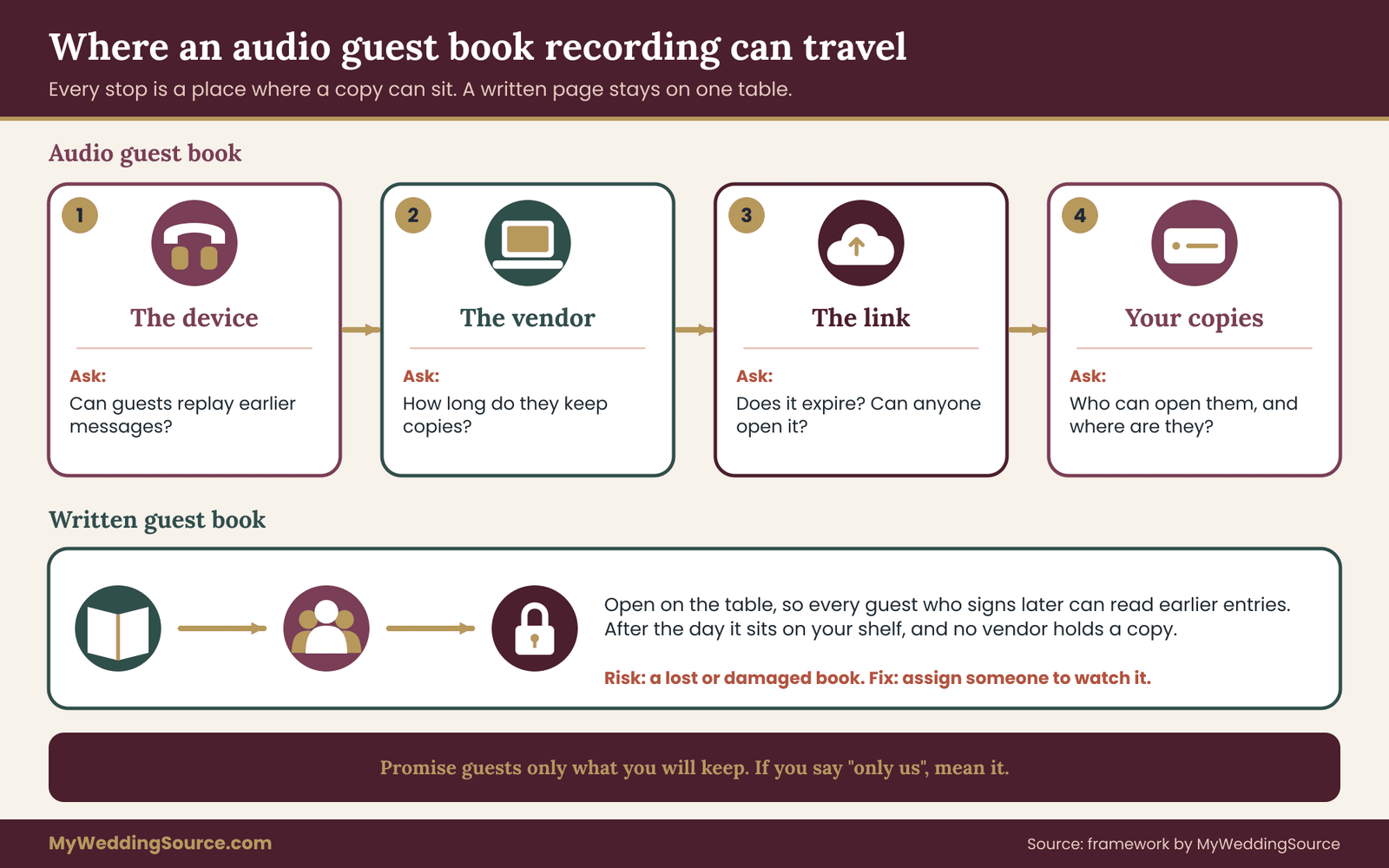
Four places recordings can leak
Think of the recording as moving through four places, and ask what could go wrong at each.
At the device. Is a recording stored in the handset or box until someone collects it? Could another guest press a playback button and hear earlier messages? Some devices have a way to replay recent messages, some do not. If you or the vendor can disable playback during the event, do.
At the vendor. After the event the vendor copies the files off the device. Do they keep a copy, for how long, and who in the company can open it? A small vendor may keep everything on a personal laptop. That is not necessarily a problem, but it is a fact you should know.
In transit. The vendor then sends you the files, often by a link. A link that anyone can open is convenient and weak. A link that expires after a short time is safer but can lapse before you download it. Ask for both an expiry date and a reminder.
At home. Once you hold the files, you are the keeper. You decide who gets copies, and you carry the same responsibility you took on for photos. Our guide to organizing wedding records after the event explains how to set access levels for sensitive files like these.
Consent and notice for an audio guest book
Consent matters more for audio than for handwriting, and the reason is not legal alone. People expect to be seen at a wedding. They do not always expect to be recorded and kept. Giving them clear notice is a courtesy that also prevents awkward moments.
Rules about recording conversations differ across the United States. Some states require the consent of one party to a conversation and some require all parties. An audio guest book is a case where a person knowingly speaks into a device that is labeled and set out for that purpose, which is a very different situation from covert recording. Still, state rules vary.
You should check current rules with your state’s attorney general or a local attorney if you have any doubt. The Department of Justice website is a starting point for federal wiretap information, and it also points readers to the right place to ask.
In practice, three simple steps cover almost every case. First, put a small sign at the station saying what the device does: records a short message, saved for the couple, not shared beyond them unless the guest agrees. Second, tell guests ahead of time on your wedding website or program that an audio guest book will be there, so nobody is surprised. Third, give guests an easy exit. The handset sits there, and anyone who does not want to speak simply does not pick it up.
“There is a phone on the table by the entrance. Pick it up, wait for the beep and leave us a message. Only the two of us will listen.”
That sort of sentence, adapted to your plans, works well on a sign. It makes a promise, which means you must keep it. If you intend to share clips with parents or play them at an anniversary dinner, say so on the sign, or do not promise “only the two of us.”
Children, minors and other sensitive cases
Children love handsets, and children’s voices are among the recordings couples most want to keep. They also raise a distinct issue. A child cannot meaningfully consent to how a recording will be used years from now, and parents may have preferences about their child’s voice being held by a vendor.
A simple rule works well.
A child records with a parent beside them, and the parent decides whether the message is for the couple only. If parents prefer no child recordings, a written option such as a drawing page lets the child take part without a recording. Our article on wedding photography consent uses a similar approach for photos, which many couples find easy to adapt. A similar rule covers guests with sensitive circumstances: someone estranged from part of the family, someone whose employer restricts public statements, someone who prefers not to be recorded for personal reasons. They should not have to explain.
Written books have a lower-key version of the same concern. A child’s drawing or a note about someone’s health on an open page is visible to the room. A written guest book is private from the vendor, not from other guests.
A privacy rule you can apply in two minutes
Here is a decision rule that turns the above into action. Ask three things about each format.
Is anyone other than the couple likely to hold a copy of the entries? If no, privacy risk is low for both formats. If yes, list who.
Could a guest reasonably be surprised by who holds or hears the entry? If yes, add a sign, a notice or a promise, and keep it.
Can the couple delete or return the entries if a guest asks? A written page can be removed with a craft knife. An audio guest book recording can be deleted from every copy only if you know where every copy is. That last question is the real difference between an audio guest book and a written one. It is why an audio guest book calls for a vendor agreement and a small list of where files live, while a written book mostly calls for a good table position.
If the answers worry you, there is a middle path: a written book for names and short wishes, plus an audio guest book that guests may choose to use, with a notice that audio guest book recordings are for the couple only. This hybrid gives privacy-minded guests a way to take part and lets the couple capture voices from those who want to speak.
Longevity: how long an audio guest book and a written book really last
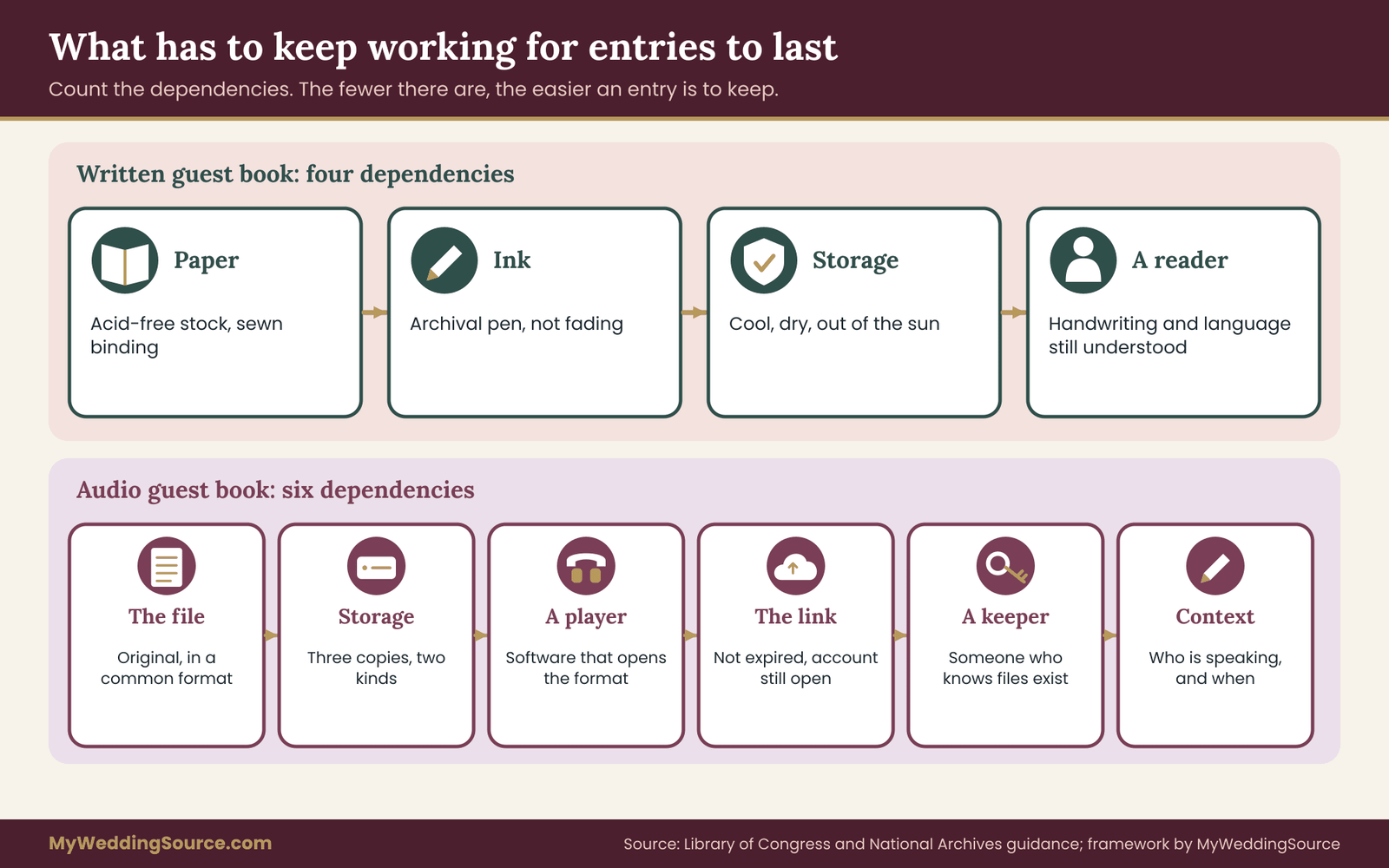
Longevity sounds like a question about materials, but it is really a question about dependencies. Count what has to keep working for a future person to read or hear the entry. A written page depends on paper, ink and light. An audio guest book depends on a file, a storage device, software that can open the file, and a person who remembers that the file exists. The more things that must keep working, the more chances there are for one to fail.
What threatens a written guest book
Paper has a long track record, and its threats are well understood. They are also mostly visible, which helps, because you can see damage before it is complete.
Acid and poor paper. Cheap paper, including pages in some mass-market books, can yellow and turn brittle over decades. Archival or acid-free paper resists this far better. If you are buying a written guest book, look for a description that says acid-free, and ask the maker rather than assuming.
Ink. Some pens fade in light, bleed through the page or smudge when touched. Pigment-based archival pens are made to resist fading and water. Ask guests to use the pen you provide, because a ballpoint from a purse may be fine or may not, and you will not know which in twenty years. A blue gel pen on a glossy page can smear if the page is handled before it dries.
Light and heat. A book left on a sunny shelf fades. A book kept in an attic gets hot. A cool, dim, dry cupboard is gentler. The National Archives and the Library of Congress both publish plain guidance on caring for paper keepsakes, and the sources section lists where to find it.
Water, pests and fire. A spilled drink at the reception, a flood in a basement and mold in a damp room are the common events. They are rare, but they destroy a single physical object completely. Because there is only one book, there is no second copy unless you make one, which is the main argument for scanning the pages after the wedding.
A scan solves a surprising number of these problems. A set of photographs or scans taken on a flat surface in good light gives you a digital copy of the pages. That copy then needs the same care as any other file, so scanning moves some of the paper’s risk into the digital column.
What threatens an audio guest book
A digital audio guest book rarely fails the way paper fails. It does not fade or yellow. It either plays perfectly or does not play at all, and the failure is often invisible until you try. Nothing warns you that a drive has begun to fail or that a link has expired.
Single points of storage. Many couples receive a download link, save the files to a laptop and consider the job done. If the laptop is stolen, replaced or fails, the recordings go with it. The Library of Congress personal digital archiving guidance recommends keeping more than one copy and storing copies in different places, and it is the single most useful idea in this area.
Vendor deletion. Vendors are not archives. Many delete files after a stated period, which may be shorter than you expect, and some close, change platforms or let an account lapse. If your only copy is “the vendor still has it,” you do not have a copy.
Link and account expiry. Download links, cloud folders and free storage tiers all have terms. A free tier can shrink. A link can expire. A password can be forgotten. The recordings did not change, but the path to them did.
Format and software change. The file formats most vendors deliver, such as MP3 and WAV, are very common and have lasted for decades. Common formats are the safest bet. Obscure or proprietary formats, files that only play inside a vendor’s app, and files wrapped in a platform’s own player are riskier because they depend on a company staying in business.
Media obsolescence. An SD card, a USB stick or an old external drive may be unreadable in fifteen years because no computer has the right port. Moving files to current storage every few years is the standard remedy and is why the preservation plan later in this guide includes a schedule.
Silent corruption. Files can be damaged in copying or by failing storage without any error message. Checking that a copy matches the original, and playing a sample from each backup now and then, catches most of this.
A fair comparison: the dependency count
Here is a simple way to compare formats without pretending either is perfect. List what must keep working for a listener fifty years from now to experience a typical entry.
For a written book on archival paper kept in a cupboard, the list is short: the book exists, the ink is legible, the person can read the handwriting and the language. If a family member has the book, no technology is needed at all.
For an audio guest book, the list is longer: the files exist in at least one place, that place still works, a device can play the format, someone knows the files exist and where, and the person can understand the voice and language. Several of those items must be renewed by someone every few years.
That does not make audio a bad choice. It means audio demands maintenance and paper mostly demands storage. If you are willing to spend an hour a year on a recording check, an audio guest book can last as long as you do. If you know you will not, a written book is the more honest choice, or at least a written book should be part of the plan.
Time horizons: a weekend, a decade, a lifetime
Different horizons call for different effort, and it helps to be honest about which one you are planning for.
The weekend horizon. You will listen once, the week after the wedding, laugh, and share a few clips. Either format works. The key is not to lose the files in the first month, when vendor links are still valid.
The decade horizon. You expect to hear or read entries on anniversaries and when children ask about the wedding. A written book on decent paper will cope with almost no care. An audio guest book needs three copies, a periodic check and one migration when you change computers.
The lifetime horizon. You hope the book will outlive you and mean something to children or grandchildren. Here both formats benefit from redundancy and from context. A written book benefits from a copy and an index of names. An audio guest book benefits from a text index saying who is speaking, since a future listener may not recognize voices, and from a plain-language note on how to play the files.
That last idea is cheap and powerful. A one-page text file, stored beside the recordings, listing each file name, who recorded it and the date, can save a descendant hours of guessing. A written guest book carries its context on the page, because each entry is signed. Audio guest book entries often are not, so you must add the context yourself.
The signature problem
Recordings do not come with names unless guests give them. Many guests start with “Hi, this is Aunt Carol” and many do not. Some say “you know who this is,” which is a delight now and a puzzle later. Written entries have a built-in advantage here: a signature sits at the bottom.
You can solve this in three ways, and they work together. Include a prompt in the greeting that asks guests to say their name first. Print the same prompt on a small sign. Then, within a week of the wedding, listen through each recording once while the day is still fresh and write down the speaker, using a guest list as a cue. Doing this while you still remember voices takes an evening. Doing it in ten years takes much longer, and some voices may no longer be identifiable.
What to expect from vendors on longevity
An audio guest book vendor sells an event experience, not an archive. That is a fair business model, and it is why you should not read their delivery as a preservation service. Ask what file formats they deliver, whether you receive the original unedited files, how long they keep their own copies, and what happens if their company closes. Ask whether they offer a physical delivery, such as a drive or a card, in addition to a download link. A physical copy delivered to your door lets you make backups without racing against a link expiry.
For a written book maker the longevity questions are about paper and ink: is the paper acid-free, is the binding sewn rather than glued, will the book lie flat so guests do not press on the spine, and which pen is recommended. A sewn binding survives a drop and a decade of opening better than a glued one.
Neither set of questions is hard, and a good audio guest book vendor will answer the first set without hesitation. The point is that longevity is something you ask about and plan for, rather than something a product has by default.
A file preservation plan for an audio guest book
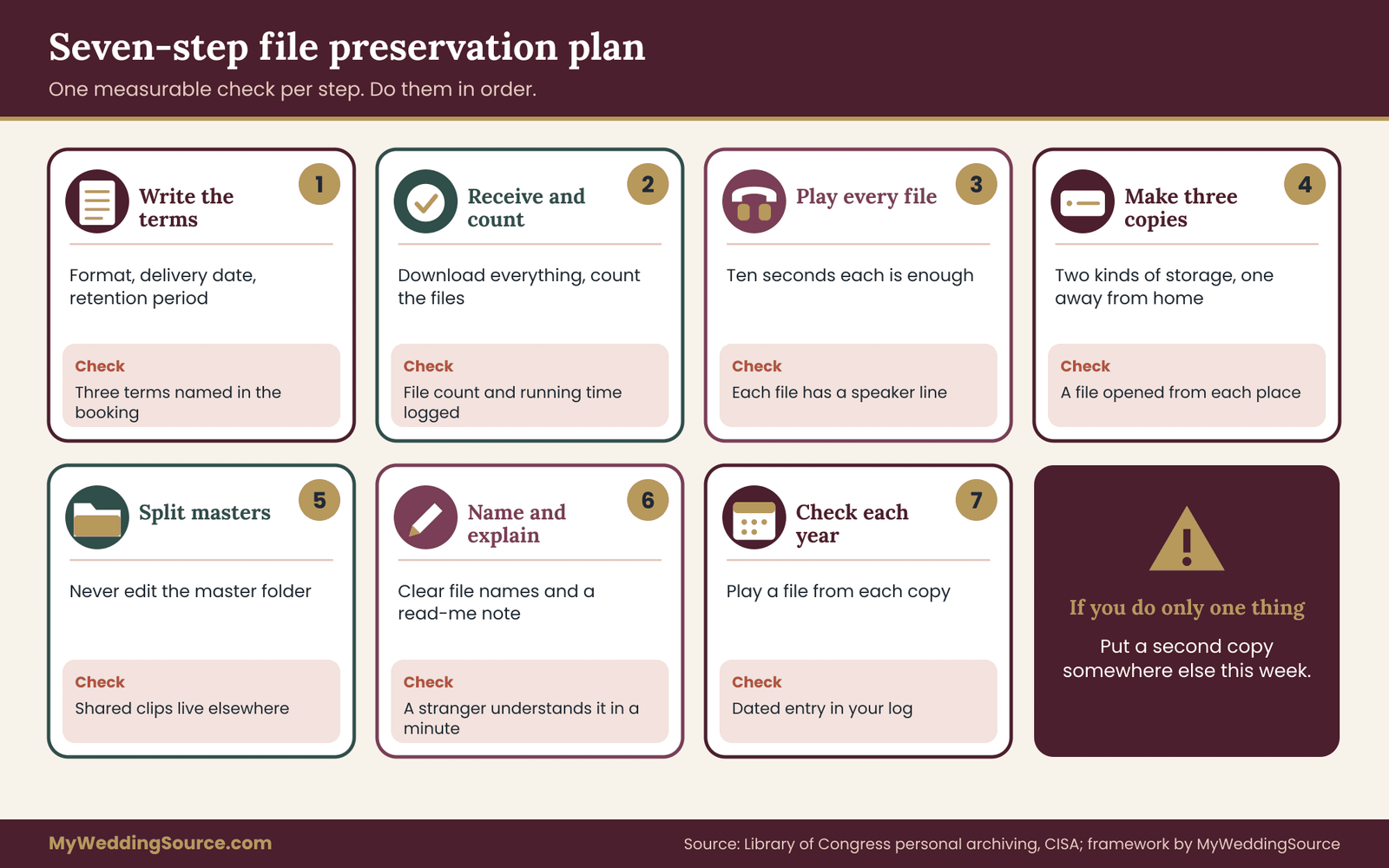
A plan beats a good intention. The plan below has seven steps, each with a measurable check, and it applies whichever vendor you hire. It is written for the audio guest book because that is where the work is, but the written book gets a short version at the end of this section.
The idea behind the plan is simple: an audio guest book is only as durable as the copies you keep of it. Recordings from an audio guest book are safe when there are several copies in several places, when you have proved that they play, and when someone knows what each file is. Every step supports one of those three.
Step one: write the deliverables into the booking
Preservation of an audio guest book starts before the wedding, with the booking. Ask for the following in writing, and use a vendor contract checklist as the place to record them.
The original, unedited audio guest book files, not only an edited highlight. A stated file format, ideally a common one such as WAV or MP3. A delivery date. A delivery method, with a physical option if one exists. The vendor’s retention period for their own copies. A statement that the vendor will delete their copies on request after you confirm receipt. A statement of who may hear the recordings on the vendor’s side.
Measurable check: the booking names a format, a delivery date and a retention period. If any of the three is missing, ask before you pay a deposit.
Step two: receive and count
On delivery day, do not just click a link and glance at the first clip. Download everything at once, then count. How many files arrived? Does the vendor’s own count match? Does the total listening time look plausible for the number of guests who used the station? A hundred and twenty guests and four recordings suggests files are missing, or guests did not know what to do, and you want to find that out in week one.
Measurable check: the number of files and the total running time are written in a short log, with the date received.
Step three: play every file once
Open and play each file, even if only for ten seconds. This is dull, and it is the only way to find a corrupted or empty file while the vendor still has the original. If the volume is very low, a long silence precedes speech, or the audio cuts out, ask the vendor for a replacement while their copy exists.
While you listen, write the speaker’s name next to each file in your log. This is the step that turns a folder of “message_017” into something a future listener can use. It takes an evening for a medium-sized event. It is also the part many couples enjoy most, because it is the first time you hear the messages.
Measurable check: every file has been played and has a speaker line in the log, or the words “unidentified.”
Step four: make three copies on two kinds of storage
The widely repeated three-two-one idea is a good fit here: three copies, on two different kinds of storage, with one copy away from home. The Library of Congress personal archiving guidance describes the same principle in plain language, and the Cybersecurity and Infrastructure Security Agency publishes backup advice for home users.
For the audio guest book, copy one is the working copy on your computer. Copy two is an external drive kept at home. Copy three is somewhere else: a cloud storage account you control, or a drive stored at a relative’s house. Do not treat a cloud account that syncs with your laptop as a separate backup, because a deleted file may delete everywhere at once.
Measurable check: three locations are written in the log, and you have opened a file from each location.
Step five: separate masters from sharing copies
Keep a master folder that you never edit. This is where the original files live. When you want to share a clip with a parent, make a copy, trim it if you like, convert it to a small MP3 and share that. The master stays untouched.
This separation prevents the most common accident, which is editing or overwriting the only good copy. It also lets you share without handing over the whole archive.
For sharing, decide a tier for each recording. Private means only the two of you. Family means you may share with named relatives. Open means you may play it at a gathering. Default everything to private and move clips up only when the guest has agreed, even informally. A single column in your log handles this.
Measurable check: the master folder has a read-only note in its name, and every shared clip lives in a different folder.
Step six: name things so a stranger could use them
A file name should say what a file is without opening it. A pattern such as the year, the word guest-audio, a running number and a speaker name works well, for example 2026-guest-audio-017-aunt-carol. Avoid spaces and special characters, which can cause trouble when files move between systems.
Add a plain text file in the same folder as the audio guest book files, named something obvious like read-me. In a few sentences, say what the folder is, who recorded the wedding, how to play the files, and who has the other copies. Write it as if a relative who has never seen the folder will read it, because one day one might.
Measurable check: a person who has never seen the folder can tell, in one minute, what it contains.
Step seven: schedule the checks
Preservation of an audio guest book is a habit. Put three dates on your calendar. One month after the wedding, confirm that all three copies exist and play. Each year on your anniversary, play one random file from each copy. Every five years, or when you change computers, move everything to current storage and note the date.
Annual checks sound tedious, but they take ten minutes. They are the difference between a backup and a hope. If a file will not play, you find out while two other copies still exist. If a drive fails, you replace it and make a fresh copy straight away.
If you want a little more assurance, a checksum is a short code computed from a file; matching codes on two copies show that the files are identical. Many operating systems include a tool for this, the National Institute of Standards and Technology publishes the standards behind the common codes, and it is optional for most couples. Counting files and playing samples catches the common problems.
Measurable check: three calendar entries exist, and the log records each check with a date.
The same plan, shorter, for a written guest book
A written book needs less. Within a week of the wedding, photograph or scan every page flat, in even light and at high resolution, and save those images as three copies using the same rules. Store the book itself in a cool, dry place away from direct sunlight, ideally in an archival box or wrapped in acid-free tissue. Write an index of who signed which page, because handwriting can be hard to read and a future reader may want to know who “Tom” was.
Then you have a physical book and a digital set, which gives you the best of both formats. It is also the cheapest redundancy in this whole guide, because a phone and ten minutes are enough.
What if you do not do any of this
Honest answer: nothing dramatic will happen in the first year. Most couples who ignore preservation still have their files on a laptop, and many will be fine. The risk lies in the years after, when a laptop is replaced, a link lapses and nobody remembers the vendor. The plan above costs a few evenings at the start and ten minutes a year, and it protects a keepsake that cannot be recreated.
If you are going to do one thing, make a second copy somewhere else this week. If you are going to do two, add the speaker log. The rest improves the odds, and the first two catch most of the likely losses.
For broader backup habits across the wedding, our guide to wedding day digital operations covers keeping files safe on the day itself, including who holds devices and where files go first.
Cost: what an audio guest book costs next to a written one
Cost is the test that looks easiest and is not, and an audio guest book is where the gap between sticker price and real cost is widest. A quick comparison of rental price against book price misses most of the real spend, and it misses all of the time. This section shows how to build a fair cost picture without relying on prices that change by region and vendor. Check current quotes from the suppliers you are actually considering, because the numbers move.
The cost ladder: what you may pay for
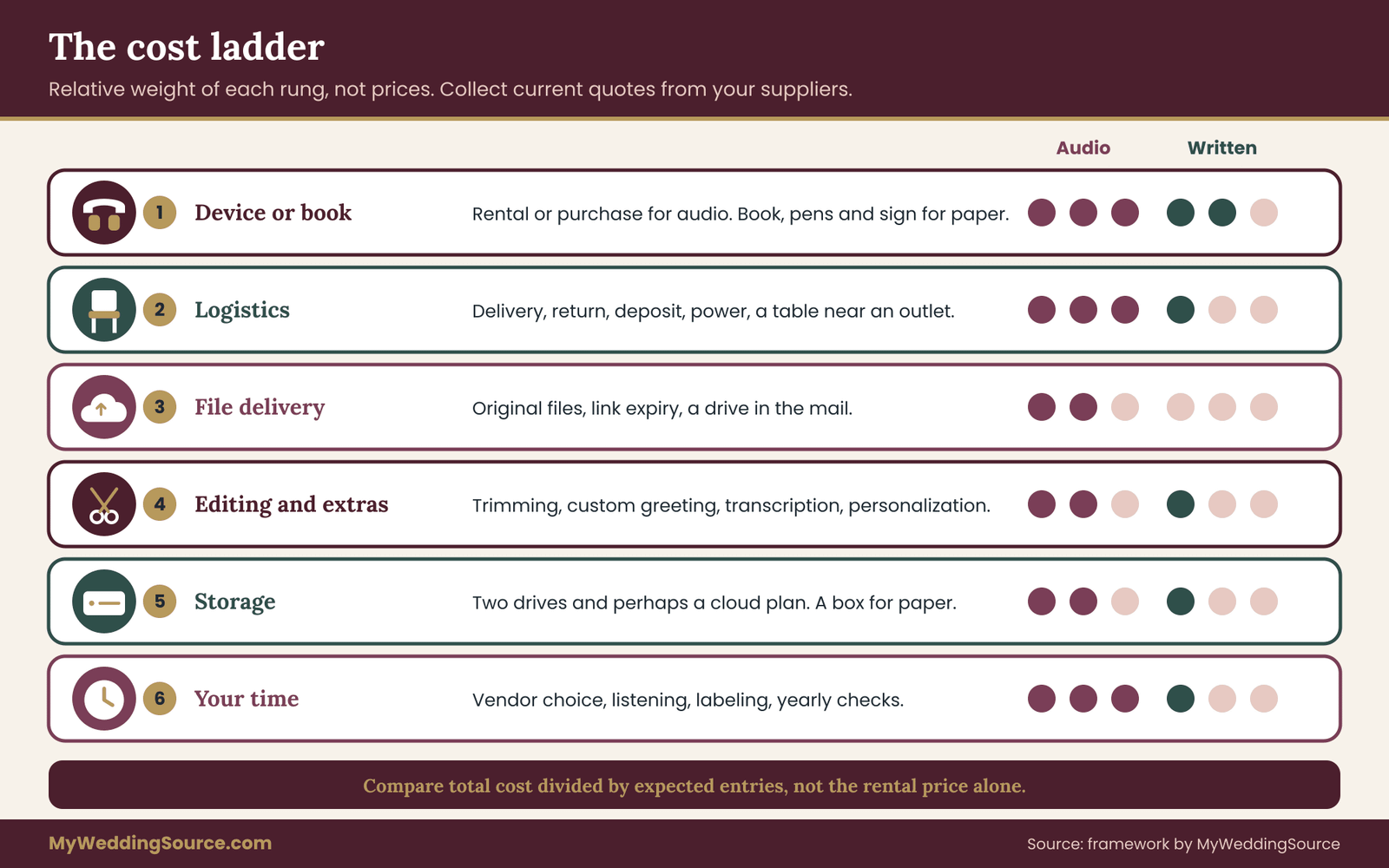
Think of cost as a ladder with several rungs. Not every rung applies to every couple, but you should know each one exists.
The device or the book. For a written book, this is the book, one or two pens and a sign. For an audio guest book, you either rent the device from a vendor or buy one. Renting usually includes setup instructions and sometimes a delivery of the files. Buying means you own the device and own the problem of getting files off it.
Logistics. Delivery, pickup, shipping both ways for a mailed rental, a damage deposit, and late return fees. A written book has none of these. An audio guest book device may need a power source or fresh batteries, and the venue may need to give you a table near an outlet.
File delivery. Some vendors include delivery of the original files; some charge extra for download links, a flash drive or a longer retention period. Ask whether the price quoted includes the original, unedited files.
Editing and extras. Trimming silence, adding a custom greeting, combining clips into a single highlight track, or transcribing the recordings into text are optional services, often priced separately. A custom greeting in your own voice costs little or nothing if you record it yourself, which many couples do for an audio guest book.
Storage. Two external drives and a cloud storage plan are a small cost, and a recurring one if you pay for cloud space. A written book has no equivalent apart from an archival box if you want one.
Your time. A written book needs perhaps an hour of your time overall, mostly choosing it. An audio guest book needs time to choose a vendor, record a greeting, handle delivery, listen to the recordings, label them and run the preservation plan. If you listen to all messages and log speakers, plan an evening or two. Time has no price tag, but it has a real cost during the weeks after a wedding, when thank-you notes and returns also compete for attention.
Rent or buy?
An audio guest book is available in two main ways, and the better one depends on reuse and on how you feel about technology.
Rent when you want the simplest path and you are comfortable with a vendor holding recordings briefly. The vendor handles setup, may provide a clear greeting, collects the device and delivers files. Your main tasks are asking the right questions and verifying delivery.
Buy when you want full control of recordings, because they never leave your possession, or when you expect to resell the device or lend it to family. Buying leaves you with the work of extracting files, and you should confirm before purchase that the device stores audio in a standard format and that you can copy files off it without proprietary software. If the manual says files can be read only through a company’s app, treat that as a warning about longevity too.
A do-it-yourself build, such as converting an old telephone with a kit, can be inexpensive and charming. It can also fail on the day if you have not tested it. If you go this way, test the device for a full hour of recording, including battery life, and test copying the files off it before the wedding. A device that works on the kitchen table may behave differently in a noisy room.
A worked cost comparison
The following numbers are invented for arithmetic only. They are not average prices and should not be treated as what vendors charge. Replace them with real quotes.
Suppose a couple has a hundred and twenty guests. For a written book, they spend a modest amount on a sewn archival book, two archival pens, and a small sign. Say the total is sixty dollars, and ninety guests leave an entry. The cost per entry is a little under seventy cents.
For an audio guest book, suppose a rental quote is one hundred and fifty dollars, delivery of files by download adds forty, and a drive to store backups adds thirty. The total is two hundred and twenty dollars. If forty guests record a message, the cost per recording is five dollars and fifty cents.
On those invented numbers the audio option costs more per entry and more overall. That is usually true in a general way, because a device and delivery cost more than paper. But look at what the per-entry figure hides. If a recording from a ninety-year-old grandfather is the thing you value most, no per-entry average captures it. Cost per entry is a tool for noticing where money goes, not for deciding what matters.
Now change one variable. Suppose the couple adds a written page for names to the audio guest book rental, for the sixty-dollar book. The total rises to two hundred and eighty, and the number of entries rises to a hundred and thirty. The cost per entry falls to roughly two dollars and fifteen cents. The hybrid costs more in total, and yet it captures more people. This is the kind of arithmetic worth running with real numbers before you decide.
Hidden costs that catch couples out
Several costs only appear after the booking.
Cancellation and date change terms. If your wedding date moves, can you move the rental without penalty? Our budget planning page covers how to keep a small reserve for items like this, but ask the vendor plainly before paying.
Damage and loss. A phone-style device is fragile, and a dropped handset or spilled drink can become your bill. Read the damage clause. Ask whether the deposit is refundable and by when.
Late fees. A device kept an extra week because nobody returned it may cost more than the original rental. Assign a named person to return it on the day after.
Venue fees. Some venues charge for power, extra tables or vendor access. This applies to any vendor and is worth a quick question to the venue.
Reprint and replacement. A written book can be damaged by a spilled drink and cannot be replaced. That is a cost too, if an irreplaceable book is lost. Treat it as a reason to place the book where it is not exposed to drinks, not as a reason to avoid paper.
Cost and value are not the same thing
Cost is only half of the picture. The other half is what you would pay to recover the item if it were lost. For most couples, the written book and the audio guest book files are both irreplaceable. The recordings of loved ones, in particular, cannot be made again. That is a strong argument for spending a small amount on storage and care, even if the rental itself was the cheapest option available.
A reasonable rule: set aside some of the budget for preservation, not just acquisition. A couple who spends on a device and nothing on backup is paying for an experience and not for a keepsake. Moving a small portion of that spend into two drives and a cloud account turns a one-day activity into something that lasts.
When the cheapest choice is the right one
A written guest book is the sound answer in several cases. The budget is tight and every line matters. The venue has no power near the entrance. The guest list is mostly older guests who prefer a pen. The couple does not want to handle digital files at all. In those cases, a good book with good pens and a clear sign serves very well, and an extra audio guest book element can be dropped without regret.
An audio guest book is the sound answer when voices matter most. A spread-out family, a guest of honor who is frail, a couple who will rarely see certain relatives again, or a couple who simply love hearing people talk, all favor voices. For them, cost is a question of how to afford the thing, not whether it is worth it.
Guest comfort: who enjoys each format and who avoids it
A guest book only works if guests use it, and that is as true of an audio guest book as of a paper one. The most beautiful device in a quiet corner is worth nothing if people walk past it. Comfort is partly personality, partly access and partly placement, and the two formats ask different things of guests.
What a written guest book asks of a guest
A page asks for a few things: a free hand, steady enough to write, a moment to think of something to say, a language the guest can write, and willingness to have words read by others. Most adults manage this comfortably. The blank page can still stall people. “What do I write?” is a common freeze, and a small prompt printed at the top of the page, such as a favorite memory or one piece of advice, helps.
A written book is hard for guests with limited vision or a tremor, for guests who write in a different script from the one on the prompt, and for small children who cannot yet write. It also puts a guest’s handwriting on show, and some people dislike that.
What an audio guest book asks of a guest
An audio guest book asks for a different set of things. The guest must hear the greeting, understand what to do, speak aloud to nobody, and be willing to leave a recording. People who are comfortable talking often love it. People who dislike hearing their own voice, or fear saying the wrong thing with no chance to revise, often skip it.
There is also a practical hearing issue. A greeting played through a small speaker in a loud room may be hard to hear for anyone, and harder for a guest with hearing loss. Guests who use hearing aids may also find that holding an audio guest book handset to the ear produces whistling. A longer cord, a handset that can be held a short distance away, or a quiet position can help.
Matching the format to your guests
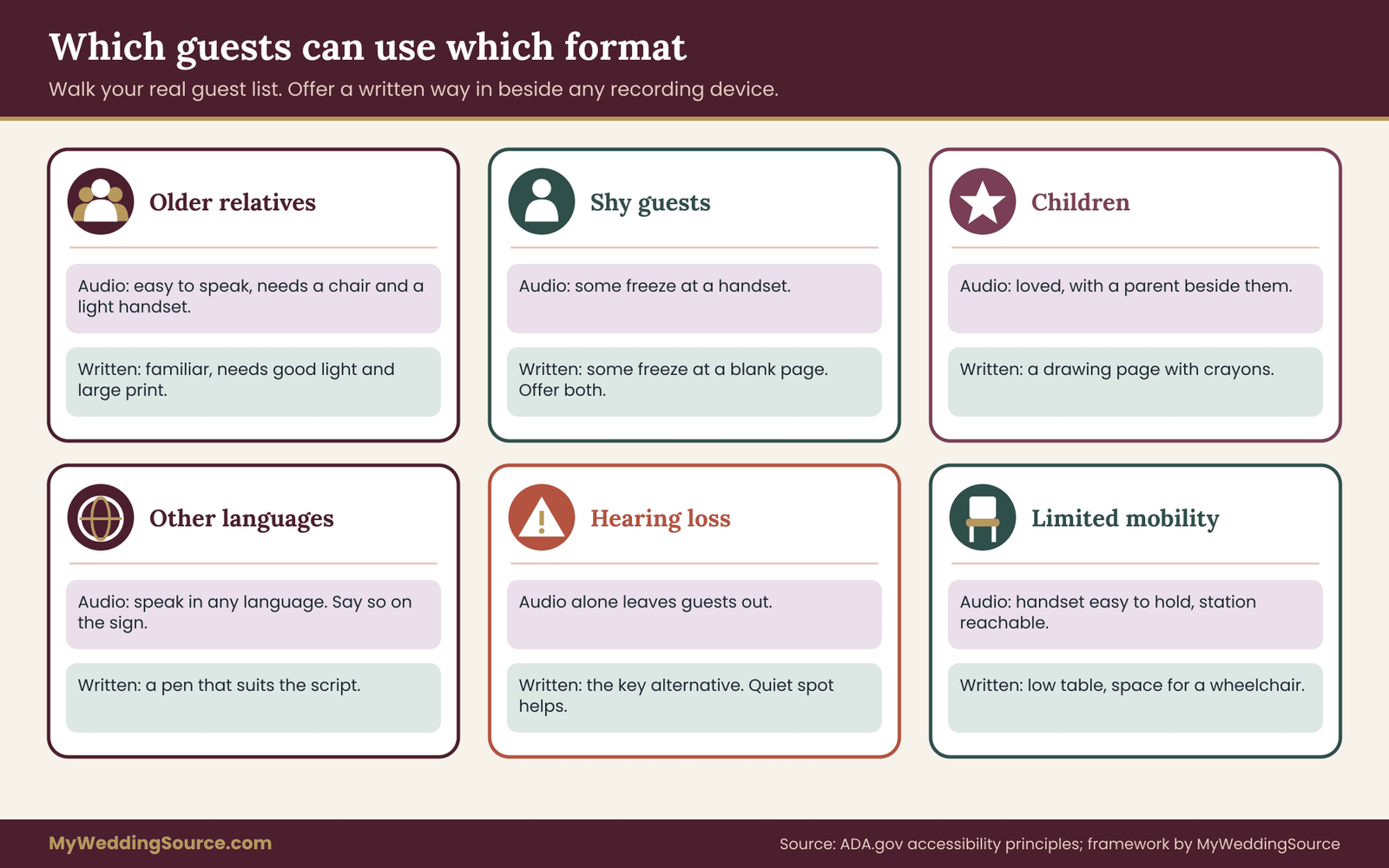
Rather than guessing which format suits, walk through your actual guest list. Think of groups and ask whether each can take part easily.
Older relatives. Many love speaking and many love writing. Both are fine, and the question is physical. Can they stand or sit comfortably at the station? Is there a chair? Is the handset heavy? Is the page lit well enough? An older guest who cannot read the small greeting sign will not know what to do, so bigger print helps.
Shy guests. Some people find writing easier because they can think before committing. Others find a handset easier because nobody is watching. There is no rule. Offering both is the kind answer.
Children. Kids love handsets and often record funny, charming messages. Pair the station with a parent’s presence. A written page with crayons or a sticker for drawings gives a child who does not want to speak something to do.
Guests who speak another language. An audio guest book lets a guest speak in the language they love. That is a gift for a family where grandparents speak a language the couple understands best aloud. Add a line to the sign saying any language is welcome. A written book permits the same, though a guest may need a pen that handles other scripts.
Deaf or hard-of-hearing guests. An audio guest book alone leaves them out unless a written alternative exists. This is the strongest reason to offer a written page alongside any recording device. The ADA website at ada.gov explains the general principles of accessibility, and venues and vendors may have their own obligations; ask the venue what they provide, and offer an inclusive option regardless.
Guests with limited mobility or dexterity. Table height, space for a wheelchair or walker, and a handset that can be held with a weak grip all matter. A written book on a low table is hard for someone in a wheelchair to reach if the table is high. Put either station where a seated person can reach it, and have someone ready to assist without making a fuss.
Placement and flow
Where you put the station affects who uses it. Near the entrance, it catches guests when they are fresh and not yet distracted, but it can create a line when everyone arrives together. Near the cocktail hour, it catches guests in a relaxed mood. Near the dance floor it is too loud for an audio guest book and too hurried for writing.
For an audio guest book, a quiet corner is best, with a wall or a screen behind it to reduce echo. A noisy room produces recordings in which the guest’s voice is buried in music. Our guide to wedding reception guest flow shows how to see where crowds form so you can avoid a bottleneck, and the cocktail hour guide helps you decide whether that window suits a quiet activity.
For a written book, a visible table with good light and a comfortable chair encourages guests to linger. Make sure the pen works, and keep a spare.
Prompts that help guests start
Whichever format you pick, a small prompt makes guests more likely to take part and more likely to say something worth keeping. Short prompts work best. One prompt about a memory, one about advice, one about a wish for the future. Avoid prompts that corner a guest, such as asking for embarrassing stories about the couple.
For an audio guest book, the greeting itself is the prompt. A brief, warm greeting recorded in your own voice works well: it says who you are, what to do, and that the guest should say their name first. Keep it under twenty seconds, because long greetings make guests restless. At the end, a request to speak after the tone and to hang up when finished is enough.
For a written book, a line at the top of each page does the job. A sign explains that the book is meant for wishes, notes and signatures.
Vendor questions, setup and edge cases for an audio guest book
This section is the buying checklist. It is also where most surprises get caught.
Questions to ask an audio guest book vendor
Ask these before you pay a deposit and keep the answers in writing.
What files will I receive, and in which format? Are they the original recordings or edited? When will they arrive and by what method? How long do you keep your own copies and who can access them? Will you delete them on request? Is any recording stored on a third-party cloud service, and under whose account? Can recordings be played back by guests at the device? What happens if the device fails during the event? What is your policy on damage, late return and date changes? Do you offer a physical copy such as a drive or card?
Pay attention to how the vendor answers. A clear, quick reply is a good sign. Vague promises such as “we take privacy seriously” are not an answer. Ask for the privacy terms, and read them. The Federal Trade Commission publishes consumer guidance on privacy claims, and it is a reminder that a business is expected to describe what it does with your data accurately.
Questions to ask a written guest book maker
Is the paper acid-free? Is the binding sewn? Does the book lie flat? How many signature lines or pages does it hold, and does that suit our guest count? Which pen do you recommend, and is the ink archival? Is there any personalization, and can I proof it before it is printed? What are the lead time and return terms?
Edge cases and what to do
A guest sings or plays a song. A private keepsake is one thing; posting a clip with recognizable music online is another. The U.S. Copyright Office explains how copyright works, and the safe habit is to keep such clips private.
A guest records something inappropriate. It happens occasionally, especially late in the evening. Keep the master untouched, and decide privately what to share. You are under no obligation to play everything. Your tiered sharing log handles this.
A guest asks you to delete their recording. Say yes, quickly and kindly. Delete from all three copies and the sharing folder, and make a note in your log. This is the practical reason to know where every copy lives.
A guest records a very long message. Set a gentle limit in the greeting, such as asking guests to keep messages to about a minute. If the device allows a time cap, use it.
Someone plays back others’ messages at the device. If playback is possible, ask the vendor to disable it. If not, place the station so that it is not a place for lingering.
The device fails mid-event. Have a written backup ready: a book, or just a stack of cards and a pen. A failed device with no backup means guests leave without a way to take part. This is the other strong argument for hybrids.
The vendor’s files are delayed or never arrive. Your contract should name a delivery date and a remedy. If a deadline passes, ask once in writing, then escalate in line with the contract. Keep every message in one folder so you have a clear paper trail.
A recorded relative passes away. Many couples find a recording of this kind precious. Keep copies in more than one place, label the file clearly, and consider making one extra copy for family members who would value it, if the person’s wishes and your original promise allow that.
You split the files among families. Decide who owns what before you hand anything out. A tiered log makes it clear which clips are private, family or open.
A worked example: choosing between an audio guest book and a written one
This example is invented, to show the method. The couple, the numbers and the choices are illustrative and are not data from real weddings.
Meet the Alvarez-Brooks wedding. The couple expect a hundred and ten guests at an afternoon ceremony and a four-hour reception. The cocktail hour is in a garden, and the entrance hall of the venue has a free table and an outlet. The budget is tight but not desperate. Three facts shape the decision. The bride’s grandmother, who is ninety-one, speaks mostly Spanish and loves telling stories. The groom’s uncle is hard of hearing and does not like phones. And the bride’s sister works in a public-facing job and does not want her voice kept on anyone’s server.
Step one: weight the four tests
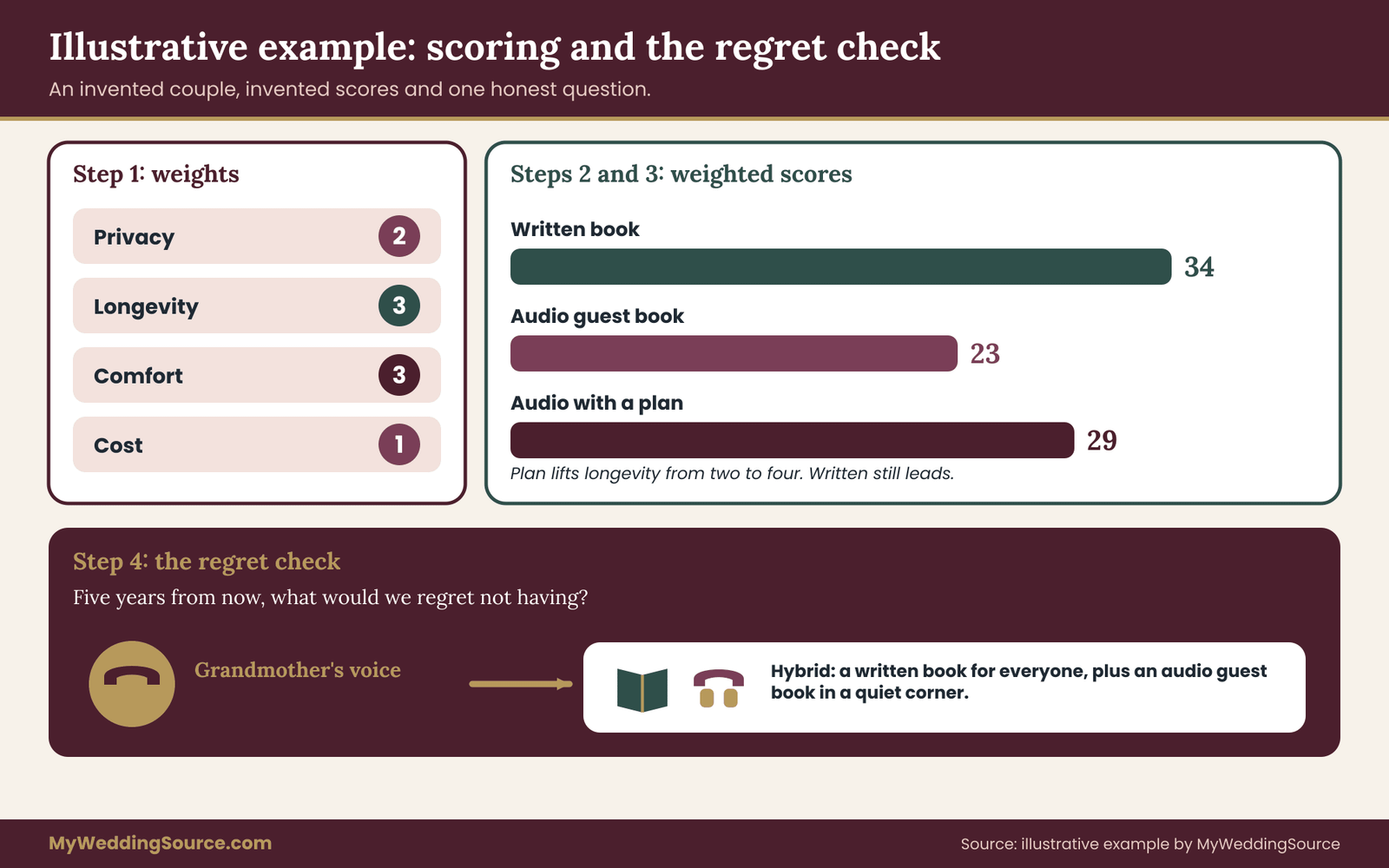
The couple sit down with a piece of paper and rate each test from one to three for how much it matters to them. Privacy gets a two, because of the sister but not much more. Longevity gets a three, because they want the grandmother’s stories to last. Guest comfort gets a three, because of the grandmother, the uncle and the children. Cost gets a one, because they can stretch for something that matters.
Step two: rate each format
Then they rate each format from one to five on each test, honestly and with the dependencies from the longevity section in mind.
For the written book, they give privacy a four, because only guests see it. Longevity gets a four, since paper on archival stock keeps well. Comfort gets a three, because the uncle will like it, but the grandmother’s handwriting is shaky and she would rather talk. Cost gets a five.
For the audio guest book, they give privacy a three, because a rental vendor will hold files for a while, and the sister’s concern is real. Longevity gets a two for now, because they have no preservation plan yet. Comfort gets a three, because the grandmother loves it and the uncle will not. Cost gets a two.
Multiplying by weights: the written book scores eight, twelve, nine and five, for thirty-four. The audio guest book scores six, six, nine and two, for twenty-three. If they stopped there, the written book would win.
Step three: rerun with the plan in place
The couple then ask what changes if they adopt the file preservation plan from earlier. Three copies, a speaker log and a yearly check lift longevity from a two to a four, which adds six points. The audio guest book now scores twenty-nine. The written book still leads, but the gap is smaller.
This is an honest result. On a pure score, a written book wins for most couples, because it is cheaper, simpler and easier to preserve. The score is not meant to overrule what a couple cares about, and that leads to the next step.
Step four: the regret check
The couple ask one more question that the score cannot answer. Five years from now, what would we regret not having? The answer comes quickly: the grandmother’s voice. That one recording is worth more to them than the difference in score.
So they choose a hybrid. A written book on archival paper sits on the main table, with two archival pens and a large-print sign. This is the baseline everyone can use, including the uncle, and it also acts as the backup if the device fails. Beside it, in a quiet corner of the entrance hall, sits a rented audio guest book with a short bilingual greeting, in English and Spanish, that asks guests to say their names first.
Step five: handle the privacy concern directly
The sister’s concern turns into three rules. A sign at the station says recordings are for the couple only. The couple ask the vendor in writing to disable playback and to delete their copies thirty days after delivery. The couple promise the sister that her recording, if she makes one, will stay private, and she agrees to leave a short one, which she was happy to do once she knew where it would go.
They also decide the grandmother’s recording gets an extra copy, in a labeled folder shared with one aunt, with the grandmother’s blessing.
Step six: write the schedule
Finally, they put dates on a calendar. In the week before the wedding, they test the greeting and the device. The day after, a named friend returns the rental. Within three days of the files arriving, they download everything, count the files and make three copies. Within ten days, they play each recording and fill in the speaker log. At thirty days, they confirm all copies play and the vendor deletes theirs. On the first anniversary, they play one file from each copy and note the date.
What the example shows
The example shows four things.
First, the weights come from the couple’s values, so the same scores could point the other way for another couple.
Second, a pure score is a starting point, and the regret check is a legitimate way to decide when the stakes are personal. Third, the hybrid is not a way to avoid choosing, since each part has a job: the written book gives access to everyone and acts as a backup, and the audio guest book captures voices that paper cannot. Fourth, preservation turned the weakest score into a strong one. The plan cost a few evenings and almost no money.
A different couple, with a small guest list of close friends, no outlet near the entrance and no wish to manage files, might pick a written book alone and feel entirely right about it. Neither answer is wrong. What matters is that the choice was made on purpose, with the privacy, longevity, comfort and cost questions answered ahead of time.
Your next steps
You do not need a long process. Work through these in order and you will have a decision and a plan within a week.
Start by answering the three first questions about an audio guest book and a written one: who hears or reads entries first, how long they should last, and who must be able to take part without help. Then weight the four tests and score both formats on paper, honestly. Add the regret check last.
If you lean toward an audio guest book, write the deliverables you need into the booking: original files, a named format, a delivery date, a retention period and a deletion promise. Ask the vendor the questions in this guide and keep the answers. Record your greeting and test the device in a noisy room before the wedding.
If you lean toward a written book, choose acid-free paper, a sewn binding and archival pens, put the book where it is safe from drinks, and plan to photograph every page within a week.
Either way, name one person to collect the book or device on the day, and one person to return it. Add the preservation dates to your calendar now: files counted in week one, speaker log in week two, three copies by day thirty, and a playback check every anniversary. Put a small sign beside the station that tells guests what it does and what happens to their words.
Finally, give yourself permission to pair an audio guest book with a written one. The most common regret is not choosing wrong; it is leaving no way in for the guests who would have loved to take part.
FAQ
Is an audio guest book more private than a written guest book?
At the moment of entry, yes, because nobody else hears the guest. Afterward it depends on the files. A written book stays on your shelf, while recordings may sit with a vendor, in a download link and on several drives. Ask the vendor where files are stored, who can open them and when they delete their copies, and put the answers in writing before you book.
Which lasts longer, an audio guest book or a written one?
A written book on acid-free paper with archival ink can last many decades with almost no care, because it needs nothing to read it. Audio guest book files can last just as long, but only if you keep several copies, check them and move them to new storage over time. An audio guest book is not worse, only more dependent on upkeep.
Do I have to tell guests they are being recorded?
You should, as a courtesy and to avoid surprises. Recording rules differ by state, so check with your state attorney general or a local attorney if you are unsure. In practice, a small sign at the station, a line on your wedding website and an easy way to skip it cover most situations. Say plainly who will hear the recordings.
How much does an audio guest book cost compared with a written one?
Usually more, because it involves a device, delivery of files and storage, while a written book is mostly the book and pens. Exact prices vary by region and vendor, so collect current quotes. Compare total cost, including delivery, deposits, late fees and backup drives, and divide by the number of entries you expect, not only the rental price.
What file format should the recordings come in?
Ask for the original, unedited files in a common format such as WAV or MP3. Common formats are playable on almost any device and are the safest for the long term. Avoid files that only play inside a vendor’s app. Keep one untouched master folder and make smaller copies for sharing.
Can I do both a written and an audio guest book?
Yes, and many couples do. A written book gives every guest a simple way to take part and acts as a backup if the device fails. An audio guest book captures voices and stories paper cannot hold. Keep the written page short and the audio guest book setup optional, and tell guests that either one is welcome.
What if a guest wants their recording deleted?
Say yes promptly and kindly. Delete the file from every location: your working folder, both backups, any shared folders and, if applicable, the vendor’s copy. Note the request and the date in your log. This is why a short list of where every copy lives matters, since you cannot delete what you cannot find.
How do I make an audio guest book accessible for all guests?
Offer a written alternative, since an audio-only station leaves out deaf and hard-of-hearing guests. Place the station where a seated person can reach it, use large print for instructions, keep the greeting short and clear, and choose a quiet spot. Welcome any language. The ADA website explains general accessibility principles, and your venue can tell you what it provides.
Sources
- Americans with Disabilities Act information, ADA.gov
- Library of Congress, Preservation
- Library of Congress, Personal Digital Archiving
- National Archives, Preservation
- Cybersecurity and Infrastructure Security Agency
- National Institute of Standards and Technology
- Federal Trade Commission, Consumer Advice
- U.S. Department of Justice
- U.S. Copyright Office