
A second look without a hair change means choosing a reception outfit that works around one fixed hairstyle and one fixed makeup application, so the swap takes minutes and nothing on your head or face has to be redone. This guide gives you a Locked Look Card, a five-gate screen for candidate outfits and a timed rehearsal, so you can choose a second look that holds up instead of discovering the problem at the venue.
Before you shop, write down what your hair and makeup artists will not redo: the hairstyle, any headpiece, the lip color, the earrings and the base makeup. Then test each candidate second look against five gates: neckline against hair, color against lipstick and cheeks, fabric transfer, the path over your head, and accessory clearance. Finish with a timed swap rehearsal wearing the real hair and makeup. An outfit that passes all five gates and swaps in the time you can spare is a good choice, whatever the style.
Most advice about a second look starts with the dress: short or long, sequined or simple, white or colored. That is the fun part, and it is where many couples start. But when the hair and makeup are meant to last from the first photo to the last dance, the second look is the variable that has to adapt, and the order of decisions flips. You decide what is fixed, and then you shop inside those limits.
The reason is mechanical, not aesthetic. A hairstyle built with pins, spray and a headpiece has a width, a height and a back. A face finished at noon has a lip color, a blush tone and a layer of base that will touch whatever goes over it. A garment pulled on afterward has to pass around, over or beside all of that.
A neckline that sits half an inch too high will crush a low chignon. A collar will rub foundation off at the jaw. A sleeve with a snug cuff can drag a loose strand out of a pin. These are small problems with ordinary solutions, but only if you see them before the day.
This article covers the decision, not the logistics around it. Who carries the garment bag and where the change happens belong to the broader planning in the site’s wedding day accessories guide. The artists’ side, including trials and booking, sits in the site’s hair and makeup planning guide. Here the question is narrower: which second look should you pick when the hair and makeup are not going to change, and how do you prove it will work before the day?
A note on scope. This is general planning information, not medical, legal or financial advice. Skin reactions, hair health and garment safety vary by person, so where a question turns on those, the article points you to the professional or agency that can answer it for you.
What a second look without a hair change really asks of you
Start by naming the situation correctly. There are really three different arrangements, and they put different demands on the second look.
In the first, the hair and makeup are completely fixed. The artist finishes in the morning, a touch-up kit comes along, and nothing is rebuilt. Every constraint described in this guide applies at full strength.
In the second, the hair is fixed but the makeup gets a touch-up. A quick refresh of lipstick, powder and blush is part of the plan, perhaps by a friend with a kit or by the artist if booked through the reception. This loosens the makeup rules a little but does not touch the hair rules.
In the third, the hair gets a light adjustment: veil out, a pin or two removed, a loose curl tucked. Here the headpiece or veil is the only thing that changes, and a good plan treats that removal as part of the swap and not as a separate hairstyle change.
Be honest about which one you are in. Couples often assume they are in the third arrangement and later find that the artist’s contract covers only the morning, the veil is sewn in, or the hairstyle was built with enough product that a casual adjustment is impossible. If you are unsure, the section on vendor questions later in this guide gives you the exact wording to ask.
Why the constraint is worth keeping. People choose a single look for practical reasons, and none of them needs defending. A second hair and makeup session costs money and time. It can eat into the schedule between ceremony photos and the reception. Some people want the same face in every photograph. Some have sensitive skin and prefer not to layer products twice. Some simply like how they look. Whatever the reason, the single look is a legitimate choice, and the second look should serve it.
What “works” means. A second look works when it meets four tests. It fits around the fixed hair without moving it. It sits beside the makeup without clashing in color or smearing it. It can be put on in a window you can afford. And it still looks like a deliberate second outfit in photographs, not a costume pulled over the first. The last test is the one people forget, and it comes back in the worked example.
A good second look does not need to be dramatic. Many successful ones are quiet: a different silhouette, a change of fabric, a new neckline, a topper in place of a train. The goal is a visible shift in the evening, not a transformation that requires a new face.
The Locked Look Card: write down what is fixed
The most useful single document for this decision is one page that records everything the hair and makeup will not do again. This guide calls it the Locked Look Card. It takes about twenty minutes to fill in and it changes how you shop, because every second look you consider gets compared to it.

The card has six fields. Fill each one in words and, where you can, with a phone photo from the trial.
Hair shape. Describe the silhouette as seen from the front, side and back. Is it a low bun, a high knot, loose waves, a half-up style with a bow, a braid crown? Note where it sits relative to the neck: the lowest point of the hair at the nape and the widest point from the side. A photo from behind is the single most helpful image on the card, because the back is where outfits collide with hair.
Headpiece or veil. List every item fixed to the hair: comb, pins, tiara, flowers, veil, bow. Note whether each one stays on all night, comes out at a set time, or comes out only for the swap. Note how it is attached. A comb slides out in a second. A veil sewn to a comb is another matter, and one wired through a braid is not a quick removal at all.
Hair hold. Write down how firm the style is. A style set with heavy spray and many pins will tolerate a garment sliding over it briefly. A soft, loose style will not. Ask your stylist for an honest rating in plain words: firm, medium or soft. The rating tells you whether a garment can brush the hair at all.
Makeup base. Record the base finish, such as matte, satin or dewy, and whether a setting product was used. Dewy and satin finishes transfer onto fabric more readily than fully set matte ones, although every product behaves differently, so the test later in this guide matters more than any rule of thumb.
Lip and cheek color. Note the lip color family and the blush family, plus the lip finish. This is the color context for every second look decision, and it is the field people forget to write down until they are standing in front of a mirror with an orange dress and coral lipstick.
Jewelry and earrings. List what is already on: earrings, necklace, hair jewelry. Decide whether each piece stays for the second look. A statement necklace that worked with the first neckline may disappear under a higher one, and earrings that fit the first outfit may collide with a hood or collar.
When the card is done, add two lines at the bottom. The first is the swap budget: how many minutes you can afford between leaving the reception and returning in the second look. The second is the rule: “Nothing touches the hair above the ears and nothing rubs the face.” Pick your own rule, but write it down. Having it on paper keeps you from talking yourself into a beautiful second look that breaks it.
The card does not need to be long. It does need to be real. A card that says “hair: pretty updo” will not help you evaluate anything. A card that says “low chignon, lowest point two inches above collar bone, comb at crown, hold firm, matte lip in berry, studs stay” gives you something to measure candidates against.
Bring the card to every fitting, every alteration consult and every conversation with your stylist. If you are buying the second look, the shop’s staff can read it in a minute. If you already own the second look, the card tells you whether it will work with the look you already have. If the alterations professional has the card, they can adjust a neckline or sleeve opening with the constraint in mind. The site’s dress fit and alterations guide covers how to approach those fittings, and the card gives that conversation a specific target.
One more practical point. Share the card with the person who will help you change. A friend or family member who knows that the hairstyle is locked will handle the garment differently from one who thinks it is a normal outfit change. That small briefing prevents most of the accidents described later in this guide.
Hair constraints that decide the second look
Hair is the harder of the two constraints, because it is three-dimensional and it can be damaged in a way makeup cannot. A smudge can be wiped. A pin that has been dragged out of a firm style takes the whole section with it. So the hair rules come first.
Think of the head as having four contact zones, the places where a garment can meet the hairstyle. Each zone suggests a different kind of risk, and each rules some outfits in or out.
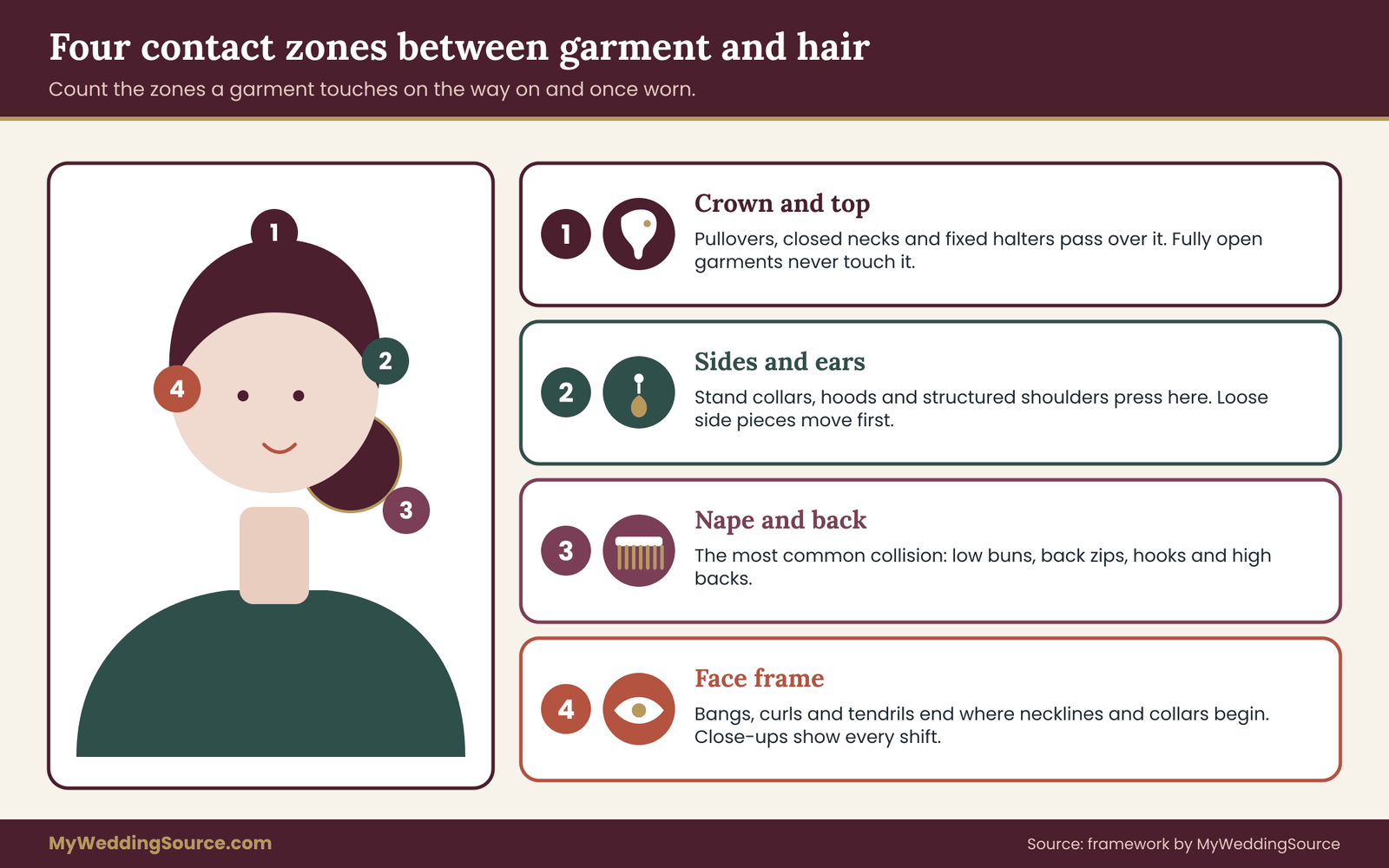
The crown and top. Anything that goes over the head touches this zone first. Pullover tops, dresses with a closed neck, jumpsuits with a fixed halter and any garment that closes at the back neck all pass over the crown unless they open fully. If your style is high or carries a headpiece, a pullover is usually out. A second look that opens completely, such as a jacket, a wrap, a button-front shirt or a dress with a full back zip, does not touch the top at all.
The sides and ears. The side zone matters for collars, hoods, high necklines with stiff stands, and any garment with a wide structured shoulder. A stand collar will press against hair swept behind the ear.
Wide bateau necklines and off-shoulder lines sit below the hair on most styles and are less of a concern, but a structured shoulder pad can push loose side sections outward. Check this on the card: if the hair is pinned back from the face, the sides are a lower risk. If it falls forward or loosely at the sides, they are a bigger one.
The nape and back. This is the zone that most often decides the outcome. A low bun, a chignon or a braid sits right where collars, zippers, hooks and high backs do their work. A high back with hooks and eyes needs fingers working at the nape, and fingers working at the nape are a hazard to a low hairstyle.
Compare two approaches. A front-opening or side-zip garment never goes near the hair at the back. A garment with a long back zipper that finishes at the neckline needs a helper to work carefully around the style, with the zip pulled up and away from the hair, not toward it.
The face frame. Loose pieces, bangs, curls and tendrils frame the face, and they sit right where some necklines and collars end. A high neck with a close collar pushes against the hair at the jaw. A wide neckline leaves the face frame alone. Note this on the card too: loose face-framing pieces are the first thing a stiff collar disturbs, and they are visible in every close-up photograph.
How to match zones to garments. Rather than a long list of dos and don’ts, use a plain rule. Count how many zones the garment touches on its way on, and how many it touches once worn. An open-front jacket touches none on the way on and perhaps the shoulders once worn.
A step-in dress touches the nape area once worn but not on the way on, since it goes up from the feet. A pullover touches the crown, the sides, the face frame and the nape on the way on, and again once worn. The fewer zones, the better the fit for a fixed style.
Headpieces and veils: the part of the hair that may need to change. If the card shows a veil or a headpiece, treat its removal as a task with its own plan. Ask the stylist how it is attached, how long removal takes, and whether the style underneath looks finished without it. A hairstyle built to carry a veil often has a visible anchor point, such as a comb sitting in a bun, a twist or a braid, and removing the veil leaves a gap or a bump that looks odd.
Ask your stylist whether the style can be finished with a smaller piece, such as a pin, a bow or a flower, that takes the place of the veil in the second look. That is a very small hair change, and it can be done by a helper in under a minute, but it needs to be planned and the piece needs to be in the bag.
Hair hold and humidity. The hold rating on the card matters here. A firm style survives a garment brushing it. A soft style does not, and it also loosens through the evening from dancing, hugging and a warm room.
If the style is soft, the second look should be an open or step-in garment that never touches the hair, and the plan should include a small repair kit: a few pins in the matching shade, a comb, a small can of the same hairspray. Ask the stylist to put the exact pins in the kit, because the wrong color or size is visible.
Weather plays a role too. Humidity affects hair and so does heat, and a long evening in a warm tent is different from a cool indoor ballroom. The National Weather Service explains how heat and humidity combine on its site, and a quick look at the forecast for your date and place helps you decide how much repair the style may need. A style that is fine in dry air can lose its shape when the air is damp.
Heat tools in the plan. If a curling iron or hot brush is part of a touch-up plan, treat it as a real tool with real risks. Use it only according to the maker’s instructions, never near a garment, and never in a space with chiffon, tulle or satin right next to it. The Consumer Product Safety Commission publishes general guidance on household products and recalls. In practice, most couples avoid heat tools during the swap altogether, because the risk is not worth a slightly neater curl.
Extensions and added hair. Clip-in pieces and extensions change the weight and attachment of the style. A second look that brushes the hair can catch a clip. If you use hair additions, ask the stylist whether the style can be tugged lightly without shifting, and whether the garment you are considering is likely to pull on them.
There is a simple test for any outfit and any hairstyle, and it needs no experience: have the person who will help you change do a slow dry run with the hair done and the second look in hand, and watch for tugging, snagging and pushing. The details of that run belong in the rehearsal section, but the hair rules above tell you which outfits deserve a rehearsal at all.
Makeup constraints that decide the second look
Makeup constrains the second look in two directions. It limits which colors look good next to your face, and it limits which fabrics and openings will touch the face and carry product away. Both are manageable, and neither needs expensive tools.
Color: the lip and cheek are now part of the second look. Under the first outfit, your lip and blush colors were chosen to look right with that garment. With a different garment, the same colors may fight. A berry lip that looked rich with ivory can look heavy with bright orange. A soft pink blush that looked fresh with white can look flat against pale yellow. The fixed makeup becomes a given, and the second look has to flatter it.
You do not need color theory to do this. Use three plain questions. Does the outfit color share a temperature with the lip color, both warm or both cool, or does it sit neutral between them? Is the second look lighter, darker or about equal in depth to the lip, and does that difference look intentional?
Does the second look’s color sit directly beside the face, as with a collar or a neckline, or is it far from the face, as with a skirt? Colors close to the face matter much more than colors at the hem.
If your makeup was chosen to be adaptable, such as a soft rose lip and a neutral eye, most outfit colors will work. If it was chosen to match a specific color, such as a deep red lip for a white dress, ask whether the lip color is a classic that suits many colors or a specific match. Classics, such as true red, a soft nude or a rose, tolerate more change. Narrow shades, such as a coral meant only for a peach dress, narrow the choice.
Reflected color in photographs. Colors near the face reflect onto skin, especially under flash or bright light. A strongly colored collar or wrap near the face casts a faint tone on the chin and neck. That can improve a complexion or work against it. A photographer can tell you how a given color tends to photograph in your venue’s lighting, and the swatch test later in this guide gives you your own evidence.
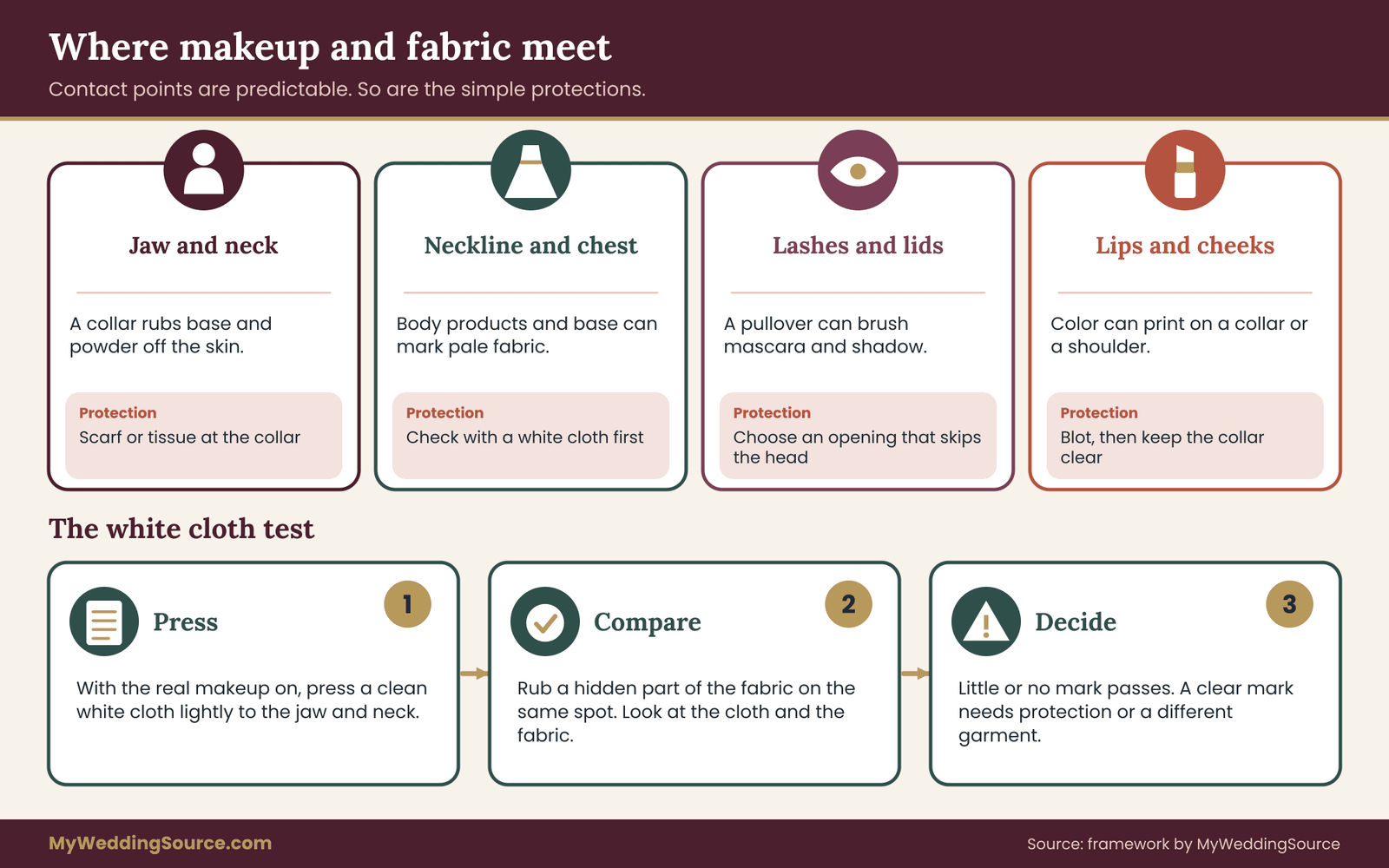
Transfer: what rubs off. Foundation, powder, lipstick, blush and sunscreen can all mark fabric, and fabric can lift product from skin. The contact points are predictable. A collar touches the jaw and the neck. A neckline touches the chest, which may have makeup or body product on it. Sleeves and bodices touch the shoulders and arms. A garment pulled over the head touches the face on the way on, which is the biggest transfer event of the whole swap.
Light, pale, tightly woven or smooth fabrics show marks most. White and ivory silk, satin and crepe are especially unforgiving. Dark, textured or patterned fabrics hide small marks. That is a practical reason a second look in a deeper color is common, and it is not a style rule you must follow. If you choose a light fabric, plan to protect it.
Protection steps that do not change the makeup. Several protections cost little. A soft stretchy face covering, the kind sold for dressing over makeup, can be held over the face while a garment goes over the head. A clean silk scarf can be laid at the collar for the first few minutes.
A pair of tissues in the neckline can catch loose powder. If the hair and makeup artist agrees, a light dusting of translucent setting powder at the collar contact points can reduce transfer, though it should be tested first so it does not leave a visible dusting on dark fabric.
Sweat, heat and touch-ups. Makeup wears differently by the end of an evening. A kit with blotting papers, a small mirror, a lip color matching the one worn, powder and a few cotton swabs allows a quick refresh during the swap. If the makeup artist is booked only for the morning, ask them to list the exact products and shades in the kit so a friend can follow the list.
The U.S. Food and Drug Administration explains on its cosmetics pages that its role differs from its role with drugs, and that consumers can report problems. That means it is reasonable to ask what is in the products you will wear and to avoid trying a new product on the wedding day.
Skin sensitivity. If your skin reacts easily, do not introduce a second product, a new powder, a new lip color or a new wipe at the swap. The American Academy of Dermatology publishes general guidance on skin care and on reactions to cosmetics. If you have known sensitivities, discuss the plan with a dermatologist or the artist in advance, and keep the touch-up kit limited to products you have already worn without trouble.
Eye makeup and the pullover problem. Eye makeup, especially mascara and liner, is the first casualty of a garment pulled over the head. Even with a hood, a closed neckline can brush lashes or smudge shadow. If the eye makeup is a high-priority element of the look, favor garments that do not go over the head. If you do choose a pullover, practice with the real makeup and see how it behaves.
Glasses. Many people wear glasses with a wedding look, and glasses have their own contact points at the nose and ears. If you wear them, add them to the card. A second look that goes over the head may knock them askew and mark the lenses with makeup. A button-front or step-in garment avoids the issue.
Taken together, the hair and makeup constraints narrow the field quickly. Most couples find that two or three styles of second look remain easy and the rest are possible with effort. The next sections give you a structured way to screen what remains.
The five-gate screen for a second look
The Locked Look Card tells you what is fixed. The five-gate screen tells you whether a candidate second look respects it. Each gate is a yes-or-no question you can answer in a fitting room or at home in front of a mirror, and an outfit has to pass all five or have a stated fix for the gate it fails.

Gate one: the hair gate. Does the garment avoid pressing on, tugging or crowding the fixed hair, both on the way on and once worn? Use the four zones from the hair section. Count the zones touched. Then ask the harder question, which is whether the second look touches the hair at the zone that the card marks as fragile.
A low chignon with a firm hold can survive a collar at the nape but not a stiff stand that pushes it upward. A loose half-up style can survive a pullover only with exceptional care. Passing this gate means the style looks exactly the same in a mirror before and after.
Gate two: the color gate. Does the outfit color look intentional beside the fixed lip and cheek colors, in the light the reception will have? Test with the real lipstick on, at the venue’s lighting level if you can, or at least in warm indoor light, not a bright shop.
A color that looks right under the cool white light of a boutique may look different in candlelit warmth. Pass means that when you look at the face and the garment together, nothing feels like a mismatch. If you are not sure, take a photo with flash and without and look at both.
Gate three: the transfer gate. Will the garment mark the makeup, or will the makeup mark the garment? The test is physical and takes a minute. With the makeup on, press a clean white cloth lightly against the jaw and neck and see what lifts.
Then rub a small swatch of the garment’s fabric, or the inside of the hem if the shop allows it, against the same spot and see what each shows. A second look that shows transfer from a quick press needs protection or a different choice. Pass means little or no mark, or a mark that a protection step reliably prevents.
Gate four: the path gate. Can the garment get on without going over the head and without a long wrestle at the back? Trace the path. A step-in dress travels up from the feet. A wrap or open jacket moves in from the sides. A pullover goes over the head. A fitted bodice with back buttons needs fingers at the nape. Count the steps and note the time. Pass means a path that leaves the hair alone or one that you have rehearsed to a clean result in the time on the card.
Gate five: the accessory gate. Do the earrings, necklace and any remaining hair jewelry still work with the new garment, or can they be moved in the swap time? A new neckline may bury a necklace or cut across it awkwardly. A high collar may catch an earring.
A wide neckline may need a necklace that the first outfit did not. The easiest fix is to decide in advance which jewelry stays and which changes, and keep the change within the swap budget. Pass means the jewelry plan is written on the card and is realistic for the swap time.
Scoring without a table. You do not need a score sheet. Use a simple rule. If the garment fails any gate with no fix, remove it. If it passes four and fails one, write the fix on the card and decide whether you will actually do the fix on the night. If you will not, count that as a fail.
If it passes all five, it advances to the rehearsal. In a typical shopping process, several candidates drop out early because the hair gate or path gate fails, and that is not a loss. It is the screen doing its job at the cheapest possible moment, before anything is altered or bought.
The tie-breaker. When two garments pass, choose the one with the shorter path and the fewer touch points. The shorter the path, the less that can go wrong on a tired evening. Beauty counts, of course, but when beauty is close, simplicity is what will protect your look at eleven at night.
Gates for outfits you already own. If the second look is something you already have, such as a favorite dress or a family garment, run the same five gates before assuming it will work. People often discover at the first rehearsal that a beloved garment fails the path gate. It is far easier to learn that at home.
If the second look is a family piece, such as a garment with sentimental or cultural meaning, treat any alteration with extra care and ask the alterations professional about reversible changes. The site’s guide to dress fit and alterations explains how fittings and alterations work, and it is worth reading before you ask anyone to cut or sew a second look that matters to you.
Gates and budgets. The five gates also help with cost decisions. A second look that needs structural alteration to pass the path gate, such as a new back closure or a sewn-in opening, costs money and fitting time. A second look that passes the gates as sold costs only its price.
When two options are close in appearance, the one that needs no alteration to pass the gates is usually the better value, because alteration costs vary by shop and by garment and cannot be known until a professional has seen the piece. Ask for a written estimate before committing.
Comparing second look types for one hairstyle
Now that the gates are clear, it helps to see how common types of second look tend to fare. This comparison is in words, not a score, because the details depend on your hair and your garment. Treat it as a map of where each type is likely to be easy and where it tends to struggle.
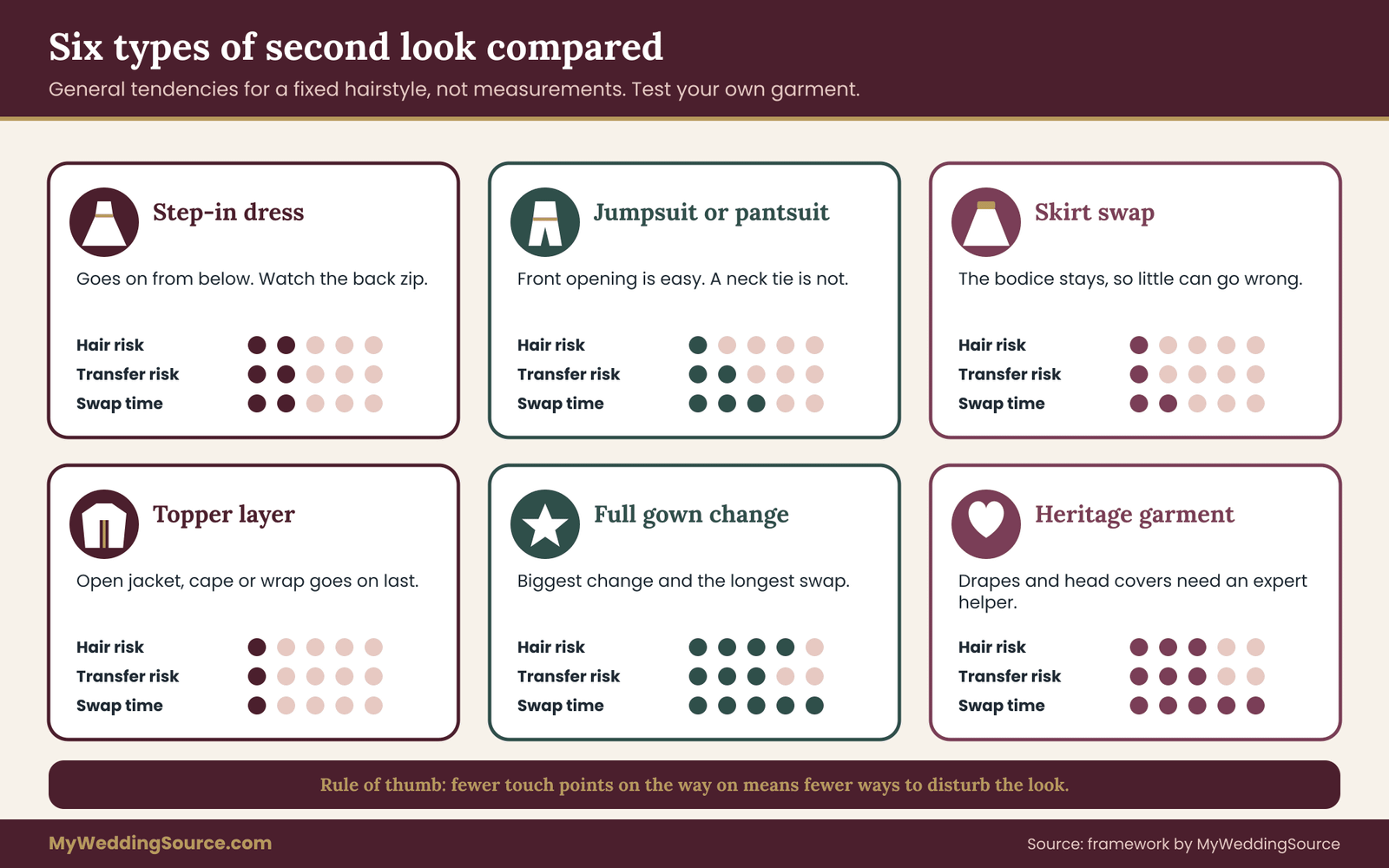
The short dress or midi dress, step-in. A step-in dress that zips or buttons at the back and has a modest neckline is probably the most common second look for a fixed hairstyle. It travels up from the feet, so the crown and sides are not involved.
Its risks sit at the nape and at the zipper. A side zip removes the nape concern almost entirely. A back zip with a low neckline is manageable with a helper who works away from the hair. Short and midi lengths also dance well and need little hem handling, which shortens the swap.
The jumpsuit or pantsuit. A jumpsuit with a front opening or a side opening is a comfortable second look and it goes on from below. A halter jumpsuit that ties behind the neck is a hair hazard, because the tie sits right on the style. A pantsuit with a separate jacket gives you two garments, and the jacket can be added last, away from the hair. A fit-focused guide covers the tailoring side of a jumpsuit, and this guide adds only the hair and makeup question to it.
The skirt swap with a kept bodice. Some couples keep the top half and change the skirt: a ceremony ball skirt replaced with a shorter or lighter one. This is the lowest-risk option for hair and makeup because the top half, the part that touches everything fragile, does not move. The trade-off is that the look may change less than you hope in photographs, so the skirt, the sash and the added accessories need to carry the difference.
The topper: jacket, cape, wrap, bolero or overlay. Adding a layer is the gentlest change possible. An open jacket or wrap touches the shoulders and little else. A cape that fastens at the front stays away from the nape. An overlay that ties at the waist leaves the head alone. The limit is the same as with the skirt swap: the underlying outfit stays, so the second look must come from color, texture and silhouette of the added piece.
The full gown-to-gown change. A second full gown gives the biggest visible change, and it carries the highest hair and makeup risk if it is a pullover or has a closed back. If you want this, choose a design with a front or side opening, a wide neckline and a bodice that does not need to go over the head. Expect the longest swap time, and rehearse it.
The cultural or heritage change. Many weddings include a change into a traditional outfit for a ceremony or a reception, whether a sari, a lehenga, a kimono, a cheongsam, a barong or another garment tied to a family’s heritage. These garments often have long drapes, multiple layers and a dupatta or veil that sits on the head.
They call for their own planning with a family member or dresser who knows the garment. Add the garment’s specific draping steps to the path gate, and ask the person who knows the garment how it relates to your hair. Some designs are made to be worn with a fixed hairstyle, and some are not.
Which type fits which constraint. If your hair is high and fragile, favor the skirt swap or topper. If your makeup is delicate or the fabric is pale, favor an open-front or step-in garment. If your hair is firm and your makeup well set, you have more choices, including a careful pullover. If your swap time is under ten minutes, simpler paths win. These are general tendencies, not rules. The gates are the real test.
Two quiet traps. The first trap is choosing a second look so close to the first that the change disappears in photographs, so that the swap costs time and adds little. The second is choosing a second look whose neckline hides a necklace or earrings that give the fixed look its character, so that the face looks less finished than before. Both traps are visible only when you compare the two outfits side by side with the hair and makeup in place, which is why the rehearsal matters.
The role of price and rental. Second looks are often bought for one evening, so cost deserves a plain look. A rented garment cannot be altered, so any alteration must be reversible or unnecessary. A purchased one can be altered, but alteration changes resale value.
A pre-owned garment has an unknown history, so inspect it before you commit. The site covers renting and buying in other guides, and the point here is simple: do not pay for alterations to rescue a second look that fails the hair or path gate unless you have a firm estimate and a plan for the fix.
The swap-time rehearsal for your second look
A rehearsal turns a guess into a measurement. It is the step that most couples skip, and it is the step that catches most failures. The aim is simple: put on the real hair and makeup, put on the real second look and time the swap, then check the result against the card.
When to hold it. Schedule the rehearsal after the hair and makeup trial and before final alterations are locked, so that anything it reveals can still be fixed. A trial day is ideal, because the hair and makeup are already done and photographed. If the trial and the garment are not available together, hold a separate rehearsal with the artist’s written notes, or even without the finished makeup, and repeat the makeup-related checks on a later day. Plan for the rehearsal to take about an hour, including setup and a reset.
Who attends. The rehearsal needs the person who will actually help on the day. A friend, a sibling, a parent or a hired dresser can fill that role. Having them practice matters more than having a professional present, because the helper’s hands are the ones that will be near your hair at the reception. If your hair and makeup artist can be on hand for ten minutes at the end to inspect the result, even better.
The setup. Bring the garment, the shoes you will wear with it, the jewelry plan, the touch-up kit, the repair kit, and a phone for photographs and a timer. Wear the first outfit with the real hair and makeup. Stand in a space that resembles the real changing area: a quiet room with a mirror, a hook and a chair, not a spacious studio. A cramped space changes the time.
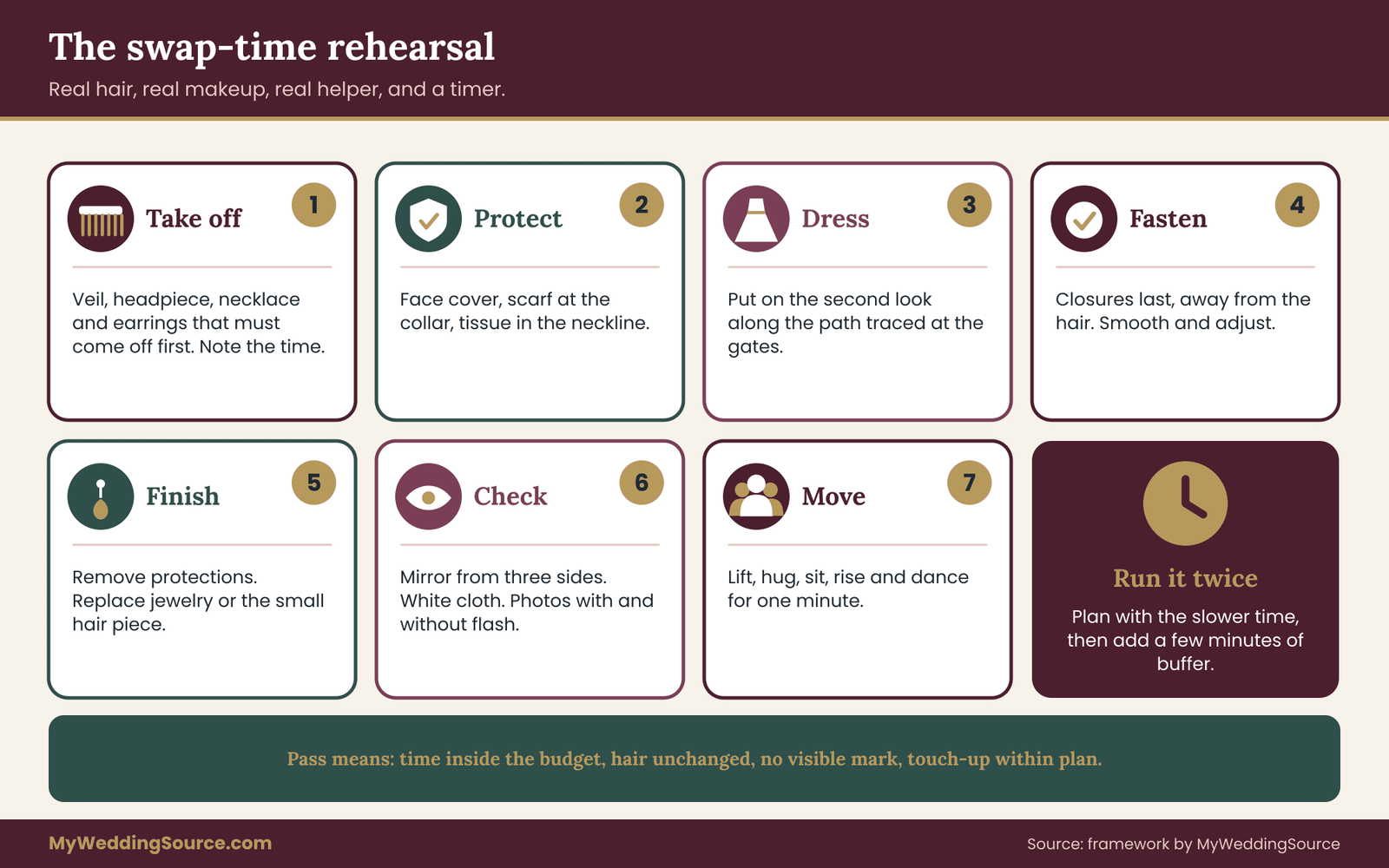
The seven-step run. Work through the swap in order and time each step.
First, remove the first outfit and any items that must come off before the garment goes on, including a veil, a hair piece, a necklace or a pair of earrings. Record the time. Second, apply protections: a face cover, a scarf at the collar, tissues in the neckline.
Third, put on the second look along the path you traced during the gates. Fourth, fasten, adjust and smooth. Fifth, remove protections and replace the jewelry or headpiece. Sixth, do the check described below. Seventh, restore the first outfit for the reset, if you are going to run it a second time.
Record the total time and the time of each step on the card. The number you get is your honest swap time, not the number you hoped for. Most couples find that the first run takes noticeably longer than the one they planned, and a second run is faster, so run it at least twice, and use the slower number in the schedule.
The post-swap check. After the second look is on, run a short, fixed check. Look in a mirror from the front, the sides and the back. Compare the hair to the photo on the card: has any piece moved, flattened or loosened?
Look at the face: any smudge at the jaw, the lashes or the lip, any foundation mark on the collar? Check the garment: any makeup mark, any snag, any pin caught in the fabric? Check the jewelry: does it sit as planned? Take a front, side and back photograph with and without flash and compare them with the trial photos.
Measurable checks. Turn the run into pass-or-fail numbers. The swap time must fit the budget you wrote on the card. The hair must show no displaced pins and no visible change in shape. The garment must show no transfer mark visible at arm’s length. The makeup must need no more than the touch-up the plan allows. If any of these fail, adjust the plan or the garment and run again.
The white cloth test. This was part of gate three and is worth repeating in the rehearsal setting. After the swap, press a clean white cloth lightly to the places where the second look touched the face, and see whether there is product on the cloth. Then look at the garment’s collar and neckline in bright light. This test is cheap and conclusive, and it needs no special equipment.
The movement test. Once the second look is on, move as you will at the reception: lift your arms, hug someone, sit, rise and dance for a minute. Watch for the hair shifting as the garment moves, for a collar rubbing, for a sleeve catching an earring. A second look that survives a minute of ordinary movement will survive an evening. A second look that looks perfect standing still and fails when you hug someone has not passed.
The photo test. Ask someone to take photographs in a setting with similar light, with and without flash. Compare the second look photographs with the first-look photographs from the trial. You are checking two things. Does the hair and makeup look consistent between them, and does the second look look like a new outfit and not a variation on the first?
The first question protects the single look. The second protects the reason you bought a second outfit. For group photos that follow the change, the site’s family photo list guide explains how to build the list, and you can decide whether any groups should be photographed before or after the swap.
Fixing what the rehearsal finds. The usual findings and fixes are ordinary. A tug at the nape usually means switching to a side zip or a front opening, or having the helper pull the closure away from the hair. A collar mark usually means a protective layer or a collar of a different fabric.
A color mismatch usually means a different accessory color near the face, a scarf or a necklace, not a new garment. A time overrun usually means simplifying: fewer fastenings, shoes that slip on, jewelry decided in advance. A hair shift usually means a firmer anchor from the stylist.
The second run. After you fix something, run the swap again. A fix that is not tested is just another guess. The second run also gives your helper practice, and it usually shows a faster time. Keep the slower of your two numbers as the planning time, and add a buffer of a few minutes for the real evening, which has more distractions than a quiet rehearsal.
A written swap card. Turn the rehearsal into a one-page card for the helper: the order of steps, where each item is, what to avoid, the repair kit contents and who to call. Keep it short enough to read in thirty seconds.
People remember little under stress, and a card on a clipboard or a phone note is the difference between a calm swap and a frantic one. If you are not the one in charge of the schedule on the night, give the card to whoever is, so the swap time is protected in the program.
Fitting the swap into the evening. The swap has to find a place in the reception timeline. It often sits after the formal dances and dinner, or just before the open dance floor. Ask your planner or coordinator where the gap fits and make sure toasts and other moments do not collide with it.
The site’s guide to the wedding vendor timeline shows how the day’s schedule comes together, and your swap time becomes one entry in it. If the swap is longer than the gap, either lengthen the gap or shorten the swap, but do not let the event start without you.
Vendor questions before you commit to a second look
Several people have information you need, and most of them are happy to share it if asked clearly. The questions below are written to be asked as stated. None of them require a long conversation, and the answers should go on the card.
Questions for the hair stylist. What is the hold of this style, in plain terms: firm, medium or soft? How is each piece attached, and how long does each take to remove? Can the veil or headpiece be removed without disturbing the style, and does the style look finished without it? Which garment types will it tolerate, and which should I avoid?
What should be in the repair kit, and can you pack it or list the pins and products? Will you be available in the evening, or will someone else need to do repairs? For a broader look at how hair and makeup planning fits together, the same hair and makeup guide linked earlier covers trials, artist choice and timing.
Questions for the makeup artist. Which products and shades are on my face, and can you list them? Which will transfer easily to fabric? Can the finish be set so that it transfers less, without looking flat? What belongs in the touch-up kit and in what order should a helper use it? Are you available for a touch-up at the reception, and what does that cost? Is anything in the routine likely to be a problem for my skin if I touch up?
Questions for the dress shop or seller. Can I try this garment on with my hair and makeup done, or with a protective cover? What are the fabric and care instructions? Under the Care Labeling Rule enforced by the Federal Trade Commission, most garments sold in the United States must carry care instructions, so the label tells you how to clean it, including after a makeup mark.
Does the garment have a front or side opening, and can the closure be changed? What is the return or exchange policy after a try-on, and are there fees? If a garment is rented, what is the policy on cosmetic marks and cleaning charges?
Questions for the alterations professional. Can the neckline, collar or back closure be changed without harming the garment? What would it cost and how long would it take? Can the change be reversed? Is there a safer way to add an opening? Can sleeves or cuffs be altered to avoid catching jewelry? When must the garment be dropped off to be ready, and what is the schedule for final fitting? Ask for estimates in writing.
Questions for the photographer. How do the colors I am considering photograph in the reception lighting? Will flash make a collar or makeup transfer mark more visible? Where in the evening will you shoot photographs of the second look, and how long do you need? If I want a few portraits in the second look, can they be scheduled in a window that suits the swap?
Questions for the venue. Is there a private space for the swap, with a mirror, a chair, a hook, a power outlet and a door that locks? How far is it from the reception room? How long will the walk take, and can someone hold a door? Is it climate controlled? Spaces with no mirror or no privacy change the plan, and discovering that on the night is expensive in minutes.
Questions for the helper. Do you feel comfortable handling this garment and working near my hair? Can you come to the rehearsal? Can you stay near me for the whole evening? Do you have a phone or a note with the card? A helper who says no is giving you useful information, and it is better to find a different one now.
Written confirmation. For paid vendors, put the answers in a short email or in the contract. If a vendor promises a touch-up or a repair kit, it should appear in writing. This is not about distrust. It is about making sure everyone is working from the same plan on a busy day. The site’s vendor due diligence checklist covers how to keep those confirmations organized.
A note on recommendations. If a vendor recommends a specific product, brand or accessory, ask whether they have a commercial relationship with the maker. The Federal Trade Commission expects material connections between endorsers and sellers to be disclosed clearly, and a vendor who is comfortable with that question will answer it simply. Nothing in this guide depends on a particular brand or product, and you can meet every test described here with items from any maker.
A worked example: one hair look, two outfits
The following couple is invented for illustration. The numbers are small planning figures, not statistics, and yours will differ. The point is to show the process, including a candidate that fails.
Dana is marrying in a garden venue in late September, with a ceremony at four and a reception that runs until about ten. Her hair stylist builds a low chignon with a comb at the crown, a few loose pieces at the temples and a short veil attached to that comb.
The hold is firm. Her makeup artist applies a satin base, a soft rose blush and a muted berry lip, and sets everything with a light powder. The artist is booked until the end of the ceremony photographs, and a friend named Priya will do touch-ups with a kit.
Dana’s Locked Look Card. Hair: low chignon, lowest point about two inches above the collarbone, comb at crown, veil removable in about a minute, hold firm, loose pieces at temples. Makeup: satin base, rose blush, berry lip, light powder. Jewelry: small drop earrings stay, necklace removable. Swap budget: twelve minutes. Rule: nothing goes over the head, nothing rubs the jaw.
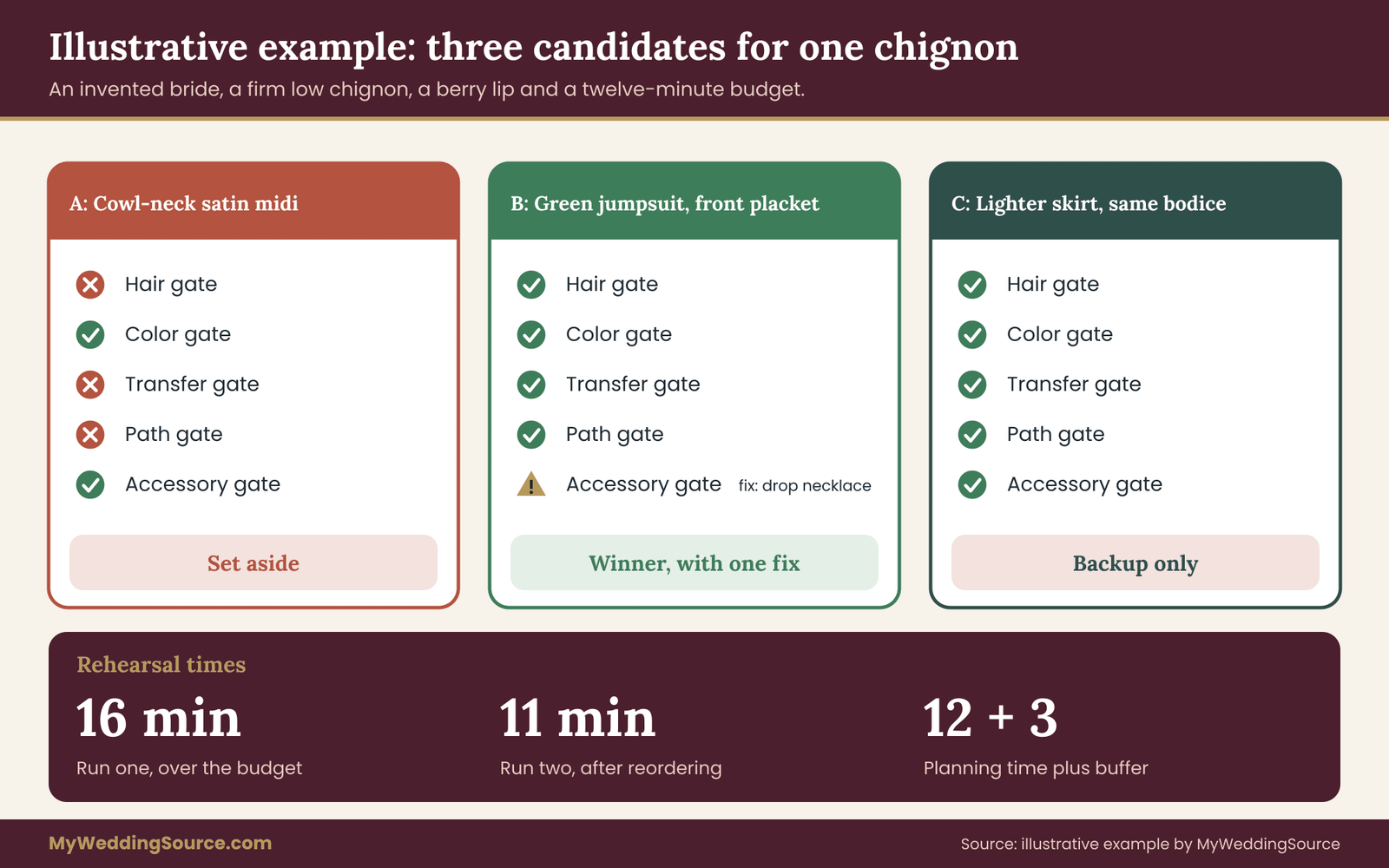
Candidate A: a champagne satin midi dress with a high cowl neck. Dana loves it. It pulls over the head, and the cowl sits against the jaw and the chignon’s lowest point. Running the gates, she finds that it fails the hair gate, because the cowl would push the chignon, and the path gate, because it goes over the head.
It also fails the transfer gate in a quick test, since satin picks up a soft smear from the jaw. She sets it aside, with a note that the shop could add a side zip, and asks for an estimate. The estimate is higher than she wants to pay for a dress that would still have the cowl problem, so she drops it.
Candidate B: a deep green jumpsuit with a front button placket and a wide boat neckline. It goes on from below and closes in front. The neckline sits well clear of the chignon. The deep green hides transfer marks. The hair gate passes. The path gate passes. The transfer gate passes on a white cloth test with only a faint trace at the collar’s inside edge.
The color gate is more interesting. Green with a berry lip is a classic pairing that looks deliberate, not matched, which suits a second look. The accessory gate needs a fix: the ceremony necklace disappears against the wide neckline, so Dana removes it and lets the drop earrings carry the jewelry.
Candidate C: the ceremony skirt swapped for a lighter one. The bodice stays. It passes every gate easily, since little changes. But the photo test shows the problem described earlier: in evening photographs, the change is small. She keeps it as a backup, not the main plan.
The rehearsal. Dana and Priya hold the rehearsal on the day of the hair and makeup trial. Priya takes the veil out first. The comb stays, and the stylist had planned for that by tucking a small cluster of pearl pins beside it as the finishing touch. The first run takes sixteen minutes, four over budget.
The overrun comes from fiddling with the placket buttons and from changing shoes. In the second run, Priya leaves the buttons for last, Dana wears slip-on shoes in place of the lace-up pair, and the time falls to eleven minutes. Dana records twelve as the planning time and adds a three-minute buffer in the schedule.
The white cloth test shows a faint beige line at the collar’s inside edge. Priya adds a folded tissue under the collar during the swap and removes it afterward. The movement test turns up one problem: a sleeve cuff catches a drop earring when Dana hugs. The alterations professional lets out the cuff by a small amount at a modest charge, and the problem goes away.
The photo test confirms two points. The hair and makeup look consistent across the two outfits, and the green jumpsuit reads as a clear second look against the ceremony gown. Dana also notices that the berry lip looks richer against green, and she decides to leave it exactly as it is.
What Dana puts in the schedule. The swap begins after the first dance and the parent dances, with a fifteen-minute window and the venue’s bridal suite booked for that time. Priya carries a small bag with the touch-up kit, the pearl pins, spare pins in a matching shade, the slip-on shoes, tissues and a printed swap card. The photographer plans two portraits in the second look near sunset, so the swap is timed to leave a few minutes of good light.
What the example shows. The three candidates map to three outcomes. A second look that is beautiful and fails the gates should be set aside early, not rescued with costly alterations. A second look that passes the gates but changes little may still be a good fallback.
A second look that passes after a small, specific fix is the winner, and the fix is already planned. The rehearsal turns an expectation of twelve minutes into a measured time and exposes two small problems, the buttons and the cuff, that nobody would have predicted from the rack.
Notice what Dana did not do. She did not change her makeup to suit the second look, she did not ask the stylist to redo the hair and she did not buy a second gown on impulse. She changed the garment and the plan, and the single look stayed whole.
Adapting the example. If Dana’s hair were loose and soft, an open-front jacket would have been better than the jumpsuit, and she would have added extra pins to the repair kit. If her swap budget were six minutes, she might have chosen a topper over her existing outfit.
If the venue’s changing space were far from the reception, she would have subtracted walking time from the budget. If the weather were humid, she would have asked the stylist for a firmer finishing spray in advance. The structure of the process holds even when the answers change.
Edge cases for a second look with fixed hair and makeup
The ordinary case is a hairstyle with a veil or a few accessories and a standard application of makeup. Several situations are not ordinary, and each deserves a plain answer.
Head coverings and hijab. If you wear a hijab, a turban, a scarf or another head covering as part of a fixed look, the second look must work with that covering’s drape, pins and fabric. Many people choose a second look with a different covering in a matching or coordinating fabric, which makes the covering the main variable. Others keep the same covering and change the garment around it.
If the covering is pinned at the neckline, favor garments that open in front or at the side, and think about how the garment’s neckline meets the covering’s edge. A friend who wears the same style and knows its pinning will be a better helper than a professional dresser who does not. The principle still applies: record what is fixed, and test candidates against it.
Natural, textured and protective styles. Braids, twists, locs, coils and other textured or protective styles are often built to last for days or weeks, and they tolerate garments differently from a pinned updo. Some tolerate a pullover easily, and some carry beads or wraps that a collar can catch. The card should record the style’s attachments and any hair jewelry, and the rehearsal tests whether a garment catches.
A stylist who works with your hair type is the best authority on what the style tolerates, and their answer belongs on the card. Satin or silk linings at the neckline are worth asking about for any garment that touches textured hair, because smooth fabric glides where rough fabric grabs.
Wigs, extensions and hair pieces. If the look includes a wig or a hair addition, ask the stylist how it is secured and whether a garment can snag the attachment. Treat anything with clips or tape as a point of risk in the hair gate.
Short hair. A short cut can seem easy, since there is little to disturb. But short hair often carries product that transfers to collars, and a pullover can flatten a carefully shaped top. Run the same gates and pay attention to the crown and sides.
Facial hair. For anyone with a styled beard or mustache, the face zone includes the jaw and the upper lip, and a high collar or a pullover can disturb a precisely shaped beard. Add the beard’s shape to the card as you would a hairstyle.
Sensitive skin and reactions. If you break out or react to products, avoid anything new on the day. Keep touch-ups to products you have already worn. If a reaction occurs, stop using the product, rinse gently, and seek medical advice if symptoms are significant. The American Academy of Dermatology and MedlinePlus, the consumer health site of the U.S. National Library of Medicine, provide general information on skin reactions. For serious symptoms, such as swelling of the face or trouble breathing, seek emergency care immediately.
Heat and long evenings. A hot reception changes everything: makeup wears faster, hair loosens, fabrics cling. Choose breathable fabric for the second look, plan for water and rest, and consider the shade. The Centers for Disease Control and Prevention publishes heat and health guidance, including signs that someone is overheated and needs to cool down. Treat that guidance as more important than any styling plan.
Cold and wet weather. Rain and damp air affect hair hold and fabric. A topper in a dark or water-resistant fabric helps, and so does a clear plan for moving between buildings. Keep spare pins and a small umbrella in the bag.
Mobility, pain and fatigue. If standing, lifting your arms or twisting is difficult or tiring, the path gate matters even more. Favor front openings, elastic or magnetic closures that work one-handed, and slip-on shoes. A seated swap with a helper’s support is better than a heroic standing one. Planning for rest is not lowering your standards; it is what lets you enjoy the reception.
Sensory needs. Some fabrics, tags, seams and closures are uncomfortable over a long evening. If you are sensitive to touch, test the second look for several hours, not several minutes, and check labels and seams. The rehearsal should include a longer wear test, even if only at home.
Children, pets and crowds. If a child or a pet will be near you in the second look, add the hazards to the card: small hands pull at veils and hems, and a pet may jump on a delicate fabric. Choose a fabric you can clean or ignore, and keep a lint roller in the bag.
When both partners have a fixed look. Sometimes both partners have fixed hair and makeup. The same method applies to each person, with a card for each. Doing the rehearsals together, with helpers who can switch between the two, saves time.
When the hair and makeup are done early. If the artist finishes at seven in the morning and the reception ends at ten at night, the look has to survive fifteen hours. That is a long time for any product. Ask for a plan, including what to touch up, when, and what to bring. If the ceremony is long and the day is hot, accept that a small refresh is normal, and keep the planned touch-up modest.
When the second look cannot be worn. A garment may become unwearable through a spill, a tear or weather. Keep a backup in mind: the first outfit, a topper or a simple dress that passes the gates. A backup you have never rehearsed is only a hope, but a backup that has passed the five gates is a real plan.
What a second look costs when the look is locked
Money enters this decision in quieter ways than the price tag. The cost logic below uses no invented averages. Prices vary widely by garment, shop and region, so use the structure and fill in your own quotes.
The visible costs. The garment itself, shoes, any new jewelry, and alterations. These are the numbers everyone adds up. For rented garments, add the rental fee, any deposit, cleaning charges and the late-return policy. For pre-owned garments, add inspection and cleaning. Ask every seller for terms in writing, and for a rented garment ask specifically what the shop does if makeup marks the fabric.
The hidden costs that the single look removes. A second hair and makeup session means another artist booking, more travel time and a longer gap in the schedule. Keeping one look removes those costs, and it is fair to count that saving when you decide how much to spend on the second look. A modest budget for alterations that make a garment pass the gates may cost less than the second session would have.
The hidden costs the single look adds. Keeping one look has costs of its own. You may need a firmer hairstyle, which can take the stylist longer. You may need a touch-up kit with specific products. You may need a helper’s time and a private room for the swap. You may need an alteration to add a side zip or front opening. List these so the comparison is fair.
A simple way to compare. Write two lines. Line one: the total cost of the second look you prefer, including the alteration needed to make it pass the gates. Line two: the cost of the nearest alternative that passes the gates with no alteration.
If line one is much higher, ask what the extra money buys that the alternative does not, and be honest about the answer. Sometimes it buys a garment you will love and wear again, and that is a good reason. Sometimes it buys a small difference that guests will not notice, and that is a reason to pause.
Reuse value. A second look that you can wear again, such as a jumpsuit, a midi dress or a jacket, spreads its cost over later wear. A second look that is useful for only one night has a higher cost per wear. This is not a reason to choose either, only a reason to count it. Pieces that can be dyed, hemmed or restyled after the wedding hold their value better than ones that cannot.
What to ask before paying a deposit. For any custom or altered second look, confirm the delivery date, the number of fittings included, the cost of extra fittings, the policy on changes after the order and the refund terms if the garment fails a fitting.
The site’s budget guide shows how to track costs against a plan, and a decision log helps when more than one person has opinions about the second look. If family members are weighing in on the choice, the site’s guide to sharing decisions offers language for keeping input useful without losing control.
Commercial relationships and honest advice. A shop or stylist who recommends a particular garment may earn a margin on it, which is normal. What matters is that you can judge the advice. Ask how the recommendation fits your card, not whether it is the most popular choice.
If someone makes claims about a fabric, a product or a technique, ask for the maker’s care instructions or product information, and treat promotional claims with ordinary caution. The Federal Trade Commission publishes guidance for consumers on advertising and endorsements, and its site is a reasonable place to check what sellers are required to disclose.
Time as a cost. The rehearsal costs an hour or two of two people’s time, the fittings cost travel and waiting, and the swap itself costs minutes in a schedule that has many demands. These are real costs, even though no invoice shows them. They are small compared with the cost of a failed swap in front of guests, and that comparison is the strongest argument for doing the work.
When to stop optimizing. A second look does not need to be perfect. There is a point at which more testing no longer changes the decision. If a garment passes the five gates, runs at a time within your budget in two rehearsals, and you like how you look in it, stop. Further tweaking tends to add stress without adding value. Reserve your effort for the schedule, the helper briefing and the repair kit, which protect the whole plan.
When the second look plan slips, and the limits of this guide
Even a rehearsed plan meets surprises. The useful question is not whether something will go wrong, but what you will do about it in the minutes you have.
A pin or piece of hair comes loose. Keep the repair kit with the helper and let the helper fix it, not you. If a piece is loose and cannot be pinned back quickly, a small flower, a clip or a bow in the same palette can cover it. This is the single most common mishap, and it is why the kit holds the exact pins the stylist used.
A makeup mark shows on the garment. Blot, do not rub. A clean damp cloth and a dry cloth are usually enough for a light mark on many fabrics, but test on a hidden spot first, because some fabrics water-spot.
Follow the care label, which for most garments sold in the United States is required to carry cleaning instructions. If the mark is on a rental or a delicate fabric, stop and call the shop later. A mark that is slightly visible in the room is much less visible in a photograph than a stain made worse by rubbing.
The swap runs long. If the swap is running longer than planned, drop optional steps in a set order: the necklace first, the shoes second, the final smoothing last. Tell the planner or coordinator in advance that the swap may stretch by a few minutes, and have a signal. A good planner will fill the gap with a toast, a dance or a slideshow, and you return to a room that is still engaged.
The zip or closure fails. A broken zipper at the worst moment is rare but possible. Keep a safety pin, a small sewing kit and a clip in the bag, and keep the first outfit or a topper as a fallback. Test closures during the rehearsal and look for weak stitching at the fitting.
The helper is unavailable. Name a second helper and give them the card. Plan for the case where the first helper is stuck in a conversation or a photograph and cannot leave. Two people who both know the plan are enough.
The weather turns. If heat, rain or wind alters the plan, favor the topper or the simplest garment that passes the gates. Move the swap indoors, shorten it, or skip it if conditions make it unsafe. A plan that bends is better than one that breaks.
The look changes anyway. Sometimes the hair does give way, or the makeup fades faster than expected. A quick, honest answer is to accept that the evening look is a little softer, and to rely on the touch-up kit. Guests see a person enjoying their wedding, not a photograph.
The limits of this guide. This guide describes a planning method. It cannot tell you how your particular garment is made, how your particular hair will behave, or how your skin will react to a product. Garment construction and fit differ by designer, and only an actual fitting shows what a garment will do. Hair and makeup professionals know their own products and techniques better than any general guide does.
Where the guide offers a test, such as the white cloth test or the movement test, treat it as a way to gather evidence for your own situation, not as a guarantee. The examples are illustrations, and the people and numbers in them are invented. For product safety, skin concerns, heat and weather, the agencies listed in the sources are the right places to confirm current guidance.
What to do if you disagree with the guide. If your stylist tells you a garment type is fine with your style and the gates say otherwise, run the rehearsal and look at the evidence. If the rehearsal shows no problem, the stylist is right. If it shows one, you have the proof you need.
In either case, the card and the rehearsal turn an argument about taste into a question you can answer. Another look at the artists’ side of the plan, covered in the site’s guide to hair and makeup preparation, can help you choose which professional to rely on for which question.
Keeping the record. After the wedding, keep the card and the notes. If you later sell or lend the garment, wear it again or recommend a stylist, the records help. They are also a useful reference for anyone else in the family who is planning a similar day.
Your next steps
The work in this guide fits into a few evenings and two appointments. Do these in order, and stop when you have a second look that passes.
- Fill in the Locked Look Card from your hair and makeup trial photos, with the stylist’s honest hold rating and the artist’s product list. Add the swap budget in minutes and a one-line rule.
- Share the card with your helper, your alterations professional and your photographer, and ask the vendor questions in this guide that apply to each.
- Screen every candidate against the five gates, with the real lip color on and a white cloth in hand. Drop the ones that fail with no practical fix, and note the fix for the rest.
- Choose the candidate with the shorter path and the fewer touch points, then book any alterations with a written estimate and a delivery date.
- Hold the swap rehearsal with your helper, the real hair and makeup, and a timer. Run it twice, use the slower time, and fix what it reveals.
- Write the one-page swap card, pack the repair kit and touch-up kit, and ask your planner to protect the swap window in the schedule.
- Name a second helper and a fallback outfit, and keep both on the card.
If you only have time for one thing, do the rehearsal. It is the step that turns a plan into evidence.
FAQ
Can I really keep the same hair and makeup for a second look?
Yes. Many people do, and it can work well when the second look is chosen around the fixed look. The key is deciding what is locked, then picking a second look that does not press on the hair, clash with the lip and cheek color, or mark the makeup. A rehearsal with the real hair and makeup confirms it before the day.
Is a pullover dress a bad choice for a second look with a fixed hairstyle?
It is a higher-risk choice, not a forbidden one. A pullover touches the crown, sides, face and nape on the way on. If your hairstyle is firm and low, and your makeup is well set, a careful pullover with a face cover can work. If the hair is soft or high, an open-front or step-in garment is safer.
How much time should I allow for the swap?
Measure it. Run the swap with your helper at least twice and use the slower time, then add a few minutes of buffer for the real evening. Many first runs take longer than expected, and the second run is usually faster. Your own timed rehearsal beats any general estimate.
What colors work with a berry or red lip that cannot change?
Colors that share a temperature with the lip, or sit in a neutral range, tend to look deliberate. Deep greens, navy, charcoal, ivory and many neutrals often work with berry shades. The best test is to wear the real lipstick, hold the fabric near your face in the reception’s lighting, and compare photographs taken with and without flash.
How do I stop makeup from rubbing onto a light-colored second look?
Use protections that do not change the makeup: a soft face covering while the garment goes over the head, a scarf or tissue at the collar during the swap, and a garment with a front or side opening. A white cloth test after the swap shows whether any product transferred. Follow the garment’s care label for cleaning marks.
What should be in the repair and touch-up kit?
Ask the stylist and artist to list the exact items. Typically that means pins and a comb matching the style, the same hairspray, blotting papers, powder, the lip color worn, cotton swabs, a small mirror, tissues, safety pins and a small sewing kit. Keep it with your helper, and include a printed swap card so anyone can follow the steps.
Does a second look need a separate hair and makeup booking?
Not necessarily, which is the point of the single look. Ask your artists whether touch-ups at the reception are included, what they cost and whether someone else can do them with a kit. If the artist is booked only for the morning, plan the helper’s role and keep the touch-up modest.
What if my rehearsal shows the second look does not work?
That is useful news before the day. Identify which gate failed, then apply the smallest fix: a different closure, a protective layer, a changed accessory or a different garment from your shortlist. Run the rehearsal again. If the fix would be costly, compare it with an alternative that passes without alteration.
Sources
- Federal Trade Commission: guidance on advertising, endorsements and material connections.
- FTC Consumer Advice: consumer guidance on clothing care labels and shopping.
- U.S. Food and Drug Administration, Cosmetics: cosmetic product safety information and how to report problems.
- American Academy of Dermatology Association: general skin care and reaction guidance.
- MedlinePlus, U.S. National Library of Medicine: consumer health information on skin reactions.
- U.S. Consumer Product Safety Commission: product safety and recall information, including heated styling tools.
- National Weather Service: forecasts and heat and humidity information.
- Centers for Disease Control and Prevention: heat and health guidance.
- Cosmetic Ingredient Review: safety assessments of cosmetic ingredients.