
Moving an antique gown is a small piece of conservation work disguised as a travel errand: the fabric is old, the weight sits on seams that were never built for it, and one hard fold can leave a permanent line. This guide explains how to plan the move so the antique gown arrives supported, uncreased and ready to wear.
Treat the antique gown as a load to be supported, not a garment to be folded. Check three loads (weight, fold and friction), then build four layers around the gown: a rigid tray, soft cushioning, a breathable cover and an outer shell. Weigh and measure the gown first, rehearse the pack with a stand-in, pick the carry method that keeps the tray level, photograph every stage, and ask any carrier or vendor in writing how they handle fragile textiles.
Most advice about packing a wedding dress is written for a modern gown with a zipper, a built-in bustle and fabric that forgives a squeeze. An antique gown is a different object. Silk may have become brittle with age, old seams may hold by a few threads, beadwork may be heavy for the fabric under it, and the cloth may carry stains or repairs that look stable but are not. The usual habits, such as hanging the antique gown in a plastic bag or stuffing it into a suitcase, are the habits that cause damage.
The good news is that the risks are predictable. They come from a short list of forces, and each can be reduced with ordinary materials: acid-free tissue, a sturdy box, clean cotton and some patience. You do not need to be a conservator to pack an antique gown carefully. You do need a method, and you need to decide early which parts of the job belong to a specialist.
A note on scope. This is general information about handling and travel, not legal, tax or financial advice, and it does not replace a conservator’s assessment of your particular gown. Where a rule or a price matters, such as carrier liability or insurance valuation, the guide points you to the company or agency that sets it so you can confirm the current terms yourself.
Why an antique gown is different to move
A modern gown is made to be worn once and then stored. An antique gown has already survived a century or more of storage, wear, cleaning and handling, and the fact that it exists is partly luck. Moving it adds new stresses on top of the ones it has already absorbed. Understanding the difference is the first step in choosing a method, because the right method depends on what the fabric can still take.
Age changes textiles in several ways. Silk, the fiber in many older gowns, loses strength with light exposure, with exposure to acids and with the slow breakdown of the metallic salts used in some old weighting treatments. Cotton and linen tend to age more gracefully but can still weaken along old fold lines. Lace may be intact as a pattern while the threads that hold it together have thinned. None of this is visible from a distance, which is why a gown that looks fine on a hanger can tear when lifted.
The three ways travel damages old cloth
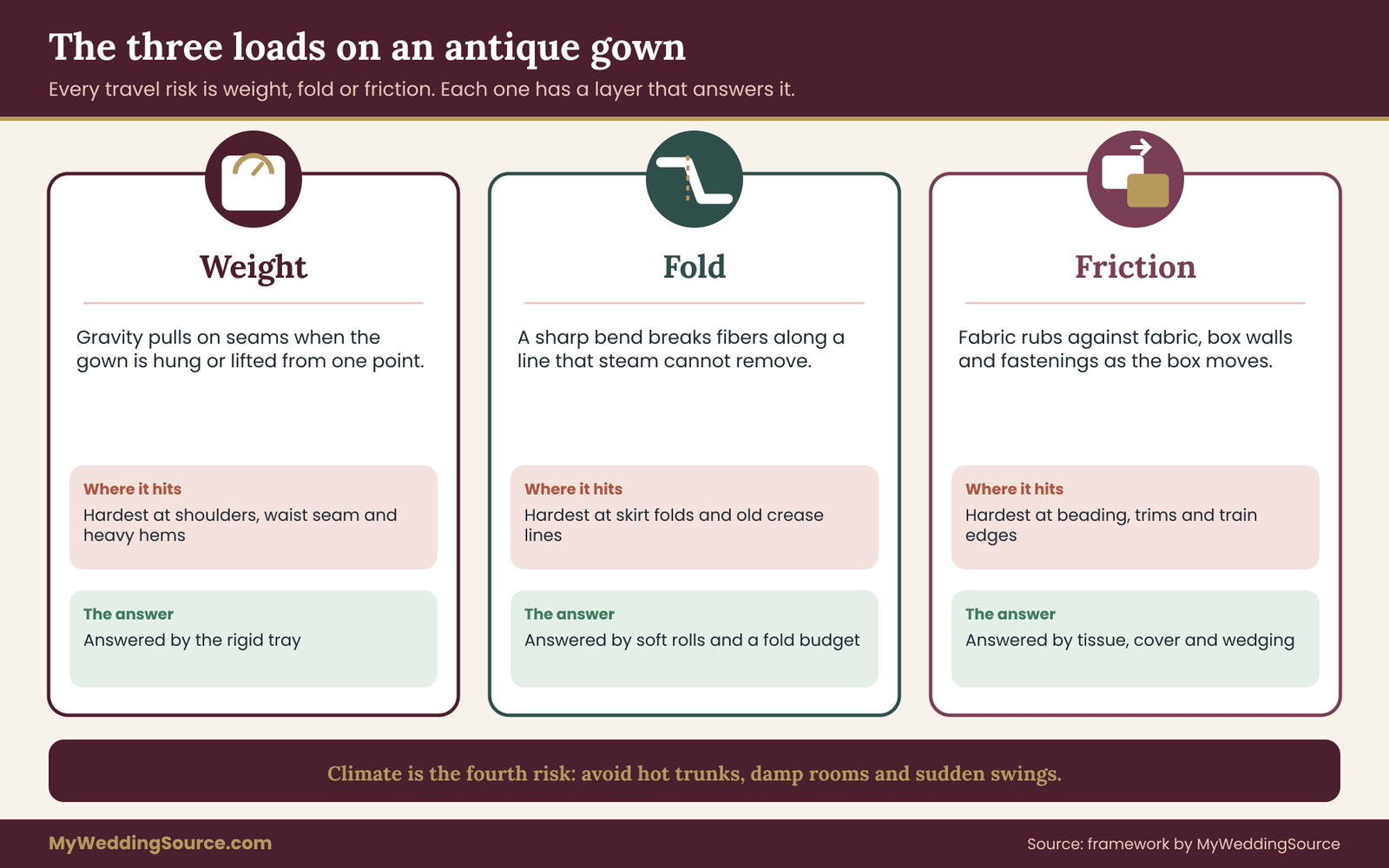
It helps to sort travel damage into three kinds of force. The rest of this guide uses them as its backbone.
Weight. Gravity pulls on every seam from the moment the gown leaves a flat surface. A skirt with many layers, a beaded bodice or a heavy train can pull hard on the waist seam and the shoulders. Hanging the gown concentrates all of that weight on the narrowest part of the garment. Lifting it from one point does the same thing in a different place.
Fold. Every fold bends the fibers sharply along a line. A single gentle fold held for a day is usually survivable. A tight crease held for a long trip, or a fold made in the same place as an old fold, can break fibers and leave a line that no steam or press can remove, because the damage is in the fiber rather than the wrinkle.
Friction. Movement rubs fabric against fabric, against a zipper, against a box wall or against a seat belt. On a smooth modern fabric this is invisible. On old silk or delicate beadwork it can abrade the surface, snag threads or knock beads loose. Vibration in a car or a plane is small friction repeated thousands of times.
A fourth issue, climate, matters too. Heat, damp and sudden changes in humidity affect old textiles more than new ones. That is the reason a car trunk in summer is a poor place for an antique gown, and why the packing plan later in this guide includes a short section on temperature and humidity. First, though, the plan needs a clear picture of what you are actually carrying.
What this guide covers and what it leaves out
This guide is about the move itself: planning, measuring, packing, carrying, unpacking and repacking. It does not cover how to judge whether the antique gown is wearable at all, how to clean it or how to alter it. If you are still deciding whether a particular antique gown is sound enough to wear, the wedding dress fit and alterations guide explains how fitting and alteration decisions fit into the timeline, and a conservator or a bridal alterations specialist who handles old garments should make the call on condition.
It also does not tell you to avoid wearing an antique gown. Many couples wear one, and many conservators are happy to help with that when the plan is sensible. The point is to make the journey from storage to the fitting room to the venue as gentle as possible, so that the gown is in the same condition on arrival as it was when it left.
Know the gown before you pack it
The best packing plan starts with facts about the gown, not with a shopping list. Before you buy a single sheet of tissue, collect five facts: what the antique gown is made of, how much it weighs, how big it is when laid flat, where it is weak, and what has been done to it before. Each fact changes a decision later.
Fiber and construction
Find out what the outer fabric, lining and trims are made of. Family records, the label if there is one, a past appraisal or a conservator’s note may tell you. If nobody knows, a textile conservator or a museum textile department can usually identify fibers from a few photographs and a short description, though they may want to see the gown in person for a firm answer.
The fiber matters because it determines which tissue and which supports are safe. Guidance from conservation bodies generally favors unbuffered acid-free tissue for silk and wool, since alkaline buffering can be harsh on protein fibers, while buffered tissue is commonly used with cotton and linen. Ask a conservator which applies to your gown rather than guessing, and use the answer for every sheet that touches the cloth.
Construction matters just as much. A gown with a boned bodice, a separate petticoat, a detachable train or a metal hoop needs a different plan from a simple bias-cut slip dress. Note every part that can be separated, every part that is attached by hooks or ties, and every part that is heavy.
Weight
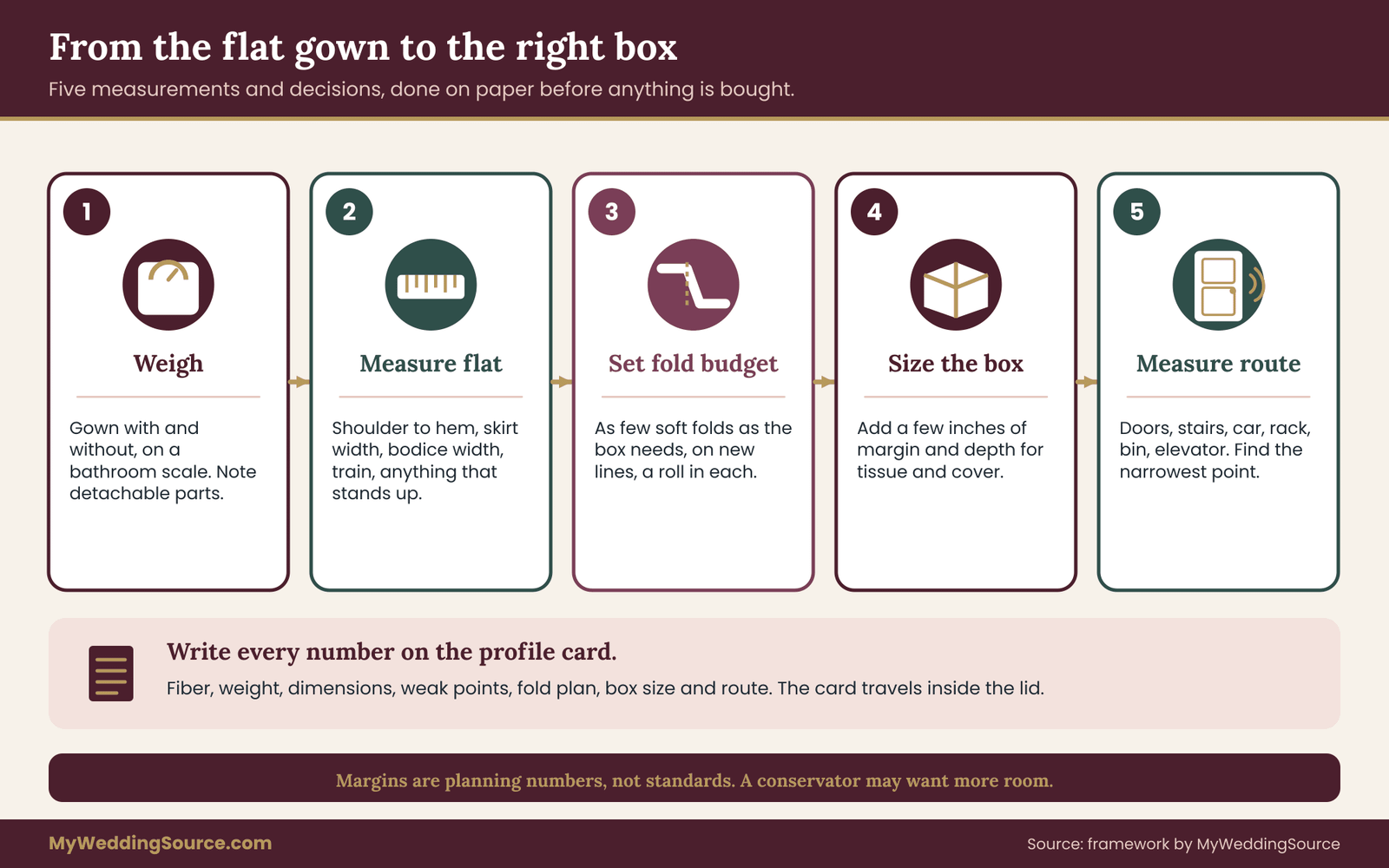
Weigh the gown. This is easy and surprisingly useful. Step on a bathroom scale holding the antique gown, then step on without it, and subtract. Do the same for the petticoat or the train if they come apart. Write the numbers down. A gown that weighs a few pounds needs a different level of support from one that weighs fifteen, and you will use the weight later to test your tray.
Remember that weight is not spread evenly. Beaded panels, a train with a heavy hem band and a metal-boned bodice all put mass in specific places. Mark those on a simple sketch. The sketch becomes part of the support diagram in the next section.
Dimensions
Measure the gown laid flat on a clean sheet, not hanging. Record the total length from shoulder to hem, the width of the skirt at its widest point, the depth of the train if there is one, the bodice width and the height of any structure such as a bustle, a hoop or a built-up sleeve. These numbers decide the size of the box or tray, the length of the tissue rolls and whether the gown can travel in one piece at all.
Weak points and past repairs
Go over the antique gown slowly in good light, and with clean hands, and note anything that looks weak: shattered silk that has split into strips, seams that gape, thin areas at the underarm, old repairs, patches, loose beading and tarnished metal thread. You are not trying to fix anything. You are making a list of places where the packing must not push, pull or press.
Take clear photographs of each of those places, plus an overall photo of the front, back and inside, in daylight and against a plain background. These photographs do two jobs. They record the gown’s condition before the trip, which matters if you need to make a claim, and they give your packing plan something to refer to when your hands are busy.
If the inspection turns up damage you did not expect, pause. A gown with active shattering or broken seams may need stabilization by a conservator before it travels at all, and moving it in that state is the quickest way to turn a repair into a loss. Get that assessment first, and treat the packing plan as the step that follows the advice, not a substitute for it.
The profile card
Put all of this on one page. Write the fiber, the weight, the dimensions, the weak points, the repairs and the names of any specialists who have seen the gown. This is the profile card for your antique gown. It will go into the box with the antique gown, and a copy will stay with whoever is responsible for the trip. Every later section assumes you have it.
The antique gown support diagram: three loads, four layers
This is the core of the method. It gives you one picture to hold in your head while you pack, and one set of questions to answer for every part of the gown. The picture has two halves. The first half names the loads that act on the gown. The second half names the layers you build around it so that none of those loads land on weak fabric.
Step one: map the three loads onto the gown
Take the profile card and a plain sketch of the antique gown from the front. For each region, ask which of the three loads matters most.
At the shoulders and neckline, weight is the risk if the gown is ever lifted or hung, and friction is the risk from a strap or a box wall. At the bodice, boning and beading add weight and friction. At the waist seam, weight is the dominant load, because the whole skirt hangs from it. In the skirt, folds are the danger, since this is where the largest areas of fabric have to be arranged. At the hem and train, weight and friction both matter, because heavy hem bands drag and train edges get caught in lids and zippers.
Mark each region with a letter: W for weight, F for fold, R for friction (rub). Most regions will carry two letters. The map does not have to be pretty. Its purpose is to make you think region by region, rather than treating the gown as one lump.
Step two: build four layers
Once you know where the loads fall, you answer them with four layers, working from the outside in.
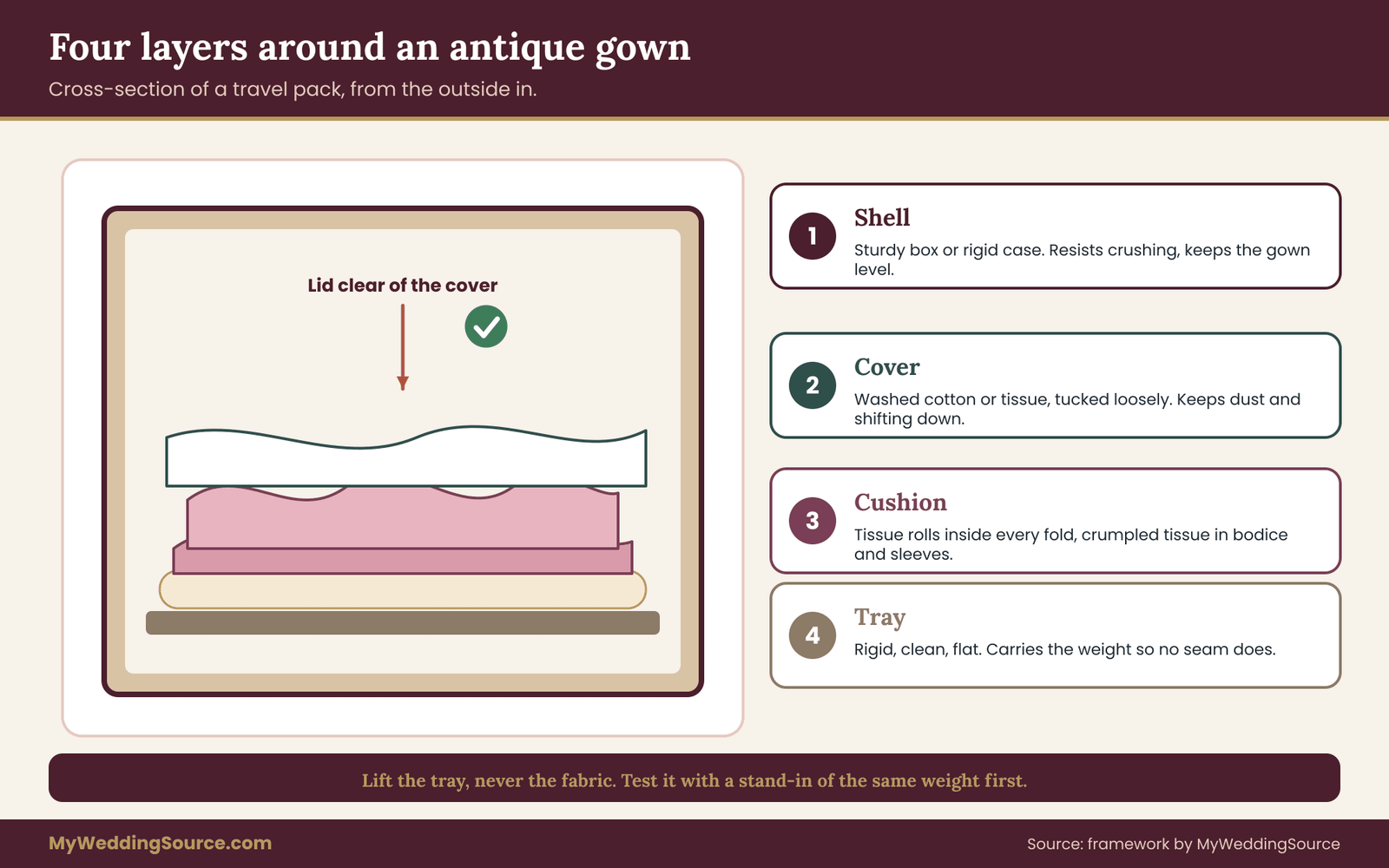
The shell. This is the outer container: a sturdy box, a rigid garment case or a hard-sided trunk. Its job is to resist crushing and to keep the antique gown level. The shell is not the part that touches the fabric. It protects everything inside it from the outside world.
The tray. Inside the shell sits a flat, rigid, clean surface that the gown actually lies on. This is the layer that takes the weight. If the gown is lifted by the tray, nothing hangs from a seam. The tray is what makes it possible to carry the antique gown without ever gripping the fabric.
The cushion. On the tray, between the tray and the gown and between each layer of fabric, go soft supports: tissue, rolled tissue and clean cotton padding. The cushion removes hard folds by turning them into soft curves, and it prevents friction by keeping fabric surfaces from touching each other.
The cover. Over the top goes a breathable layer that keeps dust and stray light off the gown and holds the cushioning in place: a clean, washed cotton sheet or a sheet of tissue, tucked loosely. It should never be tight. Its job is to protect and to prevent shifting, not to compress.
How the layers answer the loads
Each layer answers specific loads. The tray answers weight, because it takes the mass of the antique gown instead of the seams. The cushion answers fold, because it replaces sharp creases with broad curves. The cover and the cushion together answer friction, because they keep fabric from moving against itself. The shell answers everything else: crushing, impact, rain and dust.
When a region carries two loads, check that two layers answer it. A bodice that carries weight and friction needs to sit fully on the tray and to have cushioning between the beading and the surface it touches. A skirt that carries fold and friction needs rolled tissue inside each fold and a cover that holds the layers in place without pressing.
If you find a region where only one layer helps, redesign. For example, if the waist seam is the weak point and the gown is only supported by the cushion, the tray must extend under the entire waist. If the tray is too short, extend it or use a longer tray.
A rule for folds: the fold budget
Some antique gowns can be packed without any folds. Many cannot, because the skirt is wider than any practical box. For those gowns, set a fold budget before you start. The fold budget is the maximum number of folds you will allow, where each fold is a broad, softly padded bend in a place that does not already carry an old crease.
A reasonable rule of thumb is to treat the fold budget as zero hard creases, and as few soft folds as the box size requires. Each soft fold gets a roll of acid-free tissue or a padded tube inside it, so that the fabric curves around the roll rather than bending sharply on itself. If the conservator has told you a part of the gown must not be folded at all, that part is outside the budget and the box must be sized to hold it flat.
Folds should also avoid old crease lines. Fabric that has been folded along the same lines for decades has weakened along them. Fold along new lines, even if that means a slightly different arrangement from the one the antique gown was stored in.
The sag test
There is a simple way to check the tray before the gown goes anywhere near it. Fill a clean pillowcase, or a few plastic bags, with rice or flour until the total weight matches your gown’s weight from the profile card. Lay the stand-in on the tray and lift the tray by its edges, as you would with the gown.
Watch the tray. If it bends so that the middle drops noticeably, or if it twists, it is too flexible for the antique gown. A stiff tray stays flat with the stand-in on it. If you have a ruler, lay it across the tray while it is held and look for a gap. A tray that holds its shape with the stand-in is one you can trust. A tray that droops will let the gown sag in the middle, and that is exactly where the waist seam sits.
This test is cheap, takes five minutes and catches problems that would otherwise appear in a train station. Do it before you buy the rest of the materials.
Measuring the gown and sizing the support
With the support diagram in mind, you can turn the gown’s dimensions into the dimensions of every other thing you need. This section is mostly arithmetic, and it is worth doing on paper before anything is purchased.
Start with the flat gown
Lay the antique gown on a clean sheet in a room where it can stay for an hour. If it has a bodice and a skirt that separate, lay them separately. Measure these five things and write each one down.
The first is the length of the gown from the highest point of the shoulder to the hem. The second is the widest width, usually the skirt at the hem, laid flat. The third is the width of the bodice. The fourth is the length of any train. The fifth is the height of anything that stands up, such as sleeve puffs, bustle structures or built-up bodice pieces.
Decide whether the gown travels flat or folded
Compare the gown’s flat length and width against the largest box you can reasonably carry. Gown boxes from storage suppliers come in several sizes, and a larger box is easier to carry flat but harder to fit into a car or an overhead bin. In practice, flat travel works for short journeys by car and for gowns that are narrow or lightly structured. Folded travel, with a fold budget, is more common for wide skirts and for trips by plane or train.
Write the decision on the profile card, with the reason. For example: skirt width exceeds the largest box that fits in the car, so one soft fold across the skirt at mid-thigh height, with a tissue roll, in a new fold line.
Size the box with a margin
Add margin to every dimension. A box that matches the flat gown exactly leaves no room for tissue or padding, and cramped tissue means friction and pressure. A useful working margin is a few inches in each direction, enough that the antique gown with its padding does not touch the walls. Add height for the cushioning layers: when the gown is under a layer of padding and a cover, the stack is thicker than the gown alone.
These margins are working numbers for planning, not standards. If the antique gown is unusually fragile, a conservator may prefer more room. If a box has a lid that presses down on the stack, choose a deeper box, because lid pressure on layers of old fabric flattens beading and creates dents that last.
Plan the cushioning quantities
Tissue rolls and padding take more material than people expect. Estimate by measuring the length of each fold line on the gown and planning one roll for each. A roll is a long cylinder of crumpled tissue or tissue wrapped around a clean, soft core, about as thick as a rolled-up bath towel for a broad fold, thinner for a narrow one. Add flat sheets between every layer of fabric and a few extra sheets for filling gaps.
It is better to buy a little too much than too little. Nobody is helped by a pack that runs out of tissue halfway, and the leftover can be used for the return trip.
Check the route against the box
Before you commit, measure the route the box will take. Door widths at home, stair turns, the car trunk or back seat, the train aisle or luggage rack, the overhead bin on a plane, the hotel elevator and the door of the room. If the box will not pass through one of these, the plan needs a different box or a different route.
This is boring work, and it is the work that prevents a gown from being turned on its side in a stairwell. Measure the route, note the narrowest point, and size the box to pass it.
Record the plan
By the end of this section the profile card should carry the gown’s weight, its dimensions, the decision about folds, the box size, the quantity of tissue and padding, and the narrowest point on the route. That page is the plan. Everything after it is execution.
Materials for antique gown packing: what touches the fabric
Materials are where good intentions go wrong. A box from a hardware store, a plastic dry-cleaning bag and a pile of newspaper are all easy to find and all poor choices for an antique gown. This section sorts materials into what is safe against the cloth, what is safe only on the outside, and what to avoid altogether.
Against the fabric
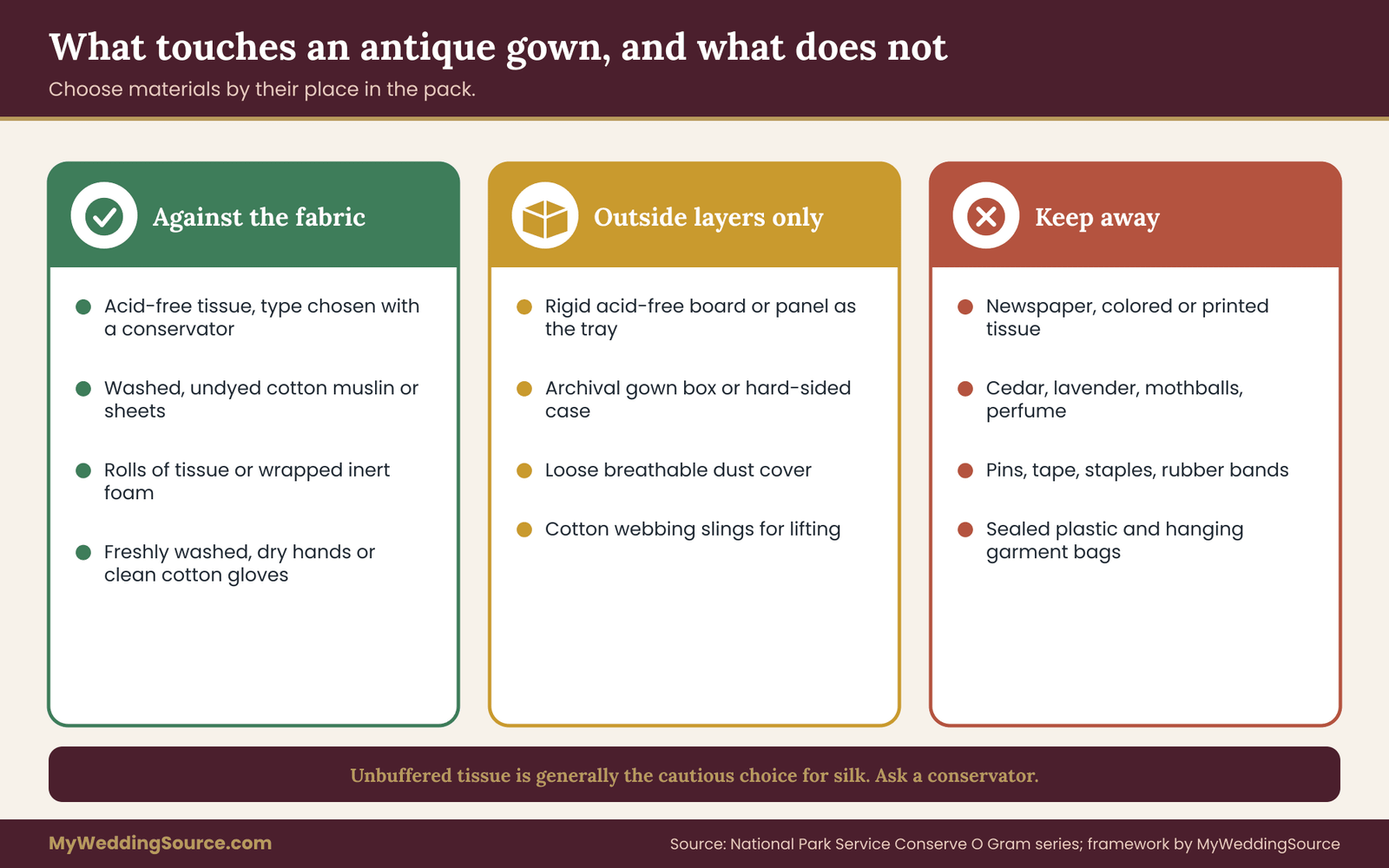
Anything that touches the gown should be clean, stable and free of chemicals that migrate. The usual choices are acid-free tissue paper, unbleached washed cotton muslin, and clean white cotton sheets that have been washed several times without fabric softener.
Acid-free tissue comes in buffered and unbuffered types. As noted earlier, conservation guidance generally steers silk and wool toward unbuffered tissue and allows buffered tissue for cotton and linen, but gowns often combine several fibers, and the safest practice is to ask a conservator or the supplier’s technical contact which one to use. If the gown is mixed or you cannot get an answer, unbuffered tissue is the more cautious choice for the pieces that touch silk.
Muslin is useful because it is soft, breathable and strong enough to work as a sling or a wrap. Wash it before use to remove sizing, and make sure it is white or unbleached, because dyed cloth can transfer color when damp.
Avoid anything scented, colored, printed or coated. Newspaper, colored tissue and wrapping paper can transfer ink and acid. Cedar, lavender sachets and mothballs release vapors that can stain or weaken fabric, and they leave smells that cling.
The tray
The tray should be rigid, flat and clean. Archival storage suppliers sell acid-free boards and corrugated panels cut to size. A sheet of stiff acid-free board works for light gowns, and a double thickness or a corrugated panel works for heavier ones. Some people use a clean wooden board covered in muslin, which is heavier but extremely stiff.
Whatever the tray is made of, cover its top surface with a layer of tissue or muslin so the antique gown never rests on bare board. If you use ordinary cardboard from an unknown source, assume it is acidic and put at least one full layer of acid-free tissue between it and the gown, and do not leave the gown on it for long periods.
The tray should be a little smaller than the inside of the box, with enough room around it to get your fingers under the edges. Handles cut into the board, or two slings of cotton webbing under it, make lifting easier.
The cushion
The cushion layer is made of crumpled tissue, tissue rolls and soft padding. Crumpled tissue is cheap and works well for filling space inside bodices and sleeves. It must be loosely crumpled, not tightly balled, because compressed tissue becomes a hard lump that presses on the fabric.
For padded rolls, wrap tissue around a core that is stable and clean, such as a tube of rolled polyethylene foam wrapped in washed muslin. Polyethylene foam is commonly used in museum storage, though the type matters, and a supplier of archival materials can tell you which foams are suitable. Avoid ordinary foam rubber and foam packing peanuts, which can degrade and stick to old fabric.
The cover
The cover goes over the finished arrangement. A clean cotton sheet or a few layers of tissue work well. The aim is to keep dust off and to hold the cushion in place without pressure. A sealed plastic bag over the whole gown traps moisture, so it is better to leave the cover open at the edges, or to use a breathable cover.
Plastic is not always forbidden. Some archival suppliers sell inert polyethylene or polyester sheeting that is used as a dust cover in museums, usually loosely draped and never in contact with damp fabric. If you use one, keep it loose, keep it for short periods and treat it as a dust cover only, because plastic that traps humidity can encourage mold on old textile.
The shell
The shell can be a good-quality archival gown box, a rigid garment case or a sturdy hard-sided suitcase large enough to lay the tray flat. Check the interior for sharp edges, staples or rough patches. Line the walls with tissue or muslin so that the antique gown or the cushioning never contacts them directly.
Avoid soft-sided luggage for an antique gown unless it has a rigid insert, since soft bags compress under other items and allow the tray to flex. Avoid hanging garment bags altogether for gowns with weak shoulders or heavy skirts. A garment bag hangs the whole weight from the shoulders, the exact place you are trying not to load.
Tools and supplies for the job
Beyond the packing materials, gather a few small supplies. Clean cotton gloves are common in textile handling, though bare hands that are freshly washed and completely dry are often preferred for fine lace and beading, because gloves reduce grip and can snag. Ask your conservator which they recommend for your gown. Keep a clean work surface, soft lighting and a place to put down your jewelry and your watch, which can catch on thread.
Also keep a roll of acid-free labels or a notepad, a soft pencil rather than a pen, since ink can transfer, and a camera. Do not use tape, pins or staples on the gown. If something needs to stay in place, use a loop of cotton tape tied loosely, or reposition the padding.
Packing an antique gown step by step
With the plan and the materials in hand, you are ready to pack. Pick a time when you will not be interrupted, preferably in the daytime with plenty of light and a second person nearby who can help lift. Allow at least two hours, and longer for a first attempt.
Rehearse with a stand-in
If you have never done this, rehearse first with a stand-in: a large, soft, old bedsheet bundle or a similar heavy cloth garment of similar weight, laid out the way the antique gown will be. Walk through the whole process, including placing it in the box, closing the lid, lifting the box and carrying it to the car or the door. A rehearsal reveals where the tray bends, where the tissue is too thin and where the box is a little too small.
It costs an hour and removes a good deal of anxiety. It also lets you reorganize the plan before the real fabric is involved.
Prepare the workspace
Clear a large table or a clean floor area covered with a fresh sheet. Lay out the tray, the tissue, the rolls, the cover and the box in the order you will use them. Wash your hands, dry them fully and remove any rings, watches or bracelets. Keep drinks and food out of the room.
Photograph the gown once more on the clean sheet before you touch it, front, back and details, so that you have a record of its condition on the day of packing.
Move the gown to the tray without lifting it by a seam
Slide the tray under the antique gown if it is lying on a flat surface, or lay a muslin sling beneath it and use two people to lift it onto the tray. Support the gown from underneath along its length, as you would carry a sleeping person, rather than lifting by the shoulders or waist. Never pull the gown across a surface, because that is where friction damage happens.
If the antique gown is already on a mannequin, remove it with two people, one supporting the skirt and one the bodice, and lay it down on the sling. Do not drag it over the mannequin’s shoulders if the fabric is fragile. If the mannequin does not allow safe removal, ask a conservator or a specialist.
Arrange the gown on the tray
Lay the gown face up with the skirt fanned out loosely behind it. Smooth the fabric with the flat of your hand, not by pulling. Fill the bodice with crumpled tissue so that it holds its shape. Place tissue inside each sleeve. Put tissue between the sleeves and the bodice, and between any layers of skirt that touch.
If the gown has a train, lay it along the tray in a long gentle S or fold it in the pre-planned location, with a tissue roll inside each fold. Fold along new lines, not along old creases, and keep each fold soft and wide. If the budget allows no folds, extend the tray or use a longer box.
Add the cushion in layers
Work from the bodice downward. Place a sheet of tissue over the bodice, then a roll under the fold line of the skirt, then another sheet of tissue, then the fold. Check that nothing is pinched or twisted. Each fold should look like a broad curve, not a crease.
Check the weak points on your profile card one by one. Each should have padding on all exposed sides and no pressure from above. If anything looks tight, loosen it.
Add the cover and close the box
Drape the cover over the arrangement and tuck it loosely along the sides. It should not press on the surface. Then slide the tray into the box, or lower the box over the tray, as the design requires.
Fill any gaps between the tray and the box walls with soft padding so the tray cannot slide. Close the lid gently and check that it does not press on the contents. If the lid touches the cover, use a deeper box or remove a layer of padding.
Label and photograph
Write a label on the outside: fragile textile, keep this side up, do not stack, do not hang. Add the owner’s contact details and your destination. Put a second copy of the profile card inside the lid, in a clear sleeve that does not touch the antique gown.
Photograph the packed gown at each stage: tray with the gown, with the cushion, with the cover, and the closed box. If anything is ever damaged, these photos show exactly how the gown was packed and what state it was in.
Test the lift
Lift the closed box with a helper, as you would on the day of travel, and walk through the route you measured. Listen for shifting. Tilt the box very slightly and see whether the tray stays in place. If it moves, add padding and test again. This step takes five minutes and is the last chance to fix the pack before it leaves your control.
Choosing how the antique gown travels
The packing method and the travel method have to match. A pack that works in a car back seat may not fit a train rack, and a pack that survives a train may not survive an airline cargo hold. The decision comes down to a few questions: how far, how many handoffs, how much control, and how much risk the gown can take.
Every handoff, where the box passes from one person or one vehicle to another, is a moment when it can be tilted, dropped or stacked. The fewer handoffs, the safer the gown. A good rule of thumb is to rank travel methods by how many times the box leaves your hands.
Your own car
For a trip of a few hours or less, carrying the antique gown in a car you control is usually the lowest-risk option. The back seat is better than the trunk for several reasons. It is inside the climate-controlled cabin, so the antique gown avoids heat, cold and humidity swings. It is easier to keep the box level. And you can watch it.
Place the box flat across the seat, on a non-slip mat, and wedge it with rolled towels or cushions so it cannot slide in a turn or a stop. Do not stack anything on it. Use a seat belt around the box only if the box is rigid enough not to be crushed by it and the belt is padded; otherwise wedge the box so it cannot move.
If the box will not fit on the seat, lay it in the trunk only if the trip is short, the weather is mild and the trunk is free of other loose items. Avoid a trunk in hot or cold weather. A parked car in sun can reach temperatures far above the outside air, and old fabrics, adhesives and beading glue respond badly to heat. Plan stops so that the gown is never left in a parked car. If you must stop, take the box with you or choose a stop where someone can stay.
Drive smoothly. Slow down for speed bumps and potholes, take corners gently and avoid sudden braking. Vibration is small friction repeated, and the smoother the drive, the less the gown moves.
Train and bus
Trains and buses give you more room than planes but less control than your own car. Many rail services allow oversized items, but the space differs by service and by route. Check the carrier’s baggage rules in advance, and when in doubt, contact the carrier and ask where a large flat box can sit.
The best seat is one with a spare seat beside it, where the box can lie flat and be steadied with a strap or a rolled coat. Avoid overhead racks for a heavy antique gown, since lifting it above your head is a handling risk, and avoid anywhere the box could tilt on a curve. A seat or a luggage space near you, not at the far end of the car, lets you keep an eye on it.
Allow extra time at the stations. Stairs, escalators and crowded platforms are where boxes get knocked. Use elevators and step-free routes wherever they exist, and have a helper ready for the transfer.
Plane: carry-on, checked or shipped
Air travel gives the most constrained options. Most airlines allow a garment or a small flat item as carry-on, but overhead bins and size limits are strict, and a box large enough to hold an antique gown flat may exceed them. Airlines differ, so check your carrier’s baggage policy for dimensions and for how they treat garments, and ask before you travel what they will do about a gown that does not fit.
Security screening applies to carry-on items. The Transportation Security Administration explains how screening works and notes that officers may need to inspect items. Ask in advance how to request a manual inspection of a fragile item, and consider carrying the packing details and a note from your conservator so that an officer can see it is a textile that should be handled with care. Allow time, because inspection takes longer than a bag going through the scanner.
Checked baggage is a poor choice for an antique gown. The box leaves your hands at the counter, goes through belts and loaders and may be stacked or tilted. Airlines limit their liability for checked bags and often exclude fragile or irreplaceable items, so cover that risk through the carrier’s declared-value option or separate insurance, and read the terms for exclusions before relying on them. The Department of Transportation publishes consumer guidance on airline baggage liability and complaints.
If the antique gown cannot travel in the cabin, consider whether another route is better: a separate flight for the gown with a trusted person, a courier who specializes in fine art, or a plan to ship it ahead and have it conditioned at the destination.
Courier or shipping
Shipping puts the gown in the hands of strangers for days. It is sometimes necessary, for example when the wedding is overseas and the antique gown cannot travel with you. If you ship, use a carrier or a specialist who handles fine art or textiles, ask in writing how they pack, how they handle the box and what they do on arrival, and arrange full-value insurance.
Standard parcel services have declared-value limits and exclusions. The United States Postal Service and the large private carriers each publish their insurance terms and their packaging requirements, and these differ for items that are fragile, antique or irreplaceable. Read them for your specific service. Some carriers do not cover items that are insufficiently packed, which means a claim may be denied if the packing did not follow their rules. Photograph everything, keep receipts and keep the tracking record.
Even with a specialist, ask what happens at each handoff. Ask who will carry the box, whether it will be kept flat and out of direct heat, and what proof of delivery is given. Get the answers in writing before you pay.
Hand-carry by another person
Sometimes the best carrier is a family member or friend who is traveling anyway. This can work well if the person understands the job and is calm, careful and available. It fails if they treat it as a favor to be fitted around other plans.
Give the person the profile card, a short written set of instructions and a call-in time. Tell them what not to do: do not hang it, do not leave it in the car, do not stack anything on it, do not open it to show people. Agree on the route and on where the box will stay overnight. Make sure they know who to call.
A simple decision rule
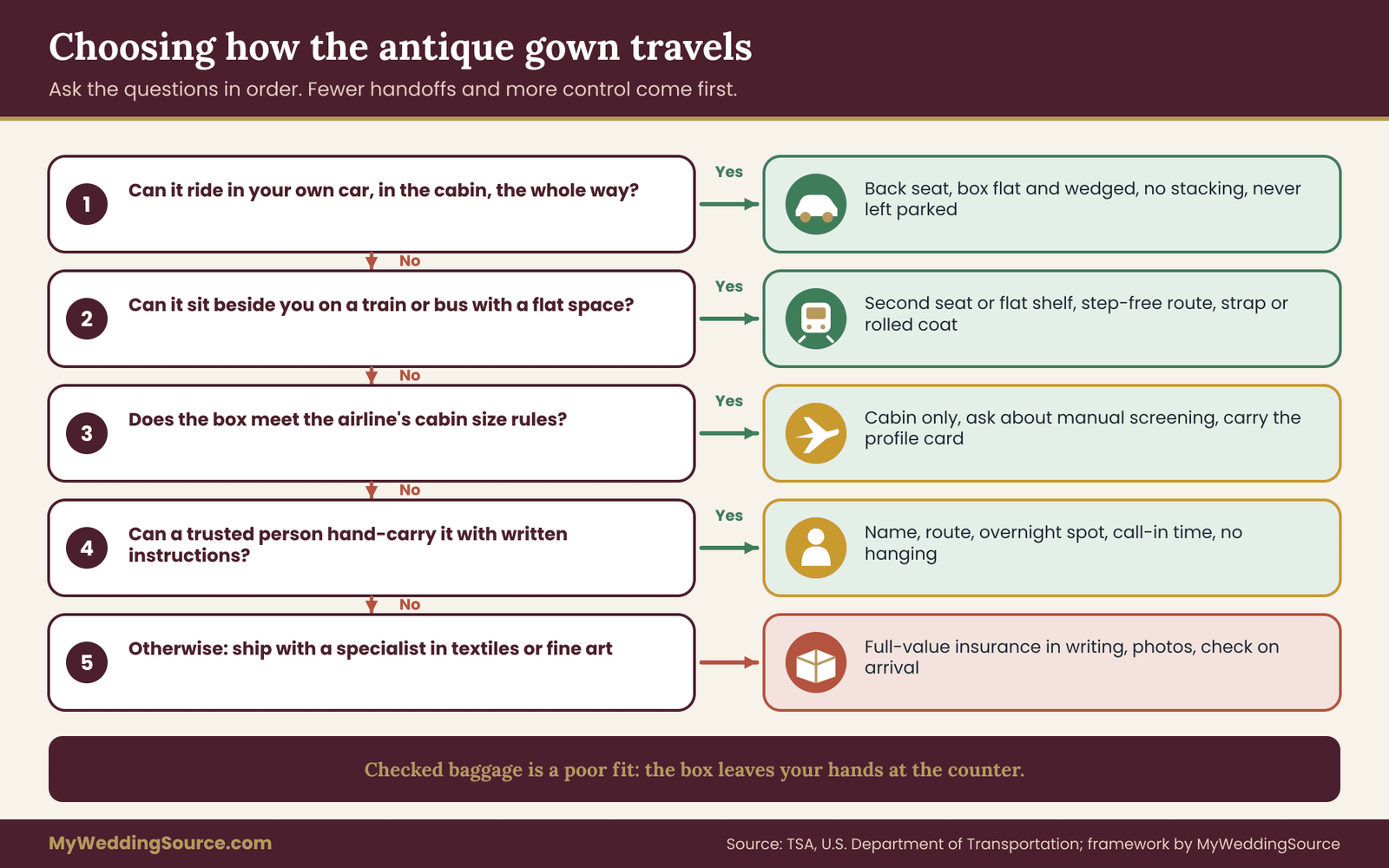
Use these questions in order. First, can the gown travel in your own car for the whole journey? If yes, choose that. If not, can it travel with you by train or bus, with a flat space? If not, can it travel in the aircraft cabin, in a box that meets the airline’s dimensions, with a manual inspection plan? If not, can a trusted person hand-carry it? If none of these work, ship it with a specialist, with full-value insurance, and plan to have it checked on arrival.
At each step, compare the number of handoffs, the amount of control you keep and the cost of failure. A cheap route that adds three handoffs is often more expensive in the end than a pricier route with one.
Temperature, humidity and time in transit
Climate does not get the attention that crushing gets, but it causes as much slow damage. An antique gown that arrives intact but damp, or brittle after a hot trunk, has still been harmed. This section sets out a few simple rules.
Heat and cold
Keep the gown in conditions you would be comfortable in. A room-temperature cabin is fine. A hot parked car, a cargo hold, a sunny window or a radiator is not. Heat accelerates chemical change in old fabrics and can soften adhesives used in repairs or trims. Extreme cold is less of a problem for the fabric itself, but cold boxes brought into a warm room can gather condensation on cold surfaces.
If the antique gown has been in a cold or hot environment, let the closed box come to room temperature before opening it, for a few hours if you can. Opening a cold box in a warm room invites condensation to form on the gown.
Humidity
Old textiles dislike both damp and extreme dryness. Damp encourages mold and can make some dyes run, and dryness can make fibers brittle. Conservation guidance commonly recommends moderate and stable humidity for textiles, and the National Park Service museum publications give practical guidance on storing textiles. Ask your conservator for a target range, and aim for stability rather than a perfect number, because rapid swings are the real enemy.
For travel, there are two practical measures. First, avoid places where damp is likely, such as basements, garages and wet luggage holds. Second, if the journey is long or the climate is humid, consider adding a few packets of silica gel in a cloth pouch, placed in the box away from the fabric, and ask the conservator whether that suits your gown. Do not seal damp fabric in plastic.
Time
The shorter the time in the box, the better. Pack as close to departure as you can without rushing, and unpack as soon as you arrive. A day or two in a well-made box is normal. Weeks in a travel pack is storage, and storage needs a different setup with attention to access and checking.
If delays happen, such as a missed connection, a closed venue or a late hotel check-in, have a plan for where the box will wait. A hotel front desk is often willing to hold a box, but ask where it will be stored and ask them not to stack anything on it. Keep the profile card on top.
A small climate kit
Carry a small kit in your own luggage: a few extra sheets of tissue, a clean sheet, a roll of soft cotton tape and a thermometer with a humidity reading. A small digital thermohygrometer is inexpensive and shows you what the room is doing. It is not a precision instrument, but it will tell you if a hotel room is damp or very dry, and it lets you move the gown to a better spot before problems appear.
Arrival and unpacking the antique gown
The gown has arrived. This is the moment when most of the careful work either pays off or is undone by a rushed unpacking. The aim is to reverse the packing in the same order, slowly, and to check the condition against the photographs you took before departure.
Let the box settle
If the box has been in a hot or cold place, leave it closed in a room-temperature space for a few hours before opening it. If it has been in a damp place, open it sooner, but do not remove the gown from the tray until you have checked it for signs of moisture or mold.
Choose a clean, flat surface: a large bed with a fresh sheet is often the best option in a hotel, because it is soft, wide and level. A hotel desk is usually too small. Clear it of everything else and cover it with a clean sheet. Check the room’s temperature and humidity with your small thermohygrometer.
Compare with the photographs
Open the box and remove the lid and the cover. Take a photograph before touching anything. Then compare the arrangement with your packing photographs. Is the tray level? Has the padding shifted? Are the folds still where you put them? If something has moved, you have learned something about the journey, and you can adjust the return pack.
Work through the profile card’s weak points one by one. Look for new creases, new snags, loose beads and stains. Photograph anything you find, including the context, and note the time and the stage of the trip. If there is damage that looks like it came from the journey, contact the carrier or insurer promptly, and keep the packing and the box. Policies often set short windows for reporting damage, so check the terms you were given and report in writing as soon as you can.
Lift the gown out on the tray
Do not lift the antique gown out of the box by its fabric. Lift the tray with a helper and lay it on the flat surface. Slide the gown off on a muslin sling if it needs to move. Then remove the tissue gently, starting with the cover and working from the top down.
Let the folds relax. An antique gown that has been folded once, even softly, will often show a gentle line where the fold was. The line is usually shallow and eases with time. Give the gown several hours, or overnight, laid flat or supported, before you judge it. Do not try to press it out.
Do not steam, press or hang
The usual reaction to a creased dress is to steam it. For an antique gown, that is a risk. Moist heat can mark old silk, cause water stains, loosen adhesives or weaken thread, and hanging a steamed gown on a hanger loads the shoulders while the fabric is damp and soft. A professional who works with historic textiles can sometimes ease creases safely, with controlled methods, and that is a decision for them.
If the creases bother you, ask a specialist whether any treatment is appropriate, and do it before the day or accept that some softness in the fabric is part of its age. It is far better to arrive at the wedding with a gown that has a gentle crease than a gown with a water mark. A garment steamer that suits a modern gown has no place in the emergency kit for this one.
Where the gown waits
Until the day, the antique gown should stay on its tray, loosely covered, in a cool, clean, dry room away from direct light, radiators and open windows. It should not be on a hanger. It should not be in the same room as food, perfume or hairspray, since airborne products can stain or leave residue. If the hotel has a safe or a lockable closet large enough, use it. If not, ask whether the front desk can keep the box.
Do not let anyone open the box to show the gown. Handling and light exposure add up, and each viewing is a risk. Plan one photograph session, done carefully, on the wedding day.
Dressing day: getting an antique gown on without strain
Packing ends when the gown is on the wearer, and the last risks come from getting dressed. They are about weight, friction and fastenings, and the same support logic applies.
Prepare the room
Clear a space big enough for the antique gown to lie out flat, away from the mirror, the makeup chair and anything that can spill. Ask hair and makeup to finish before the gown comes out, and keep hairspray and perfume out of the room until the gown is on. Remove the wearer’s jewelry and any pointed accessories before dressing, then add them afterward.
Keep a small group in the room. Two helpers who know the plan are better than six who do not. Brief them on where each will stand, how the antique gown will be lifted and what they should not touch.
Lift over the head only if the plan allows it
Many antique gowns are designed to be stepped into, and others to be lifted over the head. Check the profile card or the conservator’s advice for the safest way. If the fabric is delicate, a conservator or a specialist dressmaker may recommend a particular method, such as stepping into the skirt on the tray and lifting it up, which avoids pulling the bodice over the head.
If the neckline is narrow or the sleeves are fragile, consider whether the gown needs to be opened at a seam, which a specialist can do in a reversible way. Pushing a head through a narrow opening is a common cause of tears.
Fastenings and closures
Old hooks, snaps and buttons may be rusty or loose. Do not force them. Ask a helper to do up the closures slowly, with a calm pace, working from the bottom upward, and stop if anything resists. Stress at a closure is also stress on the surrounding fabric.
If the gown no longer closes safely, speak to a specialist before the day about a discreet support that does not damage the original, such as a modern under-bodice that carries the strain, or a modern corset worn underneath. Do not add stitches or pins yourself.
Carry the weight
Once the antique gown is on, the weight hangs from the shoulders and the waist. Short periods are usually fine, but long periods of standing, dancing and sitting add strain. Consider the plan for the day: when the gown will be worn, how long, and what happens at the reception. For a heavy gown, one option is a change into a lighter outfit for dancing. Ask your alterations specialist how to plan a mid-evening change, and treat the wedding day accessories planning guide as the place to sort out the rest of the backup kit.
Taking it off
Reverse the process, slowly. Lay the gown on a clean sheet or the tray, remove it from the wearer without dragging, and let it rest before repacking. Check it for new marks and photograph it. Wait until it has cooled and dried, since it will hold body heat and moisture after a long day.
A worked example, with invented numbers
To see how the plan fits together, here is an invented example. The numbers are illustrations, not measurements from any real gown, and they are not benchmarks. Use your own gown’s figures.
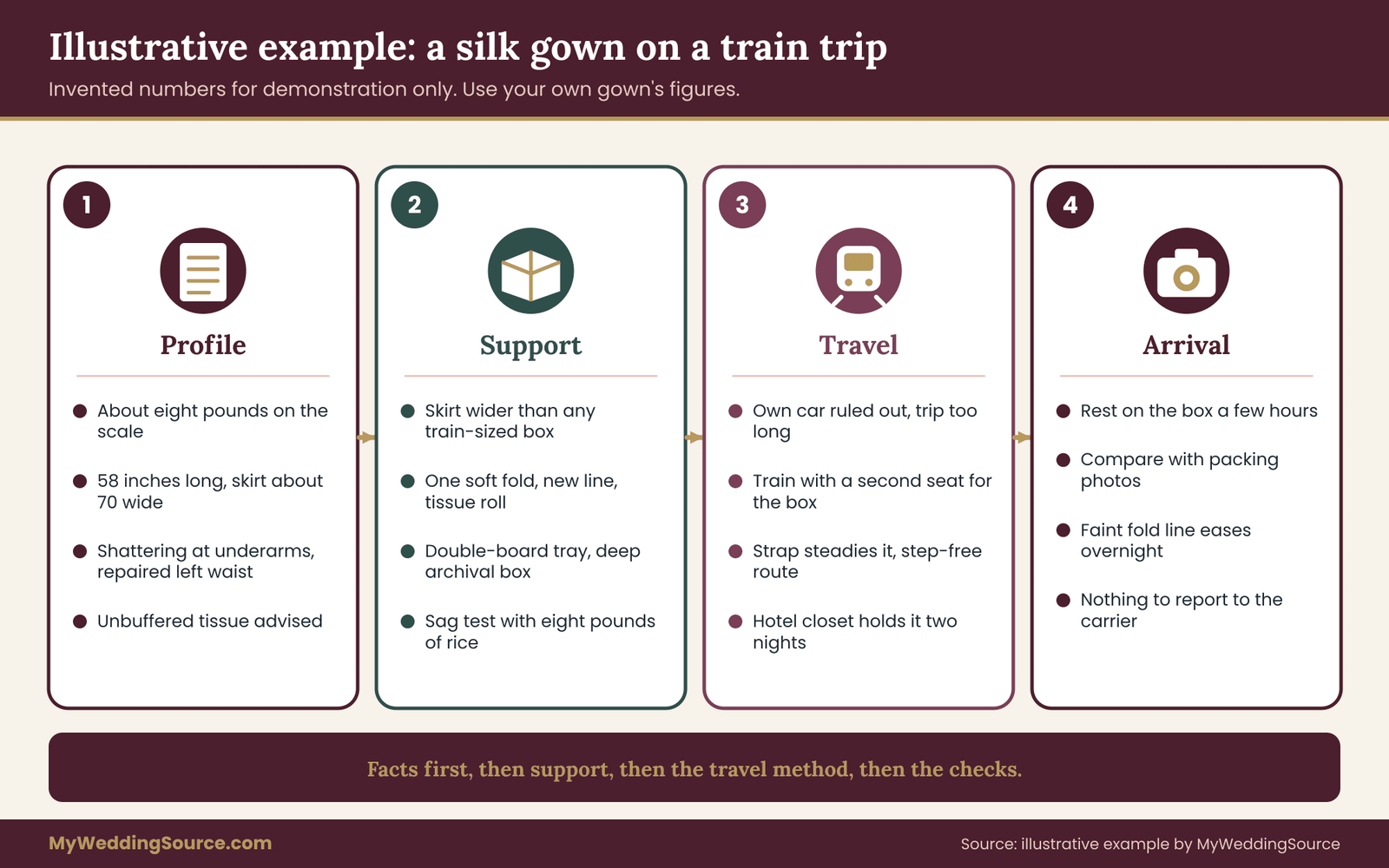
The gown and the trip
Imagine a silk gown from the early 1900s with a fitted bodice, a full skirt and a short train, owned by a family and worn by the grandmother. The couple lives in one city and the wedding is in another, about a day’s train ride away, with a hotel stay of two nights.
The profile card says the antique gown weighs about eight pounds on the bathroom scale. Laid flat, it measures fifty-eight inches from shoulder to hem, thirty-two inches across the bodice and around seventy inches across the skirt at the hem. The conservator, who saw it in photographs and then in person, noted shattering at the underarms and a repaired seam at the left waist, and recommended unbuffered tissue throughout.
The decisions
The skirt is wider than any box that will fit on a train. The couple decides to allow one soft fold across the skirt, in a new line about a third of the way up from the hem, with a tissue roll inside it. The tray is a double thickness of acid-free corrugated board, cut to fit inside a deep archival box with an inch or two of margin on every side.
The sag test uses a pillowcase of rice at eight pounds. The first board flexes in the middle, so the couple switches to the double board, which stays flat. The rehearsal with a stand-in reveals that the box handles are awkward, so they add cotton webbing slings under the tray.
The route and the carry
The couple compares travel methods. The car is not an option, because the trip is long and nobody wants to drive it. The train has a luggage area with a flat shelf, but it is a long distance from the seats. They book seats with a vacant adjacent seat, buy a second seat for the box, and travel with the box beside them, steadied by a strap.
The hotel agrees to keep the box in a closet. On arrival, the couple lets it rest for a few hours, opens it on a clean bed, compares it with the photographs and finds a faint, shallow fold line at the skirt that eases overnight. They report nothing to the carrier because nothing changed.
What the example shows
The example shows the shape of the process: facts first, then support, then the travel method, then the checks. Nothing in it is unusual. The value is in doing each step on paper before the gown is touched, and in having photographs to compare at the end.
Questions for vendors and carriers before the antique gown leaves home
The best packing plan still depends on other people: a conservator who advises, a carrier who moves the box, a hotel that stores it, a venue that gives you a room, an insurer that covers the risk. Each of them has policies, and the policies matter more than the sales language. This section gives you questions to ask and ways to judge the answers. Get the important answers in writing, even if it is only an email you save.
What to ask a conservator or specialist
A textile conservator, or a bridal alterations specialist with experience in old garments, is the best source of advice about your particular gown. Many conservators work in private practice and the American Institute for Conservation maintains a directory for finding one. Some will advise by photograph, some will want to see the gown, and some may not take on wedding work, so ask early.
Questions worth asking: What do you see as the weakest parts of this gown? Is it safe to travel and to wear, and for how long? Which tissue and padding do you recommend for the fibers involved? Does any area need stabilization before the trip? How would you want it lifted, folded or dressed? Is there anything that should never be done to this gown, such as steaming or hanging?
Ask for the advice in writing, even in a short note. It protects you, it helps any helper, and it gives an insurer or carrier a record that you took reasonable care. Be wary of anyone who offers to guarantee that the gown will be fine, because nobody can promise that about an object that has aged for a century.
What to ask an airline, train or bus company
Ask about baggage dimensions, about garments and fragile items, about boarding and storage for oversize items, and about their liability if the item is damaged. Ask what documents they would need if you made a claim and how soon you must report damage.
A useful way to phrase the key question is: “I am traveling with a fragile antique garment in a flat box measuring this size. Can it travel in the cabin, where would it be stored, and what is your policy if it is damaged?” Write down the name of the person, the date and the answer, and ask for the policy in writing or point you to the exact page.
For airlines, the Department of Transportation explains passenger rights and baggage liability in general terms. Policies change, so use the carrier’s current published terms as the final word.
What to ask a courier or shipper
If the antique gown must ship, the questions are more detailed. Ask whether they have handled antique textiles, how they pack them, whether they let you supply the packed box, who carries it, whether it travels climate-controlled and how many handoffs there are. Ask what insurance they offer, what it excludes and how a claim is valued.
Ask how they define value. Some insurance pays the declared value but requires proof of value, such as an appraisal, and some pay only replacement cost for the item as new, which does not make sense for an antique. If the gown has sentimental value beyond its market value, say so, and ask what evidence they accept. A written appraisal from a qualified appraiser helps, and so does a record of the gown’s history, although neither guarantees a payout.
Ask what happens if a box arrives damaged. Typically the carrier asks you to keep the packaging and to report damage within a stated period. Ask for the exact period, and do not discard anything until the claim is settled.
What to ask a hotel or venue
Ask whether the hotel can store a large flat box in a lockable space for the nights before the wedding, whether the space is climate-controlled and who has access. Ask whether the room can be reserved earlier, so the antique gown can be unpacked and checked a day ahead. Ask about a safe room at the venue for the gown on the day, with a clean surface and a door that locks.
For the venue, ask about the dressing room: its size, its lighting, its cleanliness and its distance from the ceremony space. A dressing room that is a corridor, a kitchen or a storage room is not suitable for an antique gown. Ask about the route from the dressing room to the ceremony, including steps, doors and outdoor paths. For a longer view of what to ask suppliers before you commit, the wedding vendor due diligence checklist lays out how to compare vendors and keep their answers on record.
What to ask an insurer
Standard homeowners or renters insurance may cover personal property away from home, and some wedding insurance policies cover attire, but terms differ greatly. Ask whether the gown is covered at all, whether it is covered in transit, whether antiques or heirlooms have limits or need a separate listing, how value is established and what evidence you need.
Ask for the wording of any exclusions that apply to wear and tear, gradual deterioration or handling by the owner. Damage from age can be excluded, and damage from your own packing can be argued over. This is another reason to keep the conservator’s written advice and the packing photographs.
If the cover is not enough, ask a broker or the insurer about a scheduled item or fine-arts rider. The answer may be that the cost is not worth it, and in that case the remaining protection is your own care, which is what this guide covers. Read the policy documents yourself, rather than relying on a verbal summary, and put anything important in writing.
Keeping the paper trail
Create one folder for the move. In it, keep the profile card, the photographs, the conservator’s advice, the carrier’s answers, the receipts for materials and shipping, the insurance documents and the tracking details. The wedding vendor contract guide shows what to look for in written terms, and the habit applies here too: the more specific the written answer, the more useful it is if something goes wrong.
If a dispute arises, such as a carrier that denies a claim or a shipper that does not deliver on a promise, the Federal Trade Commission explains how consumers can report problems and what protections apply to common transactions. Start with the carrier or the vendor’s own process, keep copies of everything and follow their time limits.
Measurable checks before departure
A short list of checks keeps the plan honest. Each one has an answer you can write down, and none relies on feeling confident.
- The profile card lists weight, dimensions, fibers, weak points and specialist advice.
- The sag test is passed: the tray stays flat with a stand-in of the same weight.
- The box has margin on every side and the lid does not touch the cover.
- The route has been measured at its narrowest point and the box passes it.
- The fold budget is written down and every fold has a roll inside it.
- The carrier’s answers on size, storage and liability are on file.
- The insurance position is known, including exclusions.
- Photographs exist for before, during and after the pack.
- The rehearsal lift has been done and the tray did not move.
- Someone besides you knows where the profile card is.
Edge cases and awkward gowns
Real gowns rarely match a tidy example. Here are common awkward situations and how the support diagram adapts to each.
Heavy beading or metal embroidery
Beaded gowns can weigh far more than they look, and the weight is concentrated on the bodice and hem. The tray matters even more, and the sag test should use a heavier stand-in. Place tissue between the beads and every surface they touch, and keep the beaded panels facing up rather than pressed into another layer. If beading has loosened, put a small note on the profile card and leave the repair to a specialist, since a snag during packing can pull a long thread of beads away.
Hoops, cages, bustles and crinolines
Structures made of metal, whalebone or cane do not fold, and forcing them can bend the frame or tear the fabric that covers it. They travel flat, or in a larger box, or are separated from the antique gown if they are detachable. Pad every point where metal meets fabric, and check for rust, which can stain.
If a frame must be collapsed, ask the conservator whether it is safe, and follow their method. Never improvise.
Gowns with shattering silk
Shattered silk splits into thin strips, often at folds and along stress lines. A gown in this state is at serious risk from any handling. It may need support through a conservation treatment, such as a backing fabric, before it can travel or be worn. It may be better displayed than worn. Pack it flat, move it as little as possible and use the tray for every transfer.
Separate pieces: bodice, skirt, petticoat, train
Where a gown is made of separate pieces, pack each on its own tray or on separate levels within one box, with a rigid divider between them. Label each and note on the profile card how they join. Do not stack the heavy skirt on the delicate bodice.
Veils, headpieces and accessories
Old veils, lace and headpieces are also fragile and are often forgotten. Give each its own flat box with tissue, and do not roll lace in a way that creases it. Keep small pieces in a separate labeled box inside the main one, away from the gown.
International travel
Crossing a border adds customs, longer transit and more handoffs. Check the rules of the destination country and the carrier about importing or temporarily carrying used or antique textiles, and ask about paperwork. Some items need declarations, and some countries restrict certain materials. The authority for this is the destination’s customs agency, and your carrier or a customs broker can tell you what is needed. Allow extra time and prefer hand-carrying in the cabin.
Humid or hot destinations
Beach and tropical weddings expose an old gown to humidity and sun. Keep the gown in an air-conditioned room until dressing, keep the box closed until needed, and have a plan to get the antique gown from the room to the ceremony with minimal time outdoors. Consider whether the gown is the right choice for the setting at all, since a conservator may advise a lighter or more durable alternative.
When the gown is too fragile to wear
Sometimes the honest answer is that the gown should not be worn or should not travel. This is a loss, but there are good options: display it in a frame or a case at the wedding, wear a modern gown with an element from the antique one, such as a sleeve, a lace panel or a veil, or have a faithful copy made. Some couples photograph the antique gown carefully and wear something new. These choices protect something that cannot be replaced.
Pets, children and smoke
Pet hair, claws, small hands and smoke all damage old textiles. Keep the gown in a closed box in a room the household does not use. If you have a pet, do not leave the box where it can be knocked or investigated.
Repacking for the return trip and storage afterward
The job is not finished at the end of the wedding. The gown has been worn, which means it carries body oils, perspiration, food and drink spills and the dust of a long day, and these are all things that attack old fabric if left. The return trip and the storage that follows deserve the same care as the outbound journey, and in some ways more.
Do not pack a worn gown straight away
If the gown can wait, lay it flat on a clean sheet and let it air in a cool, dry room for several hours before packing. Moisture from the day needs to leave the fabric. Packing a damp gown in tissue and a closed box is how mold begins, and mold on old silk is a serious problem.
Check it for new damage and photograph it, front, back and inside. Write down every stain, snag and tear with its location. These notes matter for any claim, and for the cleaner or conservator who will see the antique gown next.
Do not clean it yourself
A worn antique gown should not be washed or spot-cleaned at home or put in an ordinary dry-cleaning machine. Water, solvents and detergents can set stains, run dyes, shrink or distort fibers and leave residues. If the gown needs cleaning, ask a conservator or a cleaner experienced with antique textiles, and take it to them as soon as you reasonably can after the wedding, since many stains become harder to treat over time.
If it is not possible to see a specialist right away, pack the gown with the same support layers and clearly mark which areas are stained so that the cleaner can find them. Do not add tissue over stains, since that can transfer them. Put tissue between layers as usual and mention the stains in the note.
Repack with the same four layers
Use the same method: shell, tray, cushion, cover. Use fresh tissue, because tissue that has been used may carry moisture or odors. Use the same fold budget, and fold in new lines if you can, since the old fold lines from the first trip may already be forming. Reuse the box if it is clean and sound, but replace it if it is damp, dented or smells musty.
Take a few photographs at each stage again. If something has changed from the outbound journey, the new photographs help you spot it.
Choose a return route with care
The return trip should be as careful as the outbound. Wedding weekends end tired. People are keen to go home, and the antique gown sits in the corner of a hotel room or a car while everyone packs. Make a plan before the wedding: who is responsible for the box, where it is stored overnight and how it leaves the venue. Assign a person, and write their name on the profile card.
Avoid leaving the box in a hot car while you stop for lunch. Avoid checking it. If you used a courier outbound, arrange the return before you leave, since a rushed booking is a weak link.
Long-term storage
After the wedding, think about where the antique gown will live. Storage conditions affect it for decades. The general guidance for textiles is a cool, dry, stable and dark place, away from attics, basements, garages and exterior walls, in a clean archival box with acid-free tissue and no plastic wrap. The National Park Service’s museum publications and other conservation sources describe the principles, and a conservator can tailor them to your gown.
Check the stored gown a couple of times a year if you can, without removing it from its tray more than needed. Look for signs of pests, damp or discoloration, and refresh the tissue if it has yellowed. Keep a note of what you find. If the gown is going to be handed down, keep the profile card, the packing photographs and the conservator’s notes with it, so the next person has the whole history. The wedding records guide has a retention approach you can borrow for these papers.
Costs and budget logic
Careful transport costs money, though not much compared with what it protects. Expect to spend on a conservator’s time, on archival tissue and a proper box, on a stand-in rehearsal that costs almost nothing, on a seat for the box if you travel by train or plane, on insurance or declared value and on specialist cleaning afterward. Prices vary widely by region and supplier, so get current quotes rather than relying on a figure.
A useful way to decide where to spend is to rank the costs by what they prevent. A conservator’s advice prevents the biggest and least reversible mistakes. A proper tray and box prevent crushing and folding. Insurance addresses what care cannot. A second seat prevents handoffs. If the budget is tight, protect those in that order, and drop the extras that do not reduce a load. The wedding budget guide can help you slot the costs into the rest of your plan, and the twelve-month wedding checklist shows where gown tasks sit on the calendar.
If the gown is traveling to a destination wedding, the transport plan should also sit alongside the guest travel plans. The hotel arrangements you make for guests, covered in coordinating wedding guest hotels, can include an early check-in for you so the antique gown can be unpacked and rested before the busy days begin.
When to bring in a professional
You can pack an antique gown yourself, carefully, with the plan above. Some situations call for a professional: shattered or brittle fabric, heavy beading, unknown fibers, a very valuable or irreplaceable gown, long international trips or a gown you are unsure can survive travel. A conservator can pack the gown for you, and some will accompany it. Others will advise and let you do the work. For a gown with real historical value, a specialist is not an extra, it is part of the plan.
Return to the alterations and fittings guide when you are planning fittings, because an antique gown usually needs fewer, gentler fittings, and each one is another move for the gown.
Your next steps
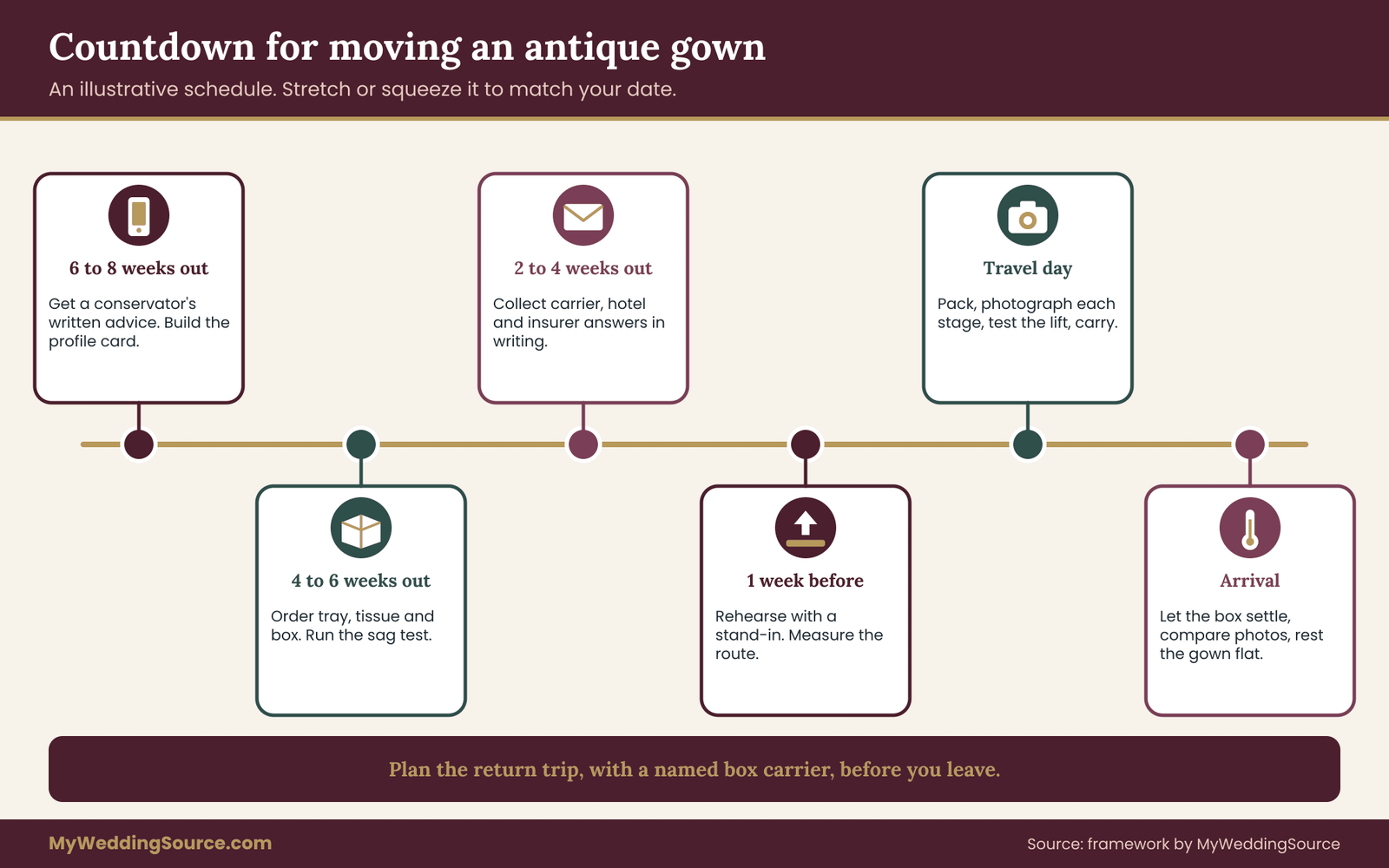
Start this week with three things. First, write the profile card: fiber, weight, dimensions, weak points, repairs and the names of anyone who has advised on the antique gown. Second, contact a conservator or a specialist and ask for written advice on whether the gown is safe to travel and what materials to use. Third, choose the travel method using the decision rule, and ask the carrier or the hotel for their policies in writing.
Then work through the plan: order the tray, tissue and box, run the sag test with a stand-in, rehearse the pack, photograph each stage, and plan the return trip before you leave. A calm, measured pack is what lets an antique gown arrive in the same condition it left, and gives you one less thing to think about on the wedding day.
FAQ
Can I hang an antique gown in a garment bag for a short trip?
Usually not. Hanging puts the full weight on the shoulders and waist seam, the places most likely to be weak in an old gown, and a plastic bag can trap moisture. Even a short trip can strain the fabric. Lay the gown flat on a rigid tray inside a box instead, and ask a conservator if a particular gown is an exception.
What tissue should I use for an antique gown?
Acid-free tissue is the standard choice. Conservation guidance generally favors unbuffered tissue for silk and wool and allows buffered tissue for cotton and linen. Because many gowns mix fibers, ask a conservator which suits yours. Avoid colored, printed or scented tissue, newspaper and cedar or lavender products, which can stain or weaken old fabric.
Is it safe to fly with an antique wedding dress?
It can be, with planning. Carry it in the cabin if the box meets the airline’s size rules, ask in advance how a fragile item is handled at security, and avoid checking it. Airlines limit liability for checked baggage and may exclude fragile items, so read the carrier’s terms and consider separate insurance before you travel.
Should I steam an antique gown when it arrives?
Generally no. Moist heat can leave water marks on old silk, loosen adhesives and weaken thread, and a steamed gown hung while damp loads the shoulders. Let the antique gown rest flat for several hours or overnight, since gentle fold lines often ease. If creases remain, ask a specialist who works with historic textiles what, if anything, is safe.
How do I know if the tray is strong enough?
Do the sag test. Fill a pillowcase with rice or flour to match the gown’s weight, lay it on the tray and lift the tray by its edges as you would on the day. If the middle droops or the tray twists, it is too flexible. A tray that stays flat with the stand-in is suitable for the real gown.
What if the skirt is too wide for any box?
Set a fold budget. Allow as few soft folds as the box requires, each placed on a new line rather than an old crease, with a roll of acid-free tissue inside so the fabric curves instead of creasing. If a conservator says a part must not be folded, size a larger box or separate any detachable parts and carry them flat.
Does insurance cover an antique gown in transit?
It depends on the policy. Standard property policies, wedding insurance and carrier declared-value options differ in what they cover, how they value antiques and what they exclude, including gradual deterioration and handling by the owner. Ask the insurer or carrier in writing, read the exclusions yourself and keep the conservator’s advice and packing photographs as evidence.
How soon after the wedding should the gown be cleaned?
As soon as you reasonably can. Stains and body oils become harder to treat over time, and a worn gown packed damp can develop mold. Let it air flat for several hours, photograph it and note every stain, then take it to a conservator or a cleaner experienced with antique textiles. Do not wash or spot-clean it yourself.
Sources
- Conserve O Gram series on caring for museum collections, National Park Service
- Find a conservator, American Institute for Conservation
- Caring for textiles and preservation guidance, Canadian Conservation Institute
- Preservation resources for caring for collections, Library of Congress
- Security screening information for travelers, Transportation Security Administration
- Air travel consumer information on baggage and passenger rights, U.S. Department of Transportation
- Consumer protection and reporting problems, Federal Trade Commission
- Shipping insurance and packaging guidance, United States Postal Service
- Textile conservation and care advice, Victoria and Albert Museum
- Caring for textile collections, Smithsonian Institution