
Shoe color is the detail that looks settled in a bright shop and unsettled in a dim ballroom. This guide gives you a repeatable way to test a pair of bridal shoes against your dress using a white tone swatch and a mixed-light comparison, so the shoe color you choose still looks right under the lights your wedding will actually use.
Build a small swatch card with a scrap of your dress fabric, a sample of the shoe material and a plain white reference. Look at it in five lights: window daylight, warm indoor bulbs, cooler indoor bulbs, dimmed evening light and colored or flash light. Judge three things at each station: undertone, lightness and sheen. Then choose on purpose: a close match, a clearly different tonal step, or an obvious contrast. The near miss is the one to avoid.
Most brides who worry about shoe color are not really worried about the shoes. They are worried about the moment in the photographs when the dress reads soft ivory and the shoes read yellow, or when the shoes seem to glow slightly blue against a warm gown. Nobody can predict that from a product photo, and a shop’s own lighting rarely resembles the room where you will dance.
The good news is that this problem is small and testable. You do not need lab equipment or a color expert. You need a scrap of fabric, a sample of the shoe, a few ordinary light sources and about an hour. What you do need is a method that keeps you from trusting a single look under a single light, which is how most mismatches happen.
This guide covers the testing method, the reasons colors shift, how to read the result, how to decide between matching, toning and contrasting, how different shoe materials behave, and what to ask sellers before you pay. It also includes an invented worked example, a list of edge cases and a simple timeline.
A note on scope. This is general styling information, not legal, tax or financial advice, and comfort and fit are individual, so try shoes on and check them in your own conditions. Where a return rule or a fabric claim matters, the seller or manufacturer is the source to confirm it.
If you are still deciding on the whole accessory plan, the wedding day accessories guide covers how shoes, jewelry, veil and wraps fit together. This article stays on one question: how to judge shoe color when the light changes.
What shoe color matching actually means
People use the phrase “matching shoes to the dress” for three different goals, and mixing them up causes most of the frustration. It helps to name them before you test anything.
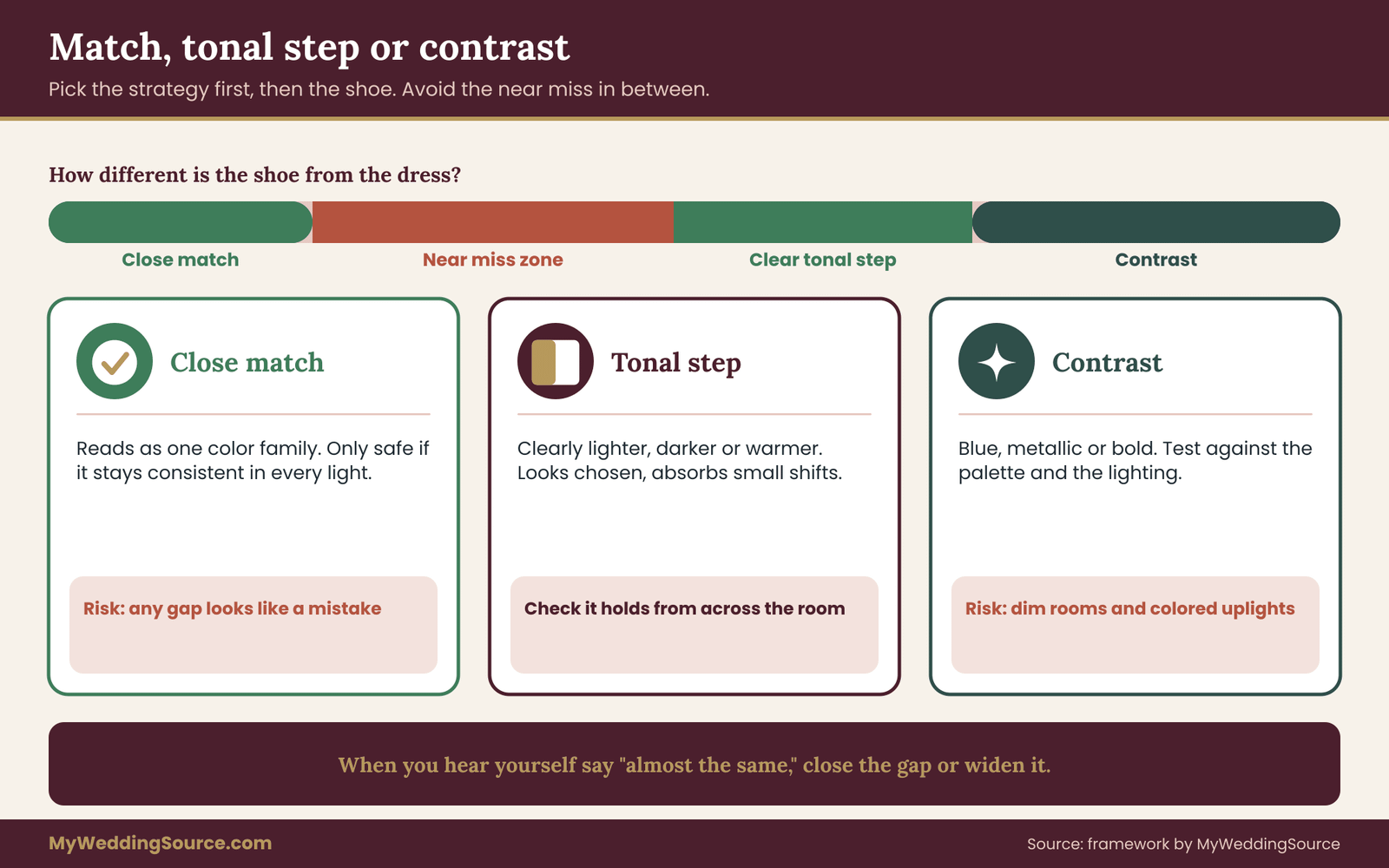
A close match. The shoe and the dress read as the same color family, and a guest standing at normal distance would not pause over the difference. This is the most common goal for formal, traditional looks.
A deliberate tonal step. The shoe is clearly lighter, darker or warmer than the dress, by enough that it looks chosen. Think of a champagne shoe under an ivory gown, or a soft blush shoe under a white one.
A deliberate contrast. The shoe is a different color altogether, such as a blue or metallic pair. Here the question is not matching at all; it is whether the shoe color works with the palette and the lighting.
The trouble sits in the gap between the first two. A shoe that is almost the dress color but not quite looks like a mistake, because the eye reads a small difference as an error and a large difference as a decision. That gap is called the near miss in this guide, and the whole shoe color test is built to catch it before you buy.
Why a product photo cannot settle it
A screen shows colors using its own backlight, its own brightness and its own color settings. Two people looking at the same listing on different devices see different colors. A seller’s photo has also been lit and edited to make the product look appealing. So a listing can tell you the intended category, such as ivory or champagne, but it cannot settle shoe color against your particular dress.
Fabric names are loose too. “White,” “ivory,” “diamond white,” “champagne” and “nude” are trade names, not measurements. Different makers use them differently, and two dresses sold as ivory can look quite different side by side. The only reliable comparison is the real shoe against the real dress fabric in real light.
What this test does not try to do
It does not try to give you a numeric score from an instrument, and it does not claim that one kind of light is correct.
It also does not replace trying shoes on for fit, and it does not tell you which style to buy. For heel shape, hem clearance and venue surface, the sibling guides on the site cover those questions. The goal here is narrower and more useful: to find out whether this shoe color and this dress will look like they belong together in the lights you will meet. Good shoe color matching is about agreement across lights, not a perfect match in one.
Why shoe color shifts under indoor lighting
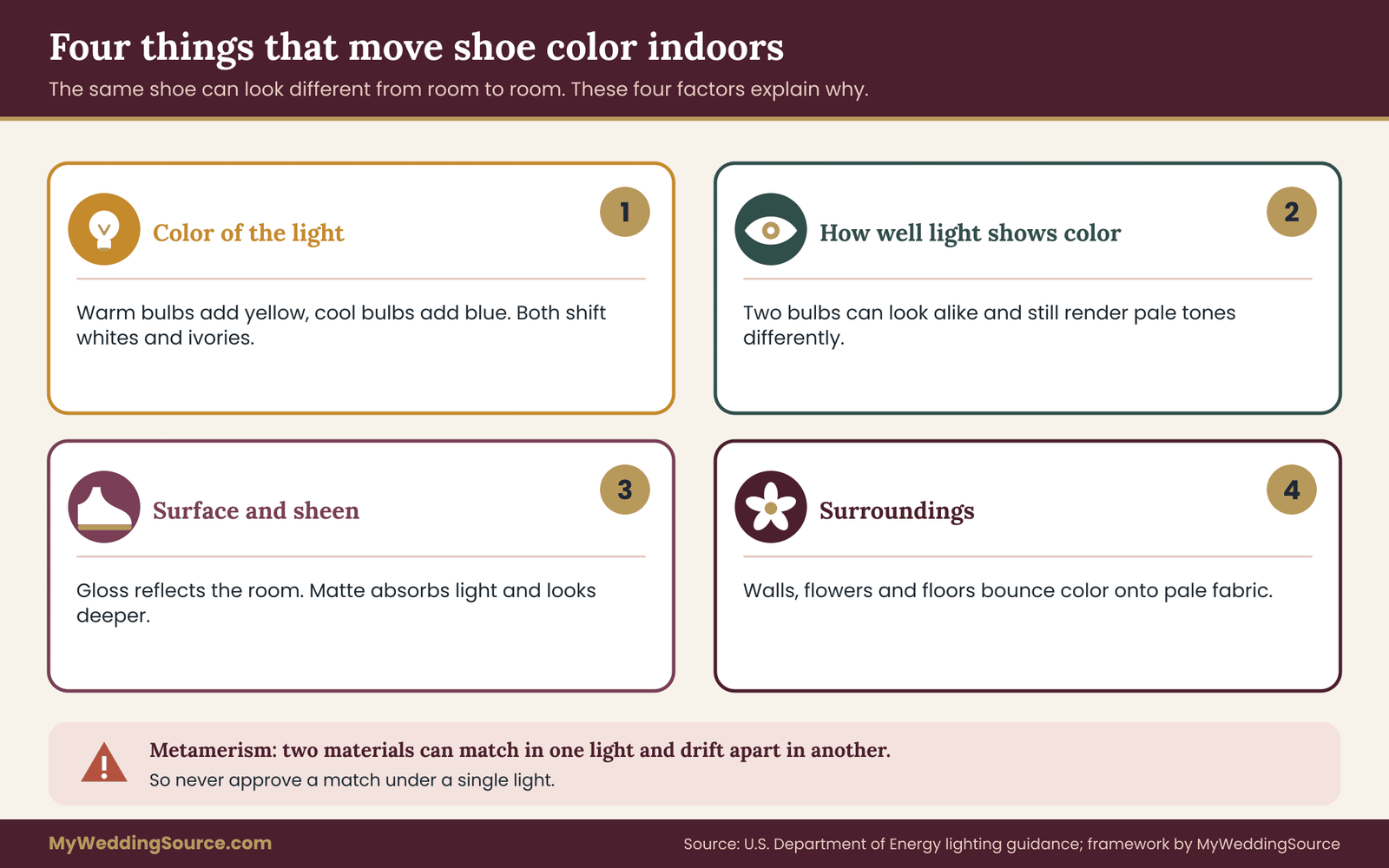
Color is not a fixed property of an object. What you see is the light that falls on the object, minus whatever the object absorbs, plus whatever the surroundings reflect onto it. Change any of those and the result changes. Understanding the four factors makes the test below feel logical rather than fussy.
The color of the light. Light sources are described by color temperature, measured in kelvin. Lower numbers look warm and yellow-orange, and higher numbers look cool and blue-white. The U.S. Department of Energy explains this on its LED lighting pages, and the same bulb shape can be sold in several color temperatures. A warm bulb adds yellow to everything it lights, so a cool white shoe can look creamier and an ivory dress can look golden. Both shifts change how the shoe color reads beside the gown.
How faithfully the light shows color. Two bulbs can share a color temperature and still render colors differently. A measure called the color rendering index describes how well a light shows colors compared with a reference source. A low-rendering light can flatten or distort certain tones, which matters most for pale and slightly tinted colors, exactly the range of bridal shoes.
The surface of the material. A shiny satin catches highlights and reflects the color of whatever is near it. A matte suede absorbs light and looks deeper and flatter. The same dye on two surfaces will not look like the same color, and the difference changes with the angle of the light.
The surroundings. Pale fabric picks up color from nearby walls, flowers, floors and lights. A shoe at floor level can pick up the tone of the carpet or the dance floor, while a dress hem a few inches above it picks up something slightly different.
Metamerism, in plain words
There is a name for one effect worth knowing. Two materials can look identical under one light and different under another. This is called metamerism, and it happens because different dyes and fibers reflect light in different patterns that happen to coincide in one kind of lighting. A shoe dyed to match a gown in a showroom may drift away from it under a warm bulb at the reception, and that drift is the main reason shoe color needs its own test.
You do not need the physics. You need the habit: never approve a match under one light only. If the pair agrees in daylight, warm light and cool light, the shoe color match is robust. If it agrees in only one, it is fragile, and a wedding day will test it in several.
Why indoor weddings make this sharper
Outdoor daylight changes gradually and affects the dress and the shoe in much the same way. Indoor events mix sources: window light, house lights, candles, uplighting, a dance floor wash, the photographer’s flash and the screens of guests’ phones. The dress and the shoe may be lit from different heights and angles, so the shoe can sit in a pool of colored light while the gown sits in a different one.
That mix is why shoe color testing uses stations instead of one lamp. It borrows the logic of a lighting walkthrough: look at the same object where the real light will fall. If your venue has a known lighting plan, the wedding color palette guide helps you keep the palette consistent with it, and the test then checks the shoes against that plan.
Building the white tone swatch for shoe color
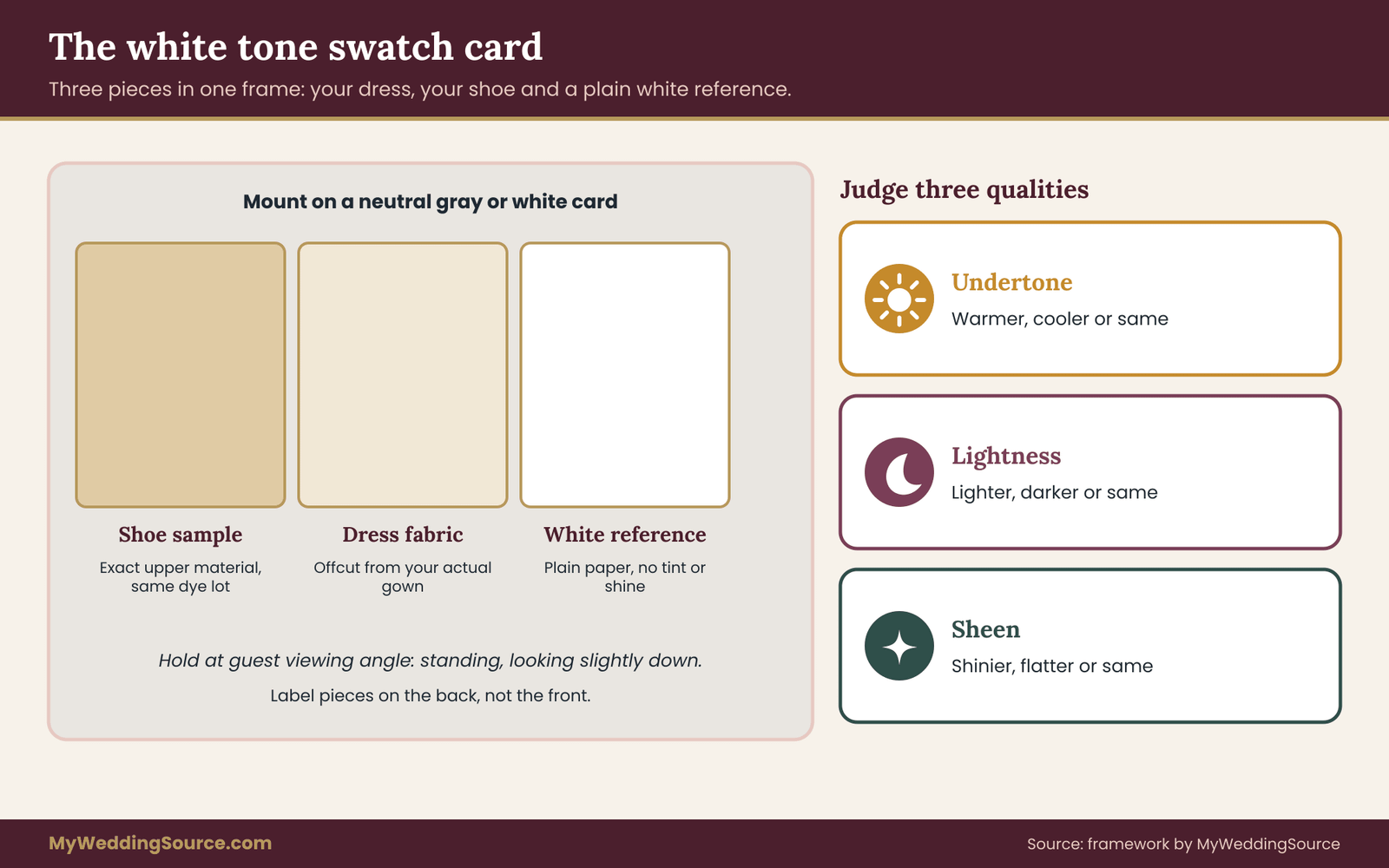
The white tone swatch is a small card that puts three things side by side: the dress fabric, the shoe material and a plain white reference. It is the central tool for judging shoe color, and it works because it removes memory from the process. You are no longer asking “does this shoe look like the dress I tried on last month?” You are looking at both in the same frame.
What you need
Gather these before you start. None of them is expensive.
A dress fabric sample. Ask the bridal shop or the dressmaker for a swatch of the actual fabric, ideally from the same bolt or dye lot as your gown. Many shops can cut a small piece from a seam allowance or hem, or provide a sample card. If the gown is already made and the seamstress has offcuts from alterations, that is the best source. The dress fit and alterations guide explains what happens in fittings and where offcuts usually come from.
A shoe sample. Ask the seller for a material sample, a swatch of the exact upper, or a loan of the actual pair. If the shoes are custom or dyed, ask for a dye swatch on the real material, not on a different fabric.
A white reference. Use plain, uncolored white paper with no tint and no shine, such as a clean sheet of ordinary printer paper. It will not be perfectly neutral, but it gives you a constant. If you also have a neutral gray card, such as the kind photographers use, add it; it makes the shifts easier to read.
A card to mount them on. A piece of plain mid-gray or white cardboard about the size of a postcard works. Use removable tape or small adhesive dots so you can move the pieces.
How to lay out the card
Place the dress swatch in the center, the shoe sample on one side and the white reference on the other. Leave a thin gap between them so edges do not blend. Put them on a neutral background, because a colorful table or a patterned cloth will tint everything.
Write small labels on the back, not the front: which piece is which, and the date. Then take the card to each lighting station described in the next section, holding it at the same angle each time, roughly the angle at which a guest would see the shoe and hem, which is from standing height looking slightly down.
Why include a white reference at all
Your eyes adapt. After a few seconds under a warm bulb your brain starts to treat the yellow as normal, and that adaptation hides how far the colors have moved. The white reference gives your eyes an anchor. If the white paper looks cream, you know the light is warm. If it looks faintly blue, the light is cool. Then you can judge whether the dress and the shoe moved together or apart.
This matters because the question is not whether either color changed. Both will change. The question is whether they changed in step. A shoe and a dress that warm up together still match. A pair where only one warms up has failed the test at that station.
Reading undertone, lightness and sheen
At each station, you will look at three qualities. It helps to name them clearly.
Undertone is the hint of color beneath the main color: warm (yellow, gold or peach), cool (pink, blue or gray) or neutral. Whites and ivories are almost always defined by their undertone. A cool white and a warm ivory are very different even though both are called pale.
Lightness, sometimes called value, is how light or dark the color is. A shoe can have the right undertone and still be a step darker than the dress, which reads as a different color from a distance.
Sheen is how much the surface reflects light directly. A glossy satin shoe next to a matte crepe dress can look like a different color purely because of reflection, even when the dye is identical.
A shoe color mismatch can live in any one of the three, and each needs a different fix. An undertone mismatch usually means choosing a different shade. A lightness mismatch can sometimes be fixed by a slightly different shade. A sheen mismatch might be fixed by changing the material rather than the color.
Keep notes in words, not scores
You do not need a scoring system with numbers that pretend to be measurements. Write one short line per station: “shoe looks a bit warmer than dress,” “shoe slightly darker,” “same.” Use the same three words at every station: warmer, cooler or same for undertone; lighter, darker or same for lightness; shinier, flatter or same for sheen. After five stations you will have fifteen short notes about shoe color, and patterns will jump out.
The mixed-light comparison: five stations
The mixed-light comparison is the second half of the method. You carry the swatch card through five lighting conditions that stand in for the real ones. You do not need to visit the venue to do this, although an in-person look helps if the venue allows it.
Station one: window daylight
Hold the card near a window on a bright day, out of direct sun, so the light is soft and fairly neutral. Daylight is your baseline for shoe color. If the shoe and the dress do not agree here, there is little point in testing further, because the underlying colors are too far apart.
Avoid testing under a window with a strongly colored view, such as a red brick wall or a large green tree outside, since reflections tint the light.
Station two: warm indoor bulbs
Move to a lamp with a warm bulb, the kind often labeled soft white. This stands in for restaurant, hotel ballroom and home lighting. Hold the card about an arm’s length from the bulb and look from the angle described earlier.
Watch for the shoe color turning more yellow or orange than the dress. This is the most common mismatch, and it happens when the shoe has a cooler undertone than the fabric or a different material.
Station three: cooler indoor bulbs
Use a bulb sold as cool white or daylight, which sits at the cooler end of the color temperature range. This stands in for offices, some conference-style venues, hallways, and the harsh lights switched on at cleanup.
Here a warm-toned shoe can look dull or slightly green-gray, and an ivory dress can look flatter and paler. Note whether both move together, since shoe color that moves alone is the warning sign.
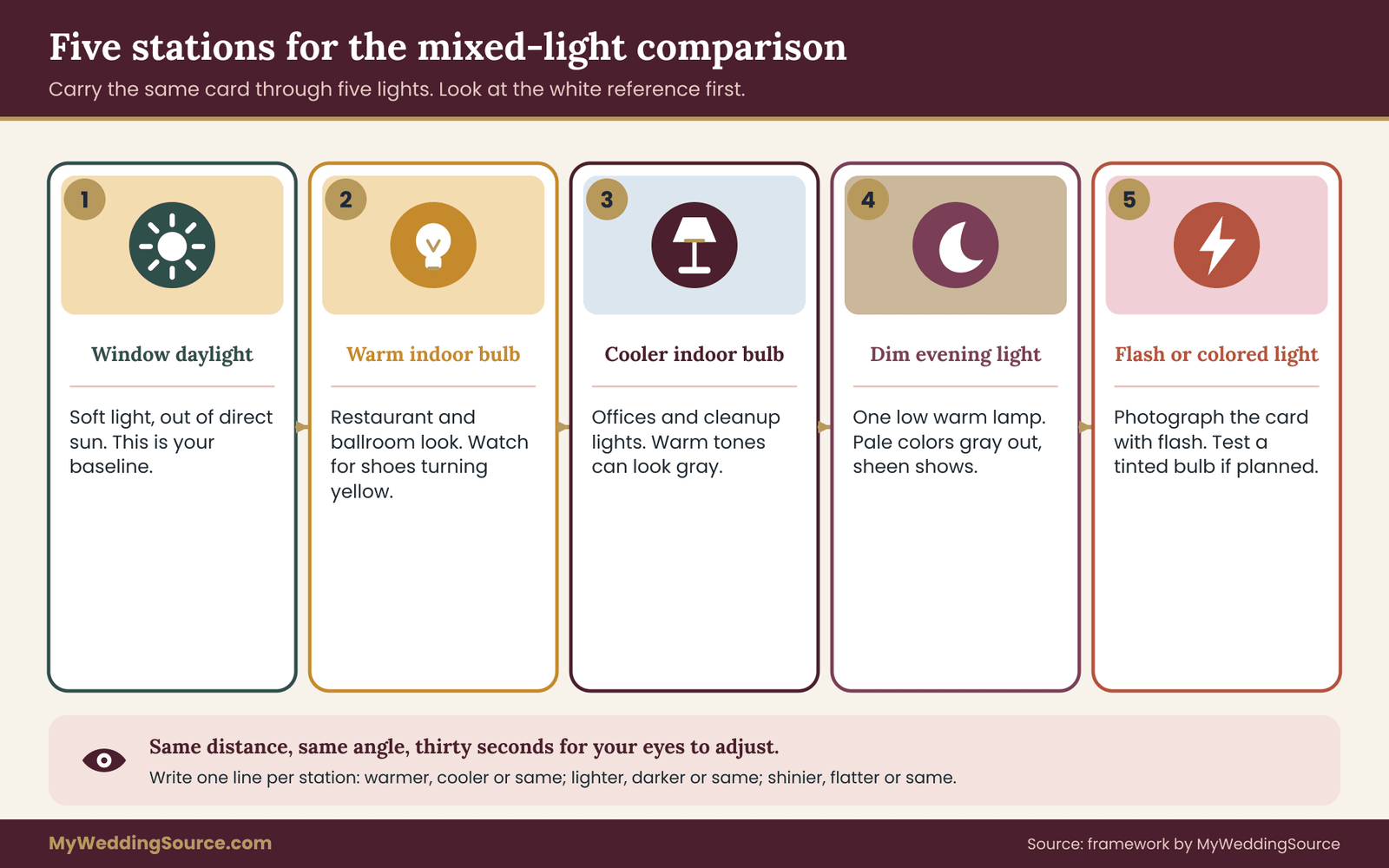
Station four: dim evening light
Turn off the main lights and use a single small warm lamp, a low dimmer setting or a phone flashlight covered with a thin white cloth. This stands in for dinner service and dancing, when the room is dim and warm.
In low light, color perception changes. Pale colors look grayer and differences in lightness become harder to see, while differences in sheen become more visible because highlights still catch the light. A shoe color that looked matched in daylight can look noticeably darker in a dim room.
Station five: colored or flash light
This one is optional but valuable if your venue or photographer uses it. Many venues add colored uplighting, and many photographers use flash. You cannot reproduce them exactly at home, but you can approximate them.
For flash, take a photo of the swatch card with the flash on and compare the image to what you saw with your eyes. Cameras do not see as people do, and a flash can wash out slight differences or exaggerate sheen. For colored light, ask the venue or the lighting vendor which colors they plan to use, and test with a similar colored bulb if you can find one.
Doing the stations well
A few practical rules keep the comparison honest. Test at the same distance and angle each time. Let your eyes adjust for about thirty seconds before judging. Look at the white reference first, then the dress, then the shoe. Take a photo at each station with your phone set to a fixed white balance, if the phone allows it, because photos show how a camera will record the colors, which is how many people will see the wedding afterward.
Avoid judging after long stretches under one light. If you have been under a warm lamp for ten minutes, step outside or look at something neutral for a moment before the next station. Spread the test over a day if needed, because a tired eye is a forgiving one.
What a good result looks like
At the end you want a pattern, not perfection. The best shoe color result is that the shoe and the dress shift in the same direction at every station, even if the absolute colors change. A shoe that is slightly warmer than the dress in daylight and slightly warmer in warm light and slightly warmer in dim light is consistent, which means the difference is stable and you can decide whether you like it. A shoe that is matched in one station and clearly off in two others is fragile.
The next section turns those notes into a shoe color decision.
Turning your notes into a shoe color decision
Fifteen notes can feel like a lot, but the pattern usually shows itself quickly. Sort the notes into three piles: what stayed the same at every station, what changed in the same way for dress and shoe, and what changed differently. Only the third pile is a problem.
The consistency rule
Look at each of the three qualities separately and ask a single question: did the difference between the dress and the shoe stay roughly constant across the stations?
If the shoe was “a bit warmer” in every light, the difference is consistent. You can decide whether that gentle warmth is acceptable or pleasing. If the shoe was “same” in daylight but “much warmer” under the warm bulb and “cooler” under the cool bulb, the difference is unstable, which is the signature of a metameric pair. That shoe color is a risk, because you cannot predict what the room will do to it.
In shoe color, consistency matters more than closeness. A small stable difference is easier to live with than a zero difference that disappears in a different light.
The three-question filter
Run each candidate pair through three plain questions.
Would a guest notice the difference at normal distance, standing in a doorway? A visible difference is fine if you meant it. It is a problem if you did not.
Does the difference get worse in the dim station? Dinner and dancing are when most guests, and most photographs, see the shoes.
Does the difference depend on the angle? If it flips when you tilt the card, the cause is probably sheen, and the fix is a different finish rather than a different shade.
A pair that passes all three is a strong shoe color candidate. A pair that fails one is workable if you can fix that one thing. A pair that fails two is usually not worth rescuing.
A simple traffic-light summary
For your own use, summarize each pair as green, amber or red.
Green: the shoe and the dress move together in every station, and any difference is clearly small or clearly deliberate.
Amber: they agree in most stations but one station shows a difference you would notice, or the sheen differs enough to read as a different color.
Red: the pair drifts apart in two or more stations, or the difference changes direction between stations.
Write the result on a sticky note and keep it with the swatch card. When you compare two or three shoe options, the traffic light turns a messy impression into a quick choice.
Match, tone or contrast: choosing a shoe color strategy
Once you know how a pair behaves, you can decide what you want the shoe to do. The three strategies produce different looks and fail in different ways.
Strategy one: a close match
Choose this when you want the shoes to disappear into the outfit, which suits floor-length gowns where the shoe barely shows, and formal looks where a single unbroken tone is the goal.
The risk with a close shoe color match is the near miss. A close match is judged by a harsh standard, because any difference reads as a mistake. A close match is only safe if the swatch test shows consistency across stations. If it does not, move to a tonal step.
A close match is also the most sensitive to fabric differences. Satin, tulle, lace, crepe and leather take the same dye differently. Asking a shoemaker to dye a satin shoe to match a lace gown can work well in one light and poorly in another, simply because the surfaces differ.
Strategy two: a deliberate tonal step
Here you choose a shoe that is clearly a step away from the dress in one direction. An ivory gown with a champagne shoe is a classic. A bright white dress with a pale blush shoe is another.
With a tonal step, the goal is to make the shoe color difference big enough that no one mistakes it for a failed match. A good test is to look at the card from across the room. If you can still see that the shoe is a different color on purpose, the step is large enough. If you have to squint, it is a near miss, and you should either close the gap or widen it.
A tonal shoe color step is more forgiving of lighting, because it already has room to move. If the dress warms up and the shoe warms up too, the step survives. It is also forgiving of fabric differences, since small variation is absorbed by the larger gap.
Strategy three: a clear contrast
A blue shoe, a metallic shoe or a bold shoe color is not a matching question at all. The lighting questions change: will the color look rich or muddy in a dim room, will it clash with the uplighting, and will it read as intentional in photographs?
Contrast shoes still deserve the swatch test, but against the venue palette and the lighting instead of against the dress. A deep color can nearly vanish in a dim room, and a metallic can pick up the color of any nearby colored light, which is sometimes lovely and sometimes odd.
Choosing by how much of the shoe will show
The visible area of the shoe changes how strict the choice needs to be. A long gown that covers everything but the toe makes the shoe color almost irrelevant for most of the day, except when you walk, dance or lift the hem. A tea-length or short dress puts the whole shoe on display, and a close match becomes a primary design decision. For hem and clearance questions, the guide to alterations and hem planning explains how the hem is set against the heel you will wear.
If the shoe is mostly hidden, spend your effort on comfort and on avoiding an obvious clash at the moments the shoe shows, such as the walk down the aisle and the first dance. If it is fully visible, give shoe color more weight in the decision and test the swatch card more carefully.
When two strategies seem equally good
Sometimes a pair tests as amber for a close match but would be a clean green as a deliberate tonal step. In that case change the goal, not the shoe. Ask yourself whether you would be happy if the shoe read as a distinct, softer tone. If yes, the pair is a good tonal step and you can stop worrying about matching.
A useful rule of thumb for hesitation: pick the shoe color strategy first, then the shoe. Brides who shop for a close match and keep settling for almost-matches end up with near misses. Brides who say “I want the shoe a half step warmer than the dress” and then look for exactly that tend to be happier with the result.
A quick example of the rule
Imagine a warm ivory dress and a shoe sold as ivory. At station one the shoe looks slightly whiter than the dress. At station two it looks about the same, and at station four it looks grayer. That pair changes direction, so it is red for a close match. As a tonal step, though, the shoe could be champagne, which is clearly warmer. If a champagne sample stays warmer than the dress at every station by a similar amount, it becomes a stable, deliberate difference and a green result.
The point is not that champagne is the better shoe color. The point is that a clear, consistent difference beats an ambiguous, unstable one.
How shoe color changes with material and finish
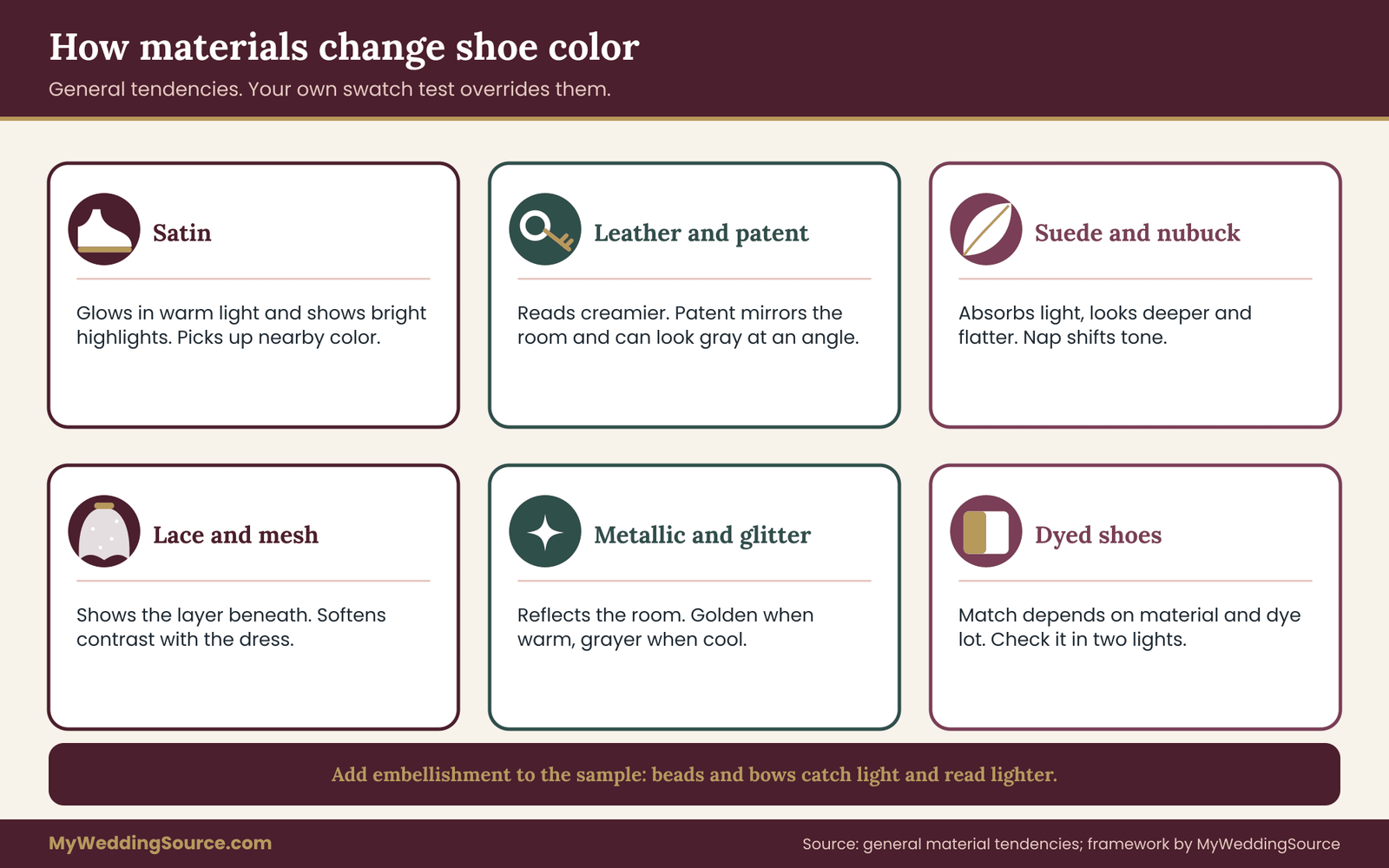
The same shade name can look very different depending on what the shoe is made of. Treat the material as part of the shoe color. Below, each common bridal shoe material is described by how it tends to behave under indoor light. These are general tendencies, not guarantees, and your own swatch test overrides them.
Satin and silk-look fabrics
Satin has a smooth, reflective face. In warm light it often glows and looks richer, and under a strong single source it shows bright highlights that can look lighter than the dye. Because it reflects its surroundings, satin shoe color can drift toward whatever is nearby, such as a colored wall or an uplight.
Satin is also the material most often dyed to match a gown, since the fabric takes dye evenly. Dyeing can slightly change the sheen, so ask to see the dyed sample rather than the plain one.
Leather and patent
Smooth leather, particularly in ivory and cream, tends to read warmer and creamier than fabric of the same name. Patent leather adds a mirror-like coating that reflects the room and the light source, which can make a pale patent shoe look nearly white at one angle and gray at another.
Leather shoe color is usually protected by a surface treatment. Ask whether the finish is likely to yellow or darken with wear. If the seller cannot say, a swatch left in a bright window for a few days is a modest check, although it is not a scientific test.
Suede and nubuck
These napped surfaces absorb light and look deeper and softer than smooth materials in the same shade. A suede shoe in ivory often looks slightly darker and flatter than a satin shoe in the same color, and the nap can shift tone as it is brushed in different directions.
Suede shoe color tends to look best against matte gowns and in dim light, and it is less forgiving against shiny satin.
Lace, mesh and tulle overlays
A sheer overlay shows the color beneath through a net, so the result is the combined color of the layers. In warm light the underlayer shows more, and in cool light the overlay pattern stands out. Photographers often notice that an overlay gives texture and also softens the contrast with the dress.
If your dress has lace and the shoe has lace, check whether the two laces share a base color. They may not, even when both are ivory.
Metallics and glitter
A metallic shoe does not have a single shoe color. It reflects, so it picks up the color of the room. In warm light, gold and champagne metallics glow, and in cool light they look flatter and grayer. Glitter adds sparkle that increases with movement and decreases in dim light.
Metallic shoes are usually a contrast or tonal choice, not a match for a non-metallic dress. They suit colored light well but can look odd under strong, differently colored uplighting.
Dyed shoes
A dyed shoe is a custom shoe color, and the result depends on the material, the dye and the dye lot. A professional dyer can usually match a swatch closely in daylight, but a match made in one light can drift in another.
For dyed shoe color, bring the dress swatch, ask the dyer to match it, and ask to see the result in the same stations as your test. Leave time for a redo, because dye work is rarely instant. Also ask about the return policy before the shoe is dyed, since a custom color usually cannot be resold.
A note on shoe color and embellishment
Beads, crystals and bows catch light and add small highlights that make a shoe read lighter than its base shade. A plain satin pair and an embellished pair in the same dye will not look identical at the same distance. If the shoe is embellished, test the swatch with the embellishment visible, not only the base fabric.
A worked example of shoe color testing
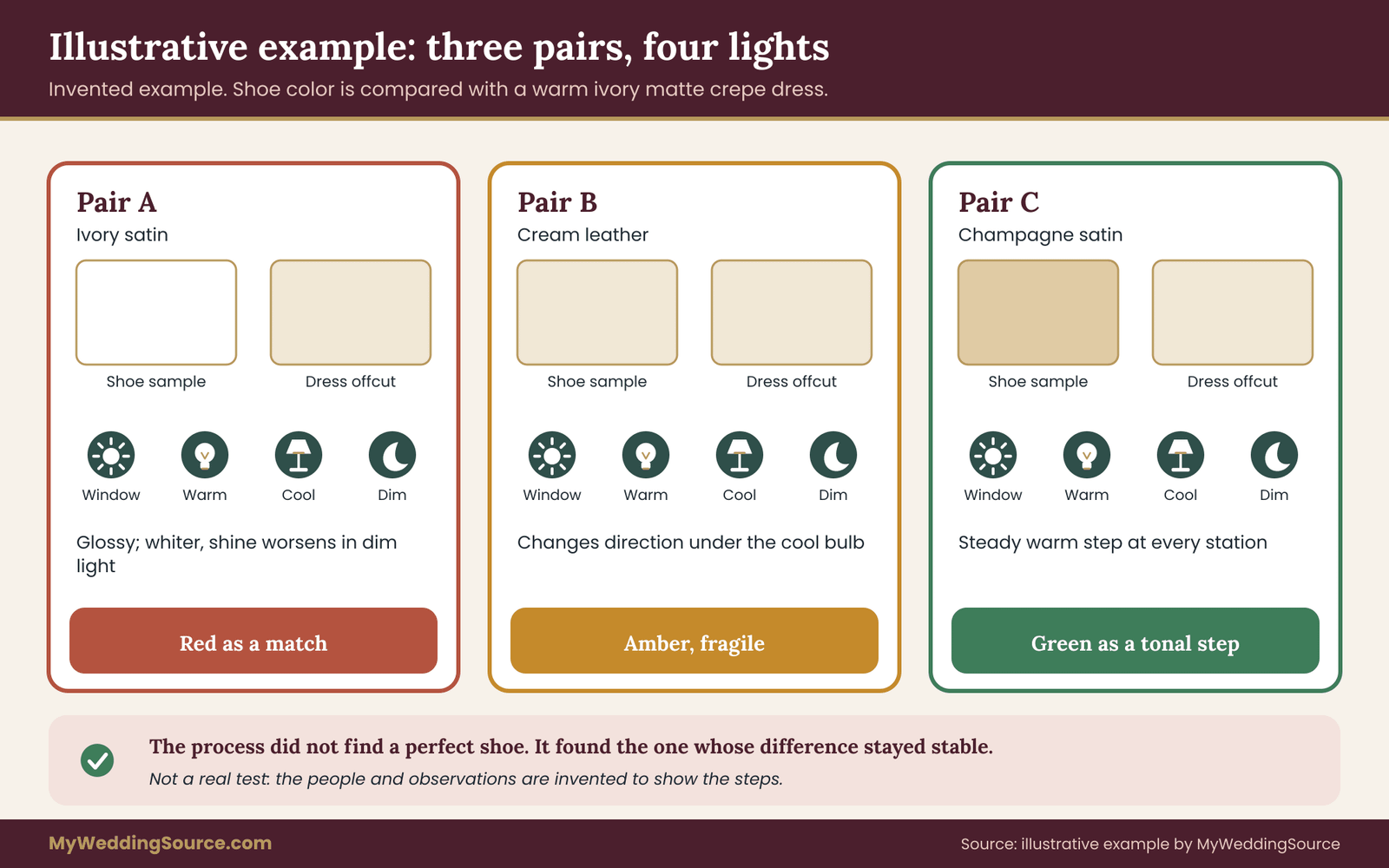
The following is an invented example, built to show how shoe color testing works. The people and the dresses are fictional, the observations are illustrative and they are not results from a real test.
The situation
Maya is planning an evening wedding in a hotel ballroom with warm dimmable lights and a few strings of warm candles. Her dress is a matte crepe in a warm ivory, with a floor-length hem that will show the toe of the shoe when she walks. She has narrowed the choice to three pairs sold under similar names.
Pair A is a satin shoe called ivory. Pair B is a smooth leather shoe called cream. Pair C is a satin shoe called champagne. She asks the bridal shop for a dress offcut and each shop for a material sample. She builds a swatch card for each pair, with a white paper reference.
Station results
At the window, pair A looks a shade whiter than the dress and glossier. Pair B looks about the same tone as the dress but slightly flat. Pair C looks distinctly warmer and a touch darker.
Under the warm lamp, pair A looks creamier but its gloss throws sharp highlights. Pair B looks a little yellow. Pair C looks a little more golden, but the step against the dress is about the same as at the window.
Under the cool bulb, pair A looks very white against the now-flat dress. Pair B looks grayish. Pair C still looks warmer, although the step looks slightly smaller.
In the dim station, pair A’s gloss makes it look brighter than the dress. Pair B looks darker and nearly merges with the dress. Pair C keeps a steady, soft difference.
Reading the example
Pair A fails on sheen and lightness: its gloss is the main difference, and it gets worse in dim light. As a close match it is red; the shine would draw attention at the moments the shoe shows.
Pair B is the nearest in tone in two stations but changes direction under the cool bulb and loses contrast in the dim station. It is amber at best, because its match is fragile.
Pair C never matches, but it differs by a similar amount in all four stations. As a deliberate tonal step, it passes all three questions. At normal distance, the difference looks chosen.
The decision Maya makes
She decides her goal is a deliberate tonal step, since a perfect match is unlikely given the matte crepe. She picks pair C. She checks that its gloss will not clash with the matte fabric by looking at the card from across the room. It reads as a soft contrast, which she likes.
She then asks the seller about the return policy and whether a dye swatch could be offered if she changes her mind. Notice what the example shows: the process did not find a perfect shoe color. It found the shoe whose difference stayed stable, and that was enough to decide with confidence.
What the example does not show
It does not show how a real room, with its own mixture of colors and surfaces, would affect the result, and it does not use measured values. In real life, you would run the same stations with your own materials. The example also leaves out fit, comfort and heel height, which belong to the other shoe decisions on the site.
A good habit for any shoe color choice is to repeat one station at the end, after you have chosen, to make sure the first impression holds. If the choice still looks right after a break, you can stop testing.
Questions to ask a seller about shoe color
Most shoe color problems can be reduced with a handful of questions asked before money changes hands. The questions below work for a bridal salon, an online seller, a custom shoemaker or a dyer. Write the answers down, or ask for them in an email so they exist in writing.
Questions about the sample
Can you send a material sample of the exact upper in this color? A swatch of the real fabric or leather is far more useful than a color chip. If the seller can send only a printed color card, treat it as a rough guide, since ink does not behave like fabric.
Is the sample from the same dye lot as the pair I would receive? Dye lots can differ slightly, and a pair from a later batch may not match the sample. A seller who tracks lots will usually say so plainly.
Does the color change on any surface treatment, such as a protective coating? A coating can add gloss or yellow slightly with age. You want to know before the shoe is made.
Questions about the match
Can I see the shoe next to my dress fabric, in your shop or by return post? Some salons allow a swatch comparison in a window or near a lamp. If the dress is at a different shop, ask whether your dress shop can hold a sample for you to compare.
Do you offer dyeing to match a swatch, and in which light do you check the match? A dyer who checks only under one lamp is giving you a one-light match. Ask them to check in daylight as well as indoor light, and to send photos of both.
What is the process if the match is off? You want to know whether they will redo the dye, adjust it or refund, and how long that takes.
Questions about timing and returns
Shoe color problems are more expensive to fix late. Ask about timing early, and plan around it. The wedding vendor contract guide explains what to look for in cancellation and return terms, and the same logic applies to a shoe order.
What is the lead time from order to delivery, and does it include dyeing or customization? Custom work often takes longer than stock orders, and shipping adds to it.
Can I return or exchange the shoes if the color does not match? Many sellers treat dyed or custom items as final sale. Ask for the written policy before you order, not after.
Who pays return shipping, and what condition must the shoes be in? Some sellers require shoes to be unworn and in the original box. That affects how you test them, since walking on a carpet at home may count as wear.
For online purchases, the Federal Trade Commission publishes guidance on how its merchandise rules treat shipping time and delays. It is a useful reference if a seller promises a delivery date and misses it, and it also reminds you that the seller’s own return policy is what you actually rely on for color disputes.
Questions for the dress shop or seamstress
Can I have an offcut or a swatch of the dress fabric? Most shops will provide one, and the seamstress often has leftover fabric from hemming.
Is the fabric dyed, or is it natural off-white? Natural and bleached fabrics age differently, and a dyed gown may shift slightly with cleaning or time.
Will the hem length change the visible area of the shoe? If hem length is still moving, the importance of the shoe color changes with it, so settle the hem first or at least test with the planned hem in mind.
Questions for the photographer and the venue
What kind of light will you use for portraits and for the dance floor? A photographer who uses flash will record colors differently from one who relies on ambient light, and a photographer who edits for warmth will change the apparent shoe color after the fact.
What colored or dimmed lighting is planned for the evening? Venues often have set lighting scenes, and some will let you view them at a site visit. If you can stand in the room under the evening scene with your swatch card, do it.
Who edits the photos, and can I ask for neutral color treatment on the dress? Editing that warms the whole image will warm both the dress and the shoe, which preserves their relationship. Editing that treats areas separately can change the match, so it helps to ask.
A short script you can adapt
If you prefer to write rather than ask over the phone, a short message works.
“Hello, I am comparing the ivory pair with my dress fabric. Could you send a material sample of the exact upper, tell me the return policy for color mismatch, and say how long a dyed pair takes?”
A prompt and specific reply tells you the seller handles this regularly. A vague or evasive reply suggests you should test cautiously and buy from a seller with a clearer policy.
Keeping the answers in one place
Make a one-page note per candidate: the sample status, the lead time, the return policy, the dye lot answer and the date you asked. When you compare candidates, the note makes the differences in policy as visible as the differences in color. A shoe color that tests green but cannot be returned may be riskier than a shoe that tests amber but comes with a generous exchange window.
Edge cases that change the shoe color decision
The method above covers most shoe color situations. A few cases bend the rules, and each is worth thinking through before you test.
A dress with a tint, pattern or color
A blush, champagne, pale blue or printed dress changes everything about the white reference. Your swatch card still helps, but a colored gown can be more sensitive to lighting, because a small shift in a tinted fabric can move it from one color family to another.
For tinted gowns, widen the swatch: include the dress fabric, the shoe sample and a second neutral, such as a pale gray card. Pay special attention to whether the shoe color reads as part of the dress color family or as something different. If the gown color itself is still undecided, settle that first, because the shoe has to follow it.
Shoes that are mostly hidden
A floor-length gown may show only a toe at the aisle and a flash of heel when you lift the hem to dance. In that case, shoe color is a lower-stakes choice, and comfort and grip should outrank a perfect match.
Do the shoe color test anyway, but with a looser standard. You are checking for a clash, not for a perfect blend. The clash to avoid is a shoe that is clearly a different undertone from the dress, because that is what flashes in photographs when the hem moves. If you plan to change shoes later in the evening, the second pair has its own color question, and it belongs in the wider outfit plan.
A second pair for the reception
Many brides wear one pair for the ceremony and another for dancing. Each pair meets different light: the ceremony is often brighter and more even, and the reception is dim and warm. If the second pair is flats or sneakers, the color question may be less important, but the swatch method still works.
Test each pair’s shoe color in the stations that match its moment. The ceremony pair needs daylight and bright indoor lighting. The reception pair needs warm, dim and flash conditions. Keep the notes separate so you do not compare the wrong pair at the wrong station.
Photographs taken with flash
A flash lights the dress and shoe from the camera’s position, which makes colors look flatter and sheen look brighter. It is also close to daylight in color, so a warm room can look cooler in flash photographs than it felt in person.
This can work for or against you. A shoe color that looked a little warm in the room may look closer to the dress in a flash photograph. A glossy shoe may flash bright white. If your photographer will use flash heavily, take a flash photo of your swatch card and look at it on a screen, then compare with what you saw in person.
Strong colored uplighting
Pink, blue or amber uplighting changes pale colors dramatically. A cool white shoe under pink uplighting can look blush, and under blue lighting it can look icy. If the dress and the shoe are the same material, they will shift together. If they are different materials, they may not.
If the venue will use colored lighting during the portraits, ask whether there is a neutral white option for the dance floor and the formal photos. A neutral scene for the key photographs keeps the dress and the shoe closest to their true tones.
Candlelight and very low light
Candlelight is very warm and very dim. Pale colors turn golden, and differences in lightness shrink. If your reception relies on candles and low lamps, the warm lamp station and the dim station deserve extra attention in your test. In that setting, a slight warmth in the shoe is usually harmless, since the whole room is warm. A cool-toned shoe color may look gray.
Aging and cleaning
Shoes and dresses do not age the same way. White and ivory fabrics can yellow slightly with time, and leather can darken. If you are buying shoes well ahead of the wedding, store them in a dark, cool place wrapped in acid-free tissue or a cloth bag, away from sunlight. If your dress is being cleaned or steamed before the wedding, check the shoe against the fabric again afterward, since cleaning can shift the fabric tone slightly.
When nothing matches
Sometimes every shoe color candidate fails, and that is also a result. The dress may have an unusual undertone that off-the-shelf shoes do not share. In that case, consider moving to a deliberate tonal step or a contrast, as described earlier. A shoe that is clearly different looks like a design decision, and it carries less risk than hoping a near miss will survive three kinds of light.
If the only option is dyeing, plan for time and cost. A dyer needs your dress swatch, the shoe, and the lead time for a first attempt and a possible redo. Do not leave this to the final month.
Timeline and costs for testing shoe color
Testing shoe color is cheap, but it takes calendar time because samples travel and dye work is slow. A realistic schedule starts well before the final fitting.
When to start
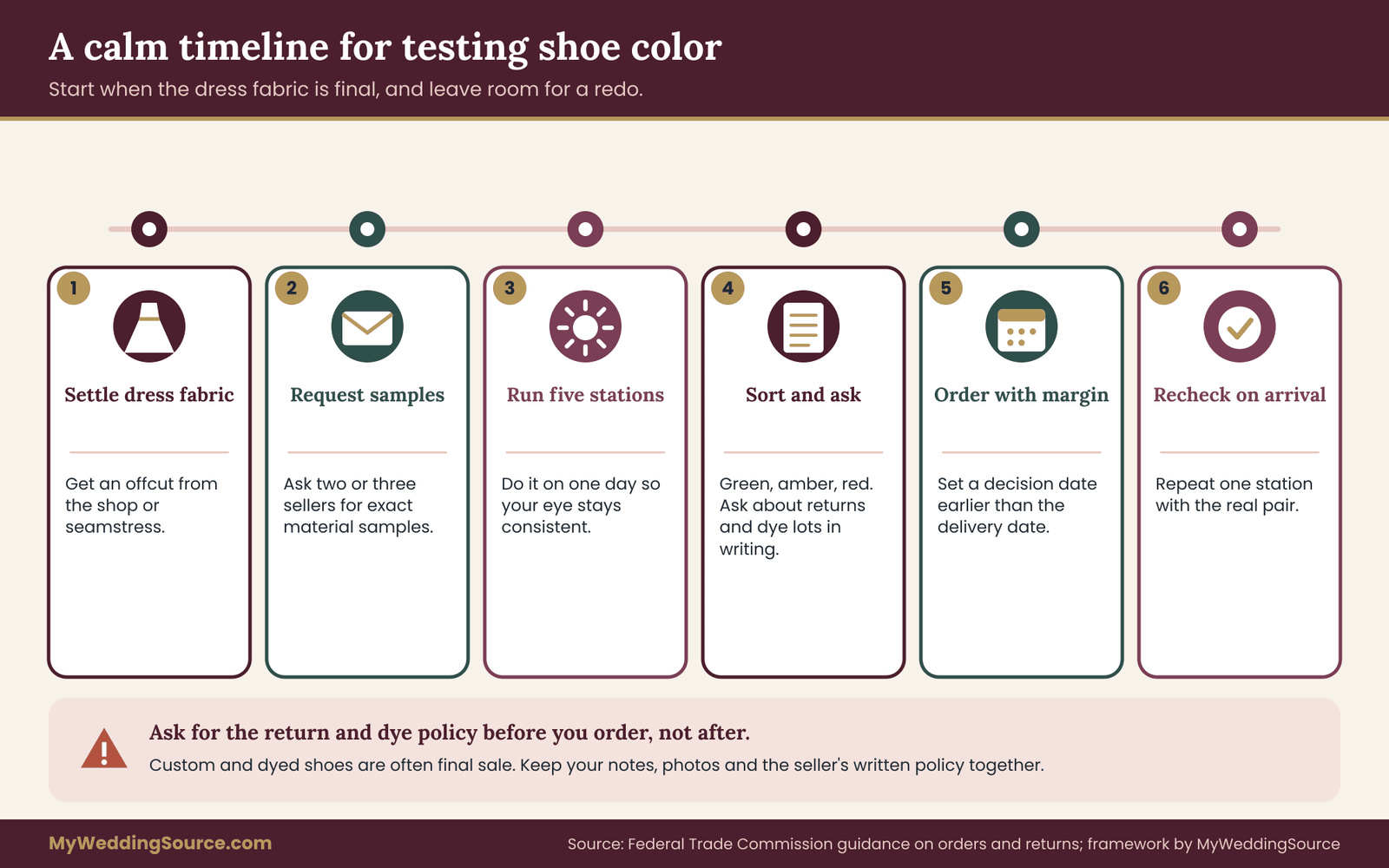
Begin the shoe color test once the dress is chosen and its fabric is final, since the dress is the fixed point. If the dress is still in design, wait until the fabric and tint are decided. Request the shoe samples at roughly the same time you start the alterations conversation, because that is when the shop can most easily provide an offcut.
Plan for the full process to take several weeks from the first sample request to a confirmed choice. If you need dyeing, add the dyer’s lead time, which varies by studio and season. Ask each dyer for their own current turnaround rather than assuming.
A simple sequence
First, collect the dress swatch and any known venue lighting details. Second, request shoe samples from two or three candidates. Third, run the five stations on a single day, if possible, so your eye is consistent. Fourth, sort the notes into green, amber and red. Fifth, ask the questions about returns and dye lots for the green candidates. Sixth, order, and then repeat one station when the shoes arrive, because the real pair can differ from the sample.
What it costs
Most of the shoe color test costs nothing but time. Printer paper, a postcard-sized card and a lamp are ordinary household items. Some sellers charge for samples, particularly for custom dye work, and some sellers credit the fee toward the order. Ask before you request one.
The real cost of getting it wrong is the cost of a second pair, a rush dye job or shipping, and a rushed decision close to the wedding. Spending an hour on the test can avoid those costs. The wedding budget guide helps you decide where a contingency for small accessory fixes belongs, and the cost of a spare pair or a redo is a reasonable thing to include.
How much margin to leave
Leave margin before the wedding for a return, an exchange or a redo. A reasonable approach is to treat the date the shoes must be settled as earlier than the date they must arrive, so a failed match is an inconvenience rather than a crisis. If the seller’s return window is shorter than the time you need to check the shoes in your lights, ask for a longer one or choose a seller who offers it.
Keeping the evidence
Keep the swatch card, photos and notes until the wedding is over. If a seller’s product differs from the sample, your own notes and photographs are the starting point for a conversation about a remedy. Store the order confirmation, the sample details and the seller’s written policy together. The point is not to prepare for a dispute, but to make a polite request easy to support.
Using a phone camera as a second opinion on shoe color
Your eyes adapt and a camera does not, at least not in the same way. A phone photo can therefore catch a shoe color difference you stopped seeing after a minute under a warm bulb. It is not a measuring instrument, but it is a useful second opinion, and it is also close to how many people will see your wedding afterward.
Fix the settings first
Most phones adjust white balance automatically, which means the phone quietly corrects the very color shift you are trying to observe. If your phone or camera app allows it, lock the white balance and exposure before you photograph the swatch card, and keep the same settings at every station. If it does not, take the photo with the white reference filling a corner of the frame so you can see how the camera treated it.
Take each photo from the same spot, with the card at the same angle. A change in angle changes sheen, and sheen is already the hardest quality to judge.
What to compare
Look at the shoe color photos side by side on one screen, not one at a time. Compare how far the shoe sits from the dress in each photo, not whether the absolute colors look pleasing. The same three questions apply: warmer or cooler, lighter or darker, shinier or flatter.
A photo exaggerates some differences and hides others. It tends to show sheen strongly, because highlights are bright. It also flattens very small tonal differences, which your eye can see in person. When the photo and your eye disagree, write down both, since your guests will meet the shoe in both ways.
Screens are not neutral either
The screen you use to review the photos has its own color settings, and two screens will show the same photo differently. Do not judge a final match from a screen. Use the photos to compare stations against each other on the same screen, and let the real materials in real light make the final call.
A flash comparison worth doing once
If your photographer will use flash, take one photo of the card with the phone flash on and one without, in the same room. The pair shows how much the flash cools the scene and brightens glossy surfaces. If the shoe color looks fine in the room but too bright or too white in the flash version, a matte finish or a slightly warmer shade may photograph better.
Photographs from the wedding itself
After the wedding, the photographer’s edit will set the final color of the dress and shoe. Editors usually correct to keep skin tones natural and whites clean, which can move pale tones slightly. This is another reason to choose a stable difference between shoe and dress: a stable difference survives editing because the editor shifts both together.
If you notice a shoe color you do not like in the final gallery, ask politely whether a revision is possible, and keep the request specific: name the item, the photo numbers and what looks different from what you saw. Check your contract for how revisions are handled, and see the wedding photography consent guide for how galleries and image use are normally agreed.
When to stop testing
There is a point where more testing stops helping. If a pair is green or a stable amber at all five stations, and you have confirmed the return terms, you have enough information. Further comparisons usually reflect nerves, not new facts. Make the call, note the date, and move on to the other decisions on your list.
Common shoe color mistakes and how to avoid them
Most disappointments with shoe color come from a small set of habits. Knowing them in advance is often enough to avoid them.
Judging in the shop
Shops are lit to make products look good, often with strong, bright, slightly cool lights that flatter whites. A shoe that looks perfect there can look different at home. Treat a shop visit as the first look, not the final one, and ask to take a sample out of the store before you commit.
Trusting a name
“Ivory,” “cream,” “champagne,” “diamond white” and “nude” are labels, not measurements, and they vary between brands. Two shoes called ivory can sit a full step apart. Always compare real materials, and ignore the shoe color name once you have the sample in your hand.
Testing in one light
A single lamp, a single window or a single shop is not a test. The point of the method is that the shoe and dress agree across lights. If you only have time for two stations, choose daylight and the warm indoor light, since those two catch the most common mismatches.
Comparing the shoe to memory
Your memory of a dress color is unreliable, and so is the color you imagine from a photo of the dress. Put the real fabric beside the shoe. If you cannot get a fabric sample, take the shoe to a fitting and hold it against the gown under the fitting room’s lights, then step to a window.
Ignoring sheen
Brides often compare the color and forget the shine. Two shoes of the same shade can look quite different if one is glossy and one is matte. If your dress is matte, a glossy shoe will usually stand out. If your dress is satin, a matte shoe may look flat beside it. Decide whether you want the sheen to match or contrast.
Choosing the near miss
The near miss is the most common error and the hardest to see in the moment. When you find yourself saying “it is almost the same,” stop and decide whether to close the gap or widen it. Almost is the one answer the lighting will punish.
Leaving the test too late
A color problem found two weeks before the wedding has few solutions. Early shoe color testing gives you room to return, redo or switch strategy. If you are already close to the date, run the test anyway and prefer a stable tonal step over a fragile match.
Overfitting to a photo
A photograph shows how the camera and the editor treated color, and a color that looks right in a sample photo may not look right in person. Photos are a useful record, but your eyes in the actual light are the better judge. Use photos to compare stations, not to confirm a final match.
Forgetting that guests see from a distance
At a wedding, people see the dress and the shoes from several feet away, often moving, often in dim light. Fine differences that are obvious on a swatch card at arm’s length vanish at that distance, and large differences stay. Let that guide how much effort you spend: eliminate the big, unstable differences first, then accept small, stable ones.
Sharing the shoe color plan with your wedding team
Once you have decided on a shoe color, a few short conversations make sure the result carries through the day. None of them needs to be long.
With your photographer
Tell the photographer which shoe color strategy you chose: close match, tonal step or contrast. This helps them frame detail photos of the shoes, and it prevents surprises when they edit. A photographer who knows the shoe is a deliberate warm champagne will not try to neutralize it to match the dress.
Ask whether they can include a quick photo of the shoes in the getting-ready lighting and in the reception lighting, so you can see how the color behaves. If you are building a photo list, the family photo list is a good companion for deciding which portraits show the full outfit.
With your maid of honor or helper
Someone on the day will carry a spare pair or help with the change. Give them a clear note about which pair goes with which moment, and describe any care steps, such as keeping satin away from damp grass. A short written note is better than a verbal one, because the morning is busy.
With the venue
If the venue controls lighting, ask for the lighting scene during dinner and dancing. If there is a scene you dislike for color reasons, ask whether an alternative is available for the portrait or first dance. Venues are used to such requests, and a clear, early one is easy to grant.
With your dress shop or seamstress
Share the shoe you chose and ask them to do the final hem check with that exact pair, since a change in heel height shifts how much shoe shows. If you changed your mind about the color, tell them before the final fitting, not on the day.
What to bring on the day
Pack the swatch card in your emergency kit, along with a small cloth and any care items for the shoe material. If something looks off in the room, the card gives you a quick reference to decide whether it is a lighting effect or a real problem. In most cases, it is a lighting effect, and the card will help you stop worrying about it.
Letting it go
After the test, you have done what can reasonably be done about shoe color. Colors will shift in the room, and no one will compare your shoes to a swatch card. A calm, consistent difference reads as style. If the shoes look a little different in the dim room than they did at home, that is expected, and it is the reason you chose a stable difference rather than a fragile match.
Your next steps
This week, get the dress fabric swatch and a sample of each shoe you are considering. Make the swatch card with a white paper reference, and set up the five stations in the order described. Write one line per station, using warmer or cooler, lighter or darker, shinier or flatter.
Then decide on the shoe color strategy first: close match, tonal step or contrast. Choose the shoe whose difference stays stable across the stations. Ask the return and dye lot questions in writing, set a decision date with room for a redo, and repeat one station when the shoes arrive. For the wider outfit, the accessories planning guide shows how the shoe choice sits beside the rest of the day.
FAQ
Why does my shoe color look different at home than in the shop?
Shops use bright, often cool lighting designed to flatter products, while homes usually have warm bulbs and softer light. Color temperature and the way a light renders color both change how pale colors look. A shoe that seemed matched in the shop may drift warmer or grayer at home. That is why the swatch test compares the same pieces in several lights, not one.
What is a white tone swatch and do I really need one?
It is a small card holding a piece of your dress fabric, a sample of the shoe and a plain white reference. You do not strictly need one, but it removes guesswork. The white reference shows what the light is doing, so you can see whether the dress and the shoe changed together or apart.
Which lights should I test shoe color under?
Use five: window daylight, warm indoor bulbs, cooler indoor bulbs, dim evening light and, if relevant, flash or colored light. If time is short, test daylight and warm indoor light first, since they catch the most common mismatches. Hold the card at the same distance and angle each time.
Should the shoes match the dress exactly?
Not necessarily. A close match is one of three strategies, alongside a deliberate tonal step and a clear contrast. A near miss is the weakest choice, because a small difference looks like a mistake. If a close match is not stable across lights, a clearly chosen tonal step is often the safer look.
Can a shoe be dyed to match my dress?
Often yes, depending on the material and the dyer. A dye match made in one light can drift in another, so ask the dyer to check in daylight and indoor light, and to send photos. Ask about lead time, a redo and the return policy before the shoe is dyed, since custom colors usually cannot be resold.
Does flash photography change how shoe color looks?
It can. Flash is fairly close to daylight in color and lights the subject from the camera, which flattens color and brightens shiny surfaces. A glossy shoe can look whiter in a flash photograph than it did in the room. Take a flash photo of your swatch card to preview the effect.
What if the dress and shoes have different materials?
Different materials can look different even with the same dye, because sheen and texture change how light reflects. Compare real samples of both and check sheen as a separate quality. If the difference is mostly sheen, consider a different finish rather than a different shade, or choose a deliberate tonal step.
How far ahead should I test shoe color?
As early as the dress fabric is settled, since samples, shipping and dye work take weeks. Leave margin for a return, an exchange or a redo. Ask each seller or dyer for their current turnaround and policy, because lead times vary and change with season and demand.
Sources
- American Podiatric Medical Association, shoe and foot health information
- LED lighting and color characteristics, U.S. Department of Energy Energy Saver
- Business guide to the Mail, Internet, or Telephone Order Merchandise Rule, Federal Trade Commission
- National Institute of Standards and Technology, lighting and color measurement
- International Commission on Illumination, color and light standards
- Illuminating Engineering Society, lighting resources
- ENERGY STAR, lighting information
- How do I dispute a charge on my credit card bill?, Consumer Financial Protection Bureau
- Consumer Product Safety Commission, product safety information
- Federal Trade Commission, consumer advice on shopping and returns